Rhythm in architecture is the way repeated columns, windows, arches, bays, materials, and gaps create visual movement through a building. The simplest test is this: if your eye can predict the next element before it arrives, the building has a rhythm.
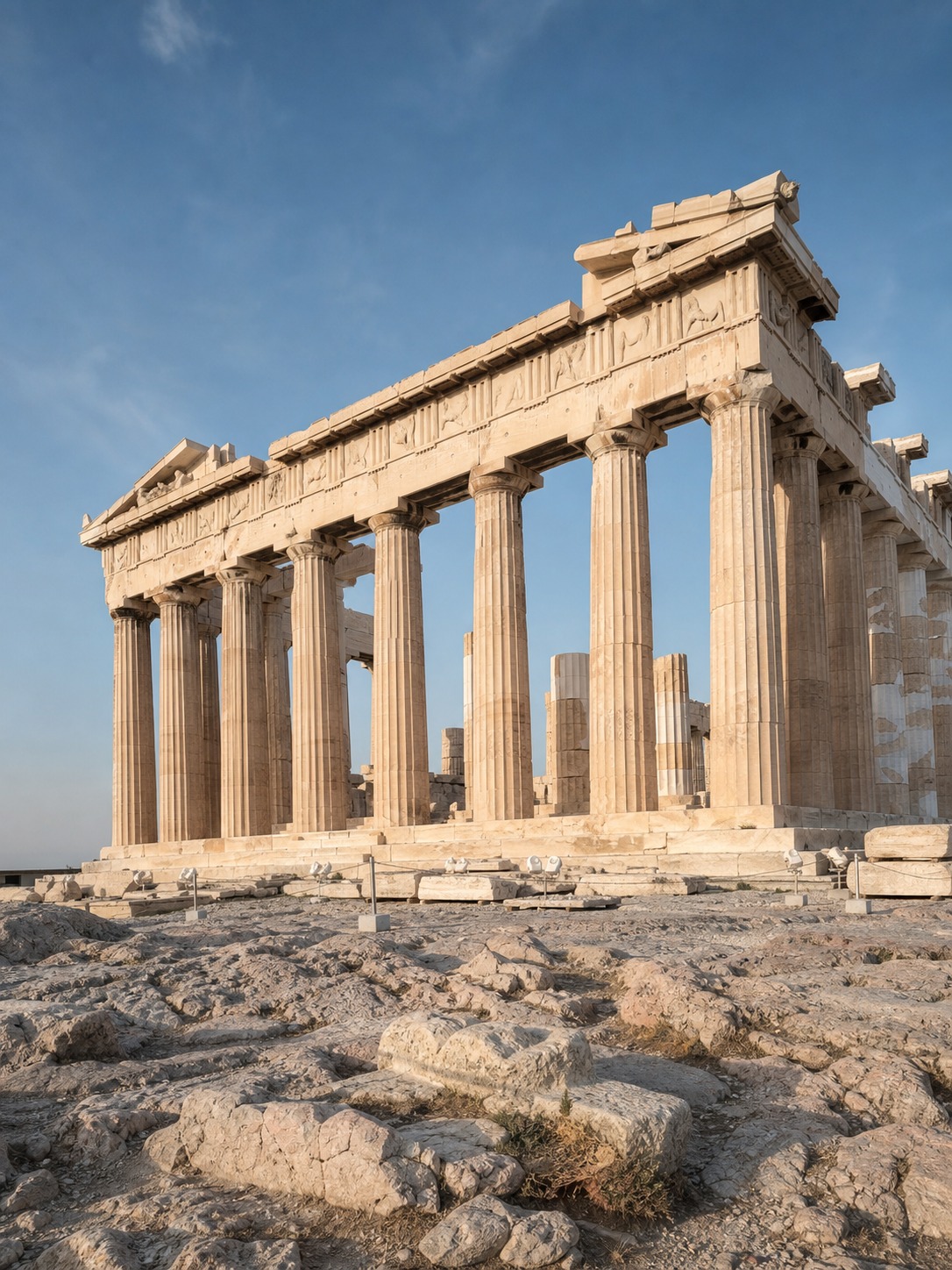
I noticed it most clearly on the Acropolis, looking down the Parthenon colonnade from the western end. The columns repeat, the interval stays controlled, and your eye runs forward before your feet move. That is the useful part of architectural rhythm: it turns a static facade into an experience with pace, expectation, and emphasis.
- What rhythm in architecture actually means
- The five types of architectural rhythm
- Rhythm and proportion: how scale changes the effect
- Breaking rhythm: how architects create emphasis
- Rhythm in interiors: how it works at smaller scale
- Rhythm in contemporary and parametric architecture
- Rhythm across an urban sequence
- Frequently asked questions
- What is rhythm in architecture?
- What are the main types of rhythm in architecture?
- How does rhythm create visual movement in architecture?
- What is the difference between rhythm and repetition in architecture?
- Can you give examples of rhythm in famous buildings?
- How is rhythm different in interior architecture?
- How do architects break rhythm intentionally?
This guide explains rhythm in architecture through practical examples: repetition, alternation, progression, flowing forms, radiating layouts, proportion, scale, and deliberate breaks. Read it as a visual checklist for facades, interiors, streets, and famous buildings.
What rhythm in architecture actually means
Rhythm in music is the recurring pattern of beats and rests. In architecture, the beats are visual elements (columns, windows, piers, arches, structural bays) and the rests are the spaces between them. The pattern of element and interval, repeated across a facade or through a space, produces rhythm.
The word gets used loosely, sometimes to mean any kind of repetition. But true architectural rhythm requires both the element and a consistent relationship between elements. A random scatter of windows across a facade is repetition without rhythm. The same windows at consistent intervals, with consistent proportions between the window width and the gap, produce rhythm. The regularity is the rhythm. And the moment regularity becomes predictable, the eye begins to move along it.
Why rhythm matters to the experience of a building
A building without rhythm is incoherent: every part reads as separate, with no principle connecting them. A building with excessive uniformity is monotonous: every part is the same, with no variation to sustain attention. Rhythm sits between those conditions. It establishes order without producing boredom, because the pattern is consistent enough to create expectation and varied enough to sustain interest.
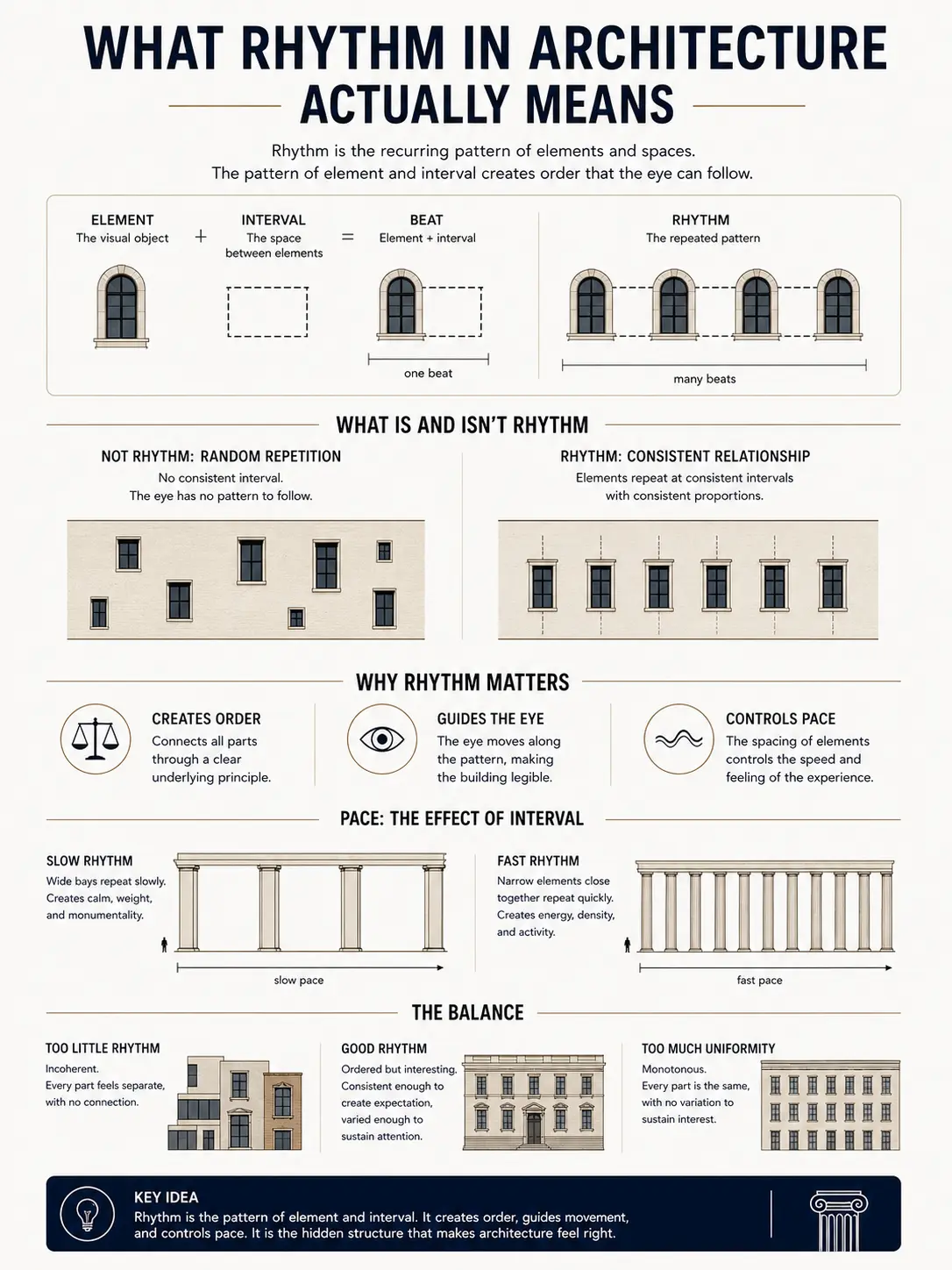
For someone walking toward a building or along a corridor, rhythm controls the pace of the experience. Wide bays repeat slowly, creating a measured, deliberate pace. Narrow elements close together repeat quickly, producing energy and density. This is not a metaphor: the speed at which the eye moves across a facade changes depending on the interval between elements, and that speed translates directly into the felt quality of the space.
The five types of architectural rhythm
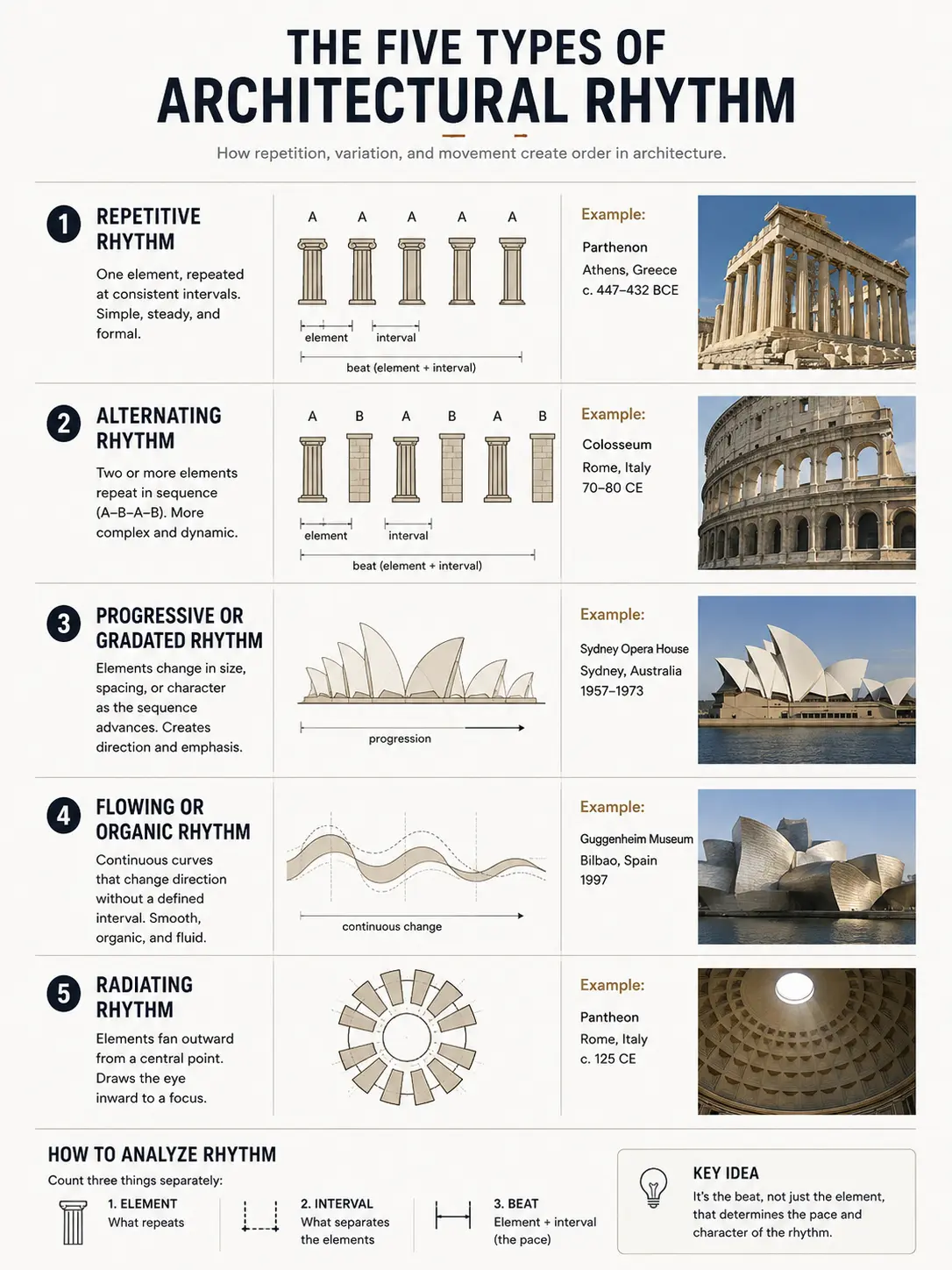
Architects and theorists categorize rhythm in several overlapping ways. The most useful framework for understanding how rhythm works in real buildings covers five types, from the simplest to the most complex.
Repetitive rhythm
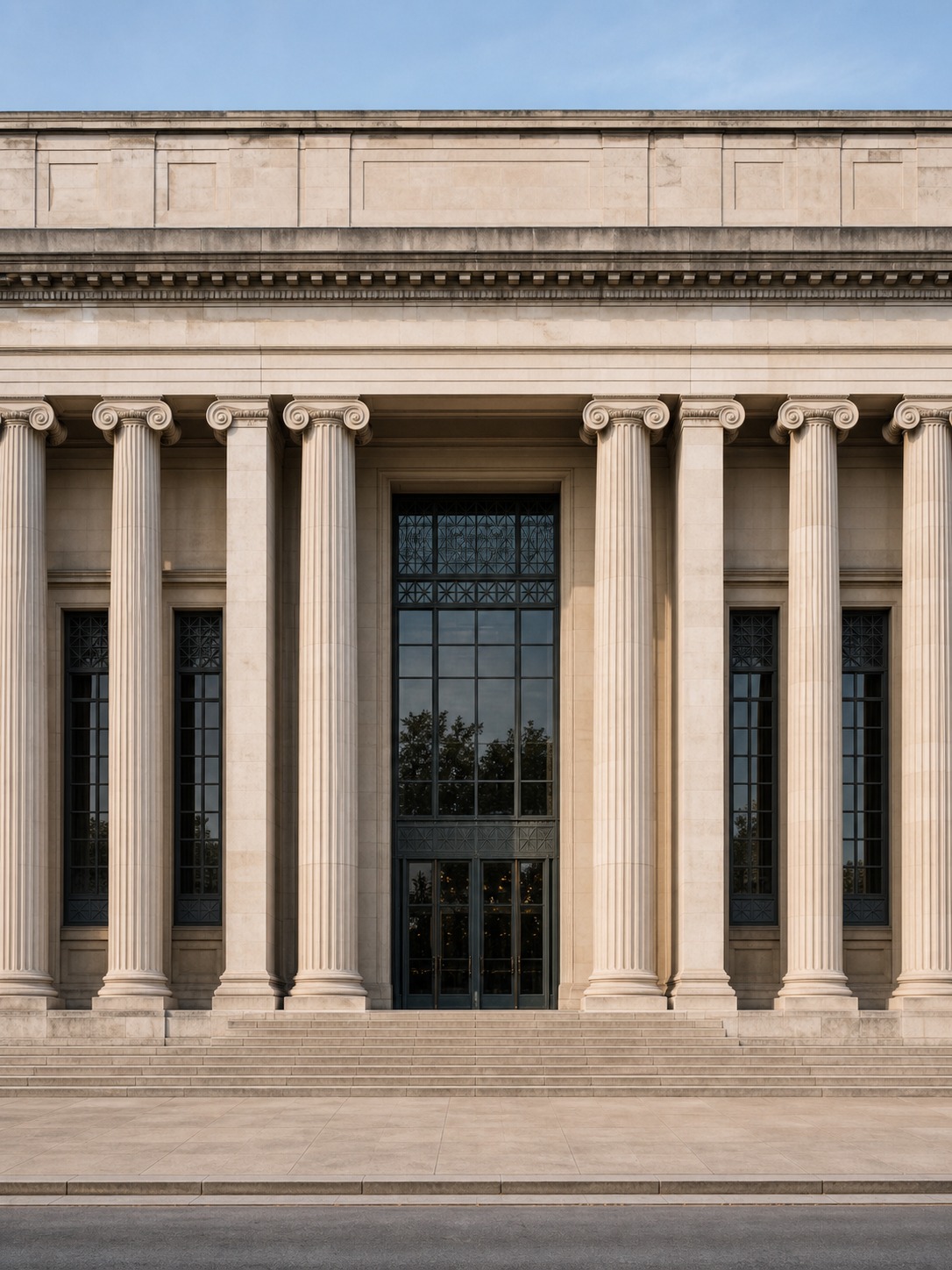
The simplest type: one element, repeated at consistent intervals. The Greek Doric colonnade is the canonical example. A row of identical columns at equal spacing creates a beat-beat-beat pattern with no variation in either the element or the interval. The effect is formal, measured, and authoritative.
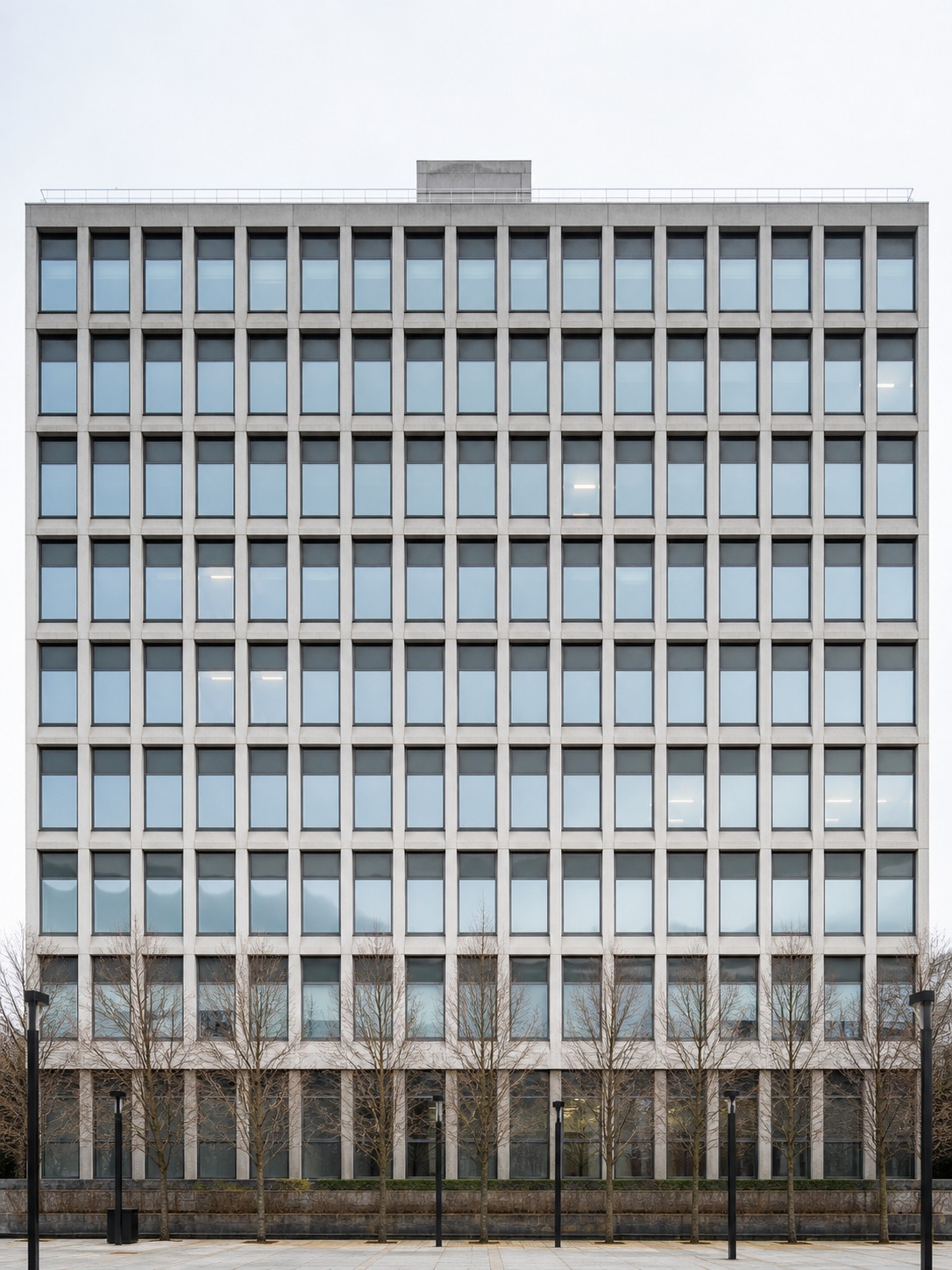
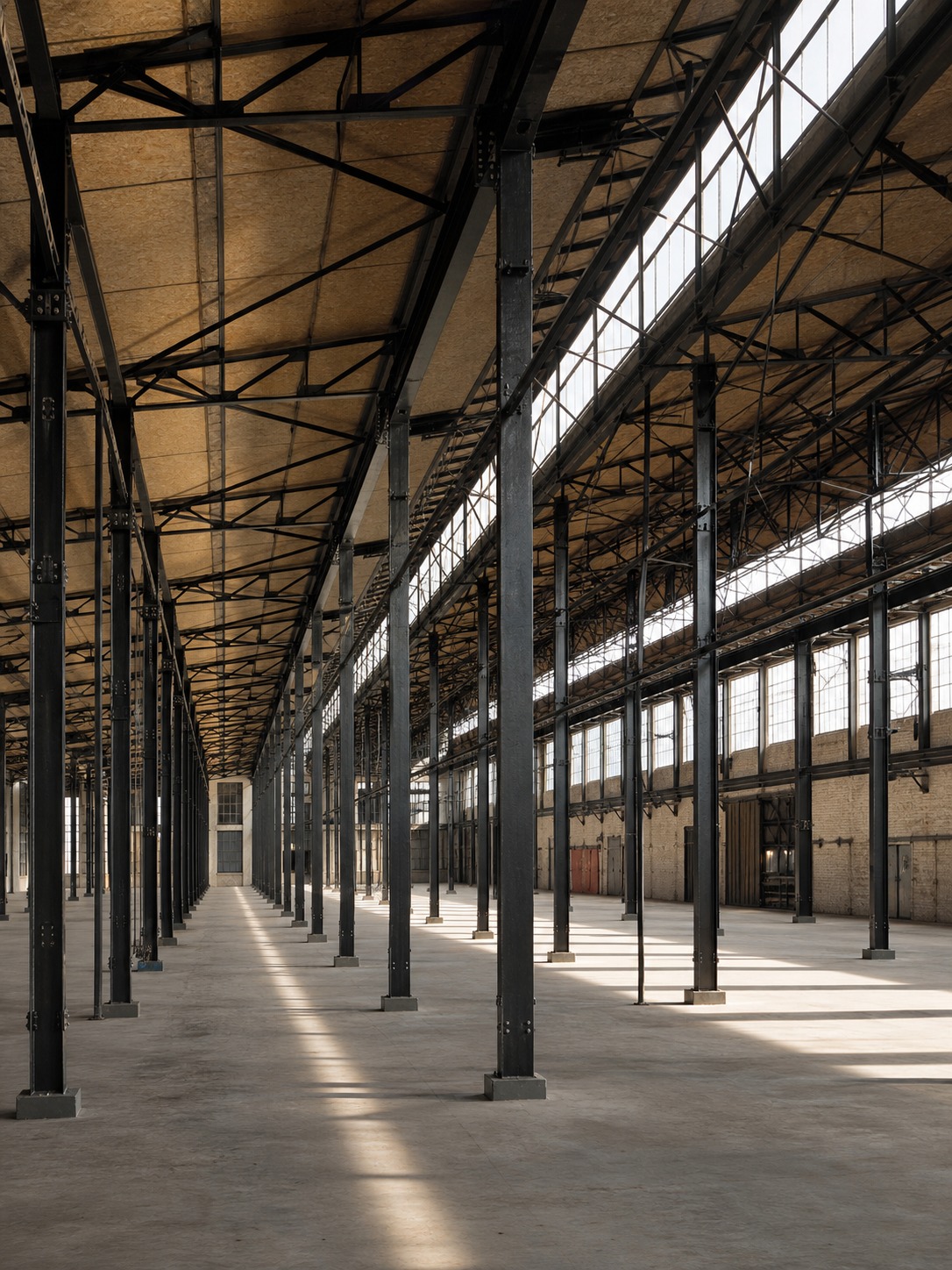
Repetitive rhythm implies infinite extension, which is part of its power. The colonnade of the Parthenon reads as if it could continue beyond the corners of the building. It suggests something larger than itself. In contemporary architecture, repetitive rhythm appears in curtain wall grids, in parking structure bays, and in the structural bays of industrial buildings where the program makes identical spacing the logical outcome.
Alternating rhythm
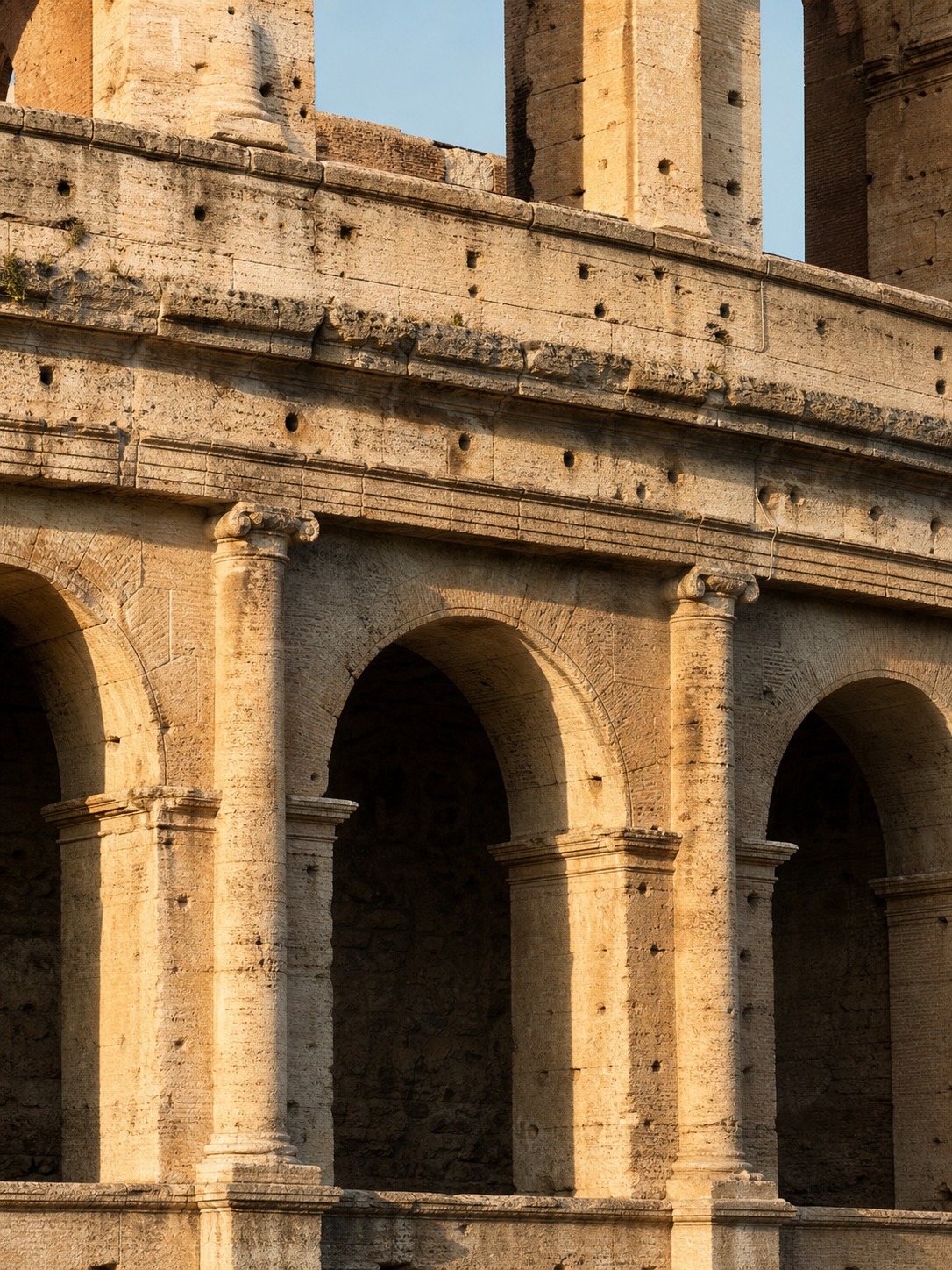
Two or more elements repeat in sequence: A-B-A-B, or A-B-C-A-B-C. The Roman Colosseum uses alternating rhythm at multiple scales. Along each tier, arches alternate with solid piers in a continuous A-B pattern. Vertically, the three main tiers use the three Classical orders (Doric, Ionic, Corinthian) in sequence, creating a second alternating rhythm perpendicular to the first.
Alternating rhythm is richer and more dynamic than simple repetition because two (or more) different elements process differently as the eye moves along them. The rhythm has a more complex beat. In Gothic architecture, the alternating column and compound pier of many cathedral naves produces the A-B-A-B rhythm that gives the interior its particular quality of alternating light and dark, open and solid.
The same rhythm you notice in architecture also appears in design principles in graphic design. Repeated shapes, alternating spacing, and progressive scale changes can move the eye through a poster, magazine spread, or website section.
Progressive or gradated rhythm
Elements change in size, spacing, or character as the sequence advances. The Sydney Opera House shells are the most photographed example: the sequence of roof vaults increases in size from the small entry forms to the large performance hall shells, then decreases toward the rear. The progression gives the building its characteristic dynamic profile.
Gradated rhythm reads as directional. The eye moves toward the dominant end of the progression. This makes it useful for creating movement toward a focal point, emphasizing an entrance, or establishing hierarchy within a facade without any change in color or material. The Gothic spire, tapering as it rises, uses progressive rhythm vertically to pull the eye upward and sharpen the building’s profile against the sky.
Flowing or organic rhythm
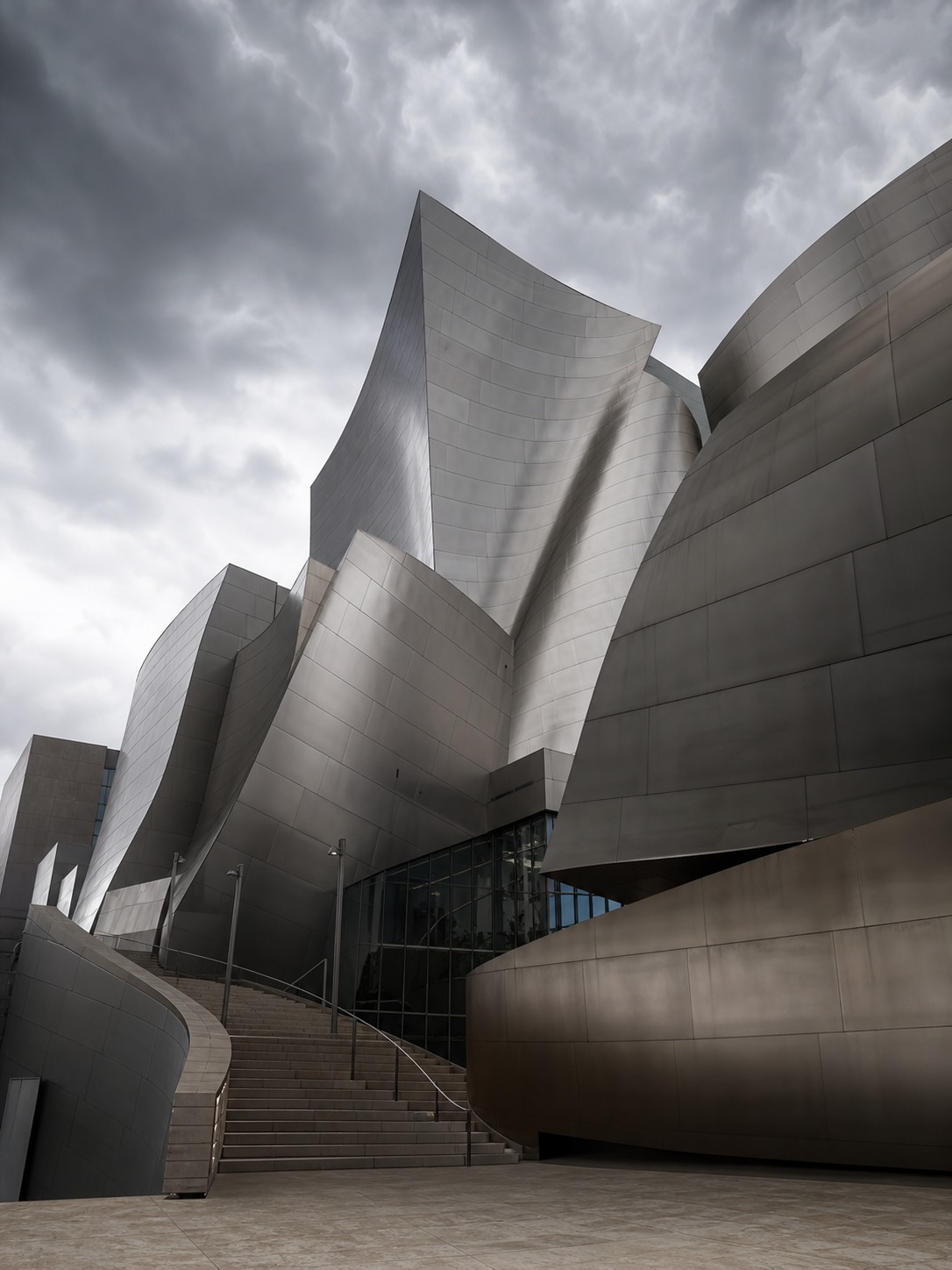
Continuous curved forms that change direction without a defined interval. The titanium cladding of the Guggenheim Museum Bilbao (Frank Gehry, 1997) creates flowing rhythm through the continuous modulation of the building’s curved exterior surfaces. There is no identifiable beat, no counted interval. The rhythm is in the continuous change of curvature, the way each panel leads into the next through a shared tangent rather than a hard angle.
Flowing rhythm is associated with organic or natural forms: the movement of water, the profile of hills, the edge of a leaf. It appears in Art Nouveau architecture through the continuous curving moldings and window frames of Hector Guimard’s Paris Metro entrances, and it re-emerges in contemporary parametric architecture where the software generates form through mathematical rules rather than geometric grids.
Radiating rhythm
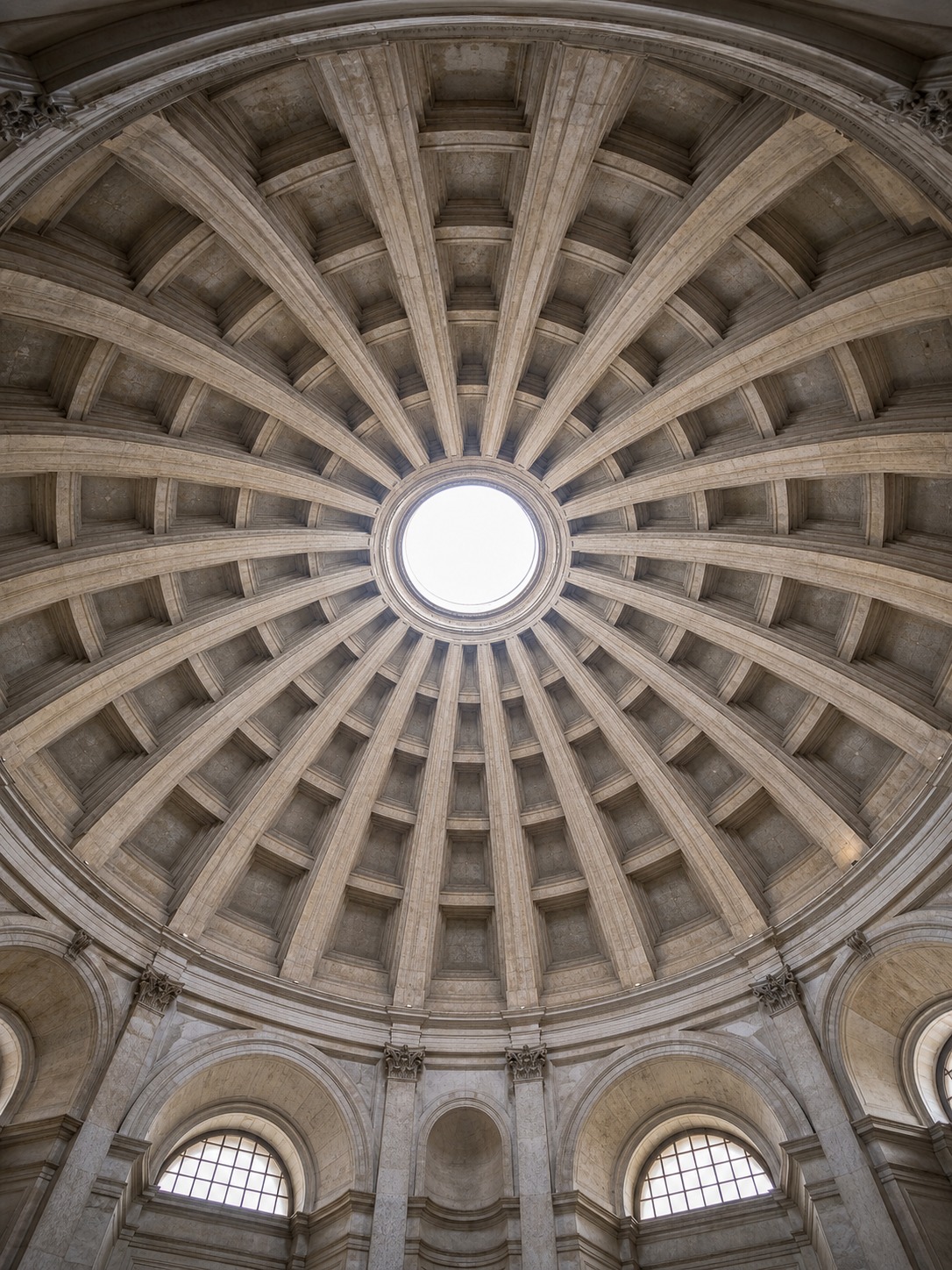
Elements that fan outward from a central point. Most visible in plan: the radial plan of the Pantheon in Rome, the radiating chapels around the ambulatory of a Gothic cathedral, the radial arrangement of structural ribs in a fan vault. Viewed from below the dome of Saint Paul’s Cathedral in London, the radiating structural ribs converge at the oculus above, and the eye follows them upward.
Radiating rhythm is inherently centripetal: it pulls attention toward the center from which the elements fan. This makes it suitable for spaces that need a clearly defined focus, a dome, a crossing, a radial plan public space, where everything in the architecture points to one location.
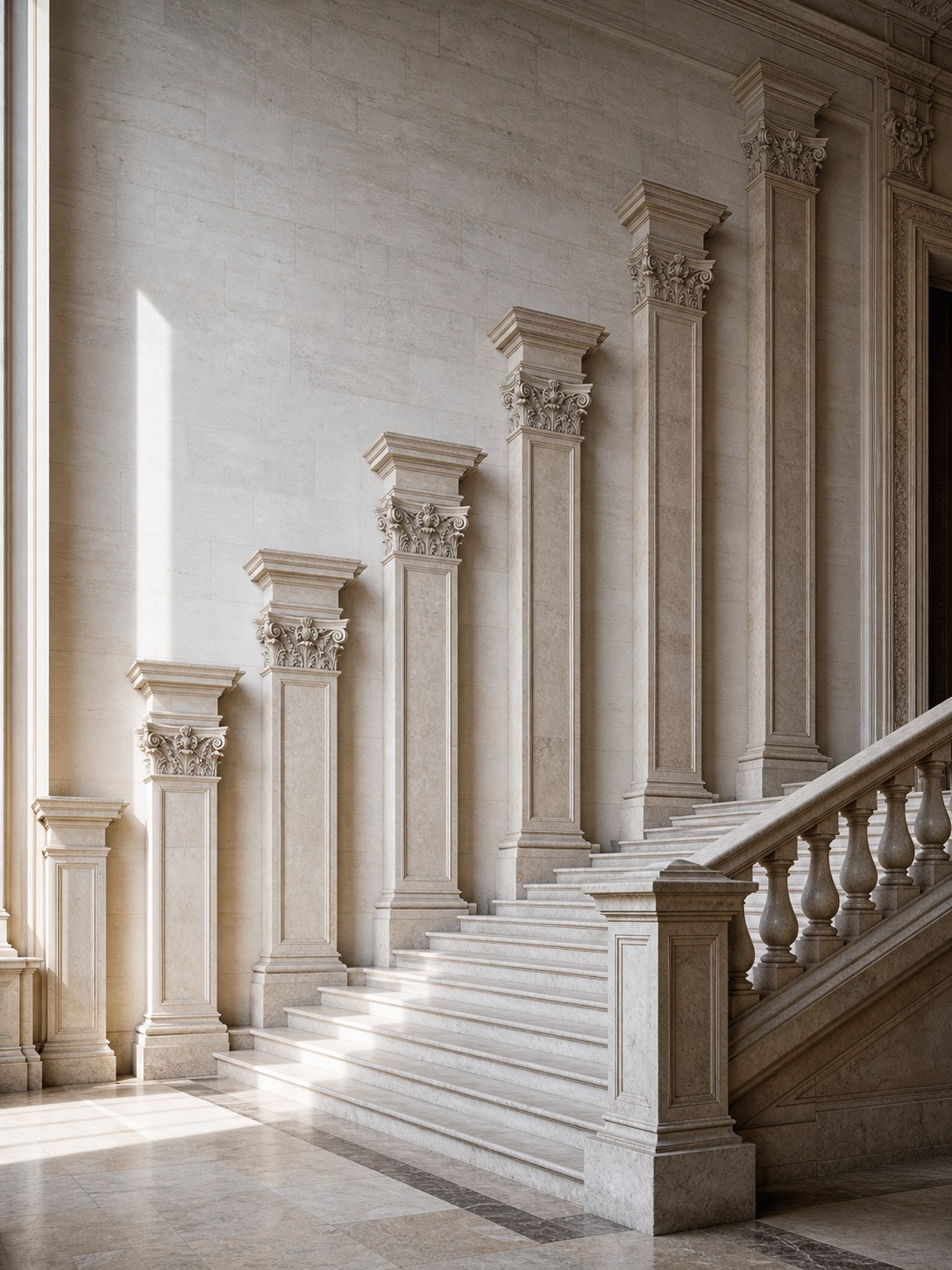
When analyzing a building’s rhythm: count three things separately. First, the element (what repeats). Second, the interval (what separates repeating elements). Third, the beat: the combined width of element plus interval. It’s the beat, not just the element, that determines the pace and character of the rhythm. Two buildings can use the same column size but different spacing and produce entirely different rhythmic effects.
Rhythm and proportion: how scale changes the effect
The same rhythmic type at different scales produces fundamentally different architectural experiences. A colonnade with 2-meter wide bays and 1-meter column spacing creates a fast, energetic rhythm. The same proportional relationship at 6-meter bays and 3-meter spacing produces a slow, ceremonial rhythm. The proportion between element and interval can stay constant while the absolute scale changes, and the feel changes completely.
Scale in architectural rhythm relates to the human body as the reference point. The human stride is approximately 70cm to 80cm. Elements that repeat at roughly that interval (a floor tile pattern, a stair tread, a picket fence) feel intimate and directly keyed to the body. Elements that repeat at 3 or 4 meters feel architectural but accessible. Elements repeating at 10 or 20 meters (the bay of a Gothic cathedral nave, the structural span of a large public hall) feel monumental.
How rhythm creates pace in a corridor or processional space
In a processional space (an axis of movement leading toward a destination), rhythm determines the pace at which the journey is experienced. Fast rhythm, created by closely spaced elements, produces energy and anticipation. Slow rhythm, from widely spaced elements, produces ceremony and deliberateness.
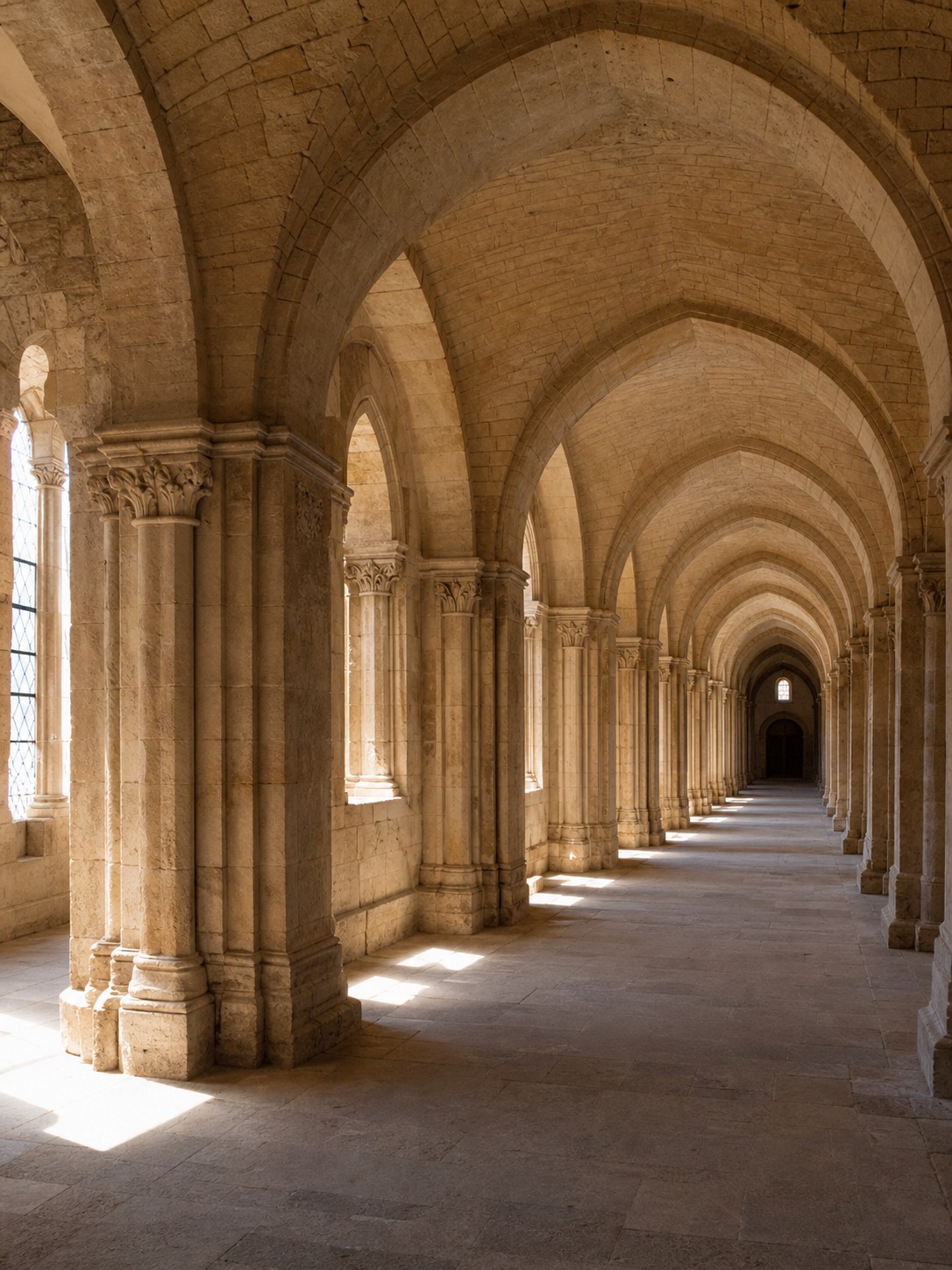
The nave of a large Gothic cathedral uses alternating rhythm between main piers to create a measured progression toward the altar. Each bay is a distinct step in the journey. The width between piers, typically 9 to 12 meters in major cathedrals, creates a pace that requires the body to move a specific distance before encountering the next beat. The architecture times the experience.
In contrast, a tight grid of structural columns in a Renaissance loggia, repeating at 3 to 4 meters, creates a much faster pace that encourages movement along the colonnade rather than through it. The rhythm produces lateral movement, not frontal progression.
Breaking rhythm: how architects create emphasis
An established rhythm creates expectation. The ear does the same thing in music: once a pattern is set, the listener predicts what comes next. When the expectation is violated, the violation draws attention. In architecture, a deliberate break in rhythm marks a place, creates hierarchy, or signals a threshold.
The wider bay
The most common rhythm break is a single wider bay within an otherwise regular colonnade or window series. The Palazzo Farnese in Rome (Antonio da Sangallo, 1534) uses this: the central bay of the main facade is wider than the flanking bays, drawing attention to the entrance without any change in the architectural vocabulary. The rhythm has been broken at precisely the place the architect wants you to look.
This technique appears in almost every classical building and persists in contemporary architecture. A curtain wall grid with one oversized window panel, a colonnade with a doubled bay at the approach to a staircase, a row of identical townhouses with a slightly wider frontage marking the entry to a square: all use the same principle. Establish the pattern, then deviate from it at the point of emphasis.
The accent
An accent is an element that differs from the repeating element in character rather than dimension. A row of identical columns punctuated by a single engaged column with a sculptural capital is an accent. The break is qualitative, not just quantitative. In music, this is the difference between a syncopation (a displaced beat) and a change in timbre (a different instrument sounds where the same note was expected).
Gothic cathedrals use accents in the alternating compound pier: within the A-B-A-B colonnade rhythm, the compound pier (B) carries the visual load of the vaulting ribs above it and reads as qualitatively heavier than the simple column (A). The accent doesn’t break the rhythm; it enriches it by adding a second layer of complexity.
Rhythm in interiors: how it works at smaller scale
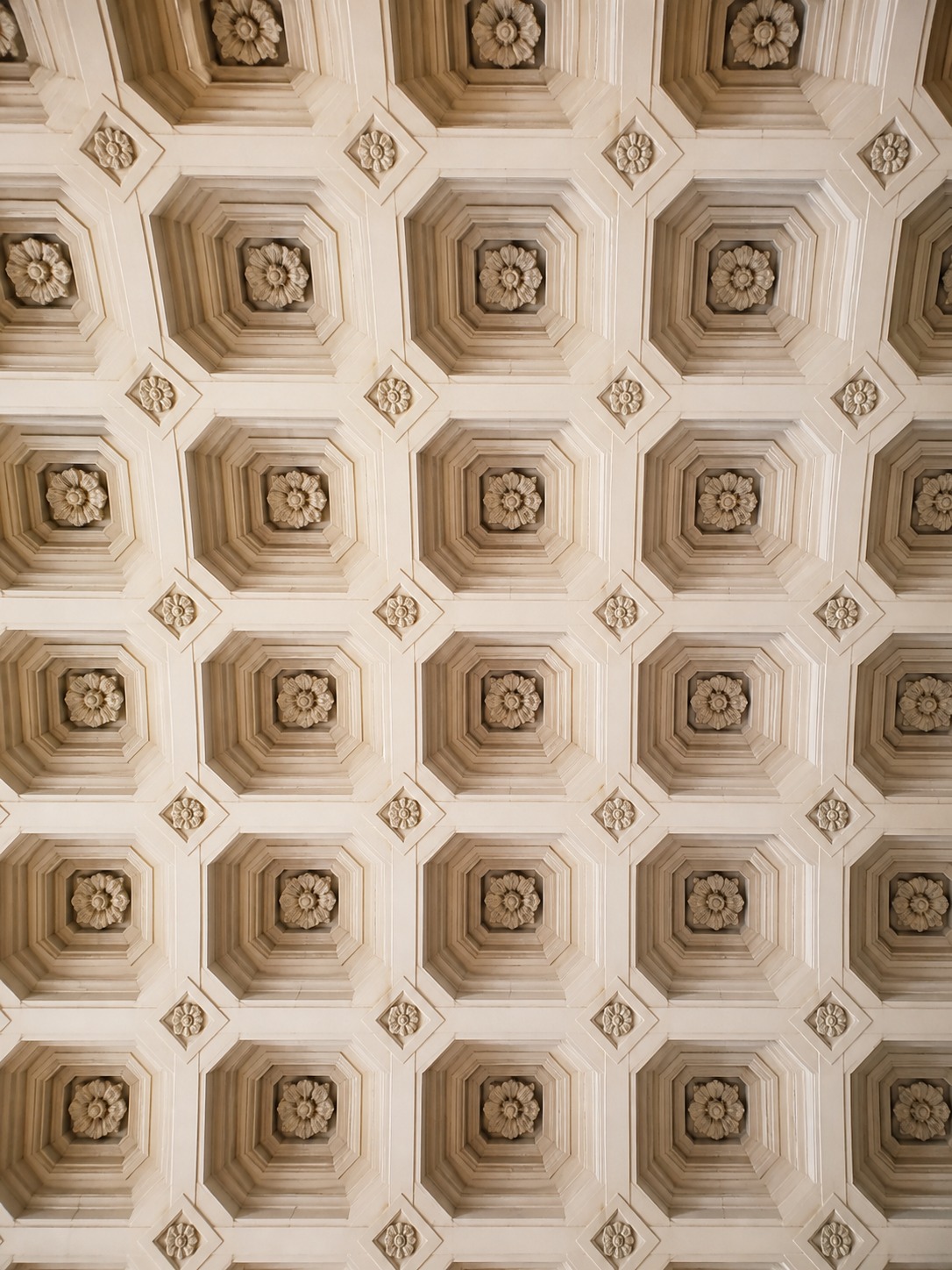
Interior architectural rhythm operates on the same principles as facade rhythm but at the scale the occupant inhabits directly. The viewer moves through interior rhythm rather than observing it from a distance, which changes how it registers. A ceiling coffer pattern that repeats at 1.5 meters is experienced differently depending on whether you’re standing in the room or walking through it.
In a room you occupy statically (a library reading room, a boardroom, a bedroom), ceiling rhythm is experienced as a field rather than a sequence. The pattern surrounds you and the brain reads it globally. In a corridor or processional hall, the same ceiling rhythm becomes sequential: you walk through it and the beats are metered by your movement.
Column sequences in interior spaces
The hypostyle hall of the Temple of Karnak in Egypt, built across many centuries, uses a dense forest of columns, some rising to 21 meters, in a repetitive rhythm that creates one of the most disorienting interior experiences in architectural history. The rhythm is so dense that it reads as texture rather than pattern: individual columns lose their identity and the space becomes a field of verticals. This is rhythm pushed to its perceptual limit.
At more human scale, the double-loaded corridor of Louis Kahn’s Salk Institute (1965) uses the rhythm of the study studios on each side of the central court to create a meditative regularity that frames the ocean view at the end of the axis. The rhythm of the studios (identical modular concrete units) acts as the counter to the singular dramatic vista. The repetition makes the exception possible.
Floor pattern rhythm
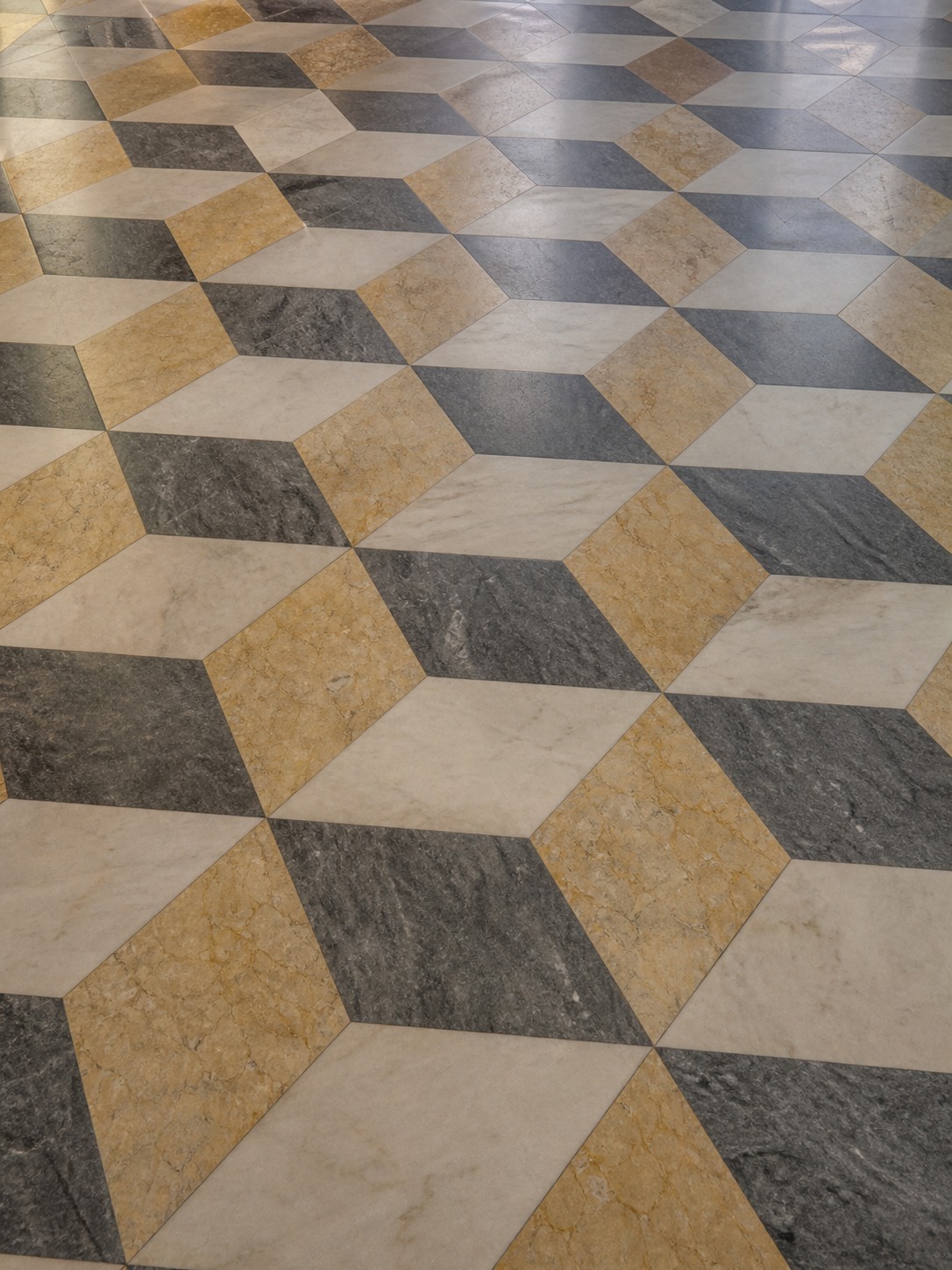
Floor tile patterns in large public interiors produce rhythm at the plane the body contacts. The marble floor of St. Peter’s Basilica in Rome uses large-format roundels and geometric patterns that create a slow, ceremonial rhythm appropriate to its scale. The Palais Royal colonnades use smaller, faster stone paving that encourages promenading. Each choice is tuned to the pace of movement the architect wants to encourage.
Rhythm in contemporary and parametric architecture
Contemporary architecture has expanded the vocabulary of rhythm beyond what was possible with the manual tools of historical practice. Parametric design software allows architects to generate rhythmic sequences governed by mathematical rules, producing gradations and variations that would have required hundreds of individual design decisions in earlier periods.
The Serpentine Pavilion and changing annual rhythms
Each year’s Serpentine Pavilion in London demonstrates a different architect’s approach to rhythm at a small building scale. Rem Koolhaas’s 2006 pavilion used a rhythm of structural columns and translucent panels at a human pace. SANAA’s 2009 pavilion used a field of slender steel columns in a near-irregular distribution that was actually carefully calculated, producing a rhythm that felt accidental but was precisely controlled.
The SANAA pavilion in particular demonstrated something important about contemporary rhythm: the rejection of obvious regularity as a starting point. The columns appeared random but were actually distributed according to rules that produced structural efficiency and a specific spatial experience. The rhythm was there, but it required time to perceive. This is characteristic of much recent work: rhythm as a discovered condition rather than an immediately legible one.
Material rhythm and texture
A brick facade produces rhythm at two scales simultaneously. The large scale is the window and wall bay sequence. The small scale is the course rhythm of the brickwork itself, the horizontal lines of mortar joints repeating at roughly 75mm intervals across the entire surface. This micro-rhythm gives masonry its characteristic texture and is visible from close distance even when the large-scale composition is invisible.
Timber cladding works similarly. Horizontal planks create a rhythm of plank width plus gap. Vertical battens create a crossing rhythm at 90 degrees. Where both exist, the surface produces a grid rhythm that reads differently at different distances: from far, as a uniform texture; from close, as two distinct overlapping rhythms.

Rhythm across an urban sequence
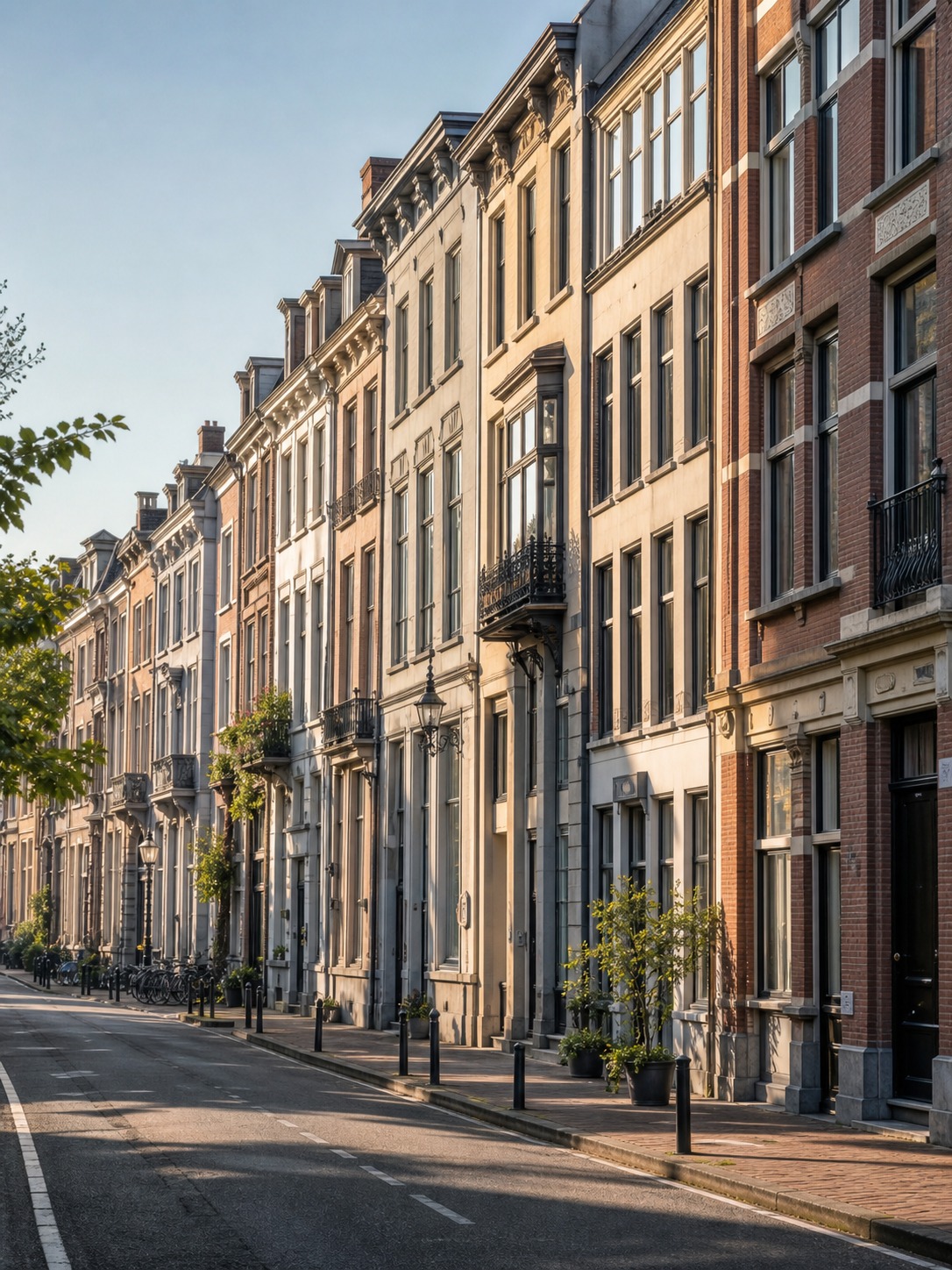
Architectural rhythm extends beyond individual buildings to urban sequences: the rhythm of building widths along a street, the cornice heights that establish a shared datum, the spacing of trees in an avenue, the rhythm of bridge supports seen from a river.
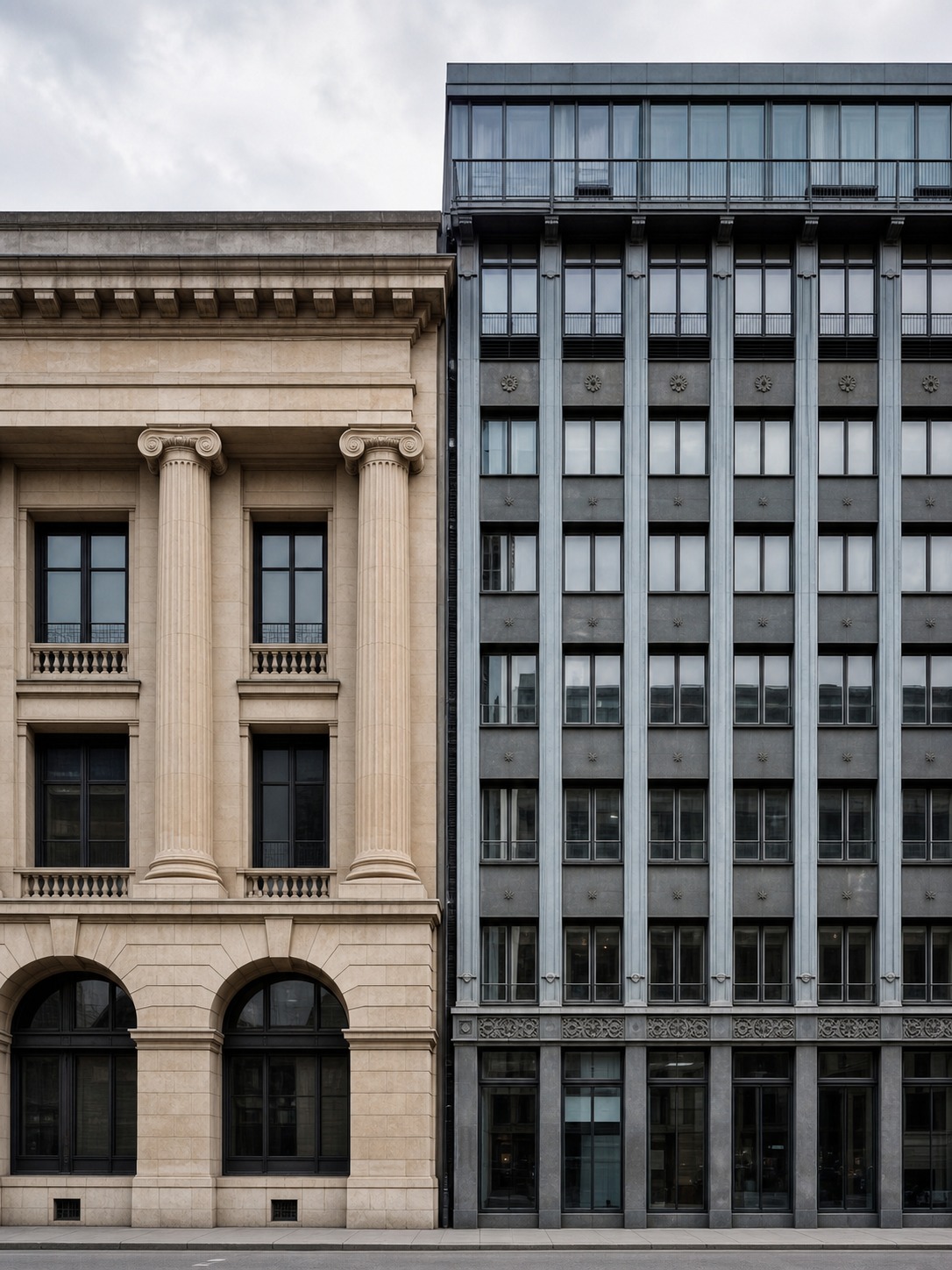
Haussmann’s Paris is the most studied urban rhythm in Western architecture. The building facades of the grands boulevards maintain a consistent cornice height (typically five to six storeys), consistent rhythm of windows per bay, and consistent material (cream limestone) across blocks of buildings designed by different architects. The individual buildings subordinate their expression to the urban rhythm, producing an extremely strong coherence at the city scale.
When urban rhythm breaks: the incident
As with building rhythm, urban rhythm creates the conditions for meaningful deviation. A building that breaks the cornice line of an established street reads as an incident, a departure that marks a specific moment in the urban sequence. This can be positive (a civic building that rises above its neighbors to claim public importance) or negative (a speculative building that breaks the rhythm with no compensating value to the urban ensemble).
The most successful urban incidents maintain the rhythm at ground level (continuous shopfronts, consistent pavement width, continuing tree planting) while departing from the rhythm vertically. The rhythm is present enough that the departure is legible as a deliberate choice rather than an accident of development.

A practical test for rhythm analysis: stand in front of any building you’re studying and count the repeating elements along one facade. Then measure the interval between them (or estimate it relative to a known dimension like a standard door height of 2.1 meters). The ratio of element width to interval is the beat. A 1:1 ratio (element equals interval) produces one character. A 1:2 ratio (interval twice the element width) produces another. The ratio tells you more about the building’s character than any style description.
To study rhythm through a lens, try this photographing architectural rhythm guide and look for repeated windows, shadows, columns, and street movement in one frame.
Rhythm in architecture examples worth comparing
Good rhythm in architecture is easier to see when you compare buildings side by side. The Parthenon is a clear repetitive rhythm. The Colosseum gives you alternating arch and pier rhythm. Sydney Opera House uses progressive rhythm through shell size and direction. Salk Institute slows the pace with a measured court and studio sequence, while the Serpentine Pavilion experiments show how a repeated structure can feel strict, loose, or almost accidental.
| Example | Rhythm to notice | What to study |
|---|---|---|
| Parthenon | Repetitive column rhythm | The interval between columns and the way the eye moves along the colonnade. |
| Colosseum | Alternating arch-pier rhythm | The A-B beat across each tier and the vertical rhythm of the Classical orders. |
| Sydney Opera House | Progressive shell rhythm | How changing shell size creates direction and a memorable skyline. |
| Salk Institute | Measured court rhythm | How repeated studio modules frame one strong central view. |
| Serpentine Pavilion projects | Contemporary structural rhythm | How repeated columns, panels, and grids can feel regular, loose, or deliberately unstable. |
For external references, compare the Parthenon overview from Britannica, the Sydney Opera House story, the Salk Institute architecture history, and the Serpentine Pavilion 2009 archive. Use them as reference points, then come back to the building and ask: what repeats, what changes, and where does the rhythm break?
Study the architecture rhythm cluster next
To keep practicing the same idea from different angles, move next into architecture sketches for fast building analysis, architectural photography ideas for repeated windows and shadows, facade redesign examples for before-and-after facade rhythm, modern house designs for contemporary massing, and home exterior details for the small trim lines that make a house feel finished.
The same rhythm logic also crosses into architecture inspired by nature, interior design principles, design principles in graphic design, perspective drawing, and house drawing ideas. Different media, same design question: where does the eye go first, what pattern carries it forward, and what moment breaks the pattern on purpose?
For an advanced example of visual movement, look at Zaha Hadid architecture and notice how curves, ramps, and rooflines create rhythm without simple repetition.
Frequently asked questions
What is rhythm in architecture?
Rhythm in architecture is the deliberate repetition of visual elements across a building or space to create order, movement, and pattern. Like musical rhythm, it depends on recurring beats, such as columns, windows, bays, arches, and the spaces between them. The pattern can be simple, alternating, progressive, flowing, or radiating.
What are the main types of rhythm in architecture?
The main types are repetitive rhythm, alternating rhythm, progressive or gradated rhythm, flowing rhythm, and radiating rhythm. Most real buildings combine more than one type. A facade might use repetitive window bays, while the roofline or entrance adds a progressive or broken rhythm for emphasis.
How does rhythm create visual movement in architecture?
Rhythm creates visual movement by training the eye to anticipate the next element in a sequence. When columns repeat at equal intervals, the eye moves along them because the pattern implies continuation. Progressive rhythm can speed the eye toward a focal point, while alternating rhythm creates a more varied beat.
What is the difference between rhythm and repetition in architecture?
Repetition means the same element appears more than once. Rhythm is repetition with intent: a consistent interval, a defined pattern, and a clear effect on how the building is read. Random windows are repetition without rhythm. Windows spaced with consistent proportions create rhythm.
Can you give examples of rhythm in famous buildings?
The Parthenon uses repetitive rhythm through its Doric colonnade. The Colosseum uses alternating rhythm in its arch and pier sequence. Sydney Opera House uses progressive rhythm in its shell forms. The Guggenheim Bilbao uses flowing rhythm through curved titanium surfaces. Each example moves the eye in a different way.
How is rhythm different in interior architecture?
Interior rhythm works at the scale of the body moving through space. Ceiling coffers, floor patterns, column sequences, shelves, and light fixture spacing all create rhythm. The difference is that you experience interior rhythm from within, so the distance between repeated elements affects the pace of walking, sitting, and looking.
What is the easiest way to spot rhythm in a building?
Stand back and count the repeated elements along one facade: windows, columns, piers, balcony rails, roof beams, or tree spacing. Then compare the width of each element with the gap beside it. That element-to-interval ratio is the beat, and it tells you why the building feels calm, fast, heavy, or formal.
How do architects break rhythm intentionally?
Architects break rhythm to create emphasis. A wider bay in a colonnade can mark an entrance. A single door interrupting a row of windows can create a destination. A change in height can define a threshold. The break works because the regular rhythm has already taught the eye what to expect.
- 396shares
- Facebook0
- Pinterest396
- Twitter0
- Reddit0