
Nature-inspired architecture borrows shapes, patterns, and structural ideas from the living world. In some buildings the reference is obvious, like a lotus flower, bird’s nest, or palm tree. In others, the natural model is hidden inside the engineering: bubble geometry, cellular facades, spiraling shells, or wind-resistant tower forms.
- What is nature-inspired architecture?
- Nature-inspired architecture examples at a glance
- Beijing National Aquatics Center
- Beijing National Stadium
- Palm Islands in Dubai
- Taipei 101
- 30 St Mary Axe in London
- Aldar Headquarters Building in Abu Dhabi
- Chicago Spire
- Lotus Temple in New Delhi
- Frank Gehry's fish sculpture in Barcelona
- Center for Disease Control in Taiwan
- Frequently asked questions
- What is nature-inspired architecture?
- What is the difference between biomimicry and biomorphic architecture?
- Which famous building was inspired by soap bubbles?
- Why is the Bird's Nest stadium considered nature-inspired?
- What natural form inspired the Lotus Temple?
- How can designers learn from these buildings?
What is nature-inspired architecture?
Nature-inspired architecture pulls from the natural world — its forms, its structures, its materials, sometimes its underlying systems — and uses that as a starting point for how a building gets designed. The simplest version is visual: a stadium that looks like a bird’s nest, a temple arranged like a lotus. You see the reference immediately.
But that’s not really the interesting part.
The stronger examples are buildings where the natural model changes how the structure actually works. Bubble geometry isn’t just a shape — it’s one of the most efficient ways to cover a large span with minimal material. Plant stems handle lateral wind load in ways that took engineers years to properly model. Shells distribute force through curvature instead of mass. When those principles get translated into a building, the form follows from the logic, not the other way around.
Biomorphic architecture at its best isn’t imitation. It’s more like — what problem did nature already solve, and can we use that solution here? Sometimes the answer is shade. Sometimes it’s airflow or circulation. Sometimes it’s just a roof that doesn’t collapse.
Nature-inspired architecture examples at a glance
| Building | Natural idea | Design lesson |
|---|---|---|
| Water Cube | Soap bubbles | Use geometry to shape structure and light. |
| Bird’s Nest | Woven nest | Let structure become the public identity. |
| Palm Jumeirah | Palm tree | Turn a symbol into a planning diagram. |
| Lotus Temple | Lotus flower | Use repetition to organize space and meaning. |
| Aldar HQ | Shell or desert rose | Make a simple natural outline work at building scale. |
Beijing National Aquatics Center
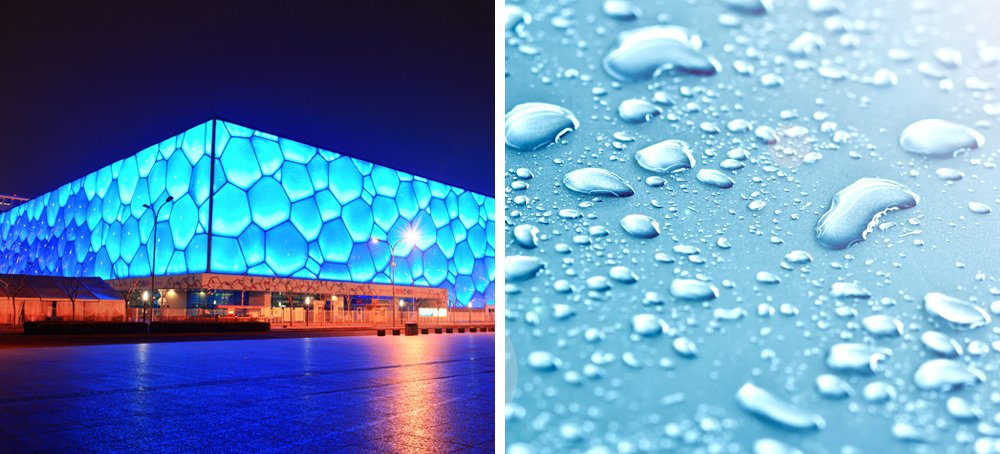
The Beijing National Aquatics Center, better known as the Water Cube, is one of the clearest examples of biomimicry in Olympic architecture. Its skin is based on the geometry of soap bubbles, turning a watery natural pattern into a structural and atmospheric idea. The bubble-like ETFE facade gives the building its soft blue glow while making the aquatic program readable from the outside.
What I like about this example is that the metaphor is not pasted on after the fact: water, light, transparency, and structure all point in the same direction. Source: Water Cube reference.
Beijing National Stadium

The Beijing National Stadium became the Bird’s Nest because its steel frame feels woven rather than stacked. Herzog & de Meuron describe the stadium as a structure where facade, roof, stairs, and public space merge into one spatial grid. That is the design lesson: the nest idea is not only a nickname. It explains how the outer basket holds circulation, shadow, views, and identity at the same time. For designers, it is a reminder that a strong silhouette can still be deeply functional. Source: Herzog & de Meuron project notes.
Palm Islands in Dubai
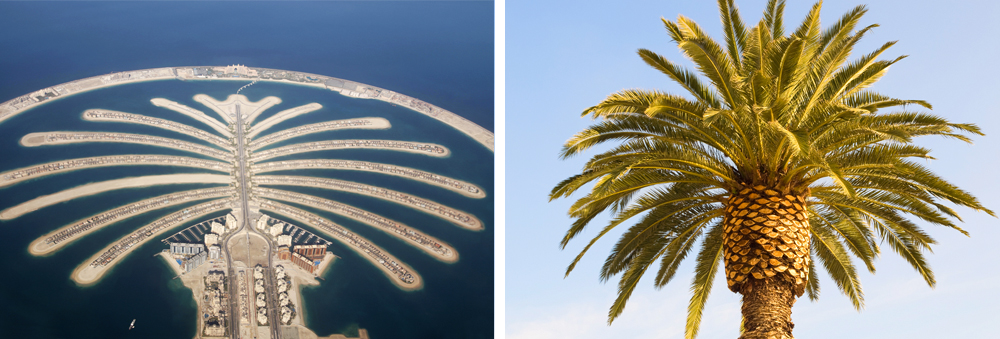
Palm Jumeirah turns a palm tree into urban planning. Seen from above, the trunk, fronds, and crescent organize roads, waterfront plots, beaches, hotels, and protected water. It is less biomimicry in the technical sense and more symbolic landscape design at a huge scale.
The palm shape makes the project instantly recognizable, but it also raises the harder design question: when a natural form becomes infrastructure, the environmental cost and coastal behavior matter as much as the aerial image. Source: Palm Jumeirah reference.
Taipei 101
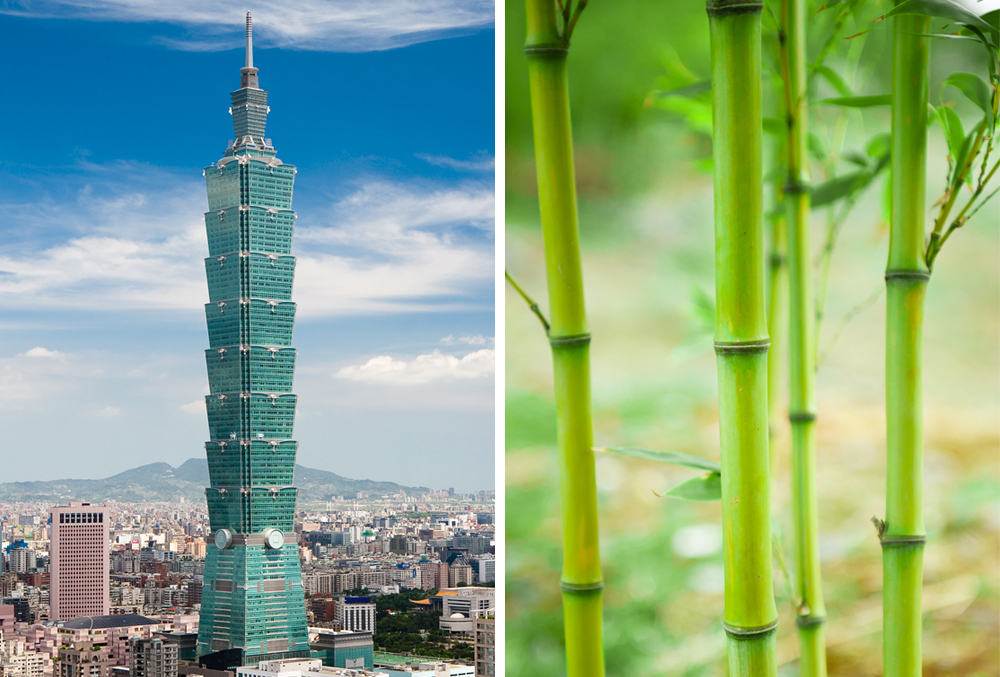
Taipei 101 is often read through bamboo, stacked pagoda forms, and repeated growth segments. The tower uses a stepped profile rather than a plain shaft, which helps the building feel rooted in Asian visual language while still working as a high-performance skyscraper.
Its official identity is not just height; it is the rhythm of stacked sections, green glass, and engineering built for typhoon and earthquake conditions. Nature appears here as a proportion and resilience cue, not as literal decoration. Source: Taipei 101 official site.
30 St Mary Axe in London
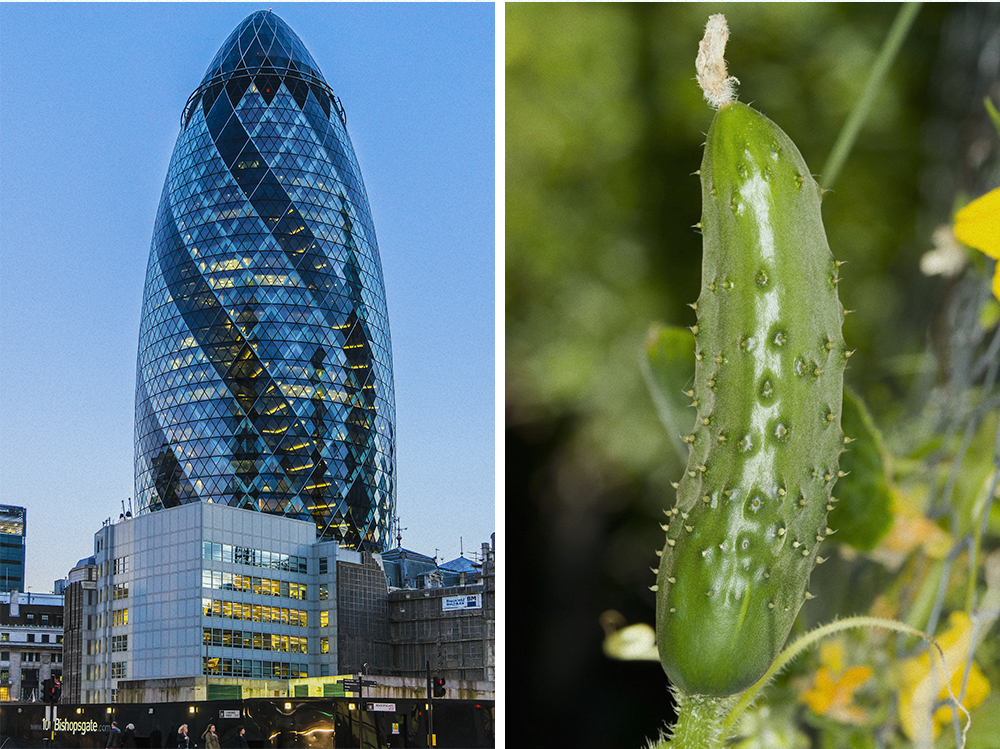
30 St Mary Axe, usually called the Gherkin, shows how a rounded natural-looking form can support environmental performance. Foster + Partners designed the tower with a diagrid structure and a tapered profile that reduces wind loads compared with a blunt rectangular tower.
The spiraling facade pattern also helps organize light and ventilation. The result feels organic, but the real lesson is technical: curves can be useful when they change wind, structure, and energy behavior. Source: Foster + Partners project page.
Aldar Headquarters Building in Abu Dhabi

The Aldar Headquarters building in Abu Dhabi is a circular office tower by MZ Architects. Its form is often compared with a shell, coin, or desert rose, depending on the reading, but the important design move is the confidence of the single geometry. A circle at this scale is hard to make convincing because every detail has to support the outline. The diagrid and mirrored facade help the building hold that simple natural shape without becoming flat. Source: ArchDaily project profile.
Chicago Spire

The Chicago Spire was never completed, but the idea remains a useful nature-inspired study. Santiago Calatrava’s twisting skyscraper proposal suggested a spiral shell, a turning body, or a drill-like natural growth pattern. Even as an unbuilt project, it shows how rotation can make a tower feel less static.
Lotus Temple in New Delhi

The Lotus Temple uses one of the clearest natural metaphors in modern religious architecture. Its 27 marble-clad petals are grouped into nine sides, so the flower idea also organizes entrances, symmetry, and the central hall. This is why the building works visually: the lotus is not only a surface motif. It controls the plan, the approach, and the way the building opens toward visitors. Source: Lotus Temple reference.
Frank Gehry’s fish sculpture in Barcelona
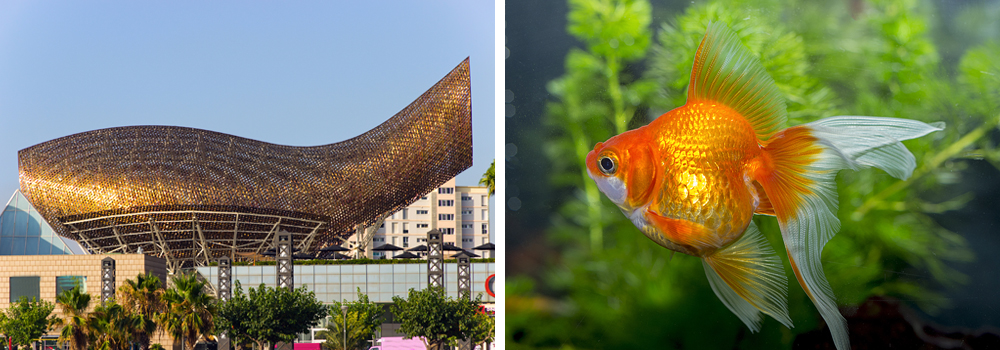
Frank Gehry’s fish in Barcelona, created for the 1992 Olympic waterfront, is more sculpture than building, but it belongs in this conversation because it shows how a natural form can reshape an urban edge. The fish body is loose, reflective, and constantly changing with the sun, which makes the waterfront feel more kinetic. Source: Visit Barcelona guide.
Center for Disease Control in Taiwan

The Taiwan Centers for Disease Control example uses a cellular reading: the facade suggests microscopic structure and biological protection. It is a good reminder that nature-inspired design does not always mean flowers, shells, or trees. Sometimes the reference is scientific and symbolic, pointing to cells, networks, health, and containment. Source: Taiwan CDC reference.
For another way to read famous buildings, architectural rhythm examples help explain why repeated ribs, shells, bays, and facade modules feel ordered rather than merely decorative.
Hadid’s work is also useful when studying fluid futuristic architecture, because many of her buildings translate movement, landscape, and organic geometry into civic form.
Frequently asked questions
What is nature-inspired architecture?
Nature-inspired architecture uses forms, structures, materials, or systems from the natural world as a starting point for building design. The best examples borrow nature’s logic, not only its appearance.
What is the difference between biomimicry and biomorphic architecture?
Biomorphic architecture mainly imitates natural shapes, such as flowers, shells, nests, or waves. Biomimicry goes deeper by using natural systems to solve design problems like airflow, shade, structure, water collection, or load distribution.
Which famous building was inspired by soap bubbles?
The Beijing National Aquatics Center, known as the Water Cube, is the clearest example. Its facade uses a bubble-like geometry and ETFE cushions to connect the building’s structure, light, and aquatic identity.
Why is the Bird’s Nest stadium considered nature-inspired?
The Beijing National Stadium is nature-inspired because its outer steel frame reads like a woven nest. Herzog & de Meuron also describe the structure as facade, roof, circulation, and public space working together.
What natural form inspired the Lotus Temple?
Nature-inspired design contrasts sharply with the heavy stone masonry and ironwork that defined traditional Victorian architecture in London during the industrial era.
The Lotus Temple in New Delhi is inspired by the lotus flower. Its 27 marble-clad petals are grouped into nine sides, creating a building that feels floral while also organizing entrances, light, and the central worship hall.
How can designers learn from these buildings?
Start by separating form from function. A flower-shaped building may be visually memorable, but the stronger design lesson is how geometry, repetition, structure, light, or airflow turns a natural idea into a usable architectural system.
- 2.8Kshares
- Facebook0
- Pinterest2.8K
- Twitter0
- Reddit0