A strong VW Beetle drawing starts with three arcs, not one big oval. In this easy step-by-step Volkswagen guide, map the roof dome, wheel centers, and oval headlights before you add chrome, shading, or pen lines.
I learned that the hard way. My first Beetle sketch was basically a potato on roller skates: one inflated body shape, two circles underneath, and no real stance.
- Why VW Beetle drawing starts with three arcs
- Tools and materials — what you actually need
- VW Beetle drawing step by step — building the silhouette
- Drawing the details that make it recognizable
- Shading a curved body — the technique most tutorials skip
- Finishing in pen-and-ink (optional but satisfying)
- Common mistakes — and how to fix them before you erase
- Start with the silhouette, trust the geometry
- Frequently asked questions
- How do you start a VW Beetle drawing for beginners?
- What's the difference between drawing the classic Beetle and the New Beetle?
- What pencils should I use for a car drawing?
- How do I draw car wheels so they look round?
- How do I shade a curved car body like the Beetle's?
- Can I draw a Beetle with just a ballpoint pen?
- How long does it take to learn to draw cars?
The Bug’s body isn’t one oval — it’s three separate arcs that meet at specific tension points. The front arc is tighter than the rear. The roofline sits slightly forward of center. These aren’t accidents; Ferdinand Porsche’s team spent years on those curves when they drafted the original KdF-Wagen in 1938. When you understand that logic, the whole drawing process changes.
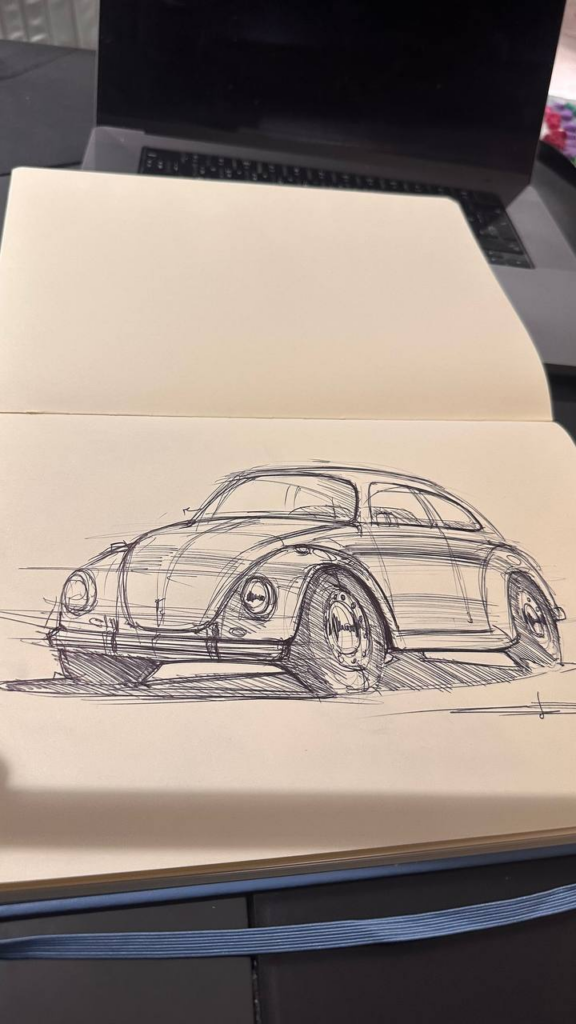
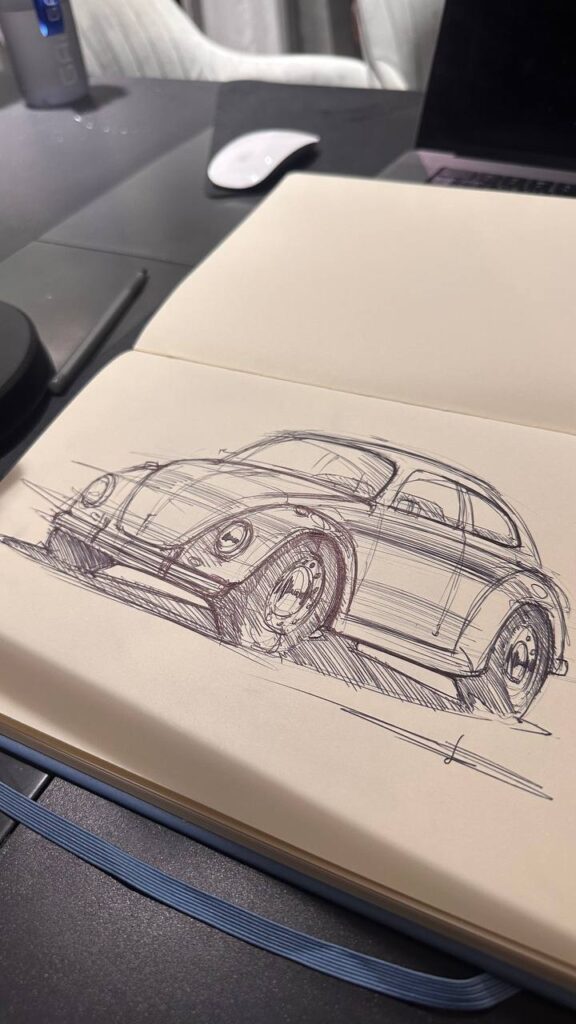
I’ve been sketching cars since my industrial design days — my curriculum included academic drawing and life painting alongside automotive proportions — and the Beetle is one of those shapes that teaches you something every time you return to it. It looks simple. It isn’t. But that gap between appearance and reality is exactly what makes it worth drawing.
Right now, vintage car sketching is having a real moment. Urban sketchers like Paul Heaston are posting fountain-pen Beetle drawings from junkyards that rack up tens of thousands of views. The Bug is one of the most useful vintage cars to draw when you want to understand rounded automotive form, and most tutorials treat it like a children’s coloring exercise.
This one won’t.
You’ll learn how to construct the silhouette correctly, place the oval headlights that give the car its personality, shade a curved body without it looking flat, and (if you want) take it to a finished pen-and-ink drawing.
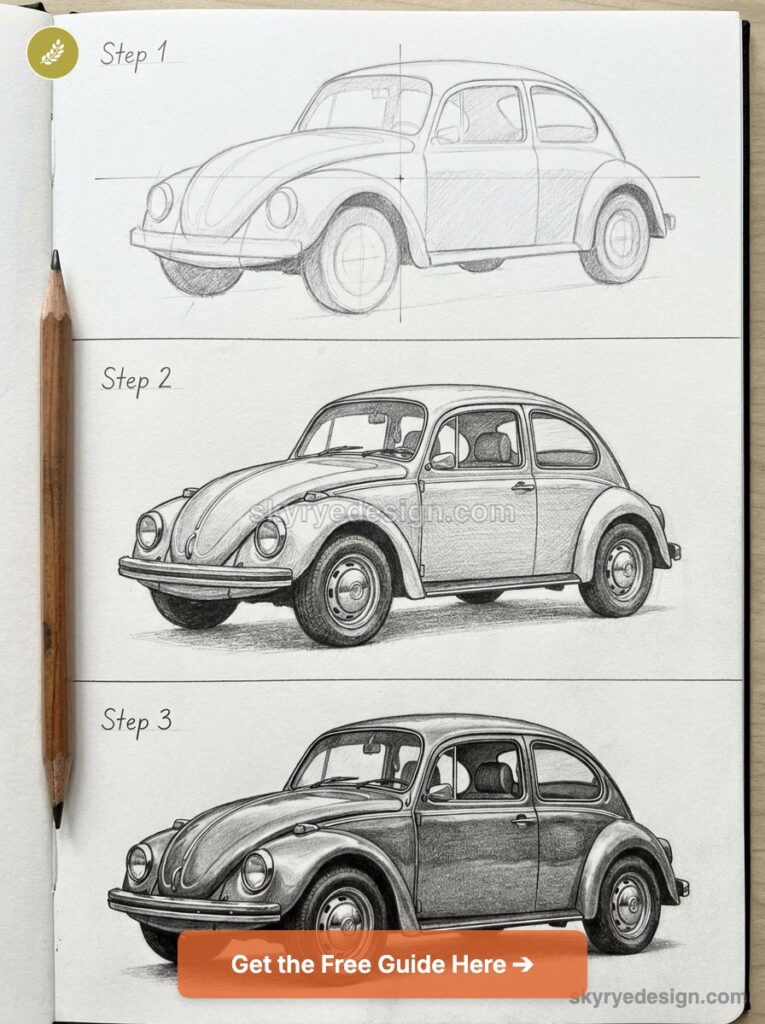
Grab a pencil. Let’s get into it.
Why VW Beetle drawing starts with three arcs
Ask most people to draw a car and they start with a rectangle. That works fine for a BMW 3 Series or a modern SUV — boxy proportions, flat sides, logical angles. Try it with a Beetle and you get something that looks vaguely angry and wrong. The Beetle doesn’t have a single straight line on its body. Not one.
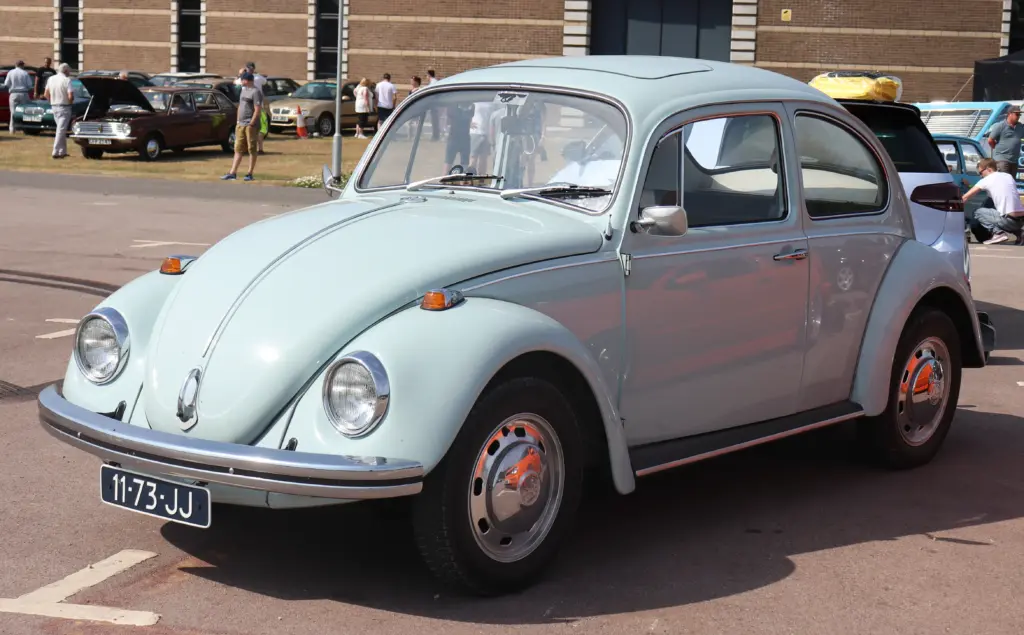
That’s what makes it different from almost every other car you could sketch.
The three-arc silhouette — it’s not one oval
Here’s what took me too long to figure out in design school: the Beetle’s body is three distinct arcs in sequence, not one continuous egg shape.
The front arc starts at the bumper and rises steeply to the windshield — it’s tight and quick. The roof arc is the longest and most gradual, peaking just slightly forward of the car’s center. The rear arc drops away more slowly than the front, giving the classic Bug that slightly heavier, rounded-tail look from the side.
Where those arcs meet (just above the windshield base and just above the rear window) are the tension points. Get those transitions smooth and the whole silhouette falls into place. Rush them and you get a lumpy blob.
★ Tip: Spend two minutes drawing just those three arcs without any other detail. Do it five times on a scrap sheet. By the fifth one, your hand knows the shape.
Proportion ratios that define the classic Bug
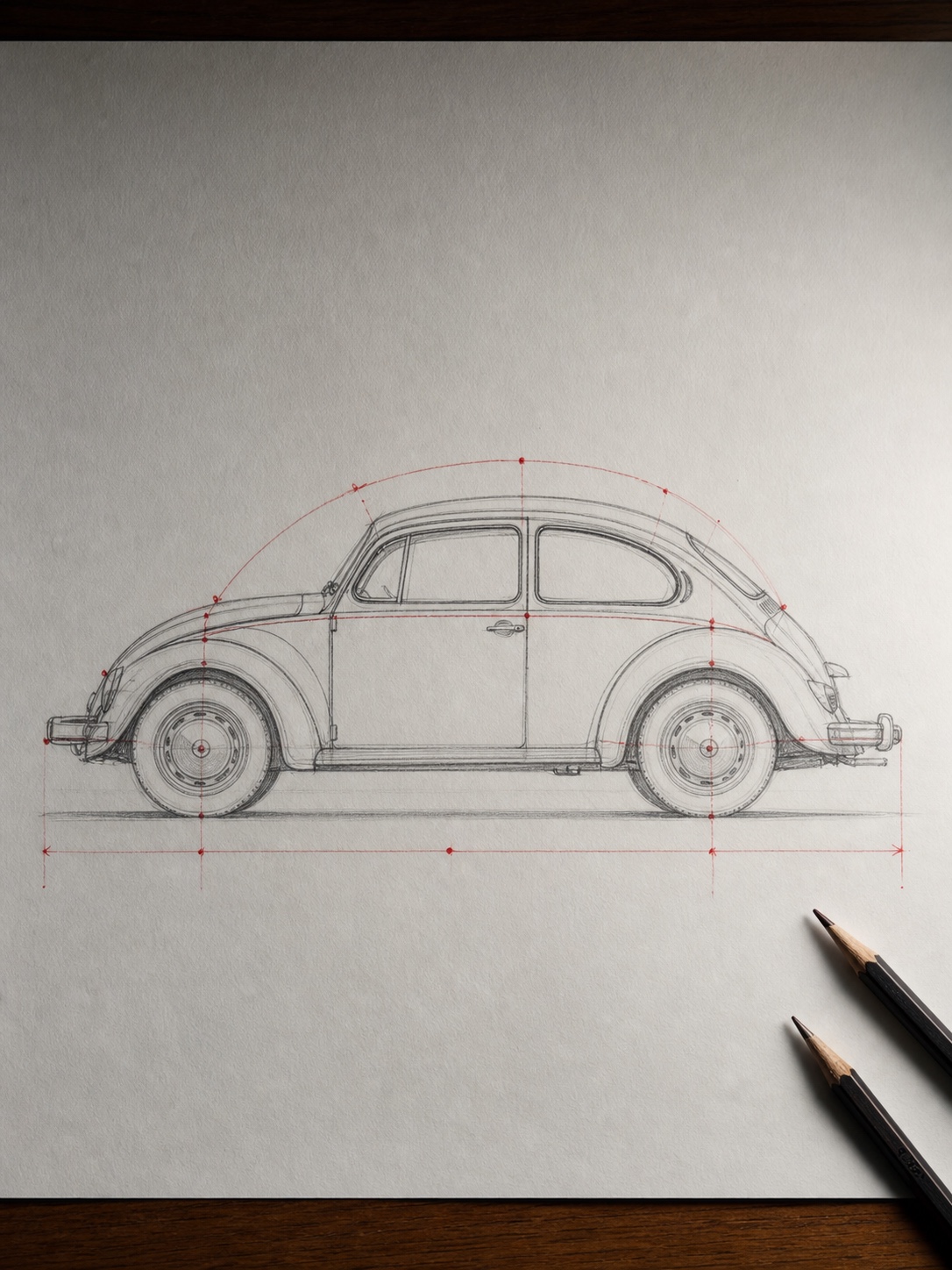
The classic ’67 Beetle sits low and wide relative to its height. A useful rule: the car’s total width (wheel to wheel) is roughly twice its height. The roofline takes up about 40% of the total height — less than you’d think. Beginners almost always draw it too tall, which kills the car’s grounded, planted feeling.
The wheelbase (distance between front and rear wheel centers) is short. The Beetle is a compact car, and that compactness shows in the side profile. The wheels sit close to the body edges, with tight wheel arches that don’t leave much gap.
Classic vs. New Beetle — pick your version before you start
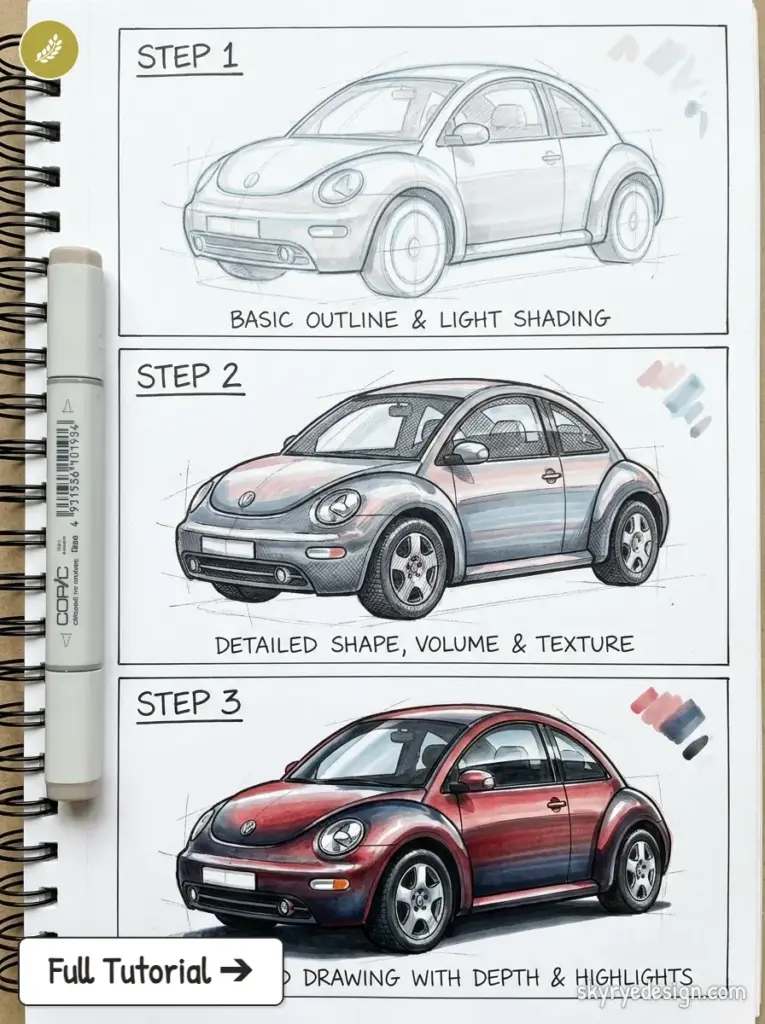
This matters more than most tutorials acknowledge. The 1998–2010 New Beetle looks similar at first glance but draws completely differently. It’s taller, more upright, with a higher roofline and a more vertical windshield. The curves are rounder and more cartoonish — less tension, more balloon. It actually sits on a Golf platform, which shows in how boxy the lower body is compared to the classic.
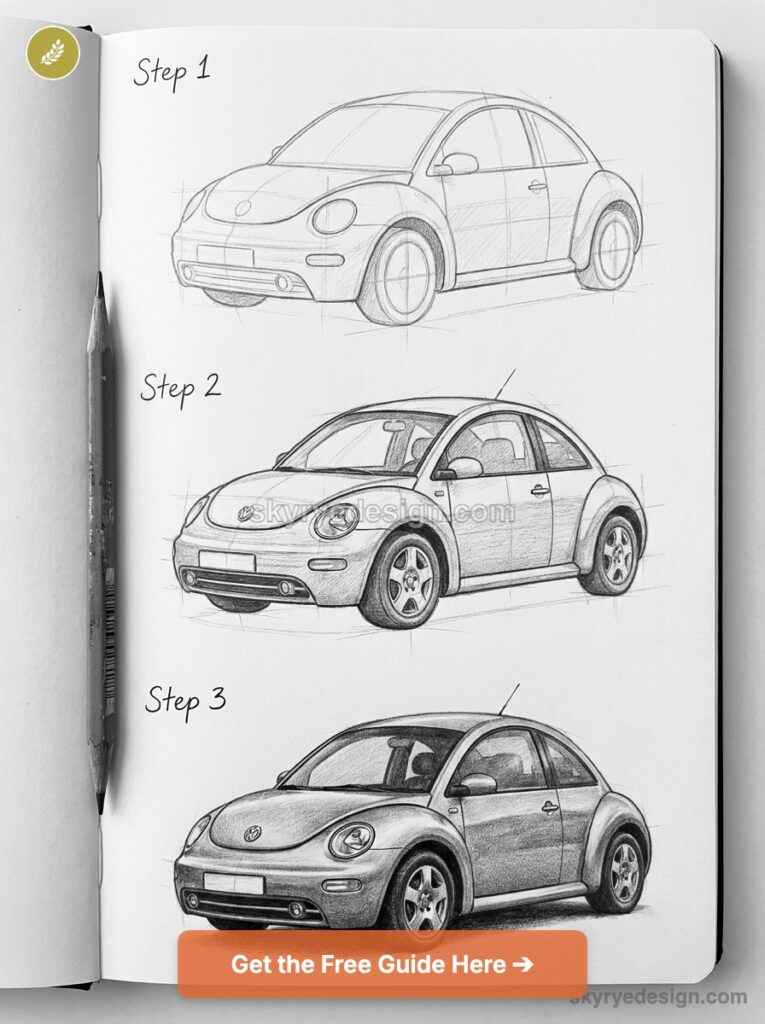
For a first attempt, I’d recommend the classic Bug every time. The proportions are more forgiving, the silhouette is more iconic, and the challenge of those three arcs teaches you more about drawing organic forms than the New Beetle’s simpler geometry will.
Tools and materials — what you actually need
Disclosure: This post contains affiliate links. As an Amazon Associate I earn from qualifying purchases. If you buy through links in this post, we may earn a small commission at no extra cost to you.
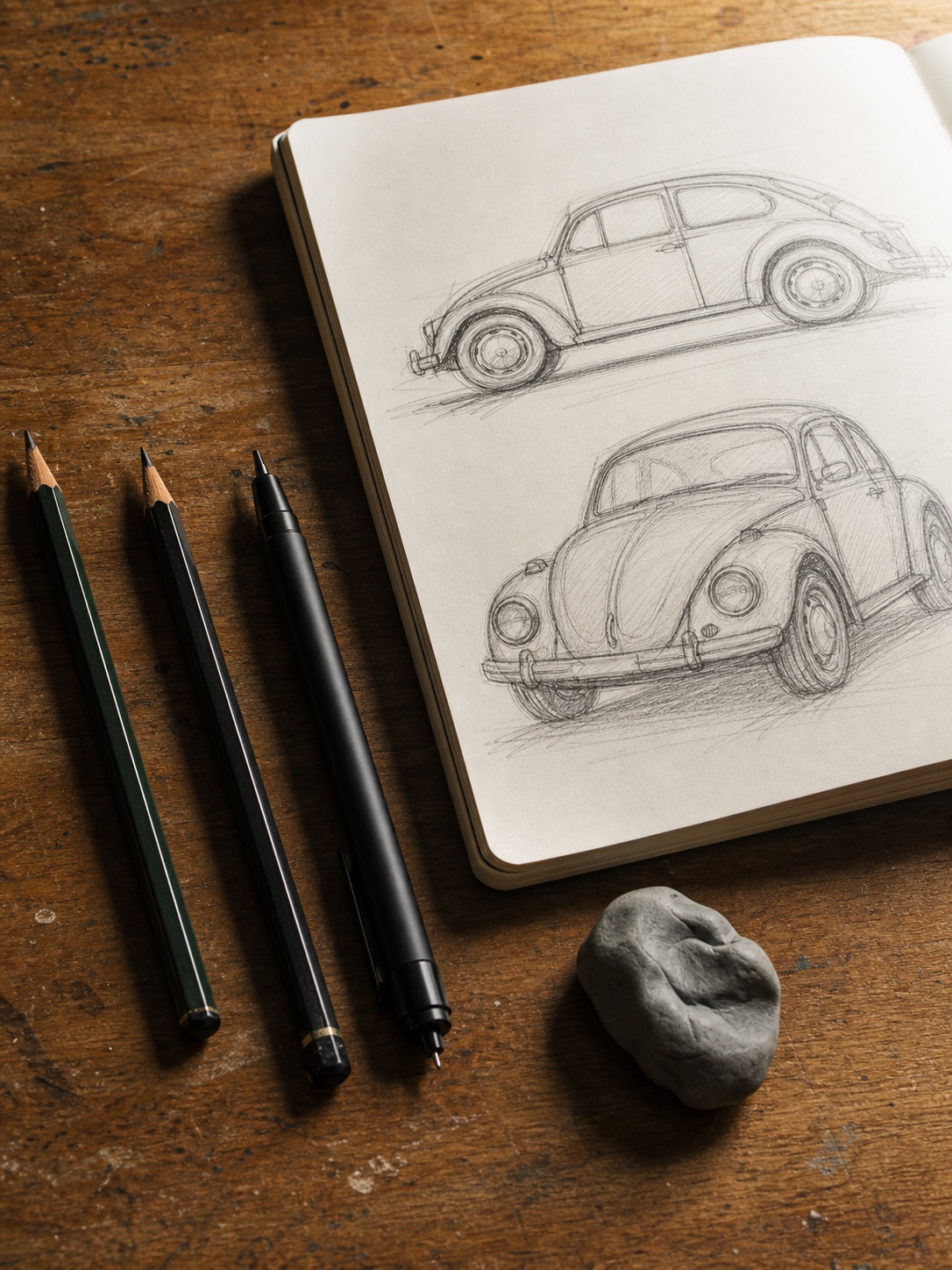
You don’t need much. One of the things I genuinely like about car sketching is that the barrier to entry is almost zero — a decent pencil, reasonable paper, and about 20 minutes. That said, the wrong tools will fight you, especially with a shape as curve-heavy as the Beetle.
Pencils for construction and shading
For a drawing like this, two pencils cover everything.
A 2H for the construction phase — light, precise lines that you can barely see from arm’s length. You’re not drawing the car yet; you’re mapping where it lives on the page. The 2H won’t dig into the paper surface, which matters when you erase half of it in the next step. Staedtler Mars Lumograph 2H runs about $2–3 per pencil and is what I’ve used since my drawing courses in university.
A 2B or 4B for shading and final linework. Soft enough to get real dark values without pressing hard, which keeps your curves smooth. Pressing hard with a hard pencil is what produces that scratchy, mechanical look you want to avoid on organic car forms.
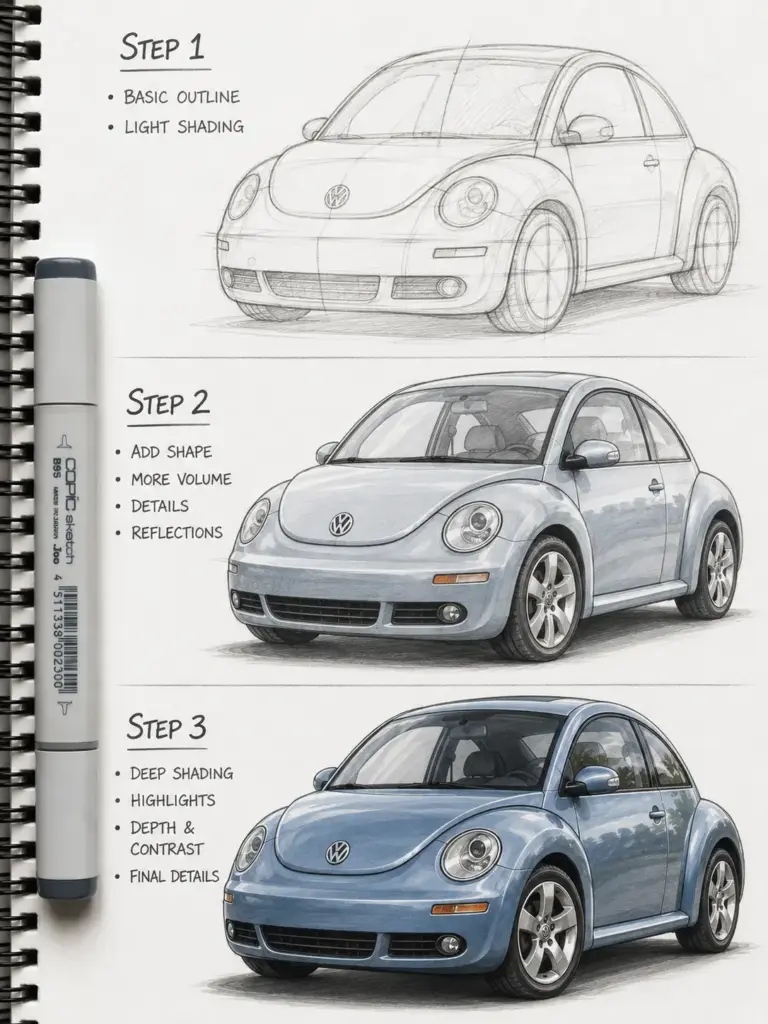
★ Tip: Skip mechanical pencils for this one. The consistent line weight works against you when drawing curves — you lose the natural variation that makes a sketch feel alive.
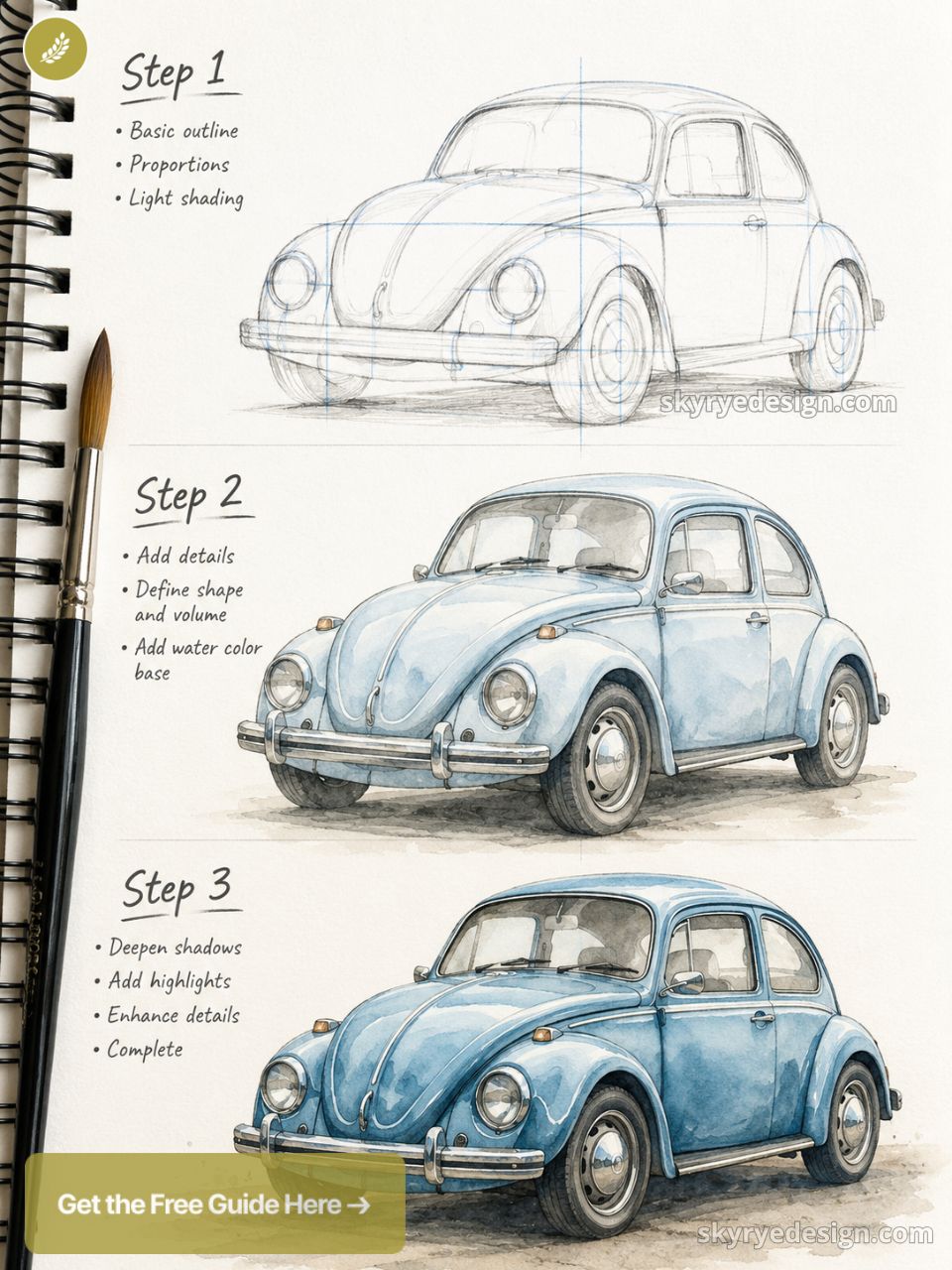
Paper choice matters more than most beginners think
Smooth paper like Strathmore 400 Series Bristol (around $15 for a 19-sheet pad) lets your pencil glide through curves without catching. Textured sketch paper is fine for loose work but tends to break up your line on tight arcs like the Beetle’s roofline. You’ll feel the difference immediately.
Size-wise: start at A5 or roughly half a letter sheet. Small enough that proportions stay manageable, large enough to add the headlight and wheel detail that makes the drawing recognizable.
When to add a pen — and which one
This is optional, but if you want a finished drawing rather than a study sketch, inking over your pencil lines transforms the result. The pen-and-ink Beetle drawings you see on TikTok and Instagram — Paul Heaston’s junkyard sketches, Aaron Thomas’s clean print-ready artwork — all use the same basic approach: Micron pens in two weights.
A Micron 0.05 for fine interior details — window lines, door seams, the VW badge. A Micron 0.3 for the main body contours. The trick Aaron Thomas mentions in his process notes: use heavier line weight on the lower surfaces of the car. The bottom of the wheel arches, the bumper base, the underside of the body. It reads as shadow and gives the car real weight on the page without any shading at all.
Both pens together cost under $10 and last through dozens of drawings. Wait until your pencil construction is fully done and you’re happy with the proportions before touching the pen. Ink is permanent. Pencil isn’t.
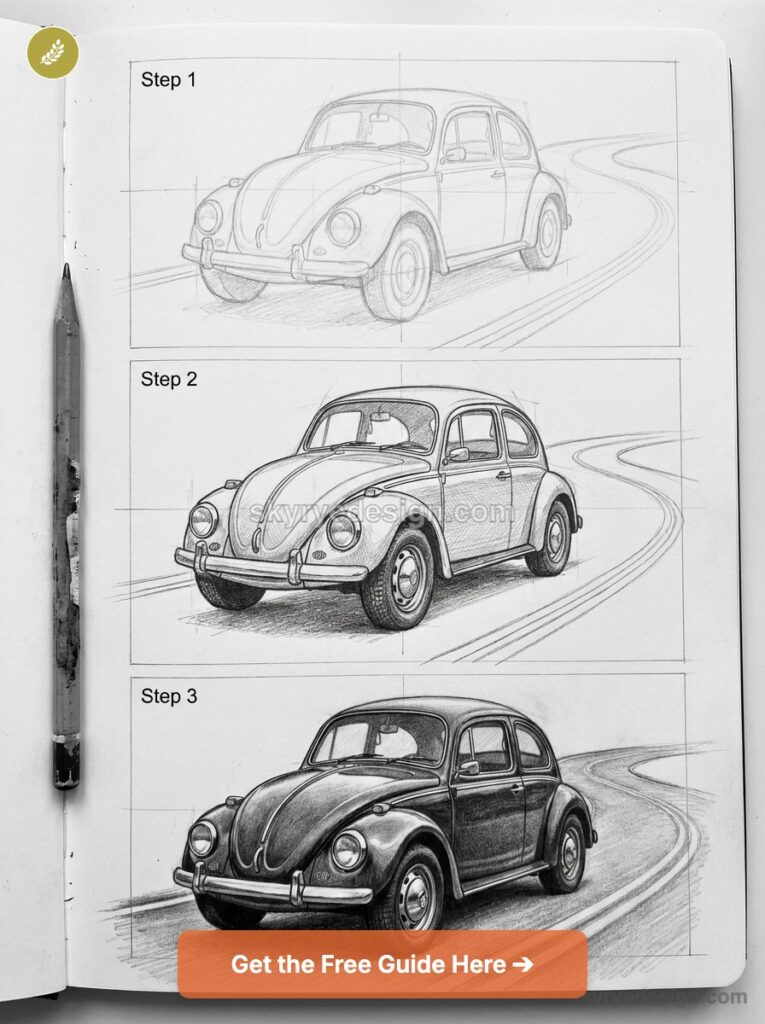
VW Beetle drawing step by step — building the silhouette
This is where most tutorials lose people. They say “draw an oval” and move on. But if the foundation is off, if the arc tension is wrong or the wheels land in the wrong spot, no amount of detail work saves it. So we’re going slow here.
Work light. Everything in this phase is construction, not final linework.
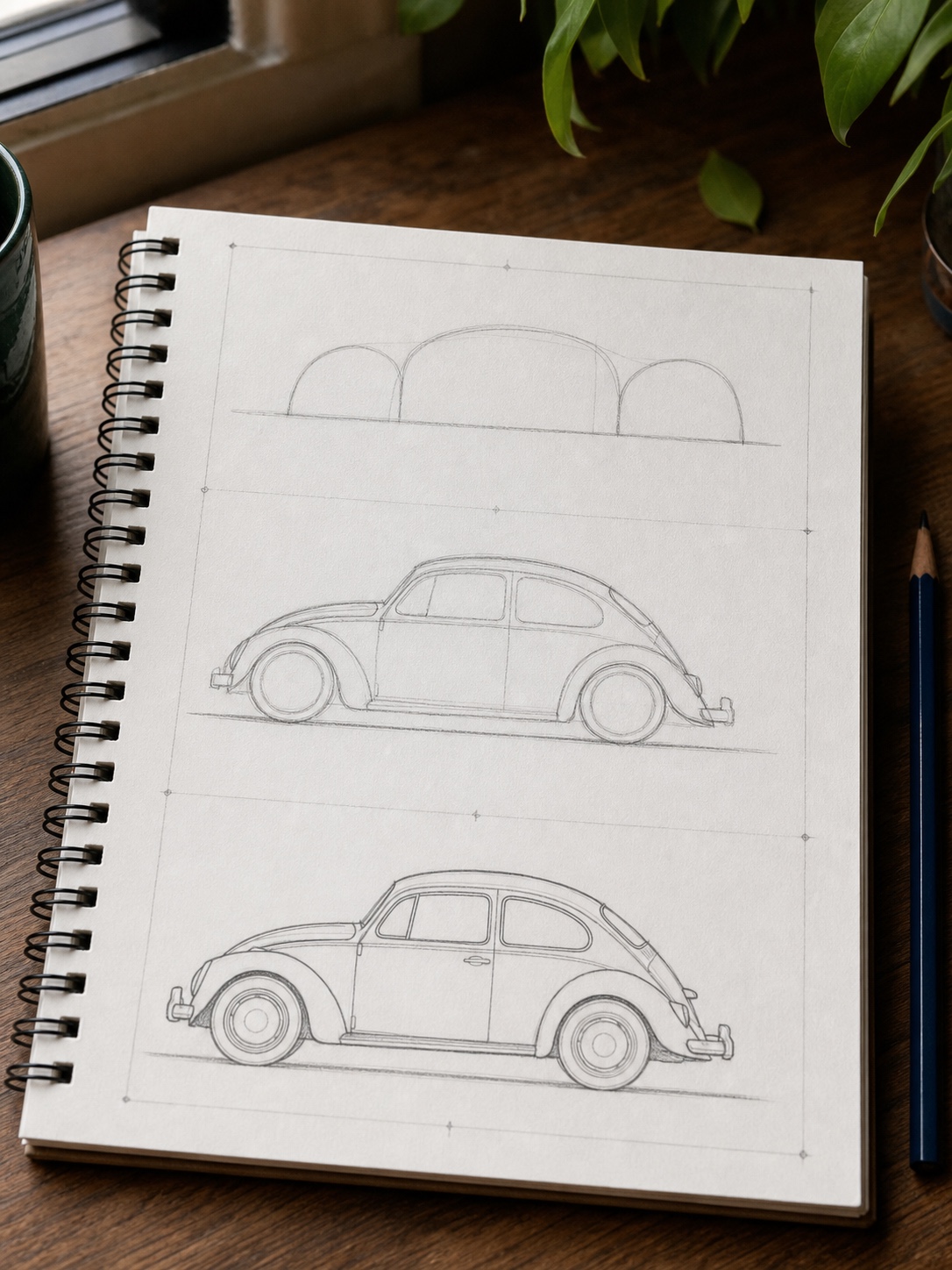
Step 1 — The construction arc (not an oval)
Start with a horizontal baseline — just a light straight line across your paper. This is your ground plane. The Beetle sits on it; don’t skip this step or your car will float.
Now draw the three arcs above it, connecting in sequence. Front arc first: start from a point about 20% in from the left edge of your intended car width, curve upward steeply to where the windshield base will be. Roof arc next: the long gradual dome that peaks slightly left of center (the Beetle’s roof is not centered — the peak sits forward). Rear arc last: drop away from the roof more slowly than the front rose, landing back on the baseline with a gentle tail.
The whole shape should feel like a sleeping beetle seen from the side — wider at the rear third, not perfectly symmetrical front to back.
Step 2 — Placing the wheels and wheel arches
This is where proportion mistakes happen most. Draw your wheel circles while the body arc is still light and adjustable — not after you’ve committed to the outline.
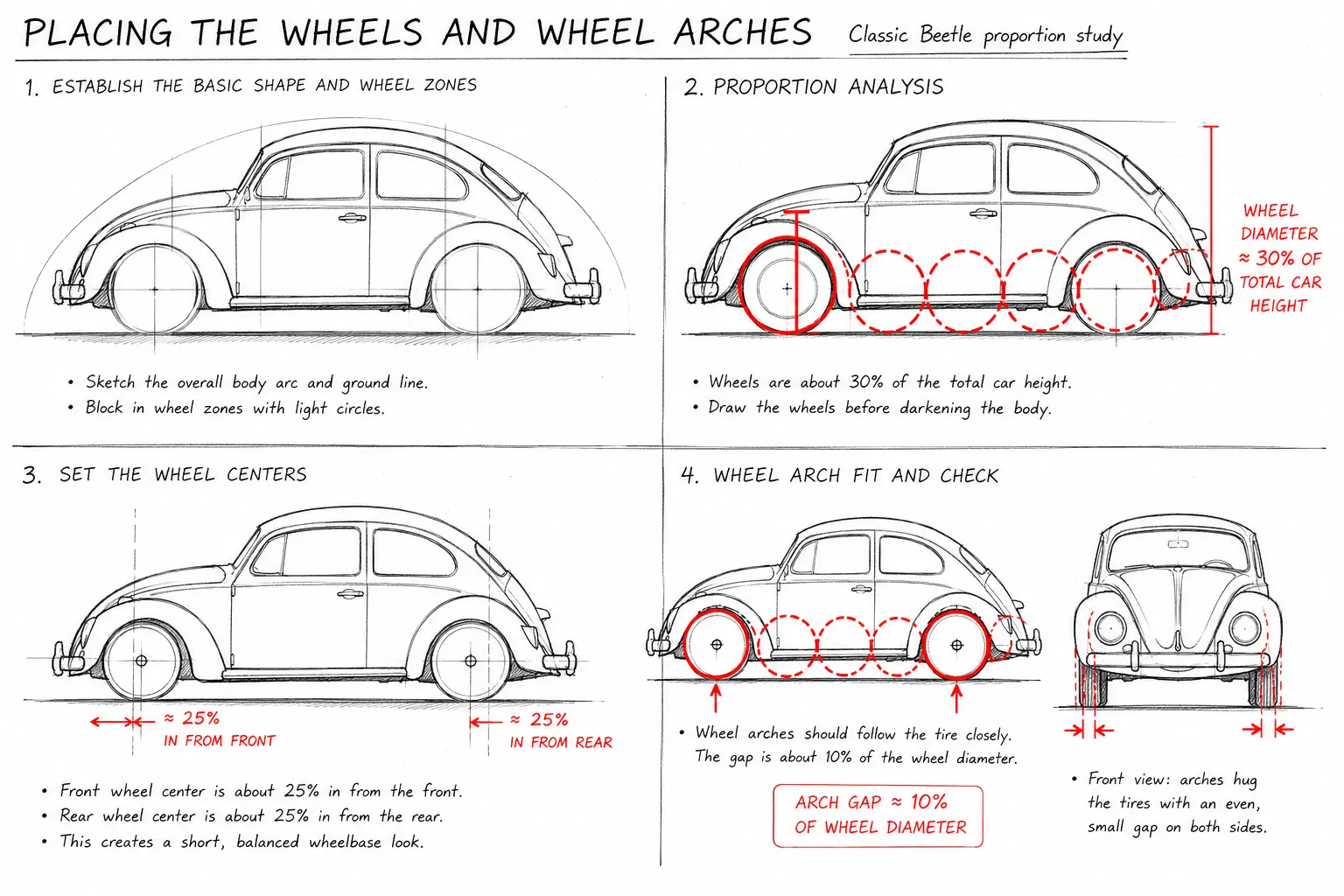
The wheels on the classic Beetle are large relative to the body. A common reference: the wheel diameter is roughly 30% of the car’s total height. Most beginners draw them at 20% and wonder why the car looks like it’s hovering.
Place the front wheel center about 25% in from the left edge of the car. Rear wheel center about 25% in from the right. The wheelbase feels short — because it is. That compact distance between axles is part of what gives the Bug its distinctive crouched stance.
Draw the wheel arches as tight semicircles hugging each wheel. The gap between tire top and arch is minimal on the classic Bug — maybe 10% of wheel diameter. Leave too much gap and it starts looking like a lifted off-road vehicle, which is not the vibe.
Step 3 — The roofline and windshield angle
The windshield on the classic Beetle is steeply raked — more angled than it looks in photos. From the base of the A-pillar to the roof peak, the angle sits around 50–55 degrees from vertical. Get this wrong (too upright) and you’ve drawn a New Beetle by accident.
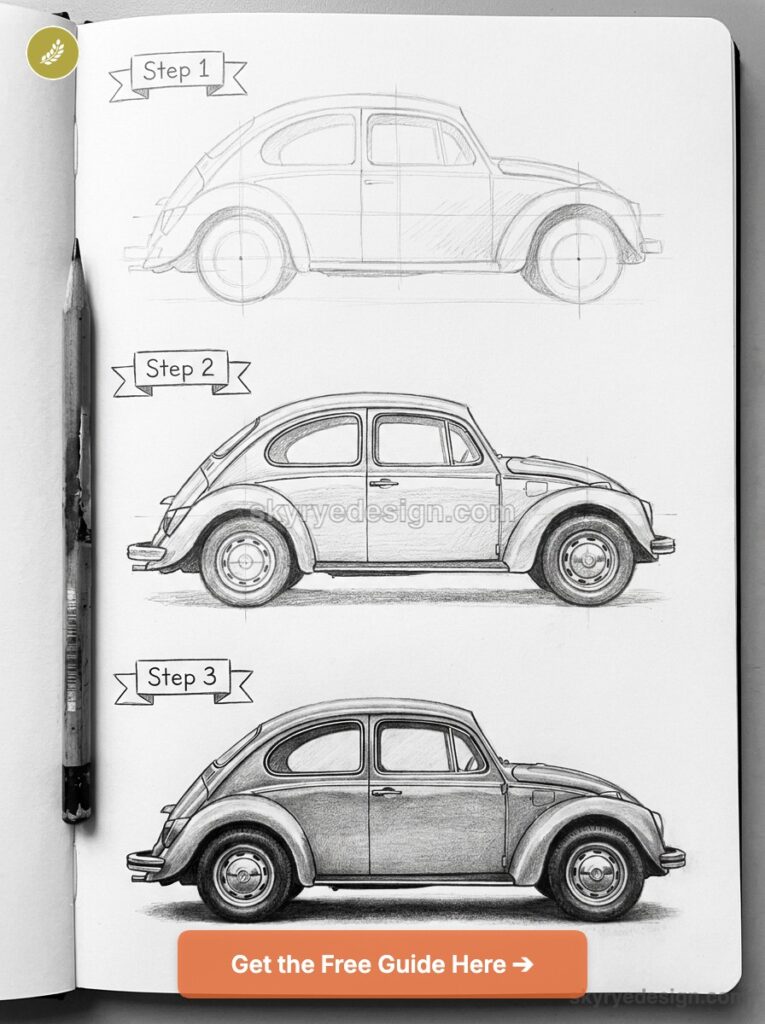
Mark the A-pillar base where your front arc meets the body at roughly door-height. Then angle the windshield line up and back to where your roof arc peaks. The rear window is smaller and more steeply angled than the windshield — that asymmetry is part of the classic Bug’s character.
Proportion check before you add detail
✓ Does the roof peak sit slightly forward of center?
Once the Beetle silhouette feels stable, try a very different body type. A simple SUV car design sketch is good practice for shoulder lines, larger arches, roof rails, and a taller cabin mass.
✓ Are the wheels large enough and close together?
✓ Does the rear feel slightly heavier and fuller than the front?
✓ If yes to all three — you have a Beetle.
Drawing the details that make it recognizable
Once the silhouette is solid, the details are what turn a generic rounded car shape into unmistakably a Beetle. And there are really only three detail zones that matter: the headlights, the front end, and the window and door lines. Get these right and anyone looking at your sketch will name the car in under a second.
The oval headlights — the Beetle’s “eyes”
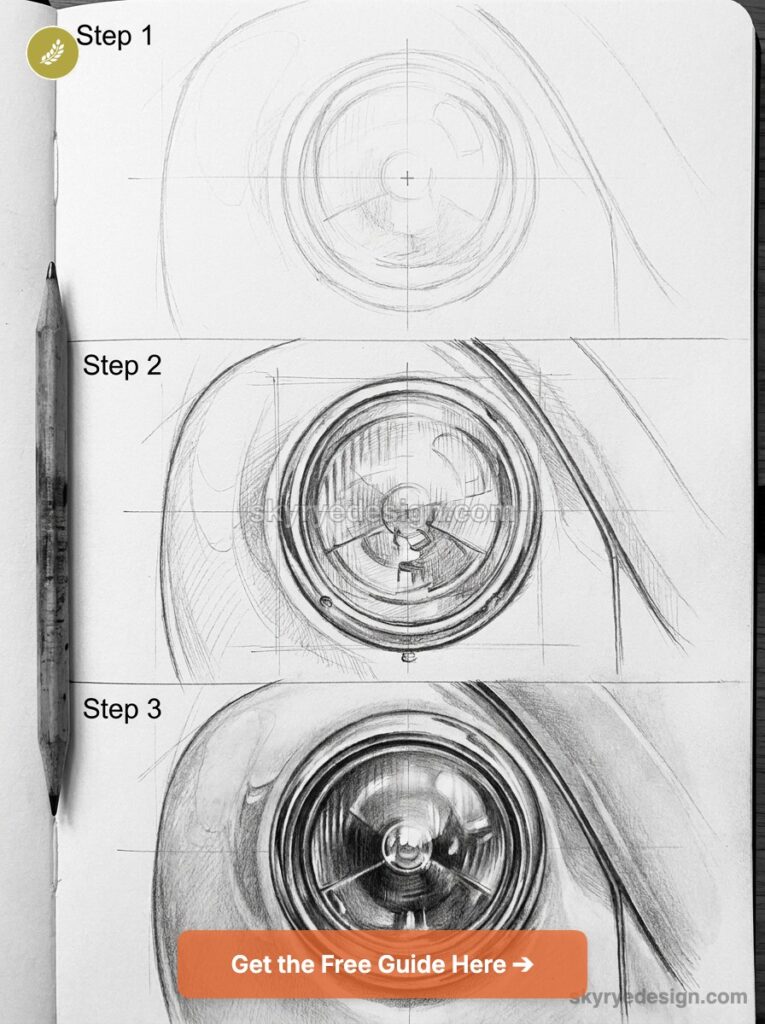
This is the single most important detail on the whole car. The classic Beetle’s headlights are round-to-oval, set into the front fenders rather than the nose — they sit high, almost at the widest point of the front arc, and they face slightly outward. That placement is what gives the Bug its famously friendly, wide-eyed expression.
Draw them as slightly flattened circles — taller than they are wide, with a subtle outward tilt. The outer edge of each headlight sits right at the fender’s widest point. The inner edges are closer together than beginners expect, with a narrow strip of body between them.
Inside each headlight: a smaller circle for the bulb housing, and a thin outer ring for the chrome bezel. That chrome ring, even suggested with a single thin line, is what makes the headlight read as three-dimensional rather than a flat dot.
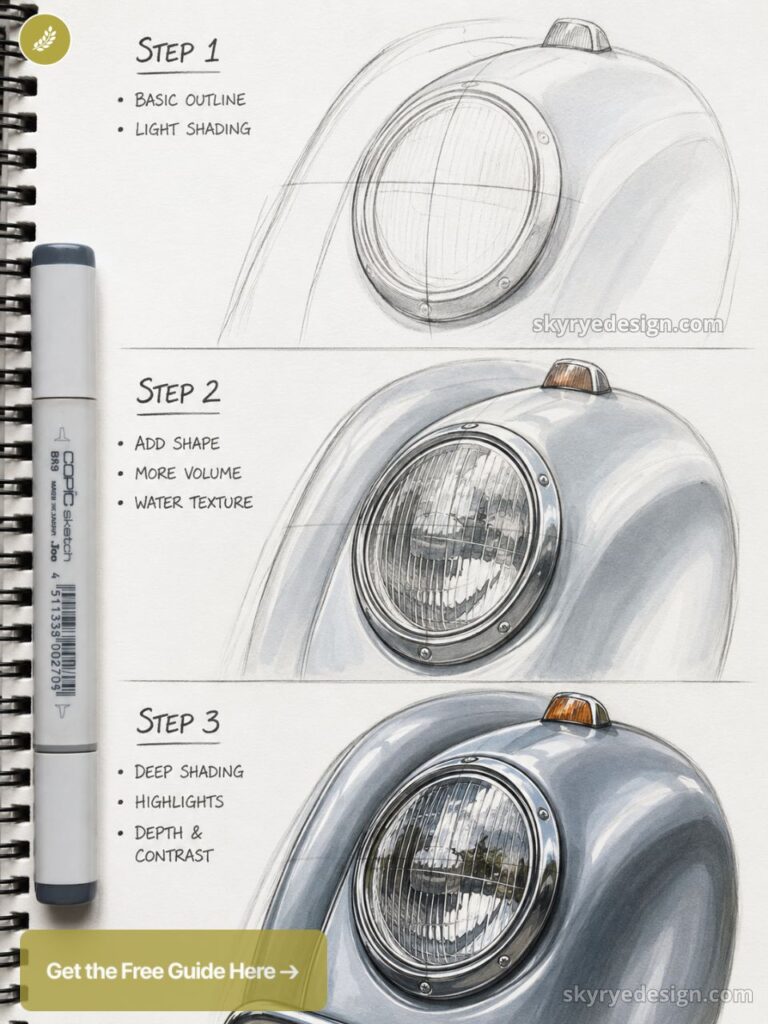
I’ve redrawn Beetle headlights probably a hundred times across different sketches. The most common mistake (besides making them too small) is placing them too low on the front face. Push them up. They should feel almost surprised.
Bumper, grille, and VW badge placement
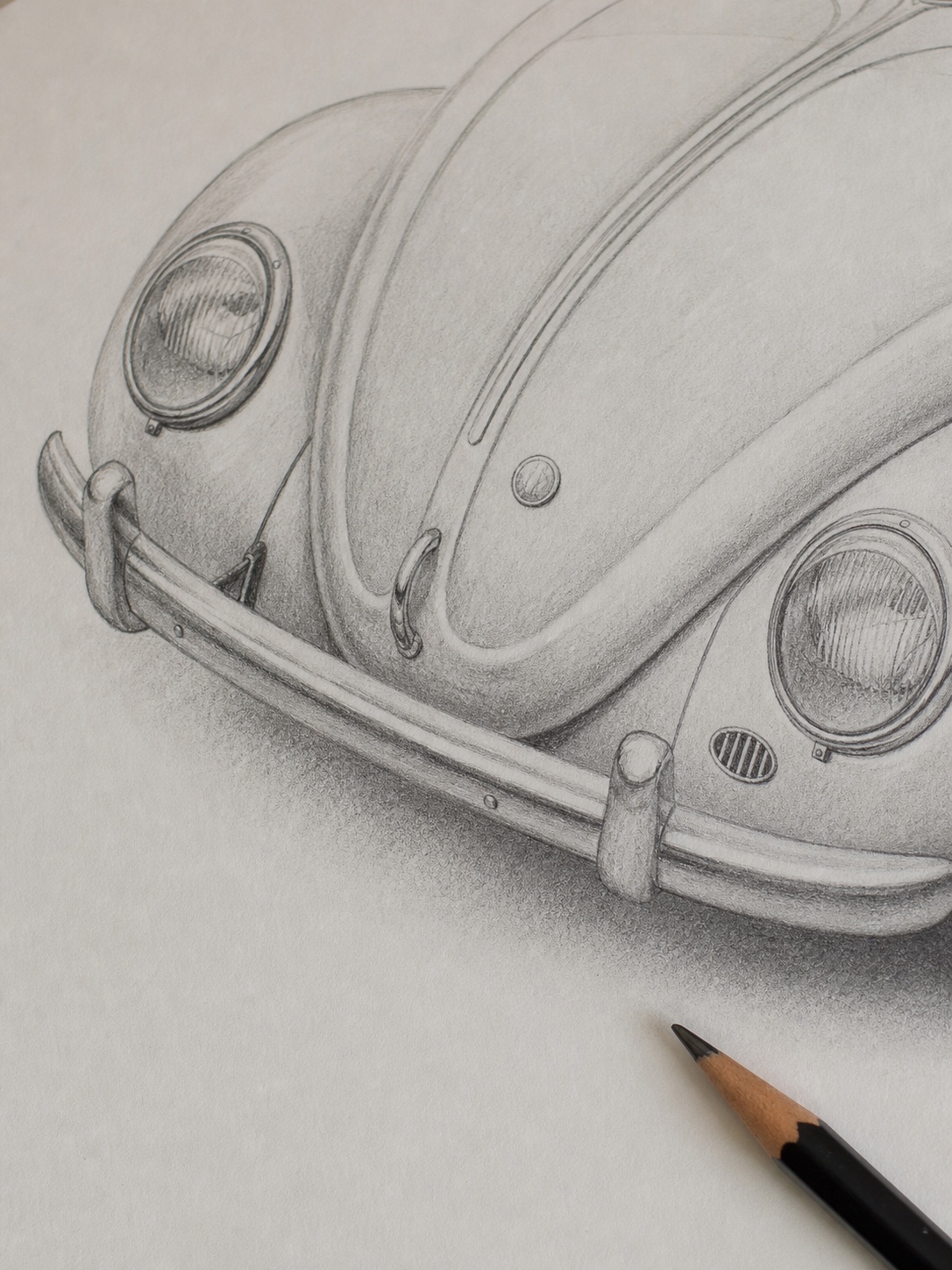
The classic Beetle’s front bumper is a single curved bar that follows the lower arc of the nose. It’s thick and chrome — suggest it with two parallel lines following the body curve, leaving a slight gap between bumper and body. Below the bumper, a small lip. Between the bumper and the hood base, a narrow grille opening on early models, or a smooth body panel on later ones.
The VW badge sits centered on the hood, roughly two-thirds up from the bumper line. It’s small — don’t overdraw it. A circle with the VW letterform inside is enough. At sketch scale, even just a circle with a faint cross division reads correctly.
One thing that trips people up: the hood on the classic Beetle is the front hood — but it’s actually the luggage compartment, not the engine. The engine sits in the rear. This matters for drawing because the front hood has a slightly different curvature than you’d expect from an engine bay design. It’s rounder, lighter-looking, with no aggressive power bulge.
Windows and door seam lines
The side window on the classic Bug is one continuous piece of glass — no quarter window, no complex division. It’s a simple trapezoid shape with the wider base at the bottom, following the roofline angle. The rear window is smaller and more oval, almost porthole-like on early models.
Door seams are subtle on the Beetle — the car doesn’t have dramatic character lines like modern vehicles. A single light line from just behind the A-pillar down to the sill is enough. Add the door handle as a small horizontal rectangle, placed about halfway up the door height.
★ Tip: Keep detail lines lighter than your body outline. The Beetle’s appeal is in its smooth, uninterrupted surface — heavy panel lines fight against that.
Shading a curved body — the technique most tutorials skip
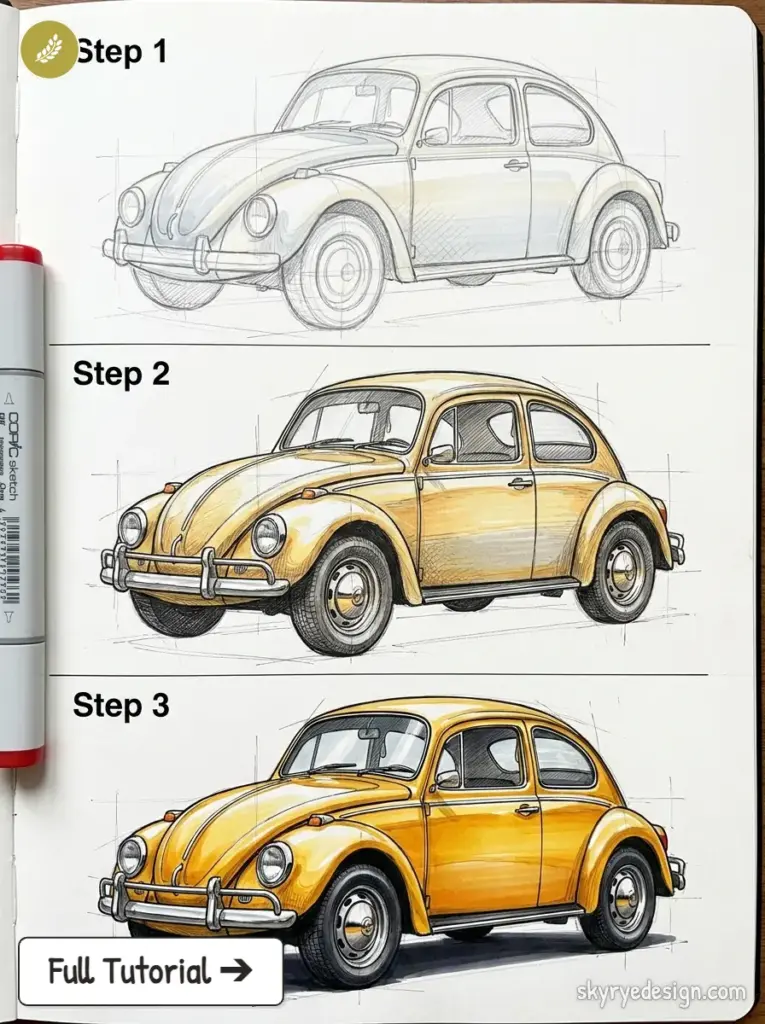
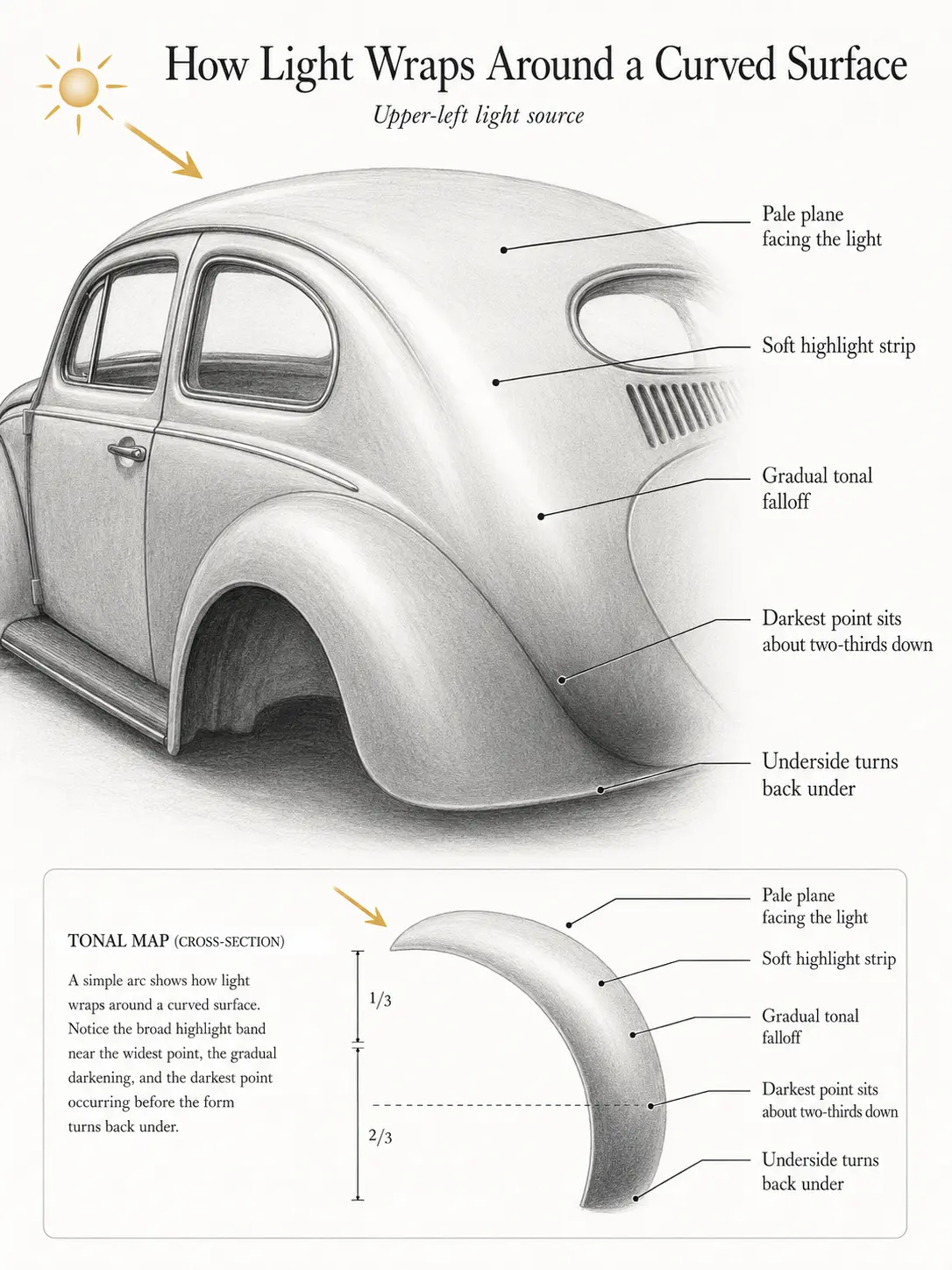
Shading a flat-sided car is straightforward. Pick a light source, darken the panels that face away from it, done. The Beetle doesn’t work like that. Every surface is curved, which means the light doesn’t hit and stop — it wraps, gradually shifting from highlight to midtone to shadow across a single continuous surface. Get this wrong and your beautifully constructed Beetle looks like it’s made of cardboard.
This is the part of car drawing that my academic training in life painting transfers to directly. Curved surfaces behave like cylinders and spheres, not like flat planes. The Beetle’s body is closer to drawing an egg than drawing a box.
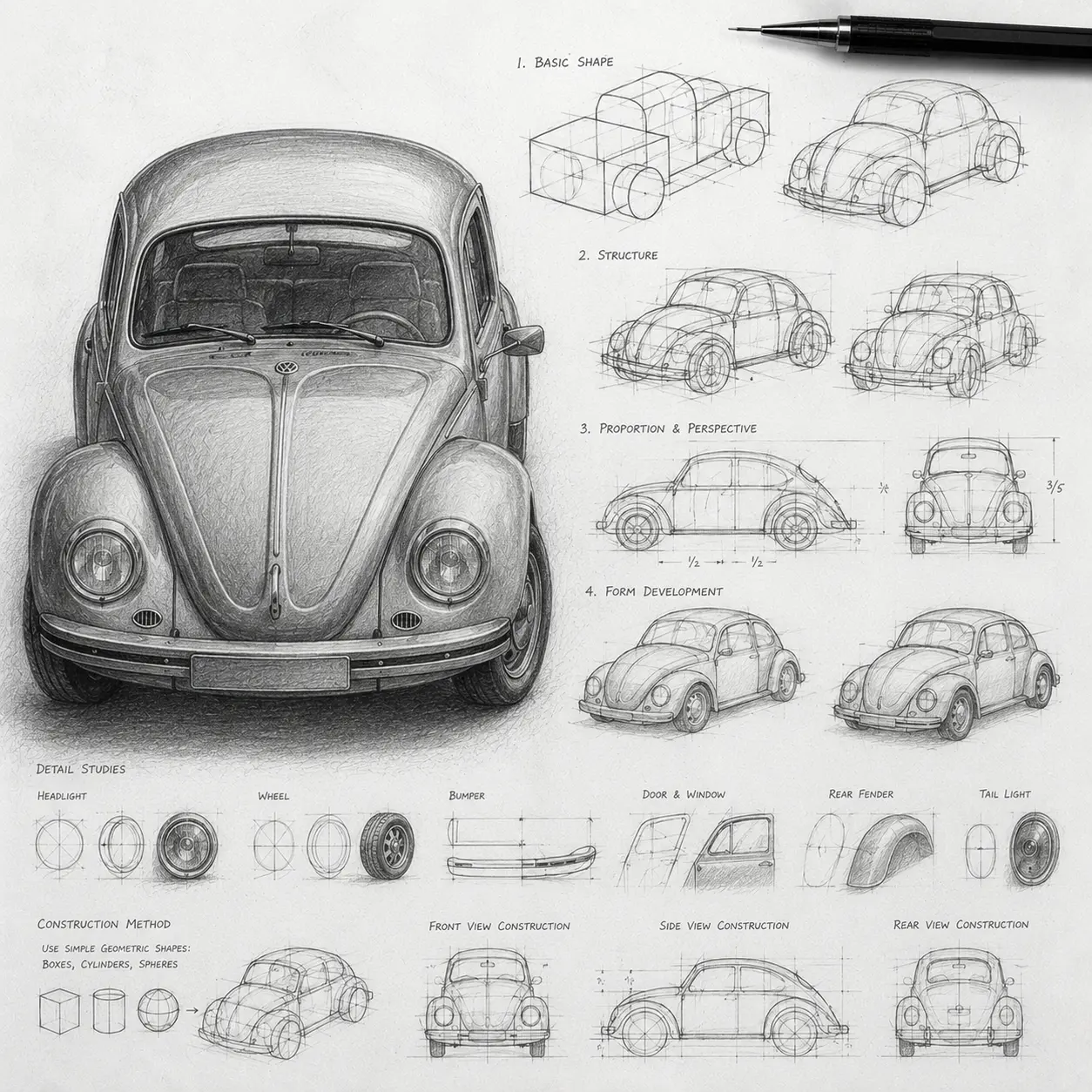
How light wraps around a curved surface
Place your light source at the upper left — it’s the most natural position for a car drawing and matches how most people read depth. On a curved body like the Beetle’s, the highlight isn’t a sharp edge. It’s a gradual strip that runs along the widest point of the body curve — roughly along the equator of that main arc.
Above the highlight strip: the surface faces the light and stays pale, almost white. Below it: the tone deepens gradually as the surface curves away. The darkest point isn’t at the very bottom of the body — it’s about two-thirds of the way down, just before the surface curves back under.
★ Tip: Use your 4B pencil with a light touch and long, curved strokes that follow the body shape. Short scratchy strokes break the illusion of a smooth surface. Think of wrapping your pencil stroke around the form, not across it.
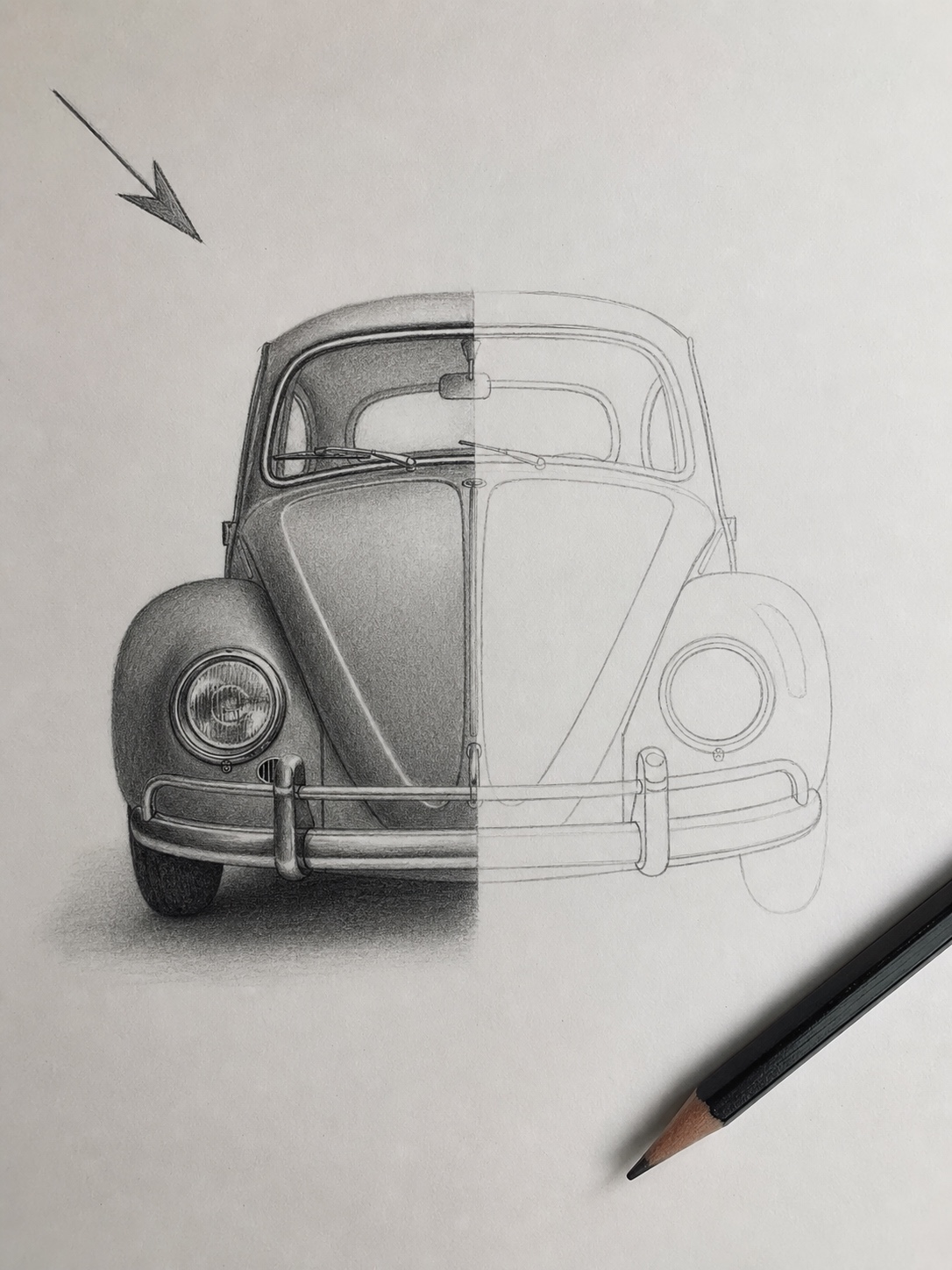
Wheel arches and under-car shadows
The wheel arches are your darkest darks. The concave recess under each arch catches almost no light — go heavy with the 4B here, building up tone in circular strokes that follow the arch curve. Leave a thin sliver of lighter tone right at the tire’s top edge; it separates the tire from the arch shadow and stops the whole area reading as one black blob.
Under the car itself, add a cast shadow on the ground plane. Keep it elliptical and close to the tires — the Beetle sits low, so the shadow hugs the body rather than spreading wide. A grounded car looks planted and real. A car with no ground shadow floats, and floating reads as amateur regardless of how good the linework is.
The highlight strip — where the body catches light
This is the detail that makes a sketch look professional. Along the upper third of the Beetle’s body, following that main roof arc, leave a strip of paper completely untouched. No pencil at all. That bare paper reads as a specular highlight, the point where the curved metal catches the light source directly.
If you’ve already shaded over that area, a kneaded eraser is your fix. Knead it to a fine point and lift the graphite in a thin curved strip. It won’t go back to pure white, but a lifted highlight still reads correctly against the surrounding tone.
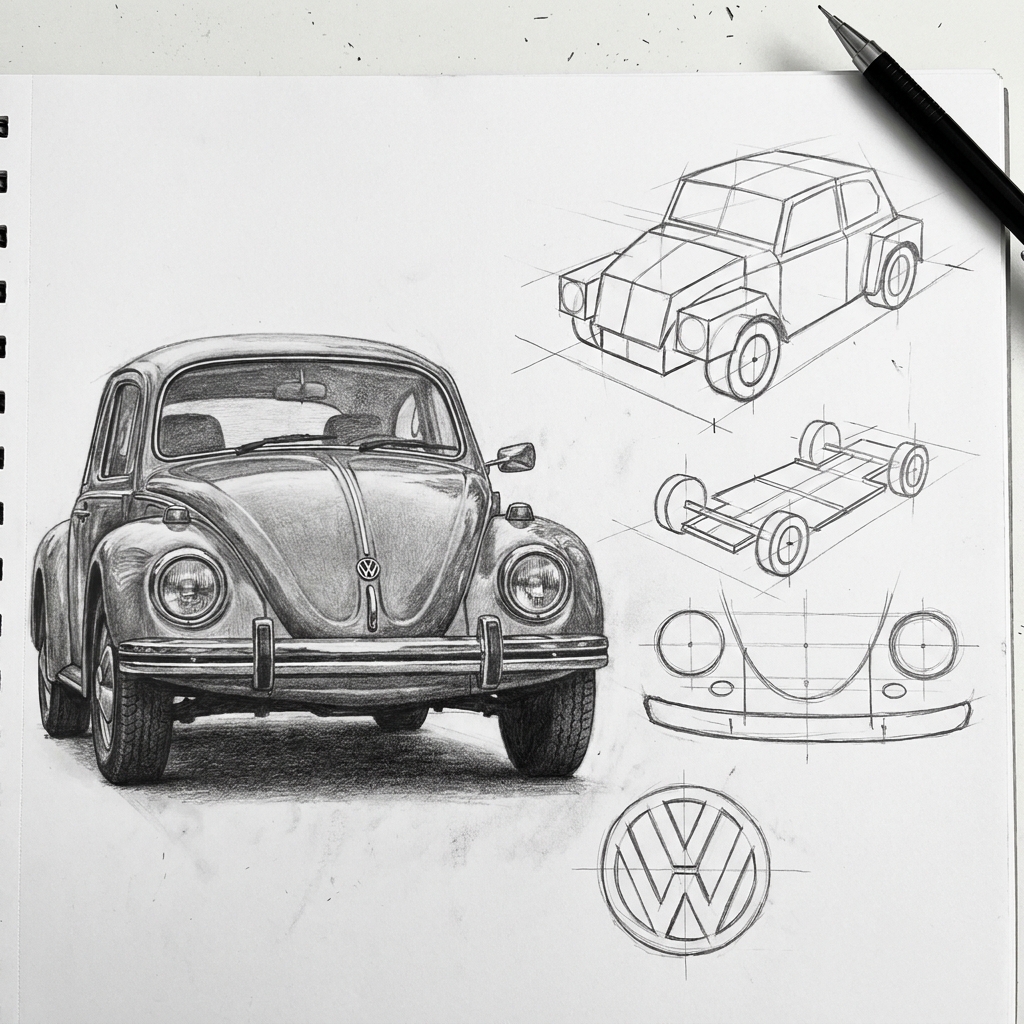
On the hood and rear deck, add smaller secondary highlights — shorter strips, slightly less bright. Real car bodywork has multiple highlight zones because the surface changes direction subtly even within what looks like a single panel.
Finishing in pen-and-ink (optional but satisfying)
You can stop at the pencil stage and have a perfectly good drawing. But if you’ve ever seen a finished pen-and-ink car sketch and wondered how it gets that clean, confident look (the kind that reads as intentional artwork rather than a practice study), the answer is simpler than you’d expect. It’s mostly about line weight, not line quantity.
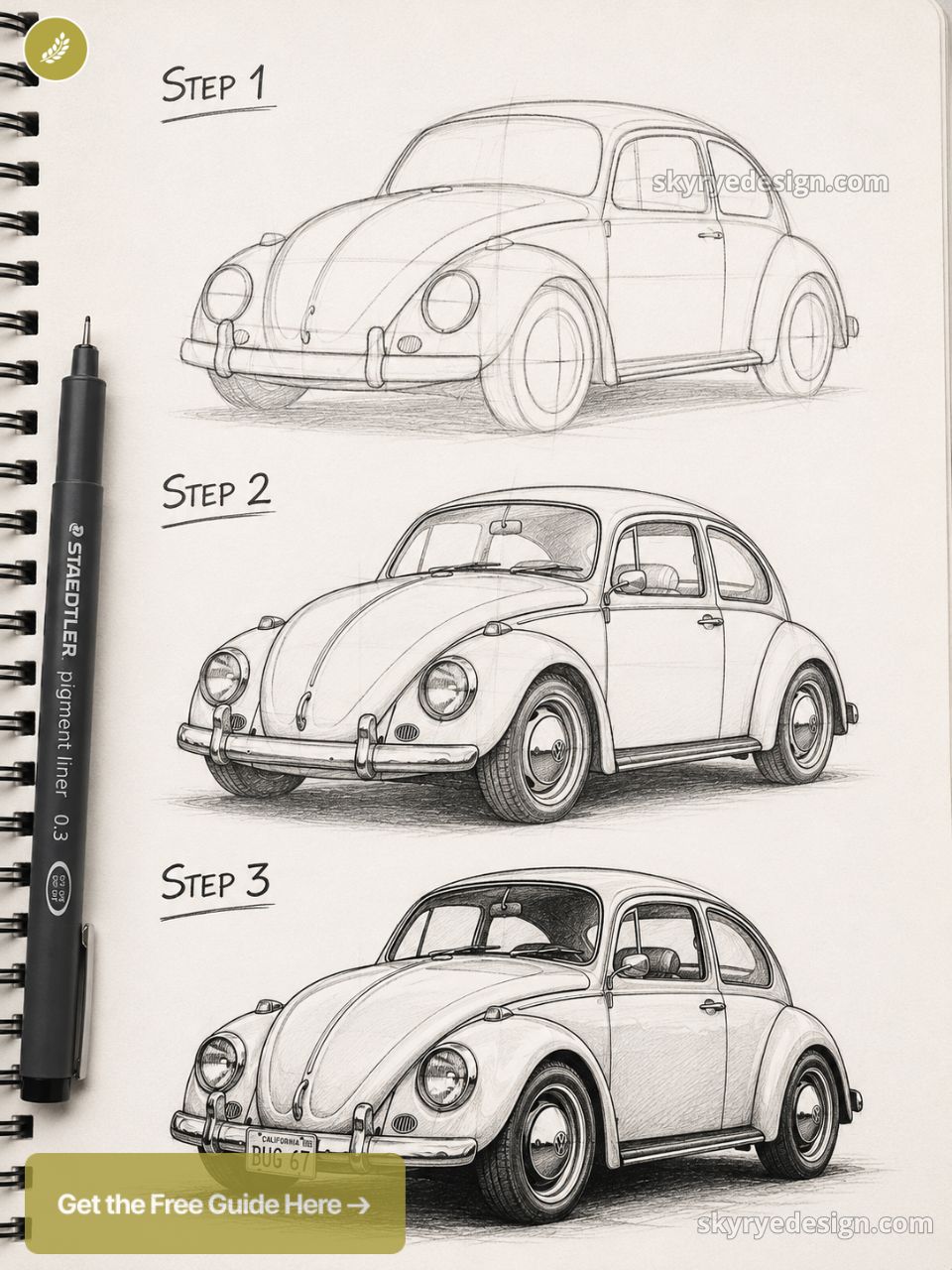
The Beetle is ideal for pen-and-ink work because of those heavily sweeping lines. Most traditional cars have gentle, gradual curves — the Beetle’s arcs have real tension and direction, which means your pen strokes have somewhere to go. The result feels dynamic even when the car is static on the page.
Why heavier line weight at the bottom reads as depth
This is the single most useful pen-and-ink principle for car drawing, and almost nobody explains it in beginner tutorials.
Lines at the top of the car (roofline, window edges, hood surface) stay thin. Use the Micron 0.05 here. Lines at the bottom (wheel arch undersides, bumper base, body sill, ground shadow edge) go heavier. Micron 0.3 or even 0.5. The visual logic is simple: gravity and shadow both live at the bottom of objects. Heavier lines there reinforce what the eye already expects, and the drawing gains a sense of weight and solidity without a single shading stroke.
I noticed this first looking at technical automotive illustration from the 1960s — the era when the actual Beetle was being sold. Those commercial drawings used exactly this technique to make cars look three-dimensional in black-and-white print ads.
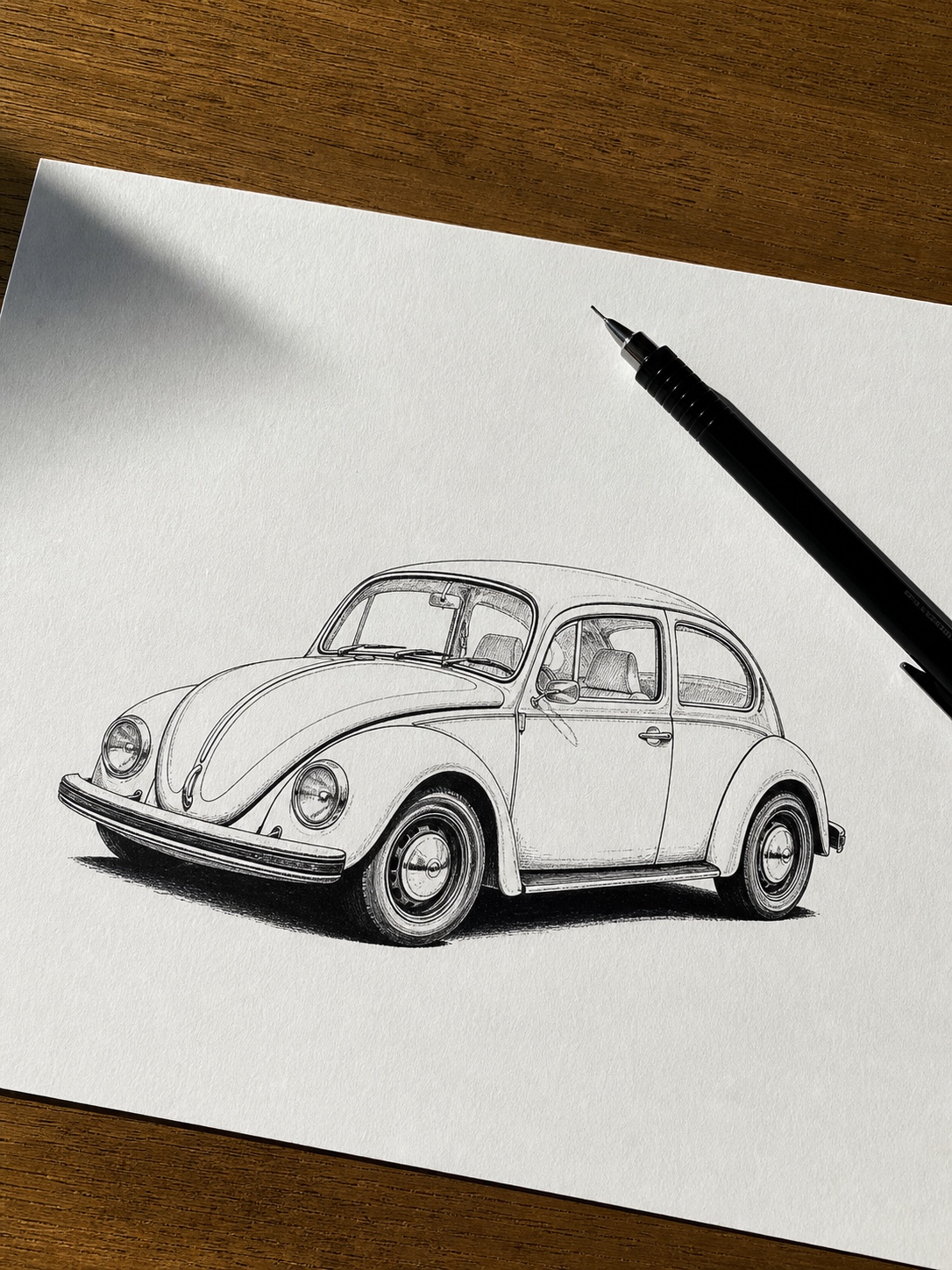
Micron pen technique for the Beetle’s curves
The temptation with a pen is to go slow and careful. For straight lines, that works. For curves (the Beetle’s entire body), slow and careful produces a shaky, hesitant line that looks worse than a confident quick stroke.
Practice the main body arc on scrap paper first. Anchor your elbow, not your wrist, and swing through the curve in one motion. Three or four practice strokes until it feels smooth, then commit to the drawing. Aaron Thomas, whose pen-and-ink Beetle prints sell at car shows, lines the entire car with Micron pens after a pencil sketch — using heavier weights on lower surfaces to give the car real depth on the page.
Ink the body contours first. Then the wheel arches. Then the windows and interior lines. Leave the fine details (badge, door handle, headlight rings) for last, when the major lines are locked in and you can judge how much detail the drawing actually needs.
Adding a drop shadow to ground the car
Once the car itself is inked, add a simple elliptical shadow beneath it. Use the 0.3 pen and fill it solid, or build it up with close parallel lines if you want a softer effect. Keep it tight to the tires — the Beetle’s low ride height means the shadow stays compact.
This single addition does more for the finished look than almost any other detail. It anchors the car to a surface, turns a floating sketch into a scene, and takes about ninety seconds.
★ Tip: Erase all pencil construction lines once the ink is fully dry — at least ten minutes for Micron on smooth Bristol. What’s left is a clean, finished drawing that looks like you knew exactly what you were doing from the first stroke.
Common mistakes — and how to fix them before you erase
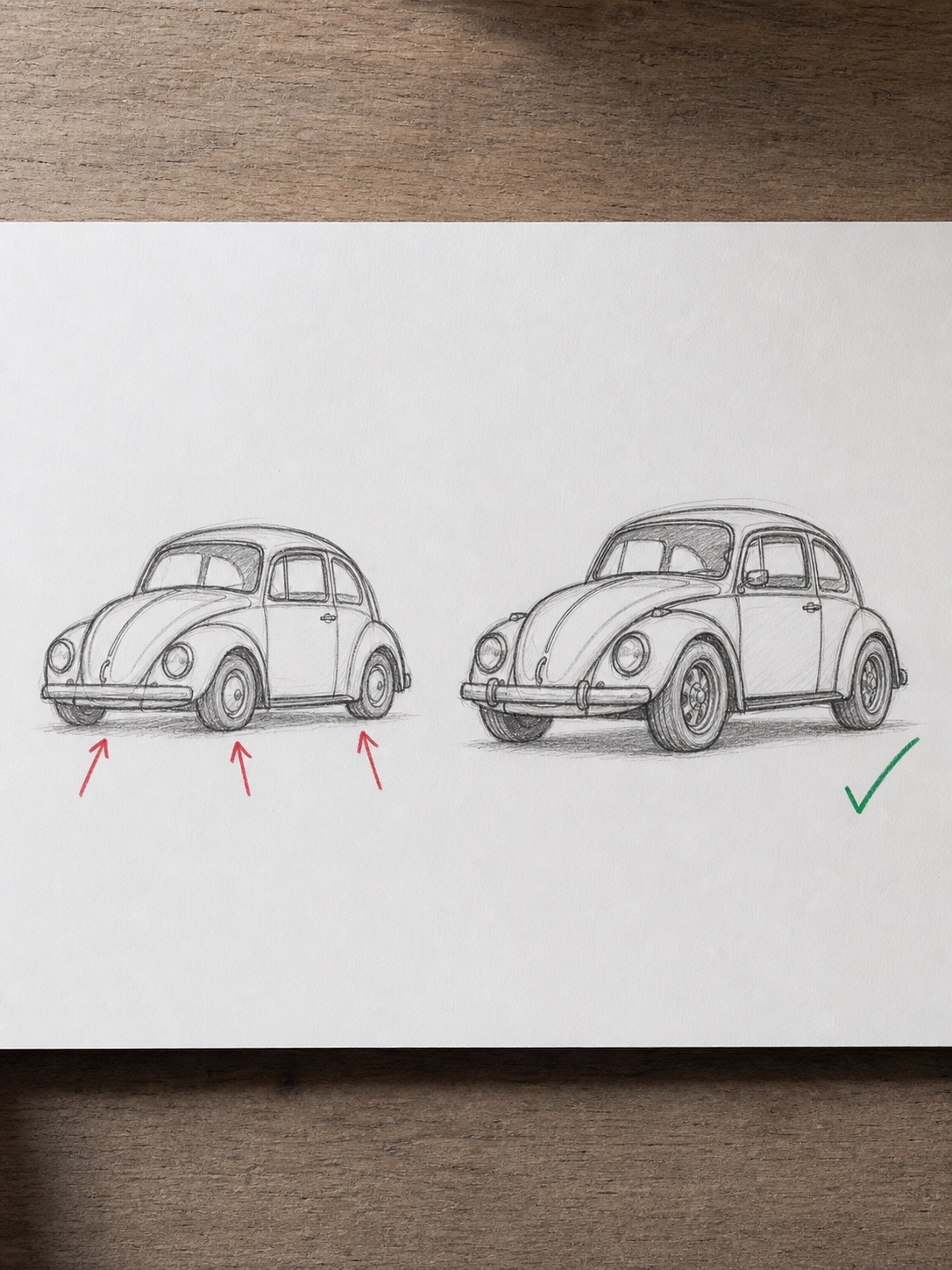
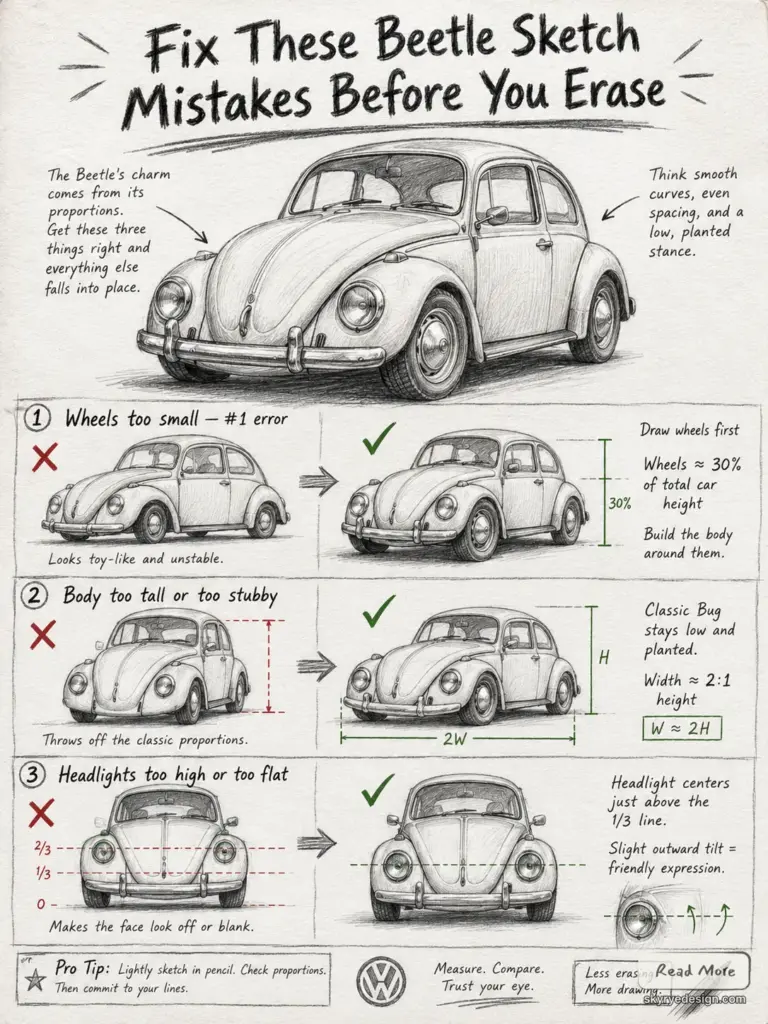
Every car drawing tutorial shows you what to do. Few bother telling you what goes wrong and why. After sketching cars for years and watching students make the same errors on repeat, I can tell you the mistakes cluster around three things: wheel size, body proportions, and headlight placement. Fix these and 80% of “why does it look wrong” problems disappear.
Wheels too small — the #1 error
This is so common it’s almost universal among first-time car sketchers. Beginners consistently draw wheels at roughly half the size they should be, then wonder why the car looks like a toy.
The fix is to draw your wheels before you commit to the body outline. Get the circles down first at roughly 30% of total car height, and build the body around them. If you draw the body first, your brain anchors to that shape and your wheels shrink to fit the space you’ve left rather than their correct size.
★ Tip: Hold your pencil horizontally across the drawing at wheel-center height. The wheel should reach noticeably above and below that line. If it barely clears, it’s too small.
Body too tall or too stubby
The second most common issue. Beginners stretch the Beetle vertically — probably because the rounded shape reads as “big and puffy” and the hand follows that impression. The classic Bug is actually a low, planted car. That 2:1 width-to-height ratio keeps it grounded.
If your Beetle looks more like a ladybug than a car, measure the width against the height right on your paper. Width should be roughly double. If it isn’t, the roofline is sitting too high. Lower it — or better, restart the construction arc from scratch rather than trying to push a completed silhouette down. Squashing an existing drawing rarely works cleanly.
Headlights placed too high or too flat
The third classic error — and the one that most changes the car’s personality. Headlights placed too high on the front face push toward the hood and make the Beetle look angry or aggressive, which is completely wrong for this car. Too flat (not enough outward tilt) and they lose their wide-eyed quality and read as generic round lights.
The fix: before drawing the headlights, mark a light horizontal guideline at roughly one-third up from the bumper line on the front face. The headlight centers sit just above that line. Then tilt each light slightly outward — the outer edge higher than the inner edge by just a few degrees. That subtle tilt is what gives the Beetle its famously friendly expression.
If something still feels off after placing them correctly by measurement, trust the feeling. The Beetle’s headlights have a specific emotional quality that you’ll start to recognize after a few attempts. When they look slightly surprised and open — you’ve got it.
Start with the silhouette, trust the geometry
The Beetle rewards patience with its geometry. Once you see those three arcs (front, roof, rear) and understand how they connect at specific tension points, the whole drawing stops feeling like guesswork. You’re not copying a shape anymore. You’re constructing one.
Start with the classic ’67 Bug. It’s more forgiving than the New Beetle, more iconic on the page, and the proportion logic is cleaner to work with. Sketch it small first — business-card size, just to feel the silhouette in your hand. Then go larger and add the details: the oval headlights, the tight wheel arches, the gradual shading that wraps around the body instead of stopping at an edge.
If you want to take it further, try the pen-and-ink finish. Vary your line weights, ground the car with a shadow, and erase the pencil construction once the ink dries. What you’ll have isn’t just a practice sketch — it’s a finished drawing of one of the most emotionally loaded shapes in automotive history.
And if the first one looks off, draw it again. The Beetle is one of those subjects that gets noticeably better between attempt one and attempt three. The shape starts living in your hand.
Share your result in the comments — I’d genuinely like to see what you draw.
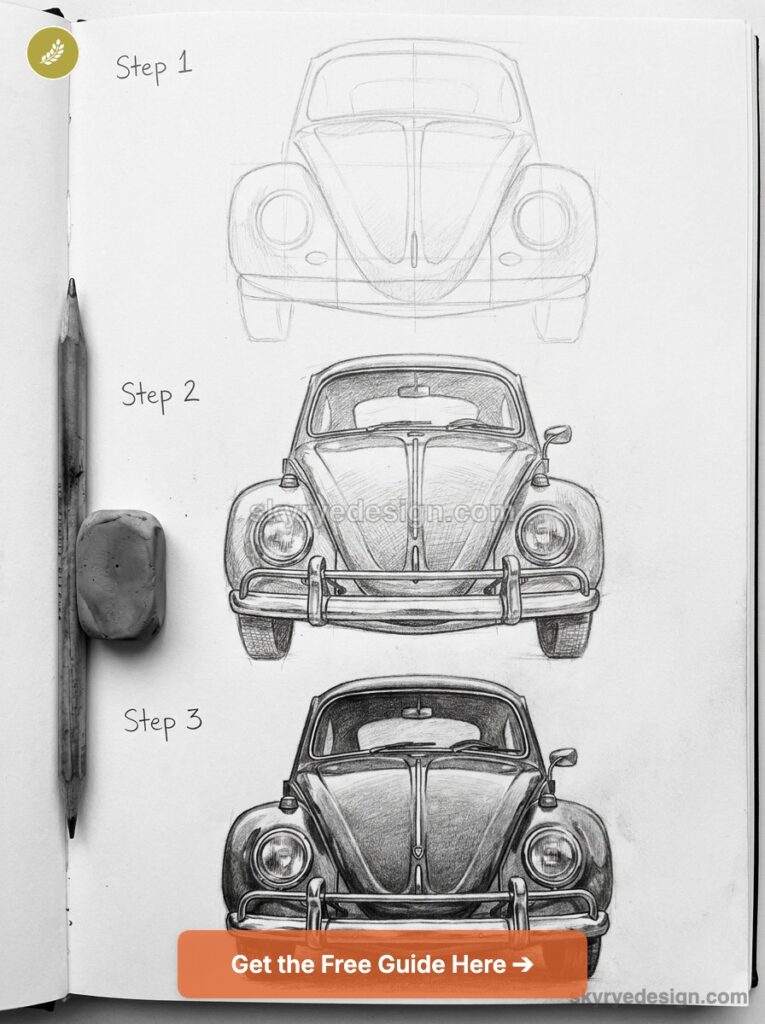
For another rounded vehicle silhouette, try an easy helicopter sketch after the Beetle; it trains the same curve control but adds rotor symmetry and landing skids.
Related car drawing practice
After this VW Beetle drawing, use the same construction checks on a broader car drawing tutorial, a vintage car drawing, and sharper bodies like the BMW M3 drawing, Lamborghini drawing guide, and Corvette drawing guide.
For bigger proportion contrast, compare the Bug with an SUV car design sketch, an Aston Martin drawing guide, a longer Rolls-Royce drawing guide, the Porsche 911 GT3 RS drawing tutorial, and a blockier Dodge Charger drawing. Then come back to the Beetle and check whether the roof arc still reads cleanly.
Frequently asked questions
How do you start a VW Beetle drawing for beginners?
Start a VW Beetle drawing with the three-arc silhouette: front arc, roof arc, and rear arc meeting above the windshield and rear window. Add the wheel circles next, about 30% of the car height, then build the body around them. Keep the first pass light with a 2H pencil so you can adjust the roof peak, wheelbase, and headlight placement before adding detail.
What’s the difference between drawing the classic Beetle and the New Beetle?
The classic Bug (1938–2003) is lower, wider, and has a roof peak that sits slightly forward of center — giving it that crouched, planted stance. The New Beetle (1998–2010) is taller and more upright, with a higher roofline, more vertical windshield, and a boxier lower body (it sits on a Golf platform). For a first attempt, the classic is more forgiving. The New Beetle’s proportions are closer to a cartoon bubble — easier to identify but harder to make look grounded and real.
What pencils should I use for a car drawing?
Two pencils cover everything. A 2H for construction lines — light enough to erase cleanly without digging into the paper. A 2B or 4B for shading and final linework — soft enough to produce smooth dark tones without pressing hard, which keeps your curves clean. Staedtler Mars Lumograph is a reliable choice at around $2–3 per pencil. Skip mechanical pencils for this subject — the consistent line weight works against the natural variation you want on organic curves.
How do I draw car wheels so they look round?
Anchor your elbow rather than your wrist and swing through the circle in one motion — the same technique used for inking curves. Practice on scrap paper first. For the Beetle specifically, draw the full wheel circle before placing the body outline, not after. The most common error is drawing wheels too small; the diameter should be roughly 30% of the car’s total height. Once the circle is placed, add the wheel arch as a tight semicircle hugging the top of the tire with minimal gap.
How do I shade a curved car body like the Beetle’s?
Think cylinders, not flat planes. Place your light source upper left, then find the highlight strip — the line along the body’s widest point where the curved surface faces the light directly. Leave that strip as bare paper. Above it, keep the tone pale. Below it, deepen gradually with long curved 4B strokes that follow the body shape, not across it. The darkest tone sits about two-thirds down the body, just before the surface curves back under. Wheel arch recesses go darkest of all.
Can I draw a Beetle with just a ballpoint pen?
Yes — ballpoint actually works well for car sketching because you can vary pressure to build tone gradually. The limitation is that you can’t erase, so your construction needs to be confident before you commit. Some urban sketchers like Paul Heaston use fountain pen with ink wash for Beetle sketches, which gives beautiful tonal range. If you’re going straight to pen without pencil construction underneath, simplify — focus on the silhouette and the key details (headlights, wheel arches) rather than trying to render every surface.
How long does it take to learn to draw cars?
A recognizable car sketch is achievable in your first session if you follow the right construction method. A drawing you’re genuinely proud of (solid proportions, clean linework, decent shading) typically takes 3–5 focused practice sessions for someone with basic drawing experience. The Beetle is one of the better starting points because the rounded silhouette is forgiving and the car is so iconic that even an imperfect version reads immediately. The jump from recognition to mastery is mostly about proportion awareness, which develops fast with repetition.
- 1.8Kshares
- Facebook0
- Pinterest1.8K
- Twitter3
- Reddit0