Learning how to draw a waterfall is easier when you stop treating the water like an outline and start treating it like movement. A convincing waterfall drawing needs three things to work together: a clear fall direction, hard rock shapes around the water, and light mist or splash at the base.
I usually start with the value pattern before the details: dark rocks, pale falling water, and the brightest whites saved for foam and spray. That simple contrast keeps the drawing readable even before you add trees, cliffs, or background mountains.
- How to draw a waterfall step by step
- What Supplies Do You Need to Draw a Waterfall?
- Step 1: Plan the Waterfall Composition
- Step 2: Draw the Basic Shape of the Waterfall
- Step 3: Sketch the Cliff and Rocks
- Step 4: Add Flow Lines to the Water
- Step 5: Draw the Splash and Mist at the Bottom
- Step 6: Shade the Rocks for Depth
- Step 7: Shade the Waterfall (Less Is More)
- Step 8: Add Background Elements (Optional)
- How to Draw a Waterfall Realistically
- How to Draw a Waterfall for Beginners
- How to Draw a Waterfall with Pencil, Pen, or Digital Tools
- Common Mistakes When Drawing Waterfalls
- Practice Exercise: 10-Minute Waterfall Sketch
- Frequently Asked Questions
- Related drawing practice
- Final Thoughts: Anyone Can Draw a Waterfall
This guide will teach you how to draw a waterfall from start to finish, whether you’re sketching with pencil, pen, or digital tools. By the end, you’ll know how to create flowing water, believable rocks, depth, and atmosphere.
How to draw a waterfall step by step
Drawing a waterfall is easier once you stop trying to draw water and start treating it as three separate problems: the fall, the rocks, and the spray at the base. That mental split is actually the whole trick.
Start with a light vertical guide to set the direction. Then sketch the water as uneven ribbons — loose, slightly irregular, nothing close to a rectangle. Symmetry is the most common mistake I see in beginner waterfall drawings. Real falls pull unevenly depending on the rock underneath, and that asymmetry is what makes them look like water instead of a frosted window.
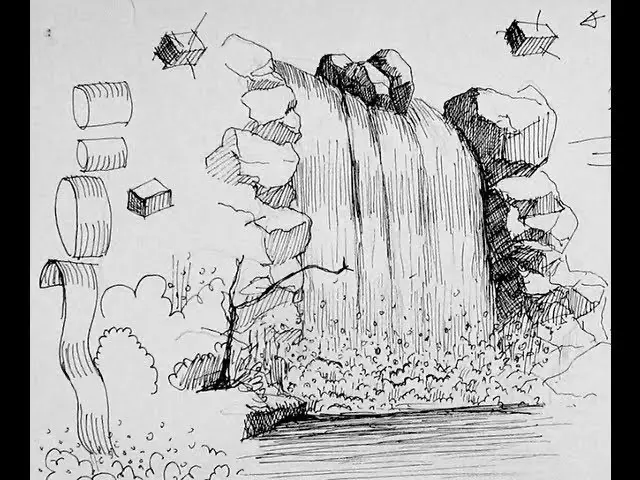
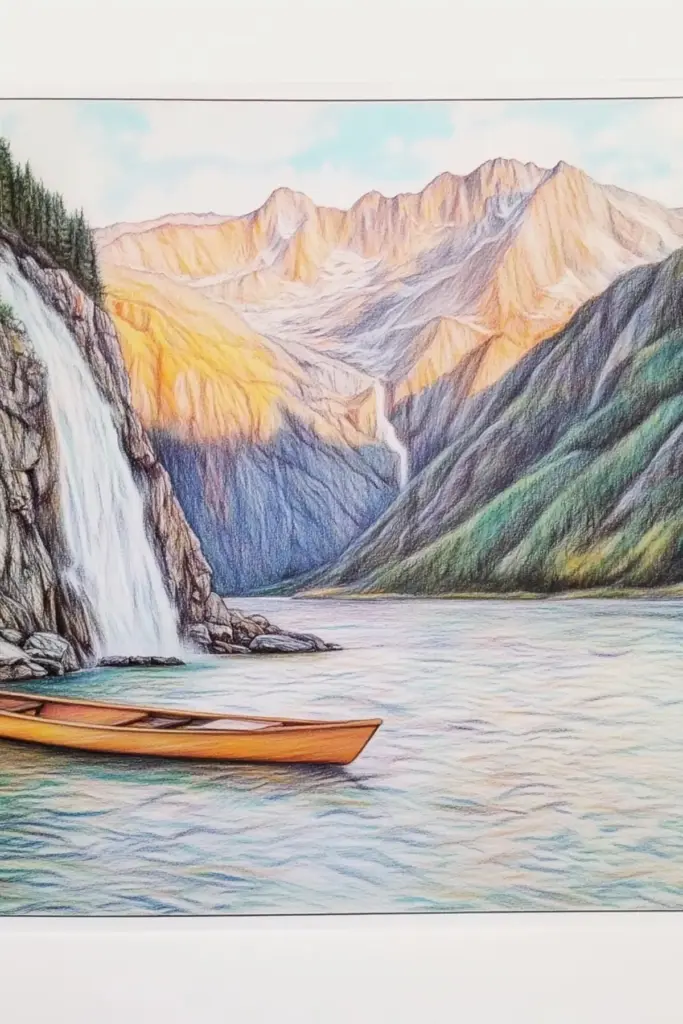
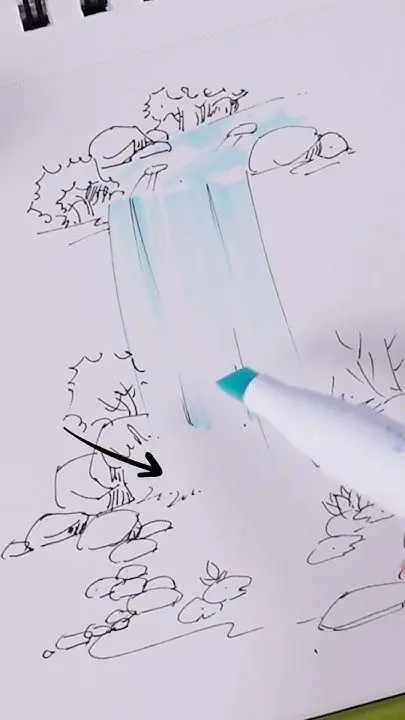
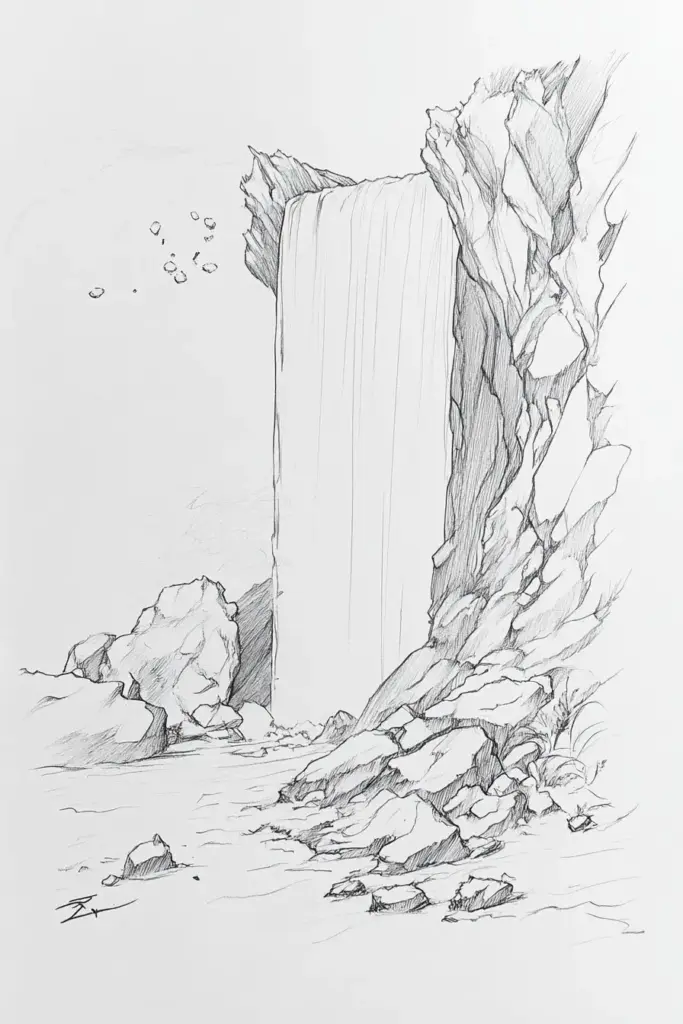
Rocks go in next, angular and dark on both sides. Once those are placed, go back into the water with long vertical strokes. Lighter through the center, a bit darker at the edges where the water thins and the rock shows through underneath.
The base trips people up. Most stop before the spray reads as spray. A few short curved marks, some scattered dots, and one or two areas where you’ve lifted pigment with an eraser — that’s enough. It should feel unresolved, honestly. Overworked spray looks worse than no spray at all.
Last thing: if the waterfall isn’t reading as transparent and moving, the rocks probably aren’t dark enough. That contrast is doing more work than any individual line.
After practicing water movement, switch to a slower natural subject with this peony drawing guide. It uses the same value discipline, but the shadows sit between petals instead of rocks and falling water.
Waterfall drawing steps at a glance
| Step | What to draw | Why it matters |
|---|---|---|
| 1 | Light vertical guide | Sets the fall direction before details distract you. |
| 2 | Uneven water ribbons | Keeps the waterfall natural instead of boxy. |
| 3 | Angular rocks and cliffs | Gives the soft water a hard structure to fall through. |
| 4 | Flow lines | Shows gravity, speed, and movement. |
| 5 | Splash, mist, and pool | Makes the base feel energetic and believable. |
| 6 | Rock shadows | Creates depth and contrast around the water. |
| 7 | Light water shading | Keeps the waterfall bright and reflective. |
| 8 | Simple background elements | Places the waterfall inside a full landscape. |
What Supplies Do You Need to Draw a Waterfall?
Disclosure: This post contains affiliate links. As an Amazon Associate I earn from qualifying purchases. If you buy through links in this post, we may earn a small commission at no extra cost to you.
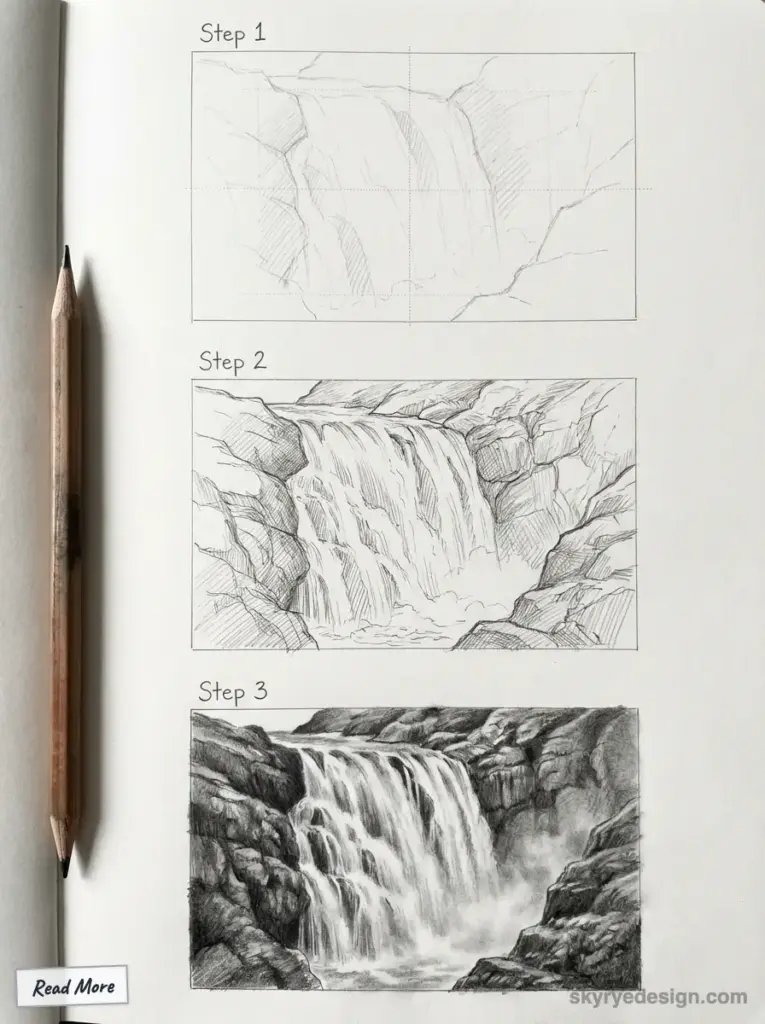
Before you begin, gather a few basic materials. Keep it simple—fancy tools are optional.
Basic supplies:
- Pencil (HB for sketching, 2B–4B for shading)
- Eraser (kneaded erasers work best)
- Drawing paper or sketchbook
- Fine liner or pen (optional)
- Blending stump or tissue (optional)
Optional tools:
- Colored pencils, watercolor, or markers
- Digital tablet and drawing software
Waterfall drawing materials by medium
| Medium | Best tools | Use them for |
|---|---|---|
| Pencil | HB, 2B, 4B, kneaded eraser | Construction lines, rock shading, soft mist, and value control. |
| Pen and ink | Fine liner, brush pen, waterproof ink | Rock cracks, varied line weight, and crisp silhouettes. |
| Colored pencil or marker | Light blue, cool gray, dark green, warm gray | Subtle water color, shadow temperature, and background depth. |
| Digital | Textured pencil brush, soft eraser, low-opacity layer | Adjustable mist, highlights, and layered shadows. |
Step 1: Plan the Waterfall Composition
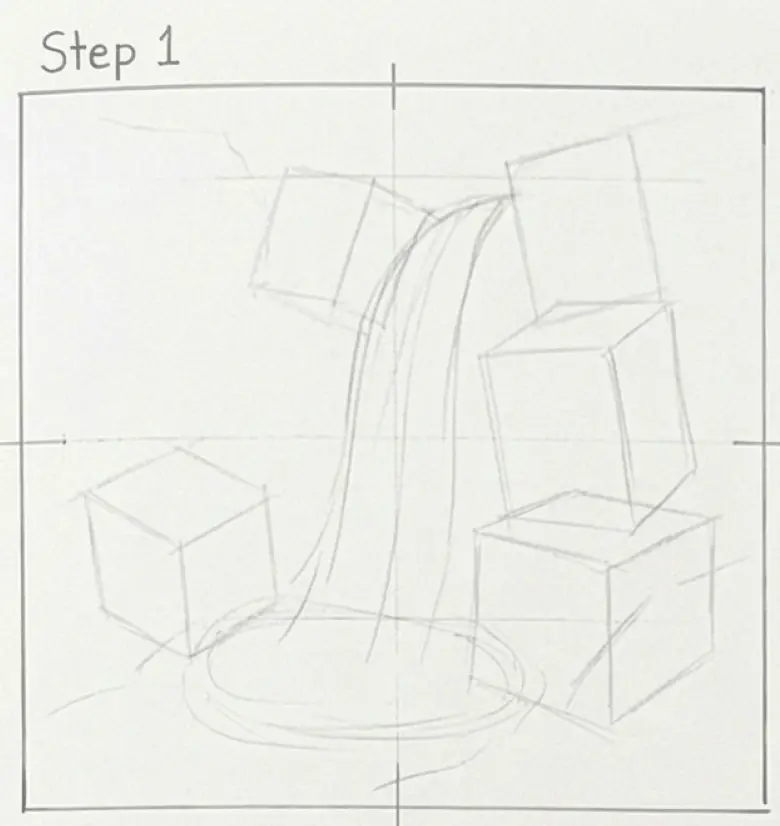
Every strong waterfall drawing starts with a clear composition. Don’t jump straight into details—begin by mapping out the scene.
Ask yourself:
- Is the waterfall tall and narrow or wide and layered?
- Is it viewed from the front, side, or above?
- Will it include cliffs, trees, or a pool at the bottom?
Lightly sketch a vertical guideline where the waterfall will fall. This helps maintain flow and direction.
Tip: Avoid perfectly straight lines. Natural waterfalls curve, taper, and break as they fall.
Step 2: Draw the Basic Shape of the Waterfall
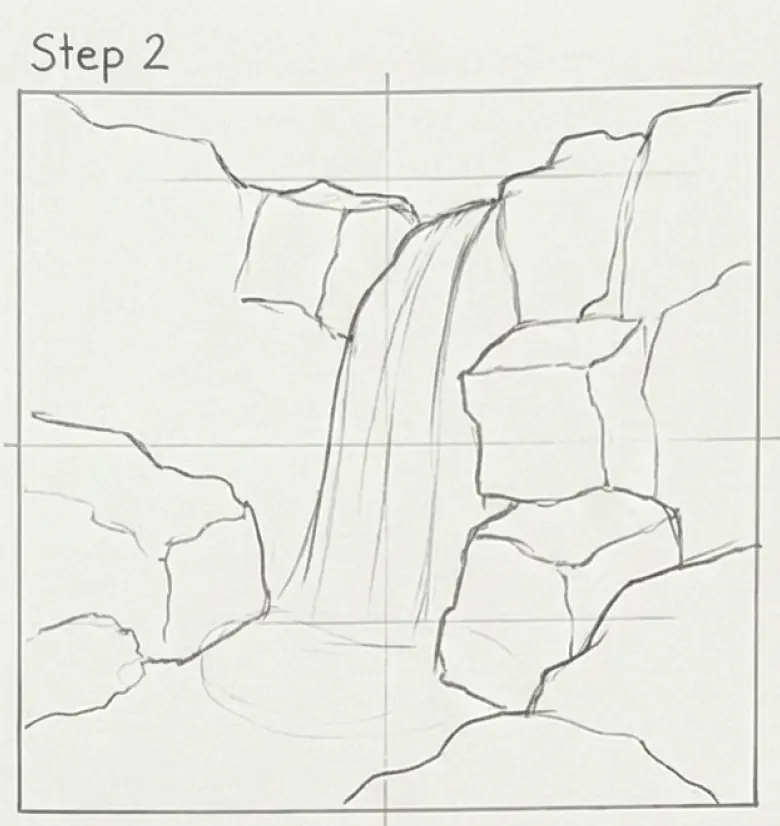
Now define the waterfall’s overall form. Think of the water as ribbons or curtains, not solid blocks.
- Draw two slightly uneven vertical lines for the edges
- Let the water widen or narrow as it falls
- Break the edges with soft zigzags to suggest movement
At the bottom, sketch a loose oval or irregular shape to represent the splash pool.
Beginner mistake: Drawing the waterfall like a stiff rectangle
Fix: Add gentle curves and breaks along the edges
Step 3: Sketch the Cliff and Rocks
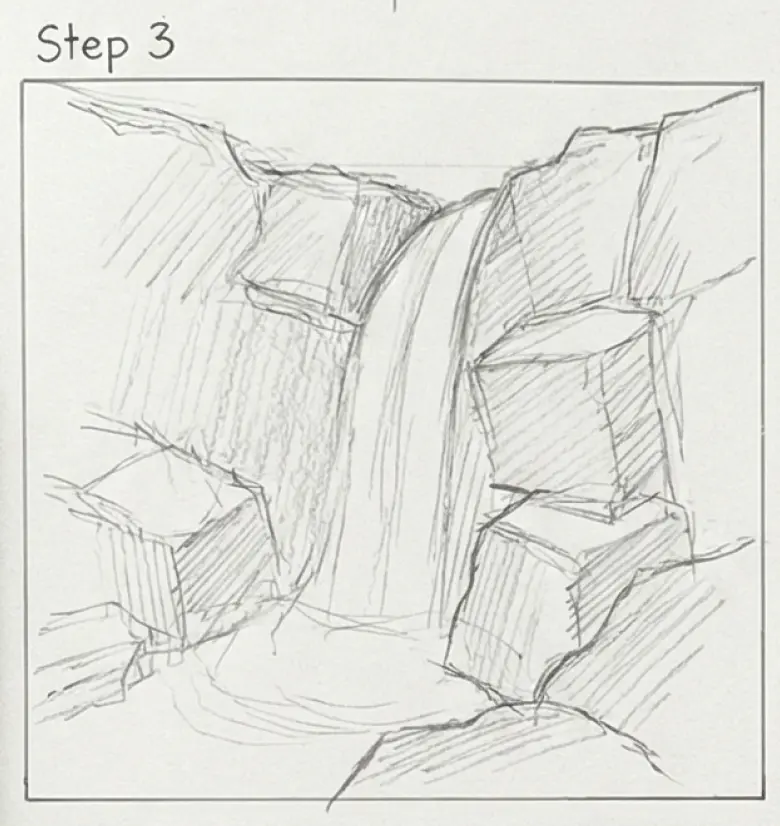
Waterfalls depend on strong surrounding structures. Rocks anchor the scene and add contrast to the soft water.
- Draw uneven rock shapes on both sides of the waterfall
- Use angular lines and cracks to suggest texture
- Vary rock sizes to avoid repetition
Rule of thumb: Rocks = hard, angular lines. Water = soft, flowing lines.
Step 4: Add Flow Lines to the Water
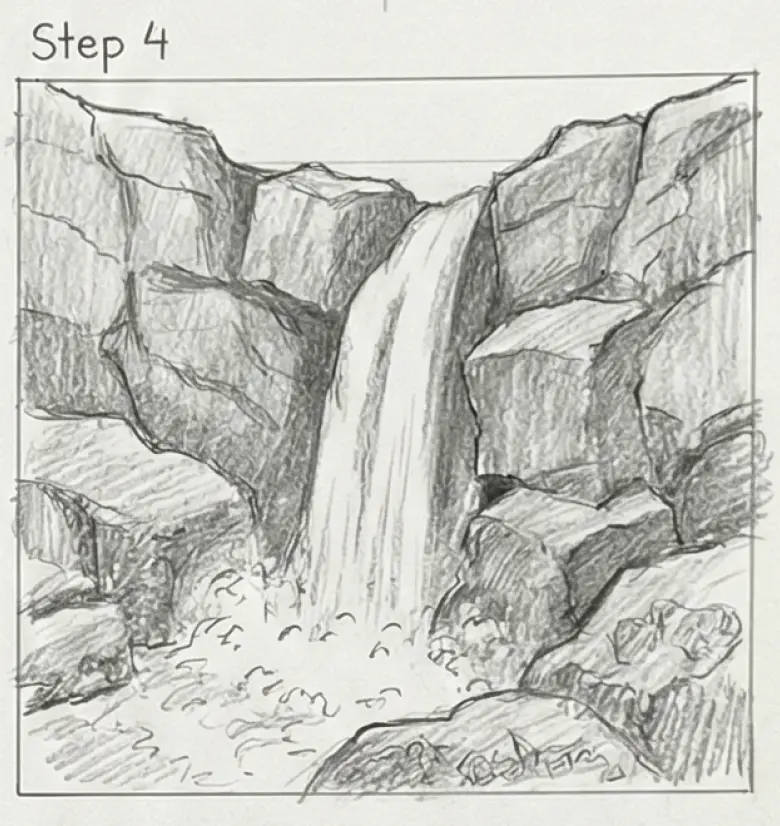
This is where your waterfall starts to feel alive.
Inside the waterfall shape:
- Draw long, vertical lines following the fall
- Vary spacing—some lines close together, others far apart
- Let lines curve slightly as they descend
These lines represent streams of water, not outlines.
Pro tip: Never shade water horizontally—always follow the direction of flow.
Step 5: Draw the Splash and Mist at the Bottom
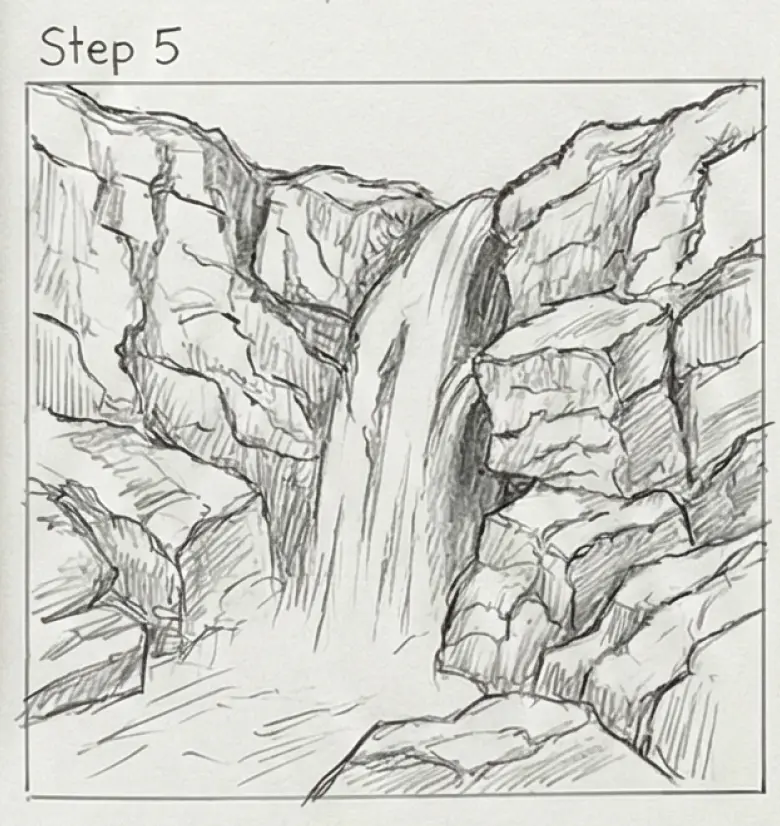
The base of the waterfall should feel energetic and chaotic.
- Use short curved strokes to show splashing water
- Draw small arcs and dots for mist
- Fade details as mist rises upward
Mist adds realism and depth. Lighter lines = softer spray.
Step 6: Shade the Rocks for Depth
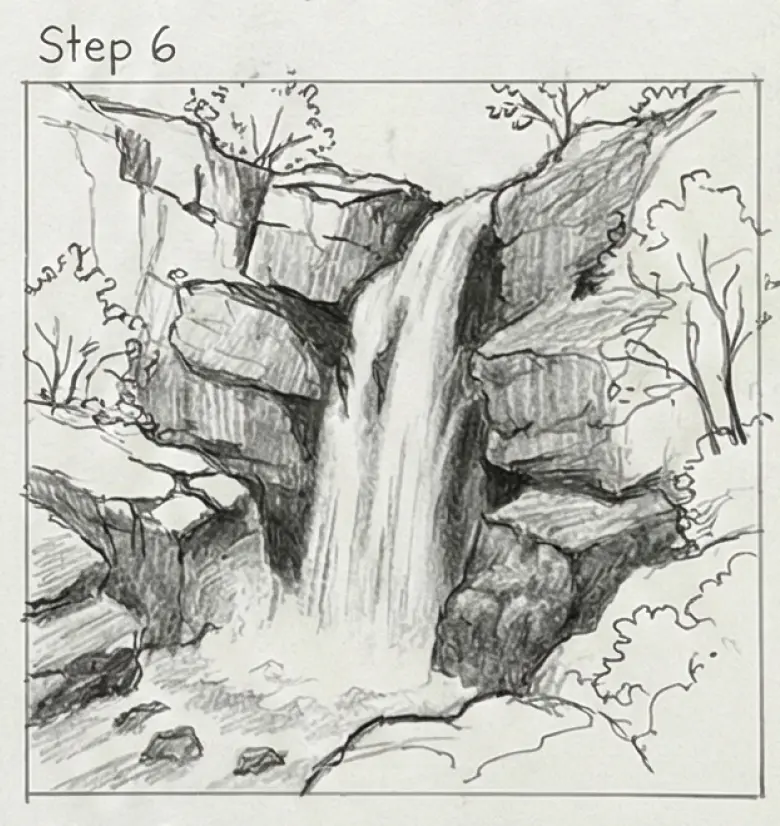
Shading brings your waterfall drawing to life.
- Choose a light source (usually from above)
- Shade rock crevices darker
- Leave edges lighter to show highlights
Use:
- Short, broken strokes
- Cross-hatching for deeper shadows
- Softer shading near water reflections
Avoid: Over-smoothing rocks—they should look rough, not polished.
Step 7: Shade the Waterfall (Less Is More)
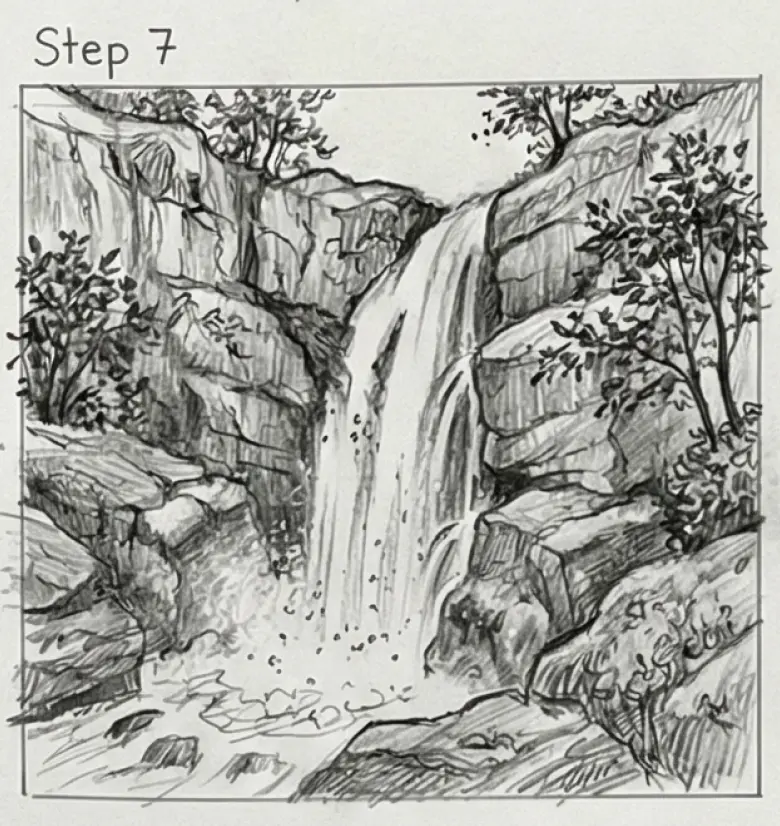
To shade a waterfall, treat the water as a bright reflective surface instead of a solid object. Leave the central falling water mostly white, then add soft graphite or low-opacity digital shading along the edges, behind rocks, and between selected flow lines. The darkest values should usually belong to the rocks, crevices, and areas hidden from the light, not the water itself. Use vertical strokes that follow the direction of the fall, because horizontal shading can make the water look flat or heavy. Keep mist and splash zones very light, using an eraser, white pencil, or low-opacity brush to recover highlights. The goal is contrast: dark, rough rocks make the pale falling water look cleaner, brighter, and more realistic.
If you want to go deeper on materials and value, The Met has a useful overview of graphite as a drawing material, and Artists Network explains why value contrast carries a drawing. For this waterfall sketch, keep that value logic simple: rocks darker, water lighter, foam brightest.
- Leave most of the waterfall white
- Lightly shade between flow lines
- Add darker tones near edges and behind rocks
The brightest whites should be:
- The center of falling water
- Splash zones
- Mist areas
Step 8: Add Background Elements (Optional)
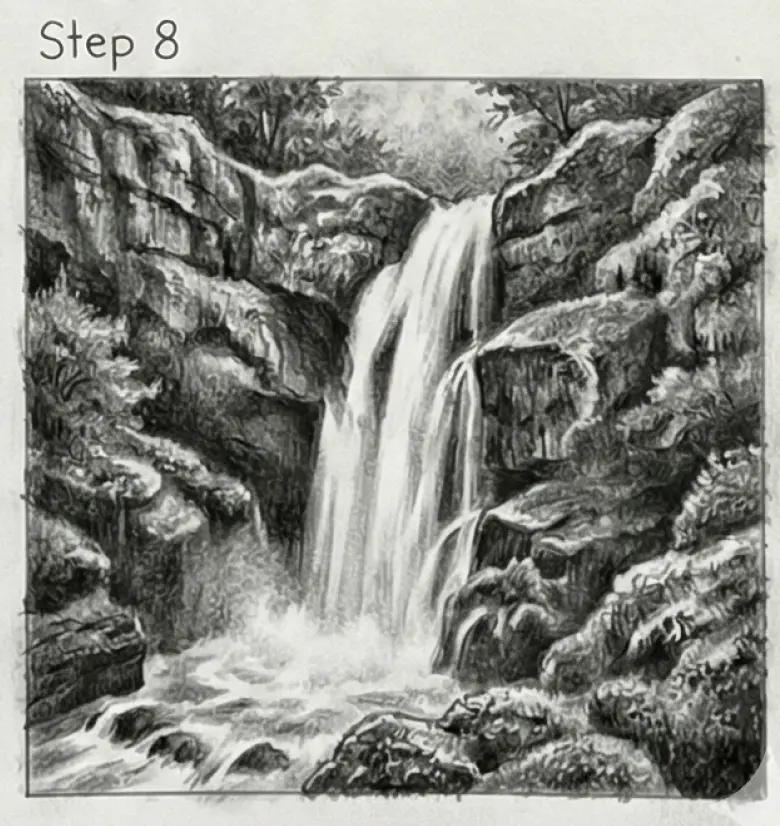
To create a full landscape, you can add:
- Trees or plants along cliff edges
- Distant mountains
- A river flowing away from the waterfall
Keep background details lighter and less defined to maintain depth.
If the waterfall scene includes open sky, keep the cloud shapes quieter than the falling water. This cloud drawing guide shows how to build soft values and lost edges so the background supports the landscape instead of stealing the focus.
How to Draw a Waterfall Realistically
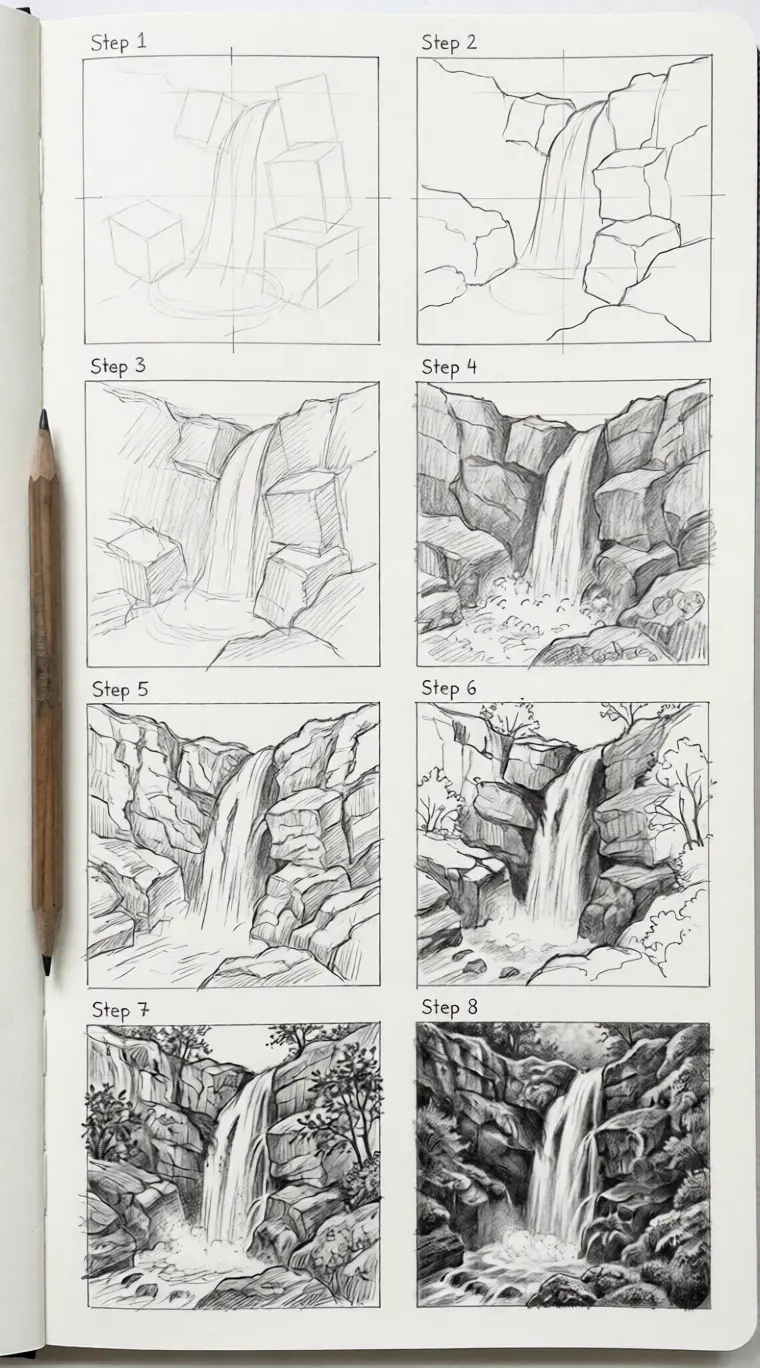
To make a waterfall look realistic:
- Use contrast (dark rocks, light water)
- Avoid symmetry
- Vary line thickness
- Let water overlap rocks slightly
Realism comes from imperfection.
How to Draw a Waterfall for Beginners
If you’re new to drawing:
- Start with pencil only
- Use reference photos
- Practice small sketches
- Focus on flow, not detail
Even simple waterfall drawings can look beautiful with good movement.
How to Draw a Waterfall with Pencil, Pen, or Digital Tools
Pencil
- Best for beginners
- Easy to adjust shading
- Great for realism
Pen & Ink
- Use varied line weight
- Rely on contrast
- Avoid outlining every edge
Digital
- Use textured brushes
- Lower opacity for mist
- Layer shadows gradually
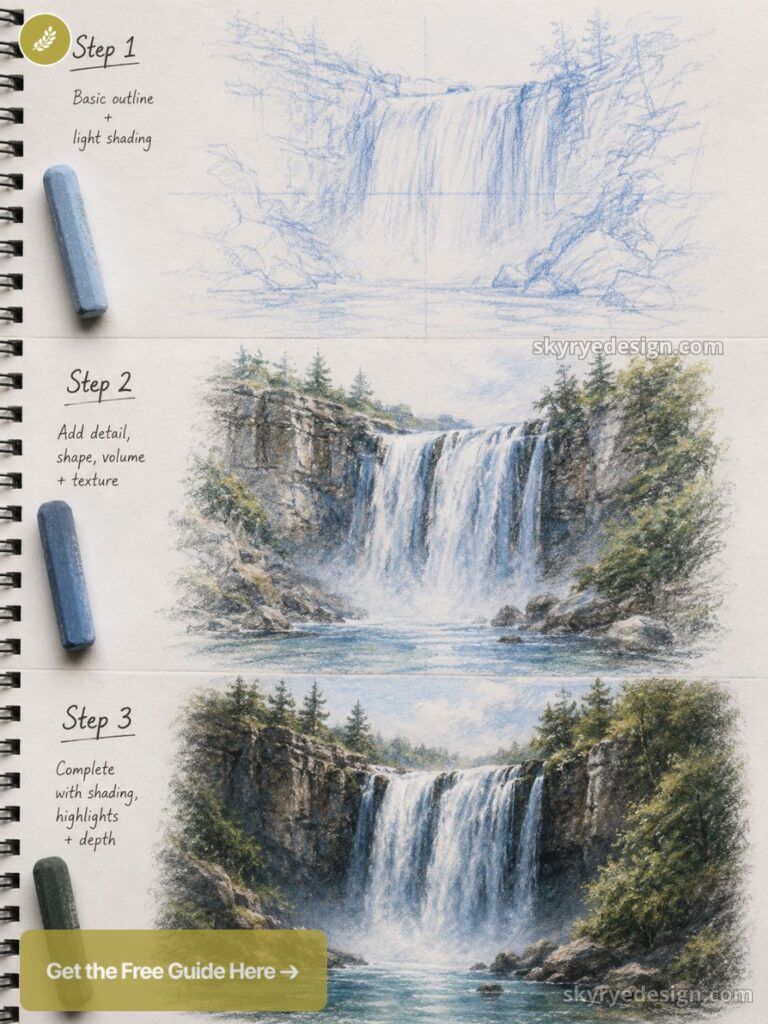
Common Mistakes When Drawing Waterfalls
| Mistake | Why it looks wrong | Quick fix |
|---|---|---|
| Straight vertical edges | The waterfall starts to look like a flat rectangle. | Break the sides with soft curves, gaps, and uneven ribbons. |
| Too much shading on water | The fall looks heavy instead of bright and reflective. | Keep the center light and push darker values into the rocks. |
| Flat rocks | The water has nothing solid to fall over. | Add planes, cracks, cast shadows, and varied rock sizes. |
| No mist or splash | The base feels quiet, as if the water has no force. | Use dots, short arcs, erased highlights, and fading spray. |
| Same line weight everywhere | The drawing loses depth and movement. | Use stronger lines in the foreground and lighter lines in misty areas. |
Practice Exercise: 10-Minute Waterfall Sketch
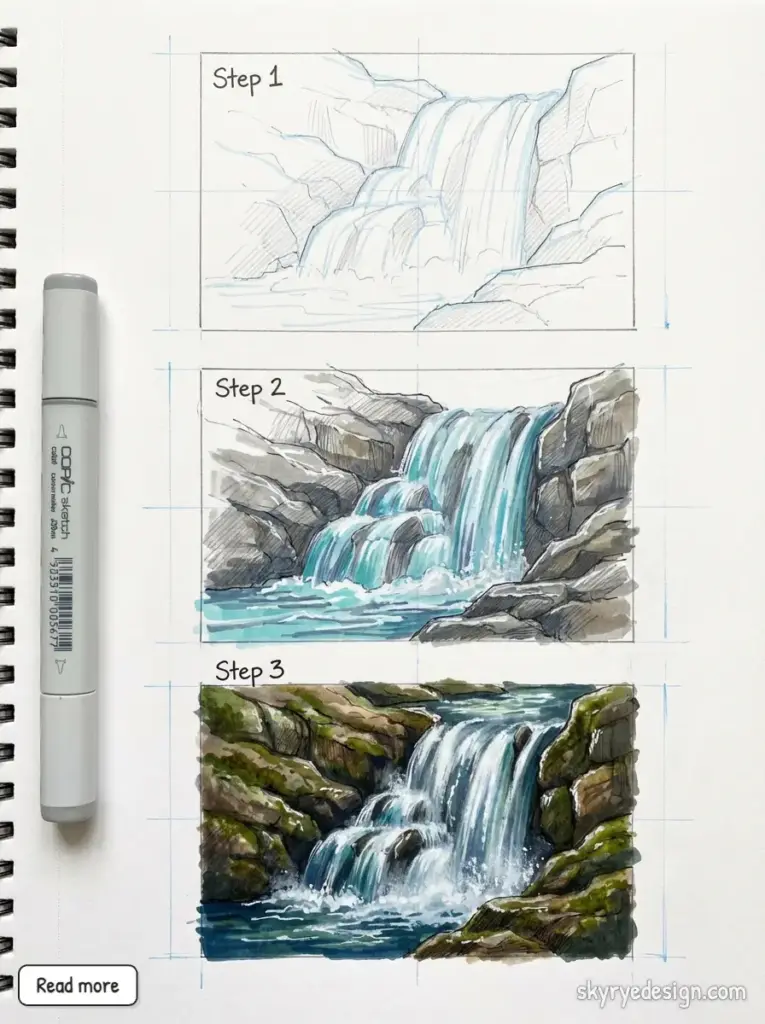
- Set a timer for 10 minutes
- Draw only the waterfall and rocks
- No erasing allowed
- Focus on motion, not perfection
Repeat daily for visible improvement.
Frequently Asked Questions
How do you draw a waterfall step by step?
To draw a waterfall step by step, begin with a light vertical guideline that shows where the water will fall. Sketch the outside shape as uneven ribbons, letting the edges curve and break naturally. Add rocks or cliffs on both sides, using angular lines so the hard stone contrasts with the soft water. Inside the waterfall, draw long vertical flow lines that follow gravity and vary their spacing so the water does not look stiff. At the base, add a loose pool shape, short curved splash marks, and small dots for mist. Shade the rocks more strongly than the water, leaving the center of the fall bright.
What is the easiest way to draw a waterfall for beginners?
The easiest method is to draw the waterfall in layers: first the falling water shape, then the rocks, then the splash. Use a pencil and keep the first lines light. Do not start with tiny details. If the big silhouette and flow direction are clear, the drawing will already read as a waterfall before you add shading.
How do you shade a waterfall without making it look muddy?
Shade the rocks more than the water. A waterfall usually looks brightest in the center, at the splash, and in misty areas. Add only light gray tones between flow lines and behind rocks. If the water turns too dark, lift highlights with a kneaded eraser or white pencil so the fall looks reflective again.
What pencil is best for drawing waterfalls?
Use an HB pencil for the first sketch, then switch to 2B or 4B for darker rock shadows. A kneaded eraser is useful because it can lift mist, spray, and water highlights without damaging the paper. If you are drawing very lightly, a 2H pencil can also help with construction lines.
How do you draw mist and splash at the bottom of a waterfall?
Draw splash with short curved strokes, small arcs, dots, and broken white spaces around the impact point. Mist should fade upward, so avoid outlining it too sharply. Keep the marks loose and irregular. The base of the waterfall should feel active, but not so busy that it hides the pool or nearby rocks.
How do you make a waterfall drawing look realistic?
Realism comes from contrast, overlap, and imperfection. Make the rocks angular and darker, keep the falling water lighter, and let some water overlap the rocks instead of sitting beside them. Vary line spacing, avoid perfect symmetry, and soften distant background details so the waterfall stays the main focus.
Related drawing practice
For more water and landscape practice, try the water drawing guide, the river drawing tutorial, and the full landscape drawing section. If the rocks are the weak part of your sketch, spend a few minutes with the rock drawing tutorial before returning to the waterfall.
Final Thoughts: Anyone Can Draw a Waterfall
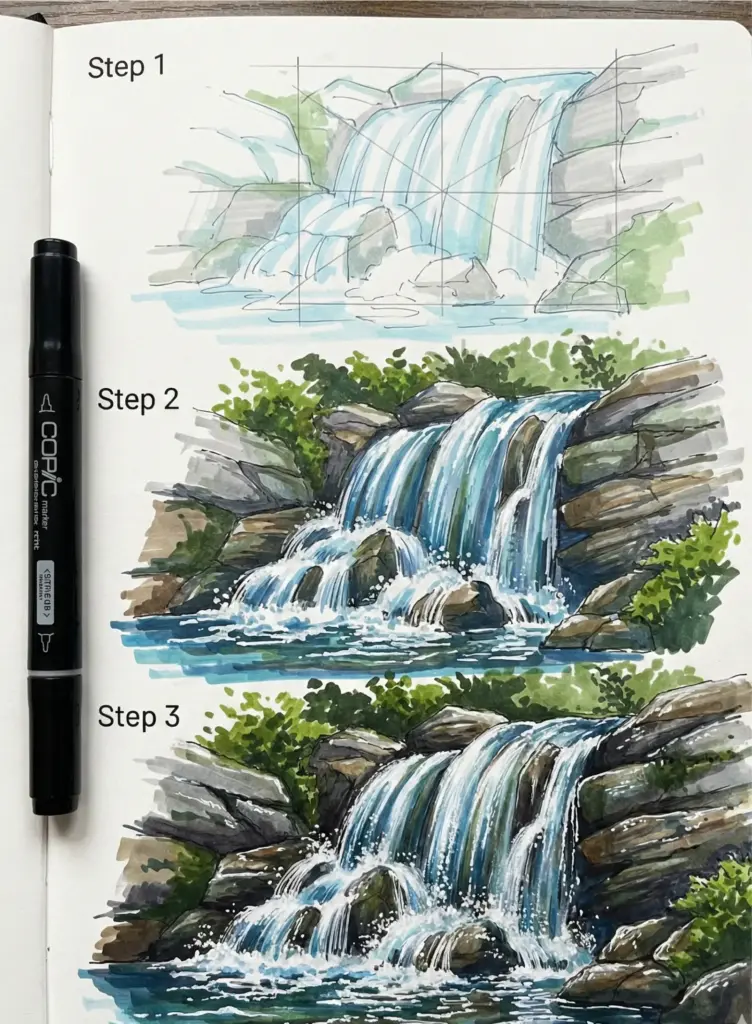
Learning how to draw a waterfall is about understanding movement, not mastering complex techniques. When you stop trying to control every line and let the water flow naturally, your drawings instantly improve.
Start simple. Practice often. Embrace imperfections.
Waterfalls are meant to move—and your art should too.
After practicing falling water, ocean drawing practice is a useful next step because waves use the same value control but a wider horizon and softer atmospheric depth.
- 15.6Kshares
- Facebook0
- Pinterest15.6K
- Twitter0
- Reddit0