I had a Jaguar F-Pace for several years, and before that an Opel Ascona I drove into the ground, and I remember clearly the first time I stood next to a BMW E46 M3 in a car park in Germany. The body surfacing was something I couldn’t stop looking at.
The way the rear quarter panel flares outward from the door, the relationship between the roofline and the shoulder, the way the front and rear overhangs are deliberately asymmetric. These are not accidents. Someone made those decisions in a studio with scale models and CNC clay and weeks of iteration.
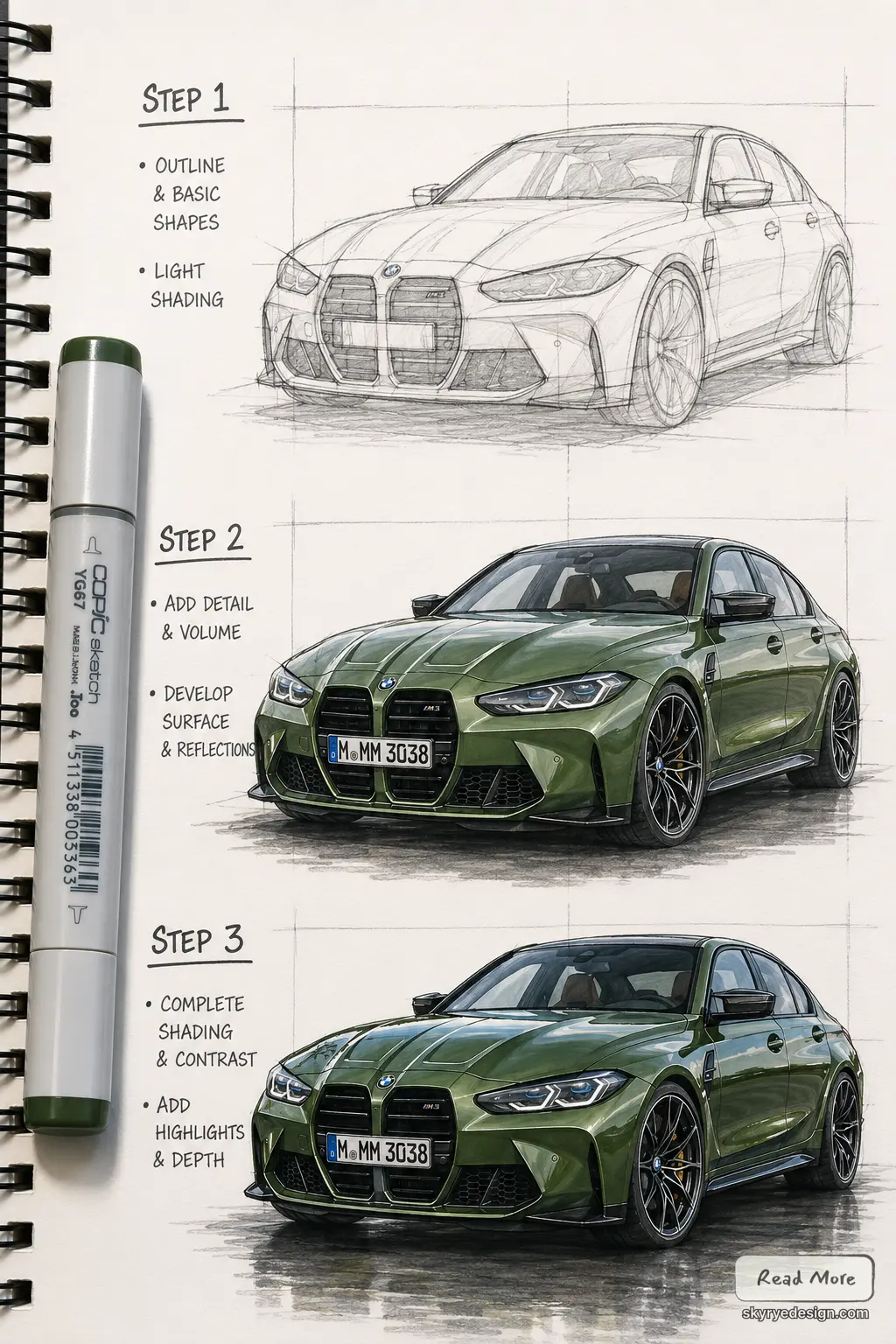
This tutorial covers the bounding box method for automotive drawing, how to construct the M3 in both side profile and three-quarter view, the specific design elements that define different BMW generations, and shading techniques for sheet metal surfaces. I’m focusing primarily on the G80 (2021 onwards) and the E46 (2001-2006) because between them they represent both the current language and the most beloved classic version.
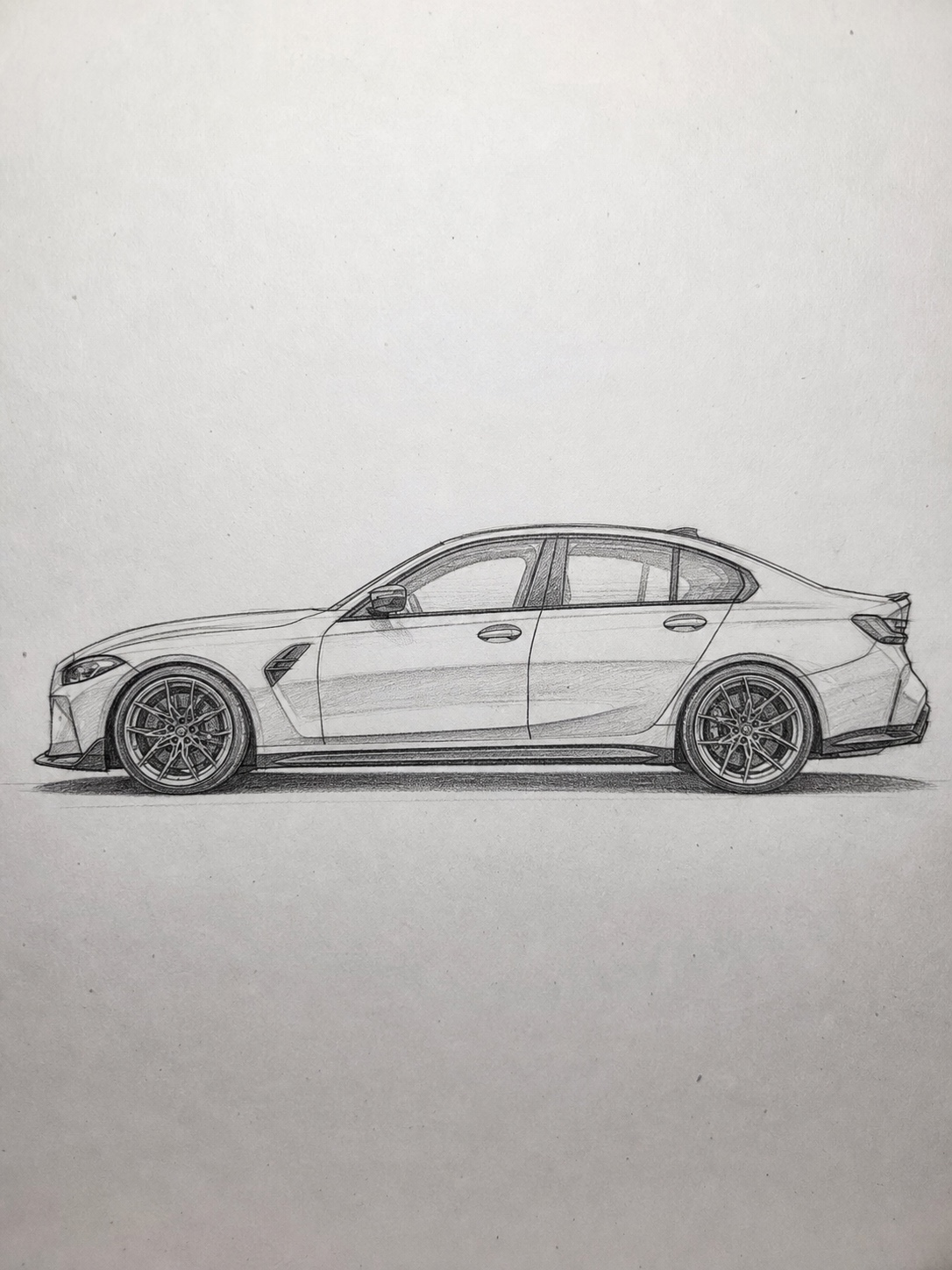
Drawing cars is the fastest way to understand those decisions. When you put an M3 on paper and get the roofline angle wrong by two degrees, you feel it immediately. The car no longer reads as an M3. That sensitivity to proportion is the thing drawing teaches you that simply looking at cars doesn’t.
The bounding box method for car drawing
Every car drawing starts with a bounding box: the minimum rectangular volume that contains the entire vehicle. This is how professional automotive designers think about proportion before they commit to any surface decision. The box defines the length-to-height ratio, the wheelbase as a proportion of total length, and the relationship between the greenhouse (glass area above the waistline) and the body below.
The same bounding-box habit works for taller vehicles too, but the emphasis changes. Compare this sedan setup with SUV drawing proportions when you want to practice roof height, ground clearance, and a heavier rear volume.
For the BMW M3 in side profile, the bounding box proportions are roughly 4.5 to 1 in length to height. That means if you draw the height as 50mm on your paper, the length should be 225mm. These are the real-world proportions of the car translated to drawing scale. Getting this ratio right before anything else is the single most important accuracy step in the whole process.
Establishing wheel positions
With the bounding box drawn, mark the wheel center positions. On the BMW M3, the front axle sits approximately 20% of the total length from the front of the car. The rear axle sits approximately 75% from the front. These positions define the wheelbase, which on the G80 M3 is 2851mm on a total length of 4794mm, roughly 59.5% of total length.
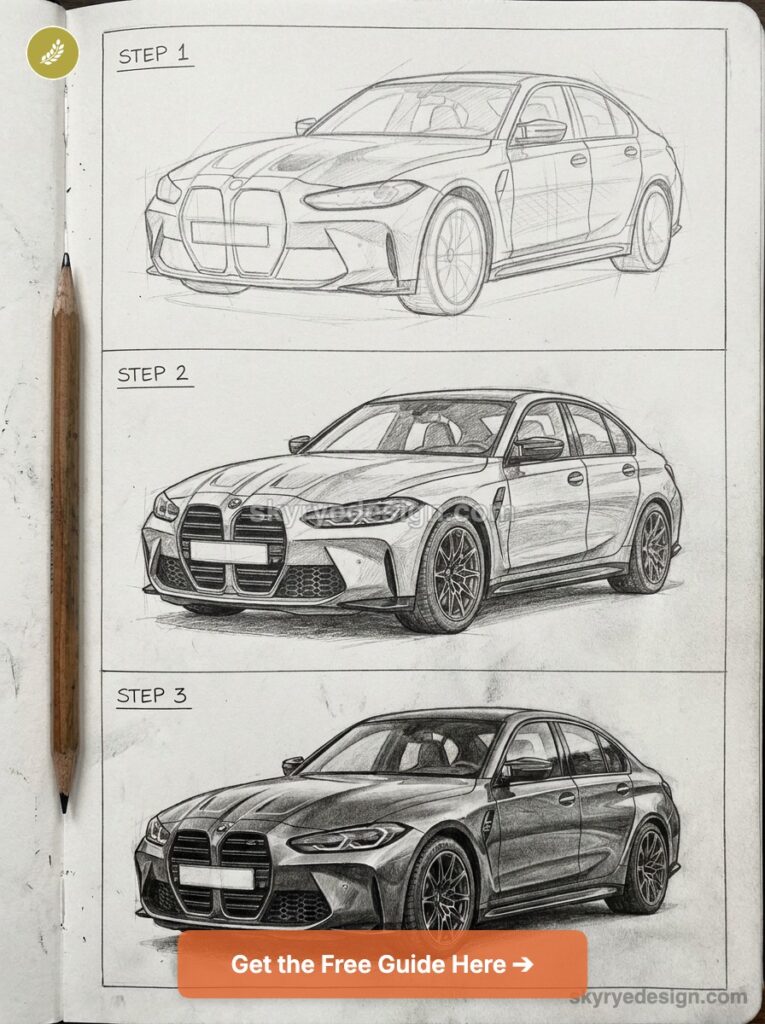
Mark a circle at each axle center point. The wheel diameter on the G80 M3 is 666mm with standard 19-inch wheels (with tyres). As a proportion of total car height (1433mm including roof), that’s approximately 46% of total height. Draw your wheel circles at that proportional size relative to your bounding box height. If the wheels look too small or too large at this point, the proportion problem will compound through every subsequent step.
Blocking in the silhouette
With the box and wheel positions established, draw the key silhouette lines. The roofline starts at the base of the A-pillar (the front windscreen upright), rises to the highest point over the front passenger area, then runs in a gentle declining arc to the C-pillar. On the M3, this declining rear roofline is a defining proportion: it creates the subtle fastback quality that distinguishes it from a plain 3 Series.
The shoulder line (the visible crease running the length of the car at roughly the door handle height) is drawn next. On the G80 M3, this line is notably higher and more pronounced than on the standard G20 3 Series, which contributes to the car’s more muscular appearance. On the E46 M3, the same line is softer and lower.
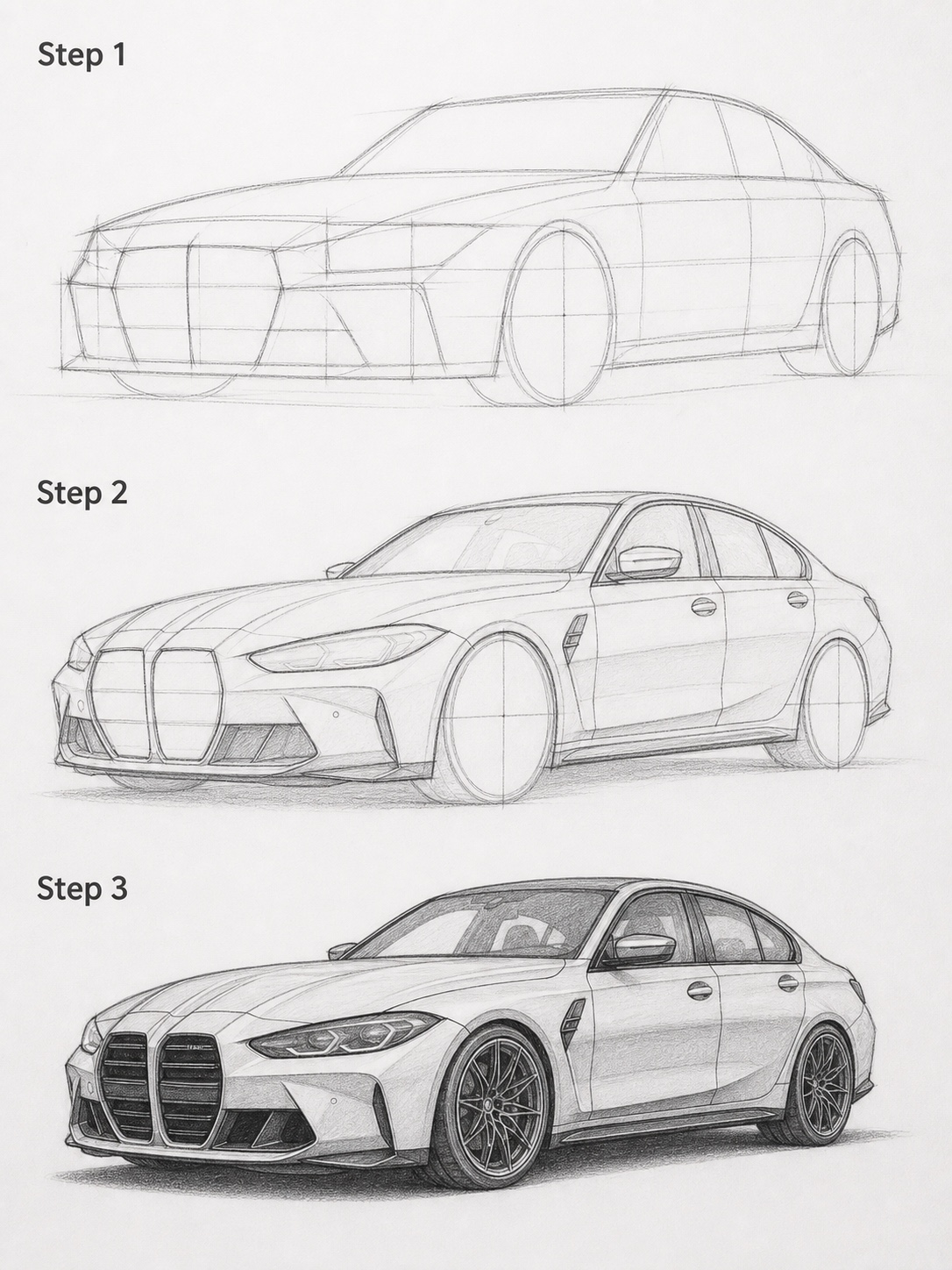
Drawing the BMW M3 side profile: step by step
Step 1: bounding box and proportions
Draw a horizontal rectangle at your chosen scale. Mark the wheel center positions at 20% and 75% from the left edge. Drop perpendicular lines from each wheel center to the bottom of the box. These will become your wheel arch center lines. At each wheel center, draw a circle for the wheel at 46% of box height. Keep all construction lines very light.
Step 2: roofline and greenhouse
From the front of the bounding box at ground level, the front bumper rises slightly before the wheel arch. The A-pillar base is at roughly 25% of the box length from the front. Draw the A-pillar rising steeply at roughly 65 to 70 degrees from vertical. The roofline rises to its peak at approximately 50% of the box length, then descends gradually. The C-pillar drops at approximately 80% of the box length. The rear window drops more steeply than the A-pillar.
The waistline (the base of the glass area) runs roughly horizontally from A-pillar base to C-pillar base, with a very slight upward sweep toward the rear. The relationship between the greenhouse depth (waistline to roofline) and the body depth (waistline to ground) is approximately 40% greenhouse, 60% body. If your greenhouse takes up more than 45% of total height, the car reads as a sedan rather than a sport. Adjust.
Step 3: wheel arches, sills, and body lines
The wheel arches on the M3 are notably wider than on a standard 3 Series because the car has wider tracks and over-fender body panels. The rear arch in particular flares outward visibly from the door surface. Draw the arch as a smooth semicircle centered on the wheel center, with a flat tangent at the top where it meets the bodywork.
The side sill (the body section between the two wheel arches, below the doors) is lower and more aggressive than on the standard car. A small diffuser-style air blade exits at the rear of the front wheel arch on the G80. The door panel between the arches is relatively flat, which is why the shoulder line crease reads so clearly against it.
Step 4: front and rear ends
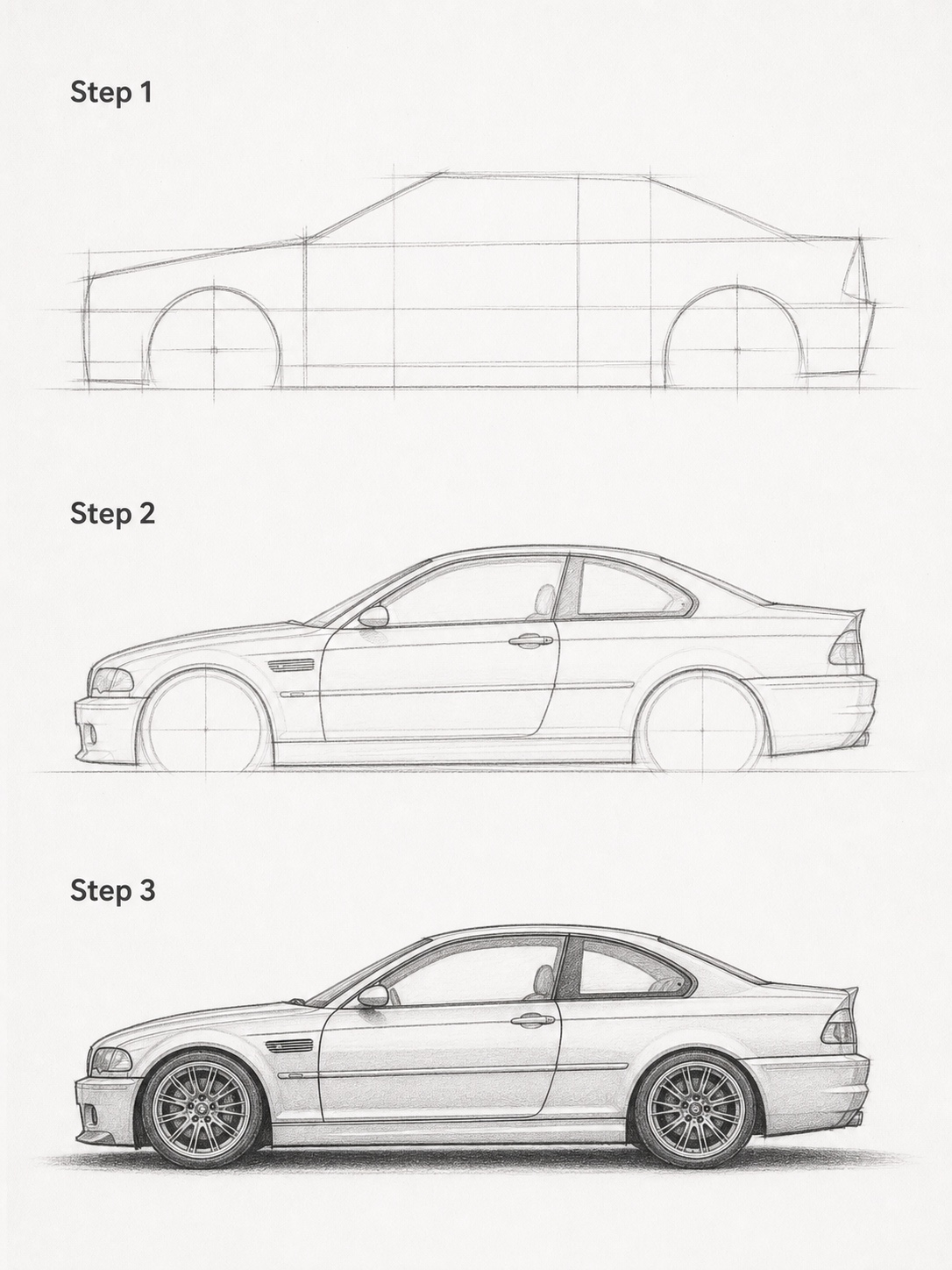
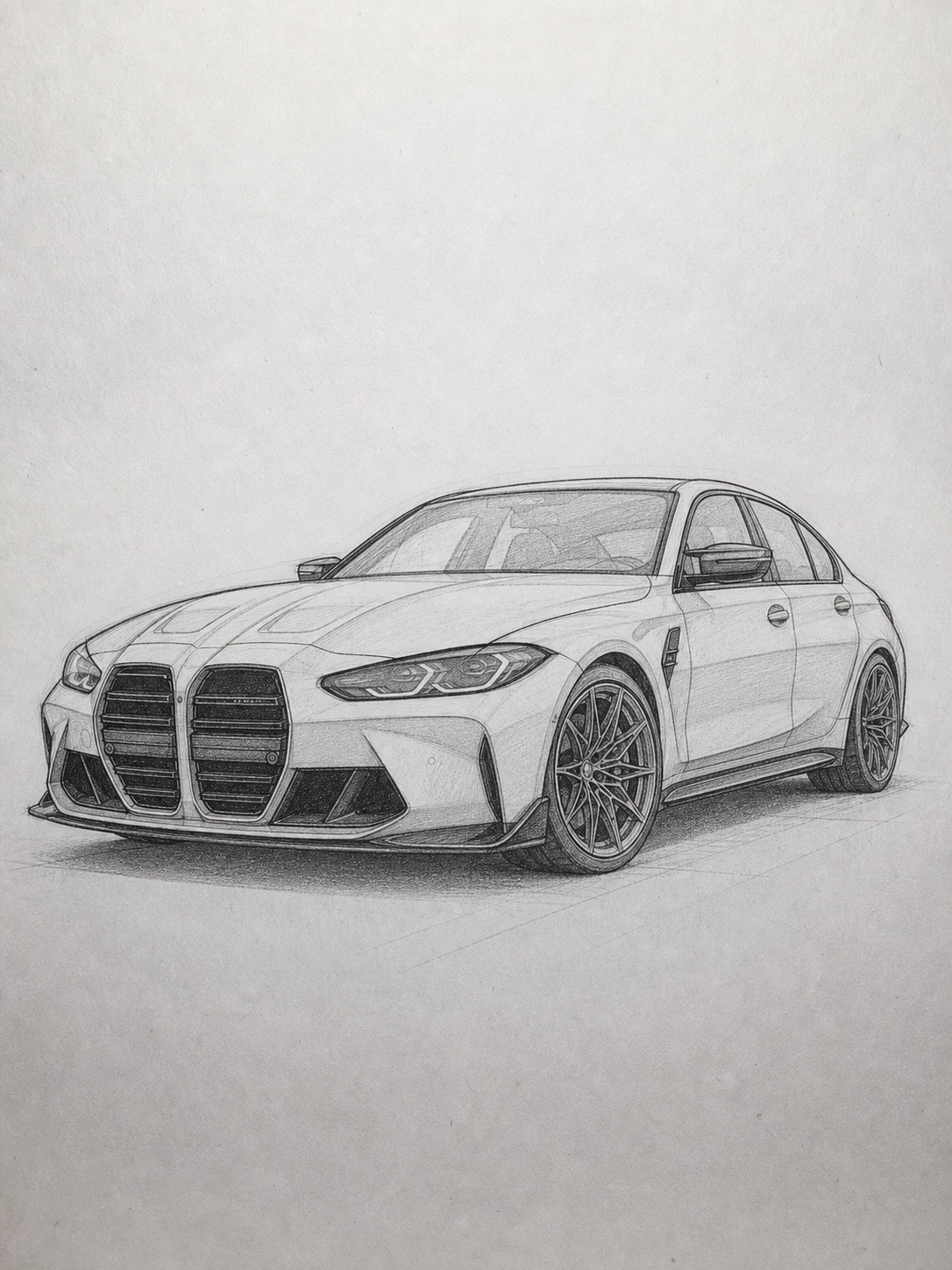
The front bumper on the G80 M3 is one of the most distinctive, and most discussed, design elements of any recent BMW. The kidney grille is large and upright, flanked by wide air intakes. In side profile, the front overhang below the bumper drops lower than the headlight line, creating an aggressive nose angle. The hood surface rises slightly from the headlights to the A-pillar.
At the rear, the trunk lid extends slightly beyond the rear screen, creating a small integrated spoiler. The rear valance contains four exhaust outlets arranged in pairs. The rear overhang is longer than the front, which is a deliberate proportion choice that distinguishes the M3 from smaller, shorter-tailed sports cars.
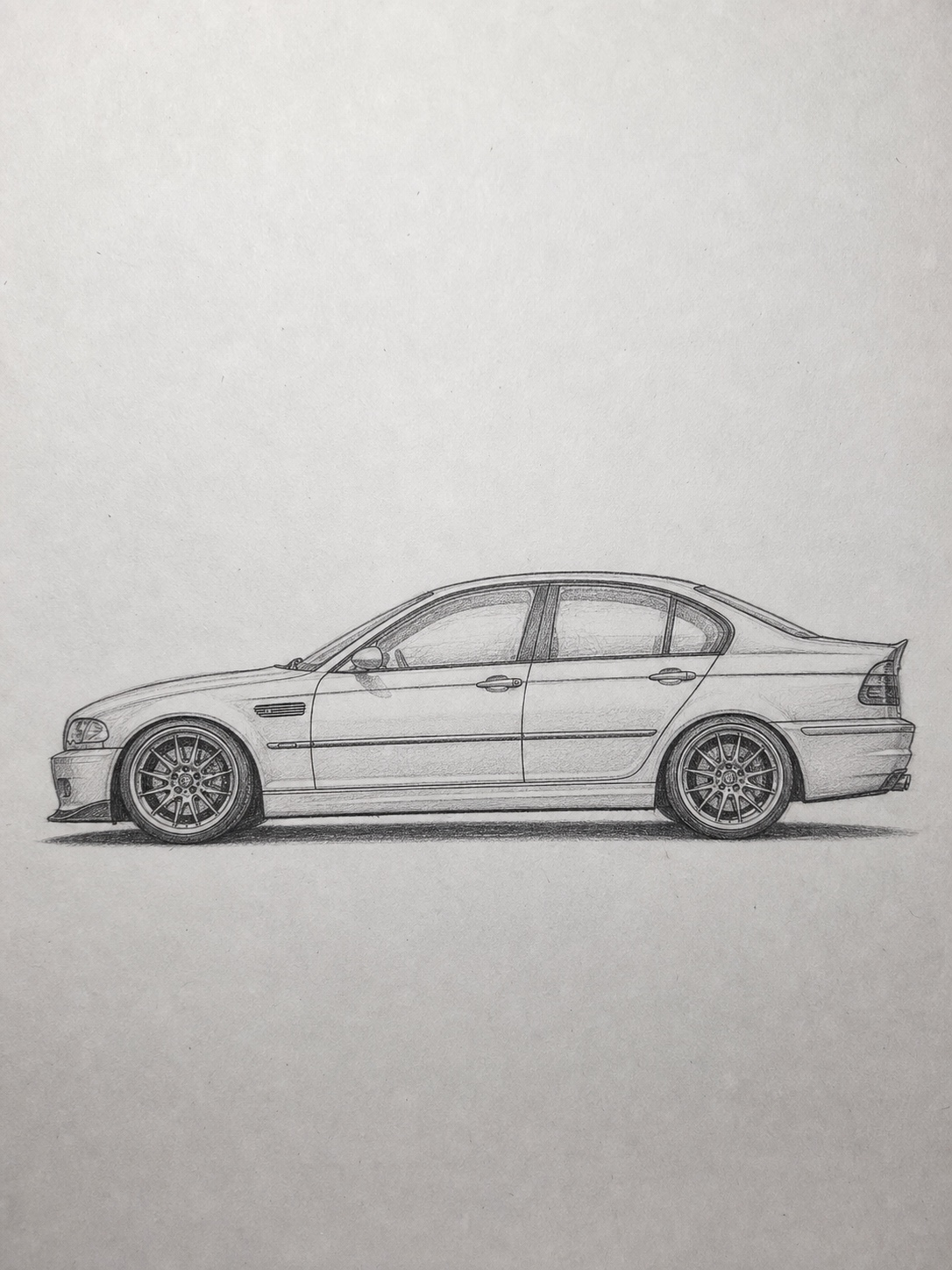
The proportion test: once you have the silhouette drawn, hold the paper at arm’s length and compare it against a reference photograph of the M3 in exactly the same view. If the roofline angle or wheel size ratio is wrong, it registers immediately at this distance. Fix proportion errors before adding any detail: every detail drawn on a wrong-proportion silhouette will need to be redrawn.
Drawing the BMW M3 in three-quarter view
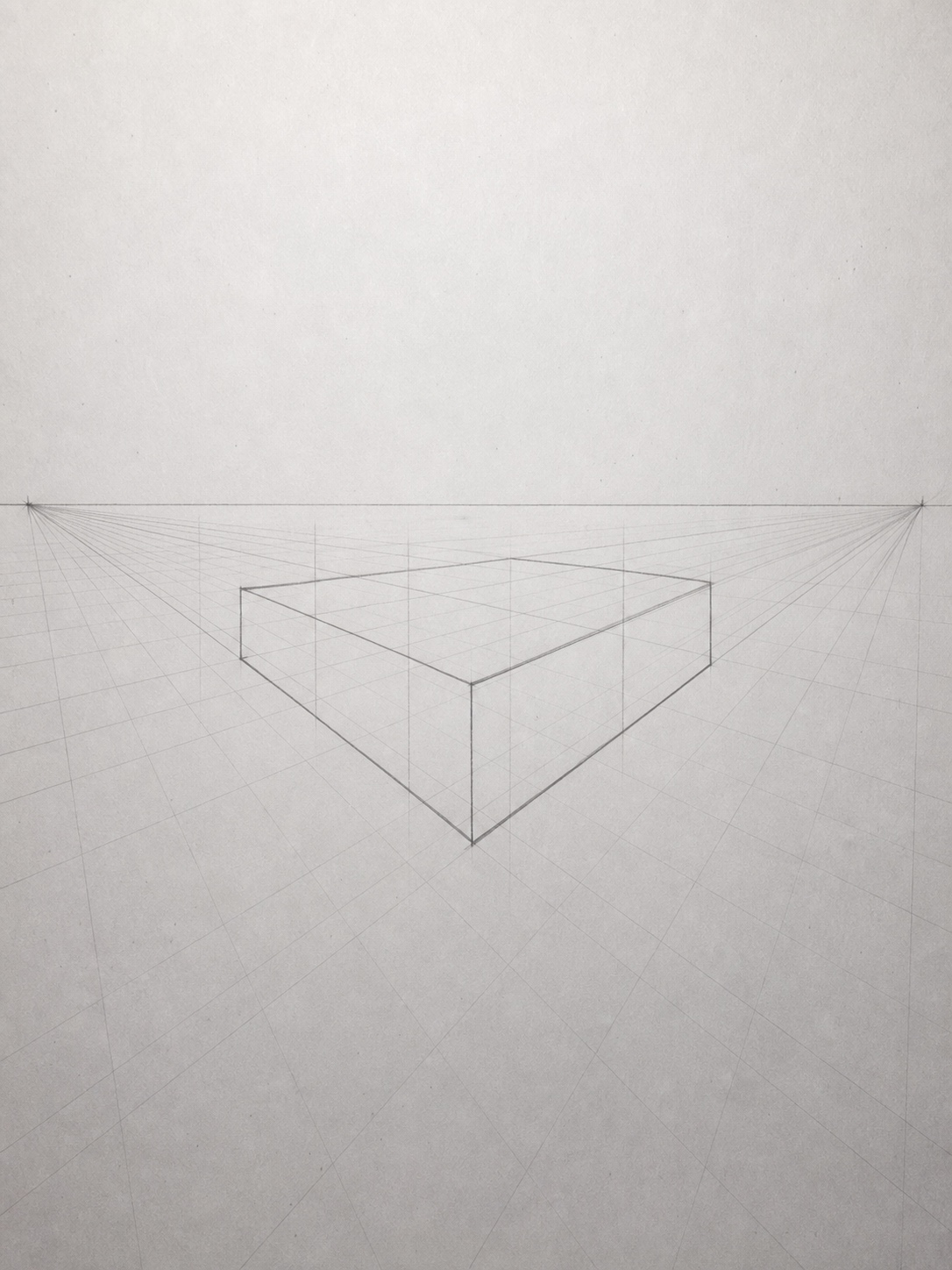
The three-quarter front view is the most used view in automotive design presentation because it shows the front, side, and roof simultaneously. It also requires two-point perspective, which is the source of most errors in car drawings that otherwise have correct silhouettes.
Setting up two-point perspective
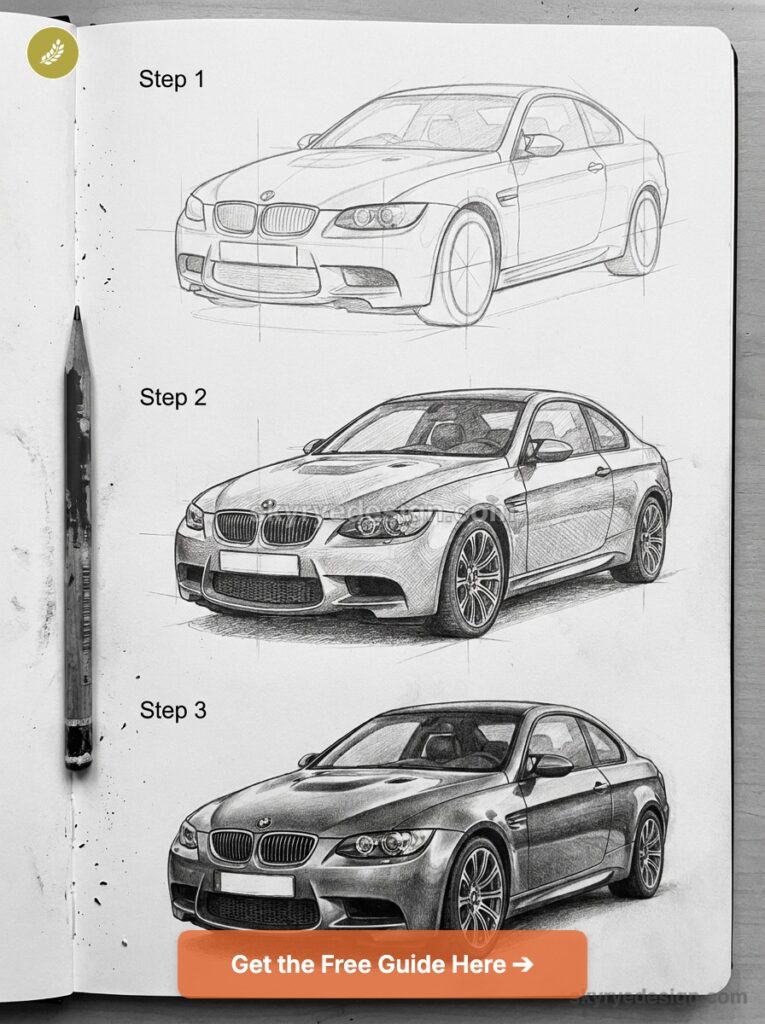
Draw a horizon line across the upper third of the paper. Place two vanishing points well outside the car’s expected position, one far to the left and one far to the right. The car’s front corner is the nearest point to the viewer. From this corner, draw lines toward both vanishing points: one set describes the front face of the car, the other describes the side face. All horizontal lines on the hood, the roofline, the sill, and the waistline must converge to these two points.
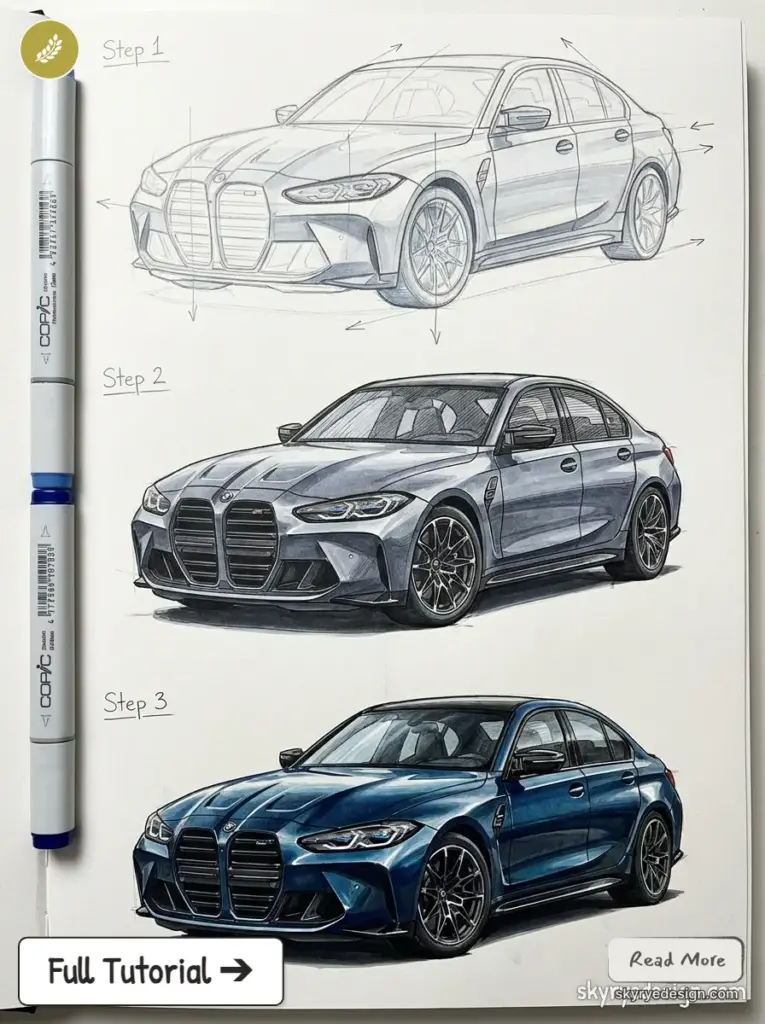
The most common perspective error in car drawing is placing the vanishing points too close together, which creates a distorted fish-eye effect at the near corner. A useful rule: both vanishing points should be outside the edges of the paper, or at minimum at the extreme edges. If either vanishing point falls within the car’s outline, the perspective is too dramatic and the proportions will read as wrong.
The kidney grille in three-quarter view
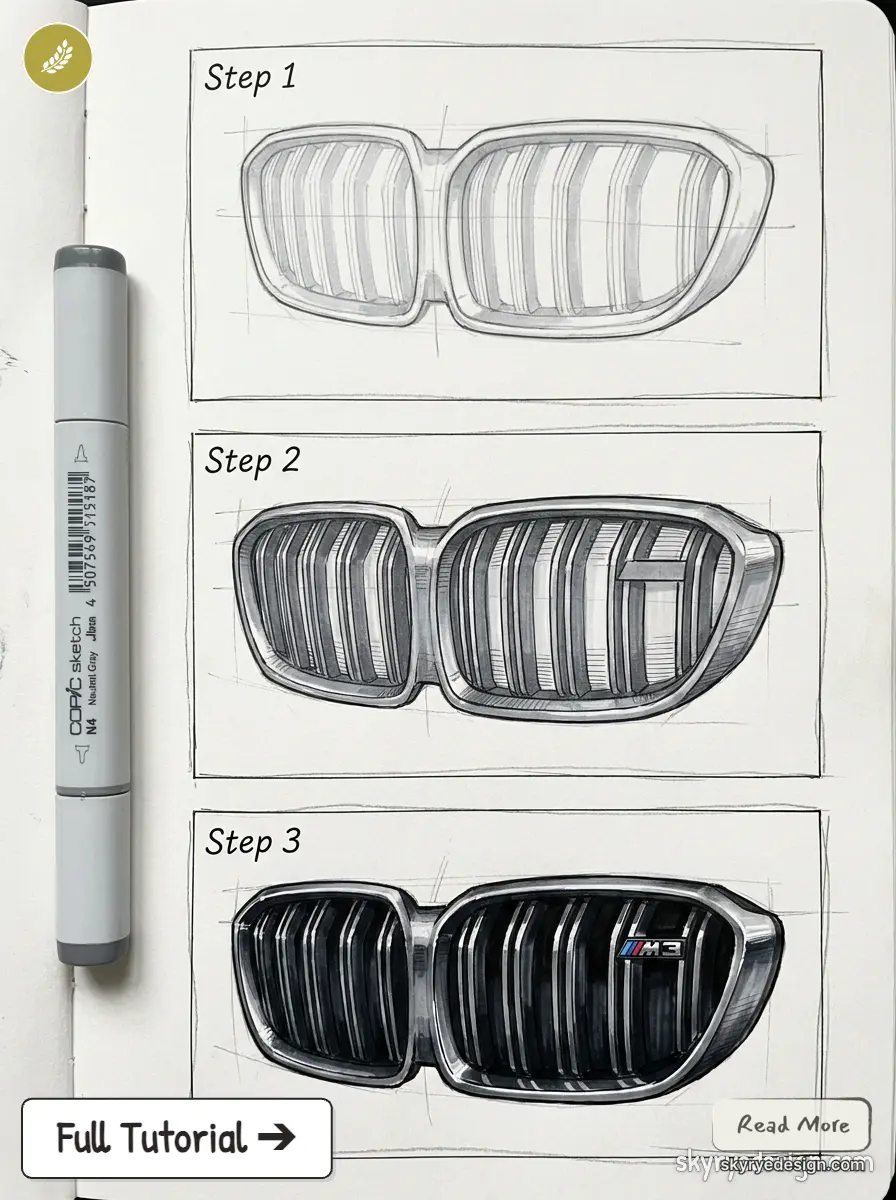
The BMW kidney grille is the most immediately recognizable element of the M3 front end. In three-quarter view, both nostril shapes are visible but foreshortened, with the near nostril (left, from driver’s perspective) reading wider than the far nostril. The vertical slats within each nostril converge toward the right vanishing point.
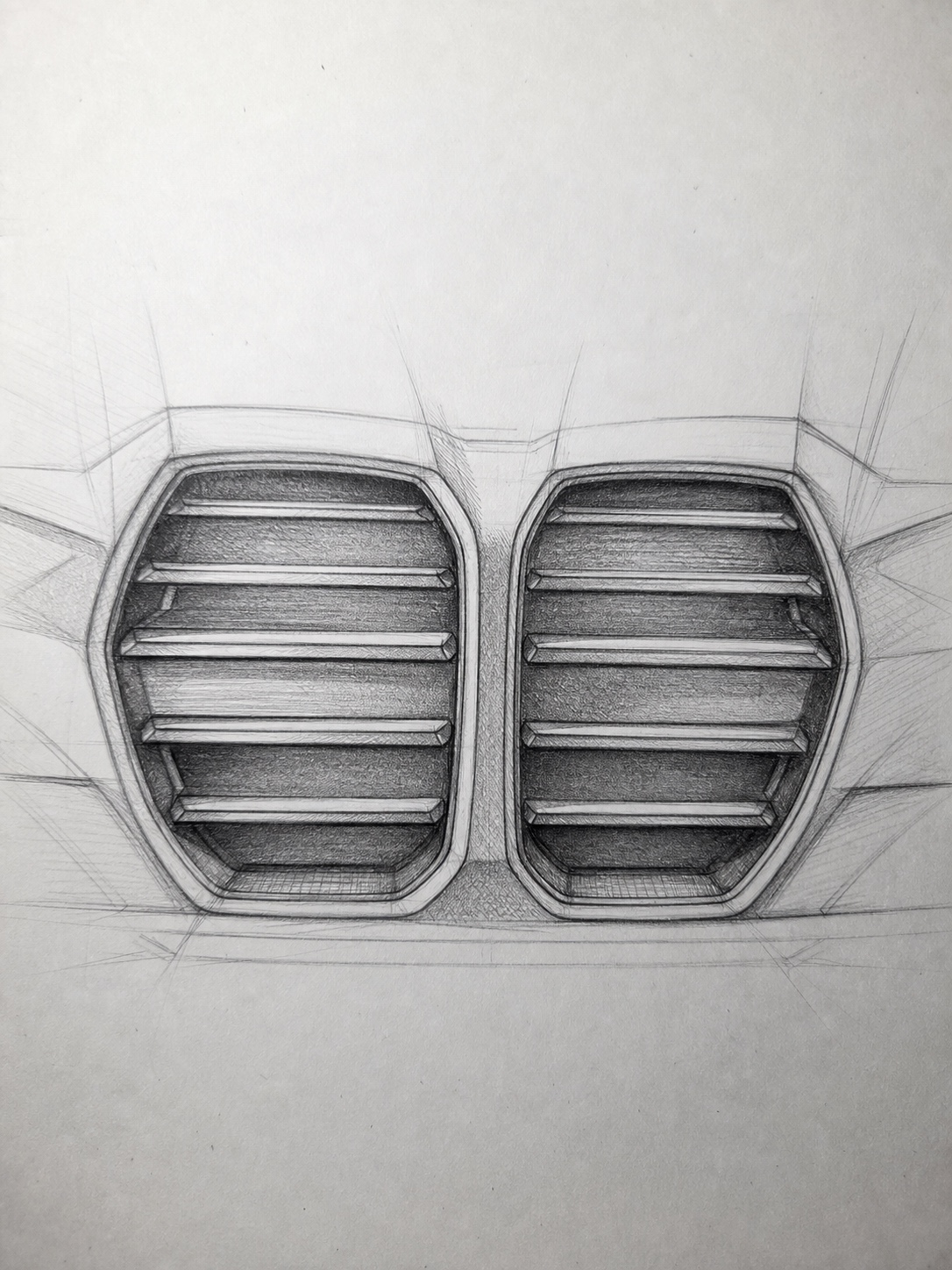
The outer frame of the grille sits at an angle, canted slightly back at the top. The relationship between the grille height and the hood height above it determines whether the front reads as aggressive (more grille, less hood) or refined (more hood, less grille). The G80 M3 pushes the ratio toward aggressive: the grille occupies a significant proportion of the total front face height.
Shading a car drawing: how sheet metal reflects light
Shading a car is different from shading a sphere or a cylinder because car panels are not uniformly curved. They are compound surfaces with varying curvature, and the way light reflects off them produces characteristically linear highlights rather than the soft gradients you’d find on organic forms.
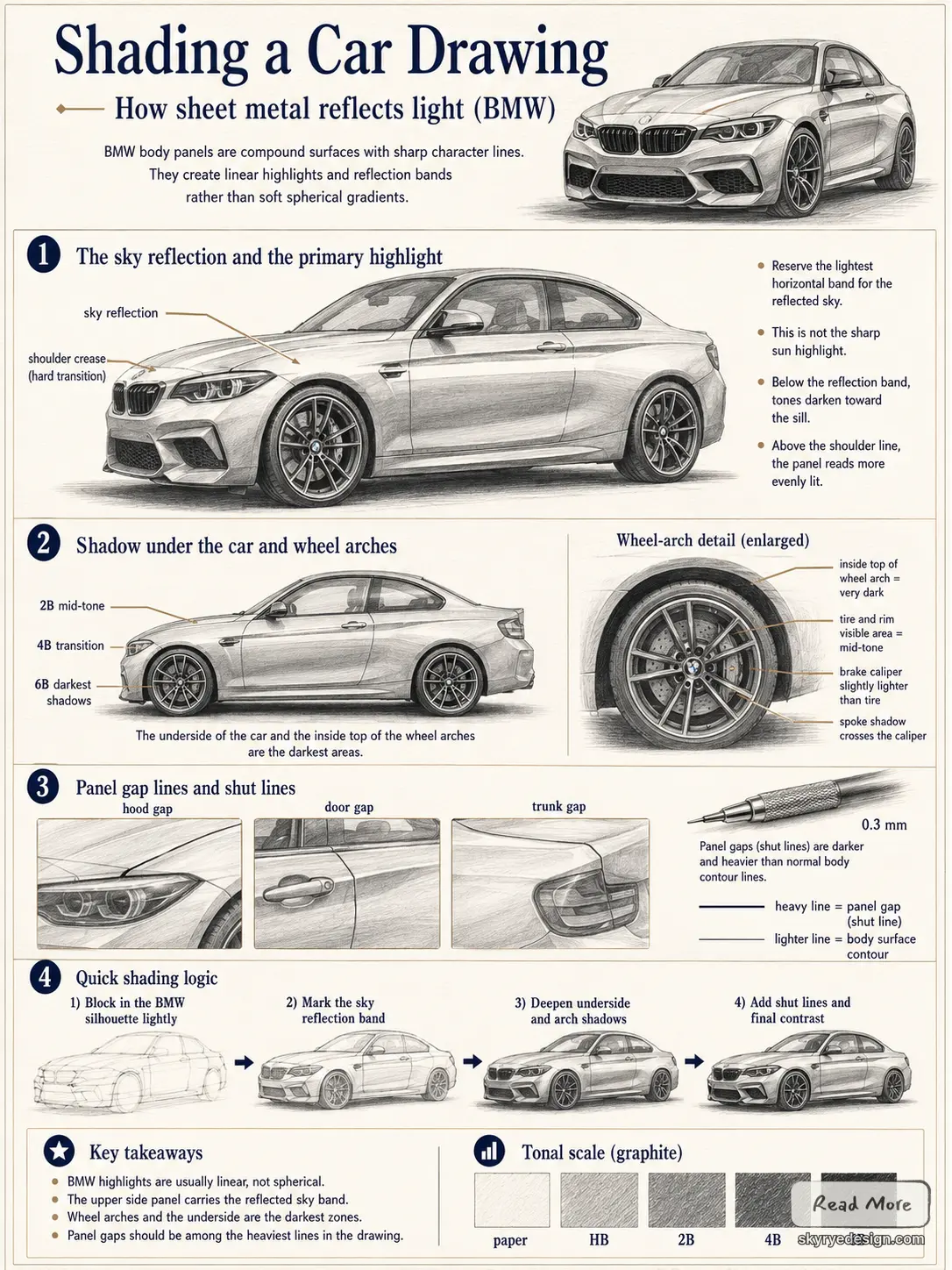
The sky reflection and the primary highlight
The single most important thing to understand about shading a car is the sky reflection. Car bodies are painted with high-gloss finishes, which means they act as mirrors. The dominant reflection on the upper side panel of any car parked outdoors is the reflection of the sky, which produces a broad, relatively bright horizontal band across the upper portion of the side panel. This is not the specular highlight (the sharp reflection of the sun); it is the diffuse reflection of the sky’s luminosity.
In a pencil drawing, this sky reflection zone is rendered as a reserved light area running horizontally across the upper side panel, roughly from wheel arch to wheel arch at the shoulder height. Leave this area as the lightest tone in your side panel shading. Below it, the panel shade darkens toward the sill. Above the shoulder line, the panel is relatively uniformly lit. The hard line between these two zones is the shoulder crease itself.
Shadow under the car and wheel arches
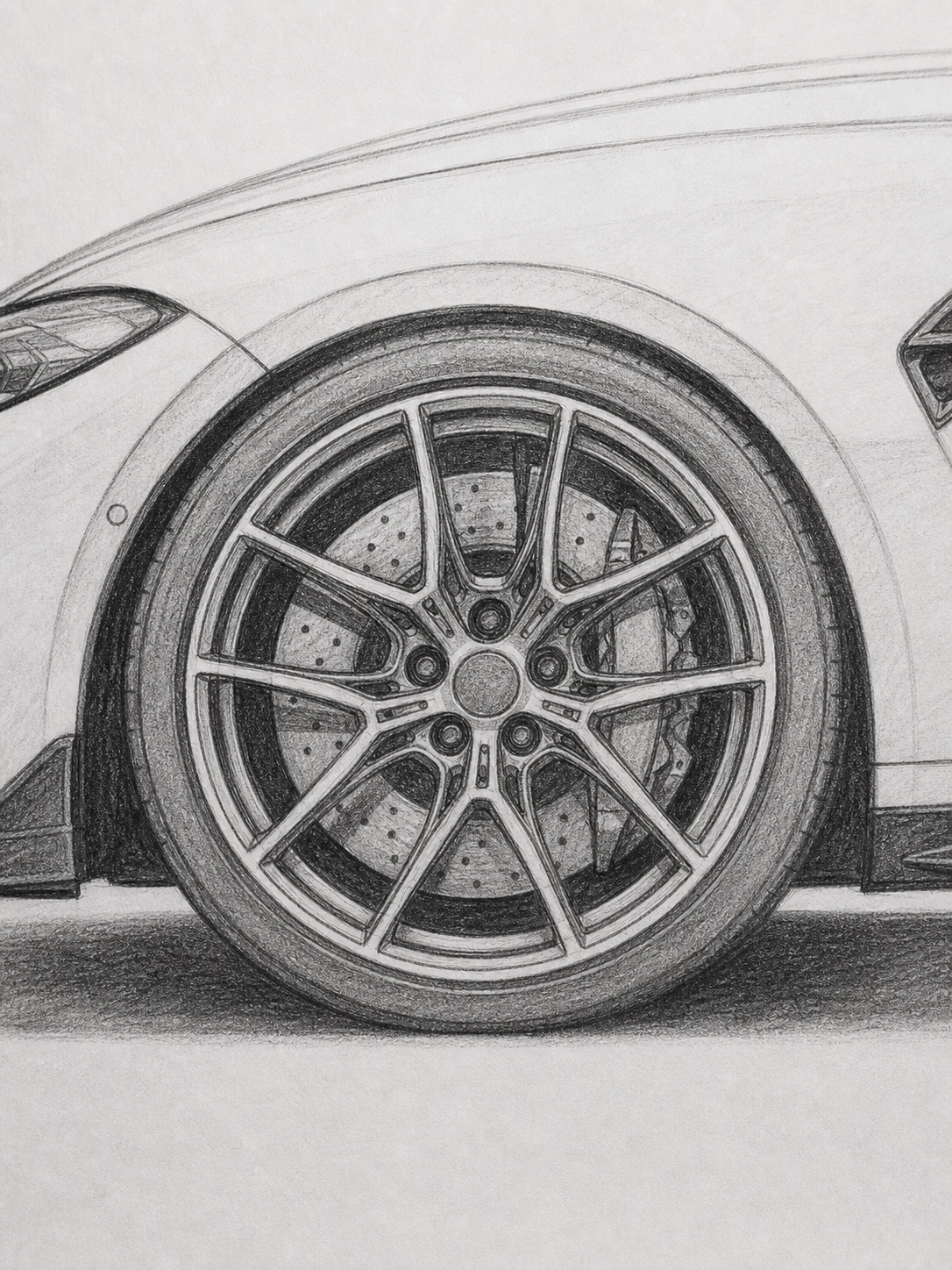
The underside of the car and the inside of the wheel arches are the darkest areas in any car drawing. Apply your heaviest pencil pressure here. A 6B pencil in the shadow zones, transitioning to 4B and then 2B as you move up from the shadow into the mid-tone areas of the side panel, produces a convincing tonal range.
The wheel arch shadows are not uniform. The inside top of the arch is very dark (the tire in the center absorbs almost all light). The visible portion of the rim and tire in the lower half of the arch is mid-tone. If there is a visible brake caliper (as on M-series BMWs), it reads as slightly lighter than the tire, often with a cast shadow from the spokes across it.
Panel gap lines and shut lines
Panel gaps (the lines between the door and the fender, between the hood and the fender, at the trunk lid) are drawn as single confident lines, heavier than the body surface lines. They represent a physical gap in the bodywork, not a surface feature. On a well-drawn car, the panel gaps are the heaviest lines in the drawing after the tyre contact patch and the shadow under the car. Using a 0.3mm mechanical pencil for these ensures consistent weight without the variation of a standard pencil.
Drawing the E46 M3 vs the G80 M3
The two most drawn M3 generations require different emphases. The E46 (2001-2006) is often described as the last M3 with a purist body language: it uses the standard 3 Series body as its base but widens it with flared over-fenders front and rear, giving it a subtle but coherent muscularity. Every M3-specific element reads as additive to a resolved baseline.
The G80 (2021+) takes a different approach. The body is extensively reengineered from the standard G20 3 Series with a wider body structure, not just over-fenders. The front end is most dramatically different: the large kidney grille and twin-duct front bumper give it an immediately aggressive character that the E46 does not attempt.
Key drawing differences between generations
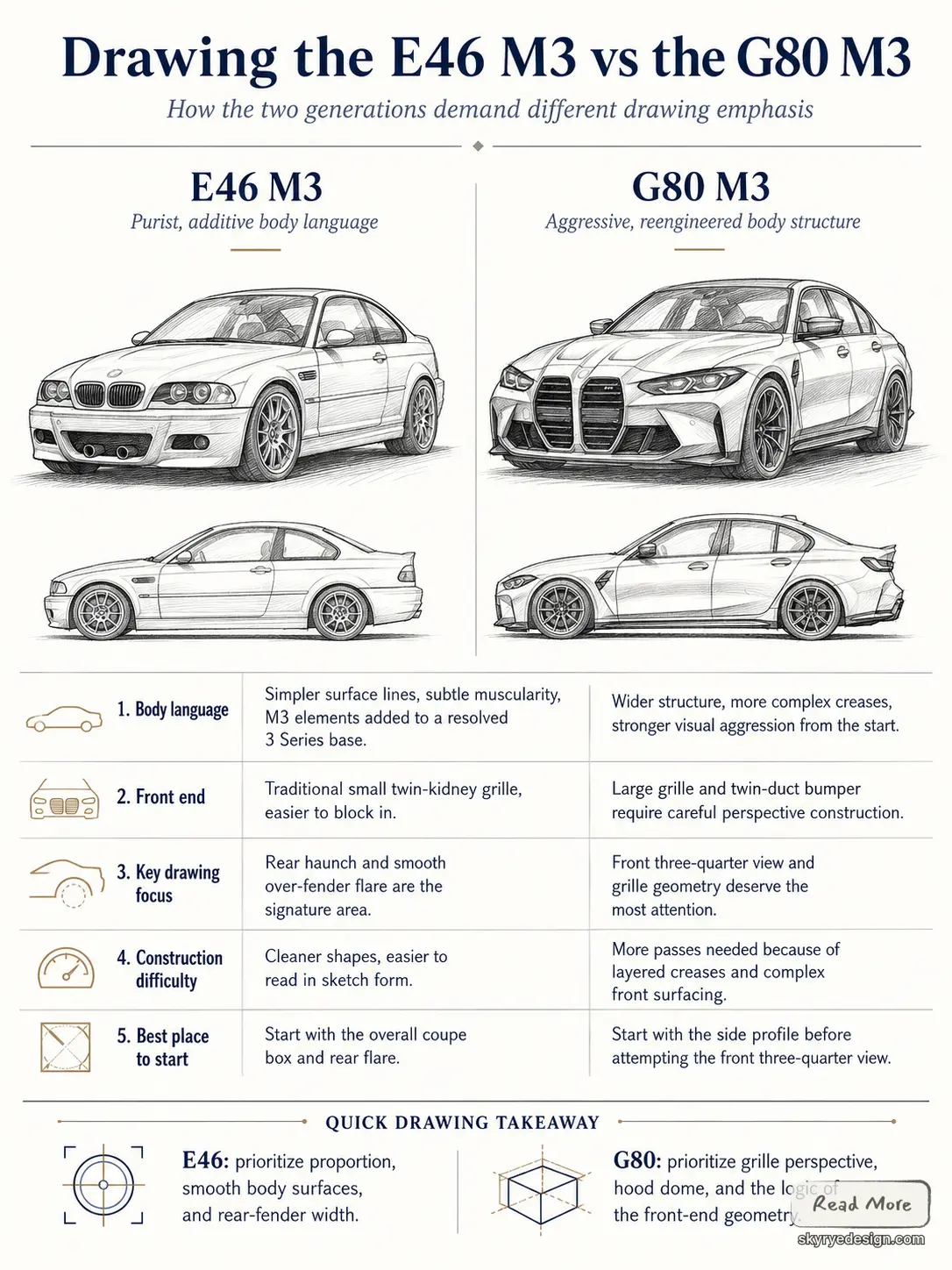
When drawing the E46: the body surface lines are simpler and easier to read in a sketch. The front grille is a traditional twin-kidney in a smaller format. The rear haunch is the most interesting area: the over-fender flares smoothly from the door surface and creates a distinctive widening that is the signature of the generation. Quad exhaust exits at the rear, paired on each side.
When drawing the G80: the front end demands the most attention. The large grille shape must be constructed carefully in perspective. The hood has a more pronounced central power dome. The body creases are more numerous and more complex, requiring more passes to get right. Start with the G80 side profile before attempting the three-quarter front view.
Taking the M3 drawing digital
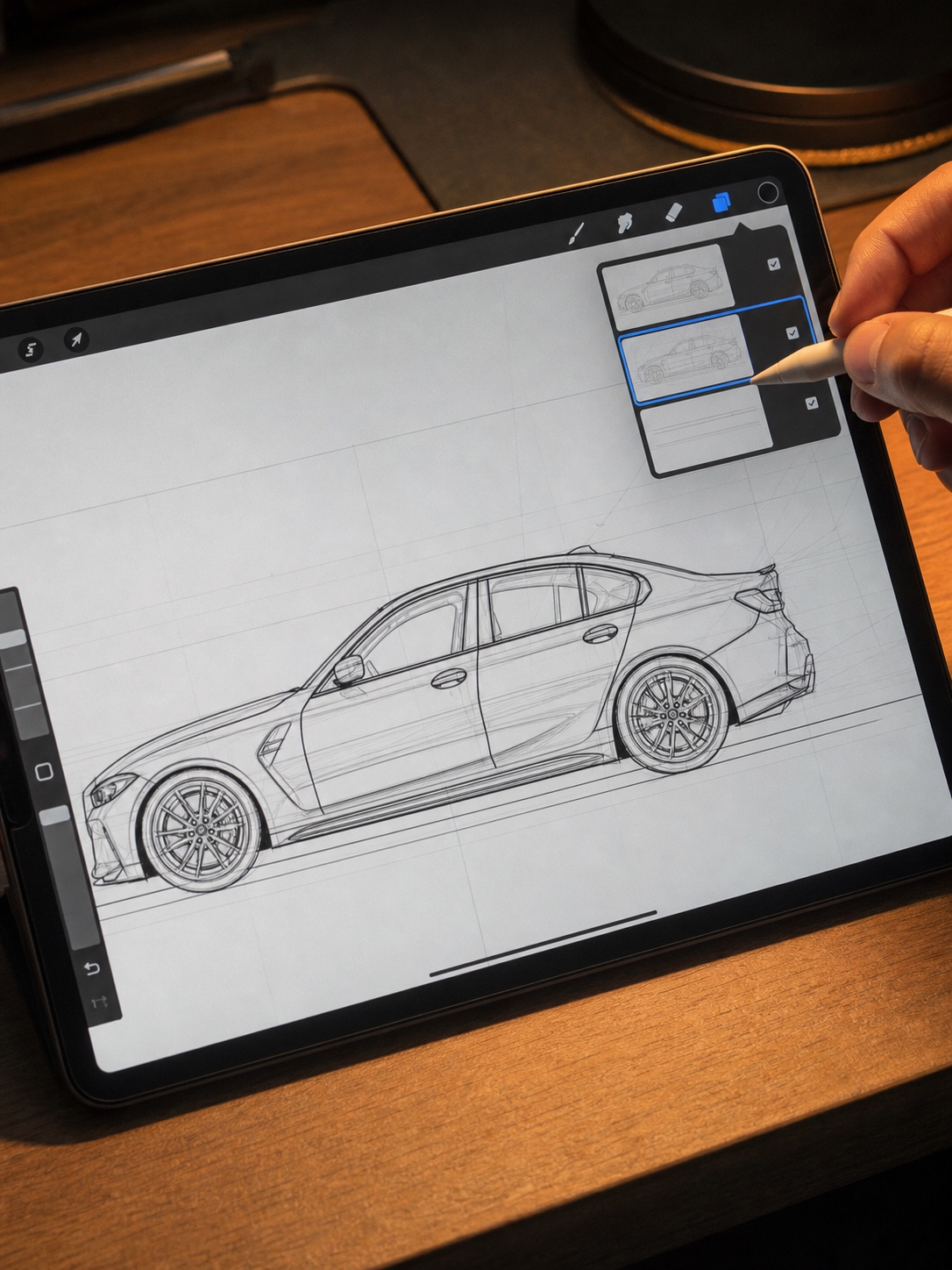
Digital tools change the car drawing process without changing the underlying principles. Perspective must still be correct. Proportions still drive the quality of the result. What digital adds is the ability to work in layers, compare the M3 method with a Lexus car drawing tutorial, and produce clean final line art over rough construction work.
In Procreate, the workflow for an M3 sketch is: rough construction lines on a low-opacity layer, clean final outline on a layer above it, shading on a separate layer below the line art. The Perspective Drawing guide in Procreate can lock drawing strokes to a two-point perspective grid, which eliminates the most common source of error in digital car drawing.
The Symmetry guide is useful for front or rear elevation views where the car should be perfectly symmetrical about the centerline. Draw one half, flip it, and check whether the proportions look right before committing to the final line art. Most front-view car drawings have subtle proportion errors that are immediately obvious when mirrored.
Porsche car drawing exercise: heaviest lines (6B or thickest pen nib) for the tyre contact patch and the underside shadow. Second heaviest for the outer silhouette of the car body. Medium weight for major feature lines (shoulder crease, sill, door cuts, hood edge). Lightest for interior panel details, grille slats, and secondary creases. This hierarchy, applied consistently, separates a car drawing that reads as finished from one that looks flat.
If you like building the BMW from a bounding box, the same method carries over when you learn how to draw a helicopter with a cockpit mass, tail boom, and rotor span.
BMW proportions are sharper and more modern, so balance that practice with a VW Beetle drawing step by step lesson focused on arcs, wheel size, and oval headlights.
Frequently asked questions
How do you draw a BMW M3 step by step?
Start with a bounding box at 4.5:1 length-to-height ratio. Mark wheel positions at 20% and 75% from the front. Draw wheel circles at 46% of box height. Block in the roofline, shoulder line, and waistline. Add wheel arches (wider than standard 3 Series), side sills, and the distinctive kidney grille. Refine panel lines, add the rear spoiler and quad exhausts. Apply shading with sky reflection as a reserved light horizontal band on the upper side panel.
What are the BMW M3 proportions for drawing?
For a side-view sketch: length-to-height ratio approximately 4.5:1, wheelbase approximately 60% of total length, wheel diameter approximately 46% of total car height, front overhang shorter than rear overhang. The roofline peaks over the front passenger area and declines gently to the C-pillar, creating the subtle fastback quality that distinguishes the M3 from a standard 3 Series.
What makes the BMW M3 distinctive to draw?
The twin kidney grille (large and upright on the G80, traditional format on E46 and E30), the wide muscular fender flares at all four corners, and the quad exhaust exits at the rear. The G80 adds a wider front bumper with large air intakes. The E46 has cleaner, more flowing surfaces with a visible rear haunch that is the signature of that generation.
Which BMW M3 generation is easiest to draw?
The E46 M3 (2001-2006) is generally easier because its body surfaces are cleaner with fewer complex creases. Lines flow continuously from front to rear with minimal sharp direction changes. The G80 M3 has more complex surface sculpting and a more detailed front end. For first attempts, the E46 side profile reduces to cleaner, more readable shapes.
What pencils should I use for a car drawing?
HB for all construction lines and the bounding box. 2B or 4B for final body outlines and feature lines. 6B for the deepest shadows under the car and inside wheel arches. A 0.3mm mechanical pencil for fine detail lines on grille slats, panel gaps, and headlight elements. Keep construction lines at minimum pressure so they erase cleanly before the final render.
How do you draw a car in perspective?
For a three-quarter view, use two-point perspective with the horizon line at roughly the car’s roofline height. Both vanishing points should be outside the car’s outline on paper, or the perspective will appear distorted. All horizontal car lines (sill, waistline, hood edge) converge to one of the two vanishing points. All verticals (A-pillar, door pillars, wheel arches) remain truly vertical.
How do you shade a car drawing realistically?
The sky reflection produces a broad horizontal lighter band across the upper side panel. Leave this as the lightest area in your side panel shading. Below the shoulder crease, the panel darkens toward the sill. The underside and wheel arch interiors are the darkest areas. Apply directional strokes that follow panel curvature. Use 6B to 2B range across the tonal scale, with the heaviest marks under the car and inside the arches.
For more car sketch practice, browse the car drawing archive and pair this BMW M3 exercise with simpler side-profile studies before moving into complex three-quarter views.
For a more extreme sports-car silhouette after the M3, use this Lamborghini drawing step by step and compare the wheelbase, roof angle, and wedge-shaped nose.
- 3.7Kshares
- Facebook0
- Pinterest3.7K
- Twitter0
- Reddit0