Start a Lamborghini car drawing with the stance, not the badge. Draw a straight baseline, place two equal wheels, then stretch a low wedge over them before you add headlights, vents, or reflections.
The shortcut is to think like a car designer: wheelbase first, roof angle second, details last. If the cabin sits too high or the wheels drift apart, even a carefully shaded sketch will stop feeling like a Lamborghini.
- Lamborghini car drawing step by step
- Which Lamborghini should beginners draw first?
- Why Lamborghini car drawing works so well
- What makes a Lamborghini car drawing recognizable?
- 8 Lamborghini car drawing models to sketch
- 1. Lamborghini Countach
- 2. Lamborghini Diablo
- 3. Lamborghini Murciélago
- 4. Lamborghini Aventador
- 5. Lamborghini Huracán
- 6. Lamborghini Veneno
- 7. Lamborghini Sian
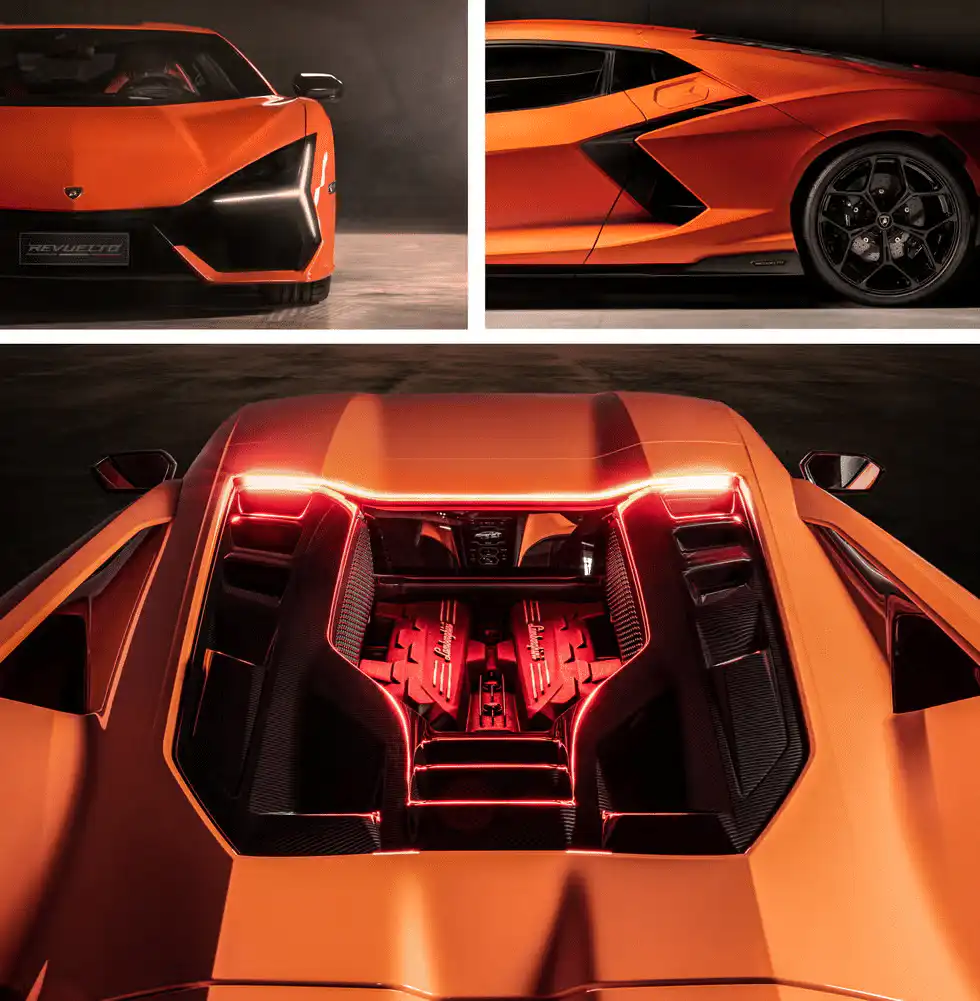
- 8. Lamborghini Revuelto
- Lamborghini car drawing styles that work best
- Common Lamborghini drawing mistakes
- Useful references for Lamborghini sketches
- Lamborghini drawing FAQ
- Final tips for a cleaner Lamborghini car drawing
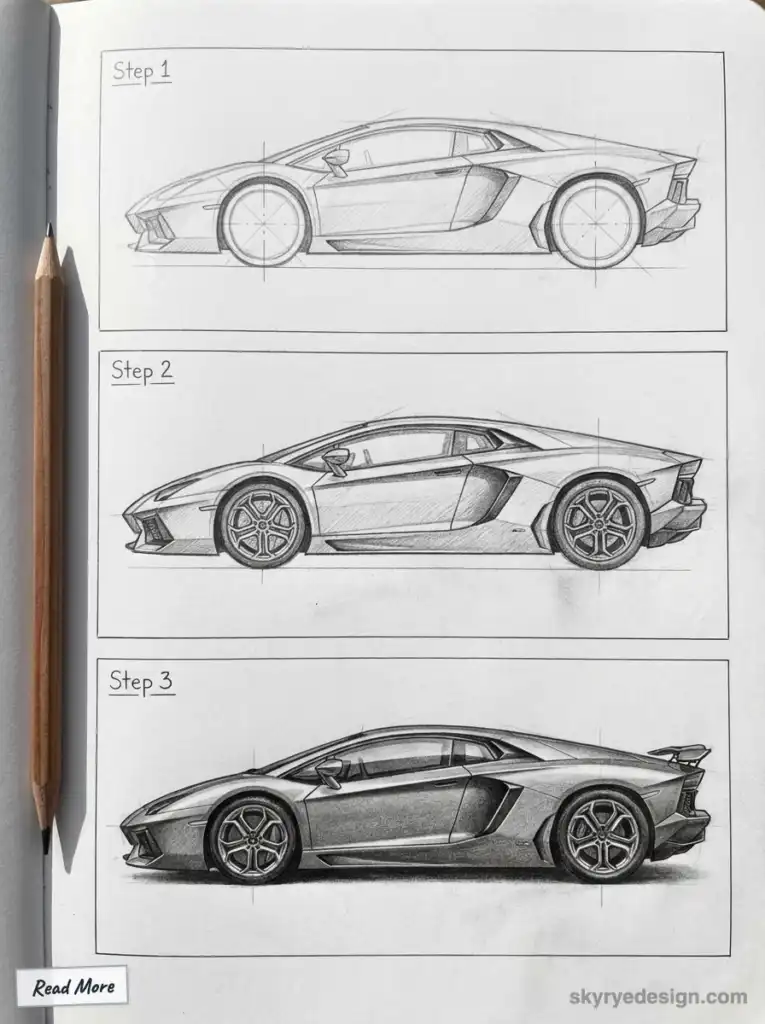
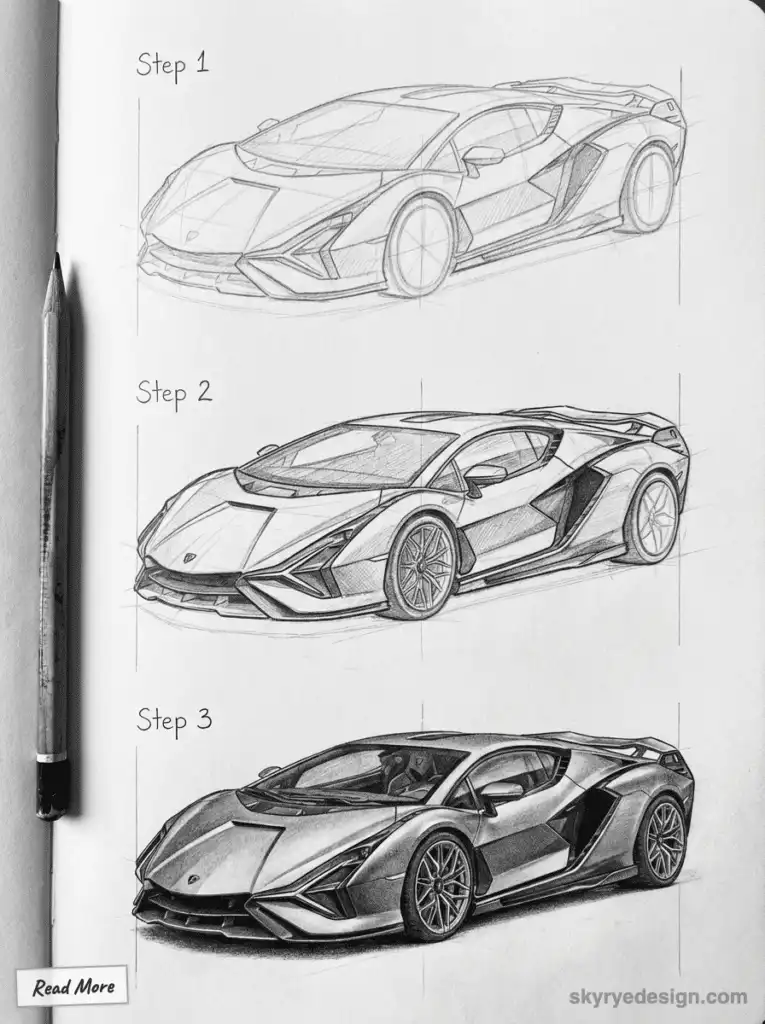
I keep this stage light with an HB pencil. Before adding any details, check the wheel spacing, the height of the body, the front overhang, and the slope of the roof. If the car looks too tall or the wheels sit too close together, it will start looking like a generic sports car instead of a Lamborghini.
Once the proportions feel right, bring in the Lamborghini cues: Y-shaped headlights, angular air intakes, deep side creases, hexagonal exhaust details, and big rims with sharp spoke patterns. Keep the lines clean and confident.
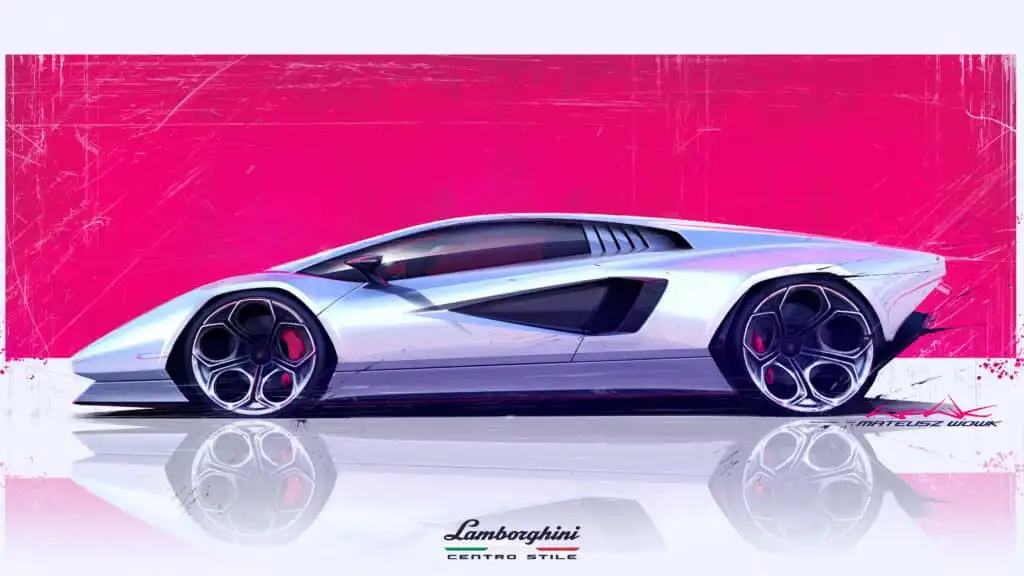
Save shading for the end. Shadows under the car, darker vents, and a few hard reflections can make the sketch pop, but they only work if the outline is already strong. Texture will not rescue bad proportions.
| Drawing stage | What to focus on | Common mistake |
|---|---|---|
| Proportions | Low stance, wide wheels, short front overhang | Making the car too tall or narrow |
| Perspective | Straight baseline, matching wheel ellipses, angled roof | Tilting one wheel differently from the other |
| Details | Y lights, side intakes, hexagonal shapes, sharp creases | Adding vents before the body shape is correct |
| Shading | Large value planes, hard shadow edges, reflective highlights | Smudging everything into the same gray tone |
Lamborghini car drawing step by step
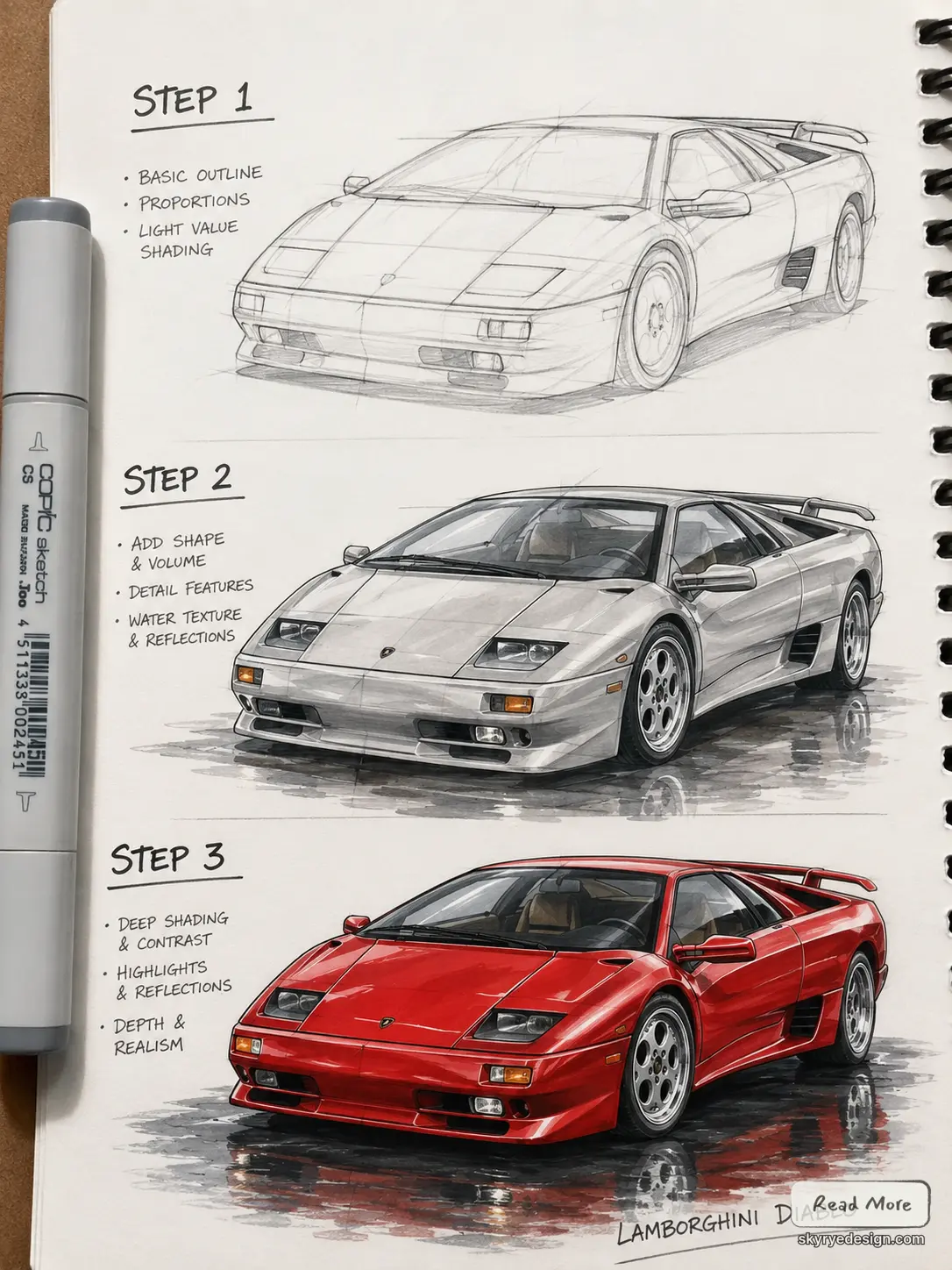
- Draw a light baseline and place two equal wheel circles.
- Sketch a long, low body box with a wedge-shaped nose.
- Add the roof as a slanted trapezoid, leaning slightly forward.
- Mark the windshield, side window, wheel arches, and rear mass.
- Add Lamborghini details: sharp headlights, intakes, creases, rims, and vents.
- Clean the construction lines, then shade the large planes from light to dark.
If car perspective still feels shaky, practice the basics with the Volkswagen Beetle drawing guide, then come back to the sharper Lamborghini shapes. For more automotive sketching practice, the car drawing hub collects the related tutorials in one place.
Which Lamborghini should beginners draw first?
The Lamborghini Huracan is usually the easiest Lamborghini to draw first. Its body is still low and aggressive, but the surfaces are cleaner than the Countach, Veneno, or Revuelto. Start with a side view or three-quarter front view, because those angles show the stance without forcing too much rear-end complexity.
The Aventador is better for intermediate practice. It has more drama: deeper intakes, harder shadow shapes, and stronger Y-shaped light details. The Countach is wonderful for silhouette training, but beginners often overdo the wedge and forget that the wheels still need believable spacing.
Quick model choice guide
| Model | Best for | Sketching focus |
|---|---|---|
| Huracan | Beginners | Clean stance, simple roofline, balanced wheels |
| Aventador | Intermediate sketches | Y lights, deep intakes, hard shadow planes |
| Countach | Silhouette practice | Extreme wedge, flat nose, iconic side profile |
| Revuelto | Advanced detail work | Layered surfaces, modern lights, complex rear shapes |
Why Lamborghini car drawing works so well
A Lamborghini car drawing is a good practice subject because the design reads clearly even before the small details are added. The low roof, long wheelbase, hard side crease, and wide wheels give you a strong silhouette to check against your reference.
I would treat the first pass like an industrial design thumbnail: ignore the badge, simplify the body into wedges, and make the wheels sit correctly on the ground. Once that foundation feels fast and stable, the intakes, headlights, rims, and reflections become much easier to place.
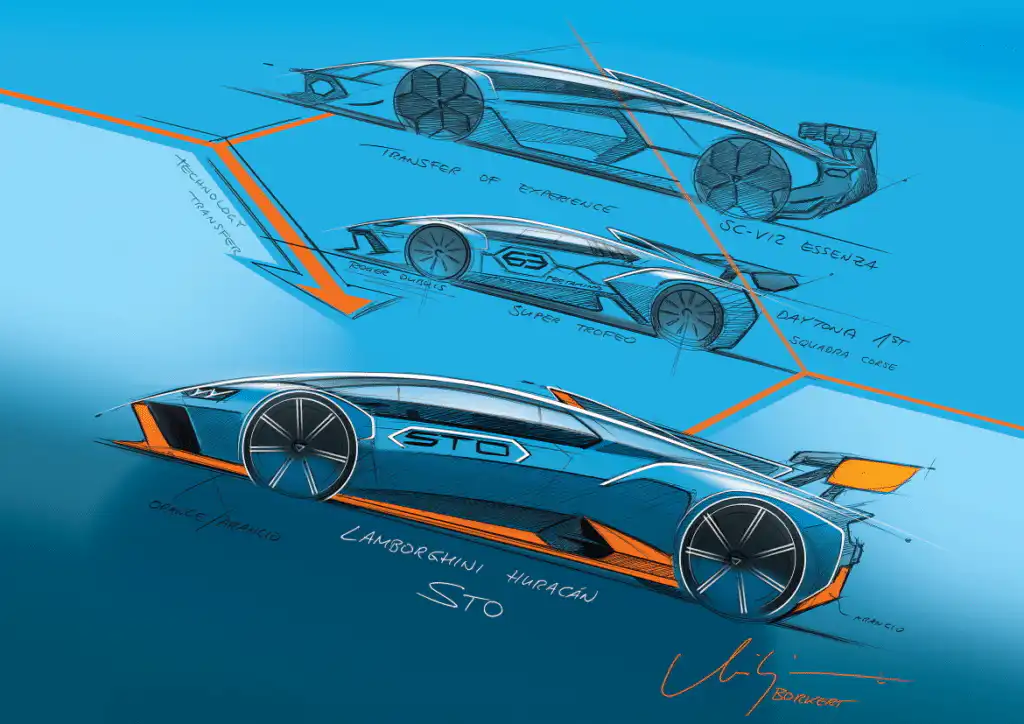
- Silhouette: a wedge profile is easier to judge than a rounded sports car shape.
- Stance: the body should feel low, wide, and planted before shading starts.
- Details: Y-shaped lights, deep intakes, hexagon motifs, and sharp vents give the sketch instant Lamborghini character.
What makes a Lamborghini car drawing recognizable?
The drawing works when the big proportions are right: two large wheels, a short front overhang, a long body, a forward-leaning cabin, and a roofline that stays unusually low. If those shapes are off, extra vents and glossy shading will not fix the sketch.
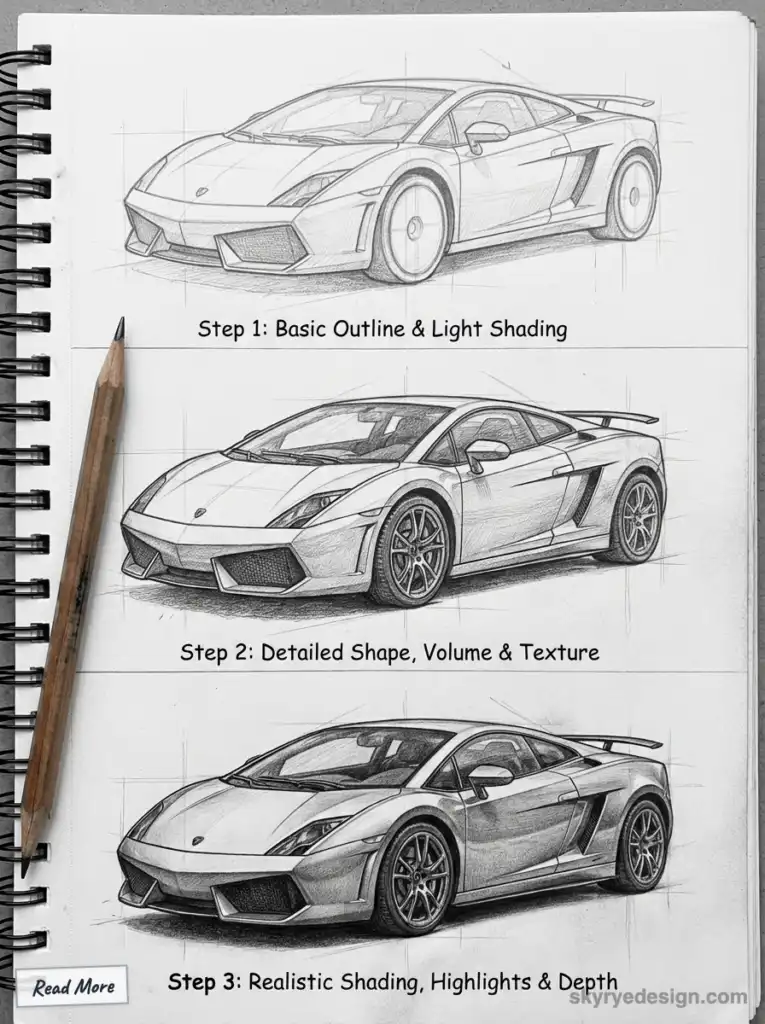
Start with a light box for the body and roof. Then taper the nose, lower the cabin, and check that both wheels share the same baseline. I usually compare the windshield angle and rear wheel placement before drawing any decorative lines, because those two checks catch most beginner proportion mistakes.
- Wedge body: the front should feel sharp without becoming a flat triangle.
- Wheel ellipses: both wheels need the same tilt and size unless perspective clearly changes them.
- Shadow planes: separate the hood, side intake, wheel arches, and rear mass into clear light and dark shapes.
1. Angular Design Language
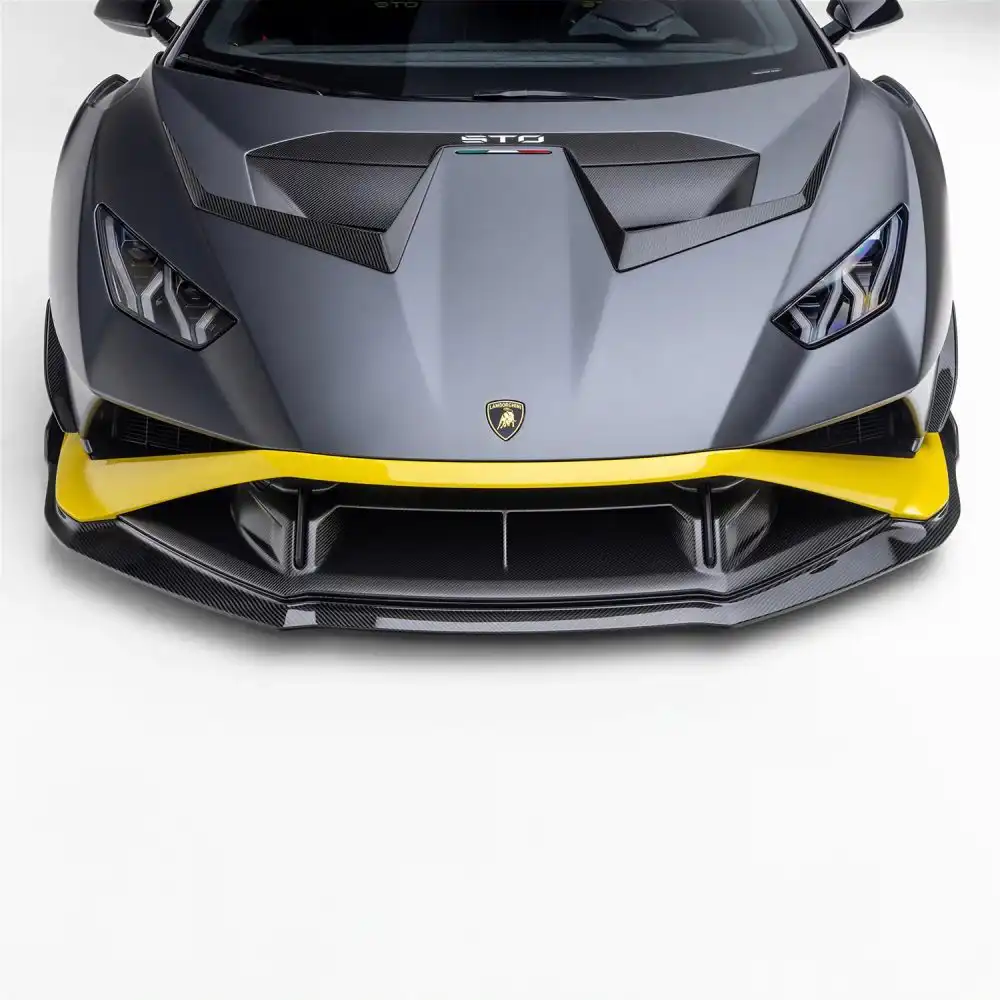
Unlike rounded sports cars, Lamborghini leans heavily on triangles, trapezoids, and sharp intersections. This helps artists:
- Block shapes quickly
- Maintain proportion
- Add drama without realism overload
2. Low, Wide Stance
The extreme width-to-height ratio creates instant visual impact—even in rough sketches.
3. Signature Details
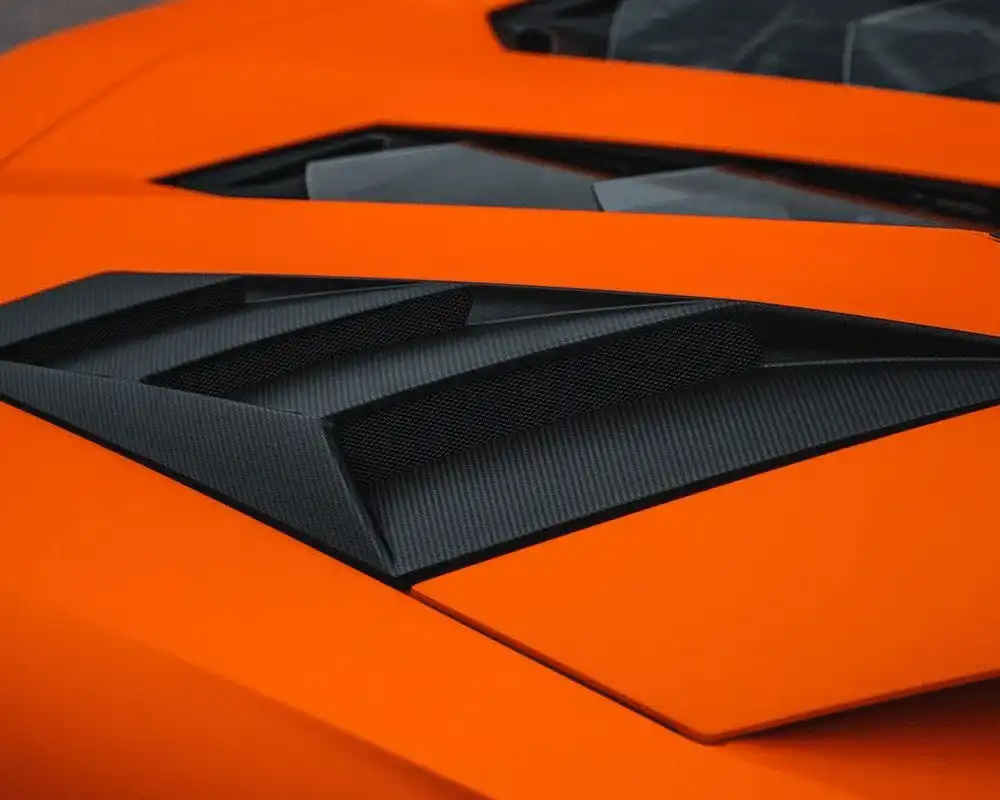
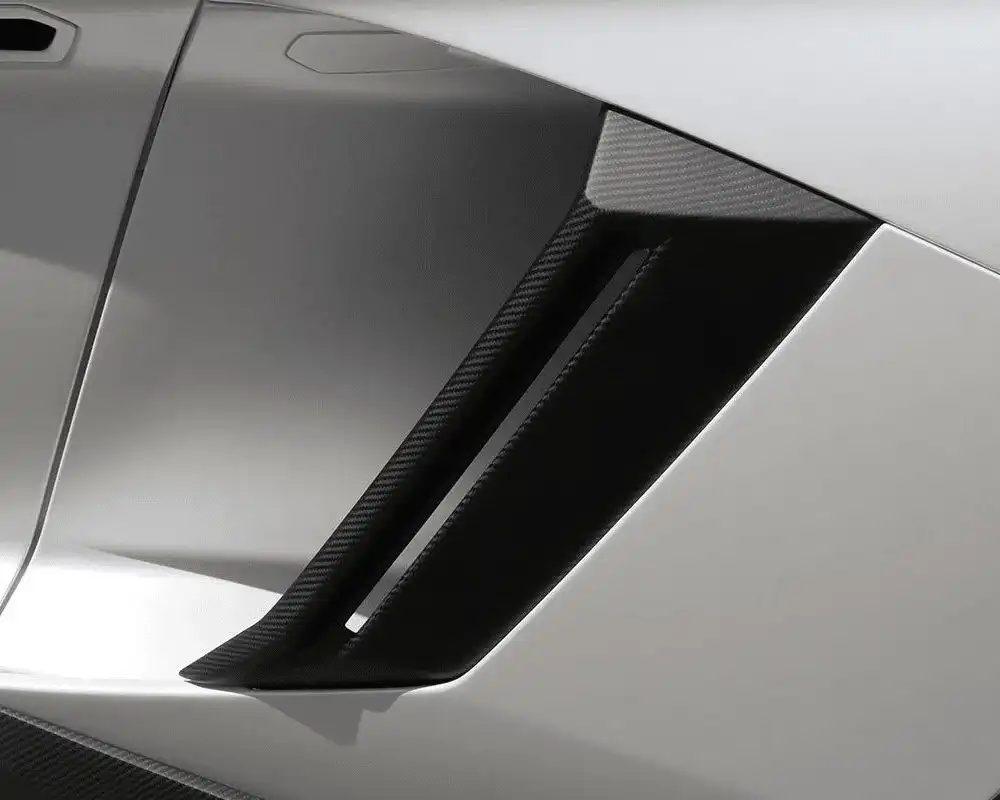
Elements like:
- Y-shaped headlights
- Hexagonal exhausts
- Sharp air intakes
…act as visual anchors in drawings.
8 Lamborghini car drawing models to sketch
These eight models give you a useful range of Lamborghini drawing problems, from clean beginner shapes to aggressive concept-car complexity. Pick one model and one viewing angle first. Jumping between references is how a car sketch turns vague.
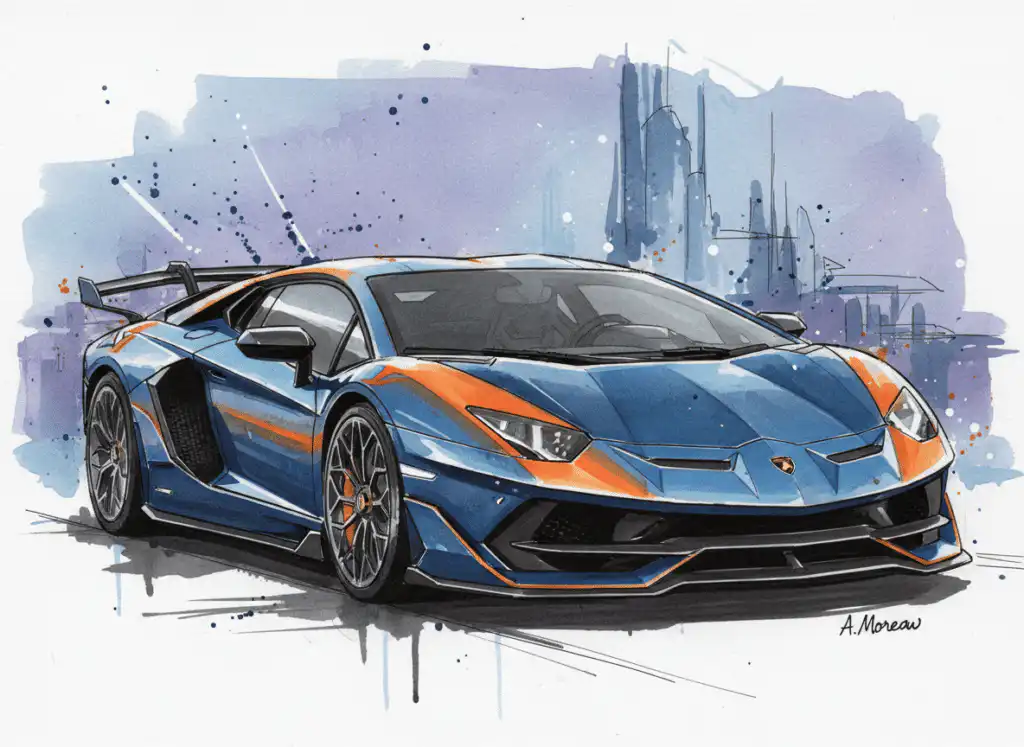
For a clean Lamborghini car drawing, block the body with rectangles and tapered wedges before you chase model-specific details. Countach is best for silhouette practice, Huracan is friendlier for beginners, Aventador is strong for dramatic intakes, and Revuelto is better once you are comfortable with layered surfaces.
Keep the first sketch small. A thumbnail forces you to solve stance, wheel spacing, and roof angle before a big sheet tempts you into overworking the headlights.
1. Lamborghini Countach
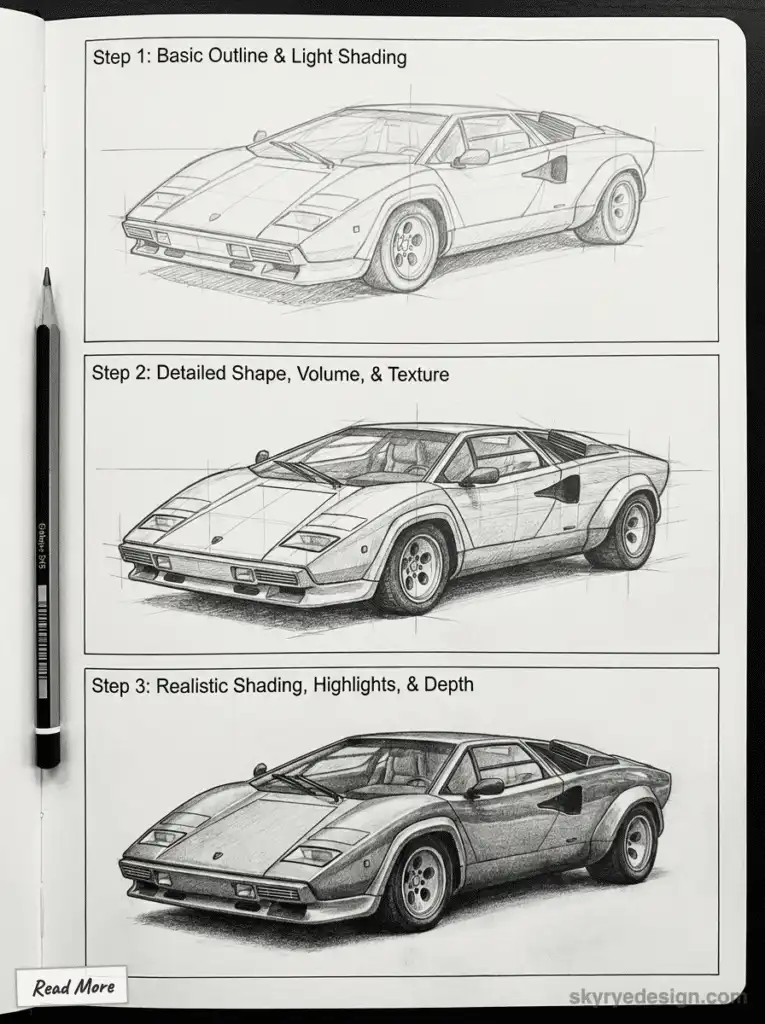
The Countach is where Lamborghini drawing culture truly began.
Why artists love it
- Perfect wedge profile
- Flat planes and straight lines
- Minimal curves
From a drawing perspective, the Countach is almost architectural. Artists can focus on perspective accuracy without being distracted by complex curves.
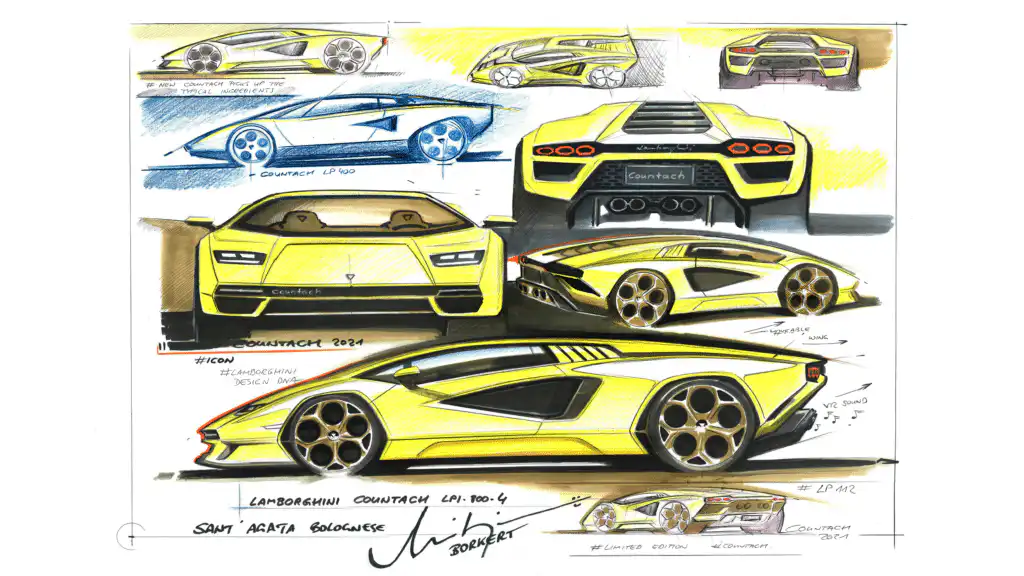
Drawing focus tips
- Start with a long triangular base
- Keep roofline extremely low
- Emphasize scissor doors
2. Lamborghini Diablo
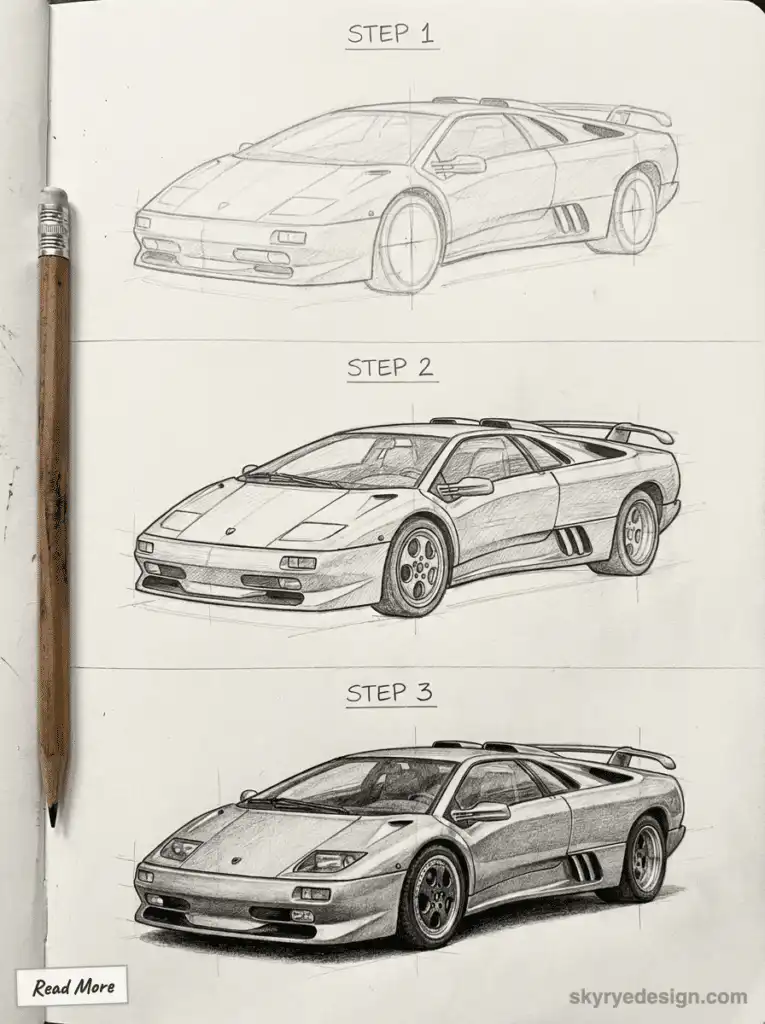
The Diablo softened Lamborghini’s edges—just enough.
Why it’s iconic for artists
- Balanced mix of curves and angles
- Wider rear proportions
- More organic surfaces than the Countach
For artists transitioning from basic sketches to more advanced shading, the Diablo is a natural next step.
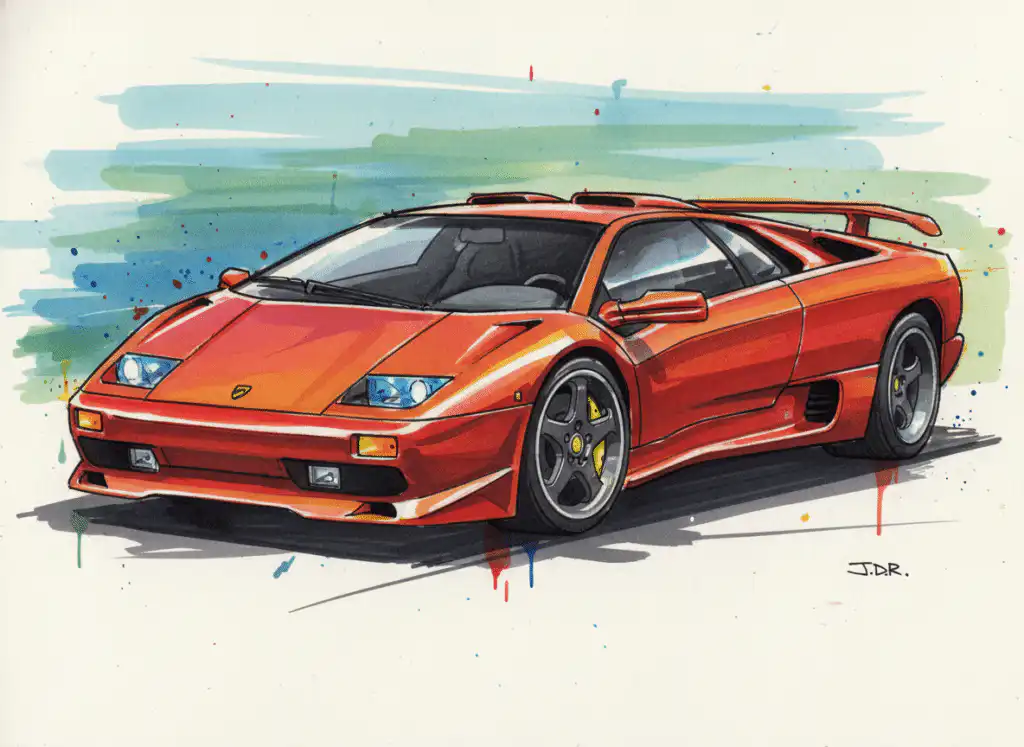
Drawing focus tips
- Pay attention to rear wheel arches
- Use light shading to define curves
- Keep headlights narrow and aggressive
3. Lamborghini Murciélago
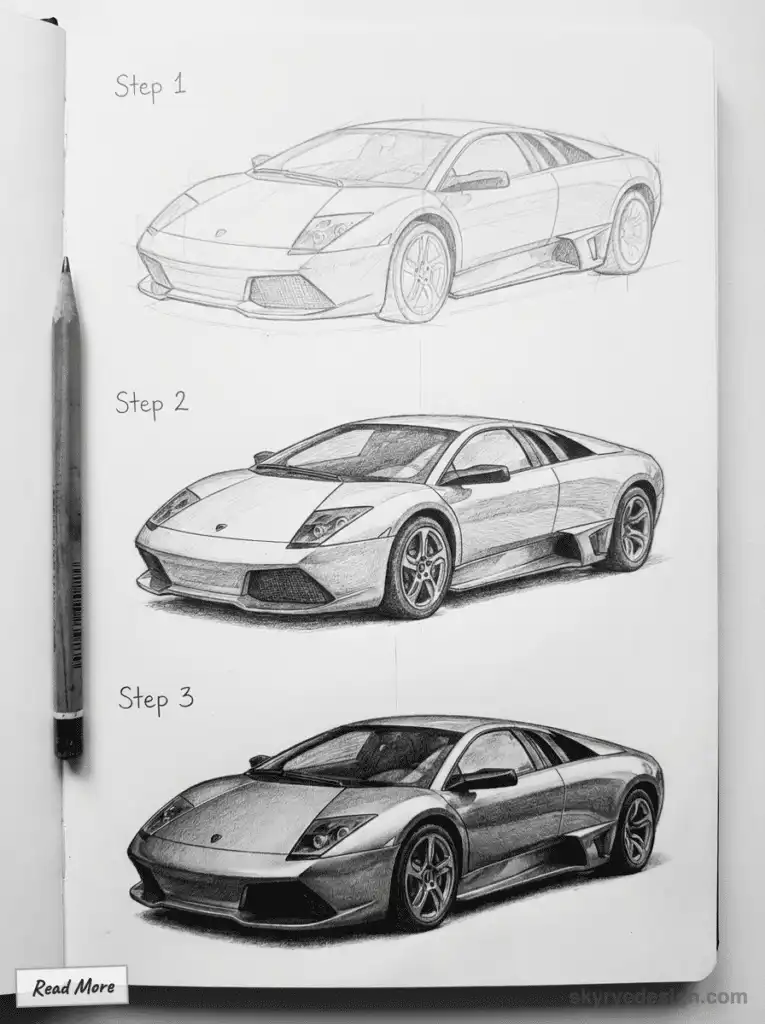
The Murciélago introduced modern Lamborghini proportions.
Why it dominates modern sketches
- Clean, muscular surfaces
- Iconic side air intakes
- Balanced front and rear geometry
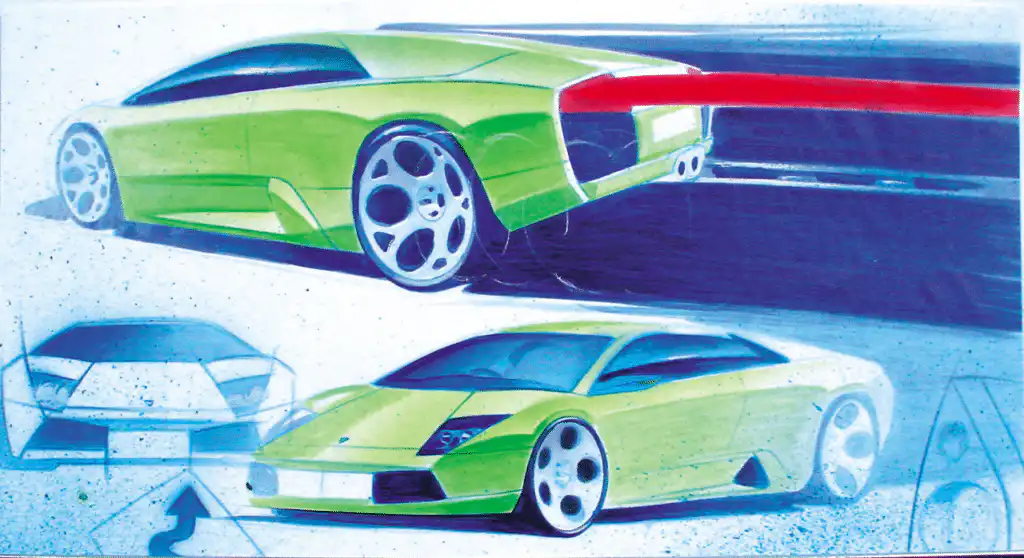
This model is often used in digital drawing tutorials because it scales beautifully from line art to full-color renders.
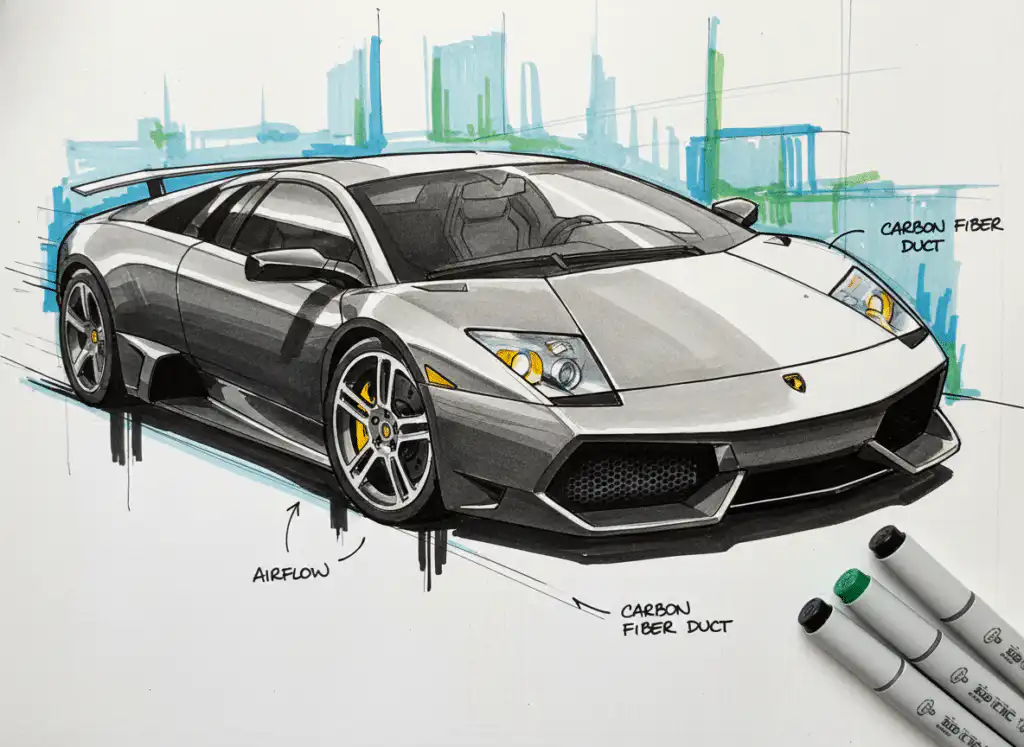
Drawing focus tips
- Block the body first, details later
- Use strong contrast on intakes
- Keep stance wide and grounded
4. Lamborghini Aventador
The Aventador is the most drawn Lamborghini of the social media era.
Why it performs so well visually
- Extreme angles
- Fighter-jet-inspired design
- High-detail potential
For content creators, Aventador drawings perform exceptionally well on Instagram, YouTube Shorts, and Pinterest.
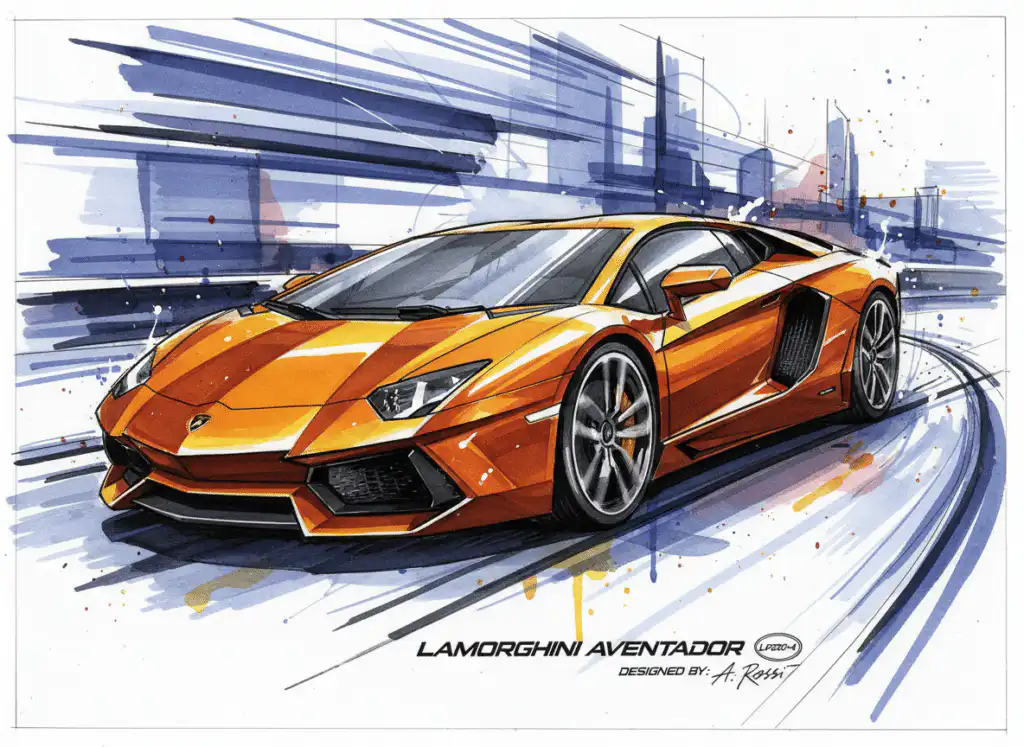
Drawing focus tips
- Break design into triangles
- Emphasize Y-shaped lighting
- Use bold shadows for depth
5. Lamborghini Huracán
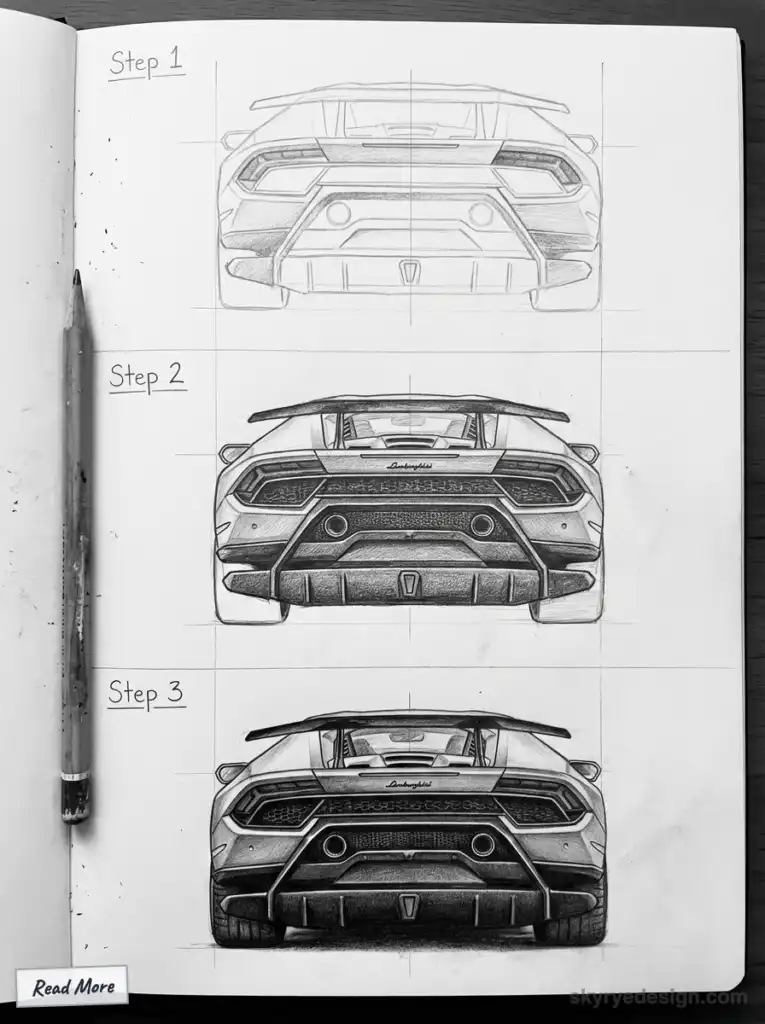
The Huracán is approachable—but still dramatic.
Why beginners choose it
- Cleaner surfaces
- Less extreme geometry
- Easier proportions
This model often ranks high in search results for “easy Lamborghini drawing,” making it a strong SEO entry point.
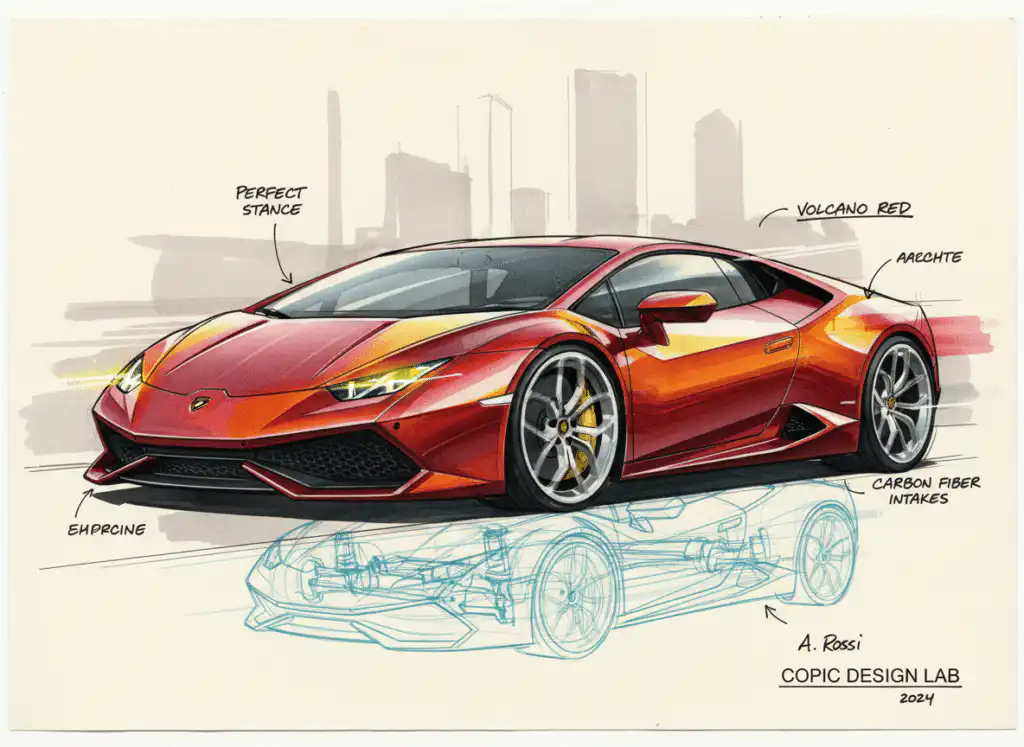
Drawing focus tips
- Maintain smooth lines
- Avoid over-detailing
- Focus on symmetry
6. Lamborghini Veneno
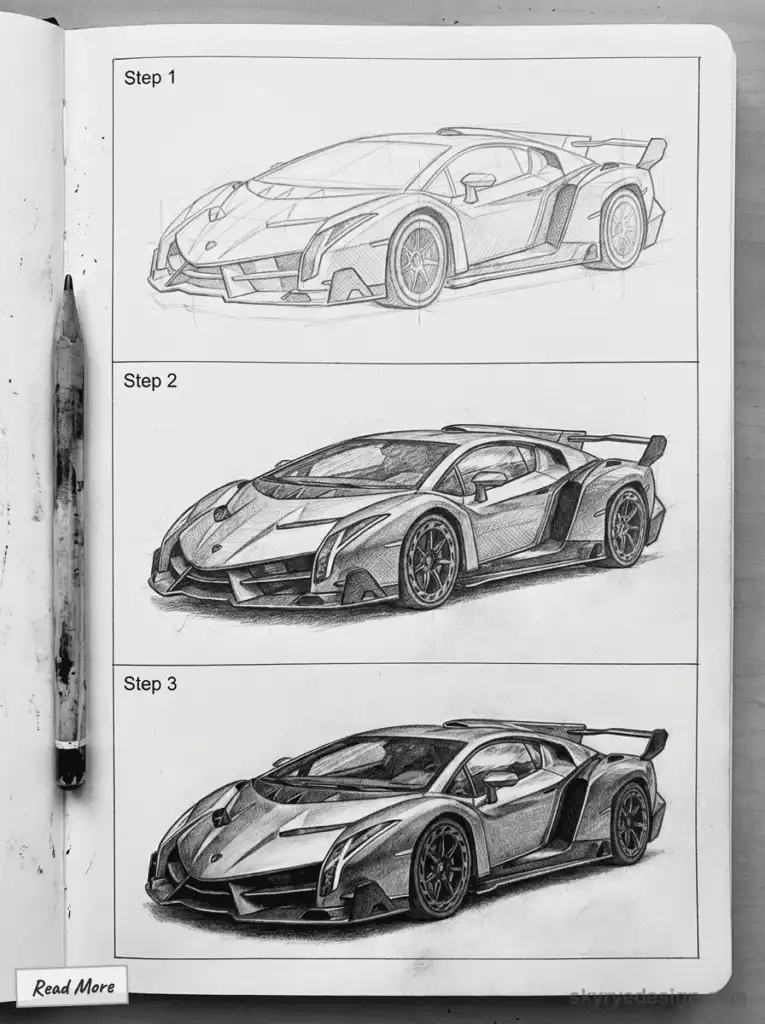
The Veneno looks like a concept car escaped into reality.
Why artists are drawn to it
- Radical aero shapes
- Extreme visual complexity
- High contrast surfaces
Veneno drawings attract attention because they’re instantly recognizable and rare.
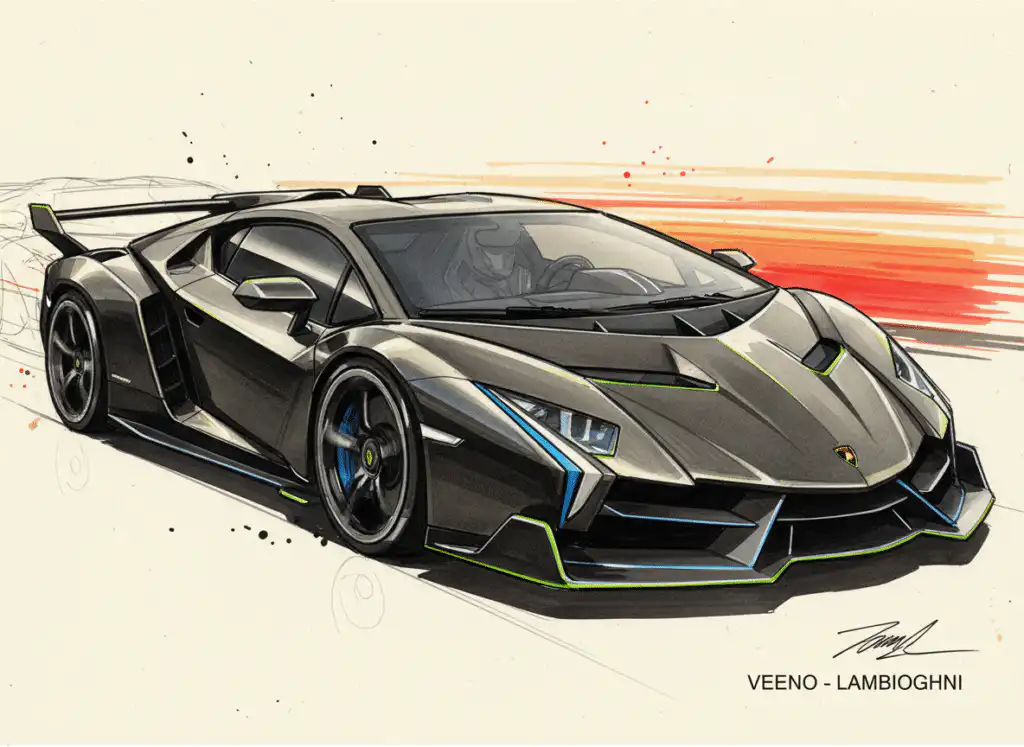
Drawing focus tips
- Sketch loosely first
- Emphasize aerodynamics
- Use sharp, confident strokes
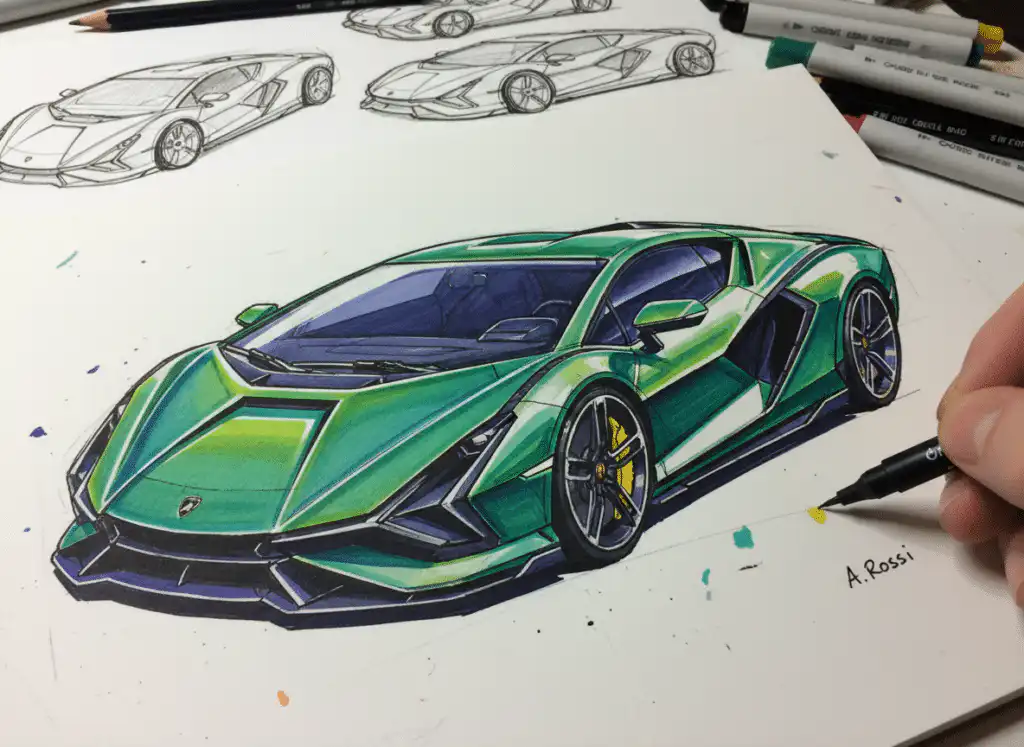
7. Lamborghini Sian
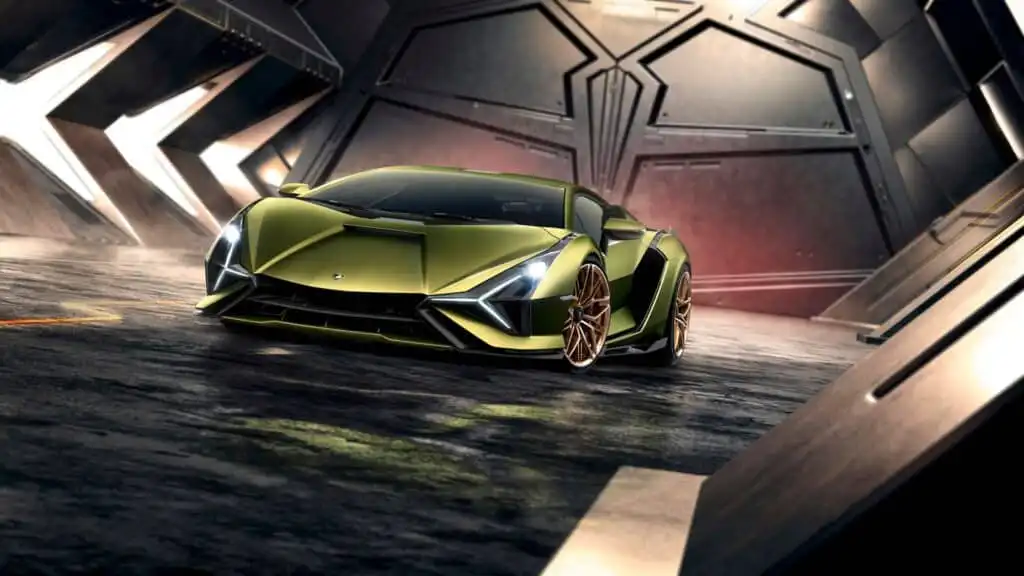
The Sian blends futuristic design with classic Lamborghini DNA.
Why it’s popular in digital art
- Hexagonal motifs
- Futuristic lighting
- Clean panel transitions
Artists often use the Sian to explore neon lighting, reflections, and cyber-inspired color palettes.
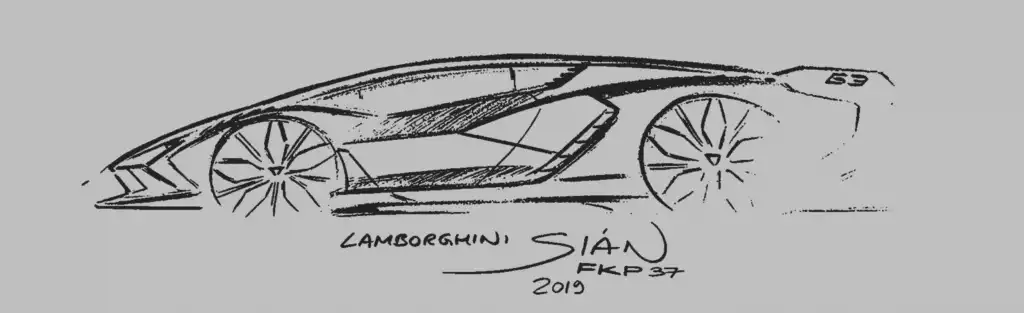
Drawing focus tips
- Highlight hexagon shapes
- Use clean line work
- Experiment with glowing accents
8. Lamborghini Revuelto
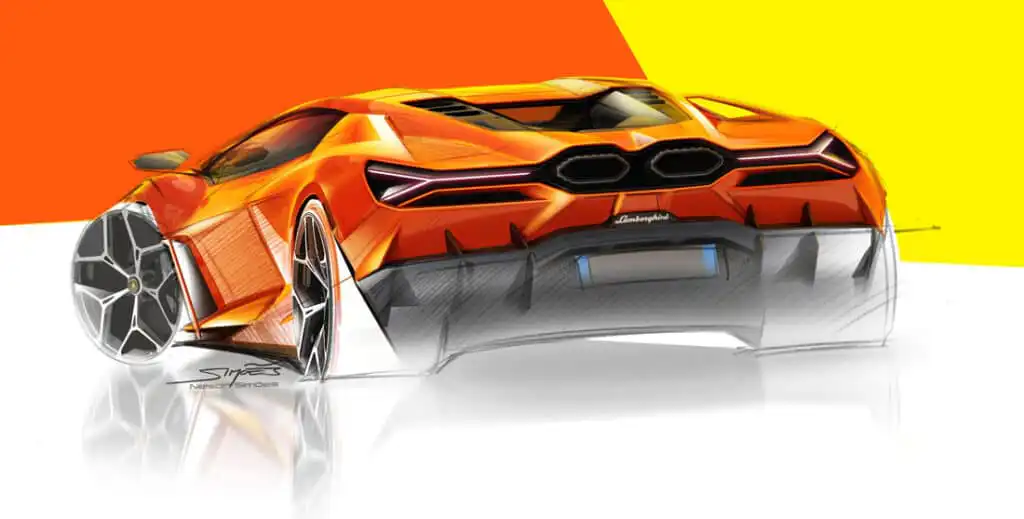
As Lamborghini’s newest V12 flagship, the Revuelto is shaping the next era of automotive art.
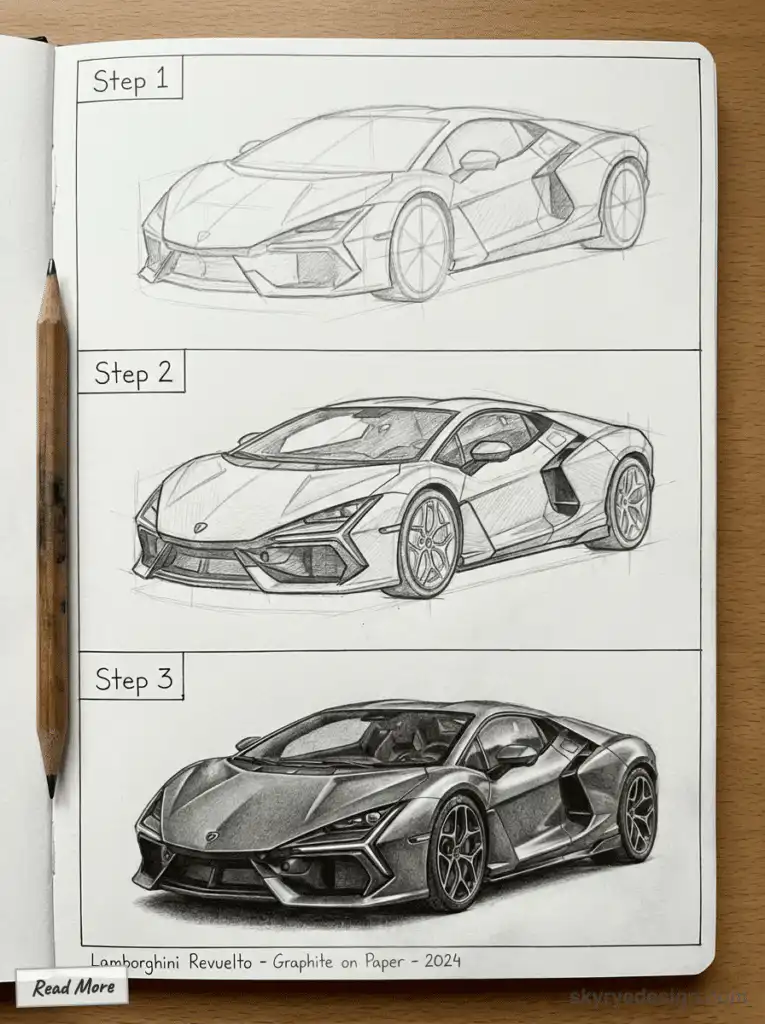
Why it’s gaining traction
- Hyper-modern design language
- Aggressive lighting signatures
- Strong futuristic appeal
Early adopters who draw the Revuelto often rank faster in search and social discovery due to lower competition.
Drawing focus tips
- Study reference angles carefully
- Balance complexity with clarity
- Let negative space breathe
Lamborghini car drawing styles that work best
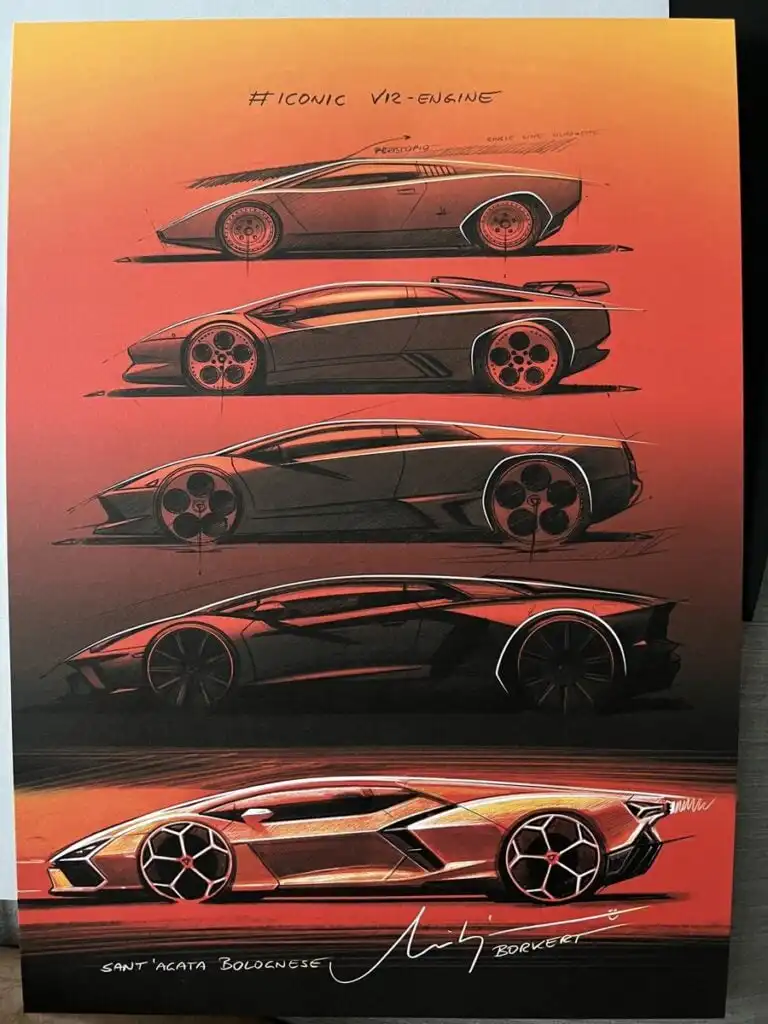
The strongest Lamborghini drawings usually choose one clear finish instead of mixing every technique at once. A pencil study can focus on wheel ellipses and value. A marker rendering can push reflections and hard shadow edges. A digital line drawing can keep the silhouette crisp and graphic.
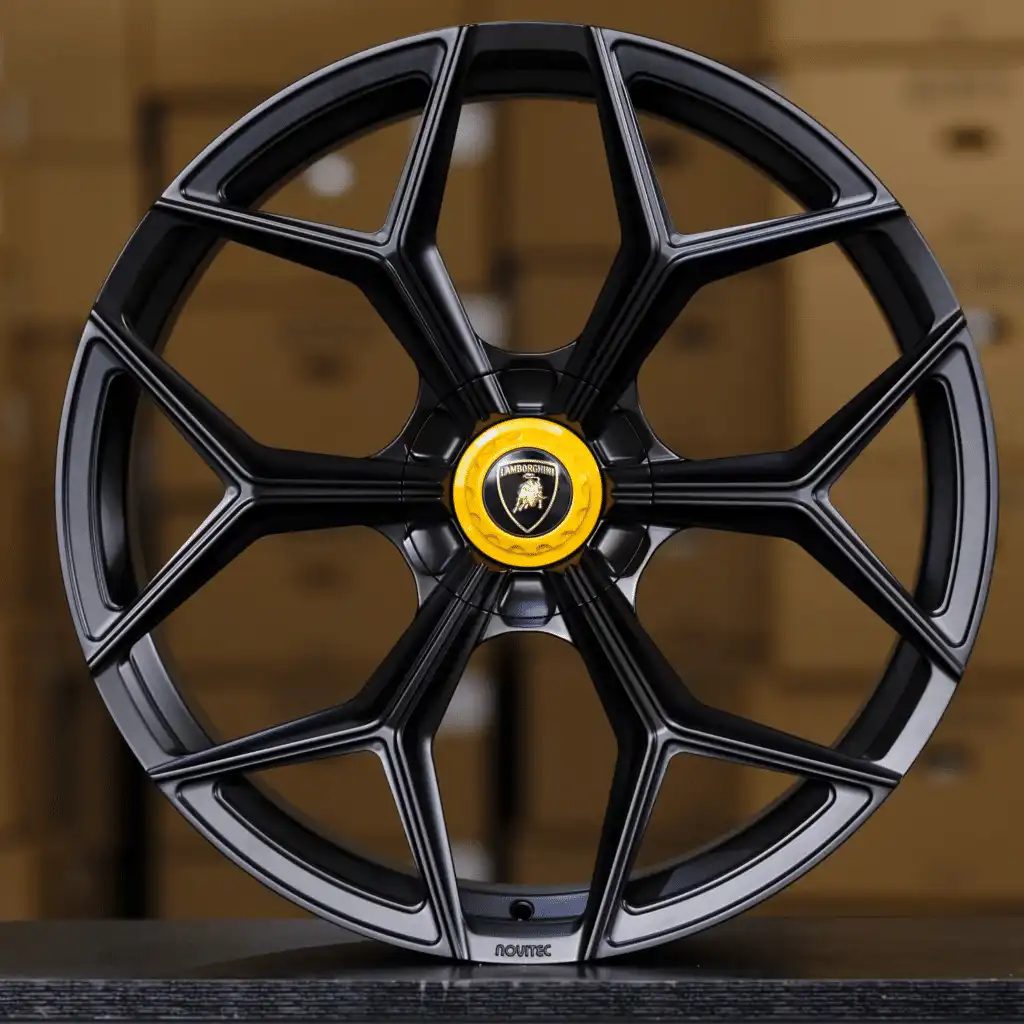
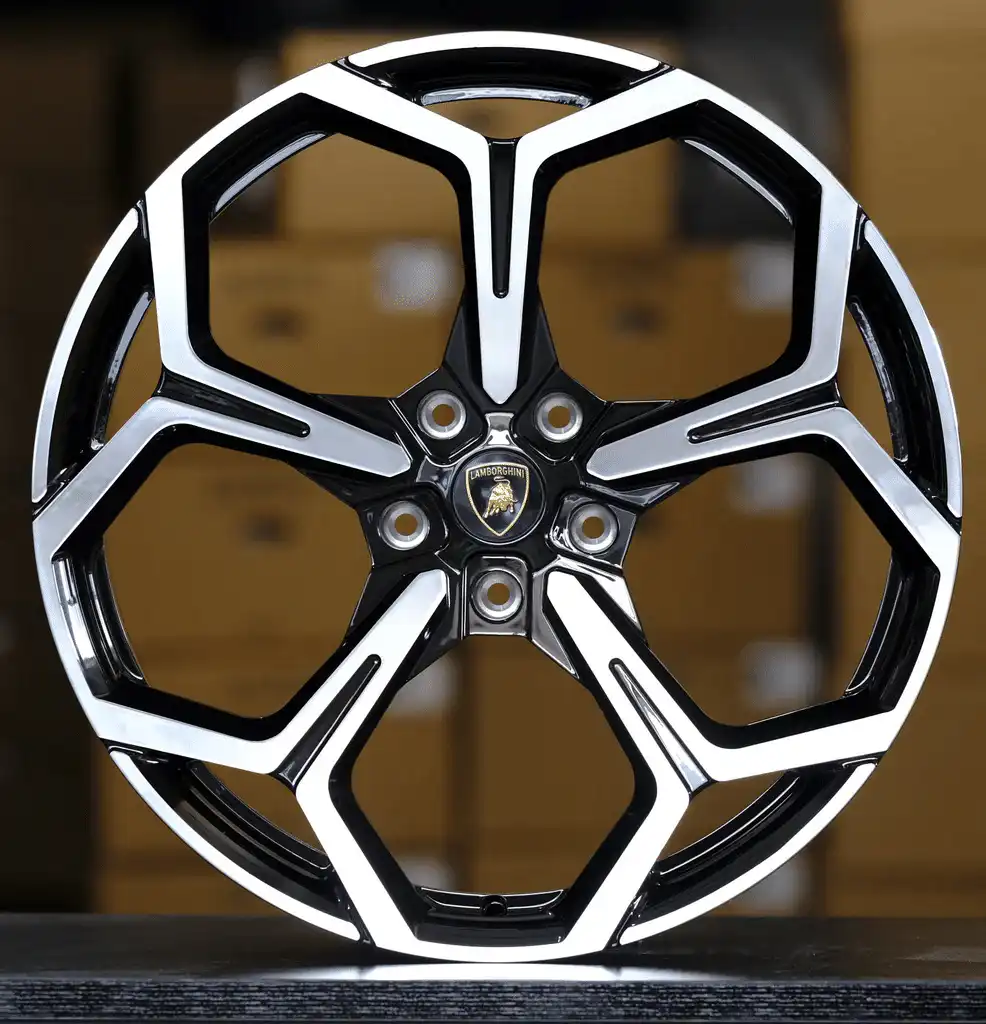
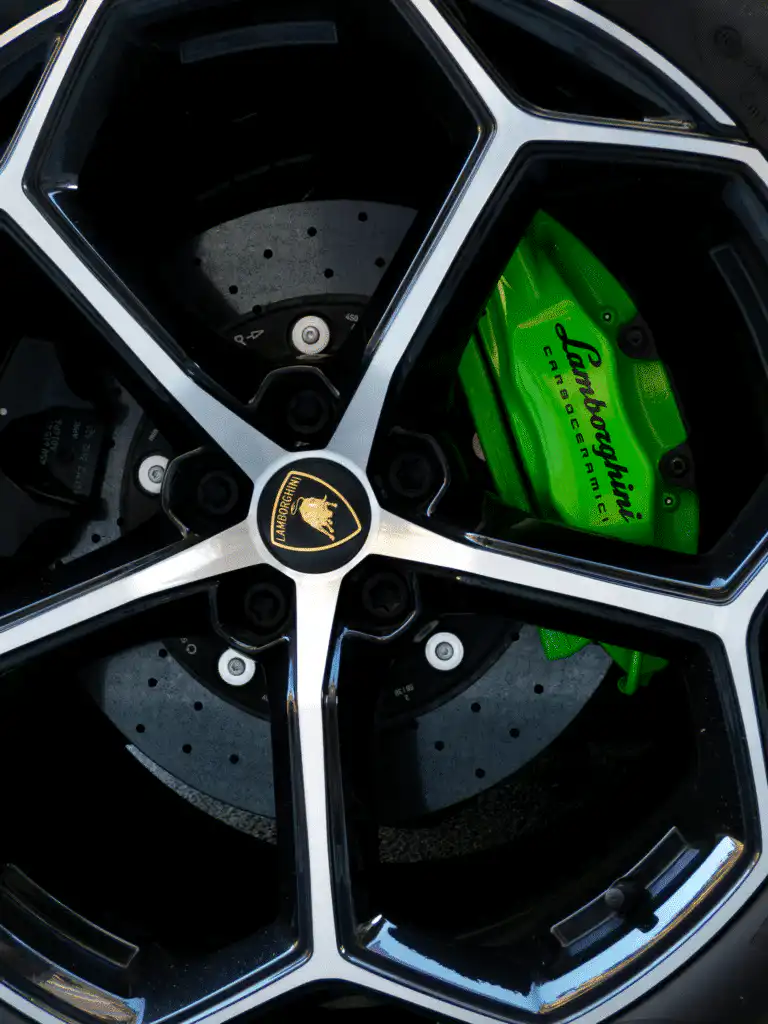
If your goal is realism, separate the body into three value families: light planes, midtone side planes, and dark intake/wheel areas. If your goal is a quick sketch, exaggerate the roofline and wheel size slightly, but keep the baseline clean so the car still feels engineered.
Label finished work with the model name and angle, such as “Aventador side-view pencil sketch” or “Revuelto three-quarter marker render.” Clear labels help readers understand what they are seeing and give you a better practice archive.
High-performing drawing styles
- Pencil sketches (step-by-step)
- Digital line art
- Realistic shaded renders
- Minimalist side profiles
Creators who label their work clearly (“Lamborghini Aventador pencil drawing”) often outperform generic uploads.
Common Lamborghini drawing mistakes
- Starting with details too early. Get the wheelbase, roof angle, and wedge shape working first.
- Making the car too tall. Lamborghinis need a low, wide stance; even a few millimeters can change the attitude.
- Ignoring wheel ellipses. If the wheels do not match, the whole sketch feels twisted.
- Using one flat gray shadow. Separate the body into light, midtone, and dark planes so the car looks designed, not dirty.
- Copying the logo instead of the form. The silhouette, intakes, and light shapes matter more than tiny badge detail.
For more line and value practice, pair this with the drawing materials guide and the sketching practice routine.
A Lamborghini teaches low stance and wedge tension; an SUV concept sketch teaches the opposite problem: making a taller, heavier vehicle still look designed rather than boxy by accident.
Useful references for Lamborghini sketches
Use official photos when you need accurate model details. Lamborghini has model pages for the Huracan, Aventador, and Revuelto. For drawing practice, keep a separate sketchbook page for construction lines, wheel ellipses, and value studies before you work on a finished illustration.
More car drawing practice
- Use the sports car drawing workflow first, then push the Lamborghini wedge lower and sharper.
- Compare similar low sports-car shapes in sports cars to sketch.
- Practice rounded proportions with the Volkswagen Beetle drawing guide.
- Study extreme speed shapes in the Bugatti drawing tutorial.
- Compare cleaner Japanese supercar surfaces in the Lexus LFA sketch tutorial.
- Switch to muscle-car proportion practice with the Ford Mustang drawing guide.
- Use the Alfa Romeo drawing guide for elegant curves after the Lamborghini wedge.
- Slow down with luxury proportions in the Rolls-Royce drawing guide.
- Compare restrained German surfaces in the Audi design sketch guide.
- Practice grand-tourer shapes with the Aston Martin drawing guide.
Lamborghini drawing FAQ
Q: What is the easiest Lamborghini to draw?
A: The Lamborghini Huracan is the easiest starting point for most beginners. It has the low supercar stance you want, but the body is cleaner than the Countach, Veneno, or Revuelto. Draw it from the side or a simple three-quarter angle first. Focus on the wheel spacing, smooth roofline, and side intake before adding reflections or tiny vents.
Q: How do you draw a Lamborghini for beginners?
A: Begin with two equal wheel circles on a straight baseline, then sketch a long, low body shape above them. Add the roof as a slanted trapezoid and keep the nose sharp. Once the proportions look right, draw the headlights, air intakes, wheel arches, mirrors, and rims. Clean the construction lines before shading.
Q: Which Lamborghini is best for advanced car sketching?
A: The Aventador is one of the best advanced Lamborghini drawing subjects because it has strong wedge proportions, Y-shaped lights, deep intakes, and hard shadow planes. It gives you more to practice than a simple side-view car: perspective, reflections, line weight, and angular body design all matter.
Q: What pencil should I use for a Lamborghini drawing?
A: Use an HB pencil for the first construction lines, then move to a 2B or 4B pencil for darker shadows and tire values. A kneaded eraser helps lift highlights from the hood and windshield. If you ink the sketch, use a fine liner only after the wheel placement and roof angle are correct.
Q: Why does my Lamborghini sketch look wrong?
A: Most Lamborghini sketches look wrong because the car is too tall, the wheels are uneven, or the roof angle is too soft. Check the silhouette first. A Lamborghini should feel low, wide, and sharp before you add headlights, vents, or shading. If the outline feels weak, simplify and redraw the main wedge.
Q: Should I draw a Lamborghini from the side or front?
A: Start with a side view if you are learning proportions. It makes the wheelbase, roofline, and wedge shape easier to judge. Move to a three-quarter front view when you want more drama, because that angle shows the nose, headlights, side intake, and body width in one sketch.
Q: What makes a Lamborghini car drawing look realistic?
A: Realism comes from proportion before texture. Match the wheel size, keep the body low, angle the windshield correctly, and separate the side planes with clear shadows. Small details such as rims and vents help, but they only work after the silhouette and stance already feel believable.
Final tips for a cleaner Lamborghini car drawing
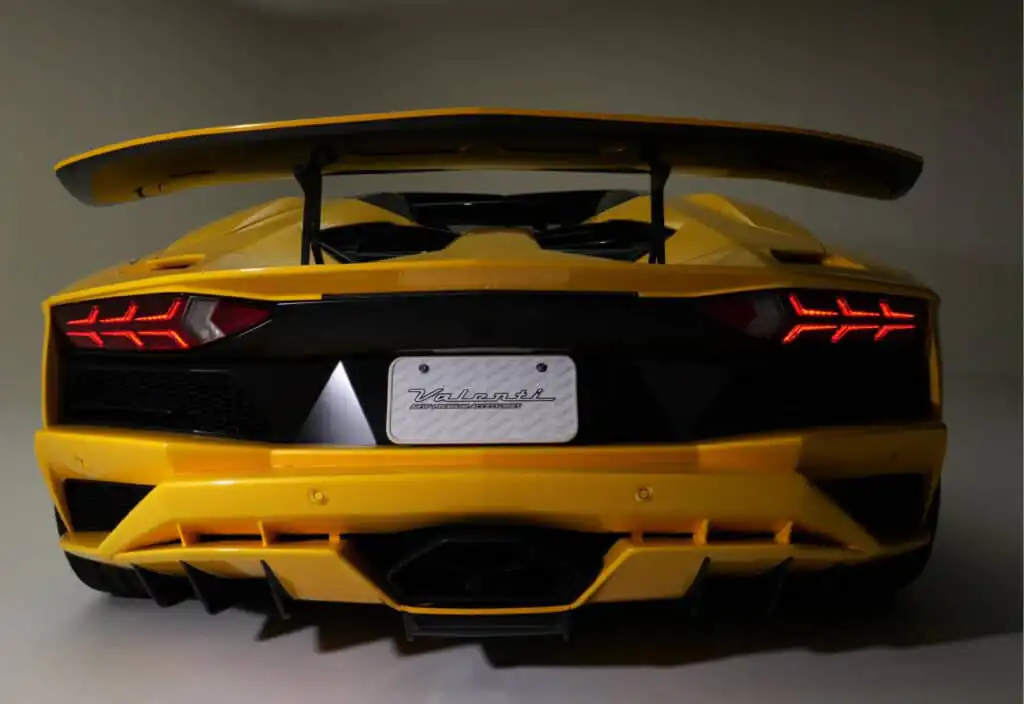
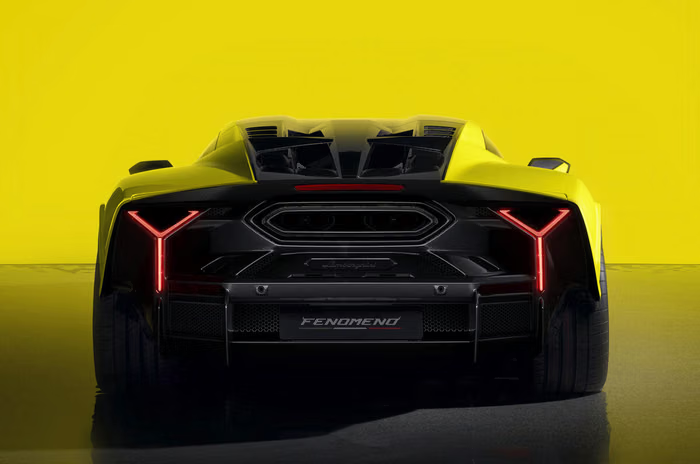
A good Lamborghini car drawing is mostly proportion discipline. Keep the baseline straight, make the wheels match, lower the cabin, and check the wedge silhouette before you darken anything.
When the outline works, add details in order: windows, intakes, headlights, rims, then shadows. That order keeps the sketch readable and stops the drawing from becoming a pile of cool parts with no structure.
- 1.1Kshares
- Facebook0
- Pinterest1.1K
- Twitter1
- Reddit0