There’s a reason automotive design students in Turin spend entire semesters sketching nothing but Alfa Romeos. The brand has produced more genuinely beautiful cars per decade than almost any manufacturer alive — and drawing them teaches you things that no other subject quite replicates: how to handle a surface that transitions from aggression to elegance within a single curve, how to render a grille that carries 115 years of unbroken identity, how to capture the weight of a car that looks simultaneously planted and about to leap.
New to automotive sketching? Start with the basic step-by-step car drawing guide, then come back to the Alfa Romeo shapes.
For a different kind of European performance reference, compare Alfa proportions with the best BMW for drifting. Drift cars exaggerate stance, front wheel angle, and tire smoke, which can make an automotive sketch feel much more kinetic.
I drew my first Alfa Romeo at seventeen — a battered 1970s Spider from a photo in a motoring magazine — and spent three sessions just trying to get the boat-tail rear proportions right. It humbled me completely. That’s what Alfa does.
This guide covers 10 legendary Alfa Romeo models and exactly what makes each one a drawing challenge worth taking on. Each entry includes the car’s defining visual features, a difficulty rating, and the specific techniques that make each silhouette work on paper.
Whether you’re reaching for a Faber-Castell pencil set or sketching in Procreate, these are the ten Alfa Romeos every automotive artist should draw at least once.
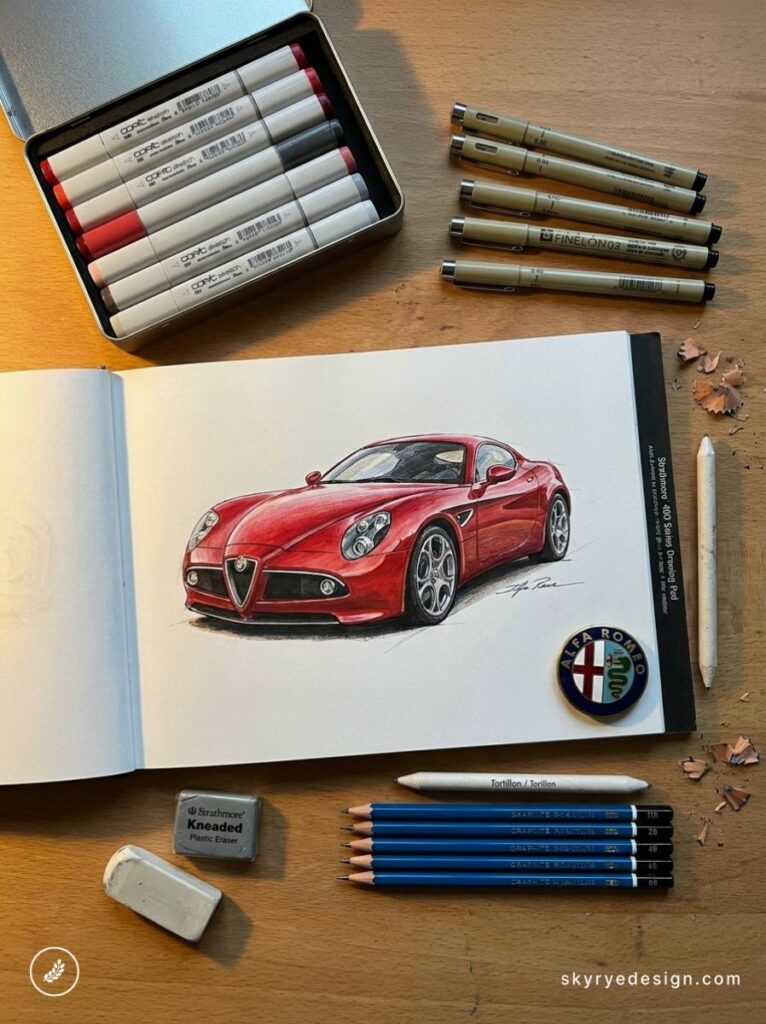
For a more aggressive supercar silhouette, pair this Alfa Romeo practice with the Lamborghini car sketch tutorial, especially the sections on wedge shape, intakes, and hard shadow planes.
1. Before You Draw — Understanding the Alfa Romeo Design Language
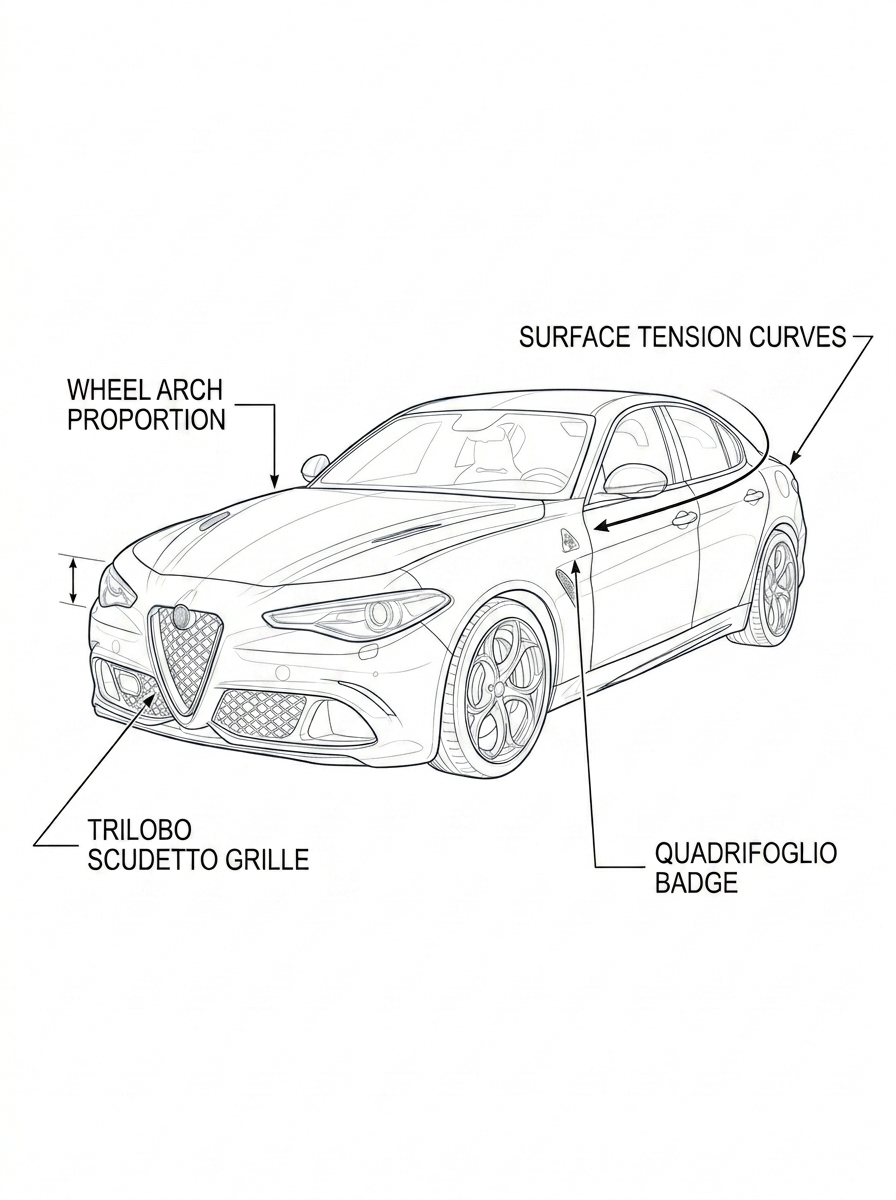
Every Alfa Romeo shares a design vocabulary that transcends eras. Before you tackle any individual model, internalise these recurring elements — they’re the thread that connects a 1938 racing car to a 2023 production vehicle.
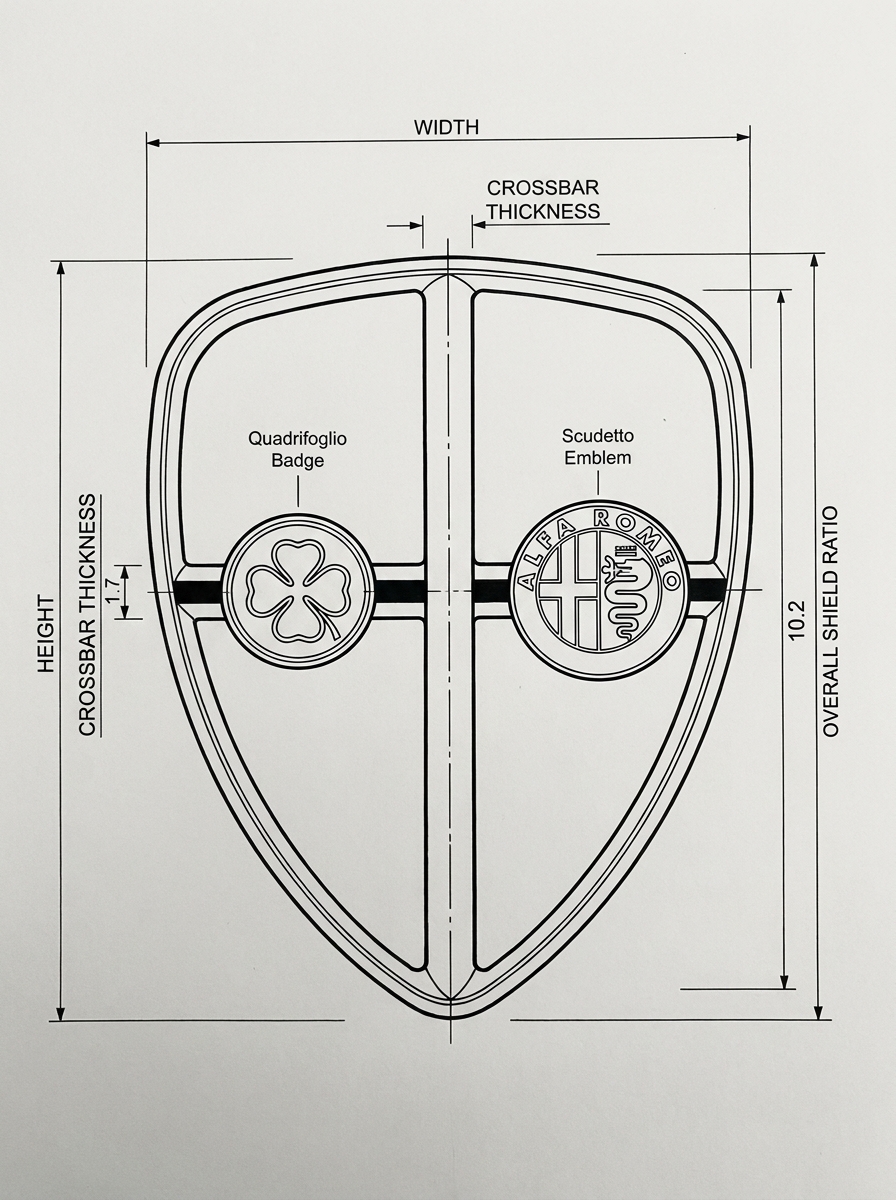
The Trilobo Grille (Scudetto)
Alfa Romeo’s signature three-lobed front grille — the “Scudetto” or shield — is the single most important element to get right in any drawing. It’s a vertical shield shape, wider at the top and narrowing slightly at the base, divided horizontally by a crossbar. The Quadrifoglio (four-leaf clover) badge sits on the left; the Scudetto emblem on the right. In drawings, treat the grille like a heraldic emblem embedded in the bodywork — give it heavier, more confident line weight than the surrounding panels.
Surface Tension
Alfa Romeo bodies don’t have flat panels. Every surface is under tension — slightly curved, with subtle character lines that catch light without becoming sharp creases. This is what separates Italian coachwork from German and Japanese automotive surfaces. In pencil, render these transitions as gradual tone shifts rather than defined edges.
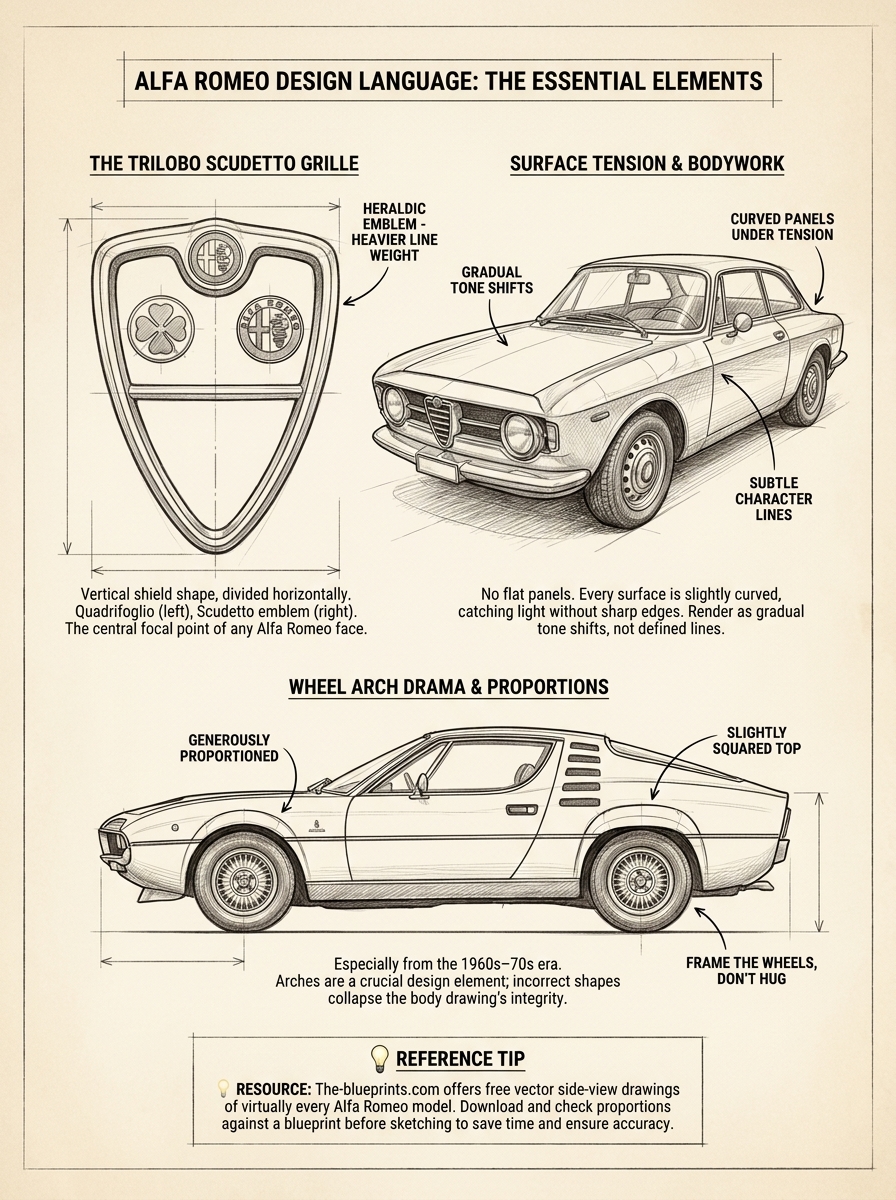
Wheel Arch Drama
Alfa Romeo wheel arches — especially from the 1960s–70s era — are generously proportioned and slightly squared at the top. They frame the wheels rather than hugging them. Get these shapes wrong and even a perfect body drawing collapses.
| 💡 Reference tip: The-blueprints.com has free vector side-view drawings of virtually every Alfa Romeo model ever made. Download the blueprint for any car before you sketch it — proportions checked against a blueprint saves hours of redrawing. |
2. The 10 Legendary Alfa Romeos — Drawing Profiles
Alfa Romeo 8C 2900B (1938)
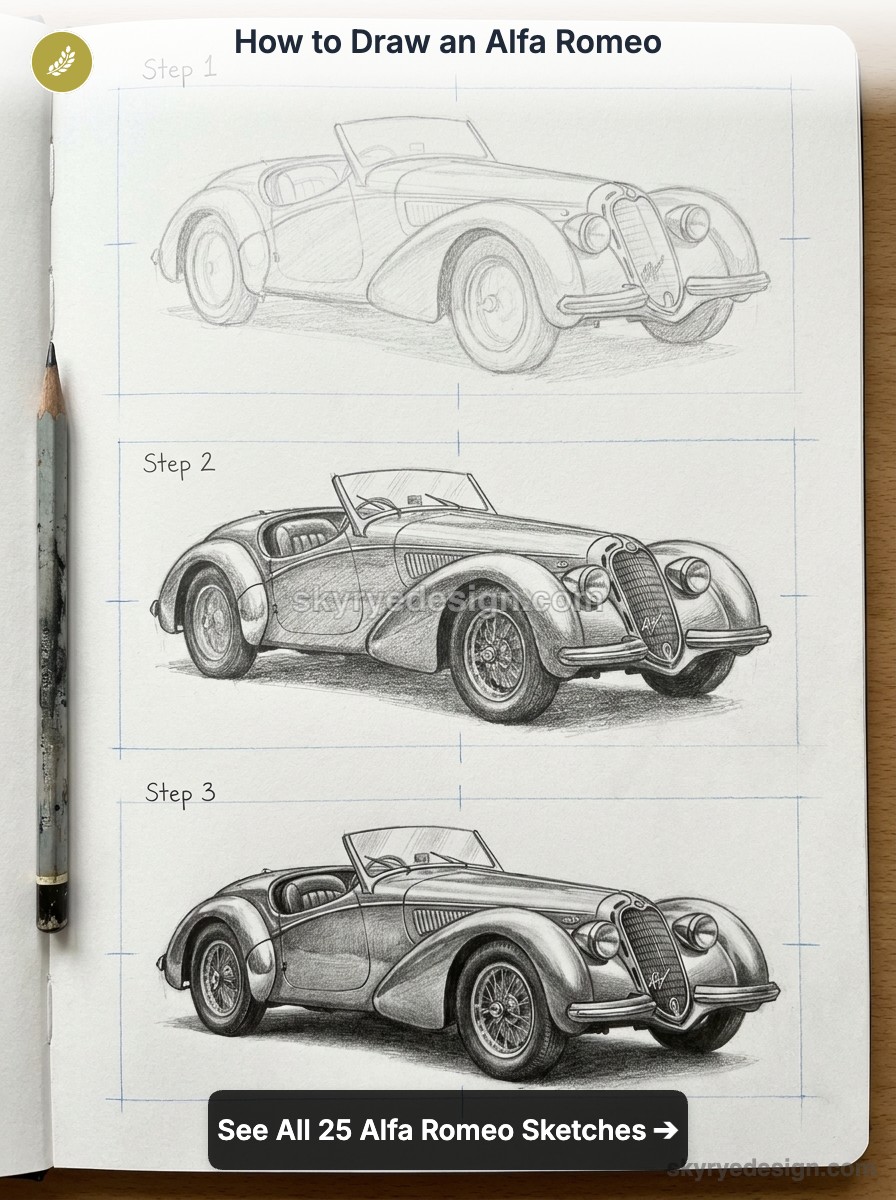
| Difficulty: ★★★★★ | Designer: Carrozzeria Touring What to focus on: The proportional relationship between bonnet and cabin is the key challenge. The cabin sits far back over the rear axle — it occupies only the rear third of the total car length. The superleggera bodywork creates extremely thin-looking panels — use lighter line weight on body surfaces than you would for a modern car. Drawing tip: Use a 0.3mm fineliner for panel details and chrome trim, a 2B pencil for surface shading. The long fender curves must be drawn in single confident strokes — no patching. |
Alfa Romeo Giulietta Spider (1955)
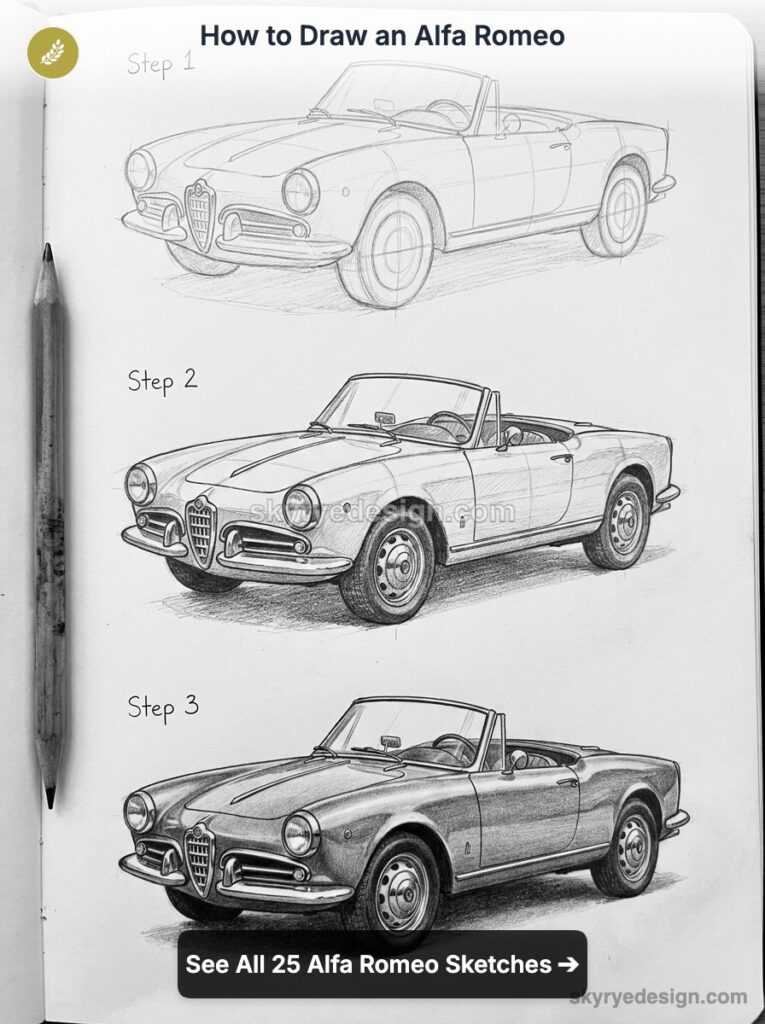
| Difficulty: ★★★☆☆ | Designer: Pinin Farina What to focus on: The side profile beauty lies in its simplicity. A gentle arc from nose to tail, two identical door openings, chrome bumpers that wrap front and rear without interrupting the body line. The windscreen rake angle is critical — too upright reads as a toy; too raked and you’ve drawn a different car. Drawing tip: Start with a single continuous horizon line — the sill of the car — then build everything above and below it. Cabin height above sill should equal roughly one-third of the total car width |
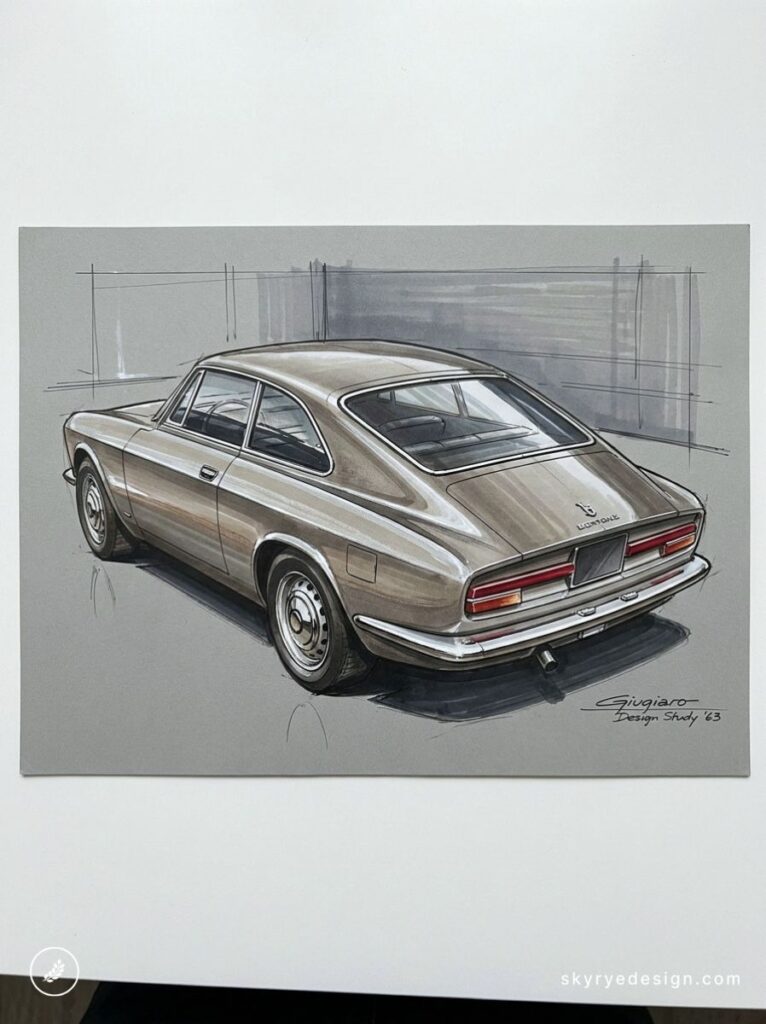
Alfa Romeo Giulia Sprint GT (1963)
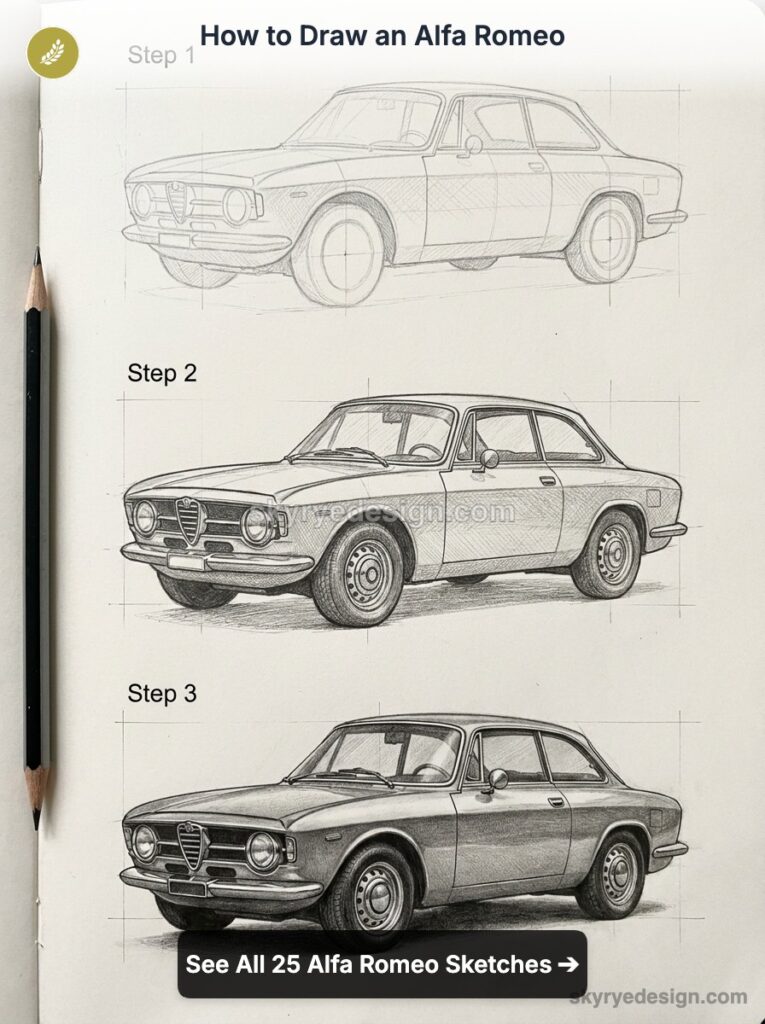
| Difficulty: ★★★☆☆ | Designer: Giorgetto Giugiaro / Bertone What to focus on: Giugiaro designed this car at 24 while at Bertone, and it remains one of the most studied shapes in automotive design education. The Kamm tail (flat, vertical rear end) is both the most distinctive feature and its trickiest drawing element. It needs to feel blunt but not heavy. Drawing tip: Draw the roofline first — from A-pillar to Kamm tail. It’s a single, elegant downward slope interrupted by the rear window. Get this line right, and the rest of the car follows naturally. |
Alfa Romeo Duetto Spider (1966)
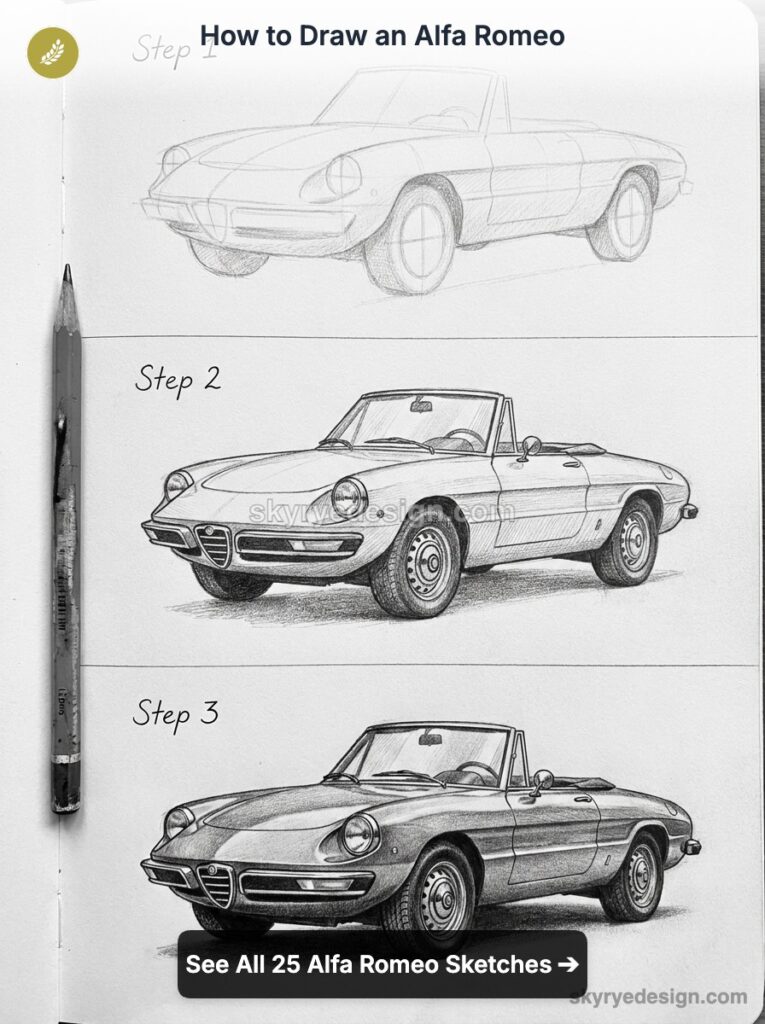
| Difficulty: ★★★★☆ | Designer: Battista “Pinin” Farina What to focus on: The “Graduate car” has the most complex rear treatment in this list. The boat-tail rear — where the bodywork tapers to a horizontal point — is one of the most copied and rarely successfully executed shapes in automotive history. The body sides curve inward toward the rear from every angle simultaneously. Drawing tip: Before drawing the car, sketch the boat-tail in isolation as a pure geometric study — an elongated teardrop pointed at the rear. Once you understand how the surfaces meet, transfer that understanding to the full car. |
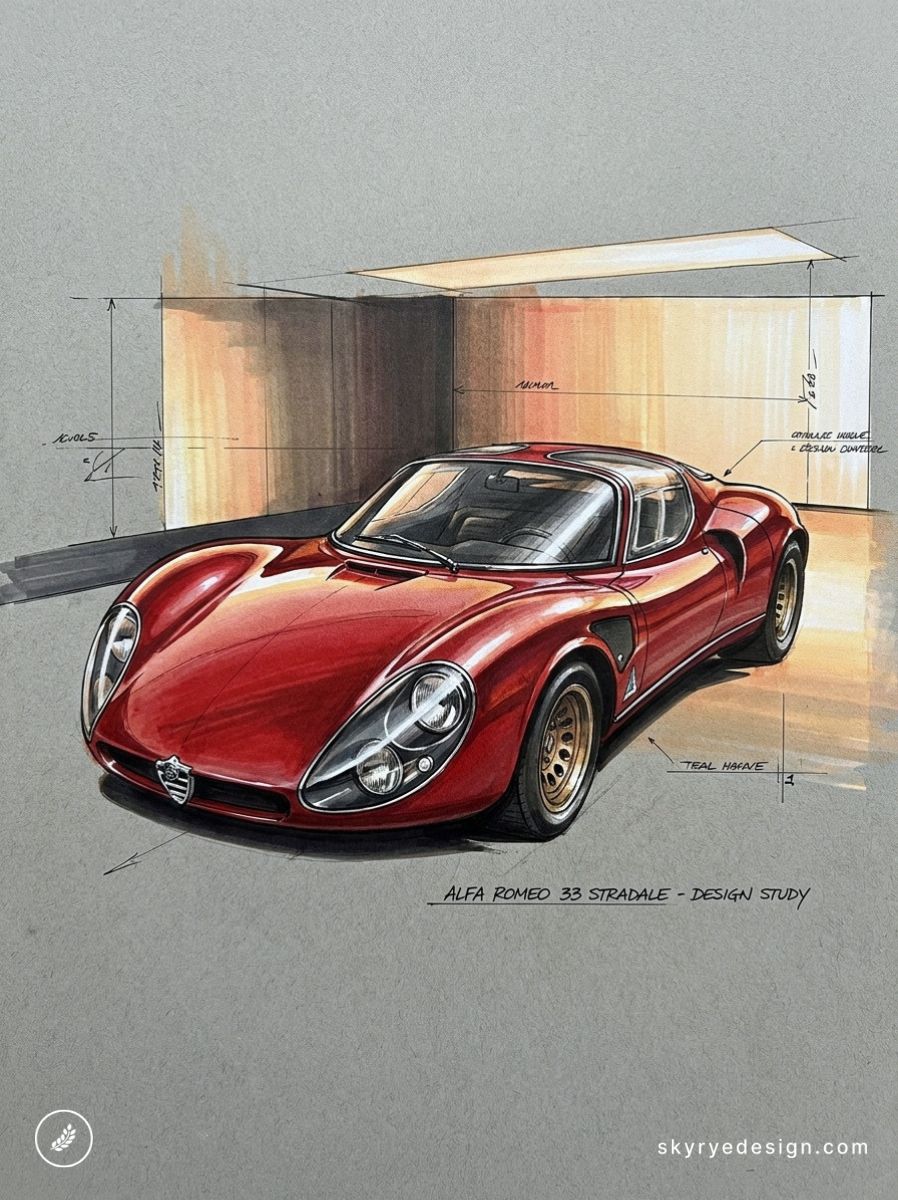
Alfa Romeo Tipo 33 Stradale (1967)
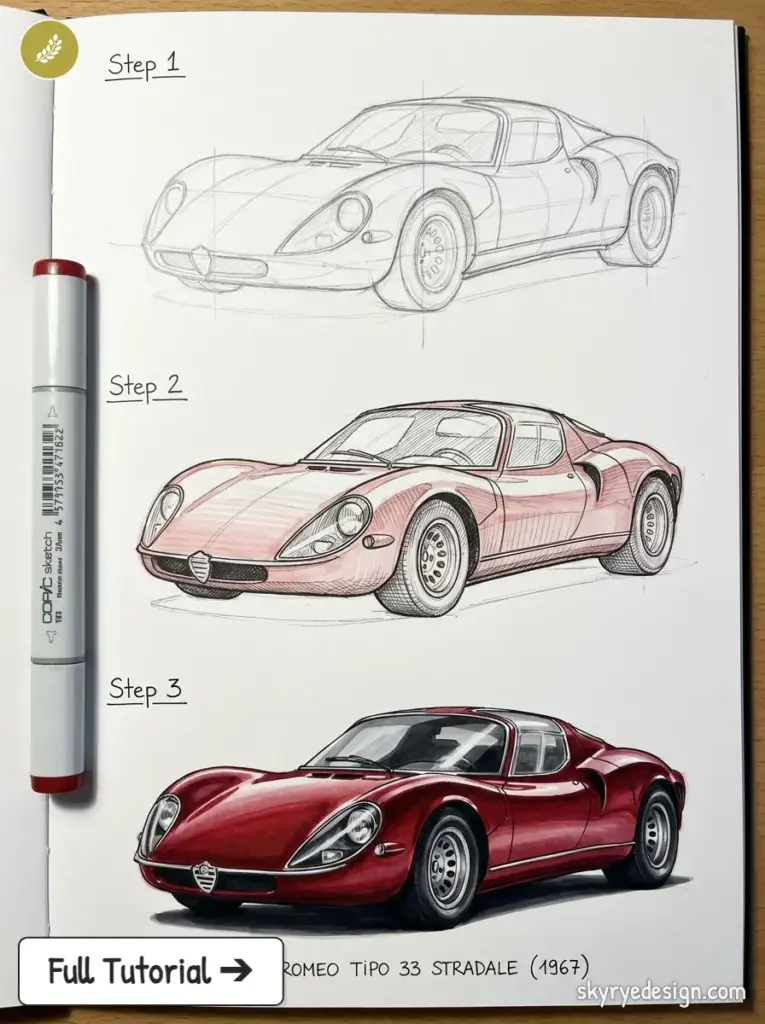
| Difficulty: ★★★★★ | Designer: Franco Scaglione What to focus on: It has been regularly voted the most beautiful car ever designed. The glass canopy wraps continuously around the front — no A-pillar interrupts the view from outside. The body below the waistline is extremely low, like a racing undertray with bodywork attached. The rear haunches rise dramatically over the rear wheels. Drawing tip: Draw the glass canopy as a separate element first — an oval bubble sitting on a very flat body. Then build body surfaces outward from the canopy’s base. Work large-to-small: overall proportion first, surface lines second, detail last. |
Alfa Romeo Montreal (1970)
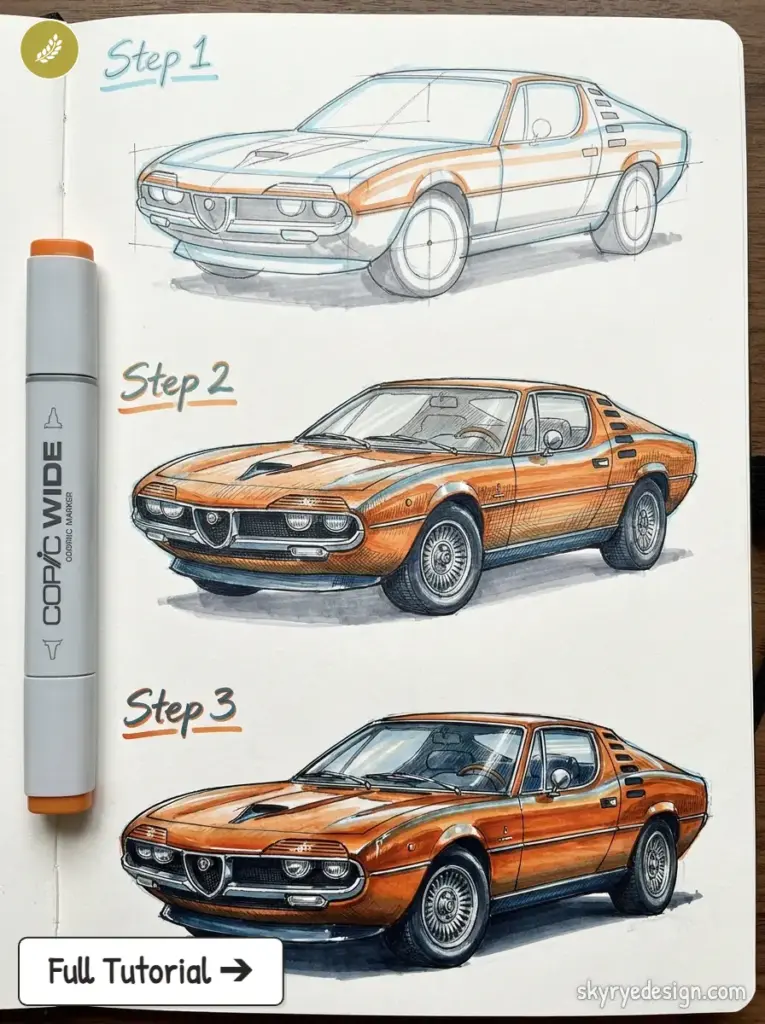
| Difficulty: ★★★★☆ | Designer: Marcello Gandini / Bertone What to focus on: The NACA ducts on the bonnet and slotted rear side window louvers are the most challenging details. NACA ducts are recessed — you’re drawing negative space, a shadow, rather than a positive shape. The rear window louvers require confident parallel line work. Drawing tip: Use a ruler for louver lines and NACA duct edges. These are engineered elements that read as sloppy if the lines waver. Everything else on the Montreal can be freehand — but these details need discipline. |
Alfa Romeo GTV6 (1980)
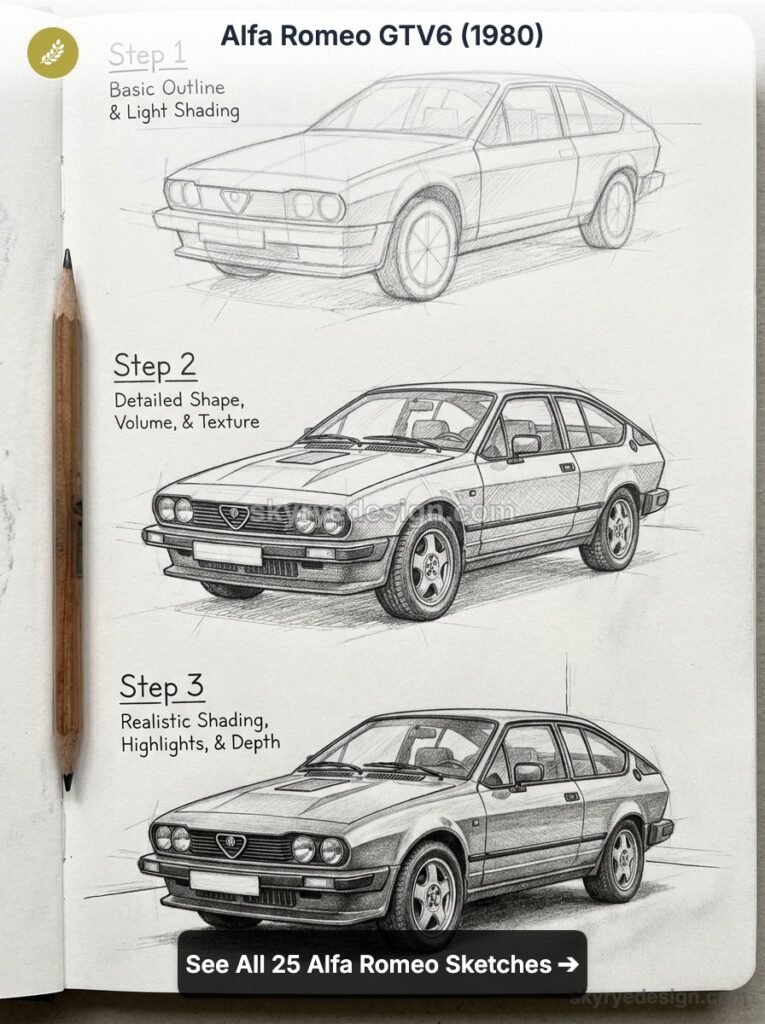
| Difficulty: ★★★☆☆ | Designer: Giorgetto Giugiaro What to focus on: The wedge profile — the car is noticeably lower at the front than the rear, with a pronounced bonnet-to-roofline angle. This foreshortening is easy to lose when drawing direct side profile. The deep front air dam is a strong graphic horizontal element that grounds the car. Drawing tip: Exaggerate the wedge angle slightly in drawings — real cars always photograph flatter than they look in person. A degree or two of extra rake makes the drawing feel alive rather than static. |
Alfa Romeo 8C Competizione (2007)
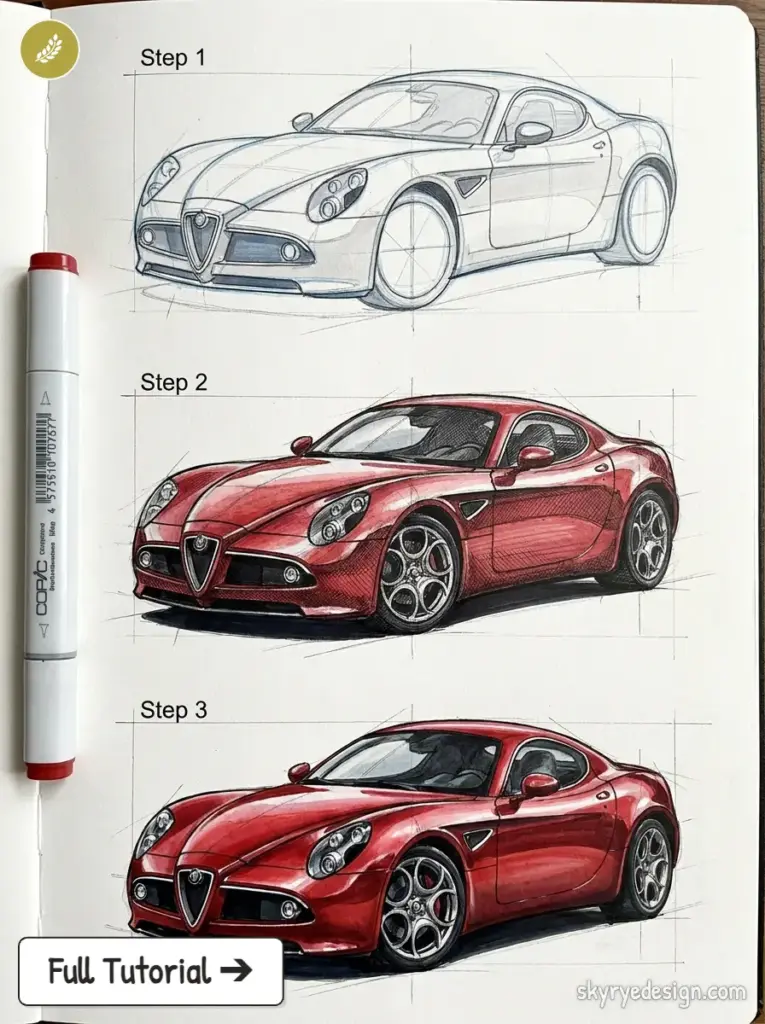
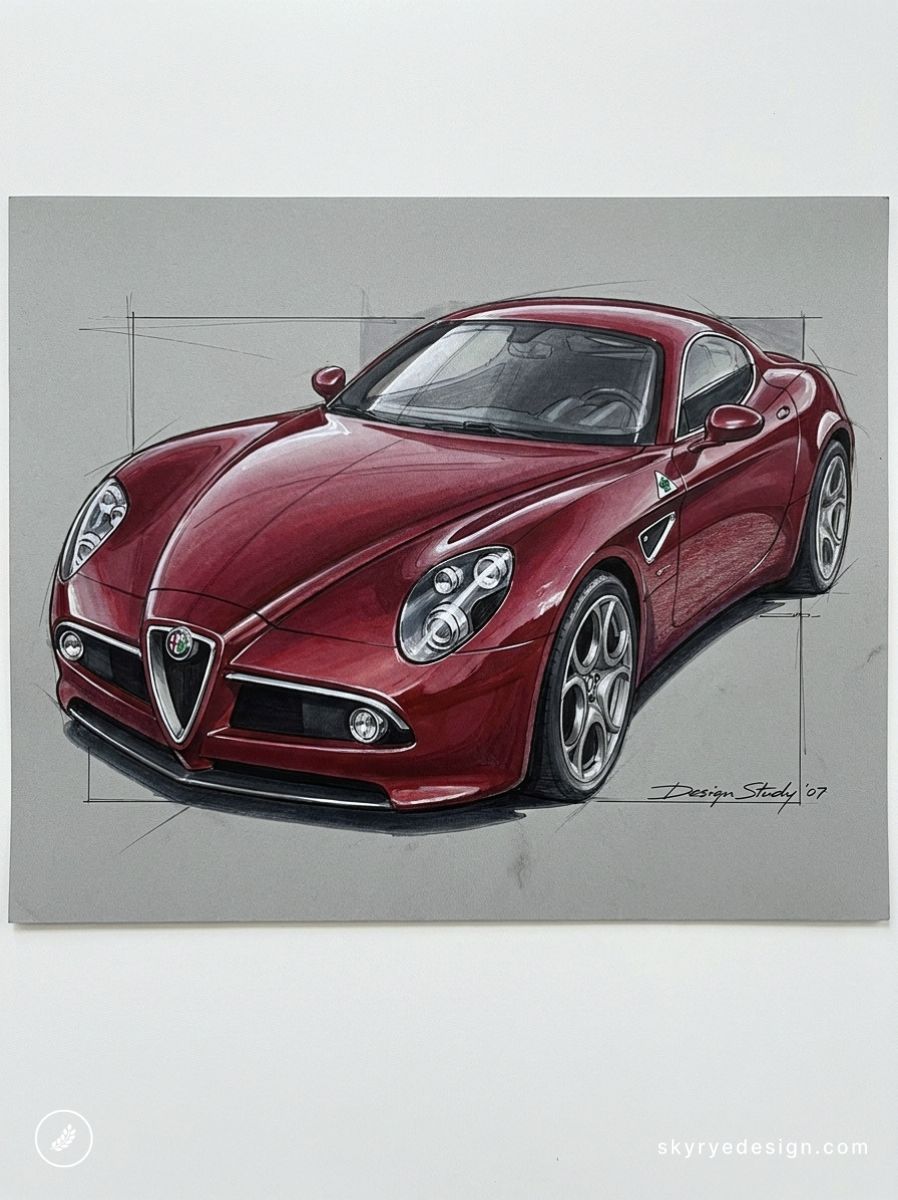
| Difficulty: ★★★★☆ | Designer: Wolfgang Egger What to focus on: Wolfgang Egger designed this as a direct homage to the pre-war 8C heritage. The clamshell bonnet crease lines run from the Scudetto grille back toward the A-pillar in two converging strokes. The air intakes behind the front wheels are unique to this model and require careful foreshortening in three-quarter view. Drawing tip: In a three-quarter front view, the 8C Competizione is at its most dramatic. The bonnet crease lines converge toward the camera, the Scudetto is fully visible, wheel arch drama reads perfectly. This is the angle to practice. |
Alfa Romeo 4C (2013)
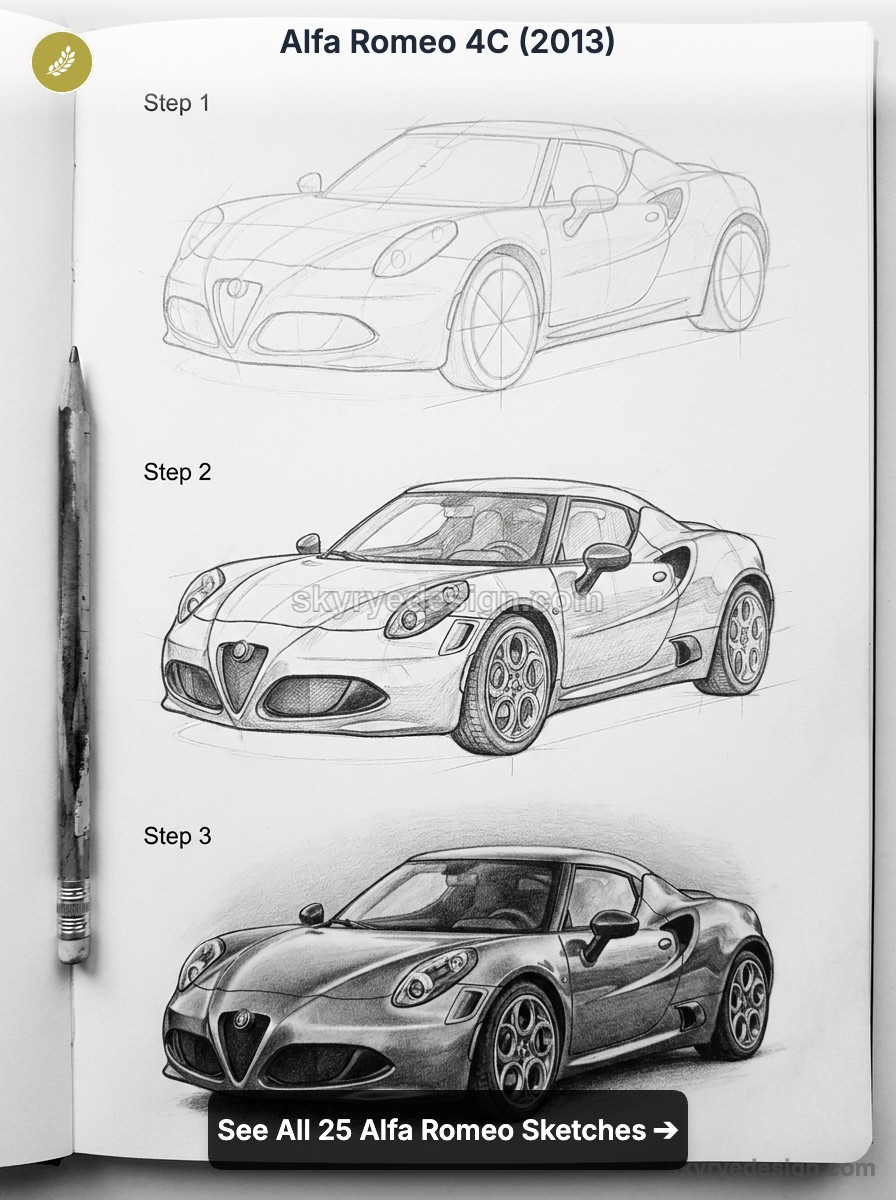
| Difficulty: ★★★☆☆ | Designer: Centro Stile Alfa Romeo What to focus on: The carbon fibre tub weighs just 65kg, and the design reflects that lightness. Large wheel arches dominate the body sides — almost as wide as the passenger cell itself. In drawings, resist the temptation to shrink the arches to more “normal” proportions. The drama is the point. Drawing tip: Start with the four wheel arches as circles, then build the body around them. The cabin will look almost too small — that’s correct. |
Alfa Romeo Giulia Quadrifoglio (2016)
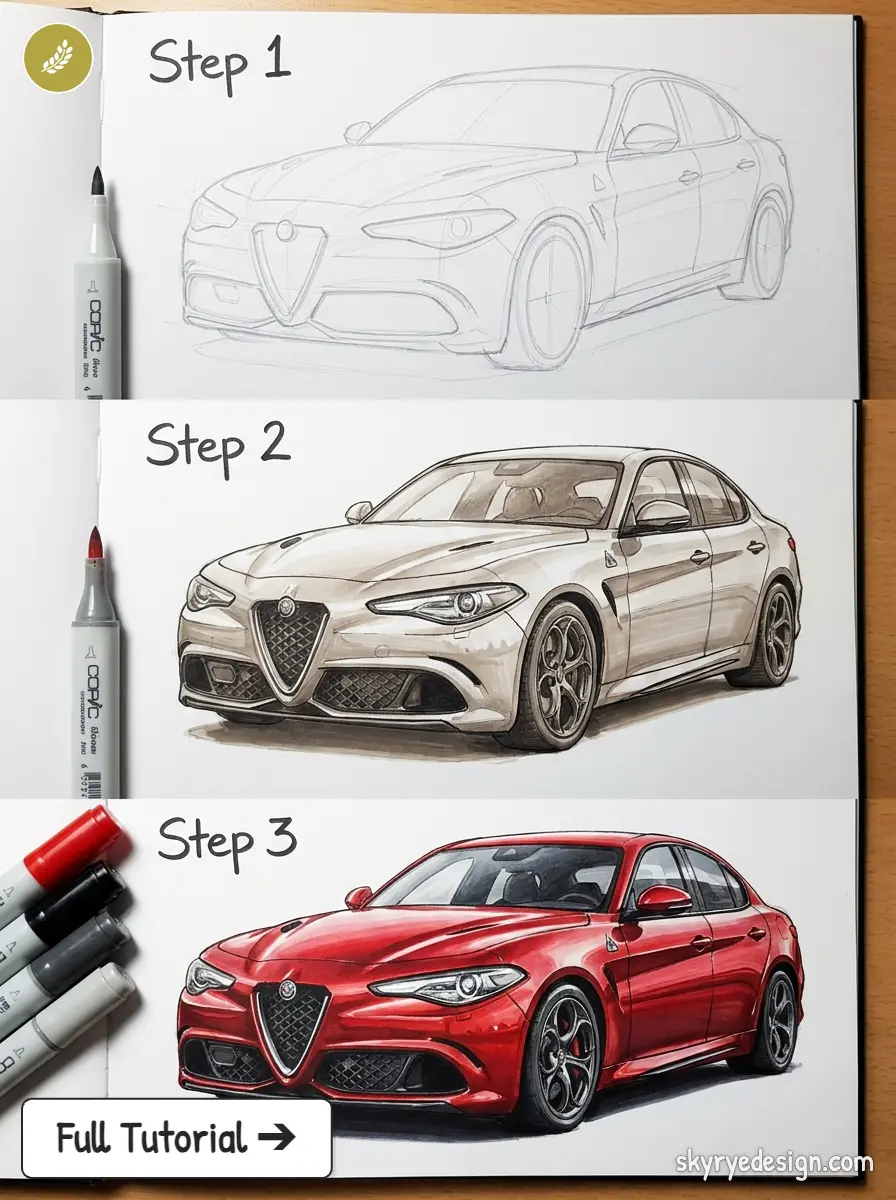
| Difficulty: ★★★☆☆ | Designer: Marco Tencone What to focus on: The Scudetto grille on the Giulia is more vertical and shield-like than on older models — it sits nearly upright rather than raked. The bonnet creases converge at the top of the grille in a pronounced “power dome.” The Quadrifoglio version adds wider front fenders and a front splitter. Drawing tip: Use the greenhouse (glass area) as your proportion anchor. On the Giulia, the window-to-body-side ratio is classic Italian — more glass than you might expect, giving a lighter, more elegant appearance than German competitors. |
| 🎨 Take Your Car Drawing Further Reading about technique is how you understand it. Watching a professional automotive designer sketch live is how you actually learn it. I’ve partnered with Skillshare to give Sky Rye Design readers a 1-Month Free Trial of their Premium membership. Use promo code AFF30D25 at checkout. Once you’re in, search for:• “automotive design sketching”• “car drawing perspective for beginners.” 👉 1-Month Free Trial |
3. Core Drawing Techniques for Alfa Romeo Cars
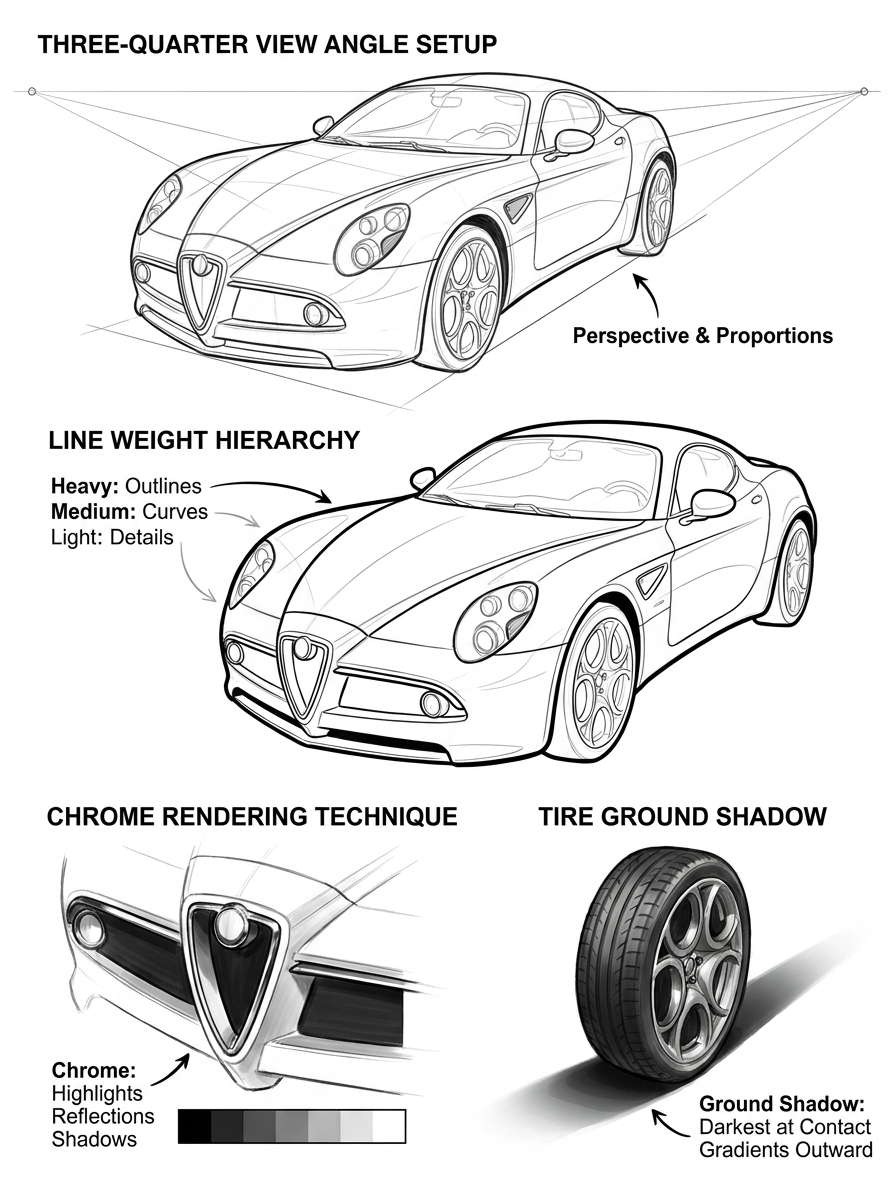
These techniques apply across all ten models and separate automotive sketches that look flat from ones that feel three-dimensional.
For contrast, add one automotive SUV sketch to the same practice session. The slower, taller volume makes line weight and wheel placement much easier to judge.
The Three-Quarter View
Every car in this list looks best in three-quarter front view — approximately 30–45 degrees off the front centreline, slightly above the car’s eye level. This angle shows the front face, the side profile, and the roof simultaneously. Start with the ellipses of the two visible wheels, then establish the sill horizon line, then build the body volume up from these anchors.
Line Weight Hierarchy
Use three line weights consistently:
- Heavy (0.7mm or 4B): outer silhouette and shadow edges
- Medium (0.3mm or HB): surface character lines, door gaps, window frames
- Light (0.1mm or 2H): reflections, interior details, background
This hierarchy immediately reads as professional and prevents the drawing from going flat.
Rendering Chrome and Glass
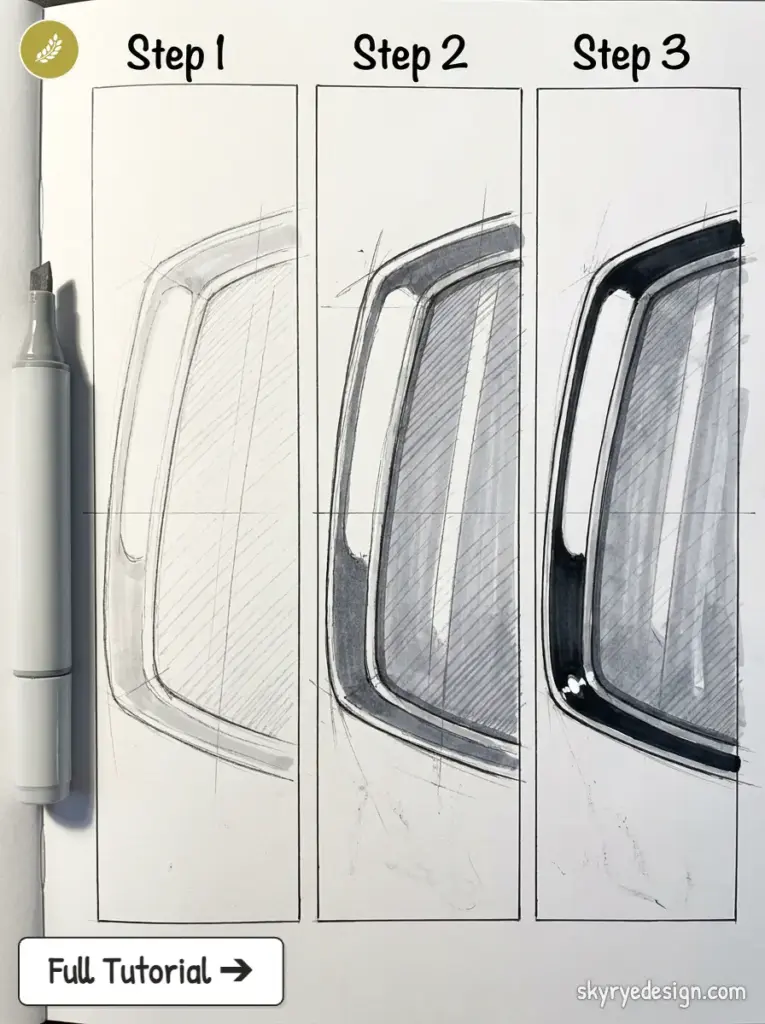
Chrome: leave as white paper surrounded by a dark reflection stroke. The reflection is the object, not the chrome itself. Glass: apply a light diagonal hatch, then erase a vertical stripe for the highlight. Tinted glass (common on 1960s–70s Alfas) gets a second grey wash over the hatch.
The Tyre Shadow
| 📐 The single quickest improvement to any car drawing: a solid dark ellipse under each tyre where it meets the ground. No shadow = floating car. Add it last, after all other shading is complete. |
Frequently Asked Questions
What is the easiest Alfa Romeo to draw?
The Giulietta Spider (1955) and the Giulia Quadrifoglio (2016) are the most forgiving starting points. Both have clean, uncluttered surfaces without the extreme detailing of the Montreal or the complex curves of the 33 Stradale. Start in profile view with a single horizon line along the sill and build proportions from there.
What pencils are best for car drawing?
Five grades cover all scenarios: 2H for construction, HB for general sketching, 2B for midtone body surfaces, 4B for shadow zones, 6B for darkest accents. The Faber-Castell 9000 series ($8–12) handles well. For fine grille and chrome detail, a 0.3mm mechanical pencil with HB lead is useful.
How do I draw the Alfa Romeo Scudetto grille correctly?
The Scudetto is a vertical shield shape — wider at the top, narrowing slightly at the base. Draw a vertical centreline first, then mirror the shield on both sides. The horizontal divider sits roughly one-third from the top. Give it slightly heavier line weight than the surrounding bodywork — it’s a graphic element as much as a car part.
What is the hardest Alfa Romeo to draw?
The Tipo 33 Stradale (1967) and the 8C 2900B (1938) are the most challenging. The 33 Stradale requires understanding a fully three-dimensional glass canopy and rear haunches simultaneously. The 8C 2900B demands mastery of pre-war proportion — very long bonnet, very small cabin — that reads as wrong to eyes trained on modern cars until you’ve studied enough reference.
Should I draw Alfa Romeo cars from blueprints or photographs?
Both — but for different purposes. Blueprint side-view drawings (available free at the-blueprints.com) give exact proportions without photographic distortion. Photographs give surface texture, light behaviour, and three-dimensional form. Use blueprints to establish proportions, photographs to understand surfaces and shadows.
What paper is best for car sketching?
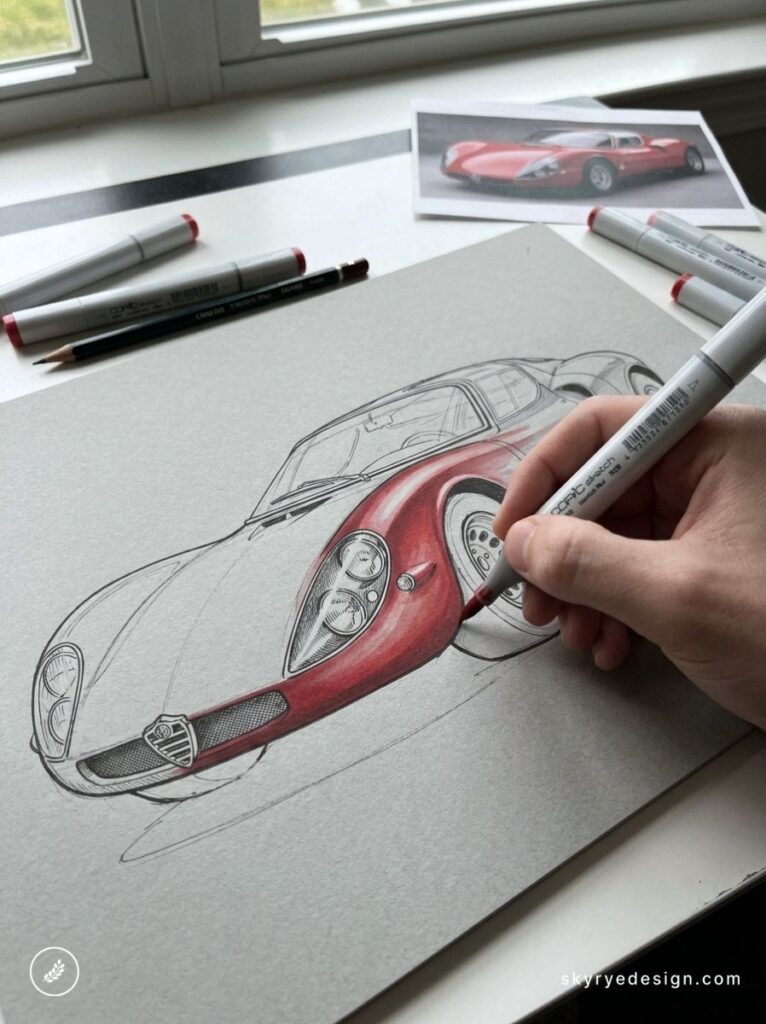
For pencil work: Strathmore 400 Series medium-tooth drawing paper (~$12 for 24 sheets). For marker and ink: Canson marker paper or Copic sketch paper. For final presentation sketches: Fabriano Artistico hot-press 300gsm handles pencil, ink, and light watercolour wash.
Start Drawing — Your Alfa Romeo Awaits
Every Alfa Romeo in this list rewards careful study before you draw a single line. Spend ten minutes with a reference photo — or a blueprint from the-blueprints.com — before picking up your pencil. Understand where the drama lives in that specific car: is it the bonnet length? The wheel arch proportion? The boat-tail taper? The glass canopy? Once you know the answer, you know where to spend your time.
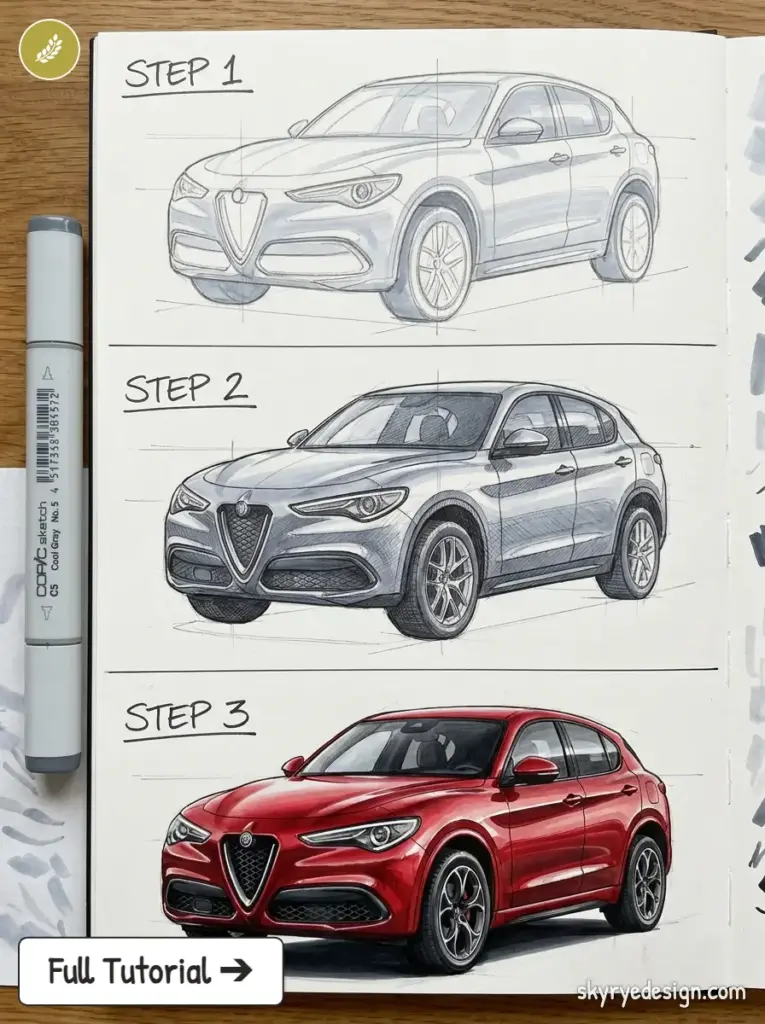
Start with the Giulietta Spider or the Giulia Quadrifoglio if you’re new to automotive sketching. Work up to the Montreal, the 8C Competizione, and the 33 Stradale as your understanding of surface and proportion develops.
If you are sketching from your own Alfa, clean paint and glass make the reflections easier to read. Before shooting reference photos, this guide on how to keep your Alfa Romeo looking like a showpiece can help you get the surfaces, wheels, and trim camera-ready.
Alfa Romeo has been making cars that make artists want to draw them since 1910. That’s not an accident. The company has always understood that a beautiful object invites attention — and that attention, sustained and careful, is where drawing begins.
Alfa Romeo’s road cars share design DNA with its Formula 1 history, from the Alfetta 158 of the late 1940s to its current partnership on the grid. If open-wheel racers interest you as much as road cars, the Formula 1 car drawing guide walks through the wings, sidepods, and cockpit proportions that make a modern F1 car read correctly on paper.
Buona fortuna. The pencil is already in your hand.
- 601shares
- Facebook0
- Pinterest601
- Twitter0
- Reddit0