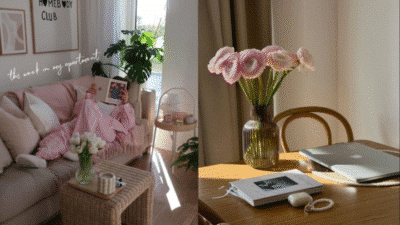
Every December, millions of people watch The Holiday and fall for the same character: Rosehill Cottage. Kate Winslet’s tiny stone house breaks every rule of modern interiors — low ceilings, cramped rooms, furniture that doesn’t match. And yet nobody dreams about Cameron Diaz’s glass mansion in that movie.
That reaction explains why english cottage style is having its biggest moment in years. After a decade of gray minimalism and farmhouse sameness, designers are relearning pattern, patina, and rooms that feel lived in. In 2026 the style even got a rebrand (“modern cottage”), but the DNA is the same.
- What defines english cottage style
- The key elements of an english cottage interior
- 10 english cottage style ideas
- 1. A floral armchair as the room's anchor
- 2. A peg rail entryway
- 3. An overloaded bookshelf
- 4. A lime-washed accent wall
- 5. A mismatched gallery wall
- 6. A window seat with pooling curtains
- 7. Blue-and-white china on open display
- 8. A faux-beam ceiling
- 9. Pattern-on-pattern bedding
- 10. A climbing rose at the door
- Color palette: the paints that make it work
- Patterns: florals, stripes, and the scale rule
- The english cottage kitchen
- English cottage style exterior and garden
- Getting the look in a modern home on a budget
- The takeaway
- Related english cottage and interior design guides
- FAQ
- What is english cottage style?
- What's the difference between english cottage style and cottagecore?
- Is english cottage style still in style in 2026?
- What colors are used in english cottage interiors?
- How do I mix patterns without making the room look cluttered?
- Can english cottage style work in a small apartment?
- Is english cottage style expensive to achieve?
- Original cottage image archive
I’m an industrial designer by training, and this style fascinates me because it works against almost everything design school teaches. No grid. No unified palette. No master plan. It still works, and there are specific visual reasons why.
This guide breaks those reasons down: the defining elements, exact paint colors, the one pattern-mixing rule that prevents chaos, the kitchen, the exterior, and how to bring the look into a regular home without turning it into a theme park.
What defines english cottage style
Here’s a quick test. Look at a room and ask: could this have been bought in one weekend? If the answer is yes, it’s not english cottage style. It might be cottage-themed, which is a different thing entirely.
Accumulated, not designed
The defining quality of a real English cottage interior is that nobody designed it. It accumulated. A dresser inherited in the seventies, chairs from three different decades, shelves added wherever books piled up. The room tells you about the person who lives there, not the stylist who staged it.
When I worked in Germany, I spent weekends around half-timbered villages, and the houses that stuck with me all shared this quality. Nothing matched, and that was exactly the appeal. Coordination reads as effort. Accumulation reads as life.
The structural signatures
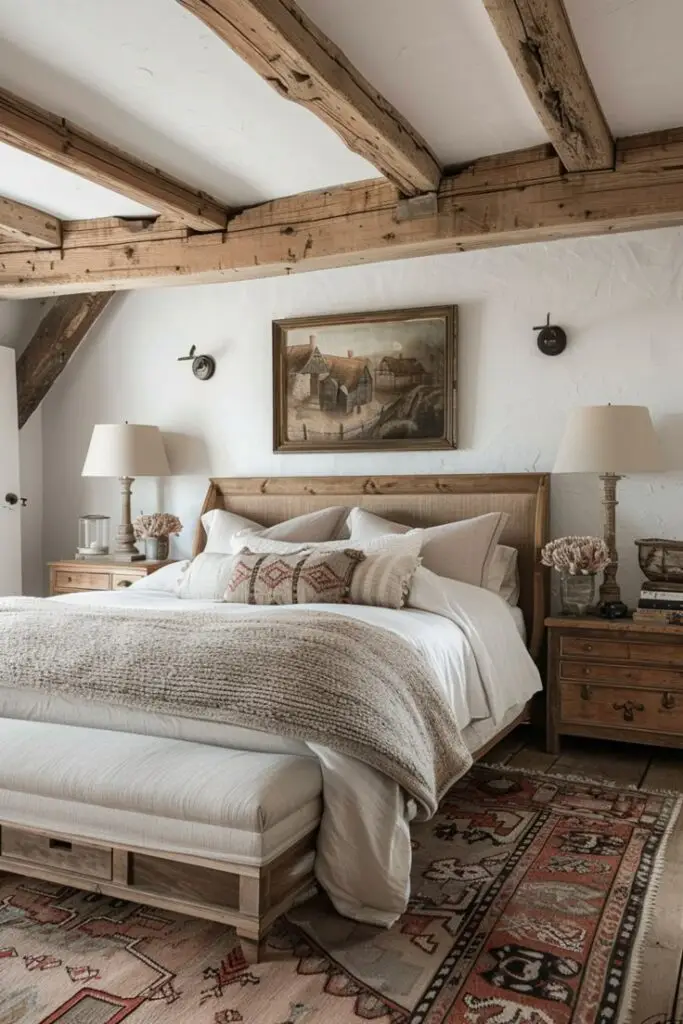
The architecture does half the work: exposed ceiling beams, stone or flagstone floors, low ceilings, small deep-set windows, plaster walls that were never quite straight. You can’t rebuild your house, but you can borrow the signals. Faux beams, a stone veneer wall with heavy over-grouting, and lime-wash paint that leaves soft cloudy variation all push a boxy modern room in the right direction.
English cottage vs cottagecore, French cottage, and modern farmhouse
These four get mixed up constantly, so here’s the split:
| English cottage | Cottagecore | French cottage | Modern farmhouse | |
|---|---|---|---|---|
| Mood | Lived-in, layered | Whimsical, romantic | Refined, symmetrical | Clean, casual |
| Palette | Muted: sage, cream, dusty rose | Bright pastels | Chalky whites, gray-blues | White + black accents |
| Pattern | Florals, gingham, tartan, mixed | Florals everywhere | Toile, subtle stripes | Minimal pattern |
| Furniture | Dark antiques, mismatched | Vintage-look, DIY | Curved, painted, elegant | New, matching, light wood |
| Fails when | Too curated | Too costumey | Too formal | Too sterile |
The short version: cottagecore is the Instagram fantasy, French cottage is the polished cousin, farmhouse is the builder-grade default. English cottage is the only one that improves with age and wear — which is exactly what the next section is about.
The key elements of an english cottage interior
Walk into a genuine cottage and count the surfaces that look new. The answer is usually zero. That’s not neglect — it’s the entire system.
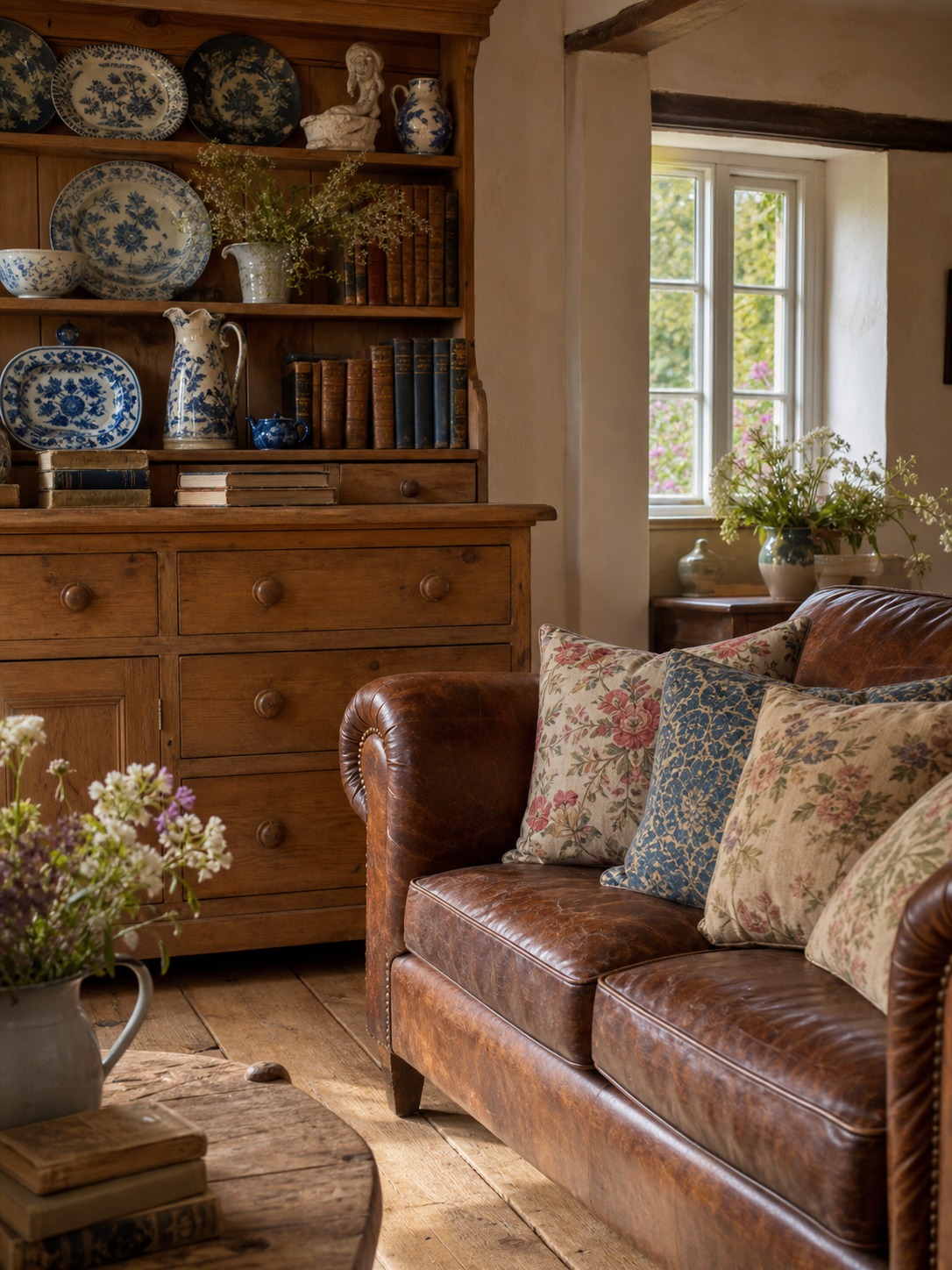
Weathered wood and real antiques
Start with wood that has actually lived. Dark floorboards with a century of wear, ceiling beams that have gone almost black, a dresser with rounded edges where hands have touched it ten thousand times. My academic drawing training makes this impossible to unsee: a factory finish reflects light in one even sheet, while old waxed wood scatters it softly in every direction. Your eye reads that scatter as warmth before your brain names it.
This is why “vintage-look” furniture from a catalog falls flat. A real Victorian pine chest of drawers runs $150–300 at most antique markets, often less than the mass-produced imitation. Buy the real one — see our vintage furniture styles guide for what to look for, era by era.
Layered textiles, books, and collections
The second layer is fabric and objects. Cushions in William Morris prints stacked on a sofa, a wool throw over the armrest, curtains that pool slightly on the floor. Then books — and not the styled kind. Real cottage shelves hold paperbacks with cracked spines next to hardcovers missing their jackets, because the books are there to be read.
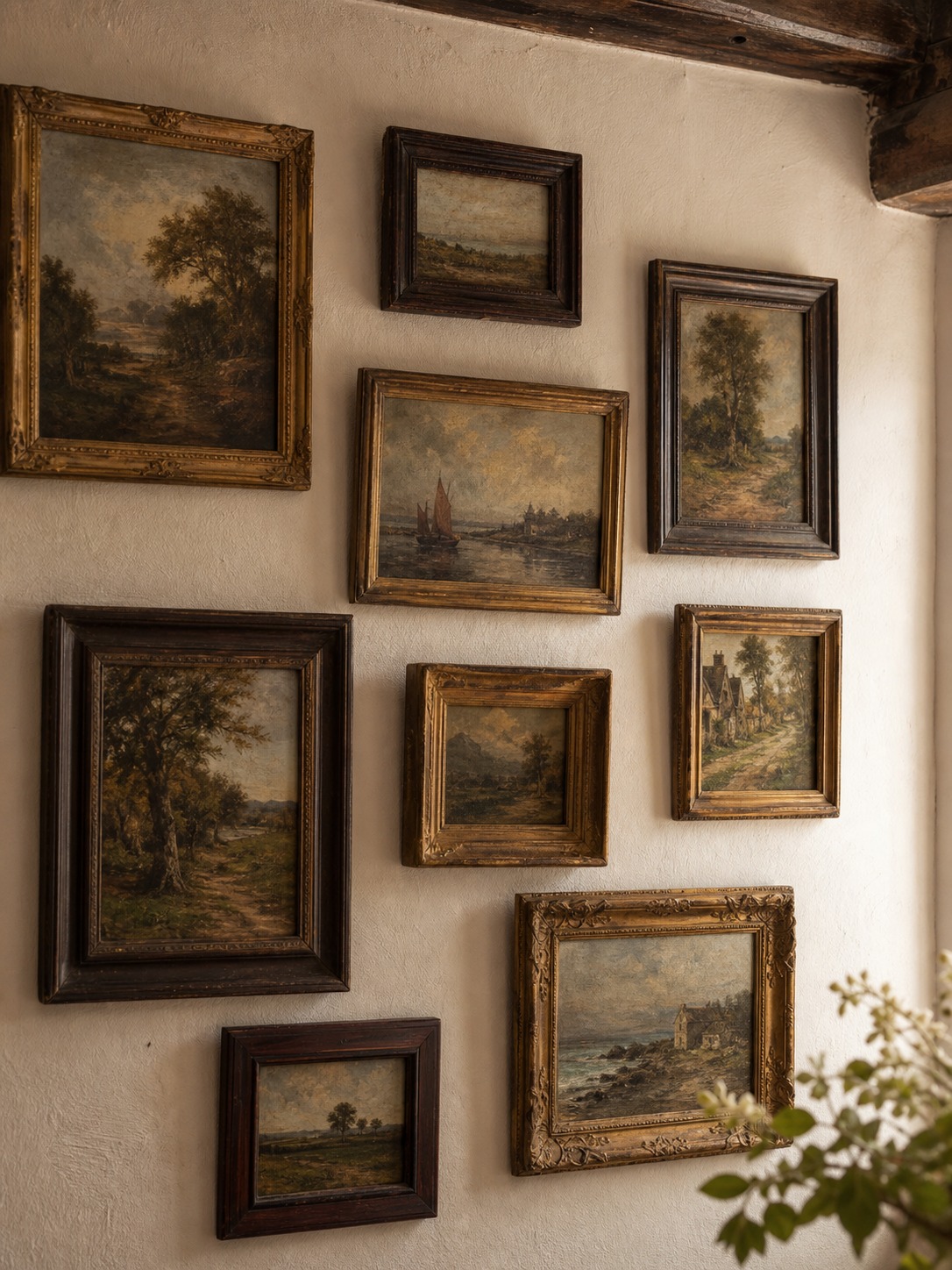
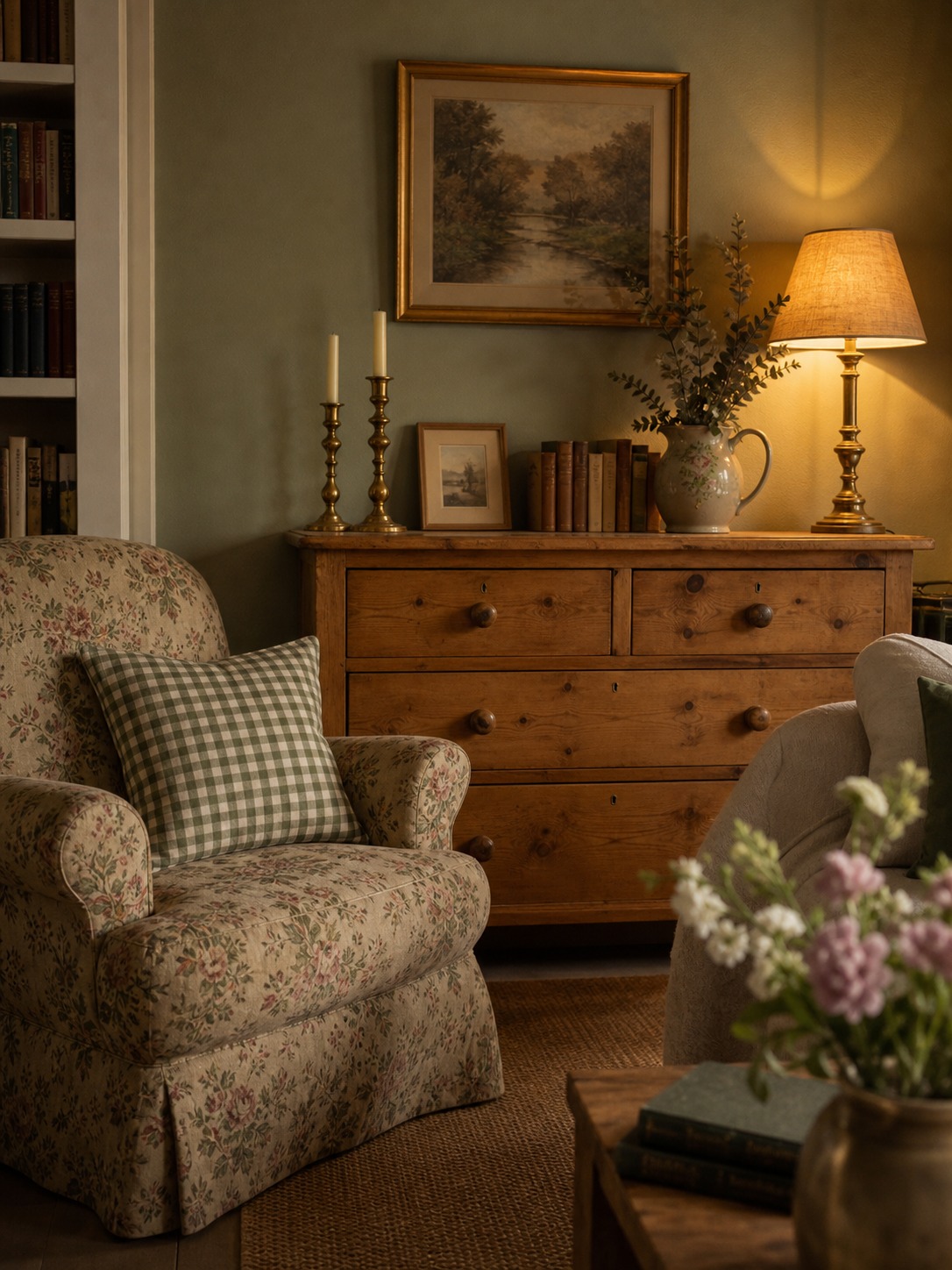
Collections follow the same logic. Blue-and-white china, brass candlesticks, small landscape paintings in mismatched frames climbing the wall. In my experience, a gallery wall works when you stop trying to align it; the slight irregularity is what makes it feel collected rather than installed.
The fireplace and peg rails
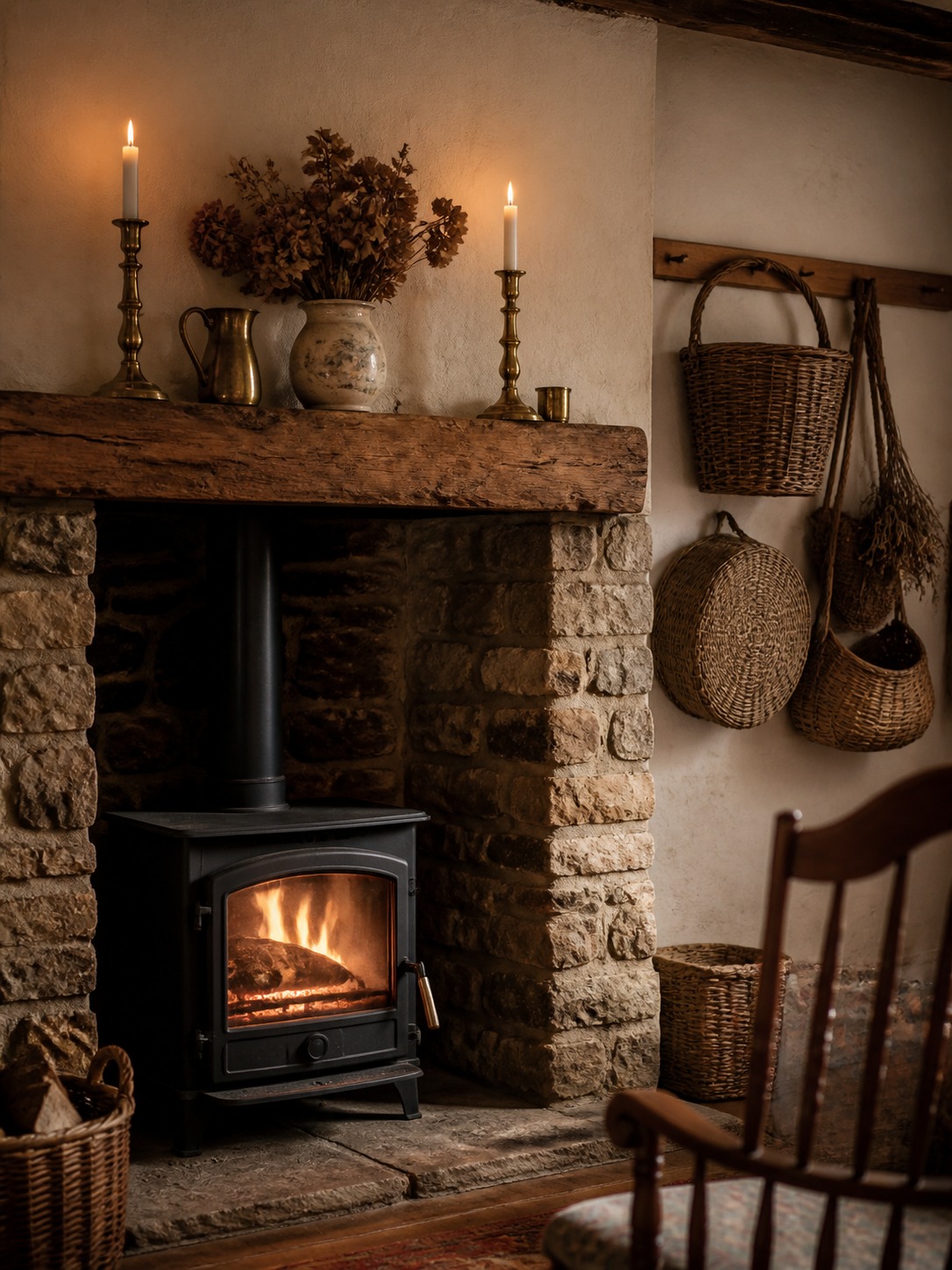
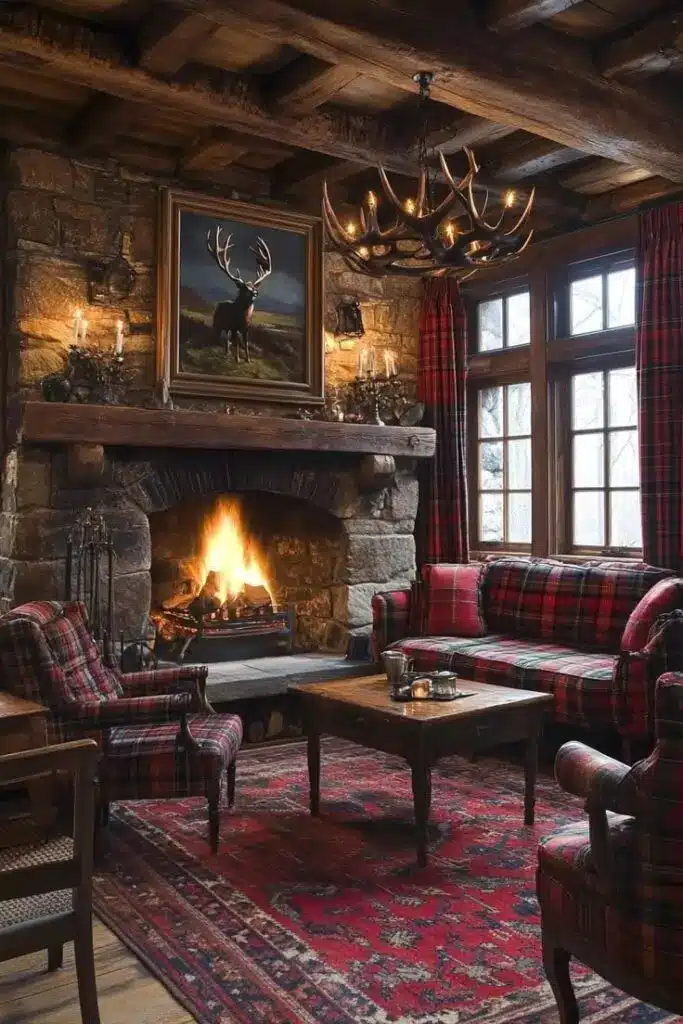
Every cottage room organizes itself around a hearth. If you have a fireplace, strip it back to brick or stone and let it anchor the composition. If you don’t, even a non-working surround with a wooden mantel, candles, and dried flowers creates the same gravitational pull.
Peg rails came from the Shakers, but they’ve been absorbed into cottage grammar completely. A simple oak rail (about $40 to make yourself) holds hats, baskets, and dried herbs in the hallway or kitchen — storage that doubles as a still life.
One practical tip before you buy anything: take your tired wooden finds, give them a light sanding, and finish with dark wax. Twenty minutes of work returns the depth that decades of polish built up. What you should never do is paint and distress them. That’s shabby chic, a different style with a different logic.
10 english cottage style ideas
The fastest way to understand this style is to see it in specific moves, not abstract principles. Here are ten ideas I’d actually use, roughly ordered from easiest to most committed — each with its own image direction.
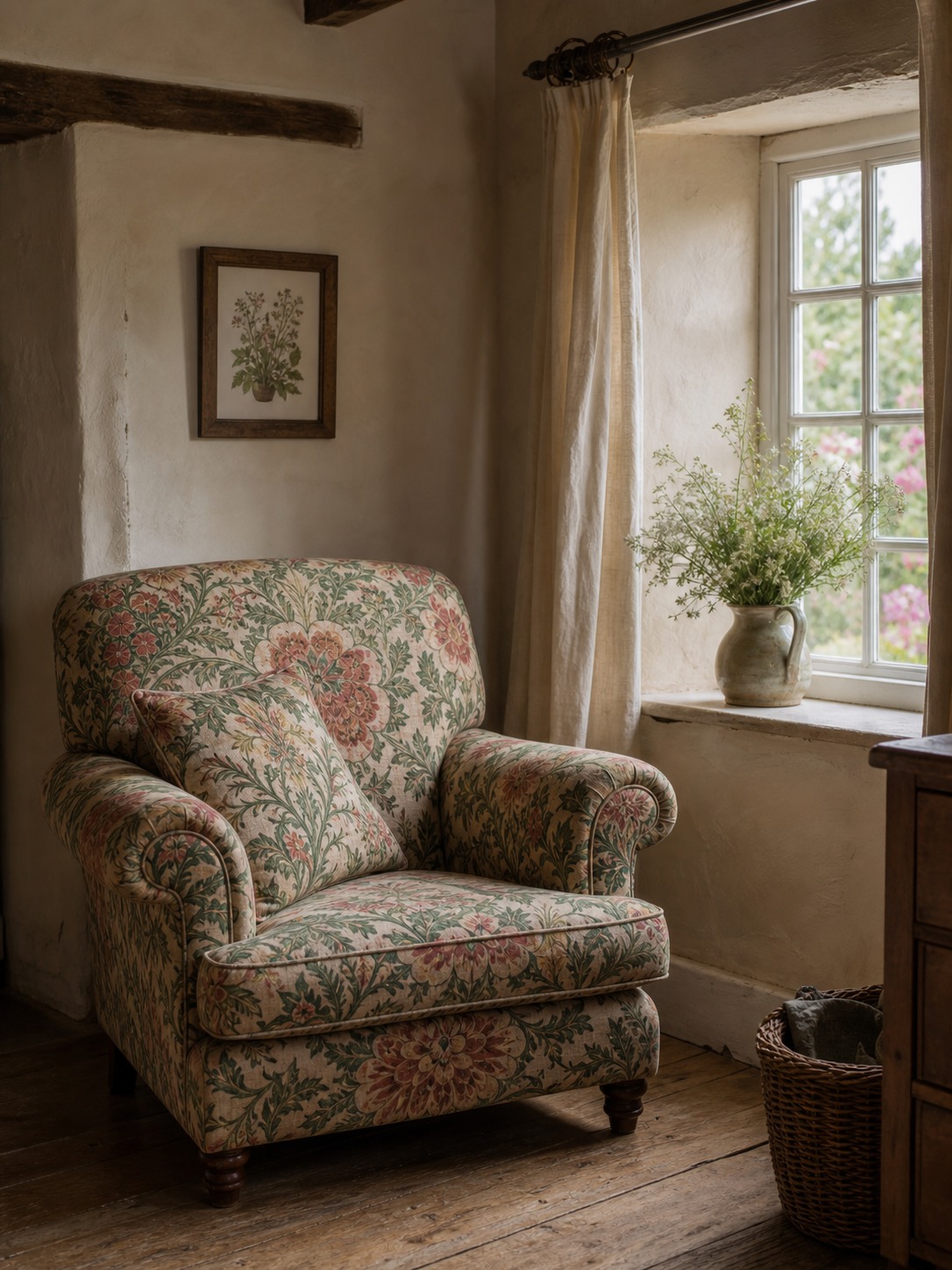
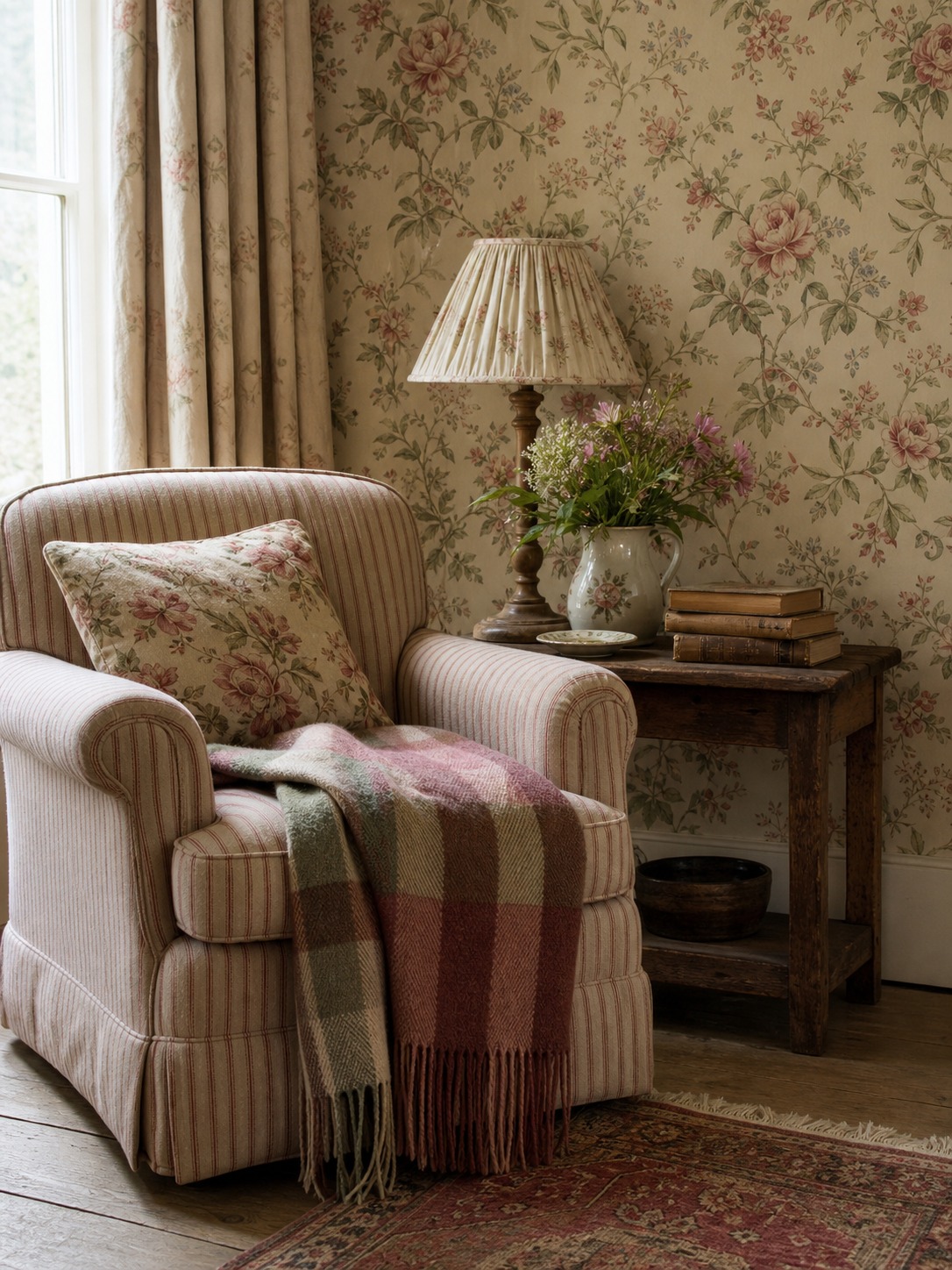
1. A floral armchair as the room’s anchor
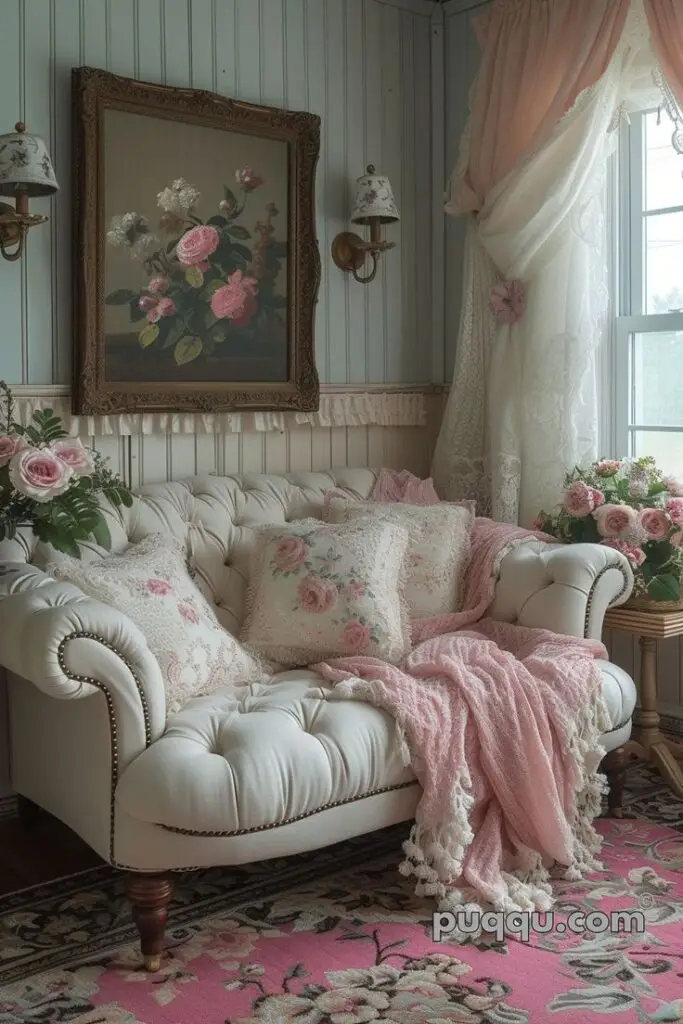
One upholstered chair in a large-scale heritage floral does more than a dozen accessories. Set it beside a window or fireplace and let the rest of the room stay quiet around it.
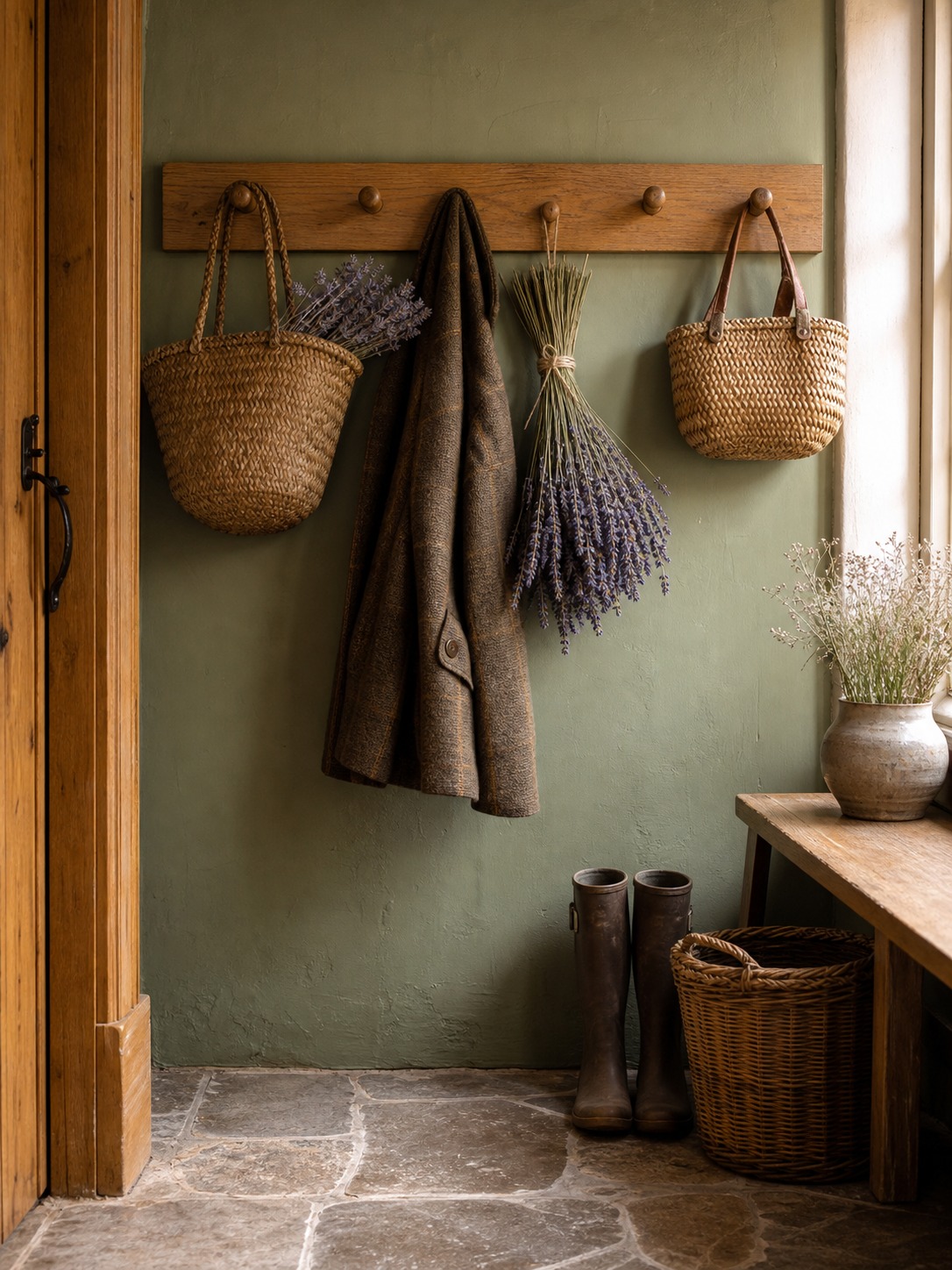
2. A peg rail entryway
An oak Shaker rail with baskets, a wool coat, and dried lavender turns a plain hallway into a working still life. Total cost under $50 if you make it yourself.
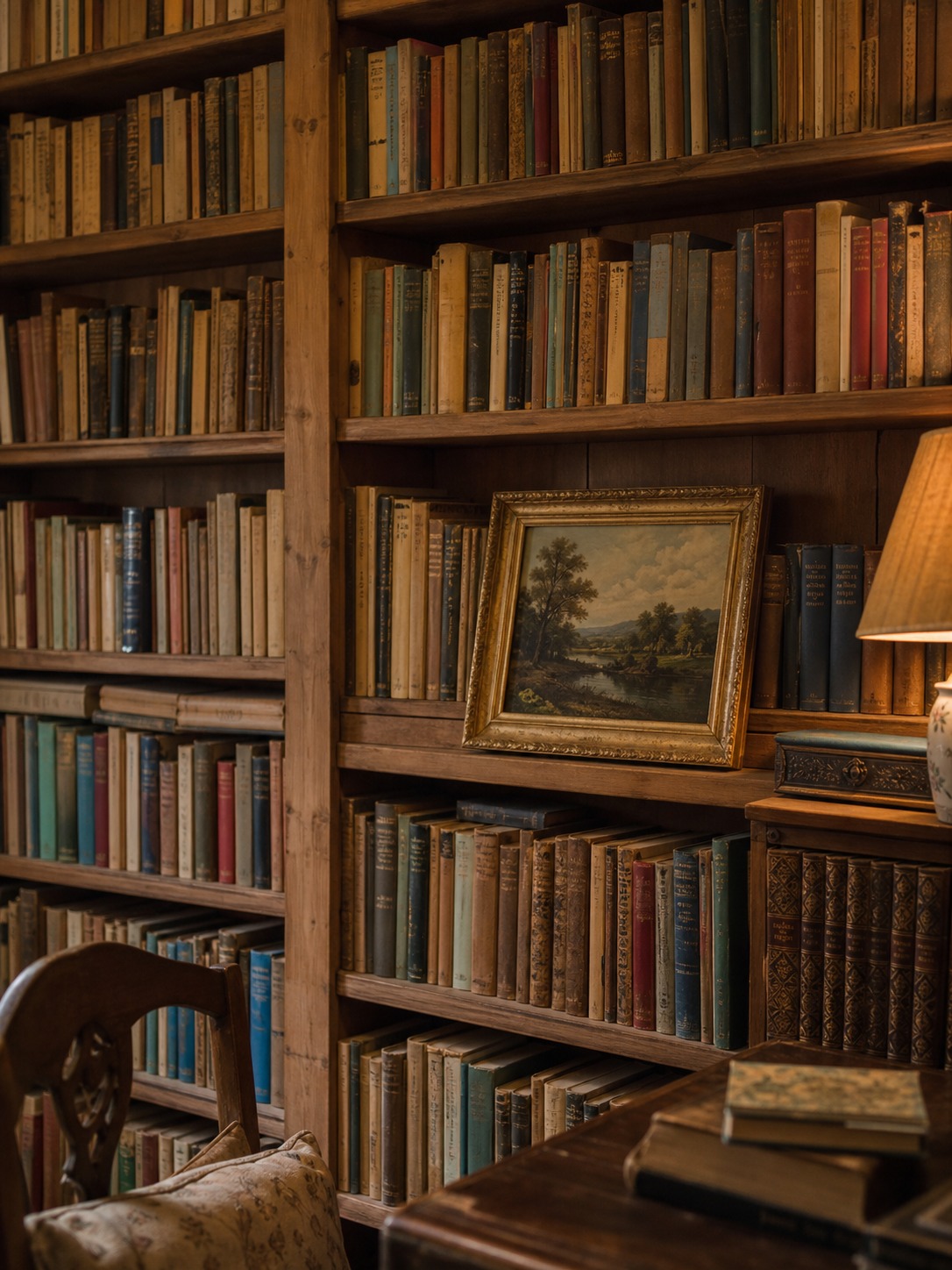
3. An overloaded bookshelf
Fill shelves to the brim with real, read books — cracked spines, no color coding. Add a few small framed paintings leaning against the rows.
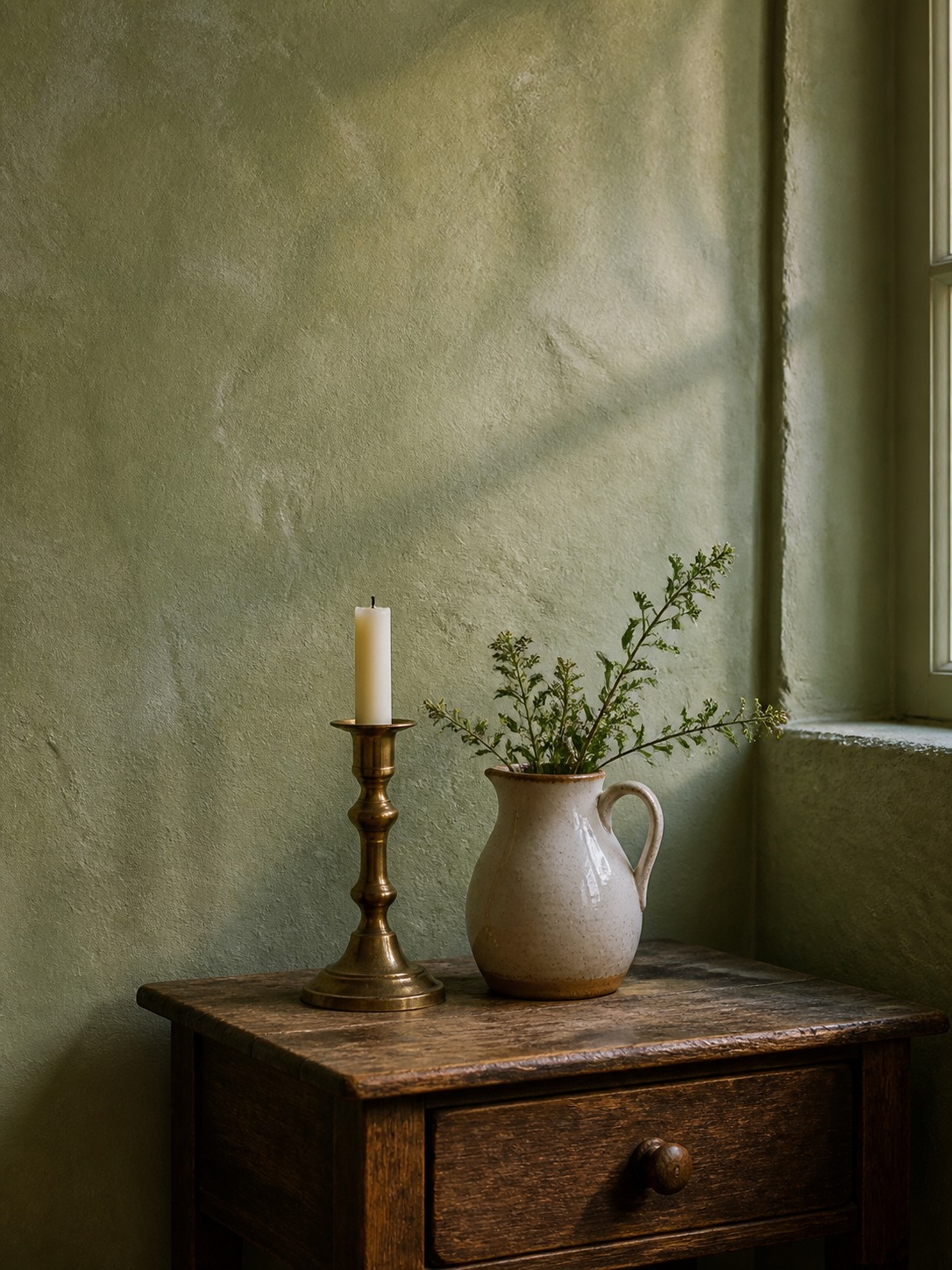
4. A lime-washed accent wall
Lime wash gives flat drywall the soft cloudy variation of old plaster. Sage or cream tones work best; the brush marks are the point.
5. A mismatched gallery wall
Small landscapes, portraits, and botanical prints in odd frames, hung slightly irregular. Thick vintage gold frames are back in 2026 — use two or three.
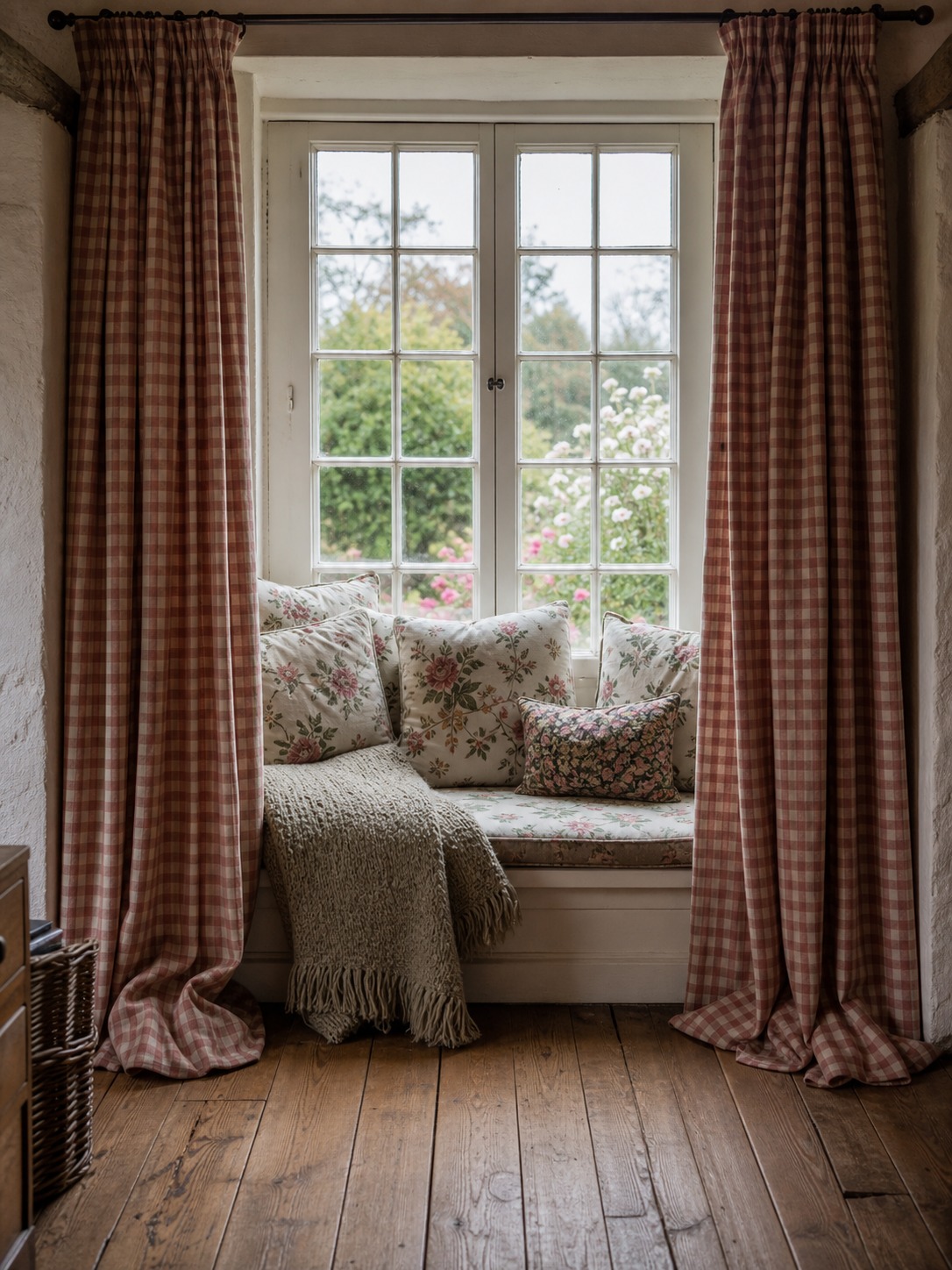
6. A window seat with pooling curtains
Build a cushioned seat into any deep window, add floral curtains that just touch the floor, and you’ve made the most-used spot in the house.
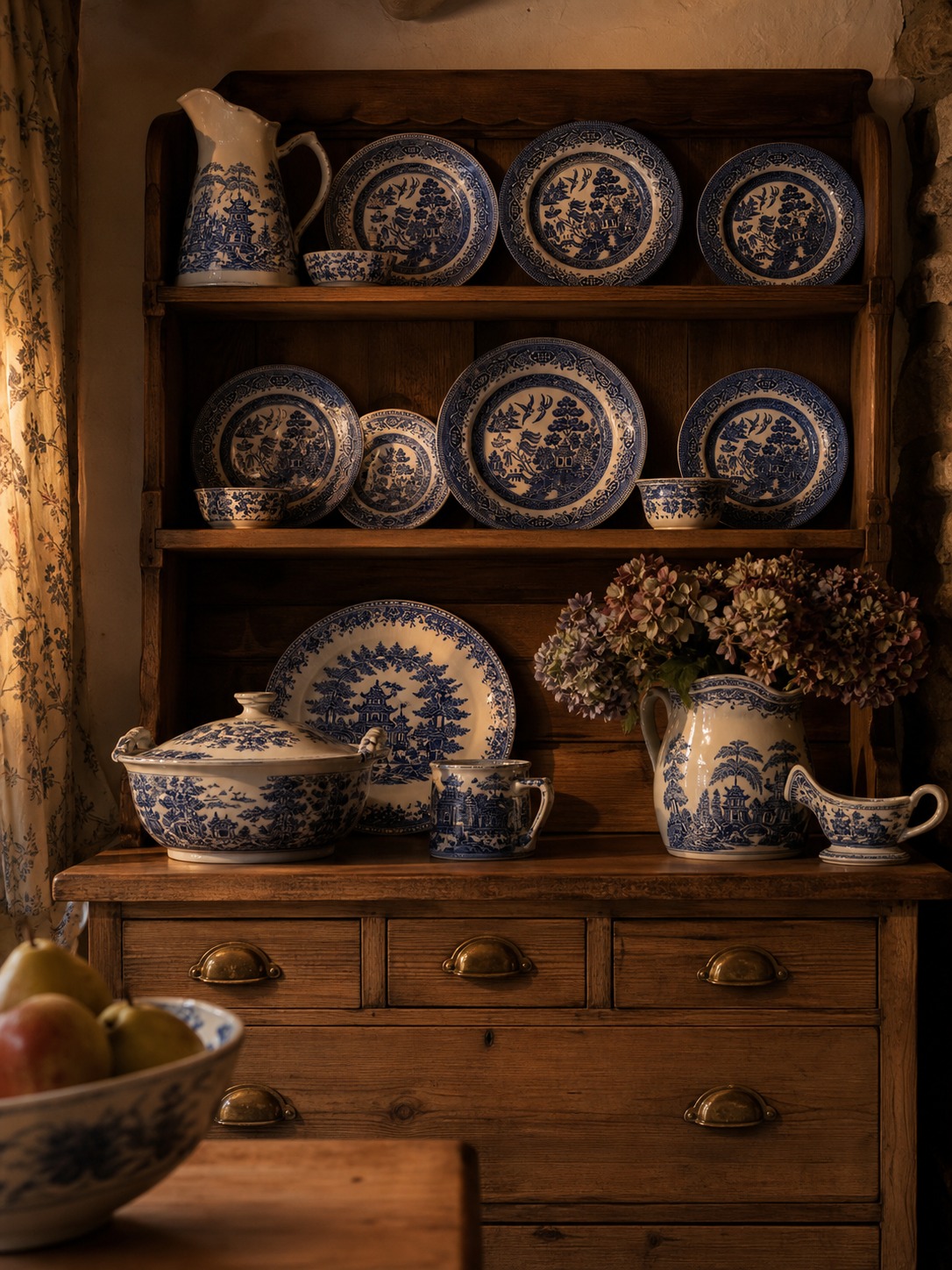
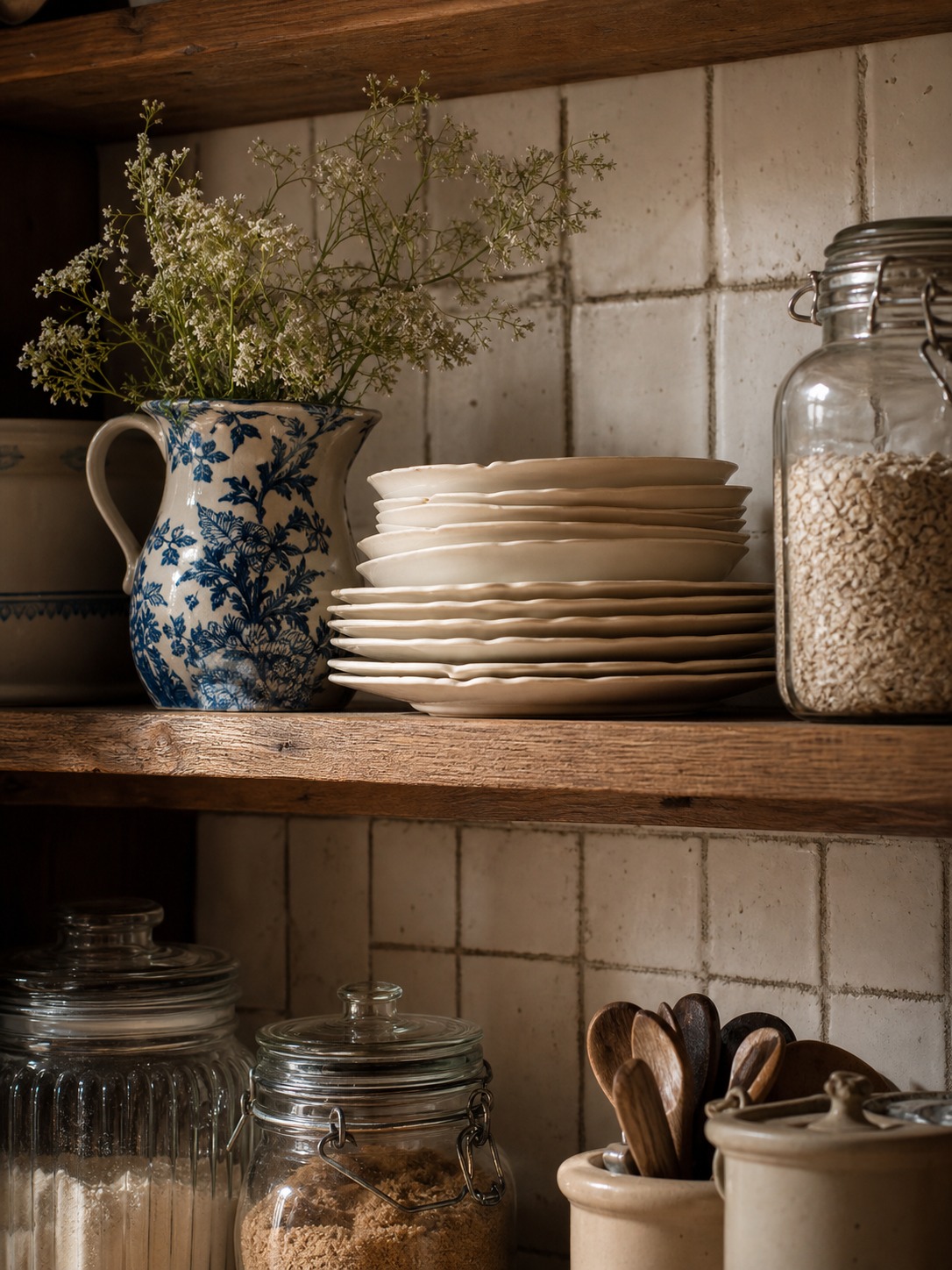
7. Blue-and-white china on open display
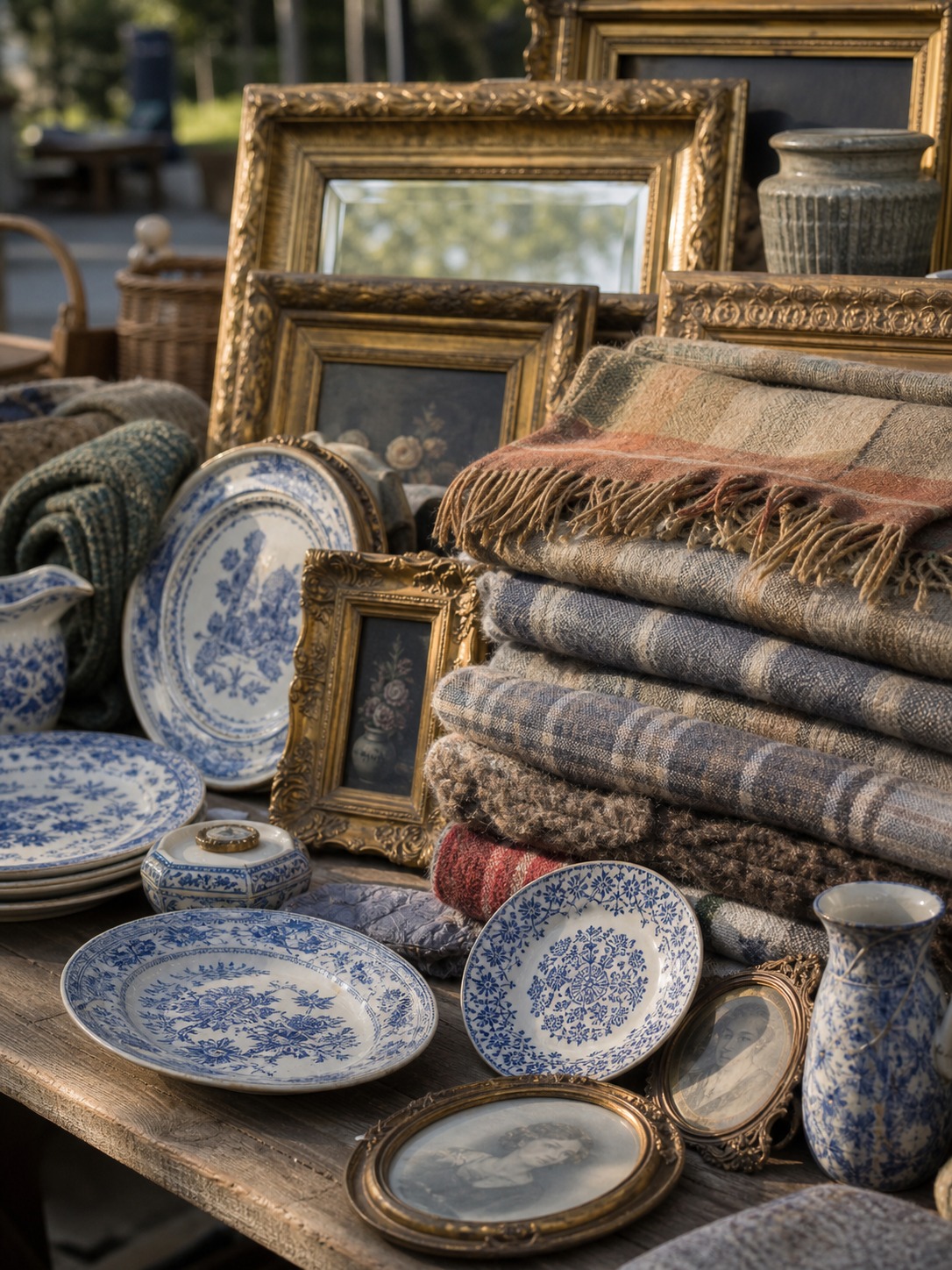
A dresser top or open shelf of willow-pattern plates and jugs. Collect it piece by piece from flea markets — $5–15 each, never as a set.
8. A faux-beam ceiling
Reclaimed or high-quality faux beams instantly lower and warm a boxy room. Dark, slightly irregular timber looks authentic; even spacing gives the fake away.
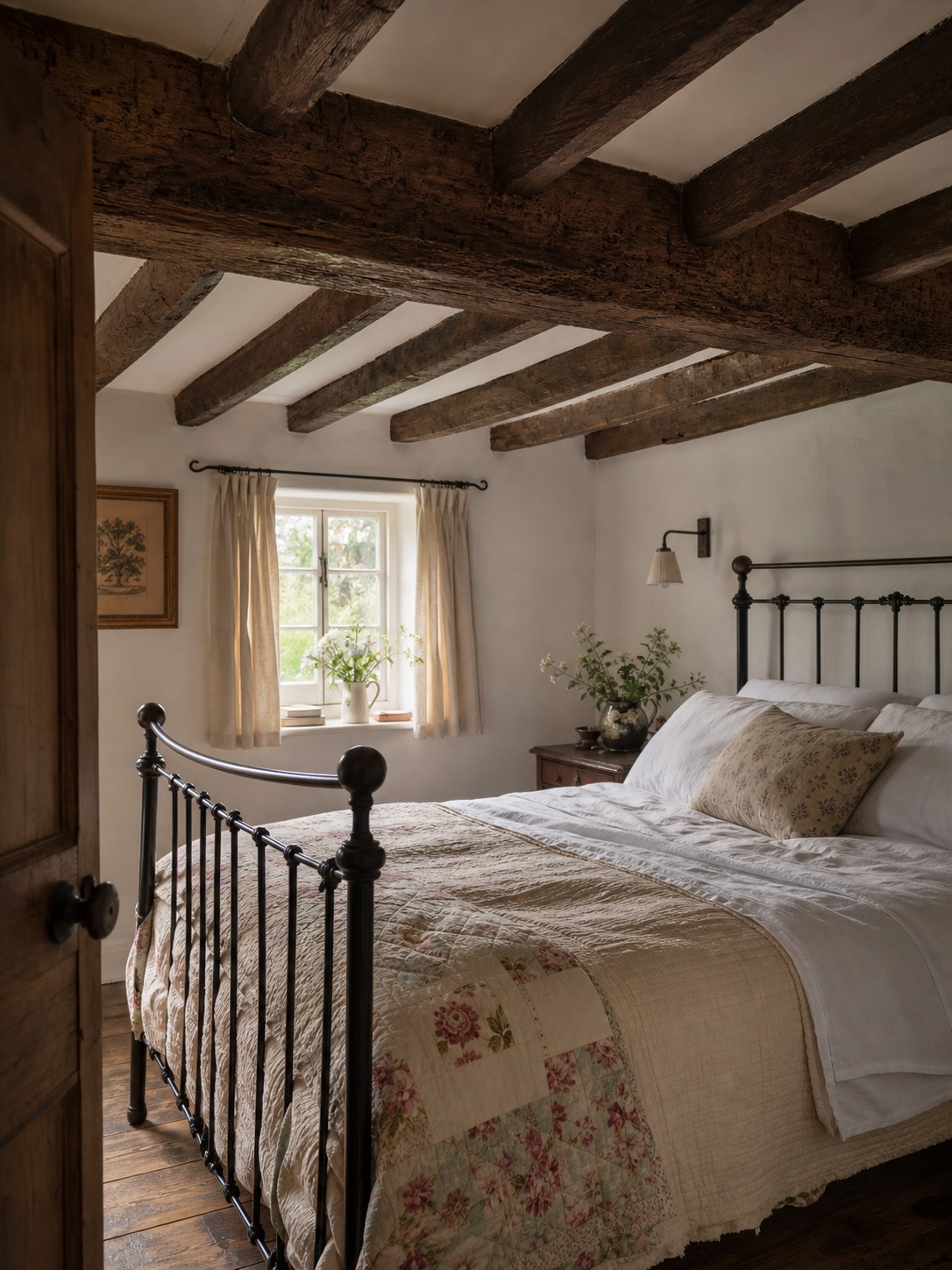
9. Pattern-on-pattern bedding
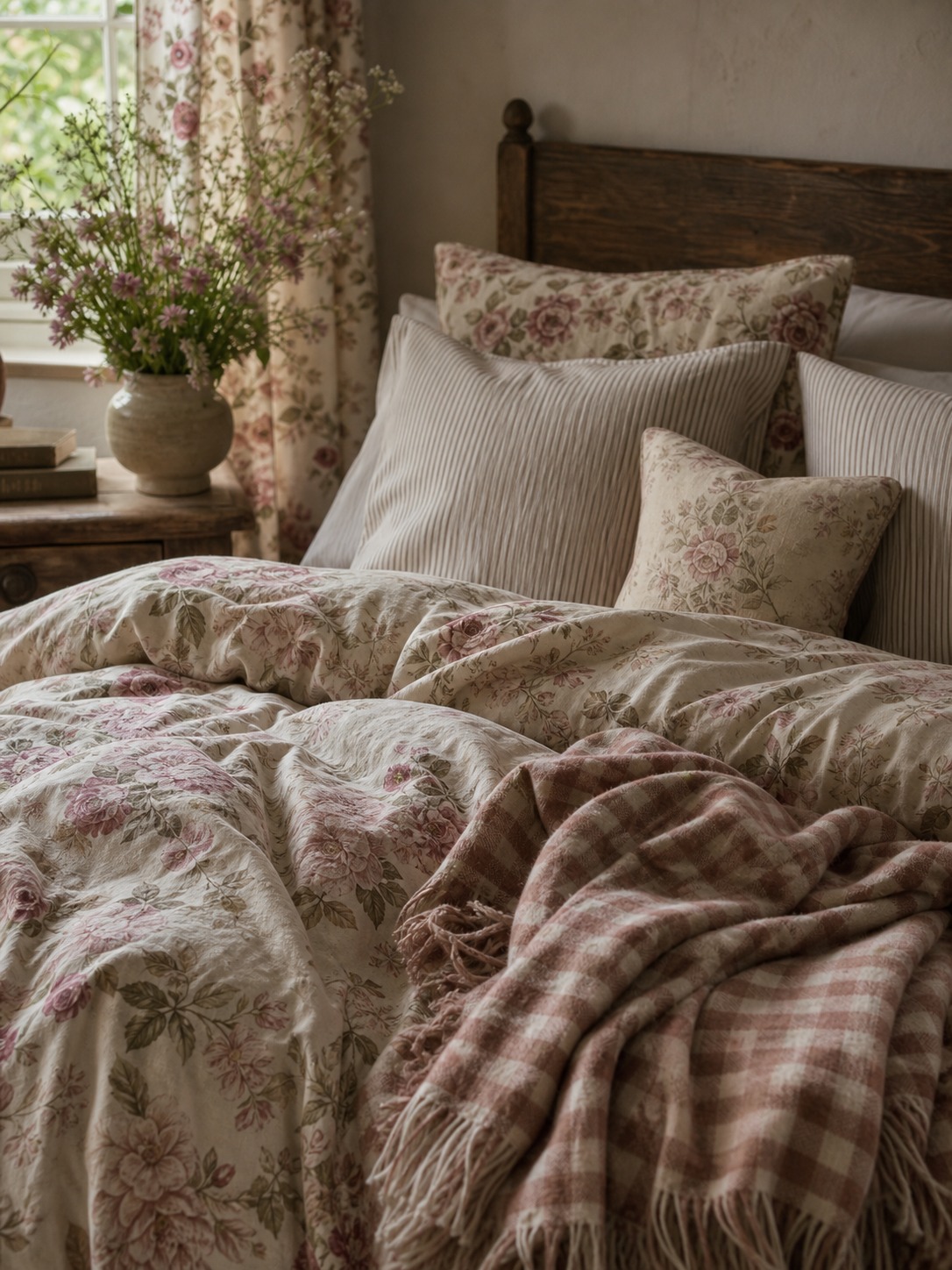
Layer a large floral duvet with striped pillowcases and a small-check blanket. Vary the scale and keep the palette muted — that’s the entire trick.
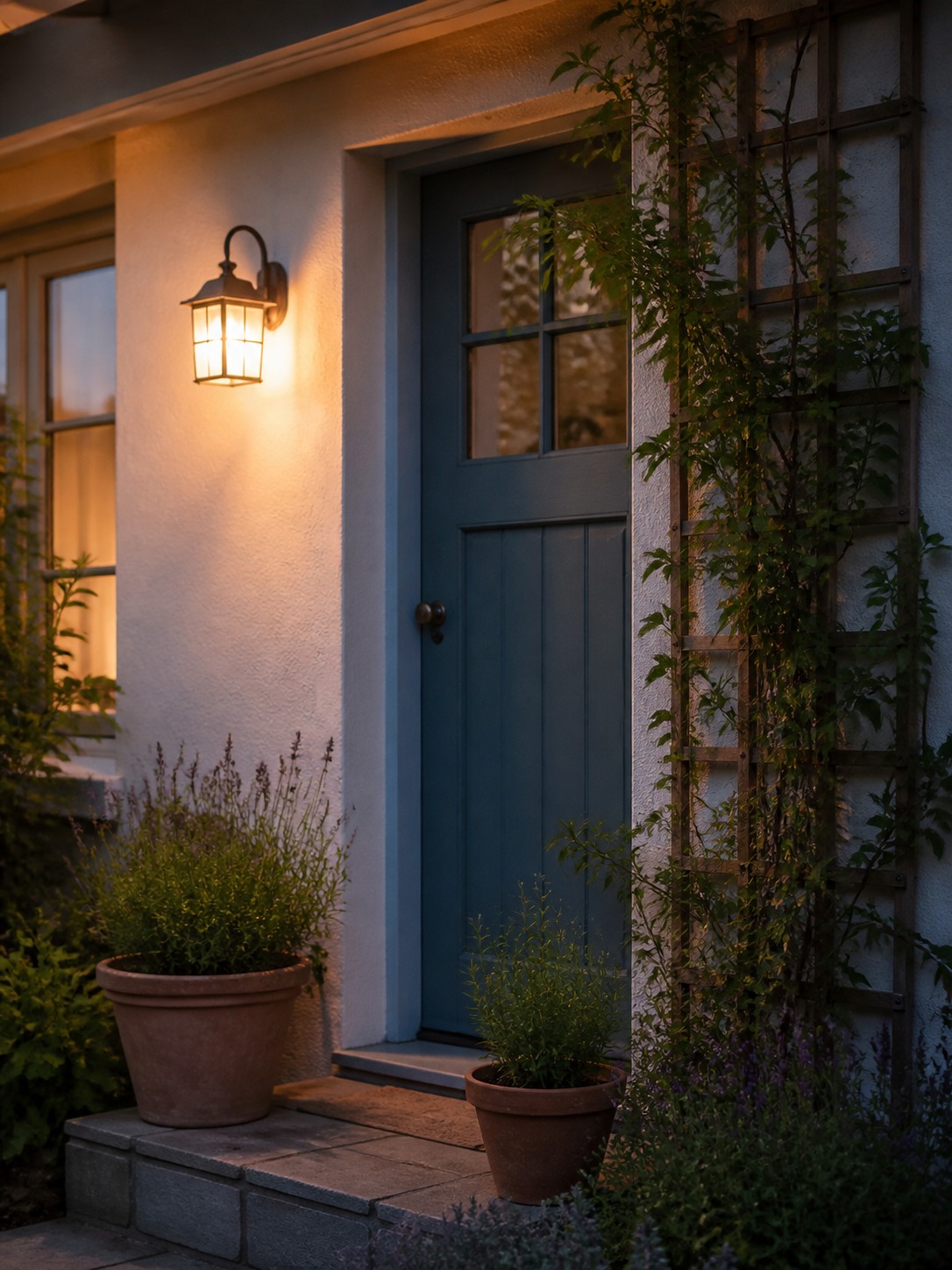
10. A climbing rose at the door
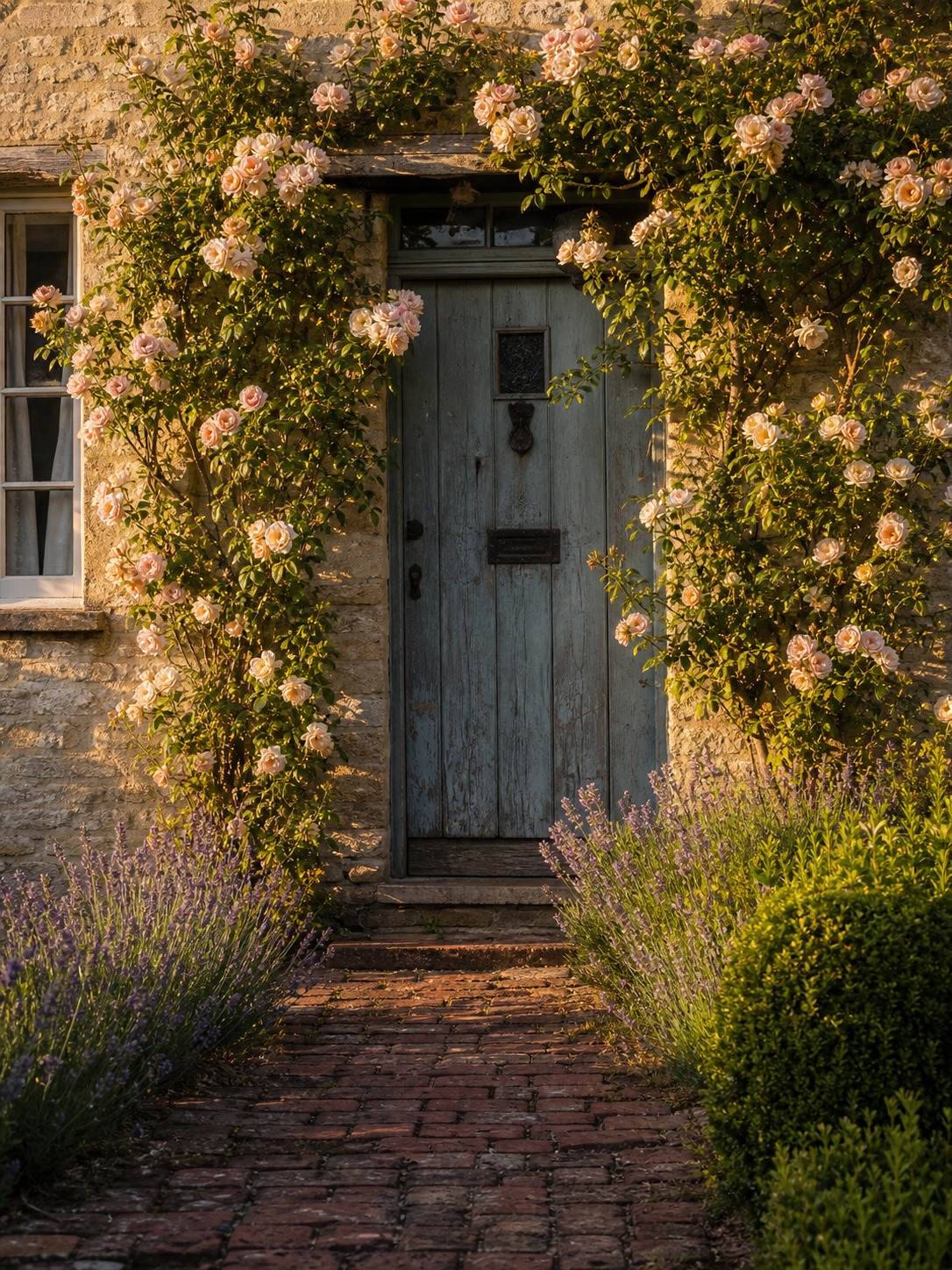
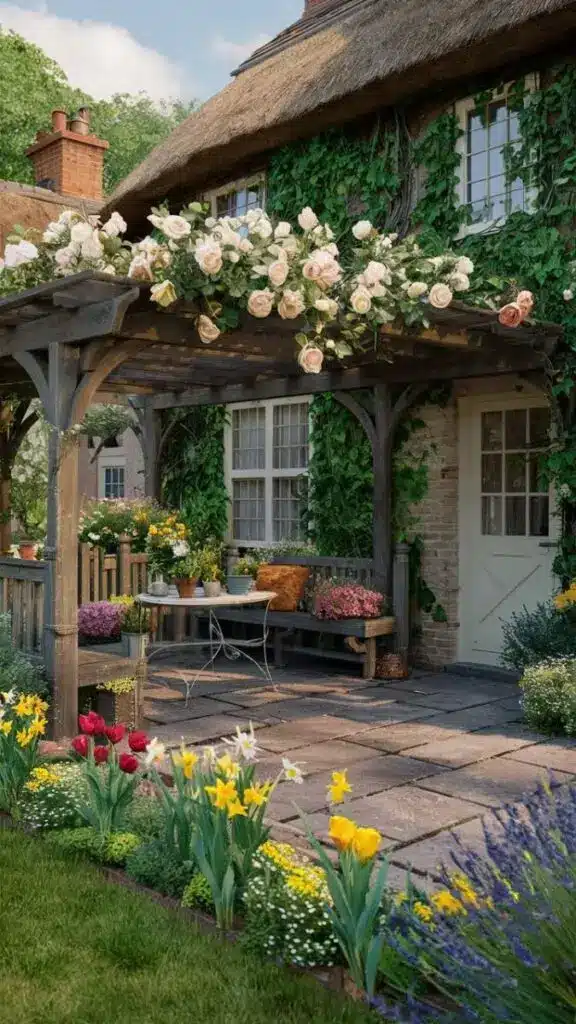
Outside counts too. One climbing rose or wisteria over the entrance changes how the whole house reads — it’s the exterior equivalent of patina.
Color palette: the paints that make it work
Ask ten people what color an English cottage is, and you’ll hear “white” or “beige.” Wrong on both counts. The real palette is muted, slightly dusty, and warmer than anything a builder would ever spec.
The muted base
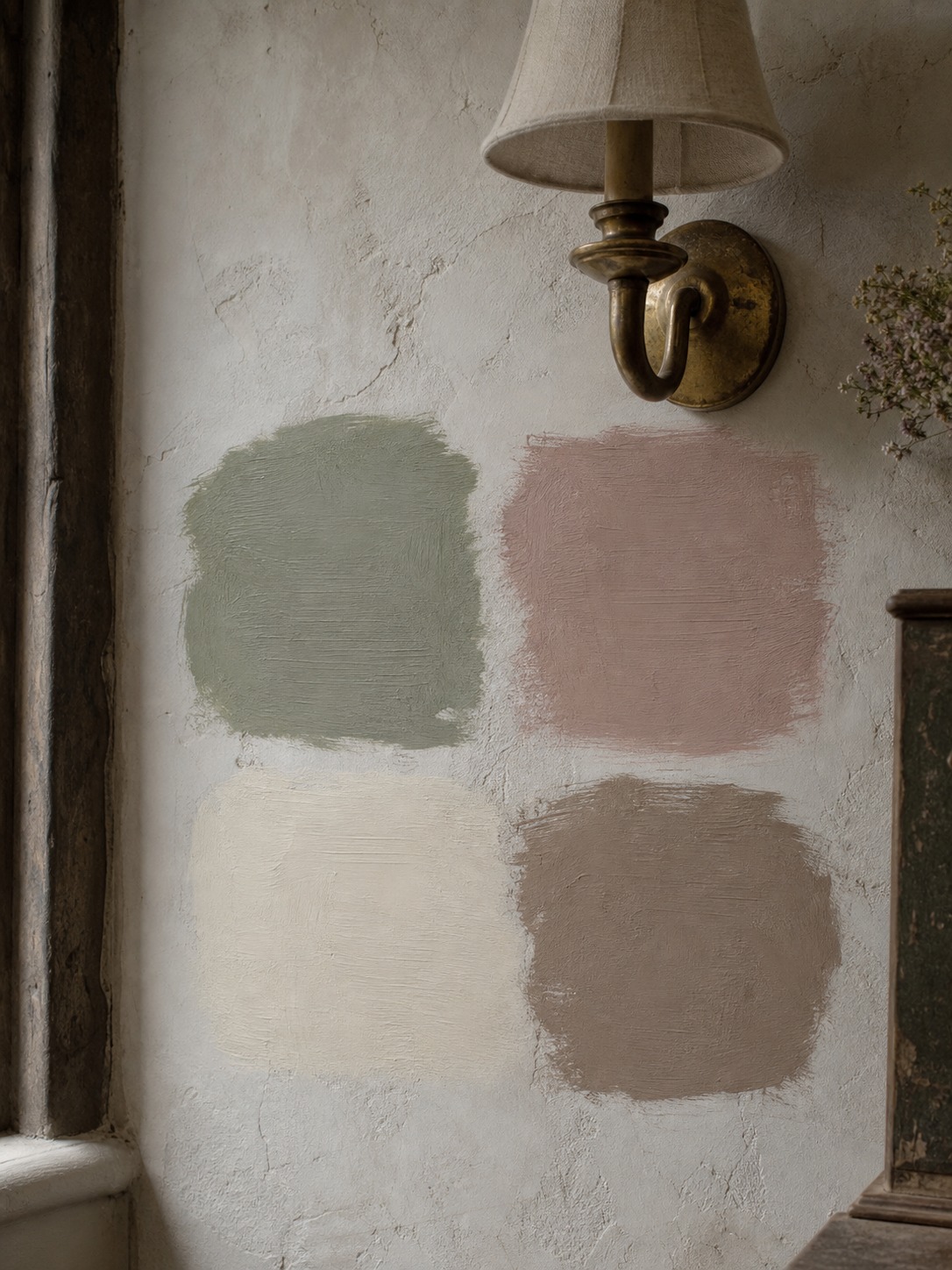
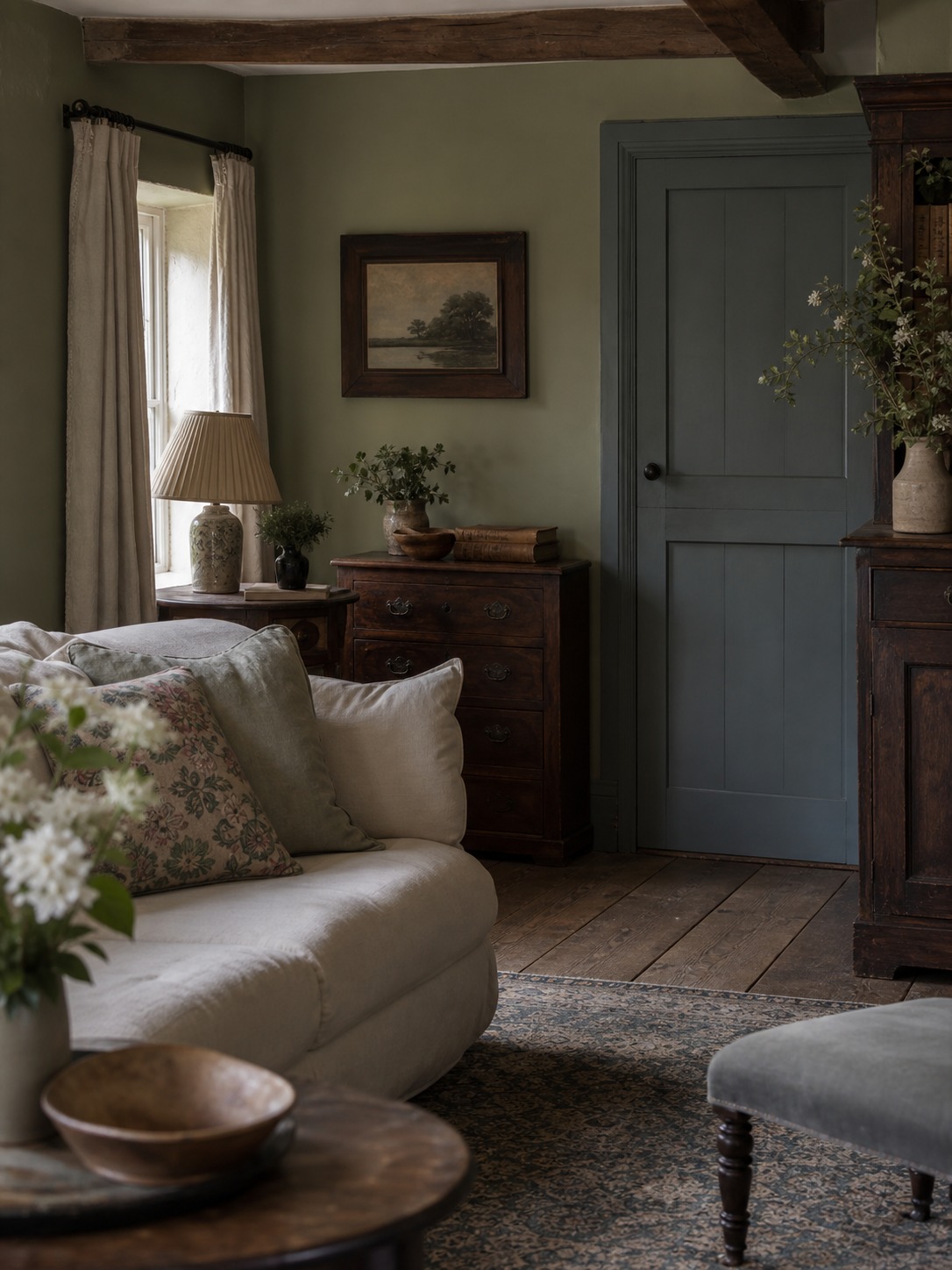
The foundation colors are cream, sage green, dusty rose, and soft gray-blue. What unites them is low saturation — every shade looks like it faded a little over thirty years of sunlight. That’s the trick: bright pastels look like cottagecore costume, while these knocked-back versions look like time.
My life-painting training explains why this works. Aged pigments lose their sharpest chroma first, so our eyes associate desaturation with age and authenticity. Paint a wall in a slightly grayed sage, and the room feels older than it is — no antiques required yet.
The 2026 shift
The newer layer on top of the classic palette is brown. Mushroom, taupe, and chocolate tones have replaced millennial gray as the neutral of choice, and deep walnut-toned furniture is back after years of whitewashed oak. If you repainted everything greige in 2019, this is your permission to warm it all up.
Specific paint picks
Names, not vibes — these are the ones I’d sample first. Farrow & Ball Ball Green is the definitive dusty sage, around $130 a gallon. Farrow & Ball Setting Plaster is pink that behaves like a warm neutral. Farrow & Ball Mouse’s Back is the mushroom-taupe of the 2026 shift. Benjamin Moore November Rain is a gray-green cream, roughly $60 a gallon and my pick for whole-room base coats. Behr Sage Gray is the budget route at about $35, surprisingly close to Ball Green on a north-facing wall.
One practical rule before you commit: test your sample on the wall that gets the least light. Cottage colors are mixed to glow in dim English daylight, so a shade that looks perfect in a bright showroom can go flat and dark in a real corner. See also professional interior painting guide.
Patterns: florals, stripes, and the scale rule
Pattern is where most people either chicken out or crash. They stay safe with one lonely floral cushion, or they go full costume and the room turns into a fabric shop. The English cottage answer sits in the middle, and it follows one rule you can learn in a minute.
Heritage prints
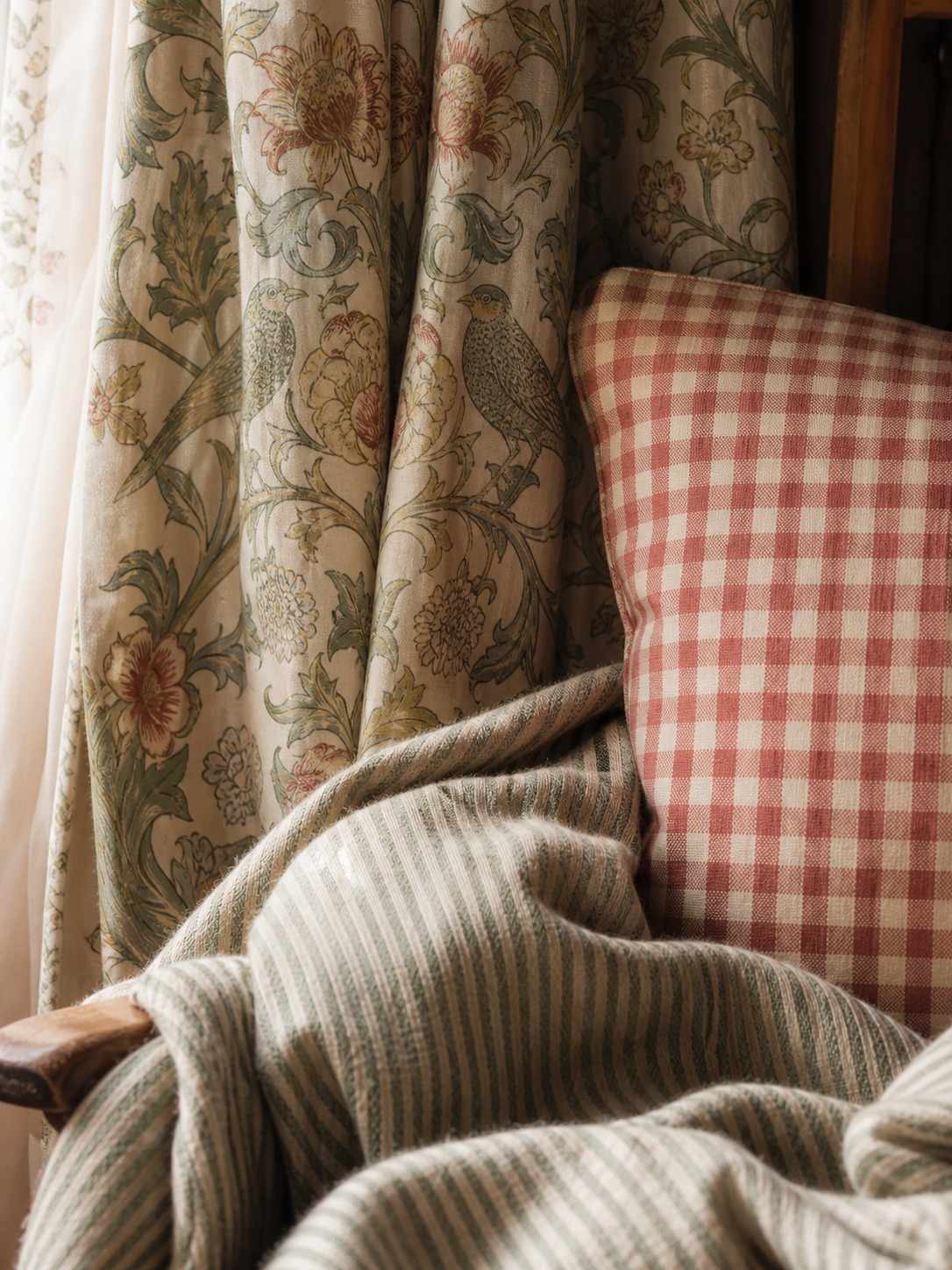
The canon starts with William Morris. His Strawberry Thief and Willow Boughs designs are over 140 years old and still in print through Morris & Co., with licensed versions at Sanderson running $80–120 per roll of wallpaper. Around Morris you layer the supporting cast: Liberty London microflorals, simple gingham checks, ticking stripes, and tartan in the colder months.
Notice what these have in common — nature and geometry, nothing abstract. A cottage print always looks like something: a bird, a vine, a woven check. Modern abstract patterns break the spell instantly.
Mixing patterns without chaos
Here’s the rule: vary the scale, keep the palette. A large floral pairs with a small check because your eye reads them at different distances. From across the room you see the floral; up close, the gingham comes into focus. They occupy different layers of attention, so they never fight.
Composition classes drill this into you with figure drawing, actually. A painting needs a dominant mass, a secondary rhythm, and a fine texture, and a room works exactly the same way. Two large-scale florals in one space compete for dominance, which is why that combination always feels loud even when the colors match.
In practice, build in threes: one large pattern (curtains or an upholstered chair), one medium stripe or check (cushions, a blanket), one tiny print (a lampshade, a seat pad). Keep all three inside the muted palette from the previous section and you can’t really miss.
Where to start if patterns scare you
Start with $30 worth of cushion covers. Etsy sellers offer covers in genuine Morris prints for $15–25 each; put a large floral next to a small gingham on a plain sofa and live with it for a week. You’ll know quickly whether to push further into curtains or wallpaper. And if a combination feels wrong, check the scale before you blame the colors — nine times out of ten, that’s the problem. Which brings us to the room where pattern, wood, and clutter all collide: the kitchen. See also floral wallpaper patterns.
The english cottage kitchen
Here’s a number that surprises Americans: in a lot of British cottage kitchens, the cabinets aren’t attached to the walls. The kitchen is furniture (a dresser here, a worktable there), and that single fact explains almost everything about how the room feels.
Furniture, not fitted cabinets
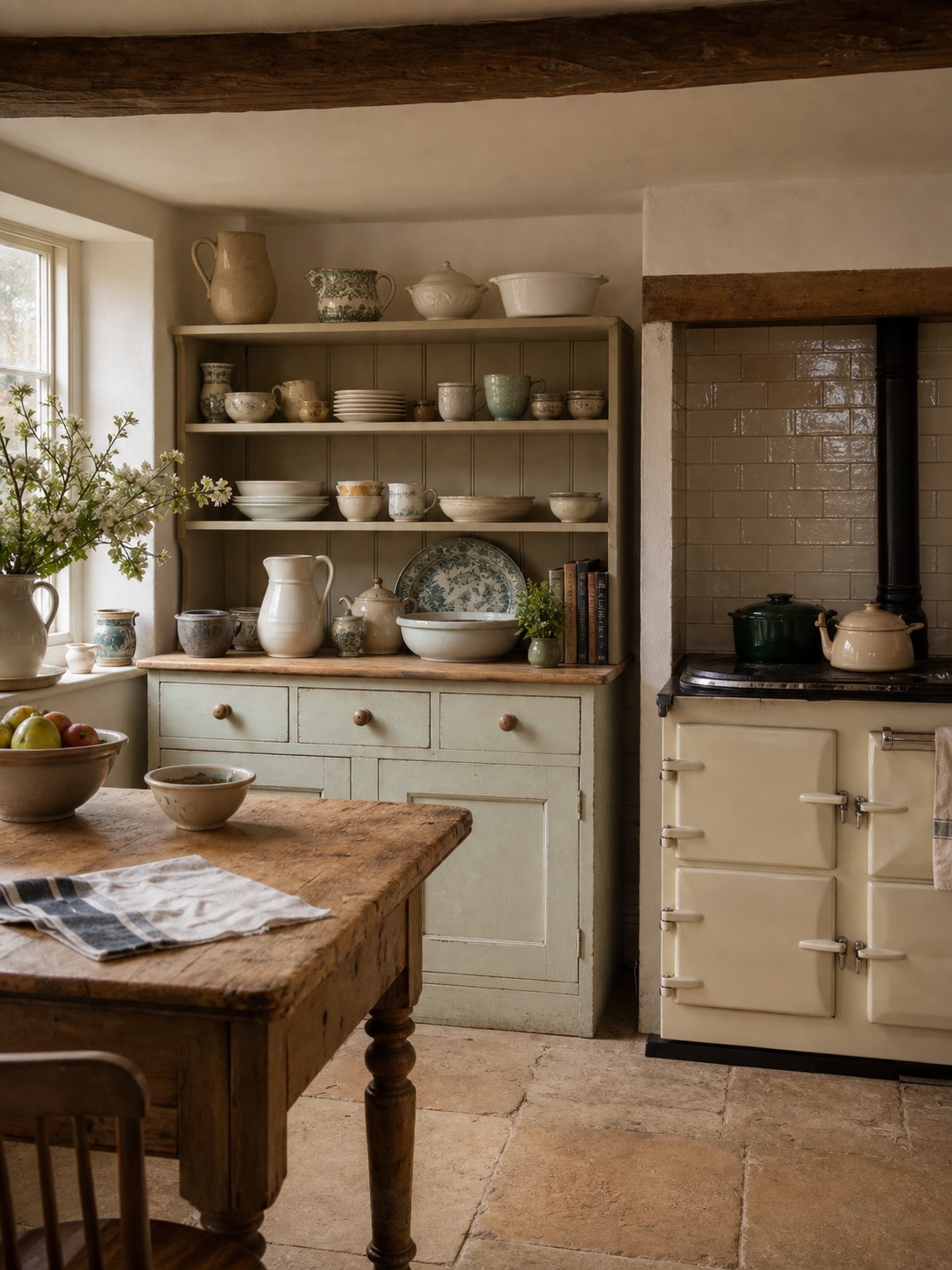
The reference point is deVOL, the Leicestershire company whose freestanding kitchens made this look famous. Their real kitchens start around £12,000, but the idea costs nothing to copy: break the fitted run. Swap one bank of upper cabinets for open shelves, bring in an antique dresser for dishes, use a scrubbed pine table instead of an island.
Your eye takes a fitted kitchen in as one large object and moves on. A furnished kitchen breaks into five or six separate objects with gaps and shadows between them, and that visual rhythm is what makes people want to linger. I’ve noticed the same principle in dashboard design, oddly enough: break one monolithic panel into separate grouped elements and users describe the exact same layout as “friendlier.” See also interior design principles.
Open shelving, ceramics, and the stove
With shelves open, the dishes become the decor. Stack everyday plates, jugs, and glass storage jars — things you actually reach for daily, so the display stays honest and the dust never settles.
The stove is the second anchor. A genuine Aga range runs $10,000–20,000, which is absurd for most budgets, but the effect comes from presence, not the brand: any substantial range in cream, black, or deep green, framed by a simple mantel or tiled alcove, does the compositional job. Finish with over-grouted tiles, grout pushed almost flush with the tile face, and the wall instantly looks eighty years old.
Start with the cheapest move first: take the doors off one upper cabinet this weekend, paint the interior sage, and load it with your real dishes. If you like living with it (most people do), work outward from there. And once the inside is settled, it’s worth stepping out the front door — because half of what makes a cottage a cottage happens outside. See also cozy kitchen ideas.
English cottage style exterior and garden
A confession: you can nail every interior detail and still lose the plot at the front door. The exterior is where this style started: the inside look grew out of buildings, gardens, and weather. It deserves more than an afterthought paragraph.
Stone, climbing roses, and the cottage garden
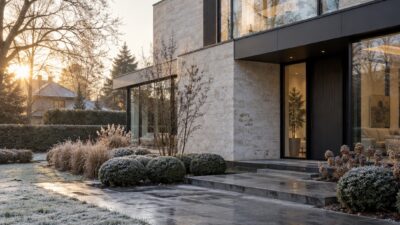
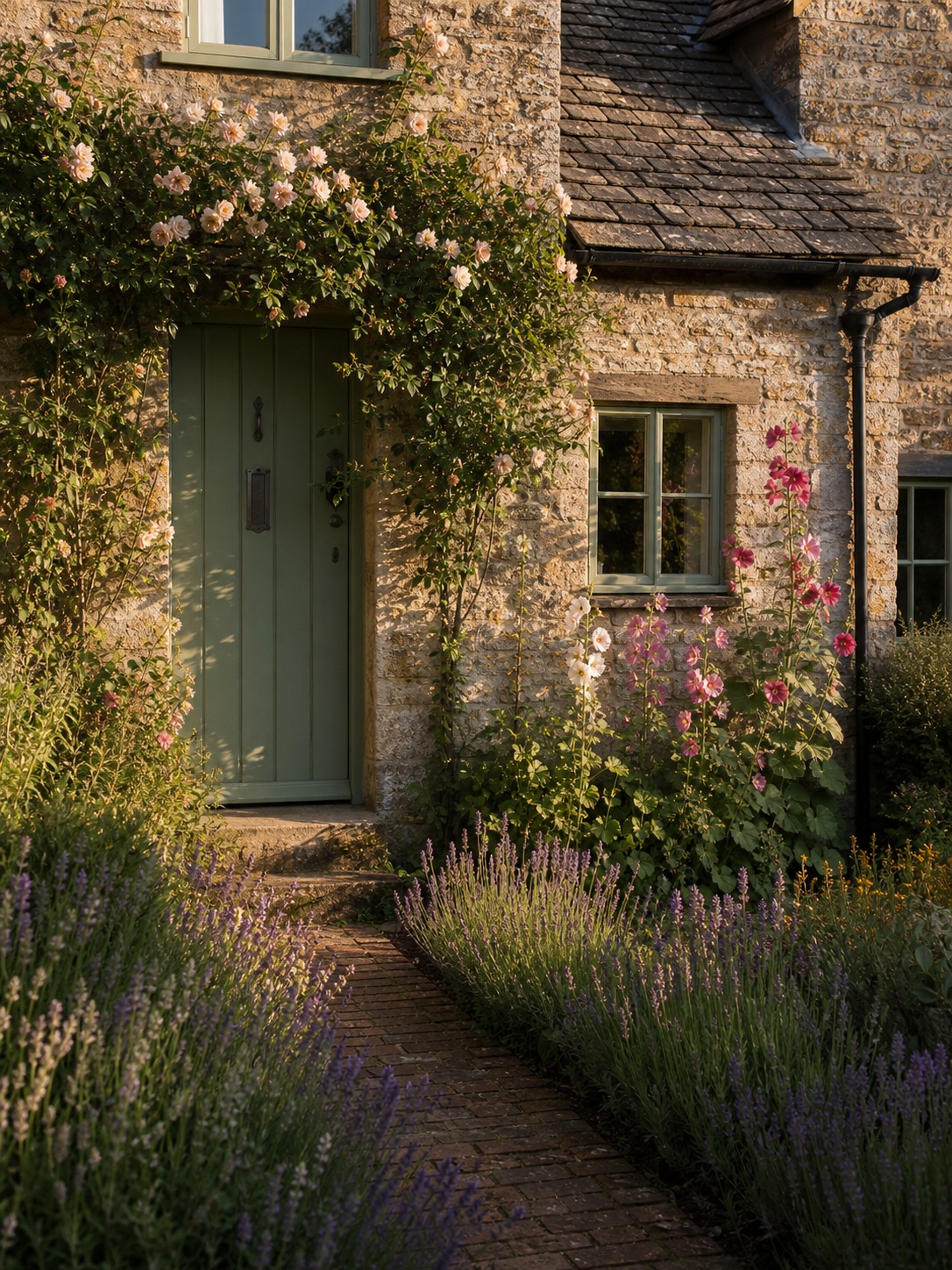
The classic shell is honey or gray stone, a steep roof (thatch if you’re lucky, slate more often), small-paned windows, and a low front door painted in a muted heritage color. Planting does the rest. A climbing rose or wisteria trained over the doorway is the single most recognizable cottage move; David Austin’s climbing varieties run $30–40 a bare-root plant and reach the top of a door frame in about three seasons.
The cottage garden itself follows the same logic as the interior: packed, layered, and slightly out of control. Lavender edging a brick path, foxgloves and hollyhocks against the wall, herbs mixed in with the flowers. No mulch-and-three-shrubs minimalism — the beds should look generous to the point of overflowing.
What translates to a regular house
You probably don’t own a 300-year-old stone shell, and it doesn’t matter. When I sketch buildings, what defines the silhouette is texture and threshold, not square footage. Concentrate on the entry sequence: the ten feet around your front door carry most of the impression.
That means a painted door in sage, deep green, or dusty blue ($40 of paint, one weekend). A trellis with one climbing plant. Terracotta pots in odd numbers, a bench if the space allows, and a warm-toned lantern instead of a builder’s floodlight — 2700K bulbs, nothing cooler. Even on a suburban facade, those five moves shift the read from “house” toward “home with a story.” See also front yard landscaping ideas.
One warning from the interior chapters applies double out here: skip anything faux-aged from a garden center. A resin “antique” urn fools nobody at door distance. One real terracotta pot with mineral bloom beats five fakes.
The exterior sets the promise; the last thing left is keeping that promise indoors without blowing the budget — or the balance.
Getting the look in a modern home on a budget
Total honesty: english cottage style is one of the few looks that gets worse the more money you throw at it fast. A $15,000 shopping spree produces a showroom. A $500 budget spread over a year produces the real thing. That’s good news for most of us.
Start with one room
Pick the room where you actually spend evenings and ignore the rest of the flat for now. The style needs density to work — one floral cushion drowning in a gray open-plan space looks like an accident. Concentrated in a single room, the same five objects start talking to each other.
Give that room a season, not a weekend. Add a piece a month: paint first, then textiles, then one antique, then art. My own rule when redesigning any space is to live with each change for two weeks before adding the next. Half the planned purchases turn out to be unnecessary, which is the budget doing itself a favor.
The thrifting strategy
Modern english cottage style runs on secondhand. The hierarchy of hunting grounds: estate sales for furniture, flea markets for china and brass, Facebook Marketplace for the heavy stuff nobody wants to ship. Realistic prices: a solid pine chest of drawers for $80–150, willow-pattern plates for $5–15, gilt frames for $10–30, a wool blanket for $20.
Never buy new: anything wooden, anything framed, anything ceramic. Always buy new: mattresses, cushion inners, and paint. Everything else is negotiable.
I tried the shortcut once — ordered a batch of “vintage-style” frames online for a gallery wall. They looked fine in photos and dead on the wall, all identical, all weightless. Three months of flea markets replaced them for less money, and that wall is now the best thing in the room.
How to avoid the theme-park effect
The failure modes sit at both ends. Too much: ruffles on every surface, florals fighting florals, a room that looks like a gift shop. Too little: beige walls, one jute rug, and a “cottage vibes” sign (please, no signs). The calibration test is simple — every object should be something you’d keep even if you changed styles. Decor bought purely as a style prop is the first thing that starts to look fake.
When in doubt, subtract the newest-looking thing in the room and see if the space improves. It usually does.
The takeaway
You can’t buy this style in a weekend, and that’s precisely what protects it from going out of fashion. Start with one room, one muted paint color, and one honest antique. Add a large floral, a small check, and use simple home art studio storage concepts to display your creative supplies. The room will do the accumulating for you — that’s the whole method, and it costs less than any trend that came before it.
If you want to go deeper into the visual thinking behind interiors, my guides on interior styles and color composition on Sky Rye Design continue from here. See also interior design styles. See also living room interior design ideas.
Related english cottage and interior design guides
For modern projects that blend historic warmth with clean forms, study how to handle digital texture scaling in our architectural rendering walkthrough.
Use these next when you want to build the same look room by room instead of treating english cottage style as a single shopping list.
| Need | Guide | Why it fits this cluster |
|---|---|---|
| Interior style foundations | Interior design styles | Use this when you want to compare cottage with traditional, maximalist, rustic, and modern interior languages. |
| Room composition | Interior design principles | Good for balance, color, texture, lighting, and detail decisions before buying decor. |
| Living room layout | Living room interior design ideas | Helpful if the cottage look needs to work around seating, traffic paths, storage, and lamps. |
| Paint and wall color | Professional interior painting | Use this before choosing sage, dusty rose, cream, taupe, or a lime-wash style finish. |
| Pattern layer | Floral wallpaper patterns | A natural next step if you want Morris-style florals, small prints, or a patterned feature wall. |
| Lighting mood | LED lights for room | Useful for keeping a cottage room warm and soft after sunset instead of harsh and flat. |
| Kitchen support | Cozy kitchen ideas | Pairs with the freestanding kitchen section and the open-shelf ceramics approach. |
| Exterior and entry | Front yard landscaping ideas | Best for translating cottage planting, path, pots, and door-color ideas to a normal house. |
| Outdoor decor | Garden decor ideas | Use this for the cottage garden layer: pots, objects, path details, and small focal points. |
FAQ
What is english cottage style?
English cottage style is an interior look built around the idea of accumulation: antique furniture, layered heritage patterns like florals and gingham, muted colors, and natural materials that show their age. It grew out of small rural British homes with exposed beams, stone floors, and deep-set windows. The defining quality is that rooms look collected over decades rather than decorated in one go — mismatched pieces, real patina, and shelves full of things that actually get used.
What’s the difference between english cottage style and cottagecore?
Cottagecore is an internet aesthetic; english cottage is an interior design tradition. Cottagecore leans on bright pastels, ruffles, and a romanticized fantasy of rural life — it photographs well but often reads as costume in a real home. English cottage style uses desaturated colors (sage, cream, dusty rose), genuine antiques, and restraint. The quick test: cottagecore looks styled for a photo, english cottage looks like someone has lived there for thirty years.
Is english cottage style still in style in 2026?
Yes — it’s arguably at its peak. Designers named “elevated english cottage” and “modern cottage” among the biggest trends of 2026, largely as a reaction to a decade of gray minimalism and white farmhouse interiors. The current version warms the palette with mushroom and chocolate tones, embraces pattern-on-pattern schemes, and treats antiques as a sustainability choice. Because the style is built on old objects rather than trend cycles, it also dates far more slowly than most looks.
What colors are used in english cottage interiors?
The base palette is muted and slightly dusty: cream, sage green, dusty rose, and soft gray-blue, with the 2026 layer adding mushroom, taupe, and deep brown wood tones. Low saturation is the common thread — every shade looks gently faded by sunlight. Specific starting points: Farrow & Ball Ball Green or Setting Plaster, Benjamin Moore November Rain, or Behr Sage Gray on a budget. Avoid bright pastels and stark white; both break the aged effect.
How do I mix patterns without making the room look cluttered?
Vary the scale, keep the palette. Pair one large pattern (a floral on curtains or an armchair) with one medium stripe or check and one tiny print, all within the same muted color family. Different scales occupy different layers of attention, so they don’t compete. The most common mistake is combining two large-scale patterns — that’s what creates visual noise, not the number of patterns. Start with $30 of cushion covers before committing to wallpaper.
Can english cottage style work in a small apartment?
Yes, and often better than in large open-plan spaces, because the style needs density to work. Concentrate on one room: a lime-washed or sage wall, one floral armchair, a secondhand pine dresser, layered textiles, and a full bookshelf. Small-scale moves like a peg rail entryway or pattern-on-pattern bedding deliver the look without renovation. Skip faux beams in low-ceilinged flats — lean on textiles, color, and antiques instead.
Is english cottage style expensive to achieve?
It’s one of the cheapest styles done right, because it runs on secondhand. Realistic prices: a solid pine chest of drawers for $80–150, willow-pattern china at $5–15 a plate, gilt frames for $10–30, wool blankets around $20. Paint is the biggest single upgrade at $35–130 a gallon. The expensive route (new “vintage-look” furniture, a $15,000 deVOL kitchen) actually works against the aesthetic — mass-produced imitation is the one thing the style can’t absorb.
Original cottage image archive
While the English cottage style has its own unique charm, you can combine it with Scandi cozy home decor ideas to maximize the warmth of your space.
While country homes focus on rustic simplicity, you can see how metropolitan projects compare by checking out the most famous Victorian buildings in London.
To create a cozy backyard experience, try incorporating rustic fall patio ideas that mirror a timeless cottage aesthetic.
These are the original images from the older version of the article, kept here for reference instead of being removed from the post.







If you like cottage warmth but want a cleaner modern structure, this wooden house planning guide is a useful bridge between mood, materials, and practical planning.
This aesthetic represents a classic, highly recognizable type of architectural style that continues to inspire modern designers.
No English cottage is quite complete without its signature projecting window spaces. Browse our gallery of classic bay windows to discover how they enhance traditional architecture with cozy, sunlit alcoves.
If you want the broader landscape behind English cottage rooms, this countryside aesthetic guide connects the interiors to stone houses, hedgerows, garden paths, and rural materials.
- 855shares
- Facebook0
- Pinterest855
- Twitter0
- Reddit0