Drawing for kids works best when the first mark is easy. A child who can start with a circle, oval, triangle, or long rectangle is much more likely to finish the drawing instead of freezing on a blank page.
Use this list as a menu of simple drawing ideas for kids: animals, cartoons, food, nature, vehicles, fantasy subjects, and age-friendly prompts. I usually keep the first sketch light, then let kids add color, pattern, or a silly detail once the main shape feels right.
- Drawing for kids: quick start by age
- Drawing for kids: start with simple shapes
- Easy drawing ideas for kids
- Seasonal Drawing Ideas
- Fantasy and Space Inspiration
- Developing Artistic Skills
- Safe online drawing resources for kids
- Engaging with Art Communities
- Safe online drawing resources for kids
- Drawing for kids FAQ
- More drawing practice for kids
The fix is simple: give them something to draw. A prompt, a subject, a first shape to put down. Once there’s something on the page, the rest gets easier.
Drawing for kids: quick start by age
The easiest drawing for kids is usually the one with a clear first shape. Younger children do best with big, friendly subjects such as flowers, fish, houses, rockets, and cartoon faces. Older kids can handle multi-step ideas like animals, food packages, simple vehicles, and small scenes because they can compare proportions and fix a sketch without feeling defeated.
| Age or level | Best drawing ideas | What to practice |
|---|---|---|
| 5-7 | Flowers, fish, rainbows, houses, rockets | Big shapes, confident outlines, simple color |
| 8-10 | Cartoon animals, cupcakes, cars, trees, superheroes | Step-by-step drawing, details, pattern, expression |
| 11-12 | Room scenes, portraits, fantasy creatures, sneakers, comics | Proportion, shading, overlapping shapes, cleaner line work |
Kids usually know what they want to draw. Animals, food, things they made up — the subject isn’t the problem. The problem is the blank page with no starting point.
A prompt fixes that faster than encouragement does. “Draw your favorite food” or “invent an animal that’s part fish, part something else” — something concrete to push against. From there, most kids don’t need much.
Switching subjects is worth pushing for too, even if a kid has a favorite. Drawing fur is completely different from drawing a glass of water. A face is different from a building. Each one teaches something the others don’t, and kids pick that up faster than you’d think.
Drawing for kids: start with simple shapes
Essential Art Supplies
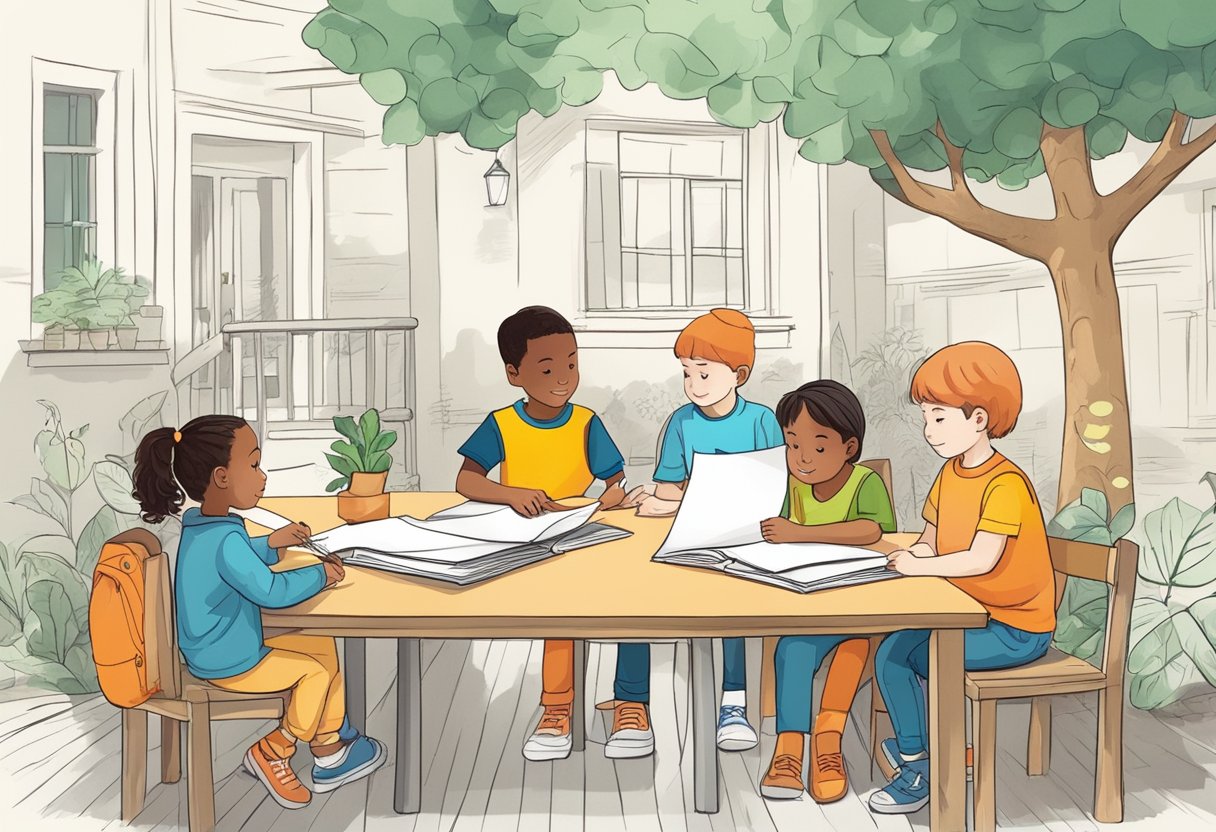
Before starting to draw, it is important to have the right art supplies. For beginners, it is recommended to start with basic art supplies such as pencils, erasers, and paper. As the child progresses, they can add more art supplies such as colored pencils, markers, and paints.
Here is a list of essential art supplies for beginners:
- Pencils (HB, 2B, 4B)
- Erasers (kneaded and rubber)
- Sketchbook or drawing paper
- Sharpener
- Ruler
For colored drawings, colored pencils and markers are recommended. When selecting colored pencils, it is important to choose a good quality brand that will produce vibrant colors and will not break easily. Similarly, when selecting markers, it is important to choose a brand that will not bleed through the paper.
Setting Up a Creative Space
Creating a dedicated space for drawing is important for children to feel inspired and motivated. The space should be well-lit and comfortable. It should also be free from distractions such as TV, video games, and other electronic devices.
Here are some tips for setting up a creative space:
- Choose a quiet and well-lit area
- Use a comfortable chair and table
- Keep art supplies organized and easily accessible
- Display finished artwork to encourage creativity and motivation
By having the right art supplies and a dedicated space, children can start their drawing journey with confidence and creativity.
Easy drawing ideas for kids
Kids who like quick wins can also try small doodles like cats, cupcakes, clouds, and tiny plants. The scale keeps the activity short and easy to repeat.
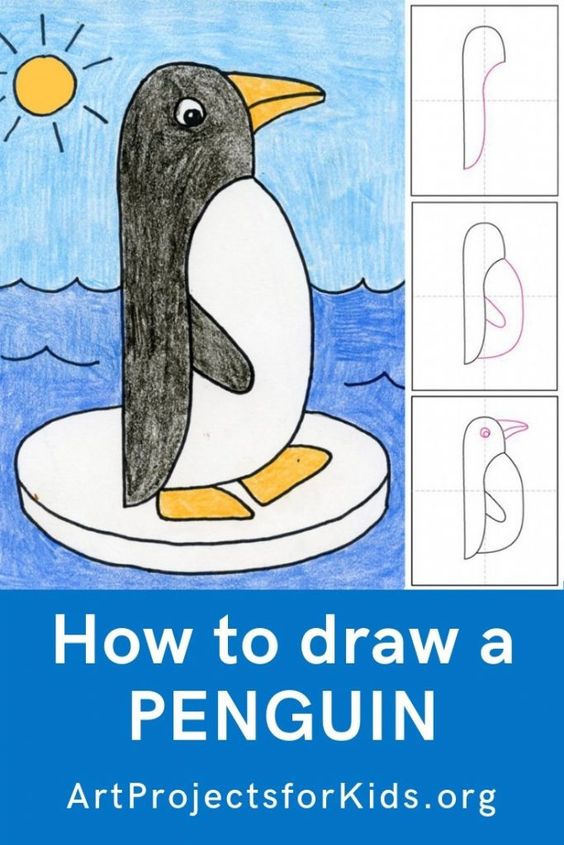
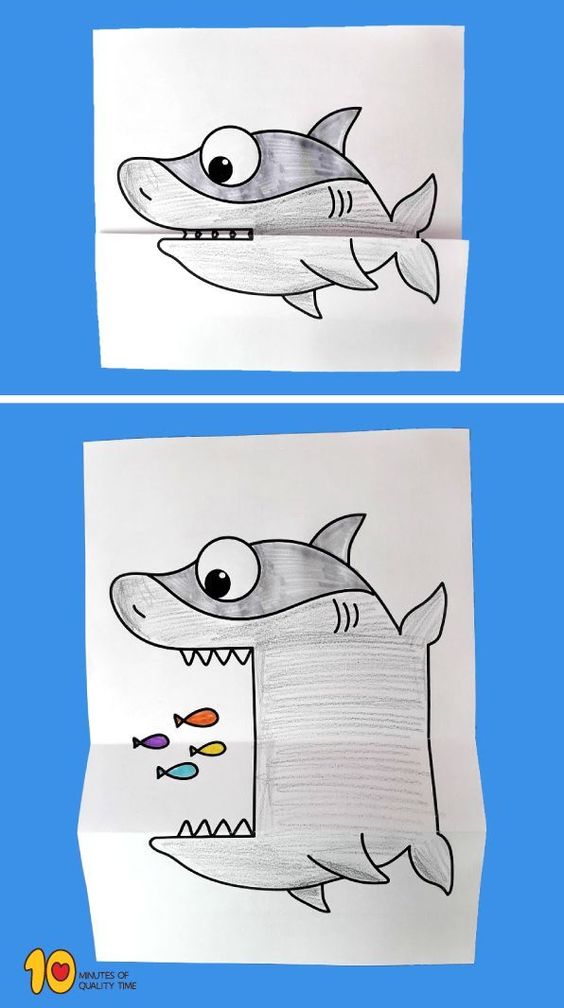
Easy drawing ideas for kids work best when the subject is specific and the first step is visible. Here are some easy drawing projects that kids can try at home:
Step-by-step drawing for kids: animals
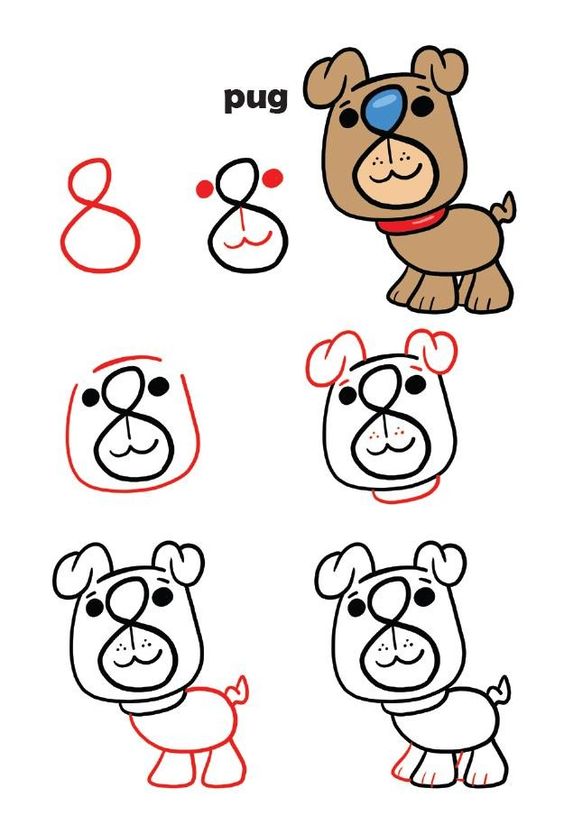
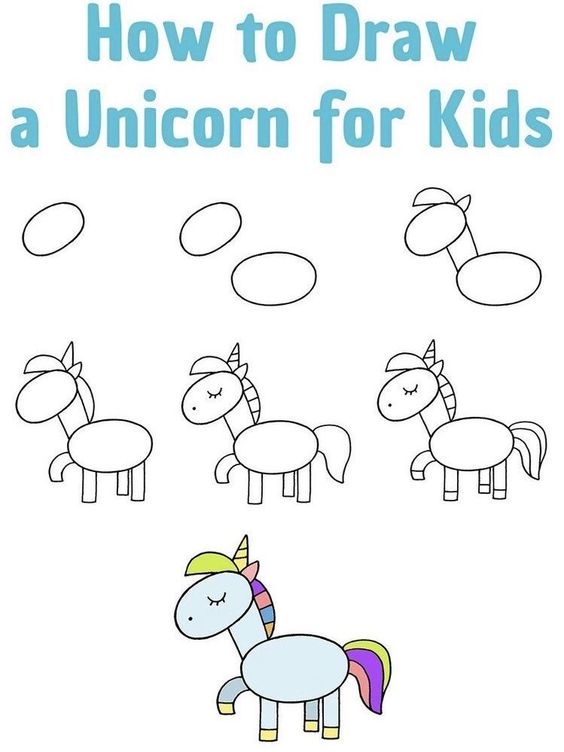
Kids love animals, and drawing them is a great way to learn about their shapes and features. Here are some step-by-step animal drawings that kids can try:
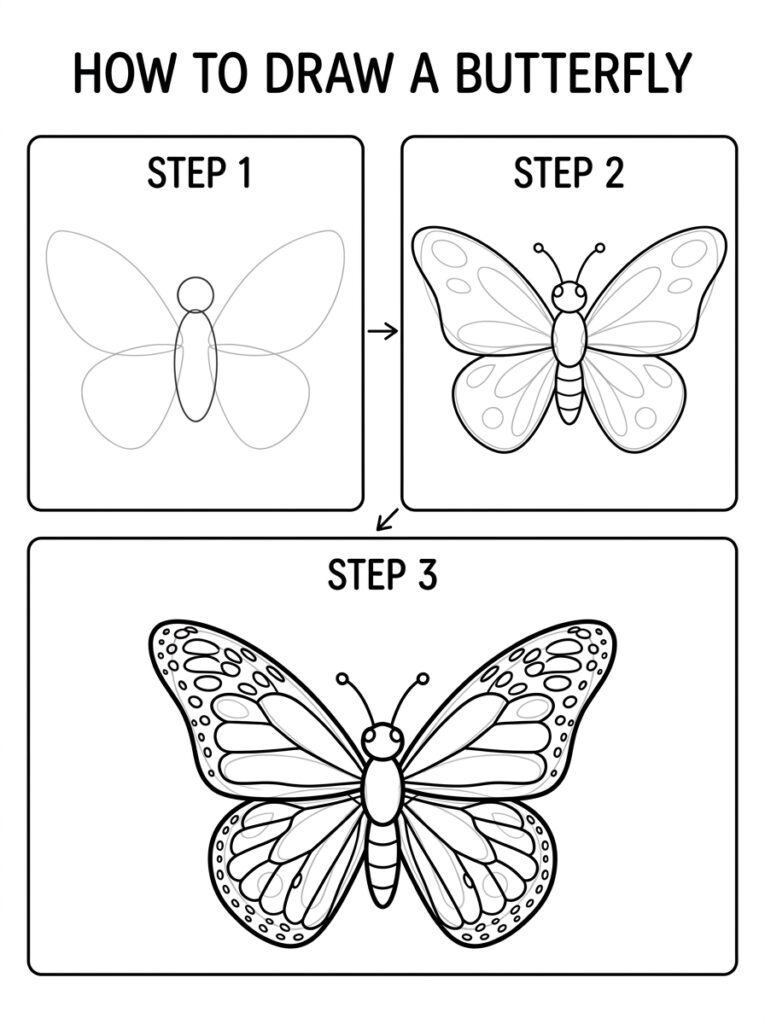
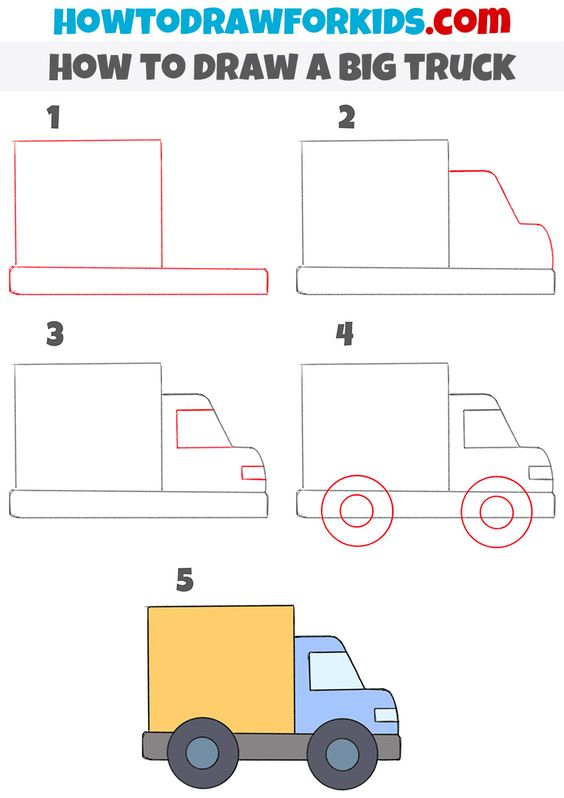
Butterfly: Start with a small circle for the head, then draw two large wings on either side. Add some details like eyes, antennae, and patterns on the wings.
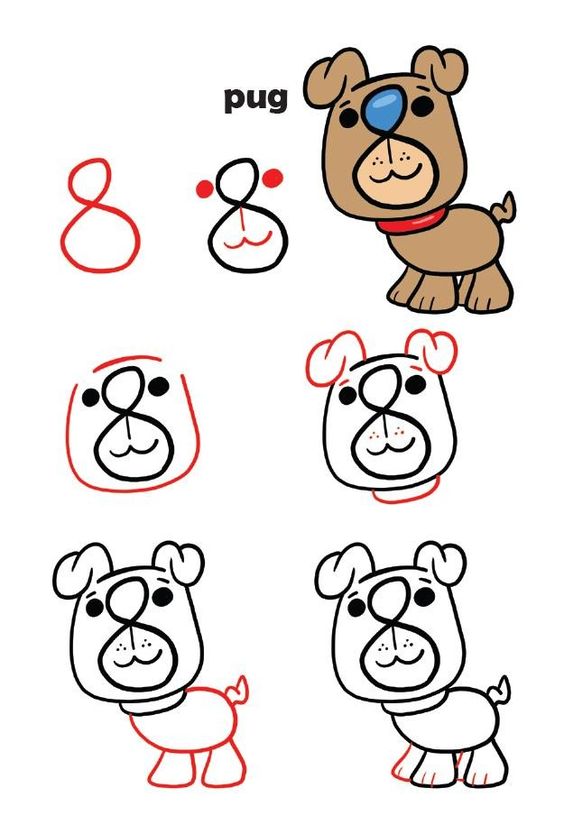
Dog: Begin with a large oval for the body, then add a smaller circle for the head. Draw four legs, a tail, and some facial features like eyes, nose, and mouth.
If animals are the easiest way to keep a child drawing, add one soft warm-up before the nature prompts: this easy dog drawing for kids uses circles, ovals, floppy ears, and a wagging tail before any tricky details.
Nature drawing for kids: trees and flowers
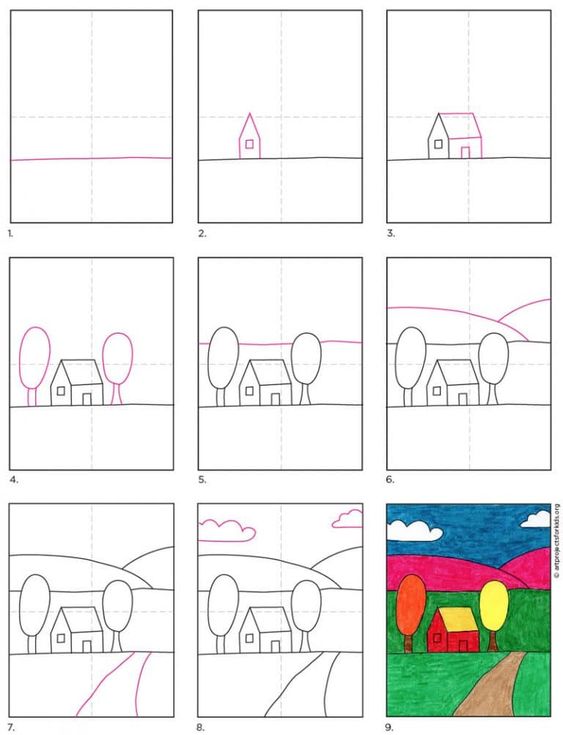
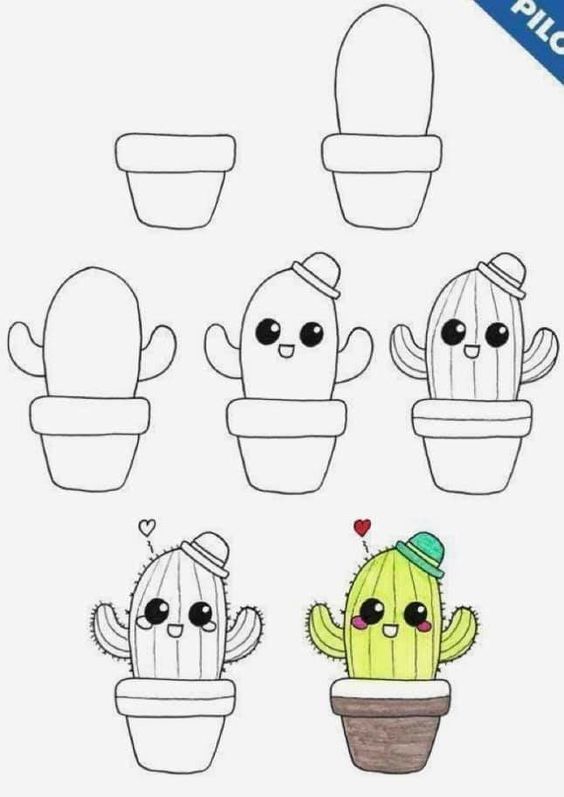
Nature is full of beautiful shapes and colors that can inspire kids’ drawings. Here are some ideas for drawing trees and flowers:
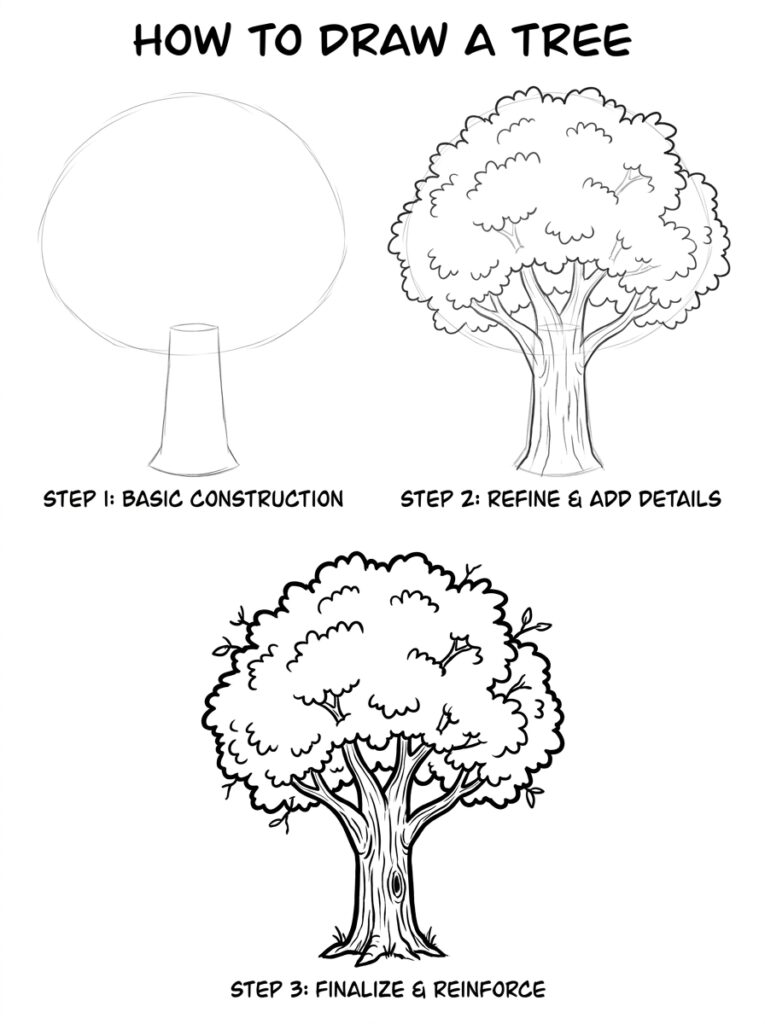
Tree: Start with a trunk and some branches, then add some leaves or needles. You can also draw some animals or birds on the tree.
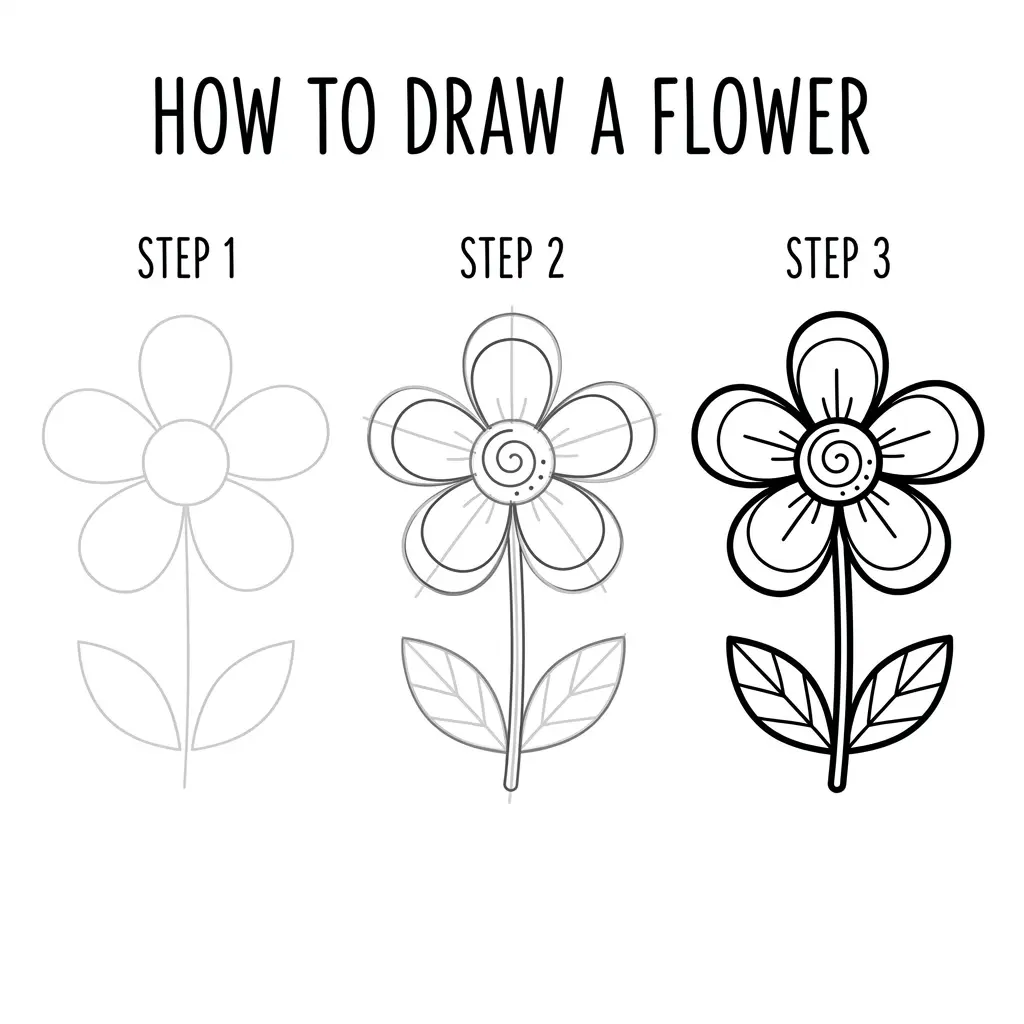
Flower: Begin with a circle for the center, then draw some petals around it. Add some details like veins on the petals and a stem with some leaves.
Fun with Food Illustrations
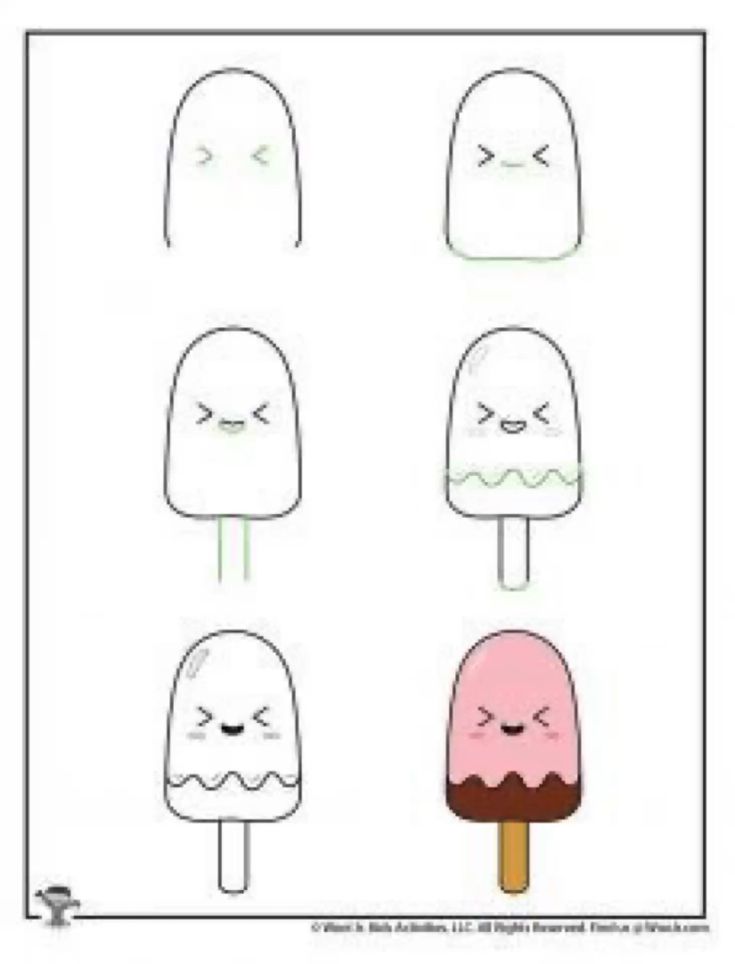
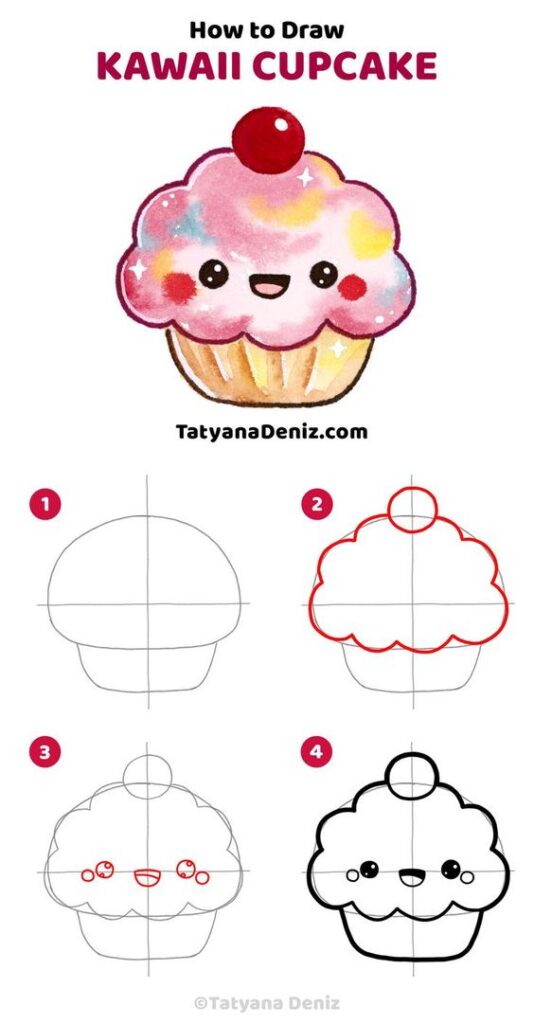
Food is one of the better things to draw early on. The shapes are simple, kids already know what everything looks like, and there’s no pressure to get it exactly right.
Two desserts to start with:
- Cupcake: Circle for the top, a trapezoid or wrapper shape below. Add frosting — give it some height, maybe a swirl. Then sprinkles, a cherry, a little candle. The decoration is where the drawing actually gets interesting, so don’t rush past it.
- Ice cream cone: Triangle for the cone, rounded scoop on top. Cross-hatch the cone to get that waffle texture. Add a drip running down one side — it takes about ten seconds and immediately makes it look less flat.
1000 Drawing Ideas for Artists
Get a free PDF packed with easy drawing ideas, anime prompts, character concepts, nature inspiration, and fantasy sketchbook challenges.
Download Free PDFCreating Cartoon Characters
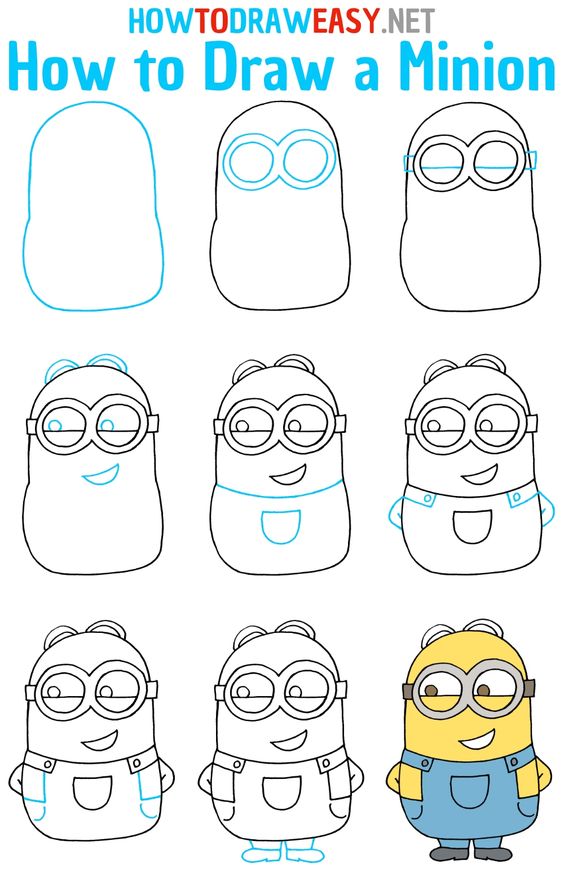
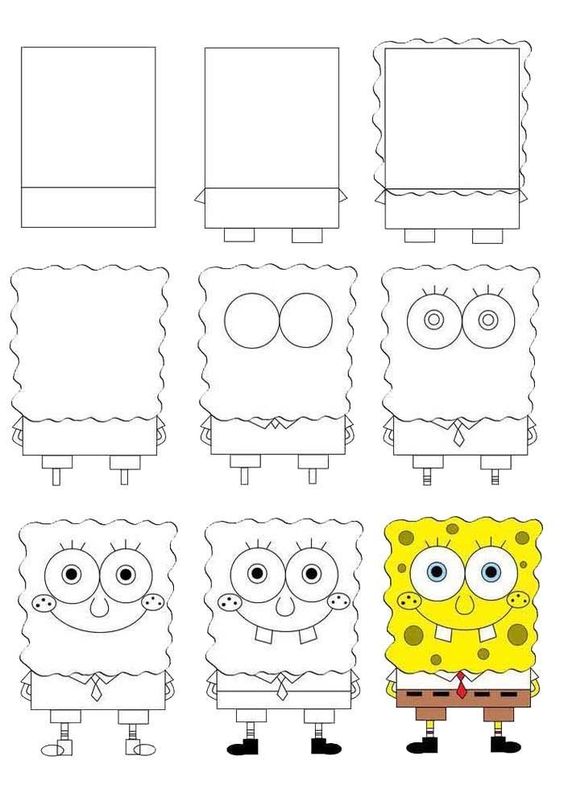
Cartoon characters are a good entry point because the rules are loose. Weird is fine. Wrong proportions are fine. That’s kind of the whole point.
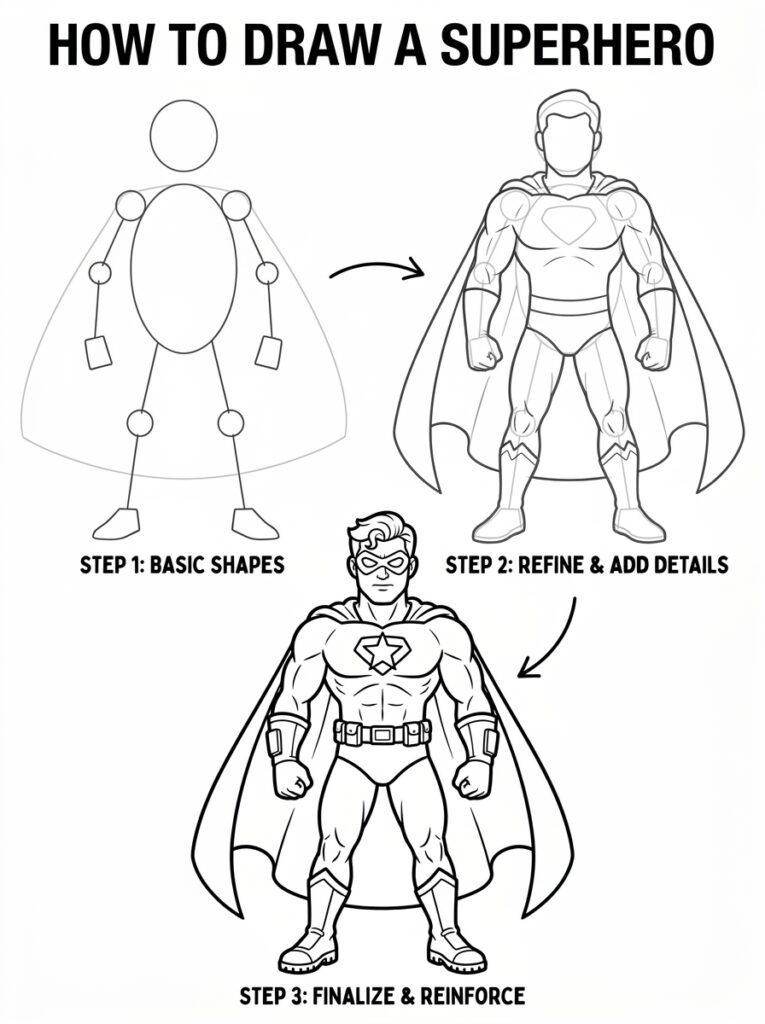
Two ideas to start with:
- Funny face: Circle for the head, then pile on the features. Eyes too far apart, nose too big, a grin that wraps around the whole face. The more exaggerated, the better — that’s not a mistake, that’s the style.
- Superhero: Body shape first, then the costume details — cape, mask, chest logo. Kids usually spend more time on the name and the symbol than the actual figure, which is honestly where the character comes from anyway.
Neither one needs to look polished. Rough and weird beats stiff and careful every time with cartoons.
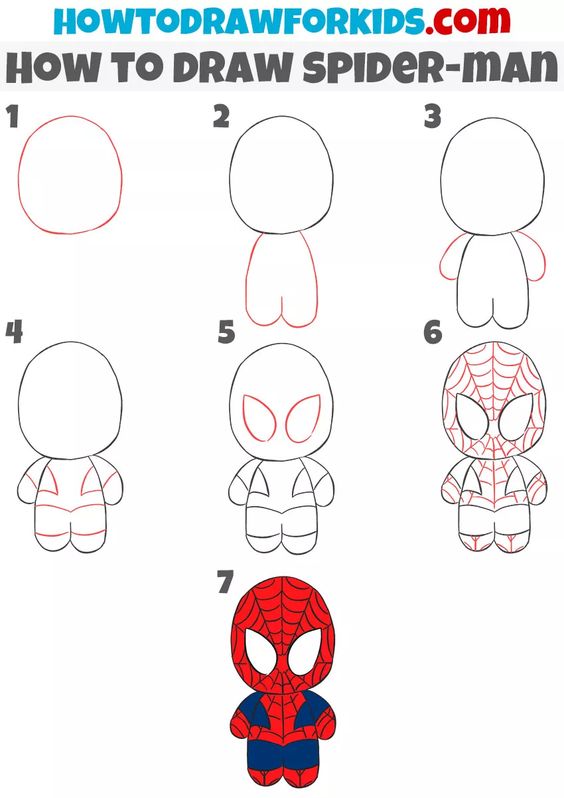
If the Spider-Man example is the one they choose, draw the oval mask and large eye shapes first. These Spider-Man drawing ideas offer a small emblem before moving on to a crouch or swinging pose.
Seasonal Drawing Ideas
Summer Scenes and Activities
Summer is the easiest season to draw, mostly because kids don’t need prompting. They already know what they did this summer, and drawing it is just putting that on paper.
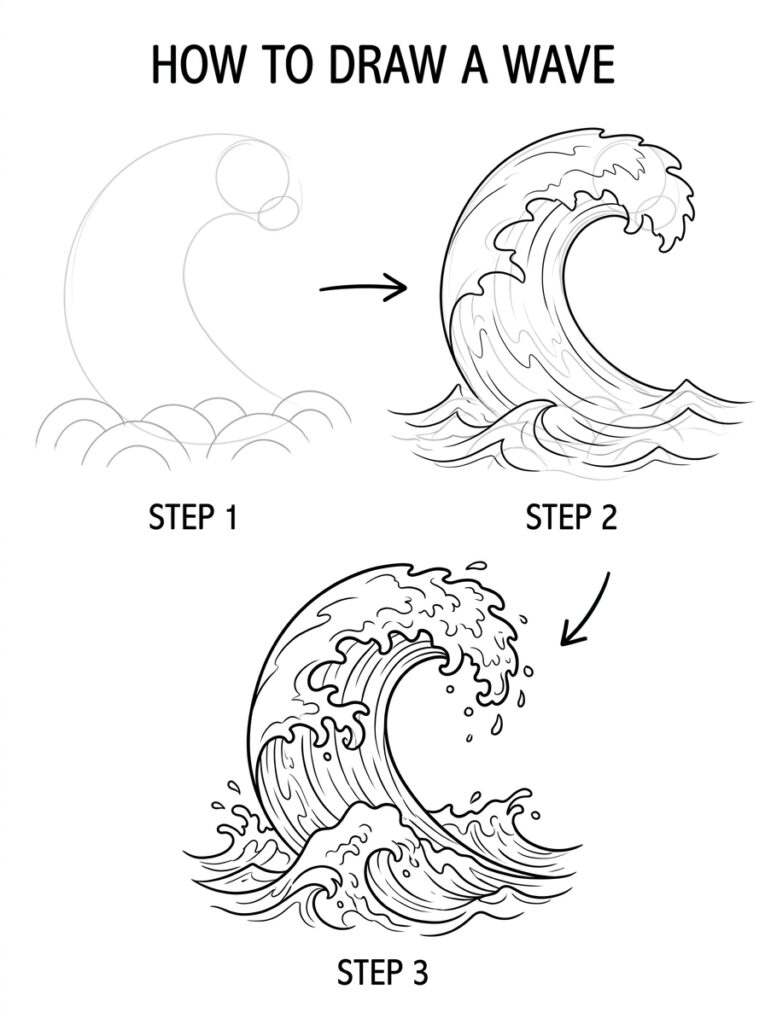
A few ideas that actually work:
- Beach scenes — sandcastles, waves breaking, seashells scattered on wet sand
- Picnics in the park with checkered blankets, lemonade, ants you didn’t invite
- Camping: a tent in the trees, campfire smoke, maybe a deer in the background
- Water stuff — swimming, fishing off a dock, someone falling out of a kayak
- Backyard games: volleyball net, frisbee mid-air, someone diving for it
Pencils for sketching, markers if they want punchy color, watercolors if they’re up for it — summer light is surprisingly hard to fake with watercolor, which makes it good practice. Texture matters here too.
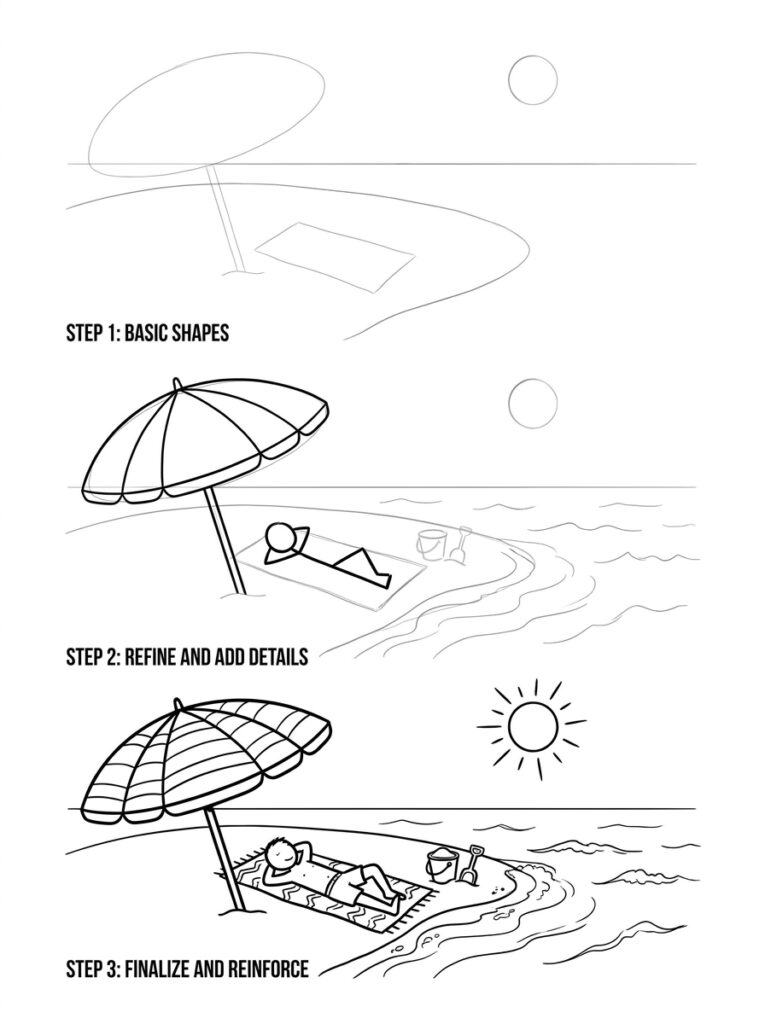
Dry sand looks nothing like wet sand. A shaded lawn reads differently than an open field in noon sun. Worth noticing.
Easter-Themed Artwork
Easter is one of those holidays where the drawing ideas basically write themselves. Eggs, bunnies, baskets — kids already know what these look like, which makes them easier to actually draw.
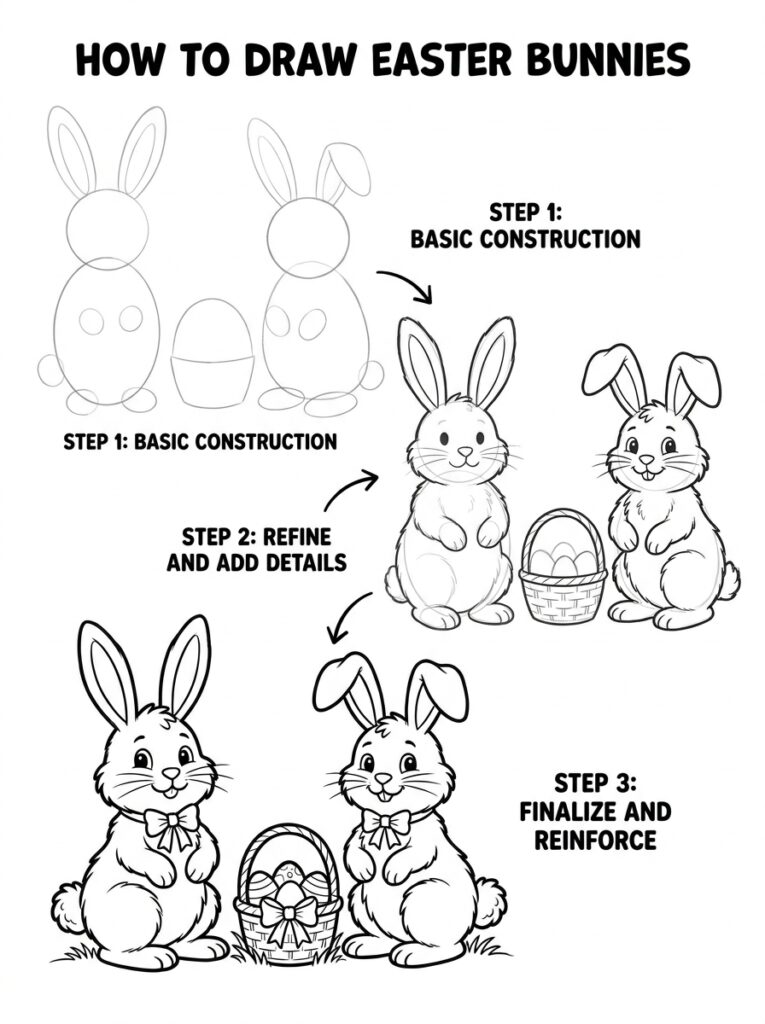
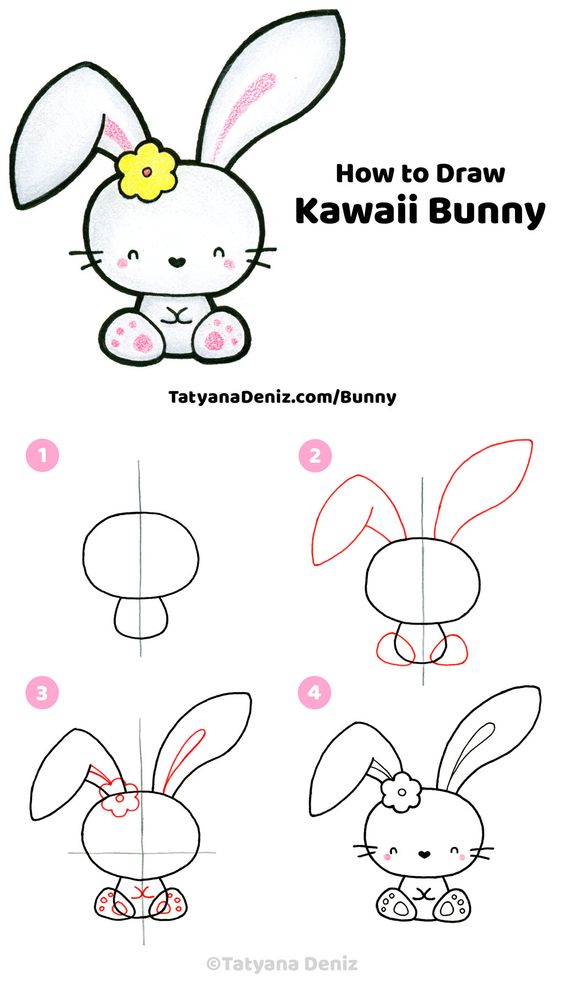
Start with bunnies if you’re looking for something low-stakes. The whole shape is curves: oval body, round head, floppy ears. No straight lines to worry about. Easter baskets are a bit trickier — the weave pattern trips kids up — but that’s also what makes them interesting. And decorated eggs are the one I keep coming back to, because there’s genuinely no wrong version. Geometric, floral, stripes, spirals. Every egg ends up different.
Spring flowers are worth throwing in too. Daffodils especially — the way the petals fan out from the center is a concept that shows up everywhere once you start noticing it.
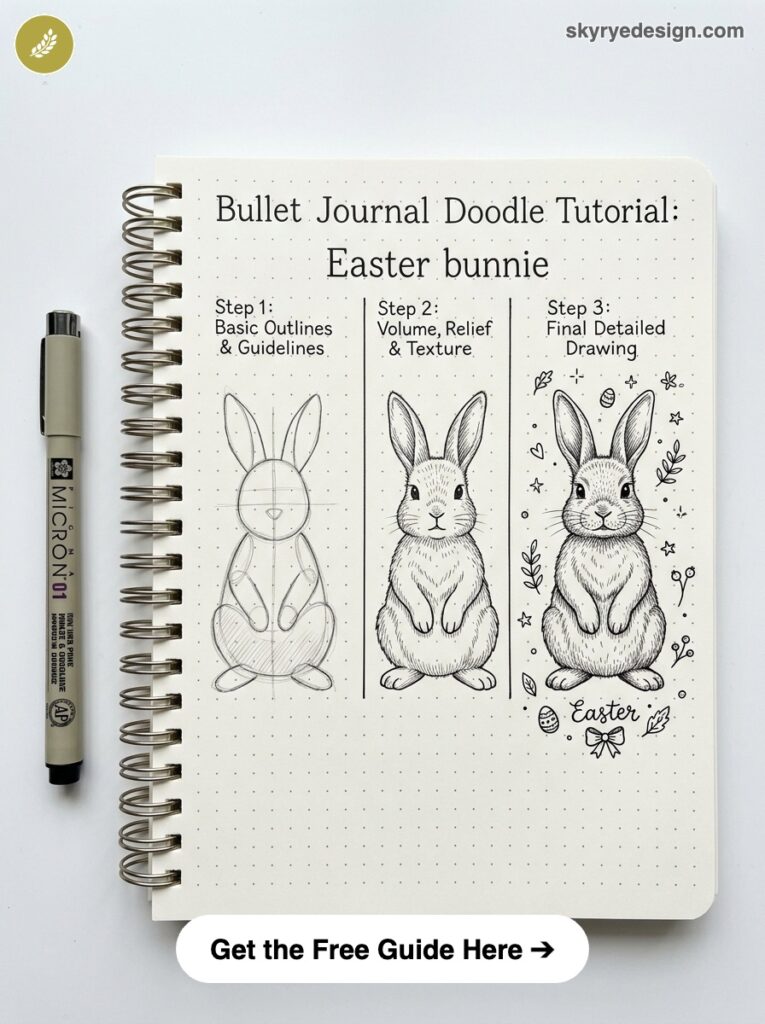
For color, keep it light. Pastels, soft layering, not too much pressure on the paper. The pale spring palette — buttery yellows, soft lavender, washed-out mint — reads better when you let the paper breathe a little. Glitter on top if they want. But honestly, the drawings don’t need it.
Fantasy and Space Inspiration
Kids love to explore their imagination and creativity through drawing. Fantasy and space themes are great sources of inspiration for children.
They allow kids to create their own worlds and characters, and express their creativity in unique ways. Here are some simple drawing ideas for kids that can inspire their imagination.
Dragons and Mythical Creatures
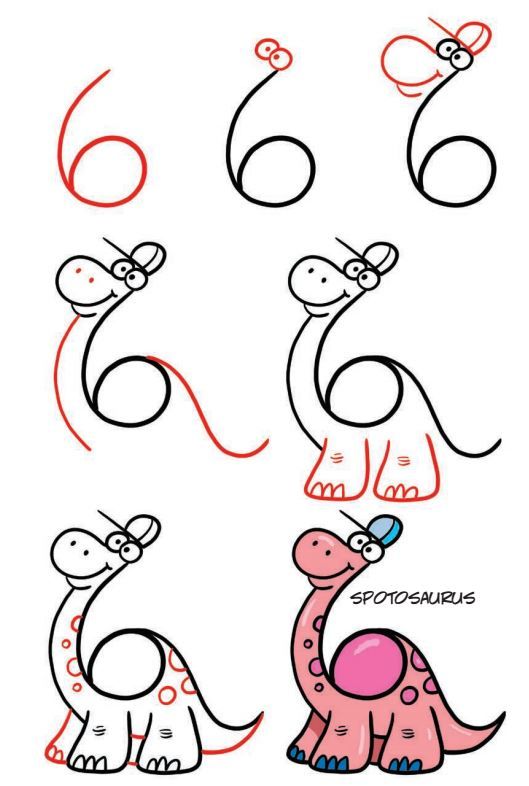
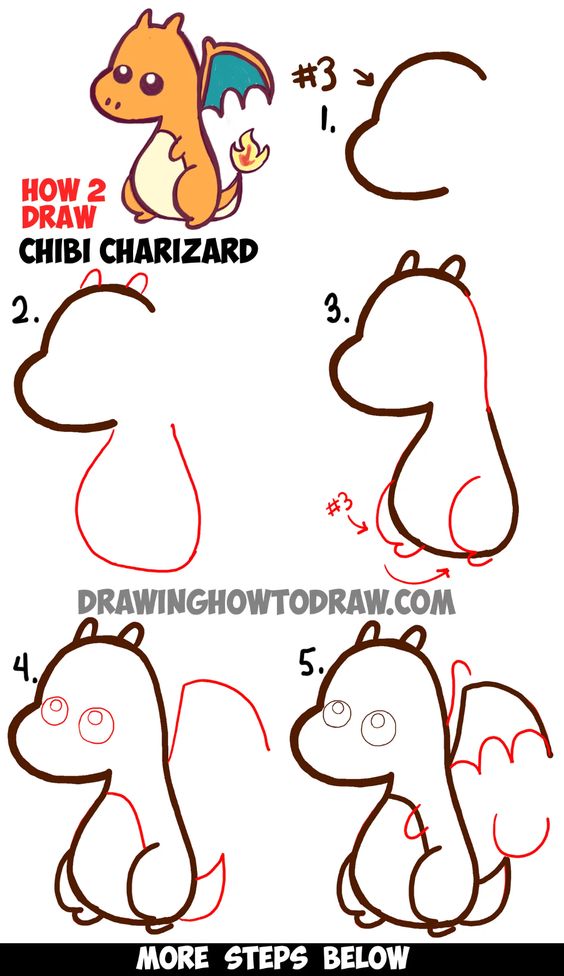
Dragons and mythical creatures are popular among kids. They are fascinating characters that allow kids to explore their imagination and creativity. Drawing dragons and mythical creatures can be a fun and exciting activity for kids.
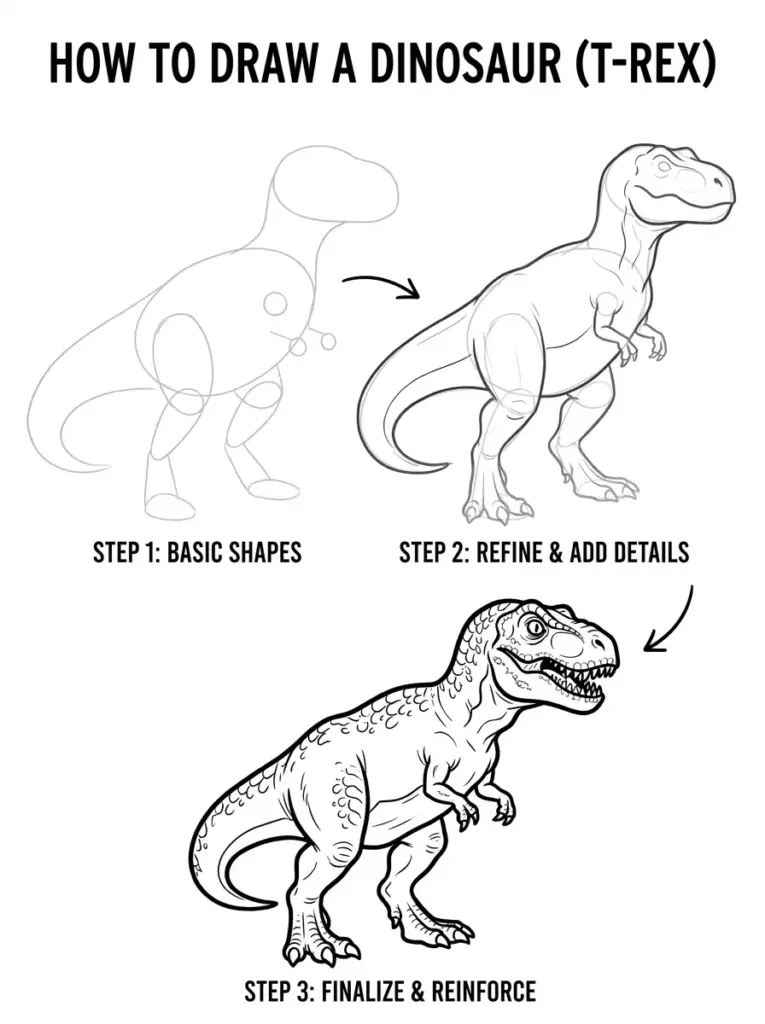
They can draw dragons with different colors, shapes, and sizes. They can also create their own mythical creatures by combining different animals or adding their own unique features.
Exploring Outer Space
Outer space is a vast and mysterious place that fascinates kids. Drawing planets, stars, and spaceships can be a fun and educational activity for kids. They can learn about the different planets in our solar system, their characteristics, and their position in the universe. They can also learn about stars, galaxies, and other celestial objects. Drawing spaceships can be a creative activity that allows kids to imagine their own spacecraft and explore the universe.
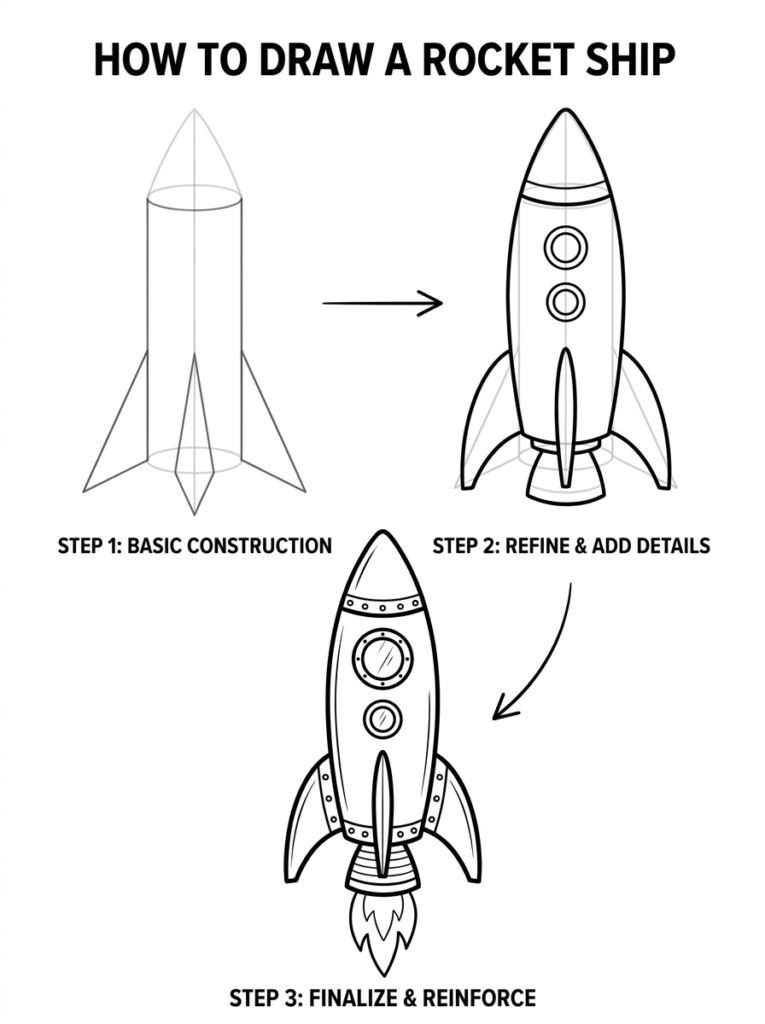
There are many resources available online that can help kids learn and explore more about space and fantasy themes. Websites such as Easy Drawing Guides and Craftwhack offer step-by-step tutorials and inspiration for kids. Printable drawing guides are also available that can be used as a reference or coloring page. Drawing is a great way for kids to express their creativity, imagination, and learn about the world around them.
Developing Artistic Skills
Coloring Techniques
Coloring is where most kids first figure out that pressure matters. Push harder, the color gets darker. Go light, you can layer something on top. That feedback loop is more useful than it sounds — it’s basically the foundation of shading.
Coloring inside the lines gets dismissed sometimes, but the hand-eye coordination it builds is real. It shows up later when kids try to draw a clean curve or follow a contour. Coloring books with varied patterns — not just cartoon characters — give them more interesting problems to solve.
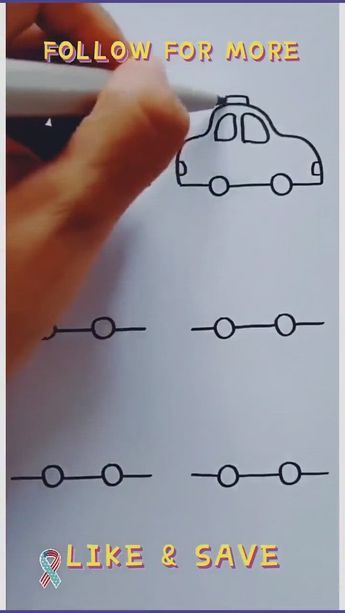
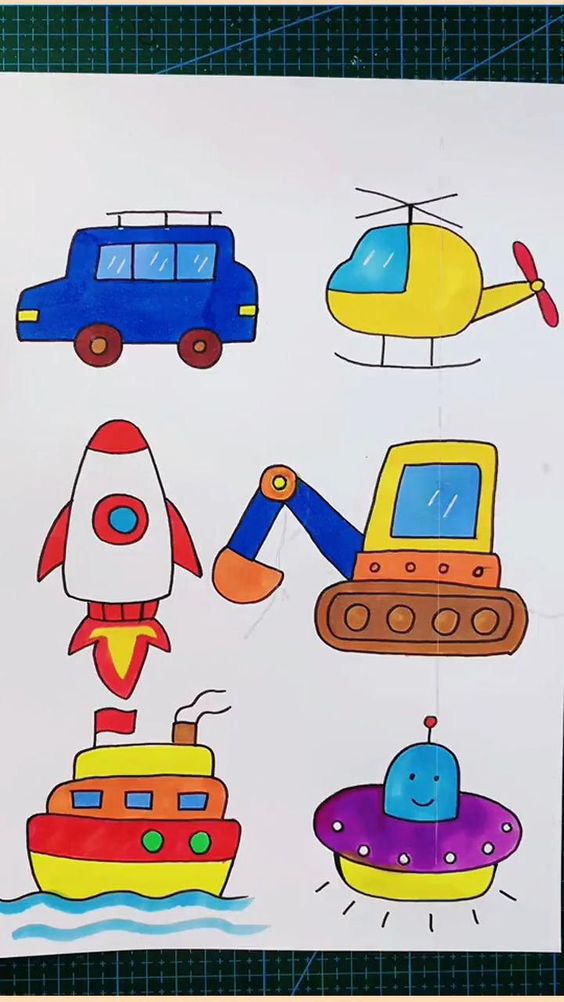
Tools make a difference. Crayons are forgiving and good for young kids. Colored pencils reward patience and work well for blending. Markers are unforgiving in the best way — no going back, which teaches commitment to a color choice. Rotating through all three is worth it.
As for technique: cross-hatching, stippling, blending. I’d introduce them one at a time, not all at once. Cross-hatching first — kids pick it up fast and it immediately makes their work look more finished. Stippling takes longer but some kids love the meditative quality of it. Blending is the one that feels like magic when it clicks.
Fine Motor Skills and Coordination
Fine motor skills are just the small movements — holding a pencil, working scissors, doing up buttons. Drawing and coloring use exactly those muscles, which is why occupational therapists recommend art activities for kids who struggle with handwriting. It’s not about talent. It’s about grip strength and control.
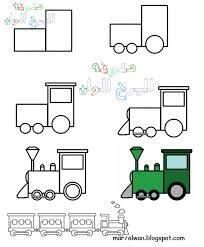
Switching surfaces helps more than most people expect. Chalk on a chalkboard requires a completely different grip than a marker on paper. A crayon on rough cardstock fights back in a way that smooth paper doesn’t. That variety is the point — each surface asks something slightly different from the hand.
Tools work the same way. Crayons, colored pencils, markers — they all behave differently, and rotating through them builds more control than any single one would on its own. Let kids switch. The mess is worth it.
Safe online drawing resources for kids
Drawing is a great way to encourage creativity and imagination in children. With the help of online resources and tutorials, kids can learn to draw and express themselves in new ways. Here are some great online resources and tutorials for kids drawing:
YouTube Channels for Kids Drawing
YouTube is a great resource for kids to learn how to draw. There are many channels dedicated to teaching kids how to draw, with step-by-step tutorials that are easy to follow. Some popular YouTube channels for kids drawing include Art For Kids Hub, Super Simple Draw, and Easy Drawing Guides.
Art For Kids Hub provides a wide range of art lessons, from drawing to painting, and even some super cool origami. The channel is hosted by Rob and Teryn, along with their four creative kids, Jack, Hadley, Austin, and Olivia. Super Simple Draw is another great channel for kids drawing, with step-by-step instructions on how to draw animals, dinosaurs, flowers, bugs, vehicles, and much more. Easy Drawing Guides is a channel that provides easy drawing tutorials for kids of all ages, with simple lines and basic shapes.
Easy Drawing Guides Online
Easy Drawing Guides is a website that provides easy drawing tutorials for kids and beginners. The website is designed to help kids learn to draw in a fun and easy way. The tutorials are based on simple lines and basic shapes, making it easy for kids to follow along. Some of the easy drawing projects on the website include how to draw a butterfly, a unicorn, a dragon, and many more.
Easy Drawing Guides members have access to a wide range of drawing tutorials, with new tutorials added regularly. The website also provides how-to videos, step-by-step instructions, and printable drawing worksheets to help kids practice their drawing skills.
Overall, online resources and tutorials are a great way to help kids learn to draw. With the help of YouTube channels and websites like Easy Drawing Guides, kids can learn to draw in a fun and easy way, and express themselves in new and creative ways.
Engaging with Art Communities
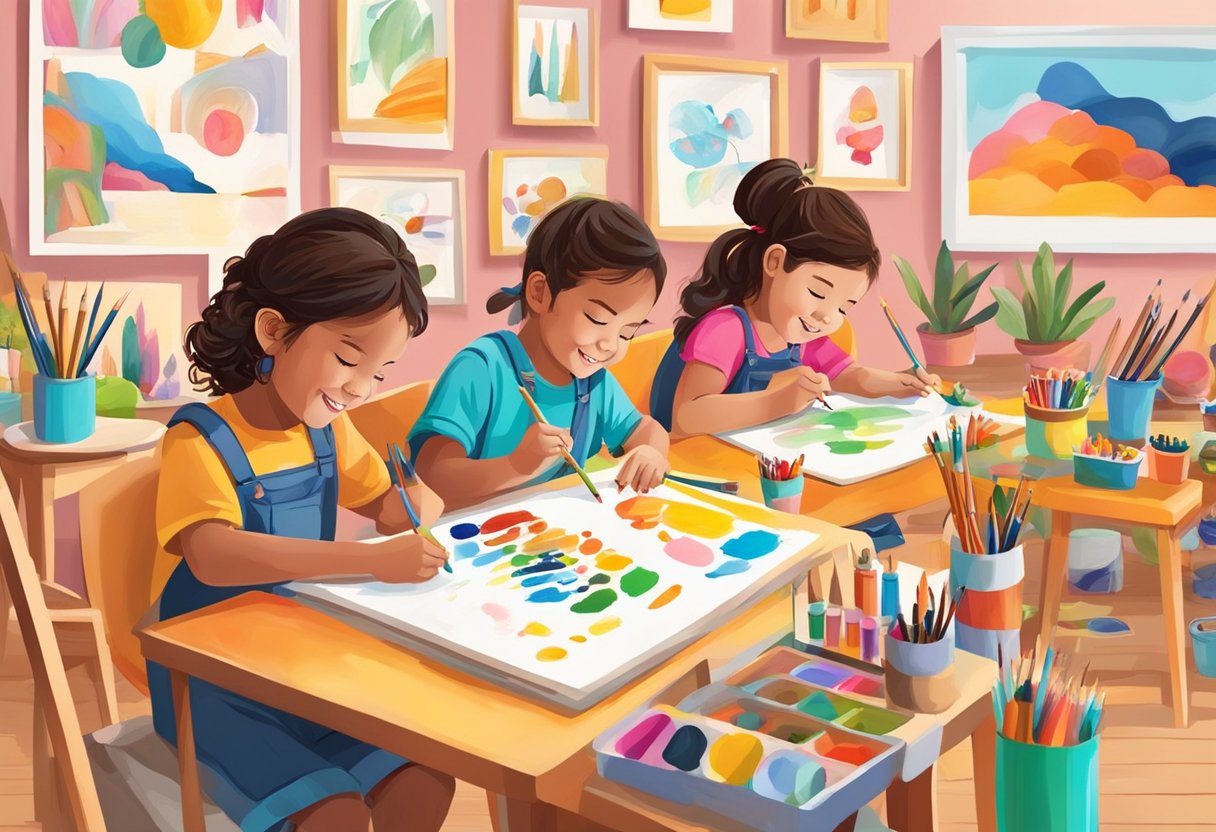
Art is a great way to engage children and encourage creativity. Engaging with art communities can provide children with opportunities to learn new skills, meet new people, and explore their creativity. In this section, we will discuss some ways in which families and schools can engage with art communities.
Family and School Activities
There are many family and school activities that can help children engage with art communities. One way to do this is by attending art events, such as art fairs, exhibitions, and workshops. These events can provide children with the opportunity to see different types of art and meet artists.
Another way to engage with art communities is by participating in art projects. Families and schools can organize art projects that involve creating art with other children or working on a project together. This can be a great way to encourage teamwork and collaboration.
Art Lessons and Memberships
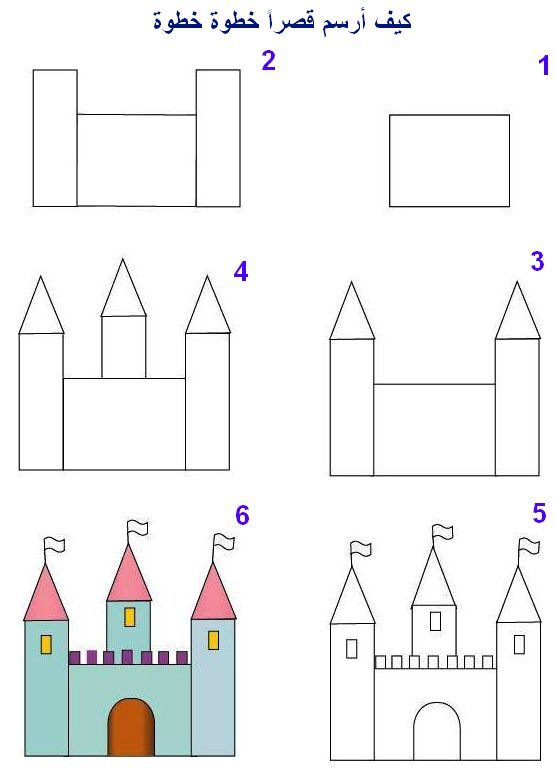
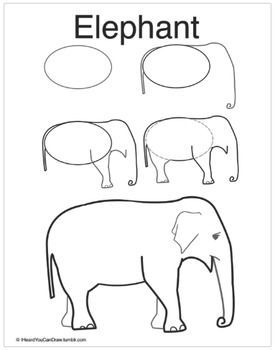
Art lessons and memberships can also be a great way to engage with art communities. Many art communities offer art lessons for children, which can help them learn new skills and techniques. Art lessons can also provide children with the opportunity to meet other children who are interested in art.
Membership in an art community can also be beneficial for families and schools. Memberships often provide access to art events, exhibitions, and workshops. They can also provide discounts on art supplies and other materials.
In conclusion, engaging with art communities can provide children with many benefits. Families and schools can participate in art events, organize art projects, take art lessons, and become members of art communities to encourage creativity and foster a love of art in children.
Safe online drawing resources for kids
Online tutorials can help, but kids do not need an endless feed to learn drawing. Pick one calm lesson, pause after each shape, and keep the paper in charge. Good resources include Art for Kids Hub, PBS Kids Scribbles and Ink, YouTube Kids, and Google’s Family Link controls for supervised viewing.
Choose one tutorial at a time
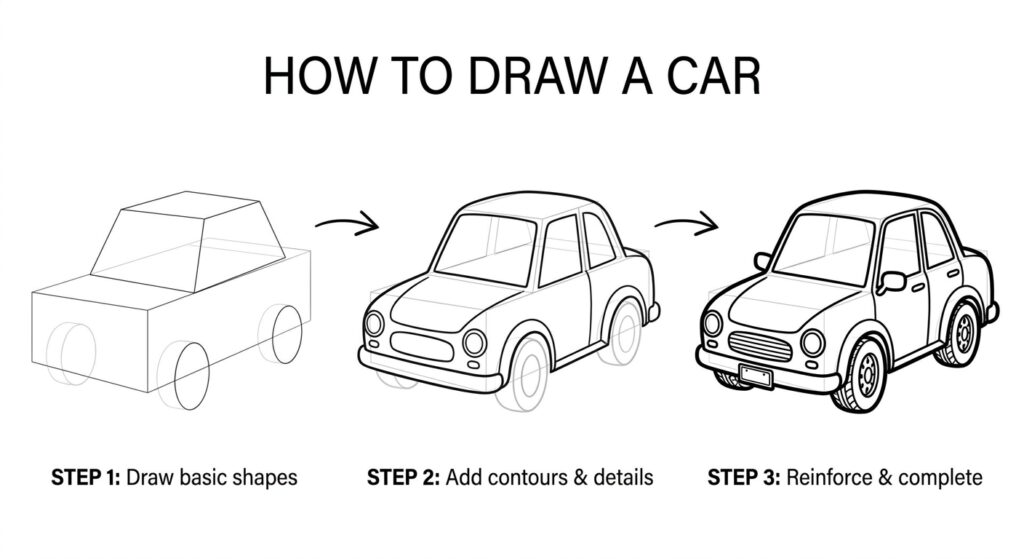
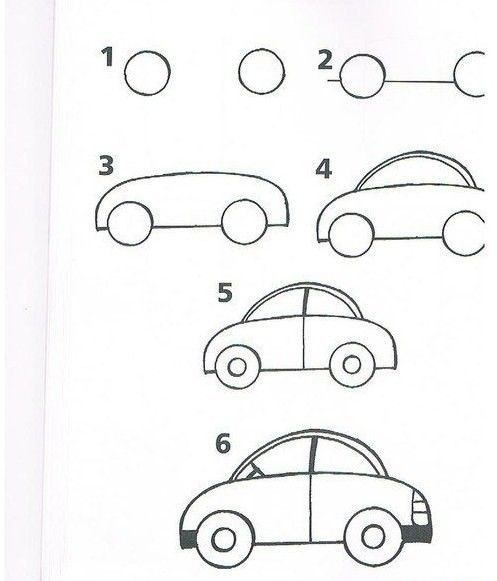
A single step-by-step drawing lesson is better than ten open tabs. Let the child finish the big shapes first, then decide whether the drawing needs color, pattern, shading, or a background. If the video moves too quickly, pause it and use the still frame as a reference.
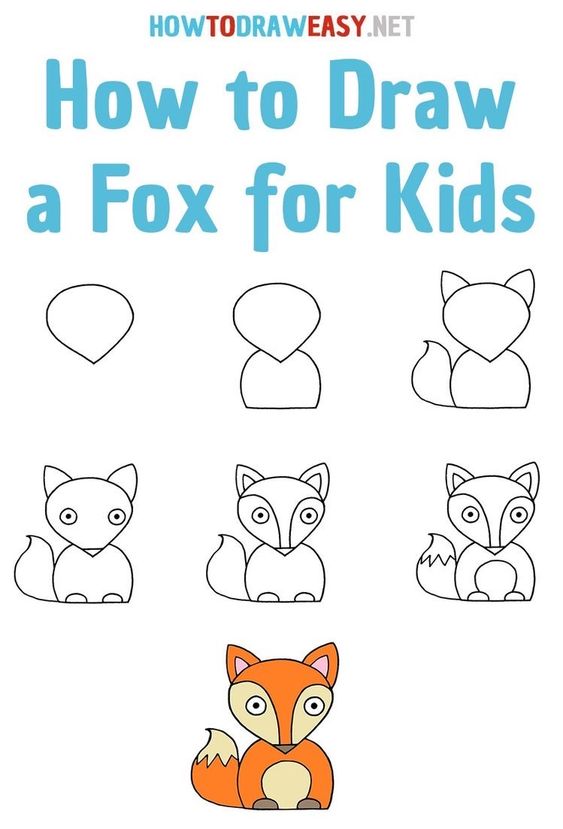
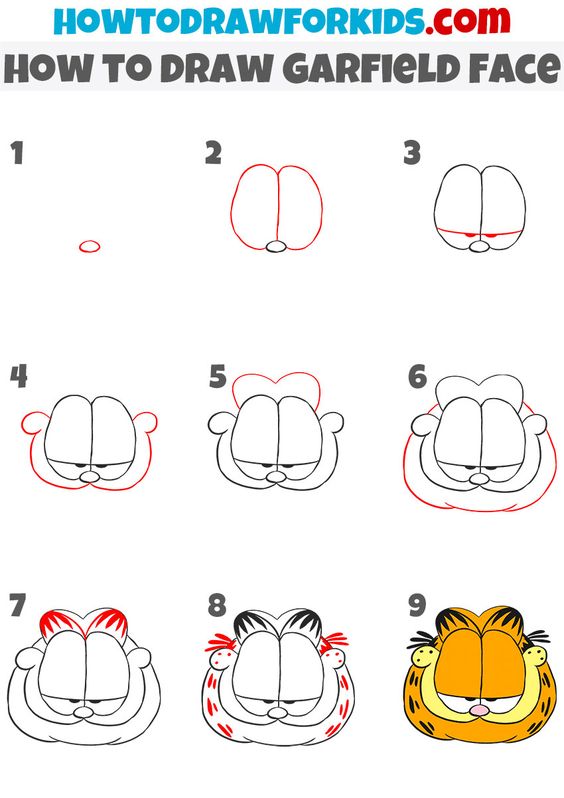
Kid-friendly tutorial checklist
- The first step uses a basic shape, not a finished outline.
- The subject is age-appropriate and not too detailed for the child.
- The tutorial leaves time for the child to make choices.
- The final drawing can still look good with imperfect lines.
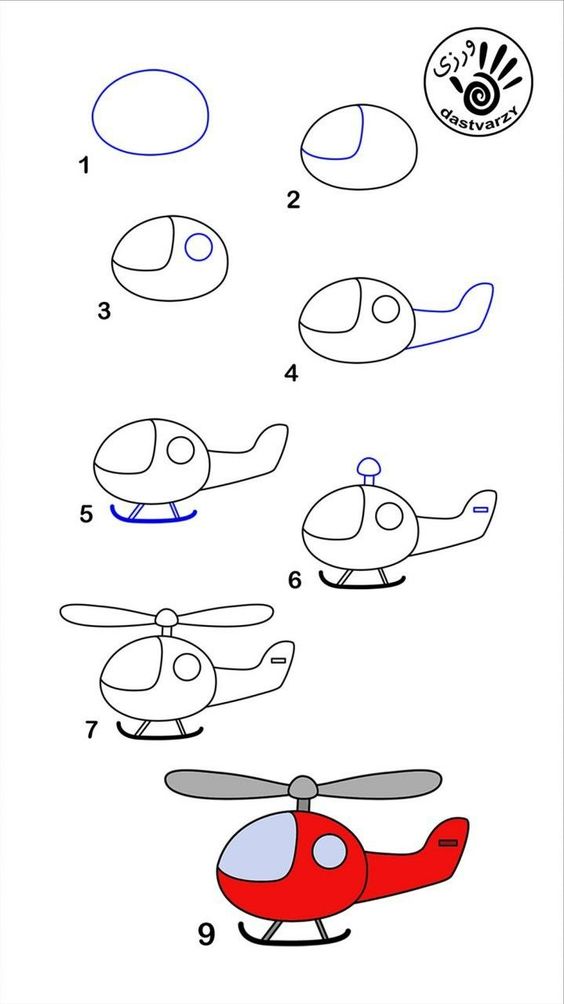
For kids who enjoy vehicle projects, this guide on how to draw a helicopter for beginners keeps the shapes simple while adding a real fuselage, tail boom, and rotor layout.
For a fantasy prompt that still feels manageable for younger artists, these cute unicorn drawing ideas work well with simple shapes, big eyes, clouds, stars, and pastel colors.
For kids who want a bigger prehistoric prompt, add these easy dinosaur drawing ideas after warm-ups like pets, cars, and simple cartoon faces.
Drawing for kids FAQ
What should kids draw first?
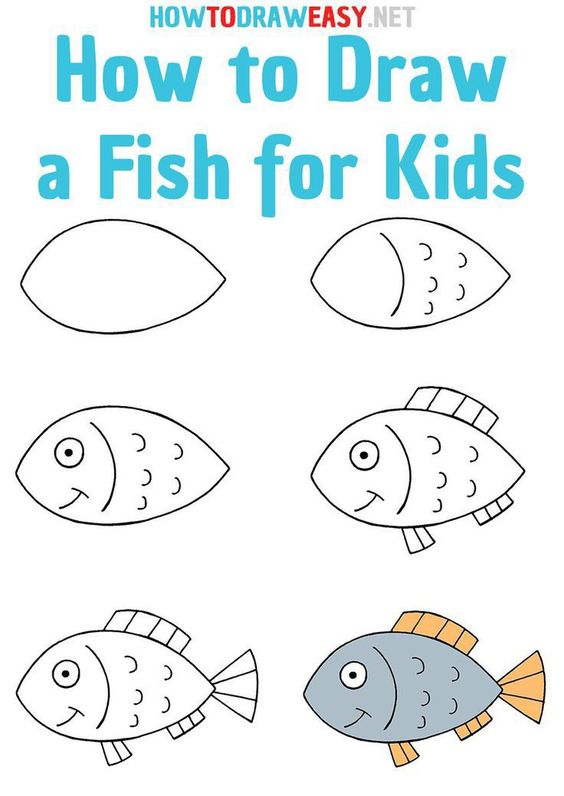
Kids should start with subjects that have a clear first shape: a flower with a circle center, a fish with an oval body, a house with a square, or a cartoon face with two big eyes. The subject matters less than the starting point. When the first shape is easy, the drawing feels possible.
What are easy drawing ideas for 10 year olds?
Good drawing ideas for 10 year olds include cartoon animals, sneakers, simple food packaging, fantasy creatures, comic panels, and small room scenes. At that age, kids can handle a little more structure, so add one skill goal: shading, cleaner outlines, pattern, expression, or background detail.
How do I teach step-by-step drawing for kids?
Teach step-by-step drawing by showing one decision at a time: big shape, smaller shape, outline, details, then color or shading. Keep the first sketch light so mistakes are easy to fix. If the drawing gets messy, pause and compare angles instead of starting over immediately.
What can a 7 year old draw?
A 7 year old can usually draw simple animals, flowers, trees, houses, rockets, rainbows, cupcakes, fish, and cartoon faces. Choose drawings with large shapes and only a few details. Thick outlines and clear examples help more than tiny realistic parts.
What supplies do kids need for drawing?
Kids only need plain paper, a pencil, an eraser, and something to color with. A 2B pencil is soft enough for sketching, while crayons or washable markers keep the activity relaxed. Better supplies can help later, but confidence comes from drawing often, not from expensive tools.
How do I keep drawing practice fun for kids?
Keep practice short and specific. Give one prompt, set a small goal, and let the child change the idea if they get excited by something else. I like prompts such as “draw an animal with a silly hat” because they leave room for personality without making the page feel empty.
Are online drawing tutorials safe for kids?
Online drawing tutorials can be useful, but younger kids should use them with an adult nearby. Pick tutorials with calm pacing, clear steps, and age-appropriate subjects. If a video moves too fast, pause after each shape and let the child finish that part before continuing.
More drawing practice for kids
For the next practice session, try coloring pages for kids, a butterfly drawing easy guide, simple tulip drawing ideas, an easy dog drawing for kids, how to draw food, easy cartoon character drawing, an easy Hello Kitty drawing, easy Stitch drawing, a helicopter drawing for beginners, or cool mini things to draw.
For kids who enjoy vehicles, these easy airplane drawing ideas are a good next step after cars, buses, boats, and simple space rockets.
- 12.4Kshares
- Facebook0
- Pinterest12.4K
- Twitter0
- Reddit0