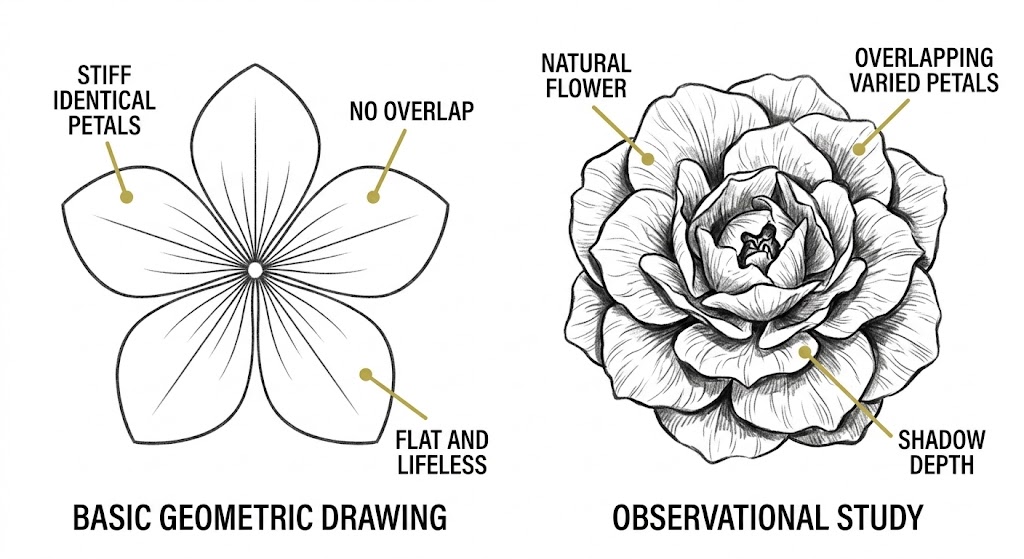
My first flower drawing looked like a lollipop with anxiety. Five identical pointed petals radiating from a circle, no depth, no variation — the kind of flower you draw when you’re seven and haven’t been shown anything better. I kept drawing them that way for years. Stiff, symmetrical, lifeless.
The shift happened when I stopped drawing “flowers” in the abstract and started drawing actual flowers in front of me. A real rose from the corner shop. A sunflower I photographed on my phone. The difference between a generic petal and a specific petal — slightly cupped, slightly asymmetrical, catching the light on one edge — is the difference between a symbol and a drawing.
- How to draw a flower step by step
- What You Need Before You Start
- The Foundation: How Flowers Are Actually Built
- How to Draw a Rose Step by Step
- How to Draw a Sunflower Step by Step
- How to Draw a Daisy Step by Step
- How to Draw a Tulip Step by Step
- How to Draw Loose Wildflowers and Floral Clusters
- Quick Flower Sketches
- Adding Color: Quick Guide for Each Medium
- Common Mistakes and How to Fix Them
- Supplies at a Glance
- FAQ
- Q: What is the easiest flower to draw for beginners?
- Q: How do you draw a realistic rose step by step?
- Q: What pencil is best for drawing flowers?
- Q: How do you make flower drawings look more realistic?
- Q: Can I draw flowers without any drawing experience?
- Q: How do I draw flowers for a bullet journal or sketchbook?
- Q: Why do my flower drawings look flat?
- Q: Should I draw flowers from photos or real life?
- Related flower drawing practice
- Conclusion
This guide covers roses, daisies, sunflowers, tulips, and loose wildflowers. Each flower has its own logic. Once you understand it, the drawing follows naturally. No art school required — just a pencil and something to draw on.
How to draw a flower step by step
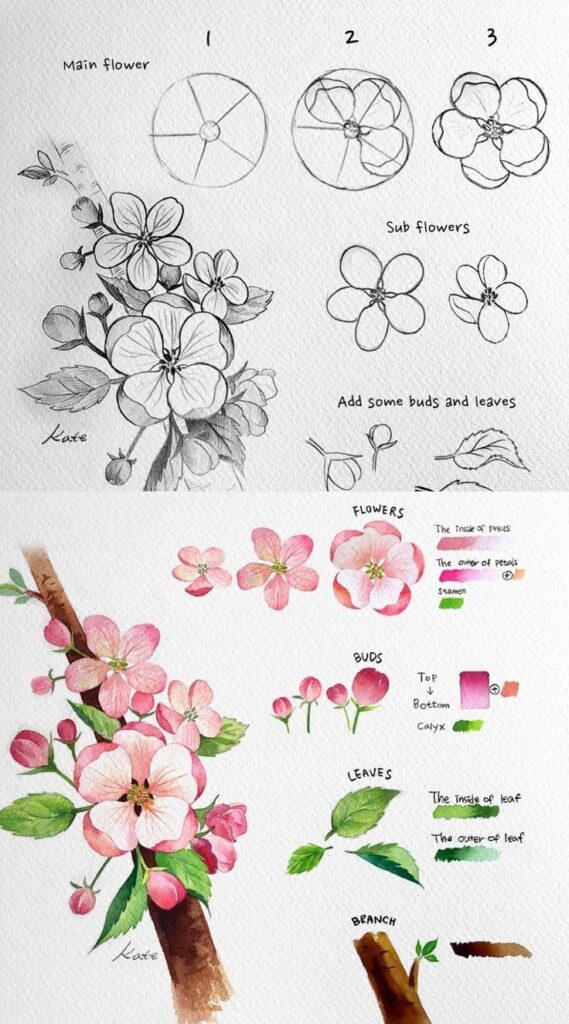
To draw a flower as a beginner, start in the middle. A small circle or oval gives you something to build around, which helps keep the whole flower from slowly drifting sideways on the page.
Sketch lightly at first. I’d use an HB pencil for the first pass and block in the largest shapes before touching the smaller petal edges. The center, the outer petal shape, the stem, the leaves — get those sitting in the right place first. Details can wait.
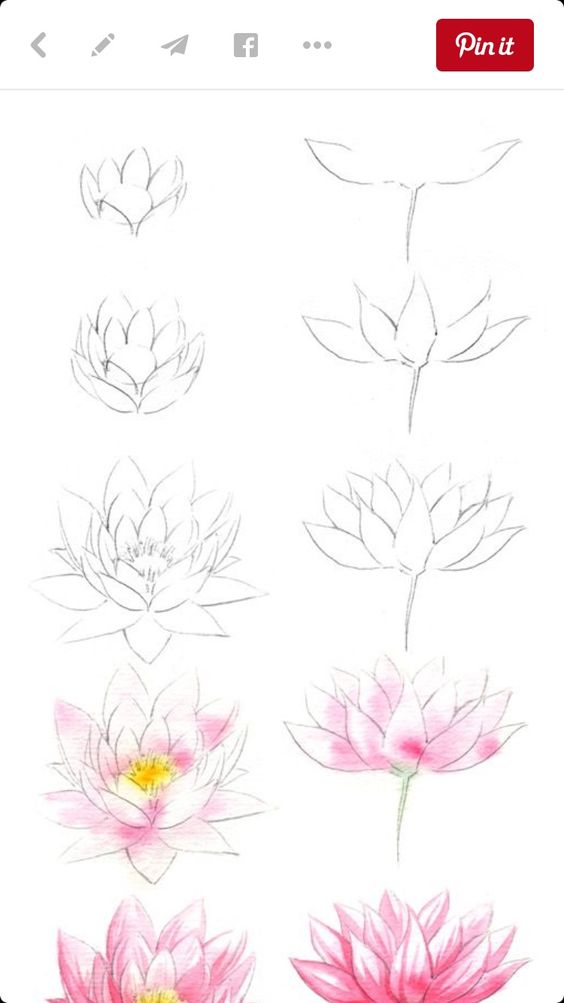
Then start layering the petals. Let some overlap, hide a few behind others, and avoid making every petal the same length. That is the mistake that makes beginner flower drawings look like symbols instead of real flowers. A little unevenness helps.
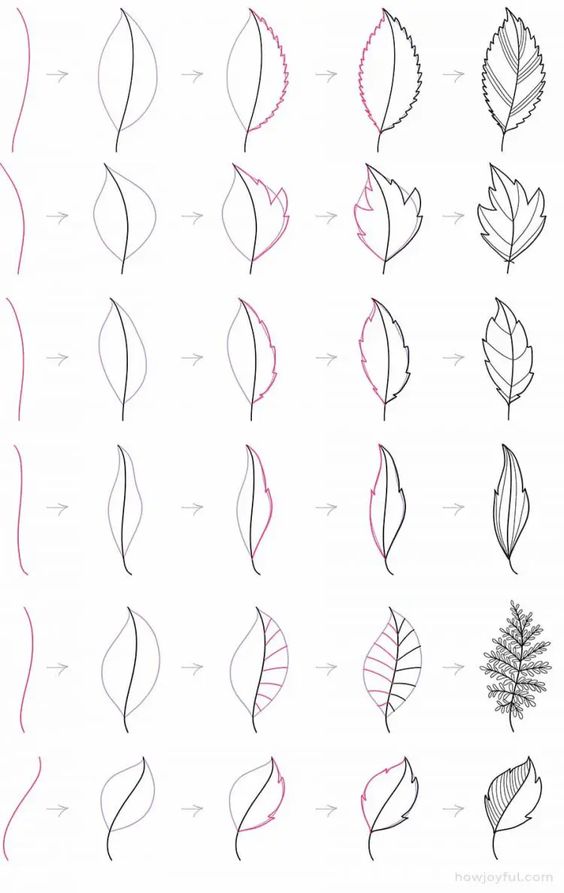
The same observation habit helps with leaves. If you want a simpler botanical warm-up before another flower, try this how to draw fall leaves tutorial and focus on the main vein, edge rhythm, and color changes.
Shadows matter more than perfect outlines. Add darker marks where one petal tucks behind another, under the flower center, and along any folded edges. That small bit of shading is what gives the flower weight.
For practice, start with a daisy or tulip. They are simple enough to correct without making a mess. A rose or sunflower is better when you want a challenge, because the layers do most of the work.
Use drawing paper if you plan to erase, shade, or build texture. Printer paper is fine for quick warm-ups, but it roughs up fast. Save the 2B or 4B pencil for the final lines, petal texture, and the deeper shadows.
What You Need Before You Start
You don’t need much. The tools that genuinely make a difference at the beginner stage aren’t expensive — the gap between a $3 pencil and a $0.50 pencil matters far more than anything else.
Pencils That Actually Work
For flower drawing, you need at least two pencil grades: something light for initial sketching and something darker for finalizing lines and adding shadow.
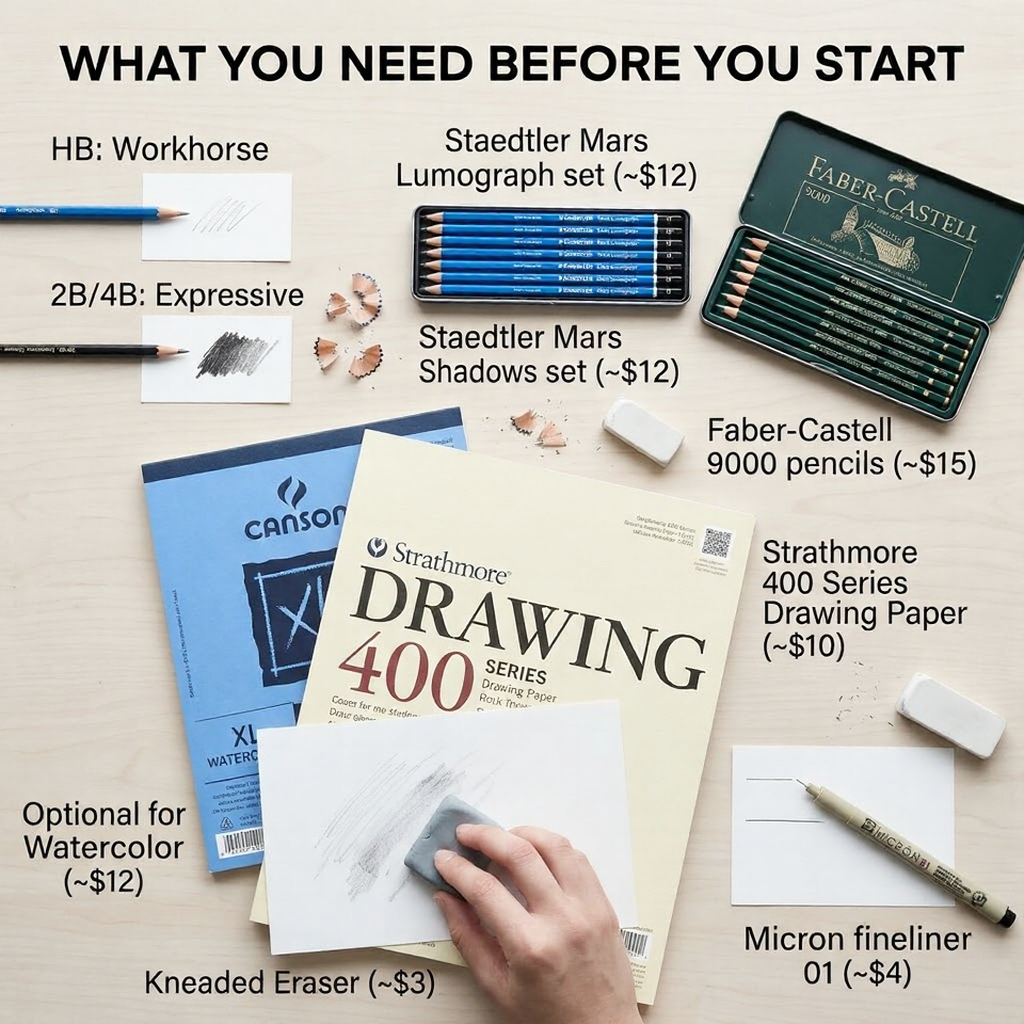
- HB — your workhorse. Light enough to erase cleanly, dark enough to see. Start every drawing here.
- 2B or 4B — for deepening shadows, adding petal texture, and finalizing lines. The softer the grade, the darker and more expressive the mark.
Disclosure: This post contains affiliate links. As an Amazon Associate I earn from qualifying purchases. If you buy through links in this post, we may earn a small commission at no extra cost to you.
The Staedtler Mars Lumograph set (~$12 for 6 grades, HB through 6B) is the most reliable entry point. Faber-Castell 9000 pencils (~$15 for 12) are another consistent option. Both sharpen cleanly and layer well on paper.
Paper That Won’t Fight You
Standard printer paper is too thin and too smooth — it doesn’t hold shading well and tears when you erase. Strathmore 400 Series Drawing Paper (~$10 for a 9×12 pad) is the practical starting point. If you want to add watercolor later, Canson XL Watercolor (~$12) handles both dry and wet media.
Optional But Useful
- Kneaded eraser (~$3) — essential for lifting light graphite without damaging paper. Much more controllable than a hard eraser for delicate petal work.
- Micron fineliner 01 or 03 (~$4 each) — if you want to ink over pencil sketches. Won’t bleed when you erase the pencil beneath it.
The Foundation: How Flowers Are Actually Built
Before drawing any specific flower, it helps to understand the structure they all share. Every flower drawing starts with two decisions: where the center sits, and how the petals overlap around it.
Think of the center as the hinge of the drawing, not as a decoration you add later.
On a daisy, it is a small oval that tells you the viewing angle. On a sunflower, it is a wide disk that controls the rhythm of the petals. On a rose, it becomes a tight spiral that the outer petals wrap around. Once that anchor is placed, draw petals from the inside out, letting some sit in front and others disappear behind.
That one habit fixes most beginner flower drawings because it gives the bloom depth before you add any color. If the sketch still feels flat, check the petal bases first. They should tuck into the center, not float around it like separate stickers.
Start With the Center, Not the Petals
This is the single most common beginner mistake: starting with the outline and working inward. Start from the center of the flower and work outward.
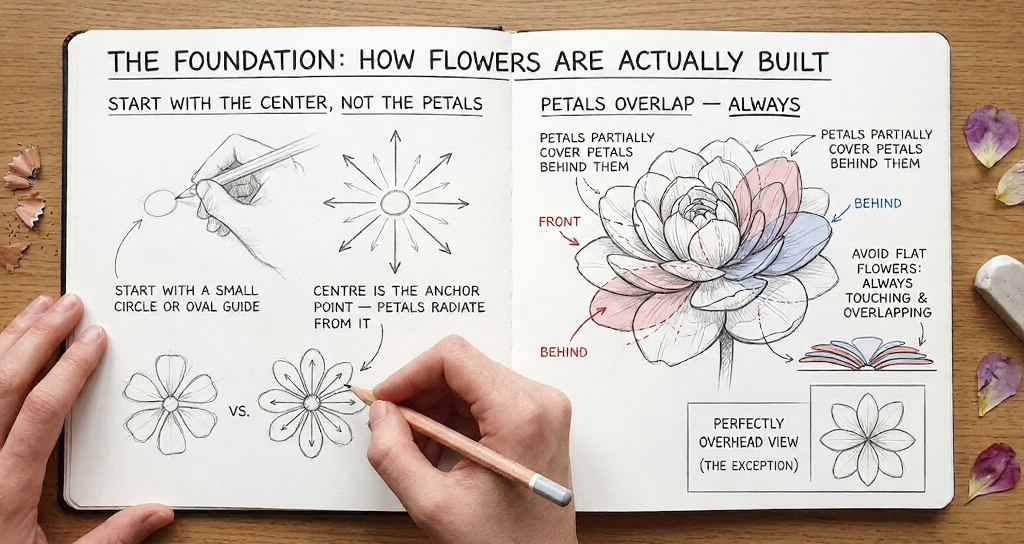
The center is the anchor point. Everything else radiates from it. If your center is placed correctly on the page, your petals will fall into place. Draw a small circle or oval for the center first — lightly. This is your guide, not your final mark.
Petals Overlap — Always
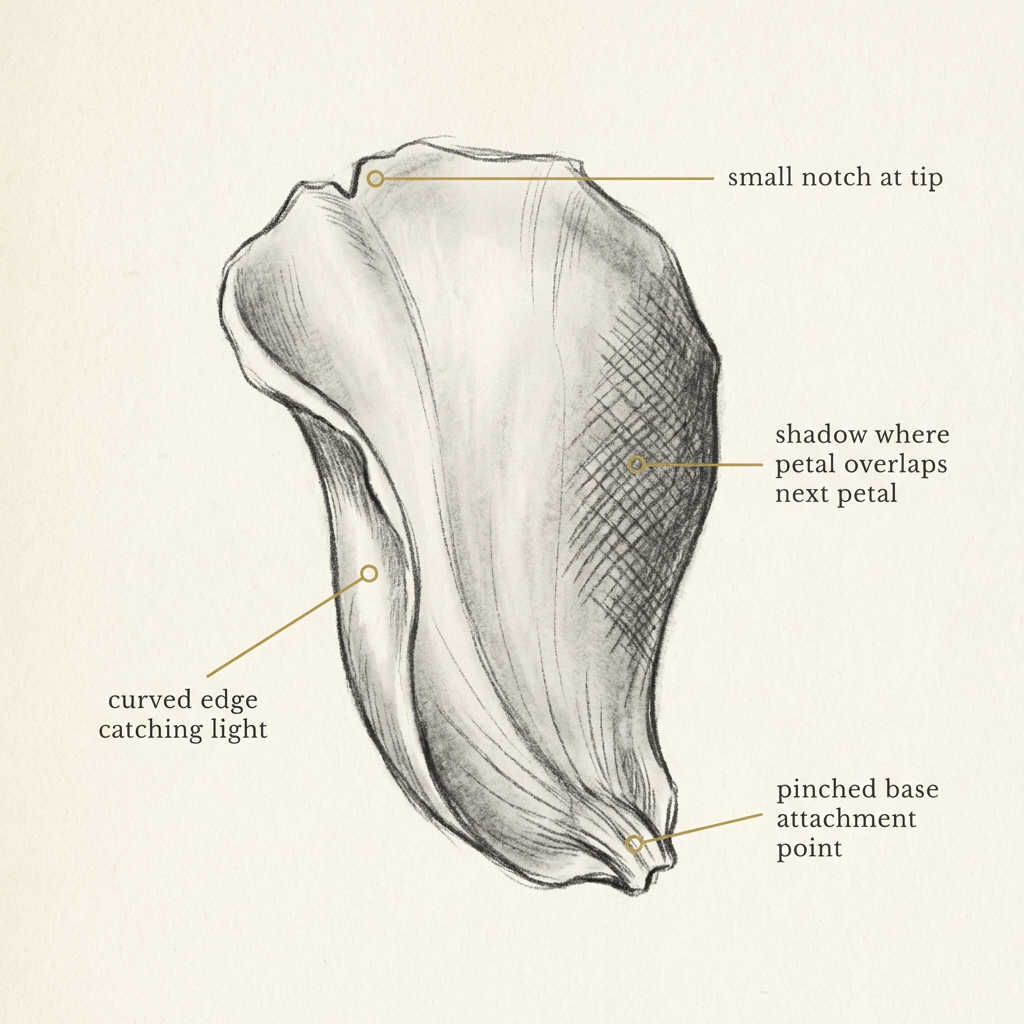
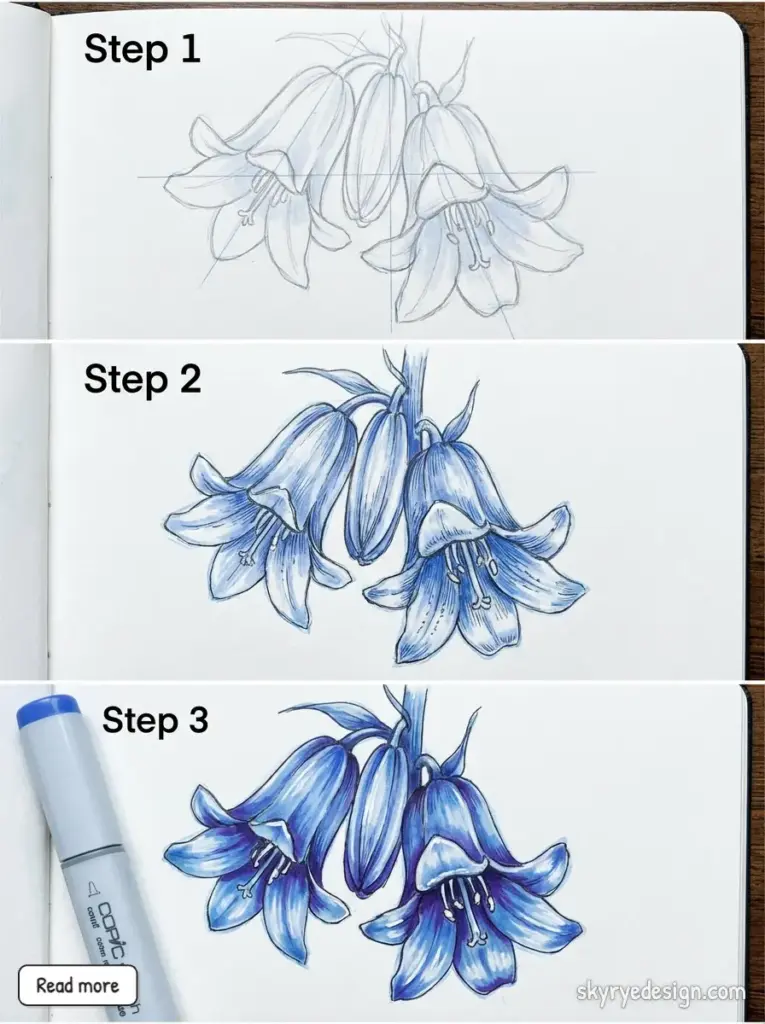
A flower viewed from any angle except perfectly overhead will have petals that overlap. Front petals partially cover petals behind them. Drawing petals as isolated shapes that don’t touch is what makes flowers look flat. Draw each petal aware of what it’s in front of and what it’s behind.
How to Draw a Rose Step by Step
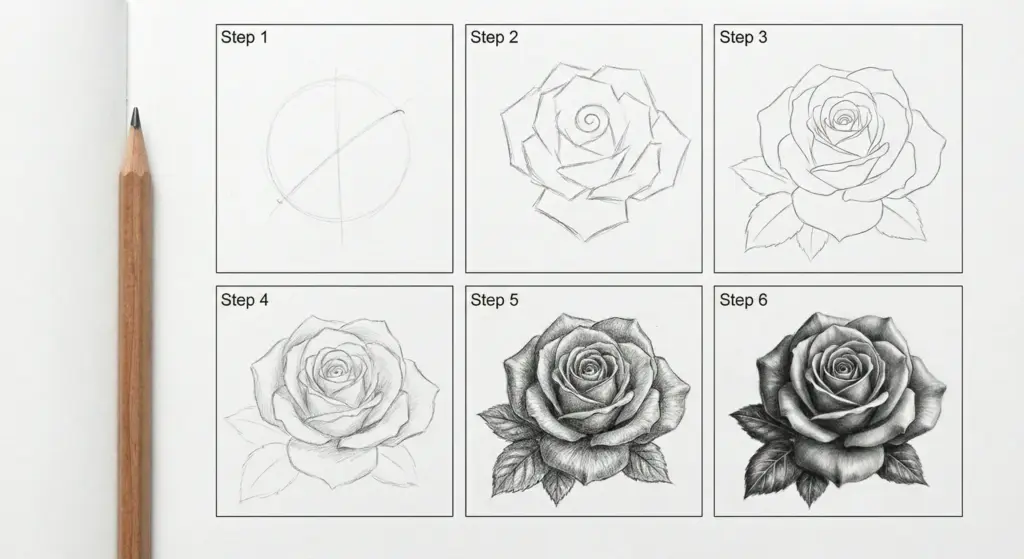
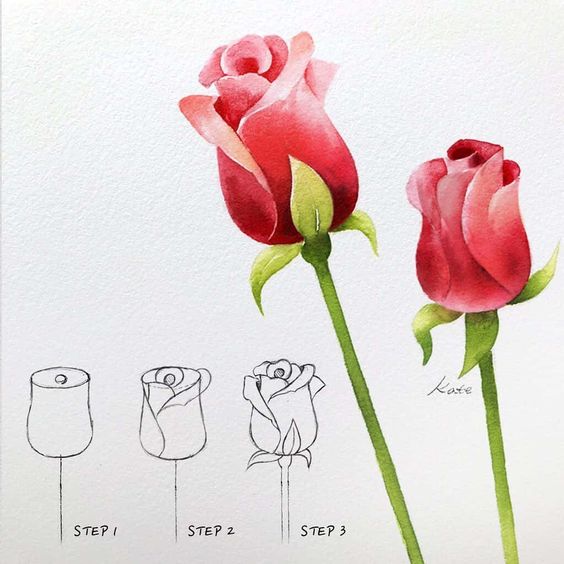
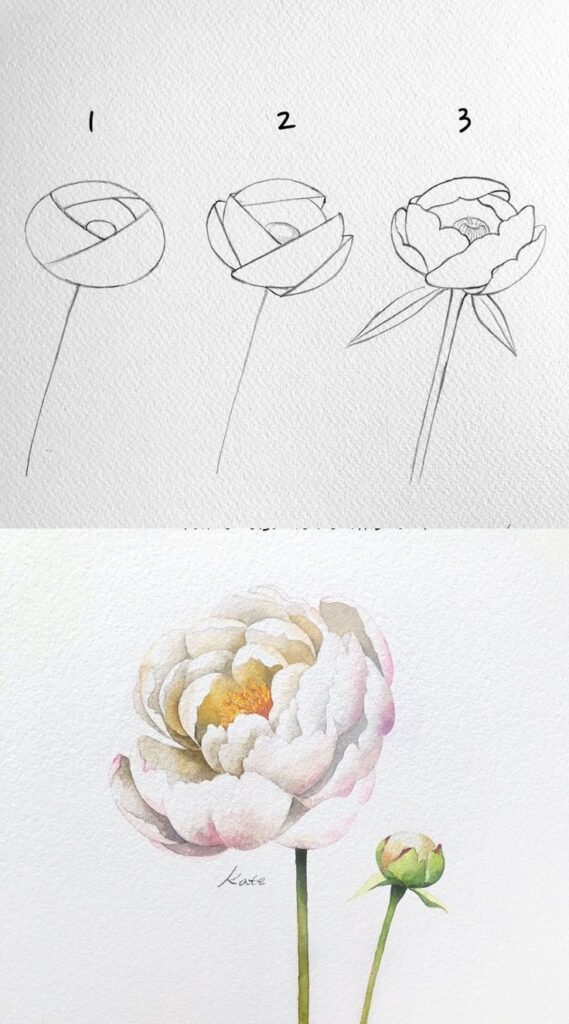
Roses look complicated because the petals fold over each other in a spiral, but the drawing process is simple if you build it in rings. Start with a tight center spiral, add small U-shaped petals around it, then keep widening the petal shapes as you move outward.
[srd_banner]
The inner petals should feel compact and vertical. The outer petals can open, cup downward, and overlap more loosely. I usually check the silhouette before shading: if the rose still looks like a perfect circle, the petals need more variation. Add a few notched edges, tuck one petal behind another, and keep the deepest shadows near the center where the forms overlap. That gives the rose depth without turning the whole flower dark.
Step 1: The Center Spiral
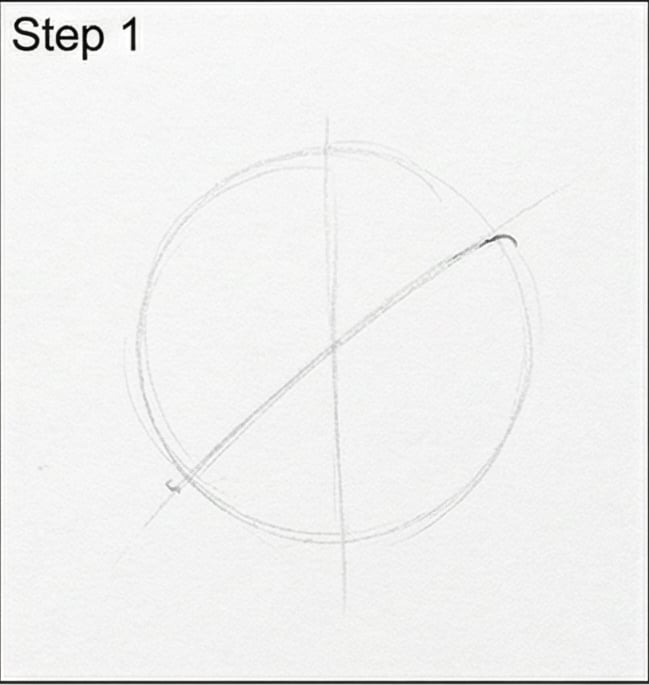
Draw a small tight spiral — like a snail shell — in the center of where your rose will be. This is the rolled inner petals. An imperfect spiral reads as natural.
Step 2: The Inner Petals (U-Shapes Around the Spiral)
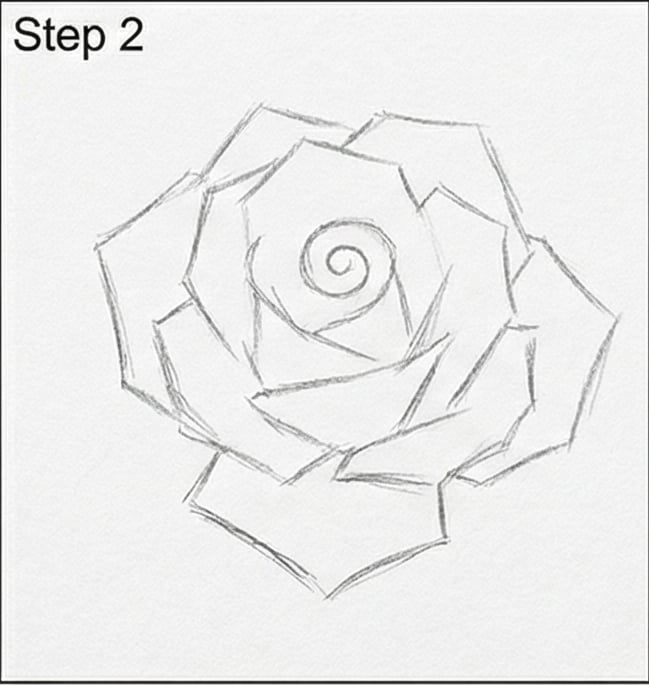
Add three or four curved U-shaped petals wrapping around the spiral. Each one curves upward on both sides and opens at the top. They should overlap each other slightly — no clean gaps between them.
Step 3: The Outer Petals (Larger, More Open)
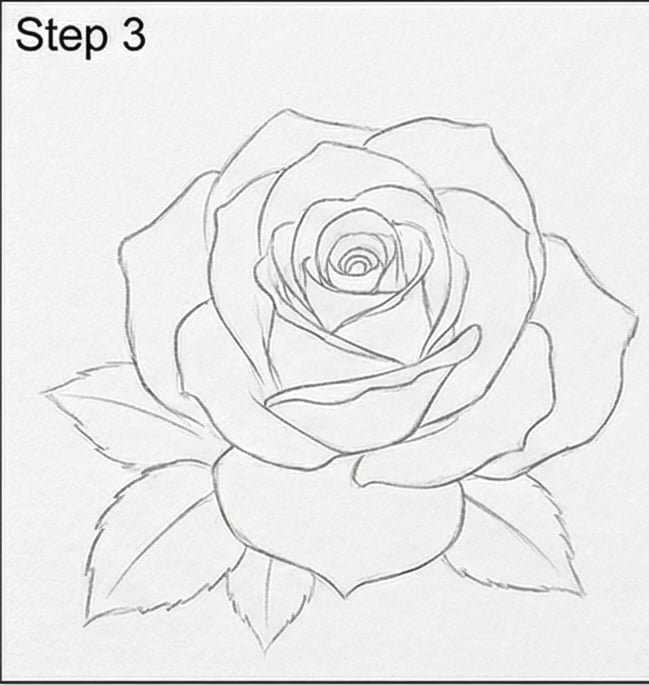
Add a second ring of petals around the first. These are larger, more open, and slightly irregular. Real rose petals often have a small notch at the tip — a slight indentation at the center of the top edge. Adding this detail makes an enormous difference to how real the rose looks.
Step 4: The Outermost Petals (Cupped and Falling)
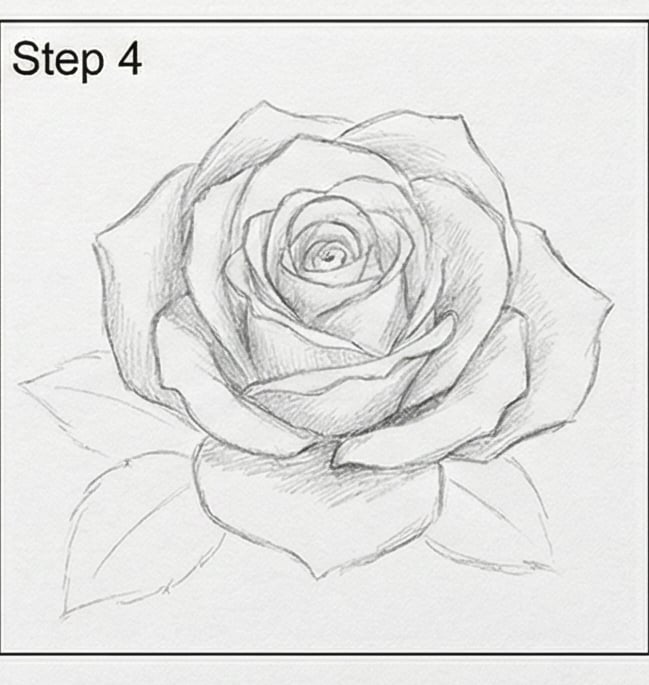
The outer petals of a rose begin to fall outward and cup slightly downward. Add three to five of these around the outside, each one partially hidden behind the petals in front.
Step 5: Sepals and Stem
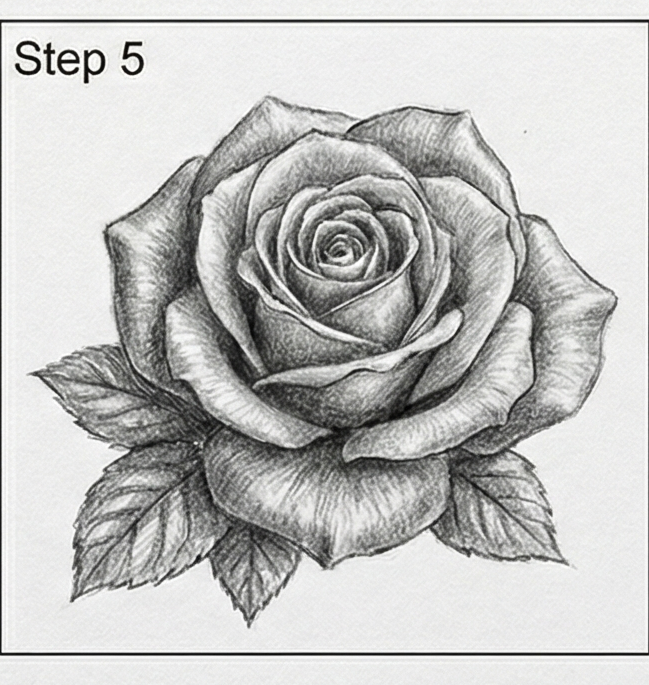
The sepals (the pointed green parts at the base) tuck between the outer petals. Add five narrow pointed shapes pointing outward from the flower base. Then draw a curved stem — roses almost never grow perfectly straight — and add a leaf or two with serrated edges.
Step 6: Shading
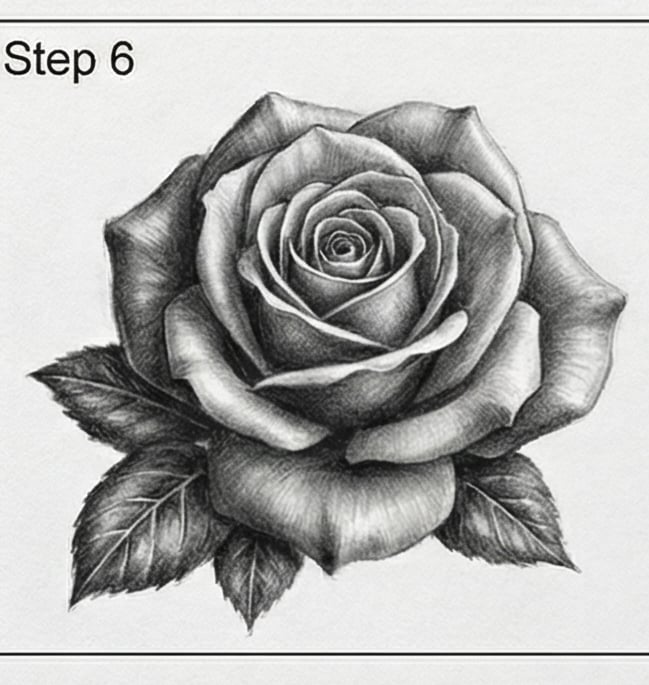
Shadows fall deepest in the areas of overlapping petals — where one petal tucks behind another. Add soft shading with a 2B pencil in these zones. Keep the outermost petals relatively light; the depth is in the center.
Read More:
- How to Draw an Easy Snowflake: A 6-Arm Method That Always Looks Right
- Fall Drawing Ideas: 5 Easy Autumn Sketches to Try
- Fire Drawing Guide: 15 Easy Ideas and Step-by-Step Tips
- Tulip Drawing Ideas: Easy Step-by-Step Guide
- How to Draw Grass That Doesn’t Look Like Spikes
How to Draw a Sunflower Step by Step
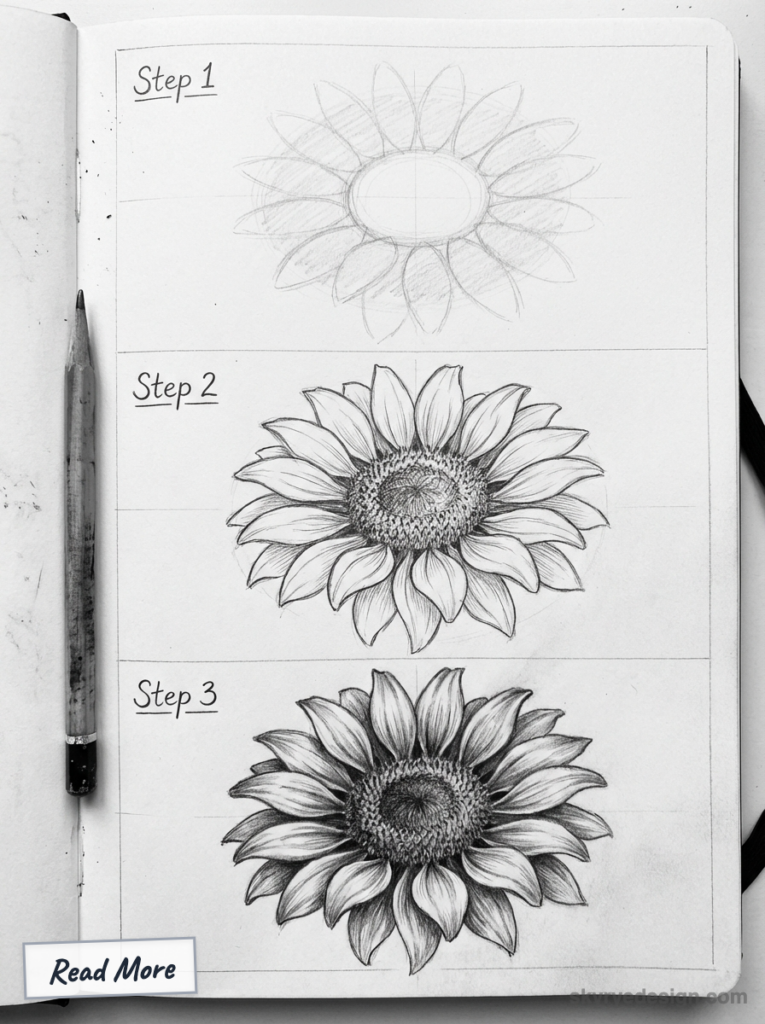
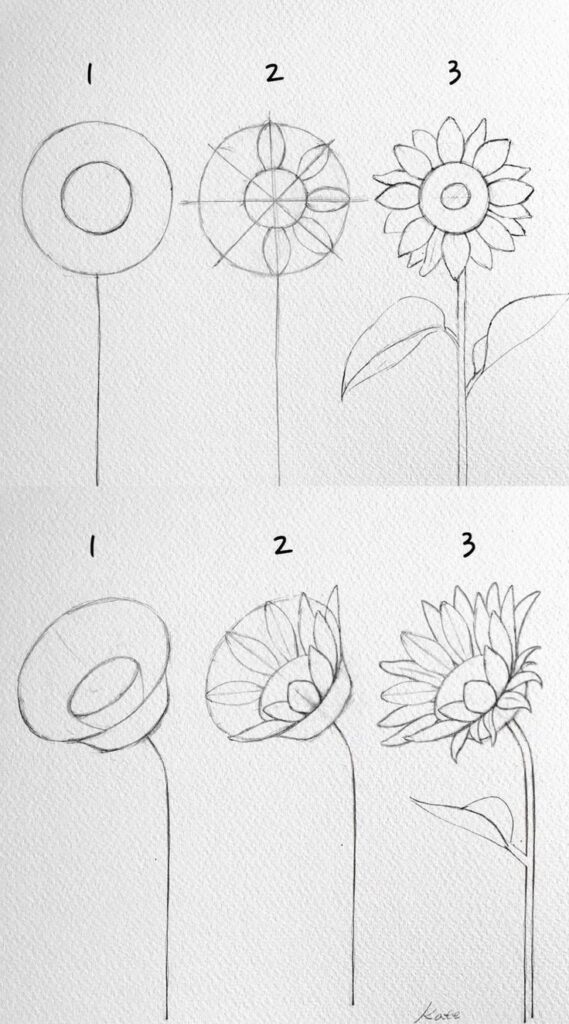
Sunflowers are architectural flowers: a heavy center disk, bold petals, thick stem, and broad leaves. Draw the disk first with two circles, one for the outer edge and one for the raised center. Fill the middle with loose seed marks, then add petals around the outer circle like long pointed ovals. The trick is to avoid perfect spacing.

1000 Drawing Ideas for Artists
Get a free PDF packed with easy drawing ideas, anime prompts, character concepts, nature inspiration, and fantasy sketchbook challenges.
Download Free PDFReal sunflower petals lean, overlap, bend, and vary in length, so rotate each petal slightly instead of copying the same shape all the way around. Add a second, shorter layer behind the first to make the head feel full. The stem should be thicker than a daisy stem, and the leaves should attach at wide angles with simple vein lines.
Step 1: Circles for the Center
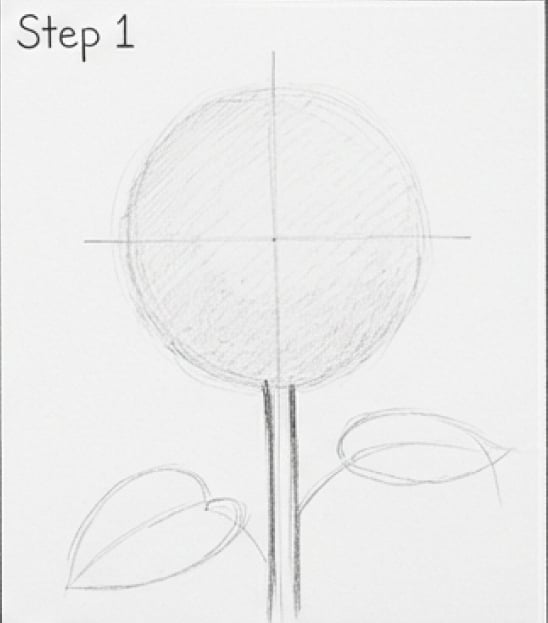
Draw a large circle for the outer edge of the disk and a smaller circle inside it for the raised center cone. This dual-circle structure is what gives sunflowers their characteristic depth.
Step 2: Fill the Disk With the Seed Pattern
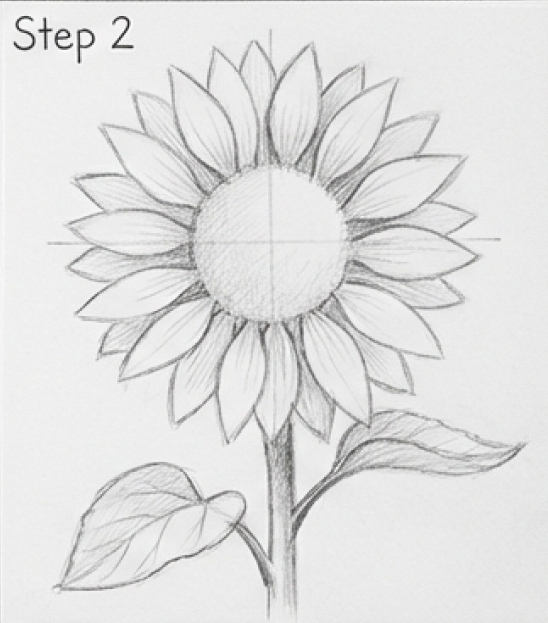
Draw loose oval shapes in a rough spiral pattern filling the inner circle. Add some shading to the spaces between them for depth. You don’t need to be precise — the pattern reads correctly even when loosely suggested.
Step 3: Add the Petals
Sunflower petals are elongated ovals with a pointed tip and a slightly pinched base. Draw them radiating outward from the outer circle, slightly overlapping where they meet the disk. Vary the length and angle slightly — perfect symmetry looks artificial. Add a second layer of slightly shorter petals behind the first, showing their tips between the front petals.
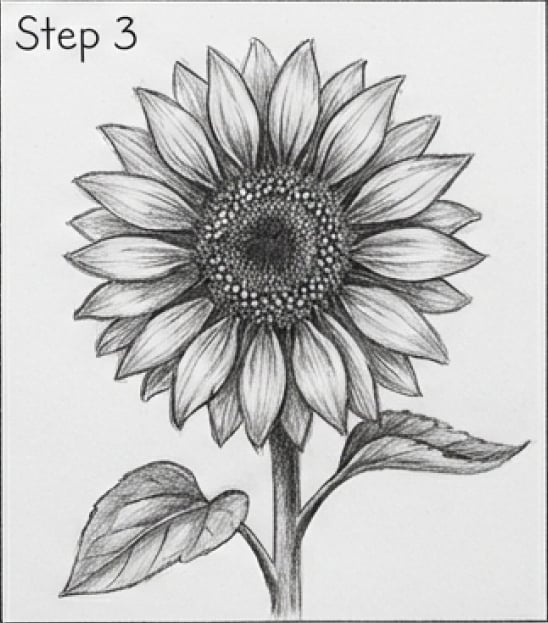
Step 4: The Stem and Leaves
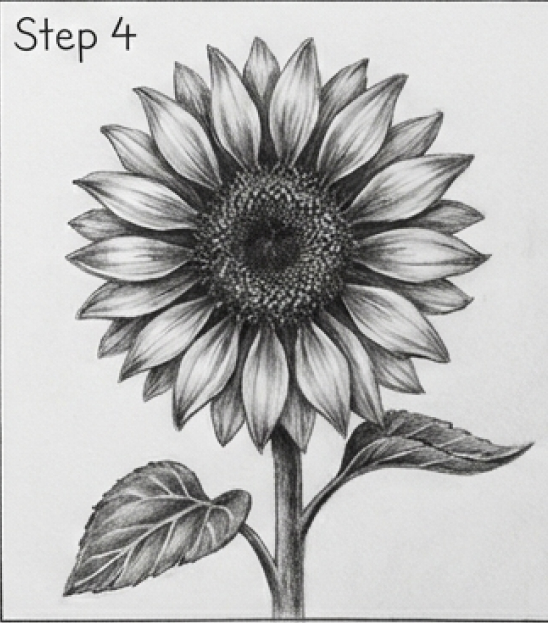
Sunflower stems are thick — draw two close lines rather than a single line, with small bumps suggesting texture. The leaves are large, heart-shaped, and attach to the stem at wide angles. Add a few simple vein lines through each leaf.
How to Draw a Daisy Step by Step
Daisies look simple — and they are — but getting them to look natural rather than mechanical requires a few specific moves.
Step 1: Oval Center (Not a Circle)
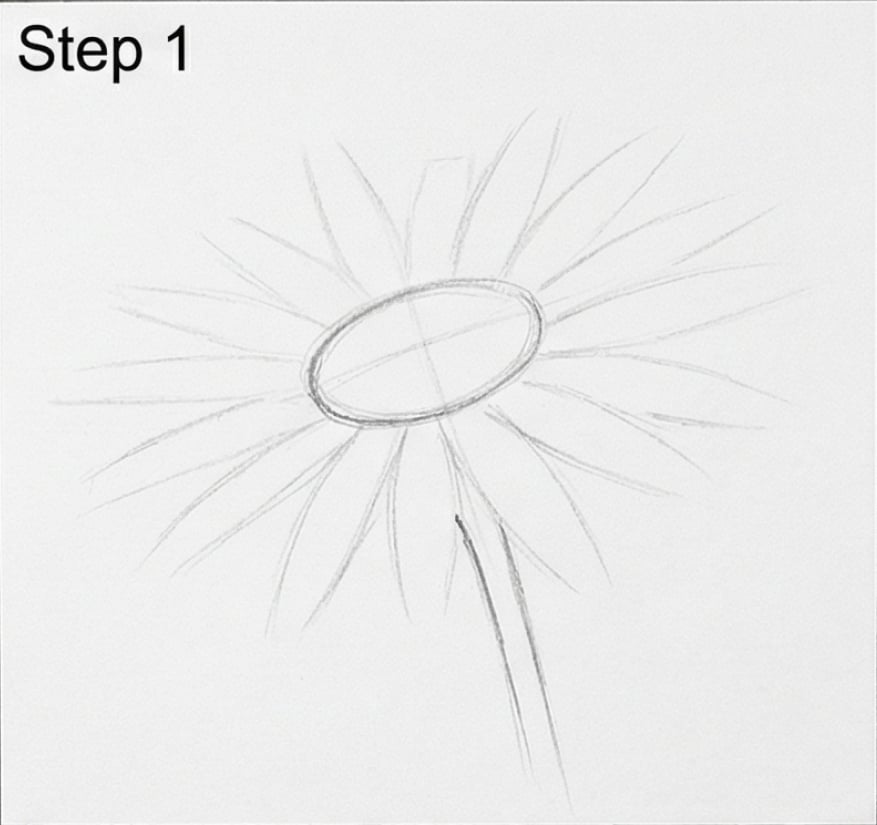
Unless you’re viewing the daisy perfectly from above, the center should be a slightly flattened oval, not a perfect circle. This immediately implies a three-dimensional flower viewed at a natural angle.
Step 2: Petals in Two Rounds
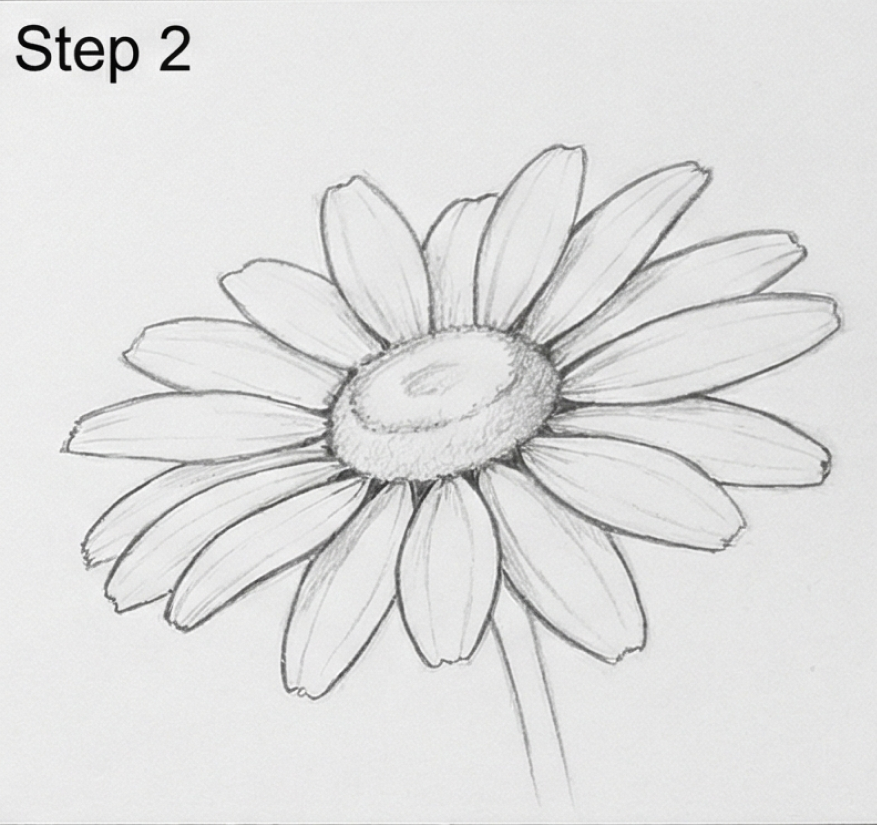
Draw a first ring of petals around the oval — narrow elongated ovals, slightly pointed at the tip. Add a second partial ring of shorter petals visible between the first ring, suggesting depth.
Step 3: Make It Imperfect
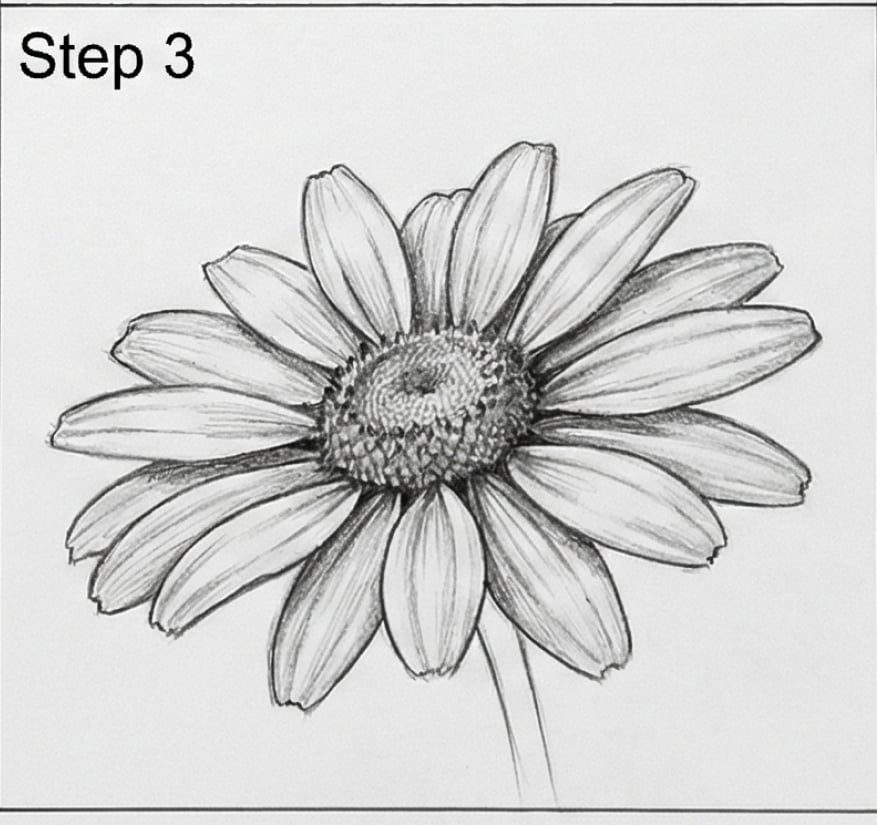
Add one petal that’s slightly bent, one that overlaps its neighbor more than the others, one with a small nick at the tip. These imperfections are what make the drawing feel observed rather than invented.
Step 4: Center Texture
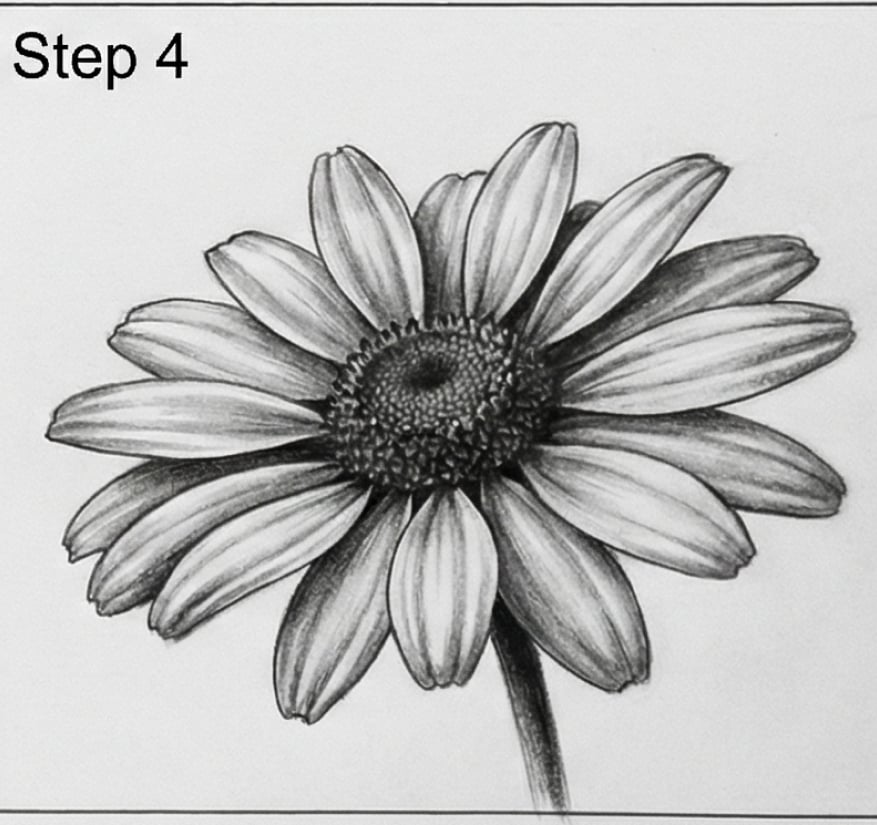
Fill the oval center with small dots clustered more densely toward the outer edge, leaving the center slightly lighter. This creates the illusion of the dome-shaped disk.
How to Draw a Tulip Step by Step
Tulips are architectural flowers — their form is almost geometric. They’re excellent for beginners because the shape is learnable quickly.
Step 1: The Basic Cup Shape
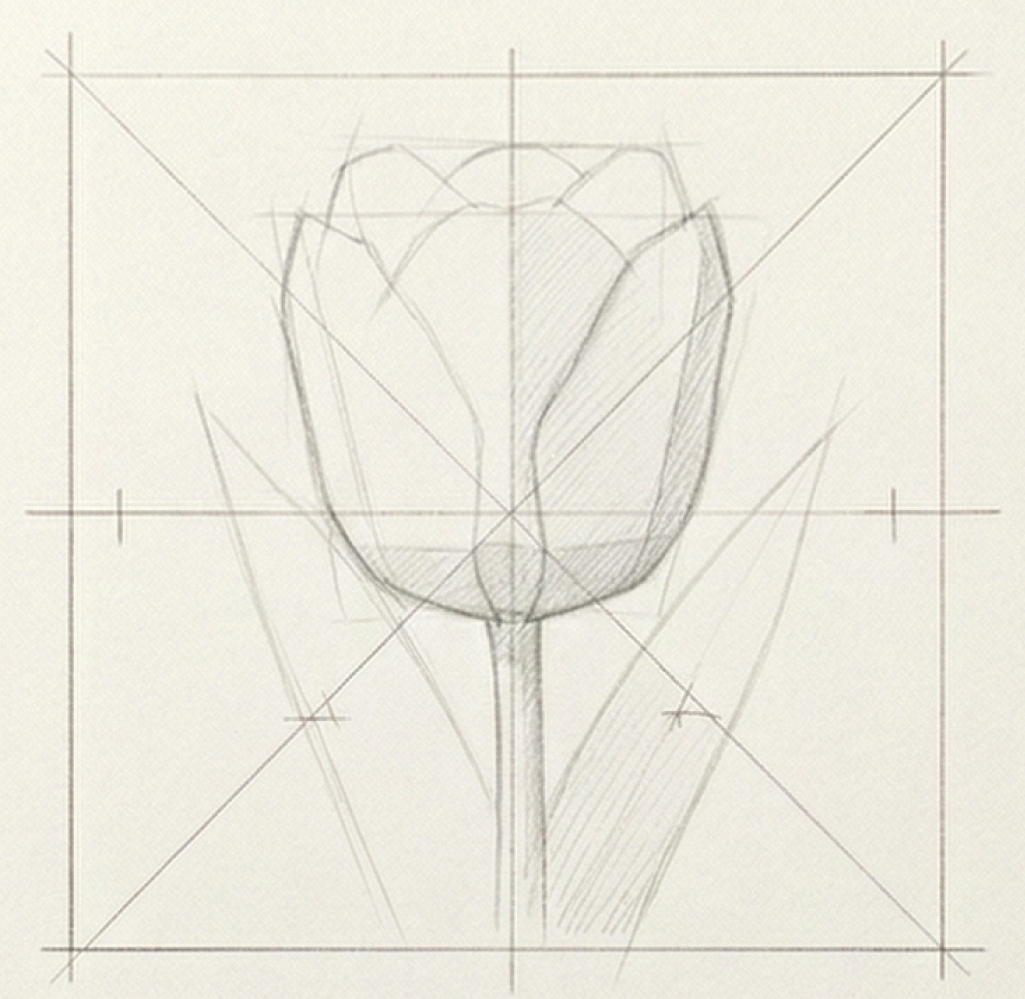
A tulip from the front looks like a cup or a slightly pointed oval — slightly narrower at the base where the petals converge, and slightly open at the top.
Step 2: Three Main Petals
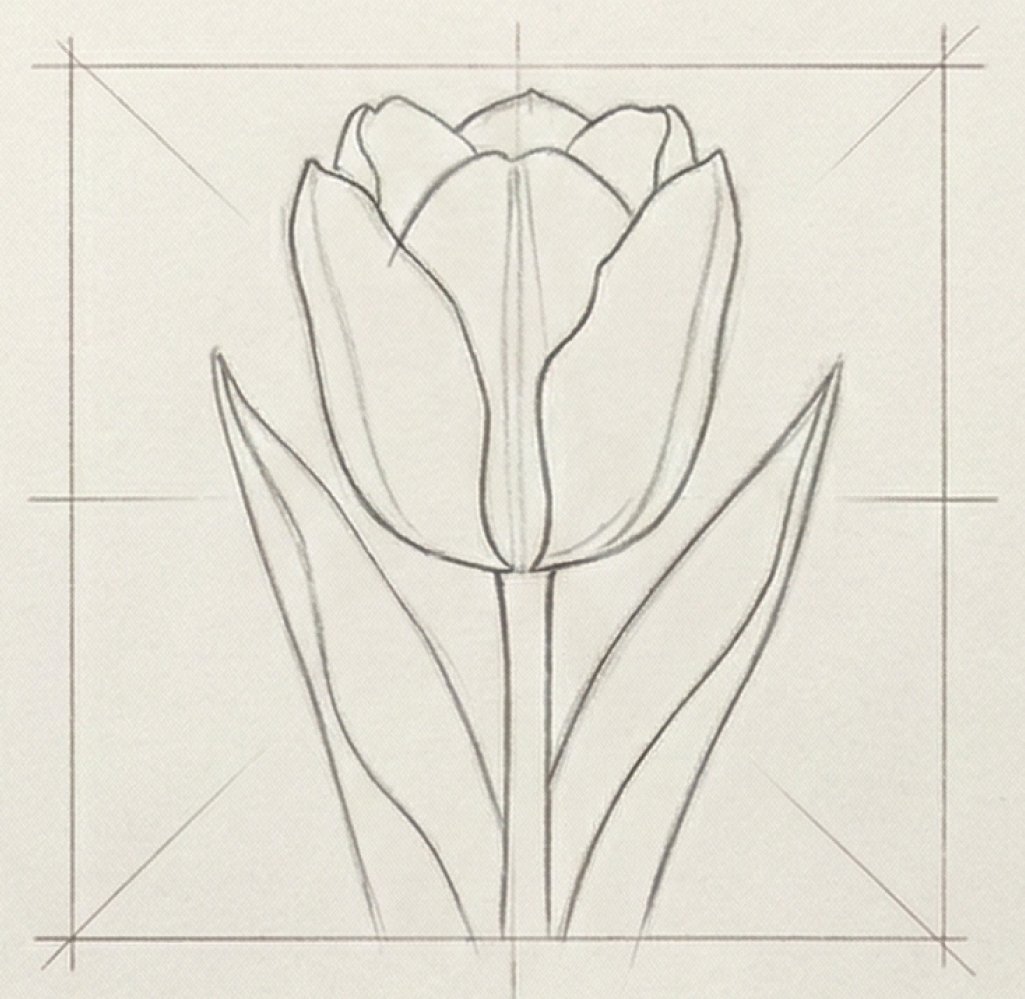
A tulip has six petals but from the front, three are visible. Draw two outer petals (slightly curved, falling away from the center on each side) and one center petal that faces you directly. The center petal is the tallest.
Step 3: The Inner Petals
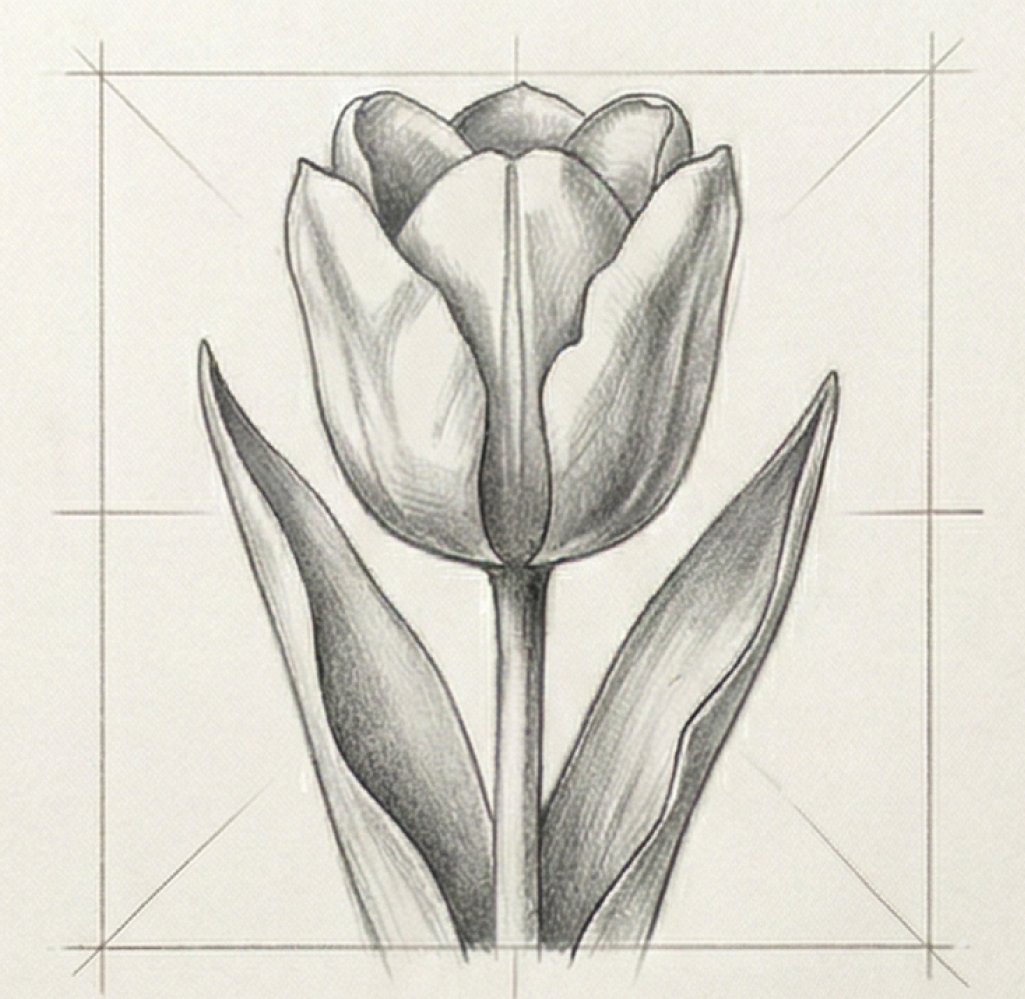
Between the three outer petals, show the tips of three inner petals. These barely visible tips add depth to what would otherwise be a flat shape.
Step 4: Stem and Leaves
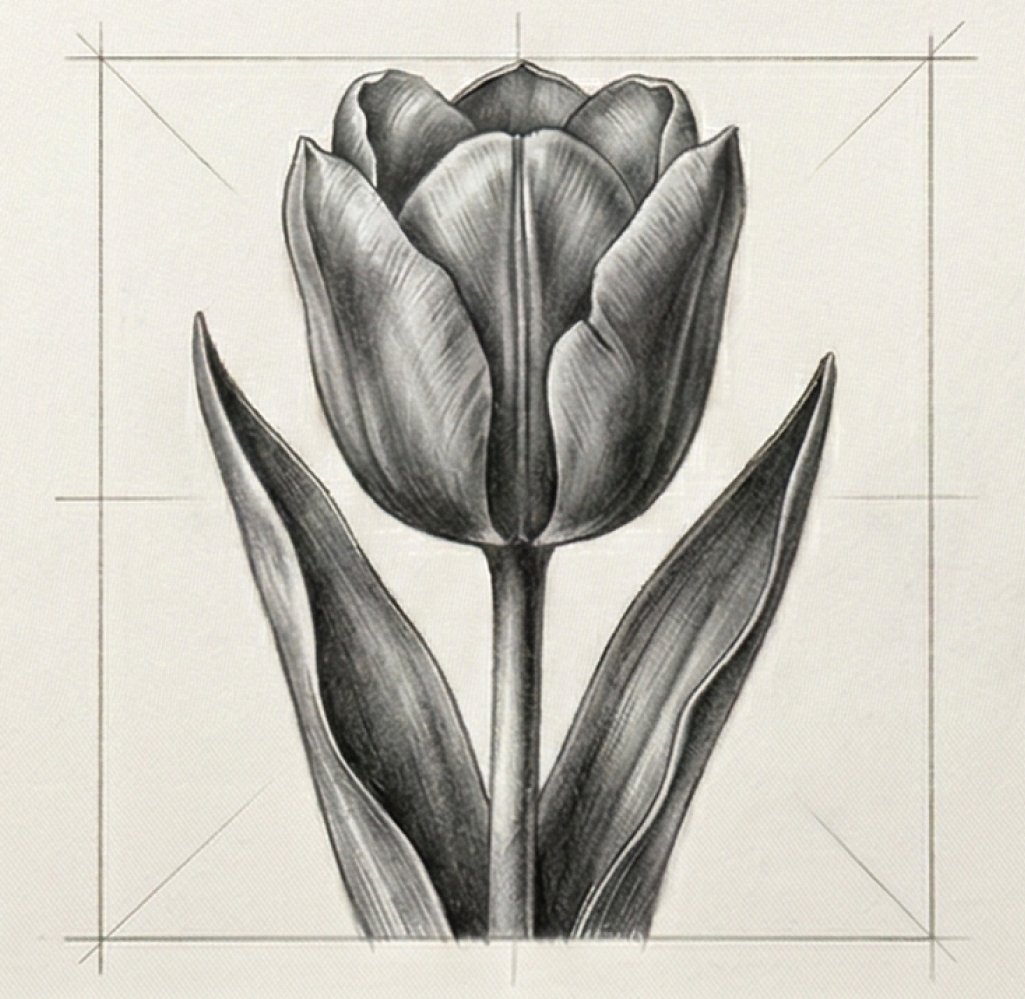
Tulip stems are elegantly curved — draw a single clean arc. The leaves wrap around the base of the stem in a long, pointed sheath shape before extending outward.
How to Draw Loose Wildflowers and Floral Clusters
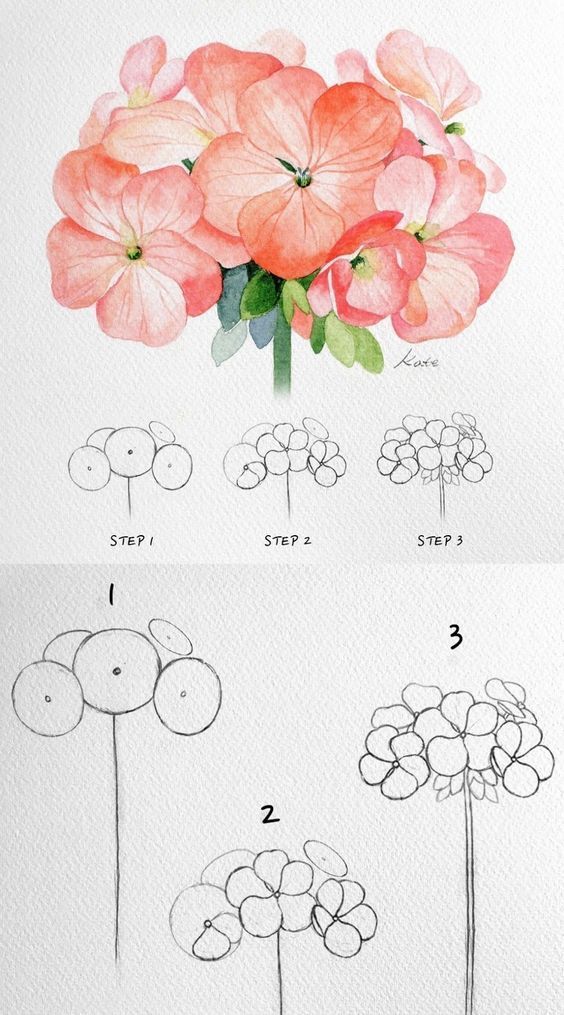
Single flowers are satisfying. Clusters are more versatile — they work as sketchbook studies, illustration elements, and journal page decorations.
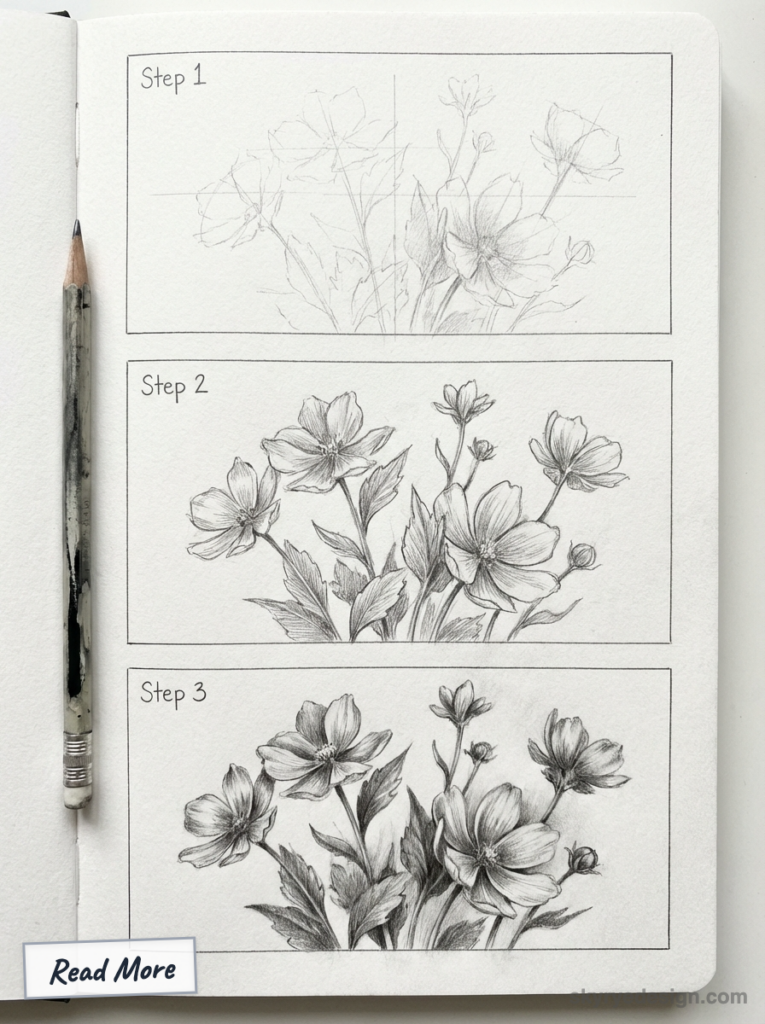
The key to loose floral clusters is working from back to front and varying scale deliberately. Start with the flowers that will sit furthest back — draw them smaller and slightly less detailed. Add mid-ground flowers at medium scale. Place your focal flower in the foreground, largest and most detailed.
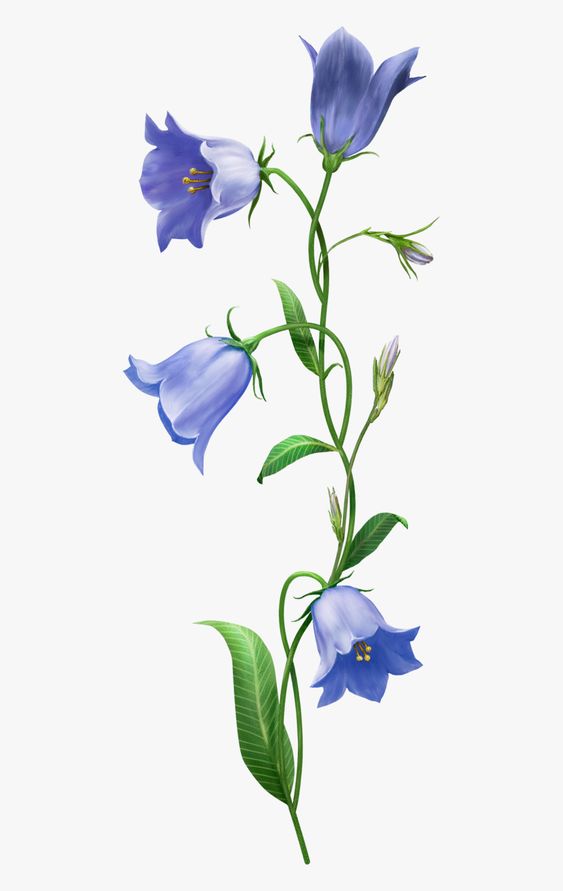
For wildflower variety, combine a few types with different shapes: one rounded daisy-type, one elongated tulip-type, one small filler flower (simple five-petaled shapes), and some small circular buds at various stages of opening. Add leaf clusters and a few loose, wandering stems.
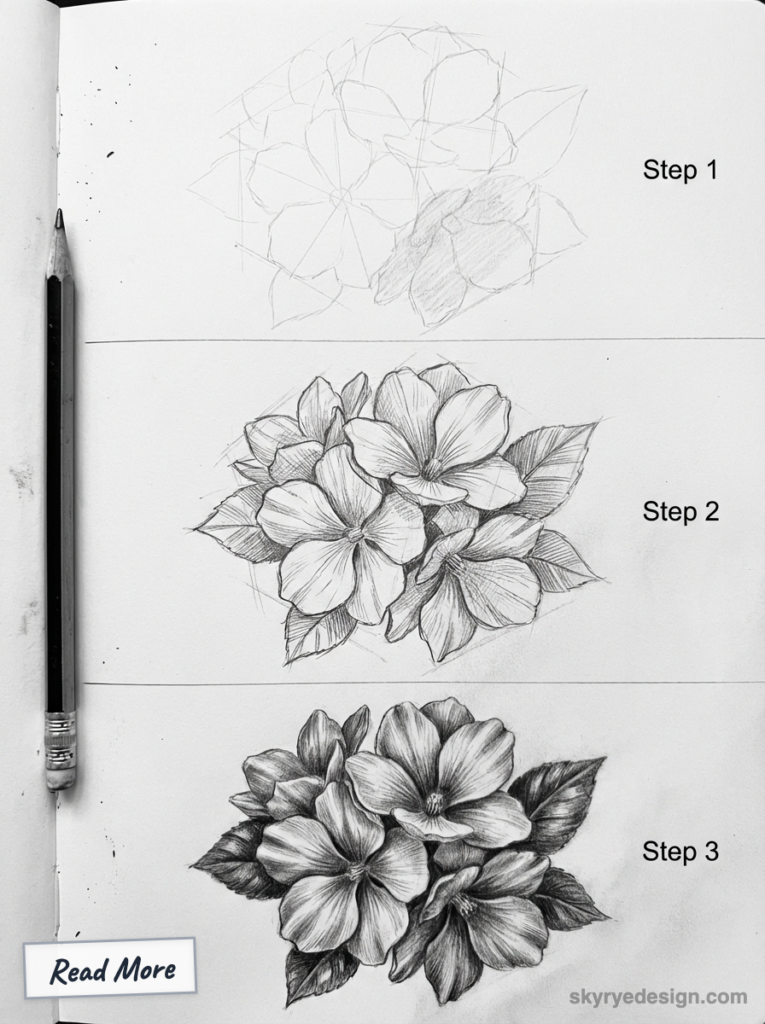
I’ve noticed that the most convincing loose floral drawings use a mix of finished and unfinished elements — one detailed focal flower surrounded by looser, less resolved secondary flowers. The eye fills in what the pencil only suggests.
Quick Flower Sketches
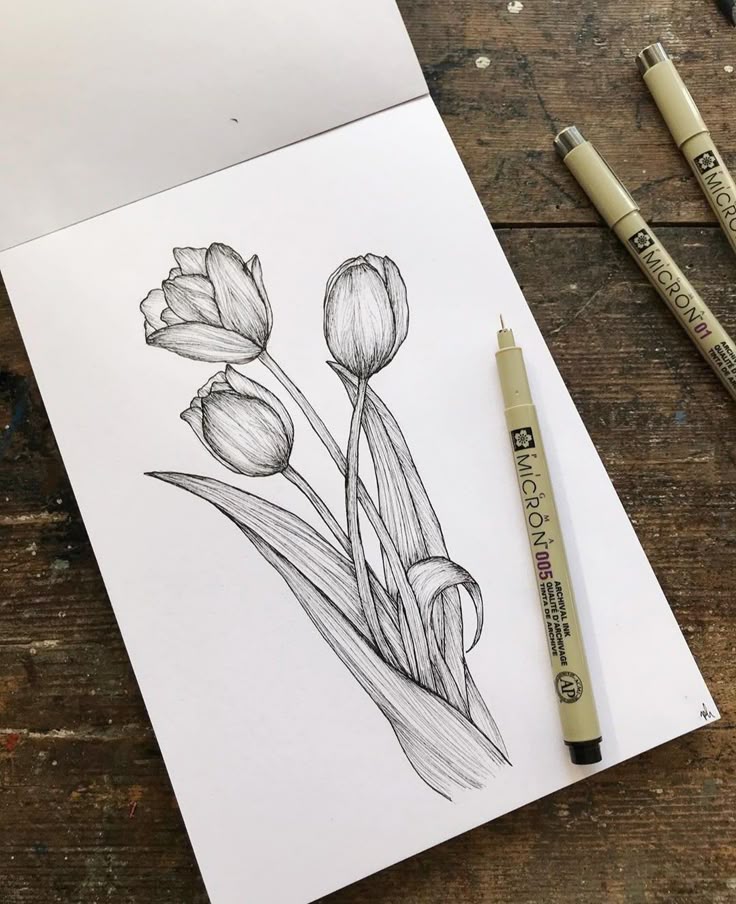
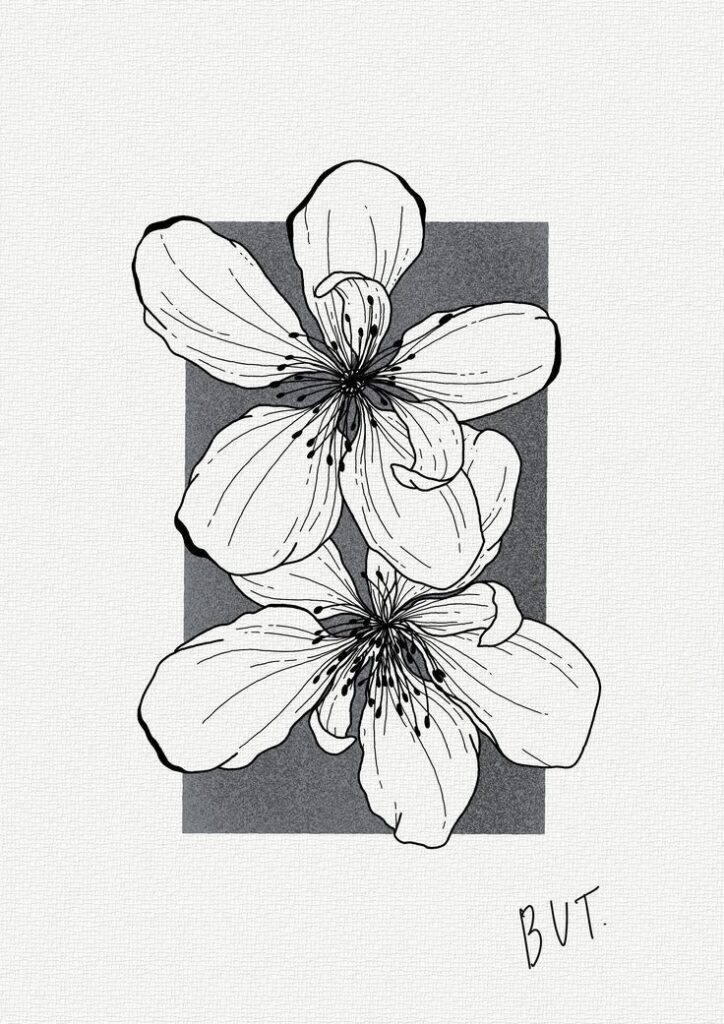
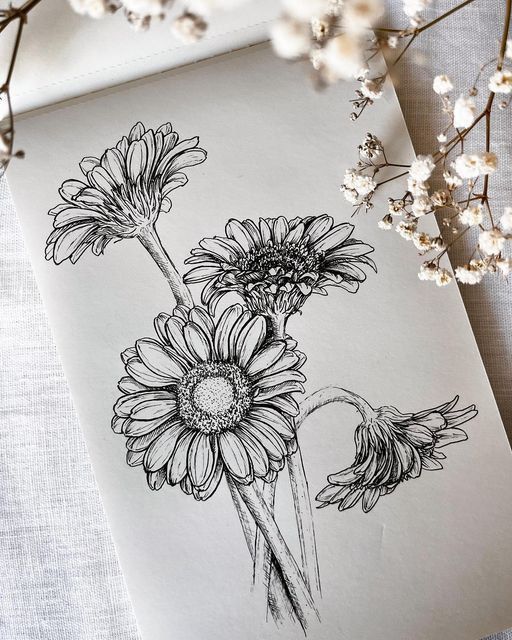
Not every flower drawing needs to be a finished piece. Quick sketches — two to five minutes per flower — are one of the most underrated ways to build fluency fast.
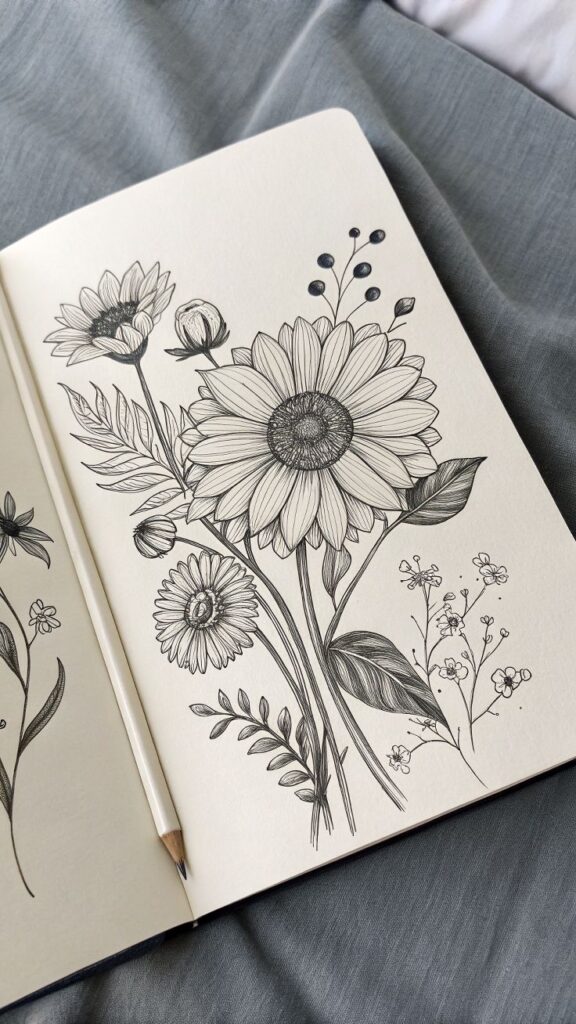
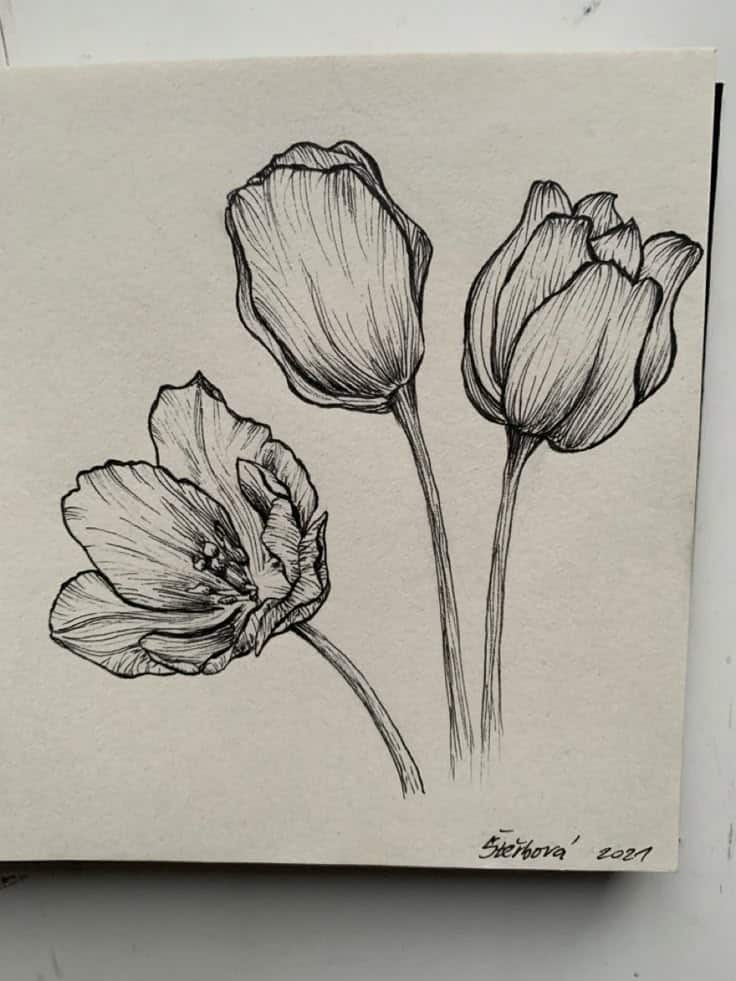
The goal here isn’t accuracy. It’s building a visual vocabulary. Draw the same daisy ten times in a row, each under two minutes, and by the tenth attempt your hand knows the shape without your brain having to manage it. That kind of muscle memory is what makes drawing feel effortless later.
A few rules that make quick sketching useful rather than sloppy: use a single confident line per petal rather than sketching over and over the same edge, don’t erase — cross out and redraw instead, and work small. Postage-stamp-sized flowers force economy of line. If you can draw a convincing rose at 3cm, drawing one at 15cm becomes trivial.
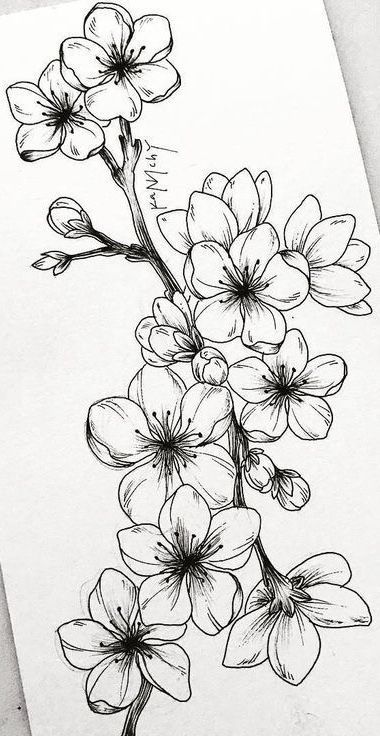
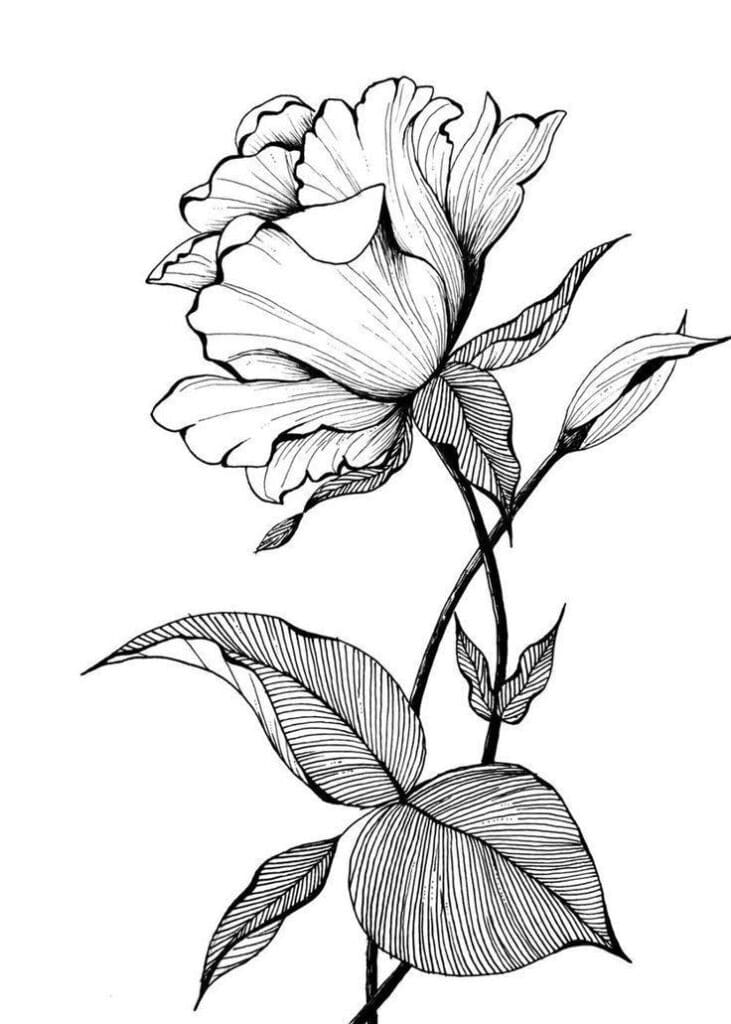
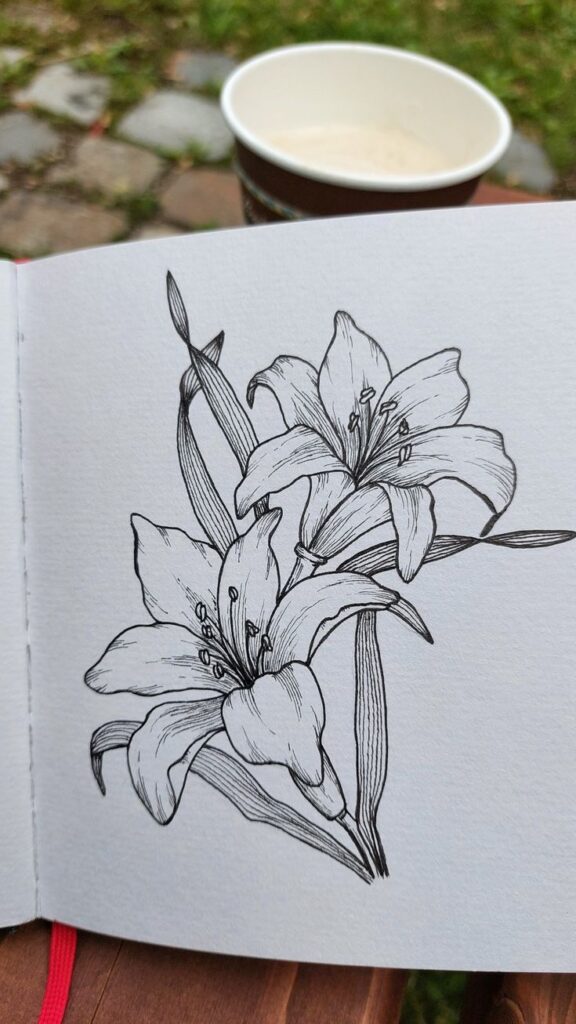
Keep a small Strathmore Bristol pocket pad (~$8) and a Micron 03 fineliner (~$4) with you. Ten minutes of quick flower sketches on a lunch break will do more for your progress than one careful two-hour drawing session per week.
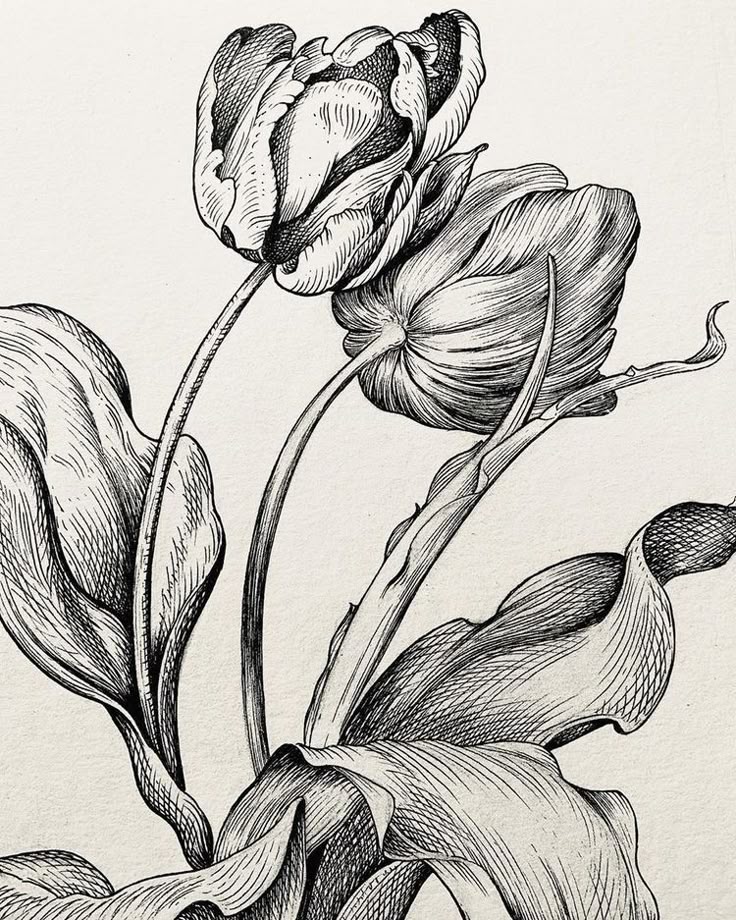
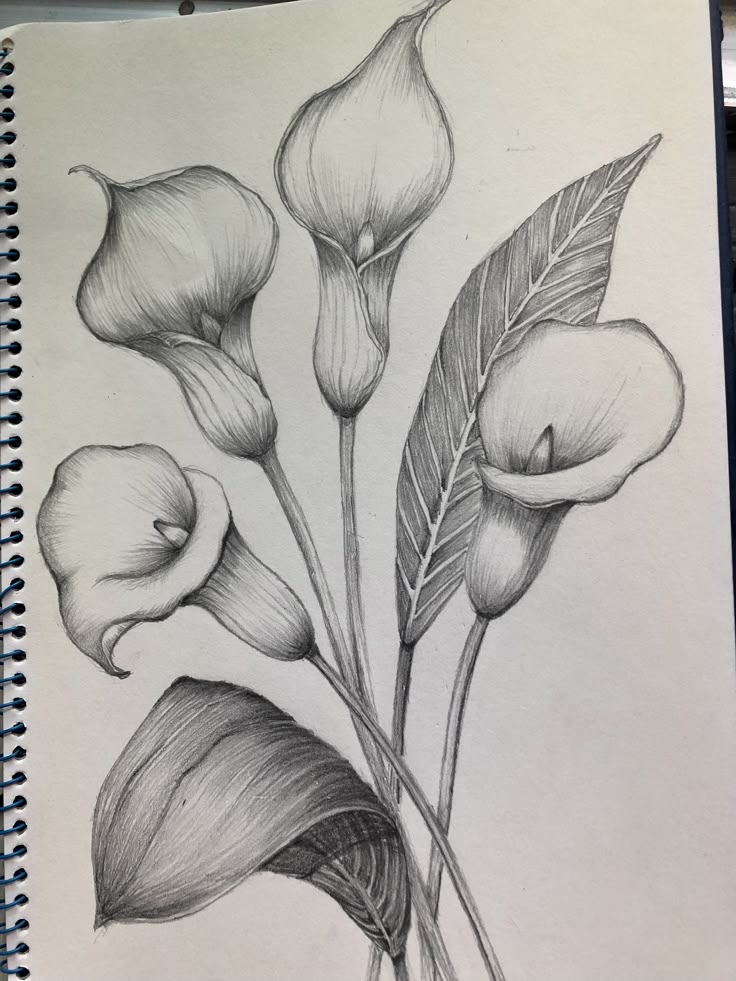
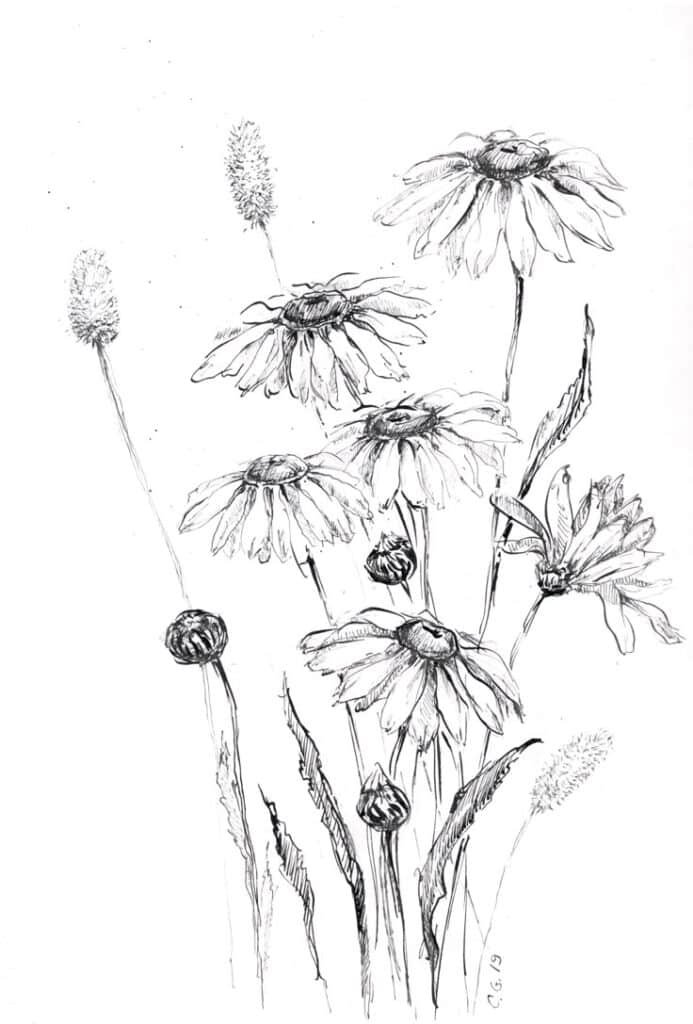
Adding Color: Quick Guide for Each Medium
Colored Pencils
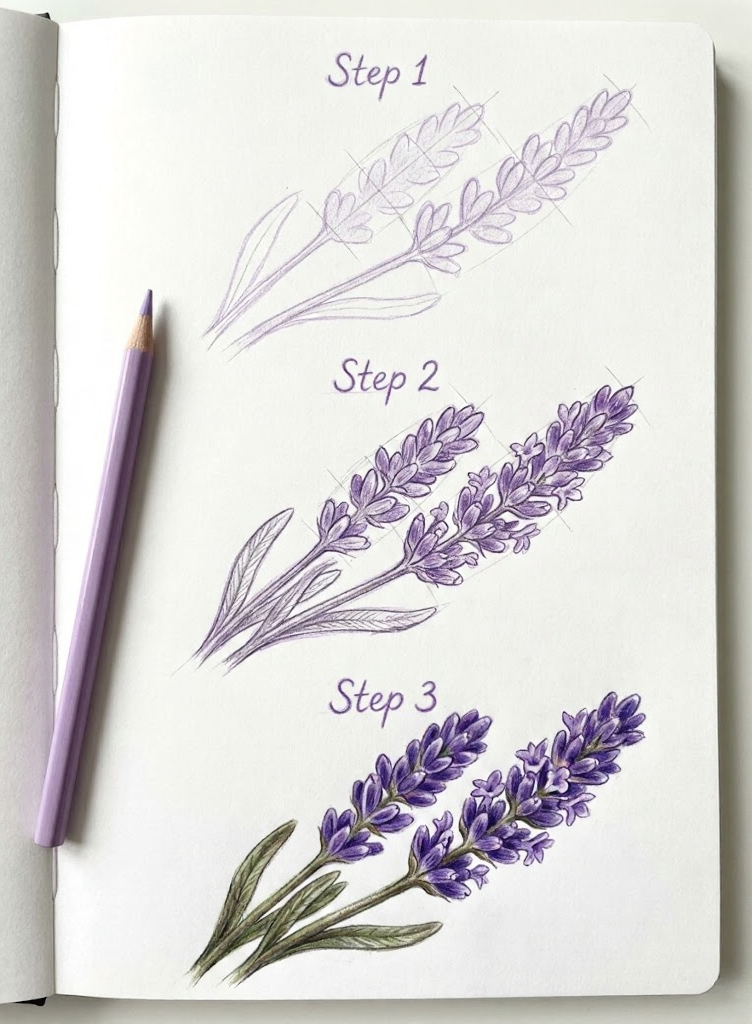
Work light to dark. Lay in your palest petal tones first, then build deeper color toward the shadow areas. Prismacolor Premier (~$29 for 24 set) is the most forgiving for flower work — soft, blendable, good pigment. For more precise detail, Faber-Castell Polychromos (~$65 for 36) hold a sharper point.
Watercolor
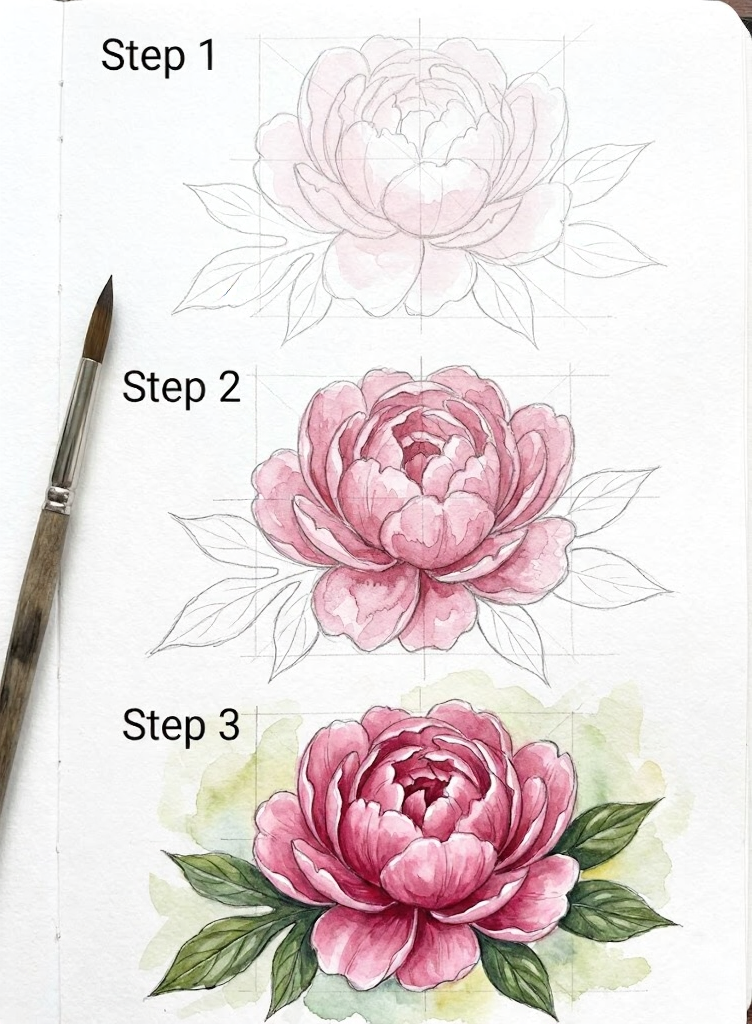
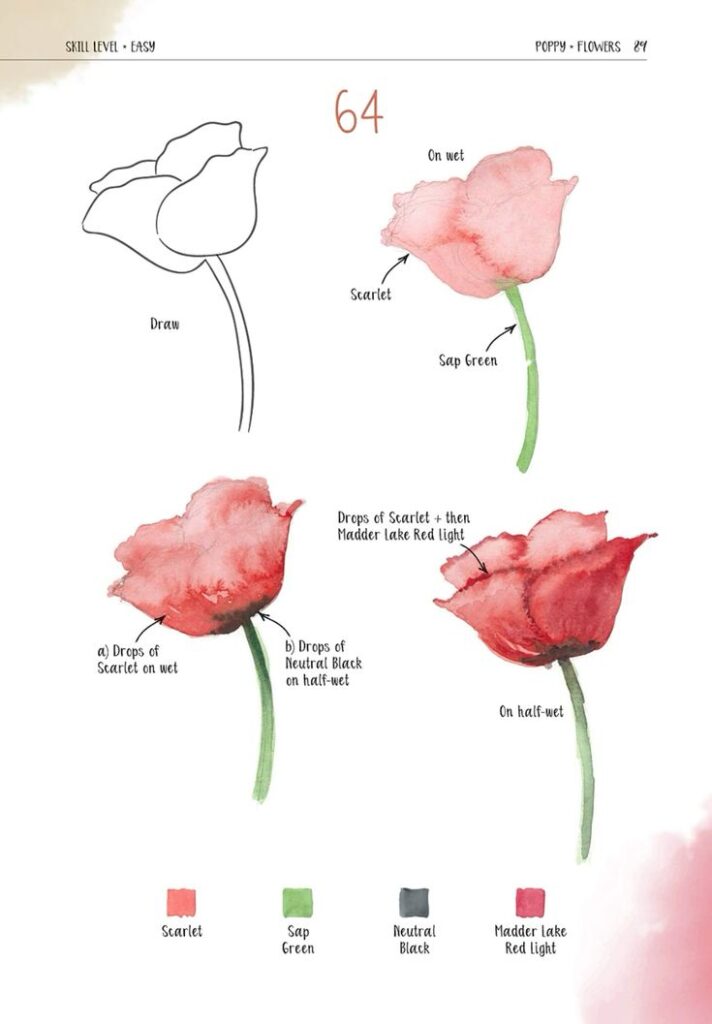
Flowers are one of the best subjects for learning watercolor. Wet-on-wet technique creates soft, atmospheric petals. Wet-on-dry gives sharper definition for details. Start with a light wash of the overall petal color, let it dry, then add a second wash in the shadow areas.
Fineliner + Watercolor
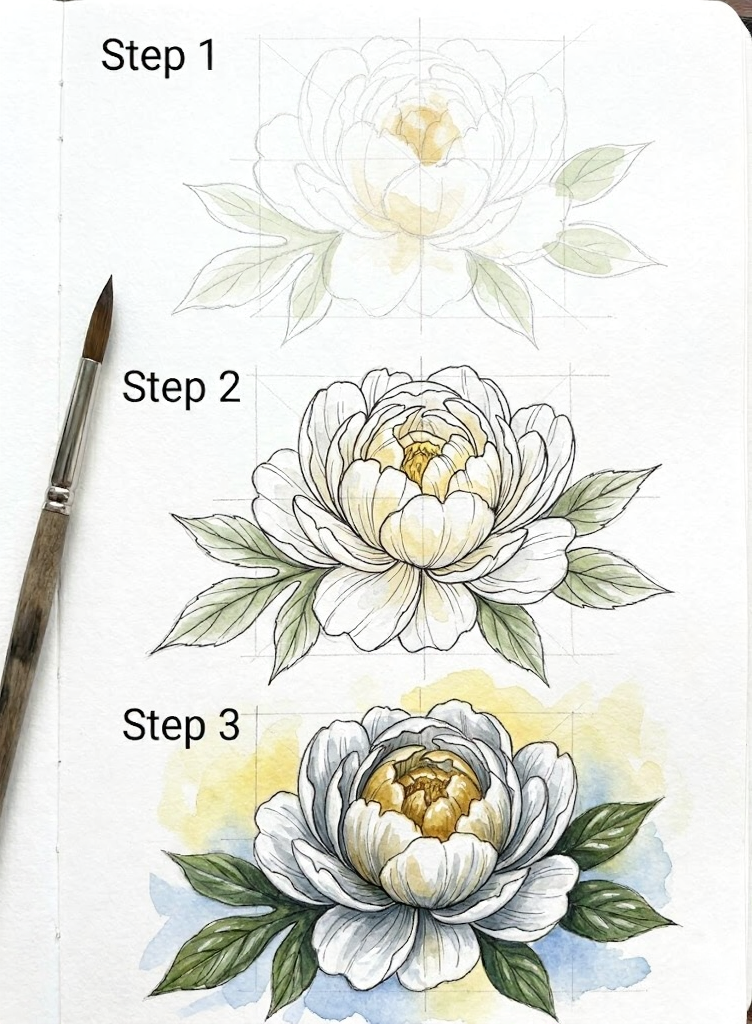
The most popular combination for flower illustration: sketch in pencil, ink with a Micron fineliner, erase pencil lines, then add loose watercolor within the inked areas. The ink holds the structure; the watercolor provides atmosphere.
Common Mistakes and How to Fix Them
Most beginner flower drawings fail for five reasons: the petals are identical, the flower is too flat, the center looks pasted on, the stem is rigid, or every line has the same weight. The fix is structural, not decorative. Vary petal length by about 10-15%, let petals overlap instead of floating separately, connect each petal visually to the center, draw the stem as one fluid gesture, and use heavier lines only where the form needs emphasis. Shadows should sit at petal junctions and behind overlapping shapes, because those are the places where depth naturally appears. If a flower drawing looks symbolic instead of observed, compare it to a real reference and correct the center shape, petal overlap, and value contrast before adding color.
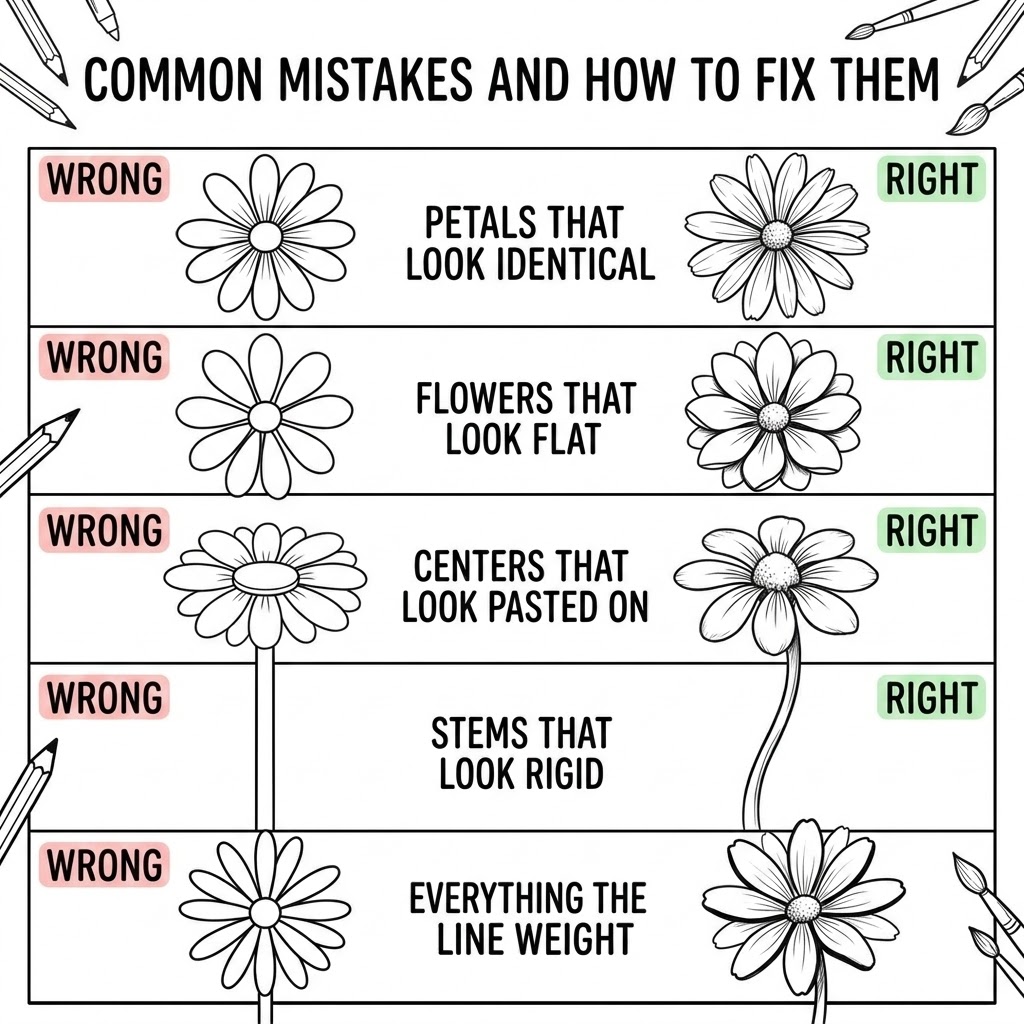
- Petals that look identical: Deliberately vary the length and width of each one by 10–15%. The variation reads as natural.
- Flowers that look flat: You’re probably not overlapping petals or adding shadow depth at junctions. Add a shadow where each petal tucks behind another.
- Centers that look pasted on: Petals emerge from the center — they don’t sit around it. Draw the base of each petal attaching to and slightly behind the center.
- Stems that look rigid: Draw stems with a single fluid gesture rather than two careful parallel lines.
- Everything the same line weight: Outlines slightly heavier, internal petal lines lighter, shadows heavier again. Line weight variation gives drawings dimension.
Supplies at a Glance
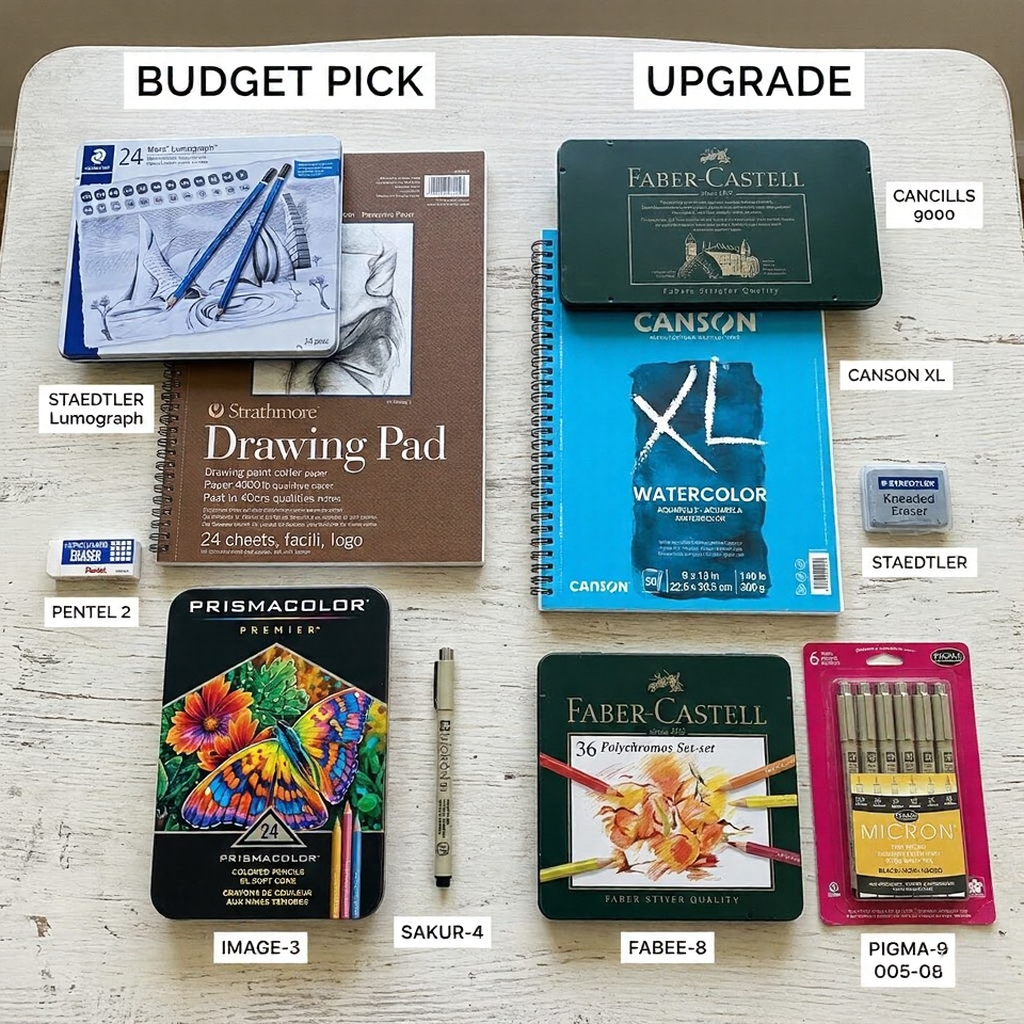
| Purpose | Budget Pick | Upgrade |
| Pencils | Staedtler Lumograph set (~$12) | Faber-Castell 9000 set (~$15) |
| Paper | Strathmore 400 Drawing Pad (~$10) | Canson XL Watercolor (~$12) |
| Eraser | Pentel Hi-Polymer block (~$3) | Staedtler kneaded eraser (~$3) |
| Color (pencil) | Prismacolor Premier 24-set (~$29) | Faber-Castell Polychromos 36 (~$65) |
| Inking | Micron 01 fineliner (~$4) | Micron set 005-08 (~$18) |
FAQ
Q: What is the easiest flower to draw for beginners?
The easiest flower to draw for beginners is usually a daisy because it has a simple center, repeated petals, and a clear stem-and-leaf structure. Start with a slightly flattened oval for the center instead of a perfect circle, then add narrow petals around it in two uneven rings. Keep the petals similar enough to read as one flower, but vary a few lengths and angles so the drawing does not look mechanical. Once the outline works, add small dots to the center and light shadows where petals overlap. A tulip is the next easiest option because its cup shape can be built from three main petals and a curved stem.
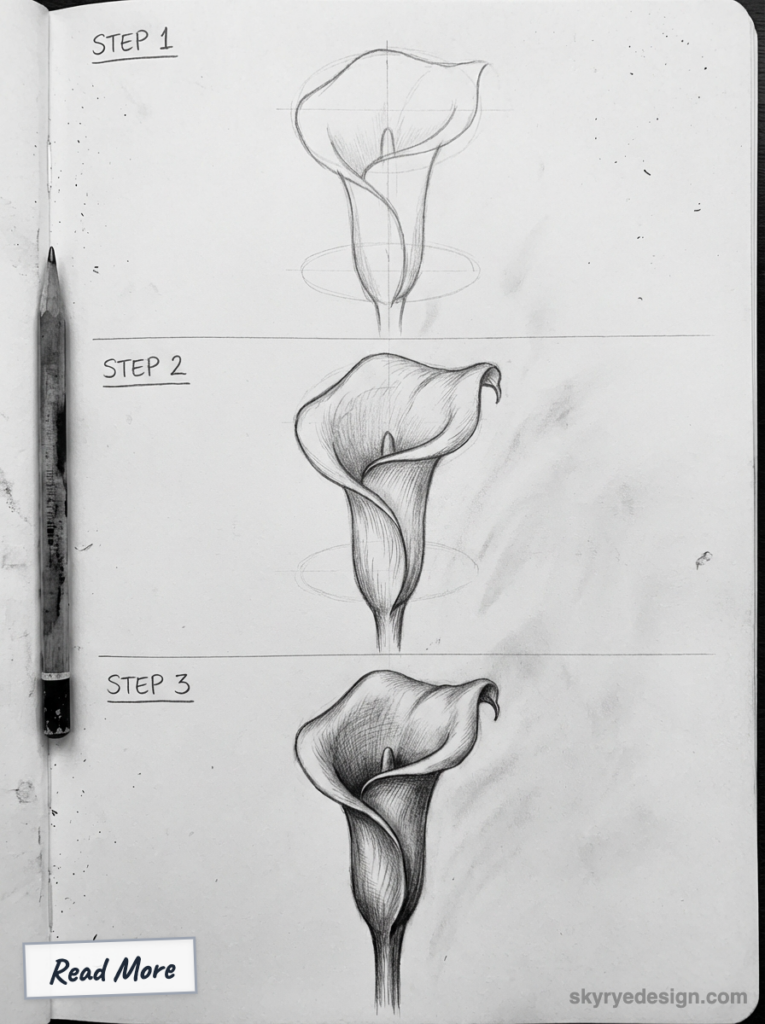
Q: How do you draw a realistic rose step by step?
To draw a realistic rose step by step, begin with a tight center spiral, then wrap three or four small U-shaped petals around it. Build outward with larger petals, letting each one overlap the last instead of leaving clean gaps. The outer petals should open wider, cup downward slightly, and vary in size. Add small notches to a few petal tips, then draw the sepals at the base and a curved stem. For shading, keep the strongest darks near the center and under overlapping petals. Do not shade every petal equally; roses look realistic when the center has depth and the outer edges stay lighter.
Q: What pencil is best for drawing flowers?
The best pencil setup for drawing flowers is an HB pencil for the first sketch and a 2B or 4B pencil for shading, texture, and final lines. HB is light enough to erase cleanly, which matters when you are moving petals or correcting the center. A 2B gives softer shadows without getting muddy too fast. A 4B is useful for deeper rose centers, sunflower seed texture, and the darkest overlaps. The Staedtler Mars Lumograph set is a reliable starter set, and Faber-Castell 9000 pencils are a good upgrade if you want more grades. Avoid relying only on a generic No. 2 pencil; the mark is often too inconsistent for controlled petal shading.
Q: How do you make flower drawings look more realistic?
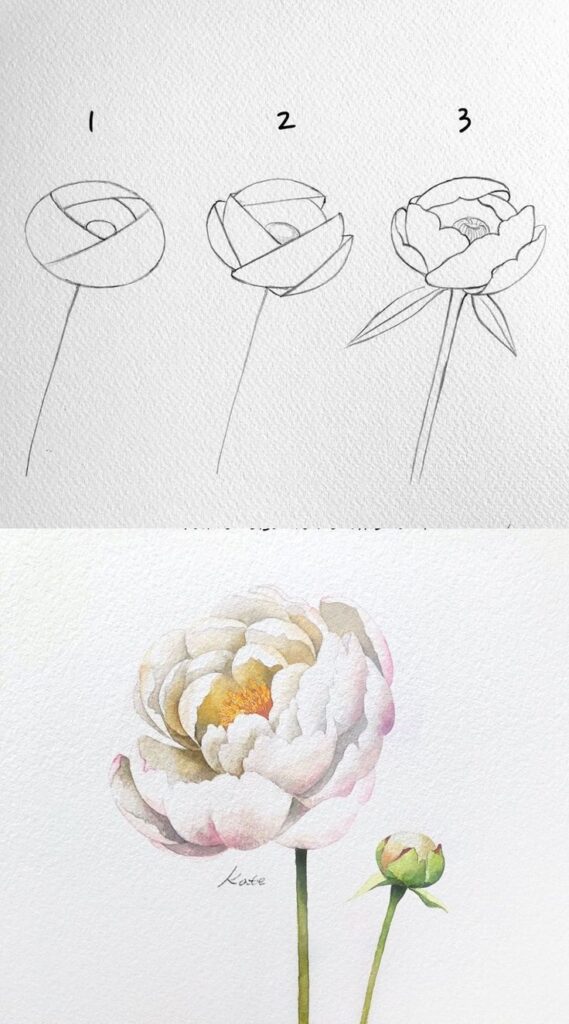
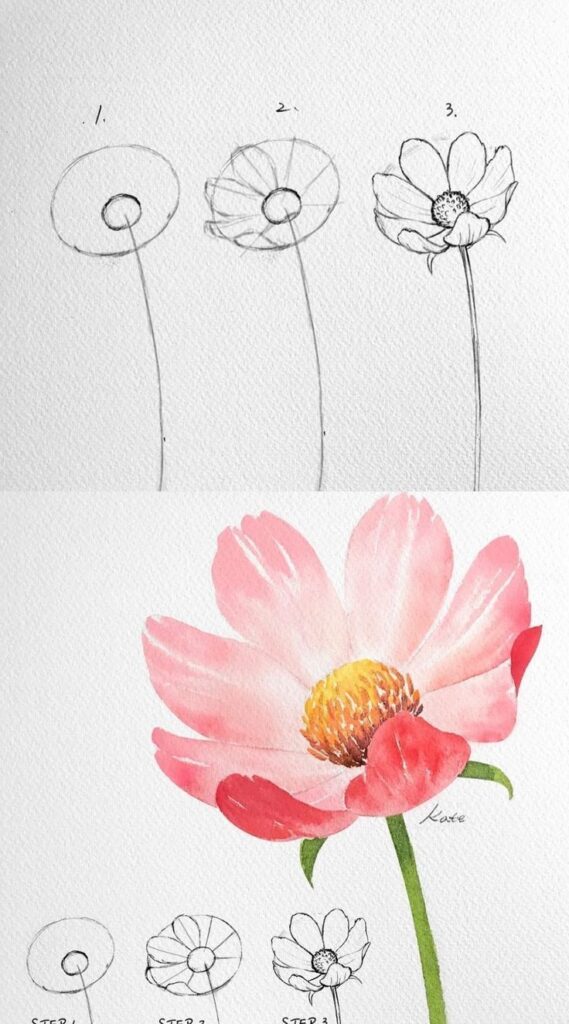
Flower drawings look more realistic when the petals overlap, the shapes are slightly asymmetrical, and the shadows sit in believable places. Start by checking whether every petal is the same size. If it is, vary a few by 10-15% and change their angles. Then add overlap: one petal should hide part of another, especially near the center. Finally, shade the junctions where petals tuck behind each other. Those small dark accents do more for realism than covering the whole flower with gray. I also like to soften the outermost petals and keep the center a little darker, because that naturally pulls the eye into the bloom.
Q: Can I draw flowers without any drawing experience?
Yes, you can draw flowers without drawing experience if you start with simple structures instead of finished-looking details. Begin with a daisy: oval center, oval petals, and a curved stem. Once that feels comfortable, try a tulip because the cup shape teaches you how petals wrap around a form. After that, move to a sunflower for repetition and a rose for overlapping layers. Keep the first attempts small and light. A postcard-sized sketch is less intimidating than a full-page drawing, and mistakes are easier to correct. The goal is not a perfect flower on the first try; it is learning how centers, petals, stems, leaves, and shadows connect.
Q: How do I draw flowers for a bullet journal or sketchbook?
For bullet journals and sketchbooks, use small flowers with simple, repeatable shapes. A five-petaled flower with a dot center, one curved stem, and two small leaves can be drawn in under a minute once you have practiced it a few times. Keep the line work confident instead of sketchy; one clean line per petal looks better at small size than several nervous correction lines. Micron 01, Micron 03, or Staedtler Triplus fineliners work well because the line stays consistent across repeated doodles. If you want variety, rotate between daisies, tulips, tiny buds, and loose wildflower clusters rather than inventing a new flower every time.
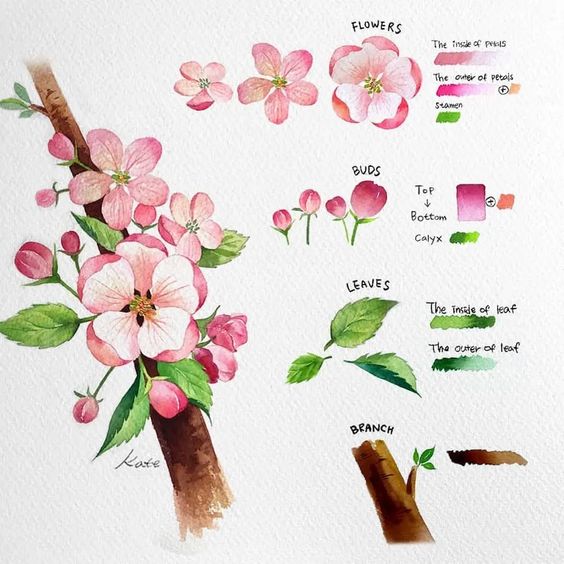
Q: Why do my flower drawings look flat?
Flower drawings usually look flat because the petals are drawn as separate shapes instead of layered forms. Check three things first: do the petals overlap, do they attach to the center, and is there shadow where one petal sits in front of another? If the answer is no, fix those before adding more detail. A flower can have beautiful line work and still look flat if every petal sits on the same visual plane. Add one front petal that covers part of a back petal, darken the tucked edge, and leave the top edge lighter. That small value change creates depth quickly.
Q: Should I draw flowers from photos or real life?
Use both, but real flowers teach structure better. A photo is convenient because the light, angle, and pose stay still, which helps when you are learning petals and shadows. A real flower gives you information a photo often hides: how petals curve, how thick the stem is, how the center sits forward, and how the leaves attach. If you are a beginner, start with a clear photo for your first sketch, then put a real daisy, tulip, or rose on your desk and draw it from two angles. The second drawing will usually look less symbolic because you are forced to observe the form.
If you want to combine subjects, try a butterfly and flower drawing after the flower shape is working.
Related flower drawing practice
If you want to keep building the same skill set, move sideways into one focused flower or one supporting technique. Try the peony drawing tutorial for layered petals, the tulip drawing ideas for simple cup shapes, or the lily flower drawing guide for cleaner botanical lines. For tools and technique, pair this lesson with drawing materials for artists, shading sketches, and bullet journal doodles.
Conclusion
The lollipop flower I drew for years wasn’t bad because I lacked talent. It was bad because I was drawing a symbol of a flower rather than looking at actual flowers.
Every technique in this guide — starting from the center, overlapping petals, varying imperfections, adding shadow at junctions — is just a way of looking more carefully. The drawing follows the observation.
Pick one flower. Draw it five times. The fifth attempt will tell you something the first four couldn’t.
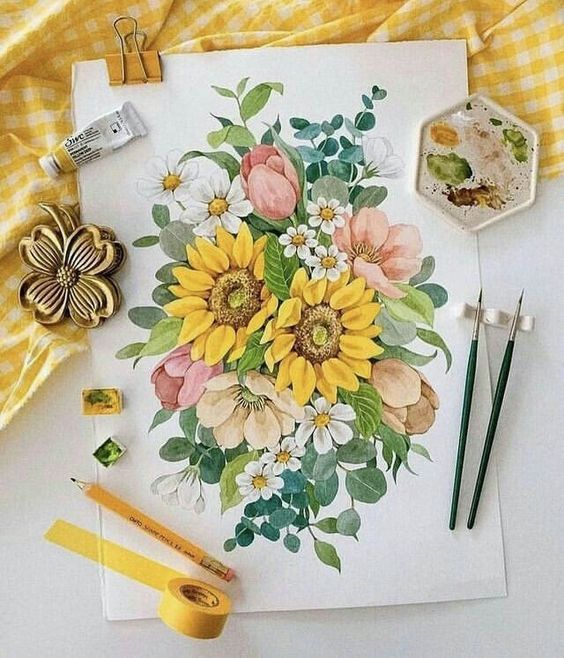
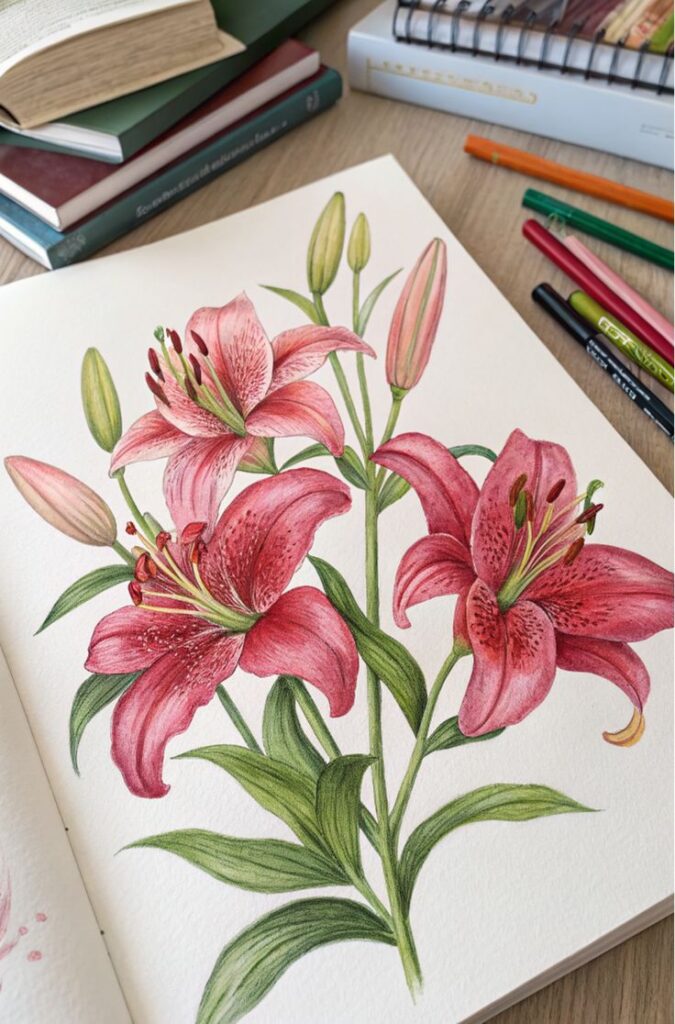
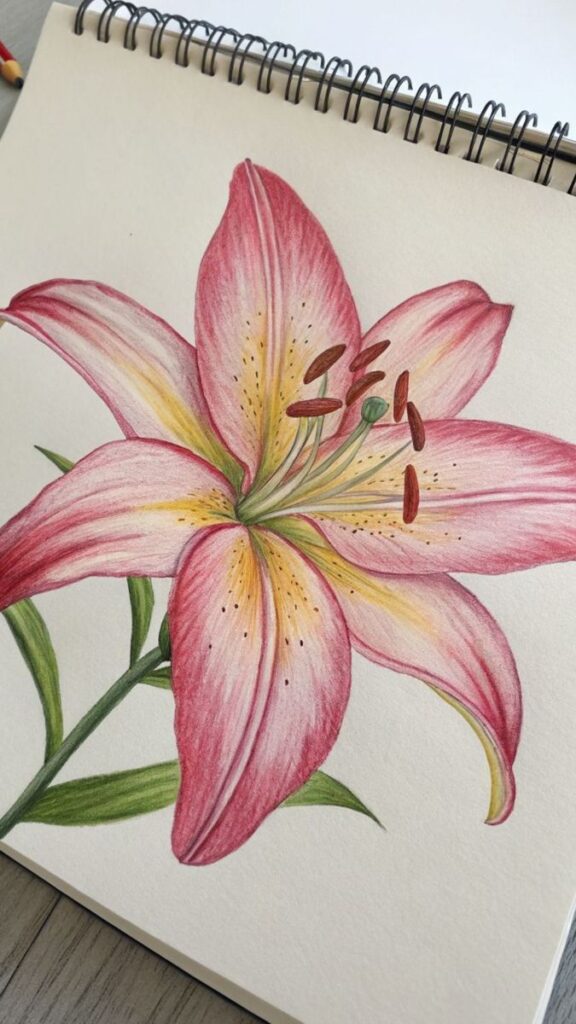
After practicing petals, you can turn the same shapes into Mexican flower drawing ideas with folk-art color and pattern.
- 19.7Kshares
- Facebook0
- Pinterest19.7K
- Twitter0
- Reddit0