There’s a specific kind of room that looks right but feels wrong. Every spatial decision is correct: the furniture proportions work, the materials are considered, the lighting is layered.
And yet something is off. People drift to one side of the room. The sofa near the window sits unused. The reading corner never gets used for reading. When a client describes this to me, the instinct is usually to question the design. But I’ve learned to check the system first. HVAC problems show up in interiors well before they show up as repair emergencies.
- 1. A room that looks finished but never feels comfortable
- 2. Hot and cold spots that break the floor plan
- 3. Weak airflow around furniture and window treatments
- 4. Humidity that makes materials feel wrong
- 5. AC noise that ruins quiet zones
- 6. Condensation and leaks that threaten finishes
- 7. Temporary fixes that create visual clutter
- 8. When the design issue is actually a repair issue
- Frequently Asked Questions
- How do AC problems affect interior design?
- Can a room feel uncomfortable even when the thermostat reads correctly?
- What are the most common ways HVAC problems show up in a finished room?
- How do I know if my room comfort problem is a design or HVAC issue?
- Does AC airflow direction affect furniture placement?
- Can high indoor humidity damage interior finishes?
- Why does my AC make more noise in some rooms than others?
They show up as behavioral patterns, in where people choose to sit and which rooms they avoid. They show up as material conditions, in floor boards that start to cup, upholstery that feels perpetually damp, paint that bubbles near a window frame. And they show up as visual compromises, in the portable fan sitting on the rug, the extension cord snaking toward the portable unit, the heavy curtain taped against a window because nothing else controls the afternoon heat.

Here are seven AC problems I encounter regularly in client interiors, and what they look like from a design standpoint before anyone has called a repair technician.
1. A room that looks finished but never feels comfortable
The first sign that an HVAC problem is affecting a space is often the gap between how a room reads visually and how it reads experientially. A room in this state photographs well. It looks balanced, complete, resolved. But people do not spend time in it willingly.
They move through it rather than settling into it. Temperature and humidity together create the felt experience of a room. A room at the correct temperature but with elevated humidity feels warm and sticky regardless of what the thermostat says.
A room with good temperature control but stratified air, where cool air pools at floor level and warm air accumulates above sitting height, feels neither warm nor cold but persistently wrong. From a design standpoint, I start suspecting the system when a room that was furnished and lit with care is consistently avoided by the people in it. The spatial logic is correct. The furniture scale is right. The problem is not the room. The problem is what the room is doing to the people in it.
What to observe
Watch where people actually sit versus where the furniture plan puts them. Watch whether a room feels fresh after a period of occupancy or whether it starts to feel stale. Note whether opening a window changes the character of the space. These behavioral signals come before any visible material damage and before any mechanical failure.
2. Hot and cold spots that break the floor plan
Uneven cooling is one of the most common AC problems in residential interiors, and one of the most damaging to how a designed space actually functions. When one zone of a room runs significantly warmer or cooler than the rest, people respond to temperature rather than to furniture placement. The beautiful window seat gets abandoned because the glass runs cold in winter and hot in summer.
The desk position chosen for its light is too warm to work in after noon. The furniture plan that emerges from this is not the one the designer intended. Cushions migrate toward the comfortable zone. Secondary chairs cluster away from the problem area. The plan begins to reflect thermal geography rather than spatial logic. In a well-used home, this happens within the first season of occupancy.
Common causes in finished rooms
A single register trying to condition a room with significant solar gain on one face. Ductwork that delivers inadequate volume to a room relative to its size. Poor return air placement that creates a pressure imbalance, pulling conditioned air out of the room before it can distribute. Rooms added to a home’s footprint without balancing the HVAC load for the new volume. In a room where furniture has visibly migrated away from certain zones over months of use, the first check is not where the sofa should be. It’s what’s happening thermally in the abandoned zone.
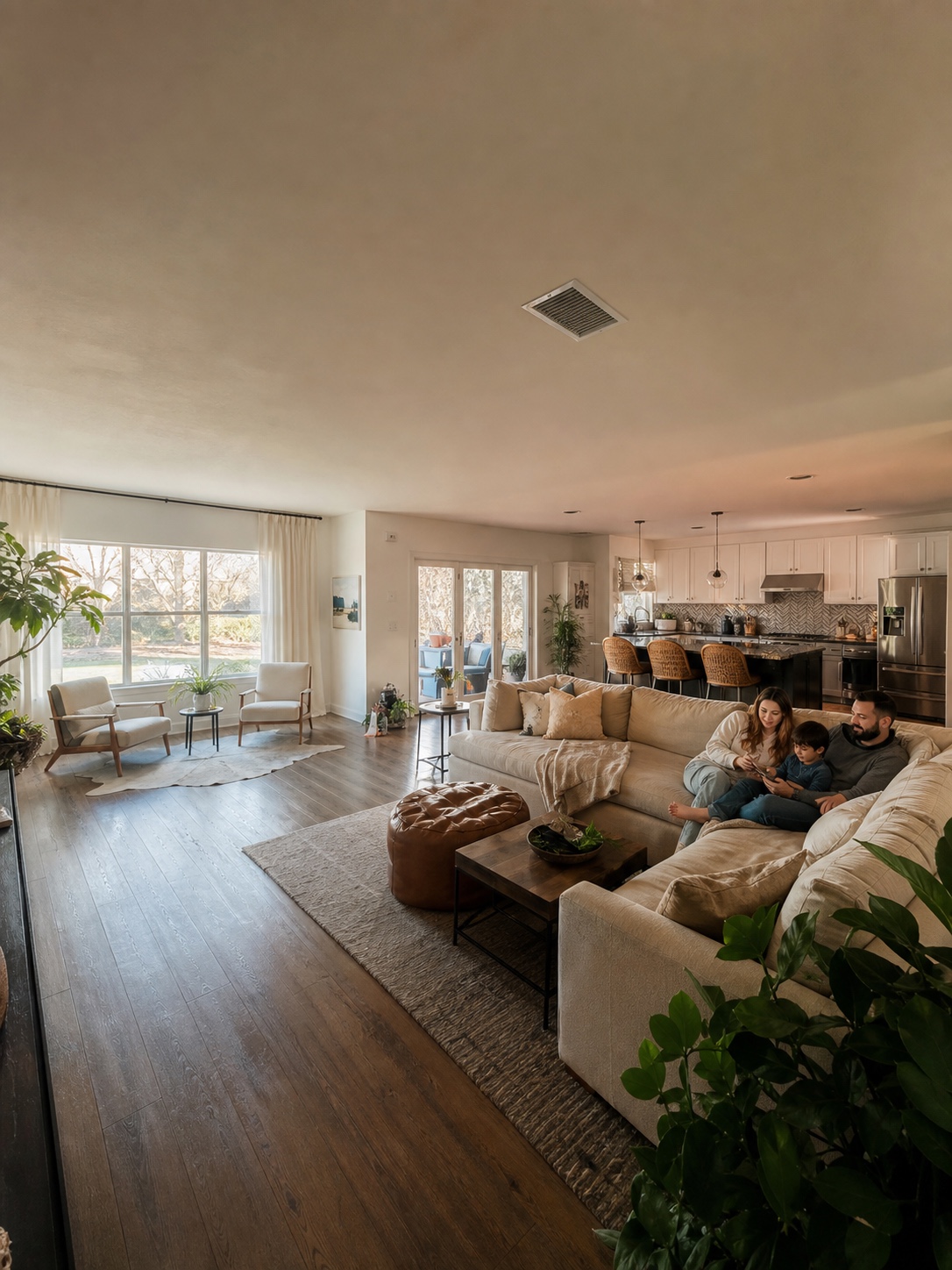
Design test: photograph a room in natural light and again after a full day of occupation. If the furniture positions have shifted, even slightly, note the direction. People consistently move toward thermal comfort. The direction of that movement tells you where the problem zone is.
3. Weak airflow around furniture and window treatments
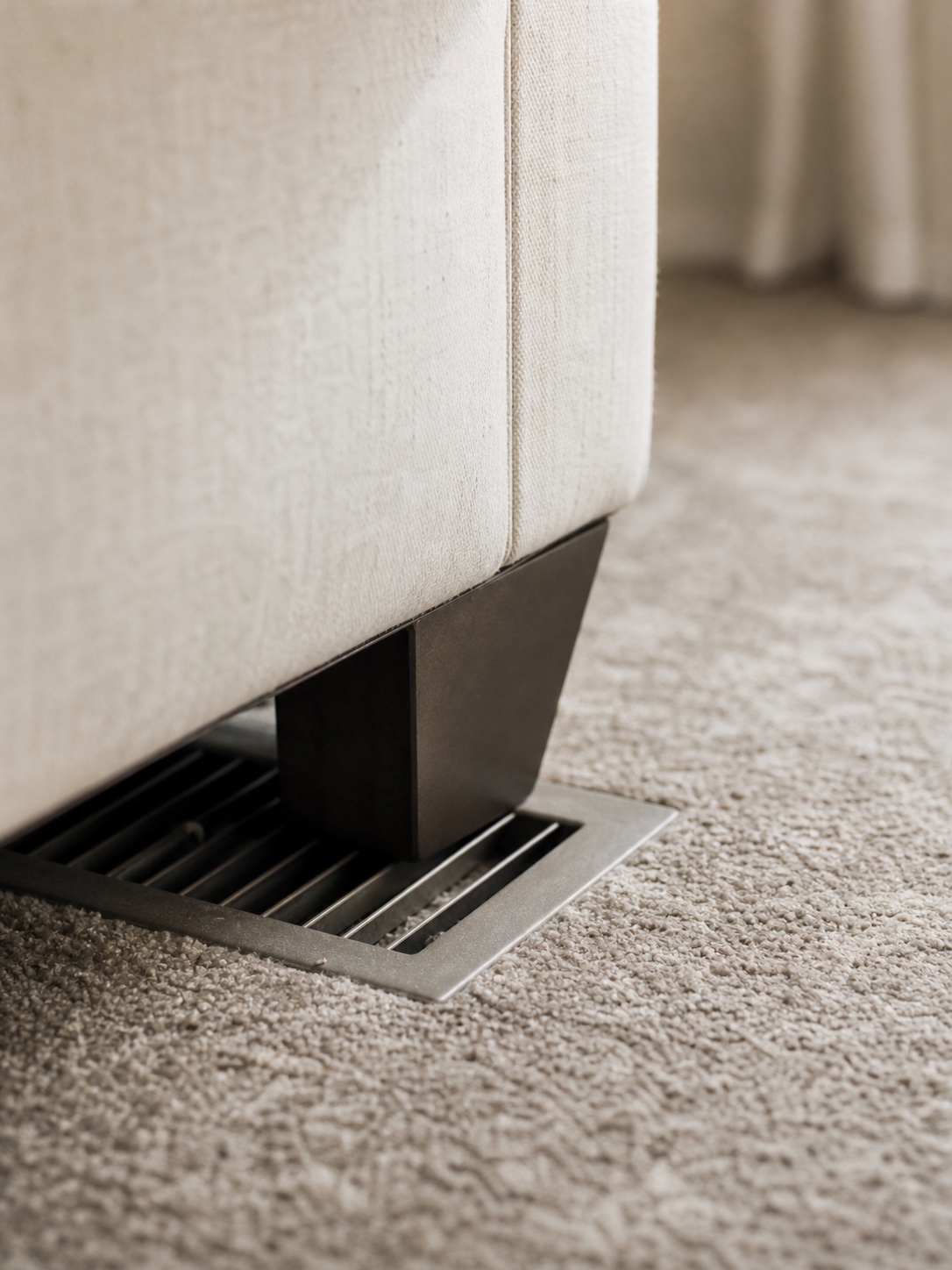
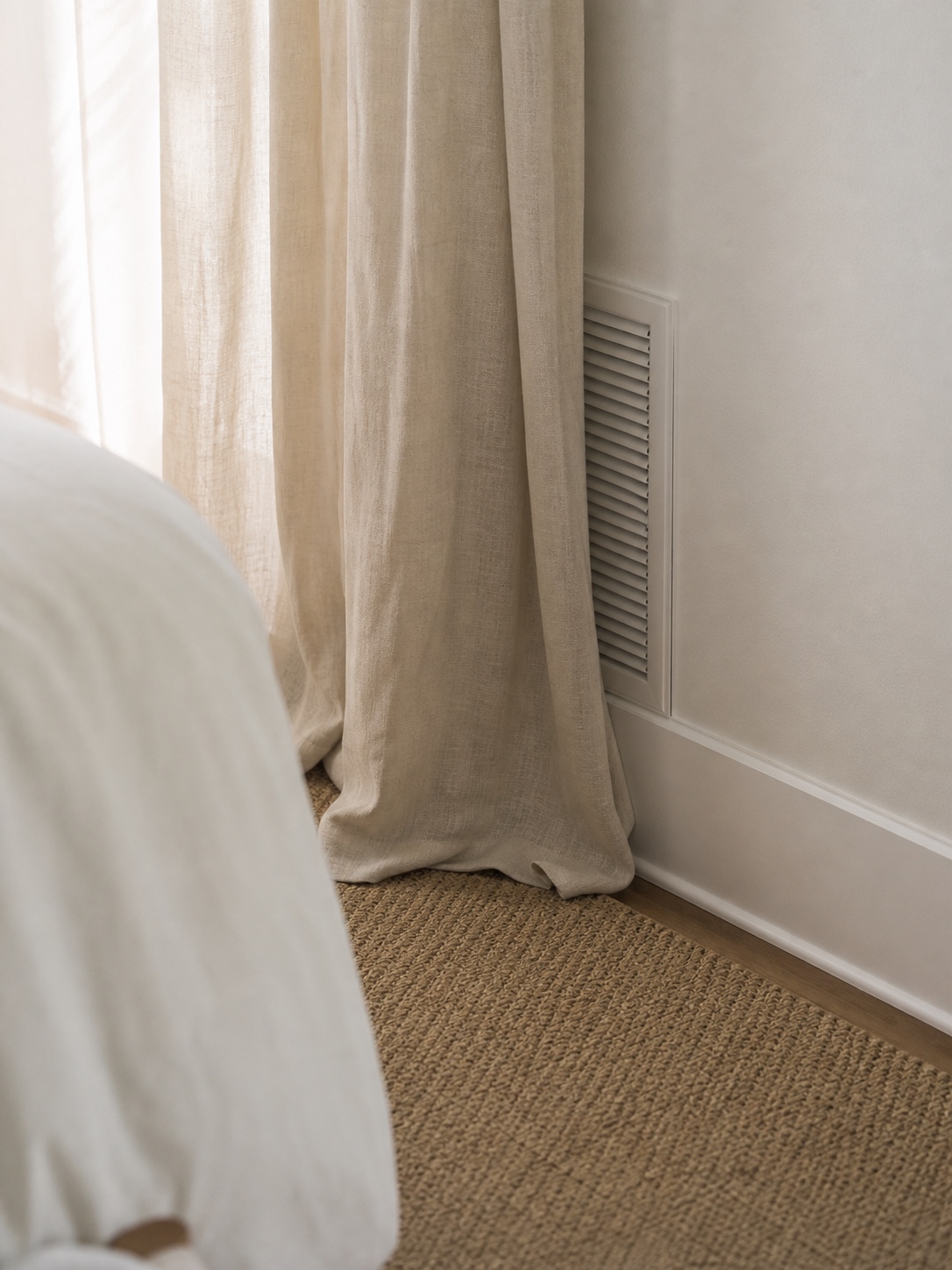
Supply vents deliver conditioned air. Return grilles pull it back. Both sides of this exchange need clear paths to function correctly. In a designed interior, furniture placement, curtain depth, built-in storage, and rug placement all interact with the vent and return layout in ways that are rarely fully coordinated. A sofa positioned over a floor supply vent blocks the air from distributing into the room. The register still delivers air, but it goes directly into the upholstery rather than into the space. A return grille behind a long curtain panel receives almost no air from the room side because the fabric creates a low-resistance barrier between the grille and the room.
What blocked airflow does to a room
A room with a blocked supply vent will feel warmer than the thermostat suggests, because the conditioned air is not reaching the inhabited zone. A room with a blocked return will feel stale, because the air cannot circulate back through the system for reconditioning. In both cases, the HVAC system works harder to maintain the set temperature, drawing more energy and producing more noise without improving the result.
From a design standpoint, this is a coordination failure that can be caught during the furniture plan phase. Vent locations should be marked on the floor plan before furniture positions are finalized. Return grilles should be accessible from the room side, which affects where floor-length curtains can be placed and how close wall-mounted built-ins can be to the grille without a gap allowance.
If the room is still at the planning stage, this guide to coordinating HVAC and interior design shows how to resolve vent positions, ceiling details, humidity, furniture, and service access before the finishes are fixed.
4. Humidity that makes materials feel wrong
A properly functioning air conditioning system does two things: it cools the air and it dehumidifies it. When the system is undersized, poorly calibrated, short-cycling, or failing, it may reduce the temperature without completing the dehumidification cycle. The room feels cooler by thermometer and uncomfortably damp by experience.
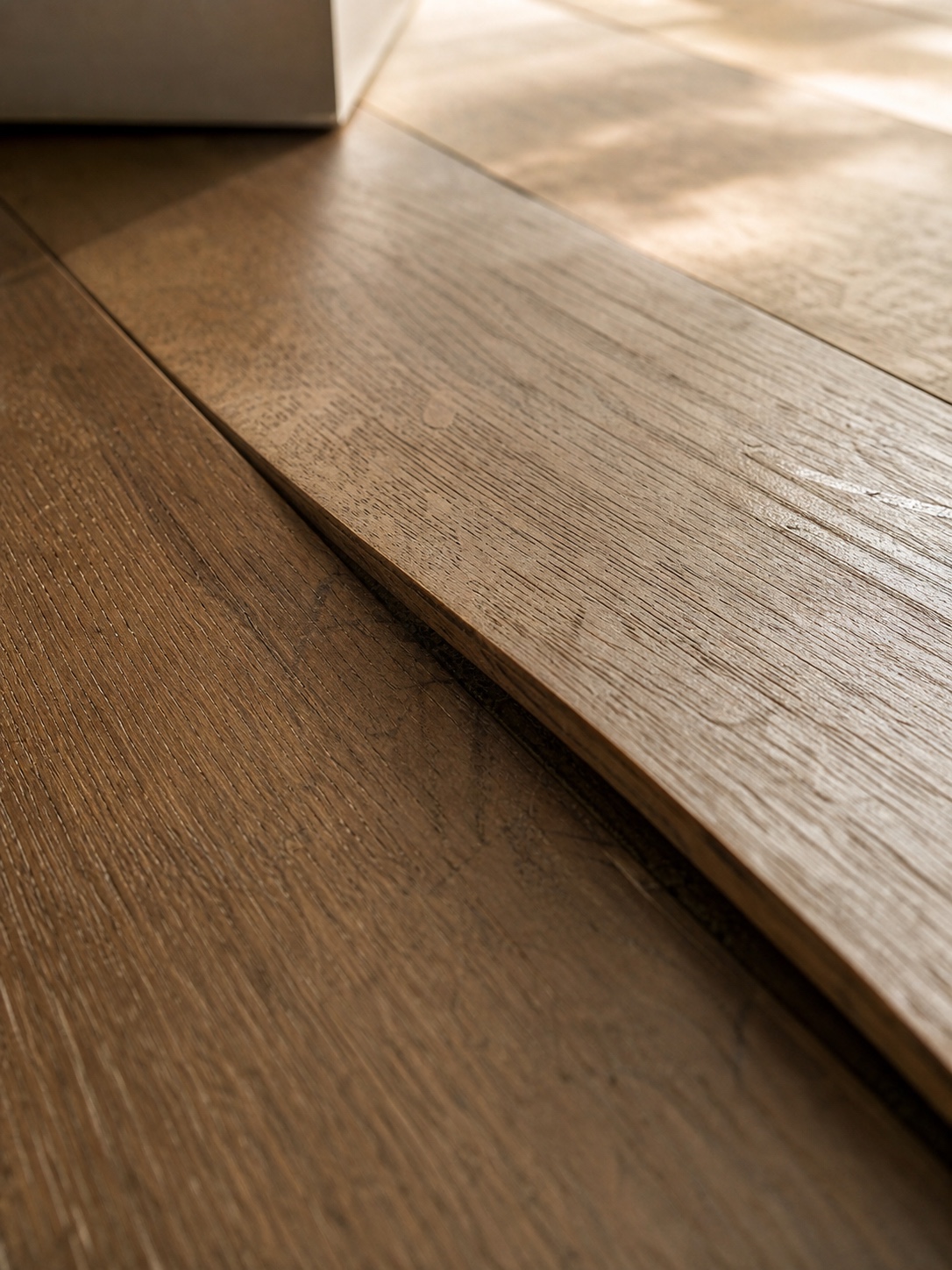
The material effects of sustained high humidity in a residential interior are real and cumulative. Wood floors absorb moisture and expand across their width. If the humidity is consistently elevated, the expansion exceeds the gaps between boards and the planks begin to cup, their edges rising above the center face. This is not a cosmetic problem. Cupped boards are structurally deformed and the damage is not easily reversed.
Materials most affected
Solid timber floors are the most sensitive because wood is hygroscopic: it absorbs and releases moisture continuously in response to ambient humidity. Wide-plank floors move more than narrow-plank floors because the wider face has more area to expand across. Engineered wood is more stable but not immune. Upholstered furniture in high-humidity rooms absorbs moisture from the air.
The result is the persistently slightly-damp-feeling cushion that clients often attribute to cleaning or a spill. The fabric surface is wicking ambient moisture from the air, and no amount of airing or drying helps if the humidity source continues. Paint on walls adjacent to a struggling AC unit or in rooms with poor air circulation can show moisture bubbles or blistering.
Trim at window frames and baseboards may begin to show slight separation at joints as the wood moves. These are material signals that the humidity in the space has been elevated long enough to affect the building fabric.

5. AC noise that ruins quiet zones
Designed quiet zones, bedrooms, home offices, reading nooks, media rooms, have specific acoustic requirements that HVAC noise directly undermines. A bedroom where the AC produces a mid-frequency hum at 40 decibels is not a restful bedroom regardless of how carefully the materials and lighting have been selected.
A home office where the register produces a periodic rushing sound every time the system cycles disrupts concentration at exactly the threshold where focus begins. AC noise in residential spaces comes from several distinct sources: mechanical noise from the air handler or compressor, duct resonance from undersized or vibrating duct sections, and register turbulence from registers that are too small for the volume of air being pushed through them.
How noise maps to room type
Rooms directly above or adjacent to the air handler unit receive the most mechanical noise. Rooms at the end of long duct runs sometimes receive turbulence noise because the pressure has dropped and the remaining airflow is less controlled.
Rooms with high ceilings can develop standing wave resonance from register placement that produces an audible tone at the dominant frequency of the room’s dimensions. In a bedroom that has been carefully specified for rest, AC noise is a design problem before it is a repair problem. It changes how the room functions regardless of how well everything else has been done. Identifying whether the noise is mechanical, ductwork-related, or register-related determines whether the solution is a system repair, a duct modification, or a register change.
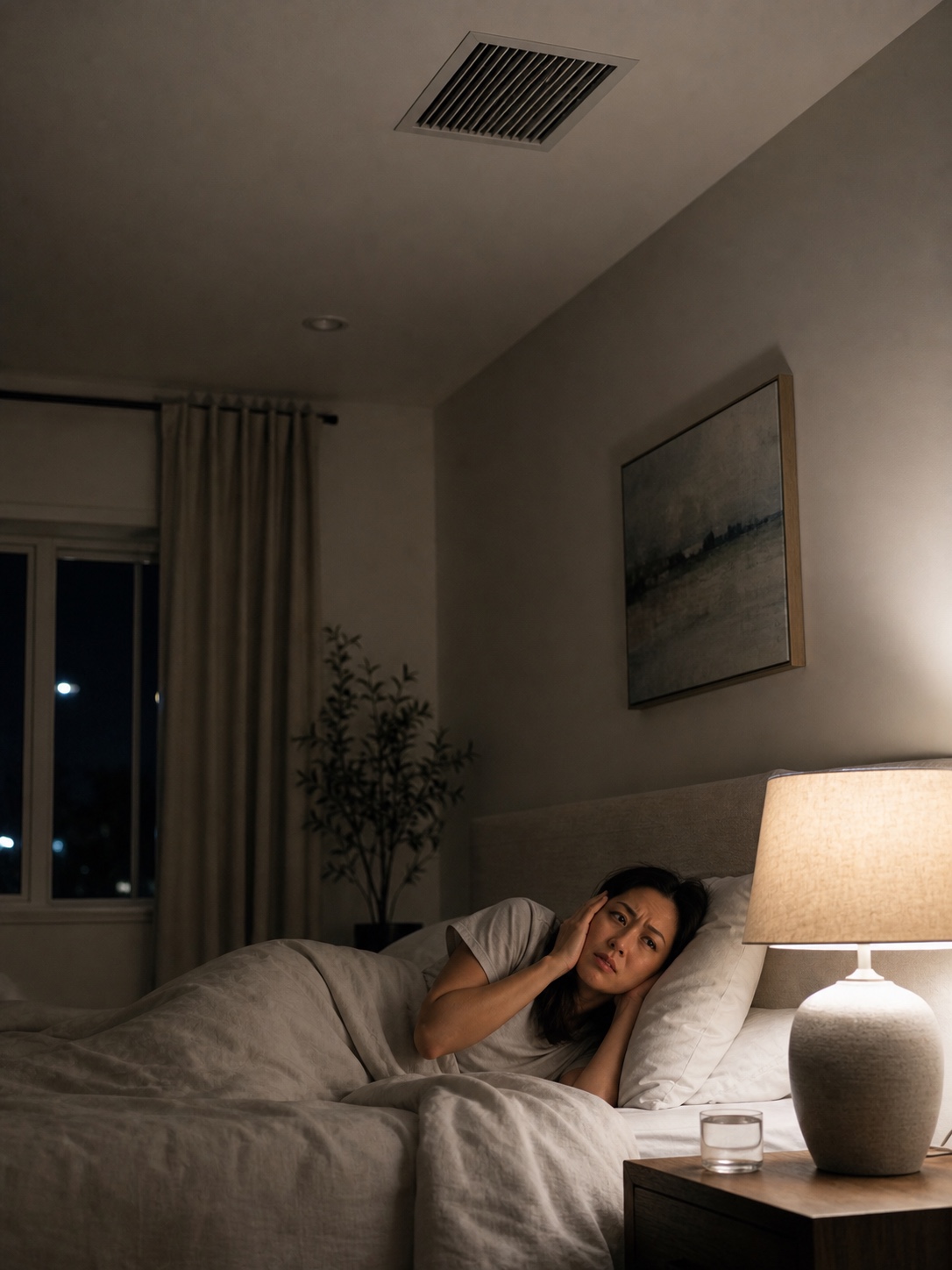
For home offices and bedrooms: map the AC noise during site visits at different times of day. Note when it is loudest (typically when the system first cycles on), what character the noise has (mechanical hum, air rush, rattle, or resonance), and whether it persists throughout the cycle or only at initiation. These observations help an HVAC technician diagnose the source faster.
6. Condensation and leaks that threaten finishes
Air conditioning systems produce condensation as a byproduct of dehumidification. That condensation is collected and removed through the condensate drain. When the drain line clogs, the condensate pan overflows. When refrigerant is low or the system is running outside its design parameters, the evaporator coil can ice over and then thaw, producing more water than the drain system expects.
Water that escapes the system reaches building materials. The results depend on where the equipment is located and what is below it. A ceiling-mounted air handler unit that overflows damages the ceiling below it, then the wall finish, then potentially the flooring. An attic unit that leaks can damage insulation, framing, and eventually ceiling finishes in the rooms below.
What condensation damage looks like before it becomes critical
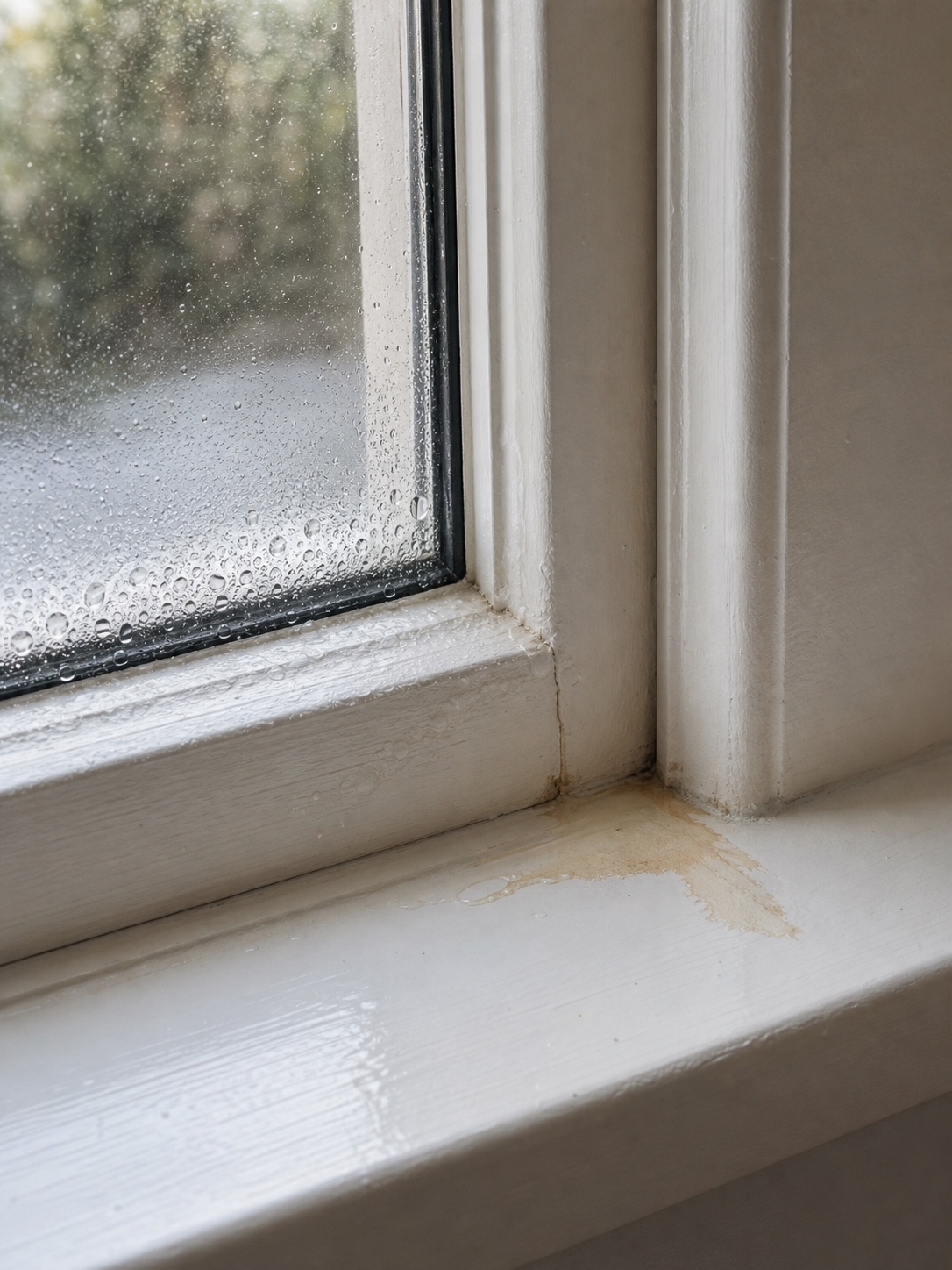
Early condensation damage is visible as water staining on painted surfaces: typically a brown ring at the perimeter of a damp zone on a ceiling, or a tide-mark effect on painted drywall adjacent to a window frame where condensation has been running. These marks appear before the ceiling or wall surface has been structurally compromised. At window frames, condensation forms on glass surfaces when the glass temperature is below the dew point of the interior air.
Some condensation on glass is normal in cold weather. Condensation that runs down and puddles at the base of the frame, or that produces visible water staining on the window stool and apron, indicates that the indoor humidity is higher than the system is managing.
The window is not the problem. The humidity is. Any finish material adjacent to a persistent condensation or leak source will eventually be damaged: painted timber trim, cabinetry placed near the equipment, hardwood flooring in the leak path. Early intervention stops the material damage at the cosmetic stage rather than the structural one.
7. Temporary fixes that create visual clutter
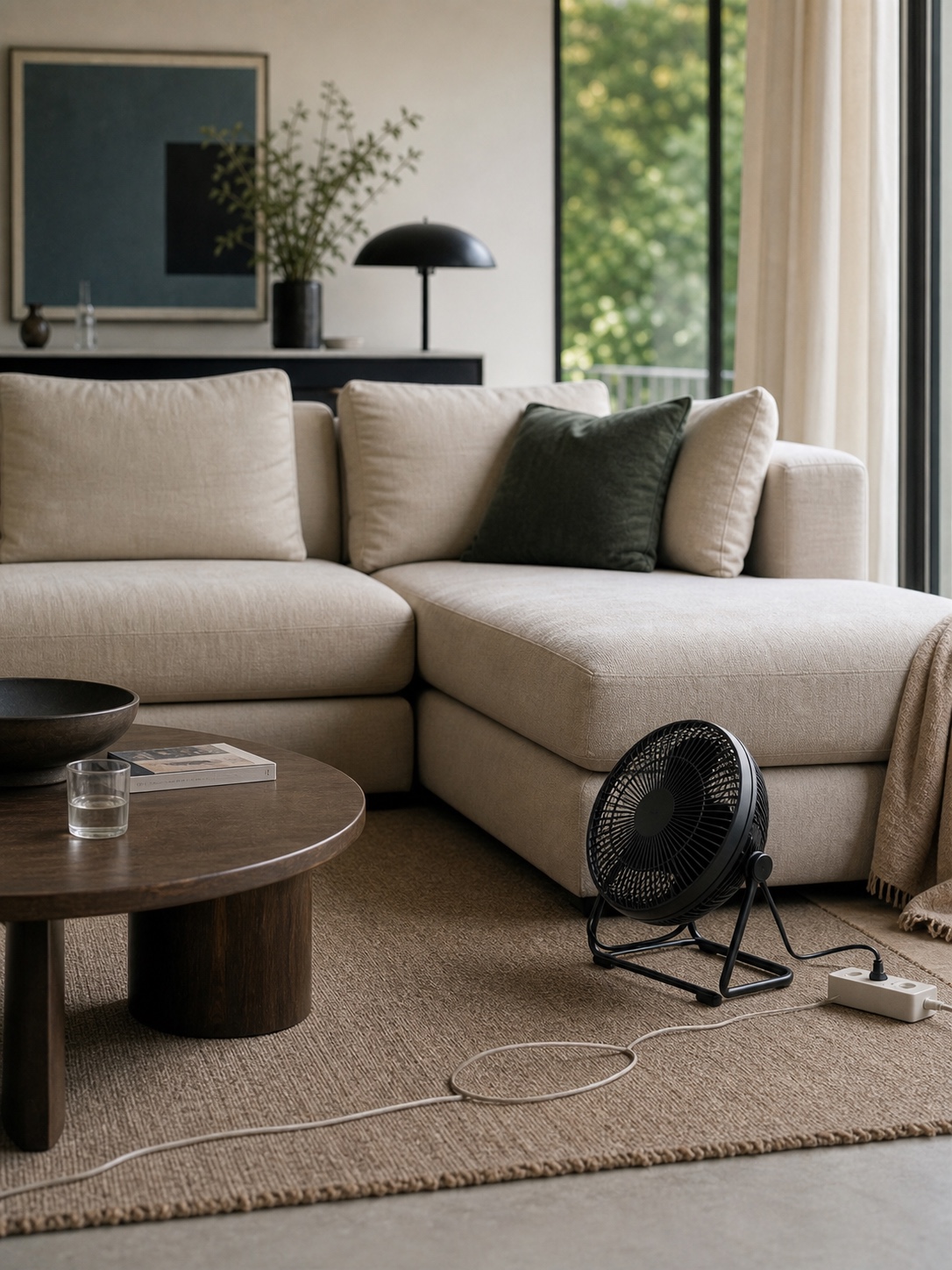
When a room is thermally uncomfortable, the people living in it find ways to cope. Those coping mechanisms are almost always visible in the interior, and they almost always conflict with the design intent. The portable electric fan on the rug with an extension cord trailing to the nearest outlet. The portable air conditioning unit blocking part of a window with its exhaust hose taped into the frame.
The heavy curtain panel pulled across the room and secured with a hook to block afternoon sun that the HVAC system cannot manage. These interventions are rational responses to a comfort problem. They are also signals that the designed solution is not working. A room where temporary workarounds have accumulated over a season of use is a room that has been adapted to a failing system rather than maintained as a designed space.
Reading the workaround inventory
When I walk into a space and see a portable fan, I note which direction it is facing and where it is positioned. A fan pointing toward a sitting area from the corner of the room is compensating for weak supply from the register in that zone.
A fan positioned near a window is compensating for solar gain that the AC is not handling. A fan in a bedroom doorway is circulating air between a conditioned corridor and an under-conditioned room. Each placement is a spatial description of a specific HVAC failure. Once you read them this way, the workarounds stop being clutter and start being diagnostic information. The room is telling you what the system is not doing.
8. When the design issue is actually a repair issue
The design-first approach to any comfort problem in an interior is to look at the spatial decisions: furniture placement, vent coordination, material selection, and solar control.
Most of the time, these are the right places to look. But when the comfort problems have appeared suddenly in a room that was previously working, or when the pattern of problems matches a specific system failure rather than a planning oversight, the room may not need redesigning first. If airflow, humidity, noise, condensation, or uneven cooling have changed in a space that was previously comfortable, the most efficient path is to schedule ac repair before attempting any spatial redesign. A failing capacitor, a clogged drain, a refrigerant issue, or a deteriorating blower motor can produce every symptom described above. Fixing the system takes hours.
Redesigning a room around a failing system takes months and produces results that still do not work once the system degrades further. The diagnostic question is timeline: did the problem appear suddenly, or has the room never worked well? Sudden appearance points to a system issue.
Persistent problems from move-in point to a planning or installation issue. Both are solvable, but the sequence matters. System issues need professional attention before design decisions are made. Planning issues need design attention before any space works as intended, regardless of how well the system performs.
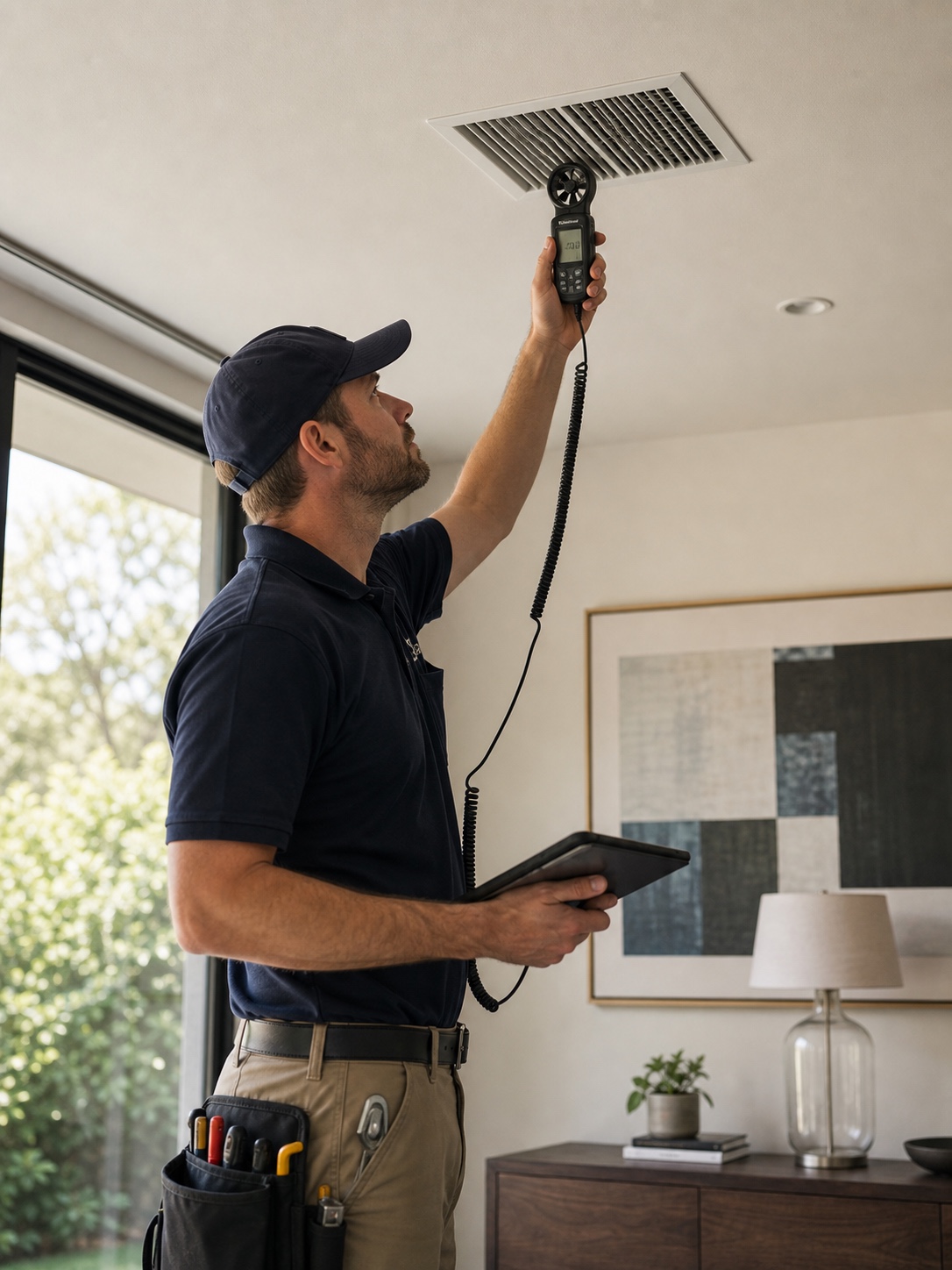
Before scheduling any interior redesign consultation for a room that is not working: note when the problem started, what changed before it started (new season, new furniture, renovation work in an adjacent space, system service or replacement), and whether adjacent rooms have similar issues or remain comfortable. This information takes fifteen minutes to gather and saves hours of misdiagnosis.
Frequently Asked Questions
How do AC problems affect interior design?
AC problems affect interior design in several direct ways. Uneven cooling creates thermal zones that change how people use a room. Excess humidity warps wood floors, causes upholstery to feel damp, and promotes mildew on textiles. Condensation from leaking equipment damages trim, flooring, and cabinetry. AC noise disrupts quiet zones. All of these effects are experienced before they appear as visible system failures.
Can a room feel uncomfortable even when the thermostat reads correctly?
Yes. Humidity is a major factor: a room at 23 degrees Celsius at 70% relative humidity feels significantly warmer than the same temperature at 45% humidity. Airflow distribution is another: a room where cool air is concentrated in one corner rather than distributed evenly has warm pockets near furniture regardless of the thermostat reading.
What are the most common ways HVAC problems show up in a finished room?
Hot spots that people begin avoiding. Furniture that migrates toward the comfortable zone over weeks of use. Condensation water staining on windowsills or walls. Upholstery that feels permanently damp. Warping in wood floors near exterior walls. Mildew smell in rooms with poor air circulation. Portable fans or portable AC units added as workarounds, creating visual clutter that breaks the design.
How do I know if my room comfort problem is a design or HVAC issue?
The timeline is the clearest indicator. If a room that was previously comfortable has developed hot spots, humidity problems, or persistent noise, the change points to a system issue rather than a design one. If the room was never comfortable from first occupancy, the issue may be in vent placement, return air location, or zoning. Sudden changes point to repair needs; persistent problems from move-in point to design or installation issues.
Does AC airflow direction affect furniture placement?
Yes. Supply vents should not be blocked by sofas, large case goods, or heavy curtain panels. Return air grilles need unobstructed access to function correctly. Blocking returns reduces efficiency and creates stale zones. In a well-designed interior, furniture placement accounts for vent and return locations as a hard constraint alongside wall outlets, switches, and architectural features.
Can high indoor humidity damage interior finishes?
Yes. Wood floors expand under sustained high humidity, causing cupping where plank edges rise above the center face. Solid timber furniture joints loosen under repeated humidity cycling. Paint on walls near poorly performing AC equipment can blister. Upholstered furniture in high-humidity rooms absorbs moisture from the air, creating a permanently damp feel and conditions for mildew within the fabric.
Why does my AC make more noise in some rooms than others?
Rooms closer to the air handler unit receive more mechanical noise through ductwork. Undersized ducts create turbulence noise at supply registers. Vibrating duct sections transmit resonance noise into adjacent rooms. Bedrooms and home offices are most affected because background noise tolerance is lowest in those spaces, and even moderate AC noise at those frequencies disrupts sleep and concentration.
- 32shares
- Facebook0
- Pinterest32
- Twitter0
- Reddit0