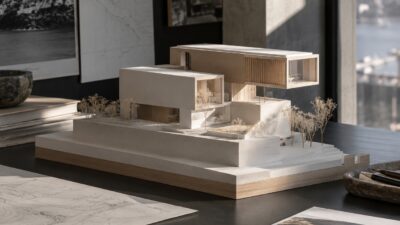
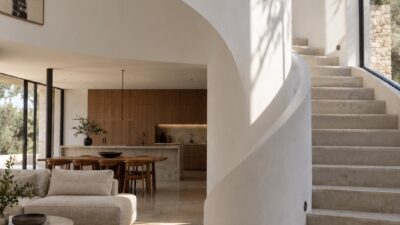
I’ve spent years working across architectural and interior design projects in different countries, and the pattern is consistent: buyers almost always know when a building has been designed well. They don’t always know why. They walk into a corridor that feels too dark, or onto a balcony that’s technically present but never usable, or through a lobby that photographs beautifully and serves nobody. The feeling is there before the reasoning.
Abu Dhabi’s residential market has grown to a point where the gap between a developer with a serious design process and one with a serious marketing budget is harder to see from a brochure alone. Renders are indistinguishable. Price per square metre can be similar. The differences show up in the details that a photograph either can’t capture or has been specifically composed to hide.
- Why design quality is the right lens for comparing developers
- Master planning and walkable community layouts
- Architecture that responds to heat, shade, and light
- Interior finishes that feel durable, not just expensive
- Outdoor living spaces: balconies, terraces, and views
- Amenities that support daily life, not just marketing brochures
- Sustainability, cooling systems, and material choices
- What buyers should check before trusting the renderings
- Final design checklist for Abu Dhabi property buyers
- Frequently asked questions
- What should I look for when comparing property developers in Abu Dhabi?
- How do Abu Dhabi building regulations affect residential design quality?
- What does master planning mean in Abu Dhabi residential developments?
- How can I verify a developer's track record in Abu Dhabi?
- What sustainability features matter most in Abu Dhabi residential properties?
- Are balconies and outdoor spaces worth paying more for in Abu Dhabi?
- What interior finish specifications should buyers ask for before signing?
- Design quality is what you live with after the sale
This article looks at seven design features that experienced buyers and architects use to evaluate property developers in Abu Dhabi before committing. These are not investment criteria — they’re design criteria. The question is not which development will appreciate fastest. It’s which one was actually designed to be lived in.
Why design quality is the right lens for comparing developers
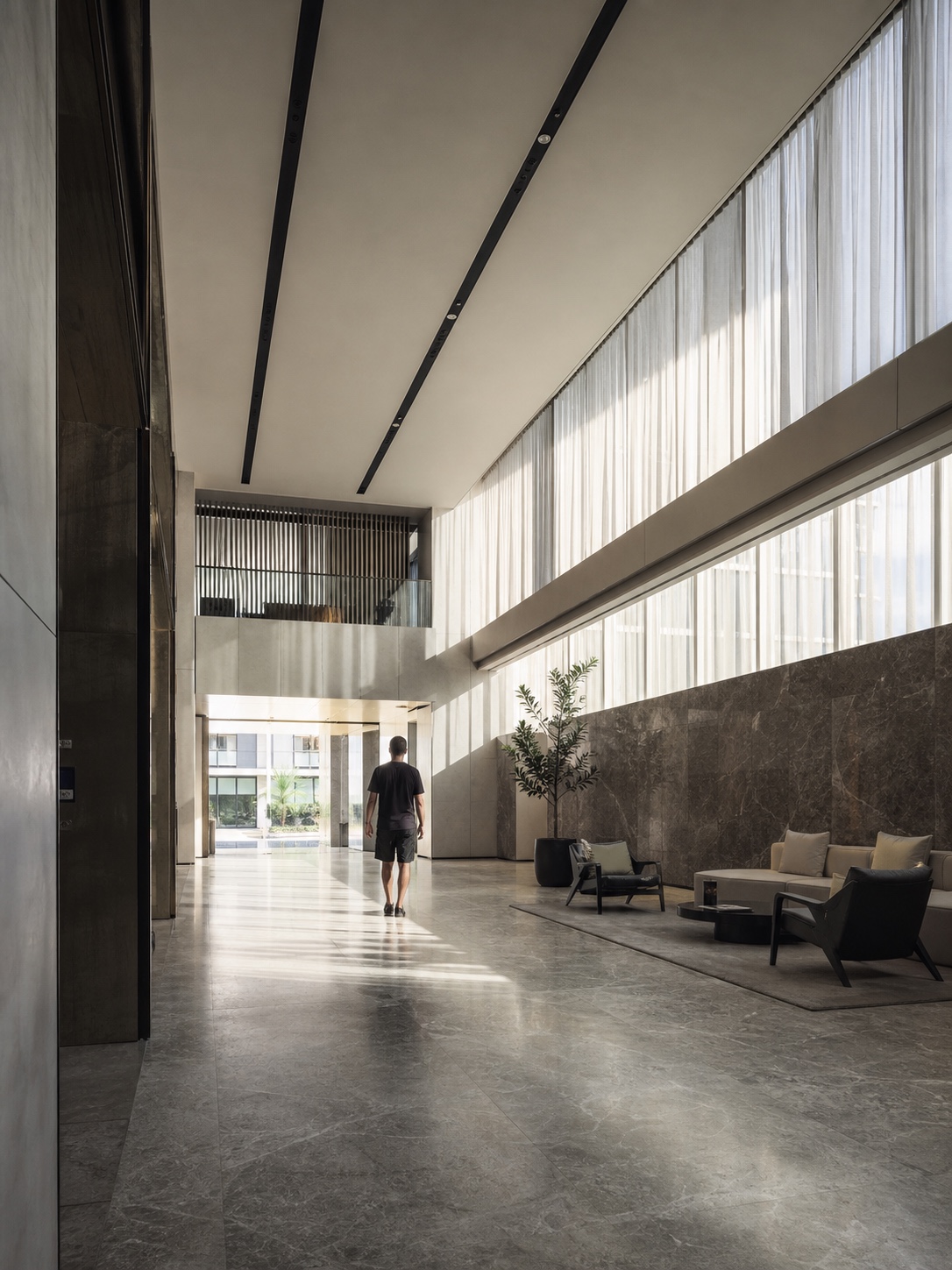
Abu Dhabi’s regulatory framework, maintained by the Department of Municipalities and Transport and documented through the adrec.gov.ae Abu Dhabi Real Estate Centre, sets baseline requirements for what gets built. Building code compliance is not the same as design quality. It’s the floor, not the ceiling.
What separates strong residential developers from average ones is typically what they do above code: insulation specifications beyond the minimum, glazing performance that reduces cooling loads, shading devices integrated into the architecture rather than bolted on as an afterthought, material grades that hold up after five years of Gulf Coast humidity.
These decisions are made during the design phase, long before a buyer sees a showroom. By the time you’re comparing units, the decisions that determine whether you’ll be comfortable in the space have already been made. Knowing what those decisions look like (and what questions to ask to surface them) is what this article covers.
Where to verify developer credentials: The adrec.gov.ae Abu Dhabi Real Estate Centre (adrec.gov.ae) provides information on registered developers, active projects, and regulatory status. Check any developer’s standing here before proceeding to contract review.
Master planning and walkable community layouts
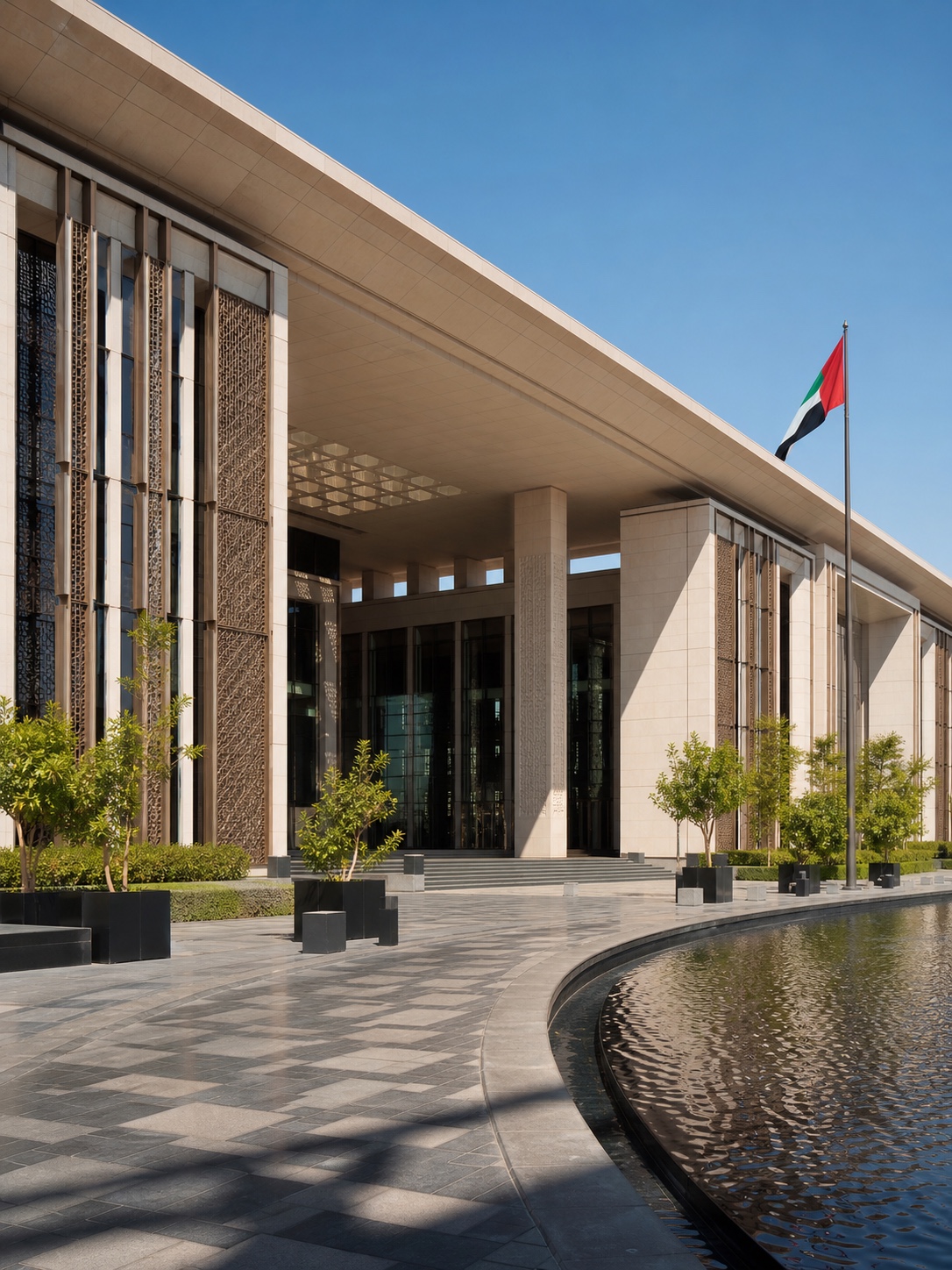
Master planning is the organizing logic of the whole development: how buildings relate to each other, where pedestrian movement happens, where cars are kept, how shared spaces connect to private ones. It’s also the part of a project most people never explicitly evaluate because they’re focused on the unit itself.
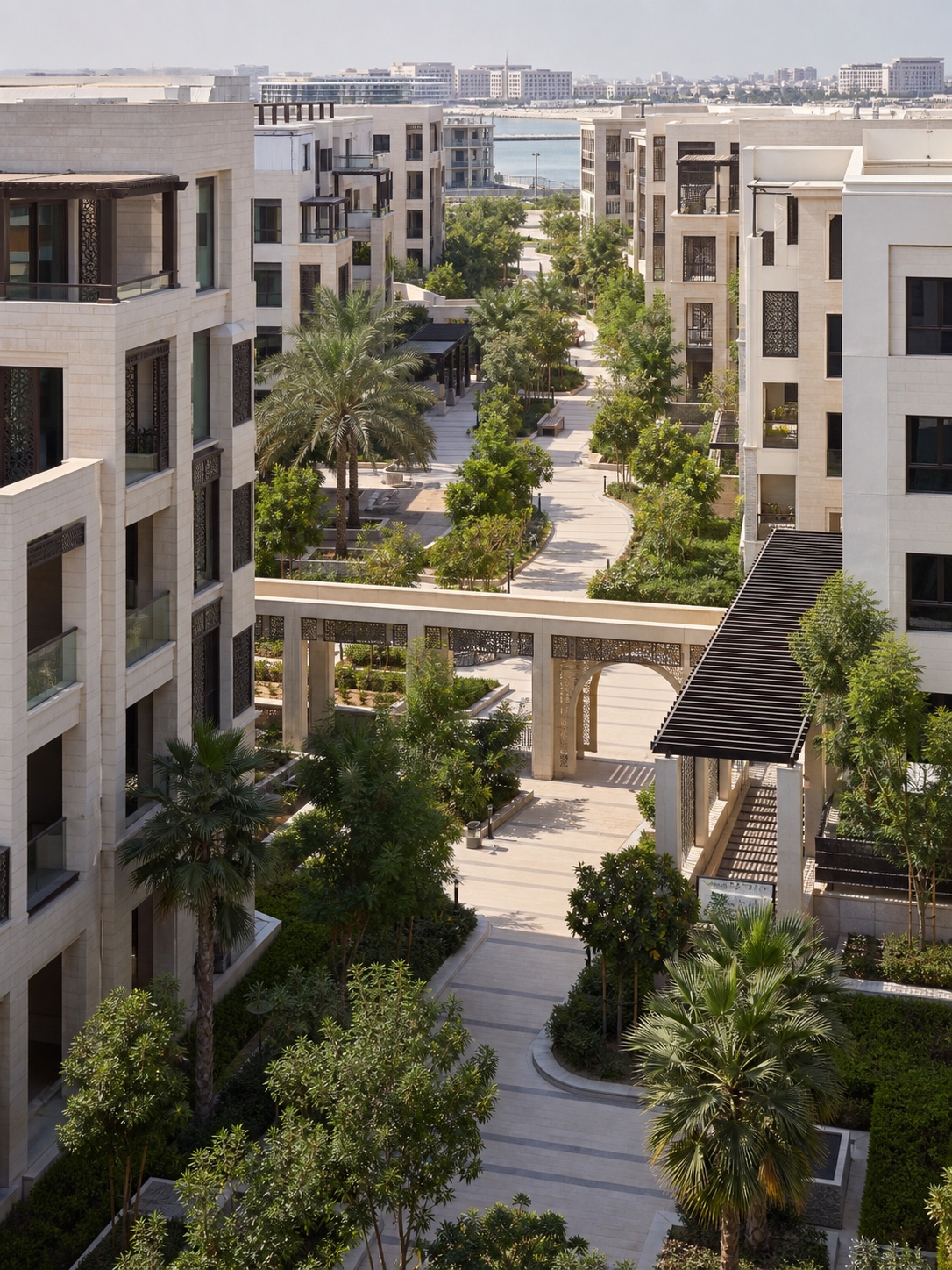
In Abu Dhabi’s climate, walkability has a specific meaning. A pedestrian path that runs unsheltered across an open courtyard is not walkable from June to September. Developers who have thought seriously about outdoor movement build covered walkways, shaded arcades, and landscaped buffers that create usable transitions between buildings. Developments that haven’t thought about it have open paths between parking and lobby entrances that residents drive around rather than cross on foot.
Building orientation in the site plan
East-west building orientation is the standard approach for reducing direct afternoon sun exposure on occupied facades. A building with its long axis running north-south exposes residents on the west face to several hours of direct afternoon sun that no amount of interior cooling fully compensates for. Check the site plan orientation before evaluating units.
Strong master plans also separate service access (delivery vehicles, waste collection) from residential pedestrian movement. This sounds obvious and frequently isn’t done. In projects where service corridors share space with children’s play areas or main walkways, the result is exactly what you’d expect.
Ground-level activation
Ground floors in residential buildings are either dead space (parking plinths, blank walls, utility entries) or active space (retail, cafes, co-working, landscaped gardens). Developments that activate the ground level create communities. Developments that don’t create buildings with nice upper floors and nowhere to be at street level.
Architecture that responds to heat, shade, and light
Gulf climate architecture has a clear design problem: intense solar radiation, high summer temperatures, and the need for both natural light and thermal comfort simultaneously. The solutions are not complicated, but they require a developer who budgets for them.
External shading devices — mashrabiya screens, projecting floor plates, deep-set windows, horizontal brise-soleil fins — reduce direct solar gain on glazed surfaces before it enters the building. A building with floor-to-ceiling glass and no external shading will have thermal comfort problems regardless of how powerful the cooling system is, and the cooling costs will reflect that permanently.
Glazing specifications
Not all glass performs the same in direct sun. Solar heat gain coefficient (SHGC) measures how much solar radiation passes through a glazing unit. High-performance glazing used by quality developers has SHGC values in the range of 0.2 to 0.3, meaning 70 to 80 percent of solar radiation is rejected. Standard glazing can have SHGC values above 0.6. This difference is measurable in surface temperature, glare, and cooling energy consumption.
Ask developers for glazing specifications by product name and rating. A developer with a serious technical process can answer this immediately. One whose specifications don’t go deeper than “double-glazed with reflective coating” is telling you something important about their design process.
Thermal envelope performance
Insulation in walls and roofs determines how much heat transfers from outside to inside over the course of a day. Abu Dhabi’s climate requires higher insulation values than temperate regions to maintain comfort without continuous maximum-load cooling. Developers working above standard typically specify minimum R-values in walls and roofs that exceed the code requirement. This is worth asking about explicitly.
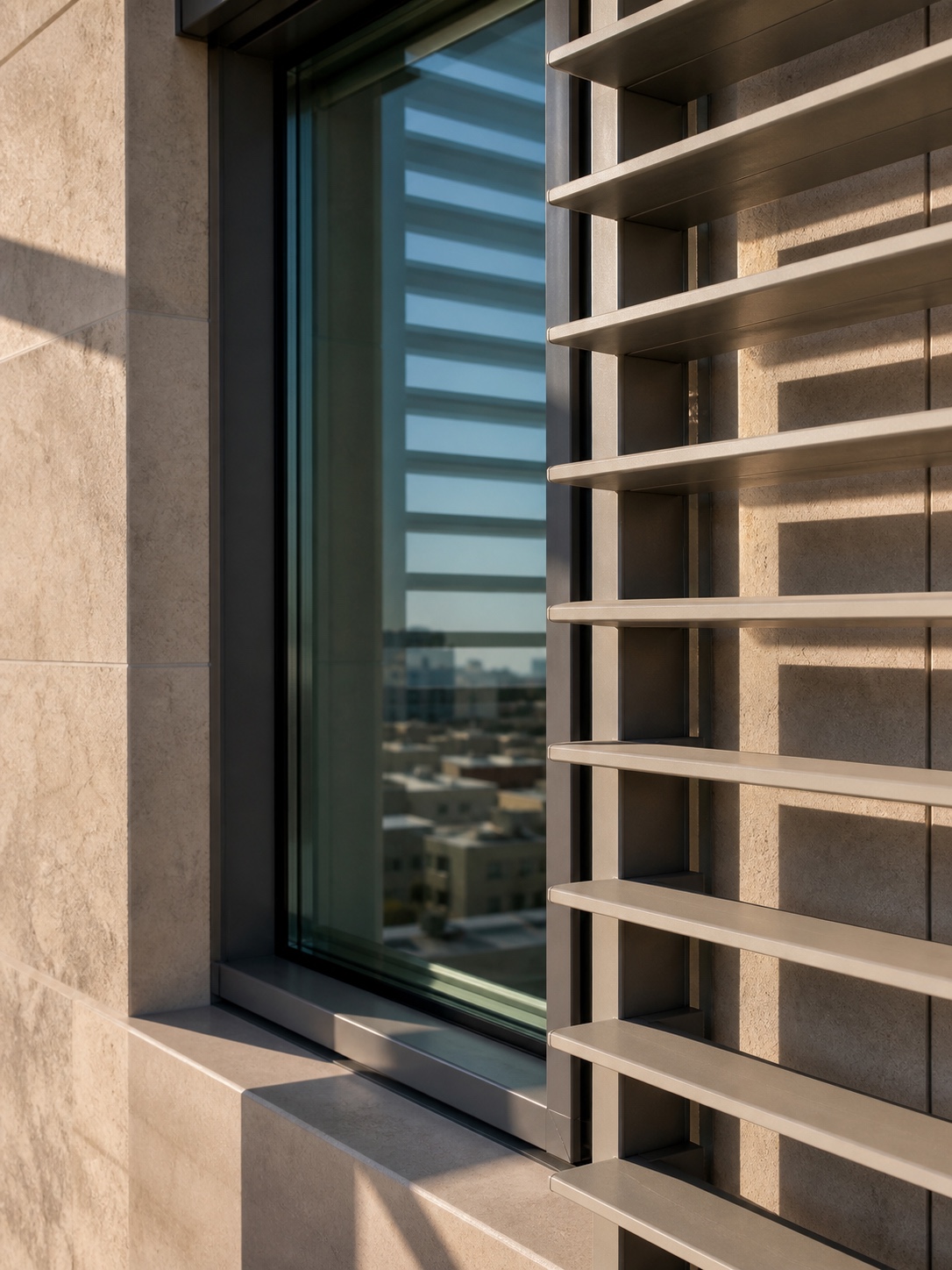
Design signal: If a developer can show you the glazing specification, the U-value or R-value of the wall and roof assembly, and the solar heat gain coefficient by facade orientation, their design process is serious. If they can only show you renders, it isn’t.
Interior finishes that feel durable, not just expensive
Showrooms are designed to impress. They’re lit specifically, styled carefully, and furnished with pieces that won’t be included in the actual unit. The finishes in a showroom are sometimes different specifications from what goes into production units. This is worth knowing before you treat a showroom visit as a reliable preview of your actual apartment.
If you are evaluating units as an investor rather than an owner-occupier, it helps to separate beautiful finishes from an interior design for property investors plan that can survive tenants, listing photos, and resale scrutiny.
Flooring
Large-format porcelain tiles are standard in Abu Dhabi residential developments at this price point. The meaningful specification is thickness (8mm versus 10mm, with thicker tiles being more dimensionally stable and harder to chip at edges) and the grout joint specification. Tight grout joints done correctly look sharp and stay clean. Wide grout joints hide installation errors and collect grime. The difference between a developer who has specified 2mm grout joints and one who’s left it to the contractor is visible within two years.
In kitchens and bathrooms, ask whether the tile extends fully to the ceiling or stops at a paint line partway up the wall. Full-height tile in wet areas is the correct specification. Paint above tile is an economy measure that shows quickly in high-humidity environments.
Kitchen and bathroom quality signals
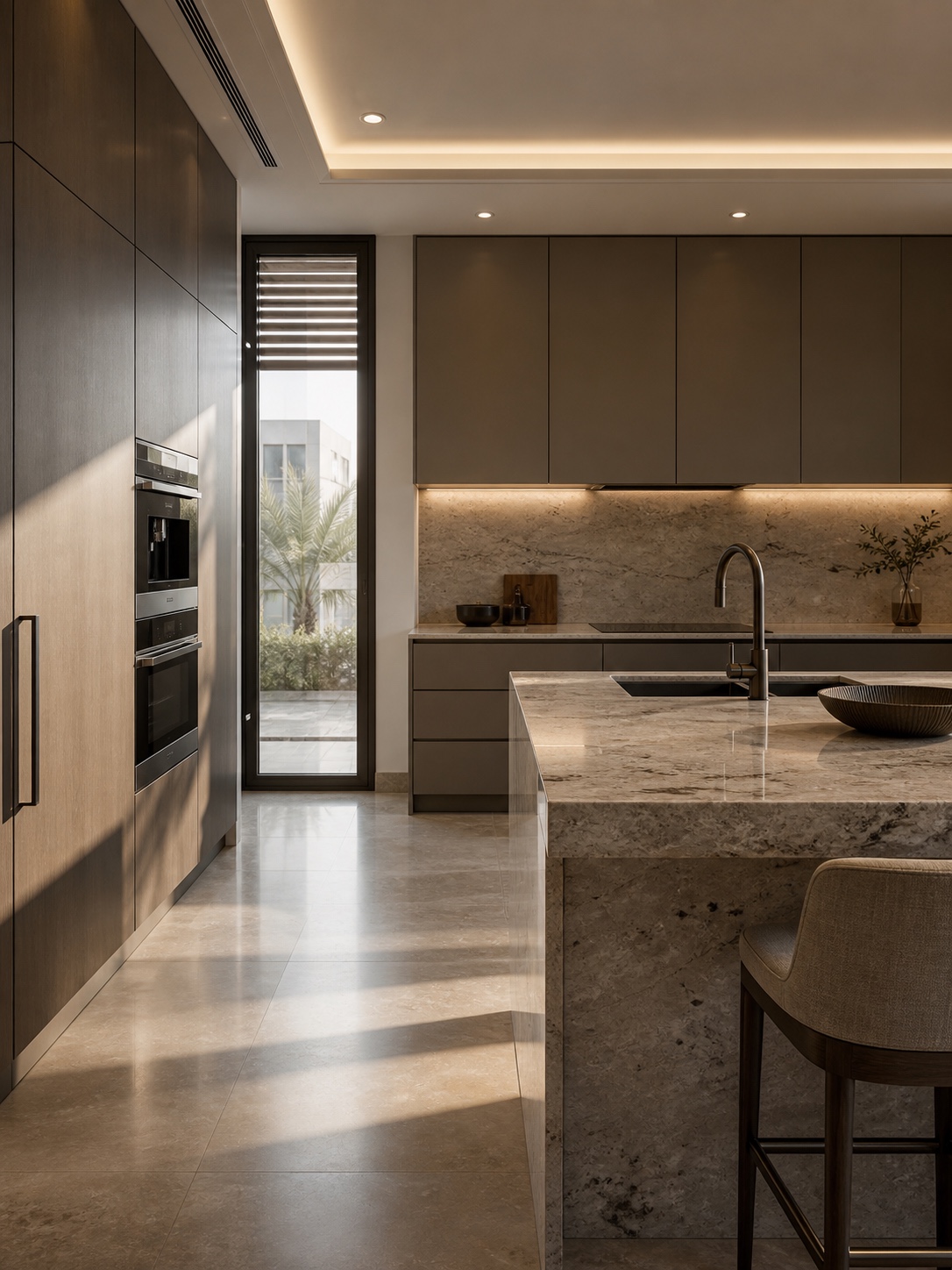
Cabinet carcasses (the box the door attaches to) should be moisture-resistant board in all kitchen and bathroom applications. Standard MDF swells in high-humidity areas. This is a specification that’s invisible in a showroom and very visible after three years of Abu Dhabi summers. Ask for the cabinet specification by brand and material, not just “high-quality joinery.”
Appliance brands and models should be specified in writing. There’s a significant difference between a Bosch appliance included in the unit and a no-name equivalent that appears in the same location in a render.
Bathroom fixtures: ask for the brand and series. Grohe, Hansgrohe, and equivalent European fixtures hold up differently than cheaper substitutes in Gulf water conditions. Hard water effects on internal components are predictable and faster with lower-quality hardware.
Outdoor living spaces: balconies, terraces, and views
Outdoor space in Abu Dhabi is either one of the most valuable features of a residential property or a completely unusable box that adds square metres to a brochure. The difference is design.
A balcony facing west with no overhead shade is a storage area from May through September. A balcony with 2 metres of depth, an overhead soffit that shades the floor during the hottest part of the day, and orientation away from the afternoon sun is usable eight to nine months of the year. These two balconies are described identically in a floor plan.
What to check on balconies
Depth matters more than area. A 4-square-metre balcony that is 2 metres deep can hold furniture and be used. A 4-square-metre balcony that is 1 metre deep cannot. Ask for balcony dimensions specifically: width and depth, not just area.
Orientation matters. North and east-facing balconies receive morning sun and afternoon shade, which is the usable combination in this climate. South and west-facing balconies receive afternoon sun directly. Ask which direction the main outdoor space faces relative to true compass bearing, not just “garden view” or “sea view.”
Overhead shading: is there a floor plate above the balcony that shades it during afternoon hours? Is there a pergola structure, or a designed soffit? Or is it open to the sky? The answer determines whether you’ll ever sit outside in the second half of the day.
View quality and permanence
Views in Abu Dhabi are subject to change. A development with a current sea view may face a building plot between it and the water within five years if the master plan for the surrounding area allows further development. Check the planning status of adjacent plots before treating the current view as permanent.
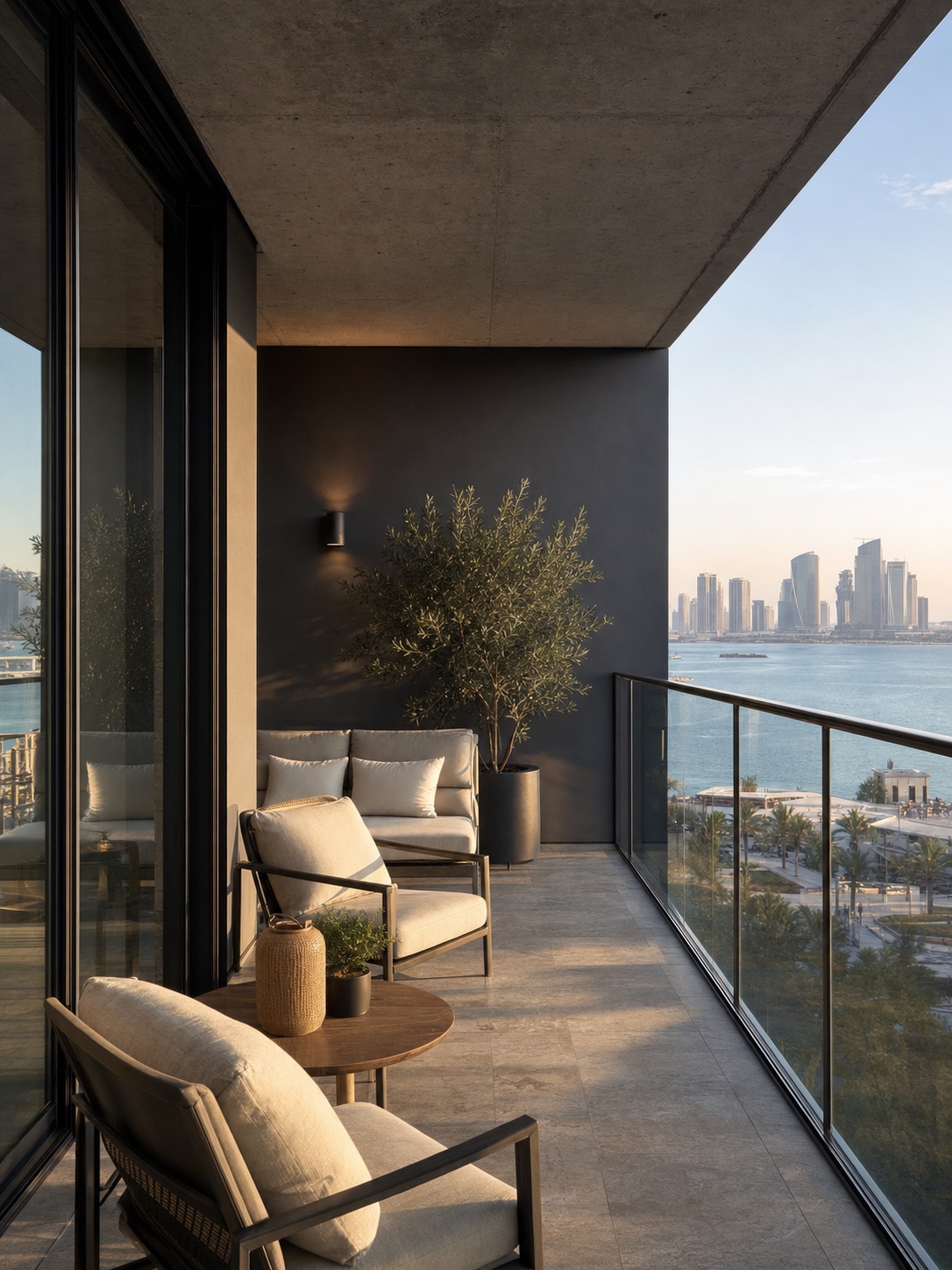
Balcony check: Before finalising any unit, ask for the balcony’s exact dimensions (width and depth), compass orientation, and what provides overhead shade. If the developer cannot provide all three answers, you are buying outdoor space you haven’t evaluated.
Amenities that support daily life, not just marketing brochures
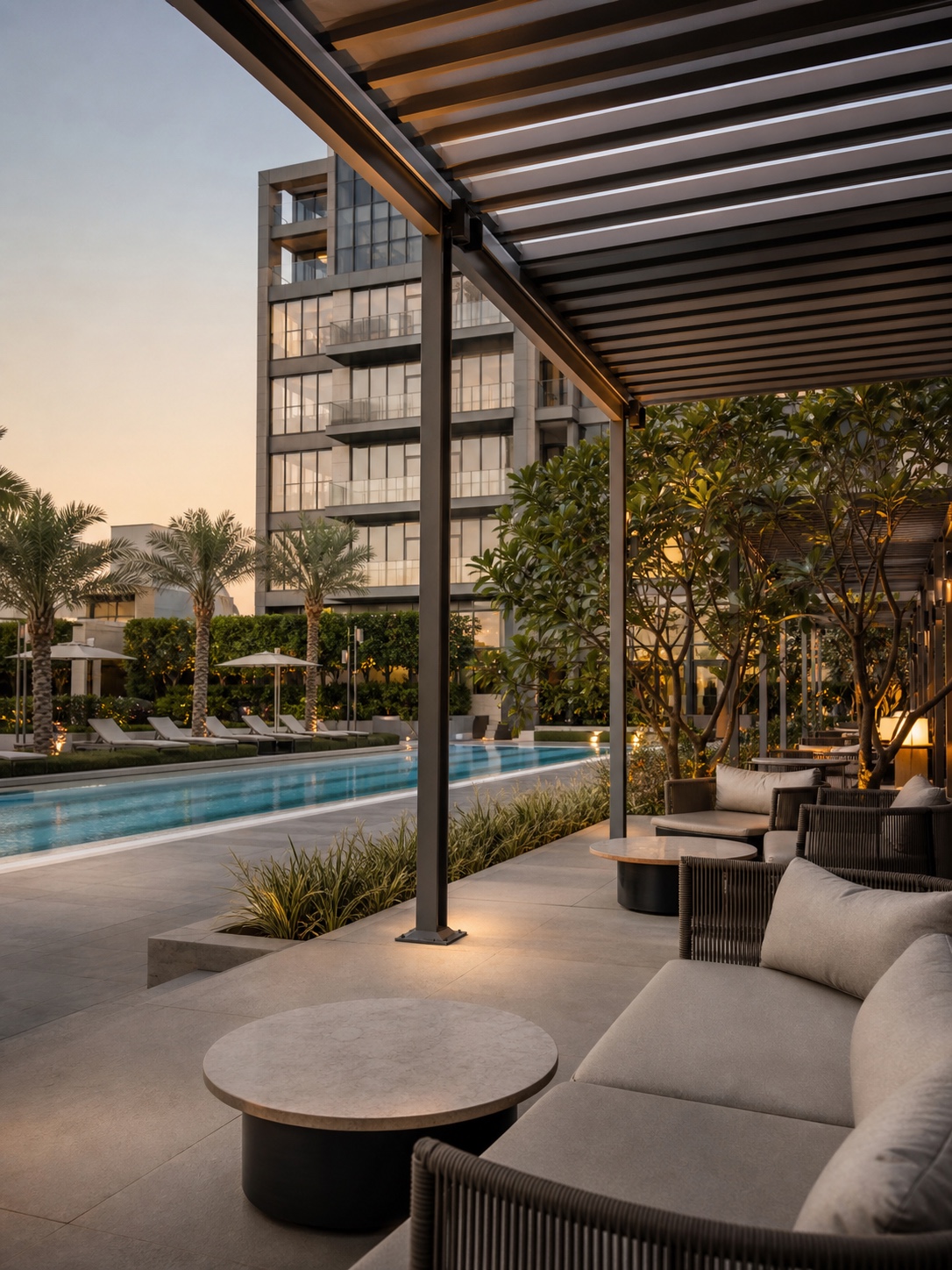
The amenity list is the most reliably inflated section of any residential development brochure. “Infinity pool,” “state-of-the-art gym,” “children’s play area,” “co-working space,” “outdoor cinema” are standard language across projects that vary enormously in what those things actually mean at completion.
The question to ask is not what amenities are listed but how they’re designed and sized relative to the number of units they serve. A gym with twelve pieces of equipment serving a 400-unit building is not a gym; it’s a room with equipment. A pool that looks proportional in a rendering may be 12 metres long in practice.
Daily life amenities versus occasion amenities
The amenities that affect daily quality of life in a residential community are typically: parking that is clearly assigned and sufficient for the actual unit mix, a building management system that handles maintenance requests efficiently, reliable cooling without frequent pressure drops, good mobile and broadband connectivity throughout the building, and lobbies that are actually comfortable to wait in.
These are less photogenic than a rooftop infinity pool. They’re also what determines whether living in the building is pleasant or stressful on an ordinary Tuesday.
Service quality after handover
A developer’s track record on building management after handover is one of the most under-researched aspects of a property purchase. Visit a completed project by the same developer and speak to residents, not just the sales team. Ask specifically about the response time for maintenance, the cooling system reliability, and whether the amenities that were advertised are actually available and maintained.
That same buyer logic applies beyond one project: a strong residential development quality test looks at walkability, daylight, shared space, transit access, and whether the public realm still feels good after the marketing render is gone.
Sustainability, cooling systems, and material choices
Sustainability in Gulf residential development is not optional context. It’s directly connected to comfort, running costs, and the long-term condition of the building. A development with poor envelope performance and an inefficient cooling system will be noticeably less comfortable to live in and cost more to run, regardless of how the marketing describes it.
Estidama Pearl Rating
Abu Dhabi’s Estidama Pearl Rating System is the local sustainability framework, managed by the Department of Municipalities and Transport. All new developments are required to achieve a minimum 1 Pearl rating. Developments achieving 2 Pearl or higher have been independently assessed against more stringent requirements in energy performance, water efficiency, and indoor environmental quality.
Ask developers whether the project has been certified and at what Pearl level. If the project is off-plan, ask what the target rating is and whether it’s a contractual commitment or a marketing aspiration. These are different things.
Cooling systems
District cooling connections are the most energy-efficient cooling option in Abu Dhabi and are standard in many newer master-planned developments. For buildings using building-specific chiller systems, the age and specification of the chillers matters for both comfort and maintenance costs. Ask what the cooling system is and whether it is district-connected or building-specific.
Individual split systems in apartments are typically a sign of a lower specification development. They give individual unit control but are significantly less efficient at scale and require unit-by-unit maintenance.
Material durability in the Gulf climate
Exterior cladding materials perform differently in Abu Dhabi conditions: high UV exposure, salt air in coastal locations, and temperature differentials between summer and winter that cause expansion and contraction in facades. Aluminium composite panels, stone cladding, and concrete with proper anti-carbonation coating are all appropriate. Painted surfaces without adequate UV protection show visible degradation within three to five years.
Interior materials also respond to the climate. Solid timber doors and furniture expand and contract with humidity changes. High-quality timber specification uses properly dried and stabilized material; lower-quality specification uses material that warps within a few seasons.
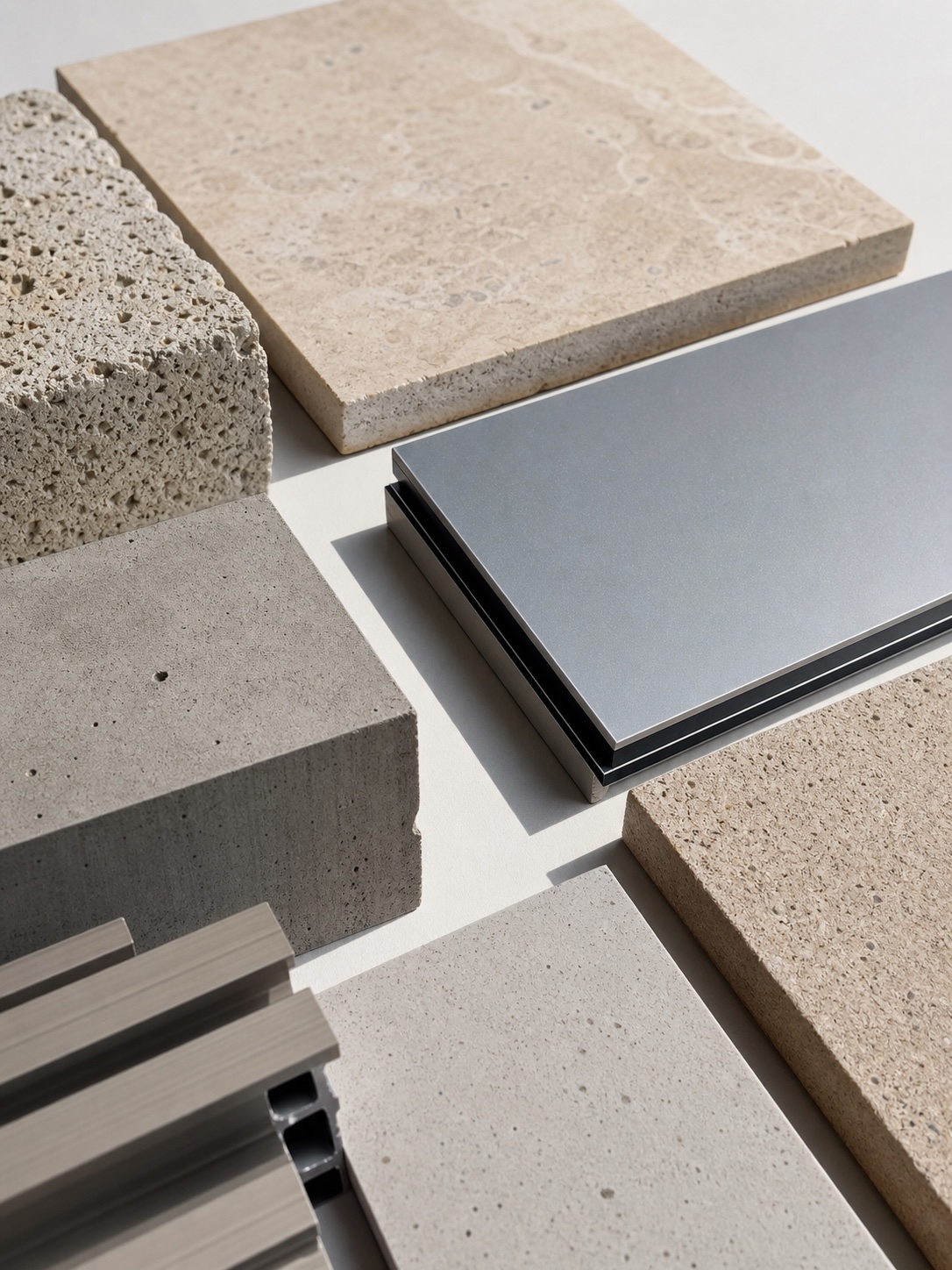
Sustainability check: Ask for the Estidama Pearl Rating certification level, the glazing SHGC specification by facade, and whether cooling is district-connected or building-specific. These three answers tell you more about long-term comfort than any render.
What buyers should check before trusting the renderings
Architectural renders in 2026 are produced with a level of quality that makes them genuinely difficult to distinguish from completed photography. This is a problem for buyers evaluating off-plan properties, because renders are composited under ideal lighting conditions, from camera positions that maximize the space visually, and with furniture, landscaping, and styling that are not part of what’s being sold.
The gaps between render and reality are predictable once you know where to look.
Ceiling heights
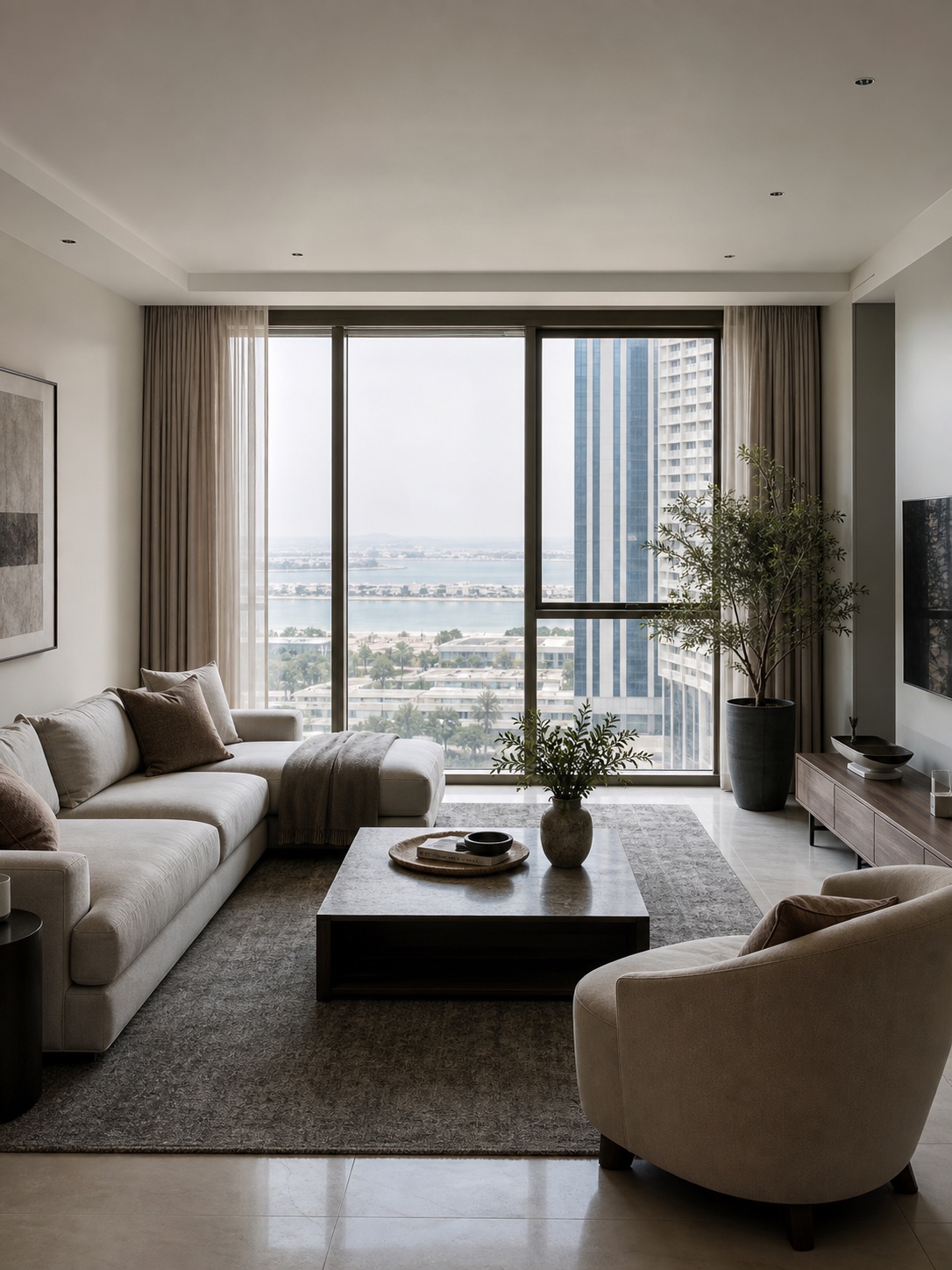
Renders consistently make ceiling heights look taller than they are by using wide-angle lens simulation and low camera positions. Ask for the ceiling height measurement from finished floor level to underside of slab — not the structural slab, but the finished ceiling after mechanical services and a suspended ceiling are installed. In many Abu Dhabi developments, structural slab heights of 3.2 metres reduce to finished ceiling heights of 2.6 to 2.7 metres after services are accommodated. That’s a normal result; the issue is when renders imply something significantly different.
Natural light
Renders are almost always lit as if the sun is at the ideal position for every room simultaneously. North-facing rooms in renders look as bright as south-facing ones. In practice, north-facing rooms in Abu Dhabi receive good diffuse light and no direct sun — which is actually the preferred condition for habitable rooms in this climate. Visit a comparable completed unit in the same orientation at the time of day you’d typically be home.
Unit dimensions on floor plans
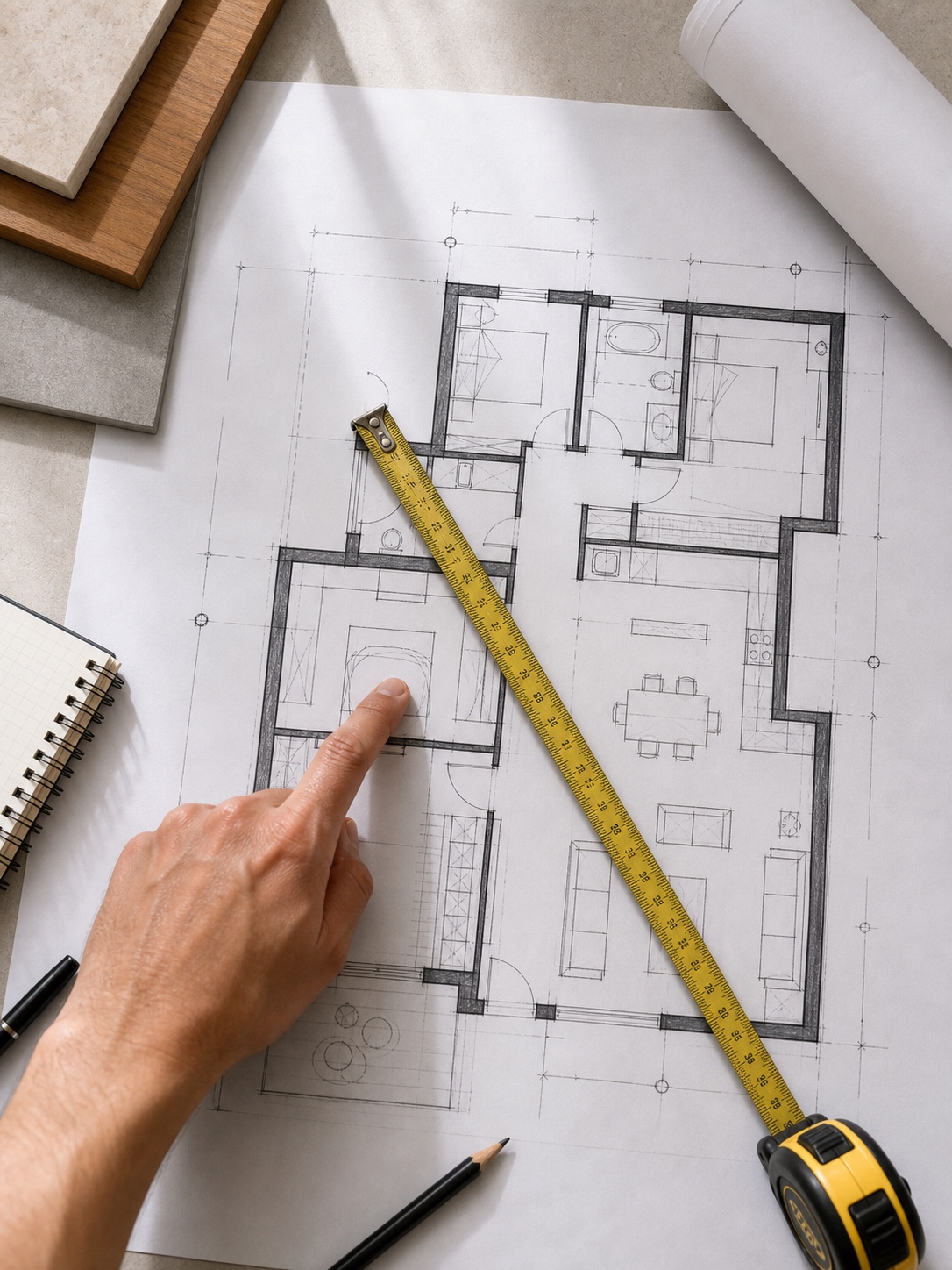
Floor plan dimensions are usually shown to the centre of walls rather than to the internal face. A room shown as 4.2 by 3.8 metres on a plan may have an internal dimension of 3.9 by 3.5 metres after wall thickness is deducted. For furniture placement purposes, internal dimension is what matters. Ask for internal clear dimensions, not centre-to-centre plan dimensions.
Ask for the material schedule in writing before signing anything. Renders show how finishes look in ideal conditions. The material schedule shows what they actually are.
Final design checklist for Abu Dhabi property buyers
Use this checklist when evaluating any residential development. Items that cannot be answered in writing by the developer’s technical team are items worth pursuing before signing a contract.
Final Design Checklist – Before Signing
- Site plan orientation: confirm which facades face south and west
- Glazing specification: request SHGC value by facade, product name and manufacturer
- Wall and roof insulation: request R-value or U-value specification
- Balcony: confirm depth (minimum 1.8m), compass orientation, and overhead shade provision
- Floor tile: confirm thickness and grout joint specification in writing
- Kitchen cabinets: confirm carcass material (moisture-resistant board required in wet areas)
- Appliances: confirm brand and model number in the sales agreement, not just category
- Bathroom fixtures: confirm brand, series, and country of manufacture
- Cooling system: confirm district-connected or building-specific chillers; ask system age
- Estidama Pearl Rating: confirm certification level achieved or contractually targeted
- Building management: ask current residents of a completed project about maintenance response
- Adjacent plot status: check planning status of neighbouring plots through ADREC
- Amenity sizing: ask for the square metre size of gym, pool length, and resident-to-amenity ratio
- Ceiling heights: request finished ceiling height (after services) in writing
- Material schedule: request the complete material schedule document before signing
Frequently asked questions
What should I look for when comparing property developers in Abu Dhabi?
Start with master planning quality: does the community have walkable connections, shaded paths, and logical service placement? Then look at the architecture’s response to heat and sun orientation, the material specifications for interior finishes, the design of outdoor living spaces, and whether the amenity list reflects daily use. Check developer credentials through the adrec.gov.ae Abu Dhabi Real Estate Centre at adrec.gov.ae before proceeding to contract review.
How do Abu Dhabi building regulations affect residential design quality?
Abu Dhabi’s Department of Municipalities and Transport sets building codes that govern setbacks, plot coverage, heights, and minimum specifications. These are baseline requirements, not quality targets. A developer working above code in insulation thickness, glazing performance, and shading device design produces noticeably better living conditions than one meeting the minimum. Official regulatory information is available at adrec.gov.ae.
What does master planning mean in Abu Dhabi residential developments?
Master planning refers to how the entire community is organized: where buildings sit relative to each other, how pedestrian paths connect different zones, where parking and services are located, and how shared open spaces relate to private units. Strong master planning in Abu Dhabi also accounts for the climate through shaded walkways, east-west building orientation, and landscaping that creates usable outdoor space.
How can I verify a developer’s track record in Abu Dhabi?
The adrec.gov.ae Abu Dhabi Real Estate Centre (adrec.gov.ae) provides information on registered developers, active projects, and regulatory compliance. Visit completed projects by the same developer before committing to an off-plan purchase. Ask for material specifications in writing and seek independent legal review of contracts before signing.
What sustainability features matter most in Abu Dhabi residential properties?
Building orientation and envelope performance are most impactful: insulation thickness, glazing specifications with low solar heat gain coefficients, and external shading devices that reduce direct sun exposure. These directly affect cooling energy and indoor comfort. Estidama Pearl Rating certification indicates independent assessment against Abu Dhabi’s local sustainability framework.
Are balconies and outdoor spaces worth paying more for in Abu Dhabi?
Yes, with conditions. An outdoor space facing west without shading is unusable from May through September. A well-designed balcony with at least 1.8 metres of depth, overhead shade, and orientation away from the afternoon sun is usable eight to nine months per year. Ask developers for balcony dimensions, orientation, and shading specifications rather than relying on rendered images.
What interior finish specifications should buyers ask for before signing?
Request the material schedule in writing: floor tile thickness (10mm minimum for porcelain), grout joint specification, kitchen cabinet carcass material (moisture-resistant board for wet areas), appliance brands and models, bathroom fixture specifications, and glazing ratings. A developer with a serious design process can provide all of these. One who cannot is telling you something important.
Design quality is what you live with after the sale
The marketing cycle for Abu Dhabi residential property is very good at creating impressions of quality. Renders, showrooms, and sales presentations are professionally produced tools designed to communicate an aspiration. The actual design quality of a development — the decisions made about orientation, envelope performance, material specifications, and spatial planning — was determined before the marketing was produced.
The buyers who end up most satisfied with their properties are typically the ones who looked past the presentation and asked specific technical questions early. Not because they were suspicious, but because they understood that the details they couldn’t see in a render were the ones they’d be living with for years.
Disclaimer: This article looks at Abu Dhabi property developments from a design and lifestyle perspective. It is not financial or investment advice.
Buyers should review official regulations, developer credentials, contracts, and independent professional guidance before making property decisions.
The massive concrete style popularized by brutal architecture continues to inspire modern designers looking for strong, durable facades.
On larger development sites, drone mapping for property and landscape planning can clarify circulation, grading, planting zones, and open-space value.
- 134shares
- Facebook0
- Pinterest134
- Twitter0
- Reddit0