The first Pegasus I ever drew looked like a horse wearing a backpack. Two stiff triangles glued onto a horse I had copied from a coloring book, with no weight and nothing connecting the wings to the body. That was years before I spent two semesters drawing horses from life as part of my industrial design training. Transport design programs make you study real anatomy, not just car bodies, and a surprising amount of that training carries over once you start drawing wings.
- Pegasus anatomy 101: horse body, bird wings, real mythology
- Materials for drawing a Pegasus
- Step-by-step Pegasus drawing
- Three angles worth practicing once the basics click
- Common mistakes (and how to fix them)
- Digital Pegasus drawing in Procreate
- Where to go from here
- Frequently asked questions
- What is the easiest way to draw a Pegasus for beginners?
- How do Pegasus wings actually attach to the body?
- What color was Pegasus in Greek mythology?
- How long does it take to draw a realistic Pegasus?
- What is the difference between a Pegasus and a unicorn?
- What pencils and paper work best for drawing a Pegasus?
- How do I make wings look realistic instead of flat and cartoonish?
- Can I draw a Pegasus in Procreate without prior horse-drawing experience?
Search “how to draw a pegasus” right now and you will find a dozen guides built from three circles and a pair of curved lines for wings. Fine for a five-year-old’s birthday card. Not so fine if you actually want the creature to look like it could fly.
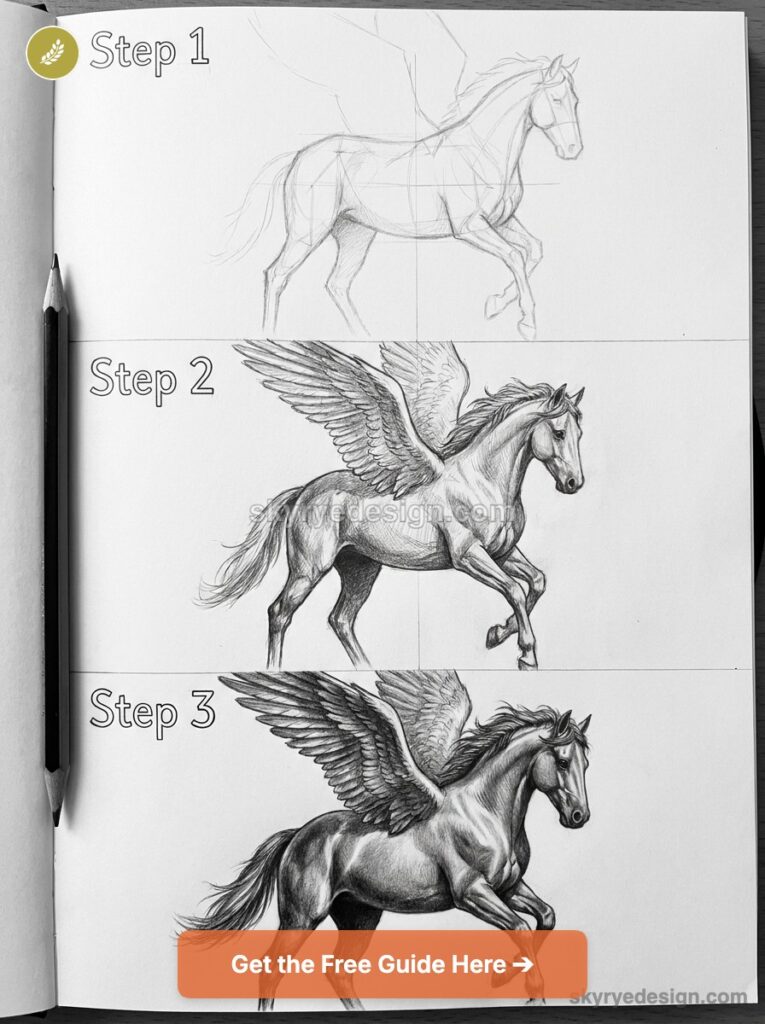
This guide treats the horse half like a horse, with real proportions and real joints, and the wing half like an actual bird wing, because that is what it anatomically is. I will cover where the wings attach, why most artists get that wrong, an eight-step construction process, the mistakes I see most often, and how the whole thing translates into Procreate.
Pegasus anatomy 101: horse body, bird wings, real mythology
Get the anatomy wrong here and no amount of detail later will save the drawing. This section is the one most tutorials skip, and it is exactly why their pegasi look stiff.
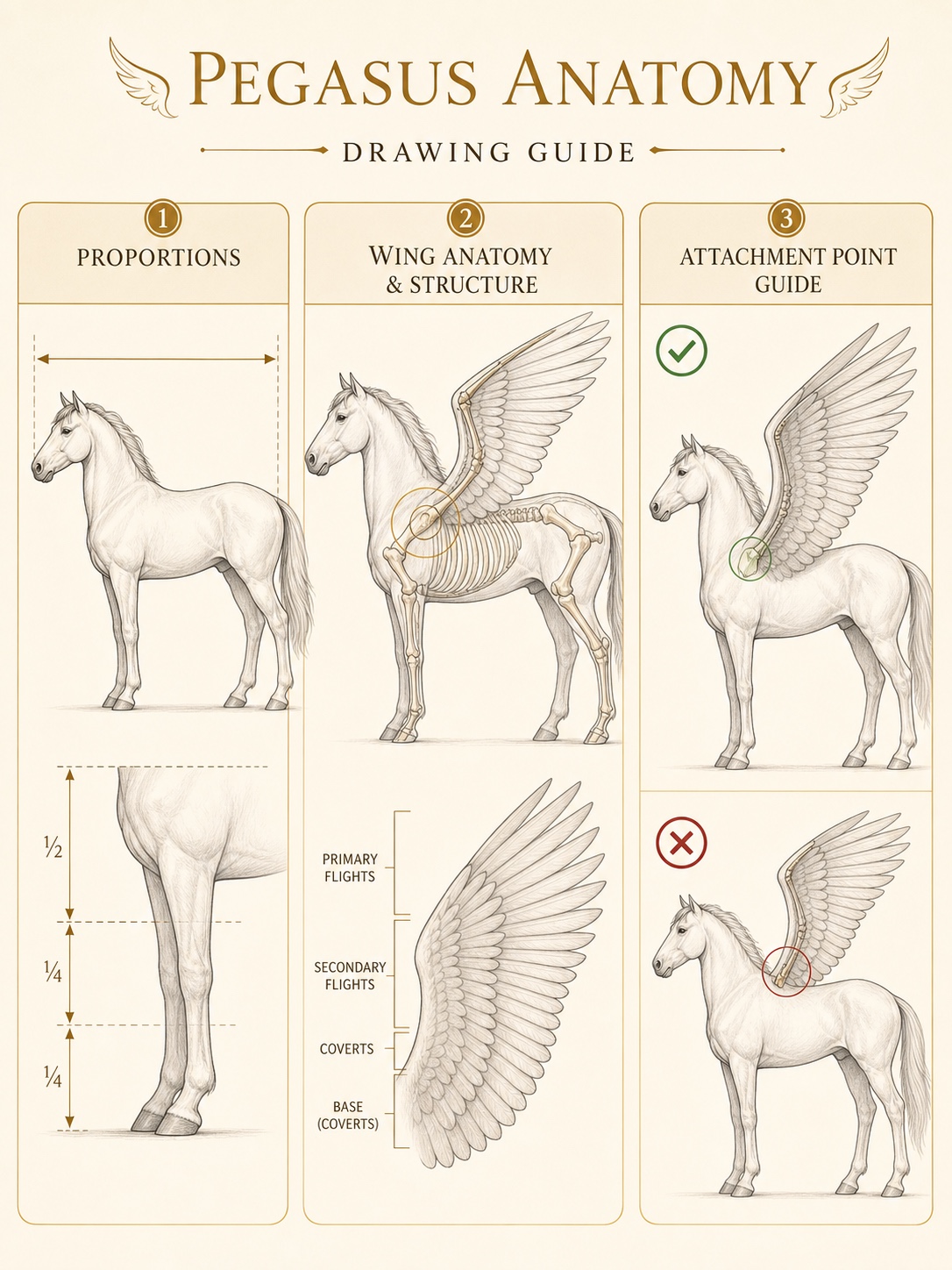
Horse proportions you cannot skip
Classic equine proportion runs roughly eight head-lengths from nose to tail, with the legs accounting for close to half the total height. Withers (the ridge where the neck meets the back) sit higher than most people draw them, and the chest barrel is deeper than it looks in photos because fur compresses the visual silhouette.
George Stubbs spent the better part of a decade in the 1750s dissecting and measuring horses to produce his book The Anatomy of the Horse, and artists still reference his plates today. You do not need to dissect anything, but pulling up a few of his studies before you start will fix more proportion problems than any tutorial diagram.
Where the wings actually attach (and why most drawings get it wrong)
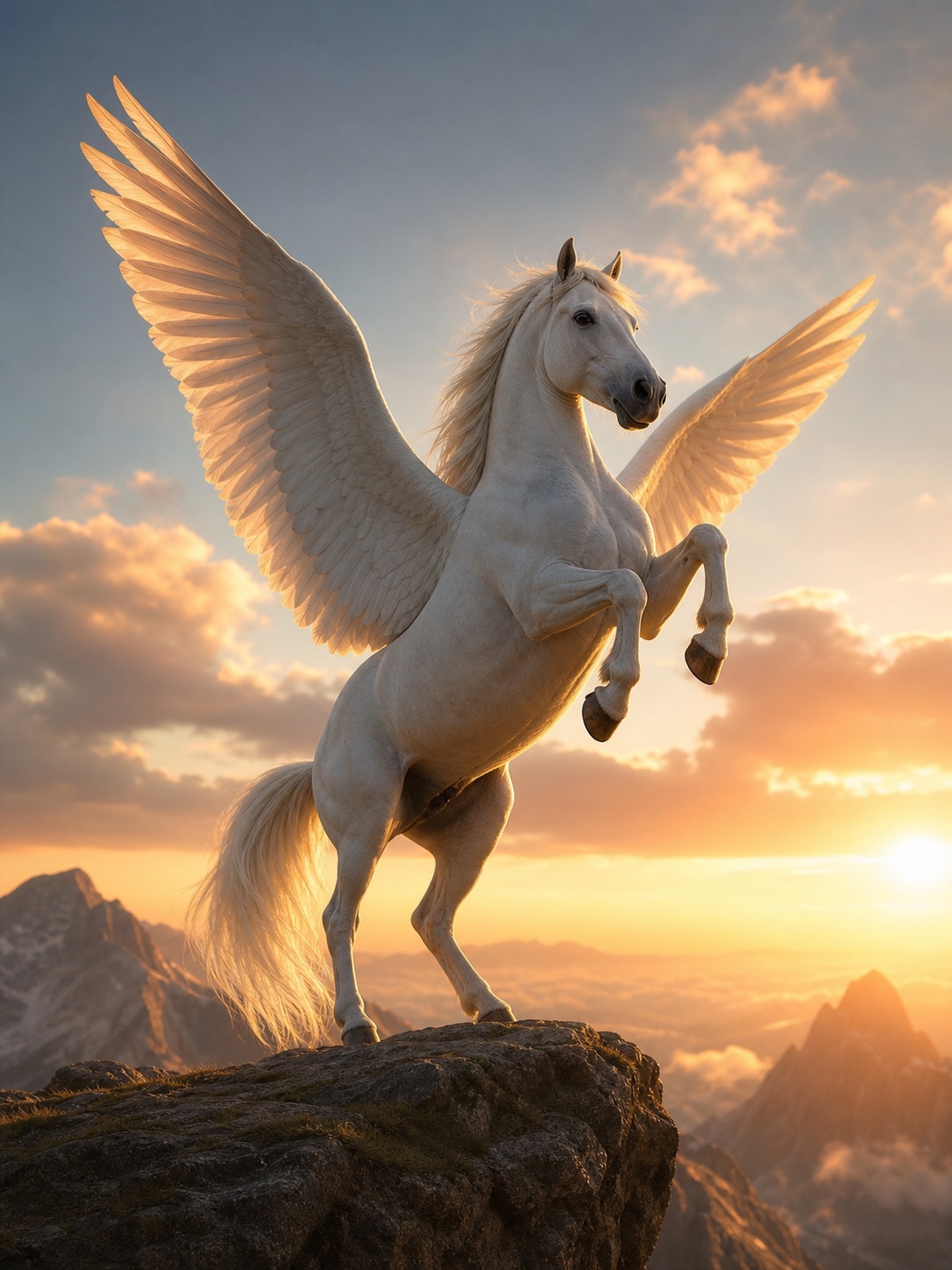
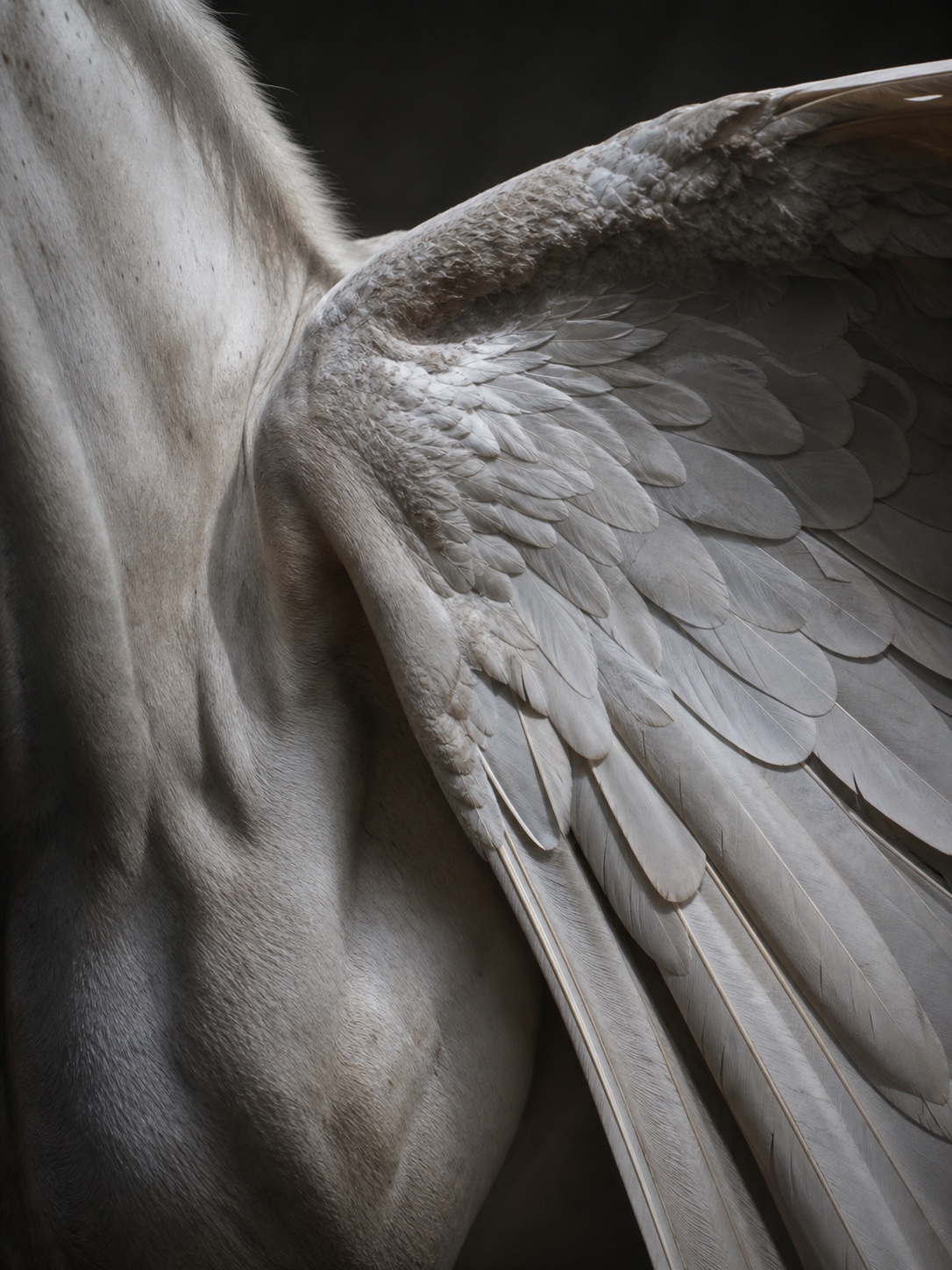
A real bird wing connects at the shoulder, through the scapula, not the middle of the spine. Picture a swan folding its wings against its body. That fold point, just behind and slightly above the foreleg, is roughly where a Pegasus wing should emerge.
Build the wing the way you would build an arm: one bone from shoulder to “elbow,” a shorter forearm bone, then the hand and finger bones that the longest primary feathers attach to. Mark these bone lines first. Check the full wingspan against the body before adding a single feather; large birds like swans and condors run about two to two-and-a-half times their body length wingtip to wingtip, and a Pegasus reads more believable in that same range.
TIP: Feathers come in three overlapping layers, not one shape. Coverts (short, near the shoulder) overlap secondaries (mid-length), which overlap primaries (the long ones fanning from the wingtip) — the same way roof shingles stack. Skipping this layering is the single biggest reason wings end up looking like paper cutouts.
A quick aside, because someone always asks: a wingspan that size could not actually lift a horse-sized body off the ground in real-world physics. Real flighted animals scale their wing area to body mass far more aggressively than any Pegasus illustration does. I bring this up not to talk you out of drawing one, but because knowing where the myth and the physics part ways helps you make confident choices instead of second-guessing every proportion. Draw the wings big enough to look plausible at a glance and stop worrying about whether a biologist would approve.
Mane, tail, and the color question Greek myth actually answers
Pegasus sprang from the blood of the Gorgon Medusa, along with his brother Chrysaor, the moment Perseus beheaded her. Poseidon was his father. Bellerophon later tamed him with a golden bridle Athena provided, and the pair killed the Chimera together before Bellerophon’s pride got him thrown off trying to fly to Olympus. Pegasus went on to carry Zeus’s thunderbolts and became a constellation. None of the ancient accounts mention a color.
White Pegasus is a much later convention, reinforced by Renaissance painting and then cemented by pop culture like Disney’s Hercules. I usually paint mine dapple grey instead of flat white. Grey holds shadow modeling on the coat far better, and it is just as mythologically accurate as white, since the myth never specifies either way.
Materials for drawing a Pegasus
Pencils and paper
An HB pencil handles the construction stage, a 2B carries the main linework, and a 6B is reserved for the darkest shadow pockets under the wings and belly. Staedtler Mars Lumograph or Faber-Castell 9000 sets (roughly $10 to $15 for a tin of six to twelve) cover this entire range without buying anything extra.
Paper matters more than people expect. A smooth-surface sheet like Strathmore 400 Series Bristol holds fine feather lines far better than a textured cold-press sheet, which tends to break up delicate strokes.
Reference photos: you need two sets, not one
Pull horse conformation photos for the body (side-on stable shots work best) and a separate set of large-bird wing photos, swans, eagles, or condors with wings fully extended. Trying to invent feather structure from memory is where most fantasy creature drawings fall apart. I keep a folder of both on my tablet before I even pick up a pencil.
Erasers, blending tools, and an optional color path
A kneaded eraser pulls highlights out of shaded fur without smudging the surrounding graphite, which a standard rubber eraser cannot do cleanly. A blending stump or a folded paper towel handles the smooth gradients on the coat; for the rougher feather shading, I actually prefer my finger over a stump, since skin oil creates a slightly broken texture that reads as plumage instead of fabric.
If you want a finished color piece rather than a graphite study, Prismacolor Premier colored pencils work well for a dapple grey palette: cool grey 50%, French grey 70%, and a touch of true blue in the deepest shadows. A light watercolor underwash before the pencil layers also speeds up large background areas like sky or cloud, though that part is optional and the line drawing holds up fine on its own.
Step-by-step Pegasus drawing
All five steps use light HB construction lines until step 4. These lines exist to be erased, so resist the urge to darken them early.
I work on a single A4 sheet for this, roughly two-thirds of the page reserved for the body and the rest left open for the wingspan; cramming the wings into too small a space is the most common space-planning mistake at this stage, and it is much easier to fix on paper than to discover halfway through step 4.
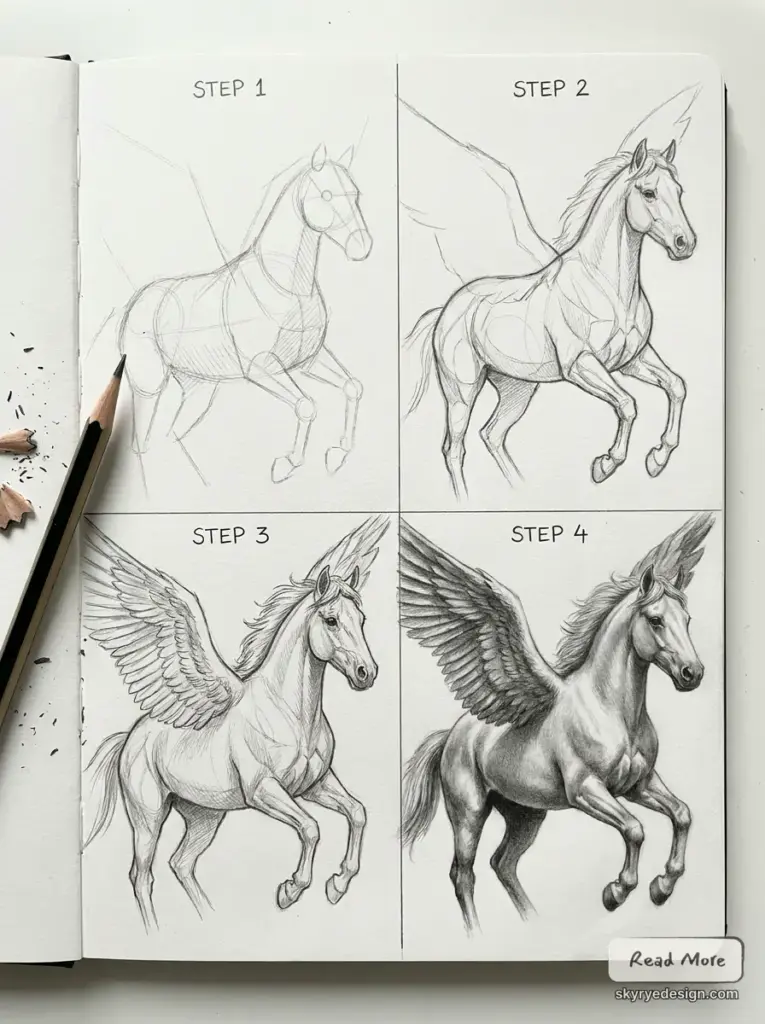
Step 1: Block in the body, neck, and head
Draw two ovals: a larger one for the chest and rib cage, a slightly smaller one for the hindquarters, spaced roughly one oval-width apart, and connect them with a gently curving spine line, the same construction every horse drawing starts with, mythical or not. From the front oval, sketch two curving lines upward for the neck, ending in a smaller circle for the head. Keep the neck arc gentle for a calm pose, or sharper and more S-shaped if you want the Pegasus rearing or mid-flight, and add a short guideline for the muzzle extending forward from the head circle.
If the body still feels uncertain, pause the wings and draw the horse body first. Pegasus only works when the chest, barrel, hindquarters, and leg joints already feel believable.
Step 2: Mark the wing attachment and leg joints
Find the spot just behind and slightly above where the foreleg meets the chest oval, mark a small dot there on each side, and sketch a simple curved guideline for the wing’s top edge reaching back about two to two-and-a-half body-lengths; this is just the bone-line skeleton, no feathers yet. While you are in skeleton mode, mark every leg joint as a small circle too: shoulder, knee, fetlock, and hoof. The foreleg knee bends backward, and the hind leg hock also bends backward, creating the slight zigzag that makes a horse leg look correct instead of like a table leg. Connect the joint circles with leg surfaces only after every dot, wing and leg both, is in place.
TIP: Reversed joint direction is the number one reason horse and Pegasus legs look broken. If a leg looks “off” and you cannot figure out why, check whether you bent a joint the wrong way before changing anything else.
Step 3: Refine the head, face, and wing shape
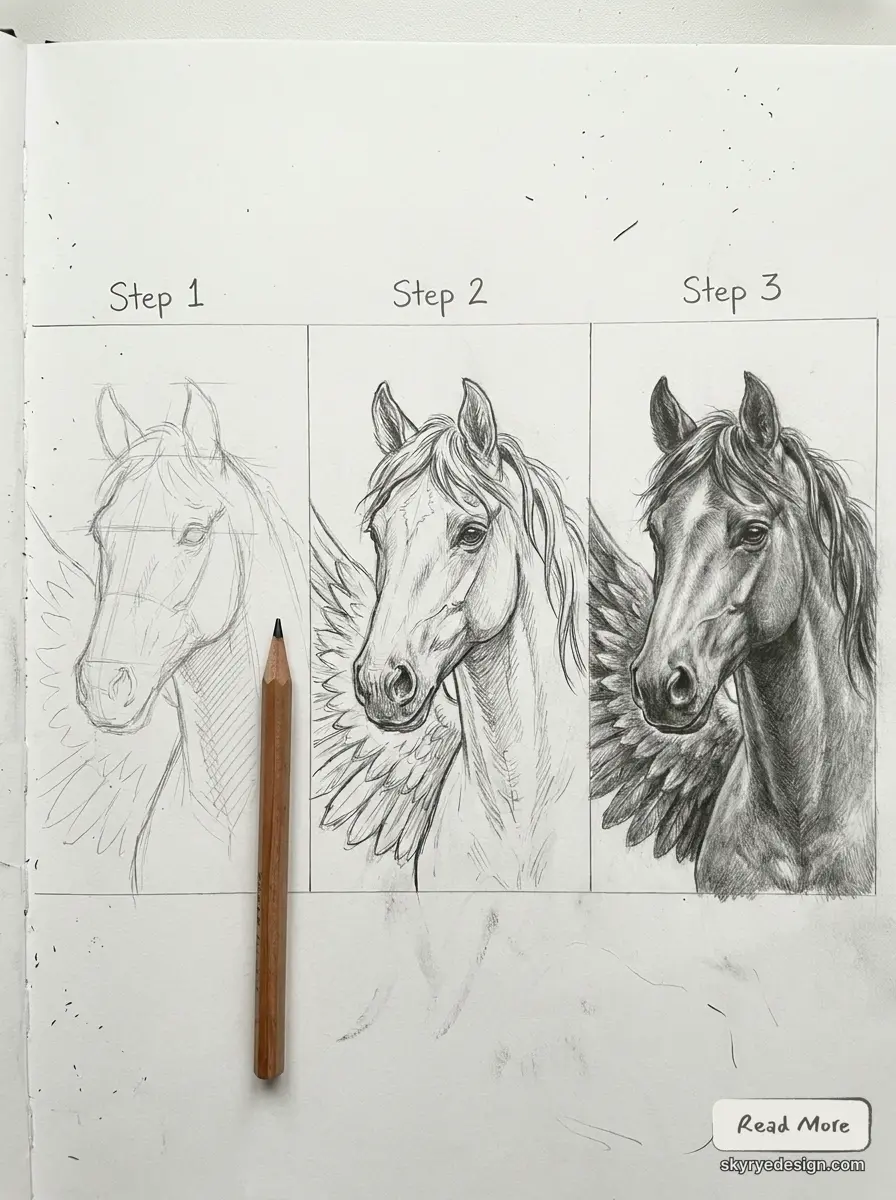
A horse head is basically a long wedge attached to a box. Place the eyes about a third of the way down the head, set wide on the sides of the skull rather than facing forward. The muzzle narrows toward the nostrils, and the ears sit at the top corners, angled slightly outward. Erase your circle guideline once the wedge shape reads correctly. Do the same cleanup pass on the wing: firm up the bone-line skeleton into an actual wing silhouette, checking the span against the body before committing to the outline. This is the last stage before any feather detail goes in, so it is worth getting the proportions right here rather than fixing them later.
Step 4: Layer the wing feathers, then add the mane and tail
Working outward from the body, draw short overlapping covert feathers first, near the shoulder. Add the mid-length secondary feathers next, overlapping the coverts, then finish with the long primary feathers fanning from the wingtip, each overlapping the secondary beneath it. Stagger the feather tips slightly instead of lining them up evenly; real feathers are never perfectly uniform. Switch to your 2B and handle the mane and tail next: flowing, jagged-tipped clumps rather than one solid mass, angled in the same general direction as the wing feathers above them for a unified sense of movement. The tail follows the same logic, a few thick base strands branching into thinner, wavier tips.
Step 5: Final shading and finishing
Pick one light source and stick to it for the entire drawing. Coat fur takes smooth gradated shading with a blending stump; feathers need a slightly rougher, more broken shading style since light scatters differently across overlapping plumes than it does across smooth hair. Push your 6B into the deepest shadow pockets under the wing and belly last, once every other value is in place. Step back from the page every few minutes; shading mistakes are far easier to catch from two feet away than with your nose six inches from the paper.
TIP: Photograph your finished drawing and flip it horizontally on your phone before calling it done. Asymmetry in the wing angle or head tilt is nearly invisible straight on and immediately obvious reversed.
Three angles worth practicing once the basics click
Every step above builds a clean side profile, the easiest angle and the right place to start. Once that one feels solid, these three variations are worth the practice. They show up constantly in fantasy book covers and concept art, and each one shifts the construction logic slightly.
Side profile, the view you just built
Flat-on from the side, both wings read as one overlapping silhouette, and the legs show clearly with no foreshortening to worry about. It is the easiest angle to get anatomically correct, which makes it the right one to repeat a few times before moving on.
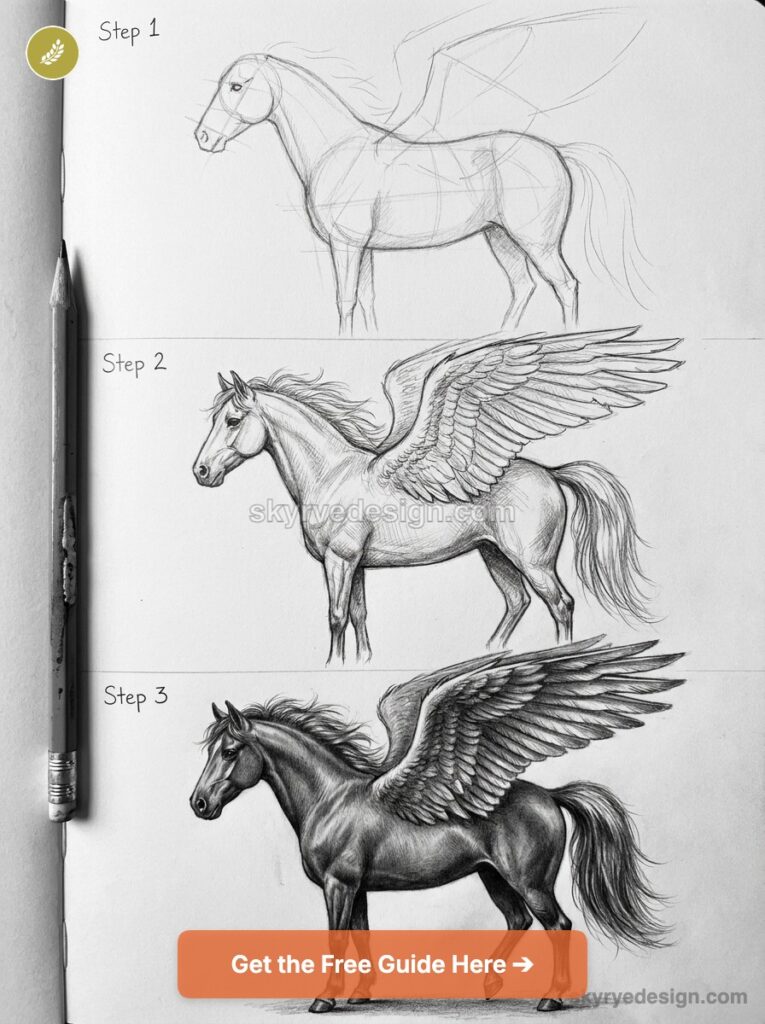
I still warm up with a quick side-profile pegasus before starting a more complex pose, the same way a musician runs scales before a performance.
Three-quarter view
Turn the body about 30 to 45 degrees away from a flat side view and the whole construction shifts. The far-side legs and the far wing both foreshorten, meaning they read shorter and overlap differently than they would in profile.
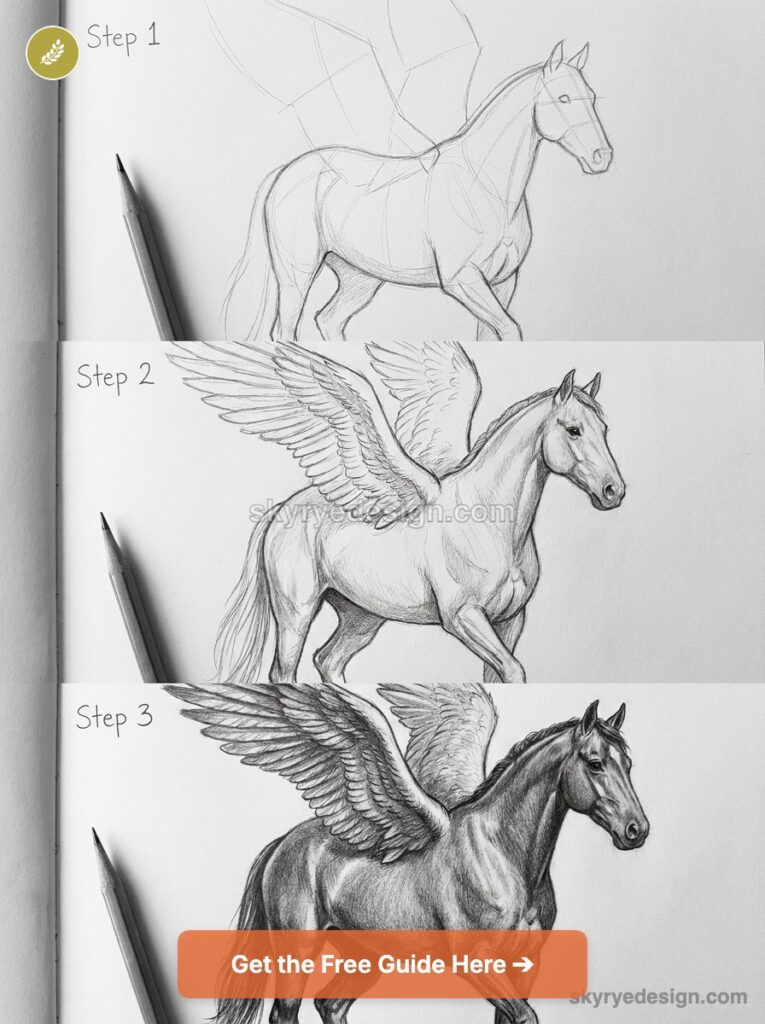
Draw the near-side oval slightly larger than the far-side one to suggest depth, and let the spine curve bend slightly toward the viewer rather than running flat across the page. The far wing should peek out from behind the near wing instead of spreading fully open; showing both wings completely flat and open in a three-quarter pose is the fastest way to flatten the depth right back out.
Flying toward the viewer, low angle
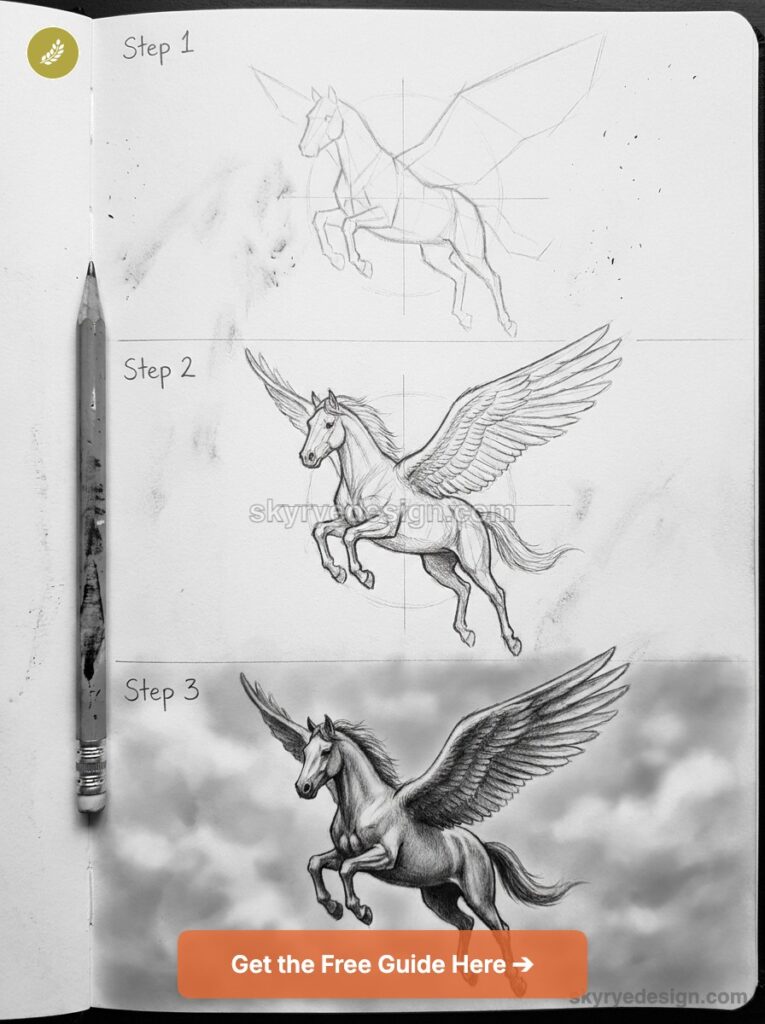
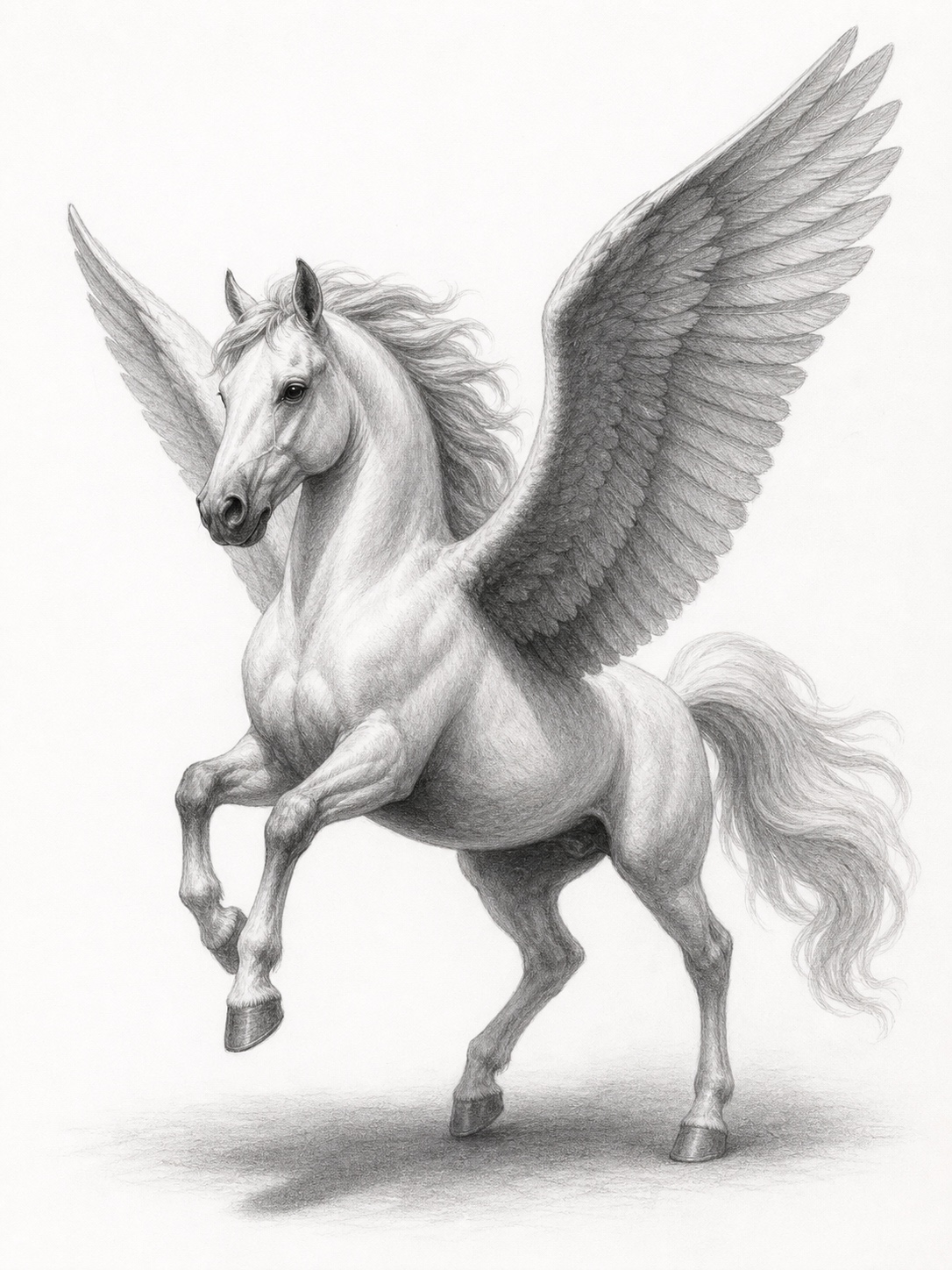
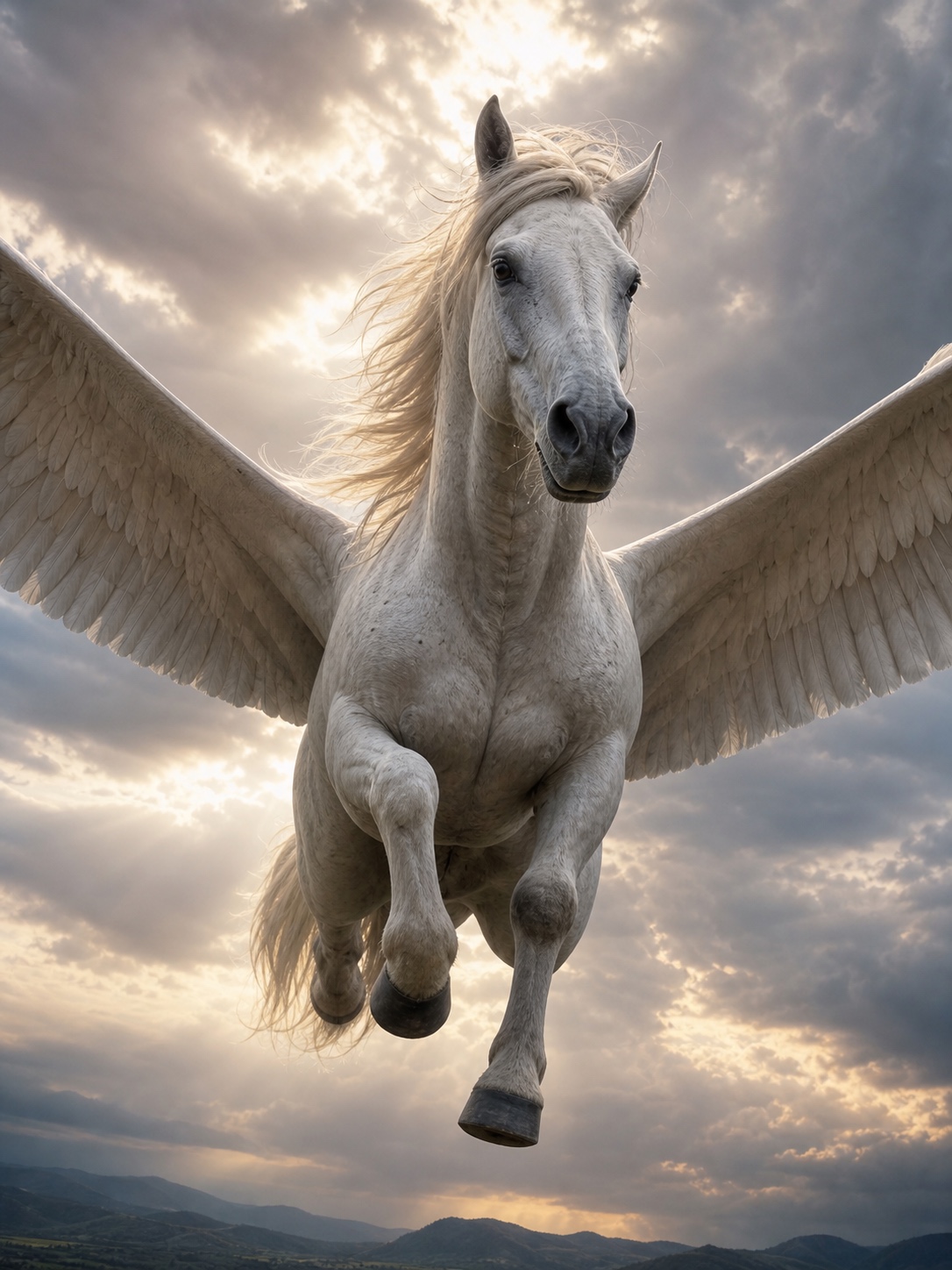
This is the hardest of the three and also the most dramatic, the pose you see on book covers and movie posters. The body foreshortens heavily: the chest oval grows much larger relative to the rest of the horse, since it sits closest to the viewer, while the hindquarters shrink and partly disappear behind it. Wings spread fully open and angle slightly downward, the way a real bird angles its wings on the downstroke that generates lift. Keep the head turned a touch to one side rather than pointed dead straight at the viewer; a perfectly frontal horse face reads as flat and almost cartoonish, while a slight turn keeps the wedge-shaped head structure from step 3 visible.
Common mistakes (and how to fix them)
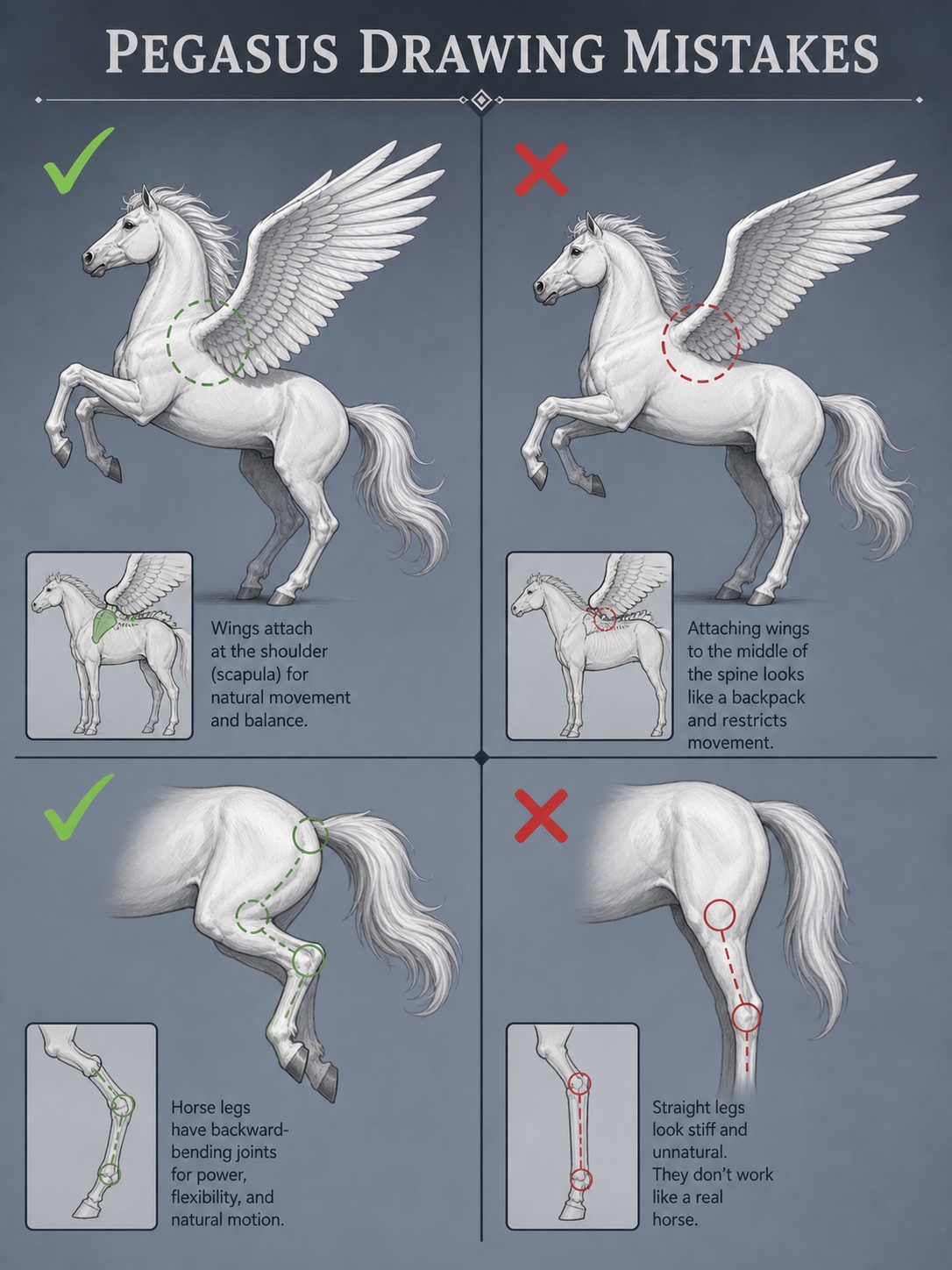
Wings glued to the spine instead of the shoulder
This is the “backpack wings” problem I started with. If the wing’s leading edge starts in the middle of the back instead of just behind the foreleg, the whole creature looks like it is wearing luggage. Move the attachment point forward to the shoulder, right where the scapula would be on a real horse, and the silhouette instantly reads as more believable. I have redone this exact fix on student sketches more times than I can count, and it is almost always the single change that makes a drawing click.
Wingspan too small, or feathers facing the wrong direction
A wingspan under one-and-a-half times the body length looks decorative rather than functional, like the wings exist for show. Feathers should also fan outward and slightly back from the wingtip, never pointing straight up or forward, which is a mistake I see constantly in quick sketches. If you are unsure whether your span looks right, hold your reference photo of an eagle or swan next to your drawing at arm’s length; the comparison is usually obvious within a few seconds.
Horse legs too thick, or joints bent the wrong way
Thin the lower leg below the knee considerably; that area is mostly tendon, not muscle, on a real horse, and beginners almost always draw it too bulky. Double-check joint direction against a reference photo if anything looks subtly wrong. Reversed joints are the fastest way to make four good legs look like four broken ones, and the fix is rarely more than erasing one small section and re-angling it.
Mismatched lighting between fur and feathers
Fur scatters light smoothly across a coat; feathers create small broken highlights along each overlapping edge. Shading both surfaces with the exact same soft gradient flattens the wings and makes them look pasted on rather than physically part of the same creature. Treat the transition zone where coat meets feather as its own small step, blending the two textures gradually instead of switching abruptly from one shading style to the other.
Digital Pegasus drawing in Procreate
Brush recommendations
Procreate’s default Inking set, specifically Studio Pen, handles clean line art for the body and wing bone-lines well. For the coat, the Painting category’s Soft Brush blends smoothly for muscle shading. Feathers benefit from a textured brush rather than a soft one; the Charcoal set’s Hard Charcoal, used at low opacity in layered strokes, mimics the broken edge of overlapping plumes better than any smooth brush will.
Do not have an iPad? Clip Studio Paint runs the same core workflow on Windows or Android, and its built-in feather and fur brush sets (under the Decoration category) actually save a step compared to building the texture by hand in Procreate. Either app gets you to the same result; the construction logic in this guide does not change.
Layer strategy
Keep the body, wings, mane and tail, and background on separate layers from the start. Use clipping masks above each linework layer for shading, so a stray brush stroke never bleeds outside the silhouette. I also keep a flat grey “value check” layer near the top, set to multiply and toggled on briefly to confirm the lighting reads correctly before I add any color.
Where to go from here
Pick one reference photo of a real horse and one of a real bird wing before you do anything else. That single decision, building from actual anatomy instead of a memory of cartoon wings, is what separates a believable Pegasus from a horse wearing a backpack. Start with Step 1 today; the construction ovals take less than five minutes, and everything else in this guide builds from there.
I still draw the occasional backpack-wing sketch on a bad day, by the way. Anatomy practice does not make the mistake disappear forever, it just makes it faster to spot and fix. That is really the whole skill.
For a gentler warm-up before adding wings, try this easy unicorn drawing practice guide and focus on the head, horn, mane, and horse-like body first.
Frequently asked questions
What is the easiest way to draw a Pegasus for beginners?
Start with two ovals for the chest and hindquarters, a smaller circle for the head, and two simple wing shapes attached at the shoulder, not the spine. Block everything in with light HB pencil lines before you commit to any detail. Most beginners go wrong by drawing the head and mane first; save the fun details for last, once the proportions are locked in.
How do Pegasus wings actually attach to the body?
Anatomically, the wings should emerge from the shoulder area, the same place a horse’s scapula sits, not glued onto the middle of the back. Picture a swan folding its wings against its body. That is roughly where the leading edge of a Pegasus wing should sit. Get this one detail right and the whole drawing reads as believable instead of cartoonish.
What color was Pegasus in Greek mythology?
Ancient sources never specify a color. The all-white Pegasus is a much later convention, reinforced by Renaissance art and modern media like Disney’s Hercules. You are free to draw a dapple grey, chestnut, or even black Pegasus and stay just as mythologically accurate as the white version.
How long does it take to draw a realistic Pegasus?
A clean construction sketch with basic shading takes about 1 to 2 hours. A fully rendered graphite or colored piece with detailed feathers and a coat can run anywhere from 6 to 15 hours, depending on background and finish level. Digital work in Procreate typically runs 30 to 50 percent faster thanks to undo history and brush presets.
What is the difference between a Pegasus and a unicorn?
A Pegasus is a winged horse with no horn; a unicorn has a horn and no wings. Some fantasy illustrations combine both into an “alicorn,” which is a separate invented term, not a Greek mythology creature. If you want to stay true to the original myth, keep the wings and skip the horn.
What pencils and paper work best for drawing a Pegasus?
An HB for construction lines, a 2B for the main linework, and a 6B for deep shadow areas under the wings and belly cover almost everything you need. Pair them with a smooth-surface paper like Strathmore 400 Series Bristol; smooth surfaces hold fine feather detail far better than a textured cold-press sheet.
How do I make wings look realistic instead of flat and cartoonish?
Layer the feathers in three groups instead of one shape: short covert feathers near the leading edge, then longer secondary feathers in the middle of the wing, then the longest primary feathers fanning out from the wingtip. Each group overlaps the one before it, the same way roof shingles overlap. Skipping this layering is the single biggest reason wings end up looking like paper cutouts.
Can I draw a Pegasus in Procreate without prior horse-drawing experience?
Yes, but do one horse-only sketch first using a photo reference before adding wings. Procreate’s undo stack and reference layer feature make it forgiving for beginners, and starting with just the horse half isolates the proportion problems before you complicate things with feathers.
- 1.0Kshares
- Facebook0
- Pinterest1.0K
- Twitter0
- Reddit0