Texture drawing clicked for me only after I stopped treating wood, glass, metal, and stone as decoration. Each surface has its own rule: wood grows in rings, glass bends what sits behind it, metal reflects in hard value jumps, and stone needs solid planes before cracks or veins. Once you see that logic, the pencil marks become much easier to choose.
- What is texture drawing?
- Texture drawing cheat sheet for wood, glass, metal, and stone
- How to draw textures step by step
- How to Draw Wood Texture: 15 Techniques That Actually Work
- 1. Start with the Ring Structure, Not the Surface Lines
- 2. Vary Your Pressure for Dark and Light Rings
- 3. Use Parallel Hatching for Flat-Sawn Plank Grain
- 4. Draw Knots as Ellipses, Not Circles
- 5. Use a Blending Stump for Soft Grain in Aged Wood
- 6. Add Cracks and Checking with a Sharp HB
- 7. Draw End Grain as Concentric Rings with Radial Cracks
- 8. Ink Crosshatch for Dark, Rich Wood Shadows
- 9. Simulate Pine vs Oak: Two Different Grain Characters
- 10. Use White Gel Pen for Highlight Grain on Dark Backgrounds
- 11. Draw Reclaimed Wood with Nail Holes and Staining
- 12. Use Directional Erasure for Raised Grain Effect
- 13. Draw Bamboo with Segmented Nodes and Smooth Internodes
- 14. Render Plywood Edges as Visible Layer Stacking
- 15. Match Your Stroke Direction to Wood Species Anatomy
- Drawing Glass: 12 Techniques for Transparent and Reflective Surfaces
- 16. Protect Your Highlights First—Before Any Shading
- 17. Use Hard Contrast at Glass Edges
- 18. Draw Refraction Distortion for Objects Behind Glass
- 19. Show Glass Thickness at Rims and Bases
- 20. Use Light Hatching for Mid-Tone Glass Body
- 21. Draw Frosted Glass with Soft, Diffused Edges
- 22. Render Coloured Glass by Tinting the Interior
- 23. Draw Reflections in Flat Glass (Windows, Mirrors)
- 24. Show Glass Contact Shadows and Caustics
- 25. Use Ink for Bold, Graphic Glass Illustration
- 26. Draw Cracked Glass with Spider-Web Fracture Lines
- 27. Digital Glass: Use Screen and Overlay Blend Modes
- Metal Drawing Techniques: 13 Approaches for Every Surface Type
- 28. The Core Metal Principle: Extreme Value Contrast
- 29. Draw Polished Chrome with Hard-Edge Value Jumps
- 30. Brushed Steel: Directional Hatching is Everything
- 31. Gold: Warm Shadows, Bright Highlights
- 32. Copper and Bronze: Rich Darks with Patina
- 33. Cast Iron: Rough, Matte, and Porous
- 34. Rust: Organic Edges, Layered Values
- 35. Reflective Metal Spheres: Map the Environment
- 36. Foil and Crumpled Metal: Sharp Value Facets
- 37. Wire and Thin Metal Rods: Draw the Reflection, Not the Metal
- 38. Anodised Aluminium: Even Tone, Subtle Grain
- 39. Ink Linework for Technical Metal Illustration
- 40. Metallic Ink and Pen for Decorative Metal
- Stone Texture Drawing: 10 Methods for Every Rock Surface
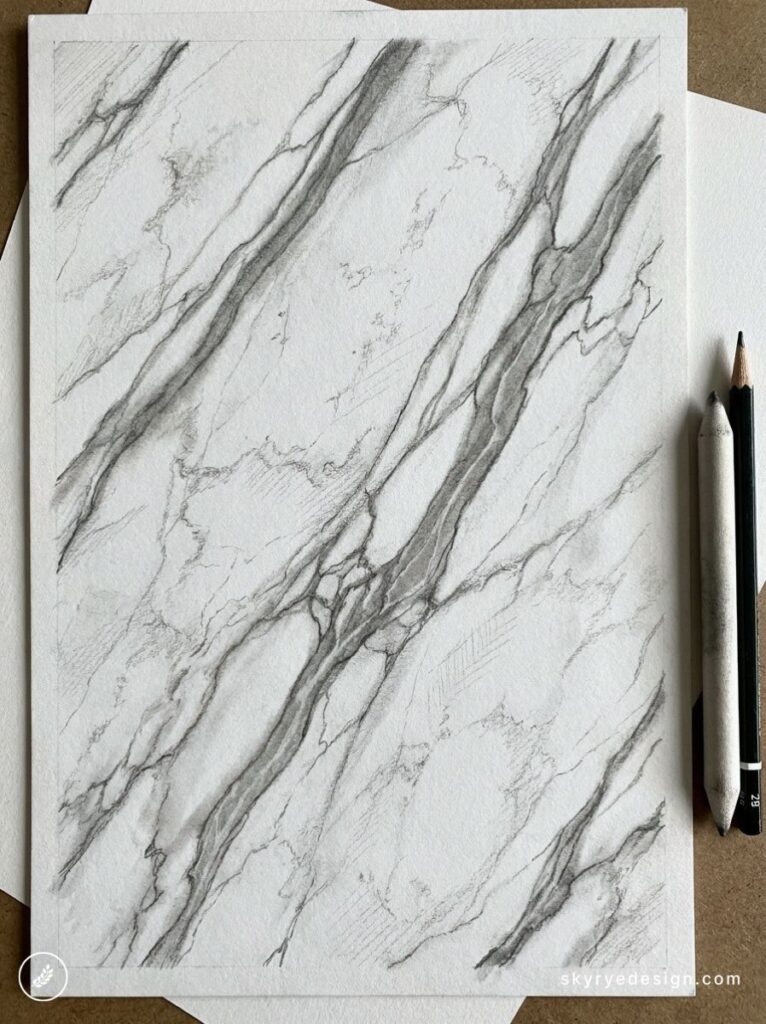
- 41. Marble: Flow-Line Logic for Veins
- 42. Granite: Stippling for Crystal Structure
- 43. Slate: Layered Planes and Sharp Edges
- 44. Sandstone: Warm Granularity and Bedding Lines
- 45. Rough Fieldstone: Build Form Before Texture
- 46. Limestone and Chalk: Soft, Matte, Low Contrast
- 47. River Rocks: Smooth Form, Subtle Surface
- 48. Cracked Rock Face: Structural Fault Lines
- 49. Mossy Stone: Organic Overlay on Mineral Base
- 50. Cobblestones: Repetition with Variation
- Putting It All Together: Your 4-Week Texture Practice Plan
- Texture drawing FAQ
- What is texture drawing?
- How do you draw wood texture?
- How do you draw glass so it looks transparent?
- What makes metal drawing look reflective?
- How do you draw stone texture without it looking dirty?
- What are the four types of texture used in art drawing?
- Can I use these texture techniques in digital art?
- What should beginners practice first?
- Texture reference sources worth studying
- Related texture drawing practice
- Final Thought
Texture drawing becomes much easier when you stop treating every surface like ordinary shading. Wood, glass, metal, and stone each have a different visual rule: wood follows growth, glass bends light, metal reflects its surroundings, and stone holds structure before surface detail. I use that rule first, then choose the pencil pressure, hatching direction, eraser marks, or marker layers that support it.
Footwear is excellent texture practice because leather, rubber, mesh, suede, and stitching sit close together. Try a shoe design sketch next if you want one subject that tests several surfaces at once.
What is texture drawing?
Texture drawing is the process of making a flat drawing look like a specific material surface. Instead of adding random decorative marks, you study how the material behaves. Wood grain curves around knots and follows growth rings. Glass is mostly hard highlights, edge thickness, and shapes distorted through the transparent form. Metal needs strong value contrast and reflected shapes. Stone reads best when the form is built first and the cracks, veins, stipples, or rough marks sit on top of that form. This is why a good texture study starts with observation, not a fancy pencil. Choose the material rule first, block in the large value pattern, then add the surface marks only where they help the viewer recognize the material.
Texture drawing cheat sheet for wood, glass, metal, and stone
| Material | Look for first | Best marks | Common mistake |
|---|---|---|---|
| Wood | Grain direction, knots, growth rings | Curved hatching, lifted highlights, dark cracks | Drawing straight stripes with no structure |
| Glass | White highlights, rim thickness, distortion | Hard edges, light hatching, clean untouched paper | Shading the whole object until it turns grey |
| Metal | Big reflected shapes and value jumps | Sharp blacks, crisp whites, directional brushing | Using soft grey gradients everywhere |
| Stone | Planes, cracks, mineral pattern | Stippling, broken lines, controlled roughness | Adding texture before the rock form is solid |
How to draw textures step by step
- Choose one material and collect one clear reference photo or draw from life.
- Mark the big form first: plank, bottle, sphere, rock, tile, or metal object.
- Block the light and dark pattern before small texture marks.
- Add the material-specific marks: grain for wood, edges for glass, reflected shapes for metal, cracks or mineral marks for stone.
- Step back and check whether the surface reads from arm’s length. If it only works close up, simplify the small marks and strengthen the value pattern.
This guide covers 50 texture drawing techniques across wood, glass, metal, and stone. The goal is not to collect tricks; it is to train your eye to notice grain direction, highlight shape, reflected value, mineral structure, and the small material cues that make a drawing feel specific.
Use it as a studio reference: pick one material, study the cheat sheet, then choose the technique that matches the surface in front of you.
How to Draw Wood Texture: 15 Techniques That Actually Work
Wood is the most forgiving material to start with—it has natural rhythm and variation, so small imperfections read as authenticity rather than errors. But most beginners make the same mistake: they draw the grain as a series of parallel lines and wonder why it looks flat. Real wood grain curves, swells, and knots. Here’s how to capture that.
Sponsored

1. Start with the Ring Structure, Not the Surface Lines
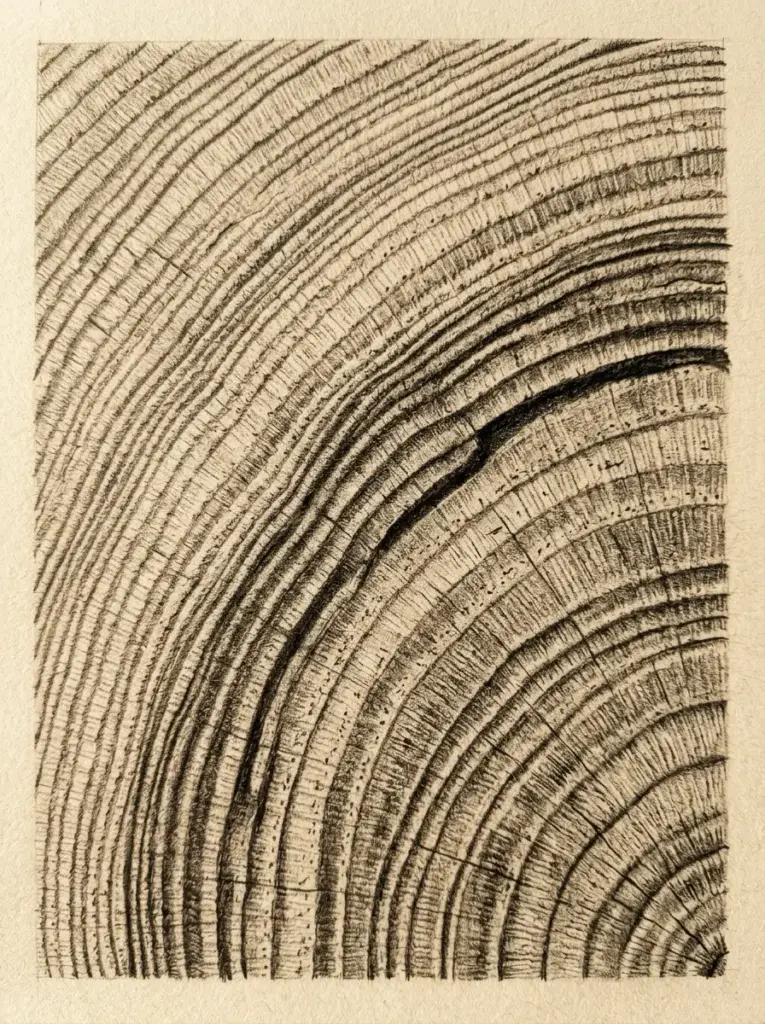
Before touching grain lines, map the growth ring pattern. Oak and pine show elliptical rings when cut across the trunk; planks show elongated parabolas. Sketch these lightly in HB first—they’re your scaffolding. Every grain line you draw later should follow this underlying curve logic.
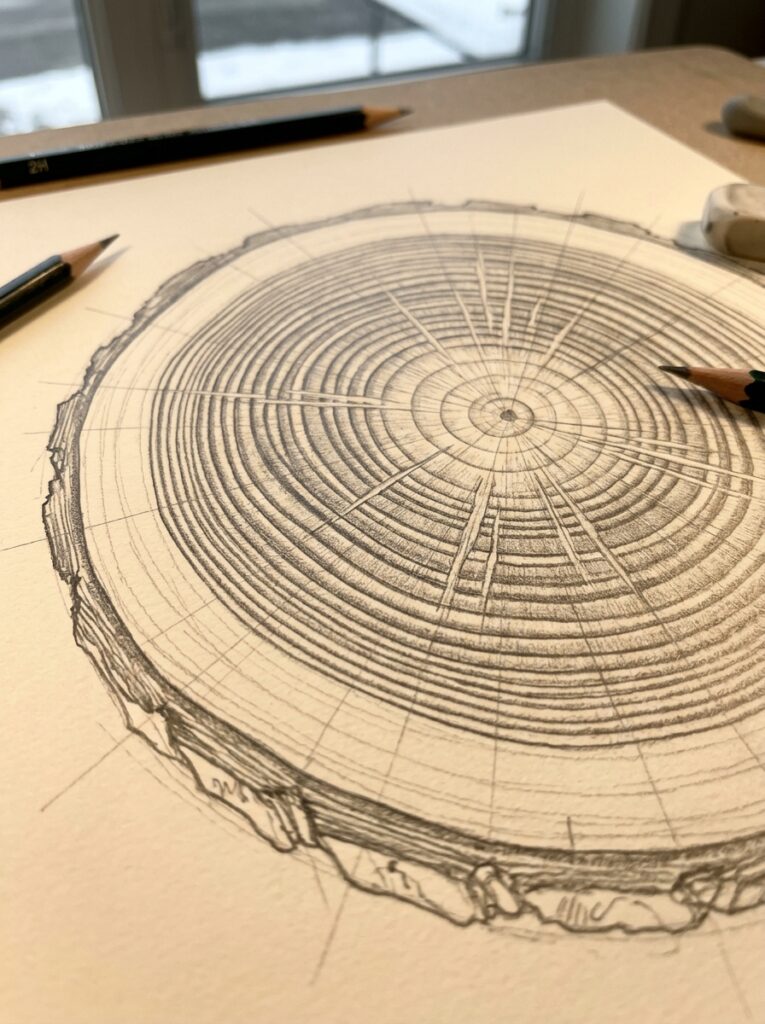
Drawing tip: Use the side of a 2H pencil at very low pressure for the initial ring map—it’s easy to erase and sets the structural direction.
2. Vary Your Pressure for Dark and Light Rings
Annual growth rings have a darker late-wood band and a lighter early-wood band.
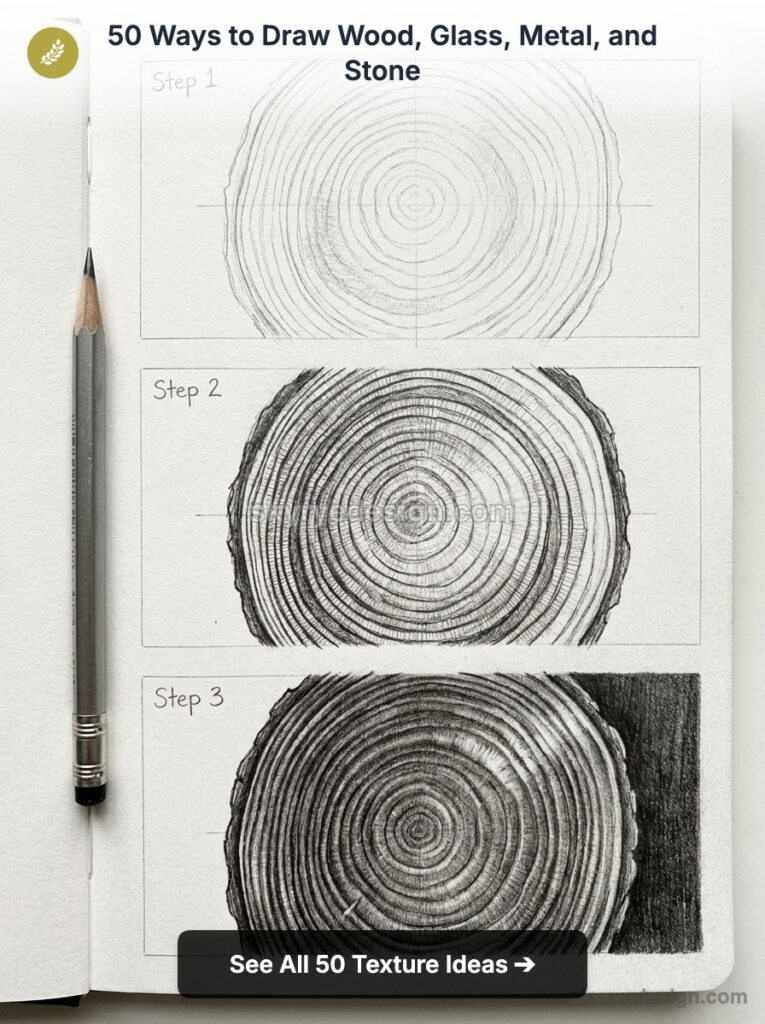
Alternate your pencil pressure as you draw each ring: heavier on the dark late-wood edge, lighter through the early-wood zone. A 4B pencil handles the dark edges beautifully without scraping the paper.
3. Use Parallel Hatching for Flat-Sawn Plank Grain
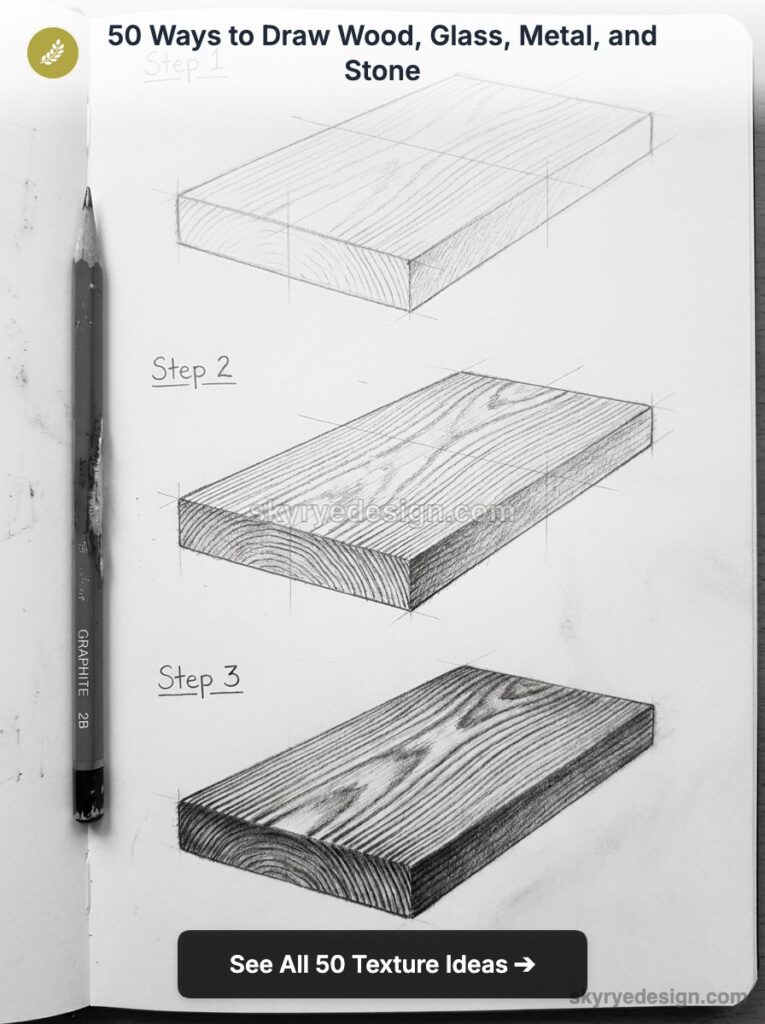
Flat-sawn boards (the most common type in furniture) show cathedral grain—a series of arching lines. Draw these with slightly curved parallel strokes, keeping them closer together at the edges of the plank and spreading toward the centre. Strathmore 400 Bristol smooth plate is ideal: you get clean line definition without tooth interference.
4. Draw Knots as Ellipses, Not Circles
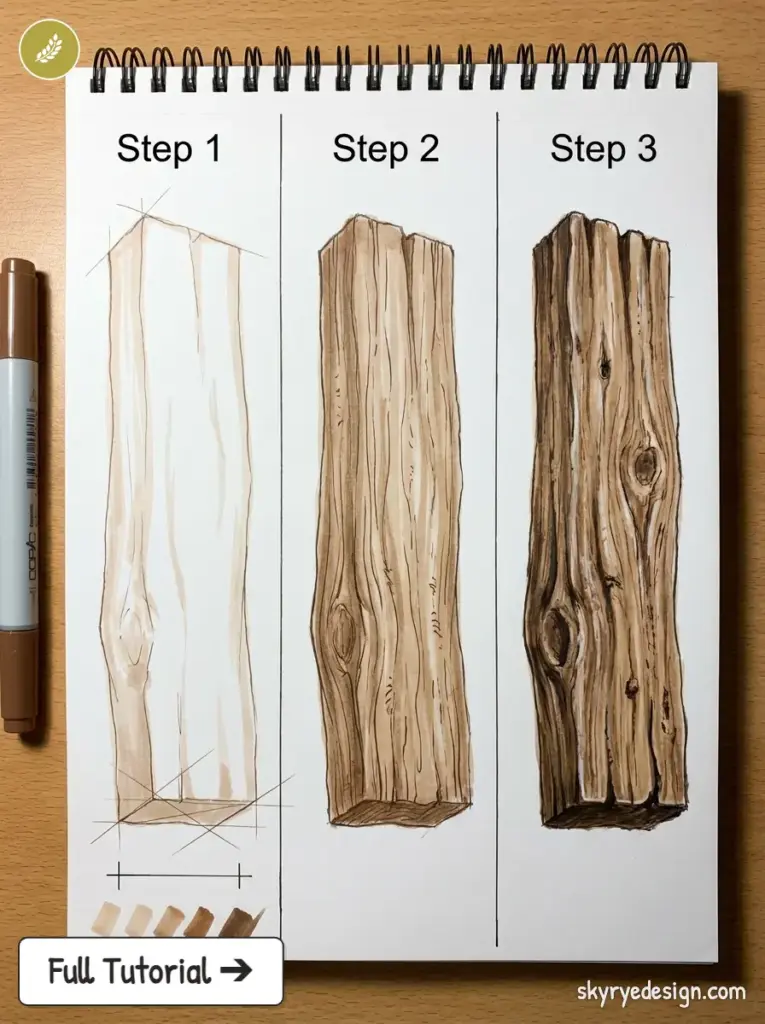
Knot grain radiates outward from a central core—but on a plank face, the knot appears as a compressed ellipse, not a perfect circle.
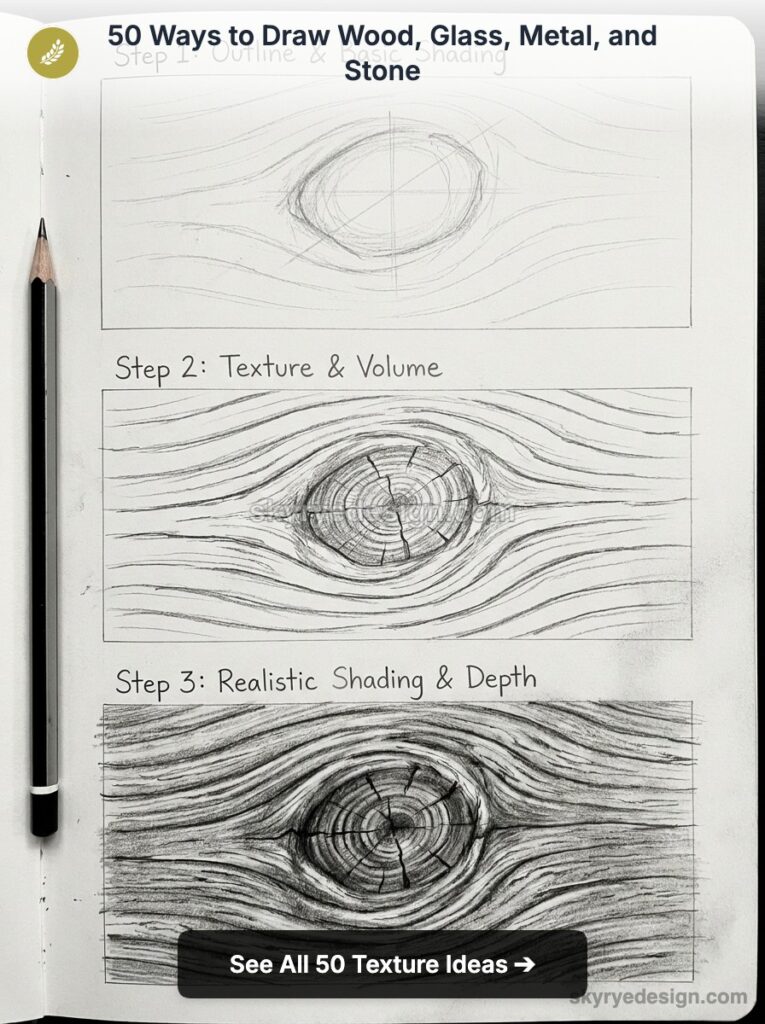
The surrounding grain lines bend around the knot like a river around a rock. Don’t just drop a circle onto your grain pattern; warp all adjacent lines to orbit it.
| ✏️ Pro Tip Study a piece of actual reclaimed wood or a cutting board up close before drawing. Photograph it under raking light (torch held at a low angle) to see the grain relief clearly. |
5. Use a Blending Stump for Soft Grain in Aged Wood
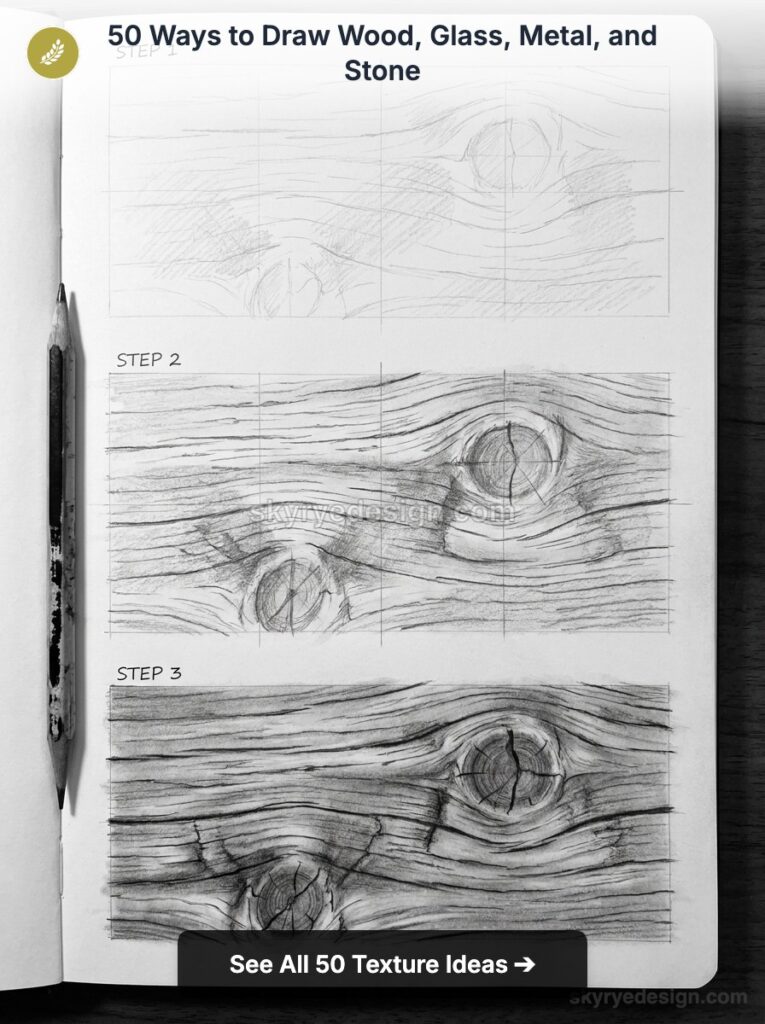
Old, weathered wood loses its sharp grain contrast. After drawing the basic grain lines with a 2B, blend lightly along the grain direction with a tortillon (blending stump). Then go back in with a 4B pencil to re-establish the darkest cracks and knot edges. The contrast between blended mid-tones and crisp dark lines sells the aged effect.
6. Add Cracks and Checking with a Sharp HB
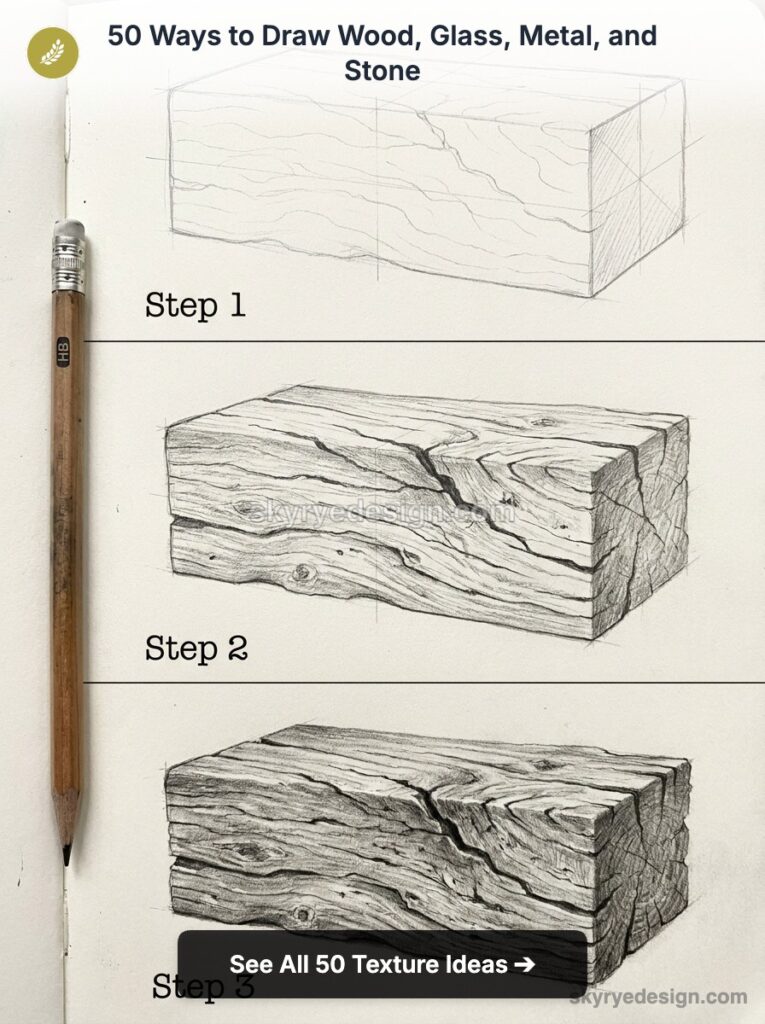
Dried wood checks—it develops small cracks running with the grain. These are narrow, irregular, and darker than the surrounding grain. Draw them with a sharpened HB, using broken lines rather than solid ones. Some checking runs the full length of a plank; some are short, parallel micro-cracks. The Faber-Castell 9000 HB handles this beautifully.
7. Draw End Grain as Concentric Rings with Radial Cracks
End grain (the cross-section of a cut log) shows the full ring structure as concentric ellipses or circles.
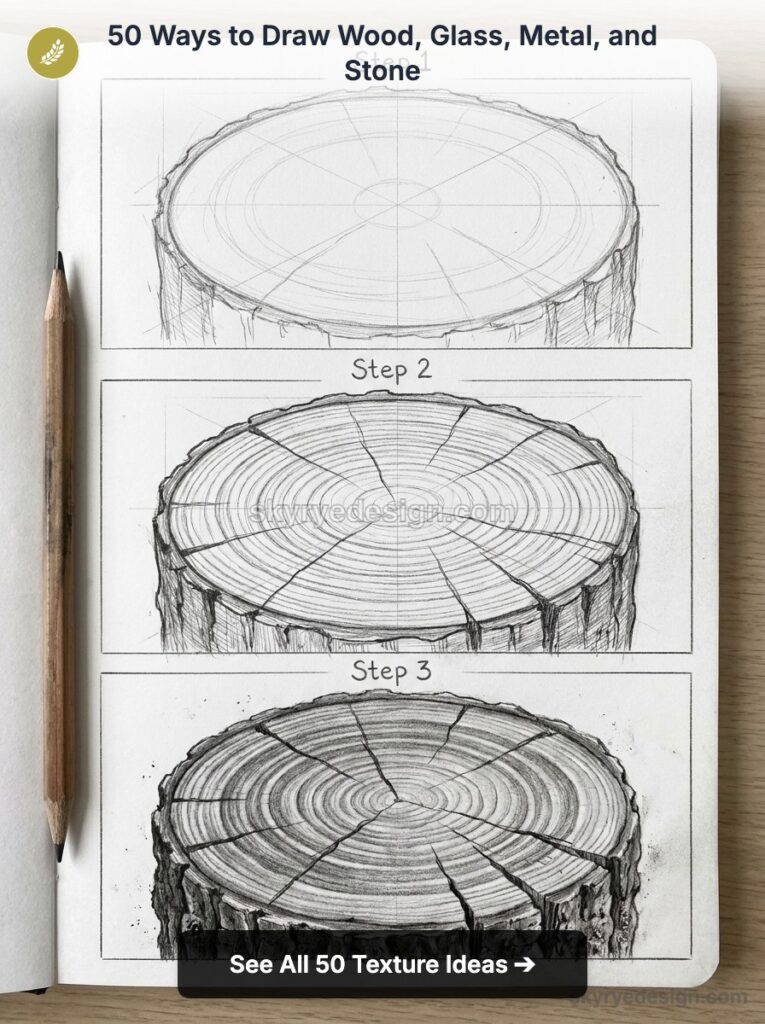
The medullary rays—thin lines radiating from the centre like spokes—are crucial for realism. Add them at irregular intervals between the rings. End grain is one of the most striking texture subjects and relatively easy to draw once you know the structure.
8. Ink Crosshatch for Dark, Rich Wood Shadows
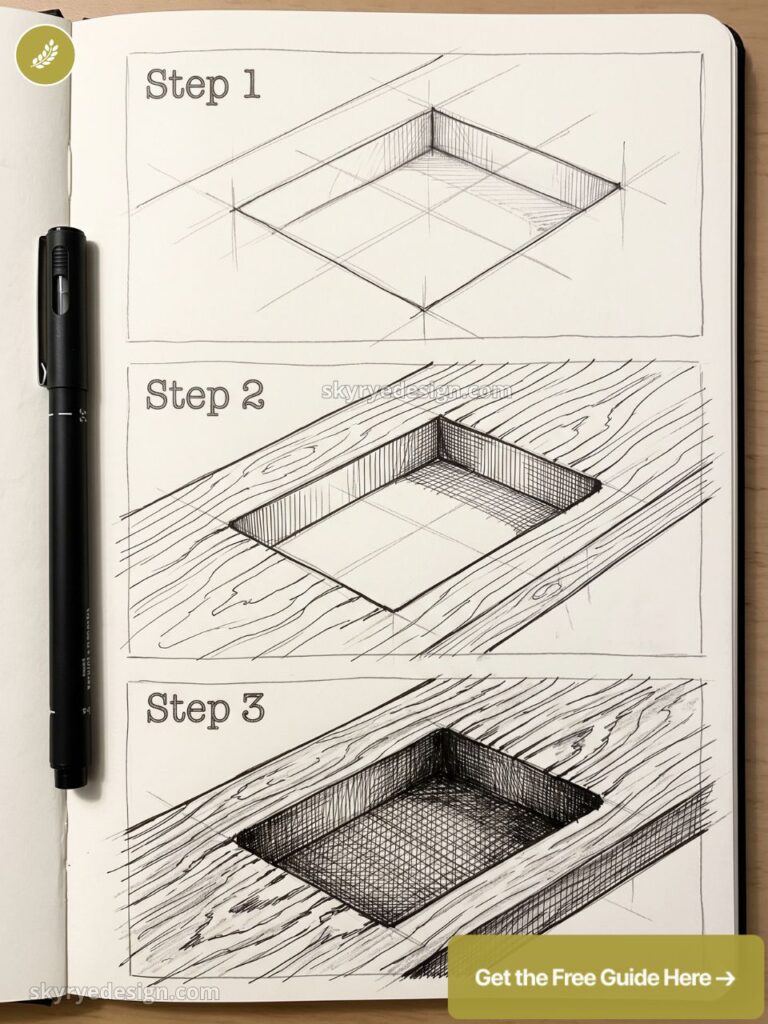
For ink illustration (pen and ink, Micron 0.1 or 0.3), use crosshatch to build shadow density in recessed wood areas. First layer: lines following the grain direction. Second layer: diagonal lines at 30–45° to the grain. The visual grain is preserved in the first layer; the crosshatch adds depth without muddying it.
9. Simulate Pine vs Oak: Two Different Grain Characters
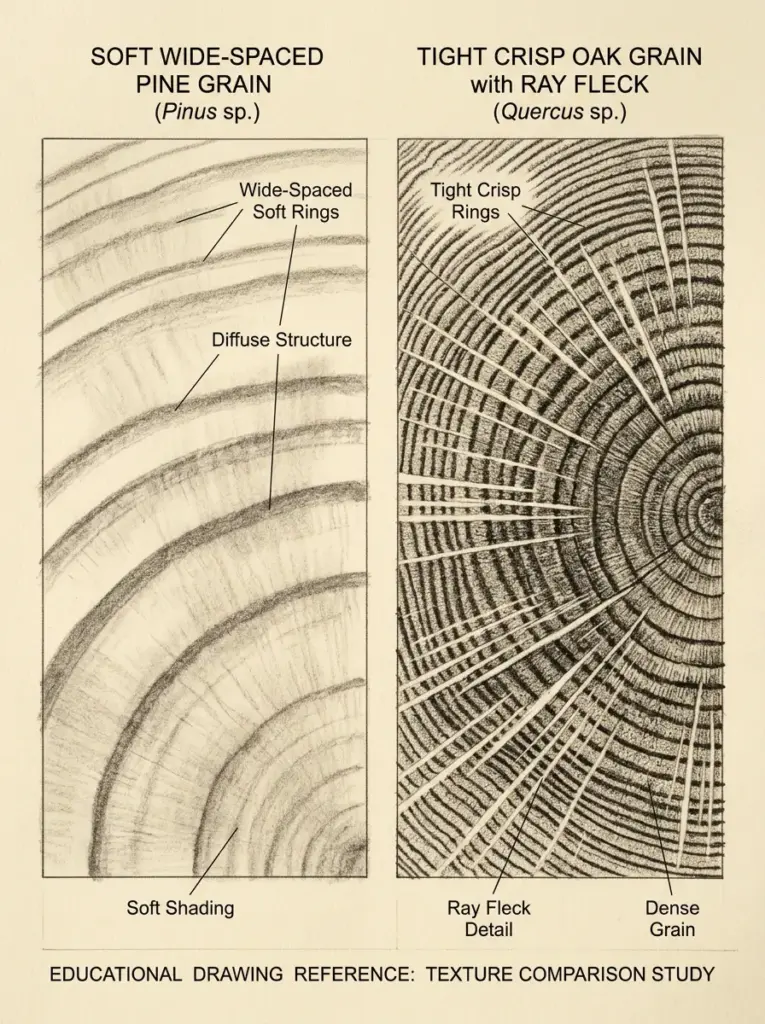
Pine grain is soft, wide-spaced, and gentle in contrast—low-pressure parallel lines with a light blending pass works well. Oak grain is tighter, more defined, often with a pronounced medullary ray figure (the ‘fleck’ in quarter-sawn oak). Oak needs crisper lines, less blending, and more attention to the ray fleck pattern across the grain.
10. Use White Gel Pen for Highlight Grain on Dark Backgrounds
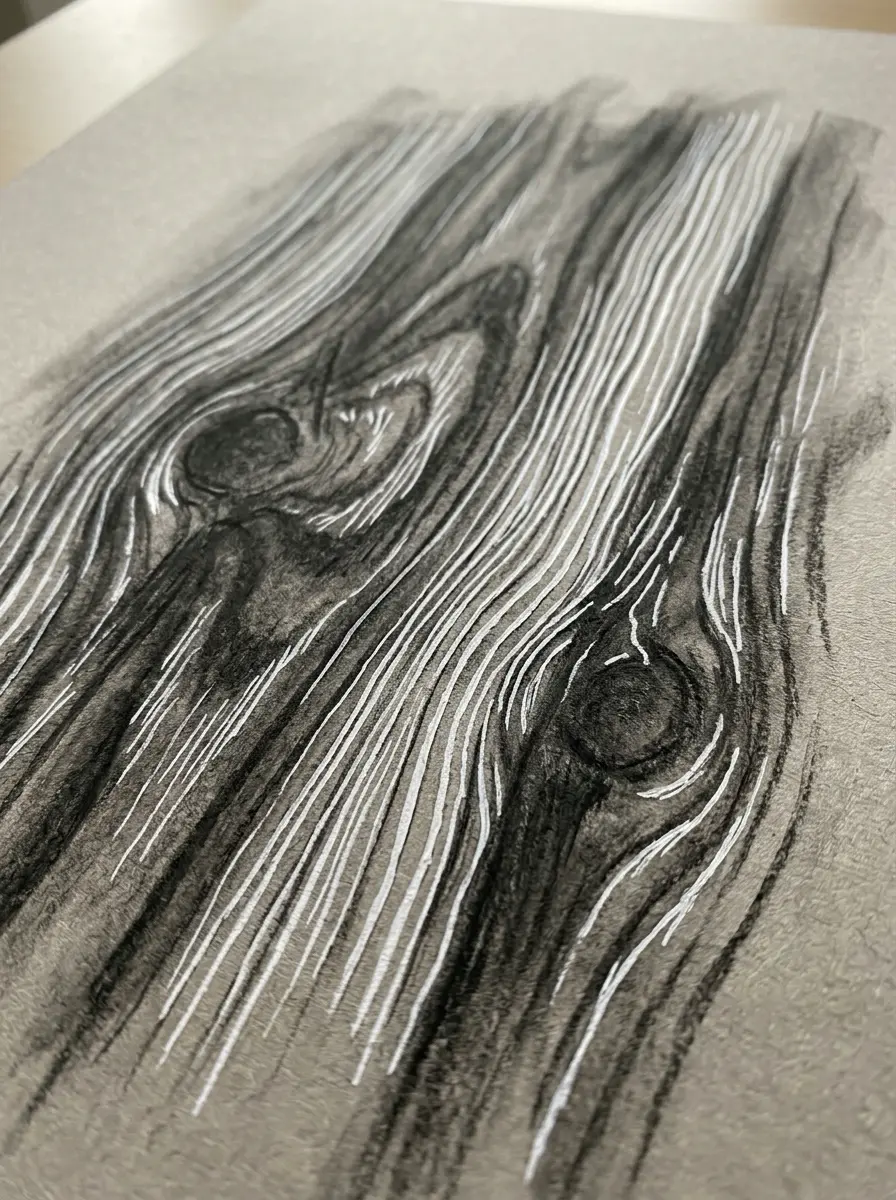
Working on toned paper (Canson Mi-Teintes grey or brown)? After drawing dark grain with charcoal or dark pencil, add highlight grain lines with a Uni-ball Signo white gel pen or a white Posca marker. The highlighted lines create a sense of raised grain catching the light—impossible to achieve on white paper alone.
11. Draw Reclaimed Wood with Nail Holes and Staining
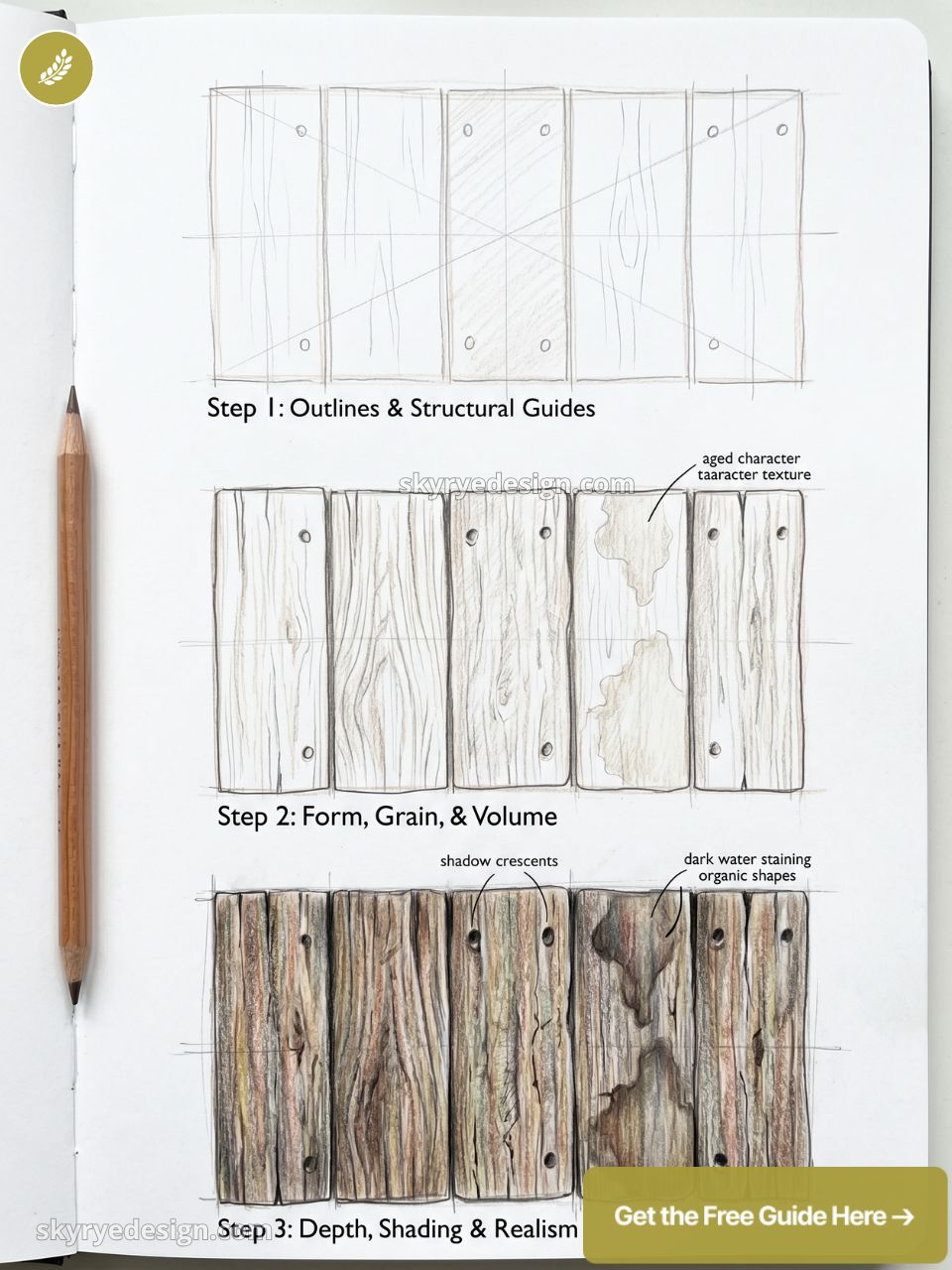
Reclaimed timber has nail holes (small circles, slightly irregular), dark water staining (soft edges, irregular shapes), and worn surface grain. Each of these adds authenticity. Draw nail holes as tiny ovals with a shadow crescent on one side. Staining is achieved with a soft 6B lightly blended—not scribbled—in organic shapes that follow wood grain direction.
12. Use Directional Erasure for Raised Grain Effect
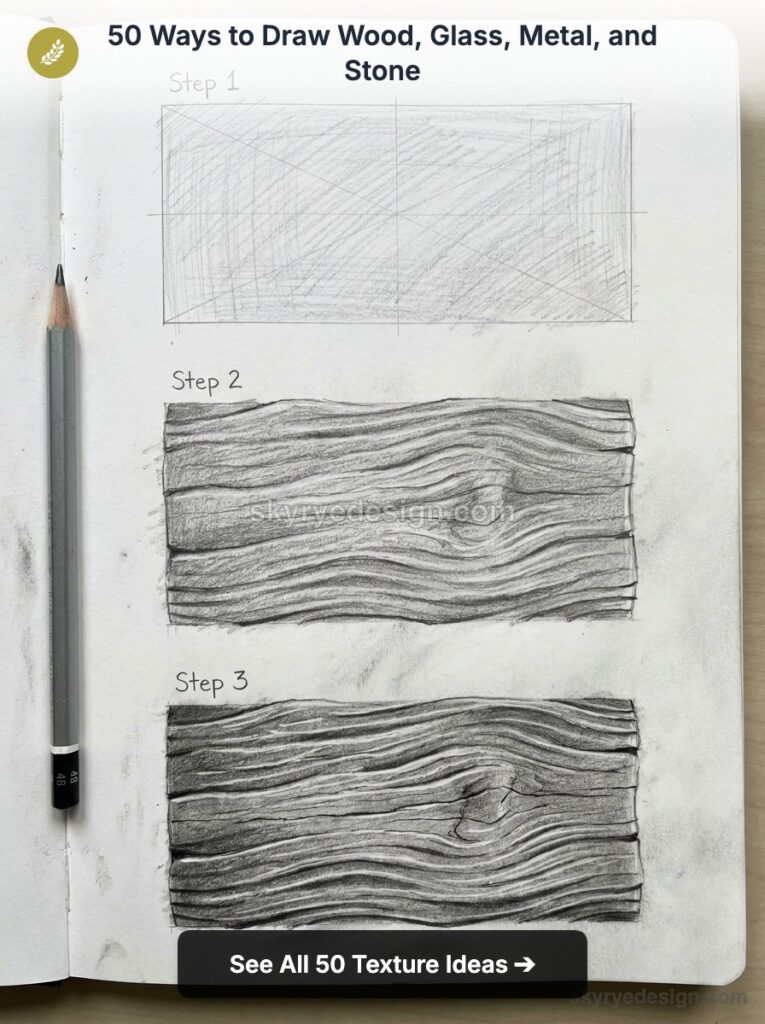
After shading a wood area with a 4B, use a sharp corner of a kneaded eraser to lift grain lines. Pull the eraser along the grain direction in quick strokes. This creates bright, raised-grain highlights that are almost impossible to draw directly. The Faber-Castell kneaded eraser holds a sharp point better than cheaper alternatives.
13. Draw Bamboo with Segmented Nodes and Smooth Internodes
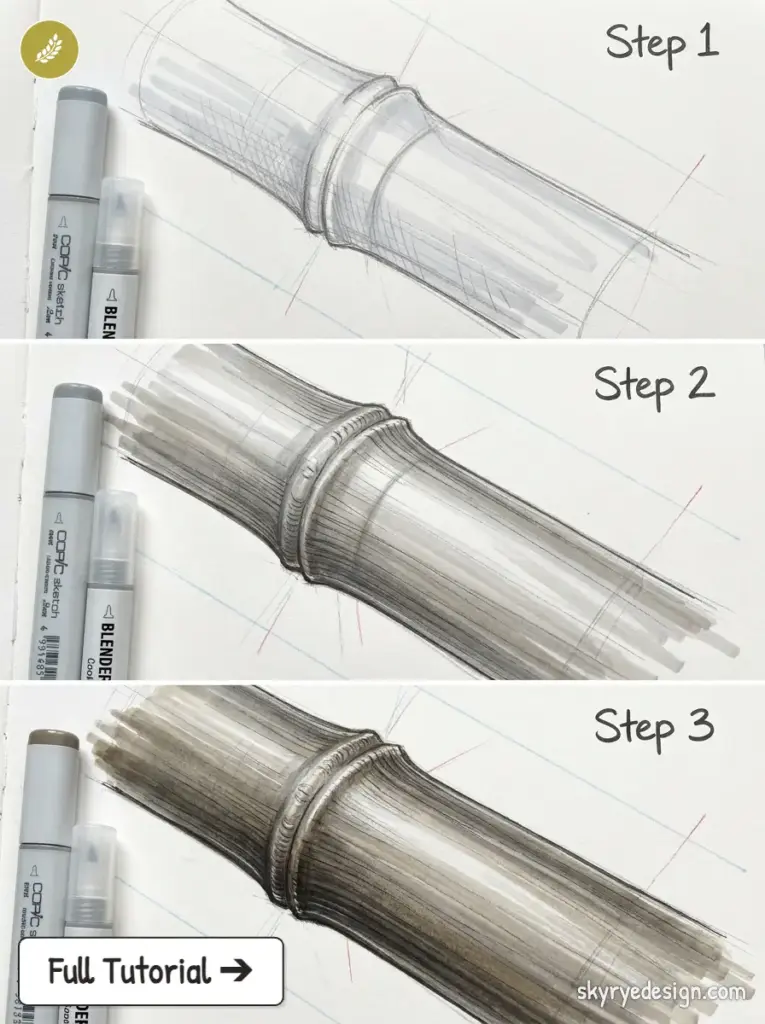
Bamboo is technically grass, but architecturally functions like wood in drawing. The key is the node: a slightly swollen ring with a raised ridge. Between nodes, the culm (stem) is smooth with subtle vertical lines. Shade with a curved gradient—darkest at the edges, lightest in the centre of each rounded segment.
14. Render Plywood Edges as Visible Layer Stacking
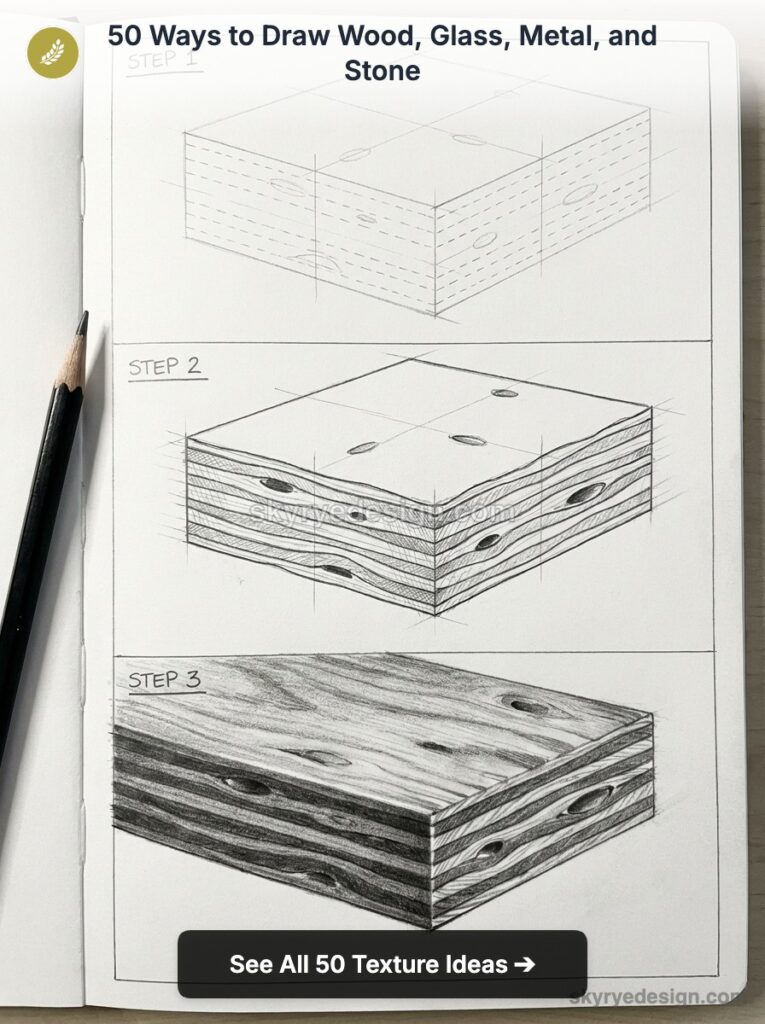
Plywood edge grain is distinctive: alternating dark and light horizontal bands, each representing a veneer layer. Draw thin horizontal stripes with slightly irregular edges where the layers meet. Add small void pockets (slightly darker ellipses) at irregular intervals—these are natural gaps in the veneer glue-up.
15. Match Your Stroke Direction to Wood Species Anatomy
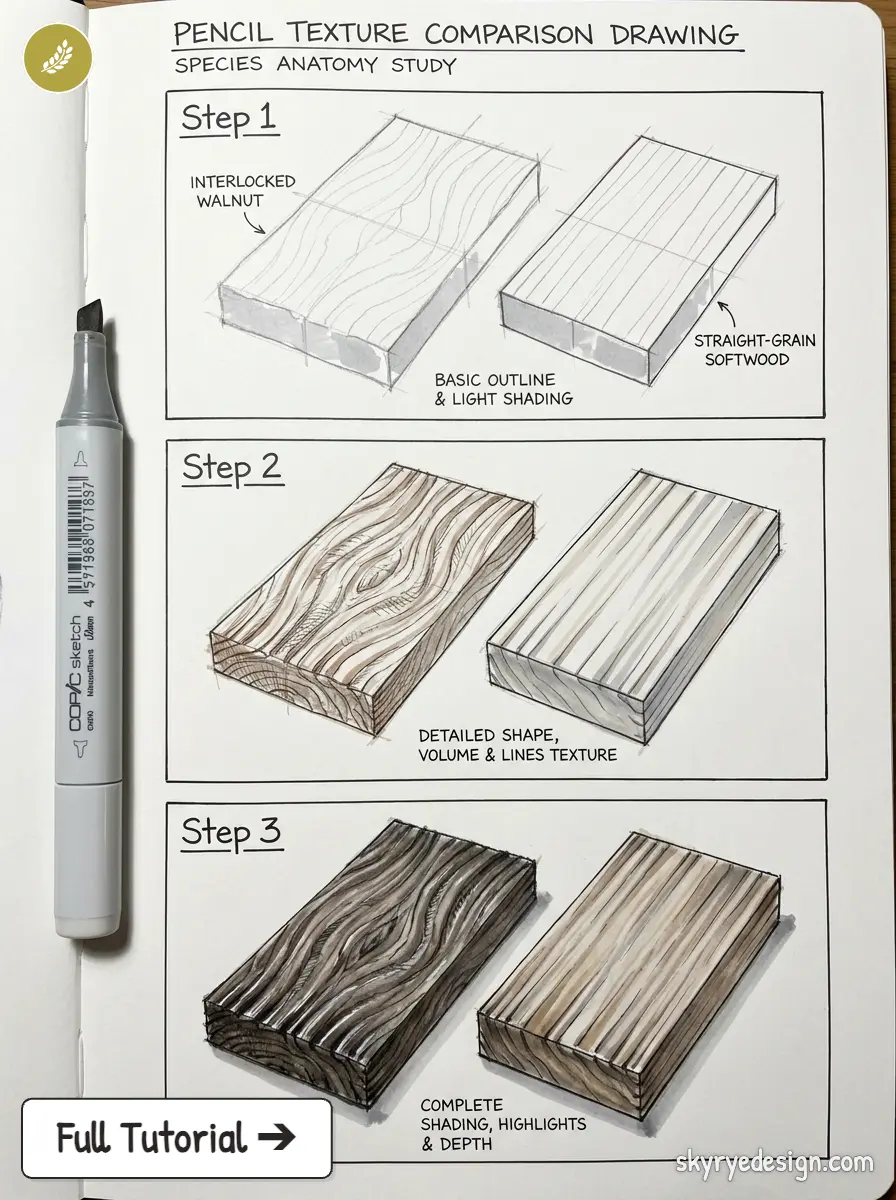
Hardwoods like walnut have interlocked grain—the direction reverses in adjacent strips, creating a ribbon figure. Softwoods have straighter grain. When drawing from a specific species reference, observe whether the grain runs truly parallel or whether it has gentle wave reversals. This single observation separates good wood drawing from great wood drawing.
Drawing Glass: 12 Techniques for Transparent and Reflective Surfaces
Glass is the most counterintuitive material to draw. Your instinct is to shade it like any other object—wrong. Glass barely exists as a mass. What you’re really drawing is what the glass does to light and to the objects around it. Once you accept that, everything simplifies.
16. Protect Your Highlights First—Before Any Shading
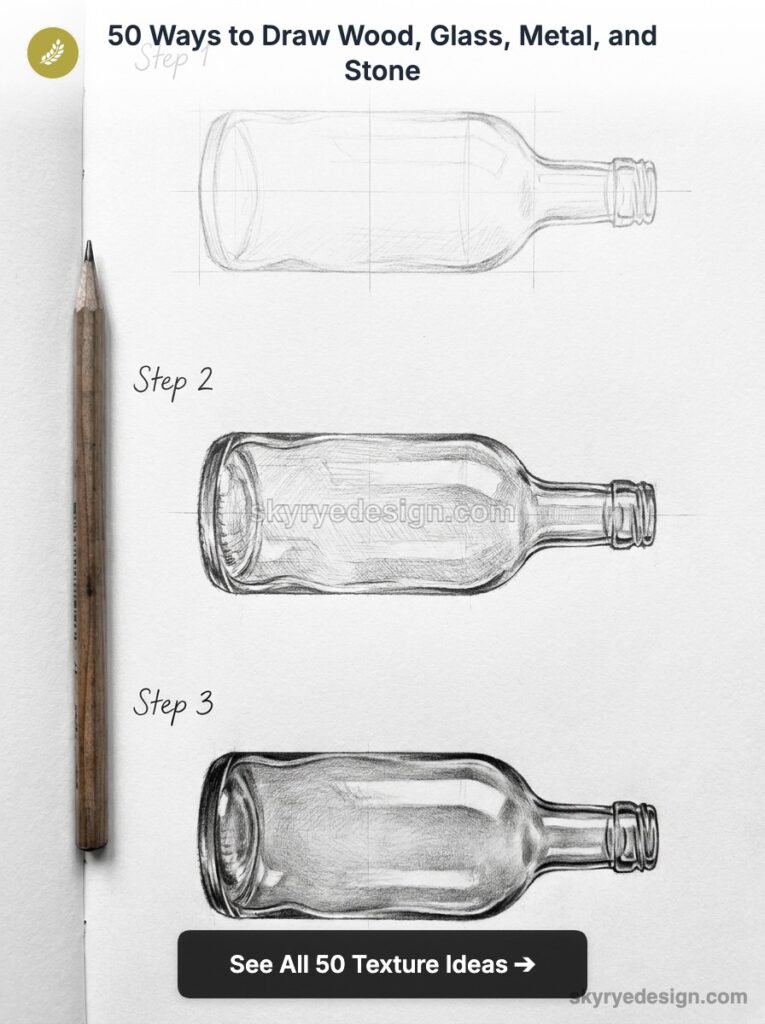
The most important step when drawing clear glass in pencil: identify every highlight zone and don’t touch those areas at all. Leave the paper white. Or, if you’re working in charcoal, apply masking fluid (Winsor & Newton Art Masking Fluid) to highlights first. The pure white highlight is what makes glass read as glass, not plastic.
17. Use Hard Contrast at Glass Edges
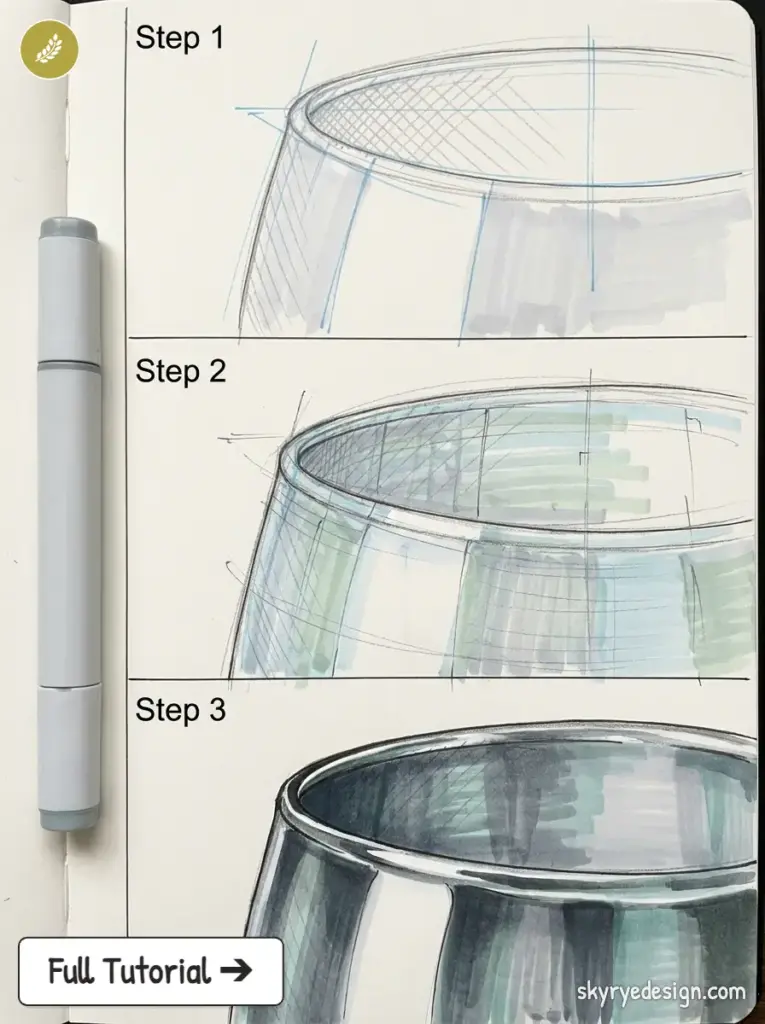
Glass edges are sharp and dark—they concentrate light bending around the curved surface. Draw a thin, dark line right at the glass contour edge, then immediately transition to a bright highlight just inside it. This sharp dark-light-dark pattern at edges is the signature of glass and tells the eye ‘this is transparent.’
18. Draw Refraction Distortion for Objects Behind Glass
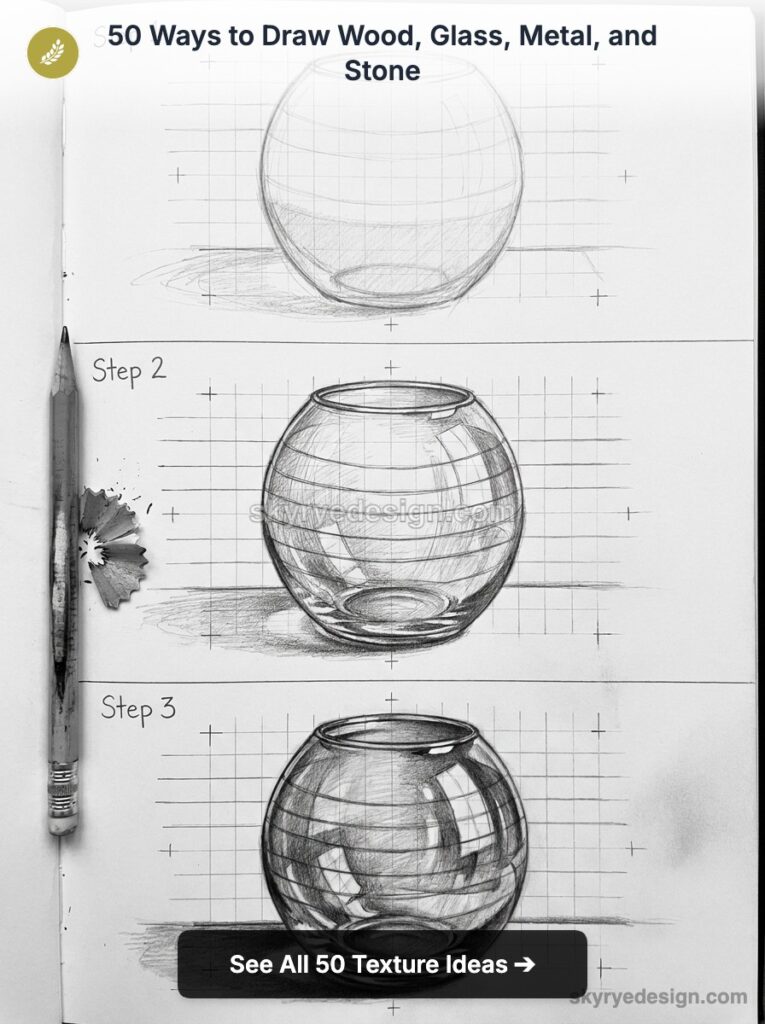
Objects seen through glass are distorted. A straight horizontal line behind a round glass vase becomes curved. A checkerboard floor seen through a glass table edge refracts and shifts. Draw these distortions deliberately—not as errors but as features. The offset, bent, or duplicated image behind the glass proves its presence better than any shading trick.
| ✏️ Pro Tip Photograph a glass bottle in front of a simple grid (graph paper works) to study exactly how it bends straight lines. Draw this reference directly before working from imagination. |
19. Show Glass Thickness at Rims and Bases
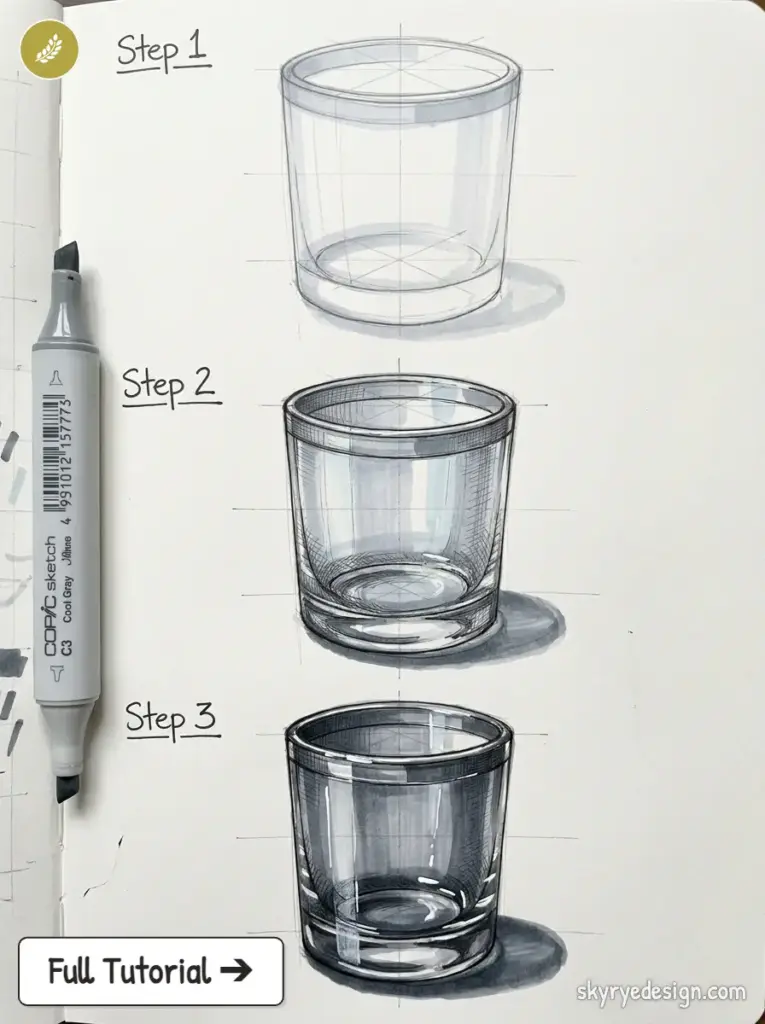
The rim and base of a glass vessel are where the material has actual visible mass. At the rim, draw a distinct edge band—slightly darker than the upper surface. At the base, a circular foot ring appears as a thick ellipse with a shadow underneath. These zones of visible thickness anchor the otherwise ghostly form.
20. Use Light Hatching for Mid-Tone Glass Body
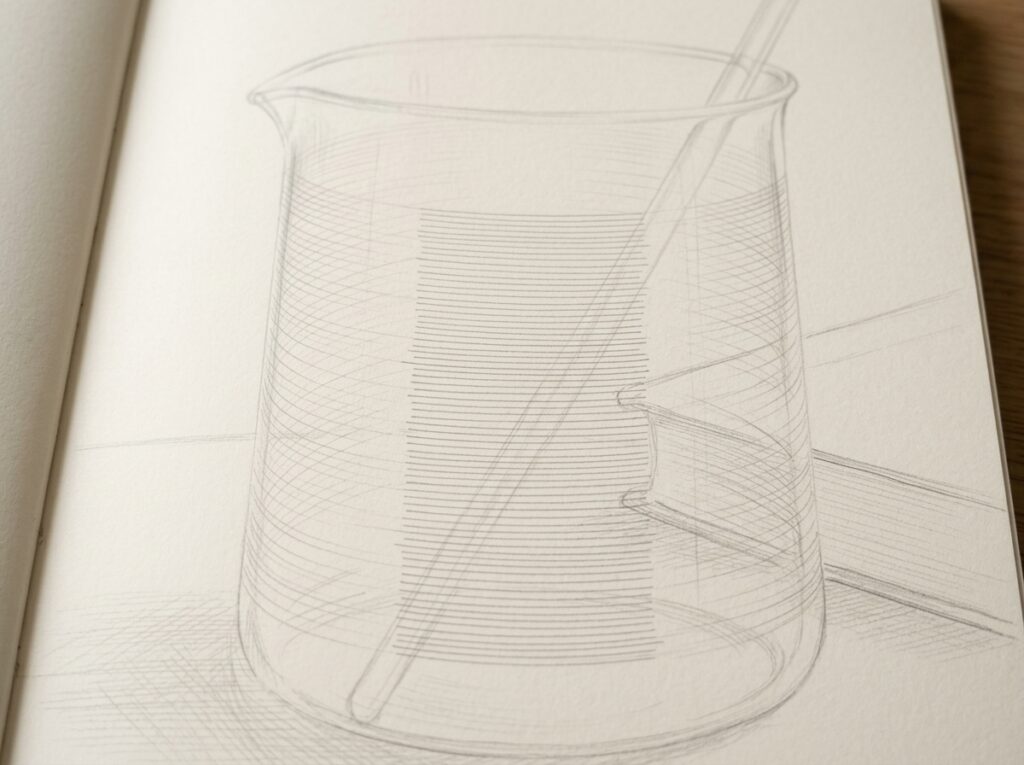
Between the bright highlights and dark edges, the glass body needs a subtle mid-tone. Use very light, evenly spaced horizontal hatching (following the glass form’s curve) with a 2H pencil. Keep pressure minimal. The hatching should be barely visible—a whisper of tone that suggests form without blocking the transparency.
21. Draw Frosted Glass with Soft, Diffused Edges
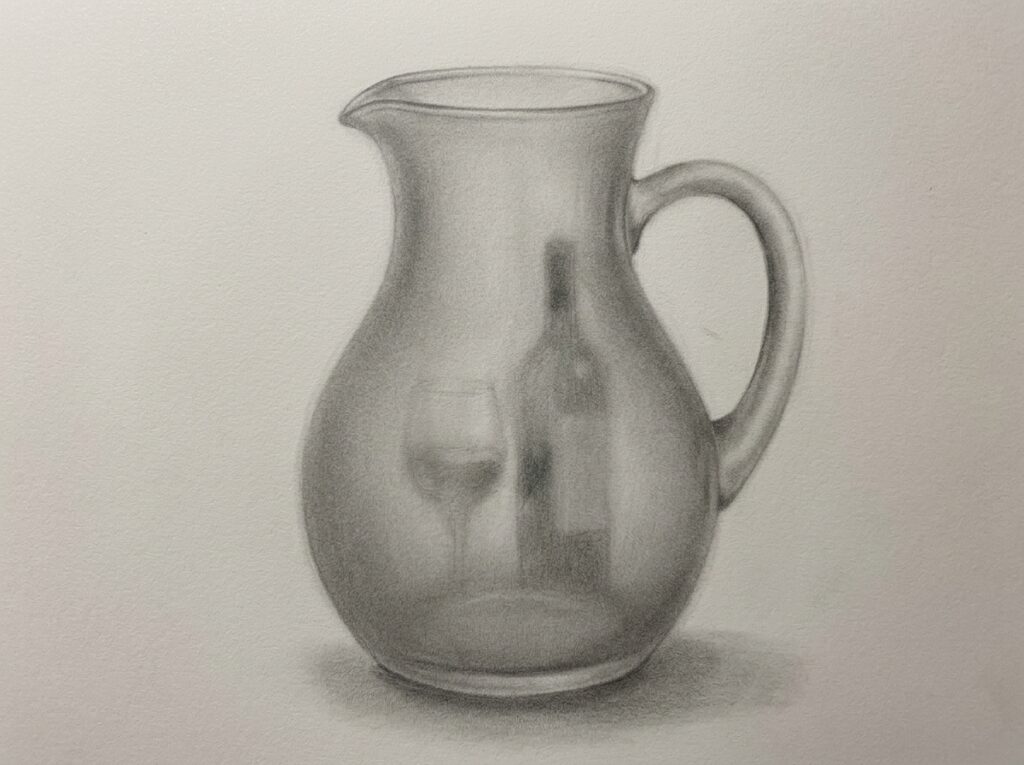
Frosted glass (like a bathroom window or a Sagaform carafe) scatters light instead of transmitting it cleanly. Objects behind it are blurred and low-contrast.
Draw the glass body with an even mid-tone using a 2B blended smooth with a tortillon, then add very soft, low-contrast ghost shapes of objects behind. No sharp edges anywhere on the frosted surface.
22. Render Coloured Glass by Tinting the Interior
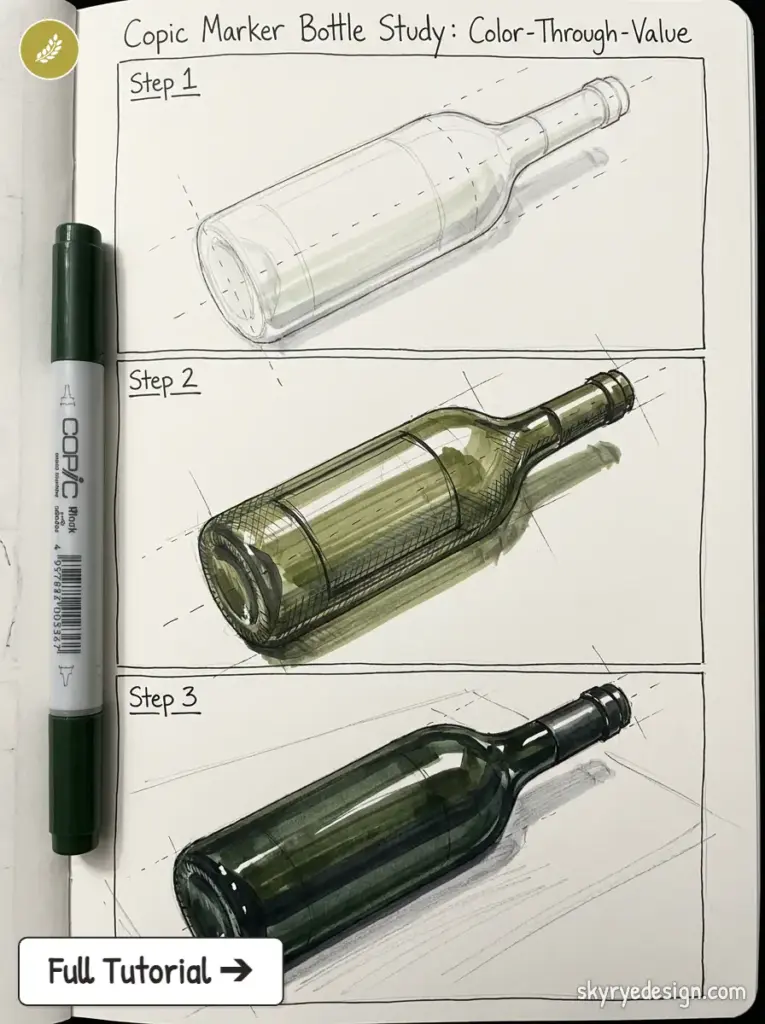
For green wine bottles or blue cobalt glass: the glass body takes on the colour of the material, but highlights stay white (or near-white). In graphite, you simulate colour with value—green glass is darker than clear glass, so shade more heavily through the body while preserving the same highlight logic. In coloured pencil, layer the glass colour over light shading and leave highlights untouched.
Turn these ideas into real sketchbook practice
23. Draw Reflections in Flat Glass (Windows, Mirrors)
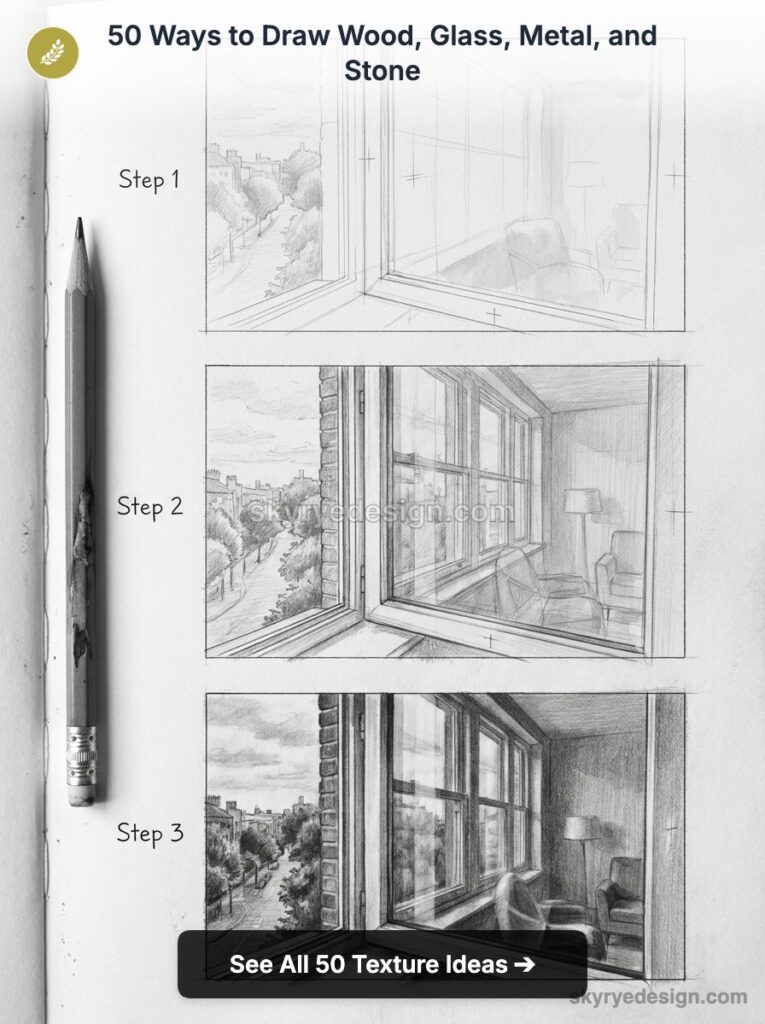
A window pane shows reflections of the room behind the viewer—ghostly, lower-contrast versions of the reflection scene layered over the view outside. Draw the exterior scene first at full value, then lightly overlay the interior reflections with a softer pencil at 30–40% of the exterior’s value. Keep reflection edges slightly softer than direct-view edges.
24. Show Glass Contact Shadows and Caustics
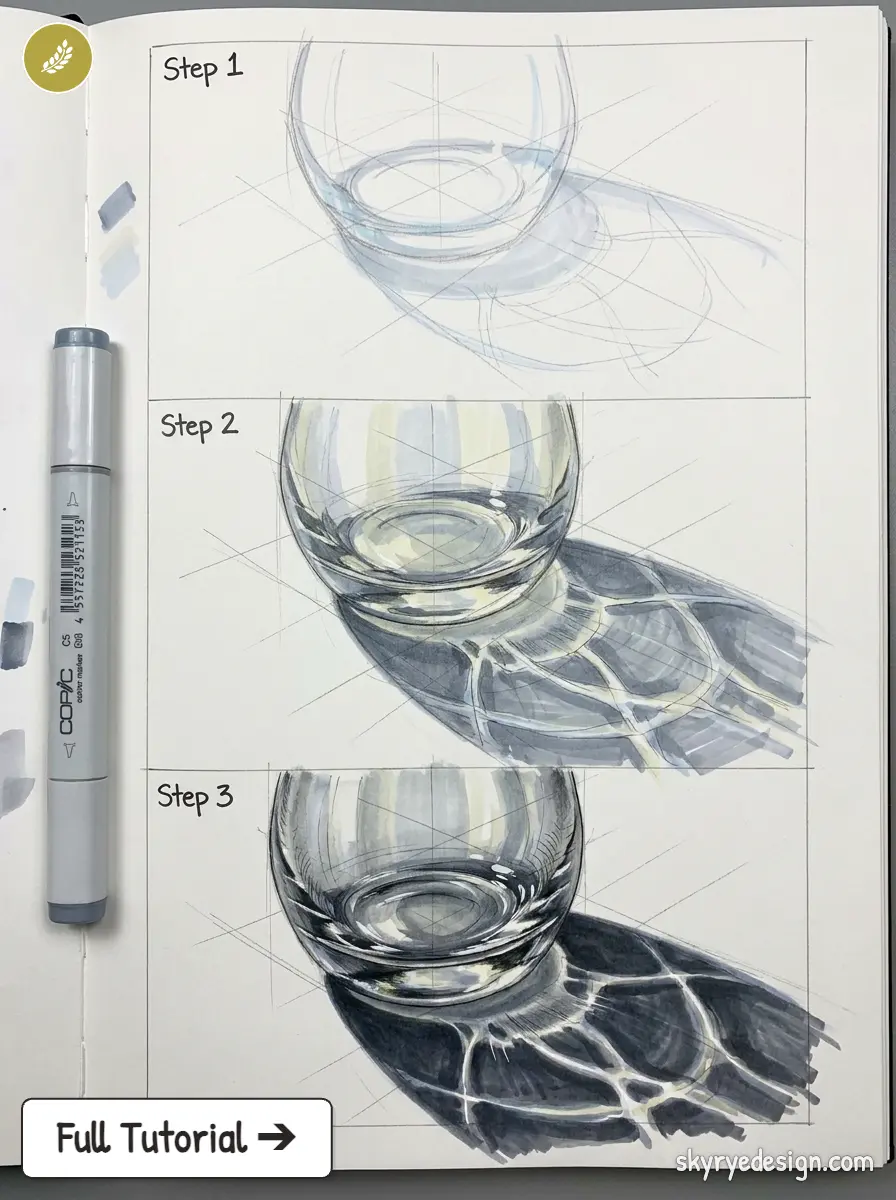
Where a glass vessel sits on a surface, it casts a complex shadow with bright caustic lines (concentrated light) running through it. These caustics are bright, sharp lines within the shadow—draw them by leaving thin bright channels in an otherwise darker shadow. The Staedtler Mars plastic eraser can lift thin caustic lines from a shaded shadow area.
25. Use Ink for Bold, Graphic Glass Illustration
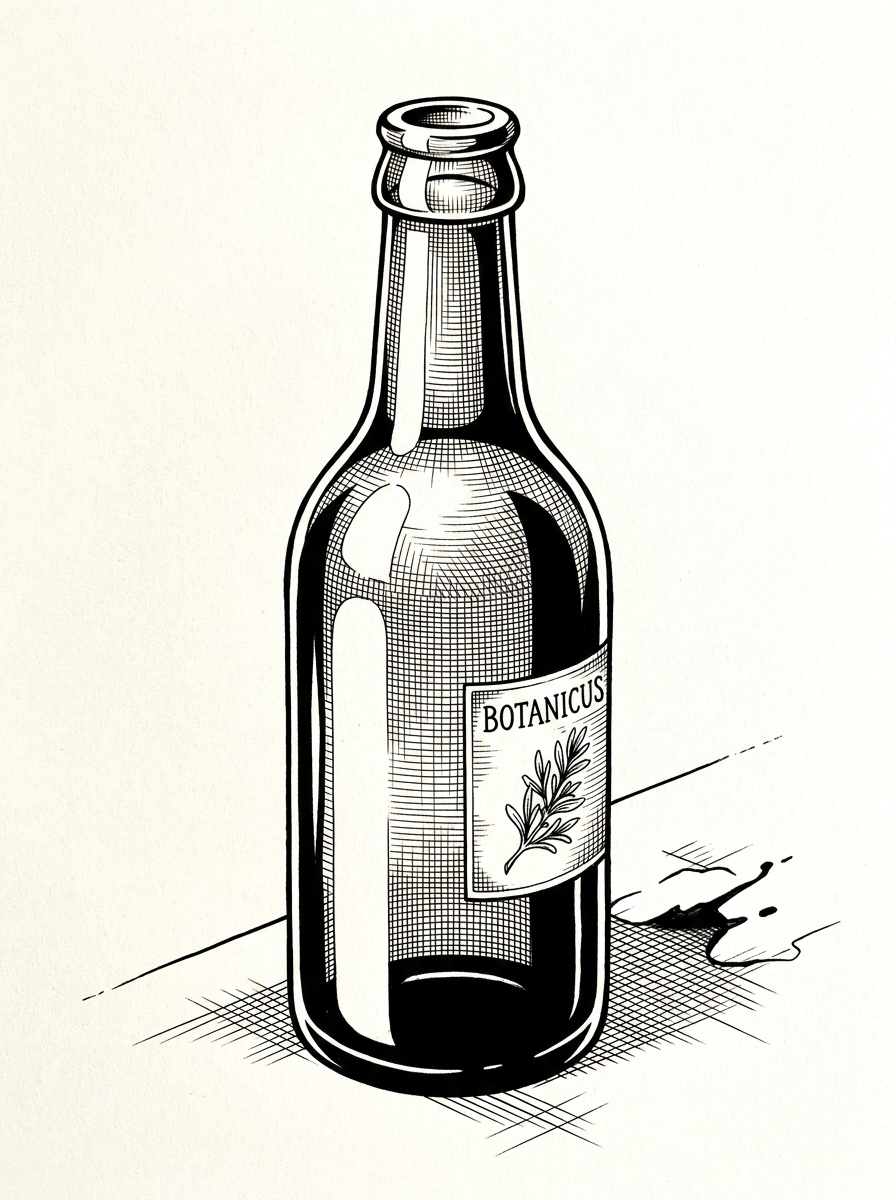
Pen-and-ink glass works on high contrast: solid black for the darkest shadow and edge concentrations, open white for highlights, and hatching for mid-tones. The Micron 0.05 pen lets you build very fine hatching in glass mid-tones without overwhelming the composition.
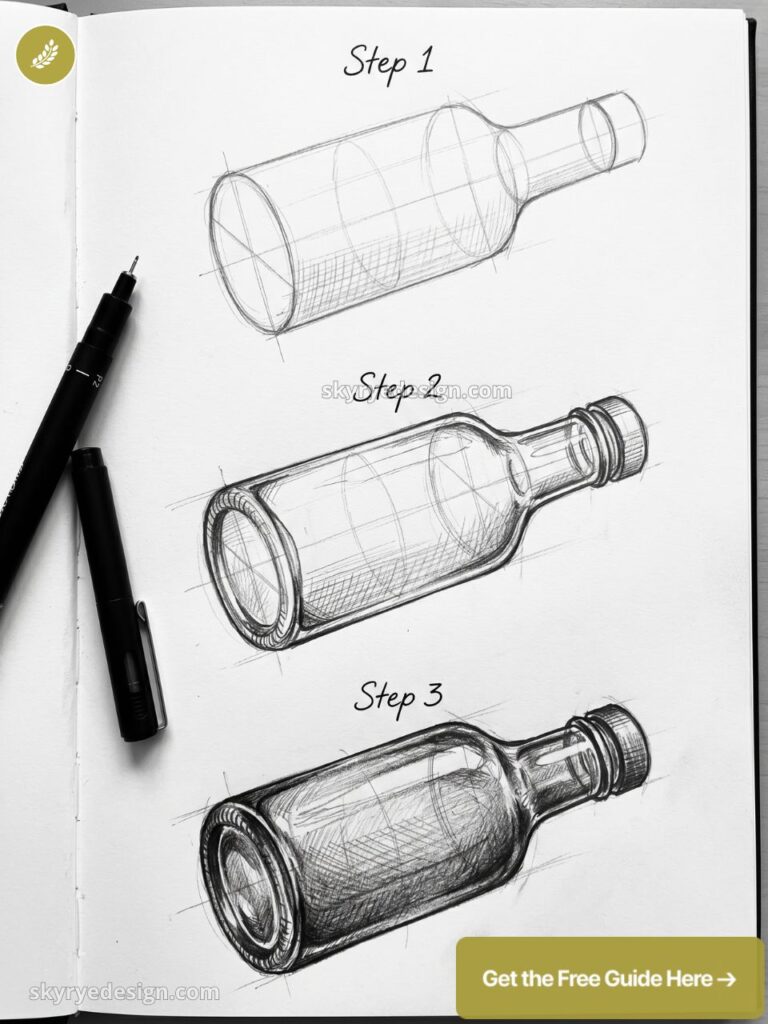
Ink glass studies are graphic and striking—ideal for logo work or editorial illustration.
26. Draw Cracked Glass with Spider-Web Fracture Lines
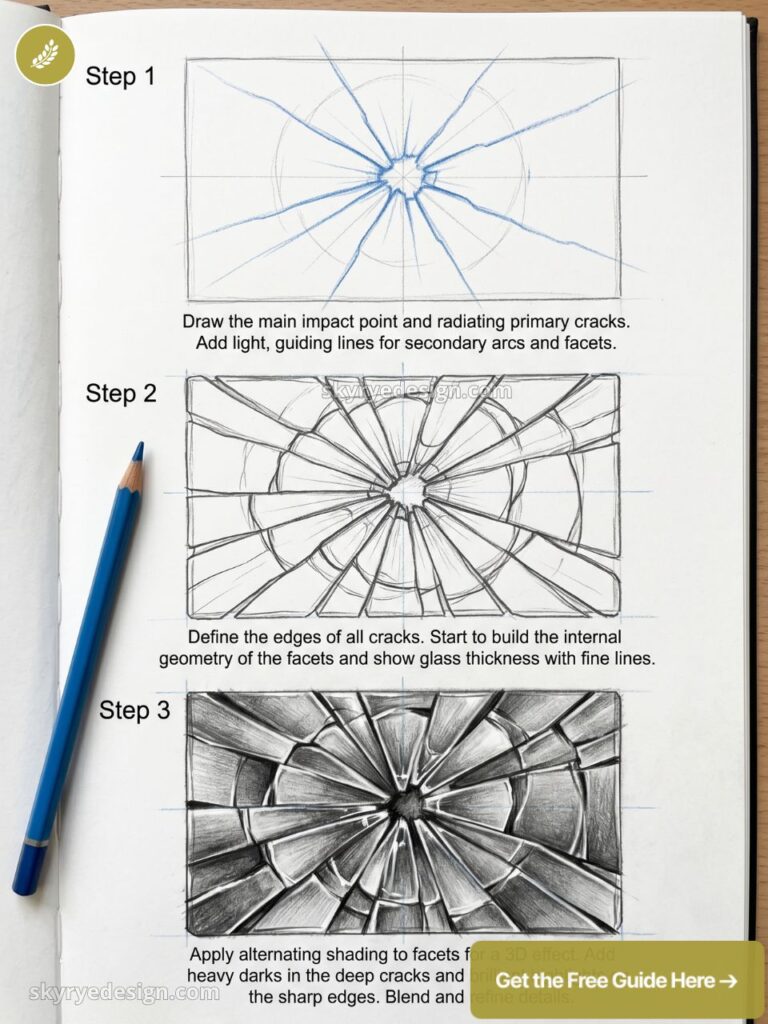
Impact cracks in glass radiate from the impact point in primary fracture lines, then develop secondary connecting cracks between them—like a spider web. Draw the primary radiating lines first from a central point, then add irregular connecting arcs between them. Each facet created by the cracks catches light differently: alternate light and dark across adjacent facets.
27. Digital Glass: Use Screen and Overlay Blend Modes
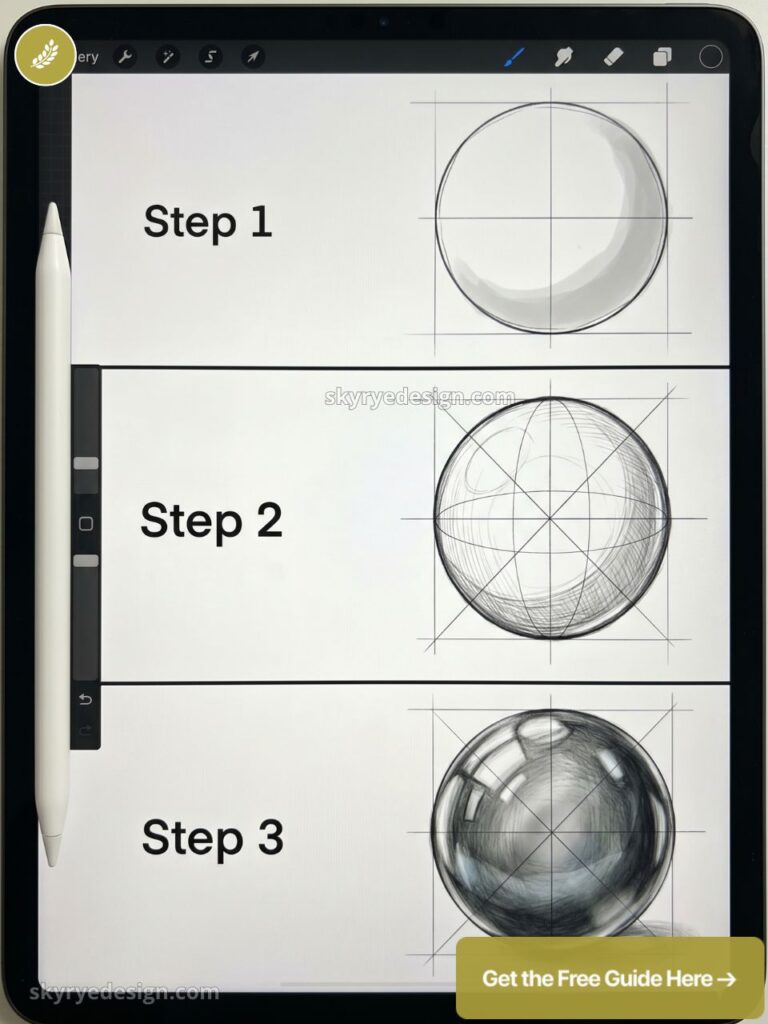
In Procreate or Photoshop, place your glass highlights on a Screen layer—it creates realistic translucent bright areas without affecting the underlying drawing. For reflections, use an Overlay layer at 20–30% opacity. These blend modes do electronically what transparent pencil pressure does manually.
Metal Drawing Techniques: 13 Approaches for Every Surface Type
Metal is defined by what’s around it, not by itself. A polished steel sphere reflects the room, the sky, and the ground—its own colour is almost irrelevant. Understanding that principle unlocks every metal drawing technique in this section.
28. The Core Metal Principle: Extreme Value Contrast
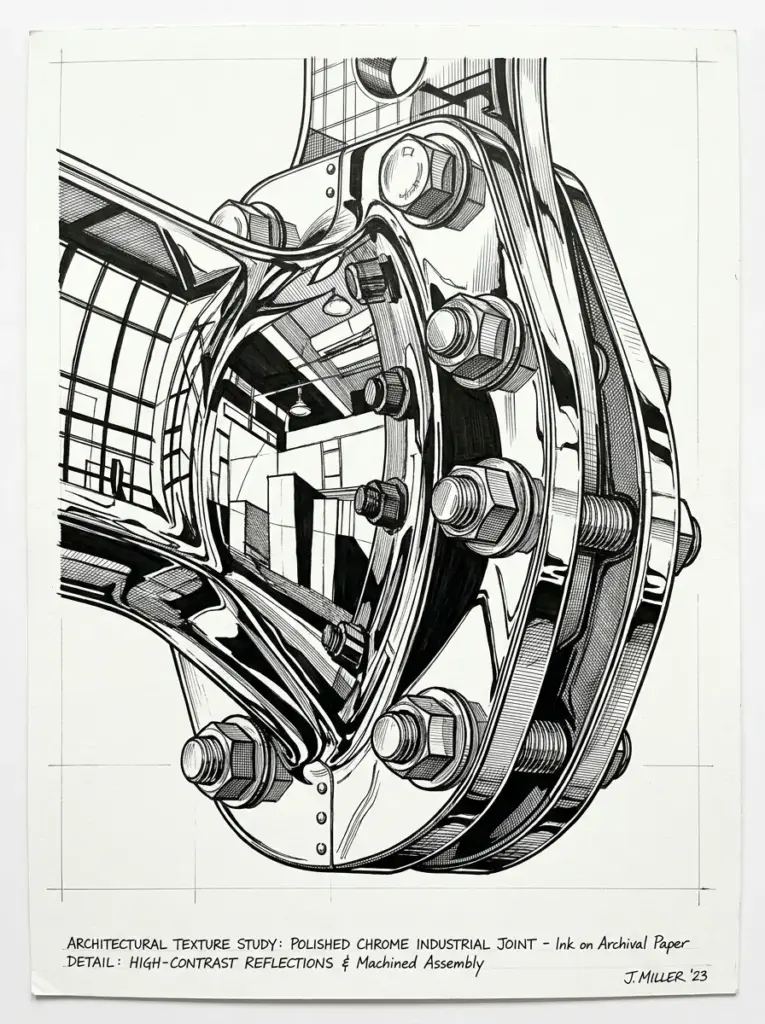
Polished metal has the widest value range of any material you’ll draw. Pure white highlights sit directly next to very dark reflections with minimal gradient between them.
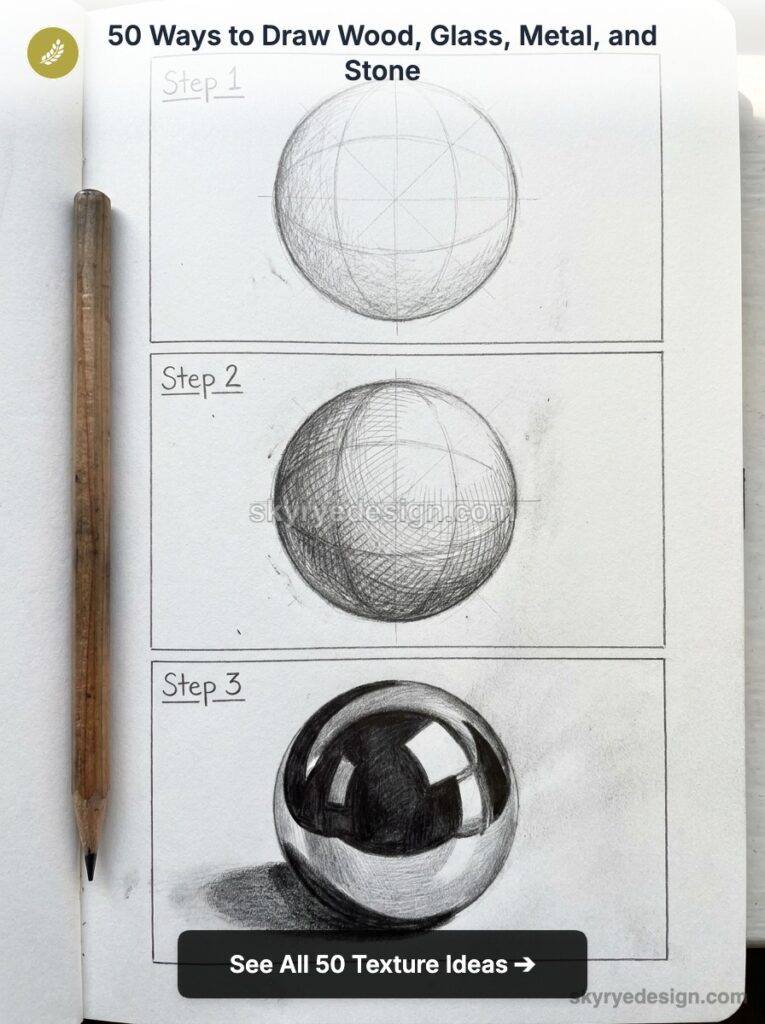
Train yourself to go darker in the darks than feels comfortable—if your metal still looks like plastic, your shadows aren’t dark enough.
29. Draw Polished Chrome with Hard-Edge Value Jumps
Chrome doesn’t blend smoothly—it slams from bright to dark abruptly. Draw a clean boundary line between your brightest highlight and the adjacent dark reflection zone.
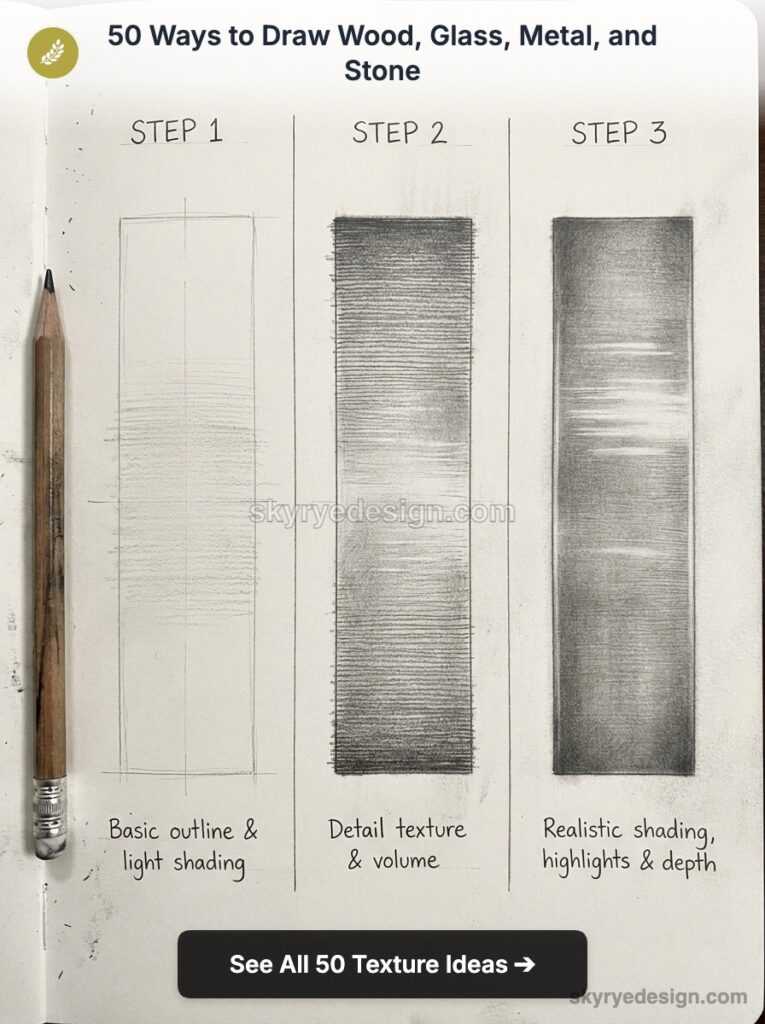
Use a 6B for the darks, keep the white paper untouched for highlights, and minimise blending. Architectural chrome (like Vola tapware or a Miele appliance handle) is excellent reference material.
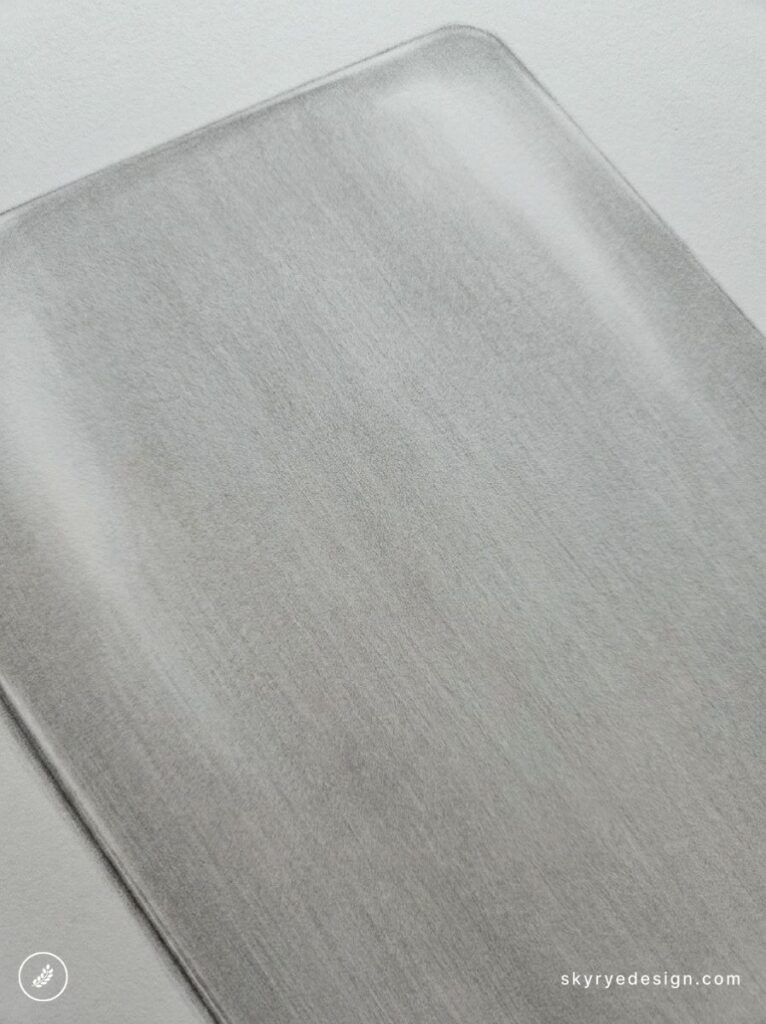
30. Brushed Steel: Directional Hatching is Everything
Brushed steel (the finish on most professional kitchen equipment and camera bodies) has fine parallel lines from the brushing process.
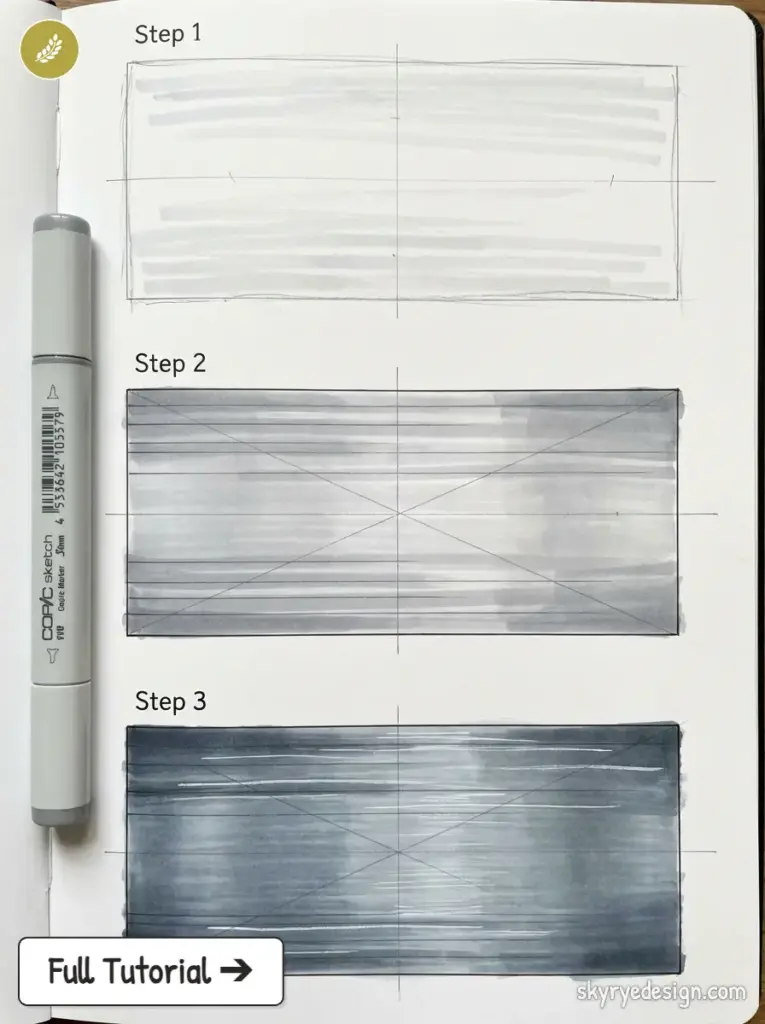
Draw these with light, consistent, parallel hatching in the brushing direction—always horizontal if the steel was brushed horizontally. The gradients are softer than polished chrome, and highlights are elongated in the brushing direction rather than circular.
| ✏️ Pro Tip Look at the base of a Leica M-series camera or a Bose SoundLink speaker—these are excellent real-world references for high-quality brushed aluminium surfaces. |
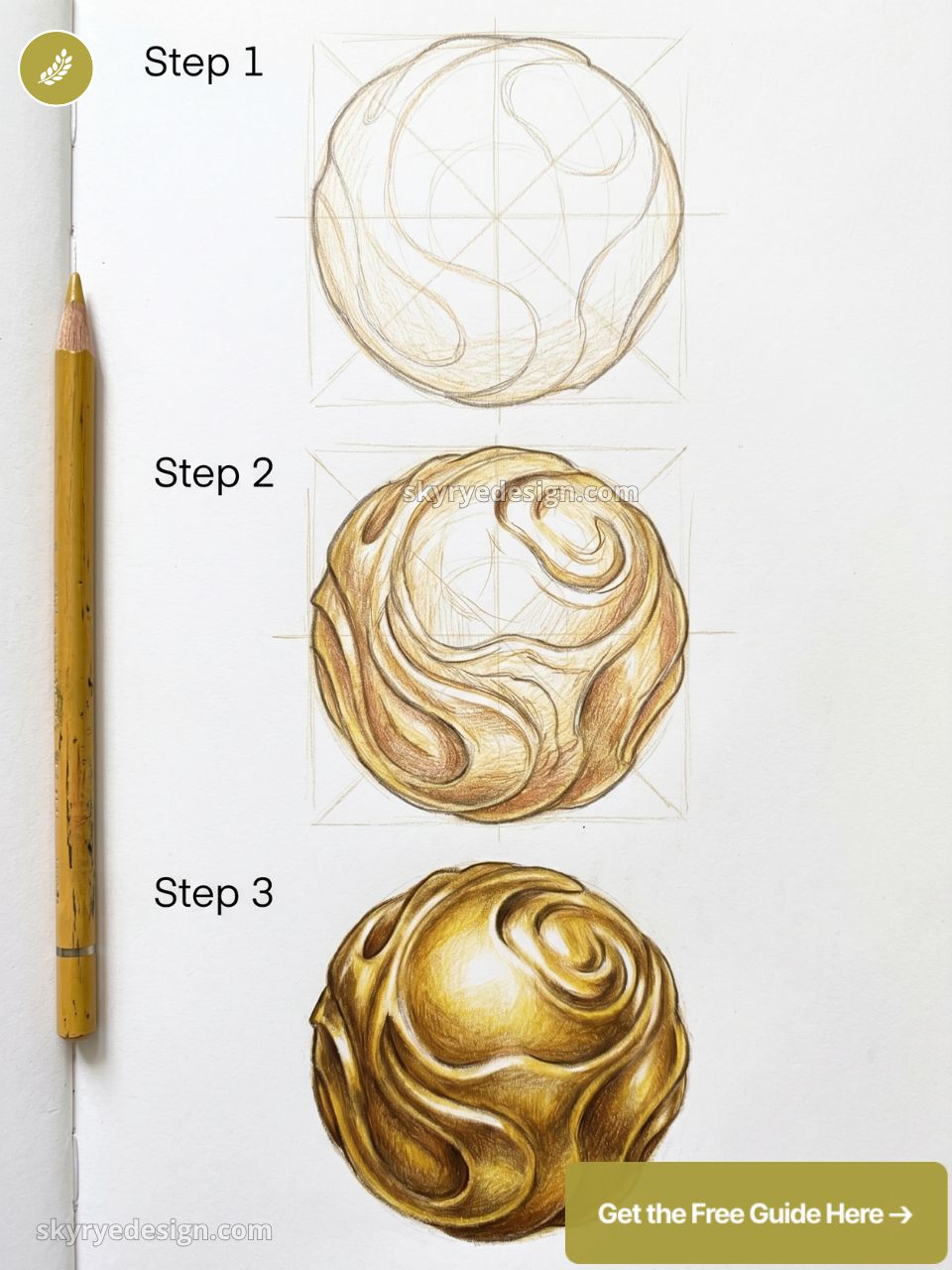
31. Gold: Warm Shadows, Bright Highlights
Gold’s distinctive character is warm shadow tones—even in graphite, suggest this by keeping the shadow areas a mid-brown value (use a warm-toned paper or warm pencil brand) rather than neutral grey.
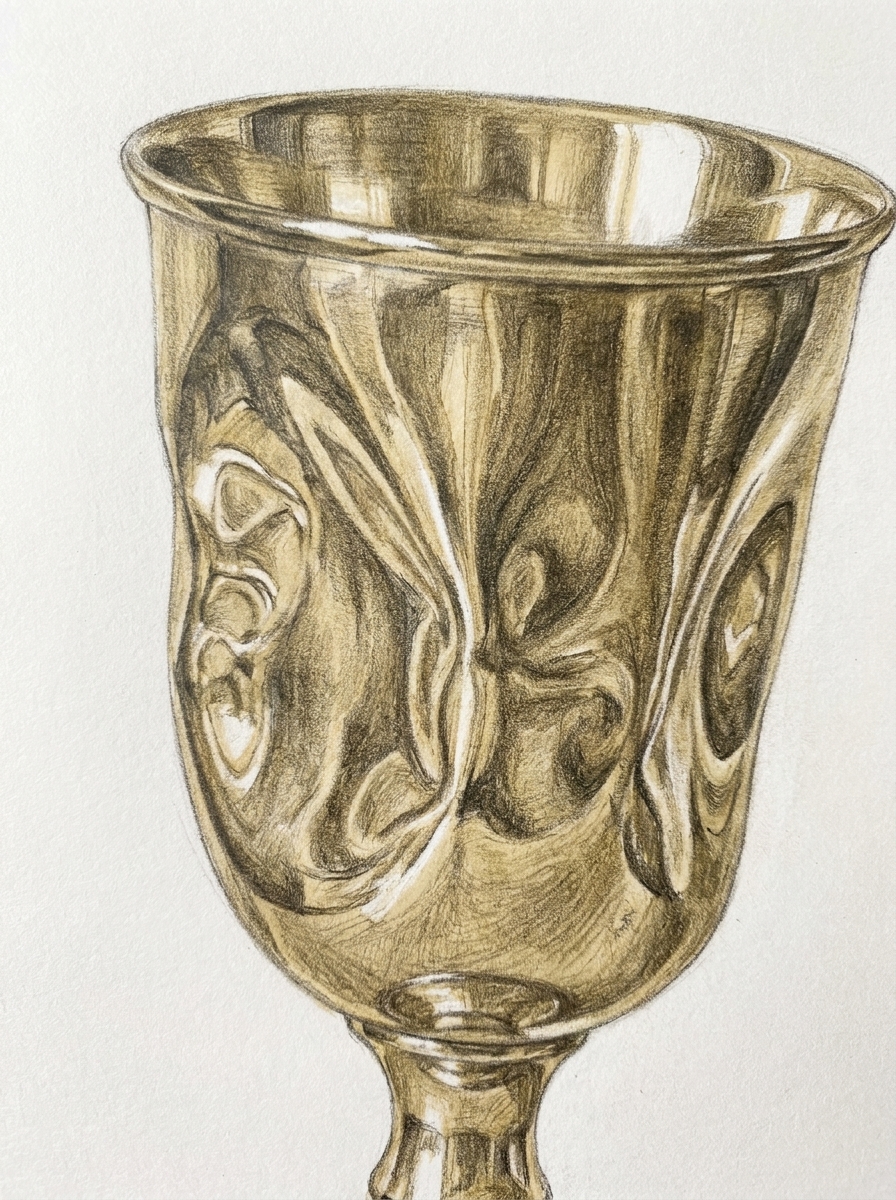
Gold highlights are extremely bright, almost as intense as chrome. The mid-tones are narrower than in silver—gold has less mid-range and more extreme contrast.
32. Copper and Bronze: Rich Darks with Patina
Aged copper and bronze develop a patina—verdigris (green-blue) on copper, darker oxidation on bronze. In graphite, patina reads as irregularly textured dark zones in the recessed areas of the surface.
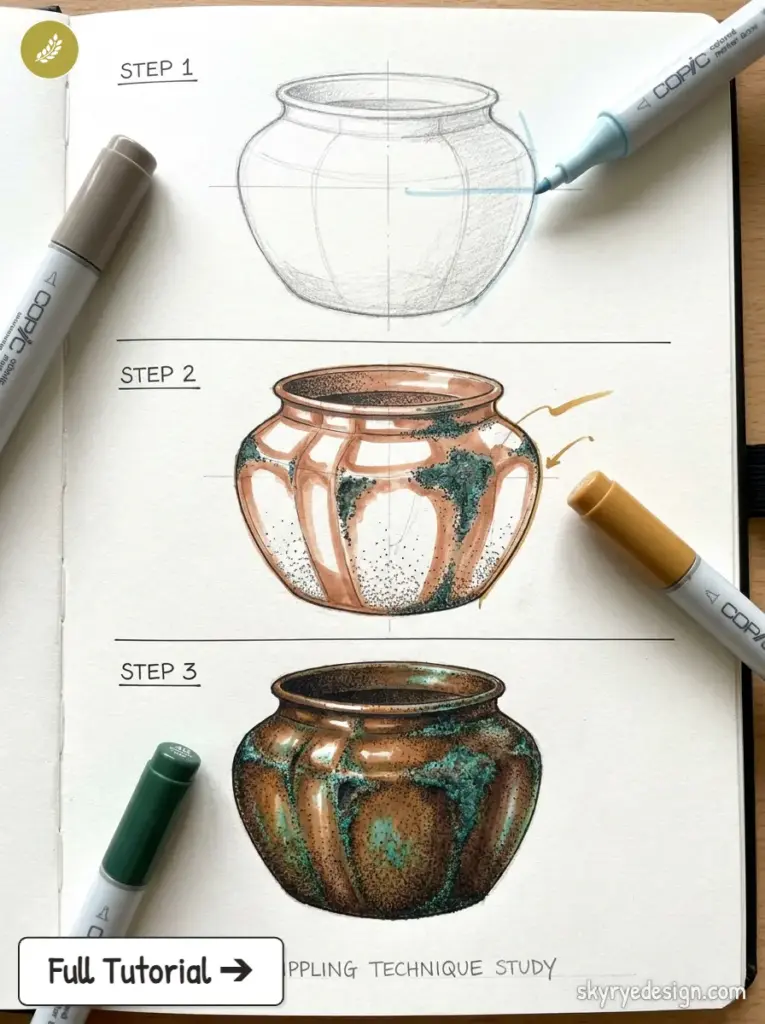
Stipple these darker zones with a 4B pencil to suggest the granular, irregular nature of oxidation. Compare new vs patinated reference photos before starting.
33. Cast Iron: Rough, Matte, and Porous
Cast iron (like a Le Creuset base or a classic radiator) is much less reflective than polished steel. Its surface has a granular, slightly porous texture from the casting process.
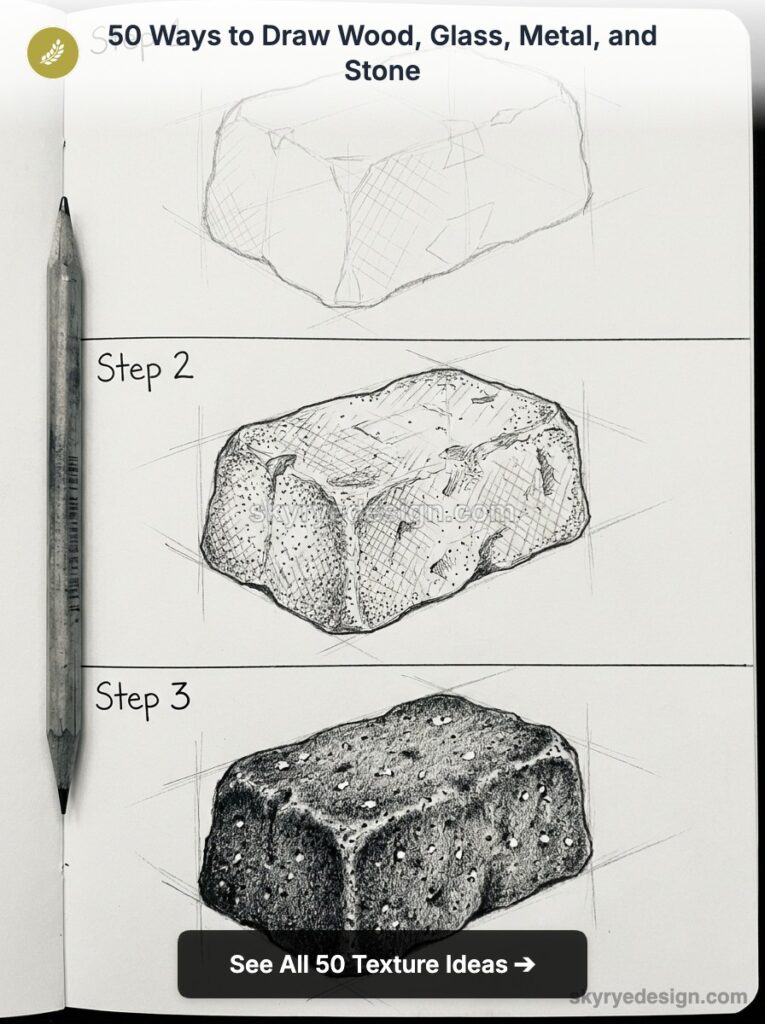
Draw with heavy stippling using a 2B over the shadow areas, and leave irregular small bright spots unpigmented to suggest the micro-pits in the surface. No smooth blending—cast iron fights smoothness.
34. Rust: Organic Edges, Layered Values
Rust is one of the most characterful metal surface conditions to draw. The key: rust has organic, irregular edges that expand outward from pits and crevices.
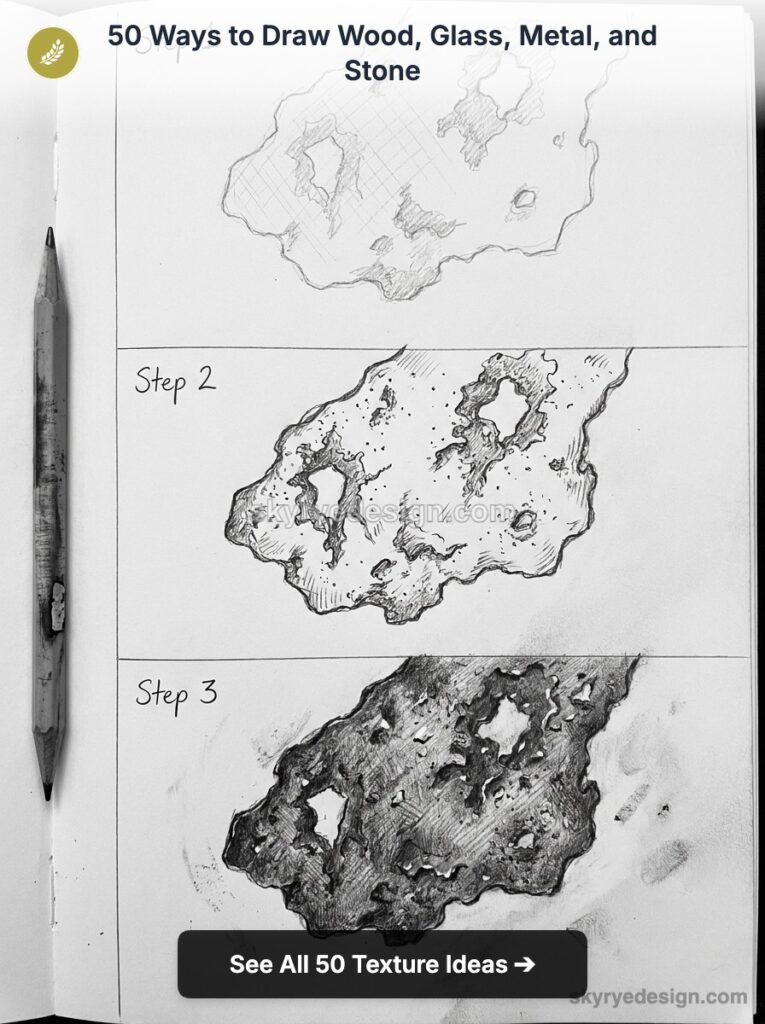
Use a 4B pencil to establish the darker recessed rust zones, then build up irregular texture with a combination of stippling and short, directional strokes. The Faber-Castell 9000 range handles both techniques cleanly.
35. Reflective Metal Spheres: Map the Environment
A polished sphere reflects a compressed, fisheye version of its entire environment.
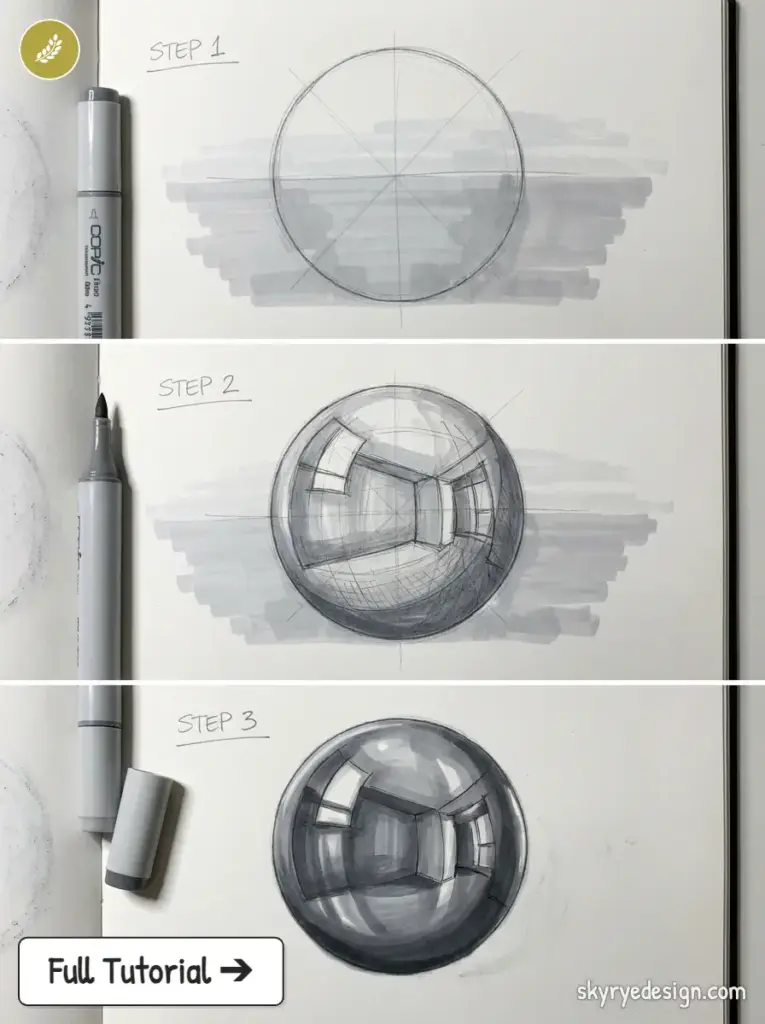
Before drawing, sketch what the environment looks like in each zone of the sphere—floor at the bottom, sky/ceiling at the top, room walls at the equator. Then shade each zone to match that environmental value. This conscious environmental mapping is what makes sphere reflections look photographic.
36. Foil and Crumpled Metal: Sharp Value Facets
Crumpled aluminium foil (or sheet metal) creates a faceted surface—each flat plane catches the light differently, creating abrupt value changes between adjacent facets.
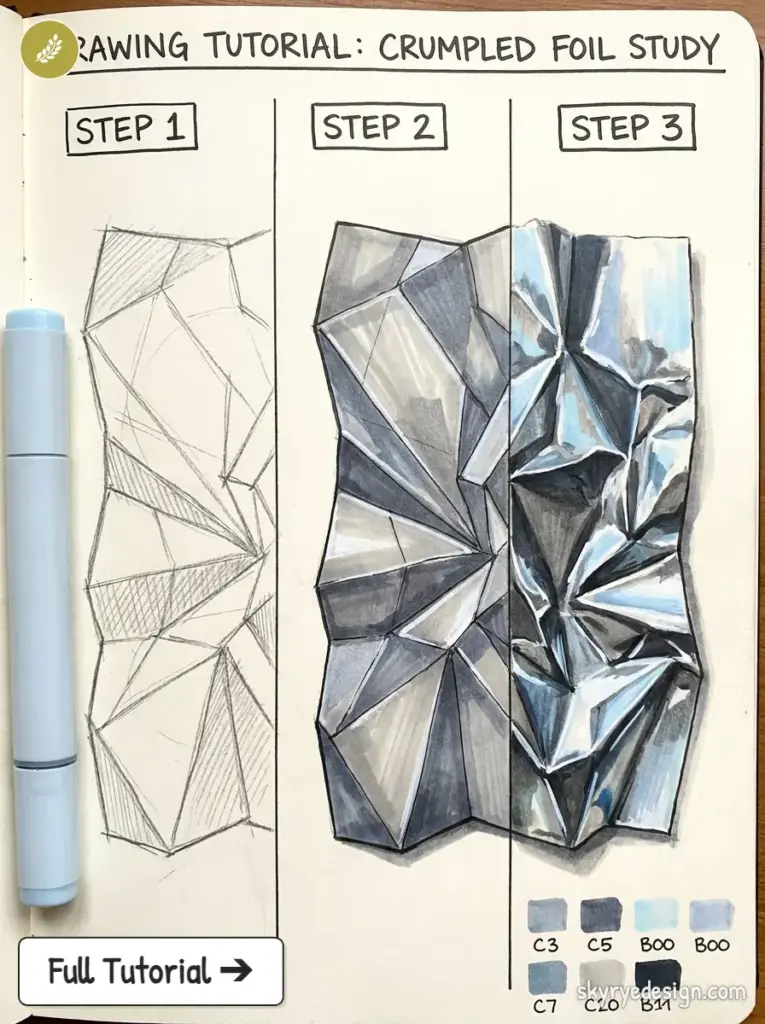
Draw these as a mosaic of flat-value polygons: each facet is essentially uniformly shaded, with hard edges between facets. No gradients within each face—just the transition between them.
37. Wire and Thin Metal Rods: Draw the Reflection, Not the Metal
A thin chrome wire is essentially all highlight and reflection—the metal itself is too thin to show surface detail.
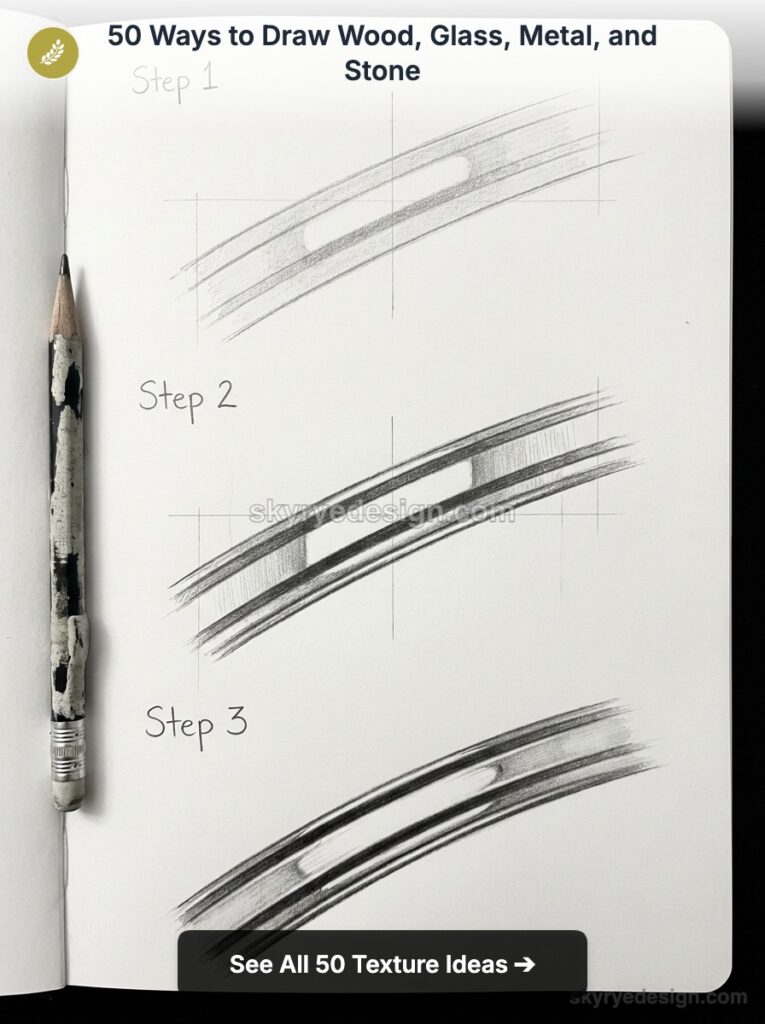
Draw wire by establishing a thin bright line (the main highlight), a dark shadow line parallel and adjacent to it, and a slightly lighter mid-tone on the far side. Three value bands, all very narrow, create convincing thin metal.
38. Anodised Aluminium: Even Tone, Subtle Grain
Anodised aluminium (matte-black MacBook chassis, coloured iPhone 5C shells) has a distinctive even, slightly satin quality—less reflective than polished metal, more than brushed steel.
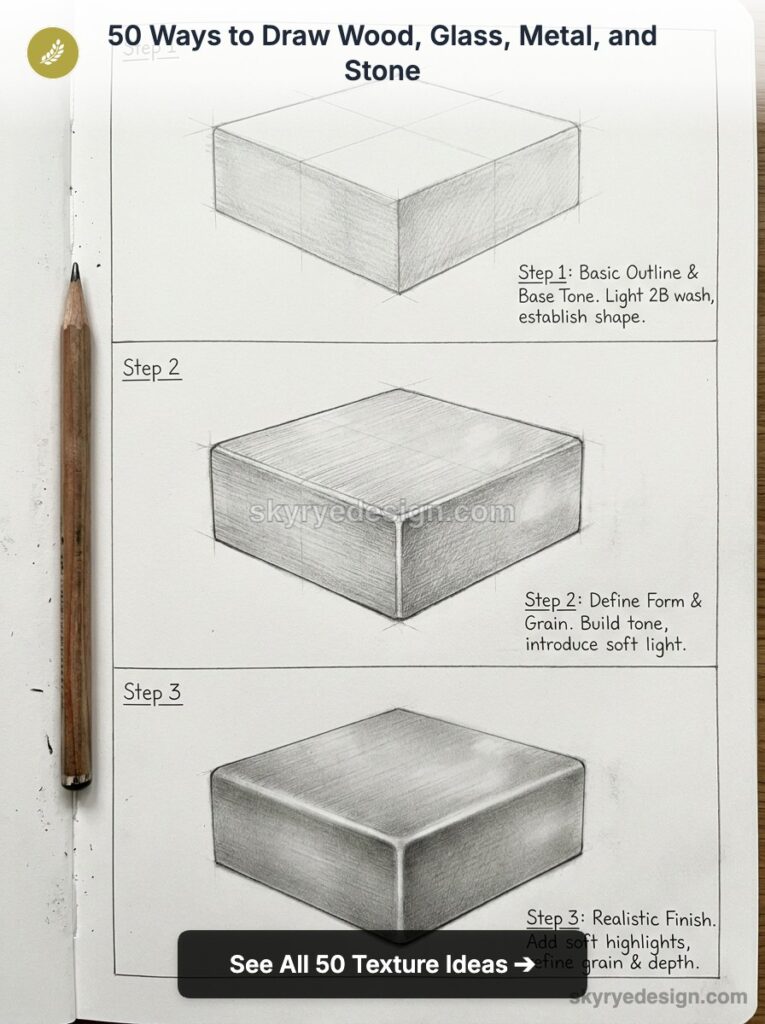
Draw with smooth 2B tone, very light directional grain, and highlights that are bright but not as hard-edged as chrome. The value range is narrower than polished metal.
39. Ink Linework for Technical Metal Illustration
Engineering and technical illustrations often use clean ink linework with minimal tone for metal components.
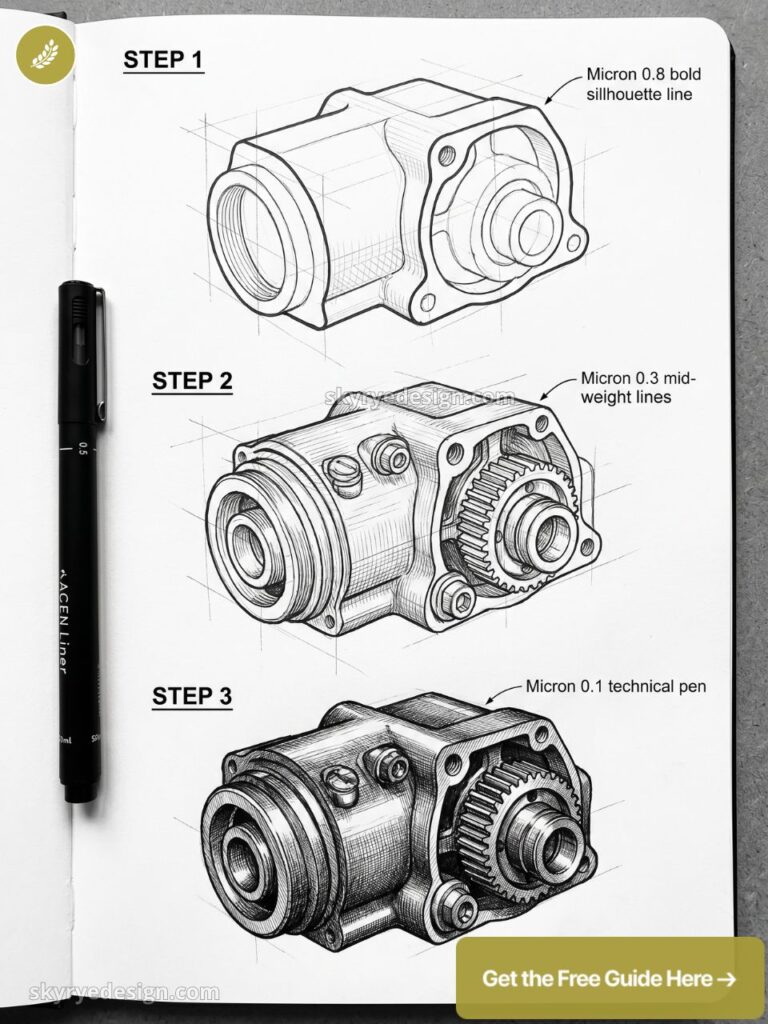
Use Micron 0.1 for the finest detail lines, 0.3 for mid-weight outlines, and 0.8 for the primary silhouette. Crosshatch at precise 45° and 90° angles for machined surfaces. This approach is used in product design patent drawings and architectural hardware specifications.
40. Metallic Ink and Pen for Decorative Metal
For decorative metalwork illustration (jewellery, ornamental hardware), a Uni Posca silver or gold marker over dark paper creates genuinely metallic effects. Work on black Canson card or Strathmore Toned Black paper, build the form in silver marker, then add highlights with white Posca and shadows by letting the black paper show through.
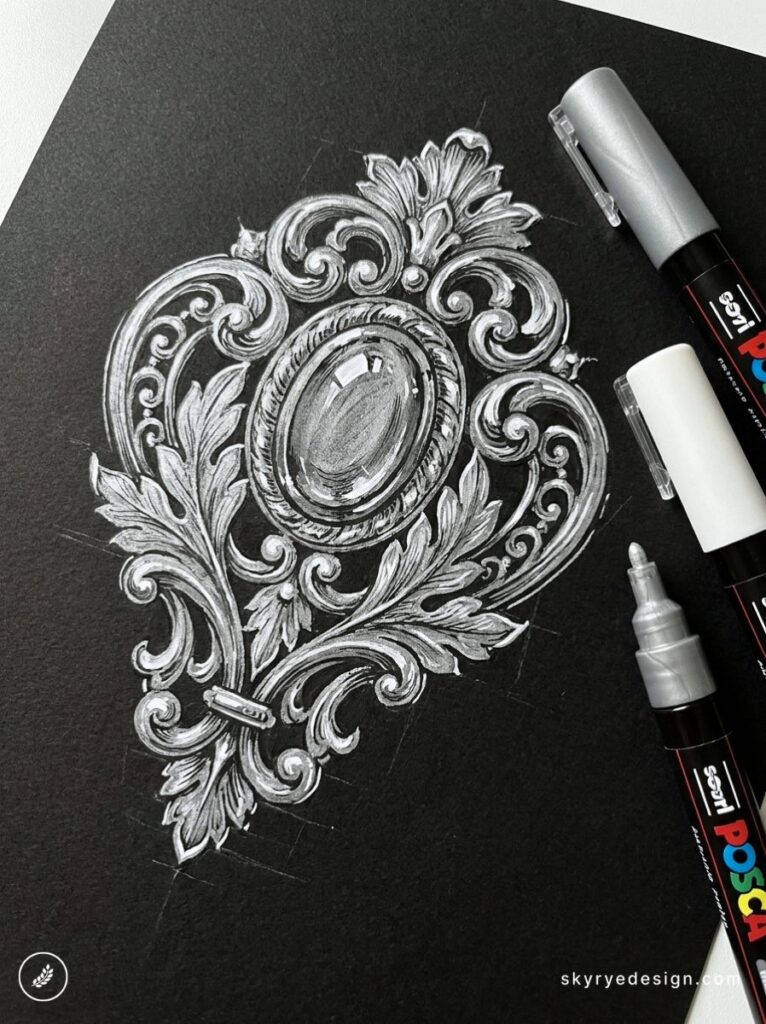
This technique is particularly effective for jewellery portfolio work.
Stone Texture Drawing: 10 Methods for Every Rock Surface
Stone is ancient and patient. Drawing it should feel the same way—built up slowly, layer by layer, with attention to geological logic rather than random mark-making. The biggest mistake beginners make with stone is treating all rock the same. Marble, granite, slate, and rough fieldstone each have distinct structural rules.
41. Marble: Flow-Line Logic for Veins
Marble veins don’t wander randomly—they follow the planes of rock stress during metamorphosis, creating flowing, directional patterns.
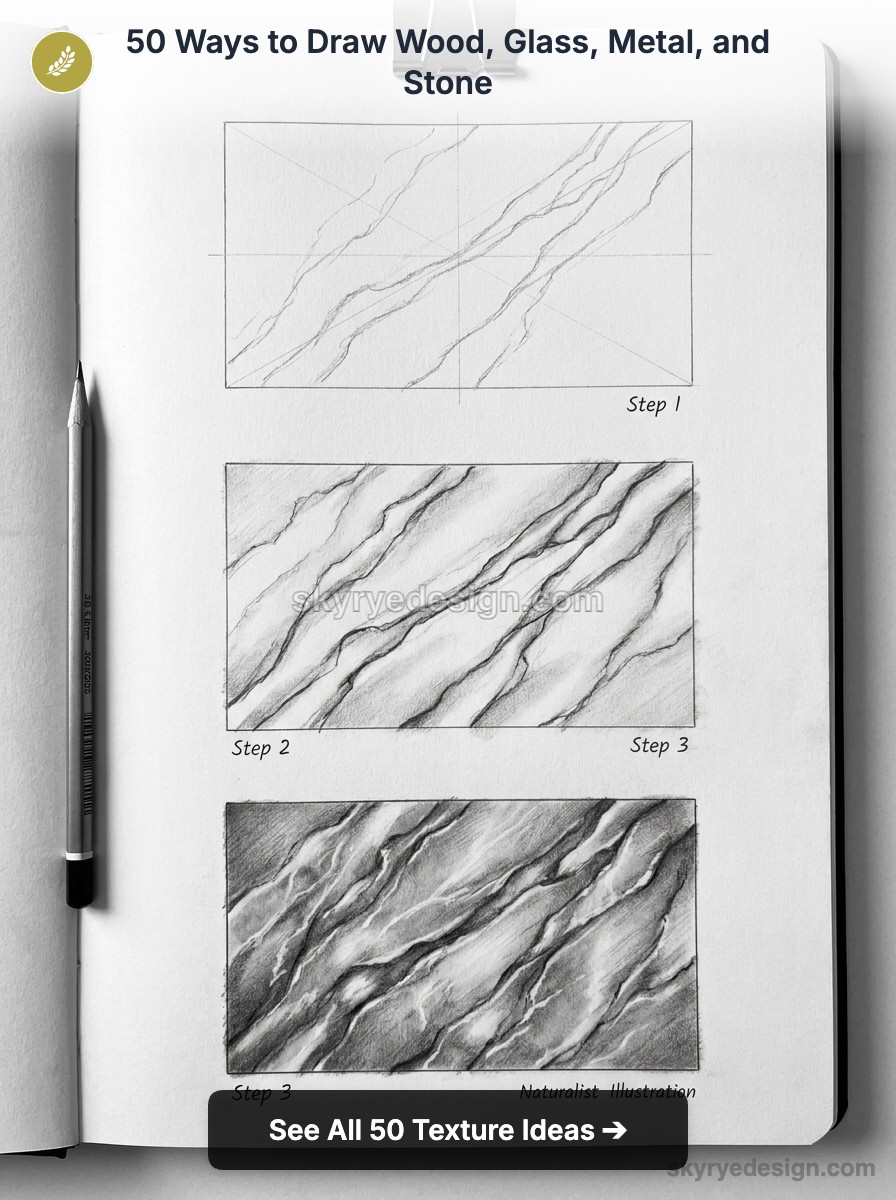
Before drawing marble veins, decide on a general flow direction (usually diagonal) and keep all veins flowing roughly parallel to that axis with natural variation. Use a 2B pencil for the main vein lines, then soften their edges with a clean blending stump.
| ✏️ Pro Tip Study actual marble tile samples at a stone yard (like Archi-Stone or similar local suppliers) rather than stock photos—the depth and complexity in real marble is far richer than photography captures. |
42. Granite: Stippling for Crystal Structure
Granite is an aggregate of different mineral crystals—quartz (white/clear), feldspar (white/pink/cream), and mica (dark, reflective). In drawing, this reads as an irregular stippled pattern with occasional bright mica flecks.
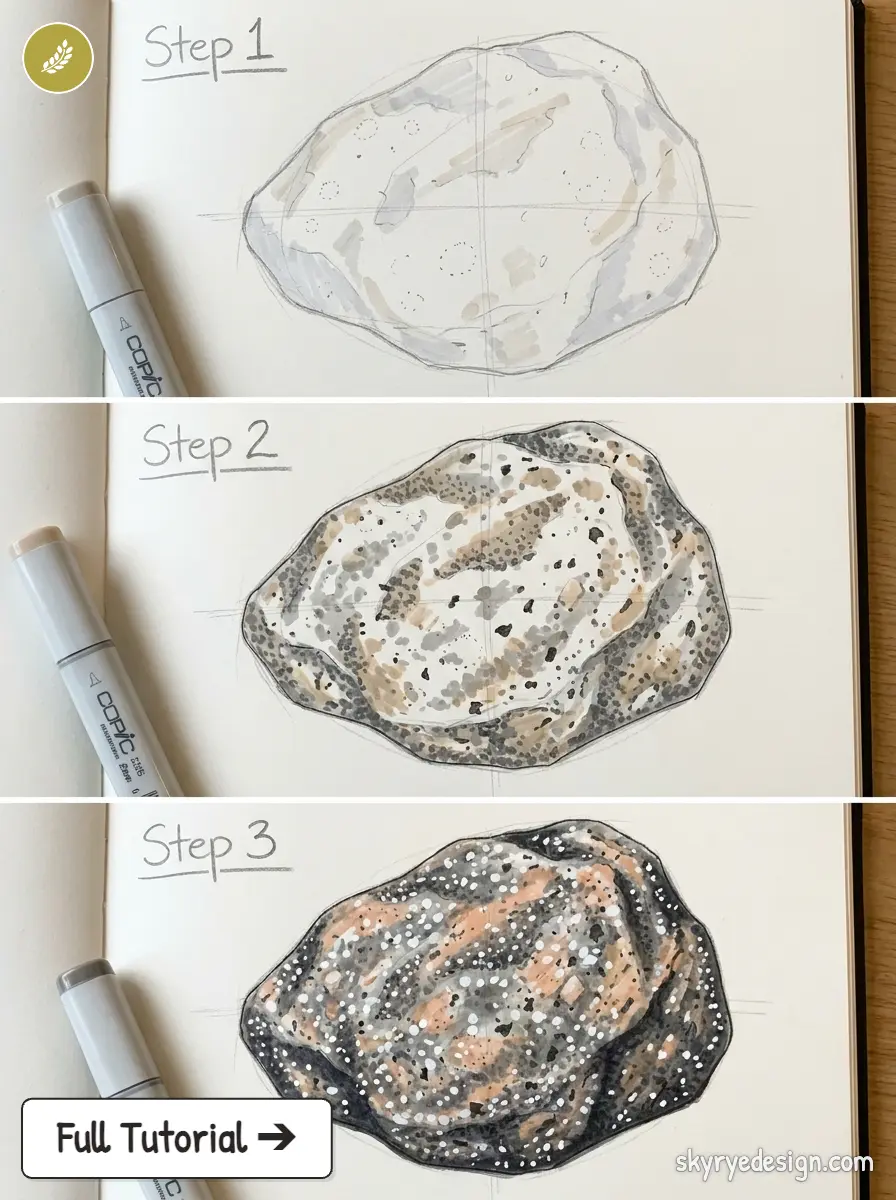
Use a 2B for the medium-dark feldspar zones, a 4B for the darker minerals, and a white gel pen for mica highlight flecks if working on toned paper.
43. Slate: Layered Planes and Sharp Edges
Slate’s character is its layered, plate-like structure—it cleaves in flat sheets. The drawing emphasis is on horizontal banding (the layers) and sharp-edged faces.
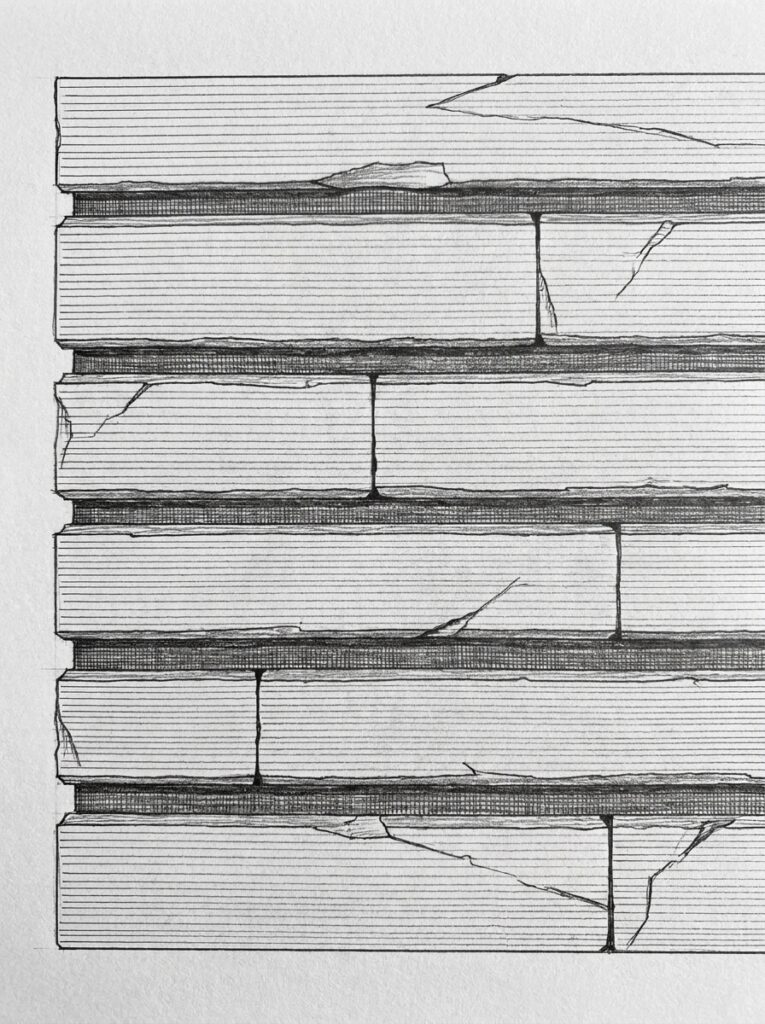
Use horizontal hatching for the layer faces, with darker values in the recessed joints between layers. Slate edges are sharp, not rounded—keep your edge lines crisp and don’t blend away the corners.
44. Sandstone: Warm Granularity and Bedding Lines
Sandstone has a warm, granular texture and often shows horizontal bedding lines from its sedimentary formation.
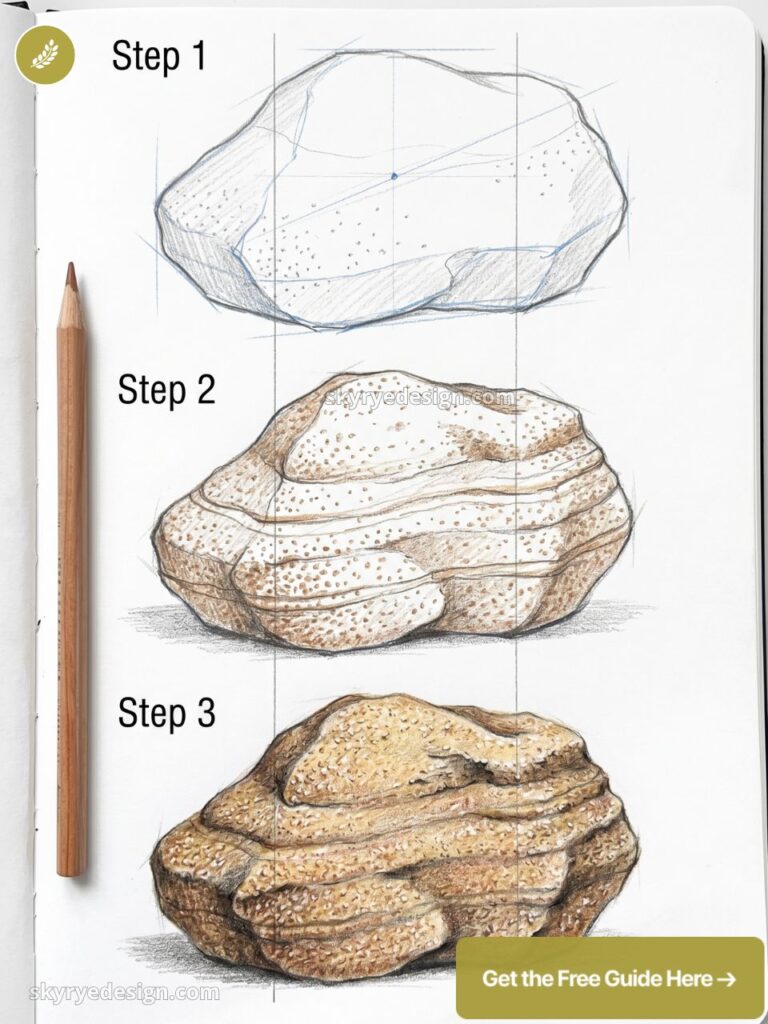
The overall texture is stippled but softer than granite—the grains are rounded, not crystalline. Add very subtle horizontal lines at irregular intervals to suggest the bedding structure. Sandstone is forgiving of imperfect stippling, which makes it good practice material.
45. Rough Fieldstone: Build Form Before Texture
A rough fieldstone (the irregular rocks in dry-stone walls or riverbeds) is all about form first.
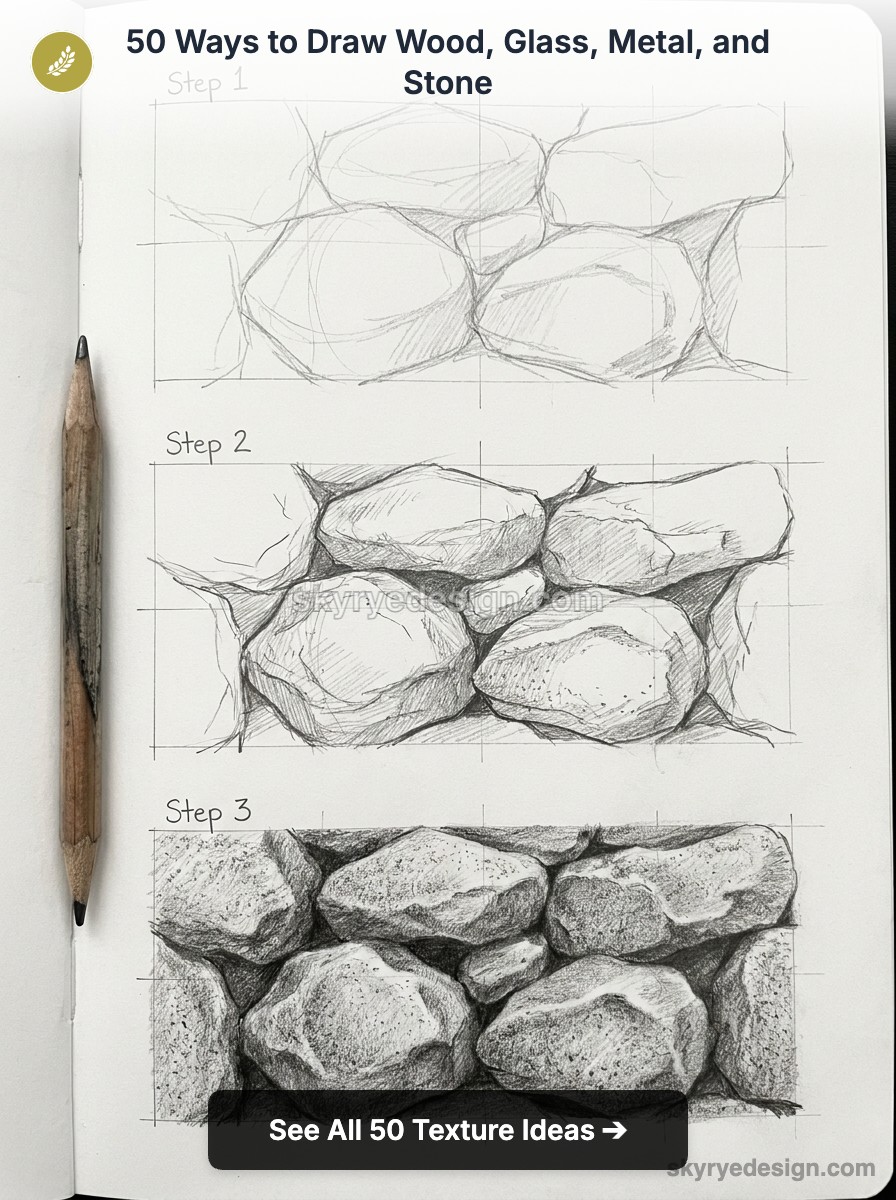
Get the three-dimensional mass right—use simple shading to establish where light hits and where shadow falls on the overall rock form. Then layer surface texture (rough stippling, irregular surface marks) on top of that form. Texture on the wrong form never looks like stone; it looks like textured paper.
46. Limestone and Chalk: Soft, Matte, Low Contrast
Limestone and chalk have a soft, matte surface with low overall contrast. Use a 2B to 4B pencil range (nothing harder than HB), blend generously with a tortillon, and keep your highlights subtle—limestone doesn’t have specular highlights like polished marble.
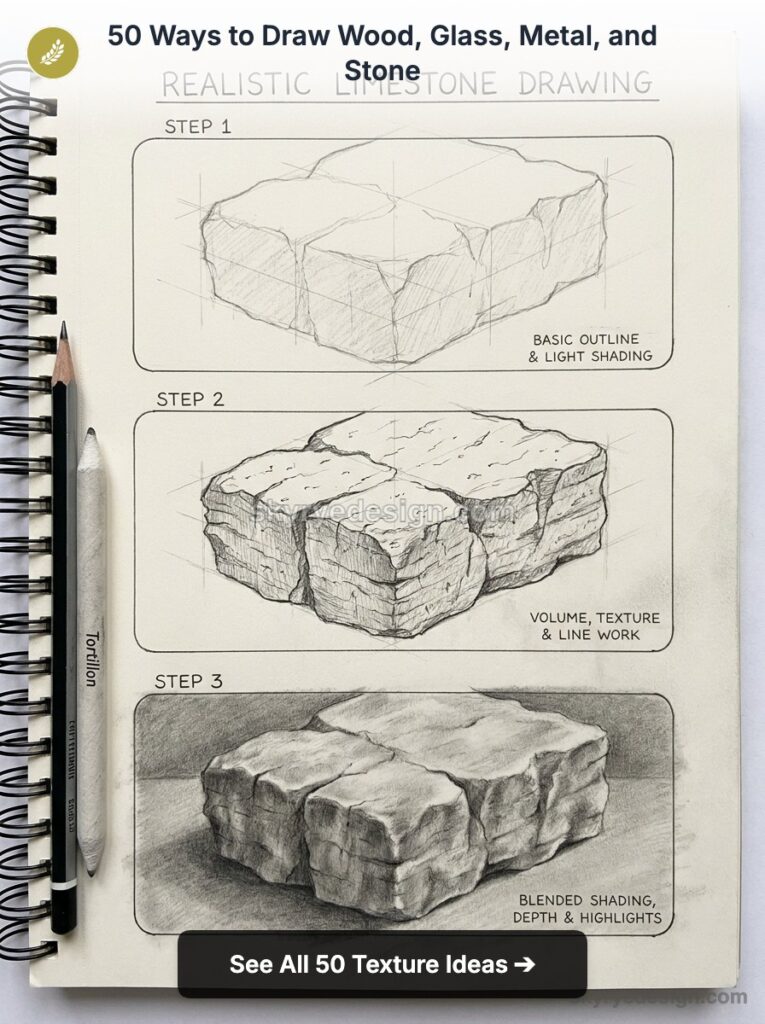
The value range is compressed: mid-tones dominate with gentle darks and barely-there lights.
47. River Rocks: Smooth Form, Subtle Surface
Water-polished river stones are smooth-surfaced but not reflective—they have a slight sheen when wet, a matte quality when dry.
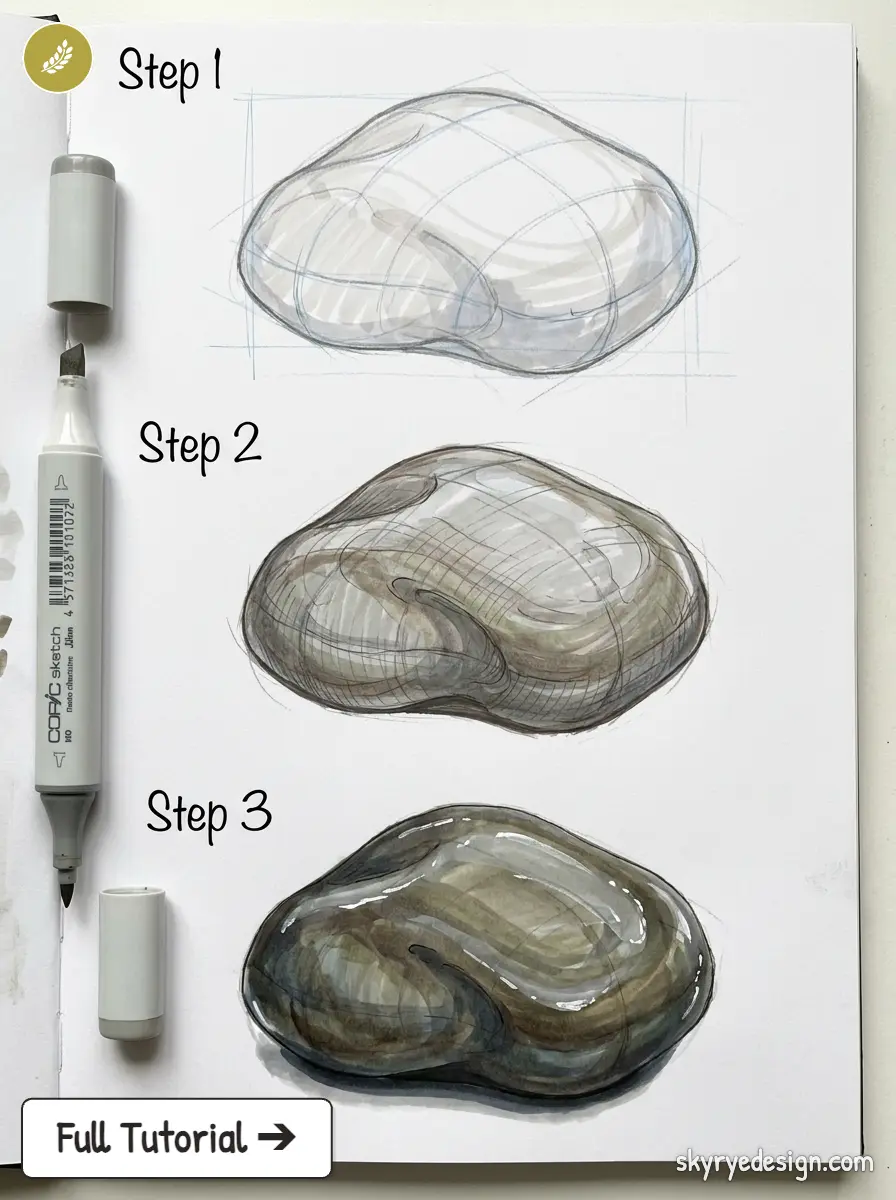
For wet river rock: treat like a low-reflectivity polished surface with subtle highlights. For dry: blend smooth mid-tones with minimal surface texture. The rounded, organic forms are the dominant feature—focus on the volumetric shading more than surface texture.
48. Cracked Rock Face: Structural Fault Lines
Large exposed rock faces (cliff faces, quarry walls) show structural fault lines and joint systems—these are relatively straight fracture systems running in two or three dominant directions.
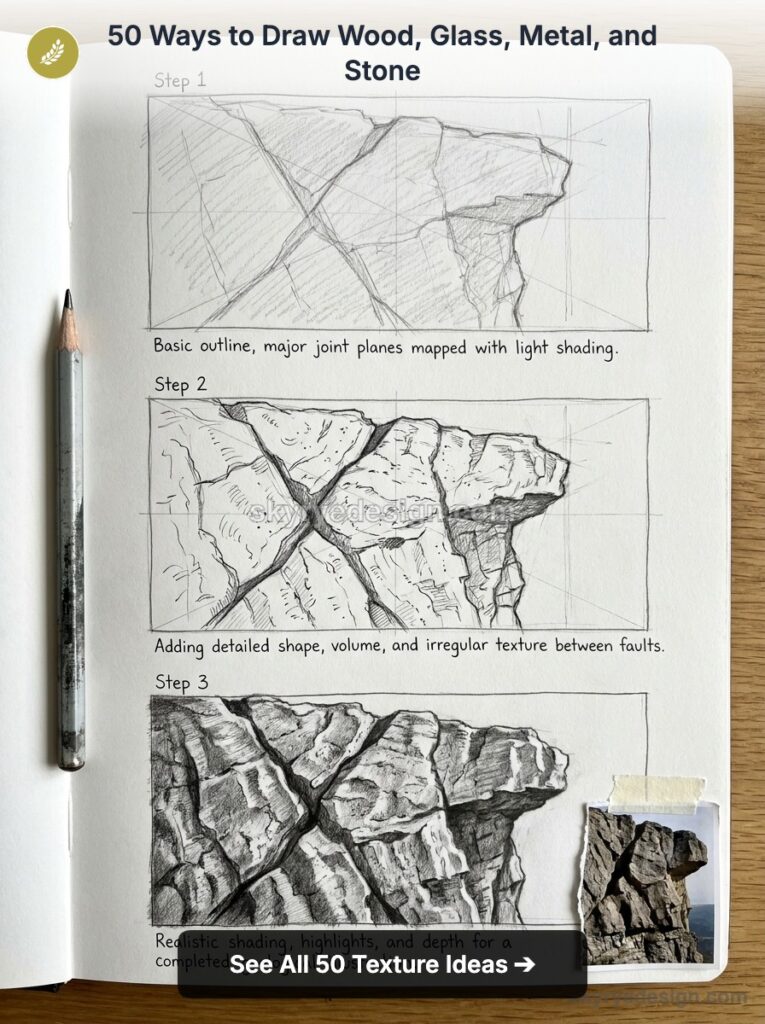
Map these structural lines first, then fill in the surface texture between them. The joints are darker (recessed) and relatively sharp-edged; the rock faces between are broader with surface irregularity.
49. Mossy Stone: Organic Overlay on Mineral Base
A stone with moss or lichen overlay requires drawing two distinct surface logics: the stone structure underneath, and the biological growth on top.
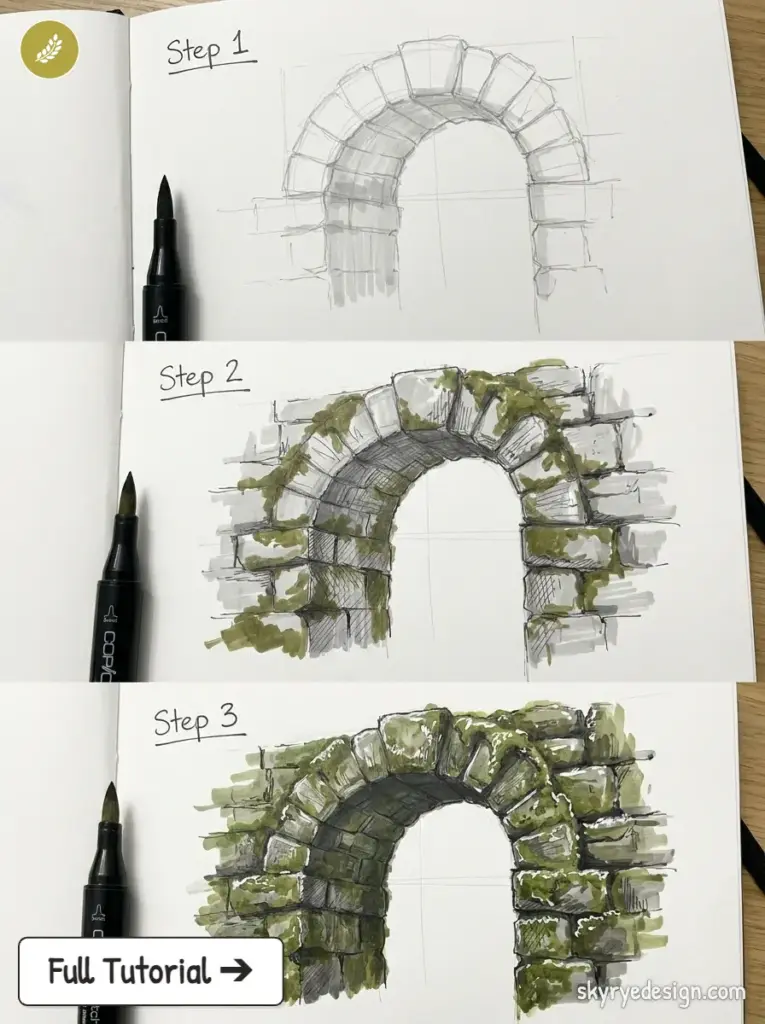
Draw the stone form and base texture first, then overlay moss with organic, irregular patches using a softer pencil and more varied stroke direction. Lichen tends to appear in circular or irregular blobs; moss is denser and more uniform in coverage.
50. Cobblestones: Repetition with Variation
A cobblestone street or courtyard is a test of systematic variation—each stone is roughly similar but distinctly individual.
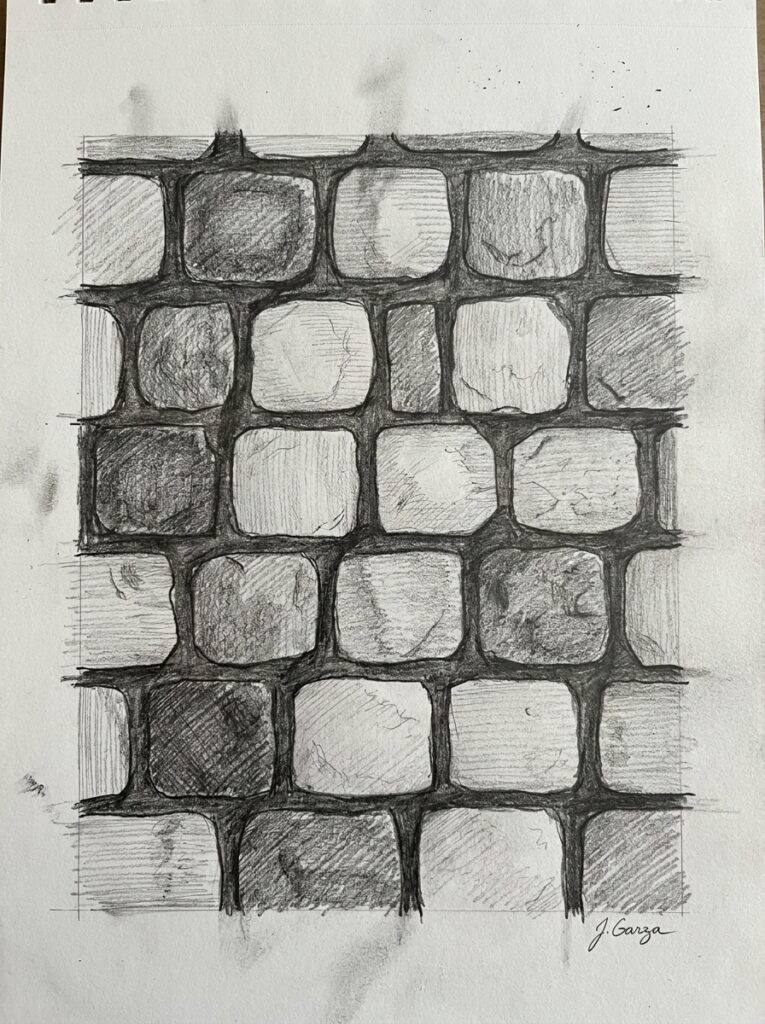
Establish the mortar joint grid first (darker lines between stones), then shade each stone individually with its own light/shadow logic. No two adjacent stones should be exactly the same value. The variation between individual stones is what makes the surface read as natural rather than tiled.
Putting It All Together: Your 4-Week Texture Practice Plan
Knowing 50 techniques is useful. Practising them systematically is what makes them stick. Here’s a structured four-week plan that builds from single-material studies to complex multi-material compositions.
| Week 1: Wood Focus Days 1–2: Draw three wood grain studies from photograph references — pine, oak, and reclaimed timber. Days 3–4: Draw a single knot study, focusing on grain warp around the knot centre. Days 5–7: Draw a complete wooden object (a stool, a box, a door panel) using Techniques 1–15 |
| Week 2: Glass Focus Days 1–2: Draw a clear glass bottle from life — protect highlights before any shadingDays 3–4: Draw frosted vs clear glass side by side using Techniques 16–27Days 5–7: Draw a complex glass composition — a window with reflection + a glass vase in front |
| Week 3: Metal Focus Days 1–2: Draw a chrome kitchen tap — map the environmental reflections first. Days 3–4: Draw three metal types side by side: polished chrome, brushed steel, and cast iron. Days 5–7: Draw a technical object (camera, tool, appliance) using Techniques 28–40 |
| Week 4: Stone + Integration Days 1–2: Draw a marble tile corner using the flow-line logic technique. Days 3–4: Draw a granite and slate comparison study. Days 5–7: Draw a complex still life combining all four materials — a glass bottle on a wood shelf, with a stone background and metal hardware |
If texture study feels too technical, these pencil drawing ideas give you easier subjects for practicing value, edge control, and shading.
Texture drawing FAQ
What is texture drawing?
Texture drawing is the practice of making a flat sketch read like a specific surface: wood grain, transparent glass, polished metal, rough stone, soft fabric, or any other material. The trick is to draw the surface logic, not just decorate the object. Wood follows growth rings and knots. Glass is mostly edges, reflections, and distorted shapes behind it. Metal needs abrupt value jumps. Stone needs form first, then irregular marks on top.
How do you draw wood texture?
Start with the grain direction before you add detail. For a plank, sketch long curved lines that swell around knots; for end grain, build concentric rings and radial cracks. Use HB or 2B for the structure, then deepen cracks and knot shadows with 4B or 6B. The common mistake is drawing perfect parallel stripes. Real wood bends, compresses, splits, and changes rhythm.
How do you draw glass so it looks transparent?
Protect the white highlights first, then draw the hard edges, rim thickness, and distorted shapes seen through the glass. Most beginners shade the whole object evenly, which makes it look cloudy. Keep the body light, push the darkest values into the edges and contact shadows, and leave some clean paper showing. Transparent glass usually reads through contrast, not heavy shading.
What makes metal drawing look reflective?
Metal looks reflective when the value changes are sharp. Polished chrome can jump from white highlight to near-black reflection with almost no soft transition. Brushed steel is quieter; it needs directional hatching that follows the brushing pattern. Before adding scratches or texture, map the big reflected shapes. If the value pattern is weak, the metal will look like grey plastic.
How do you draw stone texture without it looking dirty?
Build the rock form first with simple light and shadow, then add texture. Random scribbling makes stone look like dirt because the marks do not follow the planes. Granite can use stippling, slate needs layered edges, marble needs flowing veins, and limestone needs soft low-contrast tone. Keep the raised edges slightly lighter and the cracks darker.
What are the four types of texture used in art drawing?
Artists often talk about actual texture, simulated texture, invented texture, and abstract texture. In drawing, this guide focuses mostly on simulated texture: marks that make paper look like wood, glass, metal, or stone. You can still borrow invented or abstract texture when you are stylizing a surface, but realistic material studies work best when the marks follow the real structure.
Can I use these texture techniques in digital art?
Yes. The logic is the same in Procreate, Photoshop, or any drawing app. Use textured brushes for grain, hard erasers for glass highlights, multiply layers for deep metal reflections, and clipped layers when you need to keep texture inside a shape. Digital tools make corrections easier, but the material cues still come from observation and value control.
What should beginners practice first?
Start with wood texture because small imperfections still look natural. Then move to stone, where form matters more than tiny detail. Save clear glass and polished metal for later because both punish muddy values. A useful beginner drill is to draw four small squares on one page: wood grain, glass rim, chrome sphere, and rough stone. Compare the edge quality in each square.
Texture reference sources worth studying
When a texture drawing starts looking generic, I go back to real material references. For the art language, Tate’s note on texture in art is a useful baseline. For traditional drawing context, the Met’s drawing overview is worth a slow read.
For material behavior, compare the USDA Forest Products Laboratory Wood Handbook, the Corning Museum of Glass explanation of what glass is, the Canadian Conservation Institute guide to metal objects, and the USGS explainer on rock types. You do not need to memorize the science; you need enough structure to make better marks.
Related texture drawing practice
For wood texture drawing in a scene, practice trunks and branches in this how to draw a forest guide. For transparent edges, compare the glass section here with how to draw glasses. For stone texture drawing, use the planes and cracks in how to draw rocks.
If you are still building control, start with pencil drawing for beginners, then use drawing from photos for material references. For color studies, the colored pencil drawing guide helps with layering, and these sketchbook drawing ideas give you quick daily drills.
Final Thought
Every material in this guide—wood, glass, metal, stone—has its own internal logic. Wood grows outward from a centre. Glass exists only in relation to what surrounds it. Metal mirrors its environment. Stone was shaped by geological time. When you understand those underlying realities, your drawing marks stop being guesses and start being translations.
Pick one material, pick three techniques from this list, and draw from reference for 30 minutes today. That’s the whole plan. The 50 methods here will still be here when you need them.
For a color medium where surface texture does half the work, this soft pastel drawing texture guide is a useful next step after wood, glass, metal, and stone practice.
- 491shares
- Facebook0
- Pinterest491
- Twitter0
- Reddit0