Owls don’t move their eyes. That single fact is why nine out of ten owl drawings look “off” somehow, even when the artist can’t say why. The eyes are locked in the sockets, so every head-turn has to happen at the neck, and that changes how you place features on the face compared to almost any other bird.
- Why owls are tricky to draw (and the one thing that fixes most mistakes)
- Materials that actually matter for this drawing
- How to draw an owl: the basic shape skeleton
- How to draw a simple, cartoon-style owl (easy method)
- How to draw a realistic owl: eyes, feathers, and shading
- Owl species worth knowing before you draw
- Common mistakes and quick fixes
- Adding color and finishing touches
- FAQ
- What’s the easiest way to draw an owl for beginners?
- How do you draw a realistic owl eye?
- How do you draw an owl on a branch?
- How do you draw a cartoon or “wise old owl” look?
- What’s the easiest way to draw owl feathers?
- How do you draw an owl meme?
- How do you make an owl look like a specific species, like a snowy owl versus a barn owl?
I first ran into this problem sketching owls from photos after a night hike near Yaremche, in the Carpathians, trying to catch a long-eared owl sitting dead still on a branch for twenty minutes. My sketch looked cartoonish until I fixed the eye spacing. After that, everything clicked.
This guide walks through the basic shape skeleton first, then splits into two paths: a simple cartoon owl (good for the “easy” search crowd) and a realistic owl with proper eye shading and feather layering. Along the way you’ll get species differences, the shading tricks that make feathers read as feathers instead of scribbles, and the mistakes that give owl drawings away as beginner work.
Why owls are tricky to draw (and the one thing that fixes most mistakes)
Look at a photo of a great horned owl staring straight at the camera, then one turned three-quarters toward a branch. The eyes stay exactly the same distance apart in both. That’s the part beginners get wrong constantly: they draw the eyes converging toward the beak when the head turns, the way you’d draw a human face in profile. Owls can’t do that. Their eyes are essentially fixed tubes in the skull, not ball-and-socket like ours, so the whole head has to rotate as a unit (up to 270 degrees, which is its own trick, but not one you need for a drawing).
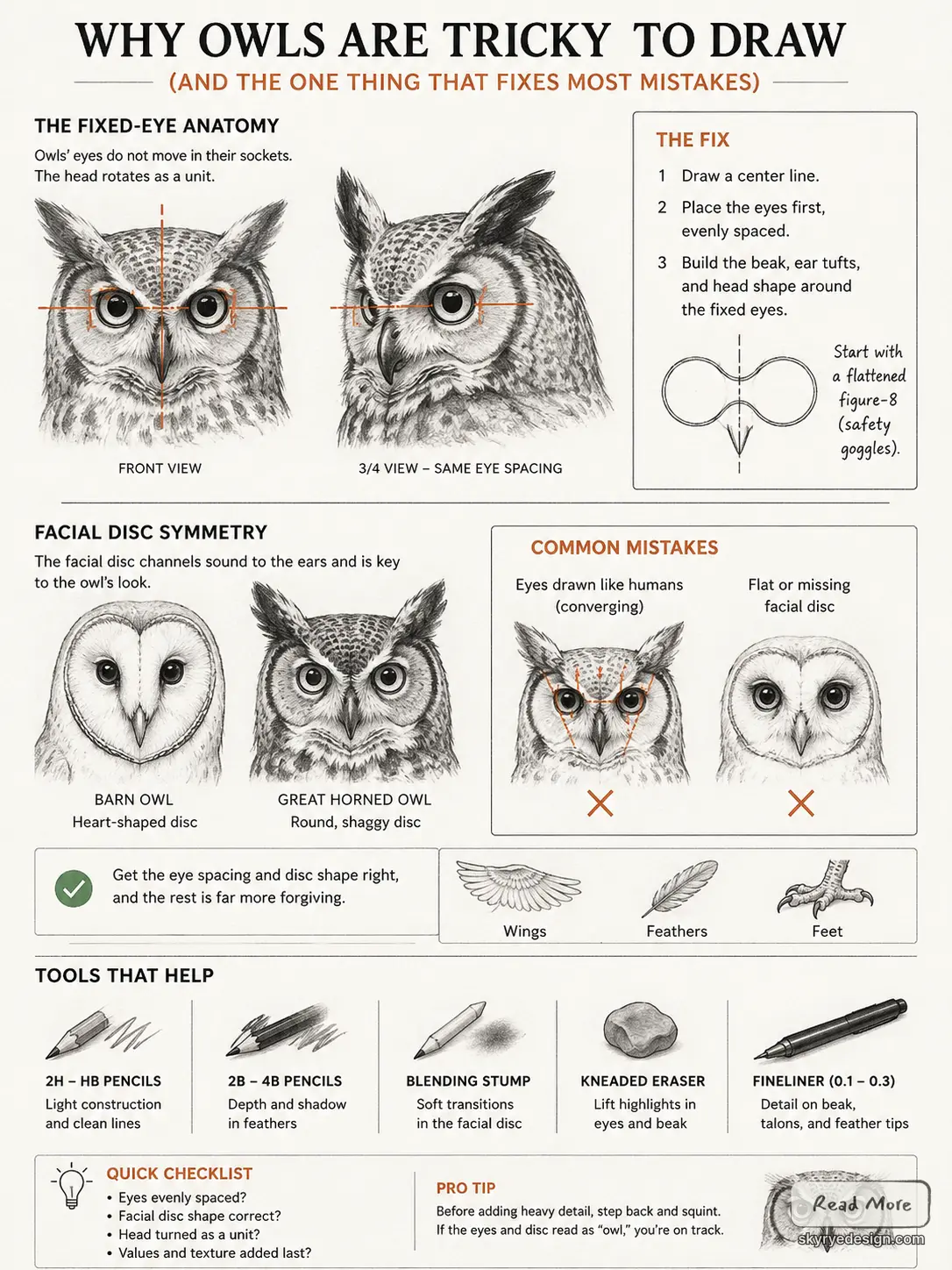
The fixed-eye anatomy issue
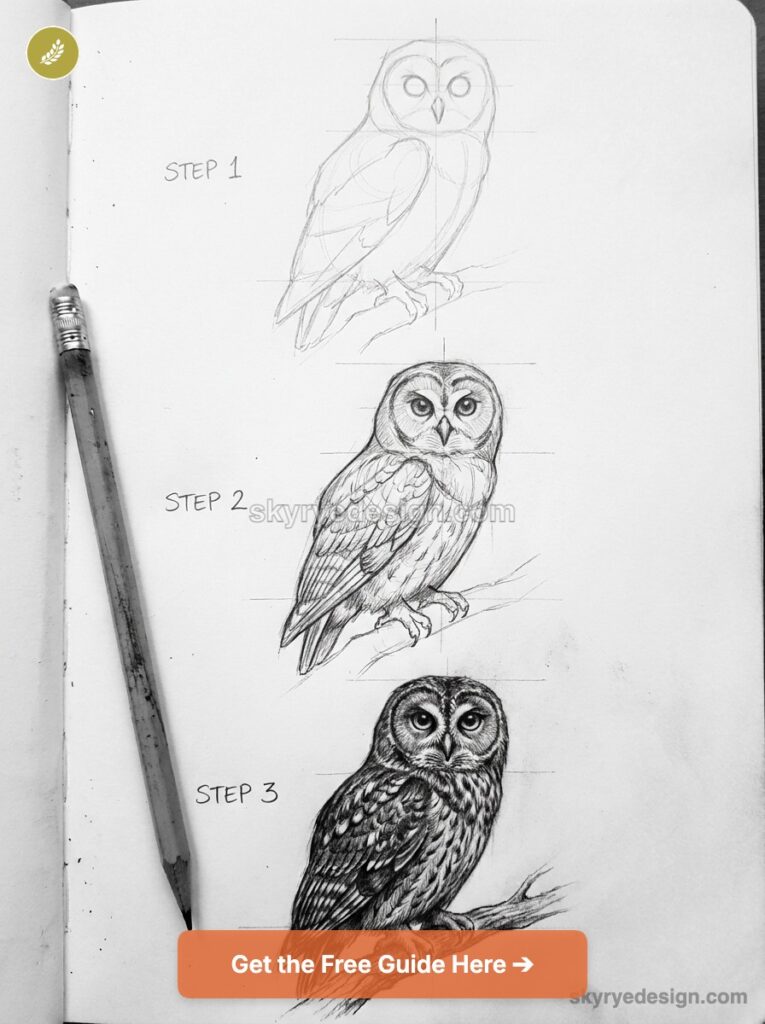
Once you know this, the fix is mechanical. Draw the eye positions first, evenly spaced on either side of a center guideline, before you commit to any head angle. Then build the beak, the ear tufts, and the outer skull shape around that fixed pair. I sketch the eyes as a flattened figure-8, almost like safety goggles, before anything else touches the page. It sounds backwards compared to how you’d approach a dog or a cat, where the eyes shift with the head turn, but for owls it’s the anchor everything else depends on.
Facial disc symmetry
The second piece is the facial disc, that flat, satellite-dish-shaped ring of feathers surrounding the eyes. Barn owls have an almost perfect heart-shaped disc; great horned owls have a rounder, shaggier one. This disc is what actually channels sound to the owl’s ears, and visually it’s what reads as “owl” to a viewer faster than the beak or the wings do. Skip it, or draw it as a flat oval, and the drawing looks like a generic bird wearing a mask.
I tell people who ask me for a quick fix on their owl sketch to check these two things before anything else, spacing and disc shape, because fixing those two usually solves 80 percent of what feels “off” about a drawing without touching the wings or feathers at all.
Get the eyes and disc right, and the rest of the drawing, wings, feet, feather texture, becomes far more forgiving. Speaking of forgiving: the tools you pick for this next stage matter more than most tutorials admit.
Materials that actually matter for this drawing
You don’t need a full art store trip for this. A basic graphite range and one fine-liner pen will cover both the cartoon and realistic versions in this guide.
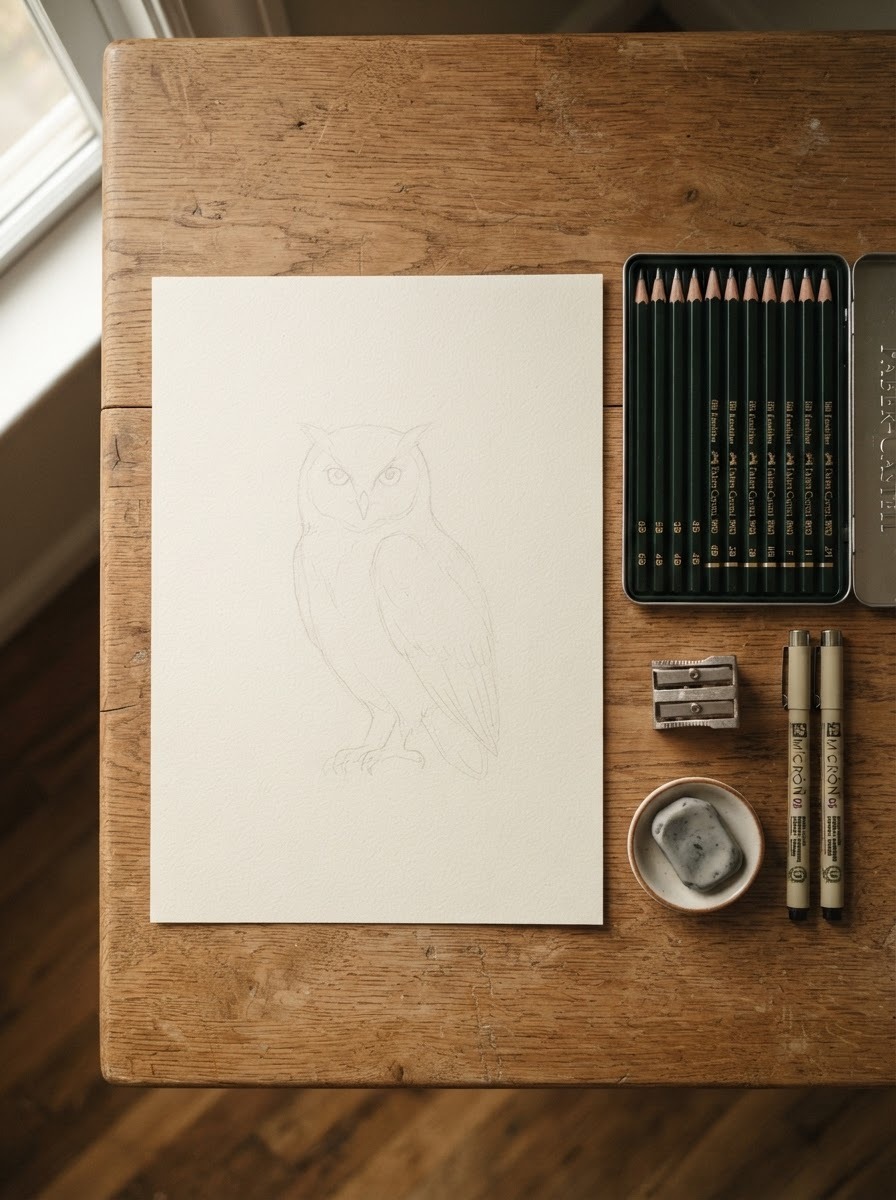
Pencil grades for sketching vs shading
For the skeleton stage, an HB or 2H keeps lines light enough to erase cleanly, which matters because you’ll be adjusting eye spacing more than once. Once you move into shading, switch to a softer range: a 2B for mid-tones and a 6B for the darkest pupil and shadow areas. I keep a Staedtler Mars Lumograph set on hand for this exact reason, the grade jump from 2H to 6B in one tin covers everything an owl drawing needs without hunting for extra pencils.
Pen/ink option
If you want to push toward the pen-and-ink look, a 0.1mm and a 0.3mm fine-liner is enough. The thin line handles feather cross-hatching, the thick line handles outer contours and shadow blocks. This is the same logic I use sketching automotive panel lines: thin line for surface detail, thick line for the form-defining edge.
Paper choice
Regular printer paper works fine for the cartoon method. For the realistic version, a slightly textured paper (something in the 90-140gsm range, like a basic Canson sketch pad) holds graphite shading better and won’t tear under repeated erasing at the eye stage.
One practical tip: sketch the skeleton stage on cheap paper first. You’ll redo the eye placement at least twice before it looks right, and there’s no reason to waste good paper on a step you’re going to erase anyway.
With materials sorted, it’s time to actually put pencil to paper, starting with the shape skeleton every owl in this guide is built from.
How to draw an owl: the basic shape skeleton
Every owl in this guide, cartoon or realistic, starts from the same five shapes. Get this skeleton right and both methods later on become a matter of surface treatment, not structure.
Start with a circle for the head, roughly a third of the total height you want the finished owl to be. Below it, draw a larger oval for the body, overlapping the bottom of the head circle slightly rather than leaving a gap. Owls don’t really have visible necks, so that overlap is what keeps the proportions honest instead of looking like two shapes glued together.
Now place the eye anchors from the previous section: two circles, evenly spaced, sitting in the upper half of the head circle. Draw a light vertical guideline down the center of the head and body first, then mirror the eye circles across it. This single guideline saves more redraws than anything else in the process, because it catches asymmetry before you’ve committed to any detail.
Add a small triangle or “V” shape between and slightly below the eyes for the beak, pointing down. Sketch two curved lines flowing from the shoulders down past the body’s midpoint for the wings, and a short pair of foot shapes at the base of the oval, gripping a horizontal line if you want a branch.
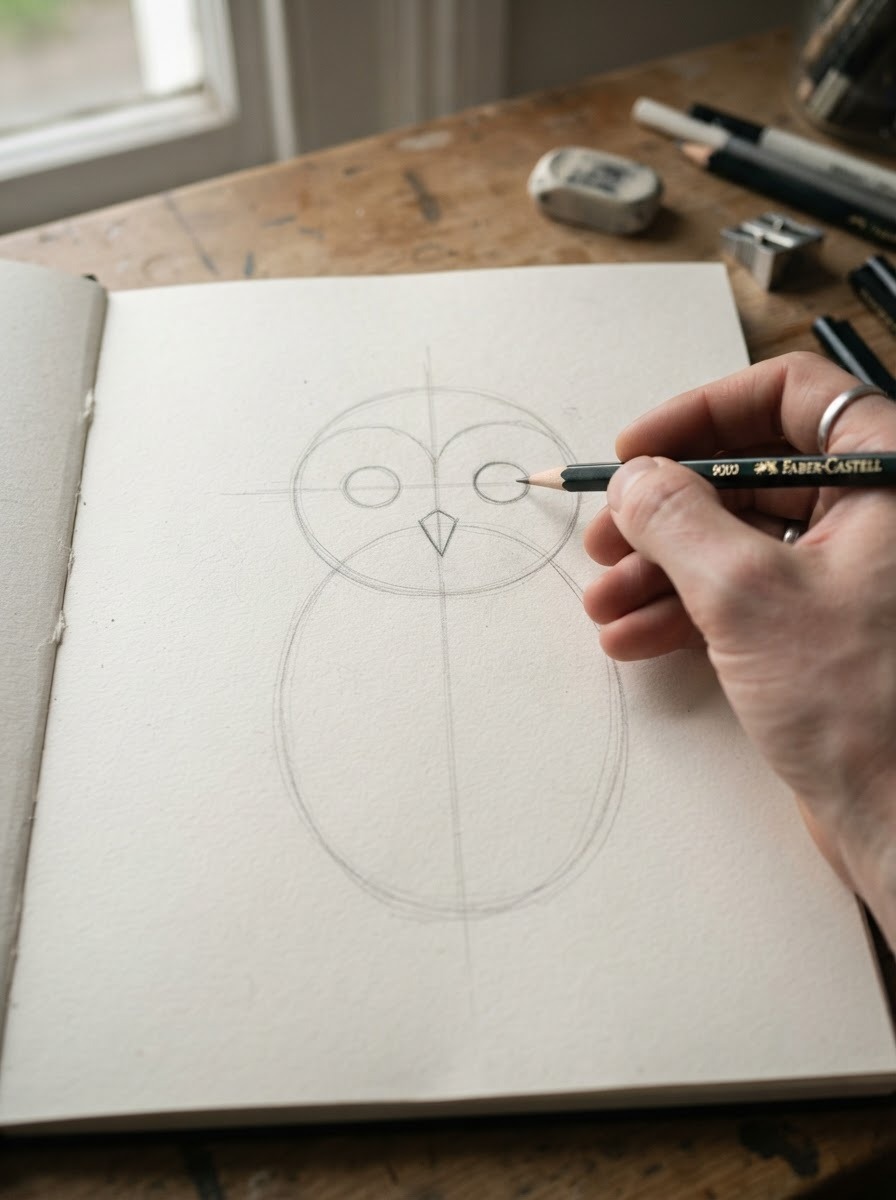
A mistake I see constantly at this stage: people rush past the wing curves because they seem like an afterthought compared to the face. Don’t. The wing shape you commit to now determines whether the finished owl looks like it has actual muscle and feather mass or looks like a triangle glued to a ball. Take the extra thirty seconds to curve them like a comma rather than a straight diagonal line.
This skeleton is intentionally loose. In the next two sections it becomes two different owls: a simple, rounded cartoon version, and a more anatomically faithful realistic one, both built from the exact same bones.
How to draw a simple, cartoon-style owl (easy method)
This is the version that matches what most people searching “owl drawing easy” actually want: something finished in ten minutes that still looks intentional, not a diagram.
Take your skeleton and round everything off. The head circle stays a circle, but let the body oval get a little egg-shaped, wider at the bottom than the top. Cartoon owls read as friendlier when the proportions skew slightly top-heavy, big head, smaller body, the same trick that makes Pixar characters likable.
Fill the eye circles with two smaller circles inside for the pupils, positioned dead center rather than to one side (side-glancing pupils tend to make a cartoon owl look shifty rather than wise). Leave a small white highlight dot in the upper-left of each pupil. That single dot does more work than people expect. It’s the difference between eyes that look alive and eyes that look like buttons sewn onto fabric.
Turn the beak triangle into a rounded diamond shape, and add two small triangular tufts above the eyes if you want the “eared” look associated with great horned owls, or skip them entirely for a smoother barn-owl-adjacent silhouette. Both read fine at this stage; it’s a style choice, not an anatomy requirement, since this is the simplified version.
For the wings, thicken the comma-curve from the skeleton into a solid teardrop shape, then add two or three simple curved lines inside each wing to suggest feather rows without drawing individual feathers. This is the single biggest time-saver in the cartoon method: three lines read as “feathered wing,” while zero lines reads as “flipper.”
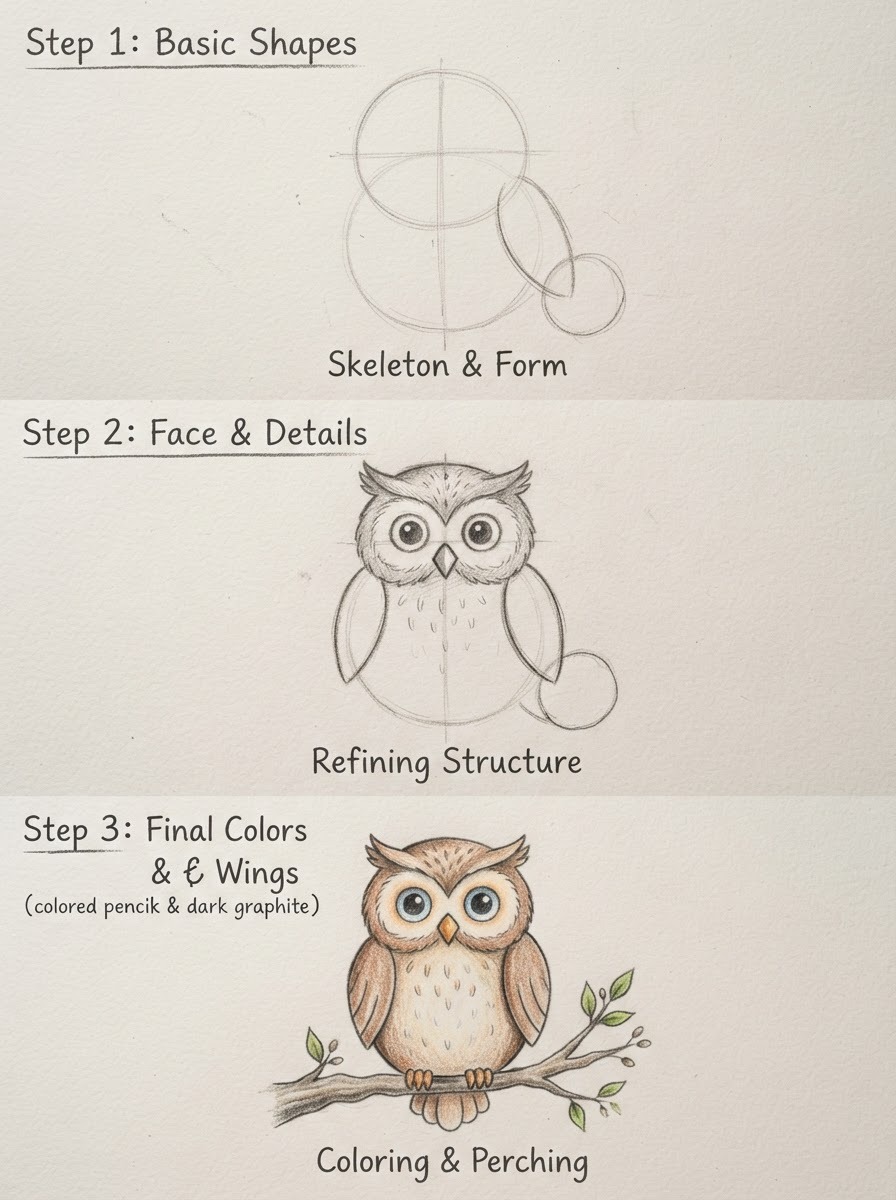
Feet get simplified to a rounded triangle shape gripping a single horizontal branch line, with two or three short marks for talons. Skip individual toe detail here; it’s one of the areas where the realistic method will diverge sharply, but for the cartoon version it just adds visual noise.
Color-wise, this method is forgiving. I’ve watched students go with everything from a realistic brown-and-cream palette to bright teal-and-orange combinations for a more decorative owl, and both work because the shapes underneath are already solid. If you’re using markers or colored pencil, block in the base color first, then add two or three darker strokes along the wing curve lines for a hint of depth, no full shading needed.
The whole point of this method is speed without looking sloppy, and that comes down to committing to clean, confident curves rather than sketchy, hesitant ones. A single bold wing line beats five faint, searching ones every time.
Next up is the opposite approach: taking the same skeleton and pushing it toward a genuinely realistic owl, with proper eye shading and feather layering.
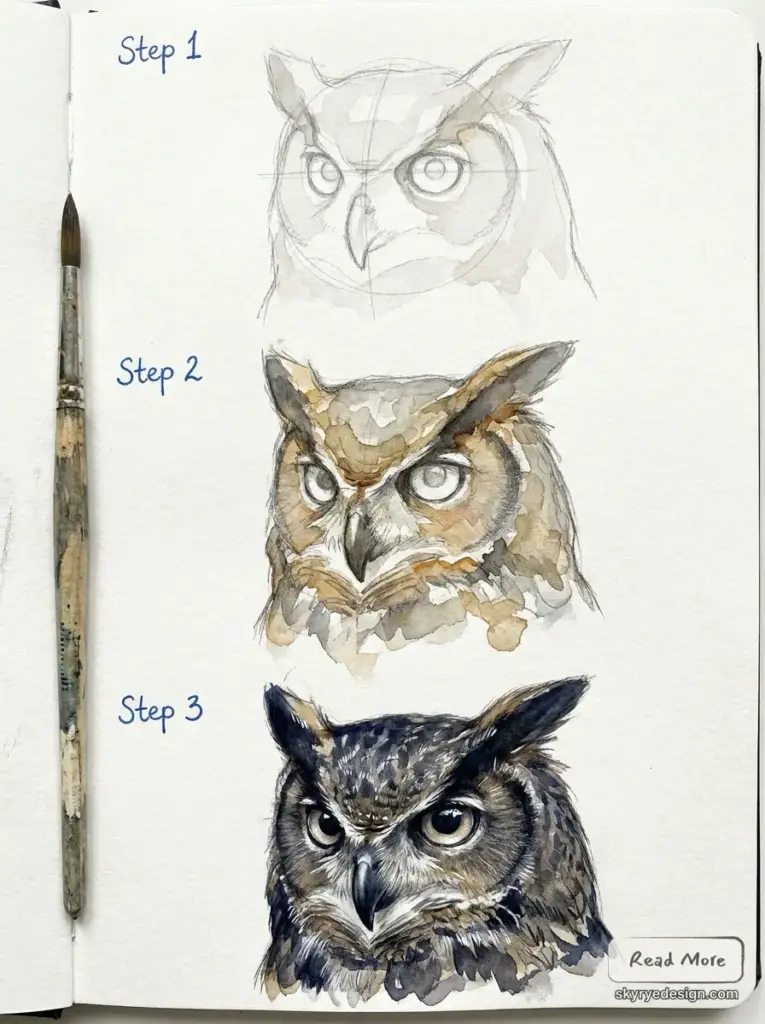
How to draw a realistic owl: eyes, feathers, and shading
This is where the pencil grades from the materials section actually earn their place in the tin, and where most of the extra time in a realistic owl drawing goes: not into the overall shape, but into the eyes and the feather layering.
Eye rendering
Start with the same eye placement from your skeleton, but instead of a flat circle, build the iris in three tonal layers. Lay down a mid-tone with a 2B first, covering the whole iris except a small crescent where the catchlight will sit. Then push a 6B into the pupil itself, solid black, no gradient. Around the pupil edge, add short radiating strokes with the 2B rather than a smooth blend.
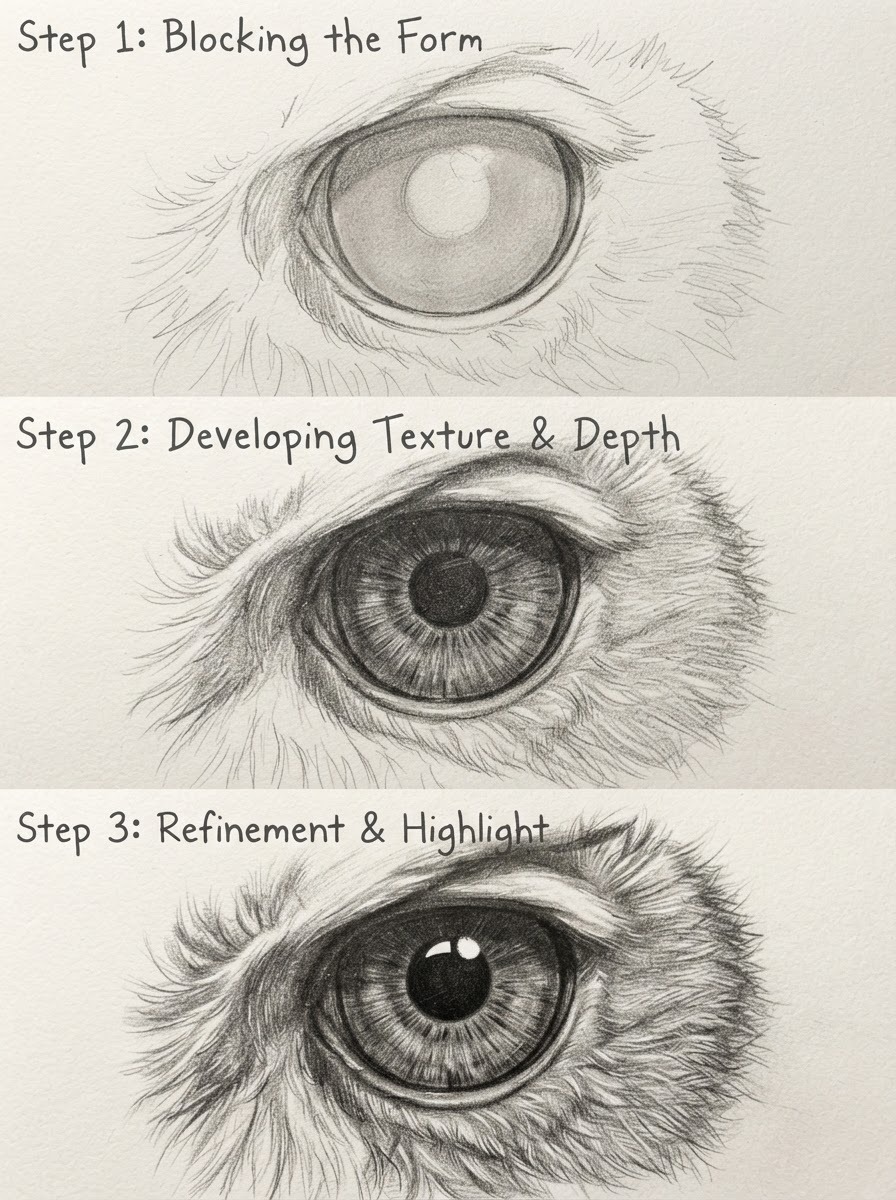
Owl irises aren’t smooth like a human eye; they have a subtle radial texture, almost like a sunburst, and that texture is what separates a realistic owl eye from a cartoon one even when the shapes are identical. Leave that catchlight crescent completely untouched, white paper. It’s tempting to shade over it “for realism,” but that highlight is what makes the eye look wet and alive instead of flat and painted on.
Feather tract direction and layering
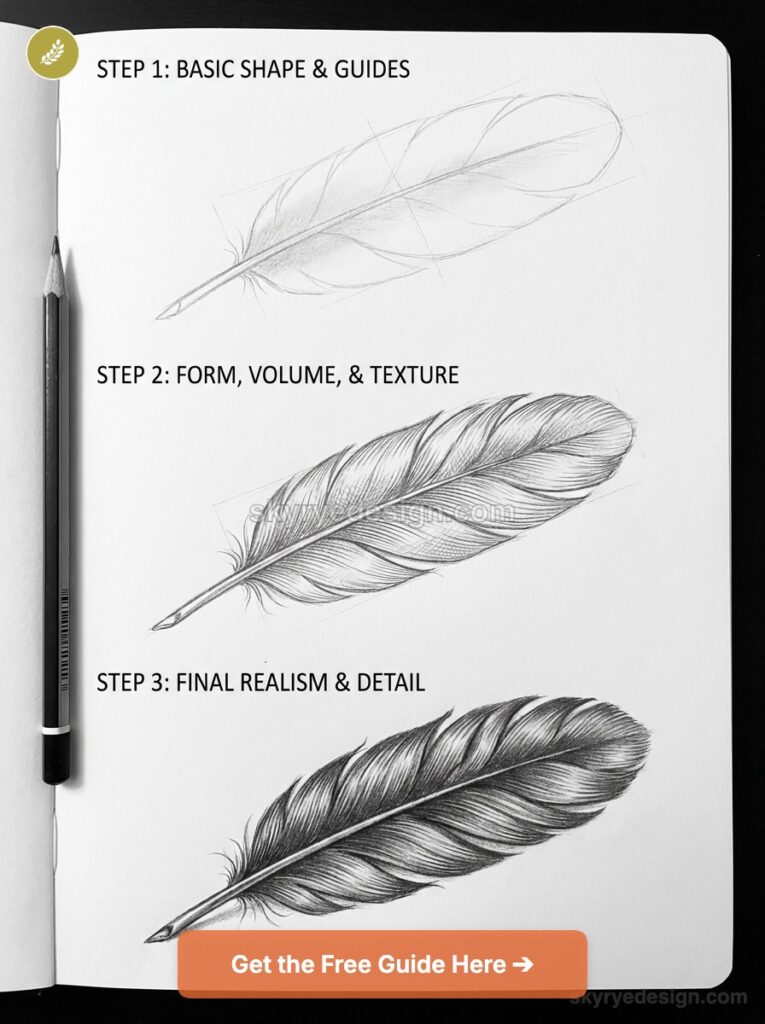
Feathers on a real owl grow in tracts, meaning they flow in a consistent direction across each body region rather than sitting randomly. Facial disc feathers radiate outward from the eyes like spokes. Chest feathers hang mostly straight down. Wing feathers layer diagonally, each row overlapping the one below it like roof shingles.
Work in the same order: lightly pencil the direction lines for each region first, almost like hair growth direction, before adding any texture. Then cross-hatch along those direction lines rather than against them. This is the same principle as cross-hatching a curved surface in pen-and-ink work, the strokes have to follow the form or the shading reads as flat regardless of how dark you make it.
For the darkest shadow areas, under the wing overlap and around the facial disc edge, layer a 6B over the cross-hatched 2B rather than pressing harder with one pencil. Two lighter layers in the same direction give you a richer, more textured dark than one heavy pass, and it stays easier to blend with a stump or your finger if you want softer transitions.
One habit worth building early: step back from the drawing every few minutes, at arm’s length if you can. Feather shading in particular tends to look fine up close and then reveal patchy, uneven density once you see the whole owl at once. I catch at least one uneven patch almost every time I do this check, and it’s a five-second fix compared to noticing it after the drawing’s “finished.”
The eyes and feather direction are what separate a realistic owl from a cartoon one built off the same skeleton. Get those two things right, and the species-specific differences covered next become the finishing touch rather than a rescue mission.
Owl species worth knowing before you draw
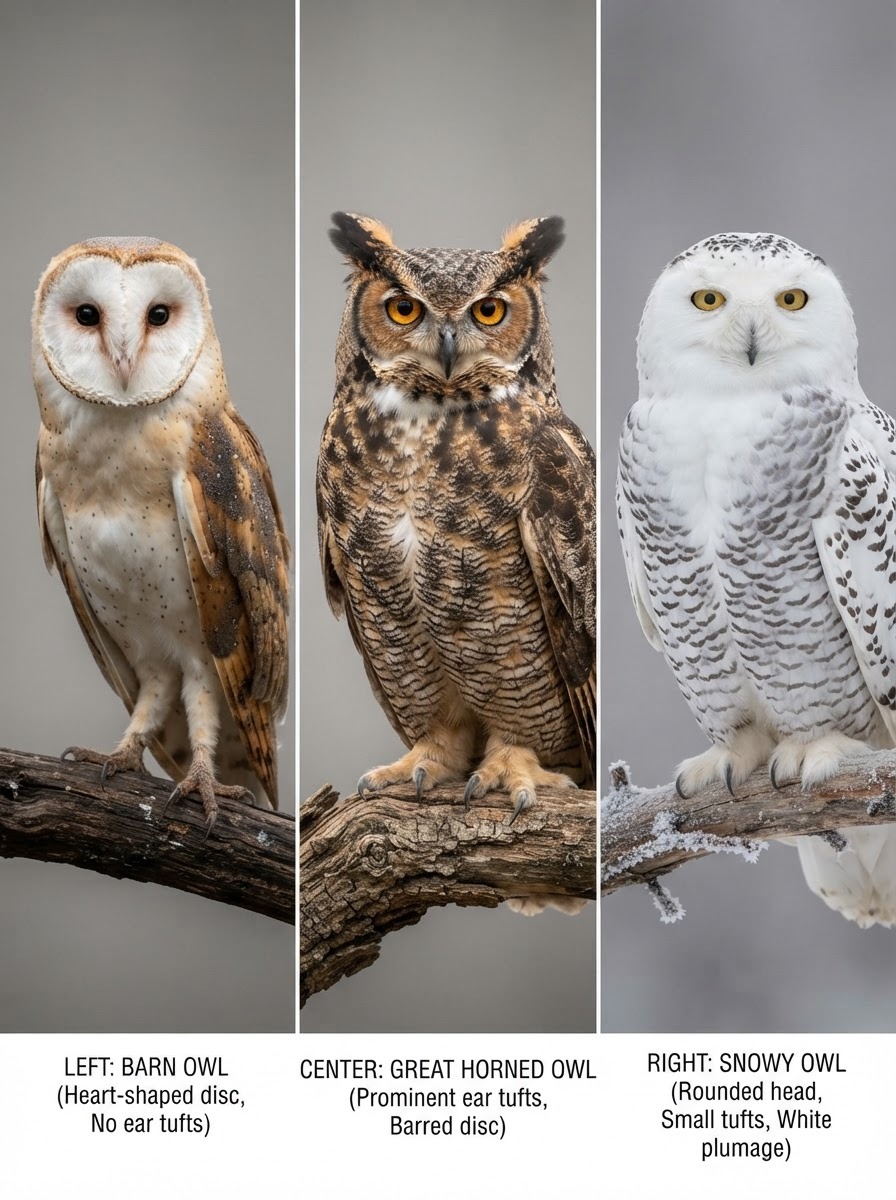
You don’t need to become an ornithologist, but three species cover almost every reference photo and every search variation people land on: barn owl, great horned owl, and snowy owl. Each one changes two or three details on the skeleton, nothing structural.
Barn owl
The facial disc is the giveaway here, a near-perfect heart shape, pale and almost white, with dark, deep-set eyes that look small relative to the disc size compared to other owls. No ear tufts at all. Body coloring runs pale gold to cream on top, nearly pure white underneath.
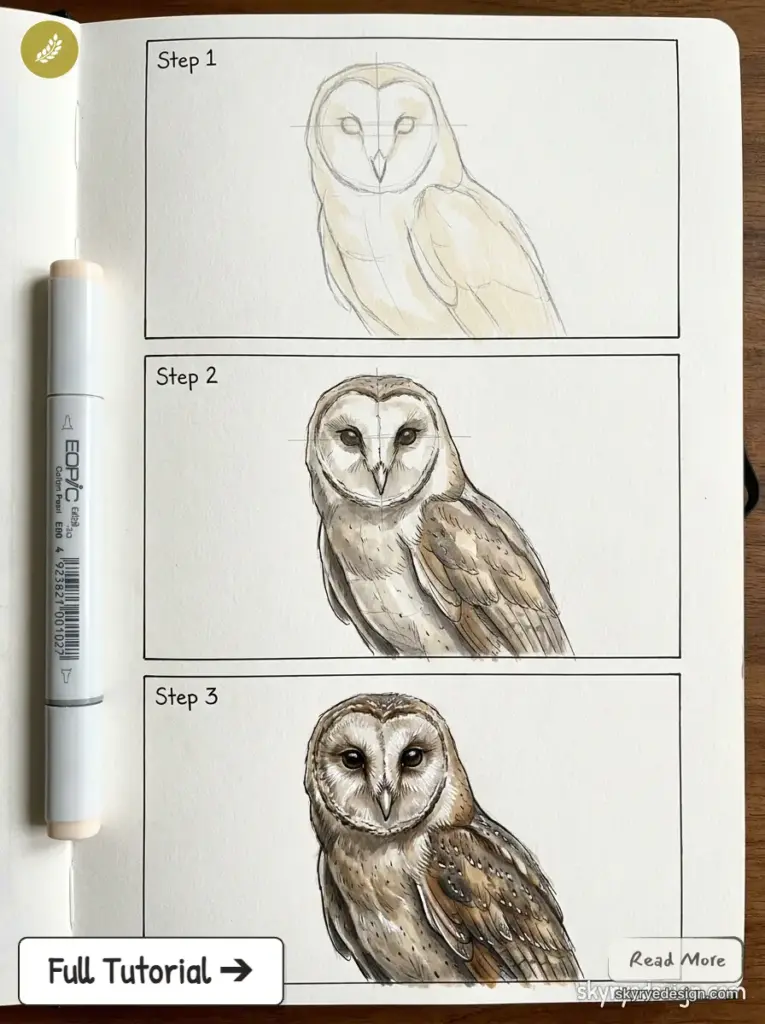
If you’re drawing the “wise old owl” cartoon type people search for, skip the barn owl reference; the heart-shaped face and small eyes tend to read as delicate or spooky rather than wise, which is closer to a horror-movie owl than a storybook one.
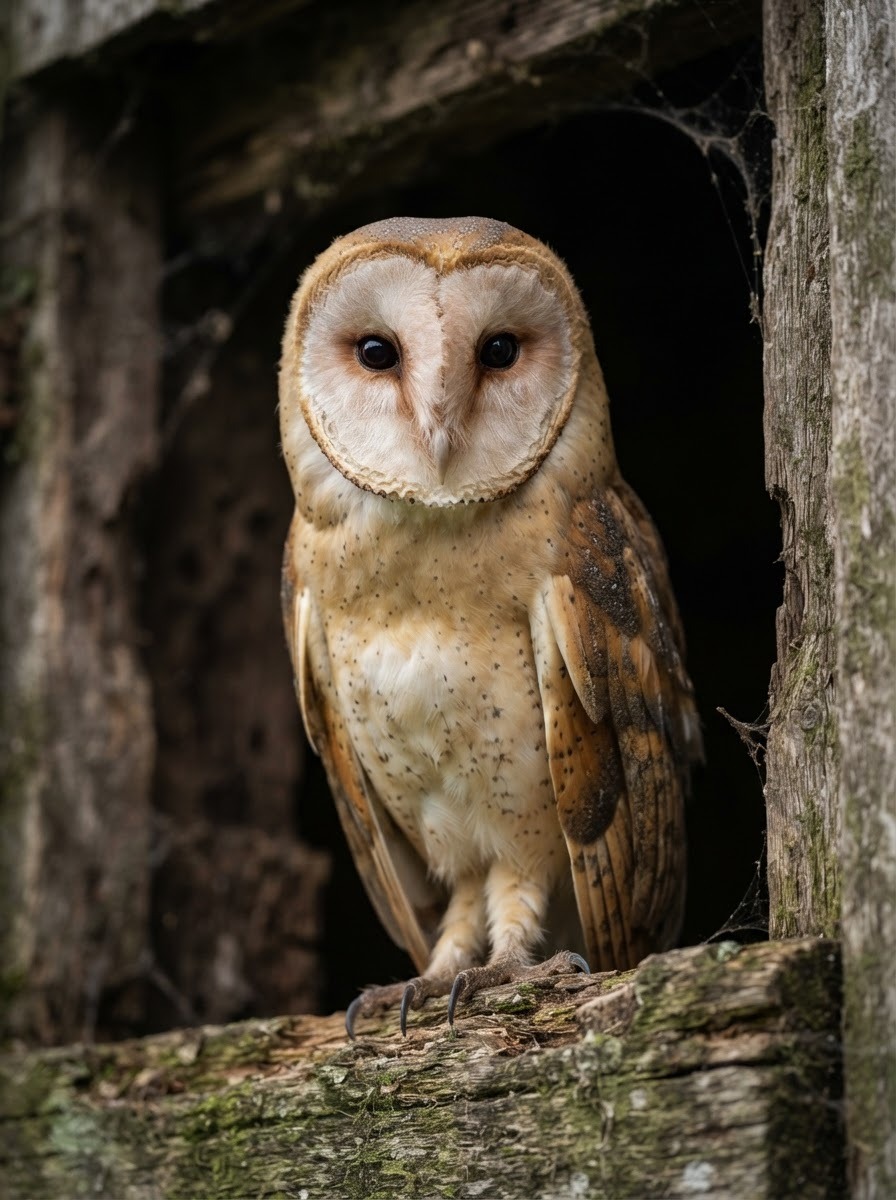
Great horned owl
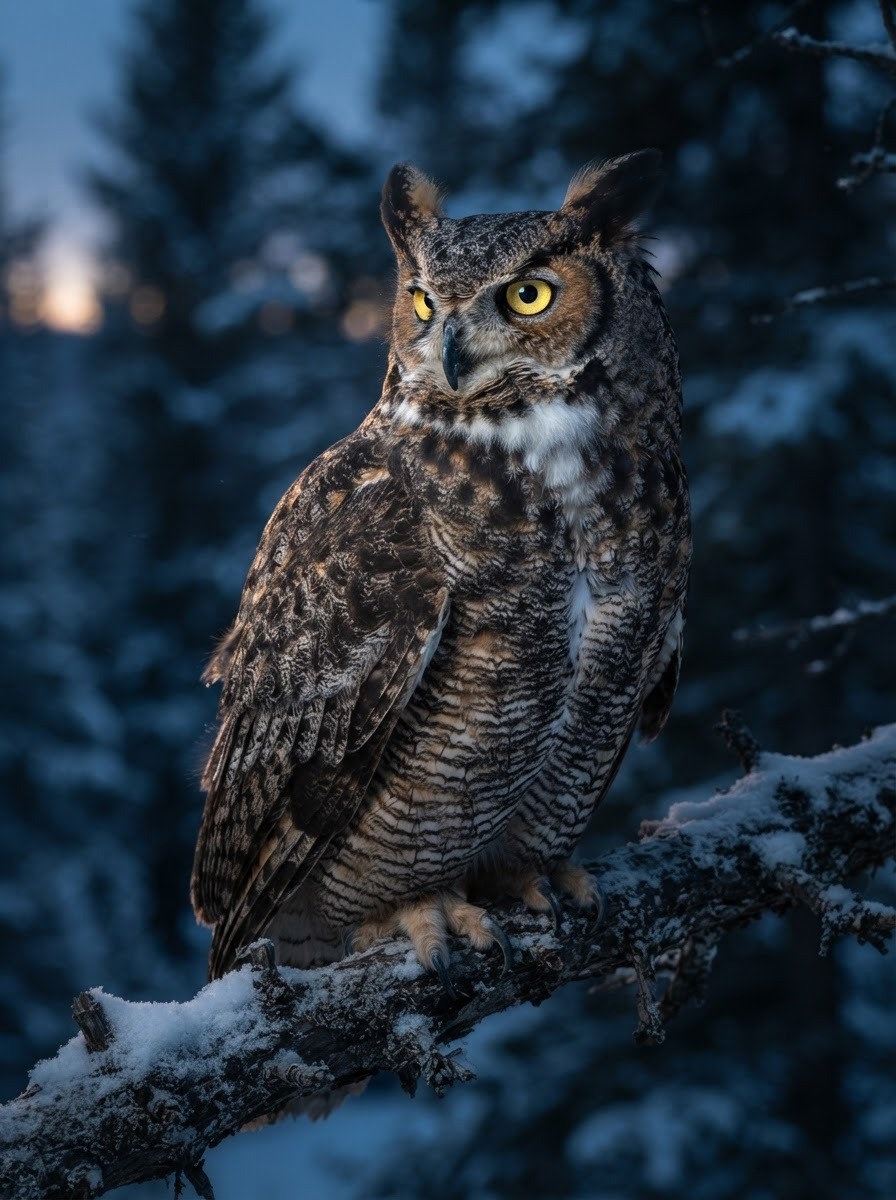
This is the “classic” owl silhouette most people picture. Rounder facial disc, prominent ear tufts (not actual ears, just feather tufts), and large, intense yellow eyes.
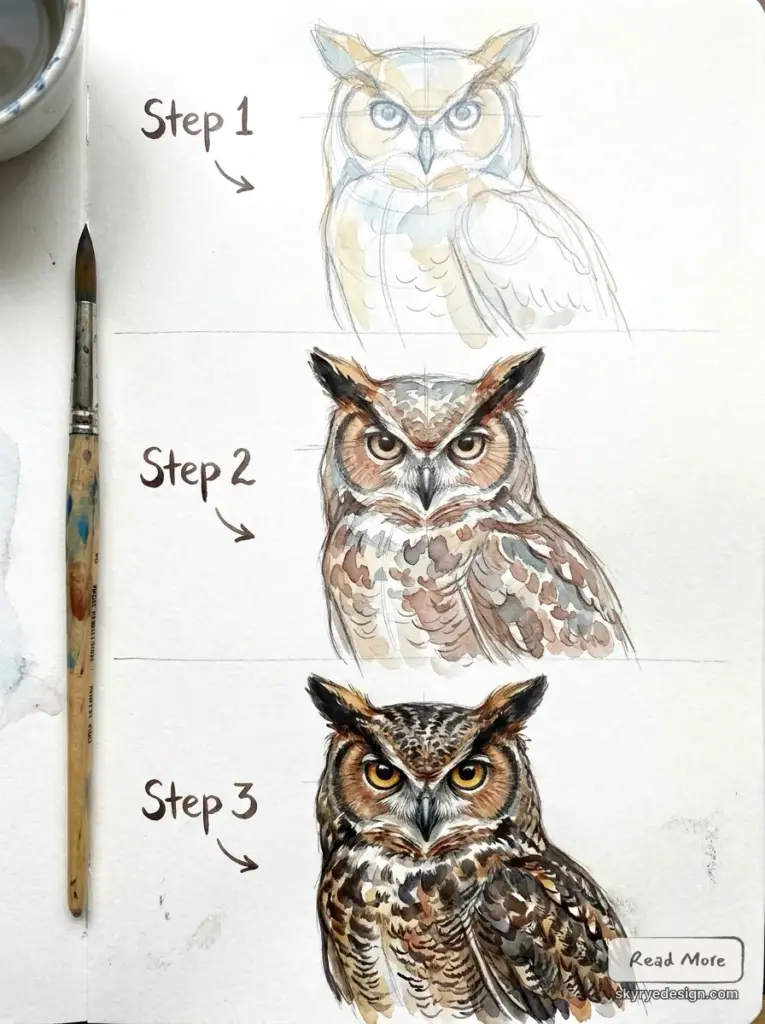
Coloring is mottled brown and gray with a distinctive white throat patch. This species is the safest default for the cartoon method, since the ear tufts read instantly as “owl” even in a simplified silhouette.
Snowy owl
Almost entirely white, with sparse dark barring that increases with age (males are whiter, females and juveniles show more dark speckling). Round head, no ear tufts, bright yellow eyes that stand out sharply against the white plumage.
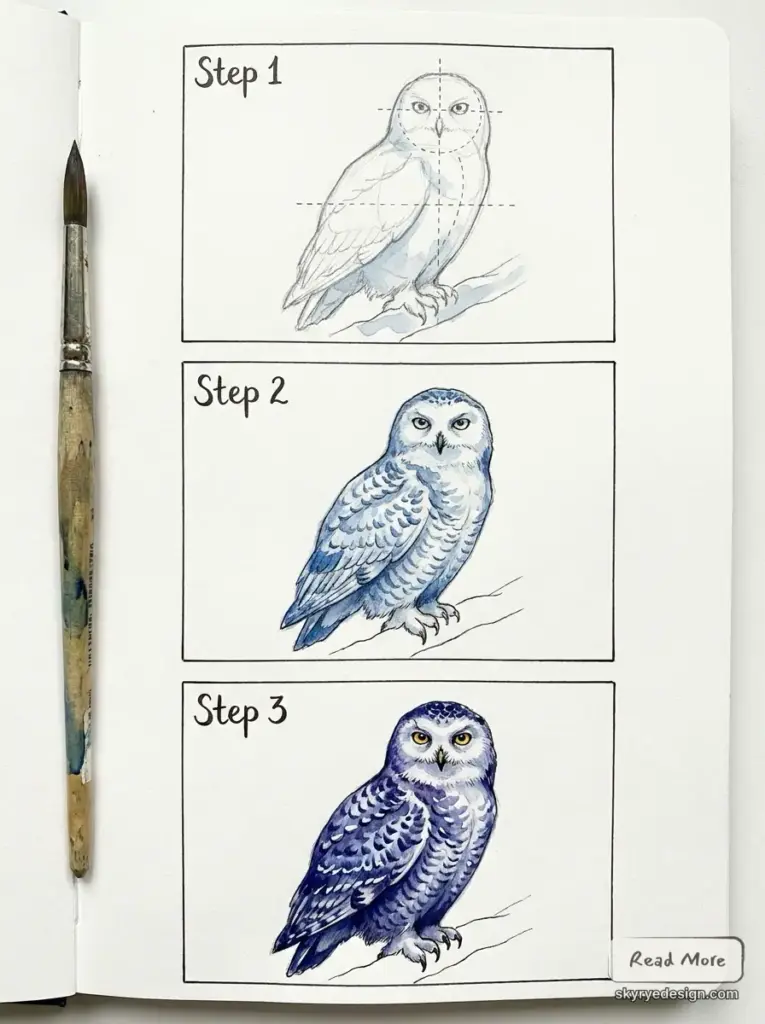
Snowy owls are worth knowing specifically because the “no ear tufts, all white” combination is what separates them from a poorly colored barn owl in a beginner’s drawing. If you draw one without tufts and it isn’t clearly white, it just reads as an unfinished barn owl.
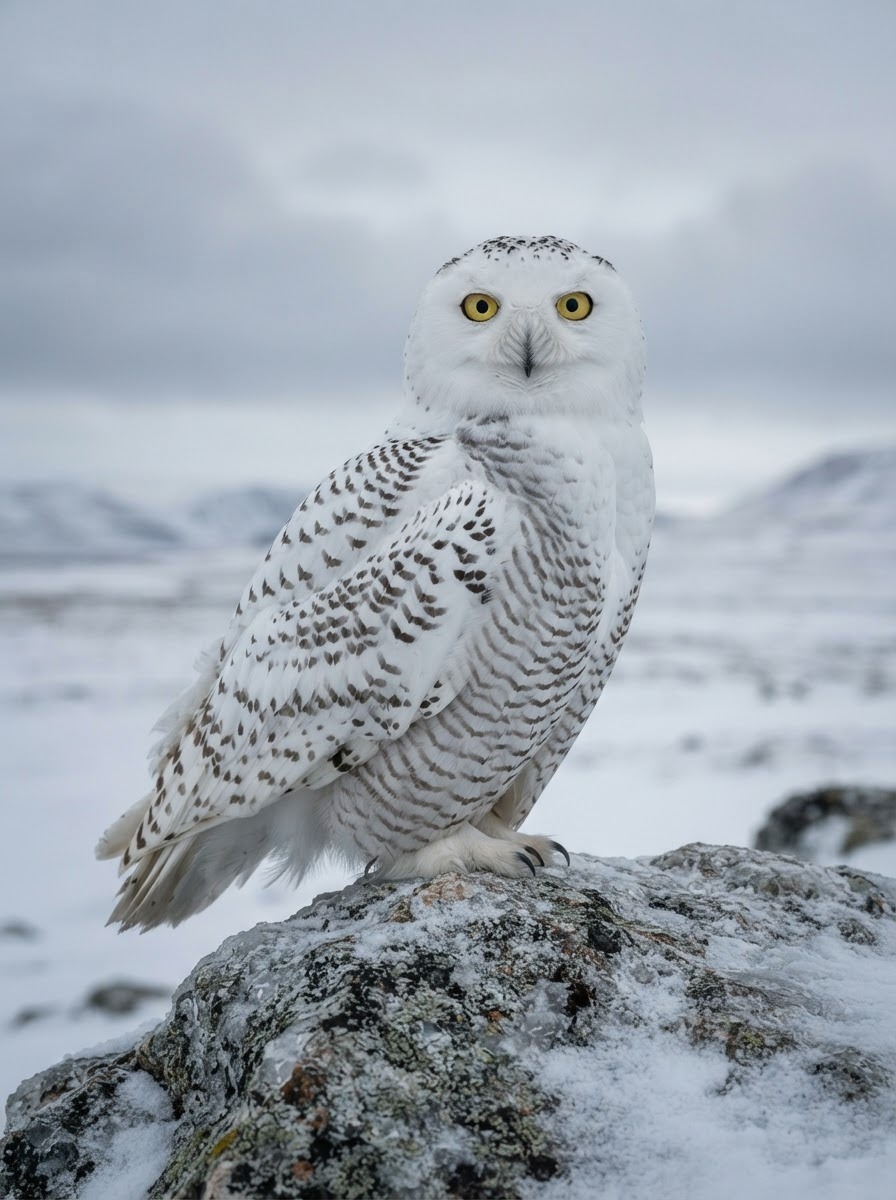
I keep reference photos of all three pinned near my desk, the same way I’d keep material swatches nearby for a product design project. Knowing which details are species-defining versus which are just stylistic choices saves you from second-guessing a drawing that’s actually correct, just unfamiliar.
Pick one species before you start the realistic method. Trying to blend features from two owls (tufts of one, coloring of another) is the fastest way to end up with a drawing that looks subtly wrong without an obvious reason why, the same “off” feeling from the very first section, just relocated from the eyes to the whole bird.
Common mistakes and quick fixes
Most owl drawings that feel “off” trace back to four repeatable problems, all fixable in under a minute once you know what to look for.
Paddle wings
A wing drawn as a straight-edged triangle or a flat oval reads as a paddle, not a feathered limb. Recheck that the wing curve reads like a comma, wider and rounder at the shoulder, tapering toward the tip, with at least a slight overlap suggestion where it meets the body rather than a hard seam.
Scribbled feather texture
Random, crosshatched squiggles with no consistent direction is the single fastest way to make a realistic owl look amateurish, even when the shapes underneath are solid. If your feather texture doesn’t have an obvious growth direction, lighten your existing marks with a kneaded eraser and re-lay the direction guidelines before adding any more texture on top. It’s faster to fix at this stage than to keep adding detail over a broken foundation.
Misaligned eyes
If an owl drawing looks subtly wrong and you can’t pin down why, check eye spacing and vertical alignment first before touching anything else. Nine times out of ten, one eye sits slightly lower or closer to the beak than the other, and that asymmetry is what your brain flags as “off” without consciously identifying it.
Stiff, frontal-only poses
Because the eyes can’t move, beginners often default to drawing every owl facing straight at the viewer, since that avoids the head-turn problem entirely. It works, but every owl in a sketchbook full of frontal poses starts to look the same. Once your eye placement is solid, try a three-quarter head turn: keep the eye spacing identical, just rotate the entire head-and-eye unit as one shape rather than shifting the eyes independently.
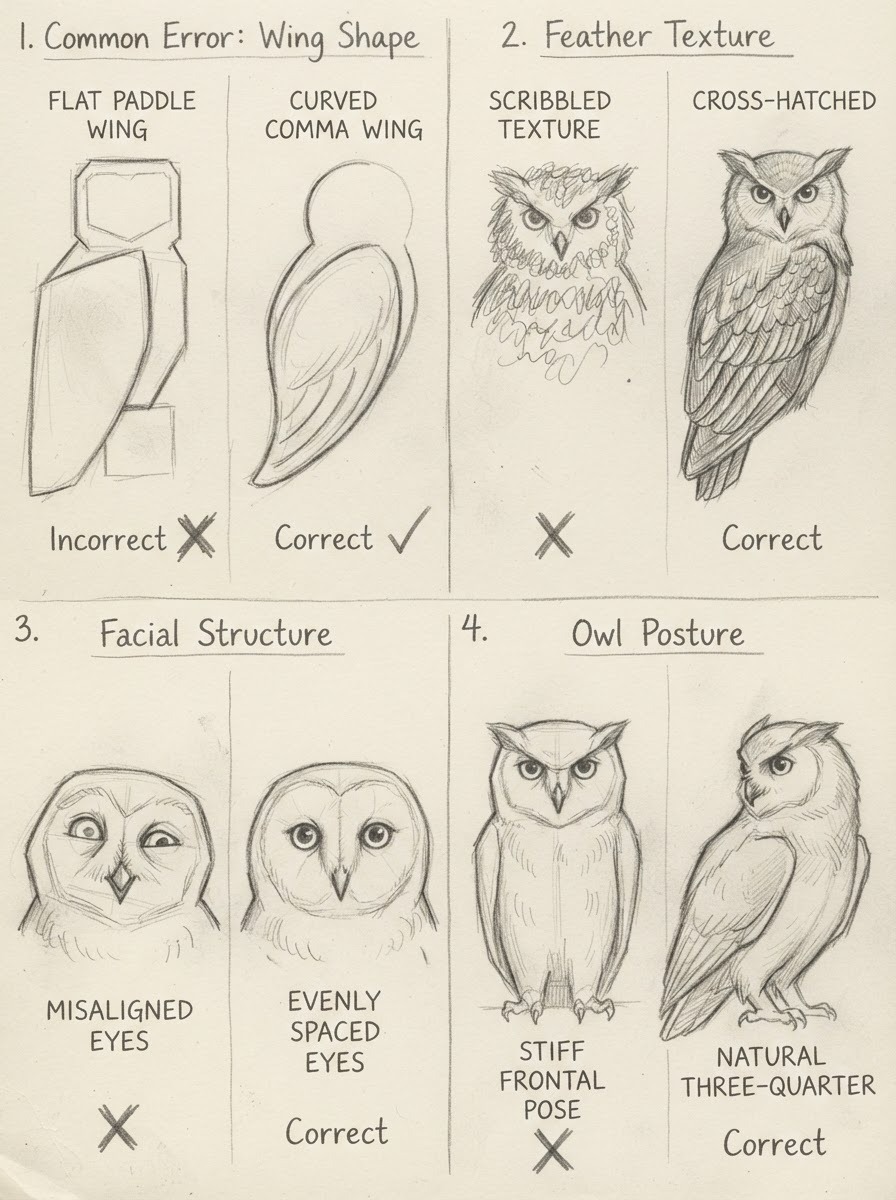
None of these fixes require redrawing the whole owl. That’s the practical upside of building from the shape skeleton first: mistakes tend to live in one specific spot, and you can isolate and correct that spot without losing the parts that already work.
With the structure solid and the common traps out of the way, the last step is bringing the whole thing to life with color.
Adding color and finishing touches
Color is where the species work pays off, since it’s the fastest way to make a drawing instantly recognizable without touching a single line.
For the great horned owl (the safest default), block in a warm brown base across the body and wings first, leave the throat patch white, then layer a slightly darker brown or gray-brown into the wing overlap shadows. Add the yellow eyes last, since a bright yellow next to darker browns tends to pull focus immediately, and you want the shading underneath fully settled before that happens.
Barn owls need a lighter touch: pale gold or cream on the back and wings, near-white on the face and underside, with just a scatter of small gray dots rather than full shading on the chest. Snowy owls are almost the inverse process of shading, since most of the “color” work is actually restraint. Leave the paper white where you can, and use a light gray, not black, for the sparse barring marks, heavier on the wings if you’re drawing a female or juvenile.
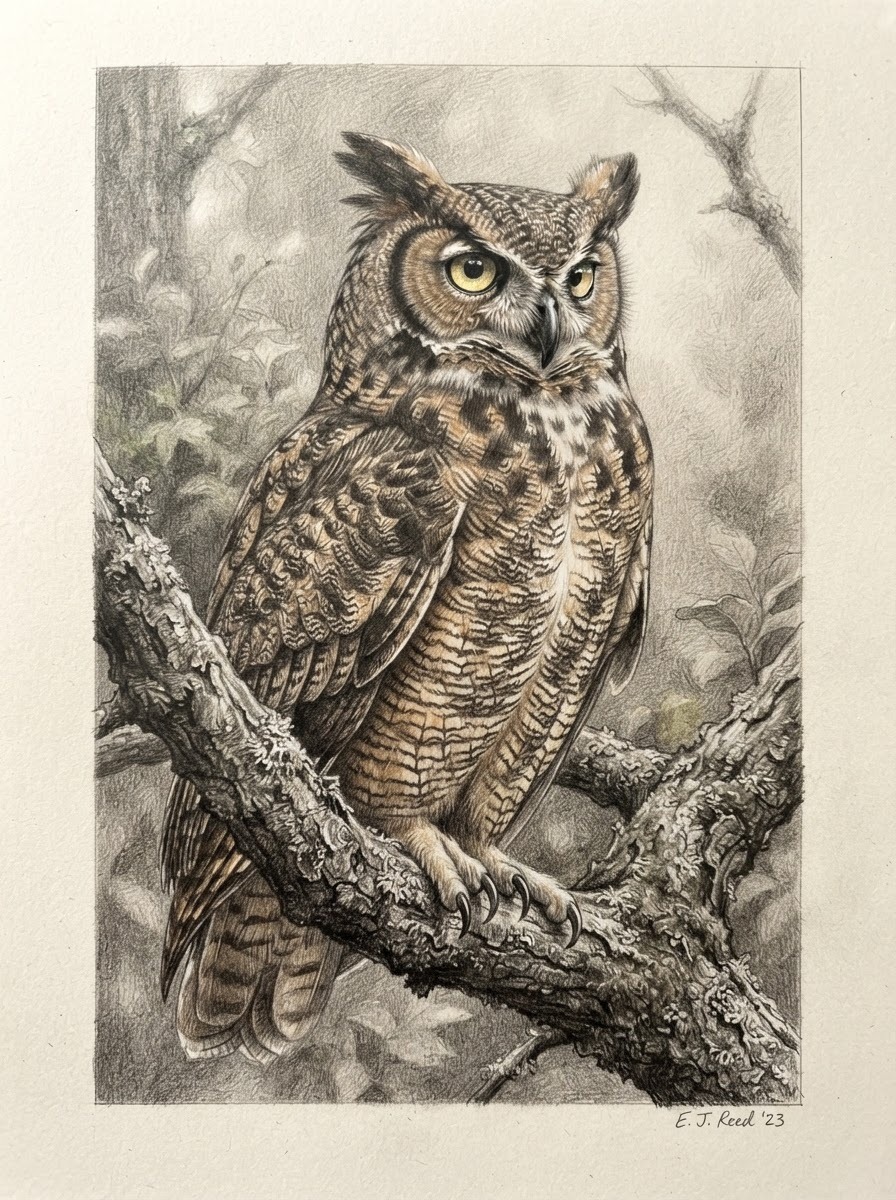
For the branch itself, a mix of warm brown and a touch of gray keeps it from competing with the owl. Add two or three small cracks or texture lines rather than an even wood-grain pattern; real bark is irregular, and an overly neat branch will look more artificial than the cartoon owl sitting on it.
One last practical habit: sign and date your drawing before you consider it finished. It sounds trivial, but going back through a sketchbook and seeing dates next to owl drawings from a year apart is the clearest evidence of actual improvement you’ll get, far more convincing than trying to judge progress drawing by drawing.
That’s the full range, from a ten-minute cartoon owl to a shaded, species-accurate realistic one, both built from the same five starting shapes.
After the owl study, a simple 3D drawing can help you isolate the same value and edge-control skills on a flatter subject.
FAQ
What’s the easiest way to draw an owl for beginners?
Start with the shape skeleton: a circle for the head, a slightly overlapping oval for the body, two evenly spaced eye circles, a small triangle beak, comma-curved wings, and simple feet. Round everything off for the cartoon method. Most beginners overcomplicate the wings early; three curved lines inside a teardrop shape read as feathers just fine without drawing individual ones.
How do you draw a realistic owl eye?
Layer it in three passes: a 2B mid-tone across the iris, a solid 6B pupil, and short radial strokes around the pupil edge for texture. Leave a small crescent untouched for the catchlight, that’s what makes the eye look alive rather than flat. Skip that highlight and the whole eye reads as painted-on instead of wet and reflective.
How do you draw an owl on a branch?
Build the owl from the skeleton first, then add a horizontal branch line under the feet before finishing the talons, so the toes can curve naturally around it. Keep the branch texture irregular, two or three cracks rather than an even wood grain, or it competes visually with the bird instead of supporting it.
How do you draw a cartoon or “wise old owl” look?
Use the great horned owl reference, prominent ear tufts and round yellow eyes read as “wise” almost instantly, even in a simplified silhouette. Keep pupils centered rather than side-glancing; off-center pupils tend to make a cartoon owl look shifty instead of thoughtful.
What’s the easiest way to draw owl feathers?
Pencil light direction guidelines first, facial disc feathers radiate from the eyes, wing feathers layer diagonally like roof shingles, then cross-hatch along those lines rather than against them. Scribbling texture with no consistent direction is the single fastest way an otherwise solid drawing starts looking amateurish.
How do you draw an owl meme?
If you want to speed up your workflow or experiment with initial ideas, you can also leverage creative drawing AI tools to generate references and variations instantly.
Meme-style owls usually exaggerate one feature, oversized eyes, a flattened head, or an unusually blank expression. Start from the same skeleton, then push the eye circles larger than normal and drop the facial disc detail almost entirely. It’s the simplified cartoon method, just with proportions pushed further for comic effect.
How do you make an owl look like a specific species, like a snowy owl versus a barn owl?
Check three details: ear tufts (snowy owls have none, great horned owls do), facial disc shape (heart-shaped and pale for barn owls, rounder for the other two), and coloring (snowy owls stay mostly white, barn owls run pale gold and cream). Mixing features from two species is the most common reason a drawing looks subtly wrong without an obvious cause.
Whether you are sketching majestic bird feathers or detailed eyes, starting your day with organic fun drawing exercises is a brilliant way to warm up your hand and build essential observational skills.
- 1.1Kshares
- Facebook0
- Pinterest1.1K
- Twitter0
- Reddit0