3D art on paper works when the drawing gives your eye just enough evidence to believe the flat sheet has depth. The best examples use a single viewing angle, strong cast shadows, clean edges, and a little theatrical timing: part of the object appears to lift, sink, or break through the page.
This collection of 3D drawing on paper examples is inspired by the optical illusion work of Ramon Bruin. Look at the shadows first, then the cropped paper edges, then the way each object overlaps the page. That order is the fastest way to understand why a 3D pencil drawing feels convincing.
3D art on paper: quick answer
To make 3D art on paper look real, choose one viewing angle, sketch the distorted shape lightly, place the cast shadow early, and keep the strongest contrast where the object touches the page. The illusion usually fails when the perspective and shadow disagree.
How 3D drawing on paper creates the illusion
The trick is not only realistic shading. A flat drawing starts to feel three-dimensional when perspective, overlap, and shadow all point to the same story. In academic drawing, I usually check the big value pattern before details; with 3D illusion drawing, that check matters even more.
| Element | What it does | Beginner check |
|---|---|---|
| Viewing angle | Sets the one spot where the distortion looks correct. | Photograph the drawing from the intended angle before finishing. |
| Cast shadow | Anchors the object to the paper surface. | Keep the shadow direction consistent across the whole piece. |
| Paper edge | Makes the object feel as if it crosses out of the sheet. | Let one shape overlap the edge cleanly instead of cluttering every side. |
| Value contrast | Separates raised forms from flat background areas. | Save the darkest darks for contact points and occlusion. |
3D drawing on paper examples
Use these examples as a small visual study. Some are dramatic optical illusions, while others are better for learning simple 3D drawing structure, pencil shading, and perspective control.
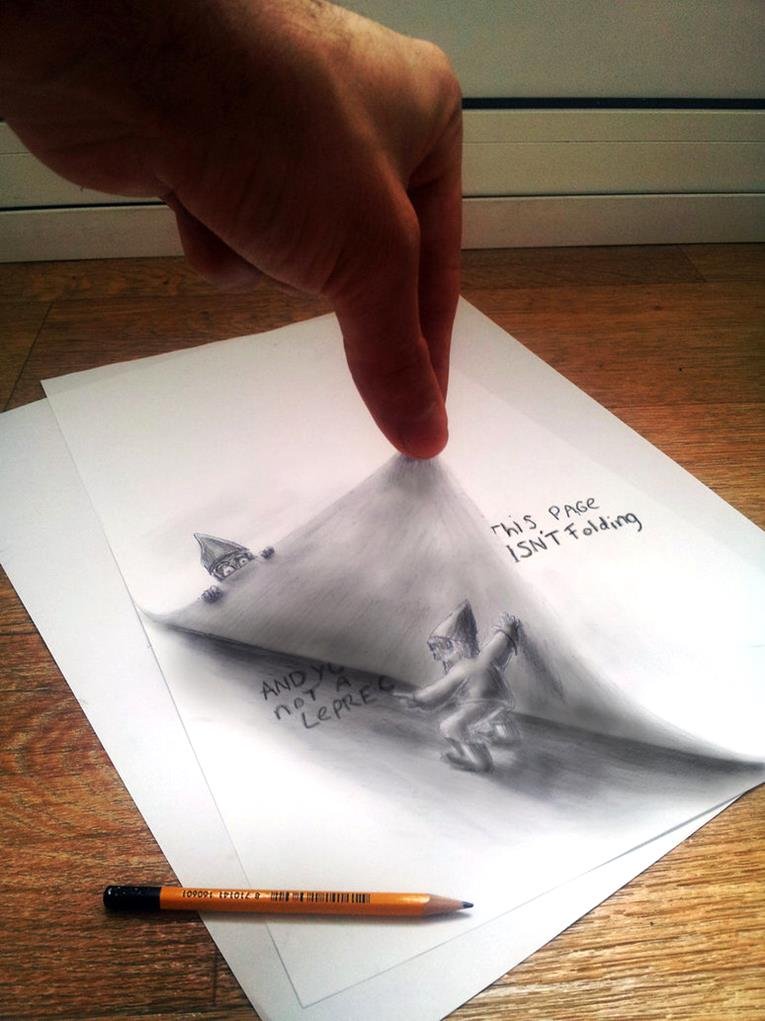
A strong first example: the figure feels lifted because the shadow and paper edge agree.

The safari scene works because the foreground object is oversized while the background stays calm.

This torn-paper eye is a good reminder that the illusion depends on clean edge control.

Small props can make a 3D paper artwork feel more believable than a huge dramatic subject.
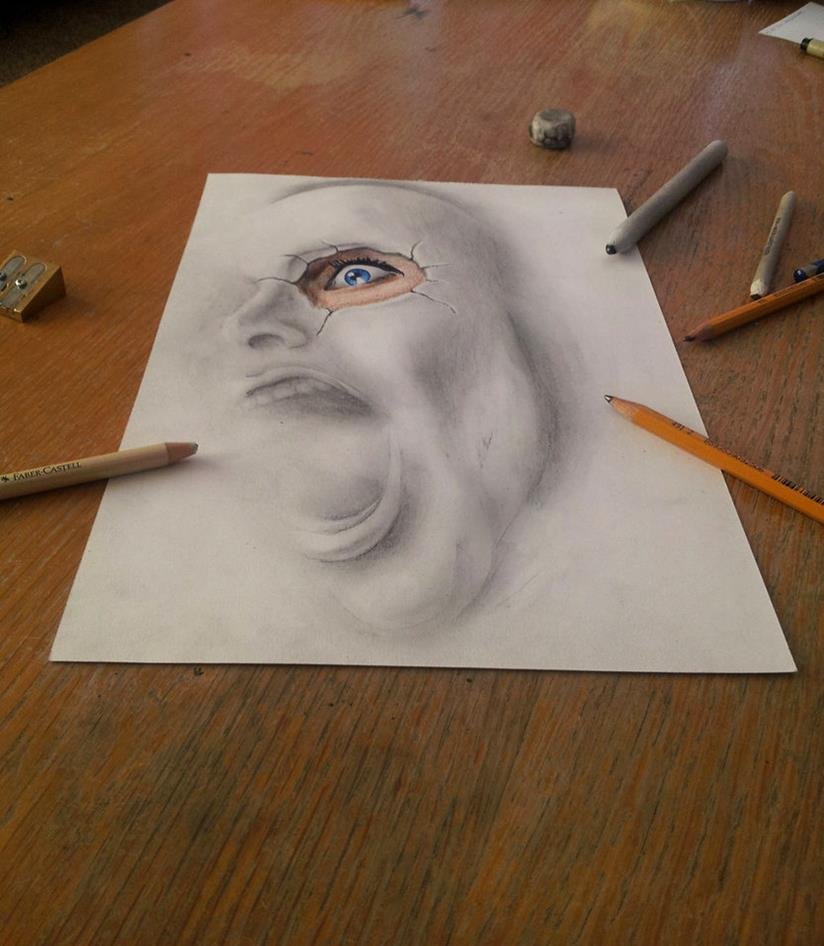
The hidden figure reads slowly, which gives the drawing a quiet reveal instead of a quick trick.

This piece uses the pencil and camera as scale clues, so the flat sheet feels like a small stage.

The skull rises because the darkest values sit under the form, not randomly around it.
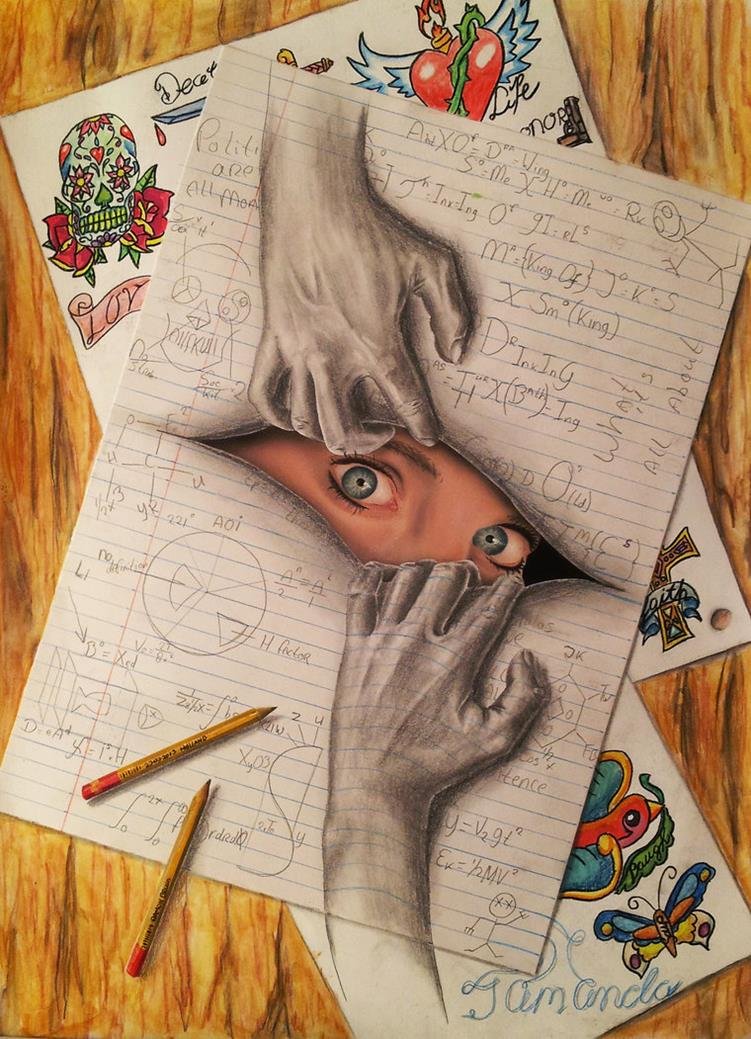
Portrait-based 3D drawings need softer transitions, otherwise the face can look pasted on.
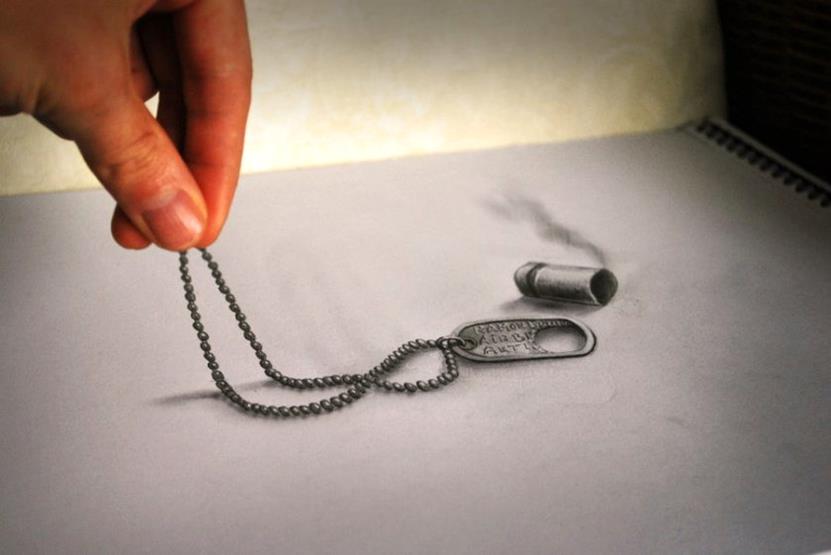
Simple objects are excellent for practice because every cast shadow mistake is easy to see.

The snake illusion depends on the body crossing the paper edge at just the right angle.

A low viewing angle makes this serpent feel longer and more dimensional.

Action scenes need a clear silhouette first; the details only work after the pose reads.

The dogfight composition uses overlapping shapes to make the paper feel deeper.

This playful sunglasses piece is a good beginner study for reflected light and shadow.

The sailing scene closes the set with a softer, story-driven version of the same illusion.
Best starting points for easy 3D drawing
| Goal | Try this subject | Why it helps |
|---|---|---|
| Learn shadow placement | A cube, hole, folded strip, or dog tag | The geometry is simple, so mistakes show quickly. |
| Practice paper-edge tricks | A pencil, ladder, snake, or hand shape | The object can cross the page edge without too much detail. |
| Build a stronger scene | A tiny character, vehicle, or animal | Overlapping forms teach depth better than isolated outlines. |
| Study values | Skull, eye, or portrait detail | Soft transitions make the form feel rounded instead of flat. |
For the drawing basics behind these illusions, practice perspective drawing for beginners, then add value studies from the sketching ideas guide. If you want a more design-focused bridge, compare these hand-drawn illusions with 3D modeling and 3D rendering from sketch to finished space.
Common 3D pencil drawing mistakes
- Using several viewpoints at once. Pick one camera angle and keep the whole drawing loyal to it.
- Leaving the shadow until the end. The shadow is part of the construction, not decoration.
- Outlining every edge equally. Real depth needs lost edges, soft transitions, and a few sharp contact points.
- Adding detail before the big shape works. Test the illusion with a phone photo before you spend time on texture.
Further study for optical illusion art
If you want to understand the art history behind the effect, start with anamorphosis, trompe l’oeil, Op art, and the impossible-space drawings associated with M. C. Escher. For hands-on practice on Sky Rye Design, the closest next steps are aesthetic bullet journal doodles, realistic deer drawing and shading, architecture sketches, photo to sketch workflows, line art inspiration, and black and white abstract drawings.
3D art on paper FAQ
Q: What is 3D art on paper?
A: 3D art on paper is a flat drawing that looks raised, recessed, or physically present when viewed from the right angle. Most pieces use perspective distortion, cast shadows, cropped edges, and careful value control to fool the eye. The paper is still flat; the depth comes from how the artist stages the illusion.
Q: How do you make a 3D drawing on paper look real?
A: Start with one viewing angle and design everything around it. Keep the light source consistent, draw the cast shadow before adding small details, and make sure the object touches or crosses the paper edge in a believable place. If the shadow direction changes, the illusion usually falls apart.
Q: What paper is best for 3D pencil drawing?
A: Smooth heavyweight drawing paper works best for most 3D pencil drawings because it handles clean shading without buckling. A medium-smooth sketchbook page is fine for practice, but very rough paper can break soft shadow gradients. For finished work, I would choose paper that lets you erase lightly without tearing the surface.
Q: Is 3D art on paper the same as anamorphic drawing?
A: Many 3D paper illusions are anamorphic drawings, but not every one is. Anamorphic art is intentionally distorted so it looks correct from one specific viewpoint. Some paper illusions rely more on trompe l’oeil realism, shadows, or cut-paper framing than on heavy distortion.
Q: Can beginners try easy 3D drawing on paper?
A: Yes. Beginners should start with simple forms such as a cube, hole, ladder, pencil, or folded strip of paper. These subjects teach the main trick: line direction, shadow placement, and a single viewing angle. Complex figures are easier after those basics feel predictable.
Q: Why do 3D drawing illusions fail?
A: Most failed 3D illusions have mixed viewpoints, weak shadows, or too much detail before the form is solved. The viewer needs one clear angle, one clear light source, and a readable silhouette. I usually check the shadow shape first; if that is wrong, extra texture will not save the drawing.
Conclusion
Good 3D art on paper is less about secret tricks and more about discipline. Keep the viewing angle fixed, make the shadow believable, and let the paper edge do some of the storytelling. Once those three parts agree, even a simple 3D pencil drawing can feel surprisingly physical.
The strongest pieces in this set are worth studying slowly: first for the illusion, then for the construction underneath it. That second look is where the useful drawing lesson usually lives.
Works by Ramon Bruin.
- 69shares
- Facebook0
- Pinterest69
- Twitter0
- Reddit0