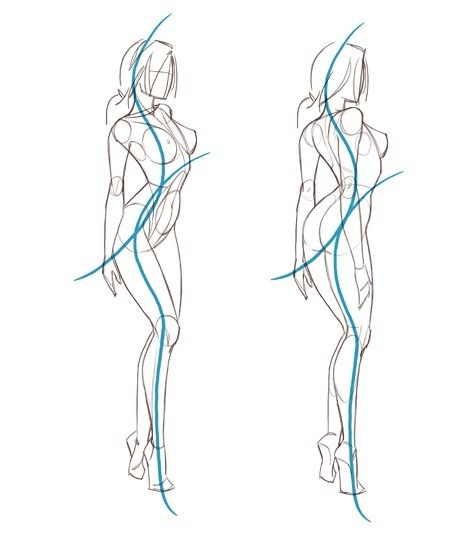
This female figure drawing tutorial gets easier when you build the pose from the inside out. Start with the gesture, rib cage, pelvis, and leg rhythm first; the waist, hips, shoulders, and contour make more sense once the structure underneath is doing its job.
Use this guide as a practical woman drawing workflow: action line, torso block, hip block, limb angles, proportion checks, then hair, clothing, shading, and final cleanup. I usually check the shoulder tilt against the pelvis before adding contour, because those two angles decide whether the pose feels alive or stiff.
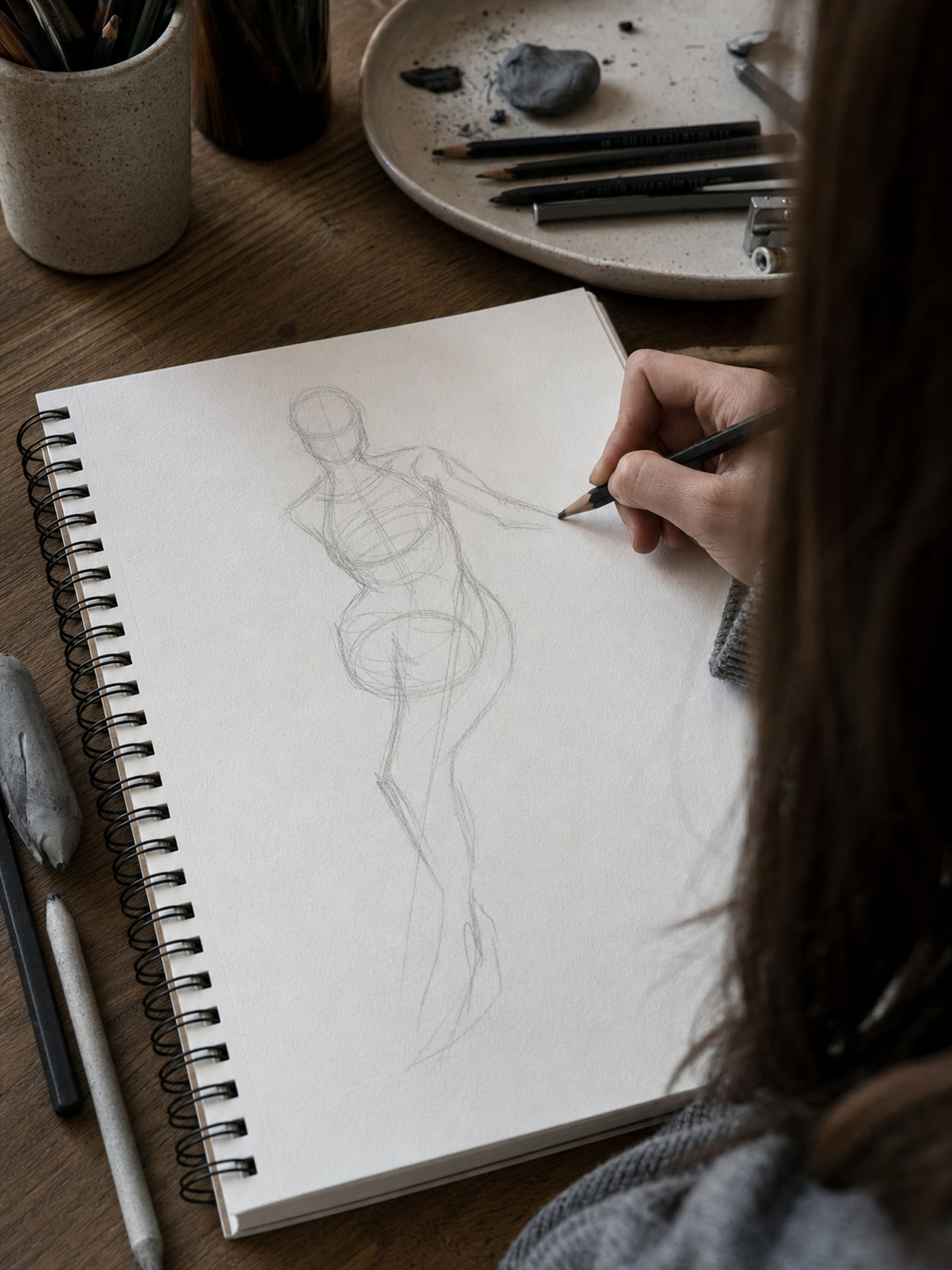
Keep the first sketch light. If the torso, hips, and leg rhythm do not work as simple shapes, erase early. Details can make a good structure better, but they cannot rescue a broken one.
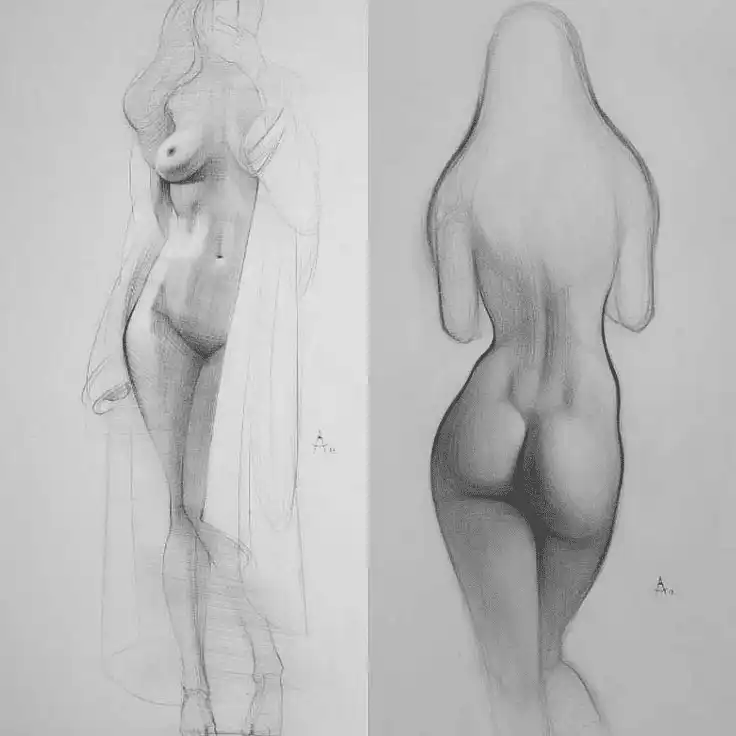
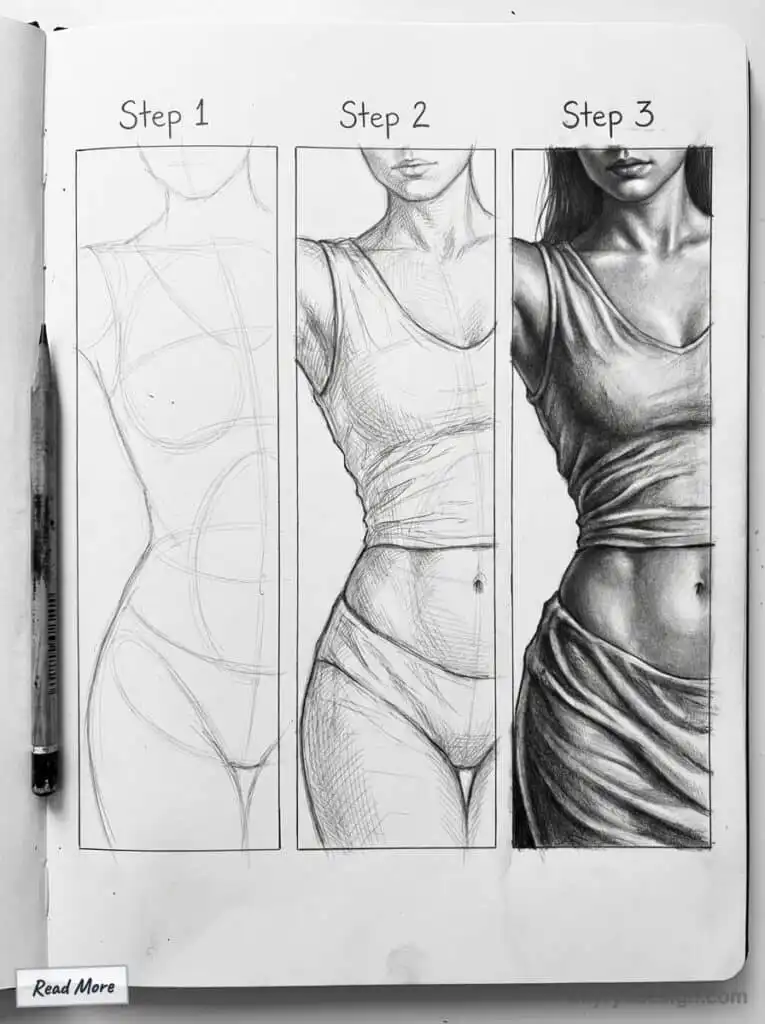
How to Draw a Female Figure in 7 Steps
Use this as the first pass before you worry about hair, clothing, face details, or clean line art. A woman drawing usually fails because the big angles are wrong, not because the eyelashes or fabric folds need more polish.
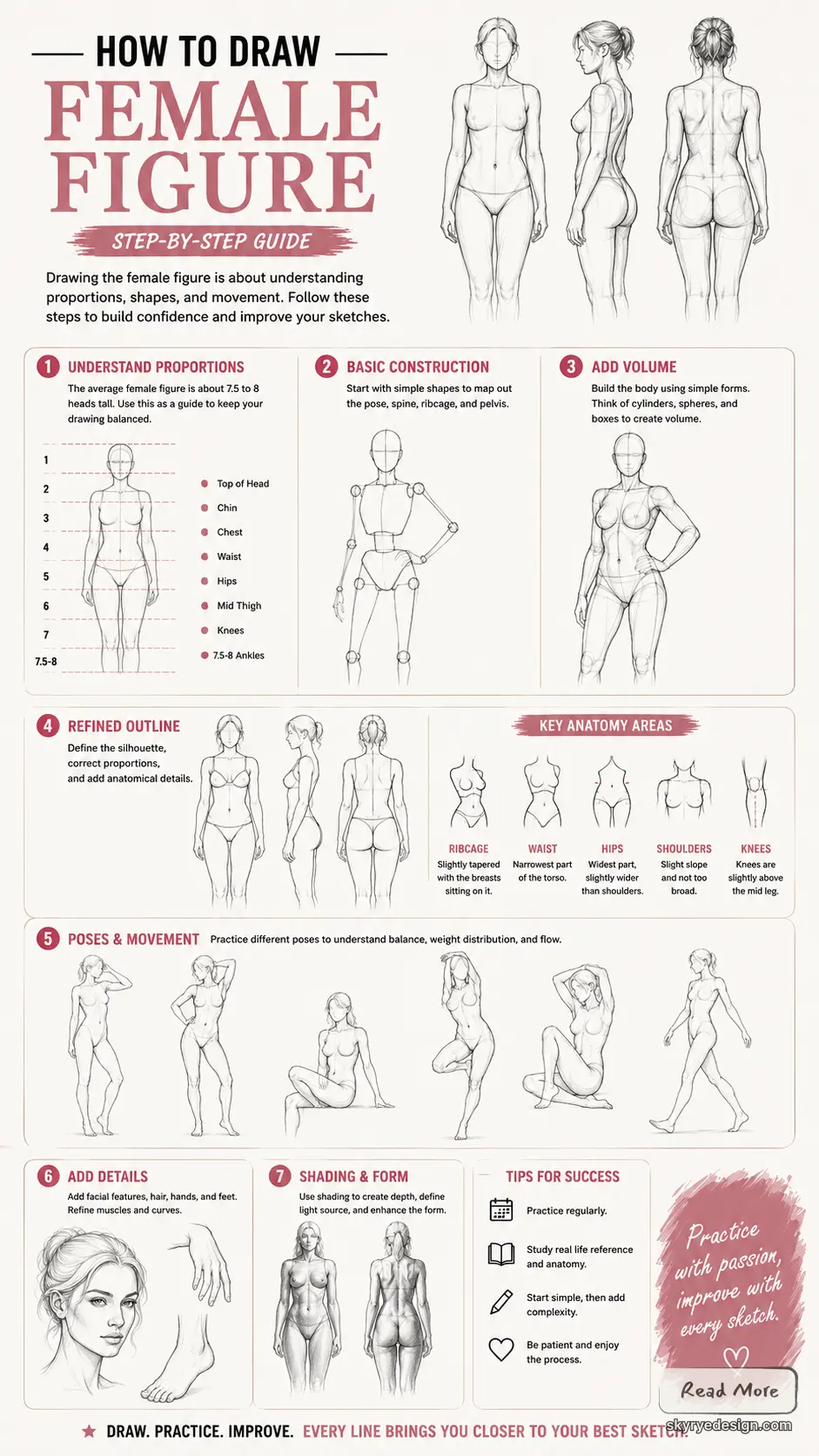
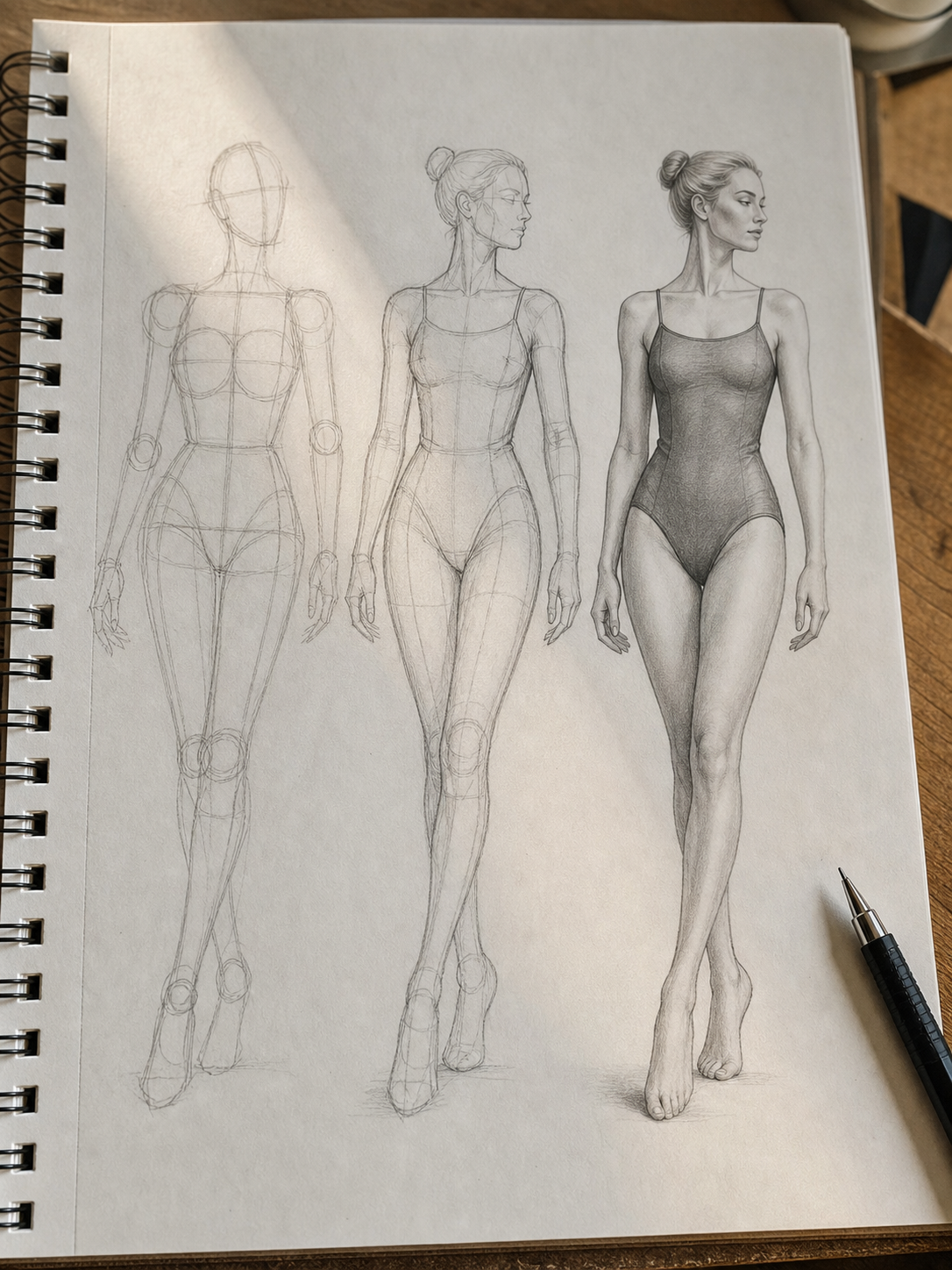
| Step | What to draw | What to check before moving on |
|---|---|---|
| 1 | Light gesture line | The pose has one clear direction, not a stiff vertical stick. |
| 2 | Rib cage | The shoulder line tilts naturally with the action of the pose. |
| 3 | Pelvis block | The pelvis angle answers the shoulder angle instead of copying it. |
| 4 | Leg rhythm | One leg carries weight; the other can relax, bend, or step forward. |
| 5 | Arms and hands | Elbows, wrists, and hands land at believable body landmarks. |
| 6 | Outer contour | The waist, hips, shoulders, and calves follow the structure underneath. |
| 7 | Shading and cleanup | Values support the form instead of hiding proportion mistakes. |
For me, the fix was stopping the “full figure from the top” thing. I’d lose the proportions somewhere around the torso every single time. Working in sections — head, torso, hips, legs separately — changed how I approached it. The eight-head rule was the first framework that actually helped. It’s not a rule you’ll follow strictly forever, but early on it stops the whole thing from going completely off the rails.
Before refining curves or clothing, block in a loose figure drawing base. It gives you a simple structure for the head, ribcage, pelvis, and legs so the female figure feels balanced before the details start.
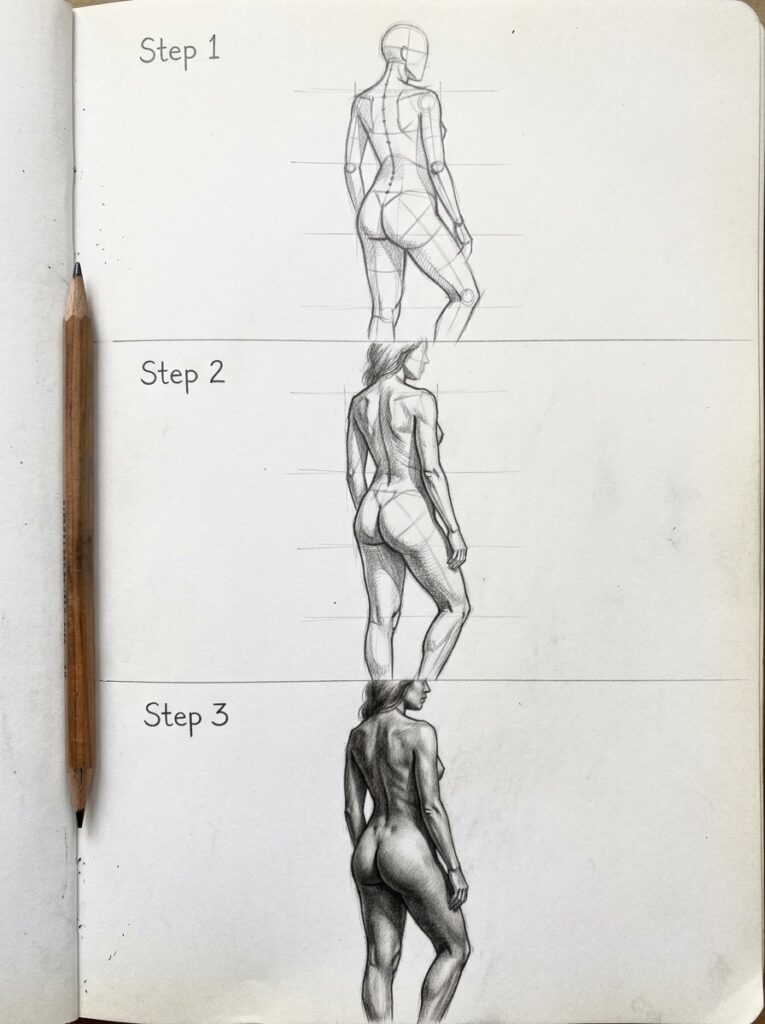
I still start most sketches the same way. Loose lines, quick shapes, no pressure. Just trying to catch the pose. If that part feels wrong, I don’t even bother with details — I’ll redraw it. Learned that the hard way after wasting time polishing bad sketches.
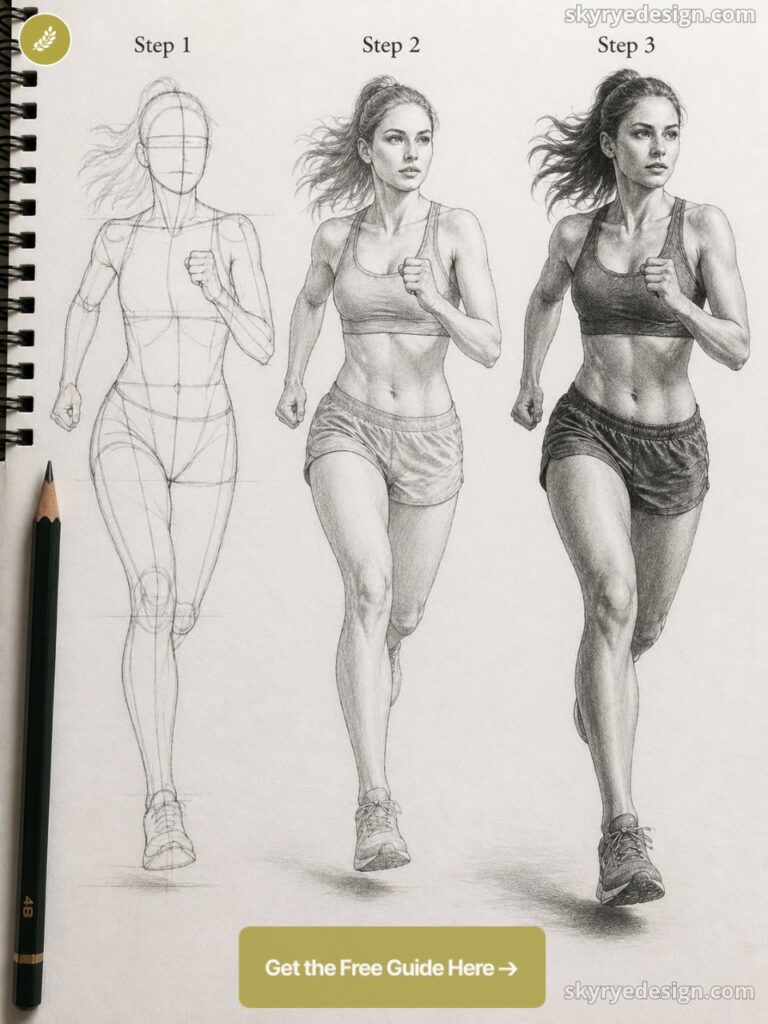
Once the structure feels right, I go back in and adjust the curves. Hips, waist, shoulders — small tweaks, but they change everything. Sometimes it’s literally a few millimeters and the whole figure suddenly makes sense.
Shading and color come last. And honestly, they can’t save a bad drawing. I’ve tried. If the base works, even simple shading looks convincing. If it doesn’t… no amount of rendering fixes it.
And yeah, it takes practice. A lot of slightly weird-looking sketches before things start to settle. But your eye improves faster than you think — especially if you actually look at what went wrong instead of just starting a new drawing.
This guide breaks the process down step by step, the way I wish someone had shown me earlier.
Female Figure Drawing Basics
Good sexy body drawing starts with three checks: head-to-body height, the angle of the rib cage against the pelvis, and the balance of the weight-bearing leg. Do those before curves. A soft waist or wider hip line only works when the simple structure underneath still feels believable.
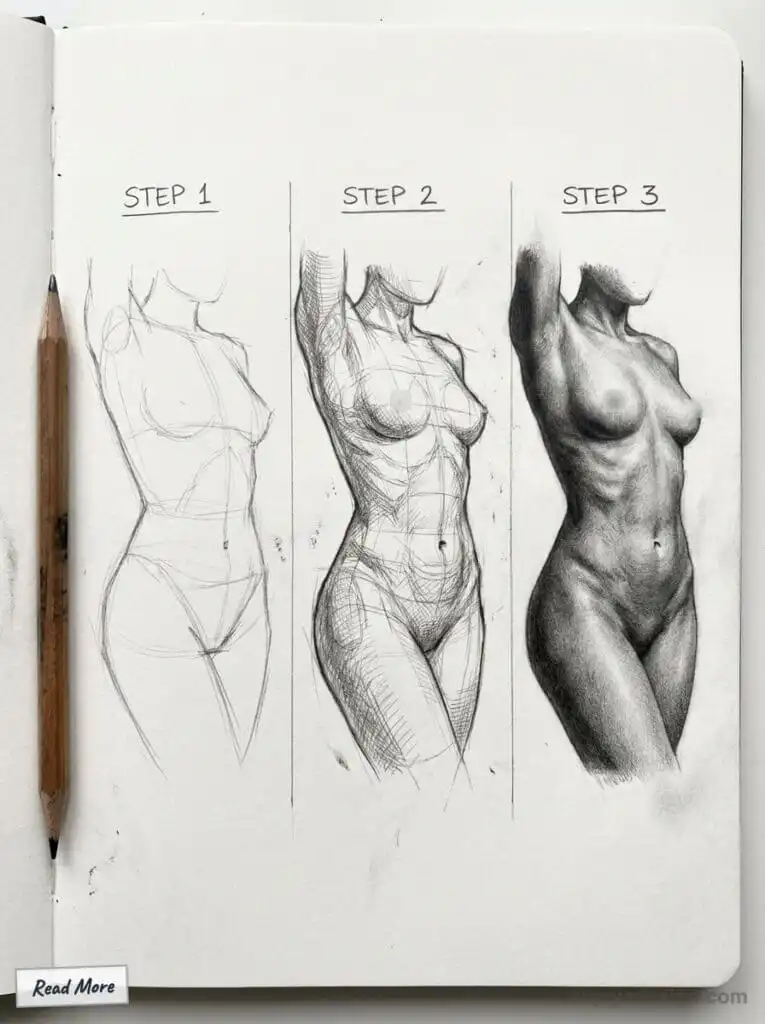
Think of these as measuring points, not beauty rules. Real bodies vary, and stylized drawings can push the proportions, but the sketch still needs a clear rib cage, pelvis, knees, ankles, and weight shift.
Female Figure Proportions and Measurements
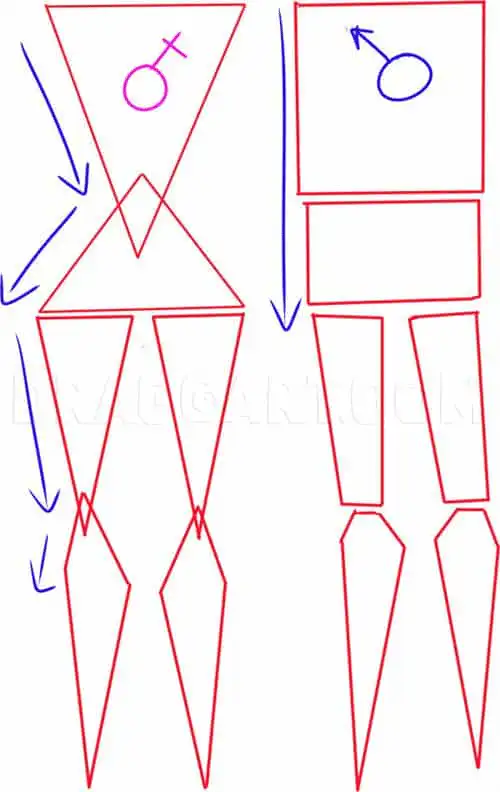
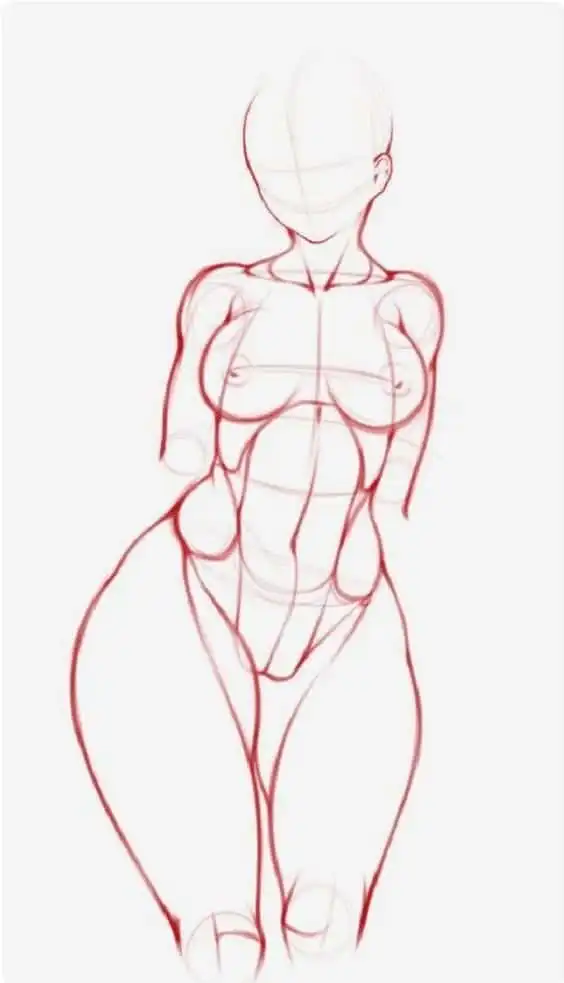
For sexy body drawing, proportions give you a starting grid, not a law. An adult figure is often drawn around 7 to 7.5 heads tall, while fashion sketches may stretch that. Use the checks below to keep the pose consistent before you refine the outline:
- Head to Hip Ratio: The widest part of the hips is usually about 1.5 times the width of the shoulders.
- Waist to Hip Ratio: A common measurement is 0.7, which represents a curvy silhouette.
- Leg Length: Legs often make up roughly half of the total height.
- Key Points: Identifying anatomical points such as the navel, shoulders, and the point where the torso folds helps maintain accurate proportions and guides placement of body parts.
Using these measurements allows artists to create balanced and realistic body outlines.
Female figure proportions cheat sheet
For a beginner female figure drawing, use a seven-to-eight-head map as a check, not a cage. Mark the head, rib cage, pelvis, knees, and ankles lightly before you commit to curves. If one landmark is off, fix it while the sketch is still pale.
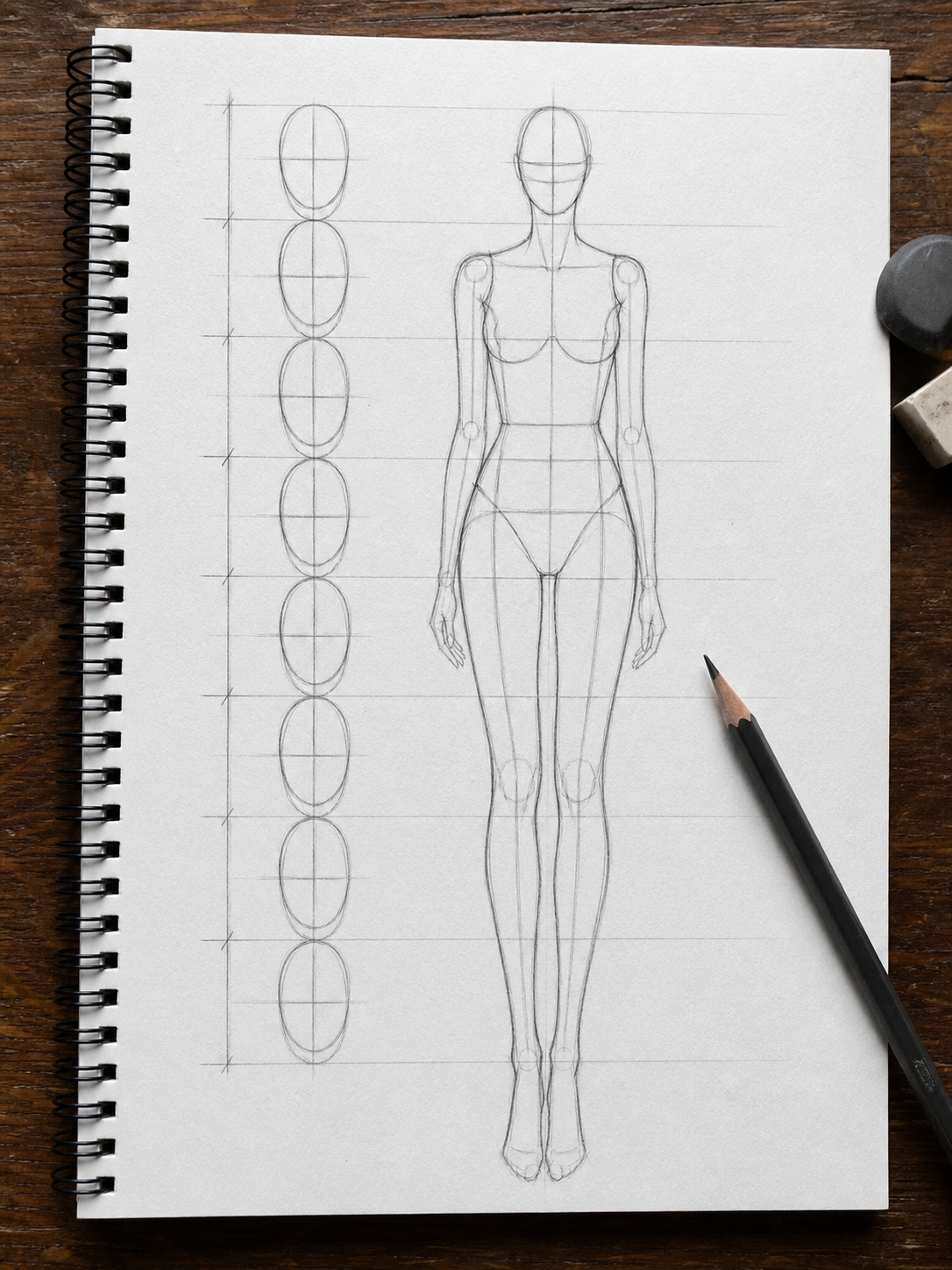
| Landmark | Quick check | Common beginner fix |
|---|---|---|
| Head | Use it as the measuring unit. | Do not enlarge it after the body is drawn. |
| Rib cage | Draw it as an egg or box with volume. | Avoid a flat chest rectangle. |
| Pelvis | Tilt it against the shoulders. | Do not copy the shoulder angle exactly. |
| Knees | Place them before refining thighs. | Keep both knees aligned with the leg rhythm. |
| Feet | Set the stance and weight direction. | Give the standing foot enough ground contact. |
Anatomical Landmarks


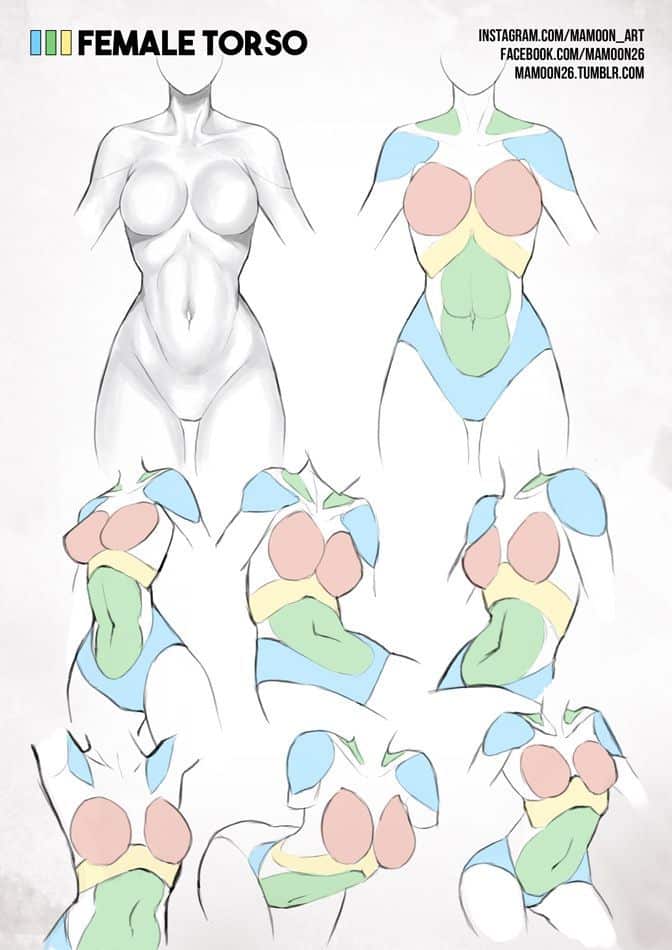
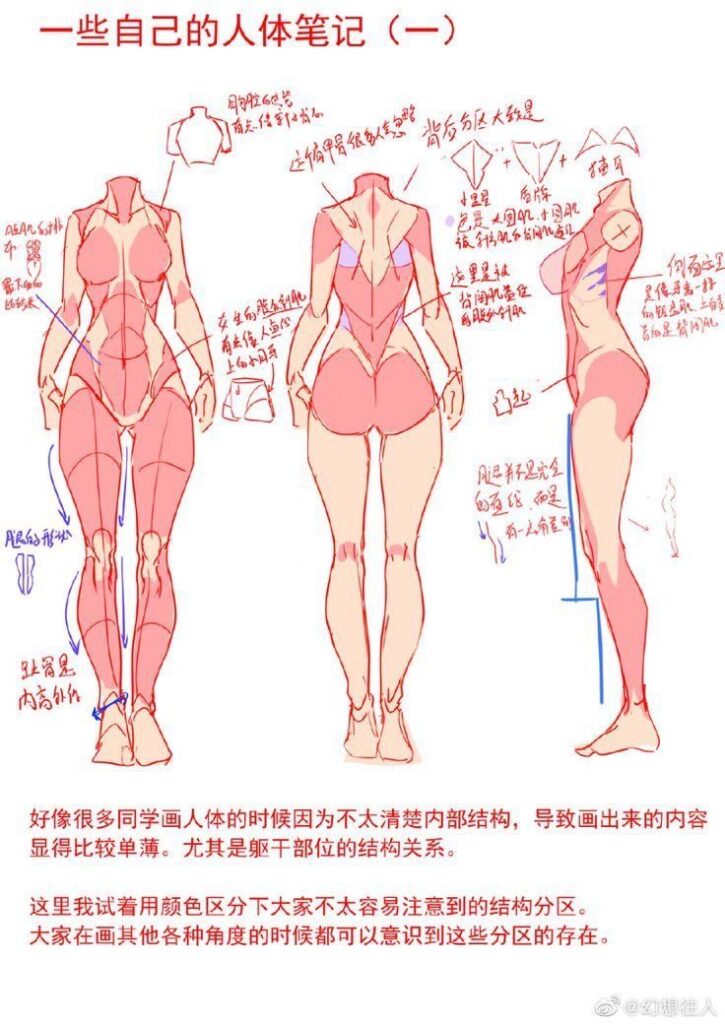
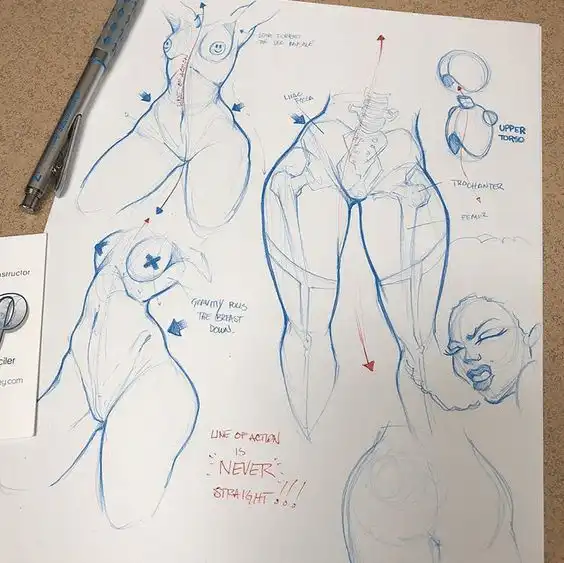
Recognizing anatomical landmarks aids in drawing a realistic female figure.
The skeleton tells you where everything goes before muscles and curves enter the picture. These six landmarks are the ones that actually matter:
- Collarbone: the horizontal anchor for the whole upper body. Tilt it wrong and the shoulders look broken.
- Neck: length and angle place the head. Short necks read as hunched; long ones read as elegant — that’s not accident, it’s anatomy.
- Bust line: drops roughly halfway between the collarbone and waist. Higher or lower than that and something feels off, even if the viewer can’t say why.
- Chest: the ribcage is an egg shape, not a flat plane. Draw it with volume and the torso stops looking like a cardboard cutout.
- Waist: the pinch point between ribcage and pelvis. On most figures it’s narrower and higher than beginners place it.
- Hips and thighs: the pelvis flares out from the waist and rolls into the thigh without a clean edge — it’s a continuous curve, not a corner.
Body Shapes and Types
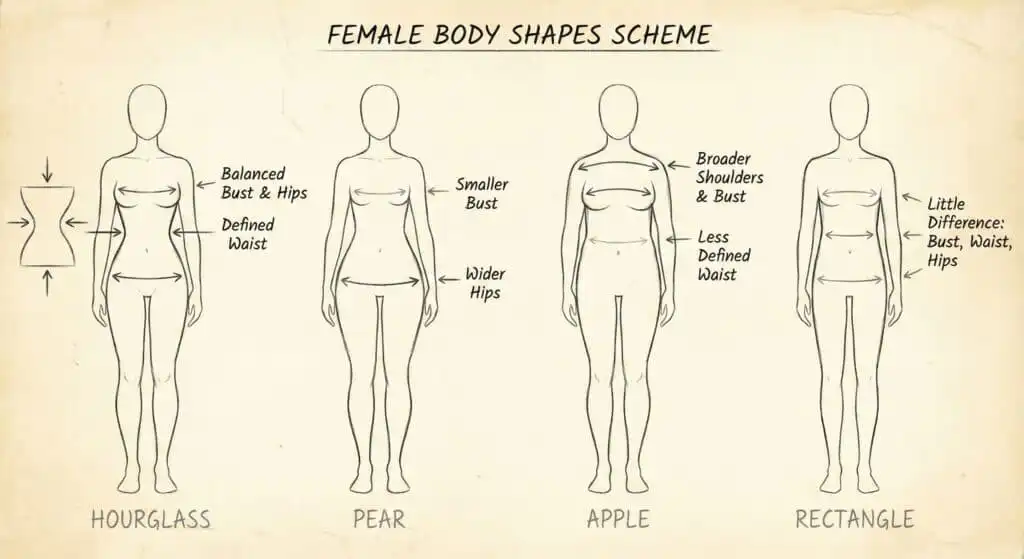
Female bodies come in various shapes, and the proportions shift more than most beginners expect:
- Hourglass: bust and hips roughly balanced, with a clearly defined waist pulling both in.
- Pear: hips wider than the bust — the weight of the figure sits lower.
- Apple: broader through the shoulders and chest, with less waist definition.
- Rectangle: bust, waist, and hips are all close in width. Straight lines dominate.
The stomach is where these differences show up most. It connects the ribcage to the pelvis, and its shape — whether it curves outward, stays flat, or tapers — is what gives each body type its actual silhouette. Draw it the same way every time and the body type disappears.
Once you internalize these four shapes, you stop defaulting to one figure.
Turn these ideas into real sketchbook practice
Gesture first, structure second
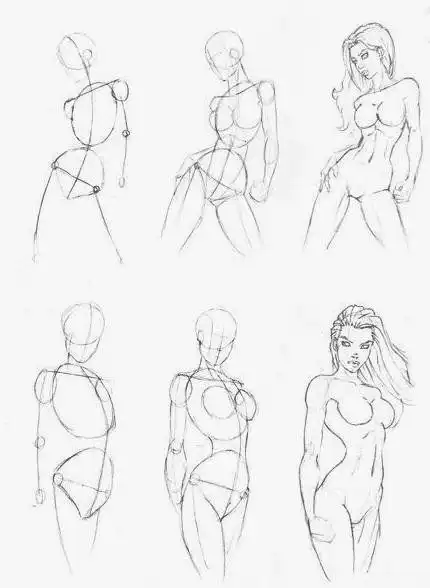
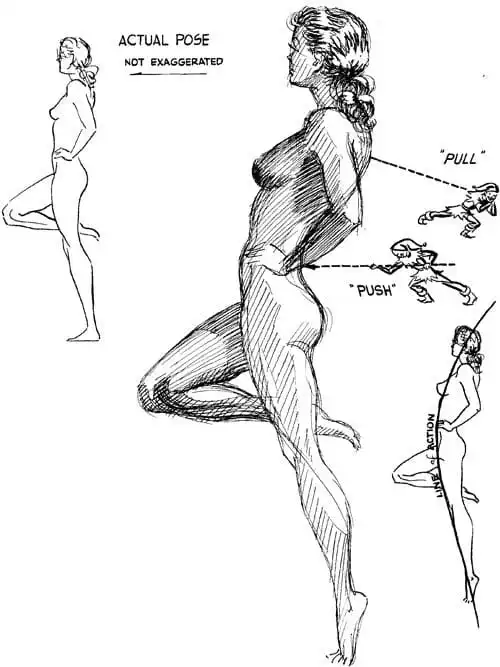
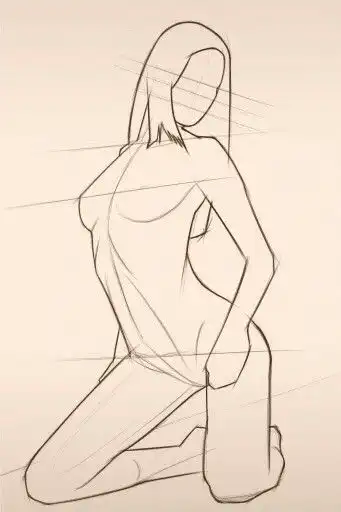
Gesture is the movement of the pose; structure is the set of simple forms that keeps that movement believable. If you skip gesture, the drawing looks stiff. If you skip structure, the curves drift. A strong female figure drawing needs both: a loose action line first, then a rib cage, pelvis, and limb cylinders placed over it.
When you want more visual ideas after this tutorial, use a separate sexy body drawing ideas page for inspiration, and keep this lesson focused on the step-by-step construction process.
Drawing Fundamentals


Understanding the basic elements of drawing is essential for creating female figures. Key aspects include using line and shape effectively, applying light and shadow for depth, and considering perspective and angle to enhance realism. These fundamentals build a strong foundation for any artist.
Note: Mastering these basics is crucial before moving on to details, as a solid understanding of proportions and structure will greatly improve your female figure drawings.
Line and Shape
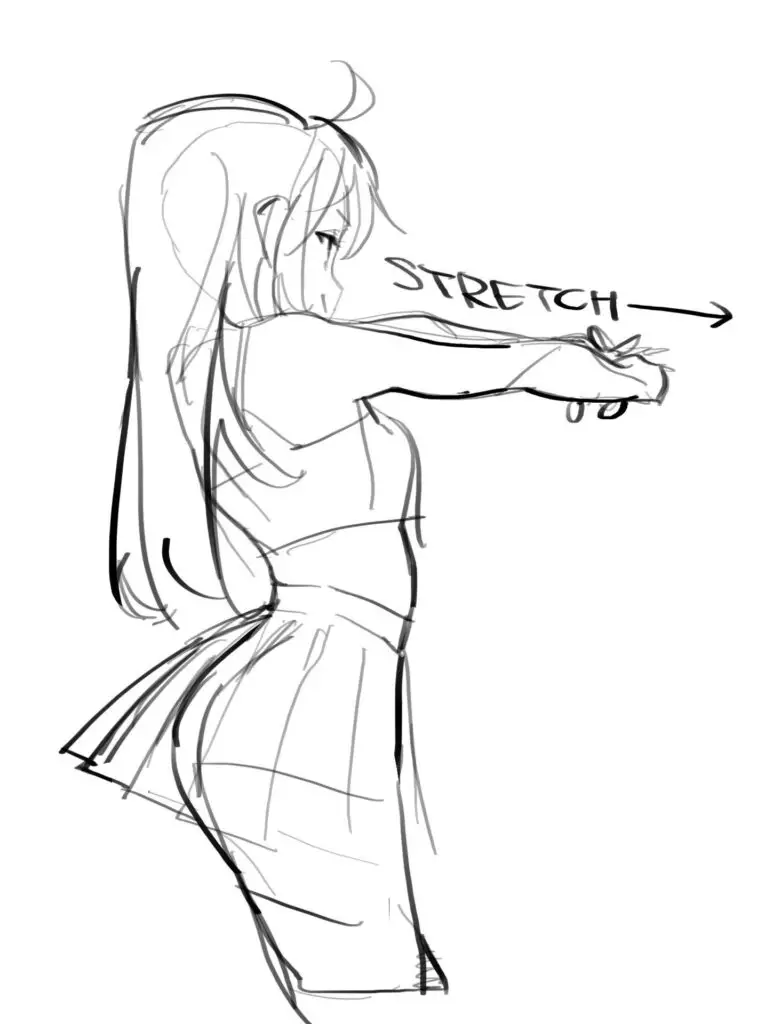

Lines and shapes are the building blocks of any drawing. Artists should start with simple forms like ovals and rectangles. These shapes create the structure of the figure.
- Head: Use an oval to map out the head.
- Torso: A rectangle can help define the torso’s width and length.
- Limbs: Cylindrical shapes work well for arms and legs.
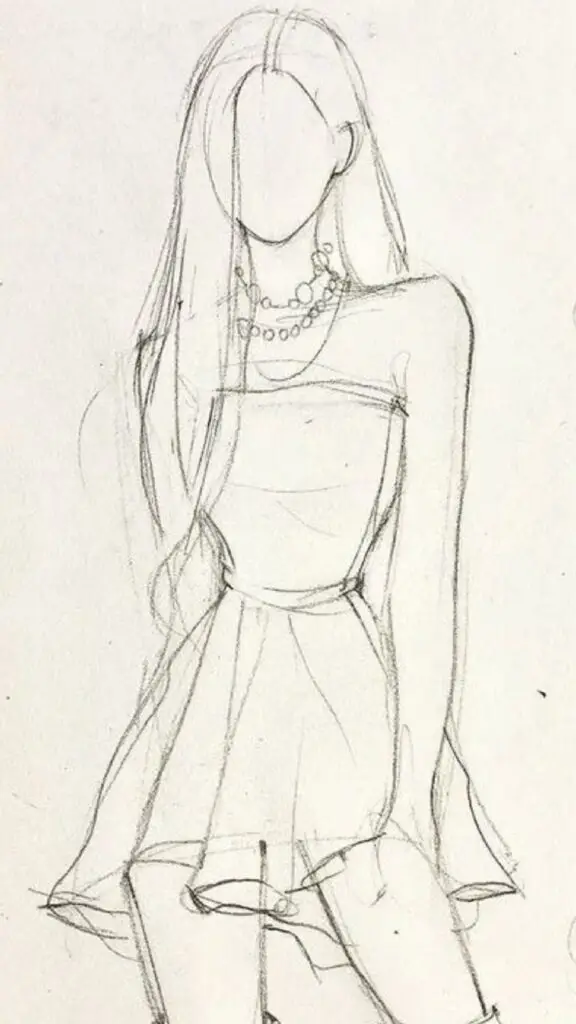
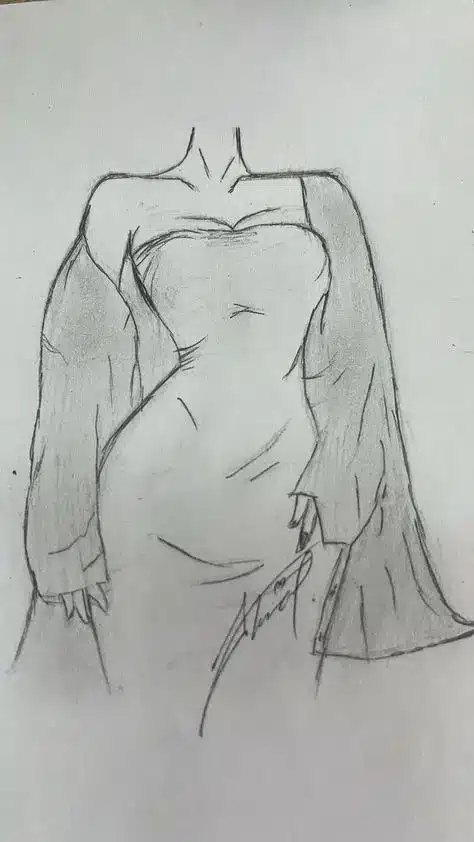
Using these basic shapes simplifies the figure drawing process. Once the artist has established the basic forms, they can refine the outlines and add details, giving more character and form to the figure.
Read More:
- 12 Cute Body Drawing Ideas That Actually Look Adorable
- 15 Best Body Drawing Ideas to Level Up Your Figure Work
- 20 Gesture Drawing Poses Every Artist Should Practice
- Body Drawing Base for Human Figure Drawing
- Body Types Drawing: Why Every Figure You Draw Looks Like the Same Person
To better understand how these basic shapes translate into real-life poses and forms, study photo reference images and observe how anatomy is constructed from simple shapes.
Light and Shadow
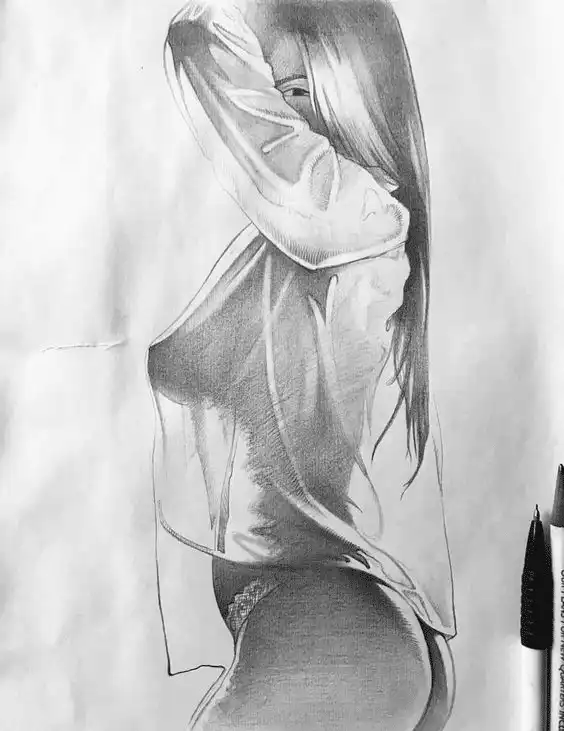
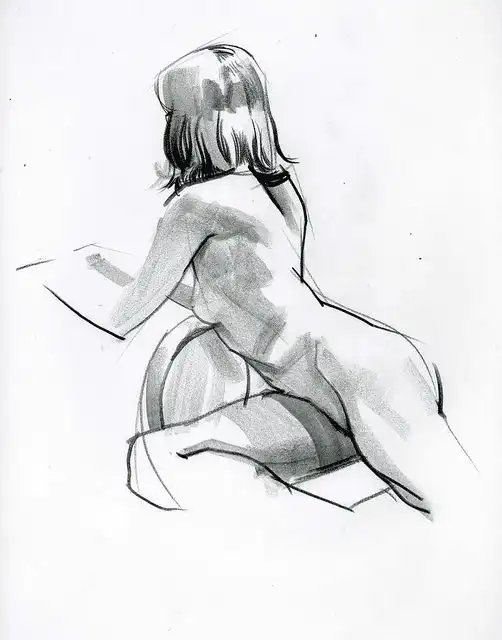
Light and shadow add depth and dimension to a drawing. Understanding how light interacts with the body helps create a realistic figure.
- Light Source: Identify where the light is coming from.
- Highlights: Areas closest to the light should be brighter.
- Shadows: Opposite the light source, shadows should be darker and softer.
Using shading techniques like hatching or cross-hatching can create the illusion of volume. Careful placement of shadows enhances the three-dimensionality of the figure.
Perspective and Angle
Perspective will mess with you at first. Same pose, different angle — suddenly nothing lines up the way you expected.
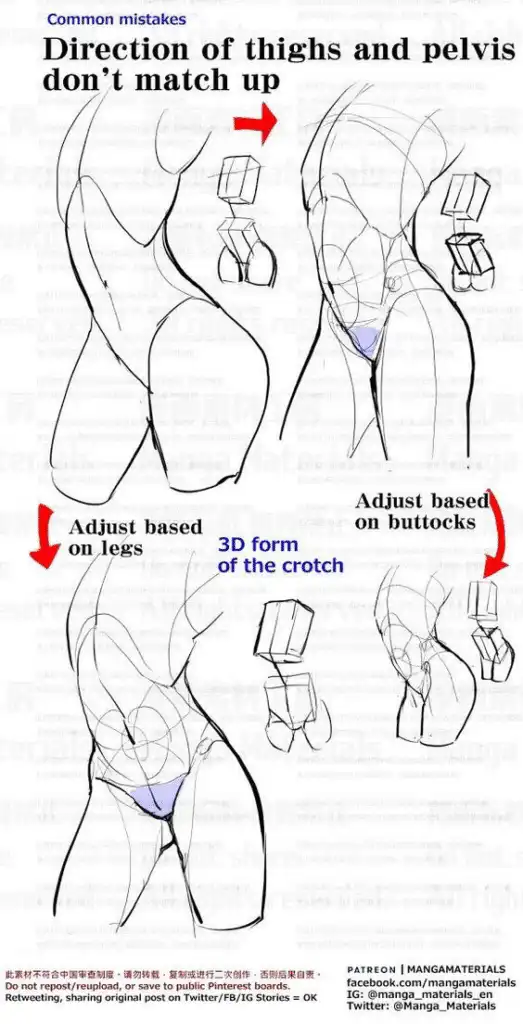
- Foreshortening is usually where things fall apart. If an arm or leg is coming toward you, it’s going to look shorter and thicker. I used to draw full-length arms out of habit, and they always looked wrong. The fix was simple: draw what I see, not what I know is there.
- Angle changes everything. Looking down at a figure compresses it. Looking up stretches it. Legs feel longer, the torso shifts, even the head placement changes more than you’d think.
- One thing that helped me — redraw the same pose from a few viewpoints. Don’t aim for clean drawings. Just quick sketches. It clicks faster that way.
Once this starts to make sense, your figures stop feeling flat. They actually sit in space instead of floating on the page.
Sketching the Basic Structure


To draw a female figure effectively, starting with a solid base is crucial. This section explores essential techniques, focusing on gesture drawings, establishing the torso, and laying out the limbs.
Creating a Gesture Drawing
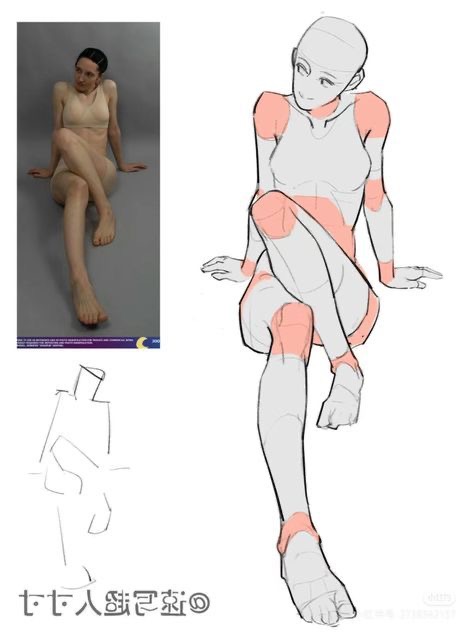
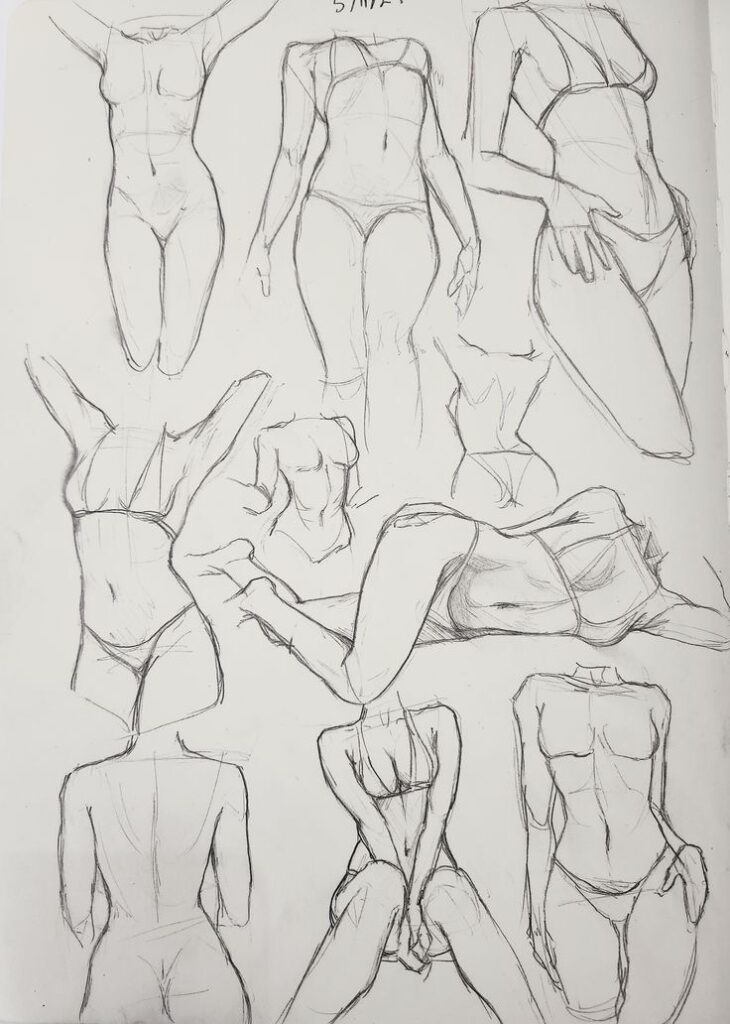
A gesture drawing captures the basic movement and flow of the figure. It is often the first step in figure drawing. Begin with light, loose lines to outline the posture and action.
Once the basic female figure is balanced, you can push the attitude further with spicy drawing poses that focus on gesture, eye contact, and silhouette instead of extra anatomy detail.
- Use simple shapes like circles and lines.
- Focus on the overall movement, not details.
- Keep it quick, aiming for 30 seconds to 2 minutes per sketch.
This method helps artists understand proportions and balance. The outcome should convey energy and motion, serving as a foundation for further detailing.
Establishing the Torso
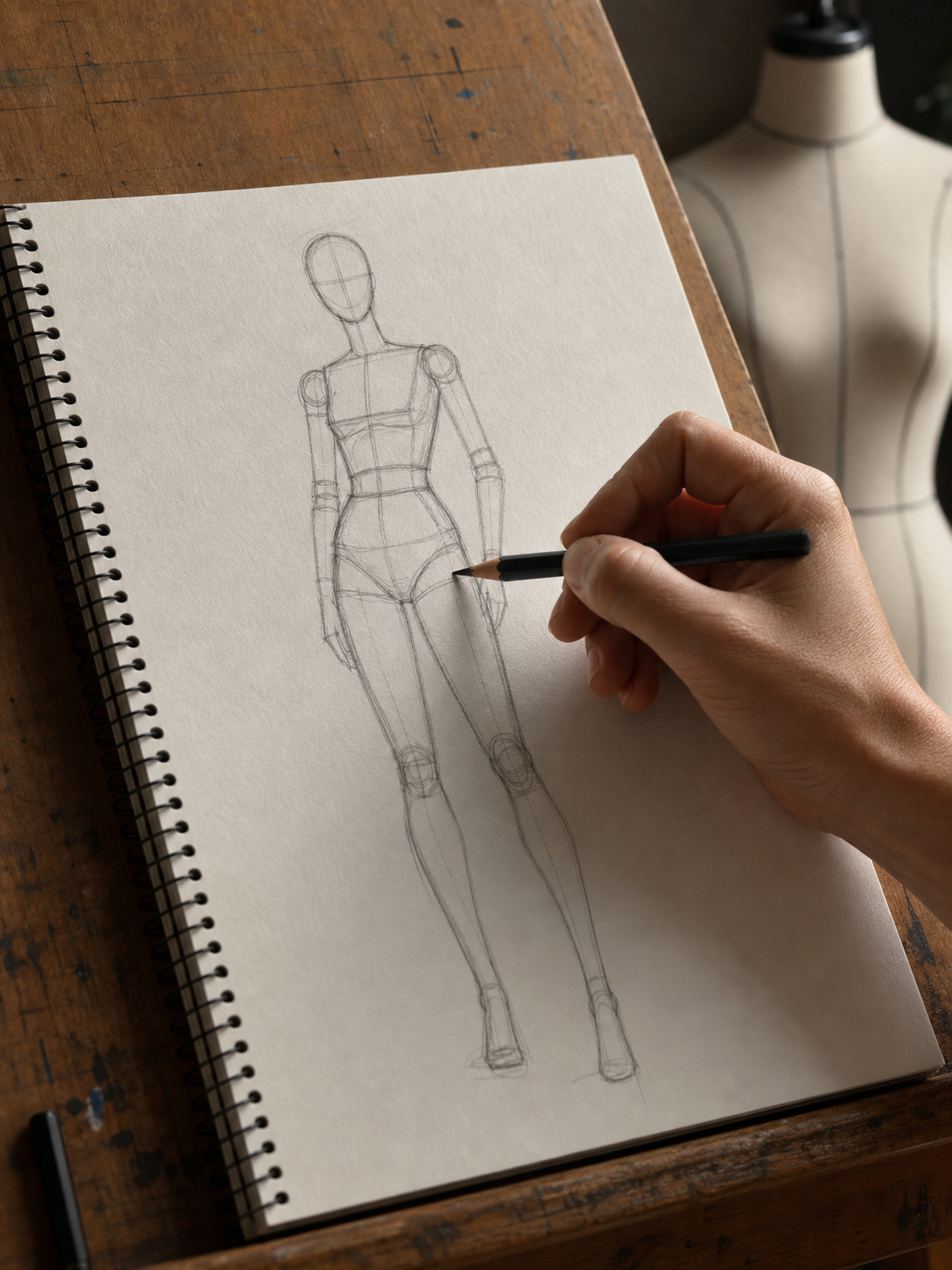
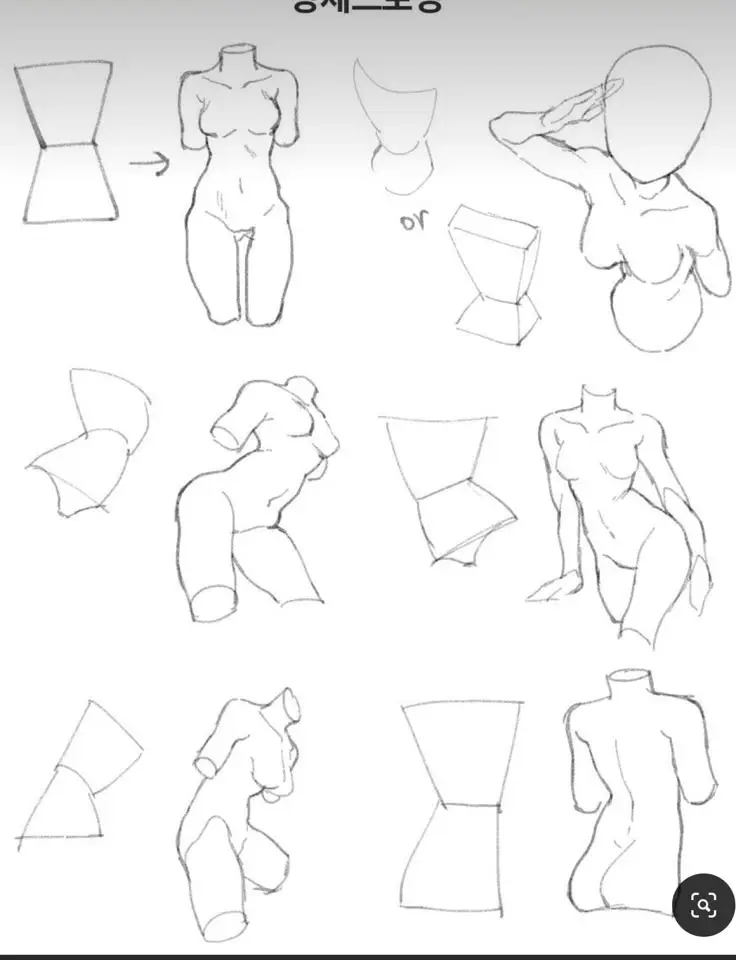
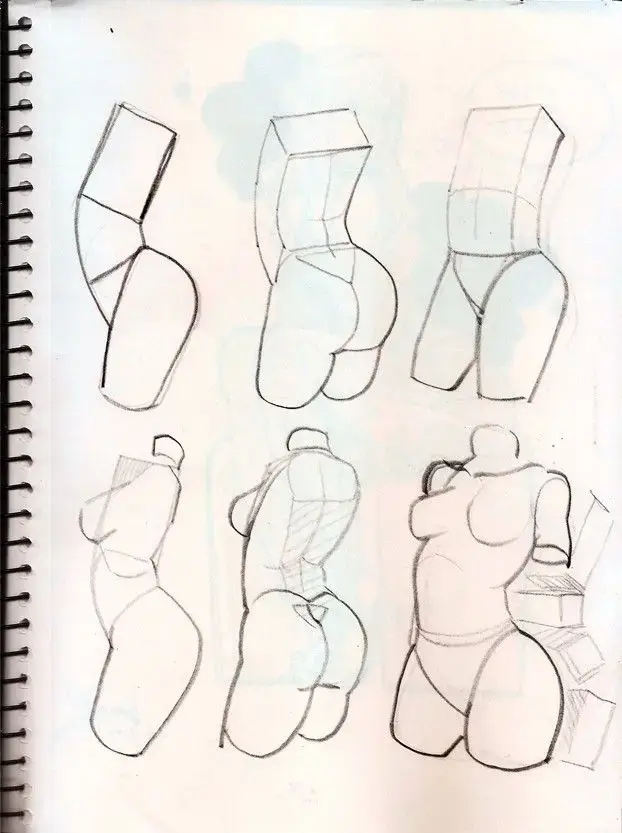
After the gesture, I always lock in the torso next. If this part doesn’t work, nothing else really will.
- I start with a loose shape — usually an oval, sometimes more of a box if the pose is stiff. It’s rough. Just enough to show the tilt.
- Proportions matter here more than people think. If the torso is too long, the whole figure looks stretched. Too short, and it feels cramped. A quick check I use: head length vs torso length — they’re usually pretty close in a standard female figure.
- Then I split it up a bit. I’ll mark the rib cage and drop a line for the waist. Nothing detailed, just guides.
- This is also where knowing a bit of anatomy helps. Not in a textbook way — just enough to understand where the mass sits and how it moves.
- Once those guides are in, the curves make more sense. You’re not guessing anymore, you’re building on something.
It’s a small step, but it’s the one that makes the figure stop looking like a mannequin.
Laying Out the Limbs
Once the torso is in place, outline the limbs. This step adds essential details to the figure.
Use cylinders and boxes for upper arms, forearms, and legs.
- Arms: Start with circles at the shoulder and elbow, connecting them with straight or slightly curved lines.
- Legs: Begin with a wider shape at the hip, tapering down to the ankle.
Adjust the angles based on the figure’s pose to maintain balance.
Pay attention to the relationship between the limbs and the torso. This balance is vital in making the figure appear natural and dynamic. Keep proportions consistent to achieve a realistic look.
Adding Details and Features
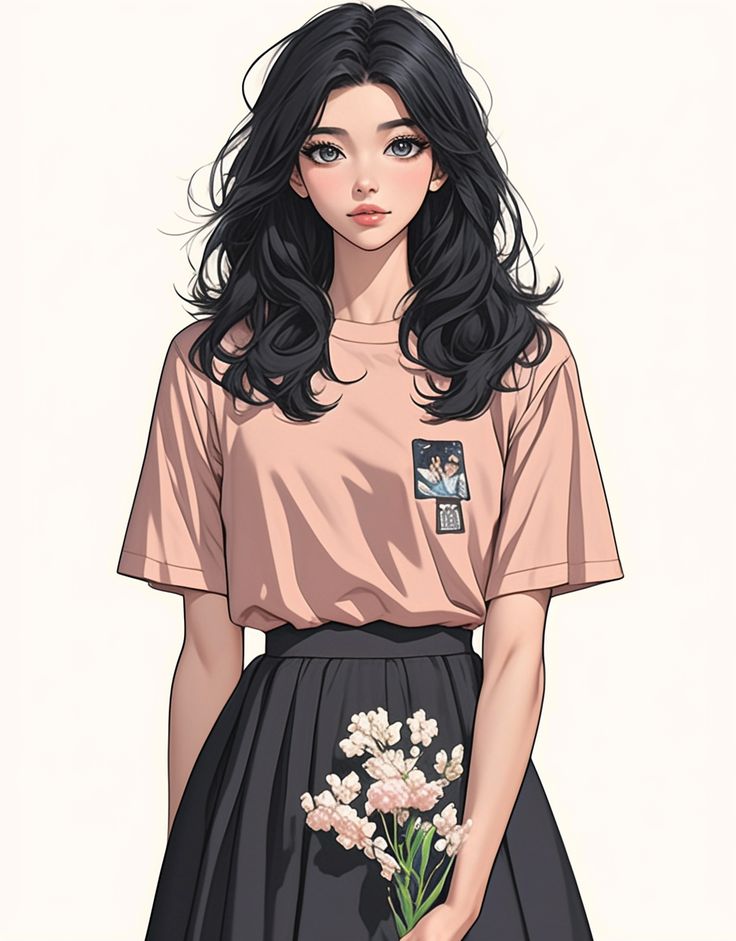

Adding details and features enhances the realism of a female figure drawing. Focus on the face, hands, feet, hair, and clothing to create a complete and lively representation. This section will also cover important anatomical features such as breasts and how to represent them accurately.
Defining the Face
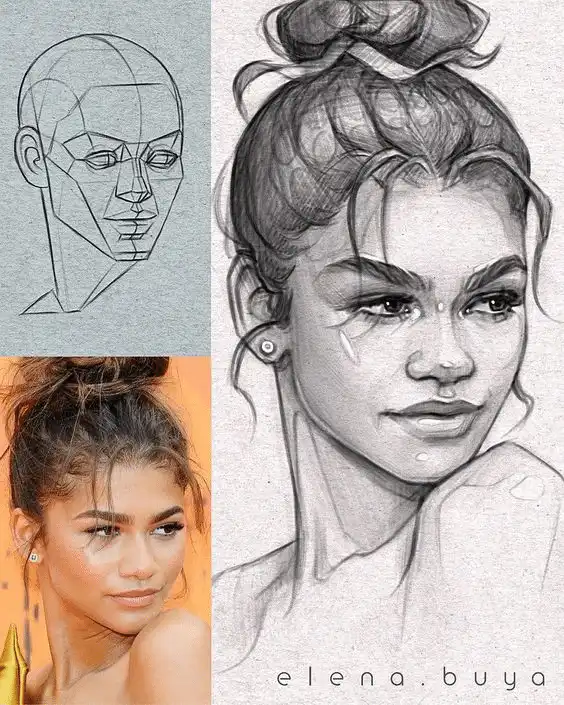
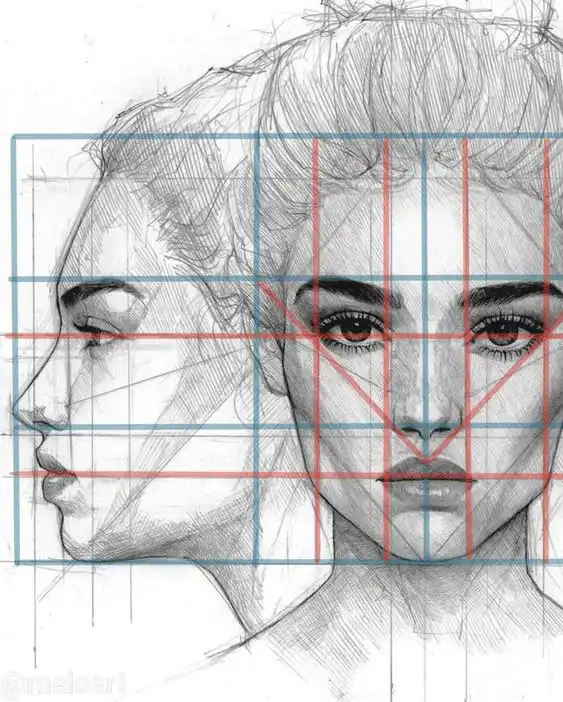
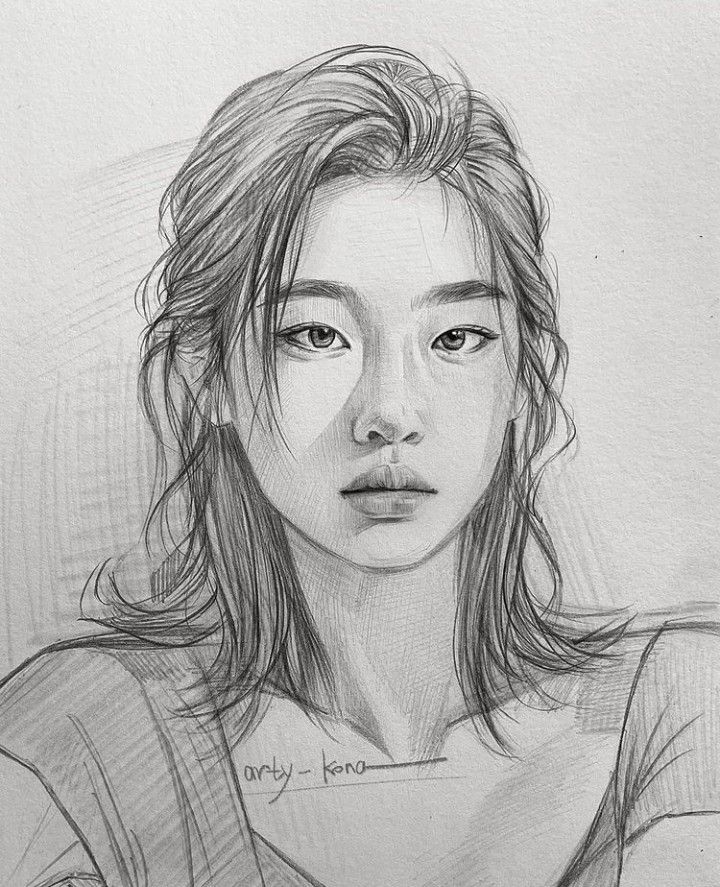
To define the face, start by sketching light guidelines to position the eyes, nose, and mouth. The eyes should be about one eye-width apart.
- Eyes: Shape varies; they can be almond or round. Add eyelashes and eyebrows for expression.
- Nose: Draw a simple geometric shape; adjust width and length based on style.
- Mouth: The lips can be fuller or thinner; give them shape by adding highlights.
Using shading can add depth, especially around the cheekbones and jawline.


Representing Hands and Feet
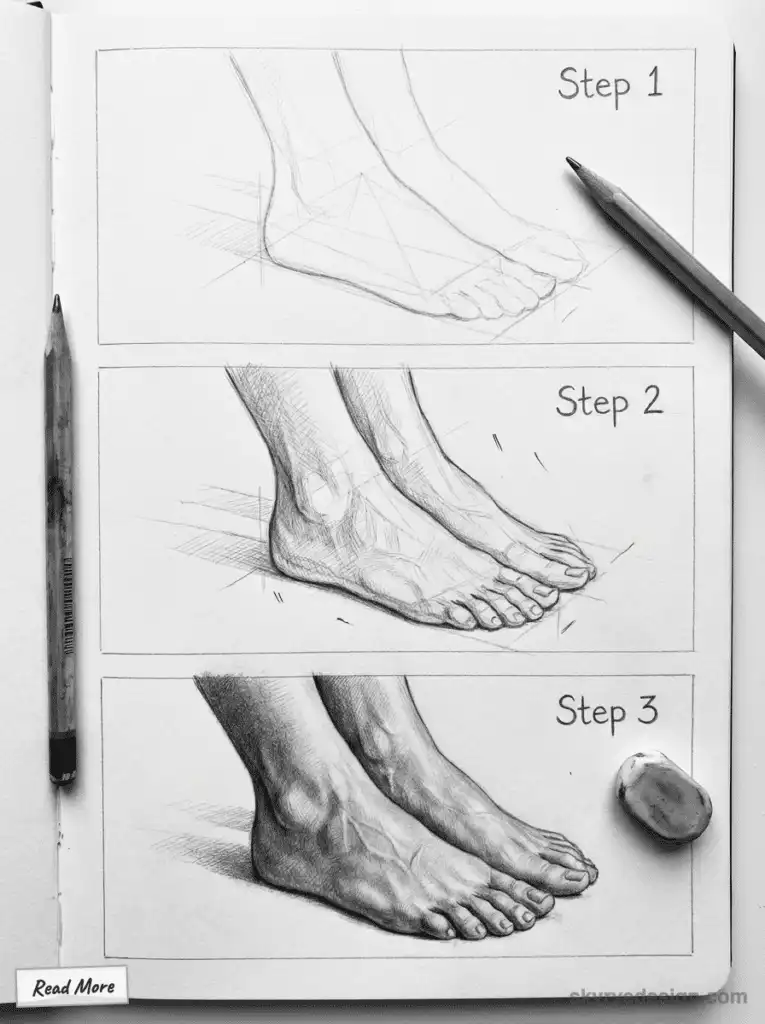
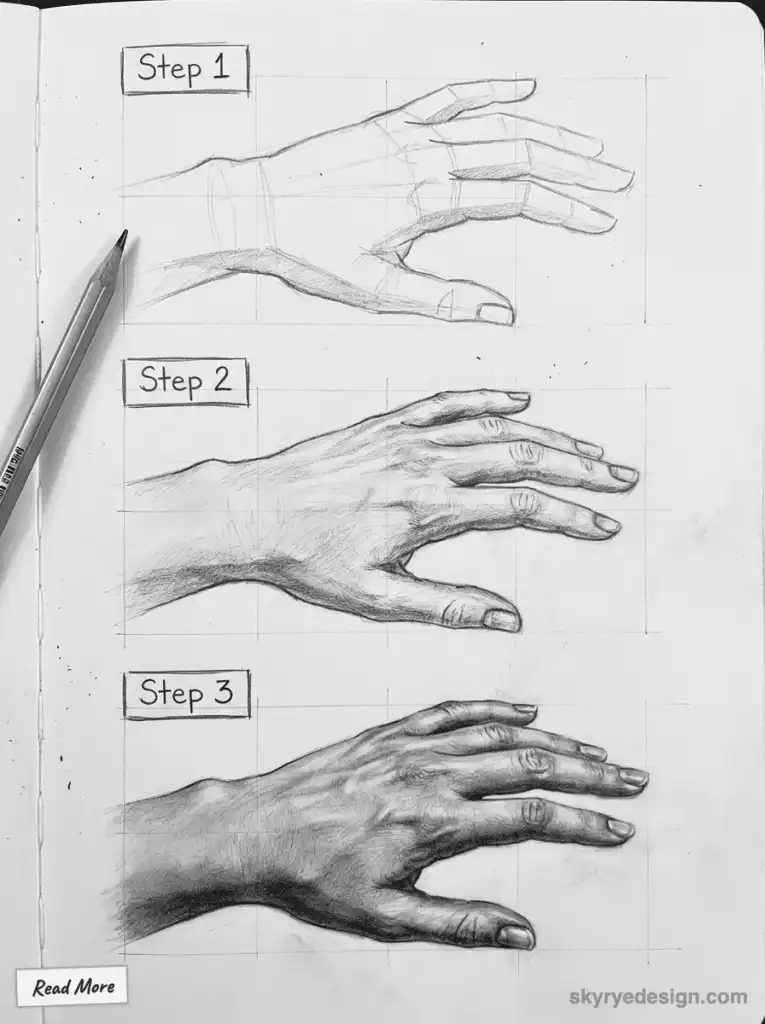
Hands and feet can be challenging but are crucial to realism. It is important to understand their proportions and basic shapes.
- Hands: Start with a basic outline. Use shapes like rectangles for the palm and ovals for fingers. There are different positions, so practice different poses.
- Fingers: They taper towards the tips, and knuckles create bends, so consider this when drawing.
For feet, use simple shapes to outline their structure. Once the outline is complete, detail the toes and arches.
Rendering Hair and Clothing
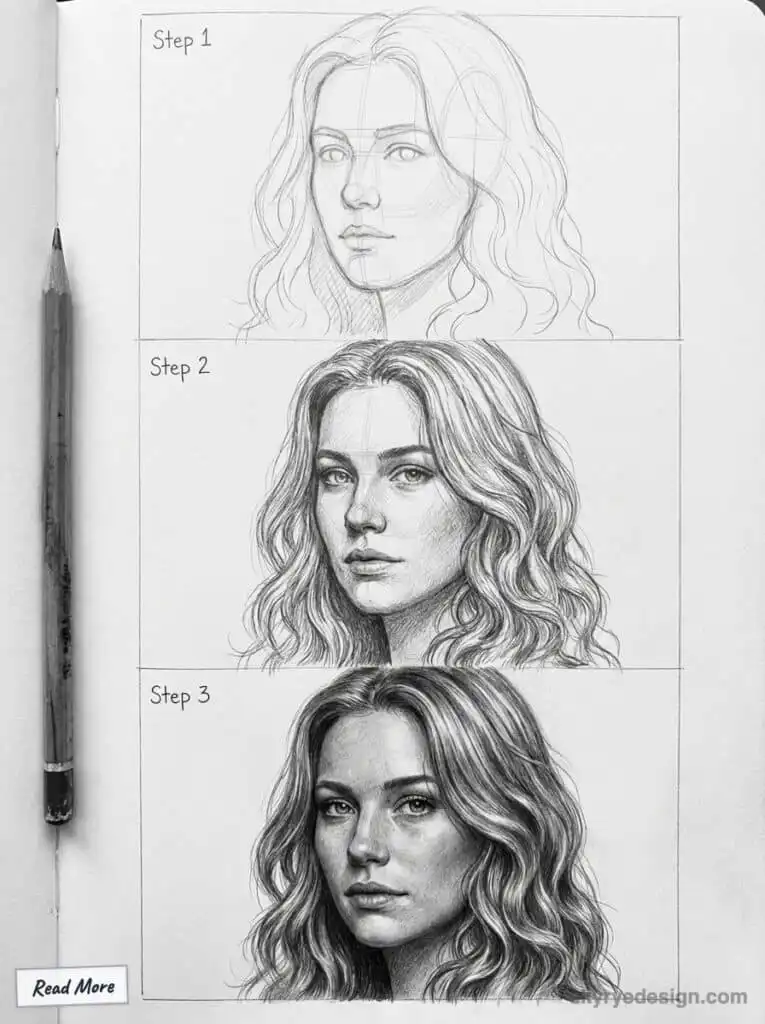
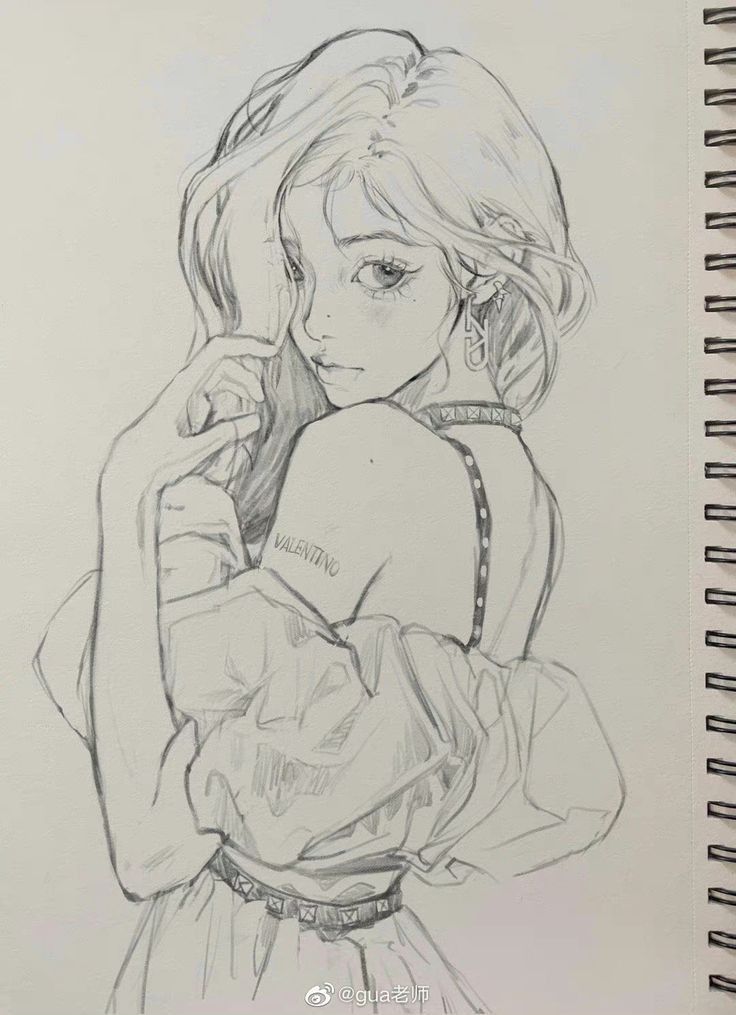
Hair and clothing add character and movement to a drawing. They should naturally follow the figure’s shape.
- Hair: Begin with a rough outline; then add bangs and layers. Use curves to imply flow and texture. Shading can indicate volume and shine.
- Clothing: Start with the body’s form as a base. Choose fabric types, as they each have their own flow and wrinkle patterns.
Be mindful of how clothing fits the figure. Use folds and creases to show movement and realistic wear.
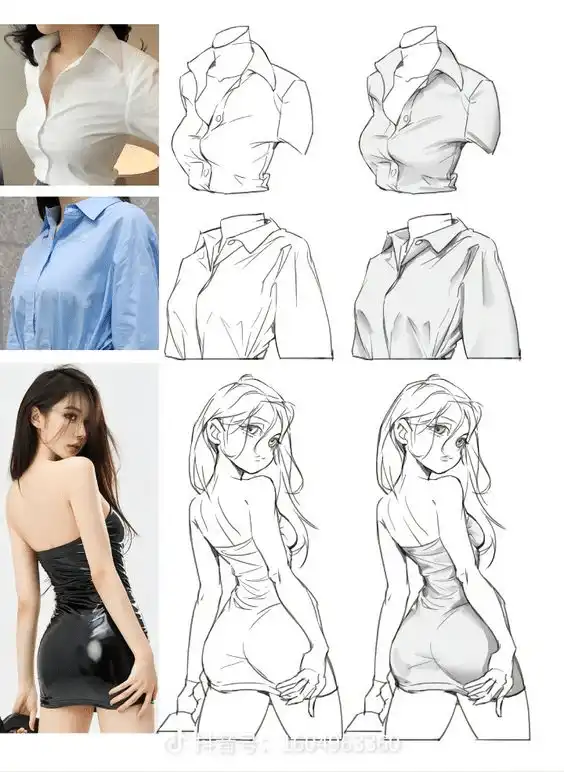
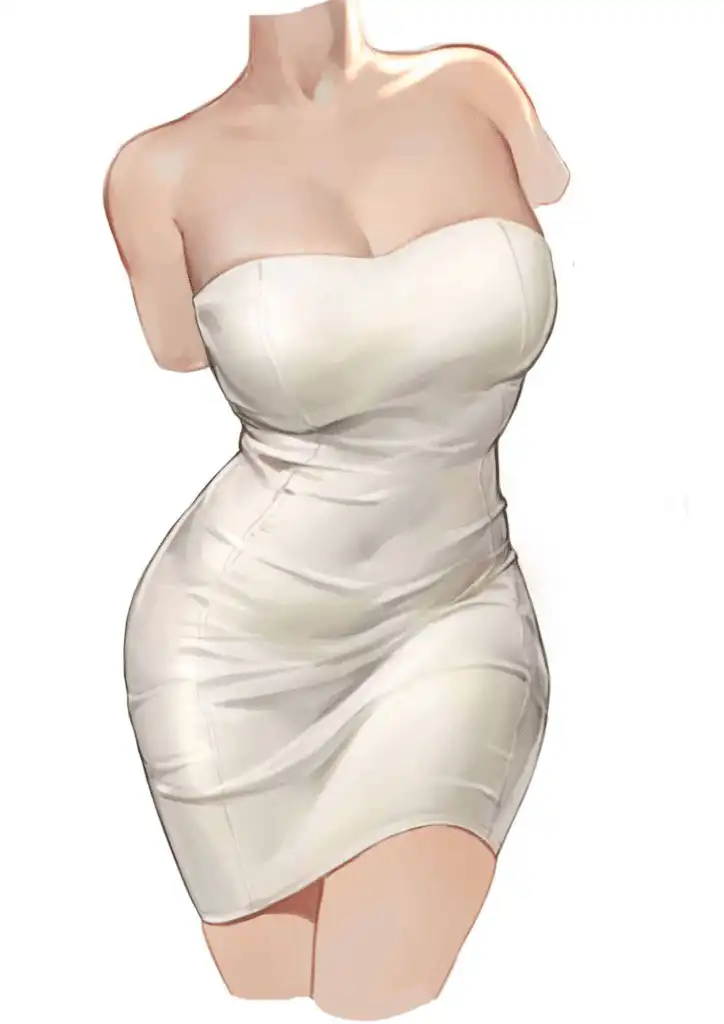
Incorporating these details will elevate the overall appearance of the figure, making it more dynamic and engaging.
Once the figure reads clearly, use clothes drawing over a figure to test how fabric hangs from the shoulders, pinches at the waist, and folds around knees and elbows.

1000 Drawing Ideas for Artists
Get a free PDF packed with easy drawing ideas, anime prompts, character concepts, nature inspiration, and fantasy sketchbook challenges.
Download Free PDFCommon woman drawing mistakes and quick fixes
| Mistake | Why it happens | Quick fix |
|---|---|---|
| Drawing the outline first | The body becomes a flat shape with no weight. | Block in rib cage, pelvis, and leg angle before contour. |
| Waist and hips feel pasted on | The pelvis angle is missing or too level. | Mark the hip tilt, then wrap the waist curve around it. |
| Pose looks stiff | Shoulders and hips are parallel, so the figure has no counterbalance. | Let one side lift and the other side drop slightly. |
| Legs look too short | The midpoint of the body was guessed too late. | Place the crotch/hip midpoint early, then build knees and ankles. |
| Shading does not help | Values are being used to hide construction problems. | Erase back to simple forms, fix the proportions, then shade. |
Refining the Drawing

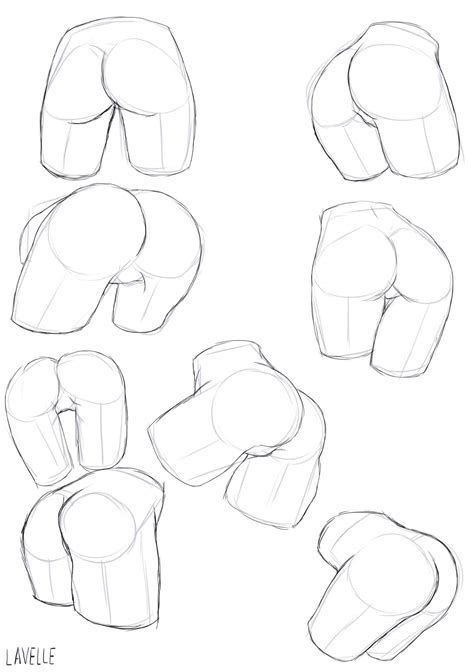
Refining a drawing involves enhancing details, correcting shapes, and finalizing contours. This process is crucial for bringing a female figure to life in an artwork.


Using your imagination during the refining stage can help you add unique touches and creative flair, allowing your drawing to stand out and reflect your personal style.
Enhancing with Texture and Tone
To enhance a drawing, adding texture and tone is vital. This can be achieved using varying pencil techniques, such as hatching, cross-hatching, and stippling. Each method creates different textures that can suggest skin, clothing, or hair.
- Use of Shading: Apply light and shadow to create depth. Identify the light source and add darker areas where shadows fall.
- Blending Techniques: Use blending stumps or fingers to smooth out harsh lines for realistic skin or fabric appearances.
- Contrasting Tones: Incorporate a range of tones from light to dark. This contrast will help the figure stand out and appear more three-dimensional.
These techniques together will enhance the visual appeal and realism of the drawing.
Correcting Shapes and Proportions
This is the stage where you slow down a bit and really look at what you’ve drawn. Shapes and proportions can drift without you noticing, so it’s worth taking a minute to check things before moving on.
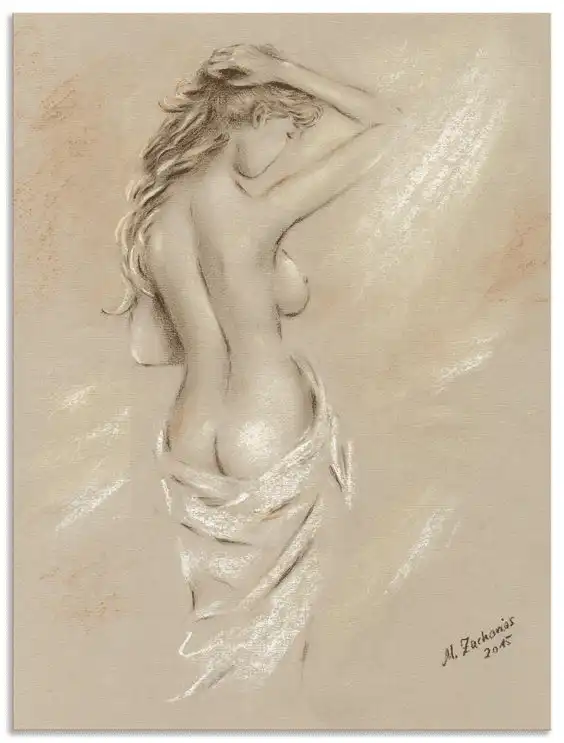
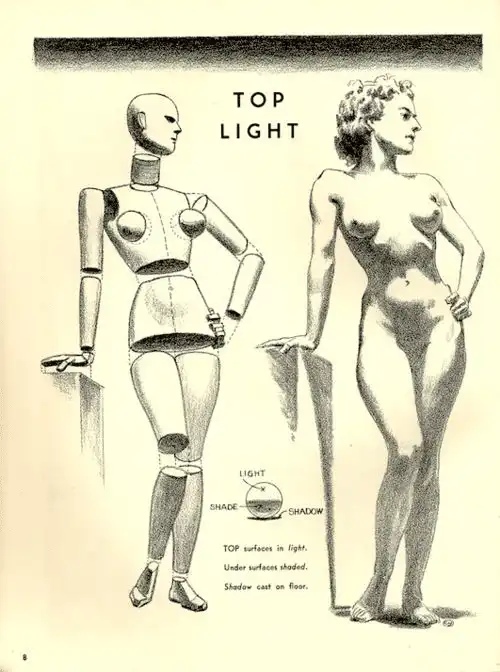
I usually mark a few key points — shoulders, hips, knees — just to see if everything lines up the way it should. It’s a simple trick, but it catches a lot of mistakes early.
- Measure when something feels off
If a figure looks strange and you can’t tell why, try measuring it. A ruler or even a quick grid can help you see if one side is longer or wider than it should be. It’s especially useful when you’re starting out. - Compare parts of the body
I often check one area against another. Are the arms too long compared to the torso? Is the head too big for the body? These quick comparisons keep everything in proportion. - Fix things without overthinking it
If something looks wrong, it probably is. Erase it and redraw. No need to be precious about it — most good drawings go through a few messy corrections before they start to work.
Getting these basics right makes a huge difference. Once the proportions feel solid, the whole figure starts to look more natural without much extra effort.
After the basic figure reads correctly, try redrawing it from anime reference poses to practice cleaner silhouettes, tilted hips, and more expressive character gestures.
Finalizing Contours


References from real-life photos are crucial for studying anatomy, proportions, and lighting.
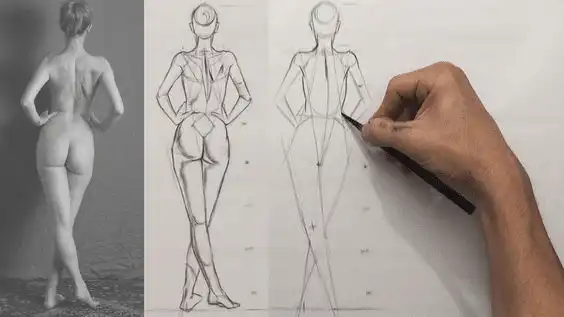
The last touch involves finalizing the contours of the figure. Clean lines add clarity and finish to the drawing.
- Defining Edges: Use a fine-tipped pencil or pen to go over important lines. This emphasizes the outline.
- Style Choices: Decide on the style of contour. Smooth lines can suggest a softer look, while jagged lines may convey motion or strength.
- Final Checks: Examine the entire drawing for any inconsistencies. Make small adjustments as needed, ensuring the foreground and background complement each other.
These final touches breathe life into the female figure, making it visually striking.
Applying Color
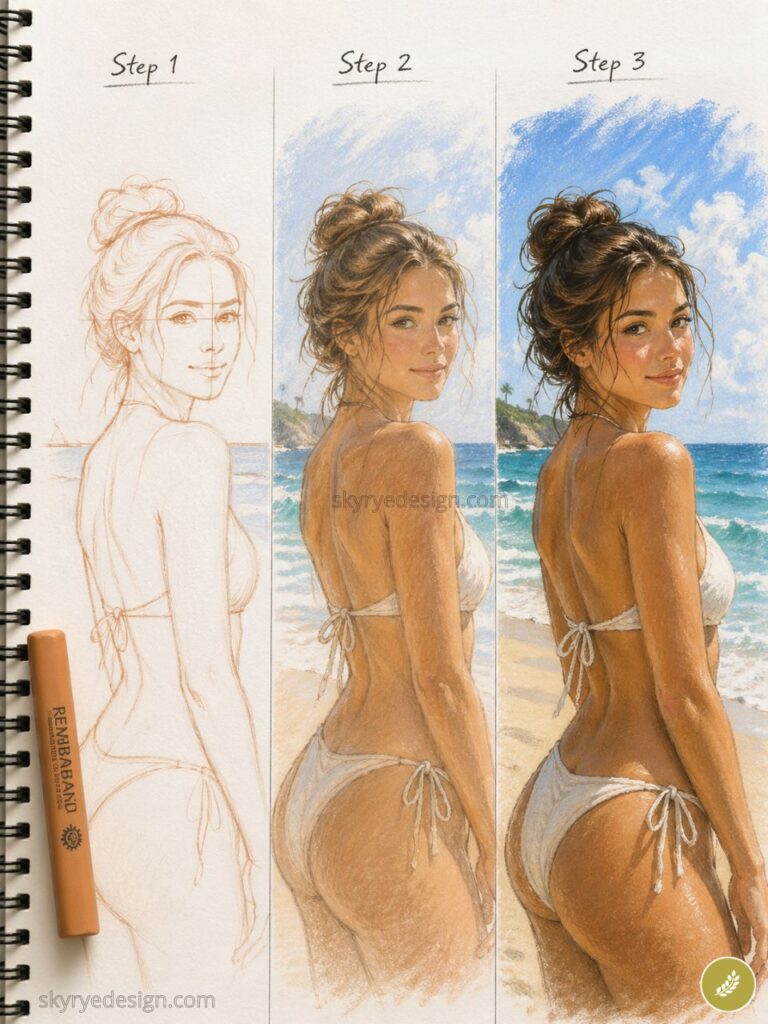


Applying color effectively can bring life to a drawing of a female figure. It is important to consider the color scheme, the techniques used, and how to add depth with shading and highlighting.
Choosing a Color Scheme

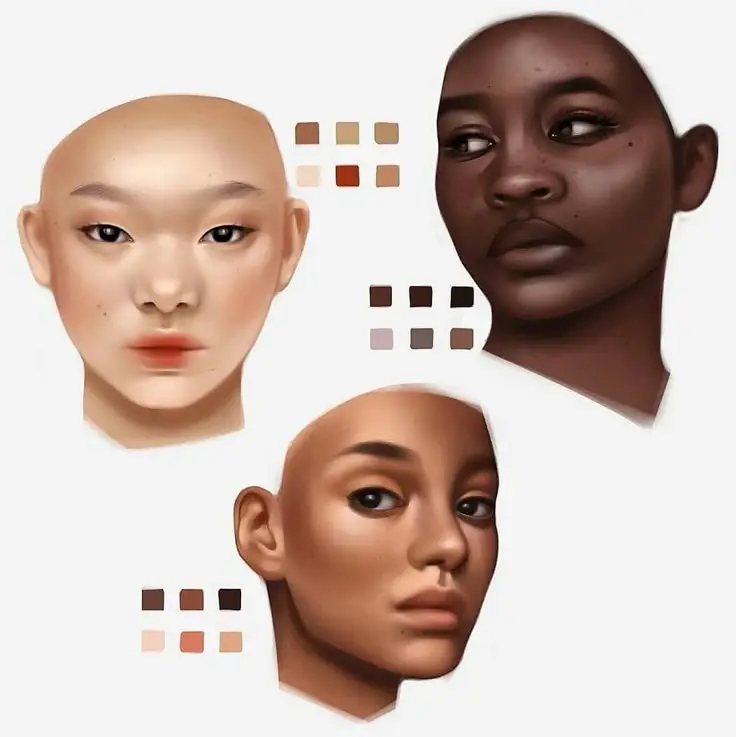
Selecting the right color scheme is essential for setting the mood of the artwork. Artists often use two main types of color schemes:
Analogous Colors: These are colors that sit next to each other on the color wheel, like blue, blue-green, and green. They create a harmonious look.
Complementary Colors: These are opposite colors on the wheel, such as red and green. They can make certain elements stand out.
Using a limited palette can also create a cohesive appearance. It is helpful to consider skin tones, hair colors, and clothing when choosing hues. For skin tones, using a base color mixed with different shades can add realism.
Coloring Techniques

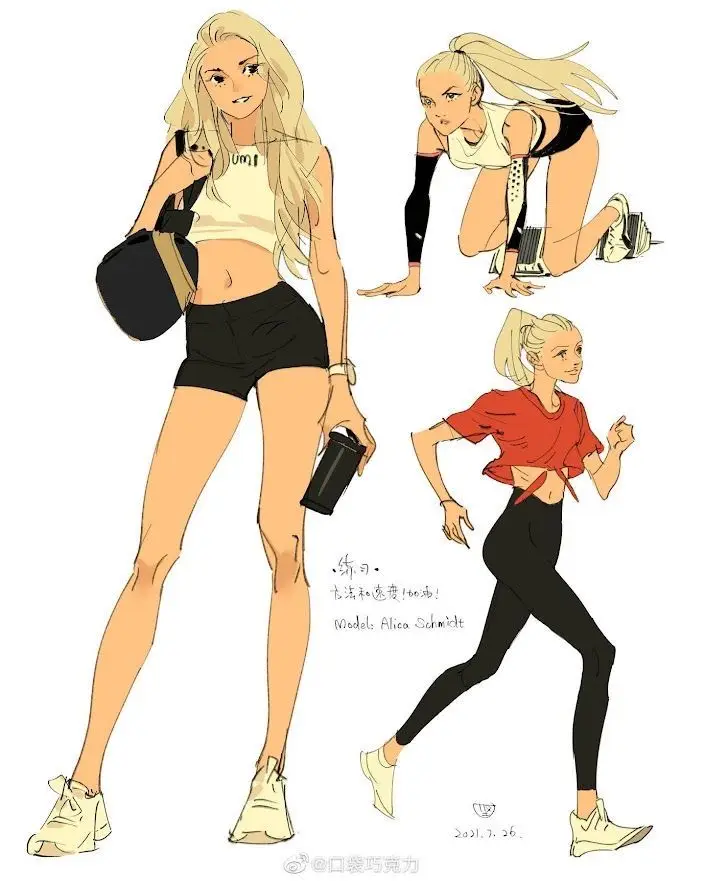

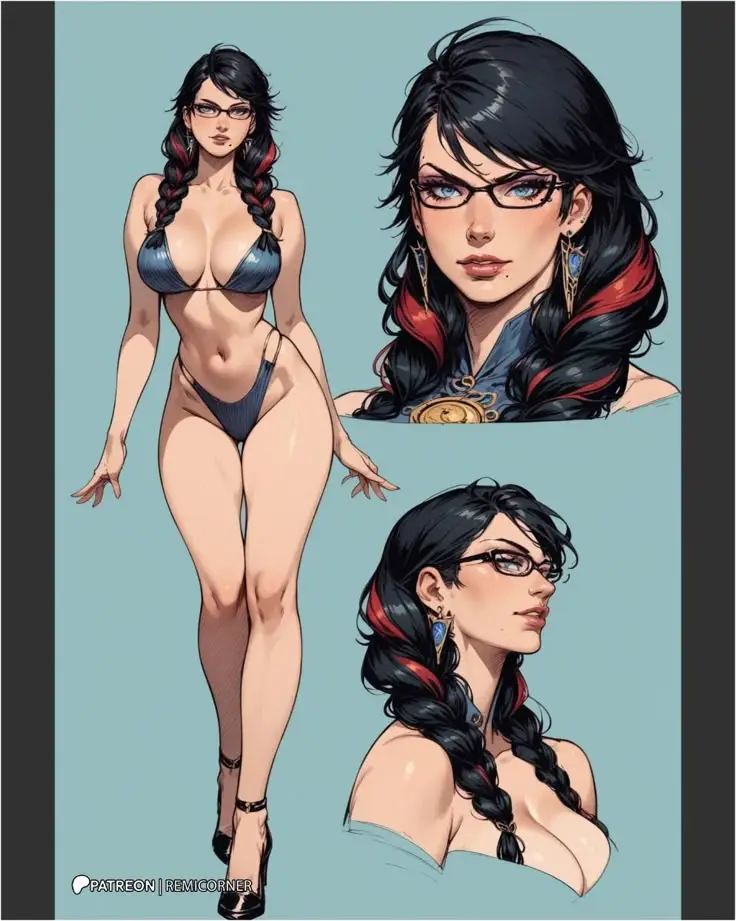
There are various techniques to apply color effectively. Some common methods include:
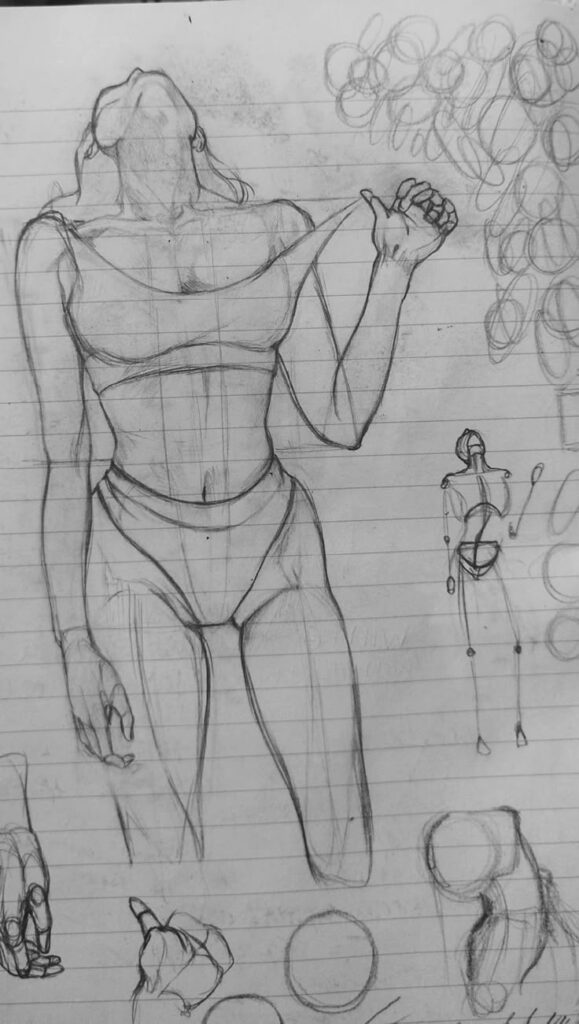
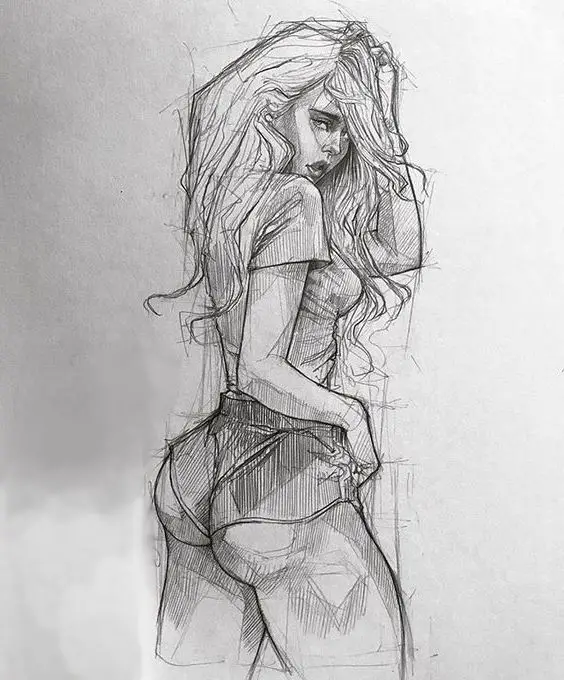
Flat Coloring: This involves filling areas with a single color, which is often the first step in coloring. It sets up the base.
Layering: By applying multiple layers of color, artists can build depth and richness. This technique is especially useful for hair and clothing.
Blending: Using tools like blending stumps or fingers can help smooth transitions between colors. For digital art, soft brushes achieve similar results.
Using reference images can guide choices and improve accuracy in color application.
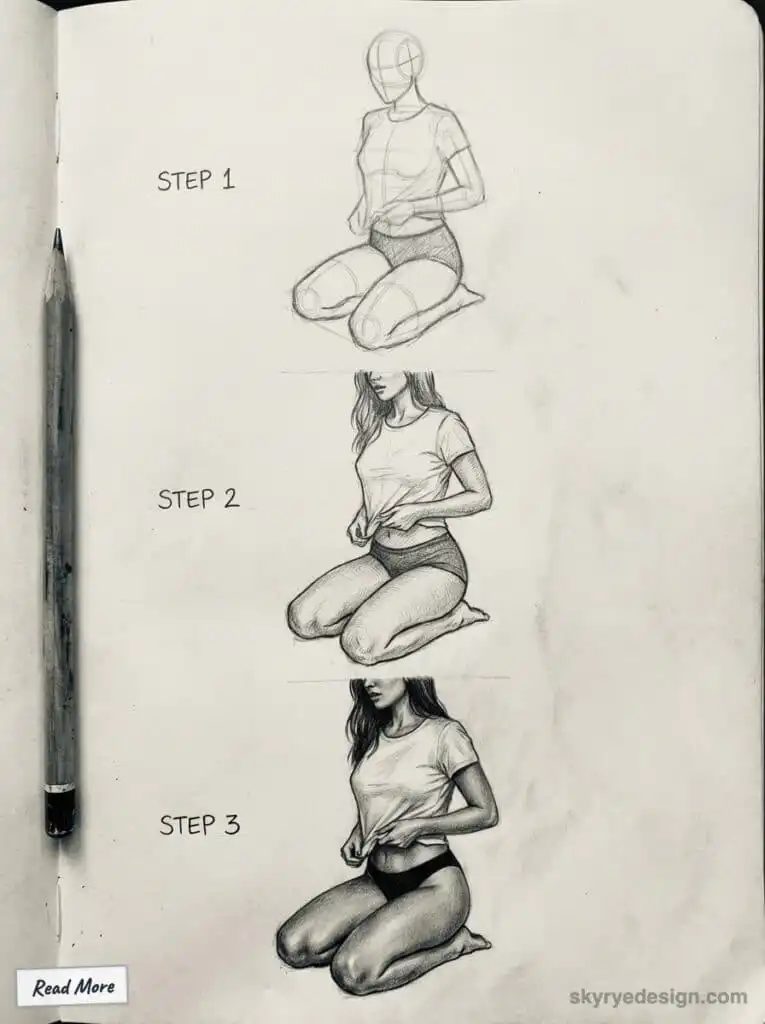
Shading and Highlighting
Light and shadow should be modeled using tonal shifts, starting with a light wash and gradually building darker tones for volume.
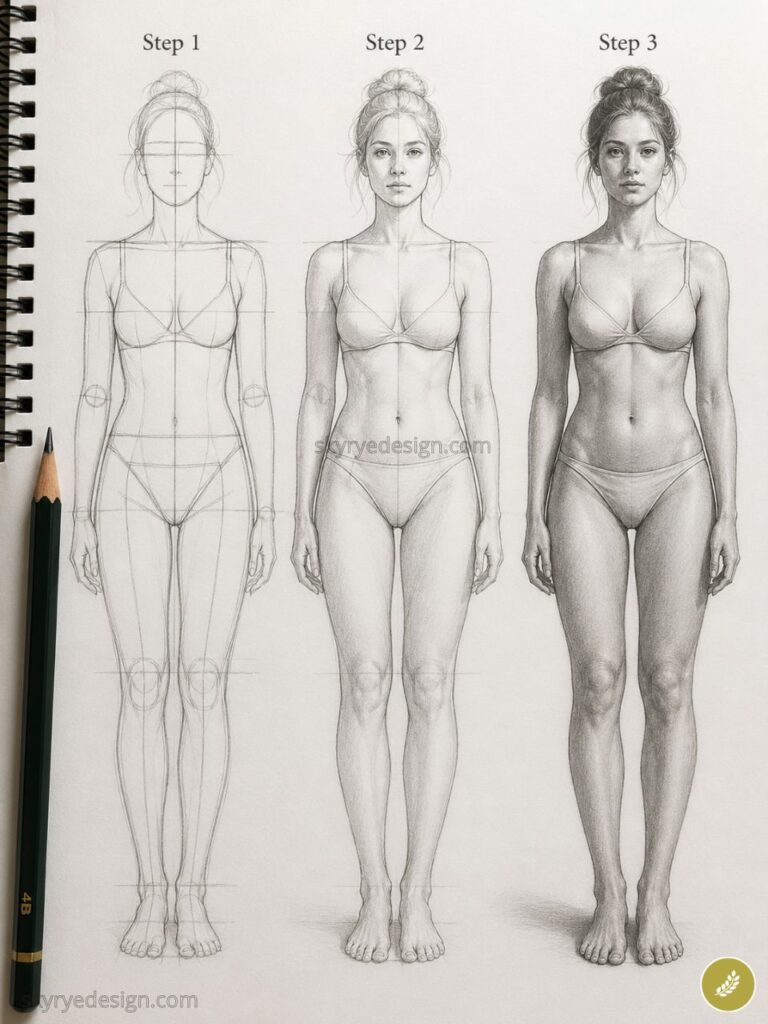
Shading and highlighting add dimension and realism to drawings. Understanding light sources is key. Here are some tips:
Determine the Light Source: Identify where the light is coming from. This will dictate where shadows and highlights fall.
Use Darker Shades for Shadows: Darker tones should be applied in areas away from the light source. This can include the underside of arms or the inner thigh.
Apply Highlights Sparingly: Brighter colors should be used on raised areas, like the tops of shoulders and cheekbones. Highlights can capture the light effectively.
Experimenting with different degrees of darkness and brightness will enhance the three-dimensional effect of the drawing.
Finishing Touches

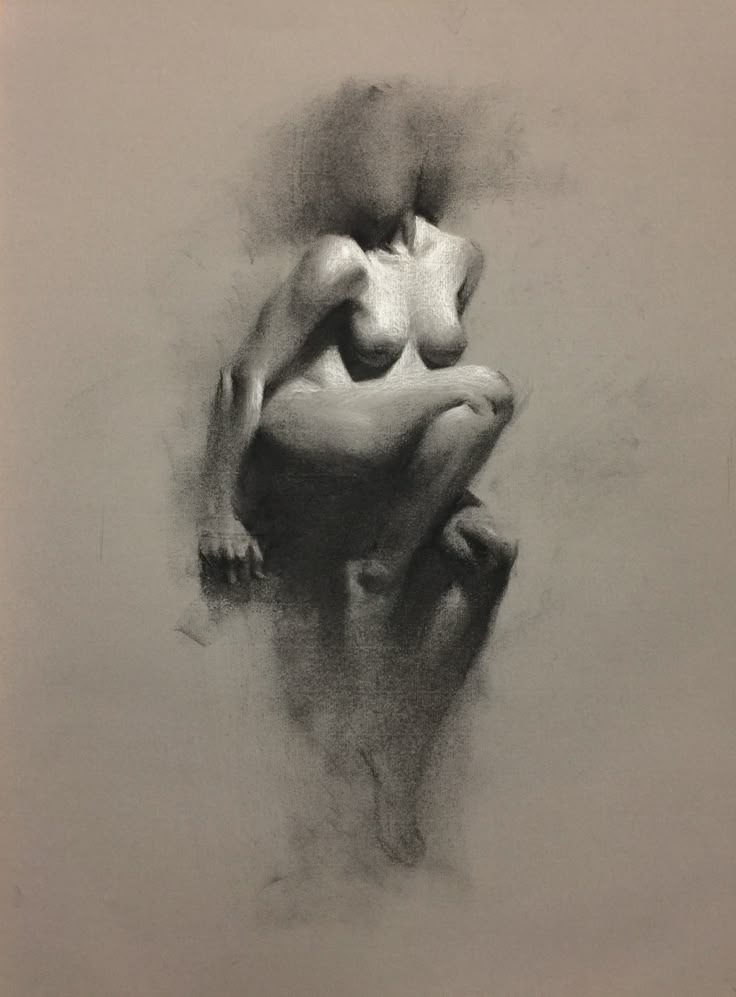
Adding the finishing touches to a female figure drawing enhances its overall impact. Key aspects include the background, narrative elements, and presentation.
Each of these factors plays a significant role in how the figure is perceived. Artists can also incorporate fantasy elements to create a more imaginative or otherworldly atmosphere in their finished drawings.
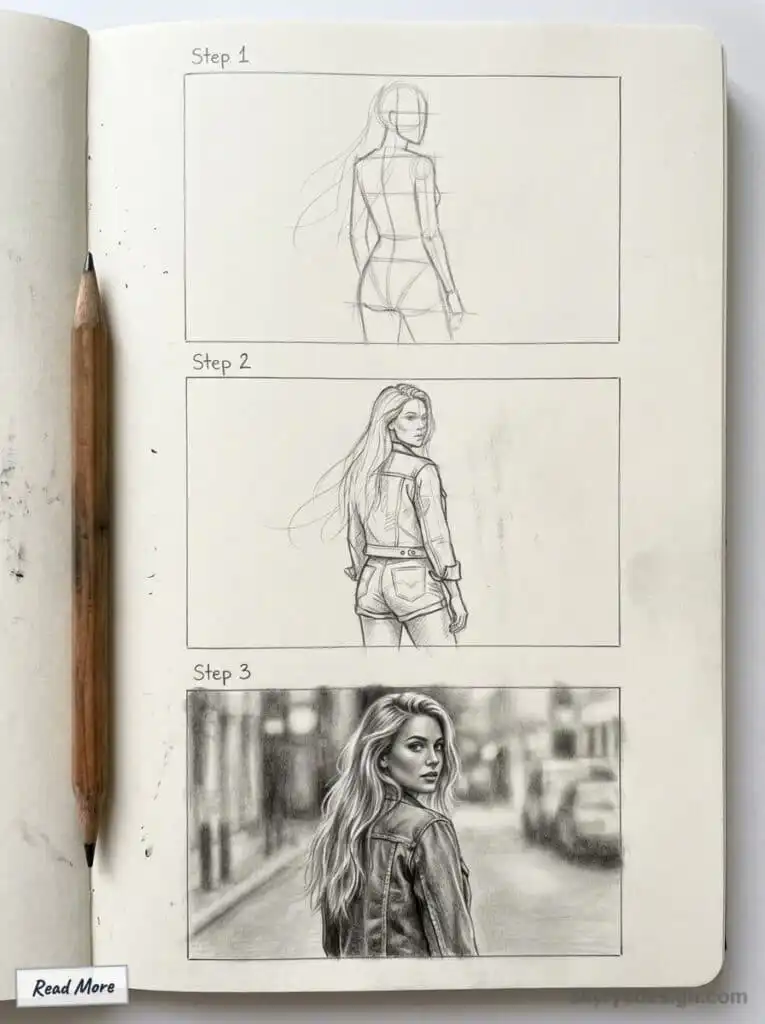
Backgrounds and Environments
A well-chosen background can add depth and context to a drawing. Simple environments, like a gradient or solid color, can keep the focus on the figure.
Here are some ideas for backgrounds:
- Nature scenes: Trees, mountains, or water can evoke mood.
- Urban settings: Buildings and streets can provide energy.
- Abstract shapes: Unique patterns can create a dynamic feel.
Choosing colors that complement the figure’s tones is essential. Soft pastel shades can create a gentle atmosphere. In contrast, bold colors can energize the composition.
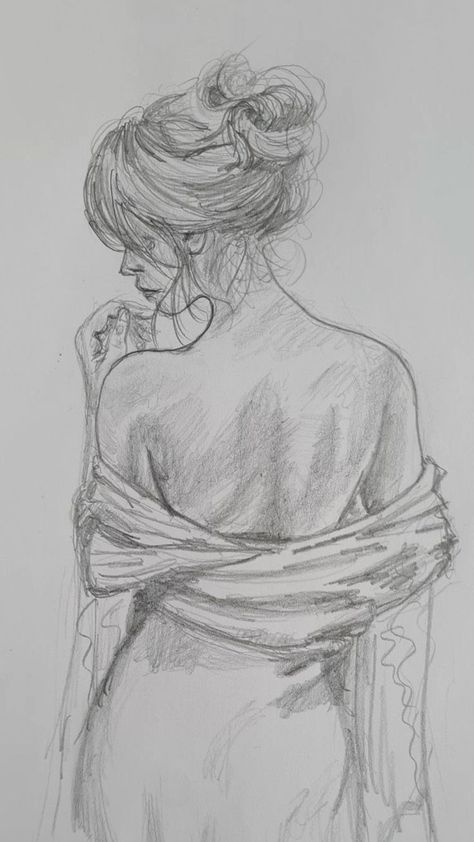
Incorporating Narrative Elements
Adding narrative elements invites viewers to engage with the drawing. This can be done through objects or the figure’s pose.
Consider these narrative techniques:
- Props: Items can suggest a story. For example, a book may indicate knowledge or adventure.
- Pose and expression: A relaxed pose suggests calmness, while a dynamic one conveys action.
- Interactions: Including other figures can enhance storytelling.
Carefully selecting these elements can create a stronger connection between the figure and its environment. It encourages viewers to imagine the scene’s story.
Presentation and Framing
Presentation is key to making a strong impression. Good framing can enhance focus on the figure.
Effective presentation tips:
- Borders: Simple frames emphasize artwork without distraction.
- Matting: Adding a mat can separate the drawing from the background.
- Lighting: Proper lighting enhances details and colors in the artwork.
When presenting a drawing, the artist should consider the audience. Adjusting the style and framing can enhance the viewer’s experience.
Pose studies to practice before a finished drawing
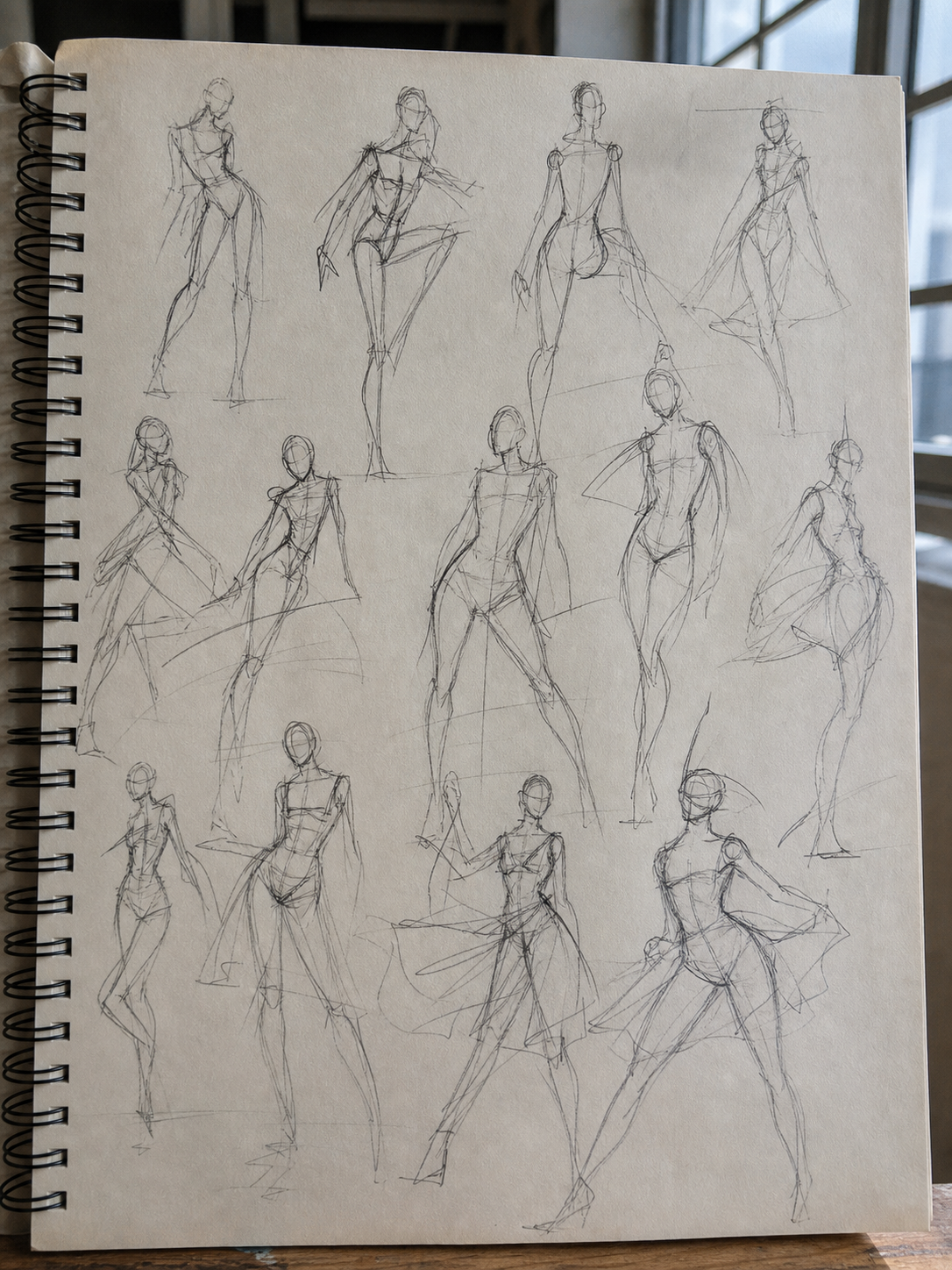
Before a polished figure, do a few fast pose studies. Look for the line of action, where the weight sits, and how the shoulders answer the hips. These quick sketches help the final female figure feel less flat.
Once the figure gesture is placed, use this guide to draw hands from simple shapes before tightening fingers, wrists, and small overlaps.
Common questions before you practice


Many new artists have specific questions when learning to draw the female figure. These tips are helpful for students of all levels, from beginners to mature learners. This section covers essential steps, techniques for beginners, capturing feminine features, poses to practice, achieving accurate proportions, and guidance on full body portraits.
Figure poses get stronger when the body sits inside simple boxes first. This guide to foreshortening and perspective drawing is useful before pushing arms, legs, or the torso toward the viewer.
Sexy body drawing FAQ
How do you start a sexy body drawing?
Start a sexy body drawing with a loose gesture line, then block in the head, rib cage, pelvis, and limbs with simple shapes. Check the shoulder tilt, waist, hips, knees, and ankles before adding details. Once the pose feels balanced, refine the silhouette and build shading gradually instead of outlining every curve too early.


What are common mistakes when drawing a female body?
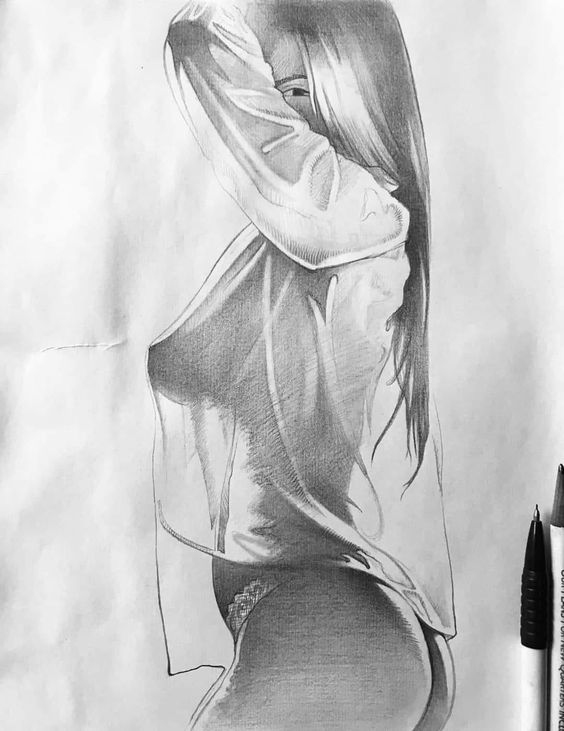
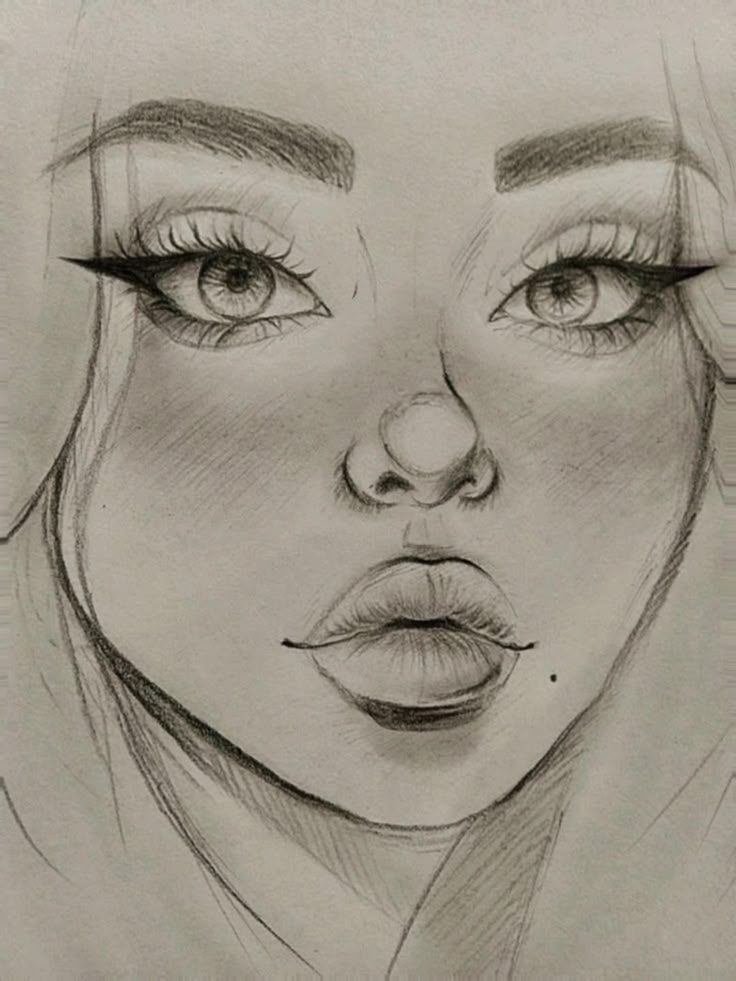
Common mistakes include making the torso too long, placing the hips without checking the pelvis angle, drawing both sides of the body too symmetrically, and using stiff lines for a soft pose. Beginners also tend to add hair, clothing, and facial details before the body structure is working. Fix the big forms first, then move to smaller features.
How do you build the female body shape in a drawing?
Build the female body shape from the rib cage and pelvis first. Use the center line to show the twist of the torso, then compare the shoulder width, waist, hip width, and leg angles. Softer curves can help, but the drawing still needs solid structure underneath. Think of the body as connected forms, not a flat outline.
What female body poses should beginners practice?
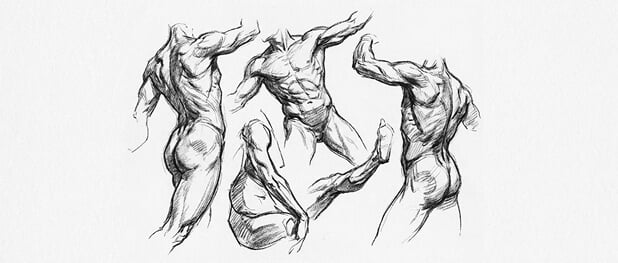
Beginners should practice relaxed standing poses, seated poses, walking poses, and simple contrapposto poses where the weight sits on one leg. These teach balance, hip tilt, shoulder angle, and natural curves without becoming too complicated. Short gesture studies from reference photos are useful because they train you to capture movement before detail.
How do you draw female body proportions?
Use the head as a measuring unit, then compare the height of the torso, pelvis, legs, and arms against it. Many figure studies use a seven-to-eight-head structure, but do not treat it as a rigid rule. Check the shoulder width, waist placement, hip tilt, knee height, and ankle position so the body feels believable.
How do you draw a full female body from head to toe?
Sketch the full pose lightly before committing to any detail. Place the head, rib cage, pelvis, spine curve, arms, legs, hands, and feet as a single connected structure. After the proportions work, refine the contour, add facial features, hair, clothing, shadows, and small accents. A full-body drawing improves when the big gesture stays visible underneath.
Related practice for sexy body drawing
If you want to keep practicing after this lesson, these guides are useful next steps:
- Browse the body drawing tutorials hub for more structure, pose, and anatomy practice.
- Return to the broader drawing tutorials archive when you want adjacent sketching lessons.
- Build a cleaner figure drawing base before adding curves or clothing.
- Study female body shape drawing when the waist, hips, and shoulders feel too stiff.
- Use poses drawing practice to make the figure feel less flat.
- Compare this tutorial with female body proportions when the shoulder, waist, and hip relationships feel confusing.
- Move from anatomy into woman character design workflow when you are ready to add costume, personality, and story.
For female figure work, a short gesture drawing pose practice round helps you solve weight shift and rhythm before you tighten the anatomy.
For unclothed reference work, study a small set of nude figure drawing poses before refining the female figure with clothing or style details.
When you move from the full figure into portrait details, add a short facial feature drawing study for brows and eyes.
When figure practice feels too broad, switch to figure pencil sketch ideas that isolate portrait, gesture, hands, clothing, and simple pose problems.
Whether drawing stylized anime girls or realistic models, mastering base proportions forms the foundation of all advanced character design drawing workflows.
If you want the pose to feel more sensual after the construction is working, use this sexy body drawing guide for curves, gesture, shading, and confident figure silhouettes.
If you want to draw her as a character, use female figure drawing ideas for the pose first, then add her hairstyle, outfit, and one recognisable accessory.
Once one figure reads correctly, move into two-person pose references. They make proportion mistakes easier to spot because weight, overlap, and hand placement have to work across both bodies.
- 52.1Kshares
- Facebook0
- Pinterest52.1K
- Twitter1
- Reddit0