Birds of prey are notoriously unforgiving to draw. A falcon especially — the combination of compressed power, aerodynamic precision, and that hooked beak trips up even artists who handle complex animal subjects well.
- Why falcons are harder to draw than you think
- Tools you need for this tutorial
- Step 1 — block in the basic shapes
- Step 2 — drawing the head and beak
- Step 3 — wings and feather groups
- Step 4 — legs and talons
- Step 5 — shading and finishing the drawing
- FAQ
- How long does it take to draw a realistic falcon?
- What's the easiest falcon pose to start with?
- Do I need to draw every feather?
- What pencils work best for drawing birds?
- Can I draw a falcon in color?
- How do I practice falcon drawing efficiently?
- Why does my falcon look like a pigeon?
- What's the trickiest part of a falcon drawing?
- Related animal drawing practice
- Final thoughts
I came to falcons the same way I come to most difficult subjects: through proportion problems. A student in one of my Kyiv workshops kept drawing falcons that looked like inflated pigeons. Body too round, head too large, beak placed too far forward. Once we fixed the underlying structure, the drawing clicked immediately. That’s what I want to give you here — a structural foundation, not just something to trace.
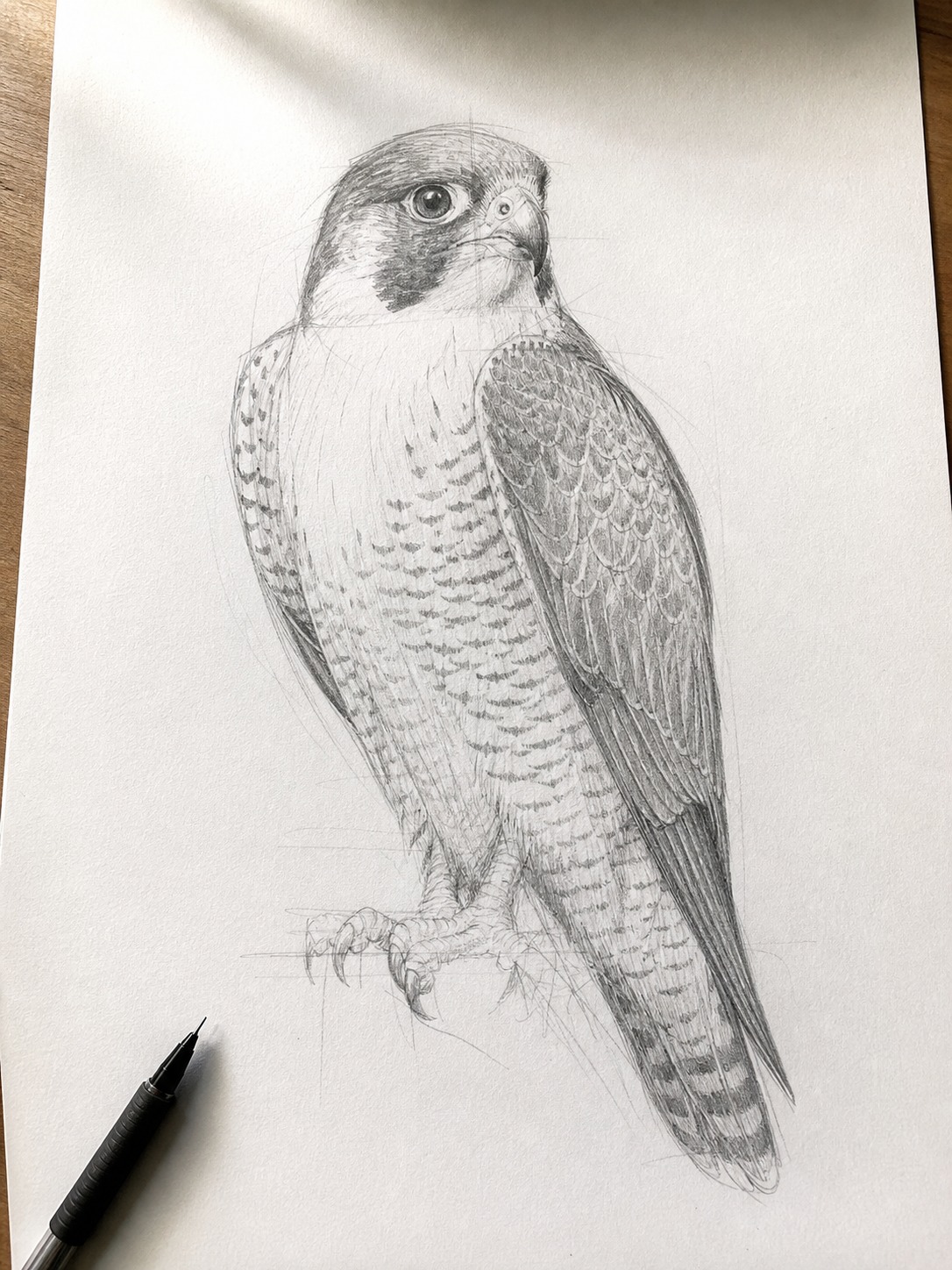
By the end of this tutorial you’ll know how to break a falcon down into manageable geometry, handle its distinctive head and beak, and suggest feather structure without drawing every single quill (which will drive you insane and still look wrong).
The method works in graphite on paper and in Procreate or Clip Studio — I’ll note the key differences where they matter.
Why falcons are harder to draw than you think
Most animal drawing tutorials treat all birds the same. They’re not. A seagull and a peregrine falcon share the category “bird” the way a city bus and a Formula 1 car share “vehicle.” The underlying physics — and therefore the shapes — are completely different.
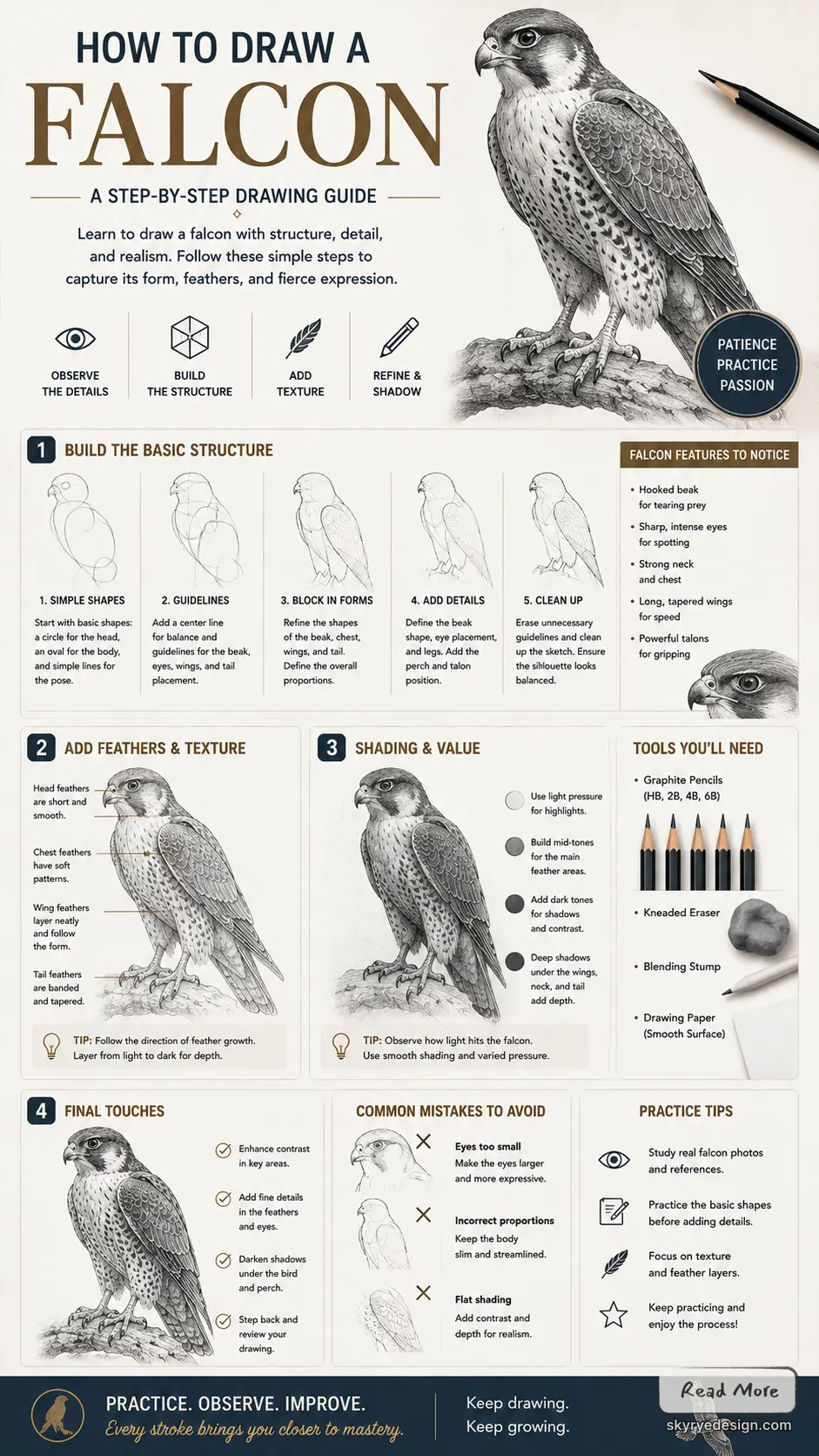
Falcons, specifically the peregrine (Falco peregrinus), are built around speed. The chest is massive relative to the overall body. The head is small and rounded, sitting close to the body with almost no visible neck. The tail is narrow and pointed. The silhouette, if you squint at a reference photo, is essentially a compressed teardrop.
The anatomy mistake most beginners make
The most common mistake I see: the head is too large. People instinctively give birds big heads because that makes characters feel friendly and readable. But a falcon with an oversized head looks like a cartoon parrot, not a predator.
The head should be roughly one-third the width of the body at its widest point. Write that down. Measure it on your reference before you start. I mark this proportion on the paper first before I draw a single bird shape.
The second common error is leaving out the crossed primaries on a perched bird. When a falcon is perched, the primary feathers — the long outer flight feathers — cross over the tail. Beginners often omit these entirely and the drawing ends up looking like a stuffed toy. Those crossed primaries sell the pose.
Reference photos vs illustration sources
Photo reference is useful for pose, lighting, and color. For structure, illustrated sources are actually better. David Sibley’s The Sibley Guide to Birds (Knopf, 2000) has plate illustrations that already simplify the forms in a useful way — they show you what matters structurally without the visual noise of feather variations and photographic artifacts.
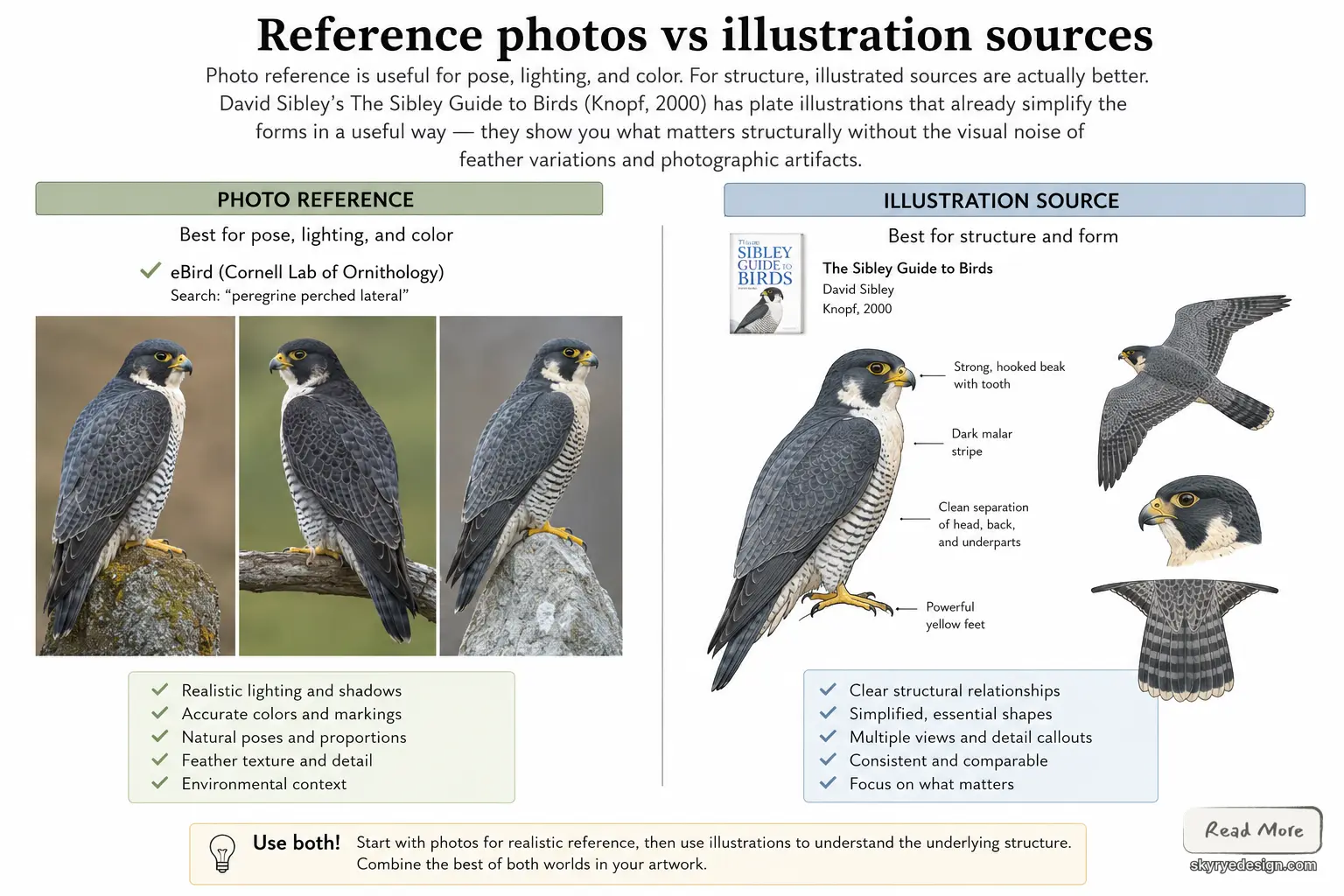
For photo reference, the eBird database from Cornell Lab of Ornithology has excellent high-resolution peregrine images. Search “peregrine perched lateral” for the most useful study angles.
Tools you need for this tutorial
Nothing exotic. Here’s exactly what I’m using:
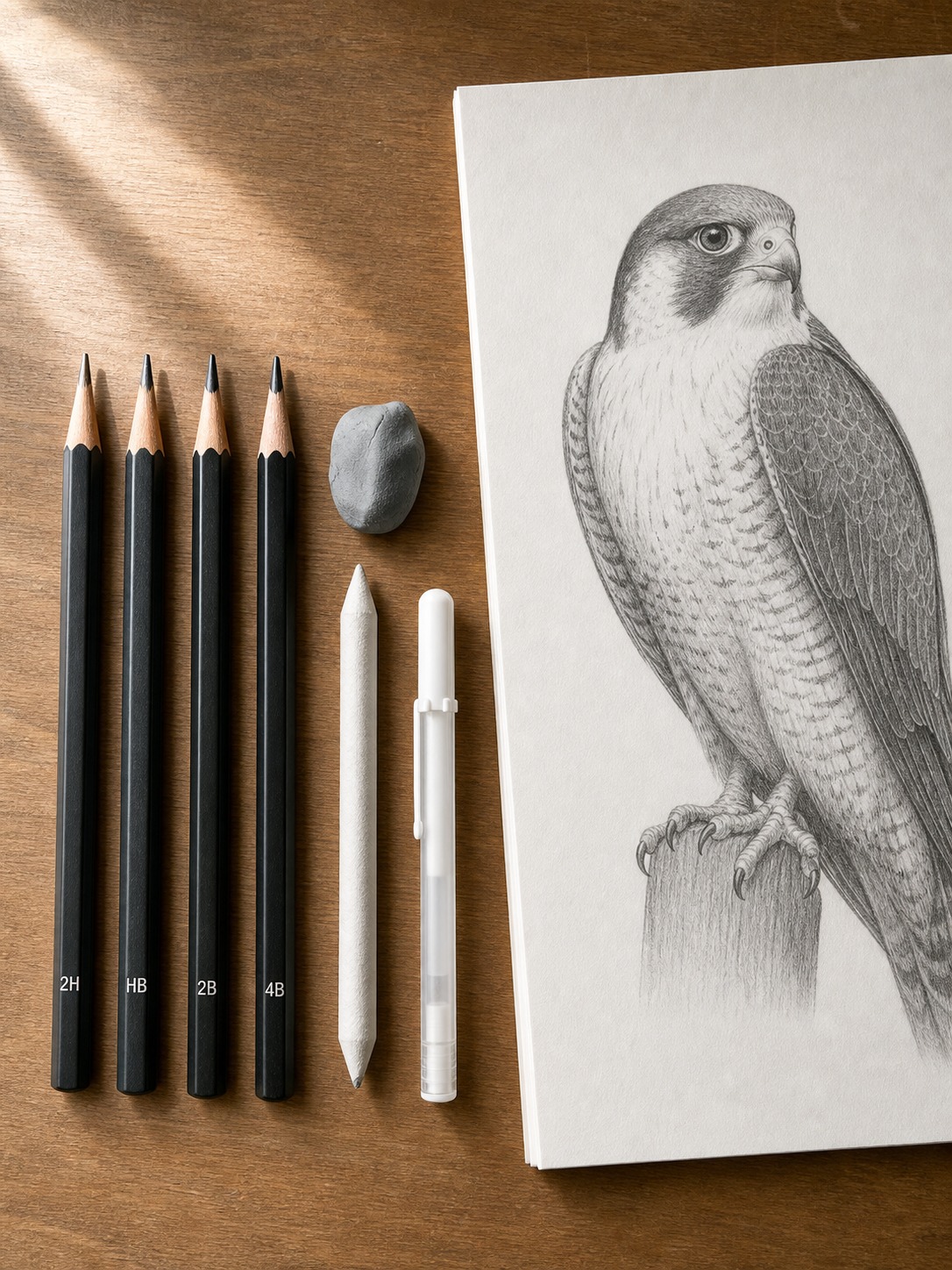
Pencils: Faber-Castell 9000 series — 2H for initial construction lines, HB for mid-tone work, 2B and 4B for darks and final detail. This range handles everything from the faintest feather suggestion to the dark eye ring. Staedtler Mars Lumograph works equally well. The main thing is consistency within one brand so the hardness steps are predictable.
Paper: Canson XL Sketch in A3 for finished studies, regular 80g printer paper for warm-ups. Work bigger than you think you need — birds benefit from working at a scale where you can get real feather detail without cramping your hand.
Erasers: a kneaded eraser for lifting highlights and softening light values without smearing, and a vinyl eraser (Staedtler 526) for hard-edged corrections.
Blending stump: medium size, for smooth transitions in the feathers and body.
Digital alternative: in Procreate, the 6B pencil brush for structural sketching and the smudge tool for feathers. Keep the line layer separate from the tone layer — you’ll adjust them independently.
Step 1 — block in the basic shapes
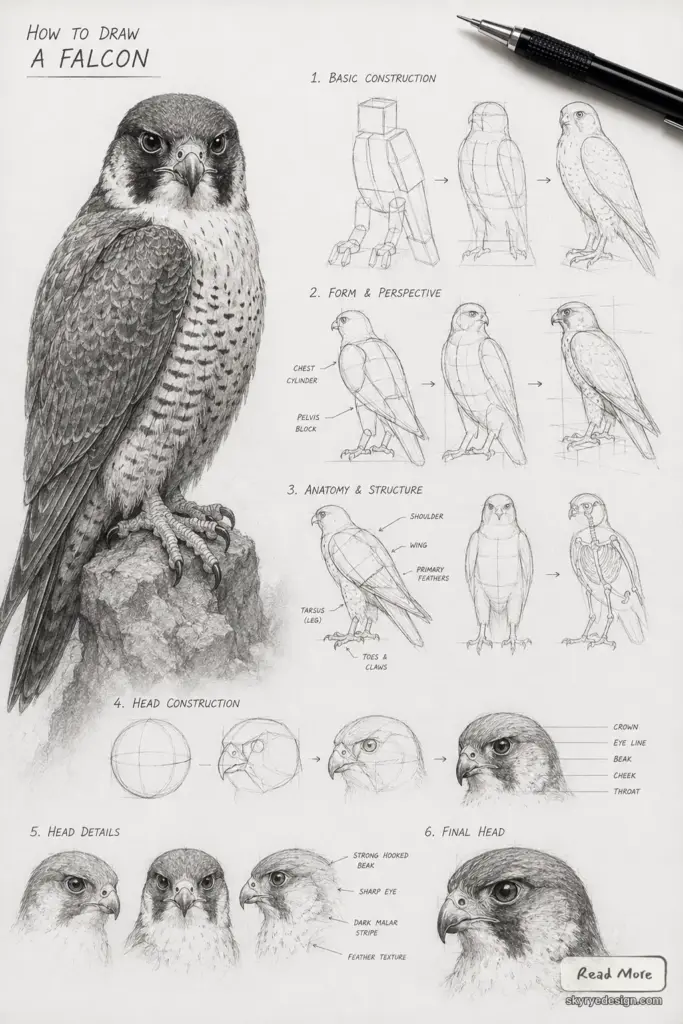
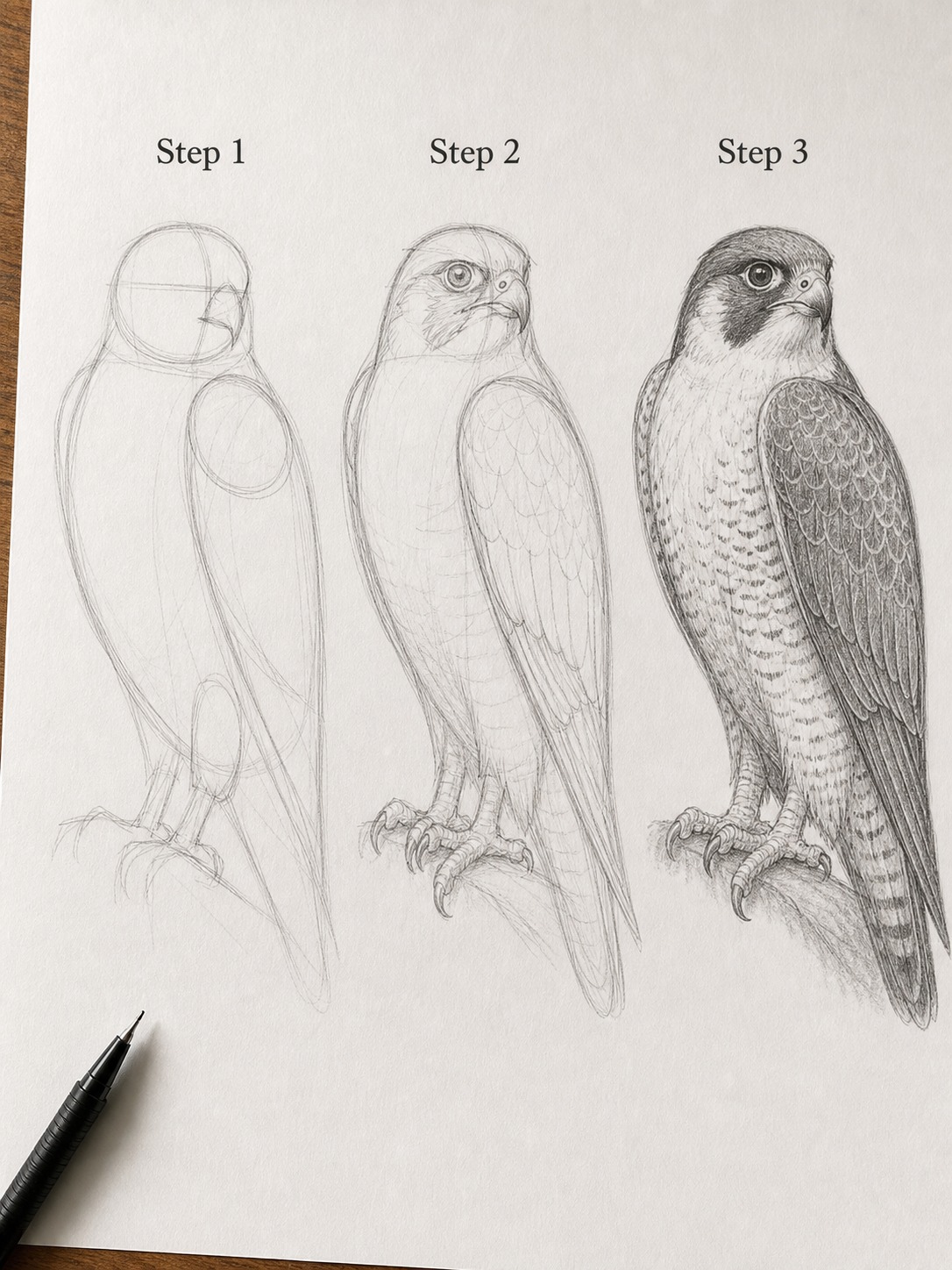
Start with the largest shape and work outward. For a perched peregrine in three-quarter view, the body is a flattened egg — wider at the chest, narrower toward the tail. Draw it very lightly. This is a construction line, not a finished mark. It will disappear under everything else.
The egg should sit at a slight angle — roughly 10 to 15 degrees from vertical. Perched falcons lean slightly forward; they don’t stand straight up like a post.
The body egg and proportion check
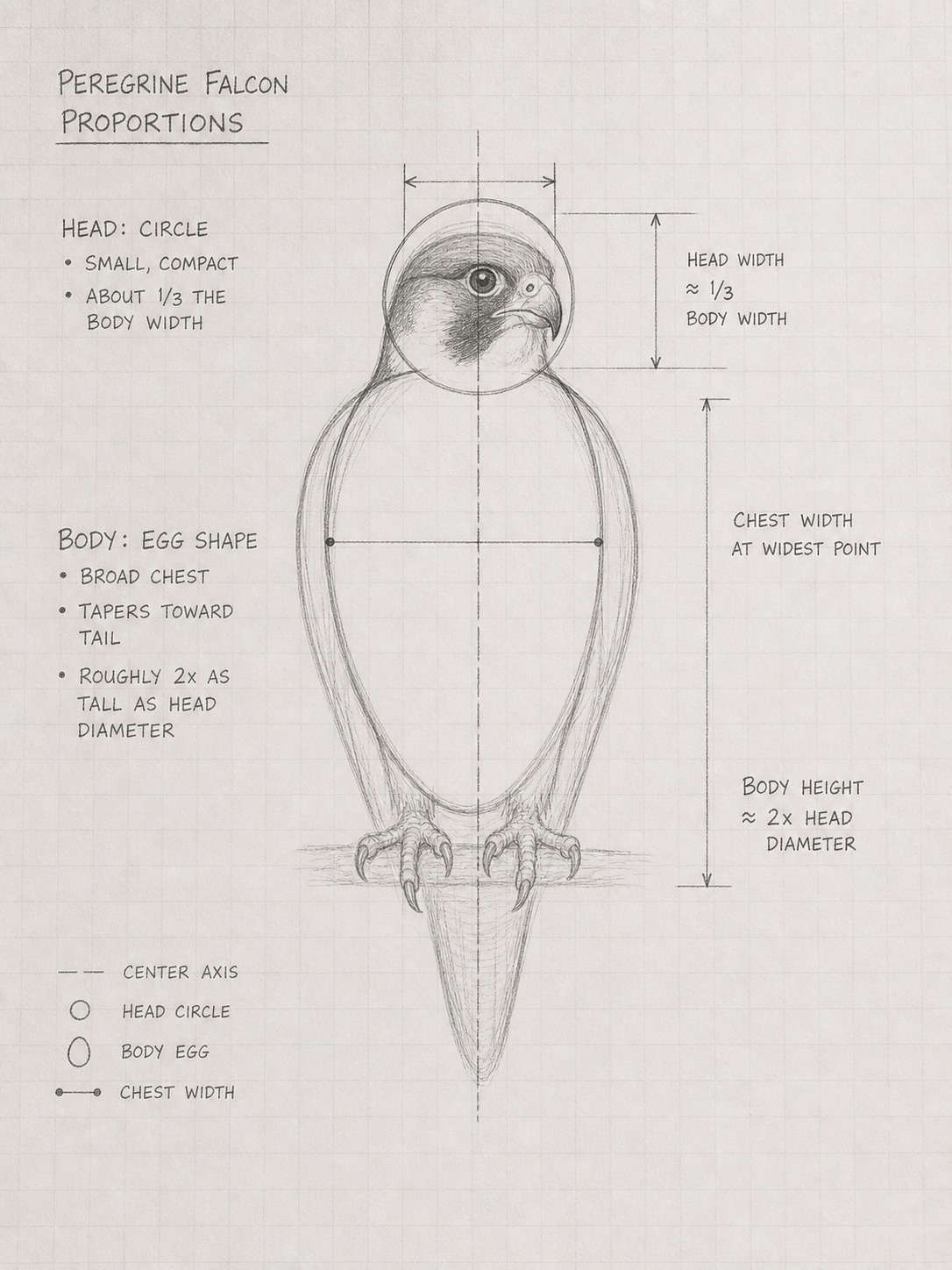
After drawing the body egg, mark the widest point — the chest — with a faint horizontal line. This is your proportion anchor. Everything else gets measured against it. The head will be roughly one-third this width. The tail will extend below the egg to about the same length as the head diameter.
If your egg is too wide and round, you’ll end up with a hawk or buzzard shape. Falcons are leaner than most people draw them — deep front-to-back through the chest but not wide side-to-side.
Head placement and the center axis
The head is a rounded shape, slightly flattened on top — not a perfect circle. Place it sitting on the top of the egg with almost no gap; there’s barely visible neck on a perched falcon. The head tilts very slightly forward from vertical.
Draw a vertical line through the center of the head and extend it down through the body. This is your symmetry axis. Everything that follows — eye, beak, wing fold line, leg placement — must respect this axis or the drawing will look subtly wrong even when each individual element seems fine. I use the same principle when proportioning automotive design sketches: the centerline is fixed until you have a specific reason to break it.
In three-quarter view, the axis tilts slightly toward the viewer. Don’t flatten it into a front view.
Step 2 — drawing the head and beak
The head is where most beginners spend too little time and then wonder why the whole drawing feels off. Everything else either earns the head or gets undermined by it.
Eye placement and the facial mask
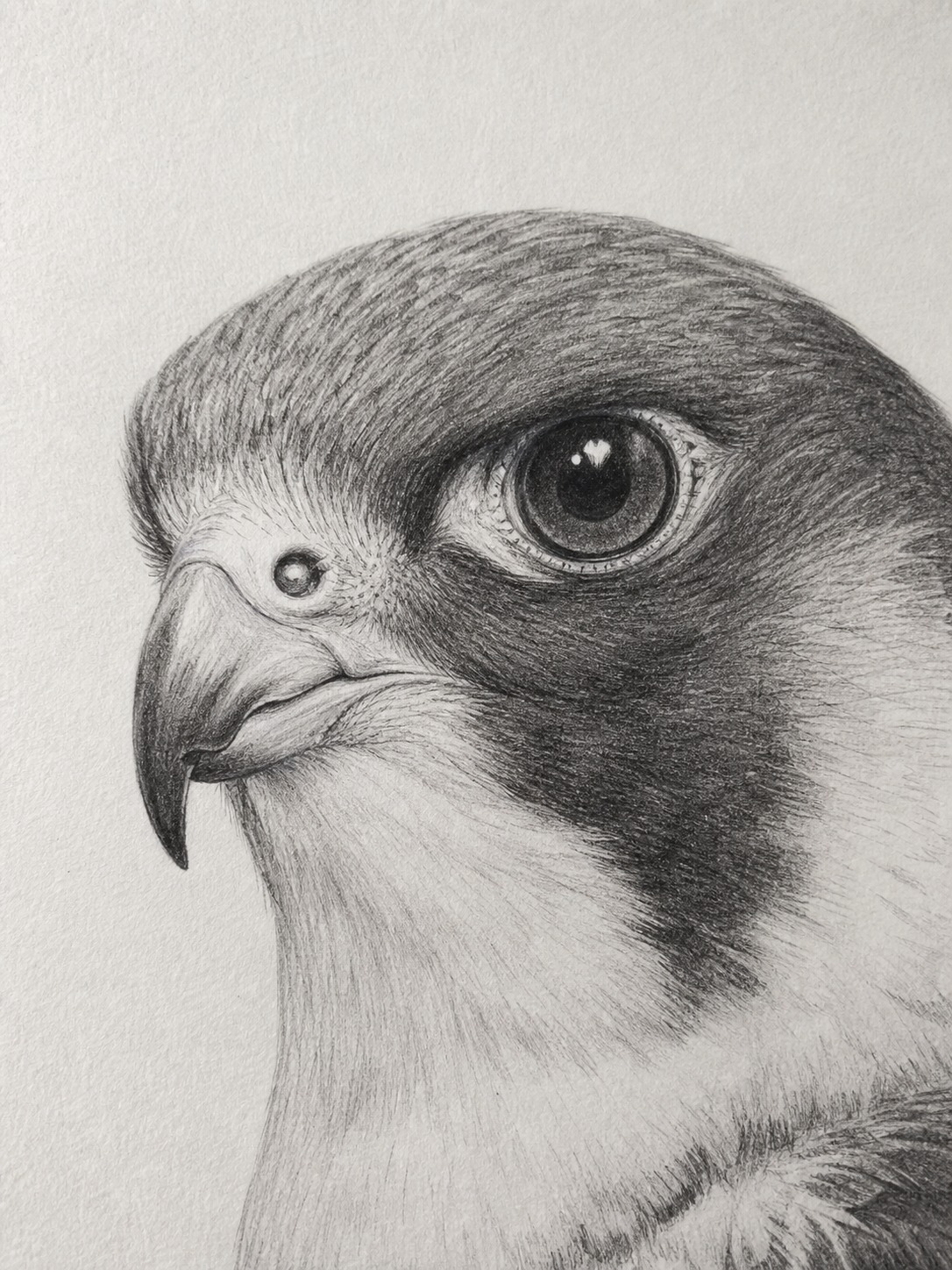
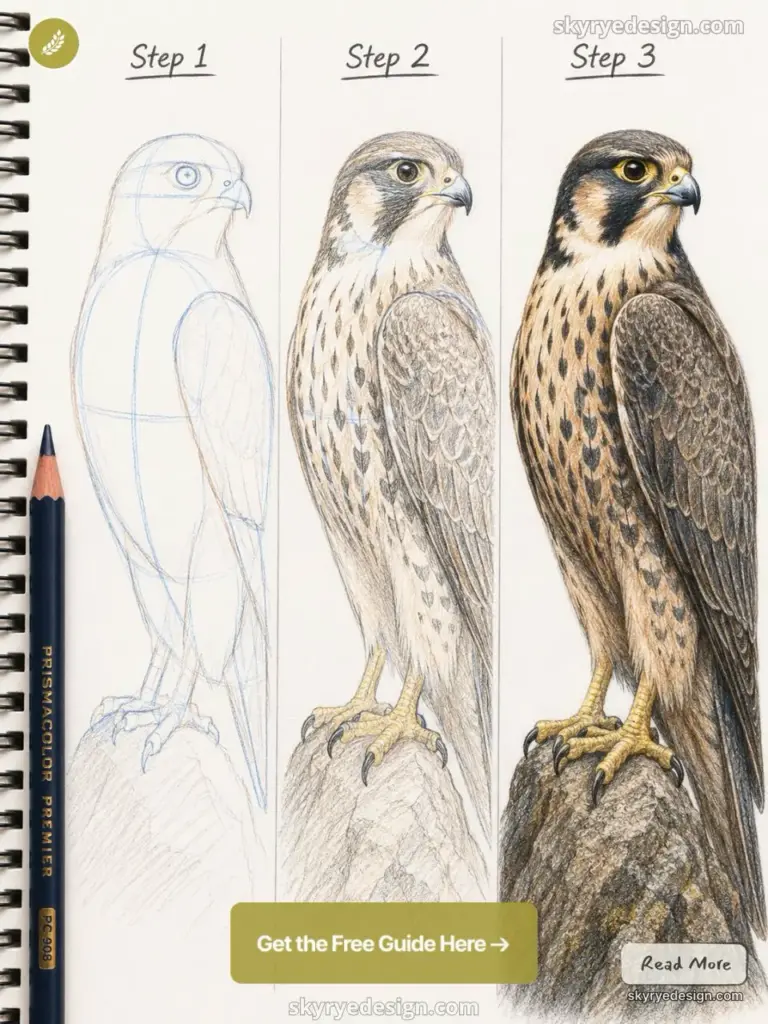
Peregrine falcons have a distinctive dark “mustache” marking — a stripe of dark feathers running down from the eye toward the throat. Don’t draw it yet. Establish the eye first, then let the mask grow outward from there.
The eye sits forward of center on the head — more forward than most birds. That placement is what gives falcons their alert, slightly intense expression. Draw a full circle for the eye socket. Then a smaller circle inside for the iris, smaller still for the pupil. Leave a tiny white highlight. That highlight is the difference between a live bird and a taxidermied one.
I place the highlight last, using a white gel pen. Sakura Gelly Roll 0.8mm. Small thing, but it changes the entire reading of the drawing.
Getting the beak curve right
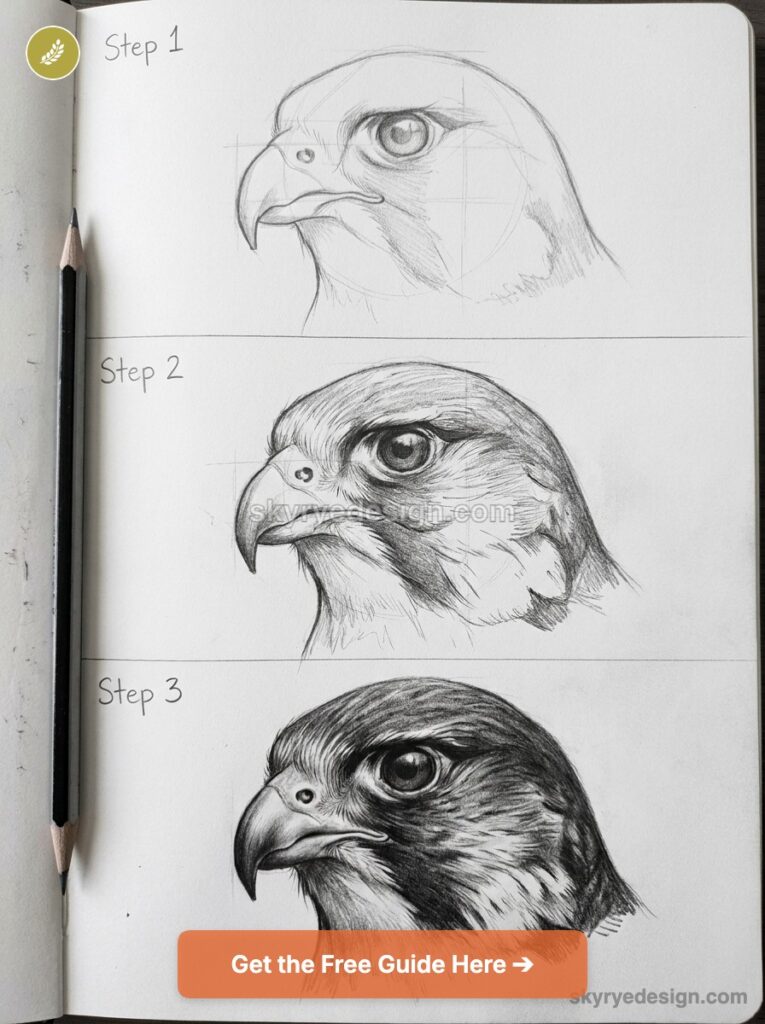
Start with the upper mandible. It arcs downward in a strong, deliberate curve, hooking at the tip. The hook is sharper than most people draw it — this isn’t a slight bend, it’s a real hook. The lower mandible follows a gentler arc and doesn’t hook.
The detail that separates a falcon from a hawk or eagle at a glance: the tomial tooth. A small notch in the upper mandible, about two-thirds down from the base. Easy to miss in photos, unmistakable once you know to look for it.
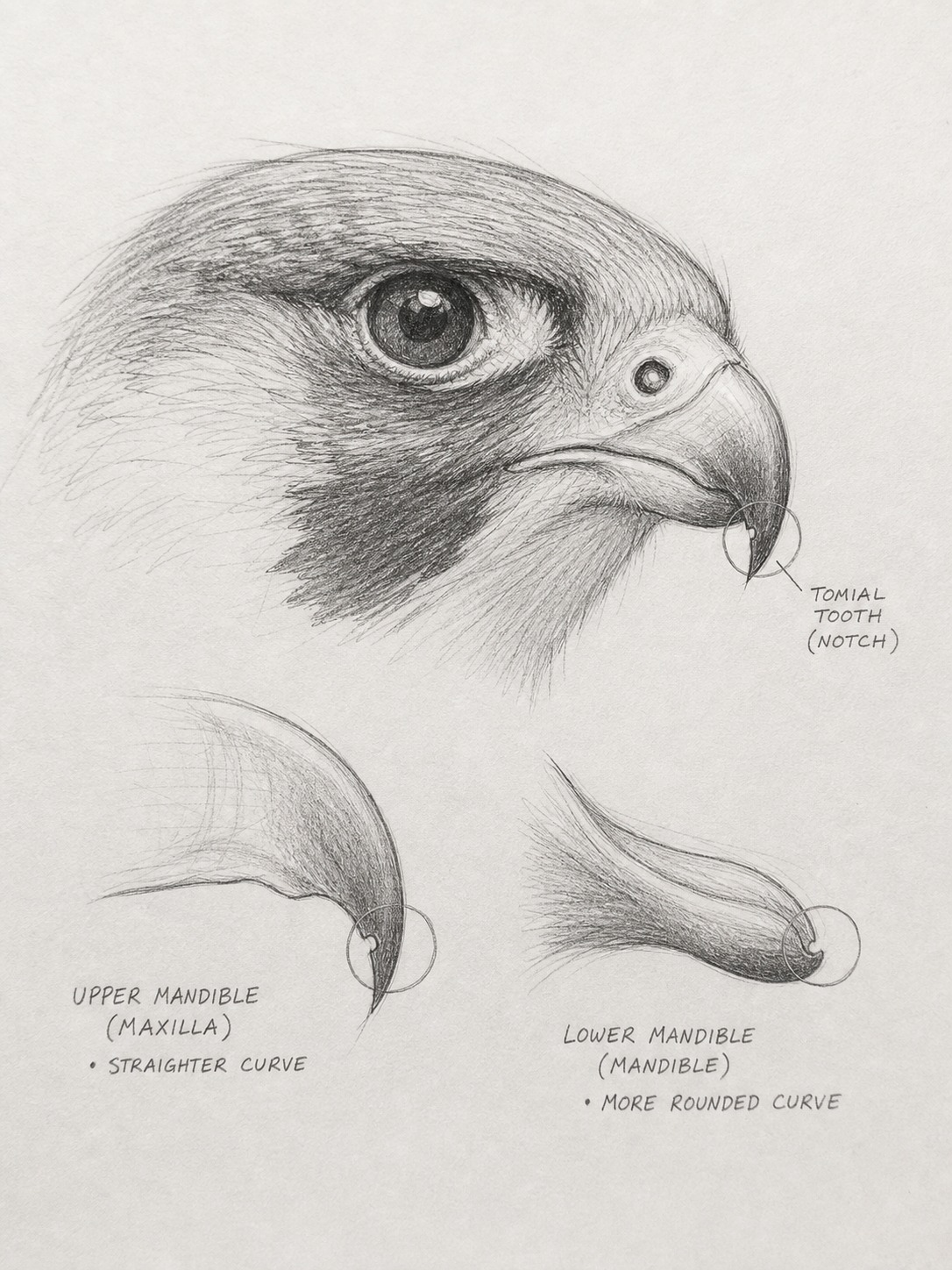
Keep the beak compact. Beginners always make it too big — the falcon ends up looking theatrical. Think of it as a precision cutting tool rather than a dramatic prop.
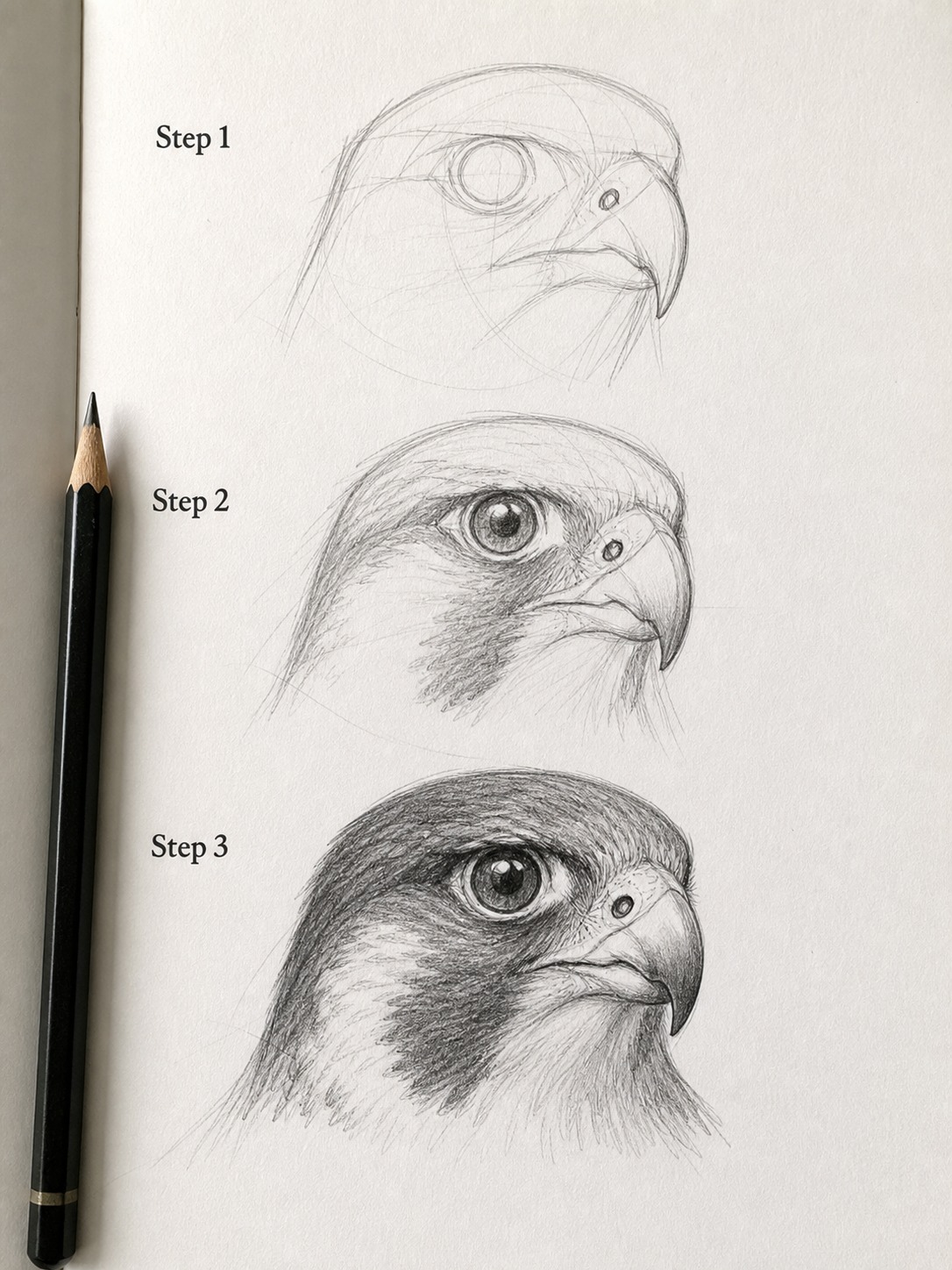
Step 3 — wings and feather groups
A perched falcon holds its wings folded tight against the body, primary feathers crossed over the tail. This is simultaneously the most characteristic thing about the perched pose and one of the hardest to draw convincingly.
How to group feathers without going insane
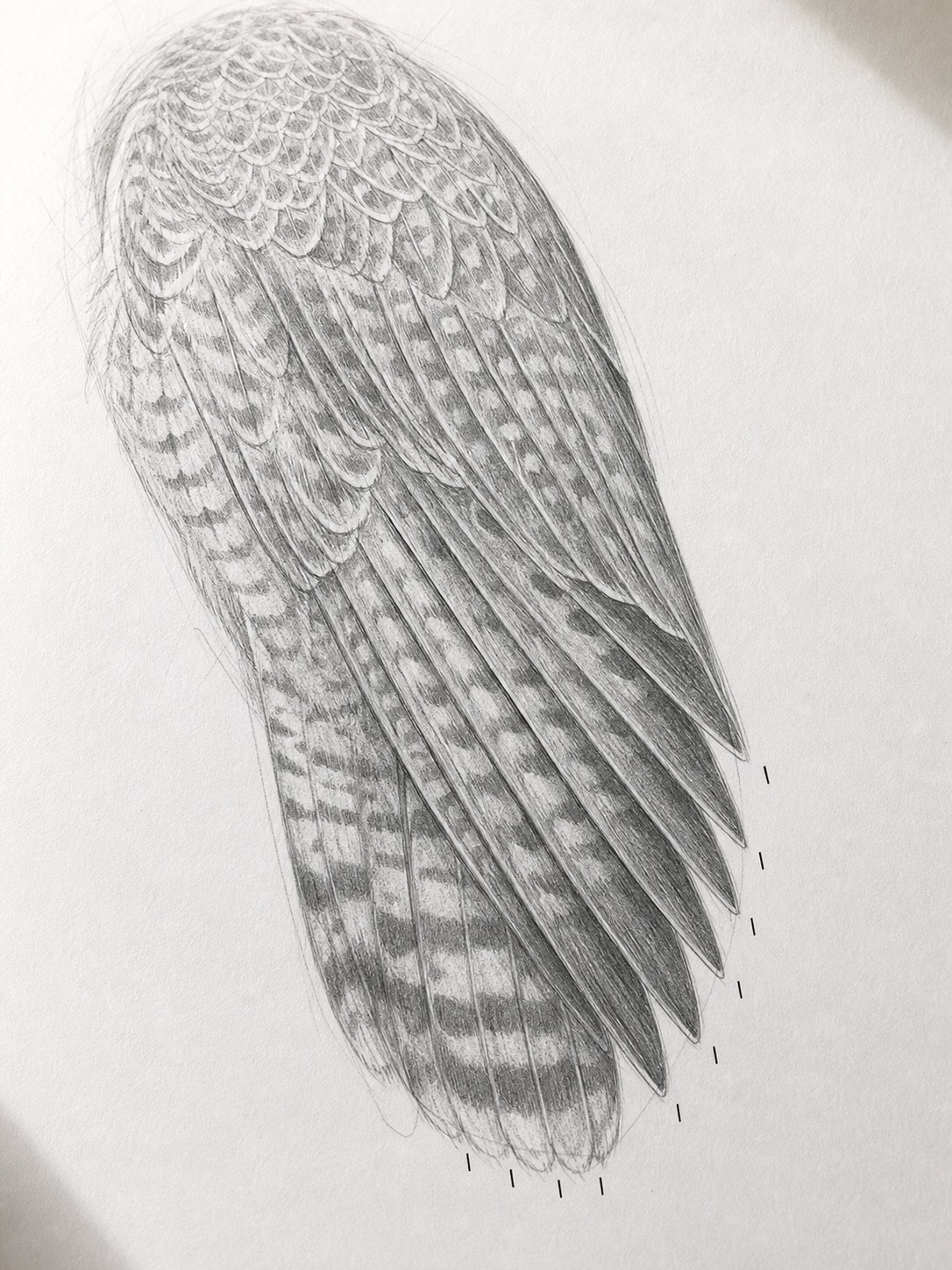
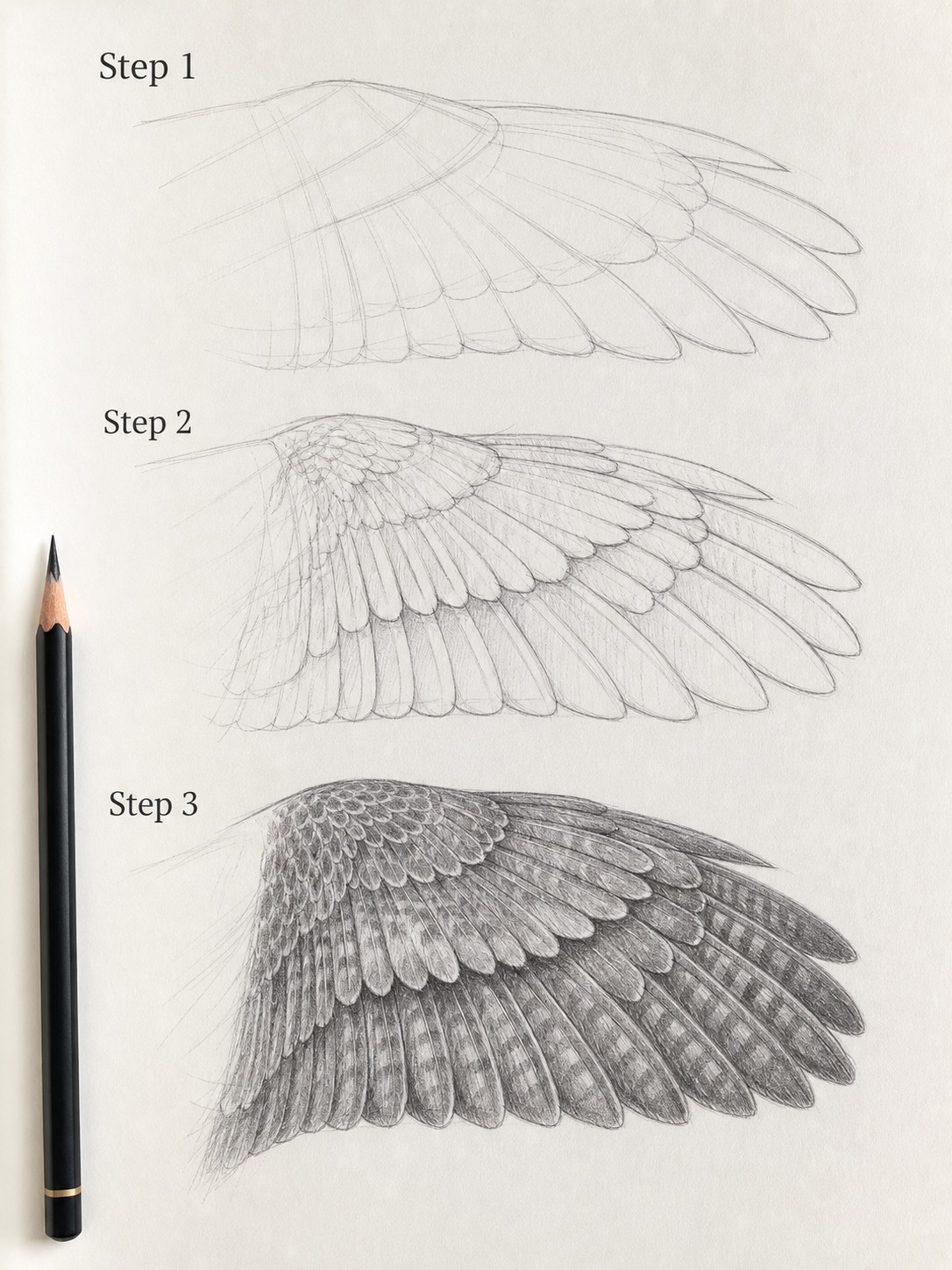
Don’t try to draw individual feathers. Work in groups. There are three visible groupings on a folded wing:
The scapulars are the shoulder feathers closest to the spine, covering the top of the wing fold. Draw the entire group as one flat shape.
The coverts — median and greater — form two rows below the scapulars, following the fold of the wing and creating a layered, scale-like look. Again, one shape per row.
The primaries are the long feathers that stick out past the tail. Draw seven to nine visible tips, evenly spaced, curving slightly outward.
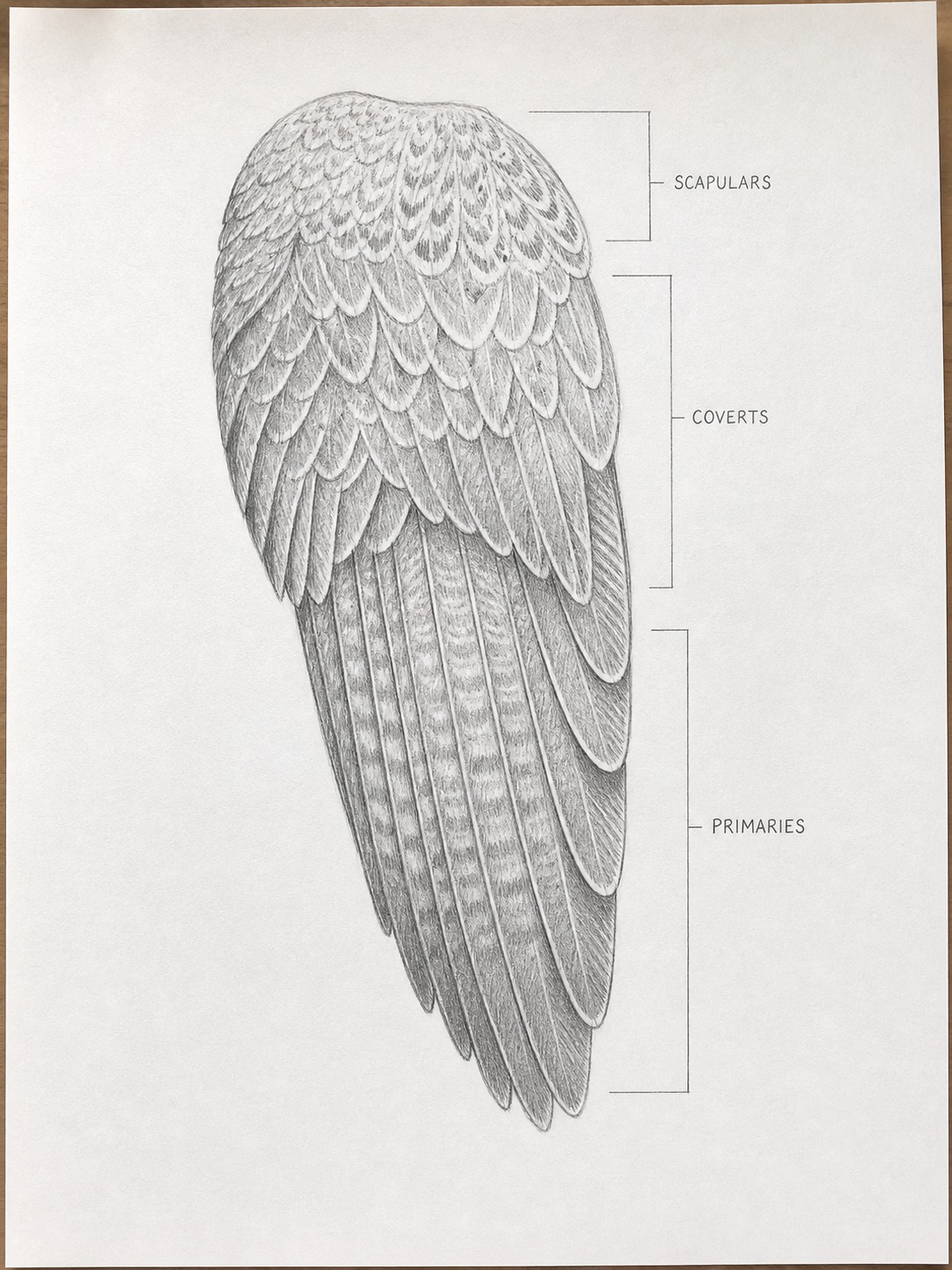
Now add internal lines within each group to indicate individual feathers. You’re suggesting, not documenting. The eye reads a cluster of curved parallel lines as “feathers” even when you’ve drawn maybe 15% of what’s actually there. That’s the trick — enough to signal the structure without spending four hours on quill detail.
The pattern on chest and flanks
Peregrine breast feathers have a teardrop barring pattern — dark spots and horizontal bars on a pale ground. Don’t draw every bar. Sketch the direction of the pattern in light HB, darken every other bar, and let some of the marks fade into the lighter chest area.
On the upper wing surface, the color is a cool blue-gray. In graphite, use very light pressure here and let the paper tooth do the work. The contrast should be subtle — slightly darker toward the wing edges, lighter over the back.
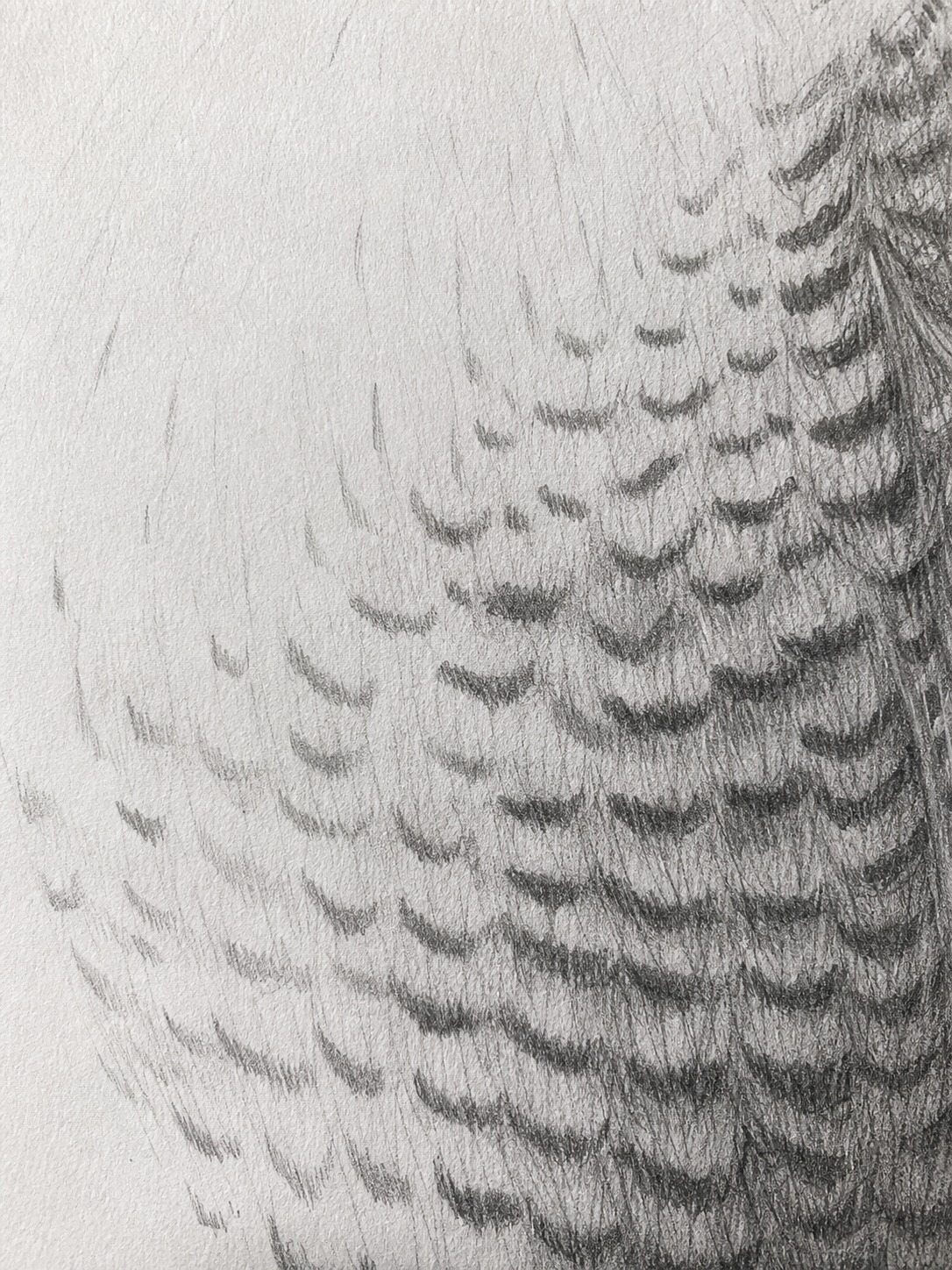
The upper wing surface on a perched bird is mostly hidden behind the body. What you’re really seeing is covert rows and primary tips. Don’t invent detail that isn’t visible in your reference.
Step 4 — legs and talons
Falcon legs are shorter and thicker than eagle legs. The tarsus — the section above the toes — has a scaled texture that you can suggest with short, curved hatch marks. This is the same approach as rendering wood grain or fabric in industrial illustration: you suggest the texture, you don’t reproduce every element of it.
Talon anatomy and proportion
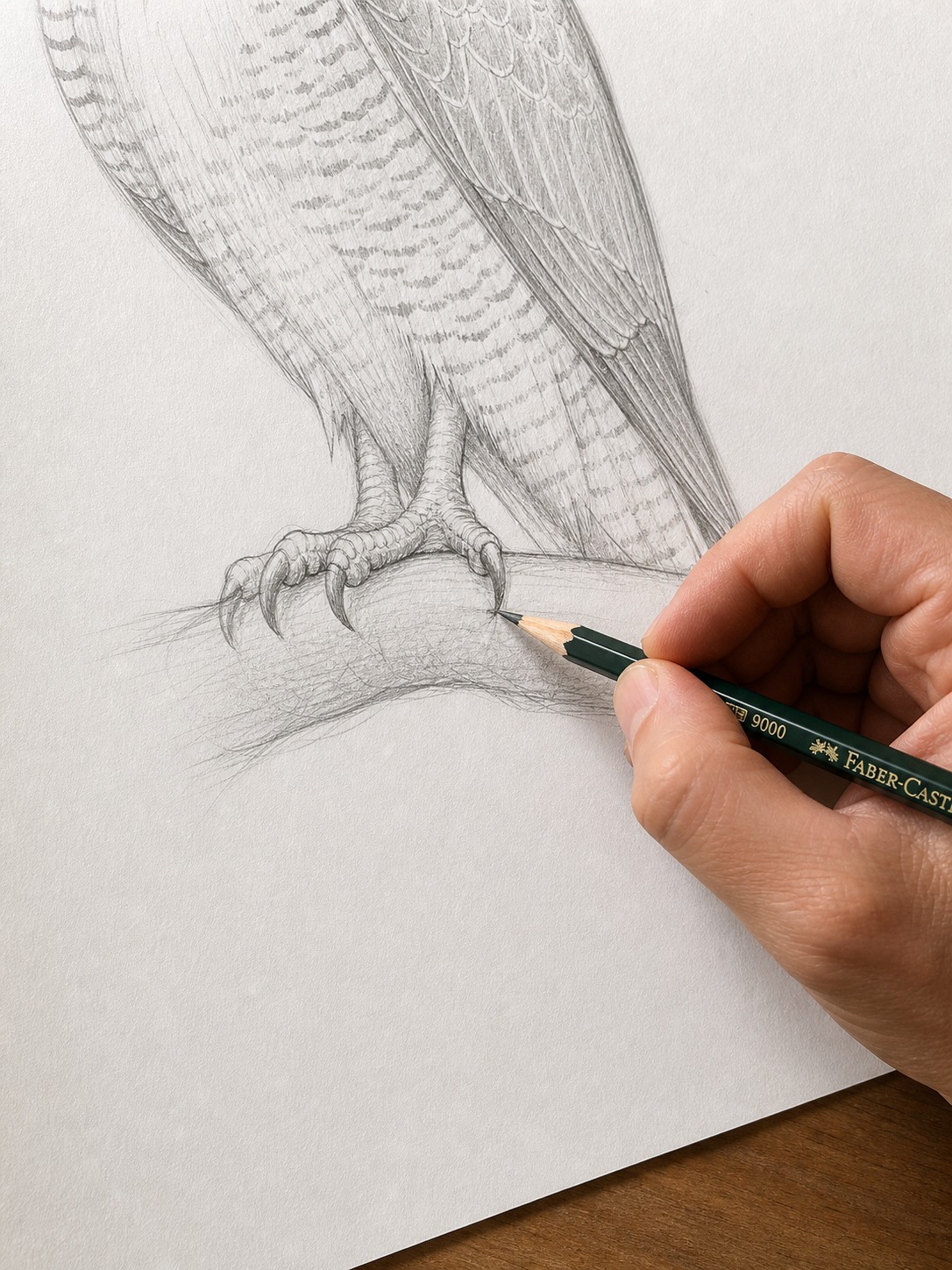
A perched falcon grips with three toes forward and one back. The hallux — the rear toe — is the largest, heaviest talon. Draw it first. The three forward toes are progressively shorter moving outward from the inner toe.
Each talon curves downward and back like a fishhook. Draw the curve first, then add volume: thicker at the base where it meets the toe, tapering sharply to the tip. The tips should look capable of doing serious damage. Pressing hard with a sharp 2B and pulling off the pressure toward the point creates this effect — dark and thick at the base, needle-fine at the end.
Talon grip on the perch
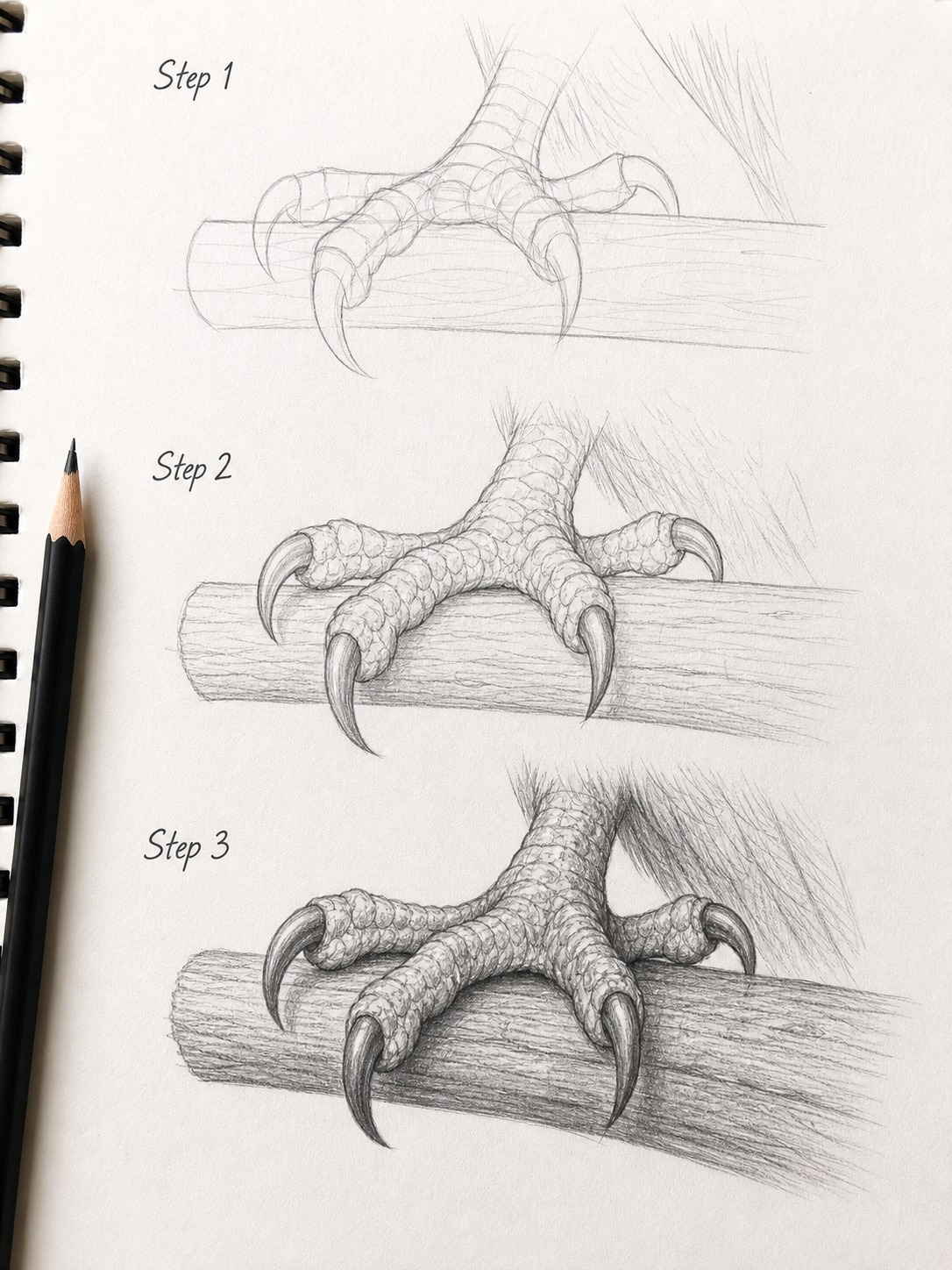
If your falcon sits on a branch, the toes need to wrap around it convincingly. Branch diameter matters. A narrow branch means the toes overlap significantly; a thick post means they spread wide. Get this wrong and the bird looks like it’s floating above the surface rather than gripping it.
Step 5 — shading and finishing the drawing
You now have a lightly drawn construction with all the major elements in place. The shading converts it from a diagram into an image.
Setting up your value zones
Pick your light source before adding any tone and don’t change it halfway through. I almost always light from upper left — it reads as natural daylight and works well with the way the falcon’s contours are oriented. Three zones to mark out mentally:
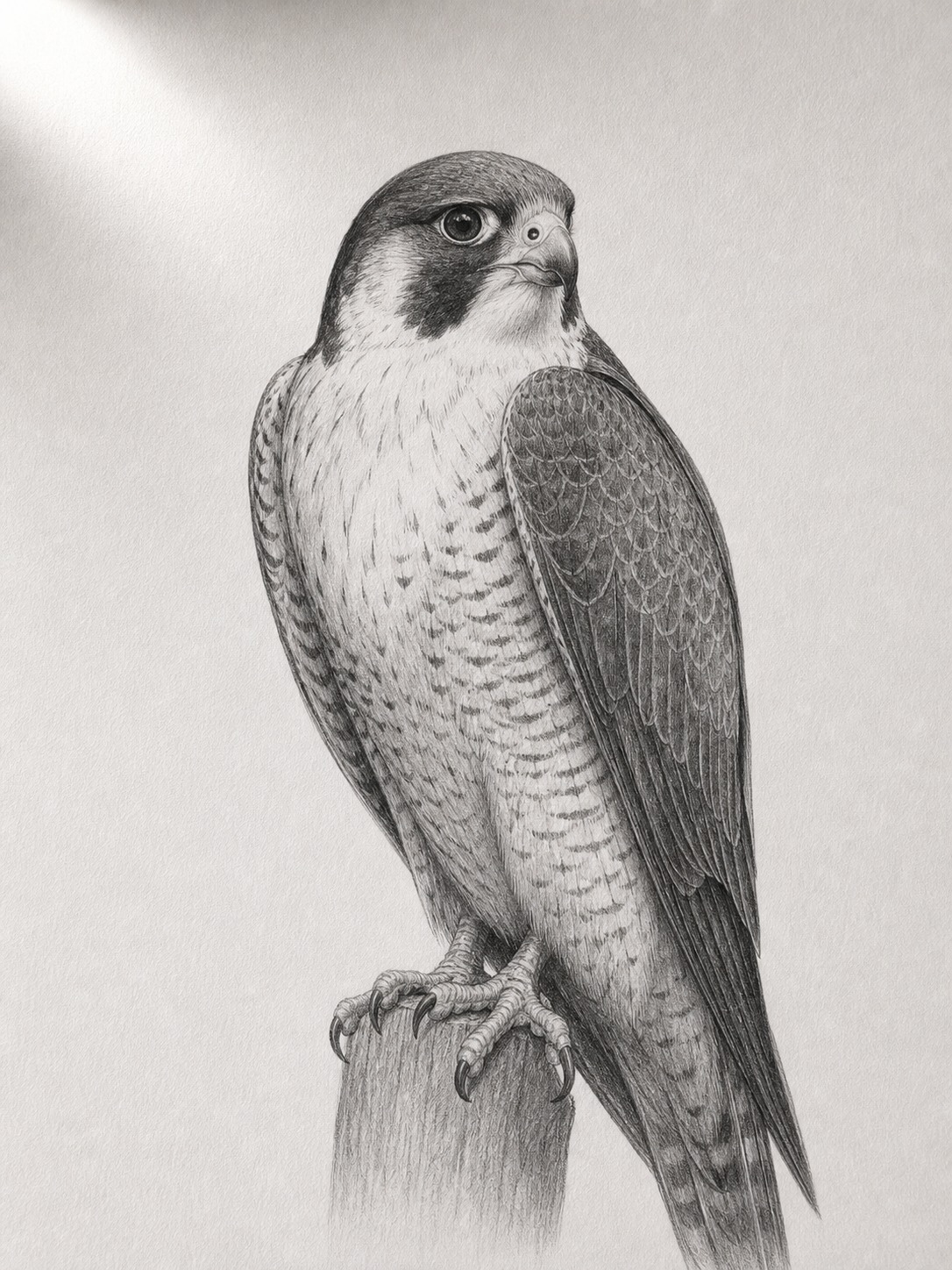
Light areas — chest, top of the head, upper beak surface.
Mid-tone — wing coverts, flanks, leg sections.
Dark — eye ring, facial mask, primary feather tips, shadow under the tail.
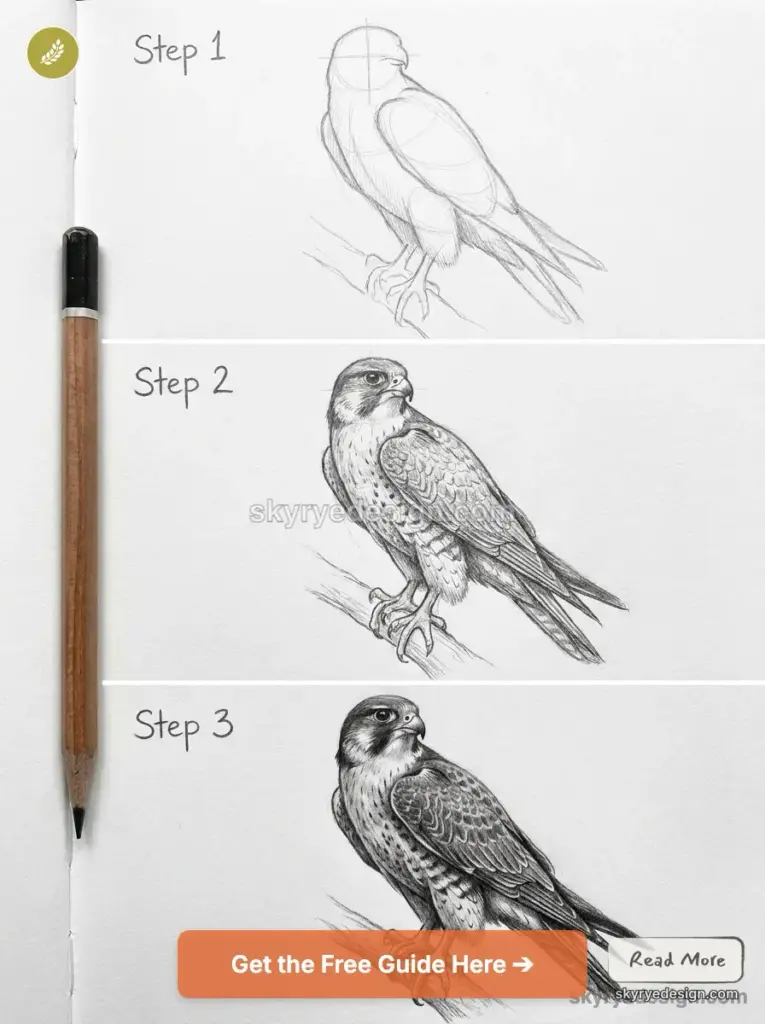
Build tone gradually. Start with 2H pencil to lay in the lightest pass over the whole drawing. Layer with HB for mid-tones. Then 2B and 4B for the darks. Don’t press hard early — once you’ve compressed the paper tooth with a heavy stroke, you can’t layer over it. This is the most common technical mistake I see in students’ graphite work.
The eye and beak details that sell the drawing
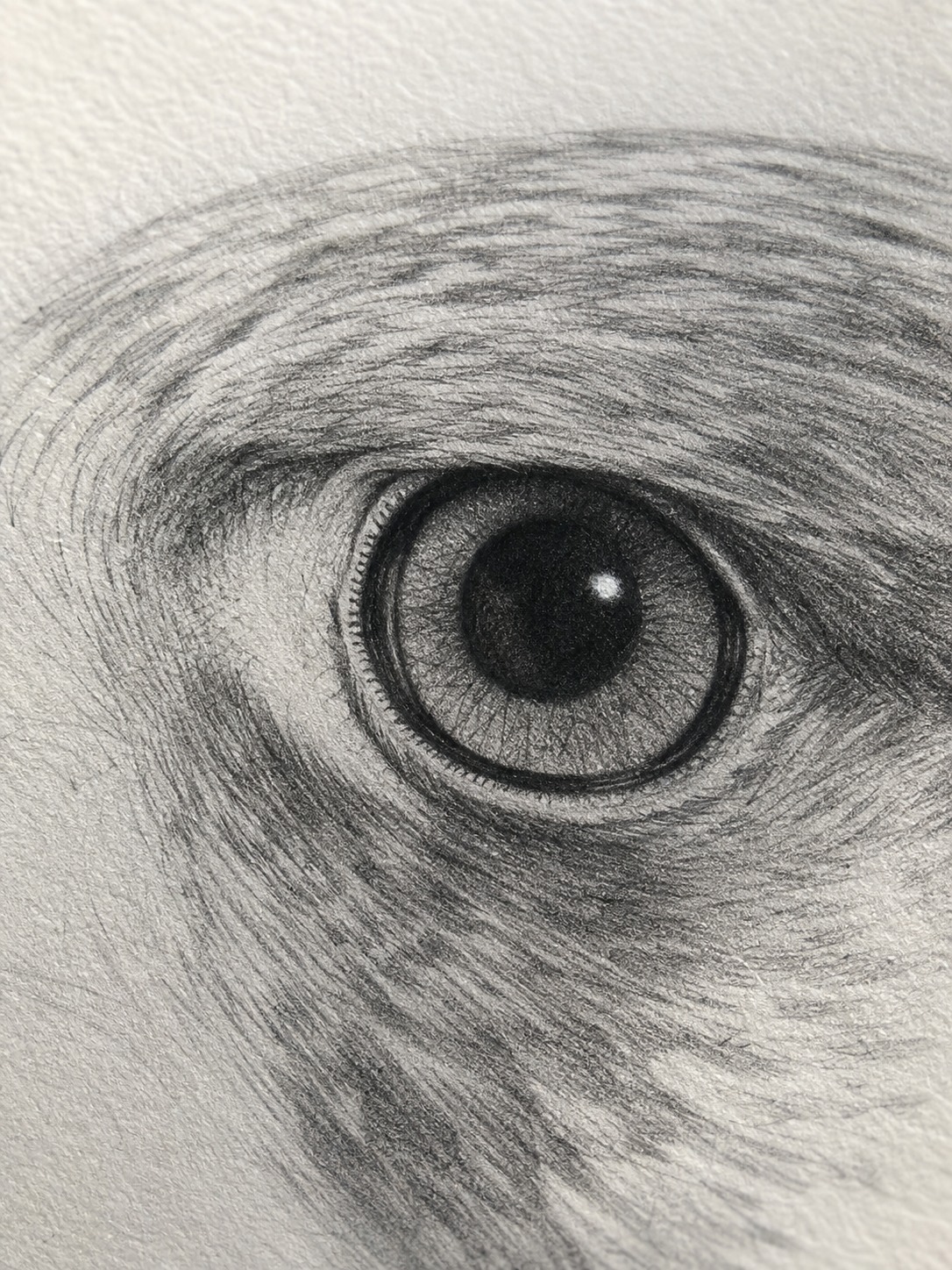
Come back to these last. Darken the eye ring with a sharp 4B, keeping the highlight spot clean. I mask the highlight with a small square of drafting tape when working close to it — a smeared eye highlight ruins everything you built up to that point.
Add a cast shadow directly under the upper mandible, on the lower beak surface. That single shadow makes the beak read as three-dimensional instantly. Without it, the beak looks printed on.
Last check: step back and look at the silhouette from arm’s length. Does it read as a falcon? If not, the overall proportions need adjustment — more detail won’t fix a proportion problem.
FAQ
How long does it take to draw a realistic falcon?
At A4 size, expect 3–5 hours for a finished drawing as a beginner. The construction phase — getting proportions right — takes longer than shading for most people starting out. Don’t rush the head. After three or four falcon studies, the construction phase drops to 20–30 minutes.
What’s the easiest falcon pose to start with?
A perched three-quarter view. Flying falcons require a solid understanding of wing foreshortening, which adds considerable complexity. Get the perched version working cleanly first — in-flight poses become much more manageable after that.
Do I need to draw every feather?
No. Group them. The eye reads clusters of curved parallel lines as feather structure even when you’ve drawn a fraction of what’s actually there. Concentrate your feather detail at leading edges, feather tips, and the boundaries between feather groups — those are the areas where the eye expects precision.
What pencils work best for drawing birds?
Faber-Castell 9000 and Staedtler Mars Lumograph are both reliable and have consistent hardness across the full range. For very dark tones in the eye ring and shadow areas, Tombow Mono 100 in 4B or 6B gives a richer black than most graphite pencils and doesn’t crumble under pressure.
Can I draw a falcon in color?
Yes. Watercolor pencils work particularly well because you can lay in a graphite base and wash over it. Faber-Castell Albrecht Dürer are the best watercolor pencils I’ve tested for this — pigment lifts cleanly and blends smoothly. The peregrine’s blue-gray upper surface responds well to a cool gray wash with a slightly warm undertone in the midtones.
How do I practice falcon drawing efficiently?
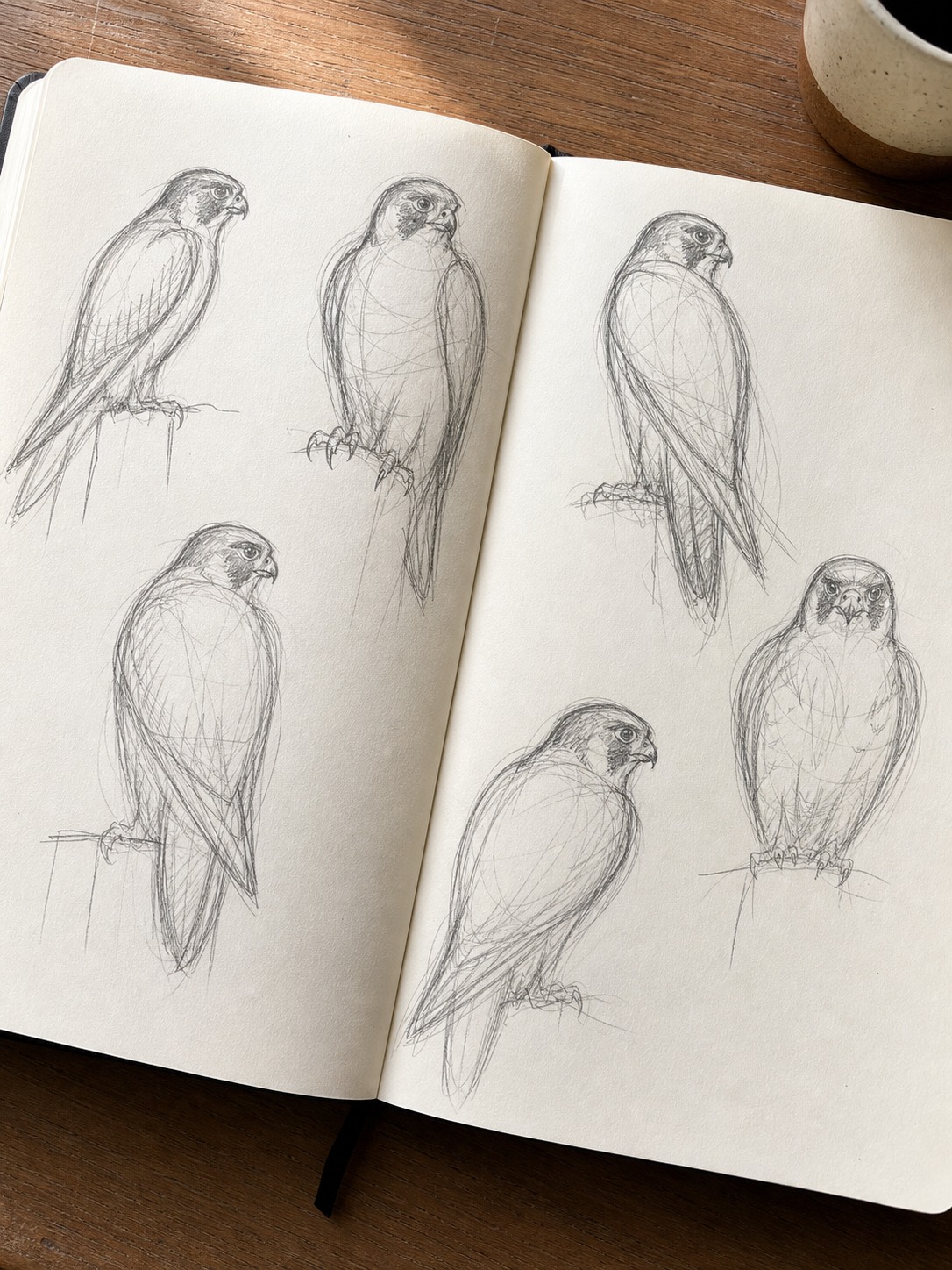
Gesture sketches before every session. Set a timer for 90 seconds and do ten quick gesture studies from reference photos before committing to a finished piece. It forces you to find the essential shapes without getting lost in detail. I still warm up this way before any complex animal study.
Why does my falcon look like a pigeon?
Almost always the body proportions. The chest of a peregrine is deeper and more athletic than most people draw, and the tail is narrow relative to the wingspread. Also check head size: if the head is much larger than one-third the body width, the bird loses its predator character. The facial mask and sharp forward eye placement also do significant work in reading as “falcon rather than generic bird” — if those are soft or uncertain, the drawing reads as generic.
What’s the trickiest part of a falcon drawing?
The wing fold on a perched bird — specifically the way the primary feathers cross over the tail. The exact angle and overlap change based on viewing angle, and getting it wrong makes the bird look uncomfortable or deformed. Study this detail across at least five different reference photos before drawing it.
Related animal drawing practice
Use the falcon study as one stop in a wider animal drawing route. These related guides keep the practice close to anatomy, proportion, texture, and bird structure instead of sending you into unrelated sketch ideas.
- Drawing hub for the full drawing tutorial archive.
- bird drawing guide for wings, feather groups, and flight posture.
- animal drawing ideas when you need the next sketch subject.
- step-by-step animal drawing basics for simple shape construction.
- realistic animal drawing process for value, texture, and lifelike details.
- lion face drawing for another focused head-and-feature study.
- tiger drawing for predator anatomy and stripe texture practice.
- elephant drawing for large-form proportion and skin texture.
- giraffe drawing for long-neck proportion checks and body rhythm.
- insect sketching practice for small-scale texture and reference discipline.
Final thoughts
Falcons demand accuracy in a way that forgiving subjects don’t. The body proportions, forward eye placement, precise beak curve — shift any of them more than a little and you’ve drawn something else.
Start with the structure, study the anatomy before touching the page, and shade in value zones rather than covering the drawing with tone all at once. The facial mask and the lit eye are the two elements that make or break the final result. Give them the time they need.
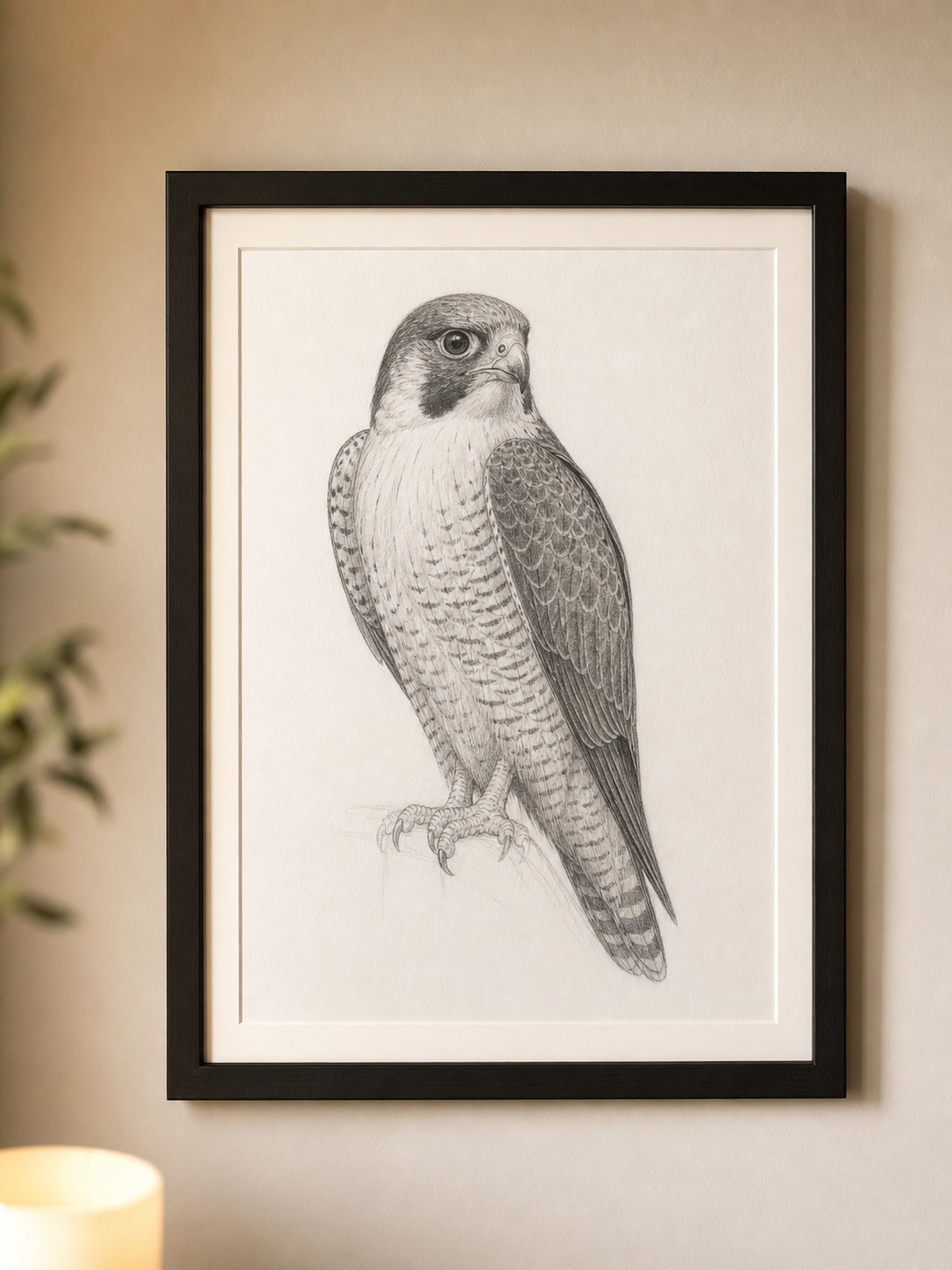
Your first falcon won’t be perfect. Mine wasn’t. But if the underlying construction is solid, you’ll have specific things to fix next time — and that’s how the drawings actually get better.
- 2.4Kshares
- Facebook0
- Pinterest2.4K
- Twitter0
- Reddit0