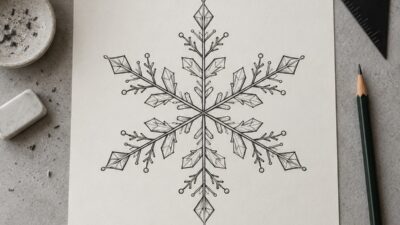
Landscape drawing is the practice of turning outdoor scenery into a clear composition: horizon, big shapes, value, texture, perspective, and atmosphere. The subject can be mountains, forests, rivers, beaches, open sky, a street corner, a bridge, or a city skyline at dusk.
Start with the largest shapes before details. Place the horizon line, divide the scene into foreground, middle ground, and background, then choose one focal point. If those decisions are clear, even a simple pencil landscape drawing starts to feel spacious before you add trees, water, clouds, or buildings.
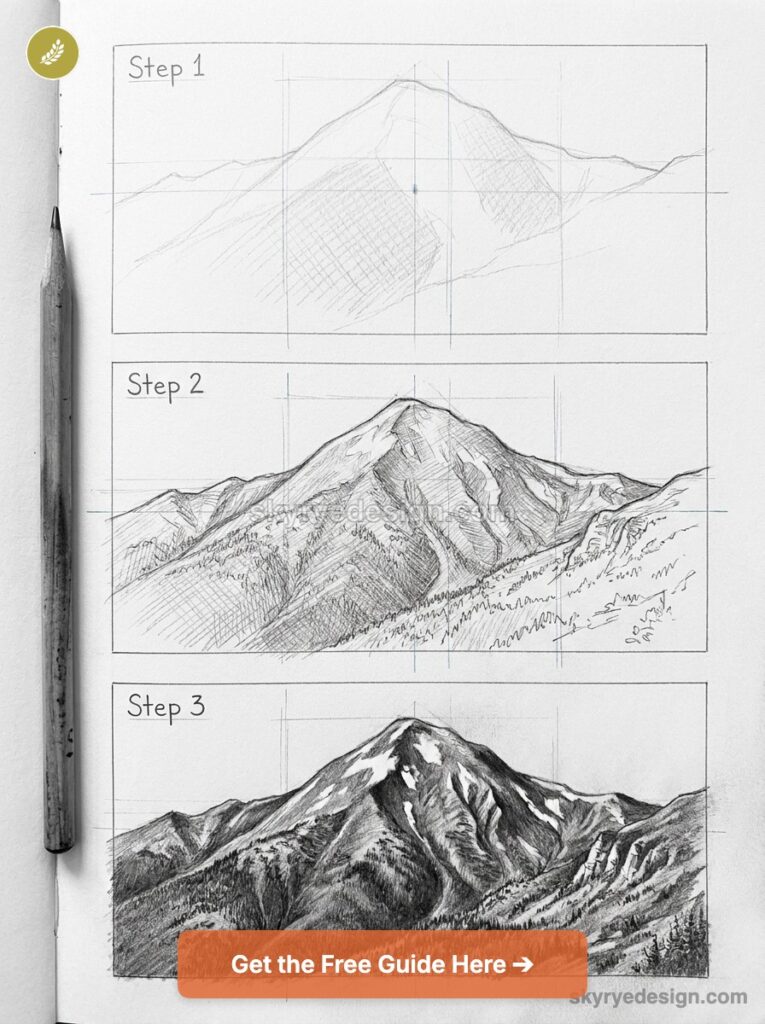
Lighter marks for distant objects, stronger contrast in the foreground, simple repeated texture for trees, grass, water, stone. Graphite, charcoal, ink, watercolor, colored pencils, digital brushes — landscape drawing works in all of them. What usually separates a strong landscape from a weak one isn’t the medium or even the subject. It’s one clear focal point and the patience to layer slowly instead of trying to finish everything at once.
- What is landscape drawing?
- What materials do you need for landscape drawing?
- How do you draw natural elements in a landscape?
- How do you add buildings, roads, and bridges to a landscape?
- Landscape drawing techniques that create depth
- How to draw a landscape step by step
- How to plan a landscape drawing before you add detail
- Landscape drawing tips for beginners
- Related practice for better landscape drawings
- Frequently asked questions about landscape drawings
- Q: What is landscape drawing?
- Q: How do you start a landscape drawing for beginners?
- Q: Why is perspective important in landscape drawing?
- Q: What are the best tools for landscape drawing?
- Q: How long does it take to complete a landscape drawing?
- Q: What are common mistakes in landscape drawing?
- Q: How can I make my landscape drawings look more realistic?
- Q: What are some easy landscape drawing ideas for practice?
I still like landscape drawing because it makes you think like a designer. You are not just copying a tree or a mountain. You are deciding what belongs in the frame, where the eye should travel, and which details can be left quiet so the important shapes have room to breathe.
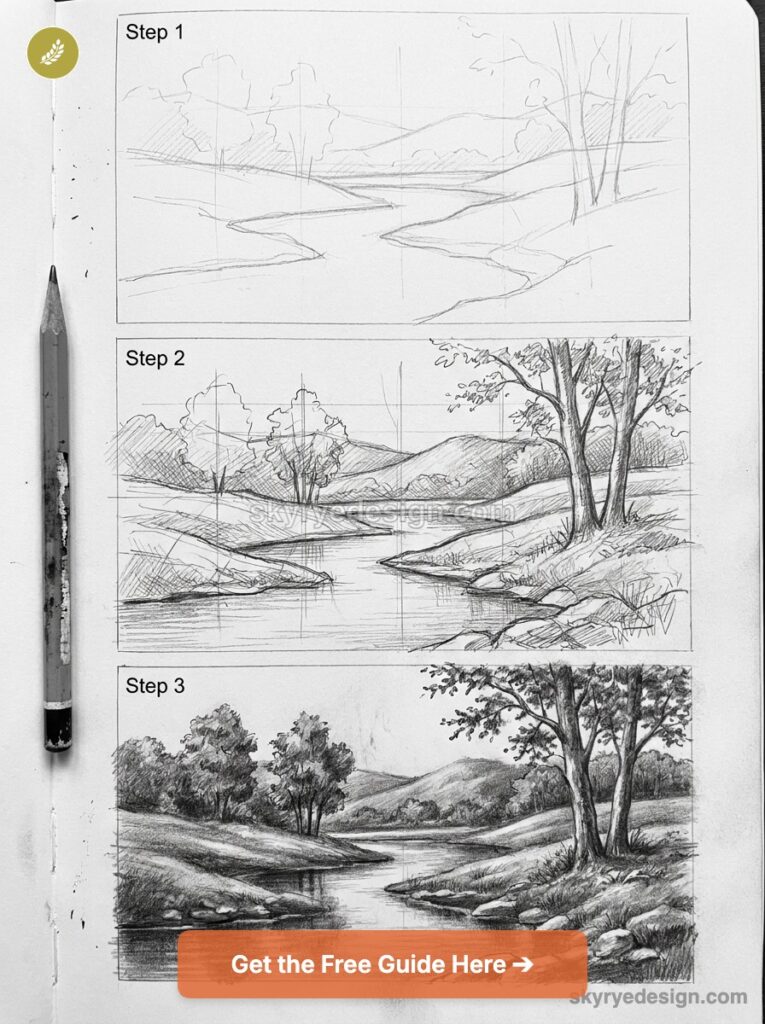
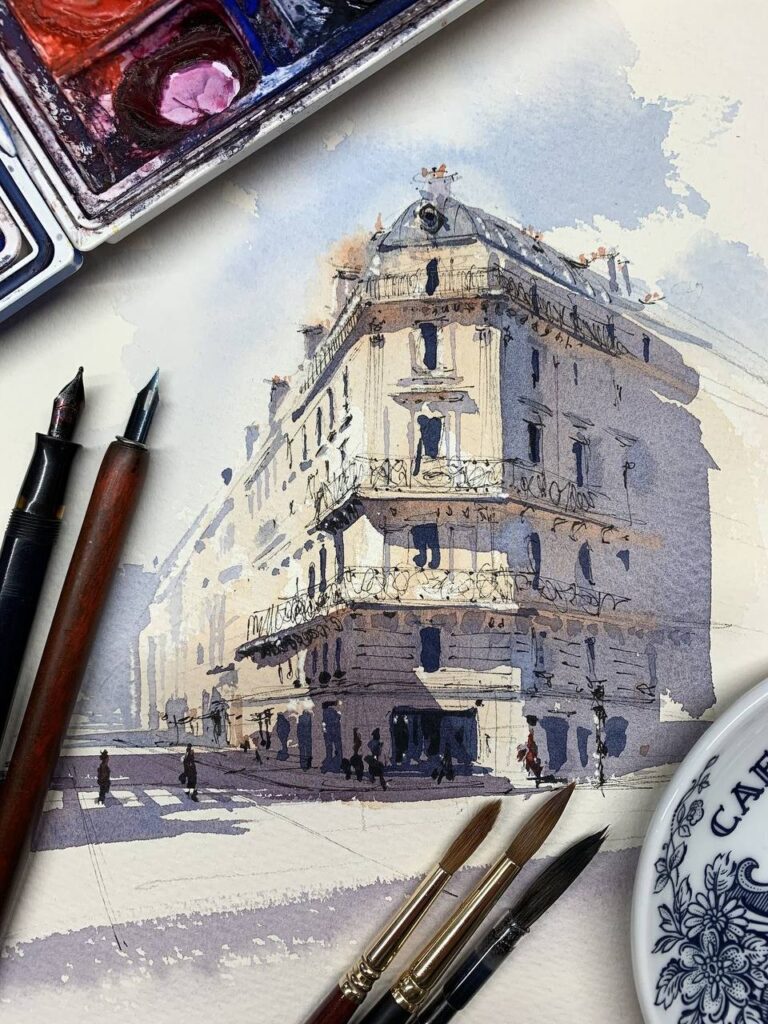
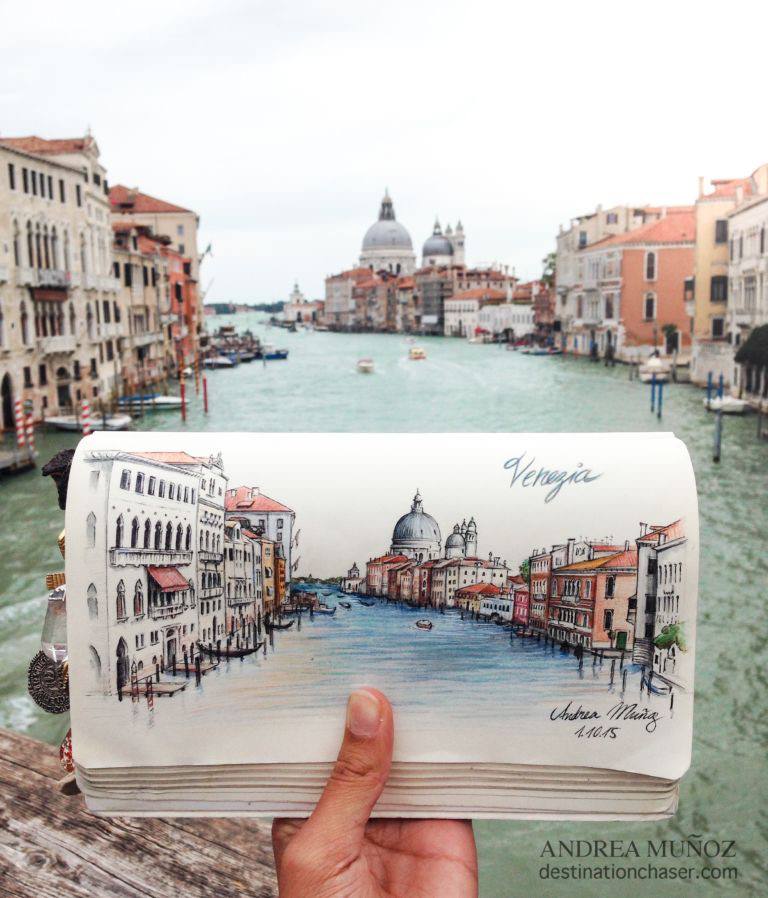
What is landscape drawing?
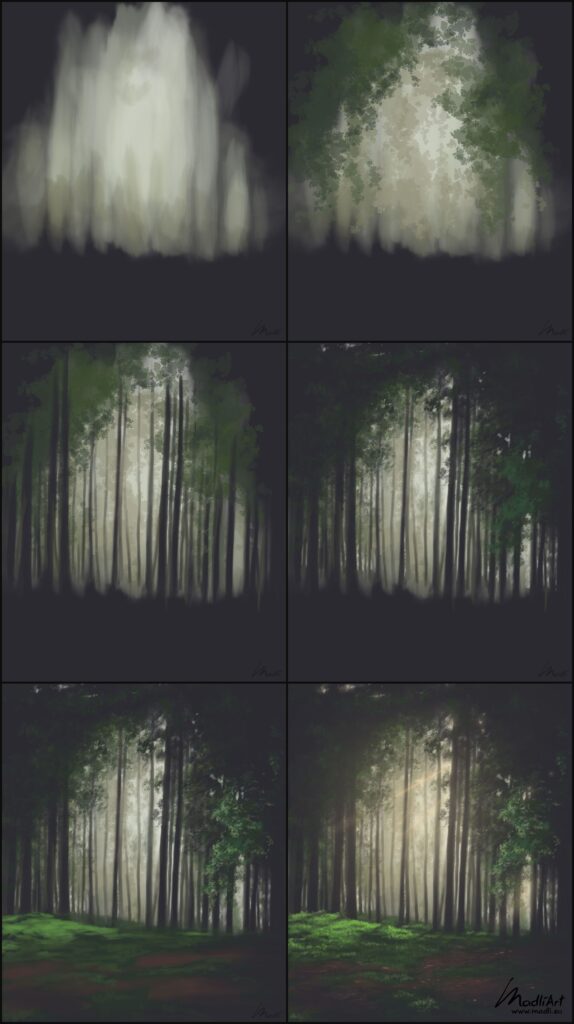
Landscape drawing starts with space. Before texture or color matters, the page has to feel as if you can step into it. Perspective and composition do most of that work.
Perspective is how you suggest depth. Objects shrink as they recede. Parallel lines converge at a vanishing point on the horizon. You don’t need to be obsessive about it — even a loose, gestural landscape benefits from keeping the basic rules in your head.
Composition is how you arrange the scene. Try not to drop the horizon line dead center unless you have a deliberate reason. Give the eye a path into the drawing: a road, riverbank, fence line, row of trees, or shadow shape. That small choice often makes the difference between a static view and a drawing that feels walkable.
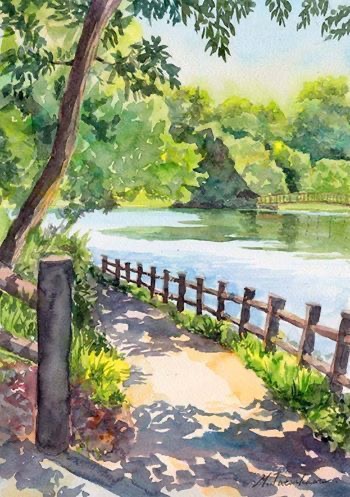
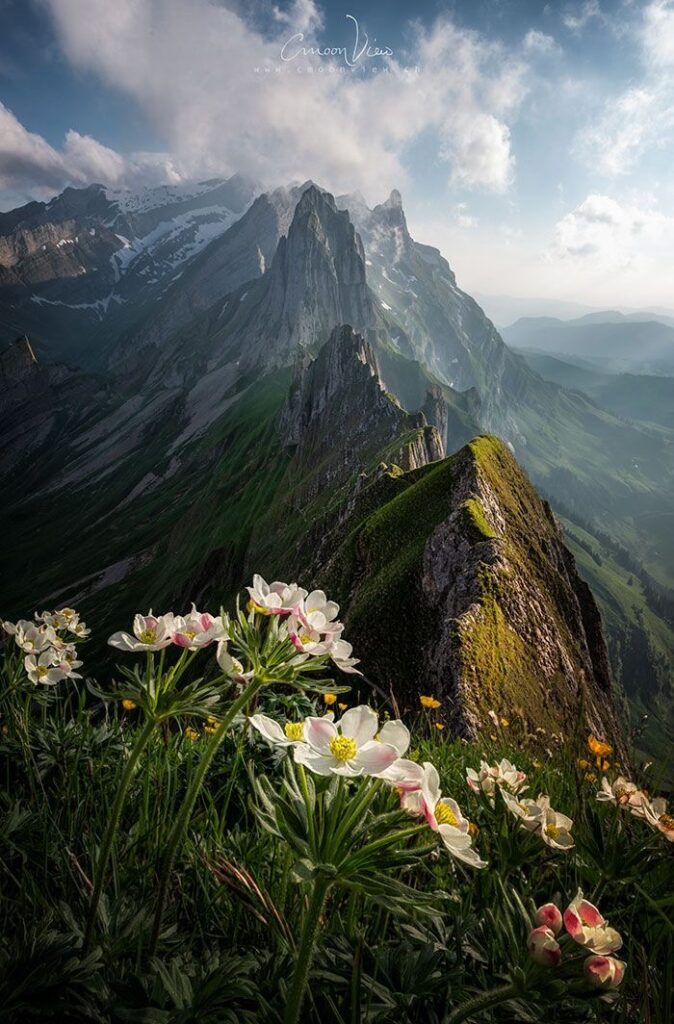
Measurements matter more than people think. I used to eyeball everything, and my distances were always slightly off. Checking proportions while you’re still in pencil saves a lot of frustration later.
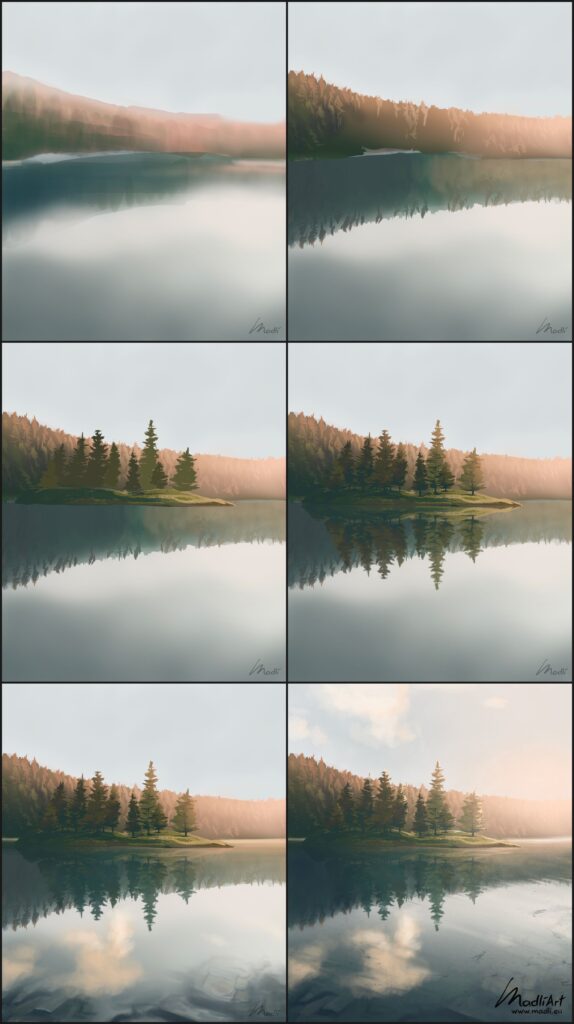
What materials do you need for landscape drawing?
You do not need a studio full of supplies for landscape drawing. A pencil, an eraser, and paper are enough for the first studies. Still, the tool changes the kind of marks you can make, so it helps to choose materials based on the scene rather than buying everything at once. If you want a fuller kit list, use this drawing materials for landscape sketches guide after you know which medium you want to practice.
| Goal | Best tool | Why it helps |
|---|---|---|
| Light planning | 2H or HB pencil | Easy to erase while you test the horizon, major shapes, and focal point. |
| Deep shadows | 4B-6B pencil or charcoal | Builds strong foreground contrast without pressing too hard early. |
| Fine outlines | Waterproof ink pen | Keeps buildings, branches, and rocks crisp, even under a light wash. |
| Soft atmosphere | Watercolor or colored pencil | Works well for skies, haze, distant hills, and quiet color shifts. |
| Digital practice | iPad, Procreate, or Wacom tablet | Layers make it easier to test values and move large shapes before refining. |
Pencils and paper
Graphite pencils are where most people start, and honestly, it’s a good call. A range from 2H through 6B covers everything — hard pencils for light hatching, soft ones for deep shadows and blending.
For paper, go with something that has a bit of tooth. Super smooth surfaces don’t hold graphite well; the lines skip and look weak.
Ink pens
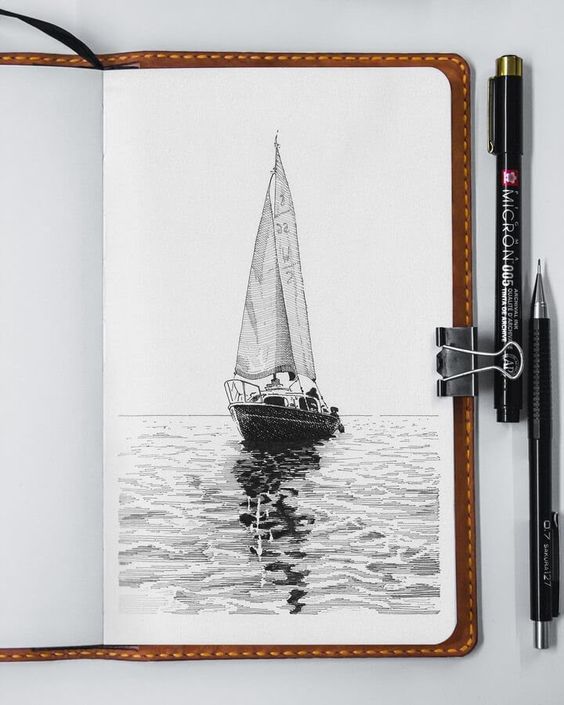
Ink is unforgiving, which is either a feature or a bug depending on your temperament. I find it forces me to commit to marks instead of second-guessing every line. Fine-nib pens work well for detail; broader nibs are good for blocking in tone quickly. If you want to add watercolor washes on top, make sure you’re using waterproof ink first — learned that the hard way.
Colored pencils
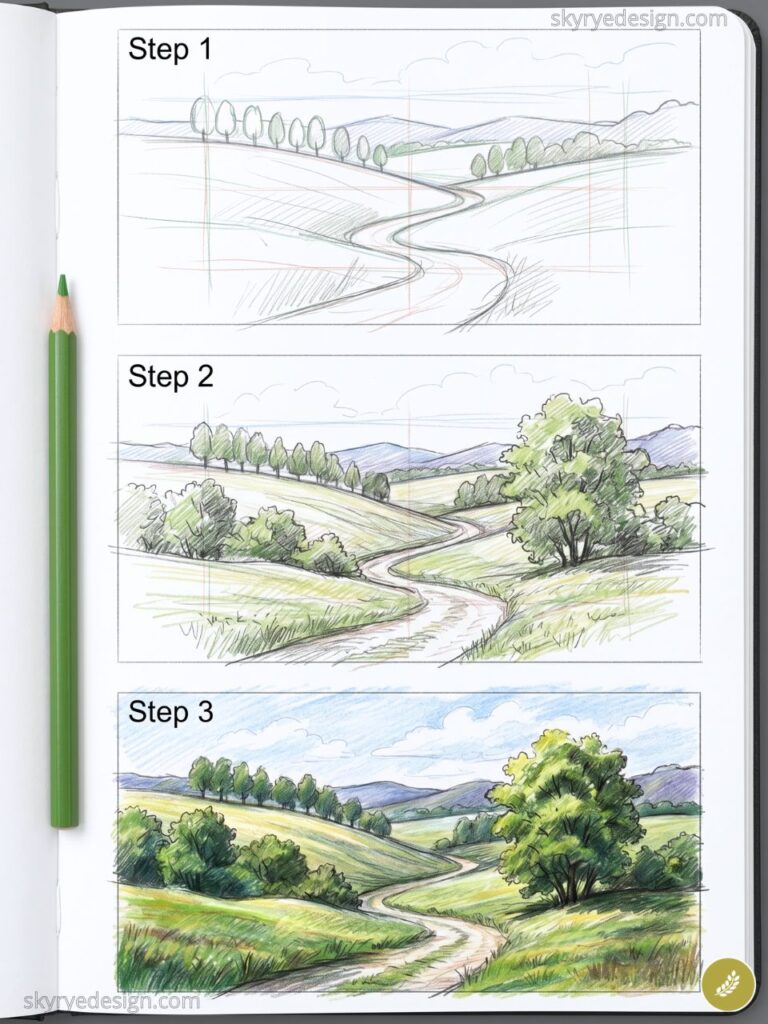
Colored pencils are underrated for landscapes. They’re slow, but that slowness is useful for building up soft gradients in sky and foliage. Look for lightfast pigments if you’re making anything you want to last. Prismacolor Premiers blend well; Polychromos are harder and hold a sharper edge if you need line detail.
Markers
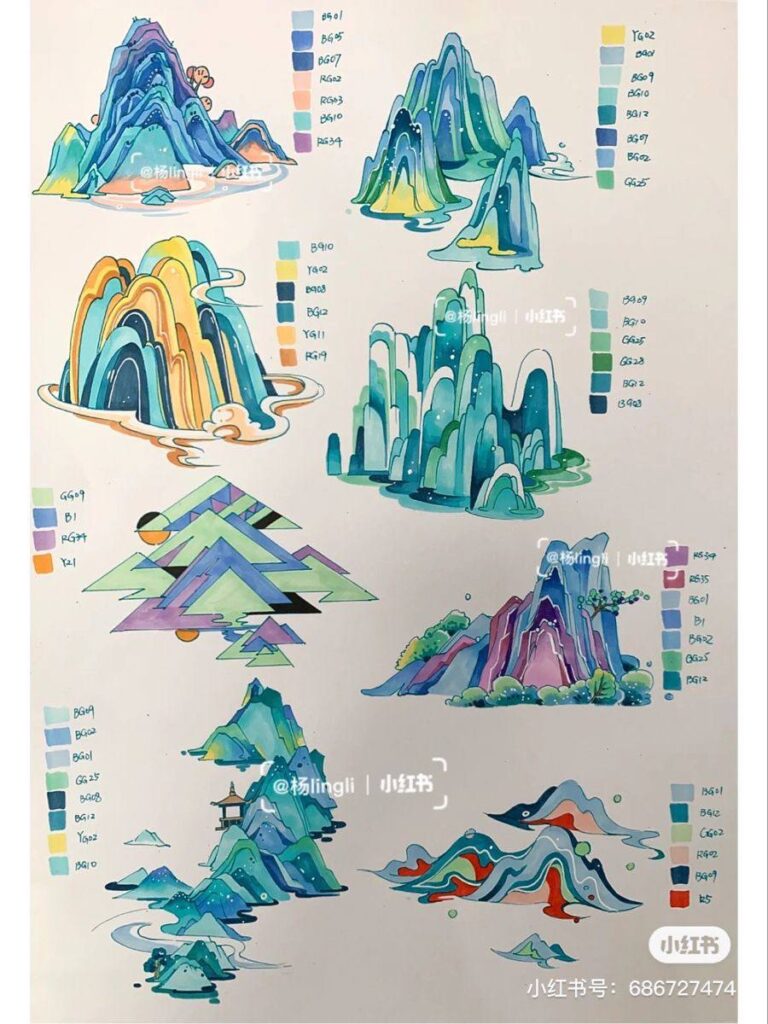
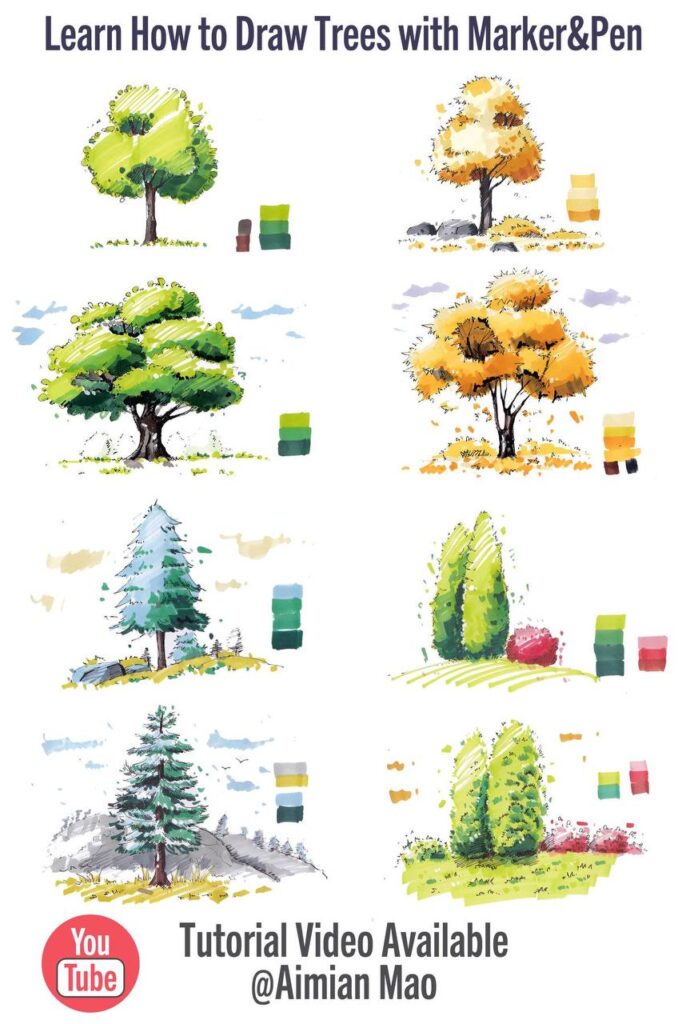
Alcohol-based markers — Copics, Touche, even cheap alternatives — are great for fast color blocking. They dry quickly and layer in a way that mimics ink wash. Not ideal for fine texture, but good for establishing overall color relationships before going in with detail.
Paint
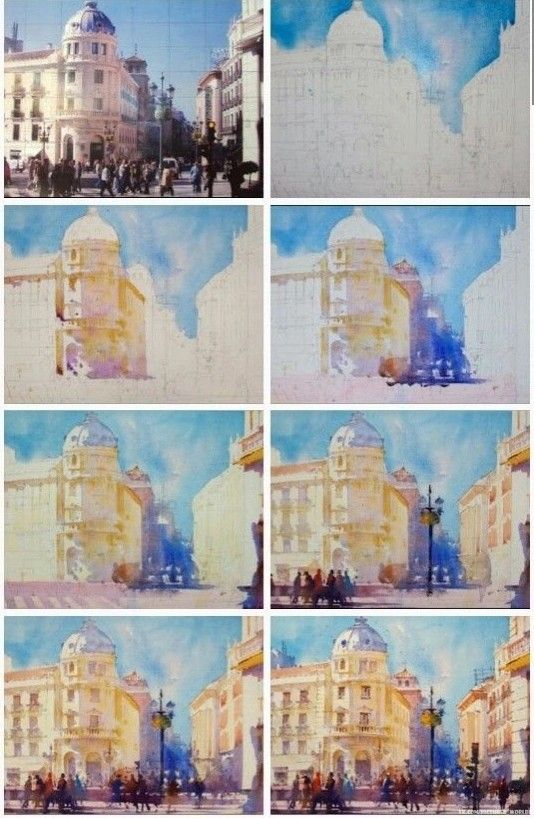
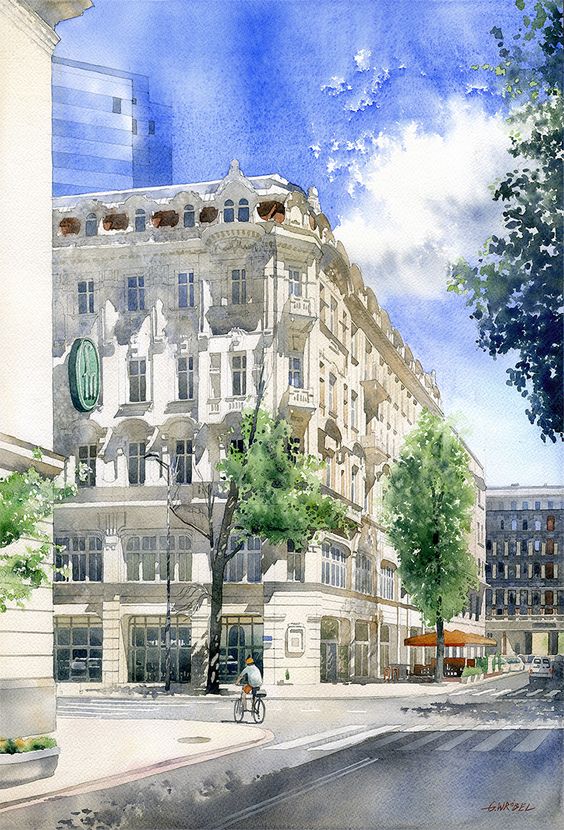
Watercolor handles landscapes beautifully because the washes naturally suggest atmosphere — soft skies, misty backgrounds, loose foliage. Acrylics give you more control and dry fast, which is useful outdoors. I’ve used both. Watercolor teaches you to plan ahead; acrylics are more forgiving if you want to paint over something.
Canvas
Canvas is for paint, not pencil. If you’re working in paint and want a surface with texture and some give under the brush, stretched canvas is worth it. For everything else, good drawing paper is enough.
Eraser and sharpener
A kneaded eraser helps a lot with graphite landscapes because you can lift out highlights by pressing it into the paper instead of scrubbing. A mechanical sharpener gives a consistent point, but I prefer a knife for soft pencils because regular sharpeners often snap the lead.
If you are stuck choosing materials, start simple: HB, 2B, 4B, a kneaded eraser, and paper with a little tooth. Add ink, watercolor, or markers only when you know what problem you want the new tool to solve.
How do you draw natural elements in a landscape?
Natural elements are easier to draw when you stop treating them as symbols. A tree is not a green cloud on a stick. Water is not a flat blue stripe. Mountains are not just triangles. Look for the big structure first, then add texture only where it helps the drawing read.
For trees, begin with the trunk angle and the overall crown shape. Then break the foliage into a few uneven masses instead of drawing hundreds of individual leaves. Put the darkest gaps where branches overlap or where the canopy blocks light. A few sharp branches near the foreground will do more than covering the whole tree with tiny marks.
For a simple foreground exercise, try a palm tree sketch and pay attention to the trunk angle before adding leaves.
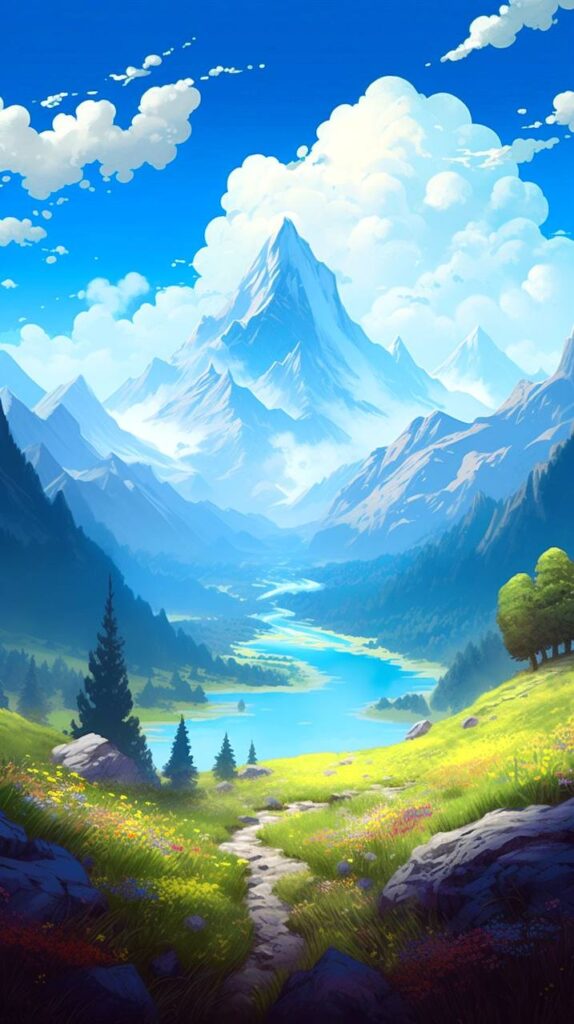
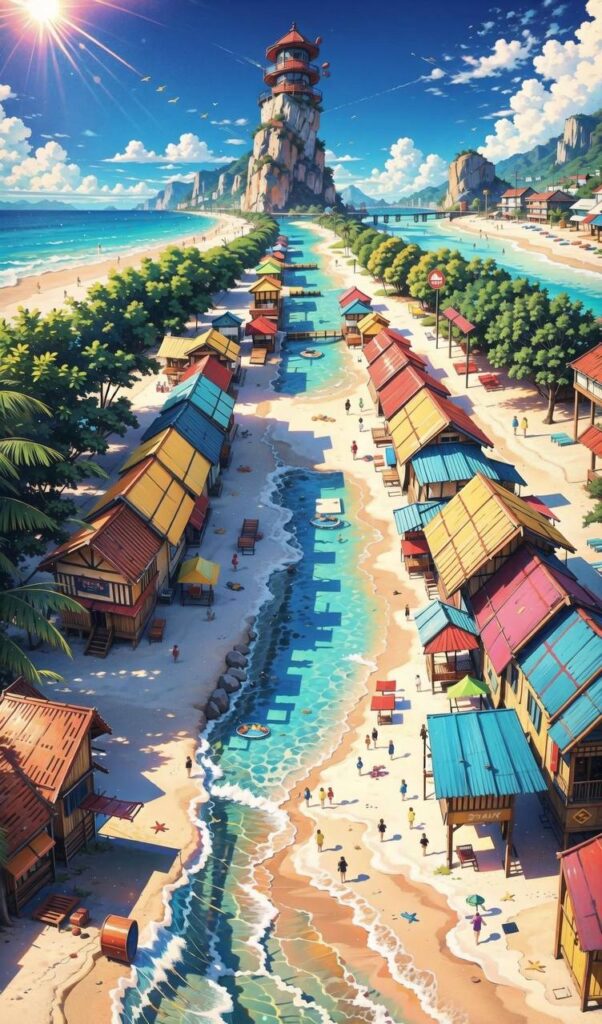
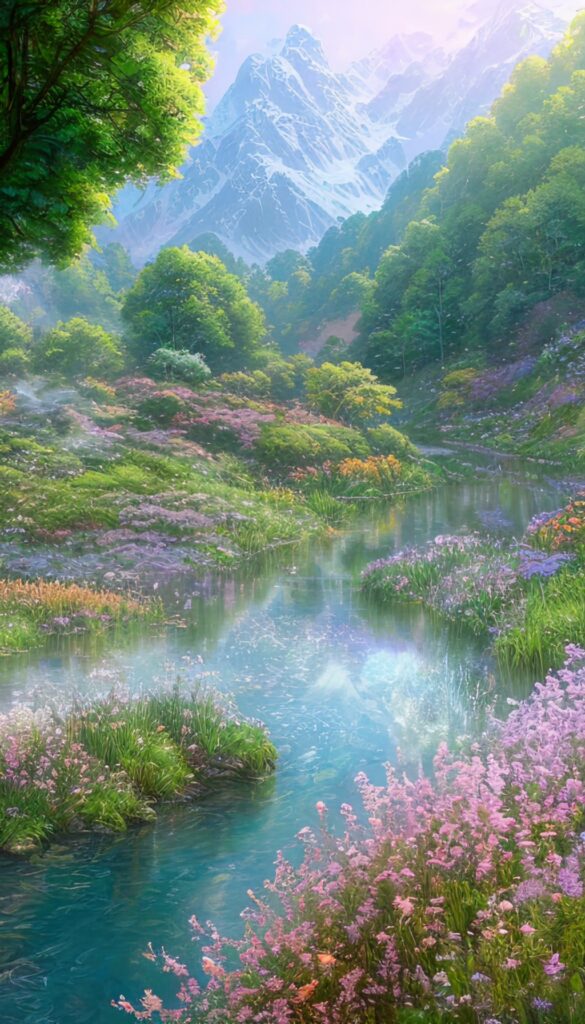
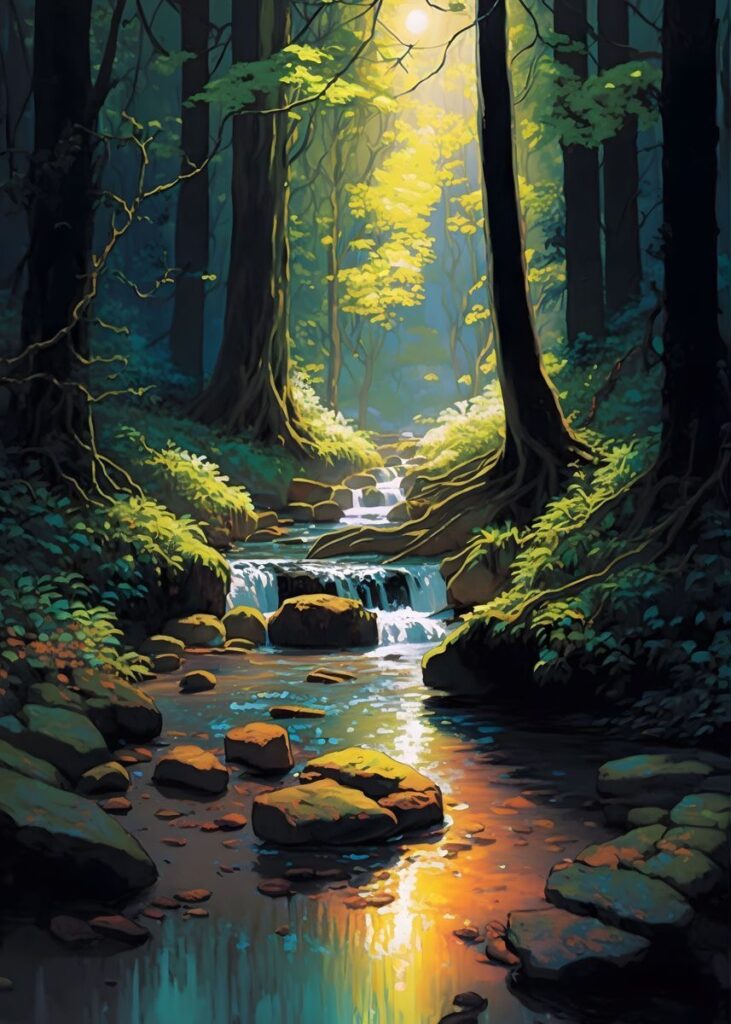
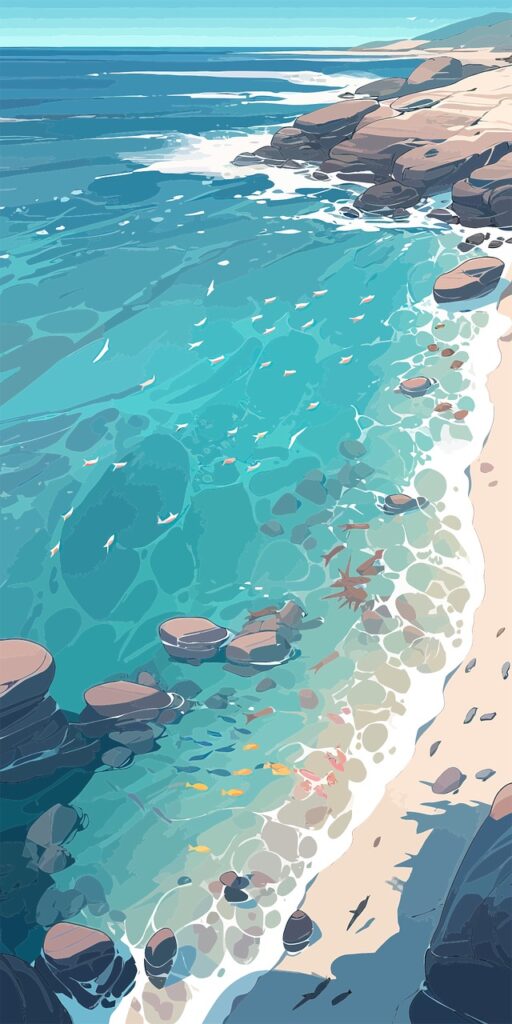
Water is mostly value and edge control. Calm water has long, horizontal reflections with softened edges. Moving water breaks into smaller shapes around rocks, banks, or waves. Keep reflections slightly darker than the object they mirror, and avoid outlining every ripple. Too many equal lines make water look like fabric.
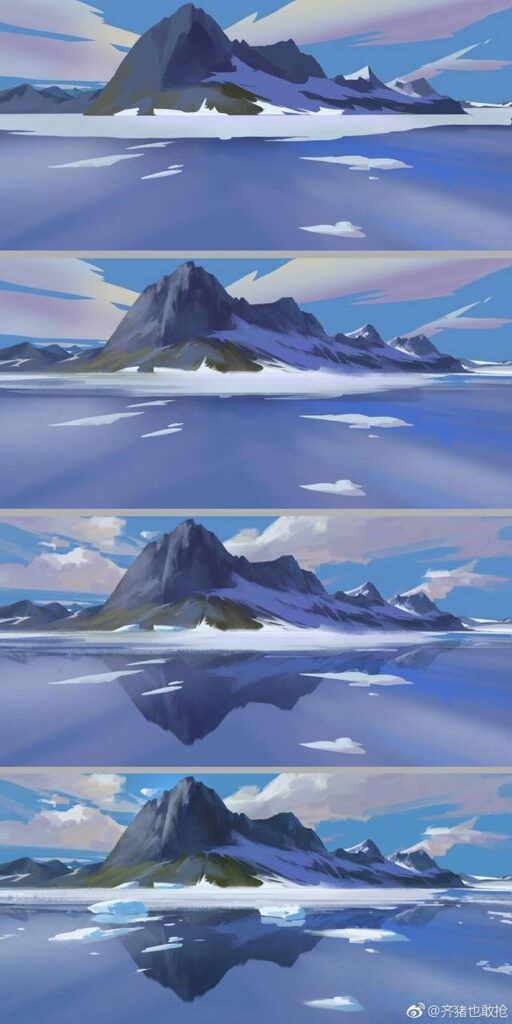
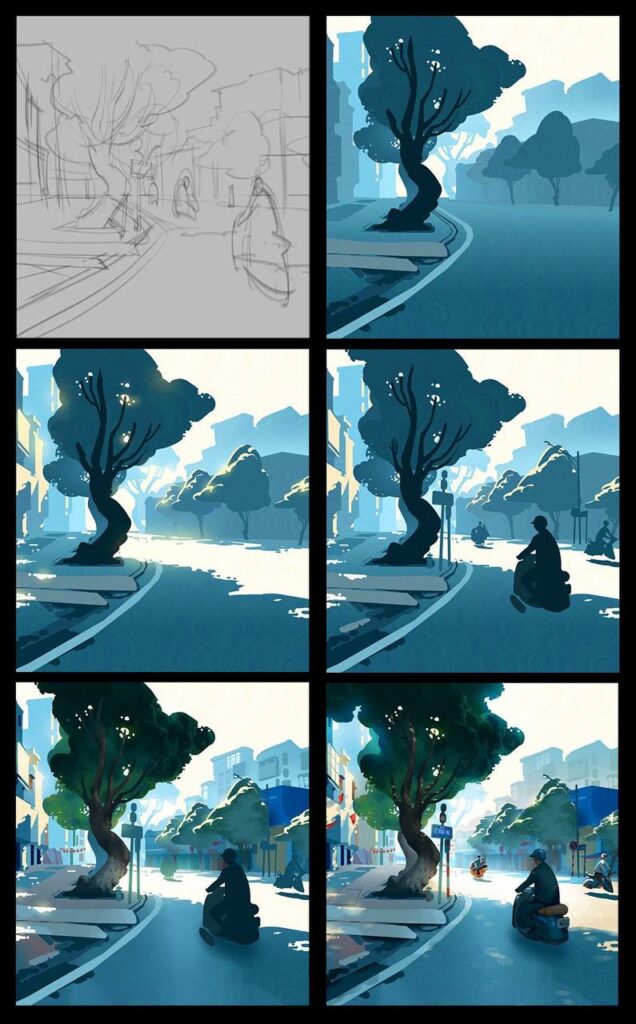
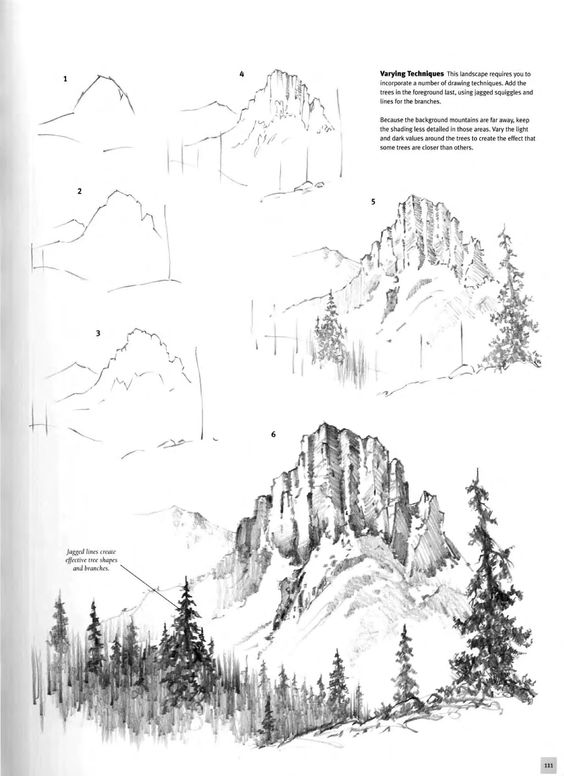
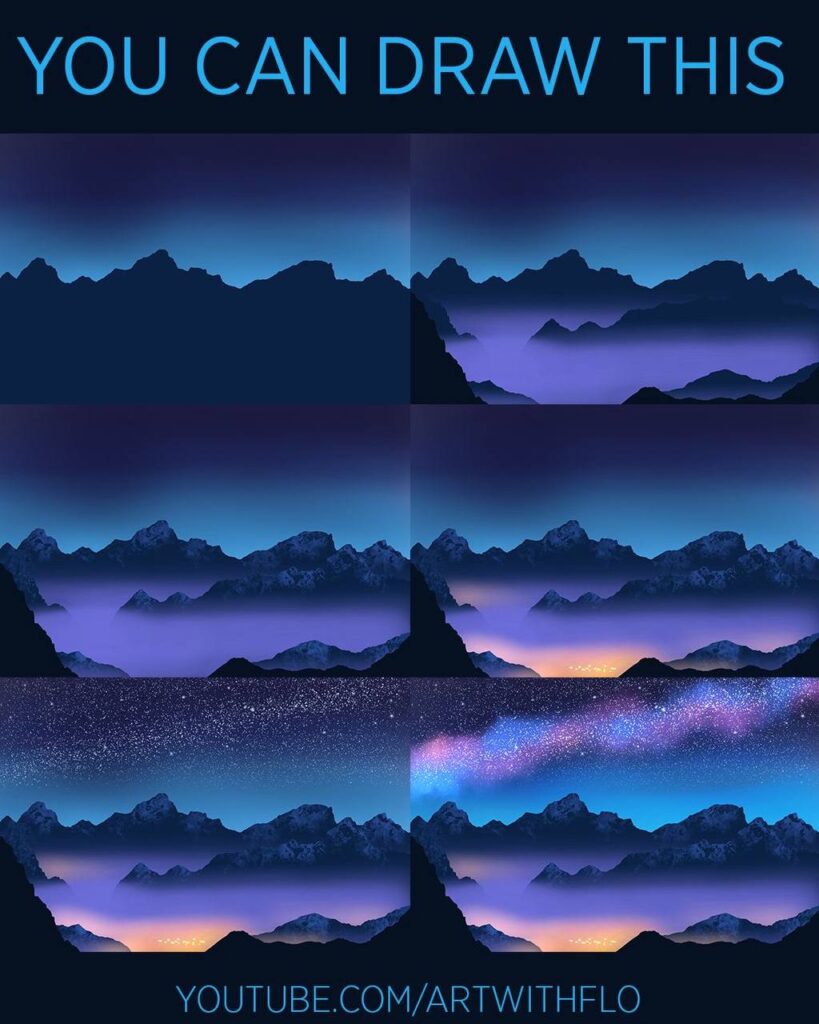
Mountains need a strong silhouette first. After that, think in planes: one side catches light, another falls into shadow, and ridges create smaller value shifts. Distant mountains should usually be lighter, softer, and less detailed than rocks in the foreground. That shift in value and sharpness is what makes atmospheric perspective work.
The sky sets the light source for the whole drawing. Before shading, decide where the sun is and keep every shadow consistent with that choice. Clouds work best as soft value groups, not hard white outlines. Leave some quiet sky space too, especially if the foreground has a lot of texture.
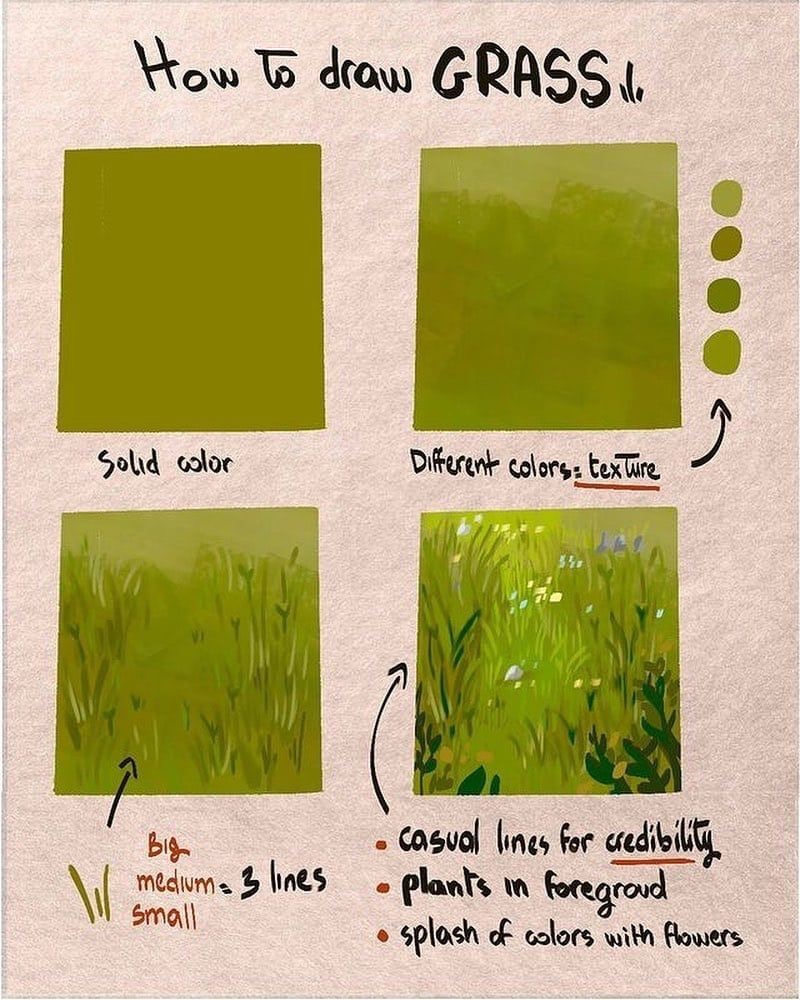
Grass and shrubs are texture, but they still need design. Use larger, darker marks in the foreground and smaller, broken marks farther back. A few blades crossing the bottom edge of the drawing can create scale without making you draw every patch of grass.
Rocks are easier when you draw them as simple blocks first. Find the top plane, side plane, and cast shadow before adding cracks. Clouds are the opposite: keep their edges softer, vary the shapes, and avoid repeating the same cotton-ball curve across the sky.
Whether you are sketching a beach, a mountain path, or a winter field, choose one natural element to study closely in each drawing. One session can be about water reflections. Another can be about tree silhouettes. That kind of focused practice builds skill faster than trying to perfect the entire scene at once.
How do you add buildings, roads, and bridges to a landscape?
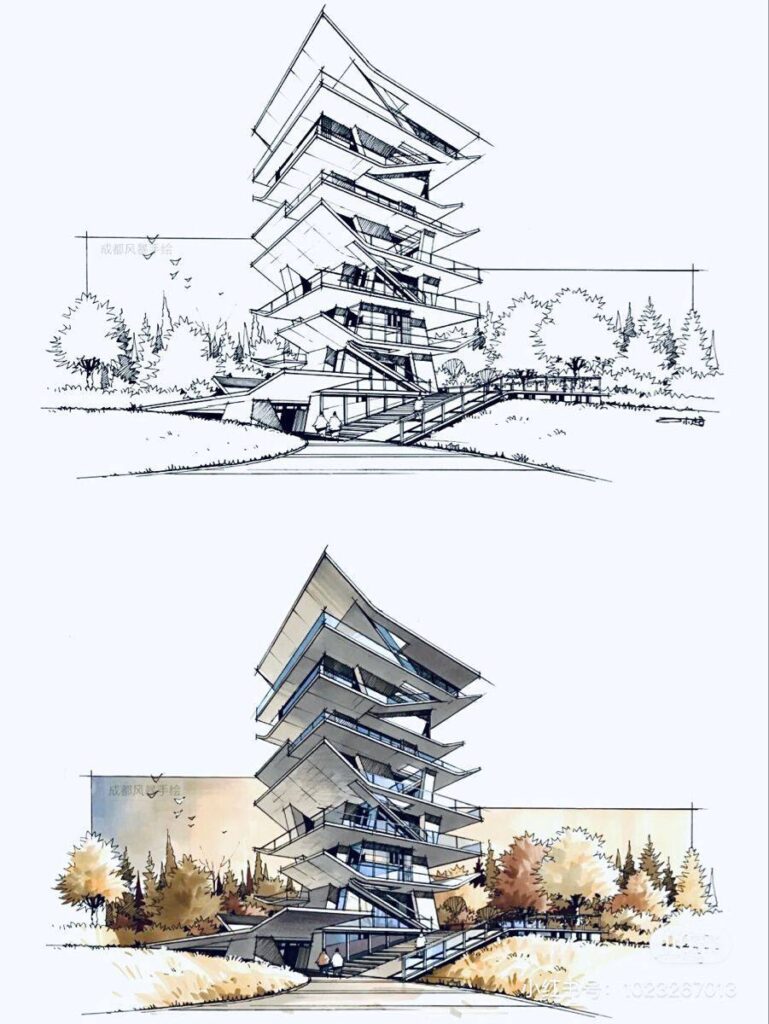
Buildings and structures add scale to a landscape and tell you something about the place. The key difference from natural elements is that man-made things follow rules — parallel lines, right angles, consistent proportions.
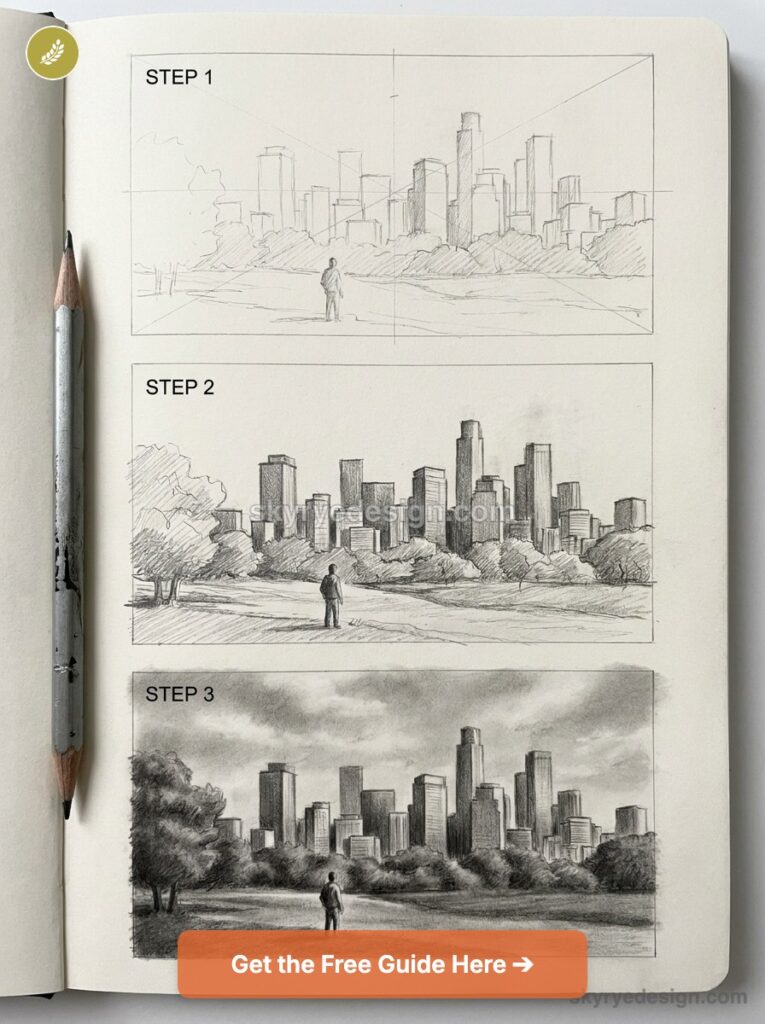
Start with the basic box before adding windows, doors, or details. Get the perspective right first. A building that’s slightly off-perspective will look wrong even if every detail is accurate.
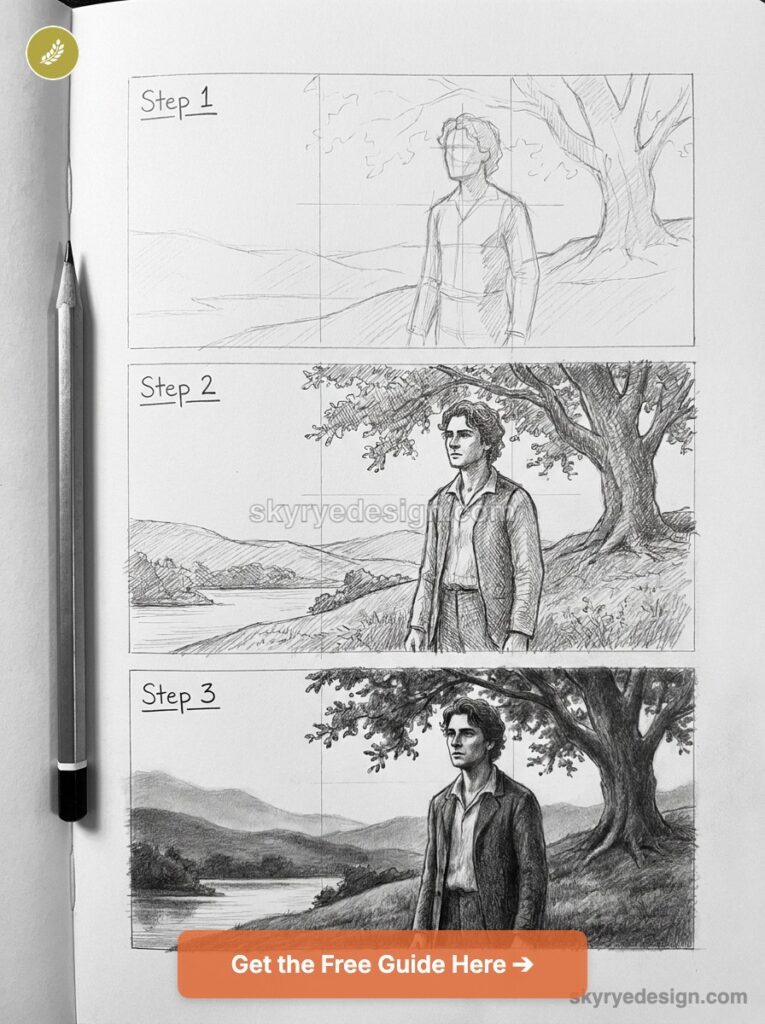
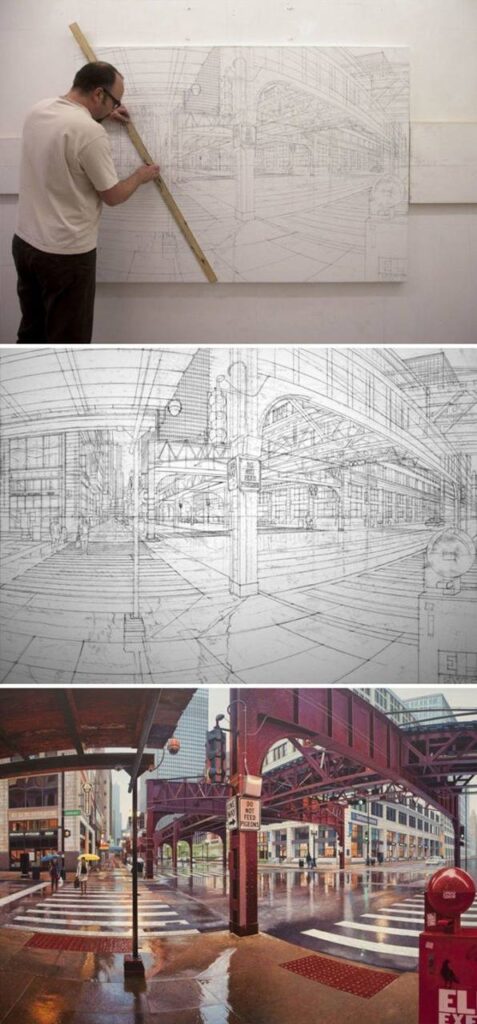
Cityscapes need reference. There’s too much going on to invent convincingly, and even a quick photo study helps you understand how the buildings relate to each other in space. I usually thumbnail the layout first before committing to ink.
Houses vary a lot by region and period. A Victorian terrace has different proportions than a farmhouse or a modernist block. The details matter less than getting the overall shape and massing right.
Landscape drawing techniques that create depth
Good landscape drawing technique is not about adding more detail. It is about controlling depth, value, edge softness, and rhythm so the viewer understands the space quickly.
Sketching and drawing skills
Sketch first in thumbnails. Make three small boxes and move the horizon, focal point, and main shadow shape around before you commit to the final drawing. This is where academic drawing habits help: compare angles, check proportions, and fix the big relationships while the marks are still light.
Color and texture
Color should support the value pattern, not cover it up. If the drawing works in grayscale, color will usually make it stronger. For texture, vary the mark direction: short broken strokes for grass, clustered shapes for leaves, longer horizontal marks for water, and angular marks for rock.
Shading
Shading creates depth when the value range is organized. Keep the foreground darker and sharper, then let the distance become lighter and quieter. I usually test the darkest dark early in one small area, then build the rest of the drawing around that value instead of guessing.
Angular shapes
Angular shapes are useful because they stop the drawing from becoming mushy. Rooflines, rock faces, fence posts, tree trunks, and mountain ridges give the scene structure. Even loose landscapes need a few firm angles so the soft areas have something to play against.
Realism
Realism is not the same as copying every detail. A landscape feels real when the light direction, scale, perspective, and value relationships agree with each other. If those are right, the viewer will accept a surprising amount of loose mark-making.
Use technique as a checklist: clear horizon, simple value pattern, consistent light, sharper foreground, softer distance. If one of those breaks, fix it before adding more texture.
For a focused terrain exercise, use the mountains drawing tutorial to practice layered ridges, atmospheric perspective, and foreground-to-background value control.
How to draw a landscape step by step
Landscape practice works best when it is small and specific. Instead of trying to finish a perfect scene every time, set one clear exercise for the page: a sky study, a tree silhouette, a road in one-point perspective, or a two-value mountain sketch.
| Step | What to draw first | Why it matters |
|---|---|---|
| 1 | Horizon and crop | Sets eye level and keeps the scene from spreading everywhere. |
| 2 | Big value shapes | Separates sky, land, water, trees, and buildings before detail. |
| 3 | Foreground, middle ground, background | Creates depth and gives the viewer a path into the drawing. |
| 4 | Light direction | Keeps shadows consistent across rocks, trees, clouds, and structures. |
| 5 | Texture and focal detail | Adds finish without making every area fight for attention. |
Use a sketchbook
A sketchbook lets you collect visual notes without the pressure of a finished artwork. Keep the drawings small. Five thumbnail landscapes on one page teach composition faster than one oversized drawing that becomes precious after ten minutes.
Draw sketches from photos
Photo studies are useful, especially when weather or travel gets in the way. Use clear references with one obvious light source. Before copying details, crop the photo into a better composition and mark the biggest dark shape. That one step keeps the study from becoming a slow outline exercise.
Experiment with different mediums

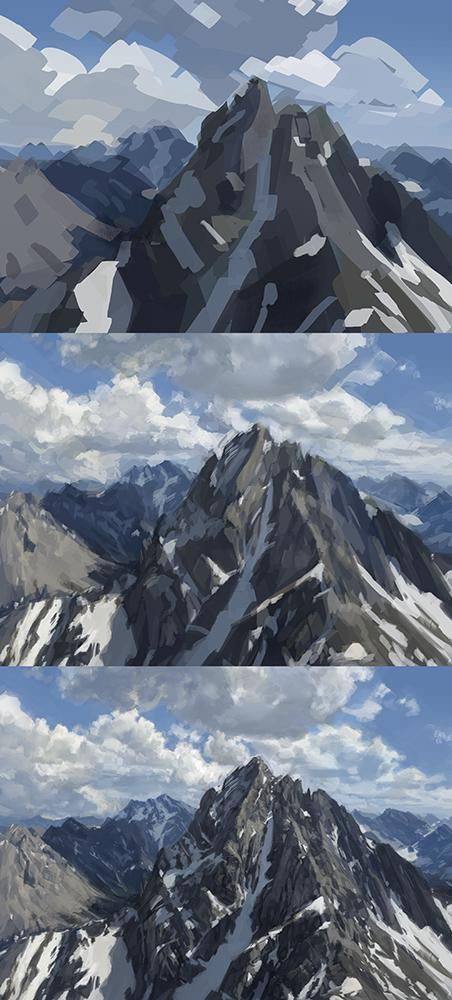
Try different mediums, but give each one a job. Use graphite for value studies, charcoal for bold shadows, ink for line confidence, watercolor for atmosphere, and colored pencil for slow layering. Switching tools randomly can be fun, but focused tests teach more.
Learn from other artists
Study other artists with a question in mind. How did they simplify trees? Where did they put the darkest value? How much detail is actually in the distance? Copying a small corner of a master drawing can teach more than scrolling through a hundred finished artworks.
Good museum collections are useful here because you can study real compositions instead of random reference scraps. The Met collection, National Gallery of Art collection, and Tate landscape glossary are good starting points for seeing how artists simplify distance, sky, and foreground rhythm.
Practice consistently
Consistency matters, but it does not have to mean long sessions. Ten minutes of thumbnail sketches is enough if you do it with focus. Date the page, write the exercise in the margin, and you will start seeing which problems repeat.
The goal is not to make every practice page pretty. The goal is to collect decisions: this crop works, this value pattern is too flat, this tree shape needs variety, this road leads the eye nicely. That is how landscape drawings improve.
How to plan a landscape drawing before you add detail
Planning a landscape drawing is a quick design pass before the final sketch. You are making a visual blueprint: where the horizon sits, where the focal point lands, how the foreground leads in, and which areas stay quiet.
Start with a tiny stakeout on paper. Mark the border of the drawing, then place the largest shapes in simple blocks. If the road, river, mountain, or building feels awkward at this stage, move it now. It is much easier than fixing it after shading.
For landscape studies, these realistic cloud drawing steps are useful when the sky needs the same care as the land forms. See the full realistic cloud drawing steps.
Use a viewfinder if the scene feels too busy. A small cardboard rectangle or your phone camera can help you crop out distractions. I look for one strong silhouette and one clear path for the eye before I start adding line detail.
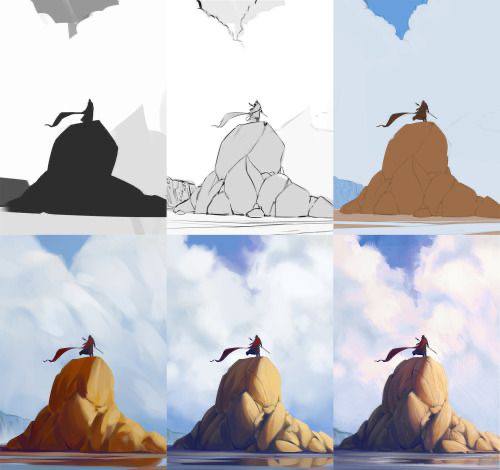
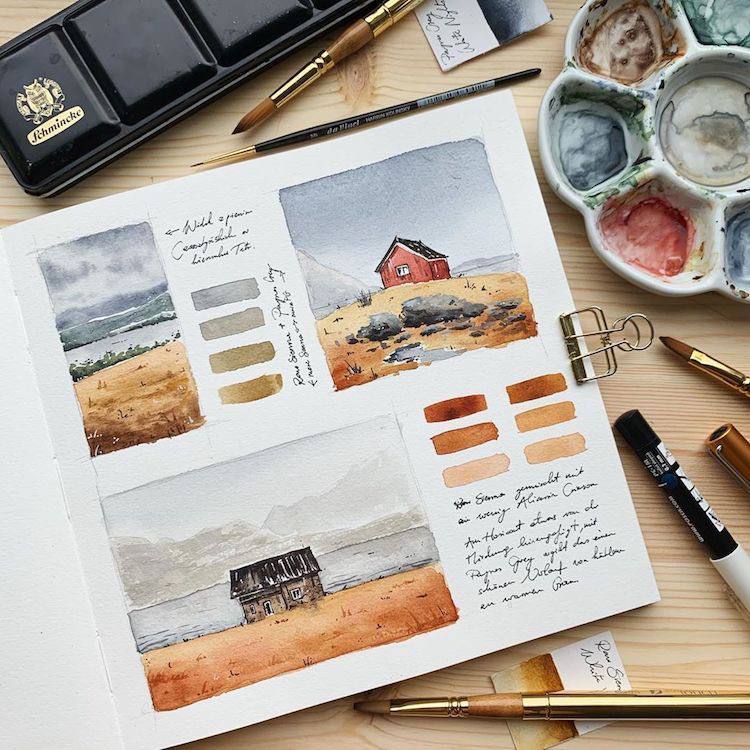
For trees, shrubs, and ground cover, plan masses rather than separate objects. Group them into value shapes first. Later you can break the edges with branches, grass strokes, and small texture marks.
For buildings, paths, bridges, fences, and walls, check perspective early. Hard edges expose mistakes faster than foliage does. If the angles are wrong, extra windows or stones will not rescue the drawing.
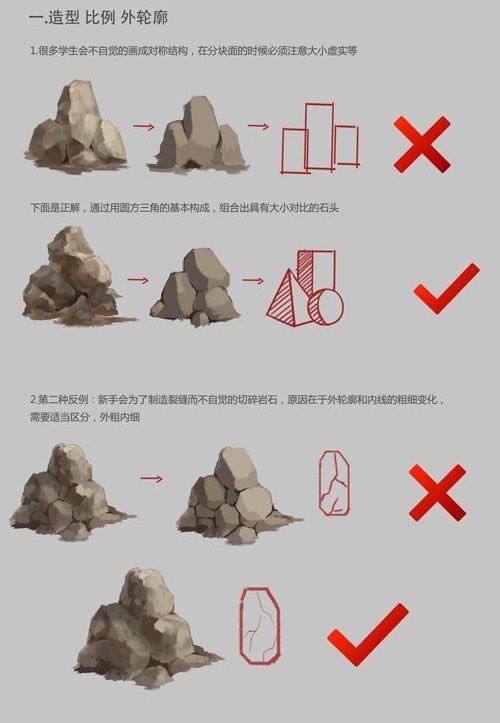
Spend the first five minutes on composition only. Draw three thumbnail boxes, place the horizon differently in each one, and choose the version with the clearest focal point. This small step usually improves the final landscape drawing more than adding extra detail later.
Landscape drawing tips for beginners
When I started drawing landscapes, I tried to capture everything at once and ended up with muddy, overcrowded sketches. The things that actually helped:
- Start with simple shapes. Reduce the scene to basic rectangles and triangles before adding detail. A mountain is a triangle; a tree is a rough oval on a stick. Build from there.
- Measure your scene. Use a pencil held at arm’s length to compare proportions — how tall is the tree relative to the barn? How wide is the sky relative to the foreground? These checks catch errors early.
- Use a viewfinder. Cut a small rectangle in a piece of card and hold it up to isolate a section of the scene. It forces you to think about composition as a frame, not just ‘everything in front of me’.
- Practice shading on its own. Fill a page with gradients from light to dark, using hatching, cross-hatching, and blending. It’s boring but it builds the muscle memory you’ll rely on in actual landscapes.
- Try one medium at a time. Switching between pencil, ink, and watercolor in the same sketchbook is fine, but actually learning a medium takes a few weeks of focused work. Pick one and stick with it until you feel comfortable.
The first few landscape drawings will probably look flat. That is normal. Depth, atmosphere, and light direction take time to develop. Keep the sketches small, work loosely, and focus on getting one thing right per session instead of forcing every page to become a finished piece.
Depth in a landscape is easier when the space has a clear eye level. This perspective drawing for landscapes guide explains horizon lines, scale changes, and vanishing points in a beginner-friendly way.
Related practice for better landscape drawings
When you are ready to focus on moving water inside a landscape, this waterfall drawing practice is a useful next study because it combines rocks, flow, mist, and background depth in one scene.
If you want to build the skills in smaller pieces, try a watercolour landscape when you want to practice atmosphere, then use these beach landscape drawing ideas for horizon lines, foreground shells, receding waves, and sunset light.
Frequently asked questions about landscape drawings
Q: What is landscape drawing?
A: Landscape drawing is the practice of turning outdoor scenery into a clear visual composition. It can show natural subjects such as mountains, forests, rivers, fields, beaches, skies, and clouds, or built places such as streets, bridges, gardens, and city skylines. The main challenge is depth. A good landscape drawing separates foreground, middle ground, and background, then uses line weight, value, texture, and perspective to make the flat page feel spacious. Beginners can use graphite, charcoal, ink, watercolor, colored pencils, or digital brushes. The tool matters less than the structure: a clear horizon, one focal point, consistent light, and enough quiet space so the important shapes stand out.
Q: How do you start a landscape drawing for beginners?
A: Start a landscape drawing by choosing one simple reference and deciding where the viewer should look first. Lightly place the horizon line, then block in the largest shapes: sky, ground, trees, water, roads, buildings, or mountains. Keep this stage loose. Next, divide the scene into foreground, middle ground, and background. Put stronger contrast and sharper details near the foreground, then make distant objects lighter, smaller, and softer. Once the structure feels balanced, build texture with hatching, blending, stippling, or layered color. Do not draw every leaf or stone. Group details into larger masses, check the light direction, and refine the focal point last.
Q: Why is perspective important in landscape drawing?
A: Perspective makes a landscape drawing feel believable. Linear perspective helps roads, buildings, fences, and bridges recede toward a vanishing point. Atmospheric perspective handles distance in natural scenes: far hills, trees, and mountains usually appear lighter, softer, and less detailed than objects nearby. Without these cues, the drawing can look flat even if the individual details are carefully rendered. Beginners should mark the horizon first, check the angle of major lines, and reduce contrast in the background before adding texture.
Q: What are the best tools for landscape drawing?
A: The best beginner tools are simple: an HB pencil for layout, a 2B or 4B pencil for midtones, a 6B pencil or charcoal for deeper shadows, a kneaded eraser for lifting highlights, and paper with a little tooth. Ink pens are useful for buildings, branches, and crisp line work. Watercolor and colored pencils help with skies, haze, and soft color changes. Digital artists can use Procreate, Photoshop, or similar apps, but the same rules apply: start with big shapes, value, and composition before detail.
Q: How long does it take to complete a landscape drawing?
A: A quick landscape sketch can take 20 to 40 minutes if the goal is composition or value practice. A more finished drawing with careful perspective, tree texture, water reflections, clouds, and foreground detail can take 2 to 6 hours. Larger or highly realistic pieces may take several sessions. Time depends less on the subject and more on how much refinement you want. For practice, smaller studies are usually better because they let you repeat the same skill several times.
Q: What are common mistakes in landscape drawing?
A: Common landscape drawing mistakes include skipping the thumbnail stage, placing the horizon without thinking, making every area equally detailed, and adding dark shadows too early. Beginners also tend to draw distant trees with the same sharpness as foreground trees, which flattens the space. Another problem is inconsistent light: shadows point one way in one area and a different way somewhere else. Start light, group details into big shapes, and save the strongest contrast for the focal point or foreground.
Q: How can I make my landscape drawings look more realistic?
A: To make landscape drawings look more realistic, organize the values first. Use darker tones, sharper edges, and clearer texture in the foreground. Let distant objects become lighter, softer, and less detailed. Check the light source before shading, then add shadows consistently across trees, rocks, buildings, and water. Vary silhouettes so every tree, cloud, and mountain does not repeat the same shape. Realism usually comes from relationships: scale, value, edge softness, and perspective working together.
Q: What are some easy landscape drawing ideas for practice?
A: Easy landscape drawing ideas include a sunset over water, rolling hills, a single tree in a field, a mountain outline, a beach with two rocks, a quiet countryside road, or a simple city skyline. Keep the first versions small, around postcard size. Limit each study to one problem: perspective on a road, reflections on water, cloud shapes, tree silhouettes, or foreground grass texture. Simple scenes teach composition and depth before you move into complex forests, buildings, or dramatic lighting.
- 9.8Kshares
- Facebook0
- Pinterest9.8K
- Twitter0
- Reddit0