I spent a week in Utah a few years ago as part of a project that took me through Park City and into the Heber Valley. Coming from automotive and product design, I tend to read buildings the way I read cars: as three-dimensional objects in relationship to their environment, where the proportion between the machine and the landscape is as important as any individual design decision. The Wasatch Back does something unusual to architecture. The scale of the peaks is so assertive that most buildings simply cannot compete, and the ones that try look worse for the effort.
The ones that work are the ones that stop trying to dominate and start negotiating. Red Ledges, the private community tucked into the foothills above Heber City, is an interesting case study in that negotiation. It is not the most architecturally experimental community in Utah mountain country.
- What mountain modern architecture actually means
- Why the Wasatch Back is particularly well-suited to this approach
- Site integration: how Red Ledges handles terrain
- The material palette: what lasts in an alpine climate
- The glazing strategy: designing around the view
- Community design: what Red Ledges gets right at the site scale
- What Red Ledges reveals about mountain modern design
- Frequently Asked Questions
- What is mountain modern architecture?
- What materials are used in mountain modern homes?
- How is mountain modern different from rustic cabin design?
- What makes Red Ledges a good example of mountain modern design?
- What are the design challenges of building in a mountain climate?
- How do mountain modern homes handle indoor-outdoor transitions?
- What is the best orientation for a mountain modern home?
It is, arguably, one of the most successful at executing what mountain modern design is actually supposed to do: root a building to its specific terrain, use materials that improve with age and weather, and configure interior space so that the view is not an accident of placement but the central organizing idea.
What follows is not a buyer’s guide. It is an architectural analysis of the design principles at work in this Heber Valley community and what they reveal about how mountain modern architecture functions at its best.
What mountain modern architecture actually means
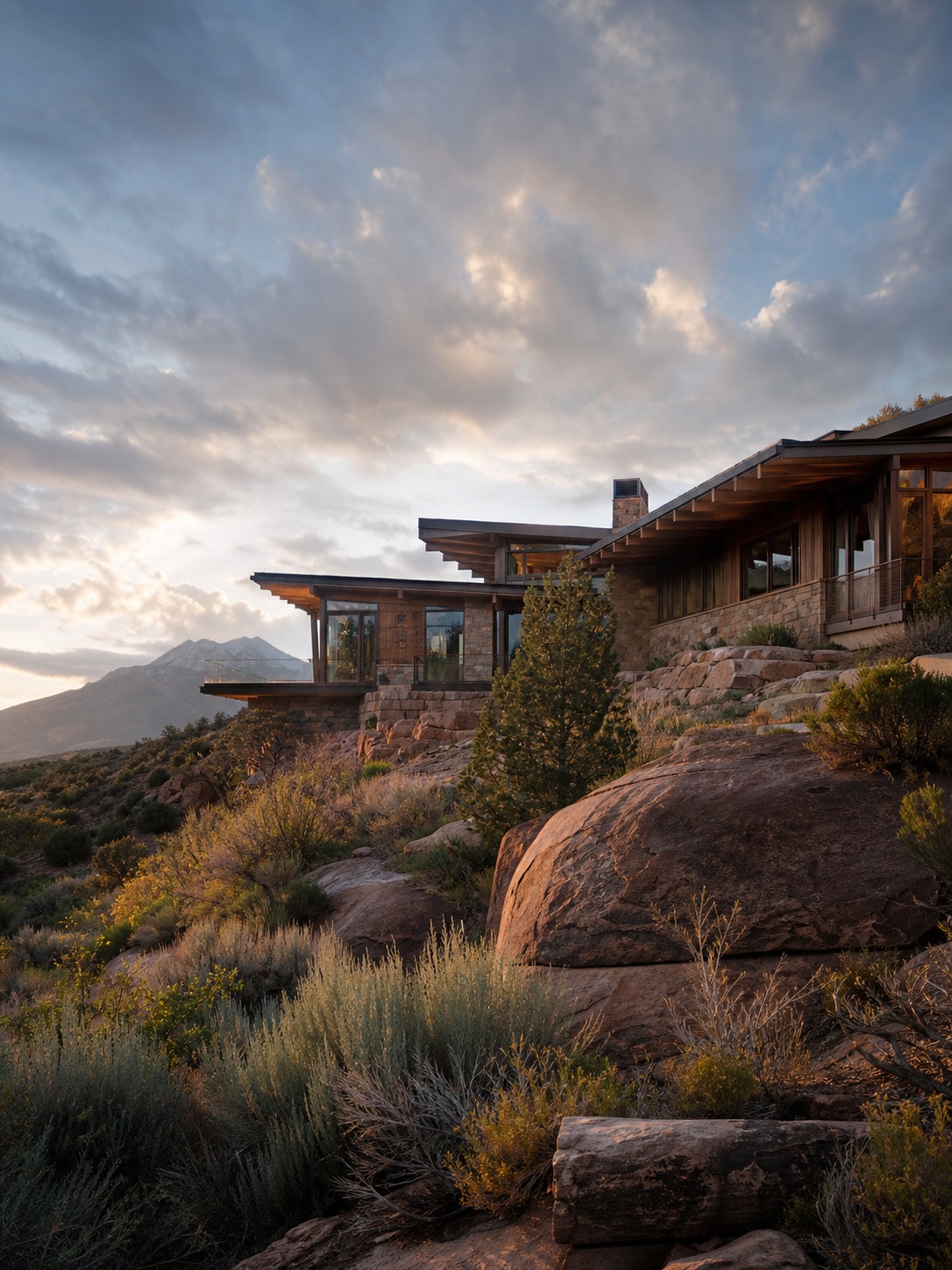
The term gets applied loosely. In real estate marketing it can mean almost anything with exposed timber and a mountain view. In architectural practice it describes something specific: a vocabulary that takes the material honesty of traditional alpine building, stone, timber, weathering metal, and subjects it to contemporary spatial logic, open plans, strong geometry, large glazing, and sight lines organized around the view rather than around a central hearth.
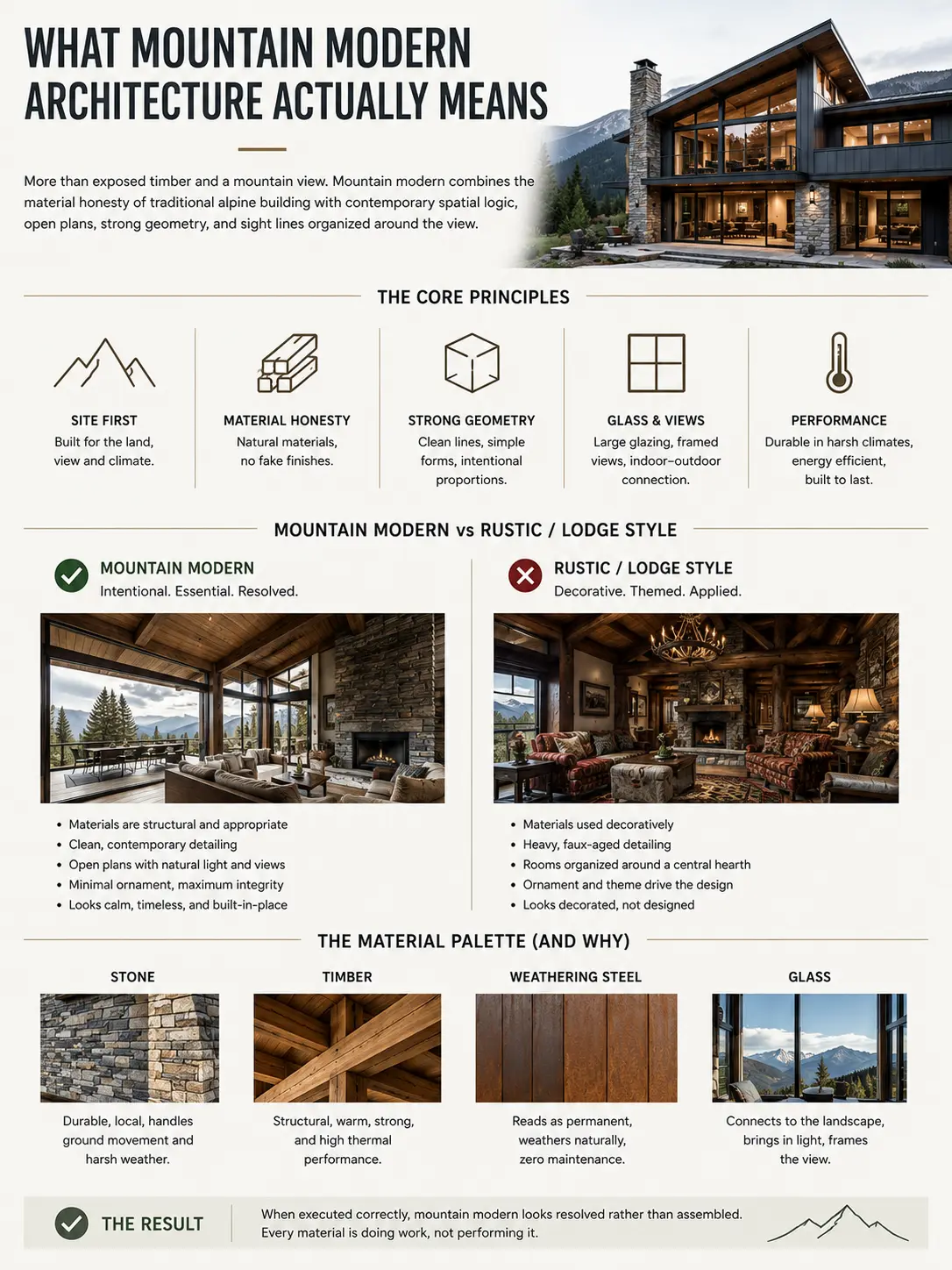
The distinction from rustic or lodge-style architecture is intentional and matters. Rustic cabin design treats materials decoratively: dark stain to suggest age, heavy timber detailing that references vernacular traditions without being structurally necessary, decorative antler hardware and hunting lodge iconography.
Mountain modern strips all of that away. The stone is there because stone is the right material for a cold climate with ground movement. The timber is there because it is structural and because its thermal performance is appropriate. The weathering steel is there because it reads as permanent and requires no maintenance.
The result, when executed correctly, looks resolved rather than assembled. Every material in the palette is doing work, not performing it.
Why the Wasatch Back is particularly well-suited to this approach
Utah’s Heber Valley sits at roughly 1,600 meters above sea level. Mount Timpanogos rises to nearly 3,600 meters to the west. The terrain differential and the clarity of the air at altitude create conditions where the landscape is genuinely dominant, and where a building that fights that dominance reads as wrong from almost any distance.
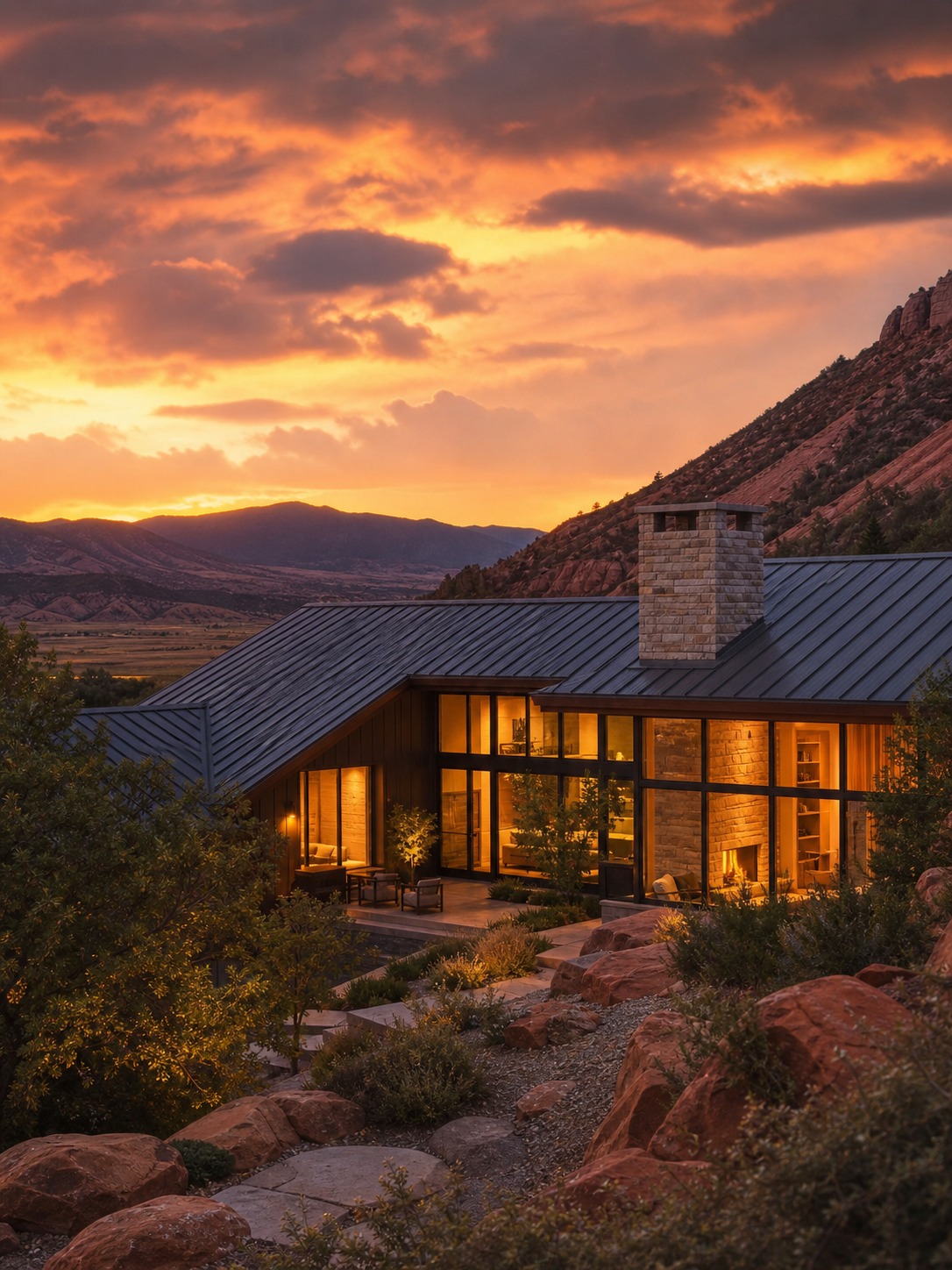
The red sandstone formations that give Red Ledges its name are also significant materially. They establish a color temperature in the landscape, a warm ochre and burnt orange range, that creates a natural material brief for any building set against them. Stone that shares those undertones reads as belonging. Stone that conflicts reads as imported.
Site integration: how Red Ledges handles terrain
One of the most consistent design problems in mountain communities is the relationship between the building platform and the natural grade. The cheap solution is to cut a flat pad from the hillside, build a box on it, and disguise the cut with retaining walls and plantings. The result looks like a building that landed on the site from somewhere else.
The more demanding approach, and the one that produces architecturally credible results, is to let the building follow the terrain’s logic: stepping the floor plates down the slope, using the grade change to separate the program (garage and entry at grade on one level, living spaces with the view on the level below), and treating any retained earth as an opportunity for planted berms rather than concrete walls.
What the site reveals about Red Ledges design
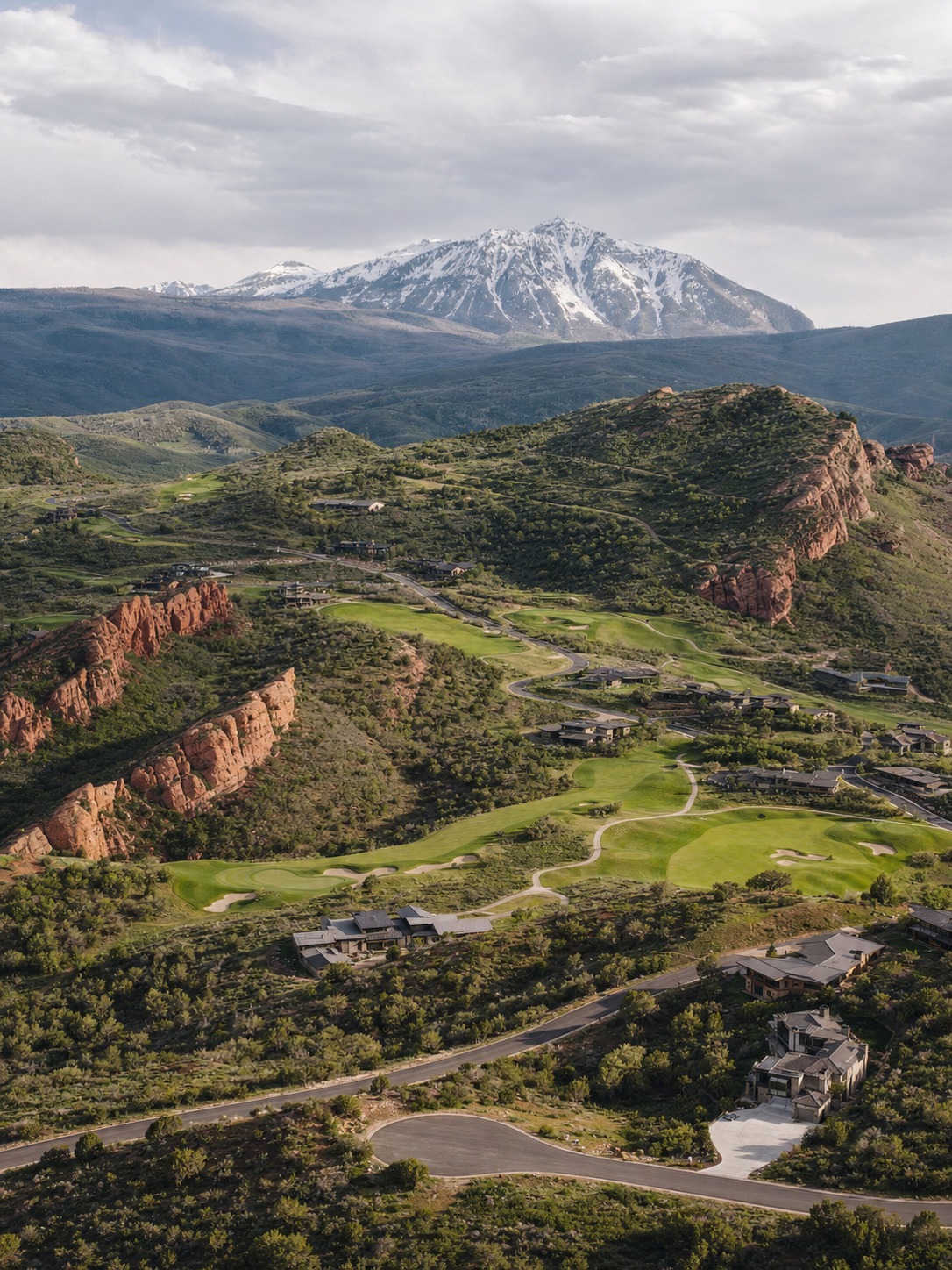
The rising terrain at Red Ledges creates natural view corridors that favor a specific building orientation: the primary glazed facade directed west toward Timpanogos, with the secondary living spaces arranged to catch the morning light from the east. This is not incidental. Competent site planning on a hillside community positions the building envelopes to take maximum advantage of view and solar orientation simultaneously, which at this latitude means the south and west faces are the high-glazing, high-priority facades.
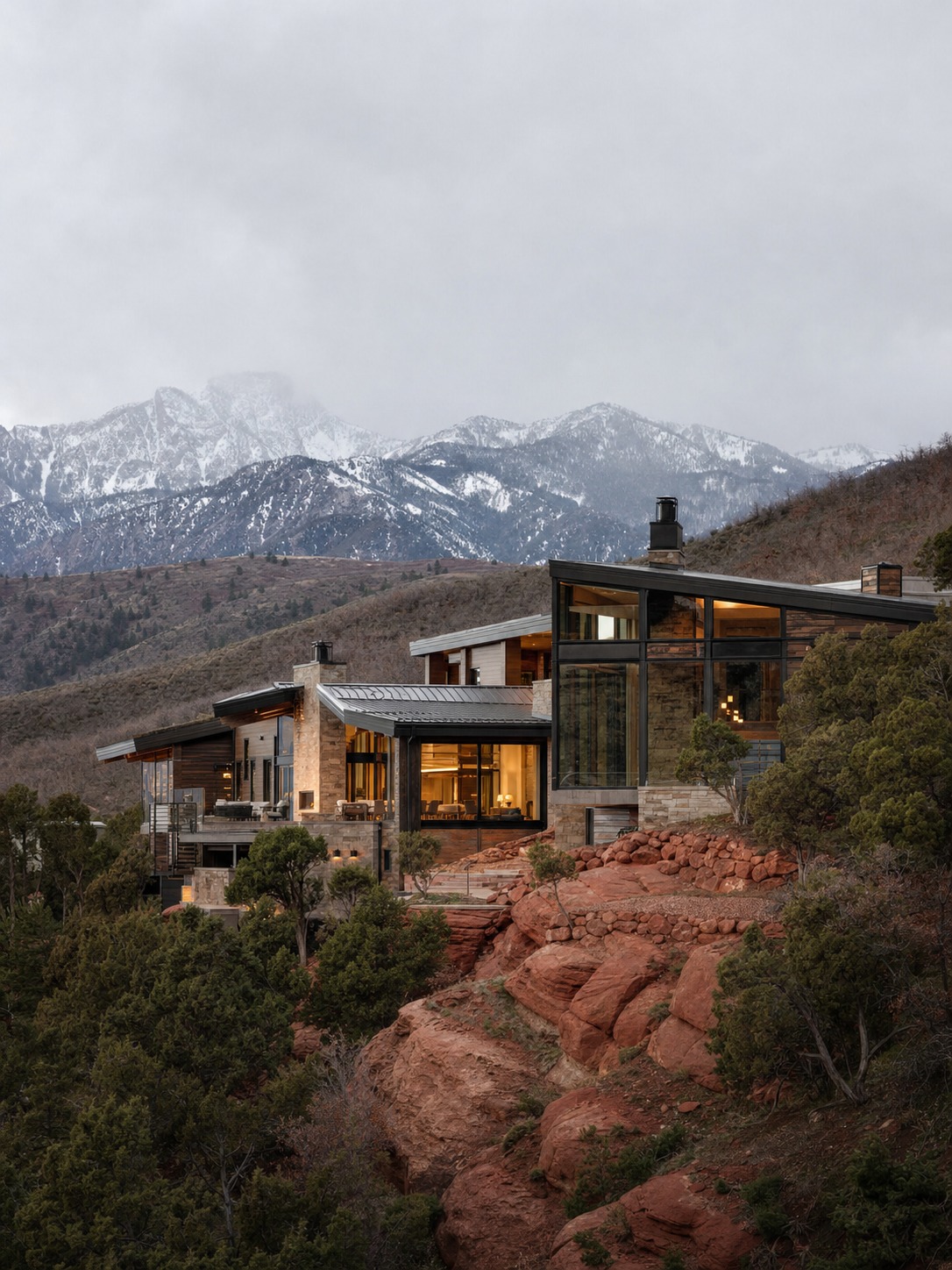
The red rock outcroppings on the site are treated as design assets rather than obstacles to be cleared. Building lots that incorporate existing rock formations gain a kind of permanence that no landscaping can manufacture. The rock is already old. It settles the building in time before the first wall is built.
The material palette: what lasts in an alpine climate
Mountain modern architecture at altitude has specific material requirements that residential design at lower elevations does not. UV radiation is significantly stronger above 1,500 meters, which accelerates the fading and degradation of finishes. Snow load requires roof structures engineered beyond standard residential practice. The freeze-thaw cycle, where moisture in porous materials expands and contracts repeatedly through winter, destroys soft stone and poorly detailed masonry.
The material palette that survives these conditions well is also, almost coincidentally, the palette that reads correctly against the Wasatch terrain.
Timber: structural and atmospheric
Heavy timber construction, using members large enough to be structural rather than decorative, does three things in a mountain modern home. It provides genuine thermal mass that buffers temperature swings. It ages visually in a direction that reads as better rather than worse (the silver-grey of weathered Douglas fir or white oak is more appropriate in an alpine setting than fresh-cut yellow). And it establishes human scale inside a room where the view from a large glazed facade might otherwise make the interior feel dwarfed by its own outlook.
The details that distinguish well-designed timber work in this context are the connections. A timber frame where the beams simply bear on walls without expressed connection hardware looks tentative. Expressed connection hardware in weathering steel or blackened iron reads as resolved and contributes to the material coherence of the overall palette.
Stone: local reference and thermal performance
Local stone used at Red Ledges pulls from the same geological context as the site’s red sandstone outcroppings. When the stone in a building shares the color temperature and texture of the stone in the ground it sits on, the building appears to have been generated by the site rather than imposed on it. This is one of the oldest principles in vernacular architecture, and it works at every scale.
In an alpine climate, stone at the base of a building also provides practical protection: it resists snow plowing damage at the perimeter, it does not absorb moisture in the same way rendered or clad walls do, and it provides a thermal mass base that moderates the floor temperature immediately above grade, which matters in a climate where heating costs are significant.
Weathering steel and standing seam metal
Corten or weathering steel develops its characteristic brown-orange patina within twelve to eighteen months of exposure. In the Wasatch terrain, where that orange tone is already present in the rock, corten reads as contextually specific rather than arbitrary. It also requires no maintenance once it has stabilized, which is a significant consideration in a mountain climate where exterior maintenance has a short season.
Standing seam metal roofing in charcoal or weathered bronze is the correct mountain modern roof choice for several reasons: it sheds snow cleanly (the continuous metal surface has no gaps for ice to accumulate at), it is fire-rated (relevant in wildfire-zone communities), and it ages without visible deterioration. The profile of a standing seam roof, with its strong horizontal shadow lines, also contributes to the visual weight of the roofline, which is one of the defining design elements in mountain modern composition.
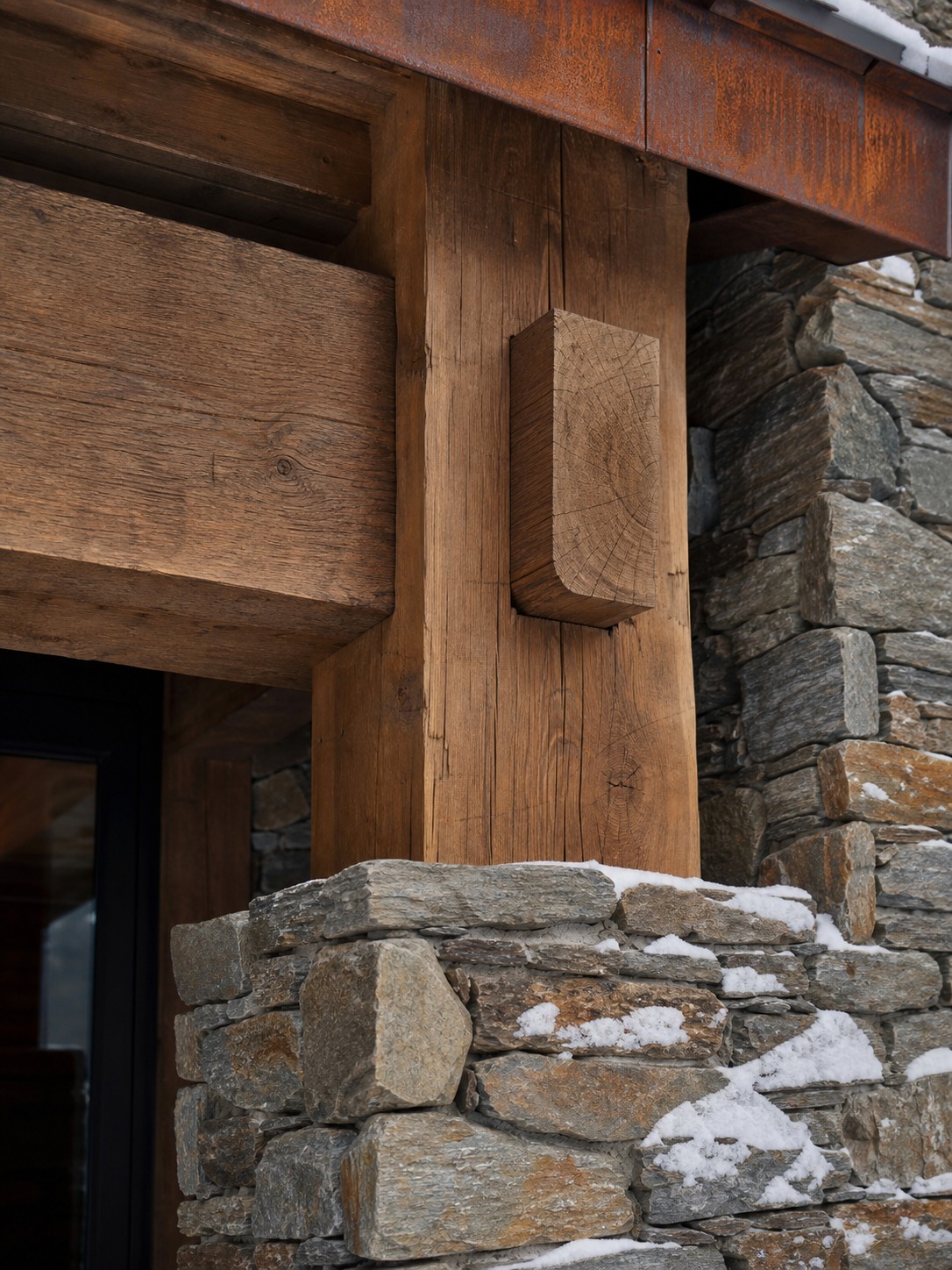
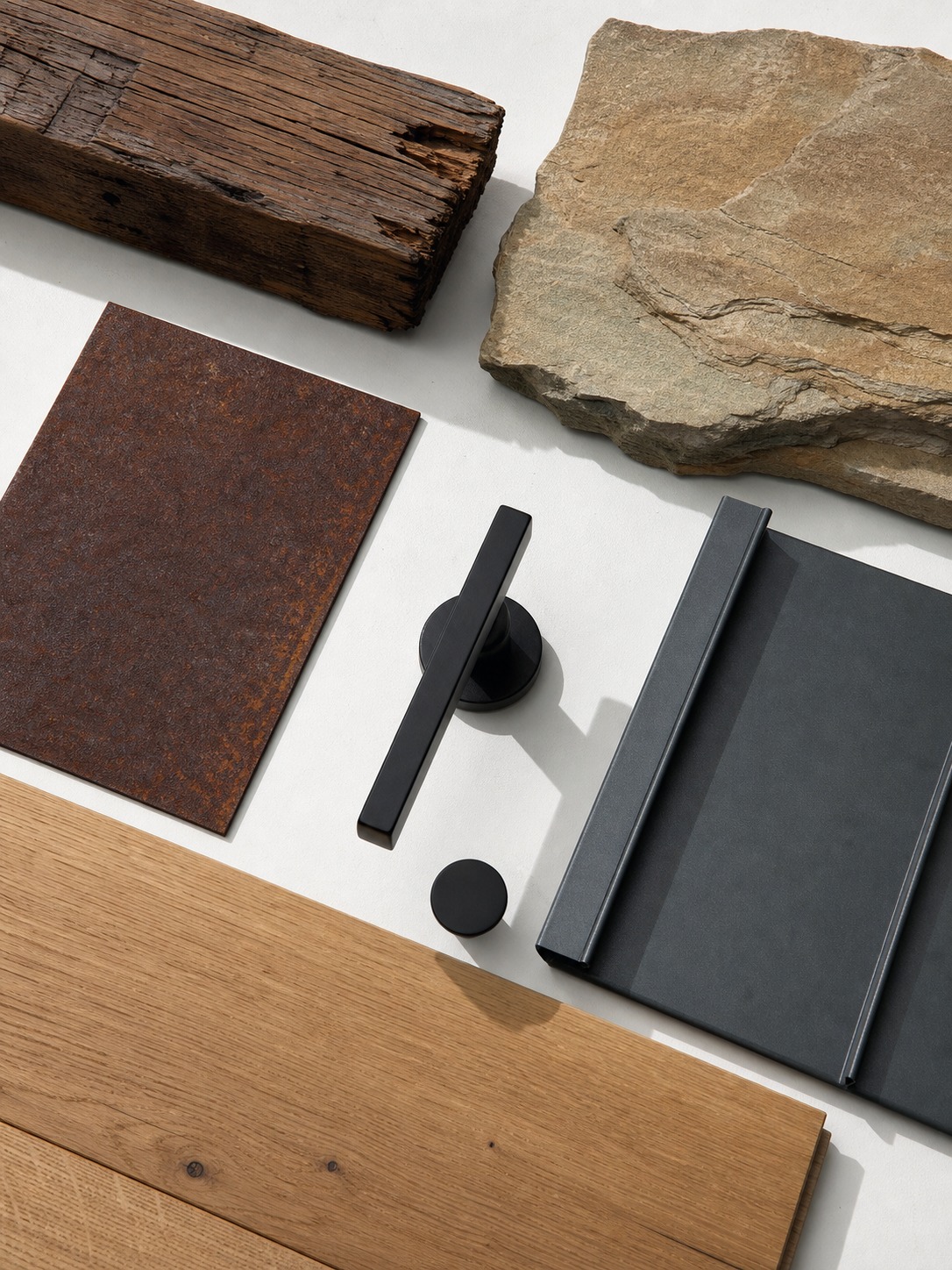
Material selection note: the most common mistake in mountain modern homes is mixing the alpine palette with imported materials that conflict with the site context. Smooth white stucco, tropical hardwood decking, and polished chrome hardware all read as belonging to a different climate zone. The palette performs best when every element shares a common material logic: natural, aged, and specific to the region.
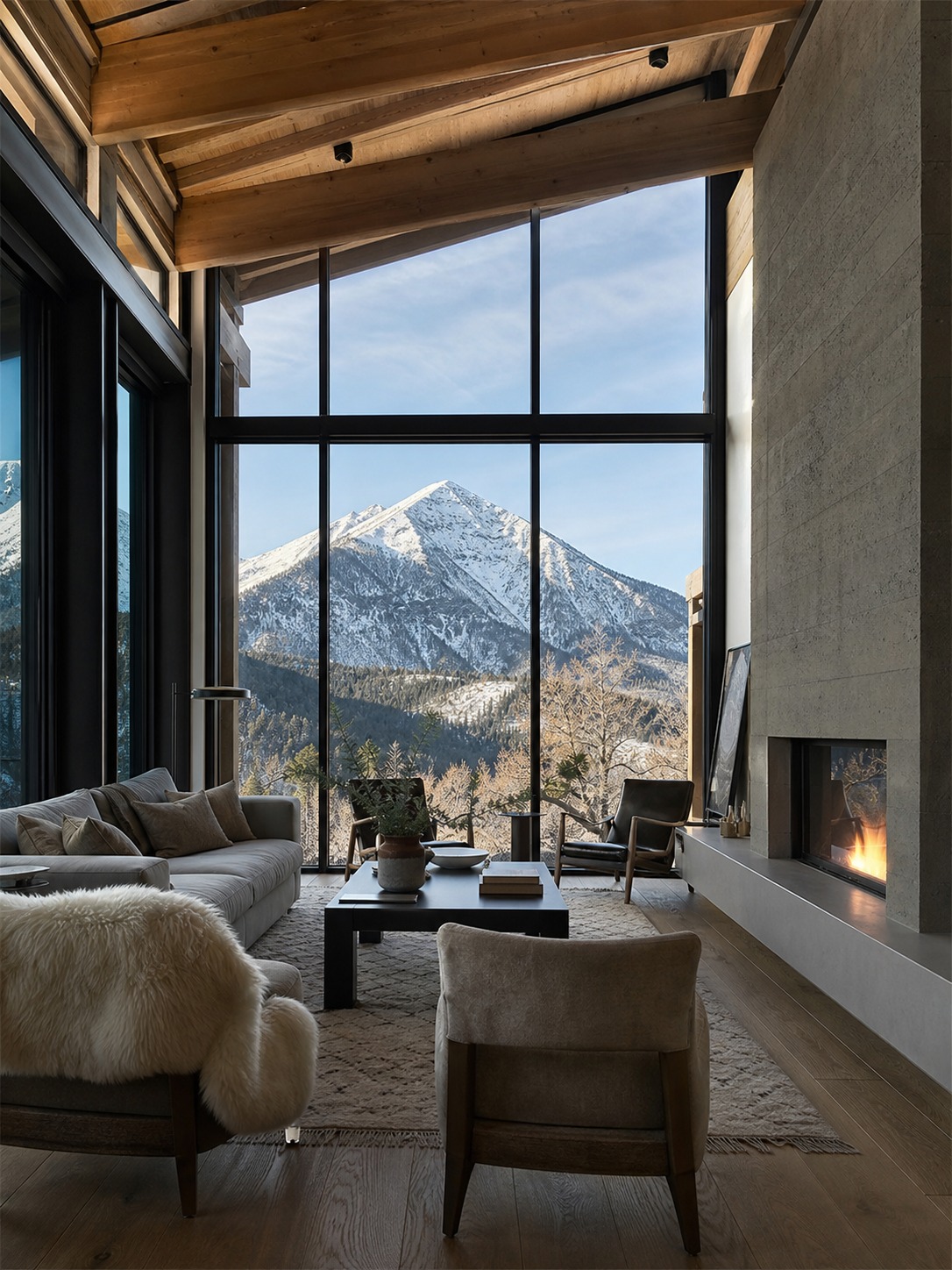
The glazing strategy: designing around the view
Large glazing in a mountain home is not automatically a good idea. Glass has poor thermal performance compared to an insulated wall of the same area. In a heating-dominated climate like Heber Valley’s, excess glazing on north and west faces creates heating loads that compound energy costs over a building’s lifetime. The design problem is not how to maximize glass but how to place it correctly.
The answer in well-designed mountain modern homes is a directional glazing strategy: concentrate the large-format glazing on the primary view facade, typically south to west in the northern hemisphere, where solar gain offsets some of the heat loss and where the view is strongest. Use smaller, more carefully composed windows on the remaining facades to provide light without the thermal penalty.
The indoor-outdoor problem in cold climates
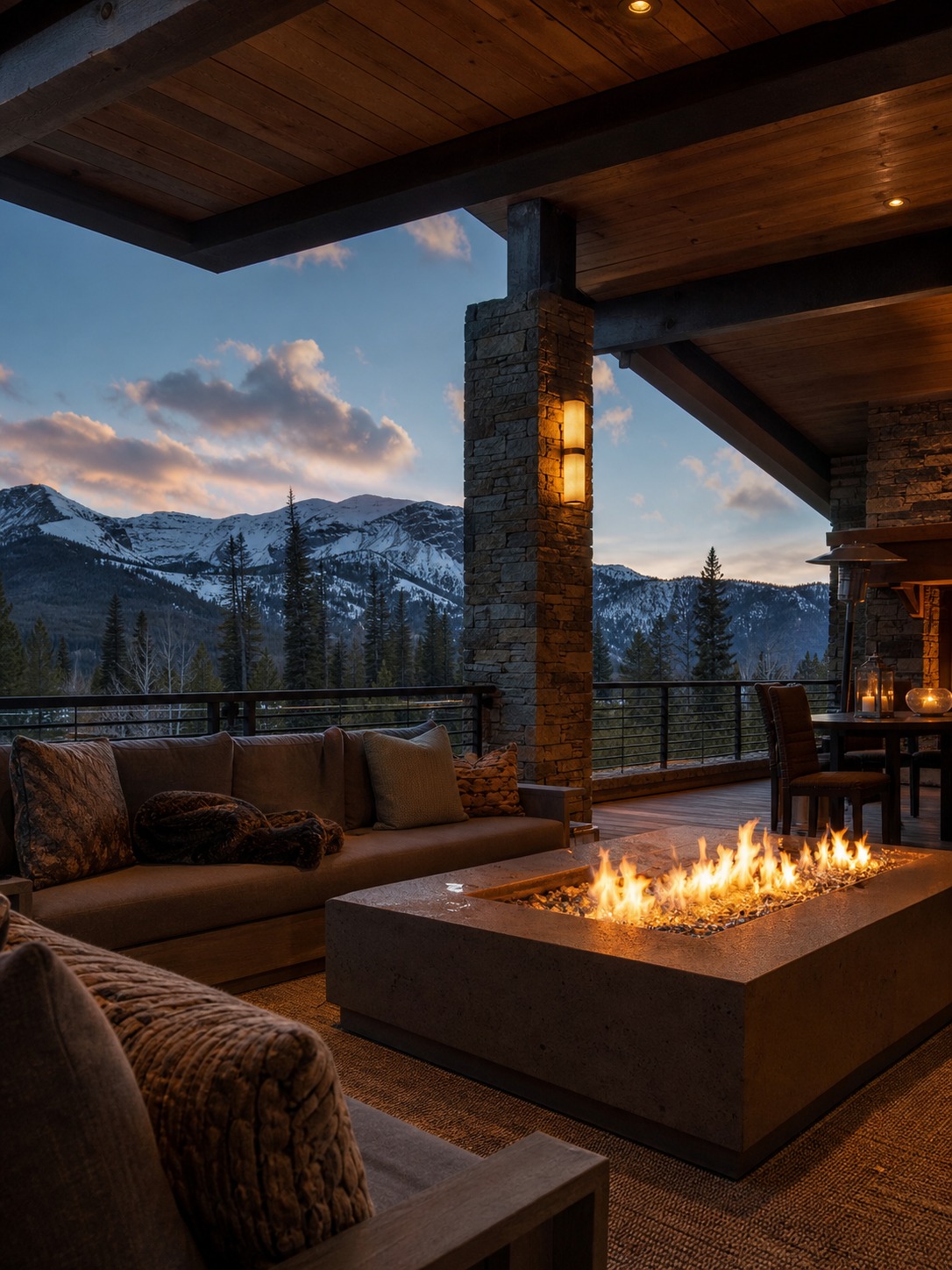
One of the persistent tensions in mountain modern design is the desire for strong indoor-outdoor connection in a climate where outdoor temperatures are genuinely hostile for four to six months of the year. The solution adopted in the best examples is the covered outdoor room: a deep-eaved terrace or loggia that is protected from precipitation and cold wind, equipped with a fire feature and radiant heaters, and connected to the interior by a large glazed sliding or folding door system.
This covered outdoor room extends the usable outdoor season significantly. At Heber Valley’s altitude, autumn evenings are cold but not yet prohibitive. A fire feature and overhead heaters make a covered terrace comfortable into November. The design move that enables this is the eave depth: the roof overhang over the outdoor room must be deep enough to exclude rain and snow while still admitting the lower winter sun that provides daylight and passive warming.
How view orientation drives the interior plan
In a mountain modern home where the view is the primary organizing idea, the interior plan should work backward from the view facade. The spaces that occupy the most time, kitchen, living, primary bedroom, should have direct visual access to the primary view. Service spaces, bathrooms, laundry, mechanical, should be organized on the non-view side, where their lower glazing is not a loss.
This planning logic also produces the correct daylighting strategy: the north-facing service spine of the building carries small, high windows that provide cross-ventilation and diffused north light for task areas without creating thermal liabilities. The south-west facing living spine carries the large glazed elements. The result is a building with a clear thermal and visual hierarchy that makes both the energy performance and the experience of inhabiting it more coherent.
Community design: what Red Ledges gets right at the site scale
Architecture in a planned community is not just about individual buildings. The spaces between buildings, the way streets and paths relate to topography, the degree to which infrastructure is visible or concealed, and the landscaping approach across the whole site all contribute to whether the community reads as designed or merely planned.
Golf course as landscape design
The Jack Nicklaus Signature golf course at Red Ledges functions architecturally as the community’s primary open space. A well-designed golf course in a mountain community is not just a recreational amenity. It preserves view corridors that would otherwise be built over, establishes a consistent landscape language that ties together what might otherwise be a collection of disparate residential lots, and provides a maintained ground plane that reads as natural from a distance.
The course here integrates with the existing terrain rather than flattening it, which produces fairways that read as part of the valley rather than overlaid on it. This distinction matters for the residential buildings that front the course: a home on a flat engineered golf hole is on a construction site. A home on a course that works with natural grade is on a landscape.
Infrastructure and sight lines
A community where utilities are underground, where street lighting is at a human scale rather than commercial road scale, and where the road geometry follows the natural topography rather than imposing a grid on it reads as designed. Red Ledges, like most premium communities in this tier, handles utilities underground and uses the road layout to manage views and preserve the terrain’s character.
For those interested in the residential product range within this design context, a range of custom and semi-custom homes at varying lot configurations are currently available. A selection of Red Ledges Utah residences for sale illustrates how the mountain modern architectural vocabulary is applied across different lot types, from golf course frontage to ridge-line view positions, with the material palette and design standards consistent across the community.
What Red Ledges reveals about mountain modern design
Every community that gets mountain modern right teaches something applicable beyond its own geography. Red Ledges is a useful case study because it executes the fundamentals with enough consistency to make the principles legible.
The site is not treated as a constraint to be overcome but as the primary design input. The material palette is specific to the geological and climatic context. The buildings are oriented to the view and solar geometry simultaneously rather than to a notional street alignment. The outdoor living spaces are designed for the actual climate rather than the climate the marketing photography suggests.
The result is a community that reads as belonging to its site in a way that many mountain communities do not. The red rock outcroppings are not obstacles around which the planning has worked. They are part of the design. The terrain is not graded flat for convenience. It is incorporated into the building typology. The views are not amenities listed in a brochure. They are the organizing idea that drives every window placement and every plan decision.
That is what successful mountain modern architecture does at any scale: it takes the site’s specific conditions, its geology, its climate, its orientation, its existing vegetation and topography, and uses all of them as design inputs rather than starting conditions to be neutralized. Red Ledges, at this level of analysis, is a working example of what that approach produces when it is executed with consistent intent.
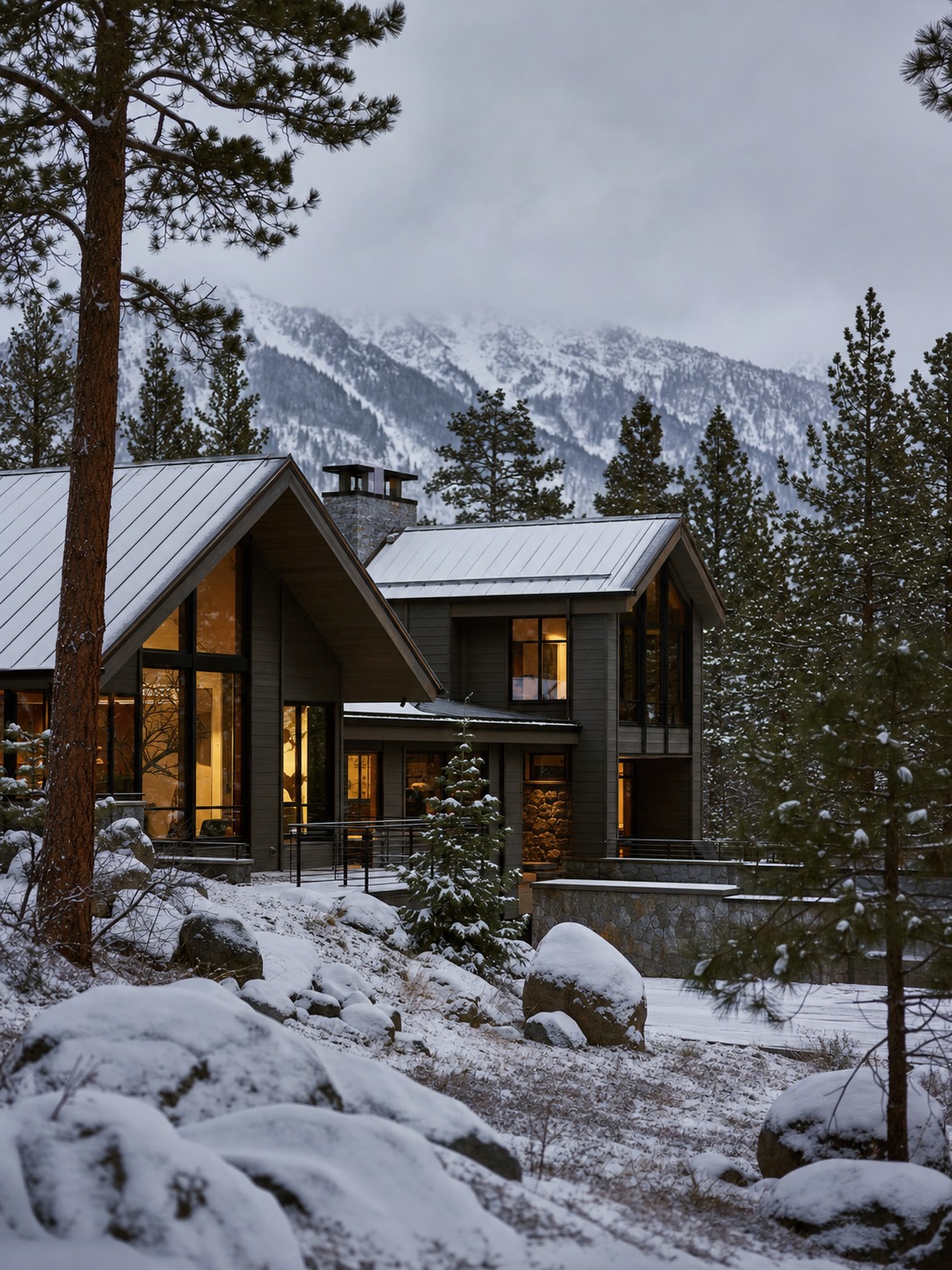
For designers approaching mountain projects: the most revealing question to ask early is not ‘what should this building look like?’ but ‘what does this site already know?’ The geology, the vegetation pattern, the direction of seasonal prevailing wind, the angle of the winter sun at this latitude, the frost depth at this altitude. That information generates a design brief more specific than any style guide.
Mountain homes are especially sensitive to light and site context, so these mountain architecture photography ideas can help frame rooflines, glazing, stone, and landscape together.
Frequently Asked Questions
What is mountain modern architecture?
Mountain modern architecture combines the visual warmth of traditional alpine materials, timber, stone, and metal, with the clean geometry and spatial openness of contemporary design. It prioritizes large glazing to frame landscape views, strong horizontal eaves, durable exterior materials, and covered outdoor living spaces. The style emerged in the mountain West during the late 1990s and has become the dominant residential vocabulary in high-altitude luxury communities.
What materials are used in mountain modern homes?
The core palette includes reclaimed or rough-sawn timber for structural and decorative elements, stacked or dry-laid local stone for fireplaces and exterior bases, weathering steel or corten for accent panels, and large-format glass for view-facing walls. Roofing is typically standing seam metal in charcoal. Interior floors are wide-plank hardwood or large-format stone tile. The palette emphasizes natural materials that improve with age.
How is mountain modern different from rustic cabin design?
Rustic cabin design uses heavy timber, dark stain, and a decorative vocabulary drawn from hunting lodges. Mountain modern keeps the material honesty (natural stone, timber, weathering metal) but applies contemporary spatial logic: open plans, clean sight lines, minimal ornament, and geometry that responds to views and solar orientation. Mountain modern homes look resolved rather than assembled. The materials are the same category; the intention is different.
What makes Red Ledges a good example of mountain modern design?
Red Ledges provides architectural standards guiding home design toward mountain modern principles: timber and stone exteriors, covered outdoor living, strong view orientation, and a color palette drawn from the surrounding terrain. The site has red sandstone formations that establish a material reference, views of Mount Timpanogos, and rising terrain that creates natural view corridors. The combination of site character, design standards, and altitude makes it a useful working case study.
What are the design challenges of building in a mountain climate?
Snow load requires engineered roof structures with appropriate pitch and eave design. Extreme temperature swings demand high-performance insulation and glazing. Wildfire zones require non-combustible exterior cladding. High UV exposure at altitude fades materials faster than at sea level. Wind exposure at ridge sites requires structural wind bracing and careful window specification.
How do mountain modern homes handle indoor-outdoor transitions?
The best solutions include covered outdoor rooms with fire features and infrared heaters, large retractable or folding glass door systems, stone or tile flooring that runs continuously from inside to outside, and roof overhangs deep enough to keep snow off the threshold zone. The goal is making the outdoor living space feel like a room with seasonal usability, not a deck that happens to adjoin the house.
What is the best orientation for a mountain modern home?
View orientation typically takes priority, with the primary glazed facade directed toward the dominant landscape feature. Solar orientation for passive gain is the secondary consideration: south-facing glass captures winter sun, deep eaves shade that glass in summer. North-facing walls carry minimal glazing and maximum insulation. West-facing walls balance afternoon light with solar gain management through shading devices or lower glass-to-wall ratios.
For sloped or scenic sites, drone terrain analysis for landscape architecture helps designers read grade, access, vegetation, and view corridors together.
Mountain modern projects often rely on the same balance of timber, glass, shade, and structure. This guide to modern wooden homes adds a broader planning lens before you settle on a facade.
- 61shares
- Facebook0
- Pinterest61
- Twitter0
- Reddit0