The most expensive furniture mistake I’ve seen in client projects isn’t buying the wrong brand. It’s buying the wrong size. A sofa arrives after a four-week wait, passes through the door by centimeters, and then proceeds to fill the room. The walkway beside it runs to 60cm instead of 90. The room that was supposed to breathe now reads as a hallway with seating in it.
Small rooms punish proportion errors more severely than large ones because there’s no slack. A sofa 10cm too deep in a 4-meter-wide room is a real problem. A sofa 10cm too deep in a 7-meter-wide room is invisible. This makes the design decisions before a small-room sofa purchase genuinely consequential, not just stylistic.
- Modular sofa brands referenced in this guide
- Rule 1: choose a sofa by footprint, not by seat count
- Rule 2: keep the arms slim and the back visually low
- Rule 3: use raised legs to show more floor
- Rule 4: make sure each module passes through the real access route
- Rule 5: avoid deep cloud-style seating in narrow rooms
- Rule 6: pick a system that can shrink now and expand later
- Rule 7: use fabric and color to reduce visual bulk
- Frequently asked questions
- What is the best modular sofa for a small apartment?
- How do you choose a sofa for a small living room?
- Are modular sofas good for small spaces?
- How deep should a sofa be for a small room?
- What sofa leg height is best for small rooms?
- What color sofa is best for a small room?
- How do you get a modular sofa into a small apartment?
Modular sofas are the right category for small spaces, for reasons I’ll explain in rule three. But ‘modular’ covers an enormous range of sizes, proportions, and design approaches. What follows is a set of design rules that apply regardless of which brand you’re considering. The brand list at the end is there for reference, not as a ranking.
Modular sofa brands referenced in this guide
- DreamSofa — to-the-inch sizing via FlexForm; expandable DreamModular system; made in USA
- Burrow — tool-free assembly; ships in compact boxes; mid-century proportions
- Cozey — ships compressed; minimal assembly; performance fabric; easy to expand
- Floyd — visible leg structure; modular configurations; minimalist Scandi aesthetic
- Article — design-forward at accessible prices; compact sizes for first apartments
- Castlery — polished apartment-scaled sectionals; mid-market pricing
This guide uses these brands as design examples only, not as a ranked list. For a brand-by-brand comparison, see our roundup of best American-made custom sofa brands.
Rule 1: choose a sofa by footprint, not by seat count
The standard way people shop for sofas is by seat count. Three-seater. Two-and-a-half seater. Sectional. But seat count tells you almost nothing useful about whether the sofa fits the room. A three-seater can be 180cm wide or 230cm wide depending on the brand and model. A sectional can project 140cm or 190cm into the room. The number of seats is almost irrelevant to the spatial question.
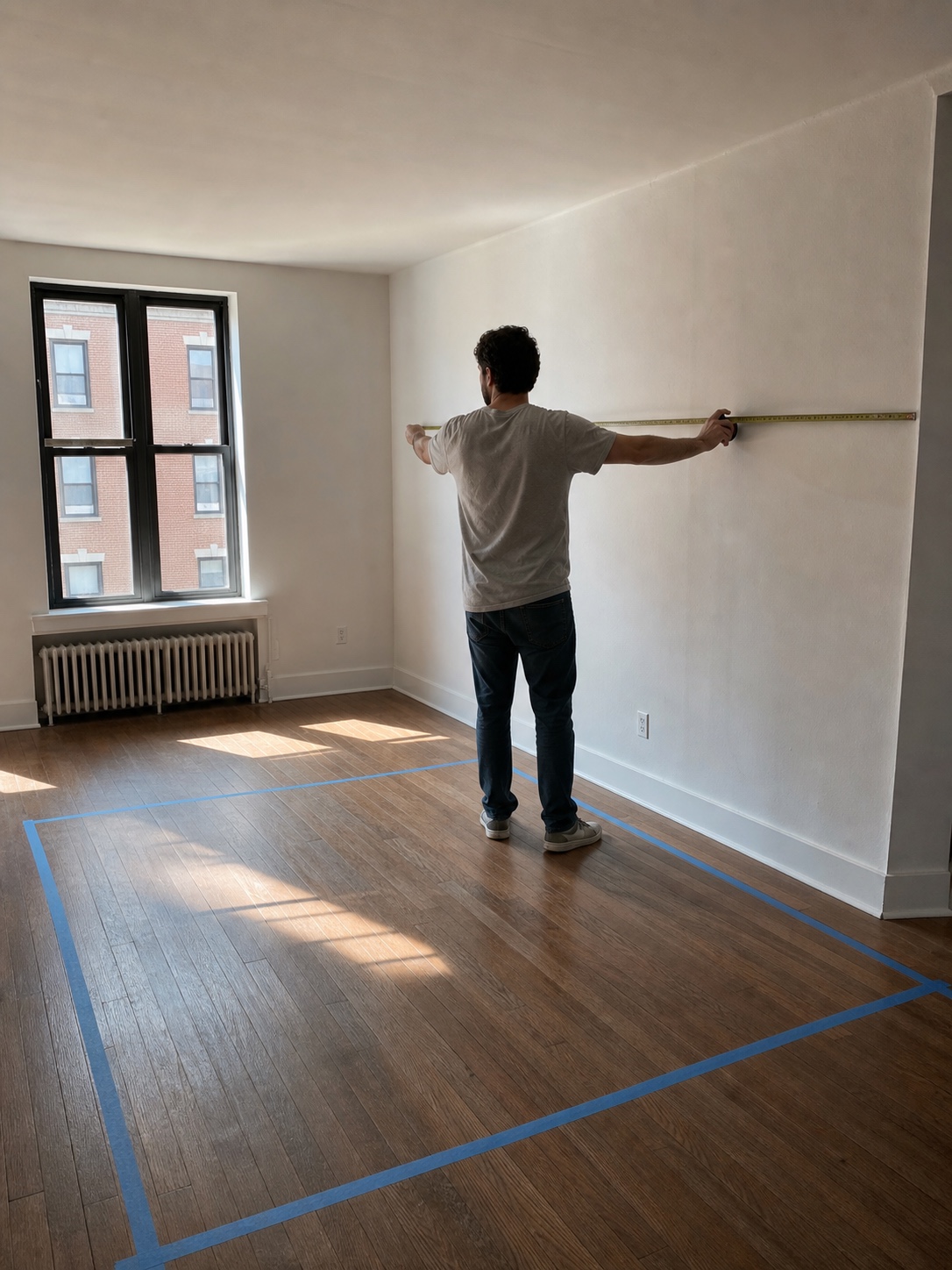
The right starting variables are the wall length and the maximum seat depth the room can accommodate. Measure the usable wall length first (from one boundary to the next obstacle: a doorway, a window reveal, a radiator). That number is the sofa’s maximum length. Then measure from where the sofa’s back will sit to the coffee table position, and from the coffee table to the opposite wall or furniture. That total gives you the maximum depth before the room stops functioning as a circulation path.
What the tape measure tells you
A comfortable minimum walkway beside a sofa is 90cm. That’s not generous; it’s the practical threshold below which movement starts to feel constrained. In a room 4 meters wide with a sofa set 30cm from the back wall, the sofa’s maximum depth is 4000 – 900 (walkway) – 300 (gap to wall) = 2800mm of available depth for sofa plus coffee table. If the coffee table is 500mm deep, the sofa can be at most 2300mm deep, roughly 90cm seat depth plus the back thickness.
Write these numbers down before opening any catalogue. They’re the actual brief. Standard sofas come in fixed sizes, and the nearest standard size is often a few centimetres off in a way that matters in a tight room.
DreamSofa’s approach to this problem is to eliminate the ‘nearest available size’ entirely: the FlexForm system sizes the sofa to the inch, so a room that needs 220cm gets 220cm rather than rounding up to 230cm or down to 210cm. For rooms where the usable wall length falls between standard sizes, this closes the gap between a nearly-right fit and an actually-right one.
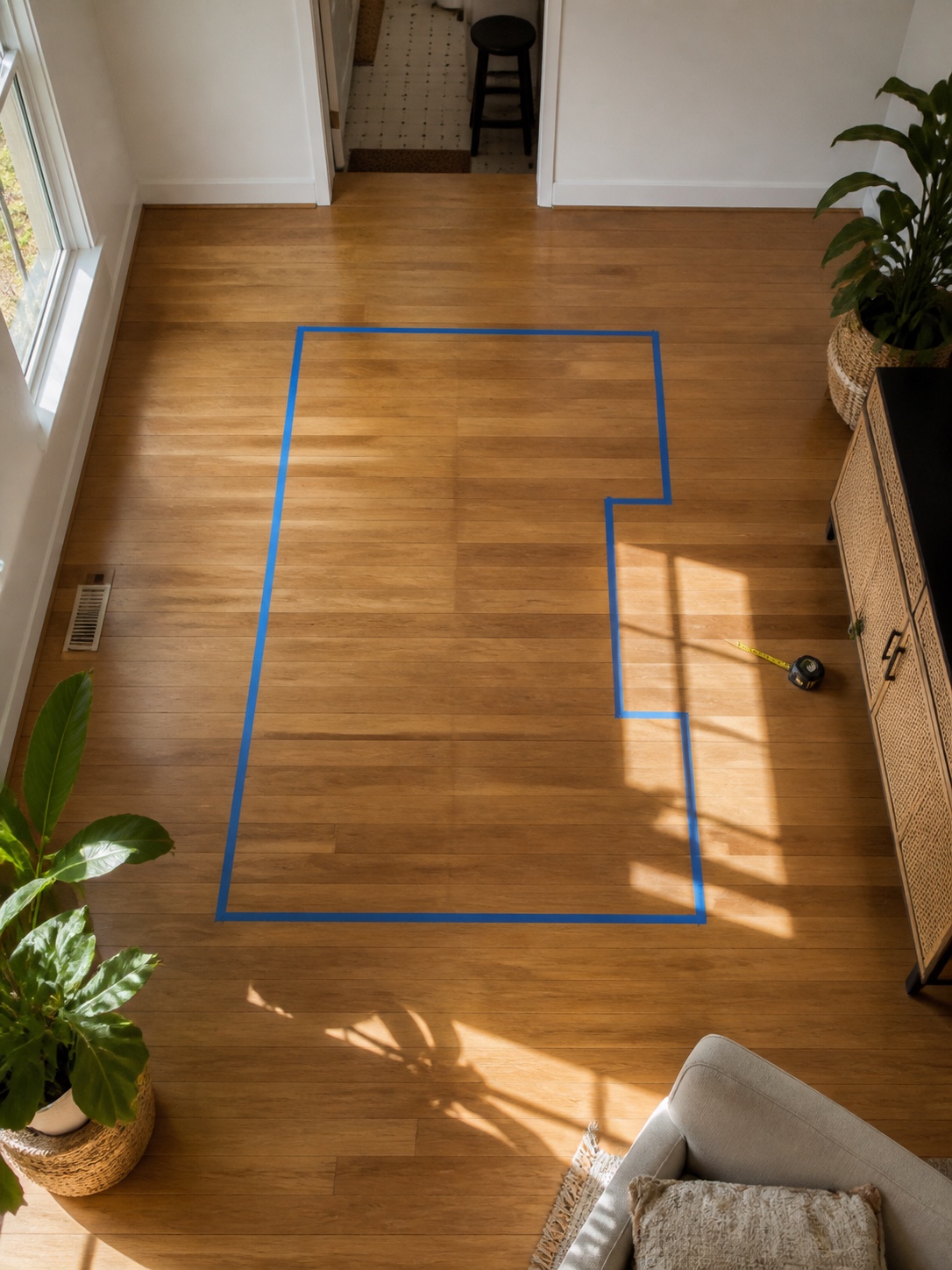
Do the tape test before ordering anything: mark the proposed sofa footprint on the floor with painter’s tape, including the arm projections. Live with the tape for a day. Walk the paths around it. Sit in a chair at the height the sofa will occupy. The tape catches proportion problems that are invisible in product photographs and that you’ll otherwise discover on delivery day.
Rule 2: keep the arms slim and the back visually low
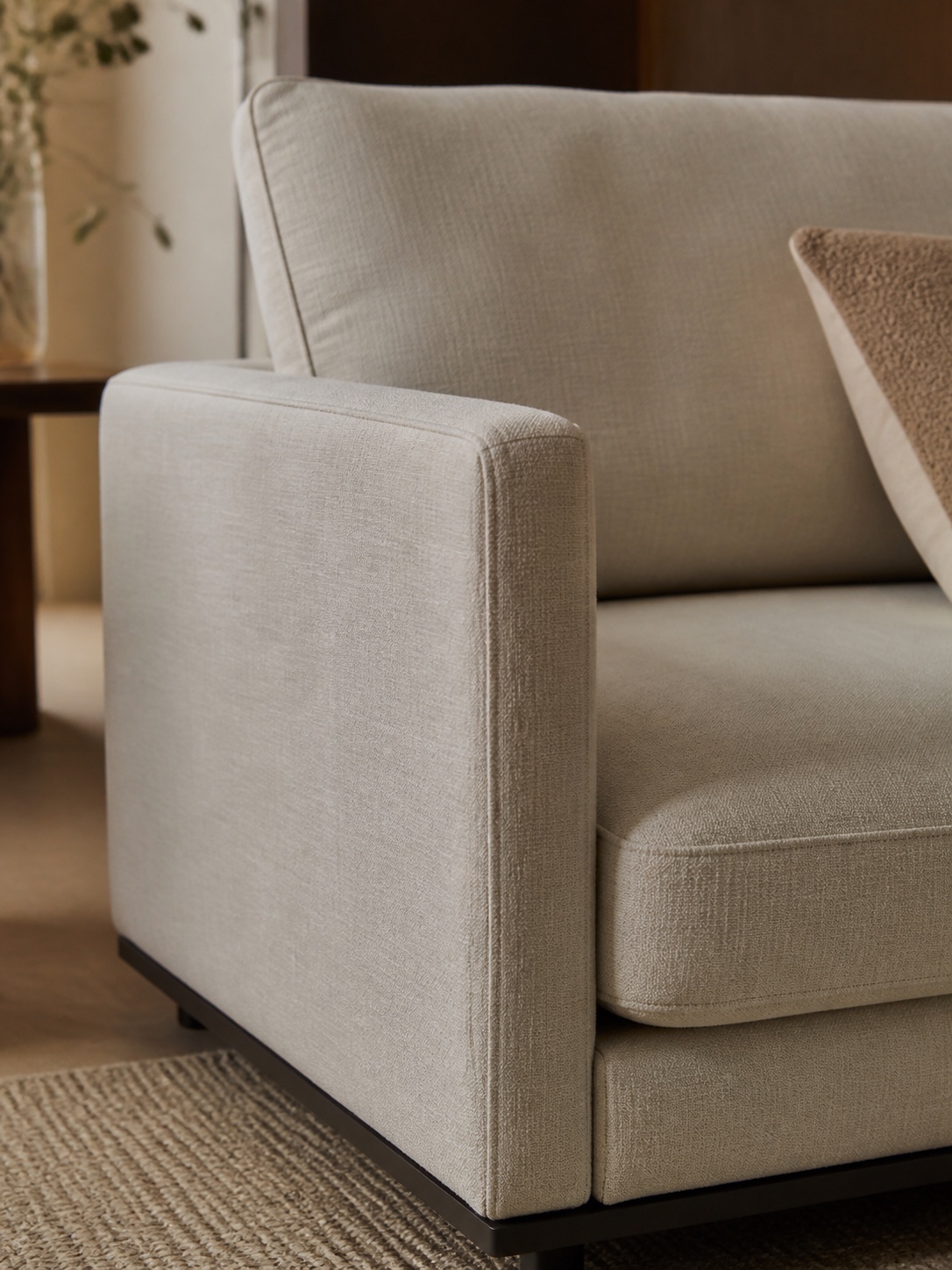
The arm style is the single most consequential design decision in a small-room sofa, and the least discussed. High arms add 10 to 15cm on each side to the sofa’s total width while contributing no additional seating surface. They also raise the visual horizon of the piece, which makes the sofa read as taller and more dominant in the room.
Track arms (also called knife arms or thin arms) sit at or just below seat height and add minimal width. They make the sofa read as lighter from across the room and allow the eye to pass over the arm without stopping. In a small room, this keeps the piece from appearing to block the space it occupies.
Back height and the horizon line
Back height determines where the sofa’s top edge sits relative to the room. A sofa with a 90cm total height (from floor to top of back cushion) draws a strong horizontal line across the room at that height. In a room with 2.5-meter ceilings, that line sits 1.6 meters from the ceiling, which can make the ceiling feel lower than it is.
A lower-back sofa at 75 to 80cm total height creates more visual breathing room between the furniture and the ceiling. It reads as part of the floor plane rather than interrupting the wall plane. This doesn’t mean every small-room sofa should have a minimal back; high backs are useful in rooms where the sofa divides an open-plan space and needs to create a visual boundary. The principle is to be deliberate about which effect you want, not to default to whatever height the standard model comes in.
Arm profile and total room width
The arm profile also affects how the sofa reads from the entrance to the room. Looking into a small room, you typically see the sofa front-on or at an angle. High, wide arms on both sides read as a visual barrier. Low arms let the eye move past the ends of the sofa to the rest of the room behind it. In a room where the sofa is the first thing you see from the door, this distinction changes the apparent size of the room significantly.
Rule 3: use raised legs to show more floor
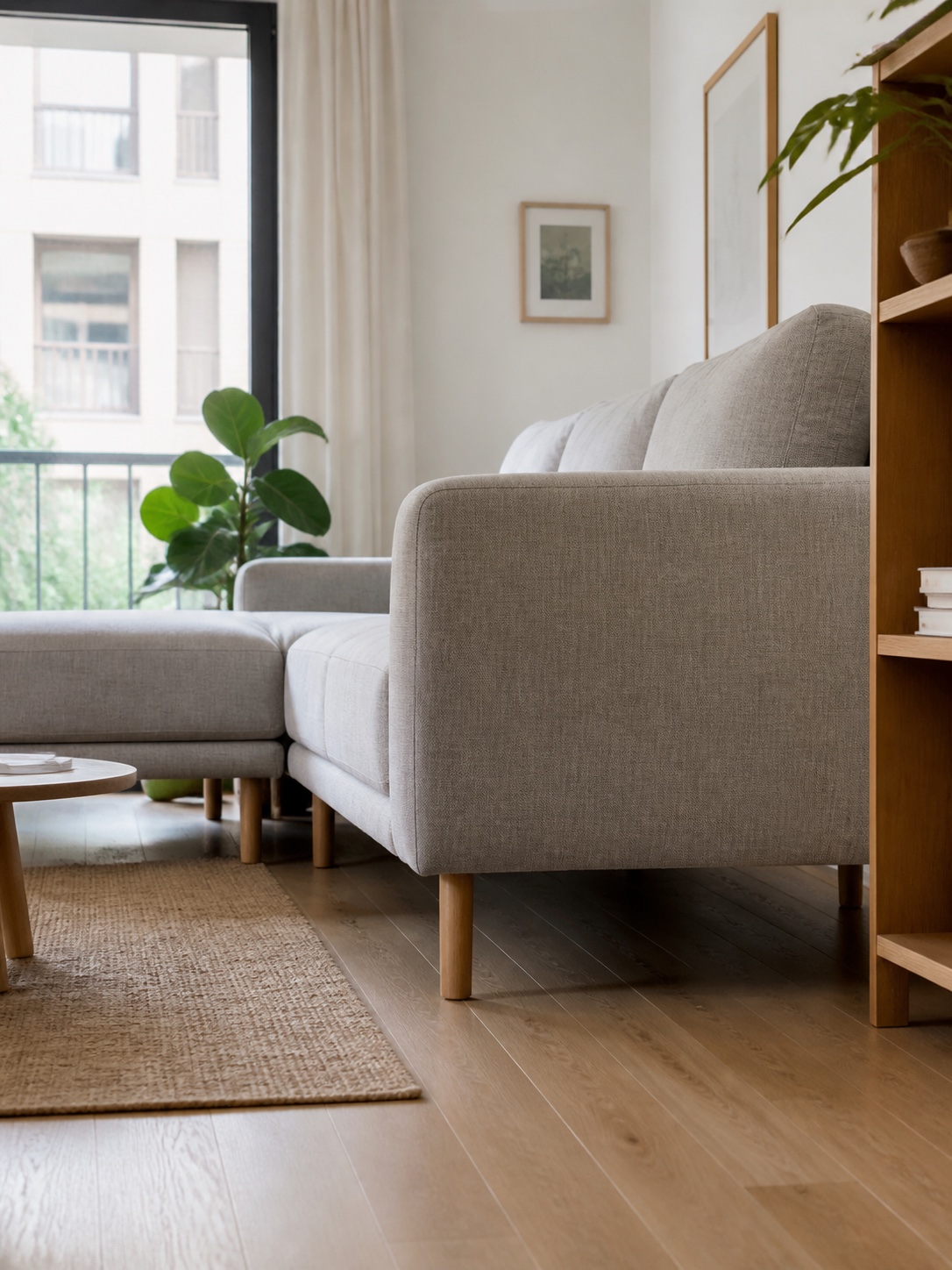
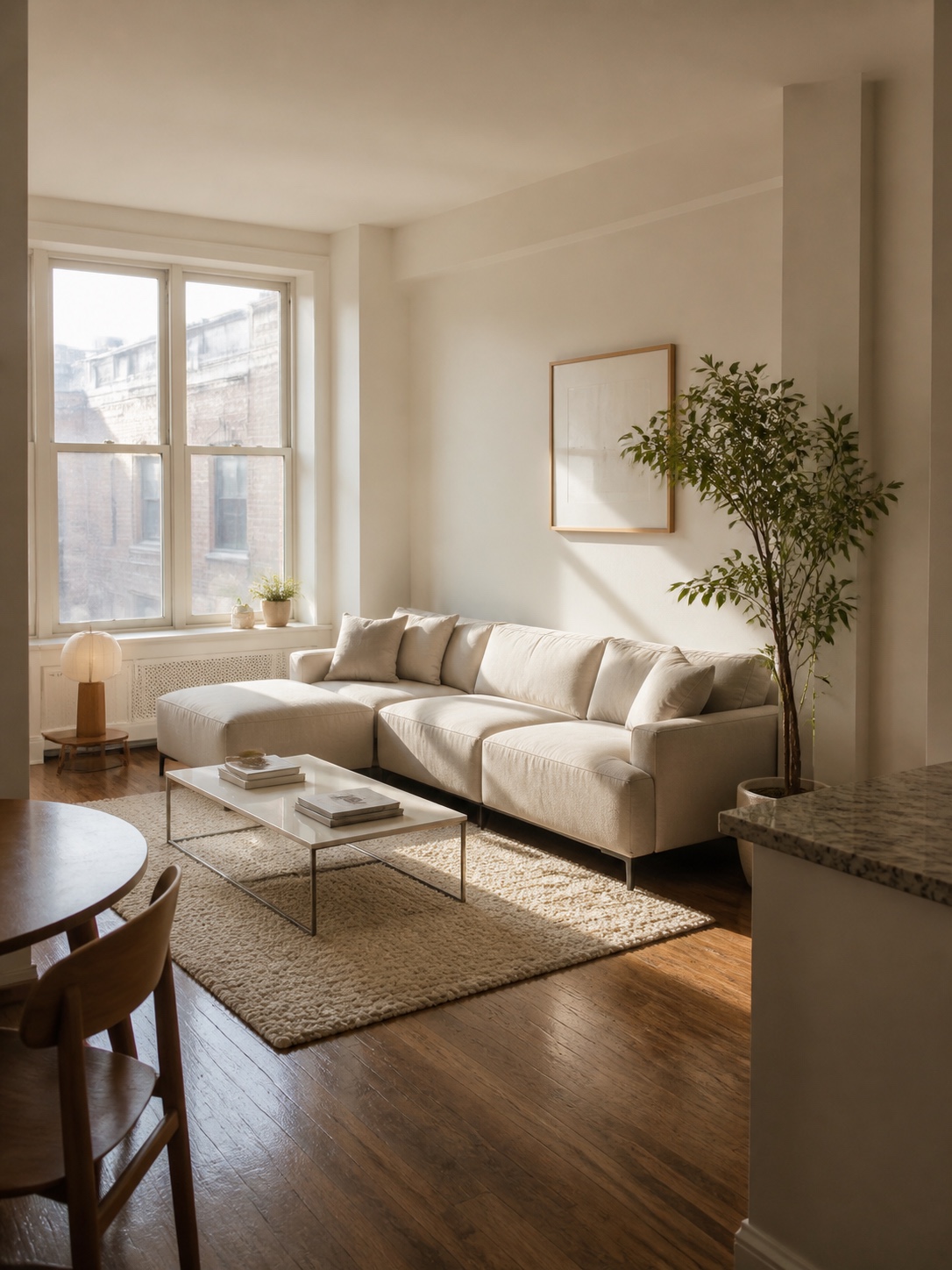
Visible floor makes a room feel larger. This is not a perception trick; it’s a direct consequence of how the brain reads available space. When you see floor extending under a piece of furniture, you register that area as floor, not as occupied space. A sofa that sits on the floor with no visible gap registers as a block that occupies its footprint completely. The same sofa on legs that reveal 15 to 18cm of floor underneath reads as lighter and less spatially dominant.
The effect is strongest when the floor is a light color or has a strong material character (pale oak, light stone, white tile). A dark floor under a skirted sofa disappears. The same floor visible under a raised sofa reads as continuous surface and expands the apparent room area.
The practical case for legs
Raised legs also have a maintenance advantage in small apartments: dust, dropped items, and pet toys don’t disappear permanently under the sofa. In an apartment where cleaning requires working around furniture rather than moving it, this saves time in proportion to how often the apartment is cleaned.
Floyd’s modular sofa uses a visible wooden leg structure as a deliberate design element. The leg reads as part of the furniture’s character rather than an afterthought. This demonstrates something important: raised legs don’t have to look like an accommodation. When the leg design is considered, it contributes positively to the piece’s appearance rather than simply revealing the underside of the frame.
The leg height should be proportional to the sofa’s total height. A 70cm-high sofa on 20cm legs looks balanced. The same sofa on 8cm legs looks squat. A rough guide: legs between 15 and 20cm work well for most contemporary sofa heights.
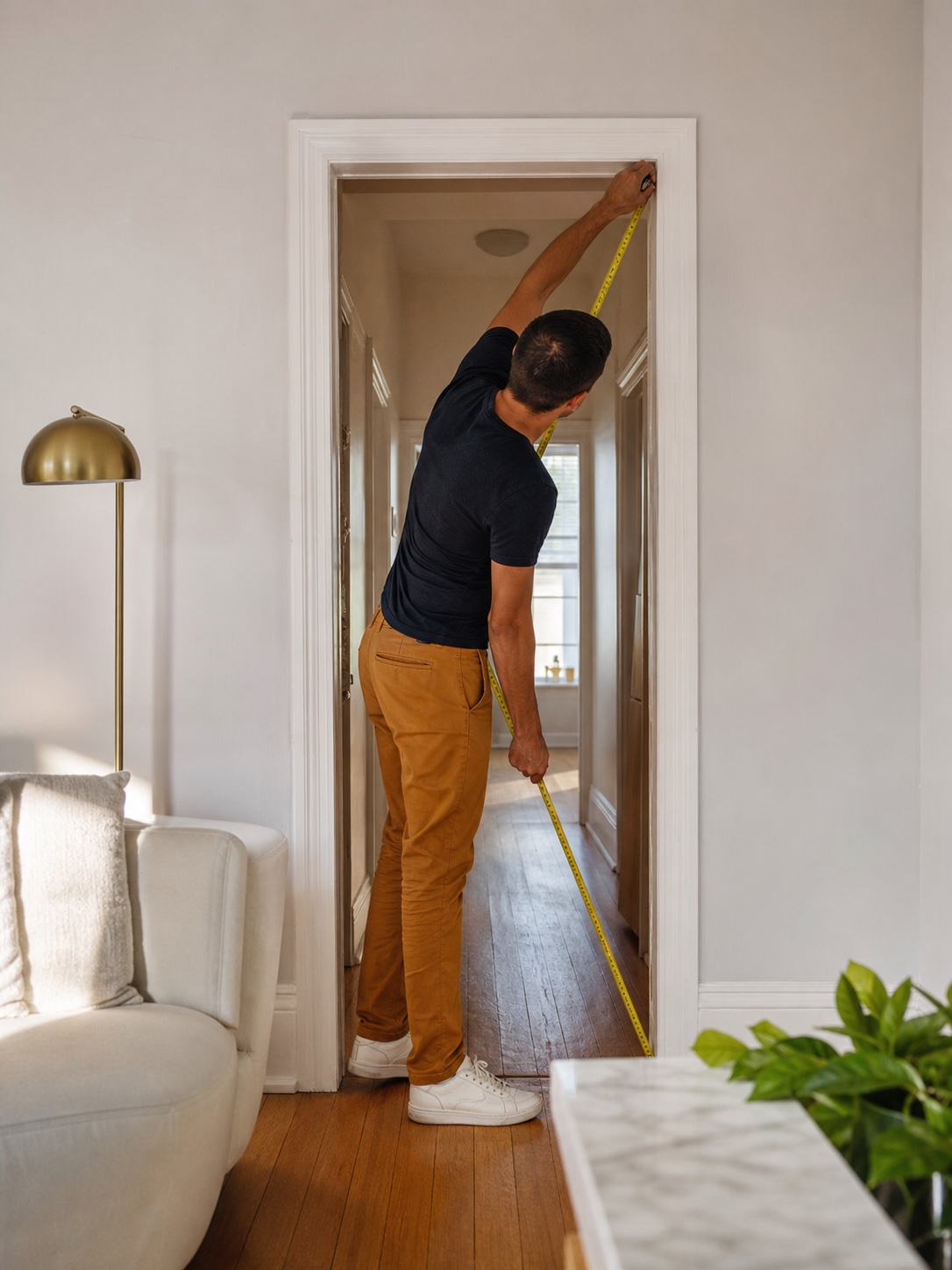
Rule 4: make sure each module passes through the real access route
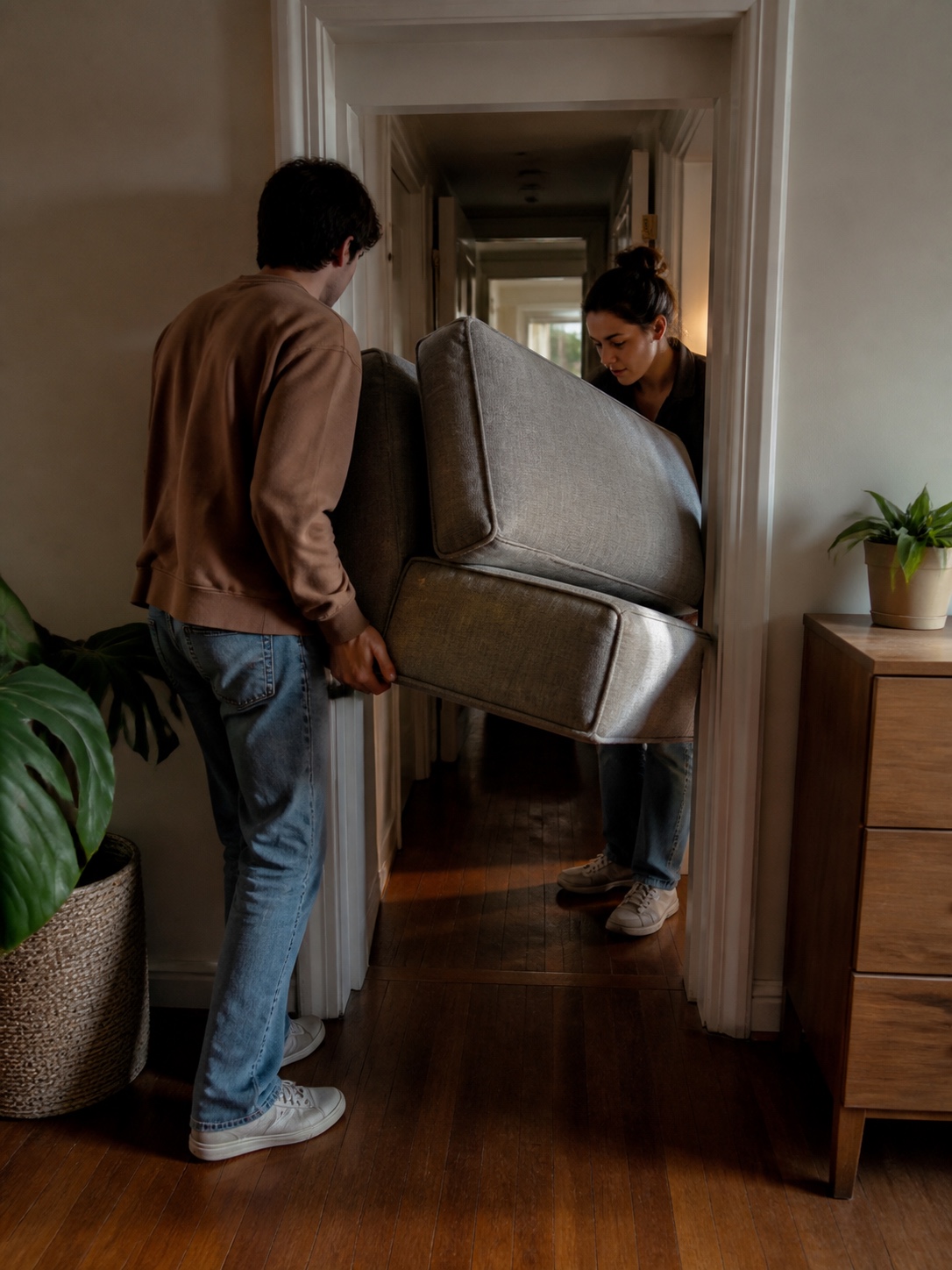
This is the rule most people check last and should check first. A modular sofa’s primary practical advantage in a small apartment is that it arrives and moves in separate pieces. But that advantage disappears if the pieces themselves are too large for the access route.
The relevant measurements are: the door width, the door diagonal (more critical than width for determining the maximum length of a rigid item that can pass through), the hallway width at its narrowest point, the width of any right-angle turn in the corridor, and if the apartment is above ground floor, the stairwell dimensions or the interior of the elevator.
What to measure and how
Door diagonal is calculated as the square root of (width squared plus height squared). A standard door 80cm wide and 200cm tall has a diagonal of approximately 216cm. Any module longer than 216cm cannot be carried through that door as a rigid piece. It would need to be tipped at a steep angle, which requires additional clearance in the hallway beyond the door. For a hallway narrower than 90cm, even a tipping maneuver becomes difficult.
Burrow and Cozey are the two brands most consistently cited for genuine delivery accessibility. Burrow ships in compact flat-pack boxes; the largest pieces are designed to fit through standard doors without special handling. Cozey ships in compressed form and assembles inside the apartment with minimal tools. Both are specifically designed for the third-floor-walk-up problem that affects a significant percentage of apartment dwellers.
What happens when you skip the measurements
The worst outcome is a sofa delivered to the building entrance that cannot reach the apartment and must be returned. This happens with enough frequency that most furniture delivery companies have a standard process for it: the delivery is refused at the door, the customer pays a return delivery fee, and the sofa goes back to the warehouse. The charge for this is typically $100 to $300 on top of the original delivery cost. Fifteen minutes with a tape measure before ordering is the alternative.
Rule 5: avoid deep cloud-style seating in narrow rooms
Cloud sofas and deep-seat modular systems have dominated interior imagery for the past several years, and for good reason in the right context. A deep seat with generous cushioning reads as generous, inviting, and spatially relaxed. In a large room, it contributes to a sense of settled luxury. In a small room, it consumes the floor area that would otherwise give the space its sense of openness.
Cloud sofas typically run 100 to 110cm in seat depth. A standard sofa runs 85 to 95cm. That 15 to 20cm difference sounds small. In a room 3.8 meters wide where the sofa sits with 30cm behind it and 90cm walkway in front, a 90cm-deep sofa leaves 170cm for coffee table plus movement. A 105cm-deep sofa leaves 155cm. That 15cm is usually the difference between a room that has a coffee table and adequate circulation and one that requires choosing between the two.
What to use instead
A moderate seat depth (85 to 90cm) works for most postures and suits both upright sitting and relaxed sitting. For the lounging posture that deep sofas are designed for, an ottoman in front of a moderate-depth sofa is more spatially efficient: the ottoman can be pushed under the coffee table when not in use, recovering the floor area entirely. A 90cm sofa with an occasional-use ottoman is more flexible than a 105cm sofa that commits that depth permanently.
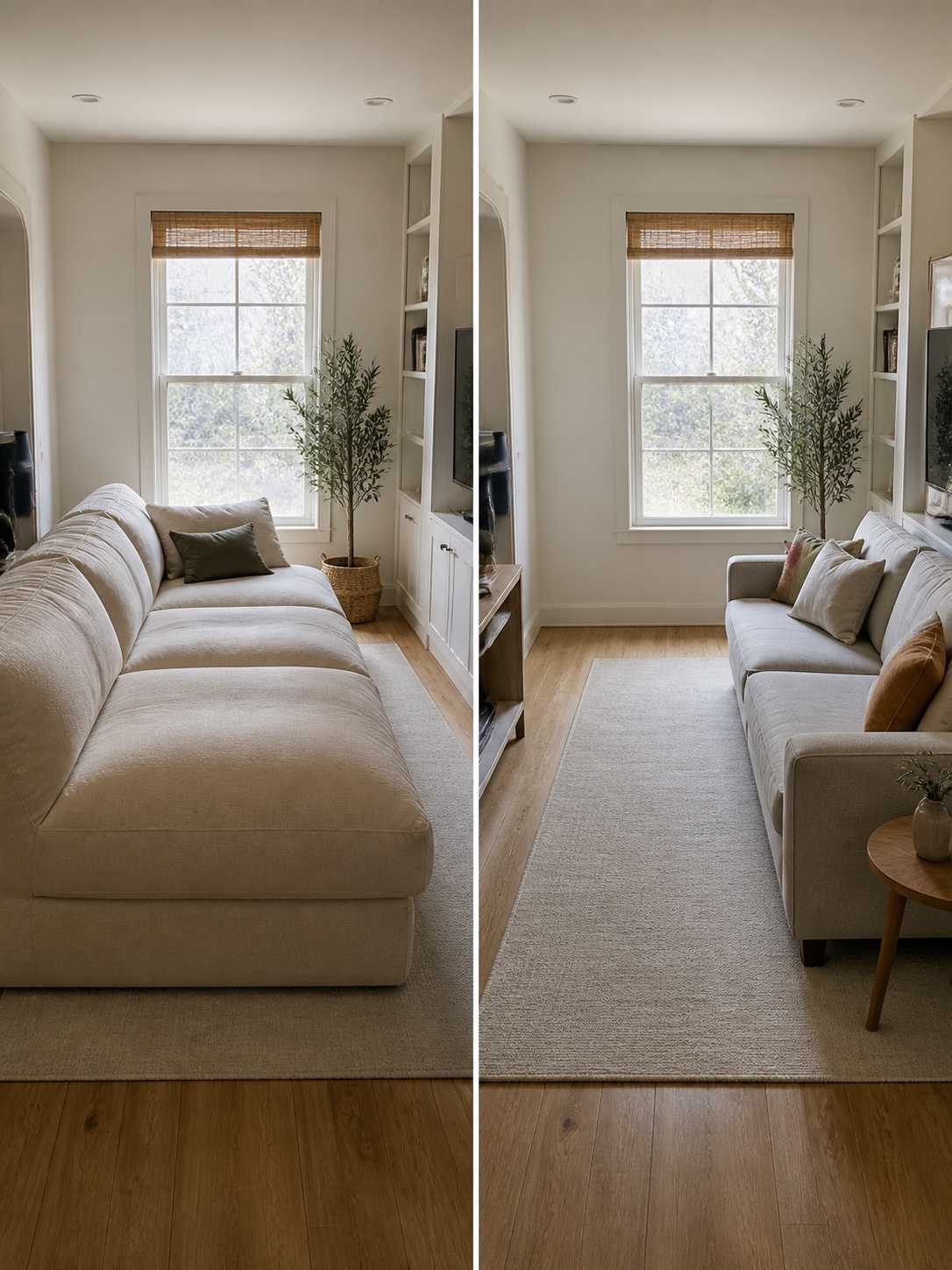
Article and Castlery both offer sectional configurations in the moderate-depth range that are specifically proportioned for apartments and smaller rooms. The compact Article Timber sectional and Castlery’s Coda sofa are examples of designs that prioritize the ‘fits the room’ outcome over the ‘looks impressive in a large showroom’ outcome.
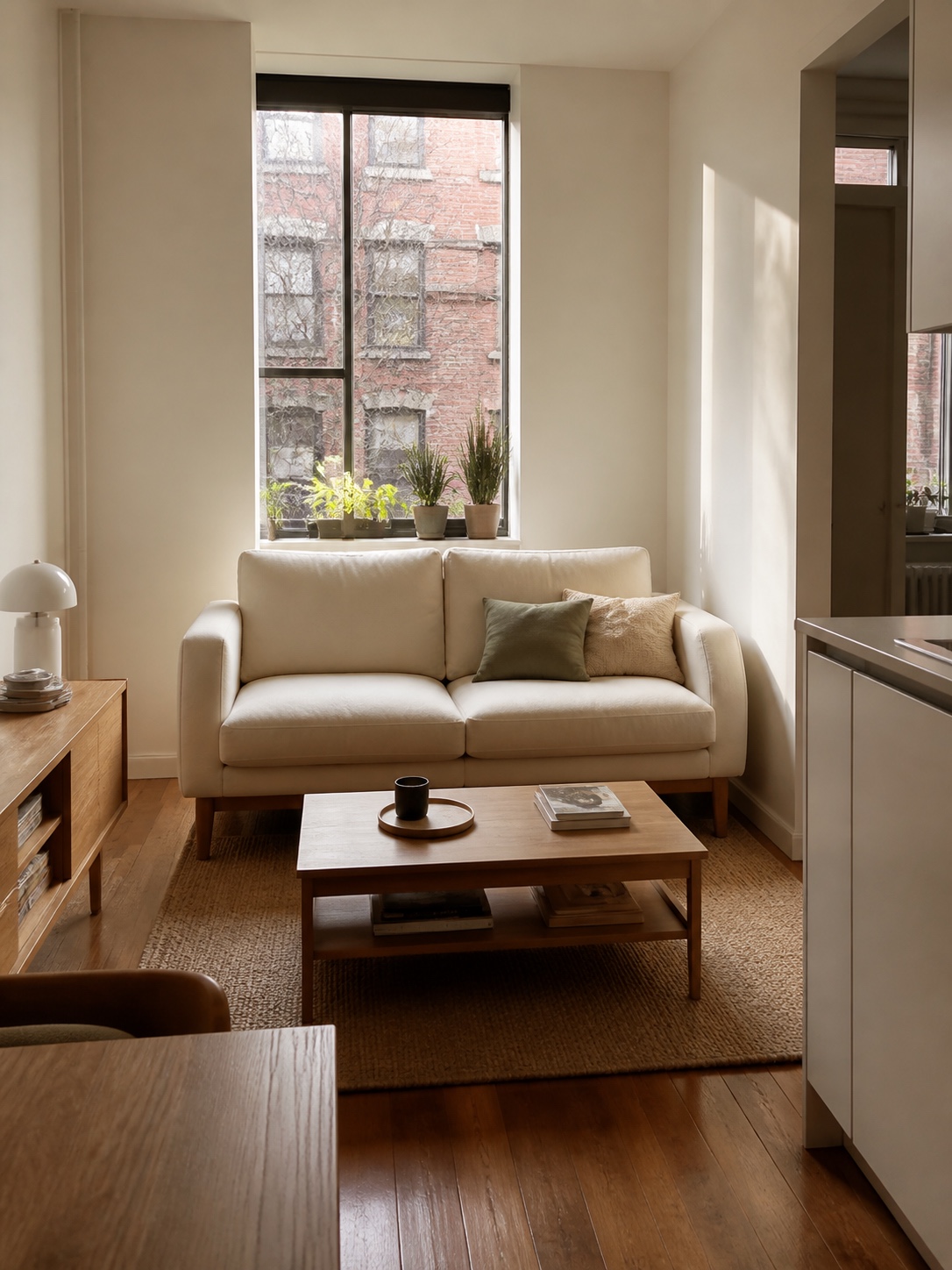
Before choosing seat depth: sit in a chair set at the height the sofa will occupy (typically 45cm from the floor) and place your feet flat on the floor. Measure from your lower back to the front of the seat. Add 5 to 8cm for comfort. That number is your ideal seat depth. Most people find 83 to 90cm works well. Deep-seat aficionados tend toward 95 to 100cm. Above 100cm, a footstool is almost always needed for comfortable longer sitting.
Rule 6: pick a system that can shrink now and expand later
Renters in particular need furniture that adapts to life’s uncertainty. A modular sofa that starts as a compact three-seat linear configuration in a 45-square-meter apartment and expands to a full L-shape when the buyer moves to a larger flat is a different investment calculation than a sofa bought for a specific room and replaced when the room changes.
For rental units and flips, modular sofas should support the larger investor-friendly interior design strategy: easy access, durable fabric, clear walkways, and listing photos that make the room feel usable.
Not every modular sofa genuinely supports this. Some are ‘modular’ in the sense that they have a corner piece and some linear units, but the modules are large and the minimum configuration still overwhelms a small room. A genuinely expandable system has small base modules and an open-ended configuration logic.
The renter argument for modular
The average renter in a major city moves every three to four years. A sofa that can’t be disassembled for the move, that won’t fit the new apartment’s different layout, or that requires professional reassembly after transport is a significant logistical and financial liability. The modular sofa pays a design premium compared to a fixed sofa of similar quality, and the return on that premium is the flexibility to move and reconfigure without additional cost.
DreamSofa’s DreamModular system is specifically built for this pattern: start with a compact configuration, add modules as space allows, rearrange when the layout changes. Burrow adds pieces individually with a consistent modular language, so a two-seat from a small apartment can become the end unit of a sectional in a larger one. Cozey covers the same ground for the buyer who wants the lowest initial price with the most flexibility preserved.
Rule 7: use fabric and color to reduce visual bulk
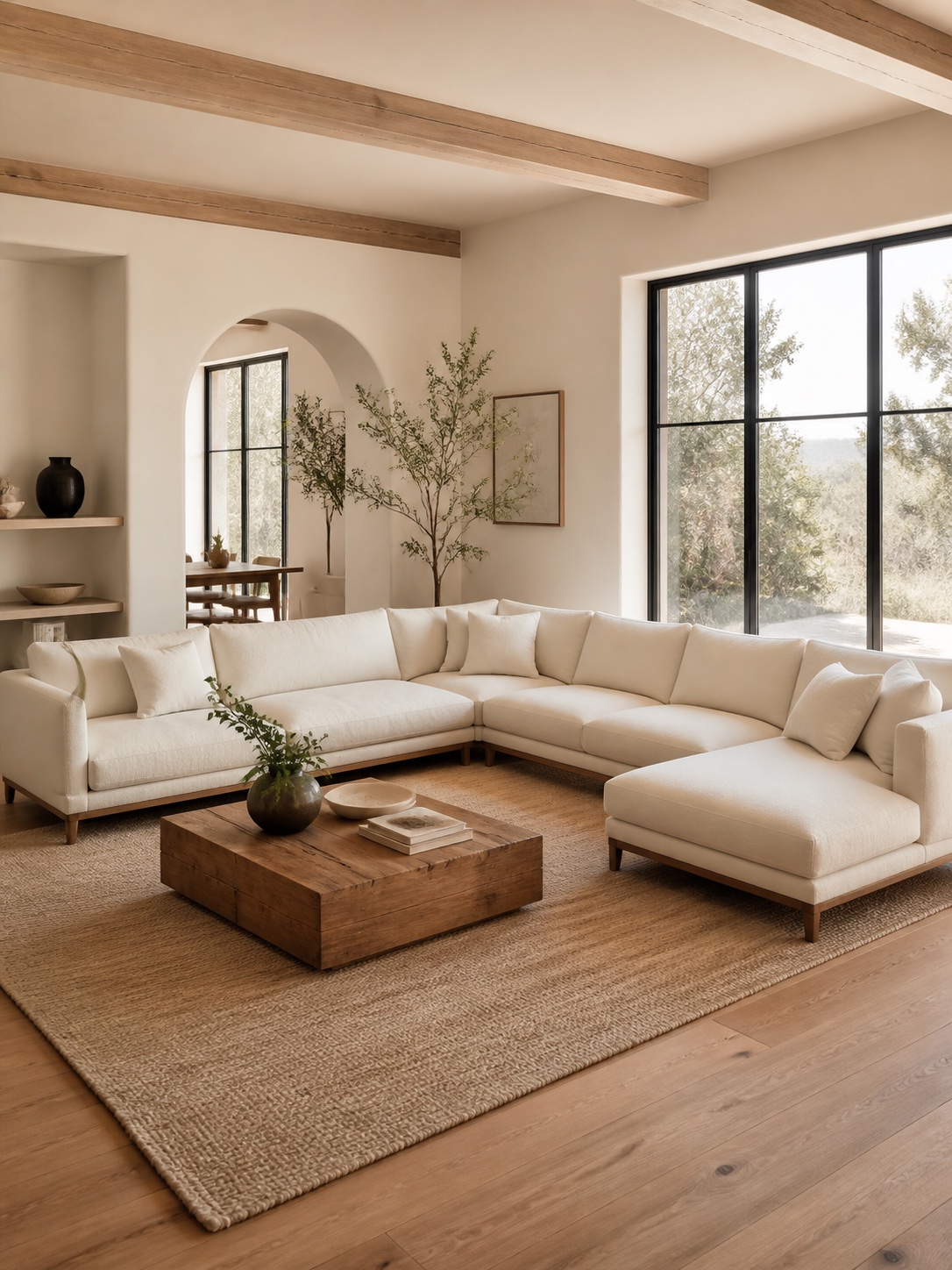
A sofa’s visual weight is partly a function of its physical dimensions and partly a function of how those dimensions read in the room. Tone and texture contribute to that reading. A sofa that is close in tone to the walls and floor recedes visually. A sofa that contrasts sharply with its surroundings advances.
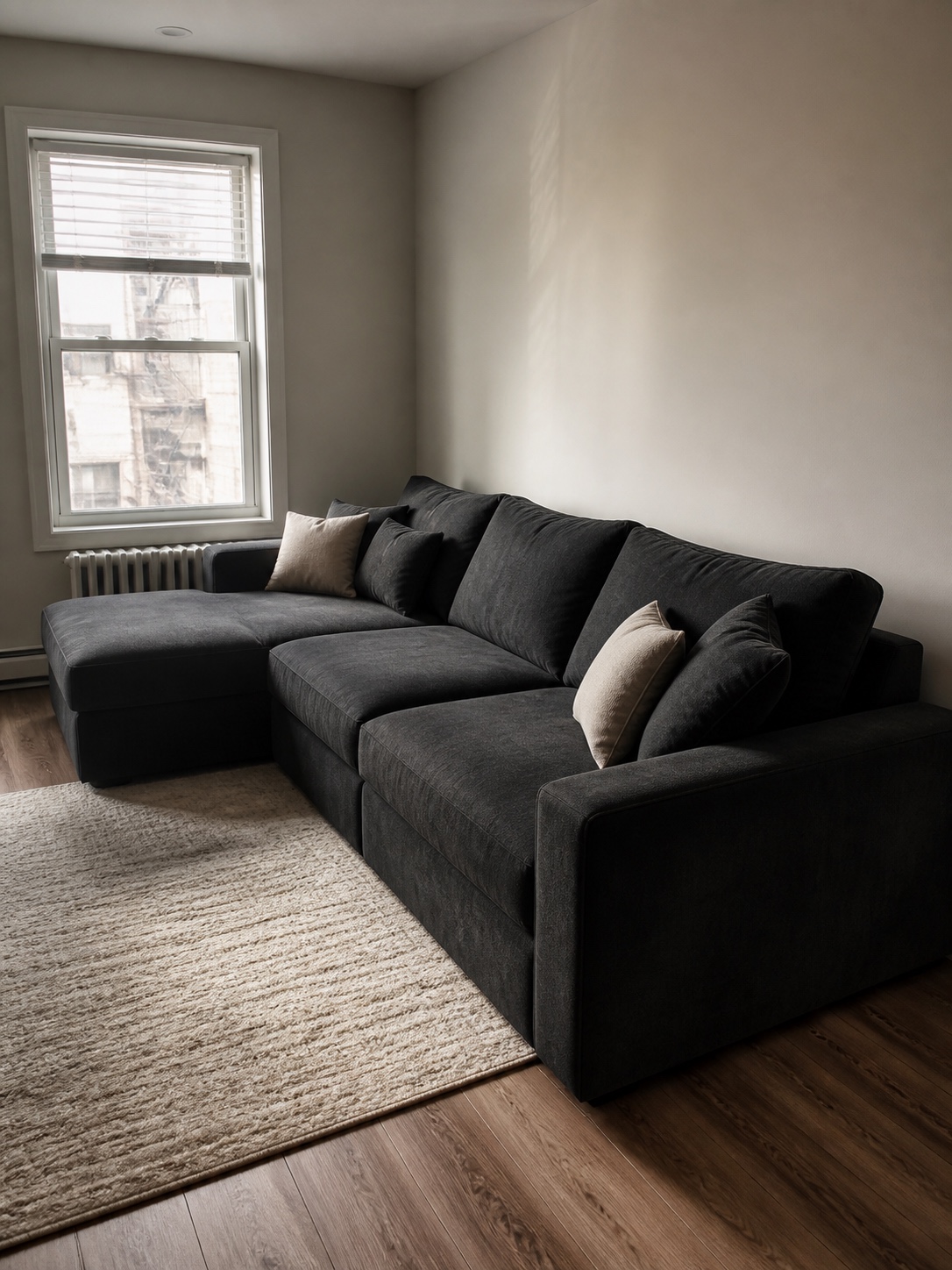
In a small room, a sofa that advances visually reads as larger than its dimensions suggest. A sofa that recedes reads as smaller. This doesn’t mean every small-room sofa should be light-colored (contrast can be used deliberately to create focal points), but the visual weight consequence is real and quantifiable in terms of how the room feels to be in.
Light neutrals in small spaces
Warm white, cream, light greige, and soft taupe all recede against standard painted walls in the 30 to 50% reflectance range (off-white to medium grey). A sofa in one of these tones against a wall painted in a similar value reads as part of the room’s tonal field rather than as a dominant object in it. The sofa is present but not the only conversation.
Test this with a simple experiment: photograph the room with a neutral swatch held against the wall, then photograph it with a dark swatch. The spatial difference visible in those two photographs is the visual weight effect. It’s consistent enough to use as a design tool rather than a preference question.
Performance fabric and texture in small spaces
Performance fabrics (microfibre weaves, solution-dyed acrylics, performance linens) have an additional advantage in small apartments: they clean more easily, which matters in a room where the sofa is closer to food preparation and foot traffic than in a larger home. DreamSofa’s
If you are pairing a sofa with a separate reading chair, this upholstery care comparison helps you decide whether leather or fabric makes more sense for spills, pets, and everyday maintenance.
DreamThread and similar performance weaves from Burrow and Cozey are specified for this use case. Texture also matters: a slightly textured neutral fabric reads as more natural and less clinical than a smooth sateen or a plain twill at the same color.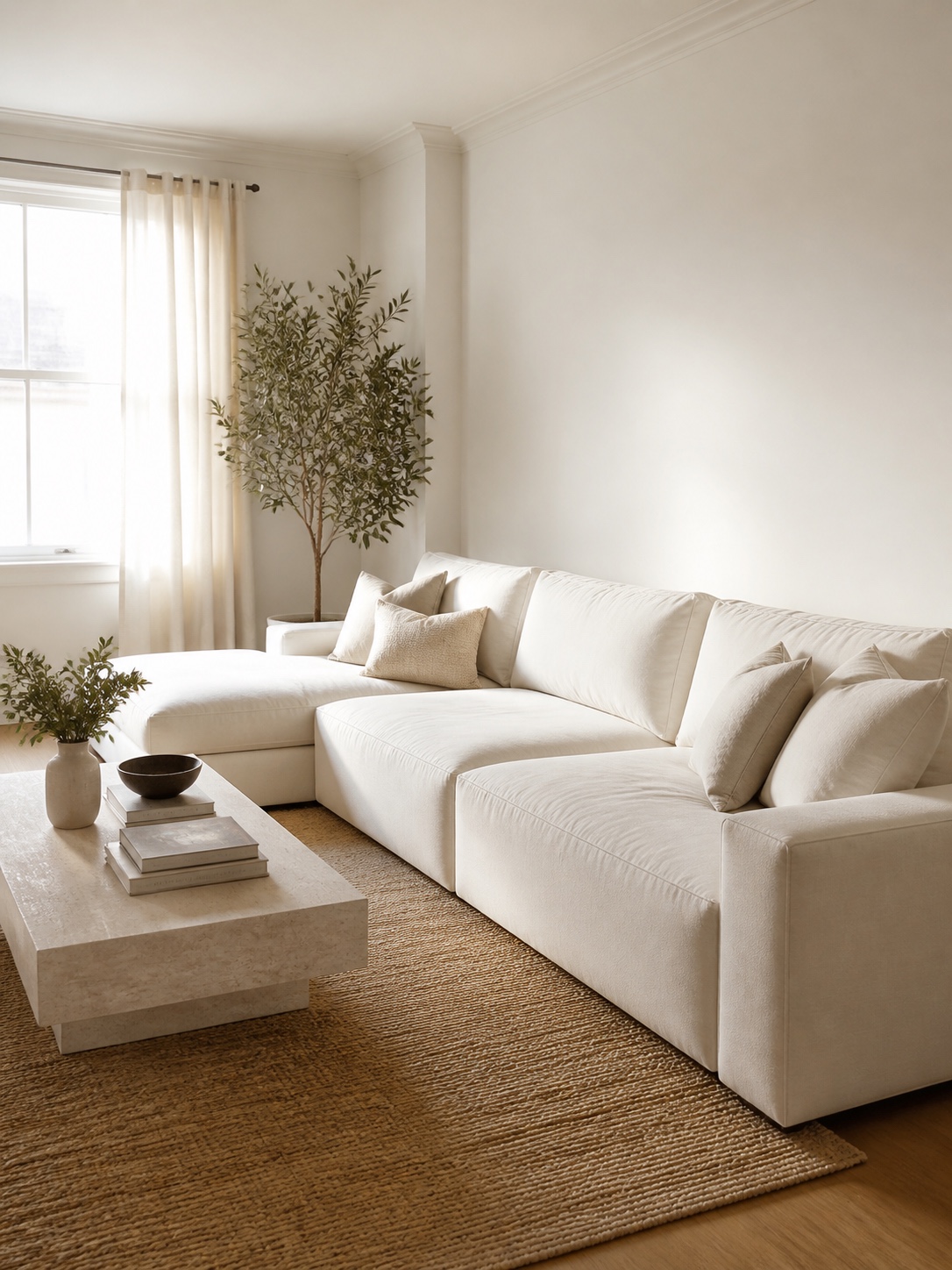
Frequently asked questions
What is the best modular sofa for a small apartment?
The most important variable is sizing precision rather than brand name. A sofa specified to the exact available wall length works better than the nearest standard size. DreamSofa’s FlexForm sizing allows to-the-inch specification. For delivery through difficult access routes, Burrow and Cozey both ship in compact pieces that assemble without tools inside the apartment.
How do you choose a sofa for a small living room?
Measure the usable wall length and the maximum seat depth the room can take while leaving adequate walkways (minimum 90cm beside the sofa). Avoid deep cloud-style seating in rooms under 20 square meters: 85 to 90cm seat depth is more practical than 100 to 105cm. Choose raised legs over a grounded base, and slim arms over high square arms to reduce visual mass without reducing seating surface.
Are modular sofas good for small spaces?
Yes, because they arrive and rearrange in separate pieces. A modular sofa that would never fit through a doorway as one unit can be carried in section by section. They can also be configured small initially and expanded later. The key is choosing a brand where the individual module scale is compact: large-module systems can overwhelm a small room even in a modest configuration.
How deep should a sofa be for a small room?
For rooms under 4 meters in width, 85 to 90cm seat depth is more practical than cloud-style sofas at 100 to 110cm. The 15cm difference matters significantly: it’s often the difference between a walkway that functions comfortably and one that feels tight. An ottoman used occasionally is more flexible than committing the floor area permanently to sofa depth.
What sofa leg height is best for small rooms?
Higher legs (15 to 20cm) are better for small rooms than lower legs or skirted bases because visible floor under the sofa reads as continuous floor area rather than occupied space. A sofa that appears to float slightly makes the room look larger. The leg height should be proportional to the sofa’s total height: a rough guide is legs between 15 and 20cm for most contemporary sofa heights.
What color sofa is best for a small room?
Light neutral tones (warm whites, creams, light greys, soft taupes) reduce visual bulk by echoing the wall and ceiling tones rather than contrasting with them. A sofa close in tone to the walls recedes visually. A dark sofa against light walls advances, reading as larger than its dimensions. This doesn’t prevent small rooms from using dark sofas, but the visual weight consequence is real and worth factoring into the choice.
A modular sofa can dominate a compact room, so set the color palette for a small living room before choosing upholstery, cushions, and wall art.
How do you get a modular sofa into a small apartment?
Measure every constraint: door width, door diagonal (the maximum length of a rigid item that can pass through), hallway width at the narrowest point, any right-angle turns, stair dimensions, and elevator interior dimensions. Burrow and Cozey are specifically designed for this: they ship in compact boxes and assemble without tools inside the apartment. Confirm module dimensions with any brand before ordering.
For more room-by-room inspiration, browse the Sky Rye Design home decor archive.
Once the sofa scale is right, the wall behind it does a lot of the visual work. The guide to textured wall finishes shows when a subtle wallpaper or grasscloth surface can make a compact living room feel more finished.
Small spaces need stronger planning, so these furniture layout rules are useful before choosing a modular sofa.
- 38shares
- Facebook0
- Pinterest38
- Twitter0
- Reddit0