Learning how to draw a monkey step by step is much easier when you ignore the fur at first. Start with circles, ovals, a soft U-shaped muzzle, and a curly tail. Those simple shapes do most of the work before you add color or texture.
This tutorial begins with a cute cartoon monkey for kids and beginners, then moves into a more realistic monkey sitting on a branch. Keep your pencil light, use an eraser without guilt, and treat the first sketch as a map rather than a finished drawing.
- Key takeaways
- Start with simple monkey shapes
- How to draw a monkey step by step
- Monkey drawing ideas and references
- How to draw a simple cartoon monkey step by step
- How to draw a more realistic monkey pose
- Tips, tricks, and common mistakes when drawing monkeys
- Expand your monkey drawings into comics, logos, and scenes
- FAQ
- Q: What is the easiest way to draw a monkey for beginners?
- Q: How do I make my monkey drawing look different from a bear or dog?
- Q: What materials do I need for this monkey drawing tutorial?
- Q: What age is this monkey drawing tutorial suitable for?
- Q: How do I draw a monkey hanging from a branch?
- Q: Can I use these steps to draw chimpanzees or other monkeys?
- References
Key takeaways
- This guide teaches an easy, step-by-step way to draw a cute cartoon monkey sitting and smiling using simple shapes like circles, ovals, and curved lines.
- The only tools you need are a pencil, eraser, black pen or marker, and colored pencils or crayons to complete your drawing.
- The tutorial builds gradually from the monkey’s head and face to the body, arms, legs, and curly tail, making it perfect for beginners.
- An additional section covers how to create a more realistic monkey pose for those ready to level up their skills.
- The FAQ at the end answers common questions about drawing different poses, styles, and monkey types from the approximately 260 species found around the world.
Start with simple monkey shapes
Before you draw details, look for the big shapes: a round head, a smaller body, two wide ears, a muzzle, and a tail that curves like a loose question mark. When I sketch animals, I check the silhouette first. If the outline reads as a monkey, the fur and face details become much easier.
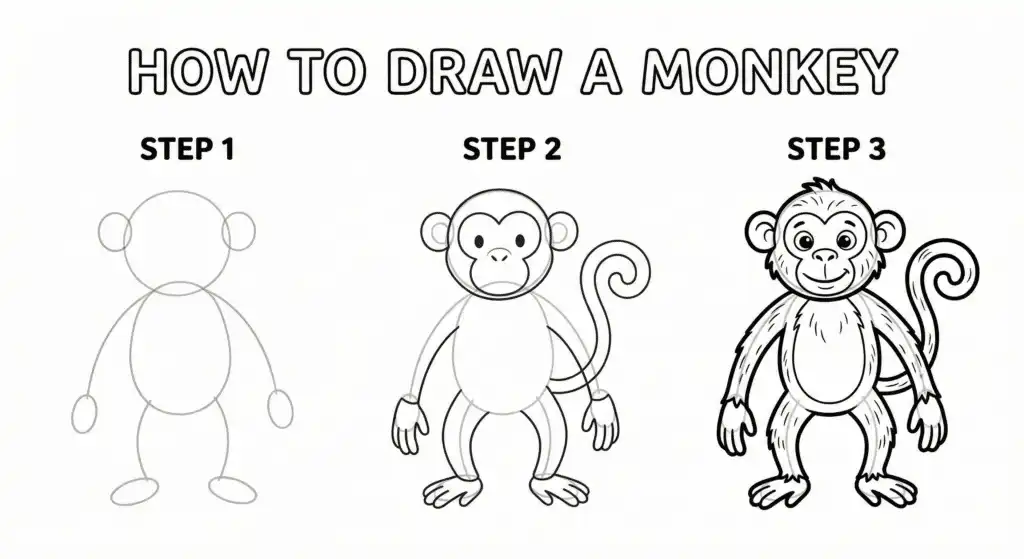
The most useful construction lines are the vertical center line and the eye line. Draw them lightly enough that you can erase them later. They are not decoration; they keep the eyes, nose, and smile from drifting to one side.
How to draw a monkey step by step
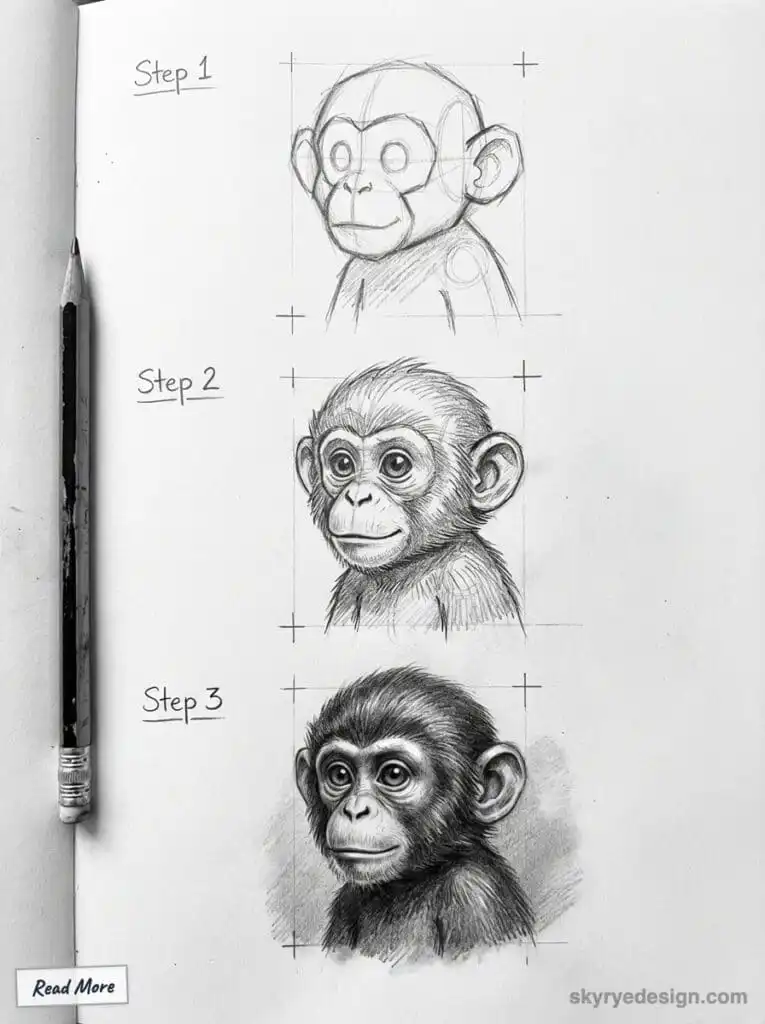
To draw a monkey step by step, sketch a large circle for the head, add a smaller rounded body underneath, place the ears high on both sides, then build the muzzle with a wide U shape. Add the eyes on a light horizontal guideline, draw a small nose and smile inside the muzzle, then sketch the arms, legs, belly patch, and curled tail. Once the outline works, erase the construction lines, darken the final contour, and color the fur with warm browns and a lighter face.
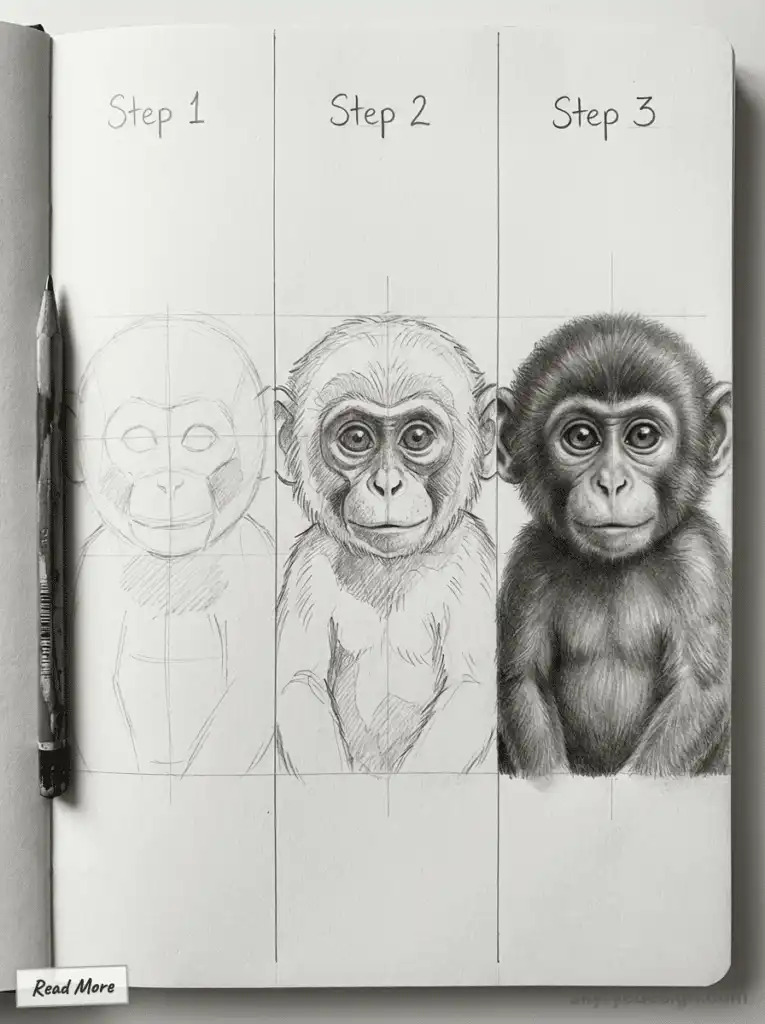
For kids, I would stop after each shape and compare left to right. Are the ears about the same size? Is the muzzle centered? Is the tail attached clearly to the body? Small checks like that prevent most beginner mistakes.
Monkey drawing ideas and references
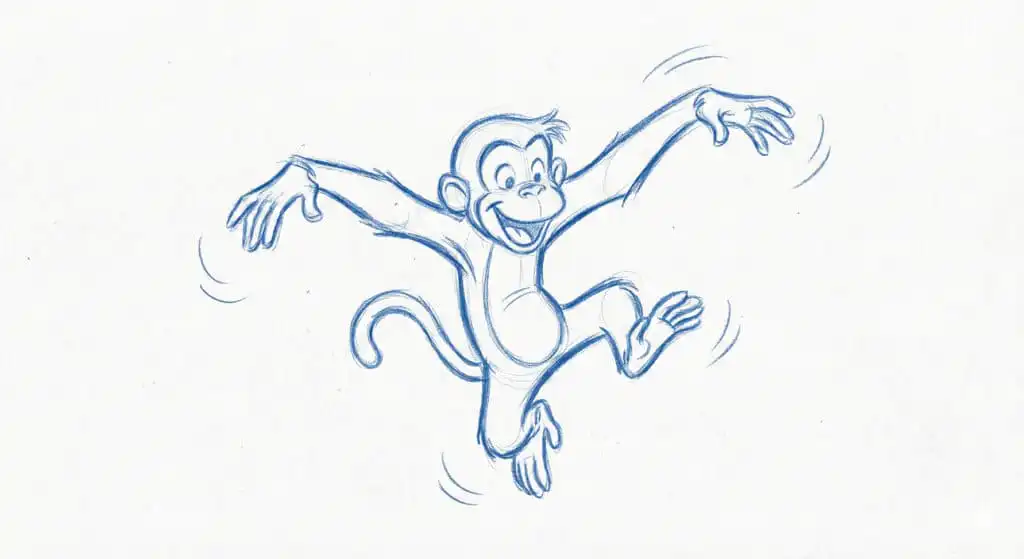
Once the basic monkey feels comfortable, use references to change the pose, mood, or species. A capuchin has a different face shape from a baboon, and a swinging monkey needs a much clearer arm gesture than a sitting one.
Here are some helpful resources to consider:
- Printable step-by-step sheets designed for kids, featuring numbered steps and blank space to sketch alongside the guide
- Nature photography of monkeys in trees, which can inspire more realistic or dynamic poses in future drawings
- Video tutorials with narrated instructions, some of which have gathered over 130,000 views from learners worldwide
- Art community forums where you can share your work and get feedback from other artists
For practice subjects after completing this tutorial, try these fun variations:
- A sitting monkey holding a banana
- A monkey hanging upside down from a branch
- A baby monkey clinging to its parent
- A funny dancing monkey with arms raised
- A monkey swinging through jungle vines
Reference photos are especially valuable when you want to capture the unique characteristics of different species, from the compact builds of capuchins to the robust forms of baboons.
How to draw a simple cartoon monkey step by step
This is the main kid-friendly version: a front-facing monkey with a round head, big ears, short body, and a smiling face. It is simple enough for a classroom drawing project but still useful if you are learning animal proportions.
Work lightly at first. A 2B pencil is perfect because it gives you soft lines without forcing you to press hard. You can darken the clean outline later with a black pen or marker.
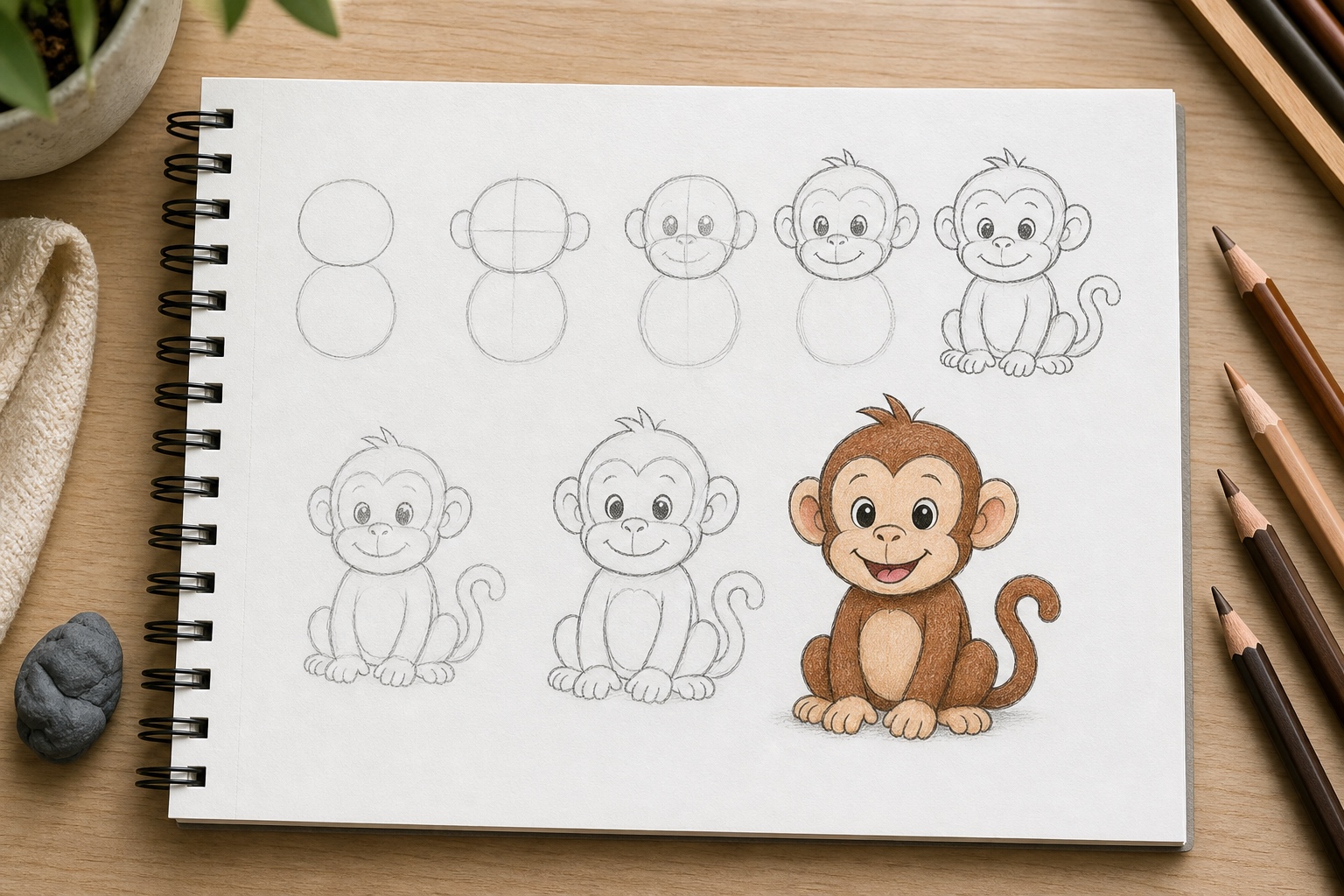
Step 1 – Draw the Head and Face Guidelines
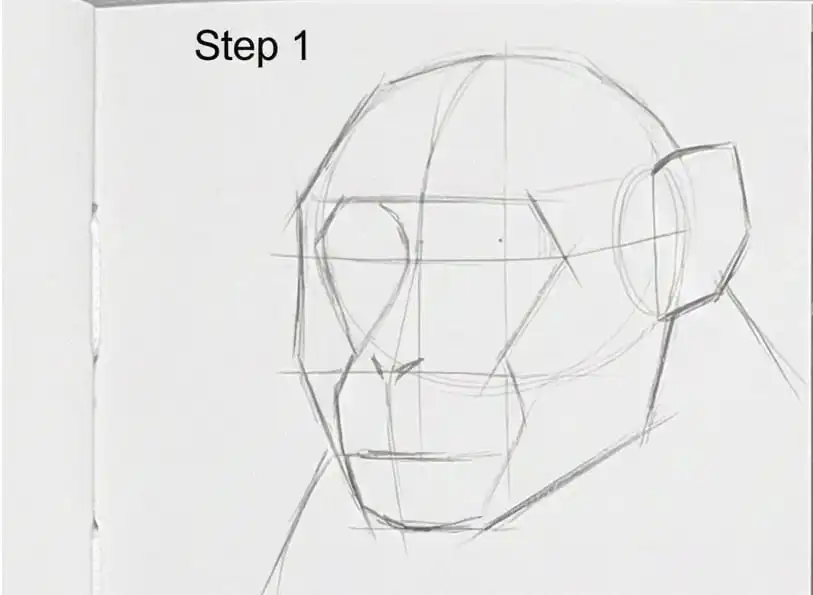
Start by drawing a large, light pencil circle in the center of your paper for the monkey’s head. On standard A4 paper, aim for about 8-10 cm wide, which gives you plenty of room for details.
Next, add a light vertical guideline running straight down the middle of the circle. Then draw a horizontal guideline across the middle, creating a cross shape inside the head.
Those light construction lines may feel boring, but they save the face. They help you place the eyes and muzzle evenly so the monkey looks straight at the viewer. If your sketch lines feel too heavy, warm up with these pencil drawing techniques before you continue.
Keep these lines sketched very lightly. You’ll erase them later once your drawing is complete.
Step 2 – Add the Face (Muzzle) Shape
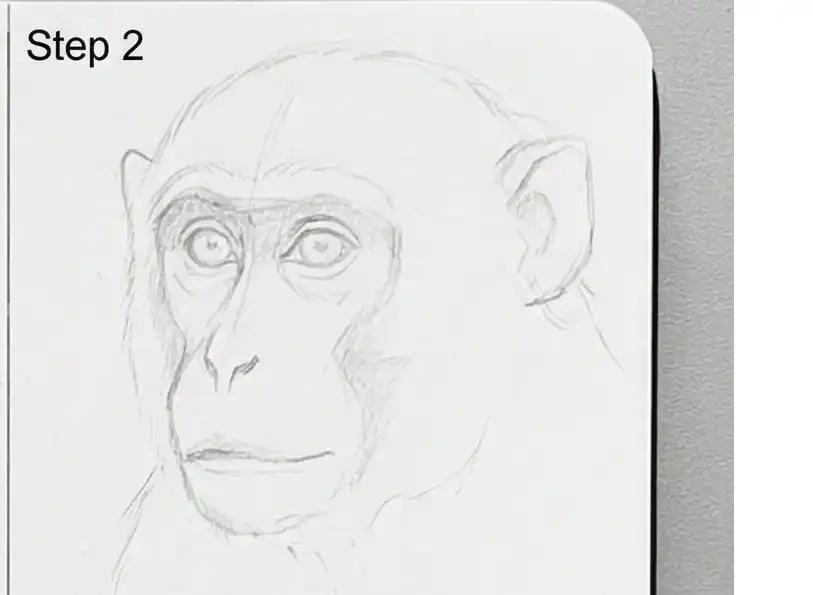
Draw a wide “U” shape inside the lower half of the head circle to form the muzzle area. This creates the lighter-colored face mask that monkeys have.
Position the top of the “U” so it touches or nearly touches the horizontal guideline you drew earlier. The muzzle should take up roughly the bottom half of the face.
Round out the sides of your “U” shape so it looks more like a soft oval rather than a sharp letter. This softer curve gives your monkey a cute, friendly appearance that kids love.
Make sure the muzzle stays centered on the vertical guideline. This keeps your monkey’s face balanced and looking straight at the viewer.
Step 3 – Draw the Eyes, Nose, and Mouth
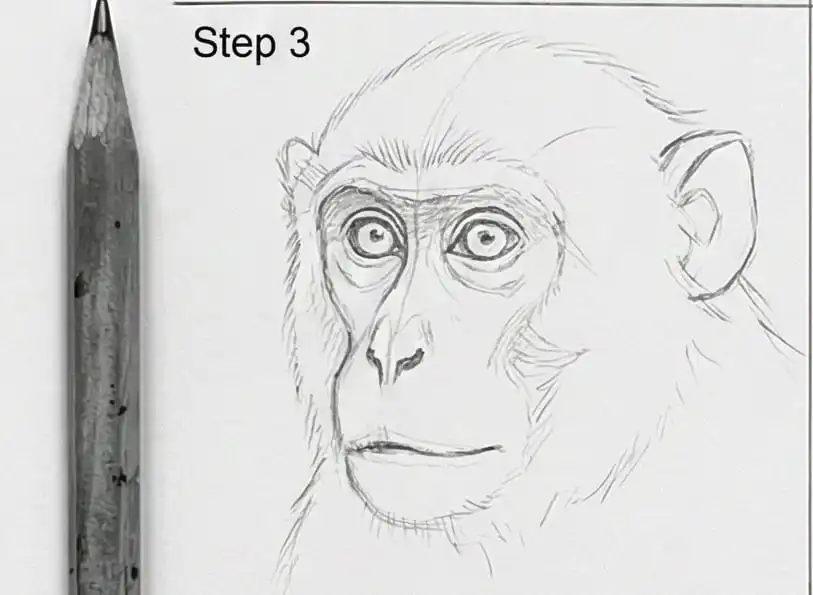
Place two medium-sized ovals for eyes on the horizontal guideline, positioning one on each side of the vertical line. Space them evenly for a balanced look.
Inside each eye, add smaller dark circles for pupils. Leave a tiny white highlight spot in each pupil to make the eyes look shiny and alive. This small detail adds tremendous expression to your drawing.
For the nose, draw a small rounded triangle or oval in the center, right at the top of the muzzle shape. Keep it simple and not too large.
Create a smiling mouth by drawing a short vertical line down from the nose, then adding two curved lines extending to each side. Think of it like a sideways “3” shape or a simple “W” turned on its side.
Optional: add tiny curved lines above the eyes for eyebrows. This is a small move, but it changes the expression quickly: raised brows feel surprised, low brows feel mischievous, and soft brows keep the monkey friendly.
Step 4 – Draw the Ears and Top of the Head
Draw two large round ears on each side of the head circle, positioned slightly above the horizontal guideline. Monkey ears are one of the key features that distinguish them from bears or dogs.
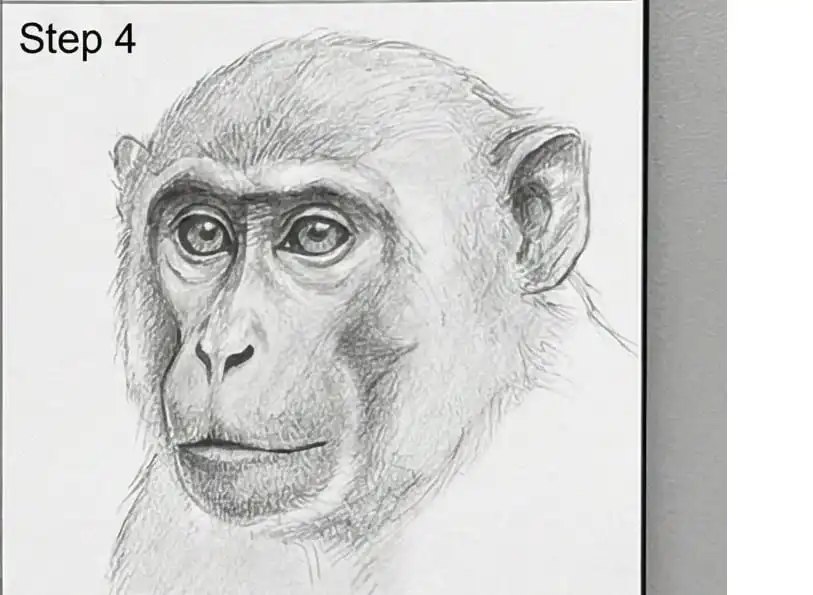
Each ear can be drawn as a “C” shape on the left side and a reversed “C” shape on the right, attached directly to the head circle.
Add a smaller curve inside each ear to show the inner ear detail. This creates a thin rim around the edge and adds depth to your drawing.
For extra character, you can slightly flatten the very top of the head or add a tiny tuft of fur with three short spiky lines. This gives your monkey personality.
Step 5 – Sketch the Body Under the Head
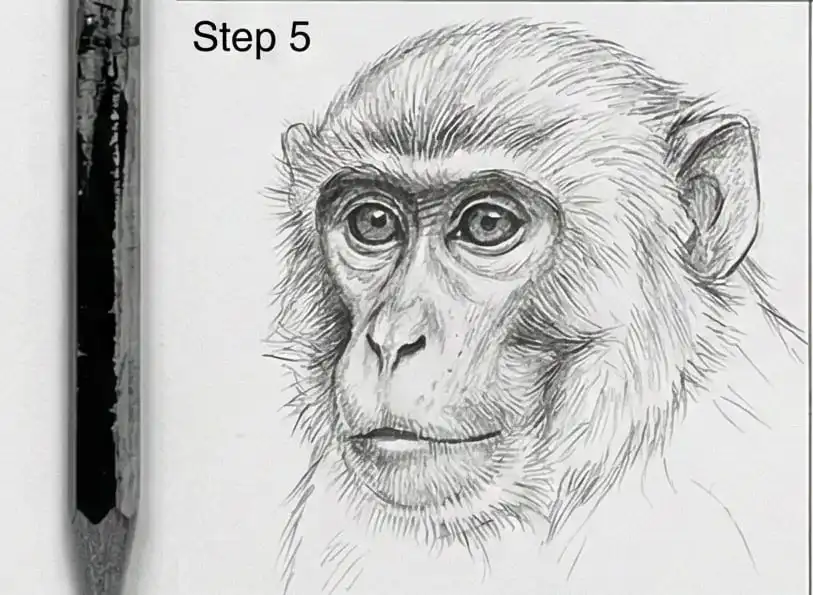
Draw a smaller oval or rounded egg shape just under the head to form the monkey’s body. Let it overlap slightly with the bottom of the head circle.
Keep the body about half as tall as the head. This proportion maintains the cute, chibi-like appearance that makes cartoon monkeys so appealing. Real monkey anatomy follows roughly a 1:3 head-to-body ratio, but we’re exaggerating for cuteness here.
Use smooth, curved lines so the body looks soft, as if the monkey is sitting and hunched slightly forward.
Add an inner oval on the belly area. This will become a lighter fur patch when you add color later, giving your monkey more visual interest.
Step 6 – Outline and Erase Guidelines
Once you’re happy with your monkey sketch, trace the final lines with a darker pencil, black pen, or fine marker. Work slowly and carefully to keep your lines smooth.
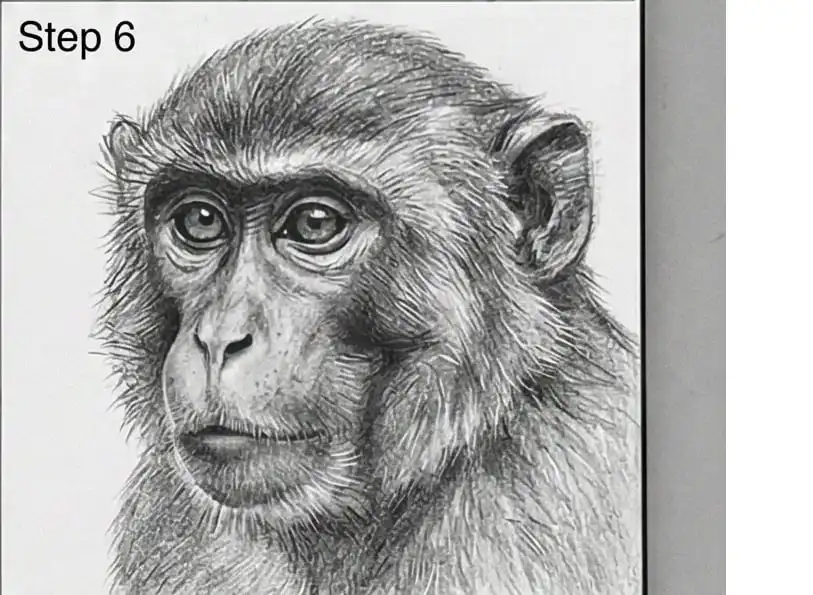
Wait for any ink to dry completely before erasing. Then gently remove all the light guidelines and construction lines you drew at the beginning.
Consider thickening the outer contours of the head, body, and tail slightly. This creates a clean, professional cartoon look that stands out on the page.
Take your time during this step. Working too quickly can cause smudges or broken lines that are difficult to fix.
Step 7 – Color Your Monkey
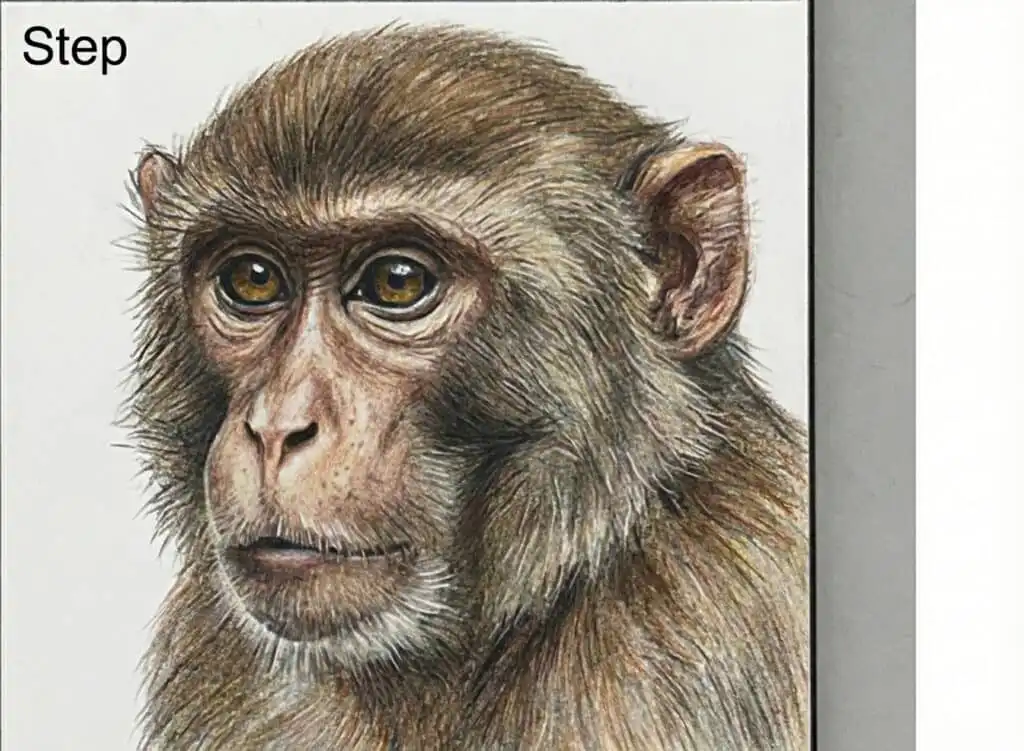
Now comes the fun part. Use colored pencils, crayons, or markers to bring your monkey drawing to life.
Here’s a classic color scheme that works beautifully:
| Area | Recommended Color |
|---|---|
| Main fur | Medium brown |
| Face/muzzle | Light cream or beige |
| Inner ears | Light pink |
| Belly patch | Cream or tan |
| Cheeks | Soft pink |
Add simple shading by using a slightly darker brown under the head, along the bottom of the arms, and beneath the tail. This creates depth without requiring complex techniques.
Don’t be afraid to experiment with different colors. Purple monkeys, blue monkeys, or rainbow monkeys can be just as fun for creative projects.
For another kid-friendly animal built from circles and ovals, use this easy dog drawing tutorial as a quick practice sketch. It is especially useful for paws, floppy ears, and simple facial expressions.
How to draw a more realistic monkey pose
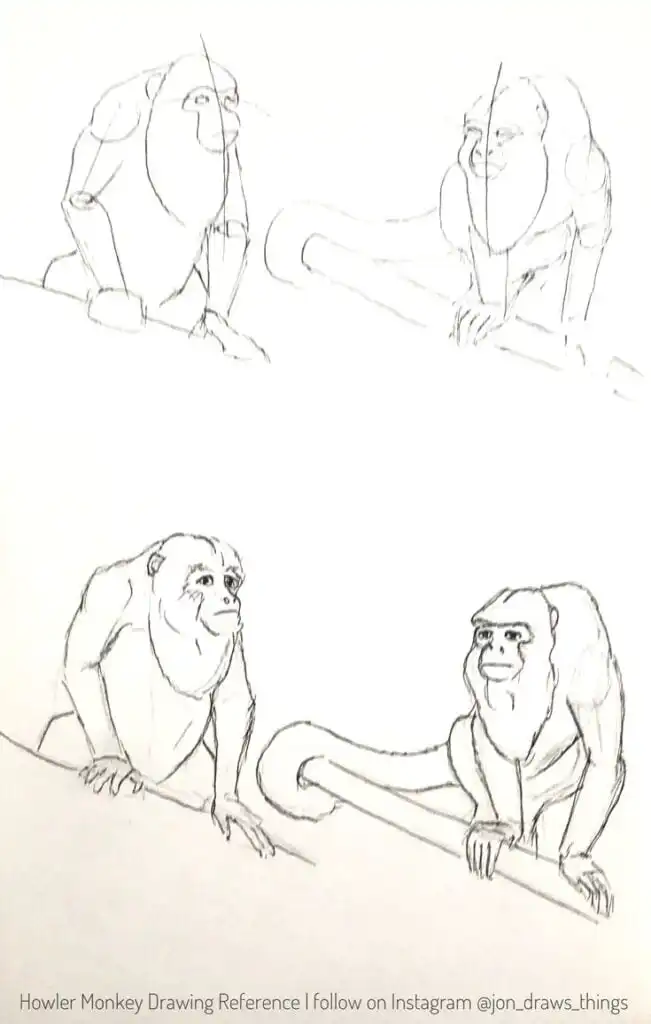
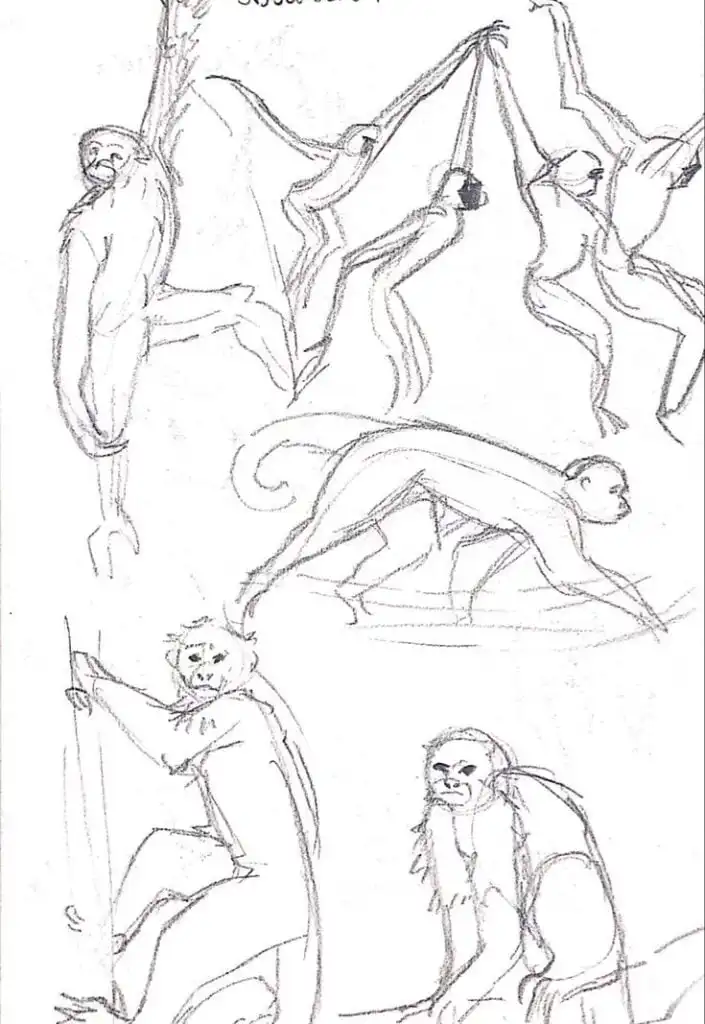
After the cartoon version, try a monkey sitting on a branch. The drawing still starts with simple shapes, but the proportions are less cute and more natural: longer arms, smaller head, bent legs, and a body that leans into the pose.
Use circles, ovals, cylinders, and one clear gesture line before you draw fur. In academic drawing, this is where you slow down and compare angles instead of guessing. The branch also matters because it gives the hands and feet something believable to grip.
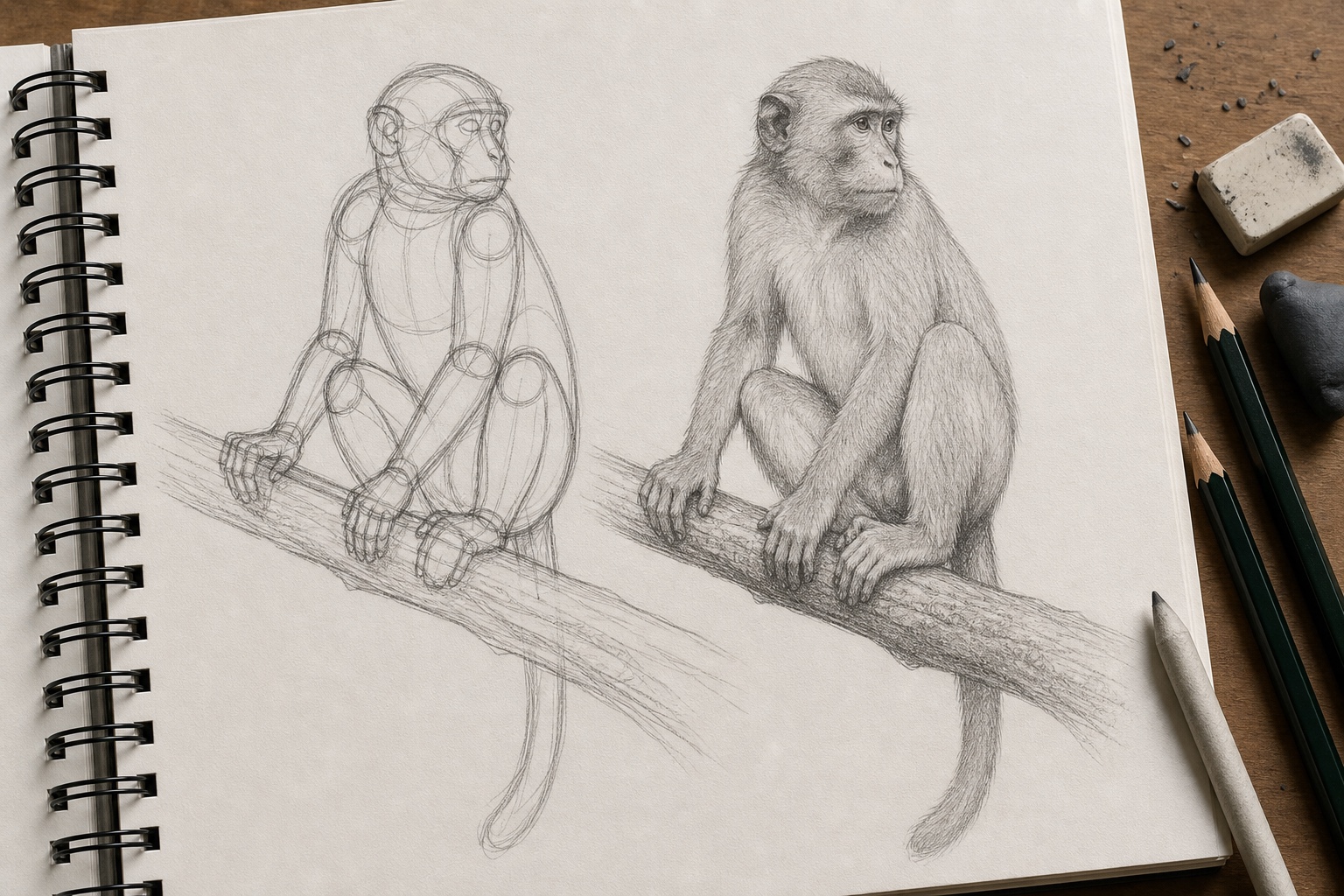
Keep a reference photo nearby for this section. Look for a monkey sitting on a branch so you can check the arm length, hip angle, tail curve, and how the fingers wrap around the wood.
Step 1 – Basic Shapes for Body and Branch
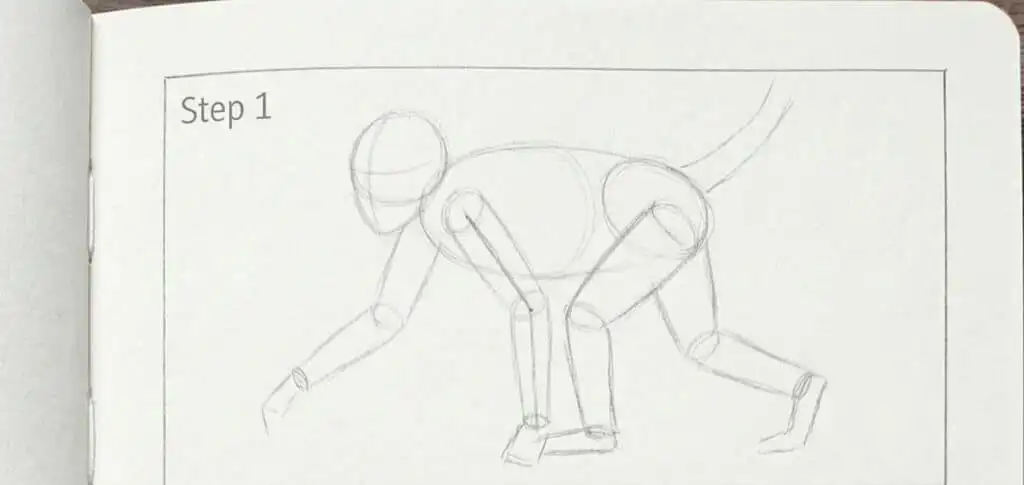
Sketch a large oval for the ribcage area and a smaller oval for the hips. Position them so they overlap slightly and tilt forward, suggesting a seated posture.
Draw a light curved line connecting the centers of these ovals to define the spine. This helps you understand how the body curves and flows.
Add a horizontal or slightly angled rectangle beneath the body to represent a tree branch. This gives your monkey something to sit on and grounds the composition.
Keep all lines light and loose at this stage. You’ll be making adjustments as you build out the figure.
Step 2 – Add Head, Limbs, and Tail Guides
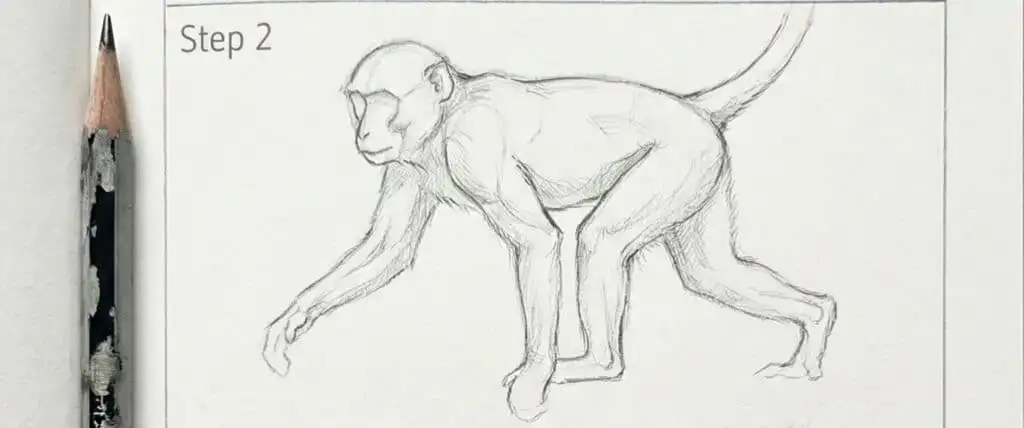
Place a medium circle above the ribcage oval for the head. Connect it to the body with a short neck line.
Add simple stick lines for arms and legs. In realistic monkey proportions, the arms should be noticeably longer than the legs—this is one of the key characteristics that makes primates look different from other animals.
Position the hands gripping the branch and the feet either resting on or dangling from it. This creates a natural, believable pose.
Draw a long, curved line from the hip area for the tail, allowing it to wrap partly around or above the branch for balance.
Step 3 – Build Volume on Arms, Legs, and Head
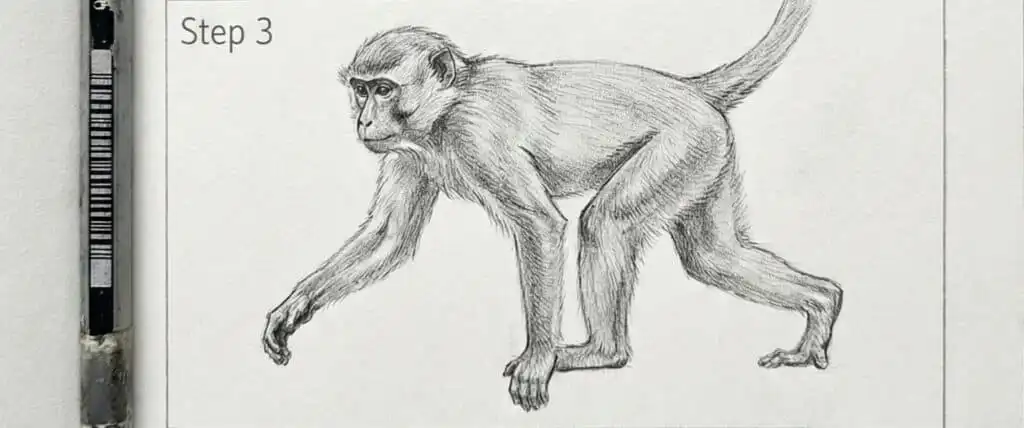
Wrap simple cylinders or rounded tube shapes around the stick lines of the arms and legs. This gives your limbs thickness and three-dimensional form.
Draw the hands and feet as flat paddle shapes with long, thin ovals for fingers and toes gripping the branch. Monkey fingers are quite long compared to human proportions.
Refine the head by adding a smaller muzzle shape protruding from the face circle. Indicate where the eyes and ears will be placed.
This is the time to adjust proportions. Check if the arms look long enough, if the knees bend naturally, and if the overall pose looks balanced.
Step 4 – Refine the Face, Fur, and Branch
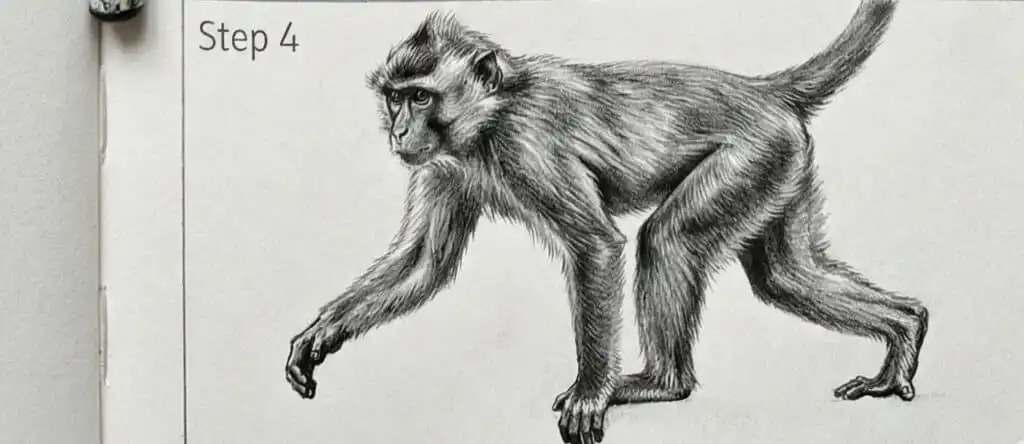
Add more realistic facial details including a subtle brow ridge, a slightly protruding muzzle with visible nostrils, and focused eyes looking in a specific direction.
Use short, directional strokes to suggest fur along the back, chest, and limbs. You don’t need to draw every individual hair—just enough to indicate texture without overworking the drawing.
Texture the branch with irregular edges and a few short bark lines to make it look like real wood rather than a smooth cylinder.
Clean up extra construction lines and darken your final contours to complete this more realistic monkey pose.
Tips, tricks, and common mistakes when drawing monkeys
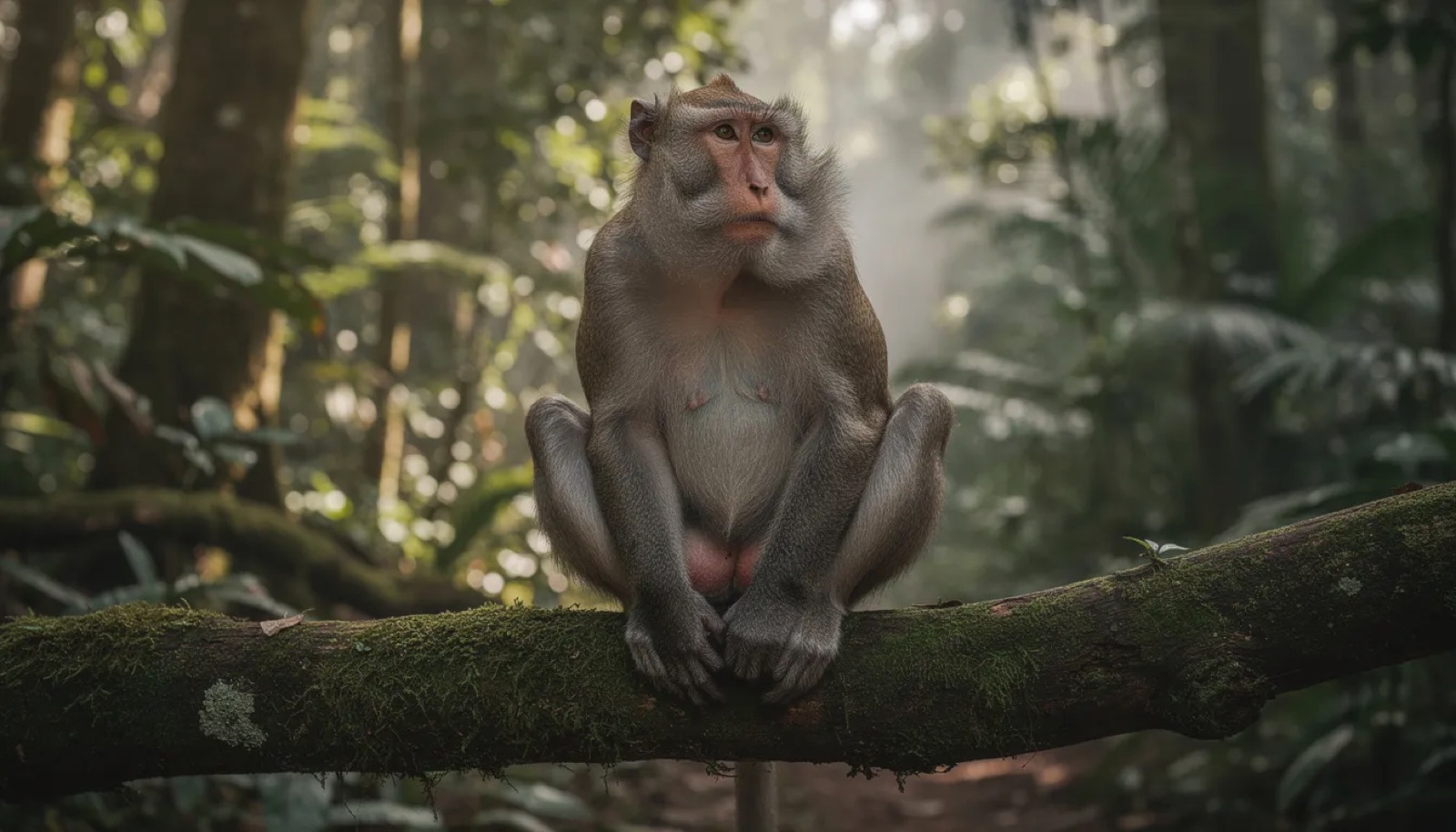
Most monkey drawings go wrong in the same few places: tiny ears, short arms, a flat muzzle, or a tail that looks pasted on. Fix those first before adding more fur or color.
Helpful Tips:
- Always start with simple shapes before adding detail—circles for heads, ovals for bodies
- Keep facial features positioned low on the face for maximum cuteness in cartoon styles
- Use reference photos of real monkeys to understand anatomy and proportions
- Practice drawing ears separately until you can create them confidently
- Experiment with different expressions by changing eyebrows and mouth shapes
- Don’t press too hard with your pencil during initial sketching
Common Mistakes and Fixes:
| Mistake | Why It Happens | Quick Fix |
|---|---|---|
| Monkey looks like a bear | Ears too small, muzzle too wide | Enlarge ears, create distinct face mask shape |
| Arms look too short | Using human proportions | Make arms extend past the body, longer than legs |
| Mouth too close to nose | Not leaving enough muzzle space | Position mouth in lower third of face area |
| Tail looks stiff | Drawing straight lines | Add curves and spirals, thick to thin taper |
| Face looks flat | Missing the muzzle shape | Add the inner oval/U shape for the face |
Do not polish a weak sketch too early. If the monkey still looks like a bear, go back to the ears, muzzle, arm length, and tail curve. Those four checks solve more problems than extra shading.
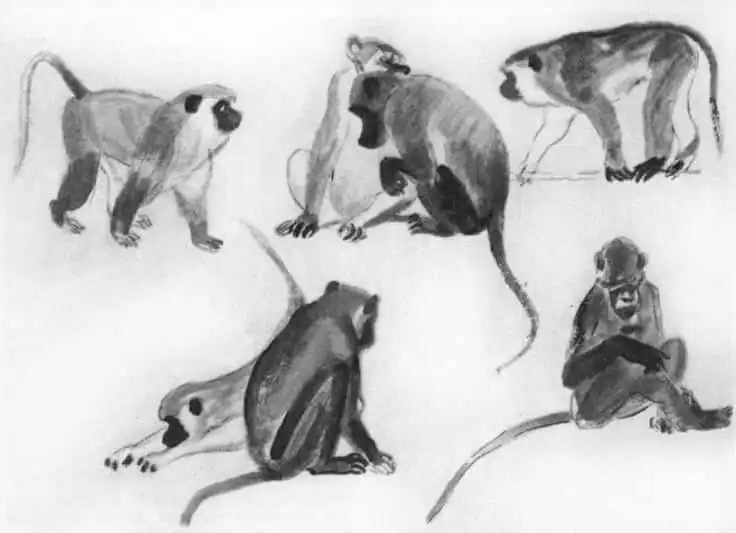
Expand your monkey drawings into comics, logos, and scenes
Once you know the basics, you can use monkeys in logos, comics, greeting cards, and full illustrated scenes. The simple shapes you’ve learned are incredibly versatile.
Creating Different Characters:
Changing the eye shape and mouth curves can transform your monkey into completely different characters:
- Half-closed eyes with a small smile = sleepy monkey
- Wide eyes with raised eyebrows = surprised monkey
- Narrowed eyes with a smirk = clever, mischievous monkey
- Closed eyes with a big grin = happy, laughing monkey
Adding Backgrounds:
Simple backgrounds make your drawings more complete and interesting:
- Jungle leaves in various green shades
- Hanging vines for the monkey to swing from
- Bananas scattered around
- A treehouse platform
- Tropical flowers in bright colors
Creating Icons and Logos:
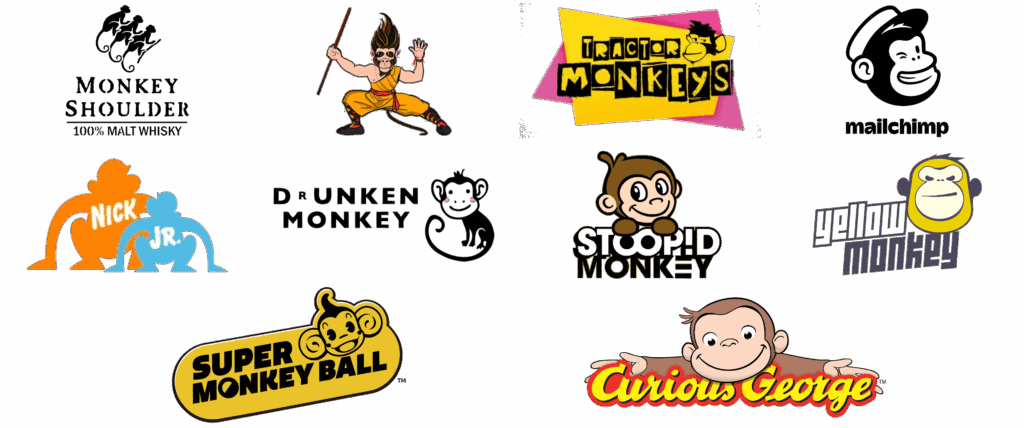
For icons, stickers, or logo drafts, simplify your monkey even further. Remove details, thicken lines, and focus on the most recognizable features: round head, big ears, and curly tail.
Comic Strip Ideas:
Try creating short comic strips where your monkey character performs simple actions:
- Climbing a tree to reach a banana
- Swinging from vine to vine
- Sharing fruit with a friend
- Making funny faces at its reflection
- Learning a new skill
Comics teach you to draw the same character from different angles and in different poses, which rapidly improves your overall drawing ability.
FAQ
Q: What is the easiest way to draw a monkey for beginners?
A: Start with a circle for the head, a smaller oval for the body, two round ears, and a wide U shape for the muzzle. Add the eyes on a light guideline, then draw the arms, legs, belly patch, and curled tail. Keep the first lines pale so you can erase and adjust them.
Q: How do I make my monkey drawing look different from a bear or dog?
A: Push the monkey features: bigger ears placed high on the head, a clear muzzle or face mask, longer arms, and a visible tail. Bears usually have smaller ears and heavier bodies, while dogs have longer snouts. If the silhouette has round ears, long arms, and a curled tail, viewers will read it as a monkey faster.
Q: What materials do I need for this monkey drawing tutorial?
A: A regular pencil, eraser, black pen or marker, and brown colored pencils or crayons are enough. A 2B pencil is nice for sketching because it makes soft construction lines, but any school pencil works. Use a marker only after the pencil sketch looks balanced.
Q: What age is this monkey drawing tutorial suitable for?
A: The cartoon monkey works well for kids around 6-12 and for complete beginners of any age. Younger kids can stop after the simple outline and color it. Older kids, teens, and adults can try the realistic branch pose to practice proportions, limb angles, and fur texture.
Q: How do I draw a monkey hanging from a branch?
A: Use the same head and body shapes, then rotate the pose so the arms reach up toward a branch. Make the arms longer than the legs, curve the fingers over the branch like hooks, and let the tail hang or curl for balance. Keep the body slightly stretched so it feels pulled by gravity.
Q: Can I use these steps to draw chimpanzees or other monkeys?
A: Yes, but adjust the species details. Chimpanzees have no visible tail and a stronger body. Marmosets have small faces and ear tufts. Spider monkeys need very long limbs and tails. Use this tutorial as the base, then check a reference photo before changing the ear size, muzzle length, body shape, and tail.
References
- Easy Peasy and Fun. (n.d.). How to Draw a Monkey. Retrieved from https://www.easypeasyandfun.com/how-to-draw-a-monkey
- Tuts+ Design. (n.d.). How to Draw a Monkey Step by Step. Retrieved from https://design.tutsplus.com/tutorials/how-to-draw-a-monkey-step-by-step–cms-29241
- wikiHow. (n.d.). How to Draw a Monkey. Retrieved from https://www.wikihow.com/Draw-a-Monkey
- The Phoenix Comic. (n.d.). How to Draw Monkey. Retrieved from https://thephoenixcomic.co.uk/comic-club/video-drawing-tutorials/how-to-draw-monkey
- Reddit. (2022). How to Draw a Monkey. Retrieved from https://www.reddit.com/r/mildlyinfuriating/comments/zmsbmt/how_to_draw_a_monkey_draw_a_monkey
- 3.6Kshares
- Facebook0
- Pinterest3.6K
- Twitter3
- Reddit0