I spent six months trying to figure out why my pandas looked wrong. Not slightly off—genuinely broken. The proportions were a mess, the fur looked like scratches, and the face had zero personality. Then one day, while looking at reference photos, I realized my mistake: I was drawing the head way too large. The panda’s head should be only about 25–30% of the total body height, not 50%. Once I fixed that one thing, everything else clicked into place.
- The Panda Proportions Problem — Why Your First Sketch Fails
- Start Simple — The Geometric Construction Method
- Refine the Face — Getting Eyes, Nose & Patches Right
- Add Body, Limbs & Posture — Making Your Panda Sit
- Shading & Fur Texture — Making It Look Real (Not Flat)
- Common Mistakes & How to Fix Them Mid-Drawing
- Optional Extras — Adding Bamboo & Background
- Conclusion
- FAQ — Frequently Asked Questions
- Q: What pencils do I actually need to draw a panda?
- Q: How long should it take to draw a panda from start to finish?
- Q: Can I draw a cute panda instead of a realistic one?
- Q: Why do my panda's eyes look dead?
- Q: How do I draw panda fur that doesn't look like messy scratches?
- Q: Should I use a reference photo?
- Q: What if I mess up halfway through? Can I fix it?
That realization completely changed how I approach animal drawing. I used to think pandas would be one of the easier animals to sketch. Big round head. Round body. A couple black patches around the eyes. Done, right?
Not even close.
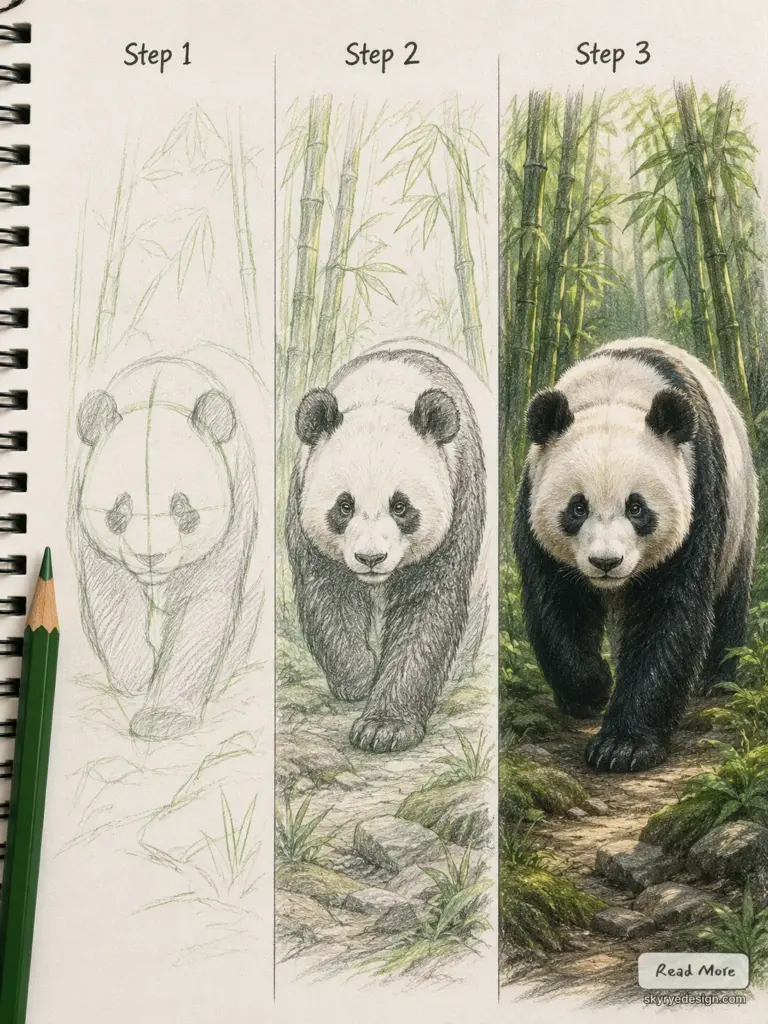
The first few pandas I drew looked like fuzzy blobs with ears. Something always felt off and I couldn’t figure out why. Then I started paying attention to proportions instead of just copying shapes. The distance between the eyes. How low the nose sits. The way the black patches tilt slightly depending on the angle of the head. Tiny stuff, but pandas fall apart fast when those details are wrong.
And that’s the part most tutorials barely touch.
They’ll show you how to build the head from circles, sure. But they don’t explain why your drawing suddenly stops looking like a panda halfway through. Or why fur shading looks flat even after an hour of blending graphite into the paper.
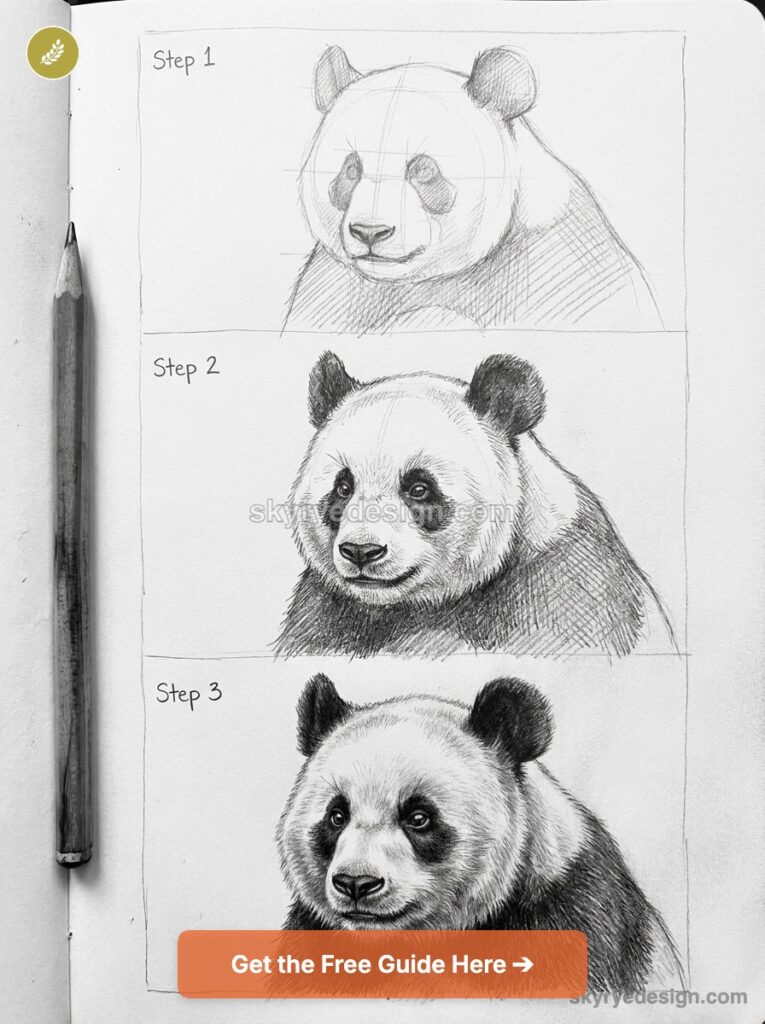
I learned the hard way that realistic fur has more to do with pencil pressure and stroke direction than fancy tools. If every stroke goes the same way, the drawing dies immediately. Real fur overlaps, changes direction, breaks apart around the cheeks and shoulders. Once I noticed that, my sketches started looking less like cartoons and more like actual animals.
Honestly, the ugliest stage of the drawing is usually the middle. That’s when proportions feel broken, the shading looks muddy, and you’re convinced you ruined it. I still hit that stage sometimes. The difference now is I know not to panic and start outlining everything darker to “fix” it. That almost always makes it worse.
That’s why I’m writing this guide. You’re going to learn the exact method I use now: geometric construction to nail proportions, step-by-step feature placement, realistic shading techniques, and most importantly, how to diagnose and fix problems before they ruin your drawing. By the end, you’ll understand not just how to draw a panda, but why each step matters.
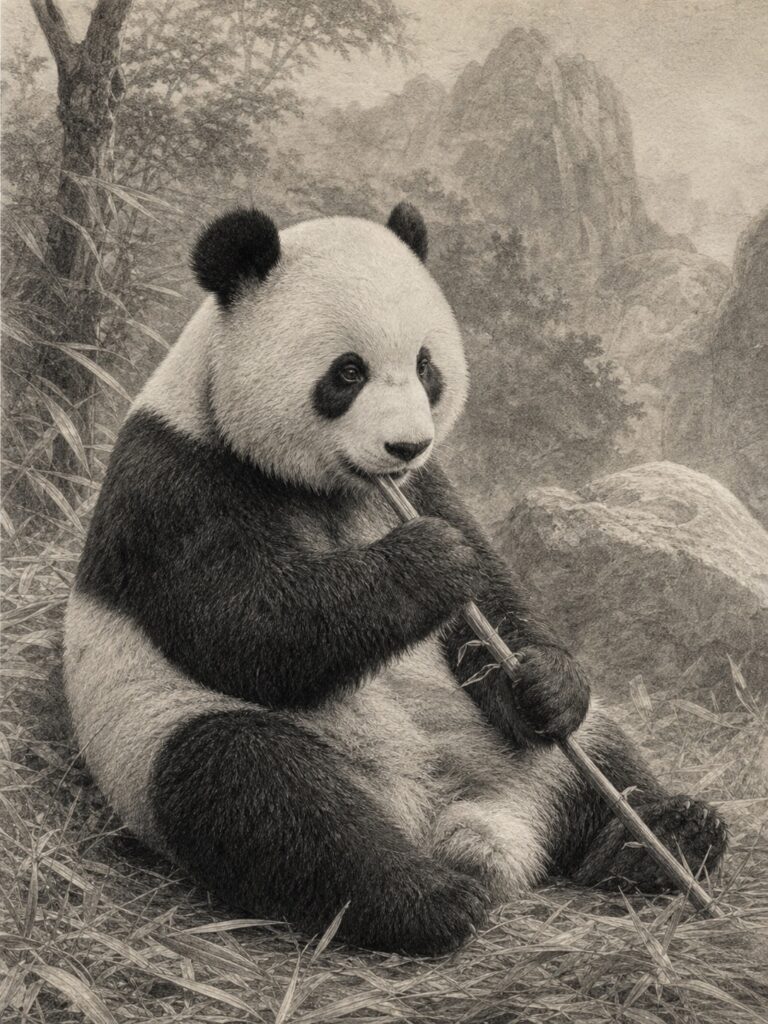
Whether you’re drawing for fun, trying to improve your animal art skills, or just want to create something you’re proud of, this guide will get you there. And yes, you will make mistakes—that’s part of it. But you’ll know exactly how to fix them.
Let’s go.
The Panda Proportions Problem — Why Your First Sketch Fails
If your panda looks off, it’s probably a proportions issue. I’d bet money on it. Not because you can’t draw—but because almost every beginner makes the exact same mistake, and it ruins the whole piece before you even get to shading.
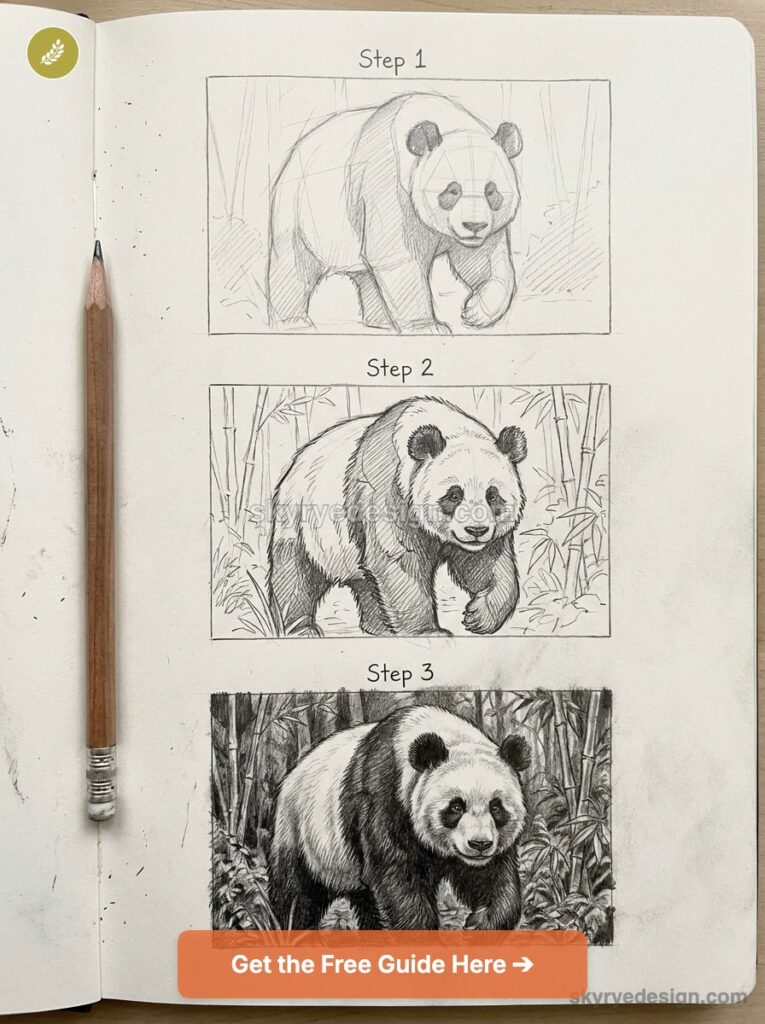
Here’s the problem: your panda’s head is too big.
Seriously. Go look at your sketch right now. Measure it roughly—does the head take up more than one-third of the total page height? If yes, welcome to the club. That’s mistake number one, and it’s why your panda looks like a bobblehead instead of an actual bear.
The 3:2 Head-to-Body Ratio
The correct ratio is this: a panda’s head should be approximately 25–30% of the total body height. The body—that round, stocky torso—needs to be roughly twice the size of the head. This matters because pandas are built like potatoes with limbs. They’re wide and solid. When you draw the head too large, you throw off everything downstream: the limbs look spindly, the proportions feel cartoonish, and the whole thing screams “beginner.”
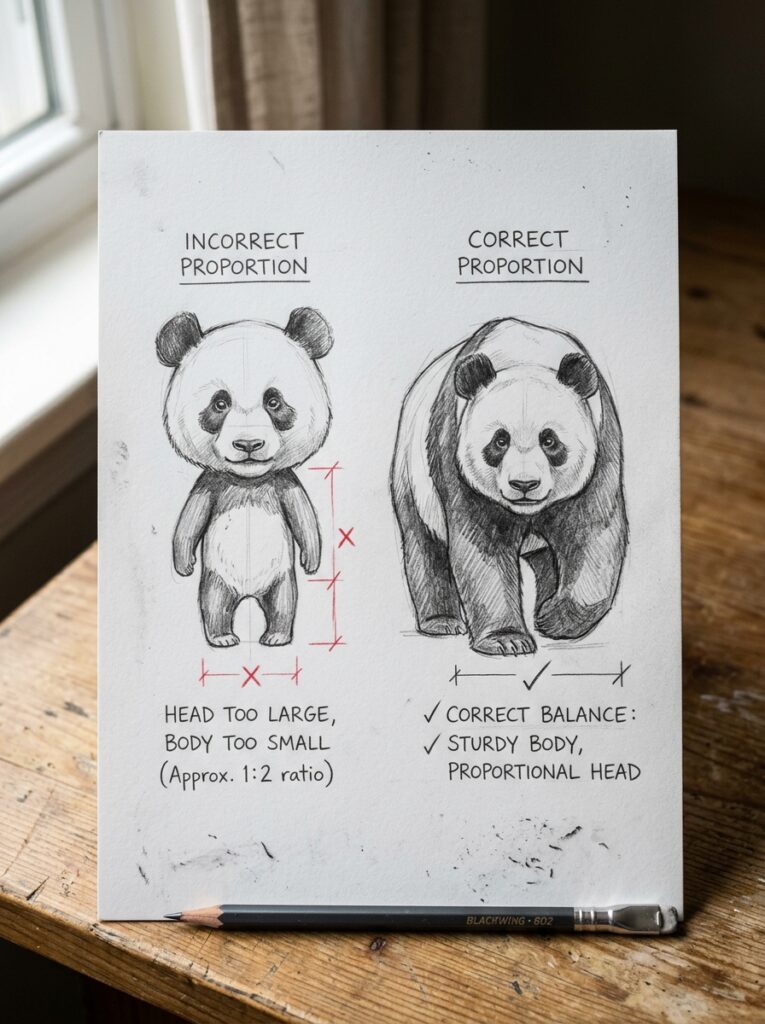
I know this because I made this exact mistake for months. Every single panda I drew looked wrong, and I couldn’t figure out why. The shading was decent. The features were placed okay. But the overall silhouette was off—too top-heavy, like the head was too important and the body was an afterthought.
How to Measure Mid-Drawing
Then I started actually measuring. I’d use a ruler or even just my pencil as a measurement tool—hold it at arm’s length, measure the head, then see how many “head lengths” fit in the body. That’s when reality hit: I’d been drawing pandas with heads that were 40–50% of the total height. No wonder they looked wrong.
Here’s the mental checkpoint: if you divide your panda into thirds vertically, the head should fit in the top third. The body fills the middle and lower thirds. The limbs extend from the sides and bottom of the body. That’s it.
The Fix: Erase and Adjust Early
If you’ve already started drawing and the proportions are off, don’t be afraid to erase. Use your H pencil lightly and adjust the body size larger. Or start over—it’s only 10 minutes, and getting proportions right from the start saves hours of frustration later.
Once you nail this one thing, everything else becomes easier. The facial features land correctly. The limbs attach where they should. The shading follows naturally.
Start Simple — The Geometric Construction Method
Now that you know proportions matter, let’s talk about how to actually build a panda without getting lost. The secret that professionals use? Shapes. Specifically: circles, ovals, and kidney beans. Seriously—that’s the entire foundation.
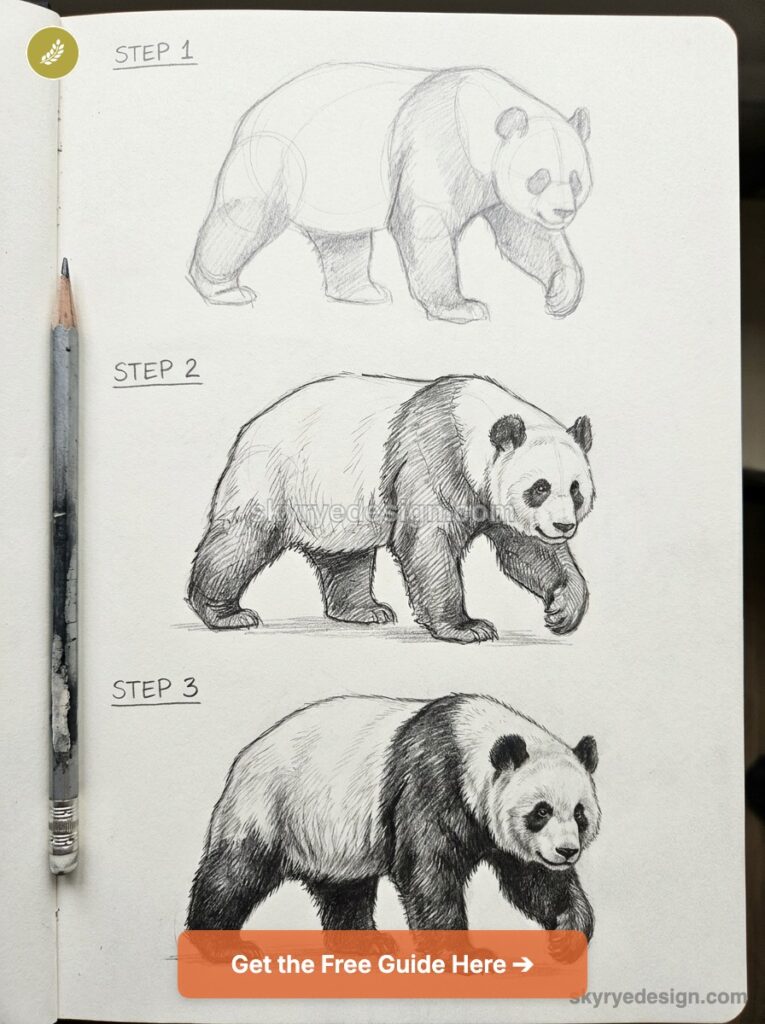
This method is called construction drawing, and it works because it forces you to think in basic forms before you get distracted by details. You’re building a skeleton made of shapes, which you’ll refine later.
The Five-Shape Foundation
Start with the head. Draw a circle near the top of your page. Not perfect—rough is fine. This circle is your head guide, worked lightly with an H pencil.
Add the body. Below the head, draw a larger oval—roughly twice the size of the head circle. This oval is the main torso where everything connects.
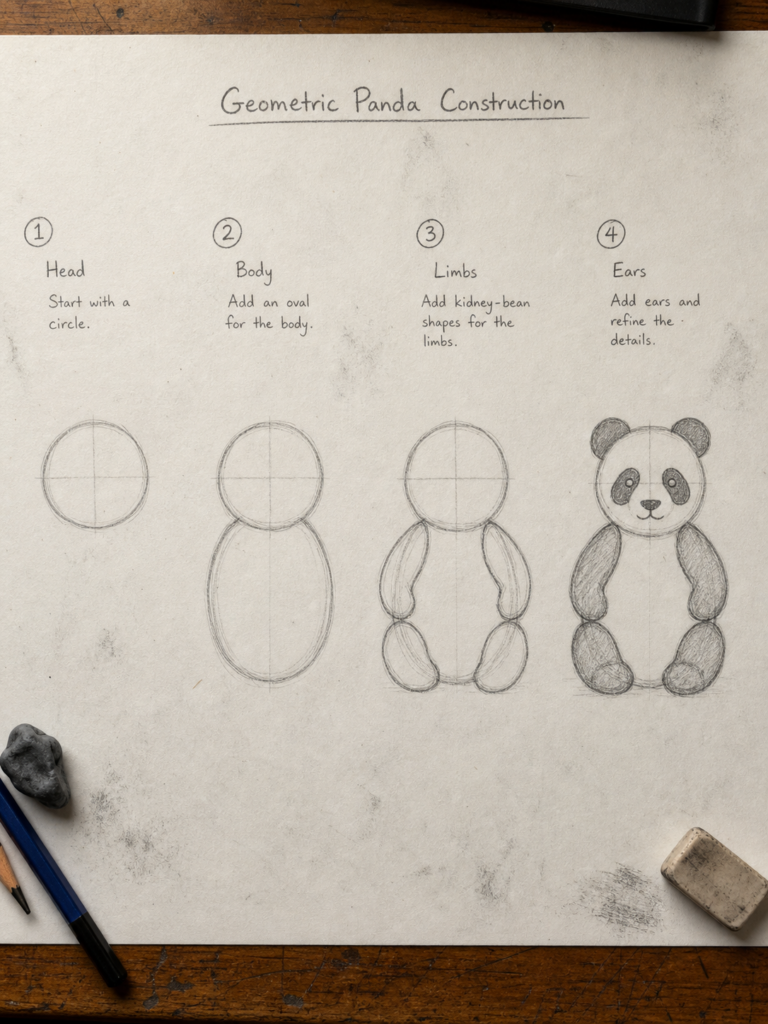
Build the limbs. Pandas have four chunky limbs. For the front legs, draw two kidney-bean shapes on either side of the body, starting from about one-third down. For the back legs, draw larger ovals below. These are thick and solid, like tree trunks.
Place the ears. At the top of the head circle, add two small circles. Just perch them on top, slightly tilted.
Why H Pencils Are Non-Negotiable
Use an H pencil and light pressure. H pencils have harder lead, which means they leave a faint, easily erasable line. When you press down lightly—think “whisper-light,” not “writing a note”—you create guide marks you can completely erase later. If you press hard, those marks show through your final shading and ruin the effect.
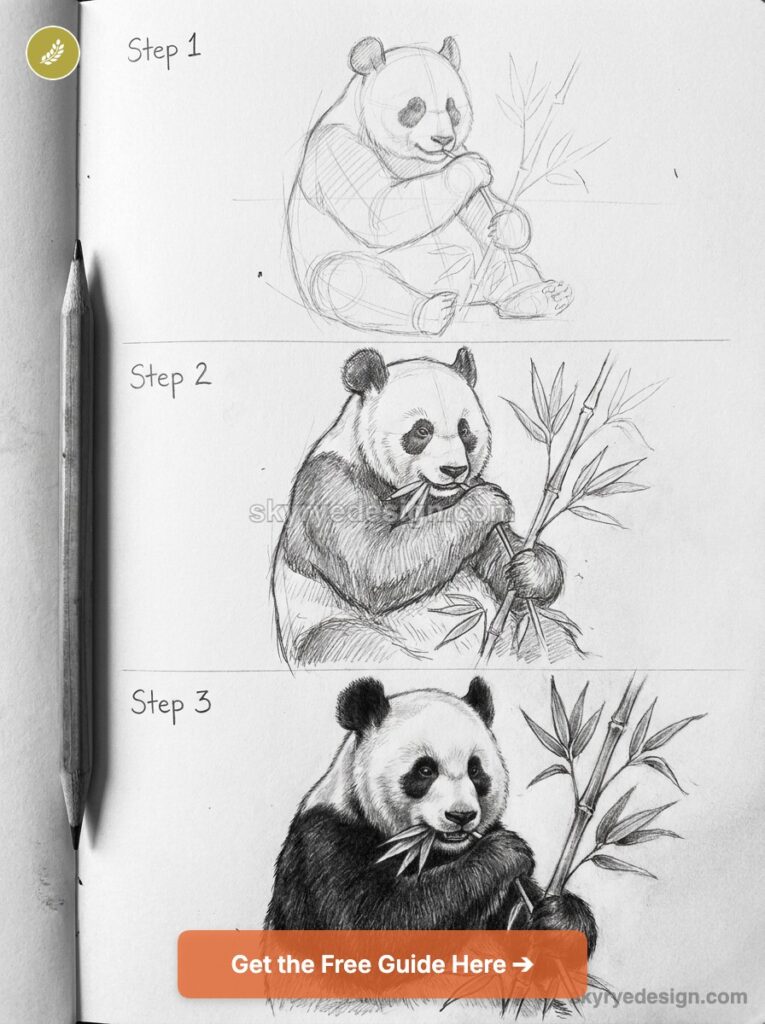
Most beginners skip the H pencil and regret it. Don’t be that person. It costs about $1. Light pressure saves you hours.
Spacing and Overlap: Making Shapes Connect
You’ve now created a complete skeleton in maybe 2–3 minutes. Your panda is already recognizable. The proportions are locked in. If the head looks too big, erase the oval body and make it larger. You’re problem-solving with shapes, not with finished lines. Get this right, and the rest flows naturally.
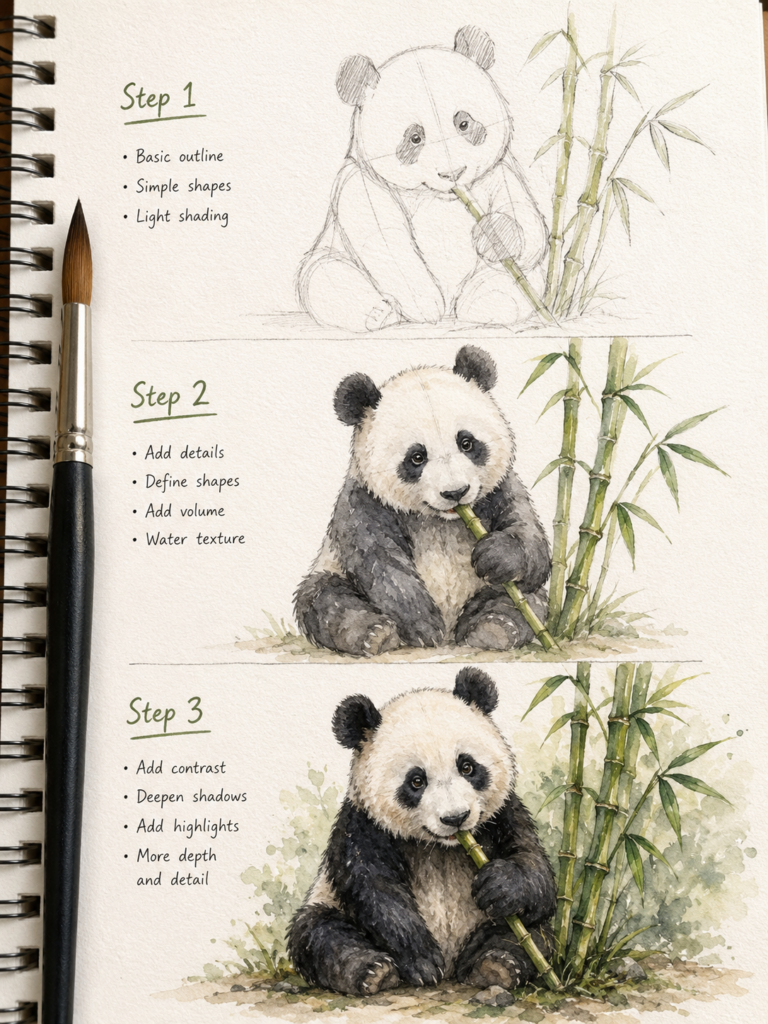
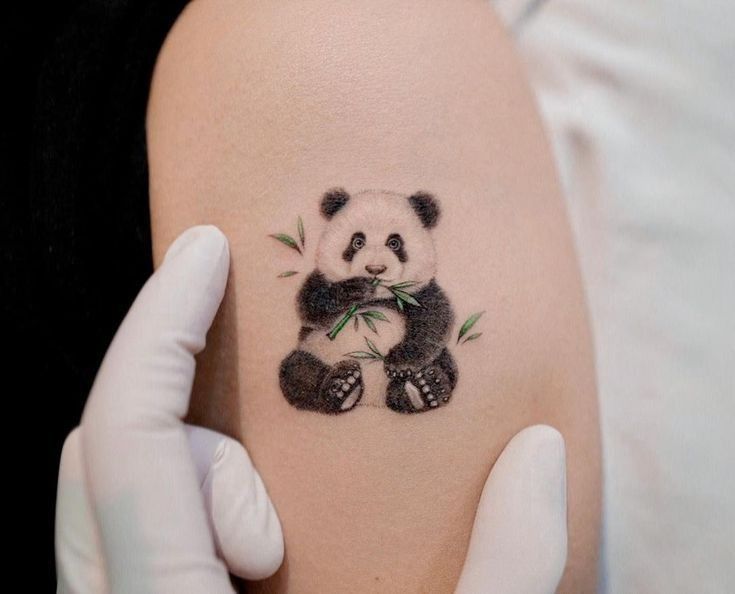
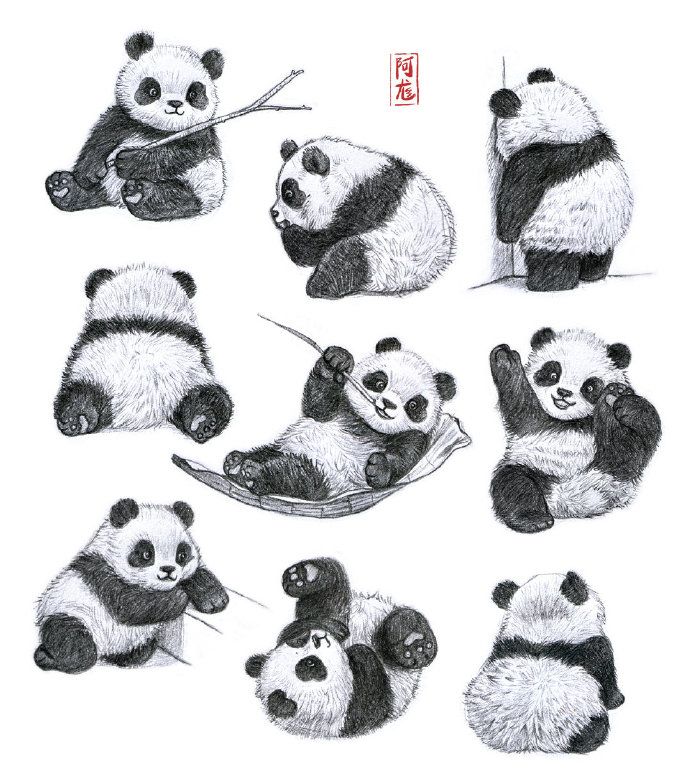
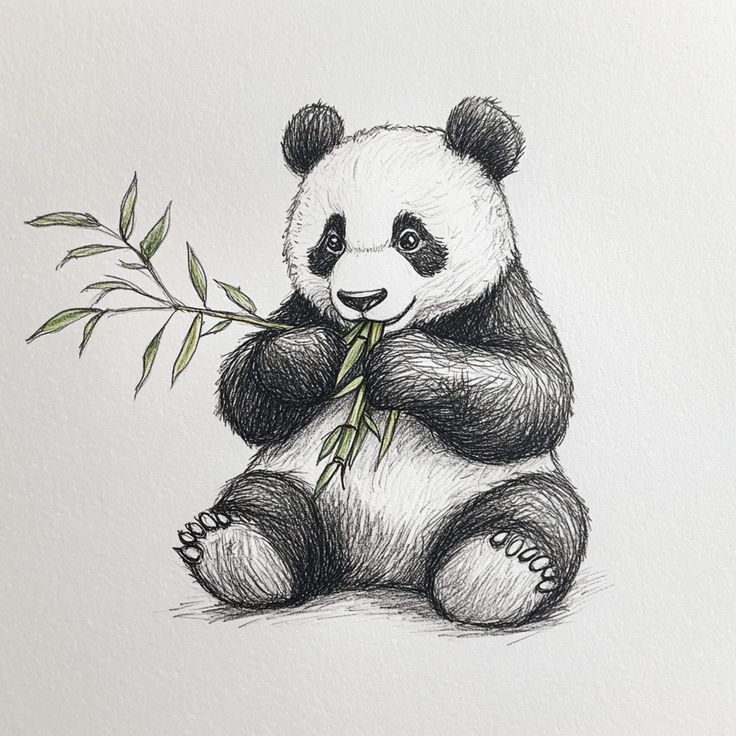
Refine the Face — Getting Eyes, Nose & Patches Right
Your panda’s personality lives in its face. Get the features right, and suddenly your sketch looks like an actual animal. Get them wrong, and you’ve got a cute blob that could be anything.
The Eyes: Size, Placement, and Pupils
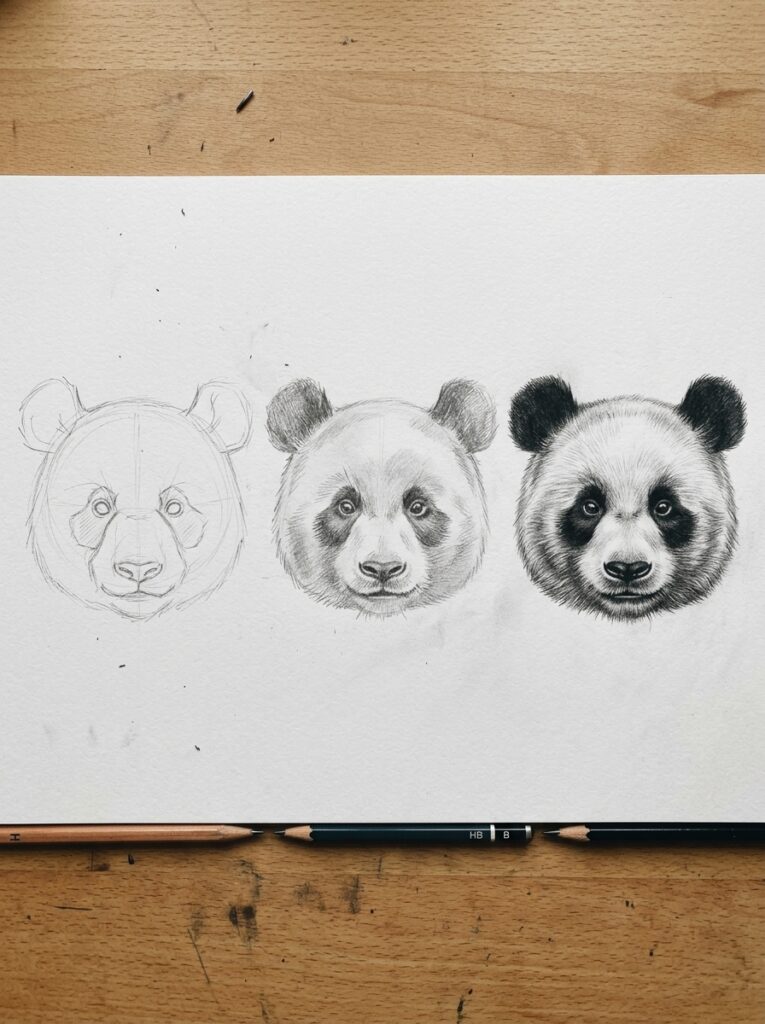
Real pandas have proportionally small eyes. They’re tiny, dark, and set relatively low on the face—roughly in the lower-middle section of the head circle, not dead center. Each eye is maybe 10% of the head width. The pupils are solid black, but always leave a tiny white spot (the highlight). That one pixel of white is what makes the eye feel alive instead of dead and glassy.
Eye Patches: Break the Symmetry (It’s More Real)
Most tutorials show panda patches as perfectly mirrored ovals. Real pandas aren’t like that. One patch might be slightly larger, or tilted differently. I’ve noticed that when I deliberately break the symmetry—making patches slightly different shapes or sizes—the drawing suddenly feels more authentic. It’s the difference between “cute drawing” and “actually looks like a panda.
The patches should wrap around the eyes, extending slightly up and down. Use darker pressure with your HB or B pencil to define them, but blend the edges softly so they don’t look pasted on.
Nose and Mouth: Less Is Often More
A panda’s nose is small—think upside-down triangle or a tiny heart shape, centered below the eyes. Place it about one-quarter of the way down from the eyes to the chin. Add a subtle vertical line connecting the nose to the mouth to suggest the muzzle.
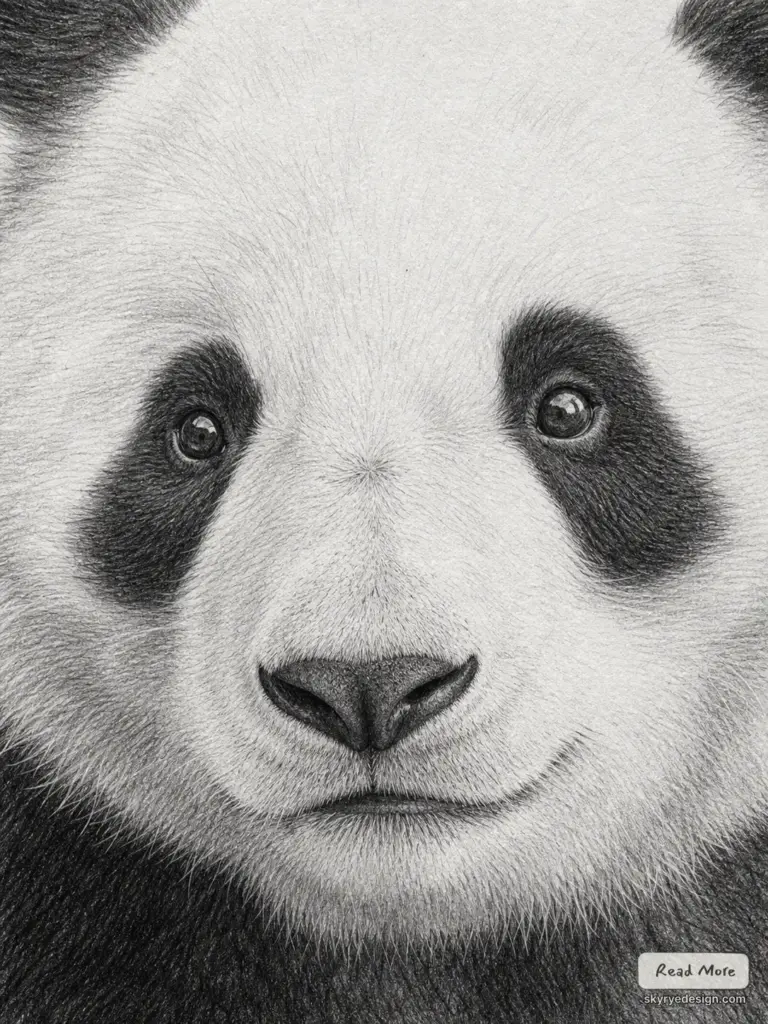
The mouth is usually a gentle curve or a slight line, not a big smile. Overdrawn mouths make the panda look cartoonish. The eyes and patches carry the expression; the mouth just supports it.
Add Body, Limbs & Posture — Making Your Panda Sit
Now that your panda’s face is solid, it’s time to build out the body. The key is understanding that pandas aren’t delicate creatures—they’re stocky, powerful, and grounded.
The Sitting Posture and Weight Distribution
Pandas sit upright, bracing themselves on their strong hind legs. When you draw a sitting panda, imagine the weight settling into the rear legs and the lower back. The spine should have a slight curve—not ramrod straight, but naturally relaxed. The torso leans slightly forward, like the panda is resting its weight but still present. This subtle posture is what makes a panda feel alive on the page instead of like a puppet.
Arm vs. Leg Thickness: A Real Difference
The back legs are thick, powerful tree trunks that support the whole body weight. The front arms are noticeably narrower—more refined, almost dainty in comparison. This size difference is crucial. If your arms are as thick as your legs, your panda looks alien. Get the size relationship right, and suddenly the anatomy reads as “this is actually a bear.”
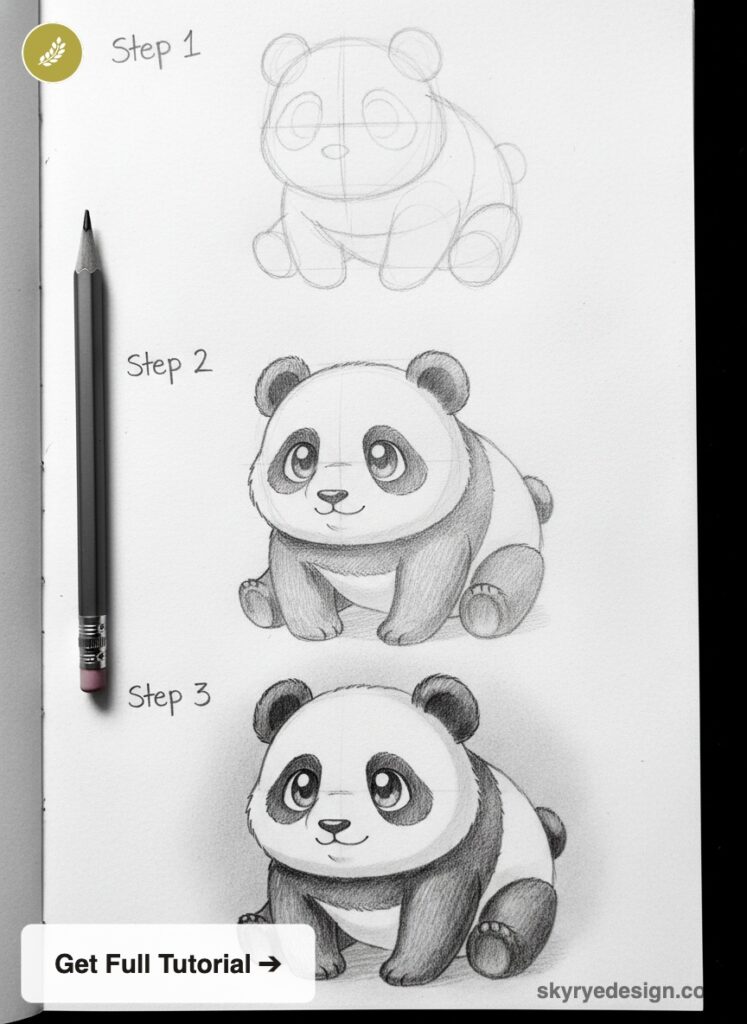
Don’t overthink the paw positioning—pandas have paws, which are just rounded shapes with subtle toe marks. Keep them simple.
The Belly Curve That Adds Personality
The line connecting the front legs, running down the center of the torso, creates a subtle curve that gives the panda that iconic “round and cuddly” impression. Emphasizing this curve, even slightly, makes your drawing more appealing. This is what separates “panda” from “generic bear.”
Connection points are where mistakes hide. Make sure the limbs actually attach to the body, not floating next to it. The connection should look organic—limbs emerge from the body shape, not bolt on like afterthoughts.
Shading & Fur Texture — Making It Look Real (Not Flat)
This is where most drawings either come alive or die on the page. Flat black-and-white zones kill realism. Real pandas have depth, fur direction, and shadows.
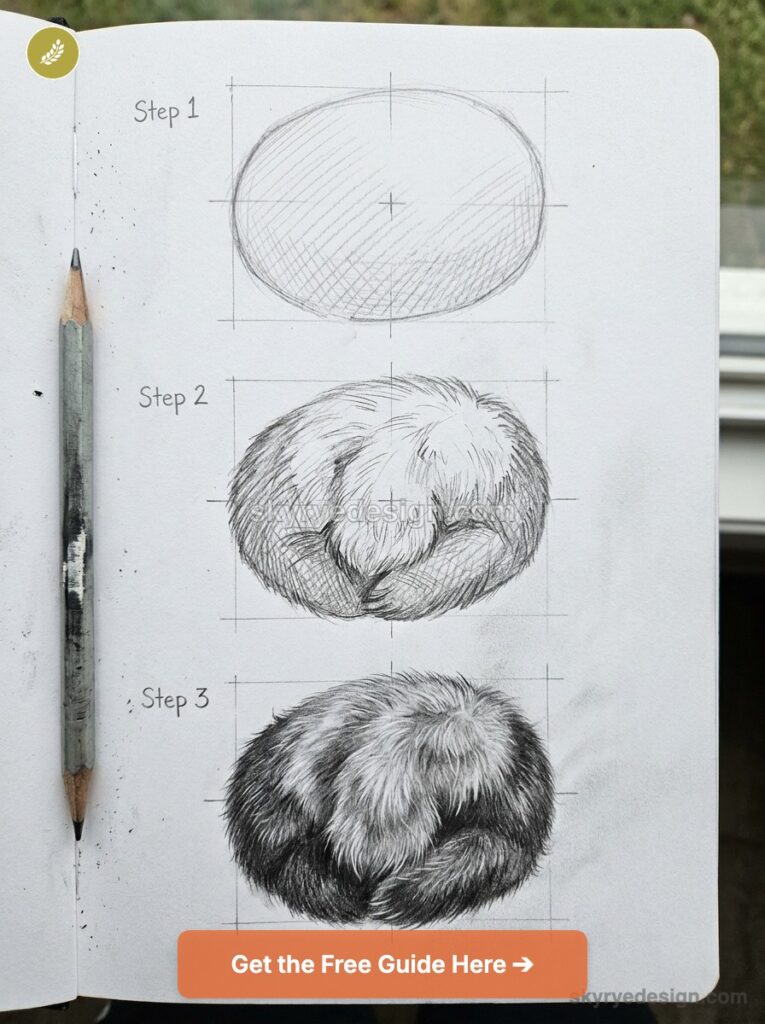
The Pencil Layering Strategy (H → HB → B)
You’ve been sketching lightly with an H pencil. Now build up darkness gradually. H pencil (light) → HB pencil (mid-tones) → B pencil (dark shading). Each pencil has a specific job. Using all three in layers gives you control and prevents you from accidentally pressing too hard and ruining the paper.
Start with your HB pencil for mid-tone gray areas—shadows around the eye patches, subtle shading on the belly, soft grays where the fur curves away from light. Make multiple light passes rather than one heavy pass. Then bring out the B pencil for the deepest blacks. But even here, vary the pressure—don’t fill patches with uniform black. This variation is what makes fur look real instead of painted-on.
Fur Stroke Patterns: Direction and Pressure
Real fur has direction. On the face, short curved lines flow downward. On the body, they radiate outward from the center. Use short, consistent strokes with medium pressure. Think “feathering,” not frantic scribbling. Around the eyes and muzzle? Short, fine strokes. On the limbs and body? Slightly longer strokes are fine.
Creating Depth with Soft Shading, Not Just Black
Beginners press the same way throughout the drawing. Professionals vary pressure constantly—light for soft areas and highlights, medium for mid-tones, heavy only for the darkest shadows. This variation creates depth and dimension.
Eye highlights are non-negotiable. Always leave a small white spot in the pupils. Without it, even a perfectly drawn panda looks dead. That one pixel of white makes all the difference between “cute” and “alive.”
Once you’ve built up your shading, step back. Look at the drawing from across the room. If you’re second-guessing whether to add more shading, stop. Overworking kills charm.
Common Mistakes & How to Fix Them Mid-Drawing
You’re going to make mistakes. The good news? Most are fixable if you catch them early.
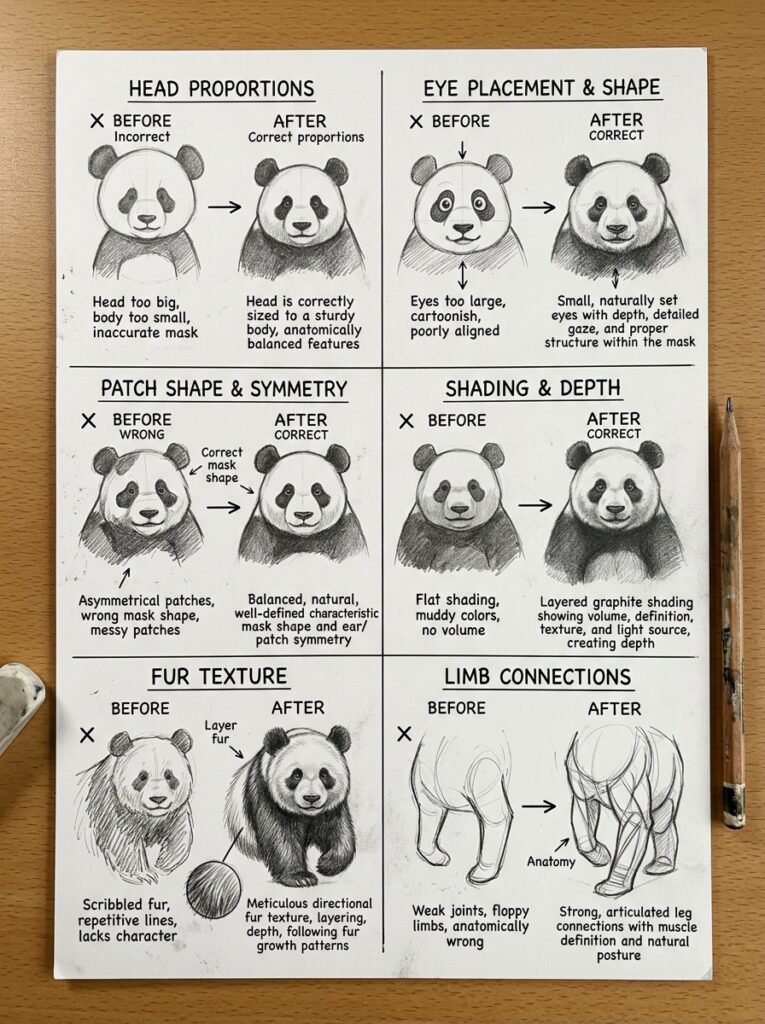
Proportions Fixes (Head, Body, Limbs)
“My panda’s head is too big.” Erase lightly and redraw the body larger. You’re not starting over—just adjusting proportions. Fix it before you invest hours in shading.
“The limbs look disconnected from the body.” Refine the connection points with your HB pencil. The limbs should emerge from the body, not bolt on. Spend an extra minute here—it fixes the whole anatomy.
Feature Matching (Eyes, Patches, Symmetry)
“The eyes don’t match.” Erase one eye lightly and redraw it to match the other. They don’t have to be perfectly symmetrical, but they should be similar.
“The patches look too perfect/fake.” Deliberately make them asymmetrical. Soften one edge, make one slightly larger, tilt them differently. This small change makes an enormous difference in realism.
Shading Problems (Flatness, Overworking)
“Everything looks flat.” You skipped the HB pencil step. Go back and add mid-tone grays—around the eyes, on the belly, on the ears. Build depth with multiple light layers. This takes 10 minutes and transforms the whole drawing.
“I don’t know when to stop.” Step back and look from across the room. When in doubt, less is more.
“Fur looks like scratches, not texture.” Fur has direction. On the face, strokes go downward. On the body, they radiate outward. Use consistent stroke length and direction. Once you nail the direction, it clicks.
Optional Extras — Adding Bamboo & Background
At this point, you have a solid panda drawing. But bamboo and a simple background transform a good drawing into a complete scene.
Drawing Bamboo (It’s Simpler Than You Think)
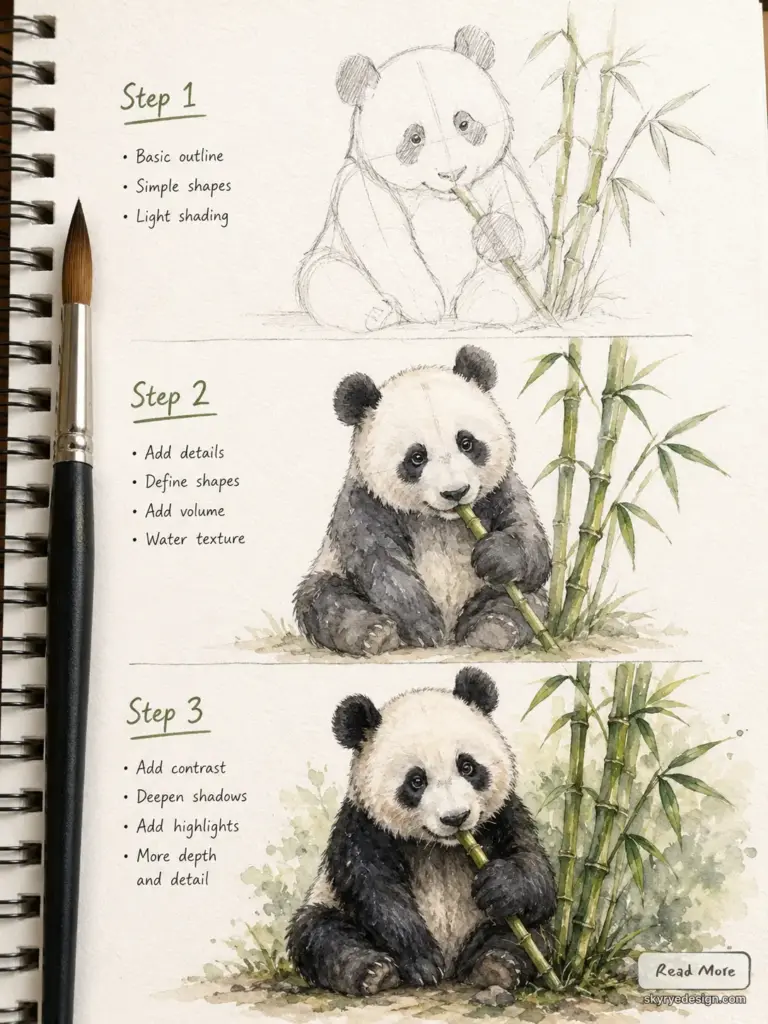
A bamboo stalk is basically a series of vertical cylinders with horizontal segments. Start with a vertical line as the center, draw two curved lines on either side, then add short horizontal lines to mark the natural segments. The whole thing takes 2–3 minutes. If your panda is holding bamboo, angle one stalk so it looks gripped. If it’s just sitting, let the bamboo stand upright or lean naturally.
Compositional Balance: Panda vs. Background
The background should enhance, not distract. A simple, soft background adds depth without stealing focus. Use lighter pencil pressure—think atmosphere, not detail. A few rocks, some grass hints, maybe abstract leaf shapes in the distance. Keep it loose and impressionistic.
The background should recede visually: lighter shades and softer edges behind, darker and sharper details in the foreground (the panda). This creates natural depth perception.
Only add background if you have time and patience. A great panda with no background beats a good panda with a messy, distracting one. The panda is the star.
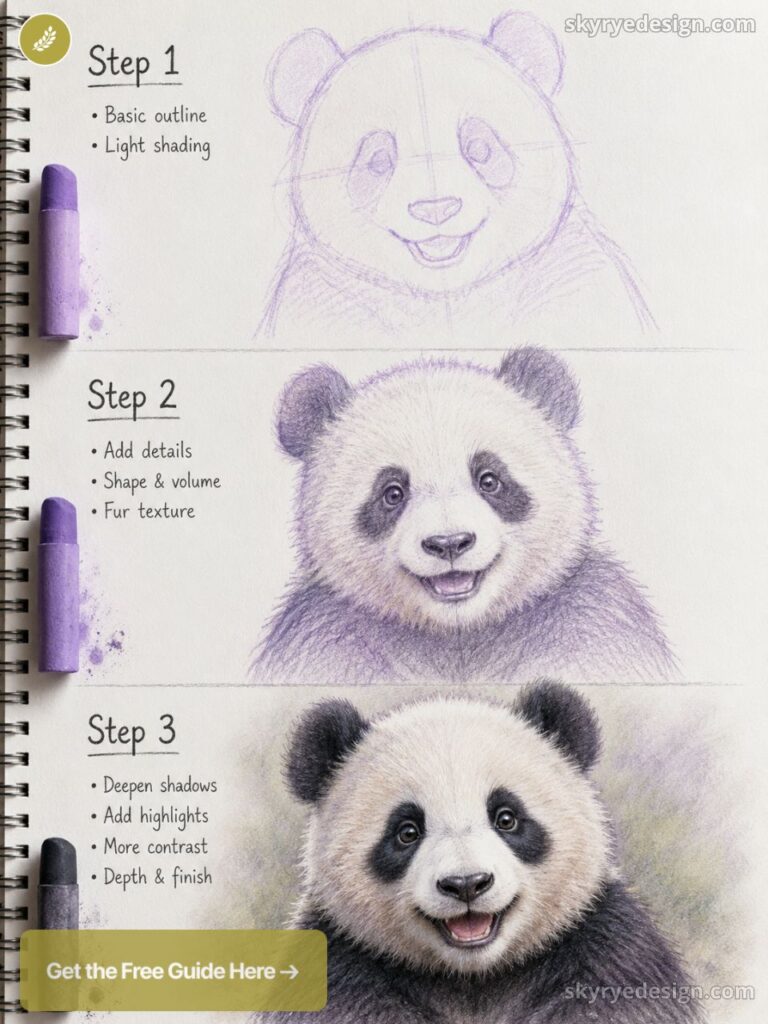
For a taller animal study with very different proportions, try this panda drawing guide; it is especially useful for practicing long necks, small heads, and coat patterns that need to follow the body form.
Conclusion
You now have the complete foundation: proportions, geometric construction, facial features, full-body anatomy, shading technique, common fixes, and optional context. That’s everything you need to draw a panda that actually looks like a panda.
None of this matters if you don’t actually pick up a pencil and draw. Right now. Today. Don’t wait for the perfect paper or the fanciest pencils. Grab whatever you have, sketch a light circle for the head, and build from there. Your first panda will be rough. Your second will be better. Your tenth will be genuinely good.
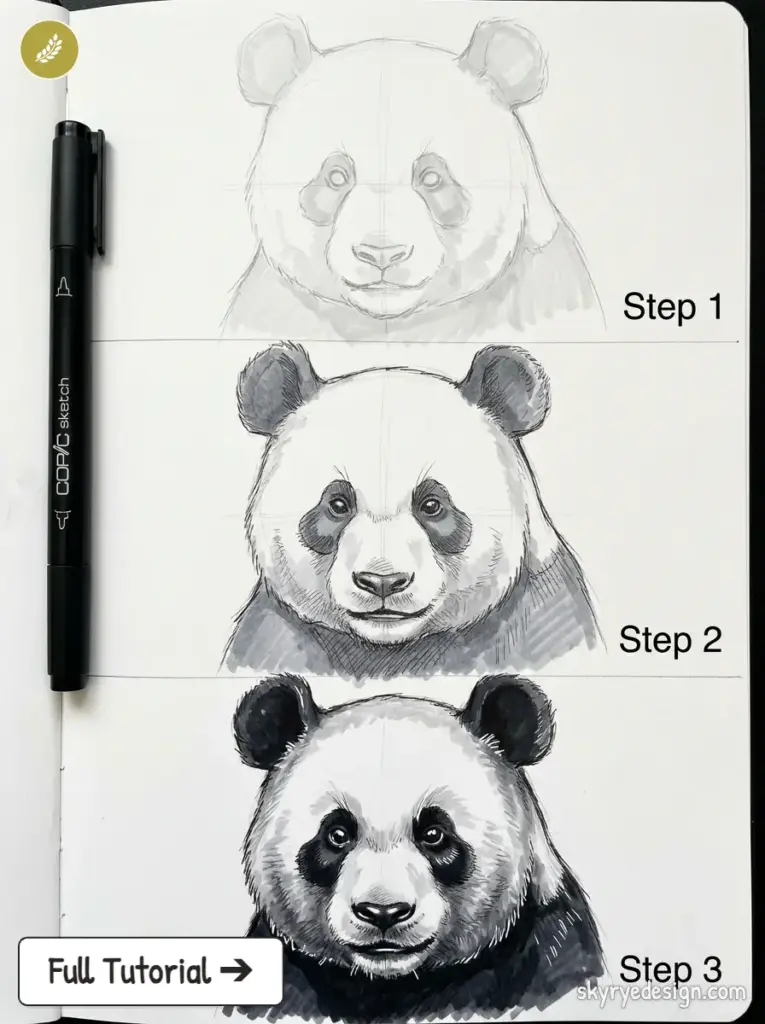
Make mistakes. Erase them. Try again. That’s the entire game.
So pick up that H pencil. Measure your proportions. Build your shape skeleton. Refine your features. Shade with intention. Fix what doesn’t work. And when you’re done, sign it. You earned that.
Share your panda with @skyryedesign on Instagram. We’d genuinely love to see your progress—first attempt, tenth attempt, whatever. That’s how this community grows.
Now stop reading and start drawing.
FAQ — Frequently Asked Questions
Q: What pencils do I actually need to draw a panda?
A: Three pencils: H (light sketching), HB (mid-tones), and B (dark shading). Total cost: ~$5–10 for a basic set. Staedtler or standard artist sets work perfectly. For paper, use sketch paper or mixed-media paper (~$10–20 for a pad). A kneaded eraser is helpful but optional.
Q: How long should it take to draw a panda from start to finish?
A: Your first attempt? 60–90 minutes. As you practice, it speeds up—40–50 minutes becomes normal. Professional artists: 20–30 minutes. Don’t rush. Quality over speed is the rule.
Q: Can I draw a cute panda instead of a realistic one?
A: Absolutely. The techniques are identical. Cute pandas just exaggerate features: bigger eyes, rounder face, softer edges. Start with realistic methods; you’ll naturally shift toward your personal style.
Q: Why do my panda’s eyes look dead?
A: You’re skipping the pupil highlight—the small white reflection. That tiny dot is everything. The highlight creates life and dimension. Without it, even a perfectly drawn panda feels lifeless.
Q: How do I draw panda fur that doesn’t look like messy scratches?
A: Fur has direction. On the face, short curved lines flow downward. On the body, they radiate outward from center. Think “feathering,” not random scribbling. Once you nail the direction, it clicks.
Q: Should I use a reference photo?
A: Yes, always. Even professionals reference real images. Print out your reference or keep it visible during drawing. Real anatomy beats imagination when you’re learning.
Q: What if I mess up halfway through? Can I fix it?
A: If you sketched lightly with an H pencil, absolutely erase and redraw that section. If you’ve already shaded dark, light erasing plus careful redrawing works. A slightly underworked drawing beats a heavily overworked one, so know when to stop.
- 2.0Kshares
- Facebook0
- Pinterest2.0K
- Twitter0
- Reddit0