
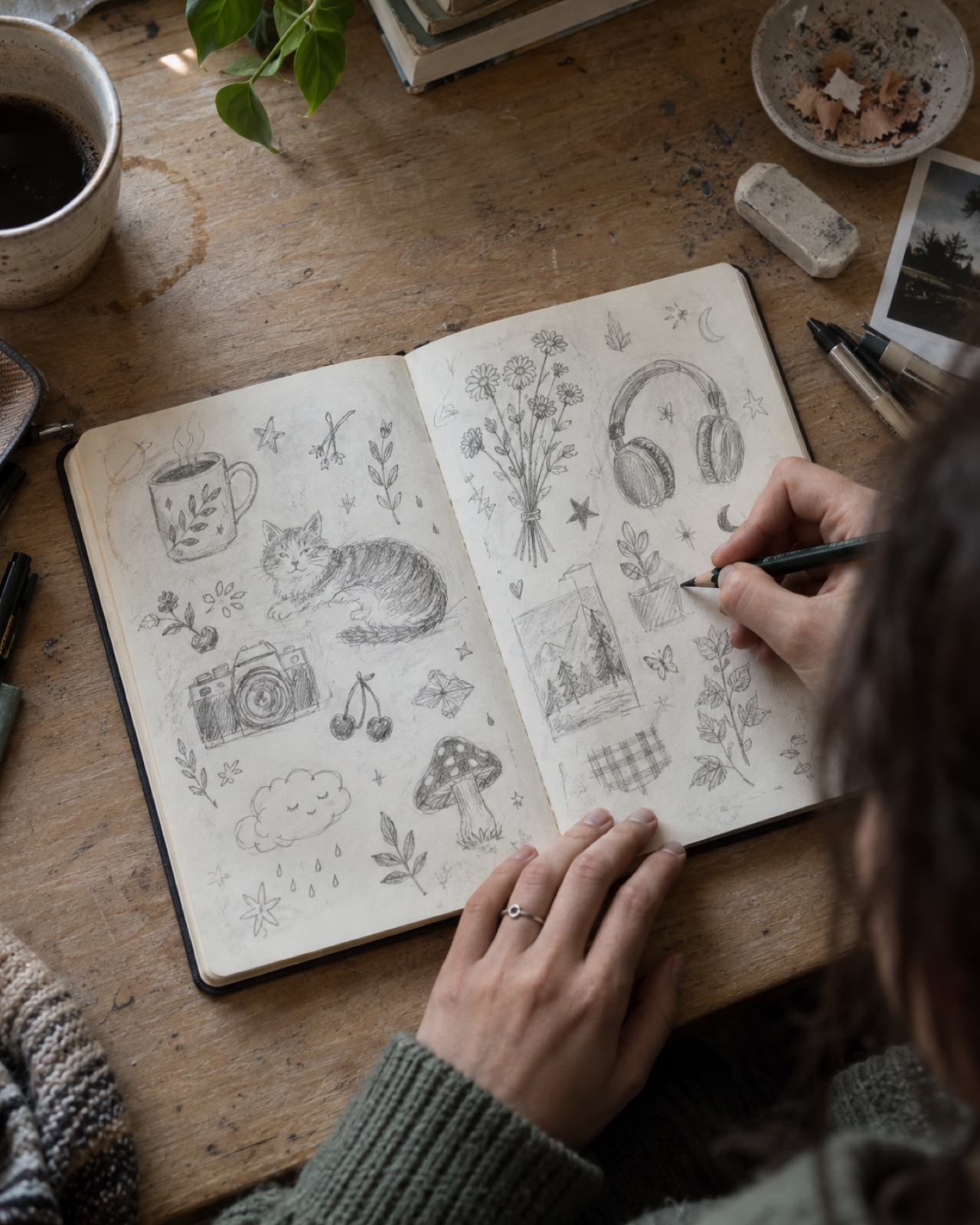
Doodle art ideas are easiest to use when they are specific: draw a mug with steam, a sleeping cat, three uneven flowers, a tiny storefront, or a row of changing moon phases. Start with one recognizable shape and add only enough detail to make the subject clear.
Food subjects are ideal for practicing simple shapes, texture and controlled highlights. This step-by-step guide to how to draw sushi breaks rice, fish and nori into forms that stay readable.
This guide gives you 40 prompts across everyday objects, cute and aesthetic motifs, animals, nature, and repeatable patterns. You will also find simple page-building steps, five visual references with notes, a seven-day practice plan, and honest guidance on what research does—and does not—say about doodling and focus.
- 40 easy doodle art ideas at a glance
- How to start a doodle page
- Everyday-object doodle drawing ideas
- Cute and aesthetic doodle ideas
- Animal, character, and fantasy doodles
- Patterns, Zentangle, and repeatable fillers
- A 7-day daily doodle plan
- Does doodling improve focus or memory?
- Common doodling problems and quick fixes
- Doodle art ideas FAQ
- Choose one prompt and start small
40 easy doodle art ideas at a glance
Quick answer: for a first page, choose five prompts from one row below. Draw each object small, repeat one filler motif between them, and stop before every gap is filled. A limited theme makes a mixed page look intentional without requiring a detailed composition.
| Theme | Eight doodle prompts | Simple unifying detail |
|---|---|---|
| Everyday objects | Mug, keys, headphones, candle, book, camera, backpack, desk lamp | Repeat small shine marks |
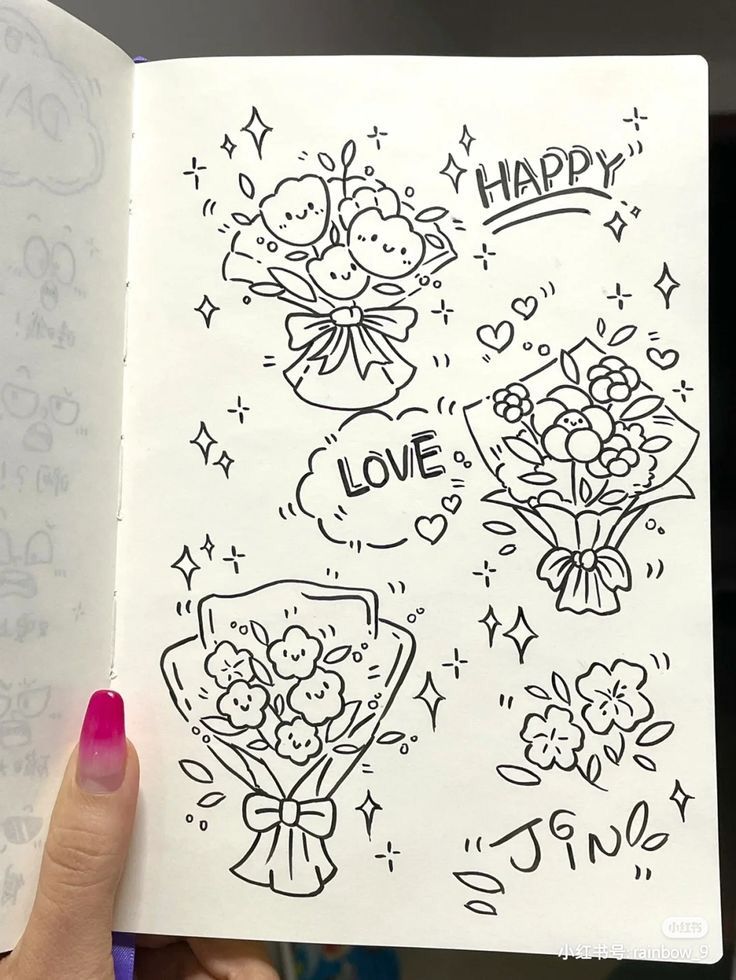
| Cute and aesthetic | Smiling flower, bow, heart cake, teddy bear, star jar, envelope, ribbon, tiny house | Use the same face style |
| Animals and characters | Sleeping cat, chicken, frog, whale, butterfly, bird, cow, mushroom fairy | Add matching cheeks or dots |
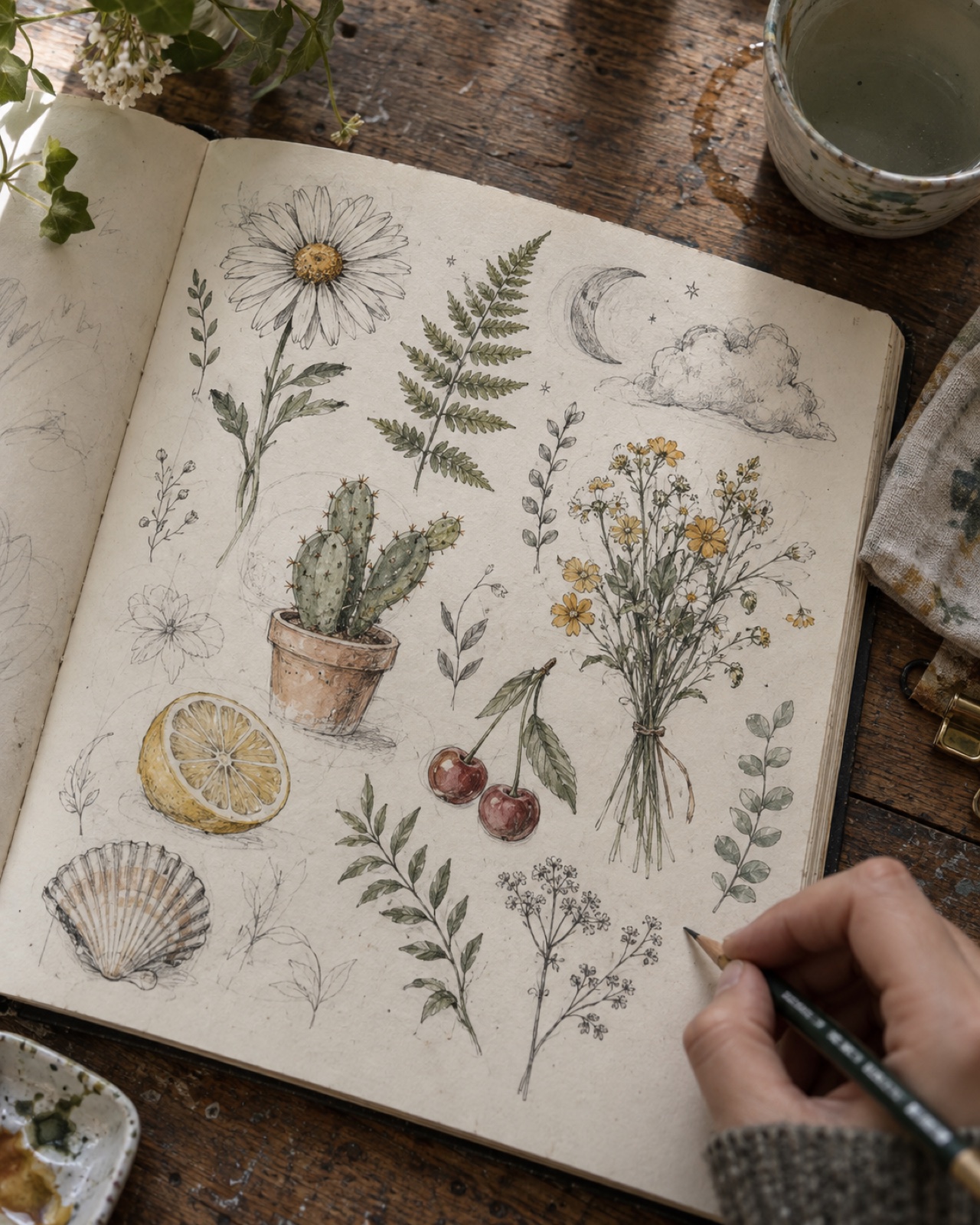
| Nature and food | Daisy, fern, cherry pair, lemon slice, cloud, moon, shell, potted cactus | Repeat leaves and sparkles |
| Patterns and fillers | Waves, checkerboard, spirals, scales, dots, nested arches, vines, uneven stars | Keep one line weight |
How to start a doodle page
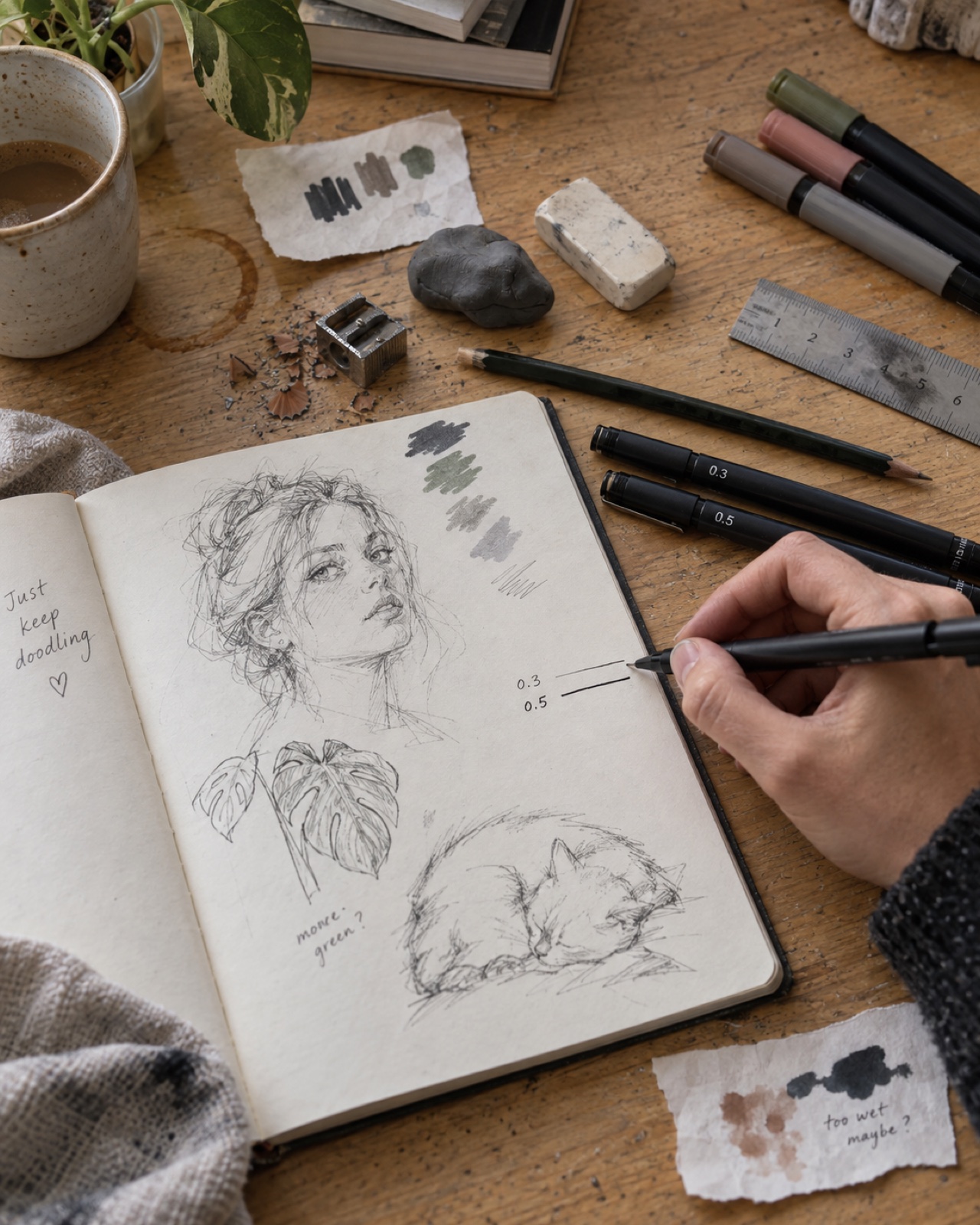
Use ordinary paper and one pen you already trust. A 0.3 to 0.5 mm fineliner is easy to control, but a ballpoint or pencil works too. If the page is thin, test the ink on the back. For a broader introduction to line, grip, and value, this Adobe pencil-sketching overview explains the basic marks without requiring specialist materials.
- Pick one theme. Food, desk objects, plants, pets, or travel keeps the first decisions manageable.
- Place three anchor drawings. Make them different sizes and keep them away from the exact center line.
- Add five smaller objects. Use circles, boxes, triangles, and bean shapes as construction forms.
- Repeat one filler. Stars, leaves, dots, or short curved lines can connect separate subjects.
- Choose one finish. Add a single accent color, light hatching, or a thicker outer contour—not all three.
If drawing directly in ink feels tense, warm up with the light construction exercises in this doodle guide for pencil beginners. The useful habit is not erasing every wobble; it is learning which few lines make an object readable.
Everyday-object doodle drawing ideas
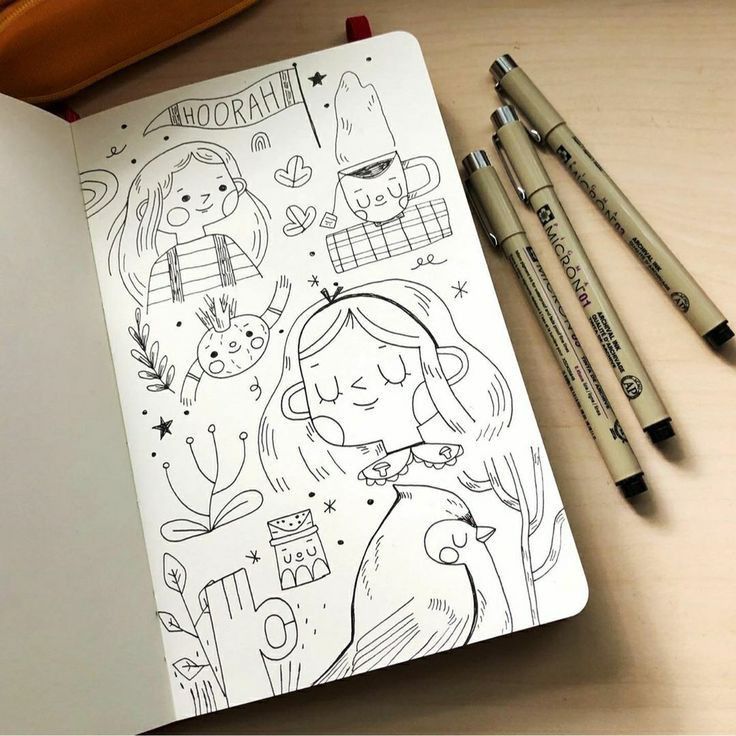
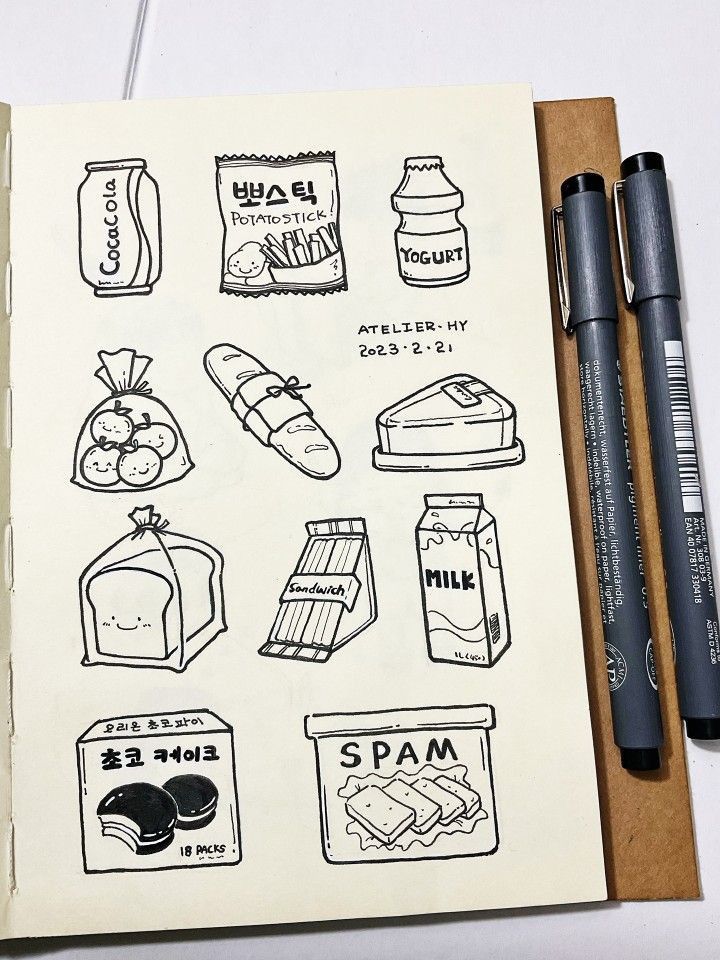
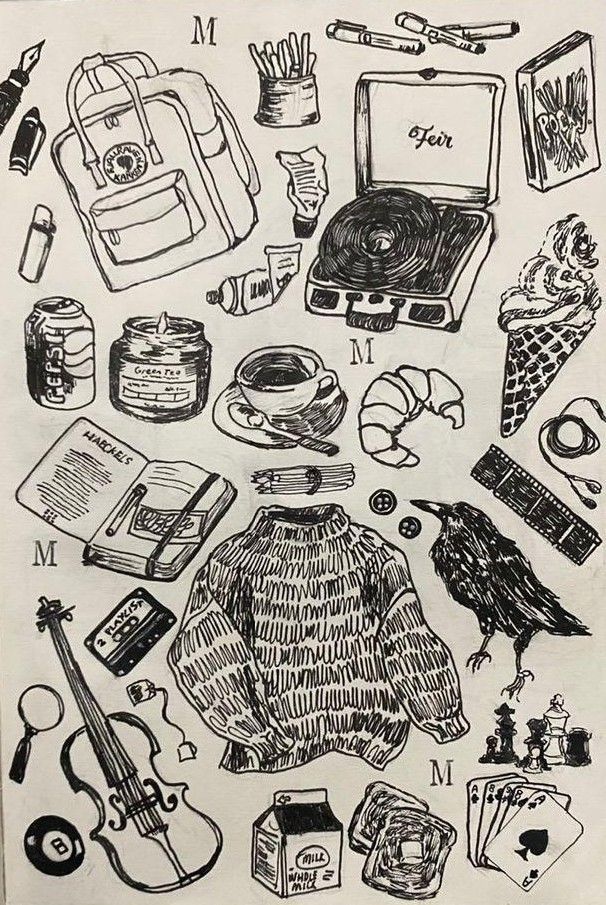
Everyday objects make reliable prompts because the reference is already in front of you. Start with the silhouette of your mug, charger, scissors, fruit bowl, glasses, or shoes. Then add one identifying detail: the mug handle, a cable bend, the blade joint, or the tread pattern. You can find more compact subjects in our collection of easy mini doodle drawing ideas.
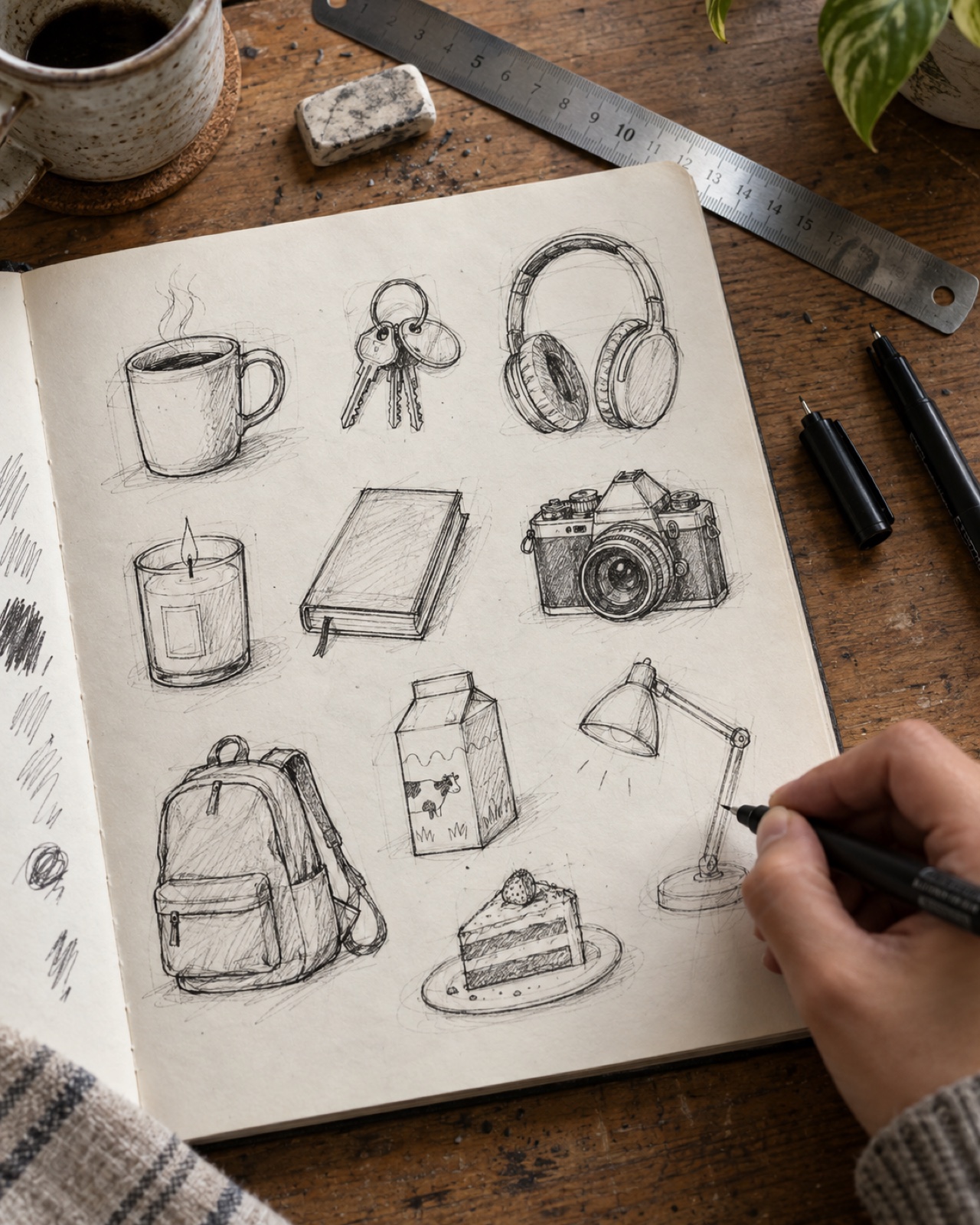
A themed collection does not need perfect realism. Draw a “morning” page with an alarm clock, slippers, coffee, toast, toothbrush, window, weather icon, and a short note. A “desk” page might use a keyboard, mouse, sticky note, pen cup, headphones, lamp, plant, and charging cable. Repeat one tiny star or curved motion line to stop the objects from looking like isolated stickers.
Food and drink prompts
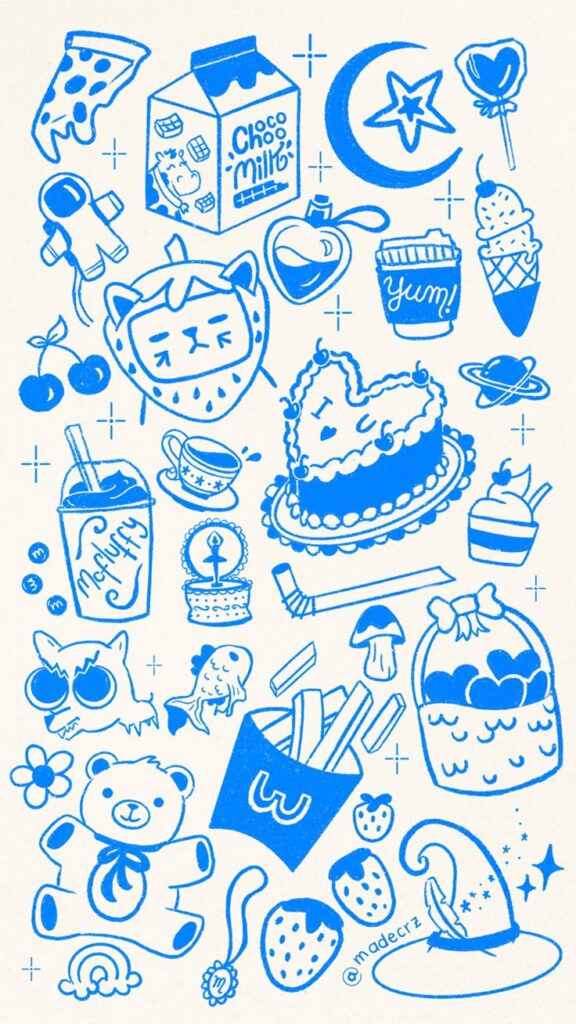
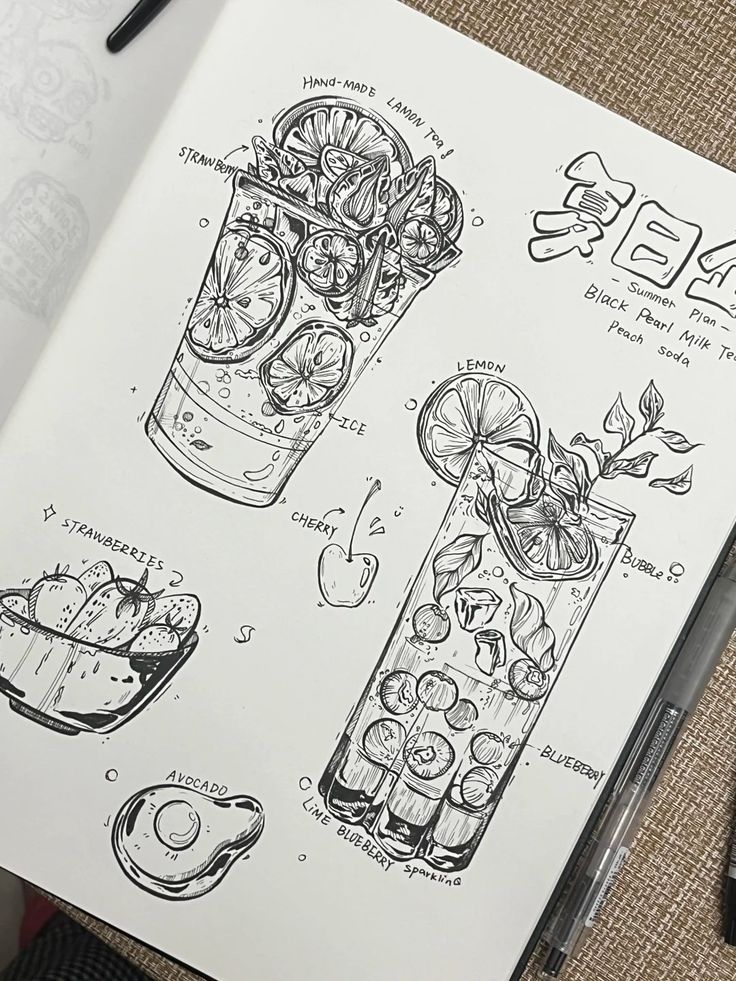
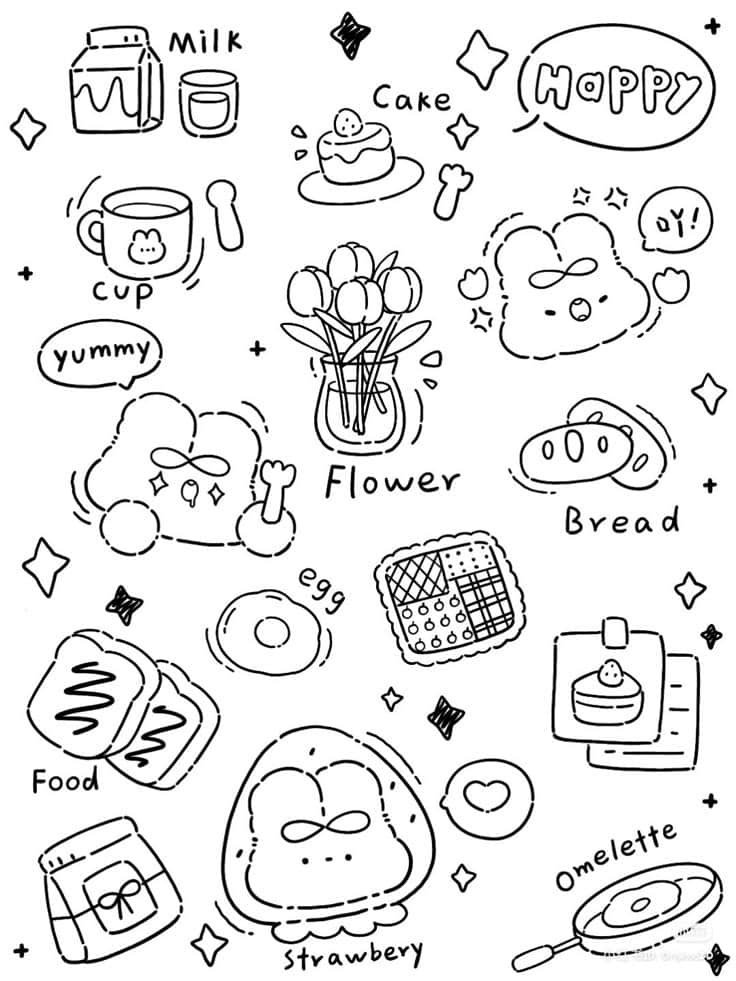
Packages and dishes are mostly simple geometry. Use a rectangle for a milk carton, a cylinder for a glass, a triangle for cake, and overlapping ovals for a bowl. Change the garnish or label instead of redrawing the whole form. For a stronger page, mix three scales: one large drink, three medium snacks, and several tiny fruit slices or crumbs.
Cute and aesthetic doodle ideas
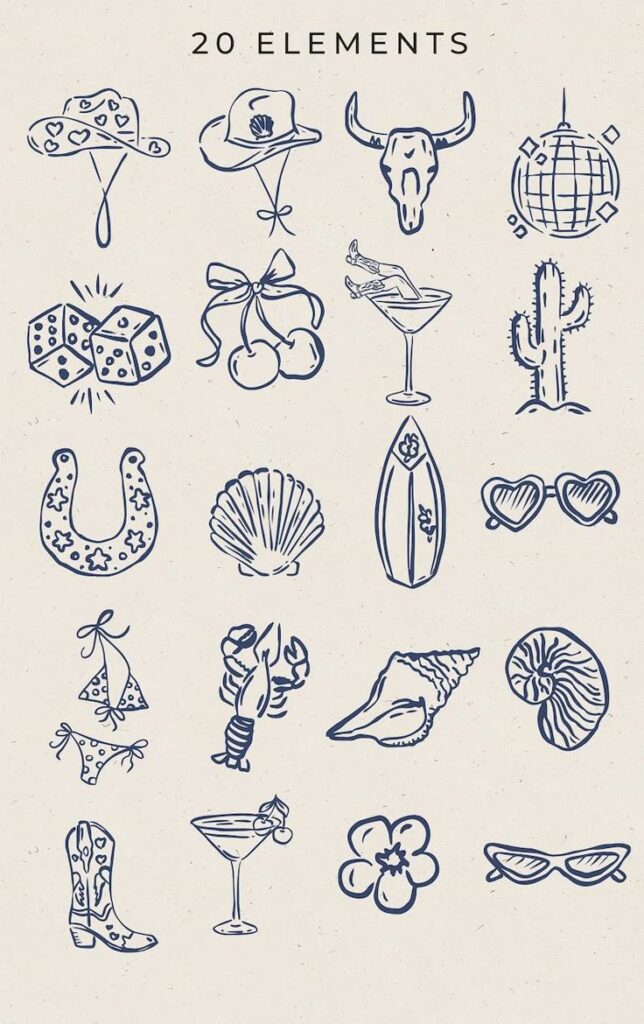
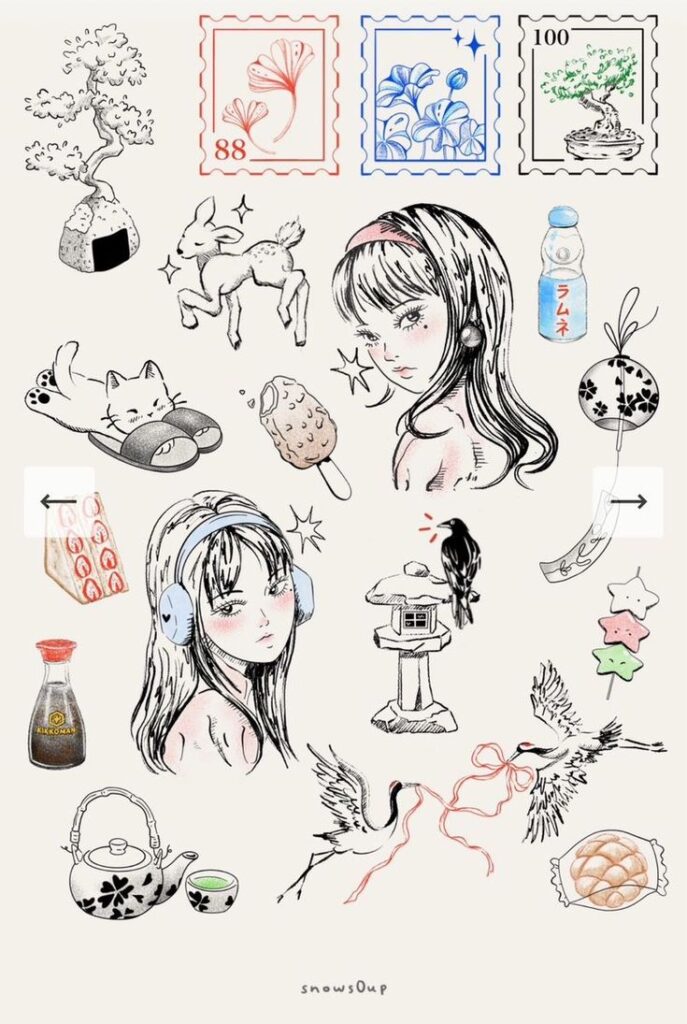
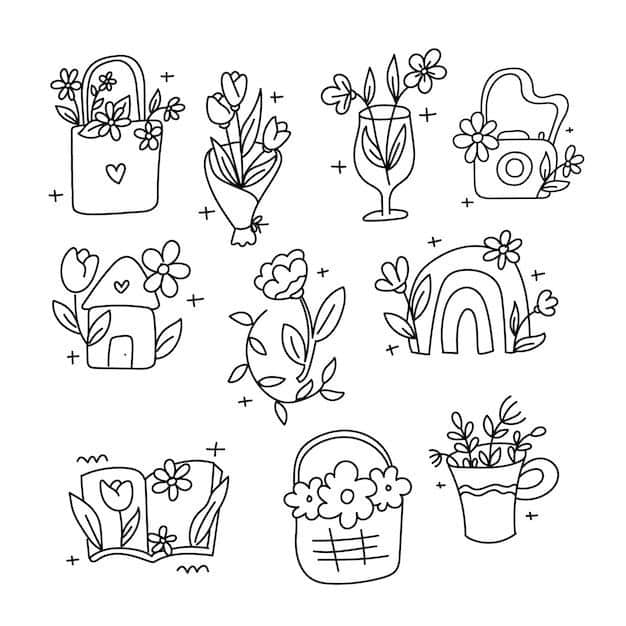
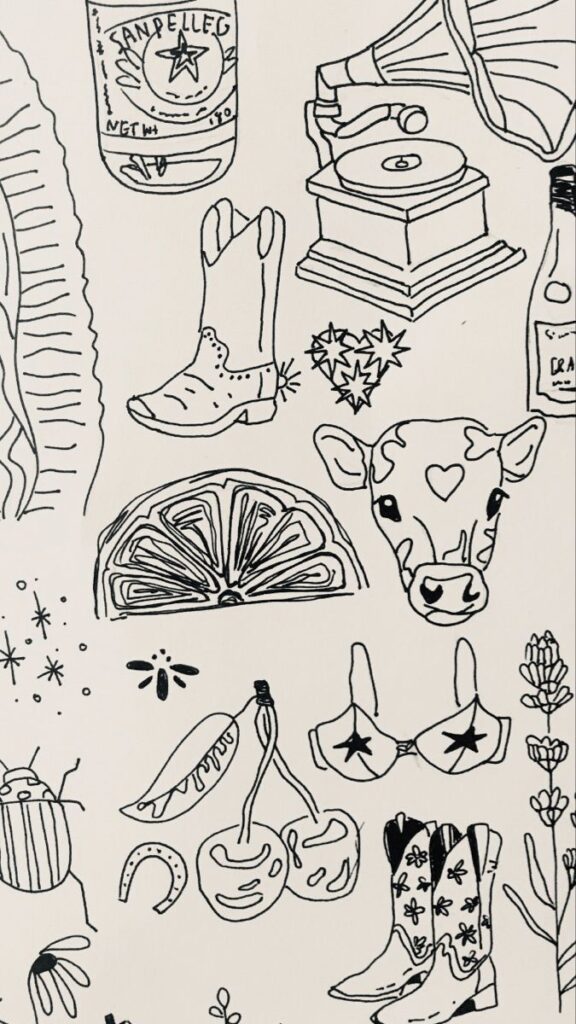
An aesthetic doodle page usually looks coherent because it limits variables. Choose one line color, two accent colors, one face style, and similar spacing. The subjects can still vary. A teddy bear, cake slice, flower, bow, star, letter, and pair of cherries will sit together if they share the same rounded corners and small highlight marks.
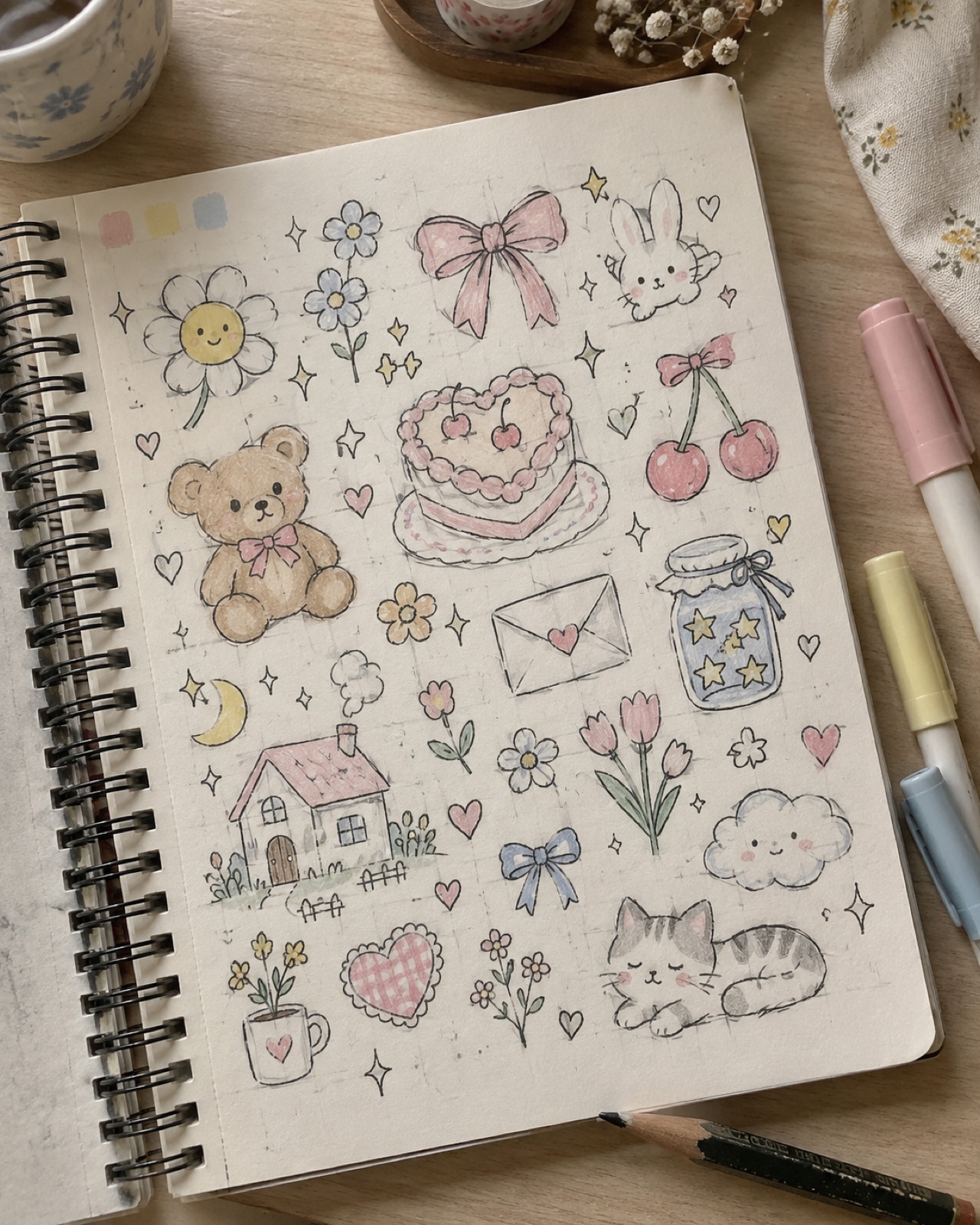
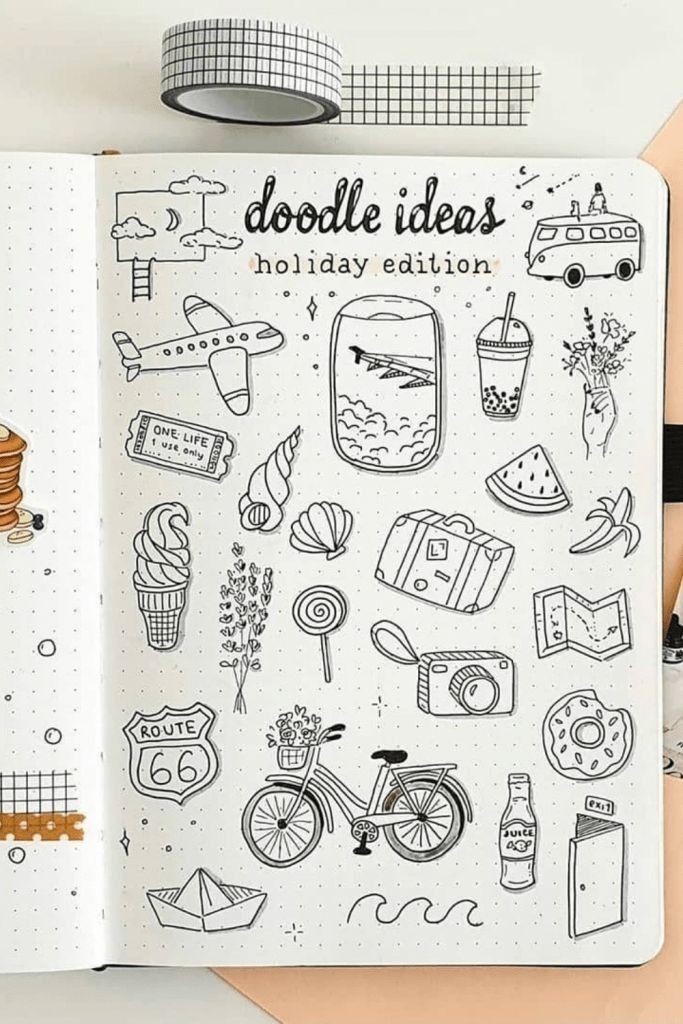
For a more structured collection, browse these aesthetic bullet journal doodles. Borrow the idea of consistent scale and labeling, then change the objects to match your own week rather than copying an entire spread.
Make a page look related without making it repetitive
- Vary the object size, but keep the outline thickness consistent.
- Repeat one motif three to five times instead of adding a new filler in every gap.
- Use open white space around the largest drawing.
- Pick either rounded or angular corners for most objects.
- Add color to roughly one-third of the marks and leave the rest as line art.
Pastel color works best when the line art remains readable. These pastel summer doodle ideas show how fruit, flowers, sunshine, shells, and beach motifs can share a soft palette without losing their individual shapes.
Animal, character, and fantasy doodles
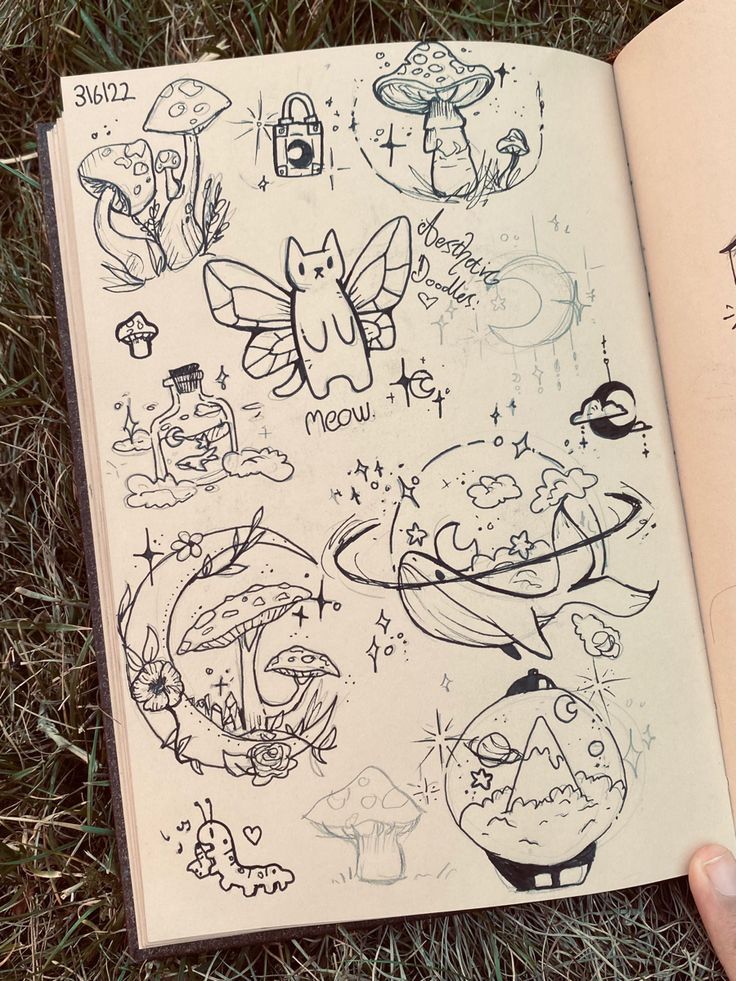
Reduce an animal to its most recognizable features. A cat needs pointed ears, a compact muzzle, and a flexible tail. A frog reads through wide eyes and folded legs; a whale through a long body and tail flukes. Draw the same subject in three poses before adding accessories. The second and third attempts usually become more expressive because you are no longer solving the basic shape.
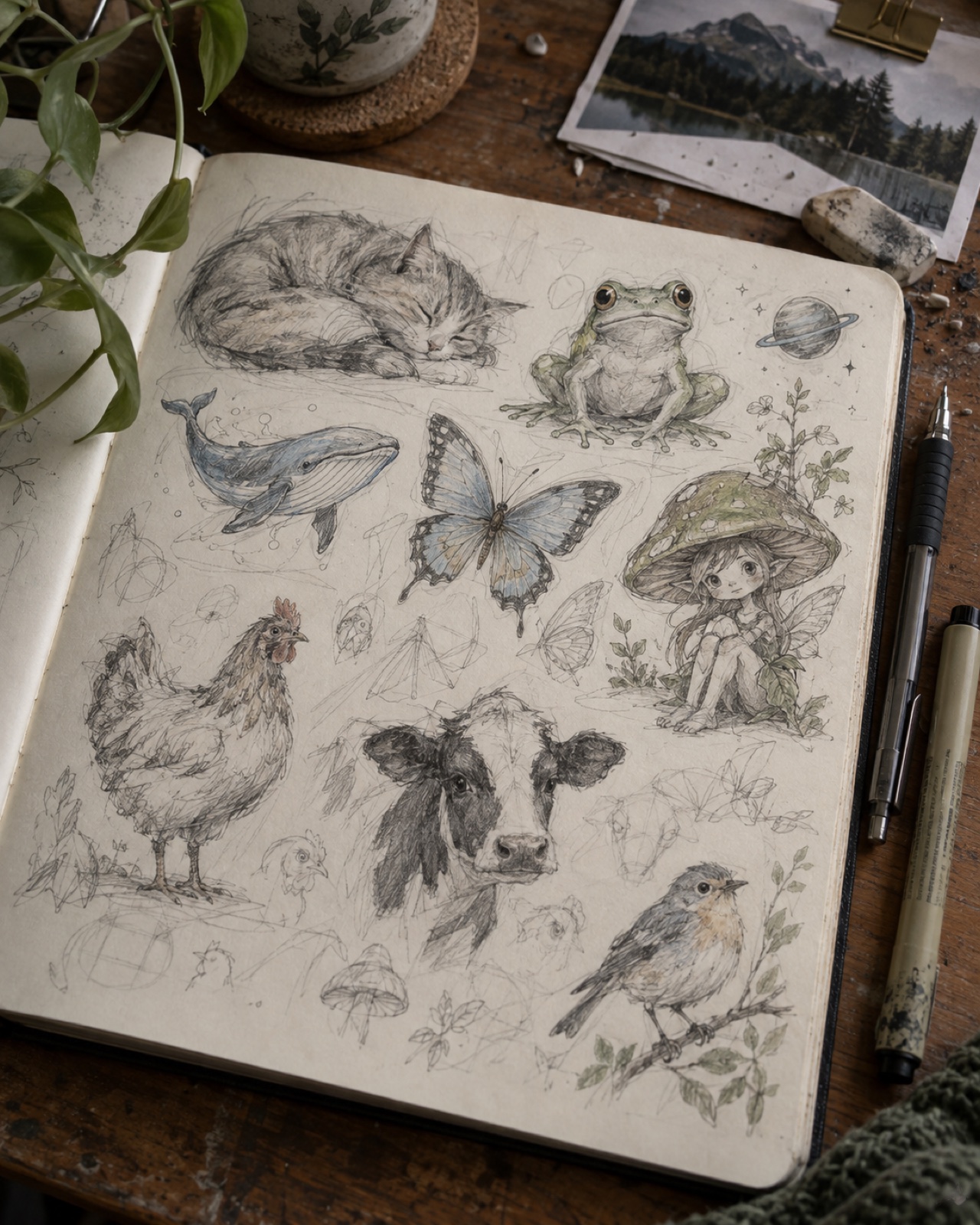
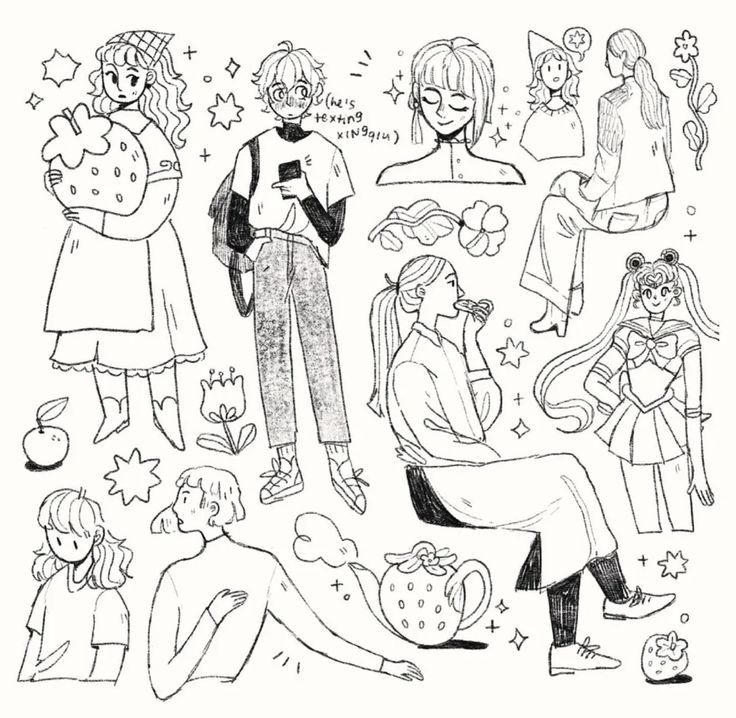
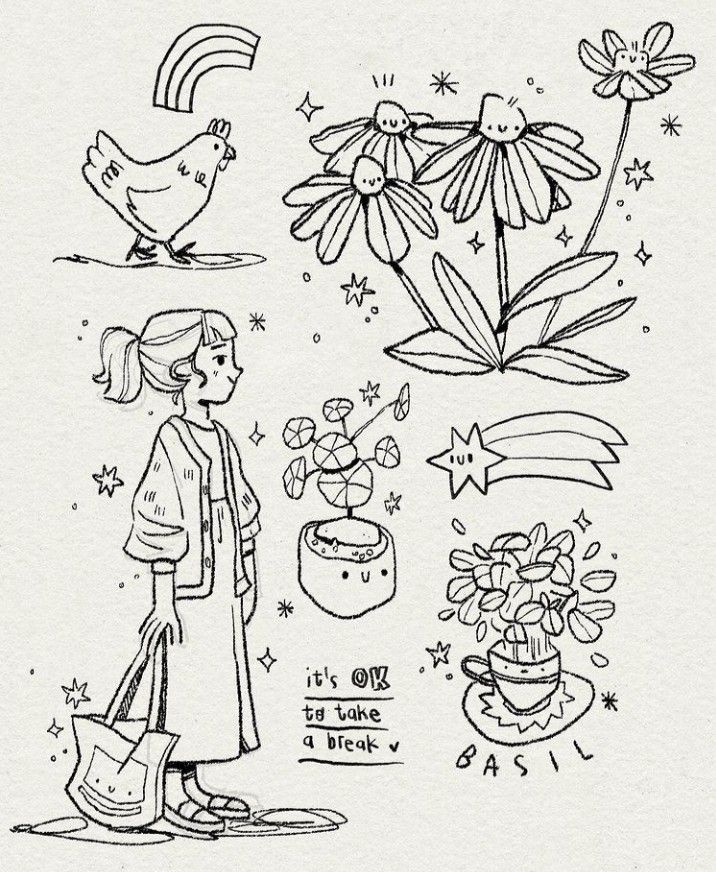
Characters need a clear action more than detailed anatomy. Let a tiny figure carry a tote, hold a flower, sit on a mushroom, or peer over a book. Props give the pose a purpose and often suggest the next doodle. If you want to loosen up first, try the timed and playful prompts in these five drawing exercises.
Turn one doodle into a tiny story
Ask three questions: where is the character, what is it doing, and what small problem could happen next? A cat in grass becomes a cat fairy when it has wings; the fairy gains a destination when a planet floats overhead. You do not need to illustrate the whole answer. One odd pairing is enough to make the viewer imagine the rest.
Patterns, Zentangle, and repeatable fillers
Patterns are useful when the page needs rhythm rather than another object. Start with rows of dots, waves, scales, nested arches, uneven stars, leaf chains, or checkerboard blocks. Change only one property at a time: size, direction, spacing, or fill. This makes it easy to see which variation creates depth.
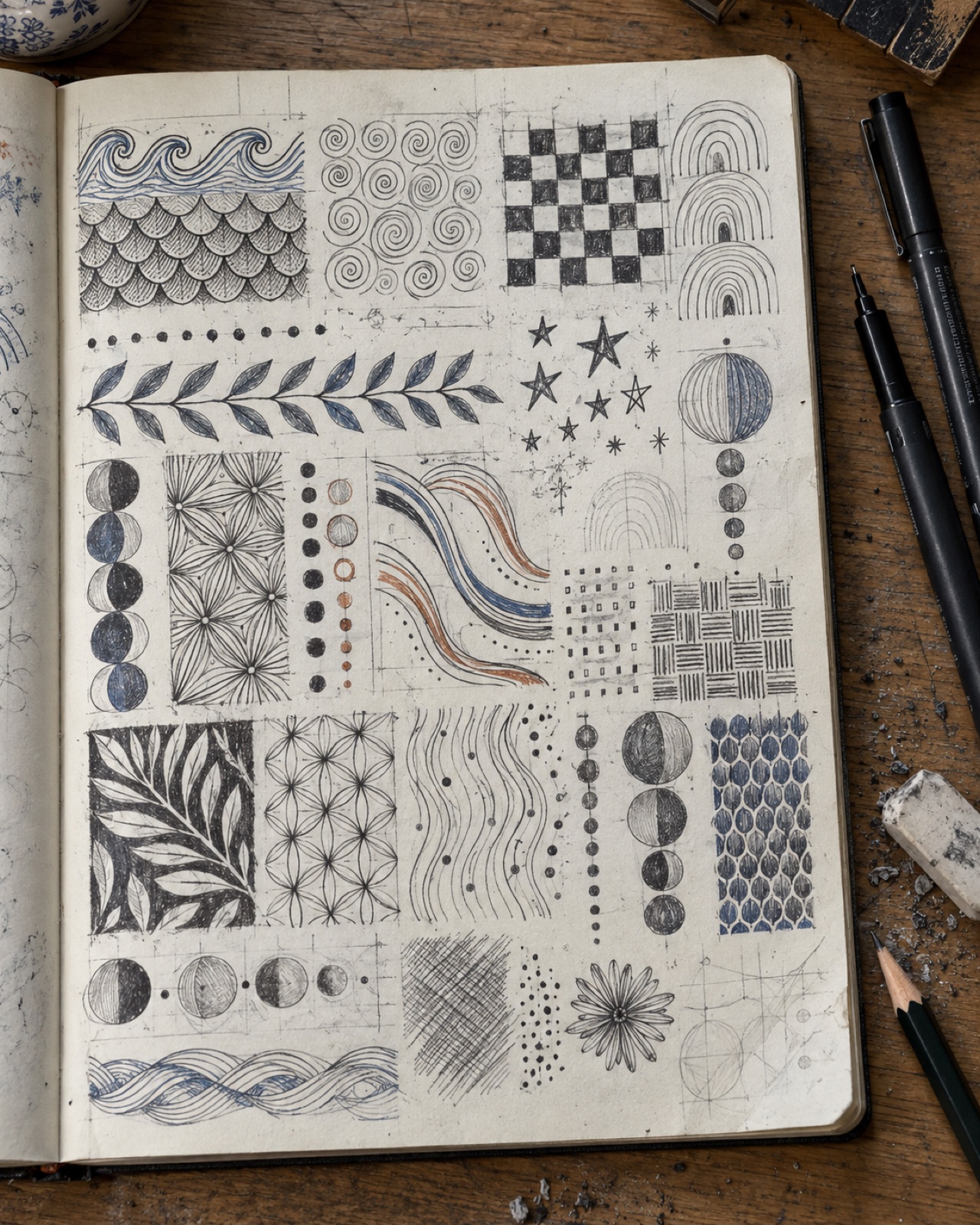
The official Zentangle description defines its method as structured patterns built from simple strokes such as dots, lines, curves, S-curves, and orbs. It is a branded method with a specific process, not a synonym for every patterned doodle. If you want to try that process, the creators also publish the eight official Zentangle steps.
For a separate circular practice, these mandala art designs show how radial repetition changes the planning. A doodle filler can grow in any direction; a mandala depends on repeating intervals around a center.
A 7-day daily doodle plan
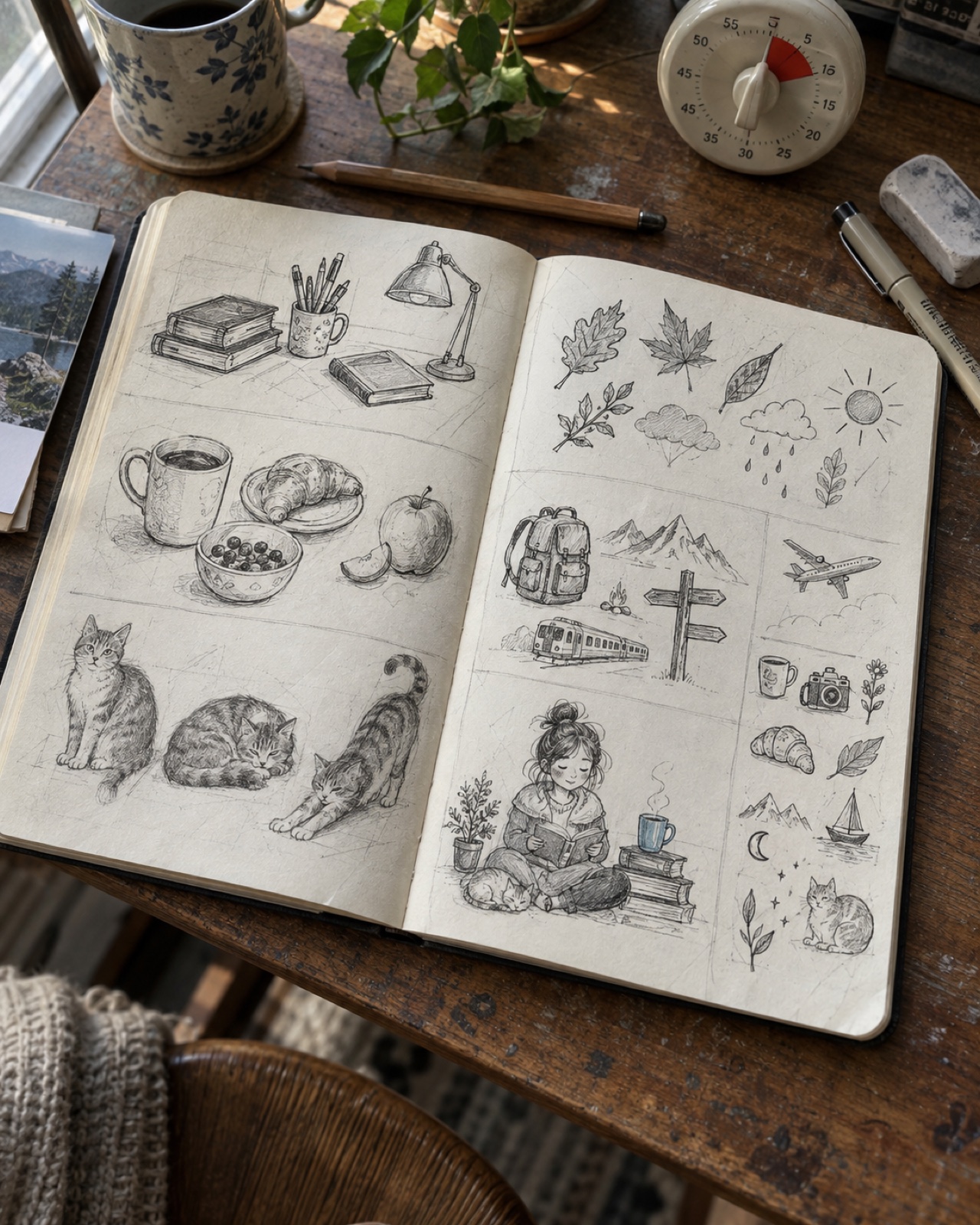
Keep each session to ten minutes and one page or index card. The time limit is deliberate: it keeps the exercise small enough to repeat. If a prompt becomes interesting, mark it and return later instead of turning the daily session into a long illustration.
| Day | Prompt | Small constraint |
|---|---|---|
| 1 | Five objects on your desk | Use only contour lines |
| 2 | Three snacks and two drinks | Add one accent color |
| 3 | A pet in three poses | Keep the face style consistent |
| 4 | Leaves, flowers, fruit, and weather | Repeat one filler motif |
| 5 | Eight tiny travel icons | Work inside a loose grid |
| 6 | One character plus five props | Suggest a simple story |
| 7 | A mixed page from the week | Redraw favorites from memory |
If you prefer a longer list to choose from, these 100 sketchbook prompts can extend the plan. Keep the daily format, though: one clear subject and one constraint are usually more useful than a vague instruction to “be creative.”
Does doodling improve focus or memory?
The evidence is mixed, so strong claims are not justified. Jackie Andrade’s 2010 study involved 40 participants listening to a dull telephone message; those assigned a structured shading task recalled more information afterward. The University of Plymouth research record provides the paper details and DOI.
A later experiment comparing writing, drawing, structured doodling, and free-form doodling found a different pattern: structured doodling did not improve free recall, and free-form doodling produced memory costs. The abstract is available through PubMed. These tasks are not identical, but together they show why “doodling always improves concentration” is too broad. Use doodling because it is accessible, enjoyable, or useful for visual practice—not as a guaranteed productivity technique.
Common doodling problems and quick fixes
| Problem | Why it happens | Quick fix |
|---|---|---|
| The page feels scattered | Every object has a different style | Repeat one line weight, filler, or color |
| Small gaps look awkward | Too many large subjects were placed first | Add dots, leaves, stars, or motion lines |
| Everything has equal importance | All doodles are the same size | Choose three larger anchor drawings |
| Ink bleeds through | Paper and pen were not tested | Test the back page; use lighter layers |
| You keep erasing | The goal shifted from practice to perfection | Draw three fast versions before refining one |
| The palette looks muddy | Too many colors overlap | Limit the page to two colors plus black |
Markers can create flat color quickly, but the paper and ink combination matters. Our marker drawing doodles guide covers shape building, color layering, and ways to avoid overworking small areas.
Doodle art ideas FAQ
What are easy doodle ideas for beginners?
Start with objects built from basic shapes: a mug, flower, cloud, mushroom, book, fruit slice, cat face, candle, envelope, or tiny house. Draw each one three times and change only one detail, such as the expression, pattern, or angle. Repetition removes the pressure to invent a perfect image and helps your hand learn the shape.
How do I start doodle art?
Choose one pen, divide the page into a loose grid, and draw one small object in each area. Begin with the largest shapes, then add faces, texture, stars, dots, or short lines in the gaps. Do not plan every corner in advance. A doodle page usually becomes more coherent when two or three motifs repeat across it.
What should I doodle when I have no ideas?
Use what is already within reach. Draw the objects on your desk, the last snack you ate, today’s weather, the shoes by the door, or icons from a recent trip. Another useful method is a five-item chain: draw one object, write the first related word that comes to mind, and turn that word into the next drawing.
What pens are best for doodling?
A waterproof black fineliner between 0.3 and 0.5 mm is a practical all-purpose choice. A pencil is useful for light placement lines, while brush pens create thicker accents and colored markers add flat fills. Test ink on the back page first, especially in a thin sketchbook, because some pens feather or bleed through.
Is doodling good for focus?
Research does not support a universal focus benefit. A small 2010 study found better recall after a structured shading task during a dull recording, but a 2019 experiment found no free-recall benefit from structured doodling and a cost from free-form doodling. Treat doodling as a low-pressure drawing practice, not a guaranteed concentration technique.
How do I make doodles look aesthetic?
Limit the page to one theme, one main line weight, and two or three colors. Repeat a small filler motif, keep similar gaps between drawings, and vary scale so every object is not equally loud. A light pencil grid can help with spacing; erase it after the ink dries. Leave some open paper instead of filling every gap.
Choose one prompt and start small
Pick one row from the 40-idea table and draw five subjects on a small sheet. Make one subject larger, repeat one filler motif, and use one accent color if the page needs contrast. That is enough structure for a first attempt. Save the page—even if it feels uneven—because the next useful step is to notice which subject you want to draw again.
A repeated doodle becomes more intentional when you vary scale, density, and empty space. This guide to building an abstract black and white composition shows how to turn loose motifs into a stronger page.
- 6.3Kshares
- Facebook0
- Pinterest6.3K
- Twitter0
- Reddit0