
I drew strawberries for two years before I understood what was actually wrong with them. They read as strawberries the way a silhouette reads as a person — recognisable, but flat. My seeds were dots scattered across a red shape. My calyx looked like a clip-art star. My highlight was a white blob I added at the end because I knew, in theory, there was supposed to be one.
If the strawberry study helped you notice surface detail, move next to a peony drawing. The challenge changes from glossy skin and seeds to layered petals, soft shadows, and a crowded flower center.
- Know What You Are Drawing: Strawberry Anatomy for Artists
- How to Draw a Strawberry Step by Step: Construction from Guideline to Outline
- Shading a Strawberry: How to Handle a Glossy Surface
- Four Strawberry Drawing Styles
- Colour Guide: Building Realistic Strawberry Reds
- Common Strawberry Drawing Mistakes and How to Fix Them
- FAQ: Strawberry Drawing
The problem was not technique. It was an observation. I had been drawing my idea of a strawberry — red teardrop, green leaves, some dots — rather than the actual object.
This guide is built around that distinction. It covers strawberry drawing from first structural principles: the geometry of the fruit, the achene grid method that makes seeds look botanically correct, how to construct a convincing calyx, the shading sequence for a glossy surface, and four drawing styles from quick sketch to finished botanical illustration.
Know What You Are Drawing: Strawberry Anatomy for Artists
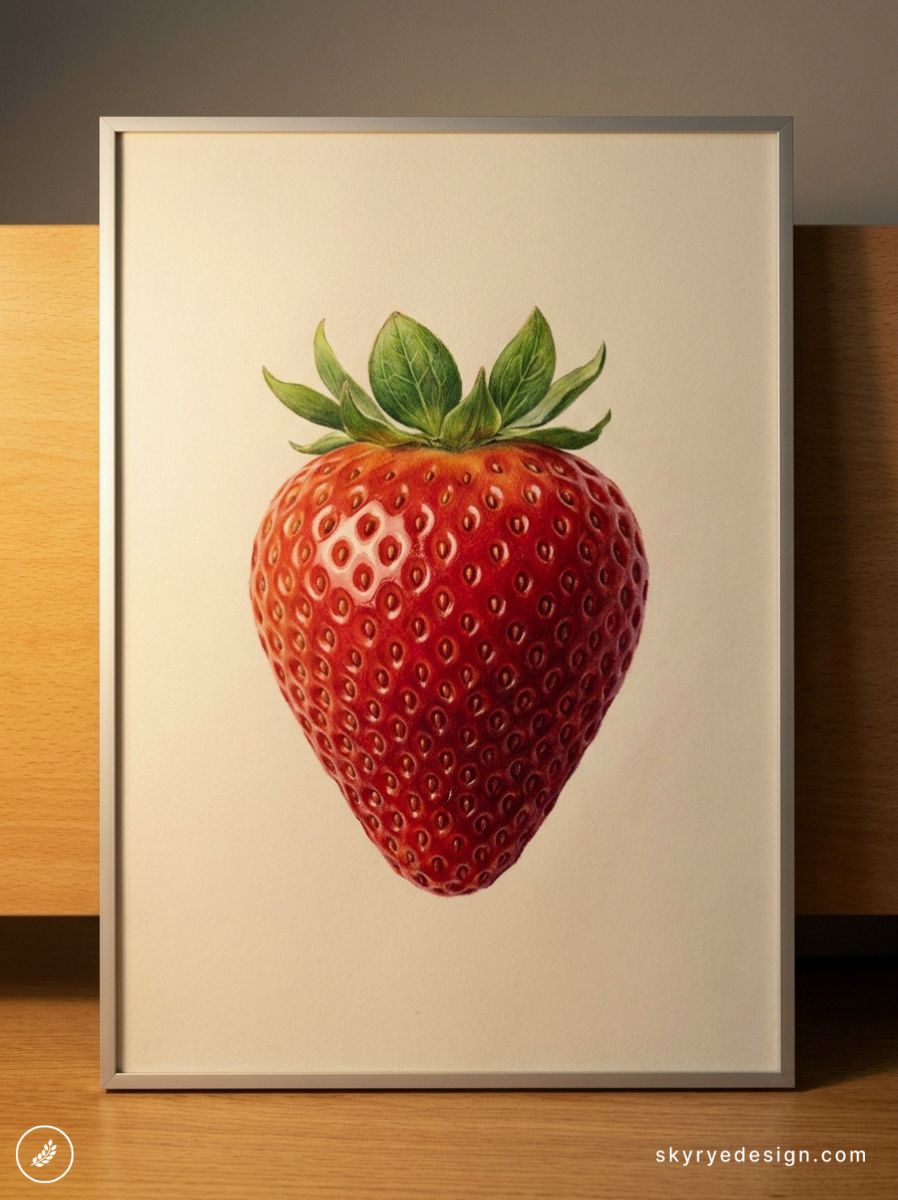
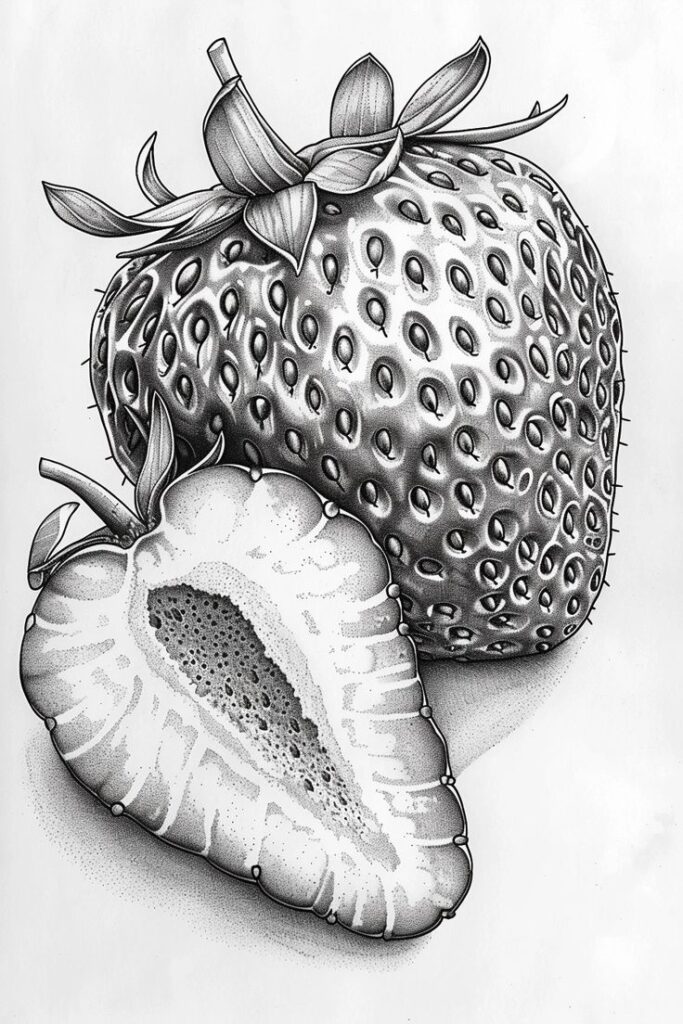
The strawberry is botanically unusual. The red fleshy part is the receptacle — an enlarged flower base, not technically a berry at all. What we call seeds are achenes: each one is a separate small dry fruit with a true seed inside. A typical ripe garden strawberry carries approximately 200 achenes on its surface, arranged in a spiral grid pattern that follows the curvature of the receptacle from tip to calyx.
This anatomy is not just botanical trivia. It directly determines the visual structure of the surface in any realistic fruit drawing. Each achene sits in a shallow depression in the receptacle. The surface is not smooth but dimpled — a textured, slightly undulating form rather than a simple cone. Each depression generates its own small shadow above the achene (where the flesh rises to form the rim) and a subtly lighter area below it (where the base of the cavity opens toward ambient light).
Getting this micro-shadow pattern right is the specific technical move that separates a convincingly realistic strawberry drawing from a flat one.
The Key Proportions
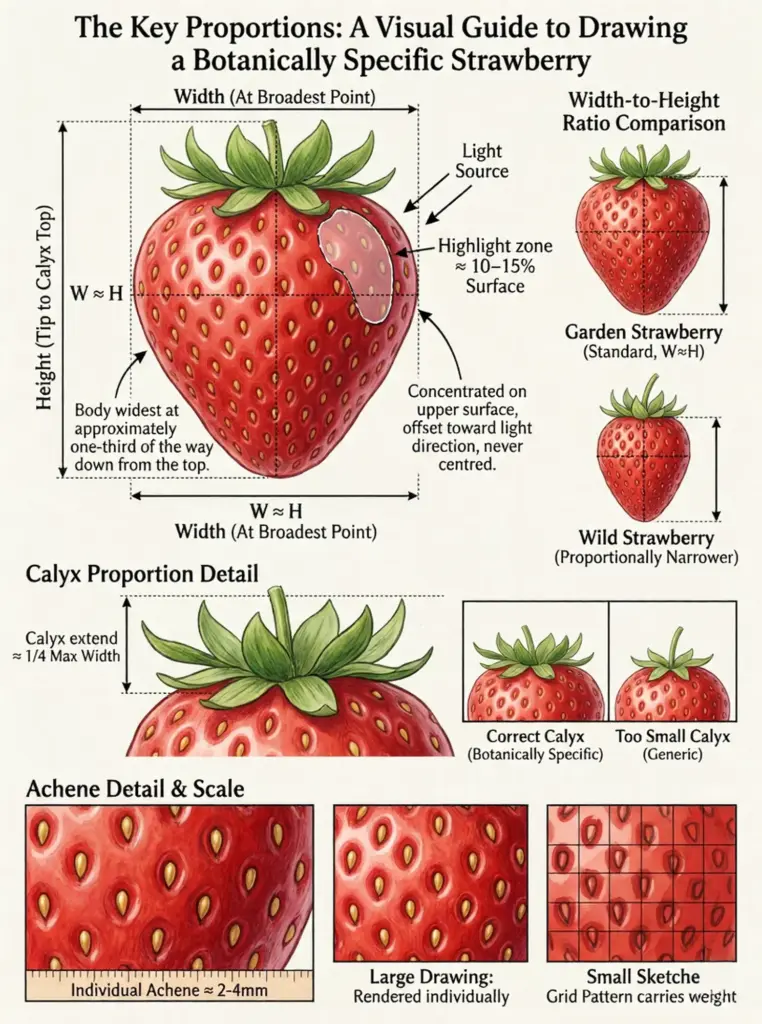
- Width-to-height ratio: A ripe garden strawberry is roughly as wide at its broadest point as it is tall from tip to calyx top. The body alone is widest at approximately one-third of the way down from the top. Wild strawberries run proportionally narrower — worth noting if you are drawing from a foraged reference rather than a supermarket fruit.
- Calyx proportion: The calyx extends outward by approximately one quarter of the fruit’s maximum width. Too small and the drawing reads as generic; correctly scaled and it immediately reads as botanically specific.
- Highlight zone: On a standard front-lit strawberry, the highlight occupies roughly 10–15% of the visible surface — concentrated on the upper surface facing the light source, offset toward that light direction. It is never centred.
- Achene size: In a life-size study, individual achenes measure approximately 2–4mm. In a larger drawing they can be rendered individually; in a smaller sketch, the grid pattern carries more weight than individual seed detail.
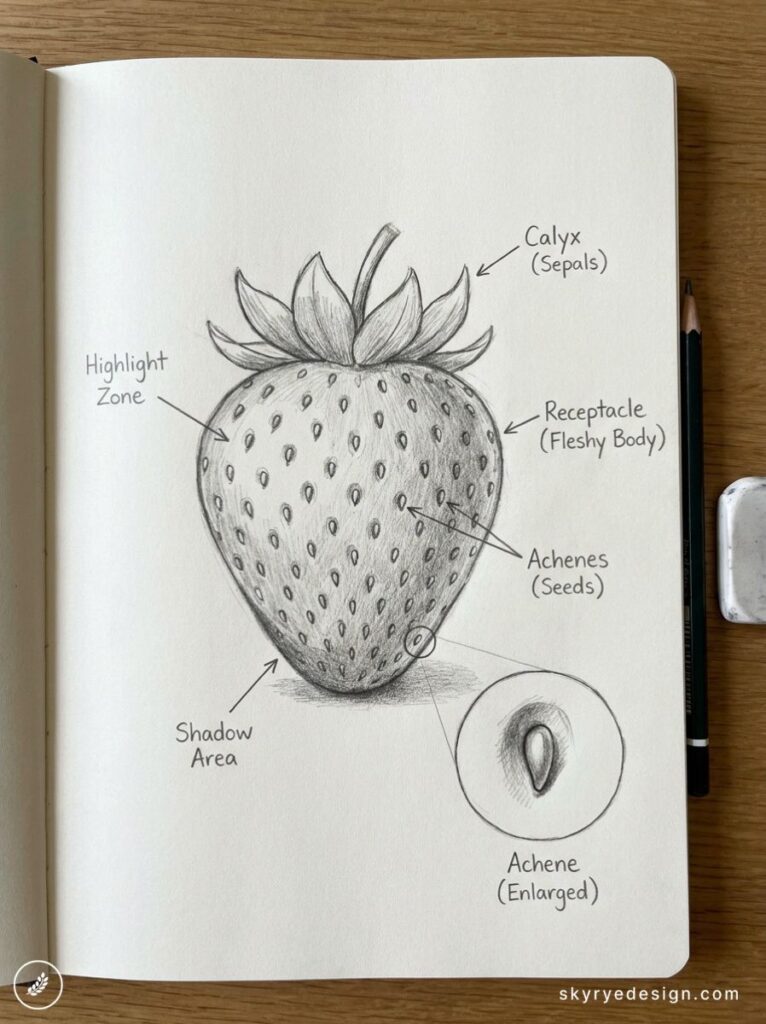
✏ Before you draw: Spend two minutes with a real strawberry or a high-resolution botanical photograph. Count the sepals — it is rarely exactly five, more commonly six or seven. Locate the highlight. Check whether there is a yellow-green zone near the calyx where the fruit is less ripe. This two-minute observation prevents errors that no technique instruction corrects after the fact.
How to Draw a Strawberry Step by Step: Construction from Guideline to Outline
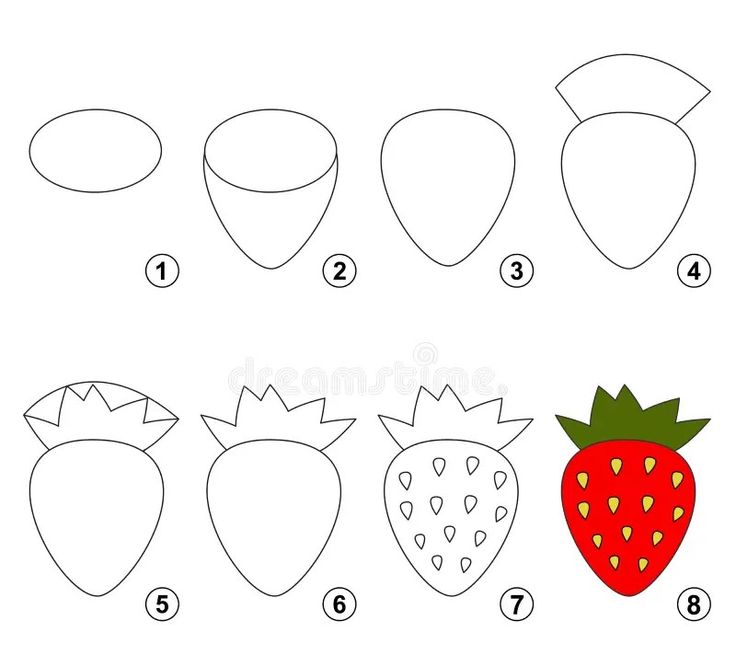
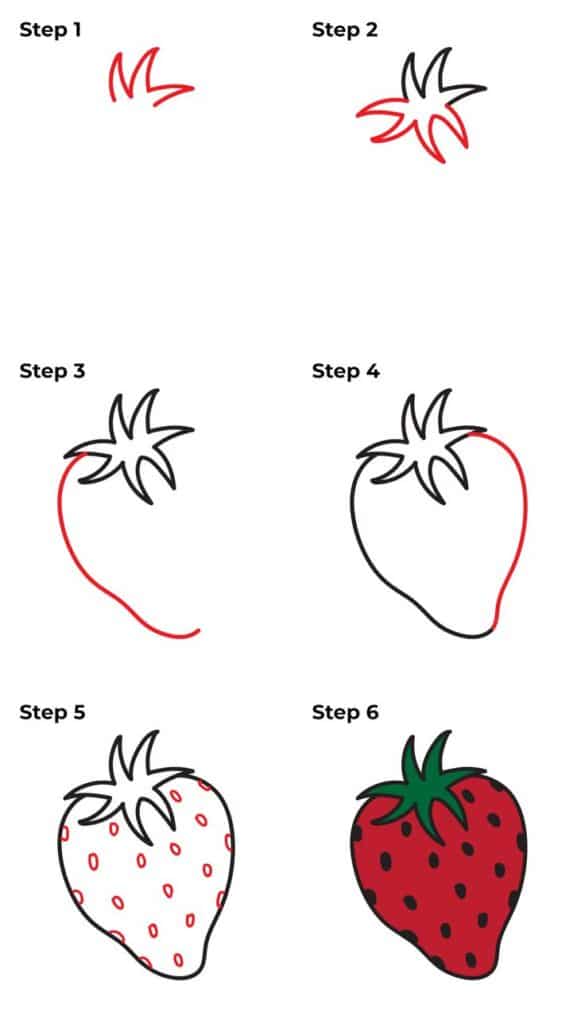
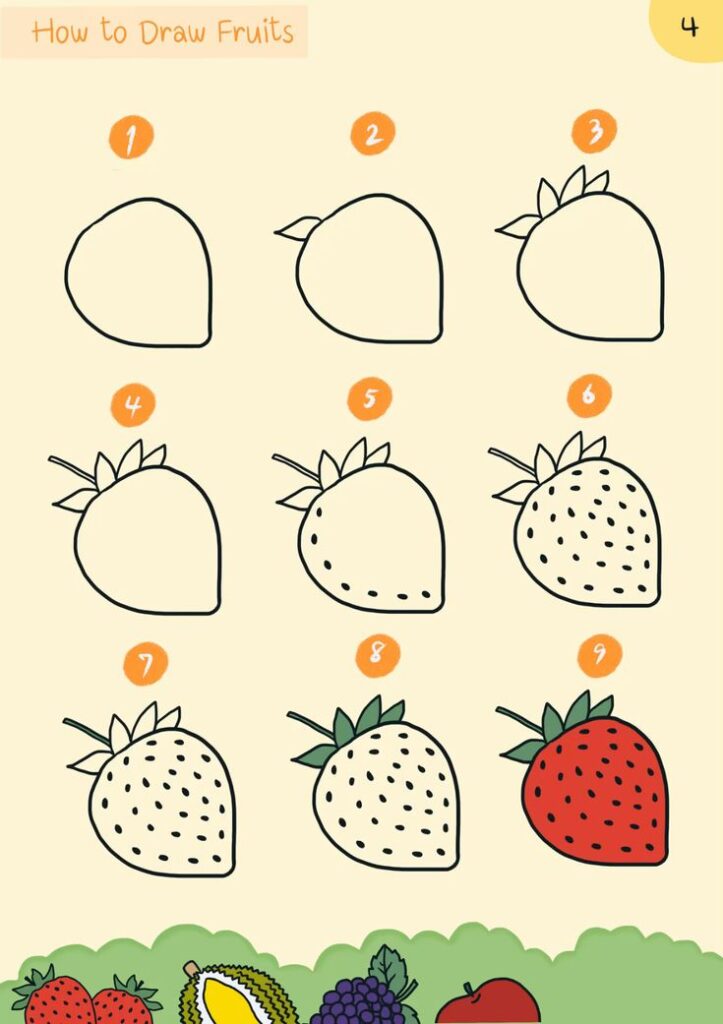
Every drawing style — quick strawberry sketch to detailed botanical illustration — begins with the same structural sequence. The complexity of the finished result depends on how far you develop each stage, not on a different starting method.
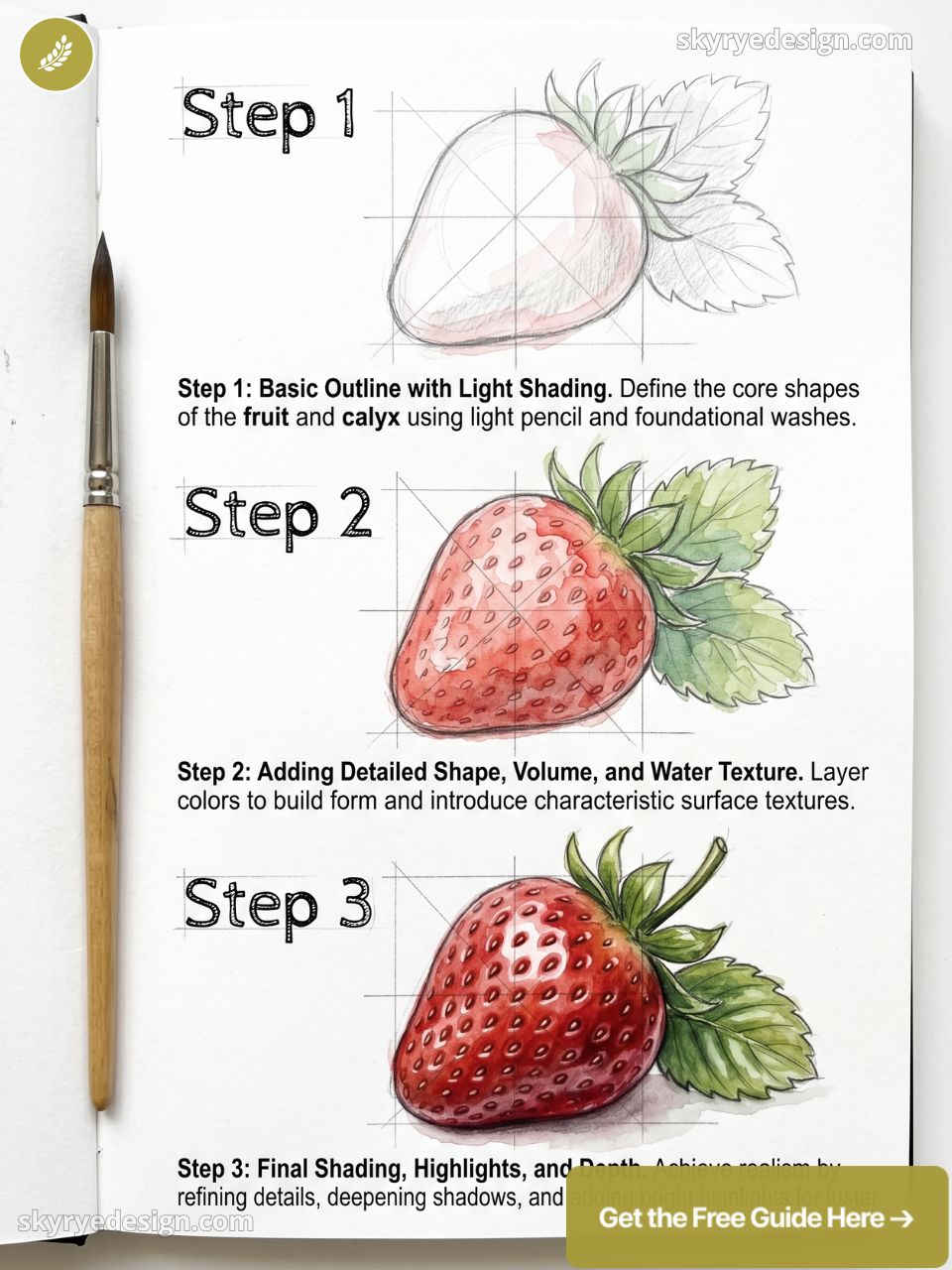
Step 1: Central Axis and Teardrop Guideline
Draw a light vertical line as tall as the finished strawberry. On this axis, sketch a teardrop shape: widest at roughly one-third from the top, narrowing to a soft rounded point at the base. Use very light HB pressure — this is a construction guideline, not the final line. Width-to-height ratio: approximately 1:1 for garden strawberries.
Step 2: Refine the Outer Contour
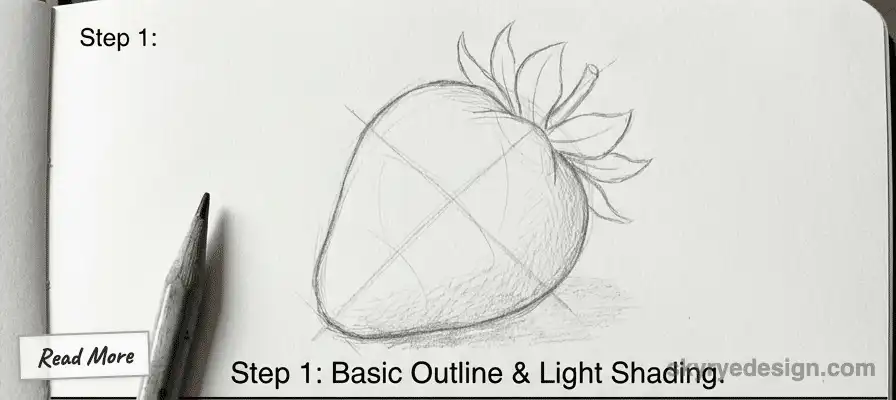
Over the teardrop, draw the actual outer edge with subtle organic irregularity. Real strawberries are not perfect geometric shapes — there is often a slight indentation where the fruit grew against another, mild asymmetry left-to-right, a faint waviness along the contour. These small imperfections are what make the drawing read as a grown object rather than a constructed one.
Step 3: Construct the Calyx
Mark a small central point at the top of the fruit where the stem joins. From it, draw five to seven sepals radiating outward — each an elongated pointed leaf shape that curves away from the fruit and then back down over the upper surface. Sepals overlap slightly at their bases. They are not all identical in length or angle — introduce subtle variation. Calyx width: approximately one quarter of the fruit’s maximum width.
Step 4: Map the Achene Grid
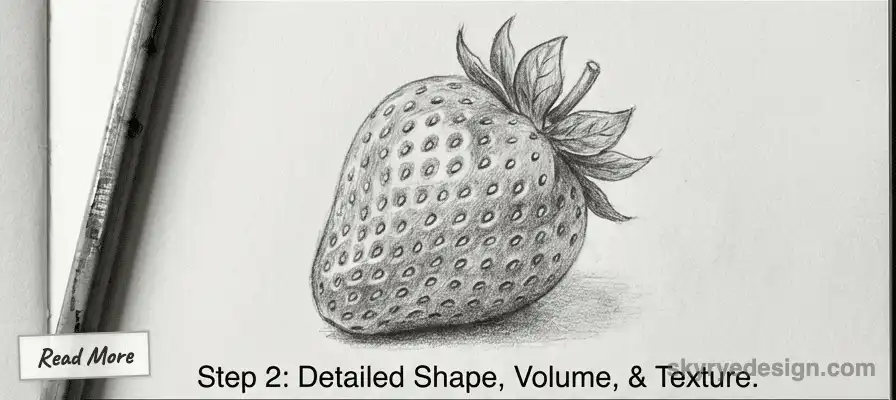
This is the step most strawberry drawing tutorials skip, and the one that makes the largest difference to surface realism. Before drawing any achenes, lay a very faint diagonal grid across the berry’s surface — lines crossing at approximately 45–60 degrees, following the fruit’s curvature rather than running straight. The grid intersections mark achene positions. Getting this grid right means your seeds will follow the correct spiral pattern rather than reading as randomly scattered dots.
Step 5: Draw the Achenes
At each grid intersection, draw a small teardrop or oval — approximately 2–4mm in a life-size study. Each achene points toward the tip lower on the fruit and toward the calyx higher up, following the surface curvature. Indicate the rim of each depression with a very faint curved line. In a casual sketch, suggest the pattern clearly in the central visible area and let it fade toward the edges — do not attempt all 200.
Step 6: Add Calyx Detail and Erase Guidelines
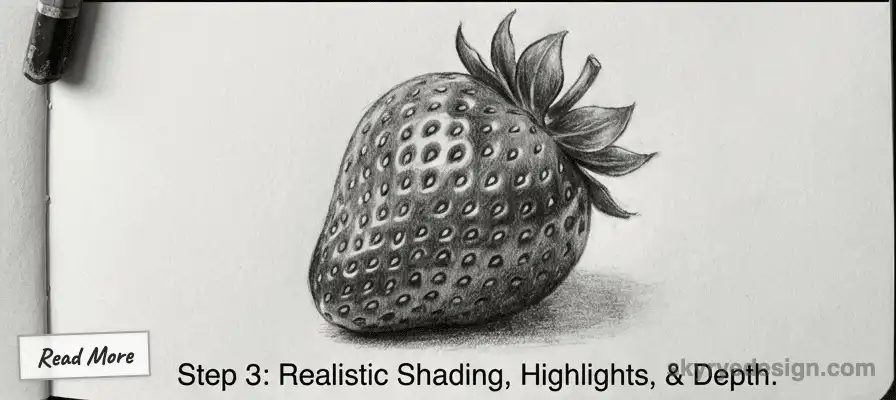
Draw a central midrib vein on each sepal — one line from base to tip. Add fine lateral veins branching off at shallow angles, curving with the sepal rather than running straight. Erase all construction guidelines: the central axis, teardrop, achene grid. The finished outline shows the outer contour, the achene depression pattern, and the calyx with vein detail.
✏ Achene grid practice: Rather than building this grid from imagination, study a botanical close-up photograph. The achene rows form diagonals in two directions simultaneously — identical in principle to the surface pattern on a pineapple. Practise the grid separately on scrap paper before applying it to the main drawing.
Shading a Strawberry: How to Handle a Glossy Surface
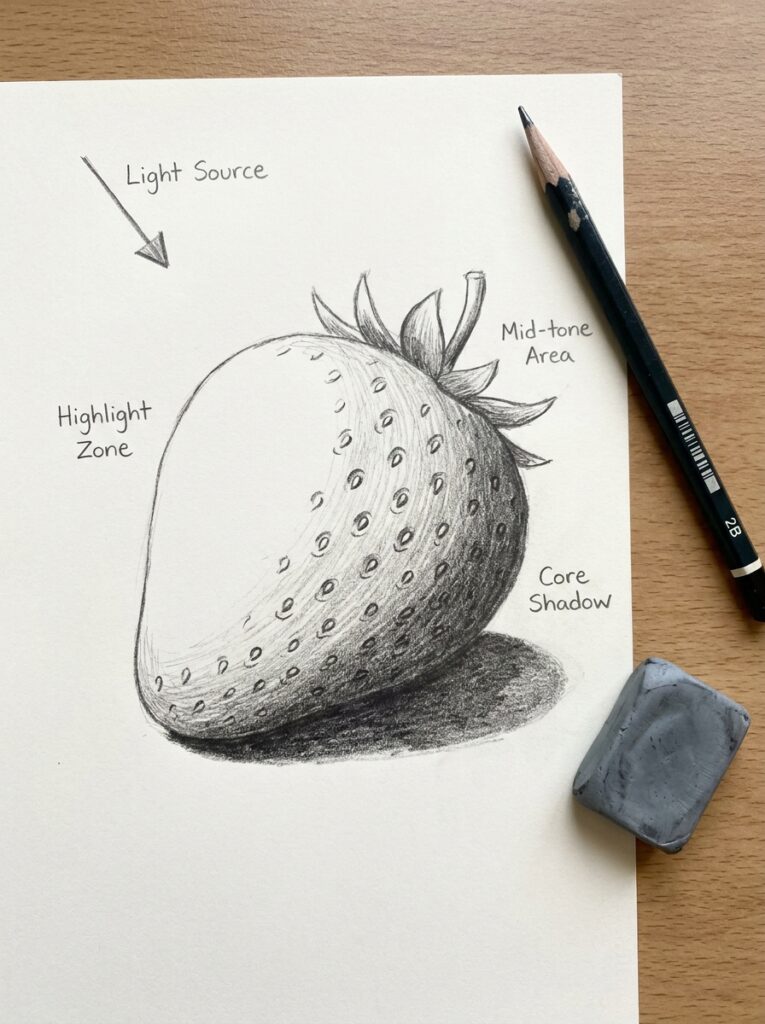
The strawberry’s skin is semi-gloss — more reflective than a matte apple, less mirror-like than a wet cherry. In shading terms, this means: a distinct, relatively sharp highlight; a clear tonal gradient from lit surface to shadow; and a subtle reflected light in the deepest shadow zone where ambient light bounces back off the surface beneath the fruit.
The Five Tonal Zones
- Highlight: A distinct bright zone on the upper surface facing the light source. On a glossy surface, the edge is relatively crisp. In pencil work, reserve it as bare paper from the start — or lift it with a kneaded eraser after establishing the surrounding tone. In coloured pencil, the highlight reads best as bare Strathmore Bristol white with the faintest warm glaze burnished over it.
- Lit area: The broadly illuminated surface surrounding the highlight. In a strawberry drawing, this carries the richest, most saturated red. In graphite, this is the light-to-medium tone zone.
- Mid-tone: The transitional zone where the surface curves away from the light. Slightly deeper than the lit area. This is where the achene micro-shadow pattern is most visible and most critical to render.
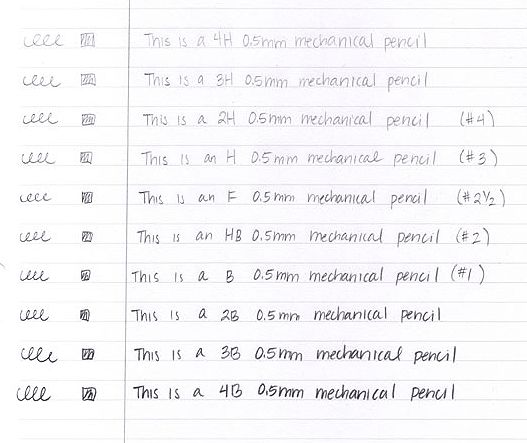
- Core shadow: The darkest zone on the fruit — on the side facing away from the light source. In coloured pencil, this goes into deep crimson or burgundy. In graphite, this is the 4B–6B range.
- Reflected light: A subtle lighter strip at the very edge of the shadow side, where ambient light or light bouncing off the surface beneath the fruit returns. Keep it darker than instinct suggests — it should read lighter than the core shadow but remain clearly within the shadow zone.
The Achene Micro-Shadow: The Specific Detail That Elevates Everything
Each achene sits in a small cavity. With the light source above, a shadow falls above the achene where the rim of the cavity rises to block the light, and a slightly lighter area sits below it where the base of the depression opens toward the source. This micro-shadow — one small curved pencil mark above each seed — takes seconds per achene and transforms the surface from flat dots to a genuinely three-dimensional texture.
In the highlight zone: draw no achene shadows at all. The bright highlight visually eliminates the small cavity shadows in that region. Restricting micro-shadows to the mid-tone and shadow zones makes the highlight read as brighter by contrast and the mid-tone texture more believable.
Four Strawberry Drawing Styles
1. Quick Graphite Sketch
Materials: HB and 2B pencil on 90gsm cartridge paper.
Establish the outer silhouette in a single confident stroke rather than assembling it from multiple lines. Suggest the calyx with five quick radiating marks. Indicate the achene grid with very faint diagonal hatching — enough to imply texture without mapping individual seeds. Apply a single directional shadow sweep with the 2B held at a low angle, using the side of the lead. Total time: 5–10 minutes.
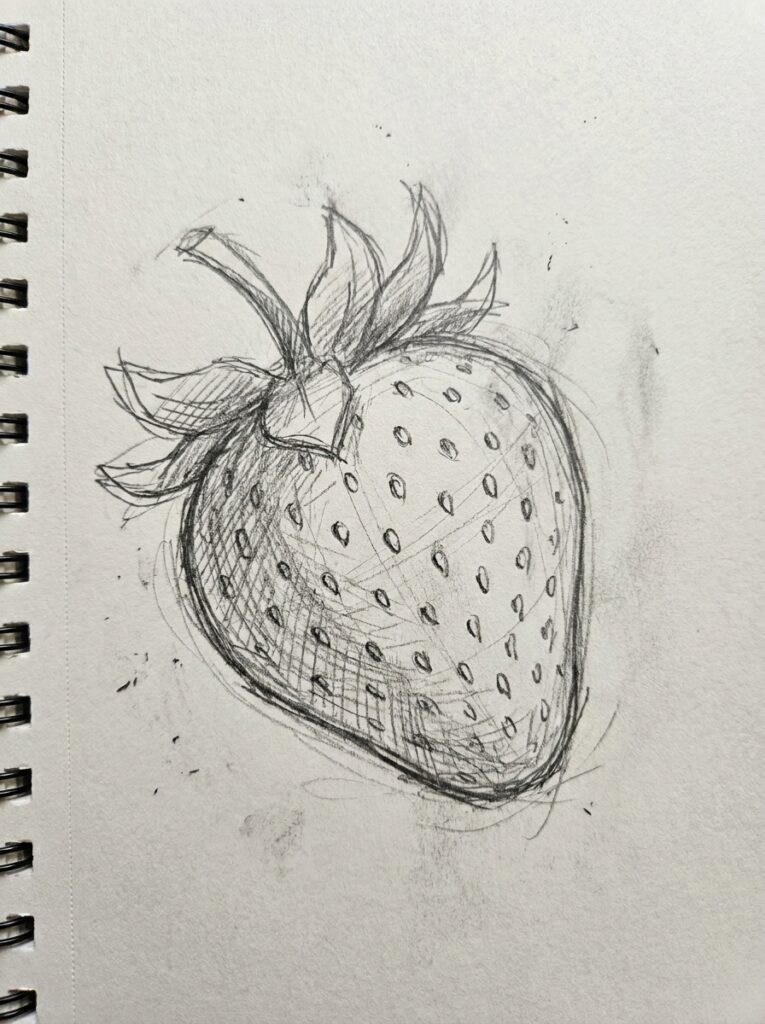
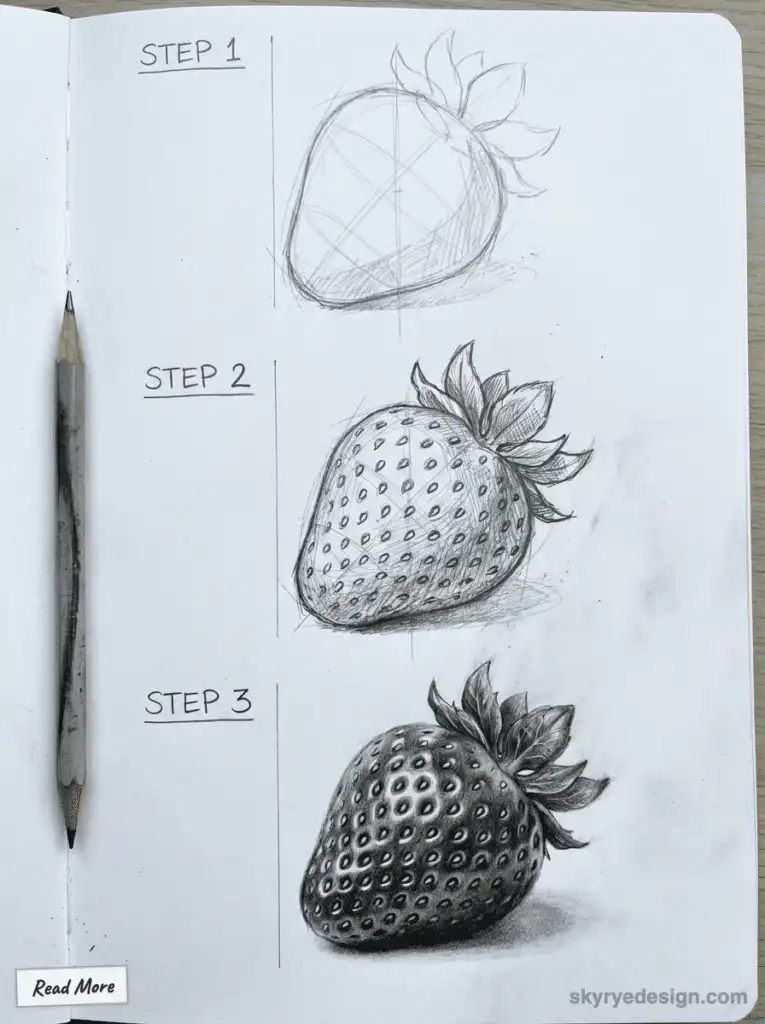
Pro tip: Confidence of stroke matters more than accuracy in a quick sketch. One decisive wrong line reads better than three tentative corrections. Draw the same strawberry four or five times on a single page — each repetition tightens the next.
2. Ink Line Art
Materials: Micron 01 (0.25mm) for interior detail, Micron 03 (0.35mm) for the outer contour; smooth Bristol or 200gsm cartridge.
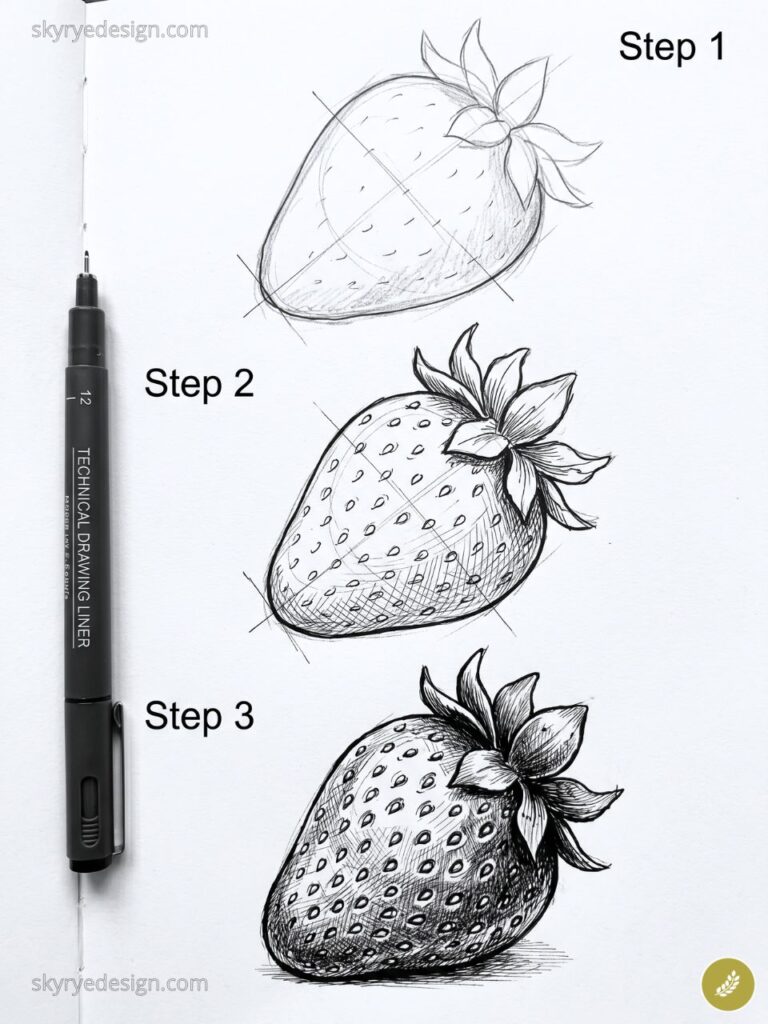
Build shadow on the core shadow side with fine cross-hatching at 45 degrees. Draw achenes individually as small oval outlines, each with a short curved shadow line above it. The highlight zone stays as blank white paper — no lines at all, which functions as a negative space drawing technique: the untouched paper reads as reflected light. Calyx veins drawn with the 01, consistent pen pressure throughout.
Pro tip: Draw the outer contour first with the heavier Micron, then switch to the lighter nib for all interior work. The boundary of the form should be the strongest mark on the page — correct visual hierarchy for a defined object.
3. Coloured Pencil — Realistic Botanical
Materials: Faber-Castell Polychromos pencils; Strathmore 300 Bristol smooth.
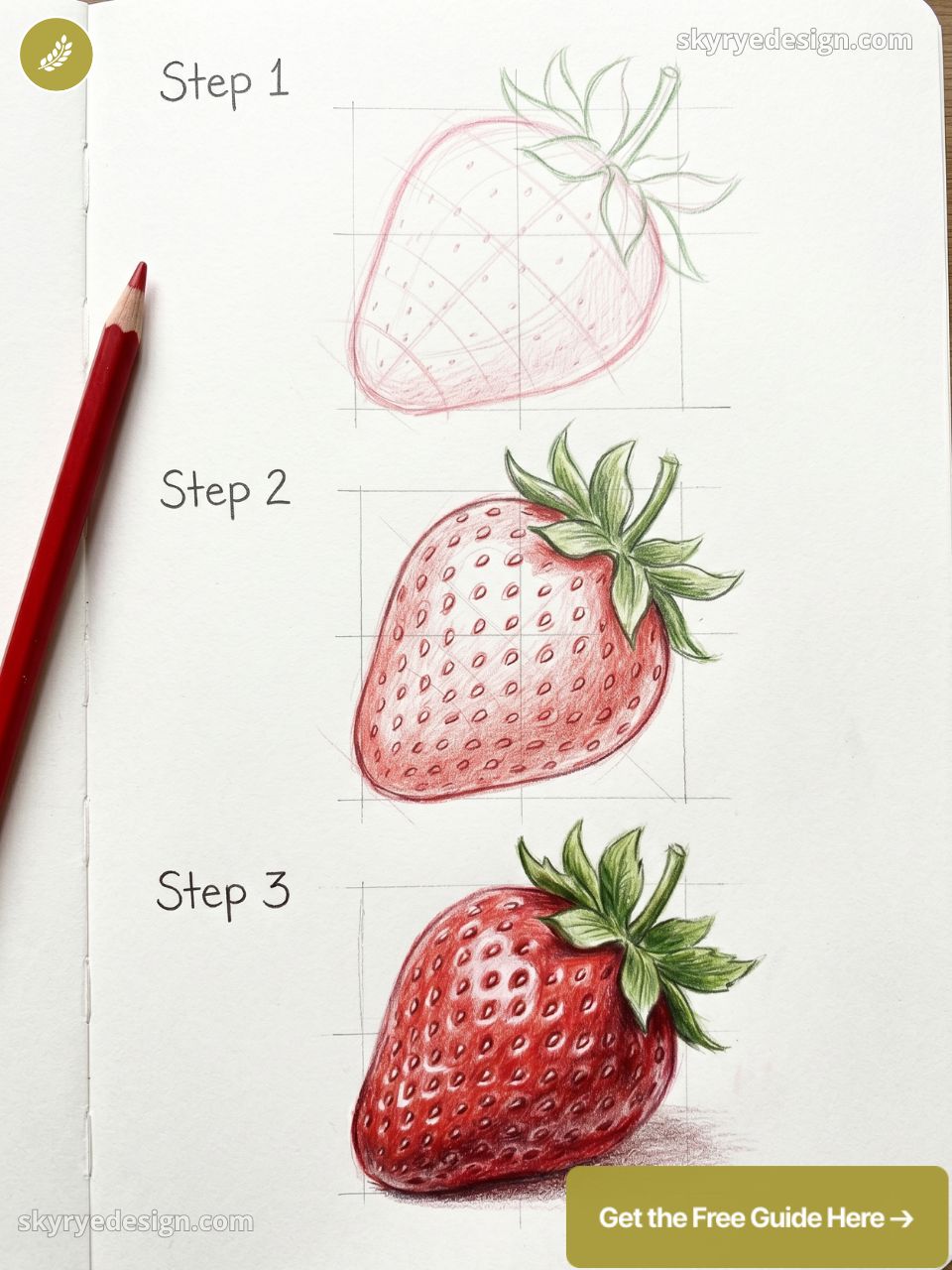
Layer in this sequence:
- Cadmium Yellow as a base layer over the entire berry except the highlight zone.
- Cadmium Red Medium over the lit area and mid-tone, built in three to four light passes.
- Crimson Lake or Alizarin Crimson in the shadow zone, blended slightly into the mid-tone.
- Dark Burgundy in the core shadow and deepest achene cavities.
- Cream or White burnished over the highlight zone — heavy burnishing pressure merges paper white with a warm glaze and produces the glossy skin effect.
Achene colour: Yellow Ochre or Light Yellow for the achene bodies — not red. On a ripe strawberry, the achenes are distinctly pale against the surrounding flesh. Use a touch of Warm Grey or Light Olive around the depression edges.
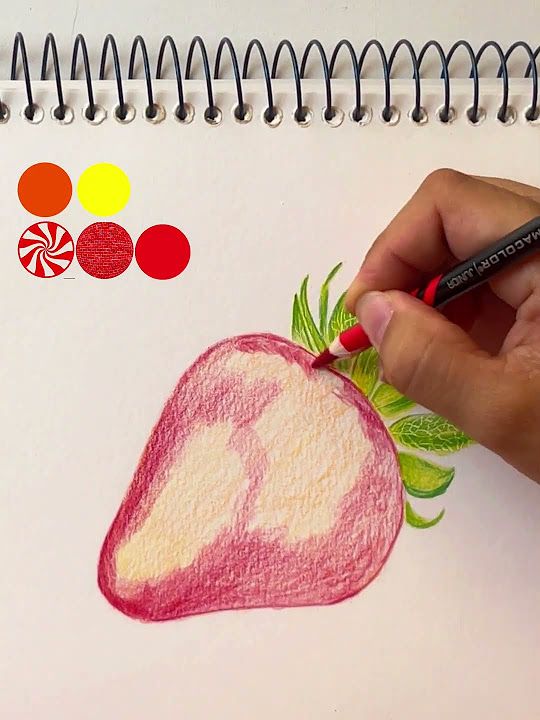
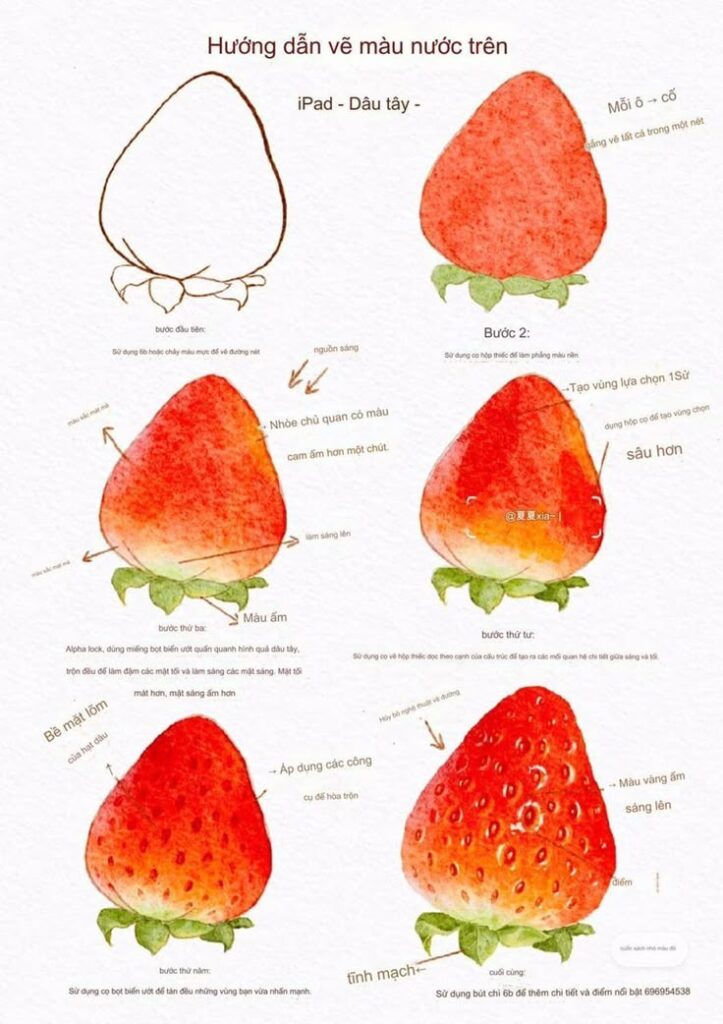
Calyx: Sap Green as the base layer; Olive Green in the sepal shadow areas; Yellow-Green or Chartreuse on the light-catching sepal edges.
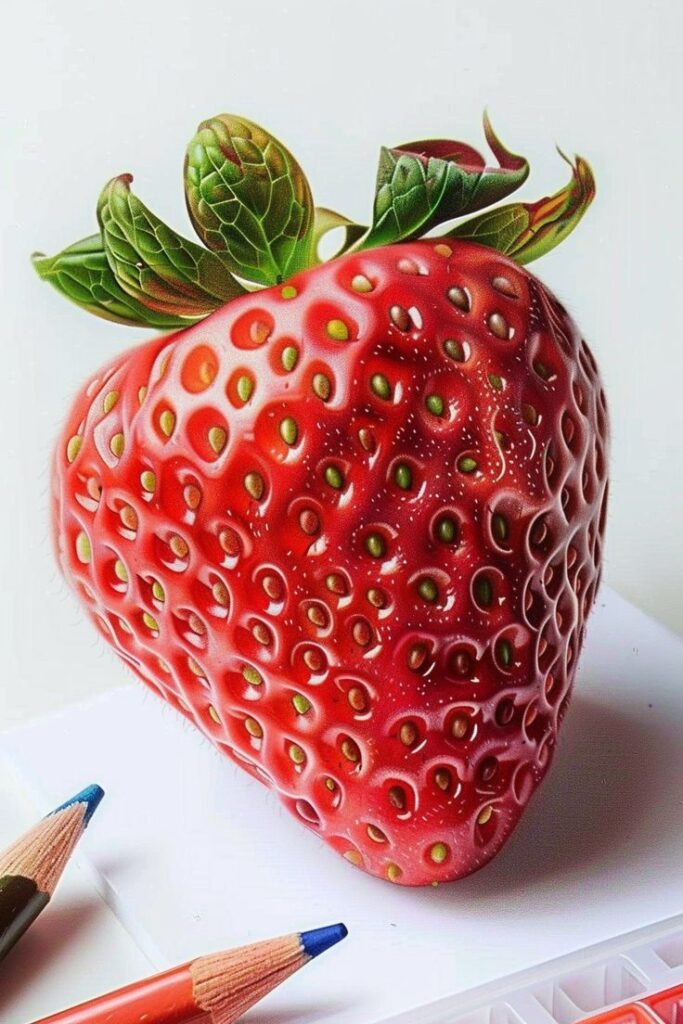
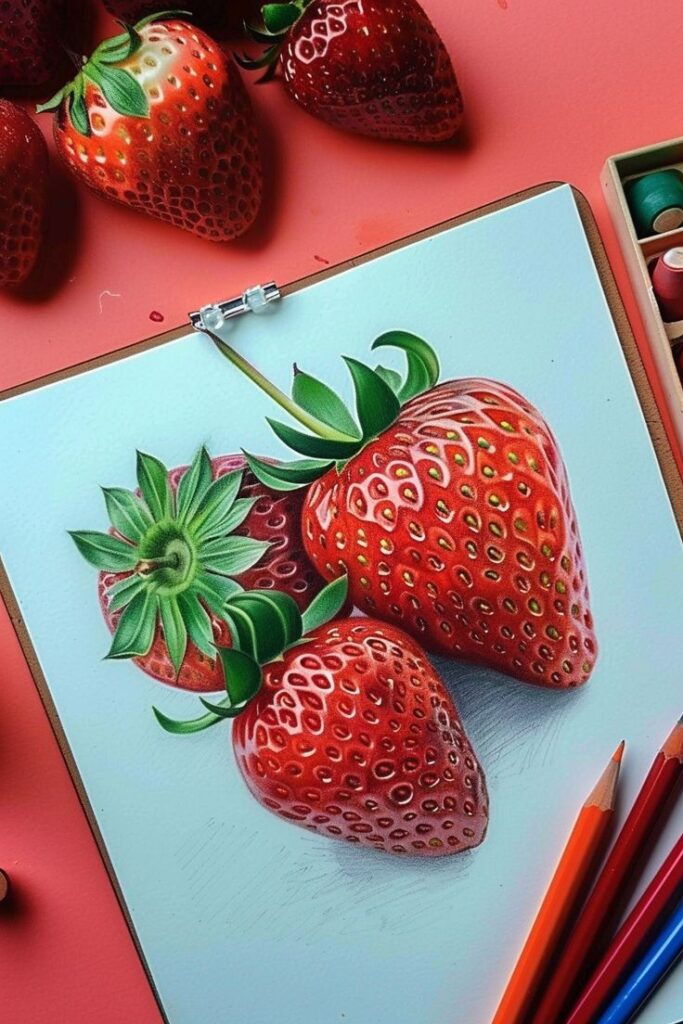
Pro tip: Reserve the highlight as bare paper from the first stroke. Burnishing the highlight zone at the end produces a cleaner, more luminous result on Bristol smooth.
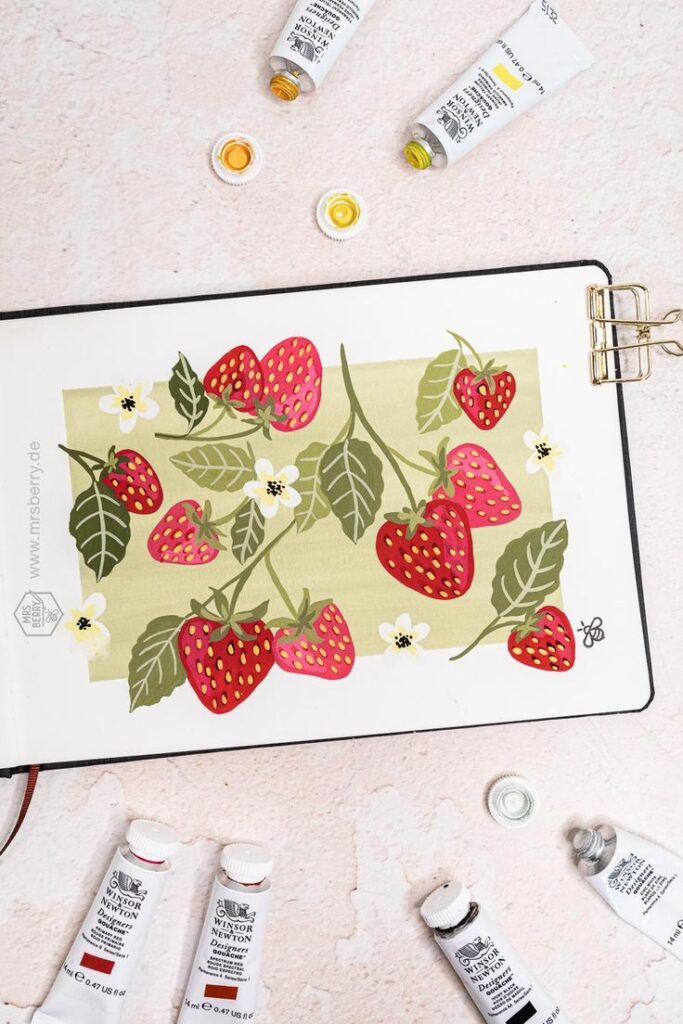
4. Watercolour — Loose and Expressive
Materials: Artist-grade watercolour (Winsor & Newton Professional or Daniel Smith Extra Fine); 300gsm cold-press.
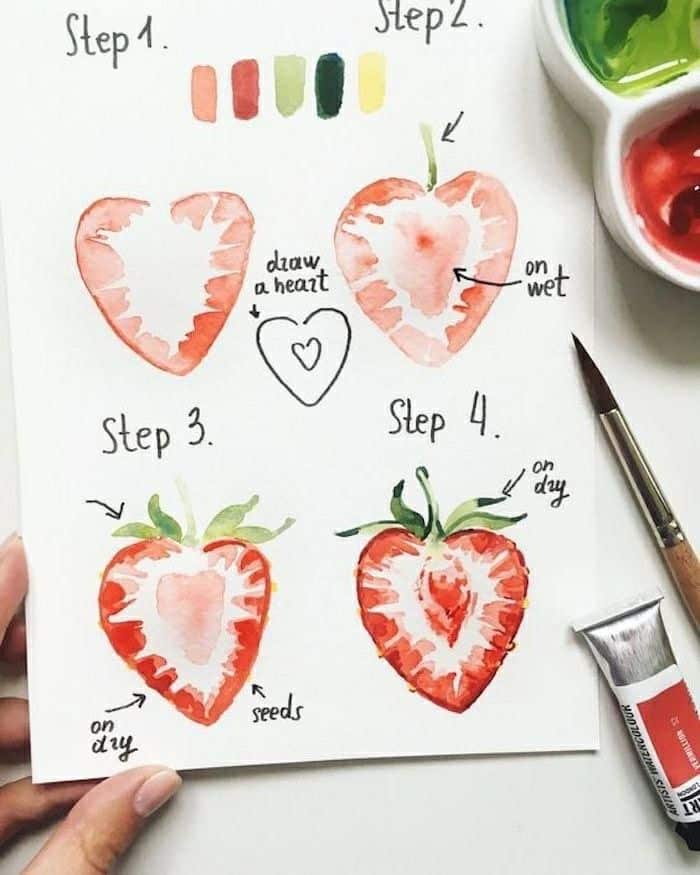
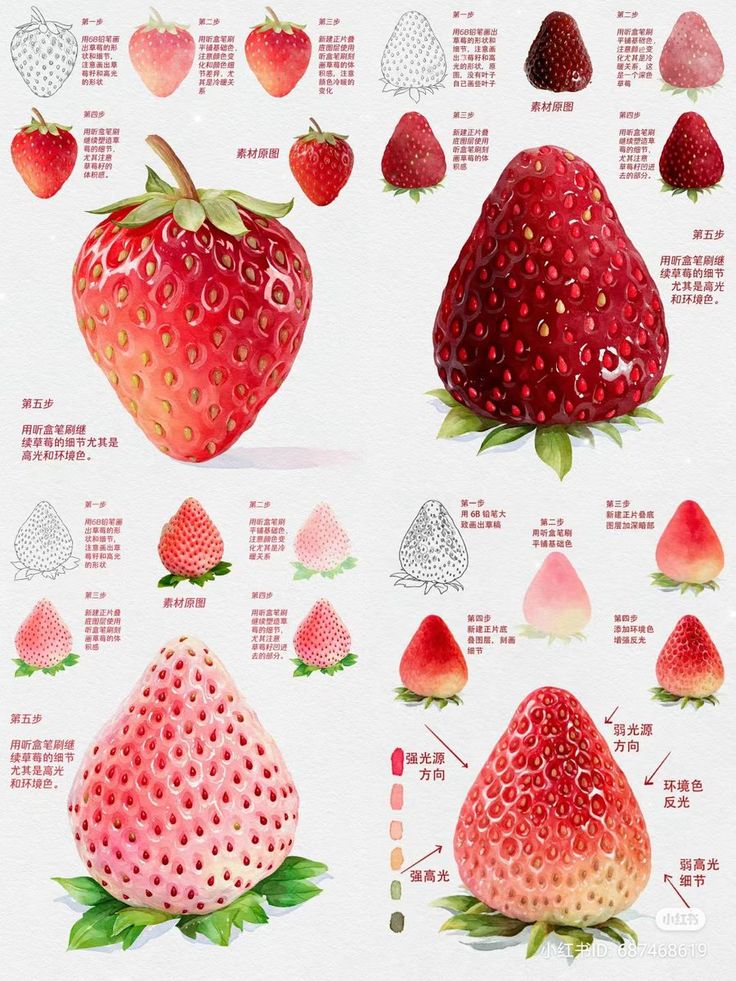
Mask the highlight zone with masking fluid before laying down any wash. Apply a wet-on-wet wash of Cadmium Red and a touch of Permanent Rose across the lit area — let the colours bloom naturally.
While the wash is still wet, drop Alizarin Crimson toward the shadow edge and allow it to bleed. When fully dry, apply a controlled wash of Alizarin mixed with a small amount of Prussian Blue for the core shadow. Draw the achene grid with a fine round brush (size 1 or 0) and a red-brown mix — suggest the spiral pattern, do not map every seed.
Pro tip: Always test the red-to-crimson wet-on-wet transition on a scrap of the same paper weight first. Watercolour dries 30–40% lighter than it reads wet — what looks correct on a wet wash will almost always need a second layer when dry.
Colour Guide: Building Realistic Strawberry Reds
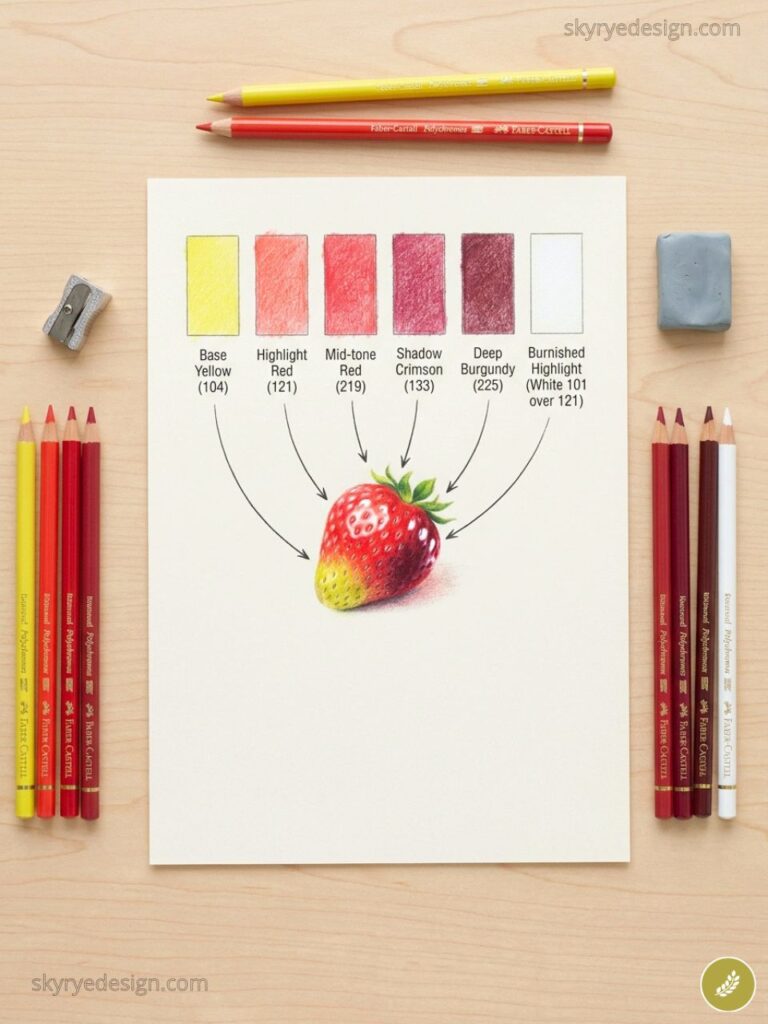
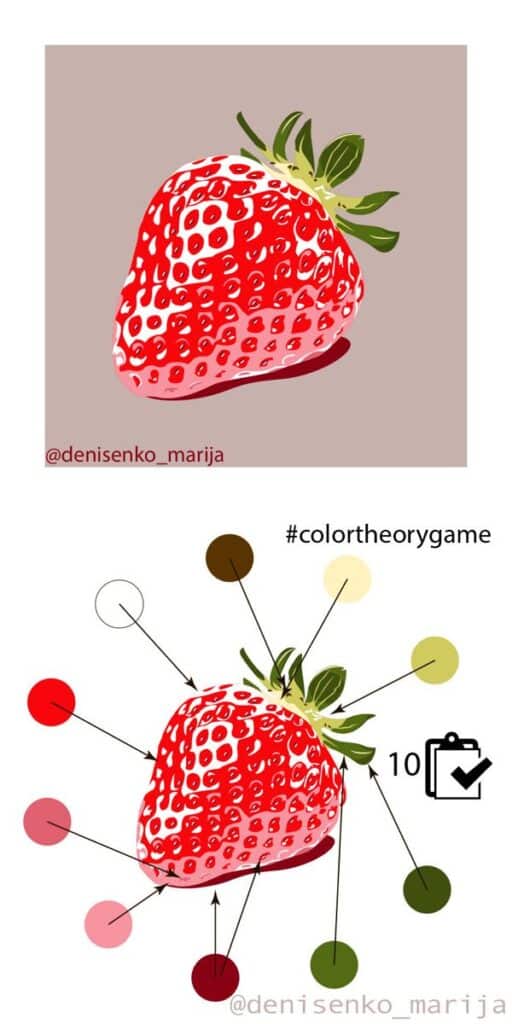
The rich red of a ripe strawberry is a layered system of at least four distinct hues. Starting with a single red and trying to push it darker is the most common coloured pencil error in fruit drawing — the result is flat, not luminous.
The Layering Sequence
- Layer 1 — Cadmium Yellow / Naples Yellow (base): Apply lightly over the entire berry, excluding the highlight zone. This warm yellow base is the foundation botanical illustrators use to make fruit glow. Red pencil applied over yellow reads as richer and warmer than red applied directly to white paper.
- Layer 2 — Cadmium Red Medium / Scarlet Lake (lit surface): Build in three to four light passes over the lit area and mid-tone. Multiple light layers allow the yellow base to show through, producing a warmer, more complex red than any single heavy application.
- Layer 3 — Crimson Lake / Alizarin Crimson (shadow transition): Apply to the shadow side, blending slightly into the mid-tone edge. Crimson pulls the red toward blue-red, which correctly simulates the cooler, darker quality of shadow on a glossy red surface.
- Layer 4 — Dark Burgundy / Dark Red (core shadow): Apply in the deepest shadow area and around individual achene cavities. This mark defines the maximum contrast range and anchors the tonal structure of the whole drawing.
- Coloured pencil blending: Between layers 2 and 3, a light pass with a colourless blender or a very light Cream pencil smooths the tooth of the Bristol and unifies the surface before the darker shadow layers go on.
- Achenes: Yellow Ochre or Light Yellow for the achene bodies; a touch of Warm Grey or Light Olive around the depression edges. Do not use red for the achenes — on a ripe strawberry they are distinctly pale against the red flesh.
- Calyx: Sap Green or Grass Green as the base; Olive Green in the sepal shadow areas; Yellow-Green or Chartreuse where sepal edges catch light.
✏ The yellow base layer is the step most beginners skip because it feels counterintuitive to put yellow under a red subject. Test it once on a strip: red over yellow base versus red directly on white paper. The warmth and luminosity difference is immediate and significant. This single technique shift moves a strawberry drawing from competent to convincing.
Common Strawberry Drawing Mistakes and How to Fix Them
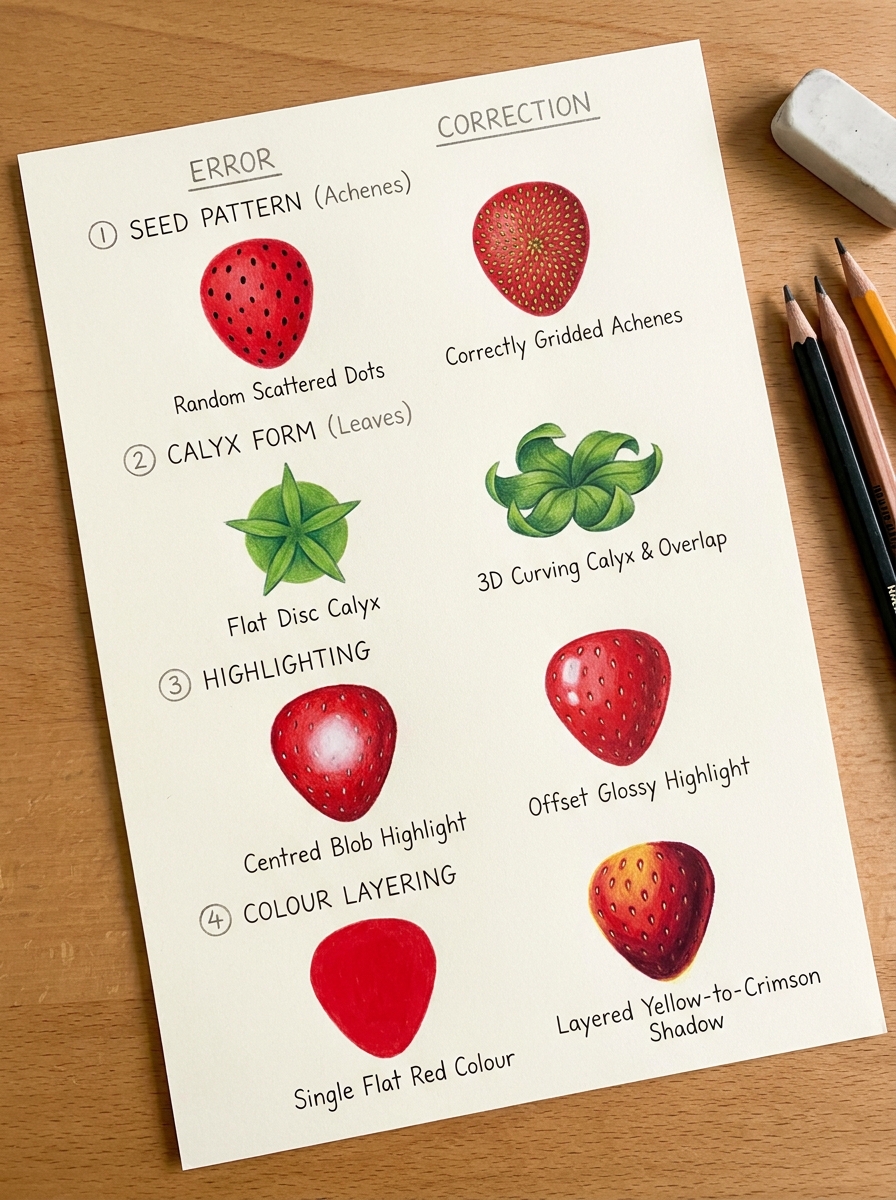
- Seeds as random dots. Achenes follow a specific spiral grid pattern from tip to calyx. Random placement breaks the pattern that generates the surface’s characteristic texture. Fix: always map the diagonal grid before drawing individual achenes.
- Flat calyx. Drawing the calyx as a flat star shape instead of three-dimensional sepals that curve over and around the fruit. Fix: each sepal must curve outward from the stem attachment and then back down over the berry’s upper surface.
- Centred highlight. Placing the highlight at the fruit’s geometric centre regardless of the light source. Fix: determine where the light is coming from, then place the highlight on the corresponding surface area.
- Perfect geometric shape. Drawing the berry as a mathematically perfect teardrop or heart shape. Fix: introduce subtle asymmetry and contour irregularity from Step 2 onward.
- Single flat red. Applying one even red over the entire fruit. Fix: use at minimum three values and in coloured media, the four-hue layering sequence described above.
- No achene micro-shadows. Drawing achenes as flat dots without the small cavity shadow above each one. Fix: one small curved mark above each achene in the mid-tone zone. It takes seconds and fundamentally changes the surface quality.
FAQ: Strawberry Drawing
Q: How do you draw a strawberry step by step?
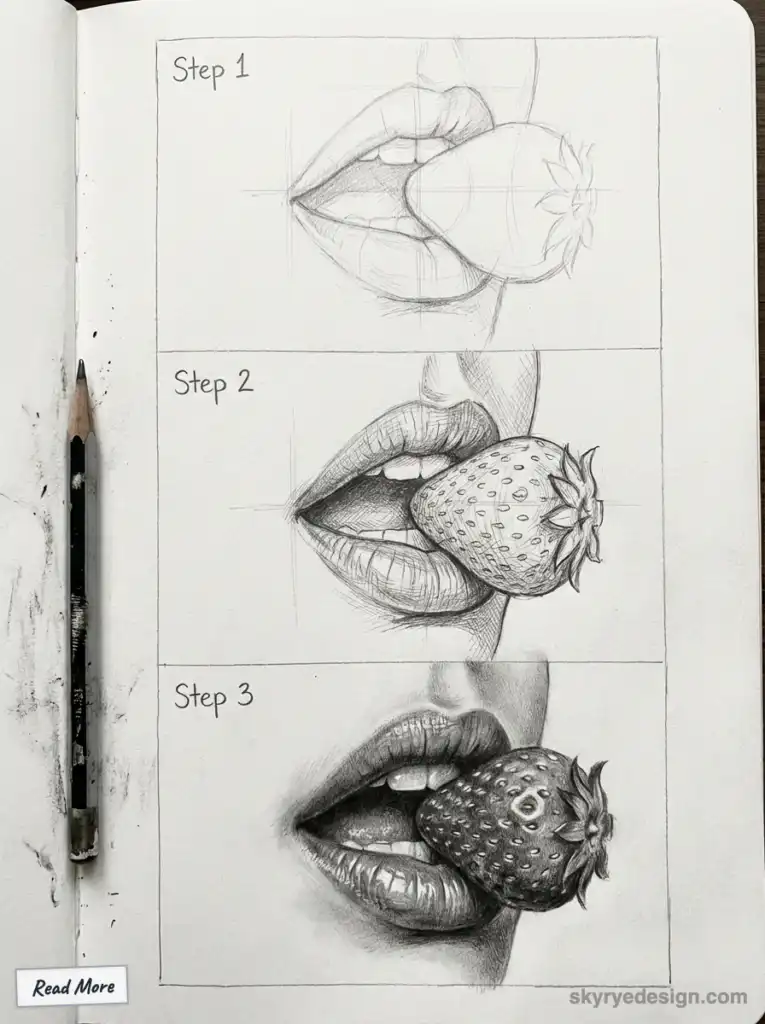
Teardrop guideline on a central axis → refined organic contour with slight asymmetry → calyx with five to seven individually curved sepals → faint diagonal achene grid → individual achenes as small teardrop shapes sitting in depressions → calyx midrib and lateral veins → guidelines erased. The achene grid is the step most tutorials omit and it produces the largest single improvement to surface realism.
Q: What are the seeds on a strawberry called?
Achenes — each is a small dry fruit, not technically a seed. A ripe strawberry carries approximately 200 on its surface, arranged in a spiral grid. Each achene sits in a shallow depression with a shadow above it and a slightly lighter area below. Rendering this micro-shadow is what makes the surface texture three-dimensional rather than decorative.
Q: How do you draw a realistic strawberry?
Four elements produce realism: (1) achenes placed on a spiral grid, not scattered randomly; (2) micro-shadows above each achene showing cavity depth; (3) a distinct glossy highlight offset toward the light source; (4) colour layered from Cadmium Yellow base through Cadmium Red to Crimson and Dark Burgundy in the shadow.
Q: How do you shade a strawberry?
Work across five tonal zones: highlight (reserved as bare paper or lifted with a kneaded eraser), lit area (medium tone), mid-tone (where achene micro-shadows are most visible), core shadow (4B–6B graphite or Dark Burgundy in coloured pencil), and reflected light (a subtle lighter strip at the outer shadow edge). Apply shading strokes that follow the fruit’s curvature.
Q: How do you draw a strawberry calyx?
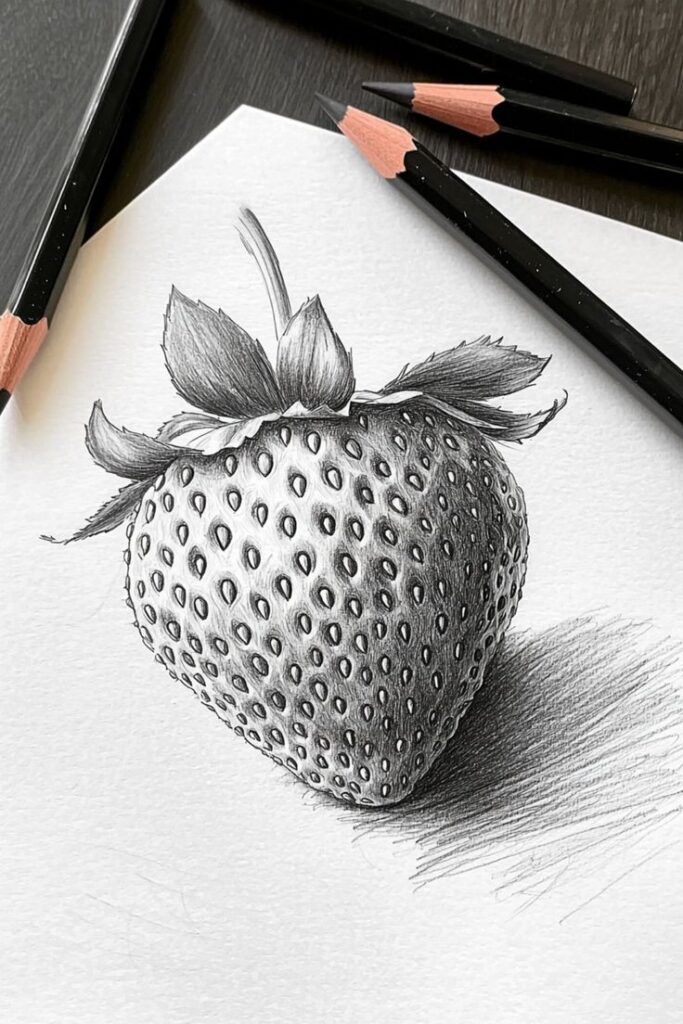
Five to seven sepals radiating from the central stem attachment, each curving outward and then back down over the berry’s upper surface — three-dimensional, not flat. Each sepal carries a midrib vein and fine lateral veins. Calyx width: approximately one quarter of the berry’s maximum width. Vary sepal size and angle slightly — real calyxes are never perfectly symmetric.
Q: What colours make a realistic strawberry in coloured pencil?
Base: Cadmium Yellow across all surfaces except the highlight. Lit area: Cadmium Red Medium in three to four layered passes. Shadow transition: Crimson Lake or Alizarin Crimson. Core shadow: Dark Burgundy. Achenes: Yellow Ochre or Cream — never red. Calyx: Sap Green base, Olive Green in shadow, Yellow-Green on light-catching edges.
- 12.2Kshares
- Facebook0
- Pinterest12.2K
- Twitter1
- Reddit0