
In my first year at design school, one of the professors gave the class an exercise: draw a house in sixty seconds, without lifting the pencil. No planning, no guidelines, no erasure. Most of us drew the same thing — a lopsided square with a triangle roof, a door, two windows. It looked like a child’s drawing.
If you are drawing houses as a beginner, a few beginner drawing supplies are enough: HB or 2B graphite, clean paper, an eraser, and a sharp point for edges.
After practicing simple house perspective, switch to this guitar drawing guide to work on curves, symmetry, and repeated string spacing.
That was exactly the point. He put the drawings on the board and said: “This is where everyone starts. The question is whether you understand what’s actually wrong with it.” The square was too wide relative to its height. The roof was floating above the walls instead of sitting on them. The windows were different sizes and positioned randomly. None of those problems were about drawing skill. They were about observation.
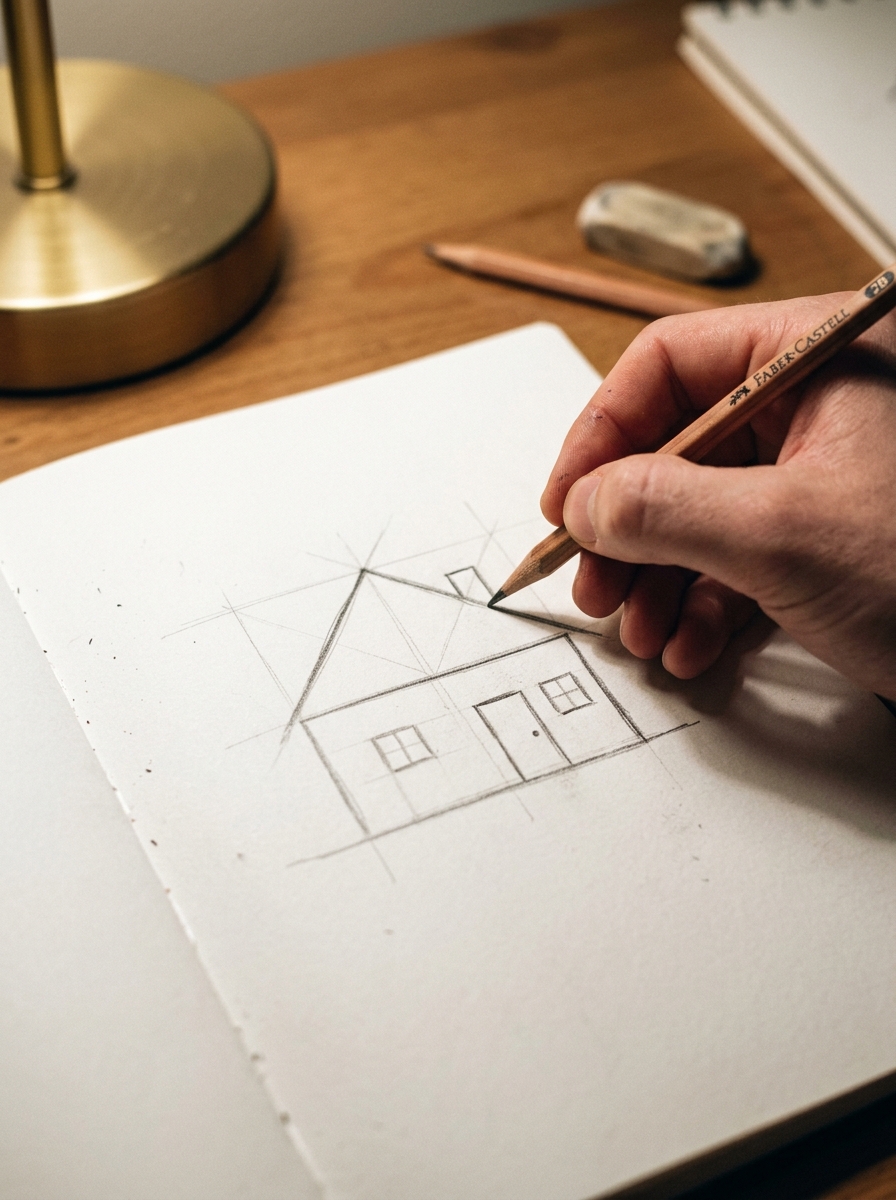
If you want to learn how to draw a simple house, start with structure before decoration. The wall rectangle, roof pitch, window spacing, and shadow direction do more for the drawing than extra details.
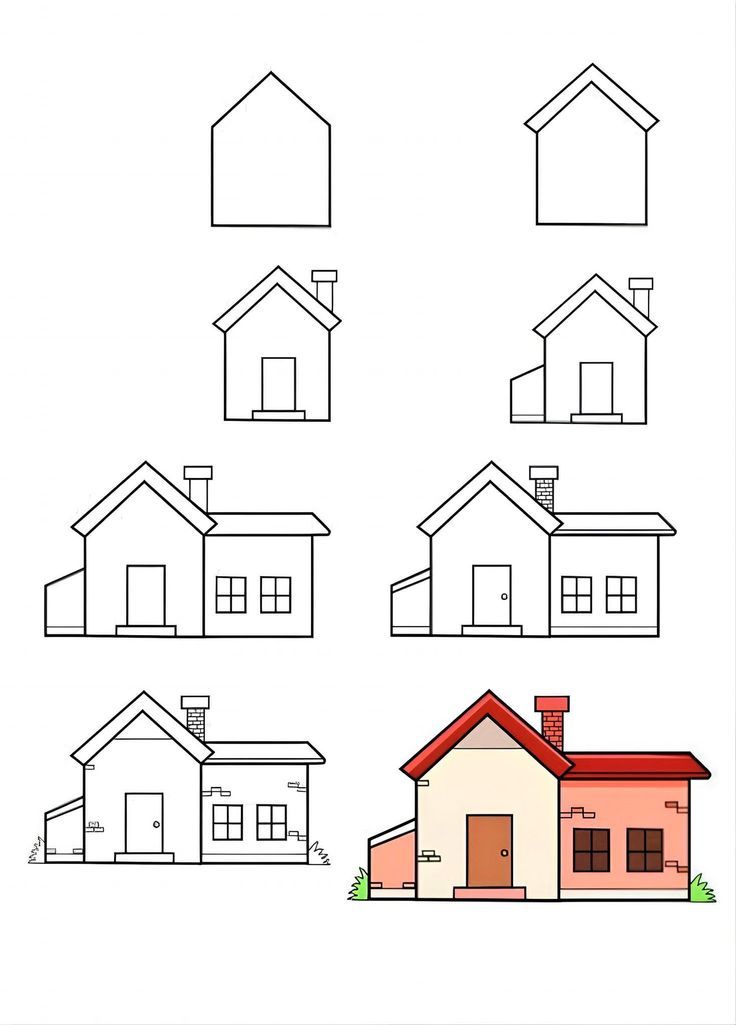
This tutorial goes through five beginner-friendly steps: block in the base, add the roof, place the door and windows, create depth cues, then shade the final sketch. By the end you’ll have a finished house drawing and a clearer sense of why each decision matters.
What You Need Before You Start
The supply list for this tutorial is genuinely minimal. You don’t need anything specialized.
Pencils: An HB for construction lines and a 2B for shading. If you only have one pencil, that’s fine — use lighter pressure for guidelines and heavier pressure for final lines and shading. The difference in hardness just makes the process cleaner.
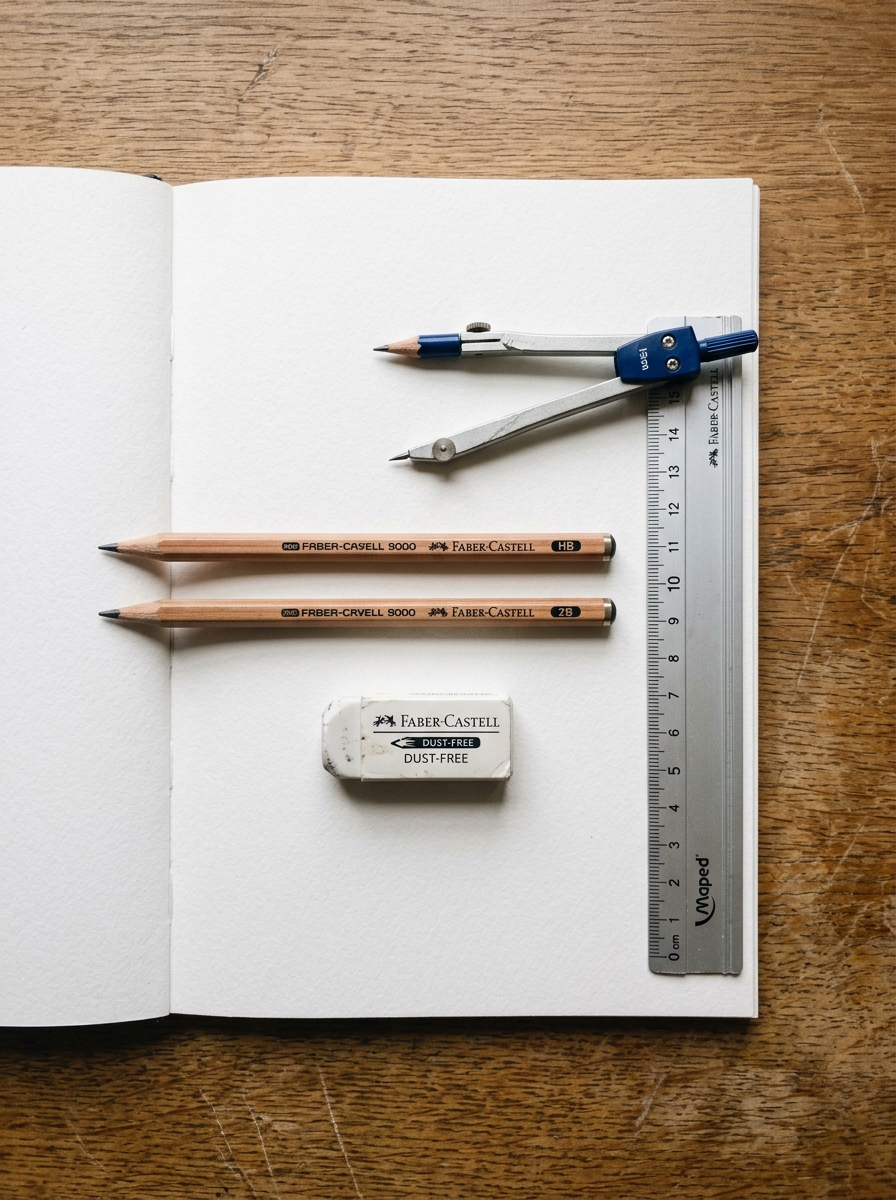
Paper: Any smooth white paper. Printer paper works. A sketchbook is better because the slightly heavier weight holds up to erasing without pilling. A small sketchbook, A5 or A4, is the right size for this exercise.
Eraser: A kneaded eraser is best because it lifts graphite without tearing the paper surface and can be shaped to a point for precision. A standard vinyl eraser works fine. Avoid the pink rubber erasers on pencil ends — they smear more than they erase.
Ruler: Optional but recommended for this tutorial. The goal is to understand proportion and structure first; once you have the eye for it, freehand construction is fine. For now, a ruler keeps the guide rectangles honest.
| Designer’s Note on Tools The tools are not the variable. I’ve seen students use expensive drawing boards and produce worse results than classmates working with a cheap school pencil on printer paper. The difference is always in the observation, not the equipment. Start simple. |
How to Draw Each Part of a House
Most beginner tutorials rush through the whole house at once. The faster approach (and the one that actually sticks) is to practice each component separately first. Once you can draw a convincing roof and a well-proportioned window on their own, combining them into a full building becomes straightforward rather than overwhelming.
The roof
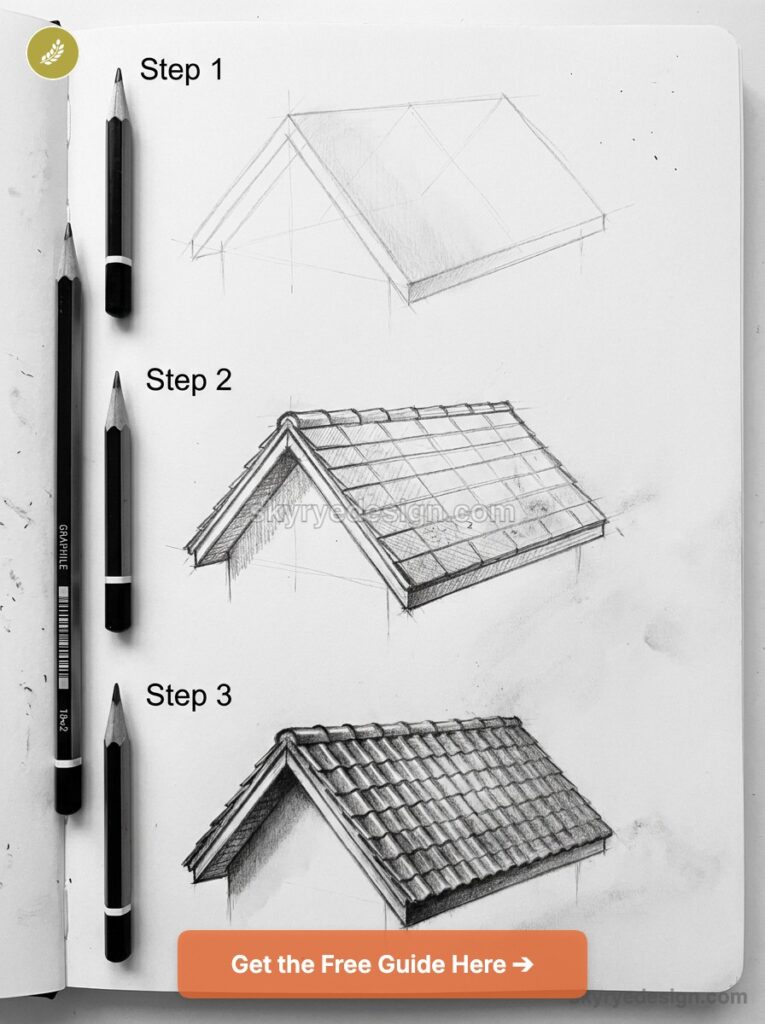
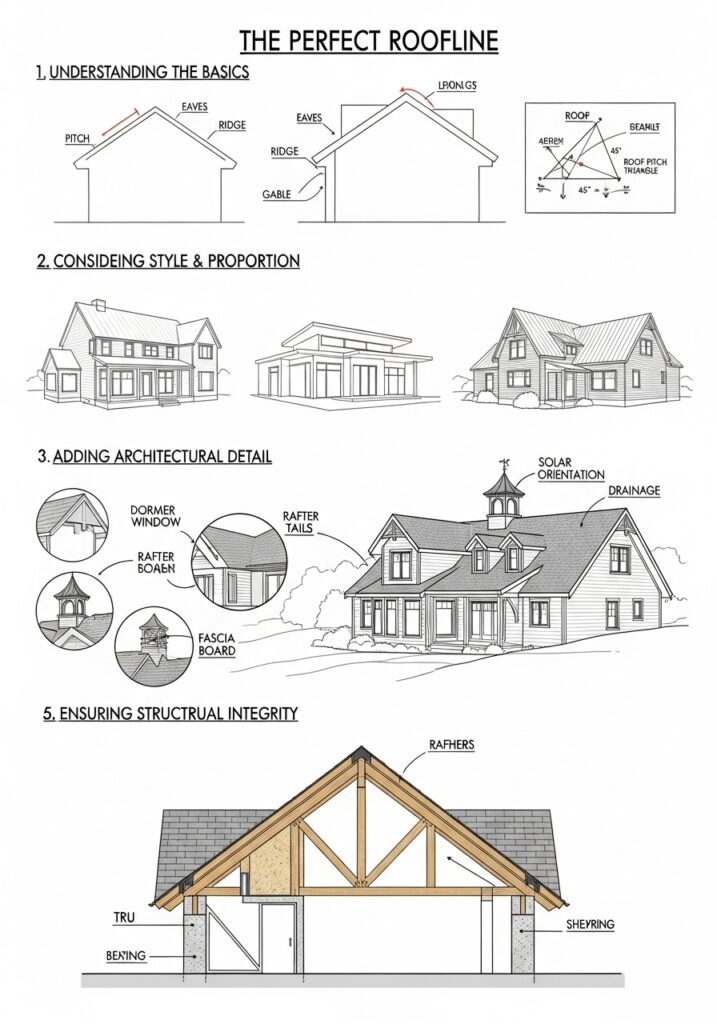
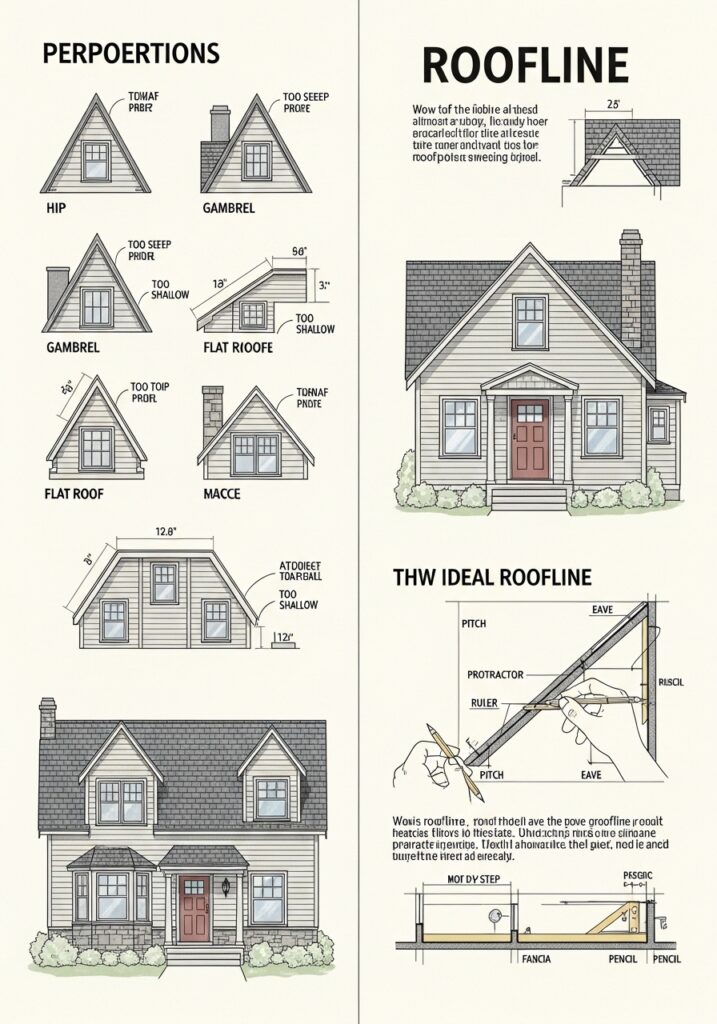
Draw roofs as standalone studies before attaching them to anything. Start with a horizontal baseline and practice finding the center point by measurement, not by eye. The peak should sit 40–60% of the baseline width above it — for a 10 cm base, that means a peak 4 to 6 cm up. Try five versions at different pitches: very shallow (like a modern bungalow), medium (classic suburban house), steep (Victorian cottage). Each one reads differently and each needs a different construction approach.
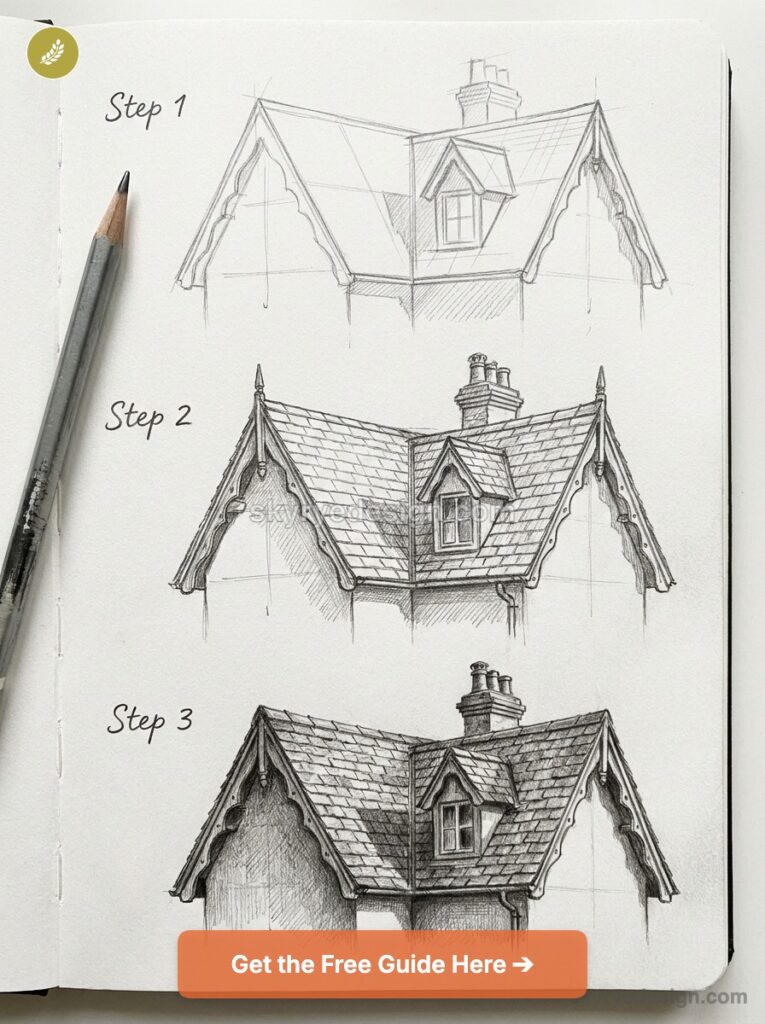
The eave overhang is the detail most beginners skip. Without it the roof looks like a triangle stuck on a box. With it (just 1 to 2 cm past each corner) the structure reads as a real building. Practice adding the overhang as a deliberate step, not an afterthought.
Walls and proportions
The wall rectangle is where proportion decisions live. A 1:1 square reads as a squat, low building. A 1:2 rectangle reads tall and narrow. The classic residential house sits at roughly 1:1.3 to 1:1.5 (width to height). When I was working through architectural drawing exercises at university, we spent more time on the wall rectangle than on any other element — because everything placed on the facade inherits the proportional logic set there.
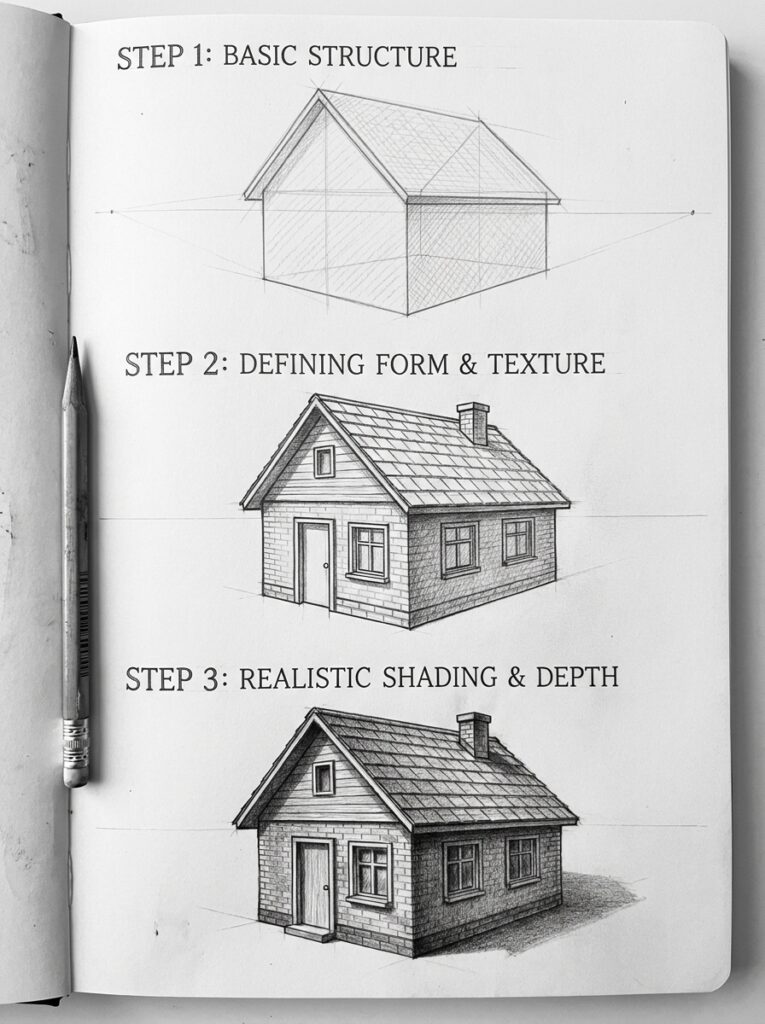
Practice drawing rectangles at different ratios until you can estimate 1:1.5 by eye without a ruler. This sounds tedious but it takes about ten minutes and it’s the single exercise that most improves beginner house drawings. Use graph paper if you need a crutch — there’s nothing wrong with it.
Windows
Windows do three things in a house drawing: they communicate scale (their size relative to the wall tells you how big the building is), they create visual rhythm across the facade, and they give you an opportunity to suggest transparency through tone. Practice each of these separately.
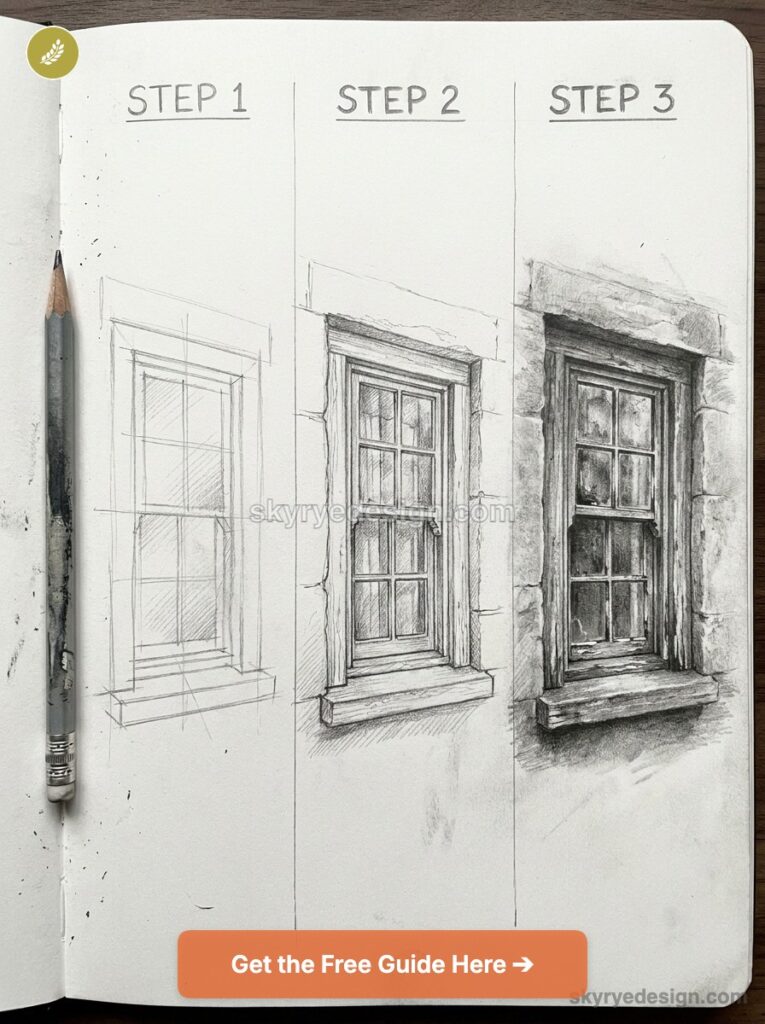
For a single window study: draw the outer rectangle, then draw a slightly smaller rectangle inside it (the reveal — showing wall thickness). Divide the inner rectangle with a vertical line for a double casement, or a vertical and horizontal for a four-pane sash. Fill the inner panes with a medium-dark tone that’s darker at the corners and slightly lighter at center. That graduated tone is what makes glass look like glass rather than a filled square. A good window study takes 5 minutes and teaches you more than drawing twenty houses without thinking about it.
The door
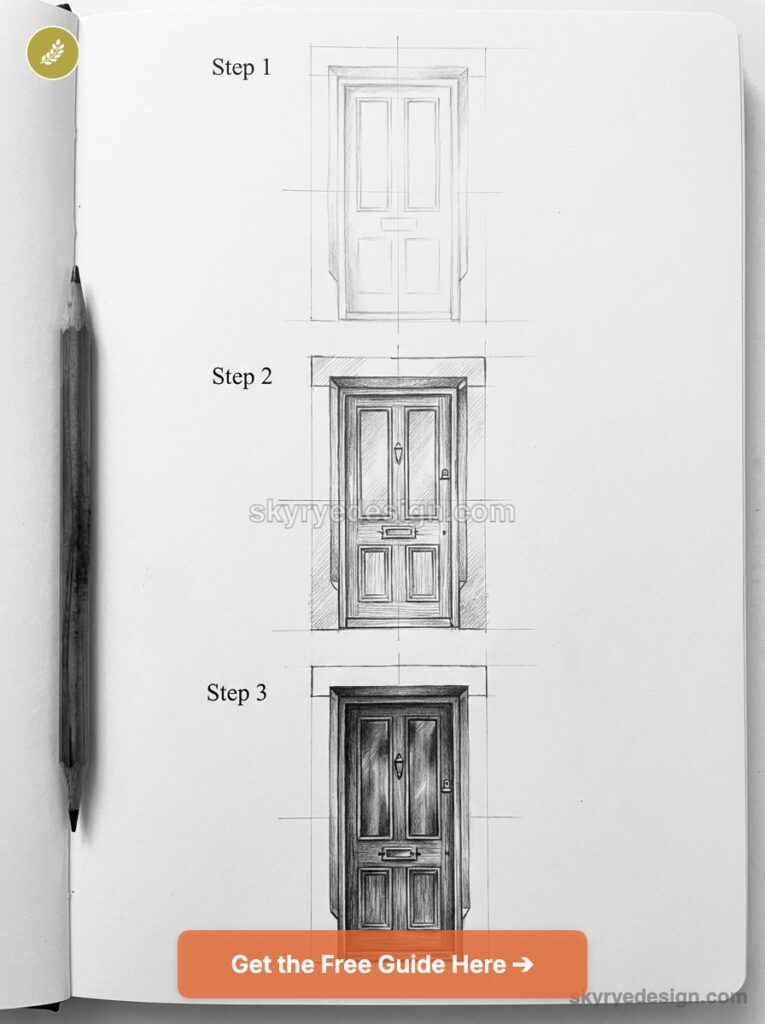
Doors are simpler than windows but more important for scale. A standard residential door is about 2 meters tall and 0.9 meters wide — a 2:1 height-to-width ratio. When you draw it too wide, the house reads as a garage. When you draw it too short, it reads as a hatch. Practice drawing door rectangles at the correct ratio until it feels natural.
Two details that immediately improve a drawn door: a door frame (a thin parallel line just inside each edge, as if the door sits in a surround) and a handle placed roughly 60–70% of the door height at about one-fifth from the edge. You don’t need to draw a detailed handle — a small horizontal line and a circle is enough to read as hardware at this scale.
The chimney
The chimney is the first element in a house drawing that requires thinking about overlapping planes. Its sides must be vertical — not parallel to the roof slope. Draw it as a rectangle that clearly overlaps the roof line, indicating it’s a solid mass sitting on (and through) the roof plane rather than floating beside it. Width should be modest: roughly one-quarter of the roof width at that point. A chimney that’s too large reads as an industrial stack rather than a residential flue.
Add a rain cap — a thin horizontal rectangle on top of the chimney shaft that overhangs on both sides. It takes five seconds and is the detail that separates a house that looks like a drawing from one that looks like a building someone thought about.
House Drawing Styles
The same house drawn in four different styles is four completely different exercises. Style isn’t decoration — it’s a set of decisions about what information to include, what to omit, and what to exaggerate. Working through multiple styles on the same subject is one of the fastest ways to understand what each one is actually doing.
Realistic pencil
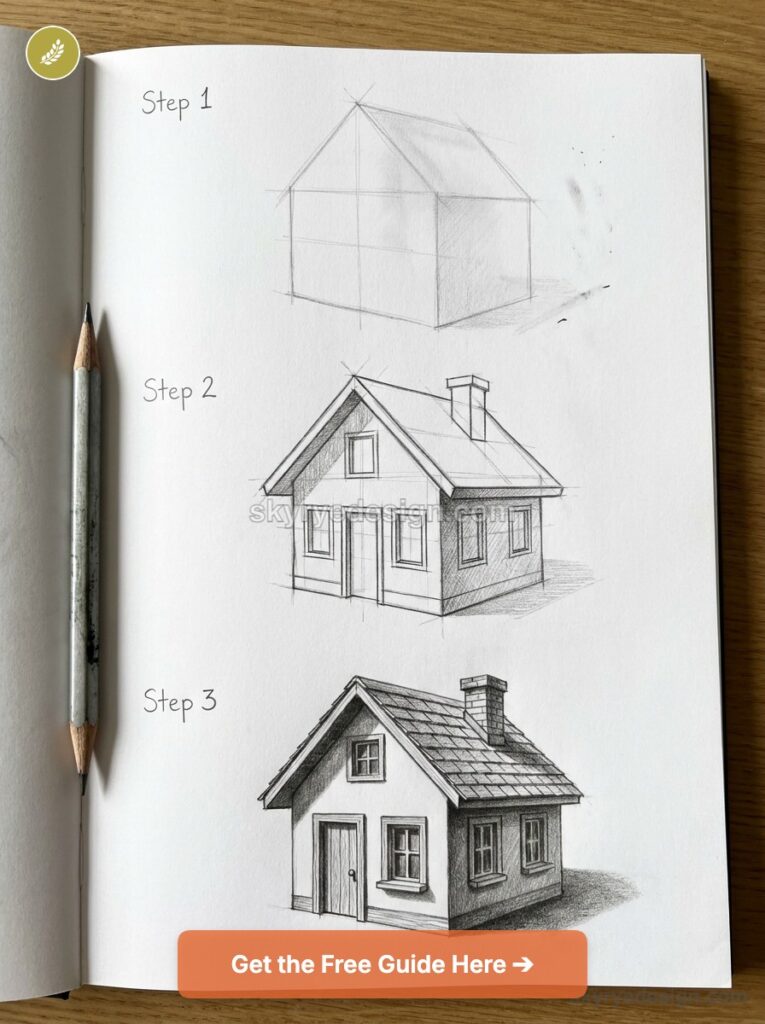
Realistic pencil drawing prioritizes light, shadow, and texture over outline. The goal is to make the building look like a photograph taken on a slightly overcast day — soft shadows, visible material texture (brick, render, wood cladding), no hard black outlines around every form.
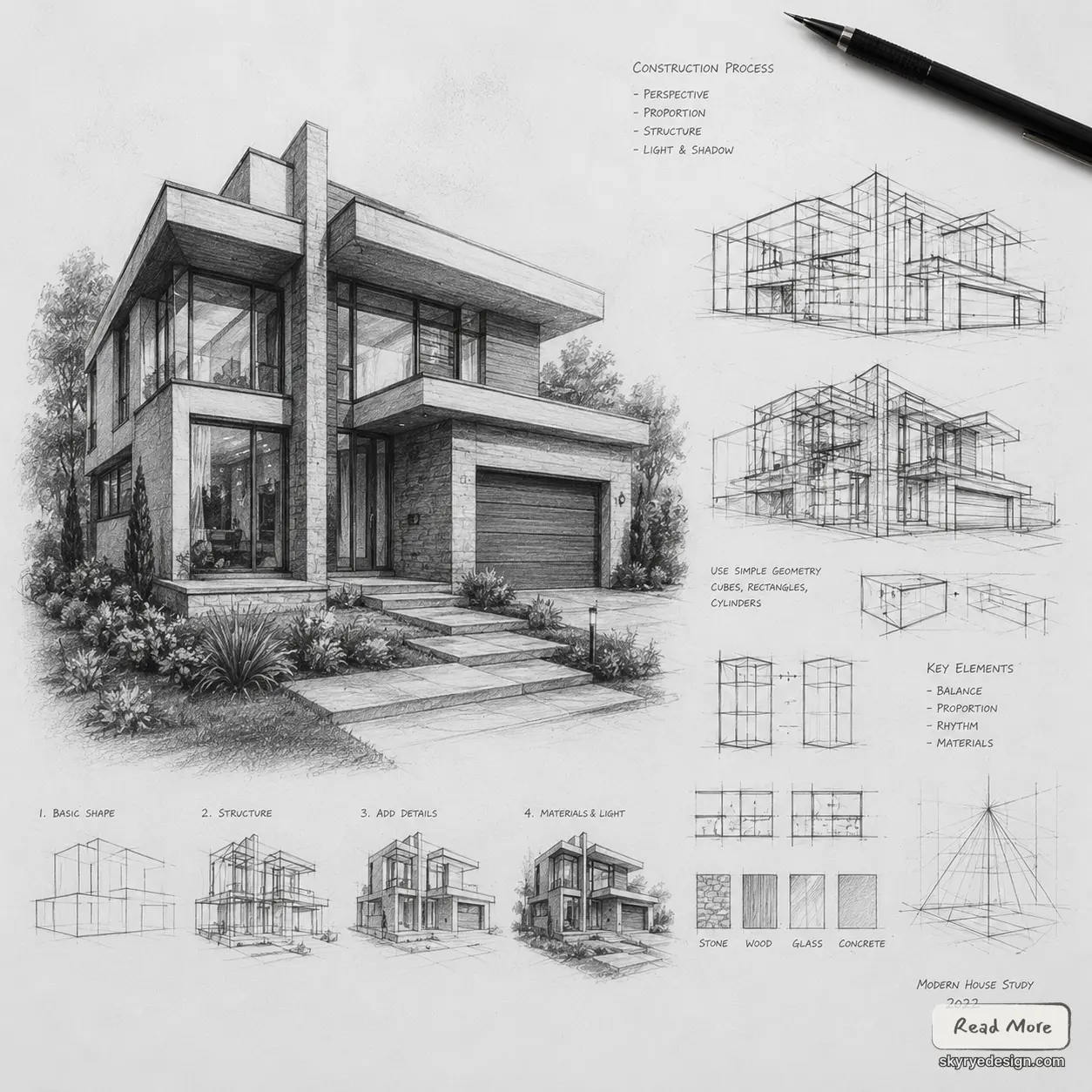
Tools: HB for initial construction, 2B for mid-tone shading, 4B for deep shadows. Work with consistent directional light (upper left is conventional). Build tone in multiple light layers rather than pressing hard once — you can always darken, you can’t easily lighten. The cast shadow on the ground is darker than any shadow on the building surface. Victorian-era architectural renderings at the Courtauld Gallery in London are excellent references for how far this style can go.
Minimalist line art
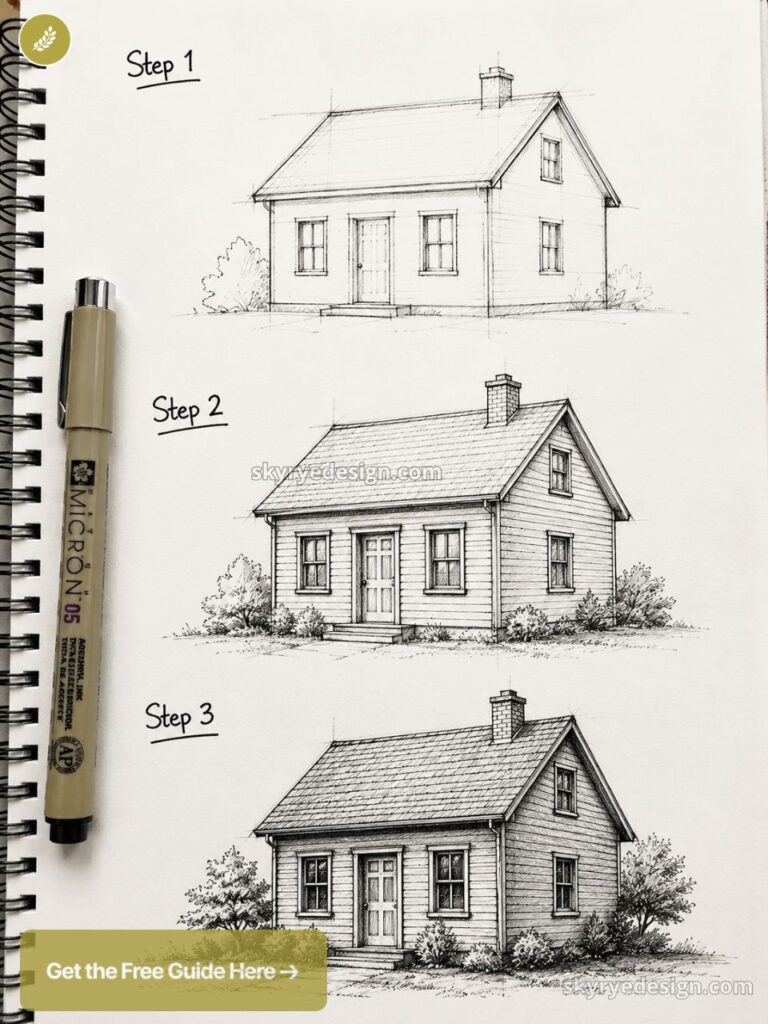
Minimalist line art removes everything that isn’t structurally essential. No shading, no texture, no tone — just clean, even-weight lines describing the building’s geometry. This is harder than it looks. Without tone to hide behind, every proportion decision is exposed. A slightly off-center peak or a misaligned window is immediately visible.
Use a 0.3 mm fineliner or a well-sharpened HB. Draw slowly. The continuous line drawing format (attempting the whole facade without lifting the pen) is a popular minimalist variant that forces you to plan the route through the building’s geometry before you start. Architects working in the Tadao Ando tradition often use this stripped-back approach in early concept sketches: the idea first, the detail never.
Cartoon and illustrative
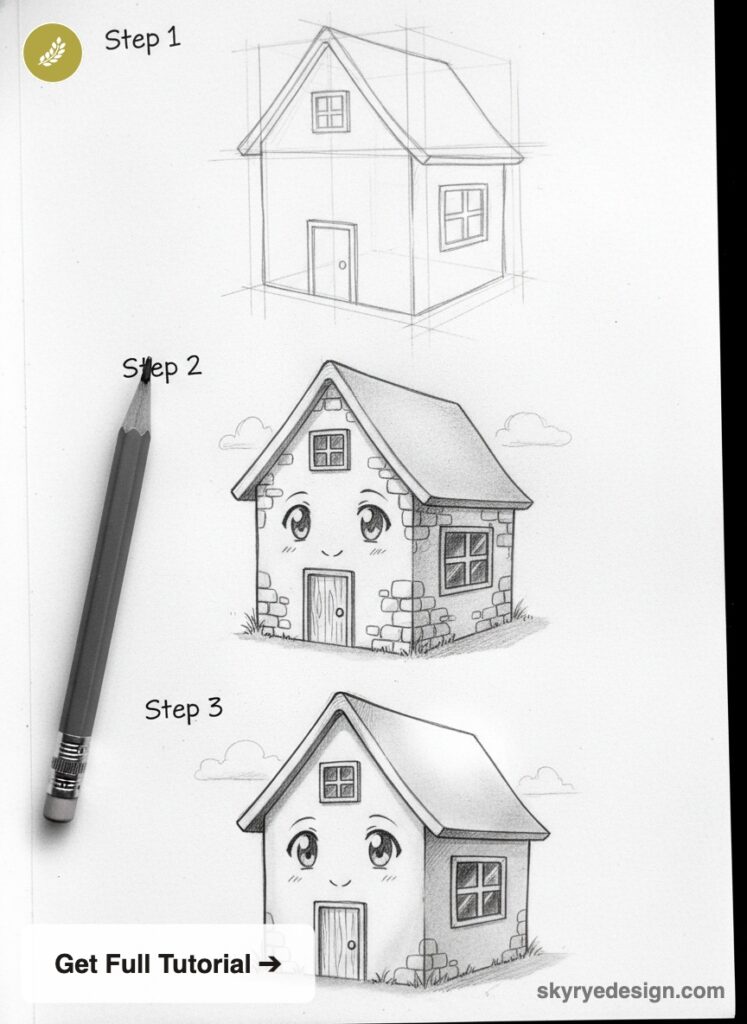
Cartoon style exaggerates proportions for personality rather than accuracy. Roofs get steeper, windows get larger, doors get friendlier. Think of the cozy cottages in Hayao Miyazaki’s background art — the buildings look impossibly charming because the proportions are pushed just past reality into something warmer. The chimneys lean slightly, the windows have thick frames, the roof overhangs dramatically.
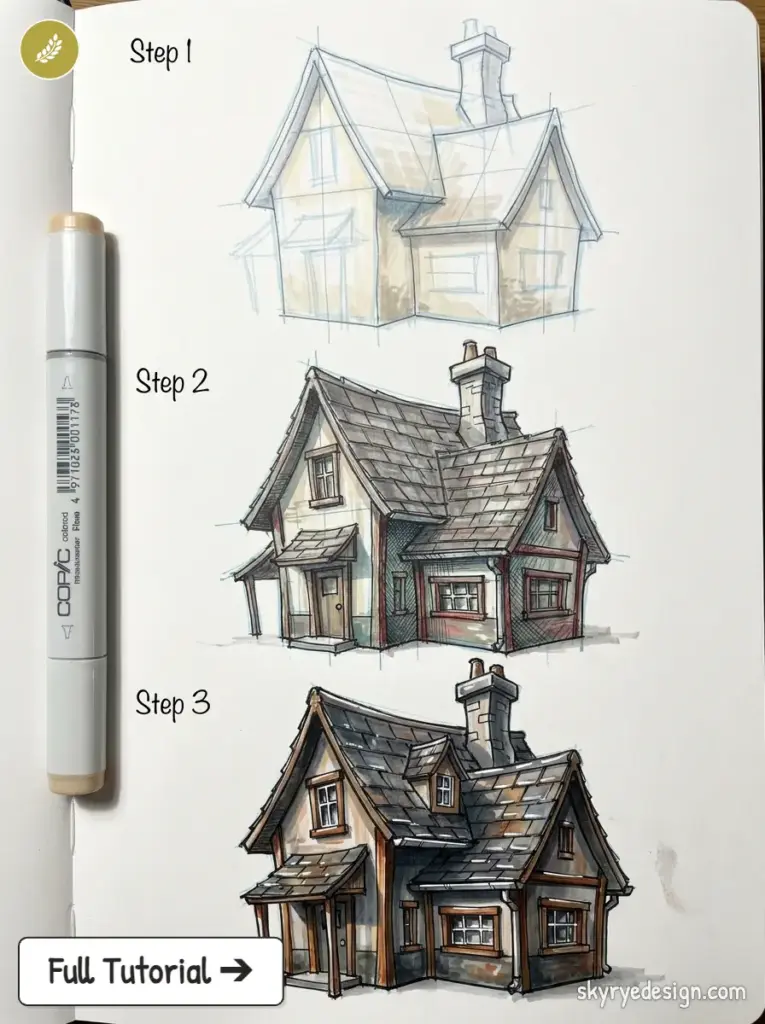
The technique: use heavier outlines on the outer silhouette than on interior details (this is called line weight variation and it’s the single biggest technical difference between flat and cartoon styles). Round the corners slightly. Make paired windows identical twins. Use flat fill or simple cel shading rather than graduated tone. Elsa Beskow, the Scandinavian children’s book illustrator, built an entire career on this approach applied to architecture.
Architectural sketch
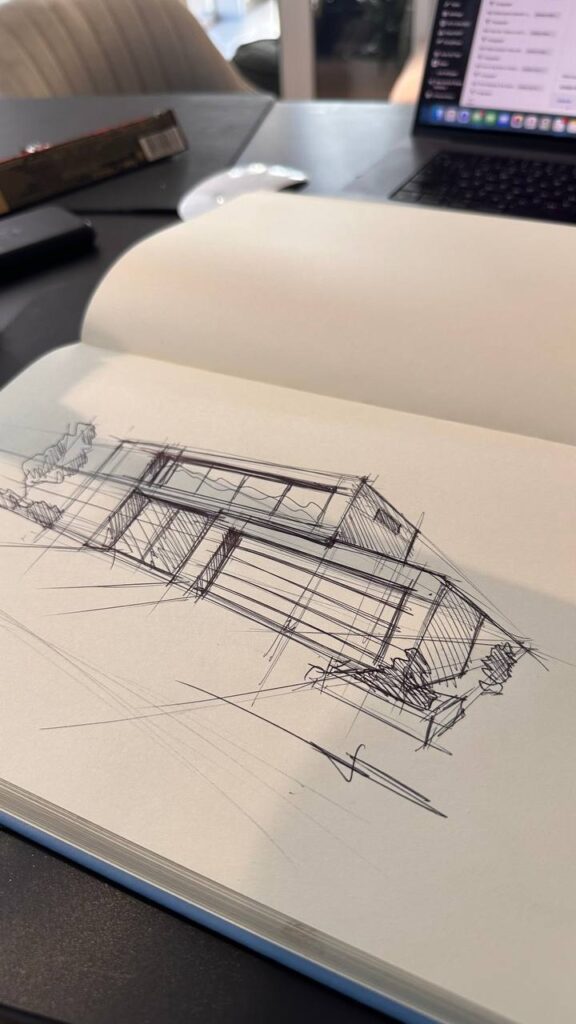
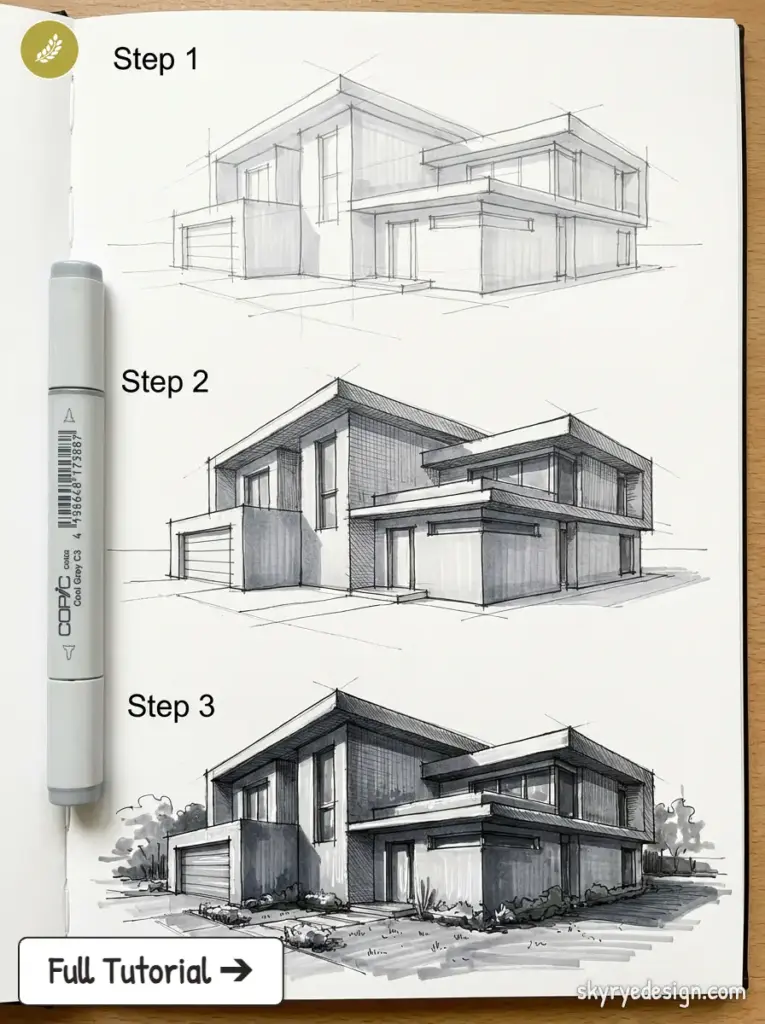
The architectural sketch style sits between realistic and minimalist. Lines are confident but not mechanical — slightly loose, occasionally doubled, with visible construction marks left in rather than erased. Tone is applied fast with hatching (parallel lines) rather than blended shading. The goal is to communicate the idea of the building quickly, not to produce a finished illustration.
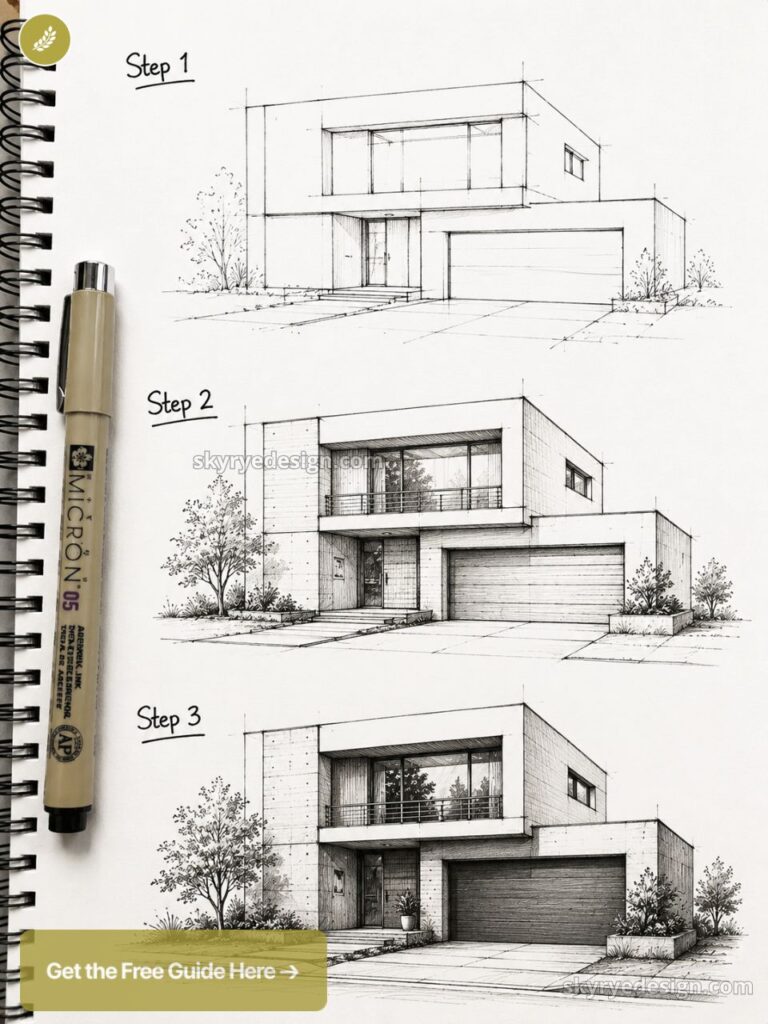
This is what I default to in industrial design work when I need to communicate a spatial idea fast — loose lines, quick hatching, no erasing. The Moleskine sketchbooks of Renzo Piano and Tadao Ando’s early rough sketches are the canonical examples of this style at the professional level. The trick is that “loose” doesn’t mean sloppy — the proportions still have to be right. The looseness is in the line quality, not the underlying geometry.
How to Draw a Simple House in 5 Steps
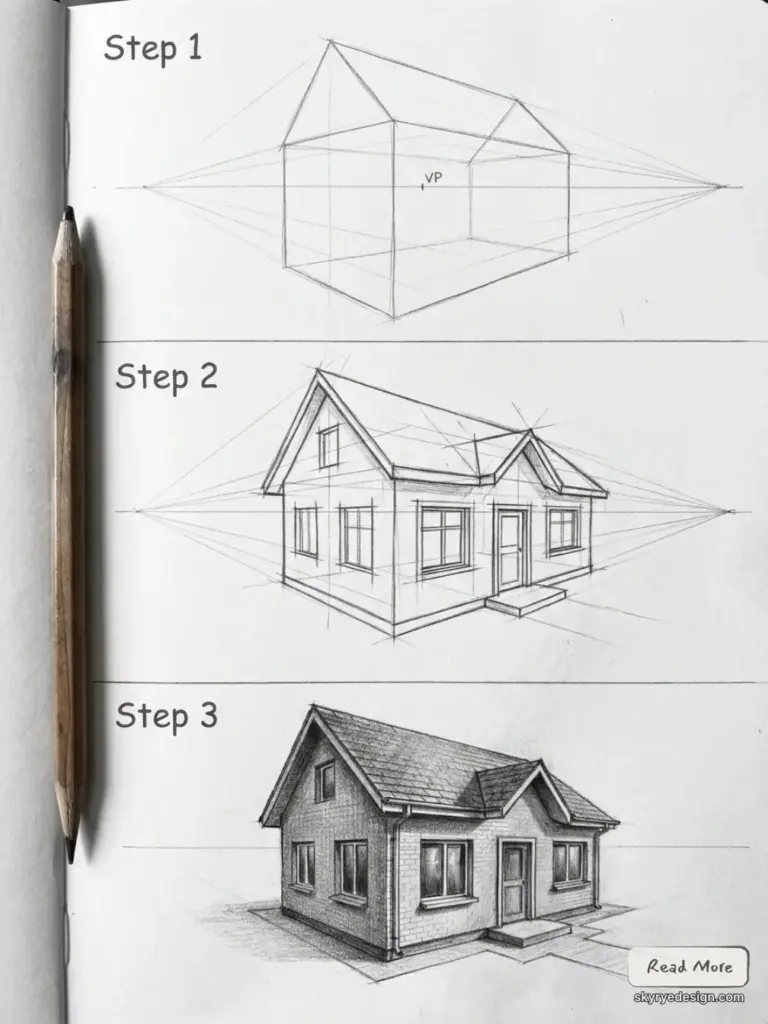
The five steps above cover each phase in detail. Here’s the same sequence compressed into a single pass — useful as a quick reference once you’ve read through everything, or as a checklist to keep beside you while you draw.
Step 1: Draw the base rectangle
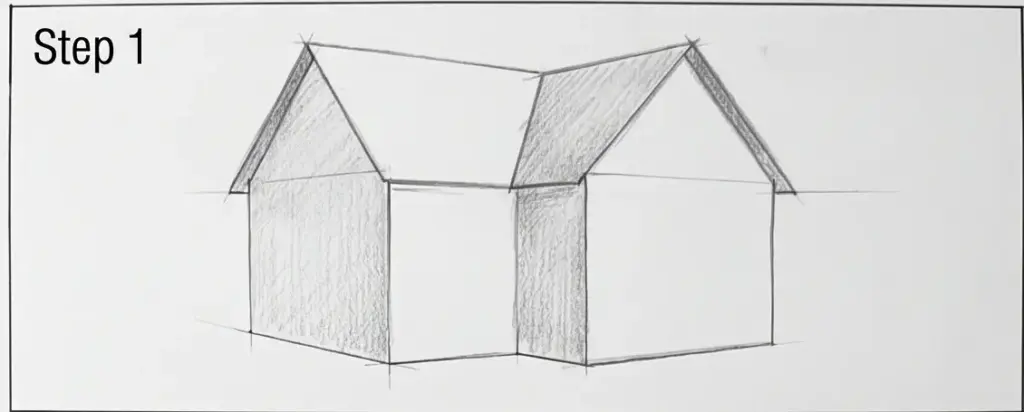
Lightly draw a rectangle in the lower two-thirds of your page. Make it 1.5× taller than it is wide — 8×12 cm works well. Use a ruler and check the corners are exactly 90°. Press lightly; this is a construction line, not a final one. Leave space above for the roof.
Step 2: Add the roof and details
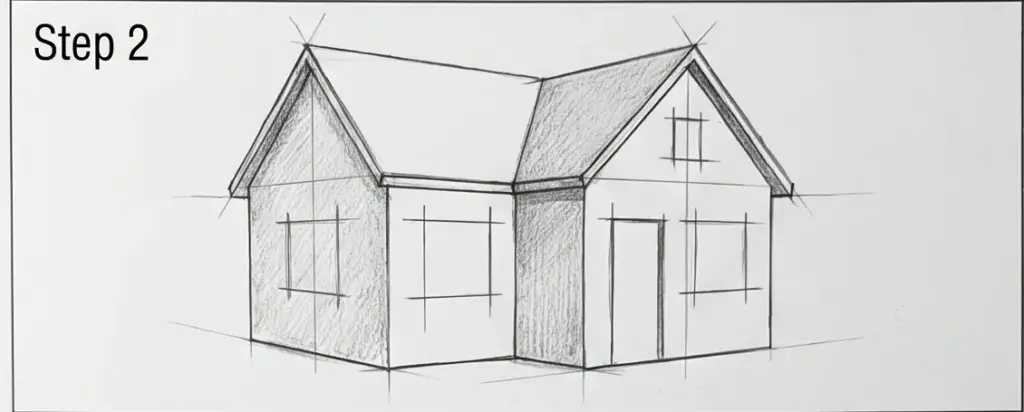
Mark the exact midpoint of the top rectangle edge. Draw the peak 40–60% of the wall height above the top of the rectangle. Connect the two top corners to the peak, then extend each line 1–2 cm past the corners for the eave overhang. That overhang is what separates a proper roof from a triangle sitting on a box.
Step 3: Place the door and windows
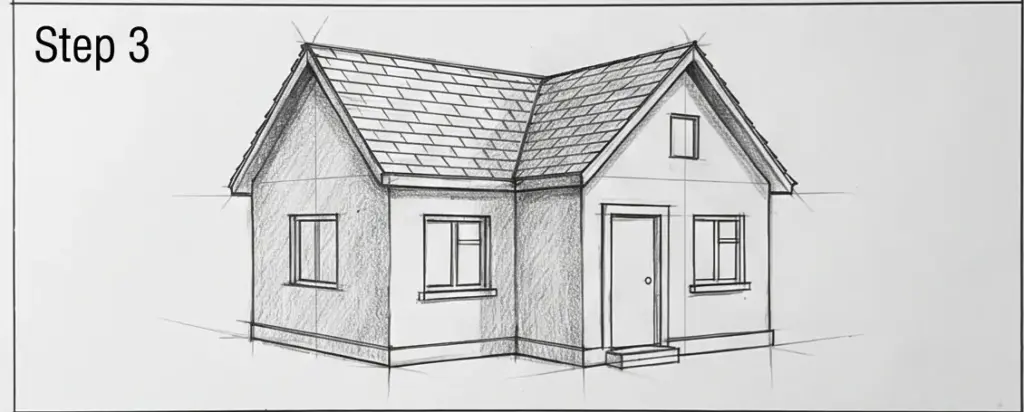
Center the door on the base of the wall at a 1:2 width-to-height ratio, reaching half to two-thirds up the wall. Place one window on each side, both the same size, both at the same height — roughly mid-wall. The sill line of each window should align with the top of the door. That single horizontal register line is what makes the facade read as intentionally designed rather than randomly arranged. I’ve corrected this alignment error in student sketches more than any other single mistake.
Step 4: Add depth cues
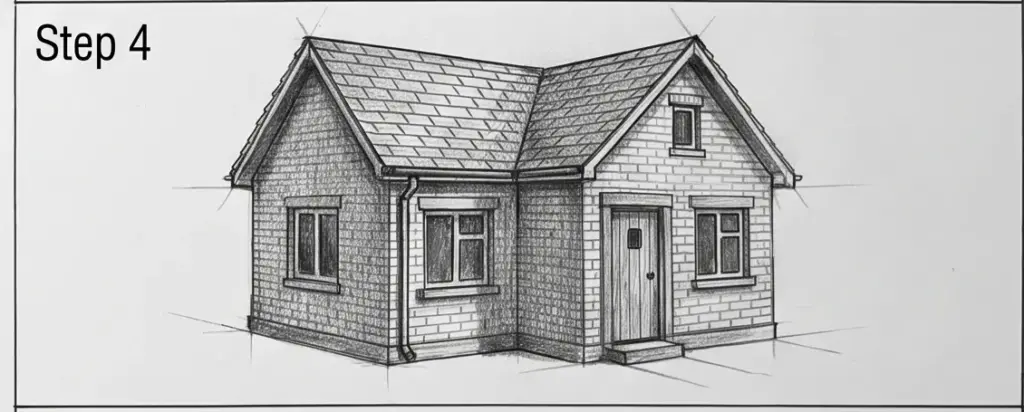
Add a chimney on the roof slope (a vertical rectangle, not parallel to the slope). Draw thin reveal lines just inside the edges of the windows and door — 2–3 mm of parallel line that suggests the wall has physical depth. Draw a ground line extending past the wall edges on both sides, and two slightly converging lines from the door base toward the bottom of the page for the path. These four additions take under five minutes and shift the drawing from a flat diagram to something that reads as a building.
Step 5: Shade and finish the line work
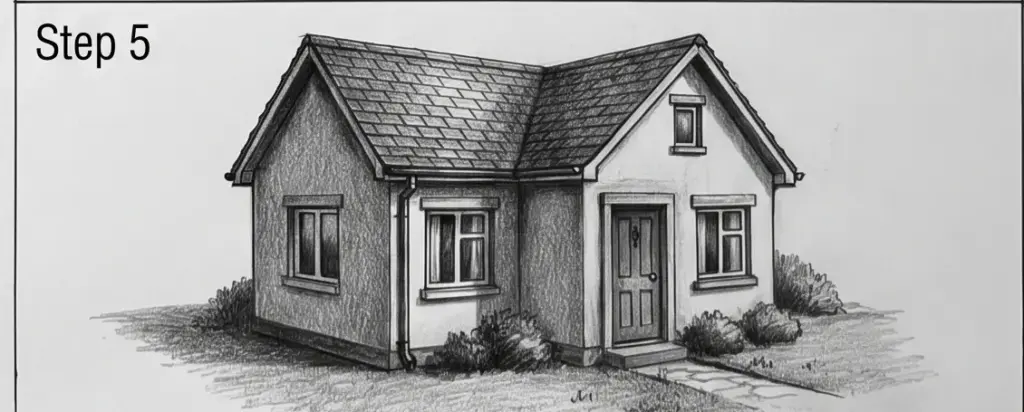
Pick light from the upper left and commit to it for every mark. Leave the front wall at paper tone. Shade the right side of the chimney and the underside of the roof overhang one tone darker. Fill the windows with a medium-dark tone — uneven, slightly darker at the corners.
Draw the cast shadow falling to the lower right of the building as a dark parallelogram on the ground. Finally, go over the outer edges of the roof and building corners with slightly heavier pressure. That line weight hierarchy (heavier on the perimeter, lighter on interior detail) is what gives the finished drawing its sense of structure.
What to Try Next
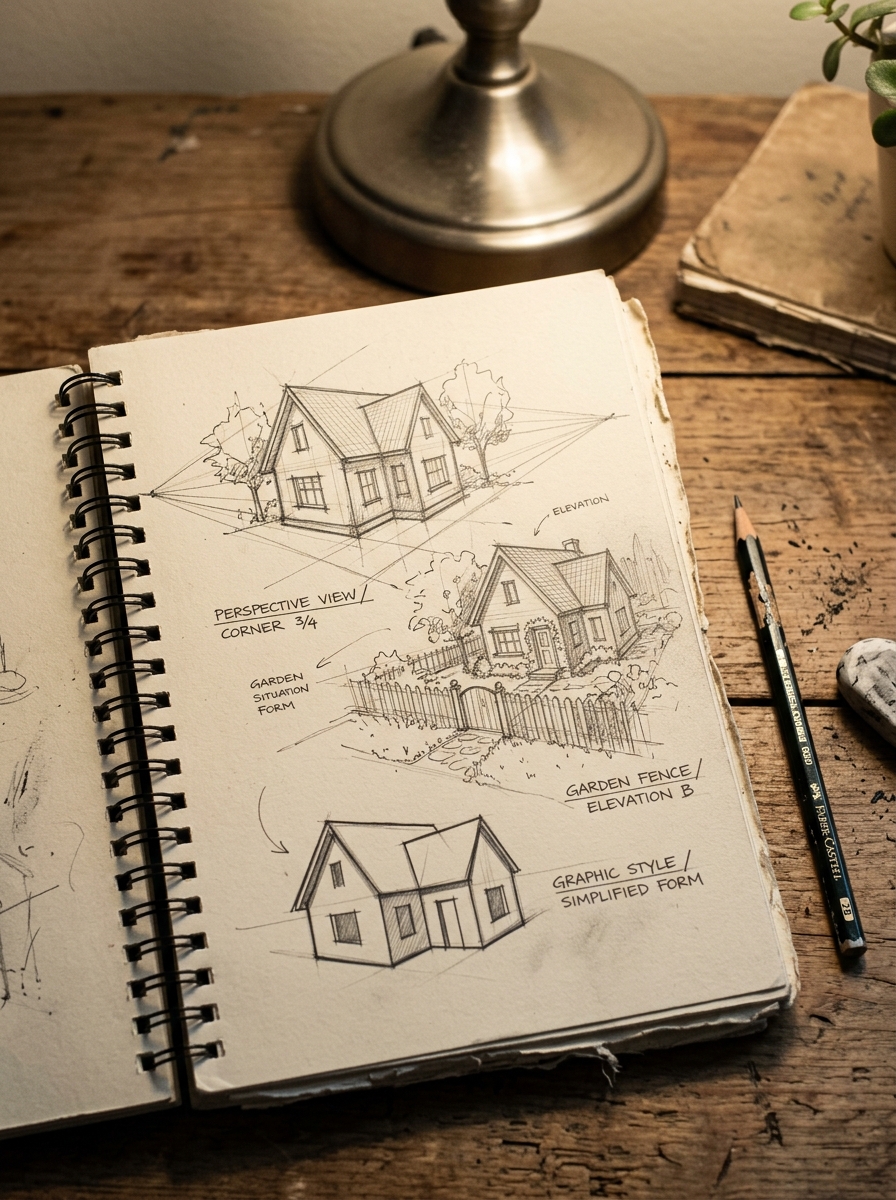
Once the five-step house feels reliable, the same structural logic opens up a set of more interesting exercises.
Add One-Point Perspective
The house you’ve drawn is a flat frontal elevation. One-point perspective turns it into a building you can see the corner of. Pick a vanishing point on the horizon line to one side of your building. Draw lines from the top and bottom corners of the visible side wall converging toward that point. The side wall becomes a receding plane. The house stops being a flat diagram and starts being an object in space.
This is a significant conceptual step. Academic drawing training at university level starts with exactly this exercise — turning a flat elevation into a perspectival object. If you’ve understood the proportional logic in Steps 1 through 5, the perspective step is not difficult. It’s the same structural thinking applied to a third axis.
Vary the Roof Type
A triangular gable roof is one option. A hip roof has four sloping faces rather than two. A flat roof with a visible parapet wall is common in contemporary architecture. Each of these reads as a different building type because rooflines carry enormous architectural character. Drawing the same simple house volume with different roof types is a fast way to understand how one element drives the overall feeling of a design.
Add Environmental Context
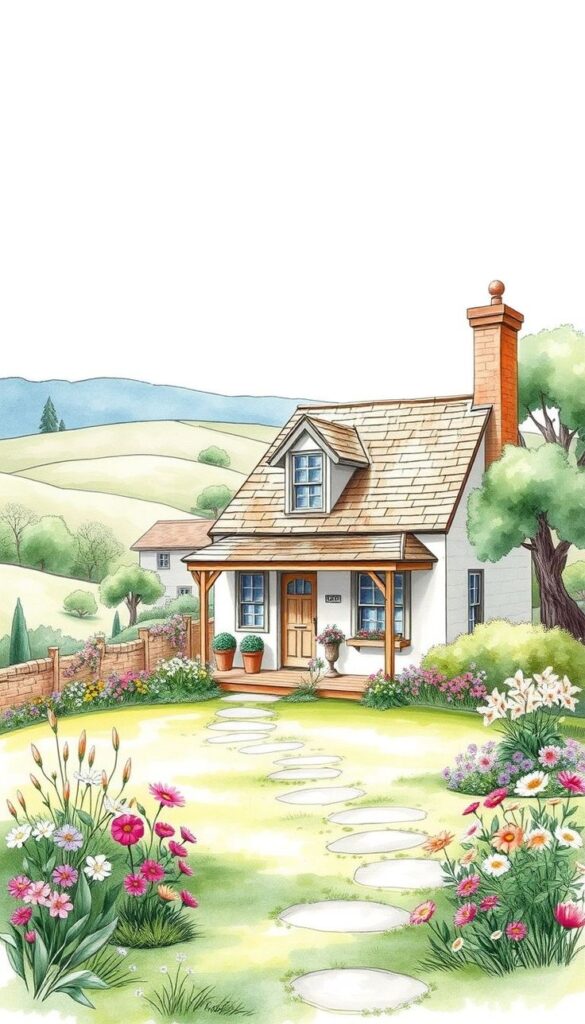
A house floating against a white page is an architectural diagram. A house with a ground plane, some suggestion of trees or fencing, and a sky above it is an architectural sketch. The difference isn’t technical difficulty — it’s the decision to place the building in a context. Simple marks suggesting a hedge line, a gate, or distant trees behind the roofline transform the exercise from a geometric construction into a scene.
Keep the sky simple at first. A little cloud drawing practice above the roofline can add atmosphere, but the cloud values should stay lighter than the house shadows so the building remains the focal point.
Work From Reference, Not Imagination
Photograph a house you find interesting and draw it using the same five-step framework. This is where the learning accelerates fastest. Working from imagination, you make the same proportional guesses every time. Working from a reference, you’re forced to observe actual ratios, actual roof angles, actual window proportions. The reference corrects your habits in ways that imagination can’t.
Architectural drawing, whether for design purposes or pure practice, is an observational discipline first and a technical one second. The technical skills matter, but they serve the observation. Every drawing of a building is an exercise in seeing how that building is actually put together.
Once the flat house shape makes sense, try placing it in a simple street or room using this one point perspective drawing guide. It helps the roof, walls, path, and windows sit in the same space.
FAQ: How to Draw a Simple House
What is the easiest way to draw a house for beginners?
Start with a correctly proportioned rectangle for the wall section, making it taller relative to its width than feels intuitive (roughly 1:1.5 width to height). Add the roof triangle with the peak centered above the wall. Place the door centered at the base and two symmetrical windows at mid-wall height. Add basic shading with a consistent light direction. In that order, the five steps build on each other and each one is individually manageable.
How do I make my house drawing look 3D without learning perspective?
Three things create the impression of three dimensions without full perspective: reveal lines around windows and doors (suggesting wall thickness), a cast shadow on the ground (suggesting that the building blocks light), and tonal variation between visible faces (the front wall lighter, any visible side wall darker). These three depth cues, applied consistently with a single light direction, will make a flat frontal drawing read as a solid object.
What pencil should I use to draw a house?
An HB pencil for construction lines and structure, a 2B for shading and final linework. If you have only one pencil, vary the pressure: light for guide marks, medium for structural lines, heavy for shading and emphasis. The pencil grade matters less than the intention behind each mark. Many professional architectural sketches are done with a single Staedtler HB throughout.
How do I draw a roof correctly?
Find the exact midpoint of the top edge of your wall rectangle before drawing anything. The peak must be centered. The roof lines extend from the top corners of the rectangle to that peak, then continue slightly past the wall corners as an overhang. The overhang is typically 5 to 10% of the wall width. The roof pitch (how steep the triangle is) should be 40 to 60% of wall height for a classic residential reading.
What should I draw after I can draw a simple house?
One-point perspective applied to the same house shape, so you can see a corner view rather than a flat front. Then two-point perspective, which shows two receding wall faces. Then drawing from photo reference rather than imagination, which forces you to observe actual proportions instead of using habitual guesses. Then adding environmental context: ground, trees, sky, fencing. Each of these next steps builds directly on what you learned in the five-step house.
How long does it take to draw a simple house?
Following this five-step process: 15 to 30 minutes for a clean first attempt, 10 to 15 minutes once the steps are familiar. The proportion work in Steps 1 to 3 is what takes the most time initially, because you’re making specific decisions rather than drawing by instinct. Steps 4 and 5 go faster once you’ve established the structure. After five or six practice drawings, the whole process becomes quick enough that a simple house sketch is a warm-up exercise rather than a project.
The Drawing That Started Everything
The sixty-second house exercise from design school is one that I’ve repeated with students and clients in every context I’ve worked in since. The lopsided square with the floating triangle tells you exactly what the person hasn’t yet learned to see. The corrected version, done five minutes later after talking through proportion and structure, tells you that learning to see is faster than learning to draw.
The five steps in this tutorial teach you to see: the proportion of the wall, the pitch of the roof, the scale relationship of windows and door to each other and to the building, the logic of light and shadow. Once you have those, the pencil follows.
Draw the house. Draw it again. Draw it from the photo reference of a building you actually like. The same structure that makes this simple version convincing is the same structure that makes complex architectural sketches convincing. The scale changes. The principles don’t.
Once you master basic shapes, try drawing complex historic structures to practice the unique details of Victorian architecture London style.
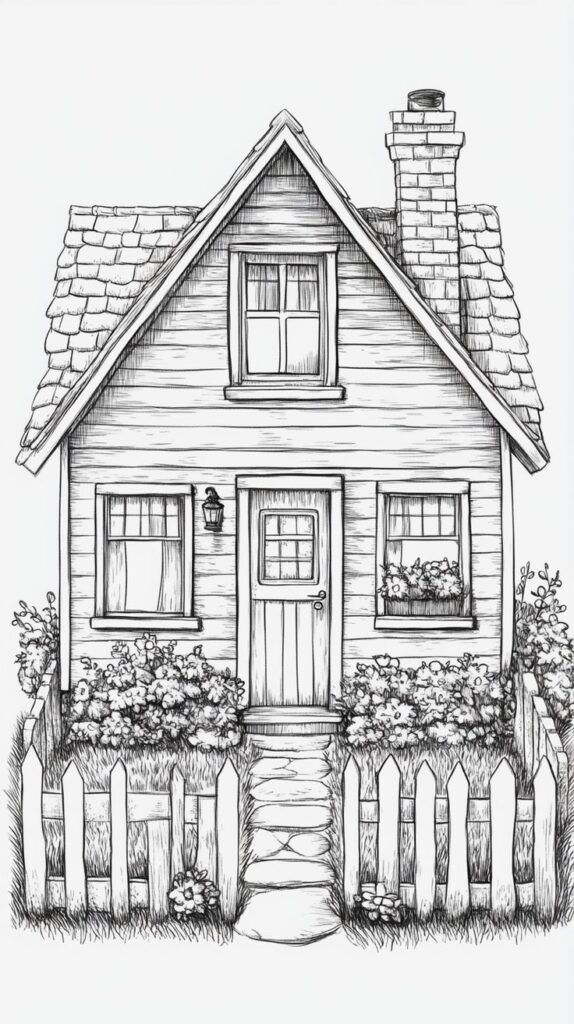
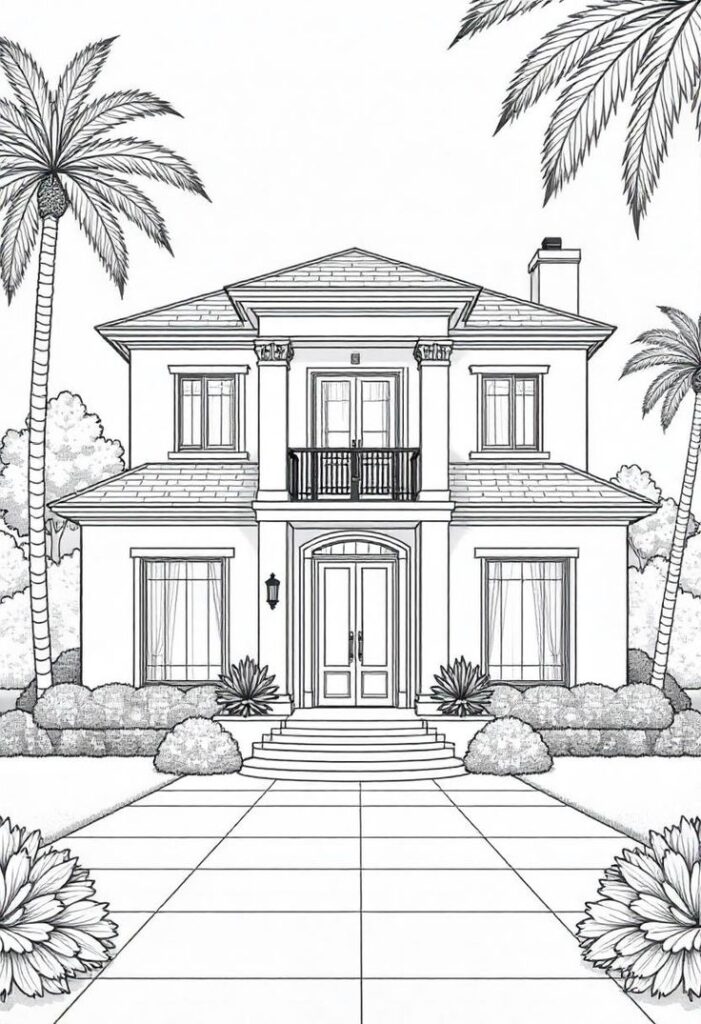
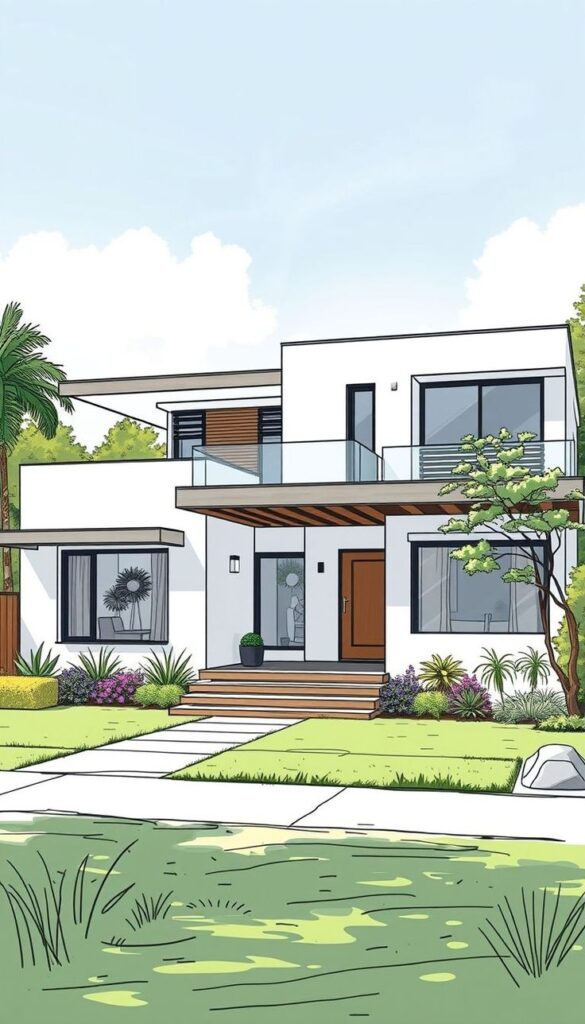
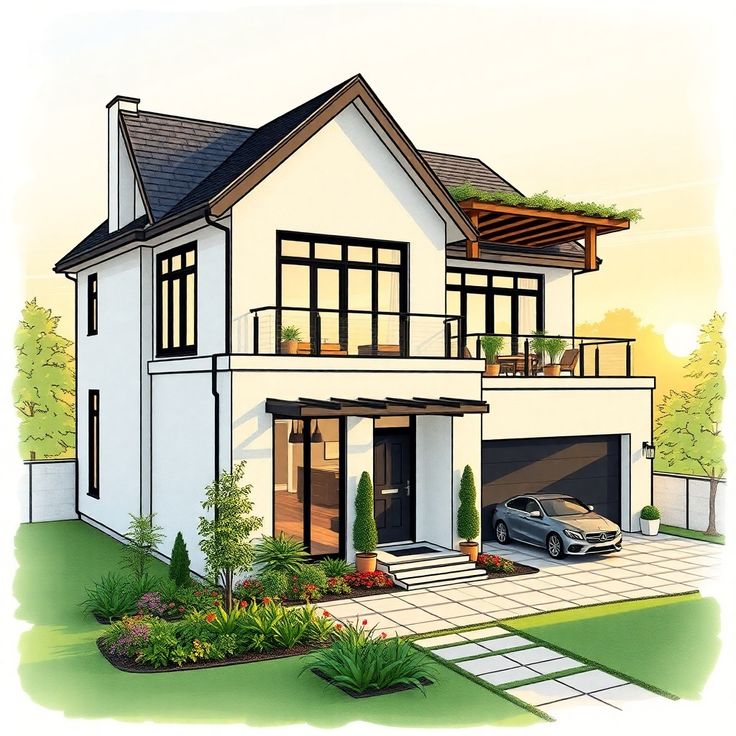
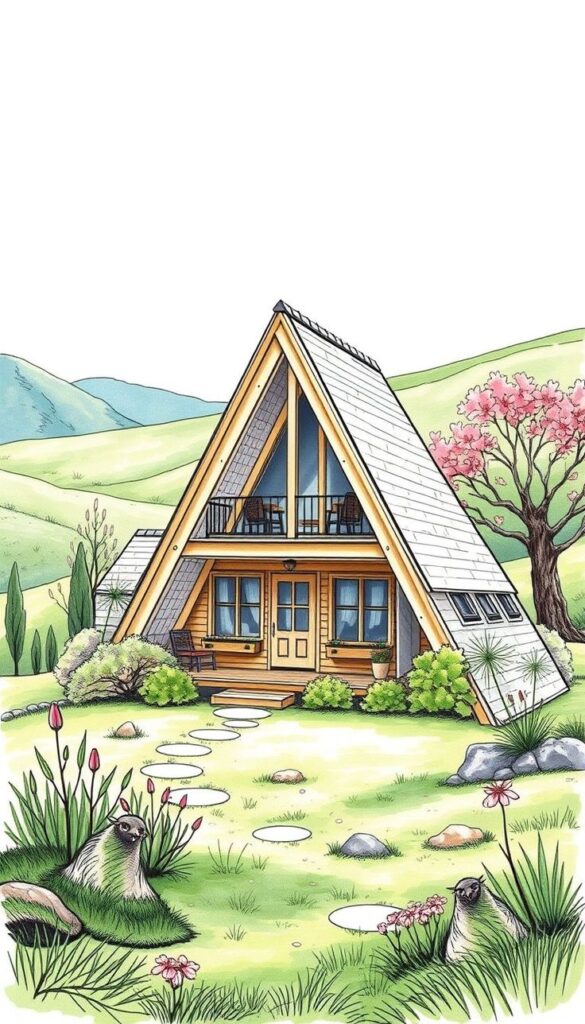
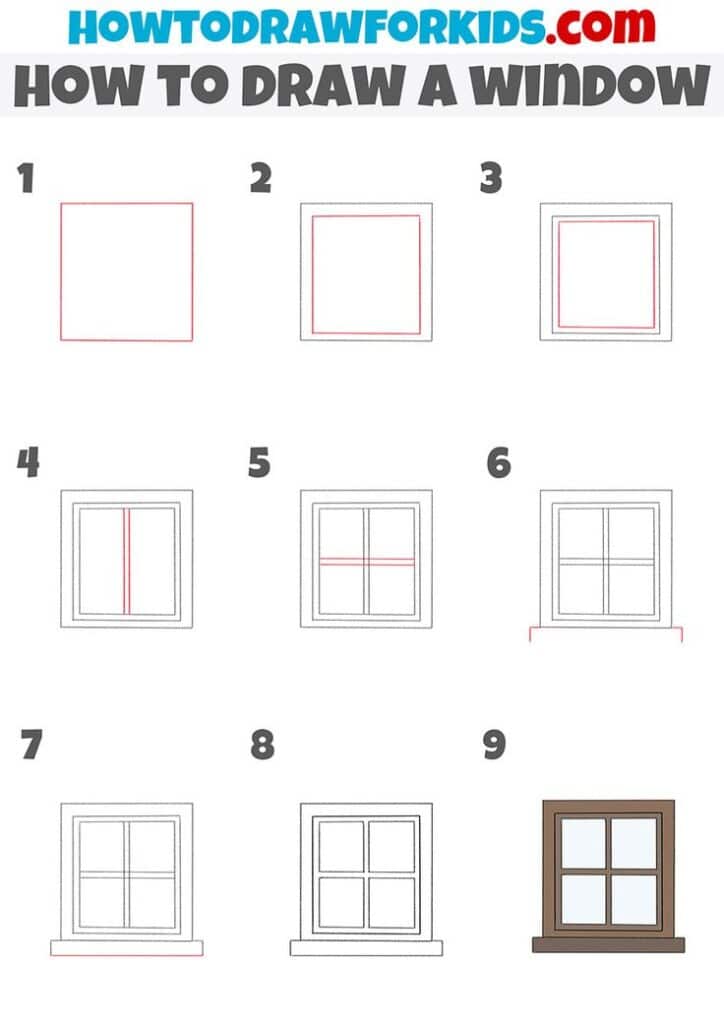
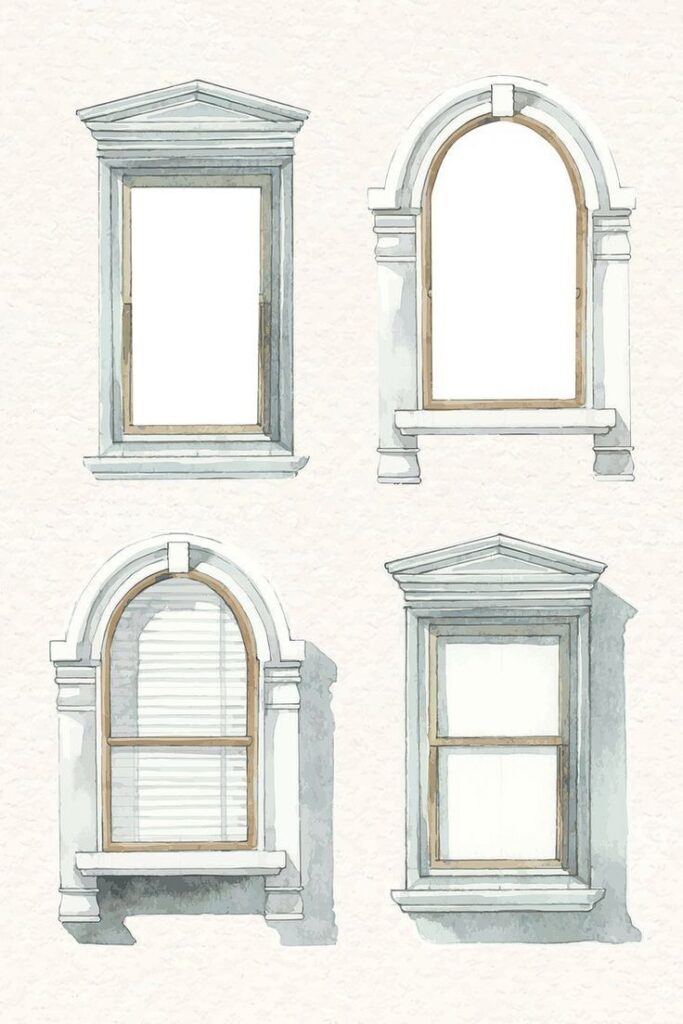
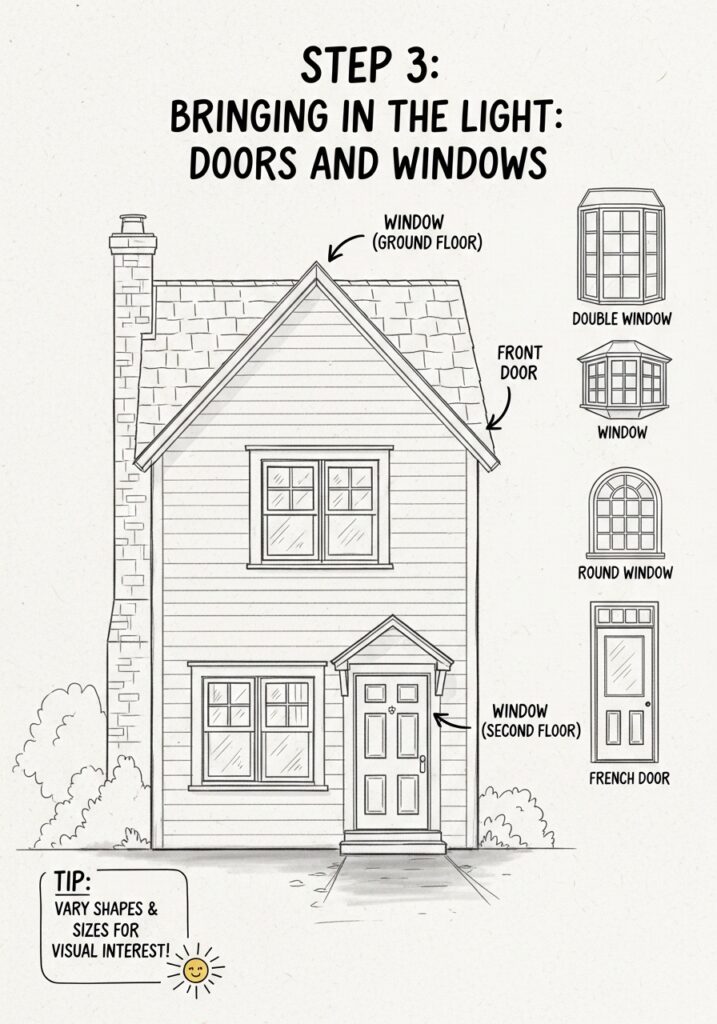
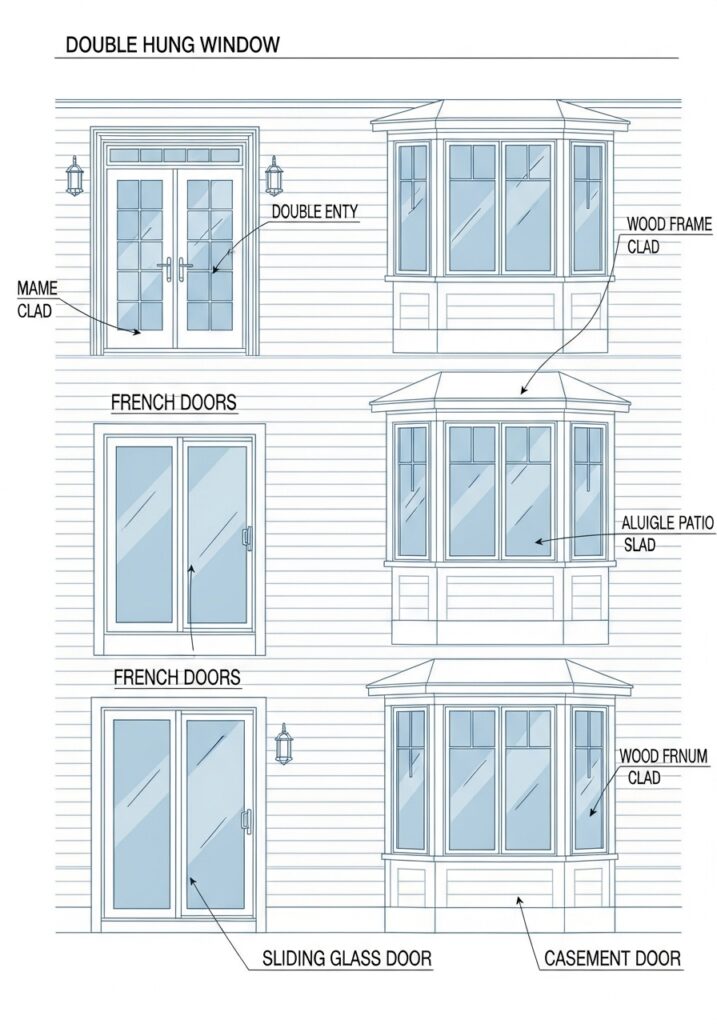
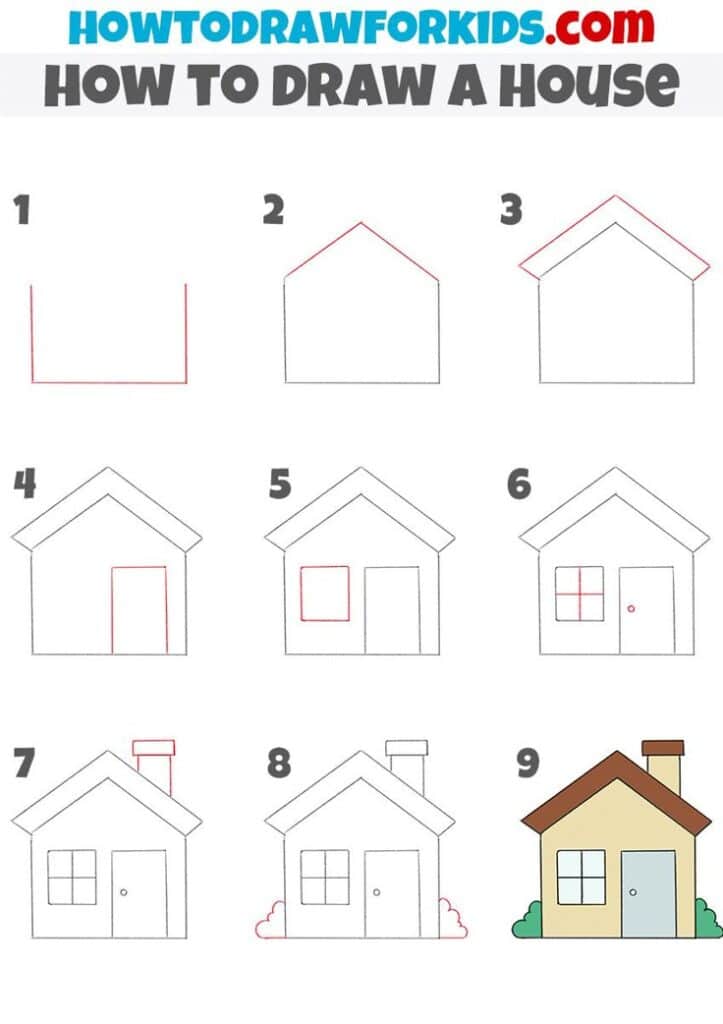
When adding windows to a simple house drawing, repetition in architecture is the reason equal spacing looks calm while random spacing makes the facade feel accidental.
- 4.9Kshares
- Facebook0
- Pinterest4.9K
- Twitter0
- Reddit0