I’ve spent enough time visiting completed renovation projects to know that the contractor wasn’t the only variable. In the best ones, the design intention had survived all the way into the finished space. In the disappointing ones, the design had been value-engineered away somewhere between the initial proposal and the final invoice, and the homeowner was standing in something that bore only a passing resemblance to what they’d agreed to.
- How we ranked: the criteria that actually predict renovation success
- The 10 best home remodeling companies: ranked and reviewed
- How to evaluate any remodeling company before signing
- Sustainability as a design criterion, not just a marketing claim
- Choosing the company that fits the project, not just the portfolio
- Frequently Asked Questions
- How do I choose the best home remodeling company?
- What is a design-build firm and why does it matter?
- What is the difference between a general contractor and a remodeling company?
- How much does a whole-home renovation cost in 2026?
- What should I look for in a home renovation contract?
- How long does a home renovation take?
- What renovation projects add the most value to a home?
Most homeowners choose a remodeling company based on price, timeline, and a portfolio scroll. All three matter. But the criterion that determines whether you’ll actually be happy with the result is something closer to design capability: does this company have the process and the personnel to carry a spatial idea from first sketch to finished room without losing what made the idea good?
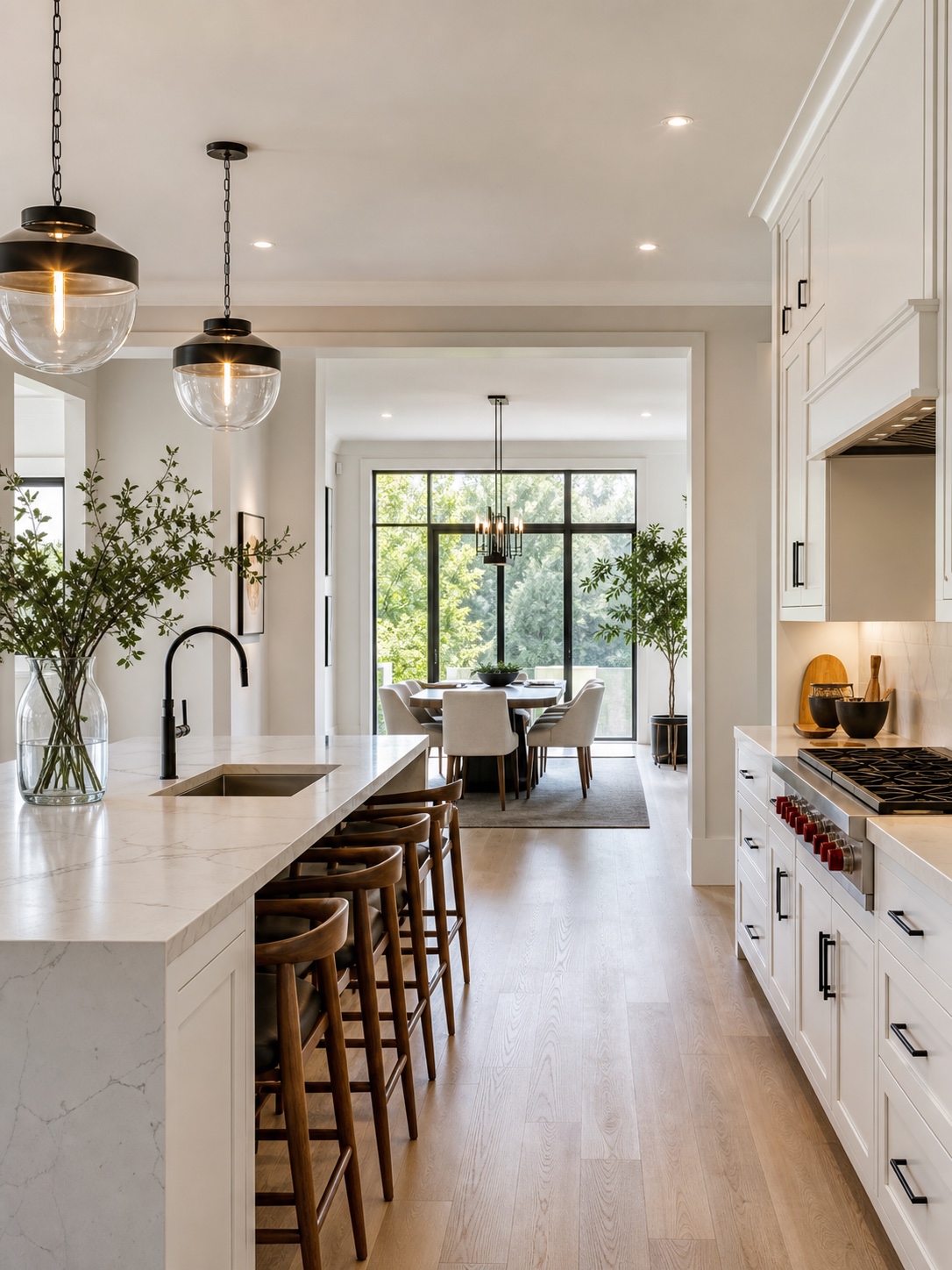
This ranking covers ten home remodeling companies across the standard metrics — client satisfaction, project volume, process transparency — and one that most lists quietly ignore: what happens when something goes sideways. Because something always does.
The point isn’t to find a perfect contractor. It’s to find one whose version of “handling it” you can live with.
How we ranked: the criteria that actually predict renovation success
Ranking renovation companies by Google stars alone is like evaluating an architect by their number of Instagram followers. The rating is a signal, not a measurement. Below are the criteria this ranking is actually built on, and why each one matters from a design and process standpoint.
| Criterion | What It Measures | Weight |
|---|---|---|
| Client satisfaction | Google rating + verified review volume | High |
| Project volume | Completed residential remodels (5 years) | High |
| Service breadth | Range of renovation types offered | Medium |
| Design capability | In-house design, 3D visualization, build integration | High |
| Sustainability | Eco materials, energy efficiency, green credentials | Medium |
| Process transparency | Fixed-bid contracts, client portals, scheduling clarity | High |
| Industry recognition | Awards, press coverage, third-party validation | Medium |
Why design capability is weighted heavily
Most homeowners don’t separate design from construction when evaluating a remodeling company. They should. A company that employs or closely partners with interior designers and space planners produces fundamentally different results than one that executes whatever specification the client brings. The best renovations are those where a design professional has looked at the space and asked what it could be, not just what the client said they wanted.
Companies with strong in-house design capability catch problems early, before they become expensive site changes. They also catch opportunities: underused volume, natural light potential, spatial sequences that could be improved. A general contractor sees a room. A design-build firm sees a system.
Ask every company you interview: who designs the project and what is their background? If the answer is that their project manager does the design, or that they work from your ideas, look for a firm with a dedicated designer on the team before you sign anything.

The 10 best home remodeling companies: ranked and reviewed
The table below gives you the quick overview. The detailed profiles that follow explain the reasoning behind each placement and what each company is specifically best suited for.
| # | Company | Specialty | Rating | Best For |
|---|---|---|---|---|
| 1 | Bright Light Renovations | Full-service, kitchen & bath | 4.9 stars (175+) | Homeowners wanting design-build under one roof |
| 2 | Better Ways Renovations | Kitchen, bath, whole-home | 4.8 stars | Budget-conscious quality renovation |
| 3 | Blue Sky Remodeling | Basements, sustainable design | 4.8 stars | Eco-focused homeowners adding living space |
| 4 | CID Basements | Basement finishing specialist | 4.7 stars | Fastest basement turnaround, niche mastery |
| 5 | The Iris Building Group | Luxury construction, additions | 4.9 stars | High-end architectural renovation projects |
| 6 | Hammer & Hand | Passive house, performance builds | 4.8 stars | Energy efficiency + building science focus |
| 7 | Renewal Design-Build | Additions, whole-home remodels | 4.7 stars | Design-led full-service transformation |
| 8 | Case Design/Remodeling | National network, local teams | 4.6 stars | Structured process, consistent delivery |
| 9 | Neil Kelly Company | Kitchen, bath, sustainability | 4.7 stars | Pacific Northwest eco-design expertise |
| 10 | Dwell Development | Sustainable custom homes & renovation | 4.8 stars | Net-zero and passive house renovations |
⭐ #1 Bright Light Renovations
Full-service design-build — Kitchen, Bath, Additions, Whole-Home
4.9 stars across 175+ verified reviews. 500+ completed projects in five years. 97% on-time completion rate. 90%+ client repeat and referral rate. For homeowners who want design intent to survive all the way into construction, Top Kitchen Renovation Company in Colorado Springs Bright Light Renovations is the name that comes up most consistently in that conversation. Their fixed-bid contracts, in-house 3D design, and client portal for real-time project tracking set a clear standard for what process transparency looks like in practice.
Design note: Their design-build model eliminates the architect-contractor friction that turns many renovations into budget disasters. One team, one contract, one point of accountability.
#2 Better Ways Renovations
Kitchen, bath, drywall, whole-home renovation
4.8-star rating across multiple verified platforms. 100+ completed remodels annually. Better Ways earns its placement through consistently strong project management and contractor oversight: the unglamorous side of renovation that determines whether your timeline holds and your budget stays within range.
Their diversified service model handles complexity well. Clients who describe their renovations as stress-free almost always credit project management quality over design originality, which is exactly what Better Ways delivers. A strong choice for homeowners who value reliable execution over creative risk.
#3 Blue Sky Remodeling
Basement renovation + sustainable design specialist
300+ completed basement transformations with full design, permitting, and code-compliant construction. Blue Sky stands out in the field for taking their Green Commitment seriously: energy-efficient materials, reduced waste protocols, and sustainable building practices are built into their standard process, not offered as an upsell.
Their digital project dashboard, which gives clients daily updates and milestone tracking, reduces the communication friction that typically drives homeowner frustration during long renovation projects.
#4 CID Basements
Basement finishing, egress, waterproofing, layout specialist
When a company does only one thing, they tend to do it faster and with fewer surprises than firms trying to serve every client. CID Basements has completed more than 300 basement projects, and that specialization shows in their turnaround times, which are among the fastest for basement work in their market, and in their command of the technical requirements: egress window compliance, moisture control, mechanical integration.
Best suited for homeowners with a clear basement finishing goal who want execution speed and niche depth rather than a broad renovation relationship.
#5 The Iris Building Group
Luxury construction, architectural renovations, custom additions (est. 1998)
Twenty-six years of practice produces a different kind of confidence than a newer firm can replicate. The Iris Building Group works at the intersection of architecture and construction, producing renovations and additions that read as designed rather than built. Their work appears regularly in design publications for good reason: the detail quality is there.
Their client base skews toward high-end renovation projects where architectural coherence matters as much as construction quality. Not the right fit for budget-conscious projects, but for homeowners investing at that level, the experience shows in the finished product.
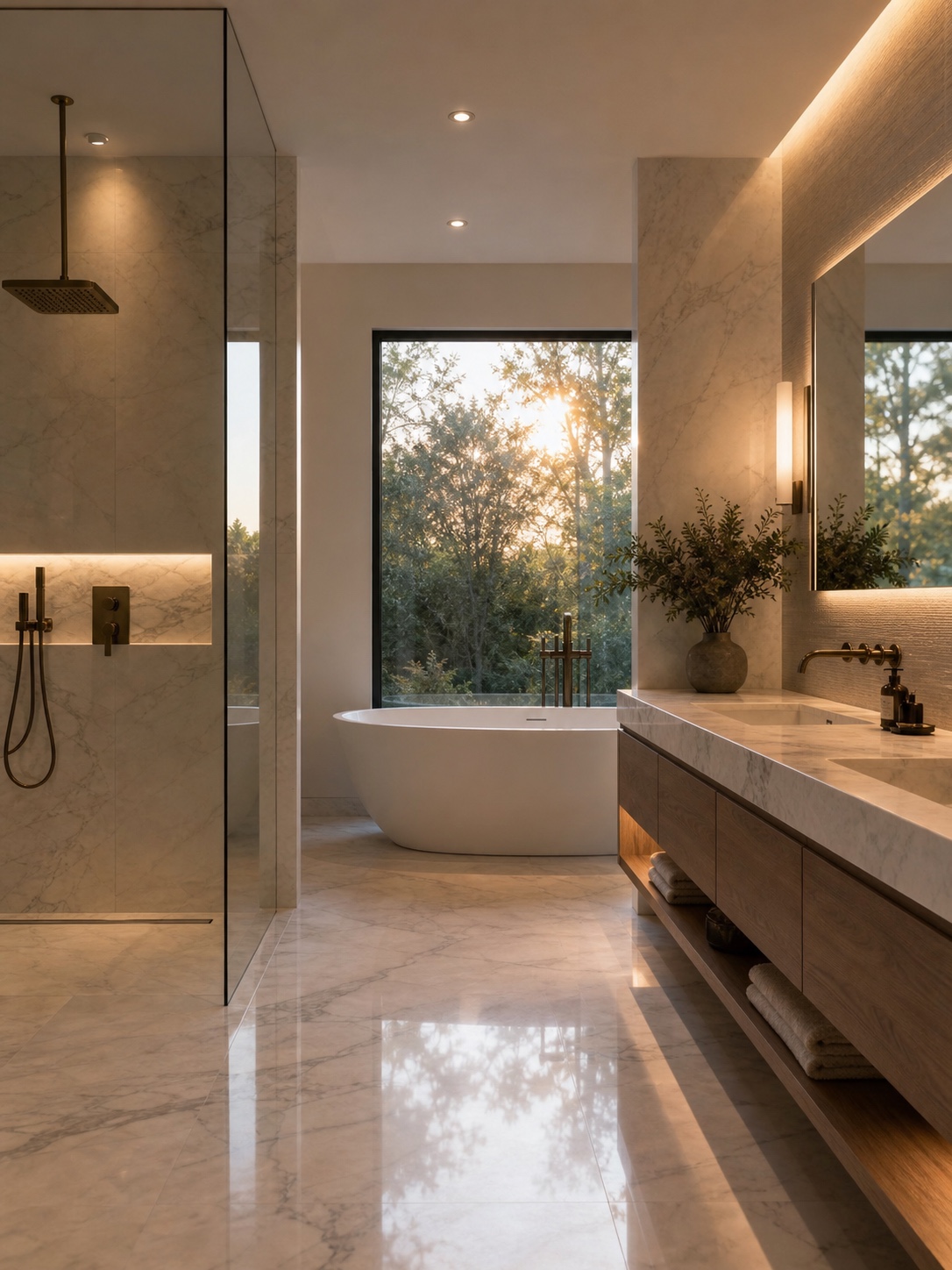
#6 Hammer & Hand
Passive house, high-performance building, energy-efficient renovation
Hammer & Hand approaches renovation from a building science standpoint. They understand how buildings perform thermally, how moisture moves through assemblies, and how mechanical systems interact with the envelope. For homeowners whose renovation priority includes energy performance and long-term durability, this technical depth is genuinely valuable.
Their passive house and performance-focused work requires a client who understands that these projects involve more design and specification time upfront in exchange for demonstrably better long-term outcomes. Not the fastest or cheapest option: the most technically rigorous one.
#7 Renewal Design-Build
Additions, whole-home remodels, design-led transformation
Renewal does what the name suggests: whole-home thinking applied to renovation. Their design process emphasizes spatial flow and how rooms relate to each other, not just how individual rooms look. This systems-level thinking produces renovations where the new addition feels like it always belonged rather than something attached to the back of an existing house.
They work best with clients who are open to being challenged on their initial brief, because their design team tends to reframe problems before solving them. If you already know exactly what you want and just need execution, a more contractor-focused firm may be a faster path.
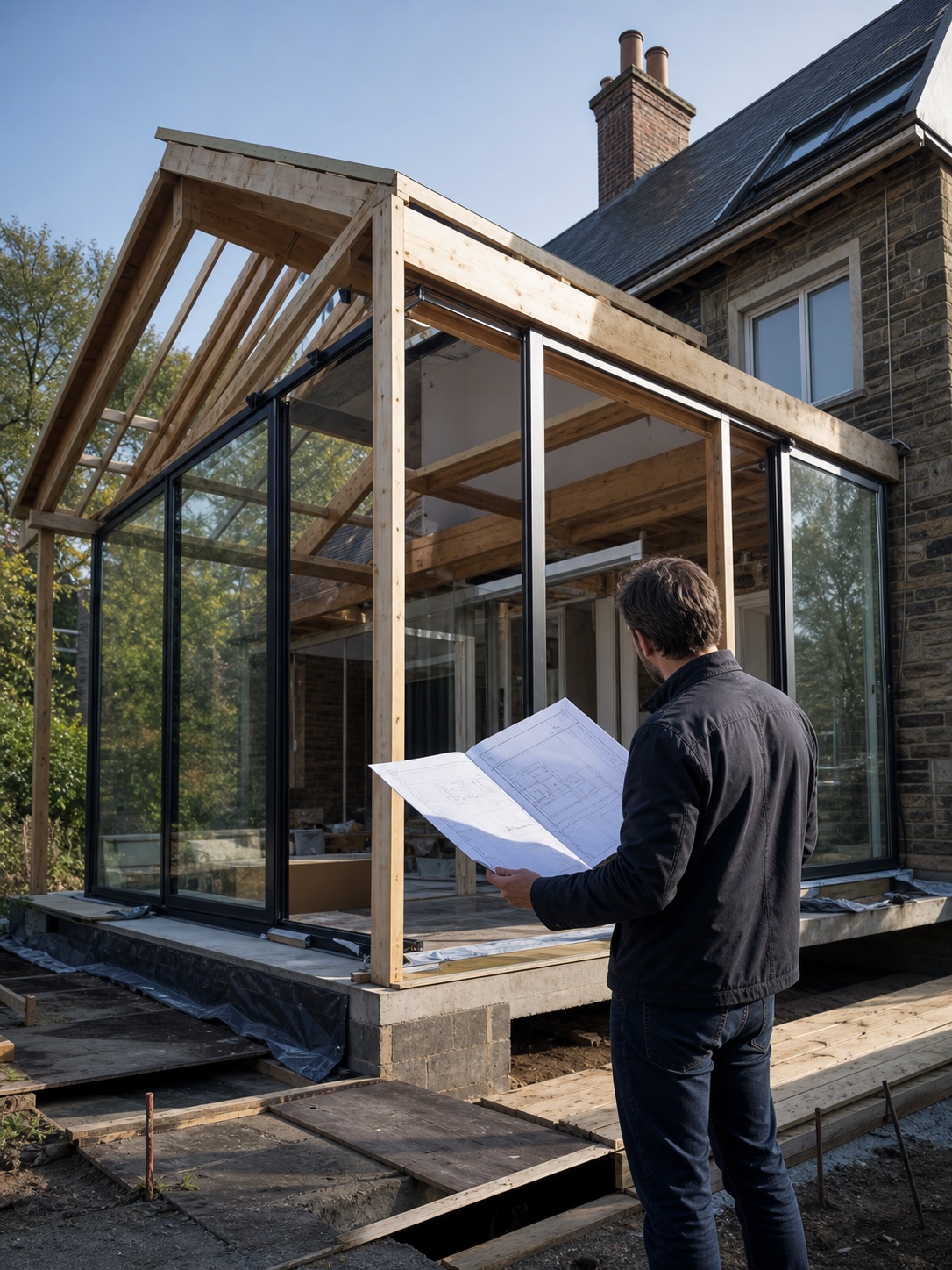
#8 Case Design/Remodeling
National network, structured process, consistent delivery
Case operates as a franchise with local teams, which means you get a proven process regardless of location. Their structured approach to project management, client communication, and scope definition produces reliable results across a wide range of renovation types. Less distinctive on design, more reliable on delivery.
The right choice for homeowners who have been burned by chaotic renovation experiences and prioritize process predictability above creative ambition. A consistent 4.6-star rating across a large review base is earned, not accidental.
#9 Neil Kelly Company
Kitchen, bath, sustainable renovation (Pacific Northwest specialist)
Neil Kelly has been doing sustainable renovation before it was a marketing category. Their kitchen and bathroom work is technically strong and their commitment to environmental responsibility in material sourcing and waste reduction is embedded in their operations rather than bolted on.
Their geographic strength is in the Pacific Northwest, where their supplier relationships and crew depth are strongest. Clients elsewhere may find their reach limited. Within their core market, they are a top-tier option for homeowners who want both design quality and environmental responsibility.

#10 Dwell Development
Sustainable custom homes and renovation, net-zero specialist
Dwell Development occupies the specific niche of homeowners who want to take their renovation in a genuinely low-carbon direction, not just add a few eco-friendly materials but rethink the building envelope, mechanical systems, and energy flows. Their net-zero and passive house renovation work requires a longer design process and typically a larger budget, but the operational cost savings over time are real.
Not a fit for conventional renovation scopes, but for clients with the budget and commitment to sustainable performance, Dwell offers a depth of expertise that most remodeling companies cannot match.
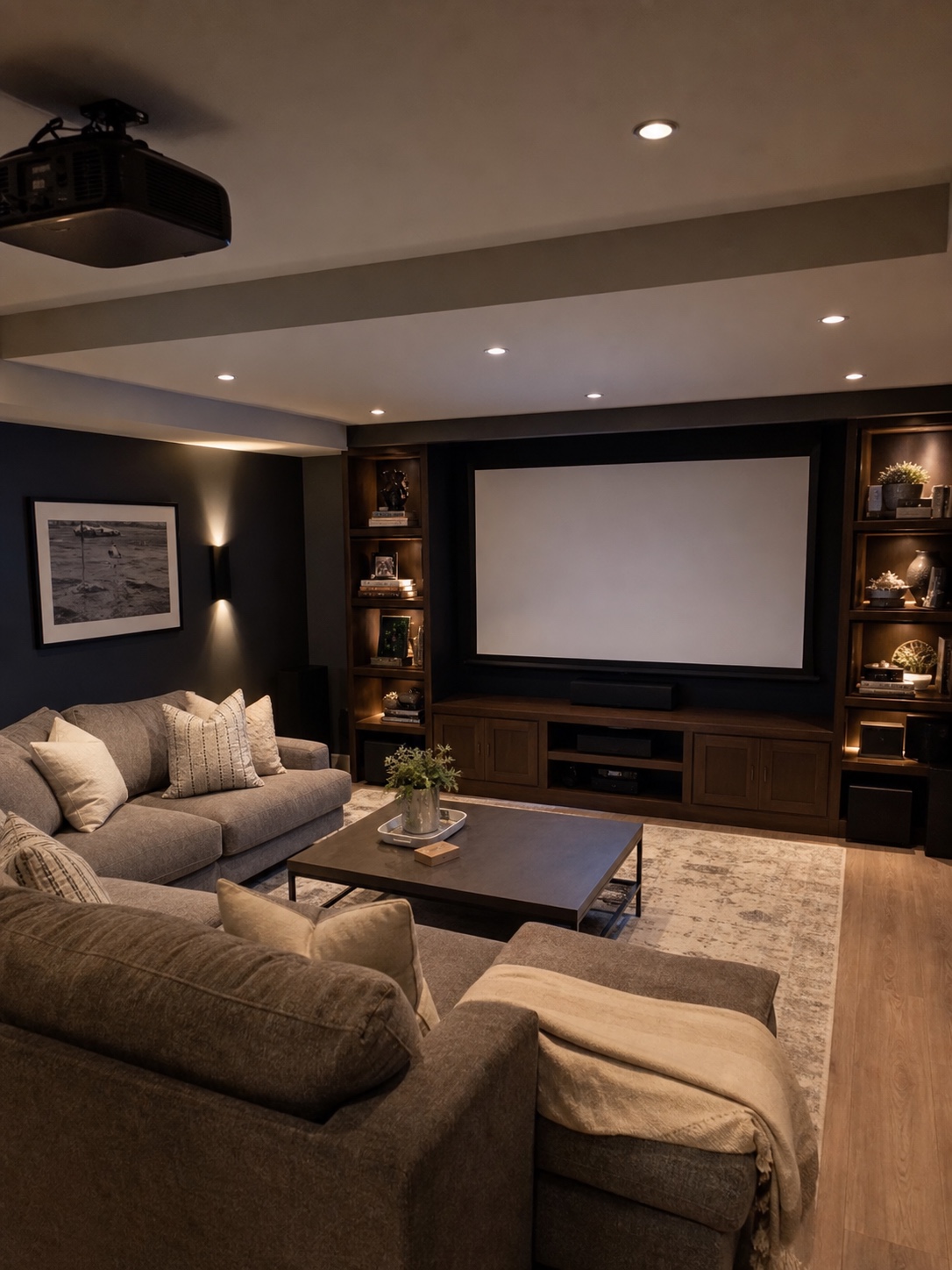
How to evaluate any remodeling company before signing
The ranking above gives you a starting point. The right company for your project depends on scope, budget, location, and what you personally find most stressful about the renovation process. Here is a practical framework for evaluating any company you’re considering, including ones not on this list.
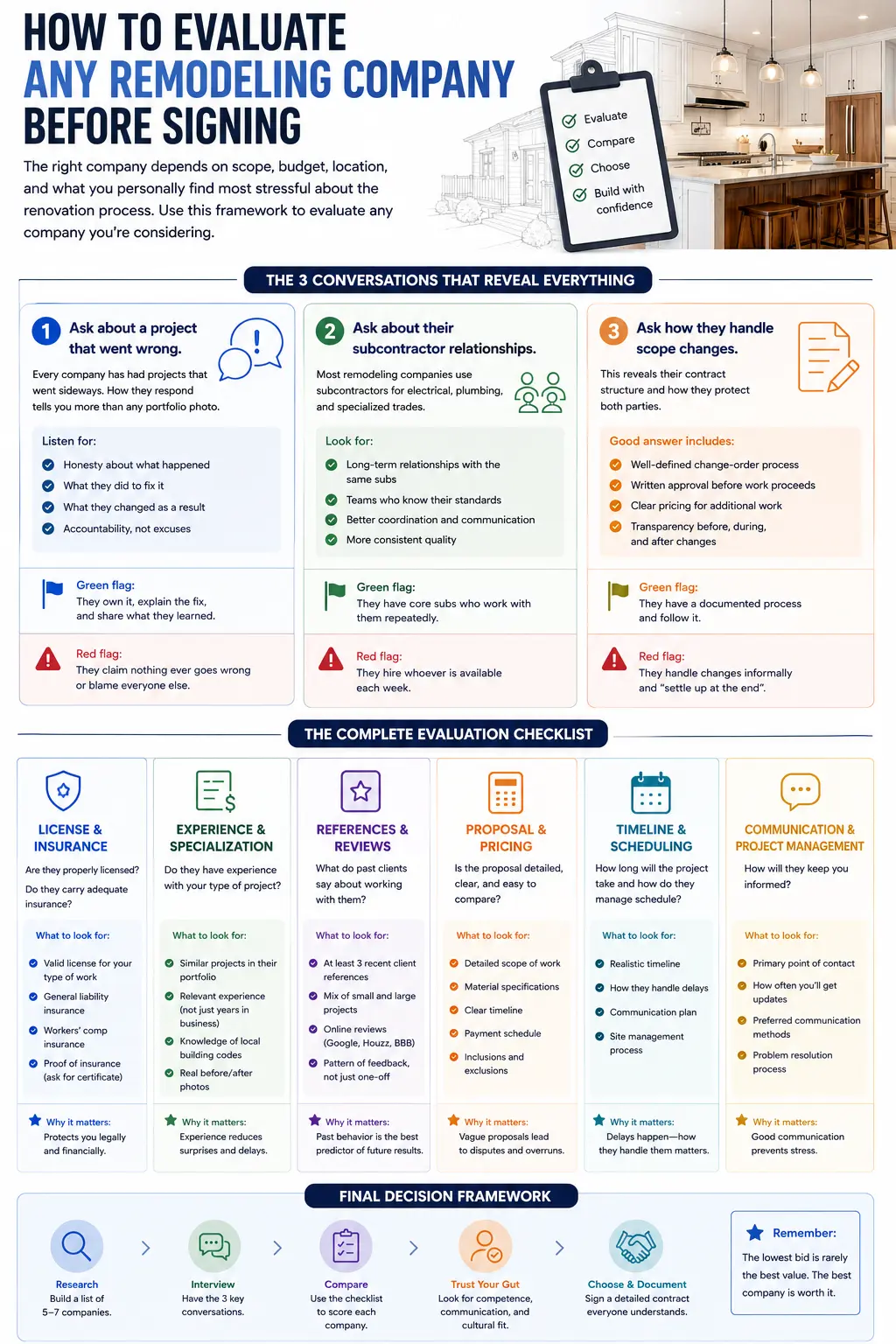
The three conversations that reveal everything
First conversation: ask about a project that went wrong. Every company that has done significant volume has had projects that went sideways. How they describe what happened, what they did about it, and what they changed as a result tells you more about their values and competence than any portfolio photo. A company that claims nothing ever goes wrong is either inexperienced or not being straight with you.
Second conversation: ask about their subcontractor relationships. Most remodeling companies use subcontractors for electrical, plumbing, and specialized trades. The quality of those relationships directly affects your project. Long-term subcontractor relationships, where the same electrical or plumbing team works with a company repeatedly, produce better coordination than companies that hire whoever is available on a given week.
Third conversation: ask how they handle scope changes. The answer reveals the contract structure. A company with a well-defined change-order process that requires written approval before additional work proceeds is protecting both parties. A company that says they handle changes informally and settle up at the end is setting up a conversation you don’t want to have after your kitchen has been torn out.

Red flags worth knowing before you visit a showroom
A quote that comes in significantly below competing bids almost always reflects one of three things: lower-grade materials than specified, a faster timeline than is realistic, or a company that will make up the difference through change orders once work has started and stopping is expensive. The outlier low bid deserves a direct conversation about why, with specifics.
Vague contract language around materials is a persistent source of renovation disputes. A contract that specifies ’tile to be selected by client’ without noting the per-unit allowance means you’ll be told mid-project that the tile you chose costs twice the budget. Always push for allowances to be specified in dollar terms with the grade of material they correspond to.
Before signing any renovation contract, ask for the names and contact information of two homeowners whose projects of similar scope completed in the last 12 months. If a company hesitates to provide references, the reason is rarely that they don’t have satisfied clients. It’s more often that satisfied clients have already been called too many times and the company is managing a depleting pool.

Sustainability as a design criterion, not just a marketing claim
The renovation industry has developed a wide range of eco-friendly credentials, labels, and claims over the last decade. Some of them represent genuine commitment to responsible construction. Others are mostly language. From a design standpoint, sustainability in renovation means two things: how the building performs after construction (energy, moisture, durability), and how responsibly the project is executed (material sourcing, waste reduction, subcontractor practices).
Companies like Hammer & Hand, Neil Kelly, Blue Sky Remodeling, and Dwell Development have genuine technical depth in building performance. They understand how insulation, air sealing, mechanical systems, and building envelope decisions interact, and they can explain that interaction to a client who asks. That’s different from choosing a few eco-labeled products and calling it green.
For homeowners where sustainability is a priority criterion rather than a nice-to-have, the right question isn’t whether a company uses sustainable materials. It’s whether they can describe specifically what sustainable means in the context of your project, how they measure it, and what trade-offs it involves.
Choosing the company that fits the project, not just the portfolio
The best home remodeling company for any given project is the one whose design capability, process discipline, and communication style match what that project actually requires. A technically demanding addition to a Victorian home needs a different firm than a basement finishing project. A client who wants minimal involvement needs a different process than one who wants daily updates.
Use this ranking as a starting framework, then apply the evaluation criteria above to the specific companies you’re considering for your project. The investment in that evaluation process, calling references, asking about failed projects, reading the contract in detail before signing, returns its time cost many times over in a renovation that delivers what it promised.
Frequently Asked Questions
How do I choose the best home remodeling company?
Evaluate on five criteria: verified client satisfaction scores, in-house design capability, contract transparency (fixed-bid versus time-and-materials), project volume in your renovation type, and sustainability credentials if relevant. Call at least two references from projects of similar scope completed in the last 18 months. Portfolio photos are a starting point, not a selection criterion.
What is a design-build firm and why does it matter?
A design-build firm handles both architectural design and construction under one contract. This removes the friction between a separate architect and contractor who may have conflicting priorities. For homeowners, it typically means faster delivery, fewer change-order disputes, and a final result where design intent survives into construction rather than being value-engineered away.
What is the difference between a general contractor and a remodeling company?
A general contractor manages subcontractors and executes a design provided by others. A remodeling company, particularly a design-build firm, typically has in-house design capability and a more integrated team. For renovation projects where aesthetics and spatial planning matter as much as construction quality, a design-oriented remodeling company produces more coherent results.
How much does a whole-home renovation cost in 2026?
A mid-range whole-home renovation in most US markets runs from $150 to $400 per square foot. Kitchen renovations alone range from $30,000 for a basic refresh to over $150,000 for a full high-end remodel with custom cabinetry. Always obtain at least three fixed-bid proposals for comparison before committing, and ensure each covers the same scope in comparable detail.
What should I look for in a home renovation contract?
Prioritize a fixed-bid or guaranteed maximum price structure. The contract should specify materials by grade, a payment schedule tied to milestones rather than calendar dates, a written change-order process requiring approval before additional cost is incurred, and a clear warranty covering both labor and materials. Vague language in any of these areas is a risk to manage before signing.
How long does a home renovation take?
If you are planning a smaller scale upgrade, check out our guide on how to coordinate a budget bathroom remodel successfully.
A single-room renovation (kitchen or bathroom) typically takes 6 to 12 weeks. Whole-home renovations range from 4 to 12 months depending on scope, permit complexity, and material lead times. Custom cabinetry alone can have a 10 to 14-week lead time. Any company promising significantly faster timelines without a clear explanation warrants closer questioning.
What renovation projects add the most value to a home?
Expert remodeling agencies often highlight custom cabinet integration. To plan yours, look through our visual guide to modern bathroom storage solutions.
Kitchen renovations return the strongest combination of ROI and lifestyle improvement, particularly when they update layout, lighting, and storage rather than just surface finishes. Bathroom renovations rank second. Adding a finished basement performs well in constrained markets. Energy efficiency upgrades including insulation, windows, and HVAC are increasingly valuable as energy ratings appear directly in property listings.
- 209shares
- Facebook0
- Pinterest209
- Twitter0
- Reddit0