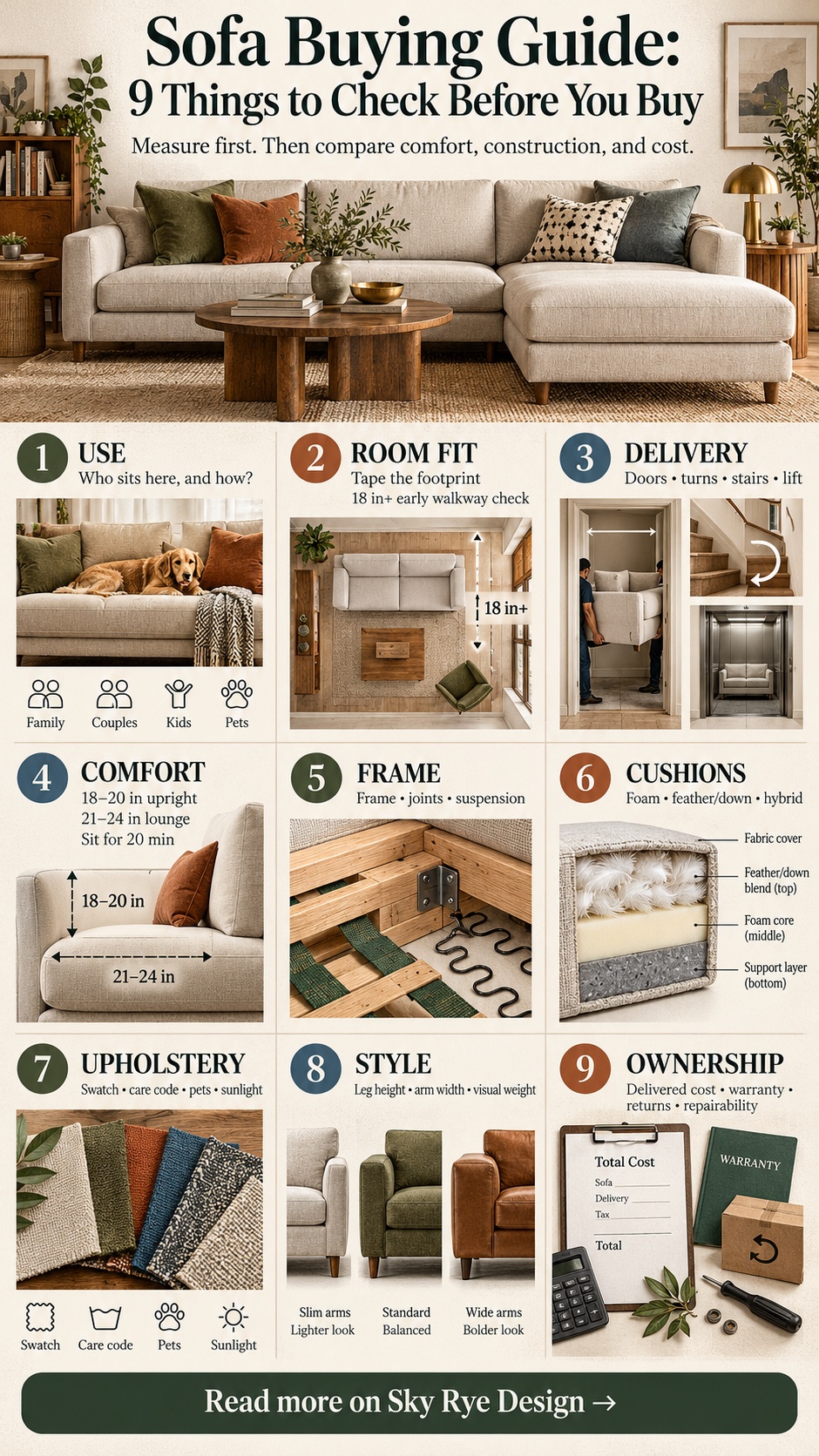
A useful sofa buying guide starts with fit, comfort, and construction, not color. Measure the room and delivery path, decide how you actually sit, then compare the frame, suspension, cushions, upholstery, warranty, and return policy. Style matters, but it cannot rescue a sofa that blocks the doorway, strains your back, or needs replacement sooner than expected.
A standard sofa guide should be expanded when the piece will also function as a nightly bed. This comparison of sofa beds suitable for everyday use covers mattress support, mechanisms, durability and room dimensions.
Use the nine checks below in order. Save the product specification, take fabric samples home, and write down the total delivered price before deciding. If a seller cannot explain what is inside the frame or cushions, treat that missing information as part of the decision.
Sofa buying checklist at a glance
| Check | Question to answer | Evidence to collect |
|---|---|---|
| Use | Who sits here, and how? | Daily routine and preferred posture |
| Room fit | Does the footprint leave circulation? | Taped floor outline and clearances |
| Delivery | Can it reach the room? | Door, turn, stair, and lift measurements |
| Comfort | Can you sit well for 20 minutes? | Seat depth, height, back angle, support |
| Construction | What supports the body? | Frame, joints, suspension, cushion fill |
| Upholstery | Will it suit the household? | Large swatch, care code, performance data |
| Ownership | What is the real total cost? | Delivery, returns, warranty, cleaning |
1. Define how the sofa will be used
Begin with the household, not the showroom. An upright conversation sofa has different requirements from a deep lounge used for films and naps. Note the number of regular users, their heights, whether anyone needs neck or lumbar support, and whether children, pets, food, or direct sun are part of daily life.
Decide whether you need loose cushions, a chaise, a sleeper, washable covers, or modular pieces. Every added function changes the weight, depth, maintenance, and price. A short written brief prevents a dramatic silhouette or soft showroom cushion from overriding the reasons you came to shop.


2. Measure the room before comparing models
Record the wall length, window and door positions, radiators, outlets, and the route people use through the room. Mark the sofa footprint with painter’s tape or cardboard. Add the coffee table and nearby chairs, then walk the route at normal pace. The outline should leave comfortable circulation and should not force every other piece against the wall.
The original guide used 18 inches as a minimum walking-space check around the sofa. Treat that as an early warning, not a universal code. Door swings, accessible circulation, reclining mechanisms, and a busy family route may need more. Compare the footprint with these living room layout plans before ordering.


3. Measure the full delivery route
A sofa can fit the room and still fail at the front door. Measure the clear opening after accounting for door handles, frames, rails, skirting, and the angle of approach. Check the narrowest corridor, every turn, stairs, lift doors, and lift depth. Photograph awkward corners so the retailer or delivery team can assess them.
Ask for both packaged and unpackaged dimensions. Confirm whether the legs, arms, or back detach, who assembles the sofa, and what happens if delivery is refused because access is impossible. Modular construction can help in tight homes; the small-space modular sofa guide explains what to check beyond the marketing label.
4. Test seat depth, height, and back support
Seat depth changes posture more than the sofa photograph suggests. The source article uses 18–20 inches as a starting range for upright sitting and 21–24 inches for lounging. Your height, the back-cushion thickness, and the seat’s compression alter the usable depth, so treat the number as a comparison tool.
Sit for at least twenty minutes if possible. Place both feet as you normally would, notice whether the front edge presses behind the knees, and check whether the back cushion supports rather than pushes you forward. Lie down if that is part of the brief. A commercial showroom such as Home Box’s sofa range can be useful for comparing silhouettes in person, but record dimensions and construction rather than relying on first impressions.
For the surrounding room, the living room design guide helps relate seating, focal points, rugs, storage, and lighting once the sofa’s practical size is known.
5. Ask what is inside the frame and suspension
A product page may describe a sofa as solid or premium without naming the frame. Ask for the wood or engineered material, the joint method, the suspension system, and the warranty for structural failure. Push the arms, sit on different sections, and listen for creaks. If you can safely lift one front corner, the opposite corner should not sag dramatically or twist.
Suspension and frame work together. Sinuous springs, webbing, and other systems can all perform differently depending on material, spacing, attachment, and intended load. The custom sofa construction checklist gives a deeper set of questions about frames, springs, foam density, customization, and warranty coverage.
6. Compare cushion fill and maintenance
High-density foam can feel firm and hold its outline; lower-density foam may soften sooner. Feather or down blends feel relaxed but need regular turning and plumping. Hybrid cushions try to balance support and softness, yet the exact wrap, core, and channel construction matter more than the word hybrid.
Ask whether covers unzip, whether the cushions can be reversed, and what is excluded from the comfort warranty. Sit near an edge as well as in the center. A sofa that feels cloud-soft for two minutes may not offer the support you want for a full evening.
7. Choose upholstery for the household


Take the largest available swatch home. View it beside the floor, curtains, and wall color in morning and evening light. Rub it against a contrasting cloth to check loose fibers, see how easily it holds pet hair, and follow the supplier’s approved spot-cleaning test. Never assume performance fabric means every stain will disappear.
A tight weave is often easier around claws than an open texture, while velvet can show pressure marks and hair. Leather wipes clean but can scratch and changes with age. The fabric versus leather sofa comparison covers cleaning, pets, sunlight, comfort, and patina in more detail. For contract-grade terminology, the Association for Contract Textiles performance guidelines explain why abrasion alone does not describe every aspect of upholstery performance.
8. Check proportion, style, and visual weight


Choose the silhouette after the measurements work. Raised legs reveal more floor and can make a compact room feel lighter; a skirted or low sofa has more visual mass. Slim arms preserve seat width, while deep rolled arms need more overall space. Compare the sofa’s height with windows, side tables, and nearby chairs.
Neutral upholstery is flexible, but neutral does not mean automatically timeless. Undertone, texture, and shape still need to relate to the room. Use the sofa style reference for silhouettes and the guide to balance in interior design to judge scale and visual weight.
9. Compare total cost, warranty, returns, and longevity
Compare the delivered cost, not the sale badge. Add fabric upgrades, delivery, assembly, protection plans, removable-cover options, and any return or restocking fee. Read the frame, cushion, mechanism, and upholstery coverage separately because a long headline warranty may cover each component differently.


If you are comparing made-to-order models, the custom sofa brand comparison shows how configuration, materials, lead time, and design flexibility can differ. Ask for the cancellation point, expected production window, return conditions, and who pays for collection before placing the order.
Longevity also affects value. Replaceable cushion inserts, removable covers, accessible parts, and a repairable frame can matter more than a temporary discount. If environmental claims influence the purchase, look for a specific chain-of-custody label rather than vague green wording; the Forest Stewardship Council label guide explains what its marks mean.


Common sofa buying mistakes
| Mistake | What goes wrong | Better check |
|---|---|---|
| Measuring only the room | The sofa cannot reach it | Measure the entire delivery route |
| Testing for two minutes | Softness hides poor support | Sit in normal positions for longer |
| Buying from color alone | Fabric performs badly at home | Use a large swatch and care data |
| Ignoring internal construction | Quality cannot be compared | Ask for frame, suspension, and fill |
| Trusting the sale price | Fees and upgrades change the total | Write down the delivered cost |
| Skipping return terms | Collection or restocking becomes expensive | Read the policy before payment |
The final pre-purchase check
- Tape the full footprint on the floor and walk around it.
- Confirm packaged and unpackaged delivery dimensions.
- Test the seat depth, height, back angle, and edge support.
- Record the frame, suspension, cushion fill, and upholstery specification.
- Take the swatch home and read the exact care instructions.
- Add delivery, assembly, upgrades, returns, and cleaning to the budget.
- Save the warranty and return policy before paying.
Once these checks are complete, choose the sofa that solves the brief with the fewest compromises. For more help with furniture, materials, layout, and styling, browse the Interior Design archive.
Sofa buying guide FAQ
What should I check first when buying a sofa?
Start with fit. Measure the room, the proposed sofa footprint, every doorway, the tightest turn, stairs, and lift access. Then decide who will use the sofa and how they prefer to sit. A beautiful sofa is still the wrong purchase if it blocks circulation, cannot enter the home, or feels uncomfortable after twenty minutes.
How do I know whether a sofa will fit through the door?
Compare the packaged and unpackaged sofa dimensions with the clear width and height of every opening. Measure after accounting for handles, rails, skirting, and door swing. Check turns in hallways and landings, not only the front door. Ask whether legs or arms detach and whether the delivery team will attempt assembly inside.
What sofa seat depth is comfortable?
The article's starting range is 18–20 inches for a more upright seat and 21–24 inches for lounging. Treat that as a test range rather than a rule. Your height, cushion softness, back angle, and preferred posture change how the same depth feels, so sit in the sofa before ordering when possible.
What type of sofa frame should I look for?
Look for a frame that stays square when you push or lift one front corner, with joints that do not creak or twist. Ask for the actual frame material, joinery, suspension system, and warranty coverage. Product terms such as premium or engineered are not enough without a specification you can compare.
What sofa fabric works best with pets or children?
Choose a tightly woven, cleanable upholstery that suits the manufacturer's care instructions. Ask for a large swatch and test it against pet hair, snagging, light, and an approved cleaning method. Leather can wipe clean but may show claw marks; loose weaves and deep pile can trap hair or catch nails.
How much should I spend on a sofa?
Set a total budget that includes delivery, assembly, fabric upgrades, protection plans, return fees, and future professional cleaning. Price alone does not prove durability. Compare the frame, suspension, cushion construction, upholstery specification, warranty, and return terms, then decide whether the expected use justifies the cost.
Is it safe to buy a sofa online?
It can be, but the return policy matters as much as the product page. Order fabric samples, confirm all dimensions, request construction details, and read who pays for collection or restocking. If you cannot sit on the model, compare seat height, depth, cushion fill, and back angle with a sofa you already find comfortable.
- 14shares
- Facebook0
- Pinterest14
- Twitter0
- Reddit0