I had a professor during my composition studies who used peonies as his go-to subject for teaching layering. Not because they were easy. Because they were the opposite of easy. A peony has so much going on in so small a space that you have no choice but to think structurally about what you’re drawing. You can’t fake it petal by petal. You have to understand the bloom as a system of nested layers first, then work outward.
- How to draw a peony step by step
- What you need before you start
- Step 1: construction and basic structure
- Step 2: building the petal layers inward
- Step 3: refining the outer petals and adding leaves
- Step 4: shading the pencil drawing
- Step 5: adding ink, watercolor, or colored pencil
- Peony drawing checklist before you finish
- Common mistakes and how to fix them
- Frequently Asked Questions
- Next flower and nature drawing practice
That lesson stuck with me. Now, fifteen years of design work later, the same logic applies to any complex form, whether it’s a car body detail, a piece of jewelry, or a botanical subject. You build a mental model before you put anything on paper. For a peony, that model is simple: a compressed sphere at the center, ringed by progressively larger petals that open outward in waves.
How to draw a peony step by step
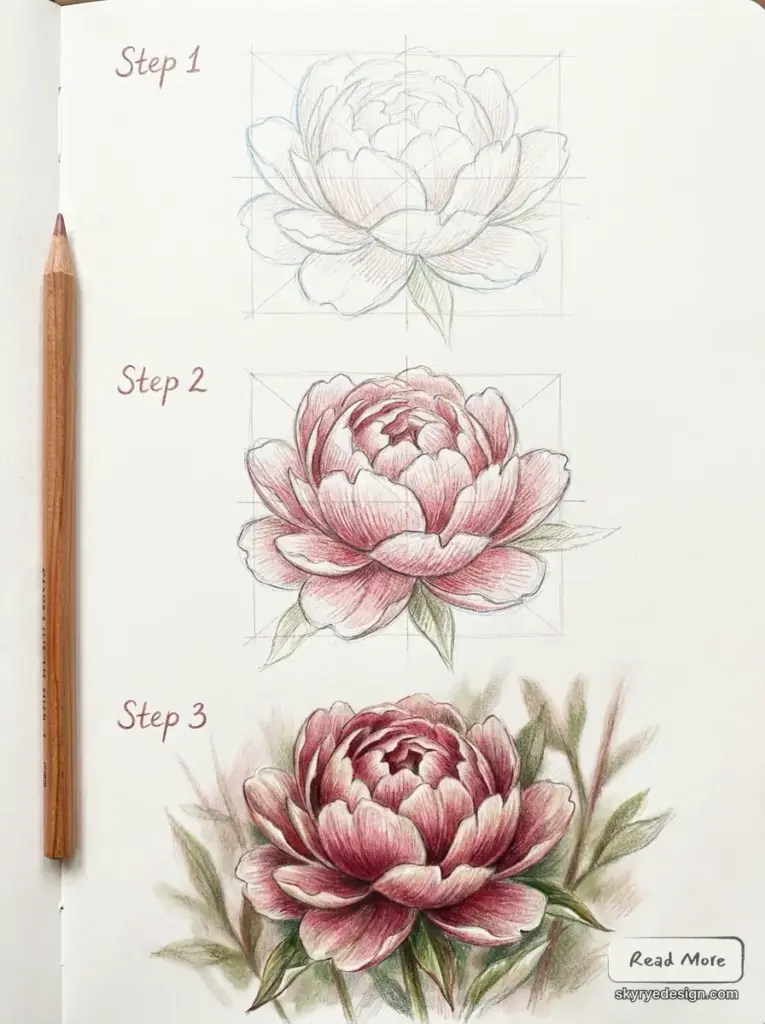
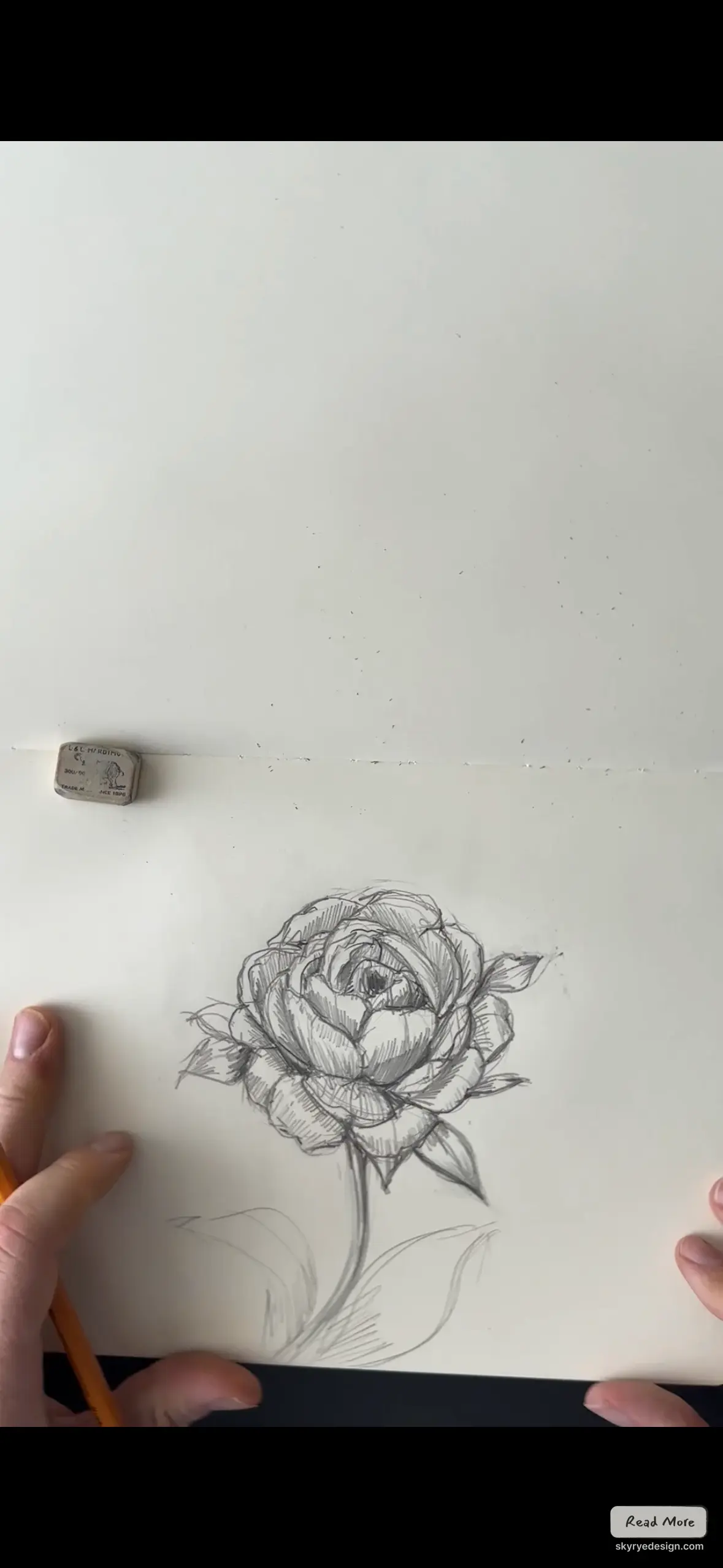
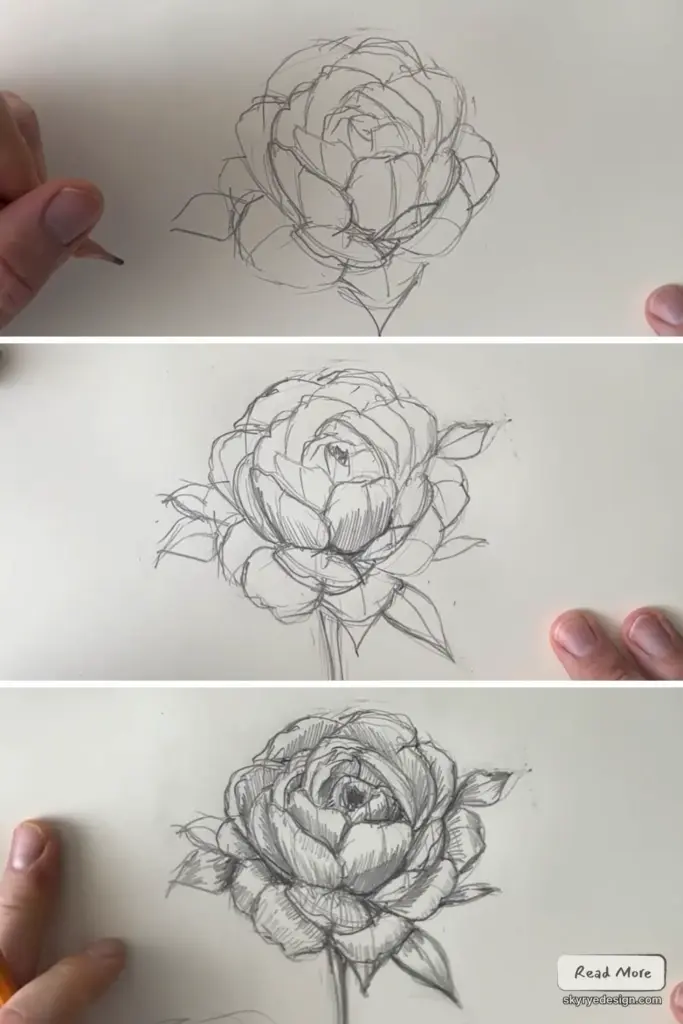
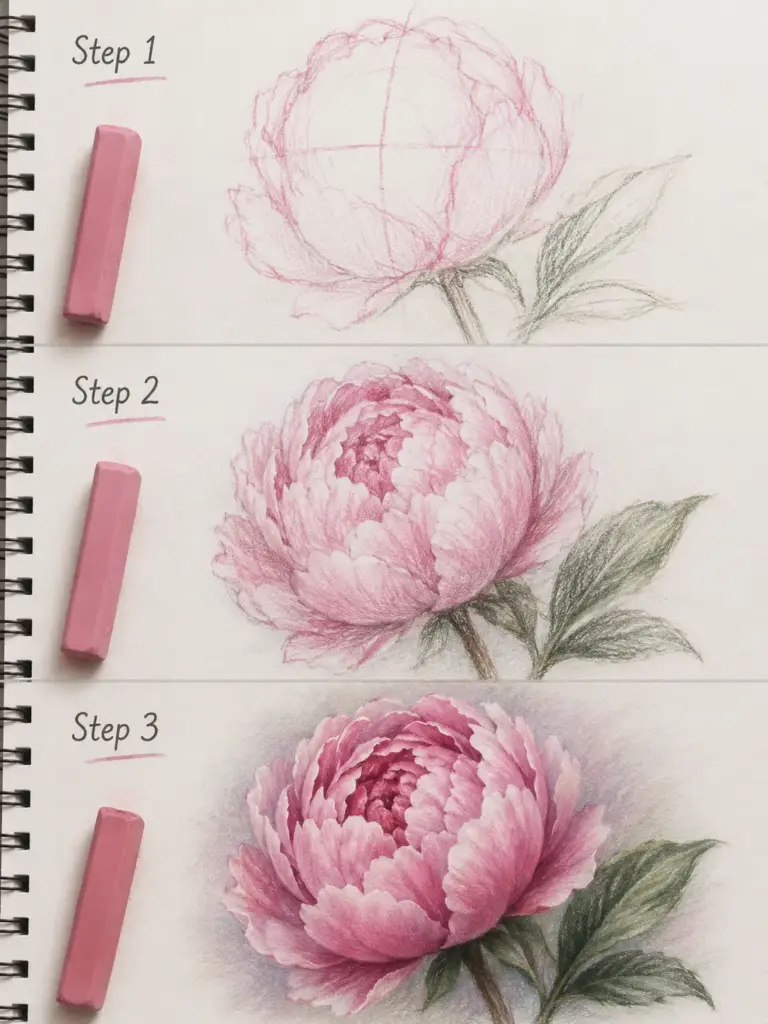
To draw a peony, start with a loose circle for the full bloom and a smaller inner circle for the compressed center petals. Sketch five to seven large outer petals first, then build smaller overlapping rings toward the middle. Keep the inner petals irregular and crowded, because a peony center looks more like folded fabric than a simple daisy center.
Refine the strongest petal edges, erase the construction lines, then shade the darkest values where petals overlap and where the bloom turns away from the light. Use HB for the sketch, 2B for midtones, and 4B for the deepest shadows. Finish with ink, watercolor, or colored pencil only after the pencil structure reads clearly.
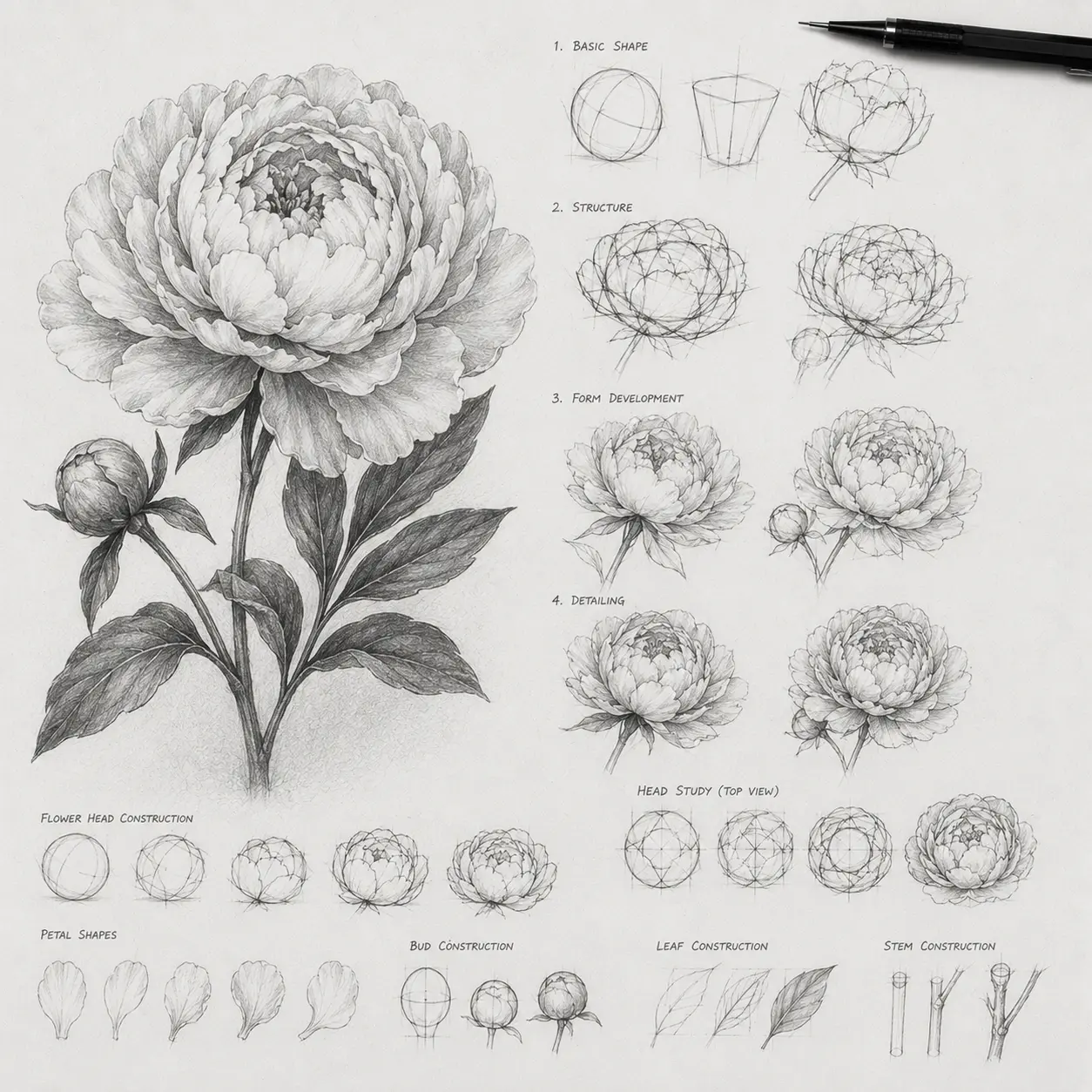
| Step | What to draw | Tool | Common mistake |
|---|---|---|---|
| 1 | Outer bloom circle and smaller center circle | HB pencil | Pressing too hard on construction lines |
| 2 | Large outer petals, then tighter inner rings | HB or 2B pencil | Making every petal the same size |
| 3 | Refined petal edges, leaves, and stem | Sharp HB pencil | Tracing every guide line instead of choosing the best line |
| 4 | Dark center shadows and soft petal gradients | 2B, 4B, kneaded eraser | Shading the whole flower at one flat value |
| 5 | Ink, watercolor, or colored pencil finish | Micron 03, watercolor, or colored pencils | Adding color before the drawing structure works |
Once that structure is clear, the drawing becomes a sequence of decisions rather than a guessing game. This guide walks through the full process: from the first construction line to finished shading, ink, and color. No shortcuts, no vague advice about ‘sketching loosely.’ Just a specific sequence that works.
If you are not ready for peony-level petal density yet, start with the broader how to draw a flower guide first. It covers daisies, tulips, roses, and sunflowers, which makes the layering in a peony much easier to read.
If peony petals feel too dense, warm up with a flatter botanical subject first: this easy fall leaves drawing lesson lets you practice outline, veins, and shading without managing dozens of overlapping petals.
What you need before you start
Disclosure: This post contains affiliate links. As an Amazon Associate I earn from qualifying purchases. If you buy through links in this post, we may earn a small commission at no extra cost to you.
| Tool | Best use | Why it matters |
|---|---|---|
| HB pencil | Construction circles and first petal layout | Light enough to erase cleanly. |
| 2B pencil | First shading pass and petal midtones | Builds soft tone without getting muddy too fast. |
| 4B pencil | Deep overlaps and the compressed flower center | Gives the drawing real contrast. |
| Kneaded eraser | Lift highlights from petal faces | Pulls light back out without tearing the paper. |
| Bristol or watercolor paper | Pencil, ink, watercolor, or colored pencil finish | Holds repeated shading and erasing better than thin sketch paper. |
Gathering the right tools before you draw is not fussiness. It’s planning. A peony drawing requires at least three pencil grades (light for construction, dark for shading, and something in between for midtones), a good quality eraser, and paper with enough tooth to hold multiple shading passes without going shiny.
Pencils
Start with an HB for construction lines, a 2B for initial shading, and a 4B for deep shadows between petals. If you’re comfortable with a mechanical pencil, a 0.5mm or 0.7mm with HB lead is useful for the fine-detail work in the center.
Staedtler Mars Lumograph pencils are my consistent recommendation: they sharpen cleanly and erase well, which matters during the construction phase when you’ll be removing a lot. A blending stump (also called a tortillon) is worth having. You can use it to soften the hatching lines in large shaded areas, particularly on the outer petals where you want a gradual tone rather than visible strokes. Alternatively, a clean finger works, though it deposits more oil on the paper surface.
Paper
Cartridge paper or Bristol smooth at 160gsm or above will hold the pressure you’ll apply during shading. Cheaper drawing paper buckles under an eraser and goes shiny from repeated pencil strokes, which kills the depth of a shaded drawing.
Canson XL Bristol and Strathmore 300-series are both reliable mid-price options that handle pencil well without committing you to premium sketchbook prices. If you’re planning to add watercolor or ink, use a heavier paper from the start.
Watercolor paper at 200gsm or above won’t warp when wet. Hot-press watercolor paper gives the smoothest surface for pencil combined with color. Cold-press gives more texture, which shows up in the paint layers and looks less refined but more expressive.

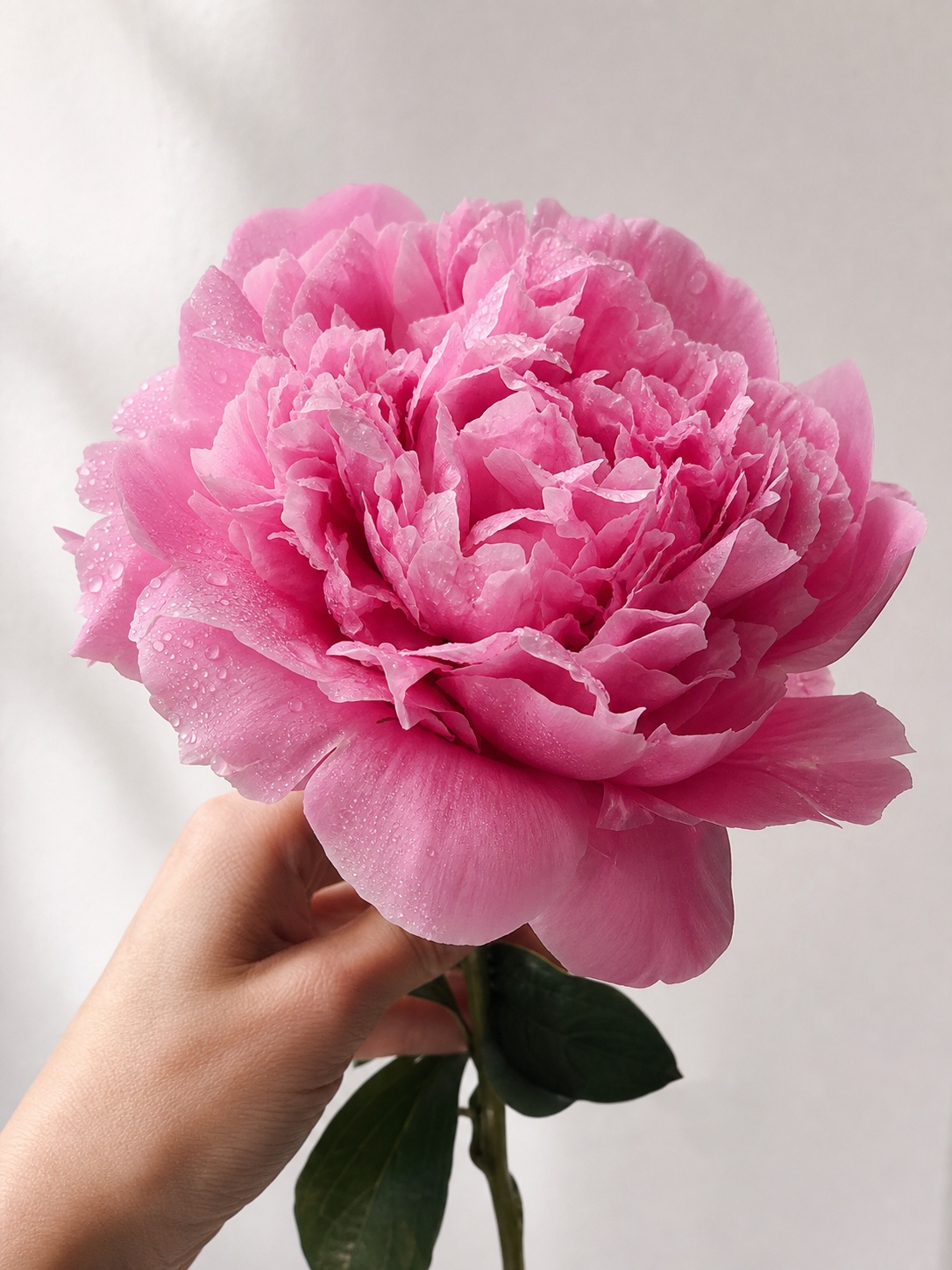
Keep a real peony or a high-resolution reference photograph in front of you as you draw. The difference between a convincing peony and a generic flower is almost always in the specific irregularities: petals that don’t quite meet, a slight asymmetry in the overall shape, an inner petal that curls backward unexpectedly. These details can’t be invented, only observed.
Step 1: construction and basic structure
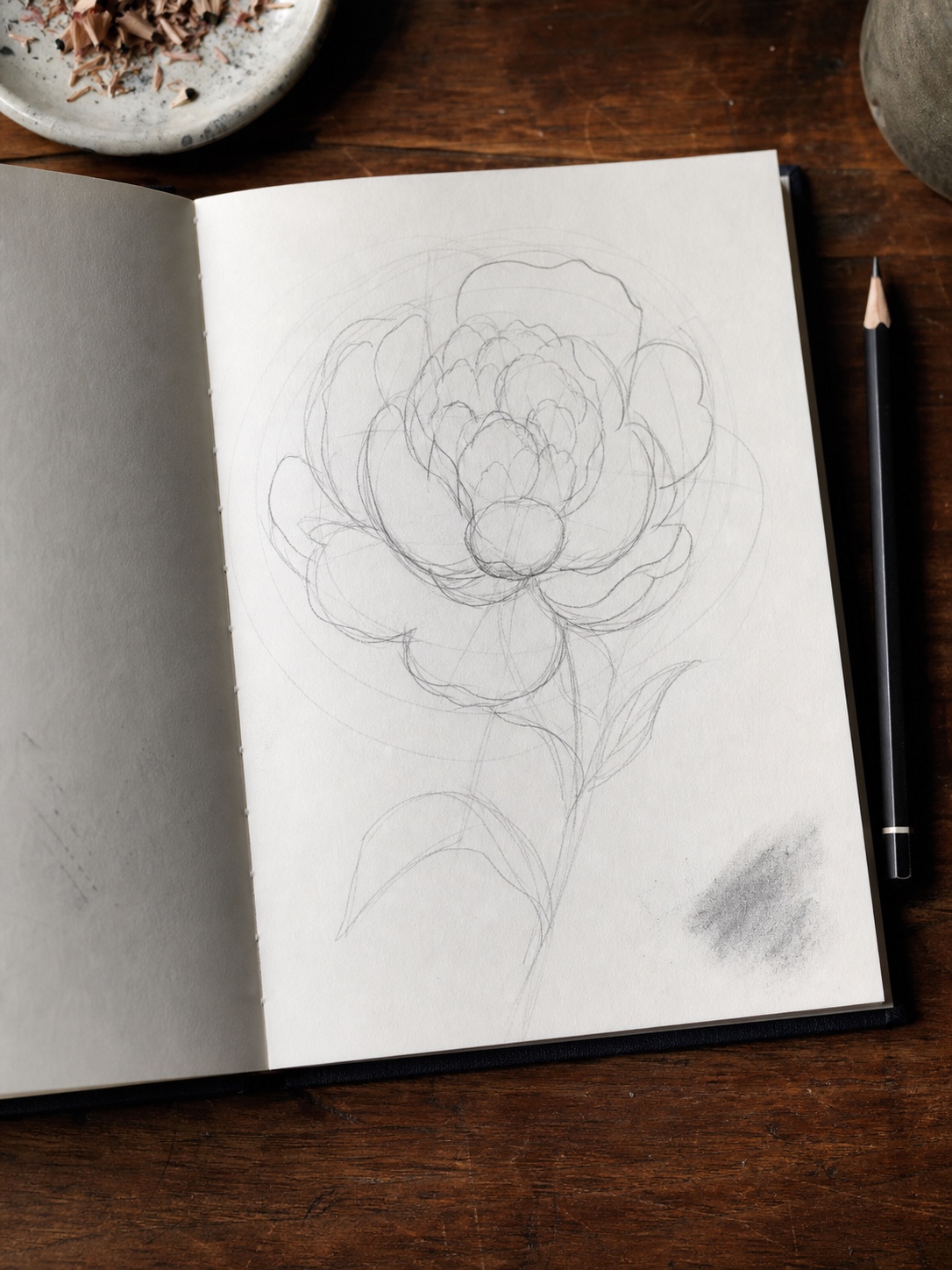
Every peony drawing starts the same way, whether you’re sketching in a five-minute gesture or building a detailed botanical illustration. A circle for the overall bloom, a smaller circle inside it for the center. Light pressure, loose grip. These are planning marks, not final lines.
The outer circle and center placement
Draw a loose ellipse or circle for the overall bloom diameter. Peonies are roughly spherical in shape, but you’ll rarely be looking at them straight on, so decide first on your viewing angle.
A three-quarter view (slightly above and to one side) gives you the most interesting petal arrangement and shows the depth of the bloom better than a flat frontal view. Inside the outer circle, draw a smaller circle about one-third of the overall diameter. This marks the center zone where the inner petals are compressed. The distance between the inner circle and the outer circle is your ‘petal field,’ where the main visible layers live. Mark a light cross through the center (horizontal and vertical axis lines) to help maintain symmetry as you build.
Roughing in the first petal layer
The outer petals of a double peony are the easiest to draw: large, cupped, slightly irregular, and they overlap like roof tiles. Rough in five to seven outer petals around the perimeter of your outer circle. Don’t worry about the exact shape yet.
The priority is establishing the rhythm: petals at roughly equal intervals, each one slightly offset from the ones beside it so they overlap naturally. Leave some petals only partially visible where they tuck behind the ones in front. This overlap is what gives the bloom its three-dimensional quality. A peony where every petal is fully visible looks flat. A peony where some petals disappear behind others reads as genuinely volumetric.
Step 2: building the petal layers inward
A double peony has three to five distinct petal rings, each one a bit smaller and more compressed than the one outside it. Working from the outer edge inward, you’re describing a flower that gets tighter and more complex the further you go. This is also where most beginners get lost, because the inner petals stop behaving like typical flower petals and start looking like crumpled fabric.
The middle ring
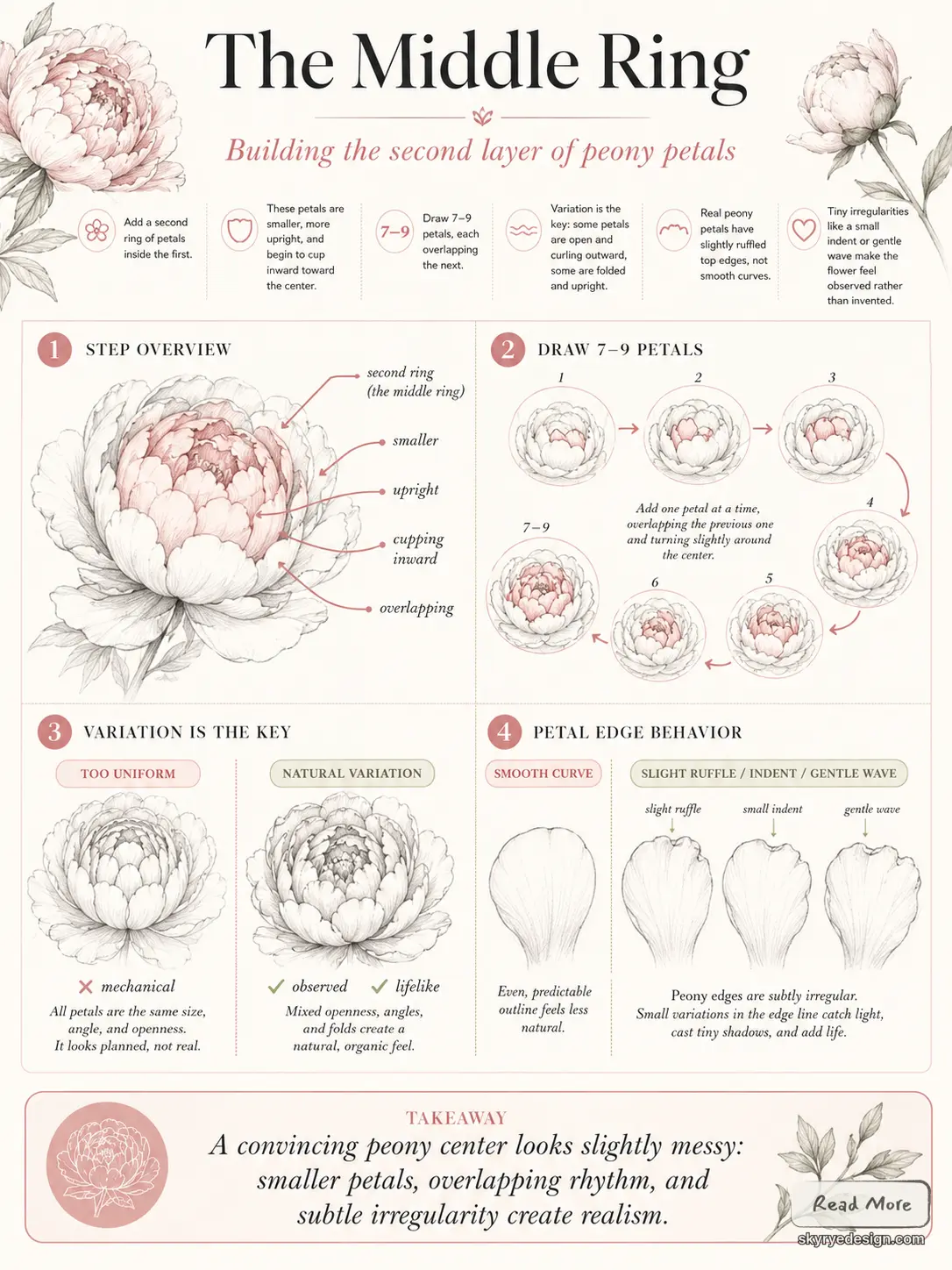
Add a second ring of petals inside the first. These are smaller, more upright, and they start to cup inward toward the center. Draw seven to nine of them, each overlapping the next. At this ring, the petals begin to show more variation in shape: some are open and curling outward, some are still folded and upright. The variation is the key.
Uniform petals at this stage look mechanical. Pay attention to how the petal edges behave. Real peony petals are slightly ruffled at the top edge, not smooth curves. A very slight irregularity along the petal tip, a small indent or a gentle wave, makes the drawing look observed rather than invented. This is the kind of thing that separates botanical illustration from decorative flower drawing.
The inner petals and center
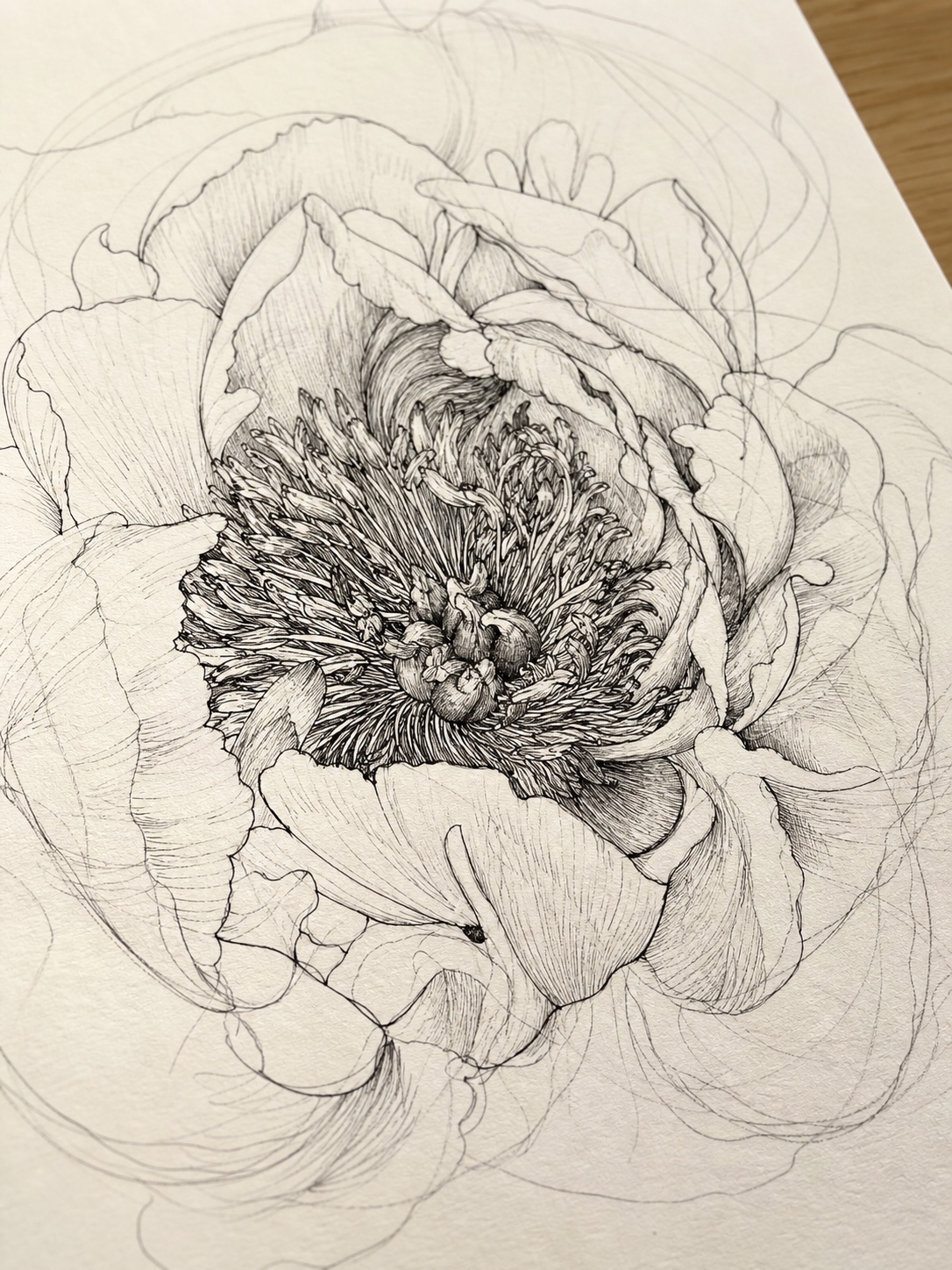
This is the hardest part. The innermost petals are small, densely packed, and they angle in different directions simultaneously. Rather than trying to draw each one individually, group them into clusters. A cluster of three or four petals angling one direction, another cluster angling another. Some are folded nearly closed, some are half-open.
At the very center, draw a small irregular mass of tightly packed petals with only their tips visible. Around this, the stamens (small dot-headed structures) are visible in an open bloom. The American Peony Society’s flower anatomy guide is useful here because it separates single, semi-double, bomb, and full double flower forms. In a very full double peony the stamens are mostly hidden. In a semi-double they’re prominent and worth including for botanical accuracy. A ring of small circles or short dashes at the inner edge of the center cluster reads as stamens convincingly.
Step 3: refining the outer petals and adding leaves
With the structure roughed in, the refinement phase is about committing to your best petal lines and eliminating the ones that are just planning marks. This is the phase where the drawing starts to look like itself rather than a sketch toward something.
Refining petal edges
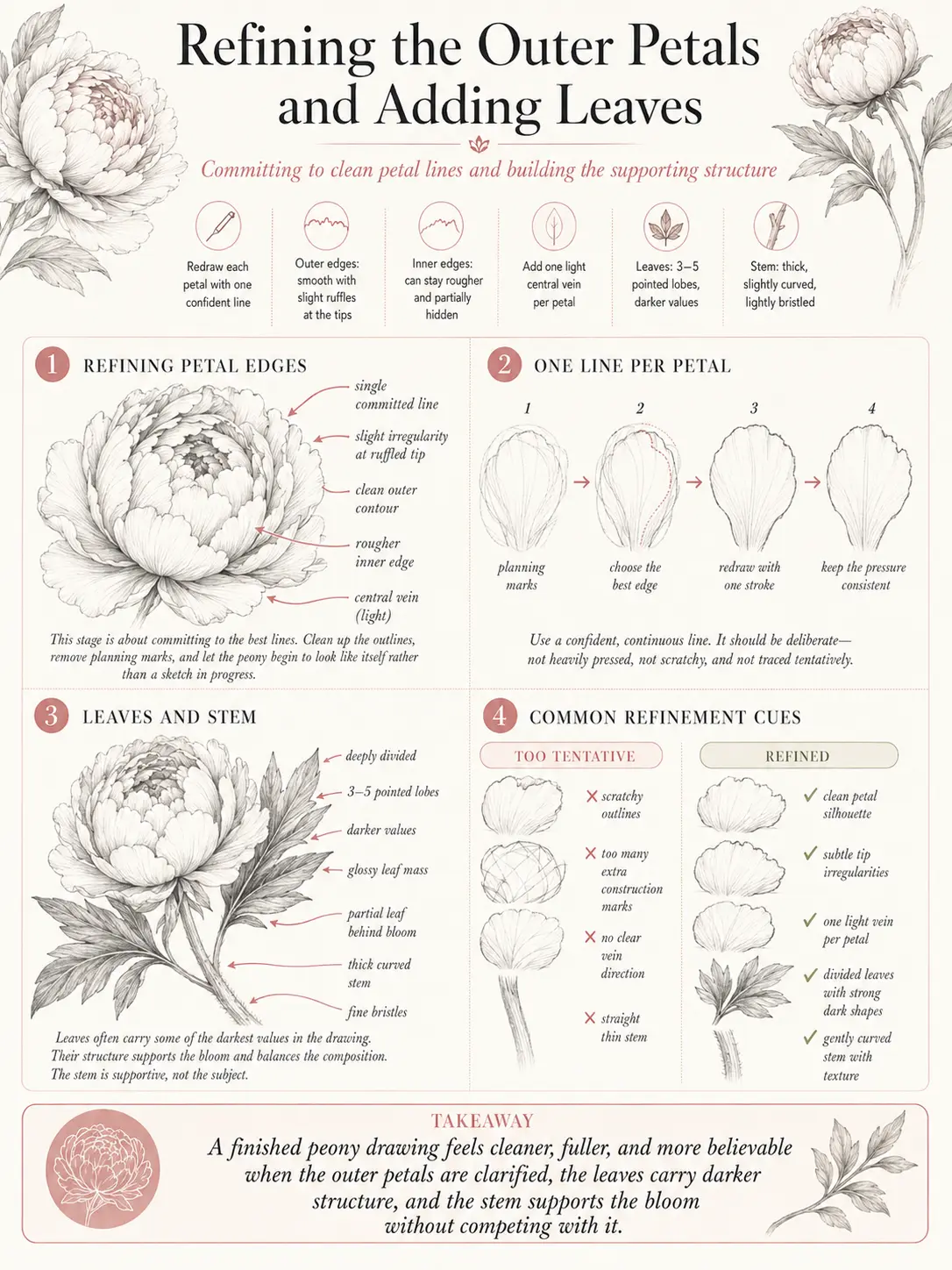
Go through each petal and redraw its outline with a single committed line. Not pressed hard, not traced tentatively: a single confident stroke at the pressure you’ll keep through the rest of the drawing. The outer petal edges should be smooth with slight irregularities at the ruffled tips.
The inner edge of each petal (the edge closest to the center) can be rougher, since those edges are partly hidden by adjacent petals. Add a central vein line to each petal: a single light line running from the base to about two-thirds up the petal surface. This suggests the petal’s structure and gives the shading something to follow later. Don’t overdo it. One line per petal. Real peony petals have a minimal vein structure compared to leaves, so you’re suggesting rather than mapping.
Adding leaves and stem
Peony leaves are deeply divided, with three to five pointed lobes on each leaf. They’re a dark, glossy green, which means in pencil they carry some of the deepest values in the composition.
Add two to three leaves at the base of the bloom, one at full visibility and one partially behind the bloom or the stem. The stem of a peony is thick and slightly curved, not a straight line. It’s also hairy (covered in fine bristles), which you can suggest with short light strokes angled along the stem length. Don’t overwork the stem: it’s a supporting element, not the subject.
Step 4: shading the pencil drawing
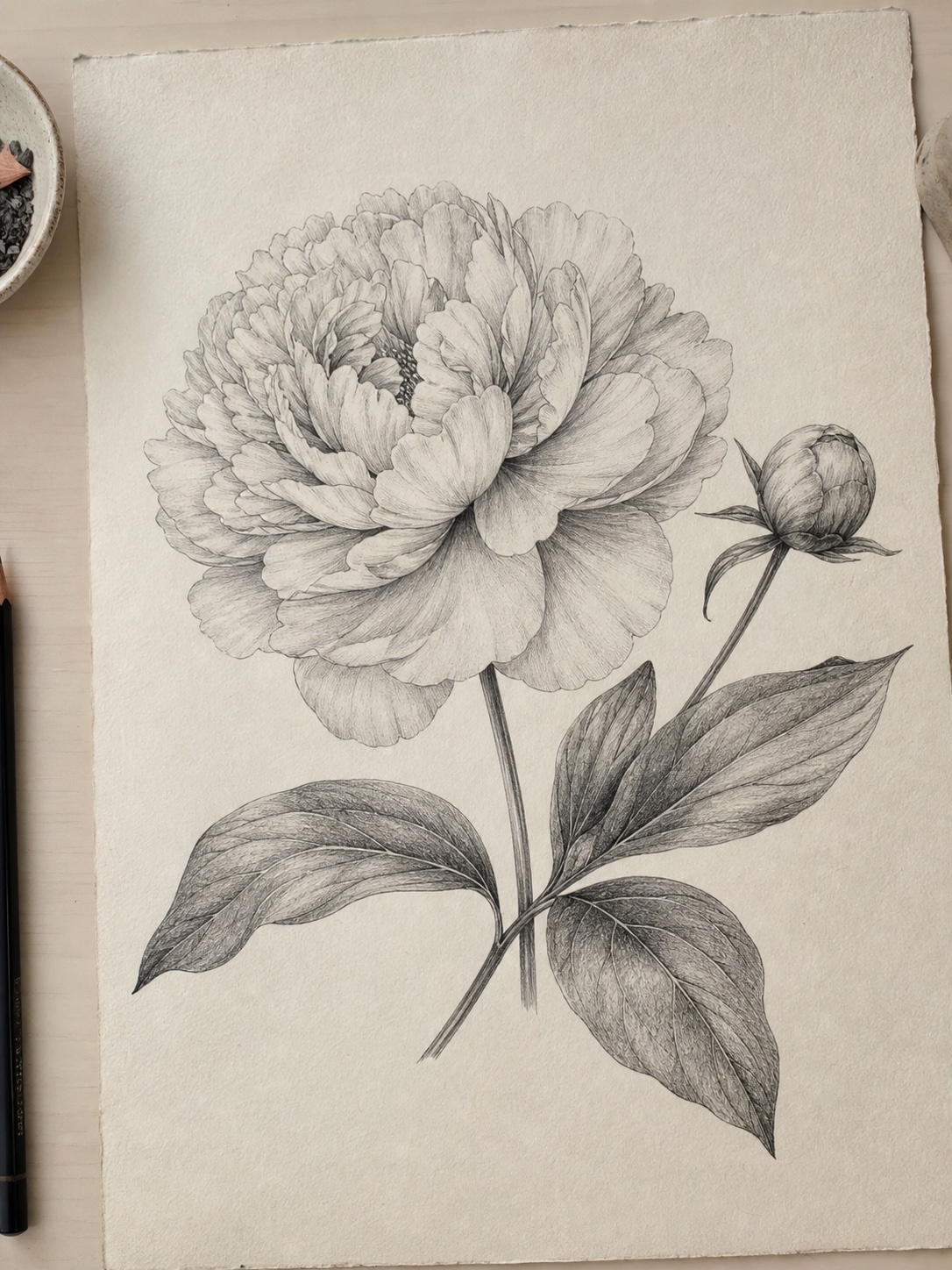
Shading is where the peony goes from a flat diagram to a three-dimensional object. The principle is simple: shadow lives where petals overlap and where the bloom curves away from the light. Application requires patience and the willingness to build value gradually rather than pressing hard on the first pass.
Where the dark values go
The darkest areas in a peony drawing are at the center (where inner petals compress together), at the base of each petal where it tucks behind the petal in front of it, and in any deep gaps between layers. The outer petal surfaces facing the light stay lightest.
Start with the center: press lightly with a 4B pencil and build up a dark, compressed tone in the innermost petal cluster. Work outward from there, getting progressively lighter as you move toward the outer petals. Use directional hatching that curves with the surface of each petal, following its form rather than going in a flat direction across it.
Gradients on petal surfaces
Each large outer petal should carry a tonal gradient from darker at its base (where it’s in shadow from the petal above) to lighter toward its tip (where it catches light). Use a blending stump to smooth these gradients after the initial hatching pass.
The goal is a soft tonal shift, not a hard line between light and dark. Use a kneaded eraser to pull highlights back out once shading is in. The brightest points on each petal are a small area near the top-center of the petal face. A kneaded eraser can be shaped to a point and used to lift a small bright spot without disturbing the surrounding shading.
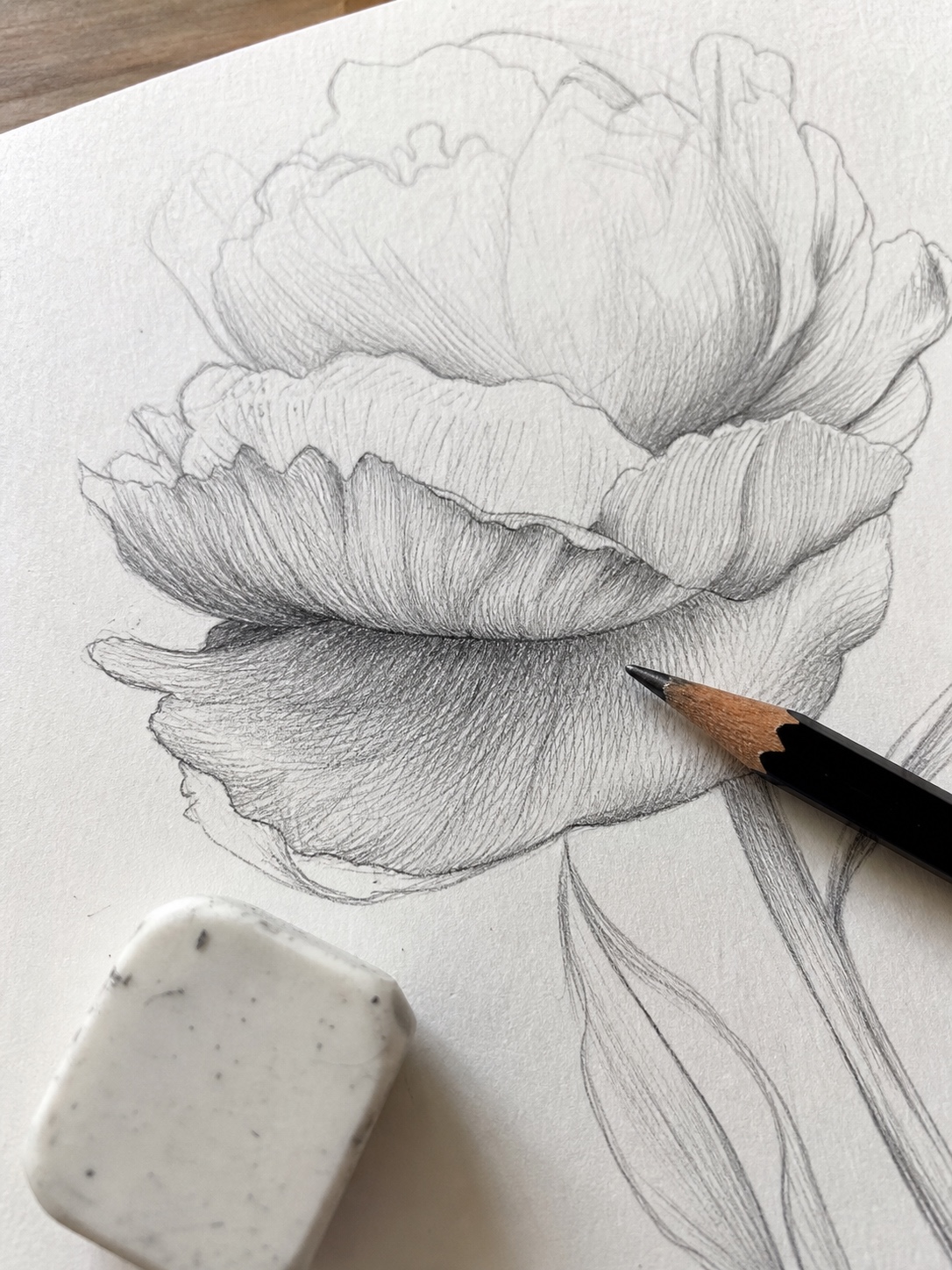
Don’t shade every petal equally. A composition with one area of maximum darkness and one area of maximum lightness reads better than one with uniform midtones throughout. Place your darkest value at the center and your lightest area somewhere on the outer petals, and let everything else sit between those two anchors.
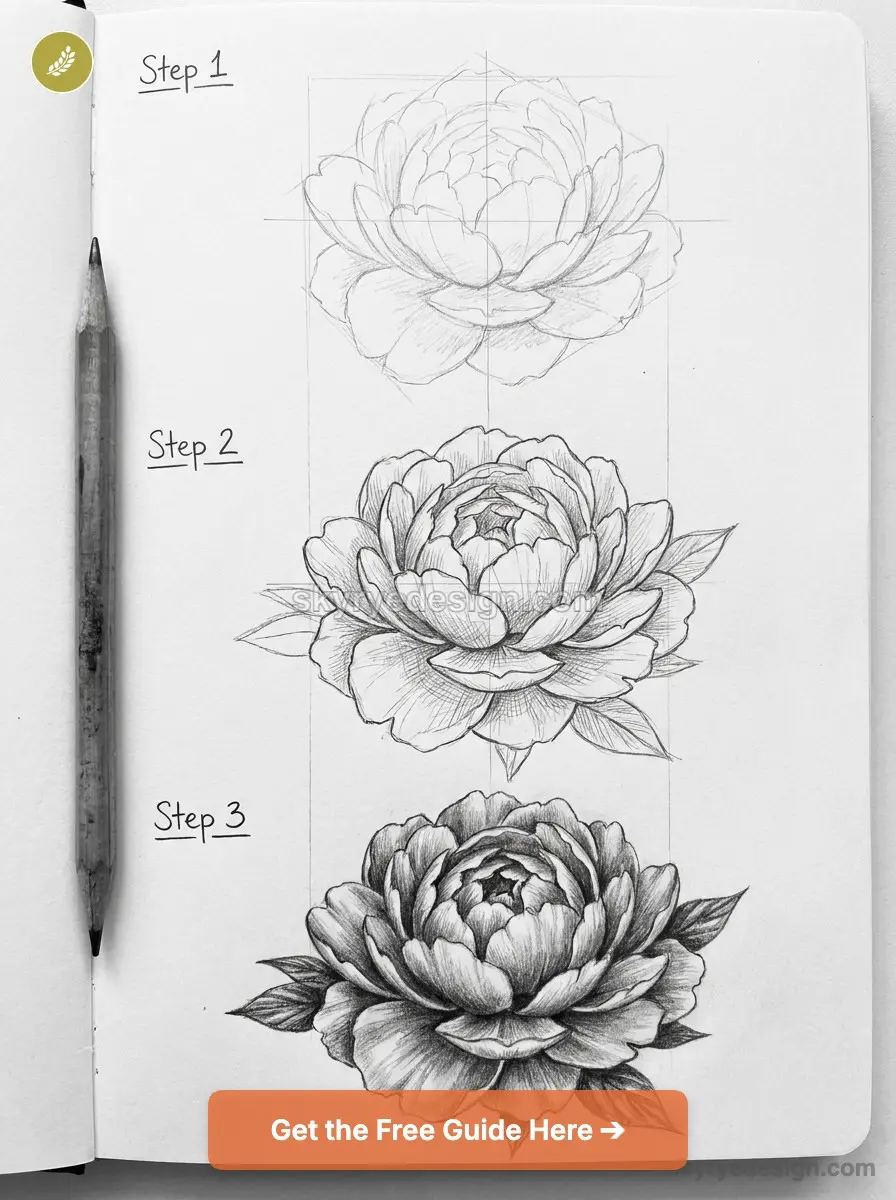
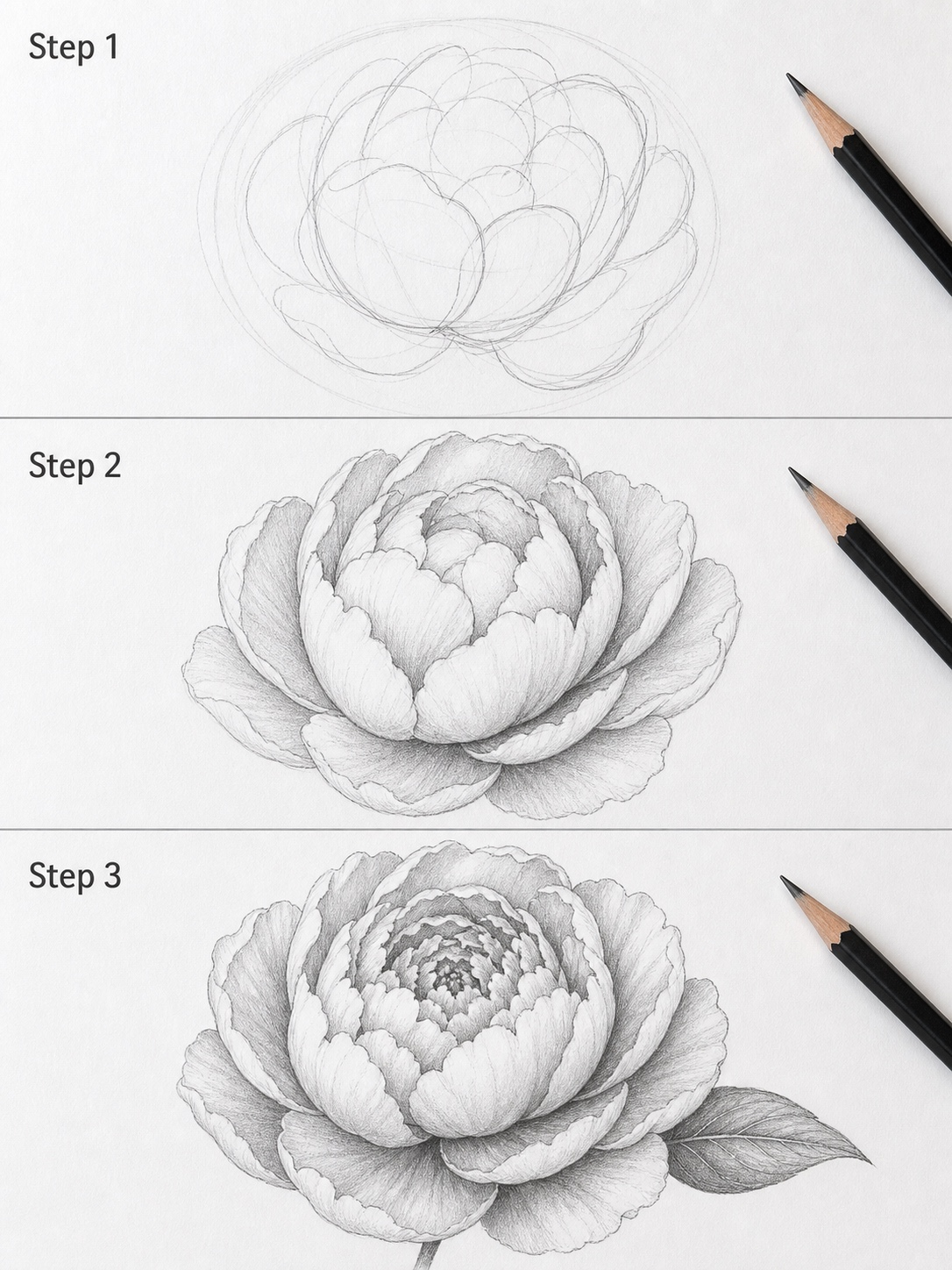
Step 5: adding ink, watercolor, or colored pencil
The pencil drawing is complete as a standalone illustration. If you want to take it further into ink or color, here’s how each medium changes the process.
Ink over pencil
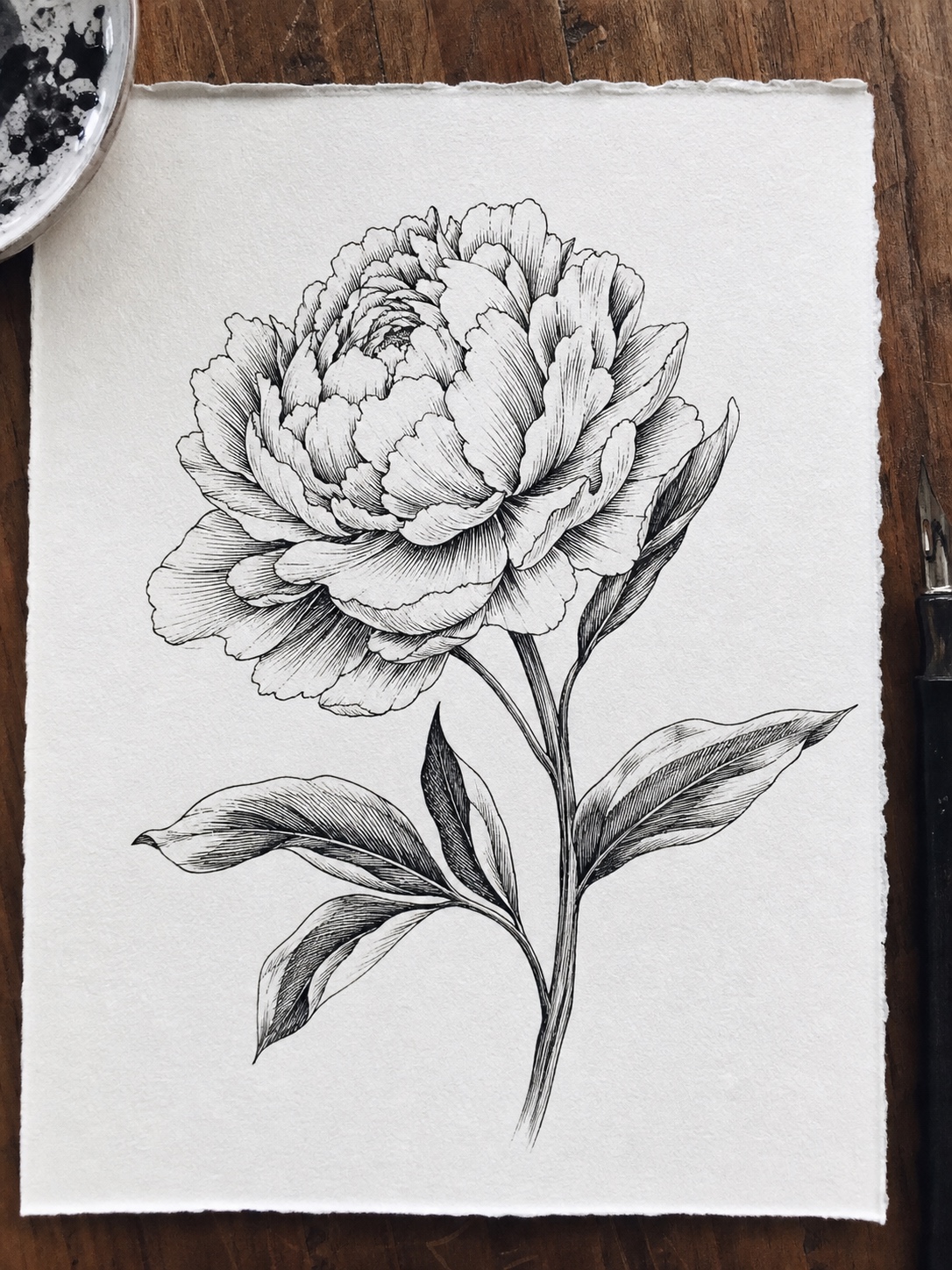
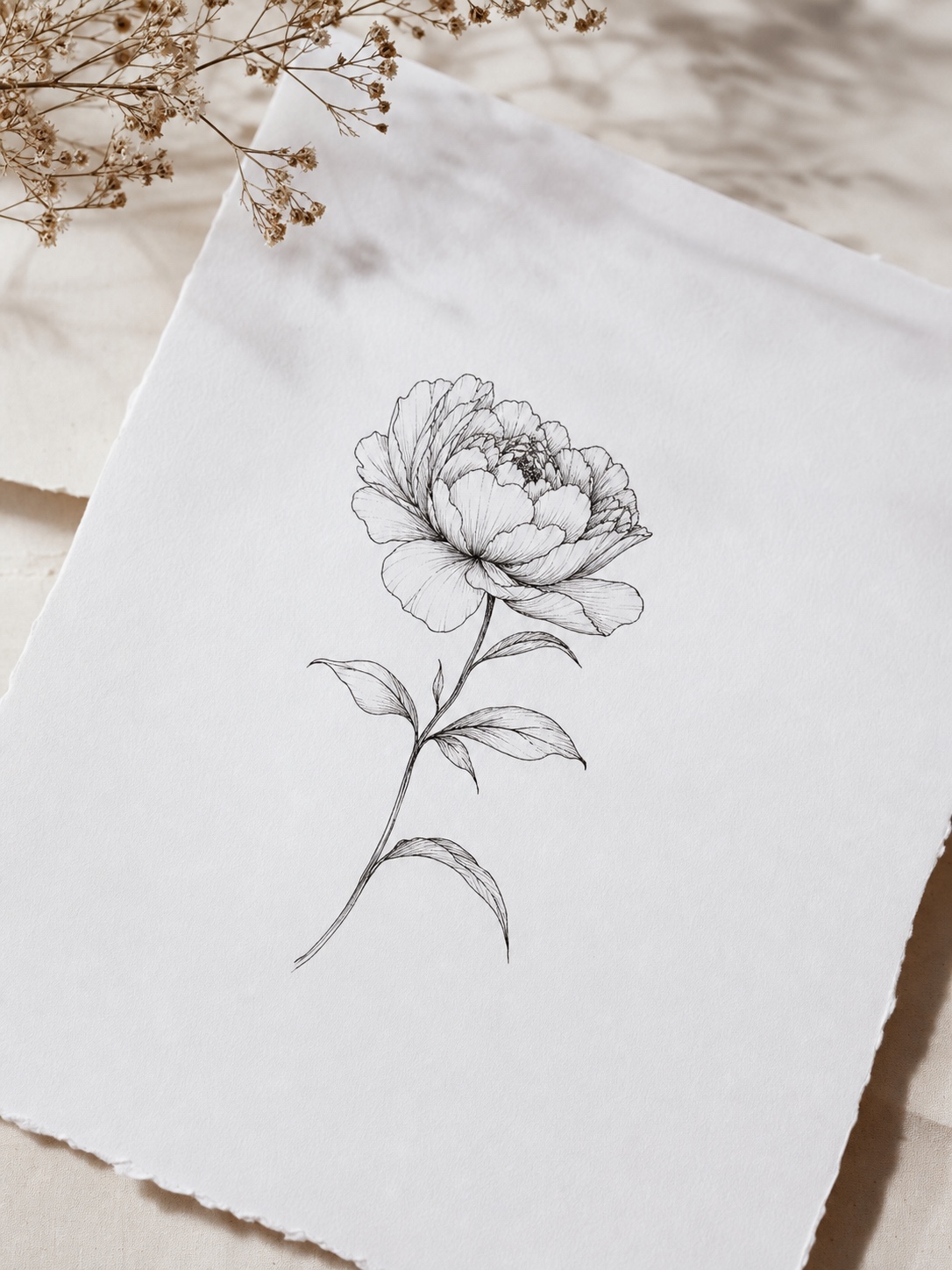
Use a fine-liner at 0.3mm or 0.5mm (Sakura Micron or Staedtler Pigment Liner both work well) for the line art. Trace over your refined pencil lines with confident, controlled strokes. Vary your line weight: heavier at the base of petals and where one petal passes behind another, lighter at the tips and on petal surfaces. Build shadow through hatching rather than filling areas solid black.
Curved hatching that follows the petal surface reads more naturally than straight-line cross-hatching. Use stippling (small dots) for the softest tonal gradations, particularly on the curved petal surfaces. Once the ink is fully dry, erase all pencil marks with a clean eraser. The ink lines hold their own.

Watercolor
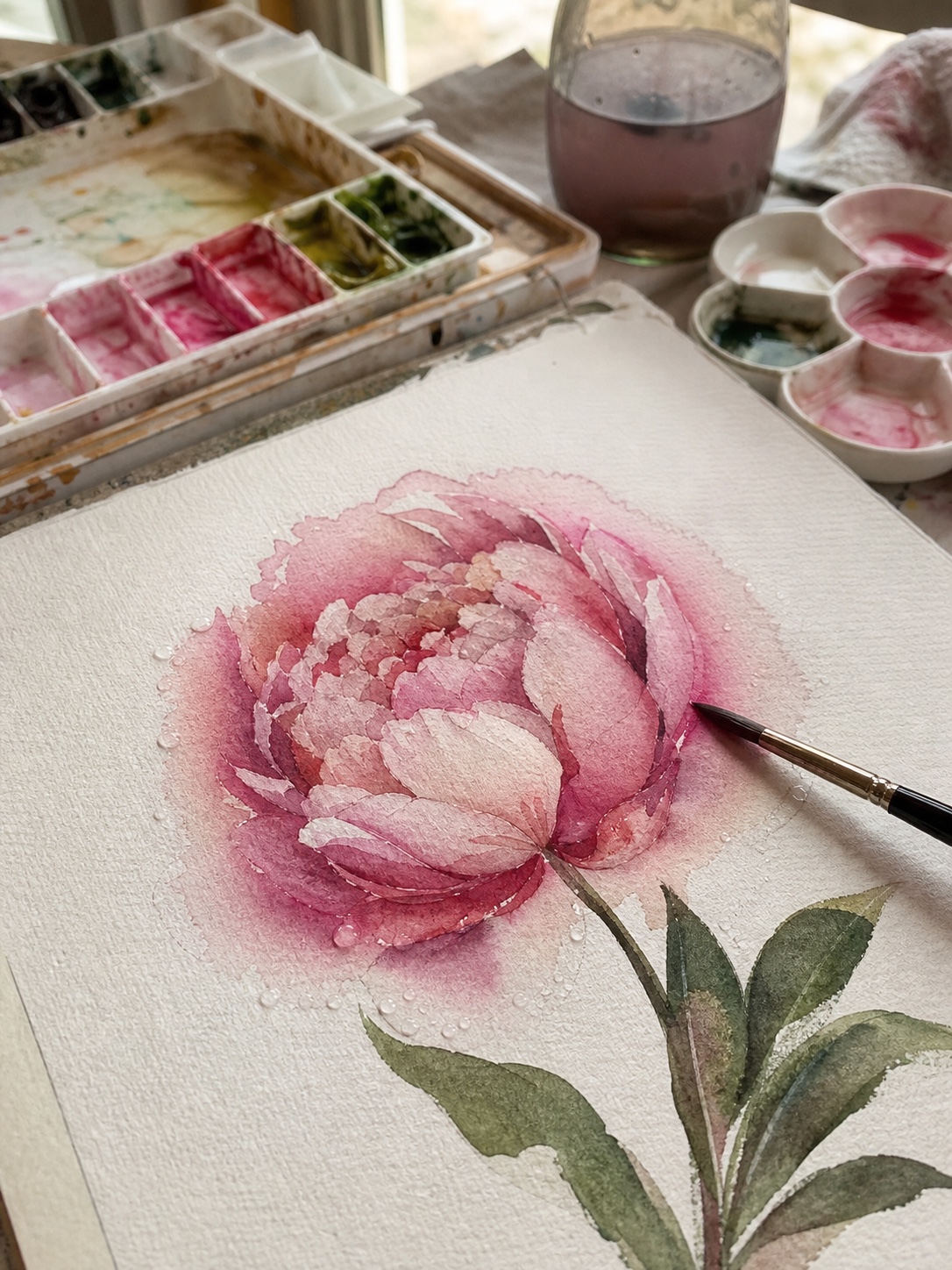
Watercolor over a pencil sketch requires working wet-on-wet for the soft petal transitions and wet-on-dry for edges and detail. Start with a pale wash of pink across all the petals simultaneously: a mix of permanent rose and a small amount of cadmium red, heavily diluted. Let this dry fully before adding the second layer.
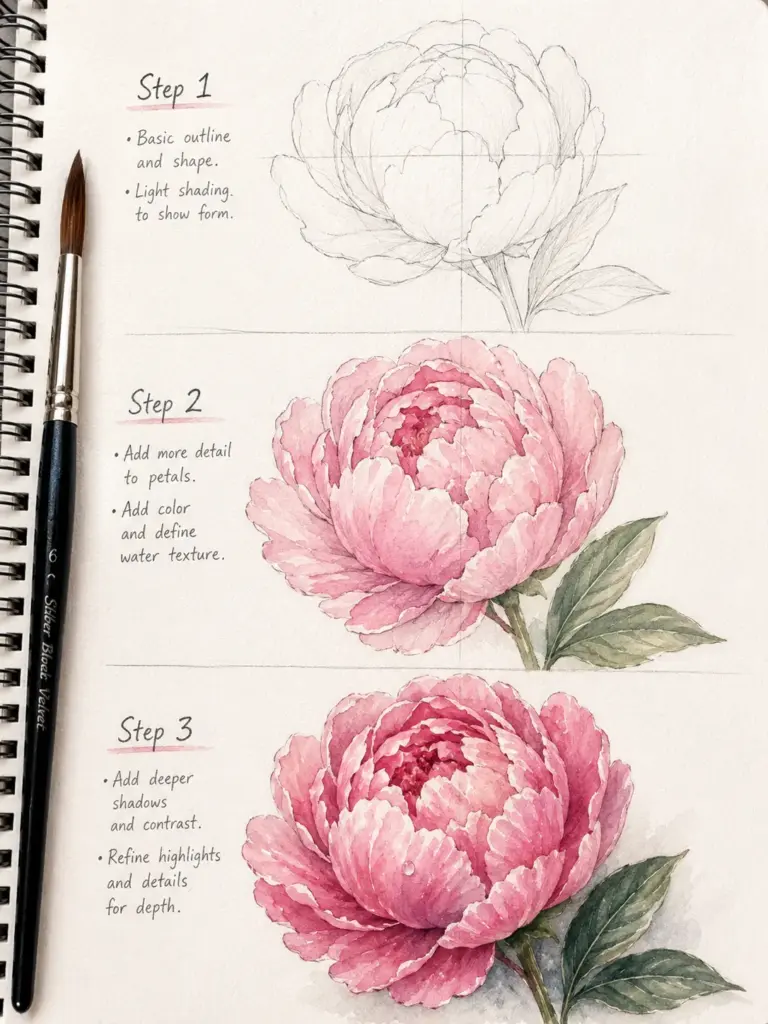
Second layer: deepen the shadows at petal bases and the center with a stronger concentration of the same mix, with a touch of violet added to push it toward a cooler shadow tone. Peony shadows read cooler than the lit petal faces, which stay in the warm pink-rose range. Work quickly in the wet phase to avoid hard edges where you don’t want them.
Colored pencil
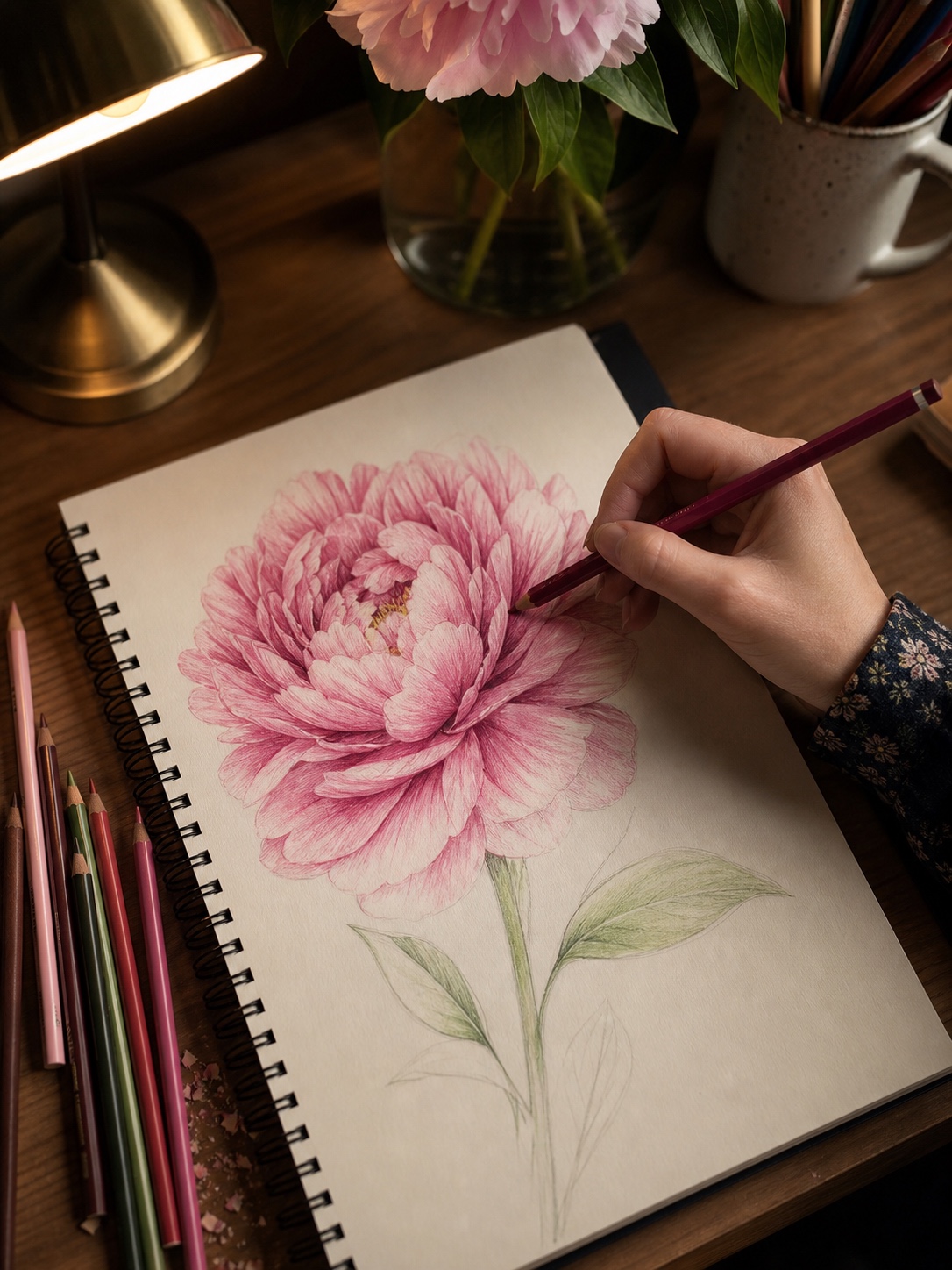
Colored pencil gives you the most control at the cost of the most time. Start with a light blush pink as the base layer across all petals (Faber-Castell Polychromos Rose Carmine is a good starting point). Add a second layer of Magenta or Medium Crimson at the shadow areas, blending with a white pencil or a colorless blender marker where the tones meet.
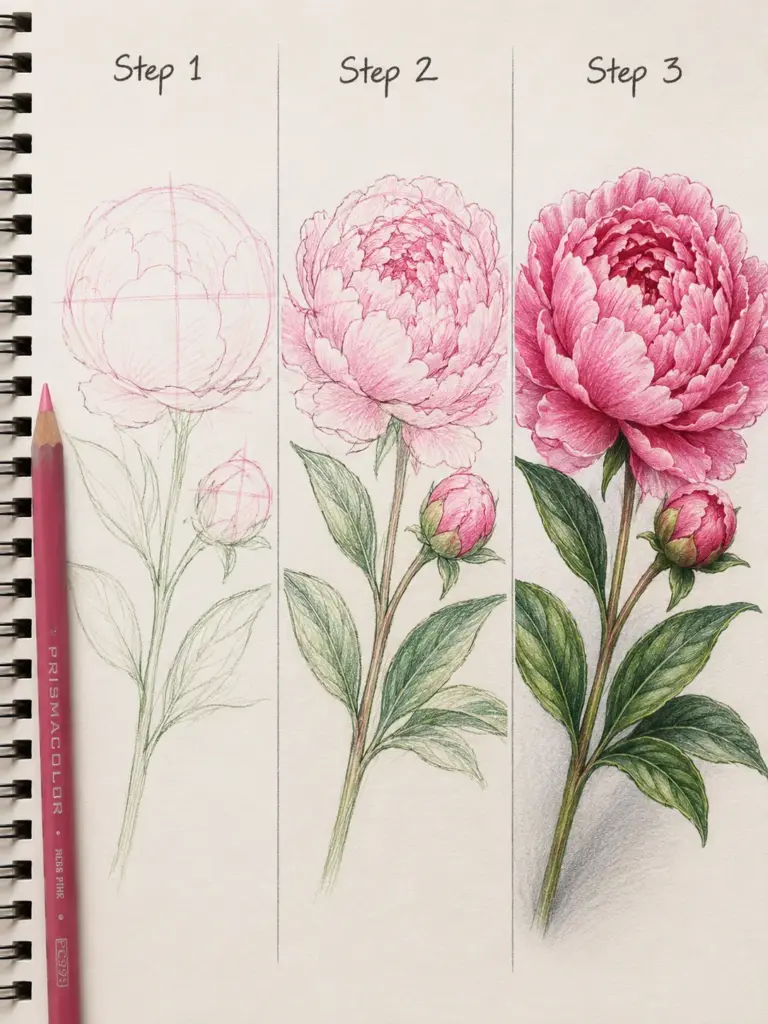
The center should be the darkest: several layers of deep pink and a touch of violet, with some cream or light yellow at the very center where the stamens would be. Leaves in colored pencil work best with two or three greens layered (dark green as the base, olive or sap green for midtones, and a touch of yellow-green for the lightest highlights on leaf edges).
Peony drawing checklist before you finish
- Inner petals are smaller, denser, and less uniform than outer petals.
- Back petals are visible and slightly darker than front petals.
- The center has the darkest values in the flower.
- Outer petal tips keep the lightest values.
- Hatching follows the curve of each petal instead of running straight across the bloom.
Common mistakes and how to fix them
After looking at a lot of student peony drawings over the years, the failures cluster around the same three problems. Fixing them doesn’t require starting over.
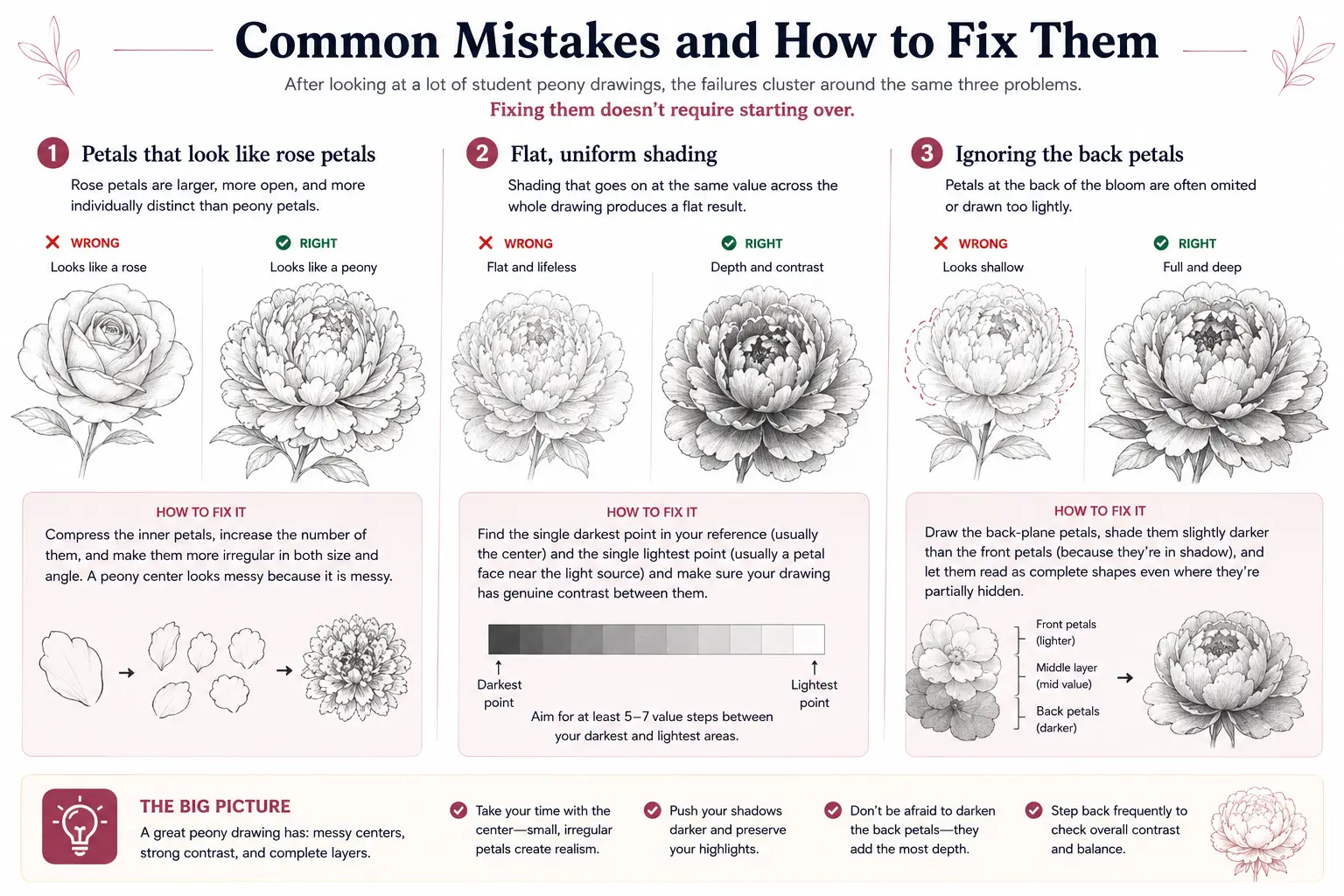
Petals that look like rose petals
Rose petals are larger, more open, and more individually distinct than peony petals. If your peony looks like a rose, the issue is usually that the inner petals are too large and too uniformly shaped. The fix: compress the inner petals, increase the number of them, and make them more irregular in both size and angle. A peony center looks messy because it is messy.
Flat, uniform shading
Shading that goes on at the same value across the whole drawing produces a flat result even when the line drawing underneath is correct. Look for the single darkest point in your reference (usually the center) and the single lightest point (usually a petal face near the light source) and make sure your drawing has genuine contrast between them. If the darkest and lightest areas are within two or three tonal stops of each other, the drawing reads flat.
Ignoring the back petals
Petals at the back of the bloom that show behind the front petals are often either omitted or drawn too lightly. These back-plane petals are important: they’re what gives the bloom its depth and sense of fullness. Draw them, shade them slightly darker than the front petals (because they’re in shadow), and let them read as complete shapes even where they’re partially hidden.
Frequently Asked Questions
How do you draw a peony for beginners?
Start with a loose circle for the overall shape, then a smaller circle inside it for the center zone. Build outward from the center layer by layer, drawing five to seven petals per ring, each slightly larger than the last. Keep lines loose in the sketch phase. Work from center outward: get the inner petals right before committing to the outer layers.
What pencil is best for drawing a peony?
HB for initial sketch and construction lines. 2B or 4B for shading shadow areas between petals. A mechanical pencil at 0.5mm or 0.7mm is useful for center detail and stamen work. Keep a kneaded eraser for lifting highlights once shading is in. Staedtler Mars Lumograph pencils are reliable across all grades for botanical work.
How many petals does a peony have?
A single peony usually has one clean ring of broad petals, while a double peony can have dozens of petals packed into several layers. For drawing, that difference matters more than the exact count. Use the outer petals to establish the flower’s width, then suggest the dense center through overlapping small shapes, darker gaps, and a few visible petal tips. The American Peony Society glossary is helpful if you want the botanical terms, but on paper the goal is simpler: make the center feel crowded without drawing every petal literally.
How do you shade a peony drawing?
Shade where petals overlap: the edge of one petal passing behind another carries a shadow. Use directional hatching that follows the curve of the petal surface. Leave top-facing surfaces lighter near the light source. Darkest values live at the center where petals crowd together and where outer petals fold back on themselves.
Can you draw a peony in ink?
Yes. Sketch lightly in pencil first, then trace with a fine liner (Micron 0.3 or 0.5). Build shadow through hatching and stippling rather than solid black. Vary line weight: heavier at petal bases, lighter at tips. Erase the pencil sketch once ink is fully dry. Ink forces commitment to your lines in a way that improves drawing decisions.
How long does it take to draw a peony?
A loose pencil sketch takes 15 to 30 minutes once you understand the petal structure. A refined pencil drawing with shading takes 1 to 3 hours. A finished ink illustration takes 2 to 4 hours. Watercolor or colored pencil adds another 1 to 3 hours. Most of the time in a quality peony drawing goes into the center petals and the shading between petal layers.
What is the hardest part of drawing a peony?
The hardest part is the inner petal cluster. It looks chaotic, but it still has structure: small petals fold inward, turn sideways, disappear behind each other, and leave narrow shadow gaps. Beginners usually make one of two mistakes. They either draw too few inner petals, which leaves the center empty, or they draw them too evenly, which makes the flower look mechanical. I slow down here and group the petals into small directional clusters before adding detail. Three petals leaning left, two curling upward, a dark gap underneath. That small grouping habit makes the center feel observed instead of guessed.
Peonies ask for patience, so I like warming up with tulip sketch practice first; it trains overlap without burying you in too many petals.
Next flower and nature drawing practice
If this peony felt useful, practice the same layering logic on a smaller subject next. A strawberry drawing teaches surface texture and highlights, while pen and ink botanical drawing helps you turn petal edges and leaf veins into cleaner line work.
If you enjoy flower studies with faces or figures, keep a separate board of watercolor portrait inspiration to compare soft petals with soft skin edges.
- 6.3Kshares
- Facebook0
- Pinterest6.3K
- Twitter0
- Reddit0