The first time most people try to draw a coral reef, it ends up looking like a pile of tangled scribbles. No depth. No recognizable coral shapes. Just curved lines going nowhere.
I know because I did the same thing. My early attempts looked more like intestines than ocean life.
- Why coral looks random (until you see the structure)
- The 6 coral types and how to draw each one
- Staging your composition: the 3-layer reef
- Step-by-step coral reef drawing
- Drawing underwater light and depth
- Adding marine life: fish, starfish, anemones
- Coloring your coral reef drawing
- Start with one coral type
- Frequently asked questions about coral reef drawing
- What is the easiest type of coral to draw for beginners?
- What pencils do I need to draw a coral reef?
- How do I make my coral reef drawing look 3D and not flat?
- Can I draw a coral reef in pencil only, without color?
- How long does a coral reef drawing take?
- What are the main types of coral to include in a reef drawing?
- How do I draw underwater light effects in a coral reef drawing?
The problem isn’t drawing skill — it’s skipping the step that anyone trained in design learns first: understand the form before you pick up the pencil. In my industrial design courses, we spent weeks doing nothing but decomposing everyday objects into primitive shapes. A car door is a compound curve over a planar surface. A chair leg is a tapered cylinder. Once you can name what you’re looking at, you can draw it.
Coral works exactly the same way. There are 6 recurring structural types — and once you know all six, a coral reef stops being a chaotic tangle and starts reading as a composition you can plan and build.
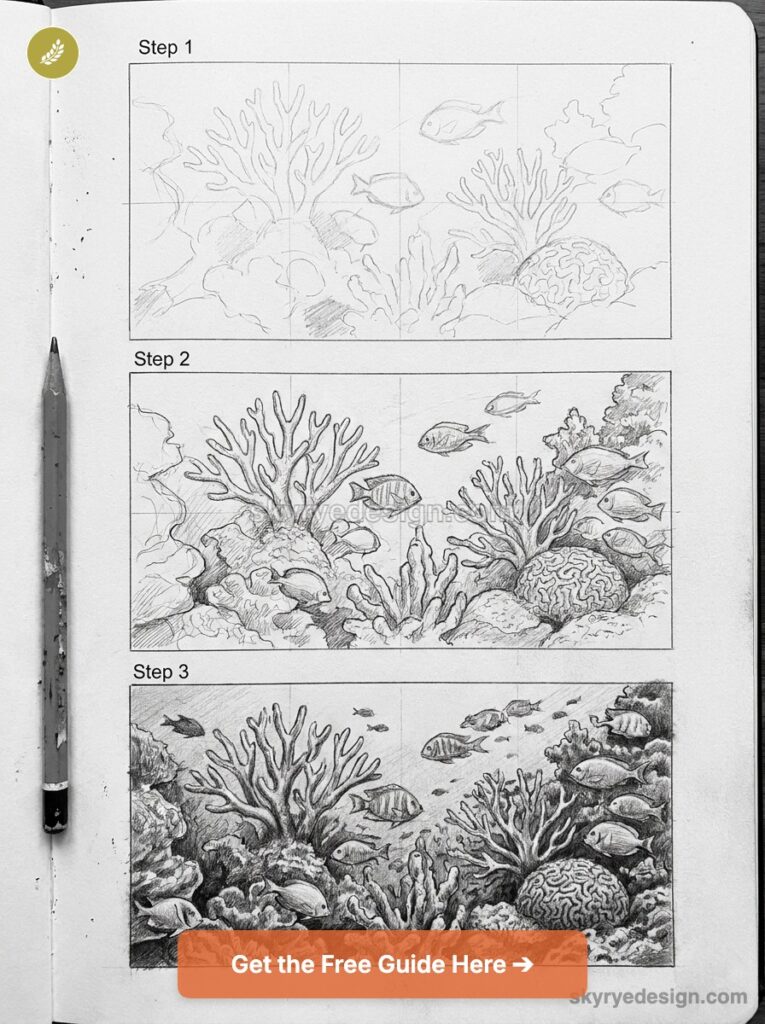
In this coral reef drawing guide, I’ll walk you through each type, how to stage a three-layer reef scene with real depth, and how to handle the underwater light that separates a flat drawing from something that actually feels like it’s underwater.
Why coral looks random (until you see the structure)
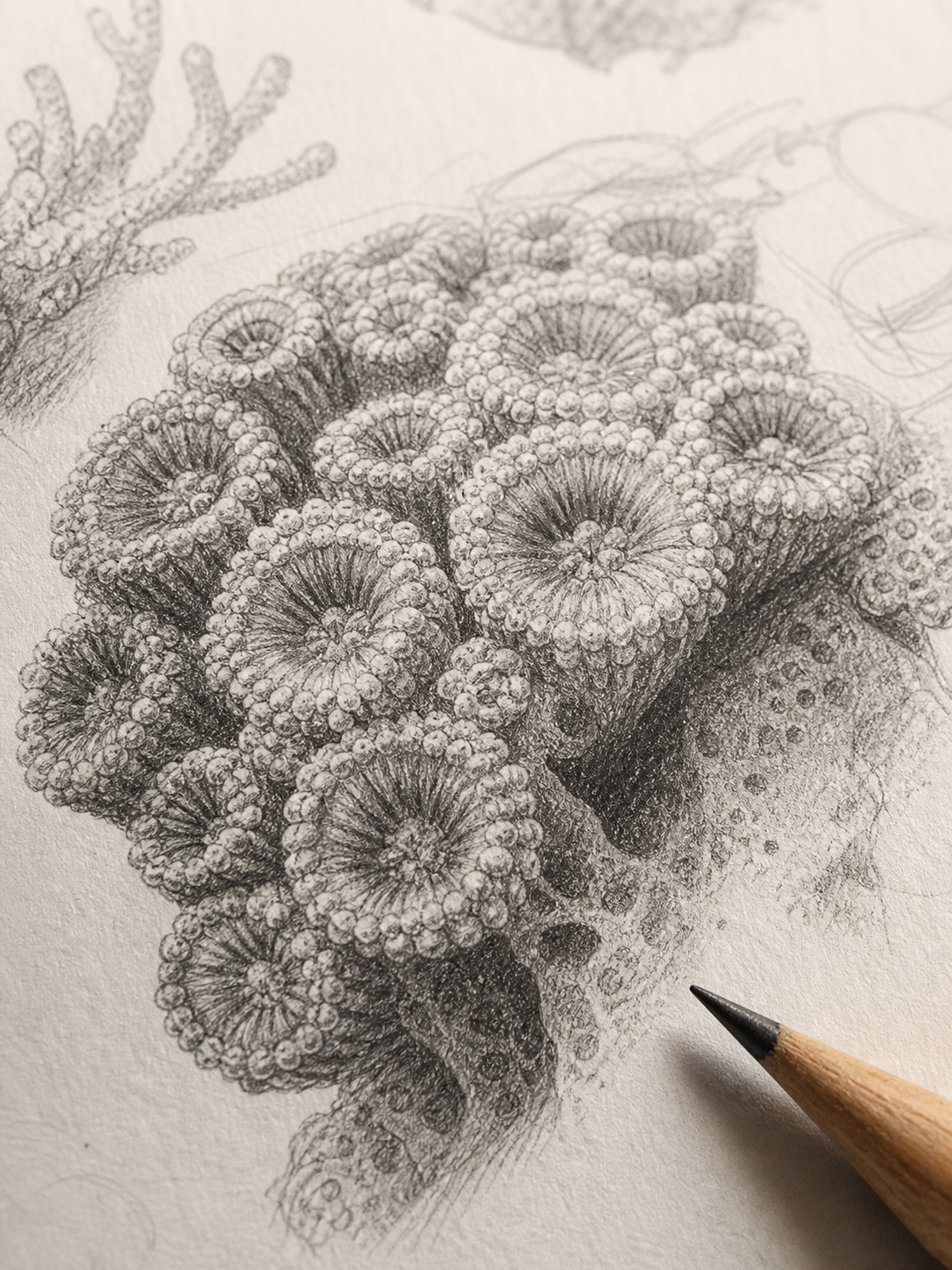
Pick up almost any coral reef drawing tutorial online and you’ll find the same instruction: “draw curved lines overlapping each other.” That’s technically true. It’s also about as useful as telling someone to draw a face by “putting two circles where the eyes should go.”
The reason coral feels impossible to draw isn’t that it’s complex — it’s that most people approach it without first identifying what kind of coral they’re drawing.
Coral isn’t chaos — it’s a repeating growth logic
Every coral species grows according to the same physical constraints: available sunlight, water current, and the calcium carbonate skeleton it secretes. That means each type repeats its structure at every scale. A staghorn coral branch forks the same way whether it’s 10 centimetres or 2 metres long. A brain coral’s grooves follow the same tight wavy rhythm across the entire surface.
This is exactly the kind of self-similar geometry you see in industrial forms — the rib pattern on a plastic casing follows the same curve logic regardless of scale. Once I started treating coral the way I’d approach a complex product surface, the drawing got easier immediately.
The practical payoff: if you learn to draw one small section of any coral type correctly, you can tile that logic across the whole form. You’re not drawing “a coral” — you’re applying a rule.
What academic drawing training taught me about observation
Before the first line, look. Really look — at least 60 seconds on a reference photo before touching the paper.
In academic life drawing, we called this the gesture phase. You’re not memorising every detail; you’re reading the dominant masses and directions. Where is the weight? What’s the tallest point? Where does it anchor to the ground?
For coral reef drawing, apply the same sequence. In your reference photo, find: the tallest form (usually branching coral), the densest mass (brain or plate coral cluster), and where the seafloor is. Those three things are your composition anchors.
I keep a Faber-Castell 2B on hand for this first blocking stage — it’s soft enough to make a loose, adjustable mark without digging into the paper, and it erases cleanly. Staedtler Mars Lumograph 4B comes in once I’m confident about the structure and ready to push the darker values.
The 60-second observation habit eliminates about 80% of the compositional mistakes beginners make. That’s worth more than any specific drawing trick.
The 6 coral types and how to draw each one
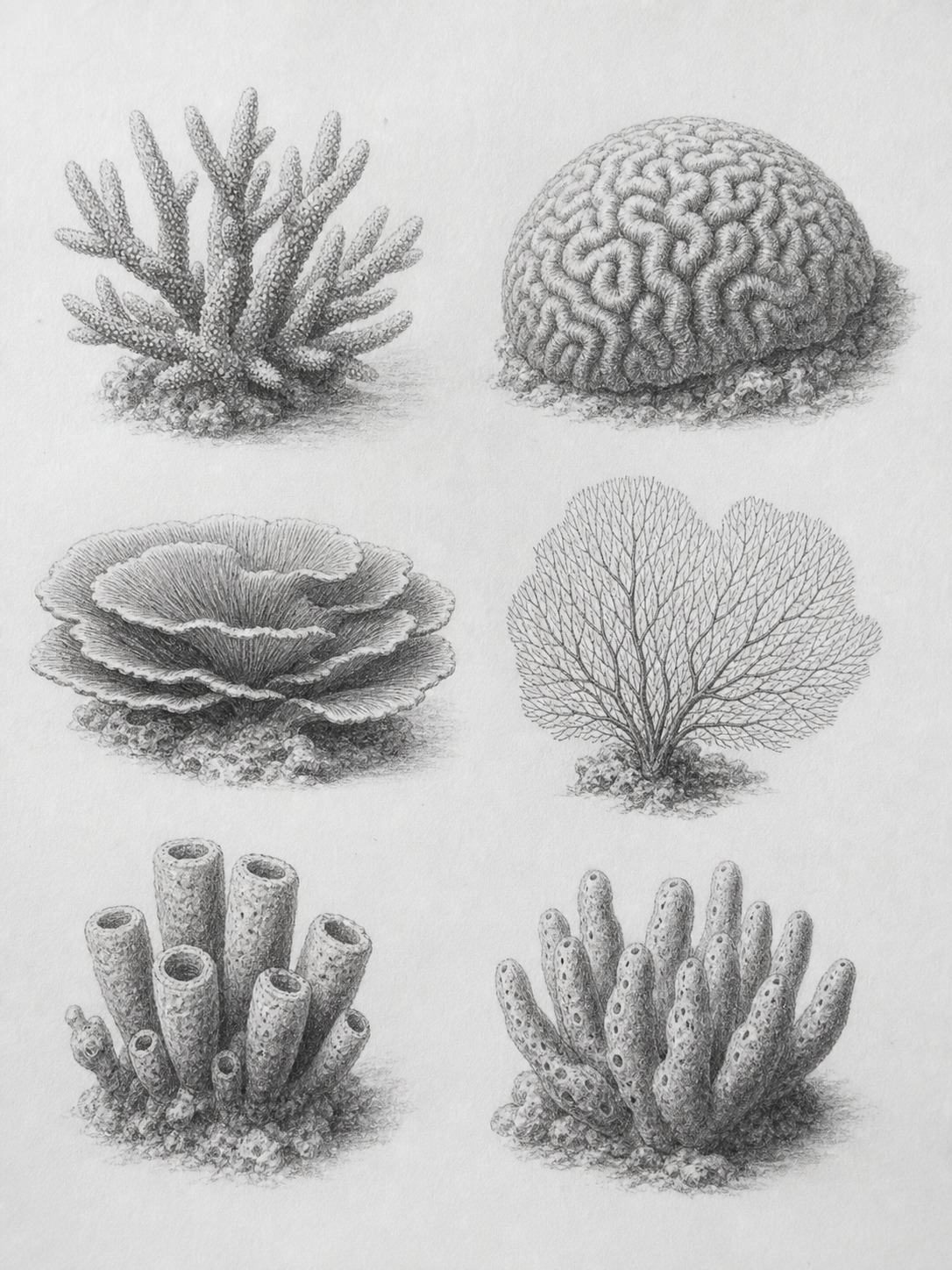
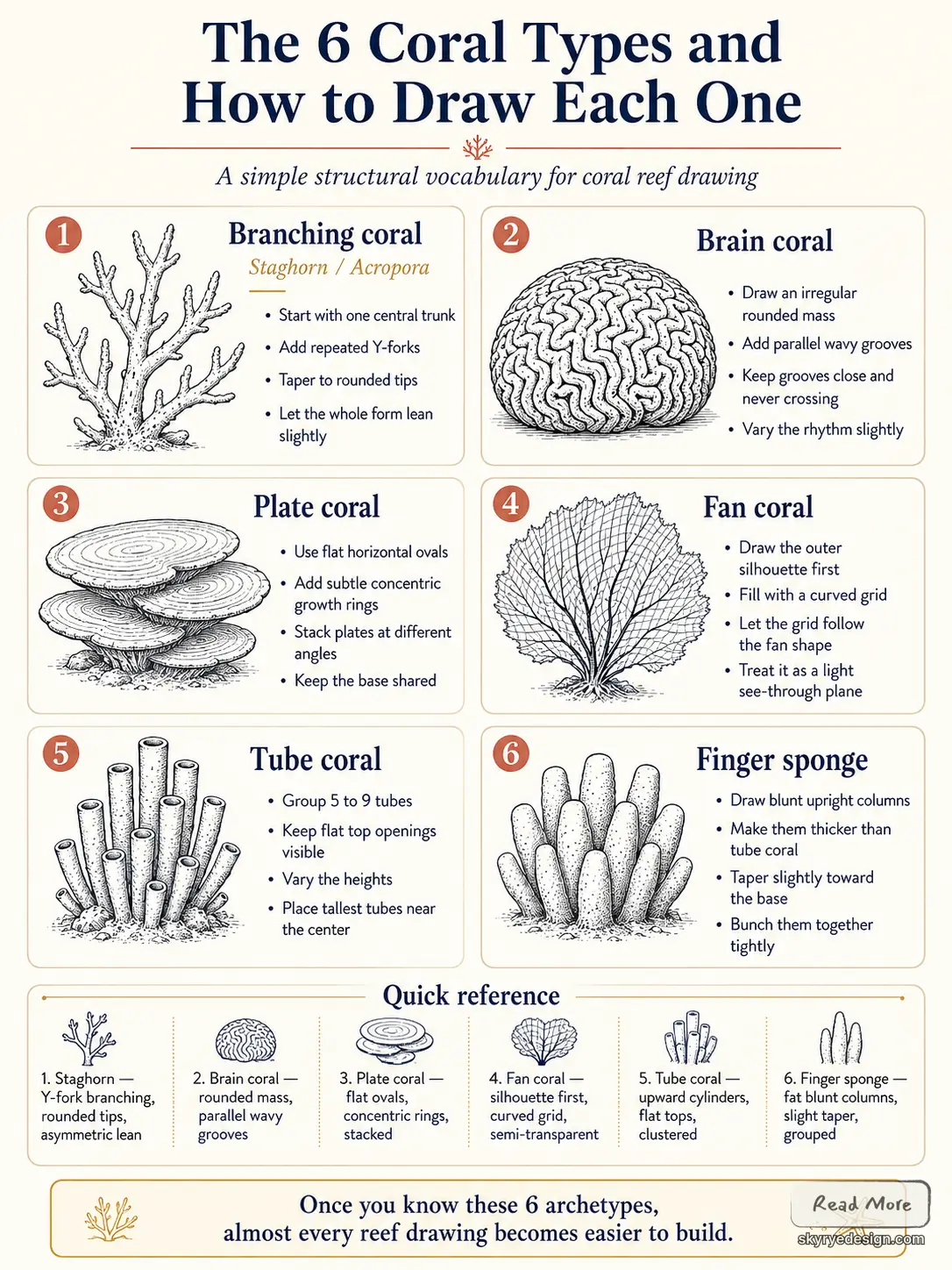
Here’s the thing nobody tells you in coral reef drawing tutorials: there are only 6 structural archetypes you need to know. Six. Every coral you’ll ever want to draw is a variation of one of them — or a combination of two.
Think of it as a design vocabulary. Once you have the vocabulary, you can build anything.
Branching corals: staghorn and acropora
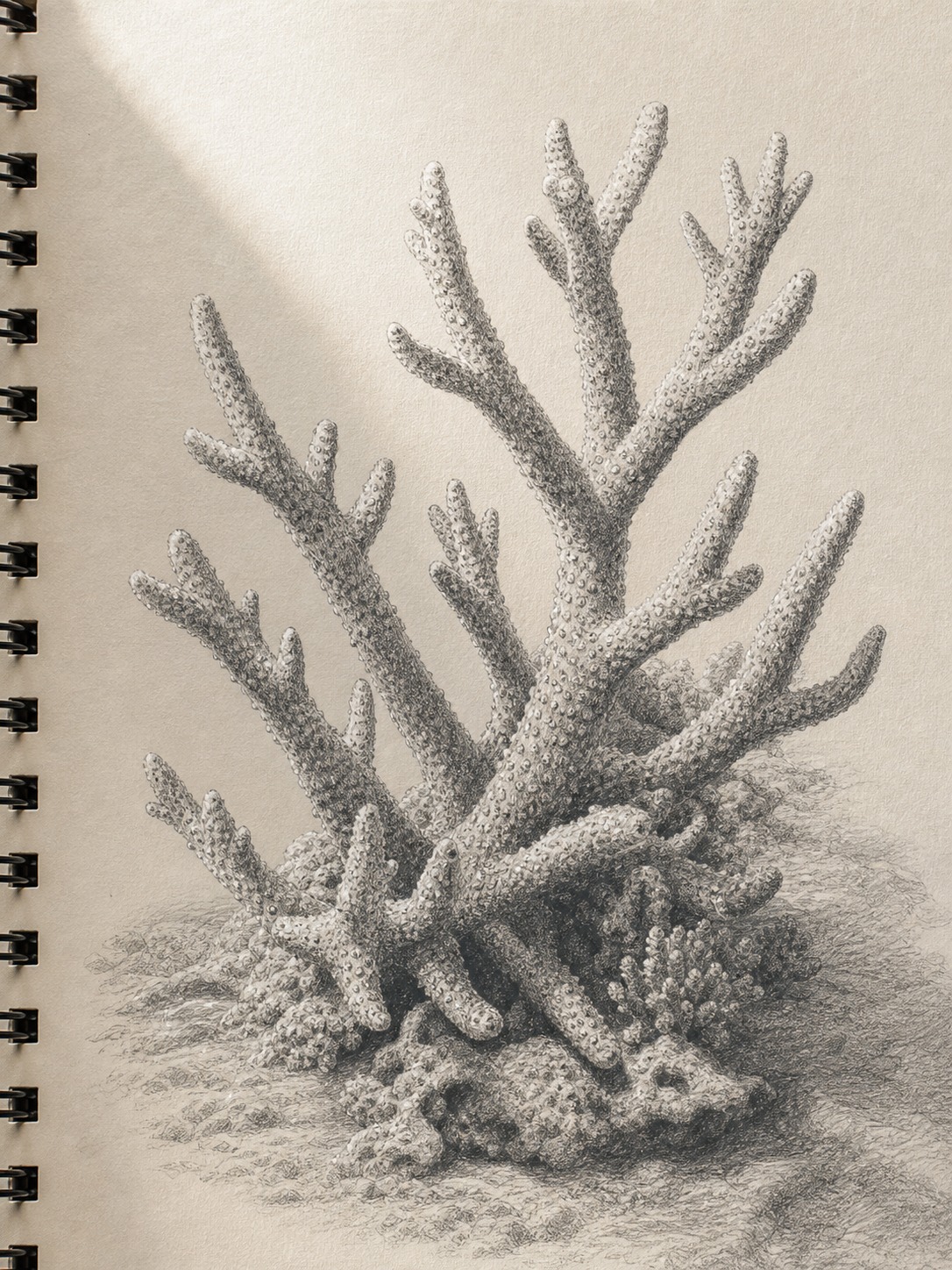
Staghorn coral (Acropora cervicornis) is the one that looks like a deer’s antlers — which is exactly what the name means. In real reefs, individual branches can reach 2 metres tall. For drawing purposes, that verticality is your friend: staghorn gives height and drama to a composition.
Draw it like a bare winter tree. Start with one central trunk rising from the seafloor. Then add Y-forks — each fork splits into two branches, each one narrower than the one before. The tips taper to rounded points, not sharp ones. The whole form should lean slightly in one direction, as if pushed by a current. That asymmetry keeps it from looking stiff.
Surface texture: small rounded bumps along each branch, closer together near the tips. A 0.5mm mechanical pencil works well for these. Twenty bumps per branch is plenty — don’t overdo it or the form gets muddy.
Brain coral and plate coral
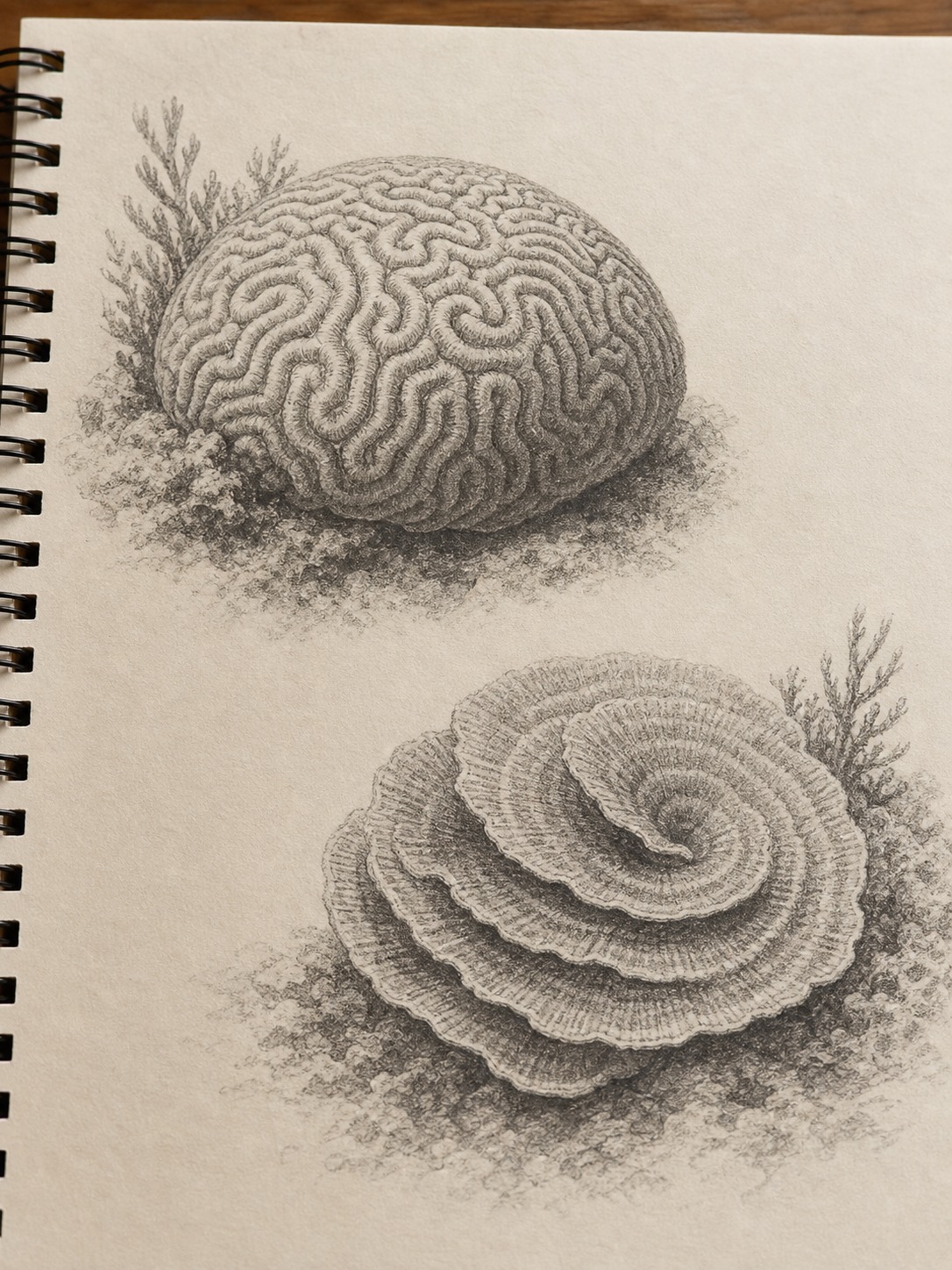
Brain coral is the one that stops people cold. Those labyrinthine grooves look impossibly complex up close. They’re not.
Start with an irregular rounded mass — not a perfect sphere, more like a slightly squashed one. Then draw the grooves as a series of parallel wavy lines that follow the surface curvature of the form. Think of it as a topographic map of a very hilly landscape, drawn at a small scale. The grooves never cross each other; they run parallel, dipping and rising together. Keep them tight (about 3mm spacing) and vary the wave rhythm slightly so it doesn’t look mechanical.
Plate coral is simpler. Draw a flat horizontal oval viewed from a slight angle (about 20 degrees off horizontal). Add faint concentric growth rings, like a cross-section of a tree trunk. Stack two or three plates at slightly different angles, each one resting on the same base rock.
Fan coral, tube coral, and finger sponge
Fan coral looks like a hand-held lace fan standing upright on a short stem. Draw the outer silhouette first (a rounded or slightly irregular fan shape), then fill the interior with a crosshatch grid of curved lines. The grid follows the fan’s curve, not a rigid horizontal/vertical axis. Real fan corals (Gorgonia ventalina) grow up to 60cm across in the Caribbean. For composition, they read as a semi-transparent plane, so you can show coral behind them through the grid.
Tube coral is a cluster of upward-pointing cylinders, each cut flat at the top. Draw groups of 5 to 9 tubes together, varying the heights slightly — the tallest tubes in the center, shorter ones at the edges. Each tube is roughly 3 to 4 times taller than it is wide.
Finger sponge doesn’t look like coral at all, but it’s almost always present in reef drawings because it fills compositional gaps beautifully. Fat, blunt-ended columns, shorter than tube coral, bunched together like a hand with all five fingers pointing straight up. Draw the columns with a very slight taper — widest at the top, narrowing slightly toward the base.
Quick reference — the 6 types and their drawing logic:
- Staghorn — Y-fork branching, taper to rounded tip, asymmetric lean
- Brain coral — rounded mass, parallel wavy grooves, tight 3mm spacing
- Plate coral — flat horizontal oval, concentric rings, stacked at angles
- Fan coral — outer silhouette first, curved interior grid, semi-transparent
- Tube coral — upward cylinders, flat tops, clustered, varied heights
- Finger sponge — fat blunt columns, slight taper, grouped
Fill a full sketchbook page with each coral type individually before attempting a complete reef scene — 10 studies per type. By the time you start composing the full drawing, every form is already in your hand’s muscle memory.
Staging your composition: the 3-layer reef
Most coral reef drawings fail at the composition stage, not the drawing stage. The forms are recognizable, the individual corals are decent — but the whole thing reads as a flat wall of shapes with no sense of space. You’re looking at it, not into it.
The fix is a method that architects and set designers use constantly: the three-layer stage.
Foreground, midground, background — treating the reef like a stage set
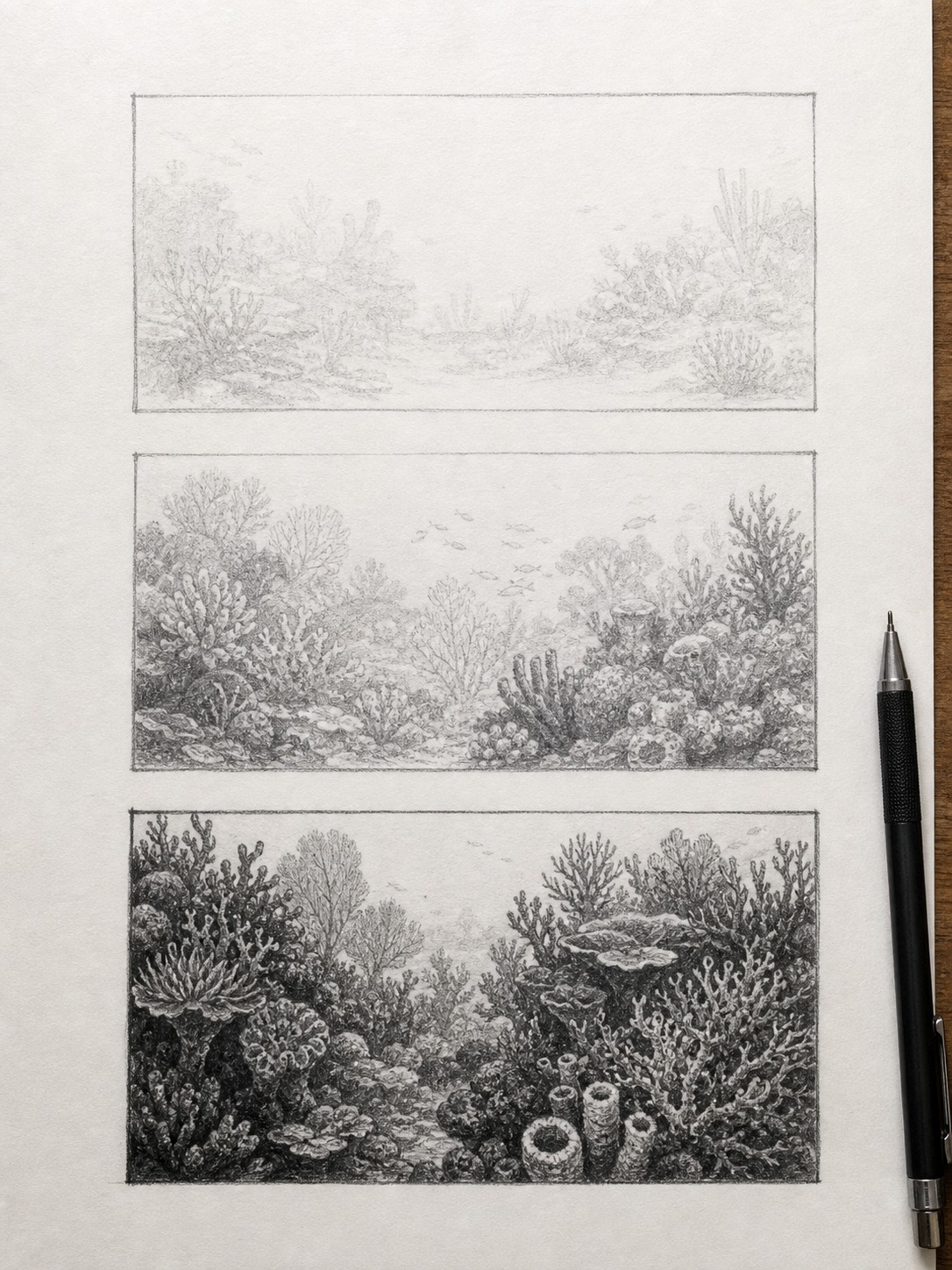
Think of your reef as a theater stage viewed from the audience. There’s a foreground (closest to you), a midground (the main action zone), and a background (far wall). Each layer gets a different visual treatment, and those differences create the illusion of depth.
Foreground: large forms, heavy line weight, high contrast, maximum texture detail. These corals are closest to the viewer, so they’re the darkest and most defined. Use a 4B or 6B pencil here and don’t be shy about deep shadow pockets between the forms.
Midground: medium scale, moderate detail, mid-range values. This is where your most interesting coral types live — the staghorn cluster, the brain coral, the fan. The eye spends most of its time here.
Background: light, gestural, low contrast. Just enough information to suggest more reef extending into the distance. Thin lines, minimal texture, values close to the paper tone. In product rendering, you treat the background environment the same way — enough to establish context, not enough to compete with the hero object.
In my own reef drawings, I push the foreground values darker than feels comfortable at first. The contrast reads as distance. When I pull back and squint at the drawing from arm’s length, the depth either reads or it doesn’t — and pushing that foreground darker almost always fixes it.
Height variation and negative space
Real reefs never have every coral at the same height. There’s a rhythm to the vertical movement — tall branching forms, mid-height brain clusters, low plate corals hugging the base rocks. Plan that rhythm before you start drawing.
I aim for at least three distinct height beats per composition. One tall element that breaks above the others (staghorn coral is perfect for this). One broad middle mass. One low, spreading form along the seafloor — plate coral or finger sponge works well.
Negative space matters just as much as the forms. The open water between corals isn’t empty — it’s where fish swim, where light shafts pass through, where your eye gets to rest before moving to the next form. If every gap is filled with another coral, the drawing suffocates.
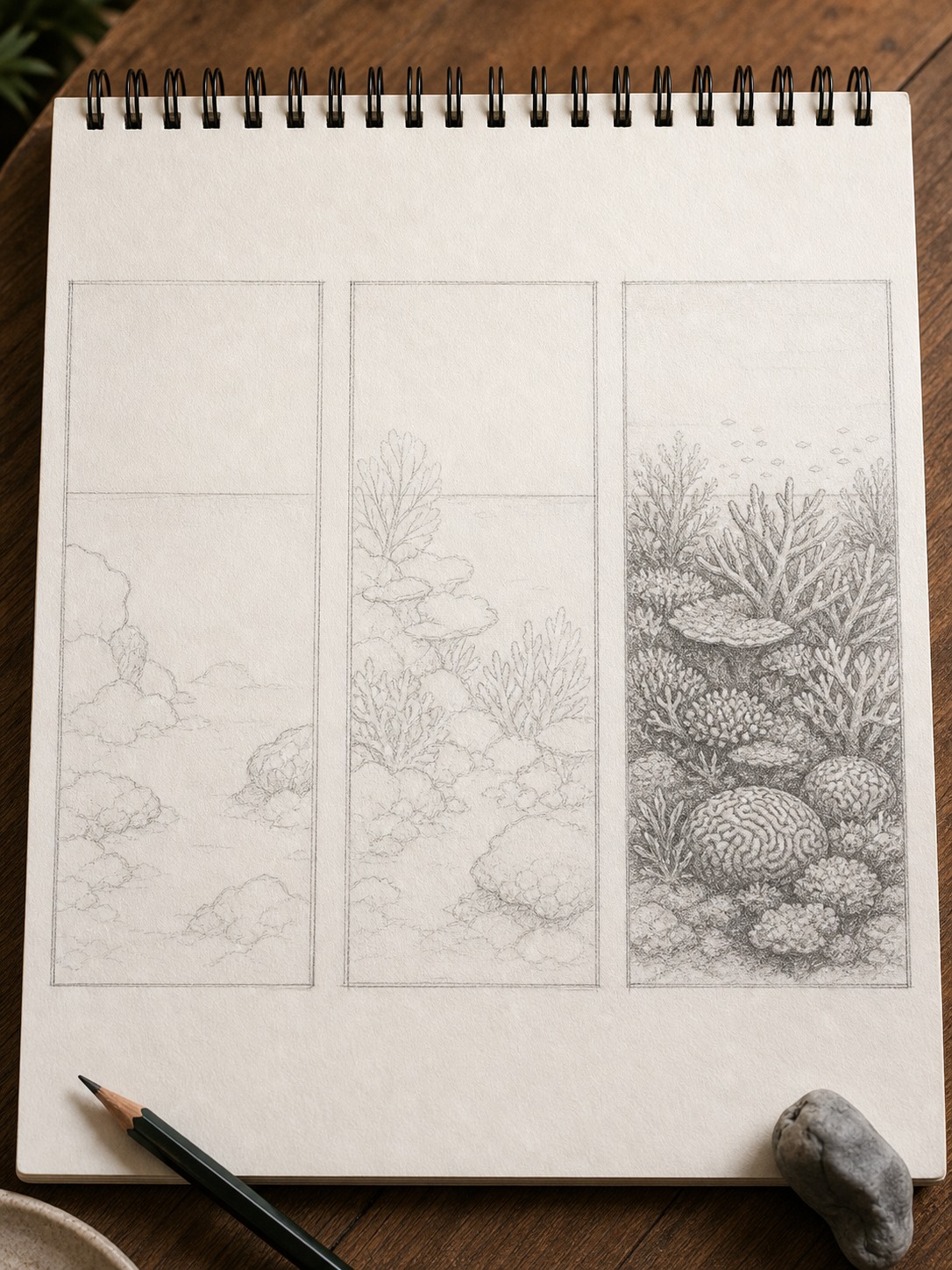
Before touching your main sheet, sketch three thumbnail compositions — each one roughly 5cm × 7cm. Try a different height arrangement in each one. Pick the one that has the clearest foreground/midground/background read when you squint at it. The thumbnail stage takes five minutes and eliminates an hour of compositional frustration later.
Step-by-step coral reef drawing
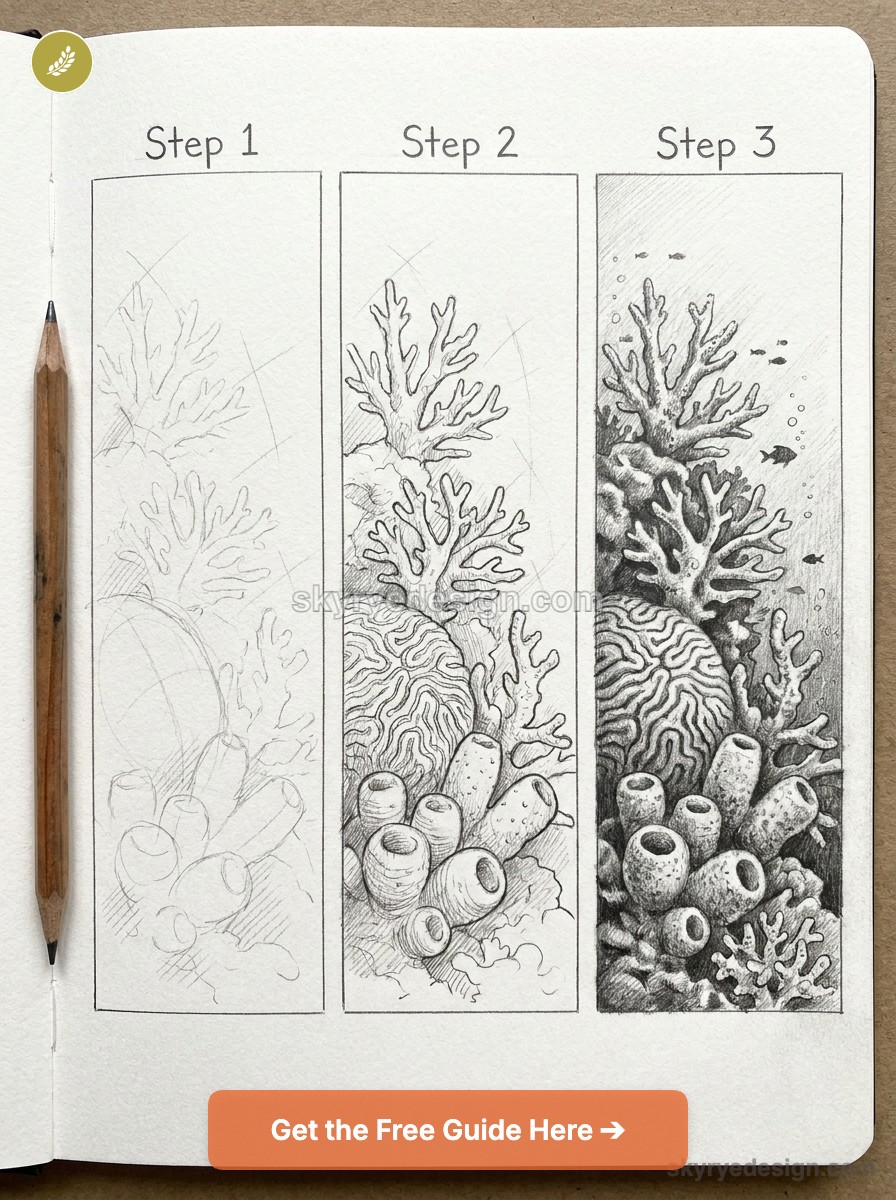
You’ve got your coral vocabulary. You’ve planned your three-layer composition with a thumbnail. Now it’s time to put it all together on the page.
This is the sequence I follow every time — not just for coral reef drawing, but for any complex natural scene. It keeps the process from collapsing into chaos halfway through.
Step 1 — Seafloor and horizon line
Start with the seafloor. Draw a slightly uneven horizontal line across the lower third of your page. Not ruler-straight — real seafloors have gentle undulations, small rises, scattered rock. Let the line breathe.
Then build up from it. Add 3 to 5 irregular rock or rubble shapes sitting on that baseline — rough rounded masses, nothing precious. These are the anchor points your coral will grow from. Without a solid seafloor line, coral floats. It’s one of the most common mistakes in reef drawings, and it instantly reads as wrong even to viewers who can’t articulate why.
Use a light HB pencil here. Everything at this stage is structural scaffolding — it’ll get refined or erased later.
Step 2 — Block in the coral silhouettes
With your thumbnail composition beside you, lightly place the outer silhouettes of your 3 to 4 main coral forms. Still HB, still light pressure. You’re placing volumes, not drawing coral yet.
Think of it exactly like blocking in a figure in life drawing — you’re committing to the mass and position of each form before any detail. The tall staghorn cluster goes in first (it dictates the vertical scale of everything else). Then the brain coral mass. Then the fan coral. Then low foreground forms at the base.
Check three things before moving on: Does the tallest form have clear space above it? Do the forms overlap slightly? Is there visible negative space between the major masses? If all three are yes, move to Step 3.
Step 3 — Build detail from back to front
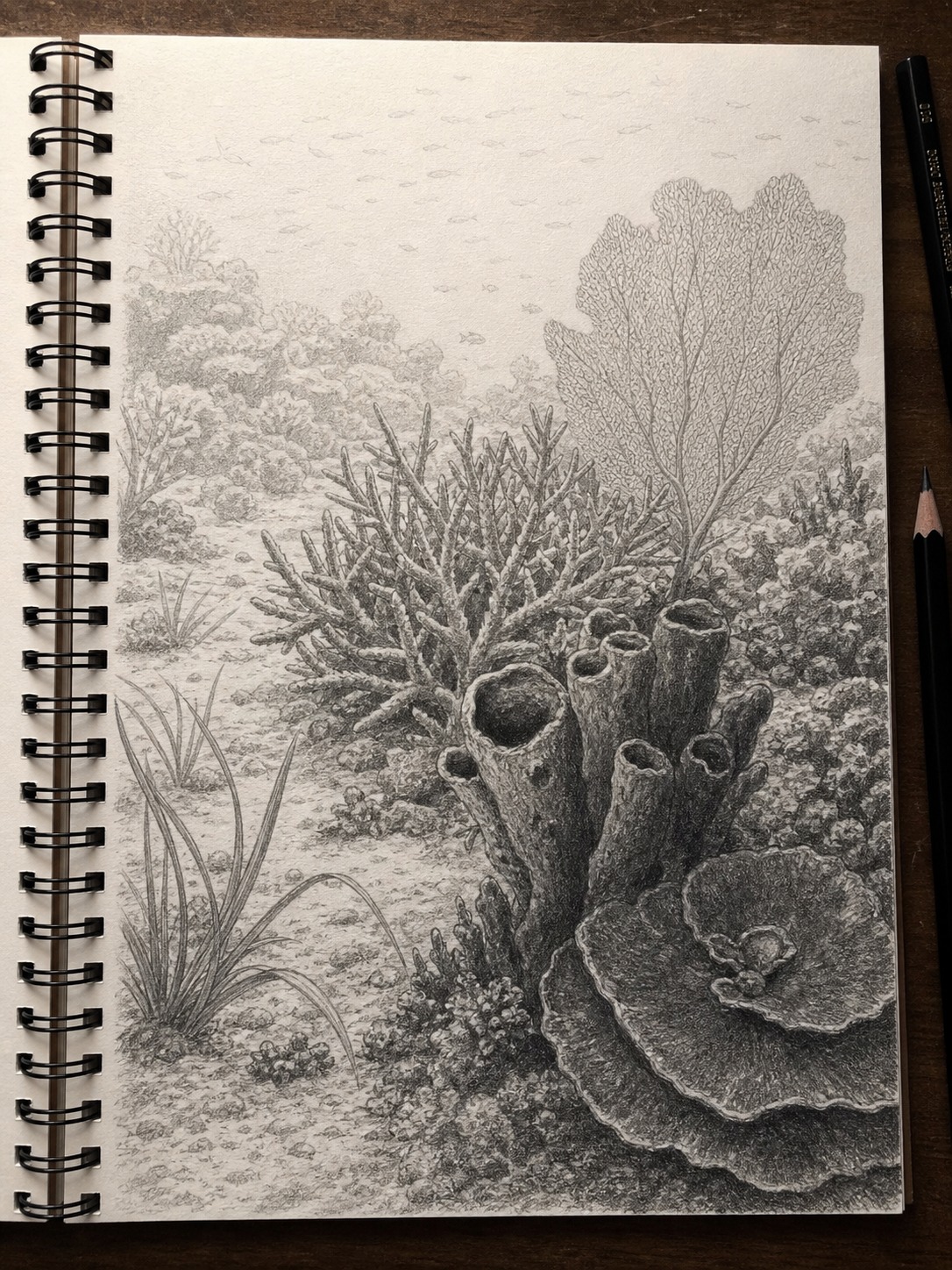
This is the step most people get backwards. They start with the foreground coral and work backward — which means the background ends up overworked and competes with the front.
Go back to front instead. Start with the background corals: lightest possible pencil marks, minimal texture, just enough line to suggest a coral form. A few gestural curves for a distant staghorn, a faint rounded mass for a background brain coral. Nothing more.
Move to the midground. This is where you apply the full structural logic — the branch forks, the parallel grooves, the fan grid, the tube cluster. Medium pressure, Faber-Castell 2B, full coral type detail.
Finally, the foreground. Heaviest marks, deepest shadows, maximum texture. Push the 4B into the shadow pockets between foreground corals until they go genuinely dark. The contrast between those deep darks and the pale background is what snaps the depth into place.
I keep a small reference photo taped next to my sketchbook at this stage — not to copy, but to cross-check proportions. Brain coral grooves really are that tight. Staghorn branches really do taper that sharply. The reference keeps you honest.
Step 4 — Seafloor details and seagrass
Once the coral forms are solid, bring the seafloor to life. Stipple the sandy areas with a 0.5mm mechanical pencil — small irregular dots, denser in shadow zones, sparser in lit areas. Scatter a few small rounded pebbles along the base rocks.
Seagrass goes in last among the seafloor elements. Draw pairs of long curved lines that converge at a pointed tip — each blade slightly different in height, all angled in the same direction. That consistent angle implies water current. A reef with seagrass all pointing straight up looks static. Angle the blades about 15 to 20 degrees off vertical and the whole scene immediately feels like it’s underwater.
Add one or two starfish on the rock surfaces — five tapered arms radiating from a small central disk, each arm with a faint row of texture dots along the center line. Sixty seconds of work that adds a lot of life to the base layer.
Drawing underwater light and depth
This is the section that separates a technically correct coral reef drawing from one that actually feels like you’re underwater. The coral forms can be perfect (all 6 types, solid composition, good line weight variation) and the drawing still reads as flat if the light is wrong.
Underwater light behaves differently from any other environment you’ll draw. Understanding why makes it a lot easier to replicate.
How underwater light actually works
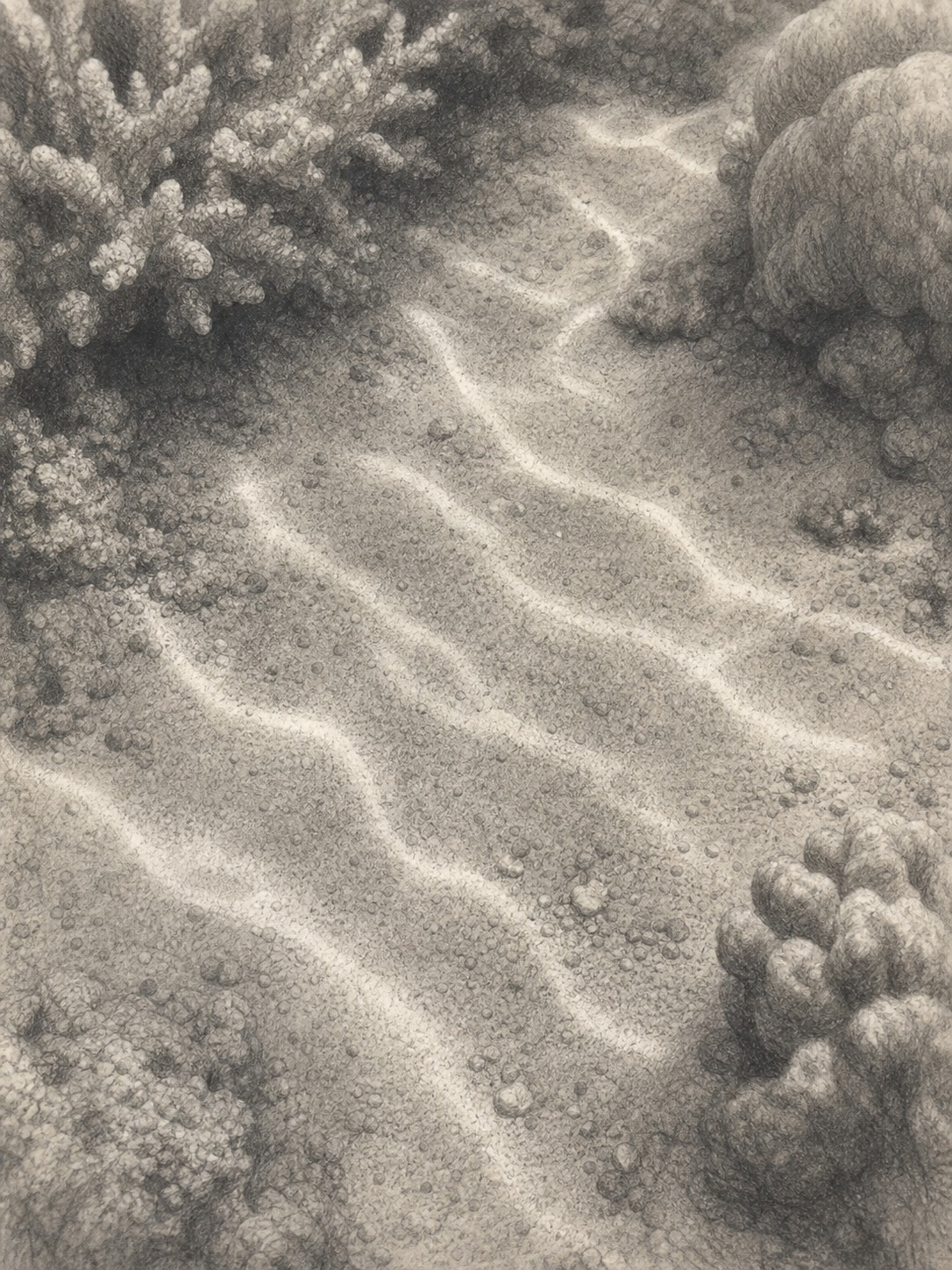
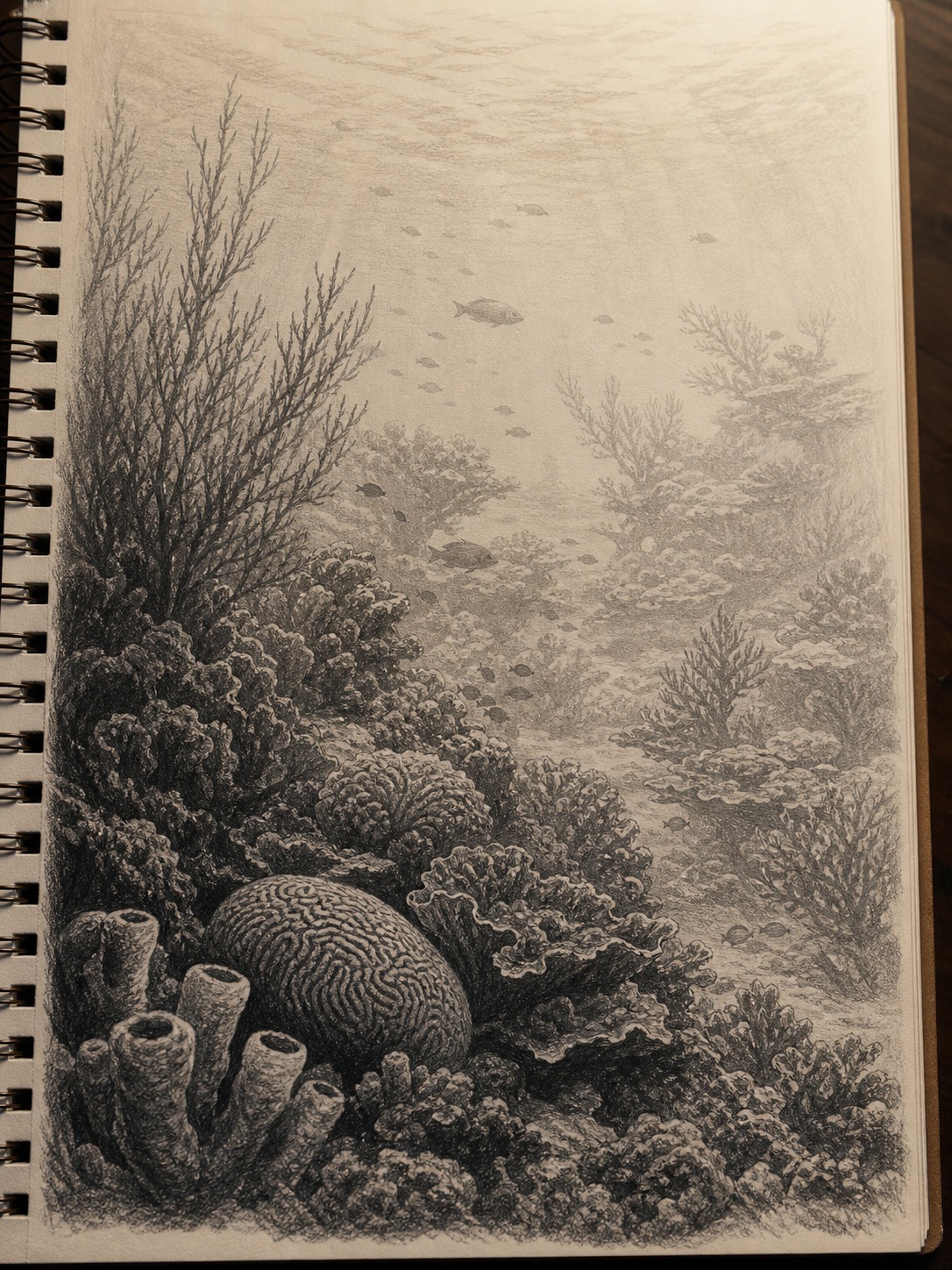
Water bends light. As sunlight passes through the surface, it refracts — and the constant movement of the water surface acts like a shifting lens, focusing and defocusing the light into moving ripple patterns on everything below. Divers call them caustics. You’ve seen the same thing on the floor of a swimming pool on a sunny afternoon: those shifting, curved light bands moving slowly across the tiles.
In a coral reef drawing, caustics appear on the upper surfaces of corals and on the sandy seafloor. Draw them as slightly irregular parallel curves — not perfectly evenly spaced, not perfectly parallel, just loosely rhythmic. They should curve gently in the same general direction, as if following a slow sweep of water. Three or four bands visible in the midground is enough. In the foreground and background, let them fade out.
Use a clean eraser to pull caustic highlights out of a pencil-shaded area rather than leaving the paper white from the start. The Faber-Castell kneaded eraser is good for this — you can shape it to a fine edge and lift precise curves out of the graphite layer. The result looks more natural than planned white gaps.
Value shift with depth
This is the underwater version of aerial perspective — the same principle that makes distant mountains look paler than nearby ones, applied to a vertical environment.
In open air, distant objects lose contrast and shift cooler. Underwater, the same happens but faster and more dramatically. Water absorbs light with depth. Every few metres, the available light drops and warm wavelengths (reds, oranges, yellows) disappear first. By the time you’re 10 metres down, a bright orange staghorn coral looks greenish-brown.
For pencil drawing, you don’t need to worry about the color shift — but the value shift is critical. Distant and deeper corals get lighter values, thinner lines, and less surface texture. Foreground corals get the darkest marks you can make. The gradient between them reads as depth.
Specifically: background coral — HB pencil, light pressure, minimal texture detail. Midground — 2B, moderate pressure, full structural detail. Foreground — 4B and 6B, heavy pressure in shadow zones, maximum texture. The 6B goes into the deepest shadow pockets between foreground forms — those near-black areas make the lighter values behind them snap backward into space.
After the full pencil drawing is done, hold it at arm’s length and squint until it blurs. What you should see is a clear light-to-dark gradient from background to foreground. If the background and foreground read the same value when blurred, the depth isn’t working yet. Push the foreground darker.
Adding marine life: fish, starfish, anemones
The coral is built. The light is working. Now comes the part most people rush — and rushing it is exactly the mistake.
Marine life in a reef drawing has one job: to animate the scene without stealing focus from the coral. Fish, starfish, and anemones should feel like they live in your reef, not like they were dropped on top of it as an afterthought. Placement and scale matter as much as how you draw them.
Fish as shape and silhouette
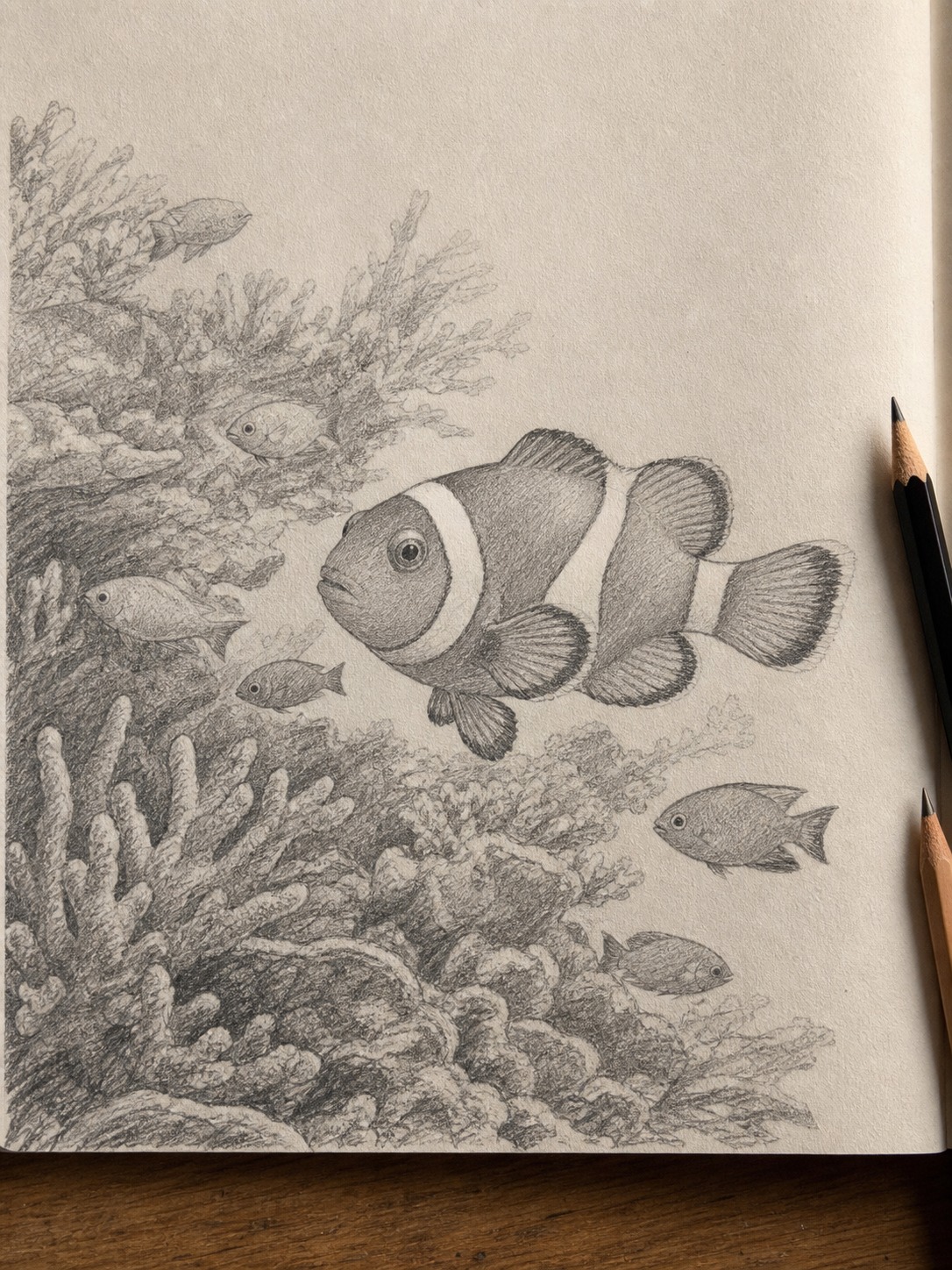
A tropical reef fish is a surprisingly simple form. The body is a flattened oval — slightly deeper from top to bottom than from front to back, widest at the shoulder and tapering toward the tail. The tail splits into a shallow fork. Two triangular fins above and below, one smaller pectoral fin at the shoulder. That’s the whole construction.
Start with the body oval at a slight angle — about 10 to 15 degrees off horizontal. Fish almost never swim perfectly level in a drawing reference; a slight angle reads as natural motion. Then add the forked tail, the dorsal fin (the tall one along the top), the anal fin (smaller, along the bottom), and the pectoral fin at the side.
Keep fish in the midground. A large fish in the foreground competes with the coral for attention — and the coral should win. Scale is your guide: a clownfish near a foreground anemone should be roughly the same height as the anemone’s tentacle cluster.
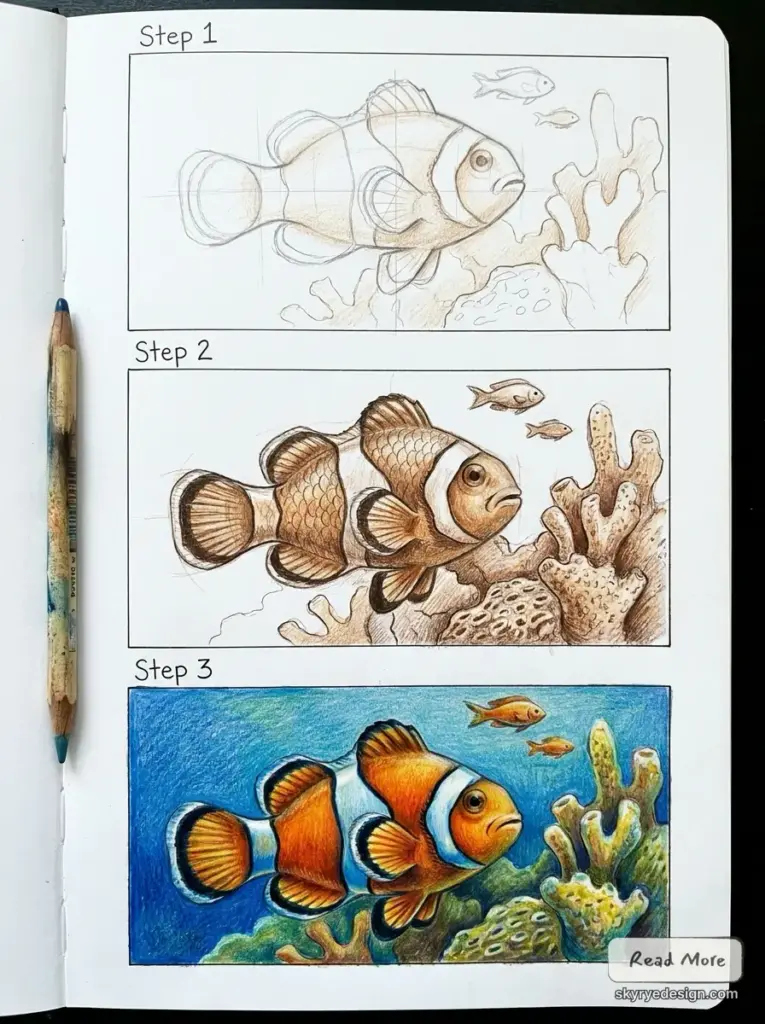
For a clownfish specifically — orange oval body, three white vertical stripes (the middle one has a slight forward curve at the top), small black outlines between the white and orange. Sixty seconds of drawing. Plant it right next to the anemone and the scene reads as immediately recognizable, even at thumbnail scale.
Starfish, sea urchins, and sea anemone
These three elements belong on and near the seafloor — they anchor the base layer and give the eye somewhere to rest after moving through the coral mid-section.
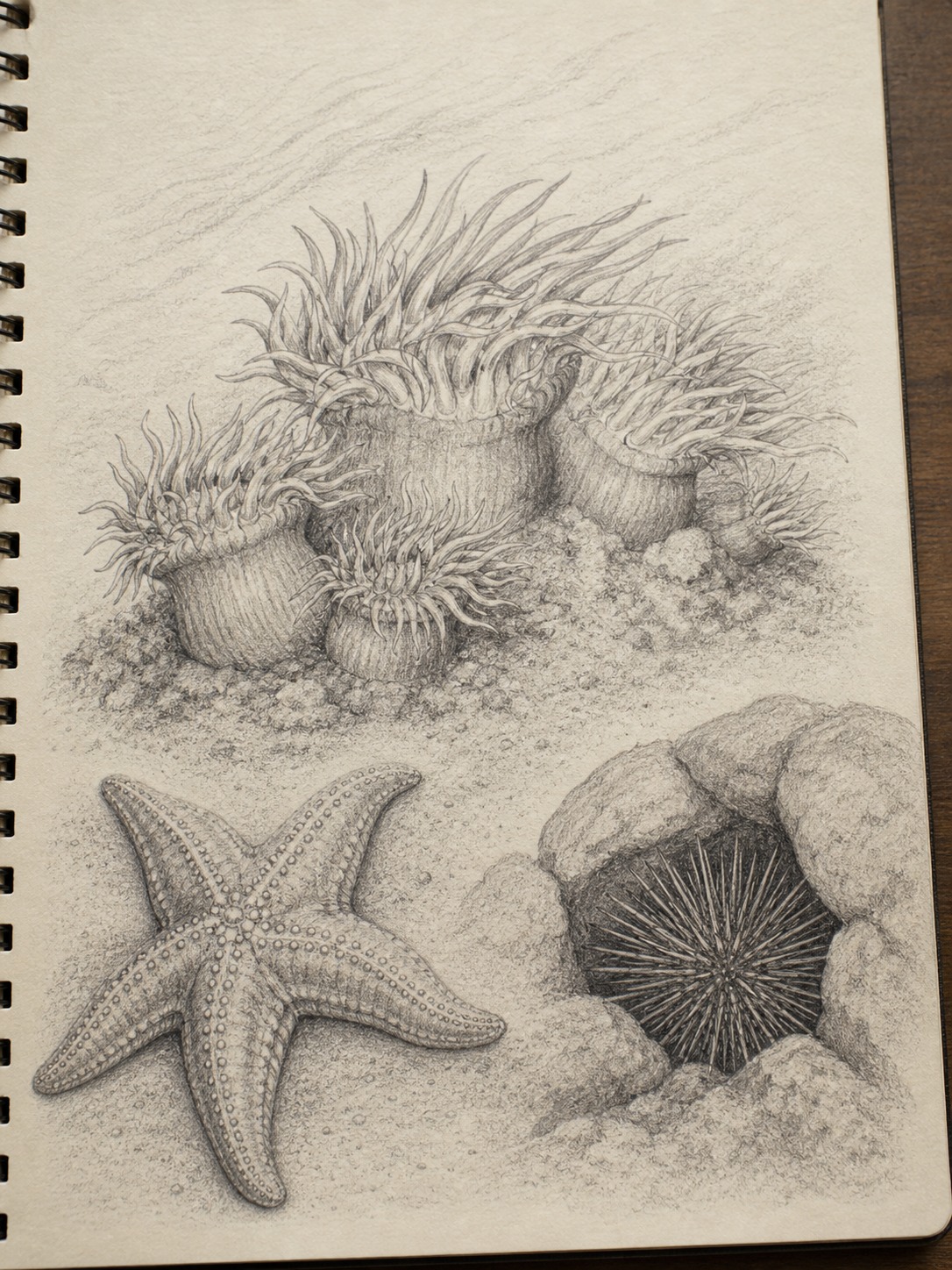
Starfish: five tapered arms radiating from a small central disk. Each arm curves very slightly — not rigidly straight. Run a faint center line down each arm, then add small paired dots along it for the tube feet texture. Don’t make all five arms identical lengths; real starfish are slightly asymmetric, and that irregularity is what makes them read as natural rather than clip-art.
Sea urchin: a circle with radiating short lines — like a compass rose with about 20 spines. Draw the circle first, then add spines of slightly varied lengths. A small ring of tiny dots around the center circle adds enough detail to read as realistic without overworking it. Sea urchins sit in crevices between rocks — wedge them into the darker shadow areas at the base of the coral.
Sea anemone: a ring of inverted teardrop shapes, each one slightly different in height, all pointing upward from a central base. Draw the base first: a short wide cylinder, then add 8 to 12 tentacles around the rim, varying their lean angle slightly. Anemone tentacles sway with the current, so the same slight directional angle you used for seagrass works here too.
One placement tip I keep coming back to: cluster your marine life near structural transitions in the coral — where two different coral types meet, where a large rock joins the seafloor, where a branching coral casts a shadow. Those transition zones are where sea life concentrates in reality, and placing creatures there makes the biology feel right.
Coloring your coral reef drawing
Color is where most coral reef drawings either come together or fall apart. The instinct is to go bright: vivid oranges, electric pinks, saturated blues. And while reef color is genuinely vivid, throwing full-saturation color everywhere produces something that looks more like a children’s poster than an underwater scene.
The same depth logic that governs your pencil values governs your color. Foreground: warm and saturated. Background: cool and desaturated. Shallow zones: bright. Deep zones: muted. Once you understand that structure, the color decisions make themselves.
Choosing your medium
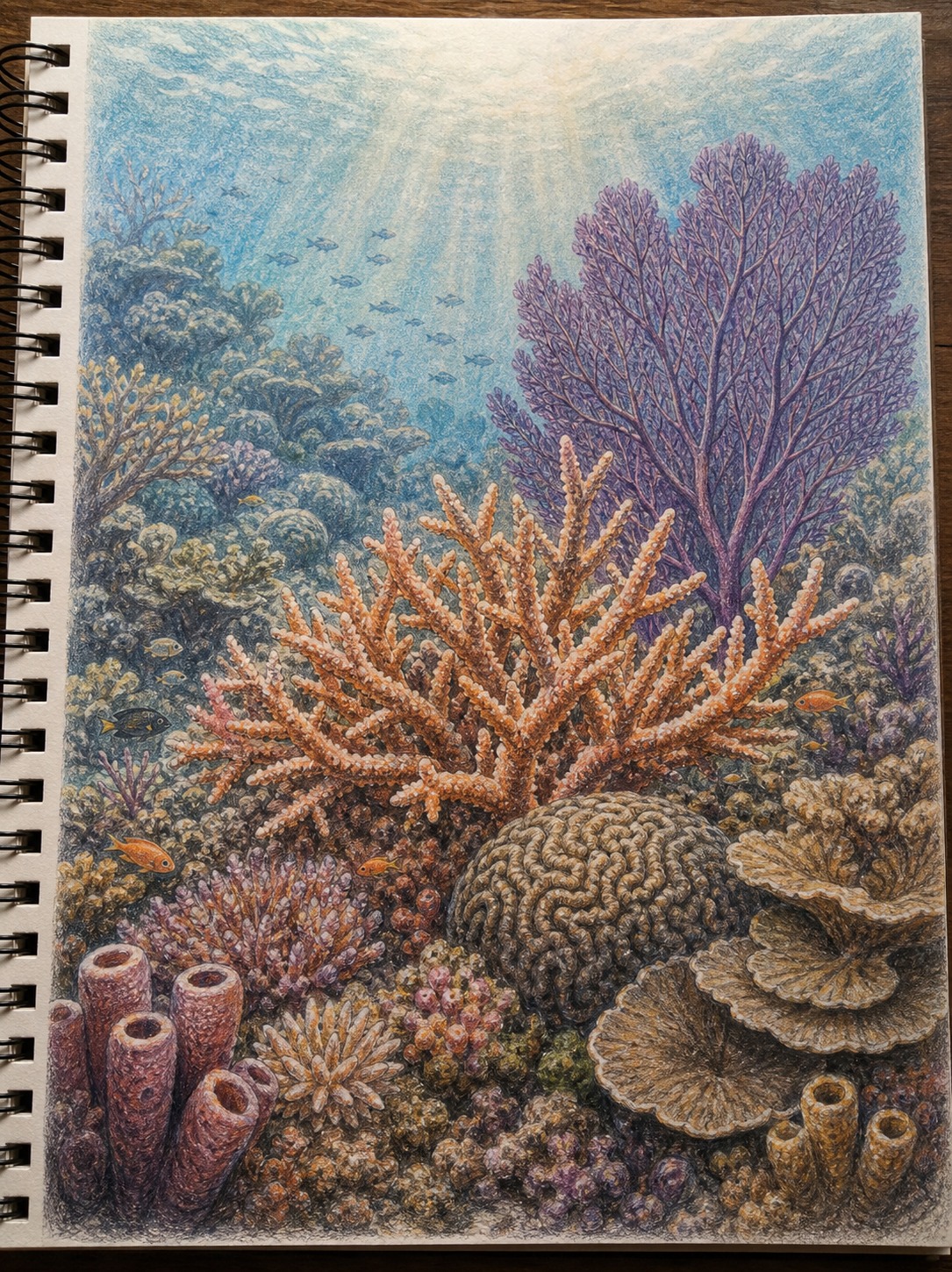
Colored pencil gives you the most control. Prismacolor Premier is the standard choice — the wax core blends smoothly and layers well over pencil structure. Burnish the final layer with a colorless blender pencil and the surface takes on a slight sheen that reads as wet. Good for detailed work where you want full control over every coral type.
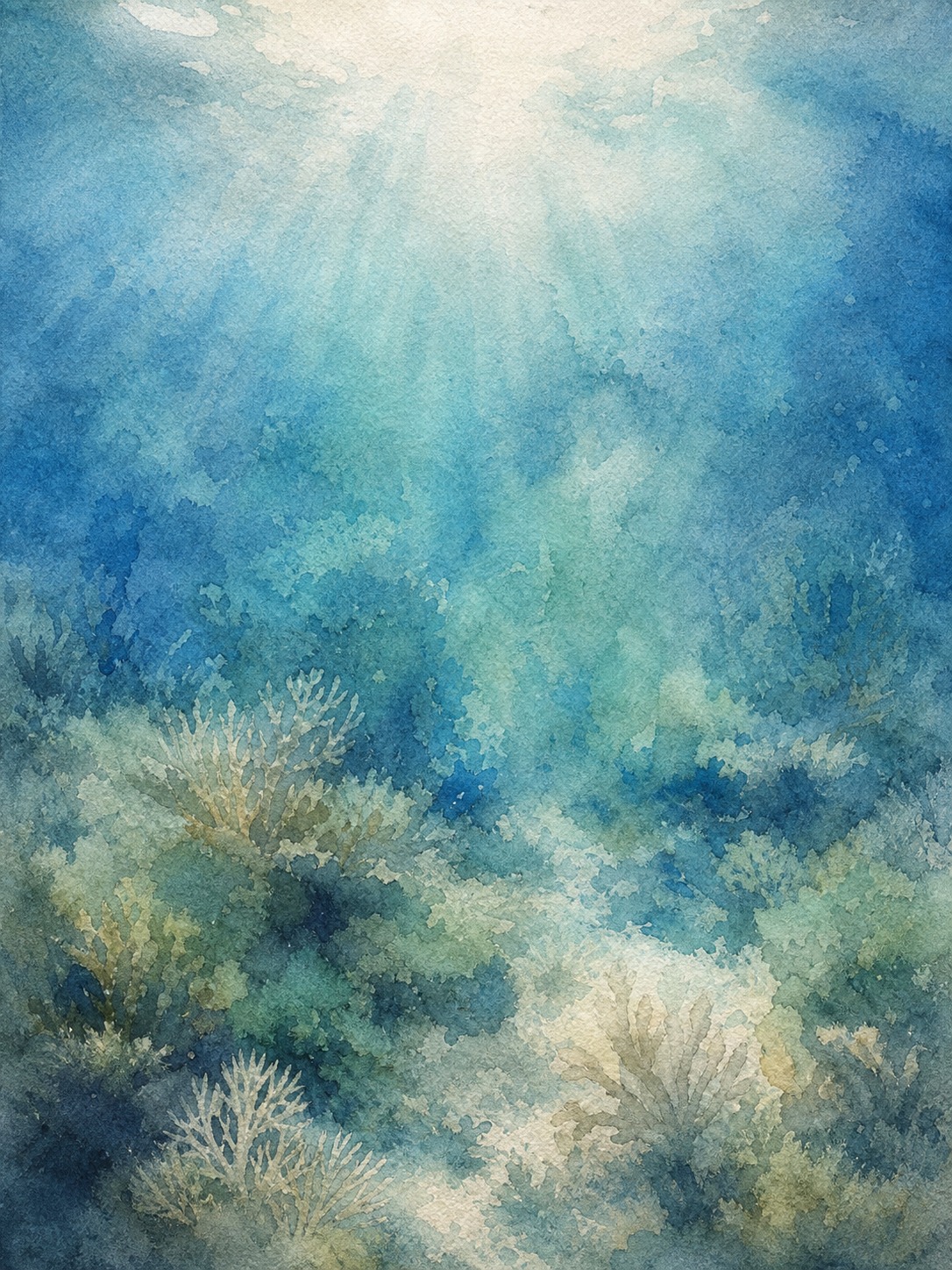
Watercolor is faster and creates the most naturalistic underwater atmosphere. A loose wet-on-wet wash for the background water, then more controlled wet-on-dry strokes for the coral forms. The blooms and bleeds you get in watercolor actually mimic the soft-focus quality of distant underwater objects better than any other medium. Strathmore 400 Series mixed media paper handles both watercolor and colored pencil without buckling — it’s the paper I reach for when I know a piece will use both.
Procreate on iPad gives you infinite undo and the ability to work in layers — which is genuinely useful for a complex scene. The Kyle Webster Gouache brushes handle coral texture well. One workflow I like: sketch and ink on paper, photograph it, import into Procreate, then color digitally on a layer set to Multiply. You keep the hand-drawn quality of the linework and get the flexibility of digital color.
My own preference: watercolor wash for the background water first, let it dry fully, then build coral color with Prismacolor Premier on top. The two-medium approach gives you atmospheric depth in the background and precise detail in the foreground — exactly what the three-layer composition needs.
Reef color logic — not just “use bright colors”
Real reef color follows depth and light, not random vibrancy. Here’s the actual color logic:
Staghorn coral: Peachy orange to pale tan, with darker brown at the branch bases where shadow accumulates. Tips are the lightest — almost cream-colored in strong light.
Brain coral: Grey-brown overall, with the groove channels slightly darker than the ridge tops. Not particularly colorful — brain coral is one of the more muted forms in a reef. Use it as a mid-tone anchor between brighter neighbors.
Fan coral: Deep purple or burgundy red (Gorgonia ventalina is typically purple in Caribbean reefs). The interior grid should be slightly lighter than the outer frame.
Tube coral: Pale yellow or cream at the tube openings, darkening to ochre or brown toward the base.
Finger sponge: Orange or red-orange, sometimes a vivid yellow. One of the warmest, most saturated elements in the scene — good for a foreground accent.
Water background: Start with a mid blue-green wash (cerulean with a touch of viridian). Add a slightly darker, cooler tone toward the top of the composition where the water is deeper.
Desaturate your background colors more than feels right. Hold the piece at arm’s length. If the background reads the same intensity as the foreground, knock it back further. The contrast between a saturated foreground and a muted background does more for depth than any amount of shading detail.
Start with one coral type
A full reef scene is a big ask for a first attempt. Six coral types, three composition layers, underwater light, marine life, color — that’s a lot to hold in your head at once.
So don’t start there.
Pick one coral type from the taxonomy above — staghorn is usually the most satisfying for beginners because the branching logic is clear and the results look impressive fast. Fill one sketchbook page with nothing but that type. Ten studies, varied sizes, different angles. Don’t try to make them good; try to make them fast and consistent. By study eight, your hand knows the form.
Then do the same for brain coral. Then fan coral. Three sketchbook pages, maybe two hours total. After that, a full coral reef drawing stops feeling like a guess and starts feeling like assembly — you’re combining forms you already know into a composition you’ve already planned.
That’s the designer’s approach to any complex subject. Break it into components. Master each component separately. Combine.
The coral reef is one of the most architecturally rich subjects you can draw from nature — layered, rhythmic, structurally logical once you know the vocabulary. And right now, they need artists paying attention to them more than ever. The Great Barrier Reef lost roughly half its coral cover between 1995 and 2017. Drawing something carefully is one of the most honest ways to look at it.
So look carefully. Then draw.
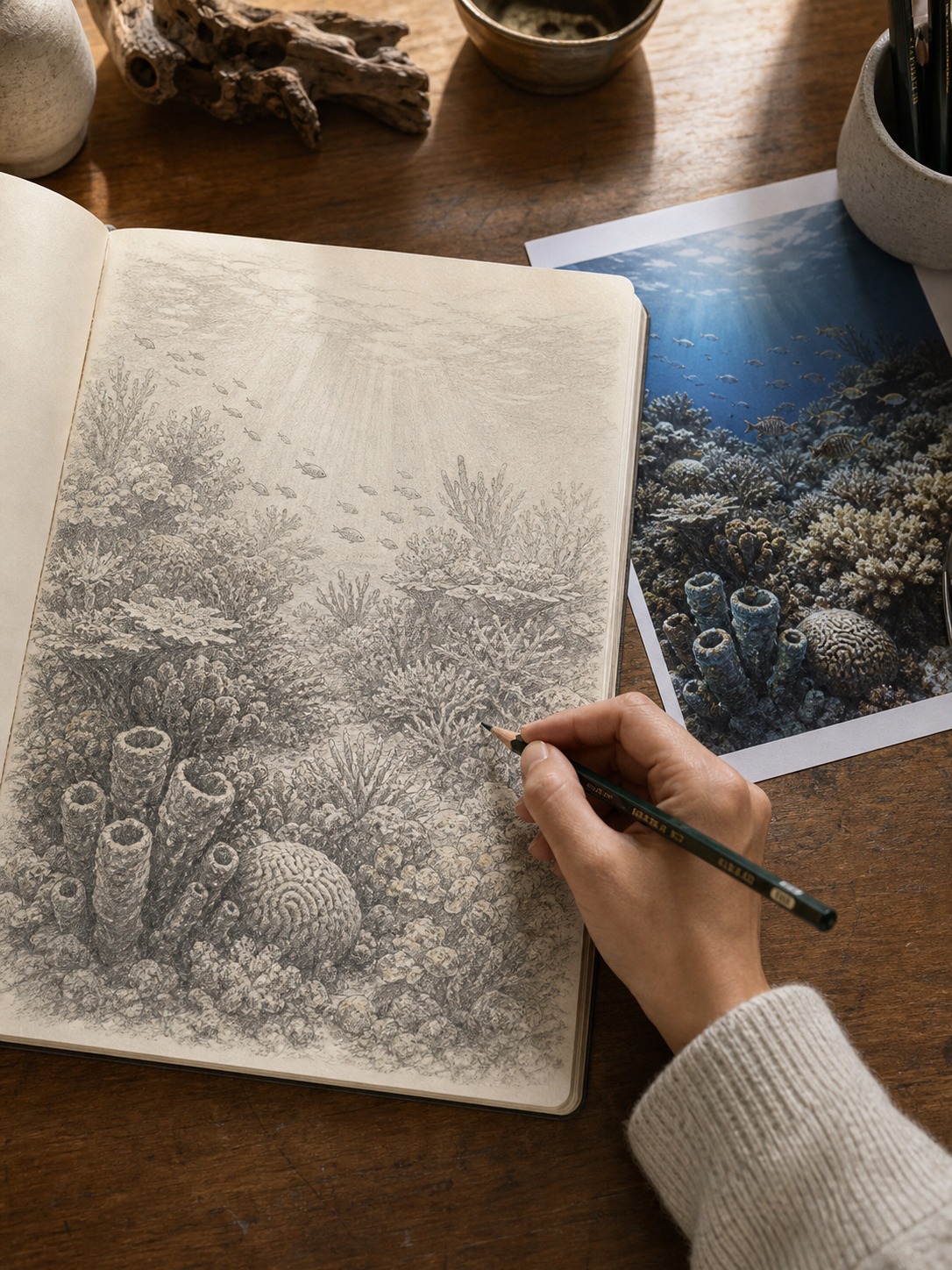
Underwater scenes still need structure. If the reef starts to look flat, revisit depth and perspective drawing basics, then layer coral shapes smaller, softer, and lighter as they move back.
Frequently asked questions about coral reef drawing
What is the easiest type of coral to draw for beginners?
Staghorn coral is the best starting point. The branching logic is simple — one central trunk, repeated Y-forks, each branch narrower than the one before — and the results look impressive quickly. It also gives your composition vertical height, which helps with depth staging from the start. Spend 20 minutes doing nothing but staghorn studies on a spare sheet before attempting a full reef scene. Ten quick sketches, different sizes. By the last few, the form is already in your hand.
What pencils do I need to draw a coral reef?
Three grades cover everything: HB for initial blocking and structural sketching, 2B for midground coral detail and general line work, and 4B or 6B for foreground shadow pockets and deep contrast. A 0.5mm mechanical pencil is useful for fine surface texture — the bumps on staghorn branches, the dots on starfish arms. A Faber-Castell Goldfaber set gives you all these grades in one purchase. A kneaded eraser rounds out the kit; you will use it to lift caustic light highlights out of shaded areas.
How do I make my coral reef drawing look 3D and not flat?
Three things, applied together. First, vary line weight: heavy lines in the foreground, thin lines in the background. Second, vary pencil value: dark foreground forms, pale background forms. Third, overlap your coral shapes rather than placing them side by side — overlapping reads as depth, side-by-side reads as a flat pattern. The squint test confirms whether it is working: hold the drawing at arm’s length and squint until it blurs. A clear light-to-dark gradient from background to foreground means the depth is reading correctly.
Can I draw a coral reef in pencil only, without color?
Yes — and a monochrome pencil reef drawing often reads better than an over-colored one. The key is pushing your value range further than feels comfortable. Background corals should be barely darker than the paper. Foreground shadow pockets should go nearly black with a 6B. That full value range — from paper-white highlights lifted with a kneaded eraser to near-black shadow zones — creates all the depth and atmosphere color would otherwise provide. Some of the most striking reef illustrations are graphite only.
How long does a coral reef drawing take?
A thumbnail composition sketch: 5 to 10 minutes. A complete pencil reef drawing at sketchbook scale (A5 or A4): 2 to 4 hours depending on detail level. A fully colored version with watercolor and colored pencil: add another 1 to 2 hours. The coral type studies that should come before your first full attempt (one sketchbook page per type) take roughly 20 minutes each. Budget the study time. It cuts the actual drawing time in half because you are not figuring out forms mid-drawing.
What are the main types of coral to include in a reef drawing?
Six types give you a complete reef vocabulary: staghorn coral (tall branching forms for height), brain coral (rounded grooved mass for mid-level density), plate coral (flat horizontal layers at the base), fan coral (lace-grid plane for transparency and variety), tube coral (upward cylinders in clusters), and finger sponge (fat blunt columns for gap-filling). You do not need all six in every drawing — three well-chosen types with clear size and shape contrast produce a more convincing composition than six poorly differentiated ones crammed together.
How do I draw underwater light effects in a coral reef drawing?
Caustic light patterns are the key effect: the shifting ripple bands you see on a swimming pool floor. Draw them as slightly irregular parallel curves across the sandy seafloor and the upper surfaces of mid-range corals. Keep them loosely rhythmic, not mechanically even. Use a shaped kneaded eraser to lift these curves out of an already-shaded area rather than leaving planned white gaps — the lifted marks look more natural. Three or four visible caustic bands in the midground is enough. Let them fade out in the foreground and background.
Coral reefs sit inside a bigger coastal world, so these ocean and beach drawing ideas are a useful next step for sketching shorelines, shells, waves, and sea-life scenes together.
- 2.3Kshares
- Facebook0
- Pinterest2.3K
- Twitter0
- Reddit0