The Eduardo Kobra mural painted for the Rio Olympics is not just a giant wall with bright colors. Etnias, often described as the 3,000 square meter mural, turns five faces into a public message about identity, migration, memory, and the idea that different cultures can share one city without becoming the same.
This guide looks at the mural as street art, Olympic public art, and visual design. The useful question is not only how big it is, but why the scale works: Kobra uses repetition, hard color geometry, and portrait detail so the wall reads from far away and still rewards close looking.
What is the Eduardo Kobra mural in Rio?
Etnias is a large Rio de Janeiro mural by Brazilian street artist Eduardo Kobra, created for the 2016 Olympic Games. It shows five indigenous portraits linked to the five continents and the Olympic rings. The work is often remembered for its record-breaking scale, but its stronger value is how clearly it turns a sports-event setting into a statement about people, place, and unity.
| Element | What to notice | Why it matters |
|---|---|---|
| Five faces | Huli, Mursi, Tapajos, Chukchi, and Karen references. | The mural connects the Olympic idea of global gathering to real cultural identities. |
| Color geometry | Bright blocks, sharp edges, and repeated angles. | The design stays readable across a long city wall. |
| Public scale | A warehouse-like facade becomes an artwork people pass on foot. | The mural works as part of the street, not as a framed object. |
| Olympic timing | Painted around Rio 2016 and the Olympic Boulevard context. | The piece became tied to the city’s event image and cultural legacy. |
| Unity message | Often summarized through the idea of We Are All One. | The work aims for connection without erasing difference. |
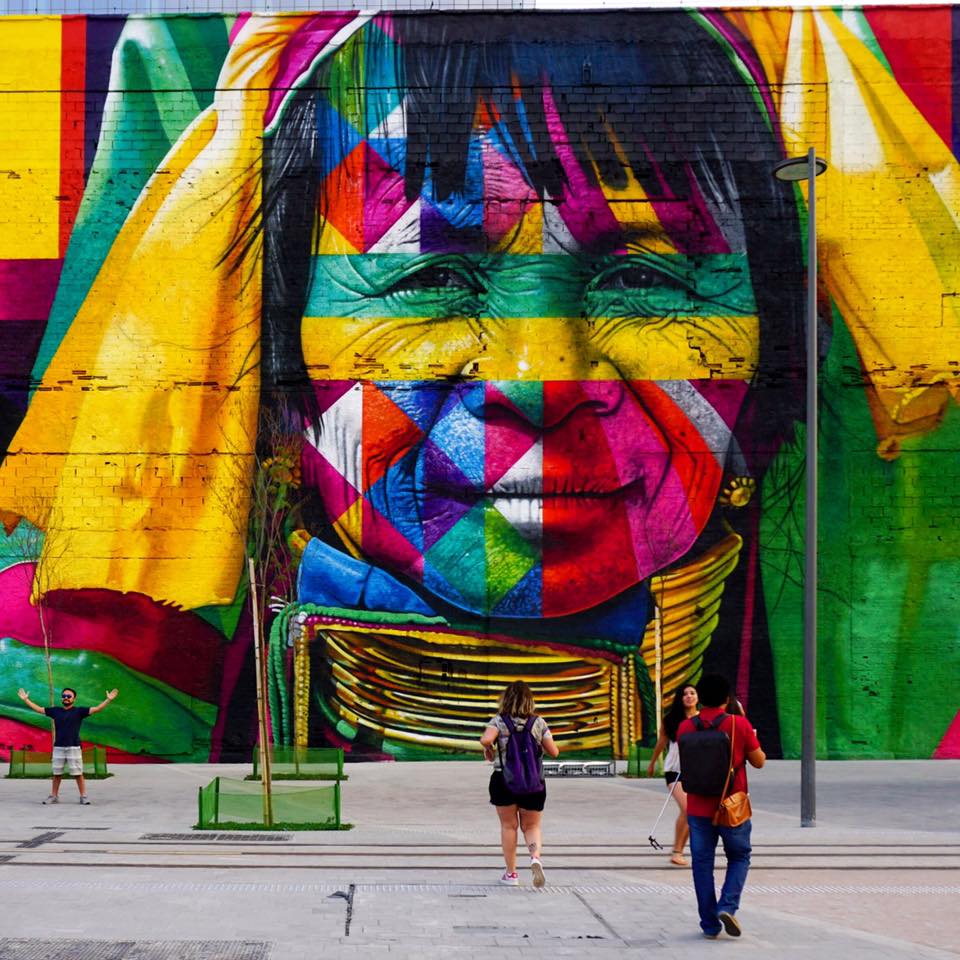
Etnias mural photos by Eduardo Kobra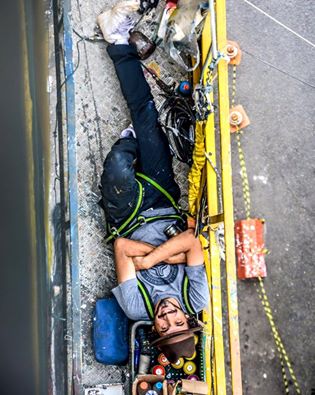


How to read Etnias as street art
Kobra’s style is easy to recognize because the portraits feel both realistic and constructed. The faces carry expression, but the color system breaks them into hard-edged fragments. That tension is what keeps the mural from becoming a simple postcard image. From a distance, you see the faces first. Up close, you start reading the surface as a designed grid of color, shadow, and line.
The Rio Olympics mural also shows why a street art mural has to respect its site. A small studio composition can rely on detail. A wall this long has to survive sun, distance, passing traffic, phone photos, and quick glances. Etnias solves that with large portrait shapes, strong contrast, and a rhythm that keeps the eye moving across the wall.
Materials, scale, and Olympic context
The mural was made with spray paint and acrylic techniques on an exterior wall, then protected for outdoor exposure. That mix matters because it lets the work keep the speed and surface energy of graffiti while still giving Kobra enough control for portrait detail. The 3,000 square meter description is useful for search, but the human experience is simpler: the artwork is big enough to become part of the neighborhood’s visual memory.
As Olympic public art, Etnias avoids showing athletes or medals. Instead, it uses faces to ask what a global event is supposed to represent. That is why the mural still works outside the 2016 news cycle. It is tied to Rio, but it is not locked inside one sports result or one opening ceremony moment.
Source notes for the Rio Olympics mural
For more context beyond this design reading, compare the Eduardo Kobra official site, Wired report on the Olympic mural, Street Art Bio profile of Eduardo Kobra, and Eduardo Kobra background. They help separate three overlapping searches: Kobra as an artist, Etnias as a specific Olympic mural, and large-scale street art as a public design format.
Street art and mural cluster next
To keep studying the same visual territory, move next into street artist mural work, mural artists for hire, graffiti ideas for urban art, street art illusions, and artists who use color beautifully. Those pages help compare Kobra’s wall with other mural, graffiti, and color-led public art references.
If the portrait and culture side is the part that interests you, continue with cultural portraits in visual communication, Chicano art style murals, Aboriginal art styles, urban sketching, and art drawing ideas. Etnias sits at the intersection of public scale, portrait symbolism, urban walking routes, and drawing choices that can be studied far beyond the Olympic story.
Recovery playbook for this post
The old version of this article was image-heavy and very short, so the recovery path is straightforward: answer the main entity query early, keep the title tied to Eduardo Kobra and Etnias, add useful context around the mural’s scale and meaning, improve image alt text, and connect the post to nearby mural, street art, color, portrait, and public art pages.
After publishing, the practical checks are impressions for Eduardo Kobra mural, Etnias mural, Kobra mural, Rio Olympics mural, and street art mural variants. If Google starts showing the post for a broader Eduardo Kobra query, the next refresh should add a tighter artist-background section without letting the article drift into a full biography.
Eduardo Kobra mural FAQ
Q: What is the Eduardo Kobra mural in Rio?
A: The Eduardo Kobra mural in Rio is Etnias, also known as We Are All One. It was painted for the Rio 2016 Olympic Games and shows five large indigenous portraits as a symbol of human diversity, unity, and shared identity.
Q: Where is the Etnias mural located?
A: Etnias is in Rio de Janeiro’s port area on Olympic Boulevard, near the waterfront district that became a major pedestrian route during the 2016 Olympics. The wall turns a long industrial facade into a public artwork rather than a private gallery piece.
Q: How big is the Rio Olympics mural?
A: The mural is commonly described as about 3,000 square meters, with a long warehouse wall covered by five huge portraits. Some records and reports use slightly different figures, but the practical point is the same: this is a landmark-scale street art mural.
Q: Who are the five faces in the Etnias mural?
A: The mural represents five indigenous peoples from different continents, including the Huli, Mursi, Tapajos, Chukchi, and Karen peoples. Kobra used those faces to echo the five Olympic rings without turning the work into a simple sports logo.
Q: Why did Eduardo Kobra paint Etnias for the Olympics?
A: Kobra painted Etnias as a message about unity during an event built around international participation. The mural uses public scale, color, and portraiture to say that different cultures can be seen together without being flattened into one identity.
Q: What materials did Eduardo Kobra use for the mural?
A: The work was made with spray paint and acrylic paint on a large exterior wall, then protected for outdoor conditions. That mix let Kobra combine graffiti speed, hard color geometry, and a more controlled portrait finish.
Q: Is Etnias the same as the 3,000 square meter mural?
A: Yes. When people mention the 3,000 square meter Rio Olympics mural, they are usually referring to Etnias, the Eduardo Kobra mural painted for the 2016 Olympic context in Rio de Janeiro.
Q: What can artists learn from the Etnias mural?
A: Artists can study how Etnias turns a simple structure into a strong image: five faces, a repeating color system, a long wall, and one clear message. The lesson is not to copy the style, but to make scale, subject, and setting work together.
- 23shares
- Facebook0
- Pinterest23
- Twitter0
- Reddit0