Why Water Can Move Backward After Irrigation Stops
Irrigation design usually gets judged on what happens while the system is running — coverage, pressure, how even the spray pattern looks across a lawn. What happens in the thirty seconds after a zone shuts off gets almost no attention, and that’s exactly the gap that causes most of the confusion homeowners bring to a landscape designer.
A useful design rule is to study a system at shutdown as carefully as at full operation. A hydraulic system does not stop the instant its input closes: pressure differences, stored volume, and elevation keep doing work for seconds or minutes. Irrigation piping is no different, and ignoring that transition is how a sound valve gets blamed for a problem caused by slope.
- Pressure differences, elevation, and water stored in the pipes
- Residual drainage versus a valve that is still leaking
- Backsiphonage vs. Backpressure: Two Different Design Risks
- Irrigation Check Valve vs. Backflow Preventer
- Designing Irrigation for Sloped Landscapes
- Pumped Irrigation Systems and Shutdown Behavior
- How to Choose the Right Protection Strategy
- A Landscape Design Checklist Before Installation or Renovation
- FAQ
The same principle applies to building drainage. A roof and gutter network keeps moving water after rain stops, and an irrigation line on a sloped lot behaves in much the same way. A design that considers only peak flow misses what the stored water does next.
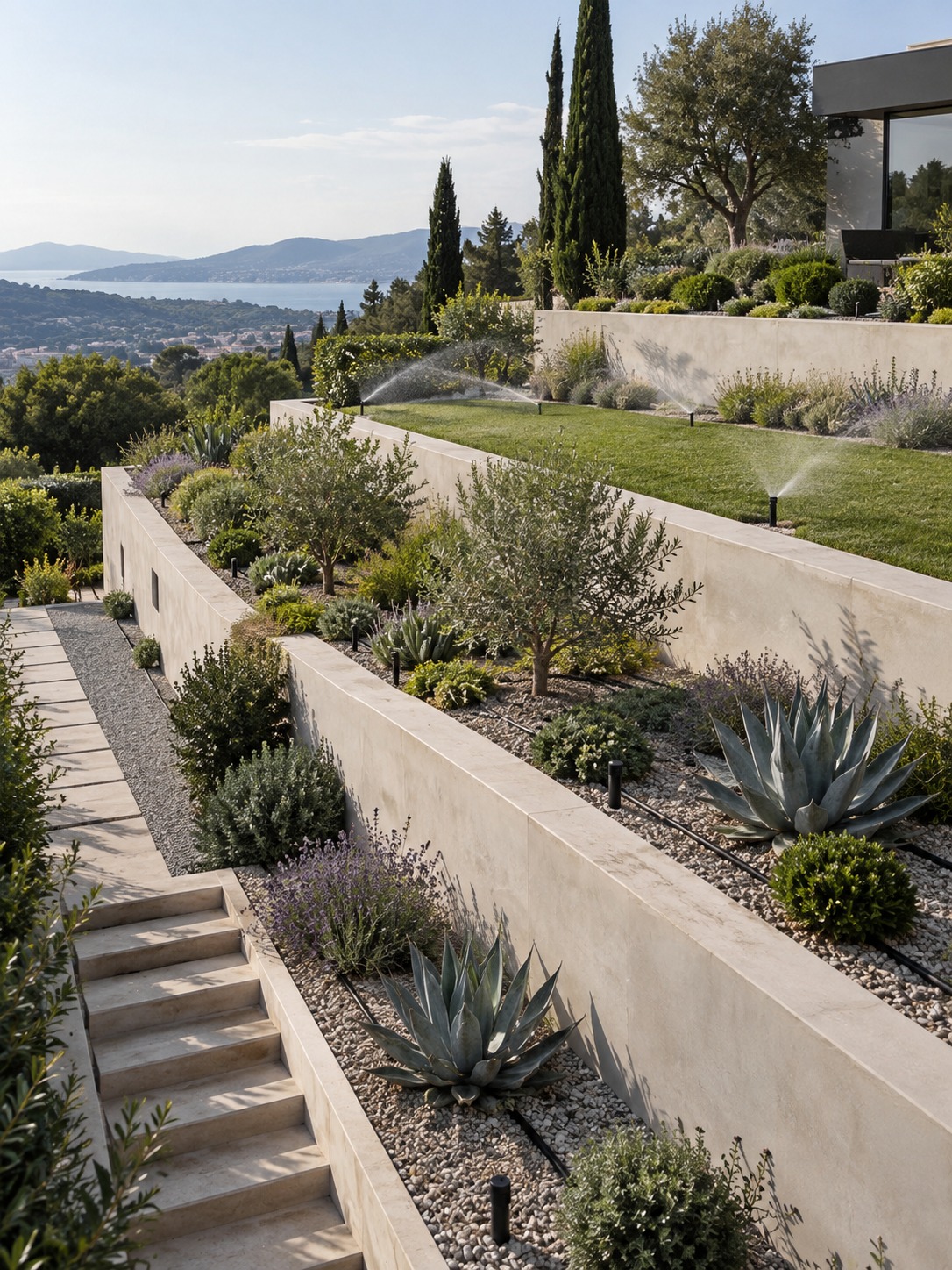
Pressure differences, elevation, and water stored in the pipes
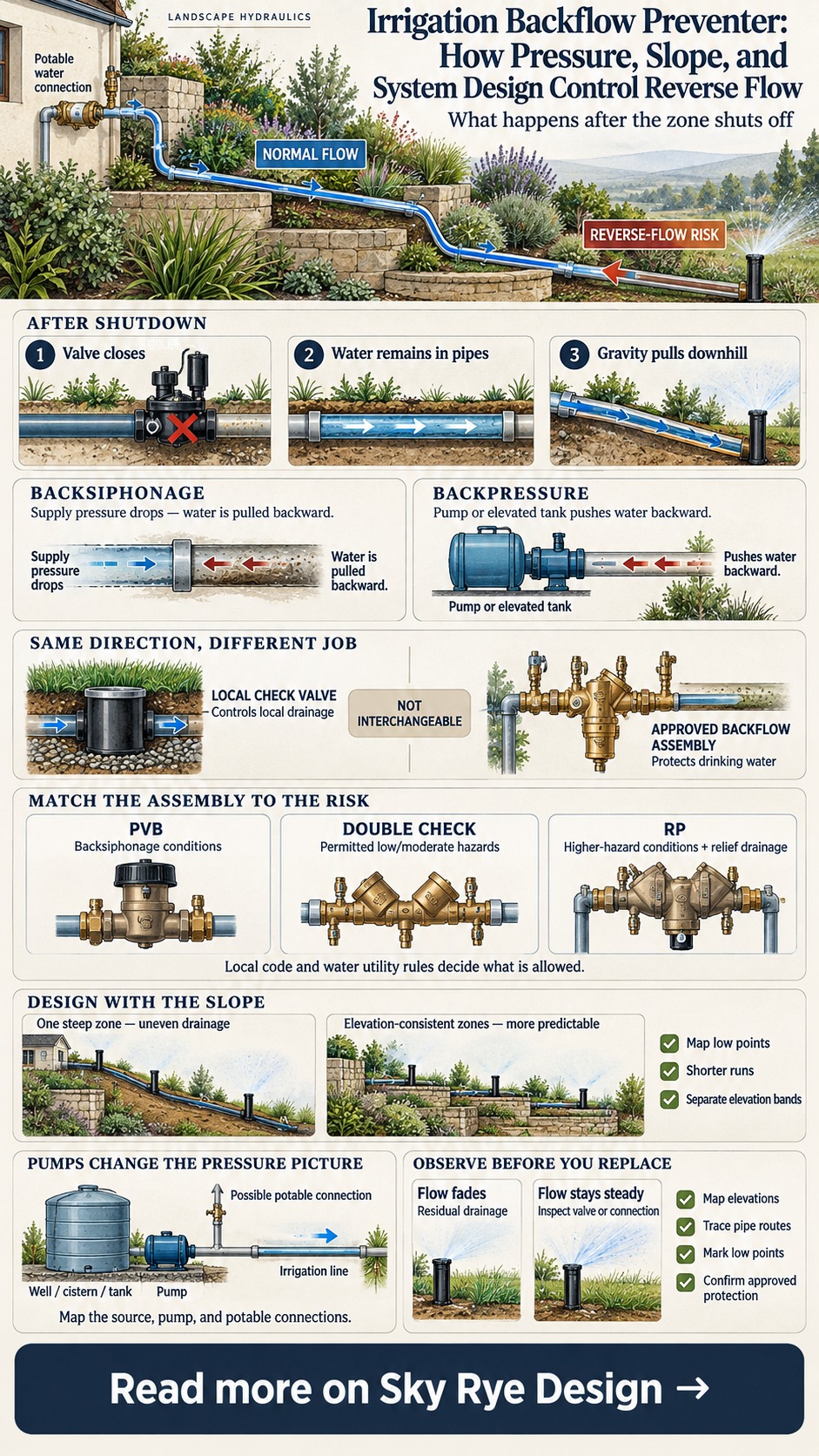
While a zone runs, supply-side pressure is high enough to push water through the whole system in one direction. The moment the automatic valve closes, that push disappears — but the pipe downstream of the valve is still full. On flat ground, that stored water mostly just sits there. On a sloped property, gravity starts pulling it toward the lowest point in the zone, and if the layout allows it, the lowest sprinkler head keeps discharging water long after the controller has already done its job.
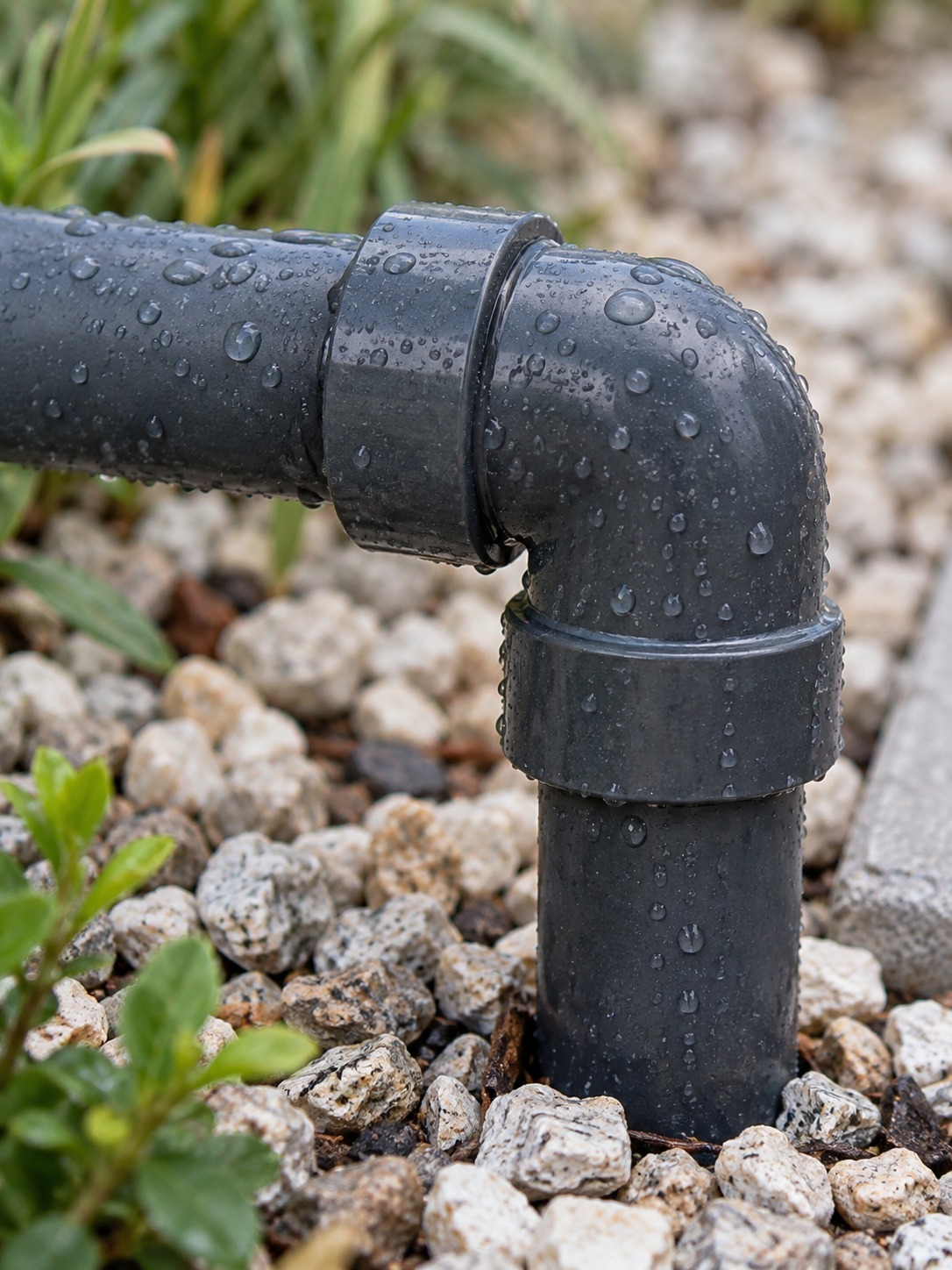
Residual drainage versus a valve that is still leaking
This distinction changes what you fix. Residual drainage weakens steadily as stored water runs out—a trickle that fades over a minute or two. A valve that is failing to seal keeps feeding a more consistent flow because water is still passing from the supply side. Replacing a functional zone valve will not solve low-head drainage when a long pipe run above the lowest sprinkler is holding the water.
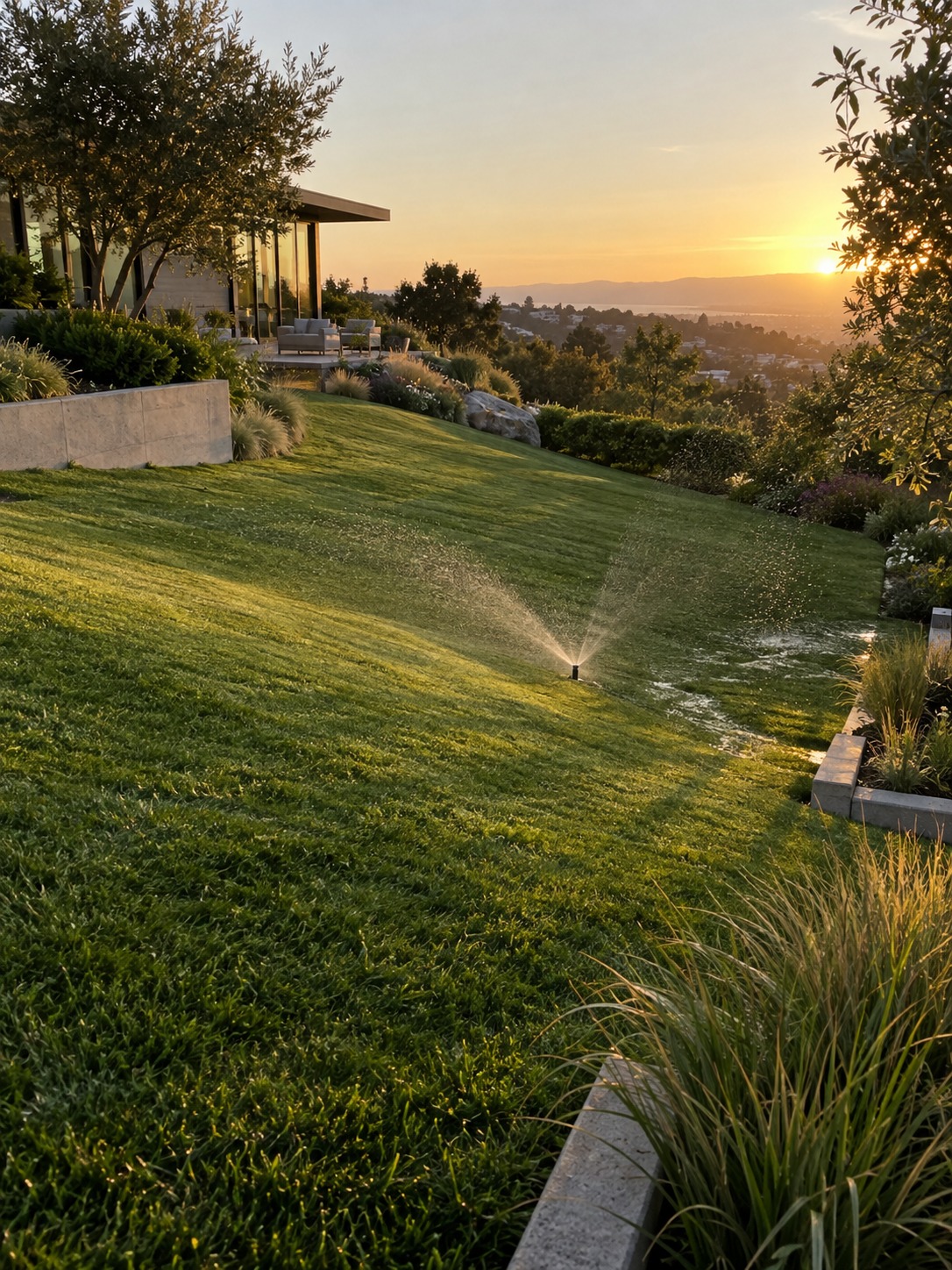
Backsiphonage vs. Backpressure: Two Different Design Risks
Reverse flow at a potable water connection isn’t one failure mode — it’s two, and they call for different protection depending on which one a given installation is actually exposed to.
What causes backsiphonage at a potable-water connection
Backsiphonage happens when pressure on the supply side drops below the pressure downstream of an unprotected connection. When that happens, whatever is sitting in the downstream piping — irrigation water that’s been in contact with soil, fertilizer, or standing water in a valve box — can get pulled backward into the drinking water line. The supply-side pressure drop doesn’t have to originate in the irrigation system at all. A nearby fire hydrant opening, a water main repair, or unusually high demand elsewhere on the municipal network can all create the same condition.
How pumps, tanks, and elevation create backpressure
Backpressure is the mirror-image risk: pressure downstream of the connection becomes higher than the supply-side pressure, and that difference can push water backward through the system instead of pulling it. Pumps, elevated storage tanks, and pressurized irrigation equipment are the usual sources. A system relying only on the assumption that supply pressure will always exceed everything downstream is designing around a condition that isn’t guaranteed to hold — municipal pressure fluctuates, and a pump or elevated tank on the irrigation side can genuinely exceed it under the wrong circumstances.
The practical takeaway is that a single generic device doesn’t answer both risks equally well. Selecting protection means identifying which condition — or both — a specific connection is actually exposed to, not defaulting to whatever’s cheapest or most familiar.
A helpful comparison is a structural load case: equipment designed for force in one direction is not automatically suitable for the opposite direction. Backsiphonage and backpressure are both reverse flow, but opposite pressure relationships drive them. Protection therefore has to match the actual site condition, not the broad label of backflow.
Irrigation Check Valve vs. Backflow Preventer
This is where a lot of confusion starts, mostly because the two components sound like they do the same job. They don’t, and mixing them up is one of the more common — and more expensive — mistakes in irrigation design.
When a one-way check valve controls local reverse flow
A check valve’s job is narrow and mechanical: let water flow one direction through a specific point in the piping, and close when flow tries to reverse. Check valves come in spring and swing configurations, and which one fits depends on pipe size, expected flow rate, and where in the system it sits — a spring check responds faster to small reversals, which matters at the low point of a sloped zone where you’re trying to stop exactly the kind of residual drainage described above.
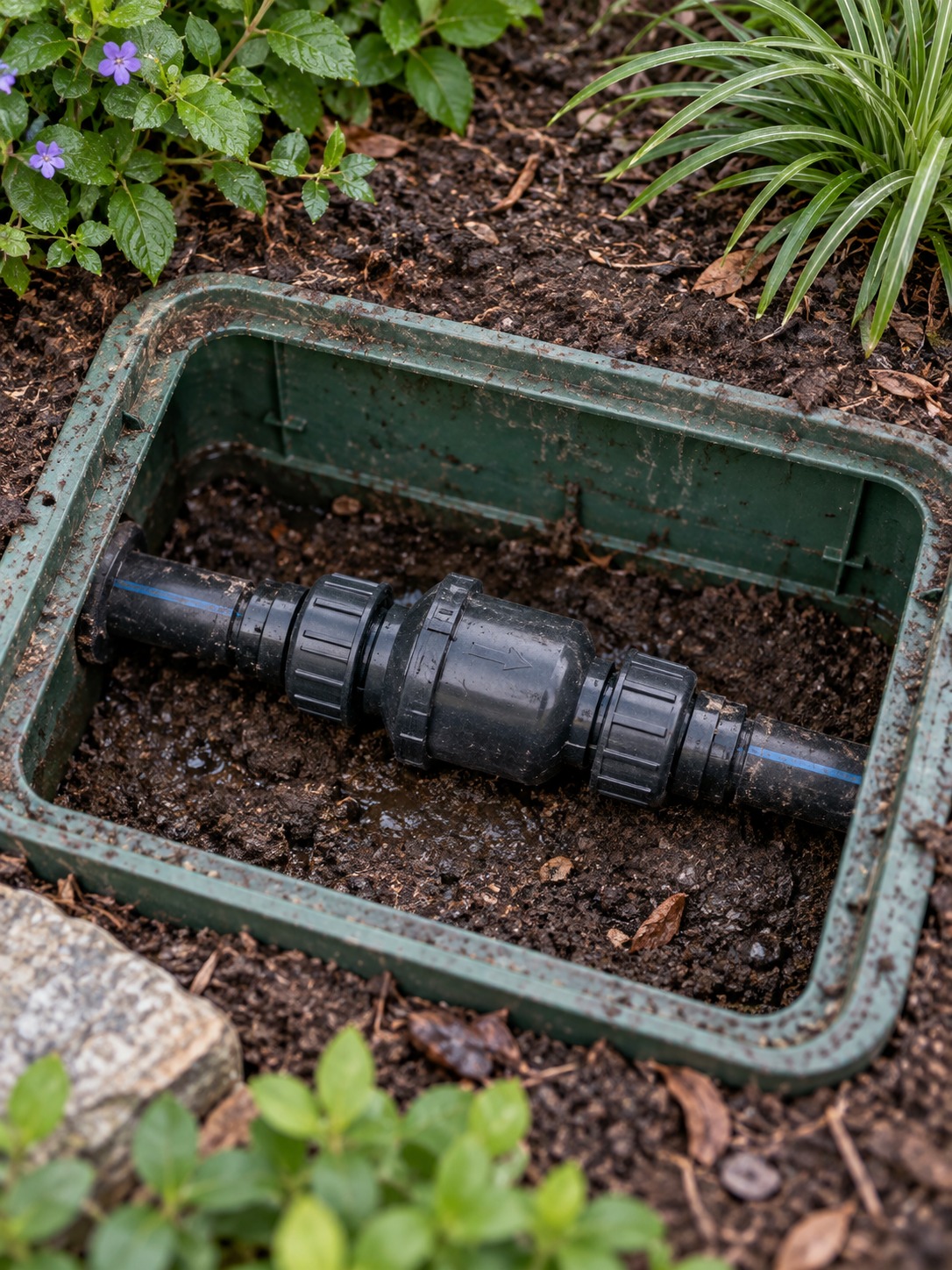
Why it does not replace an approved backflow prevention assembly
A check valve controlling drainage at the bottom of a sprinkler zone is doing a different job from a listed, testable assembly protecting a potable-water connection. Local codes and water utilities define which assemblies are acceptable for each hazard. A general irrigation check valve is a hydraulic component, not a substitute for the approved protection required at a drinking-water connection.
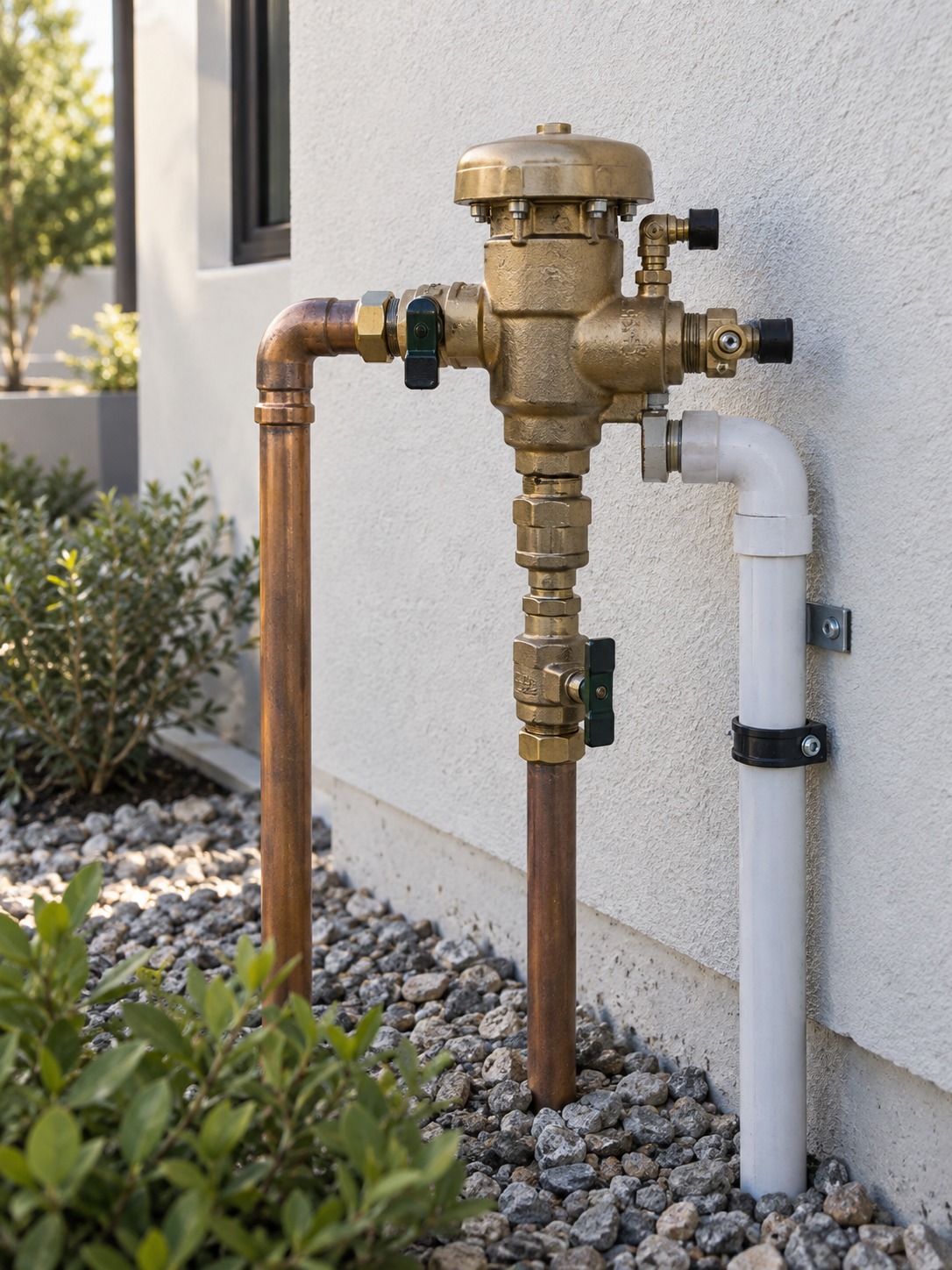
The confusion often appears during renovations, when an existing check valve is assumed to satisfy the new work’s potable-water protection requirement. The components can coexist: a check valve may manage drainage at a low point while a separate approved assembly protects the potable connection upstream. Neither substitutes for the other.
Comparison table: function, location, pressure condition, and limitation
| Component | Function | Typical Location | Pressure Condition Addressed | Limitation |
|---|---|---|---|---|
| Irrigation check valve | Stops local reverse flow at one point in the piping | Low points in sloped zones, individual sprinkler heads, pump discharge lines | Gravity-driven residual drainage | Not a certified backflow prevention device; no hazard rating |
| Pressure vacuum breaker (PVB) | Prevents backsiphonage at a potable connection | Above-grade, downstream of the last shutoff valve | Backsiphonage only | Does not protect against backpressure |
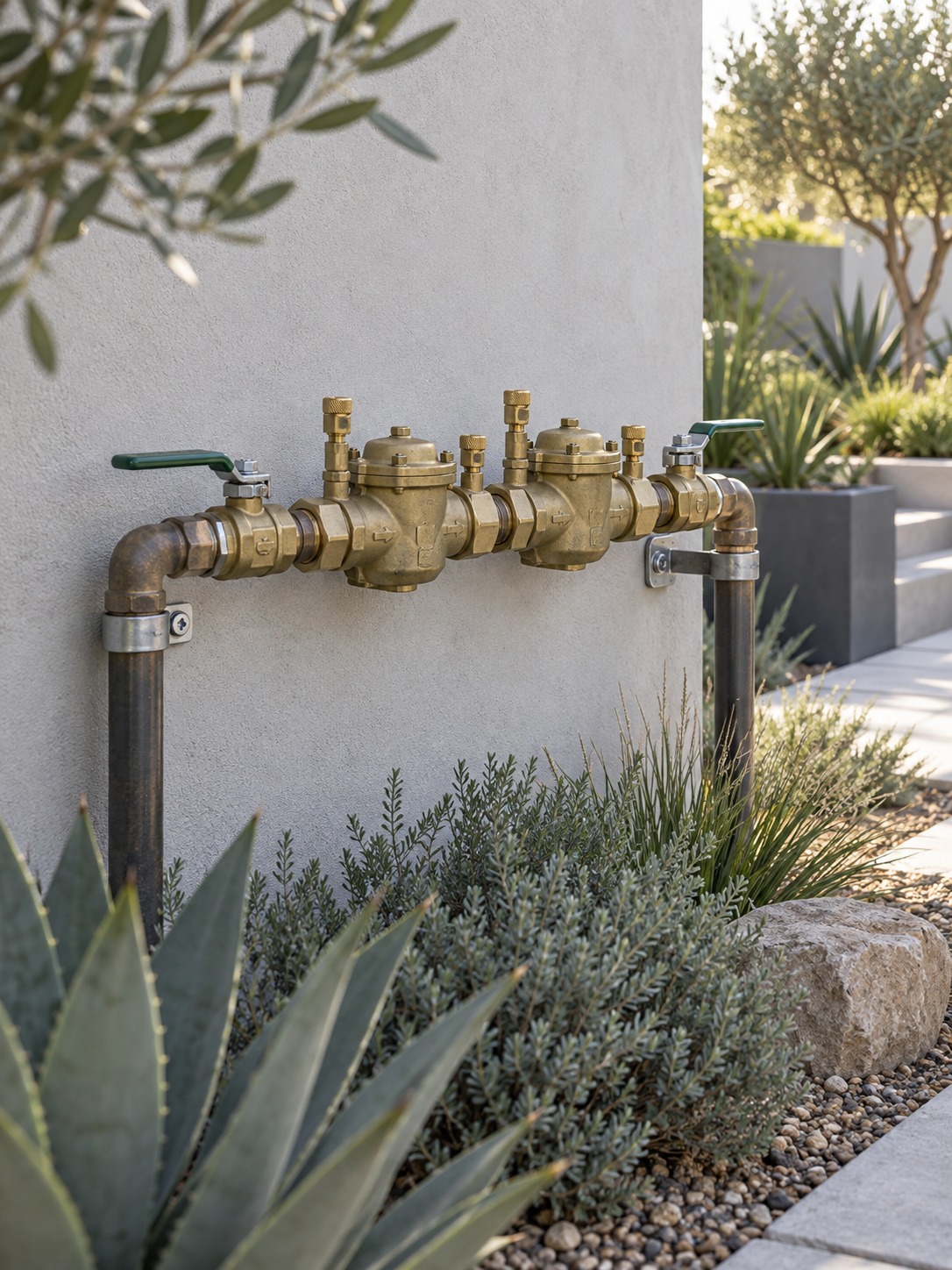
| Double check valve assembly | Prevents backflow from low- to moderate-hazard sources | At or near the potable water connection | Backsiphonage and backpressure | Not rated for high-hazard chemical injection systems |
| Reduced pressure principle (RP) assembly | Prevents backflow from higher-hazard sources, including fertigation | At or near the potable water connection, with drainage provision | Backsiphonage and backpressure, including high-hazard conditions | Requires drainage clearance and periodic testing |
Designing Irrigation for Sloped Landscapes
Low-head drainage at the bottom of a sprinkler zone
Low-head drainage is the technical name for the exact scenario described earlier — water stored in elevated piping draining out through the lowest outlet in a zone once pressure drops. The amount depends on the elevation difference across the zone, how much pipe volume sits above the low point, and whether a check valve is already doing its job at that location. Larger elevation changes and longer pipe runs both mean more stored volume, which means more visible drainage after shutoff.
Drip irrigation behavior on hillsides and terraced beds
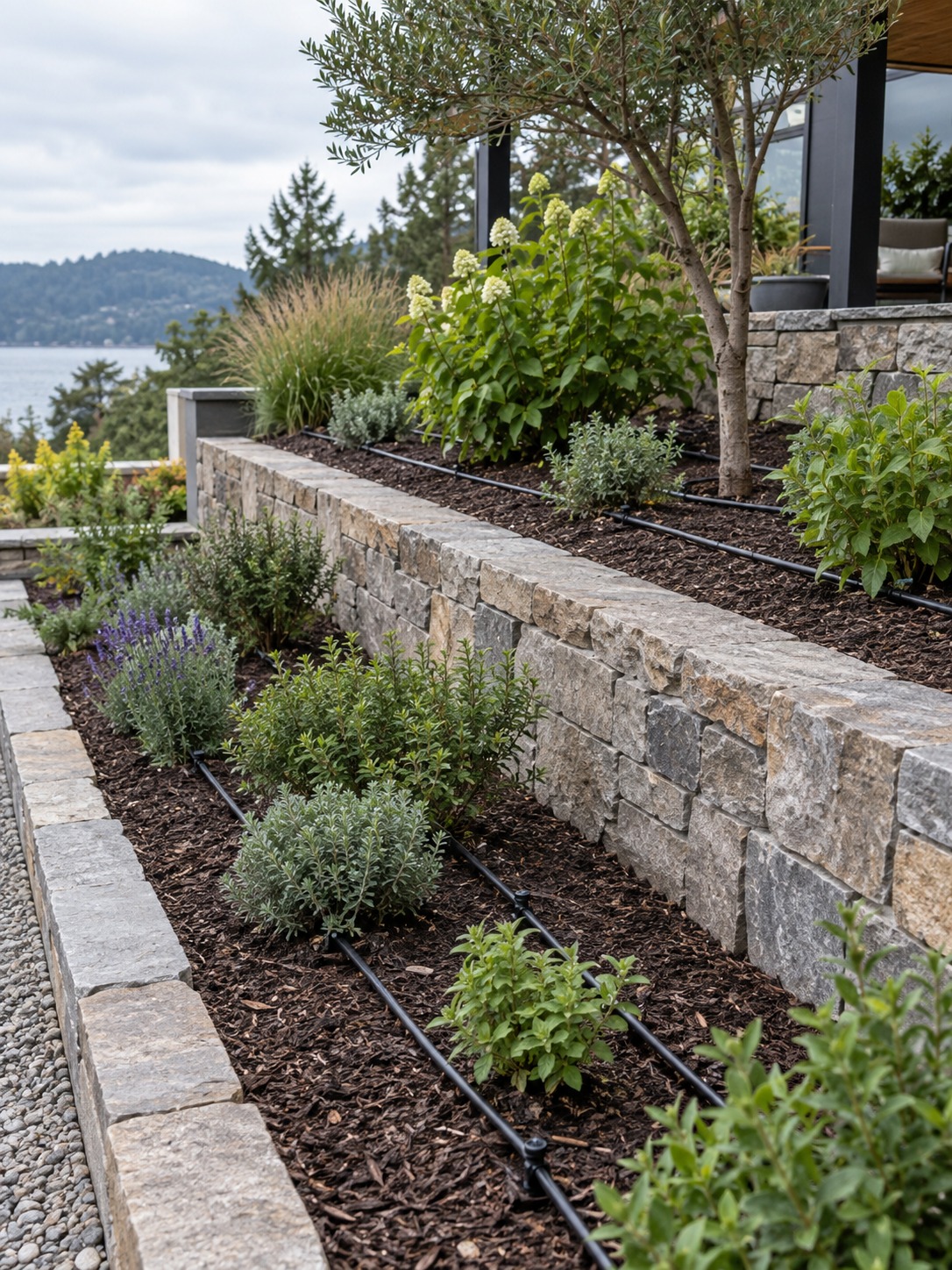
Drip systems run at lower pressure than spray irrigation, but they respond to the same gravity and elevation forces. On a terraced bed, water can migrate from higher tubing runs toward lower emitters after a cycle ends, and the lower sections can stay saturated noticeably longer than the rest of the zone. This isn’t automatically a problem — plenty of sloped drip installations run fine for years — but it does mean tubing layout, emitter flow rate, and zone length all need to account for elevation, not just square footage.
When to divide one elevation-heavy zone into several zones
A single zone that spans a large elevation change is asking one set of valves and one pipe network to handle drainage behavior that would be much more predictable if it were split. Dividing a steep property into elevation-consistent zones — rather than zones drawn purely around planting areas — reduces the stored volume any one low point has to deal with and makes check valve placement more effective, since each valve only has to manage drainage from a shorter, more consistent run above it.
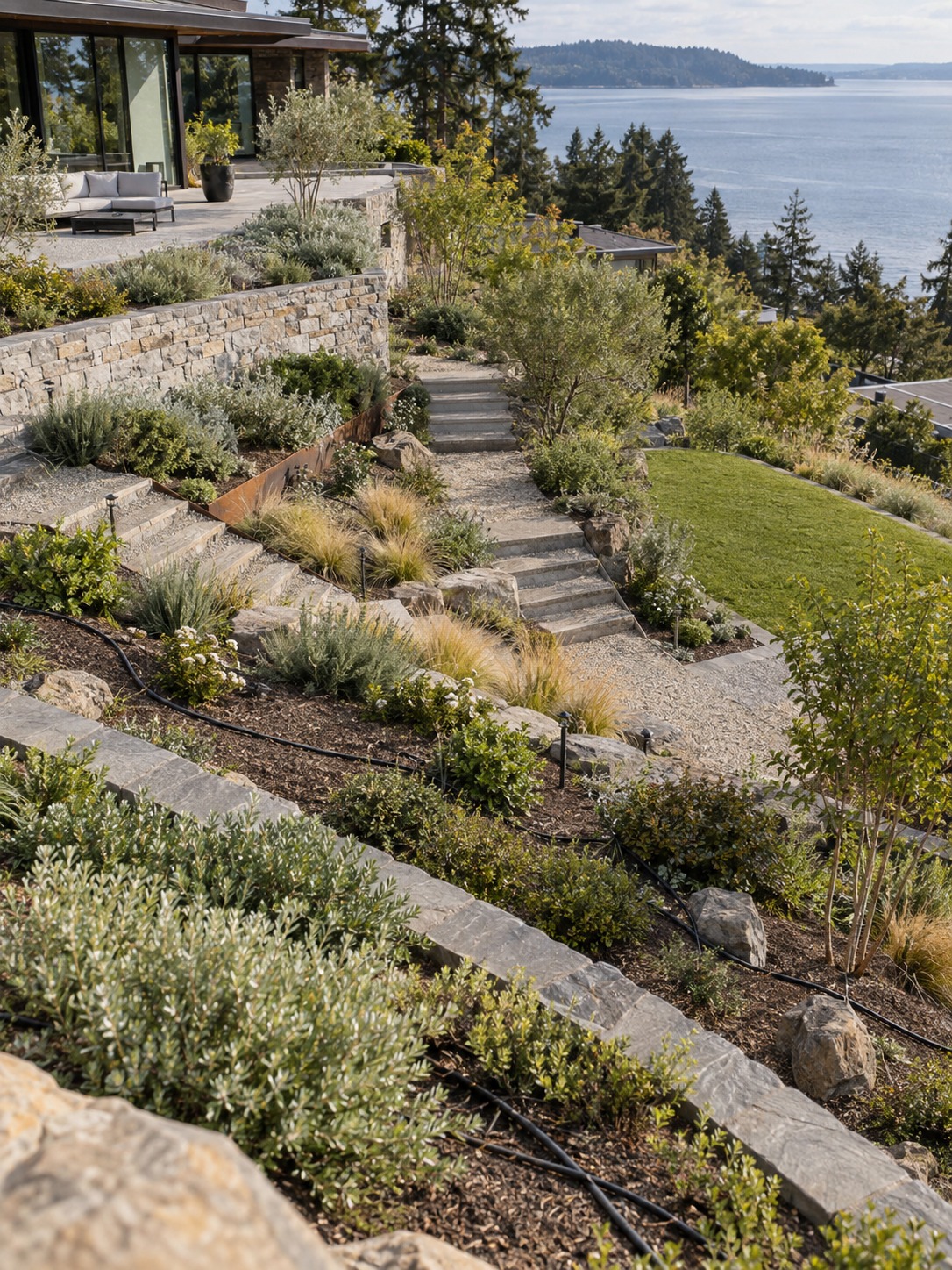
This is a zoning decision, not just a plumbing one, and it belongs in the same conversation as planting layout rather than being bolted on after the beds are already designed. A terraced hillside planted first and piped second usually ends up with one zone stretched across an elevation change nobody planned around, simply because the irrigation contractor inherited a layout that wasn’t drawn with hydraulics in mind.
Pumped Irrigation Systems and Shutdown Behavior
Wells, cisterns, ponds, and storage tanks
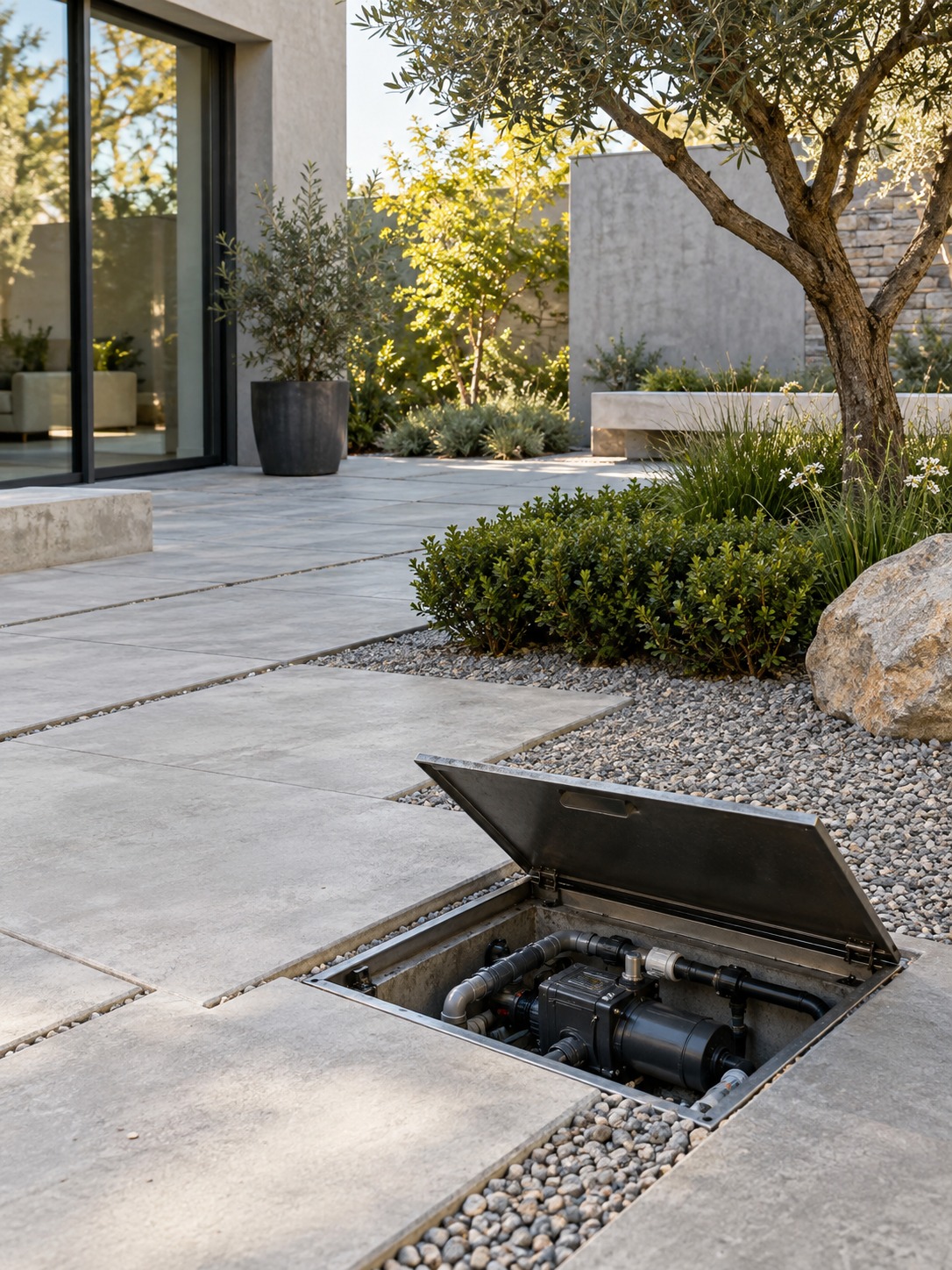
A pumped system draws from a source that isn’t the municipal supply — a well, a cistern, a pond, or a storage tank — and while the pump runs, it’s the one creating pressure on the discharge side. That changes the hydraulic picture from a standard municipal-fed system, because the pump itself becomes part of the pressure equation rather than a fixed, predictable supply.
Reverse movement after the pump stops
When the pump shuts down, the pressure it was maintaining disappears, and the water column in the discharge piping responds to whatever forces are left — gravity, elevation, or residual pressure elsewhere in the network. Depending on the layout, that can mean reverse movement back toward the source, which matters more than it might seem: if fertilizer or other chemicals have been introduced into the irrigation water at any point, that reverse movement can carry them back into a well or storage source that might also feed a household. Agricultural and specialty systems that inject chemicals into irrigation water typically need specific protection sized for that exact hazard, not a generic check valve chosen because it was on hand.
Even without any chemical injection, a pumped system deserves its own hazard review, because the source itself changes what’s at stake. A well that also feeds a kitchen tap is a very different situation from a pond used only for irrigation — the same reverse-flow event carries completely different consequences depending on what else draws from that source. Mapping the pump’s role in the overall water network, not just its role in moving water to the sprinklers, is part of designing the system correctly from the start.
How to Choose the Right Protection Strategy
Water source, hazard level, pressure, layout, and local requirements
There’s no single assembly that’s correct for every irrigation system, because the right choice depends on variables that change from property to property: what the water source is, what hazard level the connection represents, what pressure conditions the site actually experiences, how the piping is laid out, and what the local plumbing or water utility code requires. A system on municipal supply with no fertigation is a very different hazard profile than a pumped system injecting chemicals — treating them with the same generic device misses the point of hazard-based selection entirely.
PVB, double-check, RP assemblies, and why they are not interchangeable
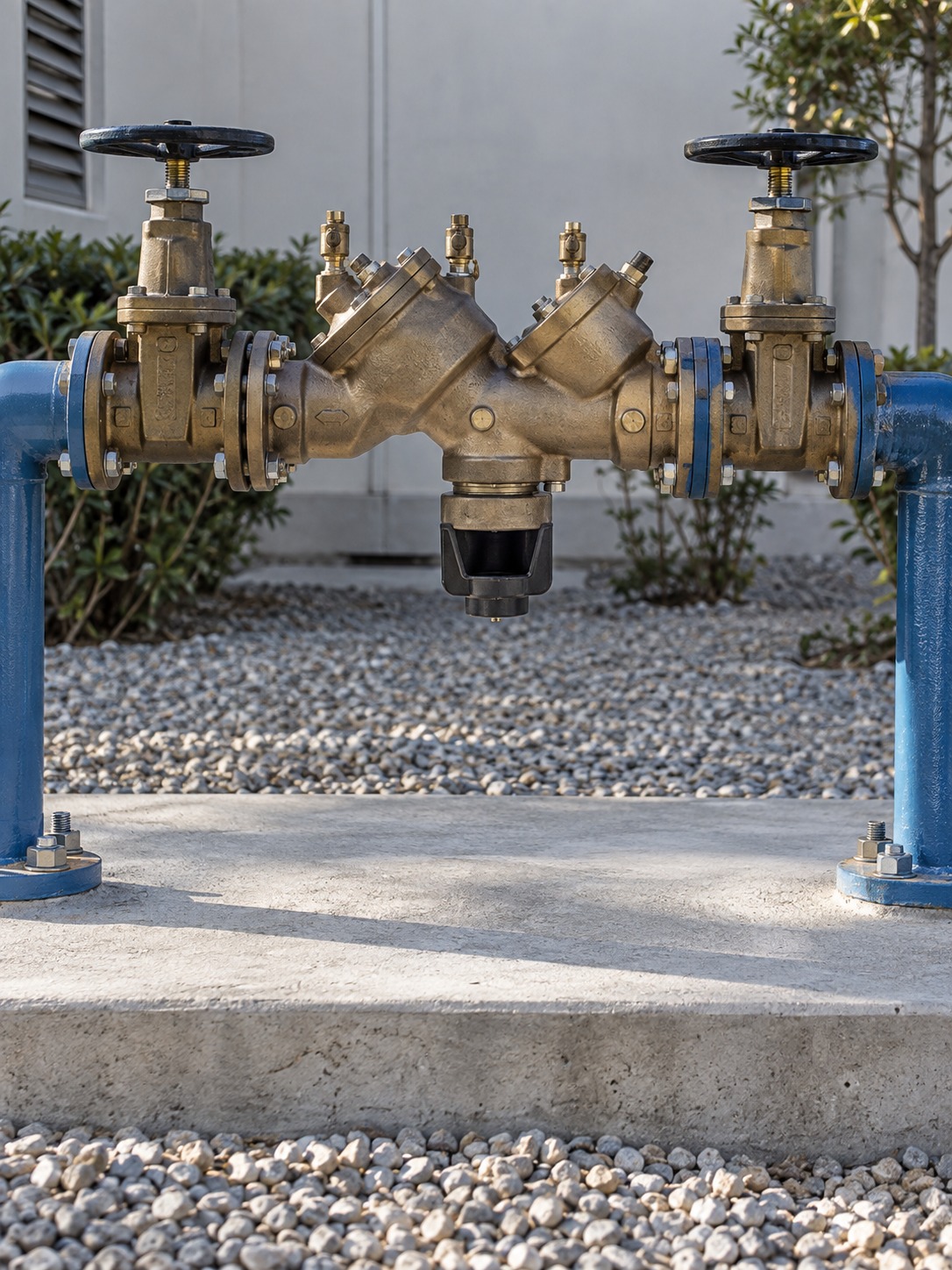
Pressure vacuum breakers, double check valve assemblies, and reduced pressure principle assemblies address different combinations of hazard and pressure condition. A PVB is generally used for backsiphonage conditions, while double check and RP assemblies can address both backsiphonage and backpressure in applications allowed by the local authority. High-hazard uses such as chemical injection usually require the level of protection specified by the local code or water utility. Selection should follow the site’s hazard classification, approved device listings, and local requirements—not installation convenience.
Installation location matters as much as assembly type. A PVB must be installed in the orientation and at the elevation required by its listing, manufacturer, and local authority. An RP assembly’s relief valve also needs safe drainage clearance so a discharge cannot flood a finished space. These constraints are part of the protection strategy, not optional detailing.
A Landscape Design Checklist Before Installation or Renovation
Map elevations, pipe routes, low points, zones, pumps, and potable connections
Before specifying any backflow equipment, map the property: where the elevation changes are, where the piping actually runs (not just where it was originally designed to run — years of changes can leave a layout that doesn’t match the original plan), where the low points in each zone sit, whether any zone is pump-fed, and exactly where irrigation connects to potable water. This mapping step is the same discipline as any site analysis in landscape architecture — you can’t design a solution for a hydraulic condition you haven’t located.
On an older property, this map rarely matches whatever documentation exists, if any exists at all. Irrigation systems get modified piecemeal over years — a zone added here, a bed rerouted there, a pump installed when a well replaced municipal supply — and the piping that actually exists in the ground can diverge significantly from any original design. Walking the property with a probe and a notepad, rather than trusting an old plan, is usually the faster and more accurate route to an actual map.

Observe duration and flow strength before replacing equipment
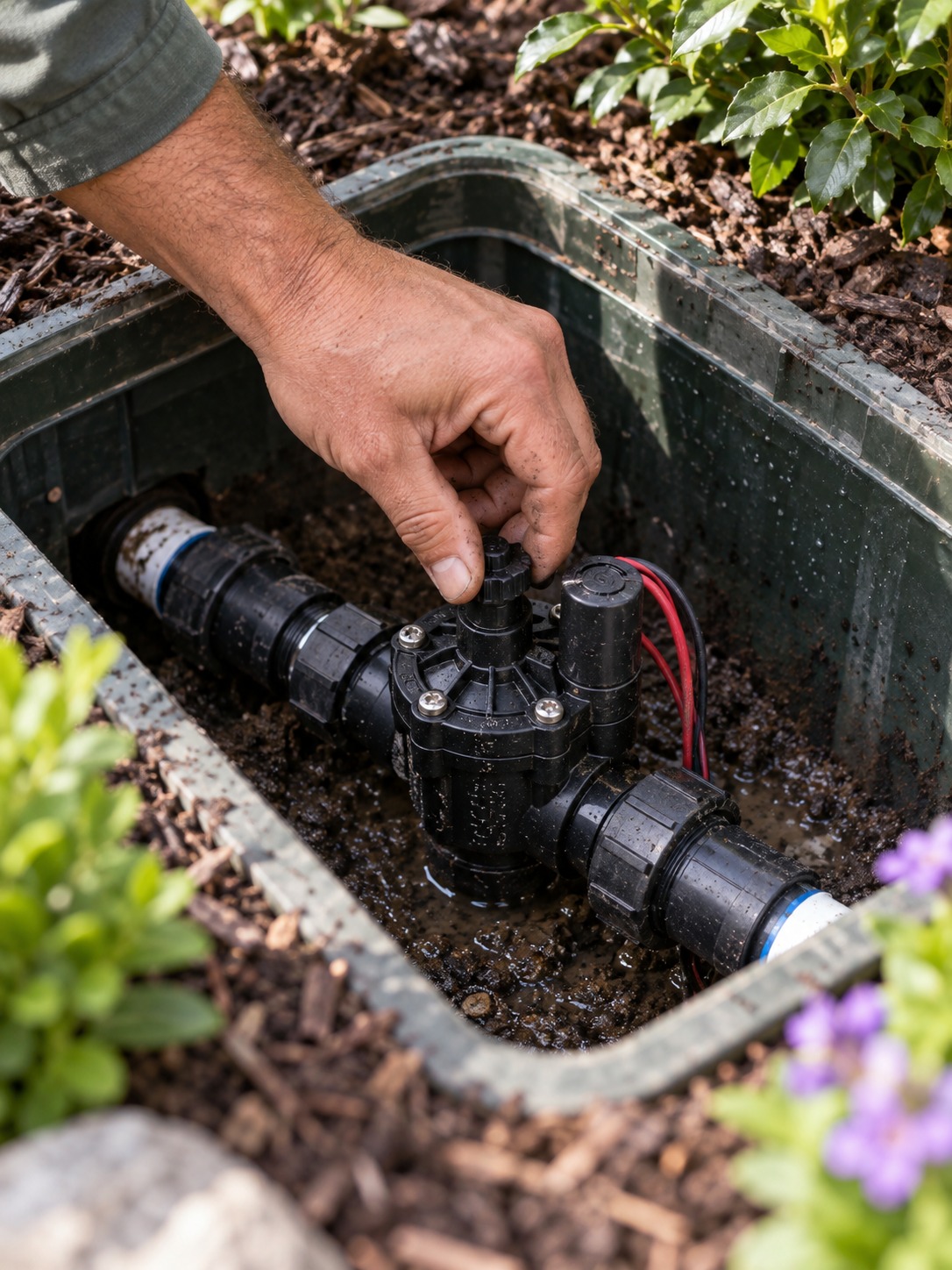
Before replacing a valve or adding equipment, watch how the system actually behaves. Time how long water continues after a zone shuts off, and note whether the flow weakens steadily or stays consistent. A short burst that tapers off is almost always residual drainage from elevation, not a failing valve — and replacing the valve in that case fixes nothing, since the water was already downstream of it. A steady, consistent flow that doesn’t taper deserves a closer look at the valve or the connection itself.
Treat this as any other diagnostic step before a design change: observe first, modify second. Replacing equipment before confirming the cause can leave a property with a new zone valve, a new check valve, and the same puddle at the bottom of the slope.
FAQ
Do I need a backflow preventer on my irrigation system?
If the system connects to potable water, backflow protection is commonly required because irrigation water can contact soil, fertilizer, and standing water. The exact assembly and testing rules vary by hazard level and jurisdiction, so confirm the requirement with the local plumbing authority or water utility.
Is an irrigation check valve the same as a backflow preventer?
No. A check valve controls local reverse flow at one point in the piping — typically at a low point or a pump discharge — but it isn’t a certified backflow prevention assembly and doesn’t carry a hazard rating for protecting a potable water connection. The two solve different problems and aren’t interchangeable.
Why does the lowest sprinkler leak after the zone shuts off?
Often it is draining water already stored in elevated piping, pulled downhill once zone pressure drops. This low-head drainage usually tapers as the pipe empties. If the flow stays steady instead of weakening, the control valve or another connection may need inspection.
Does drip irrigation need backflow protection?
If drip irrigation connects to potable water, it requires the same backflow-hazard review as spray irrigation. Lower operating pressure does not remove the cross-connection risk where emitters can contact soil or fertilizer.
Which backflow preventer is required for irrigation?
It depends on the water source, hazard classification, pressure conditions, approved device listings, and local code. A local plumbing authority, water utility, or qualified irrigation professional should confirm which assembly is permitted for the property.
For more on cutting water use without sacrificing design, see our Water-Wise Landscaping: Modern Outdoor Design That Uses Less Water guide. If you are planning from the ground up, Landscape Design Process: From Site Analysis to Planting Plan and Low Maintenance Landscape Design That Actually Works cover the planning stages. For the irrigation network itself, The Hidden System That Keeps Your Sprinklers Running All Season Long and Yard Drainage Ideas in Landscape Design complete the broader water-management picture.
- 14shares
- Facebook0
- Pinterest14
- Twitter0
- Reddit0