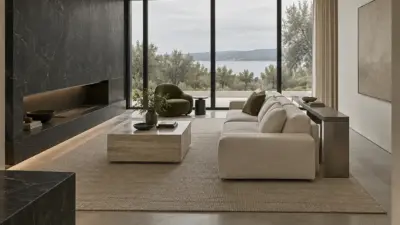
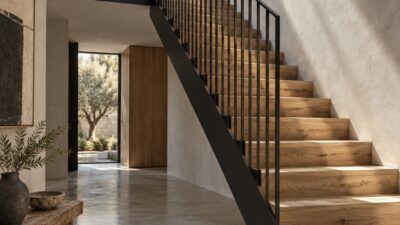
The best interior design is the kind you stop noticing. Not because it’s unremarkable, but because it’s so well resolved that your eye accepts it as simply how things are. The Eames chair that’s always been in that corner. The light that always seems exactly right at that time of day. The floor that’s always clean, even though nobody appears to have cleaned it.
The same idea applies at estate scale: private island design works best when the engineering disappears into the architecture instead of being added later.
- 01 — Adaptive Circadian Lighting
- 02 — Robot Vacuum with Laser Mapping
- 03 — Zoned Climate Control with Hidden Infrastructure
- 04 — Electrochromic Smart Glass
- 05 — Architectural In-Wall and In-Ceiling Audio
- The Invisible Architecture Principle
- Frequently Asked Questions
- Is smart home technology compatible with a minimalist interior aesthetic?
- What is the best entry point for invisible smart home technology?
- How much does a whole-home smart audio system cost?
- Are robot vacuums effective on mixed flooring types?
- Can electrochromic smart glass be retrofitted into existing windows?
- Conclusion: Technology in Service of the Space
That quality—the sense that a space maintains itself—is increasingly achievable not through invisible staff or obsessive cleaning habits but through technology that genuinely disappears into the architecture. Not gadgets that announce themselves with blinking LEDs and voice prompts, but systems that operate in the background, responding to conditions, learning patterns, and producing outcomes that feel effortless because they largely are.
The five features in this guide are selected on a specific criterion: they contribute to the flawless appearance and performance of a modern interior while remaining almost entirely invisible in their operation. Some are built into the fabric of the space. Some move through it. All of them work best when you stop thinking about them.
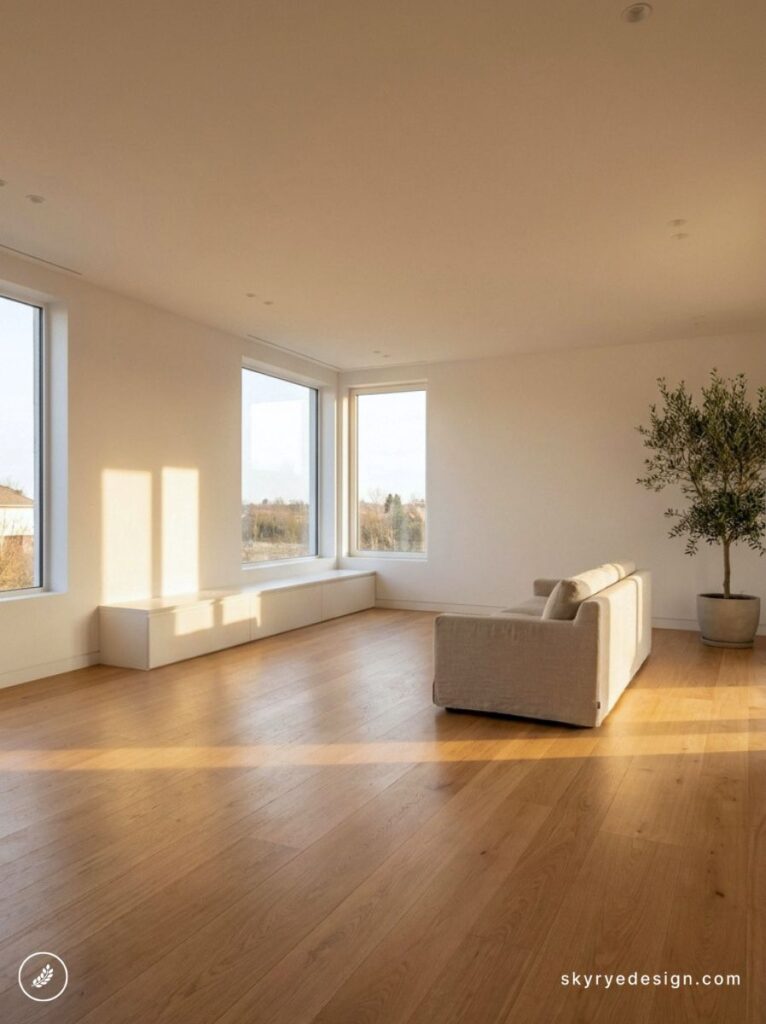
When I was renovating my new apartment and installed several gadgets from this list, it immediately added +100 to the convenience and also increased the profitability of the apartment itself.
01 — Adaptive Circadian Lighting
| Built-in · Invisible operation Key systems: Ketra, Lutron Athena, Philips Hue Gradient (residential) Integration: Recessed into ceiling architecture — zero visual presence What it does: Shifts colour temperature and intensity through the day automatically Design benefit: Eliminates the ‘wrong light’ problem at every hour of the day |
Light is the material that most directly determines how a space feels — and the hardest to get right statically. A reading light that’s perfect for 7pm is clinical at 7am and inadequate at midnight. Most homes solve this badly: a combination of too many fittings, too many switches, and too many compromises that leave the space always slightly off.
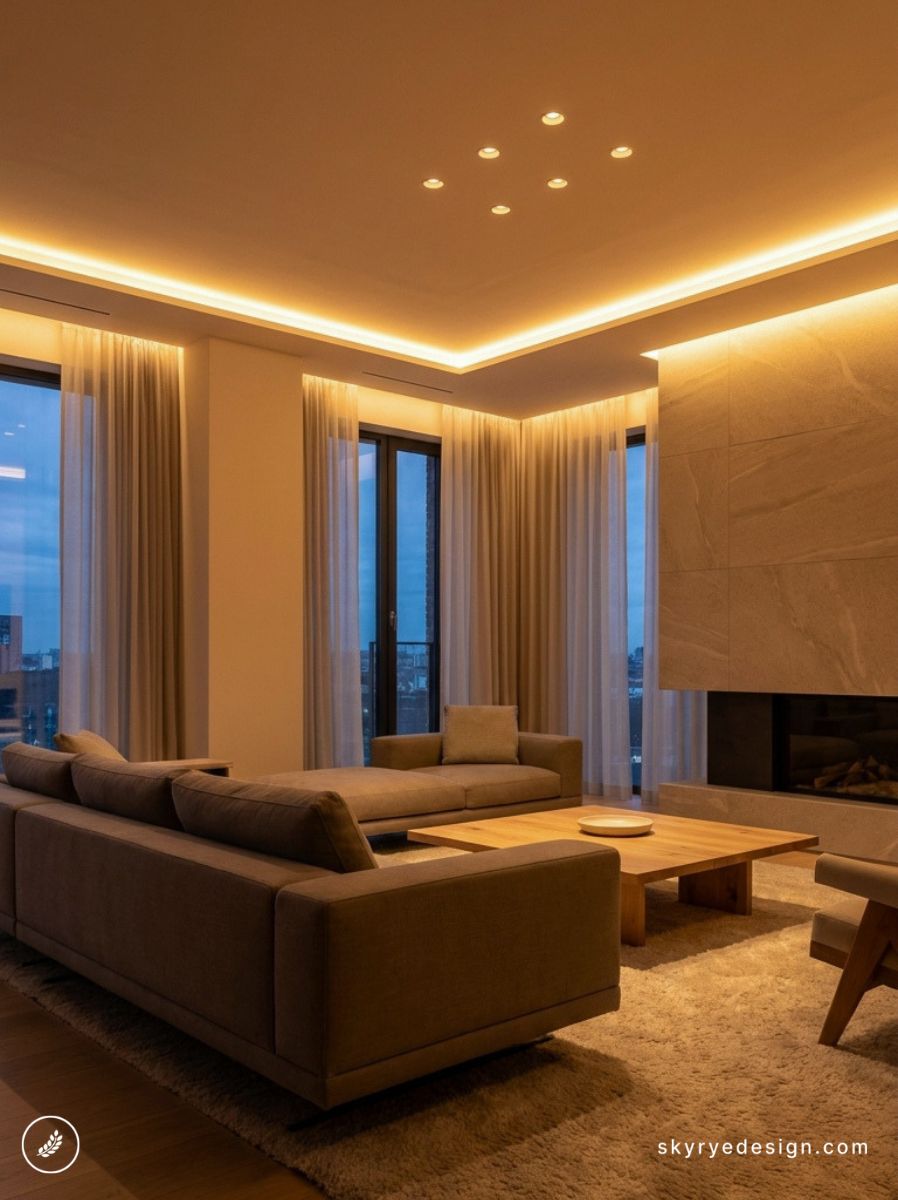
Adaptive circadian lighting systems solve the problem by treating light as a dynamic element rather than a fixed one. The system shifts colour temperature across the day in alignment with natural daylight cycles: cool blue-white (5,500–6,500K) in the morning to support alertness, transitioning to neutral white (3,500–4,000K) through working hours, and moving into warm amber tones (2,200–2,700K) through the evening to support the melatonin production that signals the body toward sleep.
In architectural terms, this is invisible design at its most effective: the fittings are standard recessed downlights, flush-mounted linear fixtures, or LED strip concealed behind coving — nothing that reads as technology. The intelligence lives in the control system, not the fixture. Lutron’s Ketra system, specified in high-end residential projects, achieves the colour temperature range and dimming precision required for genuine circadian effect without any visible control interface beyond a single flush touchpad.
The Design Logic
The practical interior design advantage of adaptive lighting is that it removes the need for layered lighting complexity. Rather than designing separate warm-light zones for evening and cooler working light for daytime, a single well-placed fixture layer delivers both. This directly supports the minimalist interior aesthetic that eliminates unnecessary elements — one layer of lighting that does everything is architecturally cleaner than three layers that each do one thing.
The system also removes the human decision about light settings — which sounds small but, in practice, means the light is always appropriate rather than always compromised by whoever last adjusted it.
| 💡 Design Insight Specify circadian lighting systems during the rough-in phase of construction, not as a retrofit. The dimmer and driver infrastructure is built into the wall cavity — retrofitting compatible dimmers into existing single-gang boxes is possible but limited. The full system benefits are only available when specified from the start. |
02 — Robot Vacuum with Laser Mapping
| Mobile · Autonomous operation Key example: Roborock Qrevo series Navigation: LiDAR laser mapping, multi-floor plan memory, obstacle avoidance AI Integration: Docking station tucked into cabinetry or utility space — virtually invisible Design benefit: Floors are always presentation-ready without human effort |
The floor is the largest surface in any interior and the one that accumulates evidence of living fastest: dust, hair, tracked-in grit, crumbs, pet dander. In a minimalist space where the floor is an expressive material — polished concrete, engineered oak, large-format stone tile — its condition determines the entire visual register of the room. A dusty floor in a carefully designed interior reads as neglect, regardless of how immaculate everything else is.
The robot vacuum is, in interior design terms, the technology that most directly maintains the flawless floor condition that modern aesthetics require — and the gap between a capable robot vacuum and an underpowered one is large enough to matter. Many people try a budget model, find it misses corners and gets stuck on thresholds, and conclude the category doesn’t work. The category works when the technology behind it is genuinely sophisticated.
Once you understand why the Qrevo performs differently from less capable machines, the case for intelligent robot vacuums becomes clear: it’s not a different type of product, it’s the same category solved properly. LiDAR laser navigation builds a millimetre-accurate map of the space — not the approximate room awareness of cheaper units but a precise spatial model that the vacuum uses to plan systematic cleaning routes, avoid furniture reliably, and return to exactly where it paused if the battery runs low mid-session.
Why Mapping Technology Changes the Interior Equation
The specific feature that makes a LiDAR-mapped robot vacuum an interior design tool rather than just a cleaning appliance is zone intelligence. Through the companion app, rooms can be labelled and given individual cleaning schedules, frequencies, and suction levels. The kitchen gets cleaned after every dinner service. The entrance hall gets cleaned daily. The bedroom gets a weekly deep clean at a time when it’s unoccupied. None of this requires human intervention — it runs on a schedule, adapts to the map, and the result is a floor that is always clean without the floor ever being a task.
The Roborock Qrevo series extends this intelligence to mopping: mapping technology controls where water is applied so that carpets are automatically avoided, hard floor zones receive the appropriate water volume, and the mop pad is cleaned between passes rather than distributing the first room’s dirt through the rest of the home. For mixed-floor interiors — which describes most real homes — this automatic surface differentiation is the feature that makes robot cleaning genuinely replace human mopping rather than supplementing it.
The Invisibility Design
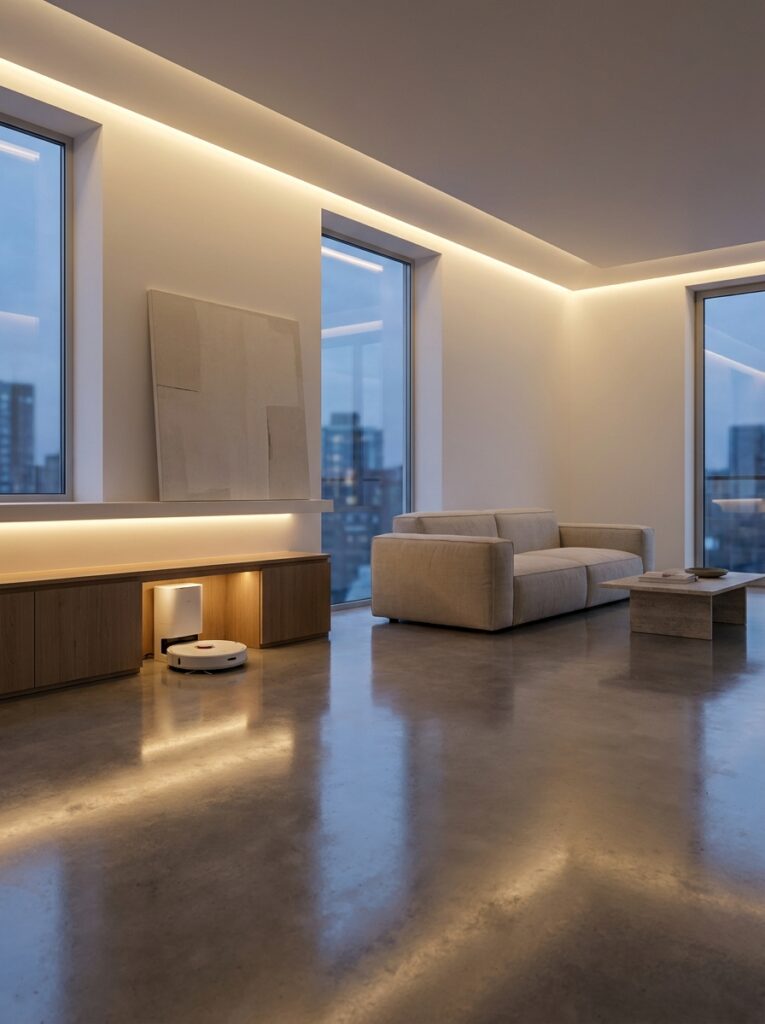
A robot vacuum’s design contribution to an interior depends almost entirely on where the dock lives. Placed in the middle of a room, even a beautifully designed unit reads as clutter. Placed in a recessed cabinetry niche, in a utility cupboard with a cut-out for egress, or behind a furniture piece with a 5cm clearance gap, the entire system disappears. The Roborock Qrevo’s dock is compact enough to fit within standard 600mm-deep base cabinetry with the door removed or replaced with a louvred panel — creating a situation where the vacuum operates autonomously, returns to its invisible dock, and the floor is simply always clean.
This is the invisible architecture principle in its cleanest form: a mechanical system that produces a consistent environmental outcome — a spotless floor — while occupying no visible real estate in the space it maintains.
03 — Zoned Climate Control with Hidden Infrastructure
| Built-in · Invisible operation Key systems: Daikin VRV, Mitsubishi Electric ducted, in-slab hydronic radiant Integration: Ceiling cassettes, linear slot diffusers, or fully concealed ducted What it does: Maintains precise zone temperatures without visible HVAC hardware Design benefit: Eliminates wall-mounted split units and portable heaters |
The split-system air conditioner mounted on the wall is the most architecturally compromising technology in most residential interiors. It’s impossible to conceal, it announces its presence constantly with its status LED and directional louvres, and it turns up in wide-angle interior photographs looking exactly like what it is: a piece of HVAC equipment bolted to a feature wall.
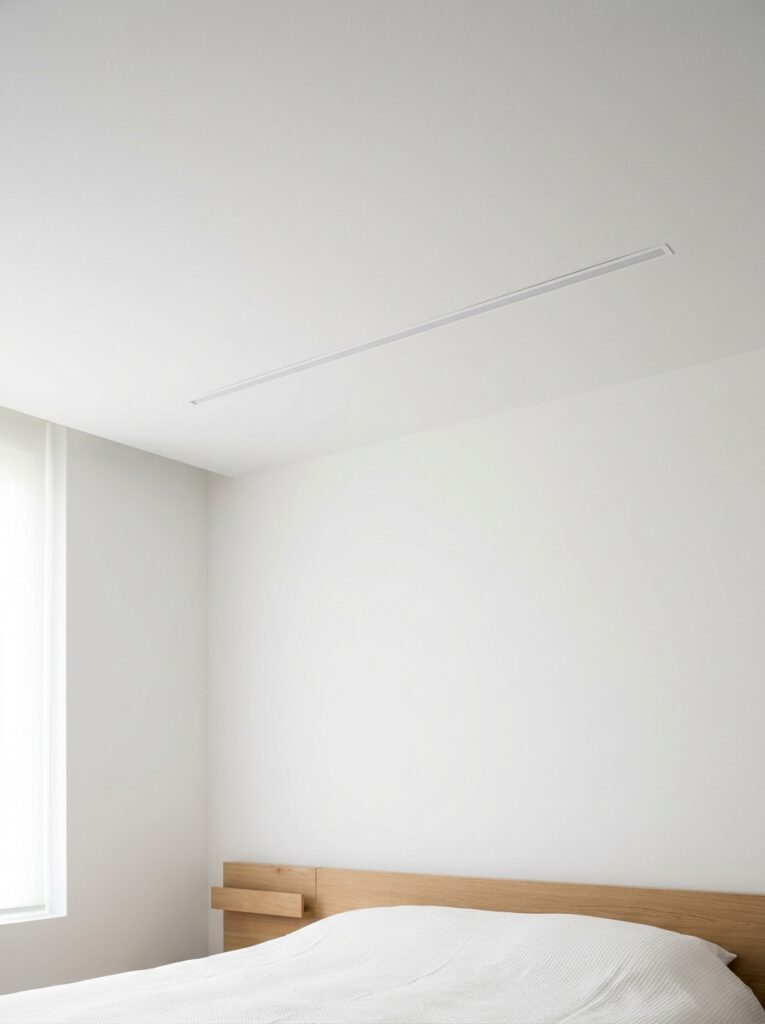
Ducted zoned climate control solves this architecturally by moving the entire mechanical system out of the room and into the ceiling or sub-floor cavity. The only visible element is the diffuser — either a circular ceiling disc or, in contemporary residential design, a linear slot diffuser flush with the ceiling plasterboard, painted to match, and essentially invisible unless you’re looking for it.
Zoning adds the intelligence layer: rather than heating or cooling the entire house to a single temperature, the system delivers different temperatures to different zones based on occupancy sensors or time schedules. A home office at 21°C during working hours, bedrooms at 19°C for sleep, living areas ramped up when occupancy is detected in the evening. The result is a home that’s always comfortable without the constant manual adjustment that conventional single-zone systems require.
Radiant Heating: The Completely Invisible Option
In-slab hydronic radiant heating takes the invisibility principle to its logical conclusion: heat delivered through water-heated pipes embedded in the concrete floor, with no visible hardware anywhere in the room. The floor surface becomes the radiator, delivering gentle even warmth from below rather than the directional heat blast of forced air. In contemporary interiors with polished concrete or large-format stone tile floors, in-slab heating is both the most architecturally coherent and the most comfort-effective heating option available — and it has a zero visual footprint.
| 💡 Design Insight Specify climate infrastructure in the architectural drawings phase, not as a late-stage addition. The difference between a ducted system that looks designed and one that looks retrofitted is whether the ceiling height, bulkhead positions, and diffuser locations were considered during the design process. A 200mm bulkhead that routes ductwork can be a design feature; a 200mm bulkhead added after the design is complete is a compromise. |
The practical limitation is that radiant systems have a long thermal response time (30–60 minutes to change floor temperature), which makes them unsuitable as the primary climate control in spaces with highly variable occupancy. They work best in combination with a zoned ducted system: radiant for baseline comfort, ducted for rapid response when conditions change.
04 — Electrochromic Smart Glass
| Built-in · Switchable Key manufacturers: View Inc., Sage Glass, RavenWindow, Gauzy Integration: Replaces standard glazing — no visible mechanism What it does: Transitions from clear to tinted on demand or automatically Design benefit: Eliminates blinds, curtains, and privacy film from glass surfaces |
Every window covering in a home is a design compromise. Curtains add warmth but require tracks, stacking space, and regular maintenance. Blinds offer light control but are mechanically obvious and difficult to detail cleanly in a minimalist interior. External shutters are architecturally strong but expensive and inappropriate for all glass orientations. What every interior designer actually wants is glass that can modulate its own transparency — and that technology now exists at a residential scale.
Electrochromic glass — sometimes called dynamic glass or smart glass — changes its tint in response to an electrical signal. At full transparency, it’s optically indistinguishable from standard double-glazed glass. As voltage is applied, ion migration within the glazing unit shifts the glass from clear through various shades of blue-grey tint, reaching approximately 1% visible light transmission at full opacity. The transition takes 3–5 minutes across the full surface area — not instantaneous, but gradual enough to be pleasant rather than jarring.
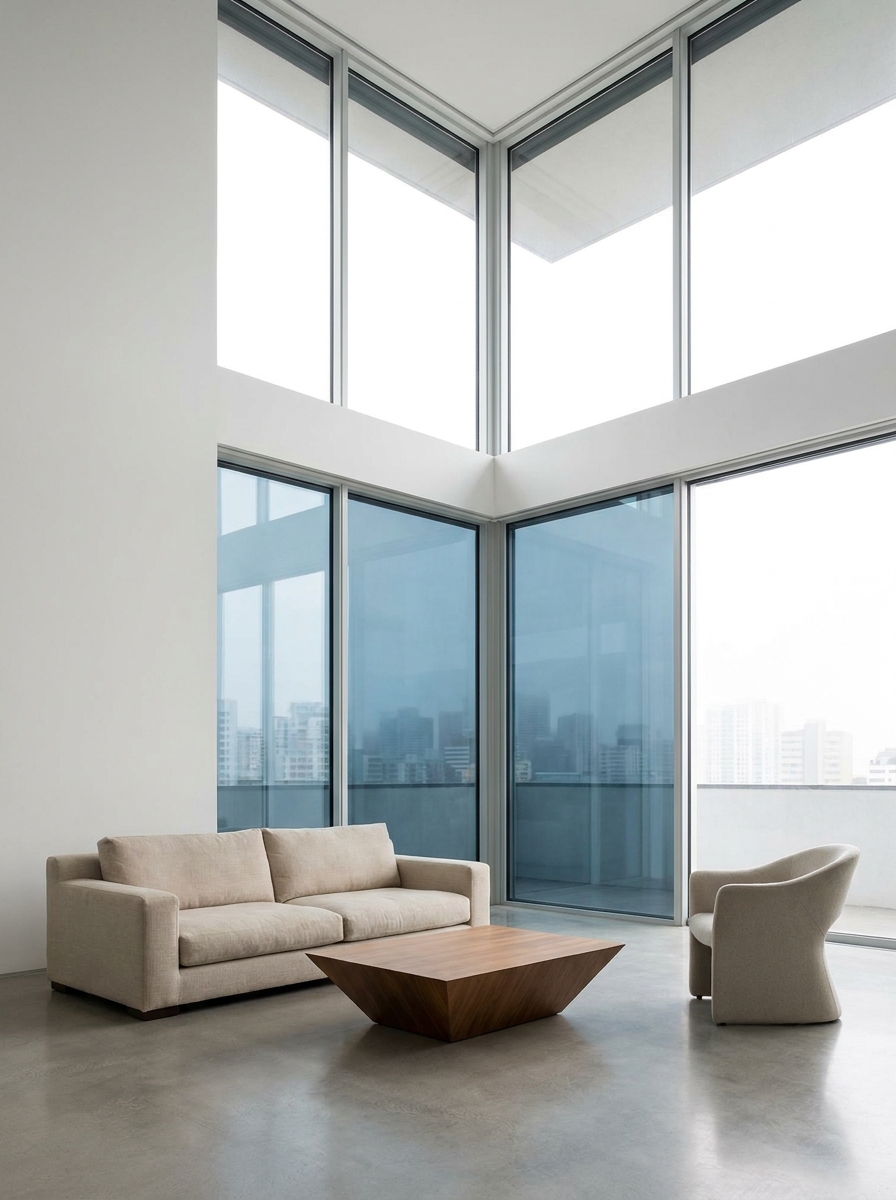
The integration into smart home systems is what activates the interior design potential. A sun-tracking algorithm can automatically tint south-facing glazing as solar angle increases through the morning, preventing glare on screens and surfaces without any manual intervention. Privacy settings can tint bathroom or bedroom glazing at scheduled times. The entire glass surface acts as an environmental control system with no visible hardware — no tracks, no brackets, no cords, no mechanism of any kind.
The Case Against Curtains
Beyond the aesthetics, the operational argument for smart glass is compelling in well-designed spaces: curtains and blinds require maintenance (cleaning, repair, replacement), they introduce acoustic absorption that changes the sound character of a room, and they create a binary choice — open for view, closed for privacy — that smart glass replaces with a continuous spectrum. An interior without window coverings is also a dramatically simpler interior to clean and maintain, which directly supports the flawless quality this article is concerned with.
The cost barrier — smart glass typically runs $800–$1,500/m² installed versus $150–$400/m² for quality curtains — remains the primary adoption limit at residential scale. For new builds or full renovations where the window frames are being replaced regardless, the cost differential narrows considerably and the long-term maintenance saving is genuine.
05 — Architectural In-Wall and In-Ceiling Audio
| Built-in · Invisible operation Key manufacturers: Sonance, Klipsch Architectural, Bowers & Wilkins CWM series Integration: Flush-mounted behind paintable grilles — effectively invisible What it does: Delivers room-filling sound without visible speaker hardware Design benefit: Eliminates all freestanding speakers and their cable runs |
Sound is the sense most neglected in interior design conversations — and the one that most powerfully determines how a space feels to inhabit. A room with poor acoustics and visible speaker stacks reads differently from the same room with distributed architectural audio delivering even sound coverage at every point. The experience of music or ambient sound in a well-specified audio environment is profoundly different from the experience of the same music from a pair of bookshelf speakers balanced on a sideboard.
Architectural in-wall and in-ceiling speakers are designed to disappear into the building fabric. They’re installed during construction or renovation into the wall cavity or ceiling void, with only a flush-mounted grille visible at the surface — and that grille is paintable, allowing it to match the wall or ceiling finish precisely. At any distance beyond arm’s reach, in a well-painted interior, a quality architectural speaker grille is genuinely invisible.
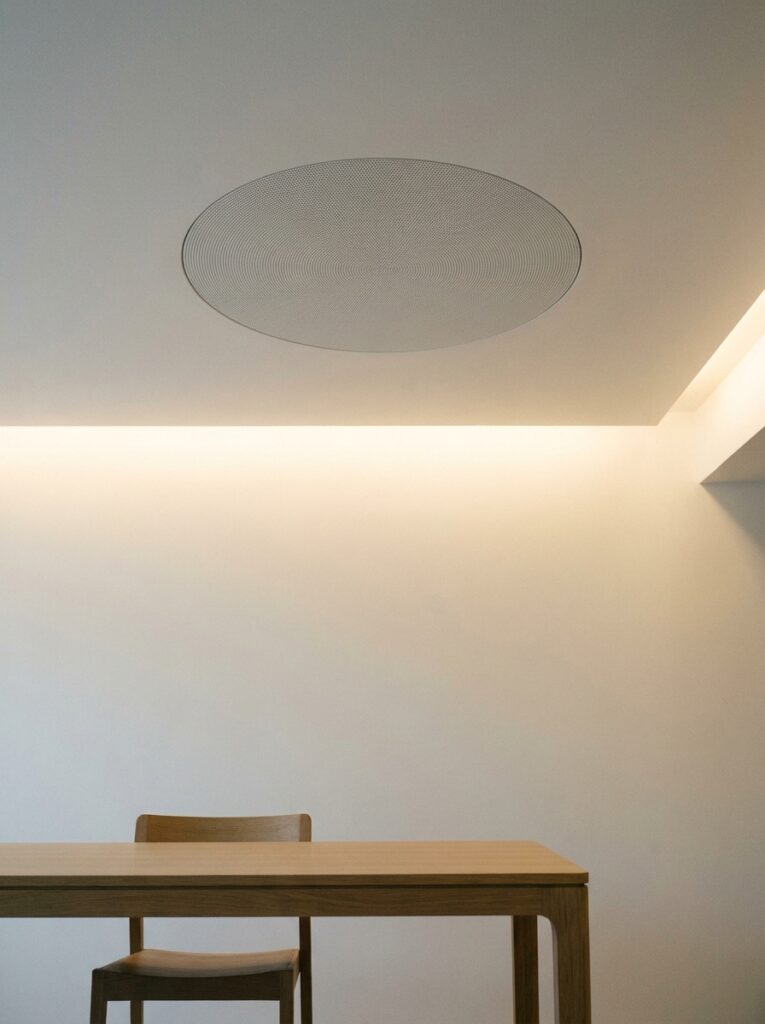
The audio performance from quality architectural speakers (Sonance, Bowers & Wilkins, Klipsch) is not a compromise relative to freestanding units of equivalent price. The larger cabinet volume available in a wall or ceiling cavity — potentially unlimited compared to the constrained enclosures of freestanding speakers — allows driver designs that produce wider frequency response and higher output than equivalent footprint freestanding units. A well-specified distributed audio system delivers better sound than the bookshelf speakers it replaces, from locations that don’t exist visually.
Whole-Home Audio Architecture
The interior design value of distributed architectural audio extends beyond aesthetics into spatial behaviour. A home with zone-based audio — where different rooms can play different content independently, or where music follows the occupant from room to room — changes how the space is used. The kitchen becomes a more pleasant cooking environment. The bathroom becomes a spa. The bedroom becomes a genuine wind-down space. These are experiential qualities that contribute to the flawless quality of living that good interior design aims to produce.
The streaming infrastructure — Sonos AMP, Denon HEOS, or Apple AirPlay 2 — handles multi-room coordination invisibly through standard ethernet infrastructure or WiFi, with a single app as the interface. The physical speakers are in the walls. The amplifiers are in a utility cupboard. The control is on a phone or a flush-mounted touchpad. The result is music everywhere and hardware visible nowhere.
The Invisible Architecture Principle
What these five systems share is a design philosophy that is fundamentally different from most consumer technology: they’re designed to be unnoticed. The standard consumer electronics paradigm is visibility — a display, an interface, a presence that communicates its capability.
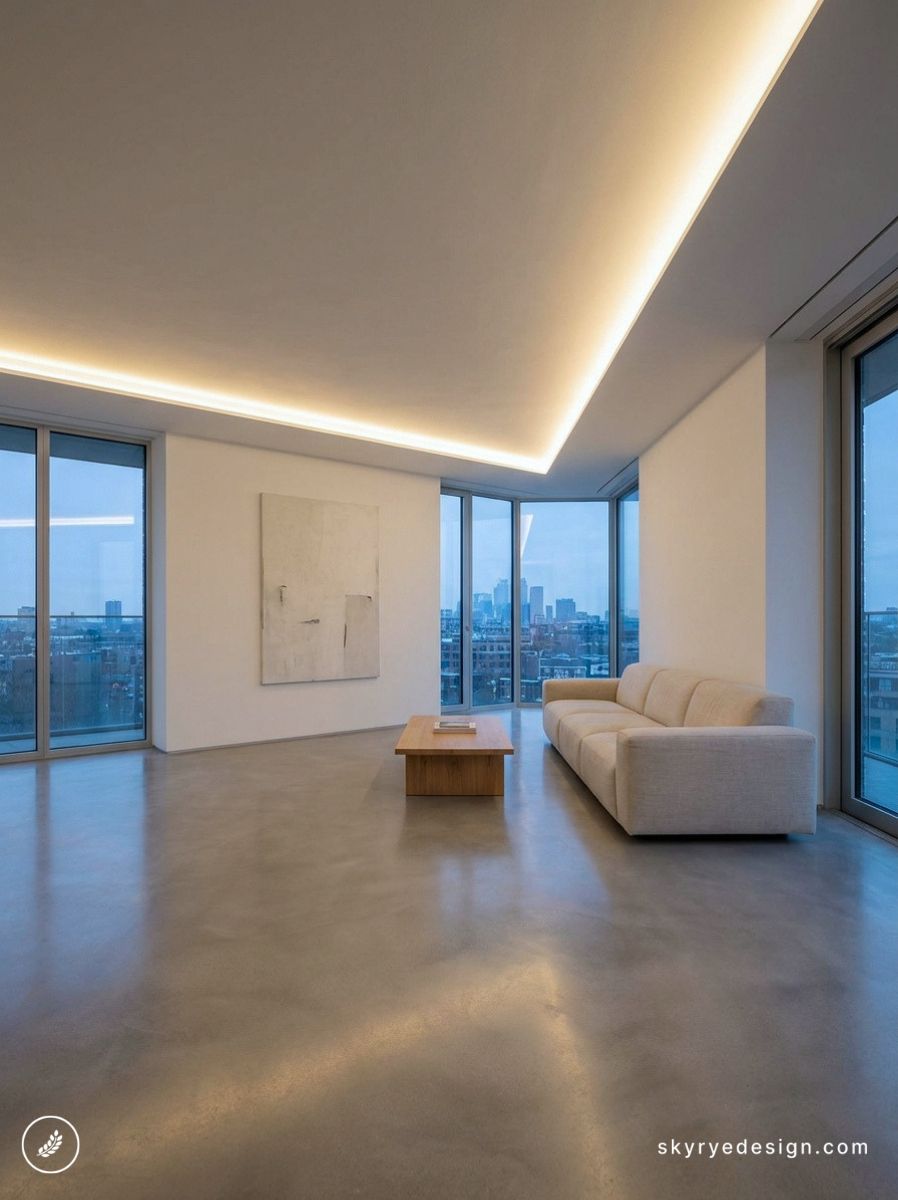
These systems work in the opposite direction, embedding their function in the fabric of the space and communicating only through outcomes: the light that’s always right, the floor that’s always clean, the temperature that’s always comfortable, the glass that adjusts before you notice it needs to, the music that’s simply present.
This is what distinguishes smart home technology that contributes to good interior design from smart home technology that undermines it. A voice-activated assistant with a glowing ring on the countertop is visible, branded, and assertive about its presence. Adaptive lighting that shifts imperceptibly through the day is invisible, unbranded, and assertive only about its outcome. The difference is the design intent behind the technology: one is a product, the other is a service.
| The Five Features at a Glance 01 · Adaptive Circadian Lighting Recessed fixtures, automatic colour temperature shift, zero manual operation 02 · Robot Vacuum (Roborock Qrevo) LiDAR mapping, autonomous schedule, dock concealed in cabinetry 03 · Zoned Ducted Climate Control Ceiling diffusers or in-slab radiant, no visible HVAC hardware 04 · Electrochromic Smart Glass Automatic tinting, eliminates all window coverings, no mechanism 05 · Architectural In-Wall Audio Paintable grilles, distributed room coverage, no freestanding speakers |
The cumulative effect of specifying these systems together in a new build or major renovation is a home that maintains itself — not through constant human effort but through the quiet, persistent operation of technology that has been designed to disappear. The floors are clean because the vacuum ran at 3 am and returned to its concealed dock before anyone was awake. The light is warm and low because the circadian system brought it down as the evening progressed. The music is present and even, coming from everywhere and nowhere in particular.
That quality — the sense that a space maintains itself — is the highest expression of modern interior architecture. And increasingly, it is technology that makes it possible.
Frequently Asked Questions
Is smart home technology compatible with a minimalist interior aesthetic?
When specified correctly, smart home technology is the enabler of minimalism rather than its enemy. The five systems in this guide all share the property of reducing visible objects in a space: adaptive lighting eliminates multiple lamp types, robot vacuums eliminate cleaning equipment storage, ducted climate eliminates wall-mounted units, smart glass eliminates window coverings, architectural audio eliminates freestanding speakers. The technology investment produces a visual reduction, which is precisely the minimalist outcome.
What is the best entry point for invisible smart home technology?
For most homeowners, the robot vacuum is the most immediately impactful entry point — it produces a visible daily outcome (a clean floor) with the lowest infrastructure requirement (a power point for the dock). Adaptive lighting is the second most accessible: smart bulbs in existing fittings deliver basic circadian control without any infrastructure change. The built-in systems — ducted climate, smart glass, in-wall audio — require construction access and are most cost-effectively specified during a renovation or new build rather than as retrofits.
How much does a whole-home smart audio system cost?
A basic distributed audio system for a standard three-bedroom home — four ceiling speaker zones, two streaming amplifiers, and standard installation — typically runs $3,500–$7,000 installed. Premium systems with larger driver configurations and multi-zone independent streaming across more zones run $8,000–$20,000+. The infrastructure cost (cable runs, amplifier location) is the primary driver — the cable runs are cheap but the labour to install them during construction is negligible compared to the cost of retrofitting through finished walls.
Are robot vacuums effective on mixed flooring types?
In a word: yes, when the mapping technology is sophisticated enough to recognise and respond to floor type changes. Basic robot vacuums often struggle with transitions between hard floor and carpet, with thresholds, and with adjusting suction appropriately for different surfaces. Machines with LiDAR mapping and AI-based floor type detection handle these transitions reliably — reducing suction on hard floors to conserve battery, increasing it on carpet for effective extraction, and avoiding carpet entirely during mopping cycles. The floor-type limitation is real in cheaper machines; it’s largely resolved in current premium units.
Can electrochromic smart glass be retrofitted into existing windows?
True electrochromic glass cannot be retrofitted — it’s a glazing unit specification that replaces the entire glass assembly, not a film applied to existing glass. There are retrofit smart film products (PDLC switchable film) that can be applied to existing glazing, but these switch between transparent and frosted (not tinted), have visible texture when off, and don’t offer the gradual tinting range that makes electrochromic glass useful for solar control. For new installations or window replacements, true electrochromic glazing is the specification. For retrofits, PDLC film provides privacy switching but not the full solar control capability.
Conclusion: Technology in Service of the Space
The five systems in this guide share a single governing principle: they serve the space rather than occupying it. They produce outcomes — clean floors, perfect light, comfortable temperature, acoustic richness, visual privacy — without claiming visual territory to do it. That is the specific form of intelligence that makes technology a design asset rather than a design liability.
Specifying these systems well requires thinking about them early — during the design phase rather than after the finishes have been chosen. The cable infrastructure for in-wall audio, the ceiling height requirements for concealed ducting, the structural considerations for in-slab heating, the framing requirements for flush-mounted speaker locations — these are decisions that integrate naturally into a design process and become expensive problems when addressed as afterthoughts.
The invisible architecture of a well-resolved smart home is, in the end, the same quality that makes any great design work: everything that needed to be thought about was thought about before it was built in. The result looks effortless because the effort was front-loaded. The space maintains itself because someone, earlier, made very deliberate decisions about how it would do so.
Invisible tech works best when the surrounding surfaces still feel intentional. For the visible layer, this guide to modern wallpaper and textured wall finishes shows how to add depth without disturbing a clean interior.
- 17shares
- Facebook0
- Pinterest17
- Twitter0
- Reddit0