Disclosure: This post contains affiliate links. If you sign up or purchase through these links, we may earn a small commission at no extra cost to you. This helps support our work.
My first vase drawing looked like a melting bowling pin. I’d skipped the construction lines, eyeballed the curves, and wondered why the thing looked nothing like the ceramic on my desk. Sound familiar?
Here’s the thing — a vase seems simple. It’s symmetrical, it has no face to get wrong, no complex anatomy. But that simplicity is exactly the trap. Because when you remove the “obvious” landmarks, every millimeter of asymmetry shows up instantly.
- 1. What Makes a Vase Hard to Draw (And How to Fix It)
- 2. Materials You Need (And What Actually Matters)
- 3. Step-by-Step — How to Draw a Vase in 7 Steps
- 4. Ceramic vs. Glass — How Material Changes Everything
- 5. Vase Styles Worth Drawing — 5 Classic Shapes
- 6. How to Draw a Vase with Flowers — Taking It Further
- 7. Common Mistakes and Quick Fixes
- Frequently Asked Questions
- Your First Vase Starts Today
The good news? Drawing a convincing vase is a learnable skill built on three fundamentals: proportion, symmetry, and tone. Once those click, you can render anything from a delicate bud vase to a chunky wabi-sabi ceramic jug — and eventually, a full still life with flowers.
In this guide, I’ll walk you through 7 concrete steps to draw a realistic vase in pencil. You’ll also learn how ceramic and glass demand completely different shading approaches, which classic vase shapes are worth practicing, and the five mistakes that keep most beginners stuck.
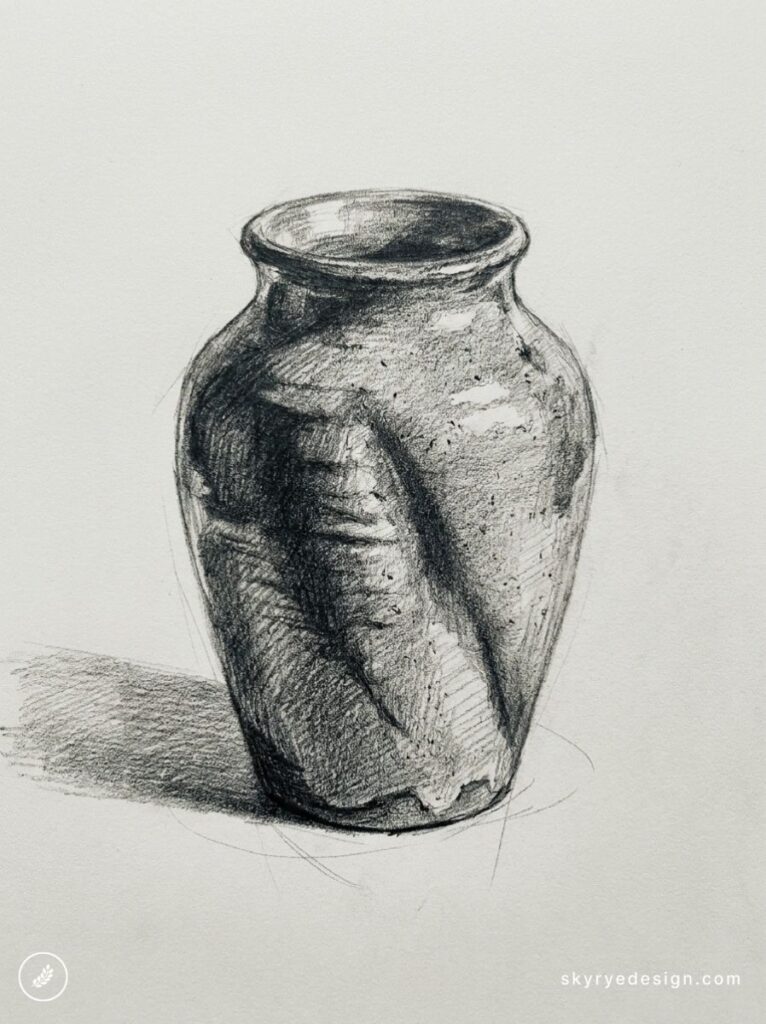
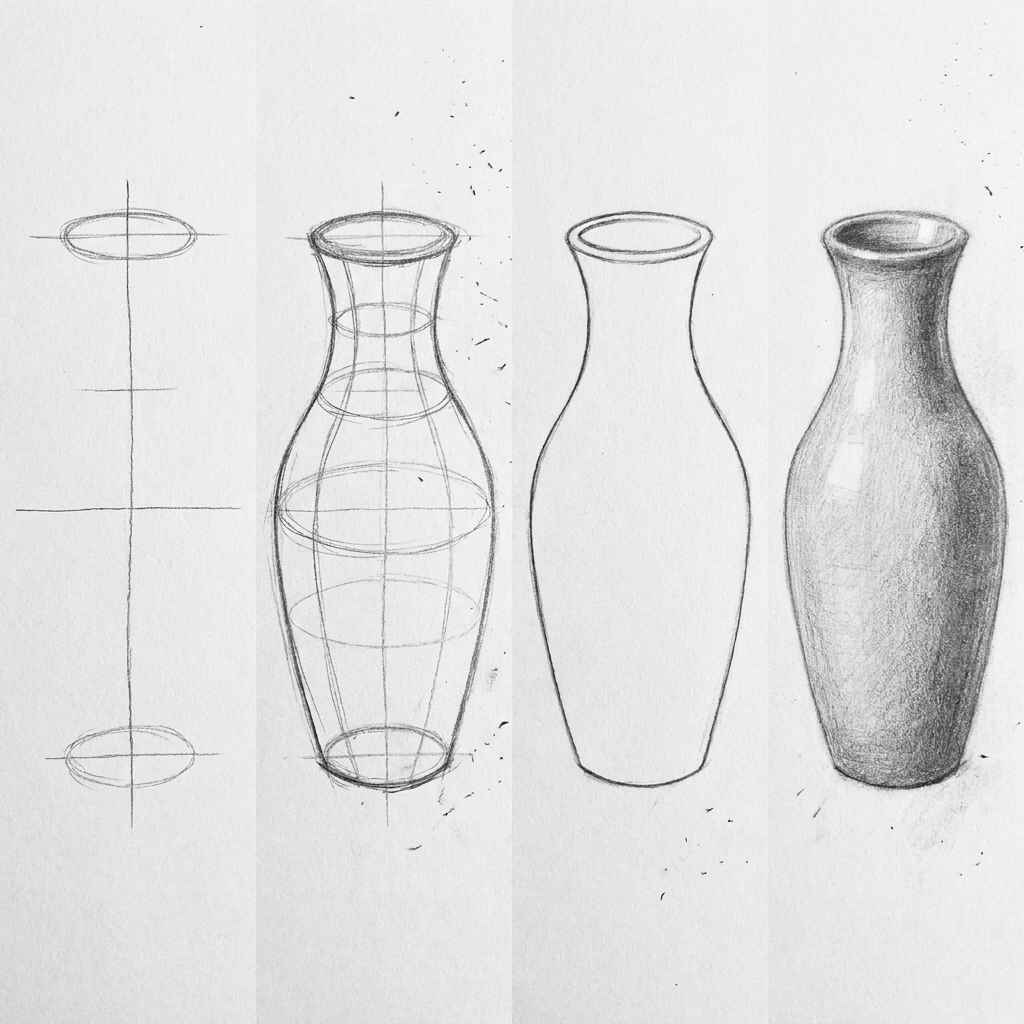
A vase is always the foundation of any classical drawing lesson, and the most challenging thing for me was creating symmetry and volume. The second step is conveying texture and filling it with something. But I’m very grateful to my engineering graphics and academic drawing teachers for showing me how to design any complex object. First, we construct an axis, then mark thick and thin sections proportionally, and then we construct a curve that we will rotate to create that very vase.
Grab an HB pencil. Let’s build something that actually looks three-dimensional.
1. What Makes a Vase Hard to Draw (And How to Fix It)
The Symmetry Trap
Your dominant hand has a natural arc. It pulls curves slightly inward or outward depending on your grip and wrist angle. Draw a vase freehand without a center axis, and that natural arc produces two sides that look like they belong to different objects.
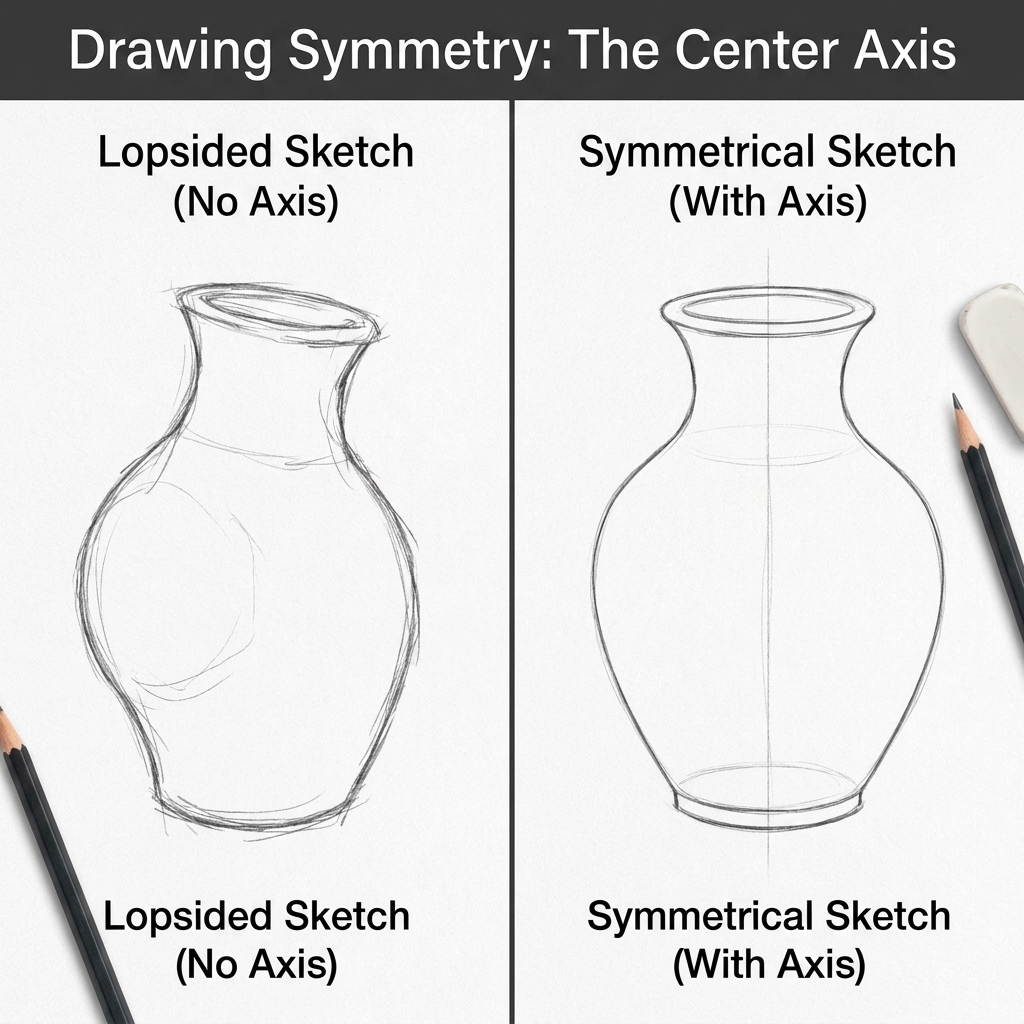
The fix is almost embarrassingly simple: draw a vertical center line first. Every curve on the left gets mirrored on the right using that line as a reference. Artists like Betty Edwards — author of Drawing on the Right Side of the Brain — built entire teaching frameworks around this kind of structural anchor. It works.
Why Flat Vases Happen
A vase without shading isn’t a vase — it’s a silhouette. The human eye reads three-dimensional form through gradations of light and dark, not through outline alone. Skip tone, and your vase sits flat on the page no matter how clean the lines are.
The fix: before you touch your final drawing, decide where your light source is. Everything else follows from that single decision.
2. Materials You Need (And What Actually Matters)
Pencil Grades Explained
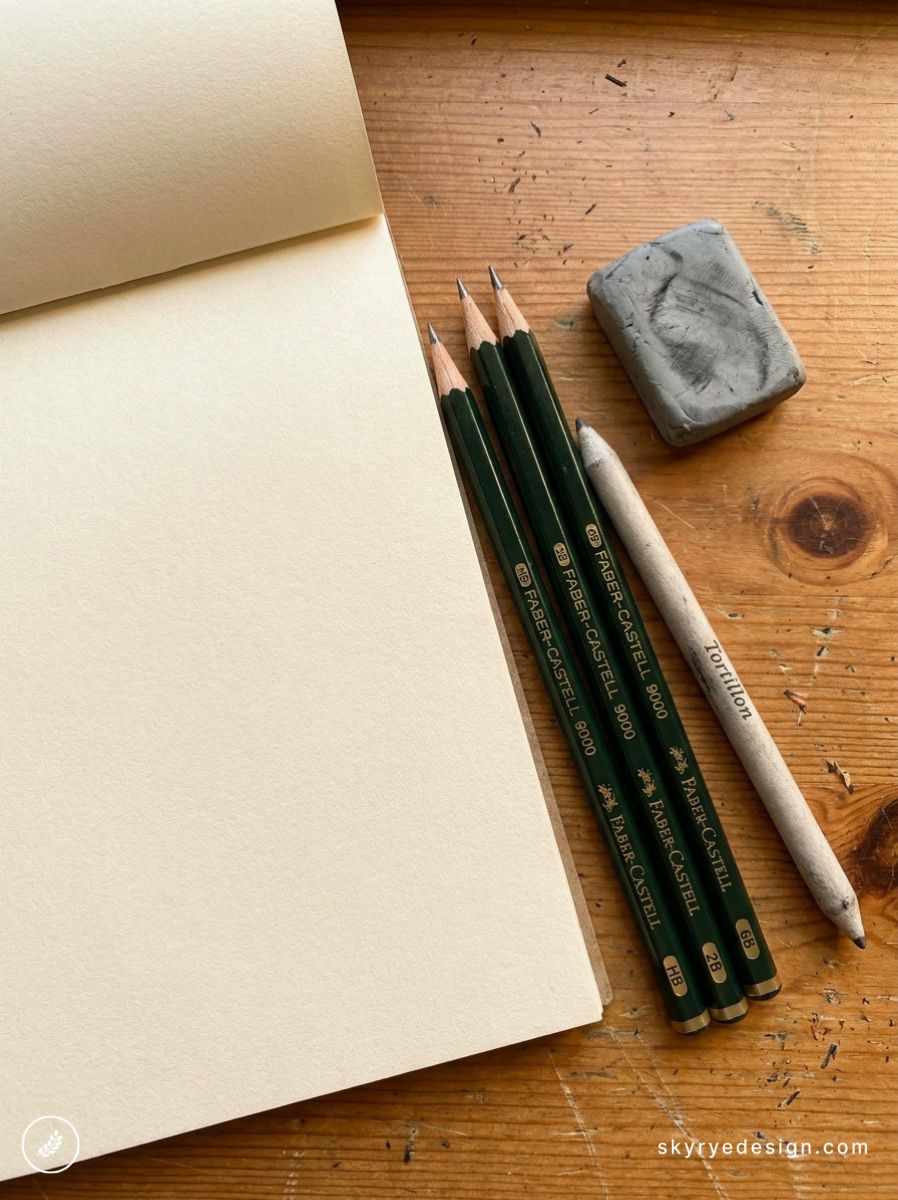
Pencil hardness runs from 9H (very hard, very light) to 9B (very soft, very dark). For vase drawing, you need three grades:
- HB — your workhorse. Construction lines, outlines, light midtones.
- 2B — medium shadows, blending transitions, the bulk of your shading.
- 6B — deep cast shadows and the darkest accents. Use sparingly.
The Faber-Castell 9000 series covers all three grades in one set — around $8–12 for six pencils. Staedtler Mars Lumograph is equally reliable and a favourite in illustration programs. Either works.
Paper Choice
Smooth paper (like bristol) gives you clean lines but limits blending. Slightly textured drawing paper — Strathmore 400 Series is the go-to at around $12 for a 24-sheet pad — holds graphite in its tooth, which makes shading transitions much more natural.
Avoid printer paper for anything you want to look finished. It buckles under blending pressure and shows pencil strokes harshly.
| 💡 Pro Tip: You don’t need 20 pencils — HB + 2B + 6B covers 95% of vase drawings. Buy a quality 6-pencil set rather than a cheap 50-pencil mega-kit. |
🎨 Master This Technique for Free
Sponsored
| Reading about theory is a great start, but watching an industry pro execute it step by step changes everything. I’ve partnered with Skillshare to give Sky Rye Design readers a 1-Month Free Trial of their Premium membership. Use the exclusive promo code AFF30D25 at checkout to unlock unlimited classes. Once you’re in, search for:• “still life drawing pencil”• “how to draw realistic objects.” 👉 Unlock Your Free Month & Start Drawing |
3. Step-by-Step — How to Draw a Vase in 7 Steps
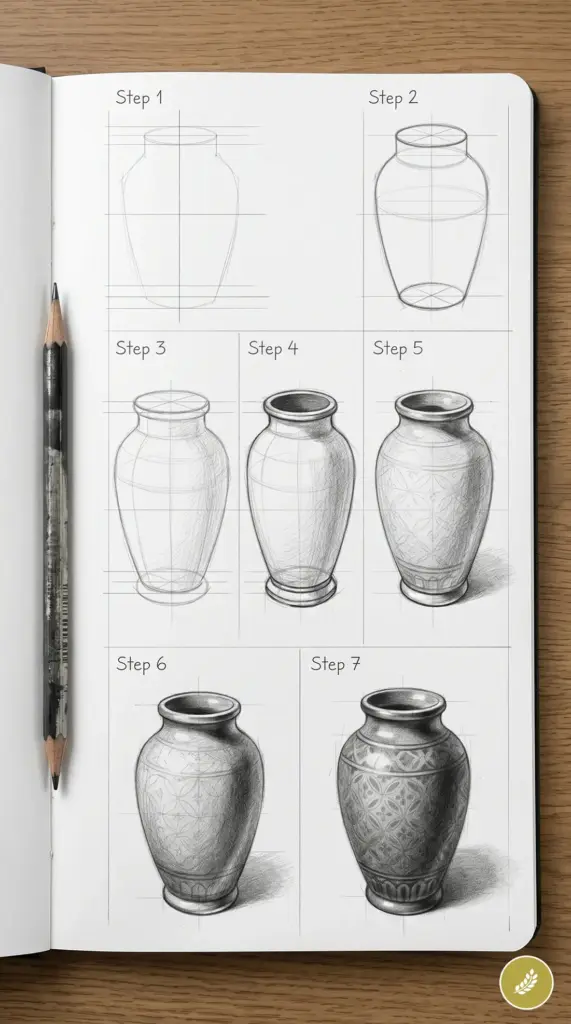
Work through these in order. Skipping steps — especially the early structural ones — is how you end up redrawing everything from scratch twenty minutes in.
Step 1 — Draw the Center Axis
Start with a single vertical line running the full intended height of your vase. This isn’t decorative — it’s structural. Every measurement, every curve, every ellipse you draw will reference this line.
Use a light HB touch. The line disappears later. Make it faint enough that erasing leaves no ghost.
Step 2 — Map Proportions with Ellipses
Draw three ellipses along your center axis:
- Top ellipse — the mouth (rim) of the vase. Keep it narrow; you’re viewing it from slightly above.
- Middle ellipse — the widest point of the body. This is your widest horizontal.
- Bottom ellipse — the base. Slightly wider than the mouth, slightly narrower than the body’s widest point.
| 📐 Pencil-at-arm’s-length trick: Hold your pencil vertically, close one eye, and compare the vase height to its widest width. Most vases run roughly 2:1 to 3:1 height-to-width. Do this before drawing a single real line. |
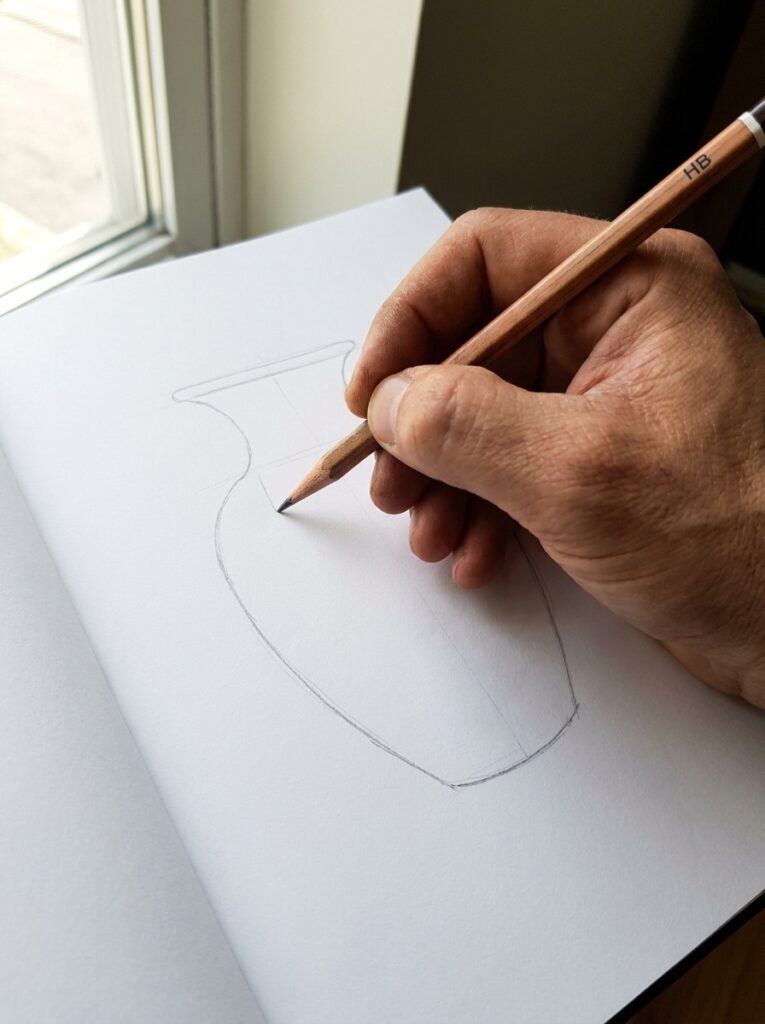
Step 3 — Build the Silhouette
Connect your ellipses with smooth, flowing curves. Start at the rim, follow the curve of the neck, widen into the body, then taper back toward the base. Draw both sides independently, then compare them against your center axis.
This is where most drawings go slightly wrong — one side curves more aggressively than the other. Check constantly. Flip your paper upside-down if needed; errors become obvious when the orientation changes.
Step 4 — Refine the Outline
Once your silhouette feels right, darken the final outline with a clean, confident HB line. Then erase the center axis and ellipse guidelines. What remains should be a clean, symmetrical vase profile.
Don’t panic if small asymmetries remain. Handmade ceramics aren’t perfectly uniform either — a slight irregularity actually reads as natural, not wrong.
Step 5 — Establish the Light Source
Before any shading, mark your light source direction lightly in the margin — even just an arrow. For vase drawings, a light source at 10 o’clock (upper left) is the classic still life convention used in atelier training since the 17th century.
Your vase now has three zones:
- Highlight — the area closest to the light (right on the surface edge, upper left)
- Midtone — the transitional area across most of the body
- Shadow — the side away from light, plus the darkest strip just before the reflected light on the very edge
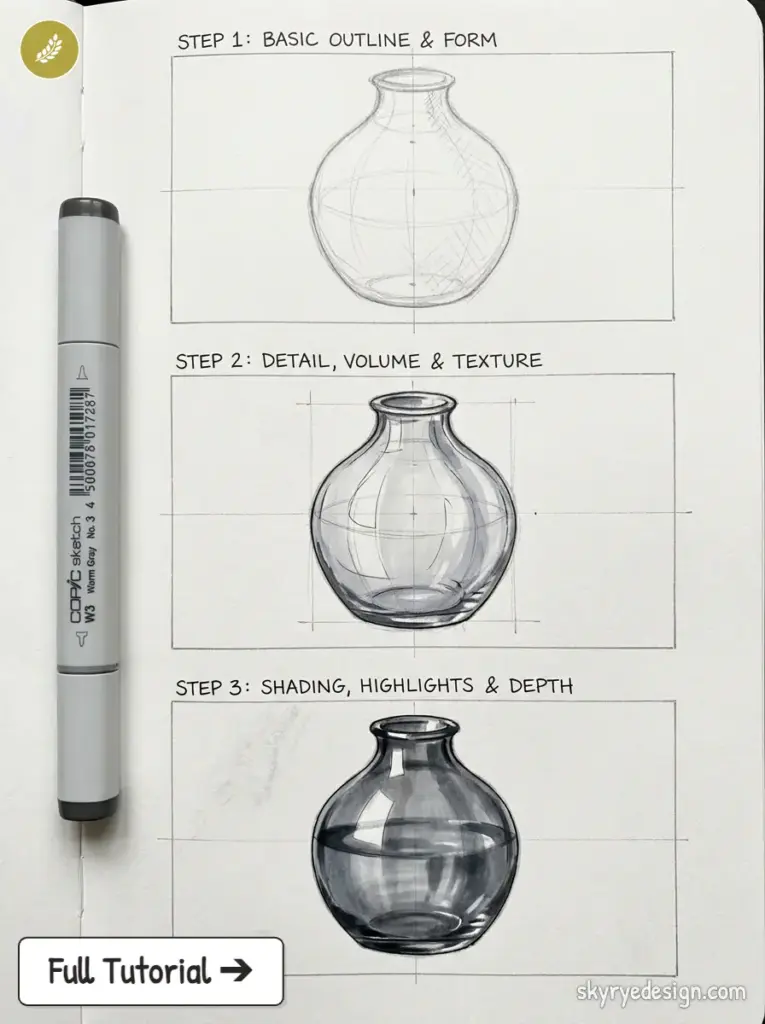
Step 6 — Add Tone and Shading
Work with your 2B pencil for midtones, applying smooth diagonal hatching strokes that follow the curve of the vase. The strokes should curve slightly — a straight horizontal line on a round object looks wrong because it ignores the form.
Build tone gradually. Start light. You can always go darker; lifting graphite without trace is harder.
Add your deepest shadows with 6B — but use it like seasoning, not the main dish. The darkest dark should appear only in the core shadow strip and the cast shadow on the surface below.
Leave your highlights completely untouched — or lift graphite with a kneaded eraser (Prismacolor makes a good one for about $3) to reclaim brightness.
Step 7 — Add Details and Background
A vase floating in white space looks unfinished. Add a simple cast shadow beneath — it grounds the object on a surface. A soft gradient background (light behind the shadow side, slightly darker behind the lit side) creates natural contrast and makes the vase pop.
If your vase has a pattern or texture — a raised rim, a decorative band — add those last. Keep decorative details subordinate to the form.
4. Ceramic vs. Glass — How Material Changes Everything
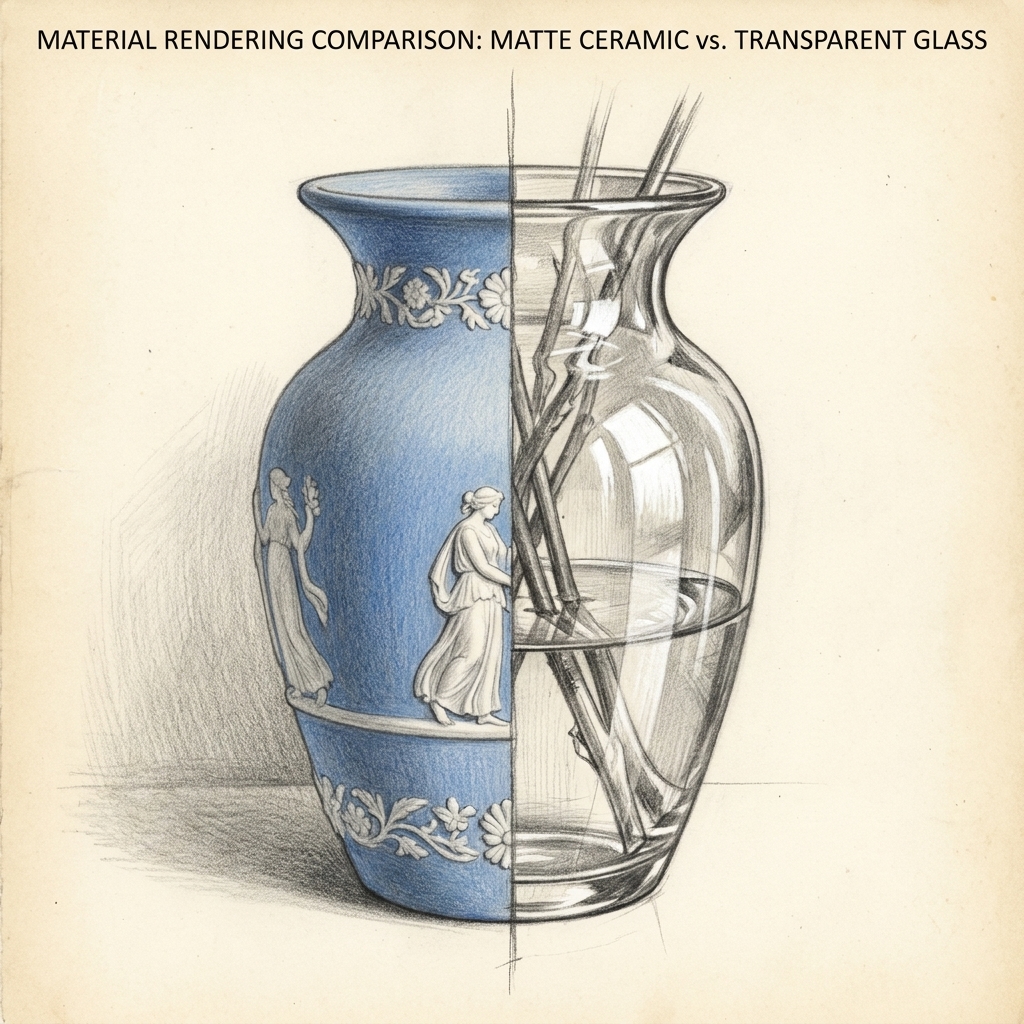
Same vase shape. Completely different drawing. The material dictates everything about how light behaves — and if you shade both the same way, both will look wrong.
Drawing Ceramic
Ceramic is opaque and usually matte or semi-gloss. Light diffuses across the surface rather than bouncing sharply. This means gradients are soft and wide, highlights are soft-edged (not sharp points of white), and there’s no transparency to worry about.
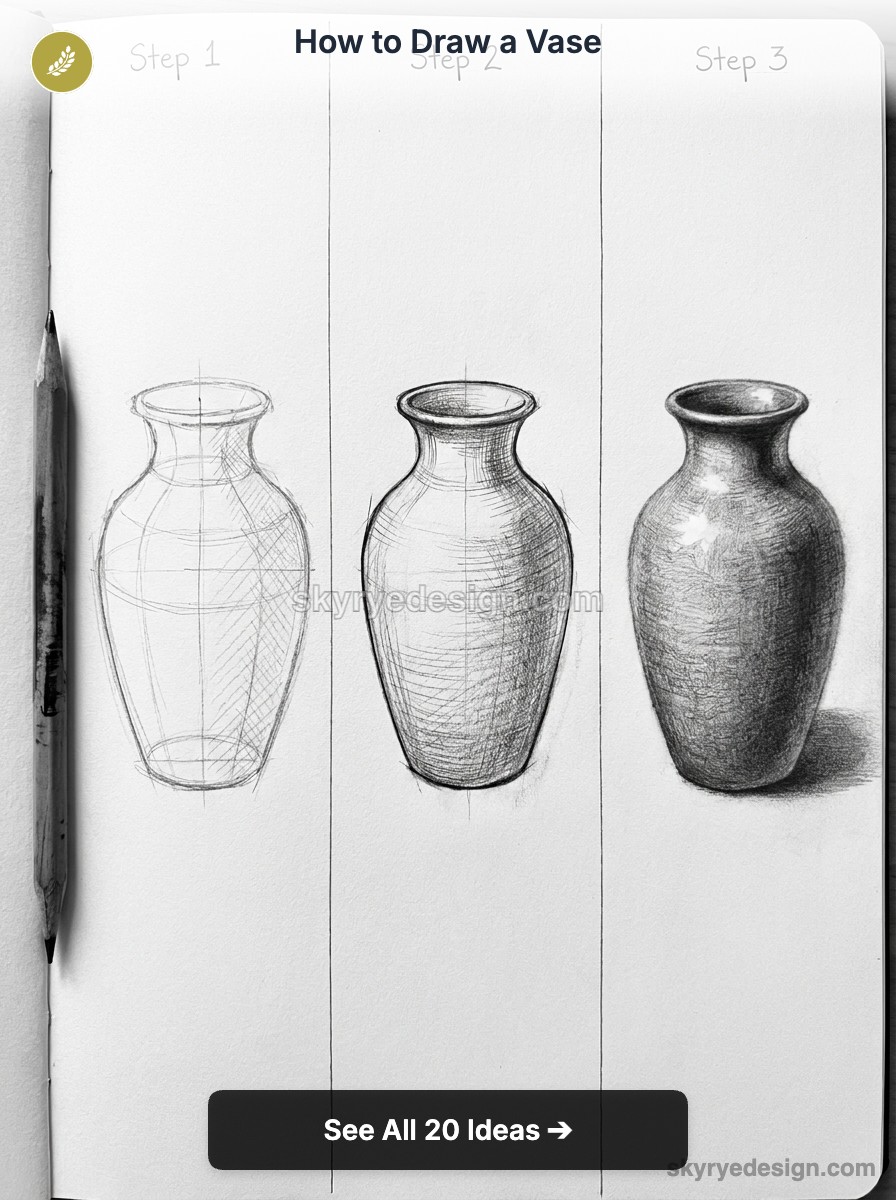
Take Wedgwood jasperware as a reference: that signature matte blue surface has no sharp reflections at all. The light rolls across it in a smooth, even wash. To replicate this, blend your 2B strokes with a tortillon (blending stump) or your fingertip, then lift soft highlights with a kneaded eraser.
Drawing Glass
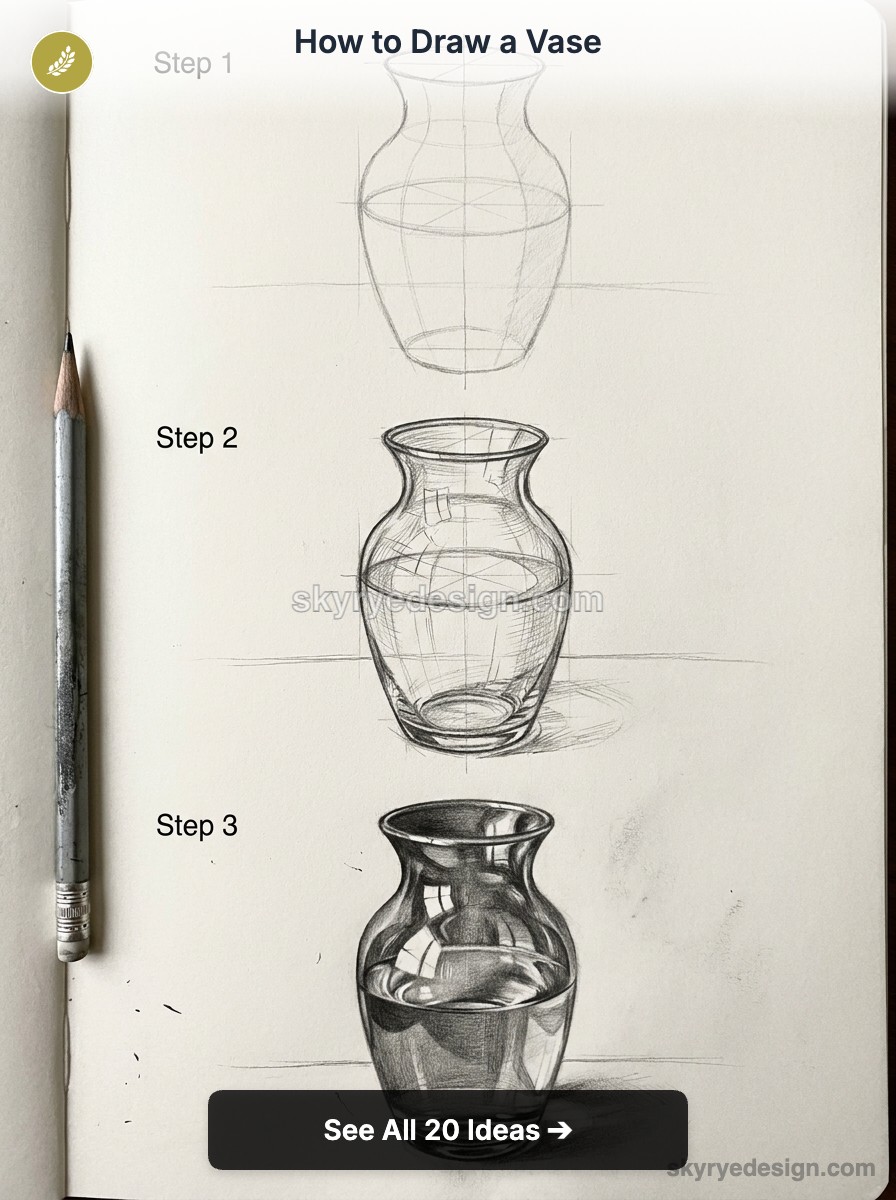
Glass is a completely different problem. It’s transparent, reflective, and refractive — all at once. Key differences from ceramic:
- Hard, sharp highlights — not soft glows, but crisp white stripes or points.
- Visible interior — if there’s water or stems inside, you draw them. They’ll appear distorted and slightly shifted due to refraction.
- Dark edges — glass edges are often darker than the interior, which is counterintuitive but optically accurate.
- Complex reflected light — expect multiple small highlight zones, not just one.
Murano glass is a perfect reference: the reflections are almost abstract, with sharp white stripes cutting across a rich, dark interior. For a clear glass vase with flower stems, draw the stems as slightly bent where they enter the water — that’s refraction at work, and it immediately sells the material.
5. Vase Styles Worth Drawing — 5 Classic Shapes
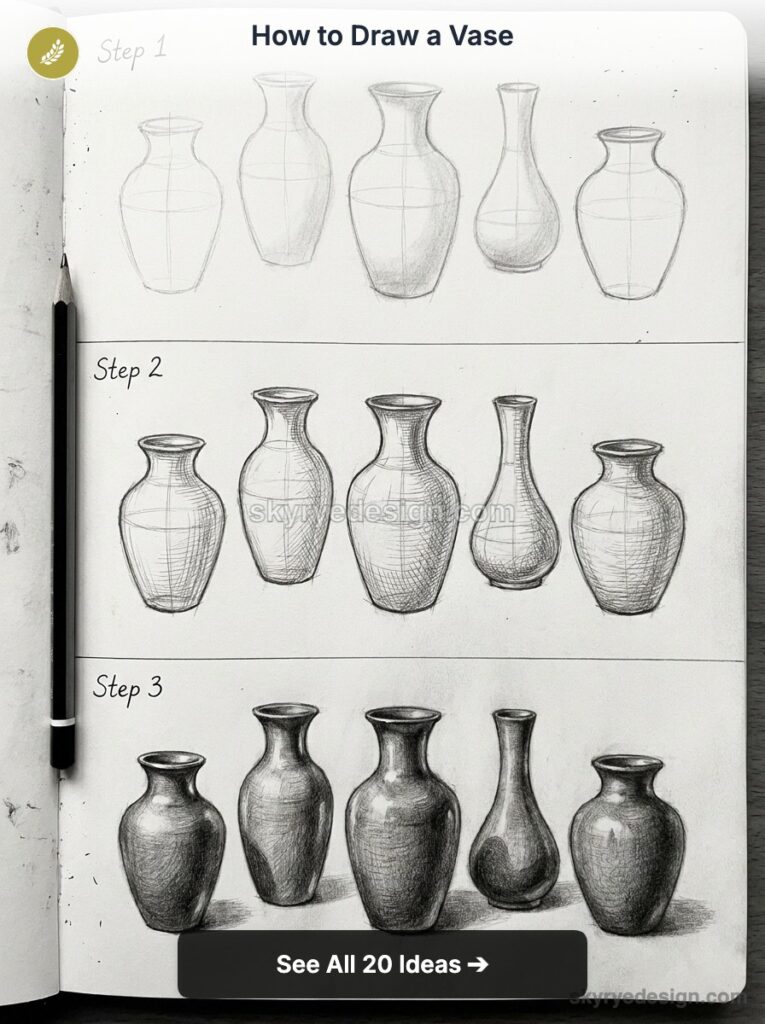
Different shapes stress-test different skills. Work through these roughly in order — each one builds on what the previous shape teaches.
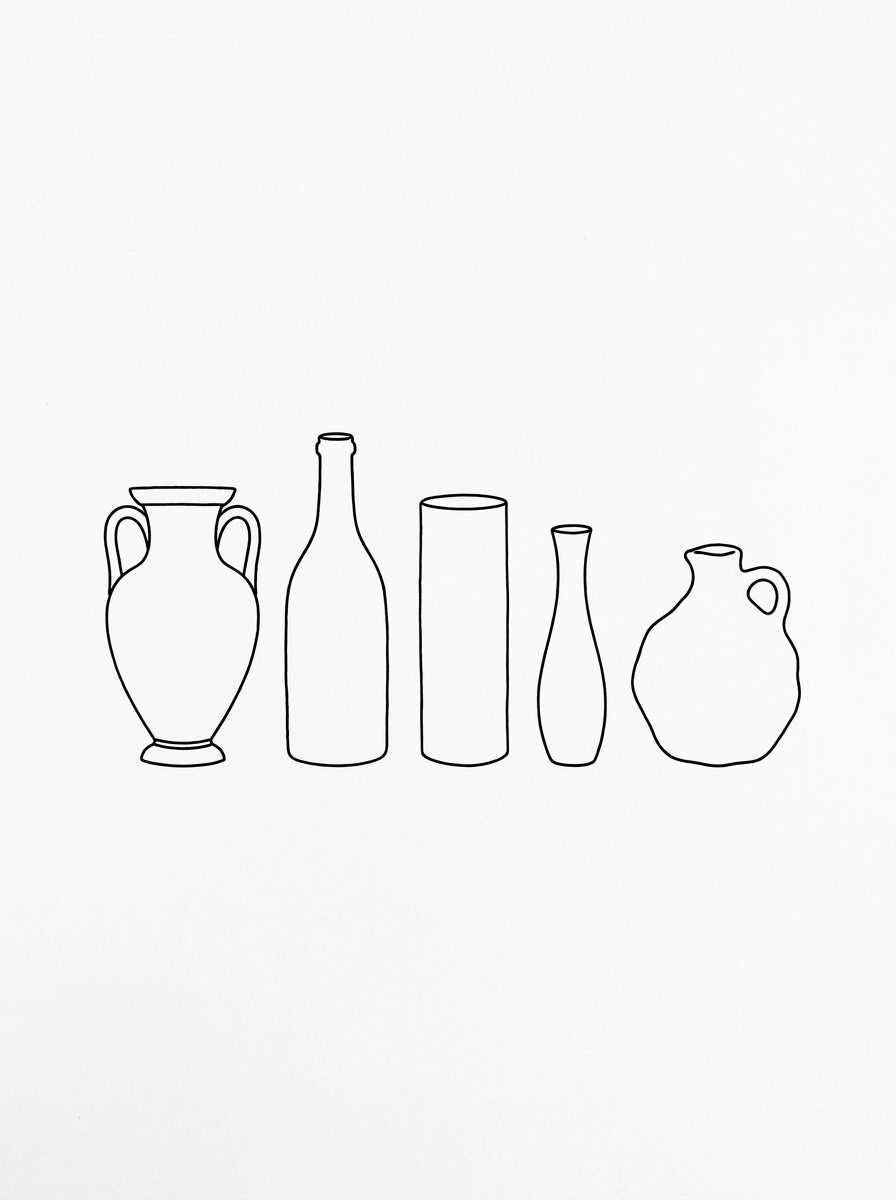
1. Bud Vase
The smallest and most forgiving entry point. Narrow neck, simple bulbous base — essentially a teardrop on a cylinder. The IKEA FORTFARANDE bud vase ($4.99) is a perfect real-world reference. Because the form is small, errors in proportion are less dramatic. Great for practicing ellipse control.
Drawing tip: the neck ellipse is very narrow — almost a straight line. Don’t over-round it or the glass will look thick.
2. Cylinder Vase
Deceptively tricky. A pure cylinder has no silhouette variation, so tone does all the work. The shadow side must be dark enough to read clearly, with a thin strip of reflected light along the far edge.
Drawing tip: vertical shading lines here — unlike curved vases, the cylinder’s shading strokes should run straight down.
3. Bottle-Neck Vase
Wide body, narrow neck — the classic “wine bottle” archetype. Excellent for practicing the transition between two very different radii. Where the neck meets the shoulder is the hardest curve to get right.
Drawing tip: slow down at the shoulder. That transition curve determines whether the whole vase reads correctly.
4. Greek Amphora
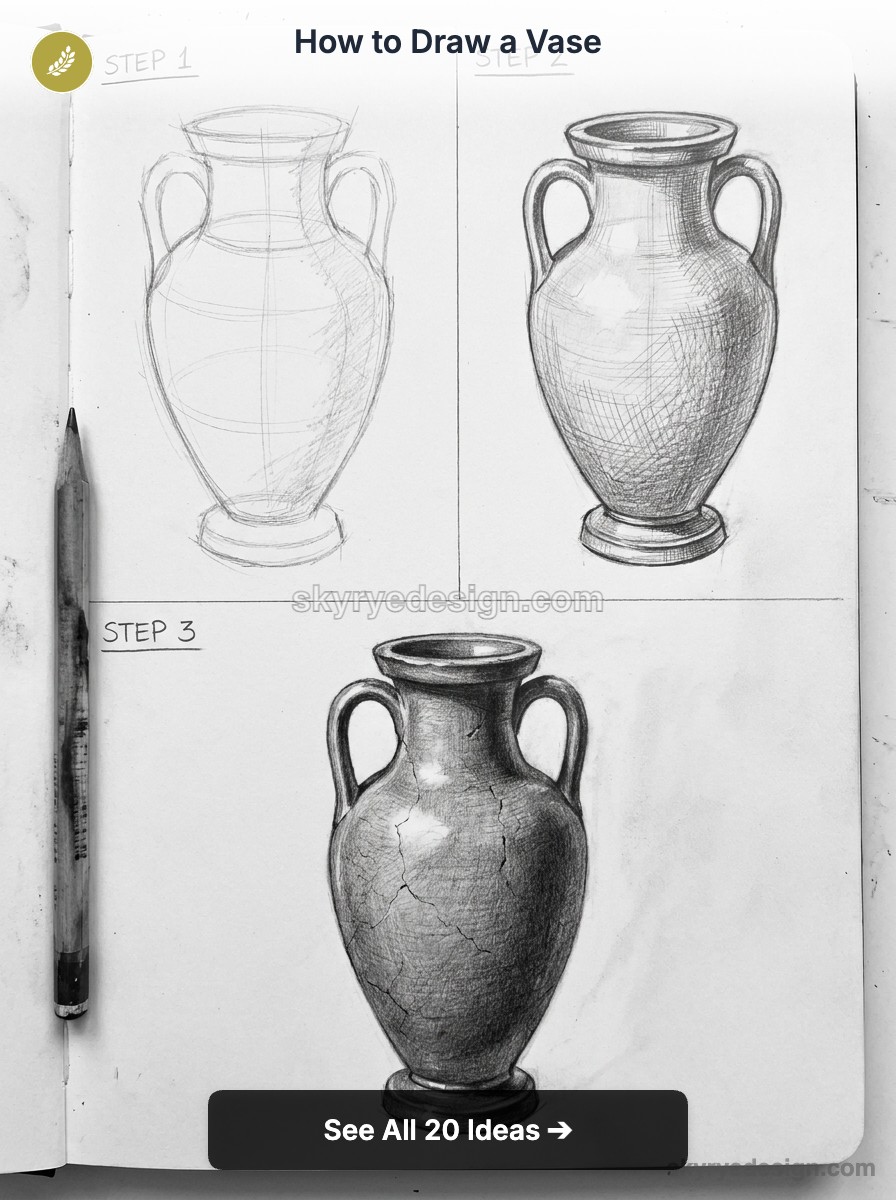
Two handles, wide belly, tapering base — the ancient archetype. Found in the Metropolitan Museum’s collection dating back to 480–470 B.C. The handles are the new challenge: they’re half-ellipses in perspective.
Drawing tip: Draw the handles as tubes, not flat shapes. Each handle has its own highlight strip.
5. Wabi-Sabi Ceramic Jug
The trendiest option for 2026. Intentionally irregular, handmade-looking, with an asymmetric rim and uneven glaze.
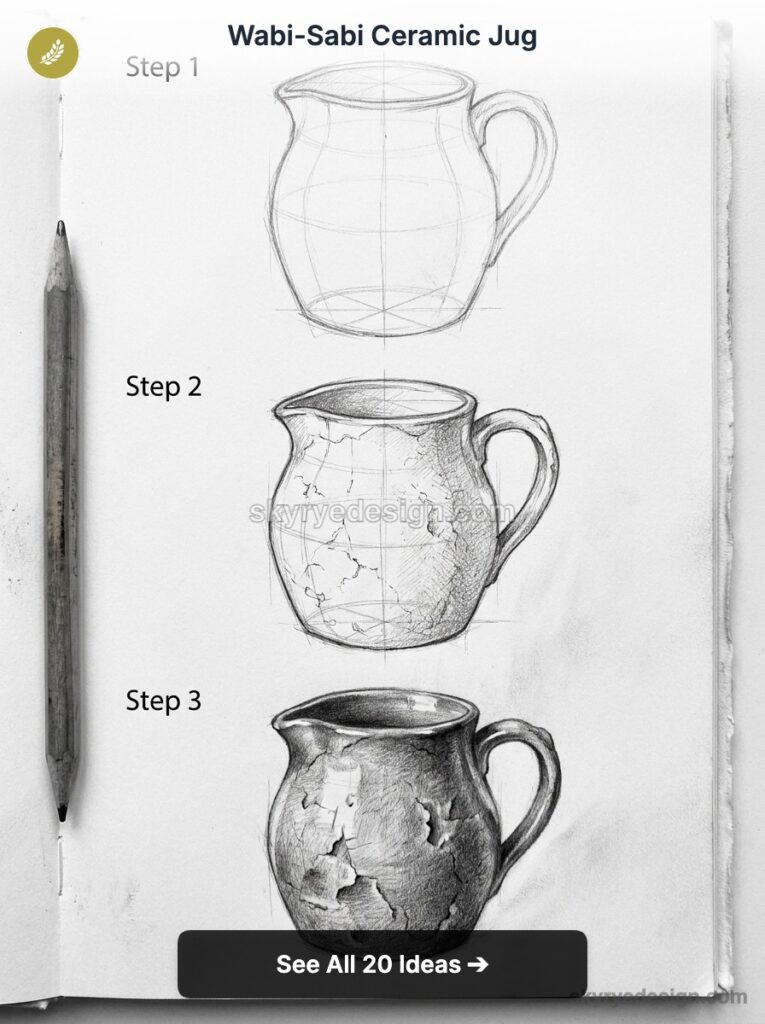
Here you’re deliberately not using your center axis as a strict mirror — slight irregularities are the point.
Drawing tip: draw the center axis, then consciously deviate 3–5mm on one side. Controlled imperfection.
6. How to Draw a Vase with Flowers — Taking It Further
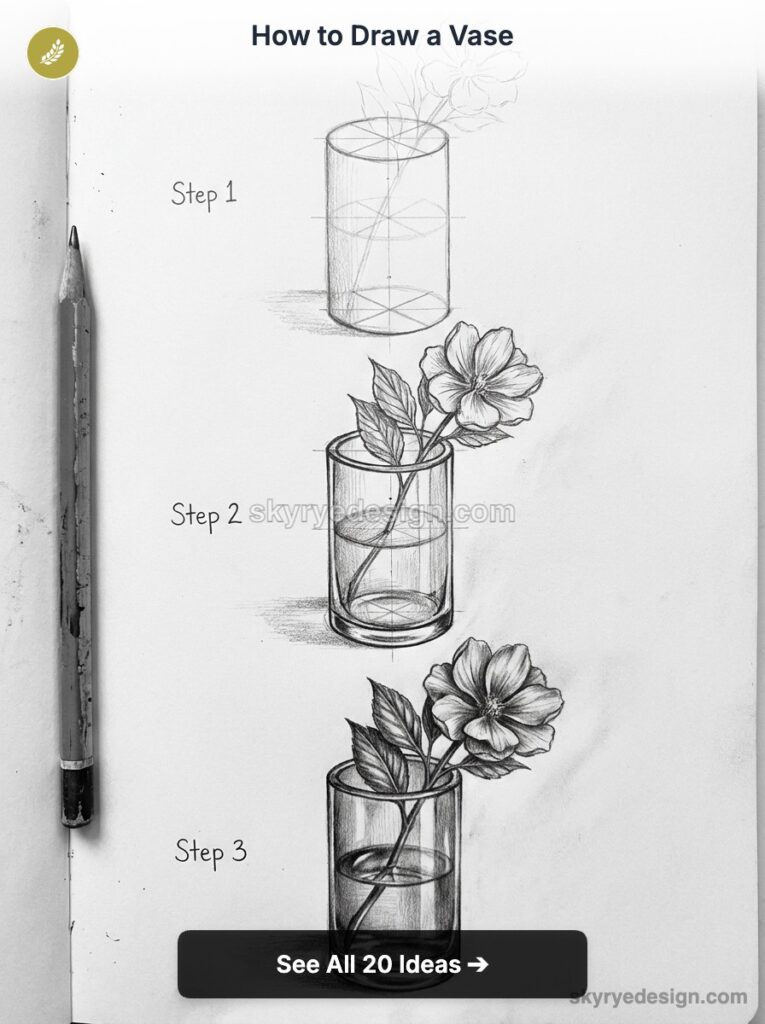
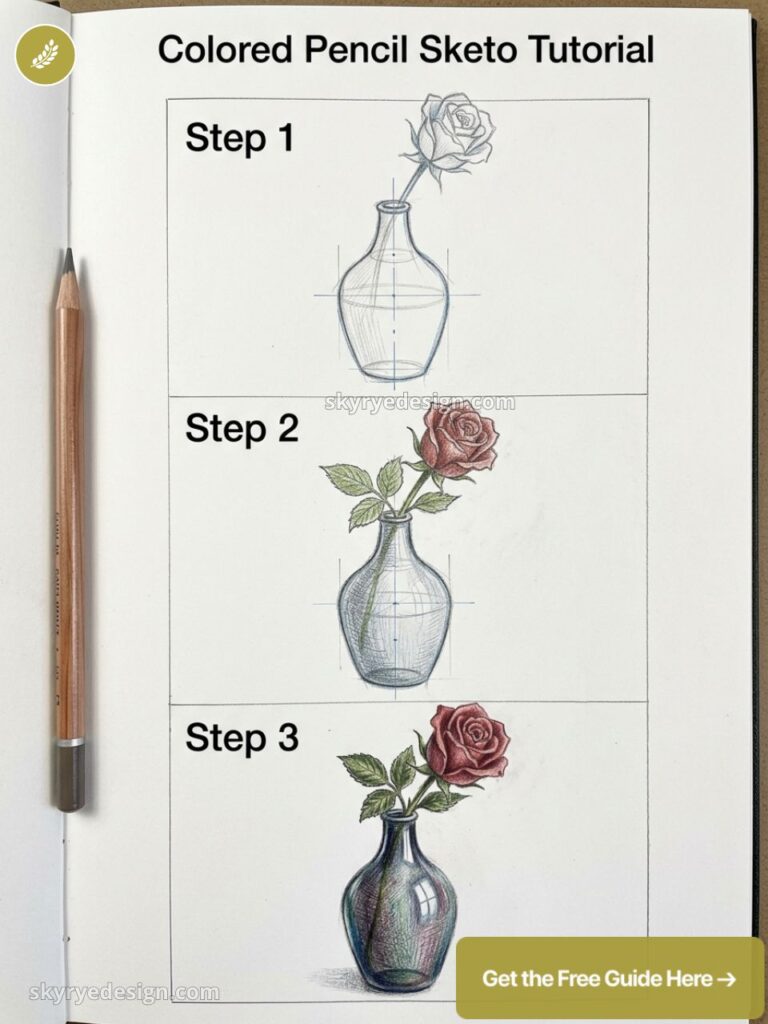
A vase on its own is an exercise. A vase with flowers is a composition — and that shift changes everything about how you approach the drawing.
Composition Basics
Before drawing a single petal, figure out your proportions. A classic rule from atelier training: flowers should stand 1.5 to 2 times taller than the vase. Anything less looks stubby and decorative rather than natural. Anything more starts to feel unstable compositionally.
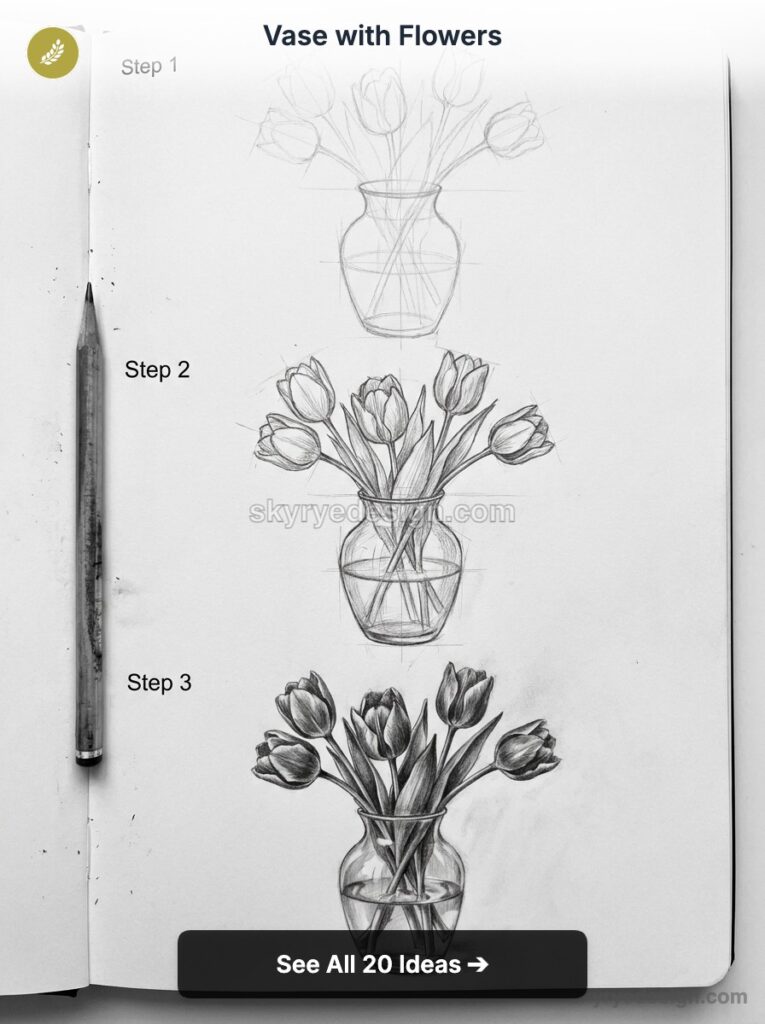
Apply the rule of thirds: place the rim of the vase roughly on the lower third of your page. That leaves the upper two-thirds for the bouquet — and creates natural breathing room above.
| 💡 Golden Ratio Tip: flowers at 1.6× the vase height follow the natural golden proportion (φ = 1.618). This is why most flower arrangements feel visually balanced without anyone deliberately planning it. |
Drawing Flowers Without Overcomplicating
Beginners try to draw every petal. Don’t. Start with the overall flower shapes as simple ovals or circles. Then — and only then — add petal suggestions within those shapes. You’re not illustrating a botanical textbook. You’re creating an impression of flowers, and the viewer’s brain fills in the rest.
Overlapping flowers and stems create depth without any perspective tricks. Push stems behind each other. Let one tulip head overlap another. Add a few leaves cutting across the vase body.
A single leafy stem escaping sideways — the kind you see in any loose, gathered bouquet — does more for realism than ten perfectly-rendered blooms.
7. Common Mistakes and Quick Fixes
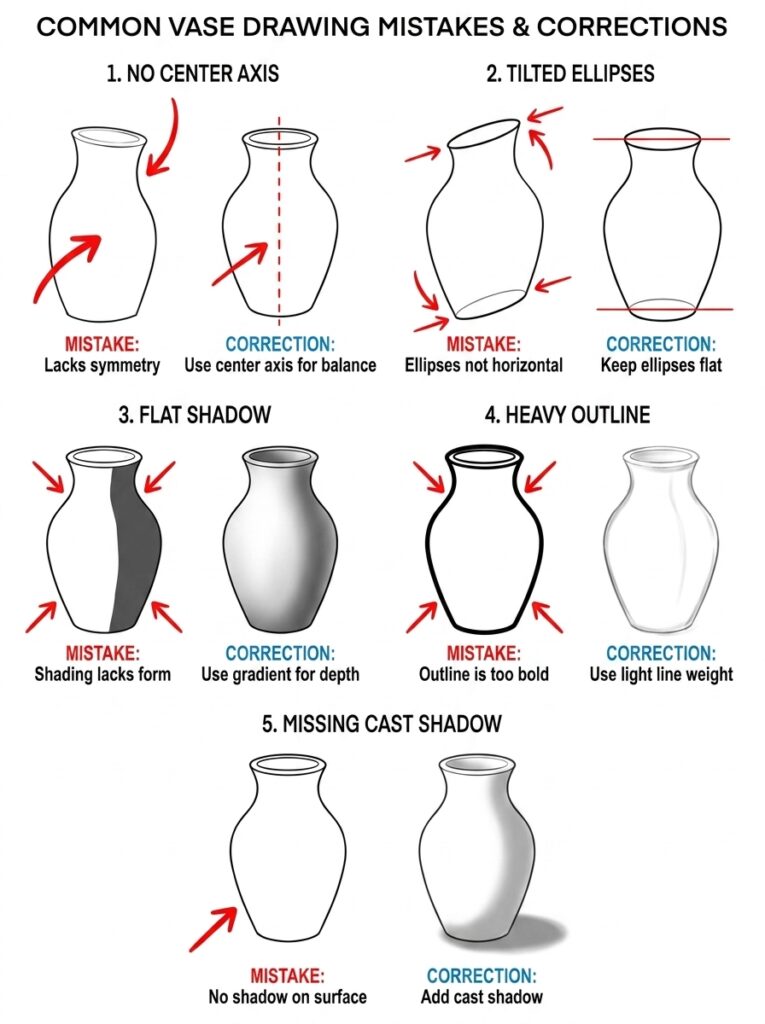
If your vase still isn’t looking right, run through this checklist before redrawing from scratch. The fix is almost always simpler than starting over.
| Quick Fix Checklist ❌ No center axis → Always start with it. The root cause of 80% of symmetry failures. ❌ Ellipses aren’t parallel → Check your viewing angle. Sit directly in front of your paper. ❌ Shadow is one flat tone → Use at least three gradations: core shadow, midtone, reflected light edge. ❌ Outline too dominant → Let it fade into shadow. In dark areas, the outline should almost disappear. ❌ No cast shadow → Ground your vase. Thirty seconds of cast shadow makes a significant difference. |
Frequently Asked Questions
How do you draw a vase for beginners?
Start with a vertical center axis, then place three ellipses along it — mouth, widest point, and base. Connect them with smooth curves, clean up the outline, then add basic shading. Use an HB pencil throughout and keep your strokes light until the final stage. The center axis is the single most important step — skip it and symmetry falls apart immediately.
How do you make a vase drawing look 3D?
Tone does the work. Establish a light source, then divide your vase into three zones: highlight (untouched paper or lifted with eraser), midtone (light 2B shading), and core shadow (deeper 2B to 6B). Add a cast shadow underneath. Without those three tonal zones, even a perfect outline reads as flat.
What pencils are best for drawing a vase?
Three grades cover everything: HB for construction and outline, 2B for general shading and midtones, 6B for deep shadows. The Faber-Castell 9000 series ($8–12) includes all three. Avoid mechanical pencils for shading — the fixed line width limits tonal variation.
How do you draw a glass vase with reflections?
Use sharp, hard-edged white highlights (leave the paper untouched in those zones). Draw the interior contents — stems, water — as slightly distorted shapes due to refraction. Keep the glass edges darker than the center. Multiple small highlight zones, rather than one large glow, communicate transparency immediately.
What is the hardest part of drawing a vase?
Consistent symmetry combined with believable tone. Getting both right simultaneously takes practice — most beginners nail one and sacrifice the other. Work on symmetry first with pencil-and-axis construction, then layer tone as a separate pass rather than trying to do both at once.
Can I draw a vase without any drawing experience?
Yes — the center axis and ellipse method works regardless of experience level. The steps in this guide are the same ones taught in foundation atelier programs; the difference is that experienced artists execute them faster. Give yourself permission to draw the construction lines lightly and erase them later. Your first vase won’t be perfect, and that’s exactly correct.
Your First Vase Starts Today
Sponsored
A vase is one of those subjects that looks simple but teaches you everything — symmetry, proportion, light, material, and composition all at once. That’s exactly why it’s been a studio staple from ancient Greek workshops to 21st-century illustration courses.
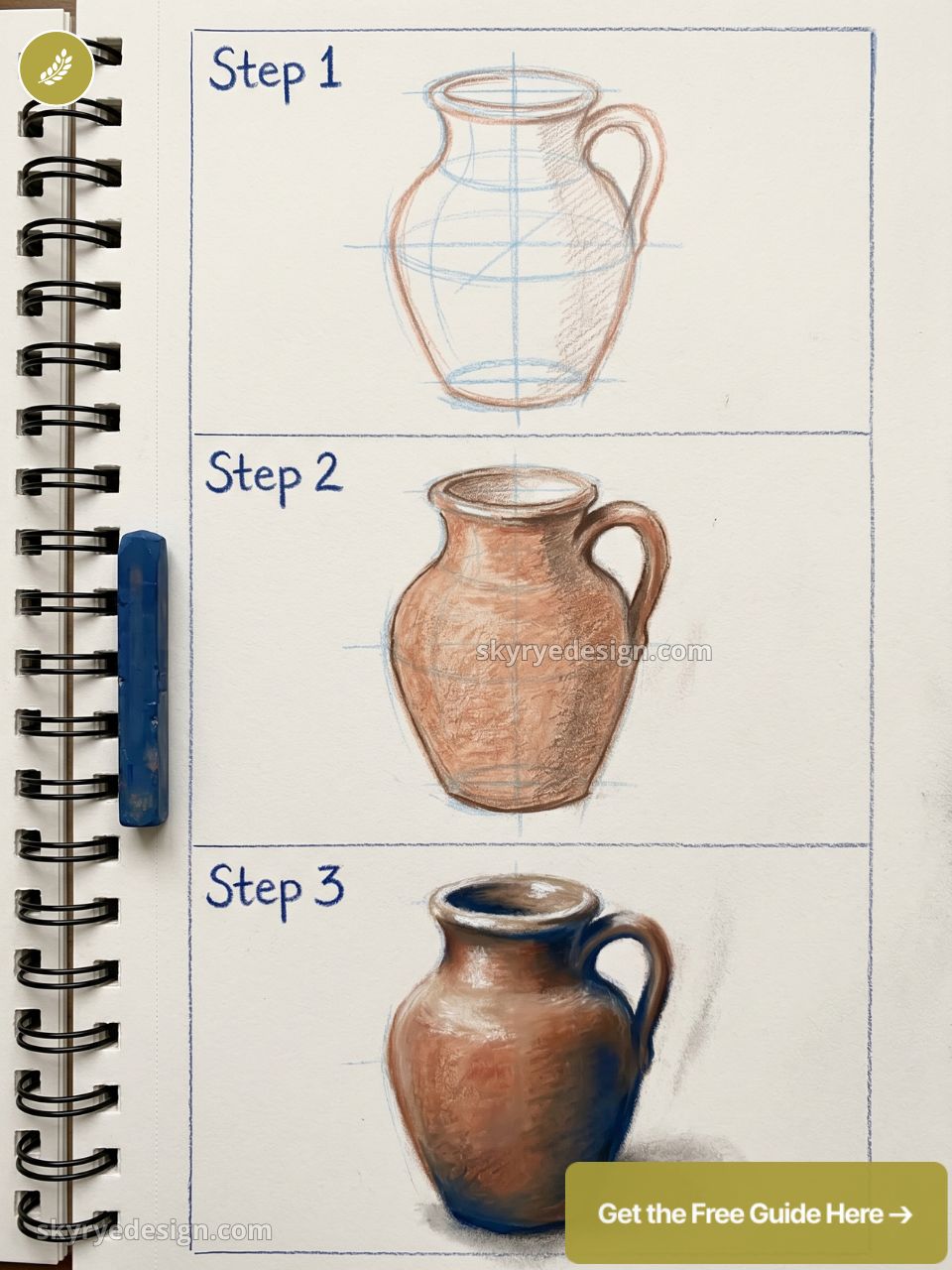
The seven steps in this guide aren’t arbitrary. They mirror the way trained artists approach any three-dimensional object: structure first, form second, tone third. Work through them in order, resist the urge to skip the construction phase, and the results will surprise you.
Start small. Pick a bud vase — the simplest shape on the list — and draw it once today. Don’t aim for a masterpiece. Aim for a vase that looks like it’s actually sitting on a surface.
Then try the cylinder. Then add flowers. Each one compounds your understanding of the previous shape.
Your pencil is already ready. The vase is already on your desk.
Use the exclusive promo code AFF30D25 at checkout to unlock unlimited classes. Once you’re in, search for:• “still life drawing pencil”• “how to draw realistic objects.”
👉 Unlock Your Free Month & Start Drawing
- 6.3Kshares
- Facebook0
- Pinterest6.3K
- Twitter0
- Reddit0