My first mandala took four hours and looked like a dinner plate drawn by someone who’d had too much coffee. Wobbly circles, petals that didn’t line up, one section that was just… bigger than the others. I kept it. Still have it somewhere in a sketchbook.
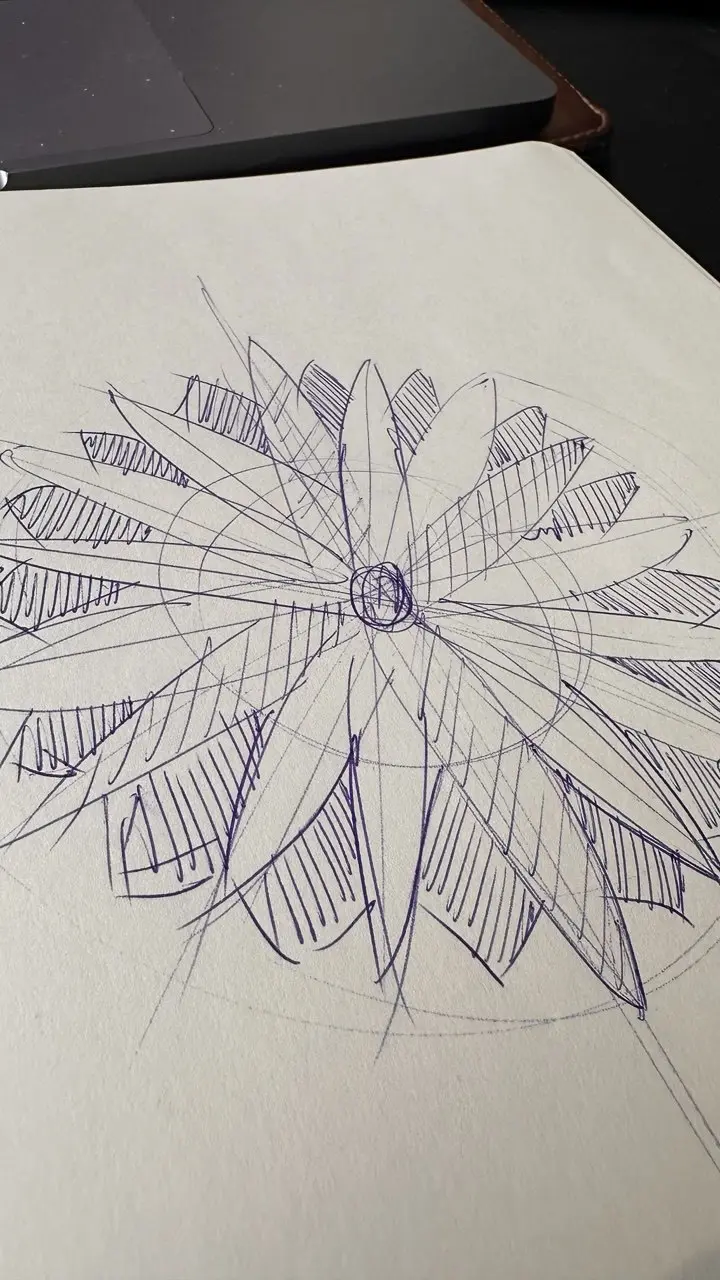
That’s the thing about mandala art designs — they’re forgiving in the best way. The structure itself compensates for small mistakes. You fill in one wonky petal, you draw its mirror on the other side, and somehow it still reads as intentional. The symmetry does the heavy lifting.
This list covers 25 designs across the full difficulty range: patterns that work on your first try in twenty minutes, and patterns that’ll take you three sessions with a fine-liner pen and a compass. Each one has honest notes on what it actually requires — no “this is easy!” cheerleading if the technique genuinely takes practice.
Grab some paper. A pencil and a ruler get you started. The rest comes with time.
Mandala line practice also translates naturally into henna mandala tattoo ideas, especially for hands, shoulders, backs, and festival designs.
Before You Start: What You Actually Need
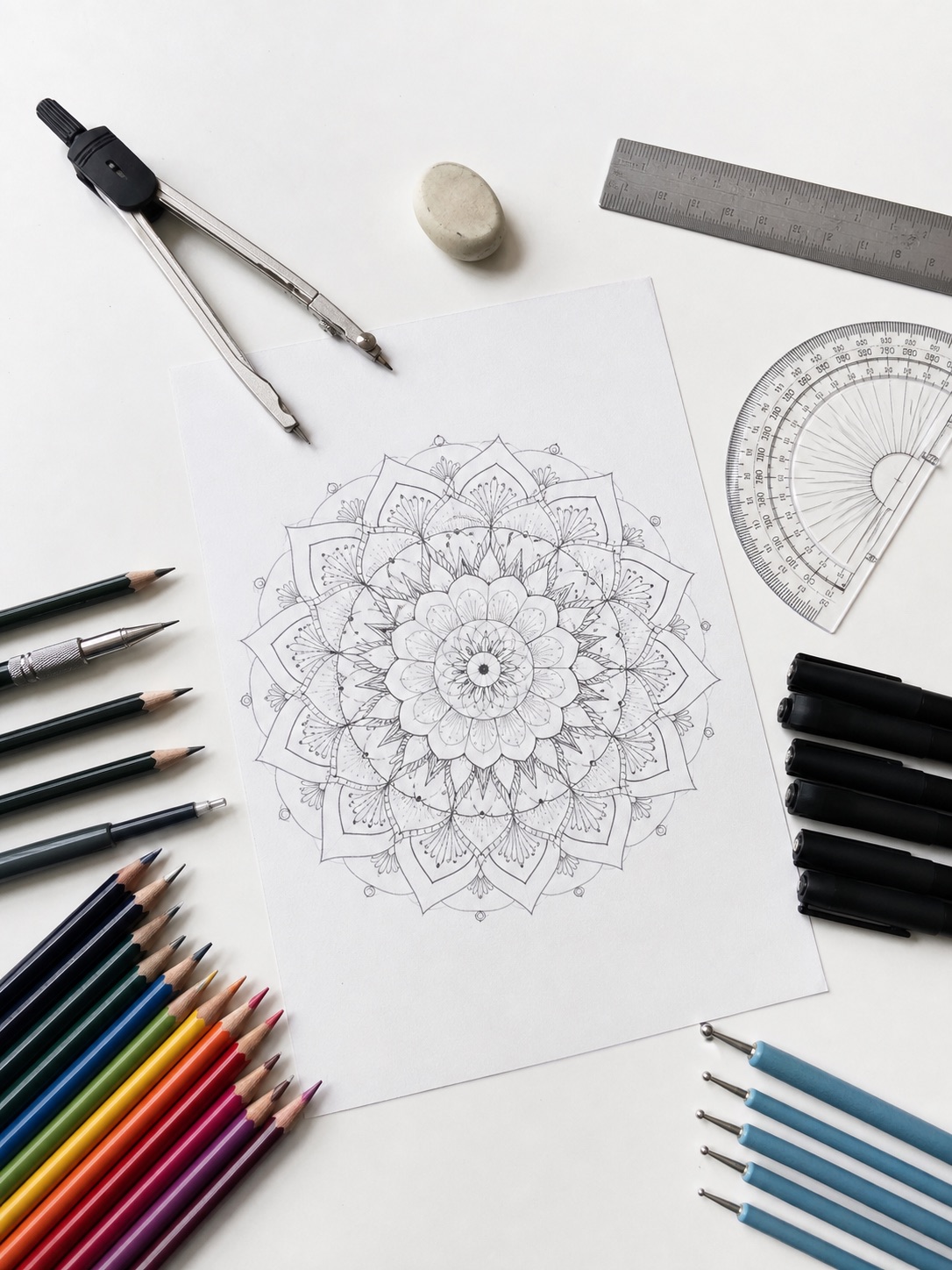
You don’t need much. But you do need the right things, because the two most common reasons mandala drawings go wrong are: (1) freehand circles, and (2) trying to eyeball the divisions.
The non-negotiables: a compass, a ruler, a pencil, and an eraser. That’s actually it for most designs in this list. If you’re going to ink: a 0.1 Sakura Pigma Micron or Staedtler Triplus fineliner for detail, and a 0.3 or 0.5 for bolder outlines. For dot mandala work: dotting tools or paintbrush backs dipped in acrylic.
Draw your guide circles lightly. Really lightly. You’ll be erasing them after inking, and heavy compass marks leave grooves in the paper that show through.
Difficulty Key Used in This Guide
Beginner: compass + ruler only, no freehand curves required. Intermediate: some freehand elements, compass essential. Advanced: fine-liner work, tight spacing, patience required. Expert: complex layering, dotwork precision, or digital tools recommended.
Easy Mandala Art Designs (1–10)
These ten designs work on first or second attempt. The goal here is learning to trust the compass and get comfortable with radial symmetry.
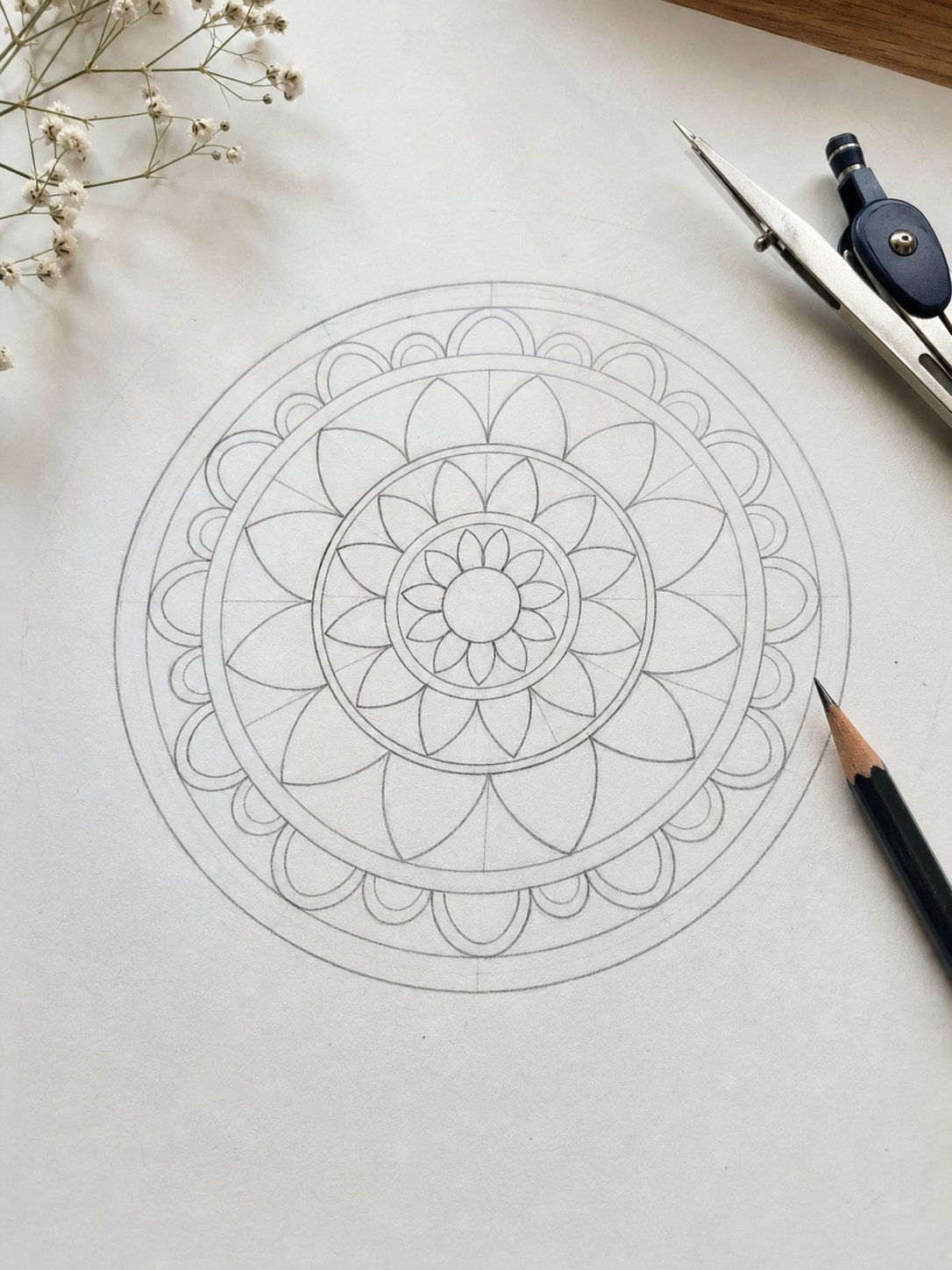
1. Basic Circle Mandala
⚡ Difficulty: Beginner
✏️ Tools: Compass, pencil, ruler
Start with a center dot. Draw five to six concentric circles at increasing radii — I usually go 1cm, 2cm, 3.5cm, 5cm, 7cm. Divide with 8 radiating lines from center. Add a simple petal in each of the 8 sections of your second ring. Repeat a different shape in the next ring. That’s it. The result looks deliberate and finished even when it’s technically very simple. This is the pattern that teaches you what mandala structure actually is.
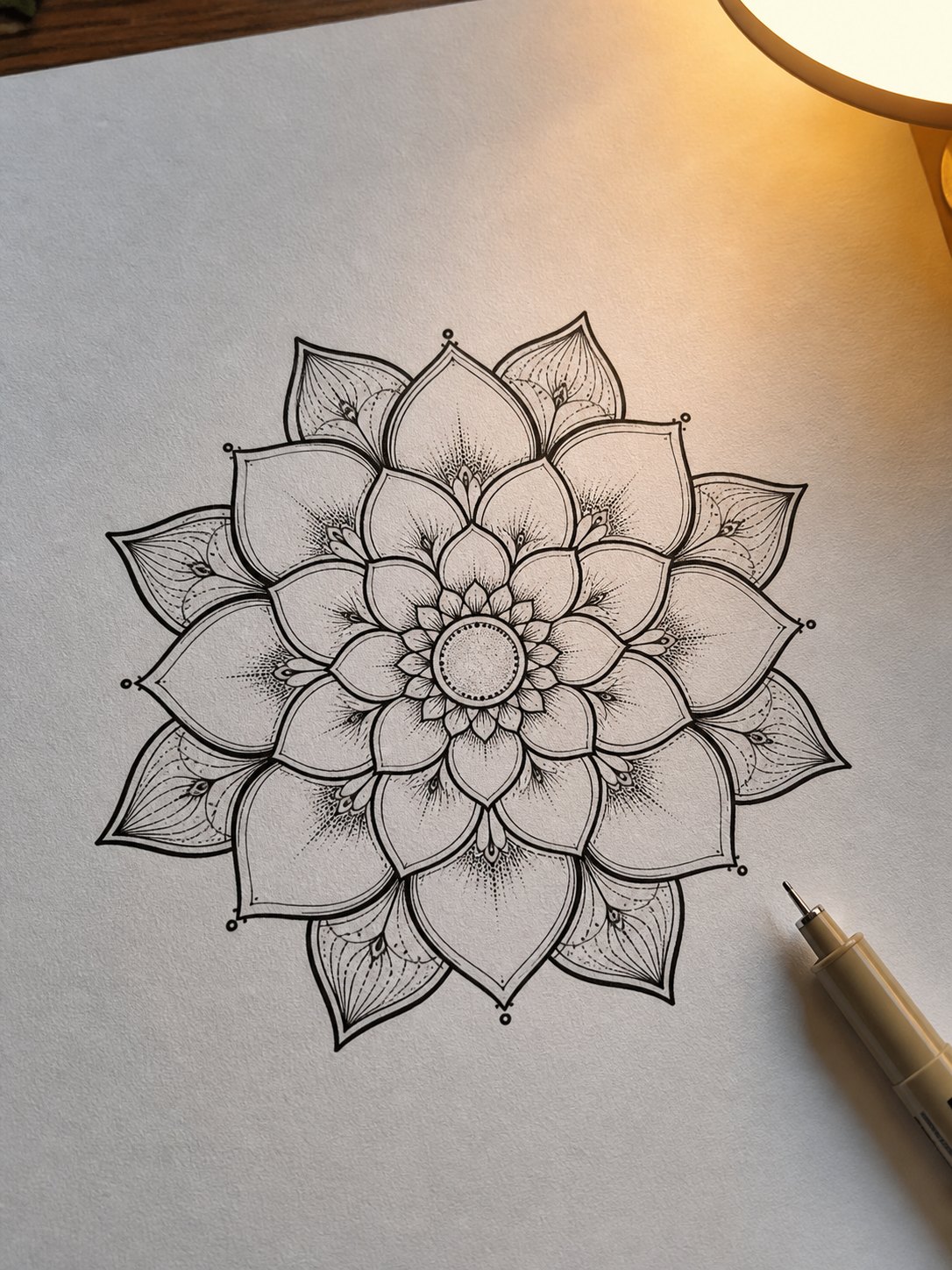
2. Lotus Mandala
⚡ Difficulty: Beginner
✏️ Tools: Compass, pencil, fineliner
A lotus has overlapping petal layers, each slightly offset from the one below. Start with 8 petals in your innermost ring, then 8 more between them in the next ring out.
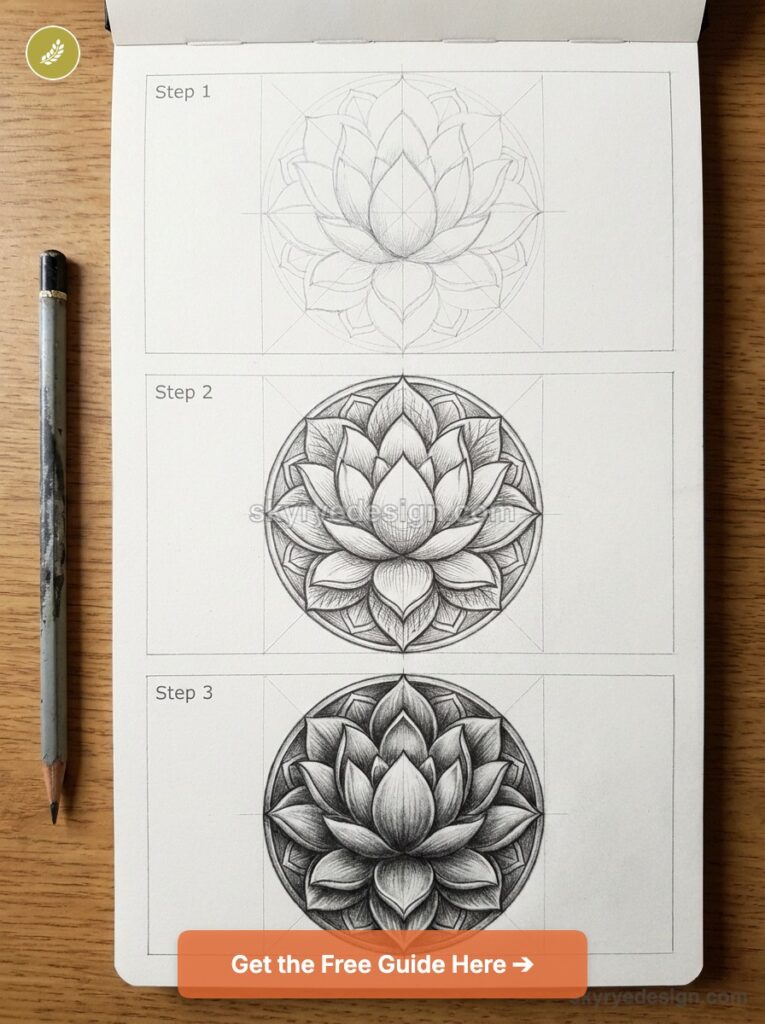
The offset creates the layered look. Keep the petal shape simple — a rounded triangle works. The lotus mandala is probably the most Instagrammed design in this category, which tells you how well a simple version lands.
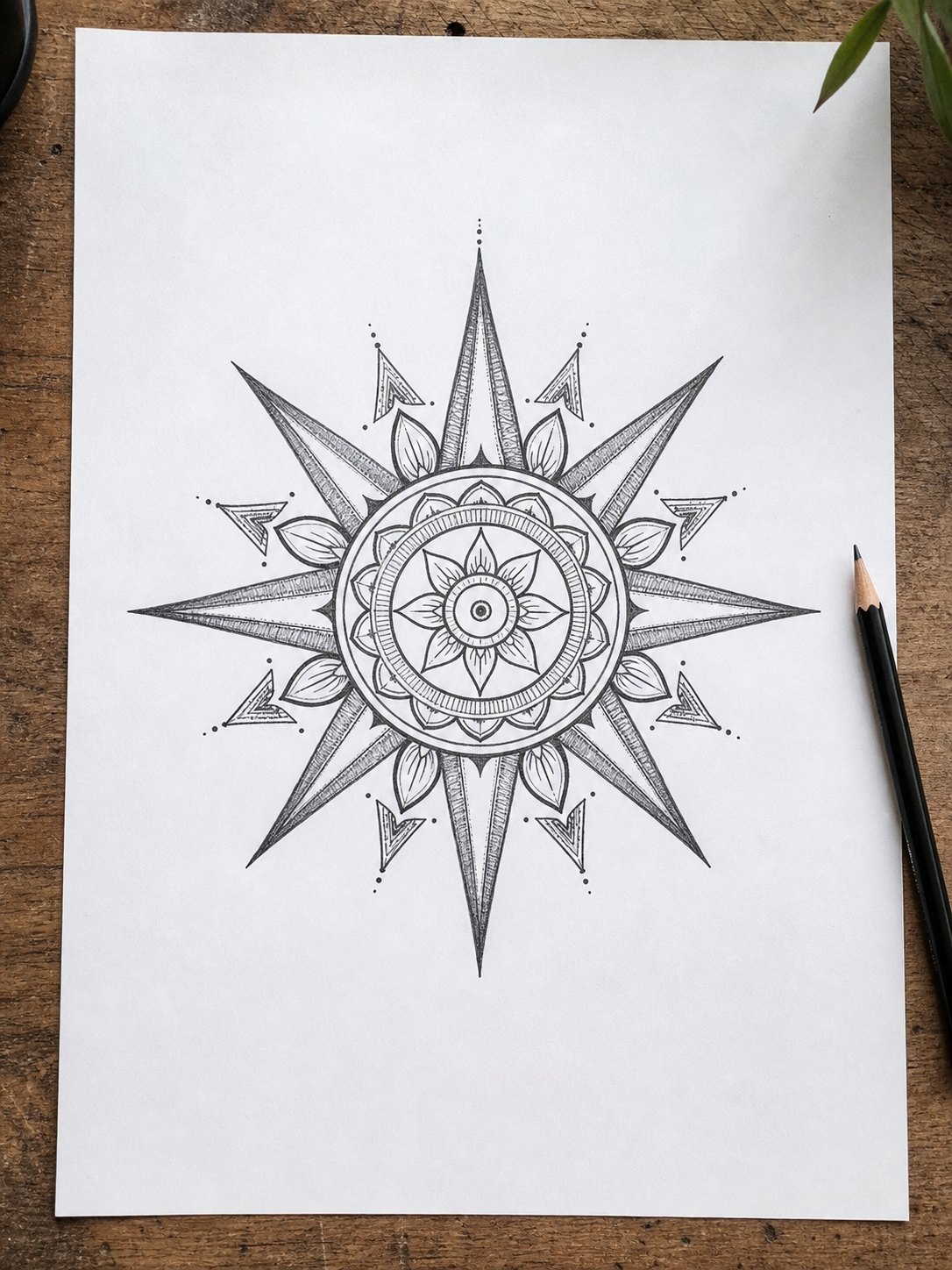
3. Sun Mandala
⚡ Difficulty: Beginner
✏️ Tools: Compass, ruler, pencil
Draw a central circle. Around it place 8 elongated triangular points like a compass rose, then a ring of shorter secondary points between them. Add concentric circles with thin rings between the points.
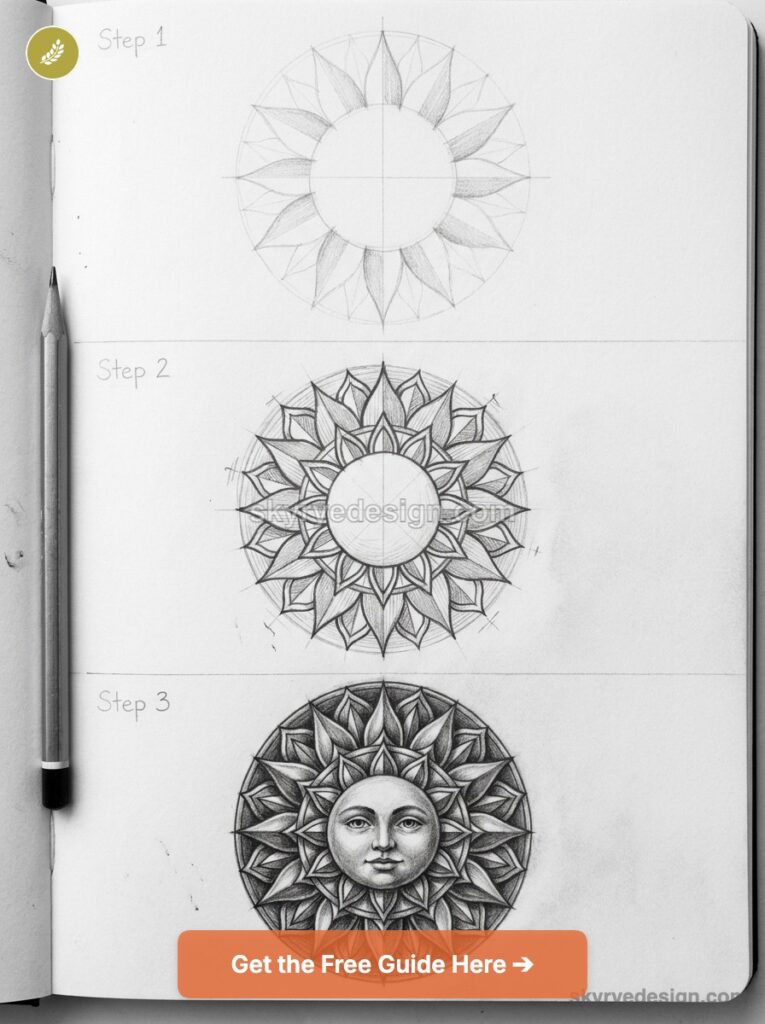
The sun mandala reads bold from a distance and works well large — A4 or bigger. Good first project if you want something that looks impressive on your wall without much technique.
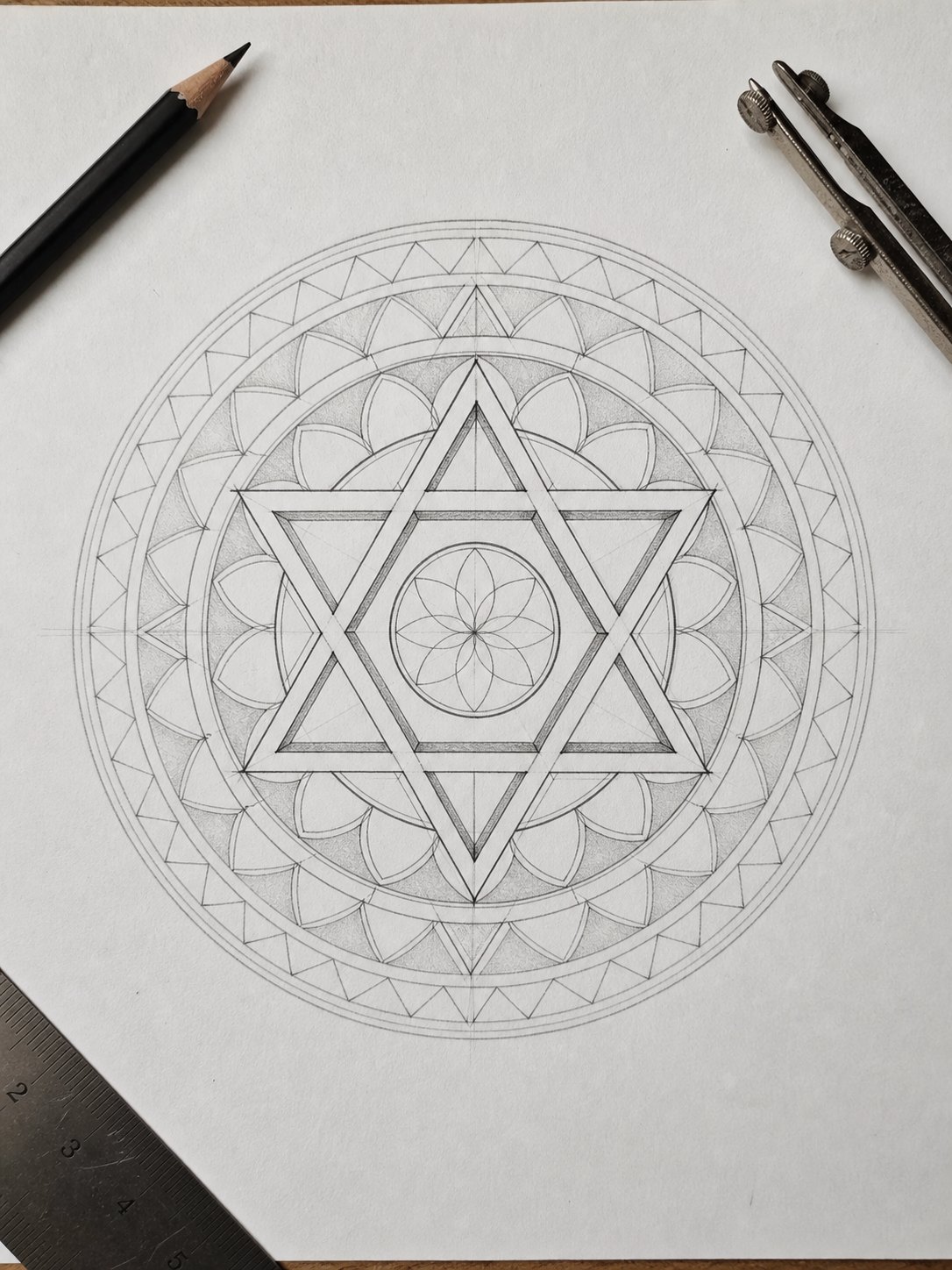
4. Star of David Mandala
⚡ Difficulty: Beginner
✏️ Tools: Compass, ruler
Two overlapping equilateral triangles form the star, then you build rings outward from that hexagonal center. The geometry is precise but the tools do the work: ruler for triangle lines, compass for outer rings. Good introduction to building from a geometric center rather than a pure circle.
5. Simple Floral Mandala
⚡ Difficulty: Beginner
✏️ Tools: Compass, pencil
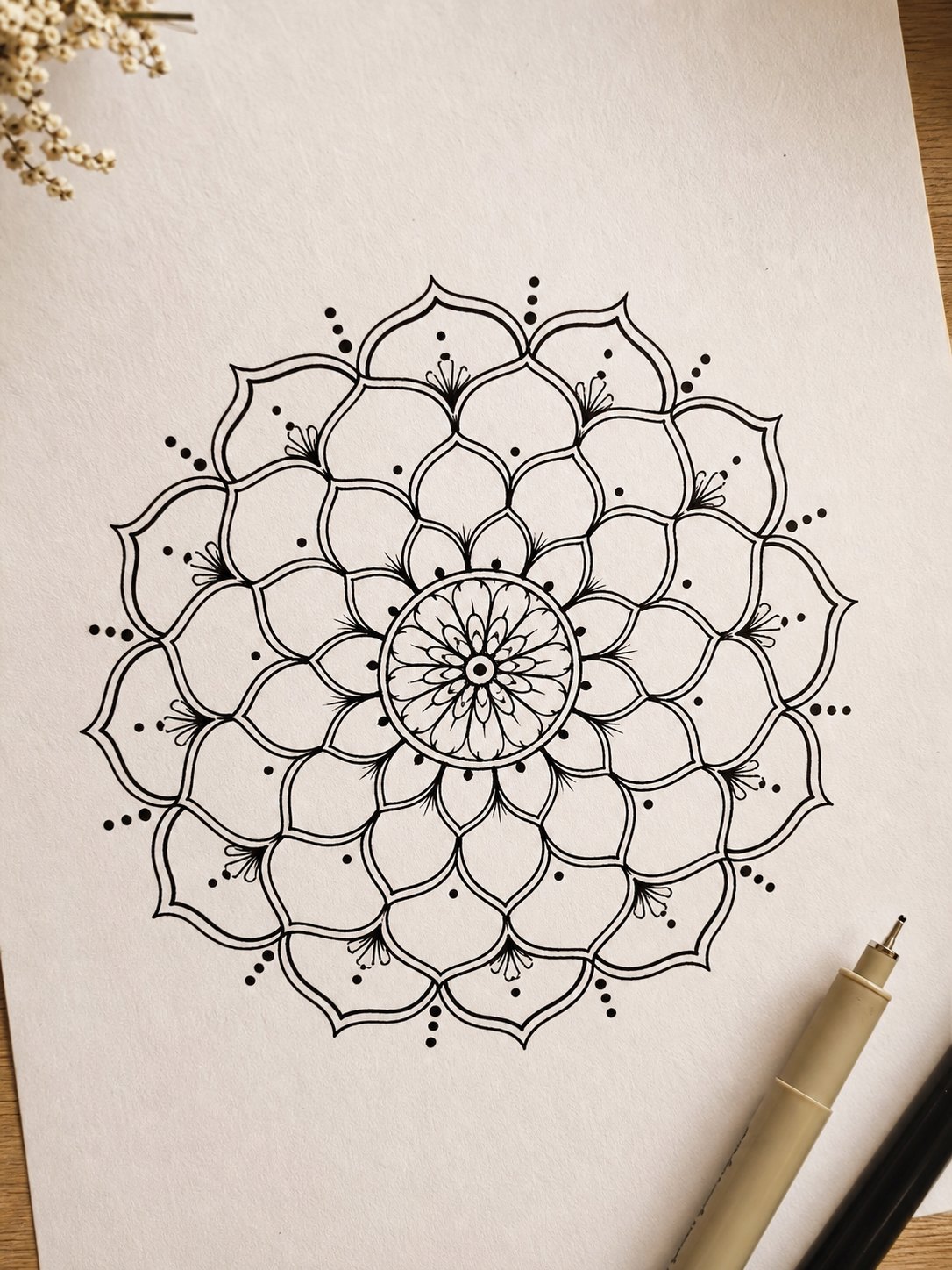
Eight round petals radiating from center, each touching the next at its widest point. Add a ring of small dots between petals. Repeat the same petal ring at a larger radius.
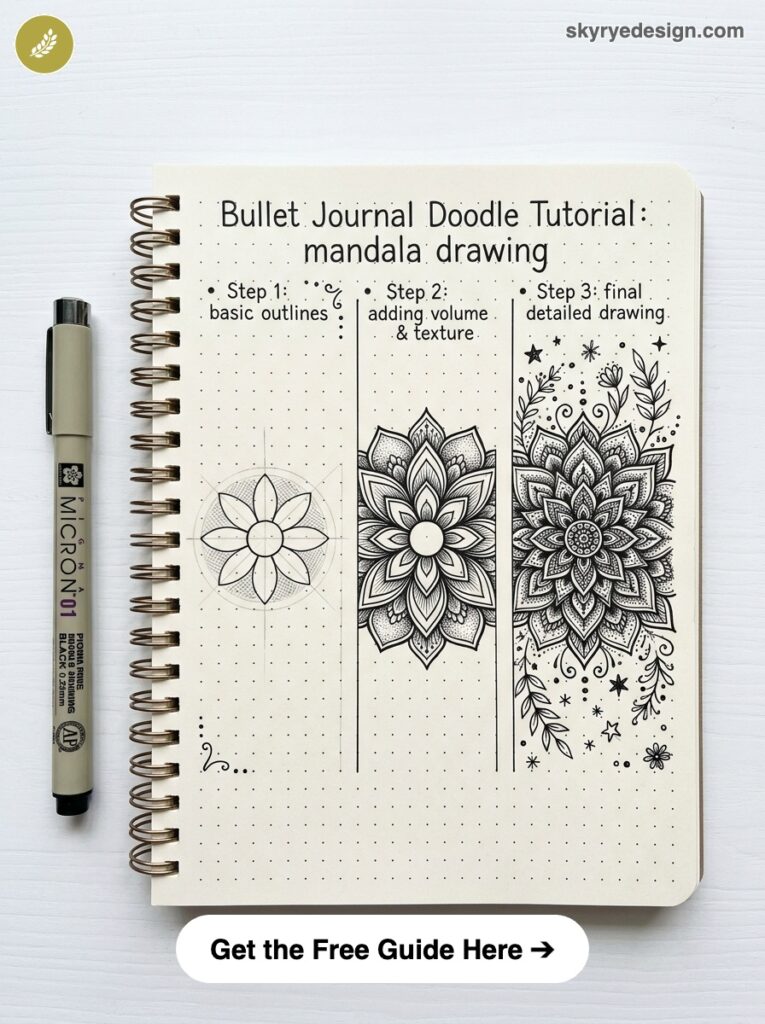
Do it once more. The whole thing takes about 45 minutes and is a genuinely satisfying result for the effort. Inking it in black and leaving it uncolored is the cleanest version.
6. Dotwork Circle Mandala
⚡ Difficulty: Beginner
✏️ Tools: Fineliner pen, ruler
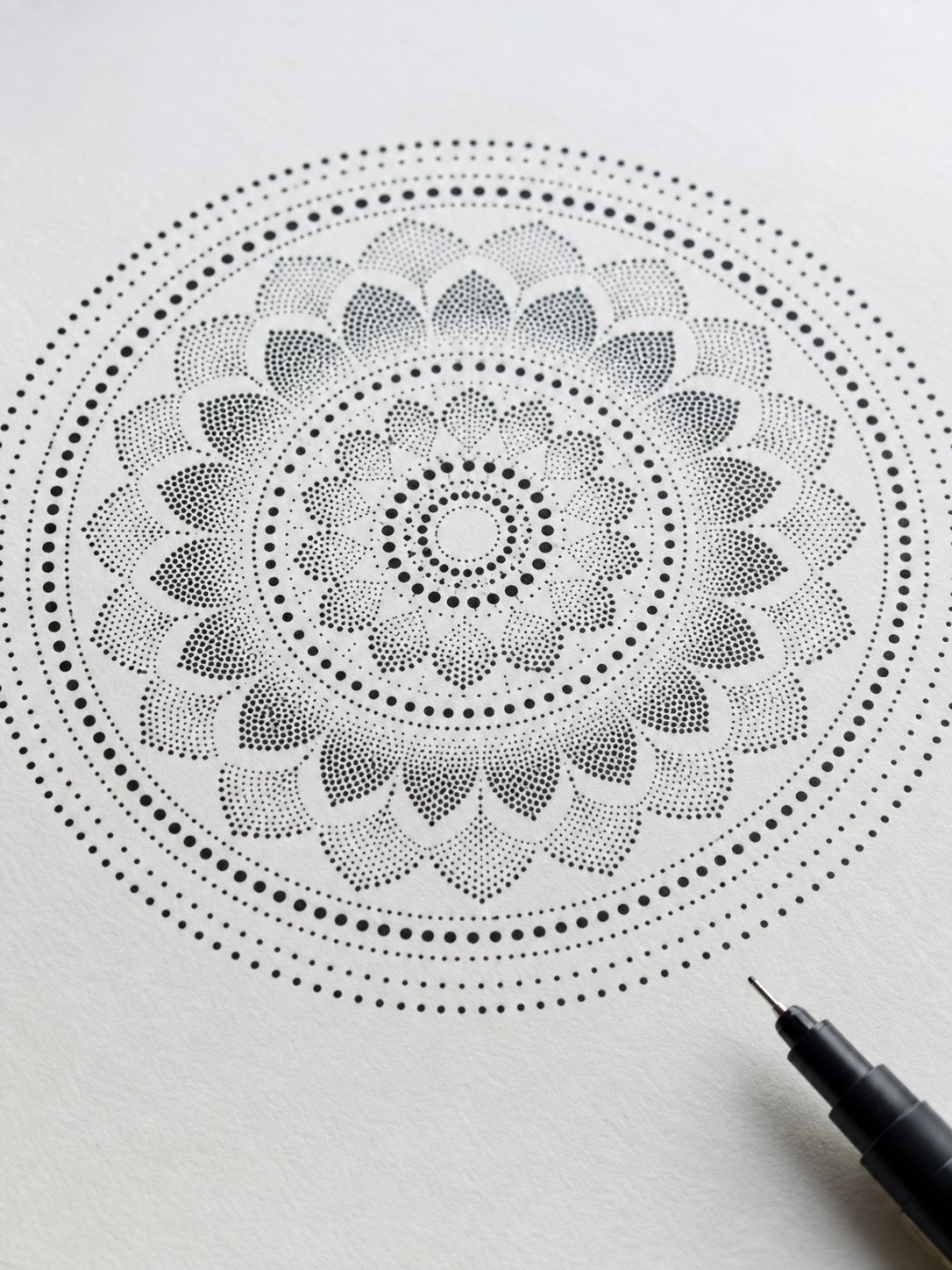
Rings of dots instead of continuous lines. Start with a circle of 8 evenly-spaced dots, then 16 in the next ring, 24 in the next. The spacing creates visual rhythm. No compass required if your dots are neat — though compass guide circles help. The dot pattern has a softer look than linework and forgives slight inaccuracies.
7. Geometric Triangle Mandala
⚡ Difficulty: Beginner
✏️ Tools: Ruler, compass
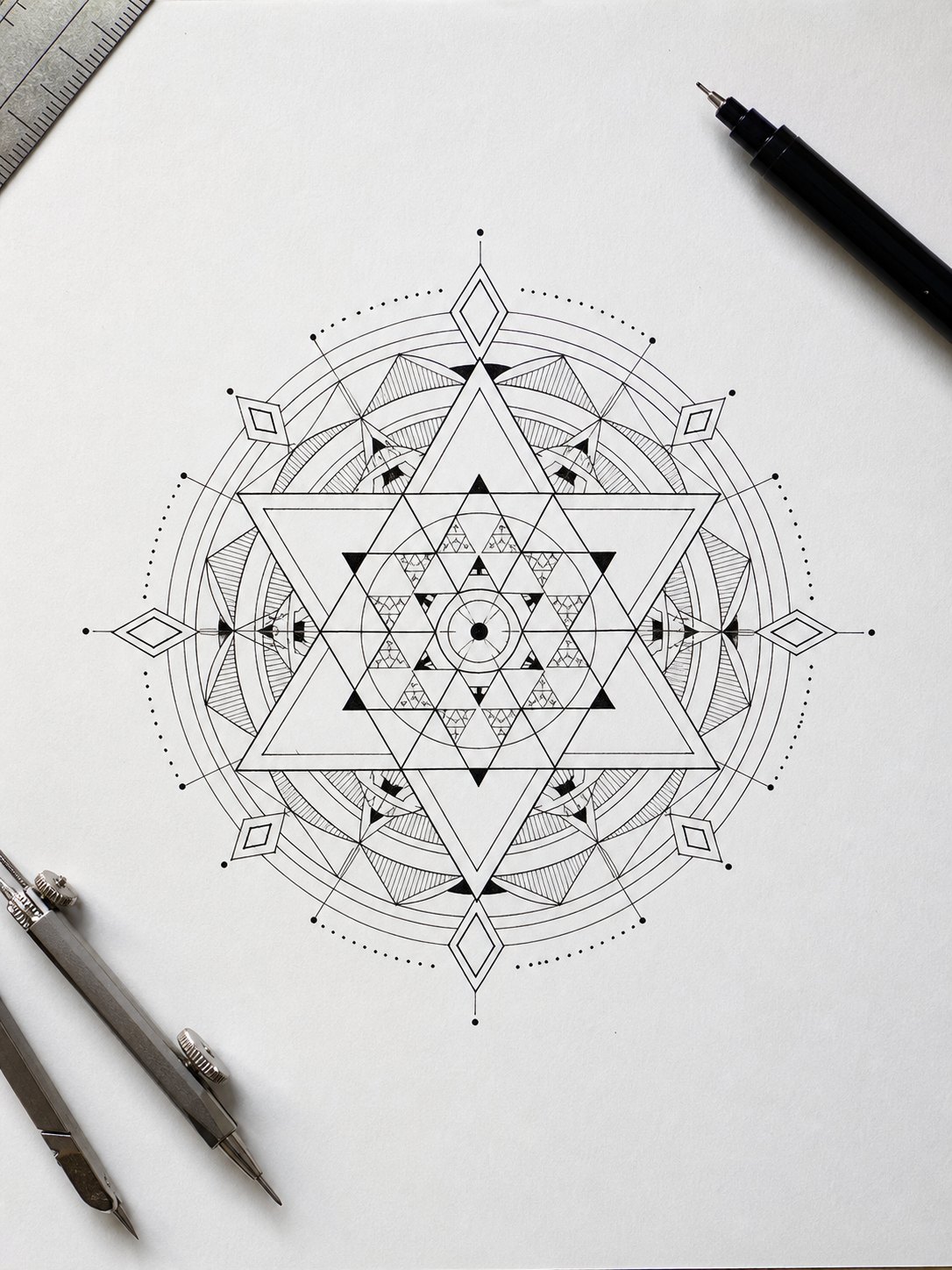
Six equilateral triangles arranged around a center point, tips touching. Around them a ring of smaller triangles alternating point-up and point-down. Around those a ring of diamonds. The result is crisp and architectural. No curves required, which makes it genuinely accessible to anyone who struggled with compass work.
8. Feather Mandala
⚡ Difficulty: Beginner
✏️ Tools: Pencil, fineliner
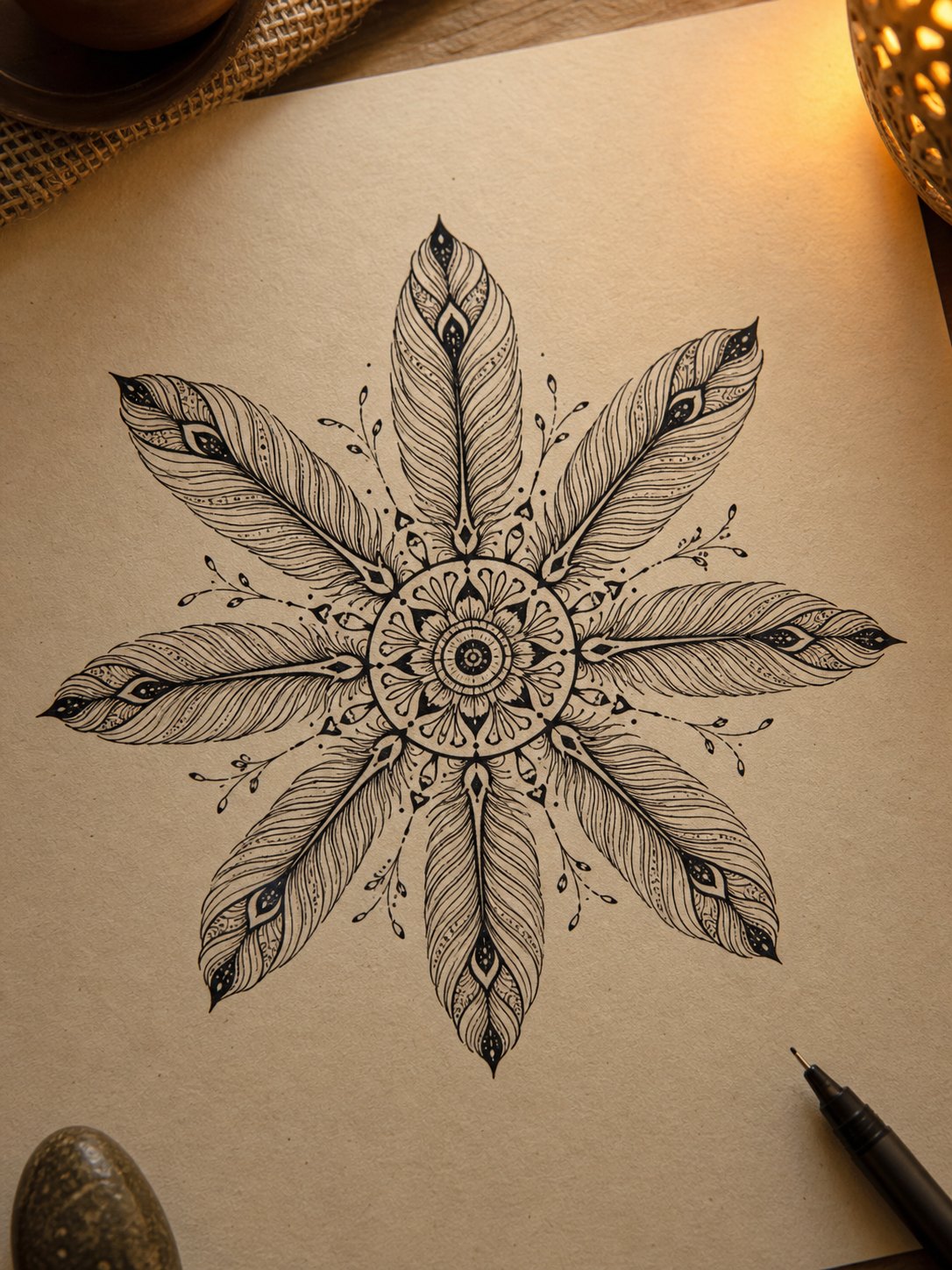
Eight stylized feathers radiating from center, with small curved lines inside each shaft suggesting barbs.
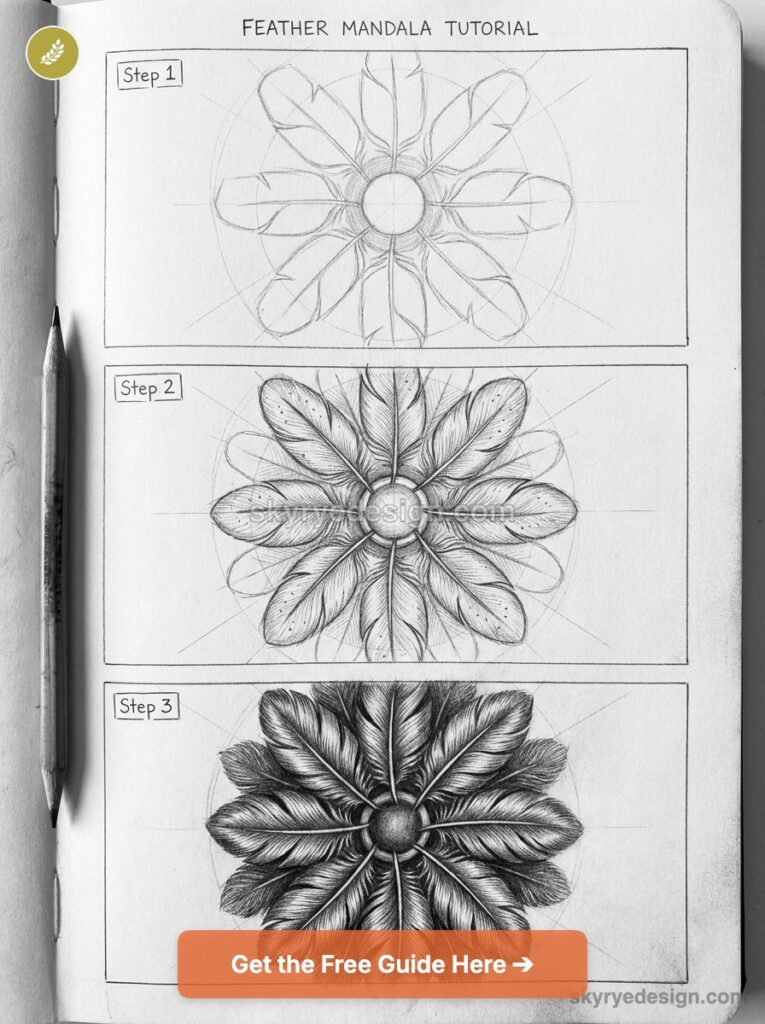
The feather shape is drawn freehand but overall symmetry is guided by compass circles. This one has an organic, hand-lettered quality that makes it look intentionally loose rather than imprecise.
9. Half Mandala (Demi-Mandala)
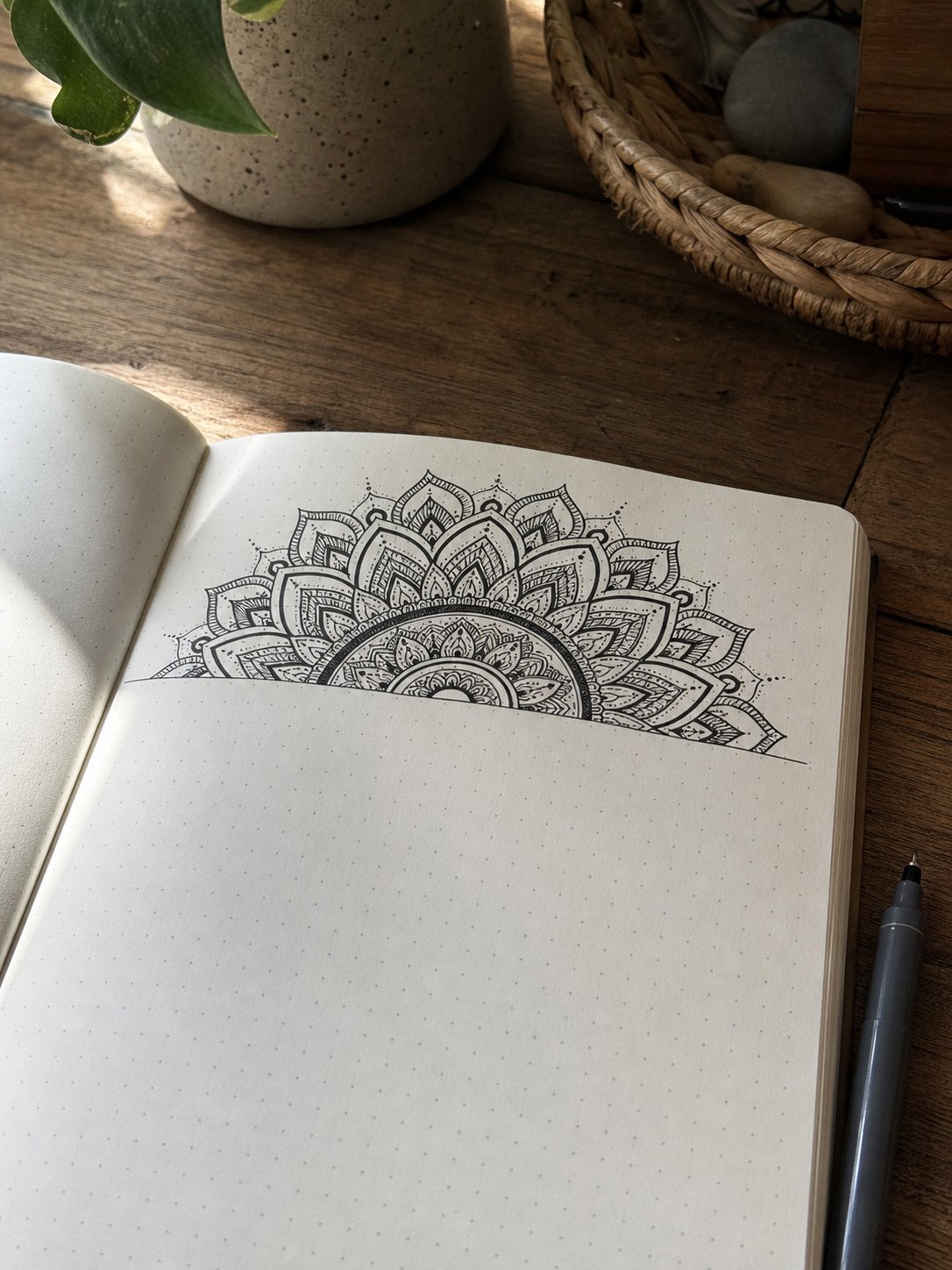
⚡ Difficulty: Beginner
✏️ Tools: Compass, pencil, ruler
Only the top half of a standard mandala — a semicircle of pattern. Works beautifully as a page border in a journal. Easier than a full mandala because you design one half and use the straight edge as one boundary. Good beginner project for anyone intimidated by the full circle format.
10. Kids Flower Mandala
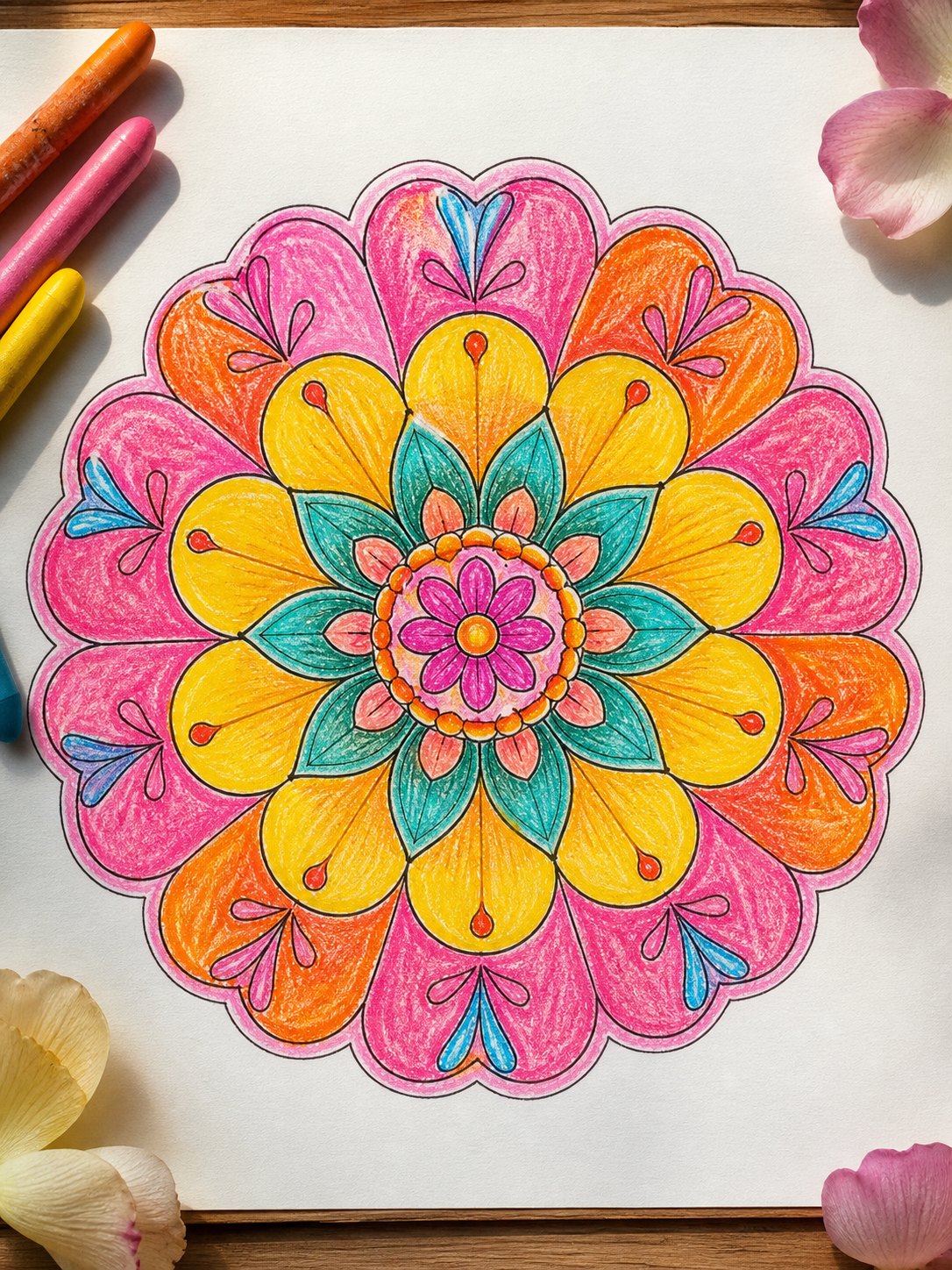
⚡ Difficulty: Beginner
✏️ Tools: Pencil, colored pencils
Round petals with wavy edges, simple enough for actual children but still satisfying for adults who want a low-stress session. Use a compass for petal placement guides and go freehand on the petal shapes. Coloring it with bright colors is the whole point — the Caran d’Ache Neocolor II crayon pencils work particularly well here.
Turn these ideas into real sketchbook practice
Intermediate Mandala Designs (11–18)
These designs require more patience than technical skill. The tools are the same — compass, ruler, fineliner — but spacing gets tighter, patterns layer more, and the margin for error gets smaller.
11. Mehndi-Inspired Mandala
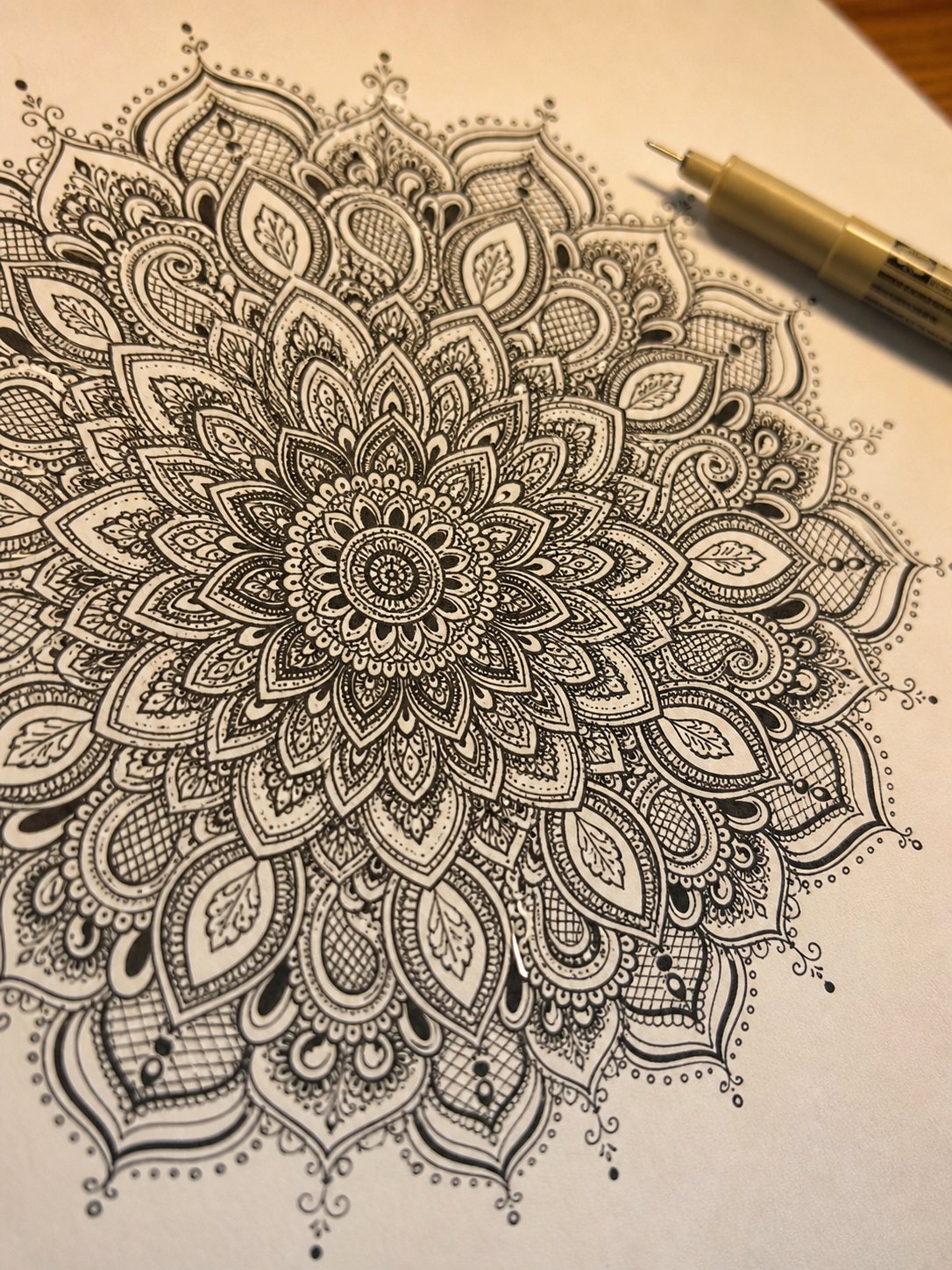
⚡ Difficulty: Intermediate
✏️ Tools: Fineliner 0.1, compass, pencil
Traditional henna patterns translated into circular mandala form: paisley teardrops, fine hatching inside petals, small decorative fill elements like tiny diamonds and curves. Every section gets its own sub-pattern. A finished A5 mehndi mandala is realistically a 3–4 hour project — the source material is thousands of years of Indian decorative tradition, and it shows.
12. Spiral Mandala
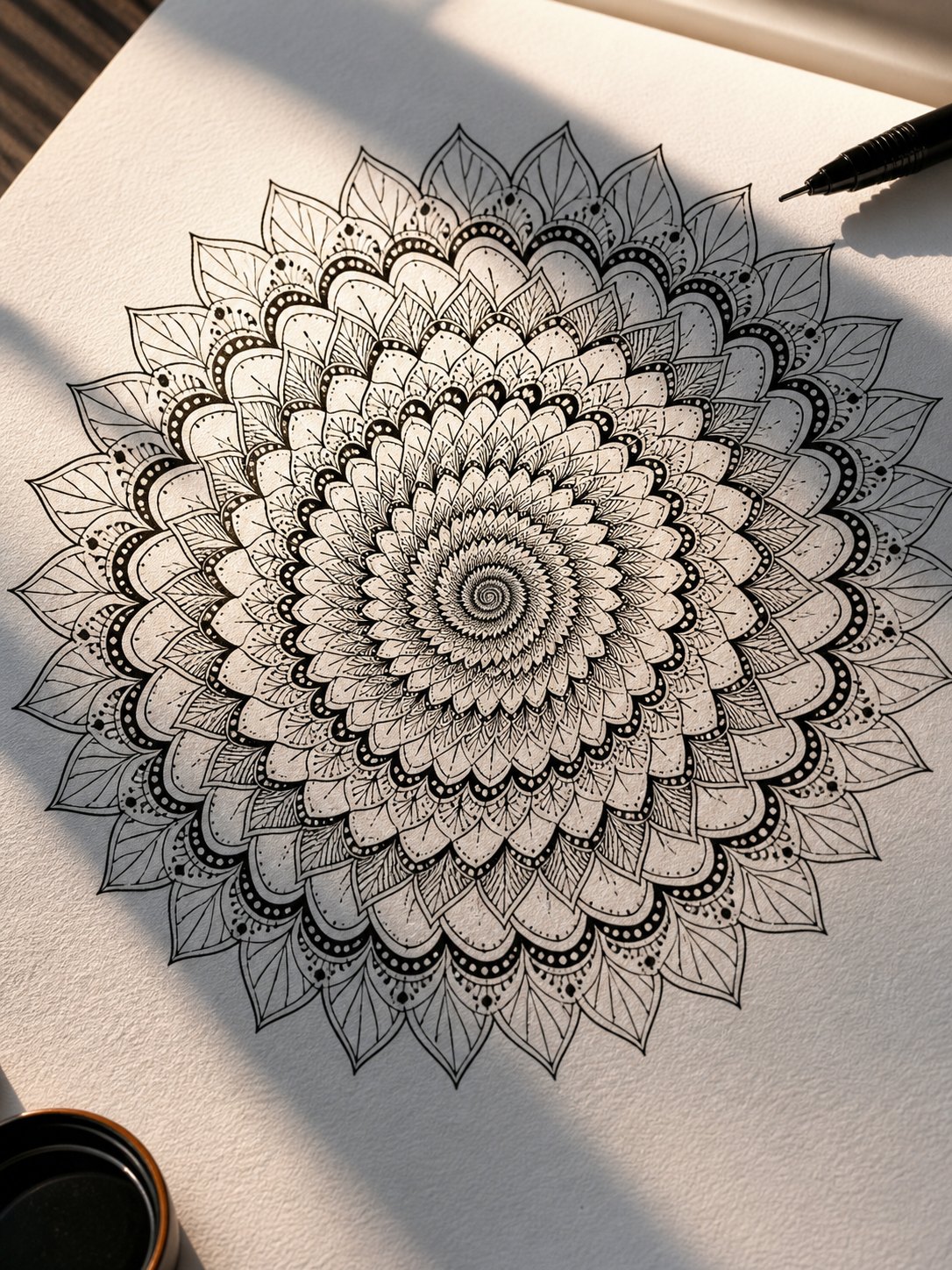
⚡ Difficulty: Intermediate
✏️ Tools: Compass, fineliner, ruler
A spiral within a radially symmetric structure. Spirals don’t naturally fit circular symmetry, so you create the illusion by rotating the starting point of each unit slightly further clockwise than the last.
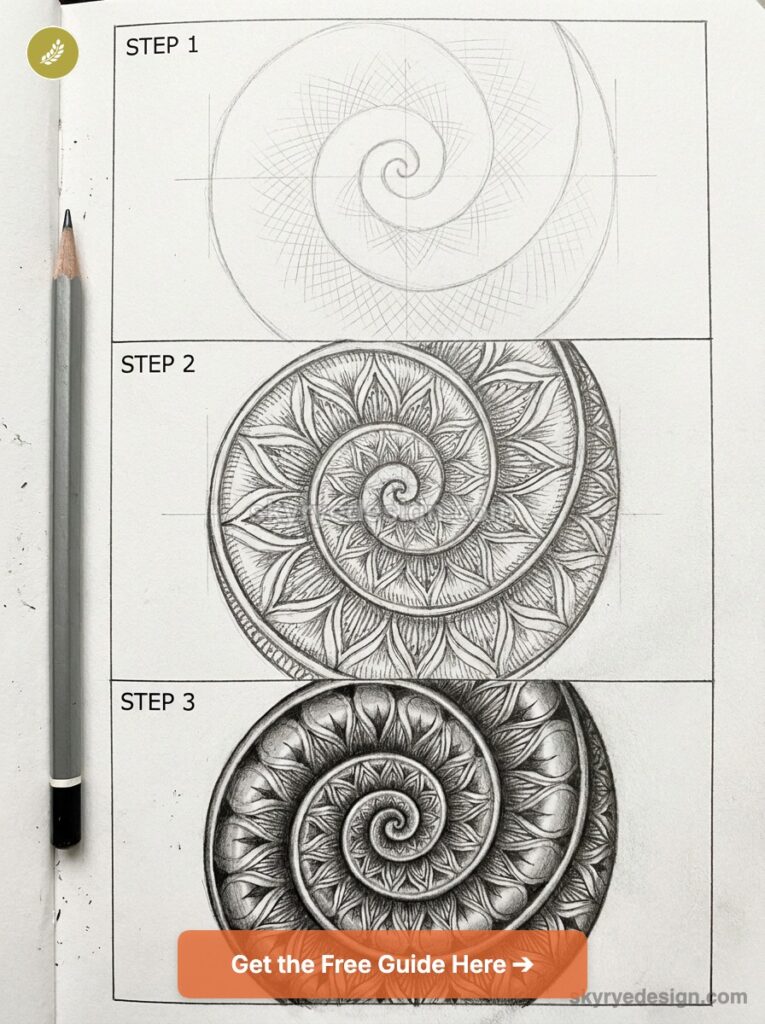
When done well, the pattern appears to spin. High-reward design that photographs particularly well.
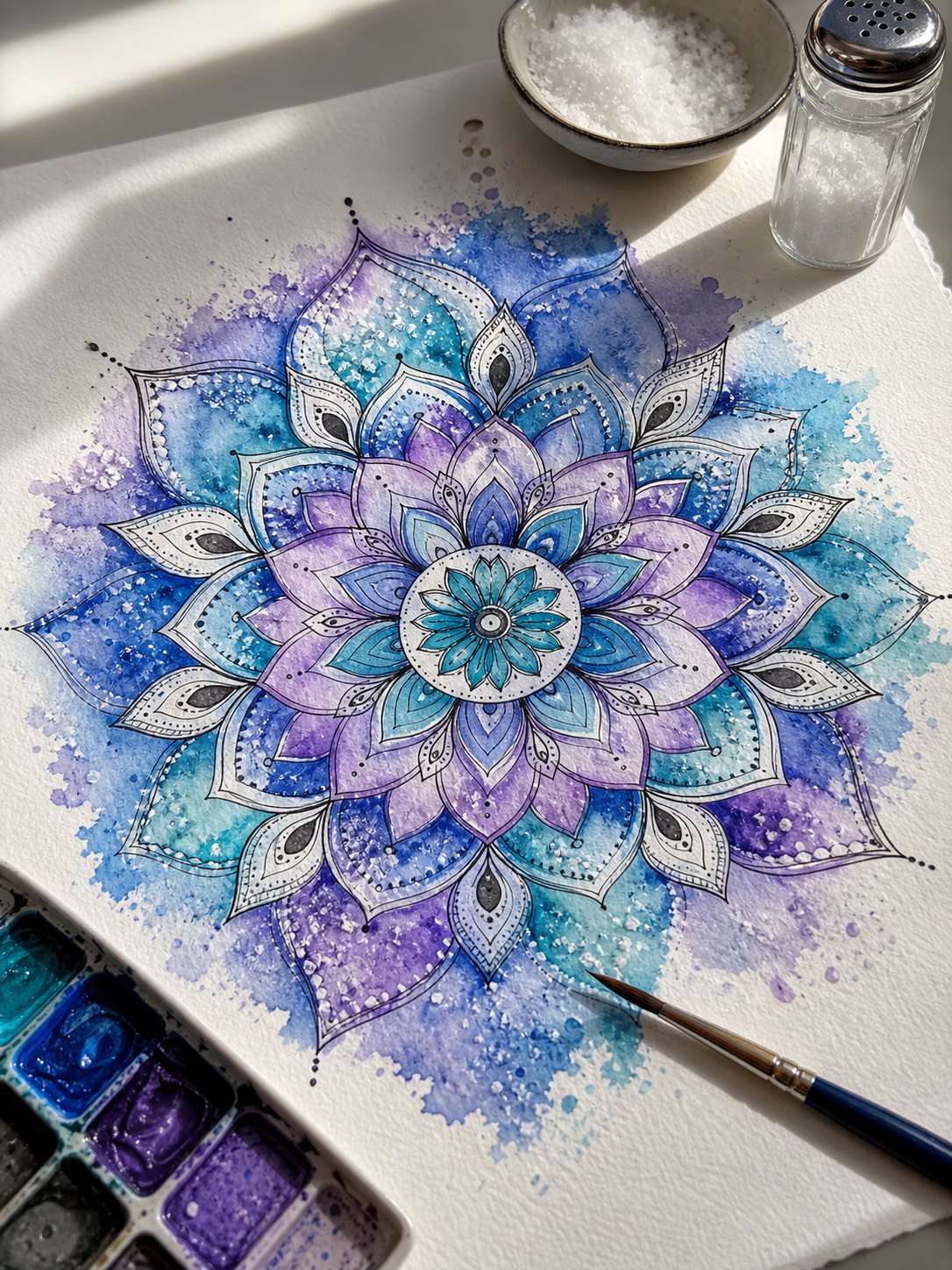
13. Watercolor Mandala
⚡ Difficulty: Intermediate
✏️ Tools: Ink pen, watercolor, salt technique
Draw the outline in waterproof ink (Winsor & Newton black ink or India ink), let it dry completely, then flood sections with watercolor washes. Wet sections next to each other create natural bleeding at the boundaries — which looks like a feature if you plan for it. Sprinkling salt on wet sections creates the organic texture effect. This is less about mandala drawing technique and more about watercolor control.
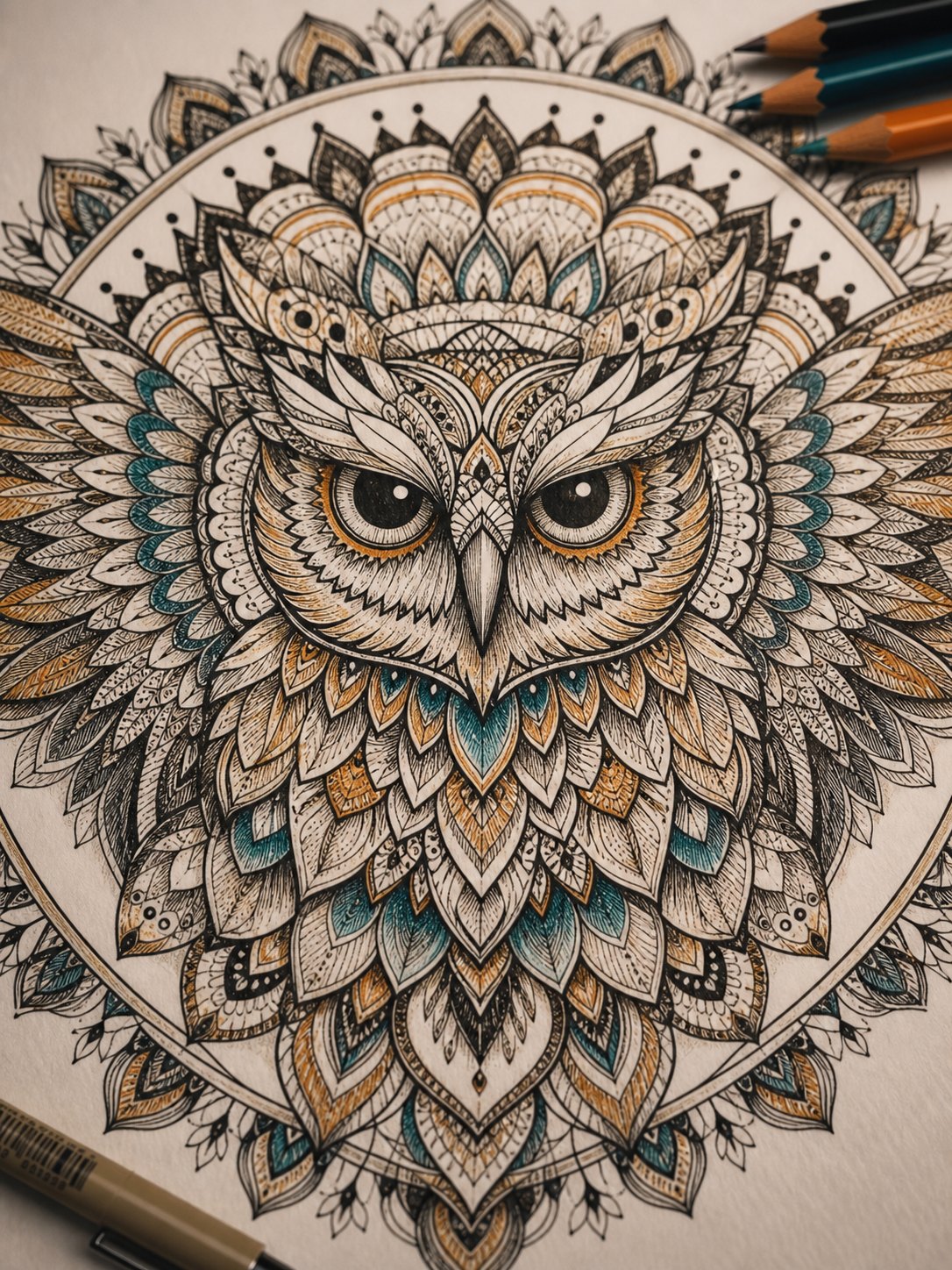
14. Animal Mandala — Owl or Elephant
⚡ Difficulty: Intermediate
✏️ Tools: Pencil, fineliner, colored pencils
The animal’s form becomes the mandala structure: an owl’s face at center, wings forming the outer mandala pattern, feather details filling the rings. Same with an elephant — the decorative Indian elephant headdress tradition maps directly onto mandala geometry. The recognizable animal form makes the work immediately readable as a subject, not just a pattern.
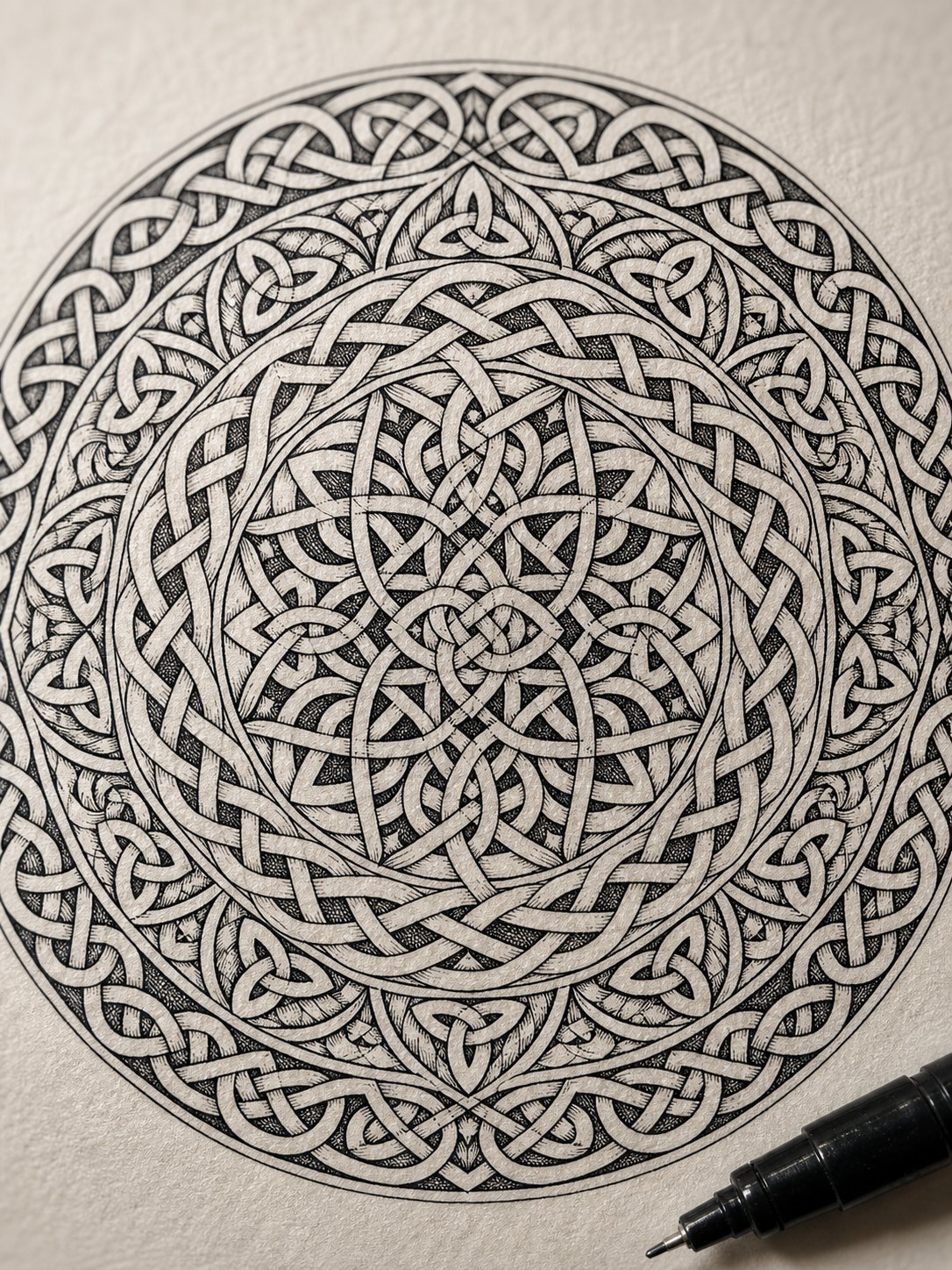
15. Celtic Knot Mandala
⚡ Difficulty: Intermediate
✏️ Tools: Fineliner, ruler, pencil
Celtic knotwork in radial symmetry. The interlocking over-under pattern is what makes this intermediate — you have to track which strand goes over which at every crossing point, consistently across all repeats. The result is dense and satisfying. Traditionally done in black ink only. Working out one repeat fully on rough paper before committing is worth the extra time.
16. Mandala with Negative Space
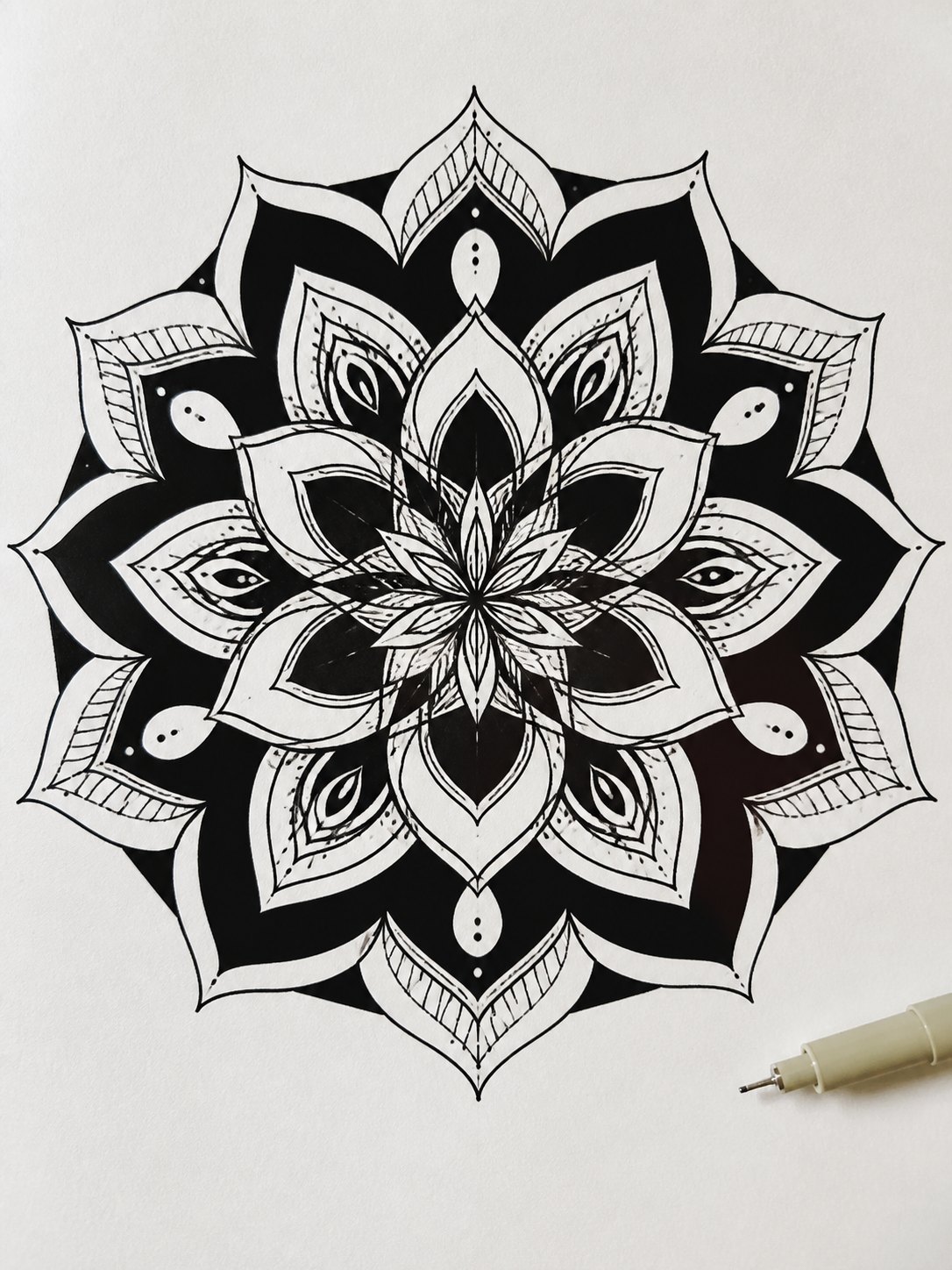
⚡ Difficulty: Intermediate
✏️ Tools: Fineliner, pencil
Black fills alternating with white space in a deliberate, high-contrast pattern. You’re designing both the inked and the un-inked areas simultaneously. The result reads as bold graphic art rather than decorative illustration. Works well large. The risk is filling too much and losing contrast, or too little and looking unfinished.
17. Mixed Media Mandala
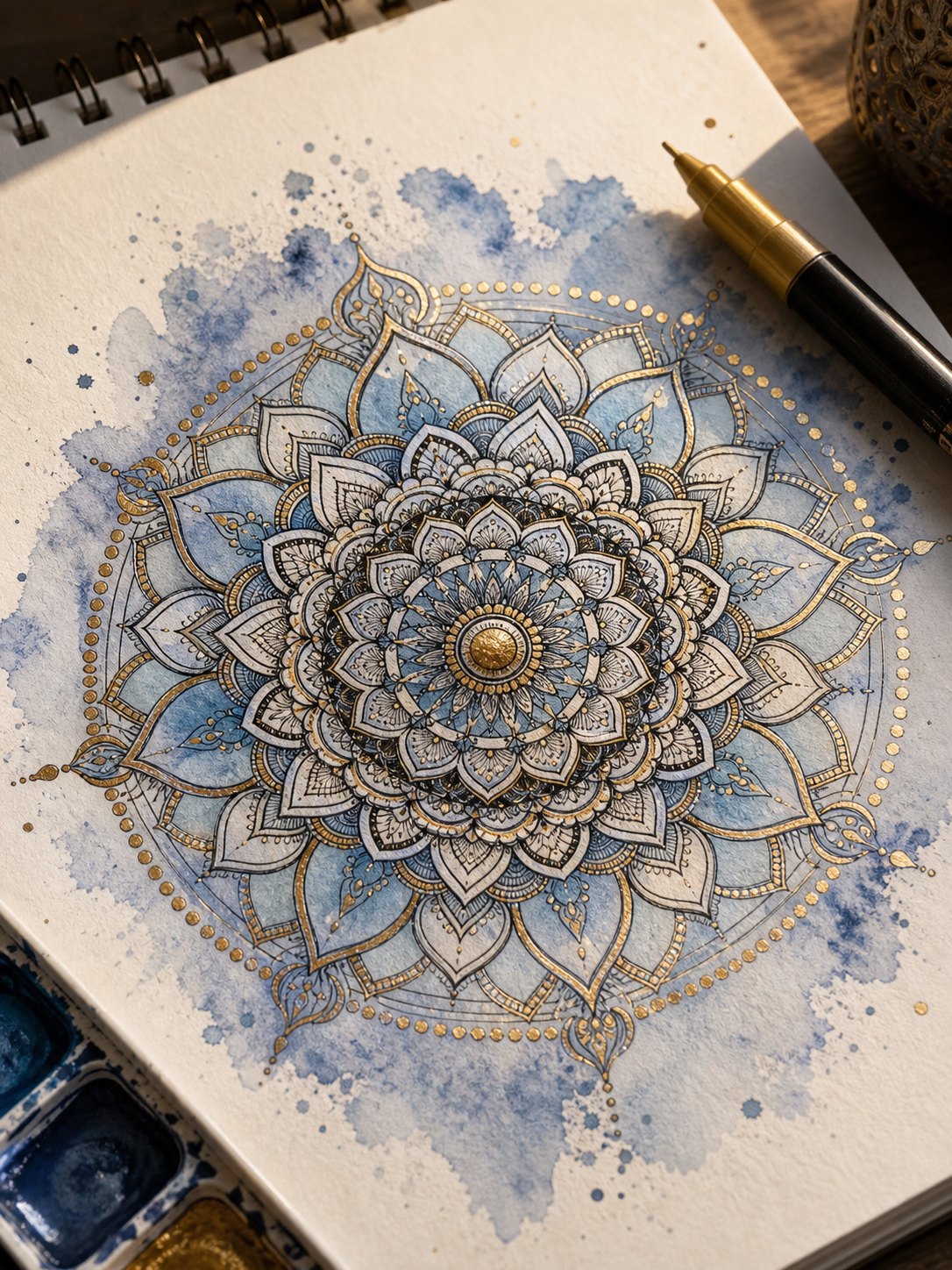
⚡ Difficulty: Intermediate
✏️ Tools: Ink, gold paint pen, watercolor
Start with a watercolor wash background (wet on wet for soft edges), let dry, draw the mandala in black fineliner on top, then add gold paint pen accents on the outer ring and center dot. The gold pen (Posca, Molotow, or Sakura Gelly Roll Gold) adds a third layer that catches light differently. This is a finished-artwork-level result rather than a practice piece.
18. Botanical Mandala
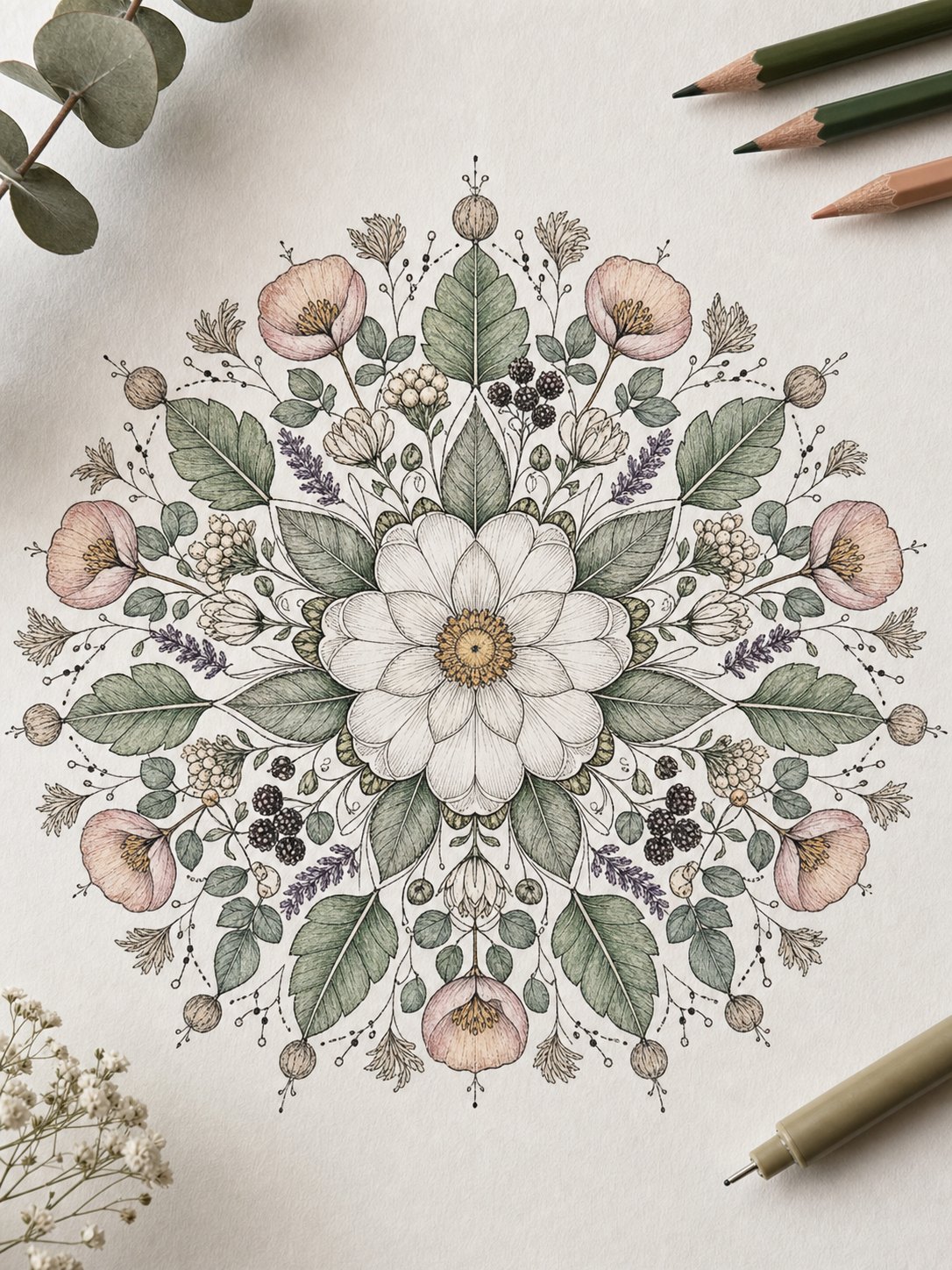
⚡ Difficulty: Intermediate
✏️ Tools: Fineliner, pencil, colored pencils
Real botanical elements — actual flower species, leaves with accurate vein detail, seed pods, berries — arranged in radial symmetry. The mandala structure gives scientific botanical illustration a meditative quality. Good reference: Ernst Haeckel’s 19th century naturalist drawings, which are out of copyright and endlessly useful.
Advanced Mandala Designs (19–25)
These take dedicated time. Some are multi-session projects. All require planning before you touch the paper — working out proportions on a rough sheet first, understanding the full pattern before committing to the final piece.
19. Sacred Geometry Mandala
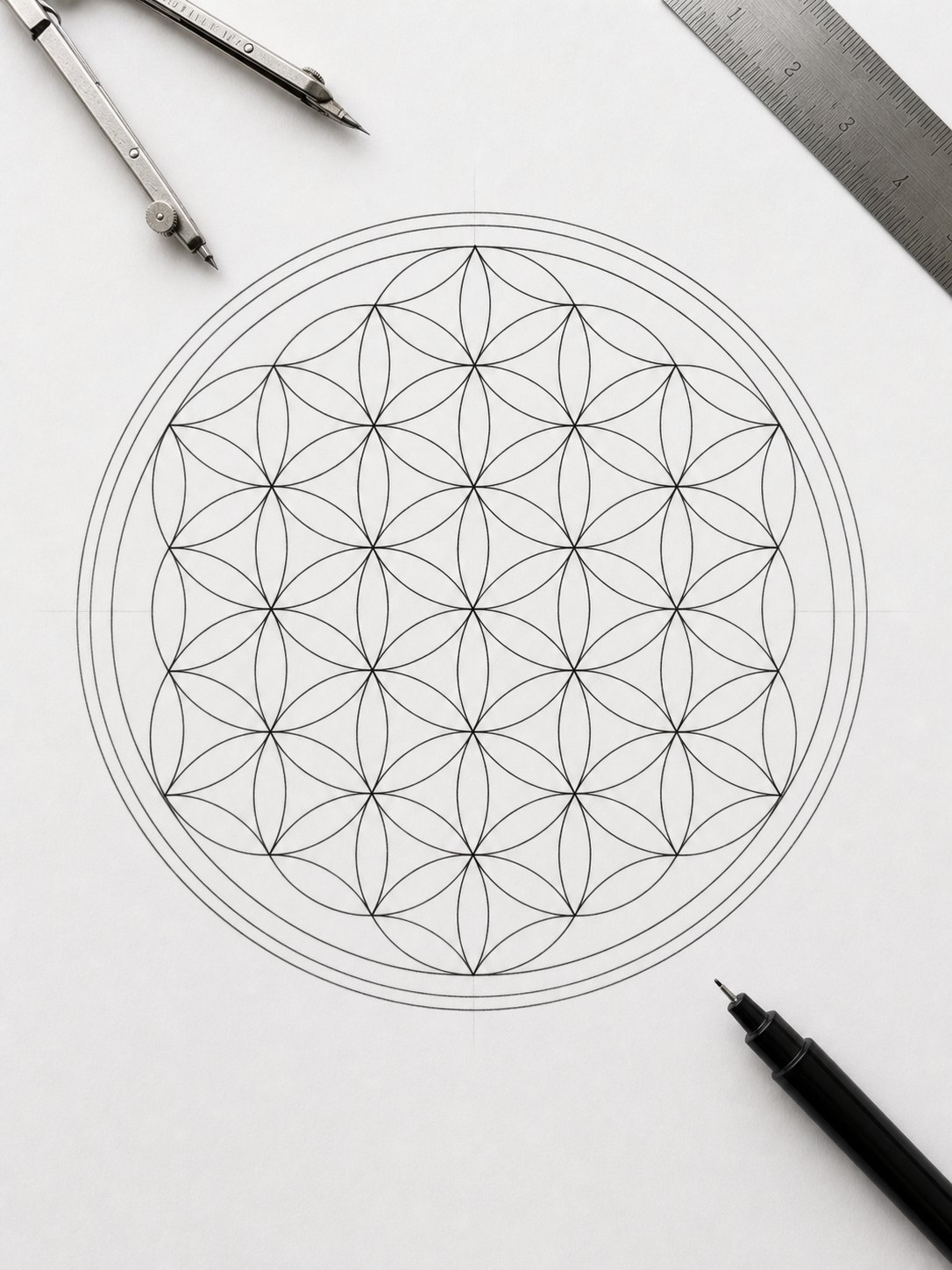
⚡ Difficulty: Advanced
✏️ Tools: Compass, ruler, fineliner, pencil
Flower of Life, Metatron’s Cube, Sri Yantra — these structures from sacred geometry tradition are inherently mandala-like. The Sri Yantra is the hardest: nine interlocking triangles forming a 43-pointed star with precise angular relationships. A proper Sri Yantra from scratch in ink, without errors, is an achievement. Start with the Flower of Life if you’re new to sacred geometry — it’s built from overlapping circles of identical size, which a compass handles cleanly.
20. Procreate Mandala
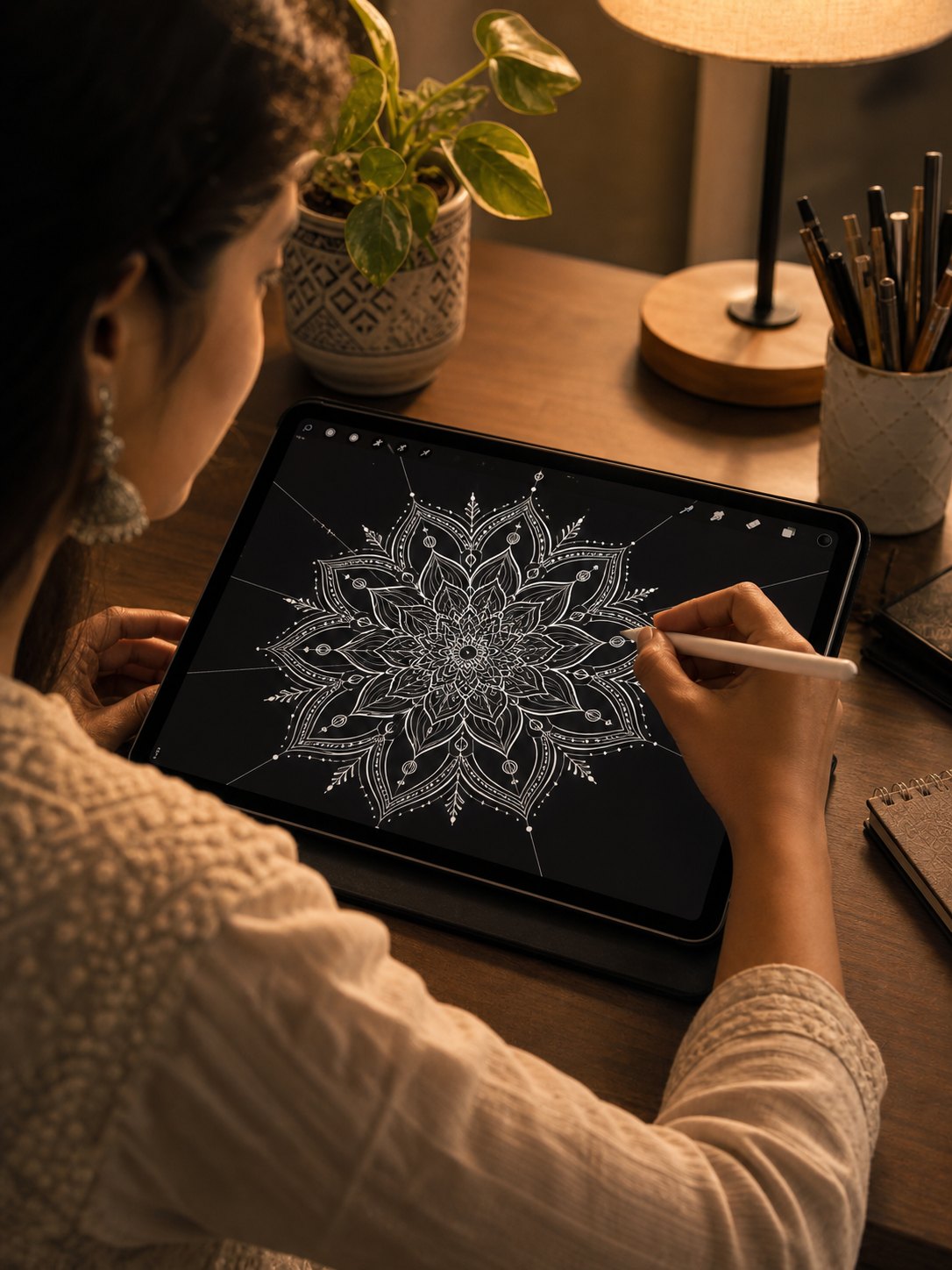
⚡ Difficulty: Advanced
✏️ Tools: iPad, Procreate, Apple Pencil
Procreate’s radial symmetry brush engine changed digital mandala work significantly. You draw one section and the app mirrors it across however many axes you set — 6, 8, 12, 16. The result is mathematically perfect symmetry in real time. The challenge: every mark is instantly multiplied, so unintended strokes become part of the pattern. It’s a different discipline than paper, not easier, just different.
21. Dotwork Mandala (Fine Point)
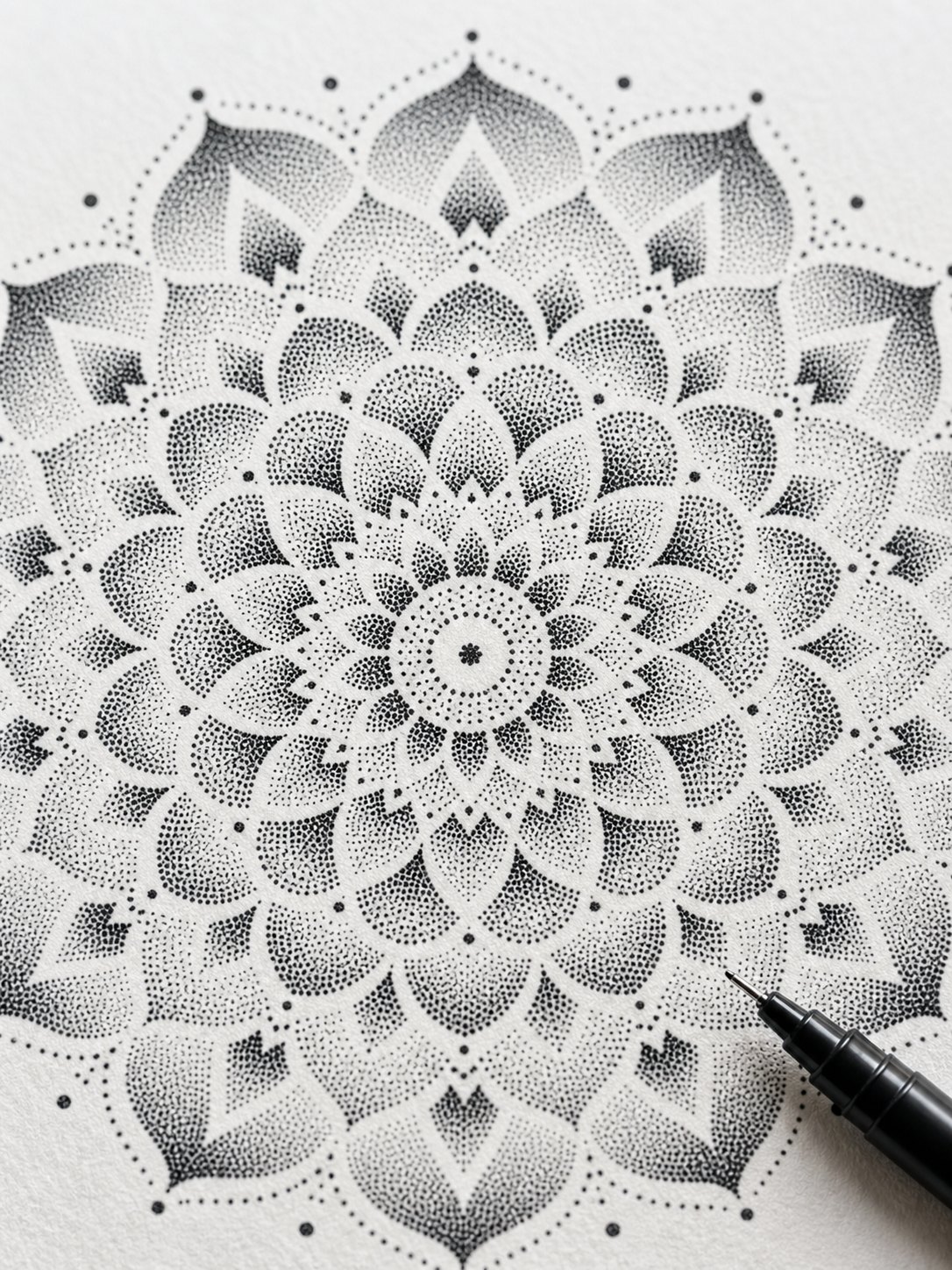
⚡ Difficulty: Advanced
✏️ Tools: Fineliner 0.05, dotting tools, patience
Pure dotwork at fine scale: the entire mandala built from points rather than lines, with dot density creating tone and form. No continuous lines. This is the technique behind the best stippling in tattoo art — and mandala dotwork translates directly to tattoo design. A hand-drawn A4 dotwork mandala at proper density is 6–12 hours of work. The result is unlike anything achievable with lines alone.
22. Mosaic Mandala
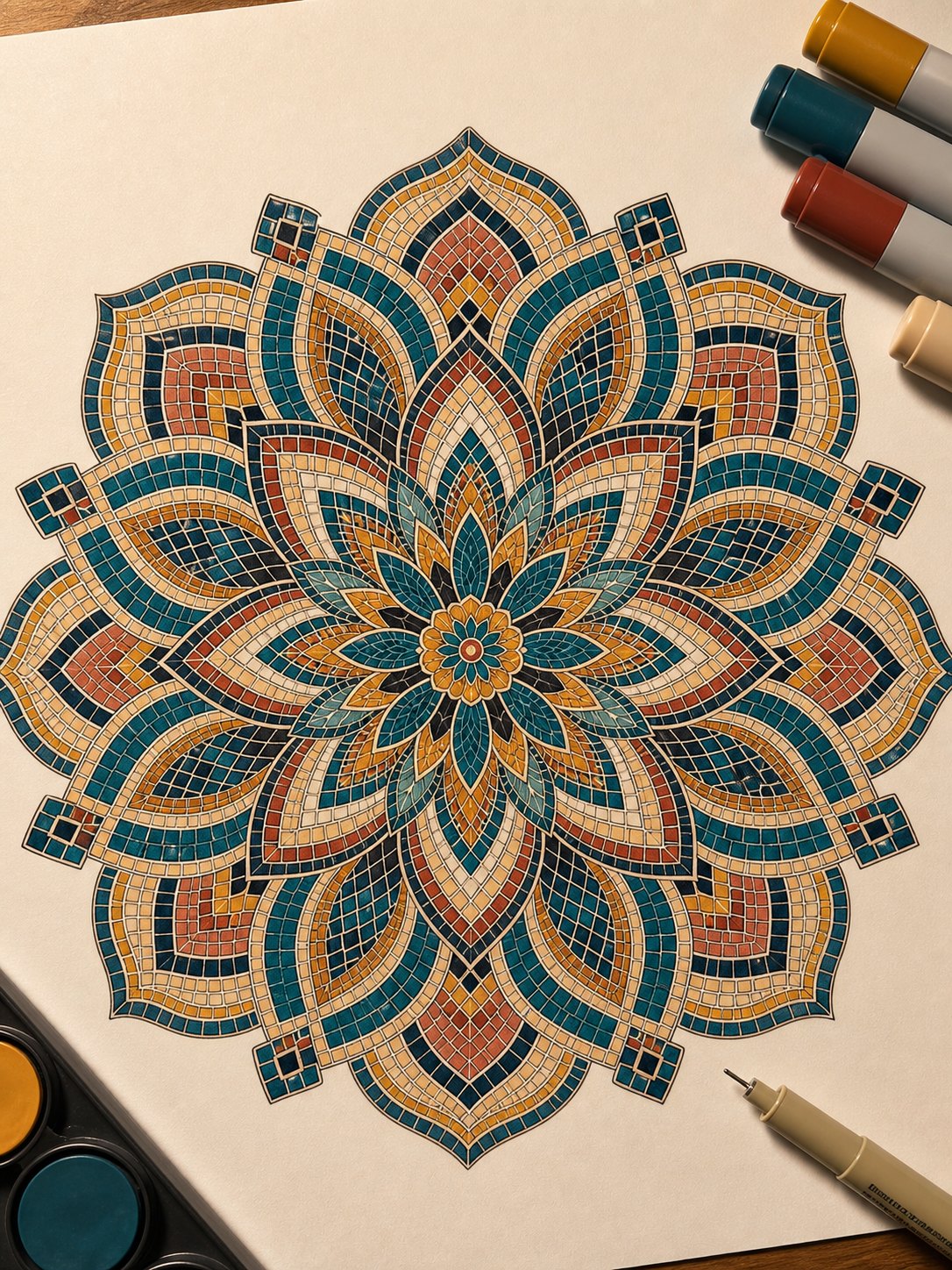
⚡ Difficulty: Advanced
✏️ Tools: Fineliner, colored markers or pencils
Each section is subdivided into small geometric tiles like a Byzantine mosaic, with color fills suggesting the grout lines between tiles. Planning is extensive: tile size, grout width, and color palette must be decided before you start. Copic markers for fills, 0.1 fineliner for the grid. Photographs well, often better than it looks in person.
23. Galaxy Mandala
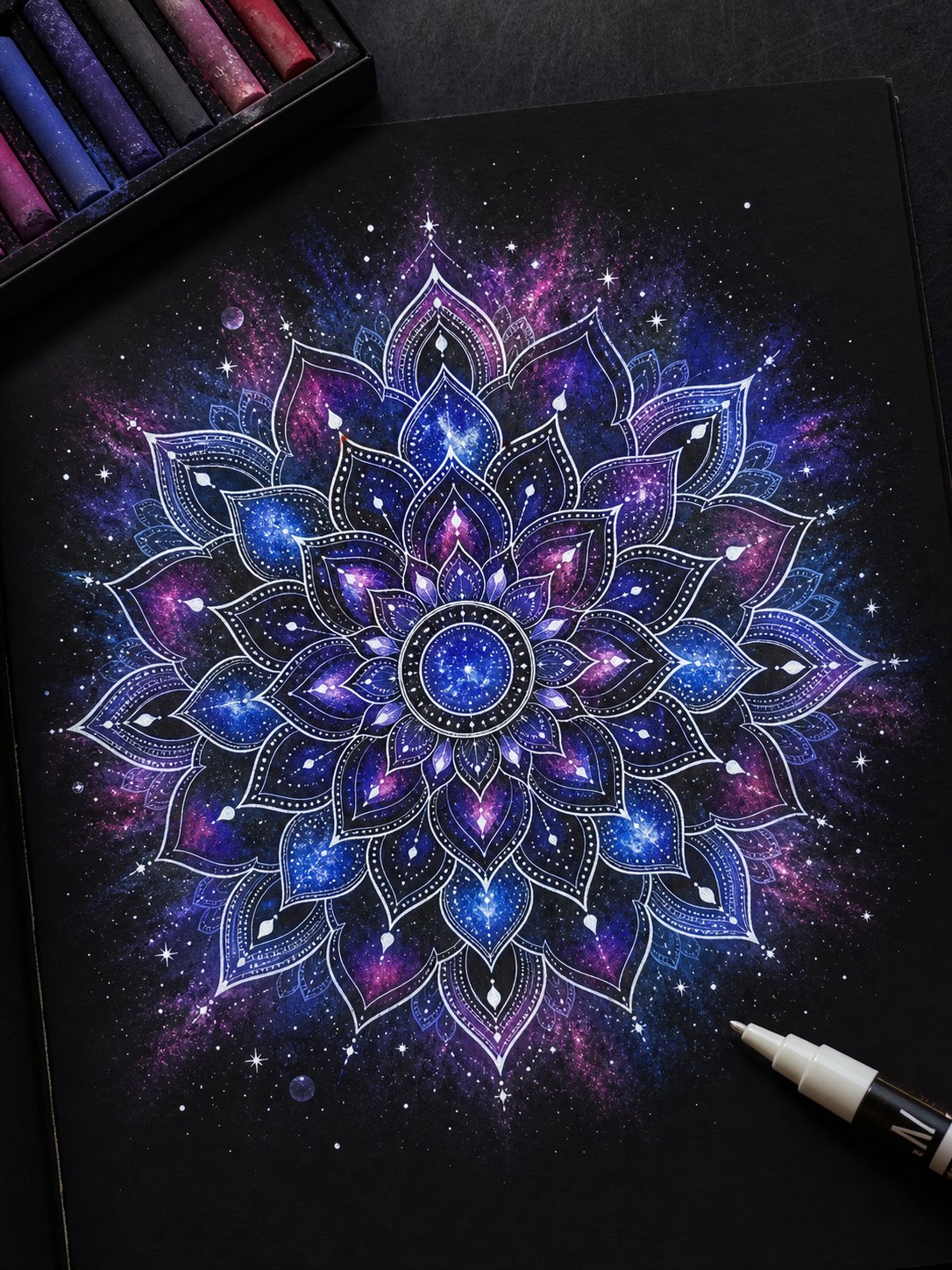
⚡ Difficulty: Advanced
✏️ Tools: Black paper, white ink, colored ink, chalk pastel
White and colored ink on black paper or black cardstock. The dark background makes the mandala appear to glow. Use Posca white paint pen for structural linework, then add nebula-colored ink washes (blues, purples, magentas) inside sections. Chalk pastel smudged at the outer edges creates the nebula diffusion effect. Requires 140gsm+ black cartridge paper and doesn’t tolerate much water.
24. Illuminated Manuscript Mandala
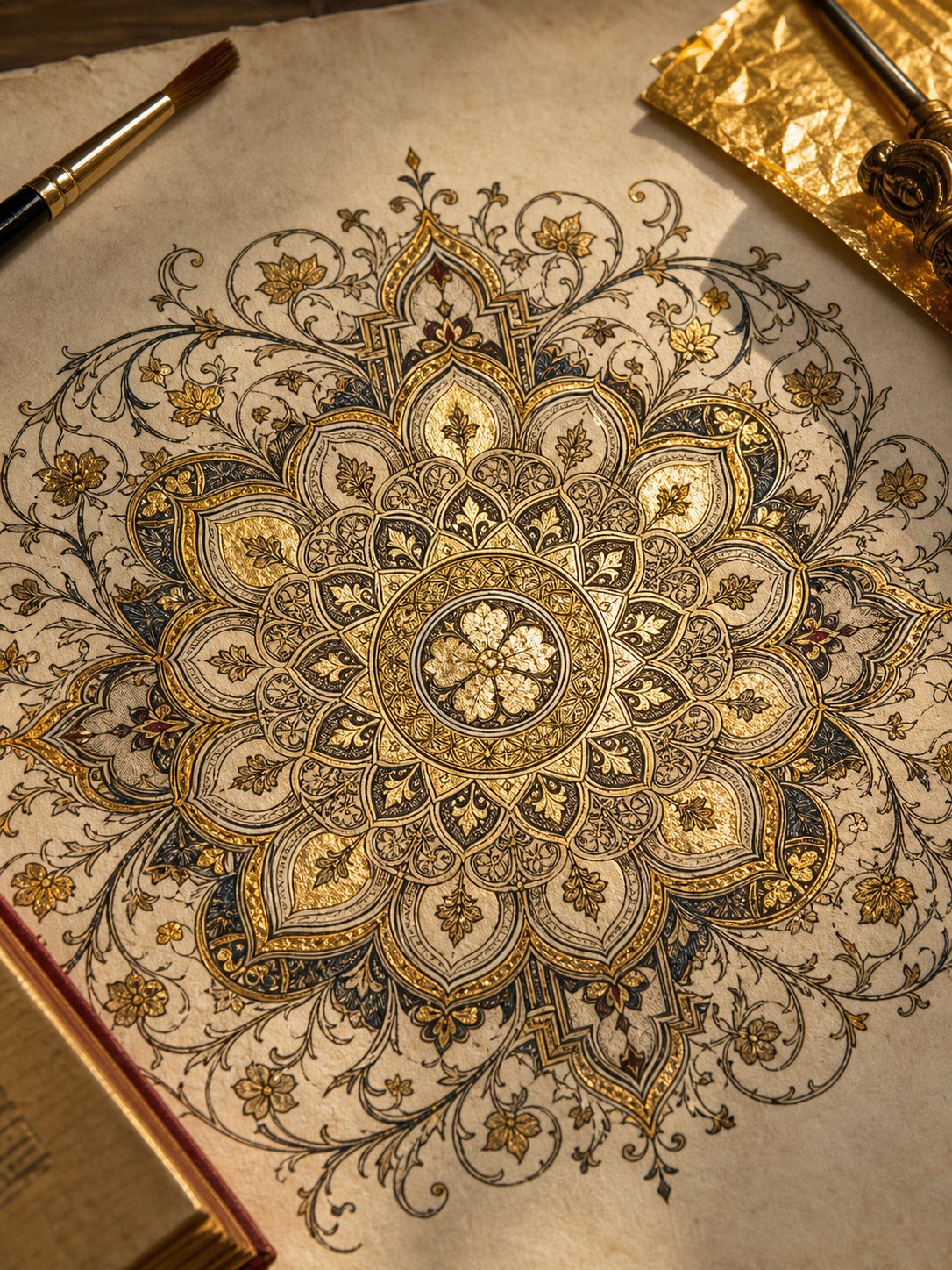
⚡ Difficulty: Advanced
✏️ Tools: Fine brush, gold leaf or gold paint, ink
Medieval illuminated manuscript borders adapted into mandala form: Gothic architectural details, vine scroll patterns, miniature figurative elements embedded in geometry. Gold leaf or imitation Dutch Metal gold leaf ($6–10 per book) applied with size adhesive gives the authentic gleam. A finished A5 illuminated mandala might take two to three weeks of intermittent work.
25. Full-Page Symmetrical Mandala
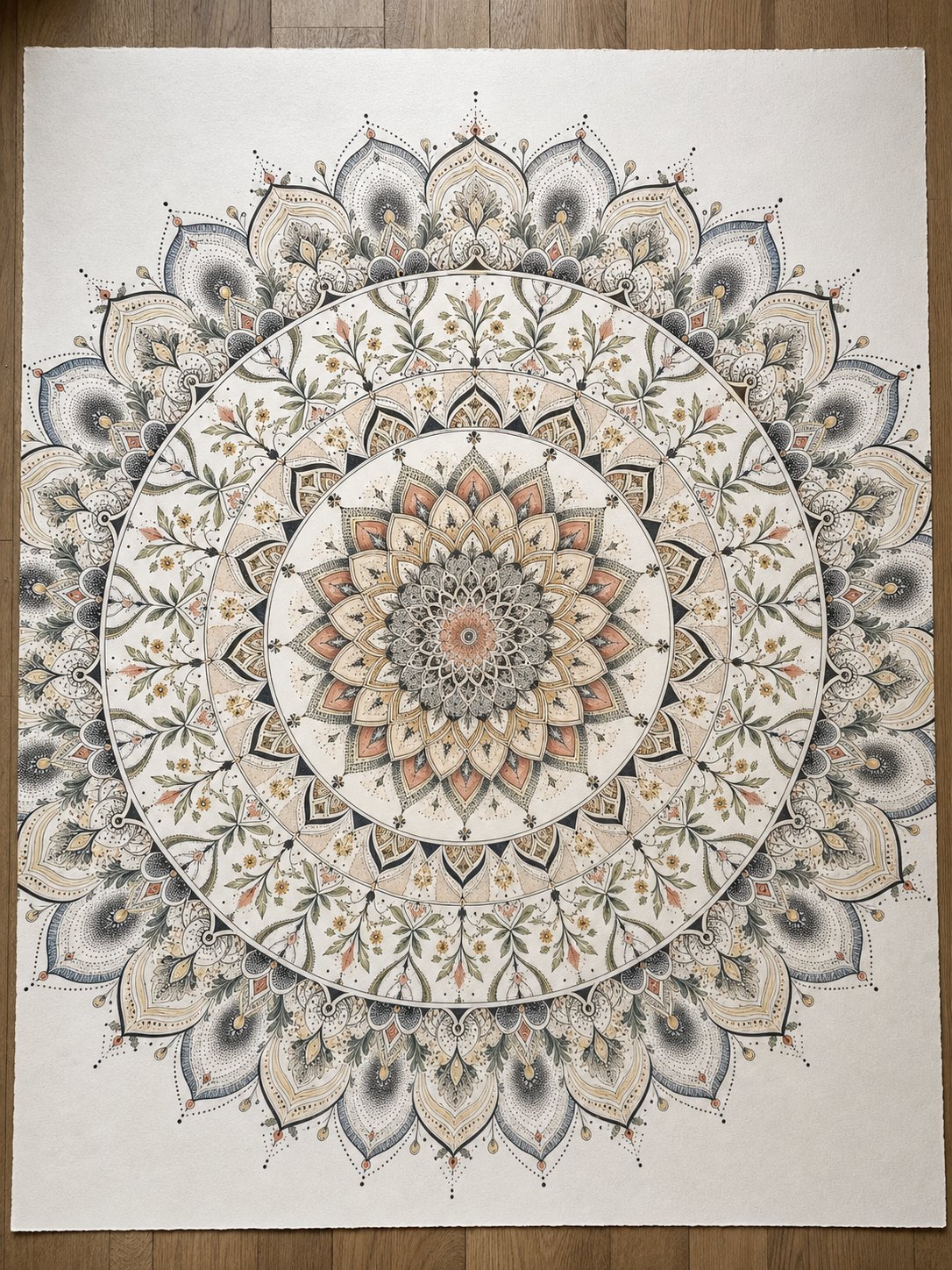
⚡ Difficulty: Advanced
✏️ Tools: All tools, multiple sessions
A mandala designed to fill an entire A3 sheet, with 16-fold symmetry, 8+ ring layers, mixed techniques in different rings (dotwork, line, botanical, geometric), and a deliberate color palette throughout. This is the culmination design — not a single afternoon project but a documented work. The planning document (which technique in which ring) can be as complex as the mandala itself.
Tips That Actually Make a Difference
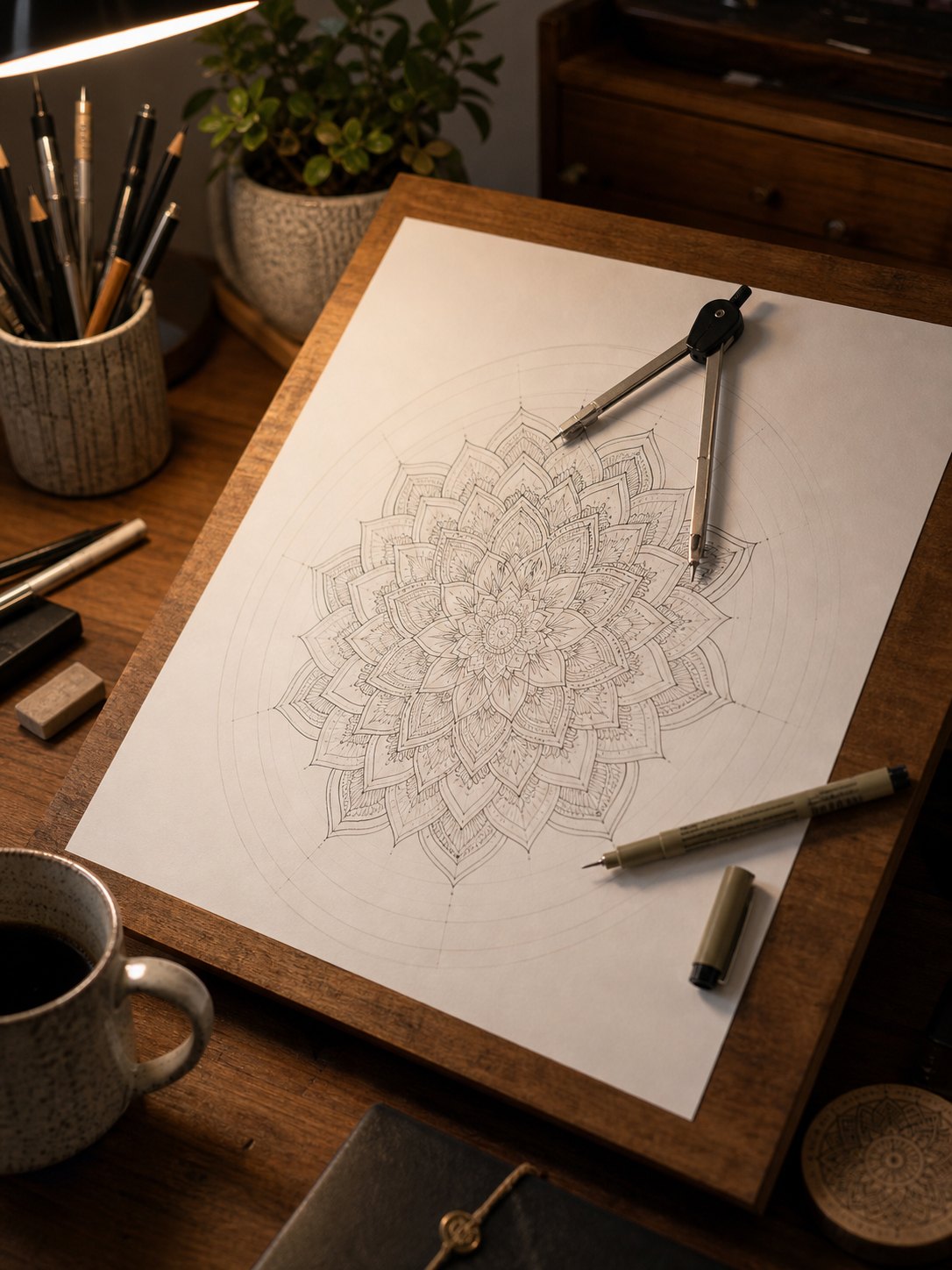
I’ve watched a lot of people give up on their first mandala around the third ring, usually because the spacing looks wrong and they don’t know why. Here’s what I’ve actually learned from doing this wrong a lot:
The Division Problem
Most mandala problems come from dividing the circle incorrectly at the start. 8 divisions is 45 degrees apart. 12 divisions is 30 degrees. 16 divisions is 22.5 degrees. The cleanest way without a protractor: fold a paper circle in half, then in half again (4 sections), then in half again (8). The fold marks give you perfect guide points. This is faster and more accurate than most protractors for hobby use.
Ink After Pencil is Dry
Wait two full minutes after finishing your pencil guide work before inking. Any moisture from your hand transfers to the pencil lead and smudges under the pen. Ink from the center outward. If you’re right-handed, work clockwise from roughly 12 o’clock; left-handed, counter-clockwise. Your hand stays in the dry zone.
The Middle Section is the Hardest
Counterintuitively, the smallest innermost rings are the hardest. The spacing is tightest, mistakes are most visible, and there’s no way to fix a bad center without starting over. Spend the most time planning the first two rings. The outer rings take care of themselves once structure is established.
If you’re using a compass and it keeps slipping, press a small piece of putty or blu-tack under the anchor point. The grip eliminates the wobble that causes off-center circles.
What Paper Actually Works
Hot press watercolor paper (140gsm+) for mixed media or ink wash work. Smooth cartridge paper (120gsm+) for pure fineliner work — the 80gsm copy paper sold in printer reams bleeds and pills under repeated erasing. For dotwork on black paper: Canson Mi-Teintes in Noir, which holds fine pen marks better than basic black cardstock.
FAQ: Mandala Art Designs
What is the easiest mandala design to start with?
The Basic Circle Mandala (Design 1) — five to six concentric rings with 8 repeated petals in each ring. All you need is a compass, pencil, and ruler. Radial symmetry is inherently visually balanced, so the result looks finished and intentional even at first attempt. Don’t start with anything requiring tight spacing or freehand curves until you’ve done the simple circle version a few times.
How do I keep my mandala symmetric?
Compass for circles, protractor or folded paper for angular divisions, ruler for straight lines. The single biggest beginner mistake is trusting the eye for spacing. Your eye is not reliable at this scale. Measure every radius. Mark every division angle. Eyeballing is how you end up with a mandala that’s 95% right and visibly wrong in one section.
What pens are best for mandala drawing?
For linework: Sakura Pigma Micron in 0.05, 0.1, and 0.3 sizes. For bolder outlines: Staedtler Triplus fineliner. For dotwork on white paper: any quality 0.05 fineliner. For white on black paper: Posca PC-1MR paint pen or Uniball Signo White. For gold accents: Sakura Gelly Roll Gold or Pentel Hybrid Dual Metallic. Avoid felt-tips for detail work — the tip deforms under light pressure over time.
Can I draw mandalas digitally without an iPad?
Yes. Adobe Illustrator has radial repeat functionality. Inkscape (free, open source) has the same. Clip Studio Paint on desktop has radial symmetry rulers. The iPad/Procreate combination is popular because it’s integrated and portable, but desktop software gives the same precision with more output control. For print-quality work, Illustrator or Inkscape in vector format beats raster output at any resolution.
How long does a mandala take to draw?
Beginner designs (1–10): 30 minutes to 2 hours. Intermediate (11–18): 2–4 hours. Advanced (19–25): 4 hours to multiple sessions over days or weeks. The dotwork mandala at full density is realistically 8–12 hours for A4. Time is not the same as skill level — a beginner can spend 3 hours on a simple design if going carefully.
What does the center of a mandala represent?
In traditional Hindu and Buddhist contexts, the center point (bindu) represents the universe’s origin, the self, or the divine. Expanding rings outward represent the move from interior stillness to the external world. In secular mandala drawing, most people treat it as the structural anchor. Both approaches are valid. The mandala as a meditative practice doesn’t require any specific belief about what the center means.
How do I fix mistakes in a mandala?
Pencil stage: erase and redo. Ink stage: white-out pen (Pentel Correction Pen is the cleanest) for small errors, or embrace the mistake and mirror it in corresponding sections to make it look intentional. For serious ink mistakes on good paper: gently scrape with a sharp scalpel blade at a very shallow angle, then burnish the scraped area before re-inking. On cheap paper this doesn’t work. On hot press illustration board it works well.
Start with One Circle
Your first mandala will look imperfect. Probably the second one too. By the fifth, though, you’ll suddenly care about circle spacing and petal shapes more than you thought possible.
Don’t treat these 25 mandala art designs like homework. Pick the one that looks fun. If the complicated geometric mandala grabs your attention on day one, try it. Worst case? You end up with a messy page and learn something.
Mandala drawing rewards repetition more than perfection. Draw the same pattern a few times and your hand steadies, spacing gets cleaner, and you stop overthinking every line.
And keep the bad ones. Seriously. Looking back at your first wobbly mandala a few months later is oddly satisfying.
- 1.3Kshares
- Facebook0
- Pinterest1.3K
- Twitter6
- Reddit0