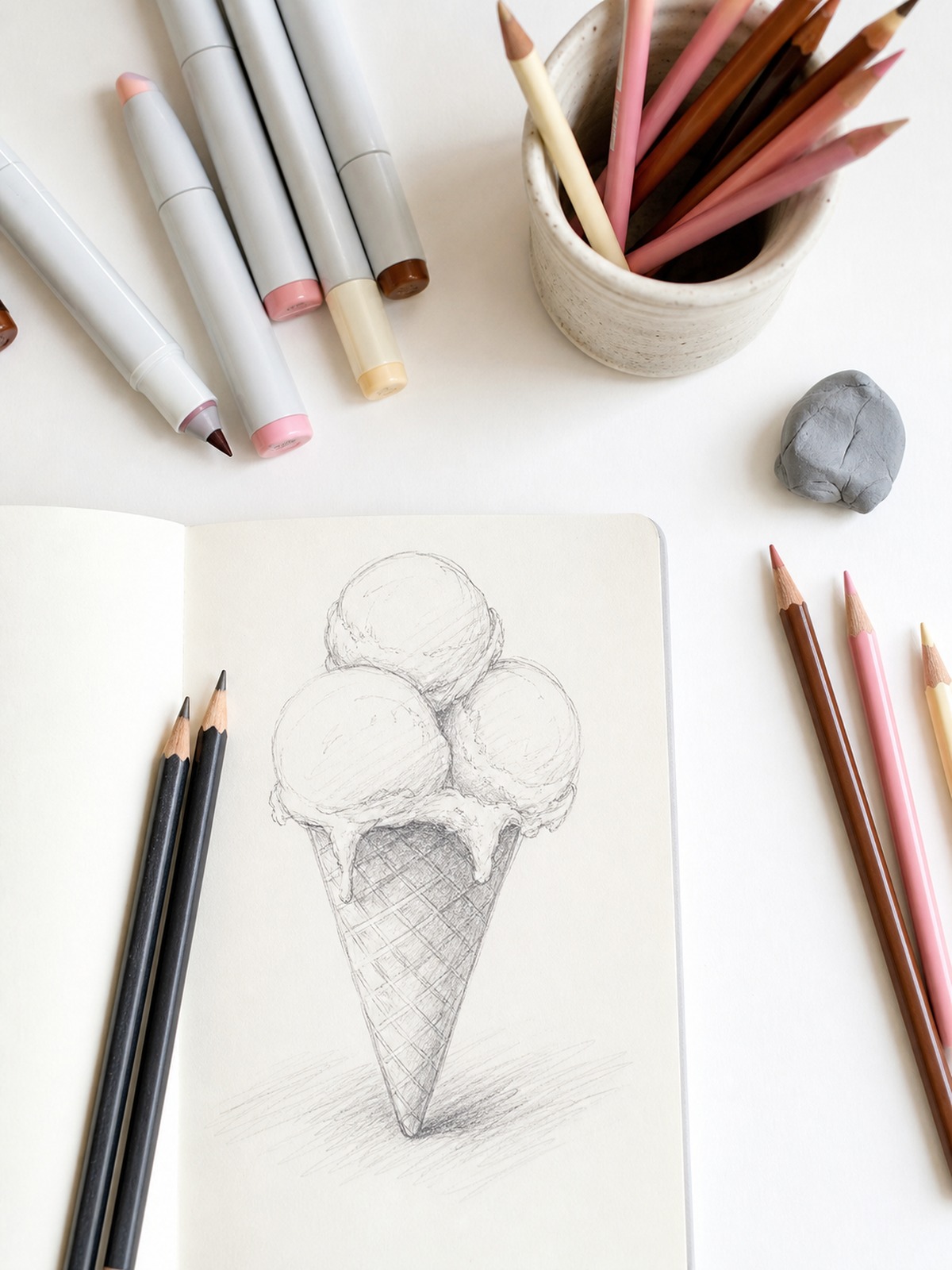
I keep ice cream drawings in a folder I started at design school. Not because they were assigned, but because the subject is a genuinely interesting compositional problem. A cone is three shapes: a triangle, a circle, and the intersection between them.
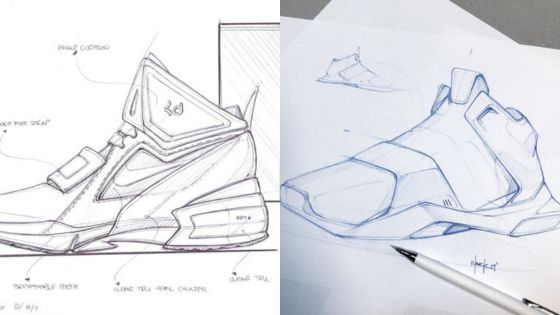
Get those three shapes right in proportion and it reads immediately. Get them slightly wrong and it looks off in a way you can feel but can’t easily explain. That proportion sensitivity is the same skill that shows up in product design, automotive sketching, and character design. Ice cream is just a friendlier way to practice it.
Beyond that, ice cream draws well at every skill level. A child can draw a recognizable single-scoop cone in five minutes with a crayon. An experienced illustrator can spend an hour on the light physics of a melting strawberry scoop in afternoon sun, where the melt changes color temperature as it thins. The subject scales with the artist.
This guide covers the construction method for the main ice cream forms, step-by-step tutorials for the most requested types, shading and coloring techniques, 30+ design ideas by style, and how to take the process digital. Start with the construction section regardless of your target style.
The construction method: three shapes that build everything
Every ice cream drawing starts from the same geometric foundation regardless of whether you end up with a simple kawaii illustration or a detailed realistic render. Understanding the construction makes the final drawing faster and more accurate. Skipping it and drawing by feel produces errors that are difficult to trace and fix.
The cone
An ice cream cone in profile is a triangle with a slightly concave top edge. The concavity at the top is where the scoop sits. Drawing this edge as perfectly straight produces a cone that looks like a party hat. The gentle inward curve at the rim is subtle, maybe 3 to 5mm at the center in a standard sketch size, but its presence makes the cone read as three-dimensional.
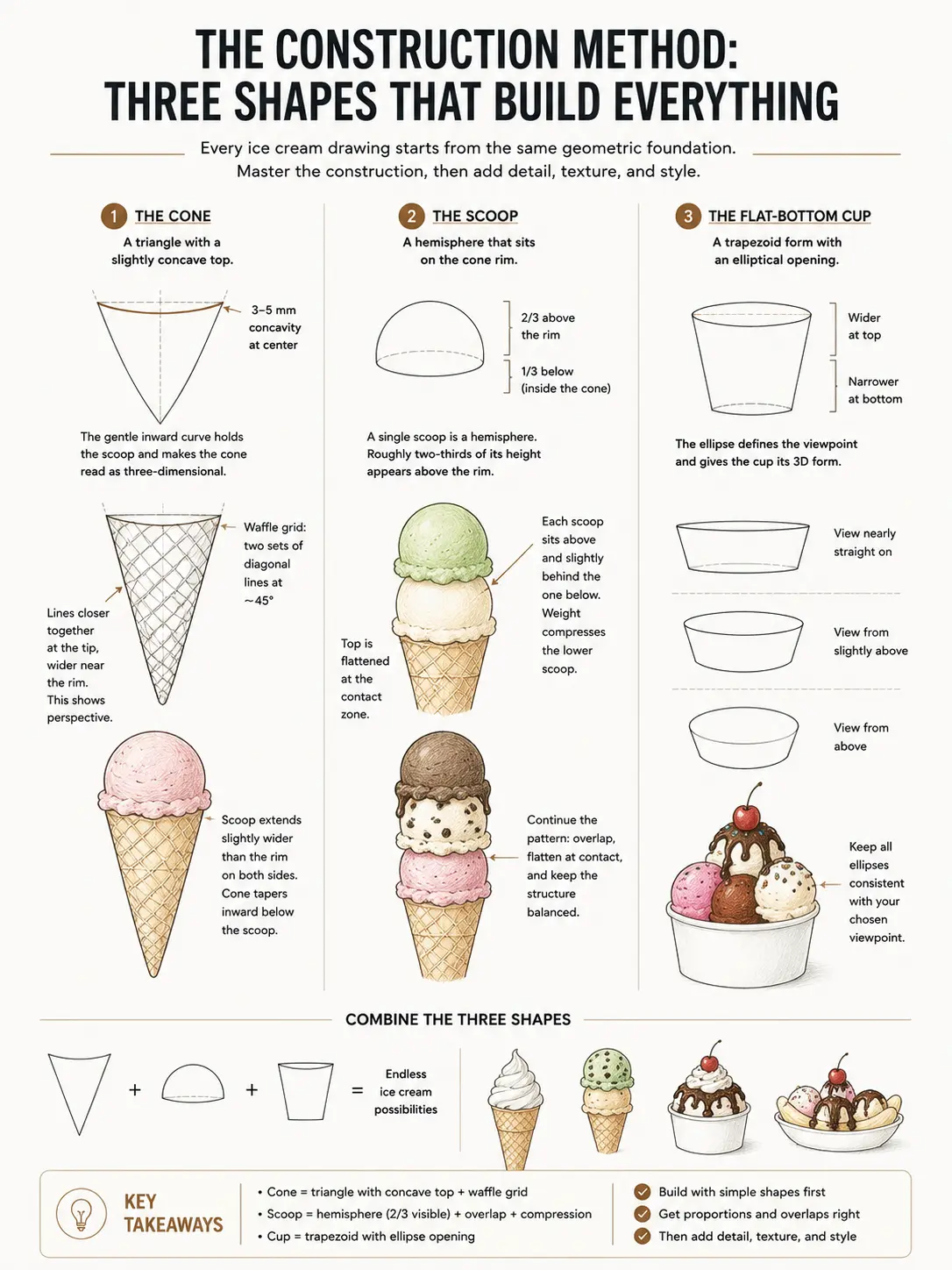
The waffle grid is the other element that defines the cone. Draw it as two sets of diagonal parallel lines running at roughly 45 degrees in opposite directions, creating a diamond grid across the cone surface. The lines are closer together at the tip (they converge with the cone’s shape) and further apart near the rim. This convergence is perspective in miniature and is the detail that makes a cone look real rather than flat.
The scoop
A single scoop is a hemisphere, not a full sphere. It sits on the rim of the cone with roughly two-thirds of its height above the rim line. The scoop extends slightly wider than the cone rim on both sides, which is why the cone appears to taper inward below the scoop. This overlap at the rim is a critical proportion detail: if the scoop is the same width as the cone at the rim, the whole structure looks wrong.

1000 Drawing Ideas for Artists
Get a free PDF packed with easy drawing ideas, anime prompts, character concepts, nature inspiration, and fantasy sketchbook challenges.
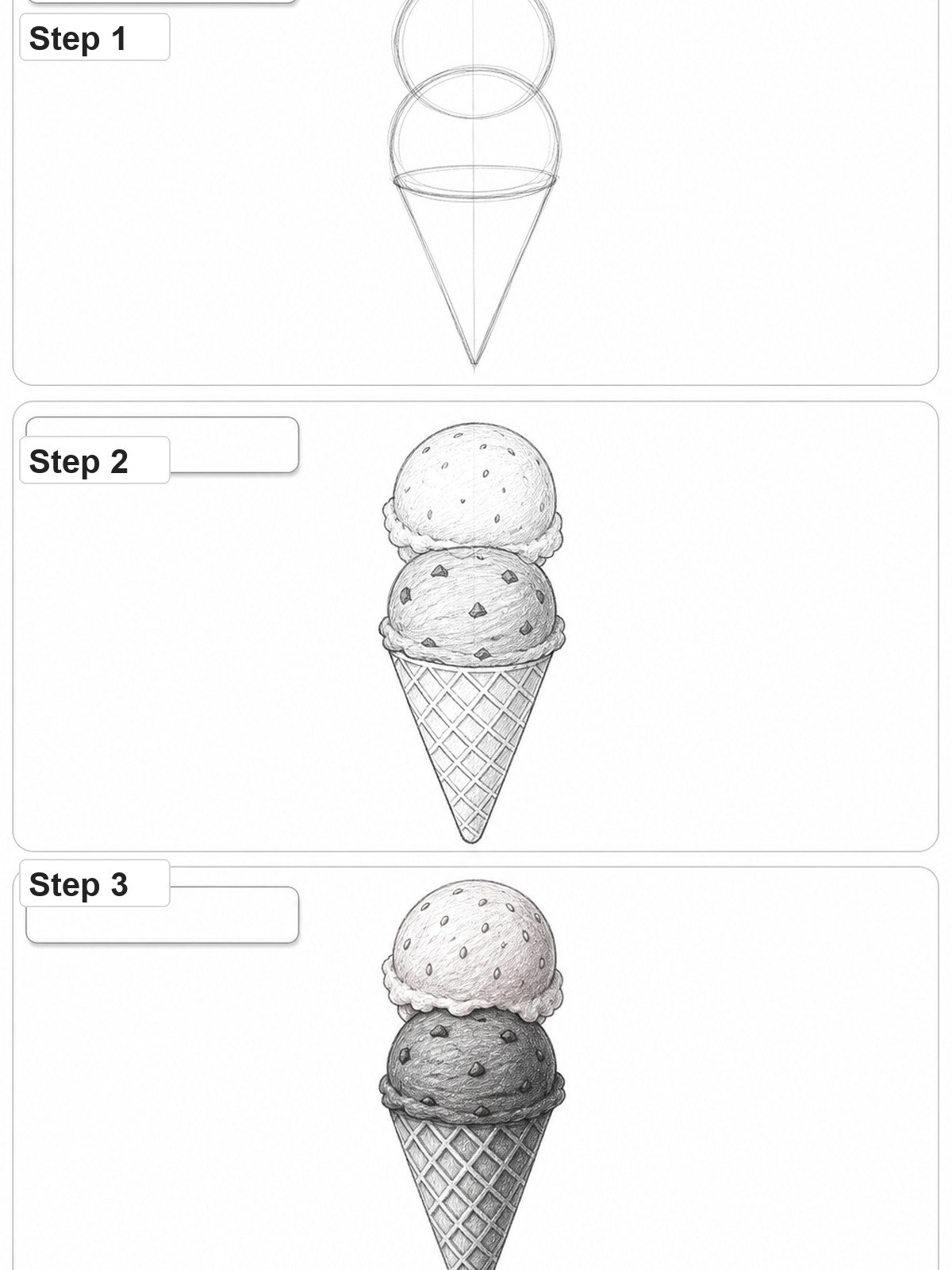
Download Free PDFFor multiple scoops, each subsequent scoop sits above and slightly behind the previous one. The lower scoop is compressed slightly by the weight of the one above it, which is shown by flattening the top of the lower hemisphere where they meet. The contact zone is the most important area to get right in a multi-scoop drawing.
The flat-bottom cup
For sundae and cup formats, the container is a trapezoidal form (wider at the top than the bottom) with an elliptical opening at the top. The ellipse is the most important element: its proportion determines whether the cup reads as seen from above, eye level, or below. A very flat ellipse means you’re looking at the cup nearly straight on. A more circular ellipse means you’re looking down into it. Choose a consistent viewpoint and keep all ellipses in the drawing consistent with it.
Step-by-step: single scoop cone
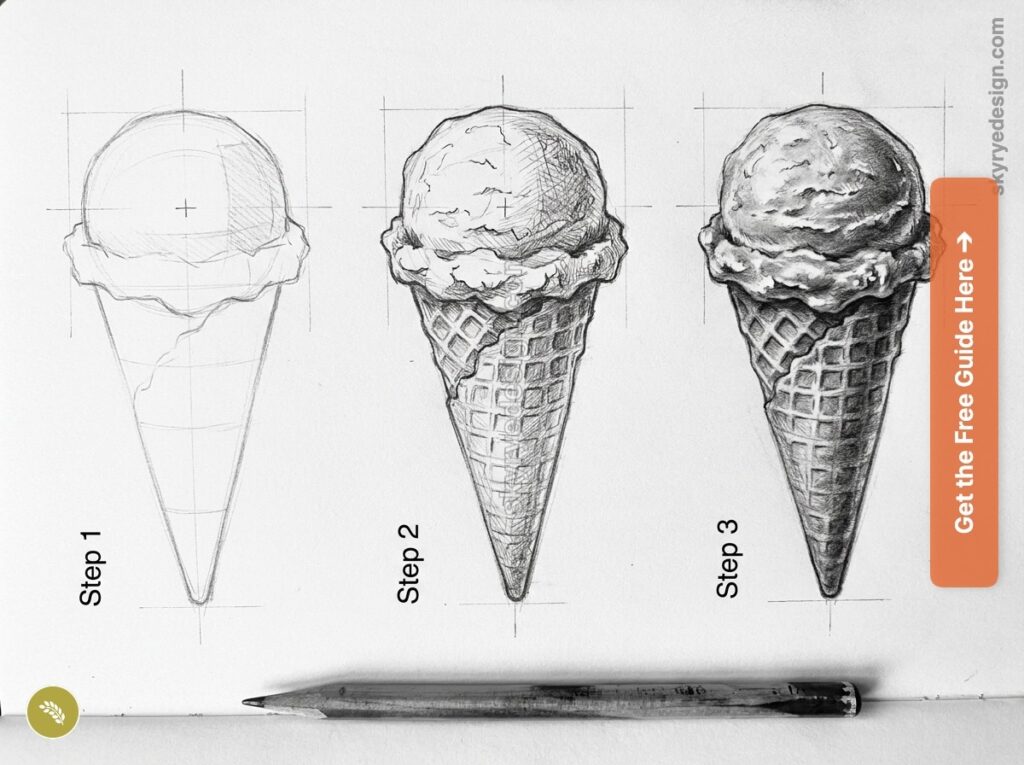
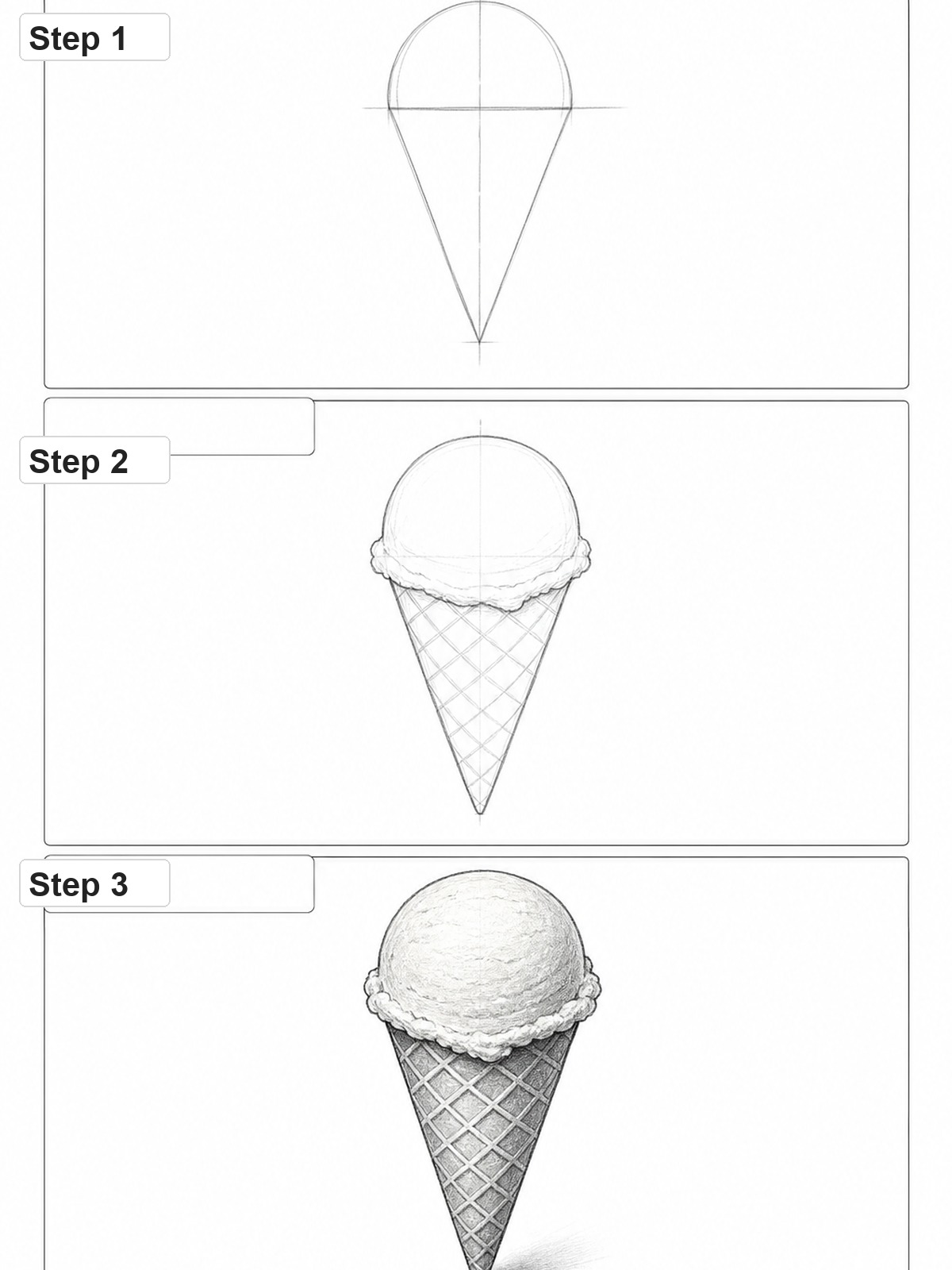
The single scoop cone is the foundation drawing. Every other ice cream format is a variation or extension of this. Spend time getting it right before moving to more complex types.
Step 1: establish the proportions
Draw a light vertical center line. On this line, mark three points from bottom to top: cone tip, cone rim, scoop top. The distance from cone tip to cone rim should be roughly equal to the scoop diameter. This 1:1 proportion between cone height and scoop diameter is the standard that looks right. A scoop much larger than the cone height reads as unstable. A much smaller scoop reads as mean.
Step 2: draw the cone triangle
From the tip point, draw two lines outward and upward to the cone rim width. The cone rim width should be about 70% of the scoop diameter you’ve planned. The top edge of the triangle is not straight: it curves very gently inward at the center. Add the waffle grid: two sets of diagonal lines at roughly 45 degrees in opposite directions. The diamond shapes they form are wider near the rim and smaller near the tip.
Step 3: draw the scoop
Center a half-circle on the vertical center line, sitting on and slightly overlapping the cone rim. The flat base of the scoop hemisphere should align with the cone rim, with the curved top rising above it. The scoop should extend about 10 to 15% wider than the cone rim on each side.
Step 4: shading
Pick a light source (upper left). The scoop’s shadow side is lower right. Apply curved hatching strokes that follow the surface of the sphere, concentrated in the lower-right quadrant. Leave a small oval or irregular white shape in the upper-left area of the scoop as the specular highlight. The cone gets diagonal hatching along the groove lines of the waffle pattern, darker at the tip and lighter at the rim.
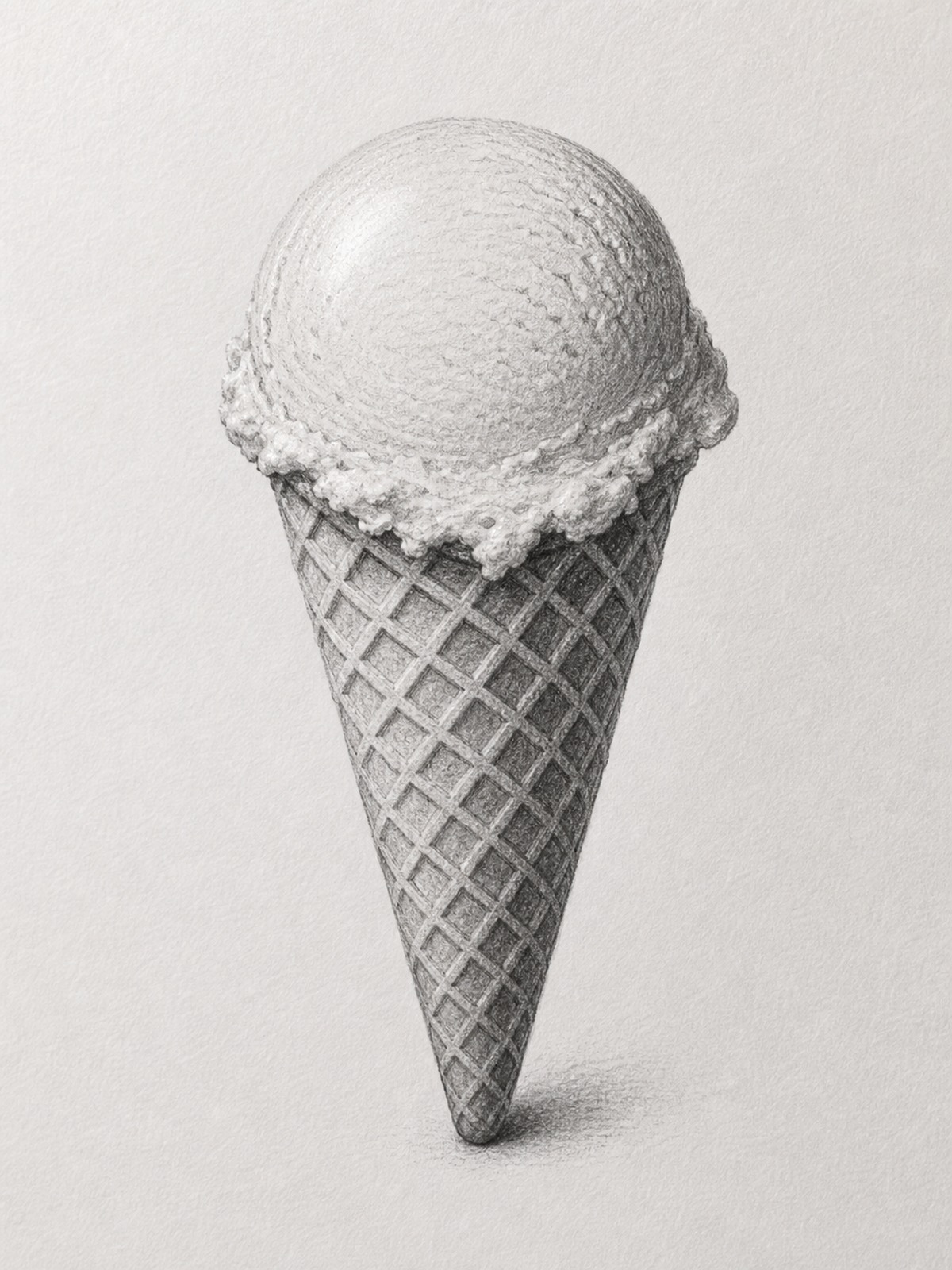
The highlight placement trick: before adding any shading to the scoop, use a kneaded eraser to lift a small bright spot in the upper-left area. Then shade around it, keeping that area white. This sequence, protect the highlight first, shade second, produces a cleaner and crisper highlight than adding it afterward. The same principle works for any round form: a soap bubble, a marble, a cartoon character’s eye.
Step-by-step: double scoop, melts, and soft serve
Double scoop
The second scoop sits above and slightly behind the first. Start by drawing the lower scoop as described above. Then add the upper scoop: its diameter should be the same as the lower one, but its lower edge overlaps the top of the lower scoop by about 20%. The lower scoop’s top hemisphere is slightly flattened where the upper scoop presses on it. This compression is subtle (maybe 5 to 8% of the scoop diameter) but essential for making the stack read as physically plausible.
Each scoop gets its own shading, but they share the same light source. The shadow on the lower scoop deepens where the upper scoop casts a shadow on it. This cast shadow from scoop to scoop is a detail that most beginner drawings miss and that experienced illustrators use deliberately.
Drawing the melt
Melting ice cream is one of the most satisfying drawing challenges because the drip shapes have a specific character: they are not random. Each drip starts where the surface tension breaks at the scoop edge, runs down under gravity, and collects in a rounded blob before falling. The drip is widest at its origin point and narrows slightly as it runs, then widens again at the collection point.
Draw several drips of different lengths along the lower edge of the scoop and down the cone. Vary the widths. Avoid making all drips the same length, which reads as mechanical rather than natural. One drip should be nearly falling off the cone tip for drama. The melt on the cone surface follows the groove lines of the waffle pattern, pooling in the diamond-shaped grooves.
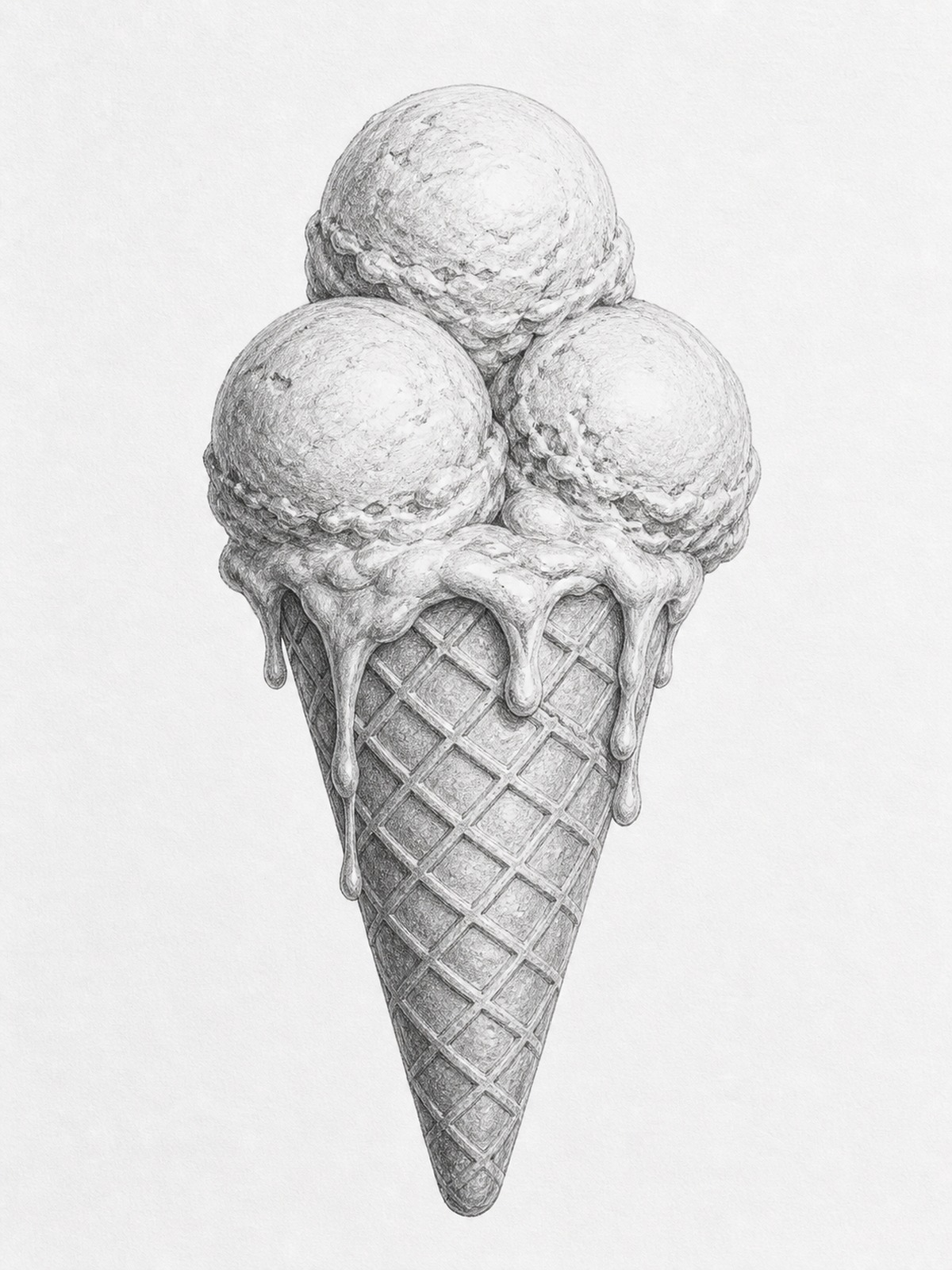
For shading the melt: it’s slightly translucent, which means it’s a lighter value than the solid scoop above it. If the scoop is chocolate brown, the melt is a lighter, warmer brown. This translucency is what makes drawn melt look wet rather than just like a flat extension of the scoop.
Soft serve swirl
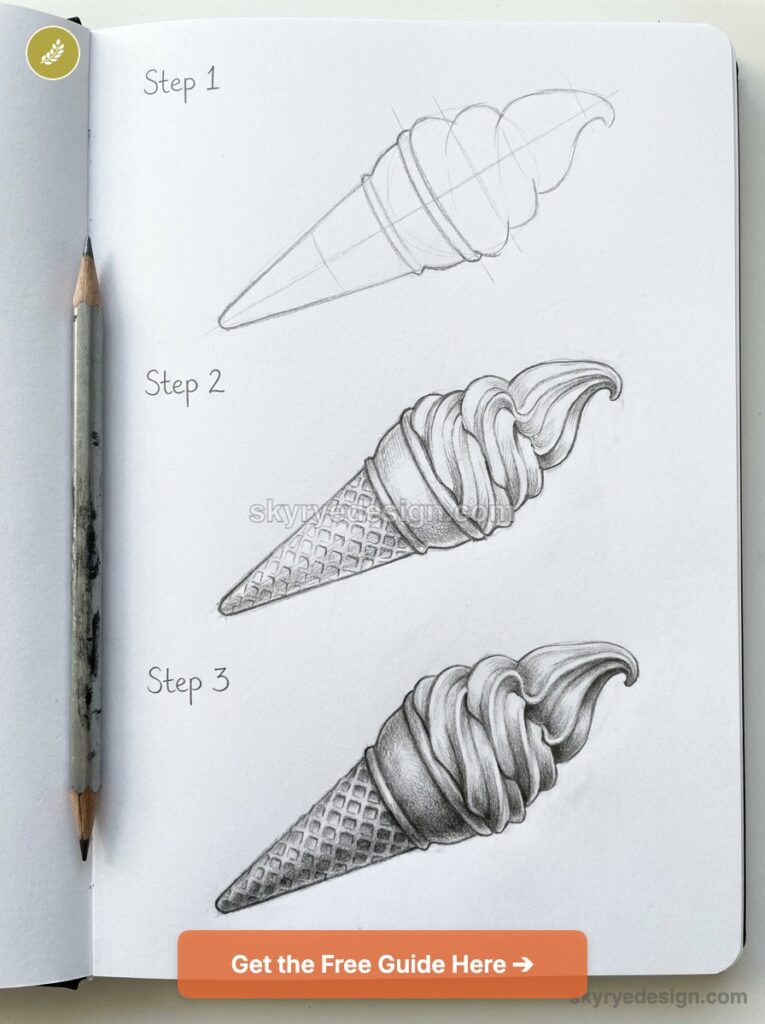
Soft serve requires a different construction than a scoop. The swirl is built from a central spine (a vertical center line) from which the cream spirals outward in a series of ascending loops. Start at the top with a small loop, working downward and outward with each successive loop slightly larger than the last. The base loop is the widest, sitting on the cone rim.
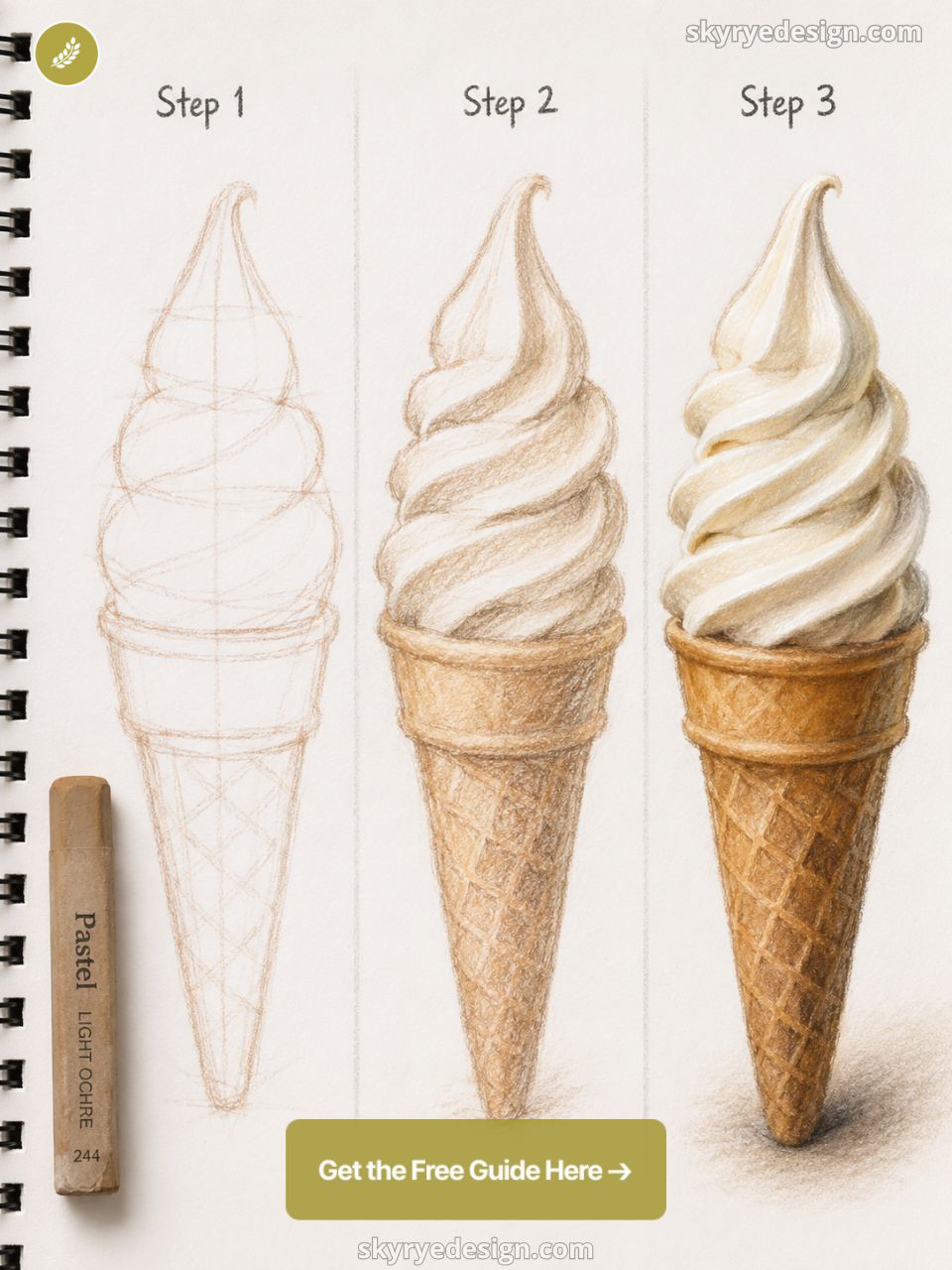
The cross-section of a soft serve swirl is circular, so each loop is drawn as a cylinder viewed at a slight angle. The near side of each loop is slightly wider than the far side. Leave small slivers of the loop behind visible between the near loops to suggest depth.
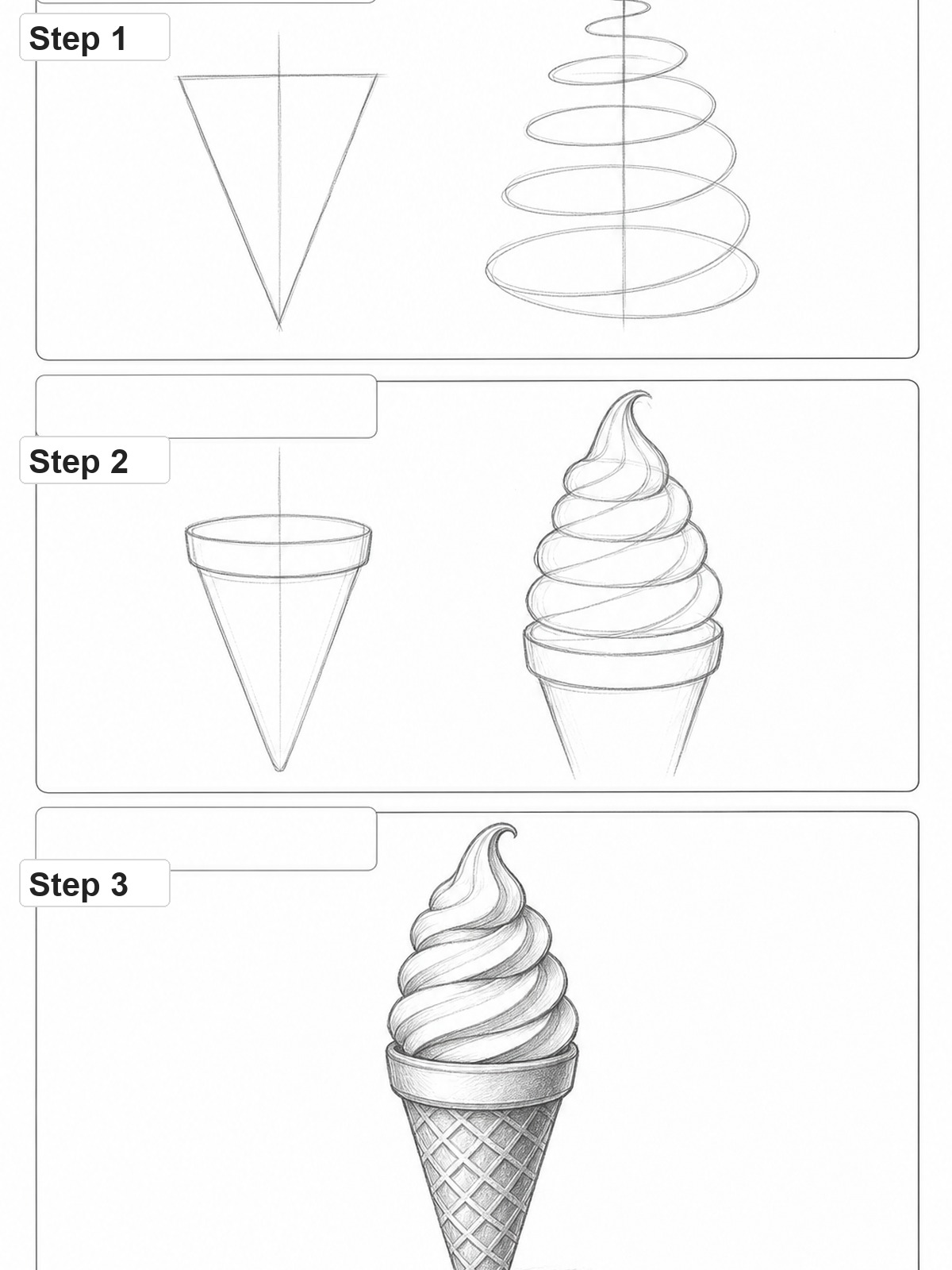
Ice cream sundae, popsicle, and ice cream sandwich
The ice cream sundae
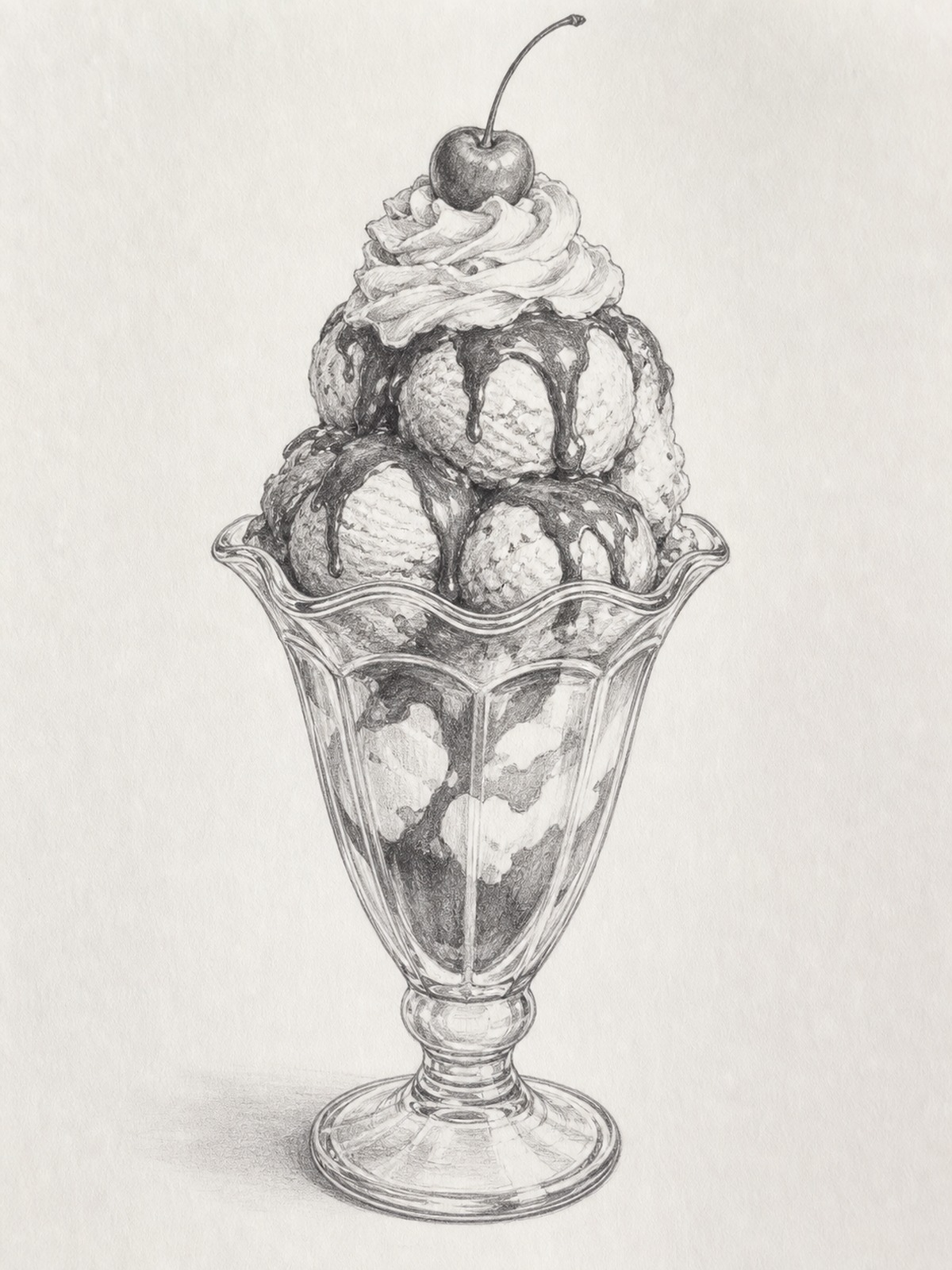
A sundae drawing is built around the glass. Draw the glass as a trapezoid (wider at top) with a narrow stem and flat base. The opening of the glass is an ellipse whose degree (flatness) determines the viewing angle. Two or three scoops sit in the glass, partially obscured by the rim. The whipped cream swirl on top is identical in construction to the soft serve swirl but smaller.
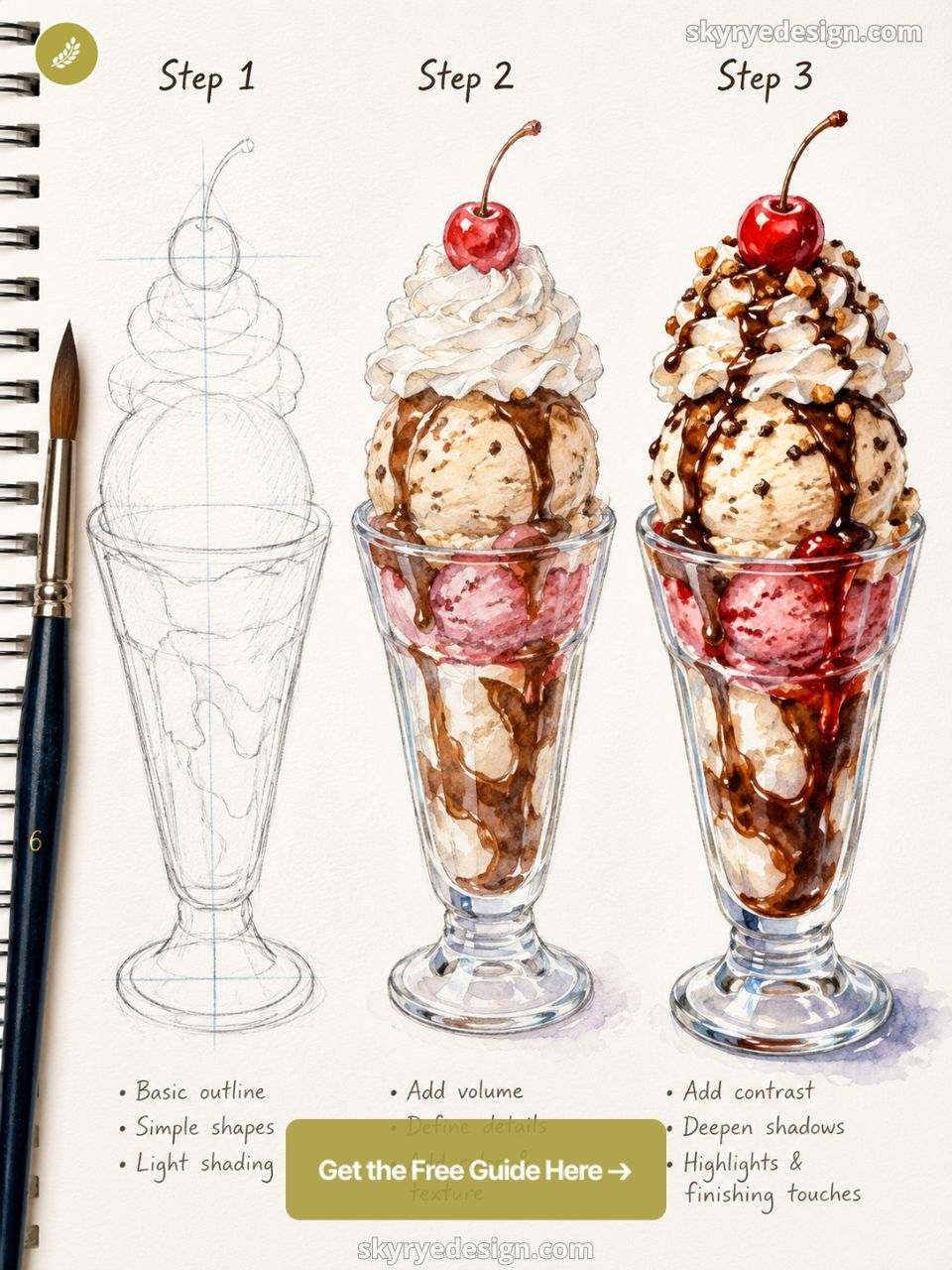
The sauce drizzle runs down over the scoops in irregular curved lines, pooling slightly between the scoops. A cherry sits at the top of the whipped cream, drawn as a small sphere with a curved stem. Sprinkles or nuts can be scattered across the scoops as small tick marks or irregular rectangles.
The popsicle
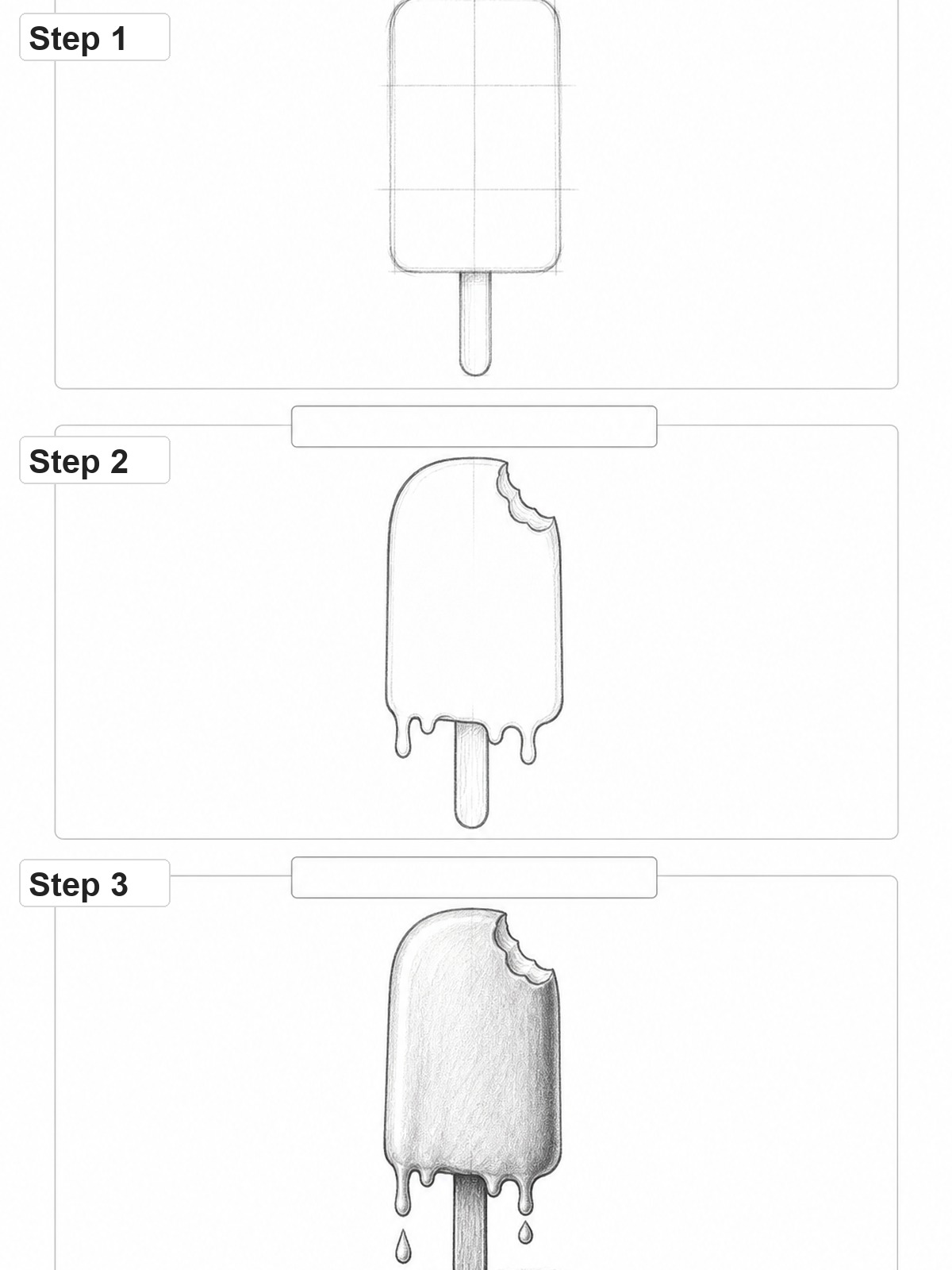
A popsicle is the simplest ice cream form: a rounded rectangle with a flat stick at the bottom. The rectangle has slightly rounded corners and a slightly domed top edge. The stick is a thin rectangle, narrower than the popsicle body, centered and emerging from the bottom.
Drips run down the lower rounded corners of the popsicle. They start as rounded blobs at the corner and taper as they run down the stick. Bitemarks, if included, are drawn as irregular curved concavities with small bite chunk shapes beside them. Popsicles with fruit pieces or swirled colors are drawn by adding organic shapes within the outline before coloring.
Ice cream sandwich
The ice cream sandwich is a viewed-from-the-side rectangle: two cookie wafers (thin rectangles with slightly irregular edges) sandwiching a rectangular block of ice cream. The ice cream filling is slightly wider than the wafers, giving the classic overflow that defines the format. The wafer edges can be drawn with a simple texture of small dots to suggest the chocolate cookie surface.
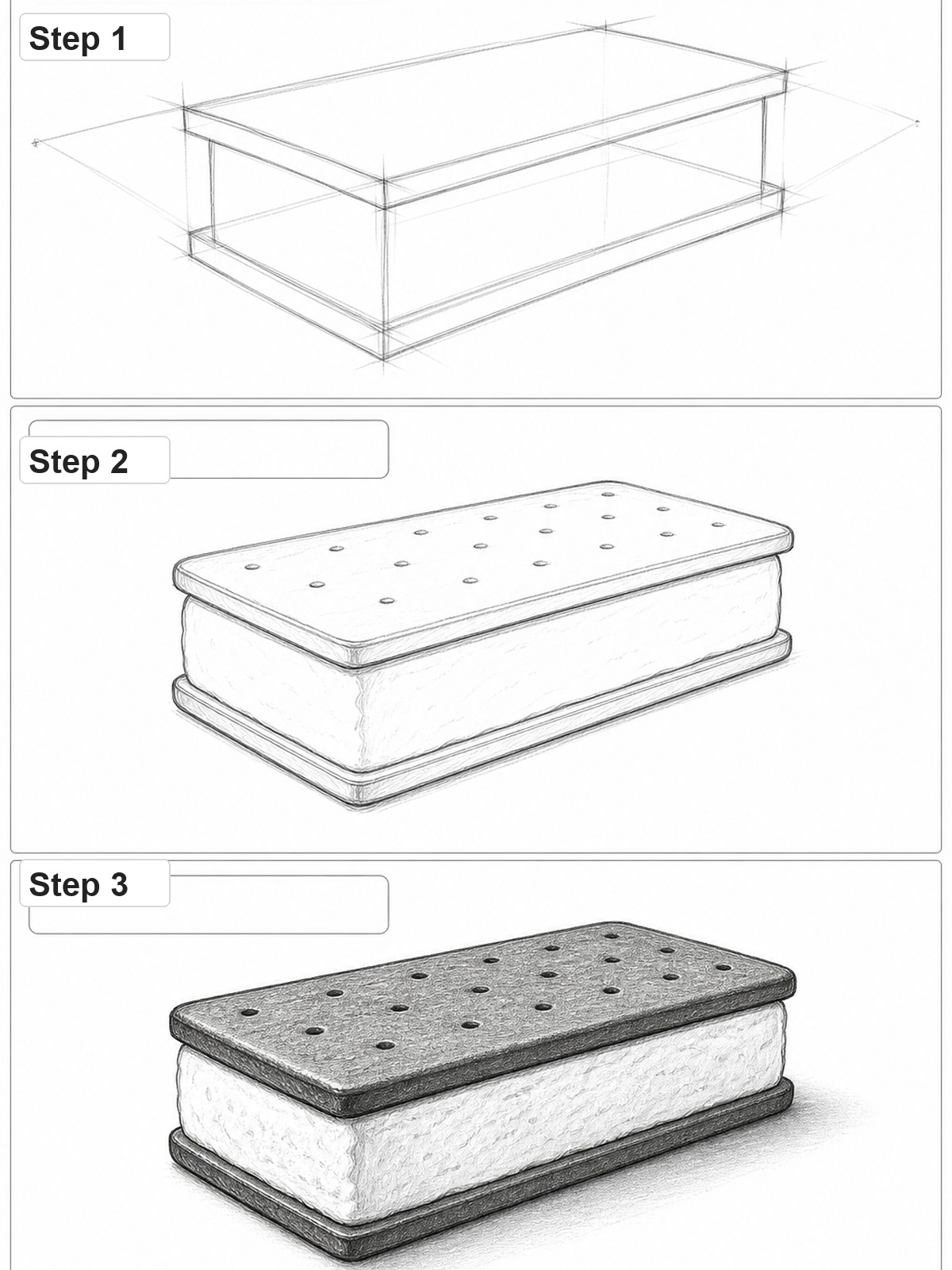
For a top-view composition, draw both wafers as slightly tilted parallelograms to show the three-dimensional form. The ice cream in the cross-section view shows the cut interior, which can be colored to show any flavor.
Kawaii ice cream drawings: the cute version
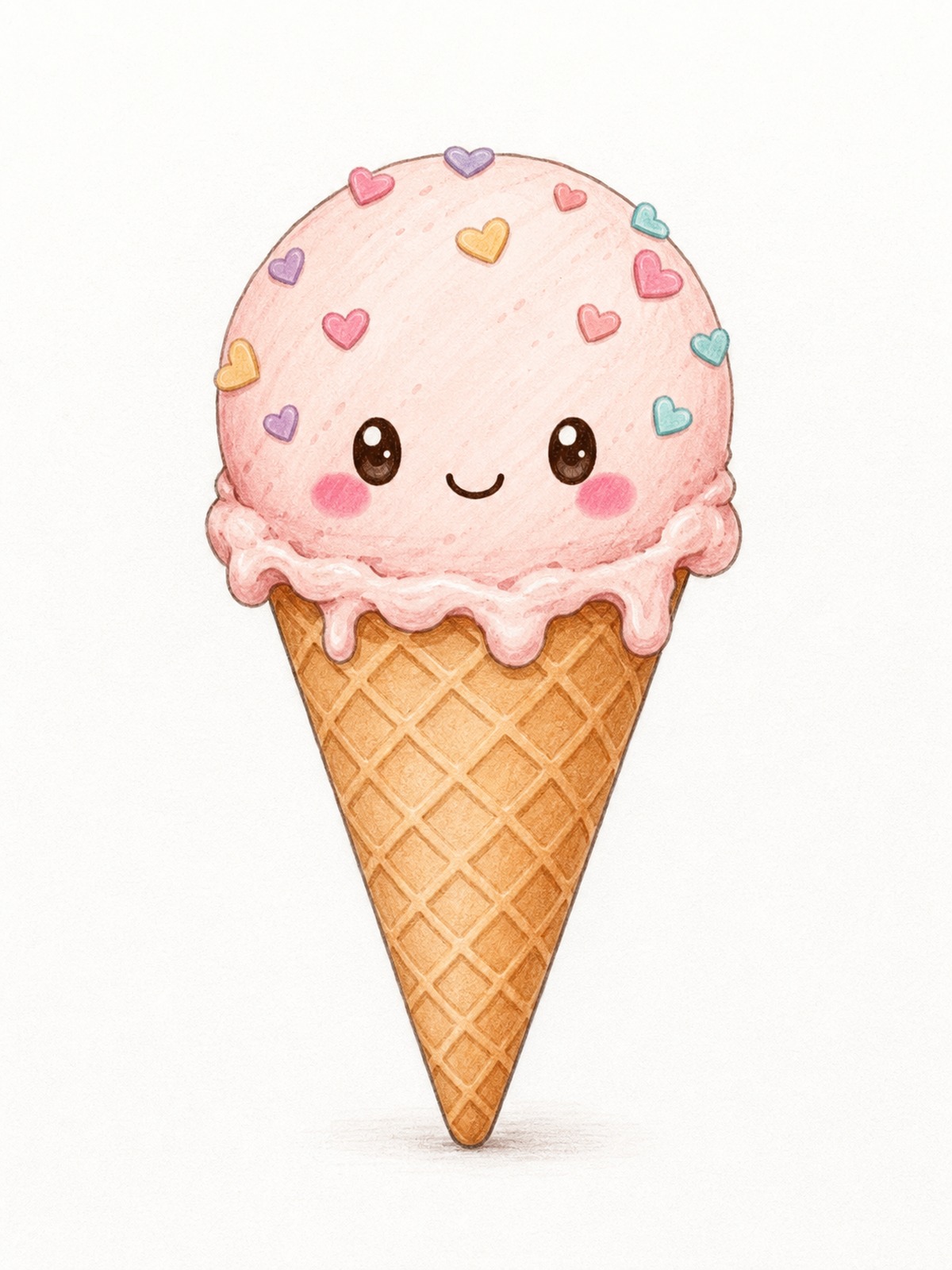
Kawaii ice cream illustrations use a specific set of proportion adjustments that shift the subject from realistic toward cute character territory. Understanding the rules makes it possible to apply them deliberately rather than guessing.
The kawaii proportion shifts
In kawaii ice cream drawings, the scoop is much larger relative to the cone than in realistic drawings. The cone becomes small and stubby, roughly half the height of the scoop rather than equal to it. The scoop itself approaches a full circle rather than a hemisphere. The face fills the front of the scoop: two large oval eyes take up about a third of the scoop diameter each, leaving room for blushing cheeks below them and a simple curved mouth.
All edges are smoothed and rounded. The cone tip is not sharply pointed; it ends in a small rounded nub. Sprinkles, stars, and hearts float around the scoop like a halo of small decorative elements. Pastel color is the standard palette: pink for strawberry, pale blue for blueberry, soft yellow for lemon, mint green for pistachio.
Adding a face
The face sits in the center of the scoop, slightly in the upper half. The eyes are the dominant feature: large ovals filled with a dark iris and a white highlight dot in the upper-right of each eye. The eyes sit on a horizontal eye line and are symmetrical. Under each eye, a simple pink oval or three small dots indicate the blushing cheek.
The mouth is a simple upward curve, optionally with a small rounded tooth visible for additional cuteness. Keep it simple: kawaii faces read as cuter with fewer elements, not more. Adding eyebrows above the eyes adds expression; a slightly raised inner eyebrow produces a happy-surprised look, which is the most common kawaii expression.
30+ ice cream drawing ideas by style
The ideas below are organized by style category. Each works as a brief for either a traditional drawing or an AI image prompt.
Simple and beginner-friendly
- Single scoop vanilla cone, side view.
- Double scoop chocolate-strawberry.
- Popsicle with bite taken out.
- Ice cream sandwich top view.
- Soft serve cone in profile.
- Simple cup with two scoops and a spoon.
- Triple scoop precarious stack.
- Dripping cone with one large melt.
- Ice cream bar on a stick, wrapper partially removed.
- Simple sundae glass, no toppings.
Kawaii and character styles
- Kawaii single scoop with happy face.
- Strawberry kawaii cone with heart cheeks.
- Sleeping ice cream (closed eyes, moon above).
- Ice cream family: large mama, medium papa, tiny child cone.
- Angry ice cream with melted body drip.
- Pastel rainbow scoop with cat ears.
- Ice cream character running away from summer heat.
- Tiny kawaii ice cream inside a teacup.
- Ice cream ghost for Halloween.
- Unicorn scoop with rainbow colors and horn.
Detailed and realistic
- Realistic single scoop with condensation drops on the cone.
- Close-up of dripping melt from above.
- Photorealistic chocolate scoop with sprinkles, full render.
- Waffle cone texture study, only the cone, extreme detail.
- Cut-away cross-section of a multi-layer Neapolitan scoop.
- Melted ice cream in a pool, viewed from above.
- Strawberry scoop with visible fruit pieces in the ice cream.
- Soft serve under harsh summer sun with active melting.
Decorative and illustration styles
- Art nouveau ice cream poster style with ornamental border.
- Flat graphic icon series: cone, popsicle, sandwich, sundae.
- Retro 1950s diner-style ice cream illustration.
- Botanical illustration style with flower garnish and herb sprigs.
- Architectural drawing style cross-section of a sundae.
- Pattern repeat of mini ice cream icons for surface design.
Coloring ice cream drawings: pencils, markers, and digital
Colored pencils
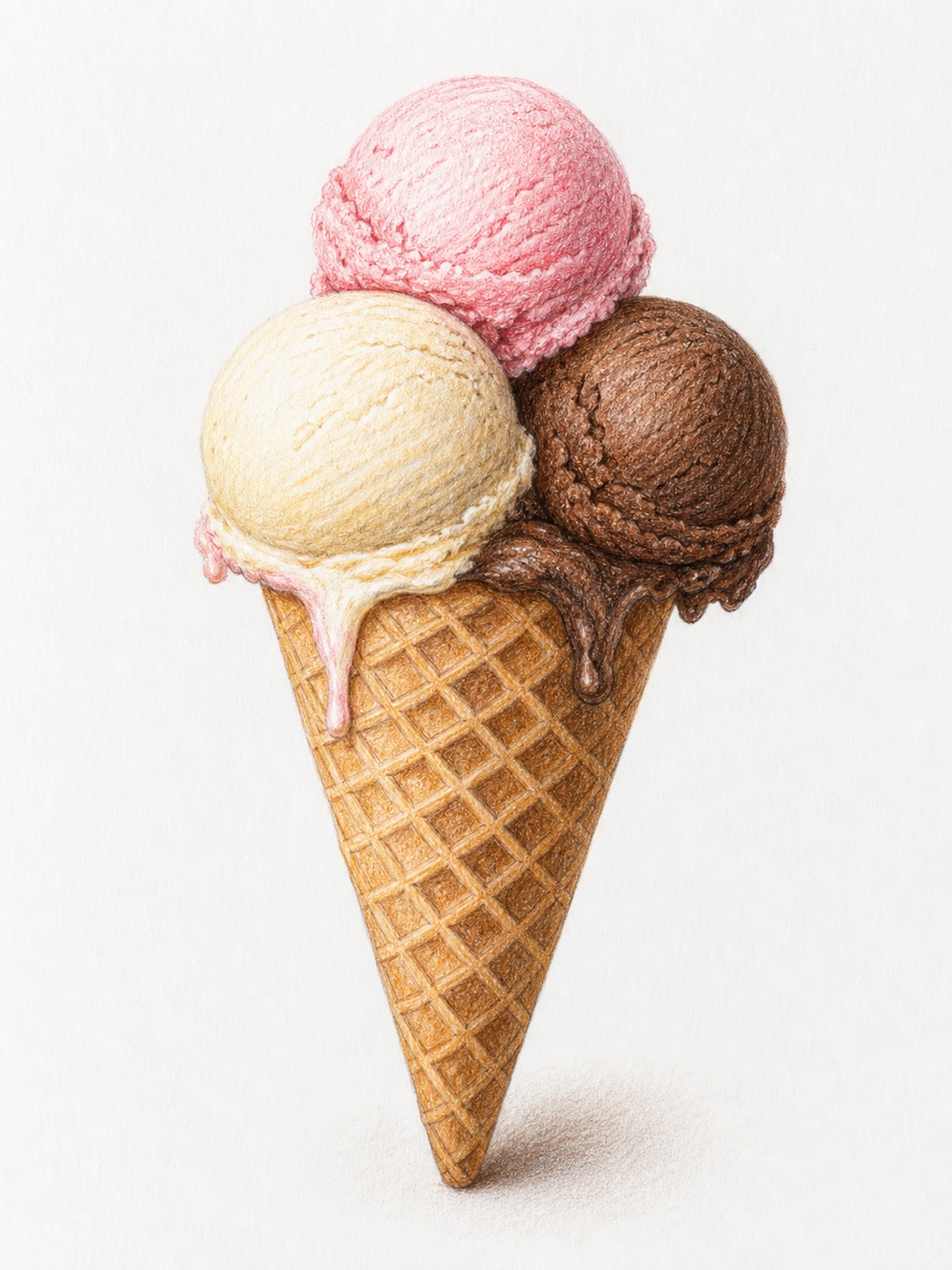
Apply the base color first at light to medium pressure across the entire scoop form. A second layer of a slightly darker version of the same hue goes into the shadow zone (lower right for a left-side light source). A third, lighter layer of near-white or a warm yellow lightens the highlight zone. Burnish the final surface with a white or colorless blender pencil at heavy pressure to remove paper texture and produce a smooth, slightly waxy surface that reads well for the smooth texture of ice cream.
For the cone, warm amber as the base, with a darker brown in the shadow side of each diamond and a near-white highlight along the raised grid lines. The grid reads as embossed when the shading within each diamond is slightly darker than the surrounding raised areas.
Alcohol markers
Alcohol markers (Copic or equivalent) are fast and produce smooth blends that suit ice cream's smooth surface. Work from light to dark: lay the lightest tone across the entire scoop, then blend the shadow tone into the shadow zone while the base is still wet. The wet-on-wet technique with alcohol markers produces a smooth, continuous gradient that is difficult to achieve with dry media.
Leave the highlight area untouched (no marker applied). The white of the paper is the brightest possible highlight in marker work. After the marker layer dries, a white gel pen can add a crisp specular highlight dot that reads even brighter than the paper.
Procreate and digital tools
Digital ice cream drawings use three primary layers. Sketch layer at 20 to 30% opacity provides the construction reference. Clean line art layer above it draws the final outlines. Color layer below the line art fills the color zones. Set the line art layer to Multiply blending mode so the color fills show through the white areas of the line art layer.
For the scoop's rounded form, the Soft Airbrush in Procreate blends from the highlight color outward in circular motions that follow the sphere's curvature. The Gaussian Blur effect on a separate glow layer produces the subtle reflected light zone along the shadow edge, which suggests that the ice cream is sitting on a colored surface that bounces light back up into its base.
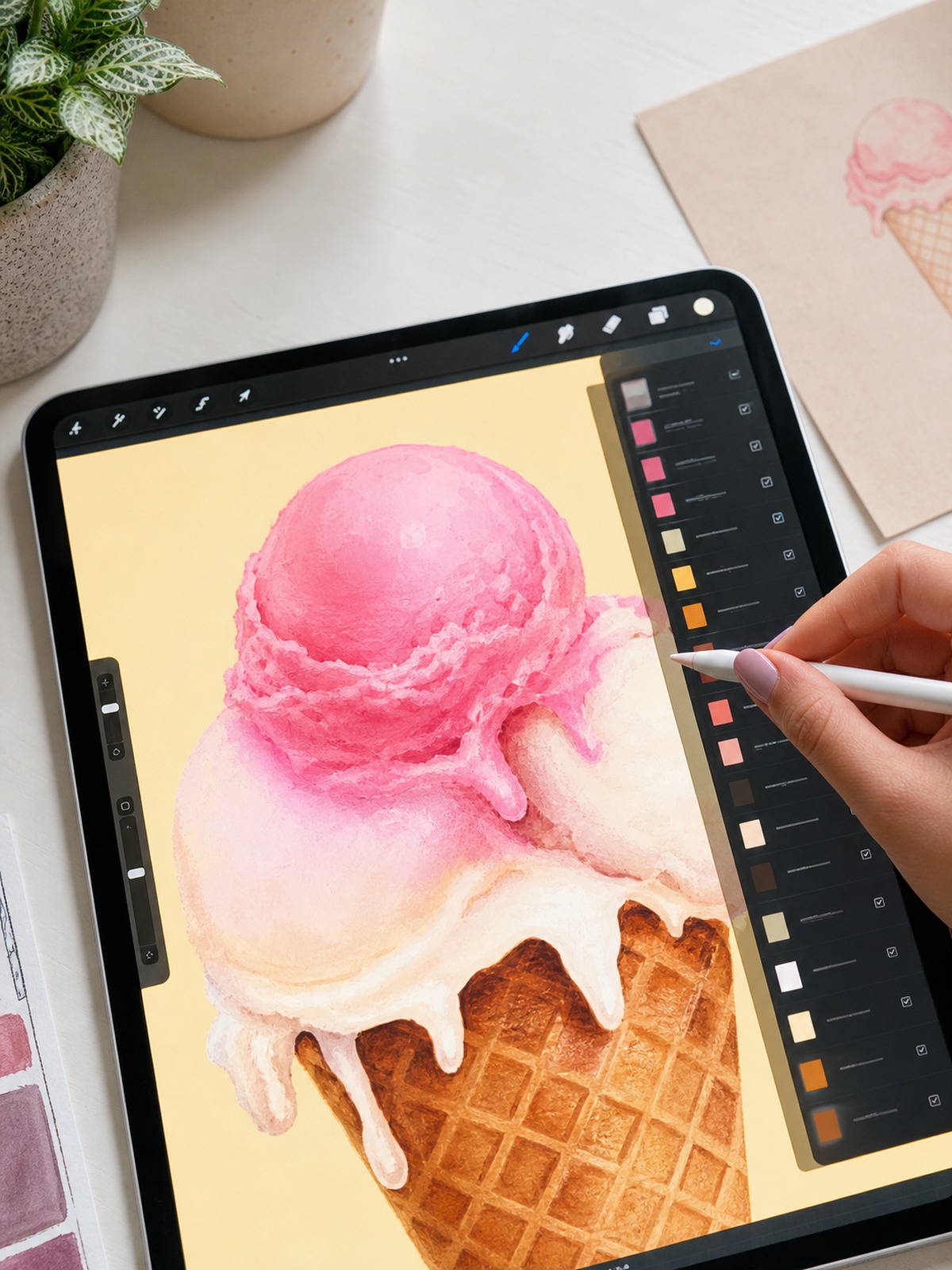
For any drawing that includes both a cone and a scoop: finish the scoop shading before touching the cone. The scoop casts a shadow on the upper rim area of the cone, and knowing where the scoop's shadow falls makes the cone shading more accurate. Drawing the cone first and then trying to add the scoop's shadow afterward often produces inconsistent light direction.
Frequently asked questions
How do you draw a simple ice cream cone?
Draw a triangle with a slightly concave top edge for the cone, tip pointing down. Add a hemisphere sitting on the rim, extending slightly wider than the cone. Add diagonal crossed lines across the triangle for the waffle grid. For a second scoop, draw another hemisphere above the first, overlapping slightly. Shade the scoop with curved hatching, leave a highlight on the upper left, and add hatching along the waffle grooves on the cone.
What are easy ice cream drawing ideas for beginners?
The easiest to start with: single scoop on a flat-bottom cone, popsicle on a stick, soft-serve swirl cone, and a simple sundae glass with a dome scoop on top. All rely on basic geometric shapes (triangle, circle, rectangle) and require no complex curves or perspective work. The popsicle is the simplest of all: rounded rectangle plus a thin stick.
How do you draw melting ice cream?
Draw the main ice cream form first, then add melt drips along the lower edges of the scoop and down the cone. A drip is a teardrop with the rounded end at the top. Vary drip lengths and widths. Melt on the cone surface runs along the groove lines of the waffle grid. For color, the melt is a slightly lighter and warmer tone than the solid scoop above it to suggest translucency.
How do you draw kawaii ice cream?
Use a large, round scoop relative to a small stubby cone. The scoop approaches a full circle. Place a face in the center of the scoop: two large oval eyes (about one-third of scoop diameter each), small pink cheek ovals, and a simple curved smile. Smooth all edges and corners. Add floating hearts, stars, or sprinkles around the scoop. Use pastel colors throughout.
What colors work best for coloring ice cream drawings?
Strawberry: pink to rose. Vanilla: warm ivory to cream. Chocolate: mid-brown base with darker shadow. For the cone: warm amber with tan and dark brown in the shadow zones. Leave the highlight zone as near-white or lightest paper. Pastel versions of any hue suit kawaii work. Saturated versions suit graphic poster-style illustration. The melt should always be lighter and warmer than the solid scoop in the same flavor.
Can you draw ice cream digitally in Procreate?
Yes. Sketch on one layer at low opacity, draw clean line art above it, then color on a third layer below the line art with the line art set to Multiply blending mode. Use the Soft Airbrush to blend scoop highlights in circular strokes following the sphere surface. White gel pen equivalent (white on a top layer) adds the crispest possible specular highlight point.
How do you draw realistic ice cream?
Attention to the light source and surface texture is what separates a realistic from a flat ice cream drawing. The scoop has subtle compression marks from the scoop tool. The shine is a small, bright, slightly irregular highlight at the top. The cone is matte with the waffle grid receding into shadow at lower edges. Melt is slightly transparent, lighter in value and warmer in temperature than the solid scoop above it.
For more sketching subjects, browse the Sky Rye Design drawing archive and keep a few simple objects ready for daily practice.
- 1.5Kshares
- Facebook0
- Pinterest1.5K
- Twitter0
- Reddit0