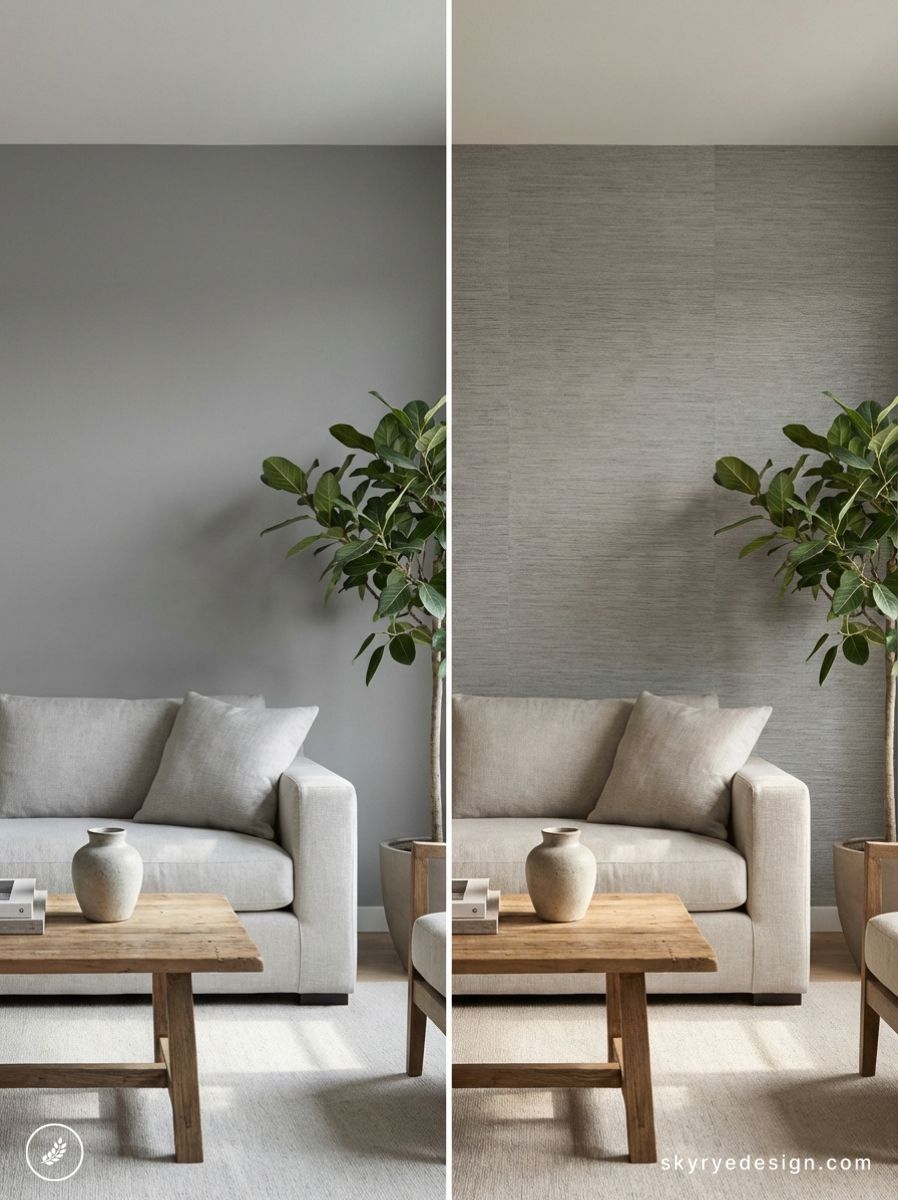
A client showed me two photographs of the same room. Same furniture, same rug, same pendant light. In the first photo, the room looked fine — clean, neutral, adequately modern. In the second, it looked like a finished interior: warmer, more considered, more like someone actually lived there rather than staged it for a listing.
The only difference between the two photographs was the wall behind the sofa. In the first, it was painted a mid-grey. In the second, it had a subtly woven grasscloth wallcovering in the same tonal range — barely darker, barely different in colour. But the texture changed everything.
- Why Flat Paint Has Started Failing Contemporary Interiors
- What's Changed: The New Generation of Wallcoverings
- Five Wallcovering Materials: What Each One Actually Does
- Where to Use Wallpaper: Feature Walls vs Whole Room
- Why Installation Quality Determines the Design Outcome
- Wallpaper Within a Broader Wall Finish Strategy
- The Wall as a Design Decision
- FAQ: Wallpaper and Textured Finishes for Interiors
That’s the phenomenon that’s driving wallpaper’s return to contemporary design: not the bold, busy patterns of previous decades, but surface character — the quality that makes a wall feel like a material rather than a background. Paint is colour. Wallpaper, at its best, is colour plus texture plus depth.
The difference reads immediately in person and registers even in photographs, which is why interior designers have steadily shifted toward wallcoverings and textured finishes as primary tools rather than finishing touches. In rooms with strong natural light, open architecture, and simple detailing, a flat painted wall can look unfinished even when the furniture is right.
The same logic can move overhead too: stretch ceilings treat the ceiling as a finish material rather than a blank background plane.
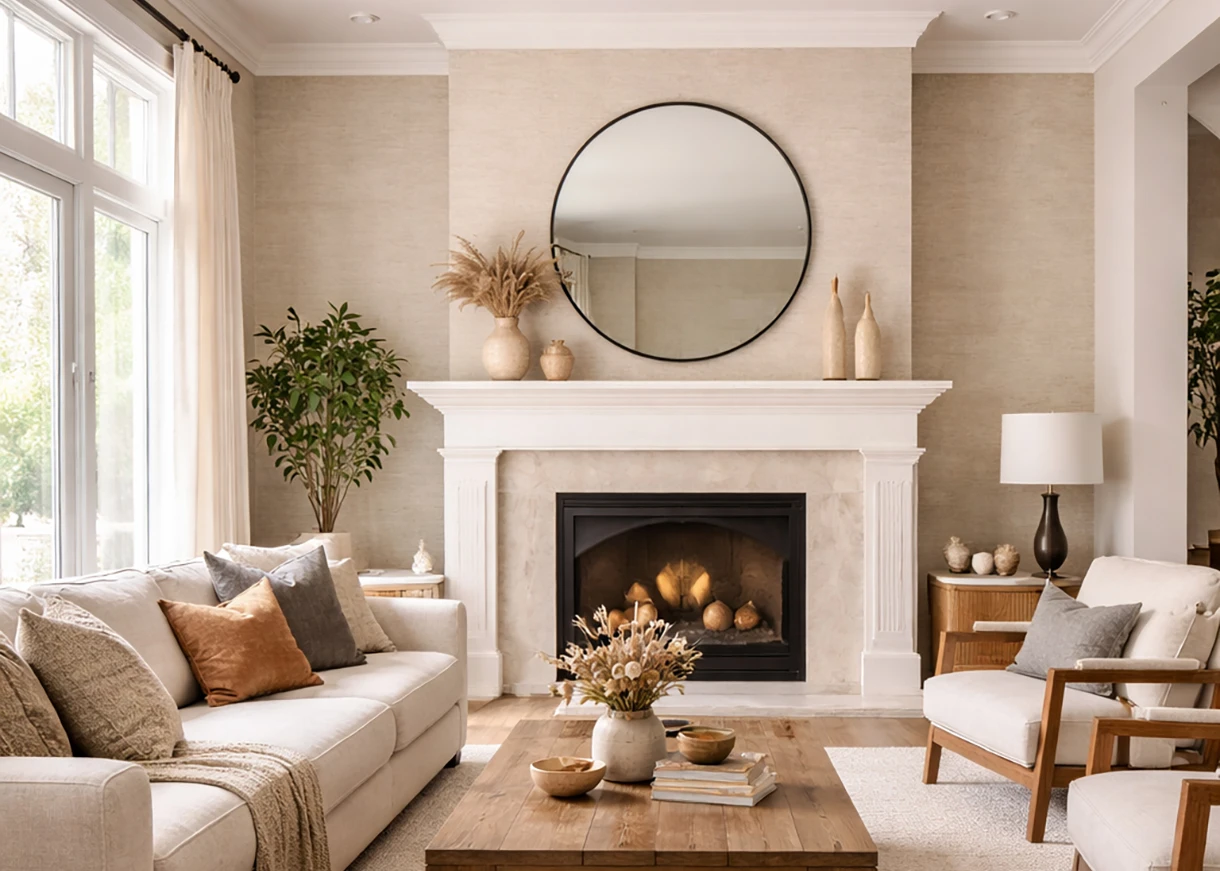
This guide covers what’s actually driving that shift, what the material options mean in practical design terms, where wallpaper works better than paint, how light and humidity affect material choice, and what the difference between good and poor installation quality looks like when the job is done.
How Wallpaper and Textured Wall Finishes Change Modern Interiors
Wallpaper and textured wall finishes change modern interiors by giving the wall a material role, not just a colour role. A smooth painted wall can look clean, but it rarely adds shadow, fibre, relief, or movement. Grasscloth, embossed vinyl, non-woven wallpaper, limewash-style finishes, and tonal micro-patterns create depth that changes as daylight moves through the room. The best use is usually strategic: one treated wall behind a sofa, bed, dining banquette, or entry view can define the space without making the room feel busy. Whole-room wallpaper works when the pattern is quiet enough to read as texture from a distance. The practical decision is simple: use paint where the wall should recede, and use wallpaper or a textured finish where the wall needs warmth, rhythm, acoustic softness, or visual weight.
- Use textured wallpaper when a room feels flat even after furniture and lighting are in place.
- Use tonal patterns when you want surface depth without a loud decorative statement.
- Use paint where the wall should stay quiet and let furniture, art, or architecture lead.
Why Flat Paint Has Started Failing Contemporary Interiors
Paint’s advantages are real: it’s fast, familiar, affordable, and reversible. For walls that are meant to recede — that exist as a background for furniture, artwork, and architecture rather than as design elements in their own right — paint is often exactly the right choice. The problem arises when paint is used as the default for every wall in every room, including the walls where more is needed.
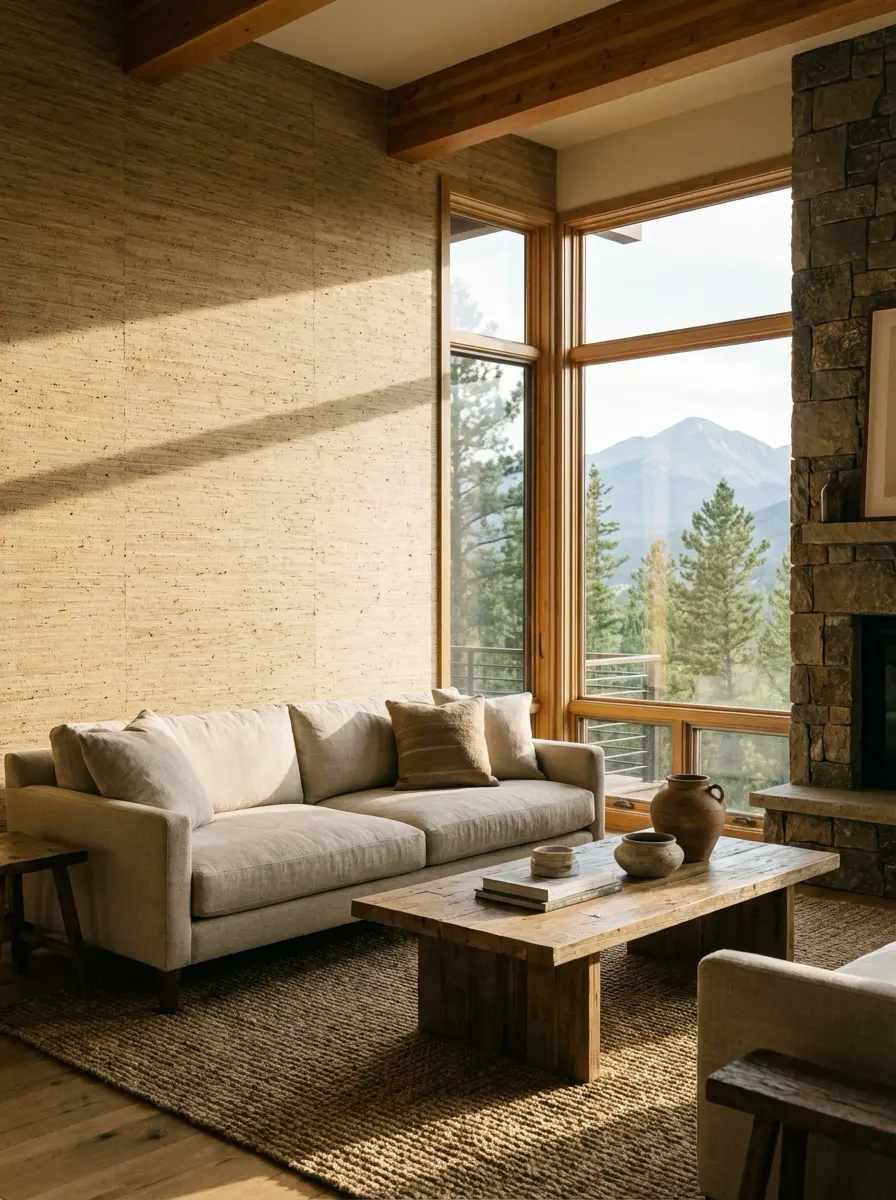
Contemporary interiors — particularly homes with open-plan layouts, high ceilings, large glazing, and relatively simple architectural detail — frequently have walls that are not just backgrounds. They’re the largest surfaces in the room. In a space with a glazed gable end and a 6-metre open living area, the wall behind the sofa is the dominant visual surface for anyone sitting in that room. Painting it a mid-grey and moving on is a decision by default, not by design. It leaves the room technically complete but experientially unresolved.
What wallpaper provides in this context — and what paint cannot replicate — is surface complexity. The way a woven texture catches raking light. The way an embossed geometric creates visual rhythm that shifts slightly as you move through the room. The way a grasscloth-inspired wallcovering adds warmth not through colour shift but through the material itself, the way its fibres hold and scatter light differently from a smooth painted surface. These qualities are not decorative in the traditional sense. They’re material qualities that make a wall participate in the room rather than simply contain it.
✏ Design note: The test for whether a wall needs more than paint: stand in the room at the time of day when it receives the most light, and look at the dominant wall surface. If it reads as flat — if it has no visual interest beyond its colour — it’s a candidate for a textured wallcovering. This is particularly revealing in east or west-facing rooms where raking morning or afternoon light exposes the surface quality of every wall finish.
What’s Changed: The New Generation of Wallcoverings
The wallpaper returning to contemporary interiors is not the wallpaper that made previous generations tear it down. The collections defining 2025 and 2026 are architecturally restrained: tonal textures that read from across the room as a sophisticated finish, not as a pattern; organic naturals that complement rather than compete with the furniture; matte surfaces that absorb light rather than reflect it; geometrics fine enough to read as surface quality rather than decoration.
The material engineering has also advanced. Older paper-based wallcoverings were dimensionally unstable — they expanded when wet with paste and contracted as they dried, which caused alignment problems and seam gaps, particularly in climates with significant humidity variation. Modern non-woven substrates are dimensionally stable, breathable, and significantly easier to install and remove than their predecessors.
Vinyl wallcoverings have become more aesthetically refined — the early vinyl products were visually heavy and distinctly non-porous; contemporary vinyl-coated wallpapers can be almost indistinguishable from textile wallcoverings in appearance while offering significantly better durability. The range of what’s currently available in modern wallpaper materials is broader and more sophisticated than at any previous point, which is part of why designers are specifying wallpaper for rooms that would never have been candidates a decade ago.
The Shift from Decoration to Finish Material
The most significant conceptual change is this: contemporary wallpaper is increasingly specified the way other finish materials are specified — for how it behaves in the space, not for how it looks in a sample book.
A grasscloth wallcovering is chosen because the room needs warmth and tactility that a painted plaster surface cannot provide. An embossed geometric is chosen because the architecture needs a surface with more visual weight on a specific wall. A subtle woven texture is chosen because the room has too much visual uniformity and needs one surface to do more without doing too much.
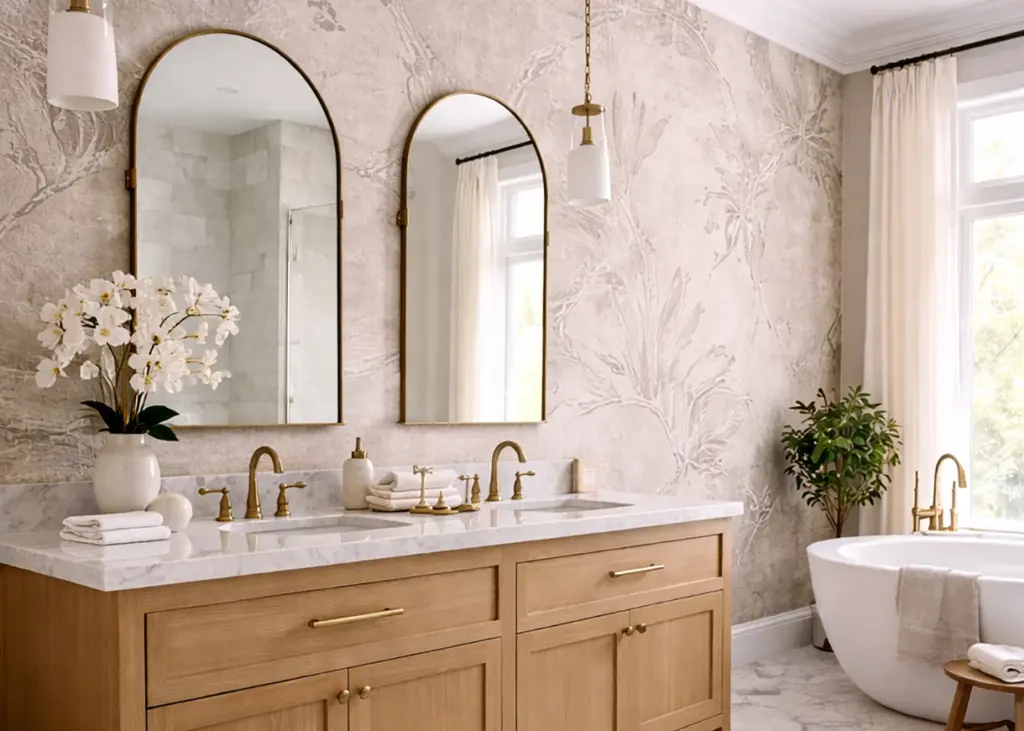
This is a different relationship with the material than the decorative tradition of wallpaper. It treats the wall as a design problem — what does this surface need to do? — and selects the wallcovering as the solution. The pattern, if there is one, is secondary to the material’s spatial function.
Five Wallcovering Materials: What Each One Actually Does
Grasscloth and Natural Fibre Wallcoverings
Character: Hand-woven natural fibres (sisal, jute, seagrass) on a paper or non-woven backing. Visible weave structure. Warm organic character. Slight variation between rolls — inherent to the material.
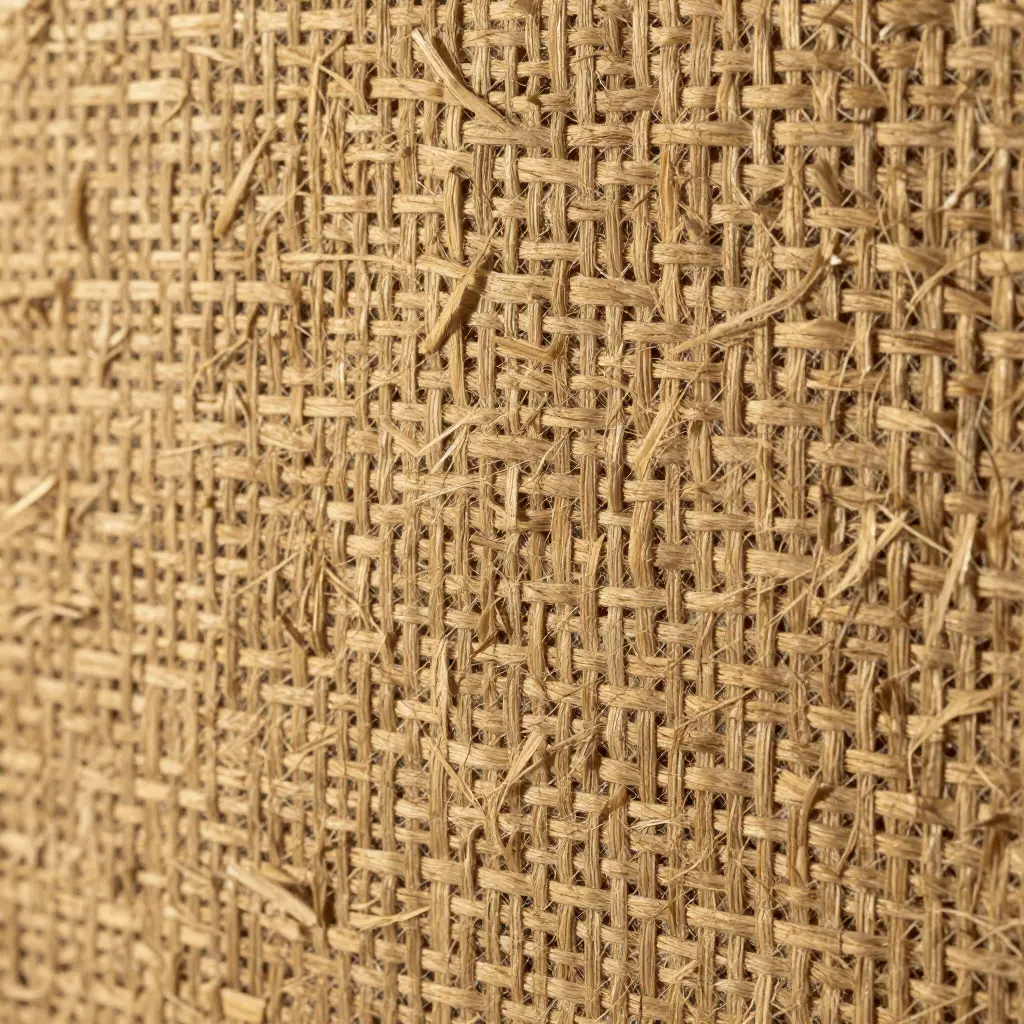
Best for: Dining rooms, primary bedrooms, home offices, powder rooms, any space where warmth and tactility are the design priority over uniformity.
How it reads in light: Exceptional in strong directional light — the woven fibres create subtle shadow patterns that shift with the light angle, giving the wall genuine visual depth. Particularly effective on east or west-facing walls where raking morning or afternoon light is strongest.
Non-Woven Wallpaper
Character: Synthetic/cellulose blend substrate with printed or embossed surface. Dimensionally stable, breathable, paste-the-wall application. The most installer-friendly category.
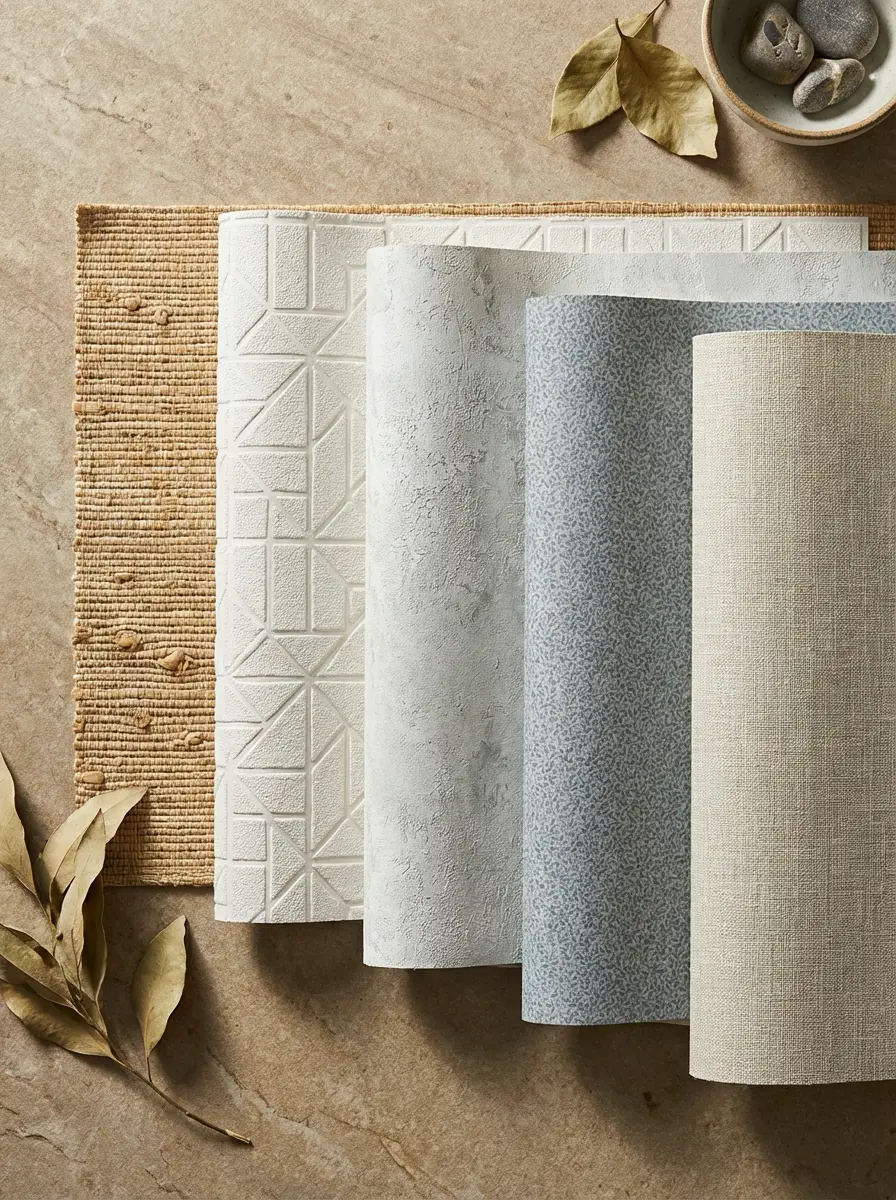
Best for: The most versatile option — suitable for any room including bathrooms and kitchens with adequate ventilation. Best choice for homeowners who want contemporary finishes without commercial-grade wallcoverings.
How it reads in light: Matte non-woven surfaces read as quiet and sophisticated in Colorado’s bright rooms — they don’t create the glare that glossy surfaces produce in high-light environments. Embossed non-wovens show well in raking light, which makes them particularly effective in Colorado’s strong angular daylight.
Vinyl and Vinyl-Coated Wallcoverings
Character: Paper or non-woven backing with vinyl surface layer. High durability, washable, moisture-resistant. Available in a wide range of surface treatments including embossed textures and printed patterns.
Best for: Hallways, children’s rooms, family bathrooms, kitchens. Any space where durability and cleanability are priorities.
How it reads in light: Vinyl surfaces can create visible reflections in strong directional light, so matte or low-sheen vinyl finishes are usually preferable to high-gloss. The surface reflection quality should be evaluated in the actual room before specification.
Embossed and Textured Wallcoverings
Character: Surface relief — raised geometric patterns, linen effects, plaster imitations, stone-inspired textures — on a vinyl or non-woven substrate. The texture reads in light rather than in colour.
Best for: Living areas, bedrooms, dining rooms where visual texture is the goal without a strong pattern statement. Excellent for feature walls in rooms with otherwise minimal architectural detail.
How it reads in light: Highly responsive to directional light — the relief creates subtle shadow patterns that shift with the light angle and time of day. In east-facing rooms, an embossed wallcovering on the north wall will read differently at 8am (side-lit from the east) than at 2pm (flat-lit). This variability is an advantage, not a problem — it gives the wall living quality.
Tonal and Micro-Pattern Printed Wallpapers
Character: Fine-scale geometric or organic patterns printed in a narrow tonal range — the pattern reads as surface character rather than as decoration. Stripes, micro-diamonds, subtle florals at very small scale, dot patterns.
Best for: Rooms where the wall needs more than a flat painted surface but where a strong pattern statement would overwhelm the furniture or architecture. Guest rooms, studies, smaller rooms where a subtle pattern adds richness without reducing the visual space.
How it reads in light: Tonal patterns nearly disappear in low light and read most clearly in bright daylight — the pattern creates visual energy when the room is at its brightest and quiets down in the evening under warm artificial lighting.
Where to Use Wallpaper: Feature Walls vs Whole Room
The Feature Wall Argument
The single-wall approach has become the dominant application strategy in contemporary interiors — and for good reason. A feature wall concentrates the design energy of the wallcovering onto the surface where it has the most visual impact: behind the bed in the primary bedroom, behind the sofa in the living room, in the dining niche of an open-plan layout, or on the wall facing the entry where the first impression is formed. The remaining walls, painted in a complementary neutral, allow the wallpapered surface to read clearly rather than compete with itself from multiple directions.
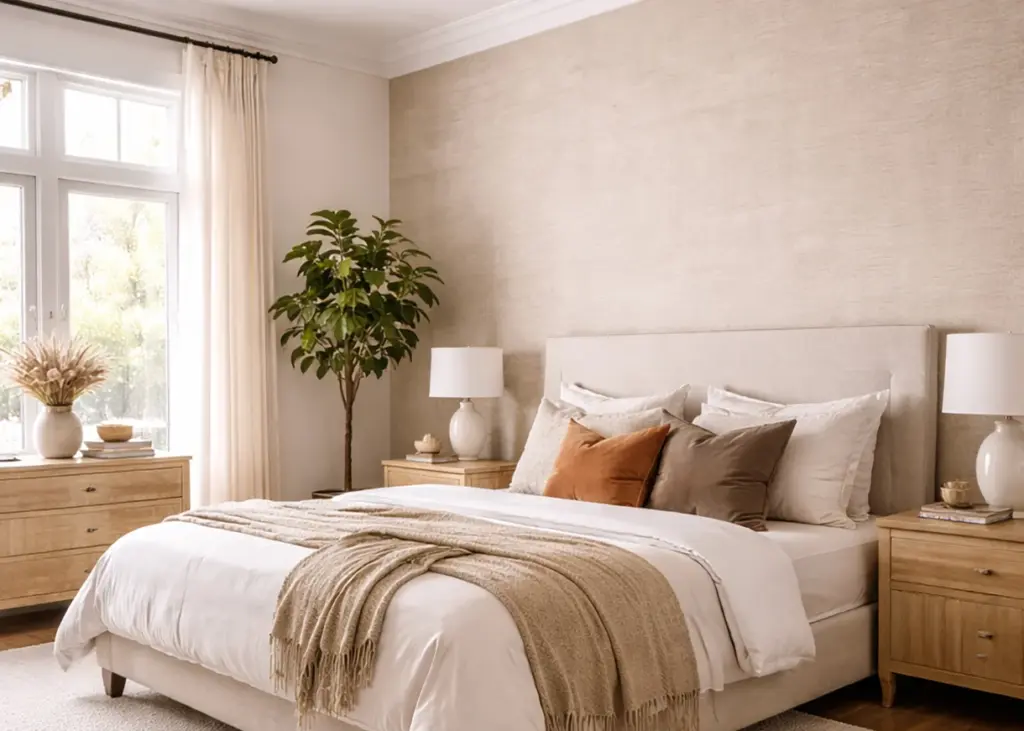
This approach is also financially efficient: a 20m² feature wall uses significantly less material than a 60m² whole-room installation, which allows a higher-specification wallcovering on the feature wall than would be practical for the whole room. The design investment goes where it has the most return.
When Whole-Room Wallpaper Works
Whole-room wallpaper application is most successful with subtle, tonal, or textural wallcoverings — materials where the repetition reads as a refined finish rather than as a multiplied pattern. A grasscloth wallcovering applied to all four walls of a dining room creates an enveloping warmth that a feature wall cannot achieve. A tonal micro-pattern applied throughout a powder room or study creates a jewel-box quality — a room that feels intensely finished without feeling busy. The rule of thumb: if the wallpaper would still look sophisticated applied to all four walls without any single wall feeling dominant, it’s a candidate for whole-room application.
Open-Plan Layouts and Zone Definition
Open-plan homes present a specific opportunity for wallpaper that closed-plan houses don’t have: using a wallpapered surface to define a zone within a larger undivided space. A grasscloth feature wall behind the dining area in an open kitchen-dining-living layout signals that zone as a distinct destination — not physically separated, but visually anchored.
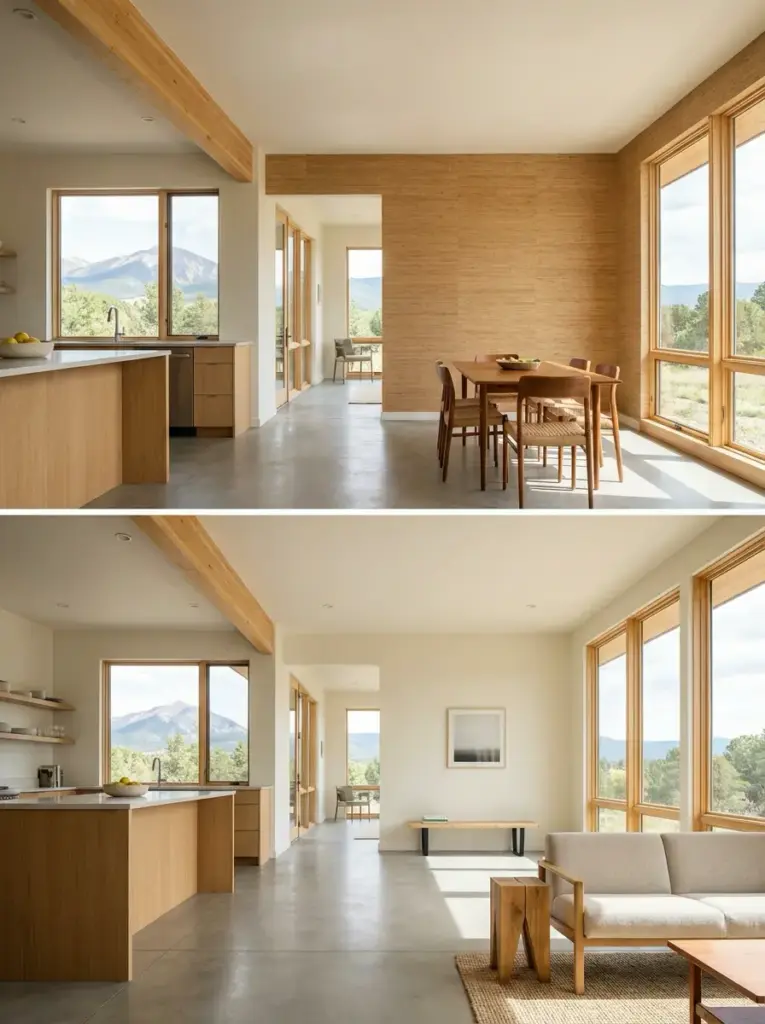
The dining area reads as a room within the room. This is one of the most valuable applications of wallpaper in contemporary interiors, where the architectural openness that allows light and connection also makes it harder to create spatial hierarchy within a single continuous space.
Why Installation Quality Determines the Design Outcome
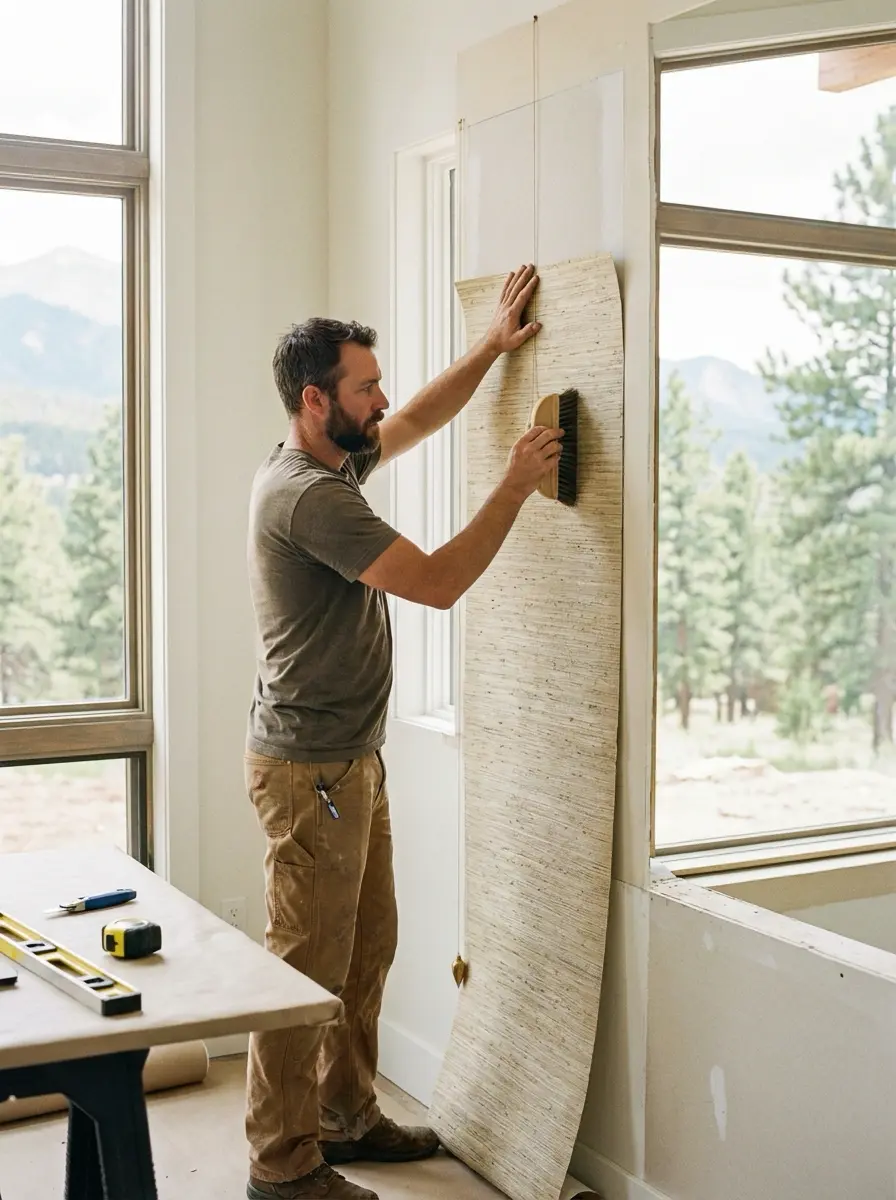
Wallpaper is a material where the gap between a good installation and a poor one is visible in the finished result and cannot be hidden after the fact. A poorly hung seam, a pattern that drifts across the width of the wall, a surface that wasn’t adequately prepared, or an adhesive choice that wasn’t appropriate for the substrate — all of these problems are visible as long as the wallpaper is on the wall. Unlike most finish materials, you can’t sand back a bad wallpaper installation. You remove it and start again.
What Surface Preparation Actually Involves
Professional installation begins before the wallpaper is touched. The wall surface must be smooth, clean, primed, and dry — and ‘smooth’ in a wallpaper context means smoother than it needs to be for paint, because wallpaper reveals surface irregularities that paint would absorb. In Colorado’s older building stock, this often means skimming over textured surfaces, filling nail holes, and sanding joint compound flat before priming. A wall that looks fine for paint will frequently reveal its imperfections under wallpaper, particularly under tonal or textural wallcoverings that make the surface the visual subject.
Pattern Layout and Drop Planning
Before hanging begins, professional installers plan the layout of the pattern across the wall — determining where the first drop will sit (typically centred on the most visible wall area or aligned to a focal point), how the pattern will fall at corners and ceiling lines, and how the pattern repeat will interact with the room’s proportions. Poor pattern layout is the most common installation error that homeowners notice and cannot live with — a bold wallpaper hung without thought to centring or symmetry will read as careless regardless of how well the individual seams are executed.
Climate Considerations
Dry rooms and seasonal humidity swings affect wallpaper installation in ways homeowners often underestimate. Natural fibre wallcoverings including grasscloth and sisal-inspired products must be acclimatised to the room’s humidity before installation; paste applied to dry fibres in winter conditions can be absorbed unevenly, leading to dimensional inconsistency as the wallpaper dries. Adhesive selection matters: some paste formulations that perform well in humid Eastern climates dry too quickly in Colorado’s dry air, reducing the working time available for adjustment.
These are the practical reasons why homeowners in dry, high-light regions, including those researching wallpaper installation in the Denver metro area, consistently prioritise installation experience in local conditions over price alone. The material and the climate have to be understood together — a technically competent installer unfamiliar with the room’s humidity profile may produce different results than one who plans around local conditions.
✏ Design note: Before any wallpaper installation, run the home’s HVAC system at its normal operational settings for at least 48 hours. If the installation is planned for winter, this means running heat rather than allowing the space to be cold during installation — winter interiors can drop to very low humidity levels that affect adhesive performance and natural fibre behaviour. The room should be at its normal occupied temperature and humidity before, during, and for at least 72 hours after installation.
Wallpaper Within a Broader Wall Finish Strategy
The most considered contemporary interiors don’t treat wallpaper as the wall finish decision. They treat it as one of several wall finish decisions made together, each appropriate to its room’s function and atmospheric requirements.
How Multiple Finishes Work Together
A typical high-quality interior might use: grasscloth in the primary bedroom (warmth, tactility, a material that reads as expensive without shouting); decorative plaster or limewash in the main living area (architectural, tonal, material depth without pattern); a feature wallpaper in the dining zone within the open plan (definition, identity); and painted walls throughout the remaining spaces (restraint, coherence, the neutral that allows the treated walls to read clearly). This combination gives the home interior hierarchy — different rooms feel distinct while sharing a material sensibility.
Wainscoting and Panel Systems
Panel systems — wainscoting, wall panelling, board-and-batten — are increasingly combined with wallpaper in contemporary interiors. The pattern: the lower half of the wall in painted or stained timber panelling, the upper half in a tonal wallcovering. This combination gives the room visual structure (the panel creates a strong horizontal datum) while allowing the wallpaper to add material complexity in the upper zone where it’s most visible at seated and standing eye level.
The Wall as a Design Decision
The client’s two photographs — the grey painted room and the grasscloth room — showed the same furniture in the same space. The second room was better not because of anything that had been added to it in the traditional decorative sense. It was better because one surface had been treated as a material decision rather than a background default.
That’s the shift driving wallpaper’s return to contemporary interiors. Not nostalgia, not trend-chasing — a recognition that walls are the largest surfaces in any room, and that leaving them all as painted backgrounds is a design decision as much as wallpapering one of them. The question is which default produces the more considered result.
In light-rich, architecturally clean interiors, the answer is increasingly clear. The rooms that feel most resolved — warmest, most complete, most like somewhere someone would want to spend time — are the ones where at least one wall is treated as a material, not just a colour.
FAQ: Wallpaper and Textured Finishes for Interiors
Q: Is wallpaper making a comeback in modern interiors?
Yes. Wallpaper is coming back as a finish material, not just a decorative pattern. The strongest modern uses are subtle woven textures, matte organic prints, tonal geometrics, grasscloth-inspired surfaces, and embossed wallcoverings that give walls depth. The point is not to make every room busy; it is to make one or two important surfaces feel more resolved than flat paint can.
Q: What types of wallpaper work best in modern homes?
Non-woven wallpaper is the safest all-round choice because it is stable, breathable, and easier to install or remove than older paper-based products. Grasscloth and natural fibre wallcoverings add warmth and texture, but they need careful acclimatisation. Vinyl and vinyl-coated wallcoverings are best for high-use spaces. Embossed and tonal micro-patterns work well when the wall needs depth without a loud print.
Q: Should I wallpaper one wall or the whole room?
Use one wallpapered wall when the material is bold, textured, or meant to define a focal point behind a bed, sofa, dining area, or entry view. Wallpaper the whole room only when the design is quiet enough to read as atmosphere rather than pattern. Subtle grasscloth, tonal linen effects, and fine geometrics can wrap a room beautifully; oversized prints usually work better as a controlled feature.
Q: Why does professional wallpaper installation matter?
Wallpaper is less forgiving than paint. Surface flaws, seam misalignment, pattern drift, air bubbles, and lifting edges stay visible in the finished room. Good installation includes wall repair, priming, drop planning, corner management, and the right adhesive for the wallpaper material. This matters even more with grasscloth, embossed textures, and large-repeat patterns, where small mistakes are easy to see.
Q: Can wallpaper and decorative plaster be used in the same home?
Yes. The best interiors often use different wall finishes for different jobs: grasscloth or wallpaper in bedrooms and dining zones, plaster or limewash in living areas, and simple paint where the wall should stay quiet. The key is hierarchy. Each finish needs a reason, so the home feels intentionally layered rather than randomly decorated.
Textured wallpaper changes how color reads, which is why living room color schemes should be tested beside fabric, wood, and daylight instead of chosen from a screen alone.
Related Interior Design Reading
If you are choosing wall treatments as part of a wider room plan, these guides help connect texture, furniture, and architectural detail:
- Interior design textures explains how wood, fabric, stone, metal, glass, and matte surfaces work together in one room.
- Solid wood wall panels in modern interiors covers a more architectural way to add warmth and rhythm to large wall surfaces.
- Modular sofas for small spaces shows how furniture scale changes the way a textured or wallpapered wall reads.
- Blackout curtains in modern interiors is useful when light control, fabric weight, and wall finish need to work together.
For a bedroom-specific version of this design problem, use these textured wall decor for a couple bedroom to balance lighting, bedding, wall decor, storage, and shared taste without making the room feel generic.
- 32shares
- Facebook0
- Pinterest32
- Twitter0
- Reddit0