In my second year of studying interior design, I had to present a living room concept to a critique panel. I’d spent three days on the colour scheme, researched the furniture, made a mood board. The sketch I drew to show the space took about twenty minutes and looked like a crime scene. The sofa was three times the height of the door. The ceiling appeared to be underground. My rug receded toward the viewer instead of away from it. The tutor said, gently but clearly: ‘The idea might be good. We can’t tell.’
The sketch killed the presentation. Not because the drawing was ugly — rough sketches are fine — but because the perspective was so wrong that the spatial relationships became unreadable. A living room where the furniture doesn’t fit through the door is not a design, it’s a problem. I’d put all my effort into the concept and none into the one skill that communicates it.
Interior design drawing is not about being a good artist. It’s about spatial communication — translating a three-dimensional idea into a two-dimensional drawing that another person can read correctly. The rules are learnable in an afternoon. The practice takes longer, but the core mechanics — horizon line, vanishing point, scale — are not mysterious.
- Why Interior Design Drawing Is Its Own Skill
- Materials: What Interior Designers Actually Use
- Perspective for Interior Spaces: The Only Rules That Matter
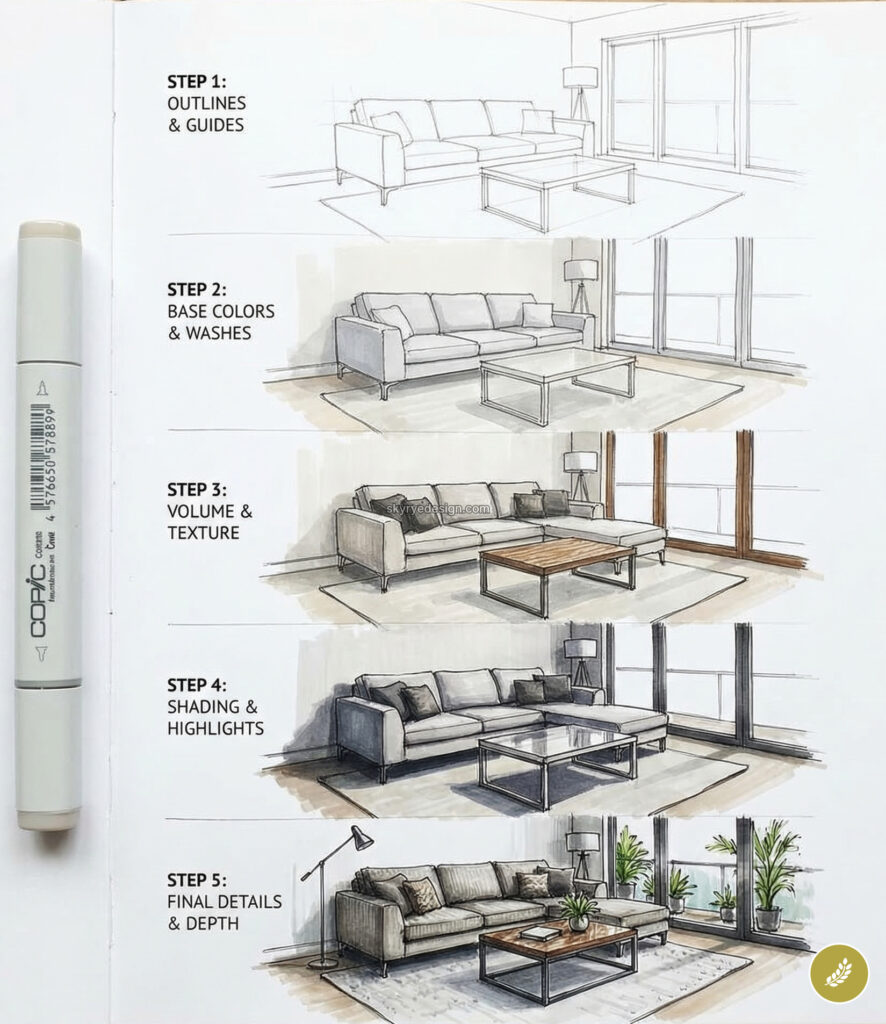
- How to Draw an Interior Room: 5 Steps
- Four Types of Interior Design Drawing
- 5 Interior Design Drawing Mistakes (and Their Fixes)
- Resources Worth Having in 2026
- The Drawing Is the Thinking
- FAQ: Interior Design Drawing
- Q: Do I need to be able to draw to be an interior designer?
- Q: What is 1-point perspective in interior design drawing?
- Q: What's the difference between a floor plan and an interior drawing?
- Q: What markers do interior designers use for sketching?
- Q: How do I draw furniture to the correct scale?
- Q: What's the best app for interior design drawing on iPad?
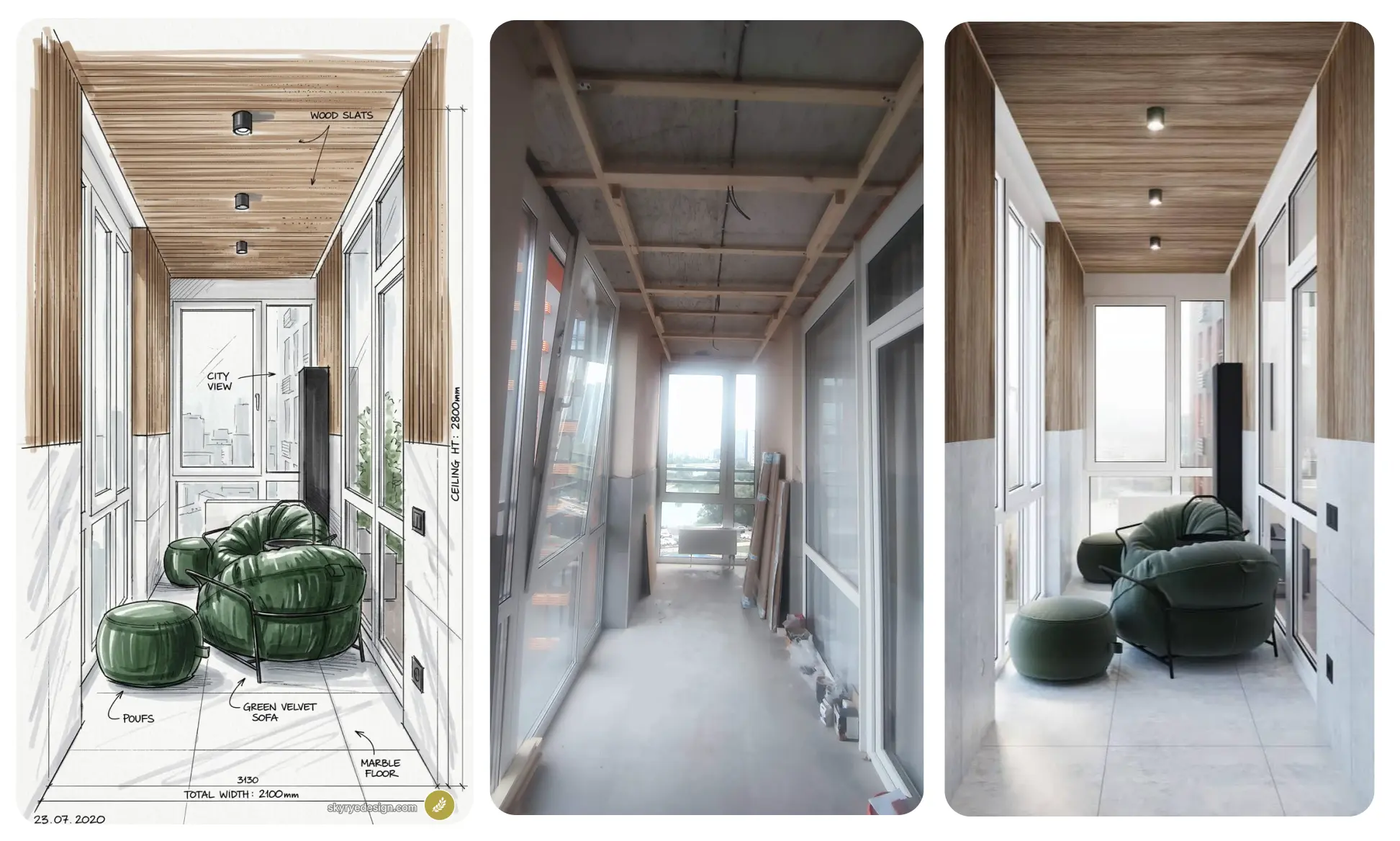
I remember when we were renovating our loggia, my first priority was to create a cozy nook where we could relax, gaze out over the city, and unwind, drinking tea or coffee, without fuss or rush. But the resulting designs were rather dull. Then I found a dark green marker and added an accent to the beige and gray palette. The sketch immediately took on new colors, and the result was quite pleasing. Slim black handles and soft chairs played a key role in the loggia’s cozy and comfortable feel.
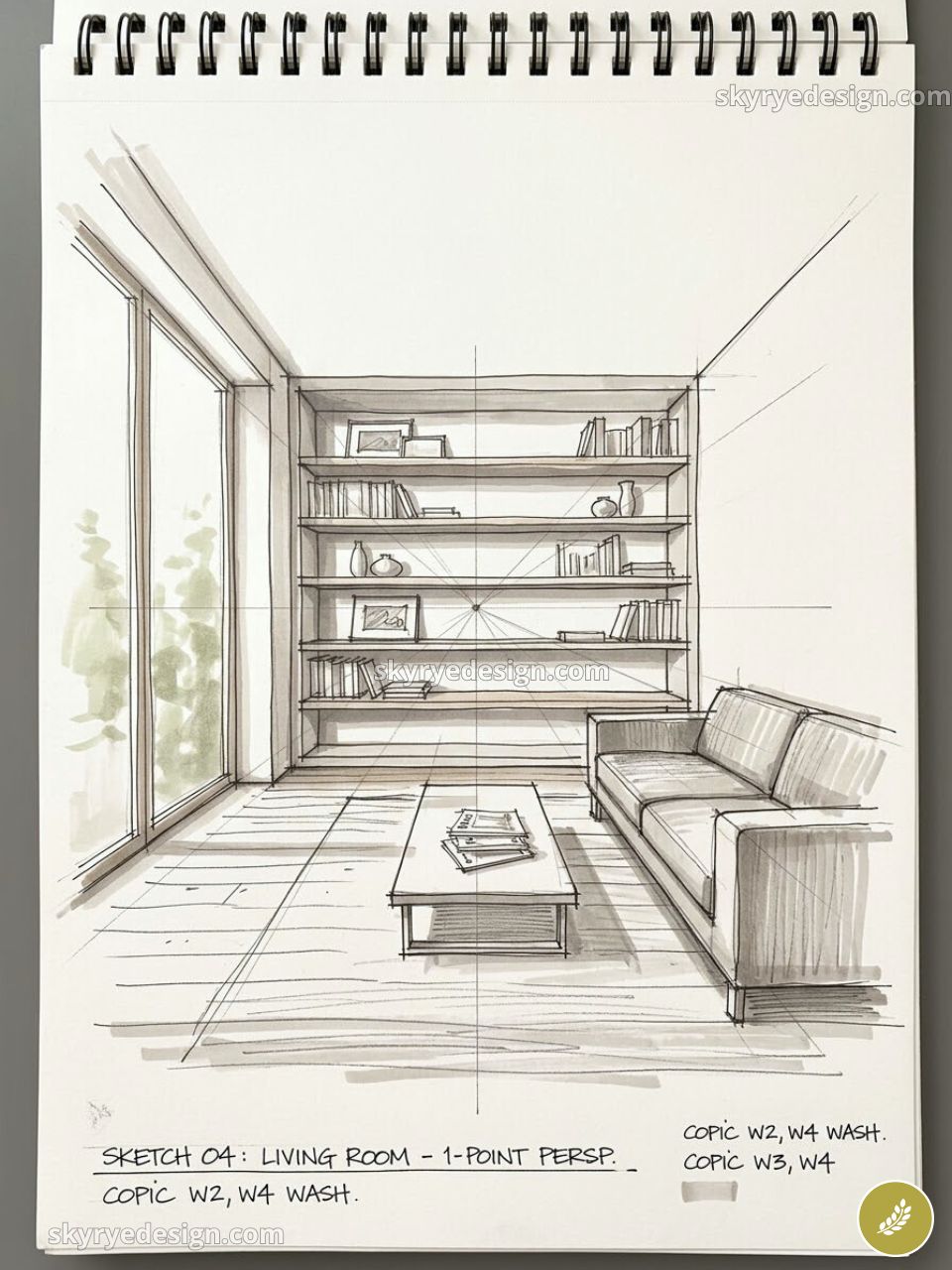
This guide covers them directly: why perspective works, how to set up a room in one-point and two-point perspective, how to draw furniture to scale, how to use line weight and marker rendering to make a sketch readable, and the five specific mistakes that make interior drawings fail.
Why Interior Design Drawing Is Its Own Skill
Most drawing tutorials focus on objects in isolation. Interior design drawing is different in one fundamental way: you’re drawing a space, and everything inside it must be consistent with that space. A sofa drawn at the wrong scale doesn’t just look odd — it tells the viewer that the room is a different size than you intend. The drawing communicates spatial information whether you want it to or not, and if that information is wrong, the design becomes unreadable.
The Three Things Every Interior Drawing Must Do
An interior design drawing serves three simultaneous functions: it visualises the space for the designer (does the furniture arrangement actually work?), it communicates the concept to a client or collaborator (what will this room feel and look like?), and it tests proportions before anything is built or bought (will that sofa leave enough circulation space?). A rough thumbnail sketch can do all three of these things in five minutes — if the perspective is correct. A beautifully rendered drawing with wrong perspective does none of them reliably.
Hand Drawing vs. Digital Tools in 2026
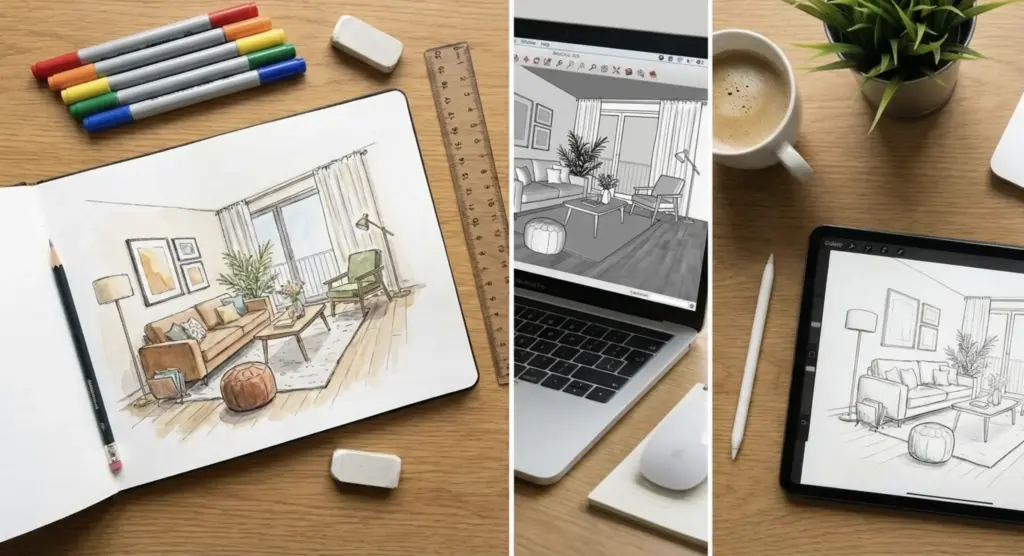
The honest answer is that professional interior designers in 2026 use both. Software like SketchUp, AutoCAD, and Revit handle technical precision for floor plans and construction documents. But hand sketching — on paper or in Procreate on an iPad — remains the fastest way to explore, communicate, and iterate on spatial ideas. If the tablet side is new, this guide to how to draw on iPad covers the basic app and layer setup.
The designer Ula Burgiel, whose work appears in London penthouse projects, has described interior sketching as ‘the only way to create truly original designs’ because the act of drawing forces spatial thinking that software interfaces can inhibit. The two skills are not competing — hand drawing is for thinking, software is for documenting.
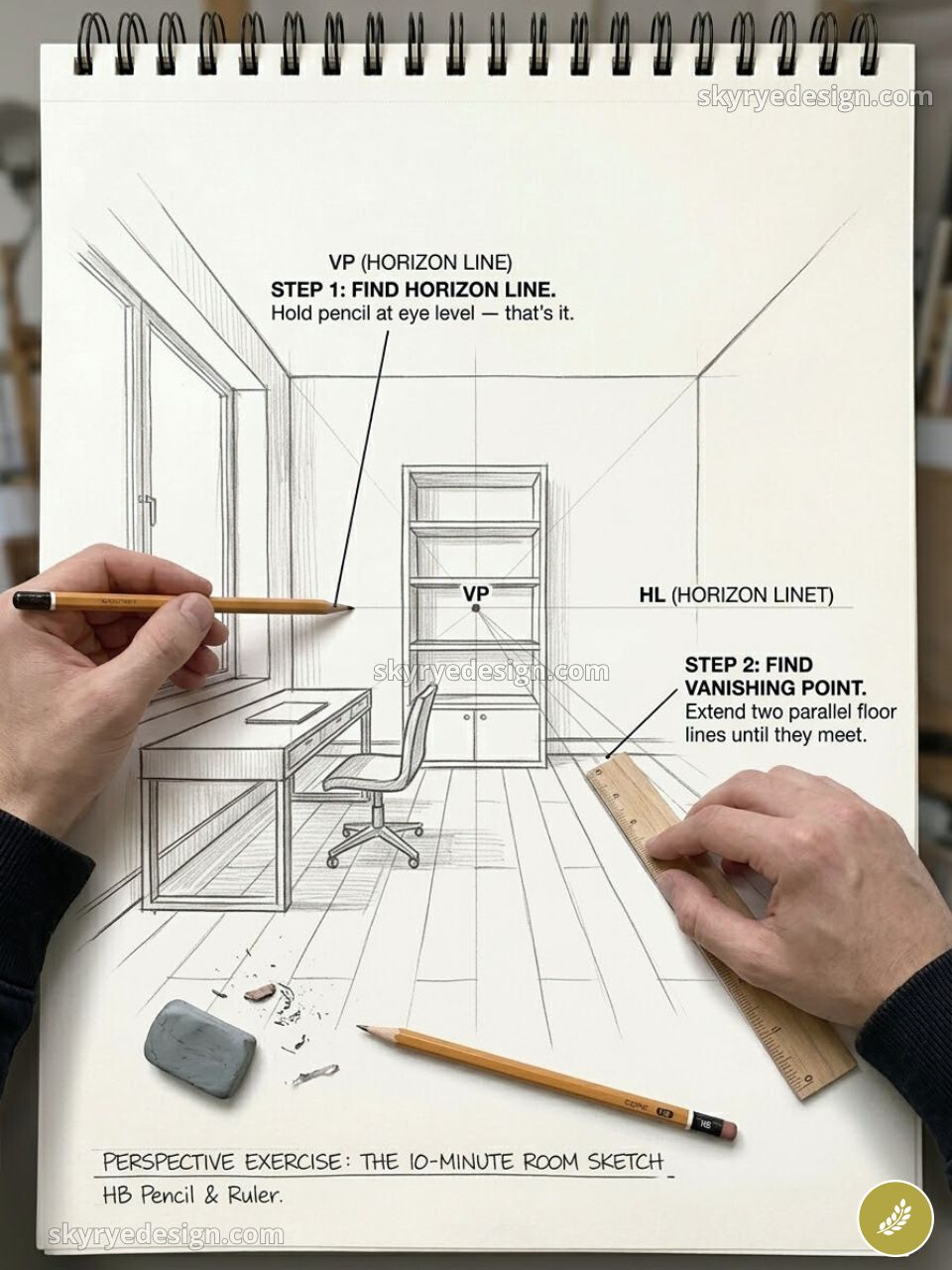
✏ Pro tip: Before investing in any drawing tools, spend one session with an HB pencil and a ruler, drawing the room you’re sitting in right now. Find the horizon line (hold a pencil at eye level — that’s it). Find the vanishing point (extend two parallel floor lines until they meet). This ten-minute exercise teaches more about interior perspective than an hour of reading.
Materials: What Interior Designers Actually Use
The professional interior sketching toolkit is simpler than you’d expect and more specific than most beginner guides acknowledge.
For Hand Sketching
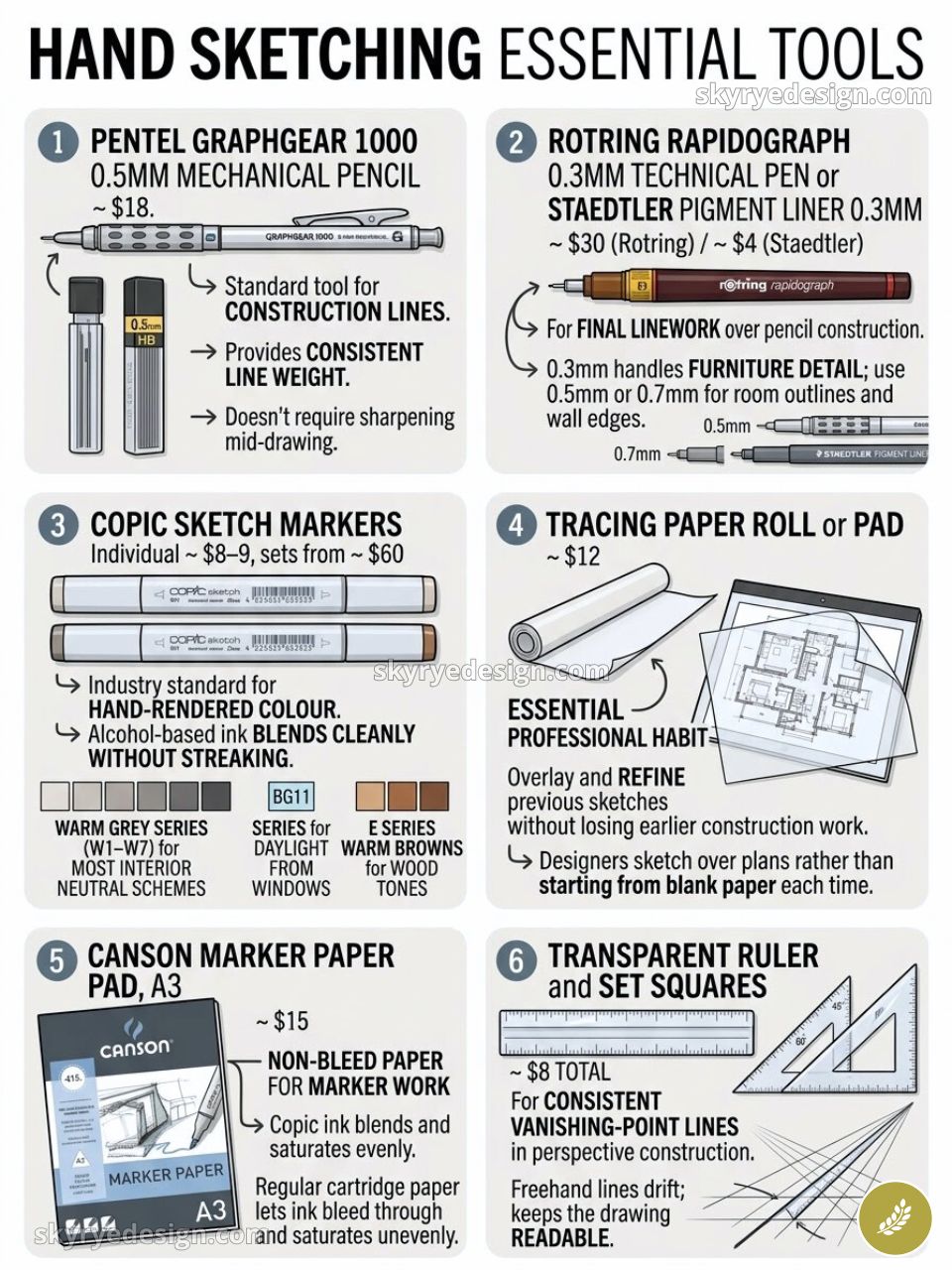
- 0.5mm mechanical pencil (Pentel GraphGear 1000, ~$18) — the standard tool for construction lines. A mechanical pencil gives consistent line weight and doesn’t require sharpening mid-drawing.
- Rotring Rapidograph 0.3mm technical pen (~$30) or Staedtler Pigment Liner 0.3mm (~$4) — for final linework over pencil construction. The 0.3mm handles furniture detail; use 0.5mm or 0.7mm for room outlines and wall edges.
- Copic Sketch markers (individual ~$8–9, sets from ~$60) — the industry standard for hand-rendered colour. Warm Grey series (W1–W7) covers most interior neutral schemes; add BG11 for daylight from windows and E series warm browns for wood tones. Copic’s alcohol-based ink blends cleanly without streaking.
- Tracing paper roll or pad (~$12) — essential professional habit. Designers sketch over floor plans and previous sketches rather than starting from blank paper each time. Tracing paper lets you overlay and refine without losing earlier construction work.
- Canson Marker Paper pad, A3 (~$15) — non-bleed paper for marker work. Regular cartridge paper lets Copic ink bleed through to the sheet below and saturates unevenly.
- 30cm transparent ruler and 45/60 degree set squares (~$8 total) — for consistent vanishing-point lines in perspective construction. Freehand perspective lines drift; even a rough ruler pass keeps the drawing readable.
For Digital Sketching
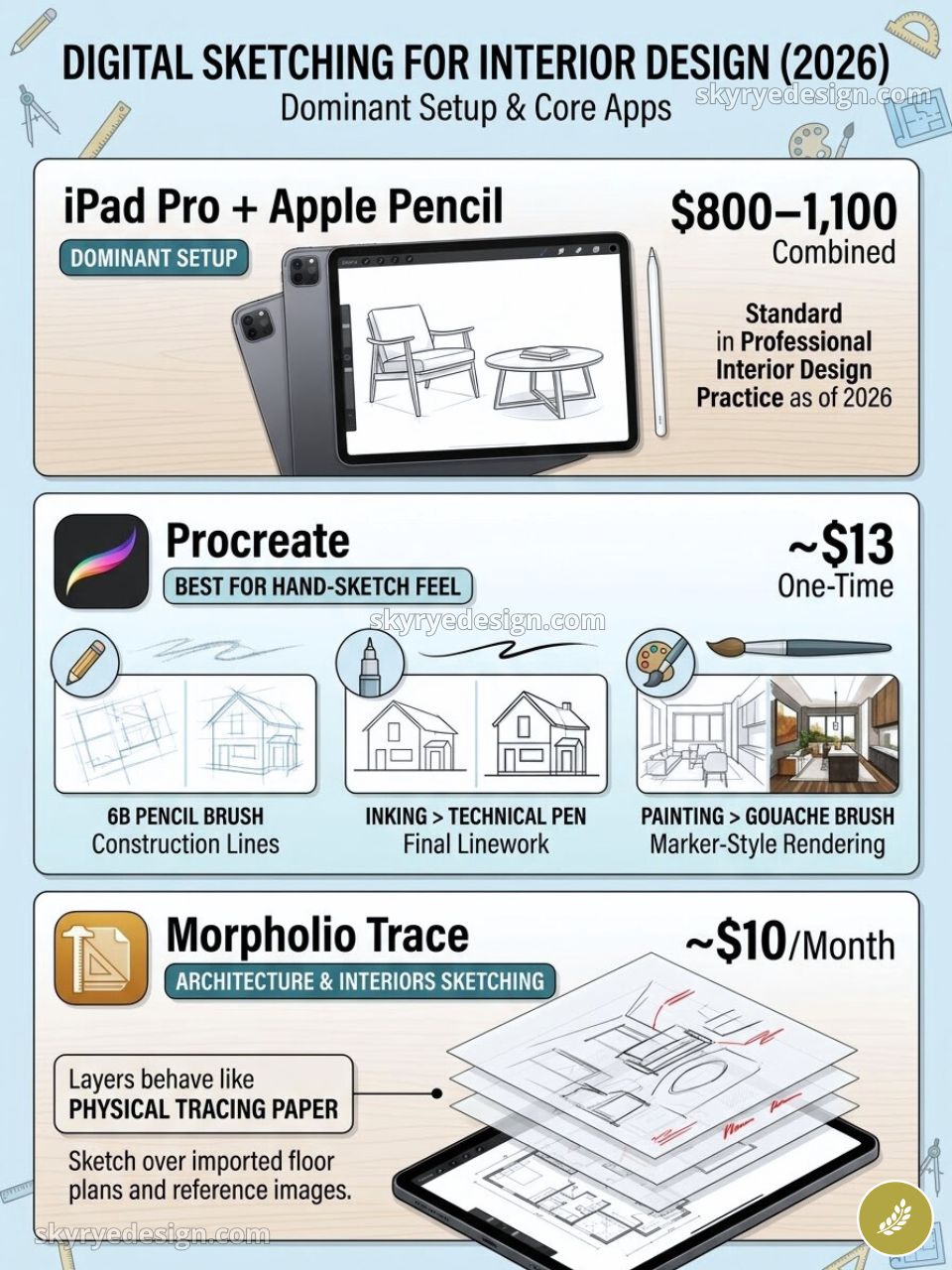
- iPad Pro + Apple Pencil (~$800–1,100 combined) — the dominant digital sketching setup in professional interior design practice as of 2026.
- Procreate (~$13 one-time) — best app for hand-sketch feel. The 6B pencil brush for construction lines; the Inking > Technical Pen for final linework; the Painting > Gouache brush for marker-style rendering.
- Morpholio Trace (~$10/month) — specifically designed for architecture and interior sketching over imported floor plans and reference images. Layers behave like physical tracing paper.
Perspective for Interior Spaces: The Only Rules That Matter
Perspective drawing has a reputation for being technical and difficult. For interior design purposes, you need two concepts and one piece of equipment (a ruler). Everything else follows from these.
The Horizon Line Is Your Eye Level
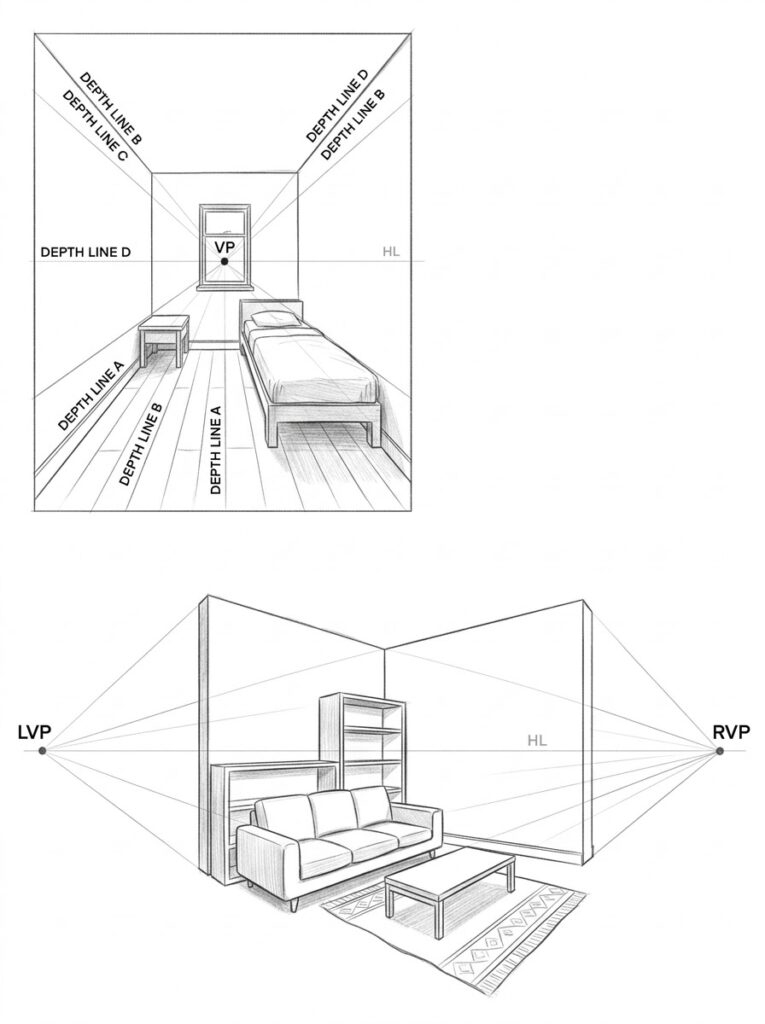
The horizon line in an interior drawing represents the height of the viewer’s eye. In a standard interior sketch, this is typically drawn at 1.5–1.7 metres from the floor — standing eye level. A horizon line drawn higher (say, 2 metres) makes the viewer appear taller or gives a slightly elevated viewpoint. A lower horizon (1.0 metres) creates the impression of a seated viewer and gives more ceiling presence in the drawing. The most common beginner mistake is placing the horizon arbitrarily, without a conscious decision about viewpoint. Decide on your eye level before drawing anything else, and mark the horizon line as the first thing on the paper.
The Vanishing Point Controls Depth
Every set of parallel lines in the real space — the wall edges, the floor, the ceiling, the tops of furniture — appears to converge at a single point on the horizon line when drawn in perspective. In a 1-point perspective interior (looking straight into the room), all depth lines converge at one central vanishing point.
In 2-point perspective (looking at a corner), lines converge at two separate vanishing points, one to the left and one to the right on the horizon. The room itself tells you which to use: if you’re drawing a wall face-on (the way most bedroom or living room sketches are composed), use 1-point. If you’re drawing a corner — two walls visible — use 2-point.
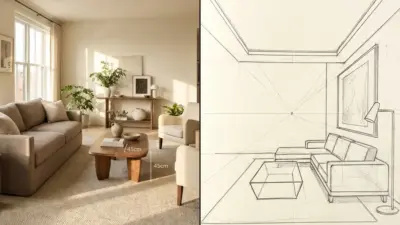
✏ Pro tip: Designer’s shortcut from IA Interior Architects: when working from a photo reference, ‘find the vanishing point’ by identifying two parallel lines in the image (a floor tile pattern, a ceiling edge, a skirting board) and tracing where they converge. Draw a horizontal line through that point — that’s the horizon. All other elements in the image vanish to points along this line.
How to Draw an Interior Room: 5 Steps
This sequence produces a 1-point perspective living room sketch — the most useful starting exercise for interior design drawing. All construction lines are drawn lightly in pencil; the final linework goes over them in ink or heavier pencil at Step 4.
Step 1: Establish the Horizon Line and Vanishing Point
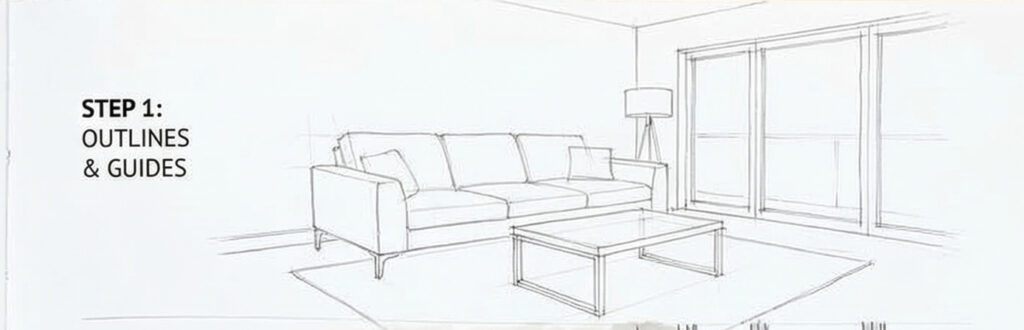
Draw a horizontal line across your paper at roughly two-thirds of the page height. This is the horizon — your eye level at approximately 1.6m. Place a single dot on this line, roughly centred (it can be offset for more dynamic compositions). This is your vanishing point. Everything in the room will be controlled by this point.
From the vanishing point, draw four light lines outward to the four corners of the paper — these define the ceiling, floor, and side walls of the room. The shape enclosed by these four lines is the back wall of the room. Draw a rectangle within this enclosed area; this rectangle is the far wall face-on. You now have an empty box — the basic room shell.
Step 2: Add Wall Depth, Floor and Ceiling Lines
The floor in front of the back wall and the ceiling above it are defined by your perspective lines. Establish the floor plane by drawing a horizontal line across the bottom of your back wall rectangle — this is the floor-wall junction. Draw lines from each lower corner of the back wall to your vanishing point; these are the side-wall/floor junctions receding into the distance.
Do the same from the upper corners for the ceiling. The room now has depth. Add a door, windows, or architectural details to the back wall — these are drawn as flat rectangles on the back wall face with no perspective distortion, because the back wall is parallel to your picture plane in 1-point perspective. Skirting boards, cornicing, and dado rails follow the perspective lines you’ve already drawn.
✏ Pro tip: Use a door as your scale reference from the start. A standard door is 2.0–2.1 metres tall. Establish the door height on the back wall, then use that measurement to check every other element in the room. A sofa that’s taller than the door is wrong. A ceiling that’s lower than the door top is impossible. The door is your built-in proportion checker.
Step 3: Draw Furniture Using Boxes
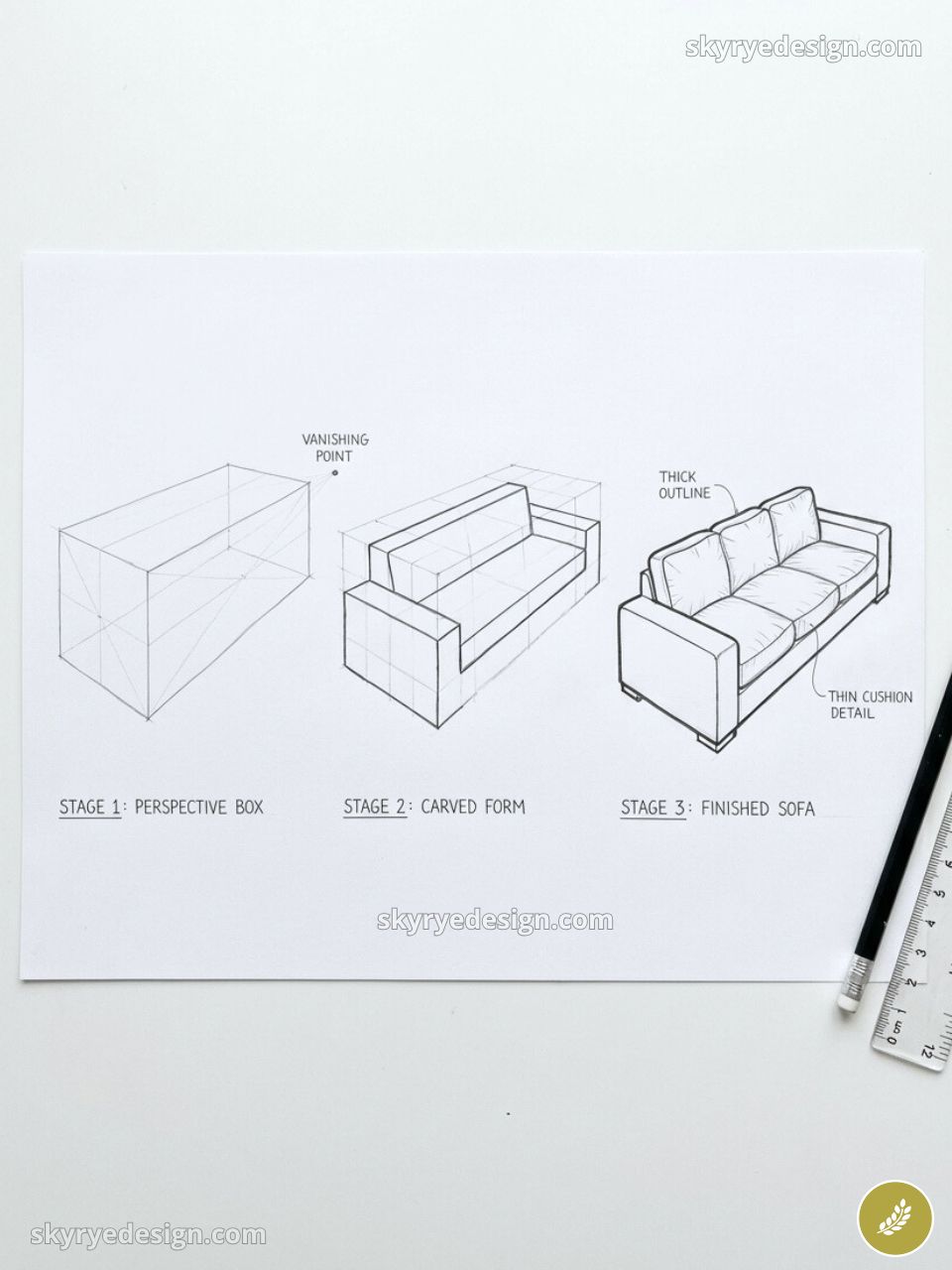
Every piece of furniture in a 1-point perspective interior drawing starts as a box. Draw the front face of the box as a flat rectangle (parallel to the picture plane, no perspective distortion). From each corner of the front face, draw lines converging to your vanishing point — these are the sides and top receding into the room.
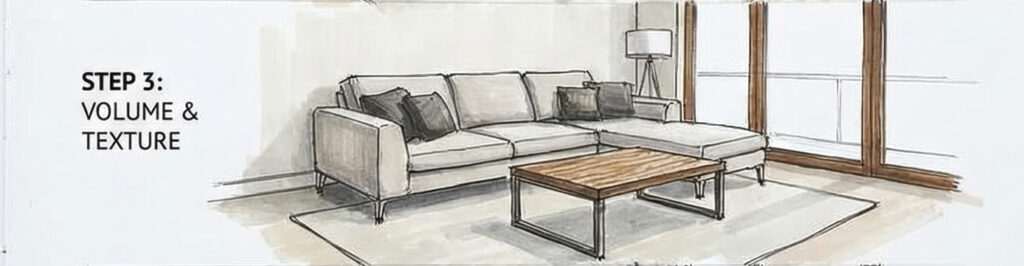
Add a back edge parallel to the front face at the correct depth. You now have a furniture box in the correct perspective. From this box, you can carve out or add the specific furniture form: round the corners for a sofa, add legs below the box for a chair, add shelves within the box for a bookcase. A common table is literally a rectangular box (the table surface) with four thin vertical boxes below it (the legs). The box method works for every rectangular piece of furniture in the room.
Step 4: Ink the Final Lines with Varied Line Weight
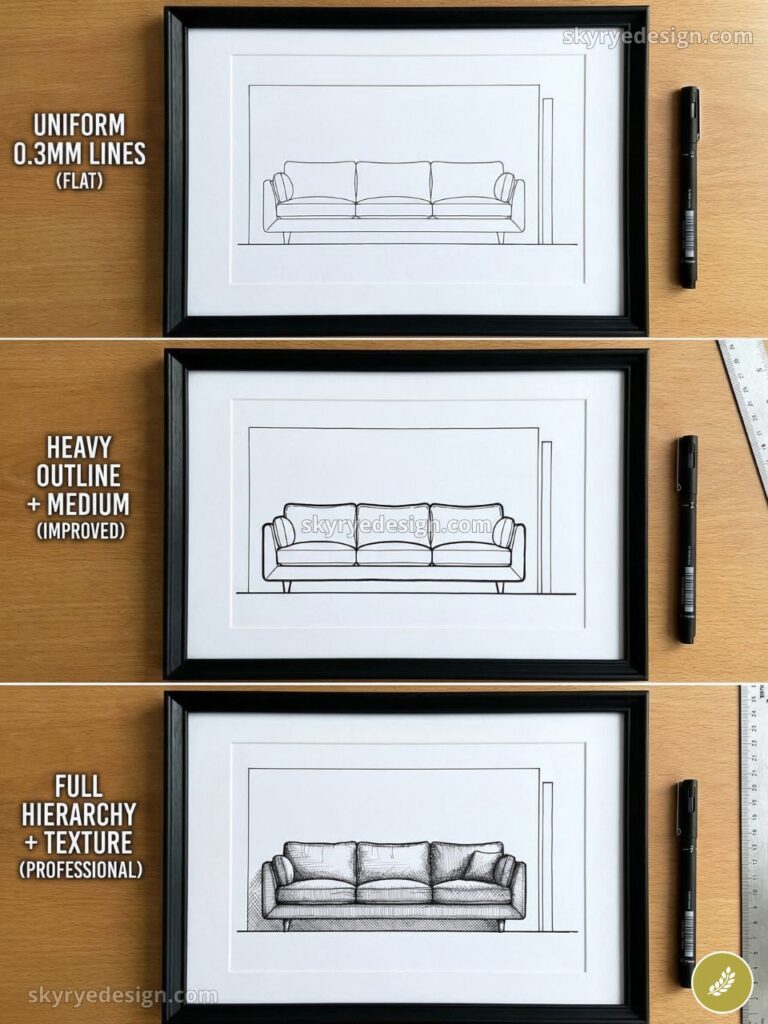
Once the pencil construction is complete, go over the final lines with ink — but vary the line weight intentionally. Use your heavier pen (0.5mm or 0.7mm) for wall edges, floor-wall junctions, and the outlines of large furniture. Use 0.3mm for furniture detail, fabric folds, and smaller elements. Use 0.1mm for hatching textures (wood grain, fabric, tile patterns).
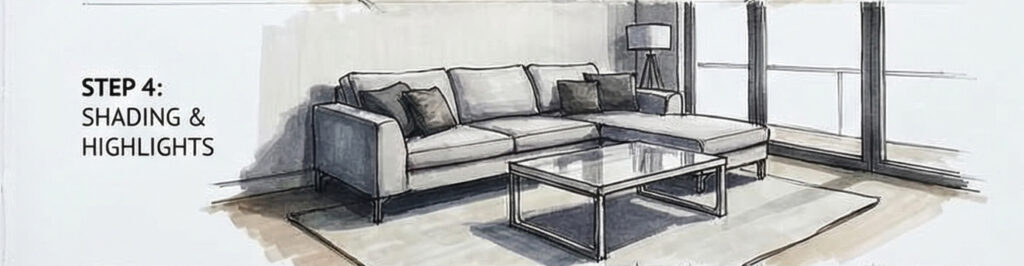
The hierarchy of line weight tells the viewer what is important and what is background: thick lines read as structure and mass; thin lines read as surface and detail. A drawing with uniform line weight throughout — everything the same weight — is harder to read because the eye has no guidance on what to look at first. Erase all construction pencil marks after the ink is fully dry.
Step 5: Marker Rendering: Light, Shadow, and Material
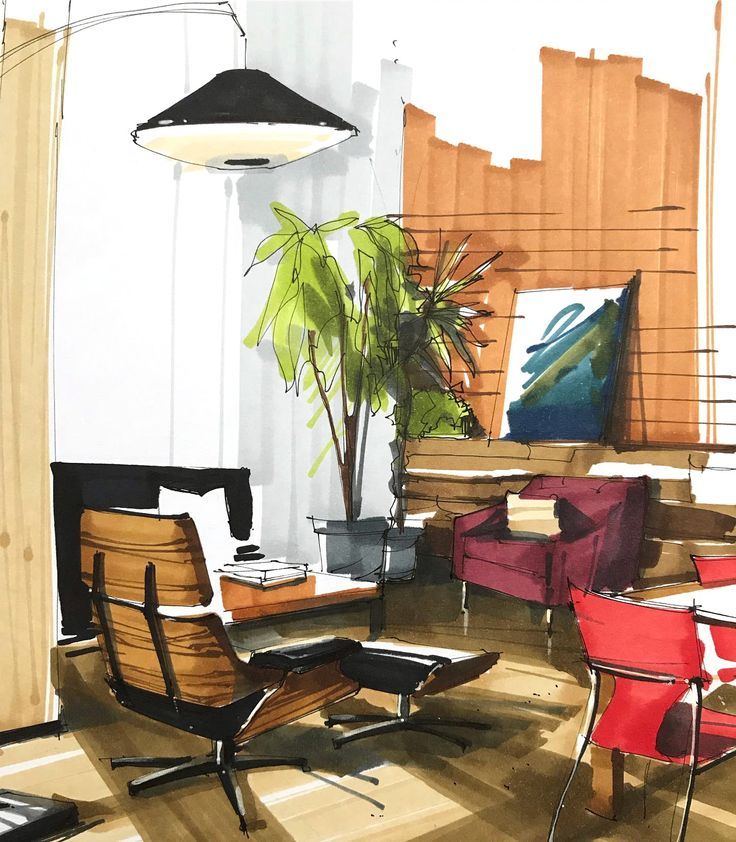
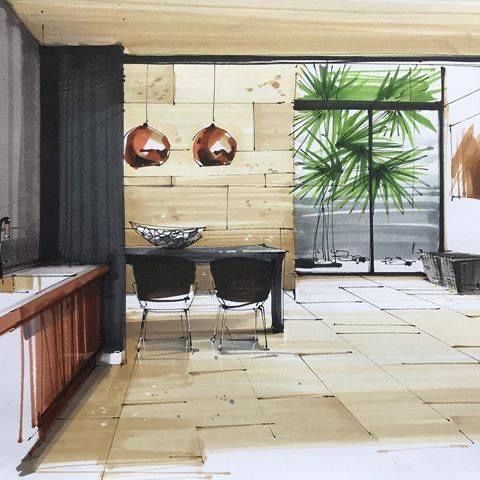
Marker rendering doesn’t require full colour throughout. The most effective interior sketches use colour selectively — a rendered sofa, a coloured wall, a lit window — against areas of plain white paper. This selective approach reads faster and is easier to control.
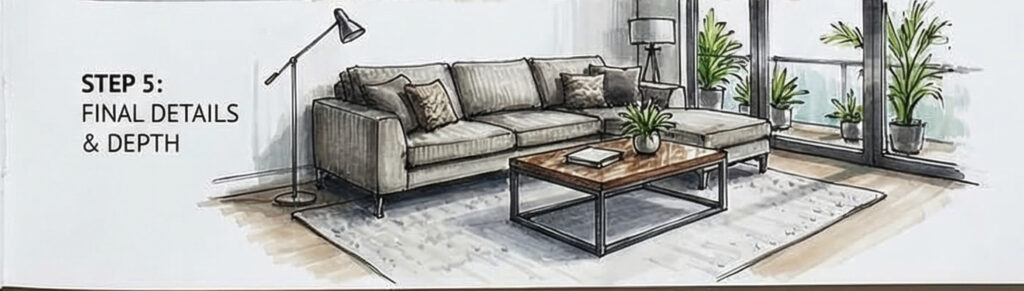
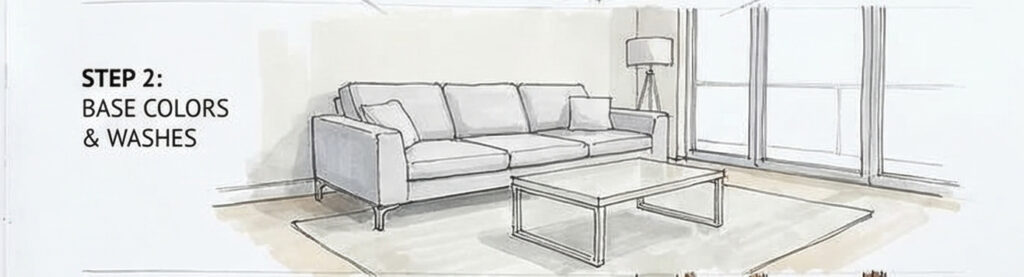
Start with the lightest tones: use Copic W1 or W2 across the floor and ceiling as a base tone, leaving the window and brightest surfaces as bare paper. Add W3–W4 for mid-shadow areas: the underside of furniture, the wall corners, the recessed areas. The deepest shadows (under the sofa, inside a bookcase) get W5–W7. Apply material colours over the grey base: E series warm browns for wood, BG11 for daylight from windows, your client’s chosen accent colour for cushions or feature walls. Keep the marker strokes directional — floor marks run horizontally, wall marks run vertically, ceiling marks follow perspective.
Four Types of Interior Design Drawing
1. Conceptual Sketch
The fastest and most important drawing in a designer’s toolkit. Done in two to five minutes, often on tracing paper or the back of whatever is available, the conceptual sketch captures spatial layout, furniture massing, and circulation paths — not detail, not finish.
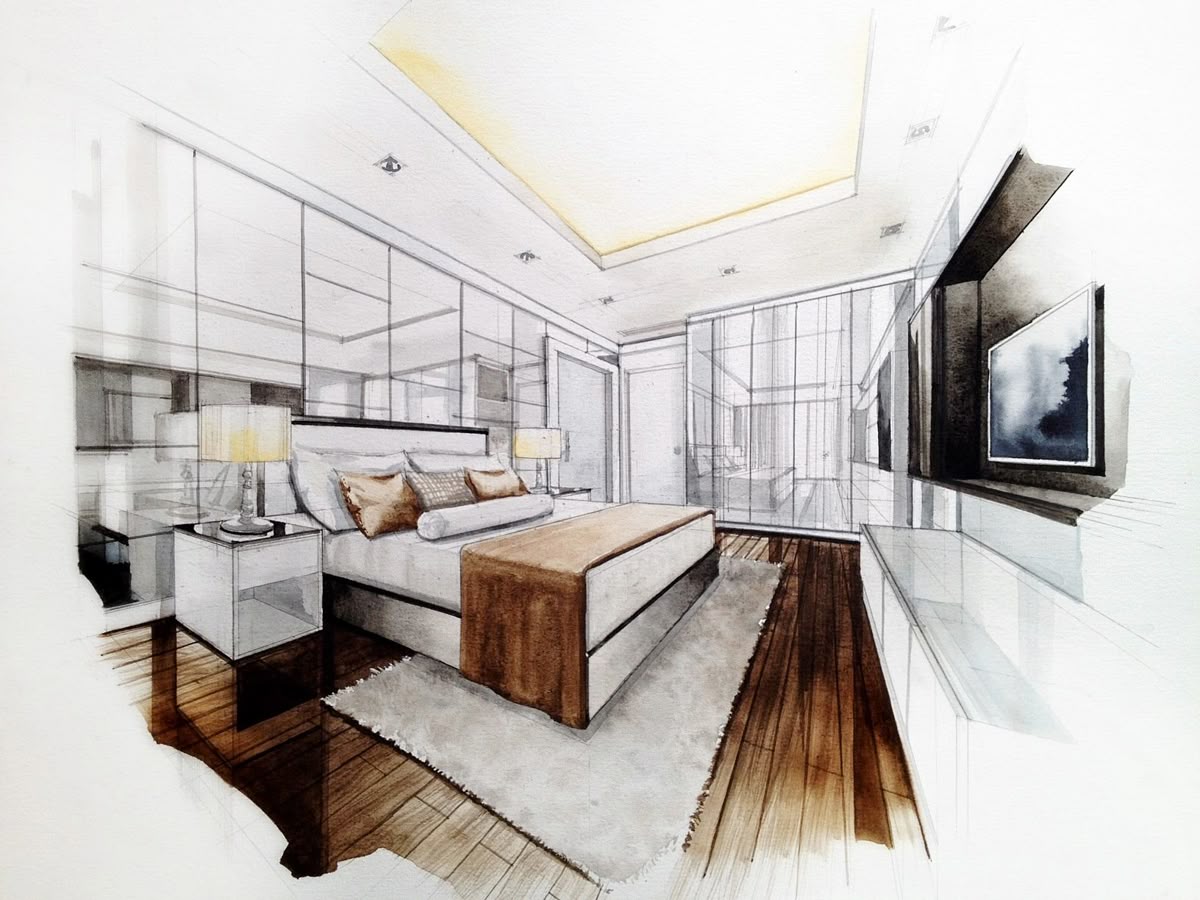
The purpose is to test whether an idea works spatially before investing time in refined drawings. Professional designers produce dozens of these before committing to a design direction. Quality is irrelevant at this stage; spatial logic is everything.
2. Floor Plan
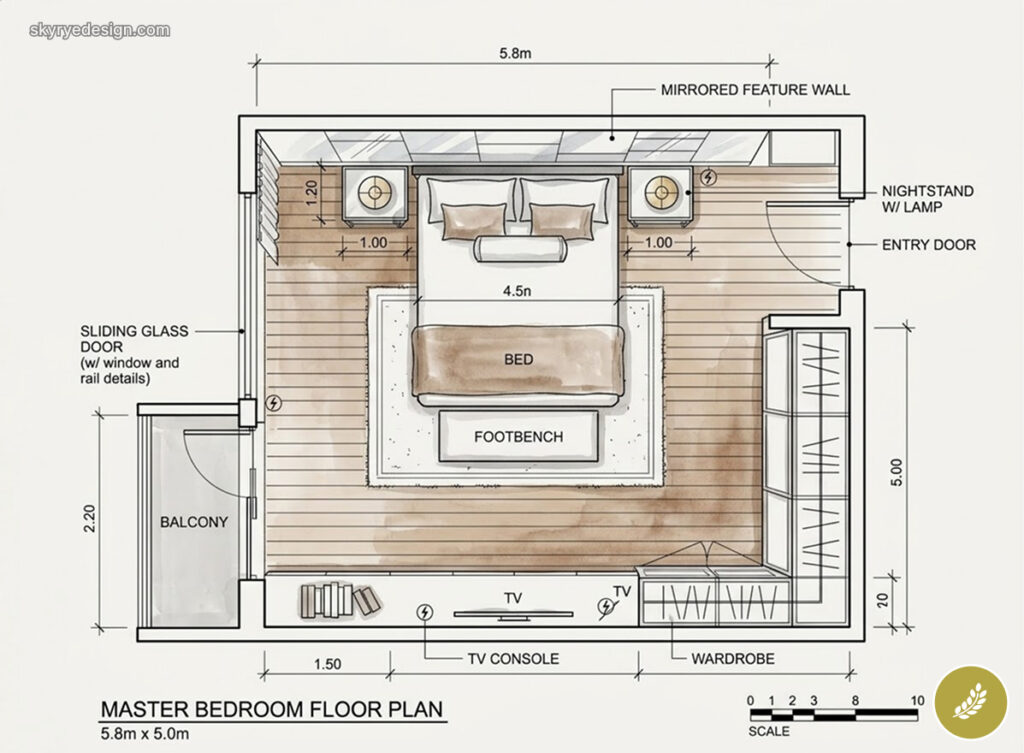
A floor plan is a scaled top-down view of the room with the ceiling removed, typically drawn at 1:50 scale for residential spaces (1cm on paper = 50cm in reality) or 1:100 for larger commercial projects. Floor plans show wall positions, door and window openings, furniture placement, and circulation paths. They’re drawn on graph paper or in CAD, using standard architectural symbols for doors (a quarter-circle arc showing the swing), windows (a parallel line within the wall), and fixtures. The floor plan is the most technically precise interior design drawing and is the basis for contractor documentation. For beginners: draw your own bedroom or living room at 1:50 on 5mm graph paper. Each grid square represents 25cm × 25cm.
3. Elevation Drawing
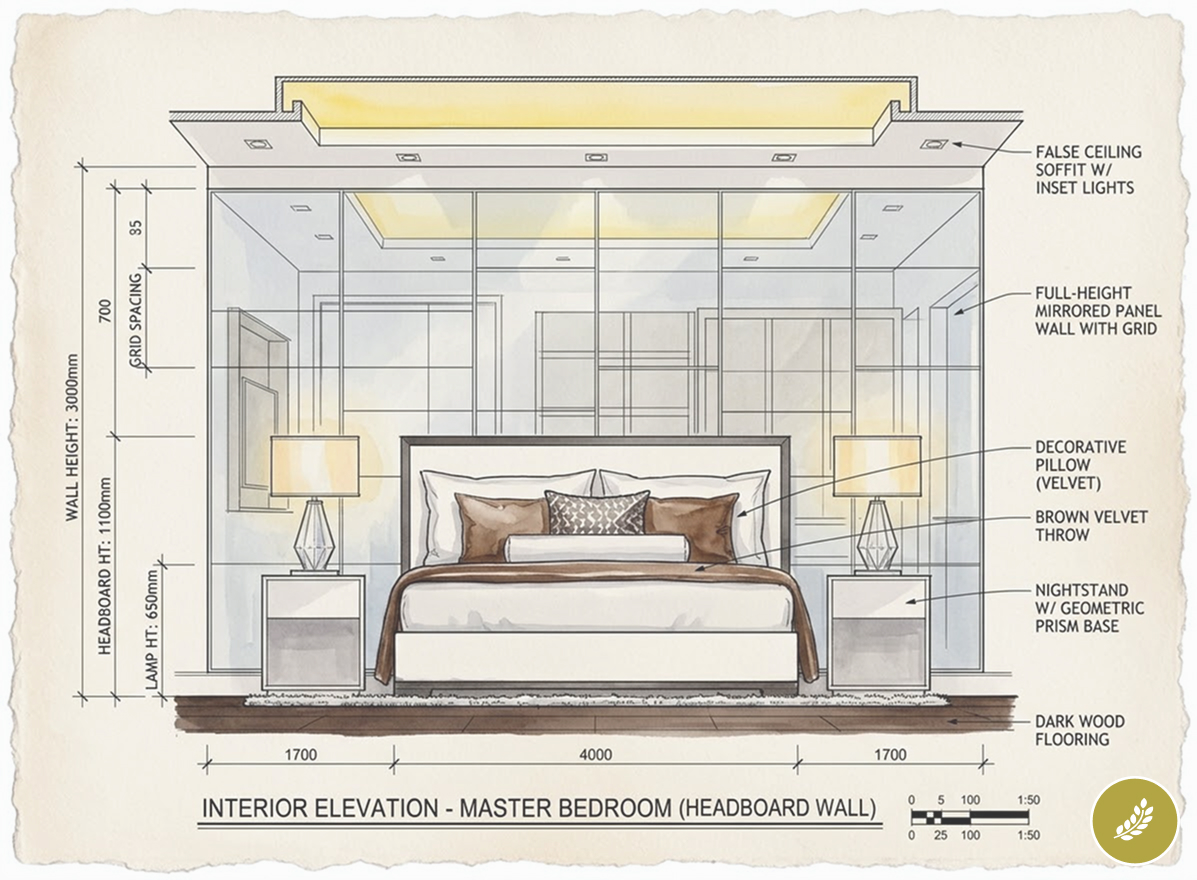
An elevation is a flat, face-on view of a single wall — as if you removed the opposite wall and photographed straight in. Elevations show the heights of furniture, the positioning of artwork, the profile of shelving, and the relationship between architectural elements (skirting, dado rail, picture rail, cornice). They’re drawn at the same scale as the floor plan. A set of four elevations (one per wall) plus the floor plan gives a complete spatial description of a room. Elevations are especially important for kitchen and bathroom design, where wall-mounted elements and precise clearances matter.
4. Perspective Presentation Drawing
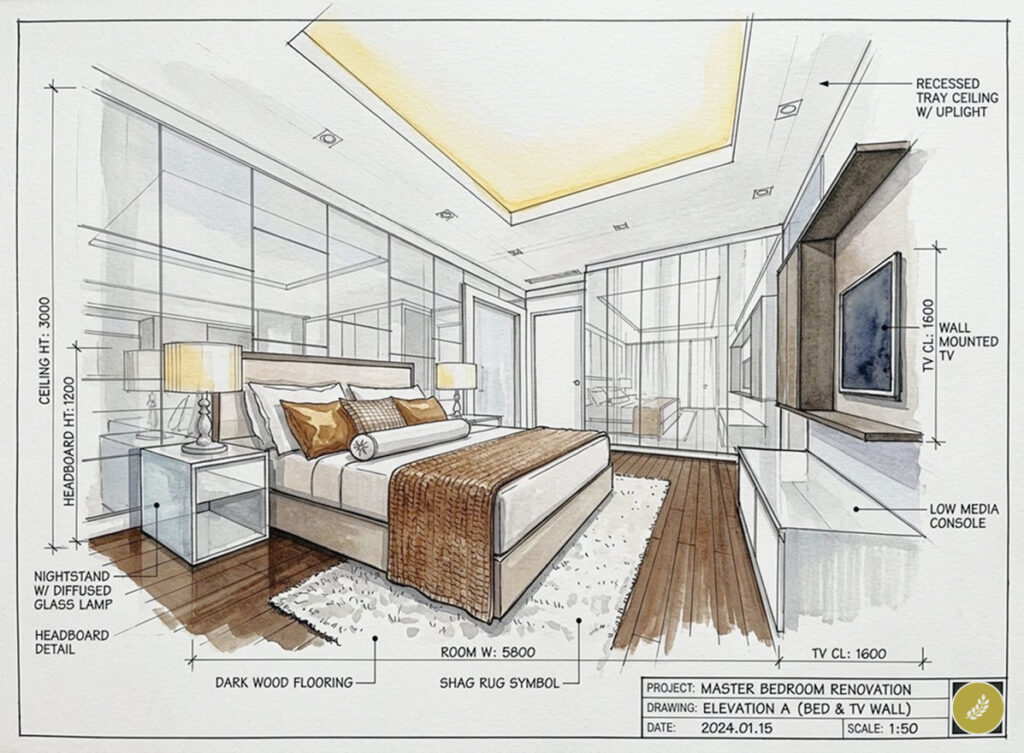
The drawing type covered in the five-step section above: a three-dimensional view of the room that shows what the space will feel and look like. This is the drawing that clients respond to most immediately, because it shows the room as it will be experienced rather than as a technical document.
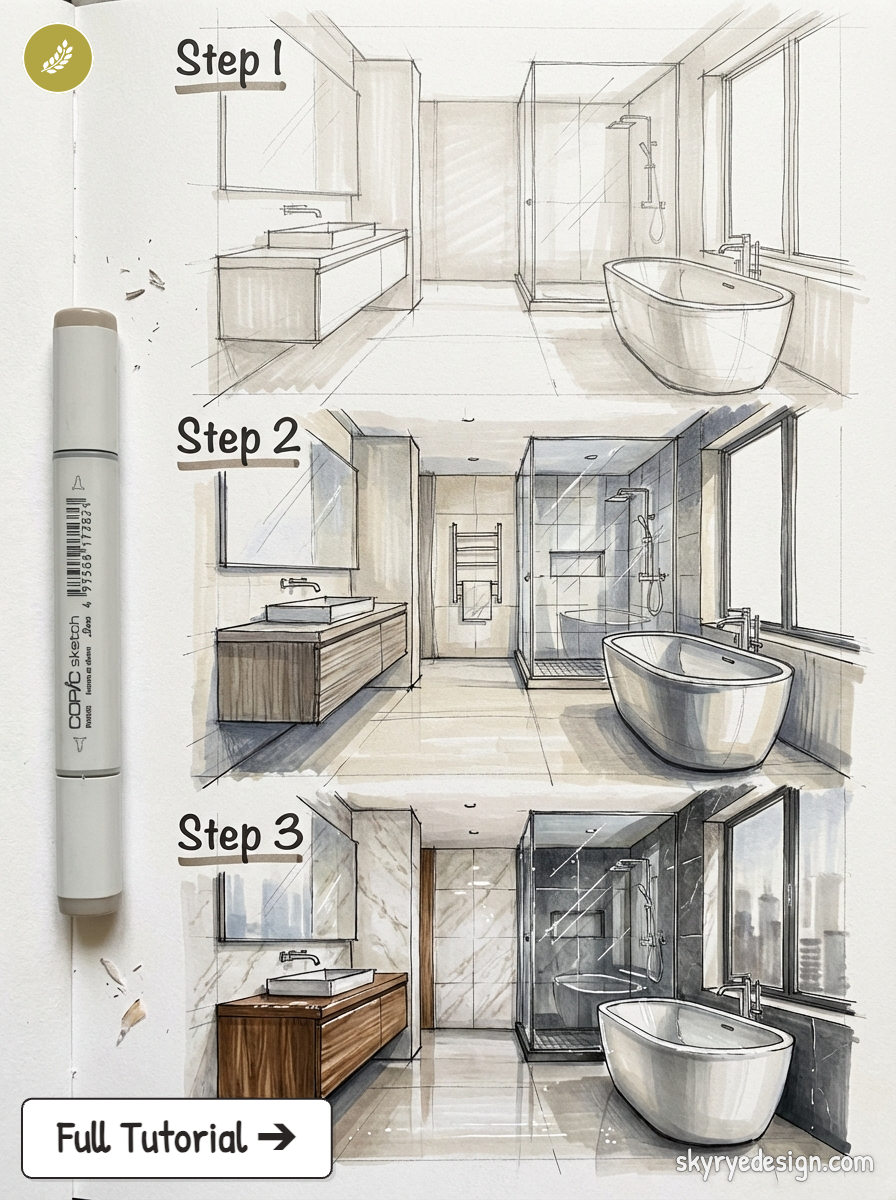
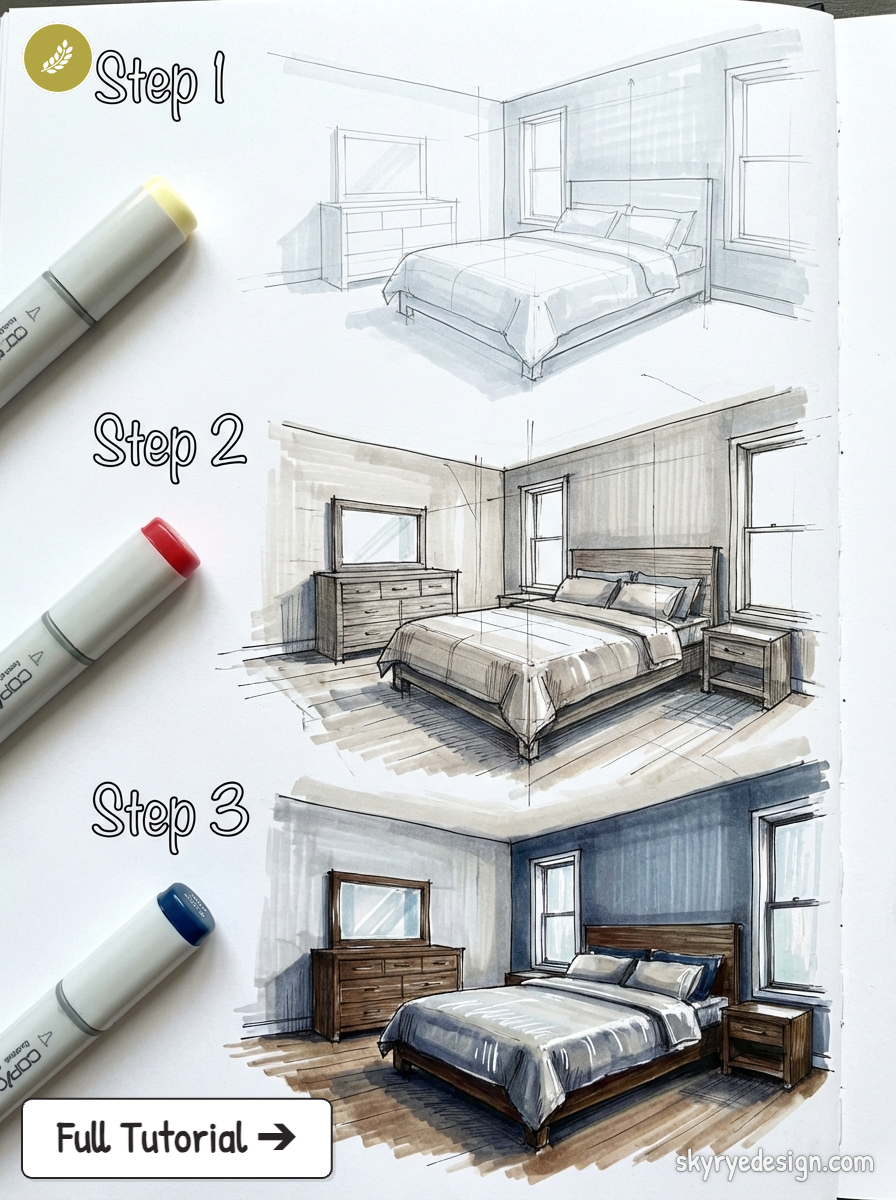
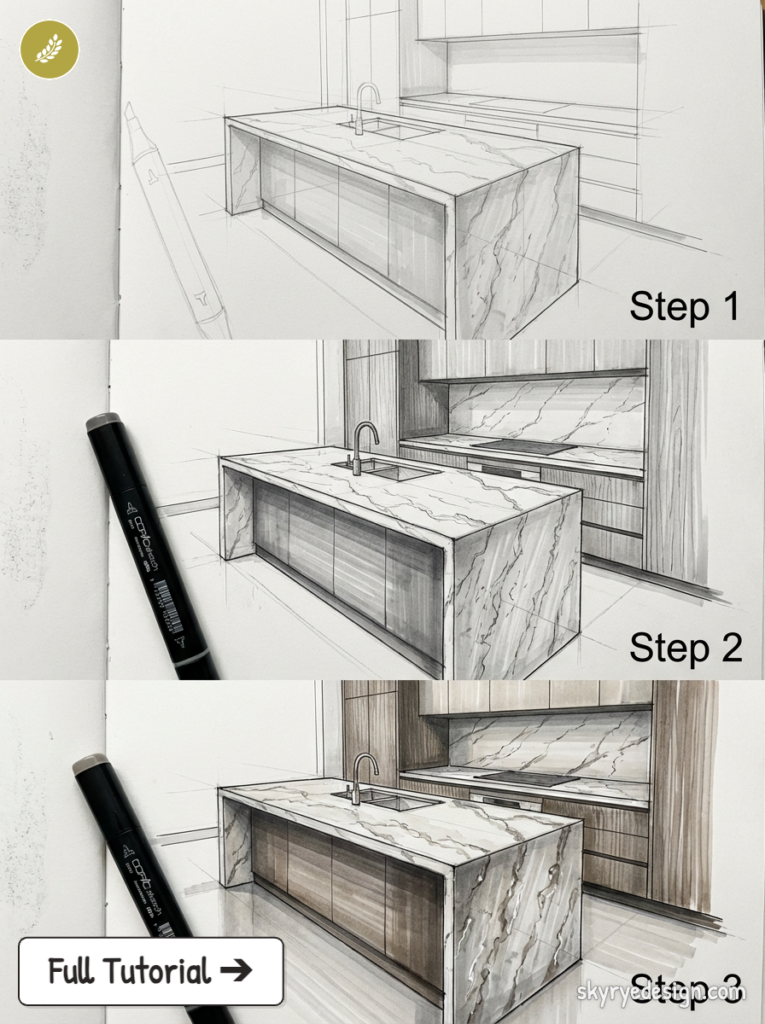
Presentation drawings are typically drawn in 1-point or 2-point perspective, rendered with markers or watercolour, and may include people or plants as scale references. The standard in professional practice is a loose, confident style — not photo-realistic rendering, but a drawing that communicates atmosphere, material, and proportion clearly.
✏ Pro tip: For practice: find an interior photograph you admire — a magazine spread, a hotel lobby image — and draw it. Not copy it pixel by pixel, but reconstruct it: find the horizon line and vanishing point, draw the room shell, add furniture boxes. This ‘reverse engineering’ exercise teaches perspective faster than any textbook because you’re verifying your construction against a known result. I spent three months doing this with one image per week and it fixed every perspective problem I had.
5 Interior Design Drawing Mistakes (and Their Fixes)
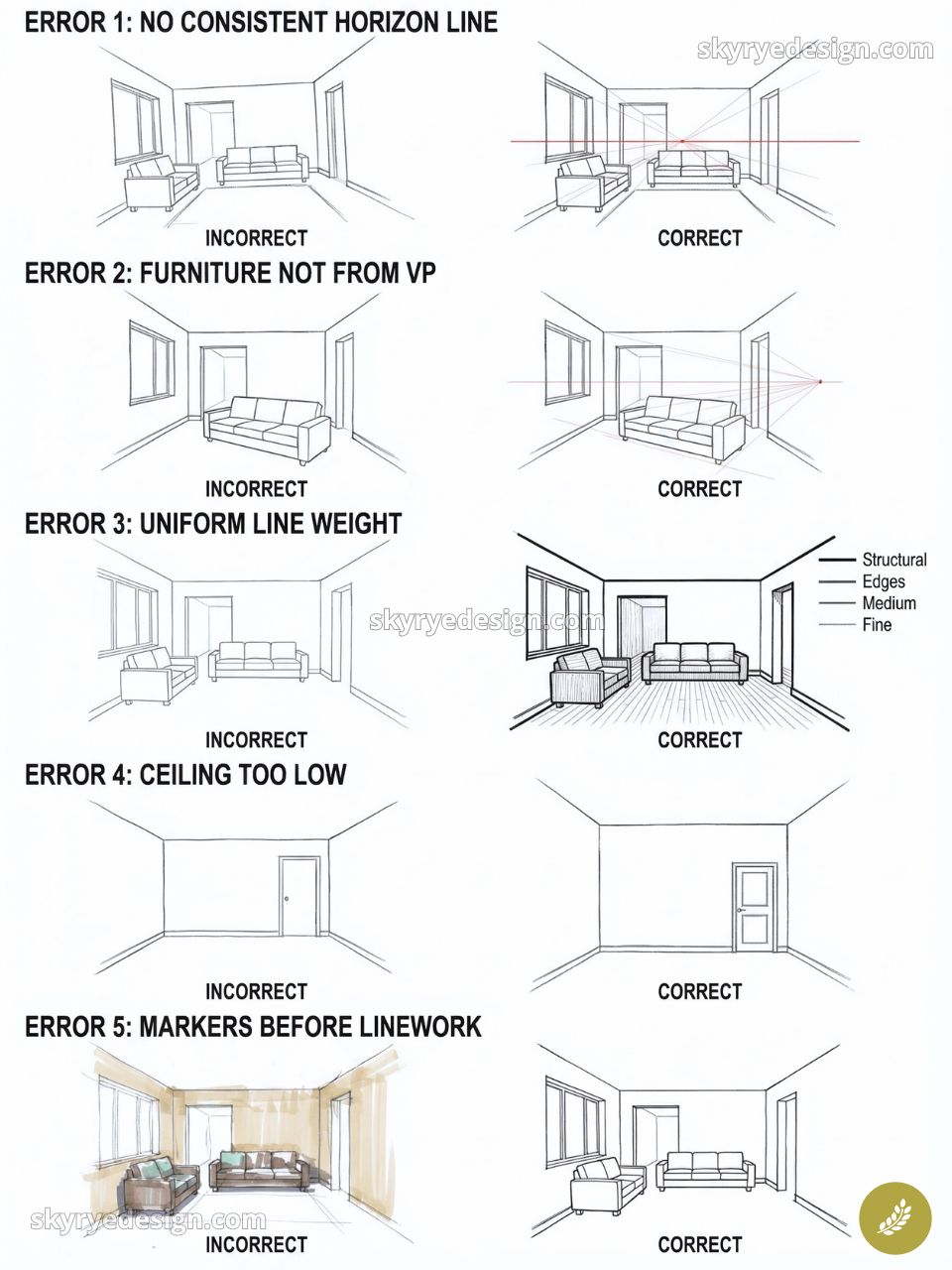
1. No Consistent Horizon Line
The most fundamental error. Drawing furniture, walls, and the floor without establishing a single horizon line first produces a drawing where each element appears to be at a different eye level — a room that looks physically impossible. Fix: draw the horizon line before drawing anything else. Every receding line in the drawing must converge to a point on this line. If you find a line that doesn’t, it’s wrong.
2. Furniture Not Drawn from the Vanishing Point
Furniture drawn freehand without reference to the vanishing point will be in a slightly different perspective from the room, creating a subtle but immediately detectable spatial inconsistency. The sofa looks like it’s facing a different direction from the room it’s in. Fix: every receding line of every piece of furniture must pass through (or converge toward) the room’s vanishing point. Use a ruler and draw a faint line from each furniture corner back to the VP to check.
3. Uniform Line Weight Throughout
A drawing where all lines — room edges, furniture outline, cushion detail, wall texture — are the same weight is difficult to read because there’s no visual hierarchy. The eye doesn’t know where to start. Fix: three line weights minimum. Heavy (0.7mm) for structural edges and wall outlines. Medium (0.3mm) for furniture profiles. Fine (0.1mm) for surface texture and hatching. This alone makes a mediocre drawing readable.
4. The Ceiling Is Too Low
Beginners draw ceilings much lower than they should be — often barely above head height — because they’re thinking about the picture frame rather than the room’s real dimensions. A standard ceiling is 2.4–2.7 metres. Using a door (2.0–2.1m) as a scale reference prevents this: the ceiling should be clearly above the door top, and the gap should look proportionally right for the room type you’re drawing.
5. Markers Applied Before Linework Is Complete
Applying Copic markers to incomplete linework is the easiest way to create a drawing you can’t fix. Marker ink is permanent; lines drawn over it read differently from lines drawn on bare paper; and the temptation to avoid inking areas already rendered leads to an incomplete drawing. Fix: complete all linework in ink and erase all pencil construction before touching a marker. The drawing should be fully legible in line only before any colour is added.
Resources Worth Having in 2026
- ‘The Sketch. Interior Design Drawing’ by Olga Sorokina (~$28, PDF or Amazon) — the clearest single resource on professional interior sketching technique, written by a working sketch artist and interior architect. Strong on marker technique and perspective shortcuts.
- School of Sketching by Olga Sorokina — BASE online course (~$150) — the industry-standard beginner course for interior sketching. Covers 1-point perspective from zero, furniture construction, marker rendering. More structured than YouTube alternatives.
- Morpholio Trace app (~$10/month, iOS) — worth the subscription specifically for the ability to sketch over imported floor plans and reference images. Layers behave like physical tracing paper overlay.
- Copic Warm Grey Set (W1, W2, W3, W5, W7) — ~$45 for five markers — the minimum Copic investment for interior rendering. These five markers cover the full range of neutral room tones. Add BG11 (cool daylight) and E35 (wood) as the next two purchases.
- ‘Francis D.K. Ching — Architectural Graphics’ (~$35) — the canonical reference for line weight conventions, drawing types, and perspective construction in architectural drawing. Directly applicable to interior design.
The Drawing Is the Thinking

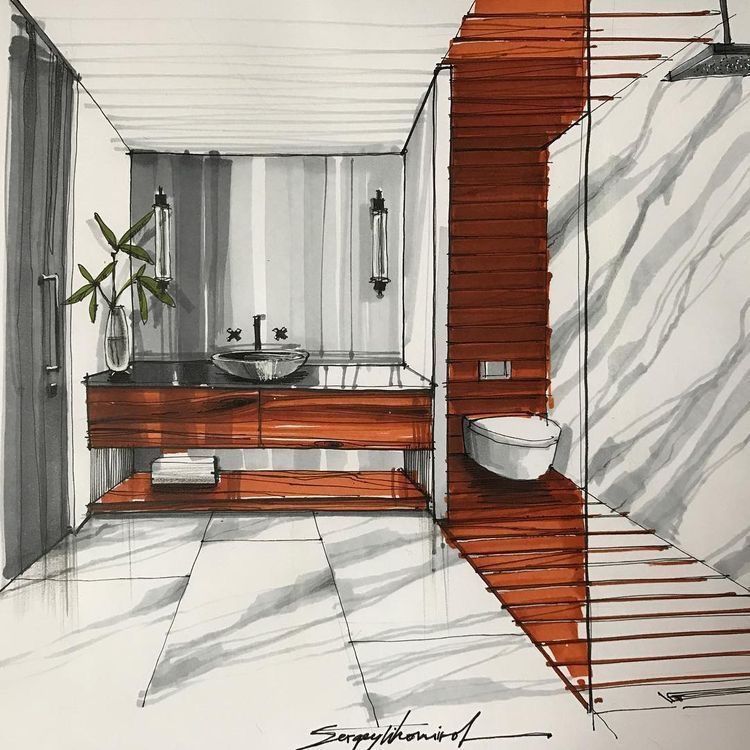
The sofa that was three times the height of the door was a perspective problem. But it was also a thinking problem: I hadn’t actually tested whether my furniture arrangement worked before presenting it. The sketch exposed the gap between the idea in my head and the idea on paper, and it did so in front of a critique panel rather than in my own sketchbook.
That’s the real argument for learning interior design drawing: not that clients want pretty pictures (some do), but that the act of drawing forces you to resolve spatial problems that feel resolved in your head but aren’t. The moment you try to draw a sofa into a room at the correct scale and it doesn’t fit, you know the layout doesn’t work. Software can do this too — but a sketch does it in five minutes, before you’ve committed to anything.
Start with the horizon line. Place the vanishing point. Draw the room as a box. Everything else is detail.
FAQ: Interior Design Drawing
Q: Do I need to be able to draw to be an interior designer?
Not at a high artistic level — but you need to be able to communicate spatial ideas on paper, which is a learnable technical skill rather than a talent. The core requirement is perspective drawing: the ability to represent a three-dimensional room on a two-dimensional surface in a way that another person can read correctly. This takes most beginners about ten to twenty focused practice sessions to develop to a functional level. Software tools (SketchUp, AutoCAD) handle technical precision; hand sketching handles rapid ideation and client communication.
Q: What is 1-point perspective in interior design drawing?
One-point perspective is the drawing system used when you’re looking straight at one wall of a room. All depth lines — the floor receding into the room, the ceiling, the side walls — converge at a single vanishing point on the horizon line. The back wall is drawn flat, with no perspective distortion. One-point is the most common perspective for interior presentation drawings because it clearly shows the far wall as a feature, places furniture in a readable arrangement, and is the easiest perspective system to construct accurately from a floor plan.
Q: What’s the difference between a floor plan and an interior drawing?
A floor plan is a top-down scaled technical drawing showing the layout of walls, furniture, and openings — it’s a map of the space. An interior drawing (or perspective drawing) shows the space from a person’s eye level, simulating what you’d see standing in the room. Both are essential in interior design practice: the floor plan tests spatial layout and provides contractor documentation; the perspective drawing communicates atmosphere, material, and proportion to clients. Elevations (face-on wall drawings) are a third drawing type that shows wall heights and wall-mounted elements precisely.
Q: What markers do interior designers use for sketching?
Copic Sketch markers are the industry standard for hand-rendered interior drawings. For neutral room tones: the Warm Grey series (W1–W7) covers the full tonal range. W1 for light floors and ceilings; W3–W4 for mid-tone walls and shadows; W5–W7 for deep shadows under furniture and in recesses. Add BG11 for cool daylight from windows, E35 for wood tones, and your client’s accent colour for focal elements. Each Copic Sketch marker costs ~$8–9; a working set of eight to twelve markers covers most interior presentations. Copic’s alcohol-based ink blends without streaking and is refillable.
Q: How do I draw furniture to the correct scale?
To capture the imposing scale of interior spaces, practice drawing rooms that showcase the raw textures of the brutalist style.
Start with a door as your scale reference — a standard door is 2.0–2.1 metres tall. Establish the door height in your drawing first, then use that measurement to check every other element. A standard sofa is approximately 85–90cm high and 200–240cm wide; a dining table is 75cm high; a ceiling is typically 2.4–2.7m. In a 1:50 scale floor plan, 1cm on paper equals 50cm in reality. In a perspective sketch, use the door as a constant visual check: nothing in the room should be taller than the door, the ceiling must be clearly above it, and furniture should be visibly smaller than a standing person.
Q: What’s the best app for interior design drawing on iPad?
Two apps dominate professional practice in 2026. Procreate (~$13 one-time) for freehand sketching — the 6B pencil brush replicates hand-drawing feel closely, and the layers system works like physical tracing paper overlay. Morpholio Trace (~$10/month) for sketching over imported floor plans and reference images — it’s designed specifically for architecture and interior design workflows, with perspective guides, scale tools, and a library of furniture symbols. Most professionals use both: Procreate for presentation drawings, Morpholio for technical overlay work.
- 1.6Kshares
- Facebook0
- Pinterest1.6K
- Twitter0
- Reddit0