The first time I walked a loft kitchen project, I spent ten minutes just looking at the ceiling before I touched the floor plan. The timber beams were at 4.8 meters, the brick ran floor to ceiling on two walls, and the slab subfloor had a six-centimeter variation across the kitchen zone.
- Why loft kitchens need a different design approach
- Working with brick, beams, high ceilings, and uneven floors
- Kitchen layout decisions in open loft spaces
- Bespoke cabinetry and precision joinery
- Materials that suit high-end loft kitchens
- How appliances, ventilation, and storage affect the final design
- What designers can learn from Soho loft kitchens
- 10 Loft kitchen ideas / references
- Open-plan industrial loft kitchen with marble island
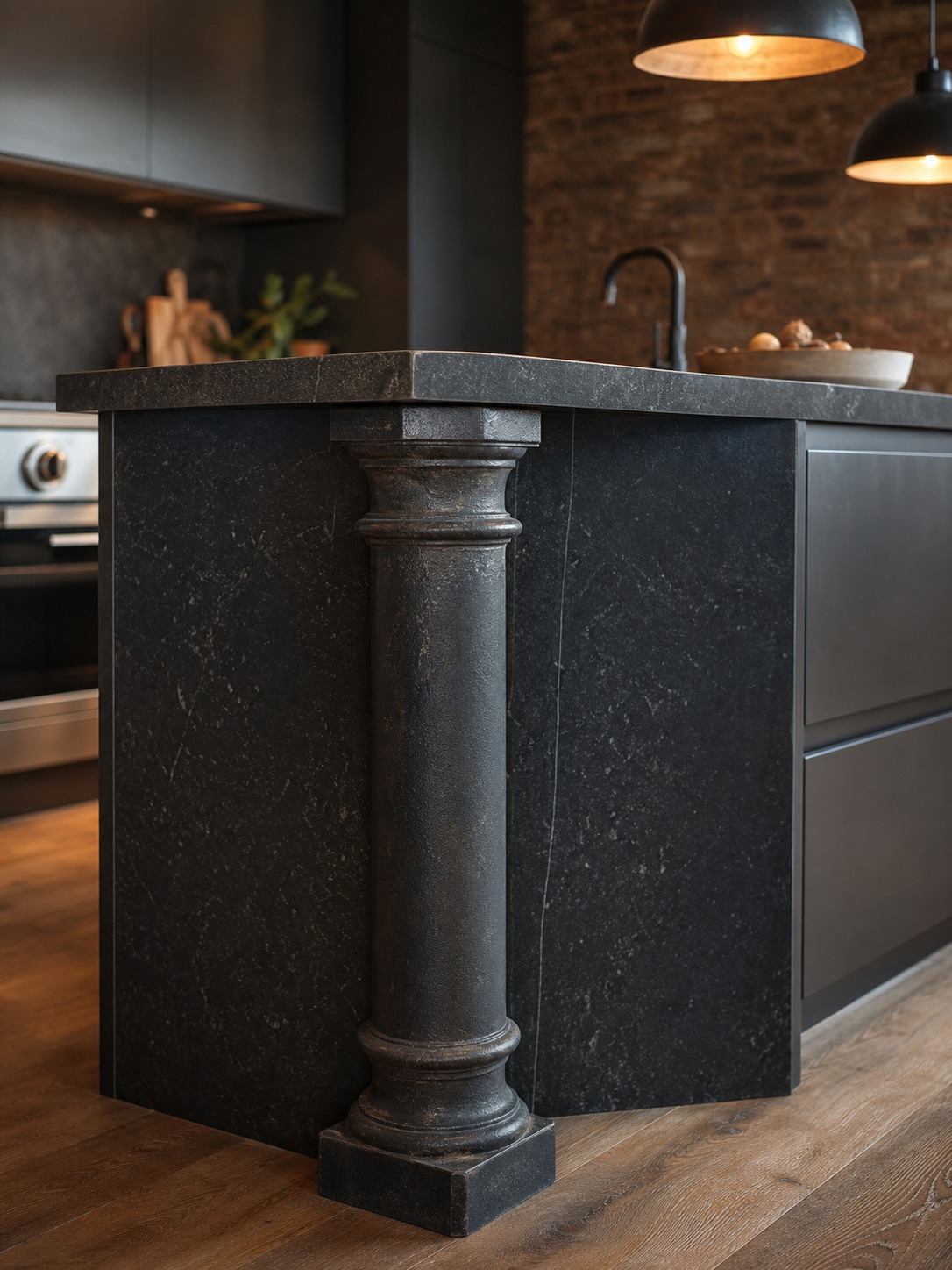
- Dark steel and smoked oak loft kitchen
- Japandi concrete and oak loft kitchen
- New York sage green loft kitchen
- Brutalist concrete loft kitchen
- Paris atelier loft kitchen
- Scandinavian white loft kitchen
- Moody Victorian warehouse kitchen
- Miami onyx island loft kitchen
- Tokyo micro loft kitchen
- Final thought
- FAQ
- Why does loft kitchen design require a different approach from a standard kitchen renovation?
- How do you handle an uneven subfloor in a loft kitchen?
- What is in-frame cabinetry and why is it preferred in bespoke kitchen design?
- How do you integrate exposed structural elements like brick and beams into a kitchen design?
- What materials work best for loft kitchen surfaces?
- How do professional-grade appliances change the layout requirements?
- What should a kitchen island accomplish in an open loft plan?
- How important is the sequence of design decisions in a loft kitchen project?
My automotive design training kicks in at moments like that, because reading a space before you commit a line to paper is exactly how you read a car’s body proportions before you propose a surfacing solution. The constraints aren’t obstacles. They’re the brief.
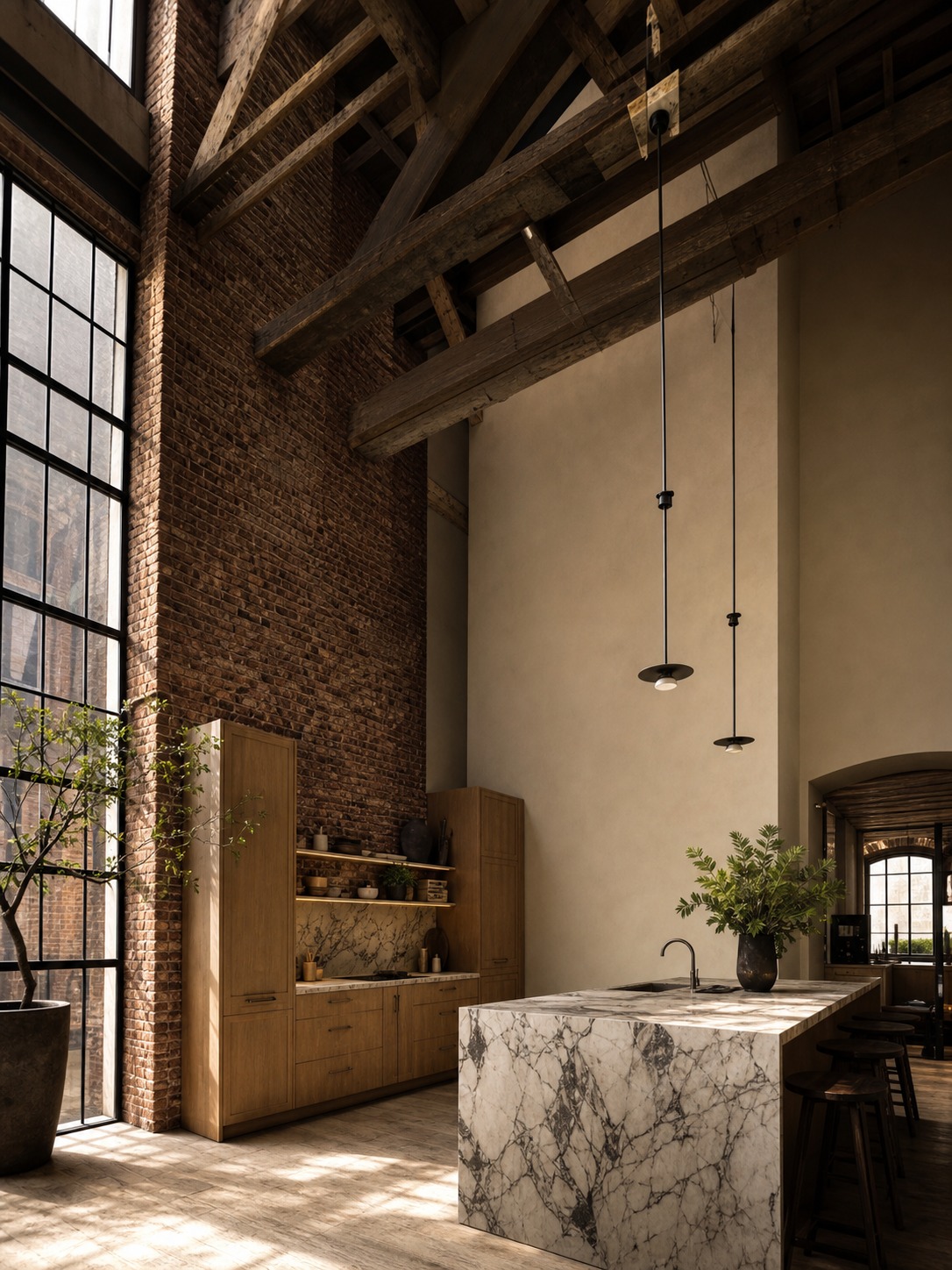
Loft kitchen design is its own discipline within interior design, distinct from the standard kitchen renovation category in almost every meaningful way. The building stock that produces these spaces, converted industrial buildings, former warehouses, cast-iron manufacturing lofts in places like New York’s Soho, doesn’t follow residential construction norms. The proportions are wrong for standard cabinetry.
The floors aren’t level. The columns land where they land, not where a kitchen designer would have asked for them. The ventilation requirements conflict with the exposed structure everyone paid a premium to preserve. Getting a kitchen right inside these spaces requires a fundamentally different design logic than fitting out a purpose-built apartment.
Why loft kitchens need a different design approach
Standard residential kitchen design works backward from a catalog. You establish the footprint, select cabinet heights and depths from a modular system, slot in the appliances, and tile the backsplash. It works because the building was designed around residential norms, and the catalog was designed around the same norms. Both systems share assumptions, and the project runs smoothly because they agree.
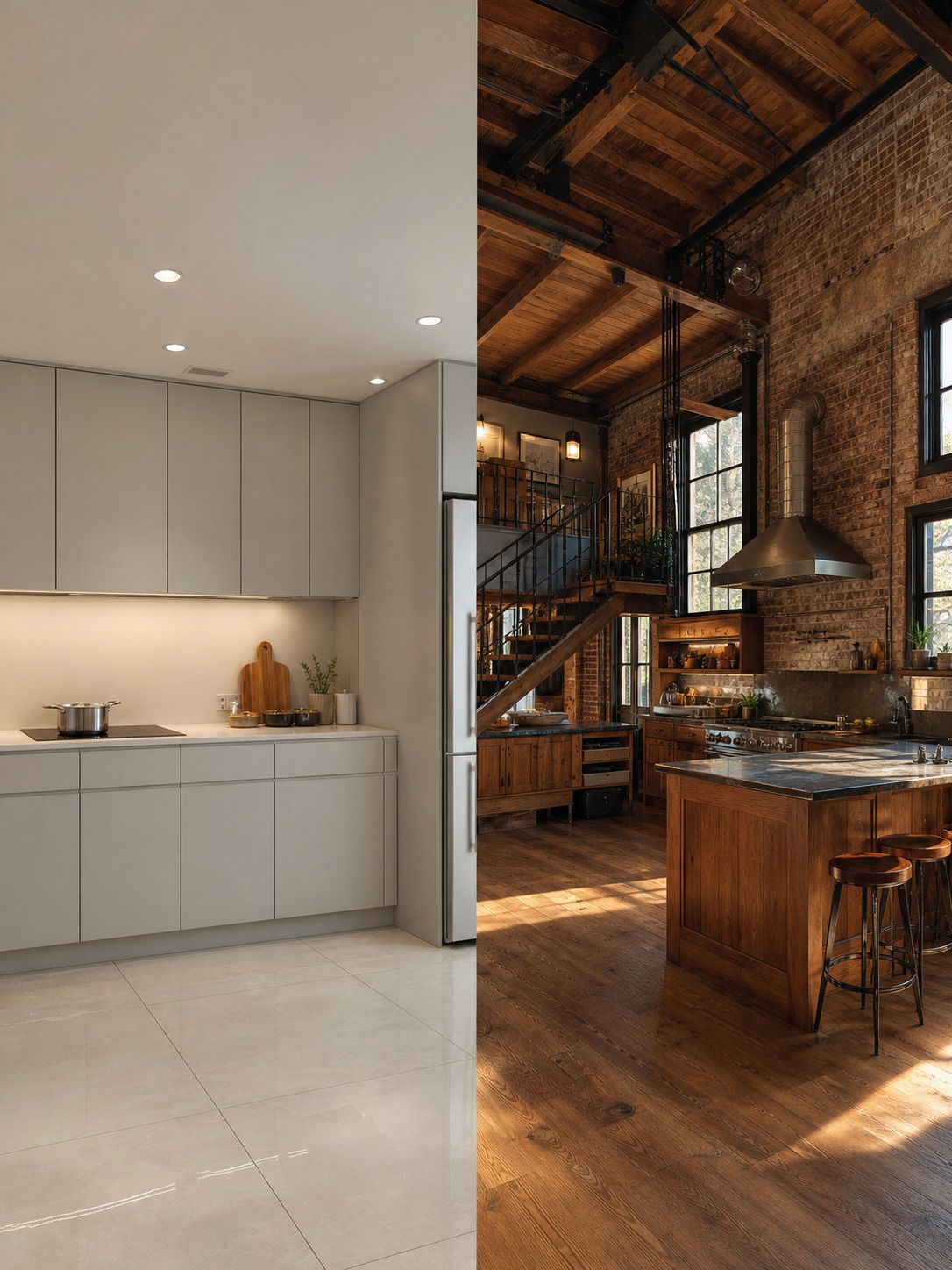
A loft kitchen breaks that agreement immediately. Ceiling heights of four meters or more create a visual void above standard 90cm cabinet tops that reads as unresolved in a way it never would in a 2.6-meter-ceiling apartment. Standard base cabinet depths assume a floor that doesn’t move; on a subfloor with a four-centimeter slope, a 24-cabinet run needs to be engineered, not just shimmed. The column grid, original to the building’s industrial use, drops into the kitchen zone at intervals that have nothing to do with cooking workflow or ergonomics.
I think about loft kitchen design as a category that demands industrial design thinking: you start with the existing system’s constraints and design a response to them, rather than starting with a preferred solution and forcing the building to accept it. The building has been there longer than you have, and it usually wins.
Working with brick, beams, high ceilings, and uneven floors
These are the four variables that define the difficulty level of every loft kitchen project, and each one requires a distinct strategy before a single cabinet gets specified.
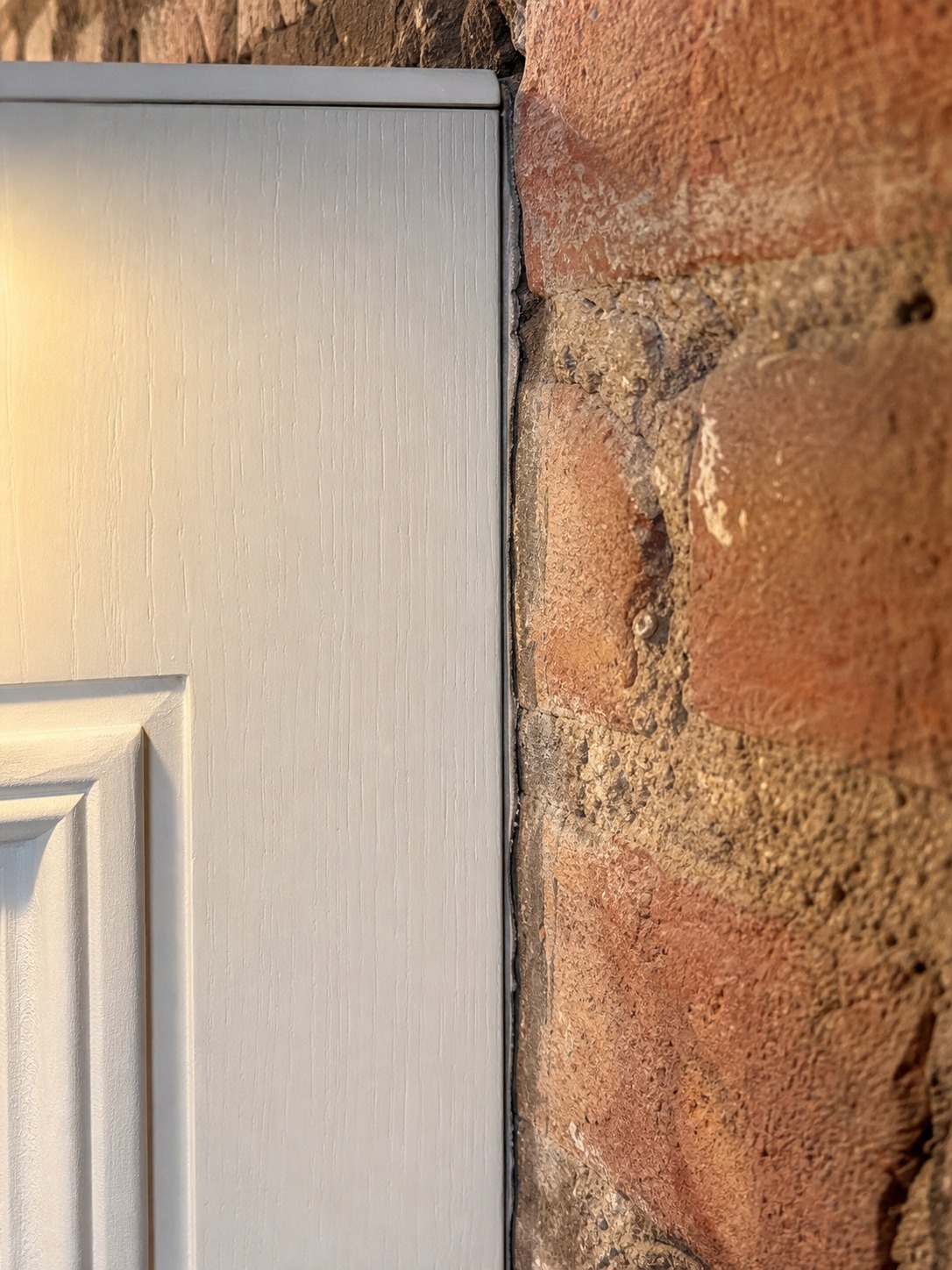
Exposed brick is the most seductive and the most demanding constraint simultaneously. It reads beautifully in a kitchen, especially under warm task lighting, but the surface is never plumb, never smooth, and never consistent across a long run. Any cabinetry that terminates against a brick wall needs a scribed filler piece cut to the exact profile of the wall at that specific point, not a standard gap filled with caulk.
Done correctly, the cabinet appears to grow out of the wall. Done carelessly, it announces itself as an afterthought. I’ve specified this detail more times than I can count, and the difference between a 1mm tolerance scribed panel and a 3mm gap matters enormously at close viewing distance.
Exposed timber beams are similar in that they require the kitchen design to acknowledge them explicitly or ignore them completely. The middle position, where you design around them without actually engaging with their position, tends to produce awkward collisions: upper cabinet runs that stop arbitrarily because a beam drops into the zone, ventilation hoods that clip a beam corner, pendant light groupings that fight the beam grid rather than working with it. The cleanest approach I’ve developed is treating the beams as a horizontal datum, the way a datum line works in a technical drawing, and letting all the vertical elements in the kitchen resolve against it at consistent relationships.
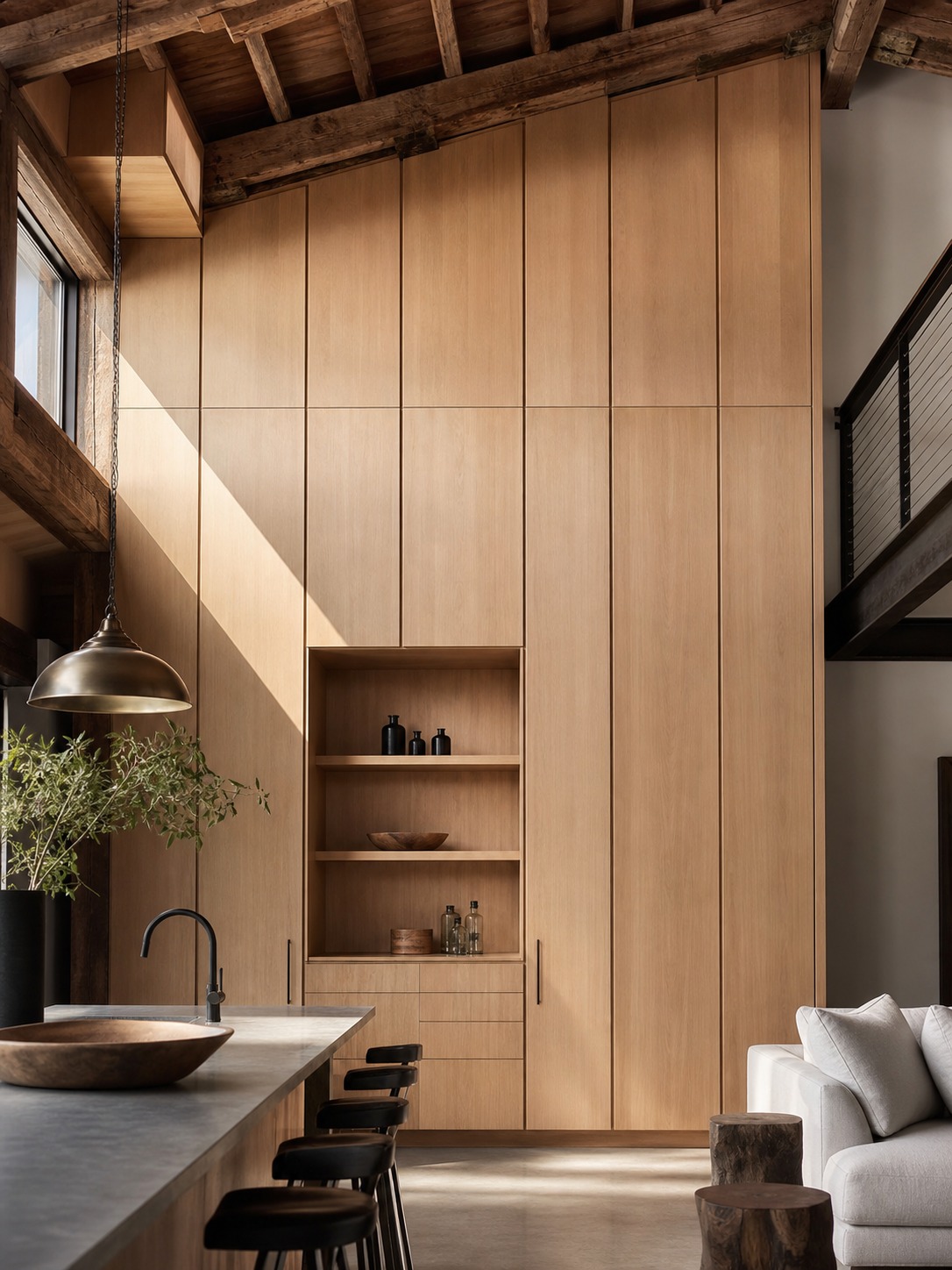
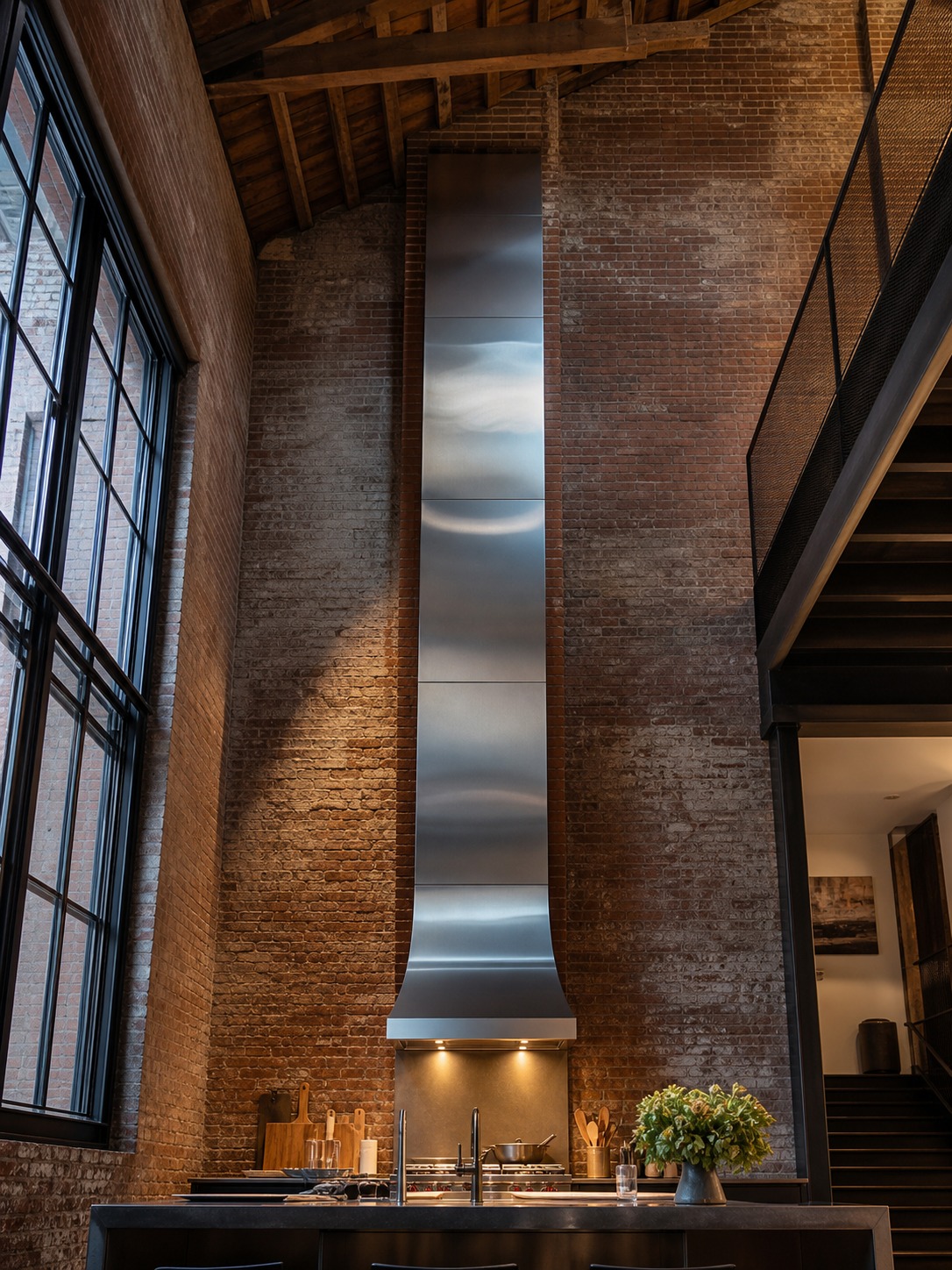
Ceiling height creates the most psychologically complex problem in loft kitchen design. Four meters of ceiling in a kitchen zone that uses standard 90cm cabinetry produces a proportional gap that feels unresolved and somehow smaller than the actual height warrants. The solutions I find most satisfying are vertical: floor-to-ceiling storage columns that use the full height, a ventilation hood built as an architectural column rather than a wall-mounted bracket, glazed upper cabinets that let light move through them at height, or an entirely open upper zone where the raw structure remains uninterrupted and the work sits at a lower register.
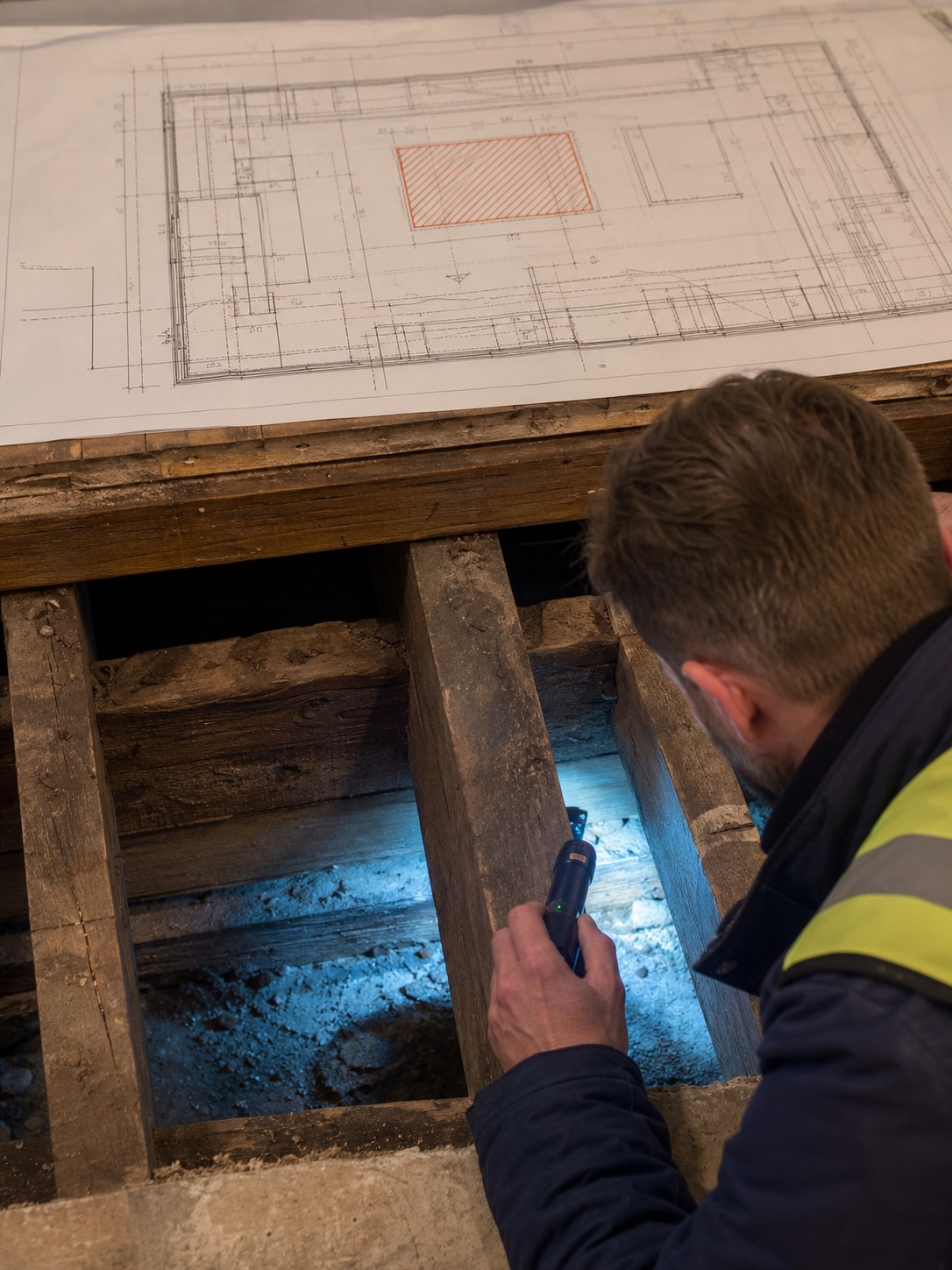
Uneven subfloors are the technical problem that the client never sees but the designer never stops thinking about. A self-leveling compound gets the surface flat enough for tile or stone, but the cabinetry still needs to be engineered to work at variable heights relative to a floor that was never designed to be level. Adjustable legs under base cabinets, carefully set to bring the cabinet top rail to a consistent height across the run, are standard practice. On a long run in a serious historic loft, I’ve measured six centimeters of variation from one end to the other, and I’ve seen it executed invisibly when the joinery team understood what they were being asked to do.
Kitchen layout decisions in open loft spaces
An open-plan loft doesn’t give you walls to anchor the kitchen to. That sounds like freedom, but it’s actually a harder problem than a bounded kitchen zone. You’re defining a room inside a room, using cabinetry, materiality, and spatial logic to carve out a functional cooking environment from an undifferentiated open floor plate.
The island becomes load-bearing in a design sense in these situations, not structurally, but compositionally. It’s the element that most clearly separates the kitchen from the living zone, and its position and mass determine how both spaces read. Too small and the kitchen bleeds into the living room; too dominant and it blocks sightlines across the whole floor plate. In loft kitchen design, the island also has to address the column grid. If a column falls within the island zone, which happens constantly in cast-iron loft buildings, you either incorporate it into the island as a design element or you route the island plan around it. Both approaches can work. Ignoring it doesn’t.
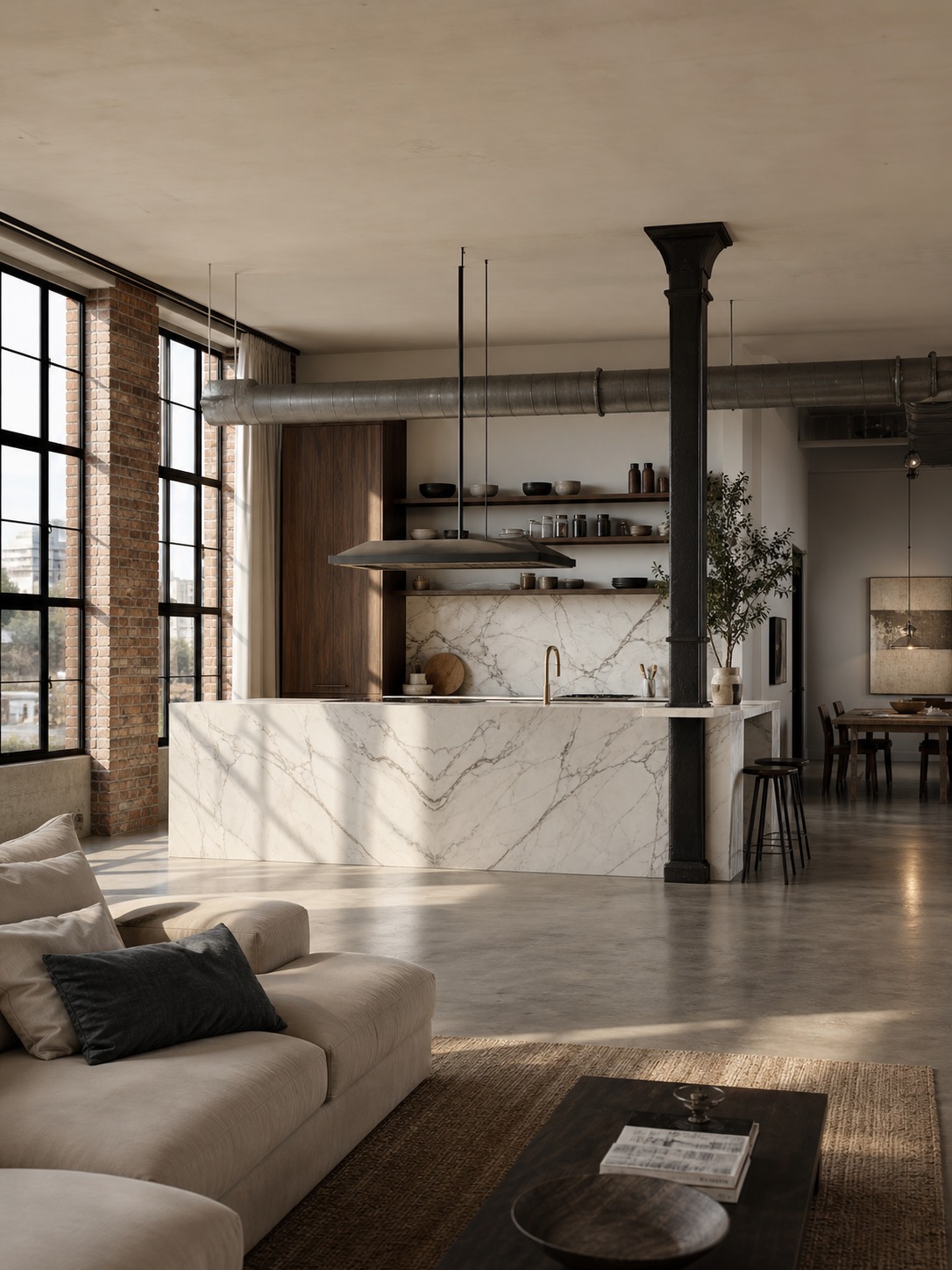
Workflow becomes more critical in open layouts, not less. Without walls to define zones, the cooking triangle has to be established entirely through the placement of elements and their spatial relationship to each other. I default to a simple diagnostic: walk the cooking sequence from storage to prep to cooking to plating to clean-up, and measure how many unnecessary steps the layout demands. In a loft with no zone boundaries, that walk can wander across the whole floor plate if the layout logic isn’t tight.
The visual connection from the kitchen to the rest of the space also drives material choices more directly in open lofts than in enclosed kitchens. Finishes you’d never see from the living area in a standard apartment are in constant view in a loft. This is why high-end loft kitchens in New York almost always use the same or closely coordinated stone on the island as on the floor, because the material becomes part of the wider spatial composition rather than a kitchen-zone material. The kitchen is always on display, which raises the specification standard across every surface.
Bespoke cabinetry and precision joinery
This is where loft kitchen design parts company most dramatically with standard kitchen renovation. The non-standard dimensions, the sloped floors, the scribed brick terminations, the specific column positions, the ceiling height, none of these can be addressed by a modular catalog system. Every project requires bespoke construction, and bespoke kitchen design means building the cabinet system from scratch to fit the specific architectural conditions of that particular space.
In-frame joinery is the construction method that shows up most often in serious high-end kitchen projects, and for good reason. An in-frame cabinet is built with a solid wood perimeter frame, and the doors are fitted within that frame with a consistent reveal, typically 2mm on all sides for a well-made example. The frame holds the cabinet structure together in a way that flush-face (frameless) cabinet construction can’t match. The doors reveal the construction quality directly, because the gap consistency is visible at reading distance. There’s no hiding a poorly cut reveal behind a flush face overlay.
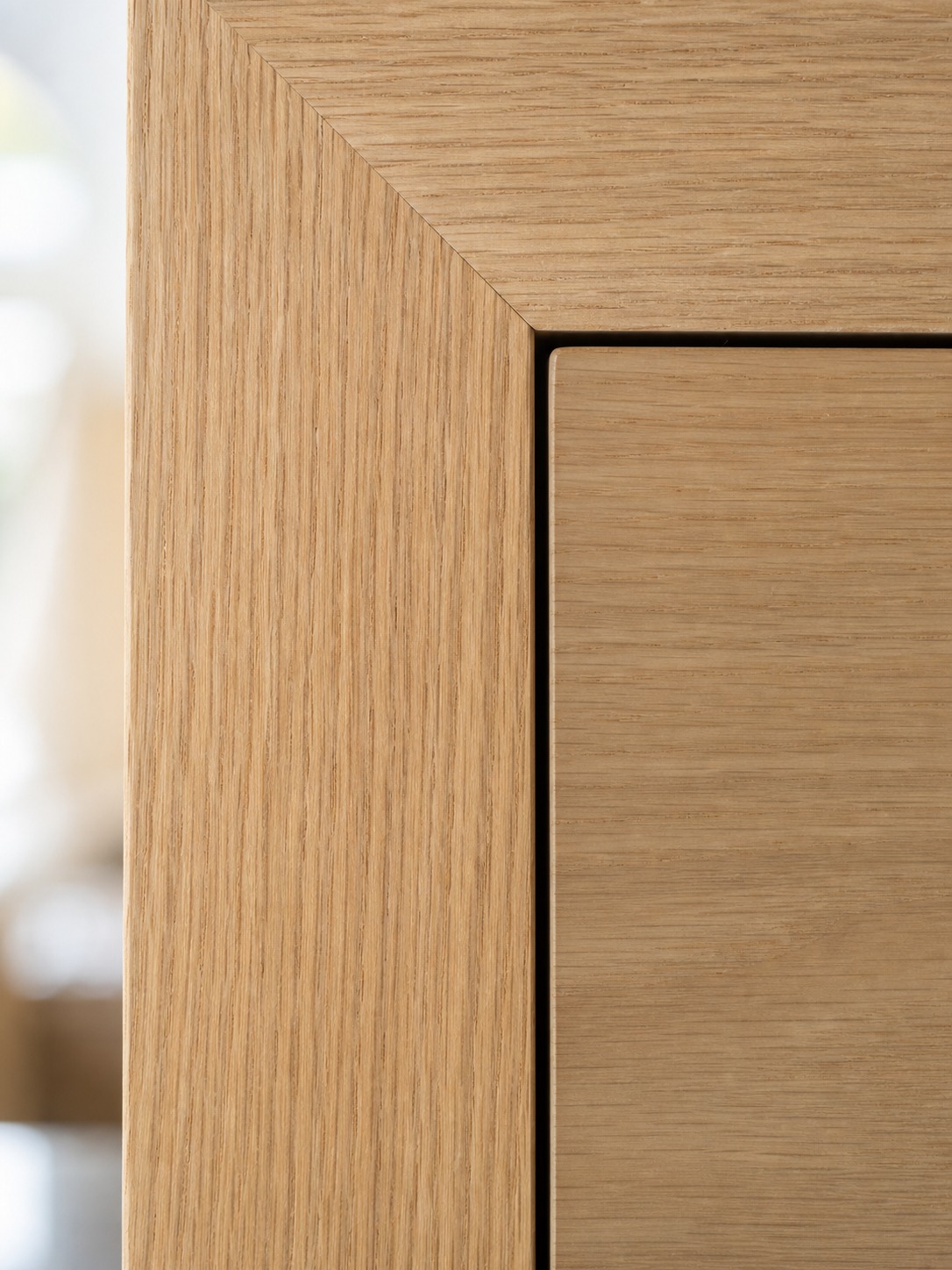
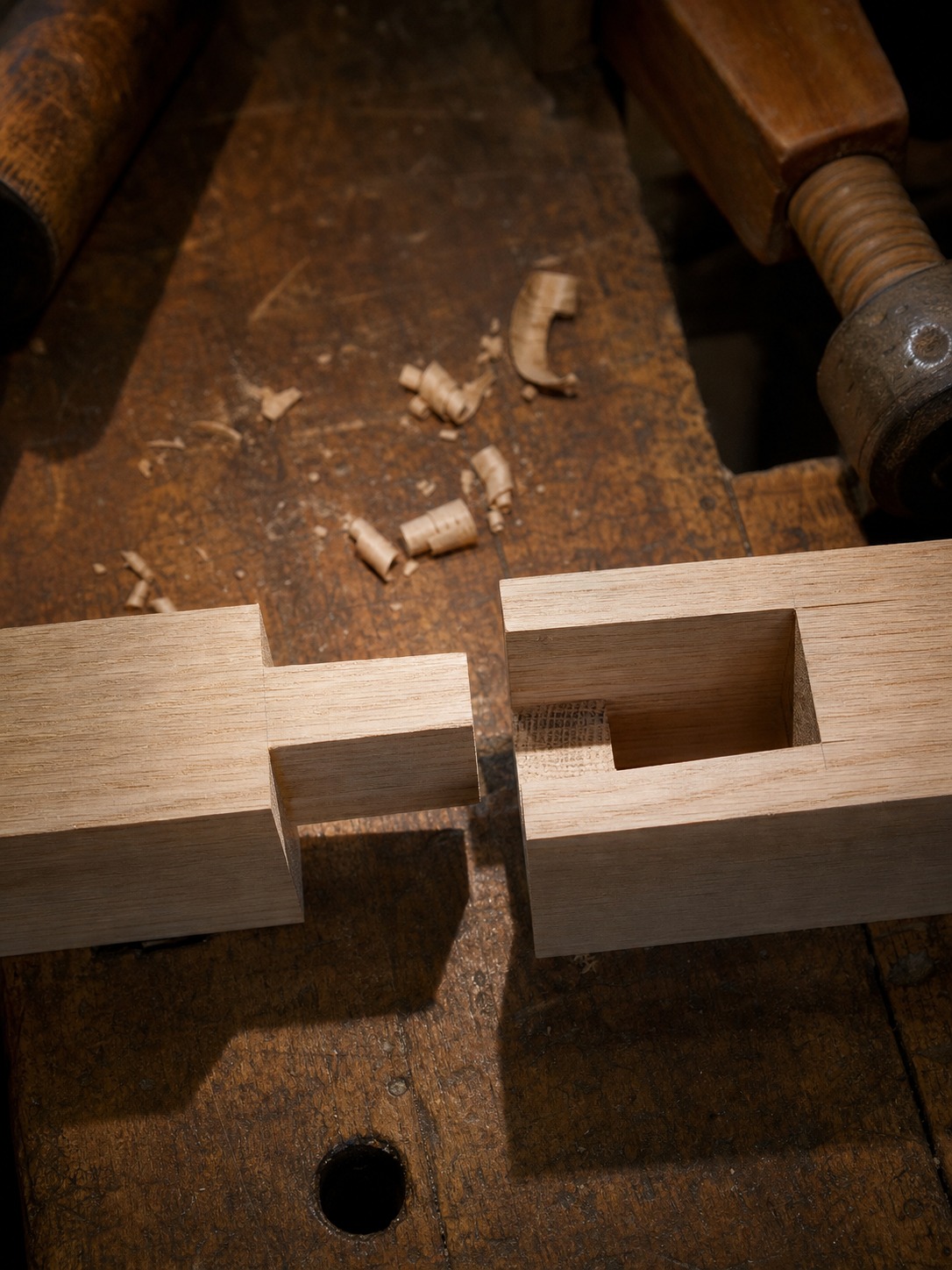
The mortise-and-tenon joinery that connects the frame components in a traditional in-frame cabinet is the detail that separates a joiner from a cabinet assembler. I’ve worked on projects where the brief required both, and you can tell in the first year which construction method was used, because the in-frame cabinet with proper mortise-and-tenon joints doesn’t move, warp, or shift with seasonal humidity changes, and the alternative tends to start showing hairline gaps at the joints within eighteen months.
For loft kitchens specifically, the joinery demands extend beyond the cabinet box. The cornice detail at ceiling height, the way the upper cabinet run terminates at the beam, the filler pieces that scribe to the brick, the stone bracket detail where the island overhangs the floor finish, all of these connections are custom fabricated for the specific space. There’s no catalog option for any of them.
Materials that suit high-end loft kitchens
The material language of a loft kitchen tends to resolve into two registers: the raw and the refined. The raw register is provided by the building itself, brick, timber, exposed concrete, cast iron. The refined register is where the kitchen design lives, and the materials in that register have to be capable of reading as precise and deliberate against the texture of the building fabric.
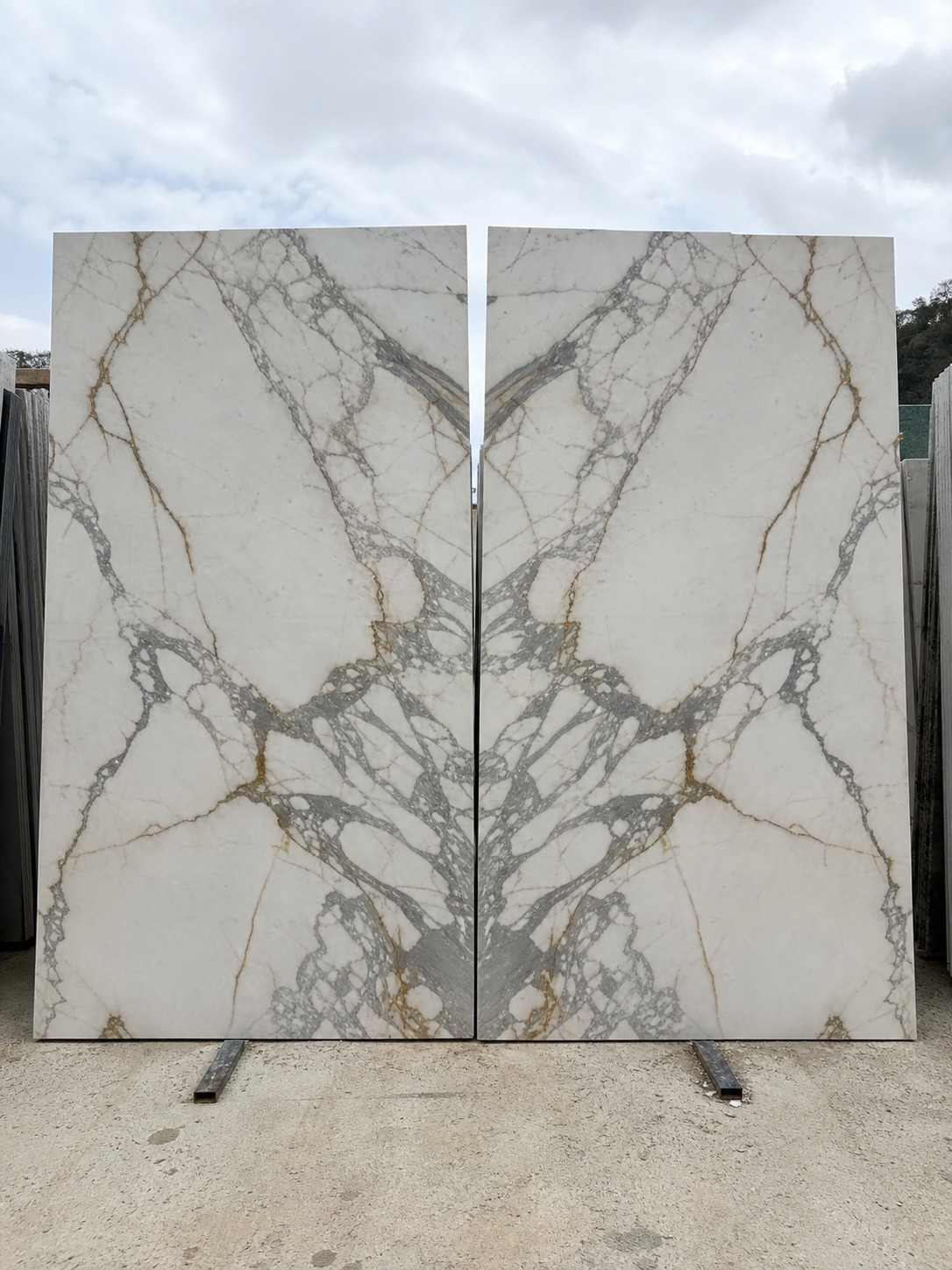
Natural stone is the classic choice, and it works in loft kitchens partly because marble and granite already carry a geological time scale that puts them in comfortable company with century-old brick. A well-selected marble slab in a Soho loft kitchen reads as if it was always there. The selection process matters enormously: book-matched slabs where the veining flows continuously across a waterfall island edge or across a set of vertical drawer fronts requires selecting the slabs in sequence at the quarry or the stone merchant’s yard, not ordering by specification number. I’ve driven to stone yards specifically to select consecutive book-matched slabs for a project, because ordering blind produces a result that looks like a specification decision rather than a design decision.
The ultra-compact porcelain category, materials like Dekton and Lapitec, offers a rational alternative for high-impact work zones. Full stain, scratch, and heat resistance, finished surfaces that can be specified at six to twelve millimeters in thickness, and a growing palette of formats and textures that read convincingly as stone or concrete from a distance. Where I’ve integrated these into loft kitchens, the typical approach is stone on the island and porcelain on the perimeter prep surfaces, playing to the practical strengths of both.
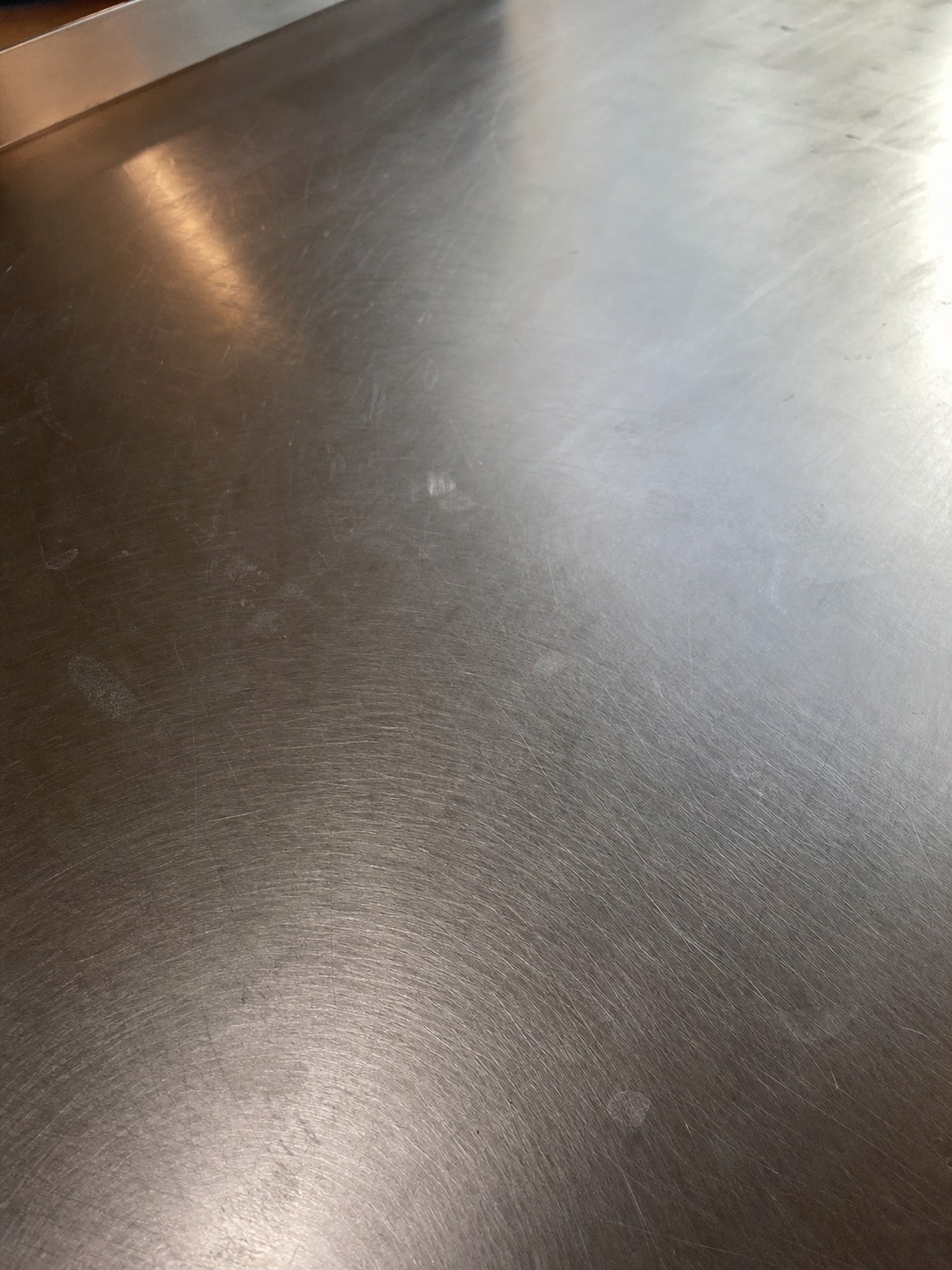
Stainless steel earns its place in high-use cooking environments and in the loft context reads as genuinely industrial rather than merely technical. A full-depth stainless prep surface or a stainless ventilation column carries a material honesty that suits a building that used to make things. The maintenance requirements are the realistic caveat: brushed stainless shows fingerprints and scratches, and both are part of the material’s character over time, which some clients embrace and others find intolerable.
Timber fronts in a loft kitchen context tend to be flat or lightly textured solid wood, not veneer, and the species choice should reference what’s overhead. Matching the cabinet timber to the existing structural beams is an elegant solution that’s more complicated than it sounds, because the structural timber is typically weathered and the cabinet timber is freshly surfaced, and getting them to read as the same material requires either treating the new timber down toward the existing condition or accepting a deliberate light-to-dark progression.
How appliances, ventilation, and storage affect the final design
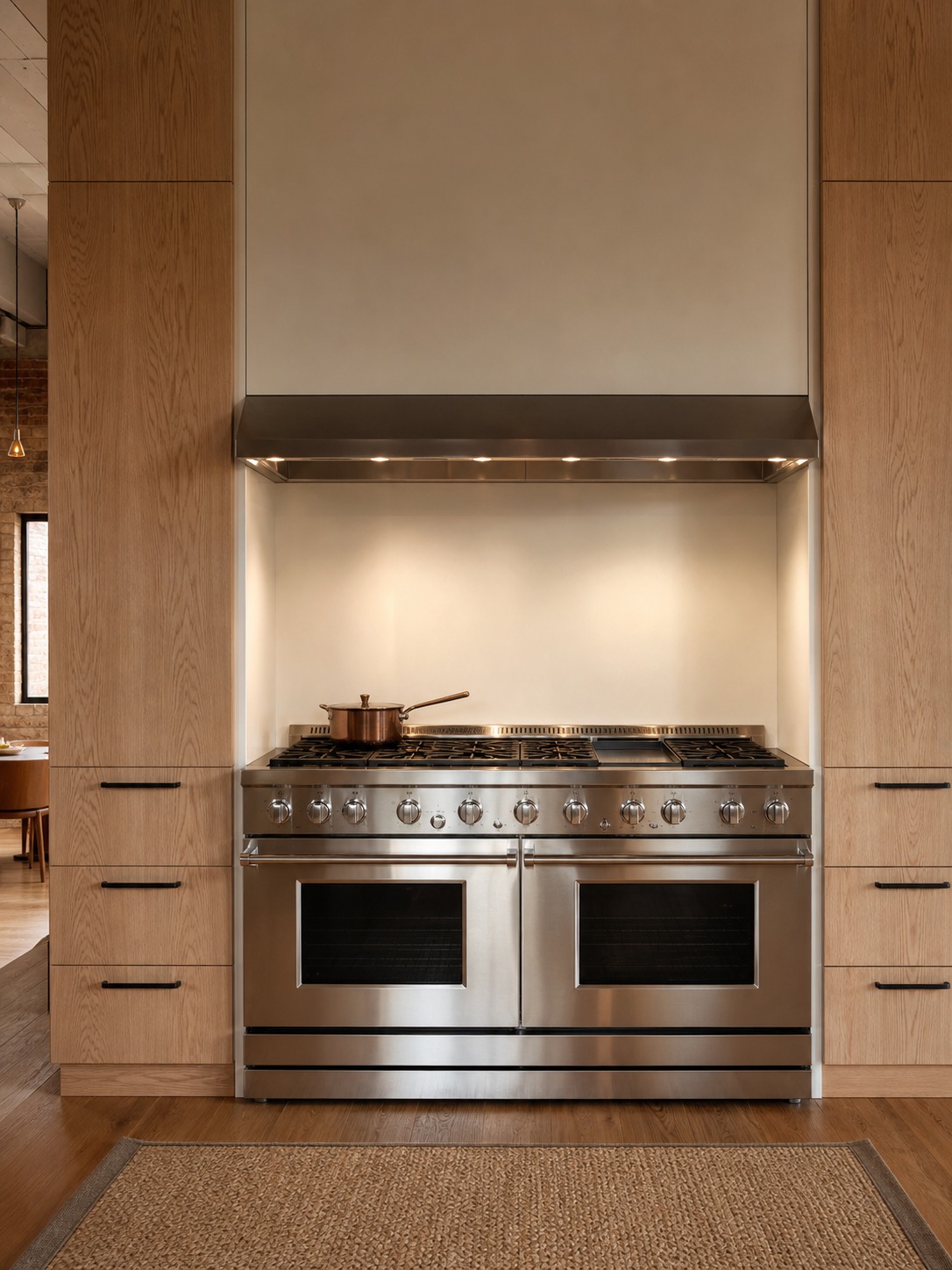
A loft kitchen sized for serious cooking in an open-plan space requires appliance integration at a level that most residential kitchen designers don’t routinely encounter. Professional-grade appliances demand their own spatial planning from the start, not as a slot-in afterthought once the layout is established.
Sub-Zero refrigerator and freezer columns, Wolf or Miele cooking suites, Gaggenau steam ovens, these appliances have specific installation depths, ventilation clearances, and electrical requirements that directly drive cabinet dimensions, floor penetrations, and electrical panel specifications. A 36-inch Wolf range with a professional ventilation hood above it requires a mechanical penetration through whatever sits above, which in a loft almost certainly means coordinating with the floor above, the building’s shared riser system, or an exposed duct run that becomes part of the design. In a Soho cast-iron loft, that duct run might go horizontal to an exterior penetration, which requires structural coordination and building approval.
Storage in an open-plan kitchen has to work harder than in an enclosed space because there’s no adjacent pantry closet to absorb the overflow. Everything the kitchen needs, appliances, dry goods, cookware, dishware, wine, cleaning supplies, has to live within the kitchen footprint or in a storage column run that’s deliberately proportioned to contain it without visual clutter. I’ve designed kitchen storage layouts where the door count exceeded sixty individual pieces across a single kitchen run, all in-frame, all with consistent 2mm reveals. The reveal consistency at that scale is a project management problem as much as a joinery problem.
Ventilation in open-plan lofts is both a technical and a spatial problem. The open plan means cooking odors travel freely, which makes an undersized or underperforming ventilation system immediately detectable from anywhere in the apartment. Professional-grade hoods sized for the cooking equipment, running at appropriate cubic feet per minute for the burner configuration, are the starting specification. The duct routing and the sound attenuation of the fan system are where the complexity sits. A high-performance range hood running at full capacity has an acoustic signature that’s noticeable in a loft where there are no room divisions to absorb it.
What designers can learn from Soho loft kitchens
Soho’s cast-iron buildings, most built between 1860 and 1890, are an extreme version of the loft kitchen design challenge. The ceiling heights run to five meters in some cases. The cast-iron column grid is fixed and non-negotiable. The building facades are designated landmarks, which feeds into approval requirements for any mechanical penetration.
The floor-to-floor construction is heavy timber on steel beams, which is both a structural asset and an acoustic complication. Getting a kitchen right in a Soho loft is a masterclass in constraint-driven design, which is exactly why looking at what designers and studios doing serious work in that environment have developed is instructive for any loft kitchen project.
The consistent lesson from projects at this level is that the designer has to understand the building as deeply as the brief. Structural load capacity for a heavy stone island needs to be confirmed with an engineer before the stone supplier is called, not after. The shared plumbing risers limit where the sink can realistically go, and fighting that constraint is more expensive and more complicated than designing around it. The acoustic properties of an open concrete and timber volume require attention to how appliance vibration and HVAC noise propagate, which feeds back into how the mechanical systems are specified and isolated.
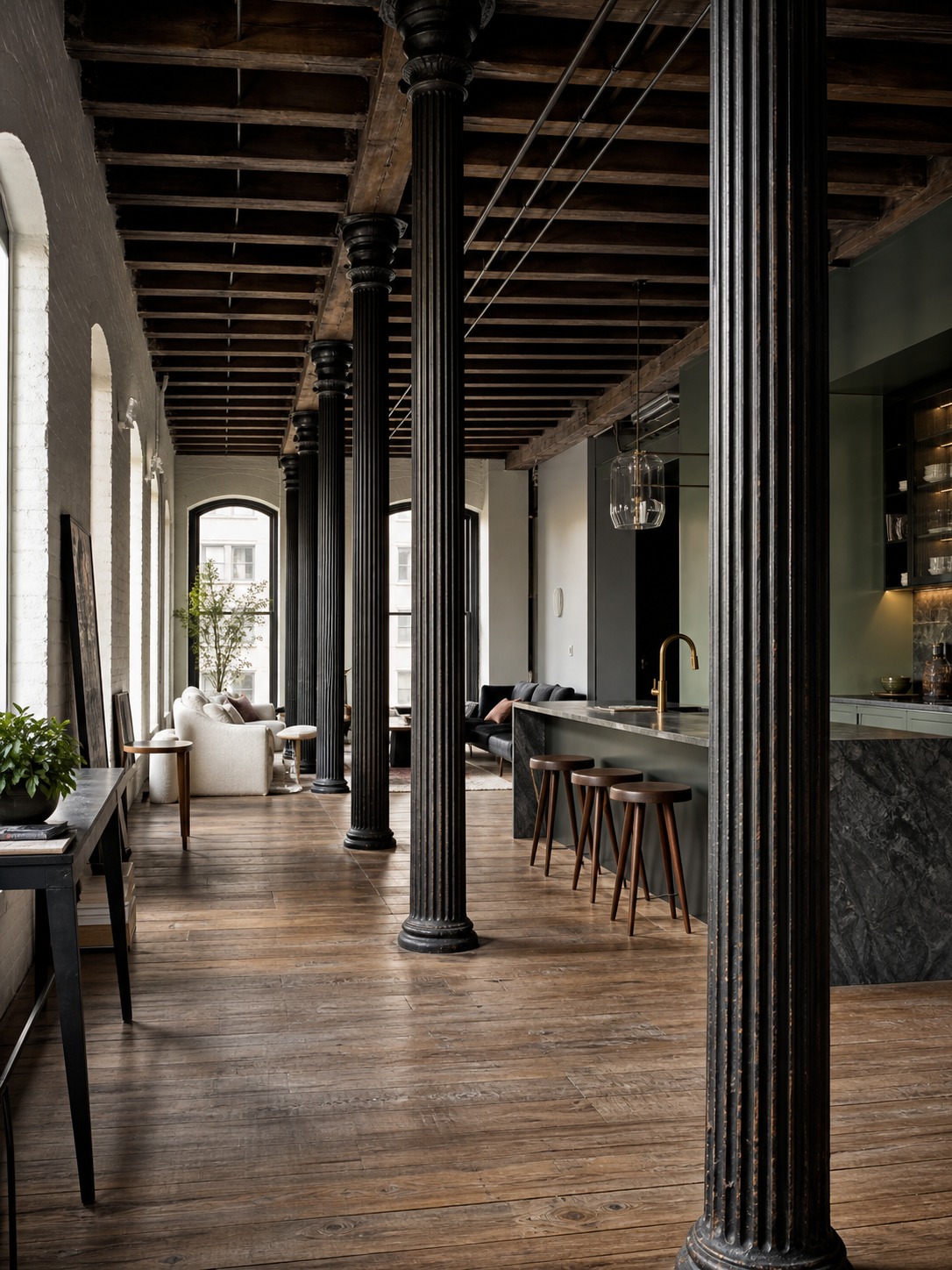
Studios doing serious work in this space, and looking at what firms behind accomplished custom kitchens in Manhattan have built and documented is a useful research step for any designer approaching a loft project for the first time, tend to share a common habit: they do the structural and mechanical due diligence before they commit to any aesthetic decisions. The cabinetry style, the stone selection, the appliance brand, all of these follow the structural and spatial logic, not the other way around. That sequencing is what produces a kitchen that looks as if it belongs in its building rather than being inserted into it.
The broader design principle that Soho loft kitchens demonstrate at their best is one I apply in every complex spatial project, from automotive interiors to kitchen planning: the constraints of the existing system are the most reliable design input you have. The column grid, the beam positions, the riser locations, the subfloor variation, these aren’t problems to be solved after the fact. They’re the parameters that make a good solution possible, because they limit the option space to what actually works in this specific building rather than what might work in any building.
10 Loft kitchen ideas / references
Use these loft kitchen references as layout and material starting points: each one pairs an interior direction with a matching plan-view logic, so the idea is not just a mood image but a workable spatial move.
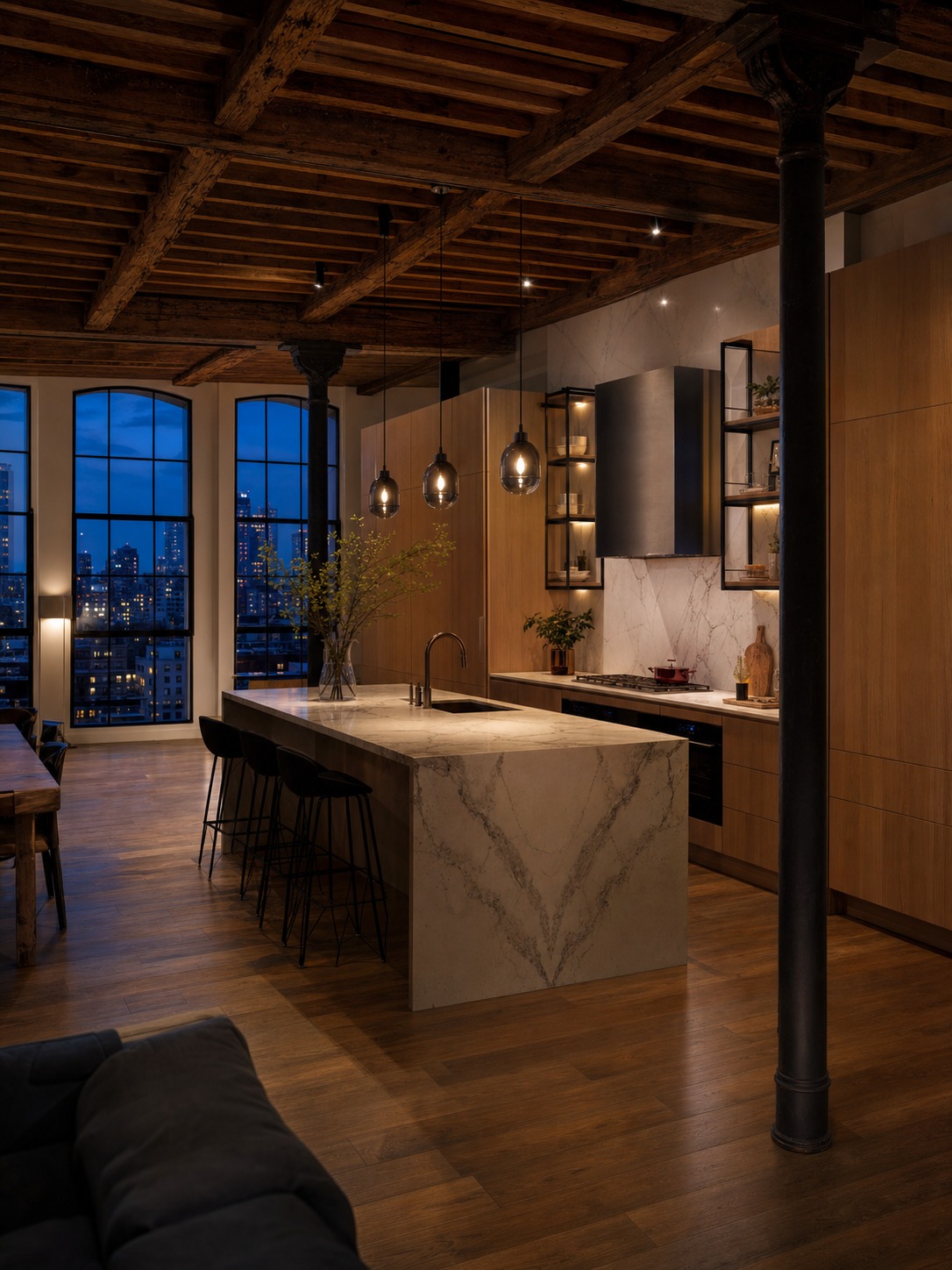
Open-plan industrial loft kitchen with marble island
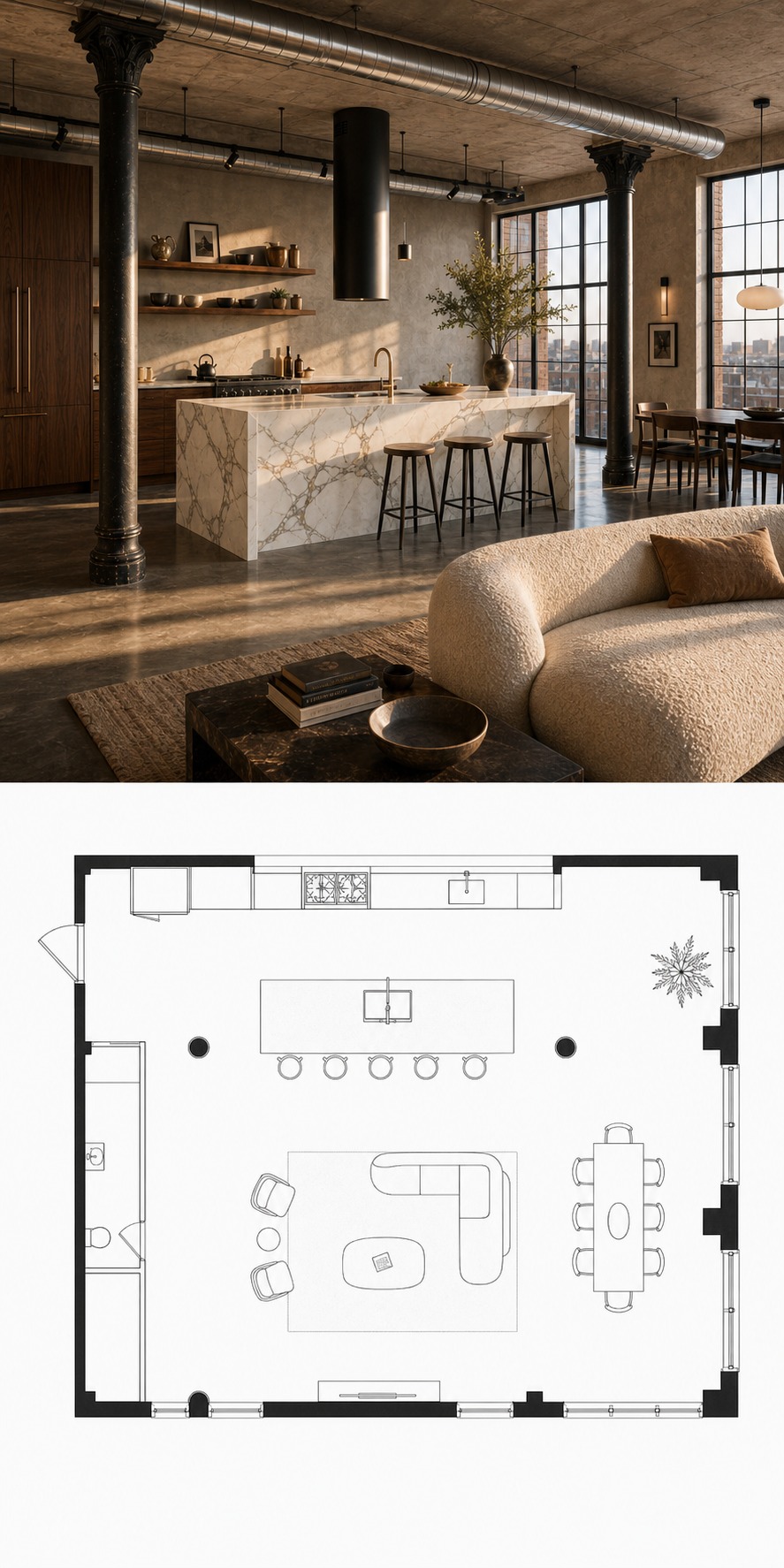
This reference is the cleanest open-plan starting point: a marble island anchors the kitchen while the sofa and dining areas stay visually connected. It suits lofts where the kitchen has to define the room without closing it down.
Dark steel and smoked oak loft kitchen
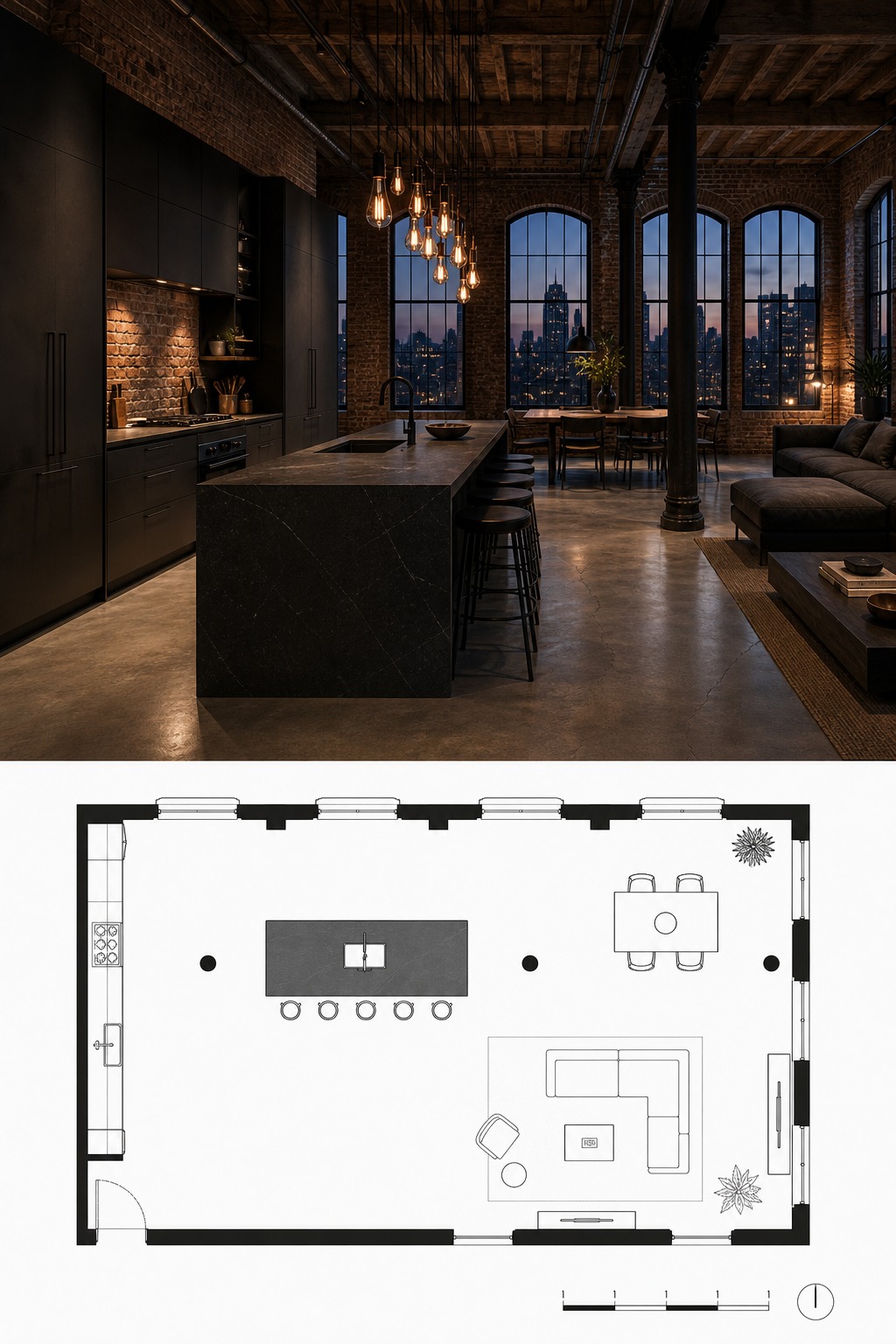
Use this direction when the building already has strong brick, steel, and evening city character. Smoked oak softens the black granite, while the plan should keep a clear island walkway so the dark palette does not feel heavy.
Japandi concrete and oak loft kitchen
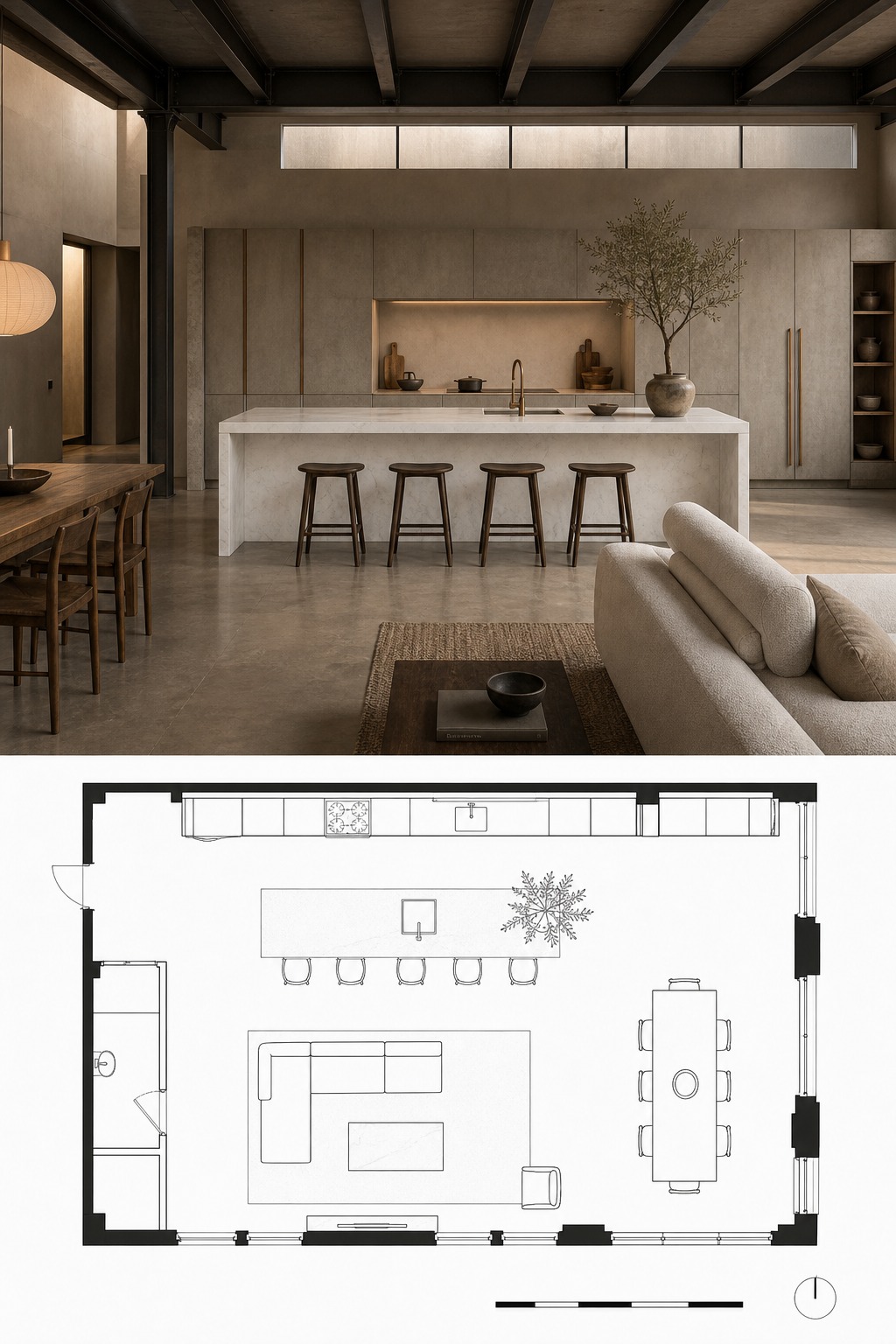
A Japandi loft kitchen works best when every line is quiet and deliberate. Concrete, pale marble, oak pulls, and diffused northern light keep the industrial shell calm instead of decorative.
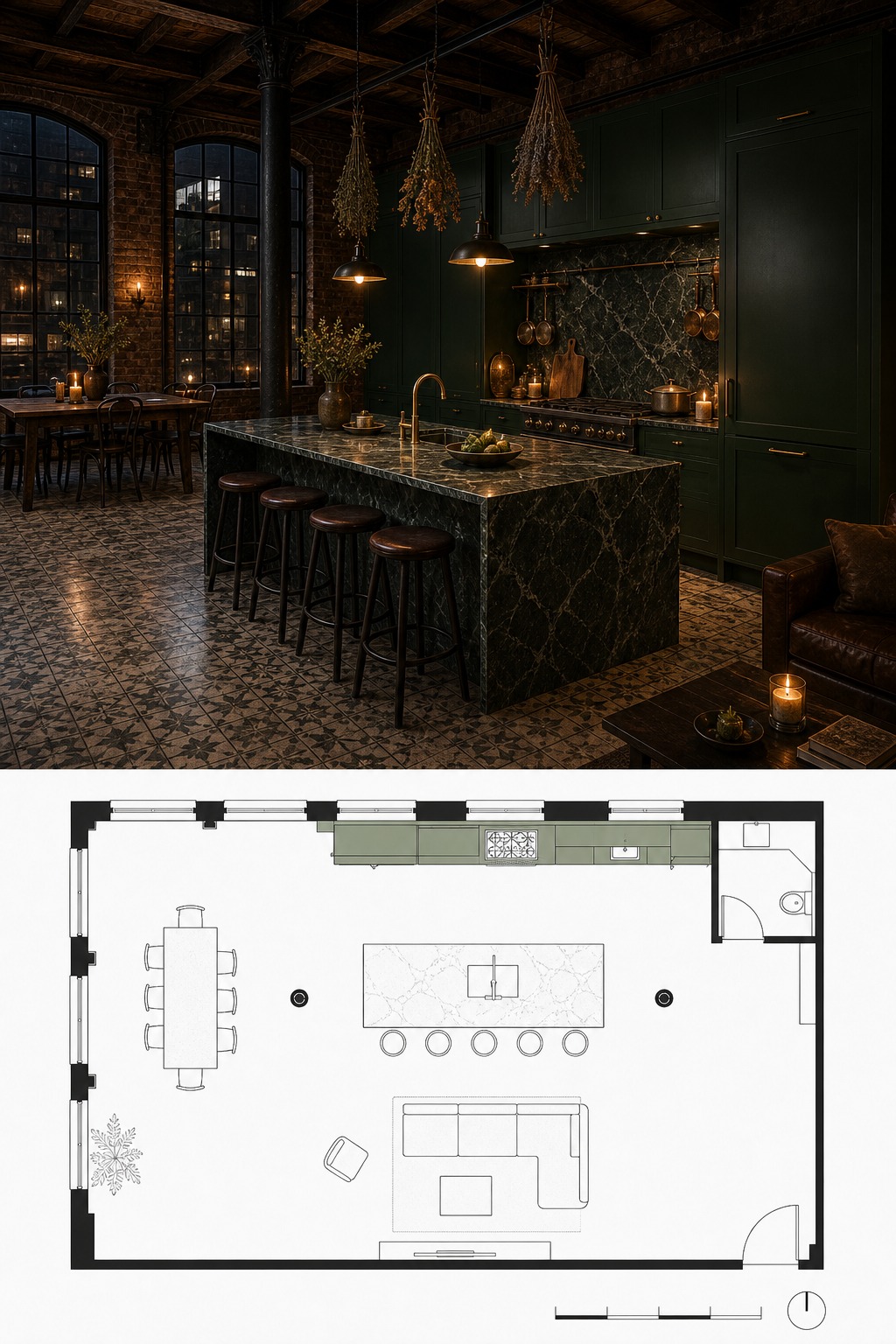
New York sage green loft kitchen
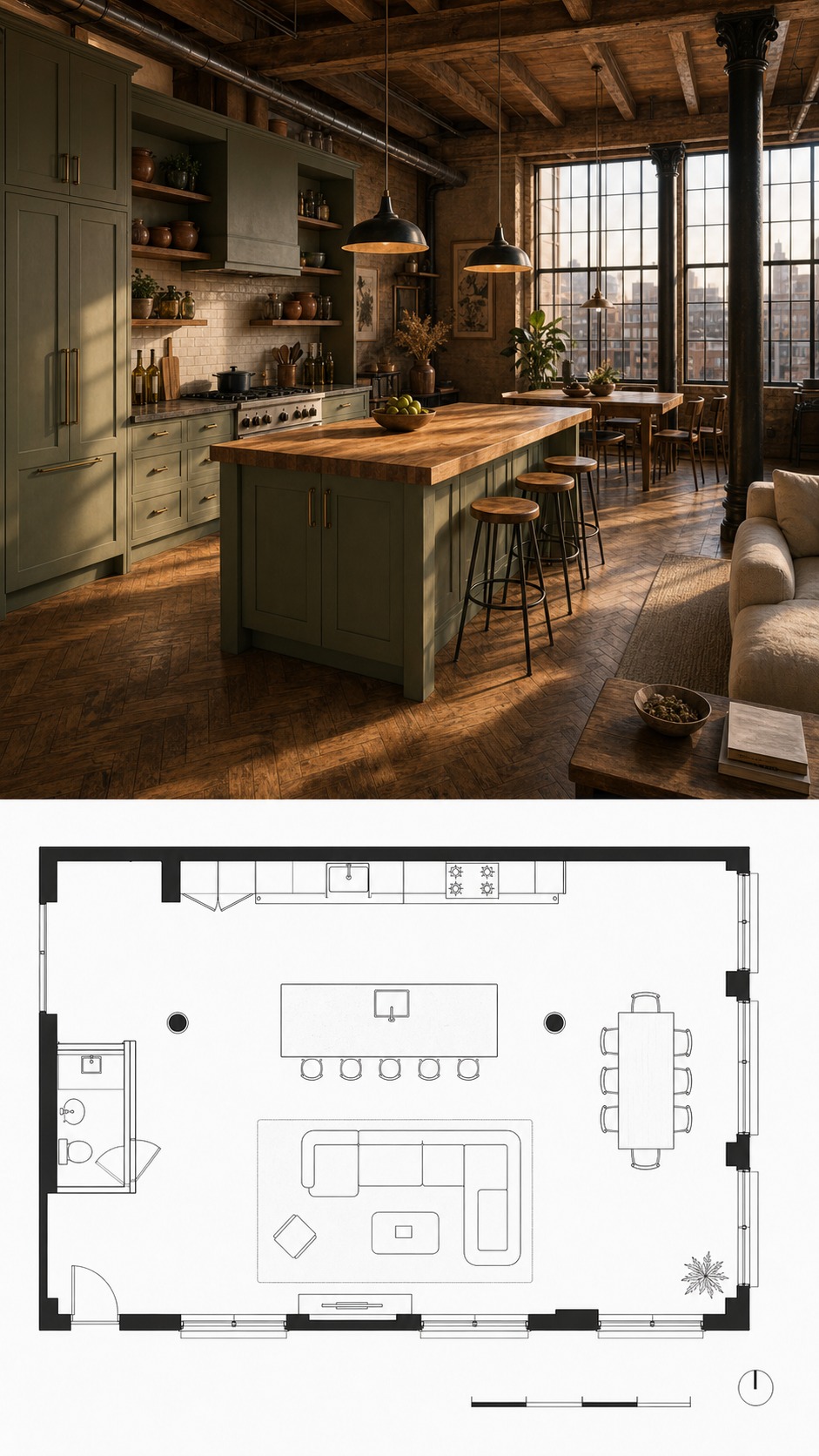
This is a warmer New York loft reference for spaces that need character rather than showroom severity. Sage cabinetry, butcher block, brass, and open shelves make the kitchen feel settled inside the old structure.
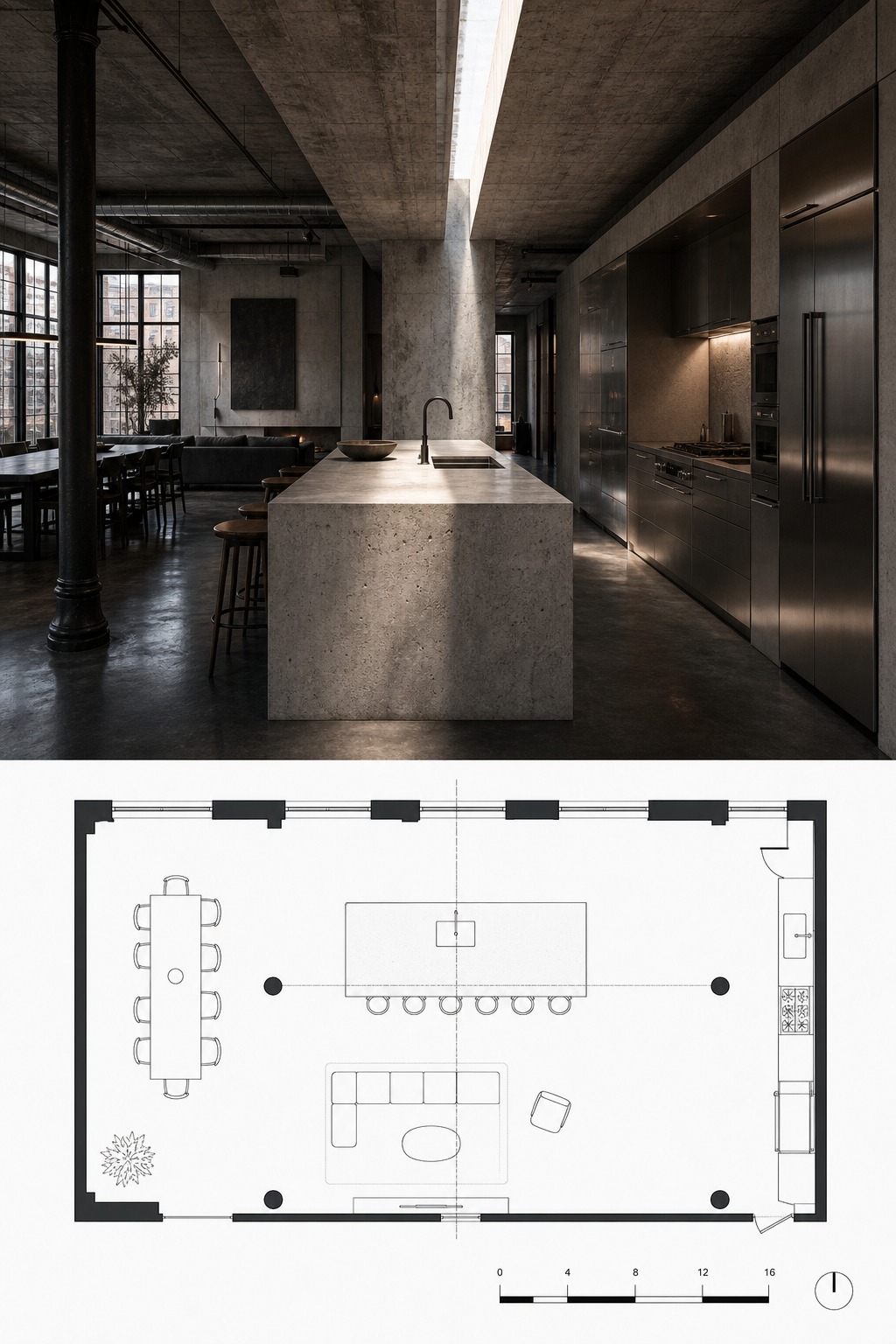
Brutalist concrete loft kitchen
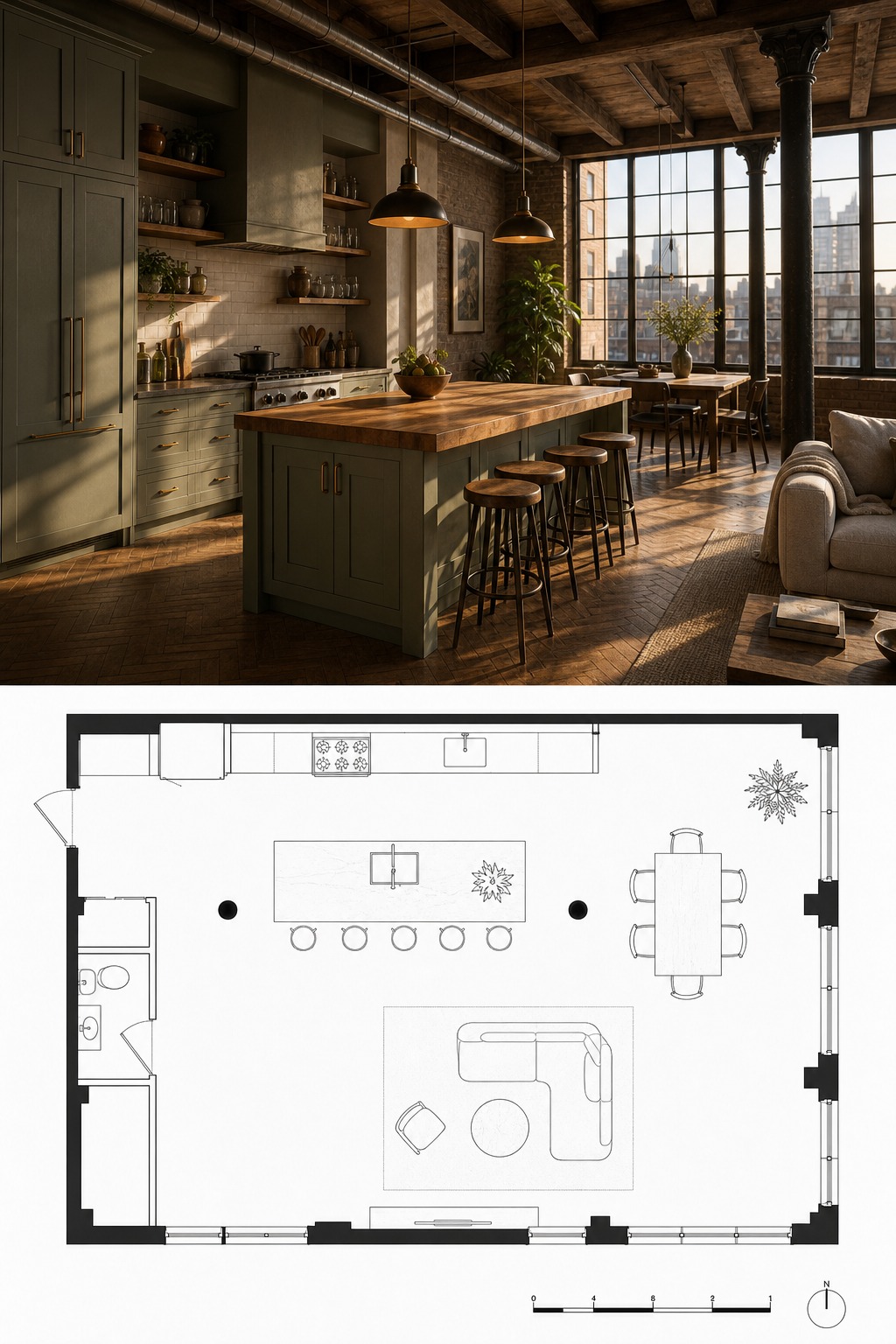
A brutalist loft kitchen is about mass, shadow, and precision. Keep the plan simple, because the poured concrete island and slit skylight already carry enough architectural force.
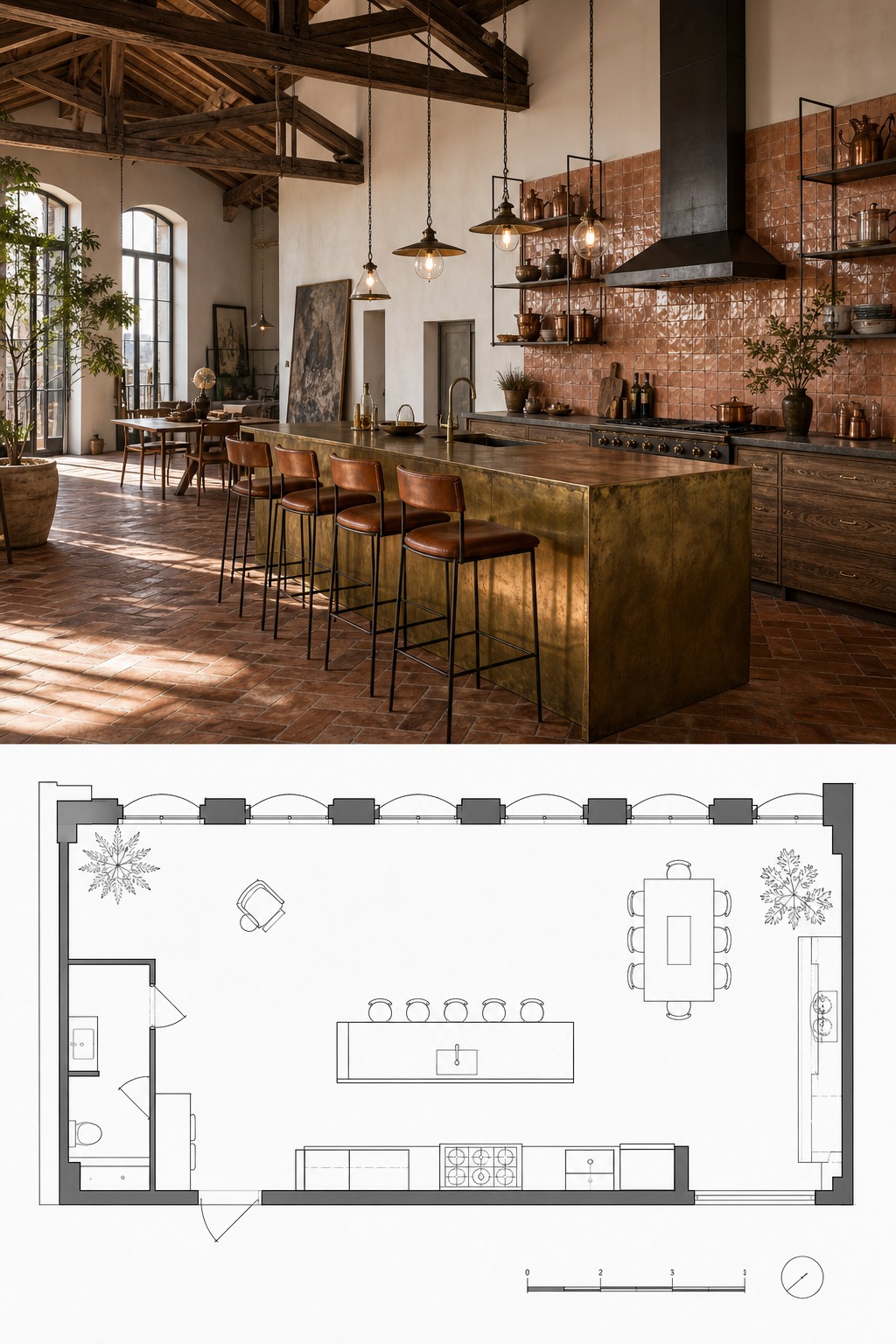
Paris atelier loft kitchen
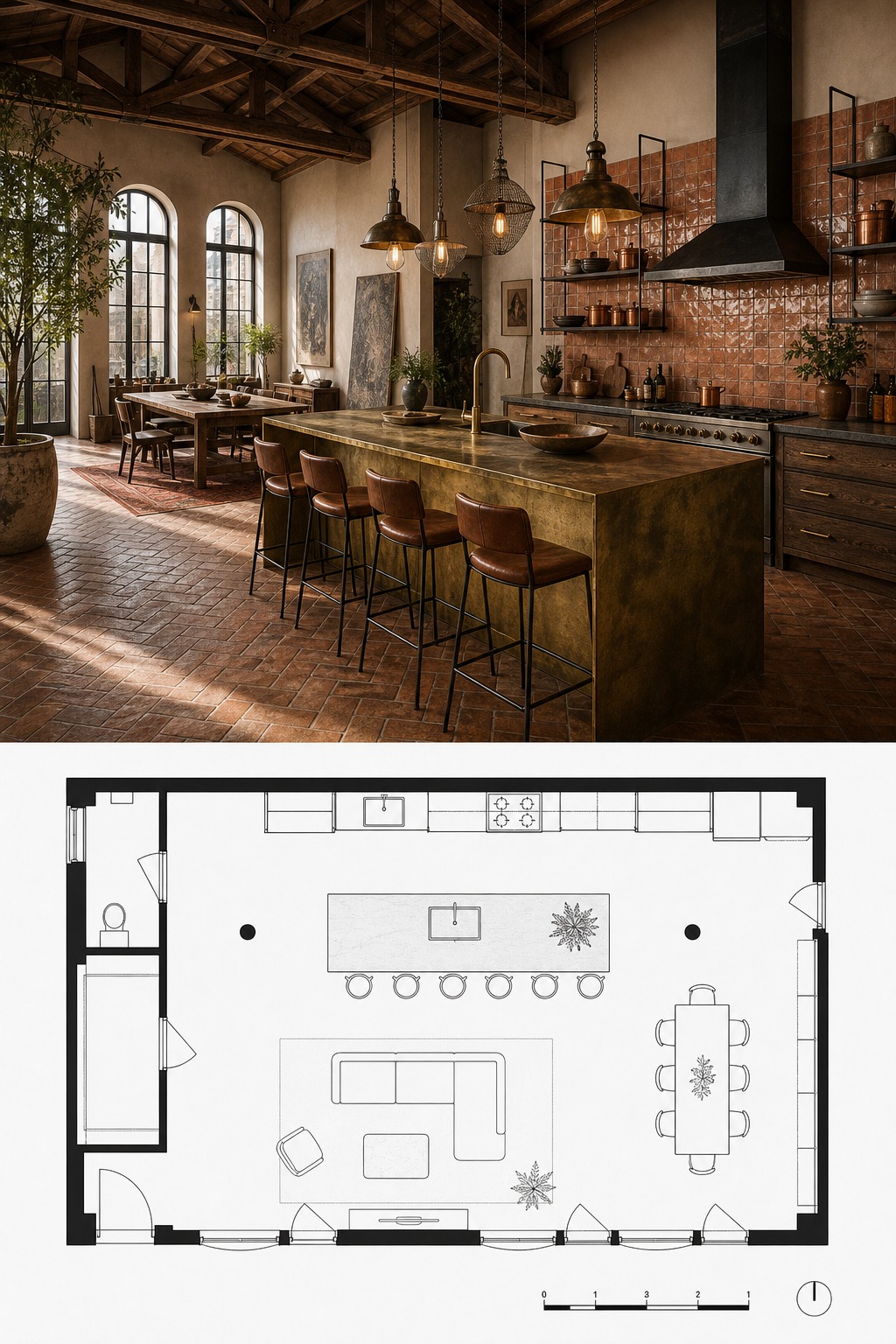
This atelier version leans into patina and collected materials. Terracotta, brass, copper, and roof trusses suit lofts that feel closer to a working studio than a polished penthouse.
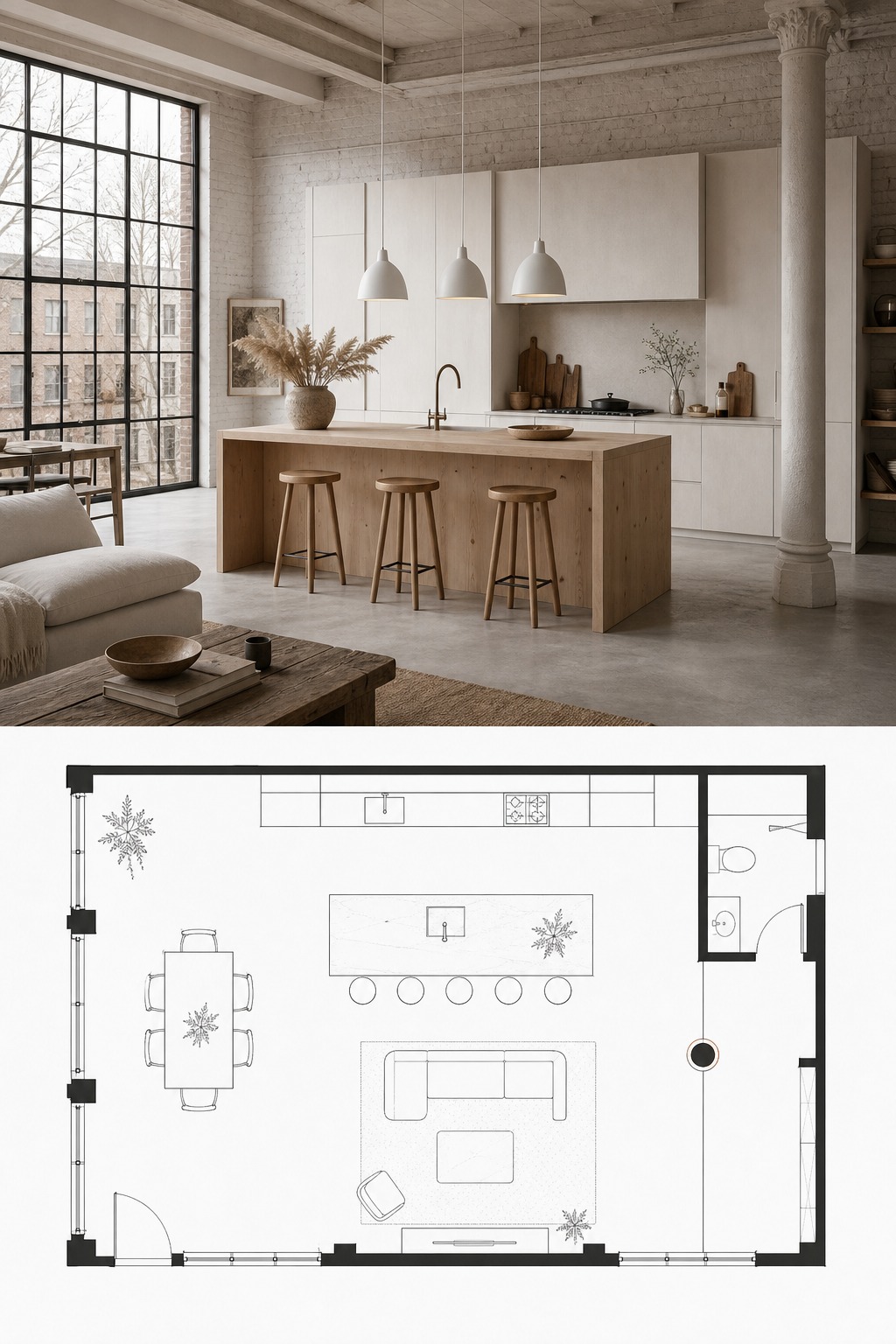
Scandinavian white loft kitchen
The Scandinavian version is useful when the loft has strong industrial bones but needs more air and softness. White limewash, pine, winter light, and pale brick keep the plan visually light.
Moody Victorian warehouse kitchen
A Victorian warehouse conversion can handle richer color and heavier materials. Bottle green lacquer, Verde marble, brass, and candlelit timber give the kitchen depth without losing the industrial shell.
Miami onyx island loft kitchen
This Miami reference is for a loft that wants glamour rather than restraint. The glowing onyx island becomes the visual center, so the plan should keep surrounding cabinetry clean and reflective.
Tokyo micro loft kitchen
A Tokyo micro loft kitchen is about compression and exact storage. Handleless ash, a thin black worktop, and one compact service wall let a small footprint feel intentionally designed.
More kitchen and interior design references
For broader room context, browse the interior design archive. For layout decisions, compare these ideas with practical kitchen floor plans.
If the palette is still open, look at white kitchen ideas and Scandinavian kitchen ideas before finalizing cabinet color, wood tone, and daylight strategy.
For the island and lighting package, check marble kitchen trends, modern kitchen countertop materials, and kitchen lighting ideas. Adjacent references in modern kitchens and minimalist industrial interiors can help keep the loft details cohesive.
Final thought
Loft kitchen design at its best is an exercise in reading a building carefully and then designing a response that respects what’s already there while doing something genuinely new within it. The exposed brick and the hand-matched stone.
The 150-year-old timber and the Gaggenau steam oven. The industrial column grid and the in-frame joinery with 2mm reveal gaps. Getting those pairings right, technically and aesthetically, is the design challenge that makes this category more interesting than any standard kitchen project I’ve encountered. The constraints don’t make the project harder. They make it worth doing.
Historic interiors need restraint, but the same planning logic applies: start with kitchen renovation ideas that improve flow, storage, surfaces, and lighting before adding decorative detail.
FAQ
Why does loft kitchen design require a different approach from a standard kitchen renovation?
Loft buildings weren’t designed for residential use, so their proportions, structural grids, floor conditions, and ceiling heights don’t match residential construction norms. Modular cabinetry systems assume standard dimensions that loft spaces rarely provide. Almost every element, from cabinet depths to ventilation routing to appliance integration, needs custom engineering rather than a catalog selection.
How do you handle an uneven subfloor in a loft kitchen?
Self-leveling compound brings the surface flat for the floor finish. Base cabinets sit on adjustable legs set to achieve a consistent cabinet top rail height across the entire run, with height variation absorbed into the plinth. On a serious historic loft, that variation can run to six centimeters across a long cabinet run, and correct execution makes it completely invisible.
What is in-frame cabinetry and why is it preferred in bespoke kitchen design?
In-frame cabinetry is built with a solid wood perimeter face frame, and the doors are fitted within that frame with a consistent gap, typically 2mm on a well-made example. It’s more structurally stable than frameless construction, resists seasonal movement better, and makes quality immediately legible because the reveal consistency is visible at reading distance.
How do you integrate exposed structural elements like brick and beams into a kitchen design?
Brick requires scribed filler pieces cut to the exact wall profile at every cabinet termination, not caulked gaps. Beams work best when treated as a horizontal datum that all vertical kitchen elements resolve against at consistent relationships, so the composition reads as deliberate rather than forced. Ignoring either element produces awkward collisions that announce themselves as afterthoughts.
What materials work best for loft kitchen surfaces?
Natural stone reads well against loft building fabric because the material carries a similar time scale to old brick and timber. Ultra-compact porcelain works better for high-impact prep zones where stain and scratch resistance are priorities. Stainless steel suits cooking environments where a genuinely industrial material honesty is part of the brief. Timber cabinetry fronts work best when the species references what’s already in the ceiling structure overhead.
How do professional-grade appliances change the layout requirements?
They drive the layout rather than fitting into it. Deep refrigerator columns, wide professional ranges, and steam ovens with specific ventilation clearances all require confirmed electrical, plumbing, and mechanical coordination before cabinet dimensions are finalized. In a historic loft, the ventilation duct routing alone can determine where the cooking zone can physically go.
What should a kitchen island accomplish in an open loft plan?
Integrating warm materials like wood and steel creates a beautiful bridge between indoor kitchens and cozy autumn outdoor decor setups.
The island is the element that most clearly separates the kitchen zone from the living space in an open floor plate, so its position and mass determine how both zones read. It also has to address the structural column grid if any columns fall within the kitchen zone, and its surface material usually needs to carry the wider spatial composition, not just the kitchen palette.
How important is the sequence of design decisions in a loft kitchen project?
It’s the most important variable that’s not visible in the finished project. Structural load capacity, shared riser locations, mechanical penetration approvals, and subfloor conditions all need to be confirmed before any aesthetic decisions are made final. Studios that complete structural and technical due diligence before committing to stone slabs and appliance brands consistently produce better results than those that work in the opposite direction.
For smaller daily rituals inside the kitchen, a focused coffee station design can borrow the same logic: tight dimensions, clear reach zones, and materials that feel deliberate.
- 124shares
- Facebook0
- Pinterest121
- Twitter3
- Reddit0