
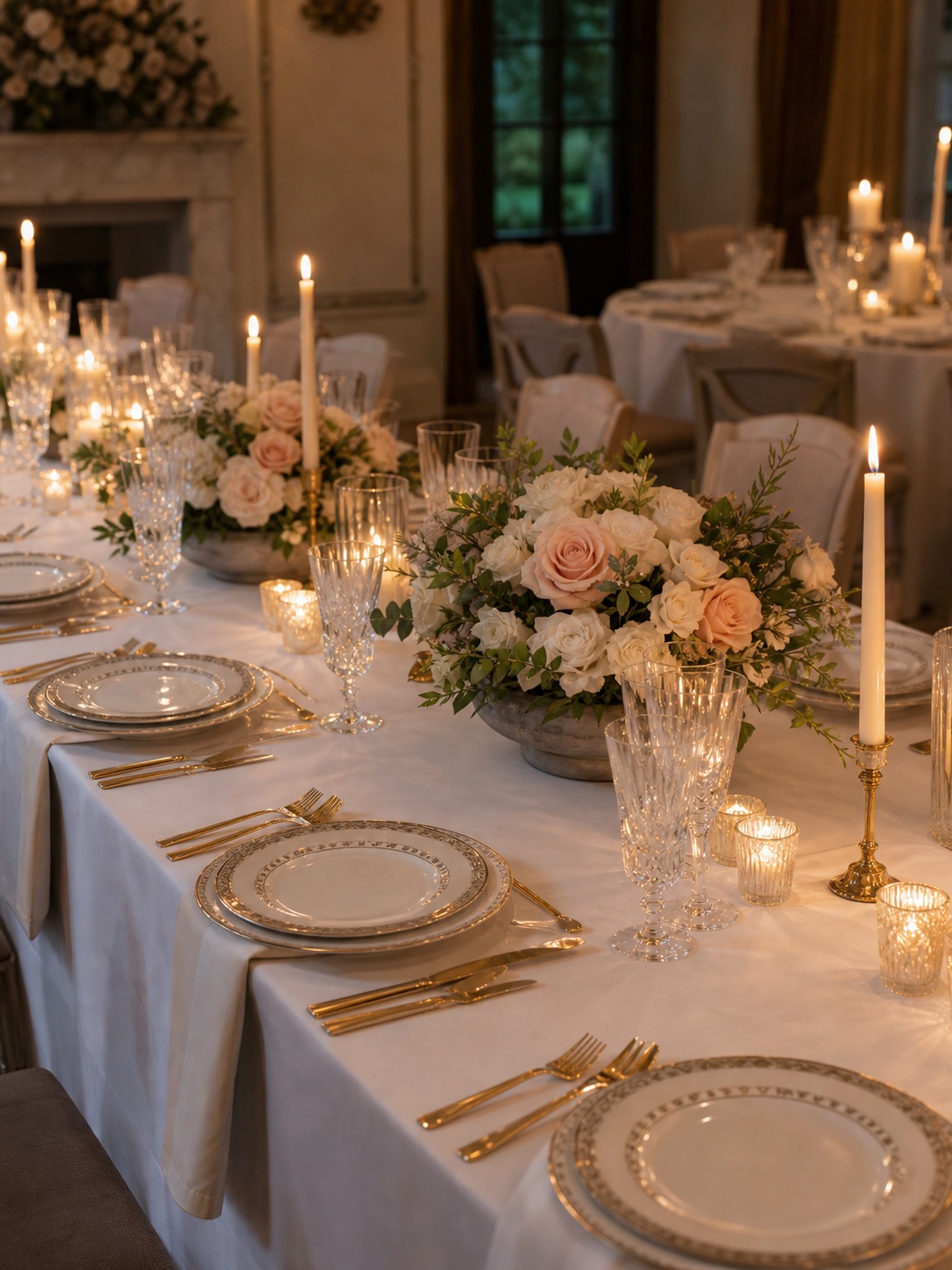
The most beautiful wedding table I ever sat at had almost nothing on it. White linen, pressed flat. A single low arrangement of garden roses in a shallow bowl. Two polished crystal glasses per place. And a plate with a rim so finely detailed you noticed it immediately and then forgot it was there, which is exactly what good tableware is supposed to do.
- 1. Start with one clear table mood
- 2. Let the dinnerware set the visual tone
- 3. Use fine porcelain, like Haviland China, as a quiet focal point
- 4. Match metal accents across flatware, chargers, and candleholders
- 5. Balance patterned plates with plain linens
- 6. Layer plates without making the setting feel crowded
- 7. Choose glassware that supports the mood
- 8. Use flowers as colour rhythm, not table clutter
- 9. Add candlelight for softness and depth
- 10. Leave negative space so luxury feels effortless
- Final thought
- Frequently asked questions
- What makes a wedding table setting look elegant rather than overdone?
- What is the best base colour for a formal wedding tablescape?
- How do you mix metals on a wedding table without it looking messy?
- What type of glassware works best for a formal wedding table?
- How many flowers should go on a wedding reception table?
- Is fine china worth renting for a one-day wedding versus buying?
- How do you create negative space on a wedding table?
- What is the difference between a charger and a dinner plate in a formal setting?
I have been in rooms where the table looked like a florist’s display that got out of hand: mirrored runners, four conflicting candle heights, chargers in a finish that fought the napkin rings, flowers blocking half the guests’ sightlines. The instinct is understandable. It’s a wedding. You want it to feel exceptional. But the path to exceptional is not more things on the table; it’s better decisions about the things already there.
These ten ideas are the ones that actually move the needle on elegant wedding table settings, whether you are working with a stylist, a catering company’s standard rental package, or your own fine china collection. Most of them cost nothing to implement.
1. Start with one clear table mood
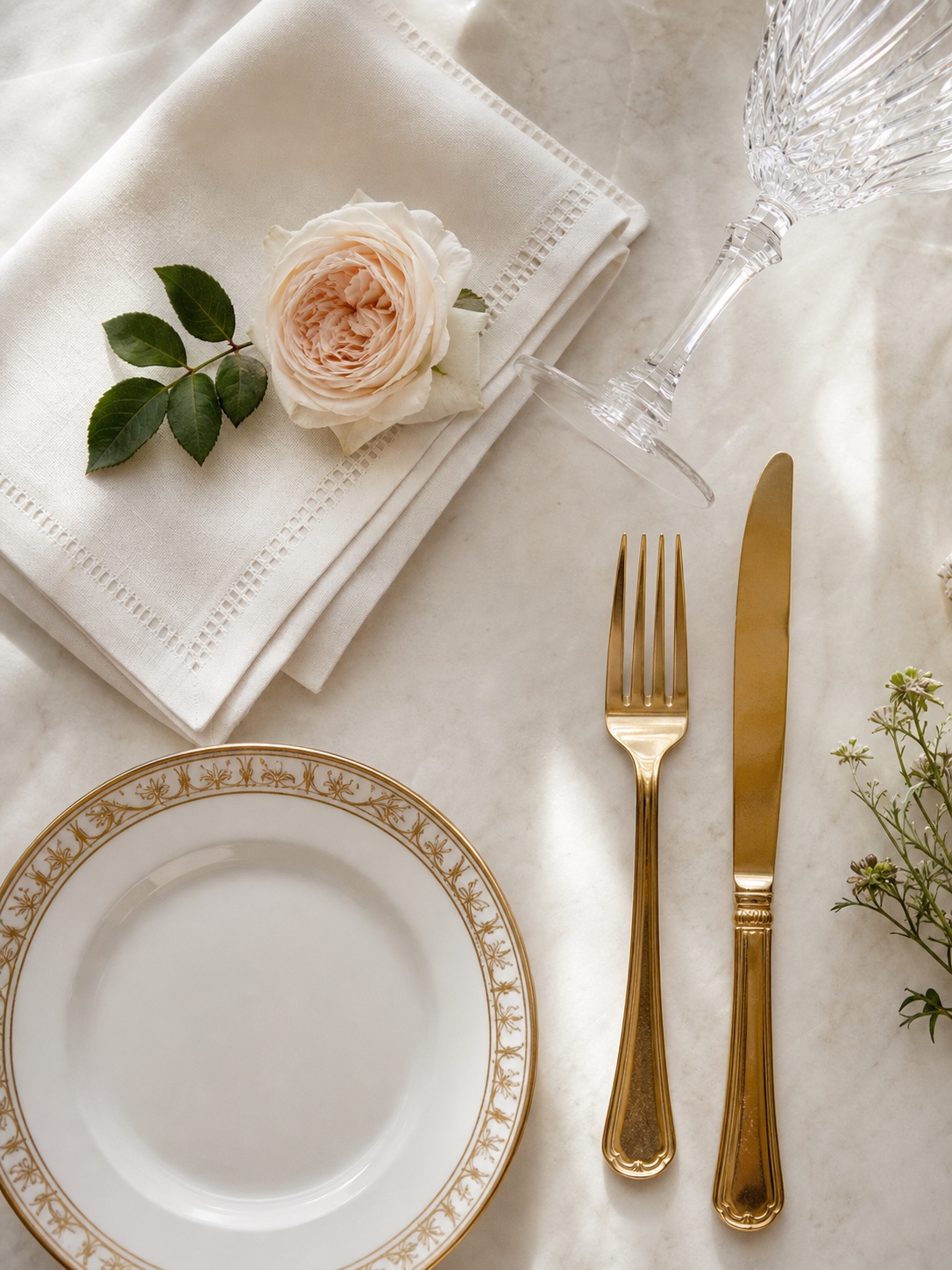
Before any object goes on the table, the mood needs to be settled. Not “romantic” or “classic,” which describe too many possible tables at once, but something specific enough to make a decision by. Is it a candlelit formal dinner? A garden reception in the afternoon? A minimalist contemporary setting where the food is the focus?
The mood determines everything downstream: linen colour, which metal finishes work, how much florals should read versus how much they should recede, whether glassware should be clear and traditional or have some slight tint. Without it, you end up making individually reasonable choices that do not add up to a single thing.
I treat mood the way I approach an automotive design brief: before you draw a single line, you agree what the car should feel like to drive, not what colour it should be. A wedding table works the same way. Settle the feeling first. Every other decision becomes much faster once you have it.
2. Let the dinnerware set the visual tone
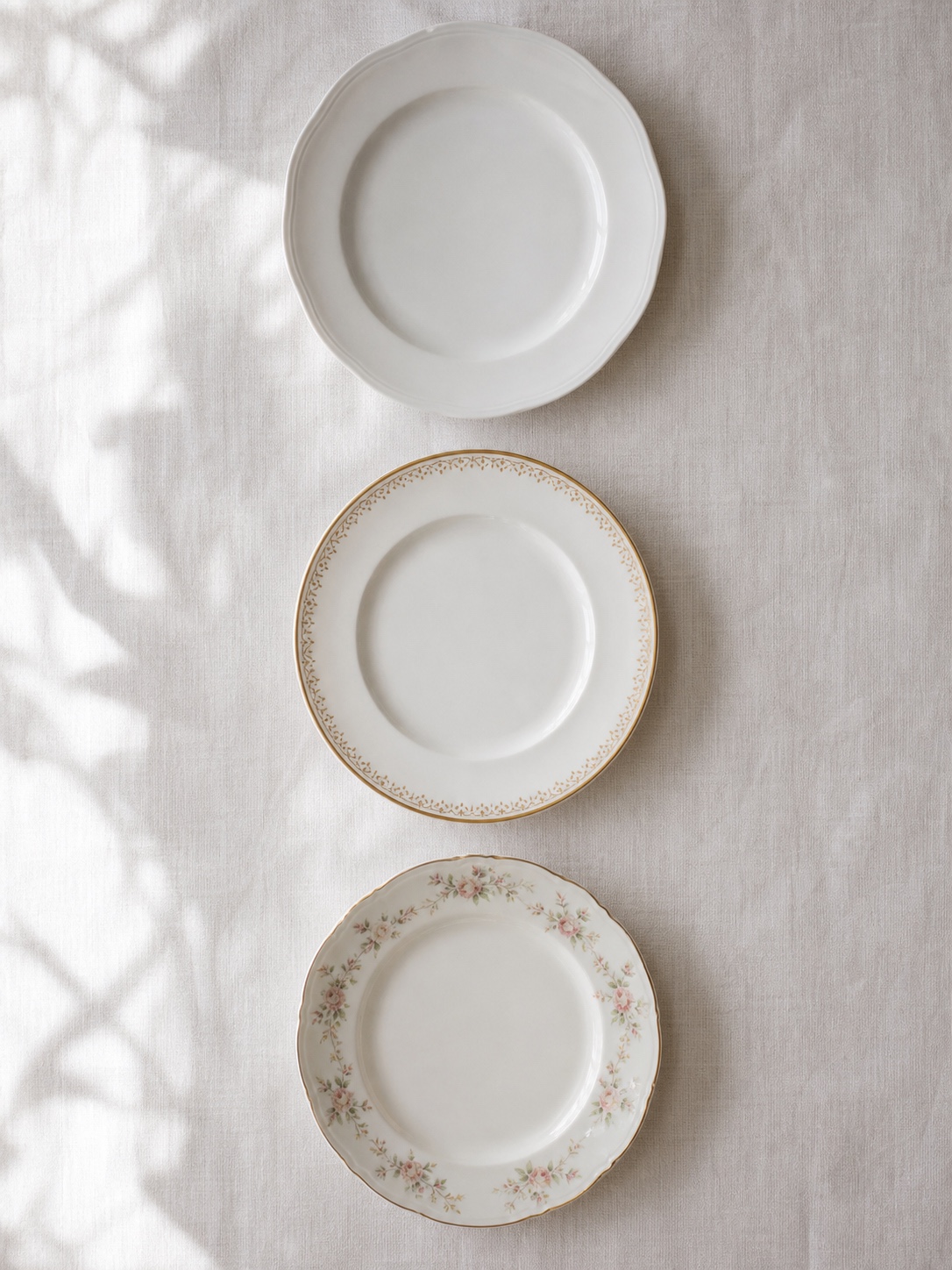
The plate is the first thing a seated guest looks at directly. Everything else on the table, the linen, the centerpiece, the glassware, is peripheral until the plate arrives. Which means the china is doing more visual work than most people assign to it when they plan a wedding table.
A plain white plate with clean proportions can hold almost any table concept around it, from minimal Scandinavian to maximalist floral. A plate with a strong decorative presence, a painted rim, a coloured body, a gilded edge, sets a direction the rest of the table has to follow or it will look mismatched. Neither approach is wrong. But the decision about which type of plate you are using has to come first, not last.
If you are renting, ask the rental company to pull out three or four plate options before you pick linen samples. I have watched too many couples choose their napkin colour and then discover none of the available plates actually support it.
3. Use fine porcelain, like Haviland China, as a quiet focal point
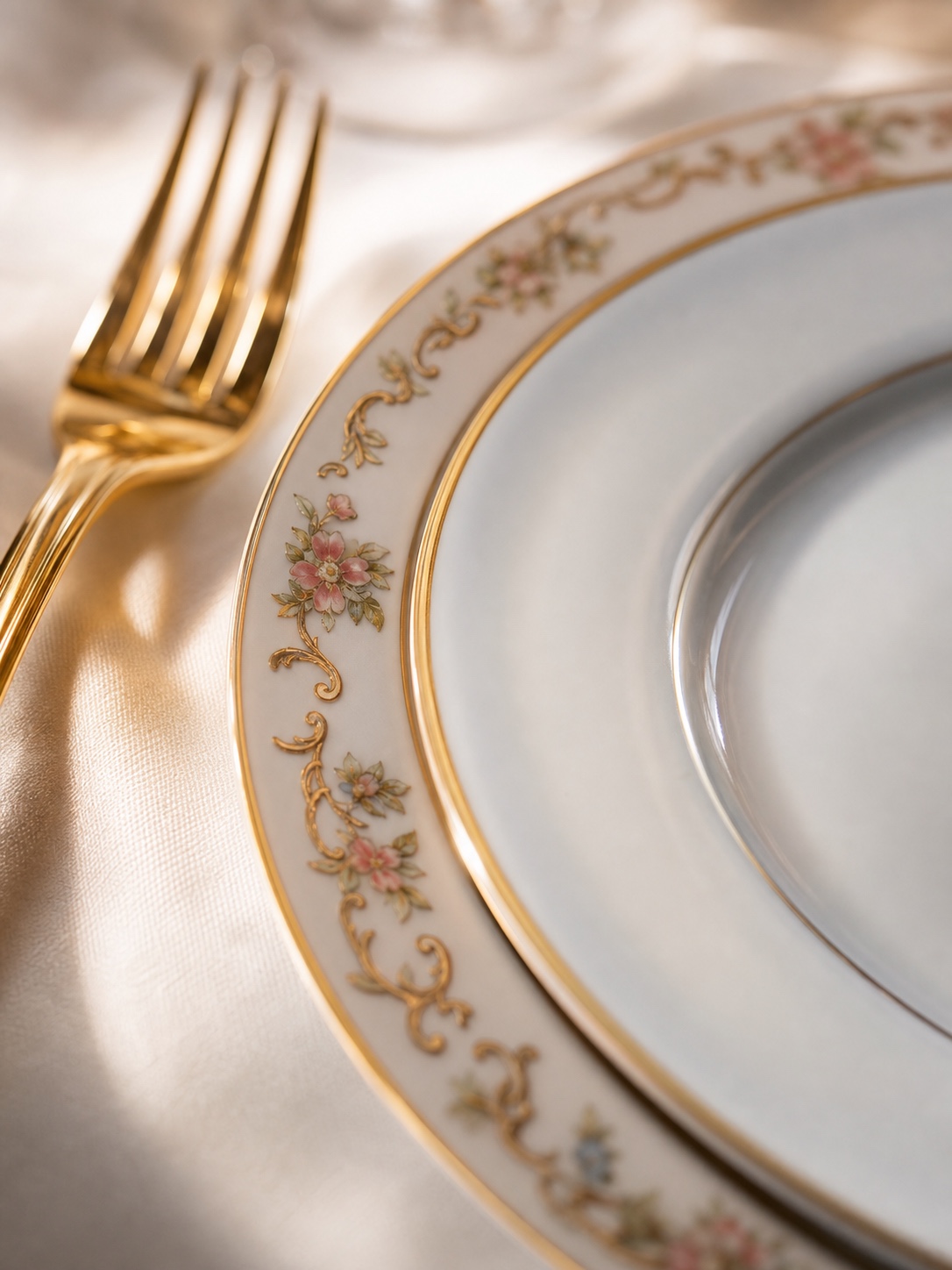
Fine porcelain can give a wedding table a sense of occasion without making it feel overdecorated. Haviland limoges is a good example: many of its patterns combine delicate detail with a soft, formal quality that works well with white linens, candlelight, and restrained floral arrangements. The Dammouse collection, for instance, has enough visual richness in the border alone that the table around it does not need much else. The Infini line in white or platinum does the opposite, offering a very clean, textured surface that lets other elements come forward.
The key is not to make the china fight for attention. If the plate has a decorative rim or floral motif, keep the charger, napkin, and centerpiece simpler so the place setting feels layered rather than busy. A patterned plate and a patterned napkin fold and a tall candelabra in the same arrangement are three things arguing at the same time. One of them needs to step back.
Haviland has been producing Limoges porcelain since 1842, and that history shows in the specifics: the weight of the pieces, the way the glaze holds colour across decades, the fact that some patterns are still produced from the original engravings. For a wedding table, that material quality reads before a guest can articulate it. It is the difference between a table that photographs well and one that people actually remember.
Tip: If the couple plans to use the china at home after the wedding, consider buying 8 to 12 place settings and renting the rest for the reception. Most specialist rental companies carry Limoges-quality pieces, so the two sources can be nearly indistinguishable on the day.
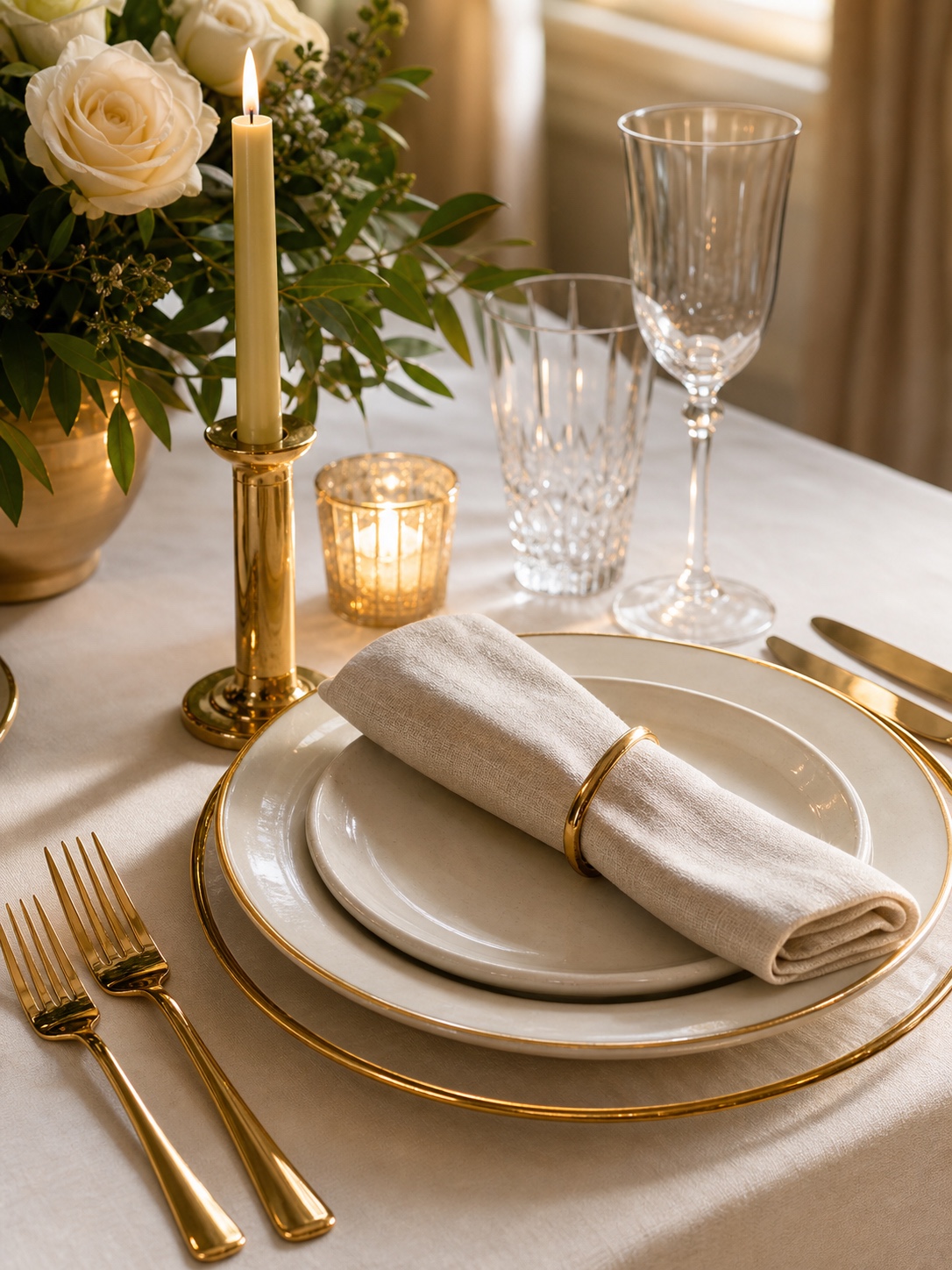
4. Match metal accents across flatware, chargers, and candleholders
Metal is the thread that ties a wedding table together visually. When the flatware, the charger rim, the candleholders, and the napkin ring are all pulling from the same metal family, the table reads as a single considered thing. When they are each a slightly different finish, the table reads as assembled from separate decisions.
Gold is the most common choice for formal wedding tables right now, and the reason is simple: warm gold and candlelight reinforce each other. But the word “gold” covers a wide range of actual finishes. Bright polished gold, brushed matte gold, champagne gold, and antique brass all read differently under candlelight and in photographs. Pick one and keep every metal piece within that one range.
Silver is more correct by traditional formal table standards, and it still reads exceptionally well on a white and white table where the linen, china, and florals are all in the ivory-to-white range. Mixed metals, specifically choosing one dominant and allowing one secondary as an accent only, can work on a contemporary table but needs a light hand. Three different metal finishes in equal weight is two too many.
5. Balance patterned plates with plain linens
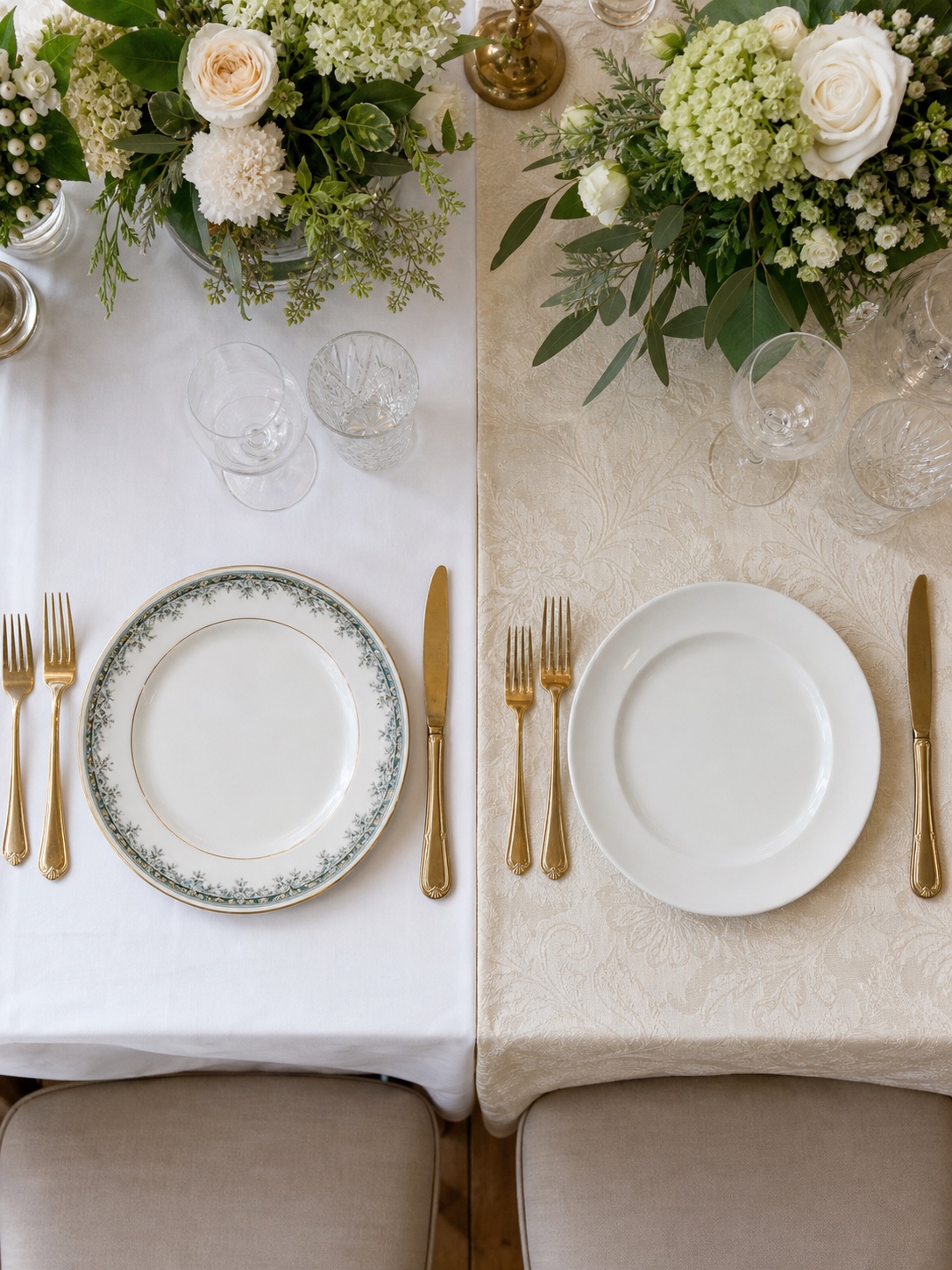
This is probably the decision I see resolved wrong more often than any other on wedding tables. A plate with a strong pattern, a coloured rim, a painted floral border, a textured relief, needs linen that gives it room to read. That means plain or very subtly textured fabric in a neutral tone, nothing with its own pattern or colour that competes.
A good table also depends on material contrast. If the linen, porcelain, and florals all feel too similar, use this linen texture and material contrast guide to sharpen the mix before choosing colours.
The reverse also holds. A plain white plate on plain white linen with no decorative interest at all reads as a hotel buffet, not a wedding. If you choose plain china, add texture through the linen (a linen weave or a simple jacquard) or through the napkin fold, since those are the layers immediately around the plate and they carry the visual weight when the plate itself is quiet.
In practice, this means deciding the pattern level of the plate first, then choosing the linen as a counter-balance, not the other way around. The linen should support the china, not compete with it and not leave it stranded.
6. Layer plates without making the setting feel crowded
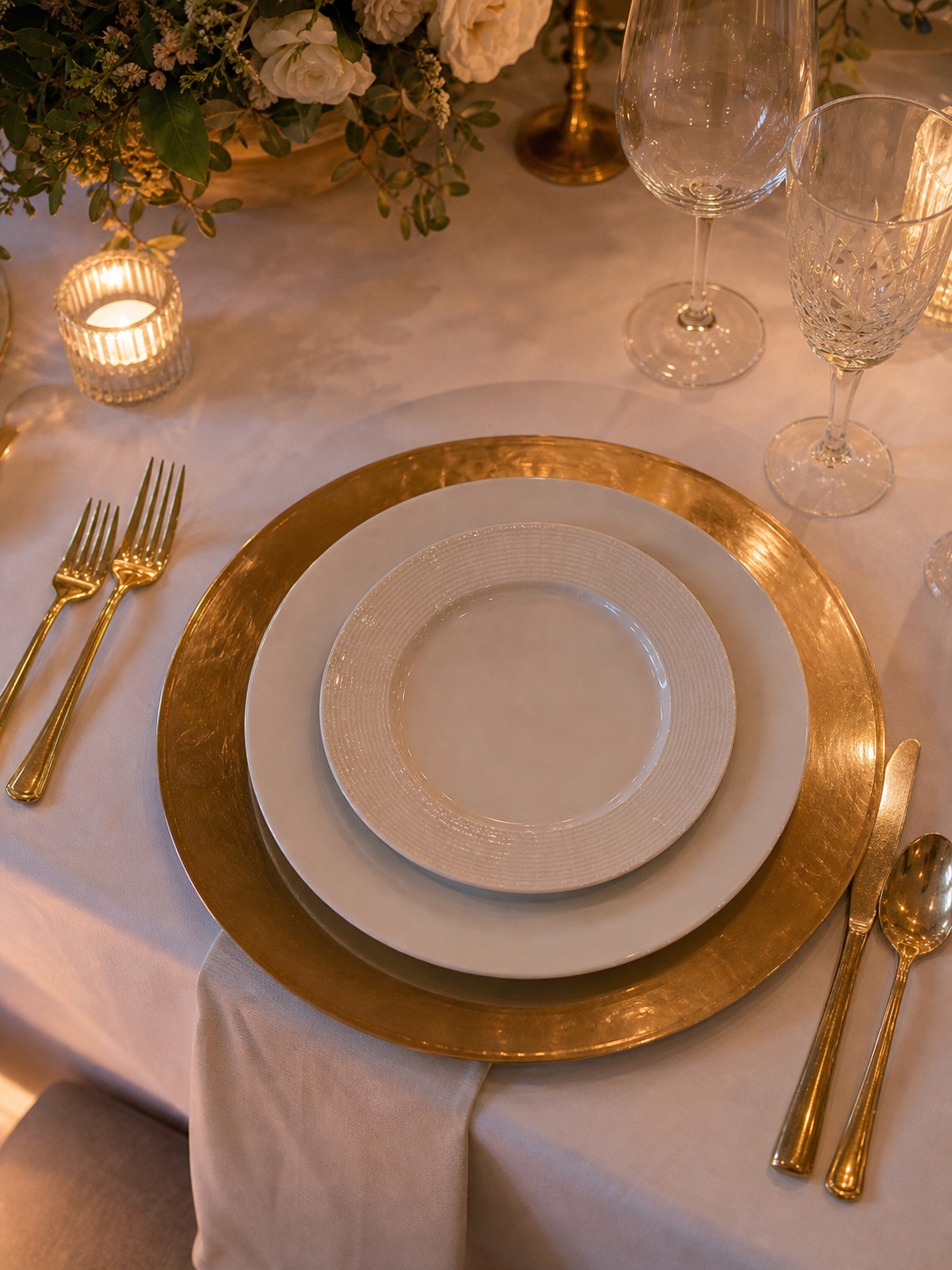
A formal place setting typically has three layers when guests arrive: the charger as the base, the dinner plate on top, and a smaller salad or bread plate above that. Done well, this reads as structured and generous. Done carelessly, it reads like a stack of dishes.
The charger should be visibly different from the dinner plate in some way: different material, a more decorative surface, a slightly different finish. If the charger and the dinner plate are both flat white porcelain, they merge and the layering loses its purpose. A metallic charger under a white plate, or a textured plate on a plain charger, creates the visual separation that makes the stack read as intentional.
Diameter matters too. A standard charger runs 30 to 33 cm; a dinner plate at 28 cm leaves a clean rim of charger visible all around. Smaller than that and the charger disappears. Larger than 33 cm and the charger starts to crowd the flatware, which makes the overall setting feel tight rather than generous.
7. Choose glassware that supports the mood
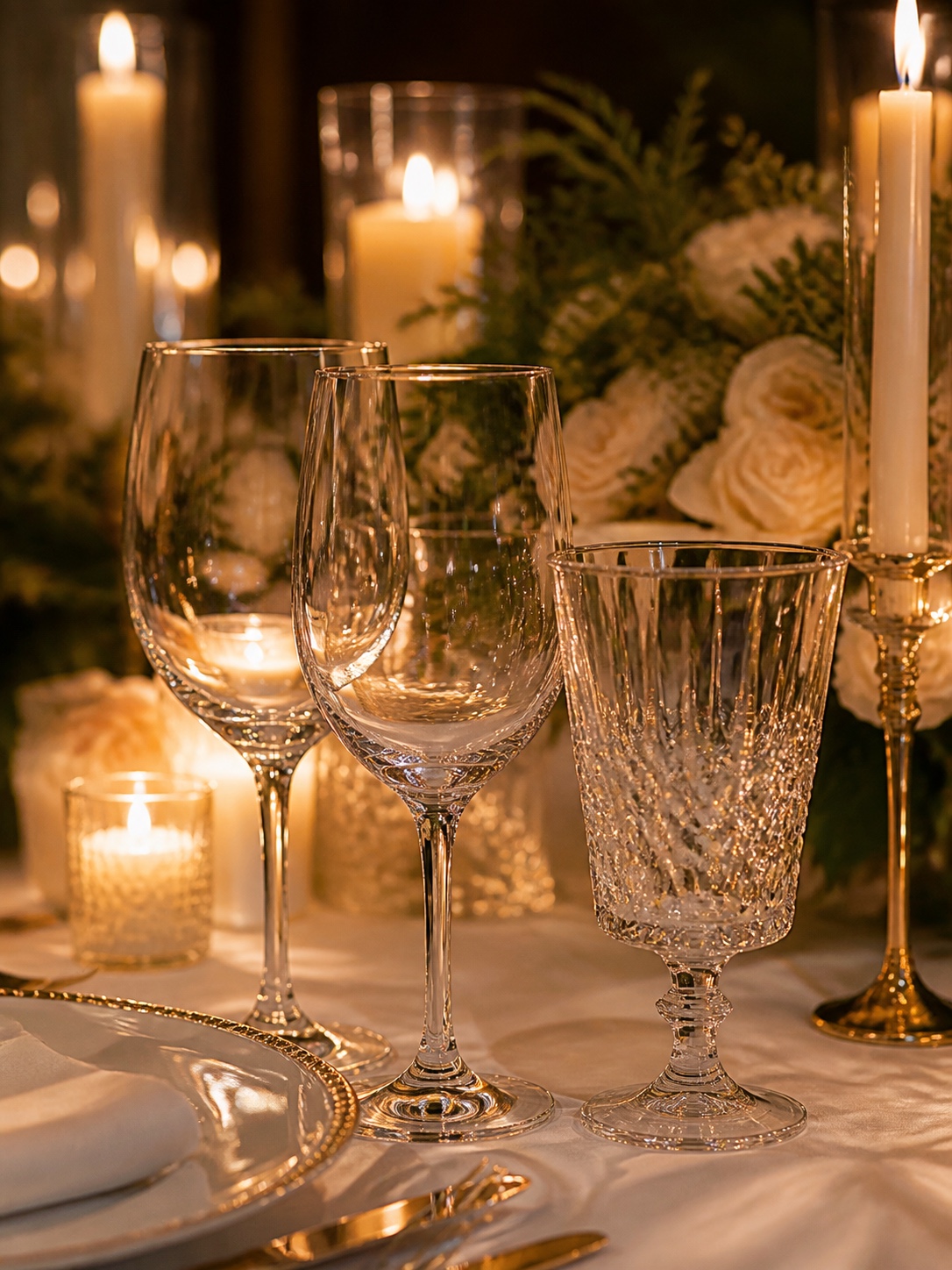
Glassware is the setting’s vertical element. Everything else on a wedding table is horizontal: linen, plates, flatware, low centerpieces. Glasses are the only pieces that add height at the place setting itself, which means they affect the silhouette of the whole table in a way that no other individual piece does.
Glassware, drapes, and candlelight all shape how formal a room feels. The same thinking behind fabric, light, and softness can help you keep the table reflective without making it glare.
Clear, thin-walled stemware in a classic proportioned shape, a long-stemmed water goblet and a standard wine glass, works at almost any formal table. It does not compete with the china, it amplifies candlelight when the light hits it, and it photographs cleanly without introducing a colour variable. Riedel’s Veritas line and Spiegelau’s Festival series are two well-regarded options that read formal without crossing into the territory where each glass costs more than the dinner plate.
Coloured or tinted glass can work on a contemporary table with a deliberate colour scheme, but it only works when the rest of the setting is very neutral. Pale smoked glass in a table that is otherwise entirely white and gold is elegant. Pale smoked glass alongside a patterned linen, coloured flowers, and a decorative charger is the fourth colour where three was already one too many.
8. Use flowers as colour rhythm, not table clutter
Floral arrangements are where wedding tables most often go wrong, not because the flowers themselves are wrong but because they are treated as decoration rather than colour structure. A flower arrangement that competes with the china, the linen, and the candle scheme for attention reads as clutter, no matter how beautiful it is in isolation.
For a softer natural palette, borrow ideas from nature-inspired interior design: repeat greens, whites, branches, and organic textures instead of adding more flowers everywhere.
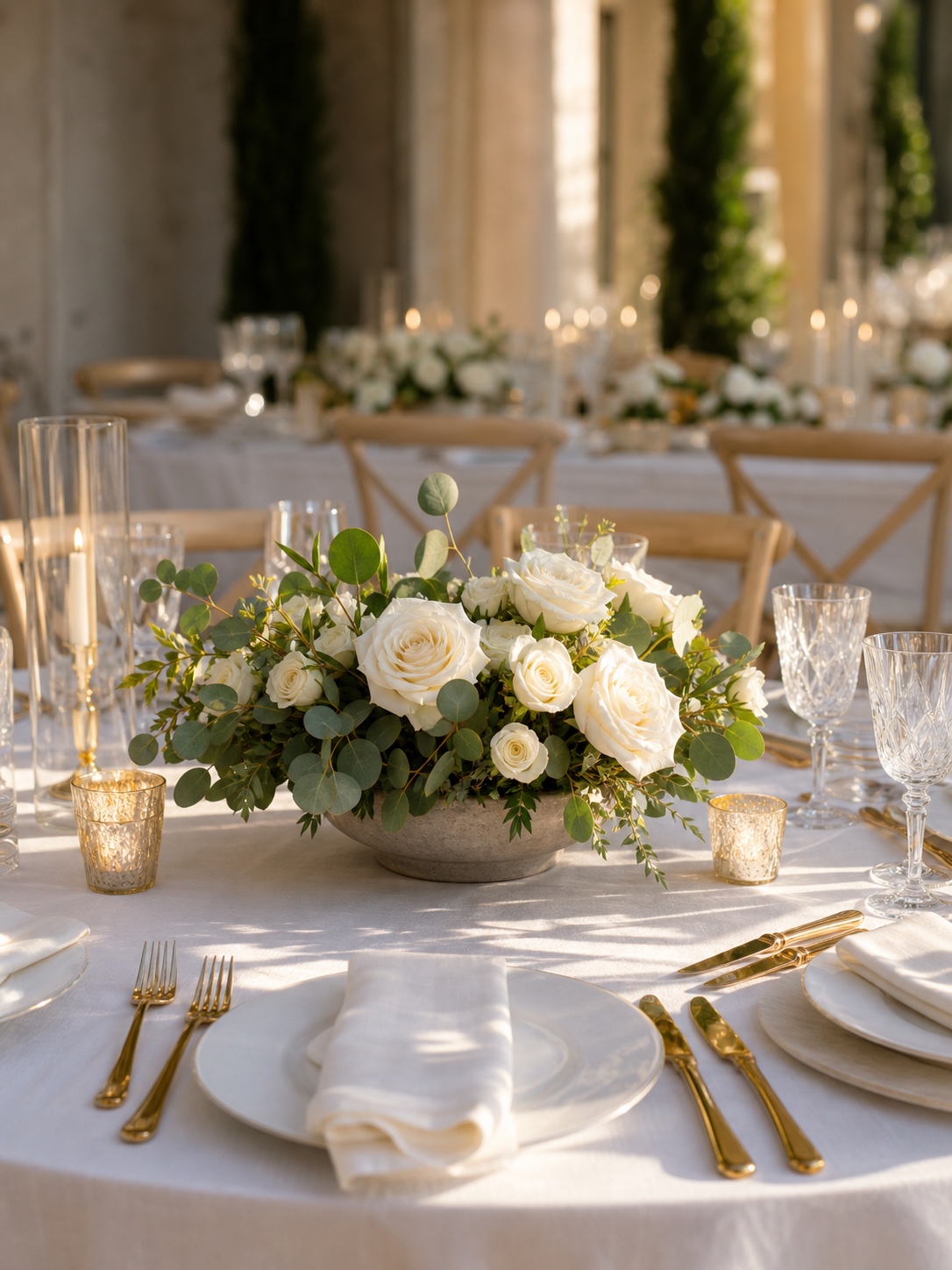
The most effective florals on a wedding table are the ones that repeat one or two colours from somewhere else in the setting. If the plate has a soft blush rim, pale pink garden roses in the centerpiece create a colour echo rather than a new colour. If the table is all white and gold, white blooms with no other colour let the metal accents carry the warmth.
Height is the other variable that directly affects whether a flower arrangement improves or damages the table. Anything that blocks sightlines between seated guests is a problem, even if it is beautiful. The safe range for a seated table is under 35 cm or over 80 cm so the arrangement clears the sightline entirely. The problem zone is mid-height: tall enough to block but not tall enough to read as an architectural statement.
Tip: Ask your florist to set up a full mock centerpiece at the actual table height before the wedding, with a person seated on both sides. It is the only reliable way to check sightlines before the day.
9. Add candlelight for softness and depth
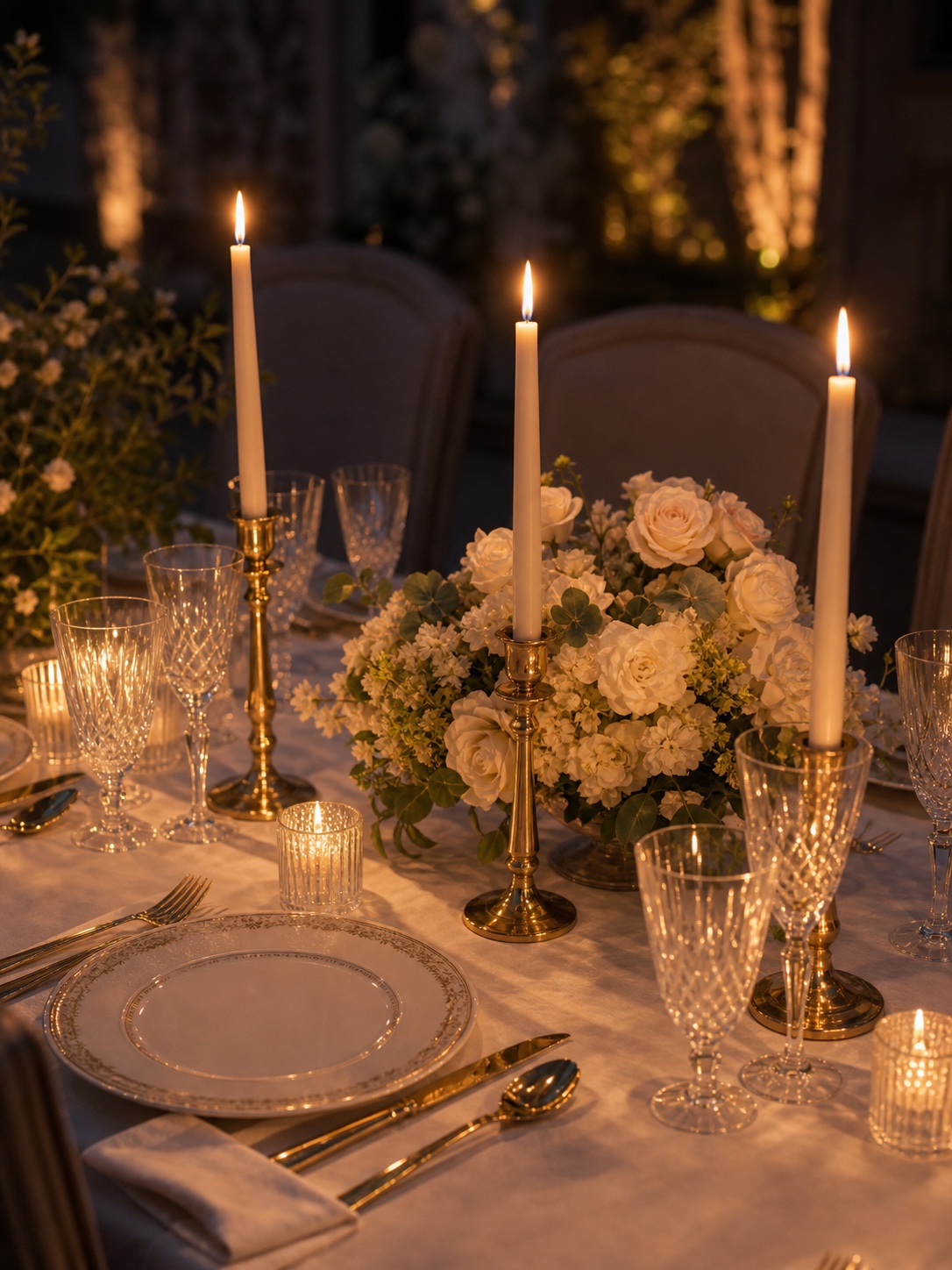
No artificial lighting at a venue does for a table what a candle does at table level. The reason is simple physics: a candle is a point source of warm light approximately at plate height, which means it casts shadow and warmth across the surface of the table itself, not just down from above. It makes everything on the table read more richly: the glassware catches it, the metal reflects it, the linen absorbs it in a way that reads as texture rather than flatness.
Taper candles in simple candlestick holders are the most formal choice, and they work proportionally on most tables because the vertical line of a taper adds height without mass. Pillar candles clustered in threes at different heights are a more casual variation. Low tea lights scattered between place settings are the version I would argue against most strongly on a formal table: they read as filler rather than as a decision, and the typical tea light is gone within four hours, which matters for a long reception.
One practical note: any candle holder that requires a guest to reach around or past a flame to get to their glass is too tall or placed too centrally. Candlelight is supposed to make a table feel warmer, not add a small logistical obstacle between a guest and their wine.
10. Leave negative space so luxury feels effortless
The single most reliable indicator of whether a wedding table was designed or just assembled is whether there is any empty surface visible. A table where every inch is covered, charger to edge, runner to runner, flowers to candles to place cards to menu cards to favour boxes, is a table that reads as anxious rather than confident.
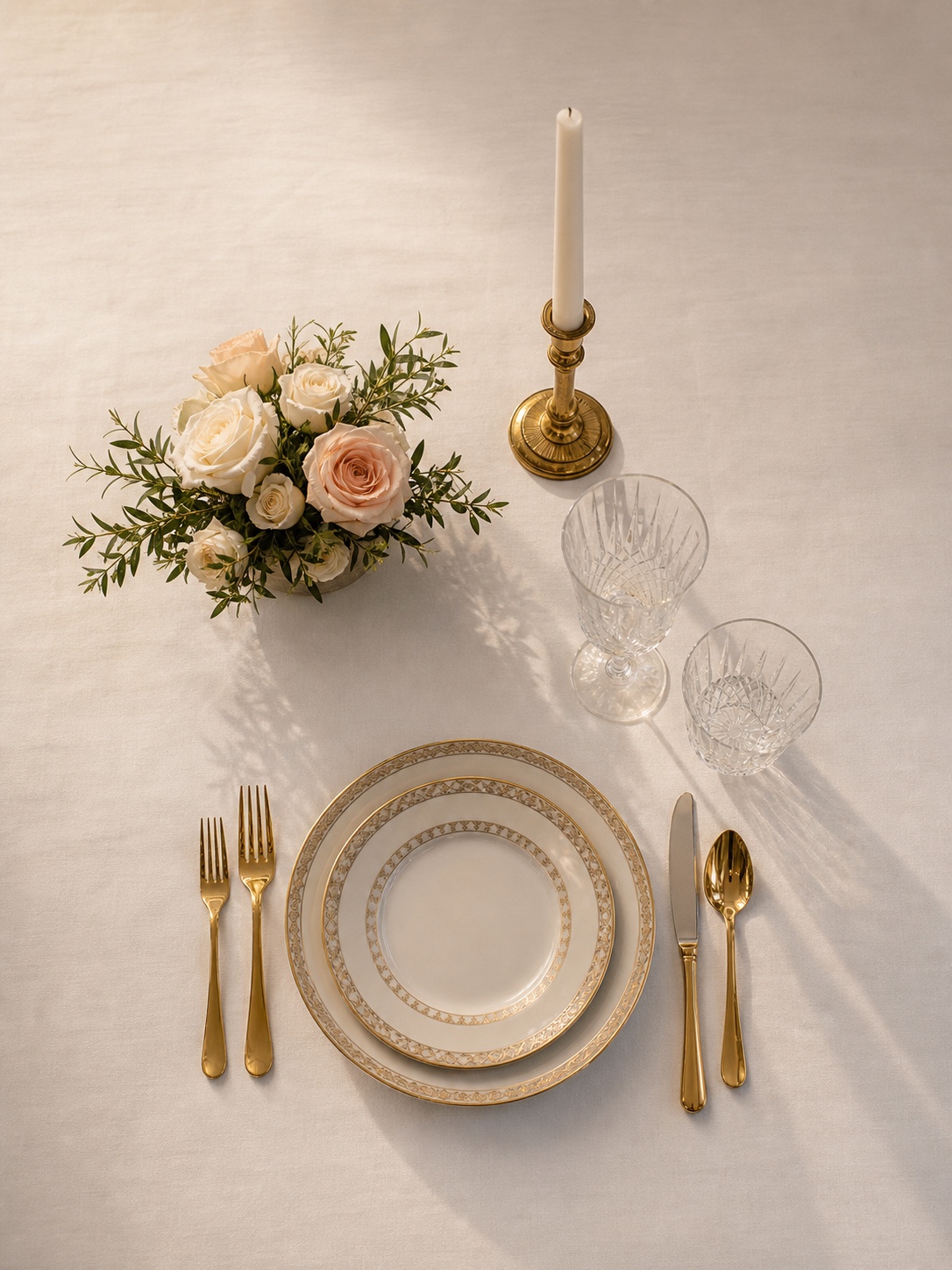
Negative space on a table is not empty space. It is the breathing room that lets each element read individually rather than merging into visual noise. It is what makes the crystal glass read as crystal rather than as one object among many objects. It is what makes the plate’s rim detail visible from a standing view rather than lost in surrounding clutter.
In practice, this means editing after you have set up the full table. Walk away and come back. Photograph it from above and from seated eye level. Whatever your eye goes to first, that is what is working. Whatever your eye cannot find easily, that might not need to be there. A table with three strong elements and visible linen around them will almost always photograph better and feel better to sit at than one where something fills every surface.
Final thought
None of these ten ideas requires a large budget. Most of them require removing something rather than adding it. The plates that I remember from years of working across residential and hospitality projects were not the most elaborate ones; they were the ones where every choice was connected to every other choice, where the table felt like a single decision rather than a collection of good ones.
If you are planning the whole reception environment, not just one table, this guide pairs naturally with broader room styling ideas about layout, light, texture, and visual calm.
Start with the china. Pick a mood specific enough to make decisions by. Then hold a firm line on the number of elements in each zone of the table, because luxury and crowding do not live in the same place. The negative space is not what you forgot to add. It is what makes the rest of the table worth looking at.
If you want the table to feel connected to the rest of the reception space, keep it in the same design language as the room. For more broad room-planning ideas, browse the interior design ideas hub.
Frequently asked questions
What makes a wedding table setting look elegant rather than overdone?
Restraint. The most striking wedding tables I have seen in person share one quality: each layer of the setting earns its place. A well-chosen plate with a decorative rim, a simple linen, a low candle, and a single stem read as more considered than a table piled with chargers, multiple candelabras, and competing floral installations. Elegance is editing, not adding.
What is the best base colour for a formal wedding tablescape?
White or ivory linen is the most reliable foundation because it reflects candlelight, lets the china read clearly, and does not fight with almost any colour scheme. Pale grey and champagne also work well for a modern formal table. Avoid deep-coloured linens unless the rest of the setting is very restrained, since a dark tablecloth absorbs rather than amplifies light, which matters particularly for evening receptions.
How do you mix metals on a wedding table without it looking messy?
Pick one dominant metal, gold or silver, and allow one secondary accent. Warm gold flatware, a gold-rimmed charger, and brass candleholders read as a coherent plan. Adding a third metal, say a chrome champagne bucket alongside them, is usually one too many. The rule is coordination, not matching: the metals can vary in finish (matte vs. polished) as long as the family stays the same.
What type of glassware works best for a formal wedding table?
Clear, thin-walled stemware in classic shapes: a long-stemmed water glass and a standard wine glass are enough for most formal settings. Coloured or tinted glass can work, but only if the rest of the table is very neutral, since it introduces a colour variable that is hard to balance once the florals and linens are also in play. Avoid wide, short stems at formal tables; they read as casual regardless of brand.
How many flowers should go on a wedding reception table?
Fewer than most people plan. A single large arrangement or three small clusters in odd numbers tends to read better than an even row of identical vases. More importantly, check the height: anything that blocks sightlines across the table, roughly anything taller than 35 to 40 cm for a seated guest, interrupts conversation, which is the actual purpose of the table. Low arrangements or very tall architectural ones that clear the sightline entirely are both solutions; mid-height is the problem zone.
Is fine china worth renting for a one-day wedding versus buying?
For a large wedding, renting from a specialist event rental company is almost always the better option: you get access to quality pieces (including lines like Haviland or Rosenthal) without committing to storing 200 place settings afterward. If the couple actually plans to use the china at home, buying a set for 8 to 12 and renting the remainder for the event is a reasonable middle ground.
How do you create negative space on a wedding table?
By resisting the urge to fill every surface. Leave the centre third of the table bare if you are using a long runner, or give each place setting a clear boundary of visible linen around the outermost piece. Negative space is not emptiness; it is the gap that lets each individual element read clearly instead of blurring into a crowded surface. The easiest way to test it: photograph the table from above. If everything merges into one visual mass, something needs to come off.
What is the difference between a charger and a dinner plate in a formal setting?
A charger is a decorative base plate, typically 30 to 35 cm in diameter, that stays on the table through the early courses and is removed before the main course arrives; it never carries food directly. The dinner plate sits on top and is swapped out with each course. In a formal setting, a charger also marks each guest’s position clearly before they sit, which is part of why they matter as a design layer: they define the geometry of the table before a single piece of food arrives.
For dining rooms and events, these table styling principles show how detail, rhythm, and balance work at a smaller scale.
- 136shares
- Facebook0
- Pinterest136
- Twitter0
- Reddit0