I once spent four days on a single radius. Not a whole car, not even a whole panel — just the transition where a door skin curves into the sill, the blend that has to read as one continuous surface even though it’s built from three different tool passes. That kind of work teaches you something most people never think about: the parts of an object nobody consciously notices are usually where the most decisions got made.
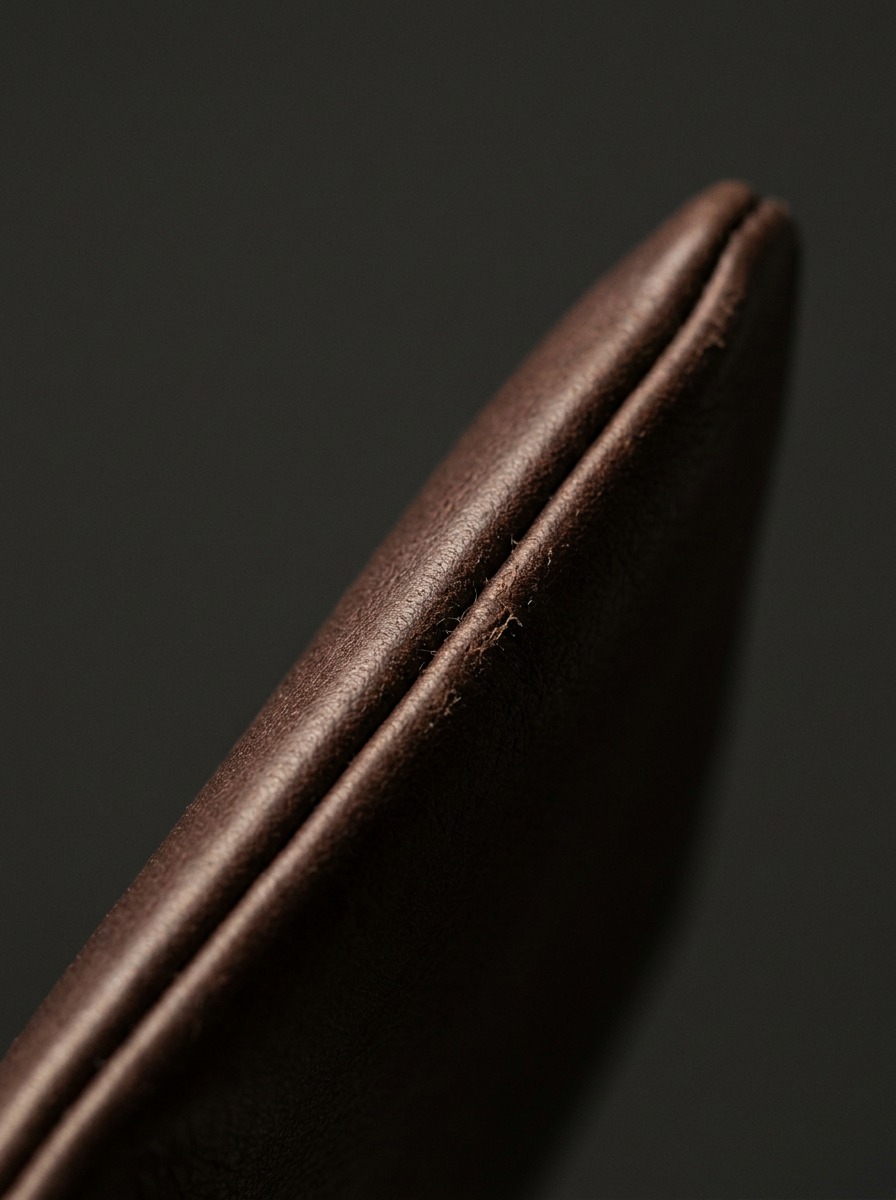
The folded edge on a leather case works the same way. Rempliage (skiving the leather thin, turning it back on itself, carrying the grain around the boundary without paint or a visible raw cut) is a piece of geometry engineered to disappear. You’re not supposed to see the decision. You’re only supposed to feel that the object is complete.
- Why the quietest line on a leather case is the hardest to make
- The geometry of a folded edge
- Folded edge vs. painted edge — two different design decisions
- Where this geometry comes from — Fes, zellij, and a shared design logic
- Reading a case like a section drawing
- Lunburg today — geometry kept in practice, not just on paper
- Reading the smallest line
- The folded edge in daily use
- FAQ
This is leather edge finishing at its most demanding, and it rewards the same kind of attention I learned reading surfaces before I ever touched a hide.
Why the quietest line on a leather case is the hardest to make
Most of what makes a leather case feel expensive is loud by comparison: the grain, the hardware, the stitching pattern running dead straight down a gusset. The edge is the one detail built specifically not to announce itself.
That’s a strange design brief. Somewhere between the last stitch and the finished piece, an artisan has to solve a genuinely three-dimensional problem (thickness, curvature, and where the lining meets the outer panel), and the entire measure of success is that nobody notices the solution.
I think about this the same way I think about a well-blended automotive surface. A door skin that flows into a sill without a visible seam took more design decisions than a panel with an obvious crease line, because the crease gives the eye somewhere to land and forgive small errors. Remove the crease and every millimeter of the transition has to earn its place. A folded edge is the leather-goods version of that blend: no crease to hide behind, no paint to smooth over a rough cut. Just the grain, folded and carried around, asking to be perfect exactly where it’s least likely to be examined.
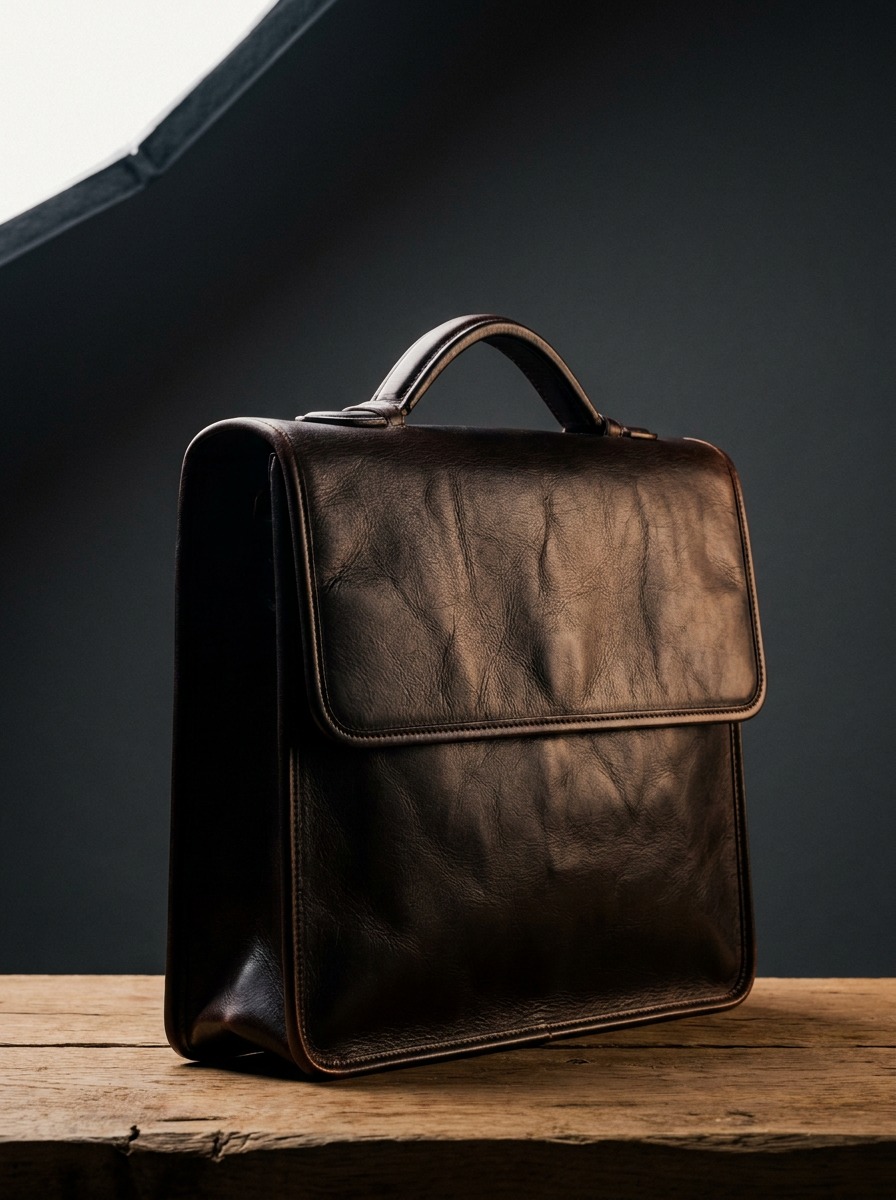
The geometry of a folded edge
Rempliage happens in three overlapping problems: reducing material, redirecting a straight line into a curve, and controlling a process that never behaves the same way twice.
Subtraction first: skiving to a tolerance you can’t see
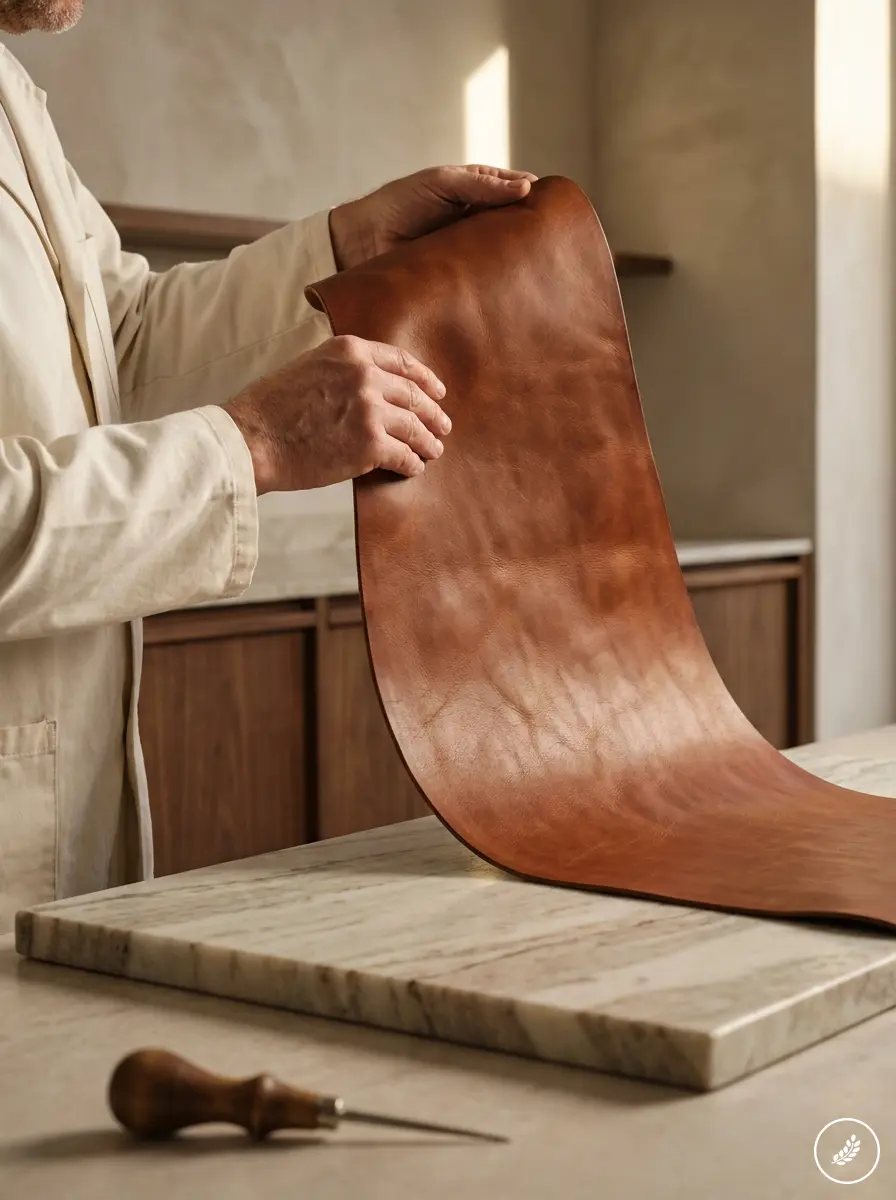
Before anything gets folded, it gets removed. The artisan pares the underside of the leather down so it can turn without piling into a visible ridge, a process called skiving. A single panel can need several different skiving configurations, sometimes one to four separate blade passes, each controlled to a tolerance of about 0.1 millimeter.
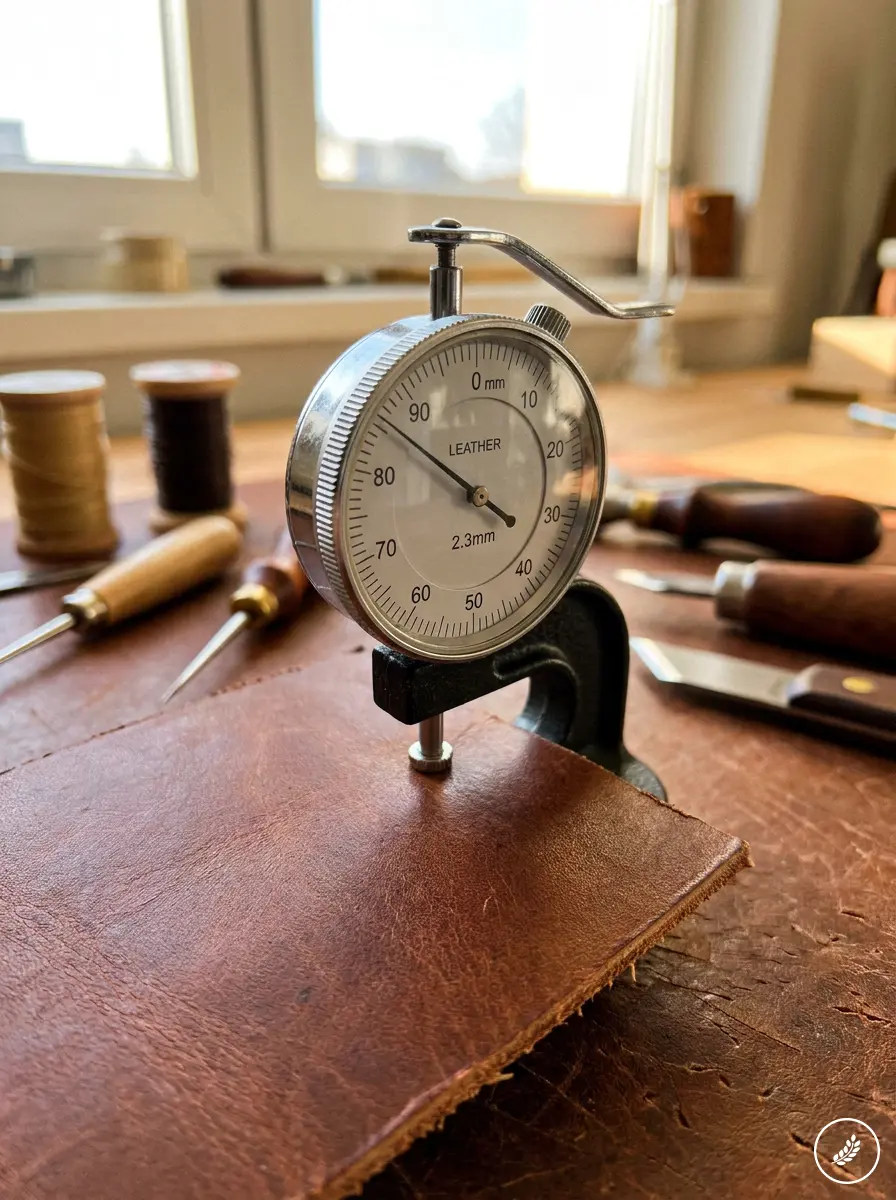
That number stopped me the first time I heard it. 0.1 millimeter is roughly the working tolerance I’d expect on a jewelry setting, not a hand tool moving across a hide. It’s not the thickness of the finished leather — it’s the precision of the cut that gets you there, and it changes depending on where you are on the edge.
A straight run along a gusset wants a different angle, width, and depth than the tight curve near a corner, so there’s no single skiving pass that works for the whole edge. You’re solving the geometry in sections, the way I’d block in a complex curve in a life drawing: not one continuous line, but a series of correct local decisions that add up to a convincing whole.
The corner problem — turning a straight fold into a radius
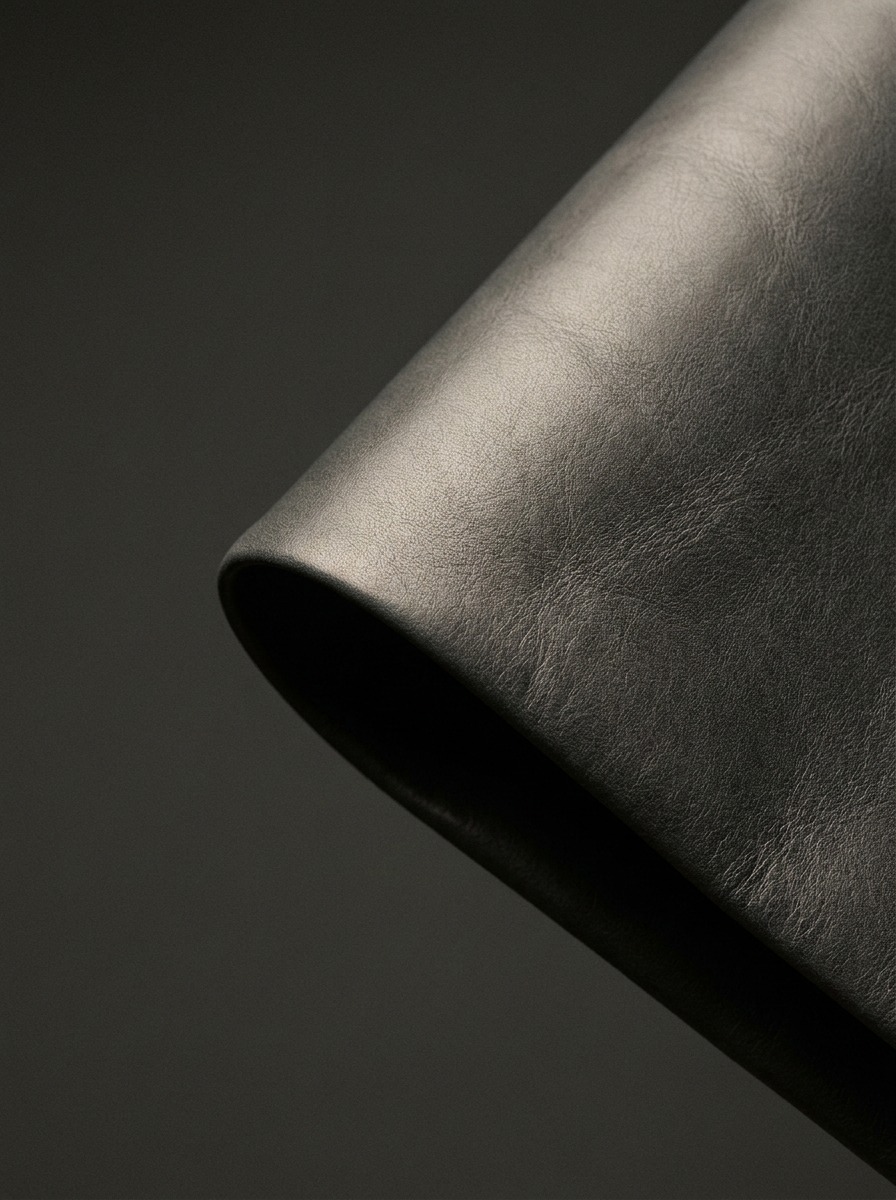
A straight edge only has to solve one axis. A corner has to solve two at once, and that’s where the geometry actually gets interesting.
Fold a straight length of skived leather and the material has exactly enough to travel from front to back. Fold a corner the same way and you’ve got a surplus — the outer curve needs more material than the inner one, the same problem a tailor solves easing a sleeve into a shoulder, or that I solved constantly shaping surfacing panels around a wheel arch. The artisan resolves the surplus by gathering it into microscopic pleats, then working those pleats down into a single, uninterrupted radius.
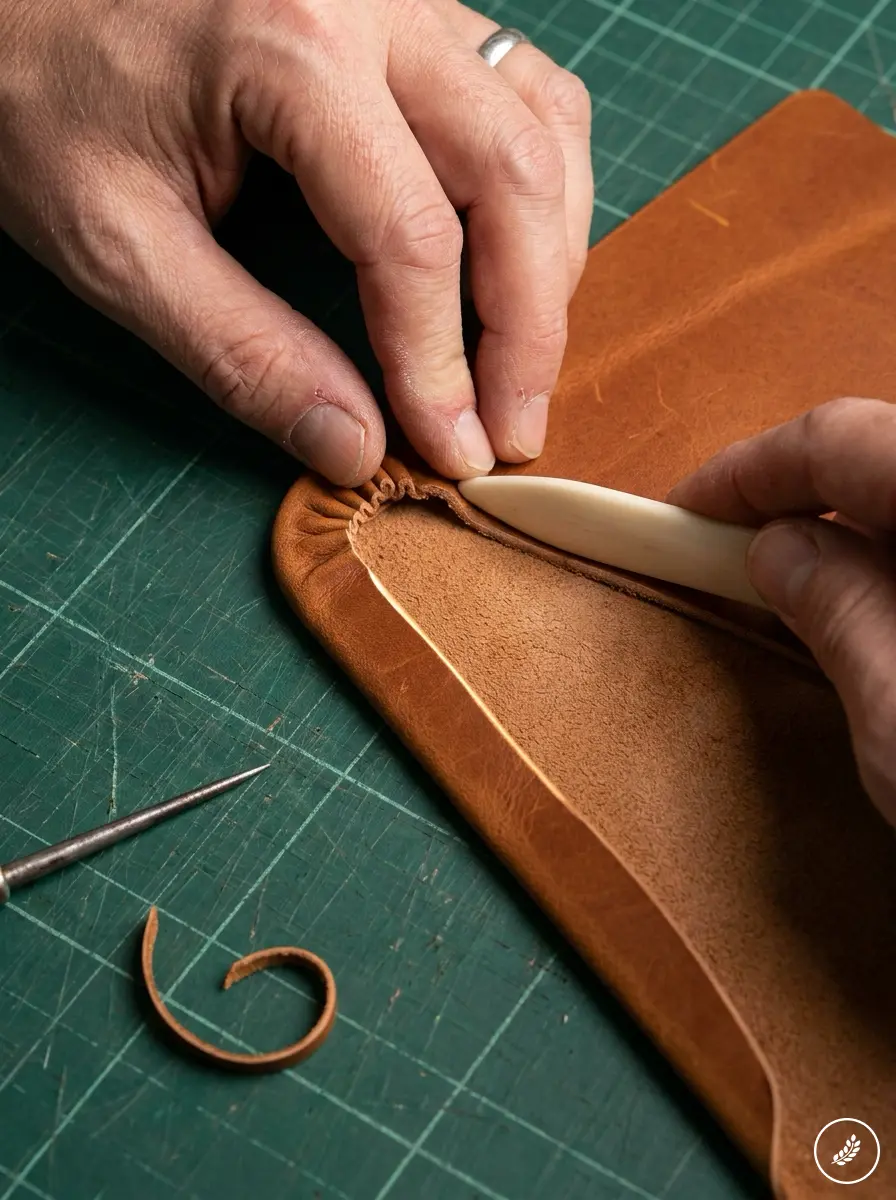
Done well, you can’t find where the extra material went. Done poorly, you get a pucker, a flat spot, or a corner that reads as slightly off even if you can’t say why. I’ve drawn enough corners and sketched enough automotive surfacing to know the eye catches an inconsistent radius before the conscious mind can explain what’s wrong with it. A hand-folded leather corner is solving the same visual problem with a hammer instead of a stylus.
Variables that refuse to become a fixed recipe
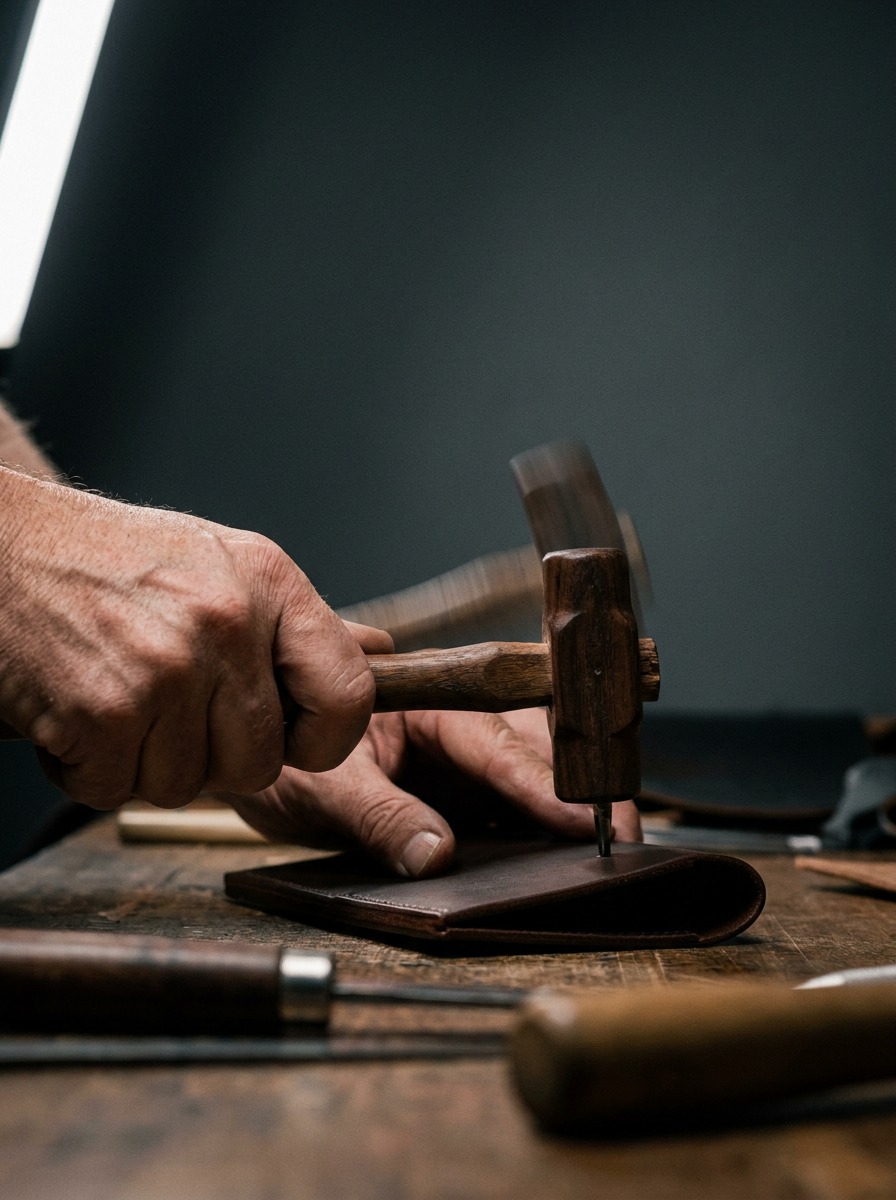
The hammer is what actually sets the fold, and the hammer’s instructions change every day. Pressure and angle shift with the temper of the specific hide, its moisture content, and the humidity in the workshop that morning.
There’s no fixed recipe for this, which is exactly why the craft resists being reduced to a checklist. I’ve had the same experience shaping clay models in industrial design studios: the material tells you something different depending on the day, the temperature, how long it’s been sitting, and a technician who’s done it for years reads those signals almost without thinking. A written spec can tell you the target angle. It can’t tell you how this piece of leather, on this particular afternoon, wants to move.
Folded edge vs. painted edge — two different design decisions
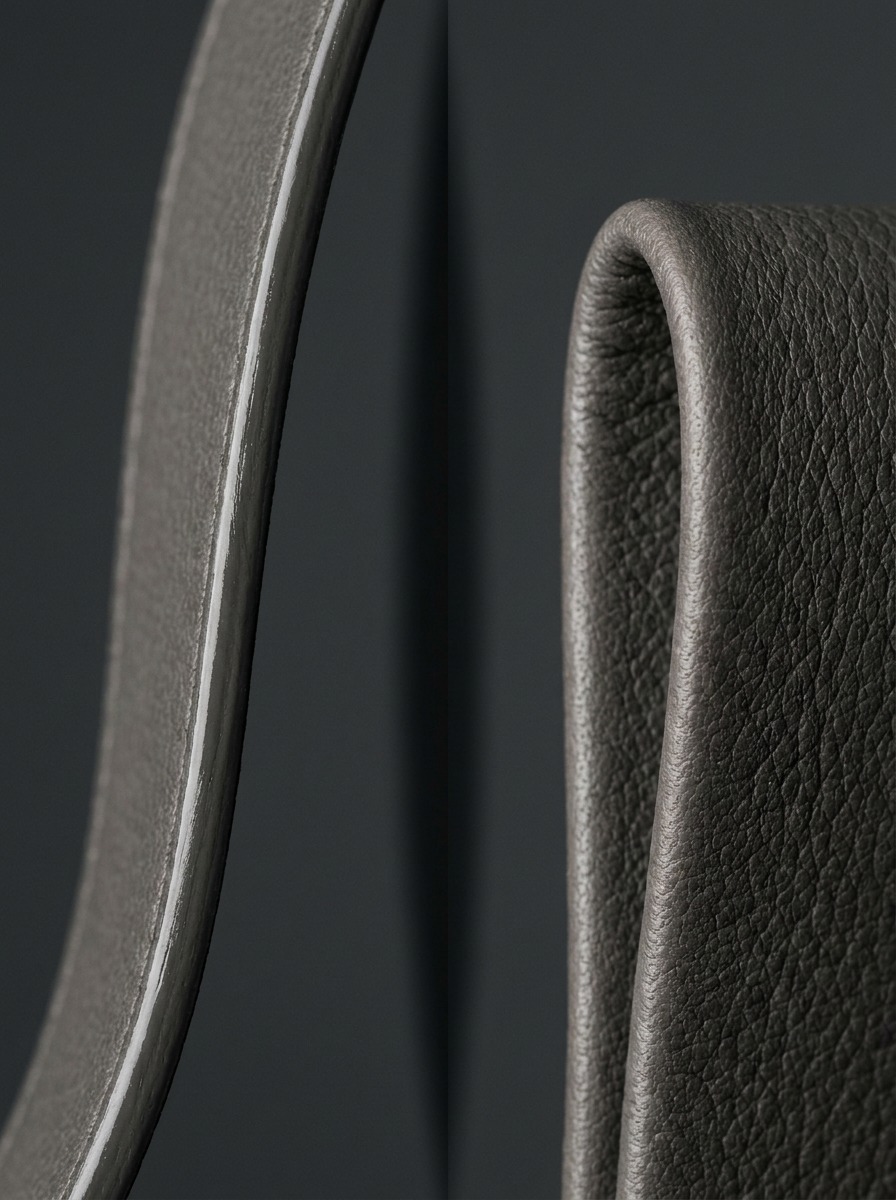
Not every leather edge gets folded, and that’s not always a mistake. It’s a different design decision with different trade-offs.
What edge paint solves, and what it gives up
Before industrial edge paint existed, leatherworkers finished a raw edge in one of three ways: left it raw, burnished it by compressing and polishing the exposed fibers on a suitable vegetable-tanned hide, or folded it, which was always the most demanding of the three.
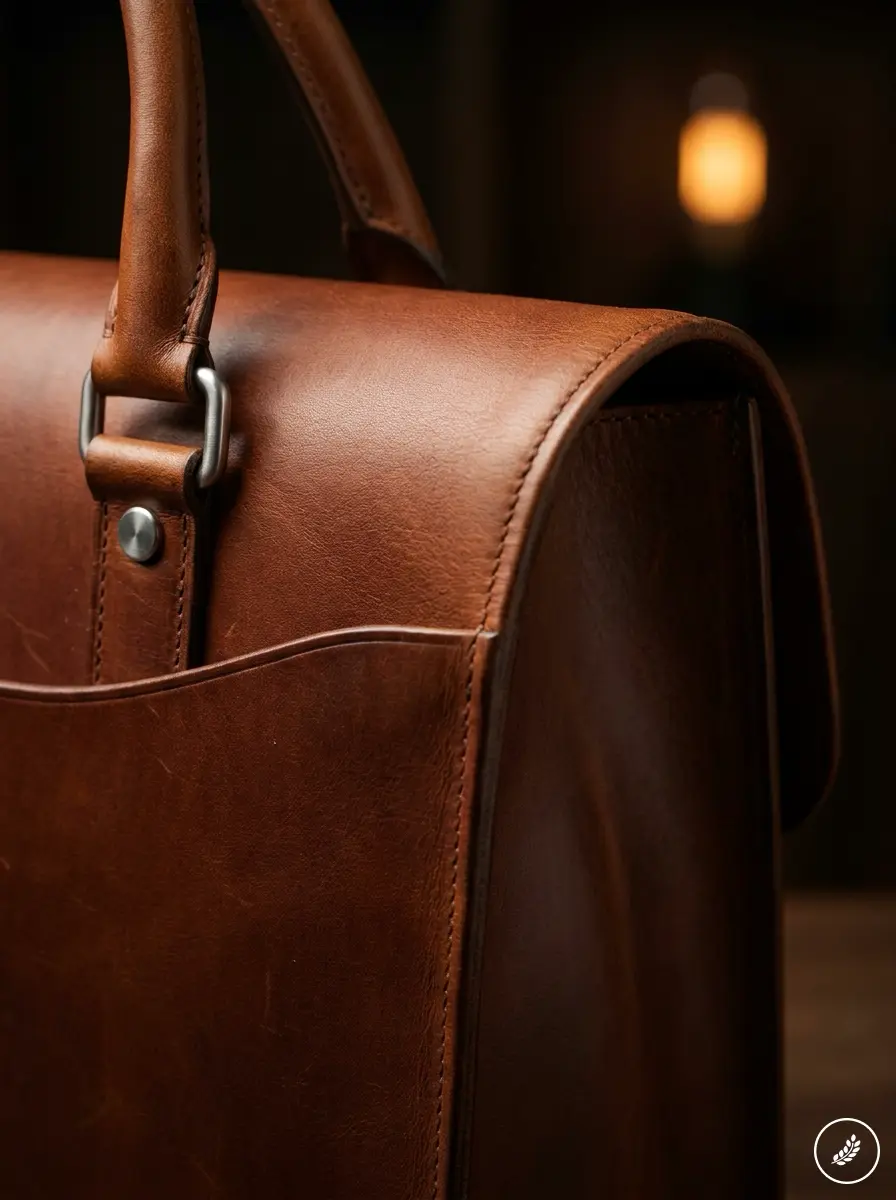
Leather edge paint arrived as a genuine shortcut, and it solves a real problem: it covers a raw cut with a smooth, uniform film in a fraction of the time a folded edge takes, sometimes 90 percent less production time by most estimates I’ve seen. For a lot of everyday goods, that trade-off makes complete sense. Paint is fast, consistent, and cheap to specify at scale.
What it gives up is durability under stress. A painted film sits on top of the leather rather than becoming part of it, and in high-contact areas (the corner of a briefcase that hits a desk edge a thousand times, the strap fold that flexes every time you pick the bag up) that film can crack and start peeling within months. It’s a coating problem, not a leather problem. The leather underneath is usually fine. The finish is what fails.
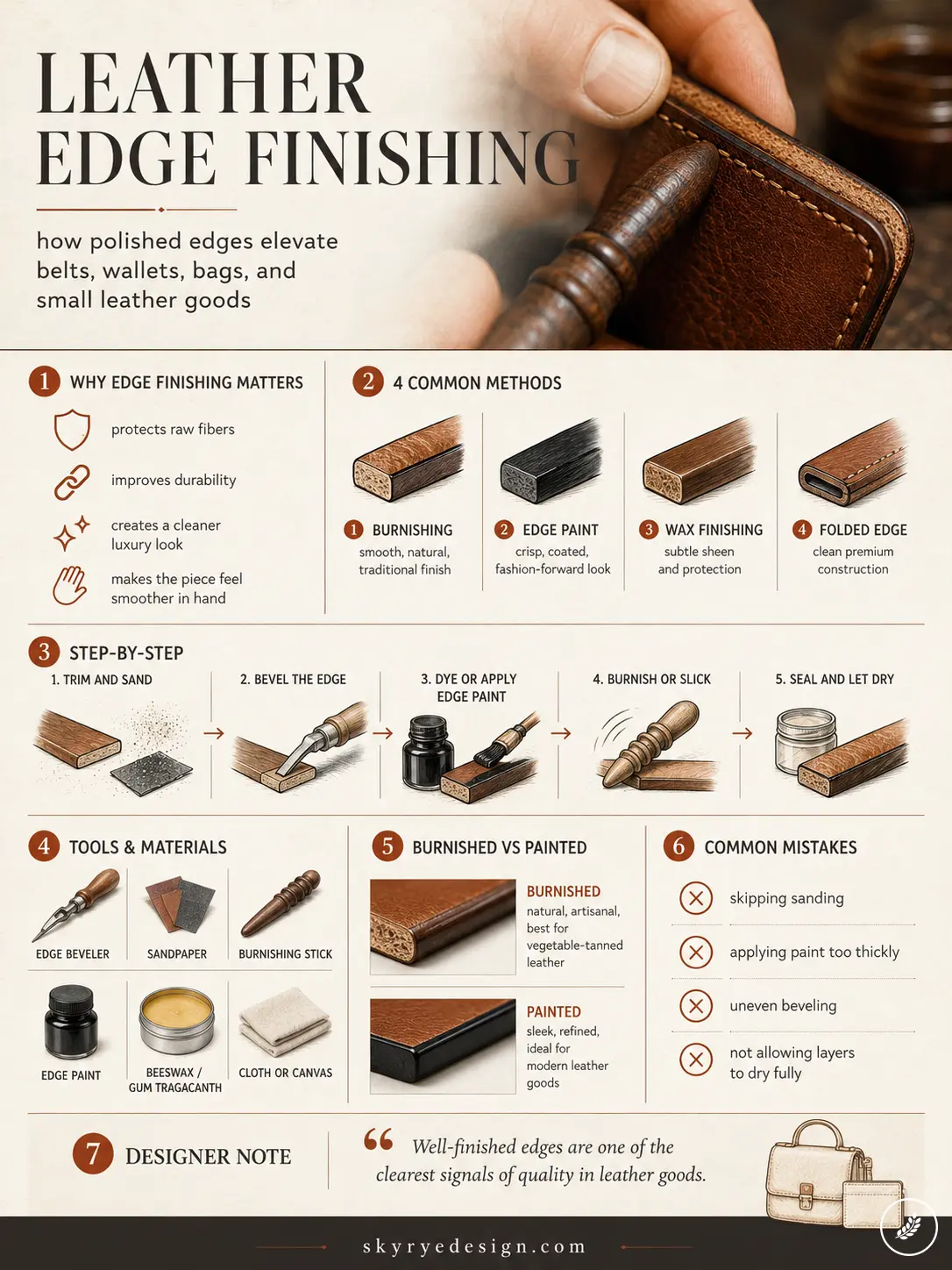
Why an unpainted, folded line ages differently
A folded edge doesn’t have a coating to fail because there’s nothing applied on top of the leather to begin with. The grain that was already there gets turned and carried around the boundary, so the edge ages exactly the way the rest of the case does — the same patina, the same slow color shift, the same texture change that comes from years of handling.
That’s a genuinely different design philosophy, not just a more expensive one. Edge paint asks the finish to hide the construction. A folded edge asks the construction to be the finish. I find that distinction useful outside of leather goods too — the best automotive interiors I’ve worked around draw the same line between a panel that’s dressed up to look finished and one where the actual build quality is the finish, with nothing hiding it.
For a leather case that’s meant to last decades, not seasons, the math favors the fold. It costs more upfront in skill and hours. It doesn’t cost you a peeling edge five years in. That’s the real content of the leather edge finishing decision: not which one looks better on day one, but which one you’re willing to still be looking at on day fifteen.
Where this geometry comes from — Fes, zellij, and a shared design logic
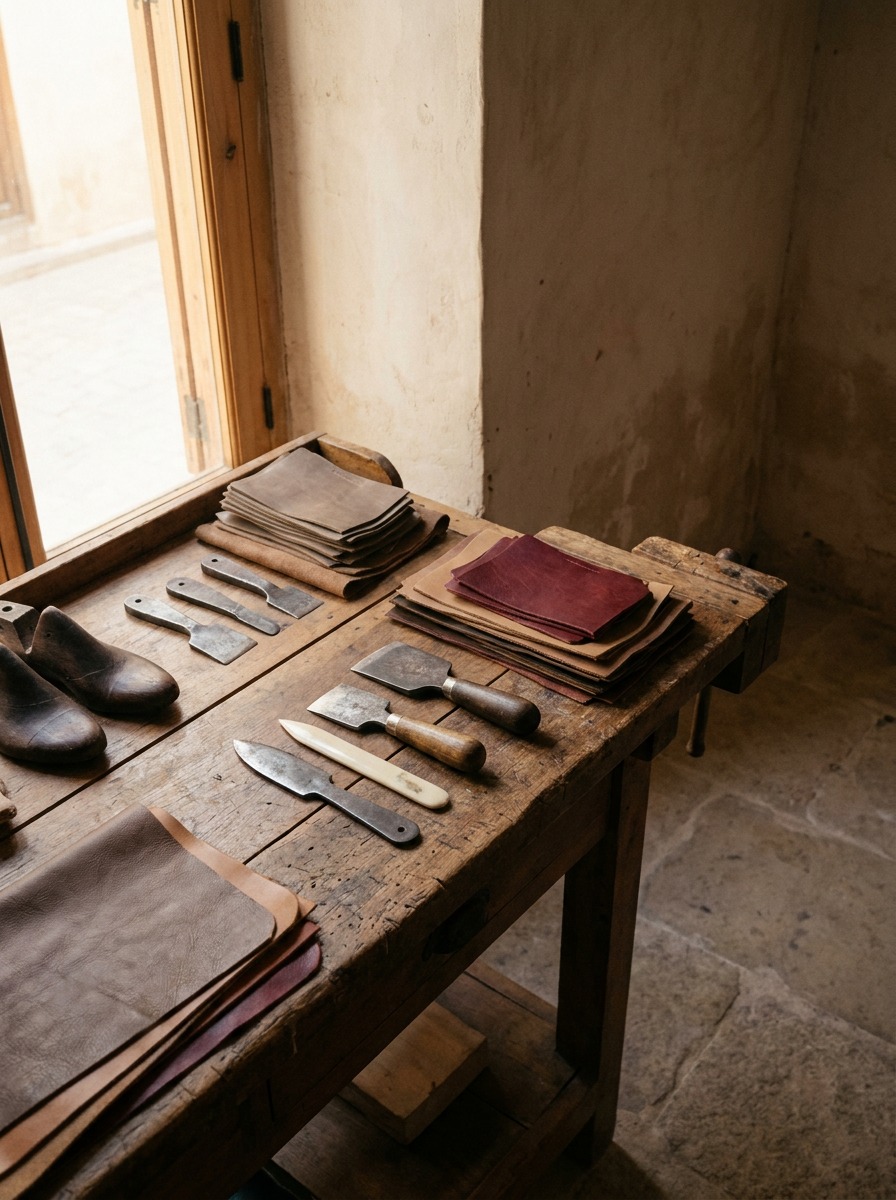
Rempliage isn’t a technique that appeared in isolation. It belongs to a Fassi leatherworking tradition that goes back more than a thousand years, shaped by the same city that produced some of the most sophisticated geometric surface work anywhere.
Fes leatherworkers historically fulfilled commissions for manuscript bindings, cases for scientific instruments, and scholars’ folios — objects where the edge had to do double duty, framing knowledge as well as protecting it physically. A binding that fails at the corner doesn’t just look wrong. It fails the object it’s meant to protect.
One institutional thread runs back to Al-Qarawiyyin, founded in 859 and still considered among the oldest continuously operating centers of learning in the world. The city’s leatherworking guilds developed alongside that scholarly tradition, in the same environment that produced zellij, the geometric tilework you see across Fes’s architecture, built from small individually cut pieces assembled into complex, repeating patterns.
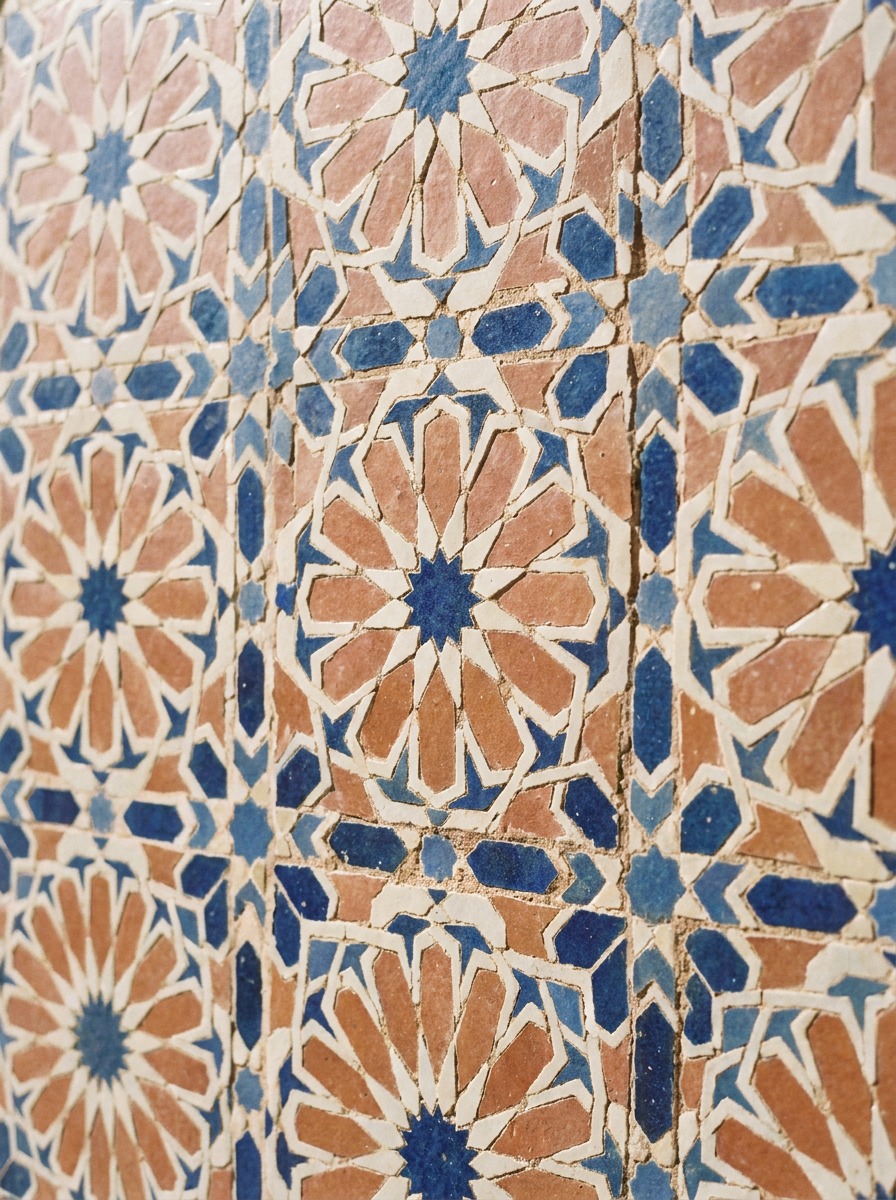
I spent time studying spatial composition in architecture school, and the family resemblance between zellij and a folded leather corner is hard to miss once you’ve seen both up close: both resolve a surface through decisions about line, angle, and where two pieces meet. (If repeating geometric pattern work interests you outside of leather, I’ve also put together a collection of geometric tattoo design ideas built on the same underlying logic.) One is ceramic and fixed to a wall. The other is organic material folded around a moving object. The underlying design logic (reduce a complex curve to a series of correct local junctions) is the same.
A second wave of skill arrived after Granada fell in 1492, when master leatherworkers from Al-Andalus resettled in Fes and brought a craft tradition refined across nine centuries. What developed afterward was a guild system where several distinct lines of geometric and handwork knowledge converged in one place.
Even the vocabulary keeps the geography intact. Maroquinerie, the French term for fine leatherwork, literally means “Moroccan work.” It’s a word that traveled into European luxury branding while still pointing directly back to where the actual skill originated.
Reading a case like a section drawing
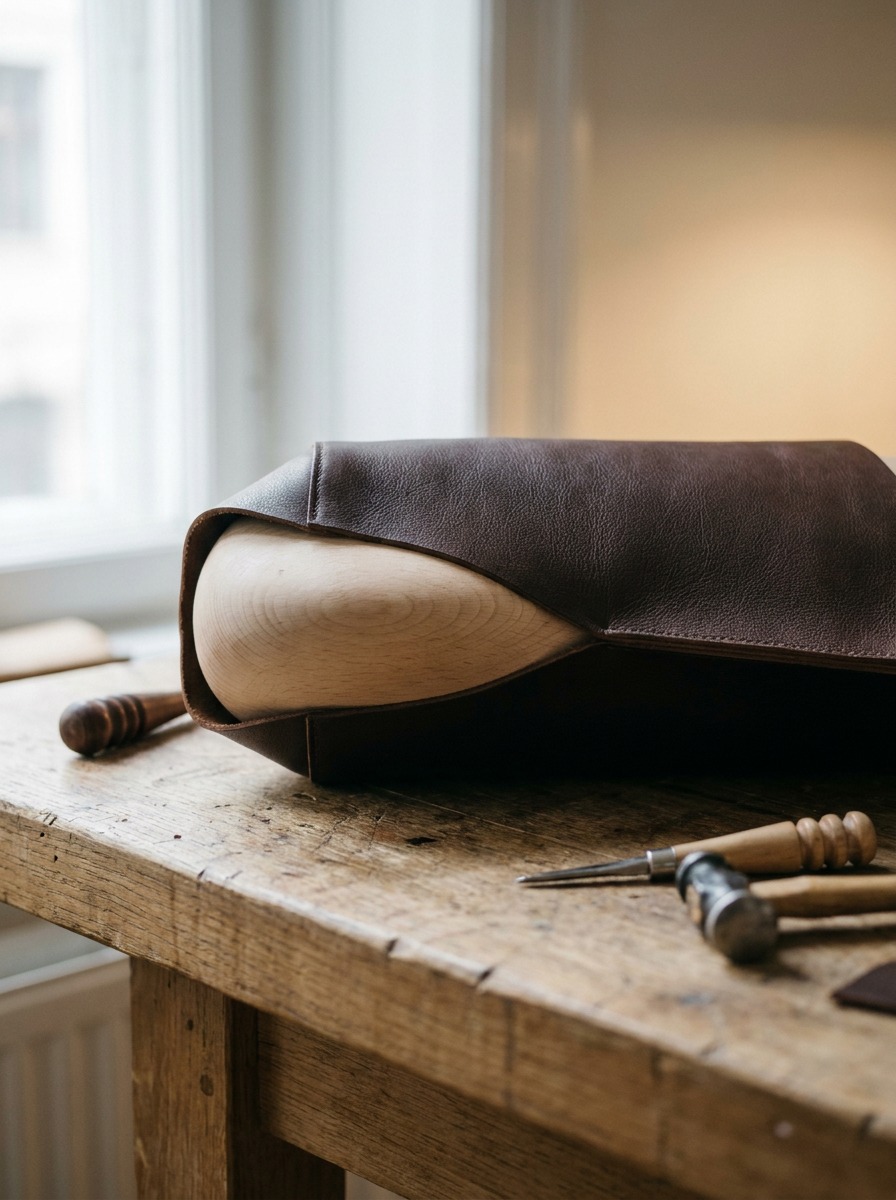
When I look at a leather case, I read it the way I’d read a section drawing of a building — not the surface, but what the surface tells you about how the thing was actually built.
A section drawing shows you the layers you’d never see from outside: where a wall meets a foundation, how a roof joint sheds water, what’s structural and what’s decorative. A folded edge does the same thing for a leather case. Where an outer panel and a leather lining come together, you can end up with four to six layers converging at a single boundary, all assembled over a wooden last, a solid form that holds the case’s intended contour while everything gets compressed around it.
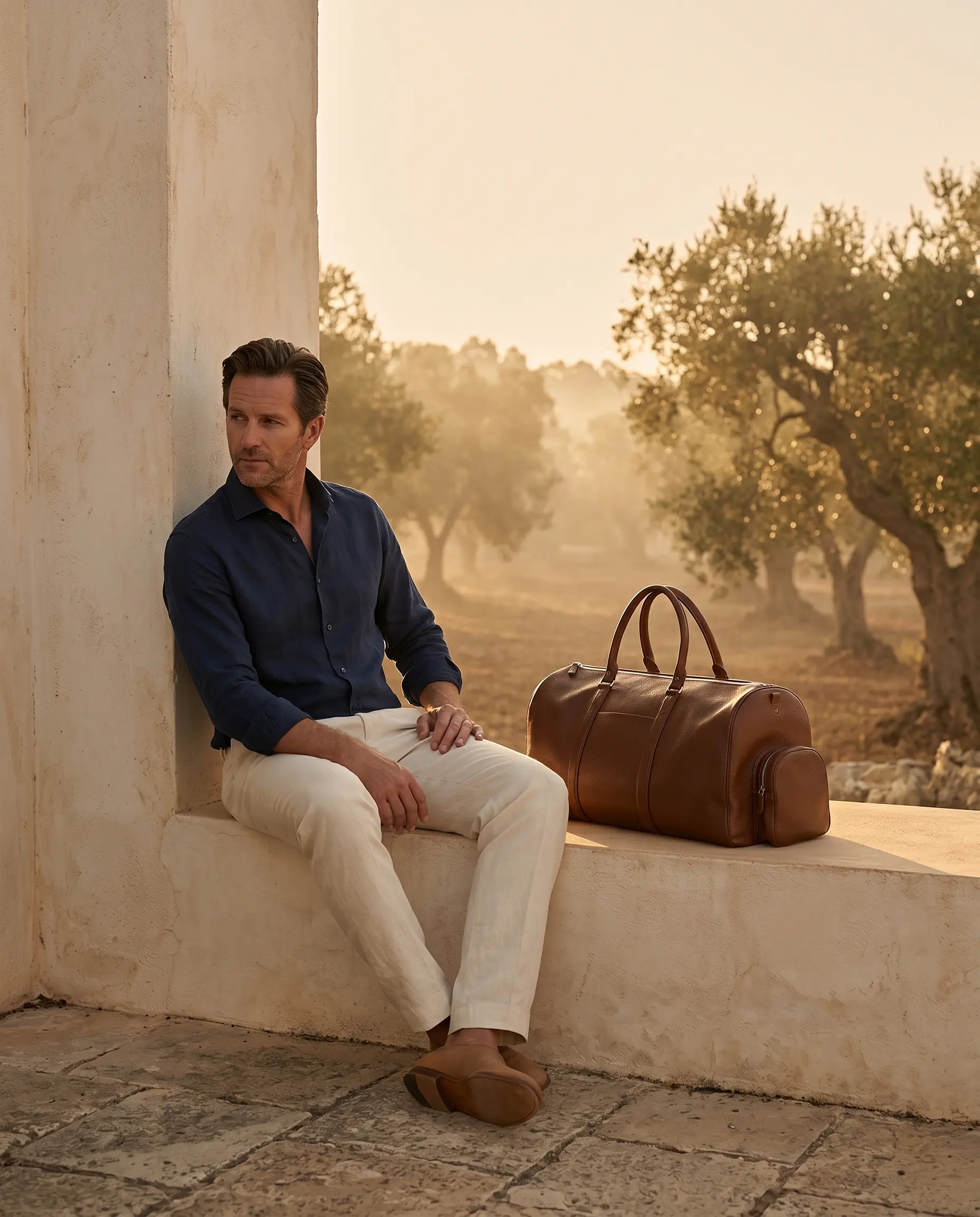
The last is doing something a flat pattern piece can’t: giving the edge a geometry that only exists in three dimensions, the same way a car’s surfacing model only fully makes sense once it’s wrapped around the actual body-in-white.
This is part of the wider leather craftsmanship story that gets lost when people describe a case purely by material and stitching. Grain quality tells you about the hide. Stitch density tells you about assembly speed and intent. But the edge tells you about sequence — the order in which decisions were made and whether each one accounted for the ones that came before it.
That sequence is also irreversible. A skived panel that goes wrong gets discarded, then recut to match the original hide’s grain and color as closely as possible. There’s no undo function in leather. By the time the grain flows continuously around a finished edge, it’s already passed through a chain of decisions that can’t be revisited. That’s the part of the product design process most people never think to look for, and it’s the part that actually tells you what you’re holding.
Lunburg today — geometry kept in practice, not just on paper

Rempliage survives in a handful of ateliers where it still gets taught hand to hand, and Lunburg (a second-generation family atelier founded in Fes in 1968, now led by Amien Marghich) is one of the places still building around it.
Lunburg’s master artisans still use folded edges and wooden lasts on current production, including the Opus briefcase, which carries a fifty-year warranty — a warranty that only makes sense if the construction underneath the finish can genuinely outlast the paint-and-plastic alternative. Marghich has committed forty percent of Lunburg’s profits to an internal artisan fund that pays for three-year apprenticeships, with the first cohort of a planned Fes School of Master Artisans expected in 2027. It’s a straightforward model on paper: current sales fund the years of training a technique like this actually requires to transfer from one set of hands to the next.
That funding structure matters more than it might look, because rempliage is genuinely tacit knowledge — how far a blade has gone into the hide, how a damp piece of leather is going to respond, how pressure travels around a corner. None of that lives in a written spec. Mastery, by most accounts, takes fifteen to twenty-five years, and fewer than 800 artisans worldwide can reportedly execute it to a haute maroquinerie standard. A technique that specialized doesn’t survive because its steps got written down somewhere. It survives because an experienced hand can watch a less experienced one, catch a mistake before too much material is lost, and correct the next strike in real time.
Lunburg publishes its own field notes on the process, including a detailed piece on the folded edge that’s worth reading alongside an actual case if you want to see the geometry I’ve been describing up close. It’s rare to find a brand willing to explain a technique this specifically instead of just marketing the result.
Reading the smallest line
The edge is a useful place to start looking at a leather case precisely because it resists vague language. You can see it. You can run a thumbnail across it and feel whether a coating sits on top of a cut or whether the grain actually continues underneath your finger.
On a painted edge, a film sits above the leather. On a folded edge, the grain turns inward, meets the lining over a wooden form, and comes back out the other side as one continuous line. Neither is a moral failing — plenty of well-made goods use edge paint intentionally. But only one of them is telling you the whole story of how the object was built.
Next time you’re evaluating a leather case, skip the grain and the hardware for a second and go straight to the corner. What looks like a simple curve is usually holding a skived layer, a set of microscopic pleats, a specific hammer strike, and a wooden last underneath it. The most articulate part of the case is often the line that says the least about itself.
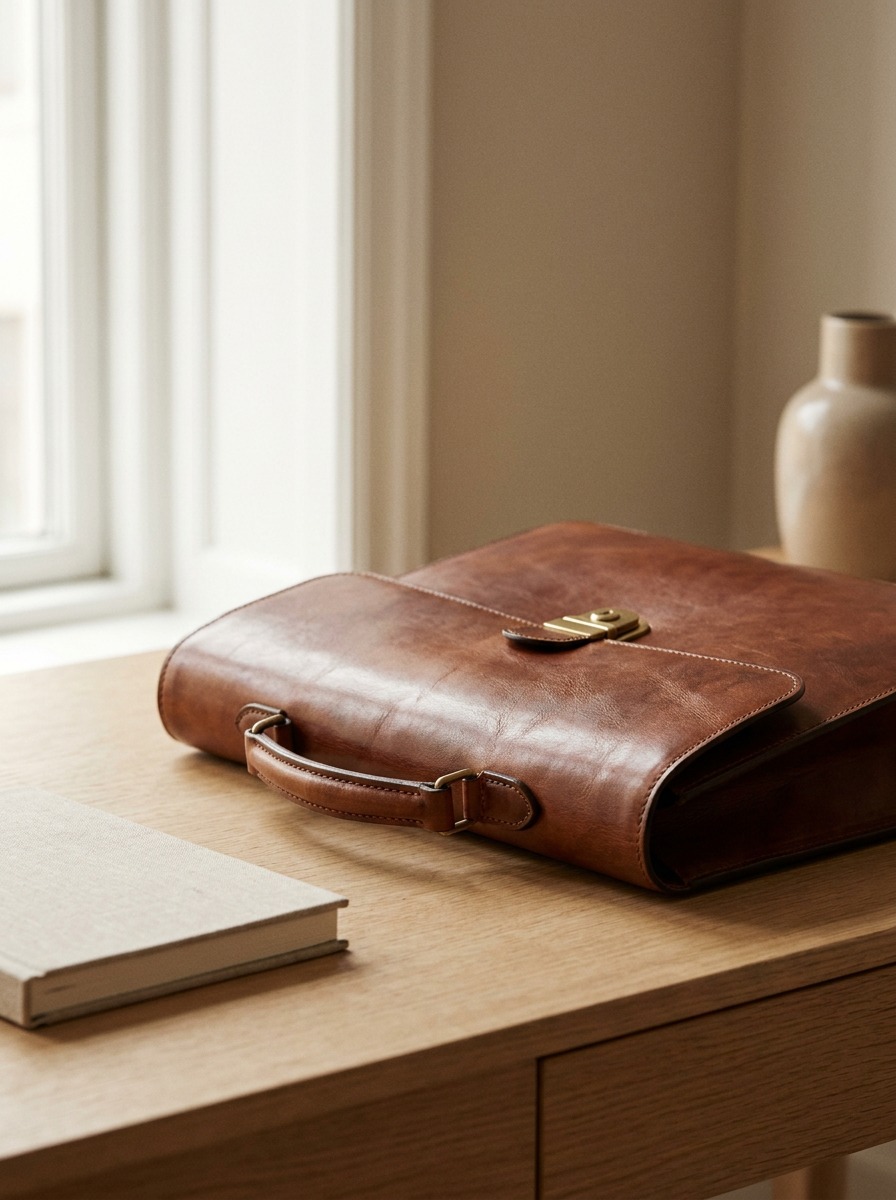
The folded edge in daily use
All the geometry I’ve walked through so far happens on a bench, under a loupe, before anyone but the artisan ever sees it. The actual test comes later, when a folded edge stops being a construction detail and starts being something a person carries through their day.

On a briefcase, the corner is the part that takes the abuse: set down on a platform, swung against a doorframe, gripped a thousand times over. A painted edge starts showing that history in the first year. A folded one just wears in, the same way a good pair of boots does.

A slim portfolio case gets a quieter version of the same test. It spends most of its life pressed against a forearm or tucked under an elbow, which means the edge is in constant, low-grade contact with a wool sleeve. That’s exactly the kind of steady friction a coating fails under first, and exactly what a folded edge is built to shrug off.
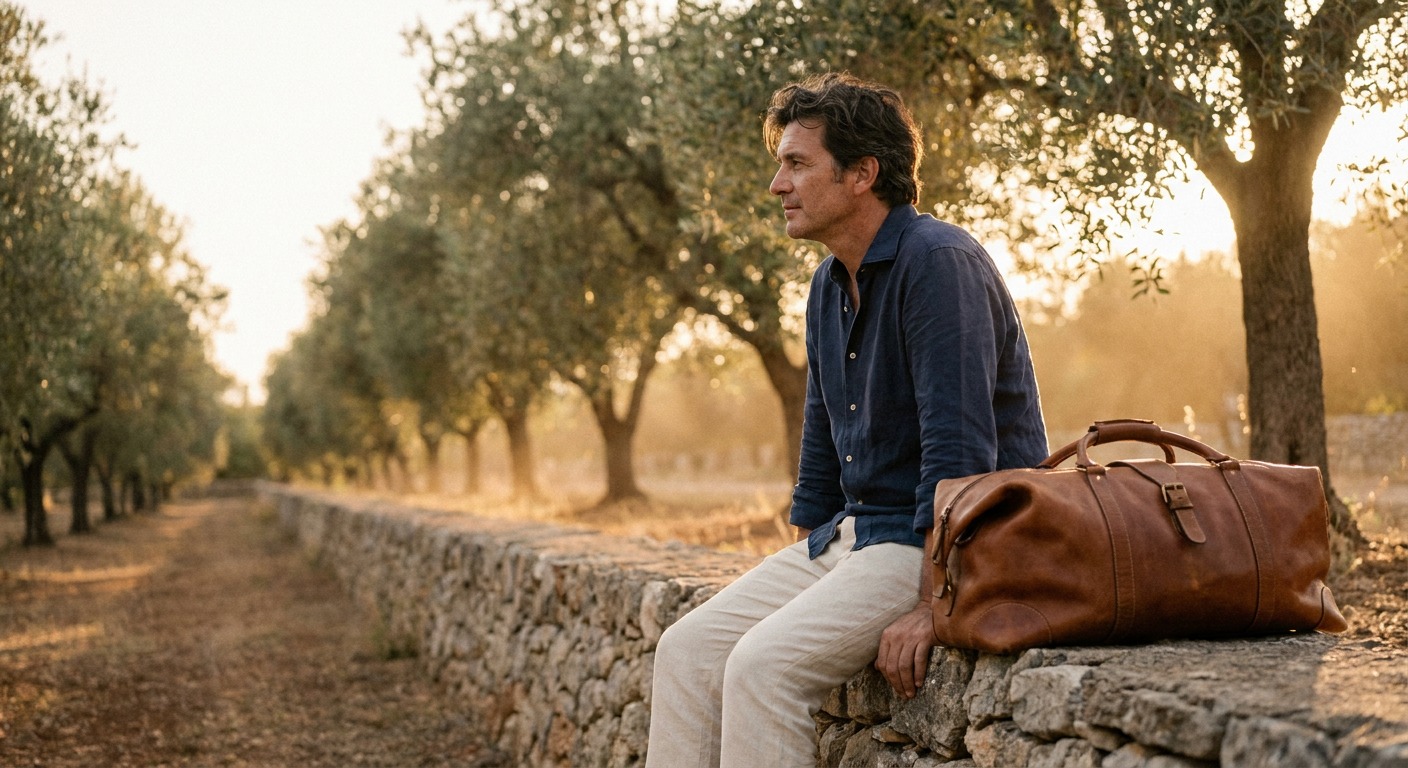
A weekend duffel takes the roughest handling of the three — set down on gravel, stone, the floor of a car — so its edge has to hold up structurally, not just visually. This is where the fifty-year warranty stops being a marketing line and starts being a bet the maker is willing to make on their own geometry.
FAQ
What is rempliage?
Rempliage, also called a folded edge, is a leather-finishing technique where the artisan skives the edge thin, folds it back on itself, and carries the grain continuously around the boundary instead of leaving a raw cut or covering it with paint. It’s considered the most demanding of the traditional edge finishes because the leather itself has to do all the work, with nothing applied on top to hide an imperfect cut.
Folded edge vs painted edge — what’s actually different?
A painted edge covers a raw cut with a smooth applied film, usually in a fraction of the time a fold takes. A folded edge has no applied coating at all — the existing grain gets turned and carried around the boundary, so there’s nothing sitting on top that can crack or peel later. Paint is faster and cheaper at scale; a fold is slower but becomes structurally part of the material.
Why does a folded edge last longer than a painted one?
Because there’s no separate film to fail. Edge paint is a coating, and coatings crack and peel under repeated flexing or contact, often within months on high-stress areas like corners. A folded edge ages the way the rest of the leather does, developing patina instead of peeling, since the “finish” is the leather itself rather than something layered on top of it.
How long does it take to master rempliage?
By most accounts within the trade, fifteen to twenty-five years of hands-on practice, and fewer than 800 artisans worldwide are considered able to execute it to a true haute maroquinerie standard. The skill is largely tacit — how a blade feels moving through a specific hide, how much pressure a damp piece of leather can take — which is why it’s traditionally taught hand to hand rather than from a written spec.
What does maroquinerie mean?
Maroquinerie is the French term for fine leatherwork, and it literally translates to “Moroccan work,” a direct reference to Morocco’s centuries-old leathercraft tradition, particularly the guild system centered in Fes. The word became standard vocabulary in European luxury leather goods while still pointing back to its actual geographic origin.
Is rempliage still used in production today, or mostly historical?
It’s still in active use at a small number of ateliers, including Lunburg in Fes, which builds current pieces like its Opus briefcase using folded edges and traditional wooden lasts. Given how few artisans can execute the technique at a professional standard, most production leather goods use edge paint instead, which is why a genuinely folded edge is now something of a rarity even within the leather goods industry.
If you’re actually in the market for one of these cases, Lunburg’s own guide on how to choose a leather briefcase is worth reading alongside everything above — it covers fit, hardware, and sizing decisions that sit outside what I’ve focused on here.
- 388shares
- Facebook0
- Pinterest385
- Twitter3
- Reddit0