The first time I drew a lion head, I spent forty minutes on a perfectly circular, carefully placed ears, decent eyes, and then hit the mane. And completely fell apart. The mane isn’t one shape. It’s not one texture. It’s a hundred individual clumps of fur moving in different directions, some catching light, some falling into deep shadow — and if you treat it like a halo around the face, it will look exactly like a halo around the face.
- 1. Understanding Lion Anatomy — What You Actually Need to Know
- 2. Materials — What to Use and Why
- 3. Step-by-Step — How to Draw a Lion in 7 Steps
- 4. Drawing the Lion's Eyes — The Detail That Makes or Breaks It
- 5. How to Draw the Lion's Mane — Texture Without Losing Your Mind
- 6. Lion Drawing Styles — From Realistic to Graphic
- 7. Common Mistakes and How to Fix Them
- Frequently Asked Questions
- Your Lion Drawing Starts Today
That’s the real challenge with lion drawing. It’s not the face — most artists figure out the face. It’s knowing how the mane connects to the skull, how the fur behaves at different distances from the center, and how to build tone without losing the animal’s weight and presence.
This guide walks you through 8 concrete steps for drawing a realistic lion in pencil — with full attention to anatomy, construction, mane structure, and the specific techniques that separate a flat sketch from something that feels alive. You’ll also learn which pencil grades to use at each stage, how to draw lion eyes that hold attention, and how to approach fur texture without spending six hours on individual hairs.
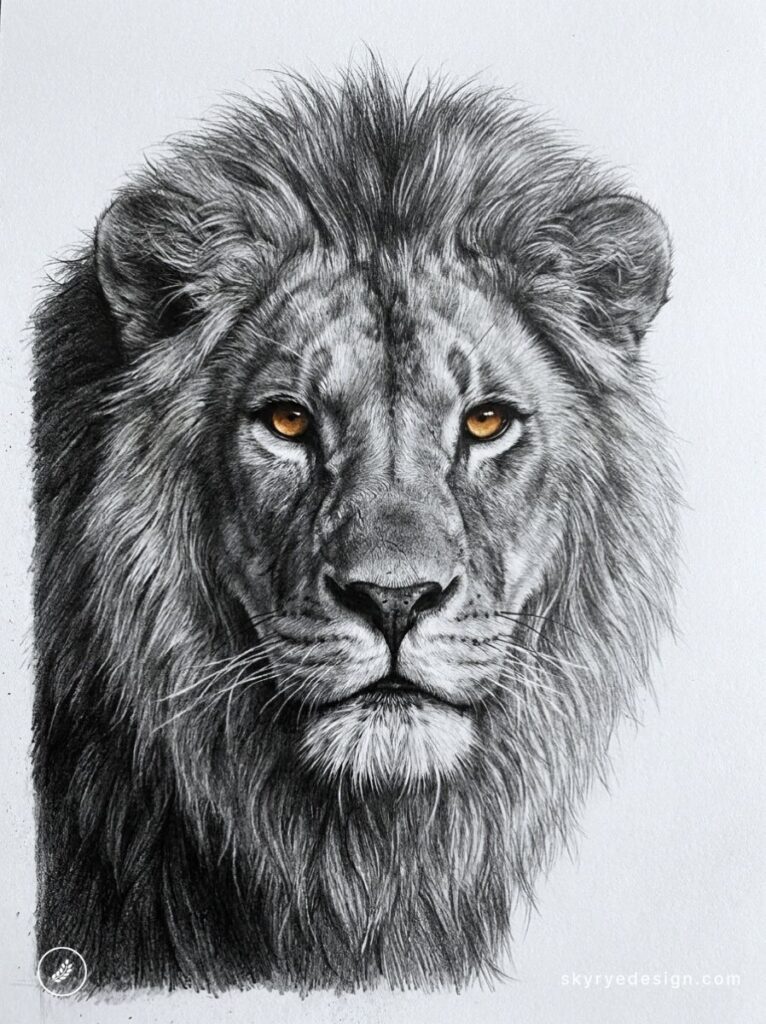
Leo has always been a cult animal for me. I’ve always loved drawing them. I was born on August 11th and always thought it was the coolest zodiac sign. But that’s not the point. It truly is an iconic animal, linked to millions of logos, art, and legends. Mastering basic proportions for use in any graphic is pure pleasure and a cool skill.
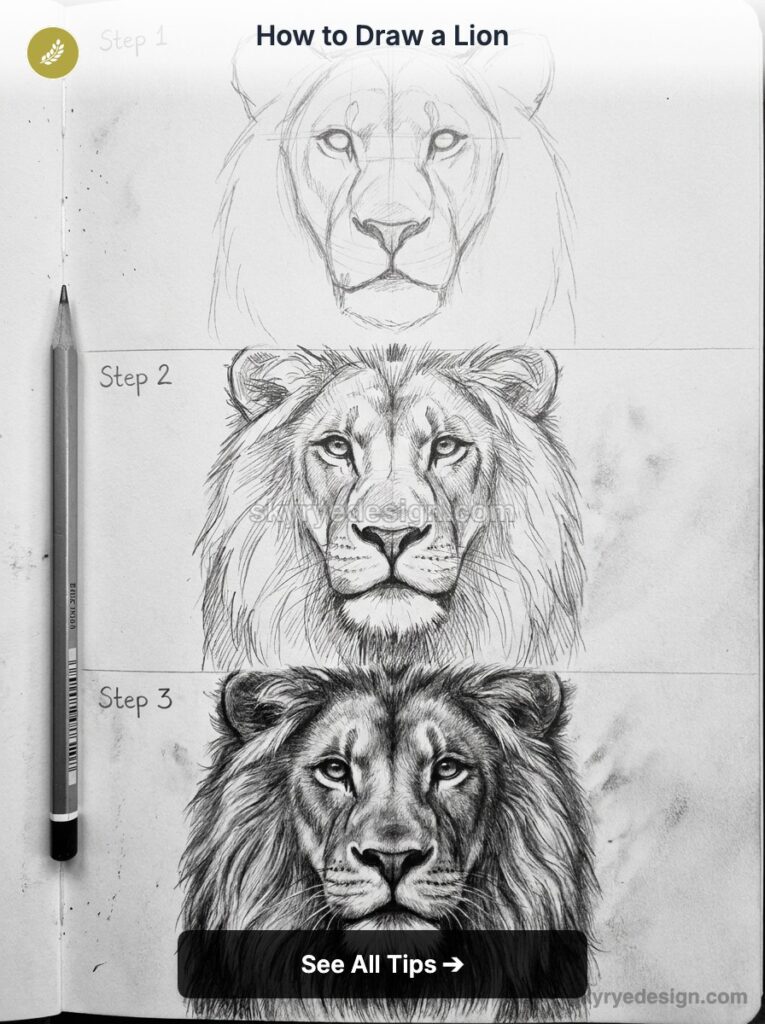
Grab your sketchbook. Let’s start with what’s underneath the fur.
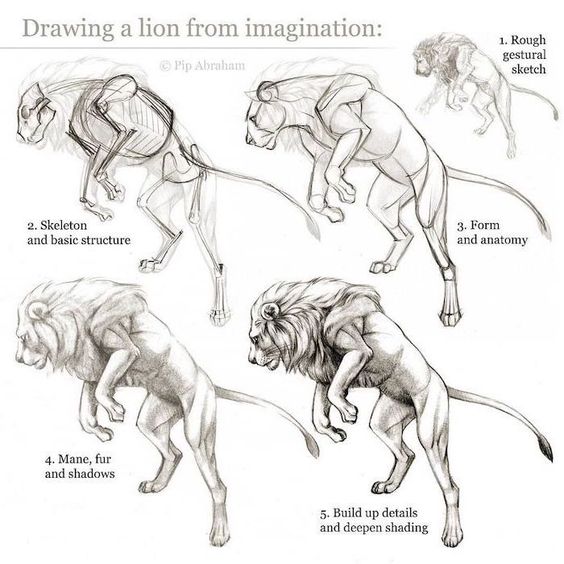
1. Understanding Lion Anatomy — What You Actually Need to Know
Most lion drawing guides show you the finished animal and work backward. That doesn’t work. The reason lion drawings fail isn’t technique — it’s that artists skip the skull.
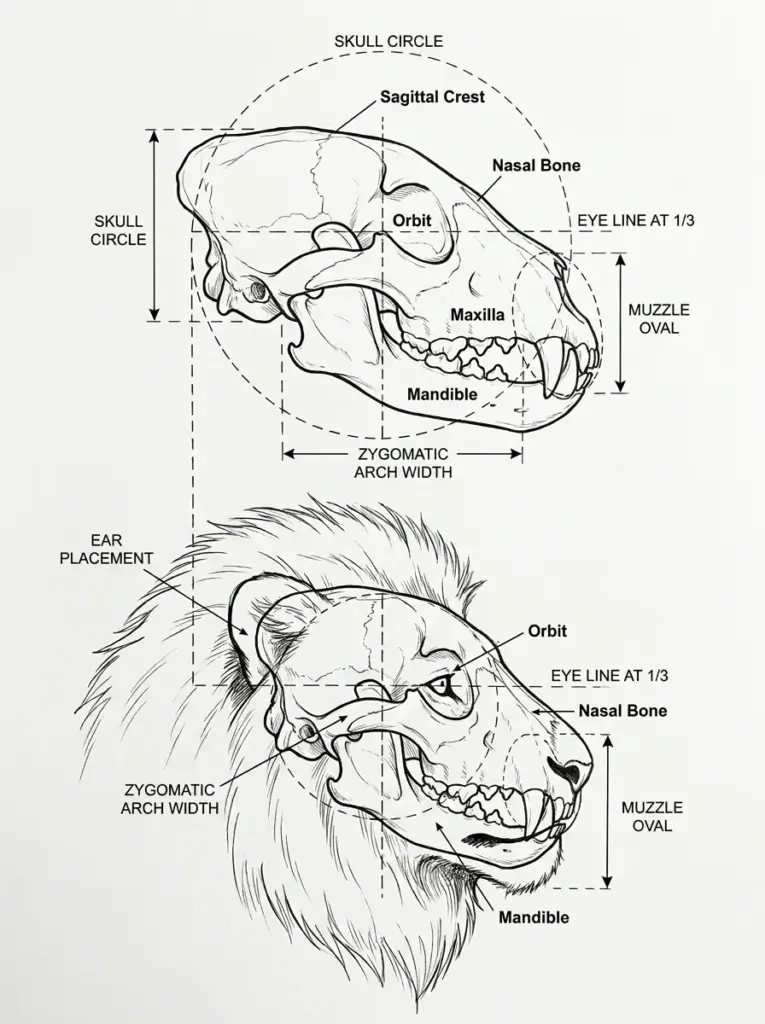
The Skull Is Everything
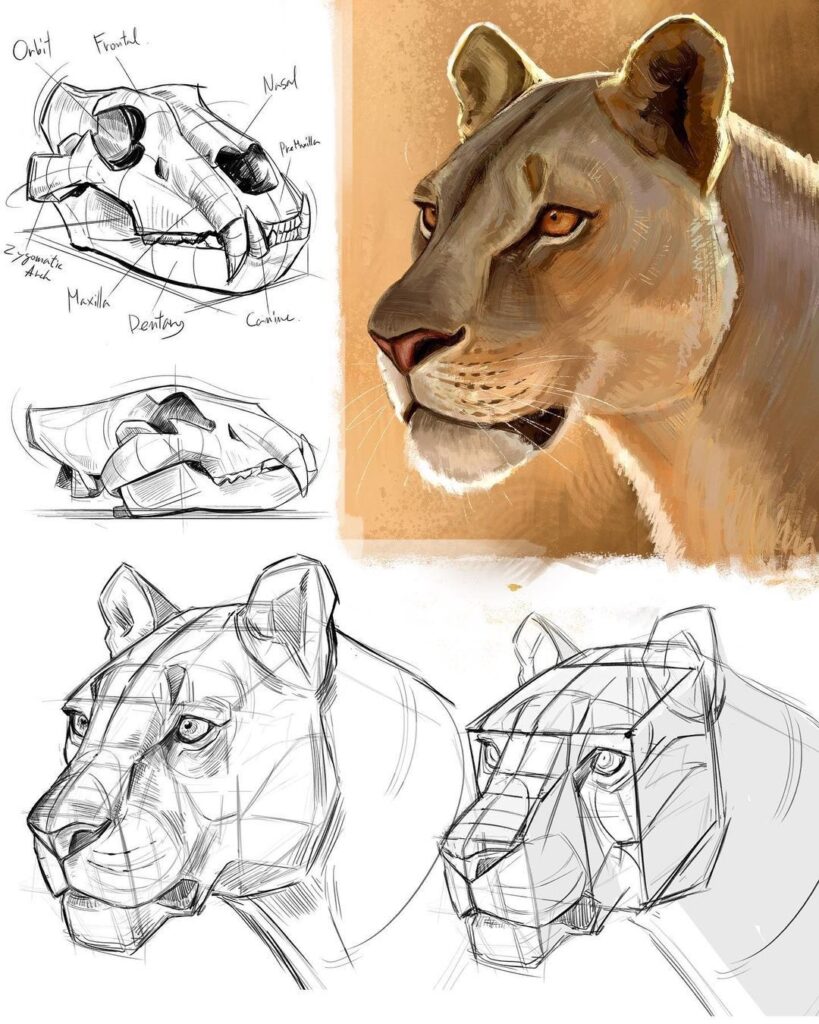
A lion’s skull is broader and flatter than a domestic cat’s — the zygomatic arches (cheekbones) flare dramatically wide, which is why a lion’s face looks so imposing even from the front. The skull also sits on a short, extremely muscular neck; the head doesn’t float — it’s planted.
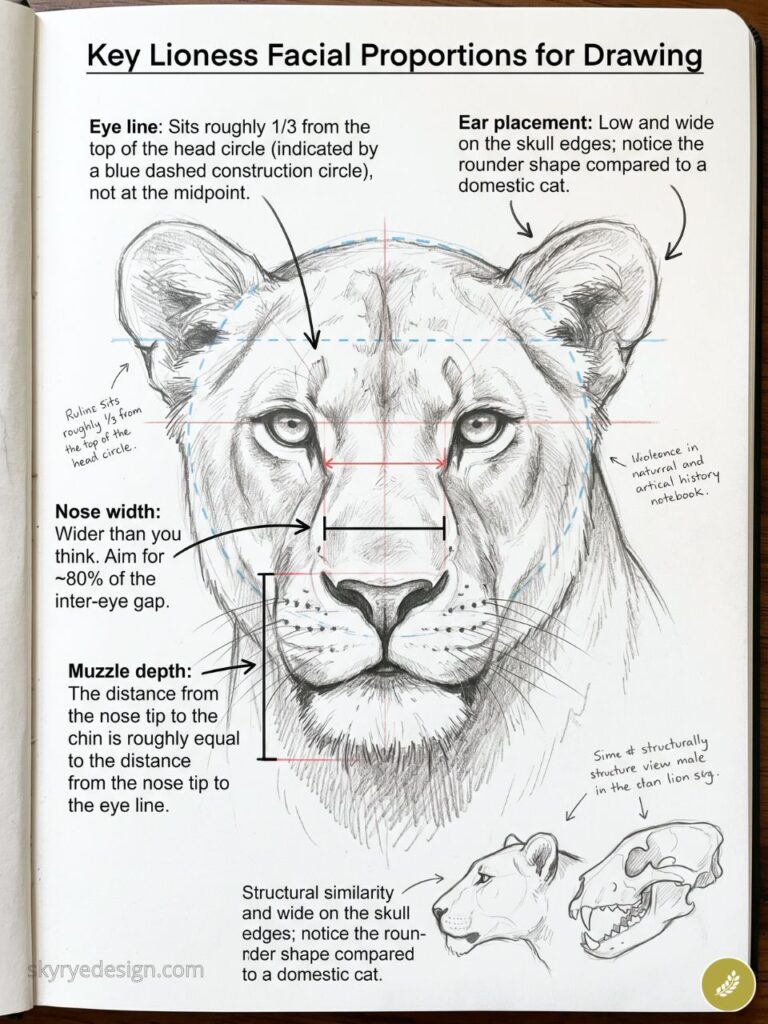
When you understand that the mane grows outward from the sides and back of this flat, wide skull, the mane stops being a mystery. It’s just fur following the cranial surface.
Key proportions worth memorising before you draw a single line:
- Eye line — sits roughly one-third from the top of the head circle, not at the midpoint
- Nose width — about 80% of the inter-eye gap; wider than most beginners draw it
- Muzzle depth — from nose to chin roughly equals the nose-to-eye-line distance
- Ear placement — outermost edges of the skull, low and wide; rounder than a domestic cat’s
Male vs. Female: One Critical Difference
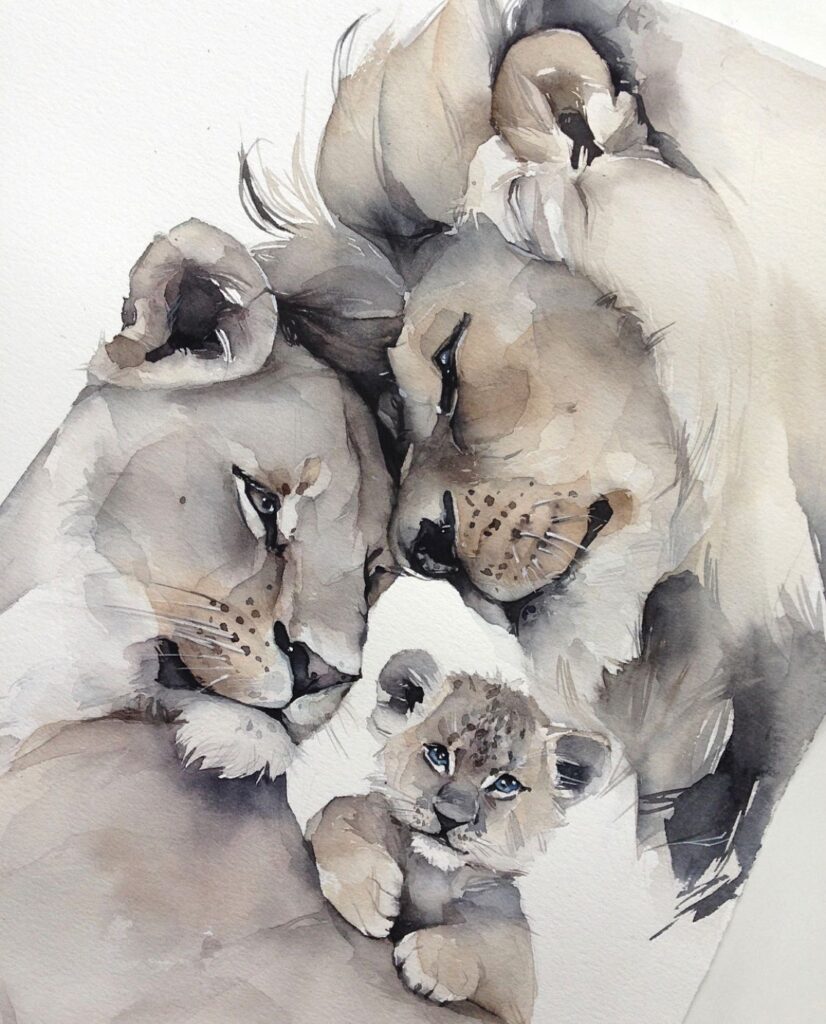
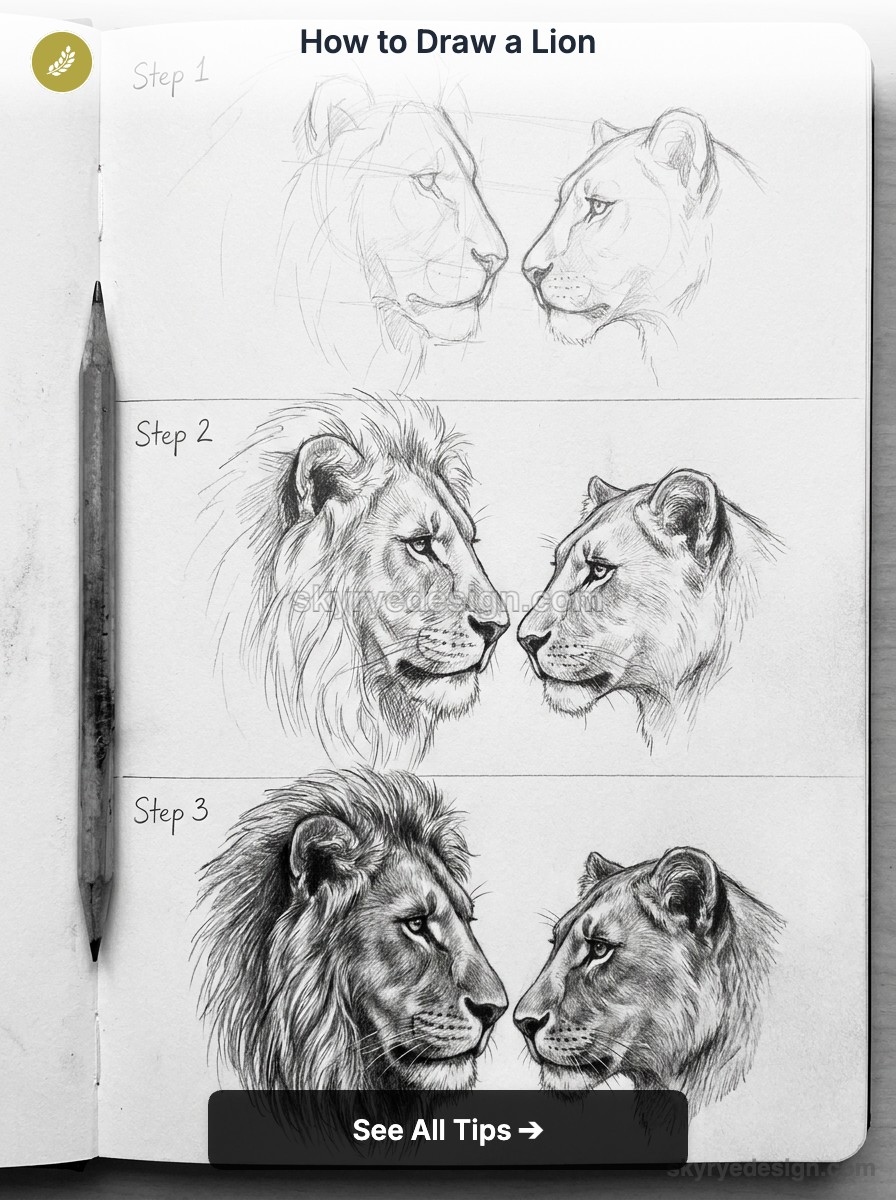
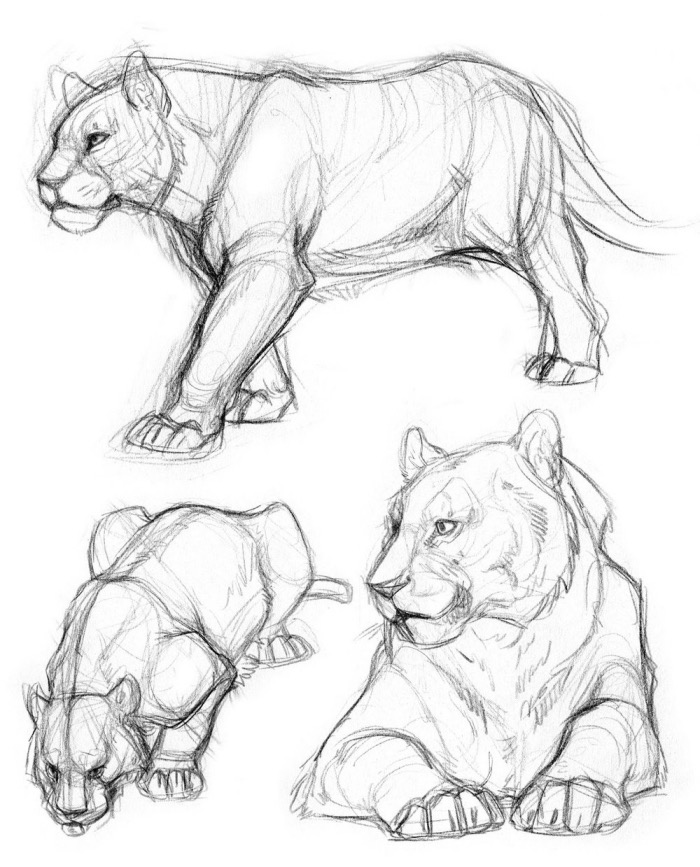
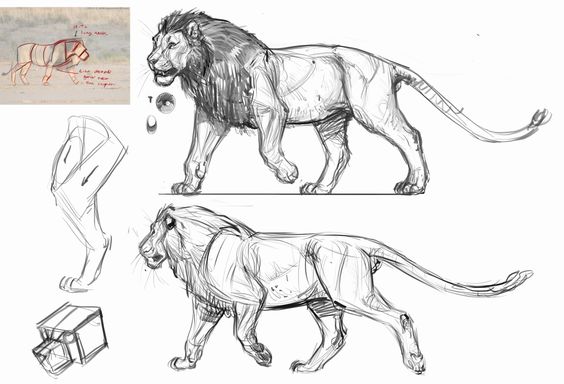
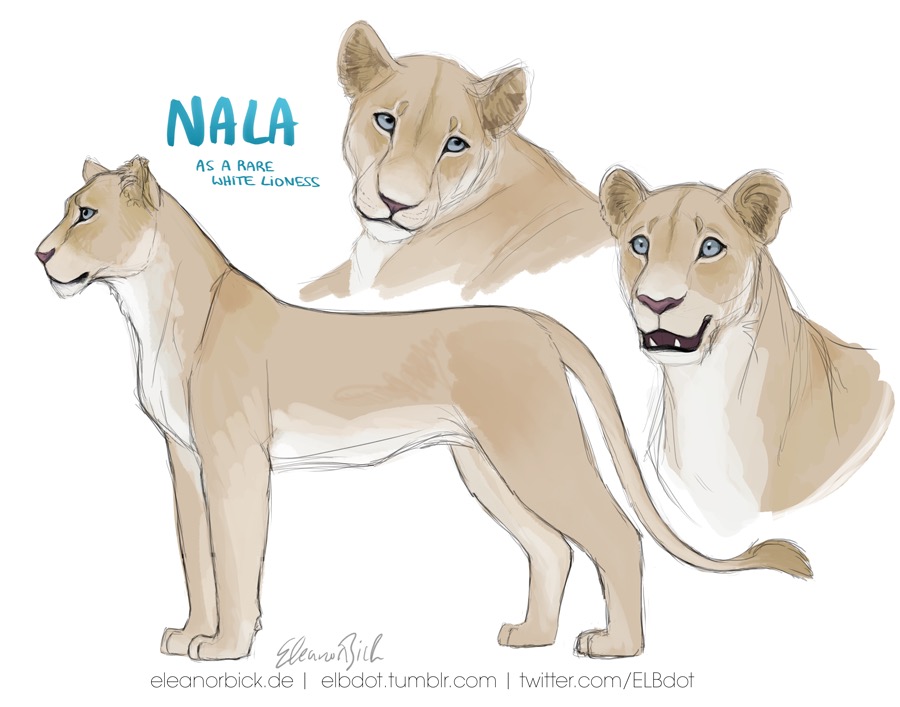
Lionesses are structurally almost identical to male lions — same skull proportions, same body type — but without the mane. They’re actually slightly more streamlined, which makes them excellent drawing practice. If you can draw a convincing lioness face, the male is just that face plus a major fur-rendering exercise.
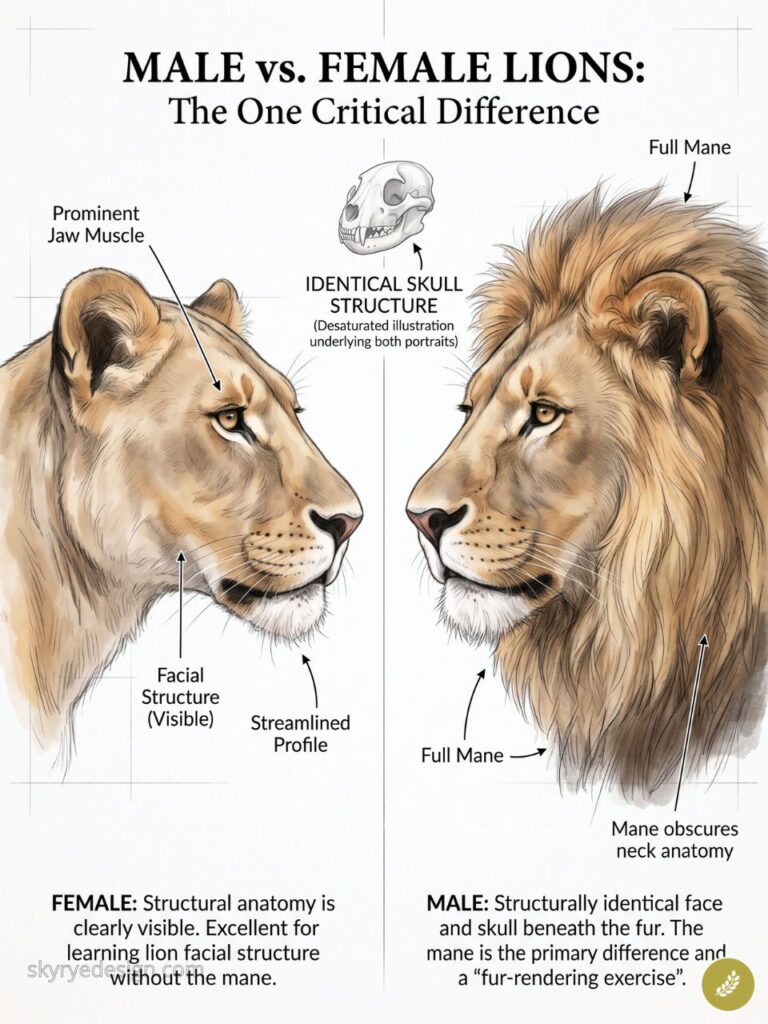
In my experience, drawing the lioness first is the fastest way to learn lion anatomy. You’re forced to work with the facial structure rather than hiding problems behind the mane.
2. Materials — What to Use and Why
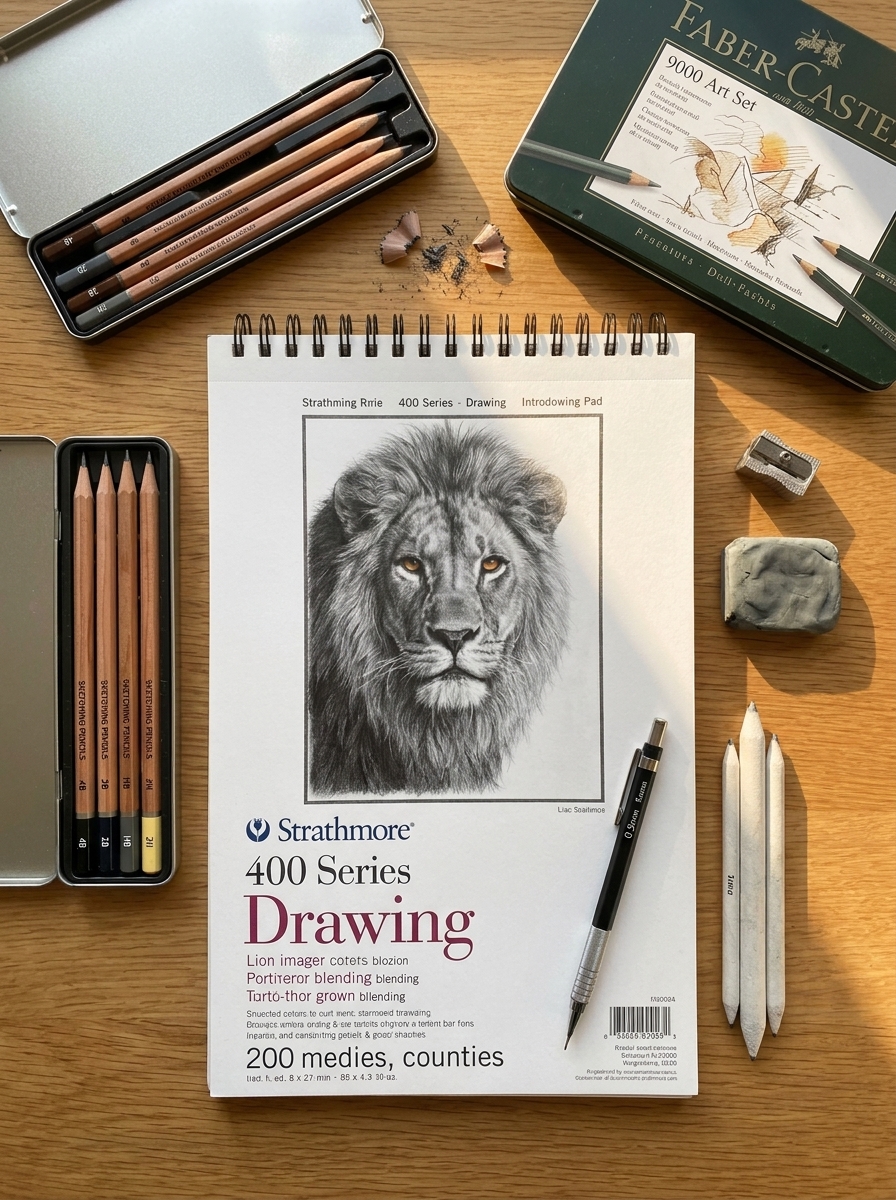
You don’t need a full set. But lion drawing specifically rewards having a proper range of pencil grades — more so than most animal subjects — because the mane requires both extremely fine individual strokes and broad dark masses, sometimes within centimetres of each other.
The Pencil Range
For a lion drawing, five grades cover every stage:
- 2H — initial construction lines, lightest touch, completely erasable
- HB — general sketching, eye outlines, nose shape
- 2B — facial midtones, initial fur strokes, base mane tone
- 4B — mane shading, shadow zones under chin and cheekbones
- 6B — deepest shadows, darkest mane core, cast shadows
The Winsor & Newton Sketching Pencil Set (around $12–15) covers this range and is the standard recommendation in atelier-style courses. Faber-Castell 9000 series works equally well. For fine mane strands, a 0.5mm mechanical pencil gives consistent line weight that a blunted wooden pencil can’t match.
Paper and Erasers
Use medium-tooth drawing paper — Strathmore 400 Series or Canson XL, both around $10–14. The texture holds graphite for blending without fighting the pencil on fine fur strokes. For highlights, a kneaded eraser (Prismacolor, ~$3) lets you lift graphite precisely — essential for whiskers and the highlight ridge across the nose.
| 💡 Pro Tip: Don’t use printer paper for a lion drawing. It buckles under blending pressure and fights you on fine fur strokes. Even a basic sketchbook pad is significantly better. |
🎨 Master This Technique for Free
| Reading about theory is a great start, but watching an industry pro render a lion’s mane stroke-by-stroke changes everything. I’ve partnered with Skillshare to give Sky Rye Design readers a 1-Month Free Tria of their Premium membership. Use the exclusive promo code AFF30D25 at checkout to unlock unlimited classes. Once you’re in, search for:• “realistic animal drawing pencil”• “how to draw fur texture.” 👉 Grab your Free Month |
Before you tackle a full mane, it helps to sketch a simpler animal head and body. This dog sketch tutorial for beginners is a softer warm-up for muzzle shape, ears, paws, and friendly expression.
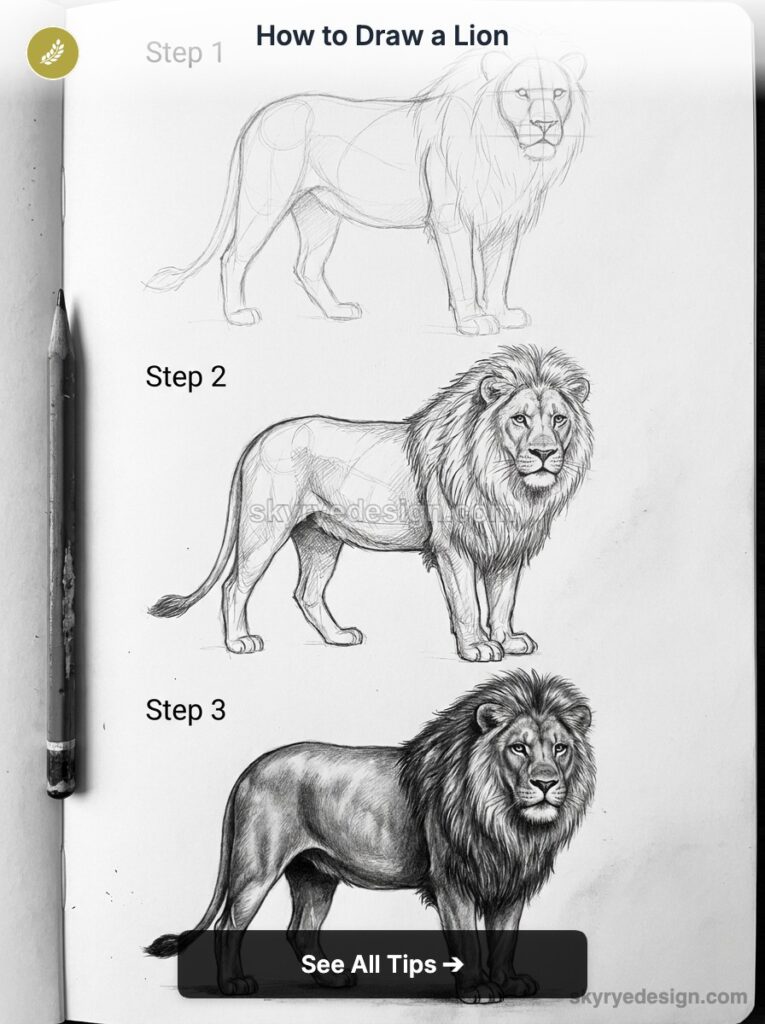
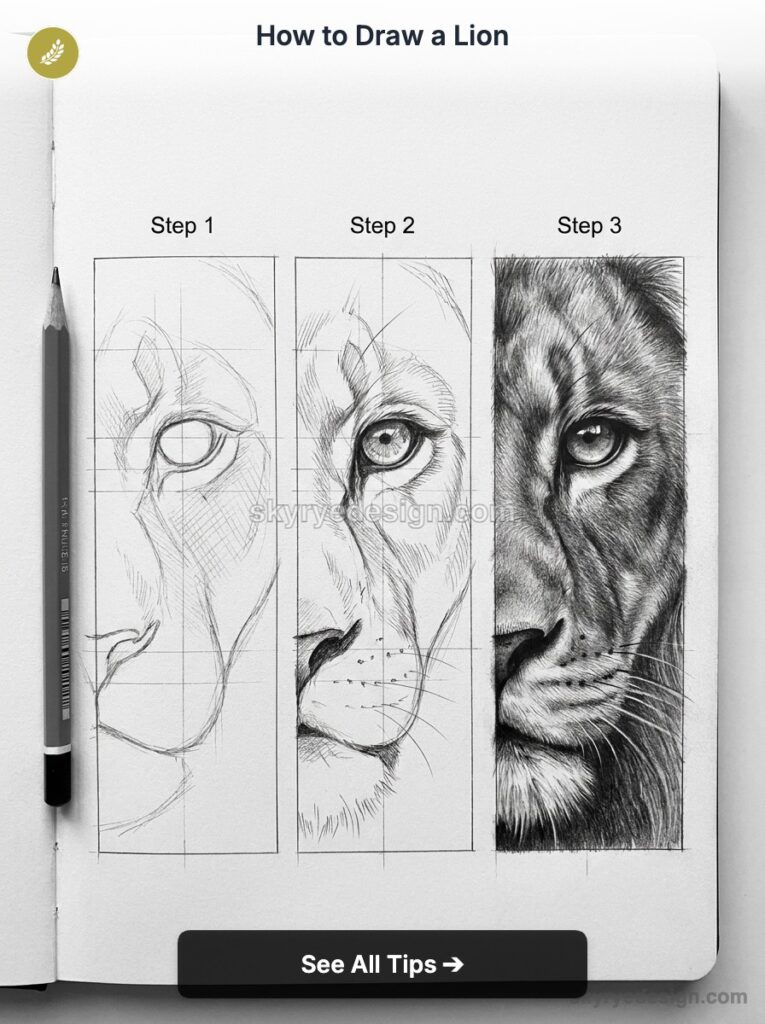
3. Step-by-Step — How to Draw a Lion in 7 Steps
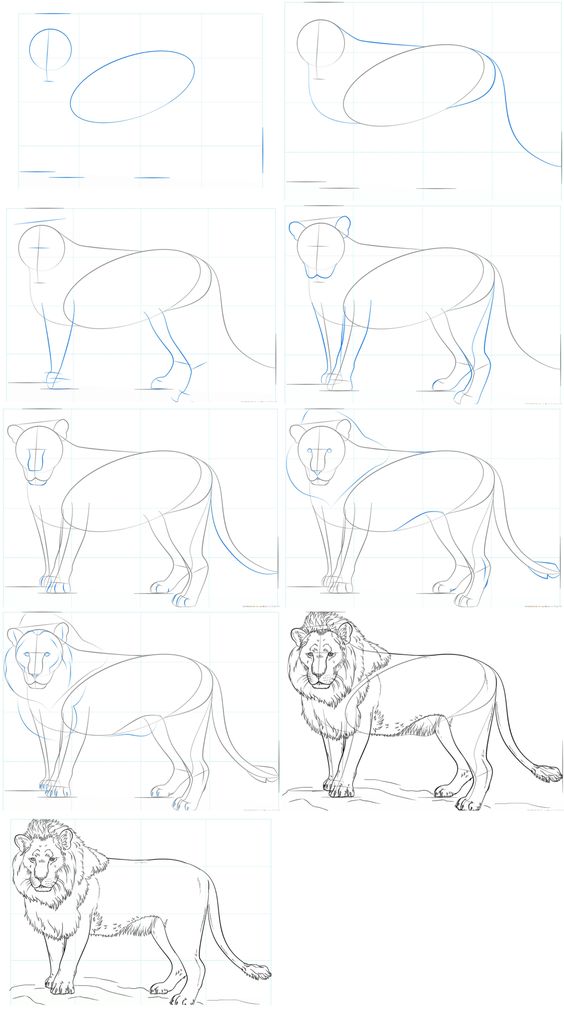
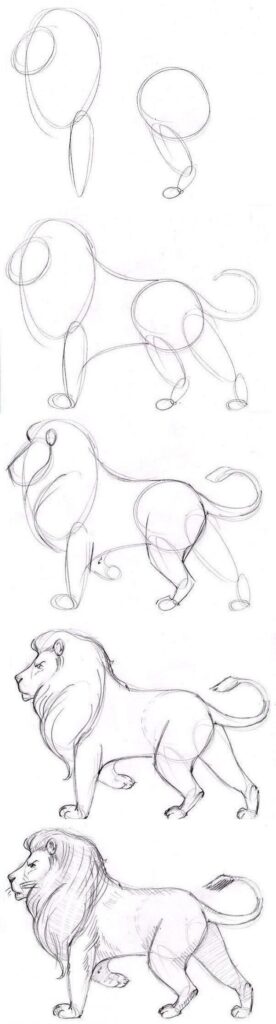
Work through these in order. The first three steps are pure construction — resist the urge to add fur detail before the structure is locked.
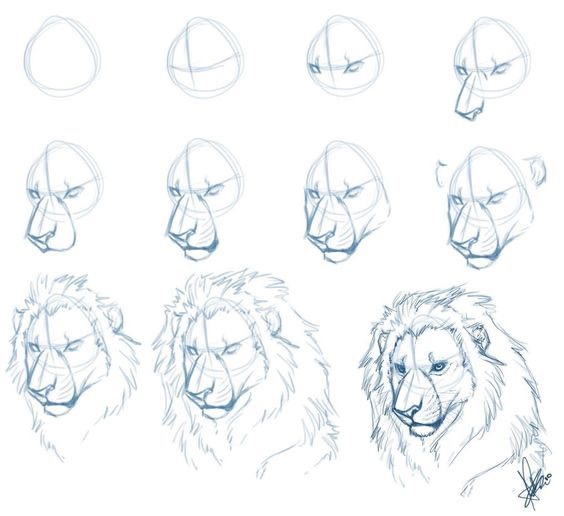
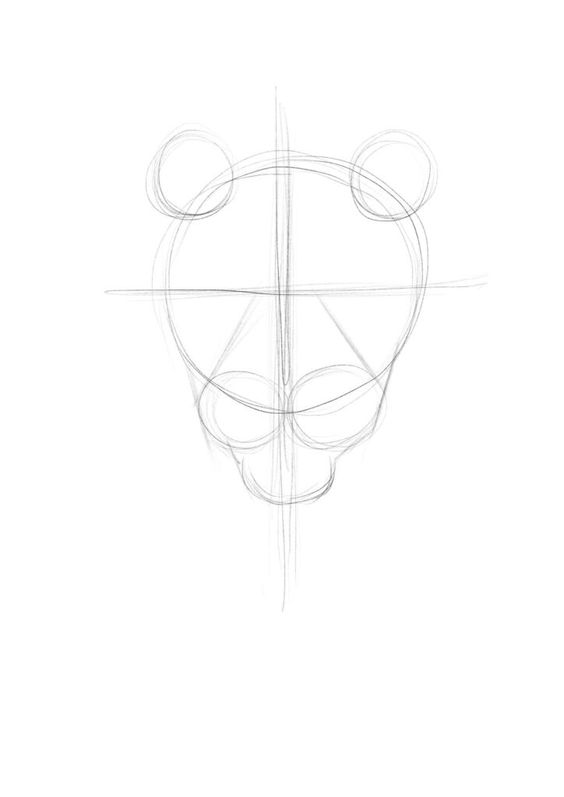
Step 1 — Draw the Cross
Start with a vertical line down the center of your page and a horizontal line approximately one-third from the top of it. This cross gives you the head’s central axis and the eye line simultaneously. Every proportion check later in the drawing references this cross. Draw both lines lightly in 2H — they vanish later.
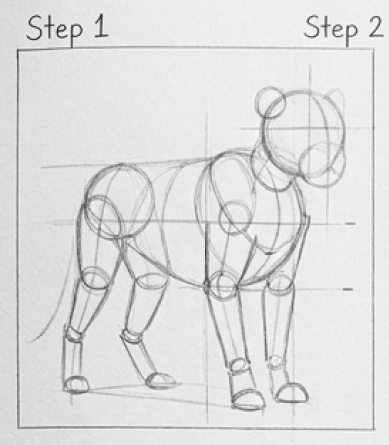
Step 2 — Establish the Skull Shape
Draw a circle centered on the cross intersection. This isn’t the full head — it’s the cranial vault (the top of the skull). Keep it modest: roughly 40% of the horizontal line in diameter. Below the circle, add the muzzle as a smaller oval — about half the skull circle’s diameter — dropped slightly below center and overlapping the skull circle’s bottom. The muzzle pushes forward. It isn’t a flat addition to the face.
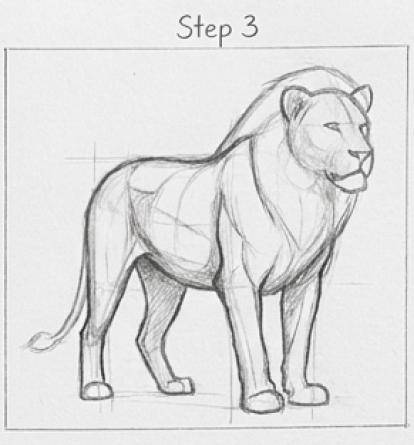
Step 3 — Place the Features
Using the cross as your guide: eyes sit just above the horizontal eye line, almond-shaped and angled slightly (outer corner higher than inner). Nose at the bottom of the muzzle oval, centered on the vertical. Mouth drops from the nose pad as a simple Y-shape initially. Ears perch at the outer edges of the skull circle, low and rounded. Don’t detail anything yet — these are placement markers only.
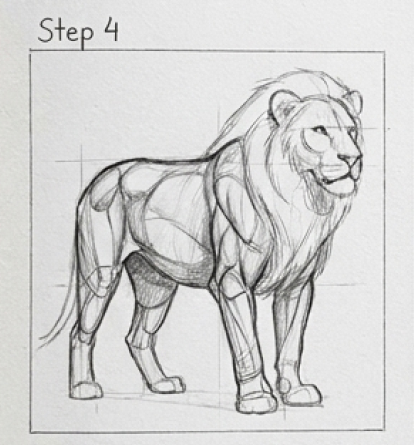
Step 4 — Block in the Mane Shape
Before fur, block the mane as a single shape — a thick collar surrounding the face, wider at the sides and bottom, thinner at the forehead. Sketch the mane outline loosely with HB. It’s not a circle: wider at the cheeks, drops lower under the chin, breaks into irregular tufts at the edges. The outer boundary should feel organic, not geometric.
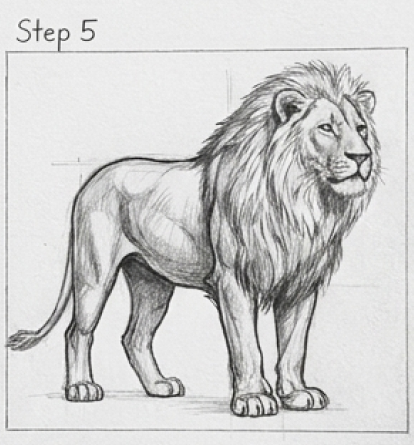
Step 5 — Refine the Face
With construction locked, switch to HB for face refinement. Clean up the eye shape — add the iris (rendered as mid-to-dark value in pencil), a dark pupil, and a small reserved highlight at roughly 11 o’clock. The highlight is untouched paper — protect it now, before any shading. Refine the nose: it’s a wide inverted triangle with soft edges, not a cartoon button. The nostrils curve around the sides. Add the philtrum — the vertical groove from nose to lip.
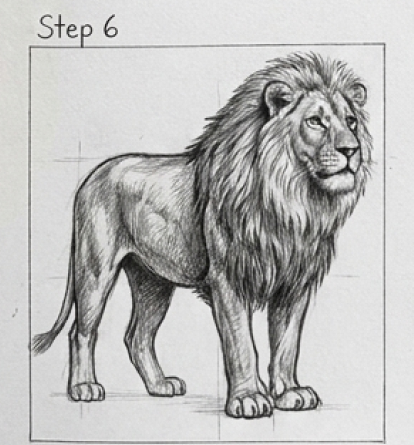
Step 6 — Shade the Face
Establish your light source (upper-left is the classic still life convention). Build three tonal zones on the face with 2B: highlight zones across the brow ridge, top of nose, and cheekbones (leave these lightest); midtone across the majority of the face; shadow under the chin, inside the ears, the dark rings around the eyes, and the shadow plane under the cheekbones. Blend with a tortillon. Then reclaim brightness on the brow and nose ridge with your kneaded eraser.
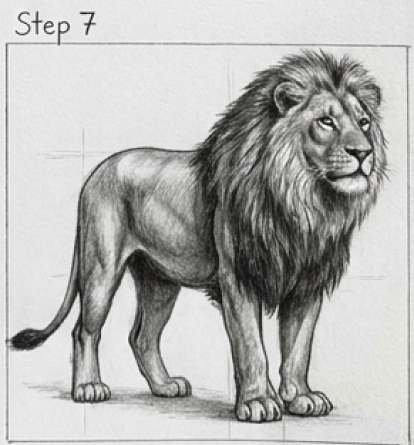
Step 7 — Whiskers and Final Accents
Whiskers are never drawn with pencil in the traditional sense — you’re removing graphite to reveal white paper beneath. Use a sharp, kneaded eraser or a Pentel Clic Eraser to draw each whisker as a lifted line through the muzzle. Add final dark accents with 6B: the pupil core, deepest shadow under the chin, and shadow behind the ears. Then add a cast shadow beneath the head — the portrait needs to sit on something.
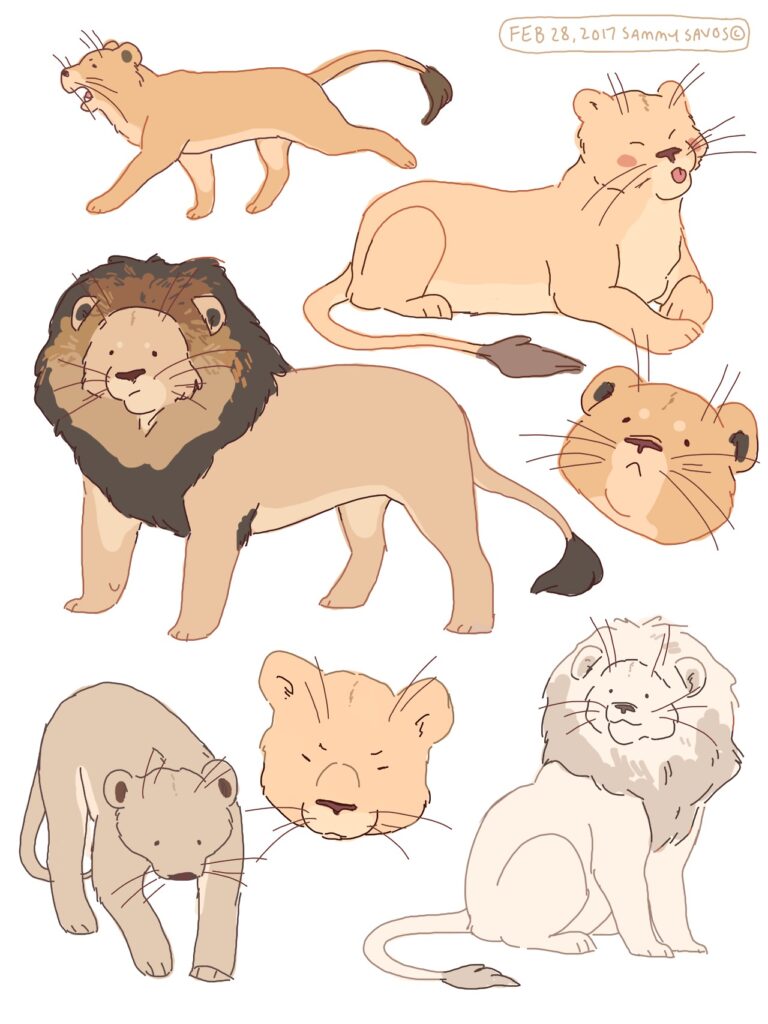
The same lion drawing basics still matter in cartoon form: a clear muzzle, rounded ears, and a believable head shape.
| 📐 Key Technique: After shading the mane, drag a sharpened kneaded eraser through it to lift highlight strands. This single step — building graphite mass first, then subtracting highlights — creates the impression of many lit hairs without drawing each one individually. |
4. Drawing the Lion’s Eyes — The Detail That Makes or Breaks It
Spend disproportionate time on the eyes. If your lion drawing has 8 hours in it, two of those hours should be the eyes. They’re the focal point of every portrait, and a flat eye will undermine technically excellent fur all around it.
Eye Structure
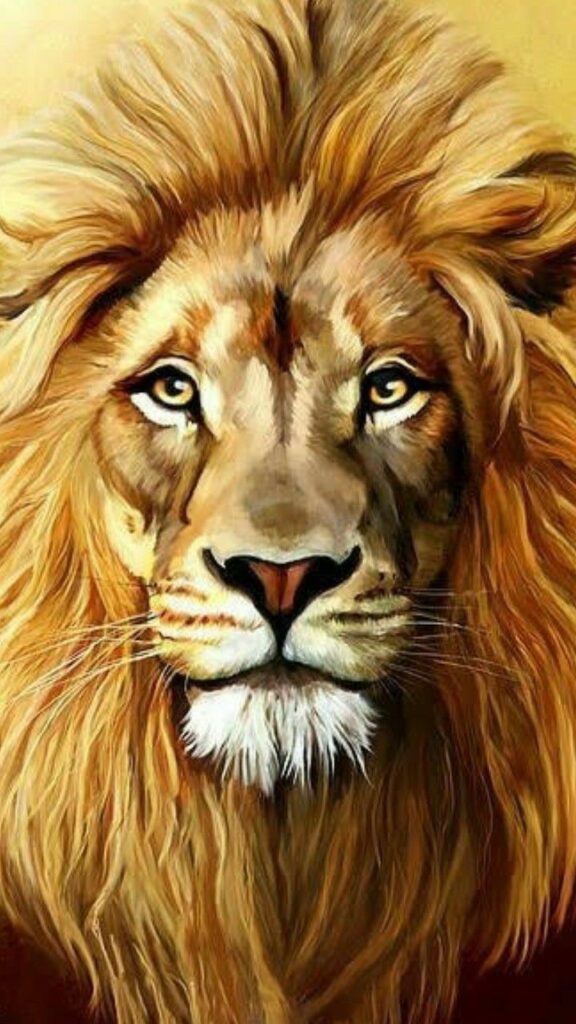
A lion’s eye is set deep under a heavy brow ridge — that brow casts a shadow that makes the eye appear to glow from within. Don’t skip that shadow. It’s what gives the eye its intensity. The iris fills most of the visible eye. Lions have round pupils in normal light — not vertical slits like domestic cats. The iris is a warm amber-gold rendered in pencil as a mid-value with radial lines emanating from the pupil outward.
Building Depth in the Eye
Work from dark to light:
- Fill the pupil completely with 6B — maximum dark
- Add the dark ring around the iris (the limbal ring)
- Build the iris with 2B radial strokes — lighter toward the top
- Leave the highlight untouched or lift it with eraser
- Add the dark shadow of the brow ridge above the eye
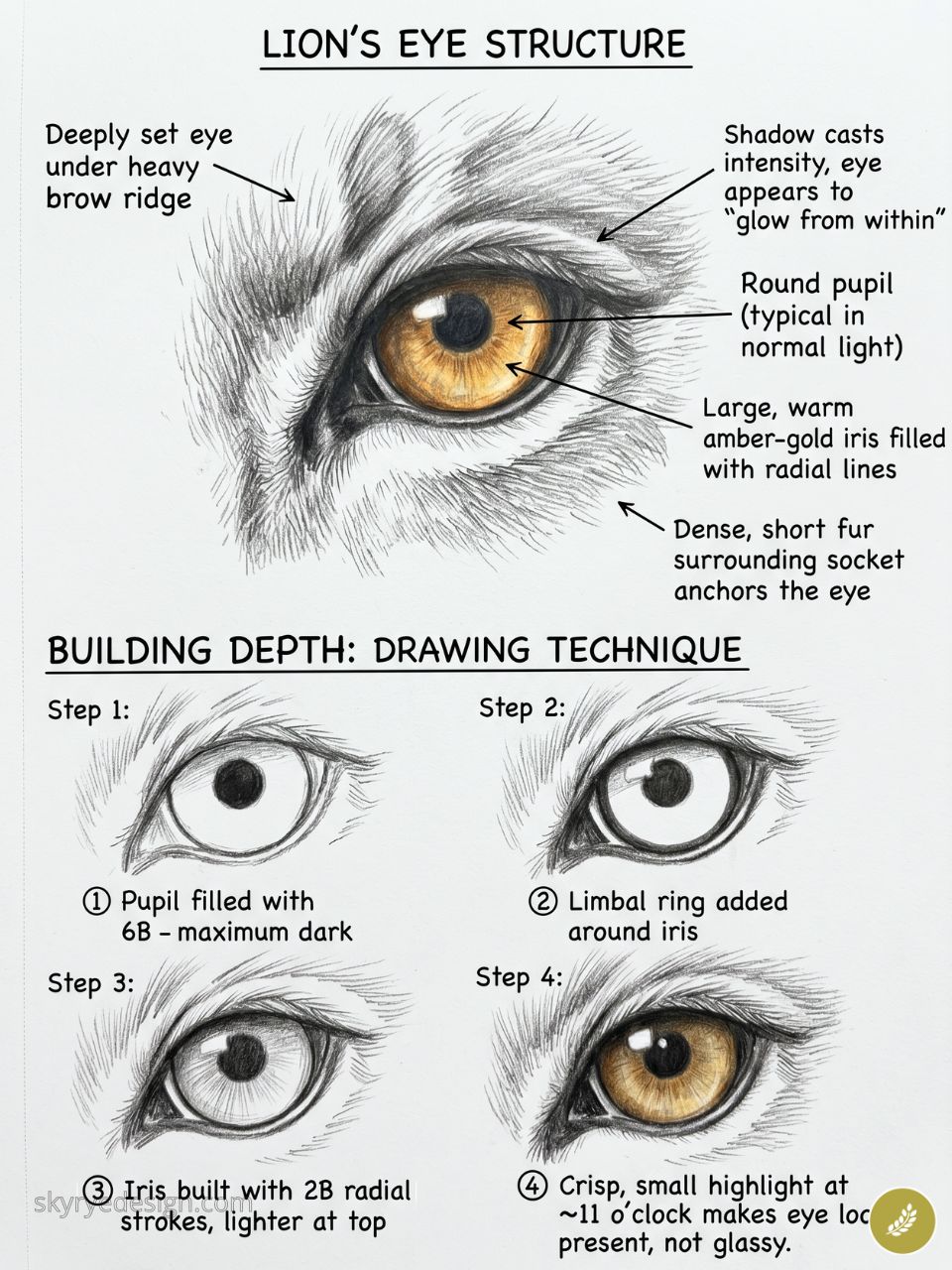
The highlight should be crisp and small — positioned at roughly 11 o’clock. A soft, large highlight makes the eye look glassy and lifeless. A sharp, small highlight makes it look present. And draw the fur above and below the eye, not just the eye itself. The short, dense fur around the socket is what makes the eye feel embedded in the face rather than painted on top of it.
5. How to Draw the Lion’s Mane — Texture Without Losing Your Mind
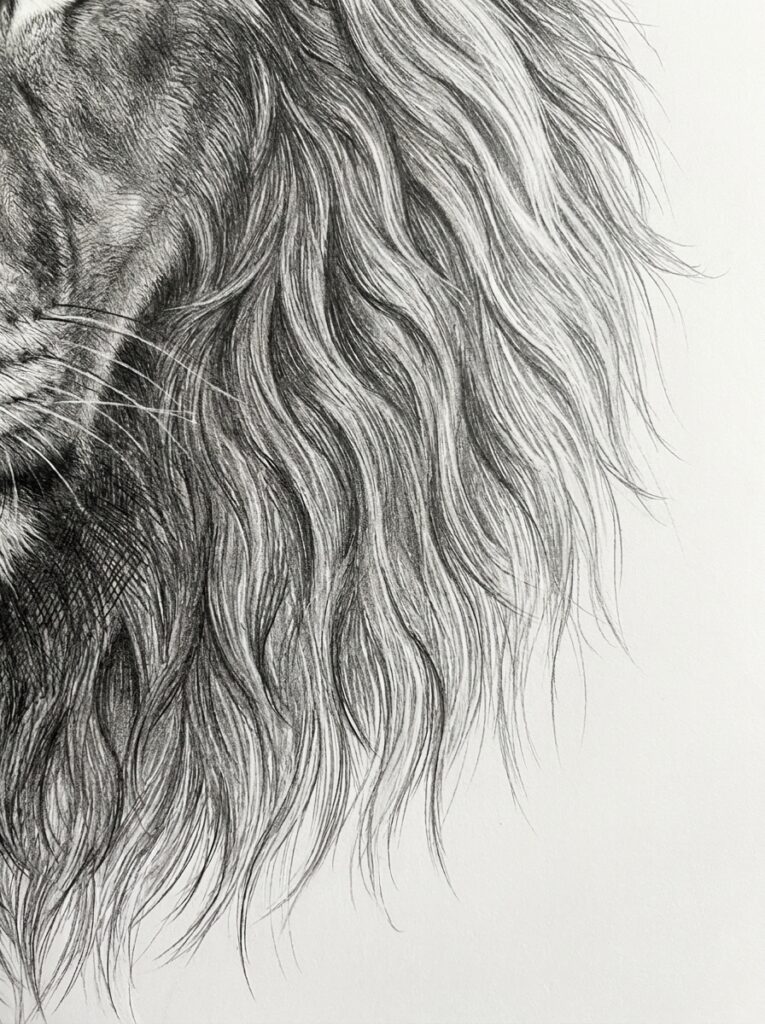
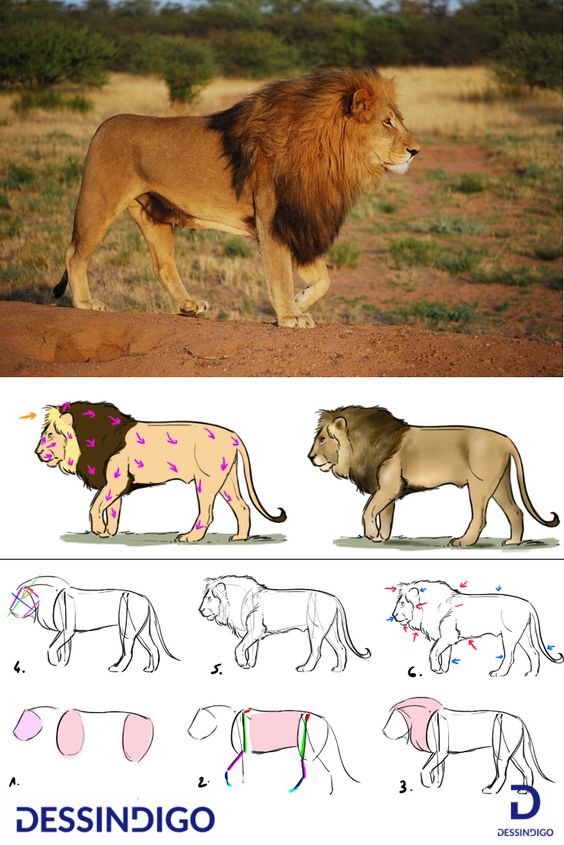
The mane is where most beginners either give up or produce something that looks like a carpet sample. The solution is thinking about it as a landscape, not a texture.
The Mane Has Zones
Divide the mane into three regions before drawing a single hair stroke:
- Inner zone (closest to the face): shortest hair, darkest value, most compressed. Where the mane meets the skull.
- Mid zone: medium length, medium value. The bulk of the mane’s visual mass.
- Outer fringe: longest individual strands, lighter value, most visible as individual hairs at the edges.
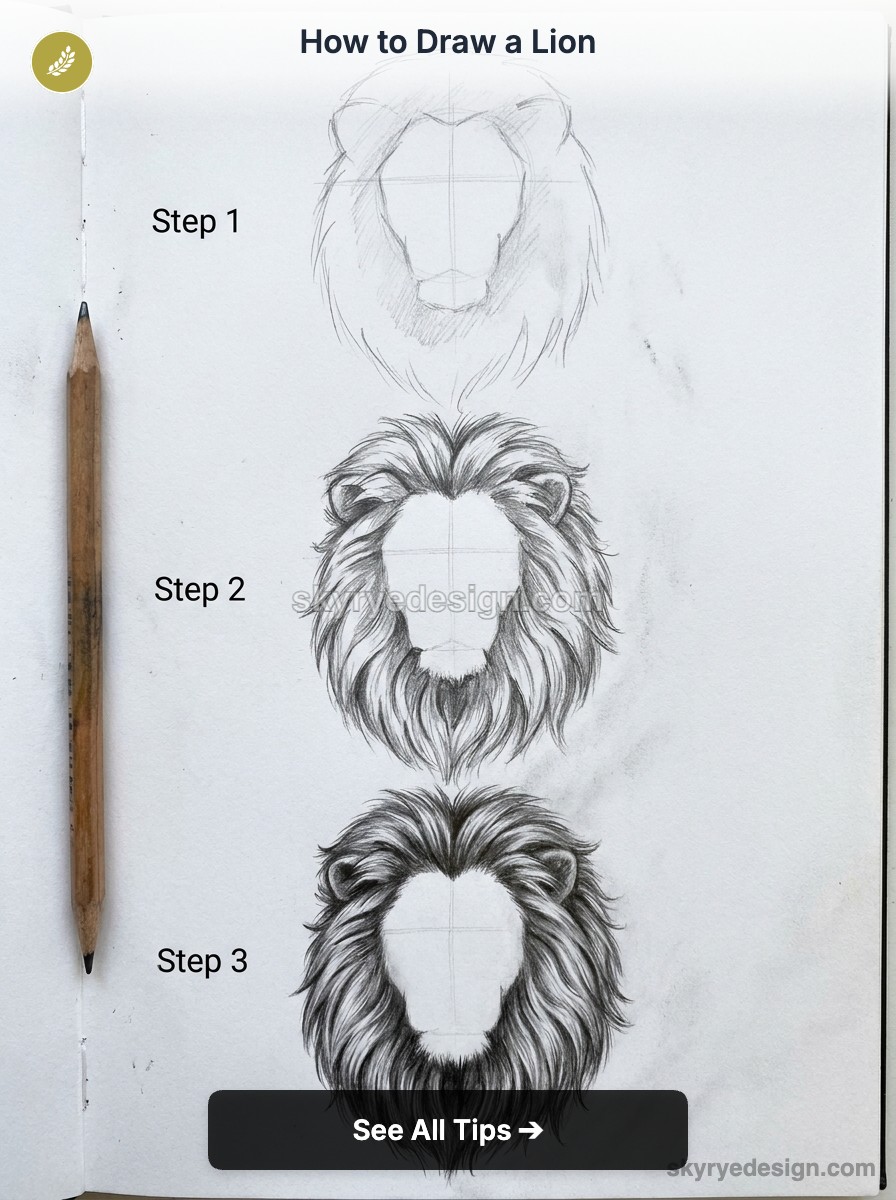
Establishing these three zones as flat tonal shapes first — before adding any stroke detail — saves enormous time and produces much better results than drawing hair-by-hair from the start.
The Stroke Direction Rule
Mane hair doesn’t radiate evenly in all directions like a sunburst. It has a logic: at the crown, hair falls downward and slightly forward. At the cheeks, hair sweeps backward and outward. Under the chin, hair falls straight down, sometimes slightly forward. Follow this direction consistently within each clump. Where two differently-directed clumps meet, there’s a natural seam — a slightly darker line. Draw these seams in and the mane immediately gains three-dimensional structure.
A Practical Mane Sequence
- Lay flat tone across the entire mane with 4B, blended smooth
- Add darker tone in the inner zone and under the chin with 6B
- Draw clumped hair strokes through the midtone with 2B
- Lift highlight strands through the outer fringe with a kneaded eraser
- Add final individual flyaway strands at the very edge with HB
6. Lion Drawing Styles — From Realistic to Graphic
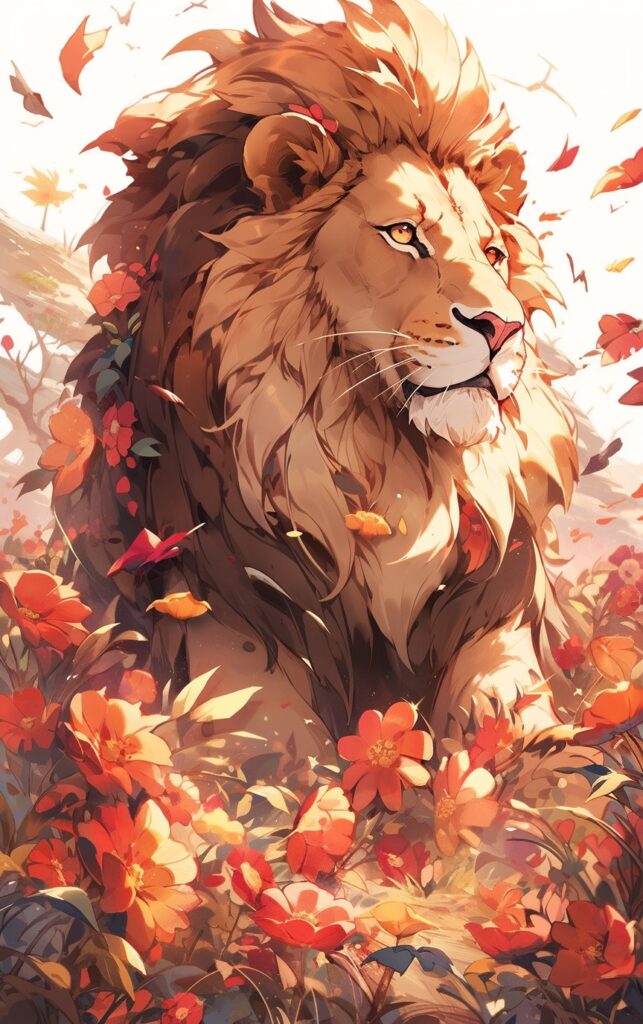
Not every lion drawing needs to be a hyperrealistic graphite portrait. Knowing which style suits your intent saves hours of frustration chasing a result that wasn’t right for the project.
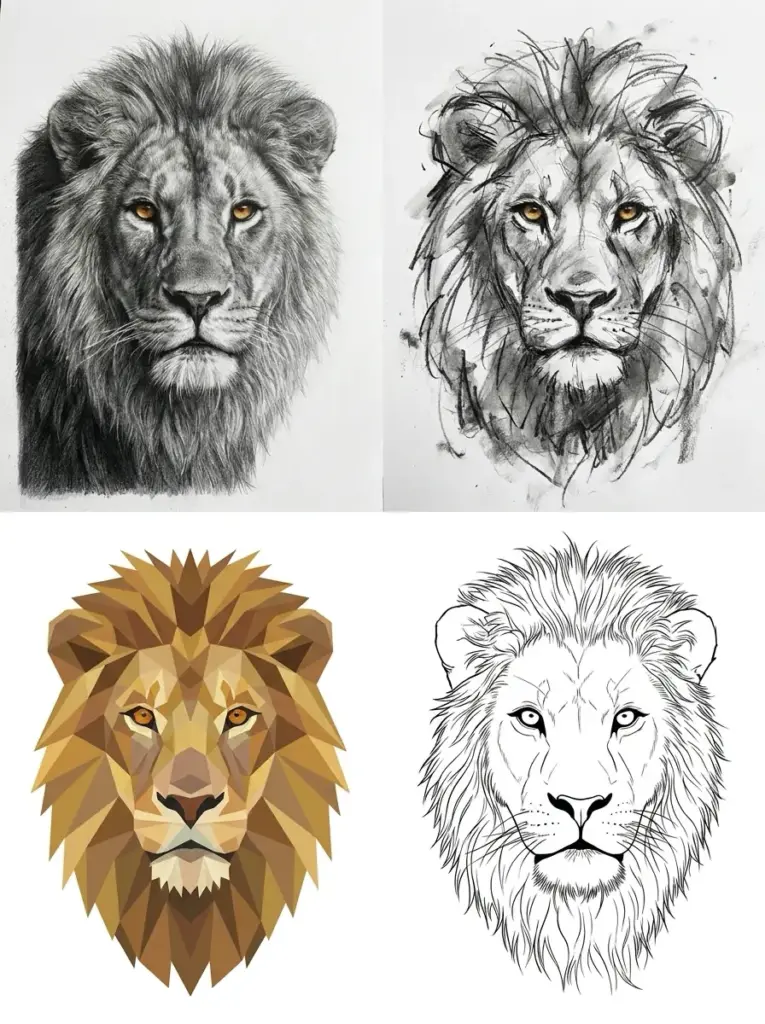
Realistic Graphite Portrait
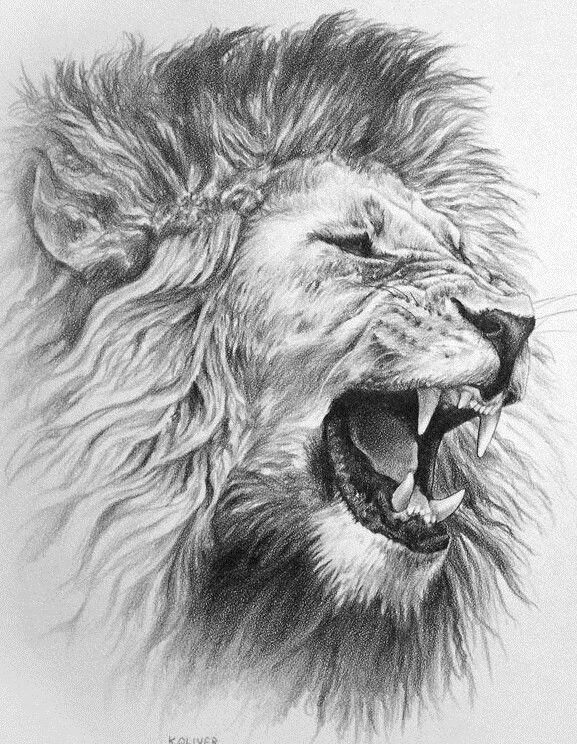
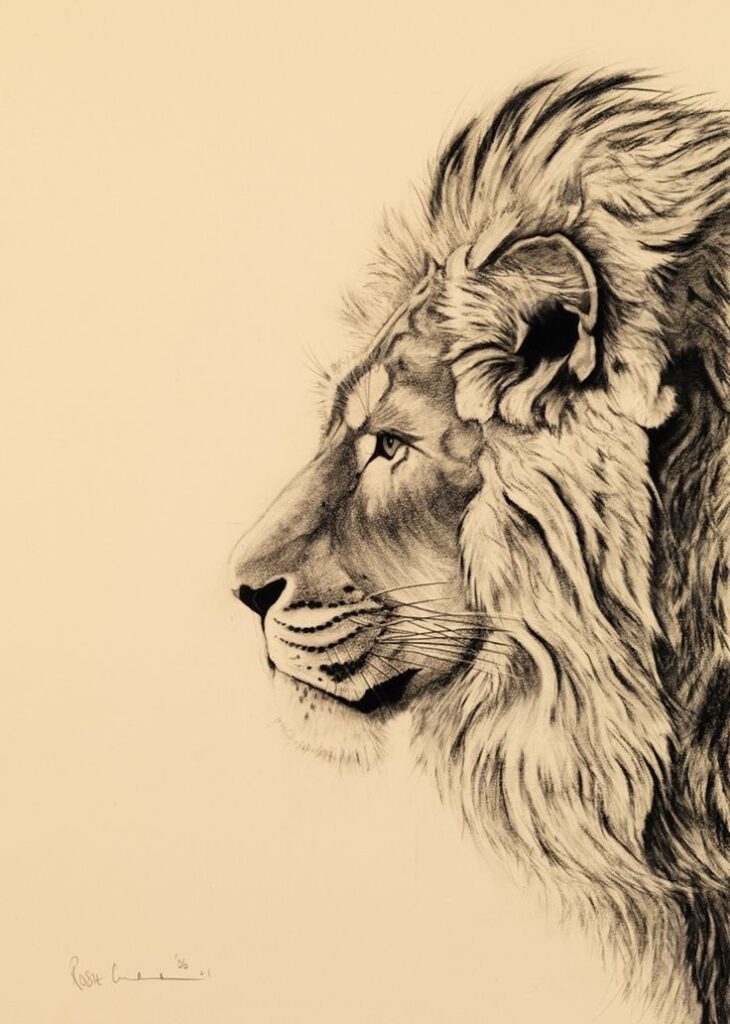
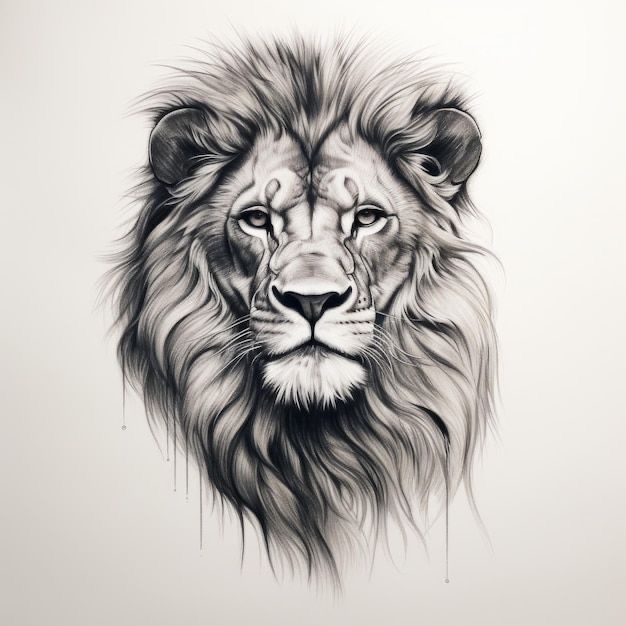
The full-rendering approach — everything in this guide so far. Takes 6–15 hours for a complete head portrait.
Reference artists: Dirk Dzimirsky (German hyperrealist, pencil on paper), Monika Zagrobelna (digital, Wacom). Great for skill-building and portfolio pieces.
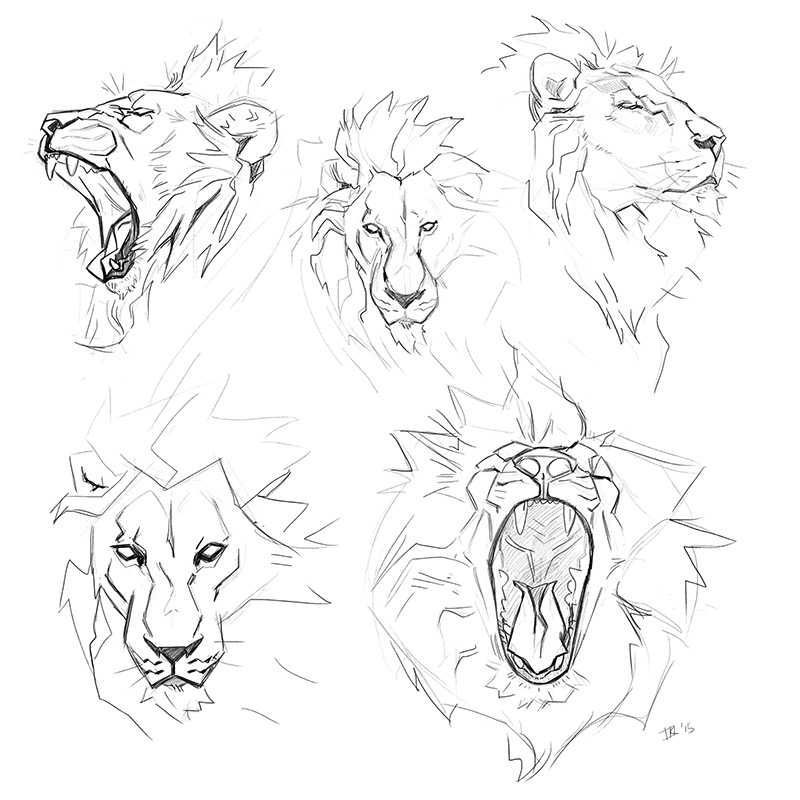
Gestural Sketch / Quick Study
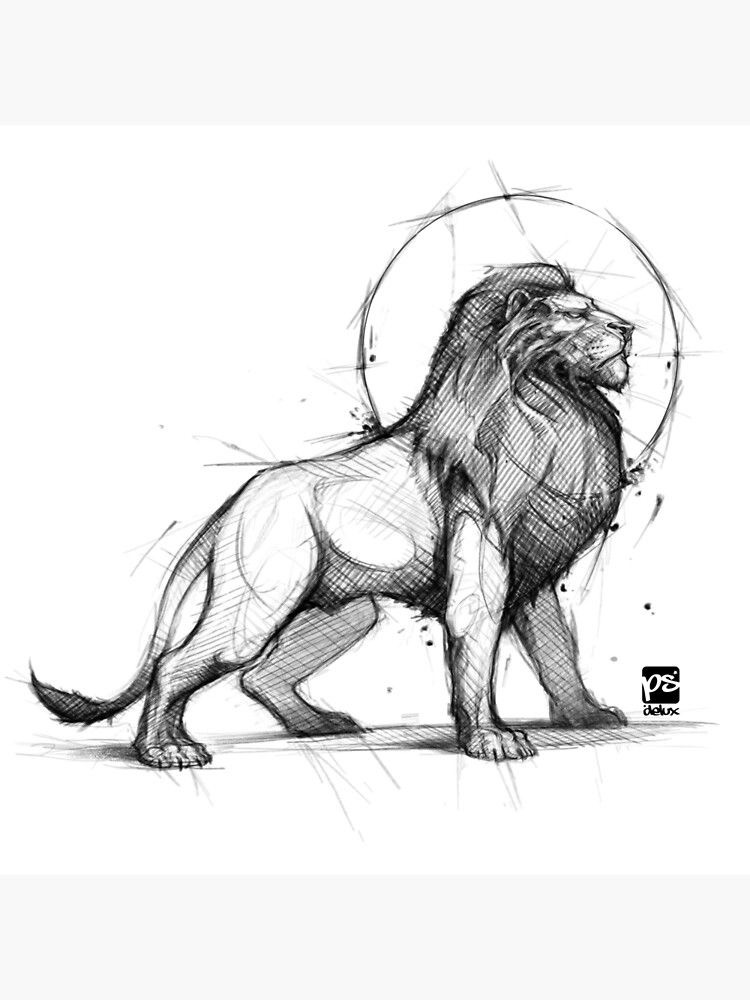
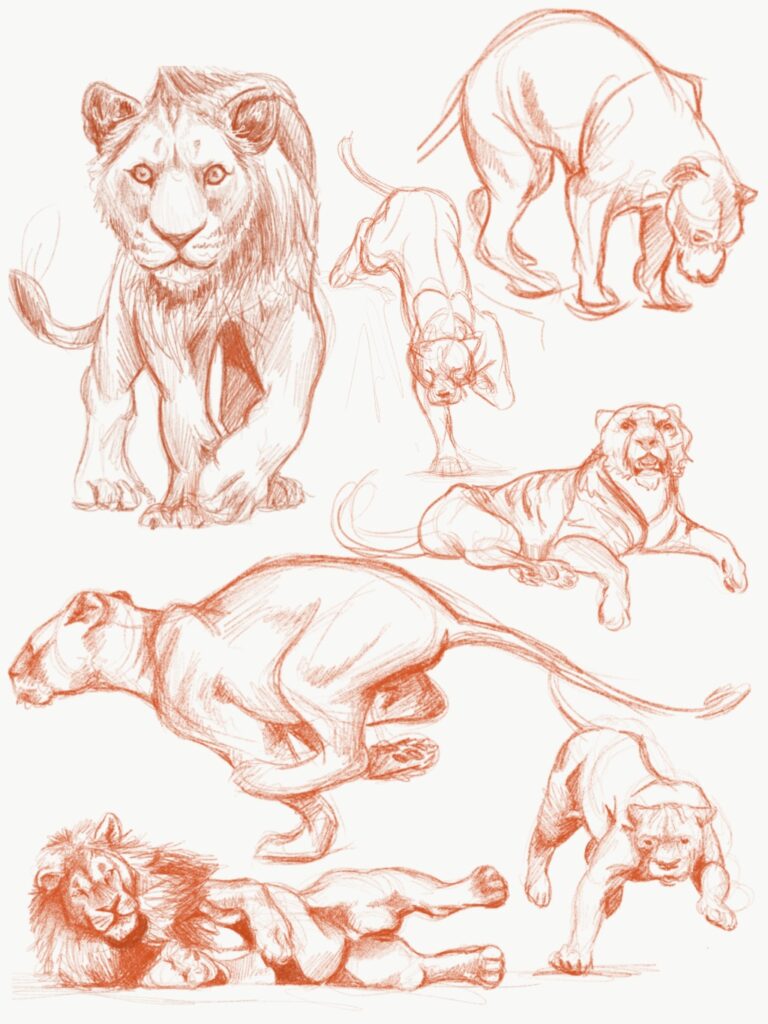
Capturing the lion in 20–40 minutes with minimal detail — strong line work, minimal shading, expressive.
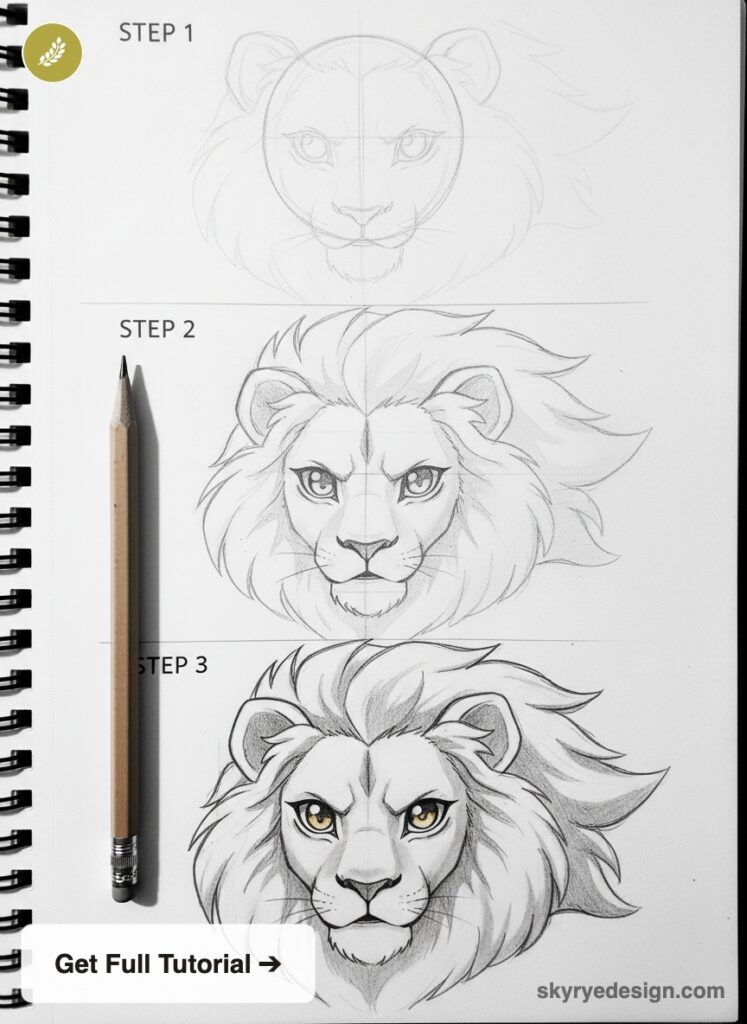
The goal is weight and movement, not detail. Artists like Kim Jung Gi demonstrated that confident gesture work at speed communicates more presence than slow, careful rendering.
Geometric / Graphic Style
Low-polygon or geometric lions — flat facets instead of fur, hard edges instead of gradients.
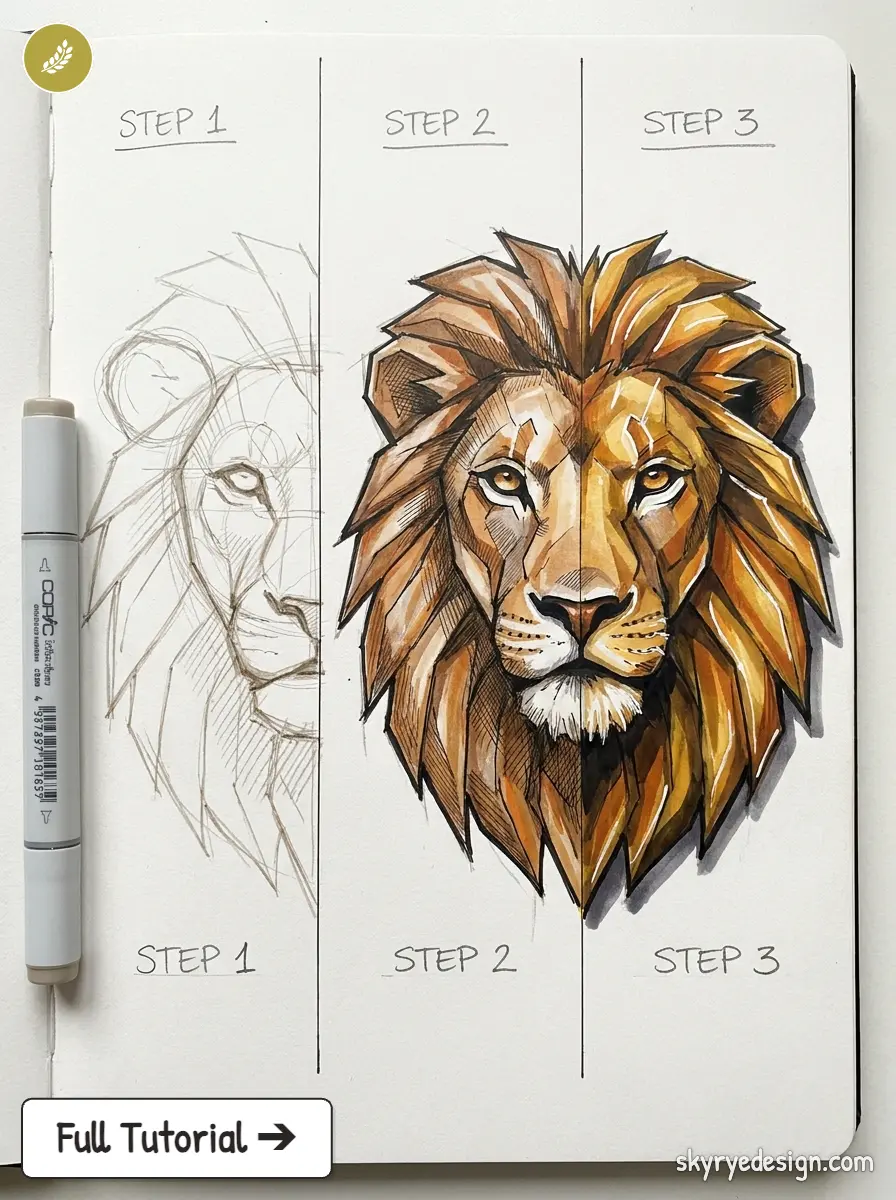
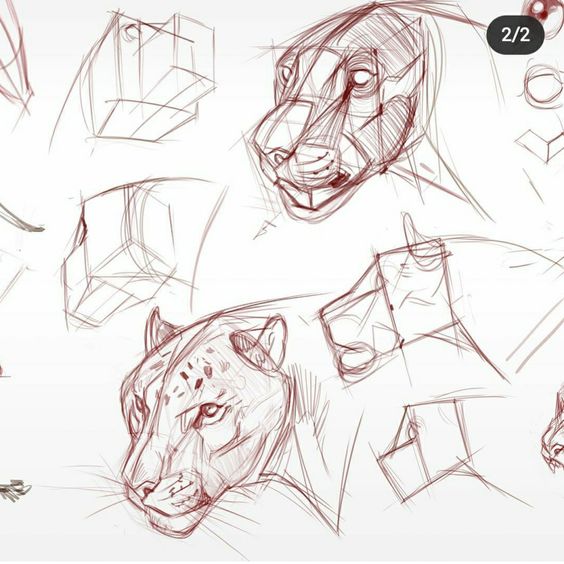
Extremely popular in tattoo design and poster art. Requires no fur knowledge but demands a precise understanding of the face’s underlying planes. Think of it as drawing the skull structure revealed rather than covered.
Line Art (Fineliner)
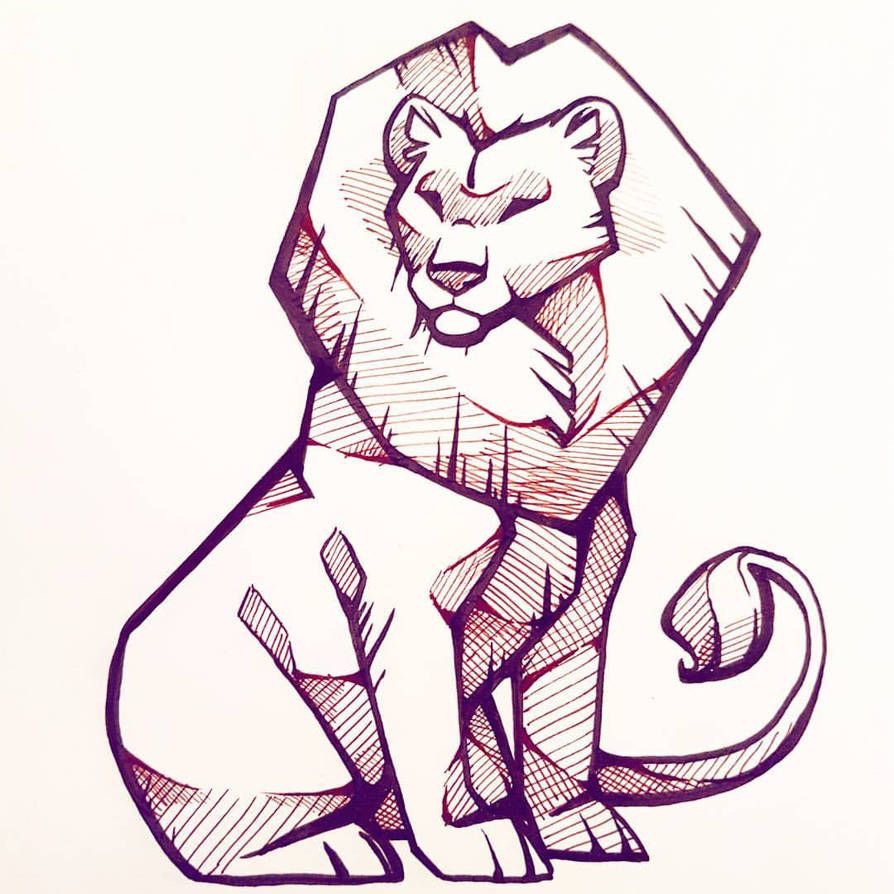
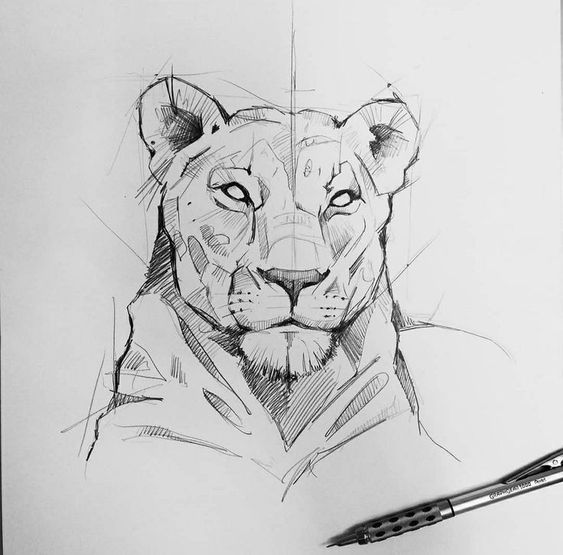
Clean ink outlines, no shading. Micron 0.3 and 0.5 fineliners are the standard — they use archival ink so your work won’t fade over time.
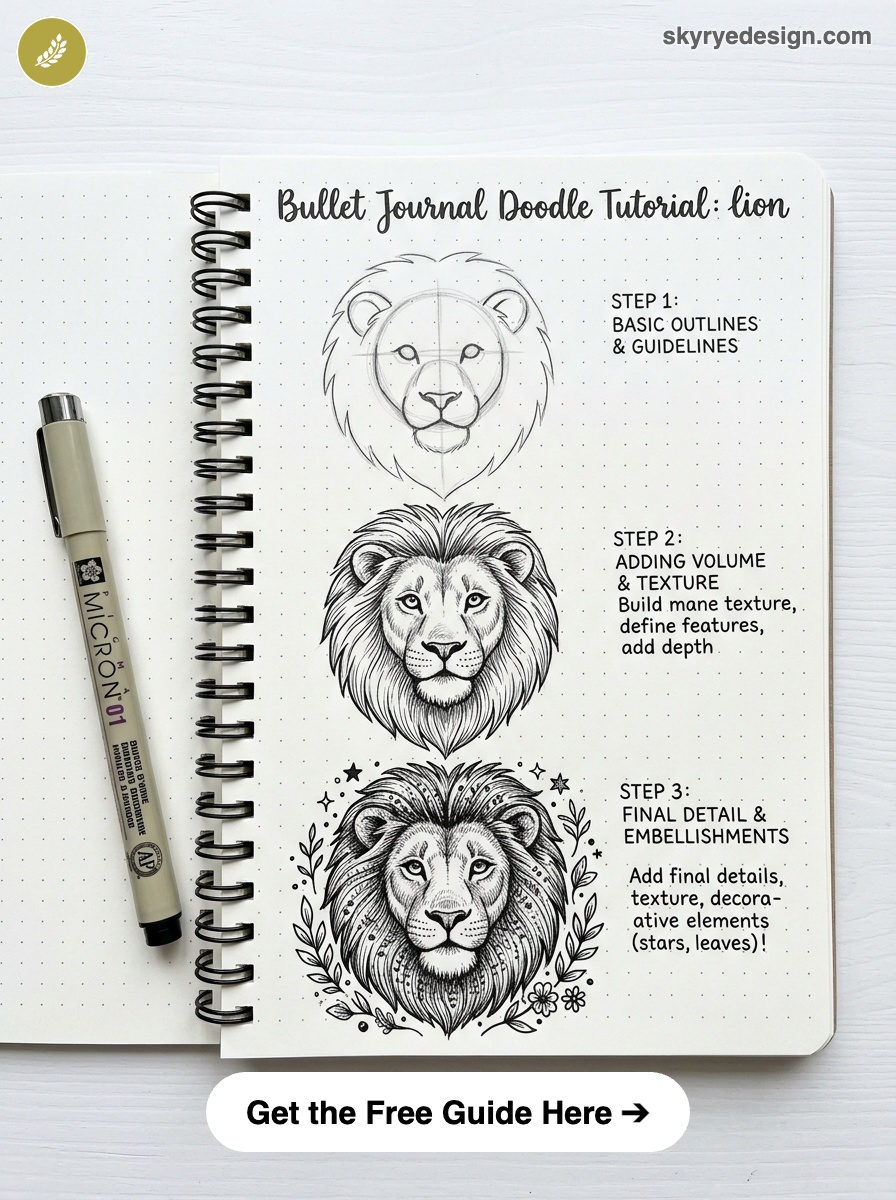
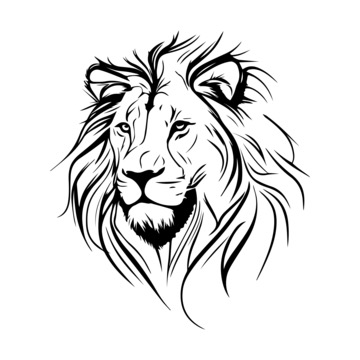
Line weight variation does all the work: thicker lines for shadow edges, thinner for highlights. This approach suits tattoo flash, editorial illustration, and anyone building a consistent ink-drawing practice.
7. Common Mistakes and How to Fix Them
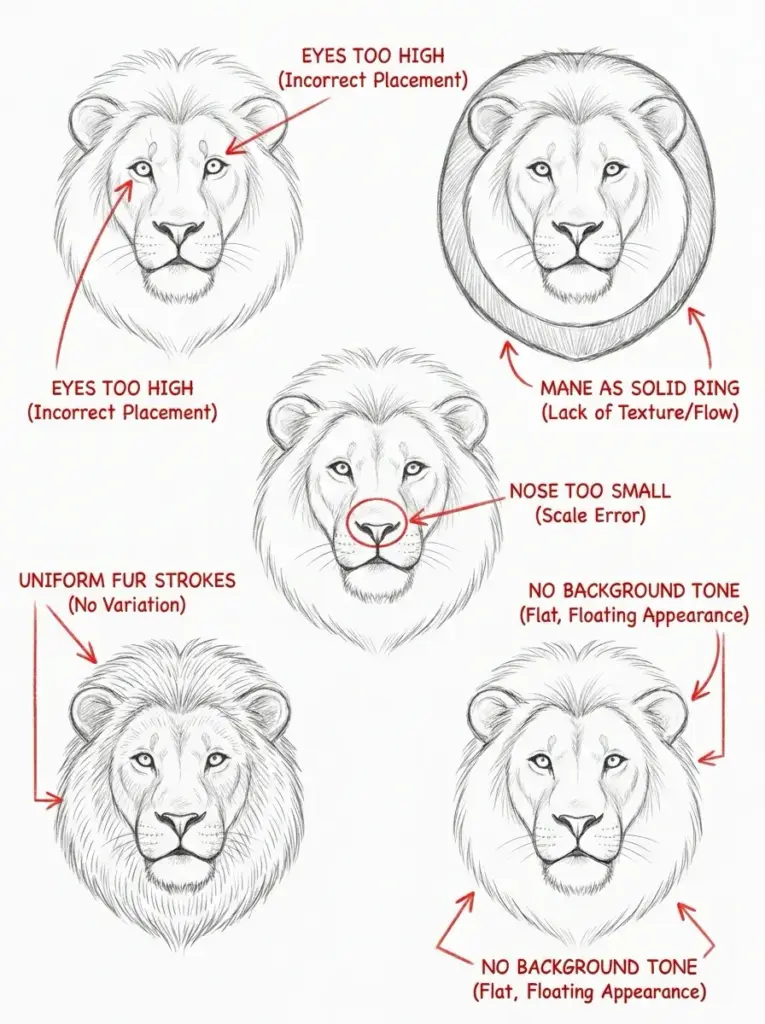
These five errors appear in almost every beginner lion drawing. Check this list before redrawing from scratch — the fix is almost always simpler than starting over.
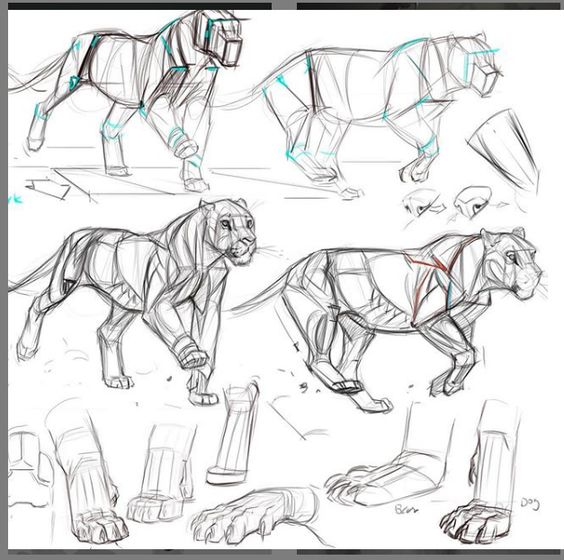
For another anatomy-heavy animal study, this horse anatomy drawing reference breaks the body into chest, barrel, hindquarters, knee, hock, and fetlock, which is useful practice before you return to big-cat structure.
| Quick Fix Checklist ❌ Eyes placed too high → Use the one-third rule. Eyes at the midpoint produce an alien-looking forehead. ❌ Mane drawn as a solid ring → Break into directional clumps. Establish zone tone before any stroke detail. ❌ Nose too small → Make it 80% of the inter-eye gap. A lion’s nose is wide and slightly rectangular. ❌ Fur strokes all the same length → Vary length and curvature per zone. Uniform strokes produce carpet, not fur. ❌ No background tone → Add a light gradient behind the portrait. White space kills value contrast. |
Frequently Asked Questions
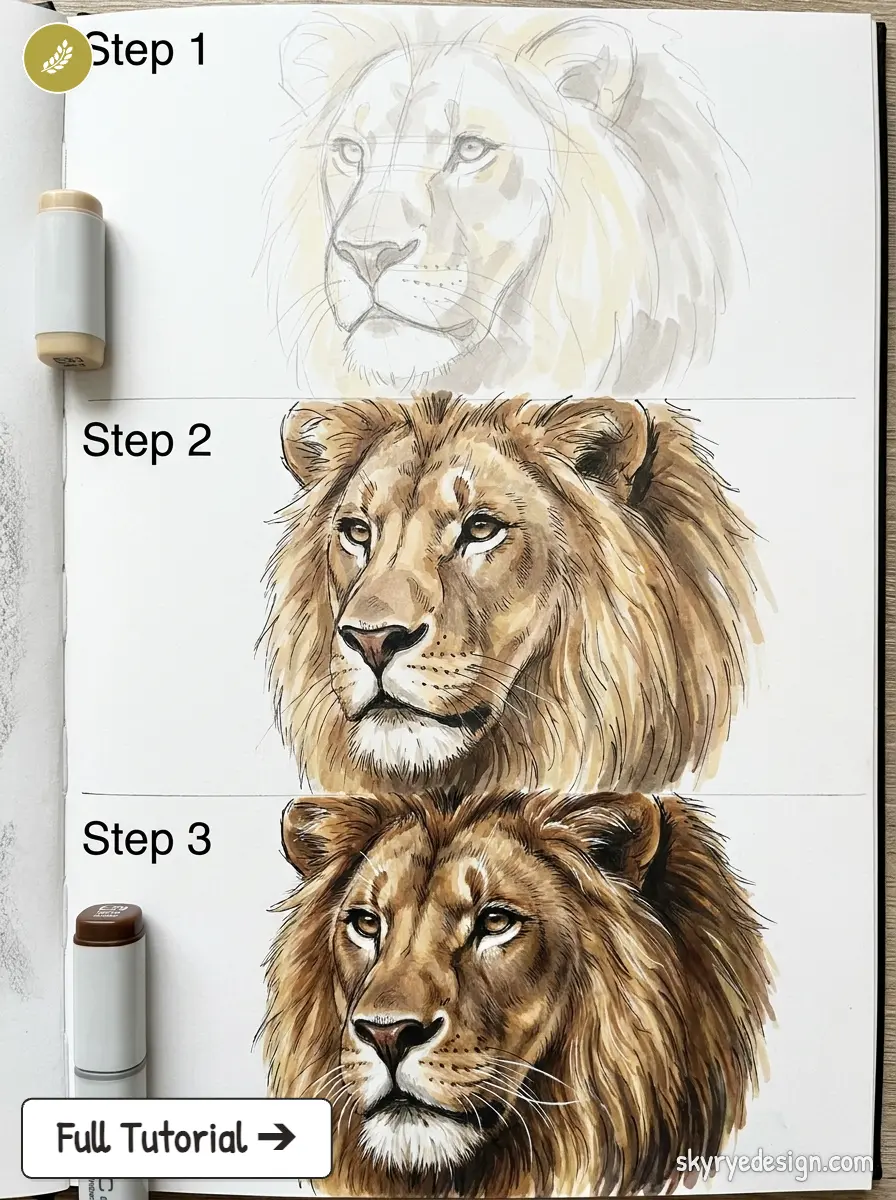
How do you draw a lion for beginners?
Start with a cross (vertical + horizontal line), draw a circle at the intersection for the skull, add a smaller oval below for the muzzle. Place eyes just above the horizontal line, nose at the base of the muzzle oval, ears at the outer skull edges. Lock proportions before adding any fur detail. An HB pencil throughout — keep all strokes light until the construction is confirmed.
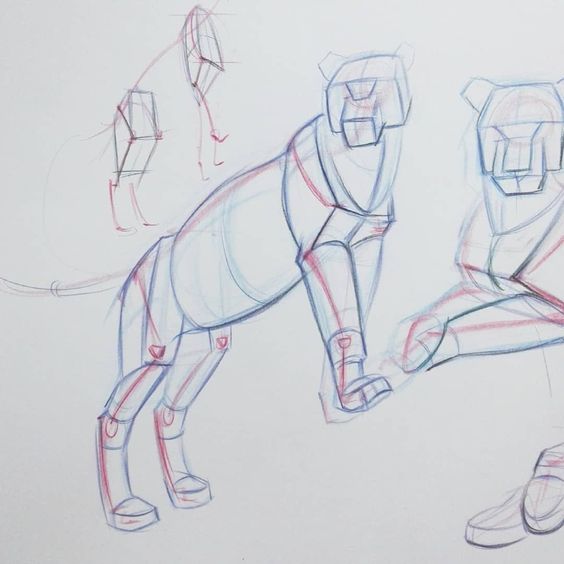
What is the hardest part of drawing a lion?
The mane, without question. Most beginners treat it as a uniform texture and end up with something flat. The key is thinking in zones — inner (short, dark), mid (medium), outer fringe (long, light) — and building tone as flat shapes before adding any directional stroke detail.
How do you draw a realistic lion mane?
Shade the mane as flat tonal blocks first. Draw hair in directional clumps using 2B–4B, varying curve and length per zone. Finally, drag a sharpened kneaded eraser through the mane to lift highlight strands. That last step — lifting graphite — creates the impression of many lit hairs instantly.
What pencils are best for lion drawing?
Five grades cover everything: 2H for construction, HB for sketching, 2B for midtones, 4B for mane shading, 6B for deep shadows. The Winsor & Newton Sketching Pencil Set (~$12–15) or Faber-Castell 9000 series work well. A 0.5mm mechanical pencil is useful for fine mane strands.
How long does it take to draw a realistic lion?
A head portrait with full mane rendering takes most intermediate artists 6–12 hours. A gestural sketch takes 20–40 minutes. Quality depends less on time and more on whether proportions are locked correctly before shading. A well-constructed 4-hour drawing will always beat a poorly-constructed 12-hour one.
Should I draw a male lion or a lioness first?
Draw the lioness first. The absence of a mane forces you to understand and render the facial structure without anything to hide behind. Once the face works on a lioness, the male lion is that same face plus a structured mane exercise.
Your Lion Drawing Starts Today
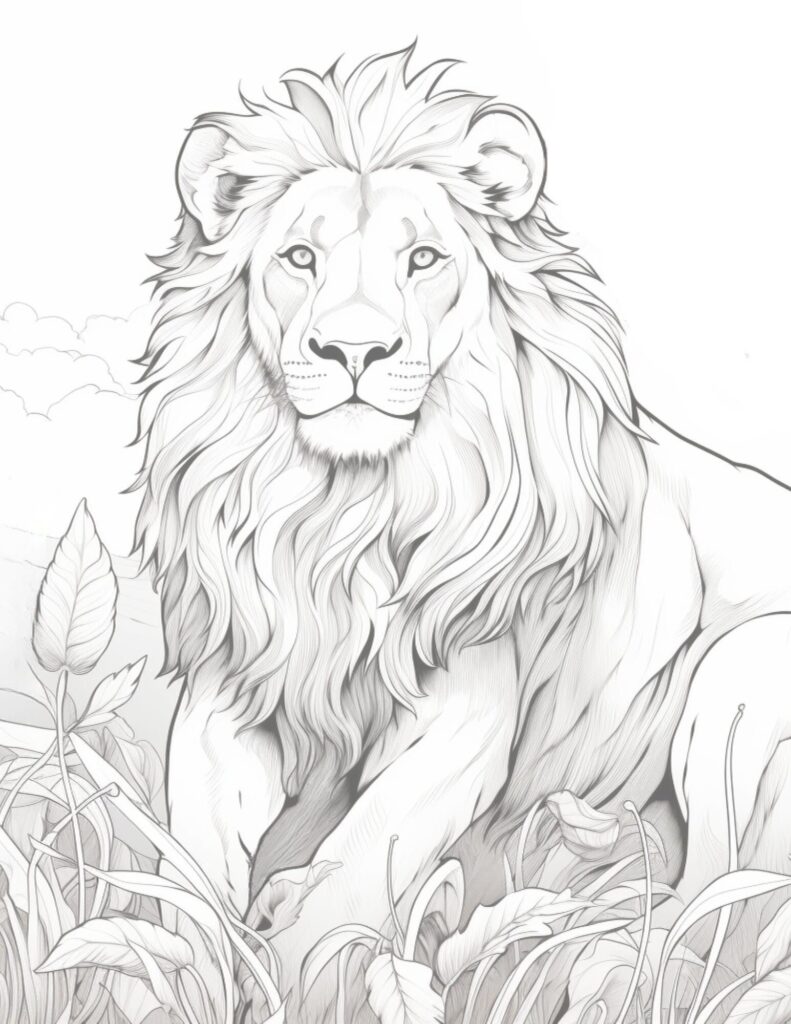
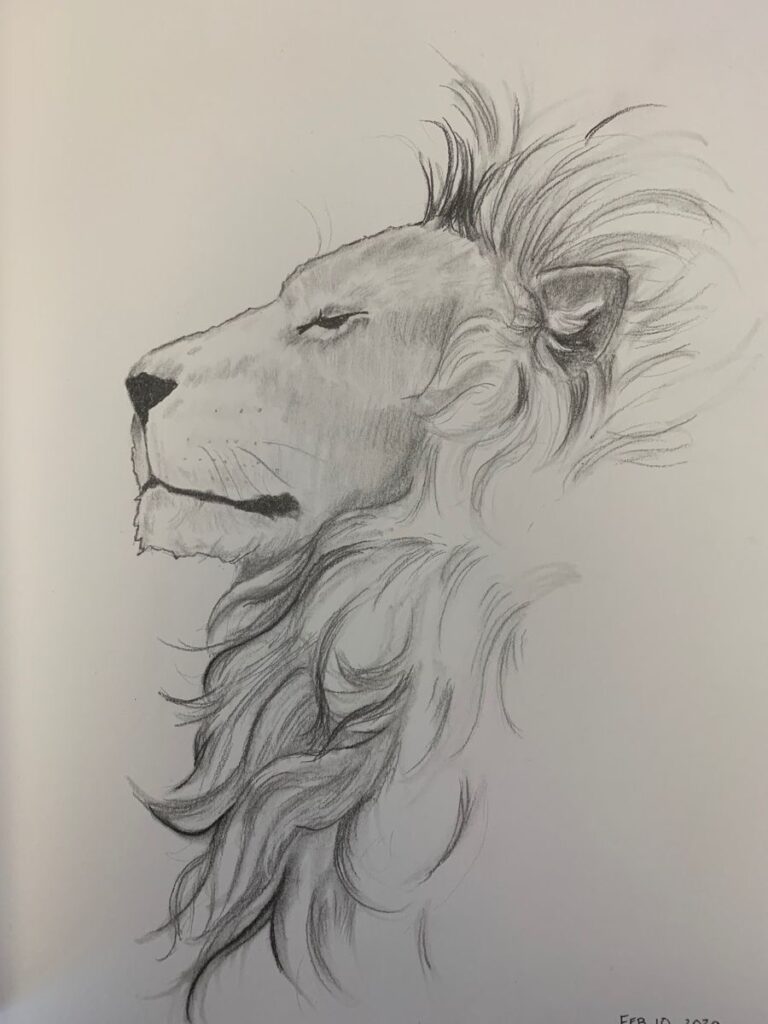
A lion drawing rewards patience at every stage — but especially the first three. Nail the cross, the skull circle, and the feature placement before you touch the mane, and the mane becomes a manageable exercise in tonal zones and directional strokes rather than an overwhelming mass of fur.
The techniques in this guide are the same ones working artists use: construction first, tone second, texture last. Whether you’re drawing a 20-minute gestural study or a 10-hour graphite portrait, the sequence holds.
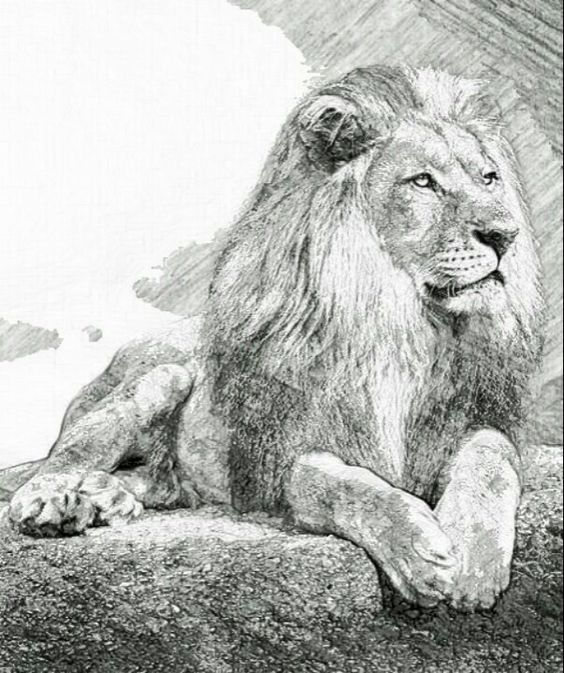
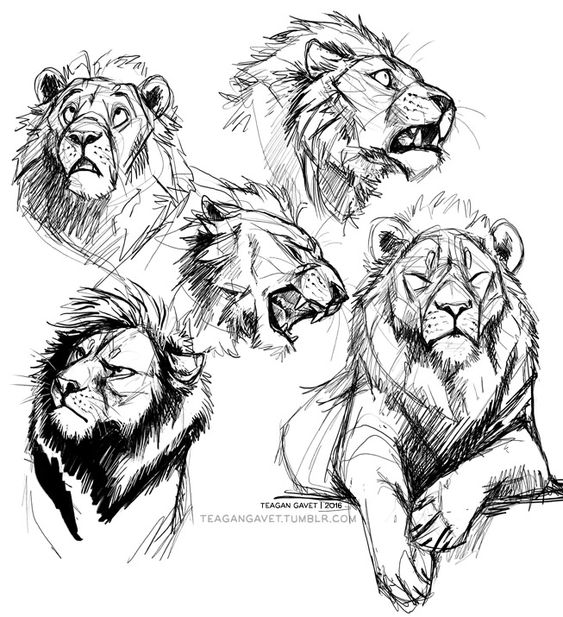
Start with the lioness. One sitting. Get the face right — the proportions, the eye depth, the nose width. Then come back and add the mane to a male. By the second drawing, you’ll have something you actually want to keep.
Print a reference photo at A4 size. Tape it next to your sketchbook. Your lion is waiting.
- 8.1Kshares
- Facebook0
- Pinterest8.1K
- Twitter1
- Reddit0