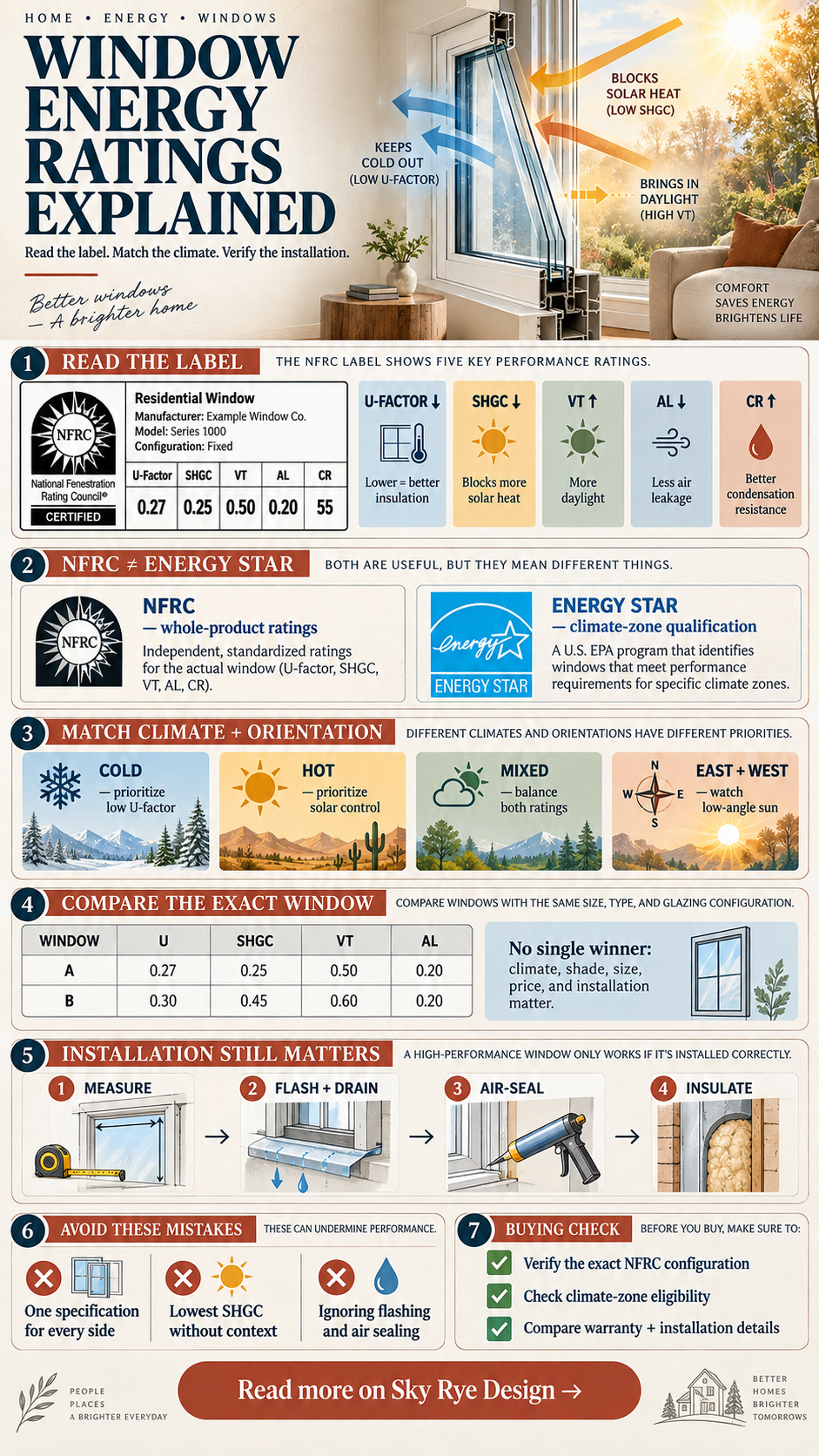
Window energy ratings turn a complicated product into a set of numbers you can compare. The most important are U-factor, which describes heat transfer through the complete window, and solar heat gain coefficient (SHGC), which describes how much solar heat enters through it. Lower is generally better for U-factor; the right SHGC depends on climate, orientation, shade, and whether heating or cooling is the larger concern.
In the United States, look for an NFRC label on the exact window configuration you are buying—not only a brochure for the product line. Use that label together with the ENERGY STAR climate-zone guidance, then check installation details. A highly rated window can still perform poorly if the opening is measured, flashed, sealed, or insulated incorrectly.
Quick answer: start with a low U-factor, choose SHGC for your climate and window orientation, compare visible transmittance so the room still gets useful daylight, and prefer a low air-leakage value. Confirm the exact product in the NFRC directory before ordering.

How to Read a Window Energy Rating Label
The National Fenestration Rating Council (NFRC) provides independent, third-party energy-performance ratings for windows, doors, and skylights. Its label compares the whole product—glass, spacers, sash, and frame—not just the center pane. That distinction matters because two windows using similar glass can perform differently once their frames and edge details are included.
| Rating | What it measures | How to read it | Why it matters |
|---|---|---|---|
| U-factor | Rate of heat transfer through the window | Lower means better insulation | Important in every climate and especially where heating demand is high |
| SHGC | Fraction of solar heat admitted | Lower blocks more solar heat; higher admits more | Balance summer cooling, winter solar gain, orientation, and shading |
| Visible transmittance (VT) | Amount of visible daylight admitted | Higher means more daylight | Helps avoid choosing dark glass simply to control heat |
| Air leakage (AL) | Air passing through window joints under test conditions | Lower means less leakage | Affects drafts and comfort; installation leakage is a separate issue |
| Condensation resistance (CR) | Resistance to interior condensation | Higher means better resistance | Useful in cold or humid conditions, but does not guarantee zero condensation |
U-Factor: Insulation Performance
U-factor measures heat flow. NFRC lists residential window values roughly within a 0.20 to 1.20 range, and a lower number indicates less heat transfer. Do not confuse U-factor with R-value: they describe related behavior in opposite directions. A lower U-factor is better, while a higher R-value is better.
Multiple panes, low-emissivity coatings, gas fills, insulated spacers, and thermally improved frames can reduce U-factor. However, “triple pane” is not automatically the best purchase. Compare the certified whole-window value, the additional cost, weight, climate, and installation requirements.
SHGC: Solar Heat Control
SHGC runs from 0 to 1 and describes the portion of solar heat that passes through the complete window. Lower SHGC limits unwanted heat gain, which is often valuable in hot climates and on heavily exposed east- and west-facing windows. A higher SHGC can sometimes support passive winter heating in cold climates, particularly on well-designed south-facing glazing with seasonal shading.
This is why there is no single “best” SHGC for every room. An unshaded west-facing window and a shaded north-facing window can need different specifications even in the same house.
Visible Transmittance, Air Leakage, and Condensation Resistance
Visible transmittance helps you balance daylight with solar control. A low-SHGC window with very low VT may reduce useful daylight and lead to more electric lighting. Air leakage measures the tested product, not gaps between the window and wall, so proper sealing still matters. Condensation resistance is a comparative rating rather than a promise: indoor humidity, exterior temperature, curtains, and installation all affect real-world condensation.
NFRC and ENERGY STAR Are Not the Same Thing
NFRC supplies the standardized ratings that let you compare products. ENERGY STAR applies efficiency criteria to those certified ratings and identifies products suitable for specific climate zones. In other words, the NFRC label is the measurement card; ENERGY STAR is a qualification based primarily on U-factor and SHGC.
Before ordering, use the official ENERGY STAR Climate Zone Finder. The current requirements vary by climate, so avoid copying a number from a generic article or a contractor’s example. If you are outside the United States, use the locally recognized rating system and climate guidance rather than treating NFRC thresholds as universal building-code requirements.
Choose Ratings by Climate, Orientation, and Room
- Cold climates: prioritize a low U-factor. Consider whether useful winter solar gain is part of the design before automatically choosing the lowest SHGC.
- Hot climates: prioritize solar control as well as insulation. A low SHGC can reduce cooling demand, especially on exposed glazing.
- Mixed climates: balance both ratings and evaluate each orientation. Exterior shade can change the best specification.
- East and west: low-angle morning and afternoon sun is difficult to shade with a simple roof overhang, so solar control is often important.
- North and south: needs depend on hemisphere, climate, and shading. In the Northern Hemisphere, south-facing glass can be easier to shade seasonally than west-facing glass.
Design choices should also account for the room. A large living-room window may need a careful daylight and glare balance, while a bathroom may prioritize privacy, ventilation strategy, and condensation resistance. If you are planning a broader project, use this together with our home renovation guide rather than selecting windows in isolation.
Worked Example: Comparing Two Window Labels
| Example | U-factor | SHGC | VT | AL |
|---|---|---|---|---|
| Window A | 0.27 | 0.25 | 0.50 | 0.20 |
| Window B | 0.30 | 0.45 | 0.60 | 0.20 |
Window A insulates slightly better and blocks more solar heat. It may be the stronger candidate for an unshaded west-facing room in a cooling-dominated climate. Window B admits more solar heat and daylight. It could be useful for a deliberately designed, well-shaded south-facing opening in a cold climate. Neither label alone tells you the winner: size, orientation, local climate, exterior shading, frame, price, and installation must be considered.
Ask the seller for the NFRC Certified Product Directory number for the exact glass, frame, grid, and operating style in the quote. Do not assume a sample label for one configuration applies to every option in the series.
Glass, Frame, and Installation Still Matter
Energy ratings make product comparison possible, but they do not replace good detailing. Low-e coatings and gas fills affect thermal and solar performance. Frame design can create or reduce thermal bridges. Operable windows introduce weatherstripping and locking points that fixed units do not have. Our guide to window innovations for style and efficiency explains how these choices fit into the architectural design.
Installation is equally important. ENERGY STAR notes that even efficient windows can be drafty when installed poorly. The opening must be correctly measured, flashed, drained, air-sealed, and insulated according to the manufacturer’s instructions and local requirements. Before replacing the unit, check whether the problem is the window itself or a failed seal; these window seal failure signs can help with the first inspection.
Interior coverings improve comfort but do not change the NFRC rating of the window. Well-fitted shutters can add light control, privacy, and another still-air layer; see our guide to using shutters in an interior design plan.
What the Label Does Not Tell You
An energy label is a controlled performance comparison, not a complete quality score. It does not tell you whether a window is durable in coastal exposure, easy to repair, quiet beside a busy road, secure against forced entry, or appropriate for a historic facade. It also cannot predict workmanship at your house. Review structural ratings where wind loads matter, check local egress and safety-glazing rules, and compare warranties for glass seals, hardware, finish, labor, and transferability.
Do not use the product’s air-leakage number as a substitute for an installation specification. The certified test measures air through the manufactured unit; it does not include an unsealed gap around the frame. Ask the installer to describe the drainage plane, sill pan or flashing approach, perimeter air seal, insulation, and final water-management details before work begins.
Will Energy-Efficient Windows Pay for Themselves?
There is no responsible universal payback period. Savings depend on the old window, new product, climate, utility prices, window area, air sealing, shading, and installation. ENERGY STAR estimates that replacing single-pane windows with certified products can reduce household energy bills by an average of up to 13 percent nationwide, but an individual home can perform differently.
For a realistic decision, compare at least three itemized quotes and separate the product cost from installation and finish work. Ask for the exact ratings, warranty terms, and expected service life. If the existing frames are sound, lower-cost measures such as air sealing, storm windows, exterior shade, or insulated coverings may deserve consideration before full replacement.
Window Buying Checklist
- Identify your climate zone and whether the room is heating- or cooling-dominated.
- Record the orientation, window size, exterior shade, and summer glare conditions.
- Compare whole-product U-factor and SHGC for the exact configuration.
- Check VT so solar control does not make the room unnecessarily dark.
- Compare AL and CR where drafts or condensation are concerns.
- Verify the product in the NFRC directory and confirm ENERGY STAR eligibility for your climate.
- Review frame material, low-e coating, gas fill, spacer, operation type, and warranty.
- Require installation details for flashing, drainage, air sealing, insulation, and interior/exterior finishes.
- Keep copies of the NFRC label, quote, warranty, and installation instructions.
Common Mistakes to Avoid
- Choosing the lowest SHGC without considering climate, daylight, or orientation.
- Comparing center-of-glass performance instead of certified whole-window ratings.
- Assuming double pane or triple pane describes efficiency by itself.
- Using one specification for every side of the house.
- Ignoring installation, flashing, and air sealing.
- Accepting broad savings promises without assumptions or an itemized quote.
The Bottom Line
Window energy ratings are most useful when you treat them as a decision system rather than a single score. Begin with climate and orientation, use U-factor and SHGC to narrow the options, then check daylight, air leakage, condensation resistance, construction, price, and installation. That process produces a window specification that supports comfort and energy performance without sacrificing the room’s design.
Sources and Further Reading
- NFRC: window label and performance ratings
- ENERGY STAR: independently tested energy performance
- ENERGY STAR: residential windows buying guidance and savings methodology
- U.S. Department of Energy: purchasing efficient windows, doors, and skylights
- Sustainable architecture examples and design context
- 12shares
- Facebook0
- Pinterest12
- Twitter0
- Reddit0