The first sun I drew with any confidence wasn’t a perfect glowing orb. It was a messy, lopsided circle crammed into the corner of a landscape sketch at a café in Lviv—too small, rays shooting in every direction. And yet that clumsy little sun made the whole drawing feel alive. That’s the strange magic of sun drawing: even a rough attempt radiates warmth on the page.
Most tutorials treat the sun like a solved problem. Circle, rays, done. But the moment you realize you can render a sun in at least seven meaningfully different ways—each suited to a different mood, medium, or artistic goal—the subject becomes far more interesting. A bold cartoon sun in a children’s book is a completely different challenge from a glowing watercolor sunset, even though both begin with the same basic shape.
- Why the Sun Is Harder to Draw Than It Looks
- Style 1: The Classic Cartoon Sun (Sun Drawing Easy)
- Style 2: The Realistic Sun (Landscape Drawing)
- Style 3: The Mandala Sun (Pattern-Based Sun Illustration)
- Style 4: Watercolor Sun (The Most Pinterest-Worthy Approach)
- Style 5: The Abstract Sun (Break the Rules Intentionally)
- Style 6: How to Draw a Sun in Nature Scenes
- Style 7: Digital Sun Drawing (Procreate and Illustrator)
- Start Simple, Then Push It
- Frequently Asked Questions
- How do you draw a sun step by step for beginners?
- What’s the best way to draw sun rays?
- How do you make a sun look like it’s glowing?
- What pencil grade is best for sun drawings?
- How do you draw a sun face (sun with facial features)?
- What colors should I use for a sun drawing?
- Can you draw a realistic sun in a landscape?
- What paper is best for sun drawing?
This guide walks you through seven distinct sun drawing styles with practical, step-by-step techniques for each. Whether you’re sketching in a Strathmore 400 Series sketchbook, painting a sun in Procreate on an iPad Pro, or just pulling off a quick sun doodle with whatever pen is closest—you’ll find an approach here that clicks.
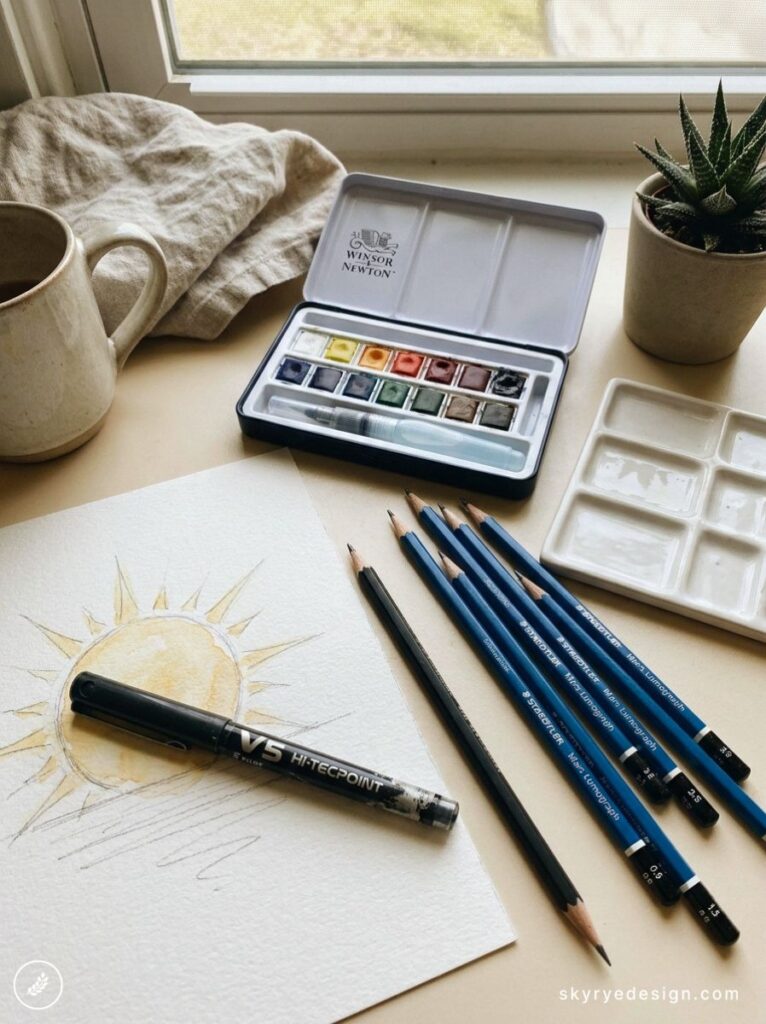
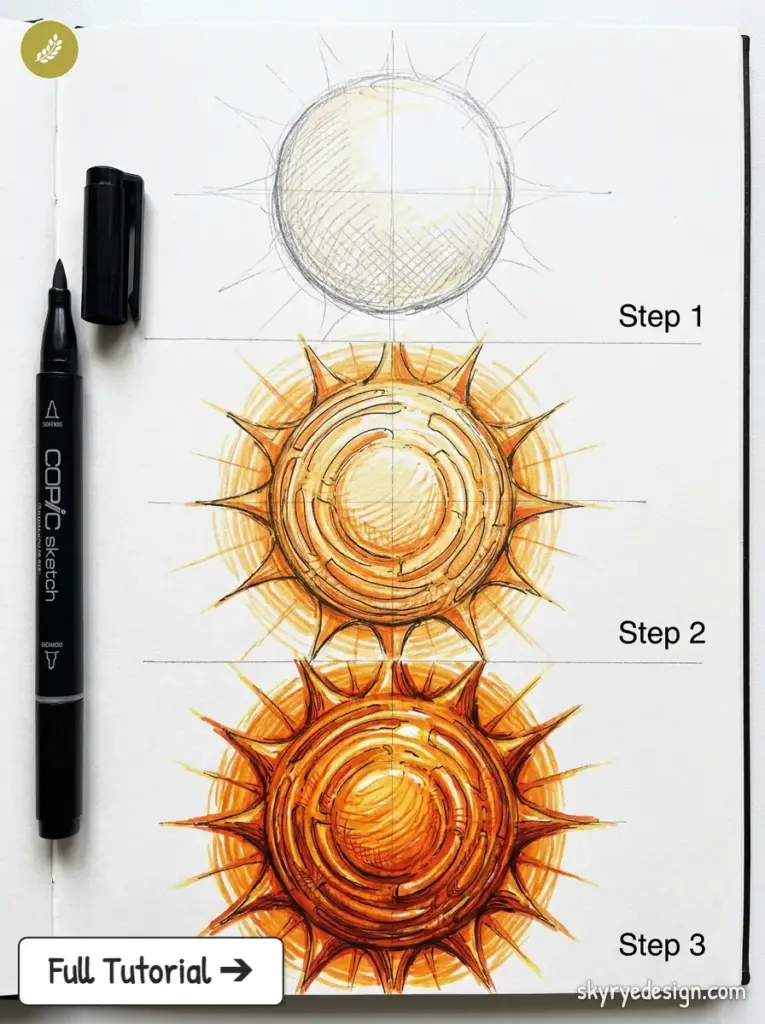
When I tried to draw the sun in my first year at academic school, it seemed the easiest thing at first, but then, when I tried to draw it with yellow paint on a white background, it was quite a challenge. After a few tries, I was able to show volume, and if there’s a small blue sky in the background, I can even show rays and a glow. Every object has its own pattern, which we’ll definitely cover in our lesson.
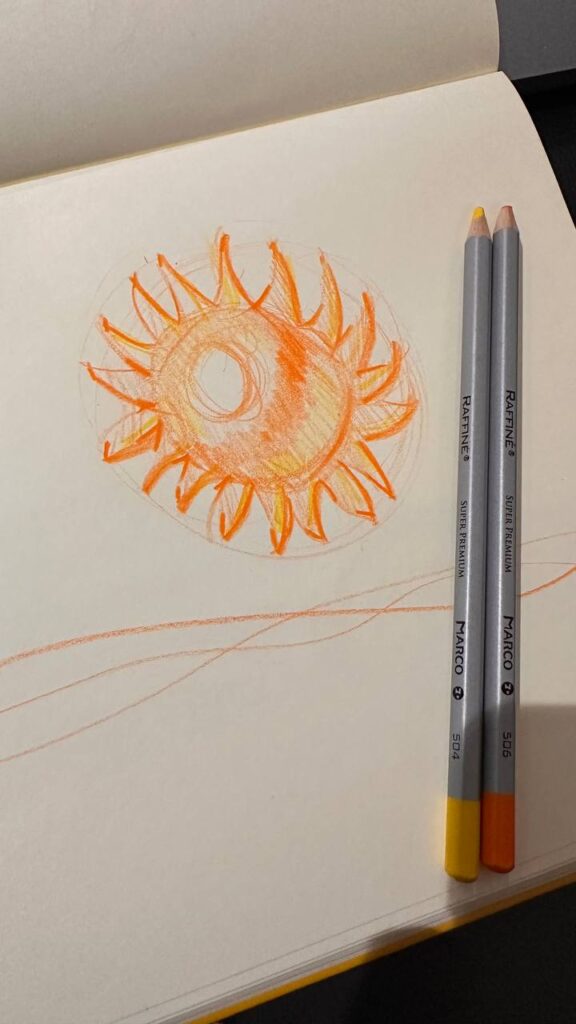
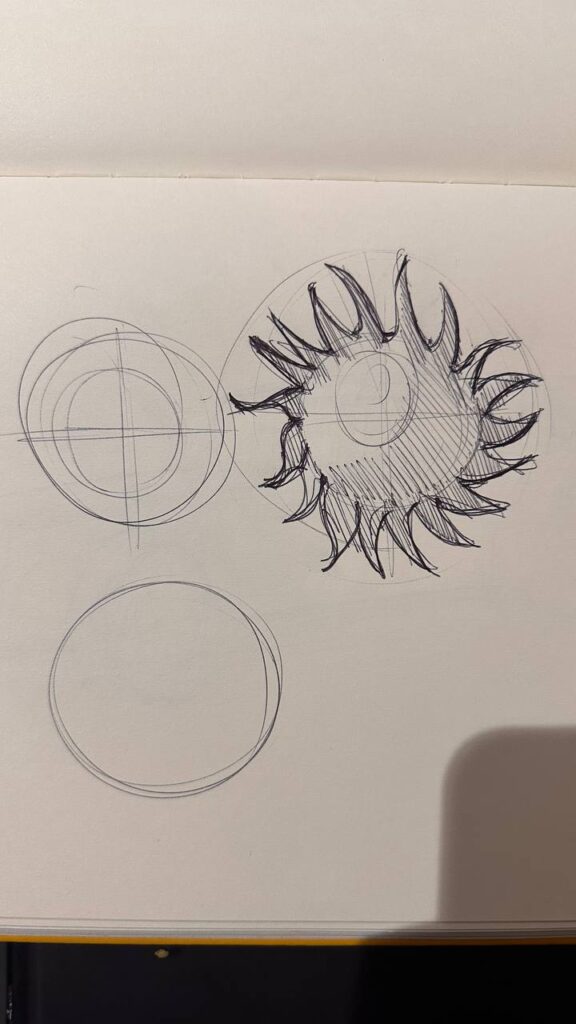
Why the Sun Is Harder to Draw Than It Looks
Ask anyone to describe the sun, and you get the same mental shortcut: yellow circle, radiating lines. That shortcut is the enemy of a good sun sketch. Students who just execute the shortcut end up with something clip-art generic—stripped of energy or light. The challenge isn’t the shape. It’s conveying radiance on a flat surface.
A Circle Has No Direction
Circles are passive. They sit. The sun, by contrast, is the most energetic object in our visual vocabulary. To fix this disconnect, you push energy into the rays. Their angle, thickness, and rhythm tell the viewer whether this is a lazy afternoon sun or a blazing summer noon. Radiating lines with tapered ends—thick at the base, narrow at the tip—carry more visual force than uniform strokes every time.
Medium Matters More Than You Think
A sun drawn in HB pencil on smooth Bristol board has a completely different character than the same shape made with a Pigma Micron 05 on cold-press watercolor paper, or a broad wet wash of Aureolin Yellow. Before you start, decide which medium you’re working in and commit. Mixing pencil sketching technique with a watercolor finish—without understanding how each behaves on the paper surface—is where most beginners stall out.
PRO TIP: Sketch rays lightly first with a 2H pencil, then refine with your final medium. Erasing mistakes from dried ink or dried watercolor is a nightmare you want to avoid entirely.
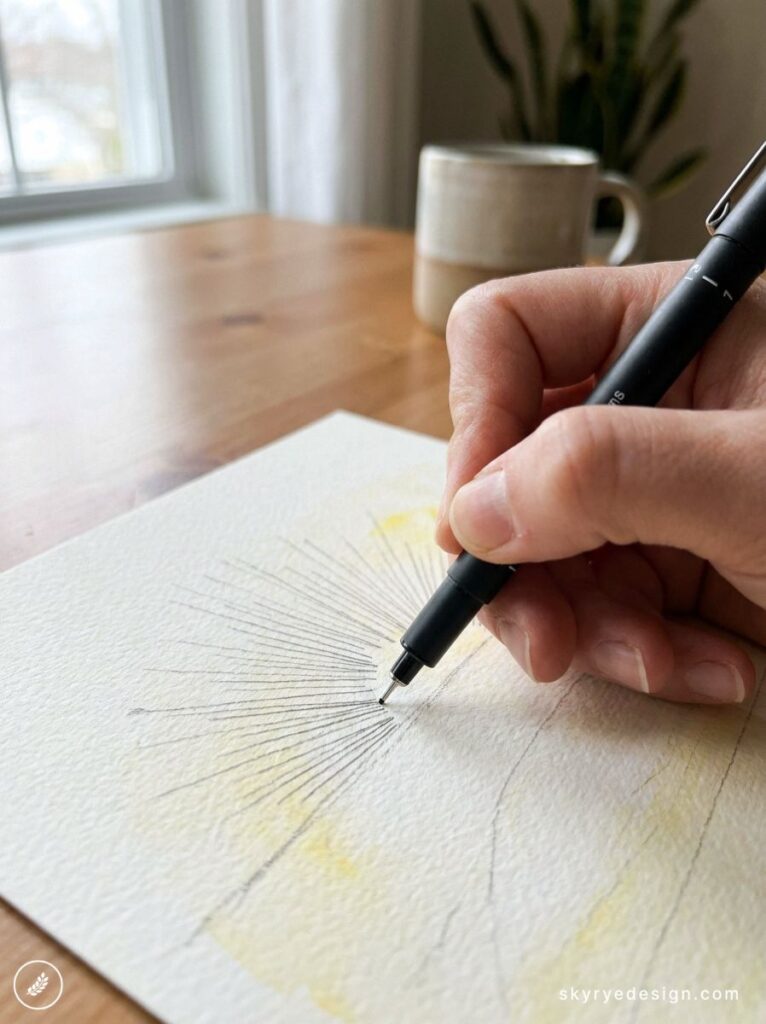
Style 1: The Classic Cartoon Sun (Sun Drawing Easy)
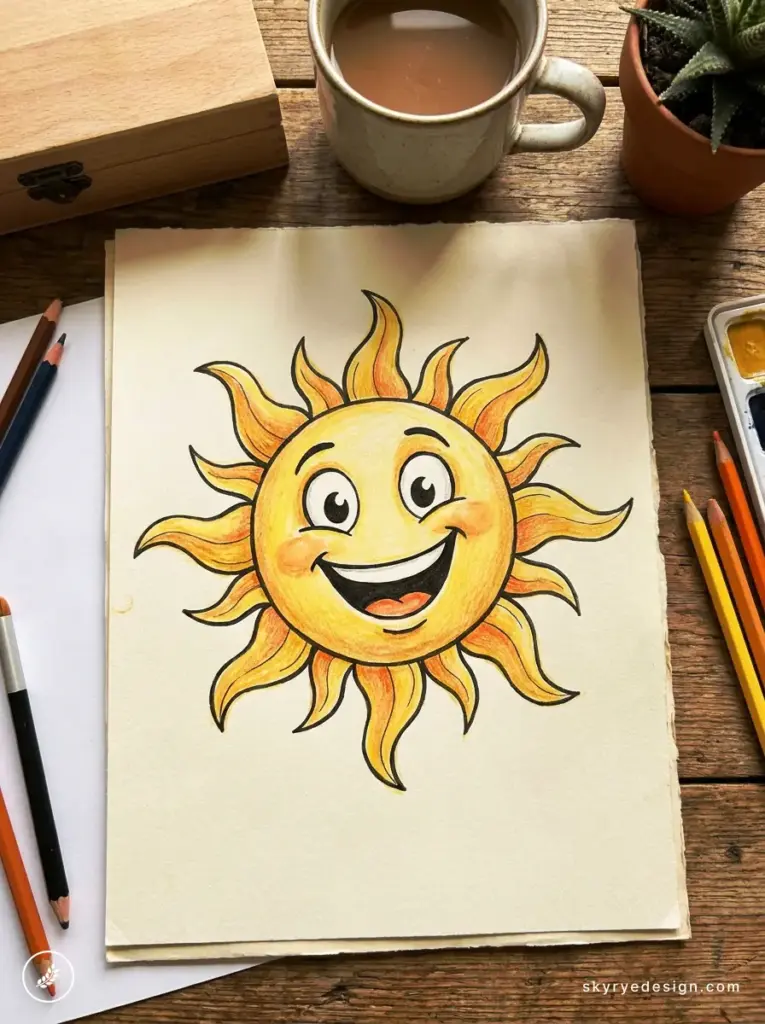
This is the style everyone pictures first—round center, alternating short and long triangle rays, optional smiley face. Don’t dismiss it. Done well, a cartoon sun has graphic punch that holds up beautifully in posters, children’s books, and hand-lettered greeting cards. It’s also the fastest way to learn how to draw a sun step by step if you’re just starting out.
How to Draw a Cartoon Sun Step by Step


- Draw your circle. Trace a coin, use a compass, or go freehand—freehand gives more character.
- Mark ray anchor points. Place 12–16 small dots evenly around the circle’s perimeter.
- Build the two-triangle rhythm. From each anchor point, alternate one tall triangle with one short triangle all the way around. Equal gaps between rays read as calm and balanced; tighter spacing feels more intense.
- Outline. Go over your pencil marks with a Pigma Micron 01 or 03 fine-liner. Let the ink dry fully before erasing pencil.
- Color. Prismacolor Premier colored pencils in Canary Yellow for the center disc, layered with Spanish Orange toward the ray tips. Optional: add rosy cheeks with light Blush Pink below the eyes.
Adding a Face That Works
Simple eyes and a curved smile are all you need for a sun face. But the details shift the personality: arched eyebrows read as confident, straight eyebrows as calm, downward-angled eyebrows as grumpy. Round dot eyes feel more cartoonish; almond-shaped eyes feel older and more expressive. Sketch a few combinations in your sketchbook before committing to ink.
CARTOON SUN CHECKLIST
- Circle traced or drawn freehand
- 12–16 rays in alternating tall/short pairs
- Outline: black Pigma Micron 01 or 03
- Color: Prismacolor Premier — Canary Yellow + Spanish Orange
- Optional: rosy cheeks with Blush Pink

1000 Drawing Ideas for Artists
Get a free PDF packed with easy drawing ideas, anime prompts, character concepts, nature inspiration, and fantasy sketchbook challenges.
Download Free PDFStyle 2: The Realistic Sun (Landscape Drawing)
When the sun appears in a landscape sketch, you rarely draw the sun itself—you draw its effect.
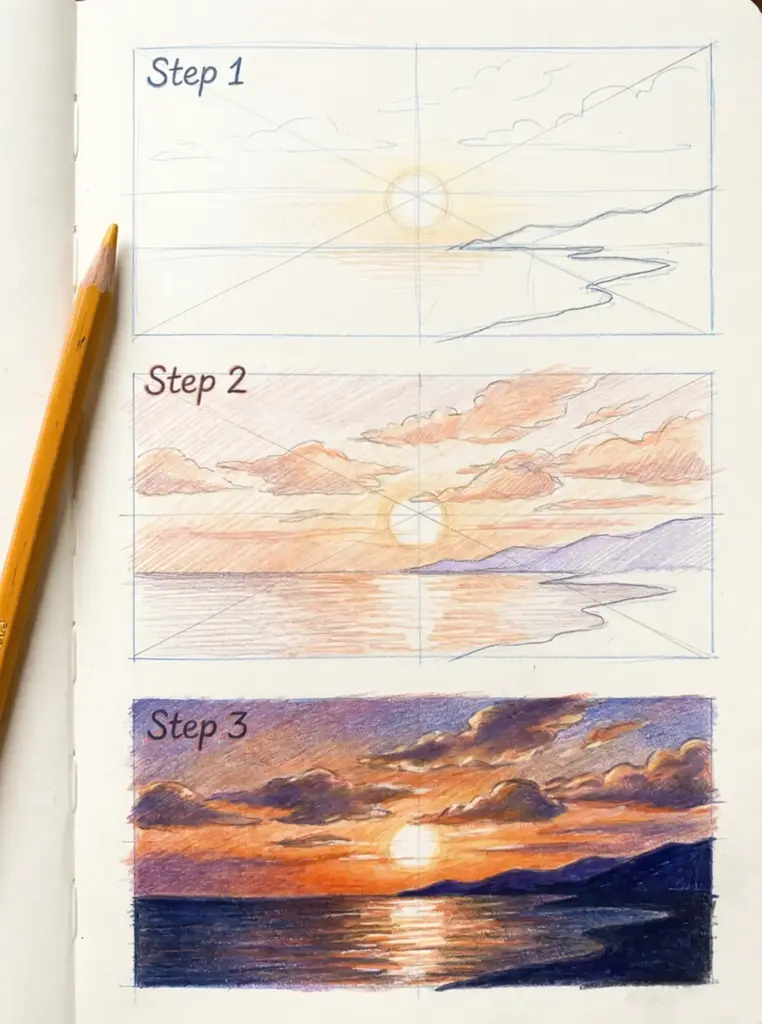
The glow halo surrounding it. The soft lens-flare quality. The way nearby clouds shift from white to amber at their edges. I learned this the hard way copying en plein air painters: the moment you draw a hard circle for the sun in a realistic scene, the whole illusion falls apart.
Don’t Draw the Disc — Draw the Glow
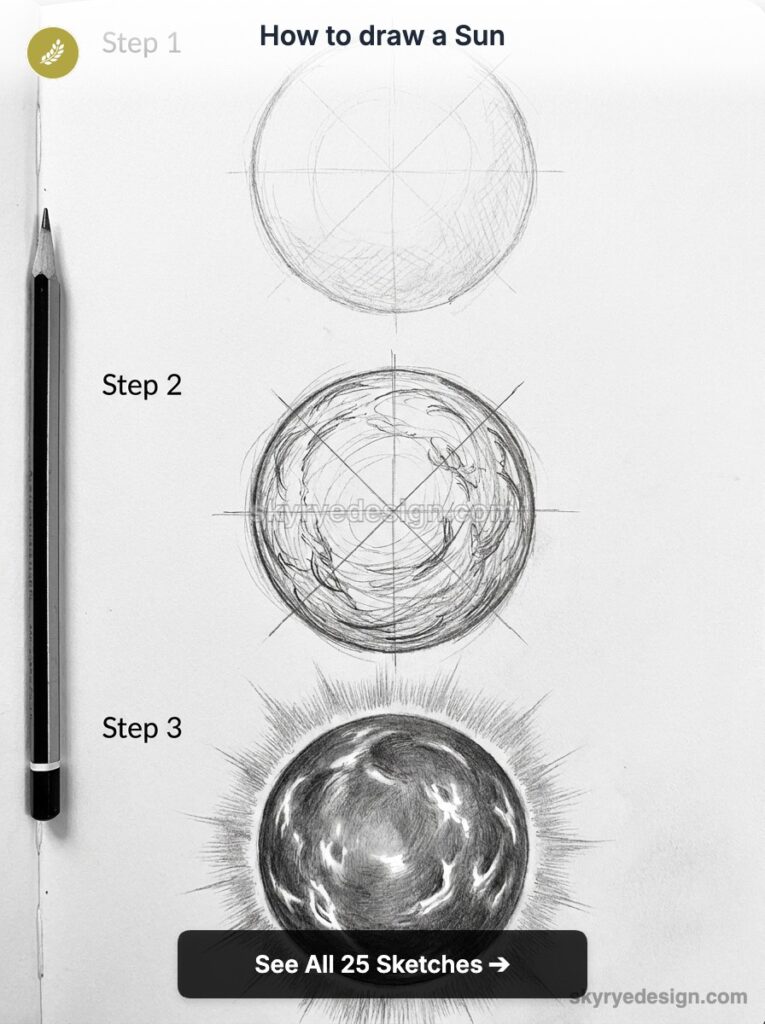
For pencil work, leave the sun area as blank white paper. Build up tone around it with a 4B or 6B pencil using light circular strokes, darkening gradually as you move away from the sun’s core. Use a blending stump (tortillon) to smooth the graphite transitions—hard tonal edges kill the illusion of atmospheric light. Then lift highlights back out with a kneaded eraser, pressing gently to pull graphite from the paper and create soft secondary glow rings. The white paper itself becomes the brightest point. This negative-space technique—standard in academic figure and landscape drawing—creates a far more convincing light source than any drawn circle.
Sunrise vs. Sunset Light
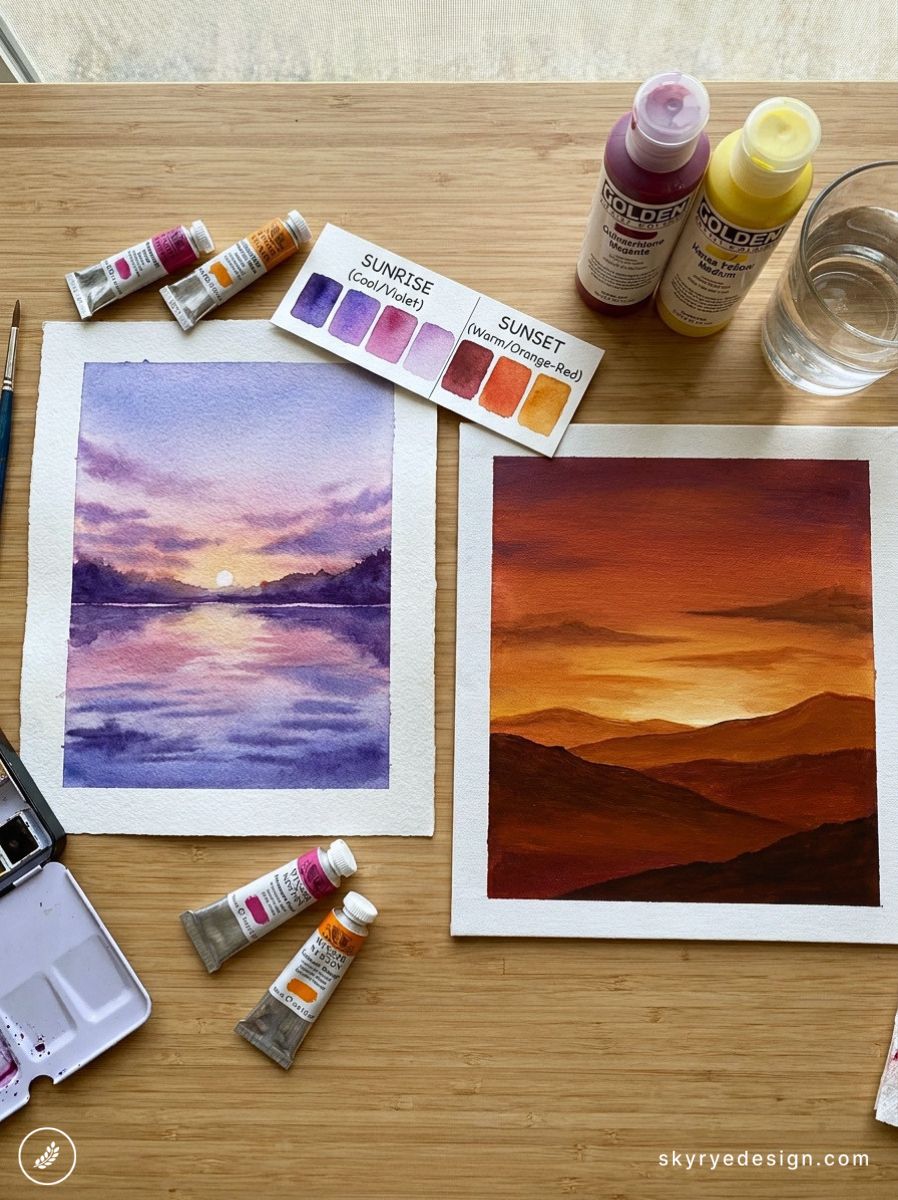
Sunrise light skews cooler and more violet-tinged. Sunset light runs warmer—deeper orange-red with amber undertones. If you’re adding color, Golden Artist Colors fluid acrylics in Quinacridone Magenta mixed with Hansa Yellow Medium, blended on wet paper, can nail that amber-to-pink sunset gradient in under ten minutes. For watercolor, Winsor & Newton’s Permanent Rose plus Cadmium Orange hits the same register on Arches 140 lb cold-press.
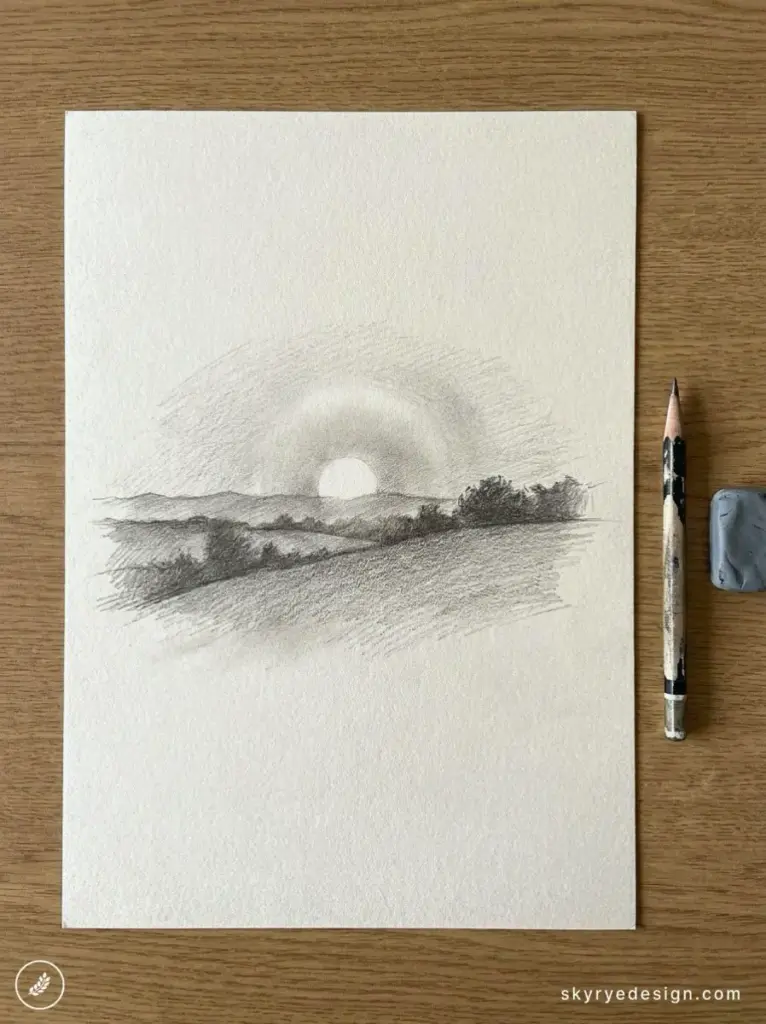
PRO TIP: Block in the darkest sky value first (the area above and away from the sun) and work toward the light. Pulling dark pigment toward the sun center always produces a muddy result.
Style 3: The Mandala Sun (Pattern-Based Sun Illustration)
Mandala-style sun illustration has exploded across Pinterest, Instagram, and Procreate feeds over the last two years—and for good reason. The structure is geometric, but the finished piece feels organic and meditative.
Building the Grid
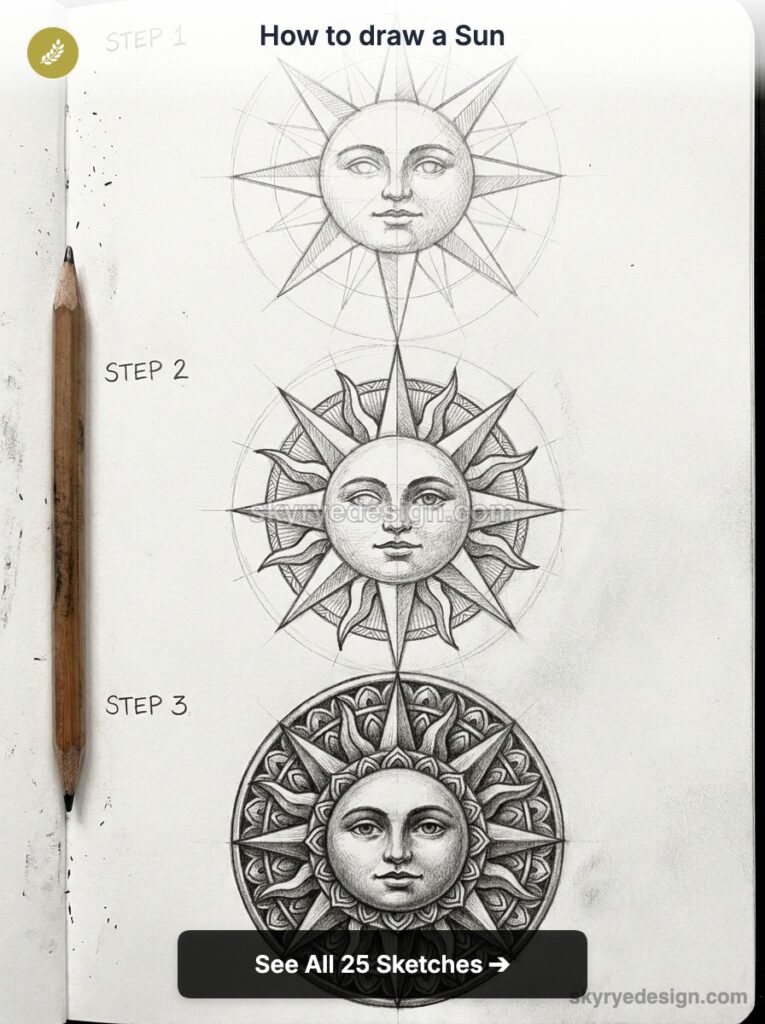
Start with a small center circle, about 1 cm in diameter. From there, draw progressively larger concentric circles—typically four to six rings. Use these as guides for where each band of pattern begins and ends. A compass is non-negotiable here; even slight wobble in your circles disrupts the whole symmetry and undermines the precision a mandala sun demands.
Ray Patterns That Actually Work
Alternate between two pattern types per ring: one ring of pointed petal shapes, the next of rounded bulges or fine cross-hatching. Pilot Precise V5 pens in yellow and orange are ideal—their consistent ink flow means even pressure across detailed patterns without skipping. For the finest internal details, drop down to a Micron 005 (0.20 mm nib). Artists using this exact approach on Lemon8 and Pinterest have generated serious engagement on sun illustration posts.
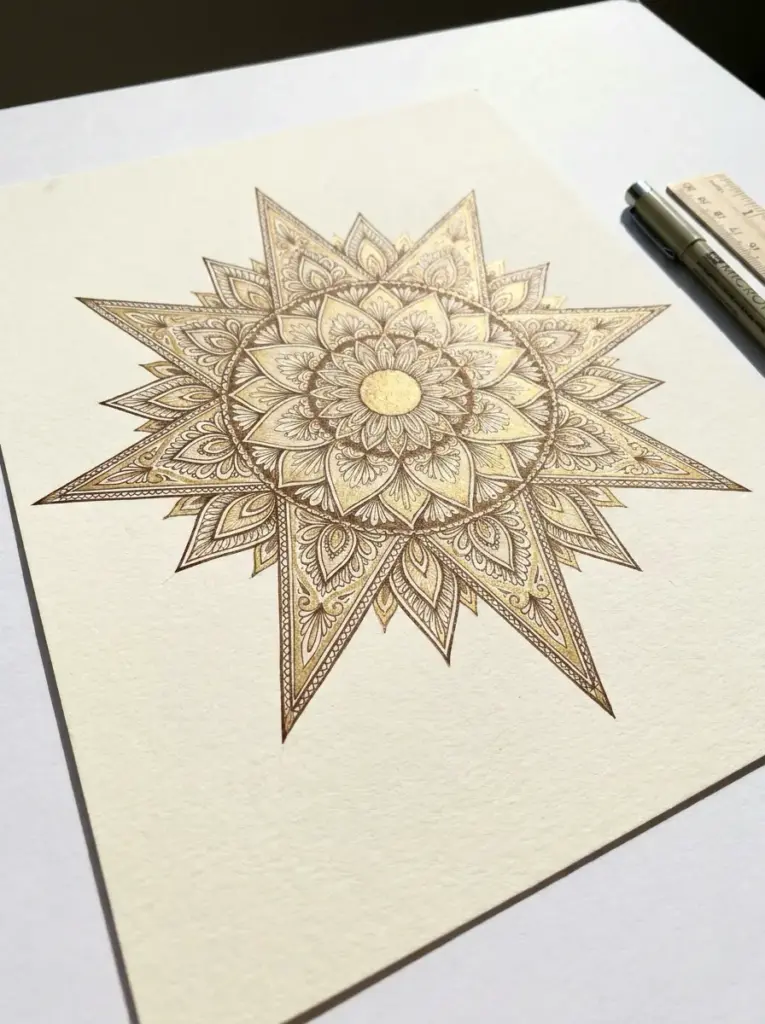
MANDALA SUN MATERIALS
- Compass + ruler (non-negotiable for clean circles)
- Pilot Precise V5 pens: yellow + orange
- Micron 005 for internal pattern detail
- Strathmore 400 Series mixed media paper (90 lb / 163 gsm)
- Optional: gold metallic Uni Posca marker for center accent
Style 4: Watercolor Sun (The Most Pinterest-Worthy Approach)
If one sun drawing style stops the scroll, it’s a soft, glowing watercolor sun dropping behind a dark treeline or ocean horizon. The technique is counterintuitive: the more you try to paint the sun directly, the less luminous it looks.
Wet-on-Wet for the Corona
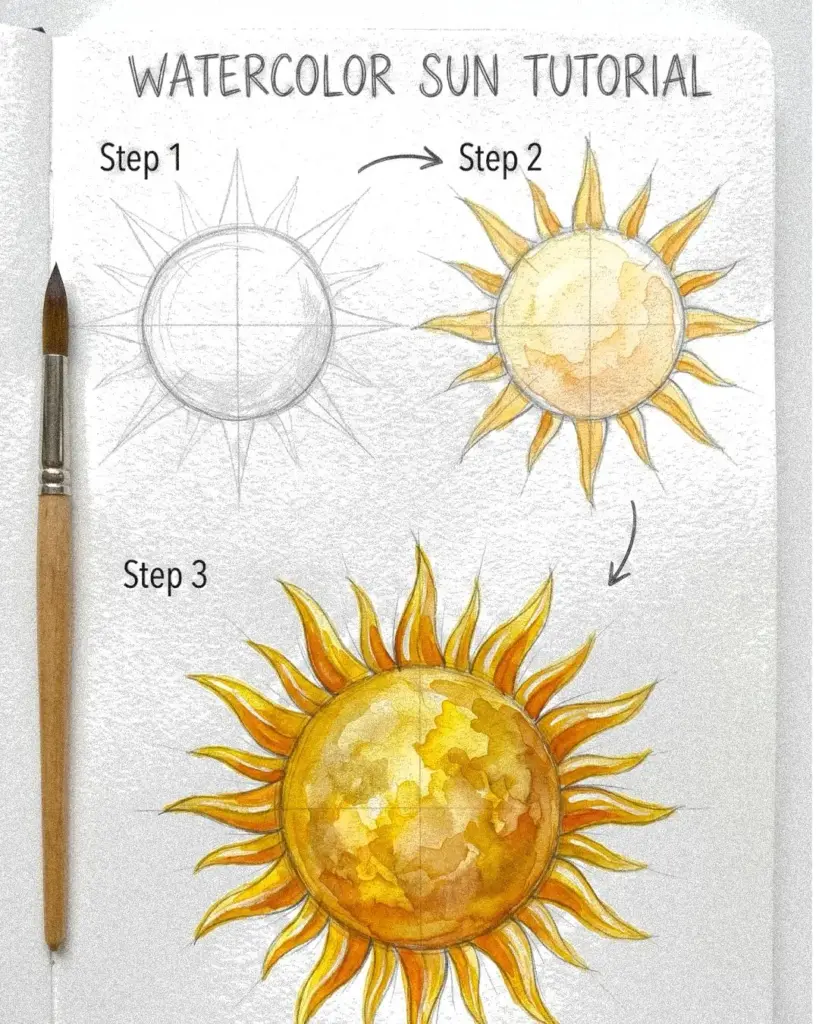
Pre-wet the paper around the planned sun area with clean water using a large round brush (a size 12 or 14 Princeton Neptune works well). While the paper is still shiny-wet, drop Aureolin Yellow close to the center—it will bloom outward in an uncontrollable, perfect way. Add Quinacridone Orange at the outer edges while still wet. Do not touch it. The bleeding edge is the entire point; it mimics the way light scatters through the atmosphere.
Masking the Sun Disc
For a crisp sun edge—useful in more graphic compositions—apply Winsor & Newton Art Masking Fluid with an old synthetic brush before you start painting. Once the masking dries completely, paint freely over the area. Peel the dried masking after the paint dries, and you’ll have a clean white disc to tint gently with diluted Aureolin. This two-stage approach is the technique behind those clean-centered, glowing-edged watercolor suns you see dominating Etsy prints and Pinterest boards.
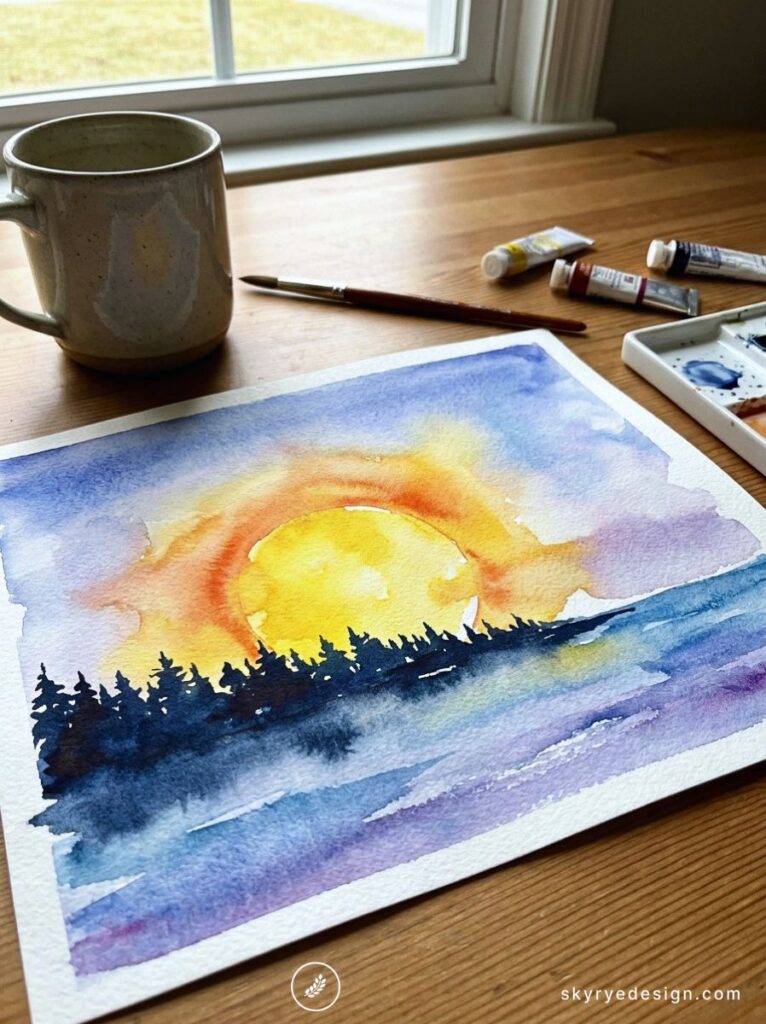
PRO TIP: Tilt your board at roughly 30° while the corona wash is still wet. Gravity pulls the pigment in one direction, creating the natural look of a sun sitting low on the horizon line.
Style 5: The Abstract Sun (Break the Rules Intentionally)
Abstract sun drawings work when the artist makes deliberate choices—not when they’re drawing without structure and calling it abstract after the fact.
The strongest abstract sun illustrations I’ve seen use unexpected color palettes (burgundy and teal, deep purple and gold) or fragment the rays into shapes that don’t read as rays at all until you step back.
Color Theory for Non-Obvious Sun Palettes
The immediate association is yellow and orange, so pushing one step further on the color wheel is how you make your abstract sun stand out. Analogous schemes using red-orange and magenta feel electric. Split-complementary palettes pairing blue-violet with yellow-green create a strangely beautiful tension that reads as “sunset” to the eye even though the individual colors aren’t traditional sunset hues.
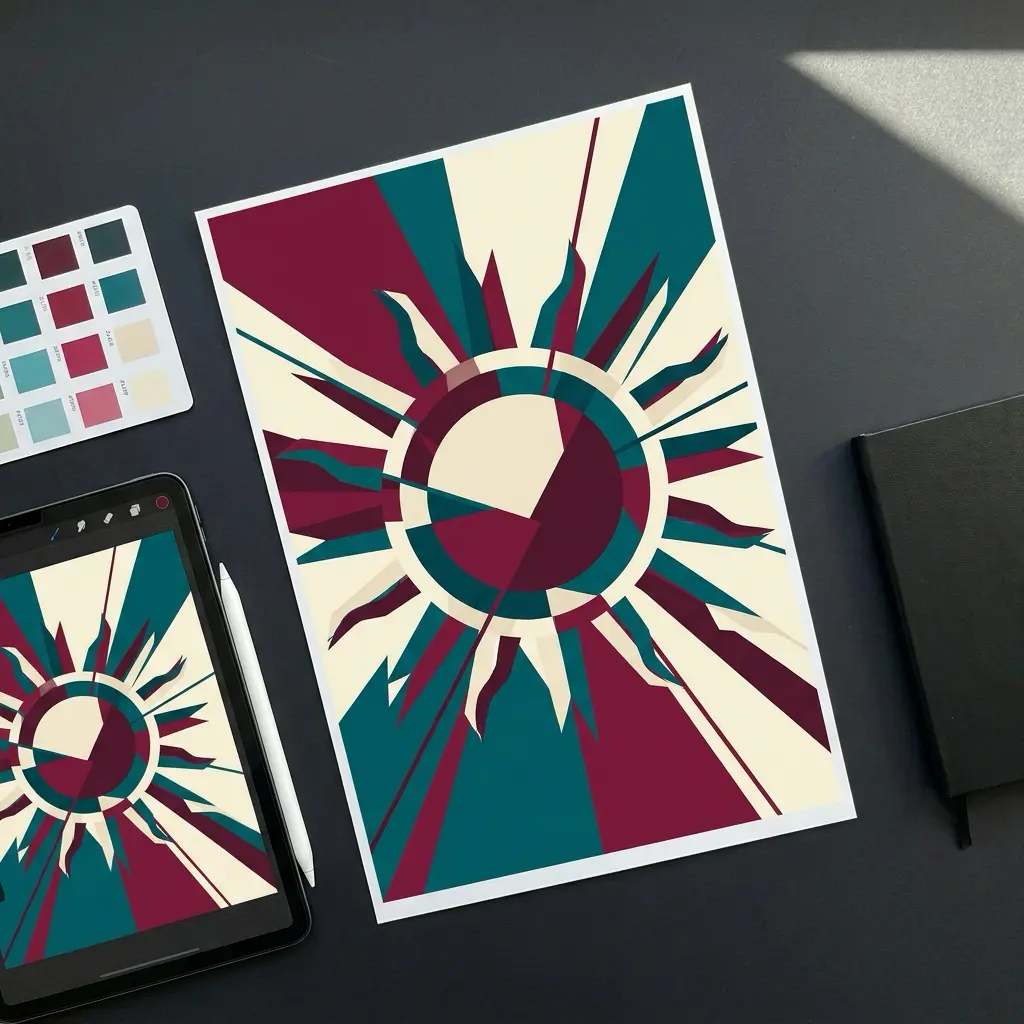
Fragmented Rays as a Design Element
Instead of radiating lines, try broken arcs, concentric incomplete circles, or clustered triangular shapes that orbit the sun disc without touching it. In Adobe Illustrator, the Rotate tool (Object → Transform → Rotate) with a defined angle—say, 24° with the Copy option for 15 repetitions—generates geometric ray patterns that are impossible to replicate by hand but print with razor-sharp precision for graphic design, packaging, or embroidery digitizing files.
Style 6: How to Draw a Sun in Nature Scenes
Placing a sun within a full scene—rather than drawing it as an isolated object—is where many artists feel stuck. The sun in context means dealing with atmospheric perspective, consistent light-source direction, and surface reflections. But it’s also the most satisfying approach, because you’re not drawing a sun. You’re drawing light itself.
Atmospheric Perspective Basics
Objects closer to the sun in a sky scene lose contrast and color saturation. A dark thundercloud on the far left stays rich and textured; the clouds directly surrounding the sun go pale and nearly formless. This principle—called atmospheric (or aerial) perspective—applies across every medium. In pencil, it means lighter pressure and shorter strokes near the sun. In watercolor, it means more water and less pigment loaded on the brush.
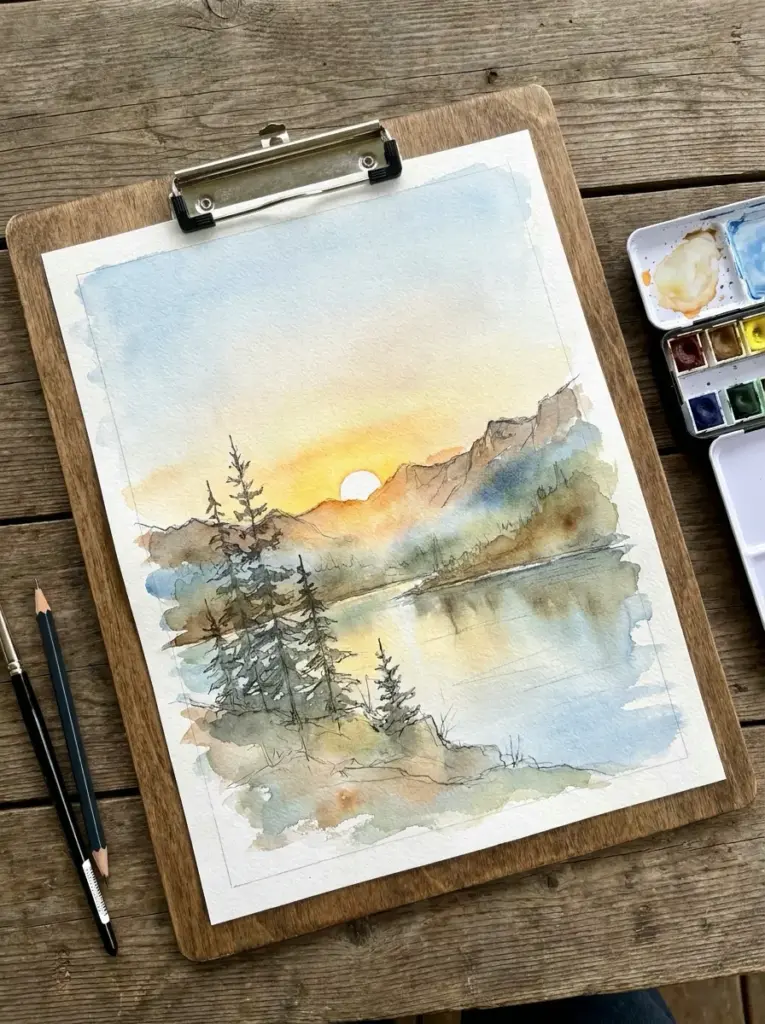
Sun Reflections on Water
A vertical shimmer path rather than a perfect mirrored circle—this is how sunlight actually reflects on moving water. Draw a short, bright central shimmer directly below the sun’s position and then broken horizontal flecks radiating outward from it. Leaving the paper white for those flecks (whether in pencil or watercolor) looks more convincing than painting them in with opaque white.
PRO TIP: The classic composition mistake is drawing the sun too high in the frame with an equally high horizon line. A low horizon, with the sun placed in the upper third of the composition, feels far more cinematic and gives the sky room to breathe.
Style 7: Digital Sun Drawing (Procreate and Illustrator)
Digital sun drawing has one major advantage and one trap. The advantage: infinite undo, perfect symmetry tools, and non-destructive layer editing. The trap: over-relying on gradients and glow filters instead of building actual form with intentional marks. I’ve studied a lot of Procreate sun illustrations on Behance and Dribbble, and the ones that feel alive are the ones that use digital tools to replicate traditional mark-making energy—not to sidestep it.
Procreate Techniques That Work
Set your canvas to 3000 × 3000 px at 300 dpi—this gives you enough resolution for print reproduction and enough layer headroom on most iPads (around 40+ layers on an iPad Pro with M-series chip). Activate Drawing Guides (Actions → Canvas → Drawing Guides → Symmetry) and set rotational symmetry to 12 or 16 segments. Every ray you draw gets mirrored around the center automatically.
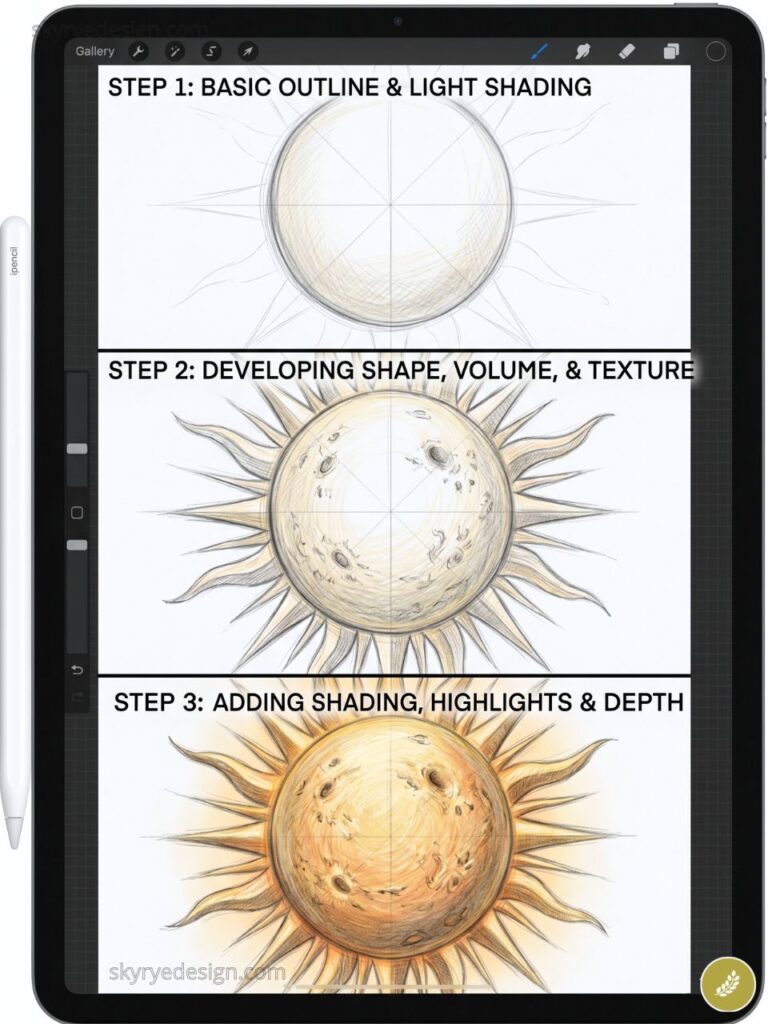
For the rays themselves, the Studio Pen brush in the Inking set gives clean tapered strokes. For a glowing halo effect, add a new layer above, set its blending mode to Add, and paint white near the center with the Soft Airbrush from the Airbrushing set. The luminous result needs no filter. For textured, pencil-feel rays, the Narinder Pencil (free in Procreate’s default brush library) replicates graphite grain on a digital canvas.
Vector Suns in Adobe Illustrator
Draw one ray as a compound path. Then use Object → Transform → Rotate, enter 24° in the Angle field, and click Copy. Press Cmd+D (or Ctrl+D on Windows) to repeat the transformation—15 copies gives you full 360° coverage. Apply a radial gradient to the center circle layer. This workflow takes fifteen minutes at most and produces infinitely scalable sun graphics suitable for print, web banners, app icons, or embroidery digitizing.
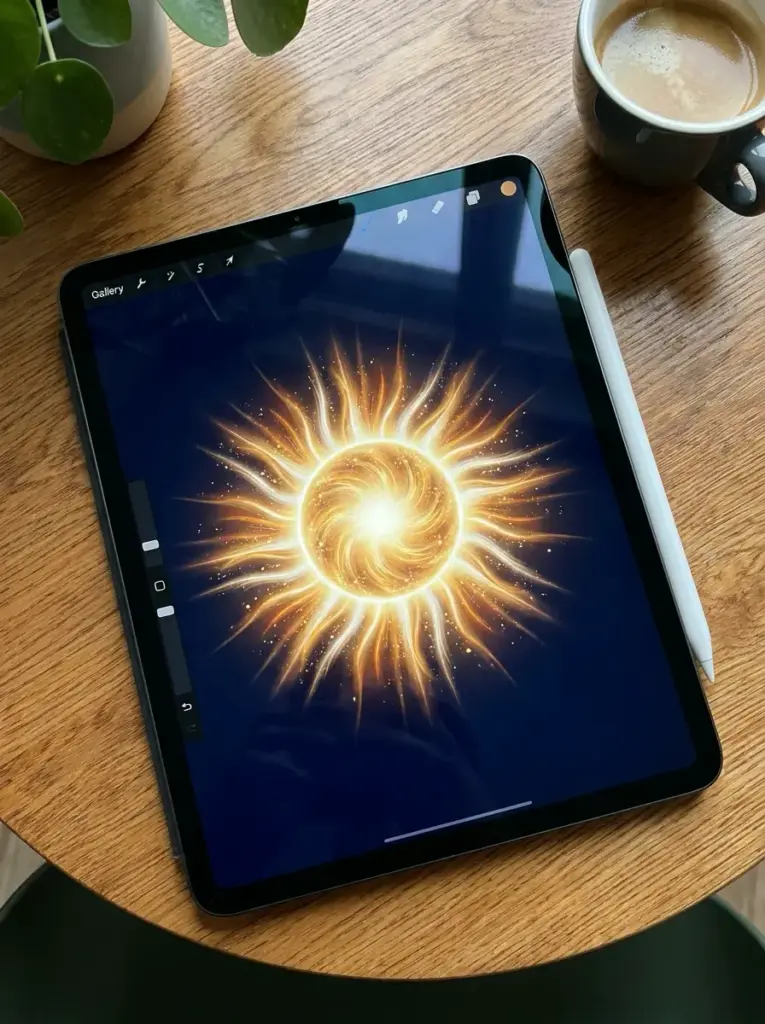
DIGITAL SUN QUICK SPECS
- Procreate canvas: 3000 × 3000 px, 300 dpi
- Symmetry guide: Rotational, 12 or 16 segments
- Ray brush: Studio Pen (Inking set)
- Glow layer: blending mode “Add,” Soft Airbrush in white
- Texture brush: Narinder Pencil
- Illustrator: 24° rotation angle, 15 copies for 360° ray coverage
- Export for web: PNG with transparent background, sRGB color space
Start Simple, Then Push It
Every one of these seven styles starts with the same basic gesture: a circle and some kind of radiating mark around it. The cartoon sun, the mandala sun, the watercolor sun—they’re all variations on that gesture, pushed in different directions by medium, intent, and technique.
My advice? Pick the style closest to your current medium and draw five versions of it this week. Not five perfect suns—five exploratory ones, each slightly different in ray count, color, or scale. That’s how the sun goes from being a stock symbol to something that carries your hand in it.
If you want to take it further, Skillshare has some excellent courses on watercolor landscapes and illustration fundamentals that go deep on light-source drawing—find the link in the Skillshare section above.
Frequently Asked Questions
How do you draw a sun step by step for beginners?
Start with a circle—trace a coin or draw freehand. Add 12 alternating tall and short triangular rays evenly spaced around it. Outline with a black fine-liner (Pigma Micron 03 works well), let the ink dry, erase pencil marks, and color with yellow and orange colored pencils. The whole process takes about ten minutes and gives you a clean cartoon sun. Once that feels comfortable, move on to wavy or curved ray styles for more character.
What’s the best way to draw sun rays?
It depends entirely on the style. For cartoons: alternating triangle sizes in a consistent rhythm. For realistic sunsets: skip the rays and draw the atmospheric glow instead. For mandala suns: symmetrical petal shapes built from a compass grid. For graphic design work: tapered strokes, thick at the base and pointed at the tip. The “best” ray is always the one that matches your intended style and medium.
How do you make a sun look like it’s glowing?
The glow comes from contrast around the sun, not the sun itself. In pencil: leave the center white and build gradual shading outward with a 4B, blending with a tortillon. In watercolor: use wet-on-wet blooming with Aureolin Yellow. In Procreate: add a layer set to “Add” blending mode and brush white softly at the center with a Soft Airbrush. The principle is always the same—the darker you make the surroundings, the less you need to draw in the center.
What pencil grade is best for sun drawings?
Use a 2H pencil for initial construction lines—circles, ray placement guides—because it’s light enough to erase cleanly. Switch to an HB or B for final visible line work. For shading a realistic atmospheric glow, a 4B or 6B gives you the soft, dark tones needed around the light source. If you’re finishing in ink, complete all pencil stages first, let the ink dry fully, then erase.
How do you draw a sun face (sun with facial features)?
Draw your circle and rays first. Inside the circle, sketch two ovals for eyes in the upper third, a small oval or dot for the nose at center, and a curved U-shape for the smile in the lower third. Keep the facial features small relative to the circle—overcrowding the face is the most common mistake and makes it look awkward. Rosy cheeks (two small circles below the eyes, tinted Blush Pink) are optional but add charm.


What colors should I use for a sun drawing?
The classic combination is Canary Yellow at the center fading to Spanish Orange or Cadmium Orange at the ray tips—this holds true whether you’re using colored pencils, alcohol markers, or paint. For a more atmospheric look, add a hint of Quinacridone Magenta or Permanent Rose at the outer corona. For abstract sun illustrations, consider non-traditional palettes: burgundy and teal, or gold and deep violet, can be more visually striking than expected yellow-orange.
Can you draw a realistic sun in a landscape?


Yes, but it requires a counterintuitive approach: you draw the light, not the disc. Leave the sun area as white paper, build atmospheric haze around it with soft graphite pencil (smoothed with a blending stump) or wet watercolor washes, and focus on how the light affects everything else in the scene—glowing cloud edges, warm ground tones, shimmering water reflections. A realistic landscape sun is about everything surrounding the circle, not the circle itself.
What paper is best for sun drawing?
For pencil and ink sun sketches: Strathmore 400 Series Bristol, smooth surface, 270 gsm—it handles erasing and repeated ink passes without pilling. For watercolor suns: Arches 140 lb cold-press or Fabriano Artistico, both of which hold wet-on-wet washes without buckling. For mandala sun work in fine-liner: any acid-free cartridge paper above 90 gsm handles repeated ink lines without ghosting or bleed-through. For digital: set your Procreate canvas to 300 dpi minimum at 3000 × 3000 px for flexibility in cropping and print output.


If your sun scene includes a horizon, add distance with the mountains drawing lesson. Pale far peaks behind a bright sky can make a simple composition feel much deeper.
- 2.7Kshares
- Facebook0
- Pinterest2.7K
- Twitter0
- Reddit0