Rainbow Six Siege runs on information and timing. A lost drone, a defender holding a narrow angle or a roamer slipping between floors can leave an attacker with an incomplete picture of the round, and the whole game is built around that gap.
That’s also why Rainbow Six Siege cheats attract so much discussion. Search for them and the same four terms keep appearing together: ESP, wallhacks, aimbot and Silent Aim. They’re often used as if they meant the same thing. They don’t. Each describes a different function, and mixing them up leads to confusing descriptions, bad comparisons and false expectations.
- What do ESP, wallhack, aimbot and Silent Aim mean in Rainbow Six Siege?
- Why visual hierarchy matters in a Rainbow Six Siege cheat interface
- ESP concerns player awareness
- Aimbot concerns crosshair movement
- Comparing ESP, wallhack, aimbot and Silent Aim through interface hierarchy
- Why Rainbow Six Siege cheats are a risk, not just a feature list
- Updates affect the comparison
- How to read a vendor feature list critically
- What this means for readers
- Final thoughts
- FAQ
- References
I come at this as an interface designer, not as a cheat user. I’ve spent years on dashboards, vehicle displays and data-heavy screens, and the question behind them is always the same: when a person has a second and a half to decide, what should the screen show first?
Cheat overlays are an unusual, slightly uncomfortable case study in that question. This article separates the terms, explains what each one does in plain language, and looks at the design logic underneath, including the risks that the marketing language tends to skip.
What do ESP, wallhack, aimbot and Silent Aim mean in Rainbow Six Siege?
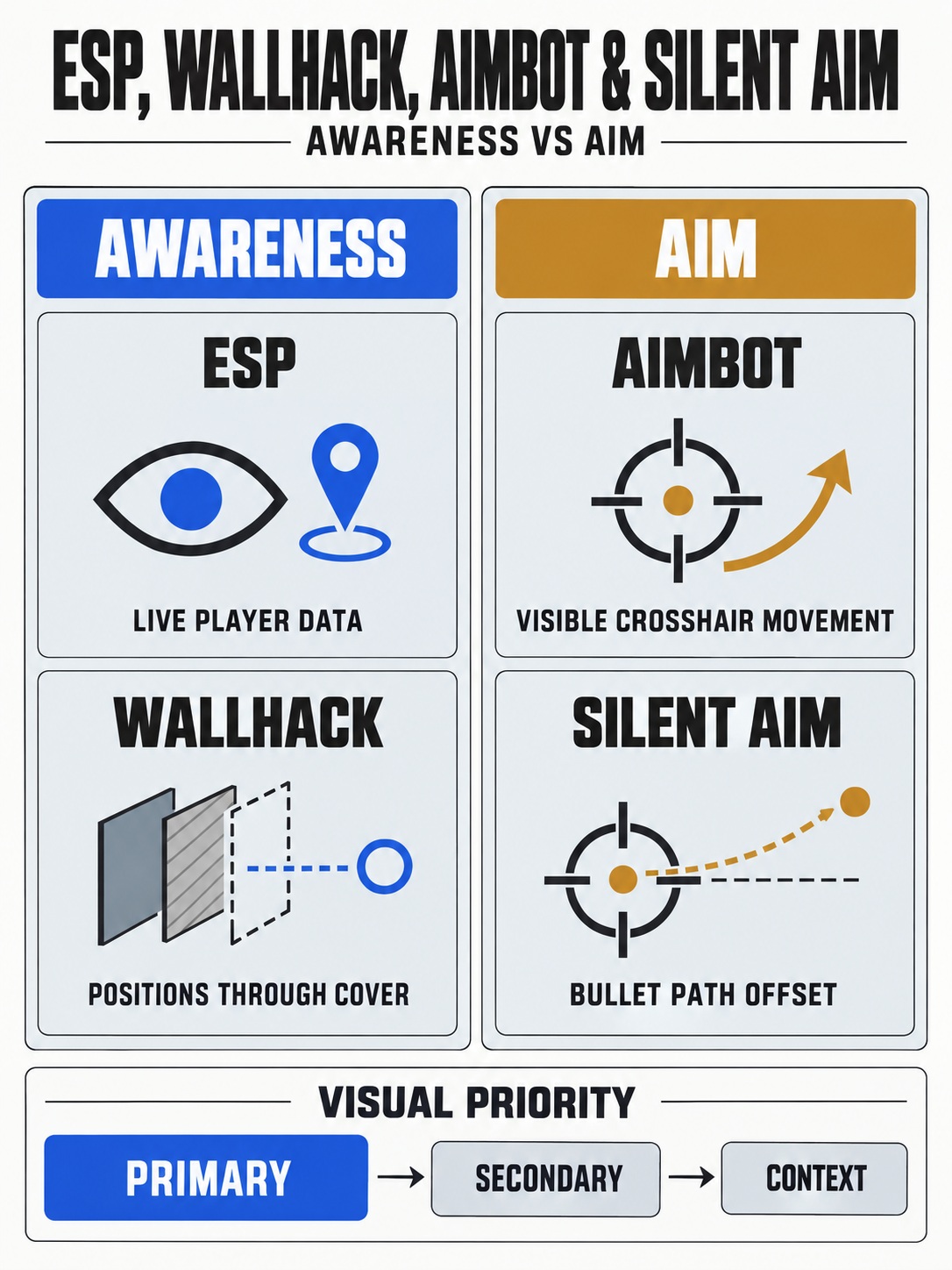
In Rainbow Six Siege, ESP is an overlay that displays player information such as position, distance or health in real time. A wallhack is commonly described as showing player positions through solid cover, so people often mention the two together. An aimbot assists crosshair movement toward a target, and smoothing controls how quickly that movement settles.
Silent Aim is a separate function: it is described as affecting the bullet path without the same visible crosshair adjustment. So ESP and wallhacks concern awareness, while aimbot and Silent Aim concern aim, and the two pairs should not be mixed up. All of them break Ubisoft’s rules for the game, and a product’s status label describes its present condition only. It cannot promise that any of them will stay undetected, because Siege updates and anti-cheat changes can alter that status at any time.
Why visual hierarchy matters in a Rainbow Six Siege cheat interface
Strip away the controversy and a cheat overlay is a user interface. It sits on top of a fast game and has to communicate quickly. Every interface that does that lives or dies by hierarchy.
Information priority under time pressure
In a Siege round, decisions take seconds. A roamer is behind that wall, a drone is about to die, the timer is running. Whatever a screen shows has to be read in a glance, with no time to study it.
Interface designers handle this with priority tiers. Primary information is what the person must see now and is shown biggest and highest in contrast. Secondary information supports the decision and is lighter. Contextual information is there only if you look for it. A well-designed car dashboard works this way: speed is large, warning lights appear only when needed, and the trip computer sits quietly in the corner. I wrote about the same logic for vehicle displays in my HUD piece, where glanceability is a safety requirement rather than a style choice.
The same logic applies to any tactical overlay. If everything is equally loud, nothing is.
A quick worked example makes the tiers concrete. Imagine a round where the main question is “is anyone on the upper floor?” The primary signal is a single yes or no, shown large. The secondary signal is where, shown smaller. Everything else, such as names and distances, stays in a lighter grey and recedes. If you reverse that order and show names first, the player reads three lines of text before getting the one fact that mattered.
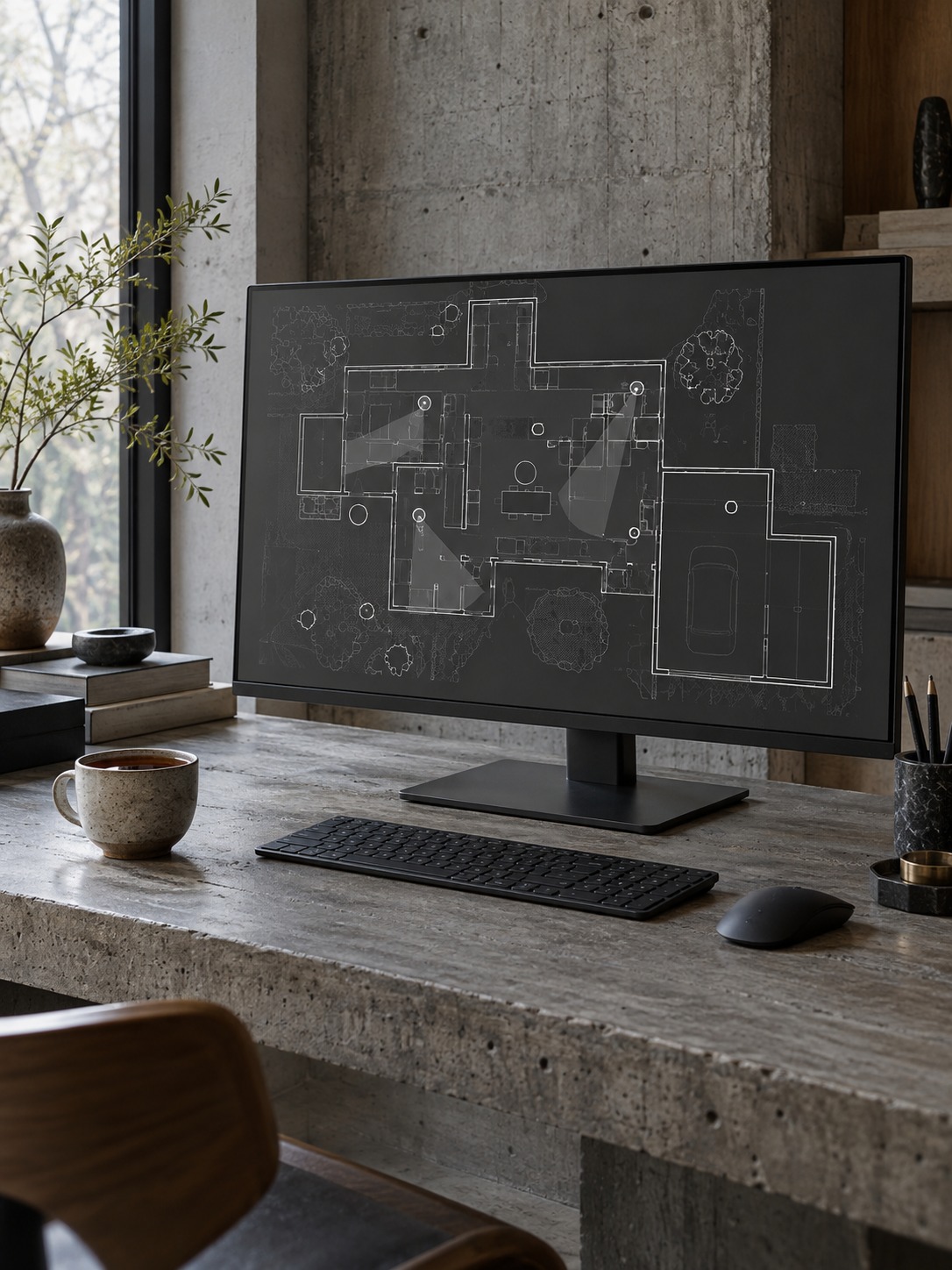
How color, labels and screen density affect readability
Three variables control whether an overlay reads or smears: colour, labels and density.
Colour should carry one meaning per hue. If red means “threat” in one place and “low health” in another, the eye has to stop and translate. Labels should be short and placed consistently, because every extra word is something to read. Density is the hardest to control. Each added element is another thing competing for attention, and attention is finite.
A habit from photography applies here: the frame holds one subject, and everything else supports it. Overlays that ignore that rule end up looking like a spreadsheet pasted over a game. For the basics of contrast, emphasis and negative space, my guide to the principles of visual design goes through the toolkit.

ESP concerns player awareness
ESP is the term most people meet first. It’s short for something like “extra sensory perception,” and the name tells you the idea: the overlay gives the player information the normal game interface doesn’t. The focus is awareness. Where is the player? How far away? Which direction are they facing?
What an ESP overlay communicates in real time
An ESP overlay draws information on top of the game picture as it updates. Typical descriptions mention boxes or outlines around players, simple lines or labels for distance or health, and colour coding to separate teammates from opponents. The point is that the information is live, not remembered.
Take a Clubhouse round with an attacker on the rafters side. In the normal game, that attacker builds awareness from sound, drones, callouts and guesswork. An overlay replaces part of that guesswork with direct display, which is exactly why the game’s own rules treat it as an unfair advantage. ChamsCheats’ Rainbow Six Siege cheats overview describes these features alongside the problem of overlay clutter, and I’m citing it as the vendor’s own description of the category, not as an endorsement.

ESP vs wallhack: overlay information and visibility through cover
The two terms overlap, which is where the confusion starts. ESP is mostly about information drawn on screen. A wallhack is commonly discussed in connection with seeing positions through solid cover. In practice, many tools combine them, and descriptions use the words loosely.
A useful way to separate them: ESP answers “what do I know about that player?” and a wallhack answers “can I see that player despite the wall?” One is about data, the other about visibility. When a page treats them as identical, it’s usually skipping a detail.
The practical focus in both cases is awareness, whether the situation involves Clubhouse rafters or Kafe stairs. Neither term is about aiming.
Why more on-screen data can reduce clarity
This is the part where the design lens is most useful. It sounds logical that more information means better decisions. It usually doesn’t.
Every extra element asks for processing. Names, distances, health bars, skeletons, lines to every player: stacked together they compete for the same few hundred milliseconds. Psychologists call the limit cognitive load, and designers have understood it for decades. Cockpit and control-room displays are designed around showing less, not more, at the critical moment.
The vendor page makes the same point in its own words, advising people to keep the overlay readable and not let it turn into a mess. More information on screen does not necessarily make that information easier to process. A single, clean signal beats ten competing ones.
Aimbot concerns crosshair movement
If ESP is about knowing, aimbot is about aiming. This is the second half of the confusion, and it matters because the two functions solve different problems.
Regular aim assistance and smoothing
An aimbot assists the crosshair towards a target. The key control in descriptions of it is smoothing, which changes how quickly the movement settles on the target. Low smoothing means a fast, abrupt snap. Higher smoothing means a slower, more gradual pull that looks closer to ordinary hand movement.
Smoothing is therefore a speed-and-feel control. It belongs to regular aim assistance, where the crosshair is visibly moved. Think of it as the difference between a door that slams shut and one with a soft-close hinge. The destination is the same, the motion is not.
Silent Aim and bullet-path behavior
Silent Aim is separate. It concerns the bullet path without the same visible crosshair adjustment. The idea, as it’s described, is that the crosshair doesn’t visibly snap to the target while the shot’s direction is altered.
So the contrast is clear: regular aim assistance moves the crosshair you can see, and Silent Aim is described as acting on where the bullet goes. They’re different mechanisms with different visible effects, even though both are about precision.
Why smoothing and Silent Aim should not be described as the same control
Here’s the error that shows up most often. A description presents smoothing as a Silent Aim control. It mixes up two different functions.
Smoothing is about how a visible crosshair movement settles. If there’s no visible crosshair movement, there’s nothing for smoothing to soften. Vendor material makes the same distinction and states that smoothing belongs to the aimbot, not to Silent Aim. When a page blurs them, it’s either careless or trying to make a feature sound more flexible than it is. As a reader, that’s a good moment to slow down.

Comparing ESP, wallhack, aimbot and Silent Aim through interface hierarchy
Put the four terms next to each other and the pattern is clear. Two concern what you know, two concern where you aim. The design lens adds a third question: how loudly does each one speak?
| Term | What it concerns | What the player sees | Main design risk |
|---|---|---|---|
| ESP | Player awareness | Information overlay | Clutter and overload |
| Wallhack | Visibility through cover | Player positions through solid surfaces | Distraction from the real scene |
| Aimbot | Crosshair movement | Visible crosshair adjustment, shaped by smoothing | Unnatural motion |
| Silent Aim | Bullet path | No matching visible crosshair adjustment | Mismatch between aim and result |
Primary, secondary and contextual signals
In interface terms, awareness features should serve three tiers. The primary signal is the one thing needed now, such as “an opponent is on the stairs.” Secondary signals add detail, such as direction or distance. Contextual signals, like health or a name, should stay available but quiet.
Most overlays fail because they treat every signal as primary. A good one decides, in advance, what loses the argument when two things compete for the eye.

Awareness, precision and visual clutter
Awareness and precision pull in different directions on screen. Awareness features add things to look at. Precision features, by contrast, try to remove the gap between the eye and the target. A screen that tries to do both at full volume asks the player to scan a crowded layer and then land a precise shot, at once.
That’s the design problem hiding behind the vocabulary. It’s also why the lists of features on a product page say little about how usable the result will be. Fewer, clearer signals usually beat a long menu.
Why Rainbow Six Siege cheats are a risk, not just a feature list
Descriptions of these tools are written to sell. Rules and consequences are written to protect the game, and they belong in the same conversation.
What Ubisoft’s rules say
Ubisoft has been explicit about this for years. Its 2016 cheating FAQ states that “if you get caught cheating, you will be banned on the first offense,” and it also notes that some cases may get a temporary ban of up to 15 days, with a permanent ban on a second detection. The same update to the code of conduct covers running unauthorized software that gives an unfair advantage, with a permanent ban as the maximum penalty. Those pages are old, so check Ubisoft’s current rules before relying on the details.
What has changed recently
Ubisoft’s community update dated 7 August 2026 described several new anti-cheat measures. These include a recoil macro detection model on PC, a secure platform requirement built on Secure Boot, core isolation and TPM for a higher division, a shared kernel-level anti-cheat across Ubisoft games, and a retroactive match analysis programme still in development. Some had no dates yet, so treat them as announcements, not finished facts.
The takeaway is simple. The environment keeps moving, and the cost of being wrong lands on the account.

Updates affect the comparison
Any comparison of Rainbow Six Siege cheats has a shelf life. That’s not pessimism, it’s how the game works.
Why private, external and internal do not guarantee stability
Product pages use words like private, external or internal as if they describe safety. They describe approach, not outcome. The vendor page makes this point itself: private doesn’t mean invisible, and an internal cheat isn’t automatically safer, since detection can catch either.
So these labels tell you how a product is built, roughly. They don’t tell you whether it will still work, or still be allowed, next month.
Compatibility, BattlEye changes and current status labels
Siege updates and anti-cheat changes can affect a product’s status. The vendor page says Siege uses BattlEye on PC and warns that a private cheat can still be detected after BattlEye changes or game updates. I’m attributing that to the vendor; confirm anti-cheat details with Ubisoft’s own documentation.
The current product listing should establish the available features and compatibility. A status label can describe the present condition, but that’s all it can do. If a page shows “updating” in the morning and “available” at night, the label is a timestamp, not a guarantee.

Why “undetected” cannot be treated as a permanent promise
The word “undetected” is a snapshot. It means nothing has been flagged yet, under the current rules, with the current version of the game.
It cannot promise that a Rainbow Six Siege cheat will remain undetected indefinitely. Even the vendor material calls it a current status, not a lifetime promise. Detection methods change, the game patches, and retroactive analysis can catch behaviour after the fact. A page that sells permanence is describing something nobody can deliver.

How to read a vendor feature list critically
A feature list is easy to write and hard to judge. When you read one for any tool in this category, five questions cut through most of the noise.
First, does the page define its terms, or does it use ESP, wallhack, aimbot and Silent Aim as interchangeable tags? Pages that define them tend to be more careful elsewhere too. Second, does it describe what a feature changes on screen, or only list the name? “Smoothing” with no explanation is decoration. Third, does it say when the status was last checked? A label without a date is a claim without evidence.
Fourth, does it mention the rules and the account risk, or only the upside? The vendor page I cited does mention account risk, which is more candid than many, though candour doesn’t change the consequences. Fifth, does the interface it shows follow any hierarchy at all, or is every element drawn at the same weight? A screenshot that looks like a wall of boxes usually reads like one in play.
None of this makes a product acceptable under Ubisoft’s rules. It only helps you separate an honest explanation from a sales page.
What this means for readers
If you’ve reached this article from a search for r6 cheats, here’s the shortest useful summary. Learn the vocabulary, because it protects you from sloppy descriptions. Be sceptical of any page that treats ESP, wallhack, aimbot and Silent Aim as one thing. And remember that the account you’d be risking is a real, long-term asset, not a disposable one.
If what you actually want is better awareness in the game, the legitimate route is also the best design lesson here. Siege’s own tools, such as drones, callouts and sound, are built around limited information on purpose. Learning to read them is the skill the game rewards.
Final thoughts
Rainbow Six Siege depends on information and precise timing, and every feature described here is an attempt to bend one of those two things. ESP and wallhacks concern awareness. Aimbot and Silent Aim concern aim, and smoothing belongs only to the first of those. Treating them as interchangeable is a mistake, and so is treating any status label as a promise.
Looking at the whole thing as an interface problem gives a calmer conclusion. The best screens show the right three things at the right moment. The worst show everything at once and call it power.

FAQ
What is the difference between ESP and a wallhack in Rainbow Six Siege?
ESP is an overlay that displays player information in real time, such as position or distance. A wallhack is commonly discussed as showing player positions through solid cover. They’re often combined in one tool, but ESP is about information and a wallhack is about visibility. Both concern awareness, not aiming, and both break Ubisoft’s rules.
How is an aimbot different from Silent Aim?
An aimbot assists the crosshair towards a target, so the movement is visible on screen. Silent Aim is described as affecting the bullet path without the same visible crosshair adjustment. They both concern precision, but they work at different points: one moves what you see, the other changes where a shot goes.
What does smoothing change in an aimbot?
Smoothing changes how quickly the crosshair movement settles on a target. Low smoothing means a faster, abrupt movement, while higher smoothing gives a slower, more gradual pull. It belongs to regular aim assistance. Describing smoothing as a Silent Aim control mixes up two separate functions.
Why can too much ESP information make an overlay harder to use?
Every extra label, line or health bar competes for the same limited attention. When everything has equal weight, the player has to work out what matters before acting. Interface designers solve this with hierarchy: one clear primary signal, lighter secondary details and quiet context. More information on screen does not make it easier to process.
Can any Rainbow Six Siege cheat remain undetected indefinitely?
No. A status label describes the present condition and cannot promise future safety. Siege updates, BattlEye changes and Ubisoft’s own anti-cheat work can change a product’s status at any time, and terms like private, external or internal don’t remove that uncertainty. Ubisoft’s rules also allow permanent bans, so the account is the real risk.
References
- Cheating and banning in Rainbow Six Siege FAQ, Ubisoft
- Rainbow Six Siege cheaters will now be permabanned on the first offense, PC Gamer
- Rainbow Six Siege community checkpoint: new anti-cheat measures, Ubisoft News
- 3shares
- Facebook0
- Pinterest3
- Twitter0
- Reddit0