First year of industrial design school, I spent more time drawing noses than anything else. Ears, hands, noses — over and over, from a plaster cast sitting on a wooden stool under a single desk lamp. Nobody explained why back then. You just drew until the form stopped looking flat.
That training changed how I see anime noses now. A dot or a dash isn’t laziness — it’s the result of removing everything that doesn’t carry information at that scale. Anime artists don’t skip the nose. They make a decision about it.
- Why anime noses work the way they do
- 5 types of anime nose (and when to use each)
- How to draw anime nose step by step — front view
- Side view and 3/4 angle — the angles that trip everyone up
- Male vs female anime nose — the actual differences
- Shading the anime nose — light logic, not just dark lines
- Common mistakes and how to fix them
- Related anime face drawing practice
- Frequently asked questions
- How do you draw an anime nose for beginners?
- Where should the nose be placed on an anime face?
- What is the easiest anime nose to draw?
- Do all anime characters have noses?
- How do you draw a male anime nose vs female?
- How do you shade an anime nose without it looking weird?
- What style of anime nose is most popular in 2026?
- Start with form, decide on detail
In 2026, with styles like Oshi no Ko and Blue Period pushing toward semi-realistic faces, that decision got harder. One line works for Chibi. It doesn’t work for a brooding Seinen protagonist.
This guide covers how to draw anime nose across five types, three viewing angles, male and female differences, shading logic, and the three mistakes that make noses look “wrong” even when the rest of the face is fine. We build from form — not from copying lines.
Why anime noses work the way they do
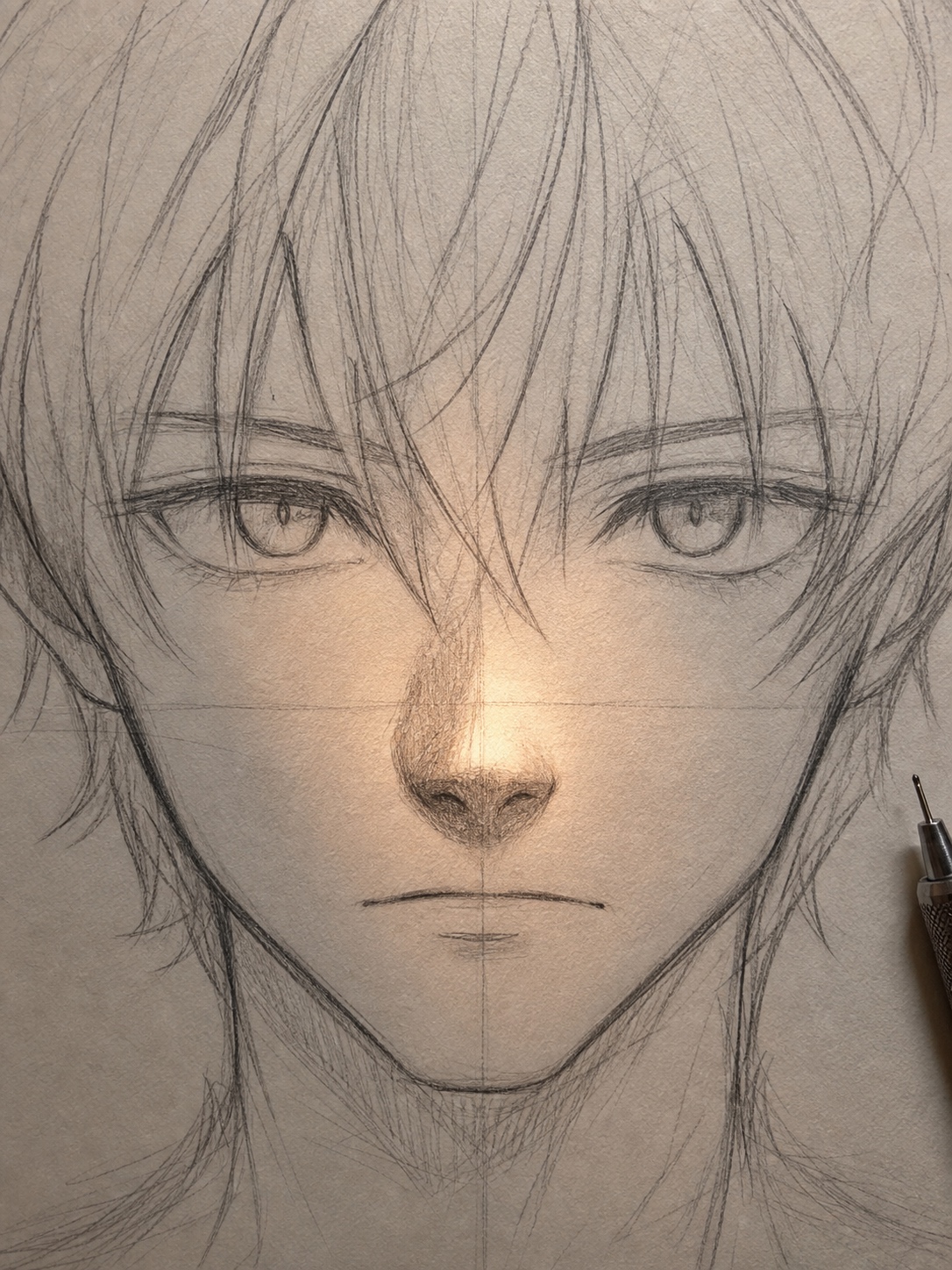
Most drawing tutorials start with “draw a dot here.” That’s fine if you want to copy one specific style — but the moment you switch genres or try a different angle, the dot stops making sense and you don’t know why.
The reason anime noses look right (or wrong) has nothing to do with how many lines you use. It’s about understanding what you’re simplifying.
The real nose underneath every anime nose
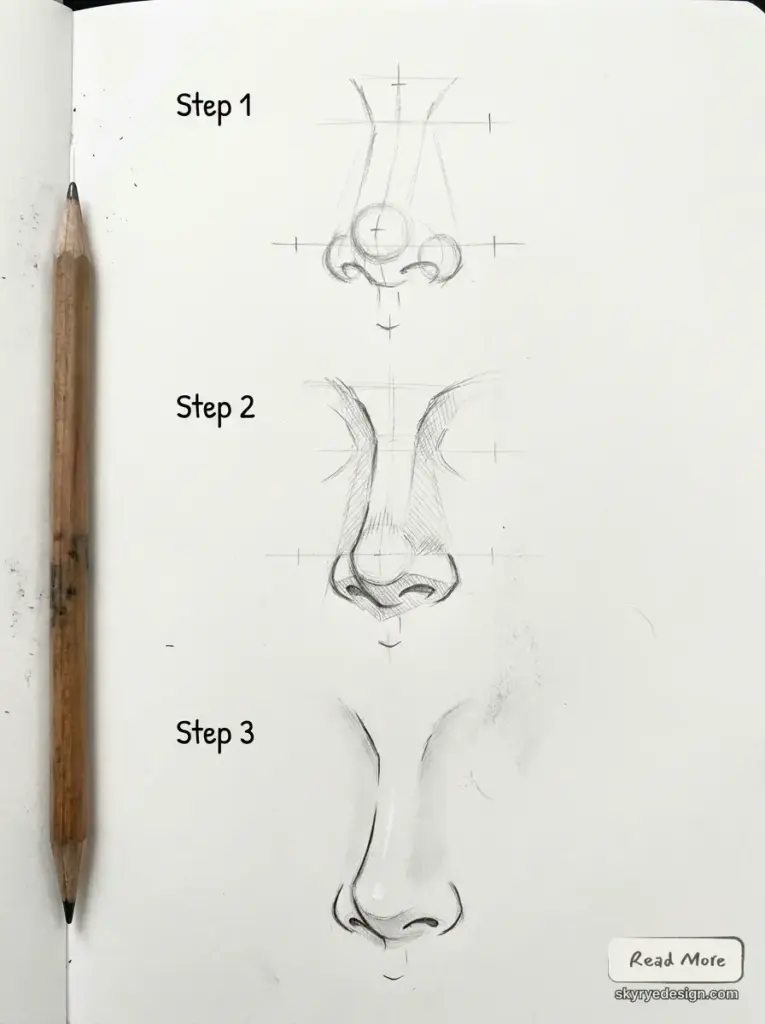
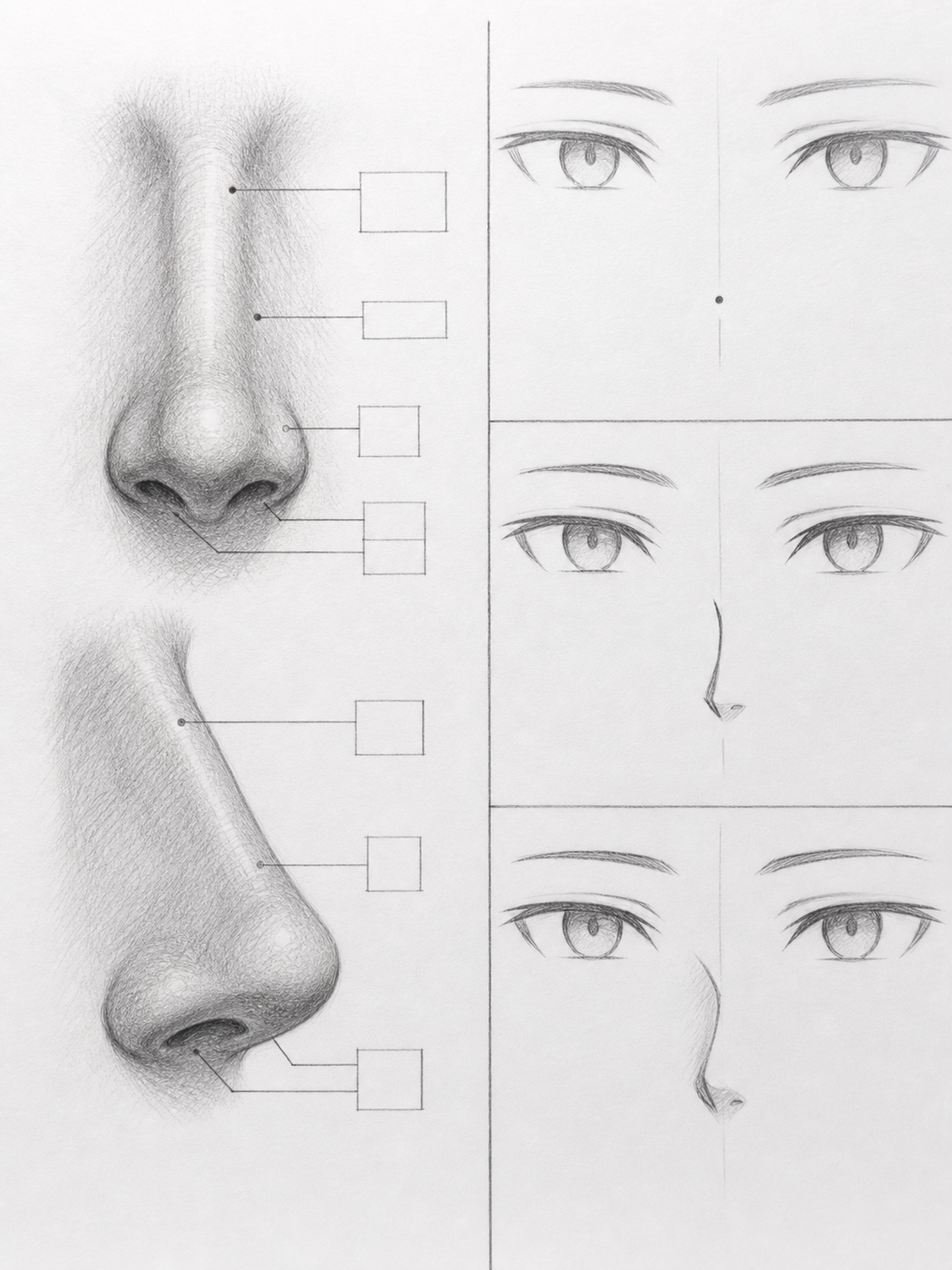
A human nose has four main parts: the bridge (the bony ridge running down from between the eyes), the tip (the rounded end that sticks out furthest), the alae (the soft wings on either side), and the nostrils themselves.
In academic drawing, you spend weeks on these. In anime, you keep one or two of them and drop the rest. Which ones you keep determines the entire character of the nose.
A dot represents the tip only — the single most readable part of the nose from a distance. A small line at the base represents the alae without drawing them. A shadow under the tip reads as three-dimensional form without any outlines at all. This isn’t simplification for its own sake. It’s the same logic industrial designers use when stripping a form down to its essential silhouette — you remove detail until removal of anything else breaks recognition.
How much detail depends on the style, not your skill level
This is the mistake I see constantly: beginners add details because they feel like more detail means more skill. In anime, it usually means the opposite.
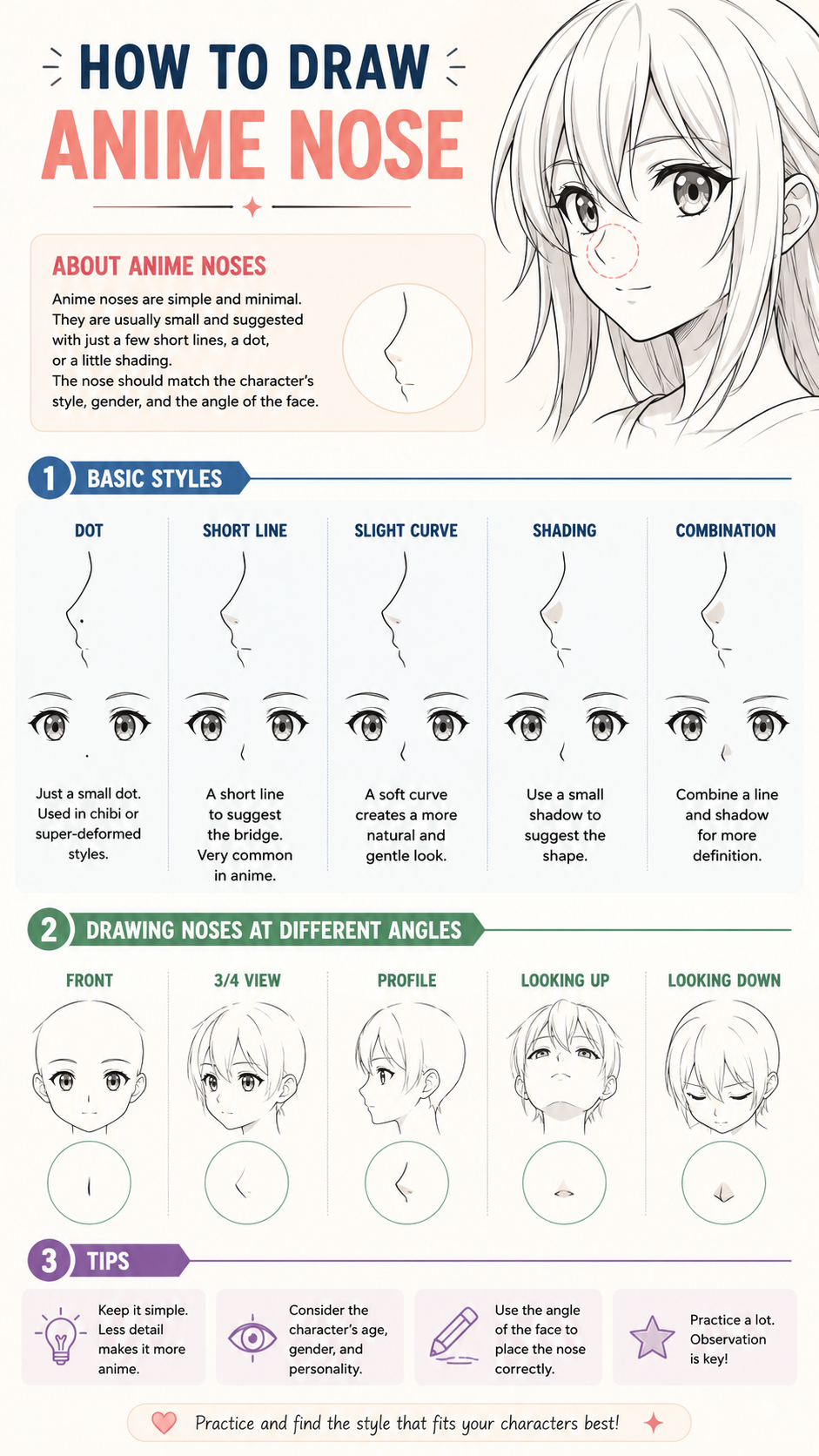
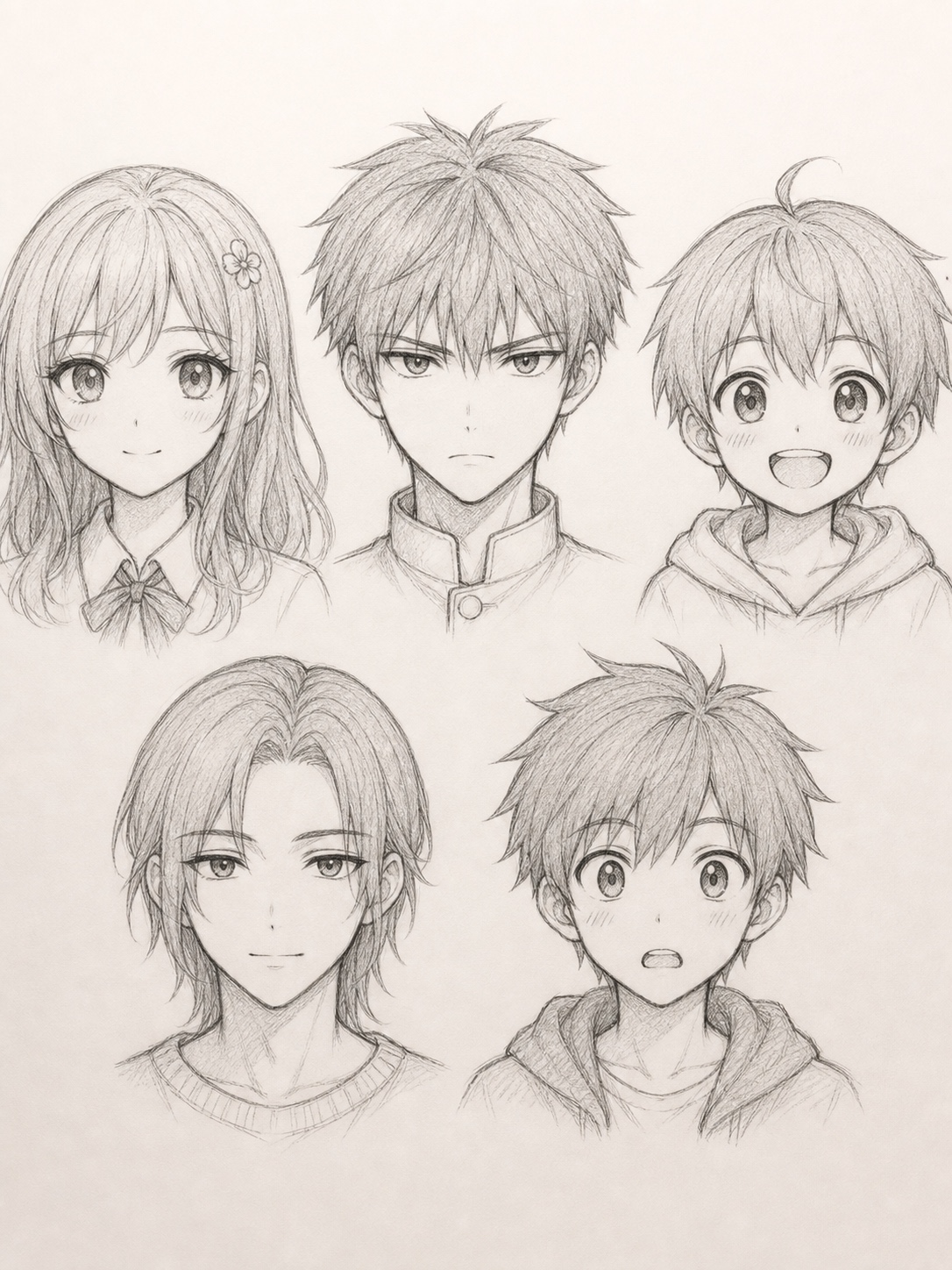
Shoujo characters get the least nose detail — often just a dot or nothing at all, because the eyes carry everything. Seinen and semi-realistic styles need more — a defined tip, shadow under the alae, sometimes a hint of the bridge. Chibi gets zero nose at all, and that’s a deliberate choice, not an omission.
Tip: Before you draw a single line, ask: what genre is this character from? That question decides how much nose exists on the face.
5 types of anime nose (and when to use each)
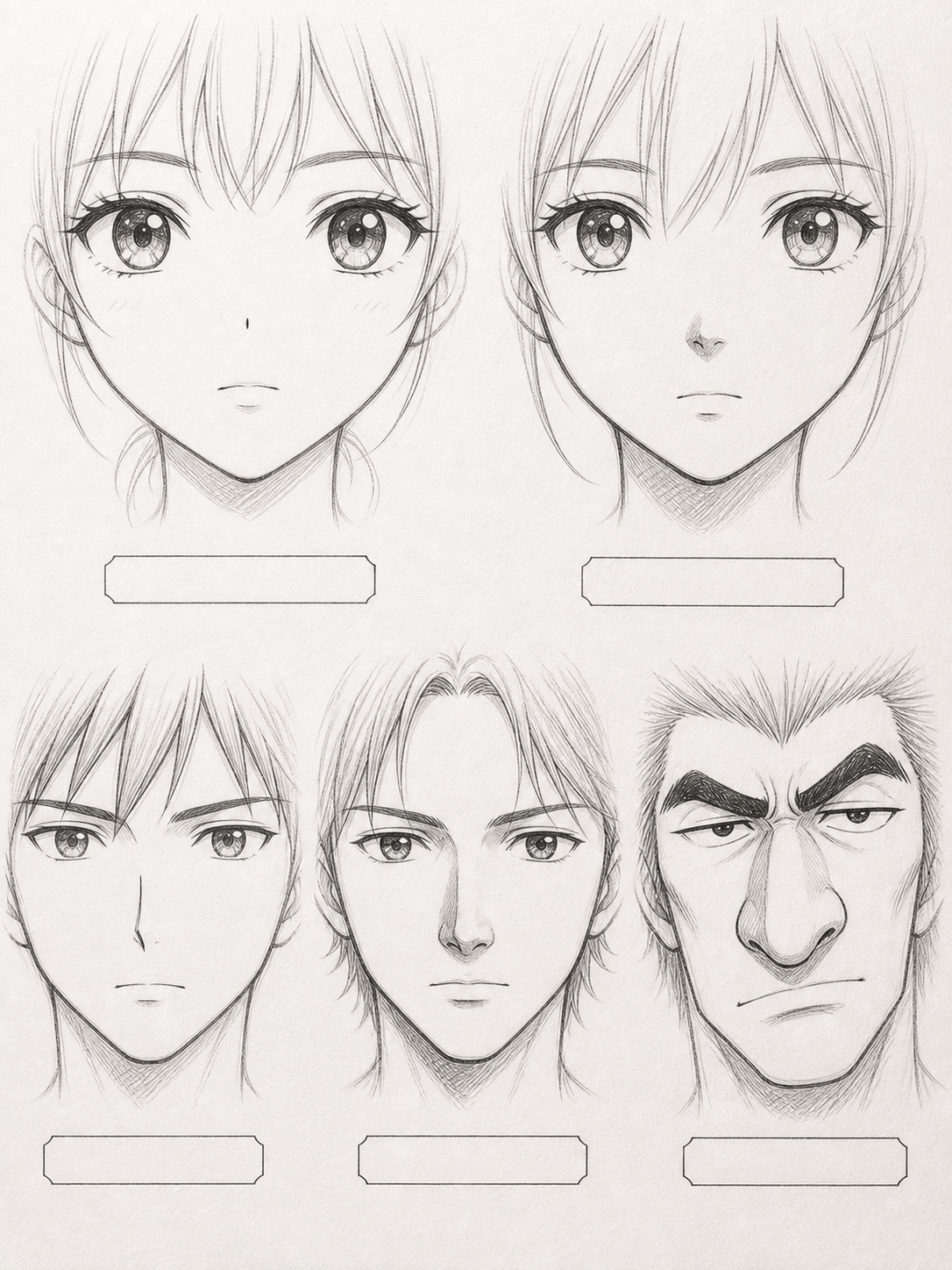
Anime nose drawing isn’t one thing — it’s a spectrum from a single pixel-sized dot to a fully shaded semi-realistic form. Picking the wrong type for your character’s genre is what makes noses feel “off” even when the construction is technically correct. Here are the five types you’ll actually use.
The dot and dash — simplest, most common
A single dot or short horizontal dash placed at the nose position. That’s it. No bridge, no alae, no nostrils.
This works because the face reads the dot as a nose automatically — context does the heavy lifting. You’ll see this in Shoujo titles like Fruits Basket and Cardcaptor Sakura, in Chibi characters, and in any style where the eyes dominate the face so completely that the nose is mostly negative space.
Placement matters more than the mark itself. Too high and the face looks childlike. Too low and the character looks long-faced. The dot sits roughly two-thirds down from the center of the face to the chin.
The shadow nose — no lines, only shading
Instead of drawing the nose as an outline, you paint the shadow it casts. A small flat triangle or teardrop shape of mid-tone grey under the tip reads instantly as a three-dimensional nose. No lines anywhere.
This is the dominant approach in modern semi-realistic anime and in digital illustration in general. Demon Slayer uses it. So does most contemporary fanart on Pixiv. I find this method more convincing than any line approach — because real noses don’t have outlines.
The shadow shape is always below the tip and slightly below the alae on each side. In Clip Studio Paint, I put this on a Multiply layer at around 35% opacity and use a soft round brush. One stroke per side, sometimes one under the tip.
The line-and-tip nose
A short vertical or angled line suggesting the bridge, ending in a small curve or point at the tip. No nostrils drawn explicitly. This is the most versatile type — it works across Shonen, Seinen, and action genres.
The female version is shorter, rounder at the tip, lighter in line weight. The male version runs longer, ends sharper, and often has a more pronounced angle at the bridge. My Hero Academia uses this for most of its cast. So does Attack on Titan for younger characters.
The defined nose — semi-realistic
Bridge is visible, the tip is shaped, the alae are suggested as soft curves, and a shadow sits underneath. Four elements total — but each one drawn with intention.
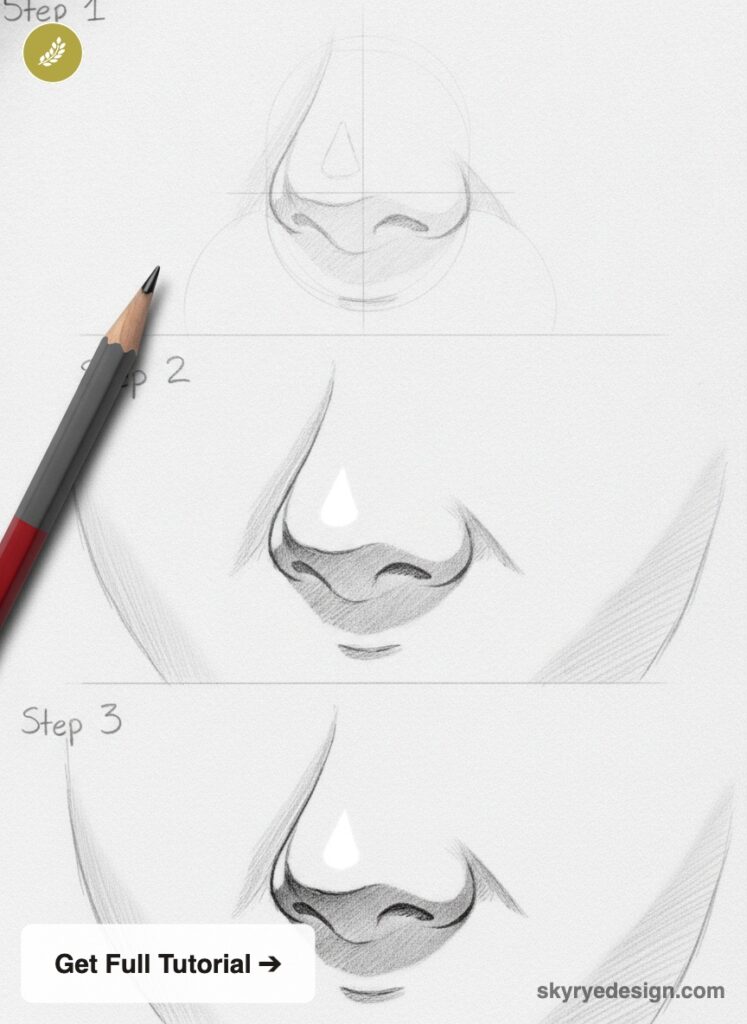
This type suits styles influenced by realistic illustration: Vinland Saga, Berserk, and more recently Blue Period. If you’re drawing original characters in this register, start with the bridge line, then the tip shape, then alae curves, then add shadow last. Adding the shadow before the form is solid is the fastest way to make it look muddy.
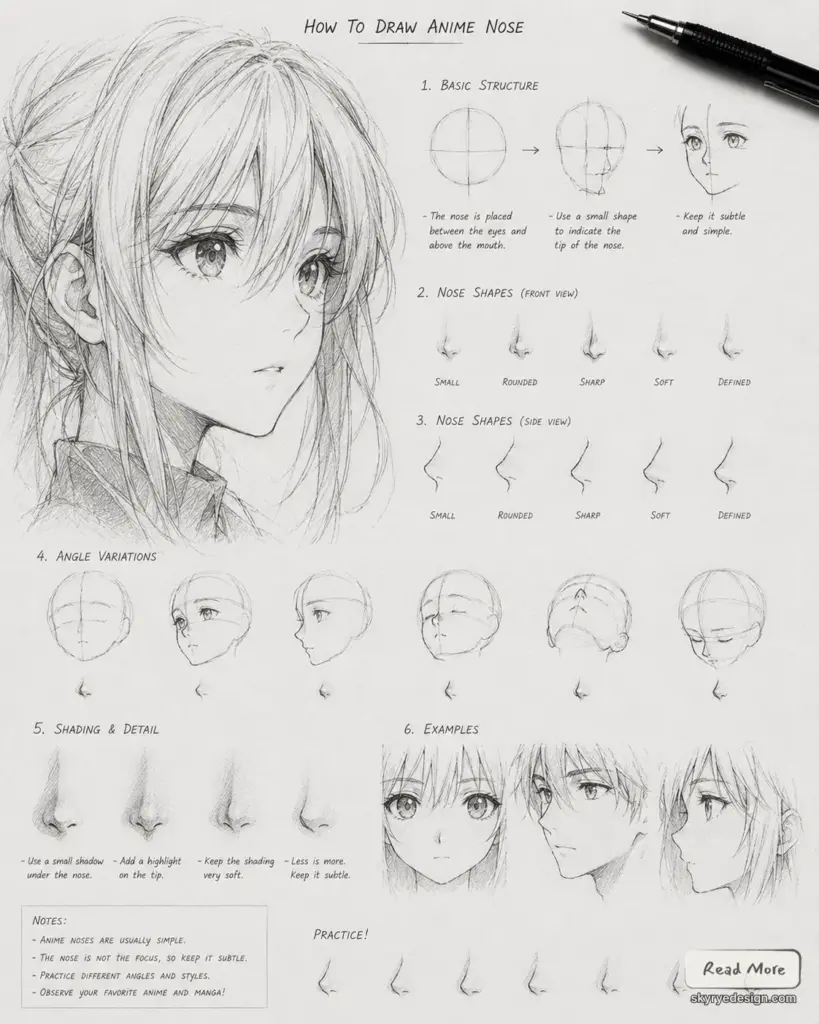
The stylized or exaggerated nose
A large, prominent shape — triangular, hooked, or bulbous. Used almost exclusively for comedy characters, villains, older male side characters, and retro designs from the 80s and 90s.
Think of the side-characters in Dragon Ball, or Jigen from Lupin III. The nose here is a personality marker as much as a facial feature. Exaggeration is the point — draw it bigger than feels comfortable, then go bigger.
How to draw anime nose step by step — front view
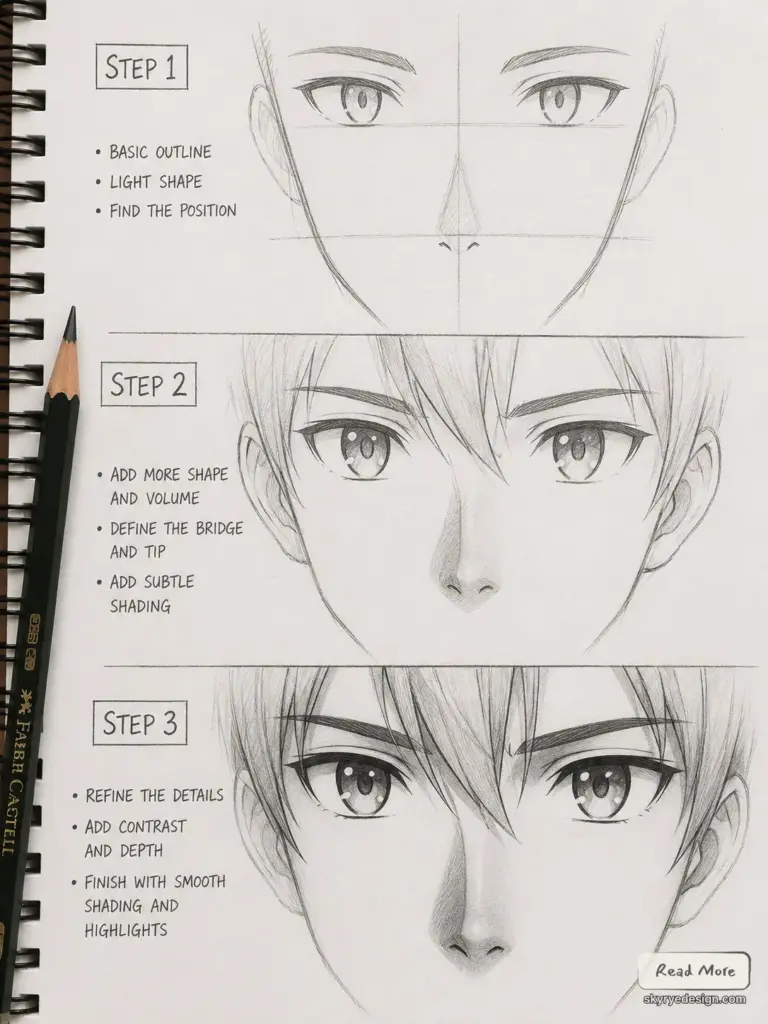
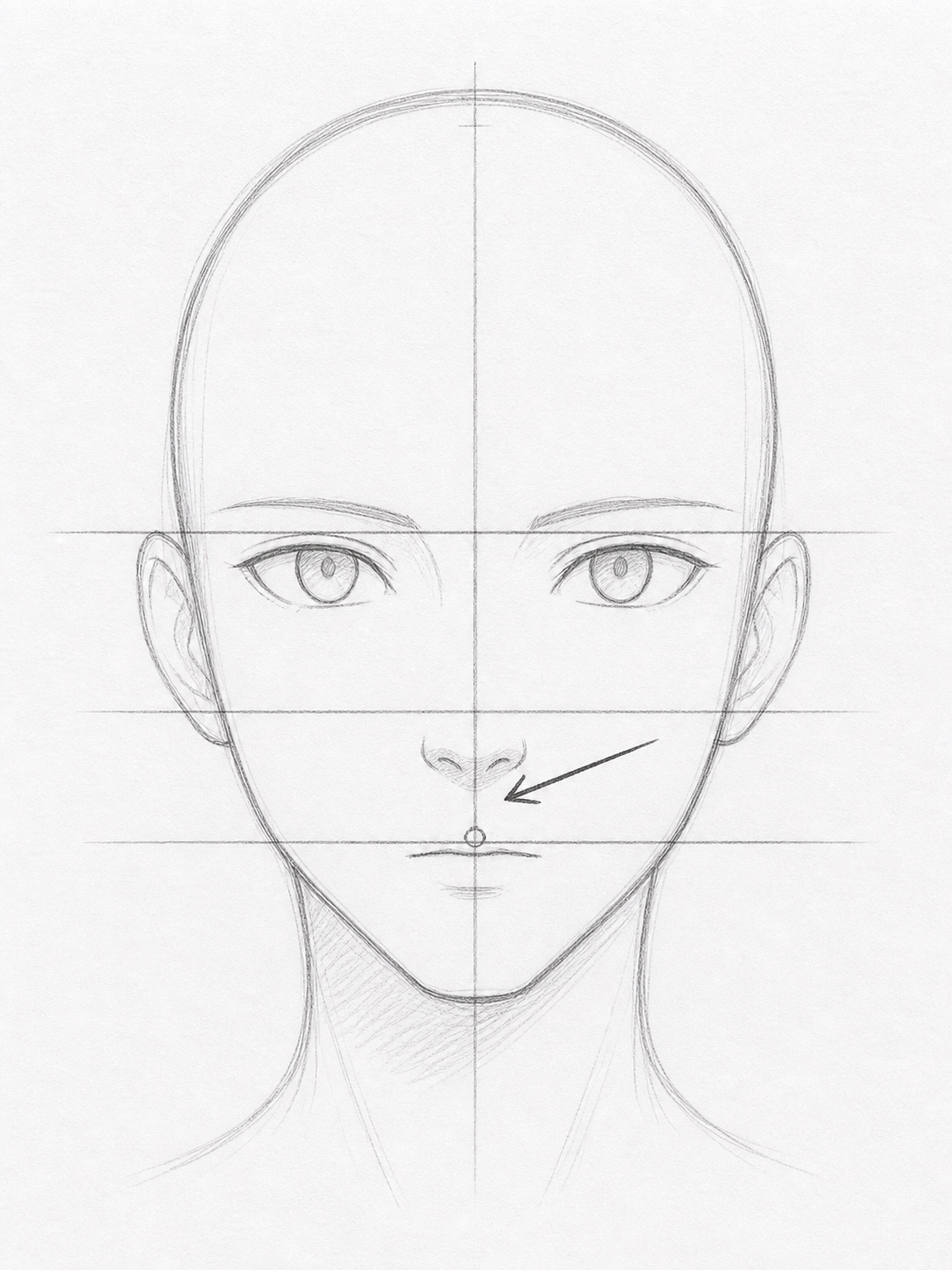
Front view is where most people start — and where most people pick up bad habits that follow them into every other angle. The fix is simple: stop drawing the nose first. Build the face grid, find the position, then draw.
Setting up the face grid
Draw an oval for the head. Add a vertical center line — this keeps the face symmetrical and tells you exactly where the nose sits horizontally. Then divide the lower half of the face into thirds: the nose lands at the top of the bottom third, roughly two-thirds of the way between the eye line and the chin.
That position feels lower than most beginners expect. When students in life-drawing classes first measure a real face, they’re almost always surprised — the nose is further down than the brain assumes. Anime compresses this slightly, but the nose still sits in the lower portion of the face, not the middle.
Step by step — the line-and-tip nose (universal starting point)
This works for the majority of Shonen, Seinen, and action-genre characters. Four marks, drawn in order:
Step 1: Place a light anchor dot at the tip position. Don’t draw the nose yet — just mark where the lowest point will be.
Step 2: From the anchor dot, draw two short angled lines upward and outward. These suggest the alae without drawing them explicitly. Keep them light — these are construction lines, not final marks.
Step 3: Add a short horizontal line across the base of those two lines. This reads as the bottom of the nose and grounds it to the face. Without this line, the nose floats.
Step 4: Darken the tip dot slightly, erase the construction lines, and add a small shadow directly below the tip if you want depth. One soft stroke is enough.
The whole thing takes under thirty seconds once it’s in muscle memory. I still draw it this way as a placeholder when I’m blocking out a face — even in digital work, I rough it in with these four marks before committing to any shading.
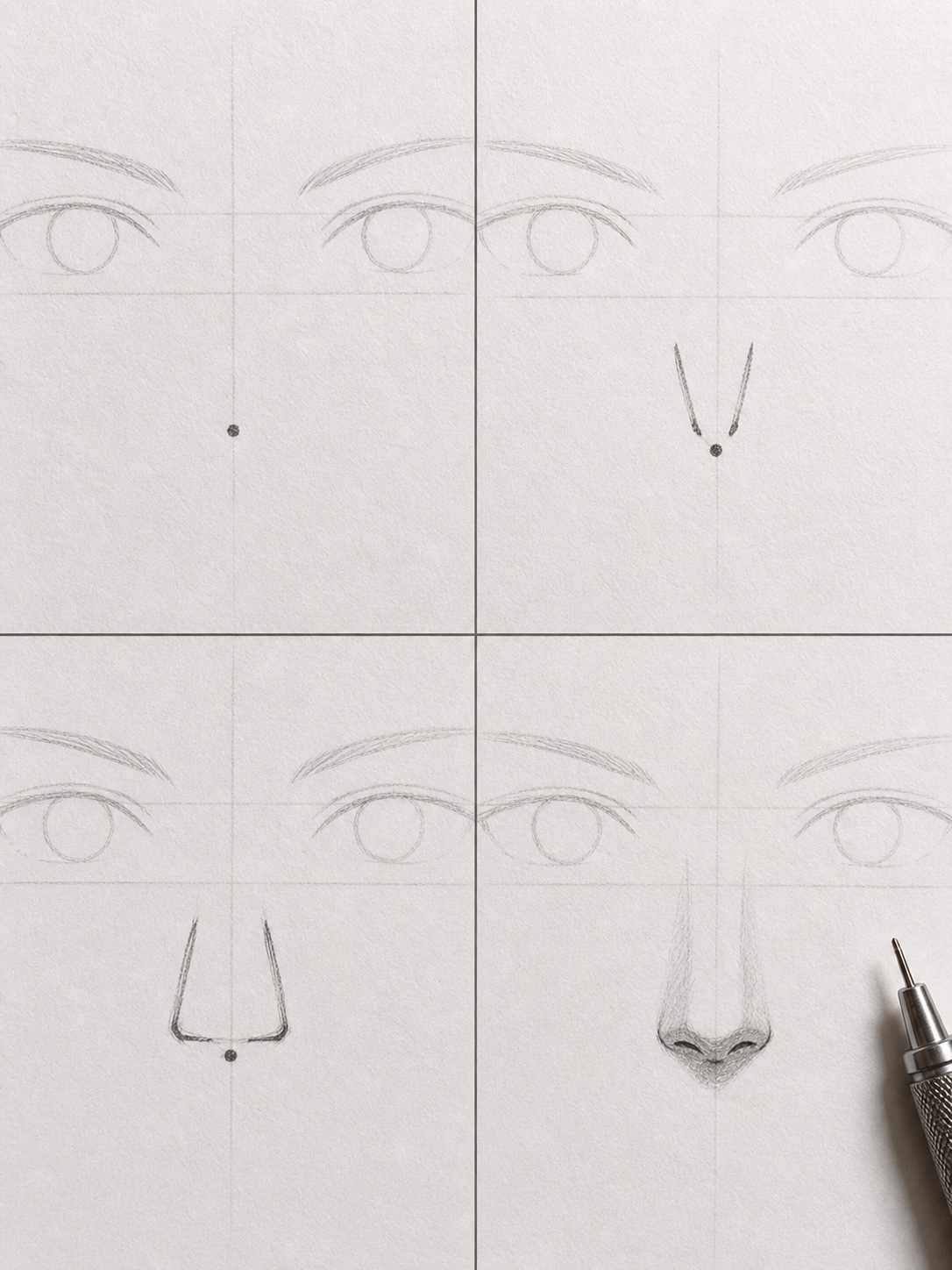
Quick check: After drawing the nose, cover the eyes with your finger. The nose should still read as a nose without context. If it disappears or looks like a random mark, add the base line or a touch of shadow.
Side view and 3/4 angle — the angles that trip everyone up
Front view is forgiving. The nose sits on the center line, both sides mirror each other, and a single dot reads correctly almost anywhere near the right position. Side view and 3/4 are different problems entirely — and the reason most beginners avoid drawing characters at these angles is almost always the nose.
Profile view — building the nose bump
In profile, the nose is no longer a flat mark. It’s a shape that projects off the face — and how far it projects, and at what angle, tells you a lot about the character.
For a simple anime profile, one curved line does the job. Start at the bridge (roughly level with the inner corner of the eye) and curve outward to the tip, then drop down and slightly back in toward the upper lip. That single C-shaped stroke is the entire nose for most Shoujo and light Shonen profiles.
For a more defined profile, break that curve into two decisions: the bridge angle first, then the tip. A steeper bridge angle reads as older or more masculine. A softer, shorter bridge with a rounder tip reads as younger or feminine. Fullmetal Alchemist uses a clean mid-angle bridge for Edward — enough to read as male, not so sharp it ages him.
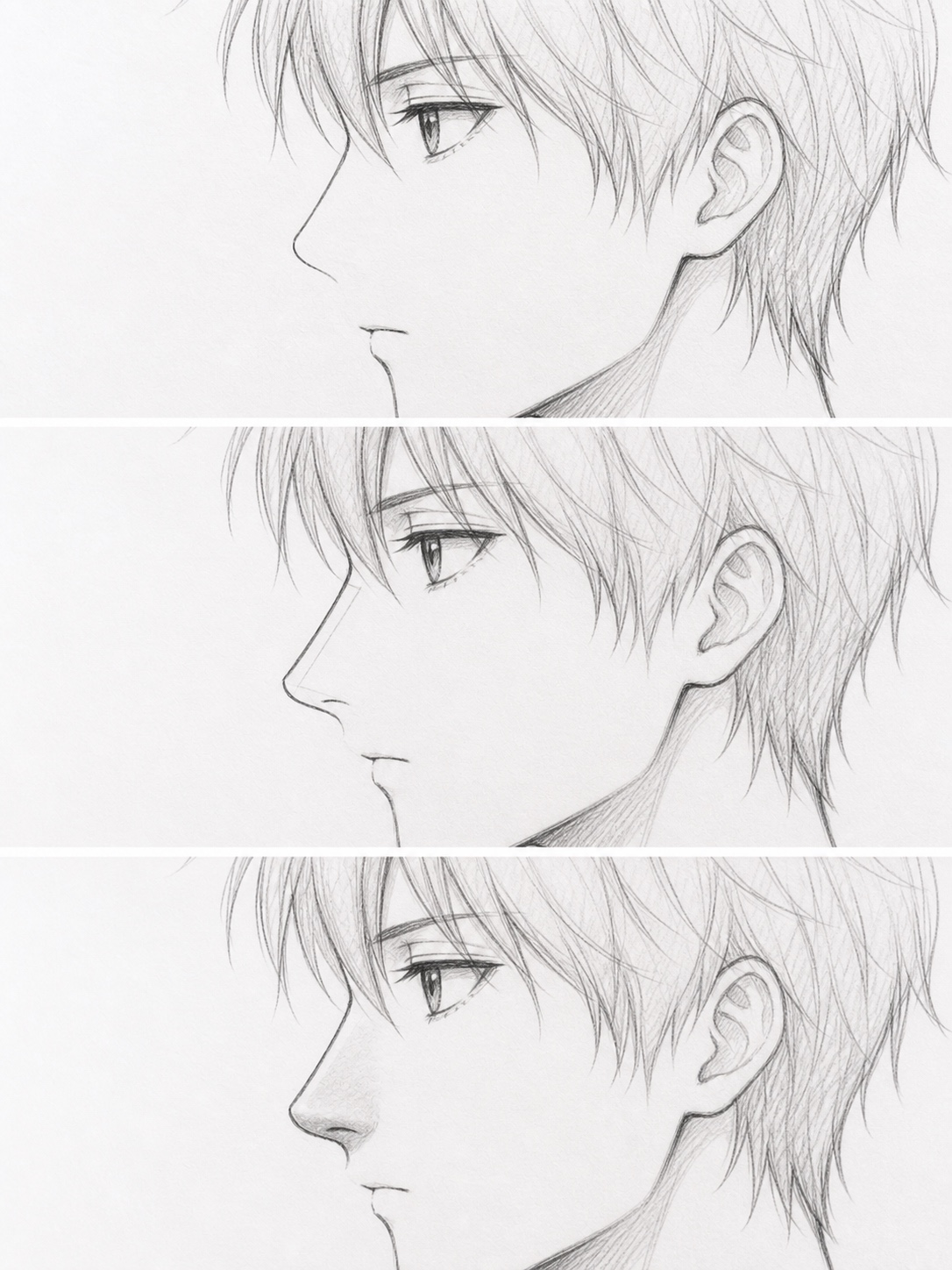
Add a short angled line near the base to suggest the nostril opening. One mark, not two — in profile you only see one nostril.
3/4 view — the most common problem angle
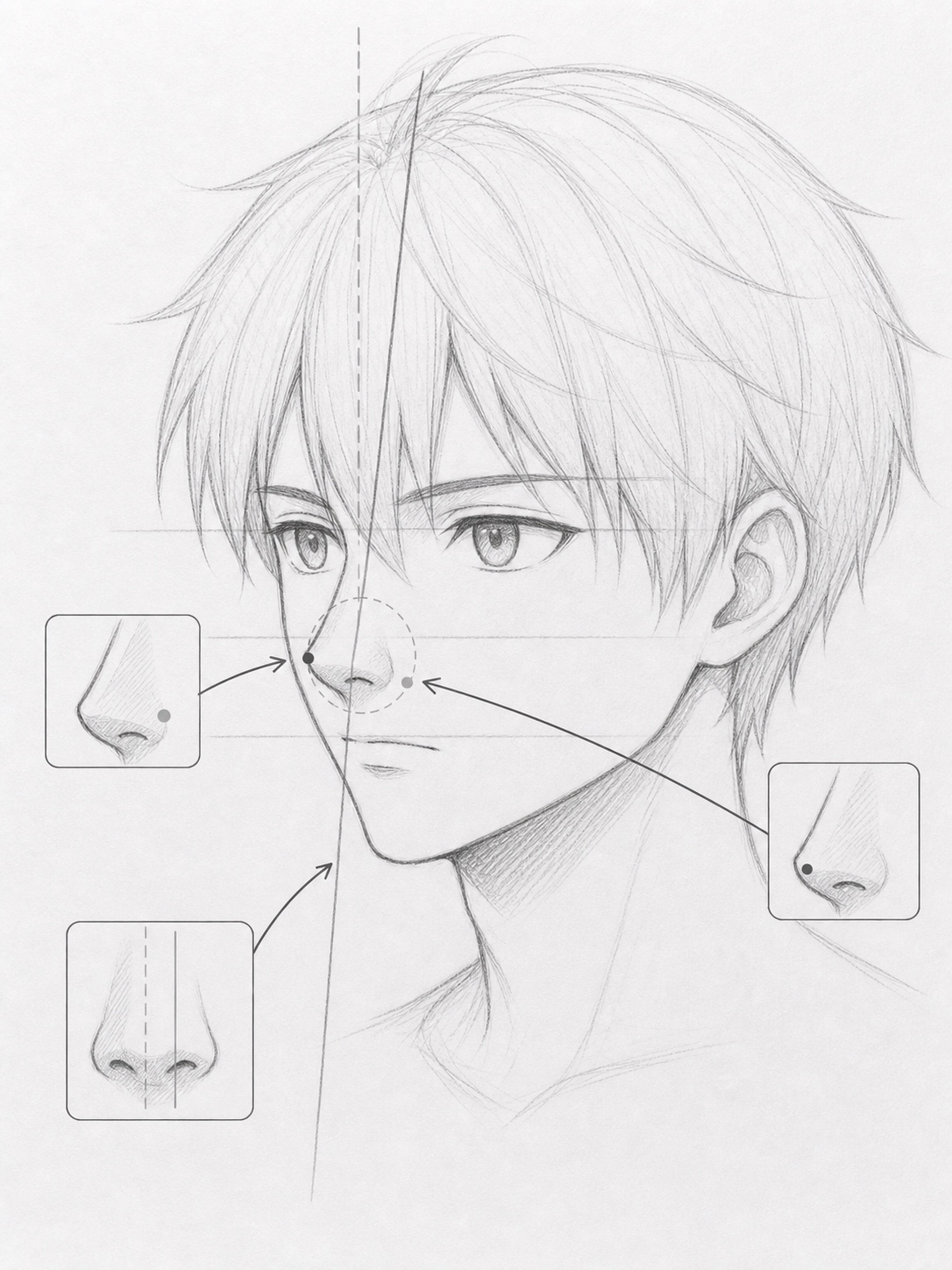
The 3/4 view is where nose drawings collapse most often. The mistake is almost always the same: the nose stays centered on the face even though the face has turned.
When the face rotates to 3/4, the nose moves with it — toward the side that’s turning away. The tip of the nose should point slightly past the center line, not sit on it. If the nose looks like it’s floating in the middle of the face at a 3/4 angle, this is why.
Build it like this: draw the face oval rotated slightly, shift the vertical center line off-center toward the far side, and place the nose so the tip crosses that shifted line by a small amount. The far alae disappears almost entirely. You’re drawing roughly three-quarters of the nose, same as three-quarters of the face.
The near nostril becomes slightly visible. The bridge line runs from between the eyes toward the visible side. Shadow falls on the far side of the tip.
I spent an embarrassing amount of time in my sketchbooks rotating the same face at 3/4 until this clicked. The mental model that finally worked: think of the nose as a small box attached to the face. When the face rotates, the box rotates with it. You see the front and one side of the box — never both sides equally.
Under-angle and top-angle — brief notes
Looking up at a character from below: the nostrils become the dominant feature. The tip foreshortens and the two nostril openings face the viewer. In anime this gets simplified to two small ovals or a simple W-shape at the base of a shortened bridge.
Looking down from above: the nose almost vanishes. What remains is a small shadow below the tip and a hint of the bridge ridge. Most anime artists draw almost nothing here — a single soft shadow stroke is enough.
After you finish the nose studies, use these aesthetic anime drawing ideas to place the face inside a fuller mood, pose, or scene.
Male vs female anime nose — the actual differences
Most tutorials cover this in one sentence: “female noses are smaller and simpler.” That’s true but not useful. The difference isn’t just size — it’s angle, weight, position, and how much the nose interacts with shadow. Get these details right and gender reads instantly, even with minimal linework.
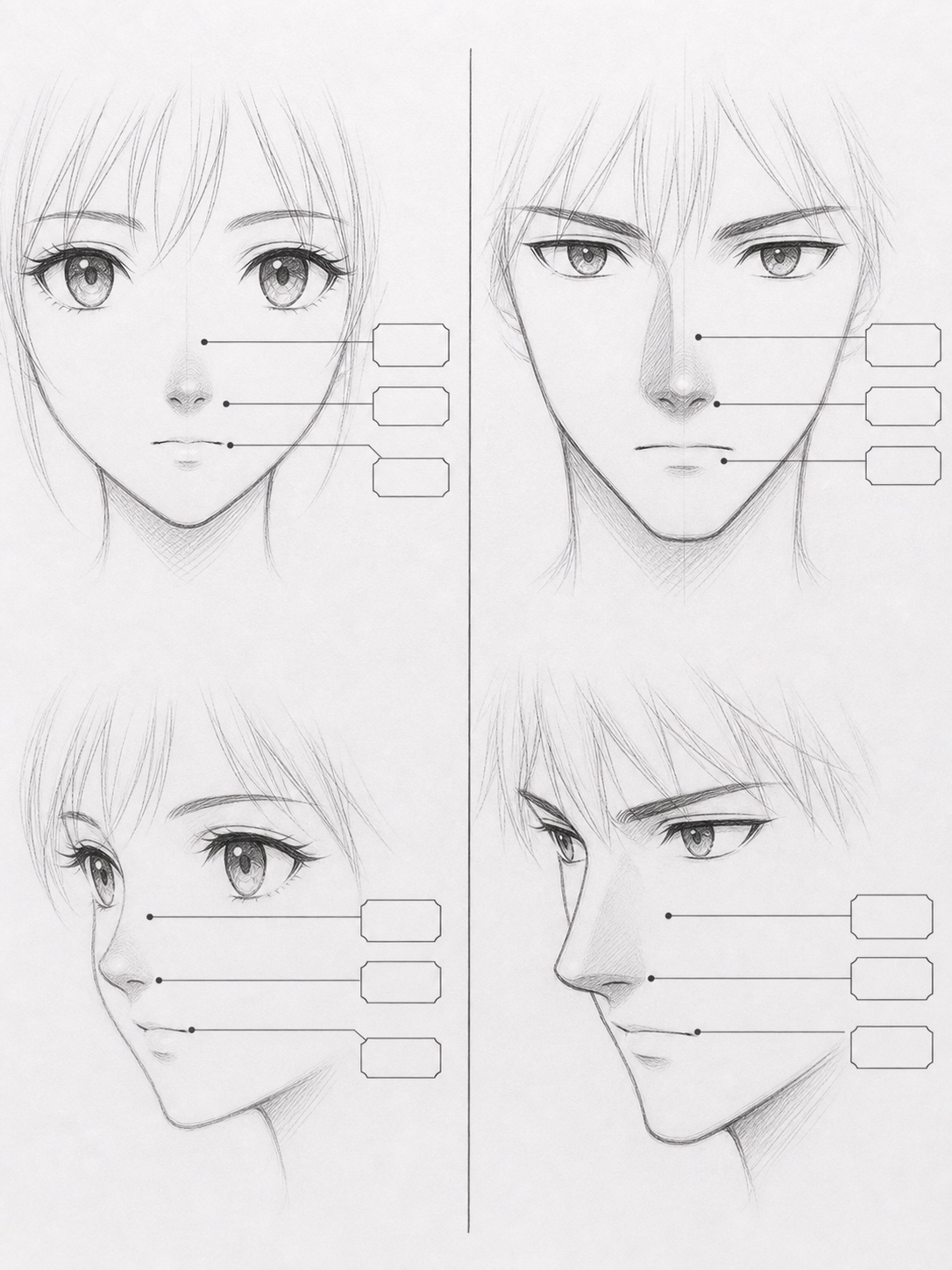
Female anime noses
The female anime nose sits slightly higher on the face than the male equivalent and tends to stay closer to the center line even at 3/4 angles. The tip is rounded rather than pointed. Line weight is light — often a single fine stroke or no stroke at all, just a suggestion.
Shadow, when used, is soft and small. A tiny teardrop shape directly under the tip, nothing under the alae. In Shoujo and modern slice-of-life styles like Violet Evergarden and A Silent Voice, you’ll often see no nose line at all on female characters, just that one small shadow. The eyes and mouth carry all the expression; the nose stays neutral.
If you’re drawing female characters and the nose keeps pulling attention, it’s probably too dark, too long, or placed too low. Lighten the line, shorten the bridge, lift the position slightly.
Male anime noses
Male anime noses are wider at the base, sit lower on the face, and carry more contrast in the shading. The bridge is longer and the angle between bridge and tip is more pronounced — think of a sharper turn at the tip rather than a smooth curve.
Older male characters get the most defined noses in almost every anime style. A side character in his forties in any Seinen title will have a nose with a visible bridge line, defined alae curves, and a hard shadow underneath. It’s one of the clearest age markers in anime character design — more nose detail signals more life experience, intentionally or not.
In Shonen, young male protagonists sit somewhere between the two extremes. Naruto’s nose is a small line-and-tip with moderate weight — readable as male but not aged. Guts from Berserk has a fully defined nose with shadow and structure. Same genre logic at work: the grittier the world, the more face.
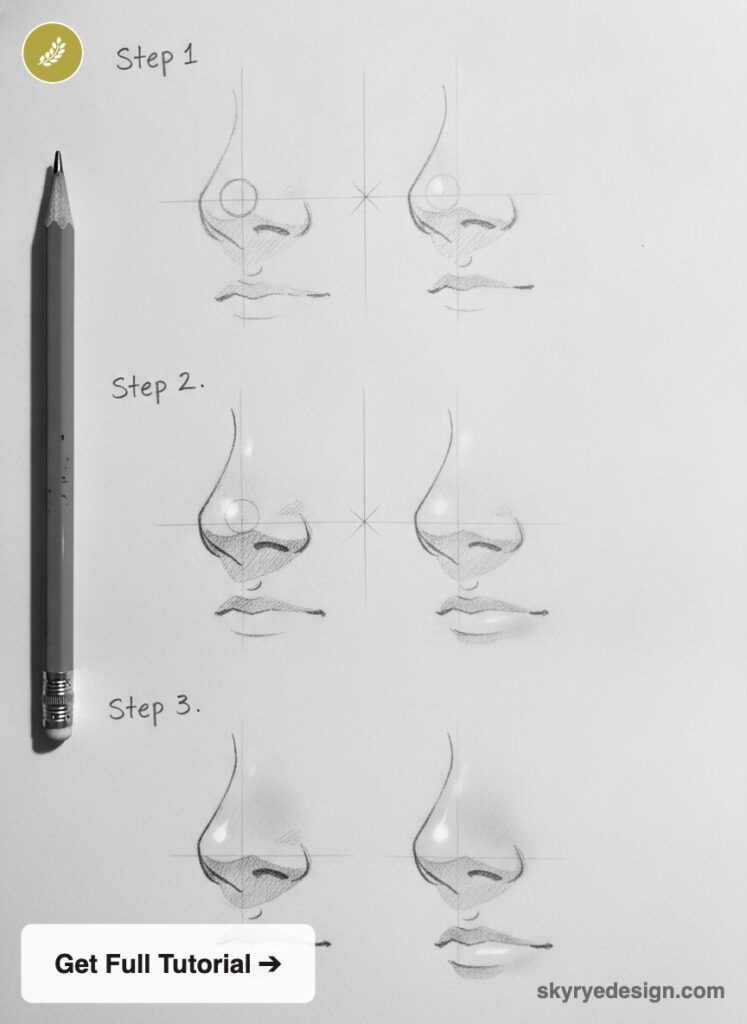
Shading the anime nose — light logic, not just dark lines
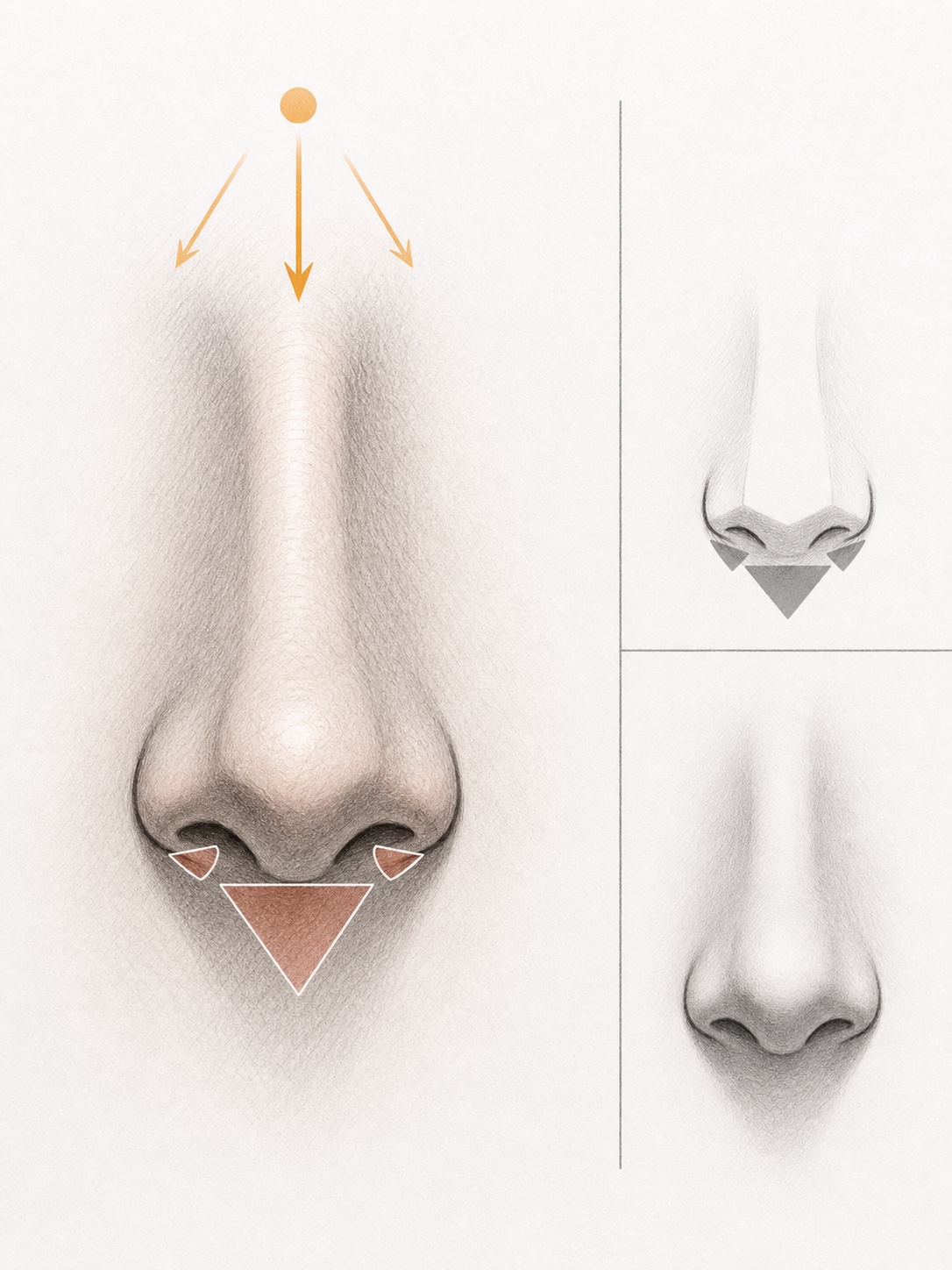
Most beginners shade the nose by darkening the outline. That’s the wrong move — it makes the nose look carved into the face rather than sitting on it. Anime shading works with flat shapes of tone, not gradients, and the placement of those shapes follows one simple rule: shadow falls where light can’t reach.
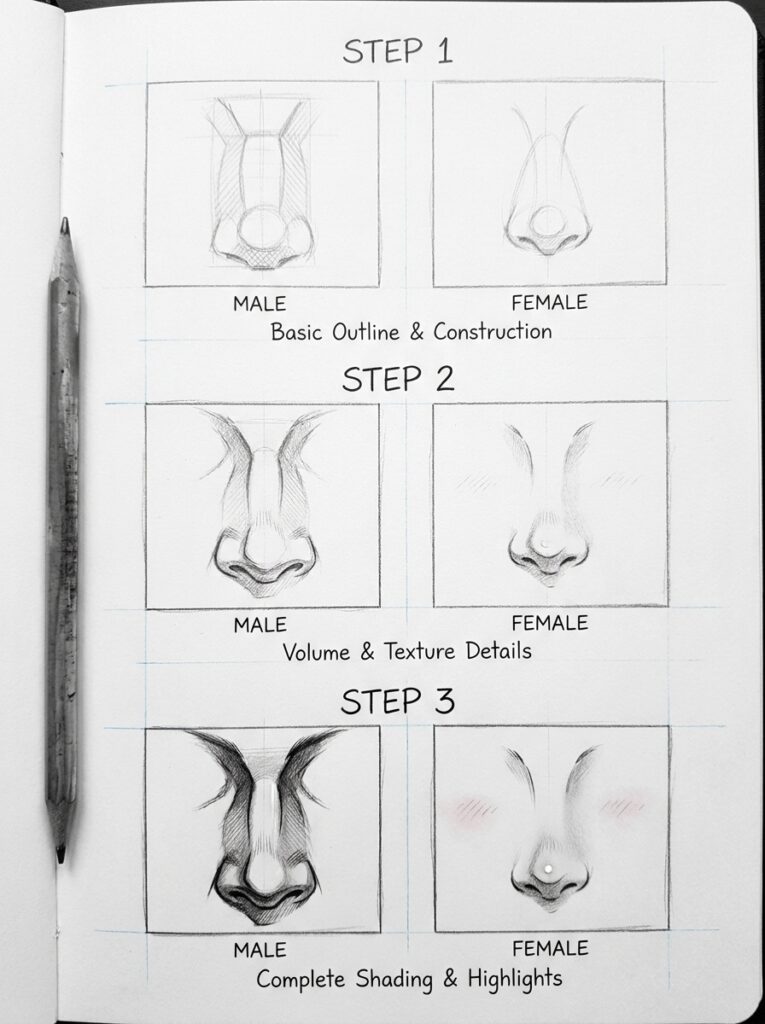
Where the shadow goes — and why
In anime, the default light source is above and slightly in front of the character. That means shadow collects in two places on the nose: directly under the tip, and in the small recess under each alae where the nose meets the upper lip area.
You don’t need to draw both. For most styles, the shadow under the tip is enough. It’s a small flat shape — roughly triangular or teardrop, wider than the tip itself, sitting just below it. That single shape creates the illusion of a nose projecting off the face without a single outline.
The shadow is flat in anime, not a gradient. Pick one mid-tone and fill the shape. No blending toward the edges, no soft fade. That flatness is what makes it read as anime rather than realistic illustration.
For traditional media, a Staedtler Mars Lumograph 2B gives enough tone without going too dark too fast. Lay the shadow in with the side of the pencil tip, not the point — you want a soft edge, not a hard line.
Digital shading workflow
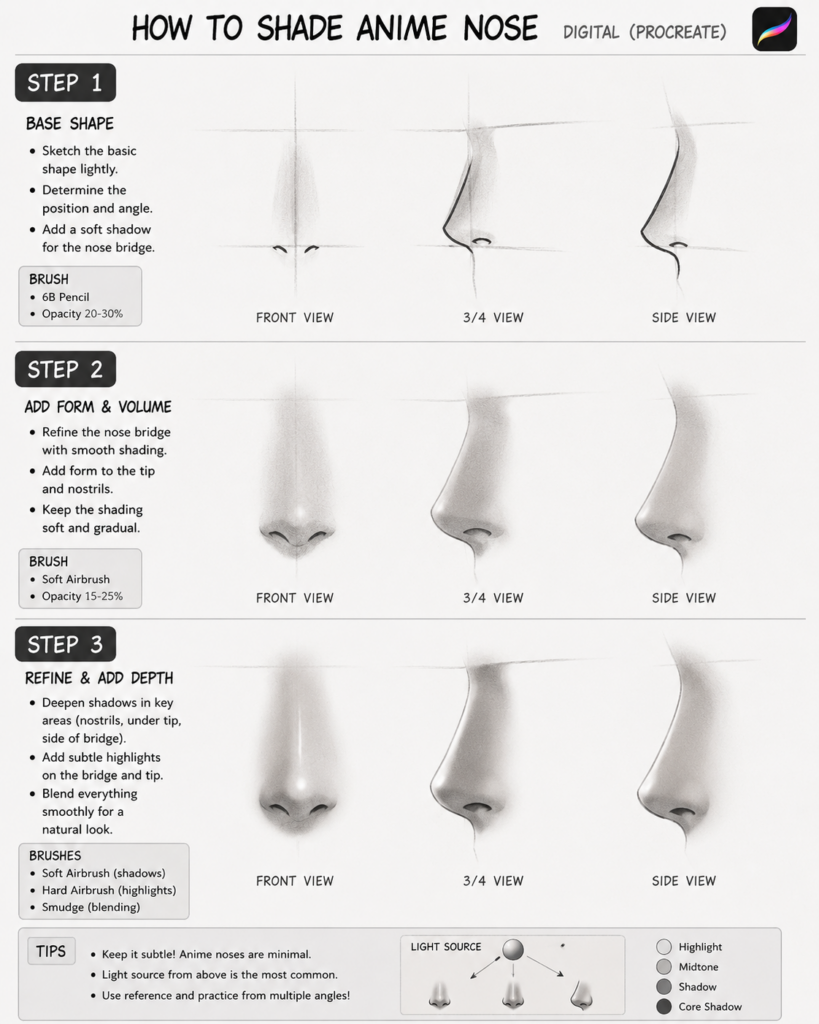
In Clip Studio Paint, create a Multiply layer above your line layer and clip it to the face shape. Use a soft round brush at 30–40% opacity, warm grey tone. One stroke under the tip, one small stroke under each alae if the style needs it. Done.
In Procreate, the Dry Ink brush at low opacity gives a slightly textured edge that works well for semi-realistic anime noses — it reads as a soft shadow without looking digital and clean. I use it at around 25% and build the tone with two or three light passes rather than one heavy stroke.
Rule: Never add shadow until the form reads correctly as a line drawing. Shadow does not fix a badly placed nose. It just makes the problem harder to see and harder to fix.
Common mistakes and how to fix them
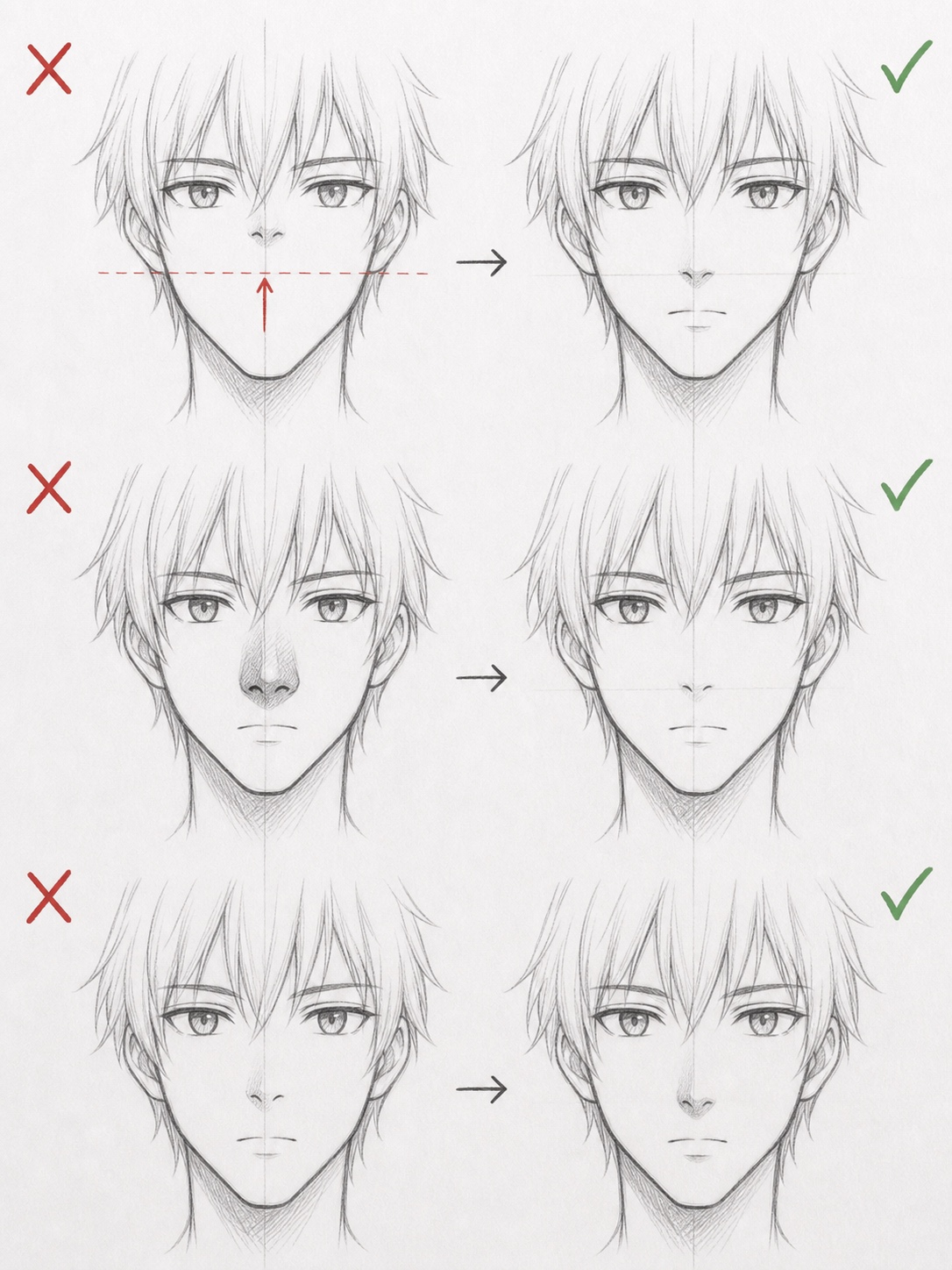
Drawing the nose correctly is mostly about avoiding a handful of specific errors. These show up in almost every beginner sketchbook — I made all of them myself during my first months drawing anime faces seriously. Here’s what they look like and how to get out of them.
Nose too high or too low
Too high: the face looks like a young child regardless of how the rest of the features are drawn. Too low: the character gets an unusually long mid-face that reads as adult but strange.
The fix is always the face grid. Measure from the eye line to the chin, find the midpoint of that lower half, and place the nose just above it. Do this before drawing any features — not after. Adjusting nose position once the eyes and mouth are in is much harder than getting it right from the construction stage.
Too much detail for the style
A fully rendered nose with bridge, alae, nostrils, and shadow on a Shoujo character kills the style immediately. The nose fights the eyes for attention and the face stops reading as anime.
Before adding detail, pull up a reference from the actual genre you’re working in. Not a random anime nose reference sheet — a screenshot from the specific show or style you’re targeting. Count how many lines the nose uses in that reference. Match it exactly before deciding you need more.
The nose that floats off the face
This one is subtle. The nose looks fine in isolation but sits on the face like a sticker — no connection to the surrounding skin, no weight, no shadow.
Almost always the cause is missing shadow. Even one small flat tone shape under the tip anchors the nose to the face. Without it, the nose exists in a different spatial plane than everything around it. Add the shadow first and see if the floating stops before touching anything else.
The nose angle works better when the whole head and body agree, so test your sketch against anime pose references before tightening the face details.
Related anime face drawing practice
Keep the full face connected by pairing this tutorial with the anime drawing tutorials hub, the anime eyes drawing guide, the anime lips drawing, and the broader nose drawing fundamentals guide.
When you simplify the nose for a character, it helps to understand anime vs manga art style differences, because manga can rely on a few ink marks while anime needs a shape that stays stable in motion.
The nose is a small feature, but it still belongs to the whole figure. If your anime heads feel detached from the pose, step back into human face and body drawing practice and build the head, neck, torso, and gesture together before simplifying the features.
Frequently asked questions
How do you draw an anime nose for beginners?
Start with the line-and-tip method. Place an anchor dot at the tip position, add two short angled lines upward from it, close the base with a horizontal stroke, and add a small shadow below the tip for depth. Four marks total. Build this on a proper face grid so placement is correct from the start, not adjusted after the fact.
Where should the nose be placed on an anime face?
Roughly two-thirds of the way between the eye line and the chin, slightly above the midpoint of the lower half of the face. Construct the face grid first: vertical center line, horizontal eye line, then divide the lower half and place the nose just above that midpoint. Getting this right before drawing any features saves significant correction time later.
What is the easiest anime nose to draw?
A single dot placed at the correct position on the face grid. It works for Shoujo, Chibi, and light comedy styles and forces you to nail placement before worrying about shape. Once the dot reads correctly as a nose in context, you can start adding lines or shadow depending on how much detail the style needs.
Do all anime characters have noses?
No. Chibi characters frequently have no nose at all, and some Shoujo styles omit it entirely for female characters, especially in close-up shots where the eyes dominate the composition. The absence of a nose is a deliberate stylistic choice, not an oversight. In those styles, the shadow that a nose would cast is also absent, so the face stays graphic and flat.
How do you draw a male anime nose vs female?
Male noses are wider at the base, sit slightly lower on the face, and carry more contrast in shading: longer bridge, sharper tip angle, harder shadow. Female noses are smaller, rounder at the tip, higher on the face, and use lighter line weight or shadow only. Older male characters get the most defined noses in almost every anime style.
How do you shade an anime nose without it looking weird?
Use a flat tone shape, not a darkened outline. Place a small triangular or teardrop shadow directly under the tip. In Clip Studio Paint, put it on a Multiply layer at 30-40% opacity with a soft round brush. In traditional media, use a Staedtler 2B with the side of the tip. Never add shadow until the form reads correctly without it.
What style of anime nose is most popular in 2026?
The shadow nose, defined by tone rather than outline, is dominant in current anime and digital illustration. Demon Slayer, Oshi no Ko, and most contemporary Pixiv illustration use this approach. The semi-realistic defined nose is also growing, driven by the shift toward more grounded character designs in Seinen titles.
Start with form, decide on detail
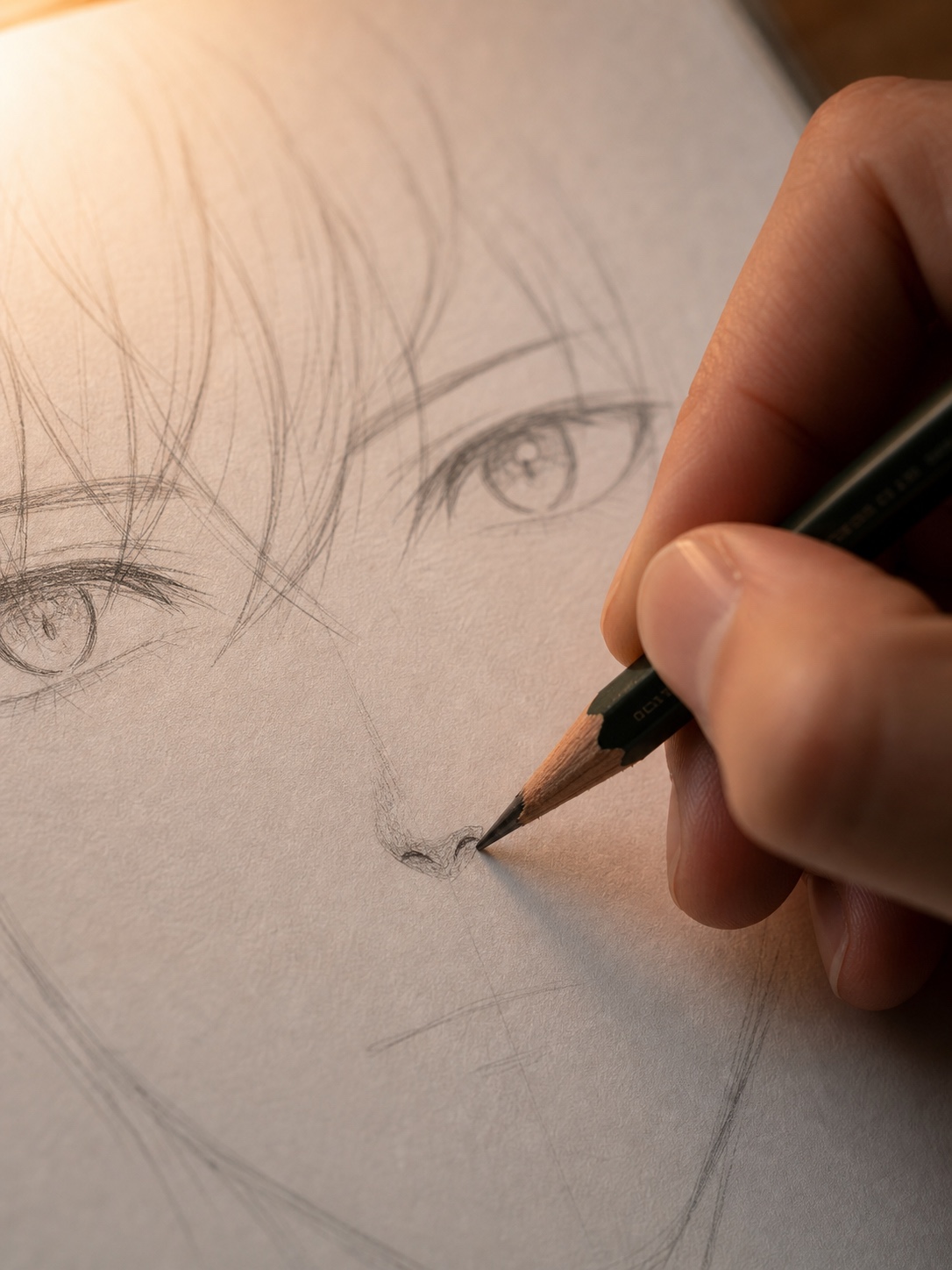
Back to that plaster cast on the wooden stool. The reason academic drawing starts with noses and ears isn’t tradition — it’s because small forms teach you to think in volume before you think in line. An anime nose is the same lesson compressed into two or three marks.
Once you understand what each mark represents (tip, alae, shadow), you’re not copying a style anymore. You’re making decisions. Dot or shadow? Bridge or no bridge? One line or three? Those decisions are what separate a nose that fits the character from one that just sits on the face.
Pick one type from this guide and draw it across all three angles today. Front, profile, 3/4. Same nose, same character, three rotations. That single exercise will teach you more than redrawing the front view twenty times.
After the nose bridge is placed, use anime eyebrow shapes and brow placement to make the upper face read clearly.
Getting the facial profile correct is only half the battle; integrating the facial features into broader character design ideas ensures a harmonious, cohesive final drawing.
Once you can place the nose across different profiles, practice drawing a full portrait with our anime girl sketch walkthrough.
If you are drawing the full character digitally after the nose study, compare the best anime drawing apps so your line art, layers, and coloring workflow support the style you want.
- 4.9Kshares
- Facebook0
- Pinterest4.9K
- Twitter3
- Reddit0