Industrial design school taught me something that took a while to fully absorb: every object, no matter how organic or irregular it looks in the finished piece, starts as a box. My professor used to say it in Italian, and it sounded better that way, but the principle is the same in any language. The chair is the single most instructive object for learning this, because it’s common enough that you know what it should look like, and complex enough that drawing it incorrectly is immediately obvious.
- The box method: why every chair starts the same way
- Drawing a basic chair in one-point perspective
- Drawing a Windsor chair: handling multiple turnings and angles
- Drawing the Eames Lounge Chair: organic forms and curves
- Shading a chair drawing: light, planes, and materials
- Drawing chairs digitally: Procreate and Clip Studio Paint
- Common mistakes and how to fix them
- Frequently asked questions
I’ve drawn hundreds of chairs, from academic observational studies in school to product sketches for client furniture concepts, and the ones that failed all failed the same way: wrong perspective, badly understood leg geometry, or shading that ignored the actual light direction and just applied darkness randomly. The box method eliminates the first two problems immediately. The shading section in this tutorial addresses the third.
This tutorial covers the core construction method, one-point perspective, three specific chair types at increasing difficulty (a basic side chair, a Windsor, and an Eames Lounge), shading technique, and how to handle organic forms and curves. Work through the basic chair first regardless of your target style. The fundamentals carry into every subsequent drawing.
The box method: why every chair starts the same way
A chair is not a collection of individual legs, a seat, and a back. It’s a volume with openings cut through it. The moment you start thinking about it as separate parts, you lose control of how those parts relate to each other in space. The box method keeps you thinking about the whole object first.
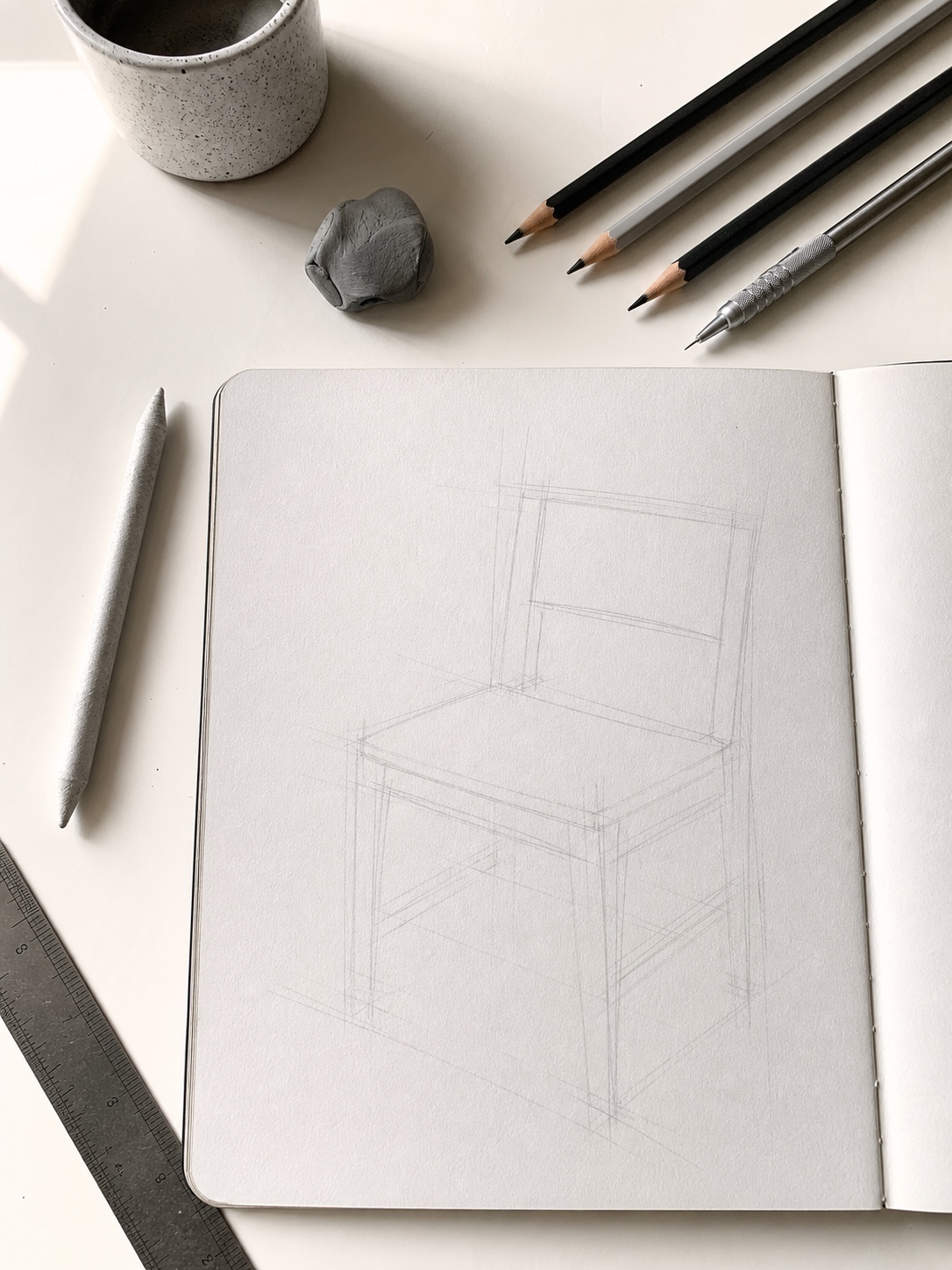
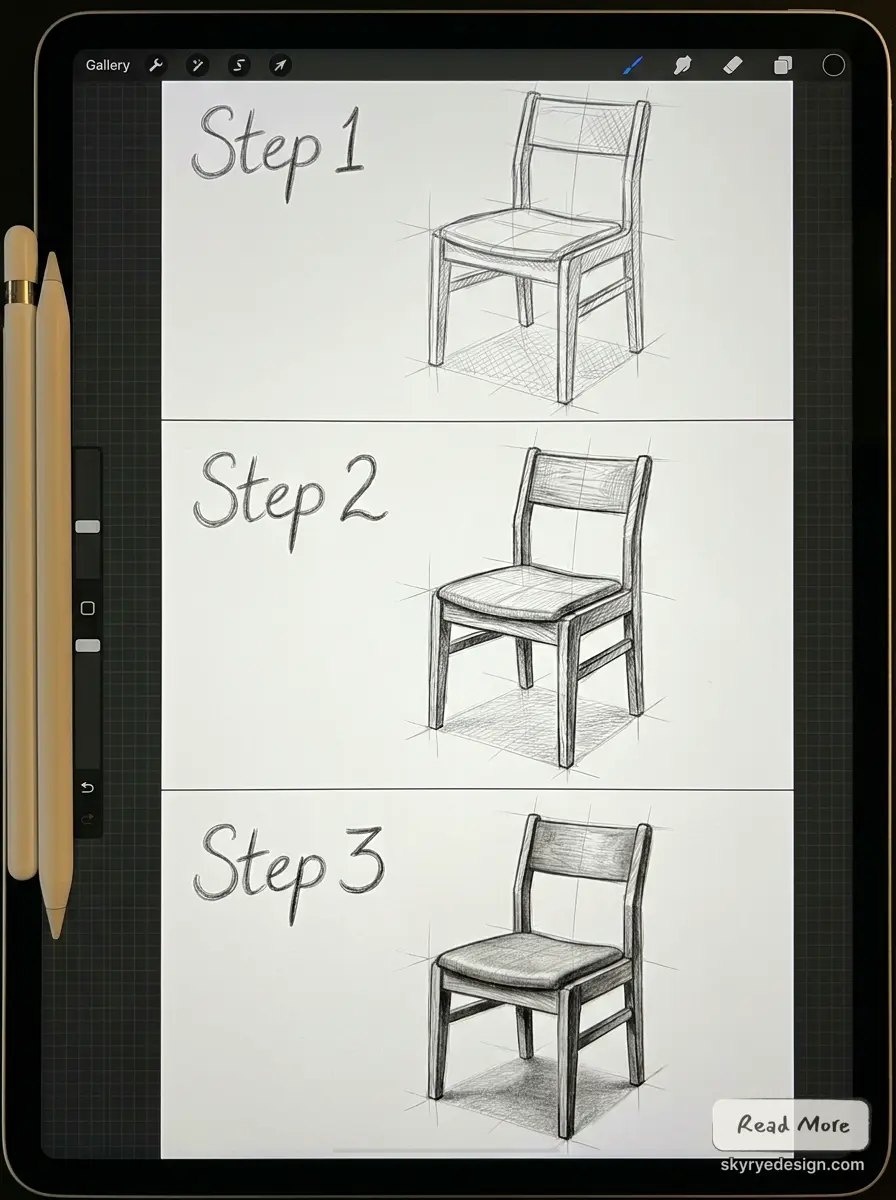
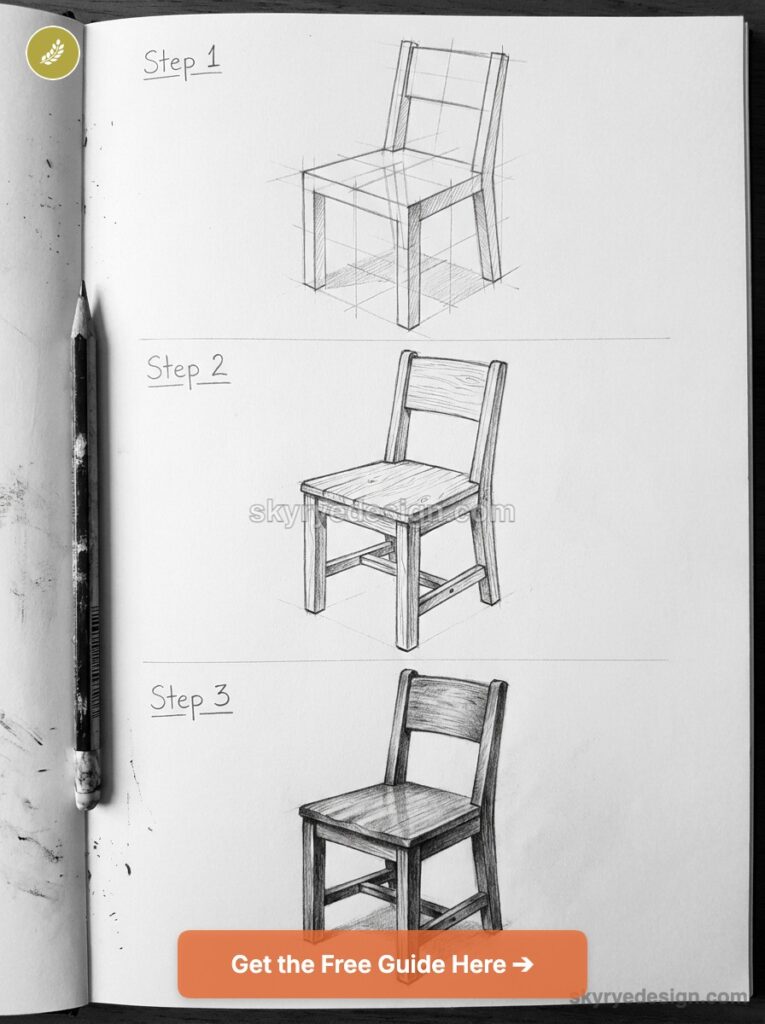
Draw a rectangular box in perspective. The proportions of the box should match the overall proportions of the chair: roughly as wide as it is deep for most Western chairs, with a height approximately equal to its width. The seat plane lives inside this box, roughly at the midpoint of the height. The back rises from the rear of the seat to the top face of the box. The legs drop from the seat corners to the ground.
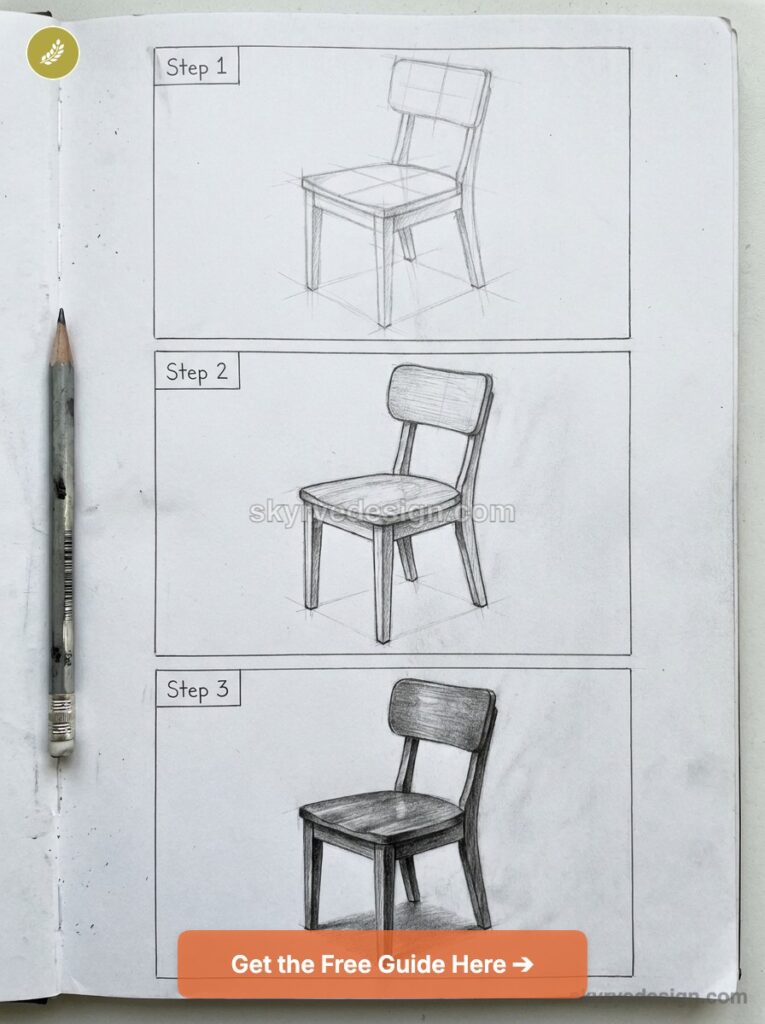
Setting the proportions before anything else
Standard chair seat height is around 45cm from the floor, which is roughly half the total height of a typical chair with a 90cm backrest. The seat depth is usually 40 to 45cm. The width varies more widely, from a 40cm side chair to a 65cm armchair. Knowing these numbers matters for drawing chairs convincingly, because proportional errors read immediately to anyone who has ever sat in a chair (which is everyone looking at your drawing).
For the initial box, I use a rough ratio of 1:1:1 for width, depth, and total height. That’s the starting point. Then I adjust: a dining chair pulls taller and narrower, a lounge chair gets wider and lower. Getting this overall box right before adding any detail is the single most time-saving decision in the whole process.
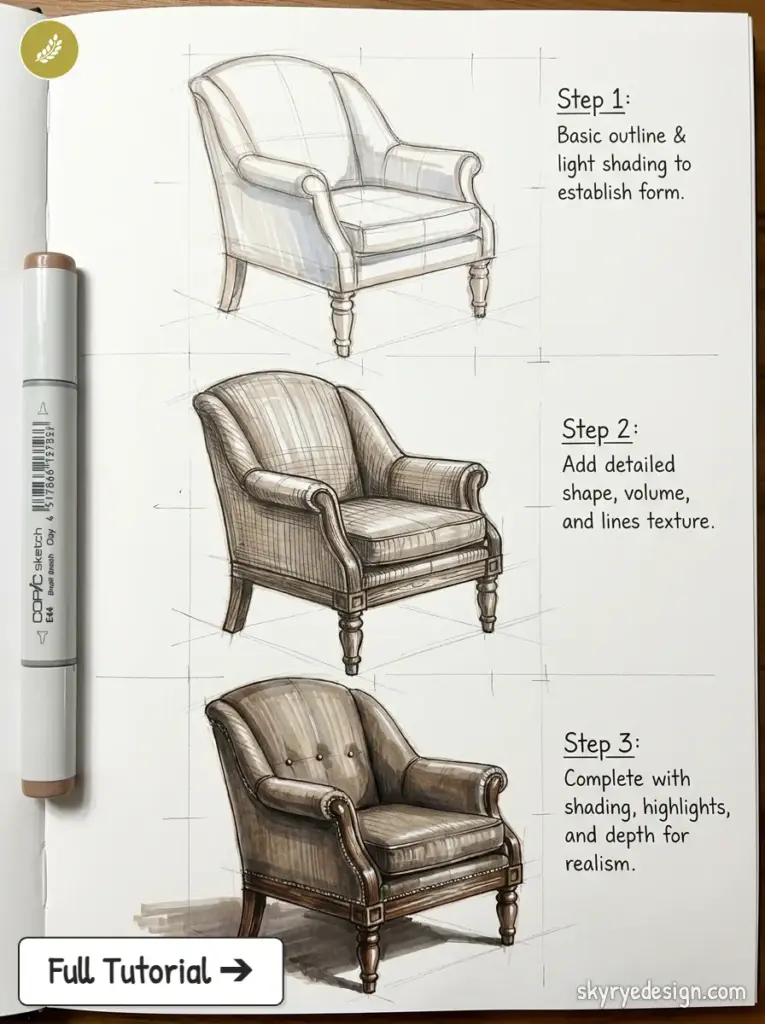
The construction lines you need to keep
Once the box is established, two internal lines matter most: the seat plane (a horizontal rectangle at mid-height) and the back plane (a rectangle rising from the rear edge of the seat). Every visible edge of the chair will lie on one of these planes or connect between them. The legs are the connections between the seat plane and the ground. They’re not added to the chair; they drop from it.
Keep all construction lines very light, HB at minimum pressure. You’ll erase them before the final stage, and a heavy construction line leaves a ghost mark that fights the final drawing.
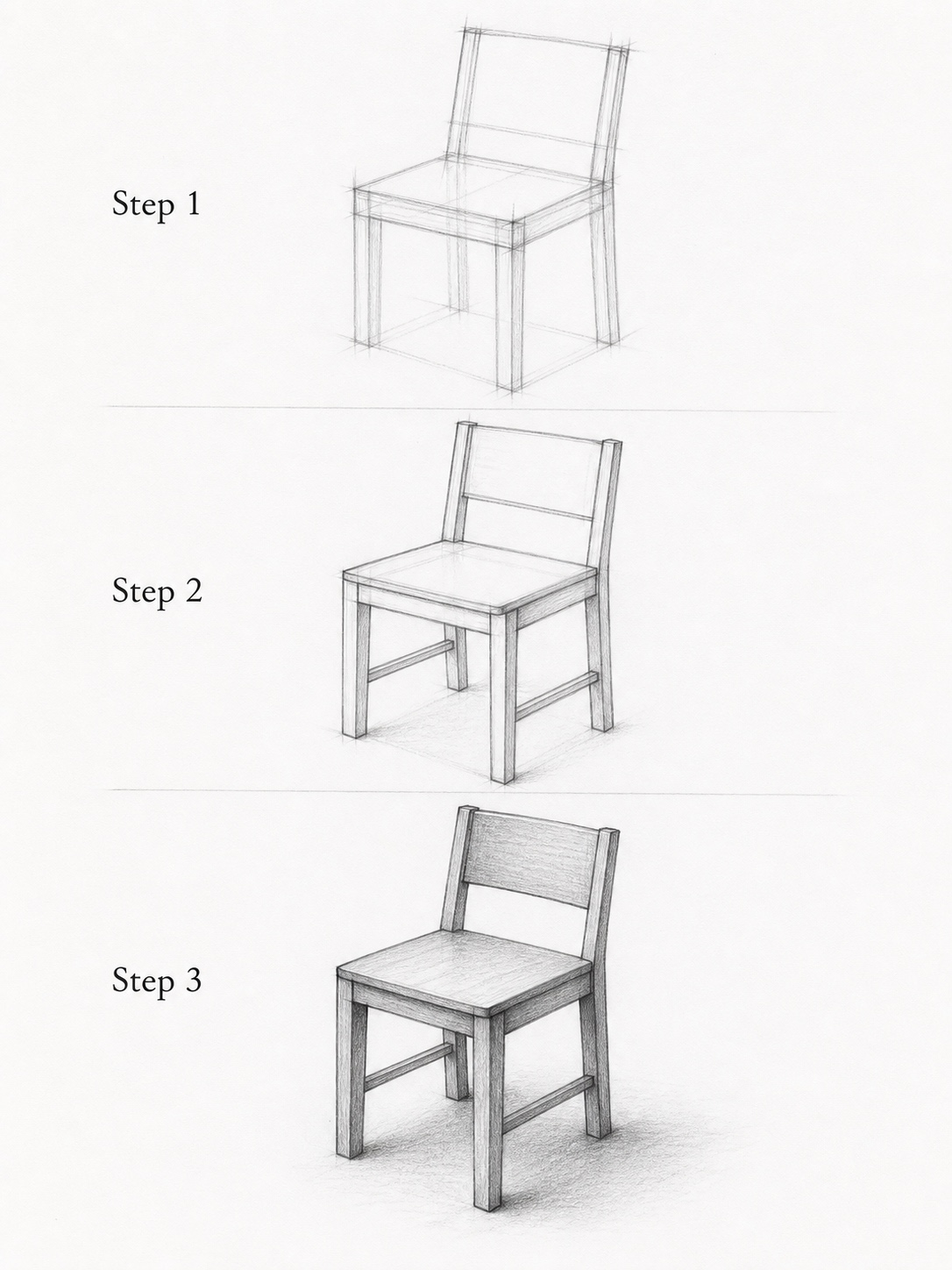
Drawing a basic chair in one-point perspective
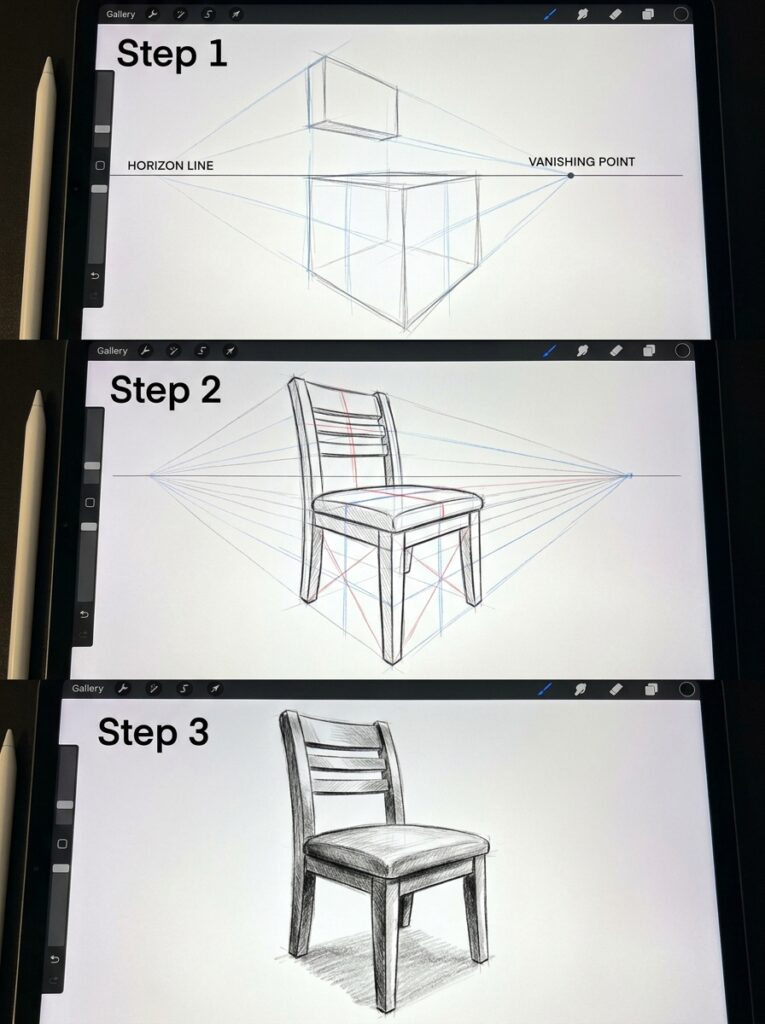
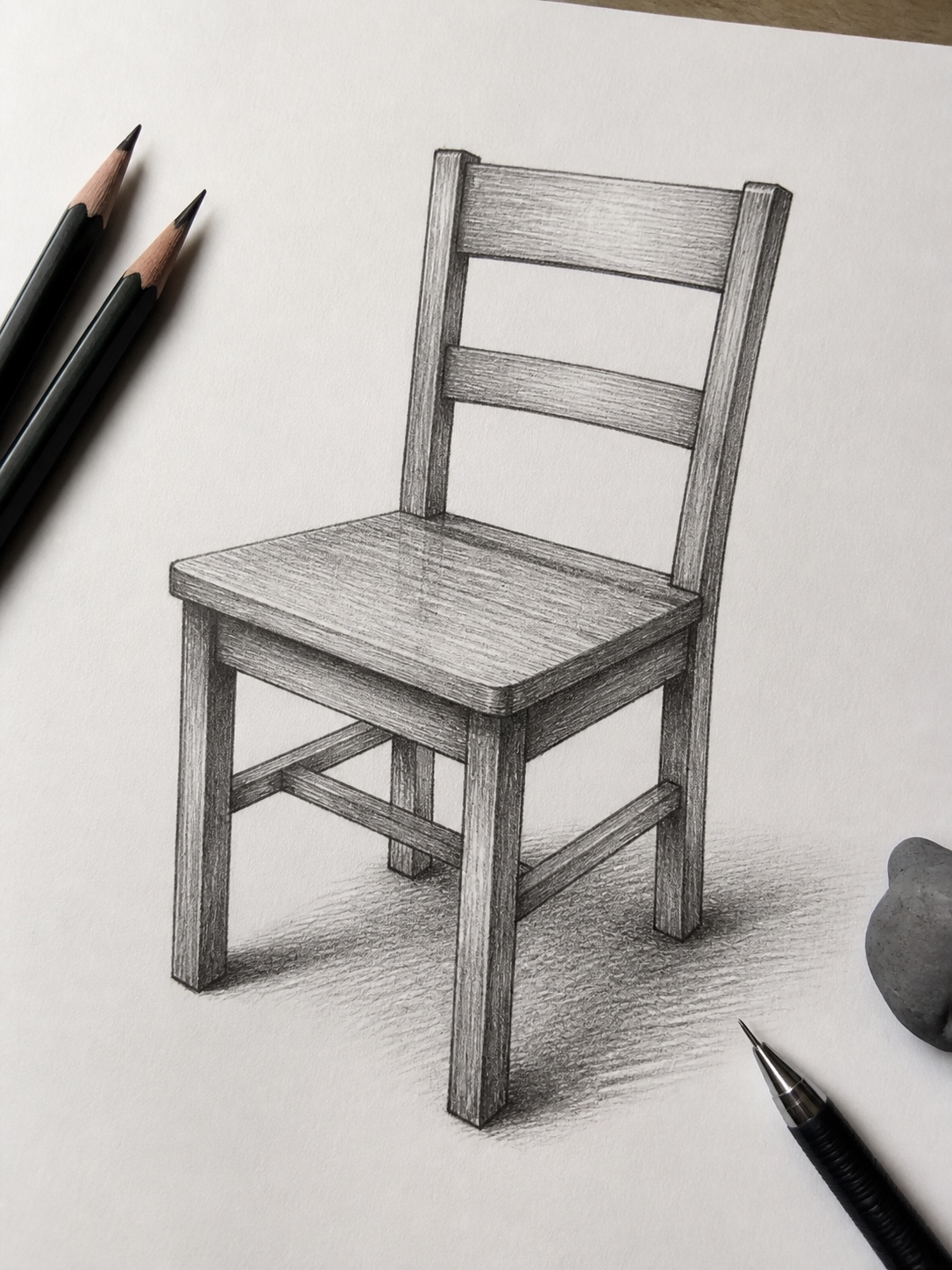
One-point perspective is the right starting point for chairs because it’s the most controlled way to handle depth. You’re seeing the chair from slightly above and slightly to one side, which is how most people actually look at furniture. The vanishing point is in front of the chair, on the horizon line.
Step 1: horizon line and vanishing point
Draw a horizontal line across the middle-upper third of your paper. This is the horizon line, which represents your eye level. Mark a single vanishing point on this line, roughly in the center or slightly to the left. The chair will sit below this line (you’re looking slightly down at it) and to the lower right.
The distance between your vanishing point and the edge of the paper determines how strong the perspective distortion is. A vanishing point close to the chair creates dramatic, slightly distorted perspective. A vanishing point placed further away (even off the paper) produces a more measured, architectural perspective. For a realistic-looking chair, place the vanishing point at least the width of the paper away from the chair’s nearest edge.
Step 2: front face and depth lines
Draw the front face of the seat as a rectangle facing you. These are the only lines in the drawing that stay truly horizontal and vertical. All depth lines, meaning every line that goes away from you into the picture, must converge at the vanishing point.
From each corner of the seat rectangle, draw a line toward the vanishing point. These four lines establish the depth of the seat. Close off the back edge of the seat at the appropriate depth. You now have the seat plane in perspective.
Step 3: legs, backrest, and details
The front two legs drop vertically from the front corners of the seat to the ground. They’re vertical lines, equal in length, parallel to each other. The back two legs also drop vertically, but because they sit further from the viewer, they appear shorter in the drawing. This is the most commonly missed detail in beginner chair drawings: all four legs are the same real-world length, but in perspective, the back legs read shorter.
The backrest rises from the rear edge of the seat. Draw it as a rectangle in the same perspective system as the seat. The uprights of the back go vertically. The top rail is a horizontal line connecting them. Add any crossbars, splats, or cushion thickening at this stage, after the main structure is established.
Perspective check: hold the drawing at arm’s length and look at the vanishing lines. Every depth line on the seat, the stretcher between legs, and the top of the back should all appear to converge toward the same point. If any line points toward a different location, the perspective is broken at that element. Fix it before adding detail or shading.
Drawing a Windsor chair: handling multiple turnings and angles
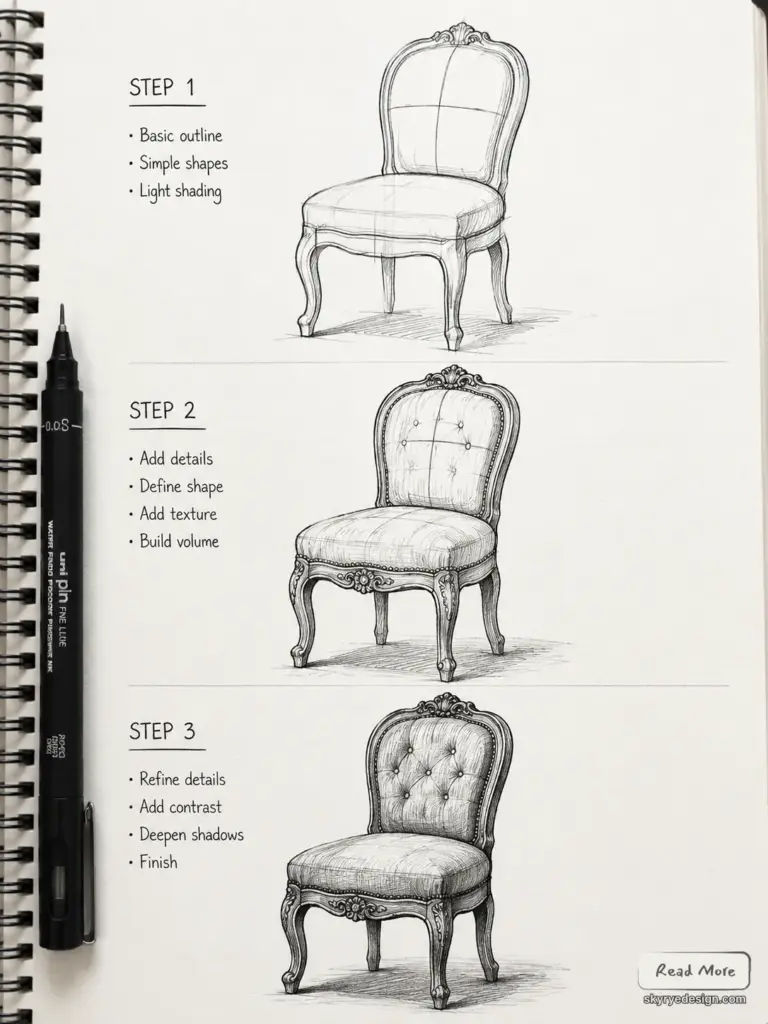
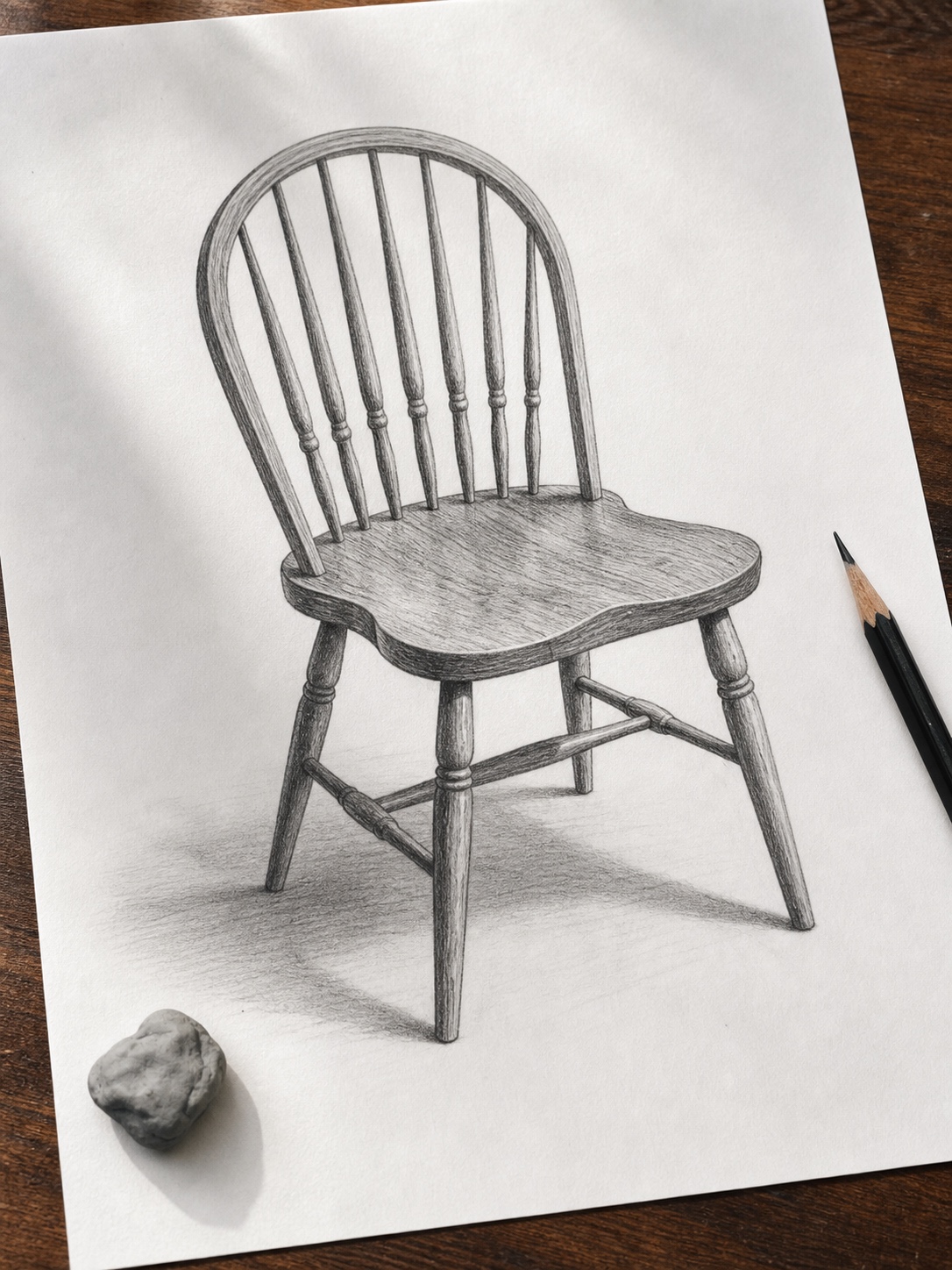
The Windsor is a harder draw than the simple side chair because nothing in it is quite rectangular. The seat is a saddle shape. The legs splay outward at an angle instead of dropping straight down. The back consists of multiple turned spindles rather than flat panels. Each of these elements requires a different approach.
The saddle seat
Draw the seat as a slightly elongated ellipse rather than a rectangle. Windsor seats are solid wood, shaped with a scoop in the center and a slight curve at the front edge. From the front, the seat reads as a relatively flat oval. From the side, the front edge dips slightly and the back edge rises. Start with a flat oval for the top surface, then add the thickness of the seat below it (about 5cm in the real object, which translates to roughly 5mm in a standard sketch size).
The sculpted hollow in the seat center is drawn as a subtle shadow, not a hard outline. Press slightly harder with the pencil in the central zone to suggest the concavity without drawing its edges explicitly. This is the difference between a chair that reads as carved wood and one that reads as flat.
Splayed legs in perspective
Windsor legs splay outward at roughly 15 to 20 degrees from vertical, which means they don’t follow the standard perspective rules for vertical lines. Each leg has its own splay direction, and the splay angle is visible from the front and from the side simultaneously.
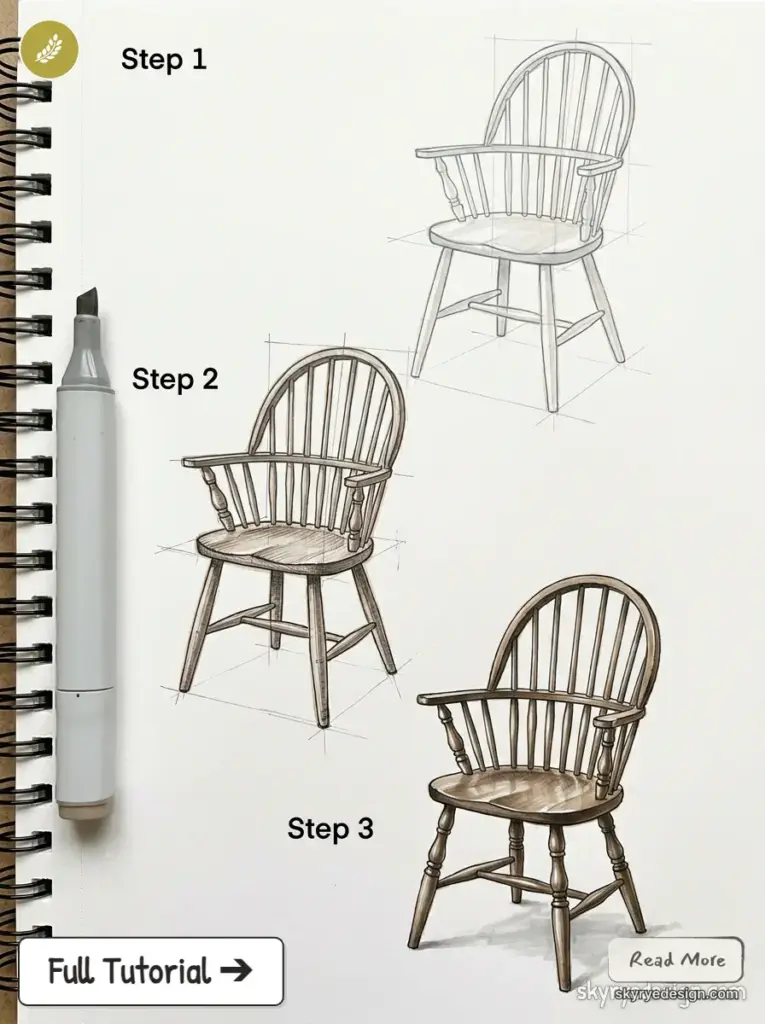
The practical approach: establish where each leg meets the floor first. The front legs land slightly wider than the front edge of the seat. The back legs land wider still. Connect the foot positions to the underside of the seat with straight lines. In perspective, these will not be vertical. They’ll angle outward and slightly toward the vanishing point at the same time. It looks complicated in description but becomes intuitive once you’ve done it twice.
Multiple spindles on the back
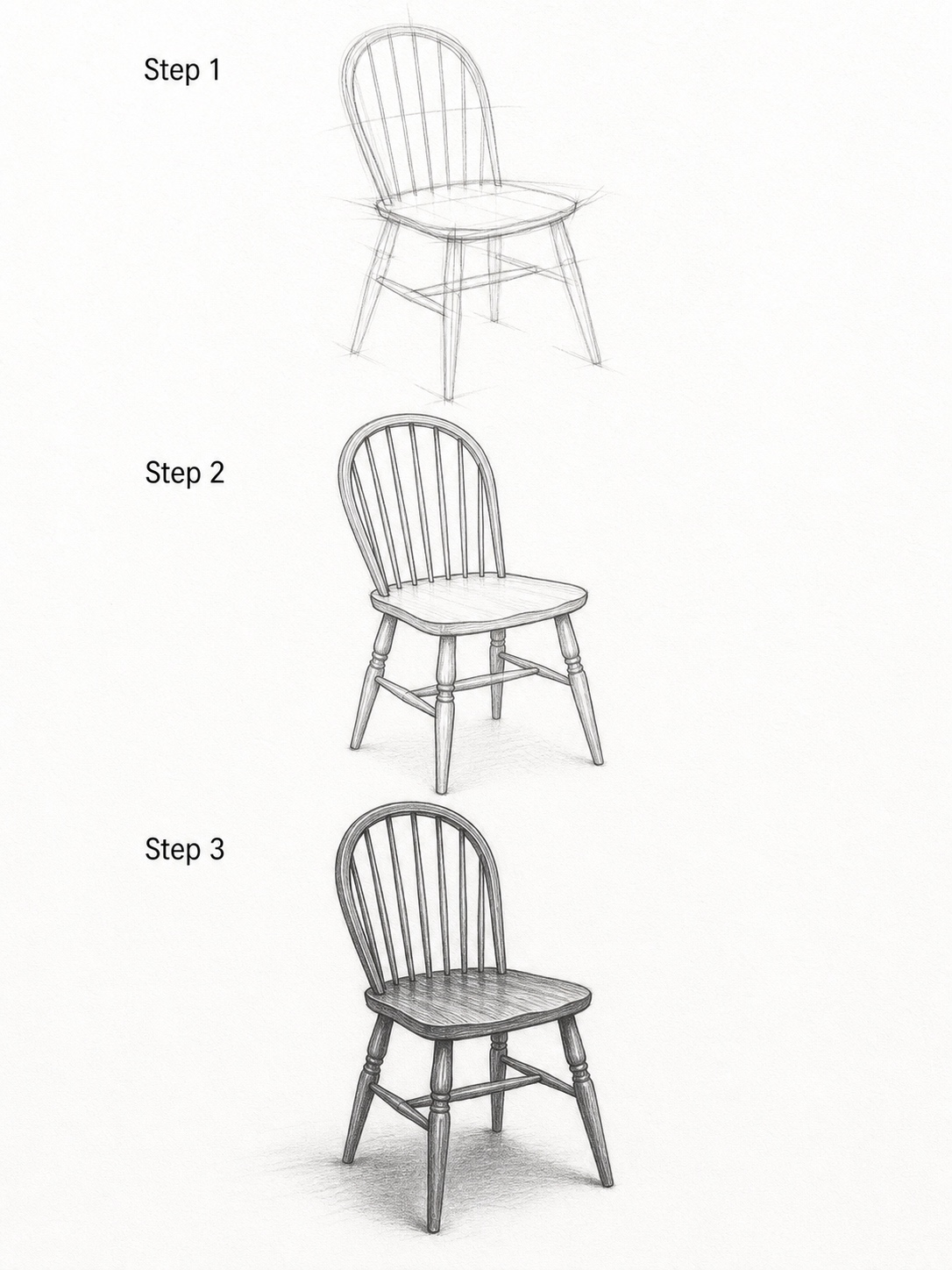
The Windsor back typically has seven to nine spindles plus two outer posts. Draw the outer posts first as the bounding structure. Then divide the space between them into equal segments for the spindles. In perspective, the segments appear progressively narrower as they go further from the viewer.
Each spindle is a thin cylinder. At normal drawing scale, a spindle is about 2mm wide at its thickest point. A thin vertical line works for most drawing distances. If you’re drawing larger (A3 or bigger), add a second parallel line 1mm away to suggest the cylinder’s roundness.
Drawing the Eames Lounge Chair: organic forms and curves
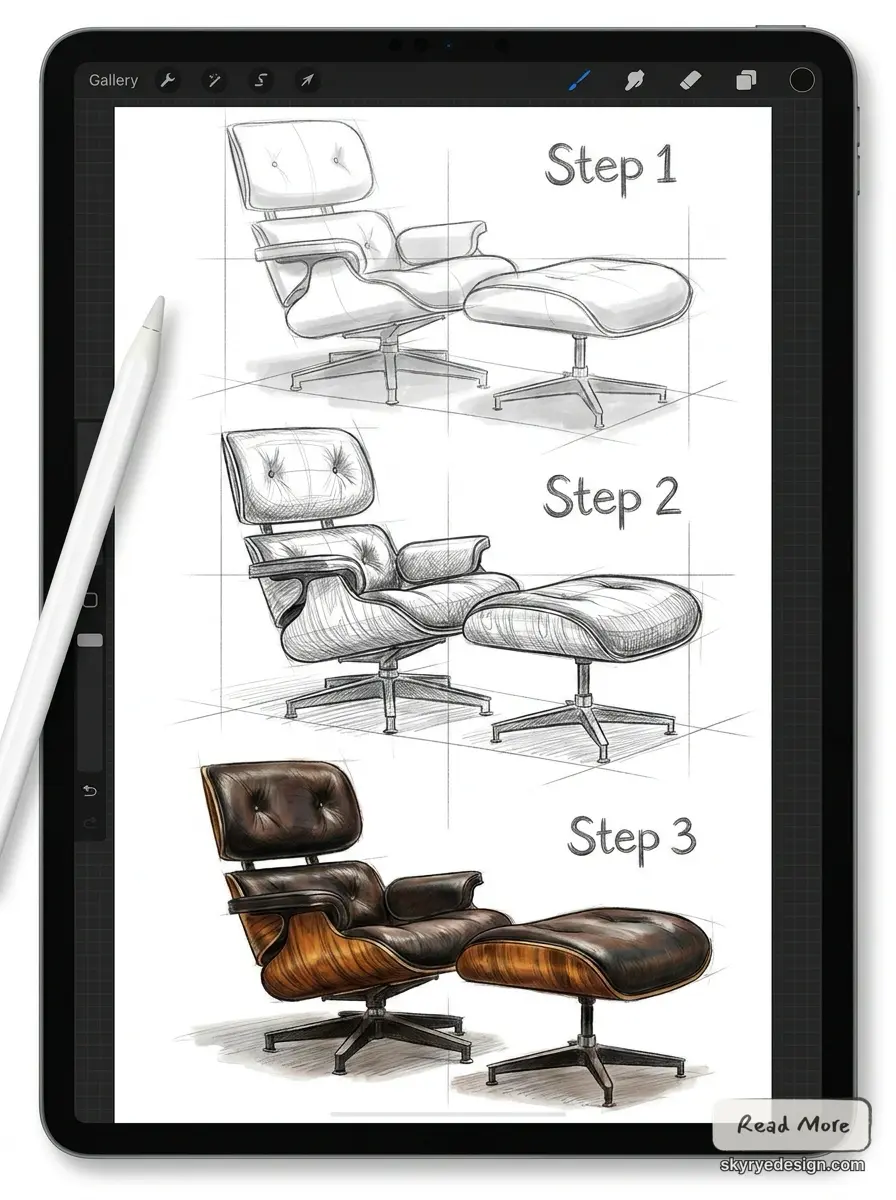
The Eames Lounge Chair (Herman Miller, designed 1956) is one of the most drawn and least well-drawn pieces of furniture in existence. The curve of the molded plywood shells, the angle between the seat and the ottoman, the proportions of the rosewood veneer against the black leather, all of these are specific and recognizable. Drawing it badly means drawing a generic lounge chair. Drawing it correctly requires understanding the geometry behind those curves.
The shell structure
There are five main shells: the seat cushion shell, the back cushion shell, the headrest shell, and the left and right armrests. Each shell is a curved plane with consistent thickness (about 18mm in the actual chair, represented as a thin border in the drawing). The curvature is not a single arc: the shells have compound curves that change radius from the center to the edges.
Start with the overall silhouette of each shell as a flat shape before adding thickness. The seat shell is roughly rectangular with rounded corners and a forward scoop at the front. The back shell is similar but slightly narrower and taller. Draw these shapes in perspective first, then add the thickness border around the visible edges.
The pedestal base and star legs
The Eames Lounge sits on a four-star aluminum base with a central column. The base reads as four curved feet extending outward from a central hub, each foot ending in a glide or caster. In perspective, two feet are fully visible and two are partially hidden by the seat above.
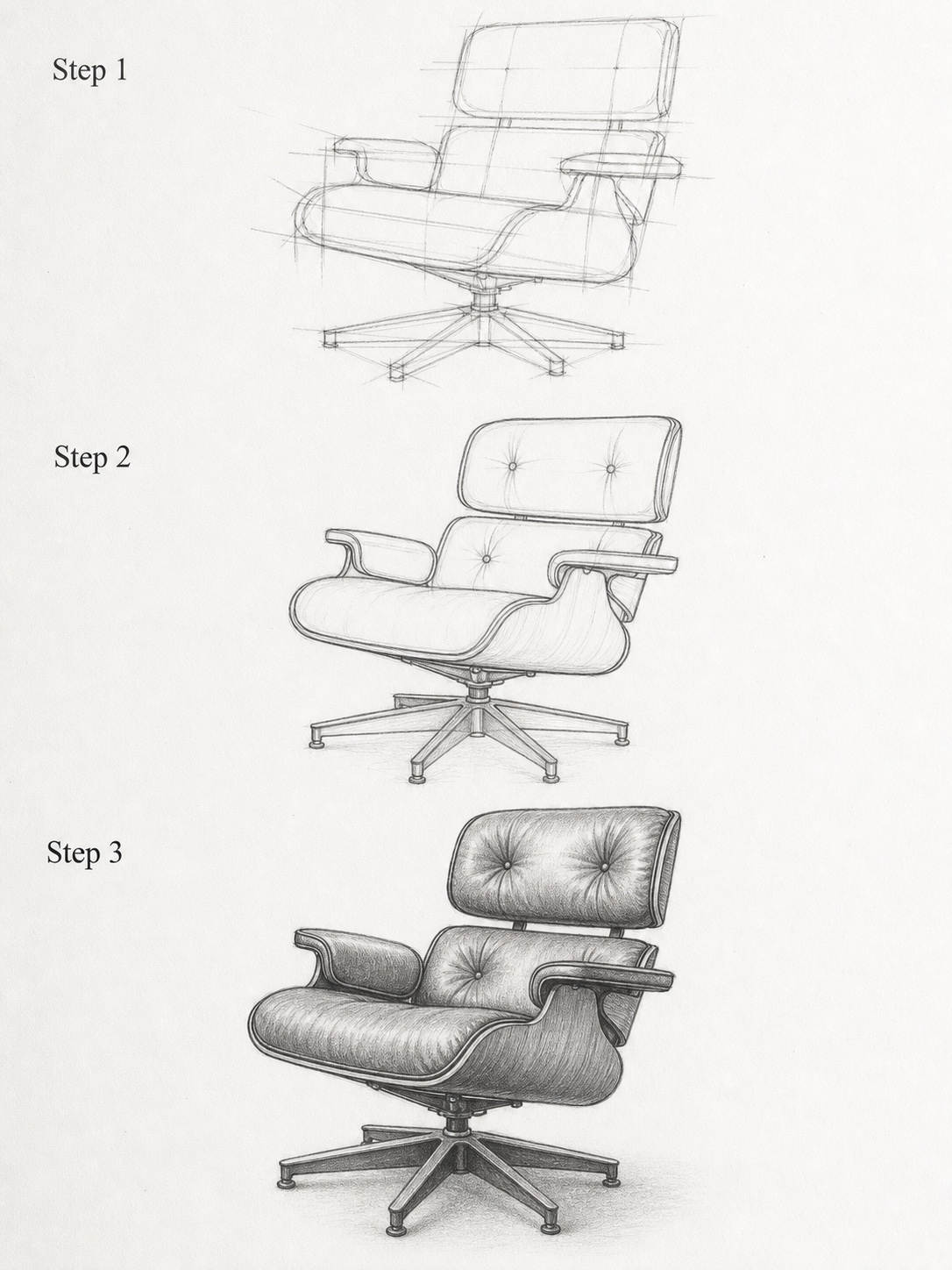
Draw the central column first as a tapered cylinder. Then add the four arms of the star radiating outward at equal angles. The arm that points toward the viewer reads shorter than the arms pointing left and right. The arm pointing away is largely hidden by the column. This foreshortening is important for the base to read as three-dimensional rather than flat.
Shading a chair drawing: light, planes, and materials
A chair drawing without shading reads as a diagram. Add shading and it becomes a drawing. The shading logic for chairs is the same as for any three-dimensional object: identify the light source, determine which planes face toward it (light) and away from it (dark), and apply tone accordingly.
Choosing and committing to a light source
Before touching the paper with shading, decide where the light comes from. Upper left is the conventional choice because it mirrors how most indoor spaces are lit and how most people read images. Once chosen, commit completely. Every shadow on every leg, the underside of the seat, the back face of the backrest, must be consistent with that single source.
The most common shading mistake is applying darkness to the bottom of every form without considering whether that bottom faces the light or not. In many chair compositions, the upper surface of a front leg faces slightly upward and toward the light, making it lighter than the vertical face of the same leg. Breaking the object into planes and asking ‘does this plane face the light?’ produces much more accurate shading than applying tone by instinct.
Hatching direction and surface character
Hatching strokes should follow the direction of the surface they’re describing. On a flat horizontal seat top, strokes go horizontal. On the vertical face of a leg, strokes go vertical. On a curved surface like a Windsor seat or the shell of an Eames chair, strokes follow the curvature of the surface. This directional consistency is what makes shading look like it’s describing a surface rather than randomly applied marks.
For wood surfaces, the grain direction gives you the hatching direction: along the grain on flat panels, wrapping around the form on turnings. For upholstered surfaces like the leather cushions of the Eames, strokes can be less directional and more layered to suggest softness and slight texture.
Cast shadows and contact shadows
The shadow a chair casts on the floor is an important part of the drawing that many beginners skip. A chair with no cast shadow looks like it’s floating. The cast shadow falls directly away from the light source, and its shape is a distorted echo of the chair’s footprint.
More important than the floor cast shadow is the contact shadow: the dark zone where the leg meets the floor. This small, concentrated shadow is what makes the leg appear to actually rest on the surface. Without it, the chair floats slightly, which reads as wrong at a subliminal level even when the viewer can’t identify what’s off.
Drawing chairs digitally: Procreate and Clip Studio Paint
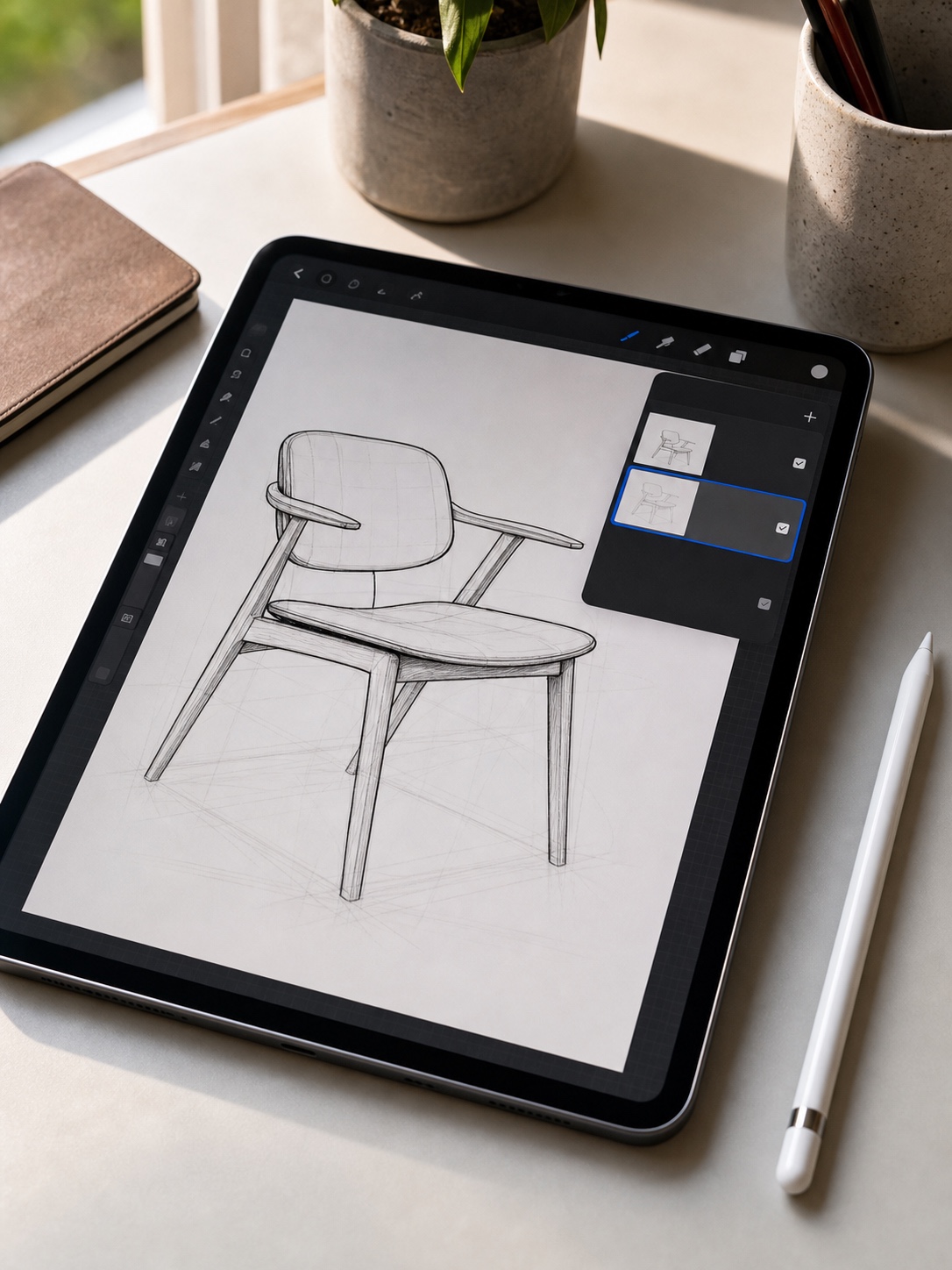
Digital tools change the chair drawing process in two useful ways: layer separation (sketch on one layer, clean lines on another, shading below that) and infinite undo. Neither of these eliminates the need to understand perspective and form, but they make the process less precious.
The workflow in Procreate for a chair is the same as in pencil but across layers. Sketch layer at 20 to 30% opacity to keep the construction lines faint, clean line art on a layer above it, shading on a separate layer set to Multiply below the line art. The Multiply blending mode means the shading darkens the color below it without covering the line art, which is exactly how ink over pencil works.
Brush selection for different chair materials
For wooden chairs with visible grain, the Rough Ink brush in Procreate or any textured brush with slight grain produces a better result than a perfectly smooth technical pen. The texture suggests wood without explicitly drawing every grain line. For upholstered surfaces, a soft airbrush blended in broad strokes reads as fabric more convincingly than hatched lines.
Clip Studio Paint has a Perspective Ruler tool that places actual vanishing points on the canvas and snaps any line you draw to them. For complex furniture drawings in perspective, this tool removes the main source of error (imprecisely drawn perspective lines) and lets you focus entirely on the proportions and details. It’s particularly useful for the Eames Lounge and other chairs with multiple overlapping planes at different angles.
Common mistakes and how to fix them
Every drawing mistake in chair drawing traces back to one of three errors: wrong perspective, wrong proportions, or wrong shading logic. Knowing them in advance is faster than discovering them in a finished drawing.
All four legs the same length in the drawing
In reality, all four legs are the same length. In a drawing, the back legs must appear shorter than the front legs because they’re further away. If your four legs look identical, the chair has no depth. Fix it by going back to the perspective construction: the back legs should end at the same depth line as the rear of the seat, and that depth line sits higher in the drawing than the front ground line.
The backrest tilts the wrong way
Most chair backs lean slightly backward (away from the front of the seat) at 95 to 100 degrees from the seat plane. Beginners often draw the back vertically straight or, more commonly, accidentally leaning forward. In the finished drawing this makes the chair look like it’s falling toward the viewer. Add a slight backward lean to the back plane and the chair immediately reads as stable.
Shading applied as darkness rather than plane description
This shows up as: the underside of everything is dark, the top of everything is light, and there’s a hard line between the two. Real shading describes planes gradually, with transitions between light and shadow (the half-tone zone). Use a blending stump to soften the transition between the lit and shaded areas on broad surfaces. Keep harder edges only at the silhouette and at the junctions between planes facing different directions.
Frequently asked questions
How do you draw a chair step by step?
Start by drawing a rectangular box in perspective to establish the overall volume. Add the seat plane inside the box at mid-height, then draw the four legs from its corners to the ground. Sketch the backrest as a separate rectangular form rising from the rear of the seat. Add any details last. Clean up construction lines and shade using a consistent light source. This box construction method works for almost every chair style.
What is the easiest chair to draw?
A simple side chair without arms and with a rectangular back is the easiest, because every element is a box or rectangle. The Shaker-style side chair, with its straight legs, flat seat, and upright ladder-back slats, reduces to five rectangles. Once you can draw that structure cleanly in perspective, adding curves for more complex chairs like the Tulip or Eames Lounge becomes significantly more manageable.
How do you draw a chair in perspective?
For one-point perspective, start with a horizon line and a single vanishing point. Draw the front face of the seat as a rectangle facing you directly. Extend lines from each corner of that rectangle back to the vanishing point to establish the seat depth. Add the legs dropping vertically from the seat corners and the backrest rising behind. All depth lines converge at the vanishing point; all height and width lines stay vertical and horizontal.
How do you shade a chair drawing?
Pick a single light source direction first, then determine which planes face it (lighter) and which face away (darker). Apply hatching strokes that follow the surface direction of each plane. Use a paper stump to blend broad areas. Leave a thin highlight strip along the top edge of the seat to make the form read as three-dimensional. Add contact shadows where the legs meet the floor.
What pencils should I use for a chair drawing?
HB for all construction lines and initial outlines, because it erases cleanly. 2B for the final visible edges. 4B or 6B for the deepest shadow areas under the seat and behind the legs. A 0.5mm mechanical pencil works well for fine structural details. Keep a kneaded eraser for lifting highlights and a standard eraser for removing construction lines before the final render.
How do you draw chair legs correctly?
In one-point perspective, the front two legs appear as vertical parallel lines. The back two legs are shorter in the drawing because they sit further from the viewer. Their top and bottom points connect toward the vanishing point. The common mistake is drawing all four legs at the same apparent length, which removes depth. In a three-quarter view, back legs always read shorter and closer together than front legs.
How do you draw a curved chair like the Eames Lounge?
Sketch the underlying structural volume as boxes first, then carve the curves from those boxes. For the Eames Lounge shell, draw the bounding rectangle of each shell, then find the curve by marking the midpoint of each edge and drawing through those points. The molded plywood panels have a specific curvature that tapers toward the edges. Add the consistent border around the visible edge of each shell last to suggest the 18mm panel thickness.
- 1.4Kshares
- Facebook0
- Pinterest1.4K
- Twitter0
- Reddit0