Picking a siding color starts exciting. You pull up inspiration boards, flip through paint decks, and feel like the answer is right there. Then the second-guessing starts. The color that looked confident on a small chip looks completely different when you try to imagine it across an entire facade. The shade that photographed beautifully on someone else’s house looks off against your roof. You start over. This is where most people get stuck.
I’ve worked on enough exterior design decisions to know that the problem is almost never about color taste. It’s about sequence. When people choose siding color before understanding their home’s architecture, its fixed materials, and how light behaves on that particular facade, they’re making a difficult decision harder. Reverse the order and most of the confusion disappears.
- Start with architecture: the decision that eliminates half the options
- The 60-30-10 rule: why proportion matters as much as color
- Fixed elements: the constraints that simplify every decision
- How light changes everything you thought you knew about your color
- Testing before you commit: the step most people skip
- Common siding color mistakes worth knowing before you decide
- Frequently Asked Questions
- What is the most popular siding color for homes?
- How do I choose a siding color that will not go out of style?
- What is the 60-30-10 rule for exterior colors?
- Does home orientation affect siding color choice?
- How do I match siding color to my roof?
- What siding colors make a house look bigger?
- Should I test siding colors before committing?
This guide works through that sequence. Architecture first, then fixed elements, then light, then testing. By the time you’re choosing between two finalists, you’ll have enough information to make a decision you’ll still like in fifteen years.
Start with architecture: the decision that eliminates half the options
Before you look at a single paint chip, look at your house. Not the landscaping, not the neighbors, not a mood board: the house itself. Its proportions, its materials, its roof pitch, its window arrangement. Architecture isn’t just a backdrop for color. It’s the constraint that makes choosing manageable.
Every architectural style developed within specific regional and material traditions. Those traditions produced color palettes that worked because they were matched to the scale, texture, and cultural context of the buildings. You don’t have to replicate them exactly, but ignoring them means fighting the building’s own logic, and that fight usually shows.
Colonial homes: symmetry needs restraint
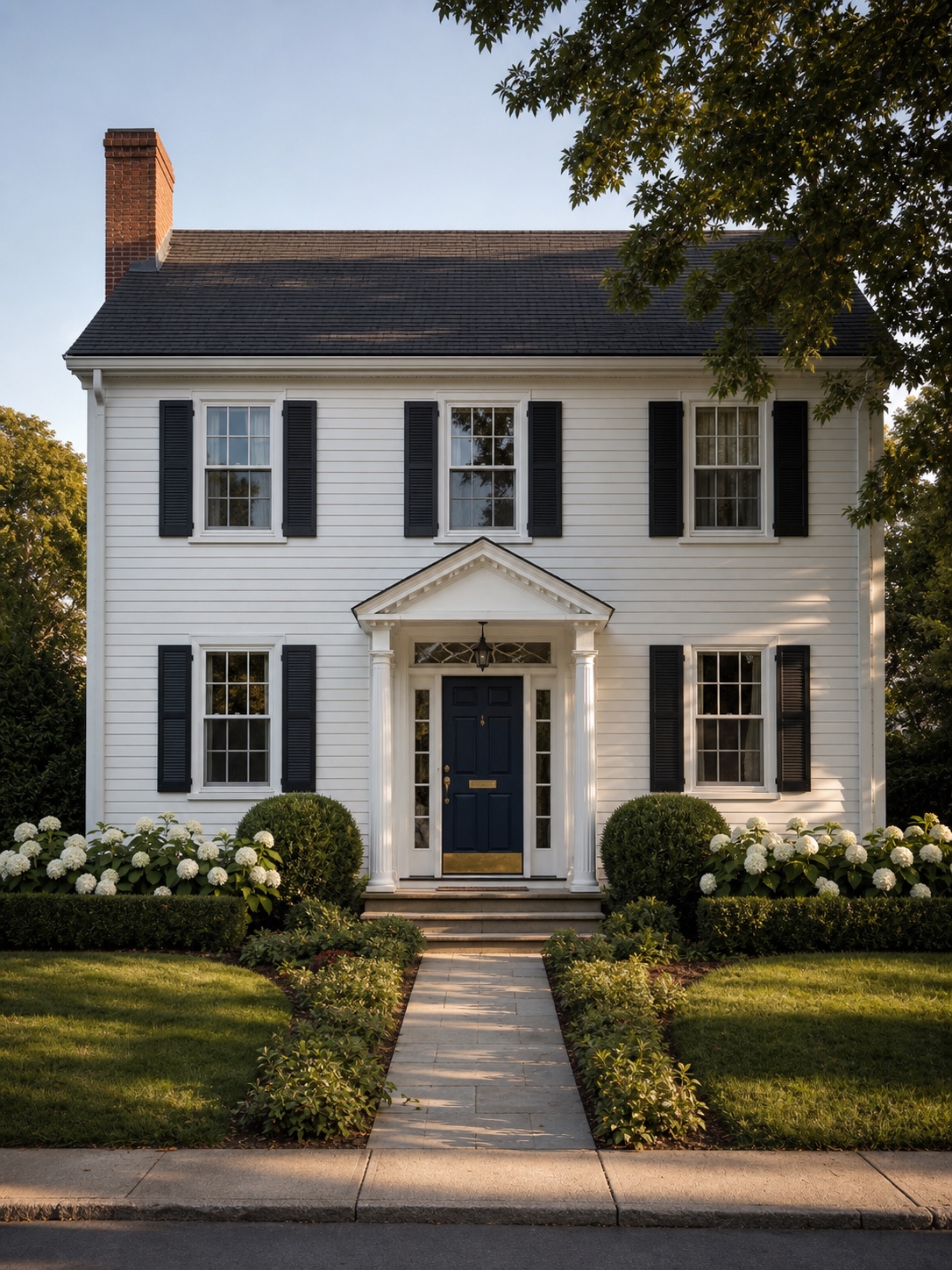
Colonial architecture is defined by symmetry, proportion, and tradition. Two-story facades with evenly spaced windows, formal entry doors, shutters at every window. The symmetry is the design. Color choices that compete with it or try to add drama end up looking nervous against all that formal calm.
Soft whites, creams, and light grays work because they let the proportions do the talking. Muted blues, sage greens, and pale yellows have long regional histories with Colonial styles, particularly in New England and the Mid-Atlantic. What doesn’t work: anything that draws the eye to one section of the facade rather than the whole. Colonial homes read best when everything feels balanced, and bold or saturated colors tip that balance.
Shutter color is where Colonial exteriors get their character. Navy, black, forest green, and deep red against a white or cream body is the classic formula. It works because the proportion is correct: shutters are the 10% accent, and high contrast at that scale is exactly right.
Ranch homes: horizontal lines need grounding
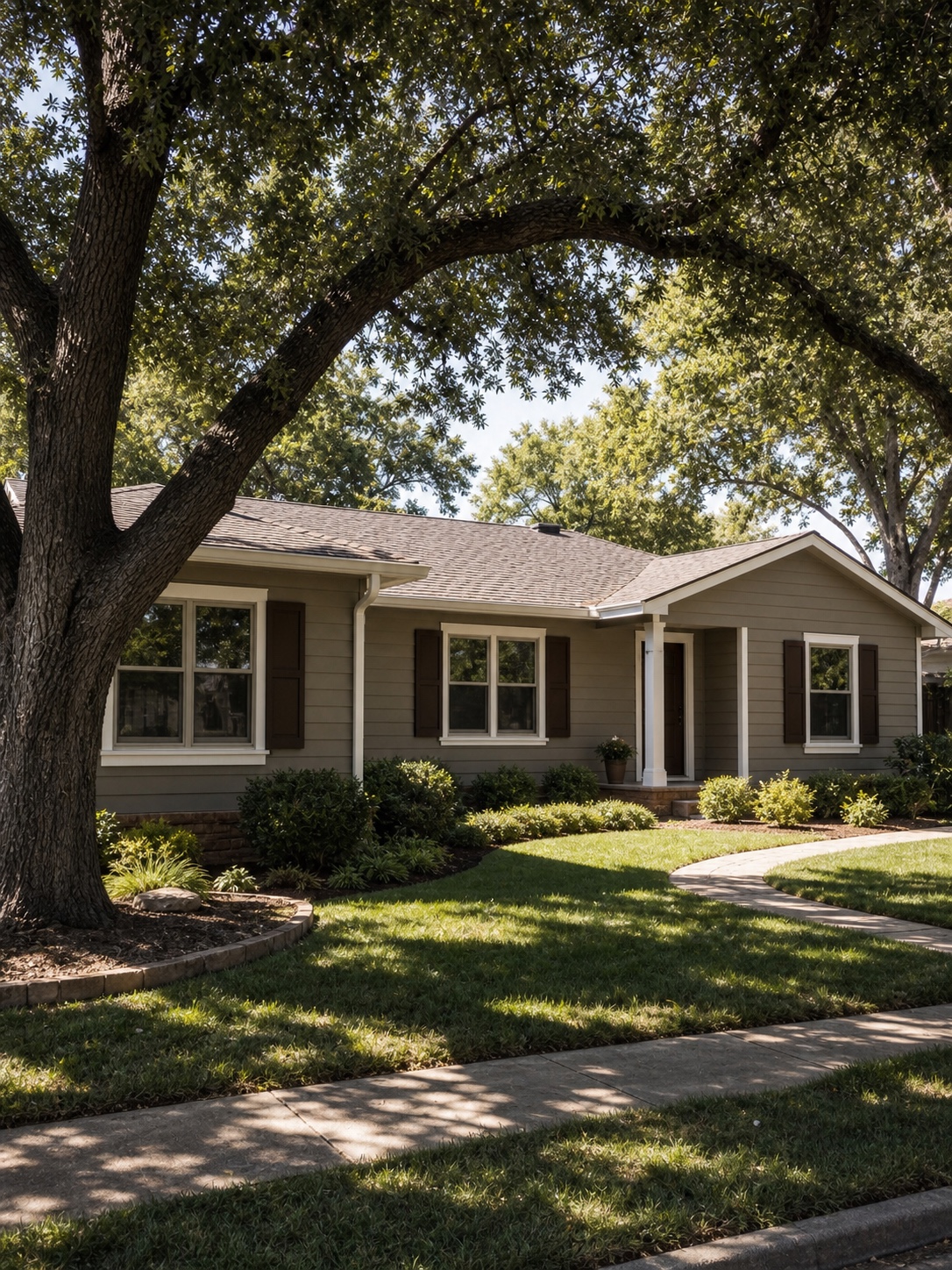
Ranch homes are low and wide. That horizontal emphasis is the defining design feature, and siding color either reinforces it or fights it. Colors with warm, earthy undertones, beiges, taupes, soft browns, warm greiges, tend to anchor ranch homes visually. They read as grounded, which is what the form wants.
Cool, high-contrast colors can work on ranch homes but they require careful management. A cool gray or blue-green body with crisp white trim can look sharp on a well-maintained ranch with mature trees providing visual relief. Without that relief, the same palette can feel exposed and flat.
The practical test: stand across the street and look at the roof-to-wall-to-ground transition. Ranch homes work best when that transition feels graduated rather than abrupt. Siding that shares undertones with the roof and the surrounding landscape creates that graduation naturally.
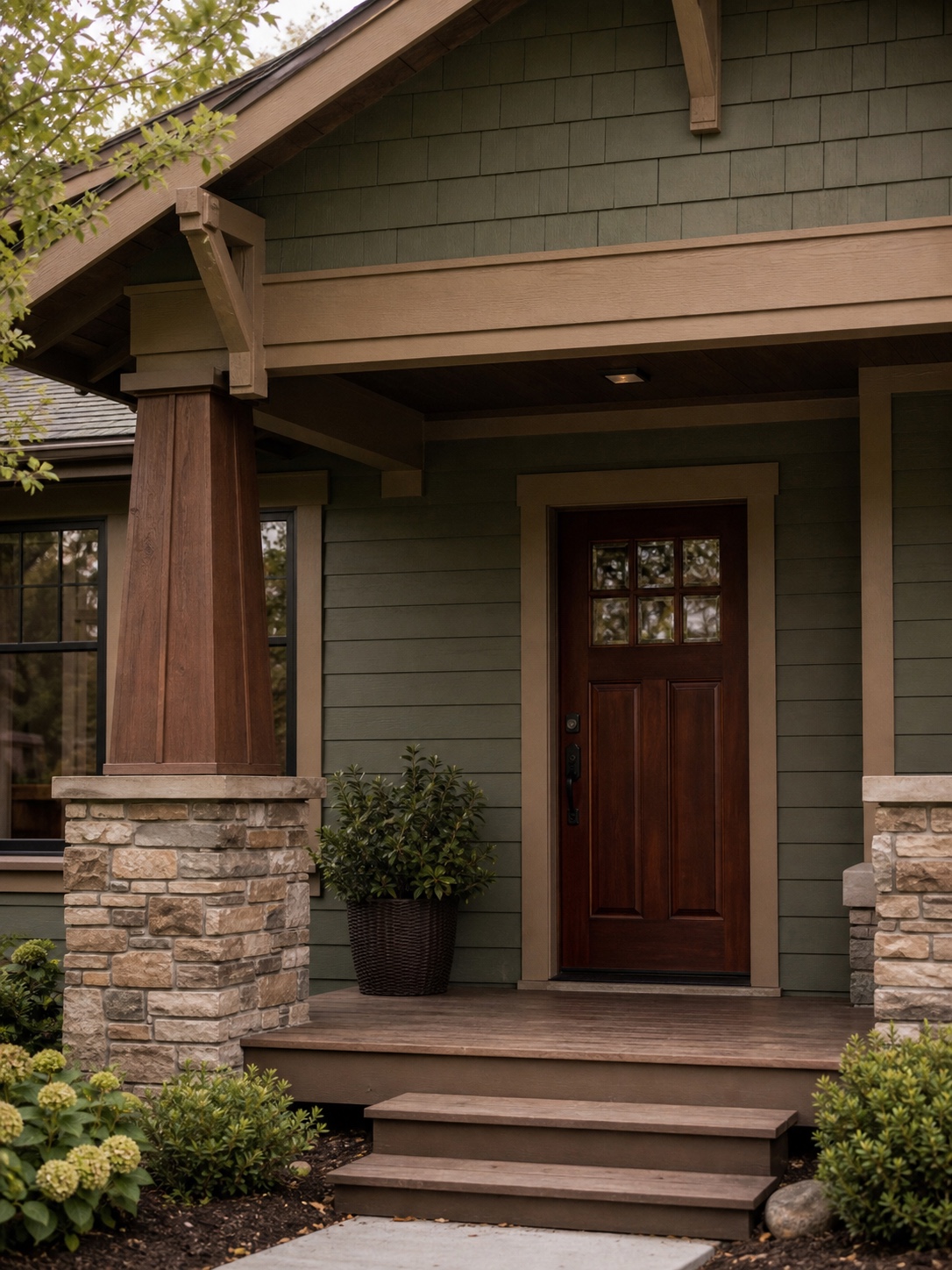
Craftsman homes: texture deserves color depth
Craftsman architecture celebrates material: wood trim, stone porch columns, exposed rafter tails, tapered posts. The visual richness is already there. Siding color should add depth rather than compete.
Olive, moss, and forest greens with brown or gray undertones are the Craftsman palette for good reason: they read as natural against wood and stone without disappearing into the landscaping. Deep warm grays, muted earth reds, and smoky blues also work well. What reads poorly is anything too clean or corporate: bright whites and cool grays strip the warmth that Craftsman architecture is built on.
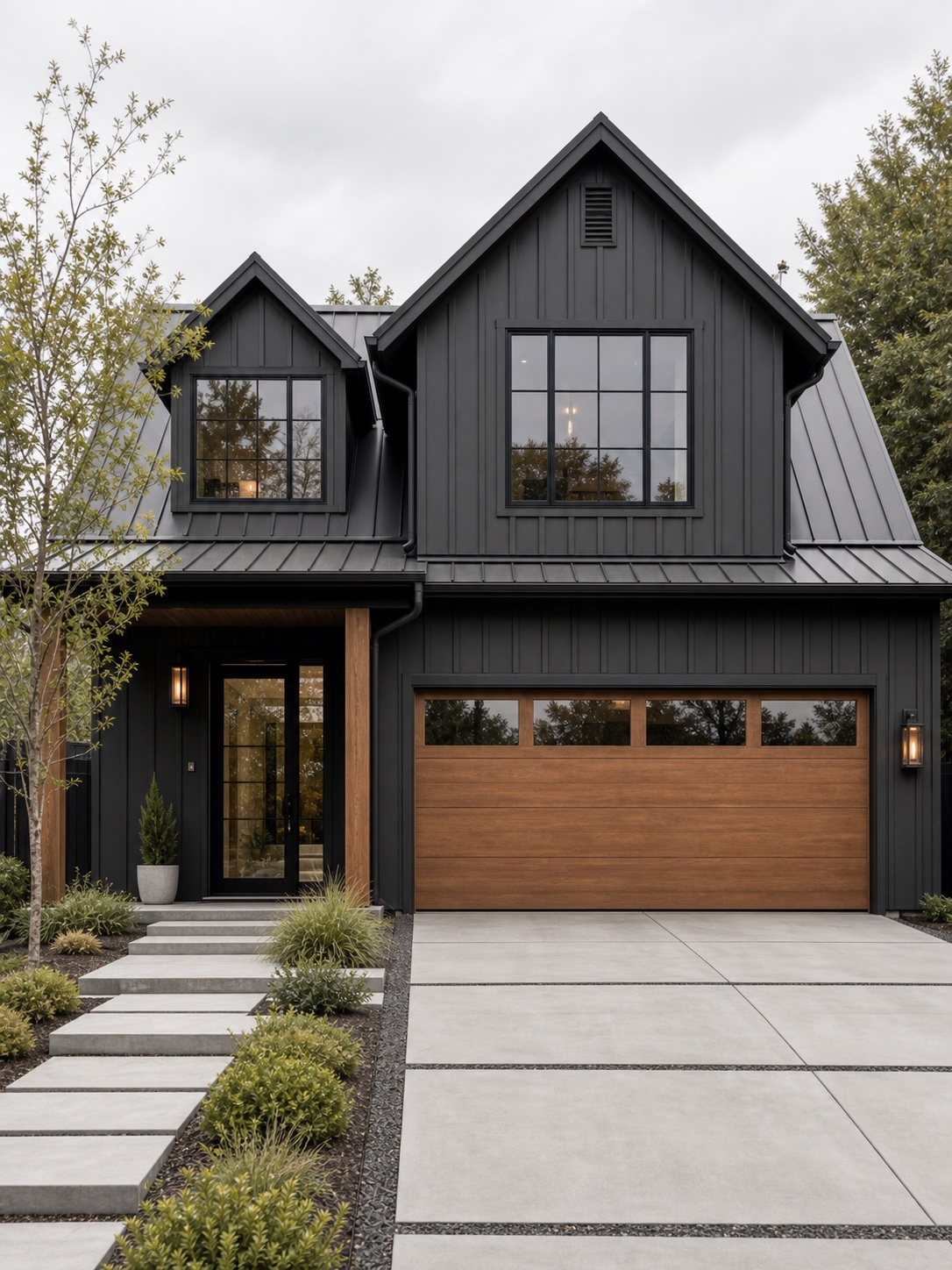
Modern and contemporary homes: fewer colors, harder decisions
Modern homes use color as a design statement rather than a finishing element. The palette is deliberately minimal: charcoal, matte black, warm white, sometimes a single deep accent. This restraint is the point. Contemporary design creates impact through proportion and contrast rather than decoration.
The mistake on modern homes is introducing too many colors in an attempt to add warmth. A warm wood element on a garage door or entry feature handles warmth better than a third siding color. Monochromatic palettes with texture variation, a smooth panel alongside a board-and-batten section, create the visual interest that color would otherwise need to provide.
The 60-30-10 rule: why proportion matters as much as color
Color theory gives you palettes. The 60-30-10 rule gives you proportions, and proportions matter as much as color choice when you’re working at the scale of an entire house exterior.
The framework is simple: 60% of the exterior is your main siding color, the dominant field that reads at a distance. 30% is secondary: trim, a contrasting siding section on a gable, window frames if they’re a distinct color. 10% is accent: front door, shutters, railings, the elements that draw the eye and create focal points.
Why most exterior color problems are proportion problems
I’ve looked at enough exterior renovation projects to notice a pattern in the ones that feel wrong. Almost always, the issue is proportion rather than color selection. An accent color that would work beautifully on a front door starts to feel overwhelming when it’s used on shutters, trim, and door simultaneously. A secondary color that should provide contrast at 30% becomes the dominant read when it’s applied to too much surface area.
The 10% limit on accent colors is the most commonly violated. People fall in love with a bold door color and start extending it to adjacent elements. Within a few additions, the accent becomes a competing primary, and the coherence breaks down. Restraint at the accent level is what makes the accent work.
Design test: Take a photo of your home and print it in black and white. The three tonal zones should be clearly readable. If the values blur into one another or if one zone dominates unexpectedly, the proportion is off regardless of which colors you choose.
Fixed elements: the constraints that simplify every decision
Your roof is the largest colored surface on most homes and you are almost certainly not replacing it. Your brick or stone foundation isn’t changing. The window frames are staying. These fixed elements aren’t limitations: they’re anchors. They tell you exactly which color temperatures are already committed to your exterior, and they narrow the siding color field dramatically.
Reading your roof first
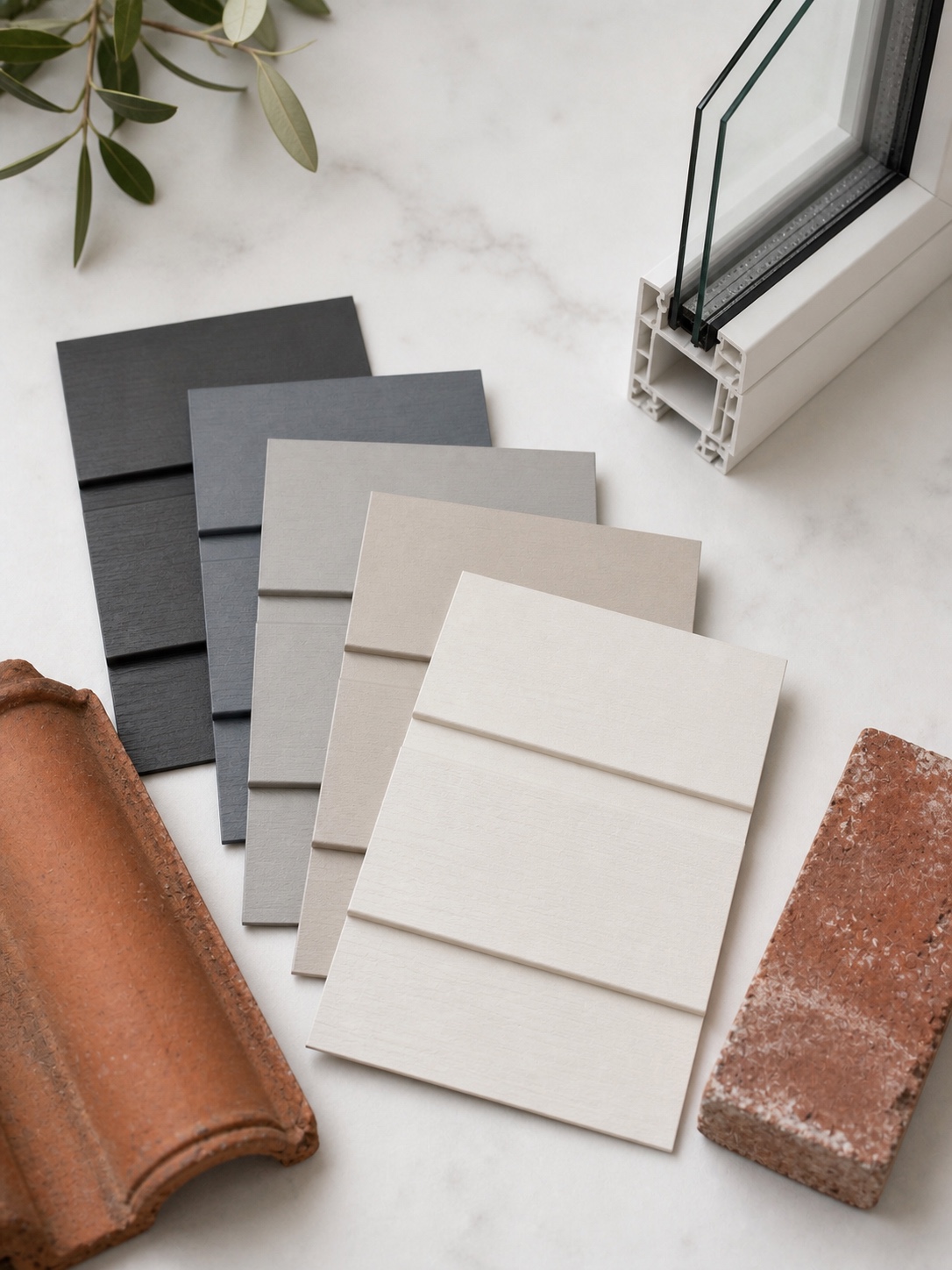
Roof color sets the palette temperature for everything below it. Warm roofs, those with brown, tan, terracotta, or weathered bronze tones, want warm siding to match. Beiges, taupes, sage greens, and warm grays sit comfortably under warm roofs because they share the same underlying temperature.
Cool roofs, charcoal shingles, blue-black slate, or silver-toned metal, open the palette toward cool grays, blue-greens, crisp whites, and slate blues. Putting warm-toned siding under a cool roof creates a visual tension that most people can sense but can’t identify. It just looks slightly off, and no amount of accent color fixes it.
Masonry: pull the undertones, not the surface color
Brick and stone have undertones that may not be obvious until you’re choosing a siding color to sit next to them. Red brick often has pink or orange undertones. Tan limestone reads warmer than it appears. Bluestone has cool gray-blue undertones that conflict with warm siding tones.
The approach that works: match undertones rather than surface color. If your brick has warm orange undertones, warm-toned siding shares that register without competing. A neutral siding in a similar temperature family makes the masonry feel intentional rather than accidental. The mistake is choosing a siding color that contrasts with the masonry’s undertone: it makes permanent exterior materials look like they were installed separately rather than together.
Windows, gutters, and fixtures as the frame
Window frames, gutters, and exterior fixtures repeat across the entire facade. They’re a visual rhythm. If those elements are white aluminum, a high-contrast trim color may not be available to you without a significant additional project. If the gutters are bronze, that warm metallic tone is part of the palette whether you planned it or not.
Look at these elements not as problems but as information. Bronze gutters and fixtures tell you that warm siding tones will read harmoniously. White vinyl window frames tell you that white or near-white trim is already committed. Working with this information produces a more coherent result than designing as if the fixed elements weren’t there.
How light changes everything you thought you knew about your color
Color is light. The way a siding color reads depends entirely on the quality, direction, and quantity of light hitting it at any given time. This isn’t a small variable. It’s the difference between a color that looks collected and deliberate and the same color that looks dull, washed out, or wrong.
Orientation: north, south, east, west
South-facing facades in the northern hemisphere receive intense, warm light for most of the day. Colors on south walls appear lighter and brighter than the same color on a shaded surface. A medium gray on a south wall can look almost white at midday. The same gray on a north wall, which receives cool reflected light rather than direct sun, reads noticeably darker and cooler.
East-facing walls receive warm morning light and cool afternoon shade. West-facing walls do the opposite. If your most visible facade faces north, choose colors a shade deeper than you think you need, because the shadow will pull them back. If it faces south, colors will read lighter than the chip, so you have more latitude with deeper or richer tones.
Landscaping and surroundings as color partners
Dense greenery, particularly mature trees in full leaf, adds cool, shifting light to everything nearby. Warm neutrals and earthy tones sit comfortably against this backdrop. Homes surrounded by green landscaping can handle slightly warmer, richer siding tones without reading heavy because the foliage provides visual relief.
Open sites with minimal landscaping expose the full facade and create harder contrasts with the sky. In these conditions, high-contrast palettes can feel stark rather than bold. A siding color that photographs dramatically at an open site may read better toned slightly toward neutral than your original sample suggested.
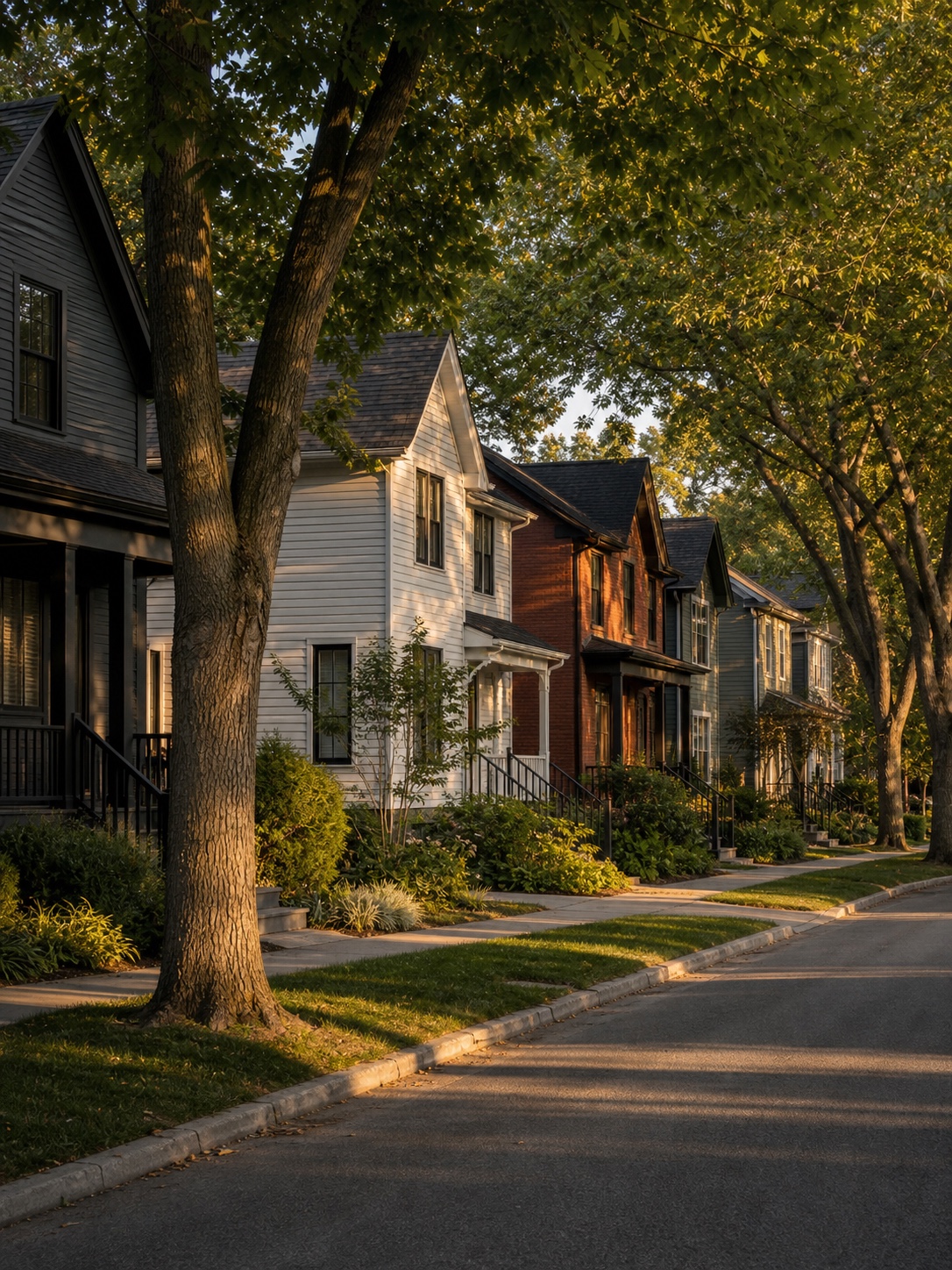
Neighborhood context is also real. Your home exists in a visual sequence with the buildings around it. This doesn’t mean matching your neighbors, but it does mean reading the general palette of the street. A single deep charcoal house on a street of warm neutrals reads differently than the same house on a street of contemporary designs. Neither is wrong, but the contrast affects how the color reads.
Testing before you commit: the step most people skip
Every conversation I’ve had with homeowners who regret their siding choice has the same element missing: they didn’t test the color at scale, on the actual building, across actual light conditions. Paint chips and digital swatches are useful for eliminating options. They are not useful for making a final decision.
At residential scale, color behaves differently than it does on a 3-by-5-inch sample. Texture affects how color reads: rough fiber cement absorbs light differently than smooth vinyl. Adjacent materials shift perception: the same gray next to red brick reads cooler than the same gray next to beige limestone.
The large sample board method
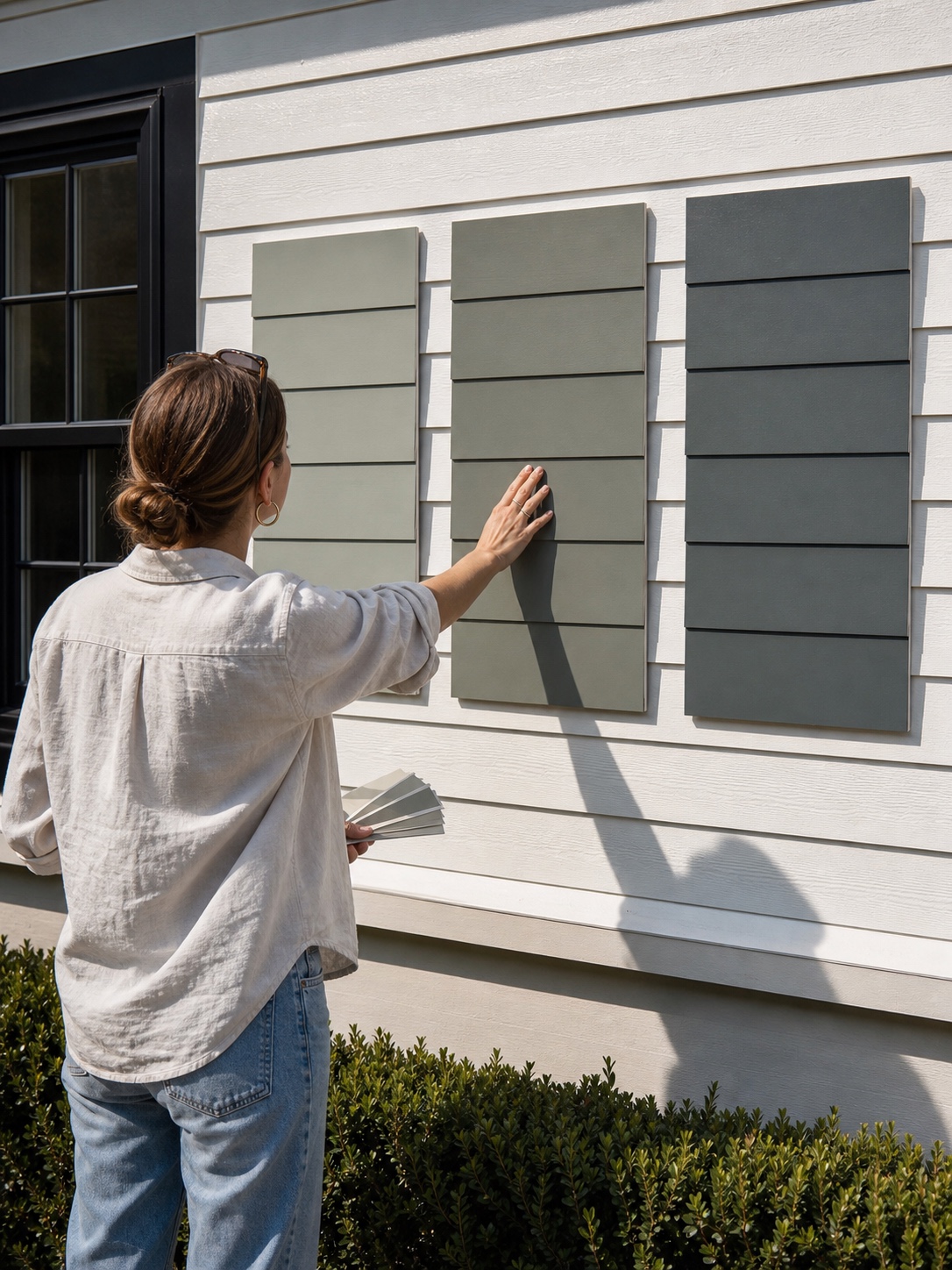
The standard professional recommendation is to paint large sample boards, at minimum 12 by 24 inches, ideally larger, in your two or three finalist colors and mount them directly on the exterior wall. Not inside. Not propped against the house. Mounted, where they receive the same light and shadow as the actual siding.
Observe them across at least a full day: morning light, midday sun, afternoon shade, and golden hour. Check them under overcast conditions, which is often when color reads most accurately because it removes the drama of direct sunlight. If your climate allows, observe them in different weather. Wet siding reads 15-20% darker than dry siding, which matters if you’re in a rainy climate.
Working with professionals who can show you the real thing
The limitation of sample boards is that they’re still an approximation. The most useful reference is a completed installation in the same color you’re considering. Pence Bros helps Ohio homeowners through this process using a portfolio of real completed projects alongside physical siding samples. Seeing a color applied across an entire home, in similar architectural context and lighting conditions, resolves uncertainties that no sample board can. Professional contractors who specialize in exterior work can also provide digital renderings on photos of your actual home, which closes most of the remaining gap between what you imagine and what you get.
Ask your contractor for three to five completed jobs in any color you’re seriously considering, within similar architectural styles. Visit at least one in person, at different times of day if possible. This single step eliminates more regret than any other part of the selection process.
Common siding color mistakes worth knowing before you decide
Most siding color regrets trace back to a small set of avoidable decisions. Knowing them in advance is faster than learning them from experience.
Choosing the trend over the building
Every few years, a color family dominates exterior design coverage: the greige wave of the 2010s, the navy surge, the current run of charcoals and moody dark greens. Following those trends isn’t inherently wrong, but choosing a color because it’s everywhere right now rather than because it works with your specific home and its fixed elements is how you end up with a dated exterior in eight years.
Trend colors can absolutely work on the right homes. The question to ask is: would this color have looked right on this house in 2005? Will it look right in 2035? If the answer is uncertain, the color is probably trend-dependent rather than architecturally appropriate. Neutral foundations that accommodate changing accent elements over time handle trends better than full-facade commitments to a trending color.
Ignoring undertones until it is too late
Two colors that look nearly identical on separate chips can clash badly once they’re on the same exterior. The reason is almost always undertones. A warm beige and a cool greige can read as similar neutrals in isolation. Next to each other, against your specific roof and masonry, one reads as fitting and the other reads as off.
The test is simple and worth doing: hold your finalist siding color chip directly against your roof tile, brick, or stone and look at them together in natural daylight. The undertone relationship becomes obvious immediately. If they sit comfortably together, the temperature match is right. If one of them suddenly looks dirty, yellow, pink, or gray in a way it didn’t alone, the undertones are conflicting.
Overworking the accent
Accent colors are most effective at 10% of the exterior surface. The moment they exceed that proportion, they stop reading as accents and start reading as a second primary color competing with the main siding. A front door in a saturated blue is a precise, controlled use of that color. The same blue on the door, shutters, trim, and window boxes is four competing focal points.
When a color is working at 10%, the temptation is to extend it because it looks good. Resist this. The reason it looks good is precisely because of the proportion. Extending it dissolves what made it effective.
Color choices also affect facade rhythm because trim, gutters, windows, siding boards, and shadow lines repeat across the elevation before the viewer notices individual details.
Frequently Asked Questions
What is the most popular siding color for homes?
Soft whites, warm grays, and greige tones are consistently the most popular across residential markets. They photograph well, work with a wide range of trim and roof colors, and hold visual appeal longer than trend-driven choices. Navy blue and deep charcoal have grown significantly for modern and craftsman applications.
How do I choose a siding color that will not go out of style?
Start with your architectural style and fixed elements: roof color, brick or stone, and window frames. Colors that share undertones with these permanent features age well. Neutral mains with deliberate accents outlast trend-based choices. If you need a reference, look at homes built 20 to 30 years ago in similar styles and note which exteriors still read as intentional rather than dated.
What is the 60-30-10 rule for exterior colors?
It divides exterior colors into three roles: 60% main siding covering the largest surface area, 30% secondary color for trim and architectural details, and 10% accent for front doors, shutters, or focal features. The rule creates visual hierarchy so no single color competes for dominance at the wrong scale.
Does home orientation affect siding color choice?
Yes, significantly. South-facing facades receive intense light that makes colors appear lighter and brighter than on a sample board. North-facing facades stay in shadow longer, deepening and cooling colors. Always test large sample boards on the actual facade and observe them at multiple times of day before committing.
How do I match siding color to my roof?
Match color temperature first. Warm roofs with brown, terracotta, or aged bronze shingles pair with warm siding tones: beige, taupe, sage green, or warm gray. Cool roofs in charcoal, blue-black, or silver work with cool grays, blue-greens, and crisp whites. The roof anchors the palette. Siding should follow its lead.
What siding colors make a house look bigger?
Light siding colors make a house appear larger by reflecting more light and reducing the visual weight of the facade. Soft whites, light grays, and pale greiges expand perceived scale. Consistent trim color in the same or slightly lighter shade reduces visual fragmentation and reinforces the effect.
Should I test siding colors before committing?
Always. Paint chips and digital swatches are starting points, not final answers. Colors behave differently at scale, in different light, and next to real roofing and masonry. Paint large sample boards of at least 12 by 24 inches on the actual exterior wall and observe them across different times of day and weather conditions before making a final decision.
- 853shares
- Facebook0
- Pinterest853
- Twitter0
- Reddit0