I was tattooing a client last year when she told me why she wanted Medusa.
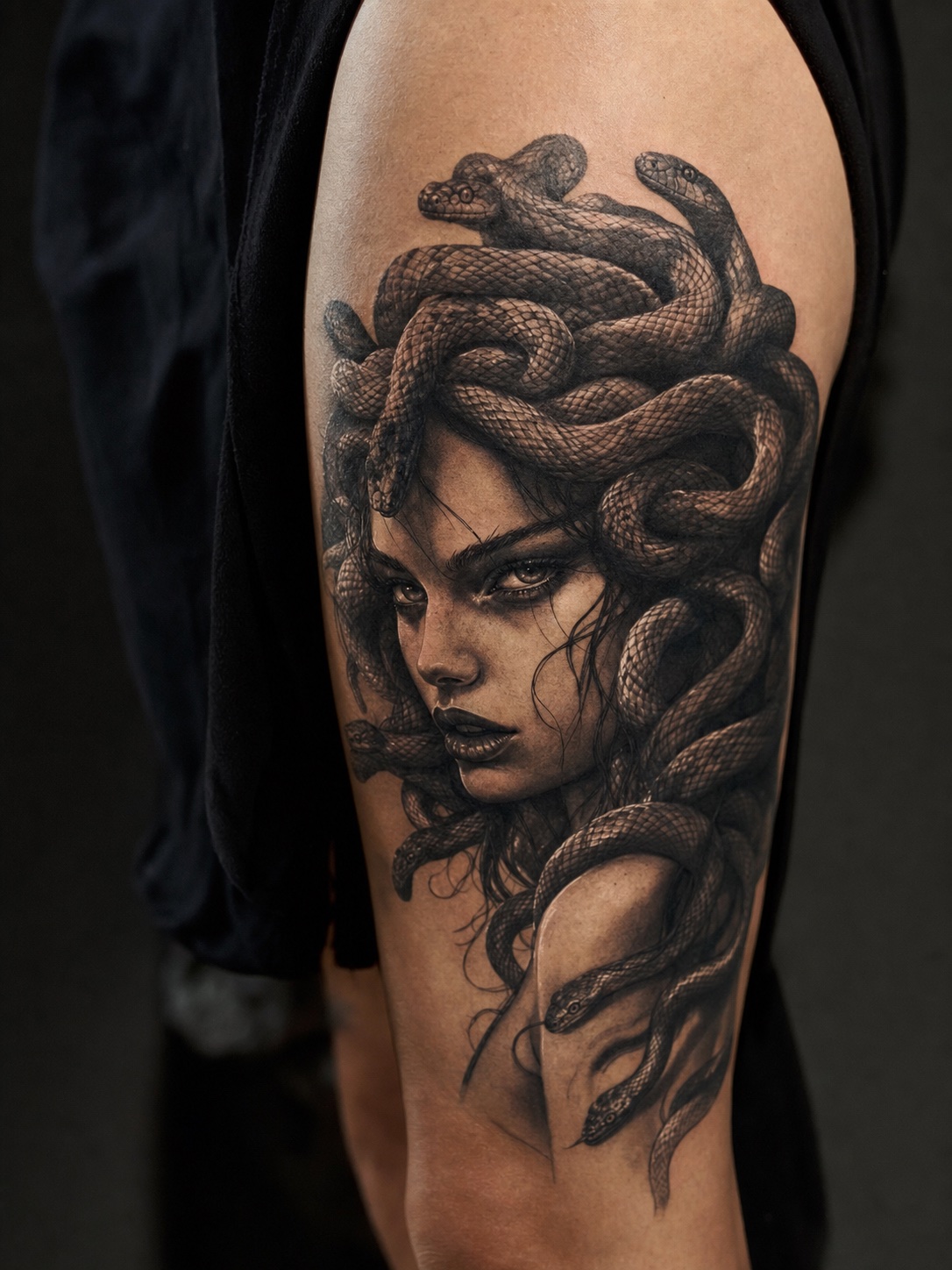
She’d been through something bad the year before and spent a long time feeling like the story was written about her, not by her. She pulled up a reference photo and pointed to one thing immediately: the gaze.
- The Real Myth: What Actually Happened to Medusa
- What Medusa Tattoos Mean Today
- Medusa Tattoo Design Styles
- Crying Medusa: What This Specific Design Means
- Medusa Tattoo Placement Guide
- FAQ: Medusa Tattoo Meaning
- What does a Medusa tattoo mean?
- Is a Medusa tattoo only for survivors?
- What does a crying Medusa tattoo mean?
- What does a Medusa tattoo mean for men?
- Is it disrespectful to get a Medusa tattoo without being a survivor?
- What style works best for a Medusa tattoo?
- How much does a Medusa tattoo cost?
- What does the direction of Medusa’s gaze mean?
- Choose Your Medusa
“I want her looking straight out,” she said. “Not downward. Not soft. Straight out.”
That’s the Medusa tattoo in one image. A woman blamed for what happened to her, turned into the monster in someone else’s version of events, whose own eyes became the thing that stopped anyone from coming for her again.
That’s part of why Medusa tattoos have exploded in popularity. Searches for “Medusa tattoo meaning” jumped 340% over two years. The design shows up all over TikTok, Instagram, and tattoo studios now. But a lot of the coverage misses the point. It either stays surface-level with the mythology or reduces the tattoo to only the survivor angle.
This guide covers both — and the design details that actually make a Medusa tattoo work.
The Real Myth: What Actually Happened to Medusa
The version most people grew up with: Medusa is a monster with snakes for hair who turns people to stone. Perseus cuts off her head. That’s the ending. The beginning gets skipped.
Medusa Before the Transformation
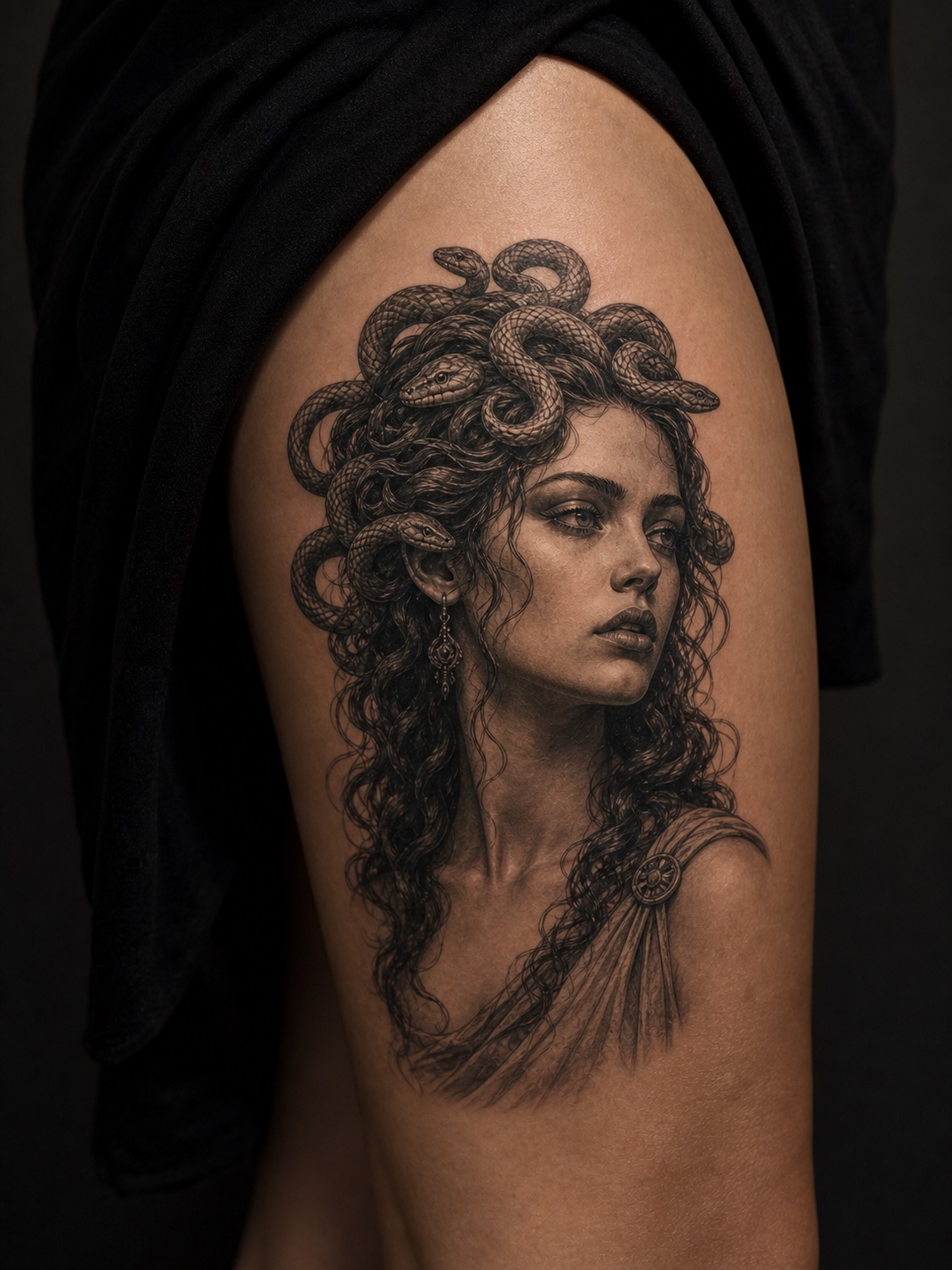
In Ovid’s Metamorphoses, Medusa starts as a beautiful priestess serving in Athena’s temple. Poseidon attacks her inside the temple itself. Athena’s response is to punish Medusa: snake hair, a gaze that petrifies, exile. The assailant gets nothing. This is the story that most tattoo artists and clients are working with when they describe the Medusa tattoo as a survivor symbol. It’s not a modern rewrite. It’s in the original text.
The other version, from Hesiod, presents Medusa as one of three Gorgon sisters born that way, without trauma as origin. Both versions exist. The Ovid version is the one that resonates most in contemporary tattoo culture because it maps directly onto experiences people recognize.
The Gorgoneion: Protection in Ancient Greece
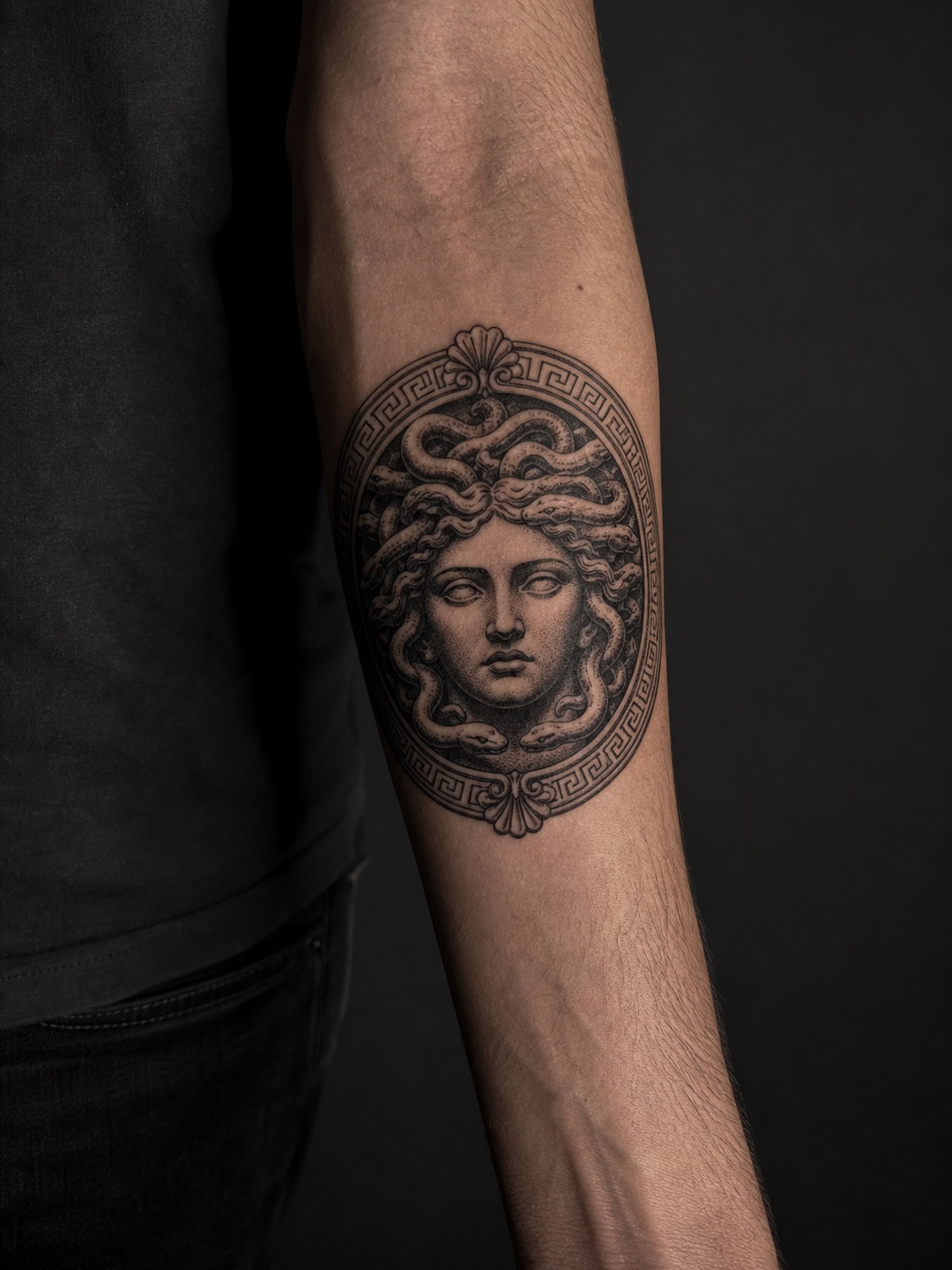
Ancient Greeks didn’t just fear Medusa. They put her face on things to protect them. The Gorgoneion, the image of Medusa’s severed head, appeared on shields, temple doors, armor, and coins. The logic: something that powerful, even disembodied, keeps threats away. Alexander the Great’s breastplate reportedly bore the Gorgon’s face. Athena wore it on her aegis.
This is the second major thread in Medusa tattoo symbolism, the one that predates every modern reinterpretation by two thousand years. The face that frightens away harm. The evil eye that defeats the evil eye. If you get a Medusa tattoo for protection, you’re doing exactly what ancient Greeks did, just in a more permanent medium.
Perseus, the Hero, and What That Story Actually Says
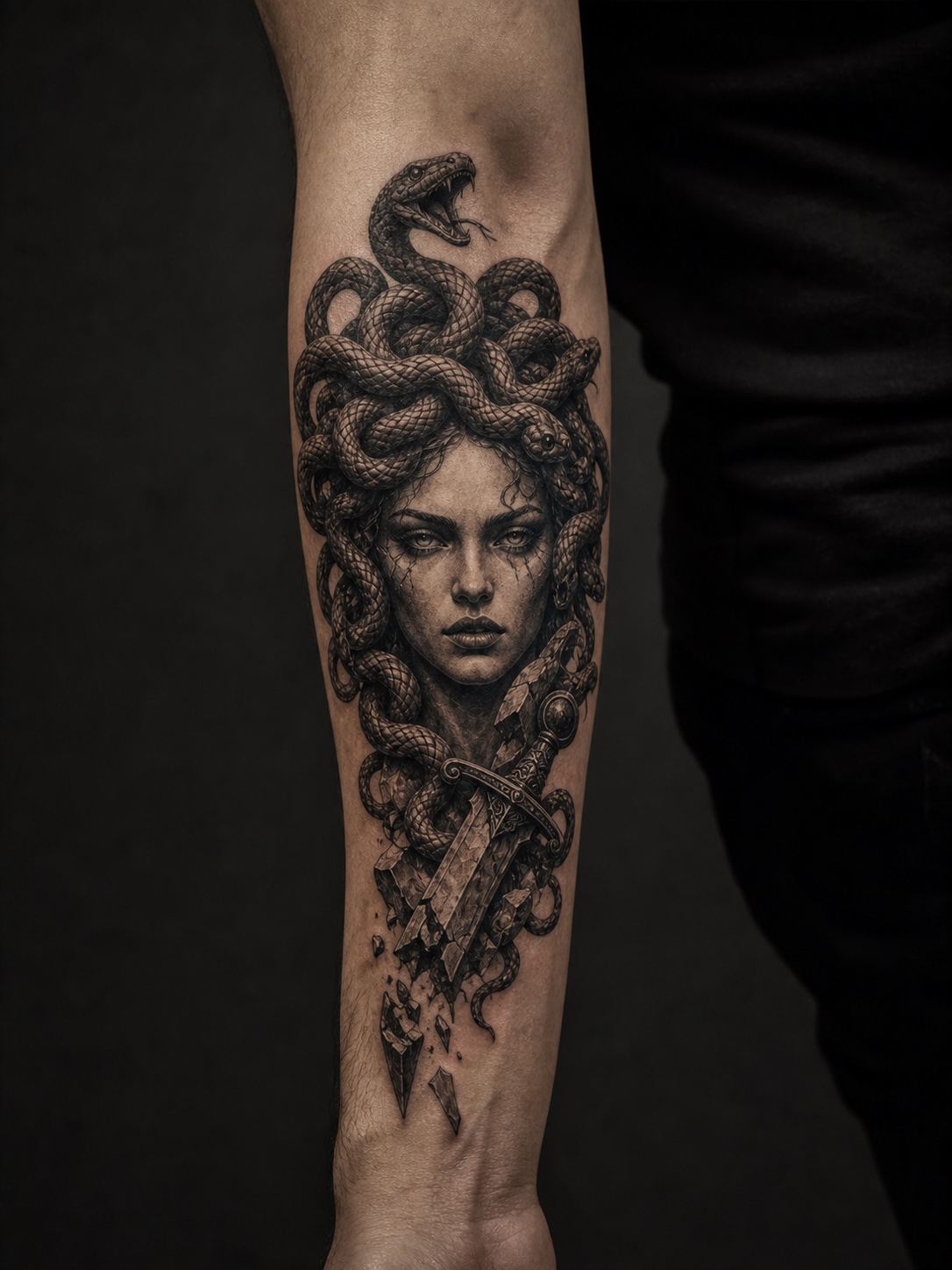
Perseus kills Medusa with a borrowed sword and a mirrored shield so he never has to look her in the eye. He uses her severed head as a weapon afterward. The classical reading celebrates him as a hero. The contemporary reading, the one running through tattoo culture right now, notices that the “monster” was a woman who’d been wronged and punished, and the “hero” killed her to advance his own story.
That reframing doesn’t erase the original myth. It sits alongside it. And for a lot of people getting Medusa tattoos, the whole point is that sitting alongside the official version, not replacing it, is enough.
What Medusa Tattoos Mean Today
If the snakes are the part you keep coming back to, it helps to separate Medusa’s story from broader serpent symbolism. I put the wider snake tattoo meaning in one place, including rebirth, protection, danger, and healing.
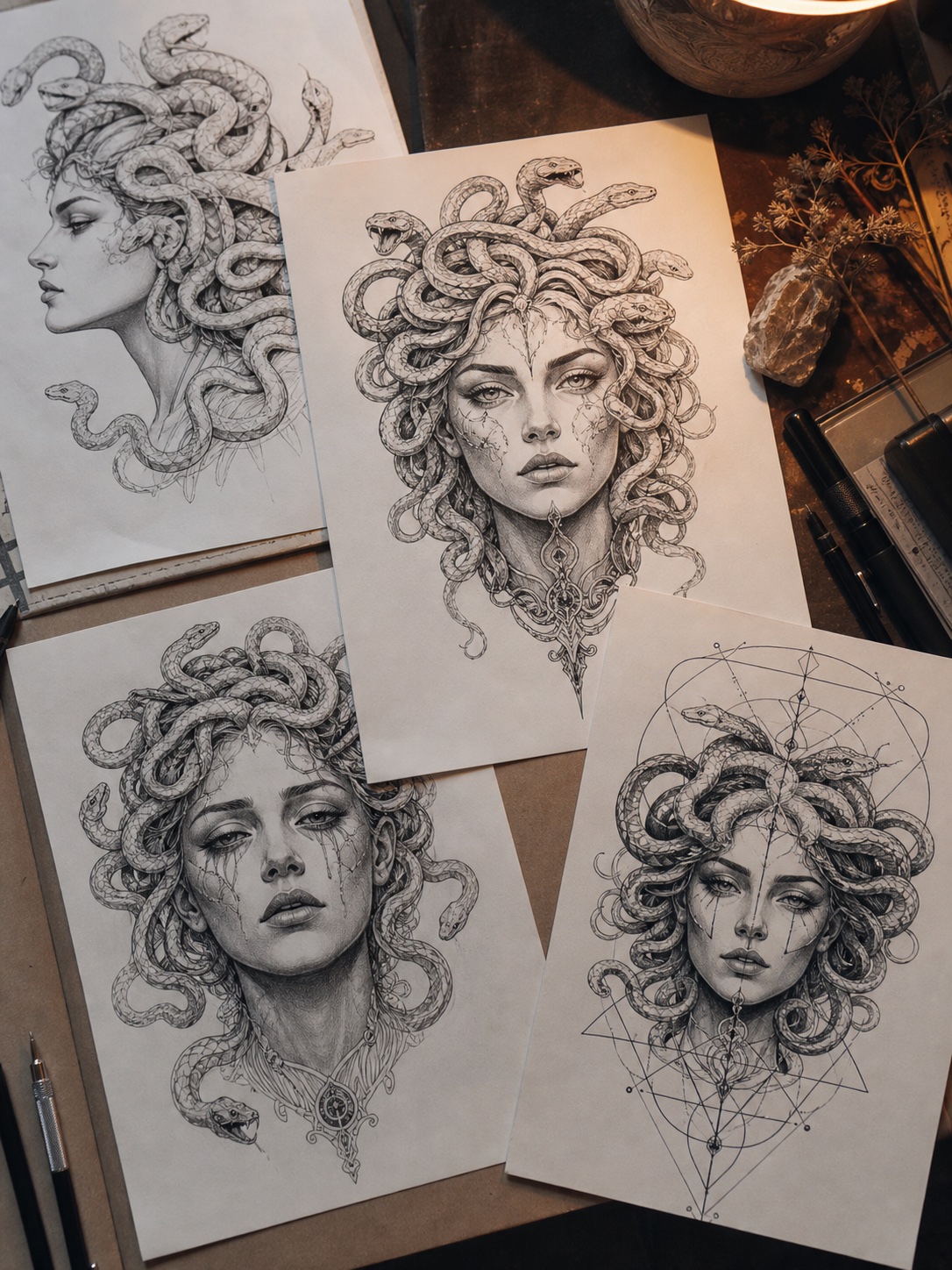
The meaning isn’t singular. Different people bring different things to this image. These are the ones that come up most.
Survivor Symbolism
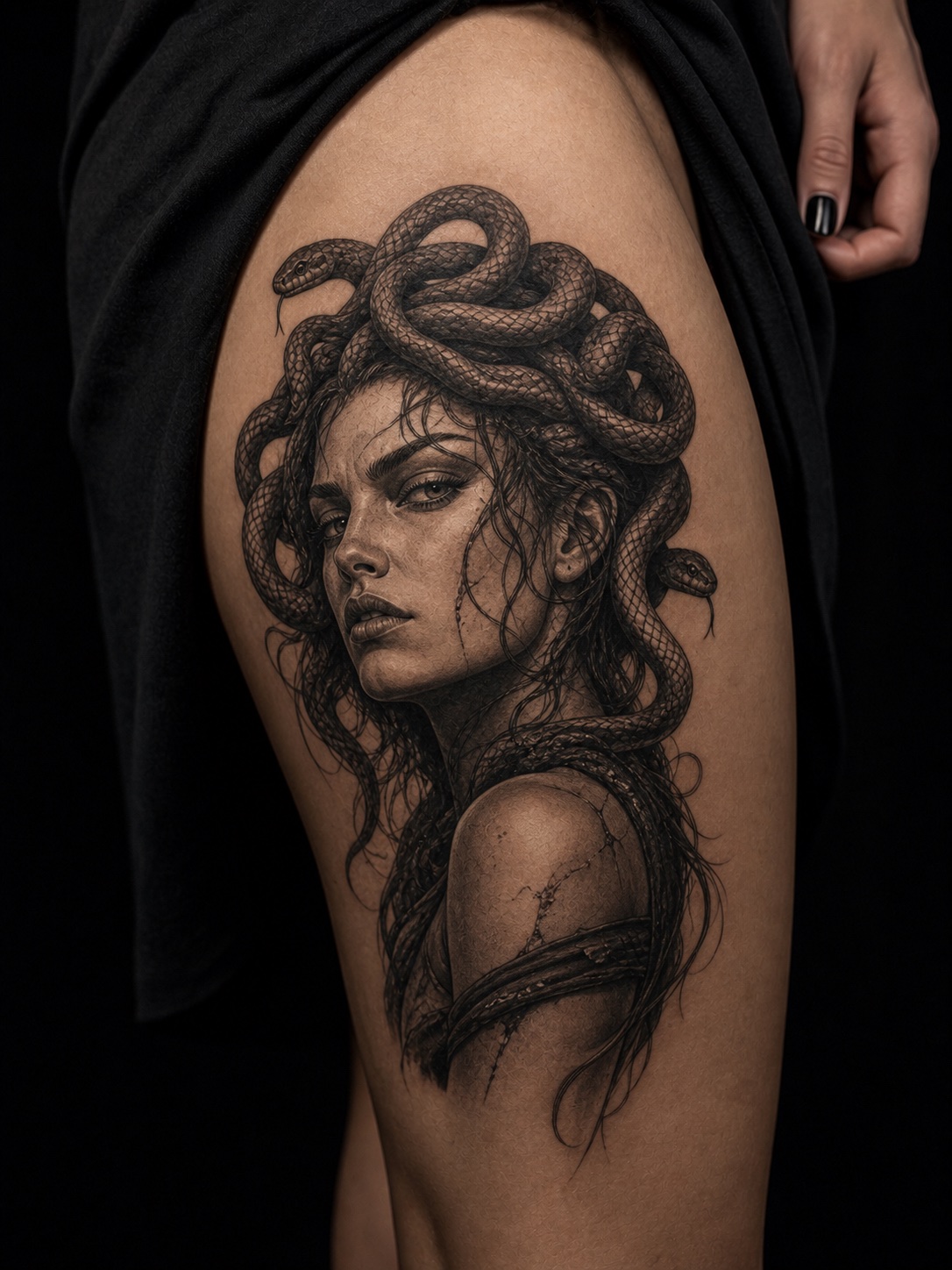
This is the reading that drove the explosion in Medusa tattoos around 2018 and hasn’t slowed down since. The #MeToo movement gave people language for an experience that had previously been hard to name publicly. Medusa gave them an image. A woman who was victimized, blamed, turned into the problem, and whose eyes became so dangerous that no one could face her directly afterward.
Therapist Anita Astley, writing in Parade, described the tattoo as “a permanent stamp of survivorship. Not hiding but displaying it for all the world to see.” That’s precise. The Medusa tattoo isn’t about hiding what happened. It’s about putting the aftermath somewhere visible and claiming it.
If this is the meaning behind your Medusa tattoo, placement choice carries extra weight. Many people choose the thigh specifically because of where the assault occurred or for visibility on their own terms. There’s no wrong answer, but it’s worth thinking through before booking.
Protection
Separate from survivor symbolism, and older than it by millennia. The Medusa tattoo as a ward, something that keeps harm at a distance. This meaning works on its own without any trauma attached. You can want protection without having a specific threat in mind, the same way people in ancient Greece put the Gorgon on their door not because they were expecting a specific attack but because the image itself felt like it was doing something.
This reading tends to show up in designs where Medusa is frontal and direct, eyes open, gaze out. Not weeping. Not soft. Looking.
Feminine Rage
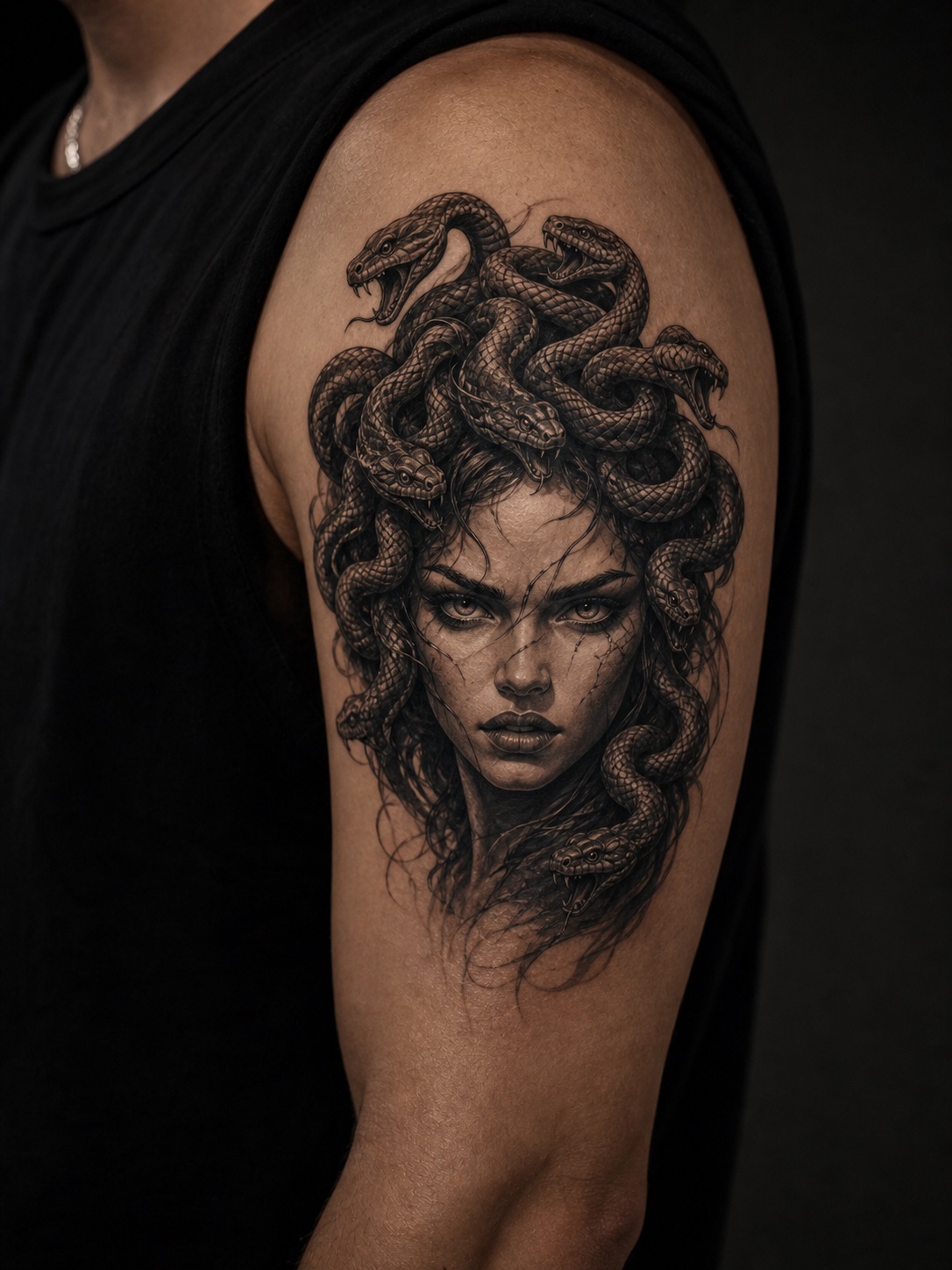
There’s an anger in the Medusa story that a lot of people find worth carrying. The specific anger of having been wronged by a system that protected the person who harmed you. Athena punishes the victim. Poseidon faces nothing. Perseus gets celebrated. That sequence of events is recognizable to a lot of people in contexts far beyond mythology.
Medusa tattoos that lean into this angle tend toward more intense expressions: mouth open, snakes active, the gaze sharper. Artists like Kat Von D have done heavily stylized versions that feel more aggressive than tragic. The meaning here is—I’m not ashamed of this anger. It’s earned.
Duality: Beauty and Danger
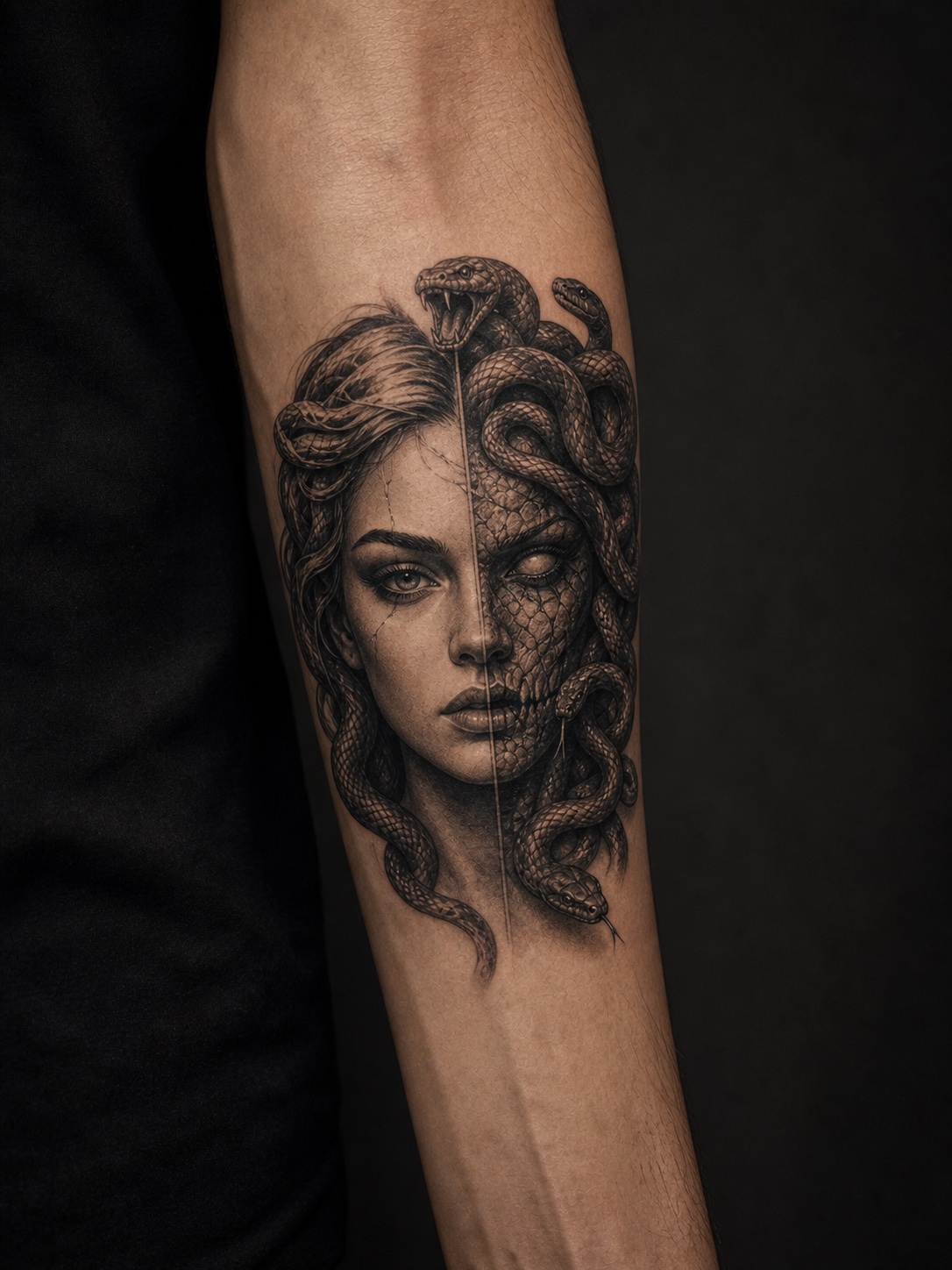
Medusa holds two things at once: she’s beautiful enough that Poseidon fixated on her, and dangerous enough that her face kills. That combination, desirable and lethal, untouchable and compelling, is what makes her such a rich image. Tattoos that split the face, one half classical beauty, one half gorgon, sit directly in this tension.
This reading doesn’t require trauma in the wearer’s history. It works for anyone who moves through the world containing contradictions and is done apologizing for the dangerous half.
Transformation and Rebirth
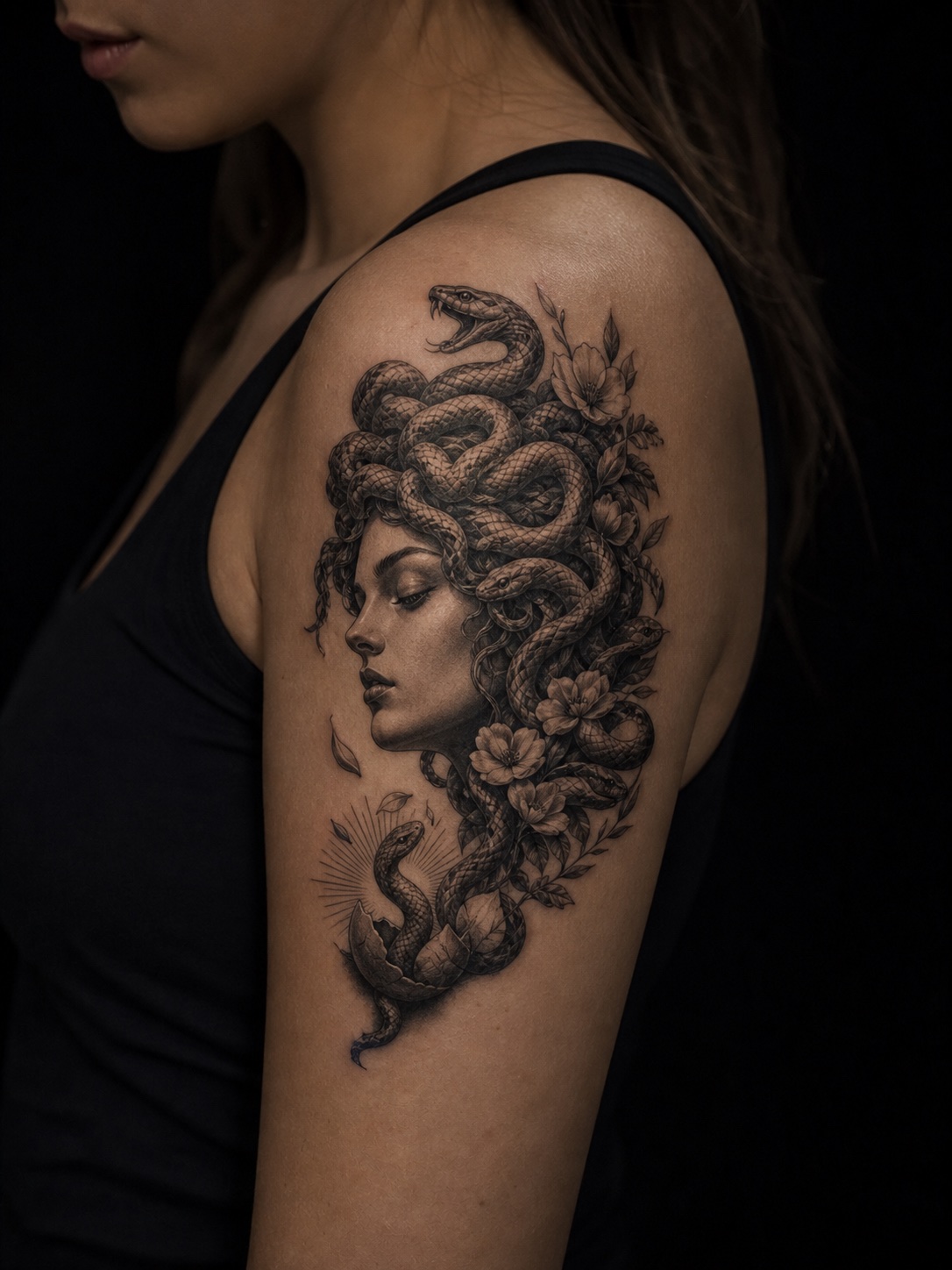
The transformation in Medusa’s story is violent and unchosen. But the result is also power. Something happened and it changed her completely, and the person she became was impossible to stop. This maps onto experiences that aren’t specifically assault: illness, loss, catastrophic failure, coming out, leaving a belief system. Any change that was not wanted but that produced a version of yourself you’ve come to recognize as real.
For a rebirth symbol that feels less mythological-guardian and more rising-after-the-fire, look at rebirth and transformation tattoo ideas built around the phoenix. It gives the same emotional reset, but with wings, flame, smoke, and upward movement doing most of the storytelling.
Medusa tattoos in this register tend to include softer elements alongside the intensity: flowers braided into the snake hair, a tear on the cheek, petals. The combination signals that the grief is acknowledged and the power is real.
Medusa Tattoo Design Styles
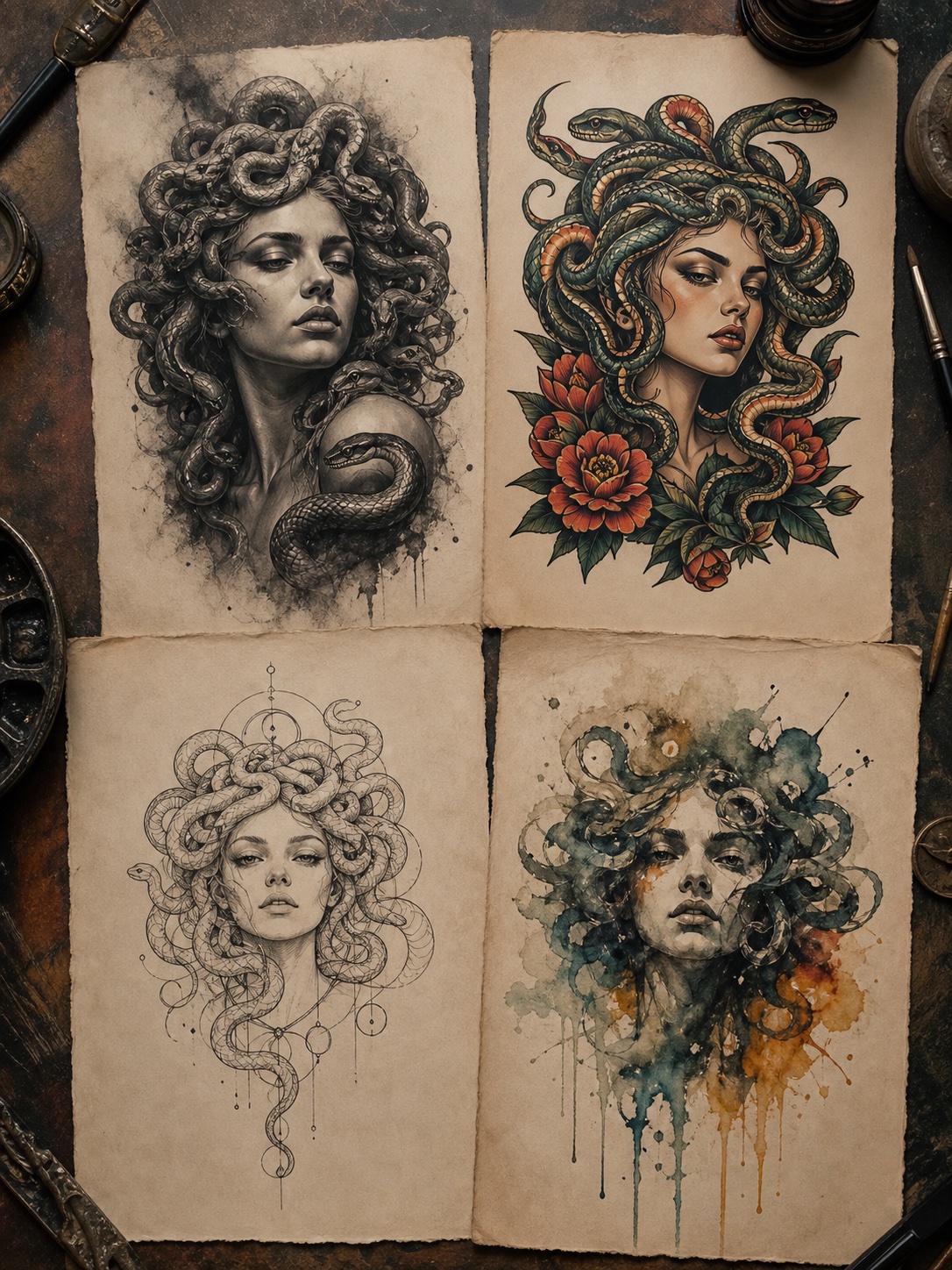
How the design is executed shifts how the meaning reads. Same subject, very different emotional register depending on style.
Black and Grey Realism
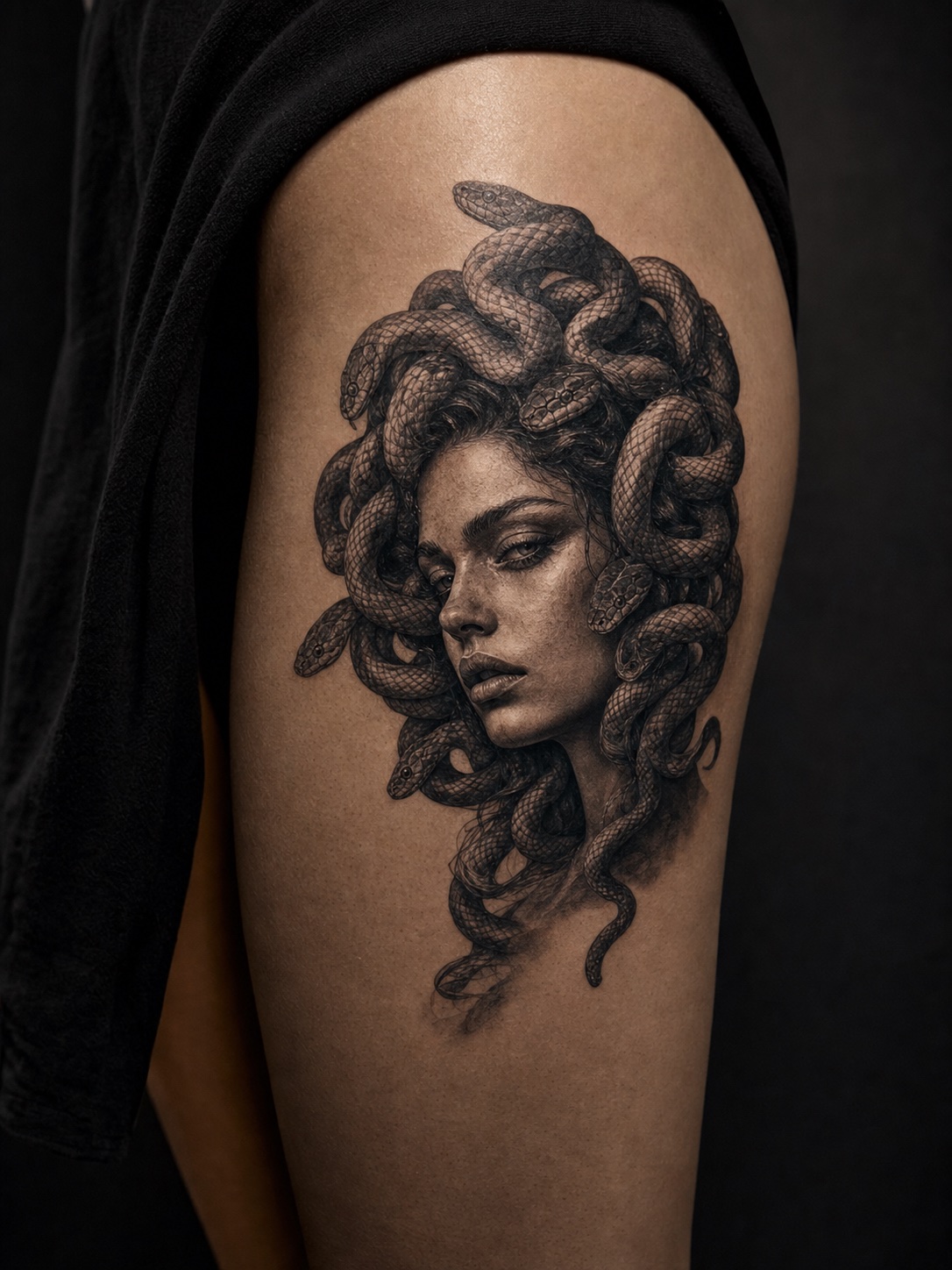
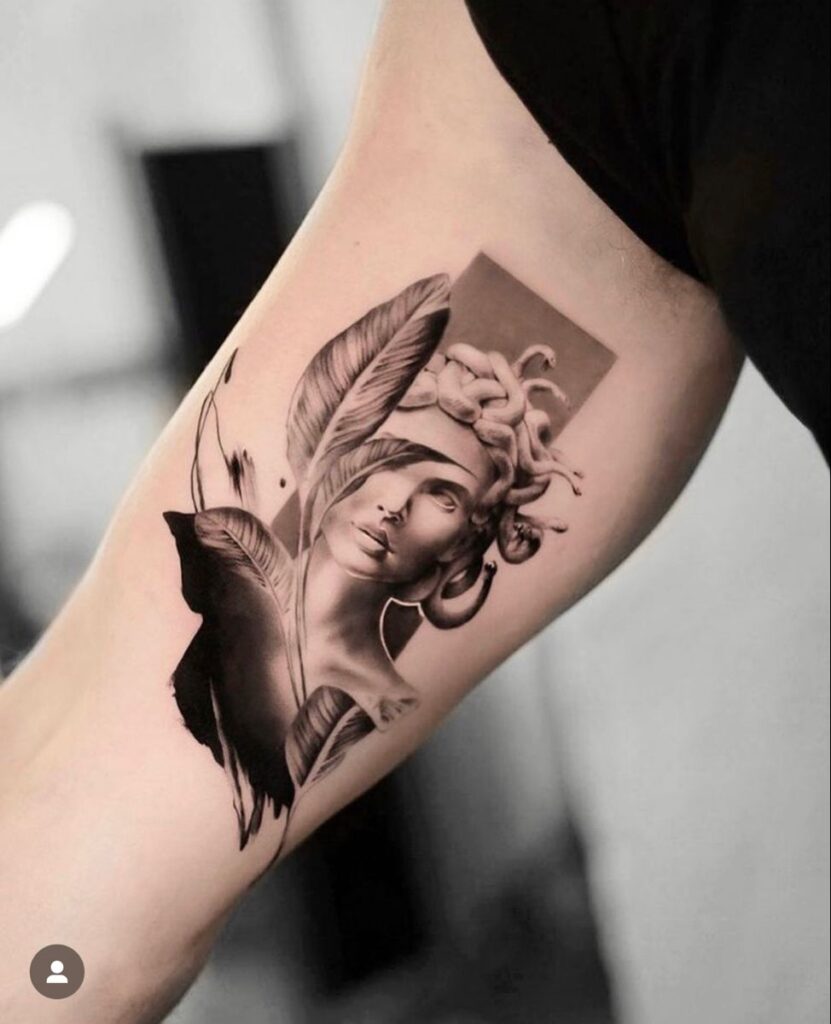
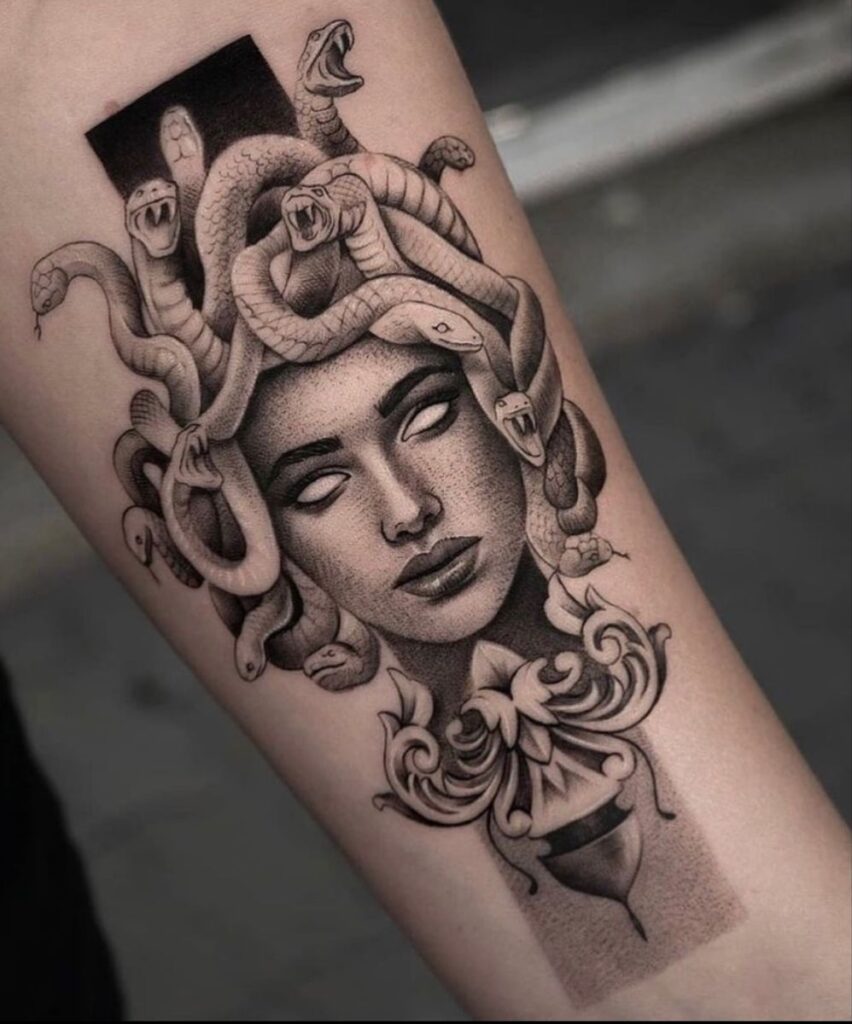
The most common style for Medusa tattoos in contemporary studios. Black and grey realism can render the snake hair with individual scale detail, give the face genuine emotional weight, and create shadows that make the gaze feel like it’s actually landing on you. Artists like Steve Butcher and the whole tradition of black and grey portrait tattooing have made this technically achievable in ways that weren’t possible 20 years ago.
The limitation is size and artist selection. A black and grey Medusa portrait needs room to breathe: thigh, upper arm, back, chest. Cramping it onto a small area loses the detail that makes it work. And the artist needs a genuine portfolio in realism portraiture. A Medusa face where the features are slightly off reads as unsettling in the wrong way.
Neo-Traditional
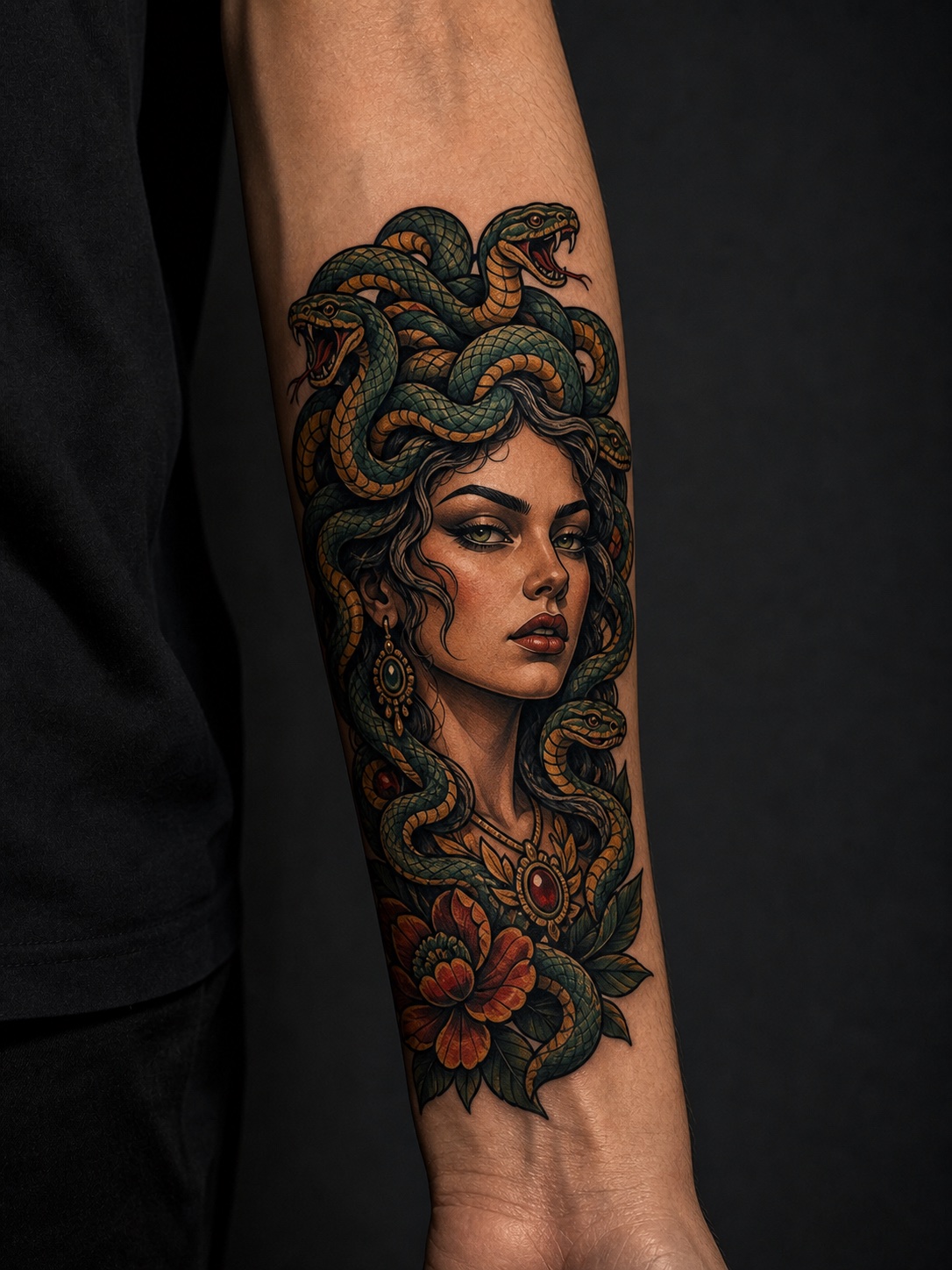
Bold outlines, saturated color, decorative elements. Neo-traditional Medusa tends to be more stylized than realistic, which can make the image feel more iconic and less portrait-like. The snake hair gets more dramatic. The colors, deep greens, golds, rich purples, read as mythological rather than naturalistic. This style suits people who want Medusa to feel like a figure from a specific visual tradition rather than a hyper-realistic rendering.
Fine Line and Minimalist
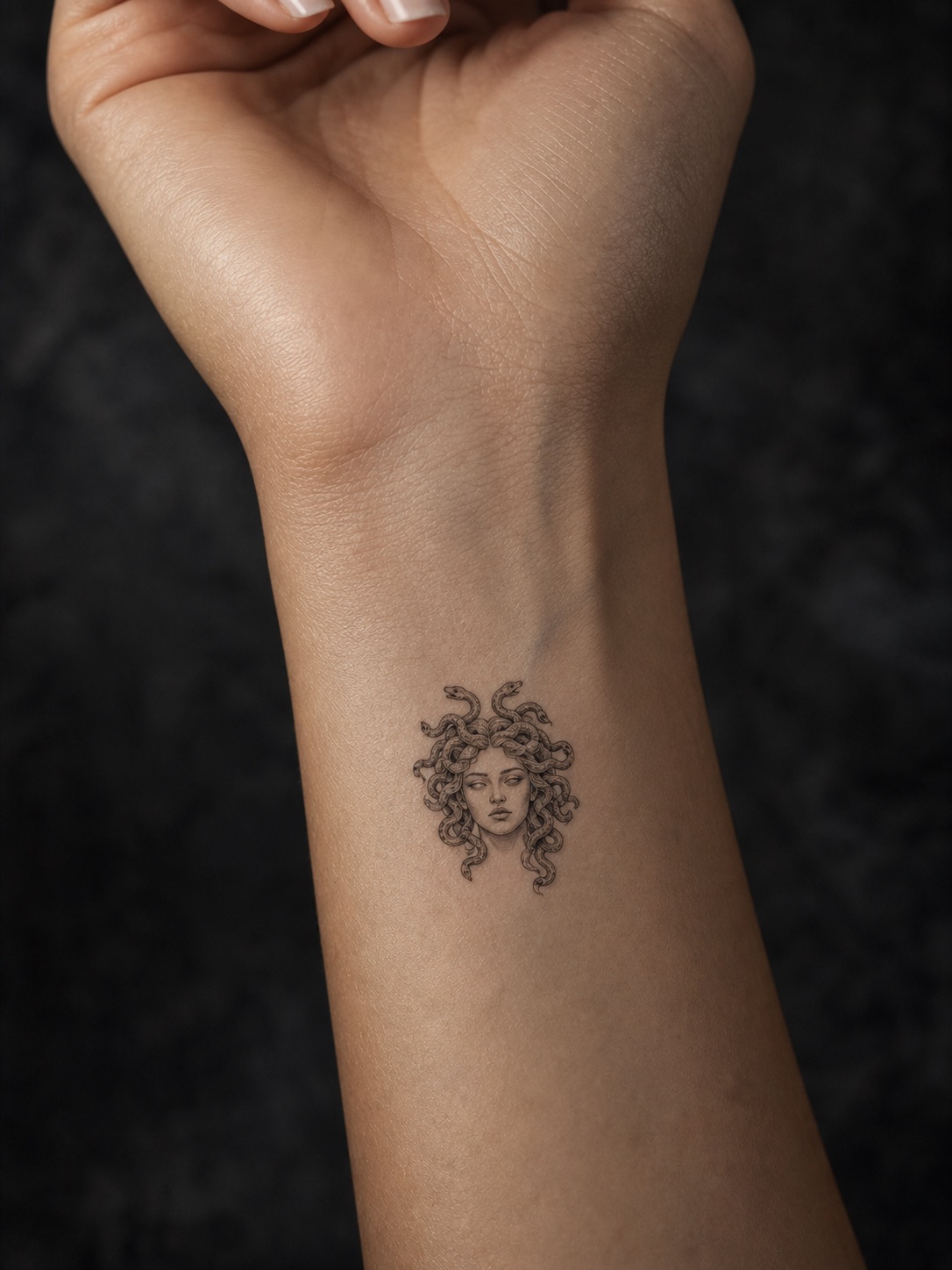
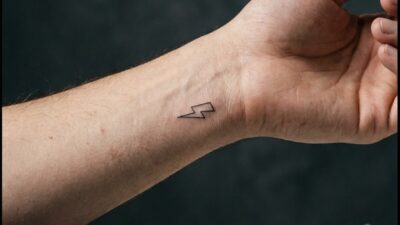
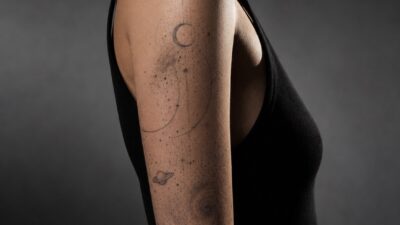
A Medusa reduced to essential lines: the outline of the face, a few snakes suggested rather than fully rendered, the eyes given weight with minimal mark-making. These work in smaller placements and read as quietly significant rather than bold declarations. The survivor meaning or protection meaning comes through without the image demanding attention from across the room.
Same aging caveat as any fine line work: the lines spread and soften over years. Sun protection matters. Touch-ups are realistic to plan for.
Watercolor
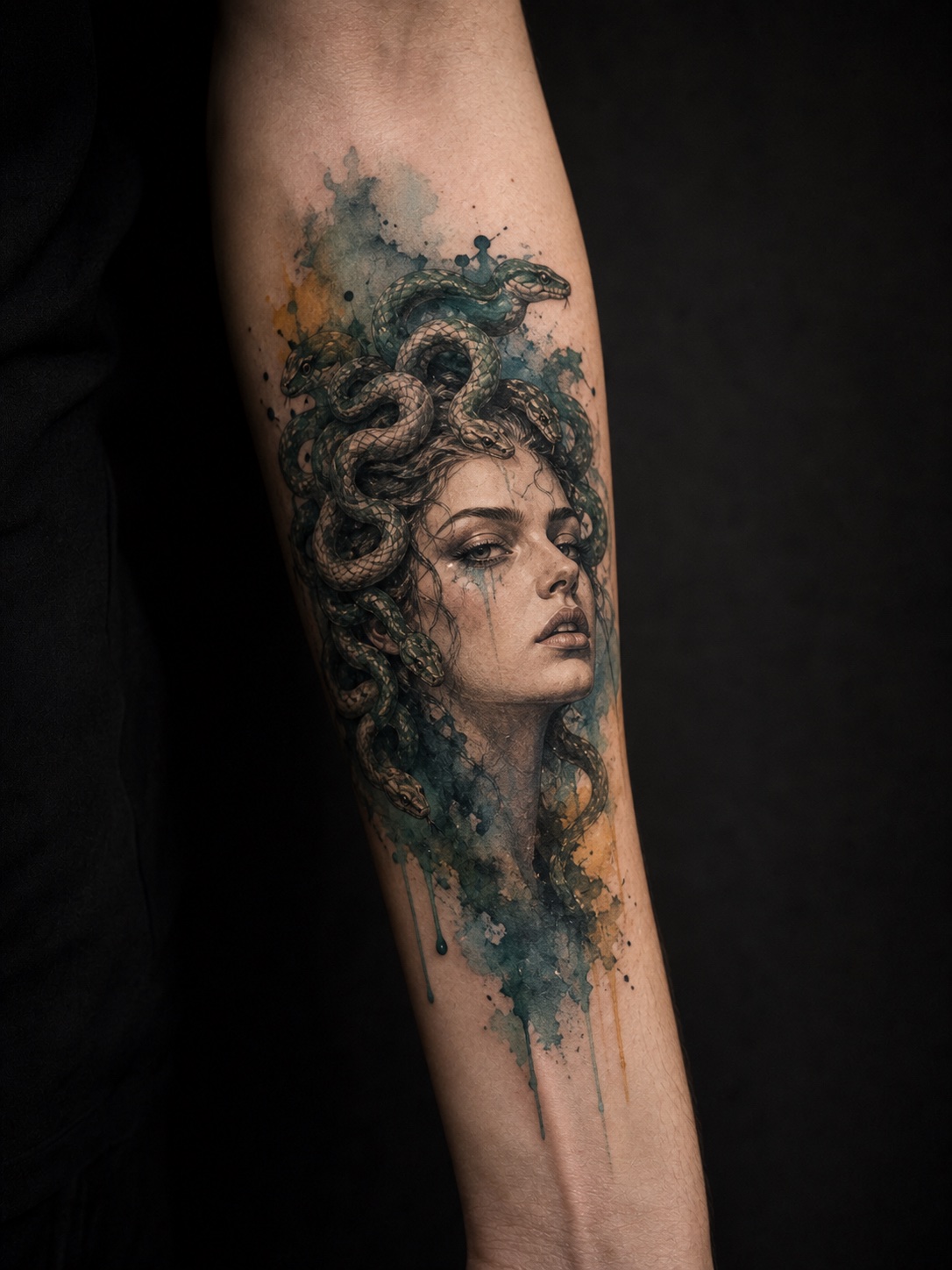
Watercolor Medusa tattoos use color washes and loose brushstroke edges to create a dreamlike version of the image. They tend toward the transformation and rebirth reading rather than the rage or protection angles. The soft aesthetic shifts the emotional register considerably: the same gaze that reads as fierce in black and grey reads as haunted or melancholy in watercolor.
Worth knowing: watercolor fades faster than other styles and requires maintenance. Three to five years before a touch-up is realistic, less if the piece gets significant sun exposure.
Ancient Coin / Classical Style
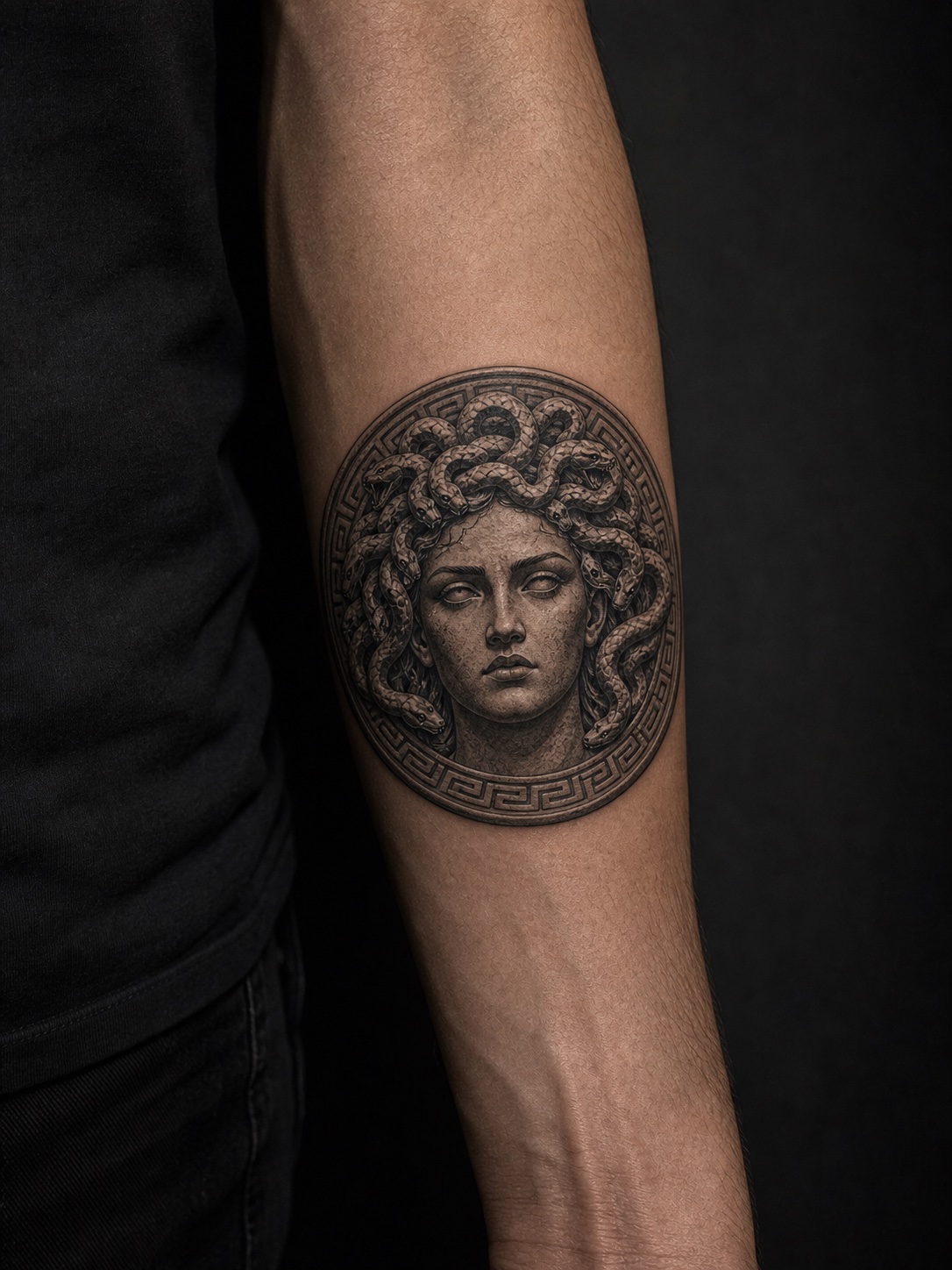
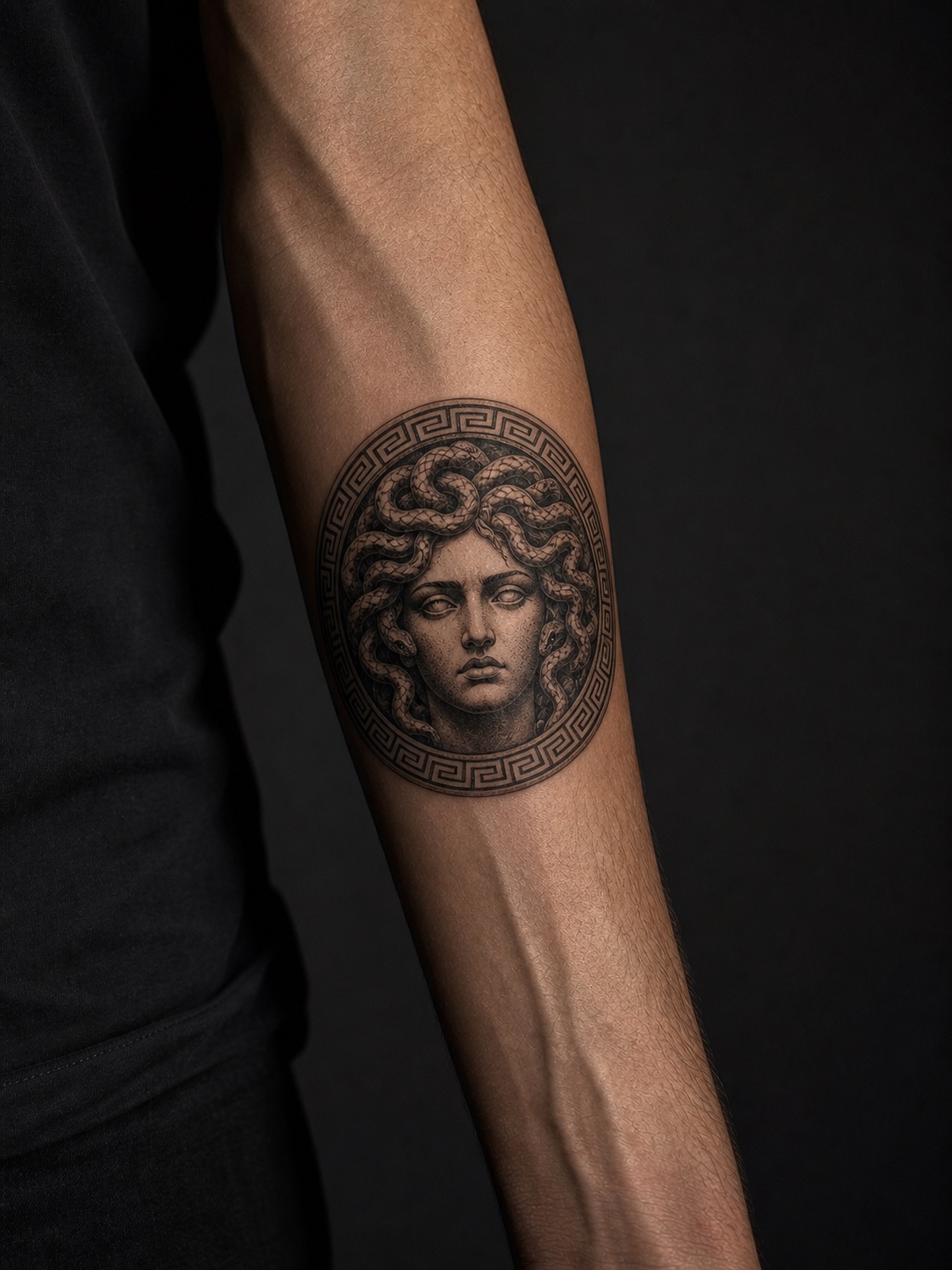
A growing trend in 2025 and 2026: Medusa rendered as if carved in relief, referencing ancient Greek coinage and sculpture. The aesthetic is deliberately archaic, sometimes including a circular border, Greek key pattern, or laurel wreath. It reads as scholarly and mythologically grounded rather than rooted in contemporary survivor culture, though the meanings can overlap. Versace uses this exact aesthetic for their logo, which has pulled the visual into fashion and luxury contexts.
Crying Medusa: What This Specific Design Means
The Weeping Gorgon
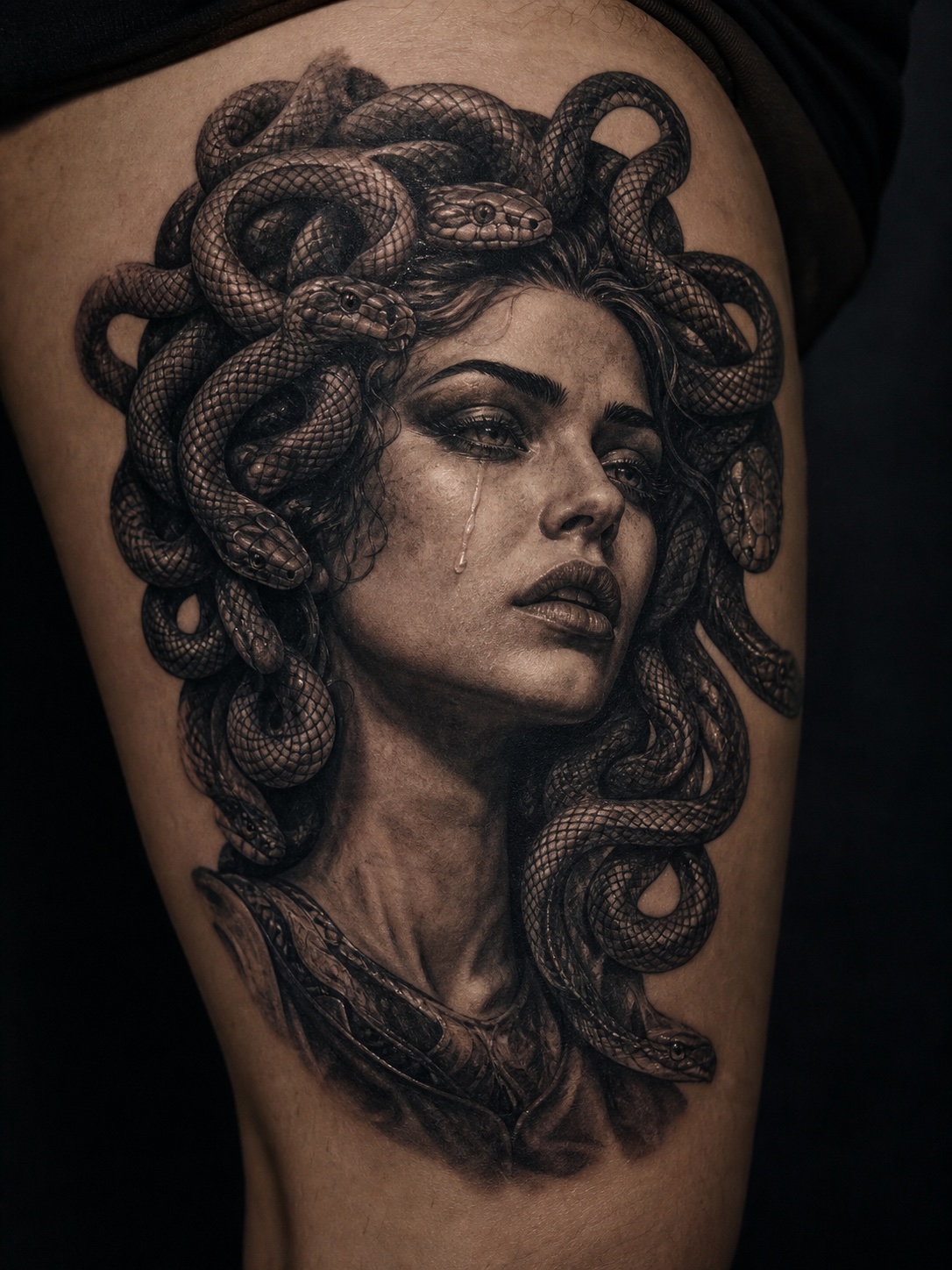
Crying Medusa tattoos show a tear on the cheek, sometimes a fully weeping expression, alongside the snake hair and intense gaze. This combination is very specific: it holds grief and power at the same time. She’s dangerous, and she’s sad about what made her that way.
This is probably the most emotionally complex Medusa design and the one most directly associated with processing trauma. The tear acknowledges the wound. The gaze says it didn’t break her. Getting this design right requires an artist who can render facial expression in fine detail, otherwise the grief reads as generic sadness rather than the specific kind this image is carrying.
Medusa with Flowers
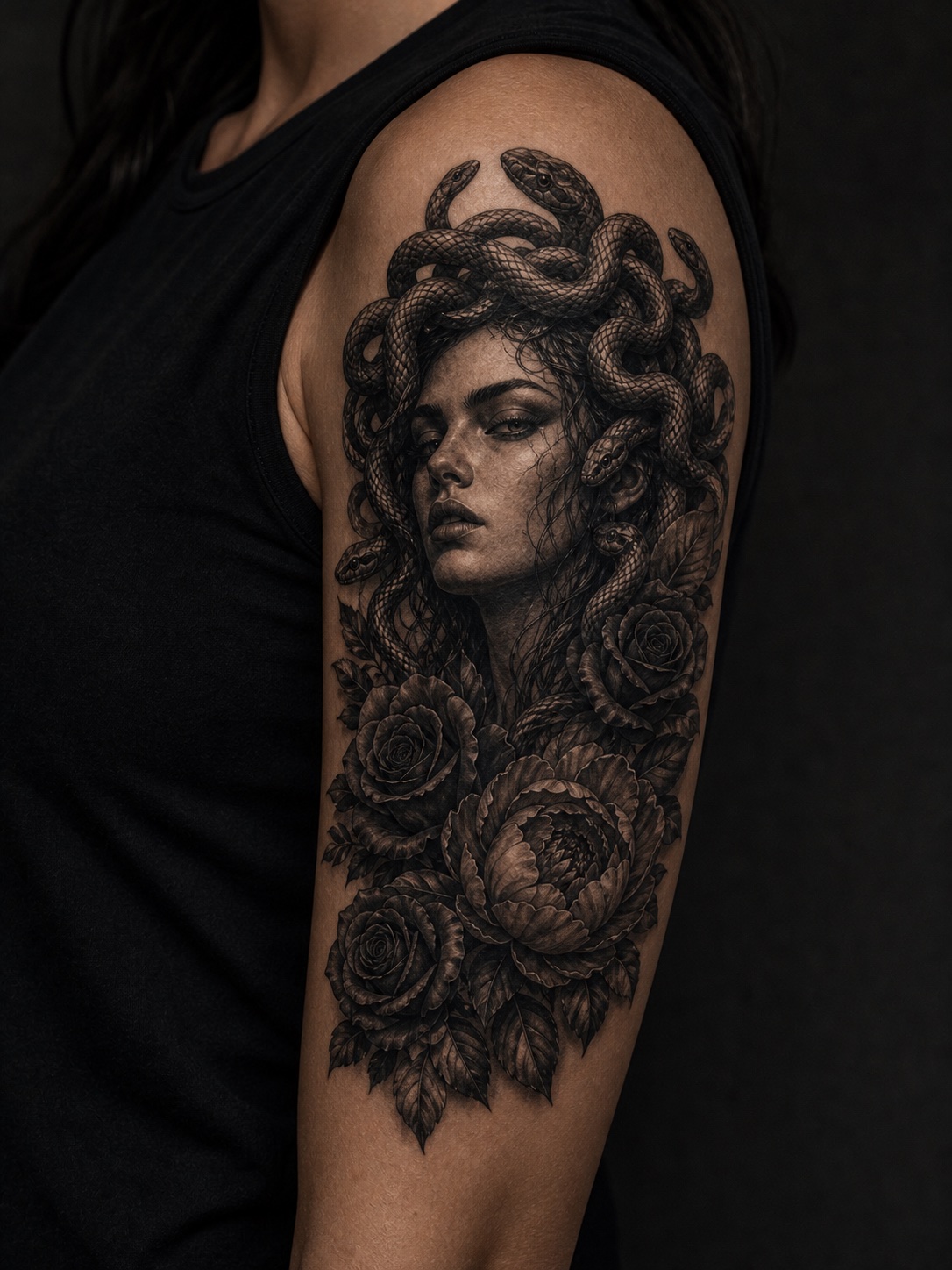
Flowers braided into the snakes or arranged around the portrait soften the image without undermining it. Roses are the most common pairing. Dark roses, specifically, work because they maintain the intensity of the image while adding something organic and alive. This combination maps onto the duality meaning more than the rage meaning: beauty and danger, grief and growth, the thing that grew from hard ground.
Medusa Tattoo Placement Guide
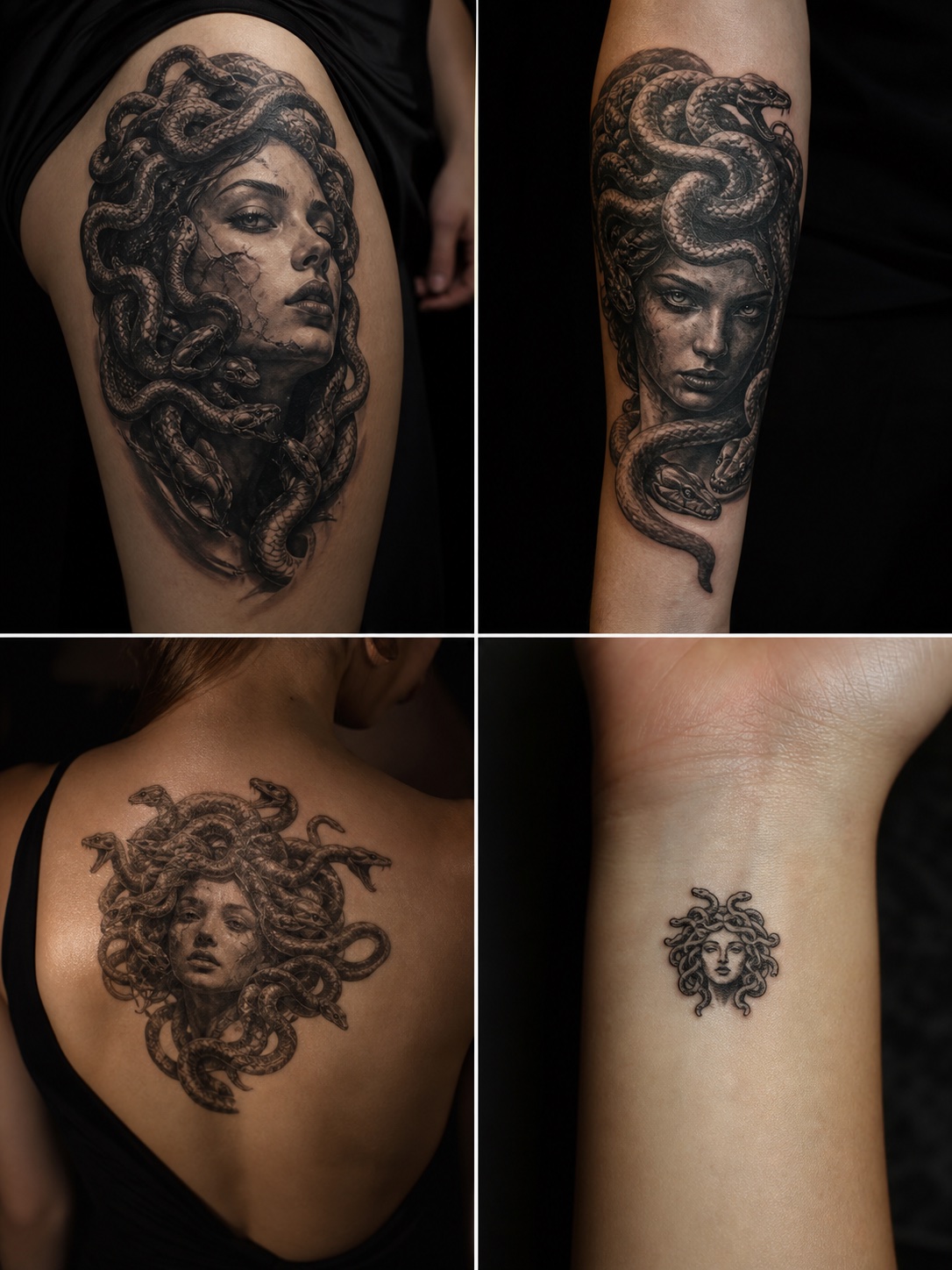
Where you put it changes how it reads, who sees it, and whether the detail can work at the size you need.
Thigh
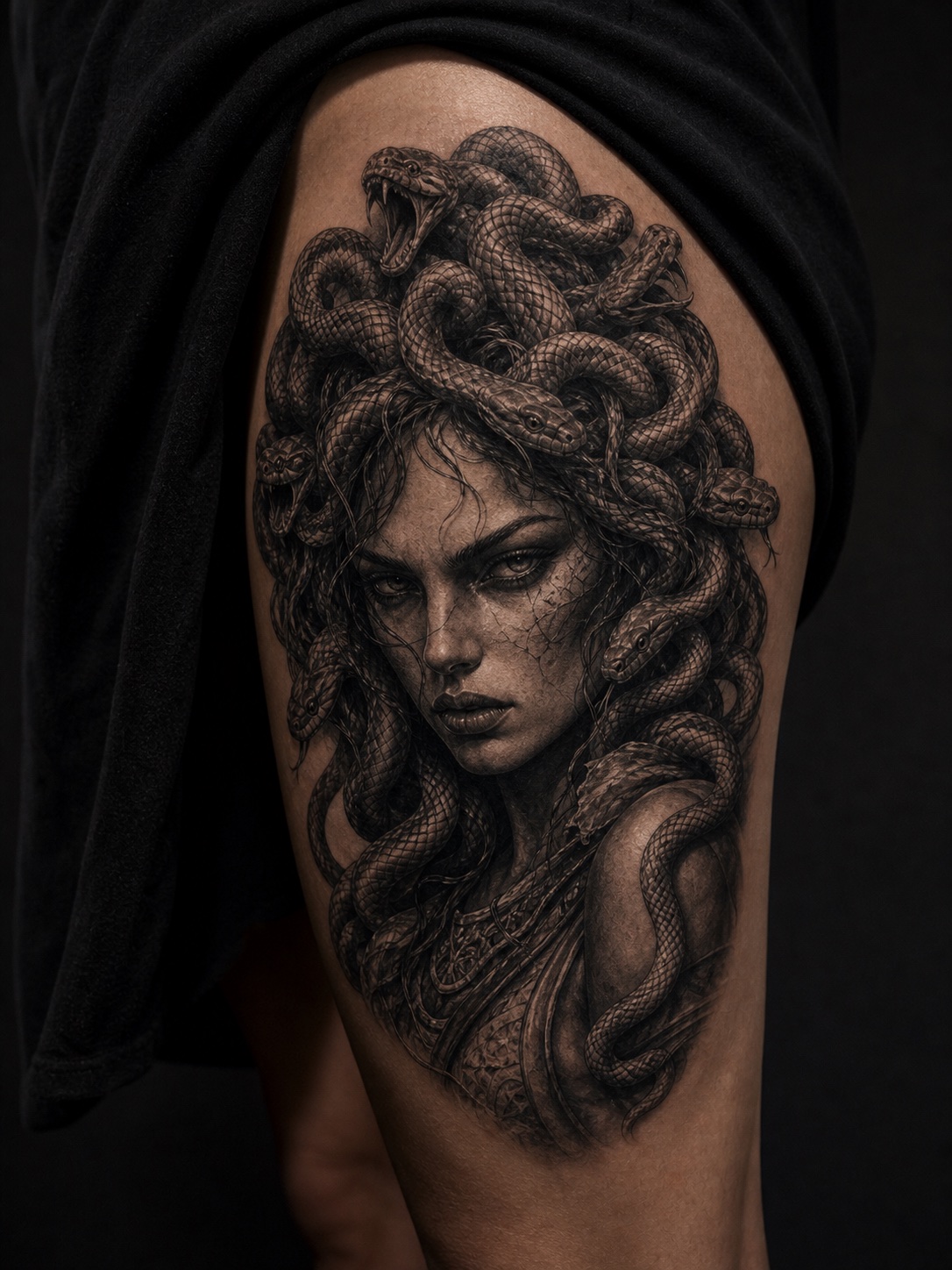
The most popular placement for detailed Medusa portraits, for several reasons. The thigh provides a large, relatively flat canvas where the face can be rendered at a scale that lets the expression carry its full weight. The placement is semi-private, visible by choice rather than always on display. Many survivors specifically choose the thigh because of where their assault occurred, but it works for any meaning. Expect 4 to 8 hours for a quality portrait, $400 to $1,200 depending on artist and detail.
Forearm
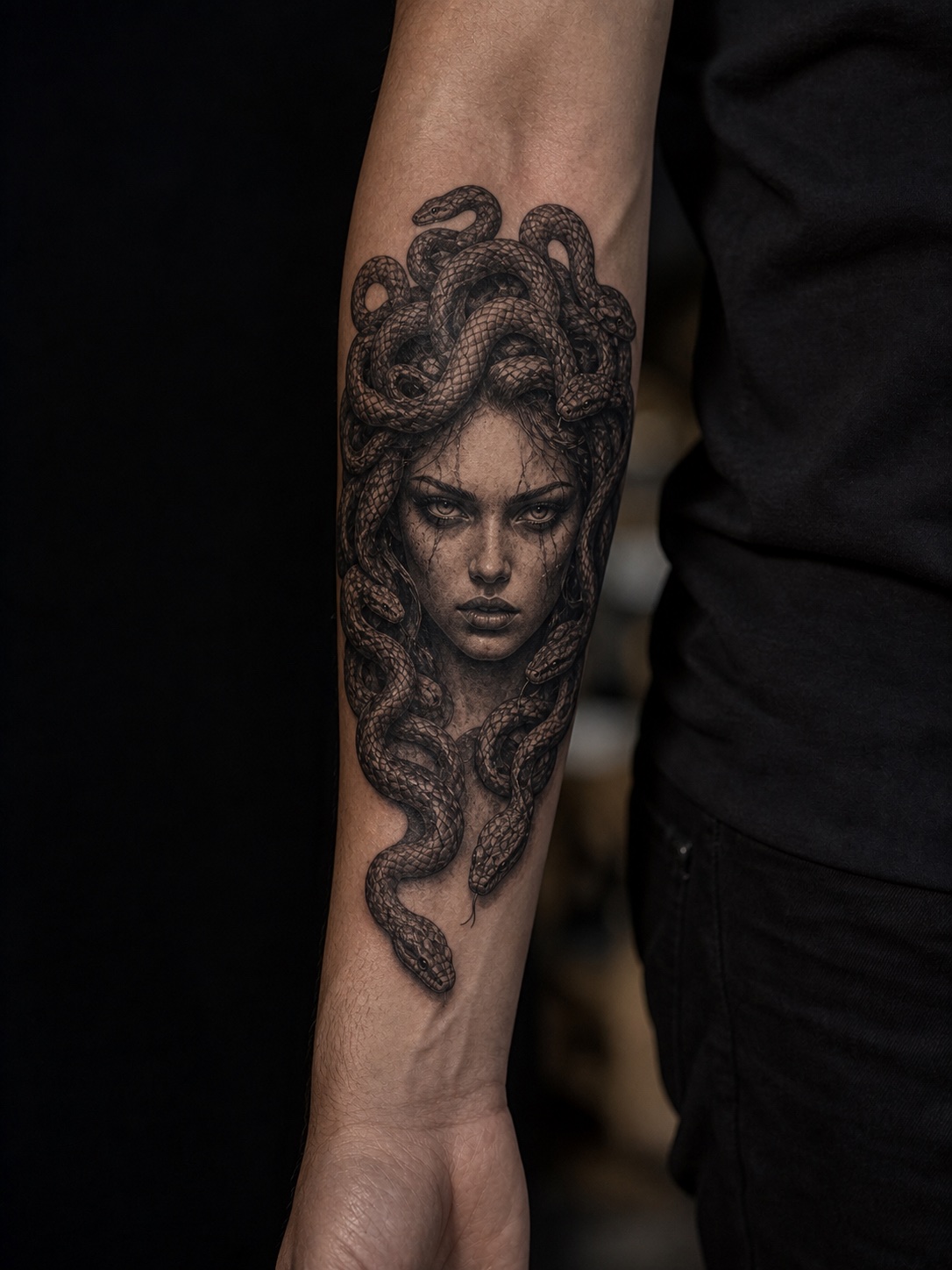
A public-facing placement. Medusa on the forearm says: I’m not keeping this private. It’s a more confrontational choice than the thigh, which aligns with the protection and rage readings. Medium-sized pieces, 4 to 6 inches, work well here. The forearm’s natural lighting from above suits black and grey work particularly well.
Upper Arm and Shoulder Blade
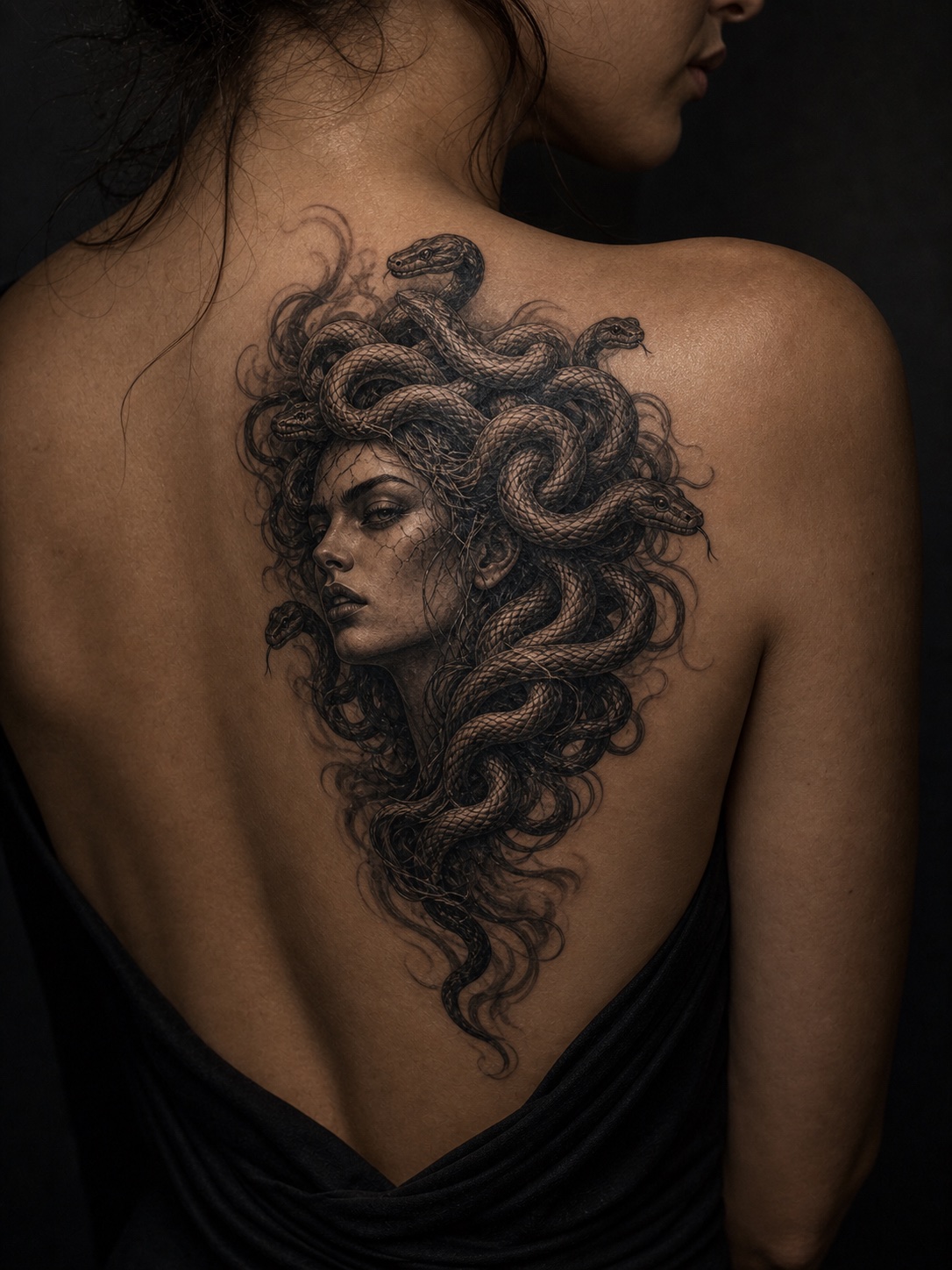
The shoulder blade gives the snake hair room to flow upward toward the shoulder, which can extend the composition naturally. Upper arm pieces tend to be more contained. Both placements are semi-private and work for medium to large pieces. The shoulder blade is one of the more painful spots, particularly near the spine, which some people factor into the significance of the commitment.
Back
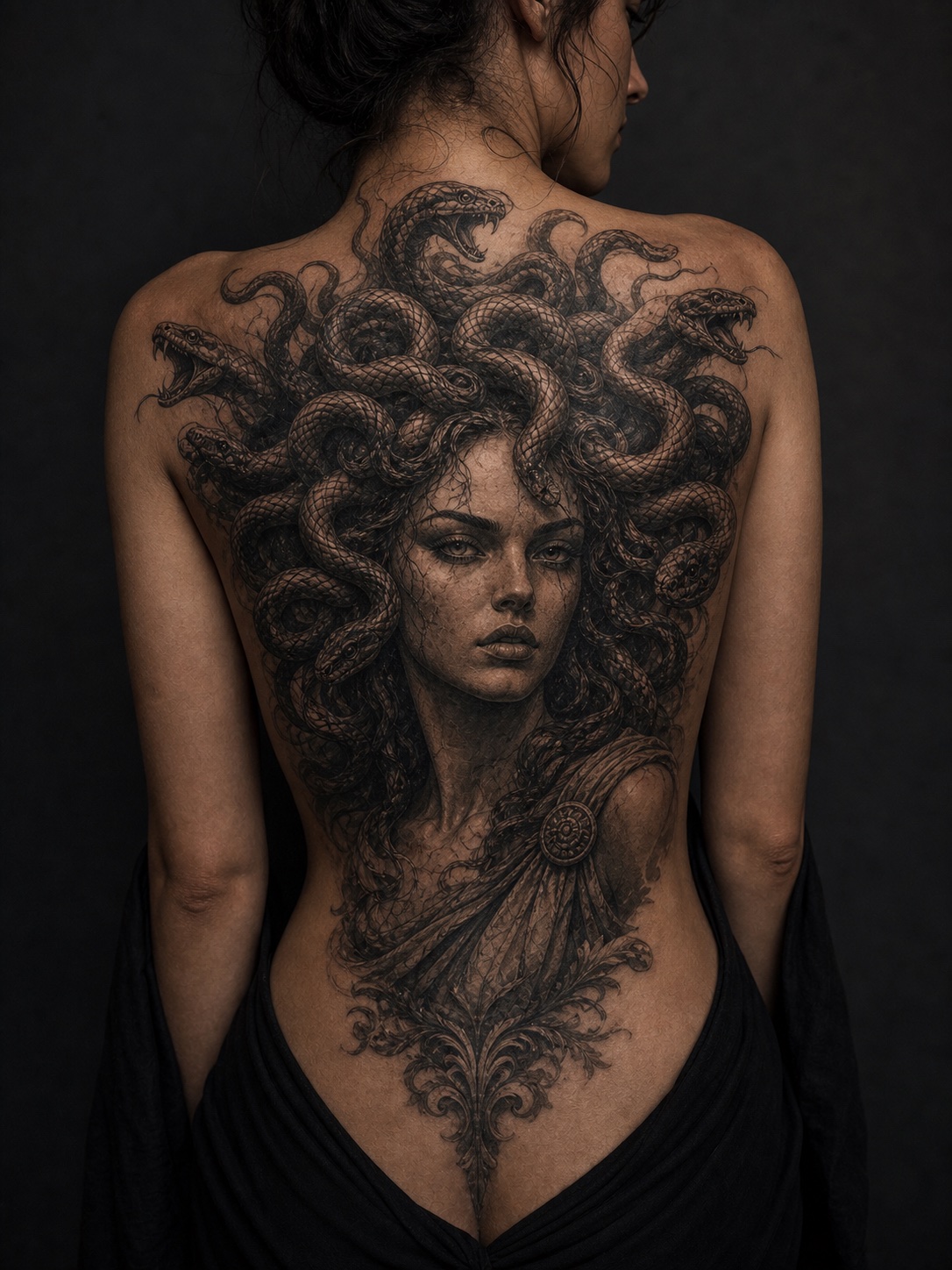
A full back Medusa, centered, with snake hair filling the upper back and reaching toward the shoulders, is one of the most dramatic tattoo commitments available. The scale allows for full realism portrait work at a size where every detail reads. These pieces run 20 to 40 hours across multiple sessions, $2,000 to $6,000 from a specialist. They’re worn privately by default. That combination of enormous commitment and private placement is its own kind of meaning.
Smaller Placements: Wrist, Ankle, Behind the Ear
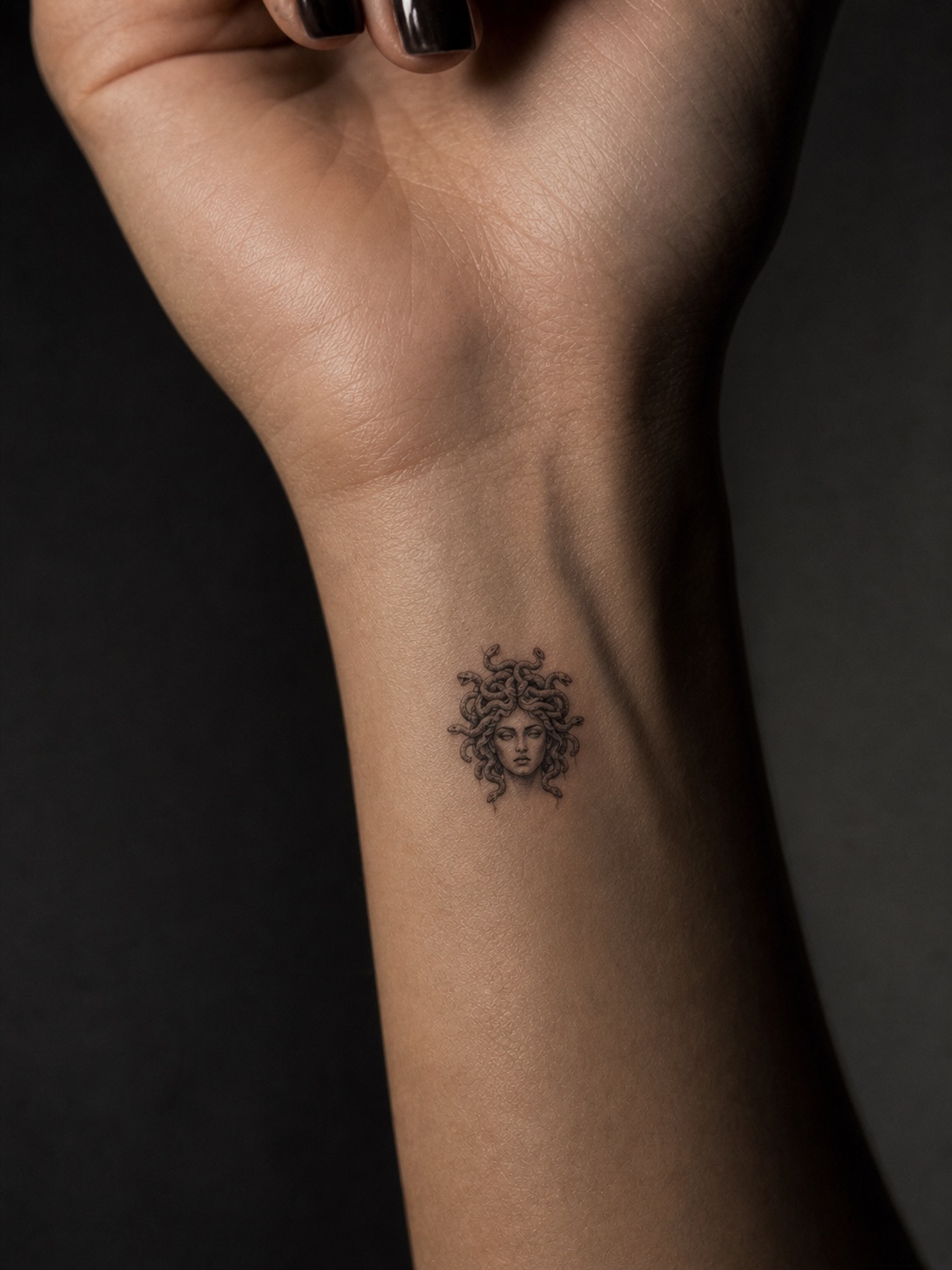
Minimalist Medusa designs work at smaller scale: wrist, inner ankle, collarbone, behind the ear. These can be as small as 2 inches and still read clearly if the artist works in a style that simplifies well. The wrist placement in particular suits the protection meaning, something you can see easily and that others notice. Fine line and simple outline styles are the most realistic for small Medusa work.
FAQ: Medusa Tattoo Meaning
What does a Medusa tattoo mean?
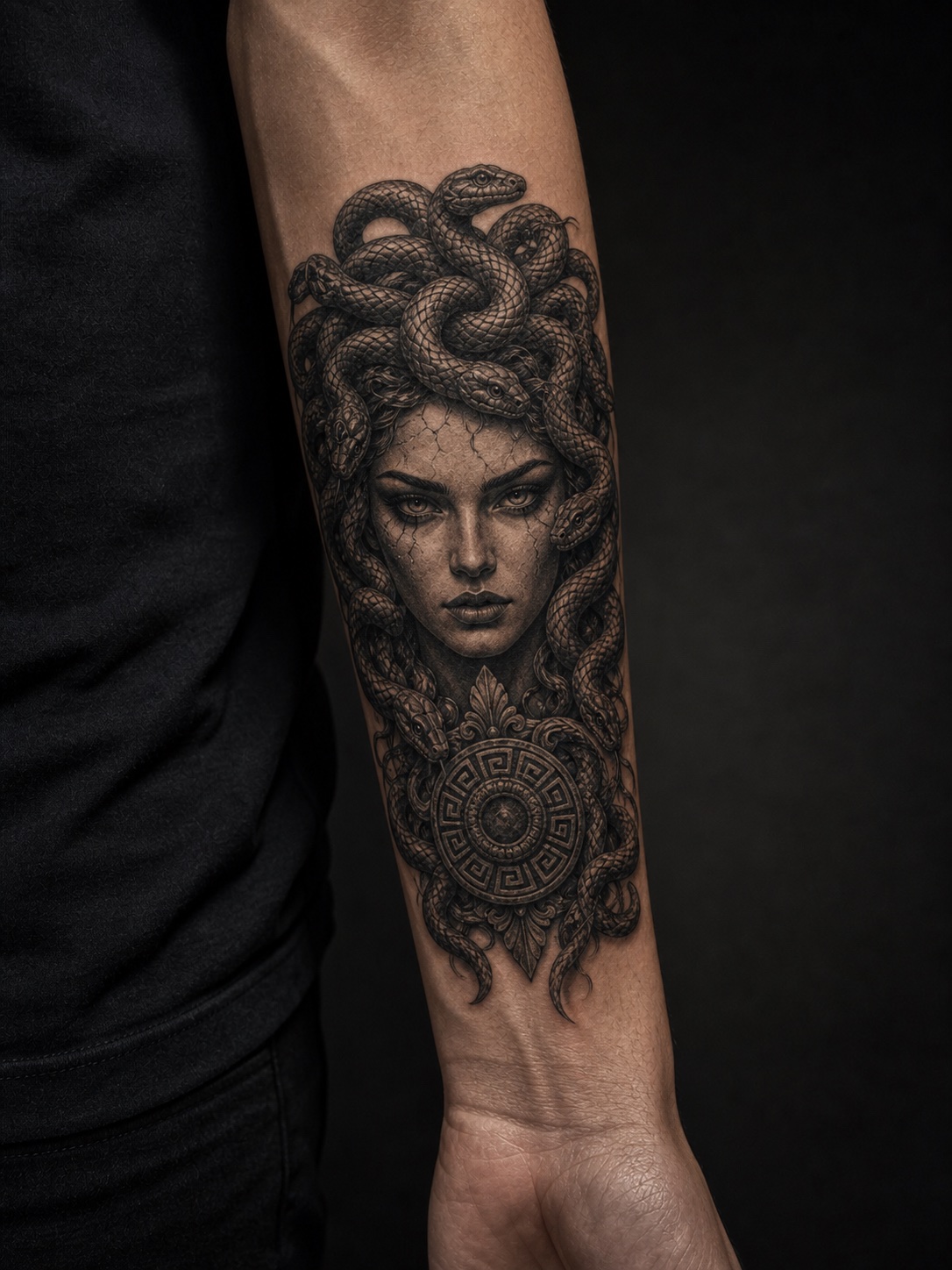
The most common meanings: survivor strength (specifically of sexual assault), protection against harm, feminine rage and power, duality of beauty and danger, and personal transformation. The specific meaning depends on which version of the myth the wearer is working with and what they bring to it personally. All of these meanings can coexist in one tattoo.
Is a Medusa tattoo only for survivors?
No. The survivor meaning is significant and widespread, but it’s not the only reading. Many people get Medusa tattoos for protection, for general feminine empowerment, for the mythology, for the aesthetic challenge of the image, or for the duality symbolism. The meaning belongs to the person wearing it.
What does a crying Medusa tattoo mean?
Grief held alongside power. The tear acknowledges the wound; the gaze says it didn’t destroy her. This specific design is most closely associated with processing trauma of any kind, not exclusively sexual assault. It’s one of the most emotionally specific Medusa designs and one of the most requested in contemporary studios.
What does a Medusa tattoo mean for men?
The core meanings don’t change by gender. Strength, protection, rebellion, respect for feminine power. Some men get it specifically as a symbol of solidarity with women in their lives. Others connect with the mythology directly or with the visual power of the image. There’s no meaningful gender boundary on who can carry this symbol or what it means.
Is it disrespectful to get a Medusa tattoo without being a survivor?
No. The tattoo draws on two thousand years of mythology and multiple layers of meaning. The survivor symbolism is real and significant, but it doesn’t own the image. Understanding the full context before getting the tattoo is worth doing, which is what this guide is for.
What style works best for a Medusa tattoo?
Black and grey realism for emotional depth and portrait-level detail, particularly on the thigh, chest, or back. Neo-traditional for a more iconic, stylized look with bold color. Fine line for smaller placements where subtlety is the point. Watercolor for the transformation or grief readings. The style should match the emotional register you’re going for, not just what looks good in a reference photo.
How much does a Medusa tattoo cost?
Small minimalist Medusa at wrist or ankle: $100 to $250. Medium forearm piece with moderate detail: $350 to $800. Large thigh or upper arm portrait: $600 to $1,500. Full back Medusa with maximum detail: $2,000 to $6,000 across multiple sessions. As with all tattooing, the artist’s experience in portrait work matters more than hourly rate. Check portfolios specifically for face and hair detail in realistic styles before booking.
What does the direction of Medusa’s gaze mean?
Facing forward, eyes direct: confrontational, protective, a warning. Looking upward: often reads as defiant or reaching. Looking to the side: more contemplative, less aggressive. Eyes closed: grief or internality rather than outward power. The gaze is the most emotionally loaded element in any Medusa tattoo. Bring a specific reference photo showing the expression you want rather than leaving it to the artist to interpret.
Choose Your Medusa
The image has held for two thousand years because it carries contradictions that don’t resolve. Beautiful and lethal. Wronged and powerful. Victim and monster in the same face. That’s why it keeps working as a tattoo, not because it means one thing but because it can hold several things that most symbols can’t.
Figure out which version is yours. The ancient protective amulet. The survivor who refuses to carry shame. The woman whose anger is her right. The person who changed completely and isn’t going back. Once you know which Medusa you’re getting, the design decisions follow from there: gaze direction, expression, style, what you put alongside her.
Then find an artist with a real portfolio in whatever style you’re choosing. A Medusa done wrong is not just an underwhelming tattoo. It’s a face that carries a story, and the face needs to work.
- 546shares
- Facebook0
- Pinterest546
- Twitter0
- Reddit0