Early in my practice I worked on a bathroom renovation where the previous owner had done beautiful tile work. Rectified large-format stone, consistent grout joints, everything flush. The problem emerged when a leak developed behind the shower wall. Three full days of demolition, not because the leak was complicated, but because there was no access panel. Every tile on that wall had to come off to reach a single corroded compression joint sitting four centimeters behind the finished surface.
Concealing plumbing is a legitimate design goal. Exposed pipes read as unfinished, and in a bathroom where the aesthetic work is careful, that contrast is genuinely uncomfortable. But concealment without planned access is not a design decision. It’s deferred cost. The question is never whether to hide the pipes. It’s how to hide them so that the eventual service call costs $200 instead of $3,000.
- Why concealed plumbing still needs service access
- Where access is always needed: the six locations
- Best ways to hide access panels in finished bathrooms
- Tile-faced panels vs painted panels vs vanity access: which to use where
- Mistakes that make hidden plumbing expensive to repair
- Designer checklist before closing the wall
- The right approach to hidden bathroom plumbing
- Frequently Asked Questions
- How do you hide bathroom plumbing without blocking access?
- What is a tile access panel for bathroom plumbing?
- Where should bathroom plumbing access panels be placed?
- Can you tile over an access panel?
- What pipes can be permanently concealed in a bathroom?
- What mistakes make hidden bathroom plumbing expensive to repair?
- How do you hide pipes under a bathroom sink?
This guide is an implementation reference, not a survey of options. It covers where access is always needed, which concealment methods maintain it, which don’t, and the checklist you or your contractor should complete before the wall closes permanently.
Why concealed plumbing still needs service access
Every plumbing system requires periodic attention. Fixtures wear, seals degrade, joints that held for twenty years develop slow weeps, and shutoff valves that are never operated can seize open. None of this is evidence of poor installation. It’s the expected maintenance profile of a system with moving parts and pressurized water running through it daily.
The cost difference between accessible and inaccessible plumbing is not in the repair itself. A plumber replacing a shower cartridge takes forty-five minutes. A plumber reaching a shower cartridge through twelve square feet of tiled wall takes two days with additional tile work, waterproofing, and grout matching. The concealment is what creates the cost.
What building codes typically require
Most plumbing codes require that all valves, cleanouts, and unions remain accessible after installation. This doesn’t necessarily mean they must be visible from the finished room, but it does mean they must be reachable without destroying permanent construction. An access panel behind a removable panel satisfies this requirement. A shut-off valve buried inside a tiled wall does not.
Code requirements vary by jurisdiction, and not every inspector will catch violations during a rough-in inspection. But the standard is a reasonable design principle regardless of local enforcement: never permanently close over any component that might need service. If you’re not sure whether your local code requires access for a specific element, your plumber can confirm. The best ones will tell you before you ask.
The plumber vs designer tension
In most bathroom renovation projects, the plumber’s priorities and the designer’s priorities pull in opposite directions on this specific point. The designer wants invisible pipes. The plumber wants everything accessible. Both positions are professionally correct within their own scope.
The resolution is straightforward: plan the access strategy before the tile plan is finalized. Access panels need to be specified at the same time as the tile layout, because their placement affects grout line positions, tile cut patterns, and in some cases the furniture layout. A tile-faced access panel is a design element, not an afterthought. Treating it as one of the first decisions rather than the last produces better results on both dimensions.
If the pipes need to disappear, they still need to be reachable. This deeper guide to behind-the-wall bathroom plumbing explains why luxury bathroom planning should leave room for inspection, service access, and future repairs.
Where access is always needed: the six locations
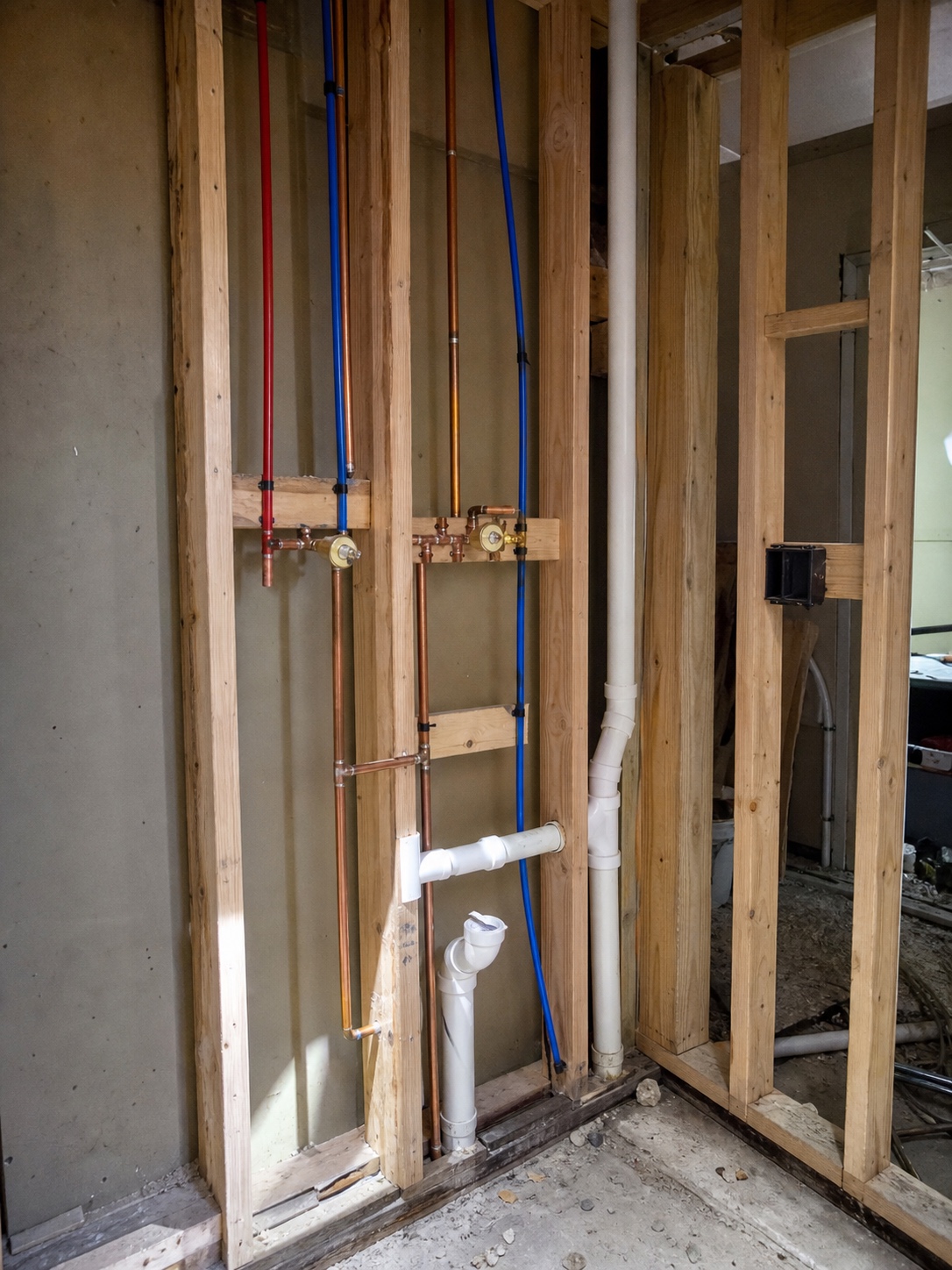
Not every pipe in a bathroom needs a dedicated access point. Supply lines running through the wall between the manifold and the rough-in stub-outs can be permanently concealed provided they have no in-wall joints. Drain waste vent pipes, correctly installed, should not need access under normal conditions. But six specific locations in most bathrooms require an access plan.
Shower and bath valve body
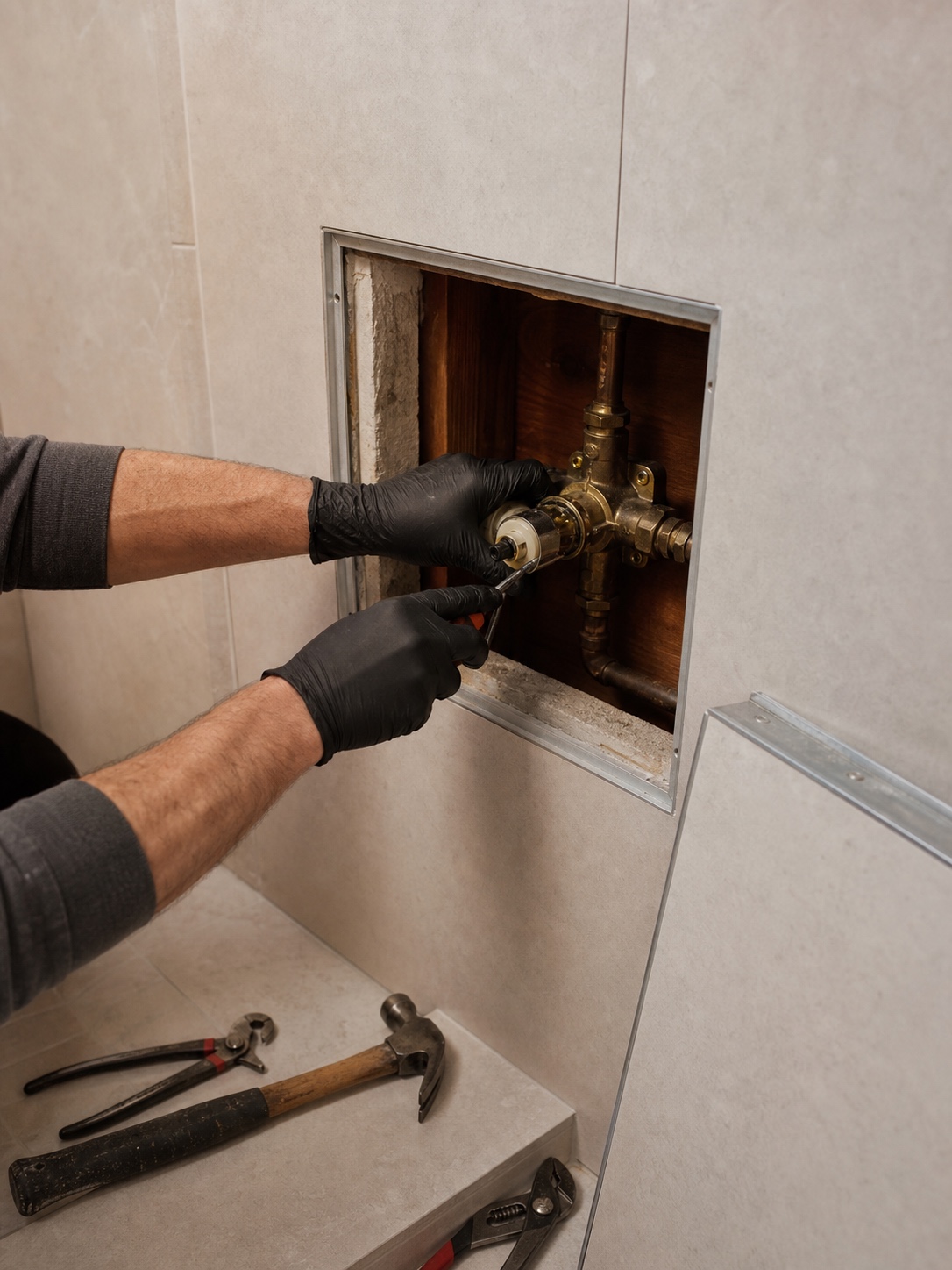
The valve body (not the decorative trim, but the internal cartridge and body unit) is the most commonly serviced component in a bathroom. Cartridges wear, thermostatic mechanisms need calibration, and pressure-balancing valves occasionally need replacement. All of this requires access to the valve body itself.
The trim plate and handle are removed from the finished face of the shower wall. The valve body sits behind the tile, usually 3 to 6cm back from the tile face. If the valve body seizes or corrodes at the connection points, access from behind the wall is necessary. Plan a minimum 300mm x 300mm access panel centered on the valve body on the opposite side of the wall, which is typically inside a closet, adjacent room, or purpose-built panel chase.
Cistern: inlet valve and flush mechanism
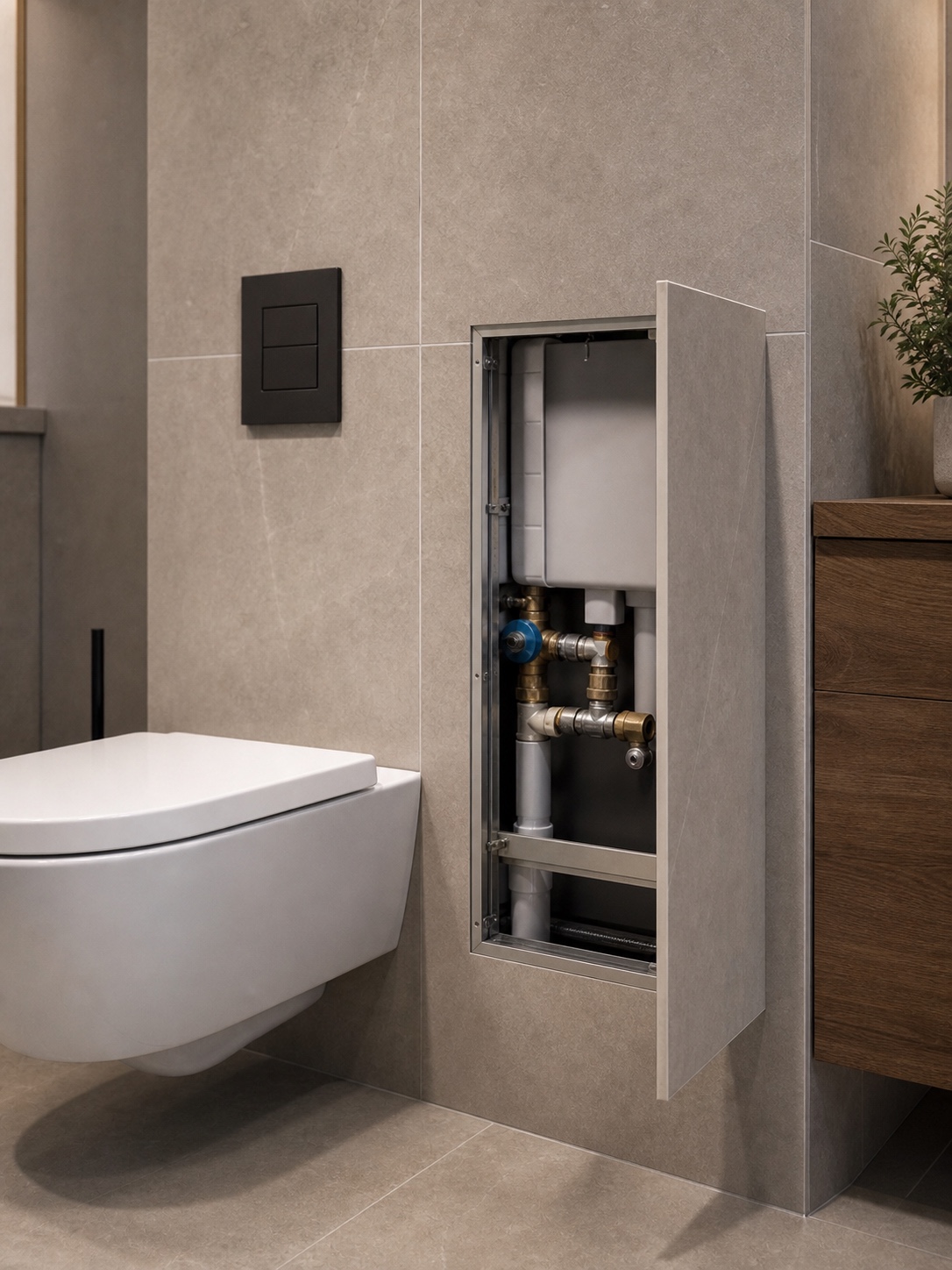
Wall-hung cisterns (concealed cisterns behind drywall or tile) require access to two points: the inlet valve that controls water entry, and the flush mechanism. Both require adjustment and eventual replacement. Concealed cistern units are supplied with a pre-framed access point, but the tile work over that access point needs to be a functional panel, not fixed tile.
For floor-standing toilets with concealed cisterns, the flush plate in the wall provides access to the flush mechanism but typically not to the inlet valve. Confirm with your plumber where the inlet valve sits and whether a separate access panel is needed. In many installations, the inlet valve is reachable through the flush plate opening. In others, it’s 30cm off to one side.
P-trap and waste connection
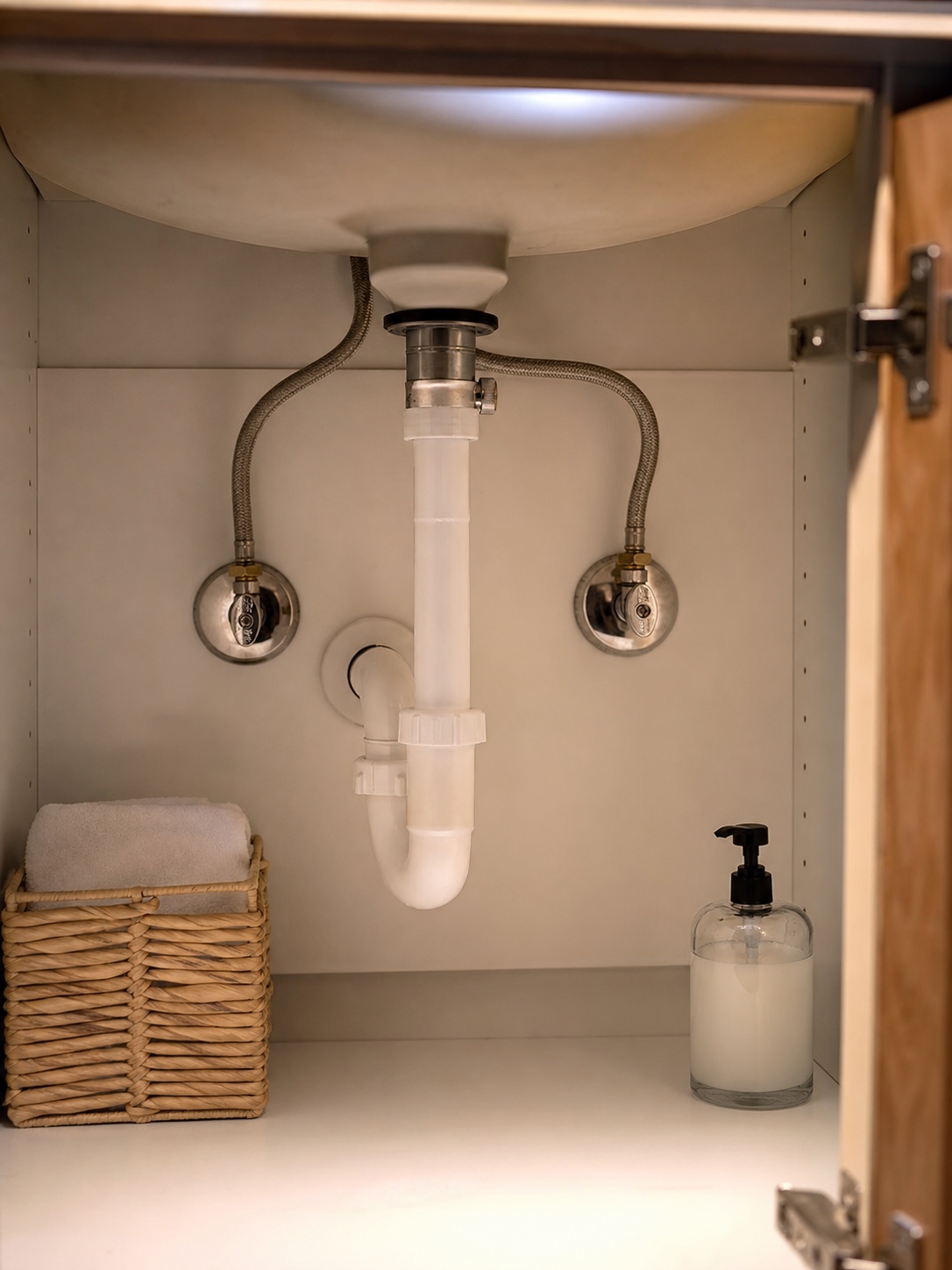
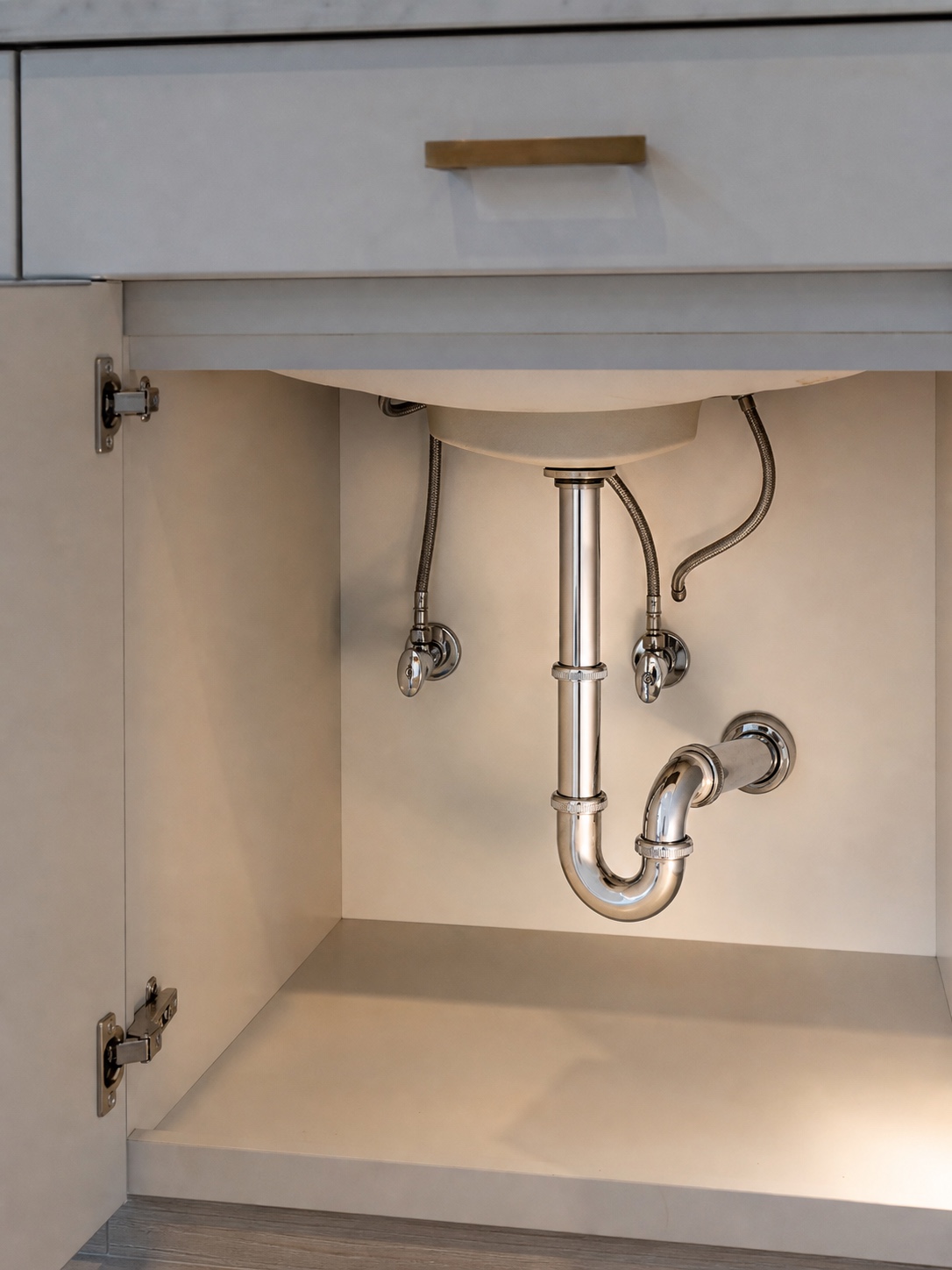
The p-trap beneath a sink or bath is the curved section of drain pipe that holds a water seal preventing sewer gas entry. P-traps don’t fail often, but they do clog with hair and soap scum, and the trap itself occasionally develops a slow weep at the slip joints. All p-traps should be accessible without removing a fixed tile or panel.
Under vanity sinks, the p-trap lives inside the cabinet. Access is automatic. For wall-hung sinks, the p-trap is behind a pipe boxing or recessed into the wall. An access panel at the back of the boxing, or a removable boxing panel, is the standard approach. For built-in bathtubs, the p-trap and waste connection are typically accessed through the bath panel (the removable side apron), which should be planned as a removable element even if it’s designed to match the surrounding tile.
Manifold and zone shut-offs
If the bathroom is served by a PEX manifold system (individual runs from a central distribution point), the manifold itself should be in an accessible location, typically a utility cupboard or service void. But even in conventional copper systems, each fixture should have its own isolation valve (shut-off) within reach without a water meter key or whole-system shutoff.
These shut-offs are often located under the sink (integrated into the angle stop valves) or in a small service panel behind the toilet. They should never be hidden inside a tiled wall without an access panel. The ability to isolate a single fixture for repair without shutting off water to the entire bathroom is the single most useful access feature a bathroom can have.
Joints and soldered connections
Any joint in a plumbing system is a potential leak point. Compression fittings, push-fit connections, and soldered copper joints that are hidden behind a finished surface need an access plan if they’re anywhere other than a supply run between stub-outs. The rule used by most experienced plumbers is simple: no hidden joints except on straight continuous supply runs. Elbows, tees, and any fitting with more than two connection points should be accessible.
In-line strainers and mixing valve cartridges
Thermostatic mixing valves for whole-bathroom temperature control, and in-line strainers on supply lines, require periodic servicing and cartridge replacement. If these are installed in the wall (common in high-specification bathrooms), they need the same access treatment as shower valves: a panel behind them, or placement in a location where the front-access trim plate allows full servicing.
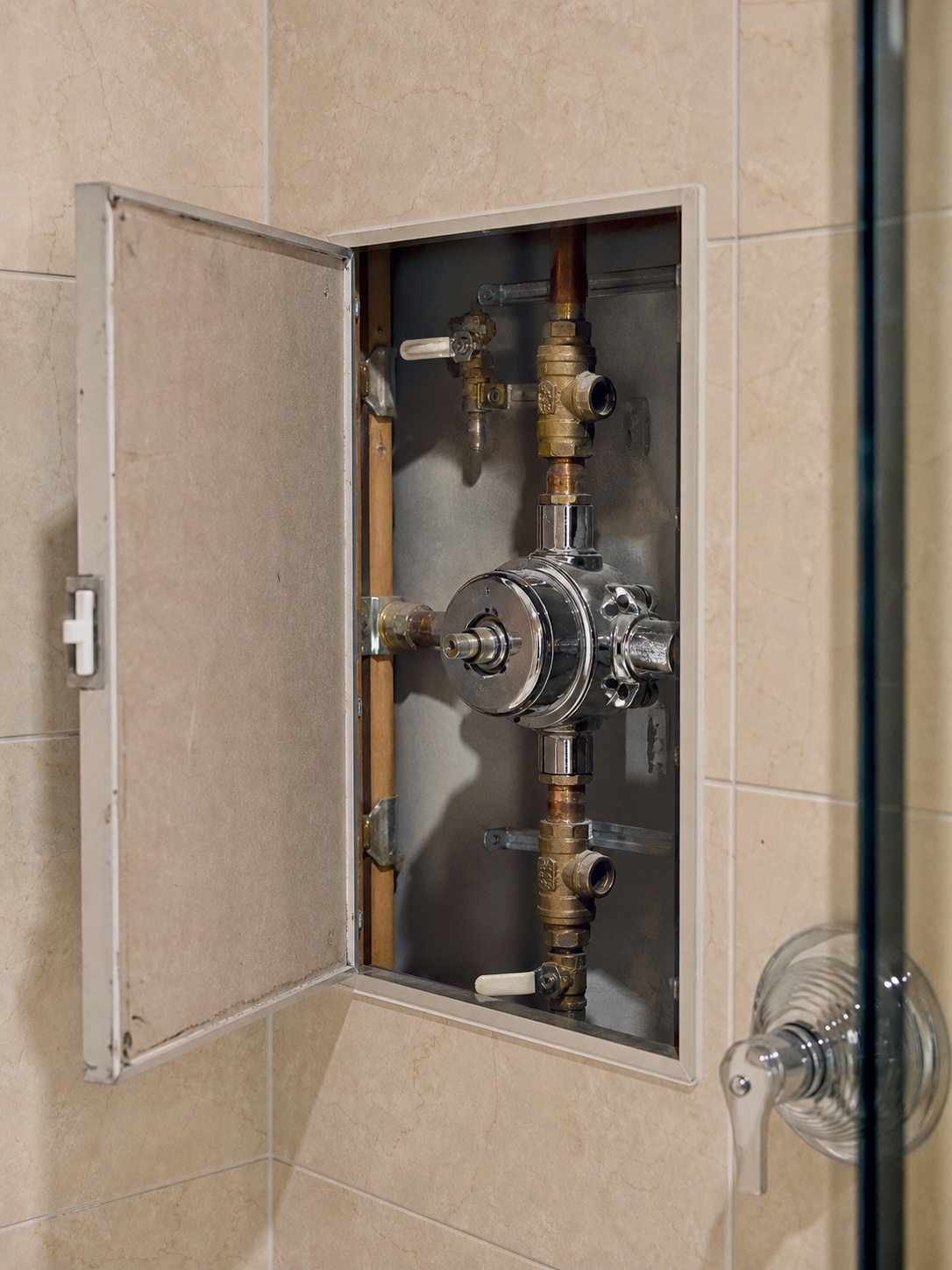
Best ways to hide access panels in finished bathrooms
The access panel is the design problem in concealed bathroom plumbing. The structural and mechanical requirements are clear. The challenge is making the panel read as part of the finished room rather than an interruption of it. Three main approaches exist, each with a specific application range.
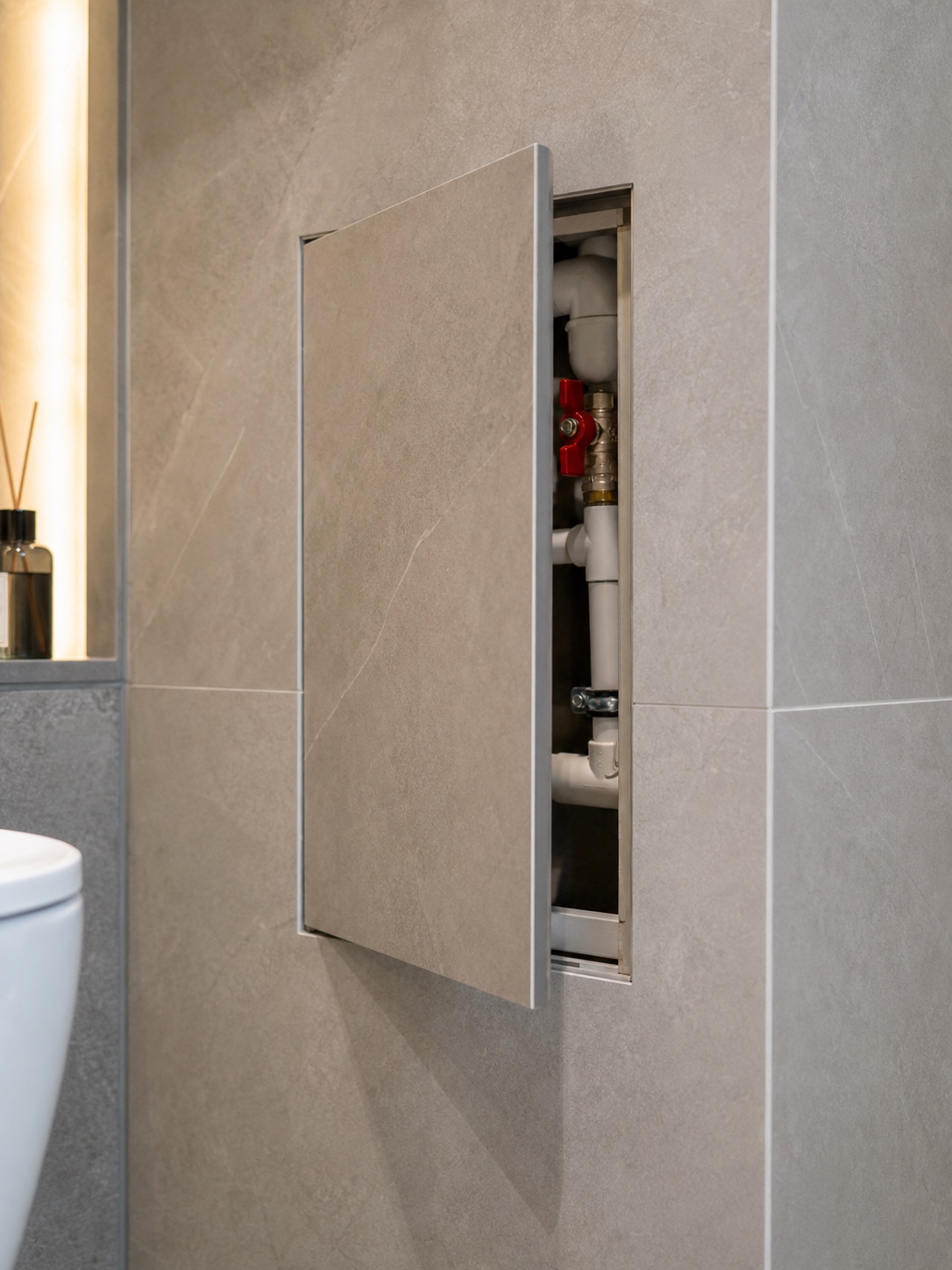
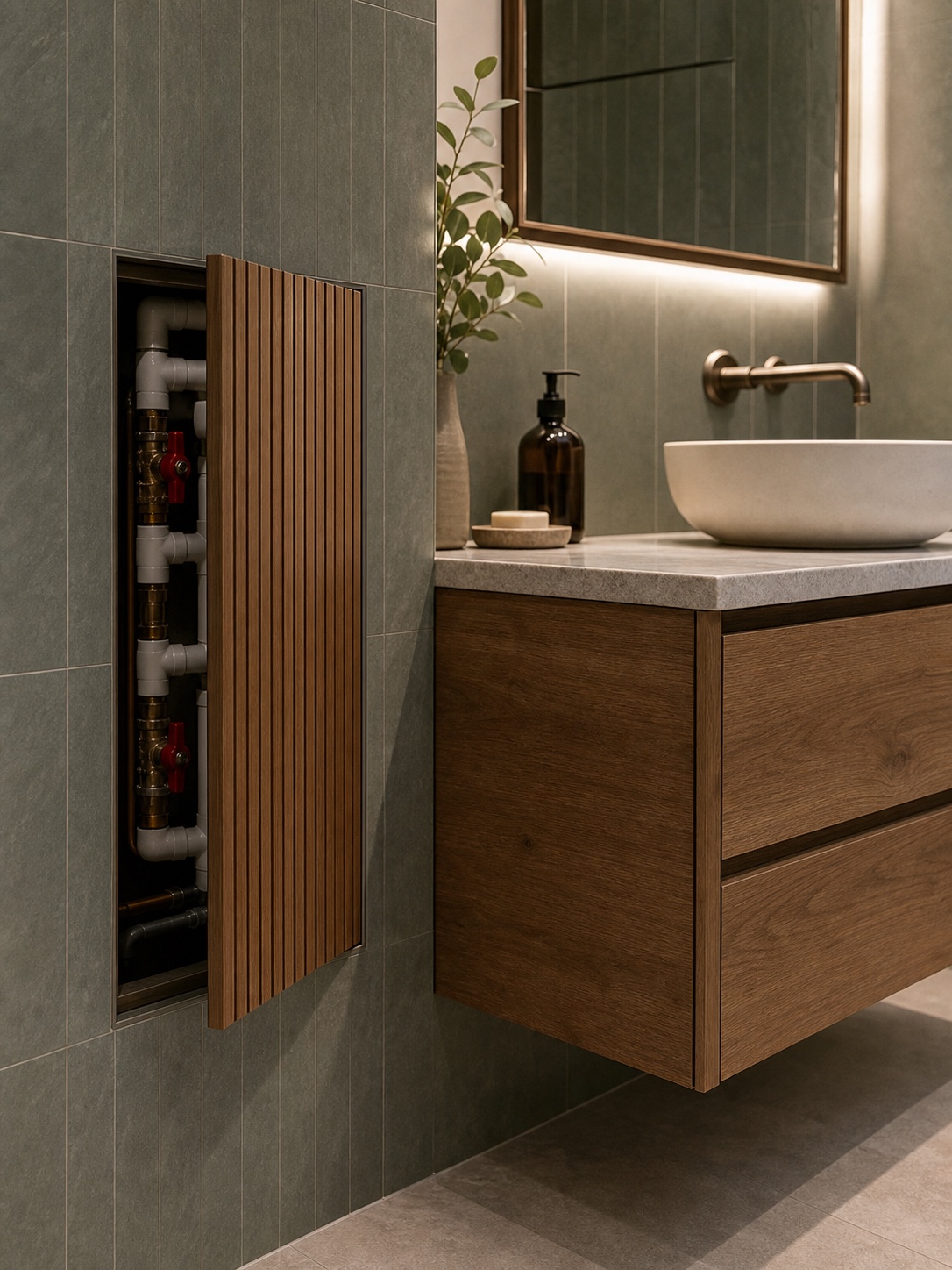
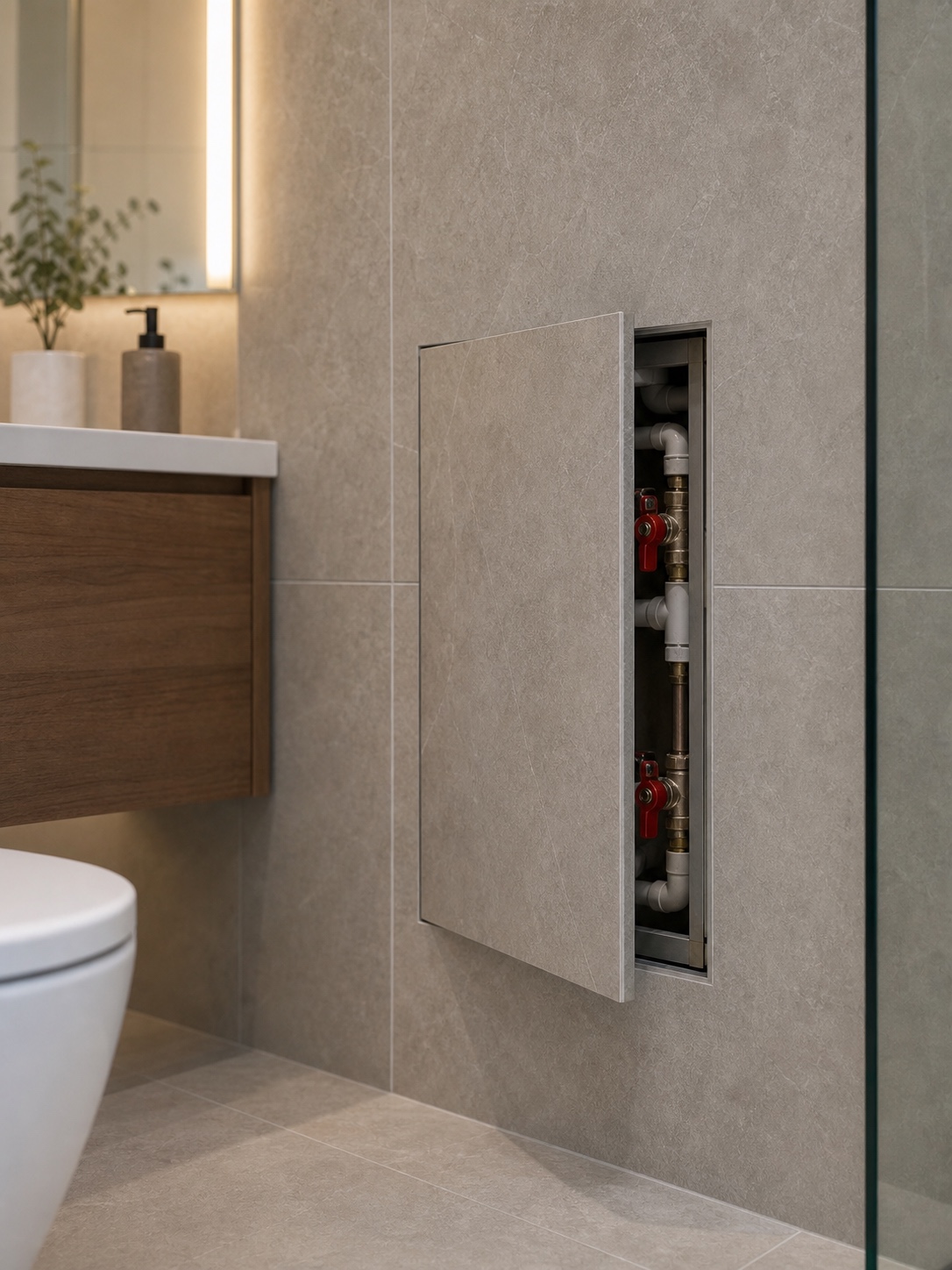
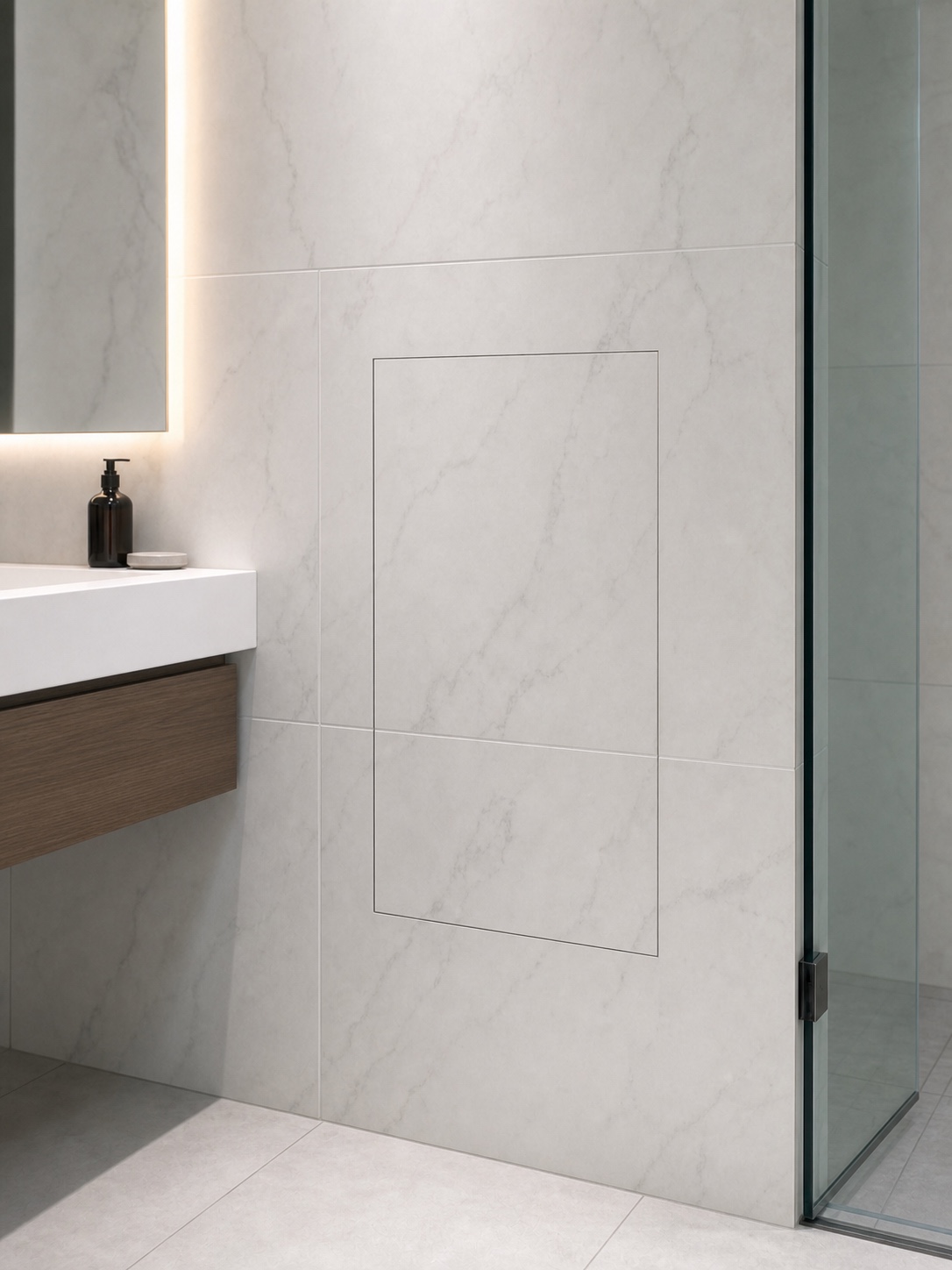
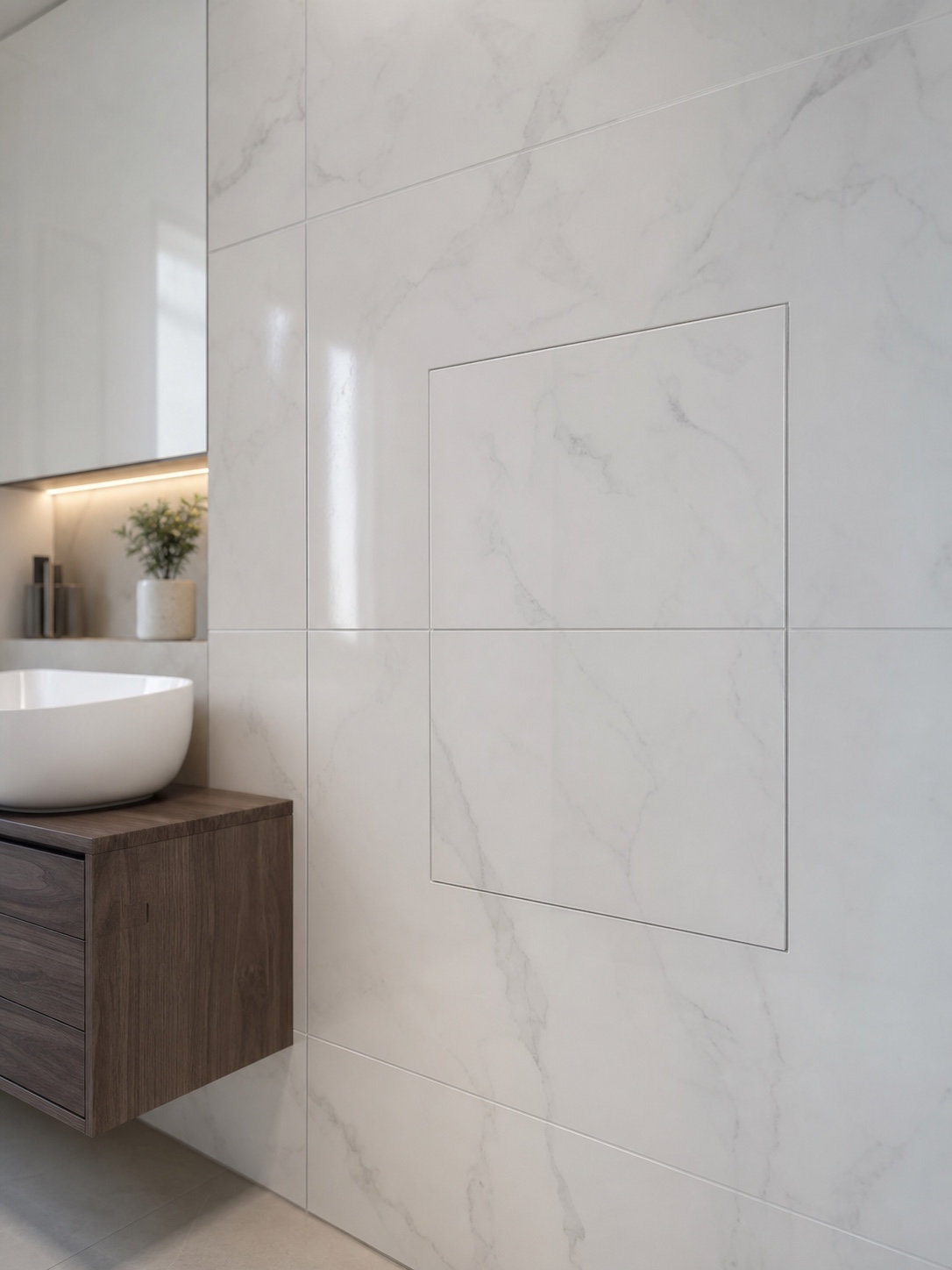
Modern bathroom examples of hidden repair hatches
In a modern bathroom, the best access hatch usually disappears into the tile grid, vanity surround, or cistern wall until a repair is needed. These examples show the same practical idea in different finishes: closed, slightly open, and fully serviceable.
Tile-faced magnetic access panels
A tile-faced access panel consists of an aluminum frame set into the wall at the correct depth for the tile installation, and a door panel that accepts tile adhesive and holds its tile facing rigidly. When closed, the panel is visible only as a thin grout joint running around its perimeter, which is indistinguishable from the field tile grout joints if the colors and widths are matched.
These panels open via a magnetic catch (push to open), a recessed finger pull, or a key-operated lock. Quality units from manufacturers including Schluter (KERDI-BOARD access panels), Redi-Access, and specialist European suppliers are specifically engineered for the deflection requirements of tile installations. The door must flex slightly as the tile substrate moves seasonally without transmitting that movement to the field grout joints, which would cause cracking.
Tile-faced panels are the correct choice for any wall that is fully tiled to a consistent pattern and where the access point cannot be placed behind a non-tiled element. They cost more than standard access panels, typically $80 to $250 depending on size, and require care in installation to align correctly with the tile grid.
Painted drywall panels in non-wet zones
In areas of the bathroom that are not directly wetted (the wall opposite the shower, above the dado rail in a half-tiled bathroom, or in a toilet-only room), a standard painted drywall access panel is appropriate and significantly cheaper. These panels use a simple frame-and-door system with a spring or magnetic catch and can be painted to match the wall finish.
The critical requirement is correct placement. A painted panel that sits behind a piece of furniture that can be moved is usable. A painted panel behind a fixed vanity or built-in shelf is not. Plan the panel location before finalizing the furniture layout and draw it on the construction drawings so every contractor on the project knows it’s there.
Vanity-based and furniture-based access
A correctly designed vanity can provide access to the plumbing behind it without any panel at all. If the vanity base unit is freestanding, or mounted with removable side panels, the back of the cabinet becomes the access surface. The plumbing runs inside the cabinet, where it’s visible and reachable, and the pipe boxing inside the cabinet is ventilated and inspectable.
This approach works for sink plumbing and for any supply or waste lines that run through the floor rather than the wall. It doesn’t work for shower valve bodies or cisterns that sit in the wall rather than behind furniture.
Tile-faced panels vs painted panels vs vanity access: which to use where
The right choice depends on the wall finish and the location of the access point. Here is the decision logic applied to the most common bathroom configurations.
Fully tiled shower walls
Tile-faced magnetic access panel, always. No other option is compatible with maintaining both the visual finish and genuine access. The panel goes on the wall opposite the plumbing side, framed into the stud cavity with the door face flush with the tile plane. Size: minimum 300mm x 300mm for a single valve body, 400mm x 500mm or larger for a manifold or multiple valves.
Half-tiled walls with painted upper section
If the access point falls in the tile zone, use a tile-faced panel. If it falls above the tile in the painted zone, use a standard painted drywall panel. Where possible, position access points in the painted zone during the rough-in phase. This reduces cost and simplifies the tile layout.
Toilet and cistern walls
Concealed cistern units come with a specified access zone for the flush and fill mechanisms. If the cistern is completely built in (not exposed at all), a tile-faced panel over the access zone is needed. If the cistern unit has a front-access flush plate, that plate typically provides sufficient access to the flush mechanism but not always to the fill valve, which may require a separate access point on the side wall.
Under-bath access
The bath side panel is the access route for the p-trap, waste connection, and overflow. This panel should be designed as removable from day one. For built-in baths, a tiled side panel with a hidden magnetic catch or a removable panel held by concealed fasteners is the standard approach. A fully tiled fixed side panel with no provision for removal is a mistake that will cost the tile cost again the first time the bath waste needs attention.
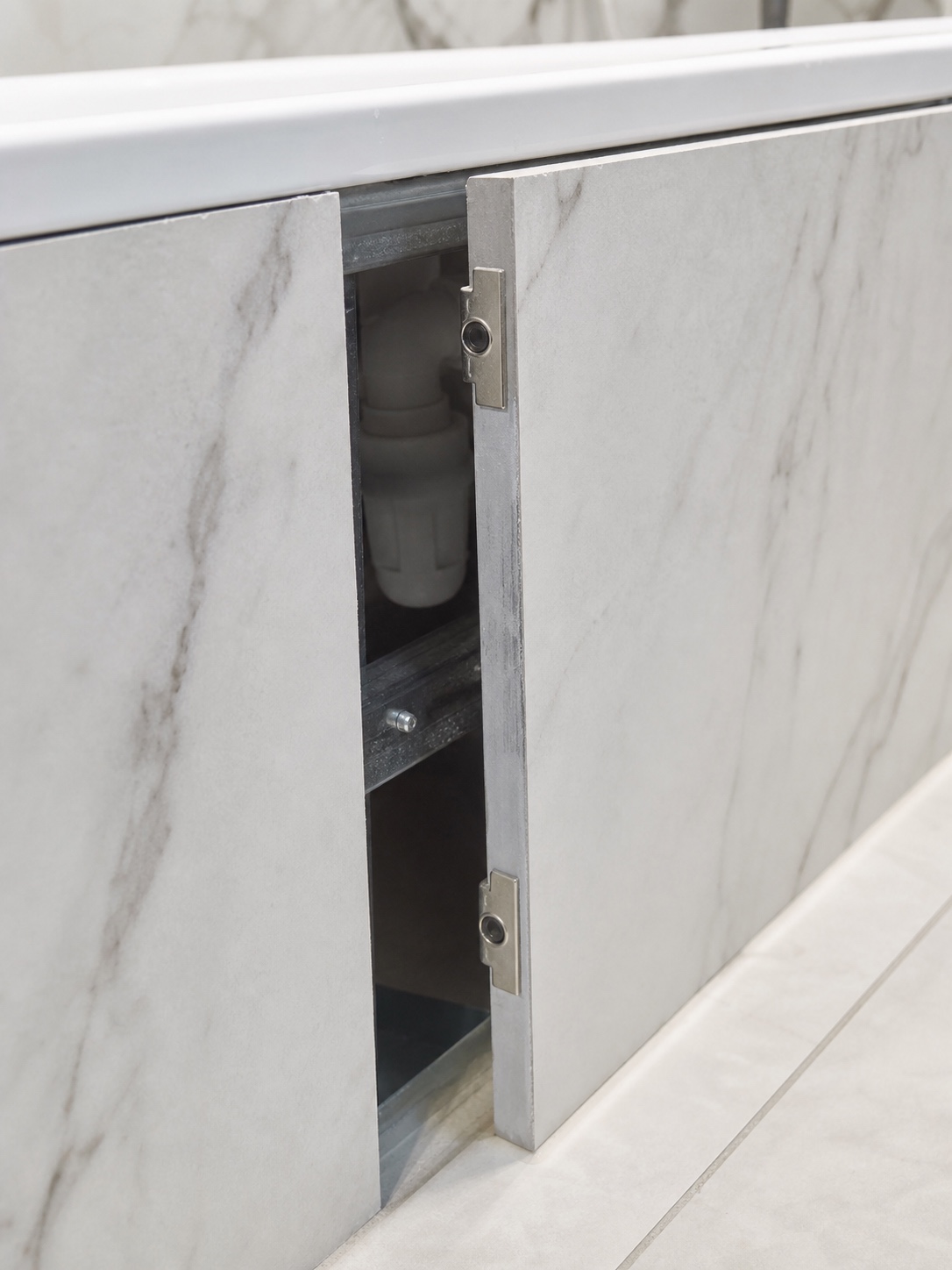
Grout joint rule for tile-faced panels: the panel door grout joint should be 0.5 to 1mm wider than the field tile grout joints. This small difference allows the door to flex and open without the grout cracking, while still being indistinguishable from the field tile pattern at normal viewing distance. Do not use the same joint width as the field tile: the panel will be difficult to open and may crack the grout on the door edge.
Mistakes that make hidden plumbing expensive to repair
The majority of the expensive calls on concealed bathroom plumbing trace back to one of five decisions made during the original installation. Knowing them before the work starts is considerably cheaper than discovering them afterward.
Hiding pipe joints inside a tiled wall
Any connection inside a tiled wall, a push-fit coupling, an elbow, a compression tee, is a potential leak point that will require demolition to reach. The correct practice is to run continuous lengths of pipe between accessible end points, with all joints at either end in accessible locations. If a length change or direction change is genuinely unavoidable inside the wall, use a soldered (sweated) copper joint rather than a mechanical fitting, and place a larger access panel over it.
Placing an access panel that cannot fully open
An access panel that opens 45 degrees due to an adjacent door, a towel rail, or a built-in shelf is not functionally different from no access panel. The panel must open at least 90 degrees and provide enough space to insert hands and tools. Check the open clearance at the design stage, not after the furniture is installed.
Omitting individual fixture shut-offs
A bathroom with no individual fixture shut-offs requires a whole-system water shutoff for any single fixture repair. In a family home, that means taking the whole household water supply offline every time a tap washer or toilet seal needs replacing. Individual angle stop valves at each fixture, hidden inside the vanity or behind a small panel, are a $15 to $30 addition at installation that avoid enormous inconvenience for the life of the building.
The San Antonio affordable plumbers at Beyer Plumbing point out something worth internalizing: the majority of their repair calls on concealed bathroom plumbing involve a feature that was accessible during the original build and was closed over anyway, either by accident or by a decision to save time on the day. The cost of the call is the cost of that decision.
Using tile panels without the correct frame system
Tiling over a standard hollow-core access panel door, or using a frame not designed for tile loads, produces cracking at the grout joint within a year or two. The tile-facing adds weight and rigidity that the standard panel system is not rated for. Use frames and door panels from manufacturers who specify tile-rated load capacities and deflection limits.
No as-built drawing of the plumbing layout
A finished bathroom with no record of where the pipes run is an information problem as much as an access problem. An as-built drawing (a simple sketch showing pipe routes, valve locations, and access panel positions) costs a few minutes at the end of the installation and can save hours of exploratory demolition years later when the house changes hands or the original plumber is no longer available.
Designer checklist before closing the wall
This checklist is designed to be completed with the plumber present, before the tile work begins. Every item on it costs almost nothing to address at this stage and potentially thousands to address afterward.
| Item | Done? |
|---|---|
| All shut-off valves mapped and labeled | □ |
| Access panel location marked on as-built drawing | □ |
| Panel opens fully without obstruction from fixtures | □ |
| Tile-faced panel grout matches field tile grout color | □ |
| Panel frame is waterproof (aluminum or PVC) | □ |
| Flexible connections used at all concealed joints | □ |
| Valve handles operable through panel opening | □ |
| No solvent-welded joins hidden without access | □ |
| Cistern inlet and flush valve both reachable | □ |
| Trap and waste connection inspectable via vanity or panel | □ |
| Plumber reviewed access plan before tiling started | □ |
| Emergency shut-off location communicated to household | □ |
Running through this list during a final plumbing inspection (what Preventive maintenance guides call the pre-close walkthrough) takes about fifteen minutes and identifies the majority of access problems before the tile work commits them permanently. Print it and walk the bathroom with the plumber before the waterproofing membrane goes on.
One practical addition to this checklist that many guides omit: photograph every wall cavity before closing. A phone photo of the pipe routes, valve positions, and access panel placement, taken before the drywall or cement board goes on, provides a permanent visual record of what is behind each wall. File it with the property documents. Future owners and future plumbers will thank you.
The right approach to hidden bathroom plumbing
Concealed plumbing in a finished bathroom is entirely achievable without compromising future serviceability. The design decisions that enable it happen at the rough-in stage: correct panel placement, the right panel specification for each wall type, individual fixture shut-offs, no hidden joints, and a documented layout. These decisions add modest cost and zero visual impact to the finished bathroom.
The decisions that create problems are also made early, usually under time pressure or in an attempt to simplify the tile layout. They typically manifest five to fifteen years later as a repair that costs significantly more than the original installation. The concealment is not the problem. The failure to plan for access is.
If you’re planning a bathroom renovation and want to get the access strategy right from the start, an experienced plumber who has worked on concealed installations is the right person to consult at the design stage, not after the tile work has begun.
Frequently Asked Questions
How do you hide bathroom plumbing without blocking access?
Install an access panel in the wall or floor cavity that covers the plumbing zone. Tile-faced access panels blend into the finished tile field while still opening for inspection or repair. For vanity plumbing, route pipes inside the cabinet using flexible braided connections that can be disconnected without cutting. Always confirm every shut-off valve and trap is reachable before closing the wall.
What is a tile access panel for bathroom plumbing?
A tile access panel is a frame-and-door unit designed to be tiled over, matching the surrounding tile field once finished. The frame is typically aluminum with a magnetic or push-to-open catch. The door holds its tile facing with adhesive. Quality units from brands like Schluter and Redi Access are designed to move with the tile without cracking the grout joint.
Where should bathroom plumbing access panels be placed?
Access panels should be placed in front of every element that requires periodic inspection or repair: shower valve body, cistern inlet and flush mechanism, trap cleanout, manifold shut-offs, and any in-wall joints. In most bathrooms, this means at least one panel behind the shower wall and one adjacent to the toilet cistern.
Can you tile over an access panel?
Yes, with the correct panel type. Tile-faced access panels are designed for this purpose. They use a rigid aluminum frame bonded to the surrounding substrate and a door that accepts tile adhesive and grout. The grout joint between the door and field tile is left slightly wider (0.5 to 1mm more than field joints) to allow the door to flex without cracking. Do not tile over a standard drywall access panel.
What pipes can be permanently concealed in a bathroom?
Supply lines between the manifold and fixture rough-in points can be permanently concealed if they are solid copper or PEX with no joints hidden inside the wall. Drain waste vent pipes can also be fully concealed once correctly installed, as they should not require access under normal conditions. All shut-off valves, unions, trap cleanouts, and in-wall joints must remain accessible.
What mistakes make hidden bathroom plumbing expensive to repair?
While organizing your pipes, consider these budget bathroom remodel ideas to refresh your space on a budget.
The most expensive mistake is hiding a pipe joint without access, which turns any leak into a full tile demolition job. Second is placing an access panel that cannot fully open due to an adjacent fixture or furniture. Third is omitting individual fixture shut-off valves, which forces a whole-system water shutoff for any single fixture repair.
How do you hide pipes under a bathroom sink?
The simplest approach is a vanity cabinet with closed sides that houses the p-trap and supply connections inside the cabinet. For freestanding or wall-hung sinks, use a pipe shroud or box column that surrounds the pipes but opens at the back for access. Avoid tiling pipes directly into the wall below a sink without an accessible cleanout or union connection that allows disassembly without cutting.
When hiding exposed pipes, you can easily integrate your enclosures with other smart diy bathroom storage solutions to maximize functional space.
To see how plumbing fits into the wider design scheme, check out our guide to planning a functional modern bathroom plumbing layout.
- 293shares
- Facebook0
- Pinterest293
- Twitter0
- Reddit0